Humans + AI
201 episodes — Page 4 of 5
S1 Ep 51Bryan Jenks on beginner mindset, optimizing everything, why Obsidian, and lessons from neurodivergence (Ep51)
“Centralize and get everything out of your head. Those two things alone, make it incredibly easier to manage your life, especially if you have a lot of things going on.” – Bryan Jenks About Bryan Jenks Bryan is an information specialist and data analytics expert who has over 300 certifications in a wide variety of technologies and is always seeking more knowledge. He is also a popular YouTuber with millions of views for his detailed insights on productivity and personal knowledge management. Website: Bryan Jenks YouTube: Bryan Jenks Tech Twitter: @tallguyjenks Instagram: @tallguyjenks Github: @tallguyjenks Medium: @tallguyjenks Discord: @tallguyjenks LinkedIn: Bryan Jenks Patreon: Bryan Jenks What you will learn An introduction to Personal Knowledge Management (PKM) and its importance (02:56) How neurodivergence and system thinking influence problem-solving approaches (06:55) The benefits of approaching everything with a beginner’s mindset (09:56) Using neurodivergent tools and processes like time-blocking and centralization in daily life (15:04) Strategies for better memory retention, including multiple calendars and color coding (17:24) A specific system for organizing physical objects to minimize clutter and increase efficiency (20:15) The negative impact of context-switching on productivity and how to minimize it (22:04) The advantages of using Obsidian for organizing notes and information (26:48) Effectively leveraging tags and links for easier note searching and retrieval (33:38) Resources Personal Knowledge Management (PKM) Notion Obsidian Evernote vimwiki Joplin Connected Papers Research Rabbit Morgen GUI Roam Research Transcript Ross Dawson: Bryan, it’s wonderful to have you on the show. Bryan Jenks: Wonderful to be here. Ross: Bryan, I’d love to just hear the story. You’re now sharing all your insights into the structure of how you think and how you take notes, and how you build your knowledge. I want to hear just a bit of the backstory of how you came to be on this path of sharing these resources with the world. Bryan: Yes, I was already on YouTube for about a year before I even started talking about or doing anything with Obsidian. It was mostly just playing around with Linux on an old laptop and talking about what I was learning there. But my channel and my interests really took off when I started diving into the whole sphere of Personal Knowledge Management (PKM), as it’s commonly called. Specifically using Obsidian, when I first was getting into Obsidian, it was primarily the big player for Roam Research, Notion to a degree, but for the connectivity, bi-directional linking, note, and applications, it was just Rome, and now Obsidian who was really capitalizing on that, and then people who were just also doing stuff in Notion or Evernote, but I was already using some tools like this. When I was on my Linux computer, it was always plain text in the terminal, super, like bare-bones, I was using vimwiki because I still love vim or the VI-improved command line text editor. I went from using vimwiki to trying out Joplin. That had a command line option, had a GUI, and pretty application options so it was the best of both worlds. Then I saw this Obsidian thing, and it looked nice. I could customize it because I do have coding experience. So I really started getting interested in that and diving into it. It’s just been, oh, it’s been more than two years now. Here we are. Ross: Take a step back. Presumably, let’s say when you were a teenager, how you came to want the structured thinking, and find the value of the structure of taking notes or pulling your ideas together? What’s the origin story of you as a deep structure thinker? Bryan: That pretty much was the origin story, when I was a teenager, and even up through my two-year college degree, I didn’t take notes or study for anything. I just listened to the lectures and took the tests and did very well, because the stuff didn’t go at my pace. I was just trying to move faster. I didn’t have any interest in any of that at the time, I didn’t even start touching computers with a more technological perspective until I was probably already 24 or 25, working for my local government. Ross: It was now when you are moving from just having to pass tests, to get to things that you’re interested in, that you’re to build these structures? Bryan: Yes. I started getting interested in reading real research papers on various things and looking at how academics were approaching different. How do you connect research papers into coherent information and knowledge and see the landscape of what these papers might cover? How they’re interrelated? Who’s citing who? That whole network diagram of scientific research and academia. This was also before I was ever even exposed to tools like Connected Papers or ResearchRabbit or anything, even vaguely network diagram of citation trees and sources, so I was just looking into how can I take consolidated notes on a topic, but also rel
S1 Ep 50Puruesh Chaudhary on research processes, information ecosystems, trusting societies, and contextual memes (Ep50)
“The more connected and participative you’re going to become in your foresight practices, the more useful the effort is, the more meaning it would give. How they recognize change, how you recognize change, and what gaps are there, to understand those, whether it’s an information gap or a knowledge gap, you need to be among those people to create that comprehension.” – Puruesh Chaudhary About Puruesh Chaudhary Puruesh is Founder and President of the NGO AGAHI, co-founder of Media Development Trust, and Senior Research Fellow at Institute of Strategic Studies Islamabad. The global recognition for her work as a futures researcher and strategic narrative professional includes being named as Global Shaper by World Economic Forum, acting as advisor to the World Futures Society, and being on the planning committee of the Millennium Project. Websites: AGAHI Karachi Futures Foresight Lab LinkedIn: Puruesh Chaudhary Twitter: Puruesh Chaudhary What you will learn How to focus your research effectively (04:55) How to use data from the past and present to form insights for the future ? (06:33) How can we be more discerning about the credibility of the media that they choose to consume? (12:38) What does a typical futurists information day look like (17:11) How do memes change us, shape our minds? (21:35) Aside from data, how can social engagement lead to foresight? (26:08) Why it is crucial to understand our and each other’s perspectives (28:04) Transcript Ross Dawson: Puruesh, it is a delight to have you on the show. Puruesh Chaudhary: Ross, thank you so much. Ross: You are amongst other things extremely well-regarded futurist globally, you work on geopolitical and other very complex topics, and you have a very deep background in journalism and setting standards for journalism. I’d love to just hear your background, what is your relationship with information throughout your life? Puruesh: I feel the relationship started during the days when my father preferred that I read newspaper headlines. The one reason that he wanted me to do this, and my siblings also at the same time, was to ensure that we don’t lose out on Urdu as a language. In most cases, while reading those headlines, even though to just do it for my father’s sake, I realized that I understood very little from reading those headlines. That’s what my starting point was. But also at the same time, my mother is an ardent reader of all the novels that she must have, so we used to go to the libraries. My connection with reading books, and reading literature was quite ingrained right from the beginning. How I transformed during my time working as a communications person in different corporate entities was that that translated into reading a lot of research work. From that point, it is then that I actually moved into media, working as a reporter, working in the editorial side, it helped me understand how critical information is, and how important it is to convey the message that people would want to be informed by. That gave me the sense of understanding the work that is important in terms of forming public opinion. But also the energy and the valor required to ensure what you’re taking to the public is something which is of the highest quality in terms of its credibility, in terms of its trustworthiness, and in the process, we in the editorial space are held accountable for what we actually put out there. In a nutshell, that’s what the relationship has been like. Ross: Another perfect description, as well as a futurist media leader, is, a researcher. Puruesh: Yes. Ross: You have this intention for research. That’s worth digging into in terms of what is it that informs how you go about your research. Puruesh: I recently found out that I’m an entrepreneur because I’ve been working for myself for the last 12 years, and you realize, okay, you’ve never labeled yourself as such, but to make sense to the world, you need a certain vocabulary to put out there. There is this driving curiosity, which becomes your motivation to figure out things, things that do not make sense to you. That’s where the element of research comes in. When you cannot make sense of something, then what is the question? That question leads you to all sets of possibilities, whether be it consulting scholars, looking, reading out certain research journals, or whether bringing in your sense into how you put together your ideas. Curiosity leads to looking at what the question is, the question helps you figure out what the potential idea could look like. I feel that’s where the research dimension for me comes in. Ross: When I tried to describe what it is to be a futurist, people say, oh, where’s your data? I say, well, the data is all about the past. That’s one of the interesting things about the futurist role, is you can research and you can find out a lot about the present and the past, but then you have to cast that into some insights which are useful about the future. How do you research to be able t
S1 Ep 49Stephanie Barnes on radical knowledge management, the power of art, tapping intuition, and building curiosity (Ep49)
“I think a lot of times we want to shortcut and jump to the middle or jump to the end. But there’s so much to be learned by taking a breath and stepping back and going: What am I really trying to do here? Whether it’s going for a walk, or painting or cooking or gardening, give yourself the space.” – Stephanie Barnes About Stephanie Barnes Stephanie is founder and chief chaos organiser of Entelechy, a global network that works with organisations to solve problems in creative and innovative ways. She has a background in knowledge management IT and accounting, and is also a successful artist. She now uses art as a catalyst for helping people do things differently, and empowering individuals, teams and organisations to resolve complex business challenges. Website: Entelechy Portfolio: Stephanie Barnes Art LinkedIn: Stephanie Barnes Twitter: Stephanie Barnes What you will learn How is art and knowledge management connected? (02:16) How can we bring art into our organisation’s learning practices? (07:18) How do scribble drawings open your mind to form new connections? (10:37) Will these creative practices work even for those in non-artistic professions? (13:04) How can we improve our ability to pick what is worth casting our attention to? (15:59) What are individual knowledge management practices to enhance our knowledge creation? (20:02) How are mind maps superior for organising information (22:39) What are radical practices that you can start or experiment on? (28:32) Resources Knowledge Management Keith Johnstone John Hagel Albert Einstein Mind Maps Dragon Naturally Speaking Transcript Ross Dawson: Stephanie it’s wonderful to be talking to you today. Stephanie Barnes: Thank you, Ross, I’m so looking forward to catching up with you. Ross: So, we encountered each other a very long time ago and what I think were called knowledge management circles at the time, though, I always thought of you as a learning person more than knowledge management, but now you have turned your attention to art. And so I’d love to hear about that journey. Stephanie: Oh, yeah, arts is a long way from my undergrad in accounting and my MBA in IT that’s for sure. Painting or art came I’m gonna say relatively late in life because it came out of a workshop I was in in 2011, a leadership workshop. But we painted as one of the leadership activities to develop our leadership and I like: Oh, this is fun. How do I do more of this? And I was already self-employed by that point, and had been for, I don’t know, eight years or so. It’s hard to shift your focus when everybody knows you for one thing. And so it became, how do I bring this into the knowledge management consulting that I was doing? I started just doing little playful, creative interventions, 5 to 10 minutes scribble drawings, and this kind of thing in my workshops. I notice right away, the shift in the energy and the engagement of people from these say stupid little scribble drawings that people throw in the garbage on the way out. But they were so much more excited and engaged in the material. And I got much better responses and more thoughtful responses. And I just kind of went, there’s something here. And so I just kept pulling that thread and doing the research when I had time and talking to other people that are in that intersection. And that’s one of the great things about moving to Berlin in 2015 was I got connected to a whole bunch more people here in Europe that are in that space. And I painted. I went out the next day after this workshop and bought paint and have painted ever since. So it informs everything: it informs my life, my knowledge management consulting, yeah, it’s part of who I am. Ross: So this is still part of knowledge management for you. So describe how that is part of knowledge management, or how that evokes the frame of mind for people. How is that connected? Stephanie: Sure, I call it Radical Knowledge Management. First off, because it’s about going back to the roots of how we learn. In as much as I didn’t think of myself as a learning person when we originally met, I have definitely become a learning person through this process. And so Radical KM and bringing creativity and arts into knowledge management is about learning and reinvigorating how we learn, and going back to those roots. As children we were playful and creative, and we do all these crazy things, because we don’t know we’re not supposed to. All of that curiosity and iteration in that fearlessness around failure gets educated out of us, and we become very fearful and now it’s got to be the right answer. We got to have the right answer. I’ve worked with so many clients that they’re like, just tell us what the right answer is and we’ll do that. But you have to discover what the right answer is because the right answer just depends on the organisation and the situation and so many factors. So bringing art and painting, and I love to when I have longer workshops, we can do painting and it really brings
S1 Ep 48Bob Johansen on the officeverse, augmented intelligence, thinking future-back, and people as filters (Ep48)
“It’s more than the Great Resignation, it’s more than the Great Reset, it’s more than Quiet Quitting, this is all about reimagining. It’s an opportunity to create something better, to be better than we were before.” – Bob Johansen About Bob Johansen Bob is Distinguished Fellow and former CEO at the Institute for the Future. He has worked as a professional futurist for nearly 50 years, including in the 1970s exploring the social and organizational implications of ARPANET, which evolved to become what we call the Internet. He is a frequent keynote speaker and the author or co-author of 12 books, including his latest title Office Shock: Creating Better Futures for Working and Living. LinkedIn: Bob Johansen Book: Office Shock (get a 30% discount. Use the code “OFFSHOCK” at checkout) What you will learn What is the office verse? (02:56) Where might we prefer physical or remote collaboration in information value creation? (06:28) What are the factors that drive information productivity? (10:37) Are there design factors for organisations which drive the ways they create value? (13:23) How can we augment ourselves to create better organisations? (18:36) How can we design the work within organisations to be pleasant and avoid overload? (23:39) What are some practices to create insightful books and guidance for leaders (26:59) What are practices to engage with information throughout the day ?(31:52) Resources BorgWarner WalMart Joseph Press Future-back 37signals ChatGPT Institute for the Future DALL-E 2 Midjourney Google Glass ARPANET Blue Zones Project Transcript Ross Dawson: Bob, it’s wonderful to have you on the show. Bob Johansen: Great to be here. Ross: You have a book, just out, Office Shock, which looks at how offices are changing and what they will become. Perhaps you can just give us the thesis in a minute, we can dig into how they can help us to thrive on overload. Bob: Sure. Office Shock is an abrupt, unsettling change in how, when, where, and even why, even why we work. Office Shock has been invoked, it has been scattering us as a result of COVID. But it’s much deeper than that and it’s much more than just “when do we go back to the office?” We think this is a historic opportunity to rethink just how work happens and how work is integrated with our private lives. Ross: One of the ways in which offices are shifting which you describe in the book is the “office verse” which is beyond any particular place, I understand. Bob: Yes, definitely. The term metaverse has become quite a pop culture term. Those of us in Silicon Valley realize that one big corporation has tried to own the term metaverse. We’ve decided to coin our own word, the officeverse, and it’s actually a sequence. We think of the office as the place, the buildings, officing as the process, the verb, and officeverse as the way it all fits together, the anytime-anyplace mix of how we work, and indeed how we thrive. I love the title of your book in terms of Thriving on Overload. The notion of the officeverse is an attempt to create, and it’s not just an attempt, it’s now a requirement to create ways of working anytime, anyplace. We’re futurists, our hope is to create a work environment that’s better than we’ve ever seen. Ross: I always think that an organization is a set of individuals working together, as you point out in the book as well, with a common purpose and working to be able to achieve that. That’s the context. The officeverse is the space for an organization with an aligned purpose and to be able to create something. Is that the case? Is the officeverse where an organization resides? Bob: That’s right. Yes. It’s an interesting way to phrase it, where an organization resides, it’s where individuals reside as well, and it’s where we work and live. The opportunity that’s presented now is a historic opportunity to rethink all the basics, where going into COVID, for the past 50 years, there have been efforts at remote work and terms like telecommuting and telework, and all these different options, then, of course, the internet made the connection possible, and the technologies, including the one we’re using right now, they didn’t just happen with COVID, they were developed over a 50 year period and it took roughly 50 years to be an overnight success. The overnight success was forced by COVID. We were scattered from offices, it wasn’t an option, it was forced. Luckily, the technology was good enough to function in a surprisingly productive way. Even though there was very little preparation for this, it was pretty productive for most organizations. It was actually very productive for some individuals. It was also very unfair. For some individuals that didn’t have a good place to work at home or had little kids around or elders they were caring for, it wasn’t a good thing. But for many people, it was a good thing. It’s more than the Great Resignation, it’s more than the Great Reset, it’s more than Quiet Quitting, this is all about reimagining. It
S1 Ep 47Chuck Frey on visual mapping, creative thinking techniques, choosing tools, and sleight of head (Ep47)
“It’s kind of a “sleight-of-head” exercise if you will. Because again, we tend to get very narrowly focused in our way of thinking. I’m sure you’ve heard of confirmation bias and availability bias. We tend to think in very narrow paths, and you need to be able to literally kickstart your head in different directions and this is one creative way to do that.” – Chuck Frey About Chuck Frey Chuck is a PR and online marketing expert who focuses on innovation, creativity, business strategy and visual thinking. He is the founder and publisher of The Mind Mapping Software Blog, and the author of books including Up Your Impact and Creativity Hacks. Website: Chuck Frey Blog: Mind Mapping Software Medium: Chuck Frey LinkedIn: Chuck Frey Twitter: Chuck Frey Newsletter: Catalyst Newsletter Books: Power Tips and Strategies for Mind Mapping Software Up Your Impact Resources: Second Brain for Content Creators Course The Ultimate Guide to Visual Note-Taking Tools FAST Framework for Effective Mind Mapping Course What you will learn What are the origins of mind mapping software? (02:20) What are ways to make mind mapping as useful and valuable as possible? (05:11) Other than mind maps, what are good alternative visual tools? (07:21) What are the most interesting recent developments in thinking tools? (09:43) How do you build up a set of tools to use which works for you? (12:04) What is a note? Should it be a sentence? A link? A phrase or an idea? (13:52) What are ways to enhance serendipity thinking for the ideas that we find (17:04) What is the process to write compelling content on topics outside your area of expertise? (20:52) How can you connect ideas to create a narrative? (22:56) What are ways to keep focused attention for long periods of time (25:25) What are daily practices to improve your information gathering (27:44) Resources Success Magazine Miro Mural Evernote Notion Obsidian SparkNotes Napkin ContextMinds AYOA formerly iMindMap Roam Evernote Notion MindMeister Second Brain for Content Creators by Matt Giaro ThinkerToys by Michael Michalco Transcript Ross Dawson: Chuck, delighted to have you on the show. Chuck Frey: I’m delighted to be here. Thanks for the invite. Ross: We have a lot to learn from you. We’ll try to dig in and get as much from you as we can. We want to start with your backstories. How did you get to this? In 2007, you set up the mind mapping software blog, and that may not have been the beginning. Is this something from when you were a child that you were looking at and thinking of? How did you come to these thinking tools, visual concept mapping, and all of these ways of approaching this? Chuck: Probably in the late 90s, I came across a handheld brainstorming tool in Success Magazine of all places. I’ll try and make this as quick of a story as I can, because I know we have a lot of ground to cover. I didn’t even know that there was such a thing. I reached out to the developer of it, who was from Chicago, and started doing some publicity for him to help promote it. It opened up a whole world to me of tools and resources and methods to think differently, to think better. It seemed to me that even 20 years ago, the pace of change was accelerating and there was a need for people to know more about this. My background is in PR and marketing. I had the opportunity to join a trade association to help put them on the web. Eventually, I took what I learned and built my own website focused on creativity and innovation, and just happened to be in the right place at the right time, that grew like crazy, to the point where it was the world’s largest site focused on that. I spent a lot of time on tools, thinking tools. One part of that was mind mapping software, which seemed to be growing rapidly, but nobody was covering it full-time. That splintered off from the innovation tools site. Eventually, innovation tools went away. There’s a bad joint venture involved there. That’s a story for another day. As we were talking before we got on this call, these tools are very powerful, they’re really useful to knowledge workers who need to be able to gather, organize, distill and share information, and doing that in a visual way helps you connect the dots, helps you to see what you’re missing, helps you to get clarity quicker, make better decisions, and to think at a higher level. Since then, that’s expanded to include other types of visual thinking tools. Since COVID, these sticky note-based whiteboard tools, they were around before that, but they took off overnight because suddenly teams could not get access to their traditional whiteboards anymore, and this was a valuable substitute. As you know note-taking has taken off quite a bit and there’s a whole new sub-genre of that, that are visual note-taking tools where you basically have combined the card base note with an infinite canvas. Now once again, you have the ability to connect the dots and see things in relationship to each other that weren’t
S1 Ep 46Alexandra Samuel on resetting for remote work, Coda evangelism, tool workflows, and combining technology and mindfulness (Ep46)
“You need to recognize that technology is not going to solve that feeling of overwhelm that I think is honestly intrinsic to being a human being in an era where the world comes at us faster than we are wired for. If you try to solve it all with meditation, you are going to miss your spreadsheet. If you try to solve it all with spreadsheets, you’re probably not going to heal your existential angst.” – Alexandra Samuel About Alexandra Samuel Alexandra is an authority on remote work and the digital workplace, a speaker and a data journalist. She is the co-author of Remote, Inc: How To Thrive at Work….Wherever You Are and the author of the Work Smarter series of books published by HBR Press. Website: Alexandra Samuel Medium: Alexandra Samuel LinkedIn: Alexandra Samuel Facebook: Alexandra Samuel Twitter: Alexandra Samuel Books: Remote, Inc.: How To Thrive At Work…Wherever You Are Work Smarter, Rule Your Email Work Smarter With Social Media Work Smarter With Evernote Work Smarter With LinkedIn Work Smarter With Twitter and Hootsuite What you will learn How organisations can set structures for their people to thrive on overload (02:11) How to block time for private focus or sharing information with others for synthesis? (06:55) How to make an overwhelming amount of information effective in any role (10:03) Should organising information be taught as a foundational skill? (13:17) How to use tools to develop your knowledge with new ideas, information, and concepts (18:27) What are habits or practices for getting information that enhances your work? (24:28) How do we shift our responses to the feeling that we are not keeping up or FOMO? (29:16) Why building a toolkit to seize opportunities is crucial to thriving on overload (33:23) Resources Zoom Slack Microsoft Teams Matt Mullenweg Automattic Sprinklr Evernote Coda Zotero EndNote Scrivener Zotfile Duo-Tang Feedly Google News Search Superhuman Transcript Ross Dawson: Alexandra, it’s wonderful to have you on the show. Alexandra Samuel: Thank you so much for inviting me. Ross: Overload today is a pretty omnipresent issue and the shift to hybrid has played an important role in that. I’d love to get your insights in an organisational context, people working all over the place, how organisations set up the structures or processes, or whatever it is that gives people the space where they can thrive or at least do well in this world of overload. Alexandra: I hear from so many people who have really struggled with overload since that overnight shift to remote work at the beginning of the pandemic. It’s been a real flashback for me because I started working remotely before it was even really a known thing. In mid-1998, I moved to Vancouver, and I started working for a company in Toronto, and it was a super weird thing to do. I didn’t go completely crazy but I did drive myself into a pretty intense depression because I was so isolated and I was working all the time to try and notionally keep up with these folks in Toronto who, of course, were waking up three hours earlier than me. I think some version of that has really been what a lot of people have gone through over the pandemic, the sense that you’re supposed to be at your desk by 9 am but if you don’t get to your desk until 9 am, you’re never going to have a chance to answer your emails, because you’re going to be on calls all day from nine until five, and often booked into multiple calls in the same window. Then people are Slacking you at the same time, and you’re getting emails at the same time, and you’re supposed to do these deliverables for your clients. Then five o’clock comes around, and if you’re lucky, your meetings end at five, and then your workday begins and it sucks, it’s totally exhausting. Not to mention the fact that it’s incredibly depressing and isolating because if you are living that pace at home, you’re not seeing other humans, and for good or bad, we are wired to be around other human beings and most of us pretty get cranky when we don’t see them. It really is up to organisations to reset expectations and norms and to, first and foremost, reduce the volume of meetings and the normalisation of nine-to-five video calls, which has had the effect of pushing so much of our work into after-hours. That comes down to making a mental shift we should have made at the beginning of the pandemic, or arguably 20 years before the pandemic when we discovered the miracle of email, the miracle of texting, and document collaboration, all of these tools have made meanings far less necessary because we do have other ways of working together. But we are so used to working like it’s 1964, the only way to get things done is by putting people in a room together that we never really stopped to look and ask “Does this conversation need to be a meeting or can I just send you a Google Doc and get your comments?” The pandemic should have been the moment to reflect on that but when everything else turned upside down, kee
S1 Ep 45Phil Morle on synthesis in venture capital, thought hacking, thinking tools, and the infinite game (Ep45)
“Because there’s so much information to pass and so many transactions that we need to transact every day, having that moment to properly think and work through a big idea is challenging. I find that especially difficult in my work today as a venture capitalist where synthesis is the core skill. It’s important that we find the time to think and the tools to help us think.” – Phil Morle About Phil Morle Phil is partner at major deep tech venture capital firm Main Sequence Ventures, where he focuses on health, food, environmental companies, and leads the Feed 10 Billion People challenge. Prior to Main Sequence, Phil co-founded the first tech incubator in Asia Pacific, Pollenizer, and was the CTO of file-sharing company Kazaa. Website: Main Sequence Blog: Phil Morle LinkedIn: Phil Morle Twitter: Phil Morle What you will learn How to enable synthesis whether alone or with others (03:10) What are some good information sources, and routines? (06:32) How to gather an information “mise en place” (09:50) What is the Roam app? (13:20) What is the fundamental difference between Outlook and Gmail? (14:56) What is the difference between Roam and Obisidian? (17:28) How do venture capitalists manage their information overload? (20:46) Why clarity of purpose is crucial to thriving on overload (27:54) Resources Obsidian Roam Research Tana Readwise John Borthwick Tools for THINKing Rob Cross Finite and Infinite Games by James Carse Oblique Strategies Cards by Brian Eno Oblique Strategies for iPhone Oblique Strategies for Android Transcript Ross Dawson: Phil, wonderful to have you on the show. Phil Morle: Glad to be here, Ross. Ross: This is a topic you’ve been thinking about for a long time. I just dug up something which you wrote in 2007, saying we are becoming good filters but poor philosophers. We are good at information retrieval and storage, but not so good at the long thought. We need time to think. Do you still agree with what you said 15 years ago? Phil: I do, and if anything, it gets harder, doesn’t it? Because there’s so much information to pass and so many transactions that we need to transact every day, having that moment to properly think and work through a big idea is challenging. I find that especially difficult in my work today as a venture capitalist where synthesis is the core skill. It’s important that we find the time to think and the tools to help us think. Ross: You just mentioned synthesis. Let’s get to that, there are a lot of elements that precede the act of synthesis. How do you enable that? Is this a state of mind? Is this giving yourself the space to think as we mentioned? What is it that enables you to synthesize all of the signals that you get? Phil: I’m a real thought hacker, and I’m just trying everything, every notebook, every tool, every meeting format. I do have a system that I like and it’s ever-evolving. I must say that coming out of COVID, one of the things I like the most is getting back in front of a whiteboard with a bunch of people because synthesis really happens wonderfully with a team. For example, I just spent some time with the team working on the pitch deck and just workshopping that with them. Because we were in a conversation, all this stuff was coming out of their mouth which was super rich and super interesting and was much more valuable than the very dry stuff that was in the pitch deck which is the kind of stuff you do natively and powerfully when you’re sitting on your own in a room with a screen in front of you. Of all the tools that I have, sometimes the best tool is a whiteboard, a marker pen, a couple of people, and ideas. It forces yourself into other spaces. When we go into digital spaces, that’s where I need that equivalent of other people, like, what are the prompts? What are the processes on rails that pull you through, that forces me to do that rather than just to get my emails done and just transact, transact, transact all day? How do I force myself into that position of thinking like I’m with some people on the whiteboard? Ross: I’d like to come back to the process but first of all the whiteboard. If you’re on the whiteboard and you’re having a wonderful conversation, what does it look like afterward? Do you have any patterns for the sorts things you put on a whiteboard? Phil: I’m a very visual person. I like connected tissue, so I suppose mind maps would be the most likely outcome for me. I’d say my whiteboards are either a mind map spider or a grid with a timeline with different dimensions to the timeline. From a venture perspective, so much of what we do is about what might be the story that plays out over time and what are all the different layers to that story. That’s what might get us to the grid, but the synthesis really comes from the mind map. That’s where you get all these strange connections in a graph that you might not have thought to do had you not co-located those two bubbles next to each other. Ross: You have mentioned more recently as we
S1 Ep 44Jennifer Sertl on scenarios for sense-making, the power of reflection, sharing feedback loops, and building constellations (Ep44)
“If people valued that their lens and the strength of their lens is their competitive advantage, they would probably take better care of themselves. The mindset that I want to invite through this conversation is that if we only treated ourselves as well as we treat our gadgets, we probably would have a better time thriving on overload.” – Jennifer Sertl About Jennifer Sertl Jennifer Sertl is president and founder of the leadership development company Agility3R, director of marketing at Circle Optics, and adjunct professor of Innovation at Rochester Institute of Technology. She is the co-author of the book Strategy, Leadership and the Soul. Website: Agility3R Podcast: Think. Build. Launch LinkedIn: Jennifer Sertl Twitter: Jennifer Sertl Book: Strategy, Leadership, and the Soul What you will learn Why is your personal processing and filtering also your competitive advantage? (03:10) Why thriving on overload is ultimately trusting yourself (04:32) How filtering using the 18 points is an excellent starting point (06:42) How your identity affects the way you filter information (09:15) How to tag people you trust to reference and find interesting information (12:58) How to take reciprocity to a higher level (17:46) How to connect the dots to build a constellation of interesting ideas (20:50) What actually is reflection and why is it so important? (23:58) Why you and your ideas are inherently interesting (26:48) Resources The World Is Flat by Thomas Friedman Transcript Ross Dawson: Jennifer, it’s wonderful to have you on the show. Jennifer Sertl: Thank you so much Ross for having me. I always think of the Knights of the Roundtable. When I think of the lineage of scenario planning where you and I learned someone that was part of the team that actually coined the phrase “scenario planning”, I feel like you’re a brother in that domain. Ross: Yes, scenarios are one of the most powerful ways to make sense of the world. The classic idea is once you’ve established a set of scenarios, that provides a filter for perceiving what fits with the scenarios, what is more likely to lead to one of the scenarios unfolding, making sense of the world. I certainly feel that scenario planning is one of the most valuable tools to filter and make sense of a world of information. Jennifer: Absolutely. Ross: Jennifer, I’ve known you for a long time. I always think of you as one of the most visible and obvious contributors to the global brain in terms of being able to filter and make sense of the world and share what it is that you find, which people will find useful to contribute to their mental models and thinking. Where does that start for you? What’s that process? Perhaps starting from the attitude behind your seeking and finding and sharing. Jennifer: Absolutely. One of the things that I feel especially in the world of gadgets is that people almost feel that they have nothing to contribute but their ability to interpret. What I really want to invite people to do is to realize that your competitive advantage is the accuracy in which you scan your environment, the way that you process what you scan, and make decisions. Ultimately, if people valued that their lens and the strength of their lens is their competitive advantage, they would probably take better care of themselves. The mindset that I want to invite through this conversation is that if we only treated ourselves as well as we treat our gadgets, we probably would have a better time thriving on overload. Ross: How we can treat ourselves well in a world of overload? Jennifer: I was lucky enough to be given a reviewer’s copy of Thriving on Overload. What was so great is that so many of the attributes that you talked about are things that are part of the practice. One is inviting everyone here to define their own sense of how to participate in the world. I was lucky enough. I know we had this conversation earlier that I was lucky enough to have a conversation with Thomas Friedman, who wrote The World is Flat, and this was back in 2005. One of the profound things about having that conversation with him is that he introduced me to John Hagel and the idea of the Power of Pull but I also realized that I was helping companies compete and that what I really should have been doing is helping companies condition, and that there’s a difference between preparing people to win or saying can you be in great condition. I went through a pretty significant change in my consulting practice as well as in myself. I named three words. The three words were resilience, responsiveness, and reflection. My ability to make sense of the world is how well I can be resilient, be responsive, and be reflective. You had mentioned the word filter before when we talked about scenario planning, and what naming and claiming kind of my lens of the world is, is that it allowed me to sharpen what it is that I need to practice, and what fits and what doesn’t fit. I don’t try and come into an organization or co
S1 Ep 43Ari Popper on storytelling for meaning, structural frameworks, taming complexity, and creative synthesis (Ep43)
“I like to say stories is data with soul. Particularly when it comes to understanding potentially where your organization could be in the future that’s emerging, how do we help human beings, which are essentially storytelling animals, make sense of all that information? Stories are a really good way to do that. “ – Ari Popper About Ari Popper Ari is the Founder and CEO of SciFutures, a foresight and innovation firm that works with leading organizations such as Visa, Ford, and NATO to create inspiring and insightful visions of the future to drive innovation and positive change. He is a frequent keynote speaker and his work has been featured in publications such as Fast Company, Wired, and BBC. Website: SciFutures LinkedIn: Ari Popper Twitter: Ari Popper What you will learn How does data storytelling create meaning (02:12) How tools prevent us from shutting down under overload (04:23) How do you identify important trends from today’s massive amount of noise? (07:11) What is the value of finding trends early enough to get first mover advantage (13:20) What are structural frameworks and buckets? (16:13) How to turn synthesis into beautiful stories (19:45) How to write a brief for prospective or existing clients (22:49) What are some available resources discussing the future of technology? (25:24) What are some recommendations to thrive on overload (27:07) Episode resources AI 2042 by Kai-Fu Lee Twelve Tomorrows Series XPRIZE HAL 9000 – 2001: Space Odyssey The Terminator Transcript Ross Dawson: Ari, awesome to have you on the show. Ari Popper: Thanks for having me. It’s great to be here. Ross: You run a very interesting organization called SciFutures. Tell us about that. What does it do? Ari: Firstly, I want to say it’s great to be here. I’ve been looking forward to chatting with you. Thanks for having me. SCIFutures is a foresight and innovation agency. We’re 10 years old. I founded the company on the belief, intuition, and gut feeling that science fiction could be a really powerful tool for organizational transformation. My background was in management, consulting, and consumer insights, market research so I knew the power of stories, in terms of making data come to life. I thought if it applies to market research, we can apply it to the world of foresight and futures. I was also a big science fiction fan. I understood how sci-fi can capture the imagination and bought you into these future worlds in a visceral way. What I tried to do is bottle that and sell it. That’s basically what SciFutures does at a very high level. Ross: So it’s getting you and your teams to write or convey stories about the future which are relevant to organizations so that they can be a little better informed or get a bit more perspective on the decisions today? Ari: Exactly. Definitely, better informed because as you put out in your book Thriving on Overload, when you have so much information, how do you make sense of it? One of the great things that storytelling can do is it can help us create meaning and data. I like to say stories is data with soul. Particularly when it comes to understanding potentially where your organization could be in the future that’s emerging, how do we help human beings, which are essentially storytelling animals, make sense of all that information? And stories are a really good way to do that. Sci-fi, in particular, has done really well as a genre, as an entertainment genre. Our company, what we did is we took it and created it as a business tool. At a very high level, that’s what we do. Ross: Pulling back to the present. Organizations and individuals are overloaded with information. One of the things you’re doing is using tools to be able to make sense of that. What are your reflections on this sense of overload that we experience as individuals? Even organizations, by extension, are also overloaded. Ari: When you’re overloaded, as we all know, at least certainly for me, we shut down. We can’t function. That’s because there’s too many stimuli to take in so we start to shut out stimuli, or the stimuli that we have, we just cannot process it fast enough or in time. Actually, not only do you become in a neutral state, you become completely ineffective. At least as an individual when I’m overloaded, I just got to literally put myself in a room, close the door, put on my music, and regenerate that way. Part of that is the way that we as human beings process information. Few of us are good at processing information in an intellectual cognitive way. That’s the tool of business, isn’t it? It’s slides and slides of data, and its management consultants talking to you and its engineers telling you about feeds and speeds, but it’s just too much. But what we are really good at is processing information in narrative, in stories. Stories help us make sense of the world. It’s a very successful medium. It’s one of the oldest technologies we have, the storytelling. Whatever most of us do and we’ve had a h
S1 Ep 42Frank Spencer IV on sense-making for complexity, holoptic foresight, digital angels, and colliding trends (Ep42)
“I think this is a really valuable conversation for this moment where we’re talking about Web3 and the blockchain and all of this because there’s a fascination about using the metaverse to sell more things and to fashion more things. But what we need is a metaverse and a Web3 and a blockchain that allows us to collaborate to solve the world’s problems in ways that we haven’t before. We’re at a real tipping point, I think, for the net right now. “ – Frank Spencer About Frank Spencer Frank is the founder and Creative Director of Kedge, a global foresight, innovation, and strategic design firm, and co-founder and Lead Instructor of The Futures School, He has worked on strategic foresight projects for companies such as Kraft, Mars, Marriott, and The Walt Disney Company and has spoken about foresight around the globe for the last 20 years. Websites: Kedge The Futures School LinkedIn: Frank W. Spencer IV Twitter: Frank Spencer What you will learn Why we are futures thinking from the perspective of what we do on a daily basis (03:14) What is the difference between complexity and complication? (04:48) What is a swarm and holoptic foresight? (07:00) What is a digital angel? (12:36) What are some best practices for filtering and scanning information? (15:54) What are sense making techniques for interesting information? (19:07) How to balance our sensitivity to information with sense making (21:53) Why we should look for where information collides with each other (26:46) Episode resources TikTok Digital Angels – talk by Alex Lamb How the Internet Will Save the World – talk by David Eagleman General Mills Walt Disney Company Zan Chandler Mural Transcript Ross Dawson: Frank, it’s awesome to have you on the show. Frank Spencer: Ross, it’s a pleasure to be here. It’s an honor and I’m looking forward to our conversation together. Ross: You have thought a lot about information overload. I’d love to hear your thoughts. Frank: Yes, I love the focus of the podcast. This is a big topic for people. We’re living in a world that’s more complicated than ever before. I’m sure that some of your guests have probably talked about the difference between complexity and complication today, but I think when we think about information overload, we think about things being so complex. For me, it’s really interesting, because I saw a great TikTok by you yesterday, I’m just scrolling through, and of course, we’re friends on TikTok, and I love that you’re using that medium as well. You were talking about how to manage your day, and just make sure you don’t go over ten two minutes in the morning. I loved that. That was great. I think people are desperately seeking those kinds of ways to manage their time and the information that comes in, and the overload. Futures thinking is interesting. I know that you know this, but maybe there’s some of your audience that isn’t aware that when we think about the future we think about it from the perspective of what we do on a daily basis. We can think almost like three concentric circles. The inner circle is what I do, and what I’m really concerned about, my job, and the things that I have to do every day, it’s sort of that microenvironment. Then you’ve got this middle bubble, that’s like, this is my environment, this is the industry I work in, this is the people I talk to, and this is where the information is bombarding me. But then how we live in this digital environment as well with this outer circle that’s all of the stuff that seems unrelated to us but it’s just information that’s bombarding us all the time, the disruption, and things that people are worried about that weren’t necessarily things that 20 years ago, they wouldn’t have been caring about at all, but it’s a much more connected or interconnected world today. There are things that we often don’t think relate to us now, people realize they do. But as you know, Ross, good futures thinking and foresight really work from the outside in and not the inside out, because it helps us to redefine how we’re thinking about our environment. I think that’s why for me, really focusing on sense-making is a critical element of that information overload. What I love to say about that, and if we get a chance to go into it on the podcast a little bit is this idea that we formed 12 or 13 years ago, natural foresight, and a conference we just had on transformation is really helping people to embrace the complexity. I know that you know this, but for the audience, there’s a big difference really between complexity and complication. Complexity is the natural order of the universe. I was just showing quotes at the anticipation conference last week of all these social scientists and biologists, and they all were saying something very similar that greater complexity gives us greater ability to find unknowns, to do things, to tap into unseen possibilities and answers and solutions. We definitely don’t want to weed out all of that noise because if we di
S1 Ep 41Eileen Clegg on visual journalism, archetypal languages of shapes, learning visual language, ancient symbols, and shared frameworks (Ep41)
“I think the research will tell us now that the ancient people probably used art and symbols before language. It is something that we all know instinctually because of the world around us. It’s visual. If you situate ideas in something physical, it stays with you.” – Eileen Clegg About Eileen Clegg Eileen has been a long-time pioneer in visual journalism. She is the founder of Visual Insight, and is now also the CEO of vTapestry, which automates the creation of visual summaries of online meetings. She is the author of seven books including Claiming Your Creative Self and Creating a Learning Culture. Websites: vTapestry Visual Insight LinkedIn: Eileen Clegg Facebook: Eileen Clegg Twitter: Eileen Clegg Books: Claiming Your Creative Self: True Stories from the Everyday Lives of Women Master Symbols: A Visual Insight Field Guide Amazon author page What you will learn What is visual note taking? (02:13) Is visual notetaking for everyone? Is it more inclusive than words or indiviualistic? (06:53) Are special skills needed to be a visual storyteller or note-taker? (09:15) How to start in visual notetaking with common archetypal symbols (13:00) What are some commonly recognized and powerful archetypal symbols? (14:47) Why generative AI is a signal that society has wider acceptance of visual note taking (18:35) What TapestryAI can do for meetings and distilling ideas (25:17) What are some practices that people could try to help them be more effective and balanced? (30:13) Episode resources Institute for the Future Carl Jung DALL-E 2 Midjourney Stable Diffusion The Guest House by Jalaluddin Rumi Amygdala Transcript Ross Dawson: Eileen, it’s a delight to have you on the show. Eileen Clegg: So good to see you, and thank you so much for having me. Ross: We first crossed paths around 20 years ago. You were the very first time I experienced somebody taking visual notes. On a big whiteboard at the back of the room you were drawing what it is that was being said and everyone was able to go back and have a look and see in just one picture the ideas of the keynote, and since then it’s now become not quite commonplace, but certainly, you see it around quite a bit. But you’re at the vanguard of that. I’d love to hear the story of how you came to be doing that. Eileen: Thank you for asking. I do remember those times and you as the thought leader about emerging technologies and their meaning for people. I was practicing an emerging technology that is now evolving into a new technology that’s beyond just paper and pastels. But back then, in the very beginning, there was a handful of us doing this on the planet. Now there are tens of thousands; our professional association has many, so it is much more common now. Interesting that it started at Institute for the Future (IFTF). While they were forecasting the world that we see today, what you were talking about then and the thought leaders, it’s all here, your life on a card, they were saying before the iPhone, it was so exciting and we were also excited about technology. But here I was with butcher paper on the wall, four feet tall, with pastels all over my fingers. One of my clients said sometimes it’s like kindergarten around here, there’s pastel dust everywhere. On the one hand, we have all this excitement about this technology. On the other hand, it’s bringing people together in the room and helping them literally see complex ideas that are hard to grasp with this very old-fashioned way of working and not fancy art. They are very simple shapes that bring ideas together that we all understand. Why does it work so well? We’ll talk about that because I did do a lot of scholarships around that. But in the very beginning, I would realize, if you ask somebody, what would you do with your hands if you’re excited? And they would make a ricky racky (sic), a nervous moving back and forth. After you ask them, how would you show wholeness or health, they will make a circle with their hands. That is that we all speak this archetypal, ancient language of shape. It’s in our bodies, it’s maybe instinctual. You and I were talking about writing back and forth about our mutual interest in Carl Jung and archetypes. Those are as much instinctual as they are a visual or a thought. Situating complex ideas in ancient language is a pretty exciting way to think about communication. Thank you so much for not only inviting me on your podcast to share this but also for your great questions that had me really thinking about this ancient and emerging way of communicating and how that works together. In the very beginning, back to your question, IFTF, back then we were using visuals to help us understand complexity, share it, and it helped us forecast to see a bunch of disparate ideas, and what were the patterns, and in those patterns, could we begin to see what was next? That was then. Since then those technologies have happened, and we’re all connected, hyper-connected. Our social lives are really con
S1 Ep 40Greg Satell on writing daily, building your own ideas, seeking different perspectives, and conceptual models (Ep40)
“There’s the experience, what it is we take in the information, and then there’s the output, which can come in many forms just in talking, thinking or writing, and so on. The writing is crystallizing the ideas, which can be a process and come out difficult, but it is this process. What you write then informs what you read or what you input or the things which can shape that to be able to then write something which is even more incisive or better.” – Greg Satell About Greg Satell Greg Satell is a transformation and change expert, international keynote speaker, and bestselling author, most recently of Cascades: How to Create a Movement that Drives Transformational Change. He is also a lecturer at The Wharton School; his work has appeared in Harvard Business Review, Barron’s, Forbes, Inc., Fast Company. Websites: Digital Tonto Greg Satell LinkedIn: Greg Satell YouTube: Greg Satell Twitter: Greg Satell Book: Cascades: How to Create a Movement that Drives Transformational Change What you will learn What is the importance of an information routine to get to the good stuff (02:27) Why thinking your own thoughts and ideas is important (04:25) How to leverage your personal information networks to learn more (06:38) How curiosity allows you to uncover what’s worth reading? (10:00) What is the process to build a framework? (16:07) What are co-optable resources and why TedX is the best example of it (18:57) Why we should ask what-if questions (22:57) Why doubting everything you think is the way to thrive on overload (26:32) Episode resources Fareed Zakaria Michael Port Goldman Sachs Elizabeth Holmes Anna Sorokin aka Ana Delvey Henry Kissinger FTX Transcript Ross Dawson: Greg, it’s awesome to have you on the show. Greg Satell: Thank you so much for having me, Ross. Ross: You keep across the edge of change, undoubtedly, in all sorts of interesting ways. How on earth do you do that? Greg: I just pursue interests that change over time. What I really think is most important is that you put in the work every day. You make sure that you’re taking some time out to read every day. For me, it’s really important to write every day, whether I write something worth writing or not. You put in the effort every day. Often I find myself copy-pasting or writing something that’s not very good, but you really need the reps, you really need to put in the time to get to the good stuff. Somebody once described it to me, you need to let the muse know you’re serious. There’s so much to just putting in the work every day. Ross: That’s great. What do you write? Greg: It’s funny. One of my favorite quotes is from Fareed Zakaria, a famous journalist and author in the United States. He says when he sits down to write that the thoughts he thought he had were just this garbled and mumbled chain of a bunch of stuff, he said it much more eloquently than I could, but a bunch of stuff that doesn’t make much sense. Obviously, everybody can’t write. I have other friends who like to do podcasts or do it in other ways. The idea of that discipline of arranging your thoughts to see if they make sense. He’s right. When I sit down to write that great idea I had, I realize that a lot of times, it doesn’t make sense, but that process of working through it – I’ve been doing this for a long time now. I have old thoughts. Sometimes I’ll have a thought, and I’ll say I thought something similar five years ago, or 10 years ago, and I’ll go back to it, and I’ll say that’s interesting, but something else I was thinking, I can build on that now. That’s really how you start building your own idea about things. It’s really important that you are thinking your own thoughts because if you don’t think your own thoughts, somebody else will think them for you. The best indication of what we do and what we think is what people around us do and what people around us think. We have decades of research that show this is absolutely true. It’s not just the people we know, either, it’s three degrees out, so our friends, and our friends and friends and their friends, many of whom we never met, are all influencing how we think. It’s one of the reasons why it’s so difficult to persuade people. Ross Dawson could come to me and tell me how to think about the future and I think, jeez, that’s a really great idea, he really persuaded me about that. But then what happens the next day? I go right back to those same social networks that form the way I thought in the first place. Chances are, that Ross Dawson’s idea is just going to fall by the wayside because everything else in my environment is pushing me in a different direction. That’s how we get into trouble. Generally speaking, we take the most available information, not the best sources, but what’s easiest for us to access. It’s called the availability heuristic. Somebody can tell us about traffic accident statistics, and it won’t change our behavior but the second we see an accident on the side of the road, we’ll immediately slow down
S1 Ep 39Jim Marous on defining yourself, ahas from unstructured dialogue, mutually beneficial learning, and the excitement of what you don’t know (Ep39)
“If somebody asks me to write about what’s not in my field, I push it out. I may know about it, I may feel comfortable about it. But at the end of the day, I need to make it so that my audience is defined and my information perspective is defined. Otherwise, thriving on overload, I would have been buried by overload.” – Jim Marous About Jim Marous Jim Marous is the publisher of the Digital Banking Report, co-publisher of The Financial Brand and host of the Banking Transformed Podcast. He has been named as one of the most influential people in banking, a sought-after keynote speaker, and is regularly featured in leading media such as CNBC, CNN, The Wall Street Journal, New York Times, The Financial Times, and The Economist. Websites: Jim Marous The Financial Brand Digital Banking Report LinkedIn: Jim Marous Facebook: Jim Marous Instagram: Jim Marous Twitter: Jim Marous What you will learn Why generosity with your insights builds your brand (02:20) How to start building your niche expertise (05:13) Why a process for a steady flow of content is vital (09:51) Why you owe it to your audience to look at alternative perspectives (14:10) What does it mean to build a framework? (20:14) Why we need to speed up our learning and execution (23:27) Why human interaction is essential to mental models and synthesis (24:40) Why you need a daily routine for information processing (28:14) Episode resources Fintech Transcript Ross Dawn: Jim, it’s awesome to have you on the show. Jim Marous: Hey, great to be on it. Ross: Throughout your career, you have been on the edge of change and seen the transformation, how do you do it, Jim? Jim: It’s interesting. A little historical reference here, I started in the banking industry over 40 years ago as a retail banker within a management training program right out of university. During my entire career, I went from being a banker to selling to banks for 25 years, and the last 12-13 years have been focused on communicating about the banking industry. But the whole background on what I was interested in throughout my career was in trying to stay ahead of what was going on, and continually learn in the process of doing what I was doing. The aha moment maybe came when I was 35, which is still over a decade ago. I was worried about becoming irrelevant. I figured out then, that the best way to not be irrelevant was to communicate to all my prospects in the universe as a whole; here’s what I see happening in banking, and here’s my interpretation of that. I started building a voice and the voice was really about I want to share what I know and share with everybody but as soon as I shared it, I emptied my bucket and had to fill it again. It was a way to not only learn but was a way to show that I am on the front edge of what is going on in banking. It just so happened 14 years ago, that was also really the beginning of social media, I realised quickly that Twitter and LinkedIn really provided me with the opportunity to broadcast that I was doing these things. I very quickly gained a fairly large following back then on the blog. I then joined a bigger organisation that uses communication in articles called The Financial Brand. That became my platform for speaking and for sharing. Then l also bought a research company, and in the last few years started a podcast but with all pretty much the same strategy, collect insights, give my perception on what those insights are, and distribute them. It became a nice business model, as I was talking to you before we came on air, even better with the advent of COVID because people couldn’t go on the road, they couldn’t sell, and they couldn’t do a lot of things so I became a resource for the distribution of thought. In some cases, it was my own thought leadership in the research we were doing but a lot of times, I’m giving perception on other people’s research and try to combine it because most of the people that are my audience, retail bankers, didn’t have the time to collate, combine, distribute and discern what was important, what wasn’t so I tried to do it for them. Knock on wood, It’s been a lot of fun. Ross: It sounds great. Obviously, you have been on that journey of creating value from information, that’s really what thriving on overload is about. When you started, when you had that insight, Alright, I need to learn about what’s changing and share that, what was the first step? How did you begin to do your first thought piece or perspective on what was changing? Jim: It was interesting because I realised very quickly I need to narrow my field of vision, retail banking, or banking, let’s take it, financial services is too broad, banking was too broad so I made it retail banking, and then my major focus was on things that impact the ultimate customer. For instance, if somebody reaches out to me and says, I would like you to write about the accounting backgrounds and how financial services should do their accounting, or regulations or something that doesn
S1 Ep 38Stowe Boyd on Obsidian and Taskidian, learning loops, work management, and sedimentary thinking (Ep38)
“People have to dedicate a chunk of time to actively make sense of the world every day. That is get out your diary and write all the thoughts you had in your head and didn’t have time to synthesize until you woke up this morning, or read the things you think are most critical to read and take notes, and capture chunks of information that you think are going to be of relevance to you in the future. You have to make that investment.” – Stowe Boyd About Stowe Boyd Stowe Boyd has been studying work and the tools we use to adapt to the future for the past three decades. Stowe coined the terms ‘hashtag’, ‘work management’, ‘social tools’, and ‘spreadbase’. Website: Work Futures Blog: Stowe Boyd LinkedIn: Stowe Boyd Twitter: Stowe Boyd What you will learn What is the following people model? (03:14) What are the advantages and how to use Obsidian (06:12) How maths is a tool for connecting information (10:08) How can we thrive on overload as individuals and as a team? (16:48) What is the role of visuals in complementing words and its role in organisations (19:00) How to nurture the process of synthesis and pulling together into a whole all of the disparate things that we see (23:19) Why you need a daily routine for information processing (28:14) Episode resources Tumblr Medium MIT Technology Review New York Times Feynman Technique Obsidian Christopher Lasch N.S. Lyons Notion Evernote The Revolt of the Elites by Christopher Lasch Taskidian Data View and Query Tool Obsidian Kanban boards Set Theory Lambda Calculus Recursion Social Network Theory Storm Norm Model by Bruce Tuckman Swift Trust Cisco Webex Ahead John Borthwick Pace Layers Stewart Brand Transcript Ross Dawson: Stowe, it’s wonderful to have you on the show. Stowe Boyd: Nice to see you again, actually, it’s been a while. Ross: It has been a very long time now. I think it’s fair to say, thrive on overload, you make sense of the world of work and where that’s going amongst many, many other things. Where does that start? What’s the starting point for you in being able to make sense of this incredible world of information that we live in? Stowe: I guess the start, in a way, was the transition from the old world onto the internet. I’d gotten involved with that relatively early and embraced all that that entails, the good and the bad. I started blogging in 1999. It was a long time ago. Around the same time, I got really interested in the transition to collaboration technologies, as most people call them, but I use different terms. I followed that very avidly for the last 20 years, honestly. That was the grounding of everything that came later. From that, I got interested in work; what people are doing aside from just the technologies that they use to do it. That’s basically the background, the foundation of everything else I’m involved in, or have been involved in for the last couple of decades. Ross: Why don’t we start from the tactical and build out into the macro of what you do? How do you choose your information sources? Where does your sensing of the world stand? What are your sources? What times of the day do you do that? How do you get to come across the things that feed your mind? Stowe: I’ve always been a real fan of the following-people model. I once said that the most important decision in a connected world is who you choose to follow. That’s a lot of it. There are specific people, hundreds of them out there, that I think highly of and are good sources. I try to follow them in whatever mechanism that comes; Newsletters now is very common but also before that things like Twitter, Tumblr, Medium, and all those kinds of platforms. That’s it principally; that and, of course, certain journals, periodicals that I think are important, MIT’s Technology Review, for example, or the New York Times, real obvious things. I’m pretty avid about keeping up with those sources. I have a deluge of newsletters coming to me all the time these days. Ross: Following these people, finding these sources, how do you pull out what is relevant? Something which you do need to capture or to do something with, how do you identify what it is? What do you do with that to pull that into your framework of thinking? Stowe: I think I’ll operate on this Feynman notion that you have a list of 20 questions or 12 questions or some number that are important to you so you’re always on the lookout for information that adds to, clarifies, or debunks things you’ve already been thinking about. I definitely have that. I’ve got this list of topics and when they reoccur, I’m very interested, I capture, read, and try to assimilate it. I was doing this in the morning before we got on the call. I was reading about this characterization of the two sides of the world, virtuals versus physicals, and people are grounded in those worlds. This aligns with other discussions that are important to me about how does the world work, and how is politics and economics changing. I copied two things that I was reading t
S1 Ep 37Michel Bauwens on challenging presuppositions, meta-curation, changing paradigms, and creating narratives (Ep37)
“I will be triggered by something that challenges ideas, assumptions, hypotheses that either I have, or that the wider world has. It makes you think, and that’s the only thing I want, I want to make people think, and have a deeper integration by challenging their assumptions.” – Michel Bauwens About Michel Bauwens Michel Bauwens is the founder of the P2P Foundation working in collaboration with global researchers in exploring the potential of peer production. Michel travels extensively giving workshops, and lectures on P2P, commons, and the opportunities of a post-capitalist world. Website: P2P Foundation LinkedIn: Michel Bauwens Twitter: Michel Bauwens Facebook: Michel Bauwens What you will learn What is the best daily habit upon waking up? (02:10) How to select books and essays to start your day (09:58) How to challenge your preconceptions (13:25) How do you assess what is worth sharing or not worth sharing? (16:48) What is the process of creating that taxonomy as a framework to clarify what the nature of peer-to-peer is? (21:02) What is a way to be integrative, synthesize, and pull together disparate ideas? (26:42) Episode resources A Theory of Everything by Ken Wilber Heurestic method Oswald Spengler Arnold Toynbee Carroll Quigley Jean Gebser Joseph Campbell Man’s Search For Meaning by Viktor Frankl Episode images Slide from “The Role of the Commons in Civilizational Transitions” Lecture delivered by Michel Bauwens, P2P Foundation, September 2022, at Uppsala University Transcript Ross Dawson: Michel, it’s wonderful to have you on the show. Michel Bauwens: Thanks Ross. Ross: You live in a world of information, you find interesting things, you are piecing together how the world is working and what it could become, so I’d love to hear what’s your starting point. What do you do? Let’s start with your daily practices. When you get up, what do you do? Michel: The first thing I do is actually read. I have this broad idea that you have to be immersed in different temporalities at the same time. So the web is now, the zeitgeist, it’s trends and patterns that emerge, and then you have to feel whether it’s going up or down. But this is now, right? It’s embedded in more long-term patterns and structures. For that, I read essays. You write an article for the web, you probably spend a day or two, or maybe a week on it; if you write a more formal essay for a magazine, a journal, or even a peer-reviewed journal, it’s going to take you months, sometimes a bit more. It’s going to be like a synthesis of a lot more thinking and more time when you do that. But then the books for me are the ultimate. The book is the long duree, the really long flow of time. My idea is you have to mix all three all the time. I do that in a structured way. I start with reading for one hour and a half, which may not seem that much, but if you do it every day for dozens of years, it shows. Then I do half an hour of reflection on reading because I believe in anchoring. I work with questions. There are things I want to know that I don’t understand so I’ll read up to it until the moment I feel okay, I’m satisfied that at my level, at this moment, this is a good enough answer, and then I’ll move to something else. I take notes on paper. I have one of them here. This is just like a notebook and I have probably 35-40 of them. So I take notes. I have the pleasure of living in a nice village kind of environment in Northern Thailand. I can see the mountains. I just lay down in a long seat and I say: “Okay, what have I learned this morning? Is there anything that I’ve read challenging some of my presuppositions?” The reason I do that in the morning is just experience. When I start with a web, after maybe two hours, my brain just loses its capacity to focus. I feel if I wait to read as I used to do later then it’s just something that happens at an almost chemical level in my brain that just doesn’t absorb it in the same way. Okay, so that’s my morning. Then I spend three hours doing curation. That’s basically not very scientific. I’m mostly concentrating on Facebook. I manage six different forums and one is called p2p. I’m pretty systematic and maybe absolutist, so anybody who sends me anything, I open a tab. At any time I have four windows with 2000-3000 tabs, and of course, I get more tabs than I can handle. This might seem weird, but in a way, it’s a meta-curation. Why? Because I’m an influencer and I influence other influences, so most people connected with me are themselves at some level already, at a somewhat higher level than the average person in terms of how they deal with information. It’s not scientific, it’s not satisfactory, but I used to do blogs, I used to do this, and whatever you do, it’s always too much anyways. I got at some point to a level of popularity where I was just getting too many things from too many people. I want to honor what they send to me, so people are tagging me and saying: Michel, have you seen this? Michel, have
S1 Ep 36Dr Kristy Goodwin on the four pillars to peak performance, digital guardrails, working with your biological blueprint, and improving micro-habits (Ep36)
“Whether you love it or loathe it, technology is here to stay. A lot of us have a love-hate relationship with our digital devices. My approach is that it’s here to stay, regardless of our approach. I believe we need to learn how to use technology in ways that are congruent with how our brains and bodies are designed” – Dr Kristy Goodwin About Dr Kristy Goodwin Kristy is a digital wellbeing and productivity researcher, speaker, author, and consultant, helping corporations promote employee digital wellbeing and performance in the workplace. Website: Dr Kristy Goodwin Blog: Dr Kristy Goodwin LinkedIn: Dr Kristy Goodwin Facebook: Dr Kristy Goodwin Instagram: Dr Kristy Goodwin Twitter: Dr Kristy Goodwin What you will learn What are the four pillars to peak performance in the digital age? (03:33) Why instead of digital detoxes, we need take control of our time with technology (08:39) Based on scientific research, what are best practices to find information and insight ? (11:27) How to create a system using Pocket, Evernote, and your inbox (12:50) What is the difference between scanning and assimilating? (15:14) How to find the best resources on social media platforms (17:01) Is there a way to control negativity bias? (20:40) What is the best way to set borders and boundaries? (22:01) How groups and teams can work better with “techspectations” (24:24) Top three recommendations to thrive on overload (30:46) Episode resources Resumption Lag Pocket Evernote Google Docs Google Sheets The Shallows by Nicholas Carr Zoom Microsoft Teams Whatsapp Transcript Ross Dawson: Kristy, it’s wonderful to have you on the show. So, we live in a world immersed with information, and you focus on this idea of digital well-being, which we all can relate to, where the digital brings us many good things but if we don’t treat it the right way, it might lead us astray. How should we be thinking about, how should we be dealing with this world of digital wonder and danger? Dr Kristy Goodwin: I often say whether you love it or loathe it, technology is here to stay. A lot of us have a love-hate relationship with our digital devices. My approach is that it’s here to stay, regardless of our approach. I believe we need to learn how to use technology in ways that are congruent with how our brains and bodies are designed, what I call our HOS, our Human Operating System. I’m worried that so many of us are using devices in ways that are completely incongruent and out of alignment with how our brains and bodies are designed, and this is why so many people are feeling overwhelmed, they’re feeling stressed, they’re distracted, and exhausted because our digital habits are out of alignment with how we are designed as humans. I often say we’ve got a biological blueprint, we cannot avoid that blueprint, and we have to start to work with it rather than against it. Ross: A bit later, I’d want to dig into what you do. But firstly, I’d like to just pull back to some general prescriptions. You work with schoolchildren as well as grown adults, and we’d love to hear what your advice is, and how you help them to deal with a very common challenge we all have. Kristy: I often say there are four pillars to peak performance in the digital age. It doesn’t matter if you’re a screen-ager, a teenager who has a digital infatuation with your phone or your gaming console, or whether you’re an adult, if we were all really honest, many of us would admit that we are tethered to technology. Adults often justify it, in terms of saying I need it for work, or I need to be responsive, maybe I’ve got aging parents or young children to care for, but the reality is that many of us have developed some unhealthy digital behaviors and dependencies. I say if we want to thrive in this digital world that we’ve all inherited, there are four pillars for peak performance. The first thing that we have to do whether we’re a parent, a child, or an adult, is we have to create our digital guardrails. We have to have some digital borders and boundaries because we know technology has crept into every single crevice of our lives. Research tells us that upwards of 47% of us now toilet-tweet, that is we use our devices in the bathroom. Some other studies tell us that 90% of adults reach for their phone before their partner, first thing in the morning. If we don’t put some parameters in place, technology seeps into every part of our life, so the first pillar is borders and boundaries. The second pillar is what I call neuro-productivity principles. We have to start to use technology in ways that work with our brains and bodies. For example, I often debunk the myth of multitasking. Many people today, however, are doing video calls and triaging their inboxes, they’re at home and watching Netflix and they’re also triaging their inboxes. We are working for really long stretches of time and our prefrontal cortex, the part of our brain that does that heavy lifting, is not biologically designed to work for long str

S1 Ep 35Robin Good on questioning authority, finding trusted advisors, focus sharing, and information design (Ep35)
“The recipe is do not trust the algorithm, do not trust mainstream media for the most part, search for individuals who you have a strong affinity with and to whom you can apply strong filters about credibility, trust, integrity, the way they conduct the work, the way they show their sources, and how much they’re transparent about the way they conduct their business and their lives, and maintain these lists while updating it because your trusted sources, your trusted advisors, as I call them, are the key source to discovering new sources. “ – Robin Good About Robin Good Robin Good is a writer, speaker, and change agent focused on content curation, learning, and collaboration. By emphasizing quality, credibility, and shared values, Robin has been helping entrepreneurs and small businesses share their content to develop long-lasting relationships and become reference points in their online market niches. Website: Robin Good Blog: Robin Good LinkedIn: Robin Good Facebook: Robin Good Instagram: Robin Good Twitter: Robin Good Book: From Brand to Friend What you will learn What are the key capabilities to curate this world of information? (02:41) What are the two requirements for doubting authority or expertise the right way? (05:21) What is the recipe for sourcing information? (07:42) Are there tools or approaches to capture, collect, distil, and make sense of information? (11:53) What are the steps or structures to create something of value? (18:55) Are there suitable software tools for information gathering? (22:22) What are the tools or approaches for communicating in terms of visual design for sharing and communicating effectively? (26:15) Why managing distractions is a key focus to thriving on overload (32:22) Episode resources Evernote Obsidian Notion Roam xTiles Earning Trust In Business Superguide Ted Nelson Apple HyperCard Edward Tufte Jakob Nielsen Karen Schriver Dynamics in Document Design by Karen Schriver Teledream or Pager Transcript Ross Dawson: Robin, it’s awesome to have you on the show. Robin Good: Thank you, Ross, it’s such a pleasure for me as well to see you again and to be in such a position to be able to discuss the things that are close to my heart, together. Ross: Indeed. For the very long time, I’ve known you, it’s certainly more than a dozen years you have been the master at content creation and curation. This is where you are thriving on overload, in a world of information, you’re finding what is valuable for yourself, and others. I and my listeners would love to find out how you do it. What’s the starting point for you? What are the key skills? What are the key capabilities for you in being able to curate this world of information? Robin: It all starts from curiosity and with a strong attitude against authority. These are the two key elements that made me who I am. That is by questioning deeply authority, I connect immediately to information, news, propaganda, misinformation, fake news, or whatever you have classified in your head, and that is the ability not to take anything for granted, no matter where it comes from, or who it comes from, but questioning everything and going into asking, is this really so? Or I’m just taking it at face value because Ross just said it, or James just said it? I have this attitude, kind of challenging, provocative attitude toward whatever has been coming my way. I want to see whether the things that I learned are really the way they’re presented or they’re somewhat different. I have to say, no matter how crazy I will sound that most of the time, things are not the way they look, and they’re presented. That doesn’t mean that what you say or what other authors that I read, write are not on the spot, but many of the basic ideas that we have about how things work, how life is, what’s the cause of this or that are not the ones that we are being presented, especially through education, through school, or university. I’ve been very rebellious against the education system because it does limit our ability to question things. We’re taught from the very first day to be right, to have the correct answer. If you don’t have it, if you question your teacher, you’re going to be in trouble. That really stifles your creativity, your ability to explore, to be curious, and it’s so precious for somebody who wants to deal with information, tell stories, explore how life is, and so. It all starts with curiosity, and with a little provocative attitude against whoever says they know it all. Ross: That’s fantastic in many ways. I know you as very authoritarian, questioning, and provocative. I’m also a big believer in schools just stifling anything which is wonderful within us. I wonder how people can nurture that; not just curiosity, as you say, that’s the starting point, that ability to question everything. Is it something we should nurture and always look for in terms of trying to always doubt the authority or expertise? Robin: I think that the key thing is not just to be pa
S1 Ep 34Cindy Otis on the disinformation landscape, analyzing content, identifying trustworthy sources, and information communities (Ep34)
“I always think of my views like a stovetop with multiple pots and mixtures brewing. I’m constantly adding new information that I’ve learned, things that I’ve read, and observations that I’ve made into each of these pots, and they’re cooking over time. My opinion, my views, and my analysis evolve as I gain more information.” – Cindy Otis About Cindy Otis Cindy Otis is an author, disinformation expert, and former CIA officer. She is the author of books including True or False: A CIA Analyst’s Guide to Spotting Fake News. Cindy is a frequent media commentator on the Washington Post, New York Times, BBC, NPR, and CNN. Blog: Cindy Otis Twitter: Cindy Otis Instagram: Cindy Otis Book: True or False What you will learn What is the difference between misinformation and disinformation (01:41) How to pick what information is worth looking at (04:34) What are the two main starting points to assess information when it comes in (06:10) How to build a list of trustworthy sources where we are not experts (11:00) Why you don’t need to completely believe or disbelieve something (15:00) What are practices to develop your expertise in an area (16:24) How combining several schools of thought, especially contrasting ones is valuable (19:21) How to consume the news and information, and make better sense of what’s going on (23:00) How does a disinformation specialist thrive in a world of information overload (24:45) Episode resources Buzzsumo Hunchly Transcript Ross Dawson: Cindy, it’s awesome to have you on the show. Cindy Otis: Thanks for having me. Ross: You are an expert in disinformation and that’s something that we have lots about these days. Let’s start perhaps with what is disinformation. What’s the difference from misinformation? Cindy: Right. The key difference between the two terms comes down to intention. With misinformation, it’s false information that people share, not knowing that it’s false. They’re not looking to deceive, they’re not looking to pull the wool over anyone’s eyes. By contrast, disinformation is false information in which the creator, the sharer knows that the information is false or misleading and is doing so deliberately. We often see it come up in the context of politics, political issues, whether a person is intentionally trying to mislead on a political topic, for example, but it spans a range of topics. Ross: Just a little update, the term fake news started to be current in 2016, started to be used a lot, and we’ve had a lot of fake news and we’ve had a lot of disinformation since then. In August 2022, where are we? Is the situation getting worse? What’s the state of play? Cindy: That’s a big question. I think that the information environment is increasingly complex, it’s increasingly busy and hard to untangle what we’re seeing, why we’re seeing it, how we’re seeing it, and who’s behind it. That is, for better or for worse, is my job to untangle that mess and try to make sense of what’s happening. But for the average information consumer, the average social media user, things are only getting more complicated. The line betweeun what is intentionally spread to deceive and manipulate is getting harder to determine whether it’s intentional, or it’s not intentional. The other big thing is that technological advances are happening on an everyday basis that make it easier to get information to people and to obscure what it is and who’s behind it. It’s getting easier to trick people because of technological advances. On the positive side, disinformation is a hot new industry so a lot of folks have joined the research community that bring really interesting expertise and backgrounds to it, to this particular problem set. We have certainly made gains in how we’re approaching the problem as well, how we’re looking at it, and the tools that we’re bringing in to be able to do that. But as somebody with a national security background, myself, what worries me the most is how advanced our adversaries are getting in creating and disseminating disinformation. Ross: You are the author of True or False: A CIA Analyst’s Guide to Spotting Fake News. Before we dig into that, I’d like to raise a bit of a philosophical point around telling the difference between true and false. Is there absolute truth? How can we unpick differences of opinion as to what is true? Cindy: It’s a great question and certainly something I struggle with daily. Despite the title of my book, I’m less interested in nitpicking over what is true and what is false, but more in helping folks understand how you make sense of the information you’re seeing, how you unpack who or what is behind it, and how it got into your feed, and then letting you determine given what you have learned through those tools and tactics, do you think the message is true or false. I tend to stick to the analysis of technology, threat actors, and how information gets to people as opposed to trying to determine what is true or false because it gets extremely complicat
S1 Ep 32Pia Lauritzen on the possibilities of questions, collective curiosity, diverse question cultures, and making room for exploration (Ep32)
“What are the questions I’m asking? Do I have some biases in my question patterns? By paying attention to the questions you’re asking, you will also get some attention to the questions that you’re not asking and that will help you make better choices” – Pia Lauritzen About Pia Lauritzen Pia Lauritzen is the co-founder and chief scientific officer at Qvest, a technology company that unleashes the power of questions in companies and communities. She is the author of the book Questions and a regular contributor to strategy+business magazine. Website: Pia Lauritzen Blog: Pia Lauritzen LinkedIn: Pia Lauritzen Twitter: Pia Lauritzen Books: Questions Questions: Between Identity and Difference What you will learn What are the questions that we could be using to be able to understand the world that we live in (02:34) How to ask questions usefully (04:25) How we can use questions to help us navigate and make sense of the world (06:46) Why we should ask more “why” questions (09:25) What are the kinds of questions which develop our subject matter expertise (12:09) Why questions create value without your knowing (14:49) What questions frame your journey to thriving (17:08) Why answers are probably not the point because good questions lead to more questions (20:40) Why good questions may or may not be independent of context (22:16) Why we need to start asking questions about the questions you’re asking yourself and others are asking (24:29) Transcript Ross Dawson: Pia, it’s a delight to have you on the show. Pia Lauritzen: Thank you for having me. Ross: You are the questions expert. Is that fair to say? Pia: I think you can say that. Yes. Ross: This is certainly your framing all of your work around questions. I’m very, very interested to ask you some questions about that. We were just having a conversation a moment ago, and you were saying that this frame of thriving on overload is not something which you’ve thought about before, you think about these kinds of things differently. Pia: It’s not something I’ve been thinking about, understanding myself or other people, as combining the two, thriving and overload, I think none of them are words that I would use. I thought the work I do and the way I see the world, I’m not that… I haven’t spent a lot of time thinking and writing and talking about either thriving or overload, so combining the two is very interesting. Ross: From my perspective, it is something which I’m sure you bring to life in your work and your life. I’d like to explore that just starting thinking about this frame of questions. We all sit in the world, we are in society, we’ve got things going on around us, we might be sitting in an organization, so from a question frame on that world, just living our daily lives, in society, in our organizations, what are the questions that we could be thinking or using or framing to be able to understand the world that we live in? Pia: I think all of us, we’re already asking tons of questions all the time. I think the first step is to start listening to those rather than finding out what to ask. I’m very curious about what we’re already asking. It’s very deliberate that I’m saying “we” because I understand human beings and questioning as something that has to do with collective curiosity. We have been curious together and sometimes you’re being curious, just because other people are being curious. Rather than having a strategy ourselves or as individuals, I’m very interested in exploring the collective curiosity and the things that we do together to navigate and the questions that we are asking each other, not necessarily the people that we’re used to asking questions like journalists, and politicians, and teachers and leader, are used to asking questions, but all the other questions, all the questions that we’re not taught how to listen to? Those are the questions that I’m very interested in exploring because I think they give us a key on how to navigate together. Ross: Let’s think about some particular contexts. One is, you’re working inside an organization, let’s say you’re a manager inside the organization. I can imagine some of the questions I might be asking myself, but what are the ones which you find that people are asking, are usefully asking in that kind of role? Pia: The first thing when I’m talking to executives and senior managers and leaders in organizations, is that I try to start by exploring, have they ever even thought about the power of questions, the power of their own questions, the power of other people’s questions, the power of their customers’ questions? And have they ever even thought about how questions are not only a matter of collecting answers and making decisions, finding input, and collecting insights to make decisions, it’s also about distributing responsibility. When it comes to questions, we are opening up a space, we ask a question because we want to make more room for something and by making that room, we are also inviting other people t

S1 Ep 31Remi Kalir on social annotation, self curation, the connective tissue of ideas, annotation tools, and nuance for synthesis (Ep31)
“What is nuance? I think it’s really important, particularly in today’s information environment, whether we’re talking about the challenges of accurate information, conspiracy theory, or in general trying to find the signal through the noise.” – Remi Kalir About Remi Kalir Remi is Associate Professor of Learning Design and Technology at the University of Colorado Denver, and a leading scholar of annotation. He is co-author of the book Annotation, published by MIT Press, and many journal articles on the subject. Remi is also Scholar in Residence at Hypothesis and the co-founder of Marginal Syllabus. Website: Remi Kalir Blog: Remi Kalir Twitter: Remi Kalir Book: Annotation What you will learn What is a scholar of annotation (01:44) What is social annotation (03:52) What is the difference between highlighting and annotating (07:13) How to get started in annotating (10:03) How to build associative trails across multiple texts (12:51) Why social annotation is useful in collaborative or collective learning (21:00) What visual tools for social annotation are available (22:07) Why we should pay attention to nuance for annotation and idea synthesis (25:30) Why reading slowly, with other people, and a robust annotation practice is a great set of practices to thrive on overload (30:13) Episode resources Hypothesis app Zettelkasten Roam Research Obsidian Logseq NowComment Diigo Fabricating And Running Orchestration Graphs (FROG) Bodong Chen References from Remi The research discussed on the podcast on knowledge construction A recent and short op-ed about the opportunities and challenges of social reading, with an emphasis on annotation. Transcript Ross Dawson: Remi, it’s awesome to have you on the show. Remi: Ross, thank you for the invitation. I really appreciate it. Ross: You are a scholar of annotation. I want to know more about that. What is an annotation? Remi: Let me begin by saying Ross that you’re an annotator. You are an annotator; I know that without even knowing the nuances of your practice but I know that you read. I know that when you read, you probably make your thinking visible. I know that when you read, you take notes. It’s very likely that when you were in school, or for pleasure on a couch, reading poetry, wherever it may be, you’re probably marking up a book, or you’re probably taking notes in some kind of way. If you’re listening to this podcast, you also probably have a personal history with annotation. One of the things that I find fascinating about the practice of annotation is that people are annotators. When people read, they are writing; when they are reading, they are thinking, they are making connections. That has to be made visible in some way so that gets to that core definition of what is annotation. It’s the addition of a note to a text. It’s that simple. You add a note to a text. We might do that when we read books. Again, for so many of us, we’ve done that in formal educational settings, schools, and universities, maybe when we were very young, maybe when we were older. So many of us have personal histories of adding notes to texts, of being annotators. Of course, we also do that in much more sophisticated ways now. We do that in digital environments. We do that with all kinds of fancy online tools. But at the very core, at the basic definition of that, we’re adding notes to texts, as we engage with media, as we engage with information, as we try and navigate information overload. I know you’re an annotator Ross, I’m an annotator too, and if you’re listening to this, you’re probably also an annotator. I find that to be very fascinating. Ross: We’ll definitely want to dig into that from all sorts of angles. But one point is you also talk about social annotation, we’d love to hear about that. Remi: That’s an important distinction, and thank you for making that, which is is that for many of us, let’s say we are reading a book of poetry, or maybe we’re reading something online, we can mark that up, we can add our notes to that text in a private way. Much marginalia, if you want to use that term, a lot of book marginalia is private, it’s written only for us, it’s written for an audience of one. Yet, we can also make our annotation social, we can share it, we can use, again, either a book lent to a friend, or we can use a whole variety of digital and online tools to make our marginal notes accessible to other people. There’s a whole genre now of not only technologies but also practices that allow us to share our thinking with other people. We can do so to appreciate different perspectives, we can do so to disagree, we can do so to build consensus, but social annotation is a practice, it’s an opportunity to make those cognitive processes, to make those social processes more connected, as we read together, as we think together, as we make sense of the world together. Again, another reason why I find social annotation a very promising practice, both in and outside of schools, and in other kind
S1 Ep 30Rohit Krishnan on looking for surprise, passionate curiosity, dynamic loops, and creating your worldview (Ep30)
“You should read things that actually make you excited and make you want to engage with the world. For that, what you choose almost doesn’t matter, but you should choose something that allows you to create your own worldview.” – Rohit Krishnan About Rohit Krishnan Rohit is Investment Director at leading global venture capital firm Unbound, focusing on software and fintech. He was previously VP at Eight Roads Ventures and leader of McKinsey’s growth tech practice. He is author of the Strange Loop Canon on Substack. Substack: Strange Loop Cannon LinkedIn: Rohit Krishan Twitter: Rohit Krishnan What you will learn How to keep across useful information as a venture capitalist or investor (01:33) What are the best practices to start your information day (03:49) How to deal with disconfirming evidence and avoiding confirmation bias (08:33) Are routine and structure important to thriving on overload? (10:54) Why we should use explicit structure mental models more frequently (17:22) Why searching for dynamic loops is crucial to business (21:28) What are some information tracks that aspiring venture capitalists should follow? (24:26) Why having a worldview is the first step to thriving on overload (25:53) Episode resources Shannon Entropy Model Thomson Financial Kindle Pocket Strange Loop Cannon Godel, Escher, Bach by Douglas Hofstadter Charlie Munger Jim Collins Flywheel Kees van der Heijden TechCrunch Crunchbase Substack Bakkie The Generalist Transcript Ross Dawson: Rohit, it’s fabulous to have you on the show. Rohit Krishnan: Absolute pleasure. Thanks for having me, Ross. Ross: You are an investor, I think it’s fair to call the thinker as well. But as an investor, you have so many opportunities in such a fast-changing world. How is it that you keep across all of the change and all the things you need to be aware of? Rohit: It’s a great question. I would say that the type of investor that I am, I work in Venture Capital, which means primarily, I work with companies that are at rather early in the stage of development, Series-A, Series-B sort of companies. In many cases, what you’re trying to buy into is a little bit of what the vision of the future is likely to be for those companies. Two things are important that they’re slightly contradictory or orthogonal, I would say, thing number one is that you need to have a pretty open mind to see all of the things that are going on in the world around you, technological development, social development, consumer developments, business developments, etc. so that you can look at them and see where the puck is going to as the phrase goes. The second is that you need to try and dive usually rather deep into individual niches so you can use those macro themes and understand how those impact specific points like open source software, banking infrastructure, or what have you. The way that I’ve at least approached some of these conversations is to mainly focus on things that I’m most interested in, which perhaps is the only enduring way to do this, quite frankly. Because initially, at least I had a very focused or frameworked point of view, where you would start from, this is what the world is going to look like, therefore, these are the sectors that are going to grow, therefore, these are the technologies, etc. But what I realized is that that form of thinking is like you trying to analyze and come up with every startup’s mission statement from the top down, which is an incredibly hard job. It’s much easier to focus on things that you’re most curious and passionate about, things where you spend your time regardless because that’s the only thing that can give you a little bit of an edge. Ross: Why don’t we go down into the weeds now and maybe we can come back to some of those themes? What are your information habits? What’s the first information you touch on in the morning? How do you touch it? How do you start your information day? Where do you go? How do you do that? Rohit: It’s a good question. It keeps changing because I feel the information habits that I have are rarely the same information habits that stay over a period of time. If we were having this conversation last year, I would probably have said, books that I’m reading, articles that I have bookmarked that I’m going back to, maybe some podcasts that I’m listening to. Recently, I’ve been doing a lot more of that through Twitter. I find it both delightfully serendipitous, and a wonderfully random collection of things that comes across which is great because I need a little bit of randomness in my feed. Currently, I think a large portion of my information diet is self-selected books that I’m reading. At any point, there are several books on Kindle, that I’m at least reading, going back and forth, some fiction, some nonfiction that I like. Any article that I like, I bookmark on to Pocket because that just helps me go back to it when I get the time. Those come from a variety of normal websites and things that I track.
S1 Ep 29Sam McRoberts on connecting the dots, being humbly curious, introducing randomness, and thought experiments (Ep29)
“It’s interesting how things that seem unconnected at first glance may actually be connected. You may be looking in finance, and you find something related to psychology, where you may be looking in psychology, and you come across something that’s related to physics. Everything is connected, it just depends on the path that you get there and the weighting.” – Sam McRoberts About Sam McRoberts Sam is the CEO of global SEO agency VUDU Marketing and the bestselling author of Screw the Zoo. He is the co-host of The Entrepreneur Cast podcast and frequently appears in media such as Forbes, Entrepreneur, Business Insider and many others. He has been travelling around the world with his wife and son as a digital nomad and been to 20 countries and counting. Blog: Sam McRoberts Podcast: The Entrepreneurcast LinkedIn: Sam McRoberts Twitter: Sam McRoberts Facebook: Sam McRoberts Book: Screw The Zoo What you will learn How to find the good things you need in the ocean of information (01:38) The advantage of Twitter in finding information (04:20) From an information perspective, should we be more or less predictable? (08:40) How can you pull a useful mental model from so much information diversity? (11:42) Why being and staying curious is an advantage (15:13) Why the concept of building a second brain is promising (16:50) What are some ways that we can start to correlate the different slivers or frames that we have on reality? (20:52) Going out of your comfort zone to separate the valuable from the not-so-valuable (24:53) Episode resources VUDU Marketing Allen Neuringer B.F. Skinner Randonautica The Dice Man by Luke Reinhart Kindle Notepad for IOS Roam Research app Tiago Forte Obsidian LogSeq Transcript Ross Dawson: Sam, it’s wonderful to have you on the show. Sam McRoberts: Hey Ross, thanks for having me. Ross: It’s fair to say you live your life in an ocean of information. Sam: That’s a gentle way to put it. All of us, we’re surrounded by massive amounts of information. We only get the tiniest sliver of it. We’re each trying to make sense of that in our minds. We never get the exact same sliver. Everybody’s attempting to connect an overlap without knowing actually what’s in anybody else’s head. It’s quite an adventure. Ross: How do you get your particular sliver? Sam: By dipping my toes in lots of different pools. I use Twitter primarily for fishing out interesting topics and then chasing down rabbit holes, stuff that catches my interest. Ross: I was trying to get a consistent ocean metaphor, but now we’ve got rabbit holes in there as well. Sam: Sure. I guess rabbit holes could fill with rainwater. Ross: We can have mixed metaphors. Let’s start with Twitter because that’s the way we connected, reflecting back on the old days, it was one of the best possible ways to connect to interesting people, I think a little bit less these days but it is how you go about it. How do you find wonder, delight, and good things in the fairly mixed waters? That is Twitter. Sam: Trial and error; more error than trial. I look for people who are talking about things that catch my interest. I have pretty broad-ranging interests. I will start by following a handful of interesting people, I’ll keep an eye on their tweets for a while to see what they talk about and who else they connect with. Then I’ll decide whether to keep following them or keep them in my mainstream, or maybe move them to a list if they only focus on a narrow topic, or unfollow if it’s not as interesting as I hoped it would be. But so far, it works pretty well. Ross: How big is your main list and what other lists do you have? Do you have very focused topic lists as well as your main list? Sam: Because I grew up as a child of the 80s, and 90s, who was interested in hacking, I limit my followers, the number of people I follow, so 1337. That is my main pool. Then I have probably 15 or 20 other lists for different topics. It could be crypto, AI, futurism, finance, humor, whatever it is. Ross: Do you scan those lists daily, or just delve in and out? Do you have particular times a day that you play around in these spaces? Sam: I’m on Twitter probably way too much. I jump in and out of those lists, depending on my mood. I have only a couple that I check daily. Then my main feed is where I spend most of my time. Ross: What do you do with that? Are you use taking notes? Are you just building things in your mind? Is there any thesis that you’re trying to build? What are the ways in which these feed your mental models and your ideas? Sam: I mostly take notes in my mind. I operate under the assumption that if it’s important to me, it will stick, and that tends to be the case. I like to just keep my options open and be open to serendipity. I’m reading along and something catches my interest, maybe it’s about a topic I’m reading on or maybe it’s something that I just find interesting, maybe I’ll spend a few days going down that rabbit hole. What I most look for in Twitter are three things
S1 Ep 28Derek Laney on transcending emotional overload, openness for serendipity, balancing focus and discovery, and using threads well (Ep28)
“Not only is that overload factual, in terms of data and trying to figure out what’s true, but also it’s an emotional overload. How do you be intentional about your feelings and emotions as well so that you can pay attention to what matters for you right now, rather than all of the stuff that’s being served up, as all of the emotions of the world are available for you on the internet to consume?“ – Derek Laney About Derek Laney Derek Laney is Technology Evangelist for the Future of Work at collaboration platform Slack, having previously held a range of senior roles at Slack’s parent company Salesforce. Blog: Derek Laney LinkedIn: Derek Laney Twitter: Derek Laney Facebook: Derek Laney Instagram: Derek Laney What you will learn How to deal with information overload in the workplace (01:29) Aside from information, why emotional overload has to be dealt with (04:07) How to give autonomy back to the individual effectively (06:20) How can individuals use an interface like Slack without being overwhelmed (09:43) Three tips on how to use Slack to manage information overload (18:07) How to make serendipity more possible in organizational information interactions (15:45) How to balance focus time and discovery time (26:37) What is the value in regenerating attention (31:01) Why having a document hierarchy for note-taking helps in idea creation (34:12) What is rubber duck debugging and its value in getting unstuck (36:20) Episode resources Slack Salesforce Alastair Simpson, VP of design, Dropbox Dropbox Harvard Business Review article on meetings Hubert Joly, former CEO BestBuy interview with Adam Grant Stewart Butterfield, CEO Slack Speaker’s Corner Rubber duck debugging Transcript Ross Dawson: Derek, it’s awesome to have you on the show. Derek Laney: Hello, Ross, it’s great to see you again. Ross: You are now a technology evangelist at Slack having come from a good chunk of your working career at Salesforce. Slack is helping us deal with lots of information at work. The last couple of years have been pretty interesting. I’d love to pull back a little context to get a sense of where is the workplace at in terms of overload amongst other things? Derek: Yes, it’s a really interesting topic, Ross. When you reached out to me, and let me know what you were doing, I thought of it and went, wow, this is the most important thing I never knew I needed to know. Suddenly after unpacking this, I’m like, wow, how did I not spend time focused on this as a topic for myself? It’s hugely important. Congratulations on the work that you’re doing. The podcast and the book, I think it’s really valuable, and plays well into our focus as well in terms of helping organizations build this thing called the Digital HQ, which is, how they connect all of their employees at work in this digital context. You mentioned my career, my summary is it’s been 25 years or so in software development, leading teams, outsourcing, consulting, and talking with lots of businesses that led me to Salesforce, and then most recently, to Slack. I feel very, very tied in with some of the topics that you’re exploring as well. Thank you for having us. Thank you for making the time on your podcast. I heard this quote from Alastair Simpson, who’s the VP of design at Dropbox, he said, if we’re honest with ourselves, work was pretty broken before the pandemic, it’s just that we didn’t do anything about it, and then suddenly, we turned on all our cameras, we pointed them at our staff, we recorded everything, and now, everything is visible two-dimensionally, and all this stuff that was broken, is now very much on display, and we’re like, how on earth, did we not solve these problems? Just what you’re talking about, a lot of this stuff has been around for a long time. Harvard Business Review in 2017 had this really interesting piece of research that said, 71% of managers agree that meetings are a complete waste of time, they’re ineffective, and unproductive. Yet, it’s the primary mechanism that we try to make sense. We get together in a room in a 30-minute block, maybe a 60-minute block, a little bit more if you’re lucky, and then we have this really weird ceremony where we go through the process of trying to work together, and it’s really not effective. Last year, people were really struggling. You talk about the great resignation that’s happening at the moment and that sort of thing, this is symptomatic of what you’re talking about. There’s this information overload, things happening in the macro environment, things happening in our world, not only is that overload factual, in terms of data and trying to figure out what’s true, but also it’s an emotional overload. If you just look at the last week, or whenever you’re viewing this podcast, think about what’s happening in your current week, there’s a lot going on you could care about. How do you be intentional about your feelings and emotions as well so that you can pay attention to what matters for you right now, rather than
S1 Ep 27Berit Anderson on mapping influencers, noticing breaks in patterns, ignoring headlines, and information warfare (Ep27)
“The most important thing, regardless of how you collect information, is learning how to notice what’s important, like learning how to notice the systems that are underlying a specific story or a specific information source, the motivations, keeping tabs on those, and identifying the context behind the information.“ – Berit Anderson About Berit Anderson Berit is COO of Strategic News Service and director of programs for the Future in Review conferences. She co-founded and was CEO of Scout.ai, a media company exploring the future of technology. Her work on information warfare has been widely featured in major media such as New Yorker and TechCrunch and she is a frequent international keynote speaker. LinkedIn: Berit Anderson Twitter: Berit Anderson Instagram: Berit Anderson What you will learn What mindset is needed to see patterns in information (01:43) How and why look for what people do versus what they say (03:00) What are good tools for building mental frameworks (06:14) Why you must find your own way of building relationships in your information (08:54) How to notice what matters especially the hidden ones (11:24) How not to fall into the rabbit hole and balance your pattern searching (15:45) How to survive the information warfare that is all around us (26:18) Why your strong emotions are your signals to think (29:20) Episode resources Strategic News Service Obsidian Roam Research Roamcult Do Your Own Research scout.ai Transcript Ross Dawson: Welcome to the show, Berit. Berit Anderson: Thank you, Ross, it’s a pleasure to be here, I’m really looking forward to the conversation. Ross: You’ve lived your life immersed in all sorts of information and picking out wonderful things from it. Part of your role is seeing patterns. How do you do that? What’s the underpinning of your practices or mindset that enables you to do that so well? Berit: I think it’s a combination for me of two things, one, reading as much as possible from sources that I trust and sources that focus on data, as opposed to what people say, I look a lot at people’s actions as opposed to their words. That comes into play a lot in the technology space and the business space where people often, majority of the time, say one thing and do another. Then the other is just talking to people. I try to talk to people who have different opinions than I do, who know more than I do about a subject. I try to bring in experts in particular spaces where I have intellectual weaknesses and use their knowledge and what they’re willing to share, to help build out my mental model of a challenge, an industry, or a space. Ross: I’d like to get to each of those points. You see what people do rather than they say, and I presume this is the public figures or entrepreneurs? Can you give examples of this idea of seeing people what they do rather than what they say? Berit: Yes, there are so many there. I live in the US. I’m a journalist, so I feel comfortable saying this, but the entire reporting ecosystem in the United States is based around sensationalism by design because the business model of journalism in the United States is primarily driven by ads. So they will publish, not all media companies, but a vast majority of mainstream media companies will publish, and reward people who can get the most clicks for their articles. Headlines are key to that. The result of that is that you’ll often see headlines about Elon Musk tweeting something, Donald Trump tweeting something, or the CEO of Google saying something, and the key to those, in my experience, is to ignore them completely. I’m not interested in what Donald Trump is tweeting, except in the context of seeing what his strategy is, in communicating with the public. I don’t take anything that most people say publicly at face value but I do look at okay, where’s the money coming from to fund that person’s initiatives? Who are the investors in their company? What are their biggest challenges from a personal and business perspective? How did they grow up? I will often look into people’s childhoods and their evolution as an intellectual as a key to understanding their intellectual framework and underpinning, and then I apply that to what are they actually doing with their businesses or with their life. What have they created? What decisions have they made? Where are they spending the money of their company? And that, to me, tells me a whole lot more than any article about Elon Musk’s most recent tweet, or Trump’s most recent tweet. Because so much of what’s happening in those spaces, especially political spaces, but business and tech are the same, is really happening behind the scenes. From that perspective, investigative journalism is very interesting to me, because people spend a lot of time and energy looking into what’s happening. Media outlets that focus on context and understanding why specific information comes out is very interesting to me. But the blah blah blah says blank headlines, I just totally turn them

S1 Ep 26Brenda Ramokopelwa on using external and internal lenses, developing young futurists, connecting rural Africa to global thinking, and validating ideas (Ep26)
“There’s a lot of information right now, sometimes you feel it’s just too much. But I try to find the right sources of information to understand how the world is changing, especially now that it is rapidly changing, and what are the impacts of those changes.“ – Brenda Ramokopelwa About Brenda Ramokopelwa Brenda is a Futurist, Author, Keynote Speaker, and Award-Winning Risk and Governance professional. She is the CEO of the Transdisciplinary Agora for Future Discussion and Managing Director at D@leo Consulting Services in Johannesburg. LinkedIn: Brenda Ramokopelwa Twitter: Brenda Ramokopelwa Facebook: Brenda Ramokopelwa Instagram: Brenda Ramokopelwa What you will learn How to get a sense of what trends are important with internal and external lenses (03:25) How to sense the relationship between local and global trends (05:15) How to assist and encourage the young and upcoming futurists (11:02) What is the importance of teaching young children to use social media well (17:35) How to introduce possibility thinking and open the world to young futurists (20:32) Why validation from people outside your circle is crucial (22:56) Why it is important to listen without biases (26:43) Why you should start at your audience’s level to engage with them more effectively (28:42) Episode resources Transdisciplinary Agora for Future Discussion (TAFFD’s) The Media, Information and Communication Technologies Sector Education and Training Authority (MICT SETA) Fourth Industrial Revolution (4IR) Transcript Ross Dawson: Brenda, it’s a true delight to have you on the show. Brenda Ramokopelwa: Thank you, Ross. I’m quite excited to be here. Ross: I’d love to hear more about your work, what is it that you do? What are you looking to achieve in your work at the moment? Brenda: I do a variety of things. By profession, I’m a risk manager. I’m a Director of Risk and Governance company. We are based in South Africa. I also work as the CEO of Transdisciplinary Agora for Future Discussions, which is a Science and Technology Institute. It’s more voluntary. What we’re trying to do there is to try and create a platform for young futurists in Africa and open that gateway for them in and out of Africa. I also sit in different boards, for example, at the MICT SETA, which is a media information technology and education authority in South Africa, I sit in the Advisory Committee for 4IR. Those are the type of things that I am currently involved in. Ross: It sounds like you have plenty on your plate. I’d love to hear how you thrive on all of that. One of the most interesting things here is in the Transdisciplinary Agora for Future Discussions. There are two parts of this. One is, of course, you need to understand some of the trends in the future, but you’re also helping, as you say, the young futurists in the youngest most dynamic continent on the world. Brenda: Yes Ross: Perhaps we can start with you in order to be able to your sensing things and then I’d love to dig into how it is that you help these young, aspiring futurists or citizens be able to think well about the future. Perhaps, we can start with how do you get the sense of what are the important trends? What is shaping your world? Brenda: How I do it in my world is engaging with people that are around me and also reading. There’s a lot of information right now, sometimes you just feel it’s just too much. But trying to find the right sources of information to understand how the world is changing, and especially now that it is rapidly changing, what are the impacts of those changes. Not just looking internally, but also looking at your external environment. TAFFD’s is a global organization with representation across many continents. It’s always important for us to understand what is happening here, at home in the African continent, and what’s happening out there in the globe; What is the impact of that on us? And what is it that we are doing or what’s happening here, that might have an impact out there? Having that external and internal lens does help me to sift through the information in the sense that one, looking at different lenses because the biases tend to sometimes cloud how we look at things, and also getting views from other people that are going through all of these changes to see how they are experiencing that, and just keeping myself abreast of things as they happen. Ross: One of the things you pointed to there is there are global trends and seeing what is happening with various technological, scientific, geopolitical developments and so on, but there’s also the African or Southern African perspective, something you’re able to experience more directly and have the people around that to do that. I think that it is a very distinctive environment globally. I’d love to just hear a little bit more about how do you sense how these factors are playing out more locally in Southern Africa, how you are sensing what it is more locally, that is happening? Brenda: If I look at the South African
S1 Ep 25Julie Rasmussen on her 7 S’s system, using Slack for note-taking, identifying systemic issues, and finding white spaces (Ep25)
“I find synergising to be the most rewarding part of the whole process. When that happens, you really are thriving on the information overload.“ – Julie Rasmussen About Julie Rasmussen Julie is a highly experienced corporate executive and entrepreneur, taking senior leadership and board roles in a range of industries and several countries for major organizations including Mary Kay, CVSL and EnXray. She is now the founder and CEO of She Banks, a fintech startup whose mission is to increase financial security for women. LinkedIn: Julie Rasmussen Twitter: Julie Rasmussen What you will learn Information processing via the seven S’s (03:07) How to sort efficiently using Slack (05:15) Why the sort structure for information is crucial (08:35) Why a pen and yellow legal pad can be the best mind mapping system (10:52) Why information synthesis is very active work (11:51) Why synergising is the creative process that adds value (14:39) What is the importance of scheduled downtime (18:06) Should mental mind maps be styled classically or otherwise (21:04) What is the advantage of getting further education even if you are already highly successful (27:51) How to avoid confirmation bias and loss aversion for thriving on overload (30:57) Episode resources Pepper by The Butthole Surfers Leslie Shannon Coggle Kumu Lego Schumpeter’s Process of Creative Destruction Oliver Wyman on serving women as financial services customers Harvard Business Review Myers Briggs Profile Blue Ocean Strategy Thinking Fast And Slow by Daniel Kahneman Transcript Ross Dawson: Wonderful to have you on the show, Julie. Julie Rasmussen: Hey, Ross. It’s great to be here. Ross: Since I reached out to you to interview you on how you thrive on overload, I gather you’ve thought a little bit more about the subject. Julie: I have indeed. It’s quite fascinating because until you sent me your list of questions, about thriving on information overload, my opinion about it really was more like barely surviving on information overload. I think sometimes it’s more like drowning in information overload, it’s like trying to drink from a firehose, or in the immortal words of the Texas punk rock bands, The Butthole Surfers, it’s like drinking from a fountain that is pouring like an avalanche coming down the mountain. Ross: They do know all about it. Julie: Exactly. Then I started looking at your list of questions and listening to some of your other interviews. In particular, one of your most recent ones, with Leslie Shannon, from Nokia, who was one of my very good friends, and one of the most brilliant and interesting people you’ll ever hope to have a chance to meet, she mentions her five F’s, she has Find, Filter, File, Familiarize, and Formulate. I started thinking more consciously about the fact that, in fact, I do thrive on information overload, because this is where I get the ideas to start up new businesses or fix businesses that I’m working on. Ross: Tell us what it is. Julie: Ross, this is not that different from her process. Again, I will repeat one thing that Leslie says, it’s very important to find what works for you as an individual, and what works for one person might not work for another. What I discovered is that my process if we want to name it as a system is the seven S’s. It consists of Search, Scan, Sort, Structure, Save, Synthesize, and then Synergize. My information processing starts in the morning, I get a strong espresso, and I check out four or five different TV channels, then go to the office where I’ll spend between one and three hours looking at the various newsletters and publications that push info to me. These are news aggregators and publications that I subscribe to. Ross: So this is starting with the Search. Is this in chronological order as in, you start with the Search? Julie: I just start by scanning my inbox, what has been pushed to me, and scanning the headlines in the news aggregators, to see what the topics of the day are. Then I will delve more deeply into the topics of particular interest that I happen to be researching at that particular time. One time I was working with a cannabis company so I would focus on issues facing the cannabis industry. Or if I’m working with a security and transportation company, I’ll be scanning and searching for information relevant to that. My newest startup that I’m working on right now is a Fintech Ecosystem for women so I’m looking at everything having to do with Fintech, financial products and services, and women’s use of financial products and services. Then it just goes deeper and deeper from there. I start with my Search, and then if I see particular things as I’m scanning, a particular author, speaker, or article, I’ll quickly jump onto Amazon, I’ll order that author’s book and have it sent to me. Or if a link leads me to another publication, I’ll click, and I’ll follow the trail of information. Now, as I’m doing that, and I’m scanning, obviously, I don’t have time to read all of this while
S1 Ep 24Paul X. McCarthy on networks to find experts, identifying authorities, computational social science, and latent knowledge (Ep24)
“Productivity is ultimately one of the greatest predictors of success in all fields. It doesn’t matter whether you’re an artist or a scientist, or whatever you’re doing, productivity is a key marker to long-term success.“ – Paul X. McCarthy About Paul X. McCarthy Paul is CEO of data science and research startup League of Scholars, which works with a wide range of organizations including Nature and News Corporation, and the co-founder of a number of other ventures, He is an Adjunct Professor at U of NSW and Honorary Research Fellow at Western Sydney University, and the author of Online Gravity, a successful book on how technology is rebooting economics. Website: Paul X. McCarthy LinkedIn: Paul X. McCarthy Twitter: Paul X. McCarthy Facebook: Paul X. McCarthy Instagram: Paul X. McCarthy Books Online Gravity What you will learn How to identify experts or stars in a field of study within their networks (03:34) How to ask simple questions to uncover their hidden expertise (06:24) How to find an expert in your network that you should be listening to (09:14) How to get even more granularity in finding experts (11:00) How to identify credible and authoritative sources (15:29) To what degree can we infer credibility from an expert’s network centrality (17:49) Why purpose leading to clarity and focus is key to thriving on overload (19:09) Why productivity is a key marker to long term success (21:00) Why sharing insights from information is crucial to network formation (24:20) Episode resources Albert-László Barabási Six Degrees of Separation Marshall Kirkpatrick Proceedings of the National Academy of Sciences (PNAS) Rise And Fall Of Rationality In Language Life in the network: the coming age of computational social science Evolution of diversity and dominance of companies in online activity The Science of Science Unsupervised word embeddings capture latent knowledge from materials science literature Transcript Ross Dawson: Paul, it’s wonderful to have you on the show. Paul McCarthy: Thanks, Ross. Ross: Paul, I’d like you to tell us about the League of Scholars and what the underlying principles are, and how it helps you and others to thrive on overload? Paul: League of Scholars is a global startup that looks at researchers and research analytics worldwide, and the basis of League of Scholars is that individuals are the key to the success of the research. In recent years, in the last couple of decades, there’s been a global rise in the rankings of universities and other research institutions worldwide. There are now three large global ranking systems, the ShanghaiRanking, the Times Higher Ed, and the QS ranking. All people interested in the university sector are aware of these and very acutely aware of the rankings game between institutions in terms of how they’re perceived in terms of their institution’s reputations. What we’ve realized is while these rankings are useful, there are a lot of drawbacks to them. They’re not very up to date. Often, they include things like Nobel Prize winners, whose work is 20-25 years plus years ago, and often the rankings don’t change very much each year, so most rankings have hovered at the top and that hasn’t changed significantly in the last couple of decades, the elite list of organizations. What’s not so visible, I guess, is information about individuals. That granular and timely information is about what the League of Scholars is about, about uncovering the individuals in science, engineering, health, but also in other areas, in humanities, in social sciences, trying to understand who are the leaders in these individual more specific fields but also looking at tomorrow’s leaders and the emerging stars. Ross: What’s the basic principle underlying how it is you identify these stars in these fields? Paul: We use a variety of traditional bibliometric techniques. For those unfamiliar with the research world, research impact is citations; it’s the number of times that work has been cited by other scholars in peer-reviewed journals and publications. We use those traditional measures of bibliometrics but also predictive measures. We use machine learning to try and understand who is most likely to have the greatest impact in the future, especially for early career and mid-career people. As inputs, there’s a variety of measures that are known to be predictive of future impact. One of those, of course, is your peer network, that idea of who are your co-authors, what are your current co-authors, and how fast the school of fish you’re swimming with now is, is one way to think about it. Ross: Of course, you can just go on Google Scholar and see the number of citations of a particular scientist from their papers and so on but that’s a pretty crude measure, so how does the network aspect overlay that to identify who’s most well regarded in the field? Paul: What we do is we look at their co-author networks. There’s a range of network analytics approaches we use to understand the influence of
S1 Ep 23Nick Abrahams on purpose and prioritisation, talking for mutual value, deliberate sharing and engagement, and telling stories for understanding (Ep23)
“It comes down to establishing why is it relevant for you. If it is meaningful, and you can use the information that you get, then you will become more interested in it.“ – Nick Abrahams About Nick Abrahams Nick Abrahams is a leading lawyer, futurist, and keynote speaker. He is the Global Co-leader of the Digital Transformation Practice at Norton Rose Fulbright advising major organisations on technology M&A, blockchain and cryptocurrency, and digital transformation. He is also the co-founder of the leading legal tech venture LawPath, and he created the world’s first AI-enabled privacy chatbot, Parker. He was was a category winner in the Financial Times Asia-Pac Innovator of the Year Awards in 2020. Website: Nick Abrahams Blog: Nick Abrahams Podcasts: Nick Abrahams LinkedIn: Nick Abrahams Twitter: Nick Abrahams Facebook: Nick Abrahams Books Big Data, Big Responsibilities Digital Disruption In Australia What you will learn How to keep up with the speed of information change in legislation and technology (01:58) How to prioritise the right items with the right amount of attention (03:09) How to frame an area of expertise that is important to you (06:33) Why you need to make sure you learn from others (09:33) What is the best way to take notes and build a system for it (12:04) How to talk to people to develop expertise through deliberate steps or osmosis (13:37) How whiteboards can be best for understanding and mind mapping (22:35) How to deliver messages and ideas through stories (21:43) How to avoid getting trapped in a bubble with information that is constantly and rapidly changing (24:20) Episode resources PWC Decentralised autonomous organisations Paris Hilton Wally Lewis NFT JPEG The Breakthrough Lawyer Transcript Ross Dawson: Nick, it’s awesome to have you on the show. Nick Abrahams: Ross, thank you very much. I’m excited. Ross: You bring together two very fast-moving worlds. One is the law. As a top lawyer, you have to keep across all of the new legislation of which there is plenty and at the same time, you’re a technology lawyer, and that’s a pretty fast-moving place there, and you’re on top of the pace of change in technology, so in a nutshell, how do you do that? How do you keep across this incredibly fast pace of change? Nick: There are loads of things going on in any one day. The critical issue is around prioritizing my time. There’s time spent doing client work. There’s time spent marketing. I’m on three boards. I have my own separate business that I started, Lawpath. Now I’m a professional speaker as well, so yes, trying to keep up with everything requires every day just shuffling priorities and making sure we hit the right ones first with the right amount of attention. Ross: I always have this idea of purpose as knowing why. I’m interested, how do you frame your priorities? I mean, if they keep on changing, as you get different insights or perspectives, do you set those for the year or the month or your lifetime? How is it that you get that guidance what your priorities are? Nick: If we’re zooming out, I definitely set priorities for my lifetime. Years ago, I did something which I think a lot of people do. If you haven’t, then you should definitely do it because it’s great for bringing things into sharp perspective: I wrote my own obituary. What did I want to be remembered for? It was very interesting, when I sat down to do that, I realized that much of what I was actually doing wasn’t relevant to the way that I wanted to be remembered, I guess that was the way that I’ve wanted to live my life. That helped me form a number of key priorities around things that I wanted to do and how I would shape my life. So yes, very much going from the big picture around what is my life’s purpose? What can I do to help people in this lifetime? And then really dropping down, going from there to a yearly check-in that I do, where I have a list that I go through, last year’s list, and update it so that gives me the very real goal. They will be very specifically set out goals, which are capable of either yes, I’ve done that, or no, I have not done that. They’re not general. In that sense, it’s not like I should be a better person, it’s I’m going to do this much volunteering, or whatever it is. Then I check in on that, that’s a little more ad hoc, during the year, but certainly, at least once every two months, just make sure I’m headed in the right direction. That’s the overarching macro picture of what I’m trying to do. Then obviously, there’s the day-to-day as well. Ross: I don’t think that many people have the discipline to do that, but the only way you can actually get a real sense of why you’re doing what you’re doing is if you do continue to check in as you do. Nick: Yes, I think that’s right. I think that’s the critical part. I didn’t make any of this stuff up obviously, this has all come from books I’ve read and people I’ve listened to. I think it depends on the sort of person that you a
S1 Ep 22Joyce Gioia on identifying trends, scanning processes, stakeholder experience, and adopting personas for communicating (Ep22)
“In order to write, I scan over 80 or more newsletters and magazines. If I get a newsletter and there isn’t something in there that I’ve used in a while then I’ll just unsubscribe from that one and look for another one that might be better.“ – Joyce Gioia About Joyce Gioia Joyce is a strategic business futurist and President of The Herman Group, which serves a wide range of clients globally with The Herman Trend Report and other services, and is on the board of the Association of Professional Futurists. She is the author or co-author of six books, including Experience Rules, and appears regularly in the media, including in Entrepreneur Magazine, Business Week, The Wall Street Journal, and NPR. Website: Joyce Gioia LinkedIn: Joyce Gioia Twitter: Joyce Gioia Facebook: Joyce Gioia Books Impending Crisis: Too Many Jobs, Too Few People How to Choose your Next Employer How to Become an Employer of Choice Workforce Stability: Your Competitive Edge Lean & Meaningful: A New Culture for Corporate America What you will learn Using trend alert tools (01:46) How to select information sources and keep them up to date (05:43) Why it may be better to deal with information as it comes instead of on a schedule (08:36) Why the futurist’s job is making big concepts understandable to your audience (11:35) What makes an excellent futurist (14:52) Why it is important to engage stakeholders other than your customers (20:16) How the Chief Experience Officer frames a company externally and internally (22:35) Why taking care of your physical health is just as important as mental health (25:52) Episode resources Herman Trend Alert DuckDuckGo South by Southwest Rhodium Research Ray Kurzweil Bertalan Mesko The Great Resignation 75 cent words Gregory Bateson League of Legends Chief Experience Officer Transcript Ross Dawson: Joyce, it’s a delight to have you on the show. Joyce Gioia: It’s great to be with you, Ross. Ross: Joyce, you help organizations and leaders to understand what’s going on, understand what’s changing, and to be able to act on that, how do you do that? Joyce: The major vehicle that I use is something that I call the Herman Trend Alert. It’s read by close to 30,000 people every week in 92 countries. In order to write that I scan over 80 newsletters and magazines, probably over the course of a month or more even because some of the newsletters are compendiums of highlights from other newsletters, so the best of. I probably cover close to 200 with all the different newsletters and magazines that I look at. When I find something that interests me, that I think I’d like to learn more about and I have a boundless curiosity like a kid, I try to find if they have something digital on it, if it’s an article online, I’ll grab the URL, and/or I’ll copy the item and just dump it into a new word file. When it’s from a magazine, I’ll tear out the pages or even look for that item online so that I don’t even have to translate the ink on paper into a digital format. Sometimes I’ll even hear a radio segment that’s on something that I want to cover. In that case, I’ll look for the transcript. I’ll keep the URL and the copy of the material in my trend alerts directory. I’ll have dozens of items waiting for processing at any given time. Then when I’m ready, I’ll pull up the file and if I need more information, I’ll search it out on the web using DuckDuckGo. I like to use DuckDuckGo because it’s more private. It doesn’t share information as much as Google does. I’m getting upset with Google about the way that it’s blocking certain other systems. But anyway, I digress. If I’m low on trend alert topics, which rarely happens, I’ll set aside some blocks on my calendar for uninterrupted research, but that very very rarely happens because so much comes into my inbox. I just need to look through the newsletters and see what interests me. This week’s trend alert is about growing third teeth. In order to get additional insight into that, I called a friend of mine whom I met at South by Southwest. Her company is Rhodium Research and what she does is she sends stem cells up into space to see what effect that will have and it turns out that stem cells multiply much faster in a microgravity situation. I had no idea. Ross: Wow, that’s fabulous. I’d love to dig into what you’ve just told me. There’s a lot in there. Let’s start with the magazines, the newsletters, and your sources for use. How do you select them or how have you selected them and how do you keep those up to date or current with making sure those are the sources which can feed what you need? Joyce: If I get a newsletter and there isn’t something in there that I’ve used in a while then I’ll just unsubscribe from that one and look for another one that might be better. You’ve got things like Ray Kurzweil’s organization and Bertalan Mesko who is the medical futurist, and I’m fascinated by medicine because my dad was a physician, my brother’s a physician, my daughter is a physician. Yes,
S1 Ep 21Stephen Poor on discerning relevance, distilling facts, thriving for lawyers and legal students, and consciously seeing connections (Ep21)
“It’s about not getting so constrained by the channel of information and see it as a sole purpose, but being able to see the connection points to other things that are relevant to you.” – Stephen Poor About Stephen Poor Stephen is Chair Emeritus of leading employment law firm Seyfarth & Shaw, which has 900 lawyers across 17 offices and multiple continents. He led the firm as Chairman for 15 years, introducing a range of industry-leading innovations, and he now focuses on the firm’s client-facing technology strategy which includes robotics, AI, and cognitive computing. Website: Stephen Poor LinkedIn: Stephen Poor Twitter: Stephen Poor What you will learn What is a good practice when reading books (01:48) How to keep on top of changing legislative information (05:09) How law firms keep up with information overload (08:56) Why focus not on information but on connection points (15:06) How to define your need and look for outside solutions (17:25) Why structured thinking is needed to filter information (19:26) How to apply your frameworks to new and different scenarios (21:31) How to occasionally go broad to find context and relevance (26:38) Episode resources Lexis Westlaw Seyfarth Shaw LLP Ed Walters Bob Ambrogi Transcript Ross Dawson: Stephen, it’s wonderful to have you on the show. Stephen Poor: Ross, thank you for having me. I appreciate the opportunity. Ross: You are a lawyer, you also run… Stephen: Do you have to say that with such hesitation, Ross? Ross: There is so much more than that. That’s why I’m saying, your starting point is you’re a lawyer, you run a major law firm, and you also delve deep into the emerging technologies that are changing the legal industry. There’s plenty to keep on top of there. I’d like to just actually go back to the beginning when you were a law student, when you were studying law. Did you have any practices that enabled you to take in the amount of information that it requires to pass your legal degrees? Stephen: I’ll give you some context first. I’m old enough now that when I was in law school, it was pre-internet, computer-assisted research was only just starting. We had these fancy things called Lexis and Westlaw terminals, but nobody knew how to use them. The information you needed was in these things we used to have called books. I know you’re writing one. As you are looking at information for learning to be a law student, you’re getting it from your colleagues, your other law students, the professors, and the books. What’s interesting about the books, it’s something I picked up in your book, a theme you picked up on, which was that one of the things you had to learn was what you referred to as keynotes; synthesized information where they’re trying to sort the cases into topics. Oftentimes, you got the most useful information, not by the keynote you’re particularly on, but by ones your eyes happen to catch by going through the book, by going through the pages. I always found that to be fascinating. It’s replicated itself over the years in different formats where useful information is not always exactly what you’re looking for, sometimes peripheral or in a framework, that’s not usually capturable that easy. It was a lot of time in the library. I was on the law review so there was a lot of information, each member then reviewed, distilled and shared with other members of the review. It was that sort of thing, and I’m still not sure we capture the information we needed to become a good lawyer. In fact, I’m certain we didn’t. We became good law students, not necessarily trained to be good lawyers. Ross: Yes. We can always point to ways our education system can improve to create people ready for the workforce. Stephen: Yes, I’ve got a whole riff on that but that’s not the point of this discussion. Ross: Moving on to the next step. To a point when you’re a legal student, it’s relatively static law, that is the law as it stands and you’ll be able to then grasp that, and understand that, and be able to use that as a foundation for practicing law. The next step is that the law is changing, and bringing in new cases or changes, or different legislations, or different situations, so as you are evolving as a lawyer, what are the practices that enable you to keep on top of the change that mattered to you? Stephen: One of the things the firm was always good about, still is good about, is trying to make sure its lawyers stayed abreast of changes in the law that were applicable to their practice and there are many specific areas of the practice of law. I grew up as an employment lawyer here in the States. The firm was always good about everyday publishing digest of new cases, of legislative developments. Now you couldn’t keep abreast of what was going on in all 50 states. It was mostly federal cases and cases in the state in which your office was located. Particularly early on, you didn’t do a lot of work outside of the state in which your office was located, at least as an associa
S1 Ep 20Abhijit Bhaduri on divergence and convergence, the power of sketchnotes, multidisciplinary sensemaking, and skill portfolios (Ep20)
“You could spend all your life just drinking from that firehose and not making sense of it, or you can say, Okay, enough, let me try and structure this. That’s really the magic.” – Abhijit Bhaduri About Abhijit Bhaduri Abhijit is an author, blogger, podcaster, keynote speaker, and influencer focusing on the future of work. His 5 books include most recently Dreamers and Unicorns and The Digital Tsunami, as well as 2 novels. Before starting his solo career he was CLO at Indian tech giant Wipro. Website: Abhijit Bhaduri Newsletter: Abhijit Bhaduri LinkedIn: Abhijit Bhaduri Twitter: Abhijit Bhaduri Substack: Abhjit Bhaduri Facebook: Abhijit Bhaduri Books Dreamers and Unicorns The Digital Tsunami Don’t Hire The Best Mediocre But Arrogant Married But Available What you will learn What mentality is needed to thrive on overload (01:51) How to structure your engagement with information (03:31) How to convert the divergent into a convergence (05:01) Using sketchnotes for sensemaking (07:20) How to pull and distil the essence of complex ideas (11:10) How to organise information visually (14:11) Developing a thriving community by being accessible (16:10) How organisations can help their employees to deal with information overload (21:26) What is the way to teach learning to learn in a world of fast change (27:45) Why conversation is a powerful tool to thrive on overload (30:54) Episode resources Wipro Google Keep Malcolm Gladwell Defi movement Prezi Transcript Ross Dawson: Abhijit, it’s an honor and a delight to have you on the show. Abhijit Bhaduri: Thank you. Likewise, it’s so lovely to be here with you. Ross: What I want to dig into is not only how you thrive on overload, but also many others whom you have helped through your career to thrive in a very fast-paced environment. We will try to unpack these but what’s the starting point? What’s the mentality that we should be approaching in making sense of unlimited information? Abhijit: I think one of the things that have changed is the number of sources of information that we’ve had. There was a phase where you had the standard newspapers. In India, we went from one official government-run television channel to two, and then suddenly, as private television happened, satellite TV happened, now we have 700 channels to choose from; and besides, of course, all the others that keep showing up on the internet. Everybody with a camera, and a microphone is now a content creator, so that has just exploded. I think it’s moved exponentially from one or two to 700 to now literally billions. That’s really what is causing this amazing thing plus so many platforms where you’re consuming it. I read stuff in the newspapers, on the internet, there are communities, you talk to people, and there are various places, it’s just incredible. You could spend all your life just drinking from that firehose and not making sense of it or you can sort of say is, Okay, enough, let me try and structure this. That’s really the magic of how do you balance these two or three things. Ross: Structure, that’s a wonderful word. How do you structure your engagement with information? Abhijit: I would say that there are three distinct phases. One is the phase that is divergent, where you’re looking for things that are of interest to you but your sources are multiple. There are some people sources, for example, I always find that talking to creators is very insightful, talking to people who are at the fringes, a lot of the futurists, people who write about that, some of the clubhouse rooms which talk about that. One of my favorites is one called trends and weak signals, which happens most Saturdays, India Time at 7:30 pm. It has got seven, eight people who are polymaths, who have very different interests, and what they interpret is sort of a seemingly innocuous weak signal. You suddenly begin to see it popping up in so many places, so that’s quite fascinating. Conferences, podcasts, YouTube, and of course, there’s social media, the usual books, magazines, movies, it’s just so many things; there is a people site, and then there is your curated content, which is available, so you just dip into both. Ross: You’re starting with the divergent as in going out and getting everything from all sides of a few carefully selected sources, what comes after the divergent phase? Abhijit: At that point in time it’s a sense-making phase where it is convergent, and you do it as part of your natural routine. When I consult with organizations, I get a chance to talk to the C suite but I also get a chance to talk to the employees; it gives me a view of what do the people at the top think? What is it that they are missing? Then you talk to industry experts, you read some of these reports. One of the ways to make sense in that convergent model is actually the way you structure your information. In my case, I use some of the apps which are there; I use Google Keep, I use Apple for some of the stuff, sometimes I email stuff and then bu

S1 Ep 19Gerd Leonhard on understanding between the lines, his favorite apps and tools, sharing bookmarks and tags, keynote storylines, and using visual catalogs (Ep19)
“Sometimes you just have to say, I don’t know why, I have no idea what that is. I think a lot of people are under a lot of pressure to know everything, understand everything, especially in our business, and you just can’t.” – Gerd Leonhard About Gerd Leonhard Gerd is a Futurist and a Humanist, a leading global Keynote Speaker (live-on-stage as well as virtually and remotely), the author of 5 books including ‘Technology & Humanity’ and ‘The Future of Content’. He is the CEO of The Futures Agency, and was named in Wired UK’s most influential people in Europe, among other accolades. Website: Gerd Leonhard LinkedIn: Gerd Leonhard Twitter: Gerd Leonhard YouTube: Gerd Leonhard Books Techology Vs Humanity The Future of Content Videos: The Good Future What you will learn Why thriving on overload is practice (01:56) How to make the most of your time while travelling (03:30) How to make feeds work for you (05:58) Pulling together, digesting, then making sense of information (08:47) How to make ideas, sentences, and phrases and distill them into your own (10:32) Knowing your purpose is the best filter for information (12:39) Why the shiny new technology also has disadvantages (17:22) How to manage your attention for focus and refreshing (18:44) How to organise information with hashtags (23:27) How to be ruthless when filtering information by picking out good sources (28:20) Episode resources Instapaper Pocket Kindle Spotify The Guardian The Economist The New York Times The Wall Street Journal The Financial Times (FT) Pinboard Apple Notes Azeem Azhar’s Exponential View Alvin Toffler Peter Drucker Transhumanism Singularity Nature-Deficit Disorder Book Brown Noise Ray Kurzweil Google Workspace Hey.com Slack pCloud Dropbox Google Drive MacBook Pro Transcript Ross Dawson: Fantastic to have you on the show Gerd. Gerd Leonhard: Thanks for having me. Ross: You’ve been a futurist for how many years? Gerd: Almost 20 now, I feel old. Ross: In that role of a futurist, you have to keep across an extraordinary amount of change. All these news items that are going on, you’re scanning that, making sense of it, helping people going out in the world. What’s the most important thing? How on earth do you do it? Gerd: You have to practice over time to deal with a huge amount of information and understanding. I think the most important thing I’ve realized over the years, is it’s not so important just to understand in terms of logic, with reports and spreadsheets, but it’s important to understand between the lines. That requires a wide reading. Basically, 90% of what I do is reading, research, and talking to people about stuff, it has just become a lifestyle. Something we have to watch out for, I think as a professional, as futurist, to do a lot of different topics, is overload. What I call digital obesity, is to get fat with information. Basically, I have a certain diet, I read three or four books a month on the Kindle, I have thousands of feeds, I monitor different topics, I talk to a lot of people, I watch a lot of stuff on YouTube. Yes, it’s wide, but you really have to practice not getting overloaded or being bogged down. Part of that includes what I call offline luxury. Offline is the new luxury because you go off into nature, things can settle down a little bit more. But I think it’s something you practice, it’s not something that is easy to achieve when you’re first getting started because the field is overwhelming. Ross: Yes, there’s plenty out there to overwhelm us! Do you have a daily or a weekly schedule? There are things which you do at particular times of day, checking your feeds, or having time for reading books? Gerd: Yes, I have to admit, I probably do most of my reading when I’m traveling because the traveling is conducive to not sitting down with your designing keynote slides or writing something besides but to just browse, so most of my work on reading is done on the mobile, and on the iPad. I use a bunch of amazing tools that are out there now, including, of course, Instapaper, which is my favorite app. Instapaper saves stuff to offline, so I do that. I have at least 300,000 articles on there. I use Pocket, which is also an offline saver, and the Kindle for reading, for underlining, and all these kinds of things. I use a lot of different tools for that to be able to read when I’m waiting for the taxi or sitting at the lounge, that’s where I do most of my reading. My routine during the week is usually about 50% research, and then 50% production for my keynotes, speeches, and preparation. It’s very much driven by the assignments I get. For example, now I’m working on a major talk about the metaverse and I’ve been doing a lot of talking about the metaverse. I have a gig coming up in Greece, for a very big gaming community, so I’m preparing for being able to work on new topics. Just like you, working on new topics is basically mandatory, because this is how you keep interested, and this is also how you
S1 Ep 18Madeline Ashby on watching the fringes, finding common threads, sensing and sensemaking, and using murder walls (Ep18)
“There will never not be a demand for people who know how to communicate. It’s about not just finding the information, but finding out how to share it effectively.” – Madeline Ashby About Madeline Ashby Madeline Ashby is a highly successful science fiction writer and an in-demand freelance consulting futurist specializing in scenario development and science fiction prototypes. Her novels include vN: The First Machine Dynasty and Company Town, which I recently very much enjoyed reading. Her work has appeared in BoingBoing, Slate, MIT Technology Review, WIRED, The Atlantic, and elsewhere. Website: Madeline Ashby LinkedIn: Madeline Ashby Twitter: Madeline Ashby What you will learn Why you should see what’s happening on the fringes (01:41) How to fit horizon scanning into your work (05:21) What is the process of taking ideas to form a vision of what might come to pass (08:20) What is the murder wall style of sharing information (09:37) Why representing information to yourself should be primarily useful to you (12:49) Why finding connections in information is a skill to be trained and nurtured (16:59) Why there will always be a demand for people who know how to communicate (17:59) How this sensemaking can be applied successfully to fiction writing (19:12) Take notes because we cannot rely on our memory (25:30) Episode resources Miro Jamboard Transcript Ross Dawson: Madeline, it’s wonderful to have you on the show. Madeline Ashby: Thank you for having me. Ross: You’re not only a futurist and able to make sense of what’s going on but you also envisage very clearly what’s happening in the future. I would just love to get some sense of how it is you see what’s going on in the world and make sense of it. Where do you start? What are your daily practices? Madeline: There’s far too much doomscrolling, for one. There’s a lot of media consumption from other countries. I work really hard to watch stuff from other places, hear things in other languages, see what’s funny somewhere else, and see what people are consuming elsewhere. One of the things that I always say, especially to students is that one of the good things to do is to see what’s happening at the fringes. Whatever struggle is happening at the fringes will often commonly make its way to the mainstream eventually, and the speed at which that happens has gotten a lot faster. That rate of change has gotten a lot faster, mostly thanks to mass communication technology, that you can know, you can observe what is happening to a very niche group very far away from your own world, and see immediately how it might apply to you or how it might mirror conditions on the ground where you are. That speed has changed, being able to observe that rate of change is a little bit different now. Ross: How do you determine what is the fringe, or from the entire fringe what it is that’s worth paying attention to? Madeline: I always consider you’re a fringe if people are trying to determine or legislate your existence. If you are the subject of law, if you are the subject of having your identity reframed by law, that’s a really good indicator. Ross: The literal societal fringe. Madeline: Yes, then that’s a really good indicator, then that’s a societal fringe issue. We could say that that’s true of a financial fringe or an economic fringe as well. Because of the discourse around what is considered poverty and what is considered wealth, remember that rash of trends pieces about like, are these people middle class or aren’t they? Those things are also determined, and they are also the subject of argument and the subject of legislation. You can move people to and from that fringe in the space of a word. I always see who is the subject of that maneuvering. Ross: So is part of it identifying explicitly these are the fringes that I will look at? Madeline: There are certainly the fringes that I personally am interested in, project by project that’ll change; project by project, I look at different crowds, different dynamics, and different demographics. I look for commonalities between a bunch of different groups some of the time. I’m working on something right now, where there are people being represented from a bunch of different groups, but they have certain common experiences, that the storytelling exercise that I’m involved in, can speak to, or hopefully that it can speak to it. That’s one of the goals of the project. It’s not that I’m focused so much on these tiny little micro-niches, I am concerned with how they are similar or different from each other but I also try to look for common threads of humanity too. Ross: You are the author of many science fiction books and also co-author of the book “How to Future” by Scott Smith, which looks at futurist methodologies. One of the methodologies is “horizon scanning”. How does horizon scanning fit into your daily practice? Is this something you would engage with in client project? What does that look like in terms of the actual scanning? Ma
S1 Ep 17Christopher Mims on seeing what’s next, filtering tools, valuable conversations, and tapping expertise (Ep17)
“I have all of these systems for blocking social media when I’m working, so it’s not a distraction. Everything that I do is about trying to keep information at bay, and spend less time on the internet.” – Christopher Mims About Christopher Mims Christopher Mims is a technology columnist at Wall Street Journal. Before joining the Journal in 2014 he worked as a science and technology journalist and editor for a variety of august publications including Quartz, Technology Review, Wired, and Scientific American. He is the author of Arriving Today, which unveils the fascinating story of how products arrive at to our doors through the global supply chain. Column on The Wall Street Journal: Christopher Mims Twitter: Christopher Mims LinkedIn: Christopher Mims Medium: Christopher Mims What you will learn Why finding new and useful information is like language immersion (01:32) How Google News can be better than monitoring social media (05:07) How to vet or find deeper information (09:18) How to take notes in a simple and efficient way (10:53) What are the benefits of listening to the knowledgeable outsider (14:37) How to avoid false balance by seeking differing views (16:32) Why working with collaborators is important (18:15) Why athletic thinking is a good analogy for information synthesis (21:54) Why we have to exercise self-control in our world of infinitely available information (24:58) Episode resources Language Immersion Google News Duolingo Card Catalog reMarkable 2 Tablet Gingko App Substack Ernest Hemingway Pocket Transcript Ross Dawson: Christopher, it’s a delight to have you on the show. Christopher Mims: It’s a delight to be here. Thank you for having me. Ross: Christopher, you describe what you do or part of what you do is searching for needles in haystacks and exploring all sorts of wonderful information to get there. Tell me what do you do? How do you explore this wonderful world of media? Christopher: I do it in a lot of different ways, and it keeps evolving. I think the governing principle for me is I’m searching for valuable new information that is true, useful, helps me build a worldview, and look a little bit around the corner to what’s next. Fortunately, I am not in the business of prediction. I’m not a futurist. I am not a venture capitalist. I don’t have to really see that far ahead. As a journalist and a technology columnist, I’m really just trying to see what is next; what is the very next thing and get to that five minutes, or a week, or six months before somebody else. Or if somebody else has already gotten to it, maybe I can explain it a little more clearly to our audience, or explain it in a different way to make it more accessible to a wider range of people. That’s a pretty doable thing, ultimately, and making it happen is just a lot of process which has happened for me because I write a weekly tech column. It is very routine, in good ways. In that, every week, I am tackling a new topic and researching it pretty systematically. That has given me a lot of chance to just practice that process. It’s a bit like language immersion. For anybody who has learned a foreign language, you really steep yourself in it. Part of what I’m doing as a journalist, but specifically as a columnist, is what I have long called hypothesis-driven journalism, which is that hopefully, I can learn enough about a topic that I can say, Hey, I wonder if somebody is doing like, X, or Y. It seems like if people are doing A, B, and C, they might next try D, E, or F. The second-order consequence of that might be this other thing. Then I might just go and look for that. I sometimes feel that comes a bit from my scientific training. Science is what I did before I was a journalist. I have an undergraduate degree in neuroscience. I spent a couple of years in the lab, and it was like getting a master’s degree. I mean, I certainly did that; an equivalent amount of bench science. I’ve published papers on some pretty esoteric subjects in invertebrate neuroscience. That was good practice for being in an environment with other really smart people who are just constantly trying to poke holes in your ideas. But during the generative phase, anything goes like, huh, maybe these insects are detecting electrical fields around them directly with their nervous systems. We were testing a hypothesis at one point with aquatic invertebrates, it turned out not to be true; it would have been pretty freaking cool if it was true. That’s what I’m doing every week. I’ll just step into a topic and be like, I wonder if the coming wave of electric trucks is going to convince a bunch of people who otherwise wouldn’t be environmentalists to “Go Green”; What’s the research on that? That ended up being a very fruitful article involving a bunch of behavioral economists. As Elon Musk has taught us if you make the green choice, the exciting choice, people will adopt it, and then they’ll adopt other ideologies along the way. Ross: I’d like to unpa
S1 Ep 16Michell Zappa on how technology evolves, scouting what’s emerging, assessing technologies, and designing useful future infographics (Ep16)
“Technology is not just the devices we use, but it’s how we do things. It’s so much more than just what’s being built, put in boxes, and sold to us. It is all of these deeply inherent aspects of how we do things as a species.” – Michell Zappa About Michel Zappa Michell Zappa is a technology futurist, information designer and founder of Envisioning, a technology foresight institute. His work aims to illustrate the implications of accelerating change and facilitate a higher level of awareness about our relationship to technology. He is a Singularity University expert in Emerging Technology & Human Behavior and is responsible for the technology thinking module at THNK School of Creative Leadership in Amsterdam. Website: envisioning.io Facebook: Michell Zappa LinkedIn: Michell Zappa What you will learn How to keep at the edge of future technology (01:24) Who are some authors to read on human relationships with technology (06:13) Where is technological innovation actually happening (09:17) What is a good knowledge management methodology when working with a team (13:15) Is a new advance going to set the direction of technology? (17:05) Why looking out for bottlenecks is a good filter for information (20:42) How to pull pieces of information to form a big picture (26:01) Why build for your audience (30:20) What is the process to then take all this data, insight, perspective, and lay that out on a page? (35:06) Why be wary of taxonomies (37:17) How to keep across extraordinary technological changes (39:46) Episode resources Star Trek Next Generation Kurt Weill Kevin Kelly The Verge IEEE MIT Tech Review Wired Martin Heidegger The Real World of Technology by Urusula Franklin The Inevitable by Kevin Kelly What Technology Wants by Kevin Kelly Amish Luddite The Entrepreneurial State by Marianna Mazzucato DARPA Things – Mac / iOS AR – Augmented Reality German Corporation for International Collaboration Episode images The Evolution of the Michell Zappa’s Envisioning Infographic Transcript Ross Dawson: Michell, wonderful to be talking to you. Michel Zappa: Well, thanks, Ross for having me. Ross: As long as I’ve known you, you’ve been looking at the edge of technology, and the edge of the future, and keeping across all sorts of change, how do you do it? What’s the starting point for you? Michell: Well, I got an early start by being interested in this particular intersection between imagination, the future, and technology by spending a lot of time watching Star Trek The Next Generation as a kid. That coupled with internet forums where they would discuss how the actual engines and everything in the series worked, just tuned my brain and my interest into figuring out that, hey, perhaps new technology is possible, and perhaps those new technologies will shape the future in unexpected ways, and perhaps by writing science fiction, we can anticipate part of how that will unfold. That was always part of my very personal interest. Professionally, I ended up doing things adjacent to this, but never directly related to it until about a decade ago, I decided to drop everything and focus on technology futures, which is how those first couple of infographics came about, and they were just this attempt at, I guess, distilling what I saw going on both in the short term in terms of which are the fields of technology that are being worked on right now but as well as coupling that with some sort of longer-term thinking. People like Kurt Weill and Kevin Kelly, who have a particular view on how the future might unfold, given these technologies, I tried coupling their long term views, which highly inspired me with a short term view of what’s actually going on now and turning that into these digestible, overviewable infographics with a finger on the pulse of what I saw going on in technology, and how that could unfold in the near future. I hope that answered your question. Ross: Yes. For those who haven’t seen Michel’s work, there will be links in the show notes to some of his wonderful infographics. Before we dig into the infographics, part of this is just keeping across change, what’s your daily routine? What sources do you go to? What do you look for? How do you assess whether something is interesting or not? What’s that process of being able to just scan for, look for, uncover, or bookmark information? Michell: That’s a great question. What works for me is a mix between the immediate gadget news and the Twitter view of what’s happening in technology. I feel that’s a valuable way of understanding how the ecosystem is shaping up. In other words, who are being invested in, which gadgets are coming out, which features are being put out there by consumer technology companies, that is a big aspect of what I keep track of. Things like The Verge, IEEE, Spectrum, MIT Tech review, Wired, I guess all of these have a good approximation or sort of an up-to-date view of what’s happening mostly on the consumer side, which gives you a good understanding
S1 Ep 15Gary Swart on achieving balance, prioritization factors, filtering by relationships, and using frameworks (Ep15)
“Because there are so many people that I like, respect and trust in my network, the key is to filter that down to the relationships that are most informed, people that you trust for the right information.” – Gary Swart About Gary Swart Gary Swart, General Partner of leading venture capital firm Polaris Partners, focusing on investing in technology and healthcare companies. Prior to joining Polaris, he was CEO of oDesk, now Upwork, the world’s largest online work marketplace. He regularly appears in major media such as CNBC, NPR, Fox, and Washington Post to discuss marketplaces, the freelance economy, and the future of work. Website: Polaris Partners LinkedIn: Gary Swart Twitter: Gary Swart Facebook: Gary Swart What you will learn Why prioritisation on an area of expertise is most important (02:46) What are the important aspects of prioritisation (04:23) How creating an information routine helps prioritisation (07:01) Why reaching out with a favour keep you top of mind (09:32) What is deal, delegate, or delete (11:53) How to structure and frame information (15:09) How frameworks will filter opportunities you should take or avoid (17:39) How to consume information while doing other things to achieve work-life balance (19:53) What is the important difference between an operator and a venture capitalist (24:43) How to avoid decision fatigue (28:38) The benefits of a digital detox (31:00) Episode Resources ODesk Upwork Peloton New York Times Washington Post Wall Street Journal San Franciso Chronicle Inc. Magazine Fortune Magazine Kara Swisher Tim Ferris Amy Schulman Pfizer Darren Carroll Eli Lilly Amir Nashat Massachusetts Institute of Technology (MIT) Alexandria Cantley Harvard University Isaac Ciechanover Kindle ebook reader Transcript Ross Dawson: Gary, it’s awesome to have you on Thriving on Overload. Gary Swart: Ross, it’s so nice to be here. Nice to see you again. Ross: Gary, you’ve been a CEO of a large company, you’re now a venture capitalist, you have information all over the place so you have to make sense in your roles. How do you do it? Gary: Ross, not only do I have information coming from all sources, but it’s getting harder and harder. Especially in a COVID world, you’re online, you’re always on your phone or your PC, it’s just getting harder and harder. But one of the things that I realized is that the answer is in your question. I used to be a CEO of a company, and now I’m a venture capitalist, when I was looking at my next job, I decided that I wanted to build more balance into my career. As a CEO, it’s so hard. My priorities were work, family, health, and fitness. I had little time outside those three. I found that I was trying to build more things into health and fitness, which I now redefine as balance. I would say first and foremost, it was designing a career around my prioritization of what was important to me, and balance is now more important than ever, in my work life. Ross: There’s overload in terms of quality of work, but also in terms of the amount of information. Arguably, if you’re a VC, you have lots of companies that you have responsibilities for, and many more that you’re passing to see whether they make the cut. Surely, there’s an immense amount for you to be keeping across, not to mention just seeing what’s happening in the environment. Gary: Absolutely. Probably most important is to prioritize, and filter yet again. I remember when I was switching from an operator into the venture job, somebody said to me, in your first year of the venture, you see a hundred things, you’re going to want to do 50 of them, and by your fifth year in the venture, you’re going to see a hundred things, you don’t want to do any of them. It’s so true. Somebody told me early on was to prioritize, come up with your area of expertise, and don’t get too distracted by everything. I was coming out of the future of work, a marketplace business, having run oDesk for nine years, now Upwork. I started by saying, I’m a marketplace guy in the future of work and my first deal was in hybrid cloud management. It’s so easy to get distracted by a shiny object. Fortunately, that turned out to be a good investment, that company was acquired by Cisco. But now I’ve learned to filter and to pick a specialty in the niche, it gets much narrower on what your hill actually is, one, it helps you just stay more organized but two, it helps you to say no to things a lot sooner. Ross: Let’s dig into that prioritization. You’re saying part of the prioritization is saying, this is what I know, this is what I’m going to stick to and I’m not going to be looking outside of it, is that right? Gary: Yes, it is. What happens is, things may still be appealing, and you may take a meeting, but your chances of investing in it get narrower and narrower when you have a focus. I say don’t ignore a yellow light, the light is either red or green, the problem is when the light is yellow, and you still proceed forward. One of those times, you’re goi
S1 Ep 14Marshall Kirkpatrick on source selection, connecting ideas, diverse thinking, and enabling serendipity (Ep14)
“I find it much more useful to pick a certain collection of trusted sources that have a demonstrated history of adding value around a given topic and subscribing to those.” – Marshall Kirkpatrick About Marshall Kirkpatrick Marshall Kirkpatrick was the first writer hired by TechCrunch and helped drive its early growth through the quality of his work, then moved to become Co-Editor of ReadWriteWeb, then one of the defining publications on the Internet economy. He left to found Little Bird, which uses network analysis to discover top influencers, experts, and insights. Little Bird was acquired in 2016. Marshall continues his work to improve the information ecosystem and develop better information systems. Website: Marshall Kirkpatrick LinkedIn: Marshall Kirkpatrick Twitter: Marshall Kirkpatrick Facebook: Marshall Kirkpatrick Instagram: Marshall Kirkpatrick What you will learn Why source selection is essential in working with information (02:02) Why source size depends on the topic (04:01) Marshall’s guide to advanced Twitter search (09:31) How to maximise the benefits of a news aggregator (12:30) How to create a news article when you find a subject with high engagement (17:11) How to store and catalogue content you want to consume (20:12) Marshall’s method for connecting which he calls Triangle Thinking (26:41) How to read a book for maximum synthesis (30:15) How to create and use STEEP analysis (32:10) Why it is increasingly important to search for and listen to people on the margins of political power (38:38) Episode Resources Anki Flashcard App Symphonic Thinking Doc Searls Steve Gillmor Walt Whitman ReadWriteWeb Richard MacManus PostRank Delicious Magpie RSS Feedly Techmeme Memeorandum Metaweb Pocket If This Then That (IFTT) Bruce McTague Roam App April Dunford Tom Cheesewright Daniel Pink How To Read A Book by Mortimer Adler HyperWrite STEEP Analysis Incasting John Hagel Damon Centola McKinsey Gartner Deloitte Forrester Accenture Transcript Ross Dawson: Marshall, it’s wonderful to have you on the show. Marshall Kirkpatrick: Ross, thank you so much for having me on the show. What a great opportunity for you and me to meet, and to compare notes. I can’t wait to listen to all the episodes. Ross: They are coming soon. Marshall, you have always thrived on information as a journalist, at one point as a tech journalist, so you got to keep on top of stuff there. You’ve built a very interesting startup. A lot of other guys you’ve been across, and all sorts of change. What’s the essence of that? How do you do that? Marshall: The essence of it, I believe, is that I focus on a few fundamental steps. The first is source selection. I am careful and deliberate about building out a library of sources on a topic that I want to follow. Then I set up an interface for myself, that makes it easy for me to capture both, the most important pieces of information coming from those sources and a serendipitous mix of other information coming from those sources. Then finally, I try to process the information that I get through tools like spaced repetition flashcards, and linked notes taking, a database, paper and pen, symphonic thinking, and drawing of connections between various things that I’ve read over the years. That combination of source selection, interface creation, and post-processing for synthesis has been the fundamental story of how I have worked with information over the years. Ross: Yes, a lot more people should learn to do it like you, I’d say. Marshall: Thanks. I hope that this show can help. I want to share some of the practices that I have developed through trial and error over the years. I’d like to tell people about those practices, tools, and strategies, so that some of them may be useful to some people, and/or they may just make people feel freer to experiment themselves, and come up with methods that work well for them. Ross: Okay, let’s dig into it. So source selection, is this explicit? Do you have a certain number of sources that you’re around? How many sources are there? And how does that evolve? How do you develop that list and evolve it? Marshall: It really depends on the topic. I’d say that the most important step for me in source selection was just deciding to focus on that. I was inspired in large part by something that Doc Searls said, almost 20 years ago, when talking about using an RSS reader, and I believe, Doc Searls and Steve Gillmor were discussing keyword search versus source subscription, and Doc said, If I listened to everything that was published, that contained certain keywords that were of interest to me, it would just be really noisy, a very mixed quality. He said I find it to be much more useful to pick a certain collection of trusted sources that have a demonstrated history of adding value around a given topic and subscribing to those. Now Steve took a different perspective. Steve Gillmor back in the day was so set on the serendipity that he refused to even share links to things with p
S1 Ep 13Annalie Killian on serendipitous learning, the network as filter, finding voices at the edge, and value from deep connections (Ep13)
“There are a number of people whom I respect and follow online because they are out-of-the-box thinkers. They might come up with something that I hadn’t encountered before. Then I pay attention because they are a trusted relationship.” – Annalie Killian About Annalie Killian Annalie Killian’s mission in life is to catalyze the magic of human ingenuity to make the world, and especially corporate life, a better place. She is currently VP of Strategy and Partnerships for Omnicom’s leading cultural intelligence agency Sparks & Honey, the founder of AMPlify innovation festival at the financial services giant AMP, and a Fellow of Aspen Institute’s First Movers program. LinkedIn: Annalie Killian Facebook: Annalie Killian Twitter: Annalie Killian Instagram: Annalie Killian What you will learn If you’re curious and find lots of information, how do you deal with it? (02:15) Why relationships can be a way to filter information (03:41) How to find patterns in information (05:27) Ways of capturing information patterns (08:15) What is the process of pulling together information strands to see what is important? (11:03) How to build your network within an information frame (13:39) How much difference to expect between experts within a domain (17:20) How to bring diverse opinions to form something holistic (20:04) What are low filters? (24:50) Use filters to surface, define, and explore what is most interesting (27:57) Episode Resources EdgeDweller Box Dropbox Readit ENTP Personality Social Chemistry by Marissa King Transcript Ross Dawson: Annalie, it’s wonderful to have you on the Thriving on Overload podcast. Annalie Killian: Hi Ross, nice to see you again. Ross: Annalie, you have been at the edge of the future in many ways for a long time now. How do you do it? What’s the heart of your ability to keep across change or where things are going? Annalie: I think it all starts with curiosity; Curiosity is a characteristic that I have in spades. It’s almost inevitable that I’m always seeking the edge because I’m curious. Sometimes this curiosity has a nemesis, which is that you end up with information overload. Ross: If you’re curious, and you find lots of information, there’s too much of it. How do you deal with that? How do you get value from that profusion? Annalie: There is this complex answer to that. One is I think that some information is okay to discard but having consumed it, and processed it, when you encounter similar scenarios, the insight is that you can recognize a pattern. It’s probably at the point where I start to recognize a pattern that I start to pay attention to see, should I be capturing some of it, should I be saving some of it? That part of the curiosity is really about an open funnel. Then there is a process of recognition of patterns, which then would for me, indicate time to track this. That’s one way in terms of just serendipitous learning. The other one is that I do a lot of my work around relationships. People to me are the way to scale lots and lots of information. Because I can’t hold it all; but if I have a network that holds much of it, and I can get to them, then it helps with the process of curation and just-in-time delivery. That is very useful. For people, I have not found an ideal solution. We know that LinkedIn is supposedly the business network where we store our valued relationships but I found that the platform has actually become weaker over time rather than stronger. They used to have a feature that they eliminated a few years ago, where you could annotate a contact, that’s disappeared. I think that LinkedIn has a very one-dimensional view of how people use the platform. Perhaps, it’s part of the architectural problems but I do think that there is an opportunity for a premiumization product. I already have a premium account that doesn’t offer me these features but I would love more features in LinkedIn in terms of being able to categorize, filter, annotate my contacts. Ross: I’d like to just go back a little earlier in our conversation and then come back to that. Talking about seeing the patterns, recognizing the patterns, is that just something that emerges? Are there any ways in which you actively try to piece together what you’re seeing to build patents? Is it just this recognition that this is something you need to follow? Is there anything that supports you in being able to see that there is a pattern? Annalie: There are two ways to answer that. One is at a personal level and the other one is professional. Professionally, I now work with a firm that tracks cultural trends. We have developed a professional platform and algorithms, etc., for capturing millions and millions of signals. Then using this to tag specific events, so you can search it, filter it, etc. That is a wonderful professional solution. At a personal level, prior to all of this, when I was working at this edge of innovation, through the lens of how it would affect and impact a particular business, I w
S1 Ep 12Robin Athey on intellectual cocaine, the journey to purpose, slow leadership, and finding your North Star (Ep12)
“I would say purpose, oriented towards a really clear, focused filter to decide what to take in and what not to take in is how I’ve managed overload.” – Robin Athey About Robin Athey Robin Athey gave up her high powered corporate career including nine-years as Research Director at Deloitte to found Integral Growth where she guides founders and leaders to manage transformational change and trust their inner wisdom in fast-moving, complex, high growth environments. Website: Integral Growth LinkedIn: Robin Athey Twitter: Robin Athey Medium: Robin Athey Facebook: Robin Athey What you will learn How purpose can help you thrive on overload (01:19) What to expect on your journey to purpose? (04:38) A simple tool or framework to finding purpose (09:01) Finding your purpose does not require radical change (12:23) What are examples of a pathway and keys to finding purpose (13:14) Why simplifying is crucial to avoiding the pain of overload (16:27) Why and how to set limits to distractions (18:24) Start your day eating the frog (21:31) What is the maximum number of big project at any given time (22:46) Why we needs frames and boundaries for sensemaking (25:04) How truly wanting protects you from the constant assault of information (30:08) Episode Resources Are You My Mother? Eat Your Frogs First Mark Twain – American writer and humourist Transcript Ross Dawson: Robin, it’s a delight to have you on the show. Robin Athey: Ross, thank you. Ross: When we think about overload, and how it is we can thrive off of it, what comes to you first, when you think about that, Robin? Robin: I’m laughing because when you say the word overload, I have these flashbacks, actually, to the beginning of the internet. I don’t know if you remember, but the dawning of what was happening, and the impact it was going to have. Ross: I do. Robin: Everyone was just like flying around, talking about overload. Then all of a sudden, I remember that dread of feeling it. It was interesting. I was just reflecting on this and preparing for our interview, it had me really reflecting on how do we actually thrive? And what is that? I feel like I’ve learned to thrive, and there have been so many different dimensions of that happening. Ross: I think one of those is purpose. Robin: One of those for sure is purpose; I would say purpose and having a really clear filter to decide what to take in and what not to take in. But it had to be really focused or oriented towards how I’ve managed overload, even with my body, what I can possibly digest? I was having memories of the early days when not only was the internet happening, but you and I were connected in some similar circles around the early to mid-2000s. I was involved in so many different councils, and there were so many ideas flying around, and the Internet was propelling a lot of those around knowledge management, and how do we handle all of this. With sitting in those councils, I remember at one point feeling like, wow, this is intellectual cocaine, I can get so addicted to this. At the time, I lived life largely from my head, taking in all of that information, it was intoxicating. I actually didn’t know how to digest it. At the time, I was practicing yoga and meditating, and all of that, but I was living life so much from my head that I felt myself ping-ponging through all the days, from one idea to the next, and the next. But not in a way that was really coherent, and not in a way that I could really make sense of a lot of it, and the impact that I wanted it to have, I really wasn’t clear at all, how it was going to channel through me as a human being who wanted to have an impact in the world. I was largely a broker; I could think of myself as a dealer of this intellectual cocaine but I was constantly connecting ideas, people with people, and ideas with ideas, and really spurring on the life, the addiction to ideas and information. Ross: That only resonates a lot with me, where I also live in my head a lot. Now, part of the way I bring myself back to the body is by trying to get in the ocean every day. But just as that balance because otherwise, you’re quite entirely in the head and the ideas. I believe that purpose and forms, as you say, the filtering, and how it is you balance yourself, tell me about that journey to purpose. How has that happened for you, just for starters? Robin: The journey to purpose I would say is, it’s largely one of really listening to my instincts and trusting deeper instincts. If I track back, Ross, to when that journey even started, I think it probably started when I was a kid. I look back at some of the things where I feel very aligned with purpose today is stuff that was planted in me as a kid, and whether that was nature or nurture, I don’t know. It’s beyond my paygrade. But what I’m really clear about though, is that the instincts were there when I was a kid, and then there were certain points along my path that helped. I’ll highlight as dark nights of the soul, which started
S1 Ep 11R “Ray” Wang on constant curation, learning from private networks, finding temporal patterns, and seeing the impact of trends (Ep11)
“I try to understand temporal patterns. I’m looking for things that are repetitive that I’ve missed. If things aren’t repetitive, I try to find out their dependencies that actually create relationships. If it’s truly ad-hoc, I want to know why are these things completely random?” – Ray Wang About Ray Wang R “Ray” Wang is the founder and chairman of the highly regarded tech analyst firm Constellation Research. He is the author of Disrupting Digital Business and most recently Everybody Wants To Rule The World on the future of business. Since 2003, Ray has delivered thousands of live and virtual keynotes at almost every major tech conference, including Salesforce’s Dreamforce, Adobe Summit, IBM, Mobile World Congress, CES, TedX, and sessions at Davos for various clients. Ray’s the co-host of the prominent enterprise tech and leadership webcast DisrupTV and frequently appears in major media such as The Wall Street Journal, CNBC, Bloomberg and many others. Website: raywang.org Blog: Ray Wang LinkedIn: Ray Wang Twitter: Ray Wang Webcast: DisrupTV Books Everybody Wants To Rule The World Disrupting Digital Business What you will learn What is the vital difference between push and pull channels (02:55) Where to find emerging data value chains (05:38) What is the commonwealth of self-interest (06:58) Why you have to get good at finding patterns (07:50) What are the different kinds of relationships to look for (09:29) What is the process from your understanding to communicating so people who think differently would also understand (11:14) Why you need metaphor and analogies to convey emotion, imagination and passion (14:32) What are three important information trends to keep your eye on (20:22) How to assess the validity of a data source (23:42) What to do when the signal doesn’t fit the model (24:33) Episode Resources Post-it Notes SWOT Analysis LISTSERV Dion Hinchcliffe Transcript Ross Dawson: Ray, it’s awesome to have you on the show. Ray Wang: Ross, it’s been way too long, I have not had a chance to get down to Australia. I’d love to, but thanks for having me here. Ross: You are a prime example of someone who thrives on an enormous amount of information, making sense of, amongst many other things, the edge of enterprise tech and where everything is all going. How do you keep on top of massive information? Ray: You know what it is? It’s constant streams of information. We are constantly looking for data points, but what we’ve gotten really good at is building ontologies, building filters, building ways of framing, and I think that has helped to be able to handle that type of information overload. Every piece of information that comes to me has a purpose, has a time, has a level of urgency. I categorize everything that way when it comes in. If I get an email and it says, Hey, let’s catch up later this weekend; I’ll probably look at that three days later from now. But if it’s something that’s an urgent deal, like, Let’s go? that’s something I’ll take on right away. If I’m reading something about a futuristic trend that’s happening, like space transportation, I’ll follow it away, saying, Hey, this is going to be related to this other research I’m looking at. It’s constant filing, constant curation, and a constantly sensitive understanding of time and urgency. Ross: So much to dig into what you’ve said already, but part of it is the distinction between the Push and the Pull. As you get a whole bunch of stuff, which is pushed to you, and you got to set up your filters to be able to assess that. The other is the Pull; you’ll go out and find the things which haven’t landed in your inbox. When we start with the Push, how do you filter things which come into you? You’ve said, you’ve got various ways of assessing those as they come in? Is that all in your email? Or through social filters? What are your incoming channels? Ray: It’s crazy. There are many channels, Ross. Email is still primary for me; the social networks, whether you’re on Twitter, or whether you’re on LinkedIn, are big feeder sources as well. Then it’s all the private chat groups I’m in right now. I’m in a lot of private chat groups, whether they’re on Signal, WeChat, even on private social networks that are going on. I think it’s those signals that are actually proliferating more than anything else, the public social networks are definitely dying, the private networks are actually growing, and it’s much higher quality information. That’s coming from the Push side. The Pull side is a little bit different. I think the Pull side is if you know what you’re asking for, you know what to curate. It’s so easy to be able to set up the meetings or set up the conversations, but what you’re missing is that level of serendipity, which you used to get, when you could move around, bumped into someone at a conference, bumped into someone on the way to a conference, have that conversation after someone had spoken, that I’m missing, and that’s been a big piece for
S1 Ep 10Dan Gillmor on going from macro to micro, useful aggregators, and the best tactics and tools (Ep10)
“We need to go outside of our personal comfort zones in all kinds of ways politically, socially, culturally, to have a better understanding of the information ecosystem that we’re engaged in. “ – Dan Gillmor About Dan Gillmor Dan Gillmor has been a media pioneer for decades. He is currently a professor at Walter Cronkite School of Journalism and Mass Communication at Arizona State University. His latest project is News Co/Lab an experimental lab aimed at collaboration to improve the information ecosystem. He is the author of several excellent books including the highly influential We The Media. He has an online course hosted by edX called Overcoming Information Overload. Website: dangillmor.com Blog: Dan Gillmor LinkedIn: Dan Gillmor Twitter: @dangillmor Facebook: Dan Gillmor Book Series We The People Mediactive What you will learn Why getting better information starts with upgrading yourself (03:09) Why we should look for sources of information outside our comfort zone (05:27) How deploying the best current tactics and tools help to deal with the overflow (08:02) What repetition tells you about a story (10:35) Why you should not depend on a single technology (14:09) How to use categories of worth (17:03) Why pay attention to articles that elicit a response from you (20:30) Why information overload is still more pros than cons (23:14) Retain healthy scepticism, not cynicism (27:19) Help the people you care about understand things that are difficult (30:31) Episode Resources Overcoming Information Overload edX Course News Co/Lab Walter Cronkite School of Journalism and Mass Communication Kabul, Afghanistan BBC The New York Times The Guardian The Wall Street Journal The Washington Post Pinboard QAnon Transcript Ross Dawson: Dan, it’s a delight to have you on the show. Dan Gillmor: Thanks for having me. Ross: So information overload is a special topic of yours, as you’ve taught it amongst other things. Dan: Yeah it’s something I’ve been looking at for quite a long time. It stems from recognizing that media is democratized, the technology is democratized, so that it’s in everyone’s hands, that everyone can participate in public conversations, as well as private ones, and one result of that is a massive amount of information, and we have to sort it out. Ross: Absolutely. We can look at it as a systemic problem, as in, there are certain things which we could, and maybe should, do to address it in terms of a systemic problem, but ultimately it comes down to us as individuals, we have to deal with the reality of this profusion of information, correct, incorrect, spurious and relevant. Dan: Yes, we do. We need to get the help of players in the ecosystem that are powerful, and that could help us a great deal. Ross: Just for a moment on that, who are the players? And what can we do? Dan: My philosophy on all this is that we need better information, no doubt about that. When I think of that, I think, in part, in the journalistic sphere, that we need a lot better journalism than we have, and trustworthy sources of information. That’s a supply-side question. While we do need to upgrade supply, what you’re getting at is that we need to upgrade demand. I believe, and my work has been focused on upgrading demand at scale, which is to say, we need to improve us, we need to upgrade ourselves. Scale requires help from major institutions in our societies, starting with the education that is at all levels, continuing on to media, which brings scale to information; journalism, entertainment should be playing a role, advertising, public relations, and others should be part of the bringing upgraded demand scale. Then finally, the institutions that pretty much define scale in the modern world, the technology, media companies, which need to do a lot more than they have been doing to help us be better ourselves as individuals and in our communities. Ross: Absolutely agreed. I do want to get to what you do, personally, as an exemplar of this. You mentioned education. I think education is, of course, lifelong. This is not just throughout our formal schooling, and it has always befuddled me why they never teach us to deal with information since that’s basically most of what we do through our lives. What would you say, at any level of education are the things that we need to be learning to be better at using the information that we have. Dan: I think it falls in two areas. One is principles, which really don’t change much, things of basic common sense, but which we need to restate periodically, so we’re clear. One is that we need to be skeptical of everything, but not equally skeptical. Use judgment to find things that we have reason to trust more than not. I think it’s a mistake to trust anything 100%, but there are many things I trust implicitly, and I trust them, even more, when they make mistakes, because they correct them, and tell me they made mistakes. Then we need to ask questions, which people don’t do very often, which the
S1 Ep 9Harold Jarche on personal knowledge mastery, the Seek, Sense, and Share framework; networked learning, and finding different perspectives (Ep9)
“Choose the sources that are going to disconfirm what you think. You need to have the people who are going to challenge your thinking so you don’t go down a single rabbit hole. That’s the trick. That’s the art in doing this. “ – Harold Jarche About Harold Jarche Harold Jarche has been an independent consultant for the past 20 years working with individuals, organisations, and governments to improve collaboration, knowledge sharing and sense-making. He is the author the Seeking Perpetual Beta e-book series and runs the very popular Personal Knowledge Mastery online workshops. In this episode, Harold shares his Seek, Sense, and Share framework; insights on network learning, finding different perspectives, and far more. Website: jarche.com Blog: Harold Jarche LinkedIn: Harold Jarche Twitter: @hjarche YouTube: Harold Jarche Book Series Seeking Perpetual Beta What you will learn What is Personal Knowledge Mastery (01:33) How is Personal Knowledge Mastery different from Personal Knowledge Management (04:26) What is Networked Learning (07:26) What is the Seek, Sense, and Share Framework and its practice (10:35) How the Seek process helped Harold make sense of Covid (22:22) Why he chooses sources that contradict what he thinks (26:02) How to make sense of complex issues with many diverse opinions (28:56) What is Harold’s daily routine (32:35) How to synthesize and add value to information (38:20) What is the difference between networks and communities (43:33) Episode Resources Lilia Efimova Denham Grey IBM Dave Pollard Ernst & Young Domino’s Pizza Citibank Valdis Krebs Dr Trisha Greenhalgh Perpetual Beta Coffee Club Feedly Pinboard Bloglines Jony Ive Sturgeon’s Law Transcript Ross Dawson: Harold, it’s awesome to have you on the show. Harold Jarche: It’s great to be here, Ross. Ross: We’ve known each other for a long time. One of our common interests has been what you have framed as personal knowledge management, or in your case, personal knowledge mastery. Can you explain what personal knowledge management is and how you came to that? Harold: It started when I started freelancing, which was in 2003. One of the challenges I had is that I live in the middle of nowhere; I’m about 1000 kilometers from Boston no or Montreal and major cities, I live out in the Atlantic, Canada. One of the challenges I had was, how do I stay current in my profession? How do I stay connected to people? And how do I not spend a whole bunch of money? I came across the work of several people, particularly Lilia Efimova, who was doing her doctorate about knowledge sharing through blogging at the University of Twente, Netherlands. There are a few other people who were talking about that, at that time, Denham Grey, who was working for IBM, Dave Pollard, who was working for Ernst and Young as the Chief Knowledge Officer. I was reading their stuff. I saw, particularly with blogs, because that was the technology of the time, that it was possible to connect with people without actually having to see them, without having to travel or anything like that. My budget was pretty well close to zero for travel. I started writing about PKM, just on my blog and sharing it mostly for myself, because I really didn’t have much of a readership. What transpired over time, was that I started taking a look at the discipline of how do we make sense of our knowledge, of our experiences? How do we build knowledge networks? How do we have others help us make decisions? How do we understand the constant flux of, which is increasingly more so today, of information, and particularly disinformation over time? I basically was writing for myself. I was putting it on the blog and basically just talking out loud to nobody. But several years later, probably, I’ve been writing about it for at least five years, I was contacted by the fellow who’s in charge of leadership development at Domino’s Pizza. He said this is really interesting stuff you’ve been writing about. Do you think that we could incorporate what you’re doing, and use it in our leadership training? I went to Domino’s head office, and we worked on this for a period of time. It was when the light went on that this is a thing that could help a lot of people. I kept working on the model and putting stuff out there. I had a whole bunch of half-baked ideas, which really was the process of PKM. I came up with a higher framework, using the alliterative terms of Seek, Sense, and Share, and then shifted from personal knowledge management to personal knowledge mastery, because I did not want to be directly linked to the knowledge management world, which was still very much about codifying information and pumping it out to people, whereas PKM is the opposite, it is people making sense, and then floating it up, sharing it with others, and what emerges from those conversations and relationships, then, is that shared knowledge base. It’s been 14 years or so that I’ve been working on that. It’s a work in progress. But now
S1 Ep 8Brett King on understanding fintech, writing for sense-making, thought leadership streams of consciousness, and changing how people think (Ep8)
“What is the technology that can solve homelessness? That can make high quality health care accessible to all? I believe that is the world we should be creating.” – Brett King About Brett King Brett King is a world-renowned futurist and speaker, an international bestselling author, and a media personality who covers the future of business, technology, and society. Brett hosts the world’s #1 ranked radio show on FinTech, “Breaking Banks” with 7 million listeners, and is the Founder and Executive Chairman of Moven, a successful mobile start-up, which has raised over US$47 million. His books have achieved bestseller status in 20 countries, with his latest book on how to shape the post-Coronavirus world The Rise of Technosocialism, just out. LinkedIn: Brett King Twitter: @BrettKing Facebook: Brett King YouTube: Brett King Medium: Brett King Books The Rise of Technosocialism Augmented: Life in The Smart Lane Bank 4.0 Bank 3.0 Bank 2.0 Breaking Banks Branch Today, Gone Tomorrow What you will learn He gets as much as 1,300 emails daily (03:08) Relationships and paying it forward is important to him (04:03) But you learn to say no in a nice way (07:35) Making sense of rapidly changing FinTech starts at 30,000-foot view (09:08) He keeps an eye on application technology and user experience (15:25) He predicted the move to mobile wallets but not QR codes (18:31) It all started with a blog… (21:50) …having a thesis… (25:15) …and a strong purpose (27:40) Join the conversation and find the value in yourself (33:08) Episode Resources Moven Breaking Bad Wise Aristotle Sibos Innotribe Vitalik Buterin Ethereum Jehovah’s Witness Transcript Ross Dawson: It’s awesome to have you on the show, Brett. Brett King: Anytime we get together and talk, it’s always interesting. Ross: Absolutely. Brett: Thanks, Ross. Ross: You keep across amongst many other things, the edge of FinTech, and far more actually, which we’ll probably get to, and that’s a pretty fast-moving field. How do you keep across change and make sense of it, and understand what’s going on in this rapidly changing space? Brett: The sheer volume of what’s happening in FinTech now means that I can’t keep across everything, but I can keep across stuff thematically that has emerged over the last 13 years or so since FinTech was a thing. I’ve been running a podcast for eight years, and that’s in the FinTech space. We’re always interviewing startups and players in that space, so that’s a good way to keep you on top of the news, actually interviewing people. Then I have a close group of friends who back in the 2008, 2009, 2010 timeframe, were the early content creators and curators of FinTech related content. Now, they have big followings, so keeping track of what those guys are talking about also helps from a macro perspective. Where I sort of fail is on the email side. I’ve now got to the point where emails are almost totally useless for me because the volume of emails I’m getting is unmanageabple. I do tend to rely on people messaging me through LinkedIn or Messenger or WhatsApp or text or Twitter direct message, rather than emailing me, just because the volume of content I get through there is now too much to manage. 1200, 1300 emails a day at peak; you just can’t go through that many emails every day. There’s some stuff that I do better than others, but the curated Twitter feed, and the lists I’ve got within Twitter help me hone in on the core news that’s affecting the industry. Ross: Starting off with talking about the relationships; Relationships are the people you know from way back, and you cannot just follow them on Twitter but have conversations with them, and reaching out to people who want to be interviewed on your show, and building the relationships there. I think part of this is around the quality of the relationships as well as who it is you know? Brett: Yes, absolutely. That’s true; having people that trust you to deal with their message properly, when you’re in the public space, like I am, as someone that has been a foundational podcast on the FinTech side. The podcast called Breaking Banks came out, not long after the Breaking Bad TV series, you can see why we named it the way we did, but being sort of a vehicle for these people to talk about their startups, express their opinions, and so forth, early in the space gave me some credibility there as a team player. I’ve also been very serious about paying it forward. I’ve been successful in this space, because of a lot of people who’ve got behind my message and amplified it and so forth. I’m also very aware of my responsibility to do the same for them, so I try and make sure that I’m a good social media partner for these people as well, and can help them get their message across when required or needed, so then when I go and ask them to help me out on occasion or ask them for some input, they’re quite open to it. I think it is very much that when you’ve got a network like that, you have to keep that network nour
S1 Ep 7Leslie Shannon on finding nuggets, storytelling for synthesis, the five Fs of sensemaking, and visual filing (Ep7)
“Information can pass through your head all day long, but unless you can capture it and put it on a shelf somewhere, it didn’t mean anything. It’s the capturing and putting on a shelf so you can find it again, that’s the important part.” – Leslie Shannon About Leslie Shannon On this episode, we learn from Leslie Shannon, Head of Ecosystem and Trend Scouting for Nokia based in Silicon Valley. Her work involves examining new technologies and how they will converge through this decade. She is a five-time undefeated winner on the US game show Jeopardy and racked up many successes on Who Wants To Be A Millionaire. LinkedIn: Leslie Shannon Twitter: @lshannon45 Facebook: Leslie Shannon What you will learn What Leslie Shannon’s typical day looks like at Nokia… (01:49) …and as a collector of trivia (02:50) She uses flashcards and PowerPoint to remember stuff (03:59) Her PowerPoint presentations can go as large as 400 slides (7:45) Sometimes it doesn’t happen the way she expected and that’s ok (11:07) Every new solution is the kernel of the next problem (12:29) You always have to ask new questions (13:24) A lot of technology is looking for a problem to solve (14:02) Find, Filter, File, Familiarize and Formulate (15:56) Leslie’s routine that involves a lot of unsubscribing (20:43) It’s an exercise in imagination…(23:44) …and connections (27:34) Find the system that works for you (31:30) Episode Resources Unsubscribe-A-Mole Connections (BBC Documentary) Transcript Ross Dawson: Leslie, it’s awesome to have you on the show. Leslie Shannon: Ross, it’s lovely to be here. Thank you much for asking me. Ross: You are definitely on top of lots of new information, both as in your job, as a professional trend scouter for a global organization, and also as a very successful competitive trivia person. How do you do it? Leslie: It does take a lot of mental discipline. Just to explain a little bit about both the job and the trivia side of things, in my role as a trend scout, I’m physically located in Silicon Valley, and my role is to look for new technology. I’m in the telecommunication space, so new technology that will come at some point in the future requires some kind of telecommunication support. I find all these little nuggets of things that small companies are doing, big companies are doing, then I think of them as building blocks, and then I weave them together to build these imaginary castles of what’s going to be possible in the future. If this company is doing that, and that company is doing that, and this other company is doing that, we can imagine a future in which this amalgamation of all of these different new things is possible. Then I tell that to the people within my company, so they can plan what’s coming. I tell that to our customers as well, so they can plan how to design their networks for what the future is going to bring. Then on the trivia side, constantly, every single day, my antennas are up. What is the fact that I didn’t know? Then I note it, and again, in order, to remember it, I have to weave it into something. If it’s historical, some narrative that my brain has for the history of the world, or I have to have some mnemonic, I have to hang some kind of tag on it, so I can retrieve that information later. Weaving it into the stuff that’s already there is the easiest way. Both of these methods require finding information, filing it in a way that I can retrieve it, and then using storytelling or some kind of synthesis to make sense of it, and then communicate that sense to others. Ross: Wow, it sounds like a fun life. Leslie: It actually is. The thing with trivia is that you need to review it constantly to keep things fresh. There’s an app on the smartphone, it’s a flashcard app that a lot of people in competitive trivia use. Every time I see something new, I make a flashcard about it. I’ve got over 20,000 flashcards now. The key is actually to keep revealing them and to keep reviewing them. Similarly, when I find a new innovation, that I think, oh, okay, that’s really interesting, I make a PowerPoint slide out of it, because my means of communication is PowerPoint presentations, either internally or, to others. A picture is worth 1000 words. If I’m talking about new technologies and if I’m just talking, people will go, yeah, whatever; but if I’m showing a picture of the thing that I’m talking about, oh, that’s concrete, maybe that really is going to happen. To keep reviewing the actual slides that I have, in both cases, I have a file, I’m continually reviewing what I have, continually refreshing the narrative in my head, and refreshing my understanding, so that it doesn’t get old, it continues to stay fresh, and the new information is continually assimilated, and incorporated, which also means continually questioning my own assumptions, which is actually very important as well. Ross: That is beautiful. Let’s look at the PowerPoint slides. I have two questions. Is there a particular format for the slides?
S1 Ep 6Robert Scoble on how to find the latest news, how to use Twitter for insight, finding the 20 people you need to follow, and the value of conversations (Ep6)
“If you’re an executive at a company, and Bill Gates is calling you going, What the hell’s going on? And you have the answer, you’re going to get called more.” – Robert Scoble About Robert Scoble On this episode we learn from technology evangelist and author Robert Scoble whose work as a blogger and communicator for Microsoft, Fast Company, Rackspace, and others has truly shaped the evolution of social media. He is the author of 4 books about technology including ones dedicated to AI and spatial computing. Find out how Robert is always the first to know about what’s coming in consumer technology. Blog: scobleizer.blog Facebook: Robert Scoble LinkedIn: Robert Scoble Twitter: @scobleizer Instagram: @scobleizer YouTube: Robert Scoble Books The Infinite Retina The Fourth Transformation Age of Context Naked Converstations What you will learn How Robert keeps up to date on the latest technologies (01:33) A lot of information also means a lot of noise (03:29) So be selective on whose Tweets you listen to… (06:22) …because Twitter is still the best place to get information (07:16) Why you should get off social media as fast as you can (12:13) Watch your blog’s comments section for interesting people (14:12) Speed matters (16:30) Where Robert got his start (21:36) His routines and structures (25:27) He keeps his focus and says no to everything else (28:56) You need to think of what’s going to happen in 5 years (31:51) AI is changing everything (35:30) Episode resources Robert Scoble’s Twitter Lists TweetDeck Gary Shapiro Consumer Electronics Show (CES) Consumer Technology Association (CTA) Andrej Karpathy Lynda Weinman Pottery Sebastian Thrun Transcript Ross Dawson: Robert, it’s fantastic to talk to you. Thank you so much for joining us. Robert Scoble: Hey, thank you much for having me on the show. Ross: Since I’ve heard about you a very long time ago, you’ve always been on the very, very edge of new technologies and what’s going on. How do you do it? Robert: 40 years of community building online, that’s part of it. For people who don’t know what I’ve done, if you go over to Twitter, you can see my TweetDeck. I have about 70 different lists, all raining down like the matrix. This is something that every listening team at a corporation uses. They watch a wide variety of people online, and new sources and things in real-time, and they can respond to that in real-time. I was part of the listening team at Rackspace for seven years and helped them quite a bit with figuring out who to listen to, and how to deal with the information flows. Ross: Let’s dig into that. How do you build your lists? And how do you keep scanning? Robert: Thousands of hours of OCD. There are different ways to look at this. If somebody needs to learn something from scratch, I’ll have one set of advice. If you told me I have two years to learn everything there is about artificial intelligence, I’d take you down one path. If you’re already up to date on artificial intelligence, and you’re already working at a tech company, you’re already working at Tesla or Apple, building AI systems, then I’ll have what I’ve built, which is a system to keep you up to date and refreshed. We could probably come out in both areas. Ross: I’m interested; since we’ve got probably people of both groups listening, let’s look at both parts. In a way, we’re really looking at those who already know the basics and saying, Okay, what’s new? What’s changed? Robert: That’s getting a little easier now; particularly on Twitter, there is a search engine. Now you can type artificial intelligence into the search engine, and you’ll see anybody who says artificial intelligence on a tweet, it’d show up on that stream, on that feed. That’ll lead you somewhat to the right place. But the problem is, now you’ll get a lot of noise, a lot of trolls, a lot of advertising, a lot of things that have nothing to do with artificial intelligence. Or if they do, they’re from people that you probably don’t care about, and probably on topics you don’t care about because you’re already fairly advanced on artificial intelligence; you’re not just trying to learn about the space and build your own list; you’re trying to stay up to date on the advanced stuff. For me, that’s when you start really building your own lists, and you have to get to know people who you’re listening to. That takes time, or you can steal my list. Ross: You can very generously share. Robert: I built a list on artificial intelligence, one on computer vision, and another one on autonomous cars for this reason. But if you don’t know who you’re listening to, you’re still going to get a lot of noise and a lot of fluff. Filtering out that is really tough. Ross: You share all your lists, so everyone can benefit from all of your work in building them. Robert: Yes. Ross: Of course, the people might prioritize different people in the list or have other people they think of or different ways of framing it. Robert: What I would recommend is you s

S1 Ep 5Jerry Michalski on collecting, connecting, and curating two decades worth of information (Ep5)
“I have this wish that more people will come forward to collaborate in building up some infrastructure for what we know, that we might use together to make better sense of the world.” – Jerry Michalski About Jerry Michalski On this episode we learn from the incredible connector Jerry Michalski. His fascinating career is hard to summarise, playing a central role in the emerging digital economy as long time managing editor of Esther Dyson’s Release 1.0 newsletter. He is now leader at the Relation Economy Expedition (REX) as well as an advisor facilitator and speaker at the Institute For The Future with a deep focus on trust and relationships Website: jerrymichalski.com Medium: Jerry Michalski LinkedIn: Jerry Michalski Twitter: Jerry Michalski YouTube: Jerry Michalski What you will learn How the word consumer started his journey to collaboration (02:21) He still uses a 23 year old software called TheBrain (05:45) Why he is sharing his brain… (17:47) …and it’s the only asset he will pass on. (20:01) How and why he’s building a more collaborative brain (21:26) Delicious still has no successor (23:54) What information sources does Jerry use (27:18) In spite of all his information, he feels less overwhelm (31:36) On connections and serendipity (33:51) His routines and structures (36:01) He has a collection of mental models and thinking frameworks (38:54) OODA loops and virtous circles (42:12) Being a pattern hound (44:04) Using dialogue to enhance his and collective models (47:56) Episode resources TheBrain Open Global Mind Kumu Miro Nassim Taleb Henry Molaison Nicklas Luhmann Delicious David Allen GTD Connections TV series Farnam Street John Boyd OODA Loop Episode images The images below are referenced during the conversation with Jerry. Contrarians Who Make (or Made) Sense https://bra.in/4jrdQp David Bohm (1917-1992) https://bra.in/9jrB85 Virtuous Circles and Vicious Circles https://bra.in/5vB5Ja OODA Loop (Observe, Orient, Decide and Act) https://bra.in/7pDkZn Useful Thinking Frameworks and Mental Models https://bra.in/8vPM9p Design from Trust (DfT) https://bra.in/9jYPAq Types of Accident https://bra.in/8vm7QZ Transcript Ross Dawson: Jerry, it’s a great pleasure to have you on the show, Thriving on Overload. Jerry Michalski: It is a great pleasure to be here, and it’s nice to have a chance to talk with you as well. Ross: Yes, it’s been too long. I’ve got to say you’re certainly one of the very first people that sprung to mind when I thought about people who are excellent at thriving on overload. Jerry: I love that. Thank you. Ross: We’ll try to go through in a little bit of the frame we have around Thriving on Overload; firstly around purpose. In a world of information, how have you developed the clarity of filtering information, or how do you find what’s relevant to you? Where does that come from for you? Jerry: I can point to two things. One of them is an insight, and the other one is an accident. A long time ago, both of the events happened within a couple of years in the mid-90s, when I was a tech industry trends analyst; not a Wall Street analyst, I don’t care what next quarter’s earnings are going to be, but is AI going to kill us or save us? Or where should we apply neural networks? Those were the things I was looking into back then. The thing that was an insight was one day, there were a couple of briefings I can point to when I suddenly realized that I didn’t like the word consumer. At the time, I was working for Esther Dyson, who was the doyen of the tech industry. I said, Hey, this word bothers me, and she said it’s just a term of art in the ad business. My little inner voice, which I’ve learned to listen to a lot, said, Hey, no, there’s something much more profound going on here. Word consumer is a symptom of a much deeper problem. This is my advice to young people, pay attention to that little inner voice, because really often it’s giving you a very good clue. For me, it gave me the clue that we’ve consumerized our world that involved the whole series of breaches of trust, and that whole mission took me deep into the notion of trust. I have a whole bunch of things I’ve thought about, which are weirdly about institutional design around trust. If you wanted to create a high-performance, high-trust team, I can point you to other people; that’s not my issue, but really, why did we design our whole world around mistrust, is the question. That was the insight that led to a quest, to a path of inquiry for me that is rich and live to this day. Then the accident, the serendipity was that back then I was writing Esther’s newsletter, and I decided to write about bookmark management & mind mapping. I’m not sure why I picked those two things. This was back in the early days of the web, and browsers, and all that. Even back then everybody knew that the bookmark feature in your browser sucks, and nobody uses it, so what else might we
S1 Ep 4Tom Stewart on the excitement of ideas, building overarching theories, abductive reasoning, applying Marie Kondo to information, and getting off the hamster wheel (Ep4)
“When you have a framework, you can plug things in, and the things that you plug in matter less than the framework.” – Tom Stewart About Tom Stewart On this episode we learn from Tom Stewart who’s had a far-ranging career immersed in information and ideas. After his early career in publishing, he became a journalist for Forbes magazine leading to his breakthrough book Intellectual Capital in 1997. He went on to become editor of Harvard Business Review for six years, and chief marketing officer of Booz & Company. He is now the Chief Knowledge Officer of AchieveNEXT. His most recent book is Woo, Wow, Win: Service Design, Strategy, and the Art of Customer Delight. LinkedIn: Tom Stewart Twitter: @thomasastewart Books Woo, Wow, Win: Service Design, Strategy, and the Art of Customer Delight Intellectual Capital: The New Wealth Of Organizations The Wealth Of Knowledge: Intellectual Capital and the Twenty-first Century Organization What you will learn How successful people stay on message (02:31) Why Tom is in love with big ideas (05:46) How he pioneered a new trend in book publishing. (08:37) How Tom got started writing about a new idea called intellectual capital (09:30) Why the value of information is in doing a Marie Kondo (10:41) The Michelin guide as an example on how big ideas frame smaller ones (12:16) The 3 kinds of thinking and why abductive thought leads to ideas (19:41) Speaking and debating is a way of processing information (24:09) Peter Drucker learned by listening to himself (25:26) Routines and blocking time on the calendar (28:41) Writing isn’t always with a pen or keyboard (30:01) Filtering information is about going to the right person (32:42) How to thrive in a world drowning in information (36:15) Episode resources The Harvard Business Review The 8 Step Process For Leading Change – John Kotter Abductive Reasoning Fortune Magazine Marie Kondo The Michelin Guide Peter Drucker The Evelyn Wood Seven-Day Speed Reading and Learning Program by Stanley Frank Transcript Ross: Dawson: Tom, it’s an absolute delight to have you on the Thriving on Overload podcast. Tom Stewart: Ross, it has been far too long since we’ve seen each other face to face, although we’re not seeing each other face to face. So, pixel to pixel, I guess. But it’s wonderful to be here with you. I guess the last time you and I were together was in Manhattan, I think, somewhere in the West 20s. But I remember a lunch with you in Sydney Harbor a few years ago, that was one of the most perfect days and a perfect lunch. It’s good to see you again. Ross: Absolutely. Tom, you have thrived on information throughout your entire life. I first knew you as a journalist. Obviously, you’ve taken that far beyond that, editor at Harvard Business Review and many other roles. As a starting point, what is it that helps you frame what information is useful to you, is relevant to you, as something you should be paying attention to? What is the bigger frame or the purpose or the objectives or the expertise you’re trying to develop which helps you frame that? Tom: I remember seeing once the then CEO—I can’t remember which Houghton it was—who was the CEO of Corning, I was interviewing him at Fortune. It was one of the first CEO interviews I had at Fortune. I remember him sitting down at the interview and he had a piece of paper at his right hand. He wrote down three or four words on that piece of paper. Those were, I realized later, the three or four messages he wanted to work into whatever answers he was giving to my questions. I had a bunch of questions to ask; he had a bunch of themes he wanted to make sure were woven into that answer. I realized this was good media training on his part. I also realized later, when I read the work of John Kotter—now Emeritus as Harvard professor—who wrote a wonderful book called The General Managers, he shadowed a bunch of general managers and found what they did. He found that each of those successful general managers had three or four load stars, three or four issues, three or four things—like the things that Jamie Houghton had written down—that they attach their actions to. “I’m trying to drive the organization forward on these three areas. So, whatever you bring to me or whatever I read in the newspaper or whatever my customer says to me, whatever it is, I try to hang these things like baubles on a Christmas tree around these themes.” Now, I don’t know that I’m that way. Personally, when I got into the business of business, before I went to Fortune, I had been nearly 20 years in the book publishing business. I was an editor. I was commissioning books. If you asked me what kind of books I was the best editor for, I’m not sure I would have understood the question. I was a magpie. I like this, I like this, I like the other thing. A little, nagging voice kept telling me, “You really ought to focus.” Even though a good publisher’s list is eclectic and has many different books and different types on it, there wou

S1 Ep 3Nir Eyal on using your values to filter, when to consume information, the best apps for content, and using audio for reading (Ep3)
‘’Determining what information is important to you starts with your values.’’ – Nir Eyal About Nir Eyal On this episode we learn from Nir Eyal, who writes, consults, and teaches about the intersection of psychology, technology, and business. He is the author of two bestselling books, Hooked: has sold over a quarter of a million copies and heavily influenced the tech industry and Indistractable which has been named best business book of the year, among other accolades. Website: nirandfar.com Facebook: Nir Eyal LinkedIn: Nir Eyal Twitter: @nireyal Instagram: @neyal99 Books Indistractable: How To Control Your Attention And Choose Your Life Hooked: How To Build Habit-Forming Products What you will learn How to turn your values into time (04:47) You absolutely can multitask as long as you multi-channel multitask (09:22) A process to make sense of all the information that you consume using Pocket, emailing yourself, and Evernote (09:57) Use tags to efficiently file ideas (15:22) Any endeavour is hard work, and you can’t wait for inspiration to strike (17:44) Once your schedule is set, follow it (20:11) The opposite of distraction is traction (21:05) Being Indistractable means understanding why you got distracted and doing something so it doesn’t distract you in the future (23:30) Call yourself Indistractible because doing so actually empowers you (24:29) The 4 steps to becoming Indistractable (25:55) Episode resources SaneBox Pocket Evernote Transcript Ross Dawson: Nir, it is an absolute pleasure to have you on the show. Nir Eyal: My pleasure. Thank you so much. Ross: I think you are a wonderful exemplar of thriving on overload. You are able to create wonderful books to gain deep insights into what’s happening in the world. How do you do it? Nir: It’s not easy. I don’t know anyone who says it’s easy, but I will say that I wouldn’t have it any other way. I think we should start, first of all, by reframing this idea that sounds pejorative, information overload as in incredible blessing. Ross: Absolutely. Nir: We have the luxury to have information overload. I would much rather live in an age today where the world’s information is at my fingertips than in past generations, where the seat of power and influence was how much information you had access to. Now, we are drowning in information, we have so much information. Now, the scarce commodity is our ability to make sense of all that information, and make sure that it doesn’t divert us and distract us into things that are not congruent with our goals and our values. But starting off, it’s a wonderful thing; that past generations, spent a lot of their time very bored, and we don’t have that problem. Ross: You’ve got to the entire thesis of what I’m doing. Nir: Is that right? Ross: Yes. This is an opportunity. Nir: Exactly, it is a huge opportunity, but opportunities also present challenges. It’s really the people who are able to rise to this occasion, people who can make the most of all this information are really the people who will succeed in the century to come. This ability to make sure that we harness our time and attention properly is a super skill. A lot of my research is around distraction, and my book “Indistractable” is all about how to control your attention and choose your life. This is definitely something that’s near and dear to my heart. Ross: I want to dig into what you do. Obviously, we’ve learned what you do quite a bit from your book, and we wanted to hear, and learn from that. But in terms of just information, I think, part of it is scope. What is the purpose? What information is going to be useful and relevant to you? How do you start off by framing that as to what information is going to be relevant to you, and how you seek it and find it, or make it come to you? Nir: Determining what information is important to you starts with your values. What are values? I define values as attributes of the person you want to become. You have to ask yourself, how would the person I want to become spend their time? That’s how you define your values. Now values, by the way, are very different from things you value. Money is not a value. Why? Because money can be taken away from you. Money is a thing you value, it is not your value. However, the idea of being a dependable person, being honest, being someone who lives with integrity, are the things that can’t be taken away from you; those are values.We have to start by turning our values into time. When we ask ourselves, how would the person I want to become spend their time, I like to use these three life domains starting out with you. You are at the center of these three life domains. If you can’t take care of yourself, you can’t take care of others, you can’t make the world a better place, so you have to start with you.What I recommend is that we start by asking ourselves, how would the person you want to become spend their time tomorrow? Starting with the very next day, how would a person who lives at your va
S1 Ep 2Cathy Hackl on finding the key players to listen to, building mental maps, how to see connections, and becoming a voice in your industry (Ep2)
“Jump in there really be an active participant in the industry, because it’s also about that. How are you becoming a voice, an active participant in the idea sharing and everything that’s being built?“ – Cathy Hackl About Cathy Hackl On this episode we learn from Cathy Hackl, a leading tech futurist and globally recognized business leader specializing in augmented reality (AR), virtual reality (VR), & spatial computing. She is the CEO of Futures Intelligence Group, a futures research & consulting firm that works with clients in tech, fashion, media, government, and defense. BigThink named Cathy “one of the top 10 most influential women in tech in 2020”. Business Website: Futures Intelligence Group Personal Website: www.cathyhackl.com LinkedIn: Cathy Hackl Facebook: Cathy Hackl Instagram: Cathy Hackl Twitter: @CathyHackl Books The Augmented Workforce: How AI, AR and 5G Will Impact Every Dollar You Make Marketing New Realities: An Introduction to Virtual Reality & Augmented Reality Marketing, Branding & Communications What you will learn Cathy is a voracious consumer of information and loves conversations (03:13) But all that information is constantly refined (06:43) It starts with keywords (08:59) And being selective (10:09) Tagging is it, especially high level topics (10:58) She has developed her thought process over time (13:10) Asking the right questions… (16:16) …then hypnagoia (19:08) Blocking time on her calendar and turning off distractions (21:48) How Cathy became the metaverse expert (24:25) When is the right time to share an idea (32:59) Episode resources Feedly Leo Medium Diigo Google Docs Transcript Ross Dawson: Cathy, it is awesome to have you on the Thriving on Overload show. Cathy Hackl: Awesome. Happy to be here. Ross: Cathy, you keep across the edge of emerging technologies. There’s a lot of information to keep across, a lot of new things. How do you do it? Cathy: It’s interesting because when I was looking at some of the questions that you sent over for this, I started to really try to think about, “How do I organize this? How am I doing this?” I’m a voracious consumer of information like a lot of folks are in our industry. How do you organize everything? How do you make sense of all of it? How do I do it? I would say I wake up, I read a huge amount of news—mostly focused on technology, because that is kind of where I spend most of my time. I consider myself a tech futurist. I’m very much focused on the technology, having been working in this space inside these companies for several years now. Definitely, start reading a lot of different information. If there’s something really interesting, I’ll flag it with different services that I use. Sometimes I’ll forward it to one of my assistants and ask them to put it in different programs. We have Google Docs right now—to be honest, as simple as that—on metaverse things. I’m very focused on the metaverse. Back in January, you didn’t have that many metaverse headlines. Now, it’s like every single headline in tech is a metaverse headline or something like that. We used to have a Google Doc where we used to keep those a little bit. Now, it’s getting a little bit more complicated. We use tools like Diigo, for example, to keep things organized. I have a very well-organized Feedly to also keep tabs of things and keep organized, kind of know what are the sources I want to get information from. I mean, lots of scanning, lots of reading lots. I will say a lot of information that I do get, I also get from conversations, especially right now with the metaverse becoming such a hot topic and lots of people wanting to talk to me about it. Sometimes it might be as simple as like, “I’m launching the X project.” Before, I might have been like, “I don’t have time.” But now, I want to hear what they’re doing. What is it that they’re doing in the space? Sometimes those conversations, not always, they don’t lead to anything. But sometimes I’ll find out something I didn’t know, or I’ll know this is interesting. This brand’s thinking of doing this. That’s gonna be happening, what does that mean? What is that a signal of? It’s a bit of a process. Especially in my field because it’s evolving so fast, it’s hard to keep up. What was new yesterday might be old by today in the technology space, because it’s moving so fast. Another thing I do is I publish a weekly column in Forbes called Metaverse Weekly. That forces me as well to always keep on top and try to make sure that I have the freshest news and the most relevant news and those sorts of things. Sometimes I do get that information via a PR pitch; it’s not my preferred way. So, it’s a combination of all these different sources of information. I don’t have one place I go, it’s a multitude of places and sources. Ross: You say in the morning you scan and you look around. You mentioned you use Feedly. Essentially, you’re choosing feeds to go into your Feedly, and that’s been curated over some time I gues
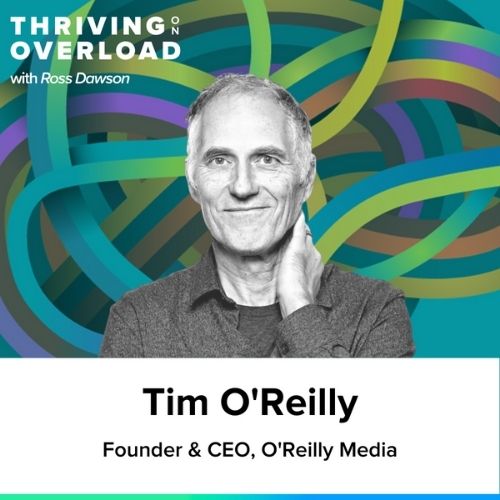
S1 Ep 1Tim O’Reilly on noticing things other people don’t notice, the value of soft focus, framing open source and Web 2.0, and patience in building narratives (Ep1)
‘’We shape reality by what we notice and choose to pay attention to.’’ – Tim O’Reilly About Tim O’Reilly On this episode we learn from Tim O’Reilly, definitely one of the most influential people in the development of the Internet as we know it. He is the founder and CEO of technology publishing giant O’Reilly Media, and has played a seminal role in movements including open source software, Web 2.0, maker culture, and government 2.0, and is author of the excellent book WTF: What’s the Future and Why It’s Up to Us. Website: www.oreilly.com Facebook: Tim O’Reilly LinkedIn: Tim O’Reilly Twitter: @timoreilly Slideshares: Tim O’Reilly Books WTF? What’s The Future and Why It’s Up To Us Welcome to the 21st Century What you will learn If information comes by, it must be important (01:51) Vectors and Bayesian probability in mental models (04:29) Creativity is noticing what other people don’t (06:48) If your dog could talk, it would show you a whole new world (08:56) Only when you have all the pieces can you put the puzzle together… (09:35) …what is the art behind it… (16:47) …and does framework help you find the pieces (19:56) Selfish individuals versus altruistic groups (20:36) Crypto is not decentralized (22:28) Tim finds out somebody else built his idea (27:48) Tim compares himself to Cookie Monster! (28:57) You will succeed when receptivity and striving are in balance (31:03) It’s all about tackling the hard things (33:03) Episode resources Lao Tzu The Way of Life According to Lao Tzu Wallace Stevens Eric Raymond Christine Peterson John Maynard Keynes The Man Watching by Rainer Maria Rilke Transcript Ross Dawson: Tim, it is a great delight to have you on the show. Tim O’Reilly: Thanks for having me. Ross: You have lived a life immersed in information and helped others in many ways to point them to, and digest that information. How do you think about that idea? How do you approach unlimited information and being able to make that into something valuable? Tim: Well, to understand how I think about it, it helps probably to say that I don’t have an approach where I really try to keep track of information, or gather information. It means certainly some ways I do, but my working principle was expressed very well by Tevye, in Fiddler on the Roof, when he said, “Good news will stay, and bad news will refuse to leave”. In a certain way, my approach is that things come by, and if they keep coming by, they’re probably important, and if they don’t, then maybe they weren’t. But there’s a bigger piece of it, and this is maybe explainable by reference to something like Google Maps, where people follow the map, and they stop noticing where they turn, versus people, who, in the old days, had to learn and observe the world around them to the level of where you think about the South Sea Islanders, who could navigate by watching the ocean currents, and the stars. They were their own GPS, and they were continually taking in information, and noticing how it was different from what they expected or the same as they expected. I work a lot like that. I have a mental model that I try to build of the world, and that model is inductive. Basically, I’m taking things in and I go, Oh, this is different, this doesn’t fit. A lot of the work that I’ve done over the years has simply been trying to construct a map by looking around. You pay attention to things and the things that start… with a soft focus. This is an idea, I think from hunting and things like that, you watch with a soft focus. Of course, I’m not a hunter, but I once read a book called “The Tracker”, and I took a workshop with one of the founders of this tracking movement. You’re just receptive and you’re open, and then certain things just pop out at you as anomalies. That’s what’s interesting. Ross: That is the same as my thesis around how it is that we build these models of the world. I think, when people talk about mental models, they often talk about discrete heuristics, in a sense, whereas, a mental model is really, I think, more holistic. It is a mental model of the entire world or the entire world of business, and how that works. How do you frame this mental model that you have built in, are building? Tim: Well, first of all, I do have a set of frames for it. One, I wrote a little bit about this in a recent piece. I also wrote about it in my book “WTF”, all thinking in vectors. This idea, that there are forces that are moving things along, and a vector has both a direction and a quantity, so what you’re looking for in a certain way is acceleration in a particular direction. You’re looking for how those directions collide with other vectors, and what the resulting outcomes might be. In this piece, “Welcome to the 21st century”, I wrote about one of the big impacts of the pandemic might well be that we never go back to the office and sure enough, that’s turning out to be a possible future. That’s the other thing, I have a mental model that comes from scenario planning about imag