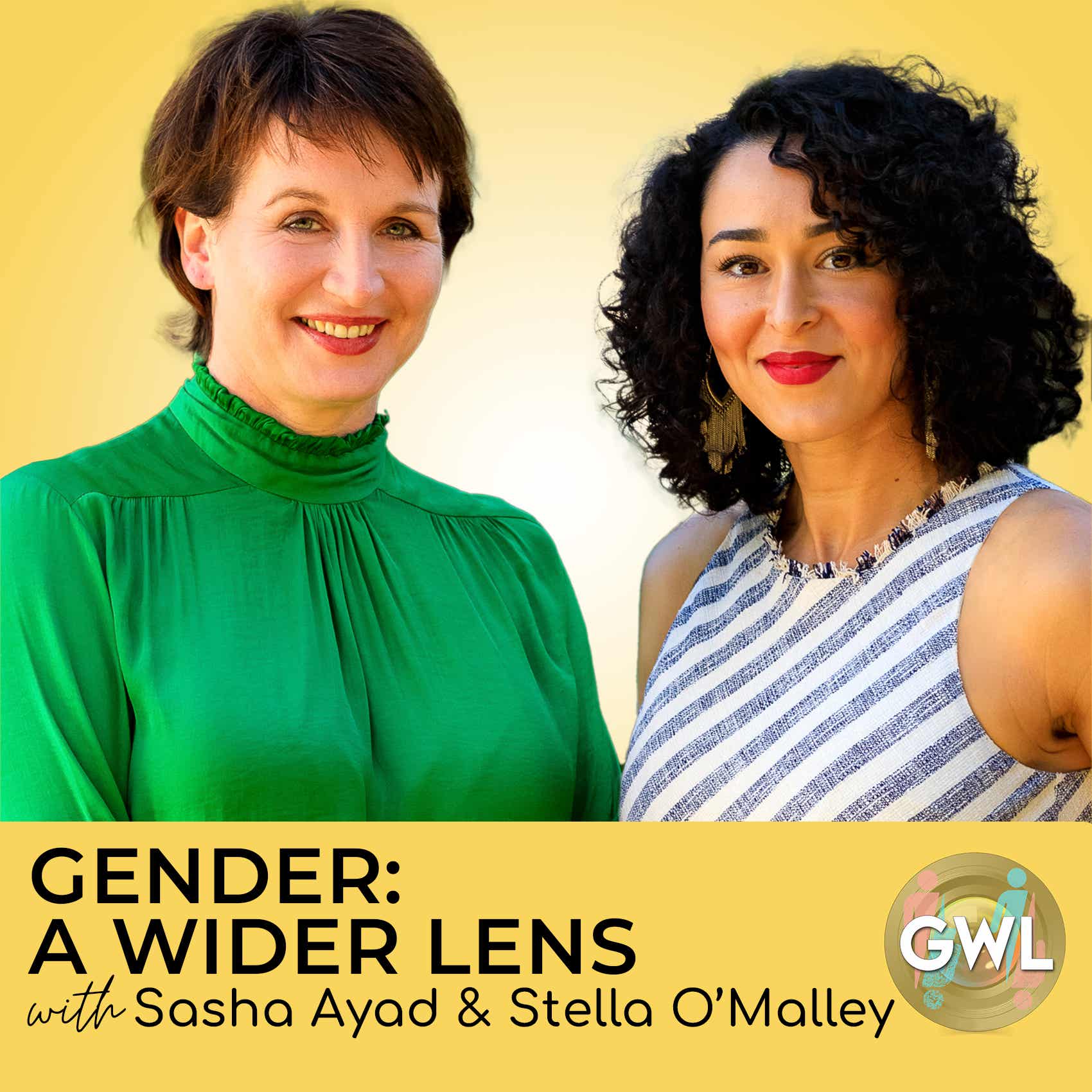
Gender: A Wider Lens
353 episodes — Page 6 of 8
Premium: My Child's Online Behavior is Appalling
This is a public episode. If you would like to discuss this with other subscribers or get access to bonus episodes, visit www.widerlenspod.com

74 - Detransition - Part 1: Going Back & Moving Forward
In today’s episode, Stella and I begin our discussion of detransition. This is an incredibly rich, important, and complex topic, and we certainly don’t think we can lift up EVERY aspect of it. But in this episode, and episode 76 (the one after next), we’ll begin to explore detransition. Today, you’ll hear our initial observations and some random musings. We touch on some of the patterns and dynamics we’ve observed and how things have evolved in the world of detransition over the last several years. We highlight the vast differences between people’s experiences of detransition and how sometimes, the pathway into a trans identity may impact the pathway out. In episode 76, we’ll start diving into the literature and research we now have about detransition. We’ll look at a few important papers, surveys, and studies and what they can tell us about this growing population. Links:Detrans Voices:https://www.detransvoices.org/ Post Trans:https://post-trans.com/ Detrans Canada:https://detranscanada.com/ Detransition Sweden:https://www.detransinfo.se/ Detransition Russia:https://vk.com/detransition GCCANhttps://www.gccan.org/ Detrans Reddit:https://www.reddit.com/r/detrans/ Life Detransitionshttps://lifedetransitions.com/ Genspect (Beyond Transition Initiatives):https://genspect.org/ Beyond Transition:https://genspect.org/beyond/ Blood and Visions:https://www.goodreads.com/en/book/show/30792924-blood-and-visions Autobiography in Five Chapters:https://www.habitsforwellbeing.com/poem-autobiography-in-five-chapters/ Extended NotesStella and Sasha are exploring topics around detransitioning. If you have topic suggestions and even recommended guests, please reach out!Detransitioning is a complex world. There isn’t a simple phenomenon. Stella is working on a program called “Beyond Transition.”Everyone in the trans world is aware there are detransitioners, but they’re wildly misunderstood.Sasha talks about her personal experience with detransitioners.Stella understands in the past that it was very difficult to celebrate with someone who has detransitioned. This new cohort she’s working with is being celebrated.If you feel masculine and/or feminine, you suddenly have to dress for this personality.Sasha has noticed more people becoming more vain. Is this due to social media?What kind of person “suddenly” transitions? Why does someone put so much emphasis on looking female (make-up, hair, etc) only to completely switch?After being in the... This is a public episode. If you would like to discuss this with other subscribers or get access to bonus episodes, visit www.widerlenspod.com
Premium: Why Don't Kids Desist from Puberty Blockers?
This is a public episode. If you would like to discuss this with other subscribers or get access to bonus episodes, visit www.widerlenspod.com
Premium: My Son's Trans ID Could be Motivated by Sex
This is a public episode. If you would like to discuss this with other subscribers or get access to bonus episodes, visit www.widerlenspod.com

73 - Shame, Narcissism, and the Transition Fantasy w/ Joe Burgo
Joe Burgo is a clinical psychologist and psychoanalyst who’s been in practice for almost 40 years. He also writes books for a popular audience mostly focused on shame and narcissism. In this episode Joe explains how a sense of shame can be a root cause of gender dysphoria and how gender transition can be idealized as a “cure” for all kinds of shame – gay shame, outsider shame, survivor of sexual abuse shame, feeling weird or different shame, and so on. The impact of the medical model on society is also lifted up as Joe describes how his depth-approach to psychological pain is often dismissed in a world seeking a solution for every problem and a pill for every ill. Resources Joe’s blog: http://www.afterpsychotherapy.com/ Joe’s books: Why Do I Do That? Psychological Defense Mechanisms and the Hidden Ways They Shape Our Lives http://www.amazon.com/Why-Do-That-Psychological-Mechanisms/dp/0988443120 The Narcissist You Know: Defending Yourself Against Extreme Narcissists in an All-About-Me World http://www.amazon.com/Narcissist-You-Know-Narcissists-All-About-Me/dp/14767… Building Self-Esteem: How Learning from Shame Helps Us to Grow https://www.amazon.com/gp/product/0997592028/ref=as_li_qf_asin_il_tl?ie=UTF… This is a public episode. If you would like to discuss this with other subscribers or get access to bonus episodes, visit www.widerlenspod.com
Premium: Estranged From My Adult Child
Here's the book Stella talked about: https://www.simonandschuster.com/books/Memoirs-of-an-Unfit-Mother/Anne-Robinson/9780743448987 This is a public episode. If you would like to discuss this with other subscribers or get access to bonus episodes, visit www.widerlenspod.com
72 - Disenchanted by Transition
This episode was made especially for anybody who might feel a sense of regret or anxiety about their medical transition. This does not mean they should necessarily detransition. Rather, it means that they are undergoing a reckoning with themselves. While some people choose to detransition, others are deeply ambivalent about transition but may feel they are “at a point of no return” and choose to remain in a trans identity. Others may find the detransition process too difficult and disappointing and decide to retransition. Sasha and Stella explore the blurry lines between terms like “transition” “detransition” and “transition regret” and hope to help listeners feel hopeful and find healing beyond these narrow concepts.Links:What I wish I’d known when I was 19 and had sex reassignment surgery, Corinna Cohn: https://www.washingtonpost.com/opinions/2022/04/11/i-was-too-young-to-decide-about-transgender-surgery-at-nineteen/ Hormone Hangover: The Opposite of GD https://hormonehangover.substack.com/p/the-opposite-of-gender-dysphoria?s Wherever You Go, There You Are, Jon Kabat-Zinn https://amzn.to/3sGI6qjExtended NotesMake the best decision for yourself at the time.Sasha changes her mind about the argument made by Alice Dreger.Stella shares her experience of working in addiction and her patients’ lost years.Some experiences make a person feel like an outsider in their peer group.The importance of speaking with someone who relates to you.The Beyond Transition project encompasses all the different layers of transition.Transitioning or detransitioning is nobody's business but the individuals.Therapy and practices for the body help people get in tune with their physiology.For those feeling overwhelmed, consider what you can do today, not tomorrow, just today.Learning to be patient and dealing with setbacks requires mental flexibility.Sharing a transition experience can assist others with their journeys.The reasons behind self-destructive behaviors.Navigating the multiple pathways to healing.Tools to understand influence and mitigate self-blame.Stella shares the beautiful story of a woman who detransitioned.Getting back to nature and the calming effects of pets.Only you know what you need. Do what you have to do.This podcast is sponsored by ReIME and Genspect. Visit https://rethinkime.org/ and https://genspect.org/ to learn more.For more about our show: https://linktr.ee/WiderLensPod This is a public episode. If you would like to discuss this with other subscribers or get access to bonus episodes, visit www.widerlenspod.com
Premium: I Think My Child is Desisting
This is a public episode. If you would like to discuss this with other subscribers or get access to bonus episodes, visit www.widerlenspod.com

71 - Gender: The American State of Affairs with Jesse Singal
Jesse Singal was instrumental in shining a light on the defamation of Dr. Ken Zucker in 2016. Then, two years later, he became even more widely known in the gender world for his seminal, long-form piece in the Atlantic, “When a Child Says She’s Trans.” In this conversation, we discuss flaws in the science of gender dysphoria treatment and the misrepresentation of research findings in the media. We also look at the recent pronouncements from the Biden Administration, new state legislation, and Health and Human Services proposals. We discuss how all of this impacts our understanding of complex issues and shapes the American political landscape around gender today.Links:Jesse’s Recent book: The Quick Fix: Why Fad Psychology Can’t Cure our Social Ills https://amzn.to/3yIVwpn Researchers Found Puberty Blockers And Hormones Didn’t Improve Trans Kids’ Mental Health At Their Clinic. Then They Published A Study Claiming The Opposite. (Updated) https://jessesingal.substack.com/p/researchers-found-puberty-blockers?s=r What the Media Gets Wrong on Gender Reassignment: https://spectatorworld.com/topic/media-wrong-gender-reassignment-transgender/ Civil rights discrimination providers - gender affirming care: https://www.hhs.gov/sites/default/files/hhs-ocr-notice-and-guidance-gender-affirming-care.pdf The Cut https://www.thecut.com/2016/02/fight-over-trans-kids-got-a-researcher-fired.html https://www.thecut.com/2016/01/false-charge-helped-bring-down-kenneth-zucker.html When a Child Says She’s Trans: https://www.theatlantic.com/magazine/archive/2018/07/when-a-child-says-shes-trans/561749/ Extended NotesJesse explains how he became involved in publishing transgender articles.Journalism allows Jesse to follow a subject to the core of an issue.Before Jesse became known for his Atlantic piece, he was already interested in psychology fads.Stella enjoys self-help books.In his new book, The Quick Fix, Jesse argues that Americans turn to fad psychology because the real problems are too big to be solved.Researchers have been known to give credence to work that does not warrant it.Bad journalism abounds and Jesse often follows up bad stories with the facts.Stella states that maybe the Dutch study should be more thoroughly examined by Jesse.Writing and publishing articles on gender is complicated.Jesse says Republicans are taking the gender issue to the state level.Politicians have no idea of what the real science around the issue is.Sasha asks Jesse if he believes this to be a medical scandal.In 1972, Sweden was the first country to bring in gender recognition.Many studies This is a public episode. If you would like to discuss this with other subscribers or get access to bonus episodes, visit www.widerlenspod.com

Premium: A College Student Asks About Medicalizing Distress
This is a public episode. If you would like to discuss this with other subscribers or get access to bonus episodes, visit www.widerlenspod.com

70 - We're Back! — Parents Lost in a Medical Scandal
We’re back! Sasha and Stella update listeners with how they’ve spent their six-week break and jump right into discussing the plight of parents whose kids are experiencing gender distress. The first-ever in-person Wider Lens retreat for parents was held in Maryland in March 2022. This was a profound experience for the attendees and also for Sasha and Stella, who reflect today upon the common themes picked up at the retreat. These include medical negligence, parental guilt, and the transformative and comforting power of connection that emerged between parents who truly understand each other. Forthcoming plans for Season Two are also highlighted in this episode.Extended NotesProof the mental health lesson of “take a break” can have a positive effect.Stella describes how she spent her time away from the podcast.Struggling with writing, Sasha found inspiration in Patricia Goodson’s book, Becoming an Academic Writer.Sasha is creating an environment that is conducive to calm, mindful writing.The interest and impact of the Wider Lens in-person retreat.Sasha calls out the medical professionals who neglect their jobs.It was a warm reception at the retreat as parents mentioned the podcast. Stella felt like she was meeting old friends.At the retreat, parents from all different backgrounds were united by sharing their stories, some for the first time.A common thread between the families was that therapists had recommended social or medical transitions without performing proper assessments.Meeting in person brought a sense of community to parents as similar patterns emerged.Parents often blame themselves but they need to cut themselves some slack. There is no formula.Empathy and understanding are the foundational building blocks of healing.The needs of parents who have boys are profoundly different from girls’ gender dysphoria.Both Stella and Sasha noticed that a lot of sibling tension emerged during the retreat.There is not a lot of family-oriented therapy around gender.Parents who worry about their parenting are probably in the top 5% of caregivers.There is a requirement for parents and that is to let go and trust the process.It is easy for parents to lose themselves when their child feels lost.Identity can trap us in very dangerous ways.During her time off, Sasha has been re-exploring Tao.Sasha recommends The Parent's Tao Te Ching: Ancient Advice for Modern Parents,by William Martin to Stella.There will be another retreat in Arizona at the end of October 2022.Sasha shares the new ideas for forthcoming podcasts.Stella is further exploring the state of the nation in the United States.2022 could be a pivotal year for gender. This podcast is sponsored by ReIME and Genspect. Visit Rethinkime.org and Genspect.org to learn more. For more about our show: Linktr.ee/WiderLensPod This is a public episode. If you would like to discuss this with other subscribers or get access to bonus episodes, visit www.widerlenspod.com
Premium: What Do Kids Mean When They Say "Gender Dysphoria"?
This is a public episode. If you would like to discuss this with other subscribers or get access to bonus episodes, visit www.widerlenspod.com

Premium: The Highly Compliant ROGD Child
This is a public episode. If you would like to discuss this with other subscribers or get access to bonus episodes, visit www.widerlenspod.com
Premium: Internalized Transphobia
This is a public episode. If you would like to discuss this with other subscribers or get access to bonus episodes, visit www.widerlenspod.com
Premium: Breast Hatred & Body Dysmorphia
Here are some accompanying resources: Befriending Your Body (Book) This is a public episode. If you would like to discuss this with other subscribers or get access to bonus episodes, visit www.widerlenspod.com
Premium: Power Struggles
This is a public episode. If you would like to discuss this with other subscribers or get access to bonus episodes, visit www.widerlenspod.com
Premium: Culturally Bound Syndromes
This is a public episode. If you would like to discuss this with other subscribers or get access to bonus episodes, visit www.widerlenspod.com
Premium: What Does the Pioneer Series Have to do with ROGD?
This is a public episode. If you would like to discuss this with other subscribers or get access to bonus episodes, visit www.widerlenspod.com

69 - Pioneers Series: Post-Series Analysis & Break!
We have completed eleven interviews and today we analyze the second half of our Pioneers Series. Stella and I discuss the psychological and emotional impact of some recent interviews. We review the shocking discussions we’ve had with several of our guests and reflect on the flawed Dutch Protocol, which is often held up as the gold standard in childhood dysphoria medical treatment. Dr. Anne Lawrence’s reflections on Autogynephilia and the extreme measures she feels some might take are discussed in the context of the Dutch researcher’s interview. We also think back about the role Az Hakeem’s groups will play when we examine this period in hindsight, years down the line. Perhaps Susan Bradley is right about ASD being a large explanatory factor in understanding gender dysphoria more broadly. We also look at the Samoan Prime Minister’s response to the Olympic Weightlifting competition: arguably the leaders of integrating male femininity into their society, the Samonas had sharp words for the Pacific Games Council’s admission of trans MtF lifter, Laurel Hubbard, in competing against two Samoan women. We’re wrapping up this season and we’ll be returning to our regular weekly programs with our next episode on May 20th. If you are a Patron, thank you! And don’t fret: we’ll continue recording our weekly Q&As and posting them on Patreon. Thanks for listening! Extended NotesStella and Sasha, being therapists, naturally ask questions to gain understanding of one’s thinking. They talk about the psychological and emotional toll this series had on them.They first analyze their conversation with Thomas Steensma and Annelou de Vries. Sasha shares what stood out to her.Stella also touches on her thoughts and why she sees avoidance tactics as anti-psychological.They explain what the gender dysphoria scale is all about.The entire premise of the puberty blockers experiment is based on the so-called success of the gender dysphoria scale. They both share their disagreements with these methods.Sasha talks about the unethical assumptions made with their studies.They move on to analyze their conversation with Anne Lawrence and how both their mouths dropped when she talked about castration.Stella asks why obsession is not being brought into this rather than just focusing on it as a gender identity topic.Sasha shares her thoughts about the dismissive counseling she has noticed in general.They both talk about their understanding of the depth of Anne’s suffering through her experience.Sasha evaluates Anne’s actions and responses as an obsession to a rejection of a body part, which is common in most Aspy people.Stella thinks there is still so much to be done on autistic diagnosis brainwork and she is looking forward to the next 15‒20 years.Everyone has a very high regard for the Dutch model, implying that they are being very careful but they both disagree.Sasha recalls how Steensma and de Vries may have perceived them as activists in their line of questioning.Stella and Sasha share more feedback about the Dutch study if they truly wanted it to be neutral and inclusive.What if the whole premise of the gender dysphoria scale is flawed? Sasha asks in retrospect.We shouldn’t really change something unless we have a really clear understanding of what the current state of affairs is. Stella reflects on this against puberty blockers.They share how off-putting it was for them to talk about the human body in a flippant manner.What if Jazz Jennings was put on this gender dysphoria scale? Stella and Sasha talk about their disappointment further.Stella mentions Az Hakim and how she admires his approach vs. the rigid coldness of the so-called experts.Psychotherapy vs. Bodily Autonomy. Sasha compares the difference between their... This is a public episode. If you would like to discuss this with other subscribers or get access to bonus episodes, visit www.widerlenspod.com
Premium: Bullying
This is a public episode. If you would like to discuss this with other subscribers or get access to bonus episodes, visit www.widerlenspod.com
68 - Pioneers Series: Cultural Misunderstandings with Paul L. Vasey
This is the last episode in our pioneers series and the second interview with Dr. Paul Vasey. If you haven’t heard our conversation with Paul in episode 57, I recommend you go back and listen to that one first, as we build upon many of the ideas we introduced there. Today we continue reflecting on the way Western activism interacts with research and the interpretation of the fa’afafine, the muxe, and other third-gender individuals from different countries. We talk about the implications of the fact that the fa’afafine, for example, don’t try to identify as women and whether there are conflicting rights issues in Samoa. Paul also explains how Western funding organizations can end up imposing foreign concepts onto other cultures. We even touch on the implications for things like puberty blockers and early medical intervention. It was a real pleasure to wrap up our series with Paul and we hope you’ll enjoy this interview and stick around next week for the post-series analysis with me and Stella. Links:“What can the Samoan ‘Fa’afafine’ teach us about the Western concept of gender identity disorder in childhood?” by Paul Vasey and Nancy Bartlett (2007).Pubmed.ncbi.nlm.nih.gov/17951883/ Extended NotesStella and Sasha reflect on the last episode they had with Paul, having now the time to digest what they’ve learned so far in this series.What is the implication of the fa’afafine to have their own gender category?Fa’afafines having their own gender role consequently makes gender dysphoria uncommon in these cultural settings.Paul talks about sports teams and how the fa’afafine participate in them as an example.What is the Samoan’s opinion about today’s phenomenon of trans women competing in international sports?Paul shares the impact the western culture has with the fa’afafine and the common questions he gets from them.What is the most important thing we can learn from the Samoan culture?Paul is skeptical about the imposition of ideas from other cultures to work when they don’t develop organically.Gender-diverse individuals in non-Western cultures are commonly depicted in idealized terms but there is no such thing as a gender utopia. Paul talks about how he thinks that’s not the reality of their everyday lives.What are the points of difference between fa’afafine and muxe? Paul shares what they are.The similarities between fa’afafine and muxe mean there is a biological structure to same-sex attraction that can be culturally universal.Sasha asks Paul how he addresses cultural relativism between different cultures.Paul does not suggest that either conceptual framework for understanding male femininity and same-sex attraction is better or worse than the other. Each has its own benefits and costs.In Samoa, male same-sex attraction doesn’t really mean anything. Paul explains this further.Paul also talks about the statistics between Western gay people vs fa’afafine vs. muxe and their implications.How do cultural influences contribute to ROGD? Paul shares his insights.Talking about cross-cultural context, Paul highlights the importance of historical change through time in terms of what boyhood femininity means.Paul uses the term female gynephilia as exclusive and explains why.Paul mentions Paul Bailey and what he said about having less flexibility in men and what that implicates.It’s natural for cultures to interact with each other and it’s natural to exchange ideas and concepts in order to evolve. But what happens when one culture imposes on another?Paul often finds a lot of people who are outsiders of This is a public episode. If you would like to discuss this with other subscribers or get access to bonus episodes, visit www.widerlenspod.com
Premium: Sibling Dynamics in ROGD Families
This is a public episode. If you would like to discuss this with other subscribers or get access to bonus episodes, visit www.widerlenspod.com
67 - Pioneers Series: Men Trapped in Men’s Bodies, with Anne Lawrence
Dr. Anne Lawrence is a physician, sex researcher, and academic writer. She is also a postoperative male-to-female transsexual who underwent gender transition in 1996. Since early childhood, she had experienced an intense desire to have a female body, but she had been unable to find any scientific or popular descriptions of transsexualism that spoke to her experience. This changed in the early 1990s when she discovered Dr. Ray Blanchard’s writings about the concept of autogynephilia, which he defined as “a male's propensity to be sexually aroused by the thought or image of himself as a female.” Blanchard’s revolutionary concept gave Dr. Lawrence an essential insight into the meaning of her desire for sex reassignment, and it helped her find the courage to undergo gender transition. Dr. Lawrence subsequently began to research and write extensively about transsexualism and associated issues, both in academic journals and on her website, “Transsexual Women’s Resources.” She is best known for her controversial book, Men Trapped in Men’s Bodies: Narratives of Autogynephilic Transsexualism, published in 2013. The book provides a detailed summary and analysis of existing research about autogynephilia and related phenomena. It also contains excerpts from narratives submitted by over 200 male informants, describing their personal experiences of autogynephilic transsexualism and gender dysphoria. Anne tells us about her early experiences with AGP in childhood, how she tried various ways to sometimes navigate, alleviate or avoid this propensity. She ultimately transitioned in her 40s. Anne is now 71 and reflects on the long game. We spend time talking about her finding Dr. Blanchard’s work and her own research, her book, and her academic interest in understanding this AGP experience. The end of the conversation took an unexpected turn when she described mindset, the intensity, and the desperate measures that seem so reasonable when you’re tortured with severe autogynephilia. For the record, Anne has not been involved in the field for many years and her reflections do not encompass the ROGD phenomenon. Stella and I feel it’s important to listen to people’s experiences so we can understand all the manifestations of GD. However, we believe in the power of therapeutic intervention and we don’t think a nihilistic approach is helpful to deeply distressed individuals. Links:2008 Paper: Shame and Narcissistic Rage in Autogynephilic Transsexualism Pfox.org/Shame-Rage.pdf 2013 Book: Men Trapped in Men’s Bodies Springer.com/book/10.1007/978-1-4614-5182-2 Extended NotesAnne opens the discussion by breaking down what autogynephilia is.She also talks about studies that describe children having autogynephilia.Anne shares her personal history with autogynephilia starting when she was just a child.When Anne told her parents she wanted to be a girl, she was sent for psychotherapy and thought it wasn’t going to be helpful.What did Anne’s therapist do to break empathy and connection?Anne experimented with estrogens at age eighteen.She shares her realizations after her attempt at self-castration.How did she come to the idea of how she used estrogens back then? Where did she get it from?Anne made several attempts to not express her autogynephilic feelings. She shares what those attempts were.How did Ray Blanchard’s work shift Anne’s thinking or experience of her propensities?Anne graphically describes how she despaired really liking her male... This is a public episode. If you would like to discuss this with other subscribers or get access to bonus episodes, visit www.widerlenspod.com
Premium: Medicalizing in College
This is a public episode. If you would like to discuss this with other subscribers or get access to bonus episodes, visit www.widerlenspod.com

66 - Pioneers Series: Where It All Started - The Dutch Researchers Steensma & De Vries
The reason this interview is so important is bc the concept of puberty blockers originated with these two researchers (along w/ cohen kettenis.) We talk about patient zero and the 22 year follow up w/ this person. We get into the nitty gritty details about the 2 studies on which all puberty blocker treatment is based: we ask why they selected certain methods, talked about eligibility criteria, and the 15 participants who didn’t make it into the final study. We even touch on Jazz Jennings, social media, ROGD and detransition. This conversation felt, to us at least, like we barely scratched the surface: we were frankly left with more questions than answers, which we are so eager to talk about in our post series analysis. You’ll probably notice the vast differences between the perspectives of these researchers and of myself and Stella, but nonetheless it was a productive and fascinating conversation. Bio: Steensma Thomas D. Steensma, Ph.D., is a health psychologist, principal investigator and part of the outpatient management team at the Center of Expertise on Gender Dysphoria at Amsterdam UMC, The Netherlands. Trained as a child and adolescent psychologist, his clinical work is focused on the counseling and treatment of people of all ages with gender incongruence and Differences in Sex Development (DSD). As principal investigator, his research lines are focused on psychosexual development, gender identity development and treatment evaluation of youth with gender incongruence. Over the years, he has published over 50 peer reviewed articles in international journals and several book chapters in close collaboration with prominent scientists in the field of gender and sexology. He has co-supervised several Ph.D. and master students. His recent scientific work is focused on understanding the developments in our field focusing on the change in observed sex ratios and the influence of media attention on gender referrals and understanding the processes and factors involved in non-binary gender identity formation. He is currently part of the working group for the text revision of the DSM-5 chapter on Gender Dysphoria. In the development of the 8th version of the Standards of Care of the World Professional Association of Transgender Health (WPATH), he is part of two working groups: Assessment and Therapeutic Approaches of Non-Binary People and Assessment, Support and Therapeutic Approaches of Children. Bio: de Vries Annelou de Vries is a child and adolescent psychiatrist and full staff member in the dept of child and adolescent psychiatry working at the Amsterdam UMC. Annelou de Vries is leading the Child Psychiatry Department of the Center of Expertise on Gender Dysphoria of the Amsterdam UMC. She is president elect of the European Professional Association of Transgender Health (EPATH) . She is co-chair of the adolescent chapter of the Standards of Care revision of the World Professional Association of Transgender Health (WPATH). At present, her lines of research focus on 1) the co-occurrence of autism and gender dysphoria, 2) capacity for informed consent of transgender adolescents, 3) long term follow up of transgender adolescence into middle adulthood, 4) sexual development of transgender adolescents, 5) shared decision making in transgender care, and 6) pathways in gender identity exploration and affirmation. Links:Young adult psychological outcome after puberty suppression and gender reassignment This is a public episode. If you would like to discuss this with other subscribers or get access to bonus episodes, visit www.widerlenspod.com
Premium: Attention from Peers: How Do We Compete with That?
This is a public episode. If you would like to discuss this with other subscribers or get access to bonus episodes, visit www.widerlenspod.com
65 - Pioneers Series: Gender - The Big Picture with Susan Bradley
Susan Bradley is Professor Emerita at the University of Toronto. She graduated with her medical degree in 1966 and completed her residency in Psychiatry U of Toronto from 1968 to 1972. In 1975 she became the Founder of Gender Identity Clinic for Children and Adolescents at Clarke Institute of Psychiatry. In 1985 dr bradley handed over the head position to Dr Kenneth Zucker (who we interviewed in ep 59). She is the author or co-author of over 50 articles on various forms of psychopathology including gender identity disorders in children and adolescents. After stepping down as Psychiatrist-in-Chief at HSC spent almost 20 years consulting to Children’s Mental Health Agencies around the Greater Toronto Area with a special interest in children with Autism Spectrum Disorder who are high functioning. Dr Bradley retired in 2010. This conversation was an incredible opportunity to hear Susan give her extremely informed long-term perspective on gender nonconforming children and their treatment. She describes what she calls the ‘naivety’ of the early clinicians who put too much trust in the endocrinologists’ eager and scientifically weak recommendations. Looking back, she worries that puberty blockers were just facilitating transition and wonders if many of the dysphoric children the clinic saw actually had undiagnosed high-functioning autism. We discuss the cognitive rigidity associated with autism as well as the laser-like focus some young people have when seeking medical transition. She also shares her thoughts on the new population of ROGD kids and the cult-like aspects of social media trans activism. Dr Bradley was honest, incredibly knowledgeable, and this conversation gives us all much food for thought. Links: Singh paper - desistance: https://www.frontiersin.org/articles/10.3389/fpsyt.2021.632784/full This is a public episode. If you would like to discuss this with other subscribers or get access to bonus episodes, visit www.widerlenspod.com
Premium: The Kiddie King!
This is a public episode. If you would like to discuss this with other subscribers or get access to bonus episodes, visit www.widerlenspod.com

64 - Pioneers Series: Psychotherapy Pre- and Post-Transition with Az Hakeem
Dr. Az Hakeem was born and brought up in North Wales and has lived and worked in London since studying medicine. He is a Consultant Psychiatrist who previously trained in forensic Psychotherapy, Mentalization-Based Therapy and is a Group Analyst. He previously worked within the NHS in Forensic Psychotherapy specializing in Analytic Psychotherapy for conditions relating to sex, gender, sexual perversion, and violence at The Portman Clinic, part of The Tavistock & Portman Clinics. Dr. Az Hakeem is unique in that he is the only consultant psychiatrist in psychotherapy who specializes in the specialist application of exploratory psychotherapy to persons suffering from gender dysphoria. He set up and ran the only specialist psychotherapy service for adults with gender dysphoria in the UK in the NHS and is the author of TRANS: Exploring Gender Identity and Gender Dysphoria. After over 15 years working in the NHS, Dr. Hakeem now works exclusively in private practice. In addition to his clinical work, Dr. Az Hakeem has worked as a consultant to the media, on-screen specialist, and TV Co-presenter on a number of TV programs in both the UK and Australia. Dr. Az Hakeem considers himself a “Gender Critical Psychiatrist.” Today we get to hear about Dr. Hakeem’s facilitated group therapy for gender-distressed adults. He ran these groups for twelve years from 2000 to 2012. Containing a mix of pre-medical-transition individuals who were often gender-euphoric and post-medical-transition individuals who experienced regret, these groups created a fascinating opportunity to give gender-dysphoric individuals more insight into the long-term experience of transition. In this episode. we discuss Dr. Az’s understanding of gender distress and how he contextualizes ROGD kids into this framework. Links:TRANS: Exploring Gender Identity and Gender Dysphoria: Amzn.to/3rckYzw The Curious Incident of the Dog in the Night, by Mark Haddon: Amzn.to/3IKVbEA “Development and validation of a measure for assessing gender dysphoria in adults: The Gender Preoccupation and Stability Questionnaire” Hakeem, A., Črnčec, R., Asghari-Fard, M., Harte, F., Eapen V. International Journal of Transgenderism (26th August, 2016) Tandfonline.com/doi/abs/10.1080/15532739.2016.1217812?journalCode=wijt20 “Psychotherapy for Gender Identity Disorders” Hakeem, A. Advances in Psychiatric Treatment (2012), vol.18, 17-24 Cambridge.org/core/journals/advances-in-psychiatric-treatment/article/psychotherapy-for-gender-identity-disorders/D10025B4A7EBBC2250E71EA6A12465F0 “Study Protocol for a randomized controlled trial of mentalization based therapy against specialist supportive clinical management in patients with both eating disorders and symptoms of borderline personality disorder” Robinson, P., Barrett, B., Bateman, A., Hakeem, A., Hellier, J., Lemonsky, F., Rutterford, C., Schmidt, U., Fonagy, P. BMC Psychiatry 14(1): 51. 2014Pubmed.ncbi.nlm.nih.gov/24555511 “Deconstructing Gender in Trans-Gender Identities” Hakeem, A. Group Analysis. The International Journal of Group Analysis Volume 43 Issue 2, June 2010 This is a public episode. If you would like to discuss this with other subscribers or get access to bonus episodes, visit www.widerlenspod.com
Premium: School Uniforms
This is a public episode. If you would like to discuss this with other subscribers or get access to bonus episodes, visit www.widerlenspod.com

63 - Pioneers: Mid-Series Analysis
Sasha and Stella sit down to discuss their thoughts and reflections on the Pioneer interviews they’ve conducted so far in the series. This analysis attempts to synthesize what they’ve learned, what differences in perspective they hold compared to their previous guests, and reiterate the importance of these discussions within the wider context of childhood transition, scientific inquiry, and deep exploration of all things gender. Links:Butch Identity DevelopmentExtended NotesSasha and Stella give a mid-series update on some of the thoughts they have had so far and talk about the range of guests they've had on.This series started with a bang with Dr. Paul Vasey and his research in Samoa.Is it more acceptable now for women to socially transition?Our society is obsessed with femininity. Sasha explores whether more masculine women get thrown to the wayside because of it.Is all of this genetic or not? Stella thinks there is a hereditary component to all of this.People who feel like they have a genetic mental health condition vs. an environmental mental health condition feel alienated. When it’s deemed “environmental,” it feels more human.Can we nurture ourselves into a different place from where we started? Stella says yes.Just because you are susceptible to something, doesn’t mean you will become it or that you are it.Where did the concept of puberty blockers come from? Why did it make sense as a form of “treatment”?Guest Michael Bailey had some thoughts on whether it made sense for trans men to marry or have a partner.Can you have a successful relationship when you have autogynephilia?Stella knows so many functioning alcoholics. You can always live what looks like a successful life, but underneath the surface, it’s in shambles.Stella is curious to see if anyone is doing research behind trans porn and who is watching that.The whole field around children with gender dysphoria has been badly handled.Guest Dr. Steve Levine talked about the chain of trust researchers have with one another and how there’s very little cross-checking the actual work.Stella is shocked that people want to silence researchers who have dedicated the last 20‒30 years of their lives within a particular field. Why silence them?Guest Carole Hooven experienced sexual assault and wanted to understand, through researching monkeys, why we were aggressive to one another.Sasha and Stella have some interesting guests lined up for you!This podcast is sponsored by ReIME and Genspect. Visit Rethinkime.org and Genspect.org to learn more. For more about our show: Linktr.ee/WiderLensPod This is a public episode. If you would like to discuss this with other subscribers or get access to bonus episodes, visit www.widerlenspod.com
Premium: What Materials Can We Give the School?
This is a public episode. If you would like to discuss this with other subscribers or get access to bonus episodes, visit www.widerlenspod.com
62 - Pioneers Series: Adolescent Identity with Riittakerttu Kaltiala
Riittakerttu Kaltiala, M.D., Ph.D., BSc, is a professor of adolescent psychiatry in Tampere University and chief psychiatrist in the Department of Adolescent Psychiatry at Tampere University Hospital. She is a specialist in psychiatry, adolescent psychiatry, and forensic psychiatry. She has been clinically involved in carrying out research on adolescent gender identity issues since 2011 when one of the two nationally centralized gender identity services for minors was opened in Finland, in Tampere University Hospital. She has been actively involved in service development, continuing education, and scientific writing and collaboration nationally and internationally, and in her home country she has been invited as a member of major national initiatives related to transgender treatment guidelines and legislation. She has published numerous scientific articles on adolescent mental health epidemiology, psychiatric health services research, and clinical adolescent psychiatry. Riitta tells us about the shift around 2010 in Finland in which health policymakers, politicians, activists, and human rights groups pushed for the inclusion of adolescent and child services for gender transition. The adolescent psychiatrists scrambled to accommodate these new demands but recognized that identity consolidation is known to take more time and they had concerns about such early interventions. Nevertheless, they began developing a program for childhood gender services based on the literature in other countries such as the UK and Netherlands. They were astonished and quite confused when the populations arriving at their services reflected a very different demographic in age, sex, and presentation of other comorbid psychiatric issues. They saw a shift again around 2015 which continued to confound the clinicians. Riitta tells us about reading the Littman ROGD research which accurately documented what she and colleagues were seeing. Dr. Kaltiala also tells us that predictions of improvement and symptom reduction reflected in the Dutch literature were not observed in their work, and describes how Finland has moved towards prioritizing psychological care and meeting all the needs of young patients who present with GD, rather than focusing only on the gender transition requests.Links:Dr Kaltiala’s Website:Riittakerttu.fi Adolescent GD Current Perspectives:Ncbi.nlm.nih.gov/pmc/articles/PMC5841333 Lisa Marchiano — Outbreak:Tandfonline.com/doi/full/10.1080/00332925.2017.1350804 GD and ASD: A Narrative ReviewPubmed.ncbi.nlm.nih.gov/26753812Extended NotesRiitta talks about how she got into psychiatry and got to work in this field.When did Riitta first come across gender identity? She shares the backstory.Riitta talks about how it was decided in Finland in 2009 that children and adolescents also needed gender medical intervention. What was the motivation behind this?It is during adolescence that young people seek and experiment with their identity. However, it is normal for them to change or evolve in 2‒3 years. It is part of the process of stabilizing their identity.It’s hard to expect in adolescent psychiatry during the early phases of adolescent development that the person would already be ready with any aspect of identity.In the beginning, most of society did not have an idea about gender identity issues so it was not discussed much, including in the medical This is a public episode. If you would like to discuss this with other subscribers or get access to bonus episodes, visit www.widerlenspod.com
Premium: Our Son is Leaving for College: What Should We Do?
This is a public episode. If you would like to discuss this with other subscribers or get access to bonus episodes, visit www.widerlenspod.com

61 - Pioneers Series: Autogynephilia: Myth and Meaning with Ray Blanchard
Ray Blanchard was the psychologist in the Adult Gender Identity Clinic at the Clarke Institute of Psychiatry 1980–1995. Much of his research in those 15 years concerned transsexualism and milder forms of gender identity disorders. In 1995, he was appointed Head of the newly created Clinical Sexology Services at the CAMH. This unit comprised the Adult Gender Identity Clinic and the Kurt Freund Laboratory, the latter being the oldest laboratory in North America for the psychophysiological assessment of erotic interests in sexual offenders and other men with problematic sexual behavior. Blanchard retired from the CAMH in 2010. Since his retirement, he has continued to be active in research on human sexuality, often in collaboration with former students, colleagues, and their students. Today, Ray tells us how he got into the field, as he was primarily interested in conducting sex research. And then he found himself in a gender identity clinic. He got interested in boiling down the cumbersome and sprawling categorizations of gender dysphoria and deemphasizing women’s clothing. He wanted to uncover the wider framework that explains a variety of behaviors for dysphoric males. The term autogynephilia was born. Ray describes common misunderstandings about the term and addresses some myths about AGP, clusters of behavior, and what he calls “erotic mislearnings.”Links:Dr. Blanchard’s PublicationsMen Trapped in Men’s Bodies: Narratives of Autogynephilic Transsexualism, by Anne LawrenceThe Man Who Would Be Queen: The Science of Gender-Bending and Transsexualism, by J. Michael BaileyExtended NotesA little bit about Ray and why he decided to work in sexology.What kind of classifications were there at the time for “transsexualism”?From 1980 to 1995, the females who wanted to transition in Ray’s clinic, all of them were attracted to other females.Ray talks about his observations with his patients that had autogynephilia and some common themes he saw within this group.Ray suggests listeners watch the difference in manners between Blaire White and Caitlyn Jenner.Ray shares his experiences in this field and how it’s changed throughout the years.Did Ray ever receive backlash for his work?Ray doesn’t believe there’s a connection between sexual abuse and gender dysphoria.Are male-to-female transexuals more likely to be pedophiles? Ray says no.Can autogynephilia be passed down to children? Is this genetic?Sasha wonders if it was easier to get the truth out of the patient back then vs. now; a time where people have an agenda to prove they’re trans.Having one erotic paraphilia tends to predispose you to other paraphilia. It’s not just an “autogynephilia” thing.Ray shares his thoughts on why pedophiles become pedophiles.What are some of the misconceptions of autogynephilia?Out of Ray’s clinical practice, only two women stood out as different from a gynophile.How come so many males transitioned in their late 40s?Ray shares his thoughts on trans widows and how they must be feeling when their partner comes out as trans.This podcast is sponsored by ReIME and Genspect. Visit Rethinkime.org and Genspect.org to learn more. For more... This is a public episode. If you would like to discuss this with other subscribers or get access to bonus episodes, visit www.widerlenspod.com
Premium: Deciphering a Therapist's Online Profile
This is a public episode. If you would like to discuss this with other subscribers or get access to bonus episodes, visit www.widerlenspod.com

60 - Pioneers Series: We Contain Multitudes with Stephen Levine
Dr. Steve Levine is Clinical Professor of Psychiatry at Case Western Reserve University School of Medicine. He is the sole author of several books: Sex Is Not Simple in 1989 (translated to German in 1992 and reissued in English in 1997 as Solving Common Sexual Problems); Sexual Life: A clinician’s Guide in 1992; Sexuality in Mid-Life in 1998 and Demystifying Love: Plain Talk for the Mental Health Professional in 2006; Barriers to Loving: A Clinician’s Perspective in 2013; Psychotherapeutic Approaches to Sexual Problems: An Essential Guide for Mental Health Professionals in 2020. Dr. Levine is also the Senior Editor of the first (2003), second (2010), and third (2016) editions of the Handbook of Clinical Sexuality for Mental Health Professionals. He has been teaching, providing clinical care, and writing since 1973 and has generated original research, invited papers, commentaries, chapters, and book reviews. He has served as a journal manuscript and book prospectus reviewer for many years. He was co-director of the Center for Marital and Sexual Health/Levine, Risen & Associates, Inc. in Beachwood, Ohio from 1992-2017. He and two colleagues received a lifetime achievement Masters and Johnson’s Award from the Society for Sex Therapy and Research in March 2005. He was given his Department of Psychiatry’s Hall of Fame Award in 2021. In our conversation, Stephen is posed the question: Why are we so prone to reductionism in our thinking about transition and gender? He explains the “chain of trust” in medical school training and academia and how it can lead to a broken system and low-quality procedures being used on a massive scale. Additionally, Dr. Levine’s deep perspective on love, intimacy, and what makes us human reflects the great wisdom he has gained from over fifty years working as a psychiatrist.Links:Solving Common Sexual Problems (1997), by Stephen LevineSexual Life: A Clinician’s Guide (1992), by Stephen LevineSexuality in Mid-Life (1998), by Stephen LevineDemystifying Love: Plain Talk for the Mental Health Professional (2006), by Stephen LevineBarriers to Loving: A Clinician’s Perspective (2013), by Stephen LevinePsychotherapeutic Approaches to Sexual Problems: An Essential Guide for Mental Health Professionals (2020), by Stephen Levine Extended NotesStephen was first introduced into this field by a suicidal man who wanted to become a woman.Despite working with this person for a number of years, she later did commit suicide.Sixty-three percent of teenagers now identify as a non-binary person.It seems now that if you claim a trans identity, your childhood, your backstory, is totally... This is a public episode. If you would like to discuss this with other subscribers or get access to bonus episodes, visit www.widerlenspod.com
Premium: Helping a 13 Year-Old to Think Critically About Gender
This is a public episode. If you would like to discuss this with other subscribers or get access to bonus episodes, visit www.widerlenspod.com

59 - Pioneers Series: 46 Years of Treating GD in Kids with Kenneth Zucker
Dr. Zucker is a registered clinical psychologist in Ontario. He received his Ph.D. at the University of Toronto in Developmental Psychology in 1982. He is a Professor (Status Only) in the Department of Psychiatry, University of Toronto, and in private practice. He was the Chair of the 2013 DSM-5 Work Group on Sexual and Gender Identity Disorders. He is a past President of the International Academy of Sex Research and has been the Editor of Archives of Sexual Behavior since 2002. Since 1976, Dr. Zucker has worked clinically with children and adolescents with gender dysphoria and their families. His research spans a variety of areas, including epidemiology, diagnosis, and assessment, associated mental health challenges, causal mechanisms, and long-term follow-up. In our discussion, Ken describes the early years of working with childhood gender issues starting in the 1970s. We talk about the changes he’s seen in the kinds of kids, families, and therapists in the field. Politics has always been present in the world of gender identity treatment, but this came to a head for Ken when he was fired from his position at the CAMH hospital in Toronto 2015 after activists made some wild accusations and hospital administrators became fearful for their positions. After a three-year legal battle, he was finally vindicated and compensated. Even with his decades of leadership in the field, Zucker was not protected from this early cancel-culture manifestation. We talk about what his story means for individuals in practice and the field more broadly.Links:Dr. Zucker’s Website: Kenzuckerphd.com Sexual Identity Conflict in Children and Adults: Amazon.com/Sexual-Identity-Conflict-Children-Adults/dp/071560774XExtended NotesKen talks about how he accidentally got into the studies of gender identity disorders.He shares about when he met Sue Bradley and joined her gender identity clinic for children and adolescents at the Clark Institute of Psychiatry in Toronto that she just started in the early ’70s.What was it like working with this study, it being taboo at the time?Ken also talks about the parents that brought their children to their clinics. What led them to seek help?Anxiety about sexual orientation is still an issue that many parents struggle with.Ken shares the shift in focus of their research studies from the ’70s to the early 2000s between children and adolescents.How much impact do social media and the internet have with rapid onset gender dysphoria? Ken also shares his insights on this.Ken talks about his experience and the various views of the subcommittees within the DSM (Diagnostic and Statistical Manual of Mental Disorders) during his involvement with them.Ken gets into more details when their clinic got closed in 2015, being one of the early targets of cancel culture.With newer administrative heads in their child program, the criticisms they received in 2015 would have been taken differently if it was still managed with Sue Bradley and their former bosses.Ken shares what were his thoughts at this time. Did he think that his career would be ruined thereafter?Ken also talks more about the lawsuits he then filed against newspapers, the hospital, and one of the administrators of their program due to libelous comments and defamation, among other things.People being accused of things and these things going viral get them canceled as opposed to having an exchange of ideas has become a pervasive issue in the last years.Ken also shares his interactions with both new and old colleagues and how they fear for their... This is a public episode. If you would like to discuss this with other subscribers or get access to bonus episodes, visit www.widerlenspod.com
Special Extended Interview with Mike Bailey
This is a public episode. If you would like to discuss this with other subscribers or get access to bonus episodes, visit www.widerlenspod.com

58 - Pioneers Series: Male Sexuality with Michael J. Bailey
Dr. Michael Bailey is an American psychologist, behavioral geneticist, and professor at Northwestern University best known for his work on the etiology, or origins, of sexual orientation. He maintains that sexual orientation is heavily influenced by biology and male homosexuality is most likely inborn. Dr. Bailey’s 2003 book, The Man Who Would Be Queen, gave an accessible, intimate, and compassionate account of male sexuality, with a focus on gender-nonconforming boys, gay men, and male-to-female transsexuals. The book was nominated for an award, which was later retracted, from the Lambda Literary Foundation, an organization that promotes gay literature. Aside from legitimate critiques of the book and Dr. Bailey’s theories, attacks spilled into the realm of the egregious as a small group of radical transwomen viciously went after Mike, his reputation, and his family. All of this was documented thoroughly in Alice Dreger’s book, Galileo’s Middle finger, which ultimately exonerated Dr. Bailey of the accusations against him. Today, Mike explains how he got interested in working with sexuality during a time when it was quite taboo in academia. After publishing research on male sexuality, Mike began encountering transexual women who wanted to talk about their experiences. He came to recognize that some MtF transsexuals were nothing like what he’d expected. He went on to study this further, write his book, and soon after, all hell broke loose. While Mike is certainly no contrarian, he unapologetically tells the truth and has committed himself to do his job well as a psychological researcher. Links: Download The Man Who Would Be Queen: Researchgate.net/publication/281747420_The_Man_Who_Would_Be_Queen Christine Benevunuto: Sex Changes: A Memoir of Marriage, Gender, and Moving On Amazon.com/gp/product/B0085UCVKY/ref=dbs_a_def_rwt_hsch_vapi_tkin_p1_i0 Alice Dreger (June 2008). “The controversy surrounding The Man Who Would Be Queen: a case history of the politics of science, identity, and sex in the Internet age”. Archives of Sexual Behavior. 37 (3): 366–421. doi:10.1007/s10508-007-9301-1. Ray Blanchard (1989). “The classification and labeling of nonhomosexual gender dysphorias”. Archives of... This is a public episode. If you would like to discuss this with other subscribers or get access to bonus episodes, visit www.widerlenspod.com
Premium: Feeling Isolated When Friends Don't Get It
This is a public episode. If you would like to discuss this with other subscribers or get access to bonus episodes, visit www.widerlenspod.com
57 — Pioneers Series: Male Femininity w/Paul L. Vasey
Recent theories about gender often describe “third gender” categories found in other cultures. Prof Paul Vasey is one of the world’s leading academic experts on the Fa’fafine. These individuals are feminine males who live “in the manner of a woman” in Samoa. Sasha and Stella have a spellbinding discussion with Paul about how our Western constructs can sometimes completely misinterpret well-researched phenomena in other societies. This conversation actually highlights the universal truths of sex difference between male and female and helps us understand the organic, naturally emerging trait of femininity in androphilic (or same-sex-attracted) males. Links:“What can the Samoan ‘Fa’afafine’ teach us about the Western concept of gender identity disorder in childhood?” by Paul Vasey and Nancy Bartlett (2007). Pubmed.ncbi.nlm.nih.gov/17951883Extended NotesPaul talks about Fa’afafine and how he got interested in this culture.Is gender identity disorder in children a mental disorder? Paul shares what they found with the data they collected on their studies of the Samoan people.What is Fa’afafine? Paul shares its definition.Paul also talks about the history of Fa’afafine in Samoa and how they are socially accepted in their culture.Does Fa’afafine also exist in other cultures? Paul shares the different groups around the world that have the same identity.Paul talks about what being gay means in the cultures of Samoa and Oaxaca.Is there an equivalent of Fa’afafine for females? Paul talks about the other categories of this kind.Paul talks about the typical behaviors children from Samoa usually exhibit that helps families identify them as being of the third gender.In these societies, gender doesn’t play any institutionalized role. Everybody is responsible for themselves.Paul also talks about how sex atypical behavior organically emerges from children through the studies he has had with these cultures comparing them to Western ones.Paul also shares his findings on what is the female equivalent to autogynephilia in his research.Is autogynephilia a Western phenomenon? Paul shares his insights on this.Paul also talks about the different cross-cultural perspectives of gender and their different norms.Sexual orientation is biological but traits can be affected by the environment they are developed under.Why is same-sex attraction often paired with gender nonconformity? Paul shares his insights.Paul also talks about his Ph.D. about Japanese monkeys and how it relates to the impact on gender from social construct.Paul shares his thoughts on what is sex and what is gender and the amount of confusion it gets.To close, Stella asks Paul two questions: One, does the Fa’afafine get married or the equivalent of such in their culture? Two, is his study considered controversial in his field of study?Quotes:“Regardless of how accommodating a particular culture is, if individuals are dysphoric with respect to their sex bodies, then no amount of accommodation is going to change that sense that I’m in the wrong body.” — Paul [7:54]“Gay isn’t necessarily an identity that people draw upon to construct a sense of who they are (in Samoa).” — Paul [14:30]“Nobody makes them Fa’afafine. Their male femininity emerges and then people recognize them.” — Paul [19:30]“Male femininity is despised in the West and so androphilic males in the West don’t like talking about it.” — Paul [36:30]This podcast is partially sponsored by ReIME, Rethink Identity Medicine Ethics: This is a public episode. If you would like to discuss this with other subscribers or get access to bonus episodes, visit www.widerlenspod.com
Premium: Cutting & Self-Harm
This is a public episode. If you would like to discuss this with other subscribers or get access to bonus episodes, visit www.widerlenspod.com

56 - New Year’s Resolutions & Introducing the “Pioneers Series”
For Sasha and Stella’s last episode of the year, they introduce a very exciting series that will be coming up in 2022. In the “Pioneers Series,” they will be interviewing experienced clinicians, researchers, and other professionals whose contributions to our understanding of gender dysphoria and sexuality are foundational. Consider this a back-to-basics 101 course on gender and sexuality. Stella and Sasha also talk about their own personal goals and priorities for the new year. They offer up 10 resolutions that listeners might focus on along with them as we all move into 2022. Links:100 days of walking: 100daysofwalking.com/FAQBrideshead revisited Goodreads.com/book/show/30933.Brideshead_RevisitedIdentity Crisis: Amazon.com/Untitled-Book-2/dp/0593073584Psychological Flexibility: Workingwithact.com/what-is-act/what-is-psychological-flexibility/ Extended NotesSasha and Stella talk about their plans for 2022 and their upcoming “Pioneers Series.”What were the criteria they considered for their list of pioneers? Sasha and Stella share their thought process.They also talk about their reflections of the previous year and their New Year’s resolutions.Sasha and Stella went to New Orleans together. How was it for them to work and spend time together in person?Sasha tells about her weight lifting program and how that relates to her New Year’s resolution.They talk more about the 10 New Year’s resolutions they are offering to the listeners. Which one would you most relate to?Stella shares about her 100 Days of Walking, a habit she wants to get back into.They also share the different ways we can lovingly communicate that are beyond just words.How can you move valuable connections from online to real life? Stella and Sasha share their thoughts.What is digital hygiene? They share their definition and how they incorporate this now in their routine.Sasha also talks about dancing and how she wants to make it more regular in her life.Stella shares about the book Brideshead Revisited and how it helped her understanding of life.Being able to disconnect is just as important as being seen or your pain being reflected somewhere.Stella recommends another book, something funny this time, called Identity Crisis, by Ben Elten which is about gender issues through comedy.How can we become more aware of our biases and the traps we fall into when talking about controversial political and personal issues?Stella shares more on Psychological Flexibility, being the hallmark of well-being.Staying in the moment vs. worrying about the future. Stella shares her realizations on this topic.Enjoying the little pleasures in life also reflects on how you can genuinely enjoy your children. And when you do, they will feel enjoyed, welcomed, and wanted.Lastly, Stella and Sasha talk about their invitation for everyone to get our minds out of gender and think big-picture! Let’s try to understand what is really going on.Quotes:“I know a lot of people crap on New Year’s resolutions; oh, New Year’s resolutions don’t work, the research shows nobody sticks with them, I get all that. But the New Year is this really important marker of what might offer a fresh start or an opportunity to build a new... This is a public episode. If you would like to discuss this with other subscribers or get access to bonus episodes, visit www.widerlenspod.com

55 - Who Gets to Decide What's Normal: A Conversation w/ Lisa Selin Davis
Lisa Selin Davis is the essayist, journalist, and author of Tomboy: The Surprising History and Future of Girls Who Dare to Be Different. Like many other open-minded, liberal Americans, she has undergone a familiar arc in her understanding of gender issues. She has experienced, first-hand, the current trend of silencing those who seek a deeper understanding of childhood gender nonconformity. In this conversation, Lisa describes how she came to write her book, examines the current state of journalism, and recounts how our understanding of gender rebels has evolved in society. Lisa reminds us that we are not done learning, and we must keep the conversation going on how to best support those who question their gender or exhibit gender nonconformity.Links:Tomboy: The Surprising History and Future of Girls Who Dare to Be Different Amazon.com/Tomboy-Surprising-History-Future-Different/dp/0316458317Future-Different/dp/0316458317WPATH Standards of Care, Version 8 Wpath.org/soc8 Some selected articles of Lisa Selin Davis: Salon.com/2020/04/23/how-researching-tomboys-and-gender-helped-me-prepare-for-a-pandemic/Salon.com/2020/08/08/going-back-to-school-dont-forget-to-ditch-gender-normsBusinessinsider.com/how-gender-and-sexuality-standards-changed-views-on-tomboys-2020-8?r=US&IR=TNbcnews.com/think/opinion/think-baby-s-gender-determines-personality-s-dangerous-ncna814841Theguardian.com/us-news/2017/apr/03/identity-theft-racial-justiceExtended Notes:Why did Lisa decide to write her book, Tomboy?Lisa received a lot of backlash and she was called a child abuser for the way she decided to parent her child.Tomboy helped young girls experiment with masculinity.However, there isn’t a male version of tomboy. So what do the boys do?The word tomboy seems to have been phased out and it has now been replaced with the word, “trans.”What happens to Lisa’s reputation after she publishes her book?Lisa talked to a lot of successfully transitioned trans people, but in the back of her mind, she knew things were going wrong.Lisa noticed that the trans people she spoke to were no different than the butch older lesbians she had spoken to. The only difference is that this younger generation had access to a newer technology.Anyone writing about trans kids should know that we do not have good research on this topic.We have to ask: Does everyone have a gender identity or is it only those with dysphoria that do?Lisa knew if she were to write more about these topics and actually have them published in the New York Times Magazine, there would be consequences for her and her family.In 2013, gender dysphoria and trans children were not big topics. However, this exploded in 2017.It’s crazy to think that a doctor or a therapist can come between a... This is a public episode. If you would like to discuss this with other subscribers or get access to bonus episodes, visit www.widerlenspod.com
Premium: How do I draw my child out from the screen in their bedroom?
This is a public episode. If you would like to discuss this with other subscribers or get access to bonus episodes, visit www.widerlenspod.com

54 - Finding a Therapist for Your Gender-Questioning Teen: A Conversation W/ Lisa Marchiano
In this conversation, Lisa joins the show to talk about the difficult task of finding appropriate therapy for a gender-questioning teen or loved one. What is it like working with indoctrinated clients or those under the influence of a partner, belief system, or ideology? Lisa highlights the parental expectations of what therapy should look like, contrasted against the complex and subtle relational dynamics between therapist and client. Stella, Sasha, and Lisa examine some of the common traps therapists fall into: either being too affirming or too challenging before sufficient rapport and exploration have taken place. The three also make an exciting announcement about GETA, a new Gender Exploratory Therapy Association.Links:Jonathan Shedler on This Jungian Life: Podcasts.apple.com/us/podcast/does-analysis-work-a-conversation-with-jonathan/id1376929139?i=1000538533899Gender Exploratory Therapy Association: Genderexploratory.comExtended Notes:What does good therapy look like for an adolescent questioning their gender?Parents often assume the therapist will explore all the options available to their gender-questioning teen. Instead, they are shocked that they pushed medicalization right away.There isn’t a biomarker for depression. Lisa explains how professionals really determine if someone is depressed.Why aren’t we doing the same process for gender-questioning teens?Therapists are being trained to not think of gender dysphoria as an unhealthy coping strategy. Instead, they’re being trained to go straight to helping them find “the cure.” If someone comes to a therapist for anxiety, the goal is to reduce that anxiety. If someone comes to a therapist for questioning their gender, the goal isn't to reduce their inner conflict.What is the true job of a therapist?Lisa talks about multiple personality disorder and how therapists handled it in the ’70s and ’80s.Patients who were diagnosed and labeled with multiple personality disorder were more likely to commit suicide than those who exhibited the same symptoms but didn’t have a label to it.However, sometimes by giving people a diagnosis, that revelation gives them relief.Lisa talks about the problems the Vietnam veterans were running into when they came home from war. Everything from being spat on at the airport to suffering from PTSD.Therapists are working with indoctrinated clients, and how you approach it is an incredibly sensitive topic.It’s one thing to explore everything going on in a teen’s life beyond their gender. However, these clients are watching hours of YouTube transition videos and trying to educate themselves. The approach has to be different.When you have an indoctrinated client, they split off their ambivalence and feel 100% sure in their decision to medically transition.Lisa talks about the Gender Exploratory Therapy Association and how it aims to help parents, therapists, and de-transitions.There are many teens who are not good candidates for therapy. Lisa explains what she means by this.Lisa shares her WAIT acronym: WAIT = Why Am I Talking. This is a public episode. If you would like to discuss this with other subscribers or get access to bonus episodes, visit www.widerlenspod.com
Premium: Desperate for a Therapist
This is a public episode. If you would like to discuss this with other subscribers or get access to bonus episodes, visit www.widerlenspod.com

53 - You Affirmed Your Child's Gender... How to Roll Back
Sometimes parents come to realize that the affirmative approach hasn’t worked out for their gender-distressed child and they could benefit from alternative approaches. In this episode, Sasha and Stella discuss the many complicated reasons some parents reluctantly affirm their child’s gender and how difficult and brave it can be to rethink the strategy. Parenting styles are explored, and Sasha and Stella point out the importance of finding your confident voice and parenting authority. They also offer tips and suggestions for steering the ship in a better direction once a family has gathered more information and observed an unfavorable outcome of the affirmative approach. These strategies include mitigating powerful influences on your child, broadening the family’s perspective on what overall well-being looks like, and modeling that it’s OK to change your mind once you get better information.Links:High Warmth, High Expectations lead to the best outcomes: Developmentalscience.com/blog/2015/6/28/the-only-parenting-model-you-needBook Recommendation for parents: Hold on to Your Kids: Why Parents Need to Matter More Than Peers Amazon.com/Hold-Your-Kids-Parents-Matter/dp/0375760288 “4 Types of Parenting Styles and Their Effects on Kids” Verywellfamily.com/types-of-parenting-styles-1095045“Diana Baumrind’s Parenting Styles”: Iastate.pressbooks.pub/parentingfamilydiversity/chapter/chapter-1-2/Extended Notes:Is affirming the best way to support a gender-questioning teen?Affirmation is often a bandage approach to a much bigger underlying problem.Do you think you made a mistake with affirming your child’s gender? Let’s discuss this openly.Parents have been steered wrong on this issue and it takes a certain level of strength and rebelliousness for parents to go against doctor’s orders.Some parents give in because they’re so tired of being called transphobic.Sometimes children are just trying to test the boundaries, and saying they’re transgender is one of those “boundary-pushing” things.Stella admits we’re in no man’s land. It can be tough to know what’s right and what’s wrong.What do you do with the whole pronoun issue? What should parents use?Are you afraid of your child’s distress and their tears? Does your parental instinct kick in to do everything in your power to make them feel better?What happens if you have a more authoritative parenting style? How does that work in a gender-questioning teen?How do you tell your friends and family you have a gender-questioning teen? If you tell half of your circle of friends and the other half you don’t, your teen will perceive that as transphobia instead of “this is a complicated issue.”Sasha explores whether being honest about your distrust in this “gender-questioning thing” is a good thing or not.It’s okay to change your mind on your approach to this tricky process. Sasha breaks down how you can communicate this to your child.A young person is constantly searching for their identity and what makes them who they are.If you want to slow things down, take the focus away from gender and then see what happens.Do you want a pause or an undo on the medical process? Stella talks about interventions with your child and how to best approach... This is a public episode. If you would like to discuss this with other subscribers or get access to bonus episodes, visit www.widerlenspod.com