
Gender: A Wider Lens
353 episodes — Page 7 of 8
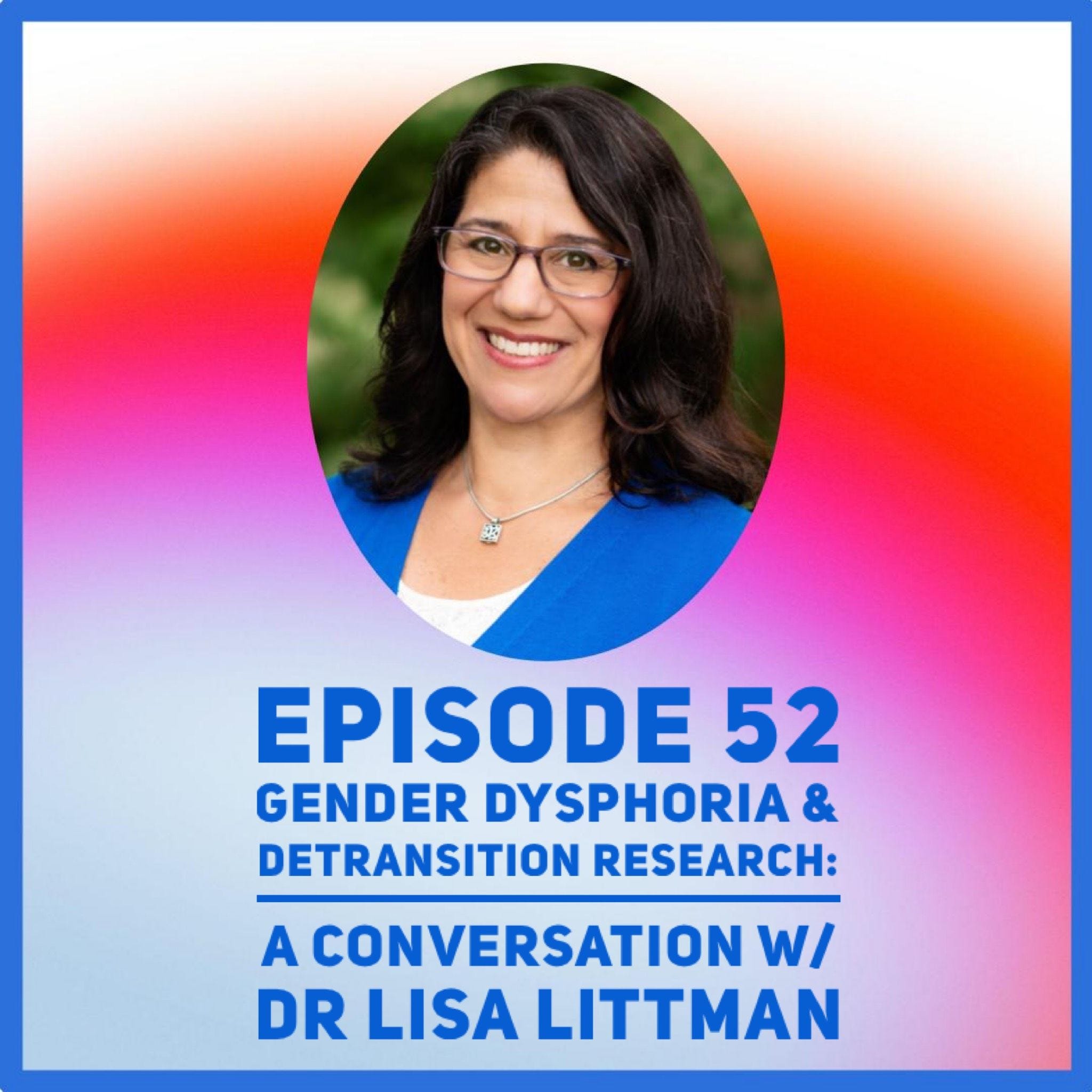
52 - Gender Dysphoria & Detransition Research: A Conversation W/ Dr. Lisa Littman
Dr. Lisa Littman coined Rapid Onset Gender Dysphoria (ROGD) in her seminal 2018 parental report survey. ROGD is a descriptive term for the phenomenon of young people suddenly announcing a transgender identity and experiencing gender dysphoria for the first time around adolescence. Dr. Littman’s latest ground-breaking study on the experience of 100 detransitioners was published in the last few weeks and we reflect on some of the most astonishing findings. In this conversation, Lisa also reflects on what she’s learned since getting embroiled in a controversy she wasn’t expecting. She shares some possible reasons why the topic of affirmative medical care has become so polarized. Lisa points out that patients get hurt when clinicians pledge an allegiance to a particular approach rather than prioritizing the well-being of dysphoric people.Links:Dr. Littman’s Website:Littmanresearch.comInterview in Quillette: Quillette.com/2019/03/19/an-interview-with-lisa-littman-who-coined-the-term-rapid-onset-gender-dysphoriaExtended Notes:Why has Dr. Lisa’s study on detransitioners received so much controversy? Dr. Lisa shares how she now feels about this.There are a lot of ways to support people who are transgender but fast-tracking access to hormones in an effort to support transgender people, regardless if it’s more beneficial, is transphobic.Dr. Lisa shares a bit about her background and what led her to the detransitioner’s study.There are parents who believe transition will help their children and there are parents who don’t. We need to understand that they just want to help their children and there are multiple ways to do that.Dr. Lisa shares further how her study was not accepted. She recruited respondents on social media where they orchestrated an event that undermined her data.Dr. Lisa defines further what detransitioning means as this area of research is still early.Affirmative model vs. exploratory model. The latter tries to understand why you are gender dysphoric whereas the former immediately concludes that you should transition.Mental health conditions don’t have a targeted fix.Psychosocial factors could contribute to the development of gender dysphoria.Dr. Lisa also shares the effects of social influence such as pressure from a person, a group of people, or society on the interpretation of one’s own feelings. Can this lead to a misdiagnosis?There are a variety of ways people can live their lives and they cannot solely be defined by rigid gender roles and stereotypes.Language can be very powerful and if it was used in a way that doesn’t confine people’s feelings to a specific label, it wouldn’t create such a problem.Where are the differences between male and female detransitions? Dr. Lisa explains further.Stella concurs that if a detransition was because the person was more comfortable with their biological sex, this could have been avoided through a proper approach during therapy.Exploring discomfort around sexual orientation would be a great place for trans therapists to help their patients. This is a public episode. If you would like to discuss this with other subscribers or get access to bonus episodes, visit www.widerlenspod.com
51 - Clearing of the Pink Mist: A Conversation w/ Debbie Hayton
UK transwoman Debbie Hayton discusses how she came to the decision to medically transition when she was a 44-year-old father of 3 children. We discuss Debbie’s appearance in Stella’s film, Trans Kids: It’s Time to Talk and the intense public reaction to her story. Male sexuality, shame, and autogynephilia are explored openly in a bid to gain a deeper understanding of the complicated mosaic of traits that encompass MtF transition. She also shares how she became disillusioned with transgender ideology and coined the phrase, “trans women are men. Get over it.” Links:Critically Examining the Doctrine of Gender Identity with Rebecca Reilly-Cooper: Youtube.com/watch?v=QPVNxYkawaoMagdalen Berns on Alex Drummond:Youtube.com/watch?v=JkK7zisjoDkMiranda Yardley:Youtube.com/watch?v=Bn66yhFoov4Debbie’s Website: Debbiehayton.comExtended Notes:Stella talks about the 2018 film, Trans Kids, and how people misinterpreted how Debbie emerged in that film.How is it for a family when there is a late transition? Debbie transitioned at 44 years old with a wife and three children.Debbie shares the answer to the big question on why the chronic condition of the dissatisfaction of her sex and body suddenly became acute.Could there have been a therapy or experience that may have pulled her back from transitioning?Debbie shares how she used shame, guilt, and fear as powerful emotions to control her desire to dress as a girl at four years old.Debbie describes how she sees autogynephilia as a sexuality and how you can be attracted to your own body where it can be the focus of your sexual interest.The male sexual drive is so powerful and there is a need to control it. Has Debbie now been freed from that after her transition?Sasha wonders, if Debbie stumbled upon gender dysphoria or autogynephilia and how it manifests in some male people before her transformation, would it have changed what she felt she needed to do or how she managed her feelings?Stella and Sasha also discuss how people can be compulsive with their feelings about gender and ask Debbie about her thoughts on gender euphoria and the “pink mist.”Is there a way for the autogynephilic to operate in the world without asking other people to buy into the narrative that they’re a woman? Debbie shares what helped her lift her pink mist.Should transwomen go through synthetic menopause and, if so, what are the potential negative effects of that?Debbie shares how she feels about her body now, her current beliefs about her sexuality, and how she interacts with it in the world around her.This podcast is partially sponsored by ReIME, Rethink Identity Medicine Ethics:Rethinkime.orgLearn more about our show: Linktr.ee/WiderLensPod This is a public episode. If you would like to discuss this with other subscribers or get access to bonus episodes, visit www.widerlenspod.com

50 - When Gender Hits the Holidays
The holiday season is often associated with big expectations and high hopes. It can be fraught for families, whether they are going through challenging times with a child’s gender identity. Sasha and Stella discuss the meaning of extended family, big celebrations, and how to keep the stakes low and reasonable during the holidays. They also discuss the holidays as a time some young people try to ‘come out,’ while others feel hesitant to reconnect with loved ones who haven’t yet seen their new ‘gender presentation.’ Sasha and Stella also provide practical strategies that families can use to recruit loving trusted adults who also have the child’s best interests in mind. Links: What happened in LeRoy https://www.nytimes.com/2012/03/11/magazine/teenage-girls-twitching-le-roy.html Stop That! It's not Tourette's but a new type of mass sociogenic illness: https://pubmed.ncbi.nlm.nih.gov/34424292/ Debbie Nathan’s Lecture:https://www.youtube.com/watch?v=vLKAIObPWJEGenspect’s Brief Guidance for Friends and Family: https://genspect.org/wp-content/uploads/2021/10/Friends-and-family.pdfSasha’s Newsletter on Extended Family: http://eepurl.com/dKNAScWhale Rider Movie:https://www.imdb.com/title/tt0298228/Extended Notes:The holidays are really hard for a lot of gender questioning children. Our families are our lifeblood to connection, and if there’s conflict within it, it’s hard for everyone involved.People are coming together for the first time since COVID. There’s a lot of things going on.People are more isolated than ever, and when there’s a conflict within the family, it really burdens the parents because they can not rely on their extended family. What do you do when you haven’t seen your extended family in a while, and you’ve...transitioned? Families who are ashamed of their child transitioning will try everything they can to keep it a secret. Some children want their parents to tell the world, others feel betrayed if their parents let out their secret. How do you navigate when each case is so personal and individualized? What should you talk about at Thanksgiving? Are you estranged with your child? Sometimes sending a small gift to remind them of home is all that's needed. Sasha offers suggestions. If you’re planning to see your family this holiday season (or if your children plan to visit you) and you know you’re going to get triggered, find someone close to you who you can call beforehand/during these events. Let them know you will need a ‘lifeline’ on this day. Families are complicated in general, add tension to the mix and you have a mini explosion waiting to happen. The holidays just intensify these feelings. Remember, pick your battles. Do you really wanna die on this hill?How do you deal with the grandparents? How do you tell your mom and dad about your gender questioning teen? Stella shares how her mother was trying to understand the field of work Stella is in as a therapist.Sasha shares resources on how you can help the older generation understand... This is a public episode. If you would like to discuss this with other subscribers or get access to bonus episodes, visit www.widerlenspod.com

49 - Archives of an Epidemic: A conversation w/ Benjamin Boyce
Over the last number of years, Benjamin Boyce has become known for his prolific and powerful video content on the impact of social justice. Among his most-watched content is a huge series of conversations about sex, gender, identity, and transition. He was among the first to platform detransitioners’ stories and investigate the issue of childhood transition. In this episode, we delve deep into Benjamin’s childhood and find out why he has committed to exposing the underlying problems associated with identity politics. Links: Benjamin’s YouTube: Youtube.com/channel/UCm13xHVNFVwzHzK3QHSaZ3Q Benjamin on Apple Podcasts: Podcasts.apple.com/us/podcast/calmversations/id1447774150 Playlist: gender, sexuality and transition Youtube.com/playlist?list=PLRdayXEOwuMH3f0pmZqVQUU62rgJIzvt9 Evergreen playlist: Youtube.com/playlist?list=PLRdayXEOwuMG1jaAtJE0KbpyY_Kh-JTUl VeeraYoutube.com/watch?v=YLkBk2bBp_c Father and son, Ash and RaphaelYoutube.com/watch?v=FoEWbVviOpkExtended Notes:A little bit about Benjamin and why he got started in this kind of work. What was he like as a child?Benjamin’s father was deeply devoted to his town’s pastor, but as time went on, this man became more and more controlling over Benjamin’s family. They accused his mother of being possessed and rearranged family structures in the community. Benjamin “inherited” two siblings.After leaving that town, Benjamin’s family moved around constantly. He always felt like an outsider.Benjamin, following in his dad’s dreams of wanting to be a pastor, also always wanted to be a pastor.Why did Benjamin decide to start a YouTube channel?Benjamin talks about his experience at Evergreen State College and why it was so chaotic.In California, there were a ton of weird cults happening in the ’70s and ’80s.Benjamin talks about a weird cascading effect that happened around pronouns and Jordan Peterson. It was all about the trans issue. He noticed some patterns between Evergreen and how people were addressing the trans issue.If you want to get good at any craft, you have to create. You have to take action.What is this trans thing all about, really? Benjamin was curious.Have the activists attacked Benjamin for his opinions?In the end, Benjamin just wants to have good conversations.Benjamin does believe that there is an erosion of masculinity in today’s society and the way certain trends are currently going.This podcast is partially sponsored by ReIME, Rethink Identity Medicine Ethics:Rethinkime.orgLearn more about our show: Linktr.ee/WiderLensPod This is a public episode. If you would like to discuss this with other subscribers or get access to bonus episodes, visit www.widerlenspod.com
48 - When an Adult You Love Transitions
When an adult comes out as trans, it might be a liberating moment in their lives that has felt long overdue. Sometimes, however, the sudden nature of the identity change can feel destabilizing to their loved ones. In this episode, Sasha and Stella discuss the many complex factors in adult transition. Are there elements of liberation, freedom, and independence, or might indoctrination or identity crisis be playing a role? And how can families try to stay connected if the adult begins throwing up rigid barriers which create distance and estrangement?Links:Love Lives Here: A Story of Thriving in a Transgender Family, by Amanda Jette Knox Amazon.com/Love-Lives-Here-Thriving-Transgender-ebook/dp/B07L2HK8D9/ref=sr_1_1?dchild=1&keywords=love+lives+here+knox&qid=1634062673&s=books&sr=1-1Somebody to Love: A Family Story, by Alexandra Heminsley Amazon.com/Some-Body-Love-Family-Story-ebook/dp/B087LVTMH5Sex Changes: A Memoir of Marriage, Gender, and Moving, by Christine Benvenuto Amazon.com/Sex-Changes-Memoir-Marriage-Gender-ebook/dp/B0085UCVKY Extended Notes:It’s tricky for everybody involved when you know somebody who is leaving their “old self” to become a radically and visually different person.Let’s talk about the demographics of those who transition. What’s happening if someone transitions in their late 20s?What’s going on in a man’s mind when he transitions at middle age?For many parents, it’s a complete shock that their child wants to change genders. And since they’re no longer living at home, the child doesn’t want to have an “open discussion” about it.When children tell their parents they’re switching majors after three years, that’s a huge shock to parents too! Parents want to talk to their children about what’s going on.When we’re terrified we can act very intensely.Some children don’t want to talk to their parents about it because they don’t want their fragile or uncertain opinion to be swayed.When someone decides to transition later in their life, they are typically men.Stella shares a story of how a man transitioned shortly after his wife had a baby. It appeared he was envious that he couldn’t care for the child in that feminine way.There is a community out there for women who were married to men that have now transitioned.Sometimes people do strange things just to keep the family together.Parents can sometimes feel “abused” by their transitioning teen. What does this typically look like? How do you spot it?For some households, it might make sense to let go with love, or else you and everyone in your family unit will crumble.Watching someone transition is a really disorientating process. It can also really affect younger siblings.There are two sides to the coin. Some children transition okay and continue to lead happy productive lives. Other... This is a public episode. If you would like to discuss this with other subscribers or get access to bonus episodes, visit www.widerlenspod.com

47 - When Parents Disagree
When parents are trying to help their teenager through a difficult time, ideally they work together as a team to strategize, plan, and collaborate. But for many families facing important parenting decisions around their child’s gender struggle, disagreement and conflict can arise. Sasha and Stella discuss a range of family dynamics from low-level disagreements to all out custody battles. What happens when one parent wants to intervene and the other wants to “go with the flow?” They also offer some reflections on what underlying issues might have predated the child’s gender distress and suggest strategies for parents to think big-picture and face the difficulties in their relationships. Q&A Clips: Therapists are not Parental Substitutes: https://www.youtube.com/watch?v=a88t_LaxKs0 The Time In Between: A Memoir of Hunger and Hope https://www.amazon.com/Time-Between-Memoir-Hunger-Hope/dp/1848318308 This is a public episode. If you would like to discuss this with other subscribers or get access to bonus episodes, visit www.widerlenspod.com
46 - Helena Part II: Advice for Parents from a Former Trans Kid
Our conversation with Helena continues and takes a personal, intimate turn. She reflects that her desire to transition was actually an attempt to meet a deep relational need. She sought to garner a kind of engagement and recognition from her parents. Unfortunately, the way they responded triggered a doubling-down and sense of urgency for medical intervention. Helena offers some insights into better ways parents can react to their gender-questioning child in the hopes of helping families avoid the dissolution hers experienced. This vulnerable conversation confronts the challenges of family relations with both emotional honesty and courage.Links:Helena on Twitter:Twitter.com/lacroicsz Extended Notes:Trans kids are worried about how their parents will receive their trans letter. What’s going through their minds when they’re about to come out to their parents?Helena wanted attention so badly. She had a very distant relationship with her parents and she wanted to have the same sort of household her peers were having (involved parents).In Helena’s family, they found out she was trans and then it became an elephant in the room where no one really ever spoke about it again. Helena shares what happened when she came out.What reaction was Helena hoping to get from her mother?Helena decided to go through with her plan anyway and write a coming-out letter. She found it in the kitchen trash a few days later. It was like no one in her household cared.Helena got into another huge fight about her identity when she came back temporarily from college with her mother.It turned into Helena being completely rejected by her mother and she had to go no contact for over a year with her.Because Helena was rejected from her household, she felt like she had to double down as a boy and she couldn’t go back to being a girl.Helena shares how she was able to get her hands on testosterone without her parent’s consent.Helena was so convincing that the nurse and the professionals just decided to skip blood work and give her very, very high doses of testosterone right off the bat. In retrospect, this was concerning.What is Helena’s relationship with her parents now?Growing up, Helena felt like it was just all her fault.Helena is still grappling with the effects of her childhood and how lonely she felt.What advice does Helena have for parents?It’s not your job to change your child’s mind. It’s your job to just be aware, attentive, and listen. Your child is not aware of all the consequences.If your child doesn’t want to talk, then start small.Don’t explode with your emotions. Use your words. Be vulnerable. Try to be open. Try to express what you’re feeling, not thinking, to them.What made Helena detransition?Helena identifies as an outsider and tries to recreate different scenarios to be in that space again.This podcast is partially sponsored by ReIME, Rethink Identity Medicine Ethics:Rethinkime.orgLearn more about our show: Linktr.ee/WiderLensPod This is a public episode. If you would like to discuss this with other subscribers or get access to bonus episodes, visit www.widerlenspod.com
45 - Helena Part 1: Social Justice, Fandoms & FtM Gay Boys
This is Part 1 of a two-part conversation with Helena. She is a 23-year-old detransitioned woman, well-known on Twitter and YouTube for her insights into the FtM trans kid mindset. The self-described “gender apostate” shares her thoughts on ROGD’s relationship with critical social justice, fandom culture, “shipping,” and the extraordinary fascination many teenage girls have with young gay men.Links:Helena on Twitter: Twitter.com/lacroicsz Extended Notes:Helena is a detransitioned woman. She identified as a transgender man at 15, but by 19, she wanted to become a woman again.A little bit about Helena and her detransition journey.Before Helena started testosterone, she had this fantasy that not being female would be amazing. Helena was very isolated in her journey. Her ex, also a trans person, was against her detransitioning.As she was on this journey as a man, she was so tired of pretending to be masculine and wearing clothes that didn’t fit her body.What was it like psychologically to suppress Helena’s feminine side for so long?Has social justice affected or played a role in trans identity?Helena remembers reading things like, if you feel different than everybody else, it probably means you're trans.Teenagers are biologically more sensitive to social rejection from their peers, and they’ll do anything to fit in and belong.Whenever Helena was questioned about her new identity, she just thought they were just stuck in old beliefs and just wouldn’t listen.Helena explains what a trans medicalist is and shares her thoughts on the difference between non-binary people and trans people.What makes someone a cis girl or a cis boy or what really makes someone trans? The reasons are very superficial.Cis allies are finding it difficult to be allies to the transgender community because they’re being told their opinions don’t count.What is trans fandom all about? And what is “shipping” all about within this fandom culture?A lot of these “shipping” content has sexual undertones of gay pairings of common fictional characters.Growing up, it can get confusing. Men, that you’re basing your identity off of, are being written by teenage girls.Let’s talk about Tumblr and how these trans mood boards all originated.Helena remembers this internet time very fondly. She loved being on the “gay” side of the internet where it was all acceptable.Helena wishes there was a way people can indulge in their sexuality in a non-threatening way, but she also understands that too much of it can lead down the wrong path where it creates dysphoria.This podcast is partially sponsored by ReIME, Rethink Identity Medicine Ethics:Rethinkime.orgLearn more about our show: Linktr.ee/WiderLensPod This is a public episode. If you would like to discuss this with other subscribers or get access to bonus episodes, visit www.widerlenspod.com
44 - Multiple Meanings of Gender Dysphoria: A Conversation with Aaron Terrell
Aaron Terrell transitioned female-to-male in 2011. He wasn’t involved in social media or the trans community until roughly 2017 when he noticed some unusual anomalies involving the new cohort of females identifying as trans men and undergoing medical transitioning. Then, earlier this year, Aaron read J. K. Rowling’s essay and everything changed.Links:Aaron’s blog: Aaronterrell.substack.comAaron on Twitter:Twitter.com/elegationvainGender Dysphoria Alliance:Twitter.com/gd_alliance?lang=enDysphoria is not one thing:4thwavenow.com/2017/12/07/gender-dysphoria-is-not-one-thingTransparency Podcast:Podcasts.apple.com/us/podcast/transparency/id1583333120 Unfiltered with Buck Angel (on UpperhandMARS):Youtu.be/nqAJLHZCWv0 Extended Notes:A little bit about Aaron and his journey.Why did Aaron decide to transition at 27?Aaron was introduced to a trans social circle when he was still in college, although it was nice to be with his tribe, certain topics made him uncomfortable.Did family members recognize Aaron’s struggles when he was going through puberty as a woman?Aaron shares his beliefs on religion, and what his religious upbringing was like.People are making their lives much more difficult by trying to opt out and be different with their gender.Why did Aaron start his blog and podcast?Aaron was largely helped by transitioning, but he understands the drawbacks and often writes about those drawbacks.Sasha reads an excerpt from his blog, and Aaron expands on his thoughts on the trans movement at the time.Aaron had a lot of internalized misogyny happening when he started to become a man.He was supposed to be a wife and a mother, and when he transitioned, what was next? It was natural for Aaron to be a breadwinner, and adopt an identity of what that “traditionally” looks like.When it comes to trans people using the male and female bathrooms, where does he stand on the issue? At first, he thought people who were offended by this were transphobes.Where does the ethical line get drawn on some of these controversial issues?With so many young children transitioning so early, what’s the fallout going to look like? Aaron believes there are going to be a lot of de-transitioners.What is the Gender Dysphoria Alliance all about?This podcast is partially sponsored by ReIME, Rethink Identity Medicine Ethics:Rethinkime.orgLearn more about our show: Linktr.ee/WiderLensPod This is a public episode. If you would like to discuss this with other subscribers or get access to bonus episodes, visit www.widerlenspod.com

43 - Sasha & Stella Answer Your Questions: Part 3
The listeners’ questions continue to absorb our interest and influence our discussion. The issue of power struggles between parents and children has been raised along with a special focus on knowing when to hold ’em and when to fold ’em. The script that trans-identified teenagers often use to declare their trans identification is outlined and Sasha & Stella discuss a kind of counter script for parents. Finally, we suggest a liberal parents’ guide to explaining your child’s gender-related distress with friends, neighbors, and the wider community.Links:Sasha’s Video: Effects of Affirmation: Gender Identity vs Sexual Orientation:Youtube.com/watch?v=Zjv-eDaZNH0&feature=emb_title Motherhood: Facing and Finding Yourself, by Lisa Marchiano:Amazon.com/Motherhood-Finding-Yourself-Lisa-Marchiano/dp/1683646665 Extended Notes:Thank you so much for submitting your questions and providing Stella and Sasha with excellent feedback! We appreciate you!Q: What can I say to my daughter? Is there a counter script?Stella loves the idea of having a script for parents to help their teen think deeper on some of the implications of a transition.Sasha has noticed parents falling into certain categories, like having a difficult time with their authority towards their child vs. some parents going in with a lot of fear and force on what their child “should” be.Don’t expect lightbulb moments from your child when you share a piece of wisdom with them. Sometimes it takes some time to sink in.Should you use a script? Sasha believes that everyone’s situation is different. She believes it’s best to share wisdom and advice that is specifically applicable to your child.Remember, you don’t need to turn this conversation into a political debate with your child.As parents, we tend to put on a cheerful “life is great” smile in front of our kids, even when you might be mad at your partner, or deeply dislike your mother-in-law. There’s something very unauthentic about this. Children pick up on it and they’ll call you out on it around the ages of 12 to 14.The best friend’s parents. Let’s talk about them. They’ve very liberal with your child’s pronouns because it’s not happening to their family.People who are giving your child the okay to transition, it’s another form of you having to stand up for your child to people who think they know better than you as a parent.Q: I can’t deny her feelings, but I think we should stay open-minded for future options, but that’s not enough for her. It feels like a power struggle. What should I do?Some parents want to avoid the power struggle, so they end up saying yes to everything. That’s not the best way forward, either.When you have a kid who has been historically compliant under their parents’ wishes, the power struggle is even stronger as they grow up.What are some of the best ways to approach this subject? Stella offers some advice on how to soften the elephant in the room.The power struggles are exhausting. It’s very difficult to manage these temperaments and all the fun gets zapped out of the household.Q: Gender dysphoria vs. social dysphoria. Are there tips on ways to help a child with social dysphoria? Can you talk more about this?What is social dysphoria? There is general anxiety around people who are prejudging you before knowing you.You cannot change somebody’s perception of you. You are setting yourself up for failure and misery if you think you can.It takes time to understand this, but as a child or... This is a public episode. If you would like to discuss this with other subscribers or get access to bonus episodes, visit www.widerlenspod.com
42 - ROGD and the Struggle to Grow Up
Many children with ROGD seem reluctant to grow up. Sometimes this is related to the difficulties of an early puberty or the hyper-sexualization of children. Other times the gap between the Disneyfied wonder of childhood and the grim hard reality of adulthood feels unsurmountable. Sasha and Stella delve into the psychology of the fear of growing up and how elements of both transition and transgender activist dogma may further infantilize and stunt development.Links:Four Thousand Weeks: Time Management for Mortals, by Oliver Burkeman: Amazon.com/Four-Thousand-Weeks-Management-Mortals/dp/0374159122“Trans Kids May Reject Family, Not the Other Way Around” Transgendertrend.com/trans-kids-reject-family-not-other-way-around/ Transparency podcast (episode with Mars Fernandez):Youtube.com/watch?time_continue=1&v=H-7PkjWgwa8&feature=emb_logo Rees M. “The age of menarche” ORGYN. 1995;(4):2-4. PMID: 12319855. Pubmed.ncbi.nlm.nih.gov/12319855/ Extended Notes:People with rapid gender dysphoria are having a hard time with the process of growing up.Children see the stress of growing up and they want so desperately to opt out of it.If you want to get into a good college, you need all these “extra” activities, which means no one really has true hobbies anymore.People love to stay in the fantasy world of YouTube, where many subgenres are acting younger than they are.So much of this “drama” is fueled on the internet. Why do you get some of the biggest criticisms from people with a cartoon avatar on their profile?Children are stuck between innocent Disney and hypersexualization. Where do you really go from here?Stella has noticed that a lot of people who have gender issues also tend to have gone through puberty earlier than their peers.Getting a period at seven years old is very traumatizing.What fears do boys have about growing up?When children have unlimited access to content, their imagination tends to dwindle, as well.Do kids play seven minutes in heaven anymore? These innocent fun games were a vital part of being comfortable with your body.Everything is so screen-based now. Human interaction is very low.Adulthood seems really intimidating to a kid who has never had to interact with people. Going into a crowded room gives them anxiety.Young, young girls are seeing a lot more porn than you might think.When teenagers want to transition and get top surgery, it's a very difficult and vulnerable state to be in. They have to rely on mom and dad to take care of them once again.A child has not thought things fully the way an adult parent has. The adult has gone through all the painful scenarios their child can go through.You don’t have to dwell on certain things, but it’s important to face it, at the very least.If you have an estranged relationship with your child, what do you do?Doctors don’t always want you to know the truth about your body and the types of medical consequences there are when transitioning. There’s a whole movement that prevents the sharing of this knowledge.When you ask transitioning girls who they’d like to look like, they never describe their father. They describe a “magazine model” or a K-pop star.Kids want to rush into the... This is a public episode. If you would like to discuss this with other subscribers or get access to bonus episodes, visit www.widerlenspod.com

41 — Trans: A Conversation with Helen Joyce
The New York Times describes Helen Joyce’s book, Trans: When Ideology Meets Reality, as “an intelligent, thorough rejoinder to an idea that has swept across much of the liberal world seemingly overnight.” Joyce reminds us that her book is not about trans people, but rather, it is about the idea “that people should count as men or women according to how they feel and what they declare, instead of their biology.” Helen explains the ways it’s more acceptable for men to “give up some privilege” and strategies women in other cultures have used to opt out of unfavorable circumstances. Perhaps denying sex leads to a perfectly clear demonstration of just how different men and women can be. We also reflect on the differences between American’s tendency to double-down on bad policy and the hopefulness Helen feels with the unfolding UK reckoning with gender self-ID. In this episode, we discuss the many ramifications of “you are exactly who you say you are.”Links:Helen Joyce’s Website: Thehelenjoyce.comHelen on Twitter: Twitter.com/HJoyceGender Book Review by Jesse Singal Nytimes.com/2021/09/07/books/review/trans-helen-joyce.html Helen’s interview with Andrew Doyle:Youtube.com/watch?v=KAYR8GUJsqo Stella’s Book Review in The Evening Standard: Standard.co.uk/culture/books/trans-when-ideology-meets-reality-helen-joyce-review-b944183.html Becoming Julia (Gender Transition Documentary): YouTube.com/watch?v=kNjV37vp5qk The End of the World is Flat by Simon Edge: Eye-books.com/books/the-end-of-the-world-is-flat Survivorship Bias: En.wikipedia.org/wiki/Survivorship_bias Small Gods by Terry Pratchett: Terrypratchettbooks.com/books/small-gods Extended Notes:NY Times reviewed Helen’s new book, Trans, and Sasha is even in the book!Helen didn’t even think her book would get published because of its taboo topic.Are people fascinated with gender or with sex?Non-binary people are trying to redefine everybody and trying to change a “fundamental truth.” Of course, it gets people upset.What is the difference between transsexualism and gender self-ID?This book is not about trans people, it’s a book about ideology.If being trans was an ideology, a belief system, that’d be okay. However, this movement is trying to change gender facts, and that’s a harder thing to get behind.Right now it’s very difficult to determine what stance is going to be on “the right side of history.”The trans movement is structured as “the next thing” that needs to be liberated from oppression. However, will it be?Why do men commit more transphobic acts than women?People say that when you call people trans,... This is a public episode. If you would like to discuss this with other subscribers or get access to bonus episodes, visit www.widerlenspod.com
40 — Social Transition: A Powerful Psychosocial Intervention
Social transition is often the first recommended intervention when a young person begins questioning his or her gender identity. It entails changing one’s name, pronouns, appearance, and other identity markers to match the desired gender. In very recent years, schools, led by the current gender identity affirmative approach, have taken it upon themselves to support and sometimes encourage students with social transition. Families often feel pressured by professionals to make these powerful changes despite little evidence supporting these interventions. At times, living in another identity can create more problems than it resolves. In this episode Sasha and Stella do a deep dive into the many challenges that arise with social transition.Links:Michael Biggs on Puberty Blockers:Youtube.com/watch?v=9VHlkE40cFk&feature=youtu.beHow Trans Kids and Parents Decide When to Start Medical Transition (VICE News): Youtu.be/QD720mHFqW0Detrans Needs Survey: Tandfonline.com/doi/full/10.1080/00918369.2021.1919479Kai and Kimberly: Vice.com/en/article/9k9bkv/she-was-asking-the-lord-to-let-her-die-raising-a-trans-child-in-texasCatherine Tuerk: Catherinetuerk.com/about/1funny.com/my-3-year-old-son-is-a-girl-now/Extended Notes:What’s the difference between pre-gay children vs. transgender children? Sasha shares a story of how a mother reacted poorly to her son’s femininity. So many families just have no idea what to do in a situation like this. What does transitioning look like for those under 8 or 9? For parents, it’s almost like a scary nightmare when their child says they’re an opposite sex. What do you do? How does one prepare for this? Adults have the responsibility to teach their children about the realities of the world. Should children really be leading the way on how they’re feeling? Should therapists really be listening to these young children? What is sex constancy? It’s so dangerous to have a 4 year old transition. Should you let children explore their gender identity? Sasha thinks it’s a blurry line. Context and environment matters. Watchfully waiting doesn’t always make sense in today’s world when our children have strong influences to ‘be a certain way’. During Stella’s generation, they’d just ask her if she was a boy or a girl. Now, children are being asked by their community if they’re trans. It’s a very different shift. People are put into a very ‘gendered’ box these days. The moment you’re slightly different than that, society asks if you’re transitioning. What are the psychological impacts of a 13 year old socially transitioning? Children who socially transition end up in an interesting situation. They either have to commit 100% or be seen as a fraud. Parents are terrified. They go down this path because they’re afraid their child will commit suicide. Your 5 year old is not going to be committing suicide! There’s so much talk about transphobia and parents kicking these children out of the house. The opposite is true.... This is a public episode. If you would like to discuss this with other subscribers or get access to bonus episodes, visit www.widerlenspod.com

39 - Nonbinary Identities
With the invention of the term “nonbinary,” we’ve seen an unprecedented number of young people claiming to feel like neither a man nor a woman. Today, we explore Ian Hacking’s concept of “making people up” and the creation of new classifications and “types” of people. Several questions also arise: does a non-binary identification require medicalization? What personality traits may correlate with this identity and is it different in males and females? For parents, how might one respond when a timid child quietly says “No” to the “gender binary?” And what role does non-binary label play as individuals step in and step out of trans identification?Links:Gender Census: Gendercensus.com/results/2021-worldwide/#pronounsKori and Searyl Doty: Theguardian.com/lifeandstyle/2020/jul/08/parent-raising-gender-free-childJamie Shupe: Theguardian.com/world/2016/jun/16/jamie-shupe-first-non-binary-person-oregonJamie Shupe: Twitter.com/notabledesisterLisa Shupe interviewed on Transparency Podcast: Youtube.com/watch?v=edzyk-TQhEYSam Smith: Theguardian.com/music/2019/sep/13/sam-smith-on-being-non-binary-im-changing-my-pronouns-to-theythemSam Smith and Alok: Mirror.co.uk/3am/celebrity-news/sam-smith-alok-vaid-menon-20126943 Alice Hope’s YouTube video: Youtube.com/watch?v=9WJBp3eEhqYExtended Notes:Parents feel so old when the term “nonbinary” gets thrown around. What does it mean?Sasha gives a bit of context and the definition of the word.Nonbinary people have an element of protest. They’re completely opting out of the “normal.”The term “nonbinary” really started picking up speed in 2014 and having it skyrocket in 2019.Are nonbinary identities just a stepping stone into trans identity?A lot of nonbinary females think they should have top surgery, which helps them with their image that they’re in this “neither/or” gender space.Can you inflict your ideologies on a little child? Stella feels like the answer should be no.There is controversy on listing two mothers or two fathers on the birth certificate. It’s a bit like stretching the truth/reality.The average 14-year-old female calls herself nonbinary. What’s going on here?Are our sexual differences causing distress among teenagers? Do they wish for a simpler time where none of this gender stuff matters?It’s a bit of a confusing thing, you shouldn’t go by looks but a lot of these gender identities use looks as a baseline.Can you be nonbinary while also looking very female or very male?How do you know if something is a singular and not a plural when you’re using the “they” pronoun.How do parents manage other children who are calling themselves they/them?Sasha wonders if saying you’re nonbinary is due to some uneasiness that’s happening in their lives, some form of trauma or unhappiness... This is a public episode. If you would like to discuss this with other subscribers or get access to bonus episodes, visit www.widerlenspod.com

38 - DSDs and the “Sex Spectrum”: A conversation w/ Claire Graham
“Differences in Sexual Development” (DSDs) is an umbrella term encompassing a range of over 40 medical conditions that impact sexual development in humans. We speak with Claire Graham, an advocate for the organization, DSD Families and explore the intricacies of these complex conditions, which are often simplified and misunderstood. Claire also tells us how she became embroiled in heated debates about transgender advocacy and dispels common myths that are used to conflate “intersex” conditions with transgender issues. Links Claire’s Blog: https://mrkhvoice.com/index.php/2019/12/18/what-is-dignity/ DSD Families: https://dsdfamilies.org/charity John Money and David Reimer: https://embryo.asu.edu/pages/david-reimer-and-john-money-gender-reassignment-controversy-johnjoan-case This is a public episode. If you would like to discuss this with other subscribers or get access to bonus episodes, visit www.widerlenspod.com

37 - Womanhood: A Conversation with Milli Hill
The founder of the Positive Birth Movement speaks to us about the birthing process and women’s health. A common theme of self-assertion and empowering women to speak up has characterised Milli’s work over the last decade. There were attempts to silence Milli last year when she said that the word “woman” has significance in relation to childbirth. Milli, however, decided to assert her boundaries and speak her truth; in this episode she explains why. Links: Milli Hill: https://www.millihill.co.uk/ I will not be silenced: https://www.millihill.co.uk/2021/07/10/i-will-not-be-silenced/ The Positive Birth Book by Milli Hill https://www.amazon.co.uk/Positive-Birth-Book-Approach-Pregnancy/ Give Birth like a Feminist by Milli Hill https://www.amazon.co.uk/Give-Birth-Like-Feminist-Milli/ Mumsnet: https://www.mumsnet.com/ Birth: A History by Tina Cassidy https://www.amazon.co.uk/Birth-History-Tina-Cassidy/ #BirthJustHappened: https://www.instagram.com/explore/tags/birthjusthappened/?hl=en [Text Wrapping Break] The Business of Being Born: https://www.amazon.com/Business-Being-Born-Helen-Ayres/dp/B001IIHAGK[Text Wrapping Break] Jane Hardwick Collings & Female Rights of Passage: https://janehardwickecollings.com/[Text Wrapping Break] Birth & Sex (Book): https://www.amazon.com/Birth-Sex-Sheila-Kitzinger/dp/1780660502 Project Netti: https://projectnettie.wordpress.com/ Panics and Persecutions – Quillette book https://www.amazon.co.uk/s?k=panics+and+persecutions Extended NotesA little bit about Milli and why she decided to start the Positive Birth Movement.What were some common themes coming up for women who were about to give birth?The birth room was built with the needs of the midwife and doctor in mind, not for the women in mind.Sasha shares her experiences with an American hospital vs. an overseas one.So many mothers are not listened to when they’re at the hospital. Their wishes are ignored.Milli is passionate about everyone having a positive birth experience, no matter the context or environment they choose to be in.You don’t have to just “go with the flow” when it comes to giving birth. You have the right to choose.Meghan Markle got attacked... This is a public episode. If you would like to discuss this with other subscribers or get access to bonus episodes, visit www.widerlenspod.com

36 - Talking Testosterone with Carole Hooven
Carole Hooven, Ph.D., is lecturer and co-director of undergraduate studies in the Department of Human Evolutionary Biology at Harvard University. She earned her Ph.D. at Harvard, studying sex differences and testosterone, and has taught there ever since. Hooven has received numerous teaching awards, and her popular Hormones and Behavior class was named one of the Harvard Crimson’s “top ten tried-and-true.”In this episode, Stella and Sasha talk to Carole about her new book, Testosterone, which explores the powerful impact this sex hormone has on the human body. This discussion revolves around a central theme: to make the world a better place, we must be willing to understand the harsh realities of our mammalian nature and take into account the biological drives behind our behavior.Links:Carole Hooven:Twitter: twitter.com/hoovlet?ref_src=twsrc%5Egoogle%7Ctwcamp%5Eserp%7Ctwgr%5Eauthor www.carolehooven.com/Carole’s Book: us.macmillan.com/books/9781250236067Carole’s Link Tree: linktr.ee/CaroleHooven Stella’s Review: www.standard.co.uk/culture/books/testosteronedr-carole-hooven-review-b941337.html Katie Herzog’s piece in Barri Weiss’s substack: bariweiss.substack.com/p/what-happens-when-doctors-cant-speak bariweiss.substack.com/p/med-schools-are-now-denying-biological Extended NotesA little bit about Carole and her experience.Carole talks about her book, T: The Story of Testosterone, The Hormone That Dominates and Divides Us.When Carole was in Uganda studying chimps, she always knew that if she was working with only females, her day would be pretty relaxed. It’s when the males came to play, however, that she had a full day on her hands.Carole witnessed a male chimp viciously and brutally beat a female chimp who wanted nothing more than to protect her child. It was shocking to watch.Carole breaks down the importance of testosterone and estrogen in our bodies.Males resolve conflict much more quickly than females. There is a reason why there is a hierarchy and it benefits the entire pack to know who’s who.What did Carole discover when she interviewed a wide variety of people going through testosterone procedures?Carole found some fascinating things. People who were living as biological women and hated being objectified, now transitioned into men, found themselves having urges to objectify women.Our nurture can be significantly modeled. The power of our environment can shape our nature.What is CAH and why do women who have this tend to have more male-oriented positions?Just witness how boys vs. girls play with one another. There is a reason for this act in play between the sexes. This crosses all cultures and is even witnessed in animals.Carole shares her insights about gay men and their sexual patterns.Knowledge is power. Carole is passionate about this because it’s important to know how we work on a biological level. We think if we... This is a public episode. If you would like to discuss this with other subscribers or get access to bonus episodes, visit www.widerlenspod.com
35 - Communicating About Gender: Translating Between Parent & Child
We invite parents and children to listen to this episode together. Stella and Sasha alternate between the perspectives of the parent and their dysphoric child and attempt to translate what each may be thinking and feeling when communicating about gender identity becomes difficult. Discussing the emotions, the inner motivations, and the thoughts parents and children might experience when gender related distress hits the family, we hope that this episode might begin to build bridges between parents and young people and foster more empathy in the parent-child dyad. Links Cat Stephens: Father and Son https://youtu.be/P6zaCV4niKk WB Yeats: The Mask http://www.online-literature.com/yeats/800/ This is a public episode. If you would like to discuss this with other subscribers or get access to bonus episodes, visit www.widerlenspod.com

34 - Gender Dysphoria & Suicide
Sasha and Stella tackle the complex subject of suicide. They reflect on the many emotional and relational difficulties involved and parse out the differences between suicide risk and suicidal ideation. While terrifying, it sometimes offers an escape fantasy and desire for control, making suicide an existential issue. Furthermore, they point to the stark lack of data available relating to gender dysphoria and suicidality and discuss how the fear of suicide is used against families wishing to safeguard their children. If you wish to speak to someone about any issues that arose during this please contact the Samaritans https://www.samaritans.org/ireland/how-we-can-help/contact-samaritan/ Links:Assist Applied Suicide Intervention Skills Training: https://www.youth.ie/training/asist-applied-suicide-intervention-skills-training/ Media guidelines: https://www.samaritans.org/ireland/about-samaritans/media-guidelines/ Kurt Cobain https://www.newsweek.com/did-kurt-cobains-death-lower-suicide-rate-1994-244332 Robin Williams https://www.psychologytoday.com/ie/blog/talking-about-men/201908/robin-williams-death-and-subsequent-suicide-contagion Dhejne C, Lichtenstein P, Boman M, Johansson ALV, Långström N, et al. (2011) Long-Term Follow-Up of Transsexual Persons Undergoing Sex Reassignment Surgery: Cohort Study in Sweden. PLOS ONE 6(2):e16885. https://doi.org/10.1371/journal.pone.0016885 https://journals.plos.org/plosone/article?id=10.1371/journal.pone.0016885 The Trans Trains 2 (Swedish documentary with subtitles): ttps://www.youtube.com/watch?v=73-mLwWIgwU Michael Biggs on suicie: Attempted suicide by American LGBT adolescents https://4thwavenow.com/tag/michael-biggs/ Mum's fury after transgender suicide teen sold hormones from illegal online clinic https://www.cambridge-news.co.uk/news/cambridge-news/transgender-treatment-nhs-webberley-jayden-16504026 Transgender Trend: Suicide Facts and Myths: https://www.transgendertrend.com/the-suicide-myth/ Philip Larkin: This be the verse https://www.poetryfoundation.org/poems/48419/this-be-the-verse Extended NotesThis episode... This is a public episode. If you would like to discuss this with other subscribers or get access to bonus episodes, visit www.widerlenspod.com
33 - Beyond the ‘Gifted’ Label: A Conversation w/ Jessie Mannisto
Stella and Sasha sit down with Jessie Mannisto, the Editor in Chief of Third Factor Magazine, a publication for and about uncommon people and their uncommon paths through life. Jessie expands on the many overlapping experiences of gifted, creative, intense, and gender dysphoric individuals. They explore some critiques and uses of terms like ‘queer’ and ‘asexual.’ Stella and Sasha ask Jessie about androgyny, loneliness, ordinariness, and exceptionalism in dysphoria people. And what’s up with anime and fan fiction amongst gender-questioning youth? Links:Jessie Mannisto on Sasha’s YouTube Channel Disintegration as an Opportunity for Growth: Part 1: https://www.youtube.com/watch?v=rGBcqT6h0Pw&t=1081s Part 2: https://www.youtube.com/watch?v=mFKpuoR9-zg&t=2s Where Intensity and Gender Dysphoria Meet: https://www.thirdfactor.org/intensity-gender-dysphoria Existential Depression in Gifted Individuals:https://www.sengifted.org/post/existential-depression-in-gifted-individuals Rainforest mind - Paula Prober: https://www.amazon.com/Your-Rainforest-Mind-Well-Being-Gifted/dp/0692713107 Hilary Jacobs Hendel - https://www.amazon.com/Its-Not-Always-Depression-Authentic/dp/0399588140 Creativity https://www.amazon.com/Creativity-Psychology-Discovery-Invention-Perennial-ebook/dp/B000TG1X9C Third Factor Magazine: https://www.thirdfactor.org/ Twitter: https://twitter.com/thirdfactormag?lang=en Facebook: https://www.facebook.com/ThirdFactorMag/ Extended NotesA little bit about Jessie and how she got involved in the field of giftedness and overexcitability.Jessie noticed a connection between gender dysphoric people and giftedness.What is the definition of “giftedness”?There are five domains or key areas where you can be gifted: Intellect, imagination, psychomotor, sensory, and emotions.How do these domains manifest into those who are extremely gifted?Although not a reliable measure, overexcitability is often linked to giftedness. One of the ways people tried to test for giftedness was through overexcitability, but it was not conclusive.What is the “hedgehog dilemma”?The more that you’re an outlier, the more you try to seek out people who are like you to confirm that you’re “okay” and not abnormal.Belonging is the biggest issue for these types of people.What is a “magnet” school?Most gifted people know they’re difficult and can be hard to manage. Jessie believes some of these... This is a public episode. If you would like to discuss this with other subscribers or get access to bonus episodes, visit www.widerlenspod.com

32 - Stereotypes
Are stereotypes always harmful? Should we use stereotypes to predict and impose behaviors and preferences onto others? Some people believe transgender identities defy stereotypes while others believe they reify them. And where does stereotyping come from? This is a mental shortcut with complex roots and crucial implications for the gender debates.Links:Carole Hooven: Testosterone: The Story of the Hormone that dominates and Divides Us Noam Shpancer: Stereotype Accuracy: A displeasing truth Extended NotesThere are so many stereotypes in this space. What’s the right definition of gender dysphoria? The DMS is just riddled with stereotypes.Stella reads out the DMS description of gender dysphoria.The first six descriptors of gender dysphoria in the DMS are very stereotypical. It’s fixed with what a boy should play vs. what a girl should play.Why are pink colors “girlish” and why are blue colors “boyish”?What are some common stereotypes about women? Or even Irish people?What frustrates Stella the most about stereotypes?Stereotypes are always framed as harmful in this community, yet they also use them extensively. It’s a bit of a contradiction.These stereotypes really do come from somewhere. There’s a reason why these exist.Stella and Sasha compare their culture and differences.Our brains use stereotypes to keep us safe.Both sides are claiming they’re breaking the stereotypes down, but are they?There are girls who are wearing makeup and are in girls’ clothing, but they are saying they identify as trans guys. What’s going on? It’s a huge mind pretzel.It’s confusing, they say “treat me like a man,” but what does that mean if it’s outside of a stereotype?There’s a mix between medical and rebellion language and, when it comes to gender, this is very scary.If you call a phone a duck and still call a duck a duck, what the heck are we actually talking about?Free speech is everything and trying to control or change speech, even in its respect to gender, is dangerous.Stereotypes have a certain level of efficiency towards understanding what another person means.Kids are resident stereotypes all the time, but they also seek out edgy and cool ones to be a part of. Their own tribe, if you will.When they feel like a stereotype is “off-limits,” Sasha wonders how that can impact the development stages of a child if they feel like they can’t be whole or have to shun parts of their identity to fit in.There’s a subcategory of feminists who feel driven to be sexually liberated and proud to sleep with multiple, multiple people, but Stella and Sasha ask questions on why that is.This podcast is partially sponsored by ReIME, Rethink Identity Medicine Ethics:Rethinkime.orgLearn more about our show: Linktr.ee/WiderLensPod This is a public episode. If you would like to discuss this with other subscribers or get access to bonus episodes, visit www.widerlenspod.com

31 - Silencing Thought: A Conversation with Heather Brunskell-Evans
Heather Brunskell-Evans is a philosopher and sociologist who studies the intersection of medicine and culture. She joins us today to trace the ways in which queer theory evolved in academia and moved into the broader culture, including the Gender Identity Development Service (GIDS) in the UK. Explaining how a social justice angle is key to the ‘affirmative model’ of care for gender dysphoria, Heather recounts a few key moments when she realized there were authoritarian elements at play in silencing thought and conversation around the topic of transgender, even for parents trying to protect their children.Links:Heather’s Website http://www.heather-brunskell-evans.co.uk/ Transgender Children and Young People: Born in Your Own Body https://www.cambridgescholars.com/product/978-1-5275-0398-4 Inventing Transgender Children and Young People https://www.cambridgescholars.com/product/978-1-5275-3638-8 Transgender Body Politics http://www.heather-brunskell-evans.co.uk/thoughts/transgender-body-politics/ Heather on Twitter https://twitter.com/brunskellevans The History of Sexuality https://www.amazon.com/History-Sexuality-Vol-Introduction/dp/0679724699 Janice Raymond, The Transsexual Empire https://janiceraymond.com/the-transsexual-empire/ Vanity Fair Cover https://www.vanityfair.com/hollywood/2015/06/caitlyn-jenner-bruce-cover-annie-leibovitz Moral Maze http://www.heather-brunskell-evans.co.uk/tag/moral-maze/ Heather Brunskell Evans opinion piece for Leicester University https://www2.le.ac.uk/offices/press/think-leicester/arts-and-culture/2015/neo-liberalism-masculinity-and-femininity-caitlyn-jenner-and-the-politics-of-transgender Extended NotesHeather has been working in this field since the very beginning --Since the early 1990s. Heather shares a bit about her background and how she got started. The moment Heather discovered medical intervention for transgender children in 2016, her work has not been the same since. Why did Heather decide to do her PhD in child sexual abuse? Technically, we don’t actually have any human or social rights. What research did Heather discover when she was doing her PhD in queer theory? Heather describes what post-structuralism is. We are a byproduct of the culture we live in, This is a public episode. If you would like to discuss this with other subscribers or get access to bonus episodes, visit www.widerlenspod.com

30 — Sasha & Stella Answer Your Questions: Part 2
Sasha and Stella answer listener questions… again! They start by highlighting recent episodes inspired by listener feedback. Next, they discuss the financial implications and complexities involved in adult children using their parents’ medical insurance. They reflect on the different roles that can emerge between mothers and fathers of gender dysphoric youth. Other questions address the similarities between body dysmorphia, gender dysphoria, OCD, and other ruminative anxieties.Links:Activist Perspective on Body Dysmorphia & Gender Dysphoria Austenhartke.com/blog/2015/5/19/o08szlrrhc8jaasya9s285qenydpy6 Homosexual OCD: Centerforanxietydisorders.com/treatment-programs/obsessive-compulsive-disorder/hocd/ Trans OCD: Treatmyocd.com/blog/transgender-ocd-symptoms-and-treatment Aaron Kimberly on Benjamin Boyce: https://www.youtube.com/watch?v=vcjBDi-ZRLA Bryony Gordon, Mad Girl, book about OCD Amazon.co.uk/Mad-Girl-Bryony-Gordon/dp/1472232089 Suicidality in Body Dysmorphic Disorder Ncbi.nlm.nih.gov/pmc/articles/PMC2361388/Extended NotesA little update on what topics Stella and Sasha have in the pipeline!This is the second episode where Stella and Sasha answer listener questions!How do you manage the costs of gender? This listener asked her daughter to pay for her own gender medical expenses.When does it make sense for parents to accept where their child is in life?This parent wants to support her child through her journey, but she also doesn’t want to pay for something she disagrees with.If the parent is paying for it, then she should be able to look at the bills she’s paying for. If her child does not want her to see the medical procedures, then she must take ownership of those costs.This parent needs to remind her daughter about all the ways she is happy to support her necessities. Basic food, shelter, and safety. How she has done so since she was a child. Sometimes children need the reminder. She also has three other children to consider and it makes sense why she might be hesitant to spend large resources on one when an emergency could happen to another one.When do you know you’re enabling your child?The fact insurance covers so many of these medical procedures is very shocking. They have an allure that they’re safe to do. They’re not!Next listener question! How does a man, who works in a blue-collared field, tell his friends that his son wants to be a girl?Stella has noticed that those who attend support groups for their transitioning children, 95% of them are mothers. Where are the men?No matter what happens to your child, look after your marriage. You are stronger together.Men are often suffering in their own private way. They express themselves differently than women do.At the end of the day, the body is real, you’re born with it, and it’s here to stay.What is homosexual OCD or transgender OCD?This is a bit of a chicken/egg question. Can spending a lot of time on the... This is a public episode. If you would like to discuss this with other subscribers or get access to bonus episodes, visit www.widerlenspod.com
29 - Conversion Therapy: A Conversation with Bob Withers
Jungian Analyst Bob Withers joins us to discuss the differences between gay conversion therapy and gender identity conversion therapy. We examine the possibility of misinformed therapists “transing the gay away” and suggest that perhaps the dark history of conversion therapy may not be over. Bob delves into his view of psychosomatic symptoms and draws on his background in philosophy and medical history to understand our current fixation with one’s subjective sense of identity. Bob also defines what he calls “detrans-phobic” responses to the experiences of detransitioners.Links:Winnicott: http://web-facstaff.sas.upenn.edu/~cavitch/pdf-library/Winnicott_PsycheSoma.pdf Dr Az Hakeem: http://www.drazhakeem.com/publications/ Vsauce Video: The Power of Suggestion: https://www.youtube.com/watch?v=QDCcuCHOIyY&feature=emb_title Safeguard evidence-based therapy for children struggling with gender dysphoria: https://petition.parliament.uk/petitions/582083?fbclid=IwAR39py7JJnyxPe_cqQZAIUPBRt5E3wZ4MjvoryWBOdyGjuXVp2qRq0o3YVk Transgender Medicalization and the attempt to evade psych distress: https://onlinelibrary.wiley.com/doi/10.1111/1468-5922.12641 The Seventh Penis: towards effective psychoanalytic work with pre-surgical transexuals https://www.thesap.org.uk/wordpress/wp-content/uploads/2017/10/Withers-2015-Journal_of_Analytical_Psychology.pdf Cambridge Books: Transgender Children and Young People: Born in Your Own Body: https://www.cambridgescholars.com/product/978-1-5275-0398-4 Inventing Transgender Children: https://cambridgescholars.com/product/978-1-5275-3638-8 One Size Does Not Fit All: In Support of Psychotherapy for Gender Dysphoria https://link.springer.com/article/10.1007/s10508-020-01844-2 Extended NotesA little bit about Bob and his work. Bob met a biological man, now a woman, who wanted to detransition. He realized that becoming a woman did not solve his psychological problems. This was in 1990. Bob’s work would later spark a new set of clients and now Bob sees parents and gender dysphoria teens. How were the narrates about gender different back then? Bob’s first detransition client was attacked and vilivided by the community. He tried to write books about it, but the only way to get the bullying to stop was to say he made up the whole thing. This was the first time Bob saw de-trans phorbia. We know the mind through introspection, but we actually know the body This is a public episode. If you would like to discuss this with other subscribers or get access to bonus episodes, visit www.widerlenspod.com

28 - Behind the Curtain: Wrapping Up Gender Exploratory Therapy
As they wrap up their initial Behind the Curtain series , Sasha and Stella discuss important issues surrounding the termination of therapy. How do we know when the therapeutic process should end? Does a resolution of gender dysphoria mean it’s time to end the therapeutic relationship? Does the start of a medical transition indicate a good time to end? And how can therapists leave the door open for a client who may want to return at a later date? Extended Notes● When a long-term client leaves. It can be a bittersweet moment.● If the therapy process is working well, the client should be proactive in how they’re building new connections.● Therapy is a lot like riding a bike. You are a little wobbling and then, next thing you know, your training wheels are off!● What do you do when you have a client who has resolved their issues around gender identity, yet other issues are cropping up?● Upon the discovery of certain deeper issues, some clients realize that they cannot trust themselves.● Sasha has seen her clients feeling ashamed for their prior thinking.● Some of Stella’s clients wished the whole event didn’t happen. Well, it did. Let’s forgive ourselves a little.● Sometimes what feels like progress and going forward can also sidetrack you and you find yourself going completely sideways. Life gets us like that, but therapy helps us process these changes in a healthy way.● The goal in therapy is not to just help them de-transition. The goal is to help them find the right answers for themselves.● When is it time for a client to leave?● What do you do when you, as a therapist, make a mistake?● Sasha has a lot of her thoughts and opinions online. There have been times clients have read that and disagreed with her, and if the relationship hasn’t been built, this can really hurt progress.● Stella knows it’s ended badly when the client is always on her mind and she’s rethinking of ways to better handle the situation.● Stella is curious to know if people “relapse” with gender the same way people might with food disorders.● Stella has noticed people talking about their feelings of transitioning as if it were a drug.● It can be so frustrating to see a patient not make progress, yet they still keep coming. There must be something there.● Stella also worries for younger patients who use therapy as a crutch. She doesn’t want to create chronic patients.● What do you do when you feel it’s time to terminate the client relationship, but the client still wants to keep going?This podcast is partially sponsored by ReIME, Rethink Identity Medicine Ethics:Rethinkime.orgLearn more about our show: Linktr.ee/WiderLensPod This is a public episode. If you would like to discuss this with other subscribers or get access to bonus episodes, visit www.widerlenspod.com

27 - Behind the Curtain: Psychotherapy for Gender Dysphoria with Sue and Marcus Evans
Marcus and Sue Evans both worked as clinicians in the Tavistock Centre in London for many years. Noticing red flags since the early 2000s, Sue was the first whistle-blower in the Tavistock Centre and Marcus resigned as its governor because the concerns raised by therapists, parents, and managers were systematically dismissed. Marcus and Sue have recently released their book Gender Dysphoria: A Therapeutic Model for Working with Children, Adolescents and Young Adults. They join us to discuss the tasks of adolescents, family dynamics, and how important it is to explore questions about gender dysphoria as part of a more holistic approach to clinical care because nobody yet has all the final answers.Links:Gender Dysphoria: A Therapeutic Model for Working with Children, Adolescents and Young AdultsAuthors: Susan Evans and Marcus EvansFiringthemind.com/product/9781912691784/ “Freedom to Think: the need for thorough assessment and treatment of gender dysphoric children” by Marcus Evans Cambridge.org/core/journals/bjpsych-bulletin/article/freedom-to-think-the-need-for-thorough-assessment-and-treatment-of-gender-dysphoric-children/F4B7F5CAFC0D0BE9FF3C7886BA6E904B “First do no harm: A new model for treating trans-identified children”Quillette.com/author/susan-evans/ Interview with Marcus Evans: Quillette.com/2020/01/17/why-i-resigned-from-tavistock-trans-identified-children-need-therapy-not-just-affirmation-and-drugs/ Sue Quoted in the Guardian: Theguardian.com/society/2020/mar/01/families-divided-tavistock-nhs-gender-clinic-judicial-review-goes-ahead An overview of the Judicial Review and court decision about puberty blockers Transparencyproject.org.uk/bell-v-tavistock-in-the-high-court-an-explainer/ Extended NotesHow did Sue get into gender dysphoria?Being involved in this work for many years now, Sue was concerned that children were being medicalized too quickly.It is clear that there needs to be more research in this area and the subject needs to be understood more before we prescribe children with puberty blockers.How did Marcus get into gender dysphoria?In 2006, Sue and Marcus were raising clinical concerns about the effects of puberty blockers. It was tough. Their opinions were unpopular.Marcus retired in 2018 and became a staff governor. He received a letter from 10 parents that were concerned that their children weren’t psychologically examined properly for their gender dysphoria. They felt the whole process was too rushed.After digging deeper into the issues, Marcus felt he had to resign because he disagreed with how his organization was handling the issue. He was terrified his career This is a public episode. If you would like to discuss this with other subscribers or get access to bonus episodes, visit www.widerlenspod.com
26 - Behind the Curtain: Depth Work in Gender Exploratory Therapy - Part II
Sasha and Stella continue their series which peers behind the curtain of depth work with gender-questioning clients. Today, they weave in philosophy and psychology to discuss the importance of authenticity, happiness, and connectedness. They also explore the value of art in the slow evolving process of an emergent Self.Links:The Catcher in the Rye: https://www.goodreads.com/book/show/5107.The_Catcher_in_the_Rye The Bell Jar : https://www.goodreads.com/book/show/6514.The_Bell_Jar Taxi Driver: https://en.wikipedia.org/wiki/Taxi_Driver The Scream: https://en.wikipedia.org/wiki/The_Scream Raised by the Village (with Stella O’Malley): https://www.rte.ie/tv/programmes/1076971-raised-by-the-village/ External Locus of Control: https://link.springer.com/referenceworkentry/10.1007%2F978-1-4419-1005-9_250#:~:text=Definition,luck%2C%20chance%2C%20or%20randomness. Extended NotesHow do you “break the ice,” as it were, with a gender-questioning teen? Sasha and Stella noticed that a lot of these children don’t have “joy” in their lives.What does it mean to be authentic?So many teens feel different from others and they feel like no one else understands the feelings they’re going through.A lot of gender-questioning teens are asking very common existential questions. It often shows up everywhere, really.Sasha often likes to ask what are some of the common triggers to her client’s gender dysphoria. The answers are very interesting and insightful.Going from a child body to an adult body is very jarring.If a child is experiencing same-sex attraction, therapists really need to slow down in this process and explore.Everybody says they’re pro-LGBTQ, but they just don’t want it for themselves.There is a lot of bullying going on in schools when someone is gay or a lesbian — a lot of bullying.It’s one thing to say you’re okay with it, but it’s quite another to be experiencing same-sex attraction physically.Sasha works a lot with helping her clients find their own voice that’s not a reaction towards their parent’s wishes.When parents are so adamant about what the “right thing” is for their children, the children end up doubling down even further.Sasha loves to do these “gender timelines” to help the child see how their views change over time.Stella really likes to go “behind the label.” Yes, they’re calling themselves certain things, but let’s dig deeper as to why.Some children also have a hard time accepting their very “ordinary” selves.Let’s explore internal vs. external locus of control.Young people have been sold this idea that they can control how other people perceive them.Stella likes to encourage her clients to develop their own sense of style. Not develop a style based on “what they think it means to be trans.” What her clients come up with is often very freeing.Stella is also curious to understand whether medications are suppressing libidos and this means young teens feel like they have to... This is a public episode. If you would like to discuss this with other subscribers or get access to bonus episodes, visit www.widerlenspod.com

25 - Behind the Curtain: Depth Work in Gender Exploratory Therapy
After the therapist has laid the foundations of therapy and established a trusting relationship, the process moves into the middle stage. This is the meat of the therapy! In this episode, Sasha and Stella explore the dynamics that can elicit change in the individual. They consider the curious vs. fixed client, self-esteem issues, broadening the client’s focus, and how to speak meaningfully about gender in therapy.Links:The Importance of an Unhappy Adolescence: Youtube.com/watch?v=zcUI1Hk0GRU&feature=emb_title Gender Care Consumer Advocacy Network: Gccan.org Extended NotesWhat’s the true job of a therapist when a parent brings their gender-questioning teen in for counseling?Timing is important when approaching therapy. Both Stella and Sasha keep phrases and viewpoints their teen is saying in their back pocket to bring up for exploration at another time.If you’re not careful, it can turn into a “gotcha” moment for your client. You want to avoid that.Teens have very harsh inner voices and, as therapists, it’s important to look into this in a gentle way.A lot of adolescents understand the importance of their mental health, which is why they’re so critical of themselves when they don’t have happiness. It’s a vicious cycle.Whenever there’s an outburst, people might be dismissive and say, “Oh you should talk to your therapist about that.” Although true, there are better ways to reassure a child that their emotions are perfectly normal.Parents don’t like to reveal some of the bad things that happened to them throughout their life, but sharing some of these experiences with their children really humanizes them.When you don’t divulge information, you make your relationship colder. By sharing information and life experiences, you create a deeper friendship.People love to throw out diagnoses left and right, but sometimes these are just children going through normal teenage things.Stella shares an interesting pattern that happens with her clients when they go from gender distress to seemingly being fine, and then back to gender distress.As a therapist, it’s important to position yourself as someone who explores unknown questions together with your client.It’s important to think big picture and dive into what else is going on in their life and not just focus on the teen’s specific gender issue.Teens have reported that social media causes a lot of distress and time wasted. Too much time on these platforms causes them a lot of mental health issues.As therapists, it’s also important to show the client how they can find their strong voice and say no to things that aren’t serving them or causing them distress.What is the sexual self? How do you define it?Therapists need to not hurry this process. A strong relationship can develop over years and so there’s time to explore challenging subjects pieces at a time.The political narrative around puberty blockers is not matching what Stella and Sasha are seeing in their clinic, is it because they have a more biased cohort?This podcast is partially sponsored by ReIME, Rethink Identity Medicine Ethics:Rethinkime.orgLearn more about our show: Linktr.ee/WiderLensPod This is a public episode. If you would like to discuss this with other subscribers or get access to bonus episodes, visit www.widerlenspod.com
24 - Behind the Curtain: Getting Started In Gender Exploratory Therapy
This is the first episode in a short series which takes listeners behind the scenes of a gender exploratory therapy process. Although there has been plenty written about Gender Affirmative Therapy, very little has been written about a concept often described as Gender Exploratory Therapy. Sasha and Stella discuss the specifics of establishing a therapeutic alliance when a person is questioning their gender identity. They describe different strategies involving issues such as names, pronouns, clothes and hairstyles and reflect on the different stages of therapy, which they’ll discuss in subsequent series episodes. Anastassis Spiliadis: ‘Taking the lid off the box’: The value of extended clinical assessment for adolescents presenting with gender identity difficulties https://journals.sagepub.com/doi/abs/10.1177/1359104518825288 Sasha Ayad: How do I work with gender questioning teens: https://gdworkinggroup.org/2018/11/12/how-i-work-with-rogd-teens/ Sasha Ayad, Stella O’Malley and Lisa Marchiano: ‘Effective Relationships and Clinical Relationships’ https://youtu.be/Sy1VuuN6V2g This is a public episode. If you would like to discuss this with other subscribers or get access to bonus episodes, visit www.widerlenspod.com
23 - Sasha & Stella Answer Your Questions
In today’s episode, we begin to answer some of the many questions sent to us by listeners.Can we be born in the wrong body? Do parental role models influence children to reject or seek transition? What is the impact of a trans partner on a teenagers’ sexuality? How do siblings of trans people experience these changes in the family?Listen in to see if your question was answered and how Sasha and Stella plan to explore these topics in future episodes.Links:TED Talks — “Own Your Face” Happiness isn’t found in your appearance: Youtube.com/watch?v=QbxinUJcLGg&feature=emb_logo“My Philosophy for a Happy Life”:Youtube.com/watch?v=36m1o-tM05g&t=1sMy Left Foot Film: Imdb.com/title/tt0097937/ The Crying Game: Imdb.com/title/tt0104036/Dr. Lisa Diamond: Youtube.com/watch?v=m2rTHDOuUBw&t=5sExtended NotesThank you so much for sending your questions! Let’s talk!Born in the wrong body? How is that different from those with disabilities?What does it mean to be in the “wrong body”? Stella and Sasha discuss.You cannot let yourself be defined by your disability or your abnormal face.Stella asks some interesting questions about people who undergo drastic cosmetic surgery.Is it the new normal to just drastically change your appearance?Sasha shares interesting cosmetic surgery trends that we’re now seeing in our society.How do you really know you’re born in the wrong body vs. just being unhappy with your body?Next question! This listener’s teenage daughter is dating a girl that identifies as a boy. This mother has some questions on what this all means.This listener is curious if her parenting style has had an impact on her daughter’s rebellious tendencies to reject her own gender identity.It’s normal for a daughter to not be a carbon copy of the mother.Don’t blame yourself for your daughter’s gender identity.Parents often put their own needs on the backburner when they have a child.Next question: How do you talk to siblings about their gender dysphoria?Birth order is important. Was the child who is transitioning older or younger? This can affect siblings differently.Parents are trying so hard to give their resources to their trans child, but siblings are sitting on the sidelines keeping their questions to themselves because they see how much conflict this is giving everyone.Listeners share some of their favorite episodes, and even ones they’ve shared with their children.Sasha and Stella share some upcoming episodes that they have in the works right now!This podcast is partially sponsored by ReIME, Rethink Identity Medicine Ethics:Rethinkime.orgLearn more about our show: Linktr.ee/WiderLensPod This is a public episode. If you would like to discuss this with other subscribers or get access to bonus episodes, visit www.widerlenspod.com
22 — An Unexpected Gender Evolution: A Conversation with Lauren
“Lauren” is a 32-year-old lesbian who has moved with ease across the gender spectrum over the course of her lifetime. Lauren offers a positive story about how being gender non-normative and having a complicated gender experience can be a pleasant and interesting experience. Cautioning against the heavy and urgent discussions about medicalizing gender expression, Lauren wonders if we can become more playful and even joyful about gender?Links:Lauren’s Blog: Theanxiousskeptic.wordpress.com/ Extended NotesA little bit about Lauren and her experience with gender.The way our society is handling trans children is completely different from when Lauren grew up.Lauren feels a bit betrayed by the LGBTQ community.What was Lauren’s childhood like?How did Lauren’s family deal with her and her older sister’s masculine gender?Can you be gay and Mormon?Lauren was always the good child and her older sister was the problem masculine child. So it threw everyone for a loop when they found out Lauren was a lesbian, and not her sister.When Lauren dressed in drag, she felt much more comfortable in her own body.Men’s clothing was just easier to understand and when Lauren took on a more butch persona, it was a lot easier for her to date.Lauren was a butch lesbian for about 10 years before switching back to a more “feminine” look.In Lauren’s mind, being butch is almost like a third gender.At one point, Lauren identified as trans.The trans community has really affected the way lesbians see themselves. Lauren knows several people in same-sex relationships who have identified as trans at one point in time in her friend group.When it came to having children, how did Lauren and her wife decide who should have a child?A lot of Lauren’s friends who were butch were transitioning, either to a more feminine persona or trans. And she felt like she could not grieve this sense of loss. She just had to be happy for her friends.When random people were shouting slurs at Lauren and her wife, it only really started to bother her as she got older and was going to become a parent.What’s it like being a mother?Eleven-year-olds are being asked if they want to preserve their fertility. It’s crazy.Lauren has gone through many different gender identities and went on to have children. She gets fired up and passionate when young children are forced to “choose.”We have to think about the long-term well-being of children and teenagers first. Not our politics.Can we be more playful with our gender? Why do we have to always pick a side?This podcast is partially sponsored by ReIME, Rethink Identity Medicine Ethics:Rethinkime.orgLearn more about our show: Linktr.ee/WiderLensPod This is a public episode. If you would like to discuss this with other subscribers or get access to bonus episodes, visit www.widerlenspod.com
21 - Gender Dysphoria in Boys: Part 2 — A Conversation with Angus Fox
Continuing the discussion about the new type of boy who is seeking to transition, we speak to Angus Fox, author of a series in Quillette. Angus explains why he thought it so important to earn the trust of parents who participate in clandestine meetings about their gender dysphoric sons. We discuss the role of systematic thinking in ROGD boys and the encouragement of their female friends to transition. Angus also provides his insights as a gay man remembering his own challenging boyhood.Links:Angus Fox (2021) — “When Sons Become Daughters: Parents of Transitioning Boys Speak Out on Their Own Suffering” Quillette.com/author/angus-fox/Angus Fox — Part II Quillette.com/2021/04/06/when-sons-become-daughters-part-ii-parents-of-transitioning-boys-speak-out-on-their-own-suffering/ Angus Fox — Part III Quillette.com/author/angus-fox/ Extended NotesHow did Angus get into this field and get interested in gender dysphoria?What are some of Angus’s biases?So many parents are blindsided when their child comes out as trans.The counselors and therapists are partly to blame.Angus conducted a survey to see what parents thought was influencing their children to become trans.What did Angus uncover after conducting this extensive research?These boys are often bright, socially behind, and very online.Angus noticed that a lot of these boys were playing particular RPG games and it gave them a false illusion of what the female aesthetic really was.These very intelligent boys, who often have intelligent answers to things, are giving parents very strange and almost immature answers as to why they want to become a woman.Predatory men online could be further exacerbating the problem.How do these boys end up relating to their own sexuality?We’re seeing a rocketing number of people who are saying they’re bisexual.What benefits do these gender dysphoric boys get by joining a girl clique?Why are young women so obsessed with dressing up their new toy?So many families are just lost and don’t know what to do.Want diversity and inclusion? You should see these groups. They’re diverse and they’re all worried about their child.When you talk to de-transitioners, they all have a level of wisdom about who they are and what they want.Did Angus see a connection with autism in his surveyed group?What kinds of reactions are mom and dad having when it comes to having a trans teen?Children are taking fewer and fewer risks in our environment. As a way to rebel, they’re taking risks on their bodies and their personal identity instead.Angus is curious about the child birth order and where trans children fall under. If they have a big family, small family, and where are they in the birth order, does it impact their identity?This podcast is partially sponsored by ReIME, Rethink Identity Medicine Ethics:Rethinkime.orgLearn more about our show: Linktr.ee/WiderLensPod This is a public episode. If you would like to discuss this with other subscribers or get access to bonus episodes, visit www.widerlenspod.com
20 - Gender Dysphoria in Boys: Part 1
Many presume that ROGD only impacts girls, but there is a significant number of boys who appear to show the hallmark traits of Rapid-Onset Gender Dysphoria. Not quite fitting in with Ray Blanchard’s classification of homosexual transsexualism or autogynephilia, these boys tend to be softly spoken Mommy’s boys, highly intelligent and hyper-ruminative. Many prefer to remain safe at home in their bedrooms and become fixated on medical transition. In this first of two episodes, Stella and Sasha introduce some of the different ways that gender dysphoria can manifest in boys.Links:Ray Blanchard (1989). “The classification and labeling of nonhomosexual gender dysphorias.” Archives of Sexual Behavior. 18 (4): 315–334. doi:10.1007/bf01541951. PMID 2673136. S2CID 43151898.Blanchard R (August 2005). “Early history of the concept of autogynephilia.” Archives of Sexual Behavior. 34 (4):439–446. CiteSeerX 10.1.1.667.7255. doi:10.1007/s10508-005-4343-8. PMID 16010466. S2CID 15986011.Michael Bailey (2003). The Man who would be Queen. Wikipedia.org/wiki/The_Man_Who_Would_Be_QueenAnne Lawrence — (2013). Men Trapped in Men's Bodies: Narratives of Autogynephilic Transsexualism. Springer Science+Business Media. ISBN 978-1-4614-5181-5.Angus Fox (2021) — “When Sons Become Daughters: Parents of Transitioning Boys Speak Out on Their Own Suffering” Quillette.com/author/angus-fox/Donna M. (2021) — “You’re not trans, you’re just weird” Newdiscourses.com/2021/03/youre-not-trans-youre-just-weird/Kellie Jay Keen Minshull — “The locker-room has a lot to answer for” This is a public episode. If you would like to discuss this with other subscribers or get access to bonus episodes, visit www.widerlenspod.com

19 - ADHD & Gender Dysphoria
Hyper-active, inattentive, immature, and impulsivity are just some of the common traits associated with ADHD. These may not have an obvious link to Gender Dysphoria and yet gender variance is found to be 6.64 times more likely among individuals with ADHD. We discuss how ADHD manifests in girls and boys, how society responds to ADHD traits, and how this interaction can lead to gender-related issues.Links: ADHD and Gender DysphoriaSciencedaily.com/releases/2014/03/140312103102.htm Girls and ADHDVerywellmind.com/adhd-in-girls-symptoms-of-adhd-in-girls-20547 Travel Programs for Adolescents/Teens/Young Adults:Adolesco.org/Habitat.org/Semesteratsea.org/Volunteerhq.org/coronavirus-update/ Elle Palmer: How my Personality Influenced my IdentityYoutube.com/watch?v=H8FrT2M44Co&feature=emb_logo Richard Branson: ADHD: The Entrepreneur’s Superpower Forbes.com/sites/dalearcher/2014/05/14/adhd-the-entrepreneurs-superpower/?sh=11f9010459e9 Michael Phelps: How swimming saved Michael Phelps: An ADHD Story Additudemag.com/michael-phelps-adhd-advice-from-the-olympians-mom/ Gabor Maté (2000) Scattered: How Attention Deficit Disorder Originates and What You Can Do About It Drgabormate.com/book/scattered-minds/Extended NotesA lot of diagnoses are flying around and it’s easy to go, “yeah, yeah.”What is ADHD? How do you define it?It’s hard to force yourself to focus when you’re really uninterested in something.ADHD is actually a good thing and it was used for our survival.When society/school tells these children they’re slow or that they’re not performing well, it can really perpetuate a lot of negative self-talk and make the problem worse.Stella can see how a lot of children with ADHD have been impacted with how poor or low self-esteem.Has ADHD always existed or is this just the byproduct of our environment?Since ADHD kids have a hard time tracking the details, they might be seen as silly or slow.Do ADHD kids seem shyer because of how many times people tell them to “stop” doing things or being who they are? Stella and Sasha wonder what kind of personality they’d truly have if they were just “free to be.”ADHD kids try their best to structure themselves and they can also end up being really obsessed with goals.Once these kids have their minds set on something, they become hyper-focused on achieving it. Even if it means it’s not 100% what they want.Social media is made for an ADHD person.How do ADHD traits show up in boys and girls, especially those with gender dysphoria?A lot of successful people have ADHD. it’s a great... This is a public episode. If you would like to discuss this with other subscribers or get access to bonus episodes, visit www.widerlenspod.com
18 - COVID, Dysphoria & Listener Shout-Outs
This last year of lockdown has been a strange and unsettling time for many. We have heard reports of gender issues escalating rapidly and we have also heard accounts of people leaving all thoughts of gender identity far behind. The impact of our restricted lifestyle on our mental health is explored and some strategies that might help in these difficult times are suggested. Stella and Sasha give listeners from around the globe shout-outs and audience members are invited to request future show topics and to share their burning gender questions.Links:Msnet thread: Mumsnet.com/Talk/womens_rights/3952739-The-effect-of-lockdown-on-transitioning-teen-girlsStella O’Malley, The Journal, “Young people have suffered so much this year — they need our support”: Thejournal.ie/readme/wellness-stella-omalley-5252594-Nov2020/Stella O’Malley, Irish Independent, “We must confront painful truth: we are facing into a mental health crisis”: Independent.ie/opinion/comment/we-must-confront-painful-truth-we-are-facing-into-a-mental-health-crisis-40031671.htmlStella O’Malley, Sunday Independent, “Locked in by Covid for almost a year, the kids aren’t all right”: Independent.ie/opinion/comment/locked-in-by-covid-for-almost-a-year-the-kids-arent-all-right-40088973.htmlConnect on Twitter: @Widerlenspod & FacebookExtended NotesHow has the lockdown affected people with gender dysphoria?Some clients spend months watching transition videos on YouTube.The internet is a very influential place. Get your children off of it!Stella has noticed that young people are really scared of life.Sasha remembers being afraid to step outside after the lockdown. She’s an adult, imagine what it’s like for young people!What is Ireland like right now?What does life look like for the rest of the world? Let Sasha and Stella know!Everyone is isolated right now and Stella is seeing a lot of relapses happening. Everything from eating disorders to gender.We’ve gotten through worse! But by saying that you are denying our current experiences.We know the mental impacts war and famine have on our wellbeings that last a lifetime, but what about isolation?Children are still developing and not being able to see any of their friends; both Sasha and Stella are curious what kinds of long-term effects this will have on our society.There are intense despair and loneliness happening right now with our children.Stella shares some observations she’s had with both her introverted clients vs. extroverted clients.Sasha shares why the lockdown made her decide to move to a different location.Stella was worried that her children were spending too much time on the screens. She needed them outside.The irony is despite being on their phones all the time, young adults are under-stimulated.What have been some of the pros of the lockdown?Shoutout to the listeners! Thank you for... This is a public episode. If you would like to discuss this with other subscribers or get access to bonus episodes, visit www.widerlenspod.com
17 - Autism and Gender Dysphoria
The startling links between ASD and Gender Dysphoria are raising plenty of questions as clinicians wonder why children on the spectrum tend to struggle with gender. Also, which comes first: ASD or gender nonconformity? In this episode, we explore how autistic traits may cause youth to question their gender and become attached to identity labels. And we wonder if this has implications for the trans movement.Links:Far From the Tree: Parents, Children and the Search for Identity, by Andrew SolomonAmazon.com/Far-Tree-Parents-Children-Identity/dp/0743236726 NeuroTribes: The Legacy of Autism and the Future of Neurodiversity, by Steve SilbermanAmazon.com/NeuroTribes-Legacy-Autism-Future-Neurodiversity-eboo… Scientific American Article: “Autism — It’s Different in Girls”Scientificamerican.com/article/autism-it-s-different-in-girls/ 13 YO girl with social struggles:Youtu.be/nNLznV-bZKc Papers: Thrower, E., Bretherton, I., Pang, K. C., Zajac, J. D., & Cheung, A. S. (2019). Prevalence of Autism Spectrum Disorder and Attention-Deficit Hyperactivity Disorder Amongst Individuals with Gender Dysphoria: A Systematic Review. Journal of Autism and Developmental Disorders, 50(3), 695–706. Doi.org/10.1007/s10803-019-04298-1 Hisle-Gorman, E., Landis, C. A., Susi, A., Schvey, N. A., Gorman, G. H., Nylund, C. M., & Klein, D. A. (2019). Gender Dysphoria in Children with Autism Spectrum Disorder. LGBT Health, 6(3), 95-100. doi:10.1089/lgbt.2018.0252 Butler G, De Graaf N, Wren B, et al Assessment and support of children and adolescents with gender dysphoria Archives of Disease in Childhood 2018;103:631-636. Extended NotesSasha worked with autistic children early in her career and it really shaped a lot of her training today.How do you define autism?Stella thinks girls who have autism are getting missed at a younger age compared to boys.How are gender and autism related?Some children are just getting misdiagnosed as children and it’s showing up as anxiety or depression, instead of being on the spectrum.Can’t figure out why a child might not be making progress? They’re on the wrong meds.Autistic kids in general don’t really conform to gender norms.Parents spend so much time with their autistic children just so they can live somewhat of a normal life. It’s painful and heartbreaking.It’s cute when you’re five when it comes to not picking up on the gender roles, but as you get older, it can be difficult to integrate into a normal life.Are there more autistic people now than there were before?Technology and being overly glued to it can accelerate the social deficit traits.Are you comfortable in your own body? A lot of times the answer is no.One of the signs of autism is sensory issues. Both Sasha and Stella have noticed with their gender dysphoric children that they have an overfixation on the new changes their body is giving them during puberty, and how they hate it.You don’t want to deny that children on the spectrum do have legitimate challenges, but there is a balance between blaming it on their autism... This is a public episode. If you would like to discuss this with other subscribers or get access to bonus episodes, visit www.widerlenspod.com

16 - Gender Dysphoria: What It's Like For Parents
Loneliness, isolation and confusion often characterises the experience of parents of the gender dysphoric child. A parallel process emerges where the children are obsessed with transition and the parents become obsessed with ROGD. Trying to set loving boundaries is often misinterpreted by others as the parent being the last standing bigot. In this episode we try to empathise with parents who feel they’ve lost control over their child’s wellbeing Links:Gender Dysphoria Support Network: https://genderdysphoriasupportnetwork.com/ Sasha’s Parent Resource Page: https://www.subscribestar.com/sashalpc Sasha’s YouTube Channel: https://www.youtube.com/channel/UCGNuXjES0uUGfvXaRwixgag Bayswater Support: https://www.bayswatersupport.org.uk/ Gender Critical Support Board: https://gendercriticalresources.com/Support/index.php Our Duty: https://ourduty.group/ Extended NotesMany parents feel lonely and isolated to be a parent of a child going through gender dysphoria.Sasha has been contacted by 1,500 families and has consulted with around 500 families on the topics of gender dysphoria.How did Stella and her parents deal with her inner struggles with her gender when she was growing up?There is a tendency to take a gender non-conforming child to a professional. Parents want to be good parents. Parents don’t want to screw their children up.For parents who are referred to a gender clinic, the things that the clinic recommends are utterly shocking. Why can’t kids just be kids?Gender clinics use fear tactics on the parents, and they listen.Early gender intervention is very damaging to the child.Suddenly, it no longer becomes about the child and their unique tastes. Their gender becomes political.Parents feel very guilty when they find out that they were being led down a path of puberty blockers that could permanently alter their children’s lives forever. They thought they were just being liberal and supporting their child’s gender identity.A good parent does “this.” And most parents blindly follow that rule.Puberty is coming fast and now parents don’t know what to do.Puberty blockers are made to seem normal in these circles, but this is a serious decision that you should not be taking lightly.What do you do when you have a very traditional gender-conforming child, and then one day they decide they’re no longer a She and want to be called a He?Parents get such a shock that they end up researching and researching to find out more.Some parents are drowning in trying to keep this a secret.By questioning whether this is right/wrong, parents get seen as transphobic,... This is a public episode. If you would like to discuss this with other subscribers or get access to bonus episodes, visit www.widerlenspod.com
15 - One Detrans Voice: A Conversation with Carol
Carol is a 40-year-old detransitioned butch lesbian. She transitioned at 34 and is part of an often ignored group: adult lesbians turned trans men. Carol tells us about the initial highs of transition and how things took a turn for the worse…Links:Velvet Chronicle InterviewDetrans VoicesCarol’s TwitterDetrans Voices Interviews“Where Have all the Lesbians Gone?”“Butch identity development: The formation of an authentic gender”“The He Hormone”Extended NotesWhere is the space for de-transitioners?Carol is a lesbian who is no longer taking hormones. She is beginning to detransition.What was Carol’s childhood like?When Carol was 9, she was told she was acting like a boy and needed to change.Carol’s mother lost her mind on her pastor when she found out Carol played football with his boys.Carol suspects that her mother was a closeted woman.Why did Carol choose not to go to high school?Carol thought it was really cool to see women who didn’t shave their hair. She saw what “normal” women were supposed to look like.Alcoholism is a big issue in the lesbian community.What makes someone trans? Carol checked all the boxes. But the boxes were wrong!“I don’t feel like a girl.” is just another way for someone to say that they don’t feel pretty.Carol has a younger sister who has blonde hair and blue eyes, and everybody just fell over themselves for her growing up. Carol felt like an ogre.At 17 years old, Carol had a nervous breakdown.The butch lesbian is often the butt of many jokes in the media. It was difficult for Carol who had more masculine traits.When did Carol first think about transitioning?Carol received different treatment for being a butch woman.Being a guy — is it easier?Carol tried twice to transition. In her 20s and her 30s. What was that experience like?Carol did not know the side effects she would have from taking testosterone. It was so experimental.Taking testosterone, especially in those large amounts, it’s like a drug.Carol’s mental state started to deteriorate about a year and a half into her transition as a man.By year four, Carol was paralyzed in her room and she didn’t want to leave because her anxiety was so high.Carol’s female anatomy was deteriorating as well from lack of use, so a new set of problems would have arisen if she had kept taking hormones.When did Carol decide to de-transition?Carol’s gender struggles were a form of distress and she was not given that many options to solve that distress.People often throw “transition!” into the fold as the only option when there are other pathways to explore. We need other options and education around that. Transitioning isn’t the only solution.This podcast is partially sponsored by ReIME, Rethink Identity Medicine Ethics: This is a public episode. If you would like to discuss this with other subscribers or get access to bonus episodes, visit www.widerlenspod.com
14 - The REAL Ways to Manage Gender Dysphoria
The misinformed presumption that gender dysphoria can only be managed through medication and/or surgery is blown out of the water in this episode. Sasha and Stella emphasize that dysphoria is a type of human distress, like any other. They discuss many different ways to understand, manage, and reduce gender dysphoria.Links:“The Detransitioners” by Laura Dodsworth, The Sunday TimesAlternatives to Deal with Gender Dysphoria, by NelemilIllusory truth effectWilliam Glasser’s Emotional NeedsThe Time in Between: A Memoir of Hunger and Hope, by Nancy Tucker“Advice for Gender Dysphoric Teens”“Storm Warnings,” by Adrienne RichExtended NotesGender dysphoria is mental distress.What are some of the best ways to manage gender dysphoria?If someone is distressed, what should we be looking at?Insomnia is a manifestation of anxiety.Are you fixated on a certain type of body and jealous you don’t have it?The more you see something, even if you don’t believe it at first, the more you accept it as reality later down the line. Be conscious of what you’re exposing yourself to.If you had mental distress, it was your problem. Therapy wasn’t exactly “the go-to” solution.Are you a parent in a rush to get your gender dysphoria child better?There is so much power in working out and owning the changes in your body.Our bodies can teach us a lot of things if we engage them correctly.What is social dysphoria?People are so afraid to say something bad or something else, but it’s your right to feel angry if it angers you!We come from apes. We were killers for survival and we all have a dark side. In our society, we can’t let that out in a healthy way.If you believe changing your body will make you happy, you’re going to spend a lot of time in that fantasy.Exercise: Measure your mood before you go online and after. Do you feel better or worse?A lot of phobias come from teens coming into their new bodies. New breasts, hair, and period pains.People are really grappling with the concept of privilege and what means.It is assumed that people who are privileged have an easy life, but this can end up suppressing a lot of core emotions or minimizing real thoughts.Many trans people have transitioned, and their feelings of gender dysphoria still remain.This podcast is partially sponsored by ReIME, Rethink Identity Medicine Ethics:Rethinkime.orgLearn more about our show: Linktr.ee/WiderLensPod This is a public episode. If you would like to discuss this with other subscribers or get access to bonus episodes, visit www.widerlenspod.com
13 - Are Brilliant People More Likely Trans?
Gifted and exceptional children seem more inclined to gender nonconformity and they represent a significant proportion of the ROGD teens discussed in Dr. Littman’s research. Sasha and Stella explore why there may be a link between brilliance and transgender identity.Links:“Overexcitability and the Gifted”, by Sharon Lind“Where Overexcitability and Gender Dysphoria Meet,” by Jessie Mannisto“Gender Identity and Overexcitability Profiles of Gifted College Students” Researchgate (2009)“Gender Dysphoria and Gifted Children,” by Lisa MarchianoDr. Lisa LittmanLiving with Intensity: Understanding the Sensitivity, Excitability, and the Emotional Development of Gifted Children, Adolescents, and Adults, Edited by Susan Daniels and Michael M. PiechowskiCarol Dweck & MindsetThe Social Dilemma FilmCotton Wool Kids: What's Making Irish Parents Paranoid?, by Stella O'MalleyExtended NotesHow do the Irish reward/acknowledge/talk about “exceptional learners” and gifted individuals?Educated American parents want to know how gifted their children really are.Children who are exceptionally gifted will be placed in a different learning program to help them accelerate.Kids can get set up with the expectation that they’re going to be exceptional all the time, and that leads to a lot of disappointment in life.Why are gender dysphoria and “giftedness” linked?How do you define a “gifted” person?Sasha believes a lot of gifted people really struggle with depression in their teenage years as they see all their peers having fun and they “just can’t relate.”It’s very lonely being intelligent.Intense kids crave really deep relationships and are dissatisfied by superficial relationships that are very common during the teenage years.Stella has noticed that a lot of teens aren’t “that into” music anymore. It used to be a huge part of her identity when she was growing up.If you have a growth mindset, you’re able to handle failure much easily.Everyone in life is “in a process.” Nobody starts out great.Do you have a fear of failure? It's a very common experience!Companies are savvy and they want you to get excited, emotionally, so that there’s more engagement on their platforms.It’s common for teenagers to have a big sense of imaginability, but these can really go “off the rails,” so to speak, with brilliantly gifted kids.What’s concerning is children taking on more video games instead of going outside and being physical to expend all that energy. It impacts your health and your... This is a public episode. If you would like to discuss this with other subscribers or get access to bonus episodes, visit www.widerlenspod.com
12 - Identity vs Role Confusion in Adolescence
The psychologist Erik Erickson’s theory of psychosocial development makes some essential observations about the period of adolescence and identifies the questions at this phase of life as “Who Am I?” and “What can I Be?”. Sasha and Stella examine this developmental period and ask how the concept of gender identity lays atop the teenage struggle for belonging, individuation, sexual development, and autonomy.Links:The Adolescent Psyche: Jungian and Winnicottian Perspectives, by Richard Frankel Untangled: Guiding Teenage Girls Through the Seven Transitions into Adulthood, by Lisa Damour, Ph.D.Hold on to Your Kids: Guiding Teenage Girls Through the Seven Transitions into Adulthood, by Gordon Neufeld & Gabor Maté“Trans Activism’s Dangerous Myth of Parental Rejection,” by Lisa MarchianoChildhood and Society, by Erik H. EriksonExtended NotesThe process of growing up; although it looks different across cultures, we all have to go through it.Stella shares the coming of age ceremonies she did for her children.There are 8 stages of “growing up” that we do, according to Erik Erikson:InfancyToddlerEarly childhoodMiddle childhoodAdolescence20s–30s — Seeking intimacy40s–60s — Stagnation60s+ — Your legacyIt’s so important for children to do things with a sense of conviction.Why are the adolescent years so turbulent?Erik Erikson was the person who coined the phrase, “Identity crisis.”Up until 12 years old, everything a parent says is considered “law.” After 12, they turn it off and take in outside influences. This makes sense. Children need this process.Children reject everything you stand for because they don’t want to be a clone of you.As a mother, Stella says there is nothing that strikes terror in our hearts more when our children are unhappy.Once our children are teenagers, is there nothing we can do to help them through this process?Parents need to have a working knowledge of what their teenagers are swimming in. This is a vital time to build a stronger relationship with the child, not disconnect from them.Do you want to understand where your children are coming from? Make the effort to learn what they’re into.Teenagers are agonizing over what to call themselves. It’s difficult. There are a lot of categories to choose from.As our sexuality develops, there is some shame around our feelings.When it comes to becoming transgender, children are not good at making judgments about long-term things.Teenagers sometimes can get wrapped up in the fantasy of blaming someone else for their developmental confusion.No one has perfect parents.There is a common thread on online forums that parents reject trans children, so it sets the child up to be defensive when they... This is a public episode. If you would like to discuss this with other subscribers or get access to bonus episodes, visit www.widerlenspod.com

11 - Sex Therapy & Education: why are all the therapists 'affirming'?
Therapist Timothy Courtois pursued graduate education to deepen his knowledge of the role sexuality and intimacy play in our lives. He quickly came to feel that this program was using some of the same tactics of moralizing and indoctrination that he’d left behind after leaving a controlling religious community. We discuss the program's mixed-up understanding of sexuality, consent, and power dynamics in relationships. We set the stage for future conversations about a richer psychological and embodied view of sexuality.Links:Tim’s Quillette PieceQueer Theory Jeopardy with Derrick JensenAASECTSexual Health Certificate ProgramExtended NotesHow did Tim get started in this field?How did Tim find out about the AASECT program?Prior to joining the program, Tim was working for a religious organization and it became apparent that there were going to be conflicts.Tim shares a little bit about his experience with the program and the materials in it.The program had a strong focus on BDSM porn and trans issues.Tim, as a therapist, wanted to be better equipped to handle new sexual issues but didn’t feel like watching porn and other materials in the program accurately helped him in this area.In the program, it was clear that it was “morally wrong” to make moral judgments about others. Tim found that troubling.It was clear that if you had any adverse responses or sensitivity to the materials being shown, those feelings needed to be “drowned out.” Tim wasn’t a fan of this method. There was so much room for exploration of one's own emotions that was ignored.When we try to buck our norms and be submissive with our behaviors, it can disconnect us from our instinct.The footage Tim saw was quite disturbing. He explains what he watched in the program.What is the pain that clients are bringing to us?It was a room of therapists watching these videos and they felt like they couldn’t speak up.In a lot of ways, Tim saw this “cult-following” to be much worse than the Christian organization he left.Did the program have an overview of intimacy and relationships?Let’s talk about morality and pedophilia within the program.There were some heavy contradictions in the program that Tim disagreed with.Virtual sex should not be considered “real sex.” It’s completely different from the real thing.How do you educate children about sex in a healthy way?You’re either going to be waterboarded with information or it’s suppressed. There doesn’t seem to be a happy middle.A lot of parents are concerned about their child’s sexual health, especially when they want to transition.What is the internet doing to our perceptions of sex, love, and intimacy?In the program, porn was a huge no because porn has a religious, moral, and political agenda.Tim shares a common story that many couples face when one of the partners has a porn addiction. What is your moral obligation as a therapist?We have to be able to point to something that goes beyond what the research paper says.What does a healthy, well-balanced, sex life looks like?This podcast is partially sponsored by ReIME, Rethink Identity Medicine Ethics: This is a public episode. If you would like to discuss this with other subscribers or get access to bonus episodes, visit www.widerlenspod.com

10 - Queer Theory: Subverting Life's Categories
Few people are aware of how much the political discussion around gender and sexuality has been touched by queer theory. This philosophy questions how we know what we know and turns hierarchies on their heads. Sasha and Stella explore the “smashing of binaries” in their therapeutic work and personal lives and discuss the positive and negative outcomes of taking queer theory thinking to its limits.Links:Butler, Judith (2007). Gender Trouble: Feminism and the Subversion of Identity. Routledge.Jagose, Annamarie (1996). Queer Theory: An introduction (Reprint. ed.). New York: New York Univ. PressFoucault, Michel (1978) [1976] The History of Sexuality: Volume 1: An Introduction. London: Allen Lane.Foucault, Michel (1992) [1984]. The History of Sexuality: Volume 2: The Use of Pleasure. London: Penguin Books.Foucault, Michel (1990) [1984]. The History of Sexuality Volume 3: The Care of the Self. London: Penguin Books.Foucault, Michel (2021) [2021]. The History of Sexuality Volume 4: Confessions of the Flesh. London: Penguin BooksKosofsky Sedgwick, Eve (1990) Epistemology of the ClosetHood, Morag (2019). Brenda is a Sheep. London: Two Hoots“What I Saw at Drag Queen Story Hour,” WSJKate BornsteinExtended NotesMother and father are no longer inclusive?So much of our female oppression has been based upon our reproductive system.Queer theory is a “slippery fish.” What is the definition of queer theory?In any good democracy, there is a questioning of how we know what we know.Ireland is objecting to all sorts of oppression. They know first-hand what it’s like.How do you get through life if you have no idea what you know?Stella’s daughter once asked: Who says being fat is unhealthy?Queer theory will always be evolving.If you can’t be a man, and if you can’t be a woman, then what are you?Sasha shares some of her struggles as a woman and how she found her sexual orientation.The development of a woman’s sexuality feels very understudied. People might scoff at this, but Stella explains further.Not everything is due to a social construct.Is gender a performance?If there was a person by themselves on an island, would they really have a gender?We are not walking gender identities, there is so much more to us.You can’t use categories of behavior to try and assume someone’s... This is a public episode. If you would like to discuss this with other subscribers or get access to bonus episodes, visit www.widerlenspod.com
9 - The Politicization of Gender
How and when did gender become such a heightened political issue? And what are the psychological implications for individuals and the collective? The origins of feminism, the LBG liberation movement, and the emerging transgender movement are explored within a psychological and cultural frameworkLinks:Books Beauvoir, Simone de (2009) [1949]. The Second Sex. Trans. Constance Borde and Sheila Malovany-Chevallier. Random House. Simone de Beauvoir wrote that "the first time we see a woman take up her pen in defense of her sex" was Christine de Pizan in Epitre au Dieu d'Amour (Epistle to the God of Love) in the 15th century. Friedan, Betty (1963). The Feminine Mystique. W.W.Norton & Company. French, Marilyn (1977) The Women’s Room. Simon & Schuster Stryker, Susan (2009-01-07). Transgender History. Da Capo Press Bailey, Michael (2003). The Man Who Would Be Queen: The Science of Gender Bending and Transsexualism. Joseph Henry Press American Psychiatric Association. (2013). Diagnostic and statistical manual of mental disorders (5th ed.). Washington, DC: American Psychiatric Press. Articles 10 reasons american politics are so divided: https://www.washingtonpost.com/news/wonk/wp/2015/01/07/the-top-10-reasons-american-politics-are-worse-than-ever/ Conversion therapy bans: https://www.lgbtmap.org/equality-maps/conversion_therapy Tumblr: A Call Out Post: https://4thwavenow.com/2019/03/20/tumblr-a-call-out-post/ The Controversy Surrounding the Man Who Would Be Queen (Michael Bailey’s book): https://www.ncbi.nlm.nih.gov/pmc/articles/PMC3170124/ Film Suffragette (2015) https://www.youtube.com/watch?v=IFoQt5vsgnQ Media Julie Bindel, 2004 article in the Guardian: https://www.theguardian.com/world/2004/jan/31/gender.weekend7 Kimberly Nixon and the Vancouver Rape Relief Centre: Rupp, Shannon (February 3, 2007). "Transsexual Loses Fight with Women's Shelter". The Tyee: https://thetyee.ca/News/2007/02/03/Nixon/ Michigan Womyn's Music Festival: https://www.facebook.com/michfest/posts/10153186431364831 https://www.newyorker.com/magazine/2009/03/02/lesbian-nation Ken Zucker: This is a public episode. If you would like to discuss this with other subscribers or get access to bonus episodes, visit www.widerlenspod.com
8 - TransGenerational Wisdom: A conversation with Buck Angel
Buck Angel transitioned in 1994 and now lives happily as a 58-year-old transsexual man. Buck describes his rollercoaster with gender dysphoria and explains why he was willing to become a medical guinea pig when he first transitioned. Buck talks about the importance of owning his sexuality within a transsexual body and he also provides a critique of the modern flavor of the transgender movement.Links:Buckangel.com Twitter: @BuckAngelFacebook: Facebook.com/officialbuckangelInstagram: Instagram.com/buckangel/Extended NotesWho is Buck and what has his transition journey been like? Buck suffered a lot with coming to terms with this new identity. He tried to commit suicide at 16.When did Buck first hear about transitioning from a therapist?Buck went in and out of therapy. Therapists didn’t believe him when he said, “I feel like a man.”Finally, one therapist recognized Buck’s confusion and just listened. She saved his life.Nobody understood Buck. In 78, this was just unheard of. Buck got committed to a psych ward.How did Buck become a model?Buck ended up getting addicted to drugs and alcohol. It ended with him becoming a prostitute.Buck is proud of his pornography work and shares a little bit about what that experience was like.If you’re not attracted to a trans person, does that make you transphobic?You should disclose if you are trans! Buck gets a lot of hate for this.Why does Buck still have female body parts?Buck talks about having an orgasm for the very first time in his late 20s/early 30s.Buck has become a guinea pig in the medical world to better understand gender dysphoria.Buck had the mantra of, “If it doesn’t work out, I will kill myself.”Buck talks about what medical things went wrong for him during his transition.Buck tries to explain some of the consequences these treatments have on your body. They’re harsh on your body.Being trans feels like a full-time job.Why are people detransitioning?What’s missing in the conversation when we talk about transitioning?Buck is a very controversial figure in the trans community. He clears the air on why he believes what he believes.This podcast is partially sponsored by ReIME, Rethink Identity Medicine Ethics:Rethinkime.orgLearn more about our show: Linktr.ee/WiderLensPod This is a public episode. If you would like to discuss this with other subscribers or get access to bonus episodes, visit www.widerlenspod.com
7 - Collective Collusion
In therapy, collusion happens when the therapist (consciously or unconsciously) participates in a client’s bid to avoid an important issue instead of helping the client to gain a deeper understanding or take a more helpful perspective. In the collective, society has colluded with the fantasy of gender identity, much to the detriment of dysphoric and transgender people themselves. Sasha and Stella discuss what factors contribute to this kind of collusion and how individuals have the power to steer us towards a more truthful and thoughtful direction.Links:JK Rowling Essay: Jkrowling.com/opinions/j-k-rowling-writes-about-her-reasons-for-speaking-out-on-sex-and-gender-issues/Pluralistic Ignorance: “When no one believes, but everyone thinks that everyone believes.” Sk.sagepub.com/reference/socialpsychology/n402.xmlThe Asch Conformity Test: Simplypsychology.org/asch-conformity.htmlThe Milgram Experiment: Simplypsychology.org/milgram.htmlCarl Rogers, the Core Conditions in Person-centered therapy: Simplypsychology.org/client-centred-therapy.htmlDiverse thresholds: Think.ing.com/articles/want-to-change-the-world-behavioural-science-offers-someadvice/#:~:text=The%20second%20microfoundation%20of%20social,what%20they%20say%20or%20doCalifornian policy congenital growth: Insurance.ca.gov/0400-news/0100-press-releases/2020/release140-2020.cfmExtended NotesWhat does collusion mean in this context?What’s the difference between a good therapist and a bad therapist? They are able to step back when they’ve colluded with their client.There is collective collusion among therapists as well as collective collusion among languages.Stella showcases how the JK Rowling situation is the perfect example of collective collusion. She is not transphobic!A person-centric therapist might be very reluctant to give honest feedback and to challenge their client.They’re afraid that they’ll rupture the client's trust if they question whether someone with gender dysphoria is a boy or a girl.However, this approach can lead a client to feel stuck and they become a prisoner to their own narrative.It’s important the therapist doesn’t take the word of their client at face-value. Take a bird’s eye view of it instead.People are more than just a walking identity. It’s important for a client to explore all the different reasons why they might have an issue.Stella outlines how therapists fall into collusion instead of exploring the client’s feelings and emotions. It happens because they’re very empathic toward their feelings.By trying to protect your client, you end up hurting them because reality will always hit hard.Stella shares her thoughts on trans therapists and what they need to be aware of when it comes to collusion.It’s easy to be kind short-term, but to be kind long-term is preparing... This is a public episode. If you would like to discuss this with other subscribers or get access to bonus episodes, visit www.widerlenspod.com
6 - Gender Intervention: Treatment or Experiments?
Quick Notes A whistle-stop tour through the history of psychological and medical approaches to sex and gender in the 20th century. This episode gives background and context to the formation of WPATH (World Professional Association for Transgender Health) and today’s “affirmative model of care” for gender issues. Extended NotesA little bit of history about gender transitions over the decades.The medical and psychological theories behind gender transition have always been controversial.Why would someone struggle with their gender?Which gender roles should you raise your children in? Sasha shares a case that happened with twin boys, and one transitioned into a girl in 1965.The outcome was not great. People played God on a child.In 1965, only 3% of surgeons took sex change requests seriously. However, by the 70s, these surgeries were commonplace.People pushed for experimental interventions too soon without having long-term data.Instead of saying “should we do this?” doctors said, “can we do this?”No one knows why a trans person exists. A psychologist would be asking questions to figure out this key piece.It wasn’t until the 2010s that you’d see a huge uptick in gender dysphoria.Both Stella and Sasha break down why they like Dr. Zucker and the research he’s conducted on child gender issues.There are so many variables. It’s hard to know or pinpoint what makes a child want to transition.Objectively, it may be better to have people come to terms with their biology vs. going through a very risky medical path.There is a heavy medical burden when you try to transition. It is not an easy thing to do. Even certain trans people admit that, if you can avoid it, you would be better.Sasha shares a gender study that used hormone blockers on children for two years and the reports they found.What is the psychological impact of puberty blockers?The criteria to see if you have gender dysphoria in the DSM, 5 out of 8 of them use outdated and stereotypical gender roles. Like if the boy or girl likes playing with the opposite sex toys.There is such a thing as a placebo effect.Sasha shares another study where 4.5% of males ended up dying from the gender intervention.What’s crazy is a lot of these studies are deemed to be successful. Someone dying is not a success. It’s a tragedy.From a medical and psychological perspective, there is a big difference between how you treat gay or lesbian people vs. how you treat a trans person.The treatment for a trans person is to take drugs till the day you die. The treatment for being gay is to live your life.How young is too young to get a child to transition?How do you talk to young people about their gender? It can be quite troubling the different doctors’ approaches on the matter.There doesn’t seem to be any studies showcasing why intervening early is going to be good for the long term wellbeing of a gender dysphoric child.You’re halting the development of a young person, we should take that seriously.Feeling distressed about your body? There might be something else going on and it might not just be strictly gender, to begin with.Links About John Money & David Reimer http://www.hawaii.edu/PCSS/biblio/articles/1961to1999/1997-sex-reassignment.html This is a public episode. If you would like to discuss this with other subscribers or get access to bonus episodes, visit www.widerlenspod.com
5 - Hormonal Interventions — from Fringe to Mainstream: A conversation with Dr. Will Malone
Quick NotesEndocrinologist Will Malone joins Sasha and Stella to discuss the pivotal position that endocrinologists have in the new practice of childhood transition. In this conversation, Will describes attending a conference in 2017 run by the Endocrine Society where suddenly everything related to trans healthcare appeared to shift, without any discussion or analysis.Extended Notes● A quick introduction about Dr. Will Malone.● How did Dr. Will get involved in this field?● Dr. Will was seeing small clusters of females declaring they were trans. What was going on?● Primary doctors were calling Dr. Will for help. They had never seen anything like this before.● Dr. Will explains what he’s been seeing in his practice when it comes to teens experiencing gender dysphoria.● Stella notes that the three main professionals needed are surgeons, endocrinologists, and psychologists to help teens through this journey.● What is the role of an endocrinologist and what kind of guidelines should they be following when helping at teen transition?● Dr. Will doesn’t agree with the treatment protocol for hormone blockers in teens.● Dr. Will was surprised by the study they based this new treatment protocol off of. It referenced only one study and the quality of evidence, he believes, is questionable.● Endocrinologists prescribing puberty blockers or sex hormones to teens outside of clinical trials — they are engaged in experimental medicine.● “Let’s see what we can do.” Is not an approach any medical professional should take. People will be harmed by this.● Sasha recaps how medical professionals were treating gender dysphoria prior to 2010 vs. how they’re treating it now. It’s alarming.● Where’s the data?● What are Dr. Will’s peers and colleagues saying about the Endocrine Society’s stance on this?● The harms can be significant. We’re talking about infertility, increase in heart disease, and irreversible effects in children.● Dr. Will has attended conferences where counterpoints are presented when it comes to prescribing new medicine, but he did not see this occur when it came to gender dysphoria. It was difficult even to submit questions.● What type of person/endocrinologist pursues this field of work (sex hormone blockers)?● How did SEGM get started?● The UK recently had a ruling about puberty blockers. Dr. Wil shares more details.● On a chemical and medical level, what happens when you stop puberty?● Can a simulated puberty be the same as biological puberty?● Why halt puberty with a mental intervention? Why aren’t we getting more psychologists on board during this process to help distressed teens navigate their new bodies?● The medical field is more than happy to provide solutions to client demand, even if it is to the detriment of the client.● Sasha is seeing something very shocking happening with parents and their gender dysphoric children right now.● Parents are being ignored. It seems to be culturally acceptable by medical professions to skip the due diligence and go straight to hormone blockers. Any questions parents bring up — they are deemed bigotted.● UK medical professionals think the guidelines are rubbish and are not... This is a public episode. If you would like to discuss this with other subscribers or get access to bonus episodes, visit www.widerlenspod.com
4 - Why Do People Seek a New Identity?
Quick Notes: Why do people seek to change genders? What drives a person to curate a brand new identity? In this episode, Sasha and Stella look beyond a literal understanding of transitioning and explore the psychological power and vulnerability of attempting transformation.Links:Hacsi Horvath on Erin BrewerQueer in the CribGender Dysphoria is not One ThingExtended Notes:Why do people want to transition?Let’s clear up some misconceptions today about trans people.Why do little children between the ages of three and five have gender dysphoria?Which comes first? Gender nonconformity, then sexuality, or is it the other way around?People can just tell when a child is developing gender-nonconforming traits.What makes a child become gender-nonconforming in the first place? Stella offers some of her insights.There is an instinctive grab for attention when siblings come along and this might create thoughts/feelings of, “If I were the other gender I’d get more attention like the way my brothers (or sisters) are getting.”It’s very hard to parent a strong-willed child, but they tend to do great things if you can handle the storm.It can be hard as a parent. The desire to save face when your child is rebelling can be very difficult to manage.Why would a child in their teenage years be looking to transition?Perhaps the desire to be a different gender, someone other than you, helps teens feel more in control of their developing bodies.Teens constantly being asked “What are you?” by adults adds an extra layer of pressure to their identity.How can a more sensitive and non-aggressive boy get the attention of the girls?When a guy reveals he’s trans or transitioning, all of sudden he’s getting more attention from the girls than ever before.Why don’t you hear more about transvestism anymore?Do children just need to “suck it up”?Adults really underestimate the mental toll puberty can have on children.Some children don’t even explore the option of transitioning into another gender because they didn’t even realize that they could.We tell children they can be anything they wish! Well, how stressful is that for a child who doesn’t even know who they are?What do you do when a young child is influenced by social media?There are so many options to pick an identity or gender pronoun. It’s stressful for a child to pick “who” they are.The more accepted transgender identities become, the more people will be asking masculine women when they plan to transition. That’s exhausting and insulting.What does it really mean to be a “woman” or to be a “man”?We want excitement. For some people, it’s exciting to call yourself a different pronoun. It’s new, it’s different, it makes you stand out.Even if you change your gender, you still wake up the same person on the inside.Sasha believes there should be a mandate for psychological exploration before taking a big decision like a gender change.This podcast is partially sponsored by ReIME, Rethink Identity Medicine Ethics:Rethinkime.orgLearn more about our show: Linktr.ee/WiderLensPod This is a public episode. If you would like to discuss this with other subscribers or get access to bonus episodes, visit www.widerlenspod.com

3 - Feminine Boy to Gay Man: a Conversation With Arty Morty
Quick Notes: Arty Morty* found it very difficult to grow up as a feminine boy amongst his peers. In this episode he explains how difficulties in his social and family life shaped his identity development. Ultimately, he came to accept himself as a gay man and he touches upon the new concept of gender identity and how it might have impacted his identity had he been a teen today.*Arty Morty is a pseudonym Links: Arty Morty on TwitterArty Morty on YouTubeRupert Everett on Childhood Dysphoria The Man Who Would Be Queen by Michael BaileyExtended NotesWho is Arty and how has gender touched his life?Arty has always been a feminine boy growing up. He grew up with his mother and his sister.Arty remembers one of his very first memories (at the age of 2) was him wanting to be one of Charlie's Angels.Arty’s father was in the army and he died. This made his mother very opposed to weapons and violence.When Arty went to school, his feminine nature became a huge problem. The children thought he had AIDS.When Arty’s family moved to a smaller town, the bullying got much worse. Not only was he a sissy boy, but he was a city nerd.Male figures frighten Arty. They were too rough and always wanted to fight. Arty had a lot more fun by having female friendships.Arty would have a fun time playing one-on-one with boys, but the moment another one showed up, they had to reject him and take on a more masculine role.Were there any other boys in Arty’s group that are now gay?Because Canada is such a hockey country, which is very violent in itself, a lot of the men Arty grew up with thought this behavior was normal.It’s the Canadian identity to watch people beat each other up.Arty was getting teased, bullied, and beat up regularly at school. He had enough. He ran away from home at 15.You see in the media how men act a certain way. Arty knew he would never be one of those guys. He knew that the world had no place for him.No matter how much gay acceptance there is in the world, it will always be hard for a teenage boy trying to find his way.People say being gay is an identity. It’s not. It’s a physiological reaction.There still isn’t proper representation in the media. Yes, there might be gay characters, but they’re a trope and not a real representation of gay people.Are gay men attracted to masculine traits?Some gay men have a total rejection of gay culture. Arty explains a little bit about the gay ghettos you’d find in cities back in the ’90s.There’s a lot of ambivalence when you discover there’s something different about you.When did Arty come to terms with his sexuality?If Arty was 15 today, how would he feel about coming out today?In today’s climate, Arty would identify as trans if he could at that age. He would have wanted to undergo a sex change, but he’s glad he has the body he has today.Not all feminine boys become attracted to the same sex.Although being gay has been decriminalized, it still feels like we’re living in the early days.How should parents react or best approach their child’s gender nonconformity?Finding yourself is hard. It’s part of being human.This podcast is... This is a public episode. If you would like to discuss this with other subscribers or get access to bonus episodes, visit www.widerlenspod.com