
Dementia Researcher Blogs
728 episodes — Page 9 of 15
Ep 329Dr Clarissa Giebel - How the Applied Research Collaboration influenced my career in dementia research
Dr Clarissa Giebel narrates her blog written for Dementia Researcher. Clarissa explains how the NIHR Applied Research Collaboration (ARC) has shaped her career, highlighting the benefits of public involvement, collaborative working, and impactful projects such as a board game on dementia inequalities. She also emphasizes the privilege of supervising early-career researchers in vital areas of study. Find the original text, and narration here on our website. https://www.dementiaresearcher.nihr.ac.uk/guest-blog-how-the-arc-influenced-my-career-in-dementia-research/ -- Dr Clarissa Giebel is a Senior Research Fellow at the University of Liverpool and NIHR ARC North West Coast. Clarissa has been working in dementia care research for over 10 years focusing her research on helping people with dementia to live at home independently and well for longer, addressing inequalities that people with dementia and carers can face. Outside of her day work, Clarissa has also organised a local dementia network - the Liverpool Dementia & Ageing Research Forum, and has recently started her own podcast called the Ageing Scientist. -- If you would like to write your own blog drop us a line, we're always on the look out for new contributors to write about their research, careers + more [email protected] This podcast is brought to you in association with Alzheimer's Association, Alzheimer's Research UK, Alzheimer's Society and Race Against Dementia, who we thank for their ongoing support.
Ep 328Dr Sam Moxon - How does an idea turn into a clinical product?
Dr Sam Moxon, narrates his blog written for Dementia Researcher. In this blog Sam explores the journey of transforming an idea into a tangible clinical solution. He highlights the complexities involved and emphasizes the importance of implementation. He draws on examples from the medical field, discussing regulatory processes, funding challenges, and the significance of market research. He encourages researchers to persevere, pivot when necessary, and focus on clinical applications to increase their chances of success. Ultimately, the value of an idea lies in its implementation for the benefit of patients. Find the original text, and narration here on our website. https://www.dementiaresearcher.nihr.ac.uk/guest-blog-how-does-an-idea-turn-into-a-clinical-product/ -- Dr Sam Moxon is a biomaterials Research Fellow at University of Birmingham. His expertise falls on the interface between biology and engineering. His PhD focussed on regenerative medicine and he now works on trying to develop 3D bioprinting techniques with human stem cells, so that we better understand and treat degenerative diseases. Outside of the lab he hikes through the Lake District and is an expert on all things Disney. Enjoy listening and reading our blogs? We're always on the look out for new contributors, drop us a line and share your own research and careers advice [email protected] This podcast is brought to you in association with Alzheimer's Association, Alzheimer's Research UK, Alzheimer's Society and Race Against Dementia, who we thank for their ongoing support.
Ep 326Ajantha Abey - Conference Insights: Top 10 Takeaways in Dementia Research
Ajantha Abey narrates his blog written for Dementia Researcher. Ajantha shares his top 10 takeaways from recent conferences. His key findings include that breakthroughs are finally happening in therapeutic treatments, some of the most exciting advances are happening in fluid biomarkers, digital biomarkers are on the rise, spatial transcriptomics is the hottest new technique on the block, microglia are everyone's new favourite cell type, and the importance of interdisciplinary collaboration - and diversity is finally making the agenda! Find the original text, and narration here on our website. https://www.dementiaresearcher.nihr.ac.uk/guest-blog-conference-insights-top-10-takeaways-in-dementia-research/ -- Ajantha Abey is a PhD student in the Kavli Institute at University of Oxford. He is interested in the cellular mechanisms of Alzheimer's, Parkinson's, and other diseases of the ageing brain. Previously, having previoulsy explored neuropathology in dogs with dementia and potential stem cell replacement therapies. He now uses induced pluripotent stem cell derived neurons to try and model selective neuronal vulnerability: the phenomenon where some cells die but others remain resilient to neurodegenerative diseases. -- Enjoy listening and reading our blogs? We're always on the look out for new contributors, drop us a line and share your own research and careers advice [email protected] This podcast is brought to you in association with Alzheimer's Association, Alzheimer's Research UK, Alzheimer's Society and Race Against Dementia, who we thank for their ongoing support.
Ep 327Dr Kamar Ameen-Ali - Should you apply for a Lectureship?
Dr Kamar Ameen-Ali narrates her blog written for Dementia Researcher. If you are looking to pursue a career in academia, it's not just about teaching and research. Kamar, a lecturer in biomedical science at Teesside University, shares her experience and insights on obtaining a permanent academic position. In her blog, she highlights the different routes to obtaining permanent positions, such as fellowships, and provides key advice on applying for lectureships. This is a must-read for anyone who wants to pursue a career in academia and understands the challenges and opportunities available in the field. Find the original text, and narration here on our website. https://www.dementiaresearcher.nihr.ac.uk/guest-blog-should-you-apply-for-a-lectureship/ -- Dr Kamar Ameen-Ali is a Lecturer in Biomedical Science at Teesside University & Affiliate Researcher at Glasgow University. In addition to teaching, Kamar is exploring how neuroinflammation following traumatic brain injury contributes to the progression of neurodegenerative diseases that lead to dementia. Having first pursued a career as an NHS Psychologist, Kamar went back to University in Durham to look at rodent behavioural tasks to completed her PhD, and then worked as a regional Programme Manager for NC3Rs. -- Enjoy listening? We're always looking for new bloggers, drop us a line. http://www.dementiaresearcher.nihr.ac.uk This podcast is brought to you in association with Alzheimer's Association, Alzheimer's Research UK, Alzheimer's Society and Race Against Dementia, who we thank for their ongoing support.
Ep 324Beth Eyre - The many hats of a dementia researcher
Beth Eyre narrates her blog written for Dementia Researcher. Join Beth on an exciting journey through the various hats worn by researchers in this blog. If you're curious about the hidden aspects of a PhD journey and want to gain insights into the diverse roles researchers play, this blog is a must-read! Beth shares her personal experiences and lessons learned, unraveling the intricacies of designing projects, conducting experiments, analyzing data, and more. Whether you're a budding researcher or simply fascinated by the world of academia, this blog will expand your understanding of the multifaceted nature of research. Find the original text, and narration here on our website. https://www.dementiaresearcher.nihr.ac.uk/guest-blog-the-many-hats-of-a-dementia-researcher/ -- Beth Eyre is a PhD Student at The University of Sheffield, researching Neurovascular and cognitive function in preclinical models of Alzheimer’s disease. Beth has a background in psychology, where she gained her degree from the University of Leeds. Inside and outside the lab, Beth loves sharing her science and in her blogs she discusses her work, career and shares lessons she learns as she navigates life as an early career researcher. -- This podcast is brought to you in association with Alzheimer's Association, Alzheimer's Research UK, Alzheimer's Society and Race Against Dementia, who we thank for their ongoing support. Enjoy listening? We're always on the look out for new contributors, if you would like to write and narrate your own blog - drop us a line [email protected]. Don't forget to also listen to our fortnightly podcast, just look for Dementia Researcher in your podcast app.

Ep 325Hannah Hussain - Weightlifting is only for your younger years, right? … Wrong!
Hannah Hussain narrates her blog written for Dementia Researcher. Looking to improve your health as you age? Hannah suggests you look no further than resistance training! As our bodies naturally experience a decline in muscle mass, strength, and function, it's important to combat sarcopenia with exercise. And lifting weights has been shown to not only slow or reverse the effects of sarcopenia but also improve bone density, cardiovascular health, cognitive function, and mood. Plus, it's especially beneficial for people with dementia. Don't let aging slow you down - Hannah makes the case for incorporate resistance training into your exercise routine and enjoy a healthier, happier life! Find the original text, and narration here on our website. https://www.dementiaresearcher.nihr.ac.uk/guest-blog-weightlifting-is-only-for-your-younger-years-right-wrong/ -- Hannah Hussain is a PhD Student in Health Economics at The University of Sheffield. As a proud third generation migrant and British-Asian, her career path has been linear and ever evolving, originally qualifying as a Pharmacist in Nottingham, then Health Economics in Birmingham. Her studies have opened a world into Psychology, Mental Health and other areas of health, and with that and personal influences she found her passion for dementia. -- This podcast is brought to you in association with Alzheimer's Association, Alzheimer's Research UK, Alzheimer's Society and Race Against Dementia, who we thank for their ongoing support. Enjoy listening? We're always looking for new bloggers, drop us a line [email protected]
Ep 323Dr Yvonne Couch - Developing a Plan B
Dr Yvonne Couch, narrates her blog written for the Dementia Researcher website. In this blog Yvonne talks about developing a Plan B for your career (just in case, because we all know that "No plan survives first contact with the enemy"). Yvonne works through unlocking your potential and exploring new career paths - leverage your skills, embrace change, and create opportunities beyond academia. Don't settle for unhappiness—make a choice for your future and find success. Find the original text, and narration here on our website. https://www.dementiaresearcher.nihr.ac.uk/guest-blog-developing-a-plan-b/ -- Dr Yvonne Couch is an Alzheimer's Research UK Fellow at the University of Oxford. Yvonne studies the role of extracellular vesicles and their role in changing the function of the vasculature after stroke, aiming to discover why the prevalence of dementia after stroke is three times higher than the average. It is her passion for problem solving and love of science that drives her, in advancing our knowledge of disease. Yvonne writes about her work, academic life, and careers as she takes a new road into independent research @dr_yvonne_couch -- Enjoy listening? We're always looking for new bloggers, drop us a line. http://www.dementiaresearcher.nihr.ac.uk This podcast is brought to you in association with Alzheimer's Association, Alzheimer's Research UK, Alzheimer's Society and Race Against Dementia, who we thank for their ongoing support.
Ep 322Lisa Hammond - Back to Research
Lisa Hammond narrates her blog written for Dementia Researcher. Welcome to our first blog from Lisa Hammond, in this post she delves into the transformative work of the Daphne Jackson Trust and the Alzheimer's Society, shedding light on the significance of supporting individuals in returning to careers in dementia research. This inspiring journey explores how these organizations play a pivotal role in empowering individuals who temporarily stepped away from their professional lives to care for loved ones or start families. Caring for someone with dementia or dedicating time to family responsibilities is a noble and selfless act. However, for those who aspired to contribute to the field of dementia research, these detours often meant putting their own ambitions on hold. Recognizing the immense potential and untapped talent that lay dormant, the Daphne Jackson Trust, has emerged as a beacon of hope for those seeking to reignite their careers in the realm of dementia research. Find the original text, and narration here on our website. https://www.dementiaresearcher.nihr.ac.uk/guest-blog-back-to-research/ -- Lisa Hammond is a Research Communications Officers at Alzheimer’s Society. As part her my role, she shares and communicates the pioneering research that Alzheimer's Society are funding. Lisa has a background in neuroscience and fine art which allows helps her to xplain science in an out of the box way. Outside work Lisa is a keen gardener, and she enjoys nature and anything creative. -- Enjoy listening? We're always looking for new bloggers, drop us a line. http://www.dementiaresearcher.nihr.ac.uk This podcast is brought to you in association with Alzheimer's Association, Alzheimer's Research UK, Alzheimer's Society and Race Against Dementia, who we thank for their ongoing support.

Ep 321Dr Gaia Brezzo - The Blot thickens; using Western Blotting in research
Dr Gaia Brezzo narrates her blog written for Dementia Researcher. Are you tired of the witchcraft and frustration of Western Blotting? Learn the basics of this technique and how it can benefit your research in this new blog from Gaia. Find out how to select the right sample, run a successful gel electrophoresis, transfer proteins, and quantify the results. Discover tips and tricks from a researcher who's been there. Don't let Western Blotting intimidate you anymore, read our blog now!" Find the original text, and narration here on our website. https://www.dementiaresearcher.nihr.ac.uk/guest-blog-the-blot-thickens-using-western-blotting-in-research/ -- Dr Gaia Brezzo is a Research Fellow based within the UK Dementia Research Institute at The University of Edinburgh. Gaia's research focuses on understanding how immune alterations triggered by stroke shape chronic maladaptive neuroimmune responses that lead to post-stroke cognitive decline and vascular dementia. Raised in Italy, Gaia came to the UK to complete her undergraduate degree, and thankfully, stuck around. Gaia writes about her work and career challenges, when not biking her way up and down hills in Edinburgh. Follow Gaia on Twitter: @Gaia_Brezzo -- Enjoy listening? We're always looking for new bloggers, drop us a line. http://www.dementiaresearcher.nihr.ac.uk This podcast is brought to you in association with Alzheimer's Association, Alzheimer's Research UK, Alzheimer's Society and Race Against Dementia, who we thank for their ongoing support.
Ep 320Dr Anna Volkmer - Does my patient understand what my research study is about?
Dr Anna Volkmer, narrates her blog written for Dementia Researcher. The Mental Capacity Act 2005 is a legislation that aims to protect the rights of people who may lack capacity to make decisions. This Act provides guidance to professionals to decide whether someone has decision-making capacity. It also offers practical examples of how to judge if a person can understand, retain, weigh up, and express a decision. The Act also provides guidance to researchers on gaining consent from research participants. However, researchers often find this legislation and code of practice complicated and difficult to follow, which leads to people with communication difficulties being excluded from studies. In this blog Anna goes through the issues and makes suggestions on how to address the issues. Find the original text, and narration here on our website. https://www.dementiaresearcher.nihr.ac.uk/guest-blog-does-my-patient-understand-what-my-research-study-is-about/ -- Dr Anna Volkmer is a Speech and Language Therapist and researcher in Language and Cognition, Department of Psychology and Language Sciences, University College London. Anna is researching Speech and language therapy interventions in language led dementia and was once voted scariest speech and language therapist (even her children agree). -- If you would like to write your own blog drop us a line, we're always on the look out for new contributors to write about their research, careers + more [email protected] -- This podcast is brought to you in association with Alzheimer's Association, Alzheimer's Research UK, Alzheimer's Society and Race Against Dementia, who we thank for their ongoing support.

Ep 319Dr Clarissa Giebel- Halving Social Care Reform Budget, what it means to dementia
Dr Clarissa Giebel narrates her blog written for Dementia Researcher. Recently, the UK Government announced that the originally planned £500m social care reform budget would be halved. That’s means £250m to be invested into a struggling social care sector, specifically the social care workforce. Now, £250m is a lot of money, but how far will that go to helping? Clarissa discusses what comes next. Find the original text, and narration here on our website. https://www.dementiaresearcher.nihr.ac.uk/guest-blog-halving-social-care-reform-budget-what-it-means-to-dementia/ -- Dr Clarissa Giebel is a Senior Research Fellow at the University of Liverpool and NIHR ARC North West Coast. Clarissa has been working in dementia care research for over 10 years focusing her research on helping people with dementia to live at home independently and well for longer, addressing inequalities that people with dementia and carers can face. Outside of her day work, Clarissa has also organised a local dementia network - the Liverpool Dementia & Ageing Research Forum, and has recently started her own podcast called the Ageing Scientist. -- If you would like to write your own blog drop us a line, we're always on the look out for new contributors to write about their research, careers + more [email protected] This podcast is brought to you in association with Alzheimer's Association, Alzheimer's Research UK, Alzheimer's Society and Race Against Dementia, who we thank for their ongoing support.
Ep 318Dr Aida Suarez-Gonzalez - Non-pharmacological interventions: methods matter
Dr Aida Suárez-Gonzalez narrates her blog written for Dementia Researcher. In this blog Aida shares valuable tips for researchers who are planning to undertake research on non-pharmacological interventions in dementia. From identifying the right intervention to selecting appropriate outcome measures, and provide practical advice to help you design high-quality studies, that are deliverable and that can have a meaningful impact on the lives of people with dementia. Join us as we explore the unique challenges and opportunities in this exciting area of research. Find the original text, and narration here on our website. https://www.dementiaresearcher.nihr.ac.uk/guest-blog-non-pharmacological-interventions/ -- Dr Aida Suarez-Gonzalez is a Clinical Neuropsychologist and Senior Research Fellow at the Dementia Research Centre, UCL Institute of Neurology at Queen Square. With many years clinical experience working in Spain, Aida now investigating non-pharmacological interventions, services and assistive technologies to support people living well with dementia. -- This podcast is brought to you in association with Alzheimer's Association, Alzheimer's Research UK, Alzheimer's Society and Race Against Dementia, who we thank for their ongoing support. Enjoy listening? We're always looking for new bloggers, drop us a line [email protected]

Ep 317Dr Sam Moxon - The Academic Exodus
Dr Sam Moxon, narrates his blog written for Dementia Researcher. In this blog Sam explores the leaky careers pipeline in academia. For many aspiring academics, the path seems clear: get a PhD, publish research, and secure a tenure-track position. However, the reality is far more complex, and many talented scholars find themselves struggling to make ends meet in an increasingly competitive and precarious job market - so they leave. Anecodtally, we're hearing PIs tell us that 3 years ago they might get 50-60 applications for a 4 year postdoc job, and today... they're getting 5-10 (so maybe good for some, but bad for others). In this blog, Sam talks about the challenges facing early-career scholars why people might be leaving, where they're going and what this might mean for the future, Find the original text, and narration here on our website. https://www.dementiaresearcher.nihr.ac.uk/guest-blog-the-academic-exodus/ -- Dr Sam Moxon is a biomaterials Research Fellow at University of Birmingham. His expertise falls on the interface between biology and engineering. His PhD focussed on regenerative medicine and he now works on trying to develop 3D bioprinting techniques with human stem cells, so that we better understand and treat degenerative diseases. Outside of the lab he hikes through the Lake District and is an expert on all things Disney. Enjoy listening and reading our blogs? We're always on the look out for new contributors, drop us a line and share your own research and careers advice [email protected] This podcast is brought to you in association with Alzheimer's Association, Alzheimer's Research UK, Alzheimer's Society and Race Against Dementia, who we thank for their ongoing support.

Ep 316Dr Kamar Ameen-Ali - What is an ‘Early Career Researcher’?
Dr Kamar Ameen-Ali narrates her blog written for Dementia Researcher. One of the most significant and prevailing challenges in academia over the last 10 years or so, has centred around how best to support early career researchers (ECRs) in an evolving landscape which has increasingly shifted towards a reliance on temporary insecure contracts, increasing workloads, and real terms drop in salaries. The criteria for defining who falls under the category of ‘ECR’ varies across institutions and organisations, and this is important if we need to identify where support is needed, and who to provide it to. In this blog Kamar will be asking the question: What is an ECR? Find the original text, and narration here on our website. https://www.dementiaresearcher.nihr.ac.uk/guest-blog-what-is-an-early-career-researcher/ -- Dr Kamar Ameen-Ali is a Lecturer in Biomedical Science at Teesside University & Affiliate Researcher at Glasgow University. In addition to teaching, Kamar is exploring how neuroinflammation following traumatic brain injury contributes to the progression of neurodegenerative diseases that lead to dementia. Having first pursued a career as an NHS Psychologist, Kamar went back to University in Durham to look at rodent behavioural tasks to completed her PhD, and then worked as a regional Programme Manager for NC3Rs. -- Enjoy listening? We're always looking for new bloggers, drop us a line. http://www.dementiaresearcher.nihr.ac.uk This podcast is brought to you in association with Alzheimer's Association, Alzheimer's Research UK, Alzheimer's Society and Race Against Dementia, who we thank for their ongoing support.
Ep 315Dr Connor Richardson - Getting Involved in Equality, Diversity and Inclusion (EDI) Leadership
Dr Connor Richardson narrates his blog written for Dementia Researcher. Welcome to this blog post about Equality, Diversity, and Inclusion (EDI) leadership. EDI leadership is a crucial aspect of academic life, as it plays a significant role in shaping the culture, values, and practices of an organisation. It's all about creating a workplace environment that is inclusive and welcoming to all, regardless of their gender, race, ethnicity, religion, age, sexual orientation, or any other characteristic. Connor recently took up the challenge and has got hands-on in EDI Leadership at Newcastle University and in this blog he talks about the how's and why's and what achievements have already been made - he hopes it might inspire you to do the same. Find the original text, and narration here on our website. https://www.dementiaresearcher.nihr.ac.uk/guest-blog-getting-involved-in-equality-diversity-and-inclusion-edi-leadership/ -- Dr Connor Richardson is a Neuro-epidemiology Research Associate (soon to be NIHR Research Fellow) in the Newcastle University Population Health Sciences Institute. Connor is the research statistician for the Cognitive Function and Ageing studies (CFAS) multi-centre population cohort. His research interest lies in using advanced statistical modelling and machine learning to measure dementia risk. Connor blogs about his research, Equality, Diversity and Inclusion and sometimes his Pomapoo’s. -- Enjoy listening? We're always looking for new bloggers, drop us a line. http://www.dementiaresearcher.nihr.ac.uk This podcast is brought to you in association with Alzheimer's Association, Alzheimer's Research UK, Alzheimer's Society and Race Against Dementia, who we thank for their ongoing support.
Ep 313Rebecca Williams - Apathy Research: Why Should We Bother?
Rebecca Williams, narrates her blog written for the Dementia Researcher website. Did you know that Apathy represents an early marker of cognitive decline and brain changes in presymptomatic frontotemporal dementia? Did you also know that Apathy is particularly common in patients with behavioral variant frontal temporal lobe dementia (bvFTD), and is a disabling noncognitive symptom of dementia that has profound consequences for morbidity, mortality, and caregiver burden? In this blog Rebecca explains Apathy, and her research into understanding the condition in dementia. Find the original text, and narration here on our website. https://www.dementiaresearcher.nihr.ac.uk/guest-blog-apathy-research-why-should-we-bother/ -- Rebecca Williams is PhD student at the University of Cambridge. Though originally from ‘up North’ in a small town called Leigh, she did her undergraduate and masters at the University of Oxford before defecting to Cambridge for her doctorate researching Frontotemporal dementia and Apathy. She now spends her days collecting data from wonderful volunteers, and coding. Outside work, she plays board games, and is very crafty. @beccasue99 -- Enjoy listening? We're always looking for new bloggers, drop us a line. http://www.dementiaresearcher.nihr.ac.uk This podcast is brought to you in association with Alzheimer's Association, Alzheimer's Research UK, Alzheimer's Society and Race Against Dementia, who we thank for their ongoing support.
Ep 312Dr Yvonne Couch - The Impact of a Paper
Dr Yvonne Couch, narrates her blog written for the Dementia Researcher website. This week Yvonne was inspired by a new student - from a country that shall remain nameless, the student was telling Yvonne about the promotion system for medical octors in her home country. Basically, more papers = more likely to be promoted. This resulted in what the student described as ‘a lot of trash science’. So, in this blog Yvonne considers the publication industry, how it works, how papers become meaningful and have impact and what that might mean for your next paper. Find the original text, and narration here on our website. https://www.dementiaresearcher.nihr.ac.uk/guest-blog-the-impact-of-a-paper/ -- Dr Yvonne Couch is an Alzheimer's Research UK Fellow at the University of Oxford. Yvonne studies the role of extracellular vesicles and their role in changing the function of the vasculature after stroke, aiming to discover why the prevalence of dementia after stroke is three times higher than the average. It is her passion for problem solving and love of science that drives her, in advancing our knowledge of disease. Yvonne writes about her work, academic life, and careers as she takes a new road into independent research @dr_yvonne_couch -- Enjoy listening? We're always looking for new bloggers, drop us a line. http://www.dementiaresearcher.nihr.ac.uk This podcast is brought to you in association with Alzheimer's Association, Alzheimer's Research UK, Alzheimer's Society and Race Against Dementia, who we thank for their ongoing support.
Ep 311Dr Clarissa Giebel - Sharing dementia knowledge and support with other countries
Dr Clarissa Giebel narrates her blog written for Dementia Researcher. Freshly returned from her second visit to Colombia for her ESRC project into the impact of stressful life events on the mental health and well-being of older Colombians, Clarissa's mind is full of thoughts and ideas and also frustrations and sadness as to how little (if any) support family carers, people with dementia, and older adults receive in Colombia. In this blog Clarissa talks about the importance of sharing what we learn through our research, and how the spread and adoption of research findings can help others, particularly in other parts of the world with less investment in dementia research. Find the original text, and narration here on our website. https://www.dementiaresearcher.nihr.ac.uk/guest-blog-sharing-dementia-knowledge-and-support-with-other-countries/ -- Dr Clarissa Giebel is a Senior Research Fellow at the University of Liverpool and NIHR ARC North West Coast. Clarissa has been working in dementia care research for over 10 years focusing her research on helping people with dementia to live at home independently and well for longer, addressing inequalities that people with dementia and carers can face. Outside of her day work, Clarissa has also organised a local dementia network - the Liverpool Dementia & Ageing Research Forum, and has recently started her own podcast called the Ageing Scientist. -- If you would like to write your own blog drop us a line, we're always on the look out for new contributors to write about their research, careers + more [email protected] This podcast is brought to you in association with Alzheimer's Association, Alzheimer's Research UK, Alzheimer's Society and Race Against Dementia, who we thank for their ongoing support.
Ep 310Hannah Hussain - Introduction to Psychometrics
Hannah Hussain narrates her blog written for Dementia Researcher. In this blog Hannah Hussain provides a whistle stop tour through some psychometric concepts. In a previous blog she discussed health outcomes – as her PhD is focused on how to use health-related quality of life data collected during dementia trials and studies. As part of her PhD, Hannah has reviewed specific psychometric properties of certain health-related quality of life measures for use in dementia populations, and she plans on using psychometric techniques within her analyses. As I have previously discussed, Hannah is a community pharmacist, her background, and learning of non-clinical academic concepts has been a steep learning curve for her. She hopes this blog is helpful to anyone else out there that may require a little introduction to the world of psychometrics (…just she did!). Find the original text, and narration here on our website. https://www.dementiaresearcher.nihr.ac.uk/guest-blog-introduction-to-psychometrics/ -- Hannah Hussain is a PhD Student in Health Economics at The University of Sheffield. As a proud third generation migrant and British-Asian, her career path has been linear and ever evolving, originally qualifying as a Pharmacist in Nottingham, then Health Economics in Birmingham. Her studies have opened a world into Psychology, Mental Health and other areas of health, and with that and personal influences she found her passion for dementia. -- This podcast is brought to you in association with Alzheimer's Association, Alzheimer's Research UK, Alzheimer's Society and Race Against Dementia, who we thank for their ongoing support. Enjoy listening? We're always looking for new bloggers, drop us a line [email protected]
Ep 309Dr Aida Suarez-Gonzalez - Dementia Research and Advocacy
Dr Aida Suárez-Gonzalez narrates her blog written for Dementia Researcher. There are many ways in which you can use your research and your knowledge to advocate. Aida encourages everyone to get better at public engagement. With your advocacy, you can contribute to fight discrimination and join a global movement to protect the human rights of people with dementia. Find the original text, and narration here on our website. https://www.dementiaresearcher.nihr.ac.uk/guest-blog-dementia-research-and-advocacy/ -- Dr Aida Suarez-Gonzalez is a Clinical Neuropsychologist and Senior Research Fellow at the Dementia Research Centre, UCL Institute of Neurology at Queen Square. With many years clinical experience working in Spain, Aida now investigating non-pharmacological interventions, services and assistive technologies to support people living well with dementia. -- This podcast is brought to you in association with Alzheimer's Association, Alzheimer's Research UK, Alzheimer's Society and Race Against Dementia, who we thank for their ongoing support. Enjoy listening? We're always looking for new bloggers, drop us a line [email protected]

Ep 308Dr Gaia Brezzo - Moving four-ward, could a 4-day working week work in academia?
Dr Gaia Brezzo narrates her blog written for Dementia Researcher. Work smarter not harder – I am sure you have heard this phrase before. And if you work in academia, like Gaia, I am sure you probably shrugged it off, most likely thinking I need to work smarter AND harder. But do we really? And where does this working ethos come from? In this blog Gaia talks about the 4-day working week movement that has really taken traction following the pandemic, the remarkable benefits working a shorter week can bring for employees and employers and discuss if this could really work in academia and if so, what it would look like. Find the original text, and narration here on our website. https://www.dementiaresearcher.nihr.ac.uk/guest-blog-moving-four-ward-could-a-4-day-working-week-work-in-academia/ -- Dr Gaia Brezzo is a Research Fellow based within the UK Dementia Research Institute at The University of Edinburgh. Gaia's research focuses on understanding how immune alterations triggered by stroke shape chronic maladaptive neuroimmune responses that lead to post-stroke cognitive decline and vascular dementia. Raised in Italy, Gaia came to the UK to complete her undergraduate degree, and thankfully, stuck around. Gaia writes about her work and career challenges, when not biking her way up and down hills in Edinburgh. Follow Gaia on Twitter: @Gaia_Brezzo -- Enjoy listening? We're always looking for new bloggers, drop us a line. http://www.dementiaresearcher.nihr.ac.uk This podcast is brought to you in association with Alzheimer's Association, Alzheimer's Research UK, Alzheimer's Society and Race Against Dementia, who we thank for their ongoing support.

Ep 307Dr Timothy Daly - From Journal Clubs to Letter Writing for ECRs: Why and How
Dr Timothy Daly narrates his blog written for Dementia Researcher. In this blog, Tim encourages early-career researchers (ECRs) in dementia research to build on their existing journal clubs or independent reading efforts to take the step towards publishing letters as part of their intellectual and professional development. Find the original text, and narration here on our website. https://www.dementiaresearcher.nihr.ac.uk/guest-blog-from-journal-clubs-to-letter-writing-for-ecrs-why-and-how/ -- Dr Timothy Daly is currently a Bioethics Training Programme Coordinator at the Latin American Faculty of Social Sciences (“FLACSO“) Argentina; and holds a position at The Sorbonne, Paris, France. His research explores ethics in Alzheimer’s Disease: How can we do better research? Outside work he writes poetry, speaking four languages and is working on learning another four. His motivation to work in dementia stems from his seeing his grandmother live with Vascular Dementia and wanting to to help. -- Enjoy listening? We're always looking for new bloggers, drop us a line. http://www.dementiaresearcher.nihr.ac.uk This podcast is brought to you in association with Alzheimer's Association, Alzheimer's Research UK, Alzheimer's Society and Race Against Dementia, who we thank for their ongoing support.
Ep 306Dr Connor Richardson - My Path to an NIHR ARC Dementia Fellowship
Dr Connor Richardson narrates his blog written for Dementia Researcher. Thinking about applying for a fellowship can be daunting and often feels like the next big pressure you face after finishing your PhD. Connor knows this as well as anyone, and he put-off deciding for 3 years. However, last year (after feeling the career drift mentioned in his last blog) he committed himself to go for it and has recently been awarded a 2-year NIHR Applied Research Collaboration (ARC) Dementia Fellowship (partnered with Alzheimer's Society). In this blog, Connor reflects on preparing for the application, the application process and what he has learned from the experience. Find the original text, and narration here on our website. https://www.dementiaresearcher.nihr.ac.uk/guest-blog-my-path-to-an-nihr-arc-dementia-fellowship/ -- Dr Connor Richardson is a Neuro-epidemiology Research Associate (soon to be NIHR Research Fellow) in the Newcastle University Population Health Sciences Institute. Connor is the research statistician for the Cognitive Function and Ageing studies (CFAS) multi-centre population cohort. His research interest lies in using advanced statistical modelling and machine learning to measure dementia risk. Connor blogs about his research, Equality, Diversity and Inclusion and sometimes his Pomapoo’s. -- Enjoy listening? We're always looking for new bloggers, drop us a line. http://www.dementiaresearcher.nihr.ac.uk This podcast is brought to you in association with Alzheimer's Association, Alzheimer's Research UK, Alzheimer's Society and Race Against Dementia, who we thank for their ongoing support.
Ep 305Dr Anna Volkmer - Every penny counts, small grant applications
Dr Anna Volkmer, narrates her blog written for Dementia Researcher. Small research grants play an important role in supporting early-stage research (and early stage researchers), encouraging innovation, and advancing scientific knowledge. They provide flexibility and agility to pursue ideas that may be considered too risky or too exploratory for larger grants, and we all know what can grow from an acorn... In this blog Dr Anna Volkmer (now a quite senior researcher) is waiting for news from a small grant application, demonstrating that despite the time and effort, these small grants play an important role, a topic Anna discusses in this blog. Find the original text, and narration here on our website. https://www.dementiaresearcher.nihr.ac.uk/guest-blog-every-penny-counts-small-grant-applications/ -- Dr Anna Volkmer is a Speech and Language Therapist and researcher in Language and Cognition, Department of Psychology and Language Sciences, University College London. Anna is researching Speech and language therapy interventions in language led dementia and was once voted scariest speech and language therapist (even her children agree). -- If you would like to write your own blog drop us a line, we're always on the look out for new contributors to write about their research, careers + more [email protected] -- This podcast is brought to you in association with Alzheimer's Association, Alzheimer's Research UK, Alzheimer's Society and Race Against Dementia, who we thank for their ongoing support.
Ep 304Dr Sam Moxon - Should we get paid for peer review?
Dr Sam Moxon, narrates his blog written for Dementia Researcher. Did you know that the academic publication industry is more profitable than the music and film industry? We’re talking tens of billions of dollars. It’ s not a surprise when you consider that U.K. universities are estimated to spend hundreds of millions each year on publication fees. And that’s per university… So where does the money go, and should some of that find its way back into your pocket for peer review? Dr Sam Moxon explores in this blog. Find the original text, and narration here on our website. https://www.dementiaresearcher.nihr.ac.uk/guest-blog-should-we-get-paid-for-peer-review/ -- Dr Sam Moxon is a biomaterials scientist at the University of Manchester. His expertise falls on the interface between biology and engineering. His PhD focussed on regenerative medicine and he now works on trying to develop 3D bioprinting techniques with human stem cells, so that we better understand and treat degenerative diseases. Outside of the lab he hikes through the Lake District and is an expert on all things Disney. Enjoy listening and reading our blogs? We're always on the look out for new contributors, drop us a line and share your own research and careers advice [email protected] This podcast is brought to you in association with Alzheimer's Association, Alzheimer's Research UK, Alzheimer's Society and Race Against Dementia, who we thank for their ongoing support.
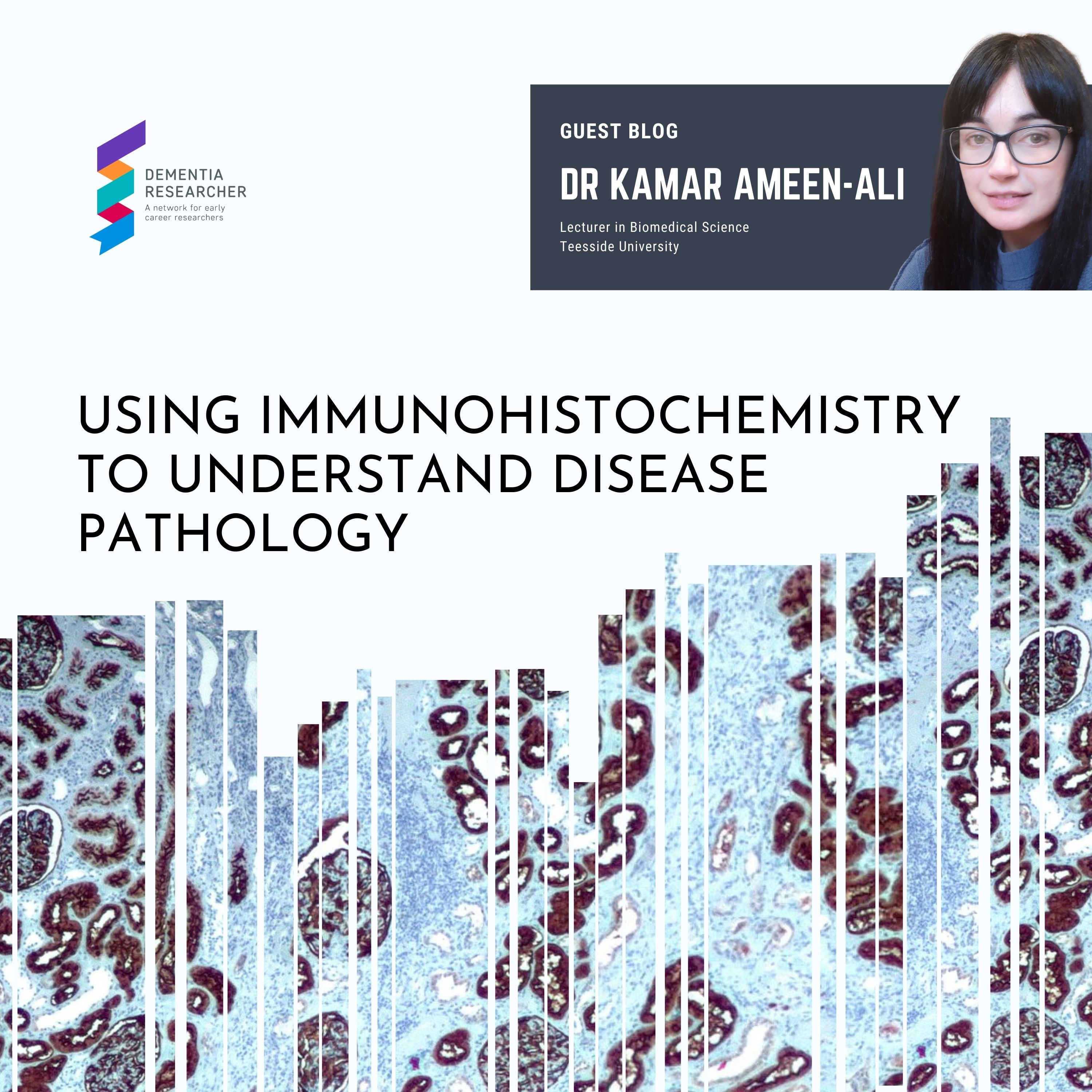
Ep 303Dr Kamar Ameen-Ali - Using immunohistochemistry to understand disease pathology
Dr Kamar Ameen-Ali narrates her blog written for Dementia Researcher. Immunohistochemistry is both an experimental and diagnostic technique which is frequently used in research and clinical pathology laboratories. In this blog Kamar provides an introduction to immunohistochemistry and describes how it is used to diagnose neurodegenerative diseases post-mortem, with examples of how it has been used in her own experimental research. Find the original text, and narration here on our website. https://www.dementiaresearcher.nihr.ac.uk/guest-blog-using-immunohistochemistry-to-understand-disease-pathology/ -- Dr Kamar Ameen-Ali is a Lecturer in Biomedical Science at Teesside University & Affiliate Researcher at Glasgow University. In addition to teaching, Kamar is exploring how neuroinflammation following traumatic brain injury contributes to the progression of neurodegenerative diseases that lead to dementia. Having first pursued a career as an NHS Psychologist, Kamar went back to University in Durham to look at rodent behavioural tasks to completed her PhD, and then worked as a regional Programme Manager for NC3Rs. -- Enjoy listening? We're always looking for new bloggers, drop us a line. http://www.dementiaresearcher.nihr.ac.uk This podcast is brought to you in association with Alzheimer's Association, Alzheimer's Research UK, Alzheimer's Society and Race Against Dementia, who we thank for their ongoing support.
Ep 302Dr Clarissa Giebel - International Women’s Day, gender equity in science and celebrating fellow women’s achievements
Dr Clarissa Giebel narrates her blog written for Dementia Researcher. Today, 8th of March, it’s International Women’s Day – Dr Clarissa Giebel takes the opportunity to highlight the many things fantastic women have achieved, taking stock where we are at in terms of gender equity (or still mostly inequity), and recognising what we still need to achieve. As a scientist, in an originally male-dominated profession, it’s also an opportunity to celebrate the brilliant achievements of female scientists, including dementia and social care researchers in my field. But what’s more, it’s an opportunity to reflect on and celebrate the many female non-academics we as scientists work with. Find the original text, and narration here on our website. https://www.dementiaresearcher.nihr.ac.uk/guest-blog-gender-equity-in-science-celebrating-womens-achievements/ -- Dr Clarissa Giebel is a Senior Research Fellow at the University of Liverpool and NIHR ARC North West Coast. Clarissa has been working in dementia care research for over 10 years focusing her research on helping people with dementia to live at home independently and well for longer, addressing inequalities that people with dementia and carers can face. Outside of her day work, Clarissa has also organised a local dementia network - the Liverpool Dementia & Ageing Research Forum, and has recently started her own podcast called the Ageing Scientist. -- If you would like to write your own blog drop us a line, we're always on the look out for new contributors to write about their research, careers + more [email protected] This podcast is brought to you in association with Alzheimer's Association, Alzheimer's Research UK, Alzheimer's Society and Race Against Dementia, who we thank for their ongoing support.

Ep 301Beth Eyre - How to find a Postdoc Job
Beth Eyre narrates her blog written for Dementia Researcher. The final year of a PhD is scary for many reasons. All of your hard work is coming to an end, you have to write a very long book and there can be lots of uncertainty about what’s next. For Beth, the ‘what’s next’ was always scary. So many thoughts would constantly run around her head, such as how and when willshe find a job? What if she doesn't... In this blog Beth talks about her approach to finding Postdoc job. Find the original text, and narration here on our website. https://www.dementiaresearcher.nihr.ac.uk/guest-blog-how-to-find-a-postdoc-job/ -- Beth Eyre is a PhD Student at The University of Sheffield, researching Neurovascular and cognitive function in preclinical models of Alzheimer’s disease. Beth has a background in psychology, where she gained her degree from the University of Leeds. Inside and outside the lab, Beth loves sharing her science and in her blogs she discusses her work, career and shares lessons she learns as she navigates life as an early career researcher. -- This podcast is brought to you in association with Alzheimer's Association, Alzheimer's Research UK, Alzheimer's Society and Race Against Dementia, who we thank for their ongoing support. Enjoy listening? We're always on the look out for new contributors, if you would like to write and narrate your own blog - drop us a line [email protected]. Don't forget to also listen to our fortnightly podcast, just look for Dementia Researcher in your podcast app.

Ep 300Adam Smith - Find the right journal for your research & avoid predators
Adam Smith narrates his blog written for Dementia Researcher. If you're new to research, at some point you will need to publish your work. In this blog Adam Smith talks about how to avoid predatory publishers and provides tips on how to choose the right journal to publish in. Not sure what predatory publishing is? Well Predatory or deceptive publishing are terms describing publishers or entities that exploit authors by charging publication fees (commonly known as article processing charges) yet don't deliver on their promise of the editorial and publishing services (such as peer review) that are associated with legitimate publishers... but don't just read this, have a listen. Find the original text, and narration here on our website. https://www.dementiaresearcher.nihr.ac.uk/guest-blog-find-the-right-journal-for-your-research-avoid-predators/ -- Adam Smith was born in the north, a long time ago. He wanted to write books, but ended up working in the NHS, and at the Department of Health. He is now Programme Director in the Office of the NIHR National Director for Dementia Research (which probably sounds more important than it is) at University College London. He has led a number of initiatives to improve dementia research (including this website, Join Dementia Research & ENRICH), as well as pursuing his own research interests. In his spare time, he grows vegetables, builds Lego & spends most of his time drinking too much coffee and squeezing technology into his house. _____________________________________________________ Enjoy listening? We're always looking for new bloggers, drop us a line. http://www.dementiaresearcher.nihr.ac.uk This podcast is brought to you in association with Alzheimer's Association, Alzheimer's Research UK, Alzheimer's Society and Race Against Dementia, who we thank for their ongoing support.
Ep 299Dr Yvonne Couch - How Being Seen Might Matter in Science
Dr Yvonne Couch, narrates her blog written for the Dementia Researcher website. Even for Yvonne this one is going to be slightly obscure (her words), full of unnecessary references to books you’ve probably never even heard of and highly opinionated. Today Yvonne talks about reputation in science. Whether it’s possible to build one and how that might affect your career (PS Dementia Researcher could help with that...) - whether thats through your science, publications, the journals you choose... or being a TikTok sensation, which counts? Is it important? Find the original text, and narration here on our website. https://www.dementiaresearcher.nihr.ac.uk/guest-blog-how-being-seen-might-matter-in-science/ -- Dr Yvonne Couch is an Alzheimer's Research UK Fellow at the University of Oxford. Yvonne studies the role of extracellular vesicles and their role in changing the function of the vasculature after stroke, aiming to discover why the prevalence of dementia after stroke is three times higher than the average. It is her passion for problem solving and love of science that drives her, in advancing our knowledge of disease. Yvonne writes about her work, academic life, and careers as she takes a new road into independent research @dr_yvonne_couch _____________________________________________________ Enjoy listening? We're always looking for new bloggers, drop us a line. http://www.dementiaresearcher.nihr.ac.uk This podcast is brought to you in association with Alzheimer's Association, Alzheimer's Research UK, Alzheimer's Society and Race Against Dementia, who we thank for their ongoing support.

Ep 298Hannah Hussain - Vitamins, Food Supplements & Dementia
Hannah Hussain narrates her blog written for Dementia Researcher. Vitamins and supplements are not pharmacological interventions and are not typically provided by the NHS. But this does not mean that they do not have benefits for the user. Hannah Hussain is a PhD Student studying health economics and dementia, however... she is also a fully qualified and jobbing pharmacist. In this blog she talks about vitamins and food suppliments and the roles they play in the brain. Many vitamins and minerals are essential for our bodies to function, and although most should be acquired through a balanced and healthy diet – supplementing on particular vitamins that a person may be deficient in or have trouble absorbing can be helpful... find out more in this blog. Find the original text, and narration here on our website. https://www.dementiaresearcher.nihr.ac.uk/guest-blog-vitamins-food-supplements-dementia/ -- Hannah Hussain is a PhD Student in Health Economics at The University of Sheffield. As a proud third generation migrant and British-Asian, her career path has been linear and ever evolving, originally qualifying as a Pharmacist in Nottingham, then Health Economics in Birmingham. Her studies have opened a world into Psychology, Mental Health and other areas of health, and with that and personal influences she found her passion for dementia. -- This podcast is brought to you in association with Alzheimer's Association, Alzheimer's Research UK, Alzheimer's Society and Race Against Dementia, who we thank for their ongoing support. Enjoy listening? We're always looking for new bloggers, drop us a line [email protected]
Ep 297Anna Marie Rosická - 5 things I wish I knew before starting my PhD
Anna Marie Rosická narrates her blog written for Dementia Researcher. The past 18 months have been adventurous for Anna Marie. From moving to a different country on her own, through the infamous “I-have-no-idea-what-I-am–doing” phase, to gradually becoming settled in her new researcher life with all its perks and peculiarities. Yes, you read that right – it has been something over a year since she started her research PhD. Anna Marie, like most who started a PhD knew it would be a learning experience. But there are also quite a few tricks of the trade she wishes someone had mentioned before she had started, to avoid learning the hard way! In this blog Anna Marie provides a list of such learnings. hopefully they will be helpful to someone else out there – whether you are just starting your own PhD journey or just need to feel less alone with the PhD storms you have already weathered! Find the original text, and narration here on our website. https://www.dementiaresearcher.nihr.ac.uk/guest-blog-5-things-i-wish-i-knew-before-starting-my-phd/ -- Anna Marie Rosická is a PhD Student at Trinity College Dublin. Anna received a master’s degree in psychology from the Masaryk University in Brno, Czech Republic, and gained industry experience working as a user experience researcher in IT. Now she studies the effects of ageing and modifiable risk factors on brain health, using gamified cognitive assessments and large-scale data from the smartphone app Neureka. Enjoy listening and reading our blogs? We're always on the look out for new contributors, drop us a line and share your own research and careers advice [email protected] This podcast is brought to you in association with Alzheimer's Association, Alzheimer's Research UK, Alzheimer's Society and Race Against Dementia, who we thank for their ongoing support.

Ep 296Dr Sam Moxon - How to Navigate a Job Switch
Dr Sam Moxon, narrates his blog written for Dementia Researcher. Sam started a new job this month. A new job that meant he left a place he had been at for 6 years, moved to a new city and ventured out into a totally new workplace. It’s quite a lot of change all at once but but did a great job of navigating it. With the challenge of short-term contracts, its easy to become desensitised to moving house in academia. You basically do it every year! But it got Sam thinking job changes and how best to navigate them. It can be quite a stressful experience and he talks about how you can make transition easier. So without further delay… here are Sam's top 5 tips for navigating a job switch: Find the original text, and narration here on our website. https://www.dementiaresearcher.nihr.ac.uk/guest-blog-how-to-navigate-a-job-switch/ -- Dr Sam Moxon is a biomaterials scientist at the University of Manchester. His expertise falls on the interface between biology and engineering. His PhD focussed on regenerative medicine and he now works on trying to develop 3D bioprinting techniques with human stem cells, so that we better understand and treat degenerative diseases. Outside of the lab he hikes through the Lake District and is an expert on all things Disney. Enjoy listening and reading our blogs? We're always on the look out for new contributors, drop us a line and share your own research and careers advice [email protected] This podcast is brought to you in association with Alzheimer's Association, Alzheimer's Research UK, Alzheimer's Society and Race Against Dementia, who we thank for their ongoing support.
Ep 295Dr Gaia Brezzo - To cross or not to cross the picket line: striking as an ECR.
Dr Gaia Brezzo narrates her blog written for Dementia Researcher. Good researchers evaluate data from every angle. They explore cause and effect and untangle the tricky web that interconnects everyday phenomena. So it is easy to understand why Gaia has found it difficult to decide where she stands when it comes to the decision around if she should or shouldn't participate in the industrial action voted on by University & College Union members in a dispute with Universities over pensions, pay and conditions. In this blog Gaia sets out the issues and shares her thoughts on the challenges, the points of dispute and how to respond. Find the original text, and narration here on our website. https://www.dementiaresearcher.nihr.ac.uk/guest-blog-to-cross-or-not-to-cross-the-picket-line-striking-as-an-ecr/ -- Dr Gaia Brezzo is a Research Fellow based within the UK Dementia Research Institute at The University of Edinburgh. Gaia's research focuses on understanding how immune alterations triggered by stroke shape chronic maladaptive neuroimmune responses that lead to post-stroke cognitive decline and vascular dementia. Raised in Italy, Gaia came to the UK to complete her undergraduate degree, and thankfully, stuck around. Gaia writes about her work and career challenges, when not biking her way up and down hills in Edinburgh. Follow Gaia on Twitter: @Gaia_Brezzo -- Enjoy listening? We're always looking for new bloggers, drop us a line. http://www.dementiaresearcher.nihr.ac.uk This podcast is brought to you in association with Alzheimer's Association, Alzheimer's Research UK, Alzheimer's Society and Race Against Dementia, who we thank for their ongoing support.
Ep 294Dr Connor Richardson - Am I in “Career Drift Mode?”
Dr Connor Richardson narrates his blog written for Dementia Researcher. Career drift can happen when you proceed on your professional career course with no plan, or when a career strategy goes awry due to conditions beyond your control (like a pandemic.... or in academia... a lack of funding maybe?). It is easy to become reactive and stop being proactive career moves, taking the next job because it was offered (without building toward long-term goals) and now you feel stuck. Well, that's kind of how Connor felt in 2022, coming out of the pandemic, but could 2023 be a new year? Was that period of drift actually useful, and was 2022 all bad? Questions he answers in this blog. Find the original text, and narration here on our website. https://www.dementiaresearcher.nihr.ac.uk/guest-blog-am-i-in-career-drift-mode/ -- Dr Connor Richardson is a Neuro-epidemiology Research Associate in the Newcastle University Population Health Sciences Institute. Connor is the research statistician for the Cognitive Function and Ageing studies (CFAS) multi-centre population cohort. His research interest lies in using advanced statistical modelling and machine learning to measure dementia risk. Connor blogs about his research, Equality, Diversity and Inclusion and sometimes his Pomapoo’s. -- Enjoy listening? We're always looking for new bloggers, drop us a line. http://www.dementiaresearcher.nihr.ac.uk This podcast is brought to you in association with Alzheimer's Association, Alzheimer's Research UK, Alzheimer's Society and Race Against Dementia, who we thank for their ongoing support.
Ep 293Dr Anna Volkmer - Writing a paper with lots of co-authors
Dr Anna Volkmer, narrates her blog written for Dementia Researcher. Success in academia if often measured in papers. And the best papers seem to be those with about a million authors on them. Writing anything down on paper seems daunting enough without having to share it with a bunch of others who are going to give their judgement (using the edit and comment function on word – which makes everything a horrifying red). And this is all before you even submit anything to the dreaded journal reviewers. So, how does one manage this as a lowly ECR? Over the years Anna has developed a couple of tricks that she finds useful - and in this blog she shares them (it would be great to hear yours too - add them to the comments). Find the original text, and narration here on our website. https://www.dementiaresearcher.nihr.ac.uk/guest-blog-writing-a-paper-with-lots-of-co-authors/ -- Dr Anna Volkmer is a Speech and Language Therapist and researcher in Language and Cognition, Department of Psychology and Language Sciences, University College London. Anna is researching Speech and language therapy interventions in language led dementia and was once voted scariest speech and language therapist (even her children agree). -- If you would like to write your own blog drop us a line, we're always on the look out for new contributors to write about their research, careers + more [email protected] -- This podcast is brought to you in association with Alzheimer's Association, Alzheimer's Research UK, Alzheimer's Society and Race Against Dementia, who we thank for their ongoing support.
Ep 292Dr Clarissa Giebel - Public Involvement & Engagement in Research
Dr Clarissa Giebel narrates her blog written for Dementia Researcher. You will have come across the term PPIE, or Patient and Public Involvement and Engagement. It is a given that we involve people affected by a condition, so for us, dementia, in our research design and development, conduct, and dissemination. And that is not restricted to dementia of course. PPIE needs to be embedded in any health and social care research, because how else do we know that we as researchers really address the issues that are most important, and urgent, to those with lived experience? In this blog Clarissa takes us through her advise for great PPIE. Find the original text, and narration here on our website. https://www.dementiaresearcher.nihr.ac.uk/guest-blog-public-involvement-engagement-in-research/ -- Dr Clarissa Giebel is a Senior Research Fellow at the University of Liverpool and NIHR ARC North West Coast. Clarissa has been working in dementia care research for over 10 years focusing her research on helping people with dementia to live at home independently and well for longer, addressing inequalities that people with dementia and carers can face. Outside of her day work, Clarissa has also organised a local dementia network - the Liverpool Dementia & Ageing Research Forum, and has recently started her own podcast called the Ageing Scientist. -- If you would like to write your own blog drop us a line, we're always on the look out for new contributors to write about their research, careers + more [email protected] -- This podcast is brought to you in association with Alzheimer's Association, Alzheimer's Research UK, Alzheimer's Society and Race Against Dementia, who we thank for their ongoing support.

Ep 291Dr Aida Suárez-Gonzalez - Building positive narratives about dementia
Dr Aida Suárez-Gonzalez narrates her blog written for Dementia Researcher. Aida has just been awarded UCL Global Engagement Funds (GEF) for a project to co-produce positive narratives about dementia. The GEF are an exciting seed funding scheme for all sorts of global engagement ideas. In Aida's project, she plans to partne with collaborators at Princeton University and the University of South Carolina. The aim being to co-create an Oliver Sack’s style book about people with posterior cortical atrophy (PCA), primary progressive aphasia (PPA) and dementia with lewy bodies (DLB). And publish it - in this blog Aida shares her journey of selling the idea and applying for the UCL Global Engagement funds. Find the original text, and narration here on our website. https://www.dementiaresearcher.nihr.ac.uk/guest-blog-building-positive-narratives-about-dementia/ -- Dr Aida Suarez-Gonzalez is a Clinical Neuropsychologist and Senior Research Fellow at the Dementia Research Centre, UCL Institute of Neurology at Queen Square. With many years clinical experience working in Spain, Aida now investigating non-pharmacological interventions, services and assistive technologies to support people living well with dementia. -- This podcast is brought to you in association with Alzheimer's Association, Alzheimer's Research UK, Alzheimer's Society and Race Against Dementia, who we thank for their ongoing support. Enjoy listening? We're always looking for new bloggers, drop us a line [email protected]

Ep 290Dr Kamar Ameen-Ali - Peer Reviewing Grant Applications
Dr Kamar Ameen-Ali narrates her blog written for Dementia Researcher. Kam was recently asked to peer review a grant by a major UK research funder. This was not something she had been asked to do before, and it made her realise the sheer number of tasks required of us in academia that we simply get zero training or guidance on. In this blog, Kamar pulls together her experience of grant peer reviewing and provides guidance that will hopefully be helpful to other new reviewers. Find the original text, and narration here on our website. https://www.dementiaresearcher.nihr.ac.uk/guest-blog-peer-reviewing-grant-applications/ -- Dr Kamar Ameen-Ali is a Lecturer in Biomedical Science at Teesside University & Affiliate Researcher at Glasgow University. In addition to teaching, Kamar is exploring how neuroinflammation following traumatic brain injury contributes to the progression of neurodegenerative diseases that lead to dementia. Having first pursued a career as an NHS Psychologist, Kamar went back to University in Durham to look at rodent behavioural tasks to completed her PhD, and then worked as a regional Programme Manager for NC3Rs. -- Enjoy listening? We're always looking for new bloggers, drop us a line. http://www.dementiaresearcher.nihr.ac.uk This podcast is brought to you in association with Alzheimer's Association, Alzheimer's Research UK, Alzheimer's Society and Race Against Dementia, who we thank for their ongoing support.
Ep 289Beth Eyre - Writing a fellowship application
Beth Eyre narrates her blog written for Dementia Researcher. Not only is this the year I will Beth be finishing her PhD training, but this was also the year she had a go at writing her first ever fellowship application. Writing your first applicatoin can be a hard slog (which is probably why so many people take a gap year between PhD and Fellowship and explore a ready-made postdoc position). Beth says she is very lucky, because she has extremely helpful supervisors to provide lots of advice along the way. So in this blog, Beth shares some of the ins and outs of the process. Because let’s be honest, there are many things within academia that we have no idea about until we actually have to do them – and fellowship applications certainly fall into that category! Find the original text, and narration here on our website. https://www.dementiaresearcher.nihr.ac.uk/guest-blog-writing-a-fellowship-application/ We're always on the look out for new contributors, if you would like to write and narrate your own blog - drop us a line to [email protected] Don't forget to also listen to our fortnightly podcast, just look for Dementia Researcher in your podcast app. -- Beth Eyre is a PhD Student at The University of Sheffield, researching Neurovascular and cognitive function in preclinical models of Alzheimer’s disease. Beth has a background in psychology, where she gained her degree from the University of Leeds. Inside and outside the lab, Beth loves sharing her science and in her blogs she discusses her work, career and shares lessons she learns as she navigates life as an early career researcher. -- This podcast is brought to you in association with Alzheimer's Association, Alzheimer's Research UK, Alzheimer's Society and Race Against Dementia, who we thank for their ongoing support. Enjoy listening? We're always looking for new bloggers, drop us a line [email protected]
Ep 288Dr Yvonne Couch - Procrastination the Thief of Time
Dr Yvonne Couch, narrates her blog written for the Dementia Researcher website. Yvonne has recently been doing a lot of procrastinating, and not a lot of grant writing. In fact as she writes this, she should be either in the lab or writing a grant and yet she is not! Instead she is writing and narrating this blog. When talking to a friend about the challenge, they replied that they thought procrastination was often a response to trauma. Not big car crash, death of a loved one trauma. But trauma, nevertheless. And it got Yvonne to thinking about why we procrastinate, more importantly why she procrastinates, and whether there’s anything we can do about it. Find the original text, and narration here on our website. https://www.dementiaresearcher.nihr.ac.uk/guest-blog-procrastination-the-thief-of-time/ -- Dr Yvonne Couch is an Alzheimer's Research UK Fellow at the University of Oxford. Yvonne studies the role of extracellular vesicles and their role in changing the function of the vasculature after stroke, aiming to discover why the prevalence of dementia after stroke is three times higher than the average. It is her passion for problem solving and love of science that drives her, in advancing our knowledge of disease. Yvonne writes about her work, academic life, and careers as she takes a new road into independent research. _____________________________________________________ Enjoy listening? We're always looking for new bloggers, drop us a line. http://www.dementiaresearcher.nihr.ac.uk This podcast is brought to you in association with Alzheimer's Association, Alzheimer's Research UK, Alzheimer's Society and Race Against Dementia, who we thank for their ongoing support.
Ep 287Dr Clarissa Giebel - The value of academic travel and face-to-face networking
Dr Clarissa Giebel narrates her blog written for Dementia Researcher. It’s only taken 2.5 years for Clarissa to finally go out to Australia as part of her Wellcome Trust funding. There was a time when she thought it would never happen, but it finally became possible to connect in real life with some researchers she has worked with remotely on routine data in dementia care, and to meet a great number of brilliant minds over there. In this blog Clarissa talks about the trip and reflects on the benefits of networking and overseas collaborations. Find the original text, and narration here on our website. https://www.dementiaresearcher.nihr.ac.uk/guest-blog-the-value-of-academic-travel-and-face-to-face-networking/ -- Dr Clarissa Giebel is a Senior Research Fellow at the University of Liverpool and NIHR ARC North West Coast. Clarissa has been working in dementia care research for over 10 years focusing her research on helping people with dementia to live at home independently and well for longer, addressing inequalities that people with dementia and carers can face. Outside of her day work, Clarissa has also organised a local dementia network - the Liverpool Dementia & Ageing Research Forum, and has recently started her own podcast called the Ageing Scientist. -- If you would like to write your own blog drop us a line, we're always on the look out for new contributors to write about their research, careers + more [email protected] -- This podcast is brought to you in association with Alzheimer's Association, Alzheimer's Research UK, Alzheimer's Society and Race Against Dementia, who we thank for their ongoing support. -- Note - Dementia Researcher understands the benefits of international travel to support conference attendance and collaborations. However, we want to make you aware that a return flight from London to Singapore creates 3 tonnes of CO2 per passenger. That’s the equivalent of heating a family home for a year. Please consider offsetting your flights when international travel is essential, and take the train when you can. Find more information at https://www.which.co.uk/reviews/airlines/article/carbon-offsetting-how-to-reduce-the-impact-of-flying-abuH44x4FeWn

Ep 286Dr Kamar Ameen-Ali blog - Why ECRs need good mentors
Dr Kamar Ameen-Ali narrates her blog written for Dementia Researcher. Recent years have seen various mentoring schemes pop up in academia both within Higher Education Institutions (HEIs), and through organisations and charities. This has, in part, been in response to a changing landscape over the last decade or so, which has seen an increase in precarious contract-based employment for early career researchers (ECRs), resulting in many talented scientists leaving academia for better-paid secure employment where they feel valued. In this blog Kam shares her experience of being part of two different mentoring schemes and discusses why ECRs need good mentors. Find the original text, and narration here on our website. https://www.dementiaresearcher.nihr.ac.uk/guest-blog-why-ecrs-need-good-mentors/ -- Dr Kamar Ameen-Ali is a Lecturer in Biomedical Science at Teesside University & Affiliate Researcher at Glasgow University. In addition to teaching, Kamar is exploring how neuroinflammation following traumatic brain injury contributes to the progression of neurodegenerative diseases that lead to dementia. Having first pursued a career as an NHS Psychologist, Kamar went back to University in Durham to look at rodent behavioural tasks to completed her PhD, and then worked as a regional Programme Manager for NC3Rs. -- Enjoy listening? We're always looking for new bloggers, drop us a line. http://www.dementiaresearcher.nihr.ac.uk This podcast is brought to you in association with Alzheimer's Association, Alzheimer's Research UK, Alzheimer's Society and Race Against Dementia, who we thank for their ongoing support.

Ep 285Dr Diana Karamacoska - Fostering inclusivity in dementia research and teams
Dr Diana Karamacoska narrates her blog written for the ISTAART Partnering with Research Participants PIA, shared by Dementia Researcher (this blog has also been published in Spanish). People from culturally diverse backgrounds, particularly those that do not speak English, tend to be excluded from dementia research. This is a pressing issue considering the disparities associated with these populations accessing information about dementia, diagnostic support, interventions, and care services in highly multicultural places like Australia, UK, and USA. Seeing the impacts of these gaps in our own communities inspired Diana and the ISTAART Partnering with Participants PIA to make dementia research accessible, inclusive, and equitable. They are now sharing the lessons they've learnt so that other teams can intentionally embrace diversity (and avoid the hiccups they encountered). Find the original text, and narration here on our website. https://www.dementiaresearcher.nihr.ac.uk/istaart-blog-fostering-inclusivity-in-dementia-research-and-teams/ -- Dr Diana Karamacoska is a Postdoctoral Research Fellow at Western Sydney University with a background in cognitive neuroscientist. Diana is moving in to the the public health field after seeing the stigma, health disparities, and lack of appropriate education about dementia in multicultural communities. Diana is also Vice Chair of the ISTAART Partnering with Research Participants PIA. Research for dementia therapeutics and care occurs in a world that is constantly changing. We can improve accessibility and meaningfulness of research by integrating perspectives of participants in the design and conduct of research, as well as in the way results are disseminated. A global forum is needed for researchers to share best practices on how to partner with participants, as well as opportunities to learn directly from the lived experiences of a diverse group of research participants. The ISTAART Partnering with Research Participants PIA, works with existing PIAs and leverage existing groups to ensure broad access and applicability. -- Enjoy listening? We're always looking for new bloggers, drop us a line. http://www.dementiaresearcher.nihr.ac.uk This podcast is brought to you in association with Alzheimer's Association, Alzheimer's Research UK, Alzheimer's Society and Race Against Dementia, who we thank for their ongoing support. Enjoy listening? We're always looking for new bloggers, drop us a line [email protected]

Ep 284Dr Diana Karamacoska - Fomentar la inclusión en la investigación y los equipos de demencia
Gabriela Caballero narra un blog escrito por la Dra. Diana Karamacoska publicado en Dementia Researcher en nombre de ISTAART Partnering with Research Participants PIA (This blog has also been published in English). Las personas de orígenes culturalmente diversos, particularmente aquellas que no hablan inglés, tienden a ser excluidas de las investigaciones sobre la demencia. Este es un tema urgente considerando las disparidades asociadas con el acceso de estas poblaciones a información sobre la demencia, apoyo diagnóstico, intervención, y servicios de atención en lugares altamente multiculturales como Australia, el Reino Unido y los Estados Unidos. Al ver estas diferencias de equidad en nuestras comunidades, inspiró a nuestro equipo a hacer la investigación en demencia accesible, inclusiva y equitativa. Ahora estamos compartiendo las lecciones que hemos aprendido para que otros equipos puedan adoptar la diversidad y evitar los problemas con los que nosotros nos enfrentamos. Encuentre el texto original y la narración aquí en nuestro sitio web.. https://www.dementiaresearcher.nihr.ac.uk/istaart-blog-fostering-inclusivity-in-dementia-research-and-teams/ -- Dr Diana Karamacoska is a Postdoctoral Research Fellow at Western Sydney University with a background in cognitive neuroscientist. Diana is moving in to the the public health field after seeing the stigma, health disparities, and lack of appropriate education about dementia in multicultural communities. Diana is also Vice Chair of the ISTAART Partnering with Research Participants PIA. Gabriela Caballero (who provided the Spanish translation and narration for this blog) is a Researcher and PhD candidate in the NICM Health Research Institute, Western Sydney University. She recently completed a Bachelor of Psychology, during this time she worked as a crisis supporter and as a research assistant on multiple dementia-related projects. Gabriela's PhD focuses on improving the quality of life for multicultural communities impacted by dementia. Research for dementia therapeutics and care occurs in a world that is constantly changing. We can improve accessibility and meaningfulness of research by integrating perspectives of participants in the design and conduct of research, as well as in the way results are disseminated. A global forum is needed for researchers to share best practices on how to partner with participants, as well as opportunities to learn directly from the lived experiences of a diverse group of research participants. The ISTAART Partnering with Research Participants PIA, works with existing PIAs and leverage existing groups to ensure broad access and applicability. -- Enjoy listening? We're always looking for new bloggers, drop us a line. http://www.dementiaresearcher.nihr.ac.uk This podcast is brought to you in association with Alzheimer's Association, Alzheimer's Research UK, Alzheimer's Society and Race Against Dementia, who we thank for their ongoing support. Enjoy listening? We're always looking for new bloggers, drop us a line [email protected]

Ep 283Hannah Hussain - Outcomes Matter
Hannah Hussain narrates her blog written for Dementia Researcher. In this blog Hannah discusses Health Outcomes. It is well known that some groups in the population have significantly poorer health outcomes and worse experiences of using health and care services than others. Overall, experts agree that the best health outcome following interaction with healthcare services or delivery of an intervention (or research intervention) should be one that the person recieving feels is the best - but how is that measures? (because we do like our checks and balances) In this blog Hannah explains all things outcomes related, hopefully this will be a helpful blog to those that may be finding this topic a little intimidating. Find the original text, and narration here on our website. https://www.dementiaresearcher.nihr.ac.uk/guest-blog-outcomes-matter/ -- Hannah Hussain is a PhD Student in Health Economics at The University of Sheffield. As a proud third generation migrant and British-Asian, her career path has been linear and ever evolving, originally qualifying as a Pharmacist in Nottingham, then Health Economics in Birmingham. Her studies have opened a world into Psychology, Mental Health and other areas of health, and with that and personal influences she found her passion for dementia. -- Enjoy listening? We're always looking for new bloggers, drop us a line. http://www.dementiaresearcher.nihr.ac.uk This podcast is brought to you in association with Alzheimer's Association, Alzheimer's Research UK, Alzheimer's Society and Race Against Dementia, who we thank for their ongoing support. Enjoy listening? We're always looking for new bloggers, drop us a line [email protected]
Ep 282Dr Megan Polden - Evaluation of Singing & Dancing Interventions for Dementia
Dr Megan Polden narrates her blog written for Dementia Researcher. In her first blog for Dementia Researcher, Megan writes about her passion for older peoples research and improving the lives of people living with dementia. We hear about the amazing work on her PhD, which explored the use of eyetracking technology as a biomarker, and now about the plans for her first postdoc position, evaluating and exploring the benefits of singing and dancing as a support for both careers and people living with dementia in the community. Find the original text, and narration here on our website. https://www.dementiaresearcher.nihr.ac.uk/guest-blog-evaluation-of-singing-dancing-interventions-for-dementia/ -- Dr Megan Polden is a Postdoctoral Research Associate at University of Liverpool, currently researching the effectiveness and accessibility of singing and dancing intervention services for people living with dementia. Megan completed her undergraduate degree, masters and PhD at Lancaster University. Her PhD examined memory and inhibitory control processes in Alzheimer's Disease and mild cognitive impairment and examining whether eye tracking could be an effective method to measure these processes. Follow Megan on Twitter: @MeganPolden -- Enjoy listening? We're always looking for new bloggers, drop us a line. http://www.dementiaresearcher.nihr.ac.uk This podcast is brought to you in association with Alzheimer's Association, Alzheimer's Research UK, Alzheimer's Society and Race Against Dementia, who we thank for their ongoing support.
Ep 281Dr Victoria Shepherd - Advance planning for research participation
Dr Victoria Shepherd narrates her blog written for Dementia Researcher. Do you have experience of struggling to recruit people to your research study? Both Alzheimer’s Research UK and Alzheimers’ Society have highlighted the shockingly low participation in dementia research compared to other major health conditions. Recent announcements of a ‘national mission’ to tackle dementia and funding to strengthen capacity and capability in dementia research are, of course, very welcome. However, the barriers to recruiting sufficient numbers of people living with dementia will also need to be addressed. Could there be other ways to look at this challenge? Vicky discusses in this blog. Find the original text, and narration here on our website. https://www.dementiaresearcher.nihr.ac.uk/guest-blog-advance-planning-for-research-participation/ -- Dr Victoria Shepherd is a Senior Research Fellow at Cardiff University where she leads a programme of research to improve inclusivity of under-served groups in trials, with a particular focus on the ethical and methodological challenges around involving adults who lack capacity to consent. She leads a number of trials methodology research projects, including the development of the NIHR INCLUDE Impaired Capacity to Consent Framework which helps researchers to design more inclusive trials. Victoria is a registered nurse and is also involved in the design and conduct of a range of clinical trials and national and international studies in care homes. Follow Vicky on Twitter: @VickyLShepherd -- Enjoy listening? We're always looking for new bloggers, drop us a line. http://www.dementiaresearcher.nihr.ac.uk This podcast is brought to you in association with Alzheimer's Association, Alzheimer's Research UK, Alzheimer's Society and Race Against Dementia, who we thank for their ongoing support.

Ep 280Dr Sam Moxon - My top tips for Veganuary
Dr Sam Moxon, narrates his blog written for Dementia Researcher. If you follow Sam's work with Dementia Researcher you may have stumbled upon his podcast series “Food for Thought”. It’s a show Sam sits down with medical doctors who specialise in treating their patients by complementing modern medicine with well-evidenced, beneficial diet and lifestyle choices. They talk about the best foods you can eat in order to keep your brain in the best possible shape and reduce your risk of developing dementia. If you have listened to any of those podcast episodes you will have learned that there is a wealth of evidence out there that, in many cases, genes merely load the gun for developing dementia. Diet and lifestyle pulls the trigger. So much so that diet and lifestyle choices are the biggest controllable risk factors for developing dementia. More specifically, eating healthy and exercising is one of the best things to do for your brain and there is a recurring theme from every podcast guest: avoid processed foods and bad fats. There are various ways of doing this but the easiest way to do it is to get more plants on your plate. Fruits, vegetables, grains, legumes etc. and this brings us to the topic for this podcast - January is a month of change and it may be the 5th January, but you're not too late to try Veganuary, in this blog Sam talks you through how to get through it. Find the original text, and narration here on our website. https://www.dementiaresearcher.nihr.ac.uk/guest-blog-top-tips-for-veganuary/ -- Dr Sam Moxon is a biomaterials scientist at the University of Manchester. His expertise falls on the interface between biology and engineering. His PhD focussed on regenerative medicine and he now works on trying to develop 3D bioprinting techniques with human stem cells, so that we better understand and treat degenerative diseases. Outside of the lab he hikes through the Lake District and is an expert on all things Disney. Enjoy listening and reading our blogs? We're always on the look out for new contributors, drop us a line and share your own research and careers advice [email protected] This podcast is brought to you in association with Alzheimer's Association, Alzheimer's Research UK, Alzheimer's Society and Race Against Dementia, who we thank for their ongoing support.

Ep 279Dr Gaia Brezzo - Reflections for 2022; another year of science
Dr Gaia Brezzo narrates her blog written for Dementia Researcher. It’s from the comfort of her living room sofa that Gaia writes her final blog for 2022, cup of tea in hand and a purring cat on her lap as she taps away on the keyboard. This month, to round up 2022, Gaia decided to blog about what she has achieved – and not achieved – this year, as she reflects back on another year of her science and what – hopefully exiting stuff – 2023 could bring. Find the original text, and narration here on our website. https://www.dementiaresearcher.nihr.ac.uk/guest-blog-reflections-for-2022-another-year-of-science/ -- Dr Gaia Brezzo is a Research Fellow based within the UK Dementia Research Institute at The University of Edinburgh. Gaia's research focuses on understanding how immune alterations triggered by stroke shape chronic maladaptive neuroimmune responses that lead to post-stroke cognitive decline and vascular dementia. Raised in Italy, Gaia came to the UK to complete her undergraduate degree, and thankfully, stuck around. Gaia writes about her work and career challenges, when not biking her way up and down hills in Edinburgh. Follow Gaia on Twitter: @Gaia_Brezzo -- Enjoy listening? We're always looking for new bloggers, drop us a line. http://www.dementiaresearcher.nihr.ac.uk This podcast is brought to you in association with Alzheimer's Association, Alzheimer's Research UK, Alzheimer's Society and Race Against Dementia, who we thank for their ongoing support.