Data Skeptic
611 episodes — Page 7 of 13
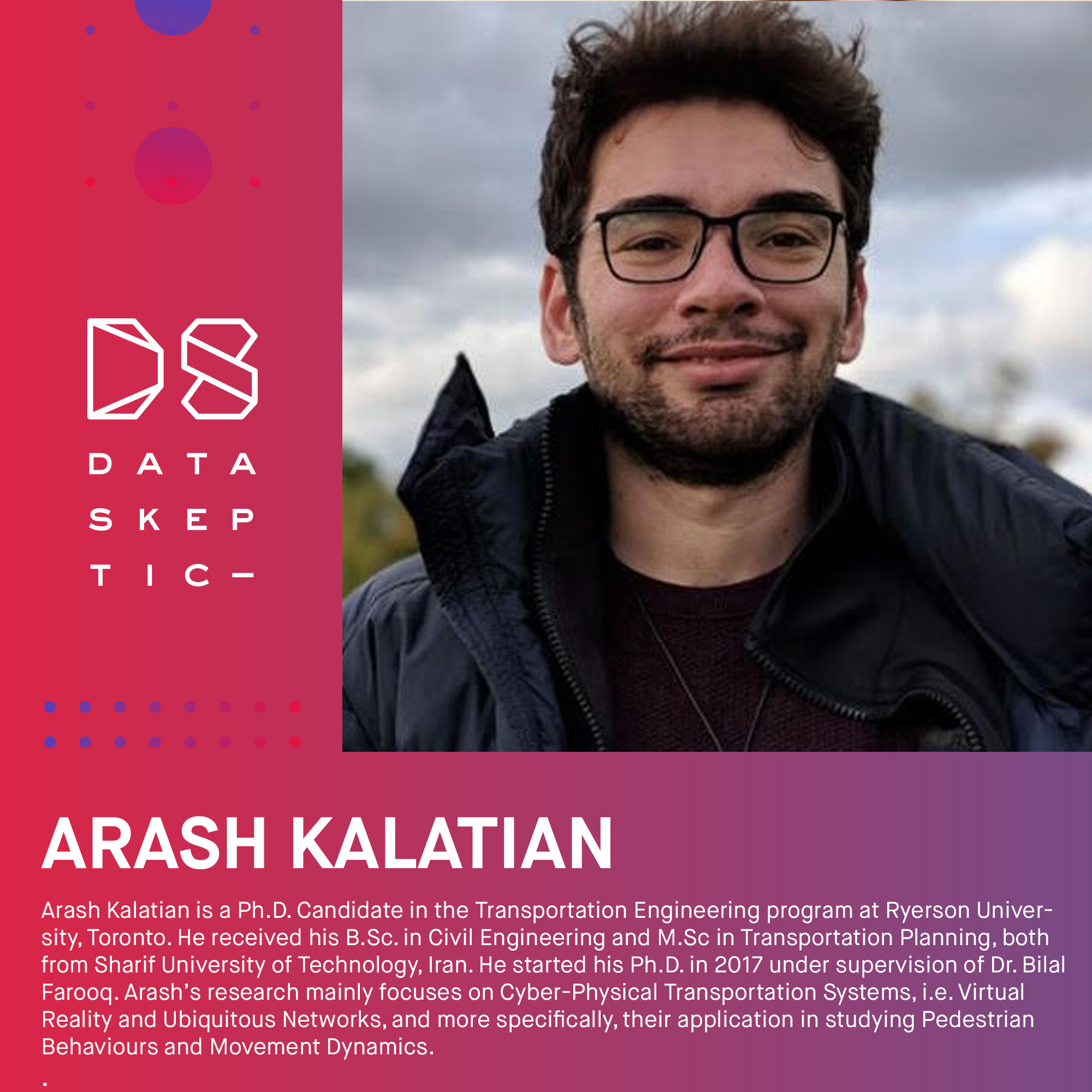
Self Driving Cars and Pedestrians
We are joined by Arash Kalatian to discuss Decoding pedestrian and automated vehicle interactions using immersive virtual reality and interpretable deep learning.

Computer Vision is Not Perfect
Computer Vision is not Perfect Julia Evans joins us help answer the question why do neural networks think a panda is a vulture. Kyle talks to Julia about her hands-on work fooling neural networks. Julia runs Wizard Zines which publishes works such as Your Linux Toolbox. You can find her on Twitter @b0rk

Uncertainty Representations
Jessica Hullman joins us to share her expertise on data visualization and communication of data in the media. We discuss Jessica's work on visualizing uncertainty, interviewing visualization designers on why they don't visualize uncertainty, and modeling interactions with visualizations as Bayesian updates. Homepage: http://users.eecs.northwestern.edu/~jhullman/ Lab: MU Collective

AlphaGo, COVID-19 Contact Tracing and New Data Set
Announcing Journal Club I am pleased to announce Data Skeptic is launching a new spin-off show called "Journal Club" with similar themes but a very different format to the Data Skeptic everyone is used to. In Journal Club, we will have a regular panel and occasional guest panelists to discuss interesting news items and one featured journal article every week in a roundtable discussion. Each week, I'll be joined by Lan Guo and George Kemp for a discussion of interesting data science related news articles and a featured journal or pre-print article. We hope that this podcast will give listeners an introduction to the works we cover and how people discuss these works. Our topics will often coincide with the original Data Skeptic podcast's current Interpretability theme, but we have few rules right now or what we pick. We enjoy discussing these items with each other and we hope you will do. In the coming weeks, we will start opening up the guest chair more often to bring new voices to our discussion. After that we'll be looking for ways we can engage with our audience. Keep reading and thanks for listening! Kyle

Visualizing Uncertainty

Interpretability Tooling
Pramit Choudhary joins us to talk about the methodologies and tools used to assist with model interpretability.

Shapley Values
Kyle and Linhda discuss how Shapley Values might be a good tool for determining what makes the cut for a home renovation.

Anchors as Explanations
We welcome back Marco Tulio Ribeiro to discuss research he has done since our original discussion on LIME. In particular, we ask the question Are Red Roses Red? and discuss how Anchors provide high precision model-agnostic explanations. Please take our listener survey.

Mathematical Models of Ecological Systems

Adversarial Explanations
Walt Woods joins us to discuss his paper Adversarial Explanations for Understanding Image Classification Decisions and Improved Neural Network Robustness with co-authors Jack Chen and Christof Teuscher.

ObjectNet
Andrei Barbu joins us to discuss ObjectNet - a new kind of vision dataset. In contrast to ImageNet, ObjectNet seeks to provide images that are more representative of the types of images an autonomous machine is likely to encounter in the real world. Collecting a dataset in this way required careful use of Mechanical Turk to get Turkers to provide a corpus of images that removes some of the bias found in ImageNet. http://0xab.com/

Visualization and Interpretability
Enrico Bertini joins us to discuss how data visualization can be used to help make machine learning more interpretable and explainable. Find out more about Enrico at http://enrico.bertini.io/. More from Enrico with co-host Moritz Stefaner on the Data Stories podcast!

Interpretable One Shot Learning
We welcome Su Wang back to Data Skeptic to discuss the paper Distributional modeling on a diet: One-shot word learning from text only.

Fooling Computer Vision
Wiebe van Ranst joins us to talk about a project in which specially designed printed images can fool a computer vision system, preventing it from identifying a person. Their attack targets the popular YOLO2 pre-trained image recognition model, and thus, is likely to be widely applicable.

Algorithmic Fairness
This episode includes an interview with Aaron Roth author of The Ethical Algorithm.

Interpretability
Interpretability Machine learning has shown a rapid expansion into every sector and industry. With increasing reliance on models and increasing stakes for the decisions of models, questions of how models actually work are becoming increasingly important to ask. Welcome to Data Skeptic Interpretability. In this episode, Kyle interviews Christoph Molnar about his book Interpretable Machine Learning. Thanks to our sponsor, the Gartner Data & Analytics Summit going on in Grapevine, TX on March 23 – 26, 2020. Use discount code: dataskeptic. Music Our new theme song is #5 by Big D and the Kids Table. Incidental music by Tanuki Suit Riot.
NLP in 2019
A year in recap.
The Limits of NLP
We are joined by Colin Raffel to discuss the paper "Exploring the Limits of Transfer Learning with a Unified Text-to-Text Transformer".
Jumpstart Your ML Project
Seth Juarez joins us to discuss the toolbox of options available to a data scientist to jumpstart or extend their machine learning efforts.
Serverless NLP Model Training
Alex Reeves joins us to discuss some of the challenges around building a serverless, scalable, generic machine learning pipeline. The is a technical deep dive on architecting solutions and a discussion of some of the design choices made.
Team Data Science Process
Buck Woody joins Kyle to share experiences from the field and the application of the Team Data Science Process - a popular six-phase workflow for doing data science.
Ancient Text Restoration
Thea Sommerschield joins us this week to discuss the development of Pythia - a machine learning model trained to assist in the reconstruction of ancient language text.
ML Ops
Kyle met up with Damian Brady at MS Ignite 2019 to discuss machine learning operations.
Annotator Bias
The modern deep learning approaches to natural language processing are voracious in their demands for large corpora to train on. Folk wisdom estimates used to be around 100k documents were required for effective training. The availability of broadly trained, general-purpose models like BERT has made it possible to do transfer learning to achieve novel results on much smaller corpora. Thanks to these advancements, an NLP researcher might get value out of fewer examples since they can use the transfer learning to get a head start and focus on learning the nuances of the language specifically relevant to the task at hand. Thus, small specialized corpora are both useful and practical to create. In this episode, Kyle speaks with Mor Geva, lead author on the recent paper Are We Modeling the Task or the Annotator? An Investigation of Annotator Bias in Natural Language Understanding Datasets, which explores some unintended consequences of the typical procedure followed for generating corpora. Source code for the paper available here: https://github.com/mega002/annotator_bias
NLP for Developers
While at MS Build 2019, Kyle sat down with Lance Olson from the Applied AI team about how tools like cognitive services and cognitive search enable non-data scientists to access relatively advanced NLP tools out of box, and how more advanced data scientists can focus more time on the bigger picture problems.
Indigenous American Language Research
Manuel Mager joins us to discuss natural language processing for low and under-resourced languages. We discuss current work in this area and the Naki Project which aggregates research on NLP for native and indigenous languages of the American continent.
Talking to GPT-2
GPT-2 is yet another in a succession of models like ELMo and BERT which adopt a similar deep learning architecture and train an unsupervised model on a massive text corpus. As we have been covering recently, these approaches are showing tremendous promise, but how close are they to an AGI? Our guest today, Vazgen Davidyants wondered exactly that, and have conversations with a Chatbot running GPT-2. We discuss his experiences as well as some novel thoughts on artificial intelligence.
Reproducing Deep Learning Models
Rajiv Shah attempted to reproduce an earthquake-predicting deep learning model. His results exposed some issues with the model. Kyle and Rajiv discuss the original paper and Rajiv's analysis.
What BERT is Not
Allyson Ettinger joins us to discuss her work in computational linguistics, specifically in exploring some of the ways in which the popular natural language processing approach BERT has limitations.
SpanBERT
Omer Levy joins us to discuss "SpanBERT: Improving Pre-training by Representing and Predicting Spans". https://arxiv.org/abs/1907.10529
BERT is Shallow
Tim Niven joins us this week to discuss his work exploring the limits of what BERT can do on certain natural language tasks such as adversarial attacks, compositional learning, and systematic learning.
BERT is Magic
Kyle pontificates on how impressed he is with BERT.
Applied Data Science in Industry
Kyle sits down with Jen Stirrup to inquire about her experiences helping companies deploy data science solutions in a variety of different settings.
Building the howto100m Video Corpus
Video annotation is an expensive and time-consuming process. As a consequence, the available video datasets are useful but small. The availability of machine transcribed explainer videos offers a unique opportunity to rapidly develop a useful, if dirty, corpus of videos that are "self annotating", as hosts explain the actions they are taking on the screen. This episode is a discussion of the HowTo100m dataset - a project which has assembled a video corpus of 136M video clips with captions covering 23k activities. Related Links The paper will be presented at ICCV 2019 @antoine77340 Antoine on Github Antoine's homepage
BERT
Kyle provides a non-technical overview of why Bidirectional Encoder Representations from Transformers (BERT) is a powerful tool for natural language processing projects.
Onnx
Kyle interviews Prasanth Pulavarthi about the Onnx format for deep neural networks.
Catastrophic Forgetting
Kyle and Linhda discuss some high level theory of mind and overview the concept machine learning concept of catastrophic forgetting.
Transfer Learning
Sebastian Ruder is a research scientist at DeepMind. In this episode, he joins us to discuss the state of the art in transfer learning and his contributions to it.
Facebook Bargaining Bots Invented a Language
In 2017, Facebook published a paper called Deal or No Deal? End-to-End Learning for Negotiation Dialogues. In this research, the reinforcement learning agents developed a mechanism of communication (which could be called a language) that made them able to optimize their scores in the negotiation game. Many media sources reported this as if it were a first step towards Skynet taking over. In this episode, Kyle discusses bargaining agents and the actual results of this research.
Under Resourced Languages
Priyanka Biswas joins us in this episode to discuss natural language processing for languages that do not have as many resources as those that are more commonly studied such as English. Successful NLP projects benefit from the availability of like large corpora, well-annotated corpora, software libraries, and pre-trained models. For languages that researchers have not paid as much attention to, these tools are not always available.
Named Entity Recognition
Kyle and Linh Da discuss the class of approaches called "Named Entity Recognition" or NER. NER algorithms take any string as input and return a list of "entities" - specific facts and agents in the text along with a classification of the type (e.g. person, date, place).
The Death of a Language
USC students from the CAIS++ student organization have created a variety of novel projects under the mission statement of "artificial intelligence for social good". In this episode, Kyle interviews Zane and Leena about the Endangered Languages Project.
Neural Turing Machines
Kyle and Linh Da discuss the concepts behind the neural Turing machine.
Data Infrastructure in the Cloud
Kyle chats with Rohan Kumar about hyperscale, data at the edge, and a variety of other trends in data engineering in the cloud.
NCAA Predictions on Spark
In this episode, Kyle interviews Laura Edell at MS Build 2019. The conversation covers a number of topics, notably her NCAA Final 4 prediction model.
The Transformer
Kyle and Linhda discuss attention and the transformer - an encoder/decoder architecture that extends the basic ideas of vector embeddings like word2vec into a more contextual use case.
Mapping Dialects with Twitter Data
When users on Twitter post with geographic tags, it creates the opportunity for a variety of interesting questions to be posed having to do with language, dialects, and location. In this episode, Kyle interviews Bruno Gonçalves about his work studying language in this way.
Sentiment Analysis
This is an interview with Ellen Loeshelle, Director of Product Management at Clarabridge. We primarily discuss sentiment analysis.
Attention Primer
A gentle introduction to the very high-level idea of "attention" in machine learning, as it will play a major role in some upcoming episodes over the next few weeks.
Cross-lingual Short-text Matching
Modern messaging technology has facilitated a trend towards highly compact, short messages send by users who can presume a great amount of context held between the communicating parties. The rules of grammar may be discarded and often visible errors are a normal part of the conversation. >>> Good mornink >>> morning Yet such short messages are also important for businesses whose users are unlikely to read a large block of text upon completing an order. Similarly, a business might want to offer assistance and effective question and answering solutions in an automated and ideally multi-lingual way. In this episode, we discuss techniques for designing solutions like that.