Data Skeptic
611 episodes — Page 5 of 13

Explainable K-Means
In this episode, Kyle interviews Lucas Murtinho about the paper "Shallow decision treees for explainable k-means clustering" about the use of decision trees to help explain the clustering partitions. Check out our website for extended show notes! Thanks to our Sponsors:ClearML is an open-source MLOps solution users love to customize, helping you easily Track, Orchestrate, and Automate ML workflows at scale.
Customer Clustering
Have you ever wondered how you can use clustering to extract meaningful insight from a time-series single-feature data? In today's episode, Ehsan speaks about his recent research on actionable feature extraction using clustering techniques. Want to find out more? Listen to discover the methodologies he used for his research and the commensurate results. Visit our website for extended show notes! https://clear.ml/ ClearML is an open-source MLOps solution users love to customize, helping you easily Track, Orchestrate, and Automate ML workflows at scale.

k-means Image Segmentation
Linh Da joins us to explore how image segmentation can be done using k-means clustering. Image segmentation involves dividing an image into a distinct set of segments. One such approach is to do this purely on color, in which case, k-means clustering is a good option. Check out our website for extended show notes and images! Thanks to our Sponsors: Visit Weights and Biases mention Data Skeptic when you request a demo! & Nomad Data In the image below, you can see the k-means clustering segmentation results for the same image with the values of 2, 4, 6, and 8 for k.

Tracking Elephant Clusters
In today's episode, Gregory Glatzer explained his machine learning project that involved the prediction of elephant movement and settlement, in a bid to limit the activities of poachers. He used two machine learning algorithms, DBSCAN and K-Means clustering at different stages of the project. Listen to learn about why these two techniques were useful and what conclusions could be drawn. Click here to see additional show notes on our website! Thanks to our sponsor, Astrato
k-means clustering
Welcome to our new season, Data Skeptic: k-means clustering. Each week will feature an interview or discussion related to this classic algorithm, it's use cases, and analysis. This episode is an overview of the topic presented in several segments.

Snowflake Essentials
Frank Bell, Snowflake Data Superhero, and SnowPro, joins us today to talk about his book "Snowflake Essentials: Getting Started with Big Data in the Cloud." Snowflake Essentials: Getting Started with Big Data in the Cloud by Frank Bell, Raj Chirumamilla, Bhaskar B. Joshi, Bjorn Lindstrom, Ruchi Soni, Sameer Videkar Snowflake Solutions Snoptimizer - Snowflake Cost, Security, and Performance Optimization - Coming Soon! Thanks to our Sponsors: Find Better Data Faster with Nomad Data. Visit nomad-data.com Visit Springboard and use promo code DATASKEPTIC to receive a $750 discount

Explainable Climate Science
Zack Labe, a Post-Doctoral Researcher at Colorado State University, joins us today to discuss his work "Detecting Climate Signals using Explainable AI with Single Forcing Large Ensembles." Works Mentioned "Detecting Climate Signals using Explainable AI with Single Forcing Large Ensembles" by Zachary M. Labe, Elizabeth A. Barnes Sponsored by: Astrato and BBEdit by Bare Bones Software

Energy Forecasting Pipelines
Erin Boyle, the Head of Data Science at Myst AI, joins us today to talk about her work with Myst AI, a time series forecasting platform and service with the objective for positively impacting sustainability. https://docs.myst.ai/docs Visit Weights and Biases at wandb.me/dataskeptic Find Better Data Faster with Nomad Data. Visit nomad-data.com

Matrix Profiles in Stumpy
Sean Law, Principle Data Scientist, R&D at a Fortune 500 Company, comes on to talk about his creation of the STUMPY Python Library. Sponsored by Hello Fresh and mParticle: Go to Hellofresh.com/dataskeptic16 for up to 16 free meals AND 3 free gifts! Visit mparticle.com to learn how teams at Postmates, NBCUniversal, Spotify, and Airbnb use mParticle's customer data infrastructure to accelerate their customer data strategies.

The Great Australian Prediction Project
Data scientists and psychics have at least one major thing in common. Both professions attempt to predict the future. In the case of a data scientist, this is done using algorithms, data, and often comes with some measure of quality such as a confidence interval or estimated accuracy. In contrast, psychics rely on their intuition or an appeal to the supernatural as the source for their predictions. Still, in the interest of empirical evidence, the quality of predictions made by psychics can be put to the test. The Great Australian Psychic Prediction Project seeks to do exactly that. It's the longest known project tracking annual predictions made by psychics, and the accuracy of those predictions in hindsight. Richard Saunders, host of The Skeptic Zone Podcast, joins us to share the results of this decadal study. Read the full report: https://www.skeptics.com.au/2021/12/09/psychic-project-full-results-released/ And follow the Skeptics Zone: https://www.skepticzone.tv/

Water Demand Forecasting
Georgia Papacharalampous, Researcher at the National Technical University of Athens, joins us today to talk about her work "Probabilistic water demand forecasting using quantile regression algorithms." Visit Springboard and use promo code DATASKEPTIC to receive a $750 discount

Open Telemetry
John Watson, Principal Software Engineer at Splunk, joins us today to talk about Splunk and OpenTelemetry.
Fashion Predictions
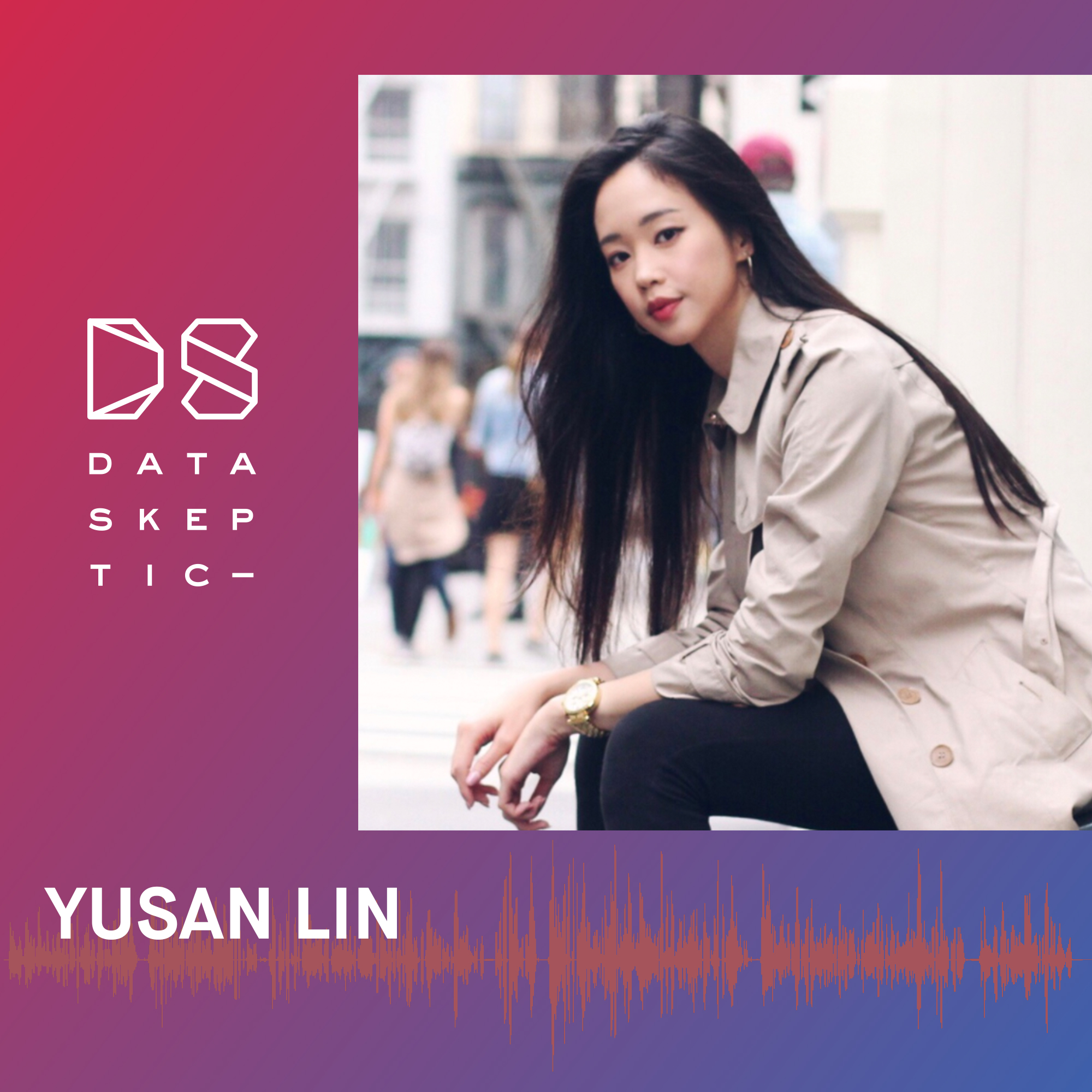
Yusan Lin, a Research Scientist at Visa Research, comes on today to talk about her work "Predicting Next-Season Designs on High Fashion Runway."
Time Series Mini Episodes
Time series topics on Data Skeptic predate our current season. This holiday special collects three popular mini-episodes from the archive that discuss time series topics with a few new comments from Kyle.

Forecasting Motor Vehicle Collision
Dr. Darren Shannon, a Lecturer in Quantitative Finance in the Department of Accounting and Finance, University of Limerick, joins us today to talk about his work "Extending the Heston Model to Forecast Motor Vehicle Collision Rates."

Deep Learning for Road Traffic Forecasting
Eric Manibardo, PhD Student at the University of the Basque Country in Spain, comes on today to share his work, "Deep Learning for Road Traffic Forecasting: Does it Make a Difference?"

Bike Share Demand Forecasting
Daniele Gammelli, PhD Student in Machine Learning at Technical University of Denmark and visiting PhD Student at Stanford University, joins us today to talk about his work "Predictive and Prescriptive Performance of Bike-Sharing Demand Forecasts for Inventory Management."

Forecasting in Supply Chain
Mahdi Abolghasemi, Lecturer at Monash University, joins us today to talk about his work "Demand forecasting in supply chain: The impact of demand volatility in the presence of promotion."
Black Friday
The retail holiday "black Friday" occurs the day after Thanksgiving in the United States. It's dubbed this because many retail companies spend the first 10 months of the year running at a loss (in the red) before finally earning as much as 80% of their revenue in the last two months of the year. This episode features four interviews with guests bringing unique data-driven perspectives on the topic of analyzing this seeming outlier in a time series dataset.

Aligning Time Series on Incomparable Spaces
Alex Terenin, Postdoctoral Research Associate at the University of Cambridge, joins us today to talk about his work "Aligning Time Series on Incomparable Spaces."

Comparing Time Series with HCTSA
Today we are joined again by Ben Fulcher, leader of the Dynamics and Neural Systems Group at the University of Sydney in Australia, to talk about hctsa, a software package for running highly comparative time-series analysis.

Change Point Detection Algorithms
Gerrit van den Burg, Postdoctoral Researcher at The Alan Turing Institute, joins us today to discuss his work "An Evaluation of Change Point Detection Algorithms."

Time Series for Good
Bahman Rostami-Tabar, Senior Lecturer in Management Science at Cardiff University, joins us today to talk about his work "Forecasting and its Beneficiaries."

Long Term Time Series Forecasting
Alex Mallen, Computer Science student at the University of Washington, and Henning Lange, a Postdoctoral Scholar in Applied Math at the University of Washington, join us today to share their work "Deep Probabilistic Koopman: Long-term Time-Series Forecasting Under Periodic Uncertainties."

Fast and Frugal Time Series Forecasting
Fotios Petropoulos, Professor of Management Science at the University of Bath in The U.K., joins us today to talk about his work "Fast and Frugal Time Series Forecasting."

Causal Inference in Educational Systems
Manie Tadayon, a PhD graduate from the ECE department at University of California, Los Angeles, joins us today to talk about his work "Comparative Analysis of the Hidden Markov Model and LSTM: A Simulative Approach."

Boosted Embeddings for Time Series
Sankeerth Rao Karingula, ML Researcher at Palo Alto Networks, joins us today to talk about his work "Boosted Embeddings for Time Series Forecasting." Works Mentioned Boosted Embeddings for Time Series Forecasting by Sankeerth Rao Karingula, Nandini Ramanan, Rasool Tahmasbi, Mehrnaz Amjadi, Deokwoo Jung, Ricky Si, Charanraj Thimmisetty, Luisa Polania Cabrera, Marjorie Sayer, Claudionor Nunes Coelho Jr https://www.linkedin.com/in/sankeerthrao/ https://twitter.com/sankeerthrao3 https://lod2021.icas.cc/

Change Point Detection in Continuous Integration Systems
David Daly, Performance Engineer at MongoDB, joins us today to discuss "The Use of Change Point Detection to Identify Software Performance Regressions in a Continuous Integration System". Works Mentioned The Use of Change Point Detection to Identify Software Performance Regressions in a Continuous Integration System by David Daly, William Brown, Henrik Ingo, Jim O'Leary, David BradfordSocial Media David's Website David's Twitter Mongodb

Applying k-Nearest Neighbors to Time Series
Samya Tajmouati, a PhD student in Data Science at the University of Science of Kenitra, Morocco, joins us today to discuss her work Applying K-Nearest Neighbors to Time Series Forecasting: Two New Approaches.

Ultra Long Time Series
Dr. Feng Li, (@f3ngli) is an Associate Professor of Statistics in the School of Statistics and Mathematics at Central University of Finance and Economics in Beijing, China. He joins us today to discuss his work Distributed ARIMA Models for Ultra-long Time Series.

MiniRocket
Angus Dempster, PhD Student at Monash University in Australia, comes on today to talk about MINIROCKET: A Very Fast (Almost) Deterministic Transform for Time Series Classification, a fast deterministic transform for time series classification. MINIROCKET reformulates ROCKET, gaining a 75x improvement on larger datasets with essentially the same performance. In this episode, we talk about the insights that realized this speedup as well as use cases.

ARiMA is not Sufficient
Chongshou Li, Associate Professor at Southwest Jiaotong University in China, joins us today to talk about his work Why are the ARIMA and SARIMA not Sufficient.

Comp Engine
Ben Fulcher, Senior Lecturer at the School of Physics at the University of Sydney in Australia, comes on today to talk about his project Comp Engine. Follow Ben on Twitter: @bendfulcher For posts about time series analysis : @comptimeseries comp-engine.org

Detecting Ransomware
Nitin Pundir, PhD candidate at University Florida and works at the Florida Institute for Cybersecurity Research, comes on today to talk about his work "RanStop: A Hardware-assisted Runtime Crypto-Ransomware Detection Technique." FICS Research Lab - https://fics.institute.ufl.edu/ LinkedIn - https://www.linkedin.com/in/nitin-pundir470/

GANs in Finance
Florian Eckerli, a recent graduate of Zurich University of Applied Sciences, comes on the show today to discuss his work Generative Adversarial Networks in Finance: An Overview.

Predicting Urban Land Use
Today on the show we have Daniel Omeiza, a doctoral student in the computer science department of the University of Oxford, who joins us to talk about his work Efficient Machine Learning for Large-Scale Urban Land-Use Forecasting in Sub-Saharan Africa.

Opportunities for Skillful Weather Prediction
Today on the show we have Elizabeth Barnes, Associate Professor in the department of Atmospheric Science at Colorado State University, who joins us to talk about her work Identifying Opportunities for Skillful Weather Prediction with Interpretable Neural Networks. Find more from the Barnes Research Group on their site. Weather is notoriously difficult to predict. Complex systems are demanding of computational power. Further, the chaotic nature of, well, nature, makes accurate forecasting especially difficult the longer into the future one wants to look. Yet all is not lost! In this interview, we explore the use of machine learning to help identify certain conditions under which the weather system has entered an unusually predictable position in it's normally chaotic state space.

Predicting Stock Prices
Today on the show we have Andrea Fronzetti Colladon (@iandreafc), currently working at the University of Perugia and inventor of the Semantic Brand Score, joins us to talk about his work studying human communication and social interaction. We discuss the paper Look inside. Predicting Stock Prices by Analyzing an Enterprise Intranet Social Network and Using Word Co-Occurrence Networks.

N-Beats
Today on the show we have Boris Oreshkin @boreshkin, a Senior Research Scientist at Unity Technologies, who joins us today to talk about his work N-BEATS: Neural Basis Expansion Analysis for Interpretable Time Series Forecasting. Works Mentioned: N-BEATS: Neural Basis Expansion Analysis for Interpretable Time Series Forecasting By Boris N. Oreshkin, Dmitri Carpov, Nicolas Chapados, Yoshua Bengio https://arxiv.org/abs/1905.10437 Social Media Linkedin Twitter

Translation Automation
Today we are back with another episode discussing AI in the work field. AI has, is, and will continue to facilitate the automation of work done by humans. Sometimes this may be an entire role. Other times it may automate a particular part of their role, scaling their effectiveness. Carl Stimson, a Freelance Japanese to English translator, comes on the show to talk about his work in translation and his perspective about how AI will change translation in the future.

Time Series at the Beach
Shane Ross, Professor of Aerospace and Ocean Engineering at Virginia Tech University, comes on today to talk about his work "Beach-level 24-hour forecasts of Florida red tide-induced respiratory irritation."

Automatic Identification of Outlier Galaxy Images
Lior Shamir, Associate Professor of Computer Science at Kansas University, joins us today to talk about the recent paper Automatic Identification of Outliers in Hubble Space Telescope Galaxy Images. Follow Lio on Twitter @shamir_lior

Do We Need Deep Learning in Time Series
Shereen Elsayed and Daniela Thyssens, both are PhD Student at Hildesheim University in Germany, come on today to talk about the work "Do We Really Need Deep Learning Models for Time Series Forecasting?"

Detecting Drift
Sam Ackerman, Research Data Scientist at IBM Research Labs in Haifa, Israel, joins us today to talk about his work Detection of Data Drift and Outliers Affecting Machine Learning Model Performance Over Time. Check out Sam's IBM statistics/ML blog at: http://www.research.ibm.com/haifa/dept/vst/ML-QA.shtml

Darts Library for Time Series
Julien Herzen, PhD graduate from EPFL in Switzerland, comes on today to talk about his work with Unit 8 and the development of the Python Library: Darts.

Forecasting Principles and Practice
Welcome to Timeseries! Today's episode is an interview with Rob Hyndman, Professor of Statistics at Monash University in Australia, and author of Forecasting: Principles and Practices.
Prequisites for Time Series
Today's experimental episode uses sound to describe some basic ideas from time series. This episode includes lag, seasonality, trend, noise, heteroskedasticity, decomposition, smoothing, feature engineering, and deep learning.

Orders of Magnitude
Today's show in two parts. First, Linhda joins us to review the episodes from Data Skeptic: Pilot Season and give her feedback on each of the topics. Second, we introduce our new segment "Orders of Magnitude". It's a statistical game show in which participants must identify the true statistic hidden in a list of statistics which are off by at least an order of magnitude. Claudia and Vanessa join as our first contestants. Below are the sources of our questions. Heights https://en.wikipedia.org/wiki/Willis_Tower https://en.wikipedia.org/wiki/Eiffel_Tower https://en.wikipedia.org/wiki/GreatPyramidof_Giza https://en.wikipedia.org/wiki/InternationalSpaceStation Bird Statistics Birds in the US since 2000 Causes of Bird Mortality Amounts of Data Our statistics come from this post

They're Coming for Our Jobs
AI has, is, and will continue to facilitate the automation of work done by humans. Sometimes this may be an entire role. Other times it may automate a particular part of their role, scaling their effectiveness. Unless progress in AI inexplicably halts, the tasks done by humans vs. machines will continue to evolve. Today's episode is a speculative conversation about what the future may hold. Co-Host of Squaring the Strange Podcast, Caricature Artist, and an Academic Editor, Celestia Ward joins us today! Kyle and Celestia discuss whether or not her jobs as a caricature artist or as an academic editor are under threat from AI automation. Mentions https://squaringthestrange.wordpress.com/ https://twitter.com/celestiaward The legendary Dr. Jorge Pérez and his work studying unicorns Supernormal stimulus International Society of Caricature Artists Two Heads Studios

Pandemic Machine Learning Pitfalls
Today on the show Derek Driggs, a PhD Student at the University of Cambridge. He comes on to discuss the work Common Pitfalls and Recommendations for Using Machine Learning to Detect and Prognosticate for COVID-19 Using Chest Radiographs and CT Scans. Help us vote for the next theme of Data Skeptic! Vote here: https://dataskeptic.com/vote