
CR101 Radio - Podcast Network
1,393 episodes — Page 18 of 28

The New Year
Noise, horns, shouting—what are we really trying to drown out on New Year’s Eve? In this episode, we peel back the tradition of noisemaking to uncover the deep fears it masks—and contrast that with the quiet confidence of those who walk with Christ. As 1954 dawns, we’re reminded: we don’t need to chase away the unknown with sound. We step into the future not with fear, but with faith. Tune in, and greet the new year with a shepherd’s peace and a pilgrim’s hope.
A Bad Teacher
The idea that "experience is the best teacher" is popular—but wrong. Experience alone doesn’t teach wisdom; it only reflects what’s already in the heart. An alcoholic doesn’t become wise by getting drunk, nor does someone become discerning by being hurt. Without faith and a godly heart, experience leads to bitterness, not insight. As Proverbs says, “Keep thy heart with all diligence,” because it’s the heart—not the experience—that shapes what we learn. True wisdom comes not from what we go through, but from how God’s Word and Spirit shape us in it. Experience isn’t the teacher—faith is.
Horror Stories
Many people today indulge in fear for entertainment—horror movies, scary stories, and imaginary threats. But this craving for false fear often masks a deeper issue: a refusal to face real fear—the fear of the Lord. Scripture says, “The fear of the Lord is the beginning of knowledge” (Prov. 1:7). Healthy fear keeps us grounded in reality and warns us of danger. But fearing monsters instead of God shows a rejection of wisdom. Fools avoid real accountability by choosing fake fears they can escape. But the fear of God confronts us with our sin—and calls us to repentance, truth, and life. What kind of fear shapes your life?
How Friendly are You to Vampires?
What do bloodsuckers, bureaucracy, and broken homes have in common? In this episode, R.J. Rushdoony skewers the absurdities of modern government—from the EEOC taking vampire discrimination cases seriously to the Supreme Court excusing murder over “emotional backgrounds.” When courts coddle criminals and agencies embrace fantasy, justice dies a slow death. Tune in to hear why the real vampires aren’t from Transylvania—they’re taxing you from D.C.
Moralism
In this episode, we explore R.J. Rushdoony’s piercing critique of moralism—the belief that man can save and sanctify himself through good behavior, social reform, or political virtue. From Samuel Pepys’ self-imposed fines for adultery to Stalin’s daughter preaching faith in human decency, Rushdoony shows how moralism, far from being neutral or noble, is a counterfeit gospel rooted in humanism. It replaces God’s sovereign grace with man’s self-made standards, offering a false hope that ultimately leads not to righteousness, but to deeper rebellion. Join us as we uncover why moralism, though cloaked in virtue, is one of the most dangerous forms of anti-Christian religion.
Natural Law and Theonomy
Can nature really teach us right from wrong? In this episode, we tackle Chalcedon Position Paper No. 200 and challenge the popular myth of natural law. Drawing from the insights of Cornelius Van Til, we expose how natural law and natural theology, far from offering moral clarity, often mask man’s deeper desire for autonomy from God. From Greek philosophy to Enlightenment rationalism—and even modern pulpits—natural law has too often been a fig leaf for rejecting God’s enscriptured Word. Join us as we explore why theonomy, not nature, is the only foundation for true justice and righteousness.
Basic Education
True education must focus on life’s basics—or it becomes miseducation. First, it must teach about God, the source of life; ignoring Him is to train for ignorance. Second, it must uphold the family, our first and most vital institution. To neglect it is to deny our foundation. Third, it must teach core skills—reading, writing, reasoning—the tools for daily life. Without these, we send children into the world unarmed. Scripture calls us to educate the whole person in truth. If we neglect this, we are not just failing our children—we are helping a generation stumble toward destruction.
Why History is Important: Part II (Remastered) (A Christian Survey of World History)
In this powerful and far-reaching lecture, R.J. Rushdoony challenges the humanistic view of history and reasserts a thoroughly biblical understanding of the past, present, and future. He argues that all history is guided by God's sovereign hand and cannot be rightly understood apart from Scripture. Contrasting the despair and confusion of modern historians and educators with the confidence of a Christian worldview, Rushdoony shows how faith in God gives meaning, order, and hope to history. This message is a clarion call to Christian families, educators, and leaders to reclaim history as God’s story—and to live their lives as deliberate plans for the future under His law and grace.

Can a Pastor be Faithful and Silent?
The episode opens with Andrea Schwartz reflecting on how modern pulpits often avoid engaging with real-world crises through a biblical lens. After events like 9/11, many churches declared that such tragedies had nothing to do with God, effectively denying His sovereignty. Over time, pastors have increasingly been discouraged from addressing cultural and political events from the pulpit, leaving congregants without clear biblical interpretation of current events. This void became evident after the assassination of Charlie Kirk, when many pastors were instructed to ignore the incident altogether. David Sims, a Michigan-born pastor and veteran, chose to address the event from Psalm 120, declaring that Christians live among those who hate peace. His refusal to apologize for the sermon’s tone or content led to his forced resignation, revealing deep tensions within modern churches over how to address cultural conflict biblically. In his sermon, Sims identified two core forces shaping the present crisis: the pervasive influence of Marxism and the church’s capitulation to a functionally Gnostic, pietistic faith that divorces belief from action. He argued that anti-God ideologies—abortion, transgenderism, statism—have flourished not merely through cultural dominance but because the church has largely withdrawn from active resistance. Sims contrasted biblical obedience and prophetic boldness with modern Christian tendencies to seek comfort, avoid offense, and reduce faith to private spirituality. His message emphasized that Christianity requires confronting evil and applying God’s law to all of life—not just personal devotion. The reaction to his sermon, including walkouts, elder opposition, and eventual dismissal, highlighted how many congregations have become more concerned with comfort and numerical growth than covenantal faithfulness and prophetic clarity.
How to be a Curse
If you want to be a curse in your church, be quick to criticize, slow to listen, and convinced you alone know the truth. From coast to coast, pastors encounter such people—those who grill visitors, drive others away, and speak of “love” while showing none. Scripture calls us instead to submit to godly authority and be “ready to every good work” (Titus 3:1). A spirit of constant judgment tears down the body of Christ, while humble obedience and readiness to serve build it up. So ask yourself honestly: are you a blessing—or a burden—to the church?
The Court (Remastered)
Every courtroom is a religious institution—whether it acknowledges God or not. In this chapter, Rushdoony demonstrates how biblical courts were rooted in God's law, guided by theological authority, and inseparable from the moral life of the community. When courts abandon divine law and claim the power to "bind and loose" apart from Scripture, they become instruments of tyranny or collapse into chaos. Without a shared moral foundation rooted in God’s word, law degenerates into coercion, and justice is replaced with bureaucratic violence. The courtroom, once sacred, becomes a stage for secular idolatry.
How to be a Blessing
One grieving husband learned, too late, that his wife had quietly praised him to others—but never to him. Her constant complaints left him feeling unappreciated, despite her true feelings. Paul reminds us in Ephesians 5:4 that thankfulness—not bitterness or foolish talk—is fitting for believers. Yet gratitude is often the gift we give least, though it blesses both giver and receiver. A thankful heart reflects contentment with God and brings peace to others. If you want to be a blessing, start with thankfulness—because a truly thankful person is a blessing.

Journey's End
Are you walking through life followed by fear—or by the goodness and mercy of God? In this final reflection on Psalm 23, we discover the Shepherd’s promise: not just peace in the pasture, but peace at the journey’s end. Whether your days feel stormy or bright, this episode invites you to travel with the One who walks with you now… and forever.

The Sociology of the Sabbath
In this episode of the The Chalcedon Podcast, Andrea Schwartz and Martin Selbrede explore the biblical and cultural meaning of the Sabbath, drawing from the work of R. J. Rushdoony in Salvation and Godly Rule. They argue that modern society has abandoned the biblical view of time—linear, purposeful, and punctuated by Sabbath rest—and replaced it with “deep time,” an undifferentiated stream without meaning or goal. In Scripture, Sabbath is not just a day off but a divine ordinance tied to creation, dominion, and eschatology. It divides time into meaningful segments, giving both individuals and communities a rhythm of work and rest that reflects God’s sovereignty over time and history. A defective doctrine of Sabbath leads to a defective view of work, resulting in either slavish overwork or escapist idleness. The conversation also connects Sabbath to broader cultural and technological issues. Historically, secular regimes (e.g., French Revolution) sought to dissolve biblical time by changing calendars and disrupting communal rest. Similarly, modern 24/7 work culture and technological obsession detach people from godly rhythms. Instead of retreating from technology, Christians should view it as a tool of dominion under God’s law, not as an idol or tyrant. The Sabbath reminds believers to trust in God’s provision, celebrate their labors, and prepare for future work. This future-oriented rest undergirds Christian hope and victory, culminating in the ultimate, eternal Sabbath. The episode ends by calling Christians to recover a full “sociology of the Sabbath” — reconnecting work, rest, dominion, and eschatology — as a foundation for cultural reformation.
Episode #115 (February 11, 1986)
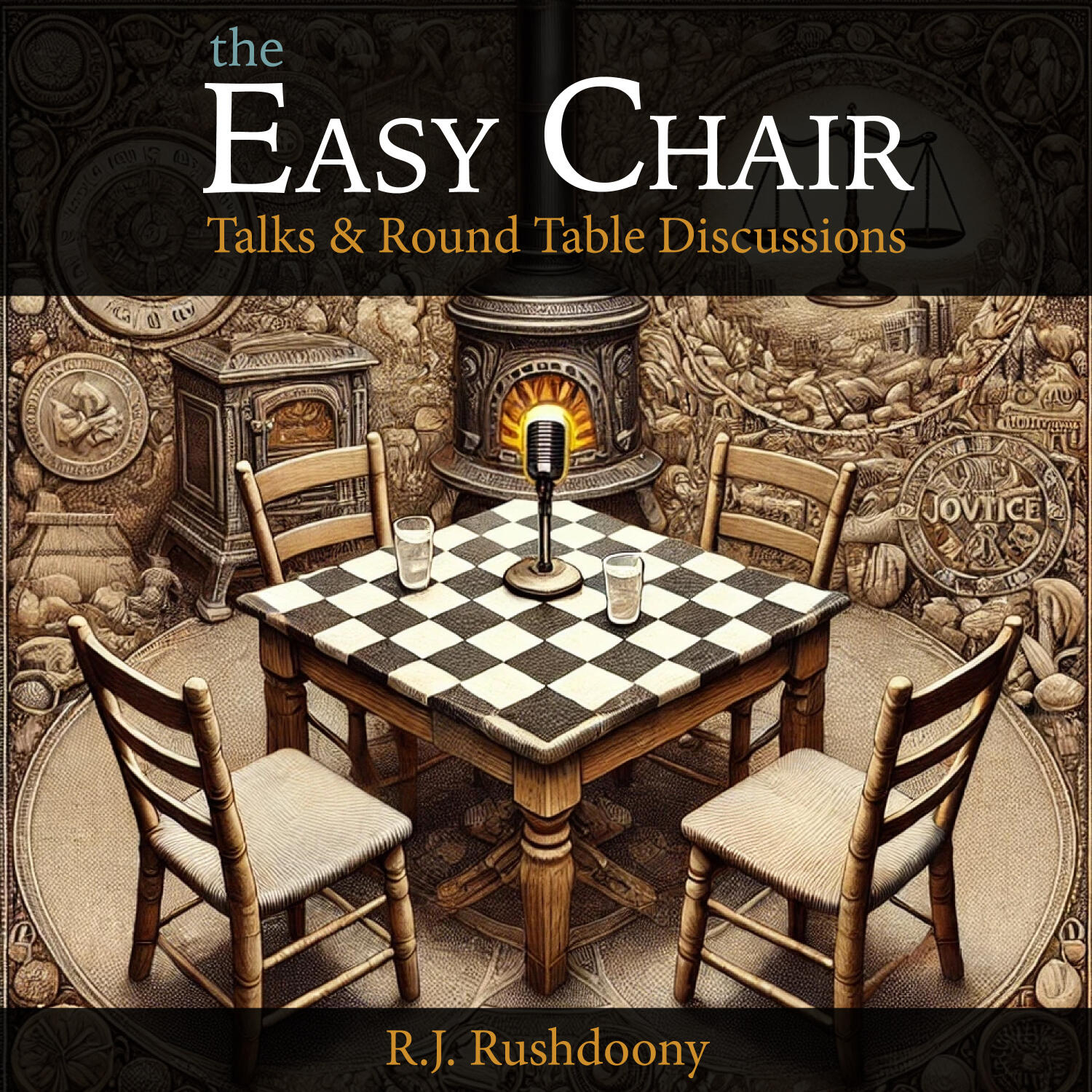
In this landmark Easy Chair conversation, R.J. Rushdoony is joined by Dennis Peacocke and Bob Mumford for a passionate and far-reaching discussion on Christian Reconstruction. Together, they unpack the church’s calling to engage every sphere—spiritual, social, and economic—with the authority of Christ. From the failures of modern pietism to the rising global hunger for biblical answers, the trio explores why the future belongs to those with faith, expectancy, and action. If you’ve ever wondered whether the gospel is meant only for heaven or also for transforming history, this episode will ignite your vision.
The Source of Law
Whose law governs your life—God’s or man’s? In this episode, we unpack Chalcedon Position Paper No. 185 and confront the inescapable truth that all law is religious at its core. Whether it comes from God or from man, law reveals who we serve and where our loyalty lies. When a society rejects God’s law, it doesn’t become neutral—it enthrones human opinion, unleashes injustice, and invites chaos. Join us as we explore why the source of law matters more than ever, and how restoring God’s law is essential to reclaiming justice, order, and true freedom.
Mother Murder
In 1 Timothy 1:9, Paul includes “murderers of mothers” (metraloais) among the worst offenders—a shocking reminder of how deeply sin can corrupt. This word implies not only literal murder but any violent or dishonorable assault on a mother’s God-given role. Scripture commands us to honor father and mother, not because they are perfect, but because the family is God’s foundational institution. To attack or dishonor that structure is to strike at the root of social order. Paul’s warning is clear: when we allow the authority of parents—especially mothers—to be undermined, we invite societal collapse. His words are urgent for our time.
Jacob's remedy for bitterness towards your father
https://cr101radio.com/podcast/jacobs-remedy-for-bitterness-towards-your-father Jacob endured one of the greatest personal injustices a man can face—his father, who walked closely with God, showed no love or favor toward him. Though Jacob was upright, dutiful, and the chosen heir of God’s covenant, Isaac consistently preferred Esau, the ungodly brother who despised his birthright. For seventy-one years Jacob labored faithfully in his father’s household, receiving neither affection nor tangible provision. When the time came for him to secure a bride, unlike Isaac who was richly supplied, Jacob was sent away with nothing but a staff in his hand. Isaac withheld not only his love but also the material support a father owed his son. And yet, despite a lifetime of neglect, Jacob never allowed bitterness to rule his heart. Jacob’s remedy was faith. He believed the promises of God more than the failings of men. He anchored himself in God’s covenant, walking in obedience and trusting that the inheritance would come in God’s timing—not Isaac’s. He honored his father even to the end, refusing to rail against the man who caused him such pain. This story isn’t just about Jacob’s suffering but about his triumph through faith and steadfastness. It’s a call to all who face their own “Isaacs”—unjust authorities, unloving fathers, or spiritual leaders who withhold what matters—to lay hold of God’s promises, reject bitterness, and keep walking faithfully. In the end, God’s blessing overtakes the one who trusts and obeys.
Anarchism
What happens when man declares himself god, rejects all authority, and demands absolute freedom? In this episode, we unpack R.J. Rushdoony’s scathing analysis of anarchism—not just as a political impulse, but as the logical end of modern humanism. From Rousseau to the hippie rebellion, from existentialist despair to daily domestic chaos, Rushdoony reveals how the denial of God’s law births moral collapse, cultural ruin, and spiritual death. Join us as we explore why true liberty is not lawlessness, but joyful submission to the sovereign Lord who alone gives purpose, order, and life.
Giving to God
In 1751, Americans protested Britain’s practice of sending criminals to the colonies, calling it a gift of contempt. They rightly asked: what good parent sends poison to their children? But the question cuts both ways. If we, as children of God, give Him only our leftovers—our spare time, energy, and money—aren’t we showing the same kind of contempt? Jesus said no good father gives a stone instead of bread. So what are we offering our heavenly Father? Our gifts reflect our hearts—and poor gifts may reveal a heart far from Him.

What Are You Waiting For?
Are you waiting for the world to change… while your own heart stays the same? In today’s episode, we explore Psalm 39 and ask a timely question: What am I really waiting for? From daily frustrations to lifelong dreams, we often wait in vain—until we learn to wait on God. Join us for a reflection on the only waiting that brings renewal, hope, and transformation.
Why History is Important: Part I (Remastered) (A Christian Survey of World History)
In this powerful and far-reaching lecture, R.J. Rushdoony challenges the humanistic view of history and reasserts a thoroughly biblical understanding of the past, present, and future. He argues that all history is guided by God's sovereign hand and cannot be rightly understood apart from Scripture. Contrasting the despair and confusion of modern historians and educators with the confidence of a Christian worldview, Rushdoony shows how faith in God gives meaning, order, and hope to history. This message is a clarion call to Christian families, educators, and leaders to reclaim history as God’s story—and to live their lives as deliberate plans for the future under His law and grace.
Can We Sanctify Folly?
A wealthy Christian couple gives generously to ministries but shows deep personal inconsistency: they ignore their godly, struggling son while endlessly supporting their rebellious daughter. This kind of misplaced compassion reflects a broader problem—when even Christians excuse sin and enable folly, how can we expect the world to act differently? If the church is soft on unrepentant sinners, society will be too. True grace is never a license for sin, and real love holds people accountable. As Scripture says, judgment begins in the house of God. We must not try to sanctify what God calls folly.
The 'Iks'
What happens to a people when all faith, family, and moral law are stripped away? In this episode, we examine The Mountain People, Colin Turnbull’s haunting study of the Ik tribe—a society reduced to brutal egoism, where children are discarded, the weak are mocked, and survival is the only value. R.J. Rushdoony takes Turnbull’s account as a sobering portrait of what humanism inevitably produces: a collapse of virtue, community, and civilization itself. Join us as we explore why neither left nor right can halt this decay—and how only a return to God’s law can rebuild what humanism has torn down.
The Judgment of Hypocrites
Jesus warns that a hypocrite eagerly judges others while ignoring his own sin. He condemned this false judgment—not judgment itself, but judgment without integrity. A man who spoils his children, indulges his brother, and then blames his wife and criticizes society is not making righteous judgments—he’s deflecting blame and masking his failures. True judgment starts with personal accountability and is guided by God’s Word, not self-righteousness. We all judge—but are our judgments rooted in truth and obedience, or in hypocrisy? God will judge the difference—and He shows no mercy to the hypocrite.
The Church as Property and Function (Doctrine of the Church)
In this powerful exposition of Acts 5, R.J. Rushdoony explores the sobering account of Ananias and Sapphira to underscore a fundamental truth: the church is not ours—it is God’s property. Far from being an institution we manipulate or merely attend, the church is a living temple indwelt by the Spirit, and each member is called not to status, but to service. This message reminds us that violating God’s ownership—through pride, deceit, or profanation—invites His judgment. But it also offers a hopeful correction: the church’s power and purpose are found not in institutional prestige, but in faithful obedience to God’s calling.
Dangerous People
The greatest threat to society isn’t just criminals or immoral acts—it’s those who tolerate evil, especially when it comes dressed in charm, wit, or sophistication. When style outweighs substance, and appearances matter more than faith or morality, society begins to decay. This misplaced value shows up even in churches, where image can matter more than spiritual integrity. Scripture warns us: “They that forsake the law praise the wicked.” True danger lies in admiring sin when it looks respectable. How we judge others—by faith or appearances—reveals how we’ll be judged ourselves.
The Meaning of Theocracy
What if theocracy doesn’t mean tyranny—but liberty under God? In this episode, we unpack Chalcedon Position Paper No. 15 and rediscover the biblical meaning of theocracy: not rule by priests or power-hungry leaders, but the rule of God and His law over every sphere of life. Far from centralized control, biblical theocracy empowers self-governing individuals, families, churches, and communities through tithing, responsibility, and dominion. We’ll expose how modern statism has stolen the public realm in the name of reason, and how only Christ’s kingship can restore freedom and order. Forget what you’ve been told—theocracy is not the enemy. It’s the answer.

Has Cowardice Been Enshrined as a Virtue?
In this episode of Out of the Question, hosts Andrea Schwartz and Charles Roberts examine how cowardice is treated in Scripture, particularly in Revelation 21:8, where “the cowardly” appear first in a list of those condemned. The conversation explores how cowardice is often overlooked or minimized compared to other sins like murder or adultery, despite its serious placement in the biblical text. Roberts reflects on his initial surprise at this verse and draws on Rousas John Rushdoony’s observations linking cowardice to democratic systems that allow people to hide behind majority opinion rather than taking personal responsibility. The discussion critiques how fear of man—particularly fear of government—has led many churches to abdicate their roles during crises, such as the COVID-19 mandates, rather than standing courageously for biblical convictions. The hosts argue that cowardice spreads socially and institutionally, infecting churches, leadership, and culture. They trace this cultural softness to modern comfort, bureaucratic leadership, and the absence of real risk-taking role models. Drawing on historical figures like Alexander Solzhenitsyn, they warn of the West’s decline in civic courage. The episode concludes by urging Christians to name and condemn cowardice, contrasting it with biblical courage modeled by figures such as Gideon, Abigail, Deborah, and the Puritans. The core message is that cowardice is not a harmless weakness but a betrayal of God’s kingdom—and that fearing God over man is the only true foundation for courage and cultural resistance.
Rejoice
We often hear, “He’s a good man, but…” as if goodness can excuse a spirit of constant criticism or complaint. Paul, who suffered much, gives us a different command: “Rejoice in the Lord always.” He reminds us that no matter our circumstances, God is on the throne and working all things for good. Complaining blinds us to this truth, while joy opens us to God’s peace. True faith looks beyond present troubles to eternal triumph. A joyful heart isn't naive—it’s rooted in trust. Rejoicing isn’t optional for the believer—it’s essential.
The Responsibility of Judges (Remastered)
Biblical law places an uncompromising burden on judges and rulers: justice must be done—even when the offender is unknown. In this chapter, Rushdoony unpacks the powerful principle behind the law of the slain man in Deuteronomy 21, showing how civil authorities bear collective responsibility before God for righting every wrong. The requirement of restitution, even by proxy, reveals a deeper truth: true justice cannot be evaded, and when rulers fail in their duty, God's judgment falls not only on the individual, but on the entire social order.
The Spiritual Man
Today, we often think of "spiritual" as vague, gentle, or mystical—but Paul meant something far more powerful. In Romans 7:14, when he says “the law is spiritual,” the Greek word pneumatikos points to divine power—God-backed, heaven-filled authority. The spiritual man isn’t weak or detached; he’s empowered by God to act, overcome, and lead. In contrast, the “carnal” man (sarkikos) is not powerful, but weak—tied to the physical, ruled by sin. We've flipped this in our thinking, seeing the carnal as strong and the spiritual as soft. Paul says the opposite. True strength belongs to the spiritual man.

My Cup Runneth Over
In a world marked by conflict, exhaustion, and fear, Psalm 23 gives us more than comfort—it gives us a Host. In this episode, we step into the rich promises of verse 5, where God prepares a feast not in peace, but “in the presence of our enemies.” What does it mean to be welcomed, anointed, and overflowed with grace even in the thick of battle? Join us as we reflect on divine hospitality, holy abundance, and the Shepherd who turns weary pilgrims into royal guests.
A Good Conscience
Some people speak of long-past sins—like swearing at age twelve—as signs of a sensitive conscience. But often, these "confessions" are more about self-righteousness than repentance. A truly tender conscience isn’t fixated on minor sins from childhood—it’s alert to today’s responsibilities, aware of current failings, and eager to obey God now. Scripture tells us that God tests our hearts and lives in the present, not the past. A good conscience isn’t haunted by old guilt—it’s shaped by grace and alive to God's will today. So, what is your conscience focused on: the past—or your present obedience to Christ?
The Reversal of Standards
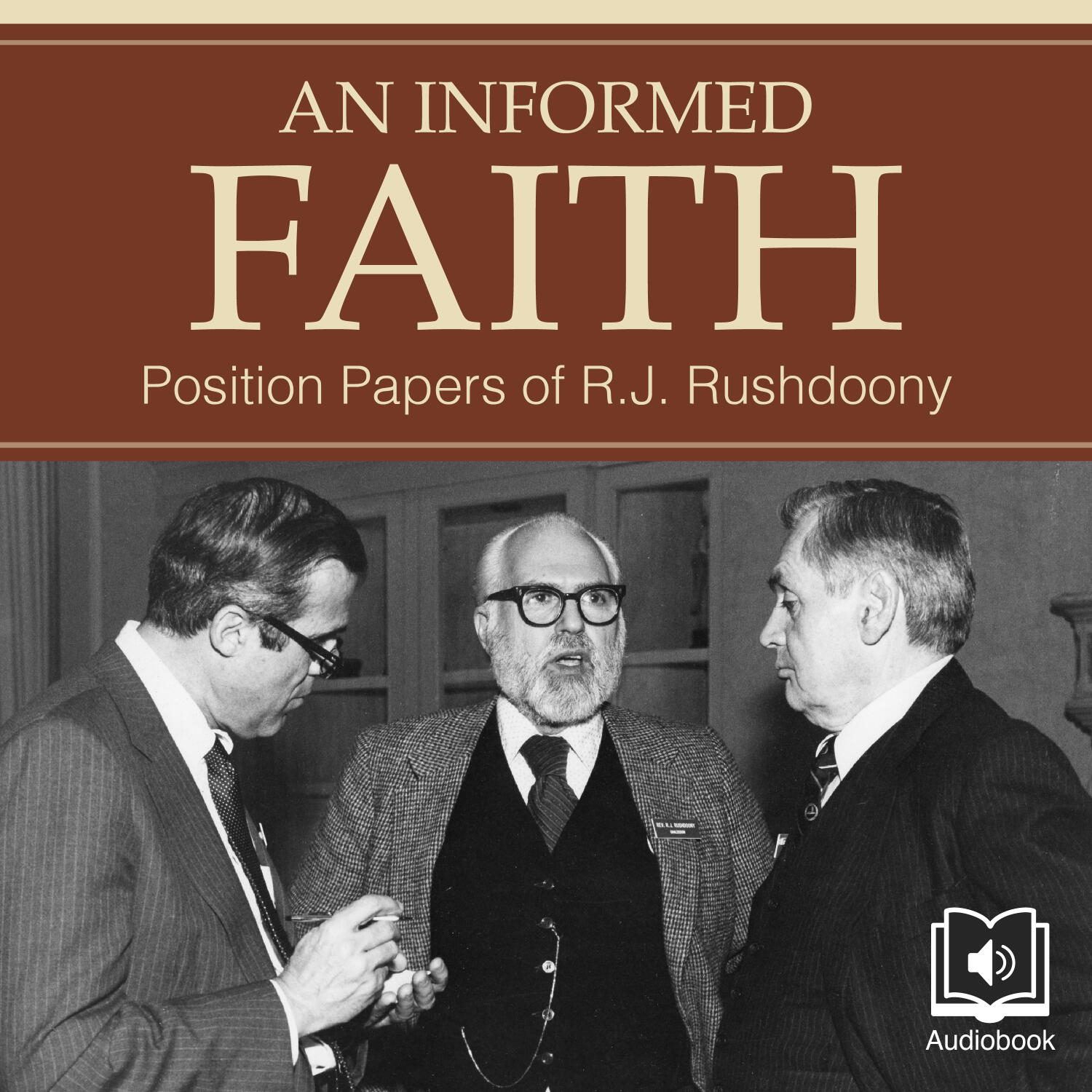
What happens when a culture abandons good and evil entirely? In this episode, we examine Chalcedon Position Paper No. 119 and confront the modern reversal of standards—from criminals becoming heroes to the unborn being sacrificed while murderers walk free. This is no mere moral confusion—it’s the outworking of a religious war against God’s law. We explore how humanism has become more faithful to its creed than many Christians are to theirs, and why “neutral” conservatism offers no solution. Join us as we call for repentance, not pendulums—because restoration doesn’t come automatically. It starts with God’s judgment, grace, and our obedience.
Episode #114 (January 27, 1986)
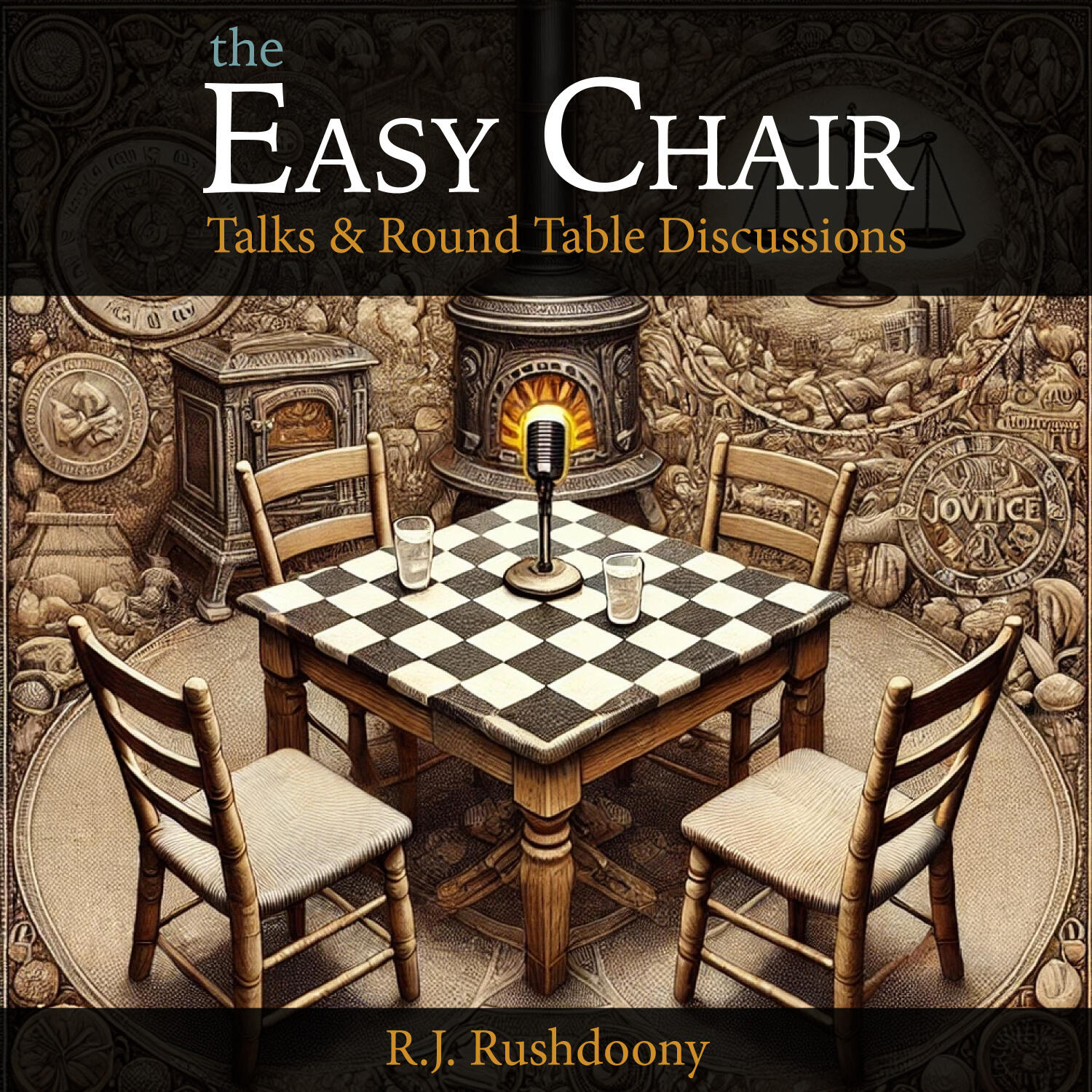
In this special Easy Chair episode, R.J. Rushdoony welcomes Jean-Marc Berthoud from Switzerland for a deep, urgent discussion on the spiritual decline of Europe. From skyrocketing youth suicides and drug use to the collapse of church influence and public morality, Berthoud outlines the crisis gripping Switzerland and France. But amidst the decay, he shares signs of hope—grassroots Christian organizing, legal victories for biblical education, and a new Reformed seminary committed to the full authority of Scripture. Tune in for a powerful reminder: truth is irresistible, and faithful witness can still turn the tide.
Why are Christians Blind to Wealth and Power in the Bible?
This episode challenges the way modern Christians view wealth and power, exposing how pagan philosophical influences have blinded many believers to the full picture of God’s blessings in Scripture. While Abraham, Isaac, Jacob, and Job were powerful and immensely wealthy men, most Christians have been conditioned to see them only through the lens of weakness, poverty, or abstract “spiritual” qualities. Nathan traces this distortion back to ancient dualistic ideas that despise matter and elevate “spirit,” showing how these pagan categories have crept into the church and shaped how believers read the Bible — often skipping over the very words of the Holy Spirit. Nathan argues that this blindness is not accidental but the result of a strategic deception. The early church inherited temples, priests, and a false view of Scripture that kept ordinary people — especially those involved in business, leadership, and wealth — at arm’s length from the plain meaning of the Word. By recovering the biblical vision of creation, incarnation, law, and covenant, Christians can once again see that wealth and power, rightly used, are not evil but instruments of godly dominion and blessing. The call is clear: take off the blindfold and read Scripture for what it truly says.
Idolatry
Idolatry isn’t just about ancient statues—it’s the ongoing sin of putting anything, especially ourselves, in God’s place. Scripture shows that whenever we live by our own word instead of God’s, we become idolaters. It’s not just false worship—it’s spiritual adultery, a betrayal of the living God. At its root, sin is man trying to be his own god, deciding good and evil for himself. That’s why the first commandment is so crucial: “Thou shalt have no other gods before me.” True faith begins when we dethrone ourselves and live by God’s Word, not our own.
The Establishment
Why is nearly everyone—from radicals to conservatives—angry at the establishment? In this episode, we dig into R.J. Rushdoony’s prophetic 1970 analysis of how modern institutions—government, courts, schools, even the church—have abandoned God’s law in favor of relativism, and how their moral collapse is mirrored, not challenged, by the very protesters who claim to oppose them. Rushdoony warns that a culture without transcendent law becomes a playground for lawlessness—on the right, the left, and everywhere in between. Join us as we explore what happens when a civilization forgets its foundation—and how true reconstruction begins with obedience to God's law.
Opinions
Many people today believe their personal opinions define truth—even about God. If He doesn't fit their preferences, they reshape Him in their minds. But Scripture reminds us that it’s not what we think about God that matters—it’s what God thinks about us. Our opinions don’t shape reality; only God's Word is truth. To insist otherwise is not just foolish—it’s arrogant. Real wisdom begins when we stop asking, “What do I think about God?” and start asking, “What does God say in His Word?”

The Valley of the Shadow of Death
We love green pastures and still waters—but what about the dark valleys? In this episode, we walk with the shepherd through Psalm 23:4 and explore why the path of righteousness sometimes winds through the valley of the shadow of death. Why does the Good Shepherd lead us into hardship? What comfort is there in His rod and staff? Join us for a reflection on suffering, discipline, and divine presence. Discover how love sometimes means wind-stripped hillsides and fording cold streams—and how even there, we are never, ever alone.
Depravity or Natural Goodness?
Is sin merely a matter of social disorder—or is it rebellion against a holy God? In this episode, we examine R.J. Rushdoony’s sharp critique of modern views of human nature, from the Enlightenment to neo-orthodoxy. As we unpack the seductive but deadly idea that sin is sociological and that elites can usher in salvation through progress, we contrast this with Scripture’s unflinching declaration: all men are sinners before God, and only divine grace through Jesus Christ can save. Join us as we confront the false gospel of human goodness and rediscover the theological root of both depravity—and redemption.
The Trouble with Statistics
The trouble with statistics is they often mislead. Divorce numbers may look alarming, but they don't tell the full story. As reporting became more inclusive—especially after World War II—numbers rose, not because marriage worsened, but because data improved. More importantly, statistics don’t measure strength. While weak marriages may collapse more quickly, strong, faith-rooted families are growing. Christian schooling is booming, and many families now care deeply for both children and elders. Despite cultural attacks, we’re witnessing a quiet resurgence of family life grounded in faith. The real story isn't decline—it's revival.
When is it Illegal to Sing in Church?
A high school chorus sings at a church event—and suddenly, it’s a First Amendment violation. In this episode, R.J. Rushdoony unpacks how legal reinterpretations are turning common sense into criminality. When students can’t sing in churches and the law is used to suppress freedom rather than protect it, everyone loses. Tune in to see how the erosion of true law threatens both liberty and sanity.
Loyalties
What shapes your deepest loyalties—God’s Word or your group identity? In this episode, we unpack Chalcedon Position Paper No. 62 to confront how self-pity, group pride, and institutional allegiances often displace our obedience to Christ. From denominational tribalism to social resentment, we explore why any loyalty not grounded in the triune God becomes a form of idolatry. True Christian faith doesn’t blame, wall off, or conform—it reforms. Join us as we examine how regeneration, not revolution, is the engine of godly change, and why loyalty to Christ alone is the foundation of a free, faithful society.
The Church of the Resurrection (Doctrine of the Church)
The church is not a mere institution—it is the living body of Christ, birthed by the miracle of His resurrection. In this powerful message on Ephesians 2, R.J. Rushdoony reminds us that we are not only saved by grace, but raised up with Christ to reign with Him. The Resurrection is not just a past event—it is the ongoing power at work in the church and in every believer. We are seated with Christ in heavenly places, called to dominion and good works, not by our strength, but by His supernatural grace. To be part of the Church of the Resurrection is to live in victory, as miracle-born people, created for triumph over sin, death, and every power of darkness.
Discipline
Discipline is not the same as punishment. A couple once lamented their daughter’s rebellious behavior, claiming they'd disciplined her—but they hadn’t. They had punished her often, but never taught her or required her to learn. True discipline means training, instruction, and forming habits of obedience and learning—rooted in the word “disciple.” Like math, it involves thought, structure, and effort. Without this, punishment is empty. Our culture has confused the two, both in the home and the church. But lasting change comes through real discipline—not just reacting to bad behavior, but shaping lives through consistent teaching and guidance.

Is Christian Reconstruction Reaching College Campuses?
The conversation spotlights “victorious eschatology” through a living remnant: two Virginia Tech students, Gil Roten and Camden Whitener, who call themselves the Kingsmen. Raised outside explicit Reconstructionist circles, they were drawn in through Bible study and presuppositional apologetics (Durbin/Van Til/Bahnsen/Rushdoony). On campus they practice bold but cordial evangelism every Friday at a high-traffic intersection—using conversation-inviting signs like “Jesus was sacrificed for sin. Babies shouldn’t be.”—and funnel interested students to “Theology Tuesday” at Panera and to their local church. They emphasize standing openly on Scripture in classes (especially philosophy), report mostly respectful interactions, and even once refused to disperse when threatened with arrest over their sign—without ultimately being arrested. Their aim is practical, generational Reconstruction: obeying God’s law, building Christian community, and making the faith’s intellectual depth accessible. Both plan ordinary vocations (accounting, statistics), marriage, family discipleship (Deut. 6), and—if providence allows—writing, podcasting (Sola Lex Dei), and possible church planting to create a tangible place people can “point to” for Reconstructionist life and teaching. They reject celebrity-driven movements in favor of grassroots faithfulness, intend to keep a durable network with fellow Kingsmen, and invite contact (e.g., Gil on Facebook and the Sola Lex Dei podcast) so others can learn, join, and replicate the work.
Is the Family Finished?
Some claim the family is outdated and must be radically redefined—but that’s a false conclusion. While the world has changed, the essential role of the family has not. As sociologist Carle Zimmerman argues, the family still educates, protects, disciplines, and shapes lives—often more than any other institution. Scripture affirms this: the family is God-ordained, older than church or state, and central to human life. It has survived every crisis in history and remains the foundation of society. The family isn’t finished—its critics are. When we lose the family, we lose touch with life itself.

The Paths of Righteousness
Most of us fear being stuck in a rut—but what if the right kind of rut could actually restore your soul? In this episode, we explore the meaning behind Psalm 23’s “paths of righteousness,” tracing their roots back to wagon ruts carved by faithful travel. These are not random grooves but well-worn tracks of trust, prayer, obedience, and godly habit—laid down by the Shepherd who leads us safely through the rough terrain of life. Join us as we consider how righteousness isn’t a detour from difficulty, but the very road through it.