
Show overview
Climate Water Project has been publishing since 2022, and across the 4 years since has built a catalogue of 43 episodes. That works out to roughly 50 hours of audio in total. Releases follow a roughly quarterly cadence.
Episodes typically run an hour to ninety minutes — most land between 1h 3m and 1h 19m — and the run-time is fairly consistent across the catalogue. None of the episodes are flagged explicit by the publisher. It is catalogued as a EN-language Science show.
The show is actively publishing — the most recent episode landed 2 weeks ago, with 6 episodes already out so far this year. Published by Alpha Lo.
From the publisher
How to restore the water cycle, and how that helps with hydrating the earth and soil, replenishing groundwater, restore rains in drought areas, lessen flooding, and slow down climate change. climatewaterproject.substack.com
Latest Episodes
View all 43 episodesCan water flip the planet’s climate? : paleoclimatologist Christo Buizert
Animals help regulate water, land, and climate : ecologist and wildlife consultant Simon Mustoe
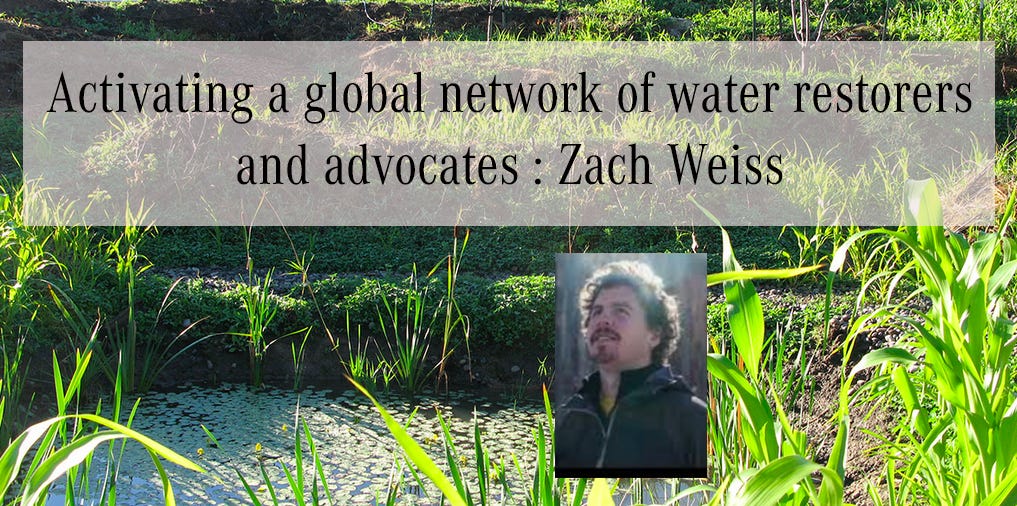
Activating a global network of water restorers and advocates : Zach Weiss
Restoring the world’s water cycles is a craft, one that takes time to learn, and a community to grow within. That community is being built.Water Stories is an education platform, community network, and hands-on career pathway dedicated to restoring the world’s water. It has been quietly growing, building a network of extraordinary people, advocating for landscape-scale change, and educating a new generation of practitioners in the art of working with water.Water Stories is following a similar path. It is a learning, training, and action platform focused entirely on water cycle restoration, offering a community-centered approach to some of the most pressing environmental crises we face: drought, flood, fire, and polluted water. Its award-winning films tell the stories of people who have raised their communities out of extreme environmental crises, and are available free to its online community. That community now numbers over 3,000 people from around the world, concerned about the future of fresh water, learning from one another across different landscapes and contexts, and supporting each other toward a better common future. Founded by Zach Weiss, Water Stories was created with a bold vision: to train a global force of water cycle restoration practitioners, equipped to heal landscapes wherever they are needed.Zach Weiss spent years learning to restore the water cycle from the ground up, studying under mentors including the legendary Austrian farmer Sepp Holzer, who urged him to take what he had learned and teach it to as many people as possible. That call to multiply the work is what drives Water Stories today.The methods Zach developed are focused on helping the land receive rainfall more effectively, slowing water down, guiding it into the ground, and recharging aquifers so they can feed springs and streams throughout the dry season. They are rooted in reading the landscape, observing where water flows, how slopes behave, where it pools or rushes away, and then working with those patterns rather than against them. In practice this means building terraces, planting strategically, putting in check dams, and creating water retention features that follow the land’s natural contours (in title picture above, are terraces leading into a water retention pond, that helps recharge groundwater, that Zach helped create in Montana USA). It is about restoring soil, restoring vegetation, and restoring the slow, generous movement of water through living landscapes.Farmers using these methods have withstood wildfires while neighboring properties burned, because their land was deeply hydrated going into summer. Others have seen vegetation flourish as rising groundwater reaches plant roots. The core idea is simple but profound: get the earth to receive water better, and life follows.Now, rather than doing that work alone, Zach is focused on training others to do it too, spreading these skills as widely and as fast as possible across the world.A groundswell takes hold when networks begin to form, when decentralized centers of activity emerge around the world, when people step into leadership, and when knowledge spreads person to person. Permaculture did exactly this through its Permacultue Design Courses, which perhaps half a million people have now completed, with many millions more practicing its principles worldwide. It spread like an octopus reaching into every nook and cranny of the globe, quietly shifting paradigms and transforming both landscapes and lives.The groundswell that Water Stories is one of the forces helping to build is beginning to feel like that.Yoga offers another useful parallel. It took off in the 1980s when enough teachers had been trained to make a living from their practice, creating a self-sustaining wave of growth. That is exactly what the Water Stories platform makes possible, a genuine career path in watershed restoration. Practitioners already report having more projects than they can handle, more land asking for attention than there are trained hands to tend it.Across the world, a broader awakening around water is underway. Scientists, farmers, indigenous communities, and restoration practitioners are all converging on the same understanding: that healing the water cycle is one of the most powerful things we can do for the planet. Water Stories sits right at the heart of that, with the tools, the community, and the vision to become one of its many central forces carrying that groundswell forward.Here is a lightly edited, abridged version of of our interview:Alpha: Cool, I’m excited to have on here again. You came on two years ago….. Maybe you could just start out by saying a little bit about the larger global water problem, and then how you came upon this path of actually trying to help the whole water situation in the world.Zach: When we look globally, I think the easiest, most succinct way to look at the challenges we’re facing is that right now, we’ve built landscapes that reject the rain,
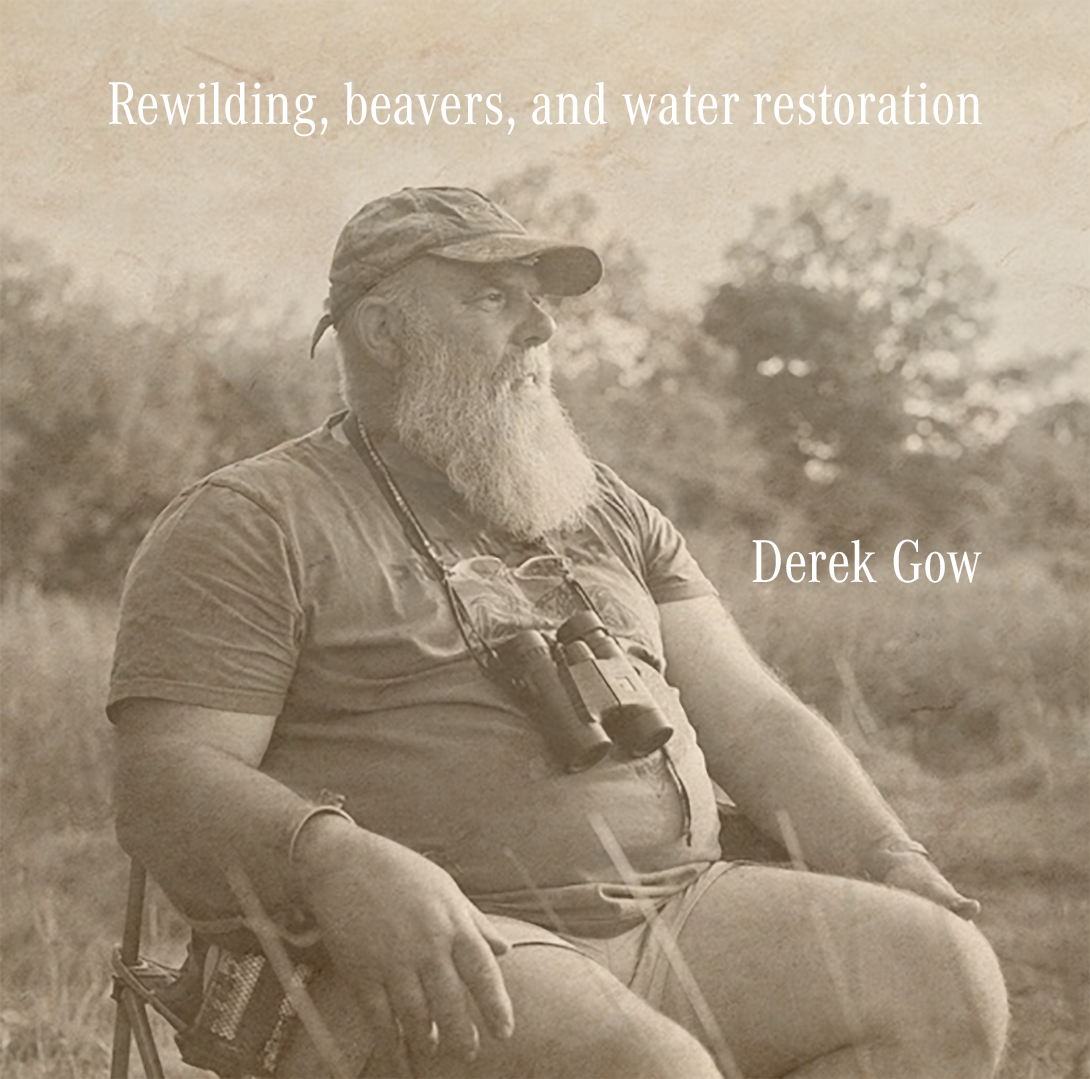
Rewilding, beavers, and water restoration : Derek Gow
The idea of bringing back the beaver to the UK was an idea that was scoffed as too eccentric, even by environmentalists. But Derek Gow, against a lot of opposition, has pioneered bringing the beaver back, so that they are now once again part of the UK landscape, restoring the wetlands and rivers.Born in Dundee in 1965, Gow left school at seventeen and spent his early years in agriculture. He was inspired by the writing of Gerald Durrell, and jumped at the chance to manage a European wildlife park in central Scotland before moving on to develop two nature centres in England. That early immersion in wildlife conservation set him on a path that would eventually make him, in the words of George Monbiot the person who has done more to restore Britain's missing fauna than anyone else in the country (words written in the blurb for Gow’s memoir).Gow was the first to import and quarantine beavers for projects in the UK, sourcing animals from Poland, Bavaria, and Norway. It was the opening salvo in what would become a long and often maddening battle against institutional resistance. Since the early 1990s, in the face of outright opposition from government, landowning elites, and even some conservation professionals, Gow imported, quarantined, and assisted the reestablishment of beavers in waterways across England and Scotland, while responding to the opposition with characteristic bluntness, charm, and what his supporters describe as an almost reckless willingness to keep pushing when anyone else would have given up.Beavers were once common throughout England, Wales, and Scotland but became extinct in the sixteenth century, hunted for their fur, meat, and castoreum - a secretion used in perfumes, food, and medicine. Their disappearance was the removal of a keystone engineer from the landscape. Beaver dams create wetlands, slow water flows, filter pollutants, and provide habitat for an extraordinary range of species. Through gnawing on stems and coppicing trees, beavers stimulate regrowth that provides homes for more insects and birds, while also enabling more constant water flows and better water retention during droughts. In 2015, several families of beavers were reintroduced in Devon, in the UK, as part of the River Otter Beaver Trial - the first legally sanctioned reintroduction of an extinct native mammal in the country. Over the following five years, the two original breeding pairs expanded to at least eight, and researchers found 28 dams built across the catchment, impounding water across nearly two kilometres of watercourse. Findings from the trial showed that beavers reduced flood flows by up to 60%, even during very wet weather, by holding back water in newly created wetlands and allowing it to trickle out slowly rather than surge downstream. In the flood-prone village of East Budleigh, a family of beavers constructed six dams upstream, with the measurable result that peak flood flows through the village were significantly reduced. The animals were also found to clean water supplies, removing large quantities of soil, manure, slurry, and fertilisers from rivers and streams. Beavers have been steadily increasing their numbers over the years. There are now over 2000 in Scotland, and around 500 in England. Wildlife trusts are looking to release more this year.Today, Gow farms a 300-acre property on the Devon-Cornwall border that he is transforming into a rewilding haven, while continuing to be influential in the reintroduction of the Eurasian beaver, the water vole, and the white stork in England. He has written about the whole extraordinary saga in his book Bringing Back the Beaver.Here is an edited, abridged section of our interviewAlpha: This whole field of water restoration and rewilding - how did you get into it? Derek: I started working with water voles which are a very small animal in Britain. Water voles are one of the characters in Kenneth Graham’s book The Wind in the Willows. The character of Ratty, sculling up and down the idyllic English River with his friends, used to represent a very common animal. They were incredibly common in British waterways from the beginning of the twentieth century, and writers at the time referred to their overwhelming presence.Around 100 years ago water voles prospered. But by the 1960s and 70s, canalization of rivers, concrete banks, pollution, and the introduction of North American mink from fur farms caused massive declines. The animals once lived in chains of colonies along waterways. When those chains break and populations fragment, they can’t find unrelated mates and they disappear.Today the species has lost around 97% of its British range. The remarkable thing is that they are extremely robust. If you reintroduce them correctly with the right gene base and numbers, they recover easily. Their decline shows how harshly we’ve treated the Earth.I began working on water vole reintroductions about thirty years ago. We’ve learned a lot, though we haven’t saved them enti
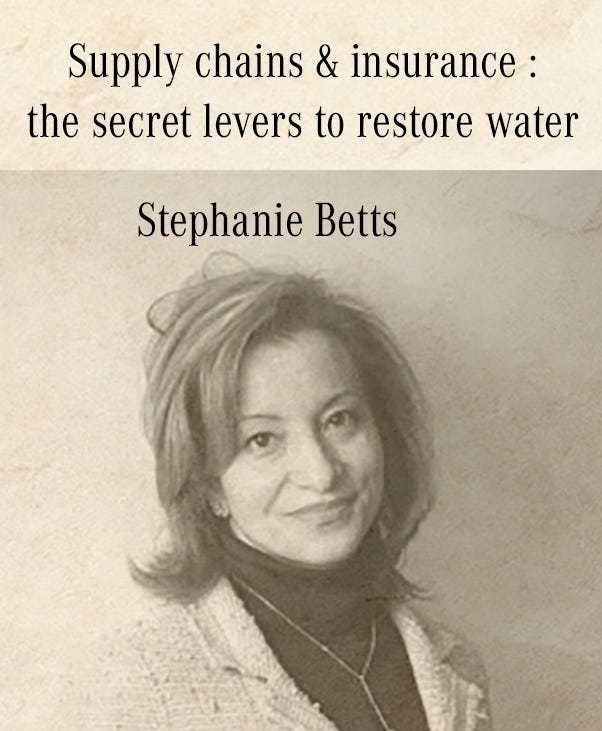
Supply chains & insurance: the secret levers to restore water - Stephanie Betts
I met Stephanie Betts a couple of months ago and was struck by her dynamic and enthusiastic energy. She had launched a pioneering, ambitious, and viable project to restoring the water cycle in a large scale systems way. Last week we sat down and talked about her project and her life.Stephanie Betts had worked in law and investment banking and was leading meetings between M&G (global investment manager) , the Bank of England and NGOs like Client Earth, looking at best practice governance for climate. Then came her first aha moment: the CEO of AXA, a major French multinational insurance company, declared to her that a world at plus four degrees would no longer be insurable. Insurance, she realized, wasn’t just a financial instrument. It was the key to dealing with climate change.She pivoted into insurance, becoming Head of Climate Alliances, Coalitions & Reporting for Aon - an insurance broker, that matches risk with capital, clients with underwriters, and counts major corporations and governments as clients.Insurance, at its core, is about understanding and pricing risk. The industry runs on calculating probabilities and turning them into prices. Stephanie started looking at something more fundamental than individual premiums. She was seeing entire sectors, entire geographic regions, becoming uninsurable. When water systems fail, it’s not just one farm or one business that becomes too risky to cover. It’s everyone who depends on that watershed. The insurance industry had been tracking this for years through their payouts: floods and droughts accounted for a large proportion of their disaster claims. But what Stephanie realized was that this wasn’t just about paying out more claims. It was about approaching a threshold where the risk becomes so high, so unpredictable, that insurance itself breaks down. Whole classes of people, whole industries, would simply have no coverage available at any price. The system only works if risks are manageable and calculable.Even before joining Aon, she had realized that water was important. But now it was getting clearer it was the fundamental risk underlying everything. Water runs through so many industries, from agriculture and technology to manufacturing and energy. It is the foundation of our society and the basis of our food security. As she puts it: “The risk isn’t just to the individual crop; it’s the dependency of our entire society on water. If the watershed fails, the entire economic system becomes uninsurable. We have to treat the water cycle as the ultimate infrastructure.” From within Aon, who initially just saw Stephanie’s interest in water as a hobby, she started to educate and convince the network around her of the importance of water.Then came her next aha moment: she realized farming was key to the whole water issue. Agriculture uses a large percentage of our total water supply, and the water footprint of regenerative agriculture was much smaller than industrial farming. Regenerative agriculture was the way to deal with water. She began to focus intensely on this connection. She saw that insurance could be a way to unlock investments, to get money flowing toward solutions. For the food industry, a switch to regenerative agriculture would make them less risky to insure. As she explains: “Insurance is the seed of resilience. By leveraging risk analytics, we can move from simply paying for a disaster to incentivizing the prevention of one. We are matching risk capital to the transition.”In other words: instead of just writing checks after disasters happen, insurance companies could lower premiums for farmers who prevent disasters from happening in the first place. But more importantly, by fixing the underlying water risk, they could keep entire sectors and regions insurable.The claims data said that regenerative farmers filed far fewer insurance claims than industrial farmers. They were more resilient. Through decades of heavy machinery and chemicals, industrial soil had become compacted and lifeless. When heavy rain hit, the ground acted like concrete. The water ran off, taking the topsoil and crops with it, leading to massive flood claims.Regenerative farmers, using cover crops and avoiding tilling, had rebuilt the organic matter in their soil, creating a sponge effect. High-carbon, aerated soil can hold up to ten times its volume in water. In a flood, the soil sponge absorbs the excess. In a drought, that same sponge slowly releases stored moisture back to the plants. Regenerative crops often stay green for weeks longer than neighboring industrial crops during heatwaves.For an insurer, it was key that a single farming practice lowered the probability of having to pay out claims on both ends of the extreme weather spectrum. Both floods and droughts. As Stephanie explains: “When we restore the soil sponge, we aren’t just fixing a farm; we are protecting the collateral. Healthy soil is an appreciating asset because it builds its own resilience against both floo
Precipitationsheds and the socio-economics of rain: Patrick Keys
In Bolivia, farmers wait anxiously for rains. Meanwhile, Bolivian consumers buy beef and soy from Brazilian suppliers whose operations are clearing the very Amazonian forests that generate Bolivia's rainfall. The atmospheric connection is real but the economic feedback loop is invisible. If Bolivian businesses and policymakers could see this connection as clearly as they see a map of trade routes, would they make different choices about whom to buy from? Would Brazil negotiate differently if it understood that the forests it's clearing don't just affect its own climate, but control a neighboring country's water supply, a country that happens to supply a significant percentage of Brazil's natural gas?These are the questions that the work of Patrick Keys, a professor at Boston University, raises. He is taking the work of moisture recycling (aka the small water cycle, aka precipitation recycling) in exciting and pioneering directions. He is making the geographical sinks and sources of rain clearer, and then transforming moisture recycling from atmospheric physics into something socio-politico-economic: maps that show which upwind regions supply a location's rainfall, and frameworks for understanding how economic decisions in those distant regions create invisible dependencies. He's building the conceptual infrastructure for embedding atmospheric connections into the social and economic systems that actually shape land use.Working with Ruud van der Ent (interviewed here previously), he developed the precipitationshed framework, which maps how much rain falling in a particular location comes from which upwind regions. A city might receive portions of its rainfall from countries A, B, and C, or provinces D, E, and F. By making these connections spatially explicit, the framework transforms vague atmospheric dependencies into actionable geographic information. This required inventing new vocabulary - terms like precipitationshed and evaporationshed had to be coined to discuss atmospheric source regions, linguistic innovations necessary for thinking clearly about phenomena that previous frameworks couldn’t adequately describe. From their paper, precipitationshed is ‘defined as the upwind atmosphere and surface that contributes evaporation to a specific location’s precipitation (e.g. rainfall). We apply the precipitationshed as a tool for better understanding the vulnerability of rainfall dependent regions (e.g. dryland rainfed agriculture).” [Keys 2012]. The precipitationshed gave moisture recycling the same kind of geographical grounding that watersheds gave to rivers.Keys then applied this framework to map mega-cities worldwide, identifying which might be most vulnerable to land-use change in their precipitationsheds. His 2018 paper combined precipitationshed boundaries, rates of land-use change in source regions, reliance on terrestrial versus oceanic moisture, and robustness of municipal water infrastructure to create a vulnerability index. It was the beginnings of a translation exercise of sorts: how to convert land and atmospheric physics into the kind of comparative risk analysis that could sit alongside assessments of aging pipes or aquifer depletion in a city planning document.The mapping of atmospheric vulnerabilities built the platform for his next stage of work. Together with Lan Wang-Erlandsson (also interviewed here previously), Keys pushed the framework into new territory: moisture recycling as an ecosystem service embedded in social and economic systems. Places downwind buy from businesses upwind that affect the land. Economic behavior affects how businesses treat the land, which then affects the rain downwind. It’s a feedback loop where economic behavior is integrated into the hydrometeorological flow. In their 2017 paper “On the social dynamics of moisture recycling,” they propose a new field: socio-meteorology. And they write: “this paper provides insights for resource managers, particularly land and water managers, who are searching for new leverage points within their dynamic social–ecological systems. Understanding where key feedbacks, bottlenecks, and potential cascades are located within a system can provide managers with better information about the consequences of direct or indirect intervention within their systems.”Keys and Wang-Erlandsson analyzed three countries with different social-ecological configurations. Mongolia recycles 13% of its own moisture and receives 29% from Russia. Its precipitationshed is geographically vast but socially isolated - the moisture comes from remote Siberian forests and Kazakh steppes with little economic or political connection to Mongolia. Niger generates only 9% of its own rain, depending on moisture from Nigeria, Chad, Sudan, and across the Sahel. Here, multiple neighboring countries with active trade relationships, migration flows, and shared resources all influence each other’s rainfall through land-use change, creating a regionally interconnected sys
The big groundwater crisis - food, water, pollution, and social unrest : John Cherry interview Part I
I was mesmerized listening to John Cherry talk about groundwater, so absorbed that I didn’t notice that two hours had gone by. With lucid clarity, he laid bare the massive groundwater crisis engulfing us.Cherry speaks from a place of gravitas. He’s won the Stockholm Water Prize, known as the ‘Nobel’ of water, which is awarded in conjunction with the Royal Swedish Academy of Sciences, the same institution behind the Nobel Prize itself. He wrote the seminal Groundwater textbook that shaped our modern understanding of groundwater hydrology. He essentially pioneered the entire field of groundwater contamination.In our conversation, he poignantly pointed out that the water crisis is really a crisis of groundwater. 99% of liquid freshwater is groundwater, and groundwater supplies 40% of our food, and 70% of irrigation, but many major aquifers are already overdrawn. The Ogallala, which grows a sixth of the world’s grain, could be largely unusable within decades. Once natural buffers against drought, aquifers are now drained, leaving regions like California, Spain, São Paulo, and Cape Town vulnerable to even short dry spells.He noted that the Agricultural ‘Green’ Revolution of the mid 20th century wasn’t just about using synthetic chemicals and high-yield seeds to produce more food, it was also withdrawing more groundwater. Cheap pumps fueled massive irrigation, temporarily boosting yields but eroding soils and depleting aquifers. Today, exhausted soils and collapsing aquifers are twin legacies of that mid-century surge.Global “virtual water” trade has been hiding the growing groundwater crisis. Wealthy nations import crops grown with disappearing groundwater, from Peruvian blueberries to Arizona alfalfa for Saudi Arabia. Far from increasing food security, globalization has made local water crises a global problem.There was so much rich material in our interview that I couldn’t squeeze it all into one written article (Substack has length limits), so I’ve split this into two parts. Part II will go further into the crisis, and also explore solutions - regenerative agriculture, rainfall harvesting and managed aquifer recharge. The audio podcast remains one complete episode.Here is a lightly edited, abridged version of the interview : Part IAlpha: Lets give you a little bit of an intro. You’ve written a very widely regarded textbook on groundwater, and you were a pioneer of contaminant groundwater.John: Yeah, I wrote that book Groundwater with a colleague, published in 1979. There weren’t any other modern books on the market, so it became a widely used book for many decades. It’s on the Groundwater Project website and it’s one of our most highly downloaded books, even though it’s very old.Alpha: Yeah, it’s very readable. At some point you began exploring the bigger picture idea of why groundwater is so important to the world.John: Yeah, I started the Groundwater Project as a follow-up to the textbook by Al Freeze and myself. The idea was to just publish a few books on the web and then it grew and grew, and that got me into looking at the bigger picture. Bigger picture lectures are what I’ve been giving for the last four or five years. First I was talking about the bigger picture of the state of groundwater science, and now it’s really about the bigger picture of groundwater in the world and how it’s kind of ignored and unappreciated and mostly pictured incorrectly.Alpha: You’ve won some of water’s biggest prizes. The Lee Kuan Yew Prize and then the Stockholm Water Prize.John: I won the Lee Kuan Yew Prize of Singapore in 2016, and then the Stockholm Water Prize in 2020, rather late in my career. But it kind of caused me then to want to develop responses to broader questions. Really, it was the Lee Kuan Yew Water Prize when the interviewers would ask me, “Why is groundwater important?” The technical things for which I won the prize were entirely irrelevant in terms of the big picture. So I realized I had to develop responses to the question of why groundwater is important.Alpha: I think for a lot of people, when they first hear about groundwater, they don’t really realize they should have any significant thoughts about. It’s just this water deep underground which we don’t see. And yet, I think you’re saying there’s actually this whole groundwater crisis that’s looming that has repercussions for many things—from our food to our water systems. Really key to human society.John: Yeah, and it’s now recognized that there’s a global water crisis. The World Bank and UNESCO and all the global organizations pay lip service to that, that there’s a global water crisis. But they never get to the point of what’s the nature of the crisis. It’s primarily a groundwater crisis because groundwater makes up 99% of all liquid fresh water. The number you see in the textbooks is always less than that because they include ice. But when you take ice out of it, it not being a liquid, groundwater is 99% of all liquid water. And most of the time, a
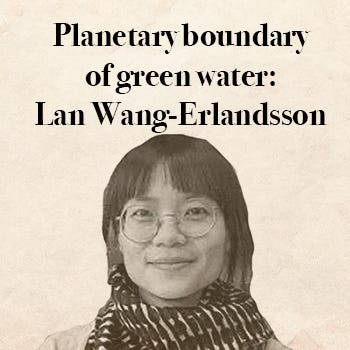
The planetary boundaries of green water : Lan Wang-Erlandsson
Lan Wang-Erlandsson is a researcher studying moisture recycling. She focuses on the large-scale interactions between land, water, and climate, and their implications for social-ecological and Earth system resilience. She has conducted work on the planetary boundaries of green water, where green water is defined as water that vegetation uses, or more formally as ‘freshwater from precipitation that is stored in the soil and used by plants through transpiration’. She helped society understand moisture recycling as an ecosystem service, and collaborated with the FAO (Food and Agriculture Organization of the United Nations) on reports examining how moisture recycling intersects with the future of agriculture.Her work has emerged from two scientific lineages. Science often evolves through such lineages. Hubert Savenije was working in the Sahel region of Africa when he wondered why rainfall did not keep decreasing further inland, as it should if the air rained out water closer to the coast. He concluded that there had to be moisture recycling, where moisture evaporated back into the air and then fell again as rain. (Other lineages have called this moisture recycling phenomenon by the names precipitation recycling, or the small water cycle.)Two decades later, Ruud van der Ent (who appeared here on the Climate Water Project podcast), a graduate student of Savenije’s, built on his work to create a map of global moisture recycling. Lan Wang-Erlandsson would eventually collaborate with van der Ent, as would Patrick Keys, who would work on hydrosocial aspects of moisture recycling (he will appear in a future podcast).Lan Wang-Erlandsson completed her graduate work at the Stockholm Resilience Centre, which brought its own scientific lineage. The Stockholm Resilience Centre (SRC) was founded in 2007 by Johan Rockström and Carl Folke as part of Stockholm University. Its intellectual roots reach back over half a century, drawing on ecological economics, systems thinking, resilience science, Earth system science, and work on sustainability, tipping points, and the interplay between society, economy, and the biosphere.From this foundation, the planetary boundaries framework emerged. In 2009, Johan Rockström, then director of the Stockholm Resilience Centre, led a group of 28 scientists to formulate the concept of planetary boundaries in the paper “A Safe Operating Space for Humanity.” The idea was to identify critical Earth-system processes (such as climate change, biodiversity loss, nutrient cycles, land-use change, and freshwater use) that regulate the stability and resilience of the planet, and to estimate thresholds or “boundaries” for those systems that should not be crossed if humanity is to avoid large-scale, abrupt, or irreversible environmental changes.Here’s an abridged, lightly edited version of our interview:Lan: I’m a researcher and team leader of the Anthropocene Dynamics theme at the Stockholm Resilience Center. Alpha: And when you say Anthropocene, that is the era where people are affecting the Earth. You’re studying how people are affecting the water, and how that then affects the whole Earth. Lan: Yes, exactly. You know, the human impact on the water cycle is really very severe and widespread now. You could say that in the past 12,000 years during the Holocene, it’s the only time in history that we know for sure that has supported modern civilization and agriculture the way as we know it, right? The Earth system has several tipping points. So the transition could be non-linear. And so whether we exit this, what we call the safe operating space, of the Holocene-like conditions, if we depart from these conditions, it could be in an abrupt way, or it could be in a more gradual way. The boundaries are a set of guardrails. So you could imagine that you’re standing at the cliff, you don’t want to stand precisely at the cliff, but a few meters away, right? So the boundaries are the guardrails. So now we are somewhere between the guardrails and the cliff, and it’s an uncomfortable zone we want to get out of. Alpha: And then one of the nine planetary boundaries is the water, right? And so that’s what your working on. Lan: Yes, so the planetary boundaries identify nine Earth system processes or components that are vital for the system resilience to function, for the Holocene-like conditions to continue, to support humanity. Freshwater is one of them. And of course, you could say that some other boundaries also relate very much to water, such as biogeochemical flow that deals with phosphorus and nitrogen pollution, for example. And eutrophication is a big problem. You have the novel entities about chemical pollution, and you know, microplastics in river systems is a big issue. And then the same goes with land system change, biosphere integrity, that also includes life in aquatic systems. We know are much threatened. And then climate change, obviously, that is the main culprit behind the water extremes that we see. So t
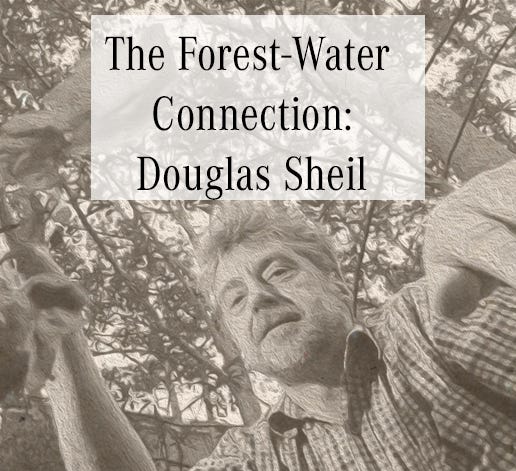
The forest-water connection: ecologist Douglas Sheil
In this podcast, I had the wonderful experience of talking with Douglas Sheil, professor at Wageningen University in the Netherlands, about forests. Douglas's academic adventures took him on a journey from his homeland to places like the rainforests of Indonesia, where he studied how local communities can help protect forests. He has studied forests in many forms of their complexity and wrote a well-regarded textbook on tropical rainforests. He became interested in questions of forest and water and helped clarify a big issue in the ecohydrology field about whether trees were contributing to or depleting the water in ecosystems. His results showed that when tree cover is done right, and not as dense invasive monocultures, then there would be an increase of water in the ecosystem.As he worked on forest water issues, he discovered Victor Gorshkov and Anastasia Makarieva's work on the Biotic Pump, and collaborated with them on explanations of their theory. Here an explanation he wrote about the Biotic Pump: “For centuries we’ve believed that temperature differences generate the pressure gradients that drive winds and carry moisture inland. The sun heats the land, warm air rises, drawing in winds. These winds carry moisture laden air inland, where it eventually warms, rises, and condenses as rain. There are complications, such as Earth's rotation and atmospheric cells, but overall temperature differences underpin our understanding of how wet inland areas of the planet stay wet. But there’s an alternative: the Biotic Pump. An idea developed and championed by colleagues Anastassia Makarieva and Victor Gorshkov. Given common misunderstandings, I thought I would try a simple intuitive summary without equations. Here goes: Imagine two vast areas of atmosphere next to each other: one wet and one dry. Both are at equilibrium with the same surface temperature. Atmospheric pressure follows a roughly similar near exponential decline with altitude in both, but there are small differences. In the wet column, the presence of moisture means that air pressure is slightly lower (compared to the neighbouring dry column) in the lower atmosphere (up to 3-4 km height) and becomes greater above that. These pressure differences mean that if the columns are brought together, and the pressure differences maintained, a circulation is established: At the surface, air moves from the dry to the wet area. At higher altitudes, it flows in the opposite direction. This circulation causes air to rise over wetter regions and descend over drier regions. In the real world, “dry” areas may be just a little less moist. As long as it is sufficiently moist the moister region draws in air from surrounding drier areas. As this incoming air rises, it cools and reaches saturation, producing rainfall. This process maintains the moisture contrast with neighbouring areas, where the now-dry high-altitude air returns and descends. As long as the wet column stays wetter, and has sufficient moisture to maintain the pressure differences, the circulation continues.Forests are key here. Forests generate water vapour more effectively and rapidly than most other land cover types, maintaining a moist atmosphere that is effective at drawing in air from elsewhere and sustaining this circulation deep inside continents. Energy derives from the sun evaporating water vapour. Heat energy still features (because condensation releases latent heat), but in this case overall pressure differences depend on condensation and the removal of water molecules from the air.”For more info here is a link to a paper where is a co-author with Makarieva & Gorshkov. Douglas Sheil and I discussed a variety of topics, like how forests evolve, how to restore forests, and his work on the intermediate disturbance theory for forests. Here’s an abridged edited version of my interview with Douglas Sheil:FOREST ECOLOGY AND WATER SYSTEMSDouglas: My background is very much as a forest ecologist, somebody who's been looking at how we can do conservation, particularly in remote parts of the tropical rainforest. How can we actually work with communities, for example, to actually protect these incredibly rich communities that are often under threat from large-scale industrial transformation, etc? My preoccupation has often been with the biodiversity, the rich species richness of these forests, which of course is famous.But if you're working with communities and stuff, talking about things like water, that's something that really matters to everybody. Everybody needs reliable water, even in wet parts of the world. If there's a big drought, that's a problem. So everybody cares about water. So I guess I've come into the water topic, partly because I see it really matters.Alpha: You grew up in Ireland. Did you then get into forestry immediately, or was it a little bit of a winding route?Douglas: It was winding. When I was young, I thought I was going to be an astronomer or a physicist, because I kind of like th
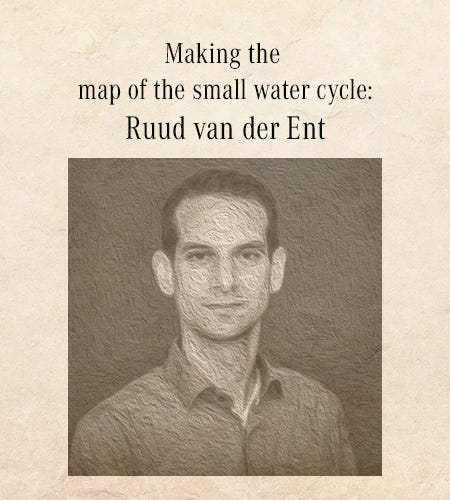
Making the map of the small water cycle : van der Ent
Where does the evapotranspiration that rises from forests and grasslands come back down as rain? This was the question that Ruud van der Ent asked as a hydrology graduate student. He wondered if he could make a map of the world that would show this flow of moisture around the world.Van der Ent worked with his professor, the renowned Hubert Savenije to make this map. They published this in a paper called “Origin and fate of atmospheric moisture over continents”. Their map has been quite influential and attracted quite a lot of attention. One of the most popular articles in this newsletter has been on their work. This is the map they made. It shows where evaporation that goes up, will become rain again on the same continent. Red areas means 60%-80% of the evaporation that rises from that area will come back down as rain on that continent. So you can see that a lot of the evaporation rises from the west coast of North America, will come back down as rain somewhere in North America. A significant amount of the evaporation from Brazil and the Amazon rainforest, will come back down as rain somewhere in South America. Much of the evaporation from Congo and East Coast of Africa will come back down again as rain somewhere in Africa. Much evaporation in northern India and western China will come back down on the continent.This is a map they made showing the origin of rain. It shows the amount of rain in that area that came from evaporation off the land. So in the Rockies in the US, you can see that a lot of that rain there originated as land evaporation. In northern China, you can note that a lot of the rain there came from moisture that evaporated off the Eurasian continent. I was really happy when I managed to track down Professor Ruud van der Ent, and he agreed to do this interview. Below is an edited excerpt from the interview.Alpha: When you were doing your Master's, was that when you first met Hubert Savenije? Ruud: Yeah, he was a professor in hydrology, a very inspiring person, very enthusiastic, full passion for hydrology and how things work. In one of the courses that I took, we had to read papers. I think the majority of the papers we had to read were his own papers. He did some work in the 90s on moisture recycling in the Sahel. He developed his own approach to the question of where does the rain come from and how much of the evaporation comes back to the land surface. Savenije took the perspective of let's follow the trajectory of moisture and then calculate along that trajectory how much is being recycled. His estimates were rather kind of surprising to me, eye-opening. As you go from the coast of West Africa up north into the drier parts, the amount of precipitation in those drier areas that stems from land sources is actually greatest. So they have a region which actually depends on the land for rain. When he did his moisture recycling equations in the 90s, the computational power was much less than we have today. Also open data was also much harder to access. You couldn't access the big climate mobile data sets, reanalysis data sets that we can access now. So he did it all with analytical equations. I said, I want to pick up this research for my Master thesis. Alpha: Savenije was very much his own independent thinker, right? He was positioned in Africa during his early days. And because there was no internet back then, he had to figure out everything himself. He was trying to figure out this whole precipitation recycling thing. Around that time researchers had just discovered that the sea surface temperature seemed to correlate with the droughts in the Sahel in Africa, and so these researchers thought most of the rainfall was due to the oceans. But then Savenije plotted the amount of rain as you move inland, and he found the rain didn't go to zero. It would have dropped off to zero if precipitation was only due to moisture from the oceans. So he figured out that the land moisture was creating precipitation.. [Hubert Savenije]Ruud: I think sometimes, maybe its a blessing, you know, back when we did not have access to all the information on the internet, because you spend more time actually thinking about your own theories and develop your own methods, which is pretty cool. People also find it very difficult to kind of get their head around that there's moisture coming from Europe that could contribute to rainfall in the Sahel because how's it possible that the moisture crosses the Sahara? There is no rainfall there. There's no rainfall there, but there is still there is still moisture in the air, right? It still crosses the desert. And that's really amazing. Alpha: Yeah, it just doesn't reach the dew point to rain out over the desert. Ruud: Exactly. Yeah. Alpha: Savenjie came up with this idea of quantifying the amount of moisture recycling or precipitation recycling by how much it came back down on the same continent. He was saying the amount of water that transpires off the continent, that then comes
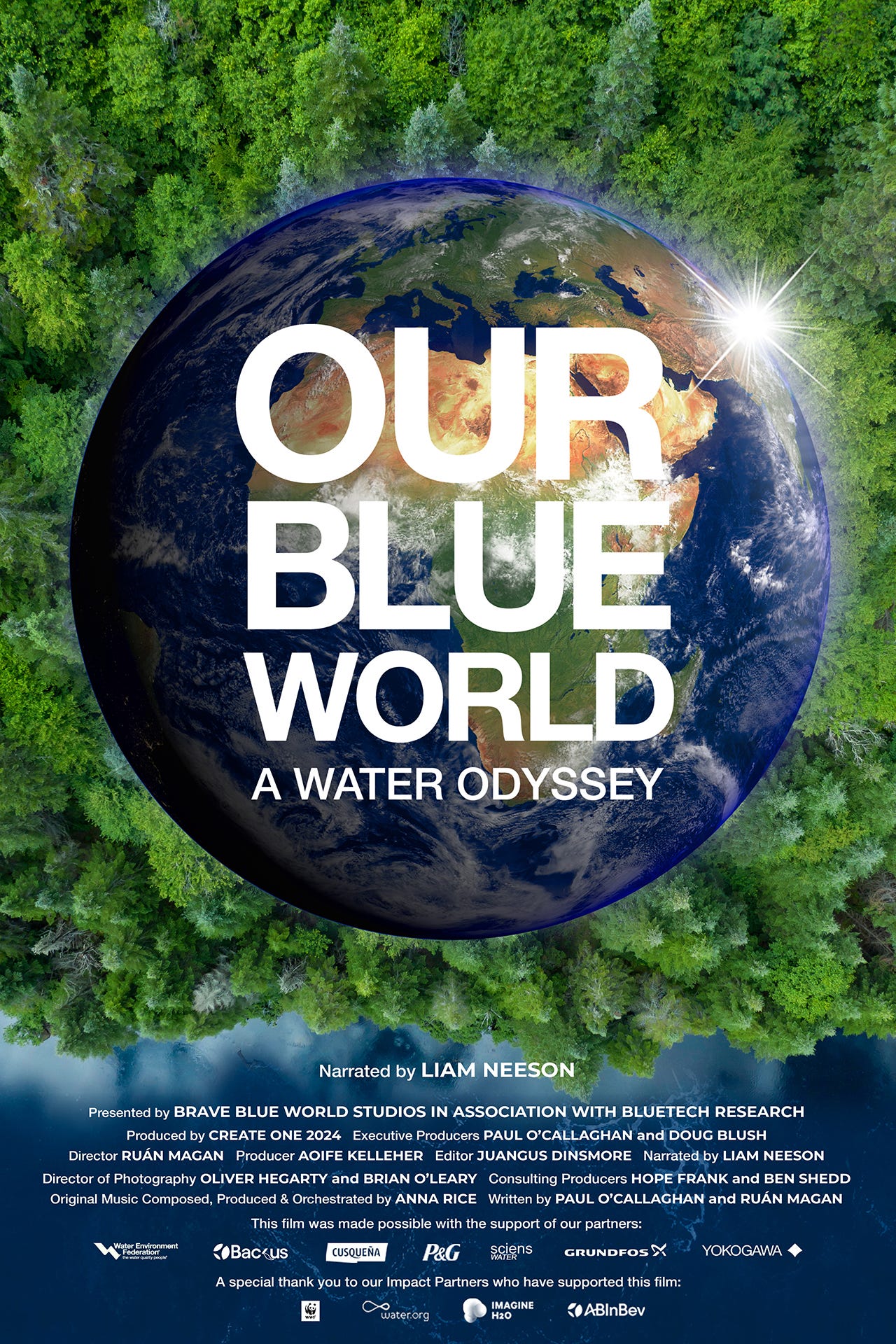
'Our Blue World' documentary : Paul O'Callaghan
A wonderful new documentary, Our Blue World, is out, and it offers a panoramic exploration of how communities across the globe are learning to live in greater harmony with water. The film highlights a wide range of innovative and traditional practices—from China’s sponge city initiative, to New Zealand’s recognition of the Whanganui River as a legal person, to the ancient Peruvian techniques for guiding water into mountains so it reemerges as springs. It also delves into the Biosphere 2 project, where twelve people lived in a sealed dome for two years and had to rely on constructed wetlands to purify their water. The documentary further explores the shift along the Mississippi River from a levee-centered approach to one that embraces wetland restoration, as well as efforts to restore Ireland’s bogs—offering a hopeful vision of how we can reimagine our relationship with water. The film is produced by Paul O’Callaghan, directed by Ruan Magan, and narrated by Liam Neeson (the action movie actor) in his voice that oozes gravitas. The movie has beautiful images, and wonderful music that connects us to the local geography and culture.[Peru: still from movie].I think documentaries are a great way to movie the word out about the water cycle, so I was glad for the chance to chat with producer Paul O’Callaghan about the movie.Trailer: Here are some abridged excerpts from our conversation, which covered topics from the movie:On sponge citiesPaul: The idea of a sponge city was very evocative. It captures your imagination. It's like, what is it? It's these two words that you're familiar with, but not together in that context. So anytime I would have talked about this, people became very curious. I was really lucky that we got introduced to Kong Jin. And I remember the day we had the call. It was chaotic in my house at the time. But we had this really great call with Kong Jin and struck up a very good rapport with him. And he kindly was willing to take part in the film. This was just post COVID-19. So China was locked down pretty much for two plus years. We were at the embassy trying to get our visas and get in, which wasn't easy. Kong Jin is a revolutionary, a visionary, something of a rebel, and a landscaper architect who felt that China was going in the wrong direction. They were following the West blindly. They were pouring concrete at an absolutely incredible race. And when he looked at that, he thought, that's not the right way to go.[Kong Jian : still from movie} He'd grown up in the 1960s in China, where it was a beautiful wonderland. It was a paradise. But nobody listened to him when he said we should embrace traditional ways of managing water like rice paddies, for example, which are stepped and terrest, the nearly room for water to ebb and to flow. That was how people lived for 5000 years along the banks of the Yangtze, the Pearl and the Mekong, where in actual fact, the fitness to govern in China was correlated with your ability to control water or at least live with the ebbs and the flows of those mighty, mighty rivers. So it's always been something fundamental to Chinese philosophy and political systems. He wrote 500 letters to 500 mayors and it landed on deaf ears. He was cast out as a pariah. Until one mayor, who later became a minister for the environment later on reached out back out to him and said - I'd love to try that idea that you had in Hainan. That was where the first sponge city was created. And these things look beautiful. When you think about China, oftentimes we think of concrete high rises, skyscrapers, maybe a lot of road traffic and air pollution. Well, these aren't like that at all. Certain parts of the city have tree lined along the streets. They may have mangroves on the coast. There large areas that are allowing rivers to ebb and flow, with constructed wetlands that look like parks. Alpha: Yeah, it's amazing that he had the persistence to do 500 mayors. It's like sometimes to make these paradigm shifts in work, you really have to push. It reminds me of little Peter Andrews, the Australian guy who did natural sequence farm. He just kept pushing, pushing against and all these people say no. But yeah, it's interesting. Not everyone has that ability to push so hard. And sometimes it takes that to get it out there. Paul: And you never know, it only has to land with that one mayor, 499 would never have listened to him. When you write these letters, when you advocate, when you communicate, none of us can really understand the wrinkles that are going to take effect downstream of this. He engendered a spirit of pride in a harkening back to perhaps a wisdom of a 5,000 year old culture. In doing so, he wasn't alienating people with some theory that they wouldn't understand. He was advocating for traditional wisdom. Alpha: And what is some of that traditional Chinese wisdom? Paul: We've been trying to flatten a variable signal, particularly in monsoon type climates in South Asia, where you get the
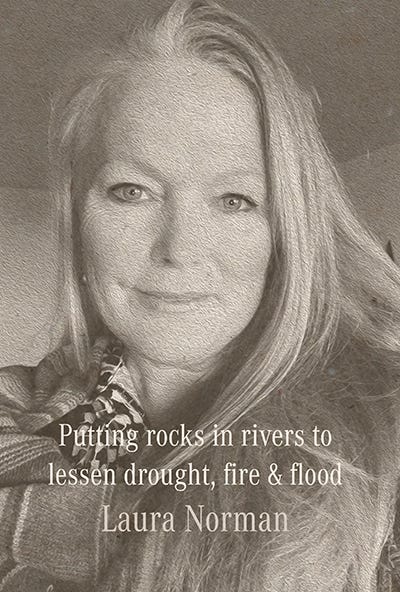
Putting rocks in rivers to lessen drought, fire & flood: Laura Norman, physical scientist
Laura Norman works for the USGS (United States Geological Survey), a US science bureau, studying water flow through our rivers and landscapes. There is a slow water movement underway, being spread by permaculture, agroforestry, Natural Sequence Farming and regenerative agriculture, promoted by people like Erica Gies, the author of ‘Water always Wins’, and its essence captured by Brock Dolman’s phrase ‘slow it, sink it, spread it’. Laura Norman has been helping make the impact of slow water more scientific with her hydrological modelling and observational studies, and helping bring these slow water ideas to US governmental agencies. It is perhaps a surprising idea that putting rocks in streams would have an impact on hydration of land around it, but slowing down flowing waters, can give them a chance to seep into soil and aquifers, and then spread sideways. It is also perhaps unexpected that the creek flow can increase by about a quarter as a result of putting rocks into it. A common assumption is to think the rocks are blocking the water from going to downstream people. But it actually increases the water available to downstream folk, because it reduces peak flow during big storms in the winter, and parcels out that water to flow more in the future - the creeks flow four weeks longer and with more volume into the dry season. Whats further intriguing, is this simple idea of putting rocks in streams can actually lessen wildfires. This is because the water now has a chance to seep laterally into the floodplains through the soil and aquifers, allowing the plants to be hydrated into the dry season. Its a similar effect to what beaver dams do to the water flow. There are a number of famous photos floating around the internet, of the vegetation in the floodplains around beaver dams being unscathed by fire, while the area around them is burnt. Norman studies how gabions and check dams, rocky structures that slow the flow of water in our streams, impact how water flows through other parts of the watershed, how they help farmers deal with droughts and floods, and how it provides us with a more nature-based way of water management.Here;s our interview (lightly edited):Alpha: Today I'm excited to have Laura Norman from the USGS, the United States Geological Survey. Welcome.Laura: Thank you.Alpha: Cool. What is it that you do with the USGS?Laura: I am a physical supervisory research physical scientist. I've been working at the USGS Geological Survey since 1998. And I study watershed modeling and all of the components of the water budget related to dryland regions. And so my research has been looking at how people can impact water budget parameters in models and trying to develop scenarios that are beneficial for management. Water budget meaning like the water cycle. So I look at all the components of the water cycle. So everything that comes into a watershed, what happens to the water when it is here and how it leaves.Alpha: How did you get interested in water and land?Laura: Well, I am originally from the swamps of Rhode Island. And so I grew up in a wetland in the coastal region of New England and went to school at Oregon State where I studied forestry. And I was very interested in the big trees in the Pacific Northwest and maintenance of big trees. And I ended up learning about watersheds when I was there. So I took a job with the state parks and some other jobs in between and ended up coming back to school to the University of Arizona, which is a water-limited area here in the desert, the Sonoran Desert. And that started studying watersheds here in the arid lands and trying to figure out how to best manage water.Alpha: Cool. And then did you work for a while before you ended up with the USGS, or you were already there?Laura: Well, I had a couple of seasonal things, internships and such. But when I came to Tucson, I got a job working for the University doing geospatial analysis. So my expertise in my master's degree in watershed management was the advanced resource technology option. I was using GIS. When I did my dissertation, I started employing remotely sensed data. So using satellite imagery within a GIS, within models. I worked for the University of Arizona for a couple of years and then started volunteering at the USGS until I was finally contracted on.Alpha: Do you want to explain to the audience what GIS is?Laura: GIS is geographic information systems. And so it's basically making maps. So I use a lot of different data. I mentioned satellite imagery, but a lot of people these days are most familiar with GPS, so global positioning systems. So using that type of geospatial data within a computer software to develop maps and do analysis in a spatial context.Alpha: Cool. And then the USGS, which is the United States Geological Survey, which is kind of an intriguing name because I don't think most people know what a geological survey is. What does it do exactly and how big is it?Laura: I think the USGS has 6,000 e
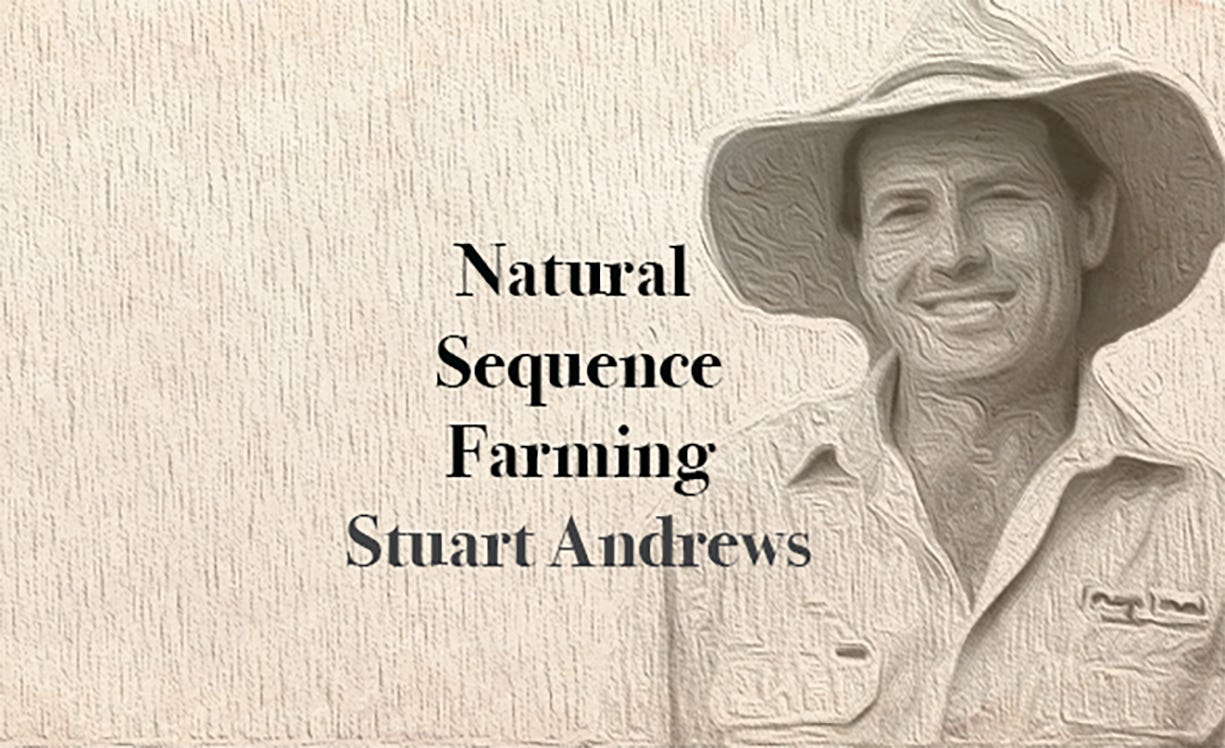
Natural Sequence Farming : Stuart Andrews
Peter Andrews, also known as PA, was an Australian racehorse breeder who in the 1970s bought a piece of property, in the state of New South Wales, to raise racehorses. However the land he bought, the Tarwyn Park property, was degraded and the water on it was salinated. After a lot of thought and experimentation he developed his own set of restoration techniques.He looked at the dried up patterns in the floodplains to figure what used to happen on the land. He saw there used to chains of ponds. So he started to work to rehydrate the floodplains. He repaired the degraded flow lines. He used willows and reeds to restore the river banks. But the neighbors keep bringing the authorities to try and stop what he was he was doing. Stubborn, brash, and confident, and because he knew he was onto something important, he continued to work anyways. The plants started bringing back the wet paddocks, and refilling the aquifers. The land turned into a flourishing, vibrant landscape.The work became known as Natural Sequence Farming. Peter Andrews went around around proselytizing the work - badgering governments, media and land owners, to get them interested. This was a process, he said, which could save Australian farming, help them stay hydrated even with the droughts. His work got on the Australian news, and word spread.The focus on getting the message out though meant Peter lost sight of running the farm as well, and the bank foreclosed on his property. But then Stuart Andrews, his son, was able to buy back the Tarwyn Park property back from the bank. Stuart had to teach himself the ways of Natural Sequence Farming to run the farm. He then worked with Duane Norris to build a training program there to teach others the same techniques. ( I had became friends with Duane a little while back, and he was very encouraging of my work during the early stages of writing this newsletter. I recruited Duane in my project three years to develop a set of principles that succinctly encapsulated the important aspects of the hydrological cycle.)Tony Coote, a successful jeweler, who had bought a property on 3 kilometers of Mulloon Creek in the 1960s. He approached Peter Andrews about restoring it. Early on the brought 6 truckloads of blackberries trees and canes to plant, which then started a feedback loop that slowed the water down, which then brought in more vegetation. Fish started coming back. And now there is a Mulloon Institute that teaches and consults on the Natural Sequence Farming work also.……………………………..Here is info about Natural Sequence Farming from the Tarwyn Park Training site :Natural Sequence Farming (NSF) is “a regenerative practice that restores landscape function, soil health, water retention, and biodiversity by working with natural processes. It explores the principles, emphasises the role of plants and water, and provides practical insights for implementing these principles in your own landscapes.The key to NSF is that plants manage water; that's what built all the environments we see. Plants are the engineers that build everything, and water is the carrier of the nutrients that feed them. Our landscapes operate in a continuous feedback loop connecting three main areas: Accumulation - The highest area where fertility is built. Production - The area where production takes place. Filtration - The lowest area where fertility is recycled.Our landscape no longer operates like this; it has become disconnected due to the way humans have managed their land. Natural Sequence Farming is the solution to that. It is about understanding how this system works and implementing works to reconnect the pieces like a puzzle. We need to understand the landscape first. And once we recognise the landscape and how it functions, it is about setting it up to work correctly once again.”[aerial view of Tarwyn park, photo from Tarwyn Park Training]The five principles of Natural Sequence Farming (NSF) are: 1) Slow the Flow: Emphasizing the importance of slowing down water flow to allow infiltration into the soil. 2) Let All Plants Grow: Promoting plant diversity and allowing natural regeneration of the landscape. 3) Careful Where the Animals Go: Integrating livestock management with the natural sequence of the landscape. 4) Filtration is a Must Know: Understanding the role of natural filtration systems in purifying water. 5) Return to the Top to Recycle the Lot: Recycling nutrients and resources by returning waste products to the top of the soil.…..I was really honored to get a chance to interview Stuart Andrews, the son of Peter Andrews. Below is part of our interview (slightly edited):Stuart: PA [Peter Andrews] was running a horse stud farm at the time. He wanted to expand. He wanted to be able to produce the best racehorses. So he was looking for an area where he could potentially produce the best racehorse. So he looked around and he realized that the horse market was better in New South Wales.So he then looked for a property over there. The h
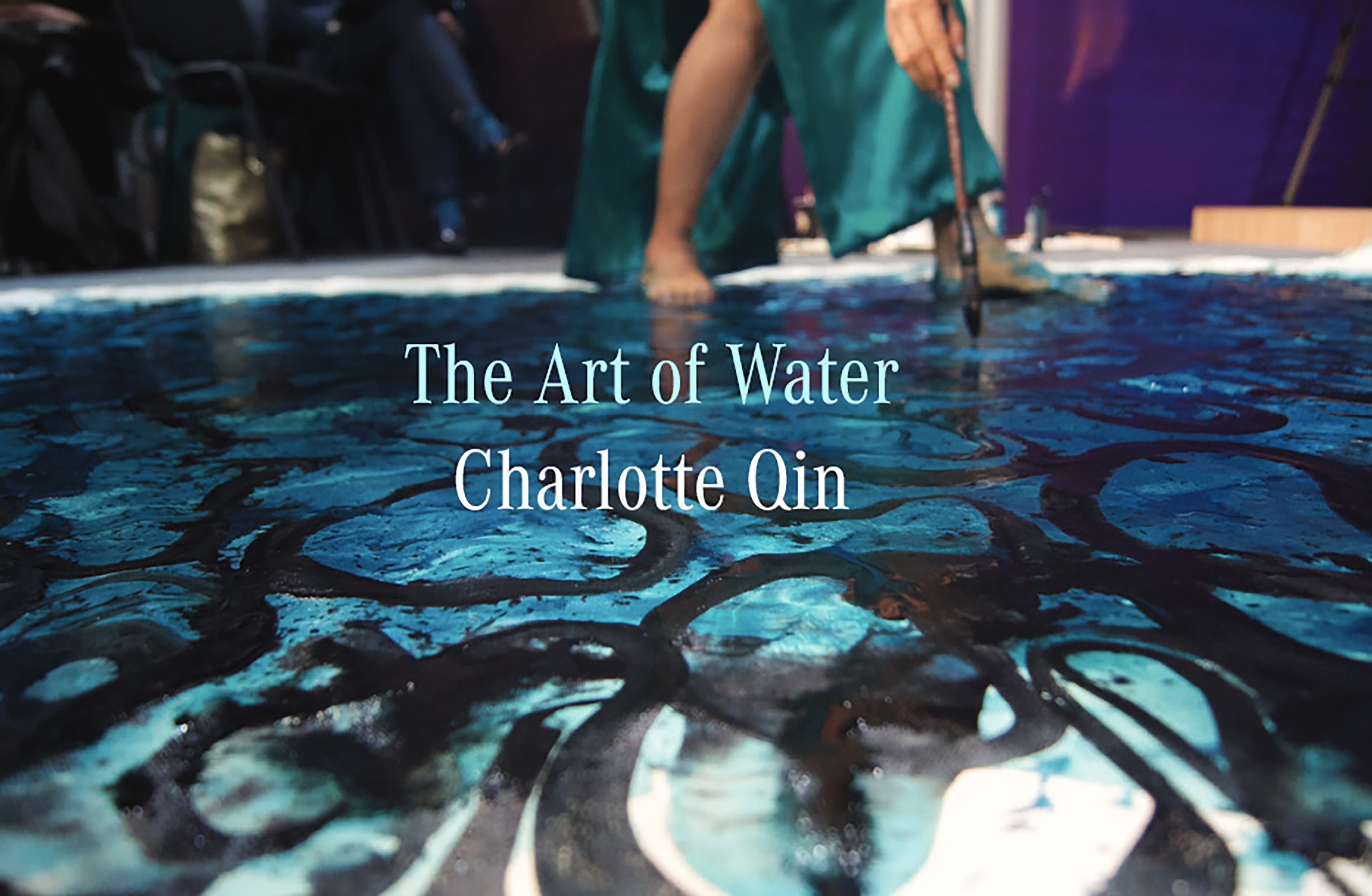
The art of water : Charlotte Qin
I had the joy of interviewing Charlotte Qin who is a water artist working to capture the emotions and spiritual essence of water through her paintings and her reciprocal performances where the audience engages in a connection with water. I was moved when I watched a performance of hers where glacial ice was brought in, and people spoke embodying the glaciers spirit, as the glacial ice melted. She comes from a physics background, and integrates science and policy into her art works, seeking to educate people about the many dimensions of water and watersheds. She writes on her Meeting of Waters project and organization site: “Water is at the heart of life, yet it remains one of the most overlooked crises of our time. Climate change, environmental degradation, and political conflicts have turned water into both a casualty and a weapon. Despite its fundamental role in sustaining ecosystems, communities, and cultures, the urgency of water issues has yet to fully resonate with the public. The complexity of water governance often keeps it siloed—separated across scientific, policy, and artistic spheres. But water is not just a resource; it is deeply woven into our histories, emotions, and faiths…. The name Meeting of Waters originates from La Jonction, where the glacial waters of the Rhône and Arve rivers merge—one clear, one sedimented—visibly illustrating the confluence of forces, ideas, and communities. What began as the artistic practice of an individual has grown into a movement—bringing together scientists, policymakers, artists, and cultural voices to reframe water not just as a crisis to solve, but as a relationship to restore.”……………………………..I was excited to connect with Charlotte, because I’ve been working on a number of water art and dance ideas, and interested in bringing together artists, who work with water, and also dancers who would like to do dance pieces around water and watersheds. I have a still emerging idea of collectives of artists and dancers working together to activate the restoration of watersheds. Drop me a line if this sounds interesting.………………………………Here’s part of the conversation I had with Charlotte, for full conversation check out the podcast.Alpha : So after graduating physics, you went and studied art, is that right, or design? Charlotte: I was doing this joint course between the Royal College of Art and Imperial College London. It was called Innovation Design Engineering. In my impression at the time, it was the marriage of art and science, except that everything is applied. We tend to think science and engineering, art and design, as two pairs, right? But in fact, our artists and scientists think more similarly, whereas designers and engineers were actually, you know, the similar family in terms of how they think. It was a very challenging course for me because I had to think about the users, think about solving problems. Whereas in my natural state, I would just be conceptualizing, trying to understand the system, and then going very deep in my thinking. In that course, I had to prototype. I had to think deeply about sustainability and why the world is messed up the way it is. And that was also when I found water. Not that I wasn't interested in water previously, but it around the same time I had kind of an environmental awakening. I realized I could feel the pain very deeply how water feels. And yeah, so I changed my direction completely. I was doing some cool technological projects involving water in my first year. But then until that awakening came and I was feeling the pain, I realized that water needed help, water needed healing. And it's not something that more technologies can fix. Or it's not something, you know, it's no longer, it shouldn't be used as a commodity again and again, especially by me, to further our egoistic creations, technologies, and crazy stuff we could make. You know, imagine, you know, the, there's so many incredible properties water manifest and we could apply it in so many different ways. But what's the point when the majority of the water bodies are suffering and are broken and needed help? Actually, people don't realize, right? It's the water's voice that needed to be amplified. So that was when I changed my project completely, almost failed my course in the end. Alpha: How did this come about that you felt the pain of water? Charlotte: I was in Spain. I went on a meditation trip in the middle of nowhere in Spain and then so I flew over from England. And then after three days, I think I just shed a tear at the end of the meditation and I just realized that, oh, wow, I was chasing after something shiny. My soul was not quiet enough until then to know my purpose or to hear water. So I really had to quiet down from, you know, all the crazy things going on in London and also my course, you know, imagine this bling-bling technology design course in the middle of London where the Industrial Revolution first started, right? And at that time, I was trying
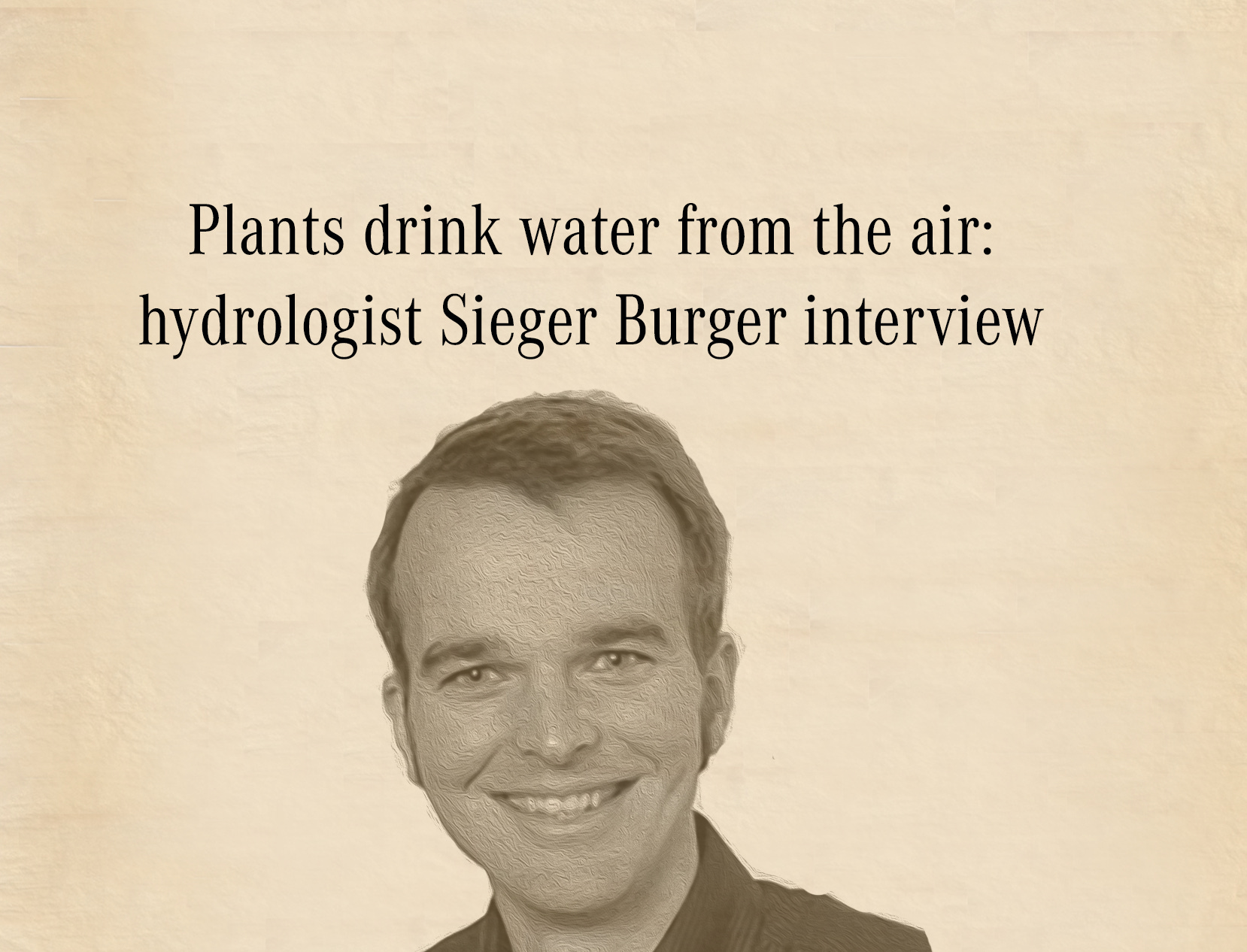
Plants drink water from the air: hydrologist Sieger Burger interview
I met Sieger Burger a few years back, and we have had quite a few interesting conversations about water over that time. He is a hydrologist and writer. In this conversation we range over many aspects of the water cycle, with a focus on hydraulic redistribution (how plants bring up groundwater), and foliar water upake (the process by which leafs can take in water).During Sieger’s Dutch childhood, he became interested in water - “water was fascinating to me. Water is this weird molecule that is both bringing life and also bringing death. It's really about water—where the sweet spot is, of the right quality. Not too pure, because with water, we can't have distilled water. Also, not too salty or polluted. You need to have the right quantity, if you have not enough, then we dry out, and if it's too much, then we drown. It's this fascination with water as a life-giver.” [quotes in this essay have been slightly edited to remove conversational filler words]Burger went to Delft University to study integrated water resources management. There he took a class from Hubert Savenije, and met Ruud Van der Ent, who was Savenije’s graduate student. Van der Ent and Savenije created a map of the small water cycle (precipitation recycling), showing where the evapotranspiration in one country, comes down as rain in another country. (The article on this map was the most read piece in this newsletter last year). Burger says of their work-“I think that it is fascinating what their work has started. The whole concept of precipitationsheds was, more or less, based on Van der Ent's work [developed formally by Patrick Keys]. It shows where my precipitation comes from, you know, so that you get an understanding of the range of area where your rain has been evaporated. If you talk about having enough water, especially in drier areas, that's really useful to know because that helps you realize: if I am in Kenya, where does my water originate from? If I'm in Kazakhstan, where does my water originate from? If I'm in the Sahel, where does my water come from? I think that that work has really helped to get a much, much better understanding of the whole hydrologic cycle. And I think it also has made it possible to visualize things. One of my first lectures was ‘A picture tells more than a thousand words,’ and those pictures from Van der Ent and all the others have really helped tell that story of the small hydrologic cycle.”As a hydrologist, Burger went to work in Uganda -“Uganda - lots of people call it the paradise. Around Lake Victoria, where we were based, it was between 15 and 30 degrees. It's perfect growing conditions. Lake Victoria rehydrates the air so that you have very high rainfall. So everything grows.But at the same time, more and more forests were cleared for growing large-scale annual crops. Then, if you get your tropical rains, all the soil can erode. I tried to encourage people to go into agroforestry. I was able to implement a few agroforestry projects to really showcase the combination of the design and plant growth. The fascinating thing about the tropics—things grow so quickly. So, with the right design, with a syntropic agroforestry system, you get after a year, the fast-growing pioneering trees at like four or five meters tall, from a seedling that was 15 centimeters. The soil comes alive, and you just create this life-giving ecosystem that is productive. We got cassava growing there, and the roots were massive, bigger than most people had ever seen. It's all about how you design it in order to give life—make growth possible so that water becomes a life-giver."Curious about many aspects of the water cycle and ecosystem, Burger started a blog “A journey of discovery into the world of food, soil, and water”. ( Its in Dutch, but you can click the translate into English button.) On why he began a blog -“I started a bit in Afghanistan. Afghanistan is a sad country because since '79, it's been in war. When I was there in 2011-2013, all the hills were denuded, all the trees were cut, all the grass was gone. And you just see terrible things environmentally happening because it's just a man-made desert. And that made me realize I just need to dive into how this works. When we moved back to the Netherlands, I got more into agriculture. Everyone was saying agriculture is causing lots of issues, like, what does that mean? What is it? You know? That made me first try to understand how this whole agricultural system works. It's a dive into the negatives, but you also need to have an alternative. And that where I started to dive into all the aspects that nature is providing, is giving us, and that we can use. That is where I got into all kinds of aspects of plants, of trees, of the biotic pump concept. It's all these things that just made me realize it's such a complex ecosystem altogether. It's really trying to get a much better rational picture—be able to tell the story much better. That's why I dived into it.”On how plant leaves c
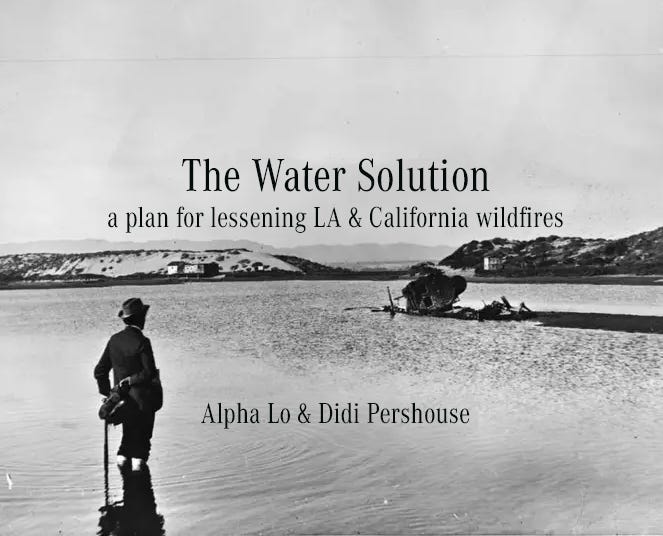
Lessening LA wildfires : The water solution - A dialog with Didi Pershouse
The Los Angeles wildfires hit close to home for me. In the wake of the fires, I started working on an expansion of an article “Rehydrating California to lessen wildfires” I wrote a couple of years back. Then I remembered that Didi Pershouse and Walter Jehne had run a Rehydrate California project awhile back. So, instead, I thought to have a dialog with her, as a way to provide an overview of the subject.Didi has a wonderful, warm personality, and is a leader in spreading the word about regenerative water. She teaches workshops about soil and water, wrote the book The Ecology of Care, and founded the Land and Leadership Initiative. I had her on for a great previous podcast where we talked about metaphors for understanding water and soil - bread, museums, and wicks. Here is a portion of our dialog, edited for clarity and context. You can listen to the audio for the full dialog. (The title picture above is the Ballona lagoon in LA which spanned thousands of acres in 1900.)Alpha Lo: I was around in many of the California wildfires during the 2010s. At one point, I thought, "How come no one's looking at the restoration of the water cycle to deal with the wildfires?" The talk was all about fuel reduction, cutting down brush and trees to stop the wildfires, but very few people looking at how we can rehydrate the land to lessen wildfires. One of the few who was talking about it was Zach Weiss, who was talking about restoring land and the small water cycle. His mentor, Sepp Holz, was talking about how draining the water from the land leads to more wildfires. Another one of the few was Milan Milan who was studying how the degrading of the landscape led to the drying up of the landscape, which lead to the loss of rain and an increase in wildfires in Spain in the 1990s. When he came to California, a US forest service person said to him, "If your ideas are correct, California is going to have a lot of wildfires in the 2010s." And lo and behold, it did. At the start of this year, a number of us who had been promoting water cycle restoration noticed that wow, there's suddenly a lot more interest around this topic and its importance in relationship to climate change. The word was getting out. When the LA wildfires hit last week, it seemed like there was a lot more talk than in the past about how rehydrating the land could be a way to deal with wildfires. Didi Pershouse: One of the phrases that's been going around is that wet wood is a lot harder to burn. So there's the basic principle that when vegetation is hydrated, when the trees and grasses have enough water, it helps with fire prevention. Even just when a lawn has more water in it, it affects the soil sponge. Healthy soil has pore space or void space. The structural integrity holds that together so that water can soak in and stay in this underground reservoir. In places like California, where there's a rainy season if you're lucky, you can have a much longer green season when you have water at the root zone for plants. There's an issue of plant health, particularly tree health. Trees are so long-lived that a tree under drought stress is much more likely to be stressed by viruses, fungal diseases, and insects. So you're much more likely to have damaged trees that are dropping limbs, falling over, etc., in a landscape where there's not enough water being held in the land at the root zone for the trees.Not only is wet wood harder to burn, but fuel on the ground doesn't break down when its dry. Limbs, leaves, dry grasses that have been trampled to the ground by foot traffic in a dry landscape will just oxidize. They're going to slowly dry out, lose their biomass into the air, and become crispy, crumbly, and fire-prone. We see this in the Southwest, where fence posts put up a hundred years ago are still standing because they haven't rotted off. But in a wetter landscape, or in a more biologically active one where you have more fungal activity from saprophytic fungi that biodegrade wood, a fence post will rot off after 10 years. Here in Vermont, you can't leave a fence post forever, or a log on the ground will turn into beautiful soil in just a few years. I can't leave firewood on the ground here for my wood stove; it has to be up off the ground because the fungal hyphae and spores will go right into that and turn it into soil. So that's really different in places with seasonal rainfall that haven’t found ways to preserve the water that was once in the land. In a more Mediterranean climate, you need the beavers, you need the wetlands, you need the soil sponge. You need a way of being in the land that does not disturb its ability to hold water. Those are some of the foundational ideas. There are ideas of biotic pump, cloud formation, precipitation nuclei, and the issue of transpiration and latent heat flux.Alpha Lo: There's some interesting studies about soil moisture correlating with wildfire risk. For example, NASA and other researchers have looked at places with more soil
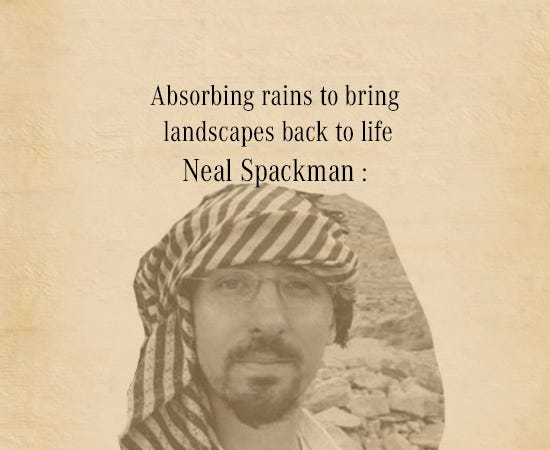
Absorbing rains to bring landscapes back to life: Neal Spackman
Trees, stout and rugged, once dotted the valleys in the Makkah province in Saudia Arabia. An indigenous system of community land management called Hima allowed nature to flourish for thousands of years. But then in 1950s Hima was abolished, and desertification set in. People cut down trees, so they could have money to import food for their animals.The land became austere. The sun seared desolation into the hills and wabis (the valleys). The earth became dry as a parched throat. Xerophytic plants baked in temperatures that reached 50 degrees Celsius (122 Fahrenheit). Animals were rare, except for the resourceful camels that weave their way through the landscape. [Al Baydha, from the “The story of Al Baydha - A regenerative agriculture in the desert” video]This is the land Neal Spackman came to help restore. One of the keys to restoration was to capture the rare rains, the rains that came once a year, or sometimes even less. These rare rains would turn into angry floods that left deep scars in the landscape. The important step was to turn these watery forces of devastation into a force of regeneration. He worked with the community to pile rocks into gabions and check dams, to slow the flow of the waters, then created initial plant beds to absorb the rain. Over the course of many years the vegetation came back, with the growth of plants like zizyphus, acacia, and sesbania seban. Biodiversity returned.I had the honor of having a dialog with Neal Spackman in this podcast episode. He is coming with us as we return to Iberia, to look at how to restore the water cycles and the rain there.This is the fifth article/podcast in a series that has a connection to restoring the Iberian water cycle and rain : 1. “Restoring Iberian rain” 2. “What implementing agroforestry on farms would do to the rain : a European perspective” 3. “How eco-tourism can help the regenerative water movement : Anna Pollock interview” 4. Regenerating a farm and a semi-arid region: Silvia Quarta.Global warming causes the air to be able to hold more water like a sponge, which means droughts are longer. But then when the sponge wrings out, we are beset with bigger storms. This week the eastern and southern coasts of Spain were pounded by huge rains. In Valencia, which was hit the hardest, rivers of mud devastated the city. Unfortunately many died. A landscape of buildings were destroyed. The road to recovery will be a long one.Preparations can be made for future large rains. We can work to restore the land, so it can absorb more of the rain, so that it can lessen the amount of that water that reaches cities downslope of it. Floods will then be a lot smaller.Just like in Saudia Arabia, the power of devastation can be turned into the power of regeneration. If there is vegetation, soil, and earthworks to slow and spread the stormwaters upslope, then more of the water can then sink into the land to refill the aquifers. That groundwater can then be brought up by trees in the dry season to hydrate the environment, and to evapotranspire to increase the small water cycle, and bring back summer rains. Nature can dampen the wild variability of our climate - lessening the impact of the big rains in the wet season, and increasing the rains in the dry season. Spain’s future food systems are being threatened by the droughts in regions like Valencia and Andalusia. Nature can store and dampen the big wet season rains, to help create summer rains that aid agriculture. ……..Here is part of the podcast dialog between Neal and I, recorded before the floods hit. Neal talks about his ecorestoration work in Saudia Arabia, and proposes some ideas for water related eco-restoration in Andalusia, Spain. (Dialog edited for brevity, grammar and clarity).Alpha: Do you want to share a little bit about how you got into the whole regenerative sphere and your background?Neal: I spent two years in Guatemala in my early 20s, and while I was there, I became very interested in sustainability in food systems and in the built environment. I met a group of corn farmers whose farms had failed. They were forced to leave everything behind and move to the city, hoping to find a better life for their kids. That sparked a question for me: why does a corn farm fail in Central America? What’s really going on?I grew up thinking I'd be a doctor like my dad, who was a cardiac anesthesiologist. But I became deeply interested in sustainability—specifically in food systems, building materials, and all that. At that time, I didn’t think I could make a living out of it, so I majored in Middle East Studies, Arabic, and did some economics work in undergrad. Then, all those interests converged when I was offered a co-founding role at the Al Baydha Project in Saudi Arabia. Back then, we thought of it as building a “green village,” and it evolved in many directions. Al Baydha was funded by Her Royal Highness Princess Haifa Al-Faisal, the youngest daughter of the late King Faisal, and for her, it was a humanitar
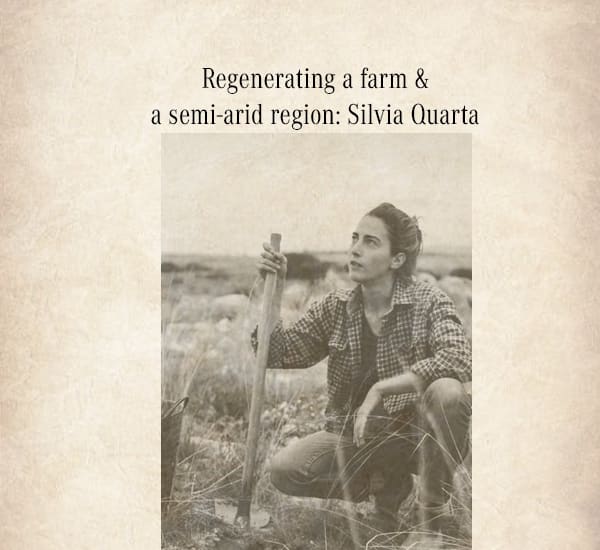
Regenerating a farm and a semi-arid region: Silvia Quarta
In the windswept plateau of South Eastern Spain, where the soil had been eroding, where desertification had been threateninghad the area, and where the community had been struggling with the exodus of young people, La Junquera farm, has been pioneering regenerative methods, and spearheading the activation and restoration of the local watershed. Its been hosting educational workshops for neighboring farmers, and its ways have gradually osmosized into the surrounding area. I had the pleasure of interviewing Slyvia Quarta, an articulate and action-oriented academic-turned-farmer, who works at La Junquera farm, running a regenerative educational program there called Camp Altiplano. Her bio reads “I love having calluses on my hands, taking a hot bath, having a beer at the Topares bar, and being alone on the farm when everyone leaves.” La Junquera farm is part of a larger Alvelal multistakeholder network, that brings together hundreds of farmers, local businesses and scientists working together for the prosperity of the region. They came together in 2014, and created a 20 year strategic roadmap that works to build community and shift the extractive sector into the regenerative sector. It has regenerated much over the past decade, and in the future aims to restore an ambitious 100,000 hectares. Alvelal’s success provides a model which other large scale land restoration projects in Iberia (and there are number of these), as well as around the world, can follow. Alvelal writes on its website “We intend to mobilize local society to transmit the vision that a self-sufficient, dignified region, full of life and prosperity, is possible. A young and revitalized territory that knows and values its resources, with a professionalized ecological agricultural sector and with business opportunities and restorative initiatives for society, the economy and the territory. This is why we work on the restoration of agricultural properties with degraded or eroded soils, through regenerative soil and landscape agricultural techniques. We offer training workshops and technical advice, thus guaranteeing an open and supportive transmission of knowledge. We promote marketing plans for indigenous organic products with great quality differentiated by their productive management. Above all, we want to help all those initiatives that defend the recovery of the landscape, culture and economy of our territory. Likewise, we are committed to the restoration of biological corridors to promote the conservation of biodiversity; activating and energizing local networks around landscape restoration.”Here’s a segment of the interview with Sylvia Quarta, (edited for clarity and brevity):Silvia: I'm currently at La Junquera, a large regenerative farm in southern Spain. It's a 1,000-acre farm, and we’re part of a larger landscape restoration project through Alvelal, a regenerative agricultural association that connects a vast landscape of 100,000 acres here in southern Spain, spanning different provinces: Murcia, Almería, and Granada. It started around 10 years ago, and their goal is basically to restore the landscape—not just in terms of land and nature but also through social restoration, creating jobs, improving the economy, and developing a patchwork landscape with natural areas as well as great regenerative farms and inspiring places. We mainly follow the Four Returns framework, which is part of the Commonland work focused on returning natural capital, economic capital, inspiration, and social capital.[from La Junquera’s website]Alpha: Cool, I'm excited to dive in with you to explore more about your farm and the larger network it’s part of and how that all came together to restore 100,000 acres in southeastern Spain. But first, let’s talk about you. How did you get involved in the regenerative field?Silvia: I’m from northern Italy, from a fairly urban area. I grew up half an hour away from Milan, a big city. At some point, I decided to study environmental sciences and went to the Netherlands. That changed a lot for me because I did my internship and my thesis on farming-related issues. I worked with indigenous communities in the Andes, and I experienced the whole world of agroforestry, organic agriculture, and permaculture. It really opened up for me, and I realized I wanted to do much more than just research. I ended up in a project in southern Spain where I worked as a volunteer for over a year on dryland restoration—learning about and restoring native species, maintaining a nursery of native varieties, planting in the desert, and having a forest garden.After that, I worked a bit at Wageningen University and coordinated excursions for the land and water management program in Portugal. We traveled across the country looking at issues related to large irrigation schemes and syndromic systems, giving students and ourselves a feel for the contrasts in land and water management in the desert.Eventually, I ended up here at Campo Altiplano; it’s the fi
How eco-tourism can help the regenerative water movement : Anna Pollock interview
While in Spain, Nick Steiner, the water restorationist, and I were involved in discussions with folks from the Spanish hospitality sector about restoring the water cycles and bringing back the rains there. It began to dawn on us that eco-tourism could play a role in the regenerative water movement. Anna Pollock, who is from the UK, heard of our discussions, and contacted me. She has been a leader in the regenerative tourism movement and in conscious travel. The 2022 Journey Women award was given to her for her work in regenerative tourism. She has been guiding the hospitality sector to help the regenerative farming sector through their purchasing power of food, through their ability to educate guests about regeneration and organic products, and through helping farms develop home-stay programs.Here is an abridged version of my podcast interview with Anna Pollock [edited for clarity and brevity] Alpha : How did you get into the tourism industry?Anna : I've been at it a long time. I started in tourism 50 years ago. I had emigrated to Canada and I happened to arrive in British Columbia at the very moment that the government there was starting to think about whether they could do something with this thing called tourism. Their economy up until that point was entirely resource-based, and they had no chance of doing a lot in manufacturing because of their location at the time. I happened to arrive after having spent a temporary job in England with the research department of Visit England. I had tourism on my resume, and the rest is history. I essentially had an opportunity to start with a very young visitor economy, with very little government involvement at that point, and develop that over a period of about 25 years, before I left Canada to come back to the UK. I’ve been working as a strategist and as a consultant, a bit of a futurist, a bit of a thinker. I’ve always liked to be ahead of the curve, and I’ve been doing that in various places.I do a lot of international speaking, trying to encourage people to think differently, look forward to see what's happening, and adjust what they're doing accordingly. That has kept me busy for that amount of time. So that’s my background.Alpha: How did your interest in sustainability and regenerative ecology begin?Anna: The sustainability journey started probably in the late '80s because I was involved with a consulting firm that was looking at land use planning. It was the time when ecotourism was being considered. A river rafting company in British Columbia came to me and said they were fighting a major mining proposal on one of the most beautiful rivers in British Columbia. They wanted to put tourism on that river to generate jobs and livelihoods without damaging the environment or the river. They asked if I could help them make a case.That was my first foray into trying to construct an argument as to why tourism in the future might be another land use that would bring benefits without necessarily causing the damage that mining was causing. That was a long time ago now, and it did get protected. It got me really interested in ecotourism, and then we did some other sustainable planning-type projects.Like many people, I was really affected by An Inconvenient Truth. That really got me looking very seriously at what was happening in the environment. I started getting serious about it, around 2000. I did a sustainability strategy in 2008 for British Columbia.Alpha: Could you explain the difference between sustainable travel and regenerative tourism?Anna: That's a challenging one. It all depends on how these terms are understood or interpreted because to sustain simply means to carry on, endure, or maintain. If the intent is to sustain a healthy planet with healthy people and biodiversity, then there wouldn't really be any difference between that and the concept of regeneration. However, over the past 20, 30, or even 40 years, the meaning of sustainability has remained very vague. It's not necessarily defined what anyone is trying to sustain. Or what I see happening is that the underlying principle behind it is sustaining the status quo, sustaining the current economic model. It aims to minimize damage, of course, mitigate and reduce emissions, cut back on water use, waste, etc., all of these good things, but it doesn't really challenge the system itself.That’s where I believe regeneration is fundamentally different because it’s based on a completely different understanding of how the world works. The current economic model that we're all caught up in, call it what you want, is based on a set of assumptions about us living in a machine-like world that we can divide into pieces and understand by reducing it to components.The reality is not that case at all. As you would understand, being involved with rivers, we are living systems as human beings. We inhabit a living system, which is the planet. It is constantly adjusting to the forces around it and within it. When you see that
The joy of restoring water cycles : Nick Steiner
Nick Steiner’s delight in restoring the water to our lands emerges as I talk to him. He works in watershed management, his service is called PermaNick , helping landowners grow regenerative landscapes that slow and absorb more of the rain. He is a passionate advocate and speaker about the larger vision of restoring our water cycles. His home is in Canary Islands, where they only have a couple of inches of rain a year, and yet he has found a way to guide the rainfall so he can harvest it for his own use and also to hydrate the land. He’s working with Water Stories to birth the larger educational movement of training the next generation of water practitioners. There are many landowners seeking to have their land hydrated, and their is much more work than there are practitioners now. We thus need to train a lot of people to do this work, and that is what Water Stories does. If you are interested in signing up for the Water Stories educational courses you can choose to use this link here (I became an affiliate because I believe in their work) Nick has a captivating essence about him, which makes one want to become enthusiastic and do the work of digging a hole to get a tree to have more water, to have your driveway guide the water into the land. So I hope some of you reading this get inspired and start looking at how to do the work on a piece of land. There is something that grounds all this water theory - when you start going out in the rain observing how the water flows, and working the land to guide the flow of water. I had been planning on putting on a water workshop by myself before talking to him. After our interview, we got excited about putting on a workshop together. So here it is.In the workshop you will learn about the theory and practice of restoring water cycles. You will also get a chance to get to connect with others who come to the workshop, as we build a community around this work. I debated whether to charge for the workshop, and decided to make it free, with the hope that some of you will sign up for paid subscriptions to this newsletter, so it will be easier for me continue offering more workshops in the future. The workshop will be on Sun Jul 7th noon-2pm EST . At that time you can open this link on Zoom https://us02web.zoom.us/j/87354624137?pwd=5Av53IbHhI9LWVmBAvyE1gQY66u5ka.1….Here is a transcript of part of our interview, edited for brevity, clarity, and understanding:Nick Steiner InterviewAlpha: Today, I'm excited to have Nick Steiner on the podcast. Welcome, Nick. Nick: Yeah, thanks so much for having me. Super excited to be here. Alpha: How did you get into this water work?Nick: So it started also pretty much 10 years ago when I when I first got got into permaculture and then got more into this whole regenerative world where I was just experimenting on really small scale with water. Then on slightly bigger water projects. I did lots of different courses that I could find, read all the books I could find. And at some point, a friend of mine, Oliver Gauthier of the Regenerative Skills podcast, he told me that he had just spoken with Zach Weiss and that he's planning on launching a course about water cycle restoration called Water Stories. I thought that's spot on what I want to be doing. I did this course in its founding round thing around two years ago. That was just completely life changing because before I was working on small projects and working indirectly with others, but I didn't quite feel ready to do this work full time. After doing the Water Stories course, I started saying, OK, now I feel kind of well-prepared to actually take on landscape projects. I started working with landowners, small projects, and bigger ones, some larger farms on the size of a few hundred hectares. That was really the kickoff point to get really serious about working with water.Now I'm also now part of the Water Stories team, the goal is to educate and have hundreds or thousands of people to work in water cycle restoration. The water cycles are so critical, we need to get them right. If its only in theory, we're not going to get far. We need the people on the ground to actually build these landscapes. And that's kind of the mission that we're on at Water StoriesAlpha : Can you say a little bit about how the Water Stories course works? Do you have a bunch of cohorts online or in person? What were some of the things you learned in that course? How long did it take? Nick: It was actually a really interesting approach because so many online courses are just videos and you just watch lots of videos and then you click a button that says, okay, I know how to do this now, but you don't really. Specifically with working with water and landscapes, you need to get your hands dirty. And that's what I loved about the course there, where it was more like you have some theory in a video format with Zach explaining concepts about water cycles, but also about all the different things you need for the kind of work. We h