Activating a global network of water restorers and advocates : Zach Weiss
Audio is streamed directly from the publisher (api.substack.com) as published in their RSS feed. Play Podcasts does not host this file. Rights-holders can request removal through the copyright & takedown page.
Show Notes
Restoring the world’s water cycles is a craft, one that takes time to learn, and a community to grow within. That community is being built.
Water Stories is an education platform, community network, and hands-on career pathway dedicated to restoring the world’s water. It has been quietly growing, building a network of extraordinary people, advocating for landscape-scale change, and educating a new generation of practitioners in the art of working with water.
Water Stories is following a similar path. It is a learning, training, and action platform focused entirely on water cycle restoration, offering a community-centered approach to some of the most pressing environmental crises we face: drought, flood, fire, and polluted water. Its award-winning films tell the stories of people who have raised their communities out of extreme environmental crises, and are available free to its online community. That community now numbers over 3,000 people from around the world, concerned about the future of fresh water, learning from one another across different landscapes and contexts, and supporting each other toward a better common future. Founded by Zach Weiss, Water Stories was created with a bold vision: to train a global force of water cycle restoration practitioners, equipped to heal landscapes wherever they are needed.
Zach Weiss spent years learning to restore the water cycle from the ground up, studying under mentors including the legendary Austrian farmer Sepp Holzer, who urged him to take what he had learned and teach it to as many people as possible. That call to multiply the work is what drives Water Stories today.
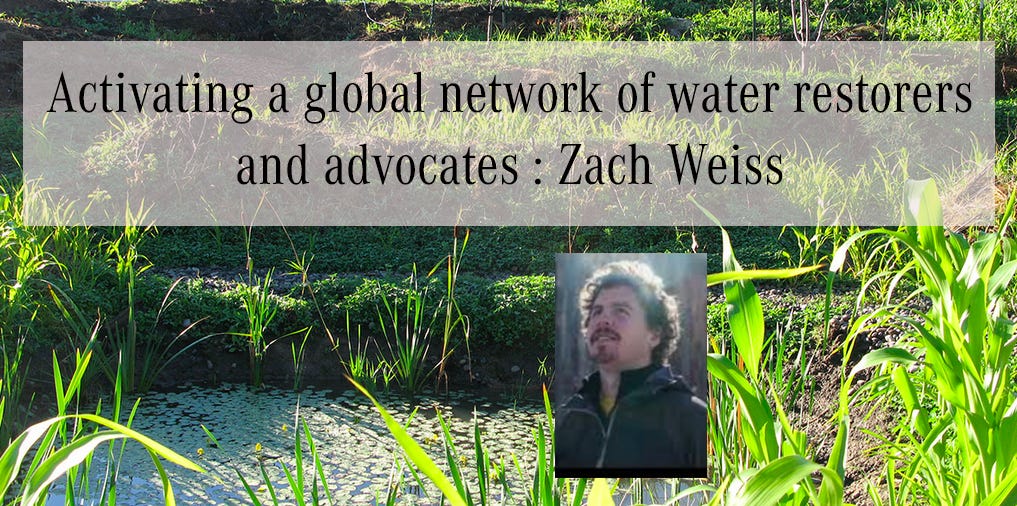
The methods Zach developed are focused on helping the land receive rainfall more effectively, slowing water down, guiding it into the ground, and recharging aquifers so they can feed springs and streams throughout the dry season. They are rooted in reading the landscape, observing where water flows, how slopes behave, where it pools or rushes away, and then working with those patterns rather than against them. In practice this means building terraces, planting strategically, putting in check dams, and creating water retention features that follow the land’s natural contours (in title picture above, are terraces leading into a water retention pond, that helps recharge groundwater, that Zach helped create in Montana USA). It is about restoring soil, restoring vegetation, and restoring the slow, generous movement of water through living landscapes.
Farmers using these methods have withstood wildfires while neighboring properties burned, because their land was deeply hydrated going into summer. Others have seen vegetation flourish as rising groundwater reaches plant roots. The core idea is simple but profound: get the earth to receive water better, and life follows.
Now, rather than doing that work alone, Zach is focused on training others to do it too, spreading these skills as widely and as fast as possible across the world.
A groundswell takes hold when networks begin to form, when decentralized centers of activity emerge around the world, when people step into leadership, and when knowledge spreads person to person. Permaculture did exactly this through its Permacultue Design Courses, which perhaps half a million people have now completed, with many millions more practicing its principles worldwide. It spread like an octopus reaching into every nook and cranny of the globe, quietly shifting paradigms and transforming both landscapes and lives.
The groundswell that Water Stories is one of the forces helping to build is beginning to feel like that.
Yoga offers another useful parallel. It took off in the 1980s when enough teachers had been trained to make a living from their practice, creating a self-sustaining wave of growth. That is exactly what the Water Stories platform makes possible, a genuine career path in watershed restoration. Practitioners already report having more projects than they can handle, more land asking for attention than there are trained hands to tend it.
Across the world, a broader awakening around water is underway. Scientists, farmers, indigenous communities, and restoration practitioners are all converging on the same understanding: that healing the water cycle is one of the most powerful things we can do for the planet. Water Stories sits right at the heart of that, with the tools, the community, and the vision to become one of its many central forces carrying that groundswell forward.
Here is a lightly edited, abridged version of of our interview:
Alpha: Cool, I’m excited to have on here again. You came on two years ago….. Maybe you could just start out by saying a little bit about the larger global water problem, and then how you came upon this path of actually trying to help the whole water situation in the world.
Zach: When we look globally, I think the easiest, most succinct way to look at the challenges we’re facing is that right now, we’ve built landscapes that reject the rain, and what we’re seeking to do is help those landscapes receive the rain. The greater picture is of water cycle restoration, of rebalancing the full cycling of water through living ecosystems, of water retaining on the lands, of being circulated in the small water cycle, of being circulated slowly through the larger water cycle. But in daily practice, it really is just helping landscapes receive the rain instead of reject them.
There’s just so much need for this around the world, there’s so much interest and demand for this work, way more than I could ever service on my own, and so we really started looking at — and Sepp Holzer pushed me towards doing this — how do we give capacity to people to do this work all around the world? I took my 5-year journey to getting where I am, and tried to condense it into 6 months, and we basically give people all of the essentials with none of the unnecessary stuff, so that by the end of that, they’re further along in activating these changes in their community. And it’s different for different types of people, you know, it’s really not a course where it’s like, come in and you’re gonna leave being an earth mover. That might be one route that you take, and that’s a route that we need lots of, but we need advocates, we need stewards, we need all these different people helping out in all of these different roles to make the changes that we’re really trying to make globally, around the world. And so we really try and just help people in that journey.
The way I look at it is it’s one thing to get a map and say, okay, I can kind of figure out where I’m going here. It’s another to get a map and then have someone grab your hand and drag you along the trail, and teach you how to orient, and teach you how to read the map. And then you’ve already started that journey by the time something like the course is finished. And it’s just amazing — we just had a webinar earlier today, and within one year, people are making real changes in their communities. They’re becoming an expert in the field in their communities, because they’re actually practicing and engaging with it every day, and have this really great community of support to lean on and learn from one another as well.
Alpha: One of your central teachings is this idea of the Watershed Death Spiral, and then also how we can restore it via the Revived Water Cycle. For instance, all the wildfires around the world are, in part, tied to this problem with hydration. Could you say a little bit about the wildfires, and also this idea of Revived Water Cycles and the Watershed Death Spiral?
Zach: Yeah, definitely. I oftentimes joke that Australia and California are in this race to the bottom of the Watershed Death Spiral. Those two places are getting so severe, the fires are getting so crazy, and it frustrates me to no end that people aren’t even addressing the root problem of the issue.
When everything’s drying out, all of the organic matter is oxidizing and turning into fuel for fire, rather than being broken down by life and becoming food for fungi. And so you very quickly get to this pattern of drought, fire, flood, drought, fire, flood — and they each beget each other. This is where we see just a huge potential to change things. The number of projects I’ve seen where drought’s no longer an issue, and flood’s no longer an issue, and they’re fire resilient — within a couple of years to a decade at most — it really just shows how clearly we have the solutions; we’re just not implementing them.
You see places that have really revived the water cycle over huge areas. We were recently in India where rivers are flowing now, it’s cooler in the summer, the rains are coming, and the communities are back on the landscape. It’s just like, wow, why aren’t we doing this? This is so simple, the benefits are so extreme. And so this is really where we’re trying to lead people: how do we restore some kind of balance to our water household, so that water is slowly moving through the ecosystem again and again? And people are able to do it all over the world. This is one of the great things — it’s not something we need to wait for governments to act logically on, or for big businesses to develop some conscience. People on the ground, living on those landscapes, can do it today and see the results after the next rains.
Alpha: Could say a little bit more about the drought-fire-flood cycle. Why exactly does fire lead to more floods, and why do floods lead to more droughts?
Zach: So after a fire — and the temperature of the fire becomes really important too — the type of char that’s created actually changes. When it gets really hot, that char can become hydrophobic, actually repelling water. So in the extreme case, when a landscape burns very hot and the rains come, it’s rejecting the water both because it lost all its organic matter and because that organic matter has been turned into something that repels water. And even if you’re not getting that effect, all of the channels that water used to move through and be absorbed by are now broken. So you get all that water moving downstream more quickly than before, creating floods downstream, but because the water didn’t infiltrate, you’re also creating drought on that landscape.
And the long-term drought leads back to fire. We’ve generally destroyed all the water-holding capacity of the landscape, then hardened it, plowed it, created hard surfaces that send water downstream, cut roads across it, dredged the waterways. We’ve done all these things to speed up water moving downhill, which creates floods downstream. But because that water is moving fast through the system instead of slowly, it creates persistent drought, which leads to fire. For example, woody matter that doesn’t have basic hydration to break down into the soil just petrifies and forms a nice fuel bundle. So you get all these effects acting collectively in the same direction.
Alpha: You’re saying there’s this Revived Water Cycle, where certain intervention points help build the land’s capacity to hold water, rebuild the soil, and rebuild vegetation. And I think to some people it might not be obvious that making certain indentations in the earth. these earthworks, can actually do a big part in restoring this important cycle that could affect the whole global water cycle and climate.
Zach: Yeah, it’s so simple. When you intervene in the right places and do the right things, you start this never-ending cycle, this perpetual motion machine that is nature. If you help slow down water, it creates more life, and that life creates more water, and it feeds into this smooth, steady cycling. There’s a really nice saying we picked up in India: where water runs, help it to walk. Where it walks, help it to crawl. And where it crawls, give it rest and allow it to enter into the womb of the earth.
This is actually the recharge of the groundwater that then supplies so much of the downstream landscape. This is another neglected mega-crisis of our times — the overextraction of groundwater, mostly without monitoring. We all know what happens to a bank account if we just take out and never put anything back in: we go broke, and it gets ugly very quickly. That’s currently happening with groundwater in a lot of our planet. So by helping water slow down and go into the landscape where it’s concentrating and moving quickly, we’re also helping reverse groundwater depletion — actually charging up those groundwater sources. The big thing is just reading the landscape and making the right interventions at the right points, because the earth has a tremendous capacity to hold water. We want to hold water not in our built infrastructure, but in the earth’s womb, where it has an incredible ability to do so.
Alpha: Do you want to say a little bit about some specifics of how you intervene? I know you did some work in Spain with the dehesas — to get agriculture going again in those degraded landscapes, your first step was restoring the water, right?
Zach: Yeah, for me it always starts with water, though it’s water as part of a whole. Water, soil, vegetation — they’re all part of the same system. But looking at how a landscape is managing water is really the first step. What we were just talking about made me think of some students of ours in Chile. They had a really tough landscape almost all silt with almost no clay — and we were thinking, you’ve got a really tough go of it down there, but apply these same principles. They built crater gardens and retention ponds and retention features on their landscape, and they already have a spring that’s formed from the work they’ve done.
By digging these little holes that collect water from the road and send it into the ground instead of downstream, they’re charging up the ground, making greenery, and even creating new water downstream as a result of that process. And the great part is you dig the water body once, and if you do it right, every time it rains after that it’s doing work. And even between the rains, it’s doing work — that’s why it’s so effective. It’s like a one-time investment for an era of nature doing its own work from that point forward. Th retention ponds are maybe a couple hundred square feet, with the biggest one around a thousand square feet or so. They really don’t need to be large; they need to be at the right points within the land, where they interact with the natural skin of the earth.
Alpha: And just a couple of these help recharge the groundwater, which then affects the hydrological cycle?
Zach: Yep, exactly. And the wonderful part is that water is also grabbing clay higher on the landscape and depositing it into their system, so they’re actually harvesting that process to improve their system over time with the clay the water is delivering.
Alpha: Can you give some examples of what happens when the water table does rise? What are some examples you’ve seen in different places?
Zach: Yeah, I think the most striking example I’ve seen was in India, where we recently visited. Rivers are flowing now because the groundwater has risen. In this area, 9 rivers are now flowing throughout the year as a result of groundwater recharge. 250,000 wells that were dry now have water again. But perhaps the most striking thing: in one of these areas, 6,000 violent bandits handed over their weapons and became peaceful farmers, because they have water again. When you talk about the impacts of recharging groundwater, it touches the waterways, the agriculture, the ecology, and even the way of life for people on that landscape. This was in Shambhal, in Rajasthan, in northwestern India — a very dry region. That’s where a lot of their projects are concentrated, though they’ve also done work in other parts of India.
Alpha: I know that Sepp told you that you were doing great work on your own with all this water retention, but what you really needed was thousands of people doing it. And so that caused you to think about starting a school to train more people. Since I last talked to you, that school has probably grown quite a bit.
Zach: Good mentors always push you to the next step. Sepp said probably the nicest thing he’s ever said to me, calling me his best student — but immediately followed it with, “but one of you is nothing! We need hundreds or thousands!” Really good mentors will just keep pushing you forward, and that led us to create Water Stories. We’ve now had around 400 students go through our training over the last couple of years, and it’s just incredible to see all of the changes they’re making around the world. It’s already dwarfed what I could ever hope to do within my lifetime, and we’re just at the beginning.
Because for each one of these people, what they’re accomplishing within one year is just the start of a career path that’s going to span the next decade or two for many of them. Imagine the change they’re going to create over such a long period of time. It really gives you a lot of hope — wow, we really can do this. People really are good; they do want to do good things when they’re given the opportunity. That’s what they execute upon, and that’s why we built the course in a very strategic manner.
We designed a course that is online, but it’s really at home in the sense that you need to go out onto the landscape and actually do all of these things. And if you do them, it will lead you to the next step. For example, we ask people to give a presentation in their community about water cycle restoration. That’s not primarily for the sake of spreading water cycle restoration — though that’s a nice byproduct — it’s because if they do that, that’s where their first client is going to come from: someone in the audience of that presentation. And then it leads to the network and the growth that people actually need to build a career around this. I think that’s why our program has been so successful: we give students a roadmap, all the steps needed to become a practitioner, and a community of hundreds of other people willing and able to support them on that journey. It makes it a lot easier. It’s one thing for visionary mavericks like Sepp Holzer or Rajendra Singh to accomplish all this, but for an average person like me or you, it’s a lot easier with some support, some people to help along the way, and some experienced mentors to draw upon — and that’s what we’ve set up our program to provide.
Alpha: Cool. I was wondering if we could talk a little bit and tell the stories of a couple of your students. Maybe we could start with Nick Steiner, who I also know and who’s also come on this podcast. He was one of your earliest students.
Zach: Yep, so Nick was in our first class, which I think was back in 2022 — the first time we ever ran the program — and a lot of incredible students came out of that, Nick being one of them. He went from being interested in these things and having quite a good skill set, but not having it be a full-time job, or a way of life, or a vocation, or a real cohesive business that earns his livelihood, to having a full-time water job.
And for me, this was a very important part of the course. A lot of trainings teach you one little skill set and then ignore everything around that skill set that’s important to actually delivering it. So, for example, how do you manage clients? How do you set up your contracts? Do you hire people or not? How do you do estimates? We give the framework in the course for how I do all of those things, so that people can really easily move on to doing that themselves.
And now Nick’s doing it full-time. He’s passing projects off to our other students because he has so many. It’s just really incredible to see that switch happen within a year, where it goes from something I’m interested in to something I’m working in full-time. And he’s doing really great projects for all sorts of farmers throughout Europe. He’s currently on an earth-moving project somewhere in Spain
[Nick Steiner building a water body].
Alpha: I know he does it with so much joy, too. What does he do on these farms?
Zach: Yeah, the approach that we teach first looks at how do you understand the landscape — what’s on it, what features it has, what capacity it has. Then how do you understand the goals of the people there: what they’re trying to create, both their long-term goals and their immediate pressing challenges. And then how do you harmonize those two elements? In Spain and Portugal, water scarcity is a real limiting factor for most agriculture in the region. And yet, when the rains do come, all of that water just flows downstream away, where it can’t benefit that farmer or that landscape. So a lot of it is: where do we find the intervention points where we can do a relatively small amount of earthmoving? Now, sometimes it might be a big earthmoving project, but we want the maximum hydration outcome per amount of earth moved. For example, today he’s building a water body in an area where they found clay and some underground seams of water. He’s on the excavator, opening up the key, compacting it very diligently, creating a vessel within the earth that will receive the waters when they come and allow them to enter the ground, recharge, and rehydrate that space. Basically, they have this dying landscape that they’re trying to put back on life support and get going in the right direction.
Alpha: So the idea is that when you build these retention ponds, or features that capture rainwater, they recharge the groundwater, and then vegetation can reach that groundwater, and that’s why the land becomes more alive. Is that the basic principle?
Zach: Yeah, and it varies depending on the geology. In some areas, you might make a water body that specifically rehydrates a deeper aquifer, or a spring, or a waterway downstream. In some areas, you might make a water body that holds water all the way through the year, creating surface tension that wicks moisture out all around it and produces this beautiful green, hydrated zone. You might also use that water for irrigation on certain crops. So there’s a kind of spectrum between a very ephemeral water body that recharges the ground and a perennial water body that supplies surface water — from the water itself to the habitat — with a lot of things in between. The specifics of the landscape tell you what’s possible, and the goals of the people tell you whether it makes financial sense and is viable. Together, those things make it pretty clear what kind of project to move forward with.
Alpha: Other students you want to mention?
Zach: Yeah, one of my favorite students is from Japan. He’s been doing amazing work. They’re actually just starting a course tomorrow for Japanese speakers on food forestry and water cycle restoration. And they have a whole project now designed around the question: how do we lower the temperature of our city by a degree and a half through water cycle restoration? He’s also using it as a way to connect with the indigenous cultural heritage around water in Japan, which is very strong and very vibrant. Basically every culture in the world, if you go back far enough, has a deep reverence for water.
They’ve been doing all sorts of really cool projects. One of my favorites: he started a food forest for a man who had been diagnosed with cancer and wasn’t expected to live very long. This man wanted to leave something for his children and grandchildren, so he started the project with Jun Omura, the student. And then he started enjoying it so much — it was going really well — and he just kept getting more and more full of life. He’s now far outlived his expected life expectancy. He created this garden to die in, but it’s actually become a garden to live in, giving him so much energy, and it will provide for his kids and grandkids. That was just a really special story — knowing that people are making such a big impact on people’s day-to-day lives. And then it begets itself, because that client tells his friends, and before you know it, Jun has this roadmap of projects and needs help because there are too many for just him. That’s the really powerful thing about this kind of work.
Alpha: Cool. And what are some of the strategies he had to lower the city temperature? What are some of the projects?
Zach: Yeah, basically making green spaces again, getting water staying in a living earth and circulating through vegetation. In their context, that means making green pockets to break up the heat island. They’re in a very industrial city, so the strategy is: how do we start to break up the concrete mass and add a bunch of cooling pockets? You know, a liter of water moving through a tree absorbs about as much energy in the form of latent heat as a regular car battery holds — about two-thirds of a kilowatt hour. So the more water you have moving through vegetation, the more localized and regionalized cooling you’re providing, breaking up those heat islands. They’ll actually be presenting on this next week on the 24th in a webinar we’re hosting — their whole strategy for how to lower the temperature a degree and a half in their city.
Alpha: It is quite amazing, because every student you have creates all these ripple effects — just like when Sepp had you. So 400 people doing projects all around the world is remarkable. You have some students in Africa too?
Zach: Yeah, we have a handful of students in Africa. One that comes to mind is Gonzalo, who’s been doing projects there. He was an architect who didn’t like being in such a corporate, sterile setting, wanted to find his way back to nature, came and volunteered on a project, and has since been working in South Africa on his own project and on projects for clients, building water bodies. And another student of ours, Stenbergen, in Kenya, is actually starting a project with a university — still in planning phases, but on university grounds as an education resource for people at Nairobi University. Natalie Topa is doing all sorts of amazing work throughout Africa. In many ways, I think Africa and South America are the best places to potentially lead the way here, in that they have a more direct relationship with the land and a real desire to do a little bit of work to improve their own quality of life.
To give you a sense of this: we did one training in a very remote village in Mozambique. We trained 15 people — we called them water MVPs — and built one water body together. The next day, people in the community were already using that water to water their gardens, do their laundry, and meet their daily needs. But then we left, and with the help of 50 villagers, they built 26 water bodies in the two weeks that followed. So from a 5-day training with the local people, they went on to create all these little water bodies all around their village — a place where they have huge water scarcity issues in the summer and real challenges growing enough food, especially with animals coming through from the nature reserve. To have that kind of impact on people’s way of life in just a few days — there aren’t too many things where you can really do that.
Alpha: Other students you want to mention?
Zach: In Australia, Claire Vanderplank comes to mind. She had a big event there, and she started the Western Australia Water Alliance. She’s been doing water projects for clients and friends, but is also very focused on advocacy, because the reality is that so many people who need to know what’s possible have no idea, and so many policymakers who need to make different decisions have no idea either. This goes back to the point that we need storytellers, authors, artists, musicians — it’s not just about getting in the machines and digging the holes. That’s a critically important piece; without it, there’s nothing. But we need all these other layers around it to create real change. Claire is doing a really good job activating local communities and building community support that will make it easier and easier for her and others in the area to do projects year after year — more interest from clients, more support from regulatory bodies.
.Alpha: And Claire was the person who felt the river was asking her — “how come you don’t drink me?”
Zach: Yeah, exactly. That’s a big part of developing a relationship with place: spending the time to let your monkey mind go quiet and receive information. She mentioned sitting next to a water body and it asking her, why don’t you drink me? And that’s a great question, because water used to be drinkable everywhere. There are entire watersheds now where it’s not even swimmable or fishable anymore, and that is shocking. That is a bad state of affairs.
So this idea of being a voice for the voiceless is really important. You know, imagine the earthworm in the soil — it has no voice to say, hey, stop spraying chemicals on me, but it still suffers from them, and it has no doctor to go to for relief. So how do we each, as humans, start to be that voice? Whether it’s for the river, the forest, the earthworm, or the fish.
Alpha: You provide support for your students to actually host workshops, right?
Zach: Exactly, and I can’t tell you how many times we’ve heard from students: they say, well, I put together the presentation, and only 3 people showed up. But I figured I’d just give them my full attention, and they really loved it. And then they put on the next event, and it’s 12 people. And then the next one, it’s 20 people! Because this is something that just has so much potential, it’s so exciting, that it just grows and grows. There’s so much opportunity. And so, yeah, that’s exactly it — how do we make this groundswell of community activation happen?
We’re trying to build community, foster networks. In a very practical sense, we’ve had a lot of situations where students from the course end up starting businesses or efforts together with other students, because they can each contribute where they have skills and capacity, and lean on others where they’re more deficient. And it’s just a lot more fun and enjoyable for everyone to push that boulder uphill together, rather than each person trying to push their own boulder alone.
Alpha: And in your education platform, you have some different tracks, too, right? One for people who really want to work the land and help clients, one for people who want to work their own land, and one for advocates working on policy. And I know you have someone in Oregon who’s pushing some policy around water?
Zach: Yeah, absolutely. Actually, a group of several students banded together and formed PLUG Oregon — Permaculture Land Users Group Oregon. Last I talked to them, they were getting very close to pushing through some exemptions that would allow farmers to create water retention features and hold rainwater. Because the reality is water law in the western US is so broken — it’s just a total mess — and it actually makes it very difficult for people to do meaningful projects. And so this group of students said, let’s fix this in our state.
And the reality is, when you speak with confidence, clarity, and a pure heart, people listen. So, yeah, we have these three different archetypes. The person who wants to do it professionally and earn their livelihood doing this. The steward who wants to do it on their own place. And the advocate who’s going to share this with the world. They all have a really important role. We have a lot of retirement-age people do our course through the advocate track, and they’re the ones who, in many ways, create the opportunities for young professionals.
Alpha: And over the last two and a half years since I last talked to you, how would you say this whole water movement has been evolving?
Zach: You know, it’s been really interesting to see it start to get a lot more mainstream traction than I ever would have imagined. Since we last spoke, I’ve worked on a job for the Department of Defense. The Water Conference had a whole segment on the power of green water for climate stability. The Global Commission for the Economics of Water has released a series of reports. A European Union Commission released reports saying, basically, we need to do decentralized water retention all throughout Europe to solve these challenges. So it’s definitely starting to get a lot more mainstream attention.
But the big thing I keep coming back to is: give all of my time and energy to the people who are the future practitioners. They do so much in one year’s time, and they give so much inspiration to each other and help support each other. When we have events, it’s like this little village forms of the best people in the world — these amazing little experiences. So I’ve really come to see: these are the people who are going to do it, and I should do everything in my power to support them, get them off and running, and be there for them over the years as they need it. The webinar we just did today — I left so inspired. It’s crazy, because I started all of this about 4 years ago, and now I look at it and think, wow, these people are so inspiring. How are they doing so much so quickly?
It’s like we’re all part of this superorganism, each getting to push in a little bit and contribute what we have. And it honestly restores a lot of my faith in humanity. I often tell people, I live in this tiny little bubble, and in my bubble, everyone wants to help, everyone is an altruistic person — and I love my tiny little bubble. I want to stay in it. And this bubble is just slowly growing. When people enter it, they’re like, oh, it’s really nice in here, this is really fun, everyone’s really supportive — and that just helps it grow a little bit at a time.
Alpha: Cool. Yeah, it sounds like getting in on the ground floor of a whole movement. Do you want to say a bit about your upcoming course — when it is, how long it runs, and how people can sign up?
Zach: Yeah, so we have a live and a self-paced version. It’s the same basic content, but the live version is a cohort of students from around the world, with live sessions with me and a whole bunch of extras if you’re able to participate in real time. People like both versions, but they say it’s well worth it to do the live — the live sessions alone are worth it. Registration is open now through March 27th, and then the program starts and runs for 6 months as we go through all the content together. But it really is also a long-term thing. After the 6 months, it moves into an alumni membership, which people are welcome to join. We have people still meeting each month who started with us at the very beginning, years ago, and you can come and go as you like.
And that’s the other big thing I’ve found: for some people, 6 months and they’re off and running — great. For others, that journey might take a year or two, or even five years. So how do we build a community of support so that all these different journeys can reach their destination? So it’s a 6-month program, then open-ended. There are sessions and new videos every week, and it’s all set up so everything is asynchronous except for the live sessions. It’s not a case of joining a call and sitting through a lecture you could have watched as a recording. It’s all built around watching the produced content beforehand, and then getting together to discuss it — so we can really dive deep into each topic and each module together. It opens once a year in the spring, runs through the end of September or October, and then the self-paced option is available anytime.
Alpha: Cool. And this is the Water Stories course. How people can find it?
Zach: WaterStories.com. The Water Stories Core Course is what we call the program. And for people who aren’t sure yet, we have a lot of free content — films, animations. If you’re not ready to jump in, we say spend a year just digesting all of it so you can really get the maximum out of the program when you do. A lot of people spend years learning from the free content, and then when they’re really ready to make that big leap, they enter the program. We just released a new film last week and will be releasing another one next week, because we really just want to get this information out there. So check out the stories section of WaterStories.com. We also have a Mighty Network community, a great place to meet other people and learn from one another. There are a lot of next steps you can take even if you’re not ready to jump into the course.
Alpha: And what’s the time commitment for the course?
Zach: It depends how much you want out of it, but I tell people to expect 5 to 10 hours per week if you want to become a professional by the end of 6 months. Some people may even want more. It’s basically 2 hours of content, 2 hours of live sessions, and then 2 to 6 hours of outdoor activities, because the course really is what you make of it. We lead you toward all the actions, but if you don’t do them, you’re going to learn half as much. So it’s definitely worth making sure you have enough time when you sign on.
Alpha: Okay, cool. Thanks, that sounds great. Well, it’s been great having you on, and I’m excited to be part of this water movement with you. Any concluding words?
Zach: I’m just excited for your forthcoming book — I can’t wait to read it.
I think the biggest thing I’d say is: just get out there and do it. Sepp Holzer always told me, do something and something happens. Go outside in the rain. The water will teach you everything you need to know — where to intervene, where not to intervene, all of it. Just get out there and start reading from the Book of Nature, and you’ll be really surprised what it tells you.
………………………………………………….
The Water Stories course begins this Friday Mar 27th, 2026 if you are interested in signing up. https://www.waterstories.com/core-course. If you enter the code ‘CLIMATEWATERPROJECT’ you can get $100 off the course.
Course Intro video
…………………………………………………………………..
Get full access to Climate Water Project at climatewaterproject.substack.com/subscribe