
Show overview
AI for Real Estate launched in 2025 and has put out 28 episodes in the time since. That works out to roughly 25 hours of audio in total. Releases follow a weekly cadence, with the show now in its 9th season.
Episodes typically run thirty-five to sixty minutes — most land between 49 min and 58 min — and the run-time is fairly consistent across the catalogue. None of the episodes are flagged explicit by the publisher. It is catalogued as a EN-language Business show.
There hasn’t been a new episode in the last ninety days; the most recent episode landed 4 months ago. Published by Dr. Adam Gower.
From the publisher
AI for Real Estate Pros is a demo-driven podcast showcasing the most innovative AI tools being deployed across commercial real estate. Each episode goes beyond theory. You see the platforms in action - sourcing deals, parsing OMs, underwriting in seconds, optimizing operations, improving tenant performance, enhancing investor reporting, and positioning assets for exit. Commercial real estate has long relied on manual, fragmented workflows. This show highlights the founders, products, and practical implementations that are redesigning those workflows with AI. Hosted by Adam Gower Ph.D, a 30-year CRE principal and advisor with multi-billion-dollar transactional experience, the podcast focuses on what actually works - not hype, not headlines. If you want to understand how AI is reshaping the full deal lifecycle - and how to apply it inside your own firm - this is where you start. Newsletter: GowerCrowd.com/subscribe Email: [email protected] Call: 213-761-1000
Latest Episodes
View all 28 episodesWhy Firm-Wide AI Beats Individual Tools
91% of Real Estate Firms Know AI. 9% act.
The CRE Sponsor Pulling Ahead on AI
How CRE Loan Brokers Automate Capital Markets
How to Find Off Market Land Deals in Minutes
AI Hotels Can't Actually Use
Why 50% of U.S. CRE Listings Pass through Buildout
The Data Layer Reshaping Real Estate Decisions

S9 Ep 9Turning Lease Documents Into Intelligence with AI
My podcast/YouTube show guest today, Cameron Steele has spent the last several years tackling a problem most commercial real estate firms don't realize they have. As the co-founder and CEO of Prophia, his focus is simple: turn the most important documents in CRE - leases - into usable intelligence. The issue is that much of the economic blueprint of commercial real estate still lives inside legal documents. And most firms are still extracting that information manually. In our latest conversation, Cameron walks through how AI is beginning to change that. In brief: • Lease documents remain the ultimate source of truth in CRE • Yet much of the data inside them is still trapped in unstructured text • Many firms still rely on manual lease abstraction processes • AI can now convert those documents into structured intelligence • That data can power portfolio analysis, risk management, and reporting Our conversation answers several questions CRE professionals regularly face: • What kinds of operational insights become possible once lease data is queryable? • What happens when lease terms are buried inside hundreds of legal documents? • Why is lease data still managed manually across much of the industry? • How can AI connect structured and unstructured data in real estate? • Why is change management the biggest barrier to adoption? Cameron captures the broader issue in one observation: "It's stunning that this industry, which is so large… is still manually compiling data like this." If you manage portfolios, analyze assets, or oversee leasing exposure, this conversation provides a useful look at how data infrastructure in CRE may evolve over the next decade - and how one shop, Prophia, is doing it today. Well worth the watch. *** At GowerCrowd, we are bringing the most advanced AI tools to our clients for both capital formation - and across other operational verticals too (like acquisitions). If you'd like to learn more about how we can assist you too, please reach out. Subscribe to my newsletter and get access to this transformational intel before anyone else: https://gowercrowd.com/subscribe Email: [email protected] Call: 213-761-1000

S9 Ep 8Real-Time Asset Management, Finally
Most multifamily asset managers are still assembling reports. Colin Green built software to eliminate that step entirely. Colin is the founder of BubbleGum BI, a business intelligence platform designed specifically for multifamily asset managers. Before launching it, he built the tool for himself - nights and weekends - to solve the frustration of pulling rent rolls, cleaning spreadsheets, and waiting on Monday Morning Reports. The result is a real-time operating layer. In our conversation, Colin answers five important questions for serious CRE operators: How do you measure renovation spreads accurately at the unit level? Where does AI realistically fit into asset management workflows today? How should retention be monitored before it hits the income statement? Can you benchmark management companies across markets objectively? What happens when occupancy, renewals, and comp data refresh daily instead of weekly? One of his more pointed observations: "It's not good using old data. I don't understand how we can make decisions for the future with data that's a week or a month old." The interesting part is that AI is not the headline. Clean data is. Colin's longer-term vision includes AI agents flagging risks, pricing mismatches, and renewal exposure daily. But he is clear that the foundation has to be structured, integrated data first. If you oversee multiple assets and still rely on static reporting packages, this episode is worth your time. It's what operational clarity looks like when reporting friction disappears. *** At GowerCrowd, we are bringing the most advanced AI tools to our clients for both capital formation - but across other operational verticals too (like acquisitions). If you'd like to learn more about how we can assist you too, please reach out. Subscribe to my newsletter and get access to this transformational intel before anyone else: https://gowercrowd.com/subscribe Email: [email protected] Call: 213-761-1000

S9 Ep 7Data Is the Real AI Advantage
The firms that win with AI in this cycle won't be the ones with the best models. They'll be the ones with the best data. My Demo Day podcast/YouTube guest today is Michael Mandel, co-founder and CEO of CompStak. Key takeaway: clean data is the moat - AI is the multiplier. CompStak spent 14 years crowdsourcing lease and sales comps from nearly 50,000 brokers and research professionals. That foundation is what makes their AI tools actually useful rather than just impressive. The practical applications worth knowing about: natural language search across 1.3 million lease comps, AI-powered rent estimations weighted by hundreds of comparable deals, and dynamic market narratives that replace what used to take an analyst team days to produce. For institutional players, the real value is portfolio benchmarking - seeing whether your rents, concessions, and lease positioning are above or below market. Not against your own assumptions, but against actual comp data. Coming in 2026: enterprise clients will be able to plug CompStak data directly into their own internal platforms, and a new prospecting tool for tenant rep brokers that surfaces opportunities based on upcoming lease expirations and tenant growth patterns. *** At GowerCrowd, we are bringing the most advanced AI tools to our clients for both capital formation - but across other operational verticals too (like acquisitions). If you'd like to learn more about how we can assist you too, please reach out. Subscribe to my newsletter and get access to this transformational intel before anyone else: https://gowercrowd.com/subscribe Email: [email protected] Call: 213-761-1000

S9 Ep 6Amazing Pitch Decks with AI
Most pitch decks are failing because PDFs no longer match how investors actually consume information, especially on mobile. That is the problem Avi Solomon and his team at Pulse are solving with AI. In brief: • Interactive decks increase conversions • AI now makes advanced pitch decks economically viable • Investors increasingly expect interactive, mobile-native formats Pulse feels like a category shift because the decks behave like interactive web pages not documents where on-screen motion captures attention, information is layered so investors can skim or drill down without friction, and everything is explorable. The most compelling feature is interactivity around underwriting where investors can stress tests assumptions, using the sponsor's pro-forma (hidden behind the scenes), to see how returns change. That reframes underwriting from a static presentation into a shared analytical exercise. Financials follow the same logic. Sources and uses, pro formas, rent comps, and market data are presented at a high level first, then expanded line by line only if the investor chooses. The visuals support the story rather than overwhelm it where floor plans become 3D renderings, amenities are navigable, sponsor bios expand on demand and with video when available. Bottom line: Pulse reflects where capital formation is heading. Pitch decks are no longer just documents, they are interactive environments designed around how investors evaluate risk and make decisions. If you are still sending PDFs and hoping for engagement, this episode is worth watching. *** At GowerCrowd, we are bringing the most advanced AI tools to our clients for both capital formation - but across other operational verticals too (like acquisitions). If you'd like to learn more about how we can assist you too, please reach out. Subscribe to my newsletter and get access to this transformational intel before anyone else: https://gowercrowd.com/subscribe Email: [email protected] Call: 213-761-1000

S9 Ep 5AI Automation for Hotels
Hotels are not underperforming because demand is weak, they are underperforming because the economics of the guest relationship are still being managed manually. That is the central takeaway from my recent Demo Day conversation with Luca Zambello, Founder, and Jason Lopez, VP of Revenue at Jurny. [Full disclosure: I am an early investor in Jurny] In brief: Hotels are leaving meaningful NOI on the table by treating guest experience as a cost center rather than an operating system. What stands out Personalization at scale is an operational advantage that directly impacts NOI. Ancillary revenues sold post-booking carry near-zero marginal cost and disproportionately expand NOI. AI changes the labor equation by shifting staff from admin and triage to actual hospitality. Centralized communications using AI work when guest intent, sentiment, and history live in one place. Jurny helps hotels systematically monetize guests beyond the room night. When guest communication is fragmented across OTAs, email, SMS, WhatsApp, phone calls, and front desks, operators lose both service quality and revenue opportunity. Once communication is centralized, automation and AI start becoming leverage. The most compelling insight is financial. As Luca puts it, a 10 percent lift in guest-driven revenue does not translate into a 10 percent NOI improvement. Because fixed costs are already covered, it can mean 30 to 40 percent relative to current NOI. Why this matters beyond hospitality What this demo really highlights is how AI is beginning to fundamentally change commercial real estate operations across asset classes. CRE is moving away from linear models where growth requires more people, more friction, and more overhead and platforms like Jurny point to a future where intelligence, not headcount, becomes the primary scaling mechanism. That shift is already underway - and it is happening faster than most operators think. Tune in to learn more – you don't need to a hotelier to appreciate the power of AI on CRE. *** At GowerCrowd, we are bringing the most advanced AI tools to our clients for both capital formation - but across other operational verticals too (like acquisitions). If you'd like to learn more about how we can assist you too, please reach out. Subscribe to my newsletter and get access to this transformational intel before anyone else: https://gowercrowd.com/subscribe Email: [email protected] Call: 213-761-1000

S8 Ep 42Underwriting CRE at Speed with AI
Want to screen (waay) more deal flow for your acquisition pipeline than you do currently? Here is exactly how to do that with AI (and I'm NOT talking about some clever new way to use ChatGPT). 𝘐𝘯 𝘣𝘳𝘪𝘦𝘧: 𝘛𝘩𝘦 𝘢𝘣𝘪𝘭𝘪𝘵𝘺 𝘵𝘰 𝘶𝘯𝘥𝘦𝘳𝘸𝘳𝘪𝘵𝘦 𝘮𝘰𝘳𝘦 𝘥𝘦𝘢𝘭𝘴 𝘢𝘤𝘤𝘶𝘳𝘢𝘵𝘦𝘭𝘺 𝘸𝘪𝘵𝘩𝘰𝘶𝘵 𝘣𝘳𝘦𝘢𝘬𝘪𝘯𝘨 𝘺𝘰𝘶𝘳 𝘦𝘹𝘪𝘴𝘵𝘪𝘯𝘨 𝘱𝘳𝘰𝘤𝘦𝘴𝘴 𝘪𝘴 𝘢 𝘣𝘰𝘵𝘵𝘭𝘦𝘯𝘦𝘤𝘬 𝘧𝘰𝘳 𝘢𝘤𝘲𝘶𝘪𝘴𝘪𝘵𝘪𝘰𝘯𝘴 𝘵𝘦𝘢𝘮𝘴. 𝘛𝘳𝘺𝘊𝘢𝘤𝘵𝘶𝘴, 𝘮𝘺 𝘭𝘢𝘵𝘦𝘴𝘵 𝘈𝘐 𝘱𝘰𝘥𝘤𝘢𝘴𝘵/𝘠𝘰𝘶𝘛𝘶𝘣𝘦 𝘴𝘩𝘰𝘸 𝘥𝘦𝘮𝘰, 𝘤𝘩𝘢𝘯𝘨𝘦𝘴 𝘵𝘩𝘢𝘵 𝘢𝘭𝘭𝘰𝘸𝘪𝘯𝘨 𝘺𝘰𝘶 𝘵𝘰 𝘴𝘤𝘳𝘦𝘦𝘯 𝘧𝘢𝘳 𝘮𝘰𝘳𝘦 𝘥𝘦𝘢𝘭𝘴 𝘪𝘯 𝘭𝘦𝘴𝘴 𝘵𝘪𝘮𝘦 𝘴𝘰 𝘺𝘰𝘶 𝘤𝘢𝘯 𝘧𝘪𝘯𝘥 𝘵𝘩𝘦 𝘸𝘪𝘯𝘯𝘦𝘳𝘴 𝘧𝘢𝘴𝘵𝘦𝘳 𝘵𝘩𝘢𝘯 𝘵𝘩𝘦 𝘤𝘰𝘮𝘱𝘦𝘵𝘪𝘵𝘪𝘰𝘯. Tyler Sellars, co-founder and CEO of Cactus, and I recorded a demo of his platform and you'll find that, while it uses AI to deliver robust, fast, easy to use underwriting output, it doesn't feel like AI at all - which is why you'll also realize it's a minimum standard if you want to compete effectively. Here's why it matters if you're sourcing deals: -> Existing acquisitions teams can screen more opportunities in greater detail, faster. -> Cactus ingests entire data rooms at once and auto populates your existing underwriting proforma. -> Audits inconsistencies across data room docs automatically -> Analysts spend less time on data-entry and more time deciding what's worth pursuing. One feature I like particularly is that after automatically inputting data to your spreadsheet from whatever resources a seller/broker provides, you can actually click on an input and on the same screen see from exactly where that number came. This means you can verify every extracted number by tracing it instantly to its source document, meaning fewer errors and more confidence in IC presentations. I also like that Cactus also provides real market comps and rent data directly relevant to the target asset that are pulled directly into the underwriting workflow using sources you already probably use - eliminating the need for you to be opening multiple apps just to build your model. And the killer app from Cactus - you can keep using your existing Excel model. Though the platform offers its own screening analytics, you can also just upload your own excel model and have Cactus populate it (almost) instantly with entire data room info leaving your formulas, assumptions, and IP intact. This is one of those tools every sponsor's acquisitions team should be leveraging as they trawl hundreds of deals just to find the one winner. *** At GowerCrowd, we are bringing the most advanced AI tools to our clients for both capital formation - but across other operational verticals too (like acquisitions). If you'd like to learn more about how we can assist you too, please reach out. Subscribe to my newsletter and get access to this transformational intel before anyone else: https://gowercrowd.com/subscribe Email: [email protected] Call: 213-761-1000

S8 Ep 41Deal Screening on Steroids
AI in commercial real estate is usually framed around predictions and pricing. In brief: Underwriting delays come from manual data extraction, not Excel. Institutional CRE teams automate the data layer, not the model. Parsing rent rolls and T12s is now a scale problem, not a staffing one. AI underwriting is being adopted first by lenders and servicers. Speed and consistency are emerging as underwriting risk controls. This Demo Day conversation with Parag Goswami, CEO of Clik.ai, focuses on something more fundamental: how underwriting actually gets done. The core insight is simple. The bottleneck in CRE underwriting is not Excel. It is the manual, error-prone work of pulling data out of PDFs and forcing it into models. Clik.ai does not replace spreadsheets. It automates everything before the spreadsheet matters by automating the tedious data input to your Excel model and automating it. That is why its earliest adopters are institutional lenders, servicers, credit teams, and acquisitions pros. Add to this automated Trepp comparable data and you have a high-value, early underwriting model to screen deals using your own Excel model. Bottom line Clik.ai eliminates friction in the earliest stage of deal evaluation by automating the grunt work of data inputting giving you faster underwriting and a significant competitive edge. *** At GowerCrowd, we are aggressively researching AI tools you can actually use and that bring real, immediate value to your business. Contact us to learn more. Subscribe to my newsletter and get access to this transformational intel before anyone else: https://gowercrowd.com/subscribe Email: [email protected] Call: 213-761-1000

S8 Ep 40Underwriting and Marketing With AI
Most CRE teams are not losing deals because of capital, talent, or market access. They are losing because they move too slowly because initial underwriting and deal marketing are still painfully manual across much of the industry. Spreadsheets. Templates. Design tools. Email chains. Outsourced vendors. All stitched together by habit. That friction costs time, and time costs deals. In my latest AI/CRE Demo Day show Anton Zajac, CEO of IntellCRE, demonstrates (onscreen) what happens when those bottlenecks disappear. What stood out immediately: BOVs and OMs that once took 20+ hours can be produced in minutes Initial underwriting and marketing stop being separate workflows Small teams gain enterprise-level output capacity Deal marketing becomes proactive, not reactive IntellCRE automates the unglamorous middle of CRE work: data aggregation, comps, market context, financials, and presentation. The result is not just speed. It's a pure, AI driven competitive advantage. Some questions the platform answers clearly: What if initial deal screening was no longer the bottleneck? What if marketing output scaled without adding staff? What if BOVs became a prospecting weapon instead of a sunk cost? What changes when responsiveness becomes your edge? If you work in brokerage, acquisitions, or high-volume CRE investing and speed matters to you, this is worth seeing. Not a concept. Not a slide deck. A genuine AI platform specifically designed for CRE pros. Trust me (I'm a doctor) this is worth a look. *** At GowerCrowd, we are aggressively researching AI tools you can actually use and that bring real, immediate value to your business. Subscribe to my newsletter and get access to this transformational intel before anyone else: https://gowercrowd.com/subscribe Email: [email protected] Call: 213-761-1000

S8 Ep 39Feasibility Studies in Minutes with AI
Introducing the Demo Day YouTube/Podcast Demo Day is a new series focused on one simple idea: showing, not telling, where AI is actually revolutionizing commercial real estate. No theory. No slide decks. Not a clever ChatGPT prompt. Just live, on-screen demonstrations of AI tools you can use today to get a significant edge against your competitors. If you think ChatGPT is all AI has to offer, this episode will reset your mental model fast. In this Demo Day, I reveal the extraordinary AI platform, TestFit, a platform that applies AI directly to land underwriting and early development decisions by building super-detailed feasibility studies for you in minutes. Best seen on YouTube, watch this episode to see how AI does what traditionally took weeks, consultants, and real pursuit capital: Instantly show what can be built on a site Kill weak deals early and surface better ones faster Update layouts and early-stage economics live on screen Run thousands of zoning and density scenarios in real time This is the real deal. Beneath all the hype about AI, and the usual 'here's (yet) another great prompt' incremental benefits, there truly are companies revolutionizing the industry. Testfit is one of them. If you want to get REAL benefit from AI and give your company a real, immediately tangible competitive advantage in the new AI era – start here. *** At GowerCrowd, we are aggressively researching AI tools you can actually use and that bring real, immediate value to your business. Subscribe to my newsletter and get access to this transformational intel before anyone else: https://gowercrowd.com/subscribe Email: [email protected] Call: 213-761-1000

S8 Ep 38When IRRs Lie and Cycles Matter
My guest this week, Jeremy Roll, is a full-time professional passive investor with more than two decades of experience allocating capital across multiple real estate cycles. He is relentlessly data-driven, deeply immersed in macro and capital markets, and unapologetically conservative in how he thinks about risk. That combination matters right now. Jeremy is not trying to predict the next rate cut or headline shift. He is focused on something far more useful: where we actually are in the cycle, which assumptions quietly failed in 2025, and why capital remains sidelined despite constant talk of opportunity. His view of the market heading into 2026 is sober, unsentimental, and grounded in how cycles really work. The overarching thesis of our conversation is simple but uncomfortable: predictability broke, patience was rewarded, and many investors learned the wrong lesson. We discuss questions that serious investors and sponsors should be asking themselves now, including: Why did "survive till 25" fail so completely? Why have interest rates stayed higher than most expected? If there is so much capital on the sidelines, why isn't it moving? Why hasn't price discovery fully happened yet? Where does real opportunity actually come from in a slow-moving reset? What was the real mistake behind floating-rate, value-add deals? How should investors evaluate sponsors after the last three years? Jeremy also draws a sharp distinction between heavy value-add investors, who are already active, and value-oriented investors, who face the very real risk of being too early. He frames today as closer to late 2009 or 2010 than 2011: the light is visible, but the reset is not complete. This is not a conversation about hype, shortcuts, or timing the exact bottom. It is about discipline, incentives, and understanding why doing nothing for long stretches is sometimes the most rational strategy. If you invest in commercial real estate or allocate capital to those who do, this episode will help you think more clearly about what actually matters heading into 2026. *** In this series, I cut through the noise to examine how shifting macroeconomic forces and rising geopolitical risk are reshaping real estate investing. With insights from economists, academics, and seasoned professionals, this show helps investors respond to market uncertainty with clarity, discipline, and a focus on downside protection. Subscribe to my free newsletter for timely updates, insights, and tools to help you navigate today's volatile real estate landscape. You'll get: Straight talk on what happens when confidence meets correction - no hype, no spin, no fluff. Real implications of macro trends for investors and sponsors with actionable guidance. Insights from real estate professionals who've been through it all before. Visit GowerCrowd.com/subscribe Email: [email protected] Call: 213-761-1000

S8 Ep 37Affordability Is Now Structural, Not Cyclical
Mark Zandi is one of the few economists who can do two things at once: explain what is happening in the data, and explain why households experience it so differently. He is the chief economist at Moody's Analytics, and in our conversation, the last of my podcast series this year and the second of two Holiday Specials, he connected inflation, affordability, market structure, and geopolitics in a way CRE professionals will recognize immediately. The theme was simple, but not comforting: affordability is no longer a "cycle" story - it is becoming structural. And the US economy is increasingly dependent on a relatively narrow slice of consumers continuing to spend. Zandi's framing matters for sponsors and investors because it changes what "risk" looks like. If the top of the income distribution is carrying demand while the middle and bottom are constrained, the economy can keep moving - but it can also become unusually fragile if equity markets stumble or confidence shifts. He also made a point many people avoid saying plainly: even if AI is transformative, markets may be pricing in an adoption curve that is too fast. That is how you get corrections - not because the technology is useless, but because expectations got ahead of diffusion. Five questions we get into: Why has affordability re-emerged so forcefully in 2025 - and why does it feel like it is not going away? What does a "K-shaped economy" mean in practical terms for spending, jobs, and social stability? If the top 10% accounts for nearly half of spending, what breaks the expansion? Is today's AI boom more like 1997 or 2000 - and what would cause a valuation reset? Why does deglobalization threaten America's "exorbitant privilege," and what does that mean for markets? If you are underwriting 2026 with a clean, mean-reversion narrative, you will want to hear this conversation. *** In this series, I cut through the noise to examine how shifting macroeconomic forces and rising geopolitical risk are reshaping real estate investing. With insights from economists, academics, and seasoned professionals, this show helps investors respond to market uncertainty with clarity, discipline, and a focus on downside protection. Subscribe to my free newsletter for timely updates, insights, and tools to help you navigate today's volatile real estate landscape. You'll get: Straight talk on what happens when confidence meets correction - no hype, no spin, no fluff. Real implications of macro trends for investors and sponsors with actionable guidance. Insights from real estate professionals who've been through it all before. Visit GowerCrowd.com/subscribe Email: [email protected] Call: 213-761-1000
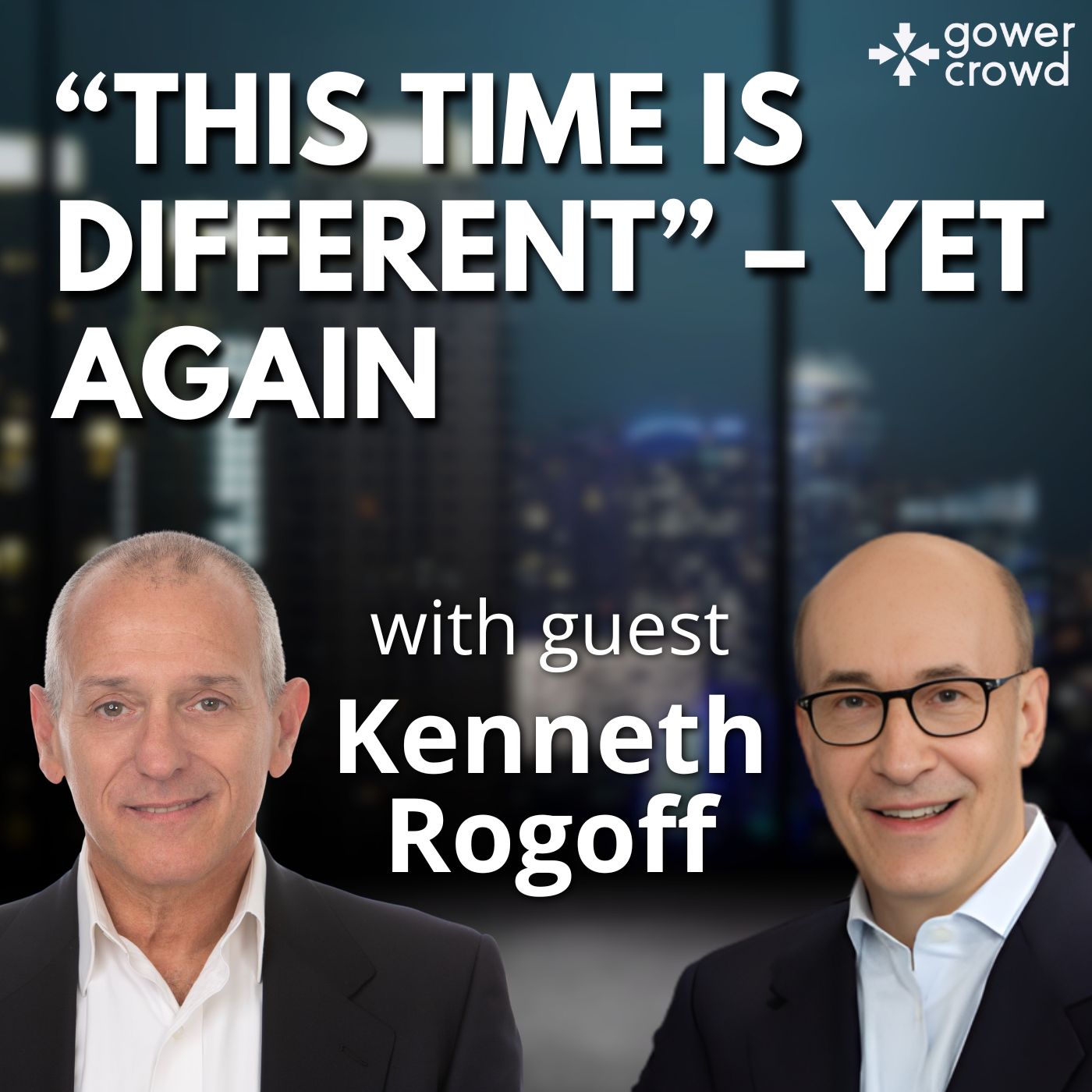
S8 Ep 36"This Time Is Different" – Yet Again
Ken Rogoff does not trade in headlines or market timing. He trades in history. As Professor of Economics at Harvard and co-author of This Time Is Different, Rogoff has spent decades studying what happens when societies convince themselves old rules no longer apply. His latest book, Our Dollar, Your Problem, extends that lens to today's economy – and to the quiet assumptions underpinning U.S. financial dominance. In our conversation, Rogoff unpacked why the dollar's "exorbitant privilege" still matters, why it is slowly eroding, and why the real risks facing the U.S. economy are not where most people are looking. This was not a discussion about panic. It was a discussion about probability. Among the questions Rogoff addresses: Why does dollar dominance lower borrowing costs for U.S. households and businesses – and what happens if that advantage fades? Why is the combination of high debt and higher interest rates historically dangerous, even for advanced economies? Why central bank independence matters more than most people realize – and why it is under pressure from both sides of the political spectrum. Why commercial real estate stress is serious but not systemic – and what risks matter more. Why AI could extend U.S. economic strength or trigger a sharp reversal – and why today's low volatility is misleading. Rogoff's core message is unsettling precisely because it is familiar. The United States has navigated debt, inflation, and institutional stress before. It did not escape unscathed. It adapted under pressure. The question is not whether adjustment comes. It is how – and under what conditions. If you care about macro risk, capital markets, or the long-term assumptions embedded in real estate and investment decisions, this conversation is worth your time. Tune in to hear it in full. *** In this series, I cut through the noise to examine how shifting macroeconomic forces and rising geopolitical risk are reshaping real estate investing. With insights from economists, academics, and seasoned professionals, this show helps investors respond to market uncertainty with clarity, discipline, and a focus on downside protection. Subscribe to my free newsletter for timely updates, insights, and tools to help you navigate today's volatile real estate landscape. You'll get: Straight talk on what happens when confidence meets correction - no hype, no spin, no fluff. Real implications of macro trends for investors and sponsors with actionable guidance. Insights from real estate professionals who've been through it all before. Visit GowerCrowd.com/subscribe Email: [email protected] Call: 213-761-1000