
250 and Counting
660 episodes — Page 5 of 14
Brits: Keep Out!–April 6, 1776
Mr. Washington Goes to Providence–April 5, 1776

Washington Departs Cambridge–April 4, 1776
To say the Washington left the Longfellow House is putting the cart before the horse, because Washington was in it before Longfellow. The house originally belonged to John Vassall Jr, a Loyalist who had the good sense to get out of town when the shooting started. From July 16, 1775 until this day in 1776, Washington occupied it as his home and his headquarters. In 1791 Washington’s apothecary Andrew Craigie purchased the house and made a major addition to it, the only big cosmetic change to the house. After Craigie’s death, his widow rented out various rooms to supplement what little income she had, and one of her tenants was Henry Wadsworth Longfellow, who eventually became the owner in 1843 when it was purchased for him as a wedding gift. The Longfellow family was the last to live in the house; some time after his death the family established the Longfellow Trust to provide for the house’s preservation, and in 1972 the house and its possessions were donated to the National Park Service. The post Washington Departs Cambridge–April 4, 1776 appeared first on 250 and Counting.
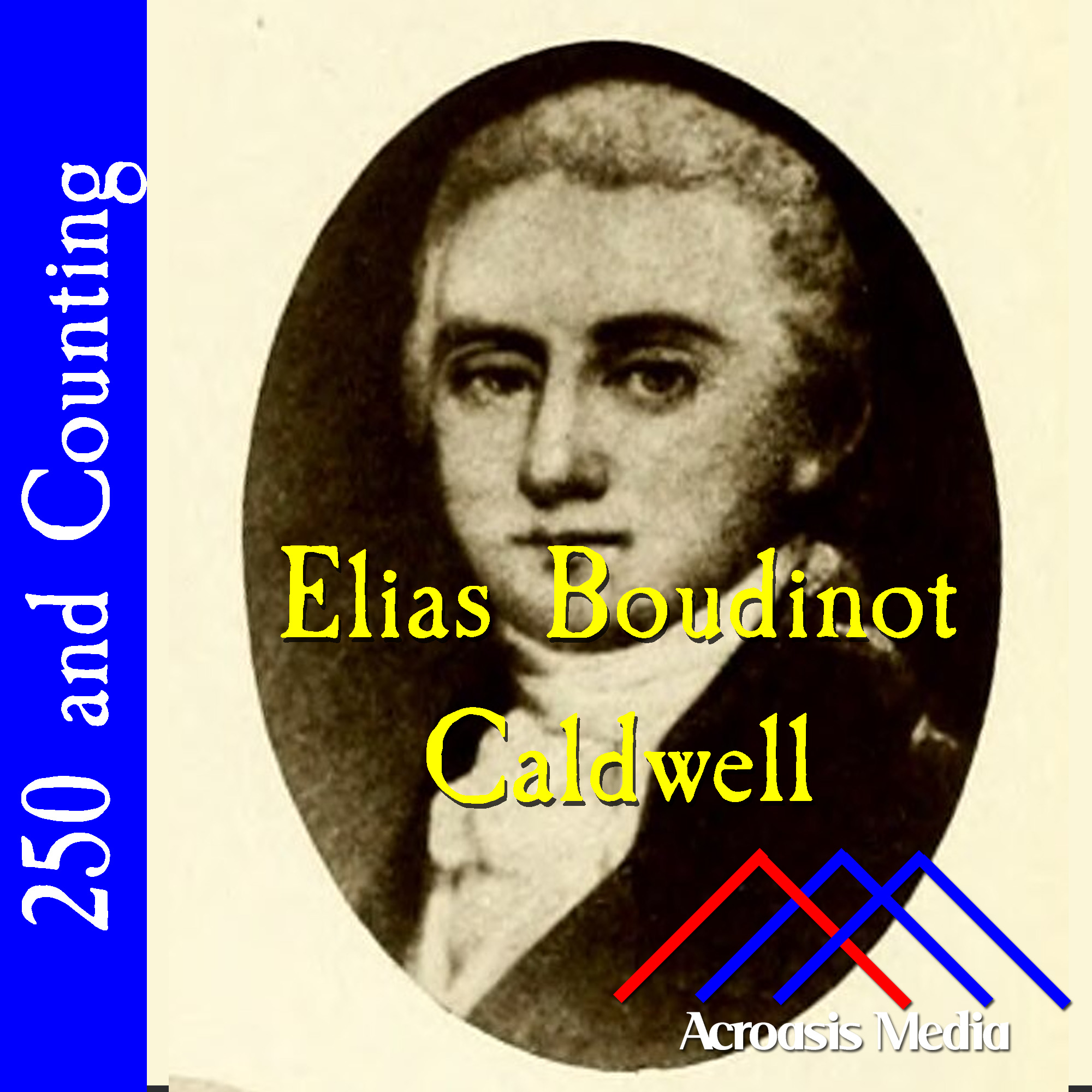
Elias Boudinot Caldwell–April 3, 1776
I mentioned briefly that Elias Boudinot Caldwell was a member of the Society for the Colonization of Free People of Color of America (to the extent that anyone can say that briefly), and I though I’d get a little deeper into that organization here. The group was founded in 1816 by Robert Finley, along with Caldwell and Francis Scott Key, to encourage and support the repatriation of freeborn people of color and emancipated slaves to sub-Saharan Africa. Their feeling was that free people of color could not integrate into American society. It was also thought that free Blacks running around would incite still-enslaved Blacks to escape or rebel. So…why not relocate them? The group, which later became known as the American Colonization Society, thought they’d be preventing a civil war from breaking out. In fact, some historians think they may have hastened its onset. What’s more, only a few thousand African Americans out of millions, eventually made the trip to (what would become) Liberia. Worse still, they were kind of bad at it. Transporting people to Liberia was very costly, and close to half the people who arrived died from tropical diseases. And for all that, the ACS didn’t officially dissolve until 1964. The post Elias Boudinot Caldwell–April 3, 1776 appeared first on 250 and Counting.
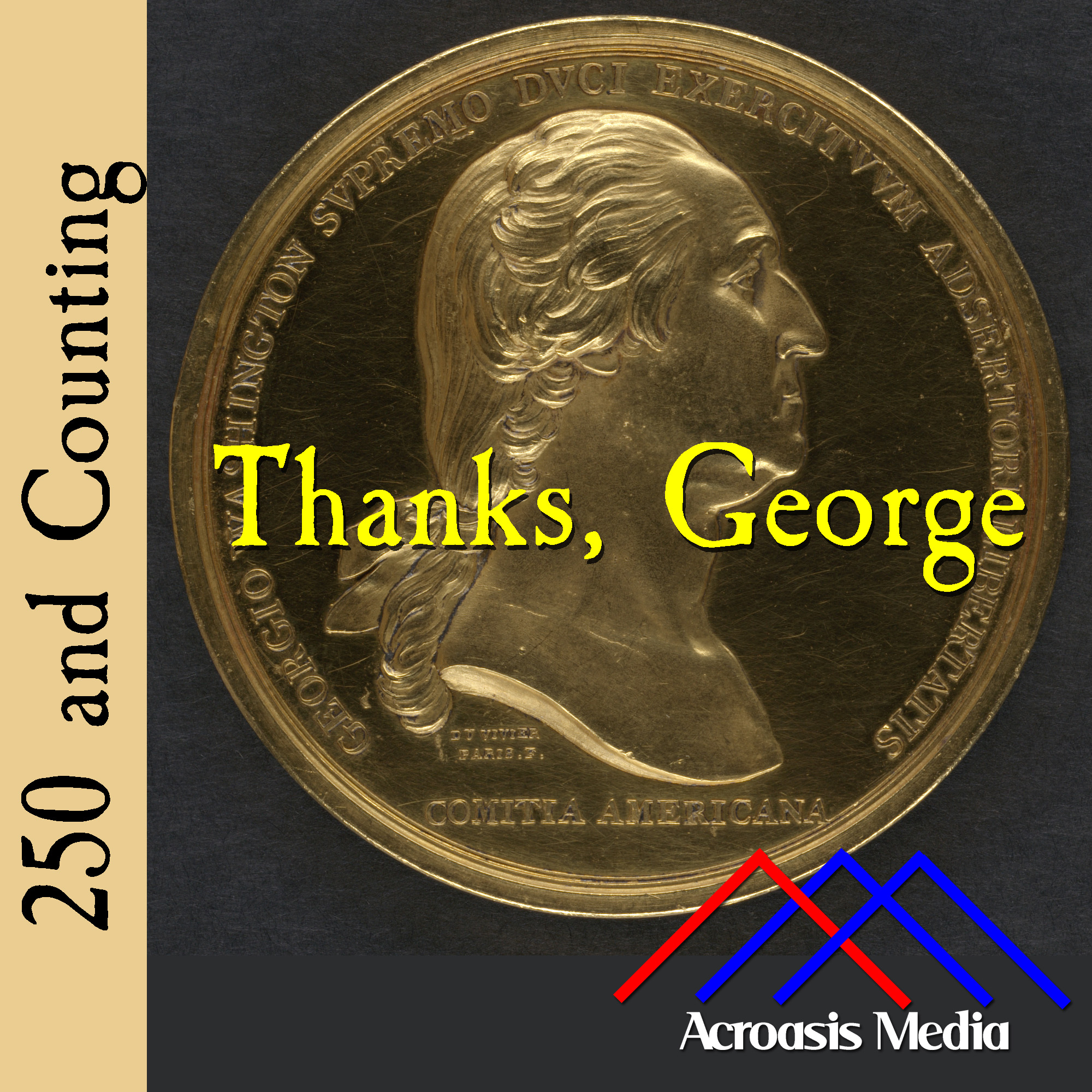
Thanks, George–April 2, 1776
Just a few days ago, Congress passed a resolution that George Washington should be thanked for his efforts in Boston, and that a Congressional Medal should be issued to him. Specifically, the resolution read: Resolved, That the thanks of this Congress, in their own name, and in the name of the thirteen United Colonies, whom they represent, be presented to His Excellency General Washington, and the officers and soldiers under his command, for their wise and spirited conduct in the siege and acquisition of Boston; and that a medal of gold be struck in commemoration of this great event, and presented to His Excellency; and that a committee of three be appointed to prepare a letter of thanks and a proper device for the medal. They did do all this, but frankly striking a congressional medal (or any other type, presumably) during the Revolutionary War was kind of a low priority (in addition to the other issues Mike cites), but it did eventually get done. An unknown Greek poet, possibly from the 1st century CE, once said: Ὀψὲ θεῶν ἀλέουσι μύλοι, ἀλέουσι δὲ λεπτά.The millstones of the gods grind late [slowly], but they grind fine. Clearly this guy knew how governments operate. The post Thanks, George–April 2, 1776 appeared first on 250 and Counting.
Gang Greene–April 1, 1776
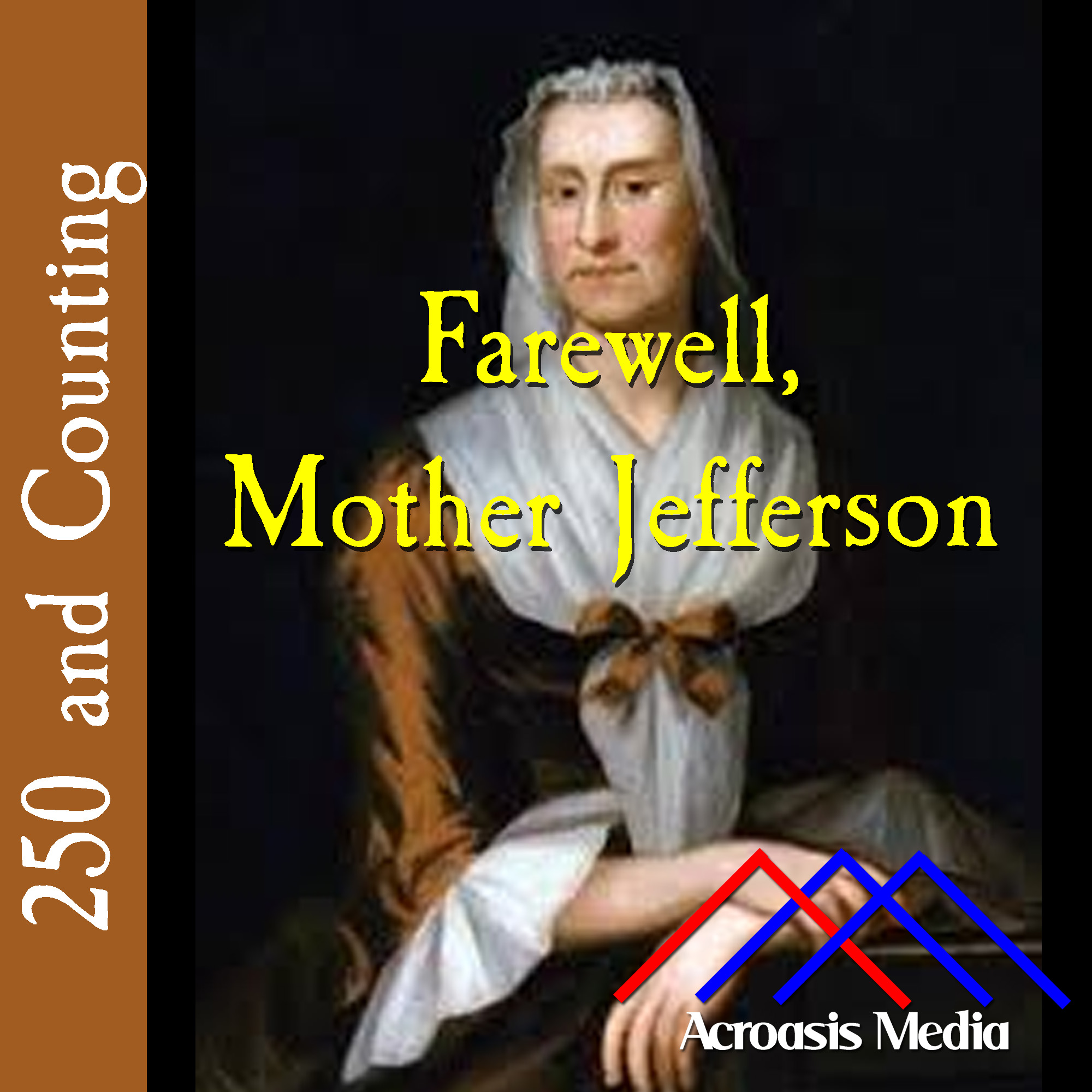
Farewell, Mother Jefferson–March 31, 1776
In discussing the life of Jane Randolph Jefferson, I mentioned during the episode that Thomas Jefferson rarely discussed her. This is not, however, to suggest that he lacked affection for her, or that he was somehow ashamed of her. There are family remembrances and contemporary biographies that show that Jane was a revered family member. It’s also worth noting that Thomas Jefferson, unlike Benjamin Franklin, was not in the habit of retaining correspondence, even with people important to him. Jane is credited by many historians as the person responsible for his love of music and for his writing abilities. And after all, he didn’t leave his family home until it burned down. Furthermore Thomas named his second daughter after his mother (his first was named after his wife). The post Farewell, Mother Jefferson–March 31, 1776 appeared first on 250 and Counting.
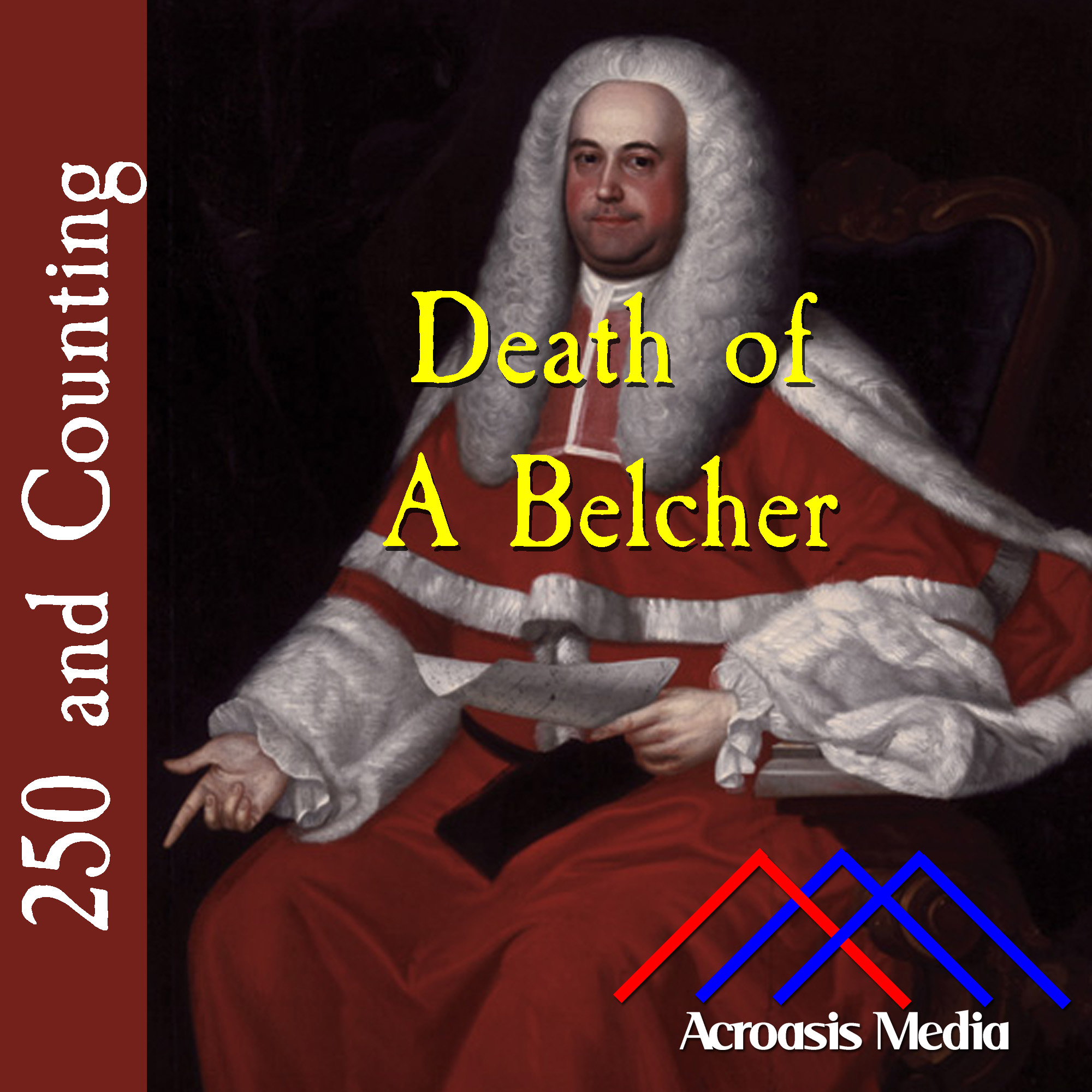
Death Of A Belcher–March 30, 1776
Jurist Jonathan Belcher was born in Boston. He was the second son of Jonathan Belcher and Mary Partridge, Belcher entered Harvard College, where in 1728 he received a Bachelor of Arts degree in Divinity Studies. In 1730 he entered the Middle Temple, London, to read law, and in 1734 was called to the English bar. In the meantime he had been admitted as a fellow-commoner to Trinity College, Cambridge, where in 1733 he received another master’s degree, this time in mathematics. He later received a third master’s degree from the College of New Jersey (now Princeton University). In 1754, Belcher was sent to Nova Scotia to become the first Chief Justice of the Nova Scotia Supreme Court. Prior to Belcher’s arrival Nova Scotia had no formally trained law officers. This meant that he was not only interpreting the law there, he was oftentimes writing it. Belcher also served on the Nova Scotia Council. On July 28, 1755, he published a document which concluded that deportation of the Acadians was both authorized and required under the law. This is the decision that got him in hot water. From 1761 to 1763, he was also Lieutenant Governor of Nova Scotia, spending the last three years of that period as Acting Governor when Henry Ellis did not fulfill his duties. He negotiated the peace that led to the Burying the Hatchet ceremony in Nova Scotia. Jonathan Belcher died in office in 1776, and is buried in the Old Burying Ground in Halifax. The post Death Of A Belcher–March 30, 1776 appeared first on 250 and Counting.

From One Postal Official To Another–March 29, 1776
While we’re focusing on one letter written by Benjamin Franklin today, written to Anthony Todd, it’s rather impressive the sheer number and breadth of letters written by, or to, Franklin during his lifetime as a statesman. There is a collaborative effort going on between Yale University and the American Philospohical Society, among others, to search, collect and publish the various works of Benjamin Franklin. So far over forty volumes have been published since 1959, and the scholars involved are pretty sure that number will surpass 50. Important to this effort is the fact that Franklin saved a lot of his correspondence specifically for the sake of posterity. As a result we have perhaps a more complete collection of what historians like to call “primary sources” of materials than for any other Founding Father. What’s more, Franklin didn’t just dash off quick notes; he treated them like miniature works of art and crafted their composition. This came in handy when he edited the first draft of the Declaration of Independence. It was his suggestion that the phrase “We hold these truths to be self-evident” whereas Jefferson had described them as “sacred and undeniable.” The full text of Franklin’s letter can be found here. The post From One Postal Official To Another–March 29, 1776 appeared first on 250 and Counting.

He Built This City–March 28, 1776
Juan Bautista de Anza is considered one of the founding fathers of Spanish California. He was born in 1736 in New Spain (what we now call Sonora, Mexico) into a family of military leaders. Most of his military actions involved taking on Native Americans while he explored what is now known as Arizona. Near the end of the 1760s Spain began to colonize Alta California, which was basically anything not considered Baja California. They took a two-pronged approach; one expedition ran up the coast at sea, which turned out to be quite difficult because the winds were going the wrong way. The other path was over land, which was a little more direct and allowed the Spanish to establish several missions along the way. In 1772 Anza proposed a new expedtion to Alta California, which was eventually approved by the King of Spain, and in January 1774 he set out from a place a little bit south of present-day Tuscon, Arizona. By April he’d reached Monterey, California before returning to the place he’d started. October 1775 brought a new start to the expedition, this time with the goal of transporting colonists to Monterey. Having done that, he continued north until arriving at the arroyo of San Joseph Cupertino, which is now known as Stevens Creek. Two days later he’d spotted the San Francisco Estuary and identified the sites for the Presidio of San Francisco and Mission San Francisco de Asis. Having established an overland route, Anza returned the way he’d come. Unfortunately in 1781 the Yuma Tribe closed off the trail at the Colorado River, which stayed closed until the 1820s, meaning that if you wanted to get to Alta California from Baja, for over 40 years you had to do it by sea. The post He Built This City–March 28, 1776 appeared first on 250 and Counting.

A New Home For The Royal Navy–March 27, 1776
The image in today’s cover art is an engraving of Citadel Hill, around 1780. Citadel Hill is a very popular historic site in Halifax, and while four forts have been built on this site, none of them have ever had to withstand a direct attack. In a couple of instances, structures near the Citadel were attacked, but never the building itself. It’s possible that the forts that were erected on the site served as deterrents. The first Citadel was built in 1749. Fortifications were constructed on this hill to protect against raids by the French, colonial Akadians, and local tribes, especially the Mi’kmaq (pronounce it “MicMac”). By 1761 the fort was in ruins and a second, larger Citadel was built in 1776. This is the one in the artwork. While the garrison was always on alert, again it was never attacked, and by 1784 it was again in ruins. The third Citadel was built starting in 1796, when the old one was dismantled. This one was larger still and looked much like the current model, except it had more earthworks. During the War of 1812 some quick renovations were made in case the Americans attacked, but again the whole thing fell to ruin by 1825. Construction for the current Citadel began in 1828. It was a huge masonry-construction star-shaped fort that took 28 years to finish. An incident in the nearby waters nearly dragged the Citadel into the American Civil War but again there were no attacks on the fort. Eventually it was restored by historians and in 1956 it opened as a historic site and home to the Halifax Army Museum. In the 1990s it was restored again to its 1869 appearance and is maintained as such. The grounds of the Halifax Citadel are open year round. From spring to fall, a living history program features re-enactors portraying the 78th Highland Regiment (stationed at Halifax between 1869 and 1871), the 78th Highlanders (Halifax Citadel) Pipe Band, the Third Brigade of the Royal Artillery, soldiers’ wives, and civilian tradespeople. Parks Canada also hosts several re-enactment events each year by volunteers of the Brigade of the American Revolution and the two living history associations. The Citadel’s role in the history of Halifax and North America is communicated through guided and self-guided tours, audio-visual presentations, and various exhibits. On average, the citadel sees over 200,000 visitors annually. A ceremonial firing of the noon gun is conducted daily by staff, and continues year-round, even when the site is closed to visitors. The artillery is also used for formal occasions such as 21-gun salutes. The “Army Museum”, located in the Citadel’s Cavalier Block, displays a rare collection of weapons, medals, and uniforms exploring Nova Scotia’s army history. It is an independent non-profit museum, and staff work in close partnership with the Citadel staff and Parks Canada. In July 2006, the Halifax Citadel celebrated the 100th anniversary of the withdrawal of the last British military forces from Canada. The Citadel hosted over 1,000 re-enactors from around the world. Approaching the Christmas season, Citadel Hill annually hosts a “Victorian Christmas”. Visitors are treated to crafts, carolers, and games, as well as a visit from Santa Claus. Ghost tours are held at the fort in the weeks leading up to Halloween. Ghost tours! Nobody ever died in battle there, but we’re doing ghost tours. Fantastic. The post A New Home For The Royal Navy–March 27, 1776 appeared first on 250 and Counting.
A Death In Rhode Island–March 26, 1776
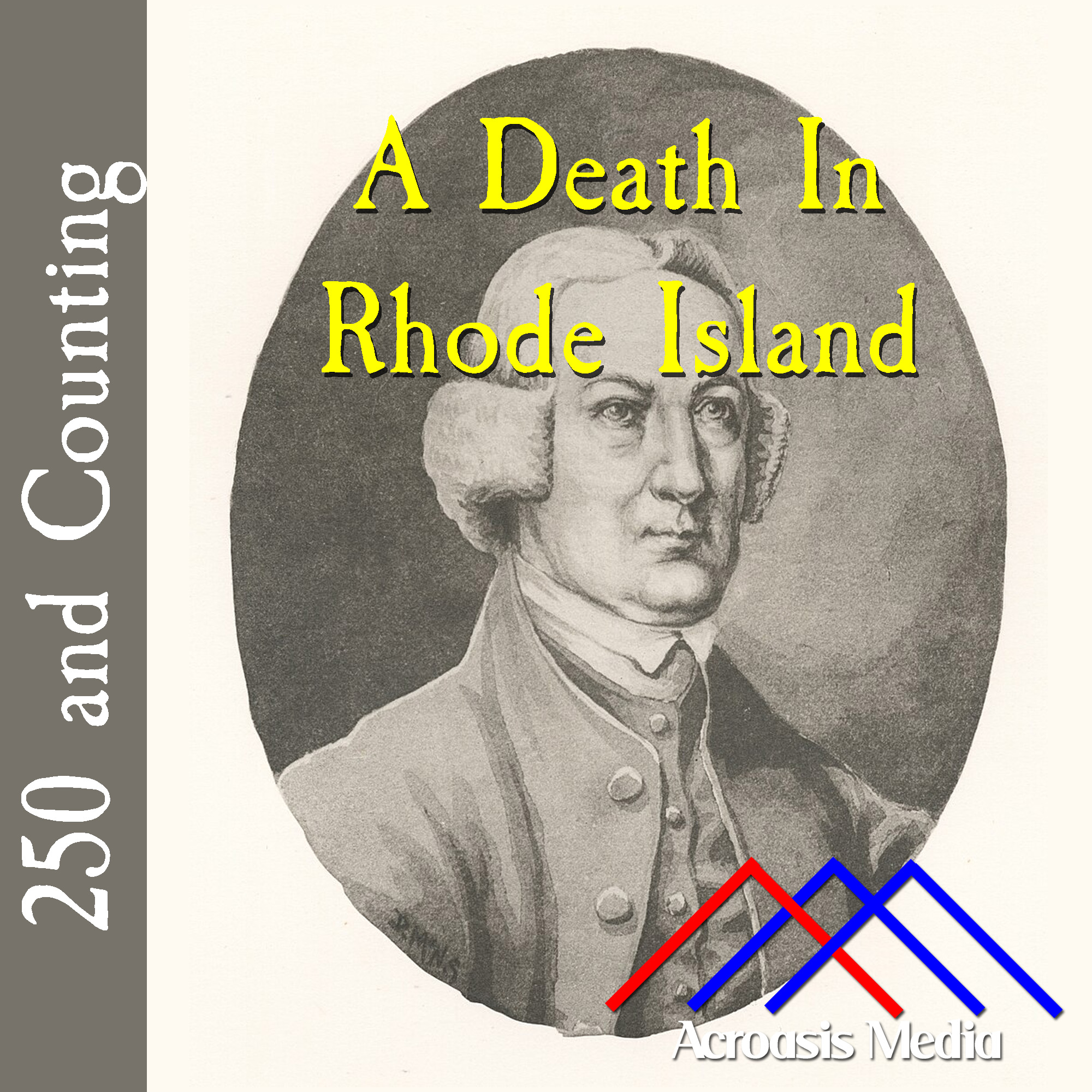
Samuel Ward Sr. was a farmer and a politician, the governor of the Colony of Rhode Island and Providence Plantations, and a Justice of that colony’s Supreme Court. As a younger man, Ward believed in governments issuing hard money rather than paper, often battling with Stephen Hopkins over this issue. Because of this specific topic, the two men became bitter rivals and for several terms they alternated being governor of Rhode Island. His final term as governor ended in 1767, at which he left politics to work on his farm. But in 1774 he was called back into service as a delegate to the Continental Congress. Fortunately, he and Hopkins had buried the hatchet and the two were more friendly with one another. I say “fortunately” because Stephen Hopkins was also called to join the Congress. Ward died in Philadelphia and was buried there, but over 80 years later he was moved to the Common Burying Ground in Newport, RI and reinterred there. The post A Death In Rhode Island–March 26, 1776 appeared first on 250 and Counting.

Raid On Tybee Island–March 25, 1776
The raid on Tybee Island wasn’t the only one of its kind; in fact a similar action had been taken at Sullivan’s Island in South Carolina a few weeks earlier. In that case there were many more runaway slaves involved, but like Tybee, very few were actually captured and the fate of most of the others is unknown, although there is one account that says fifty people had resisted capture and were subesquently killed. But in both cases we see a raid that took place specifically to deny people their freedom, and the proclamation the led to these raids directly influenced the argument in the Declaration of Independence that King George incited “domestic insurrections.” So…the desire of slaves to be free…drove the Patriots to desire independence. The post Raid On Tybee Island–March 25, 1776 appeared first on 250 and Counting.

Letters From The General–March 24, 1776
Mike had a little fun busting on George Washington’s spelling in today’s episode, but we do have to offer a little grace here, because in 1776 efforts to standardize spelling in the English language were only just beginning to catch on. About a hundred years earlier, some of the language was simplified; thus, sinne became sin; logique became logic; toune to town, etc. Not long afterward, some words were tied to their Greek or Latin roots, e.g. det became debt (Latin, “debitum”) and dout became doubt (Latin, “dubitare”), and so on. It really wasn’t until the 19th Century that more serious efforts to standarize some English took place, as the science of phonetics began to rise. In the 1870s, societies actually began springing up that were dedicated to reforming the English language’s spelling. One such group had the editor of the Chicago Tribune as a member, so whenever his group had something they thought was good, he’d be the first one using it in print. In 1903 a group called the Simplified Spelling Board was formed, backed by Andrew Carnegie. Their recommendations were immediately relayed to all government agencies by President Teddy Roosevelt. And then between the 1930s and 1975, the Chicago Tribune (again) was at the forefront of changes to standardized spelling, thus giving the new language a huge platform on which to rest. Look that up in your Funk & Wagnalls, kids. The post Letters From The General–March 24, 1776 appeared first on 250 and Counting.

Here Come The Privateers–March 23, 1776
When you first hear the word “Privateers” and its definition, your mind probably goes to your basic concept of a pirate: someone who attacks a ship and plunders its hold for anything valuable. And you wouldn’t be entirely wrong, but there’s still a difference. A privateer is essentially a pirate who’s working on the right side of the law. Privateers are given commissions through a document called a Letter of Marque, which authorizes a vessel to engage with any ship they consider unfriendly. This wasn’t unique to America; privateering was done all over the world. But in our case, it was a response to the fact that America was sorely out-gunned by the British and needed whatever help they could get. And early privateers had a high success rate, until the British realized that privateers were in use at all. One of our most famous privateers is John Paul Jones, who volunteered his services and, rather than using his ship to raid British vessels near America, did most of his work near the English coast. He would raid towns, attack vessels and send the Congress their share of the spoils. So the bottom line when it comes to the difference: permission. Privateers and pirates did much the same thing, except privateers had consent. The post Here Come The Privateers–March 23, 1776 appeared first on 250 and Counting.

William Tryon Isn’t Popular–March 22, 1776
To be perfectly clear, William Tryon was never popular on this side of the pond. When he was appointed Lieutenant Governor in North Carolina in 1764, he wasn’t able to move into the usual housing for a man of that title because the previous inhabitant refused to move out. When the Stamp Act was enacted in 1765, there was a great deal of opposition in North Carolina, so he refused to allow meetings of the Assembly in order to prevent them from voting for a resolution formally opposing it. When he was appointed Royal Governor, he made plans for an elaborate new Governor’s Mansion that cost twice the amount of money allotted for it. Then he hired laborers from Philadelphia to construct it, saying that North Carolinians didn’t have the necessary skills. The 1771 Regulator Uprising that Mike talks about in today’s episode was the last straw for William Tryon in North Carolina, and many historians view it as the first sign that a true revolution was coming. Within a month of that event, he left North Carolina and headed for New York, where things, as you’ll hear, didn’t go any better. The post William Tryon Isn’t Popular–March 22, 1776 appeared first on 250 and Counting.
John Frederick Frelinghuysen–March 21, 1776
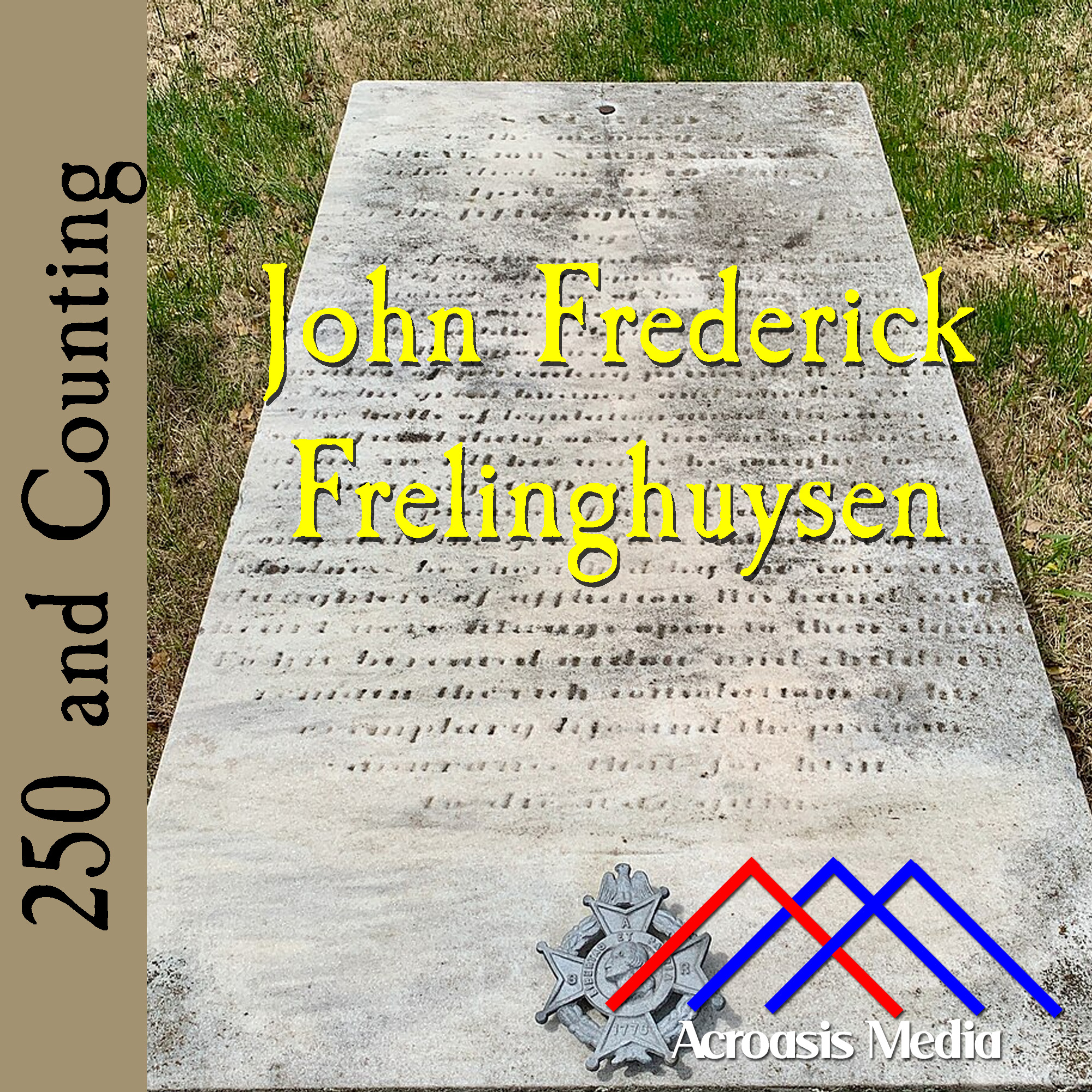
John Frelinghuysen was born on this day in 1776 (hey! Cake and Candles for this man!) and died in 1833. Like many people of the time, he never permanently left the area where he was born. Born there, lived and worked there, died there. He probably went to Trenton on business a few times, and he was stationed at Sandy Hook while in the Army, but that appears to be about all as far as travel. John Frelinghuysen married Louisa Mercer in 1797, and they had two daughters: Gertrude and Mary Ann. Louisa died around 1809 and John married Elizabeth Mercereau Van Vechten on November 13, 1811. They had eight children: Louisa, Theodore, Frederick J., Catharine, Sallie, Sophia, and Elizabeth LaGrange Frelinghuysen. The post John Frederick Frelinghuysen–March 21, 1776 appeared first on 250 and Counting.

Meet The New Boss–March 20, 1776
While preparing to depart Boston for New York, George Washington appointed Nathaniel Greene to run things for awhile until everything was back in order. Fortunately for both Greene and Washington, matters straightened out rather quickly, because Greene was called to join Washington just a few weeks later. Nathaniel Greene was tasked with fortifying Brooklyn while Washington prepared to defend Manhattan. As a military leader, Greene had a bit of a mixed record, but more often than not it appears that he was the victim of poor timing when things didn’t go well for him. Later on in the war, he took on the position of Quartermaster General, which on its surface looks like a demotion, but Washington still considered him “inner circle” and Greene would sit in on War Council meetings, even though he was considered a staff officer. Later on, when things started looking gloomy in South Carolina and Georgia, Nathaniel Greene was put in charge of the Southern Department of the Continental Army, where he embarked on a campaign of guerilla warfare rather than pitched battles. His unconventional approach wasn’t always successful, but if the British won a battle it was at a much greater cost than it should have been. The post Meet The New Boss–March 20, 1776 appeared first on 250 and Counting.

Philemon Beecher–March 19, 1776
Philemon Beecher is an unusual name (said the guy named Claude Call, sigh), but that’s on us for not recognizing it as a name from the Bible. Philemon was a man to whom the apostle Paul wrote while in prison. He was in prison more than once, but it’s not entirely clear which stretch Paul was doing when he wrote it. Philemon was a leader in the Colossian Church, and Paul’s letter—one of a very few that scholars generally agree was actually written by Paul—touches on themes of reconciliation, forgiveness, and Christian fellowship, addressing themes of slavery, freedom, and ethical conduct within the Roman social context. While it doesn’t explicitly condemn slavery, it reframes master-servant relationships in spiritual terms, highlighting the moral and social transformation encouraged within early Christian communities. But I digress. Philemon Beecher was a successful attorney and a semi-successful politician who was one of Ohio’s first House members once Ohio became a state. Beecher also got married in 1803, so that was a pretty good year for him. He was one of ten children, one of whom died at the age of three and who coincidentally was also named Philemon Beecher. They recycled that name two years later! Some of his other siblings also died relatively young but they had reached adulthood. I don’t imagine he had an especially distinguished political career, given that I couldn’t find an image of him in any of my usual haunts. What’s more, I couldn’t ascertain whether he and his wife Susan had any children, though it appears the answer to that is “no.” Nevertheless, he remained a prominent citizen as an attorney and member of the board of the Lancaster, Ohio Bank. He also participated as a member of The Colonization Society in Lancaster, a group dedicated to repatriating Black people back to Africa as an alternative to slavery. The post Philemon Beecher–March 19, 1776 appeared first on 250 and Counting.
Reviewing Boston–March 18, 1776
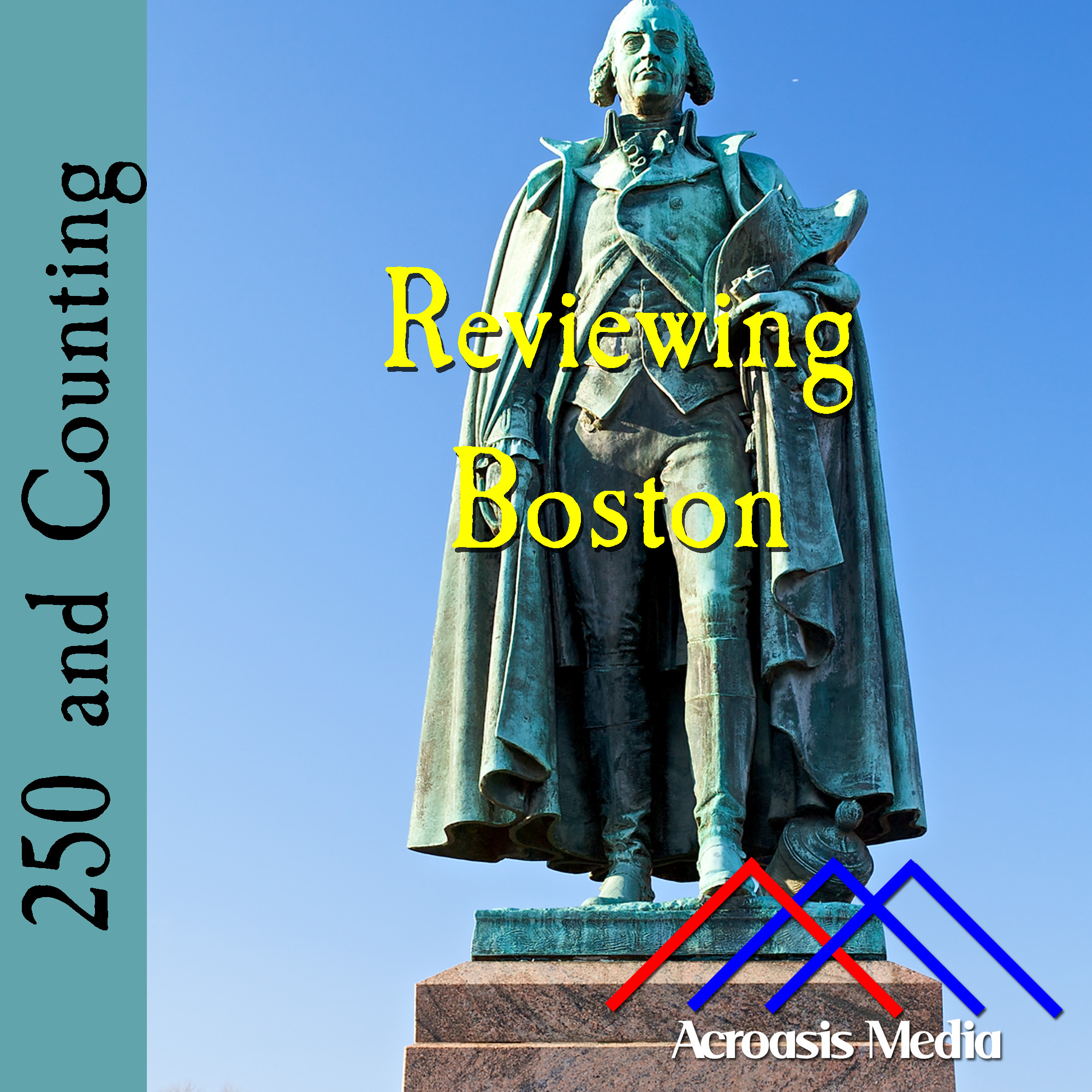
In the aftermath of the siege of Boston, it was incumbent upon George Washington and his men to re-enter the city and take stock of its condition. Mike brings up Artemas Ward in today’s episode, and I’m pretty sure that was the first time his name has come up in the course of this podcast. Ward was a major general during the Revolutionary War, among others, and an effective political leader when he wasn’t being a soldier. It was Ward who sounded the alarm on Bunker Hill, and who took command of the New England area once Washington led most of the troops down to New York City. ‘ The statue in today’s cover art can be found in the center of a traffic circle in Washington, DC, where Massachusetts and Nebraska Avenues cross one another. Ward’s great-grandson donated four million dollars to Harvard on the condition that they build a statue of Artamis, and maintain his Shrewsbury home. Harvard apparently chose to purchase a statue but did not provide enough money to provide the general with a horse. Oddly enough, because it’s a traffic circle and therefore has no obvious way for a pedestrian to get to the center (i.e., no crosswalk), it’s quite difficult to get close enough to the pedestal to read the inscription: ARTEMAS WARD1727–1800SON OF MASSACHUSETTSGRADUATE OF HARVARD COLLEGEJUDGE AND LEGISLATORDELEGATE 1780–1781 TO THE CONTINENTAL CONGRESSSOLDIER OF THREE WARSFIRST COMMANDER OF THE PATRIOT FORCES The post Reviewing Boston–March 18, 1776 appeared first on 250 and Counting.
The Siege Ends–March 17, 1776
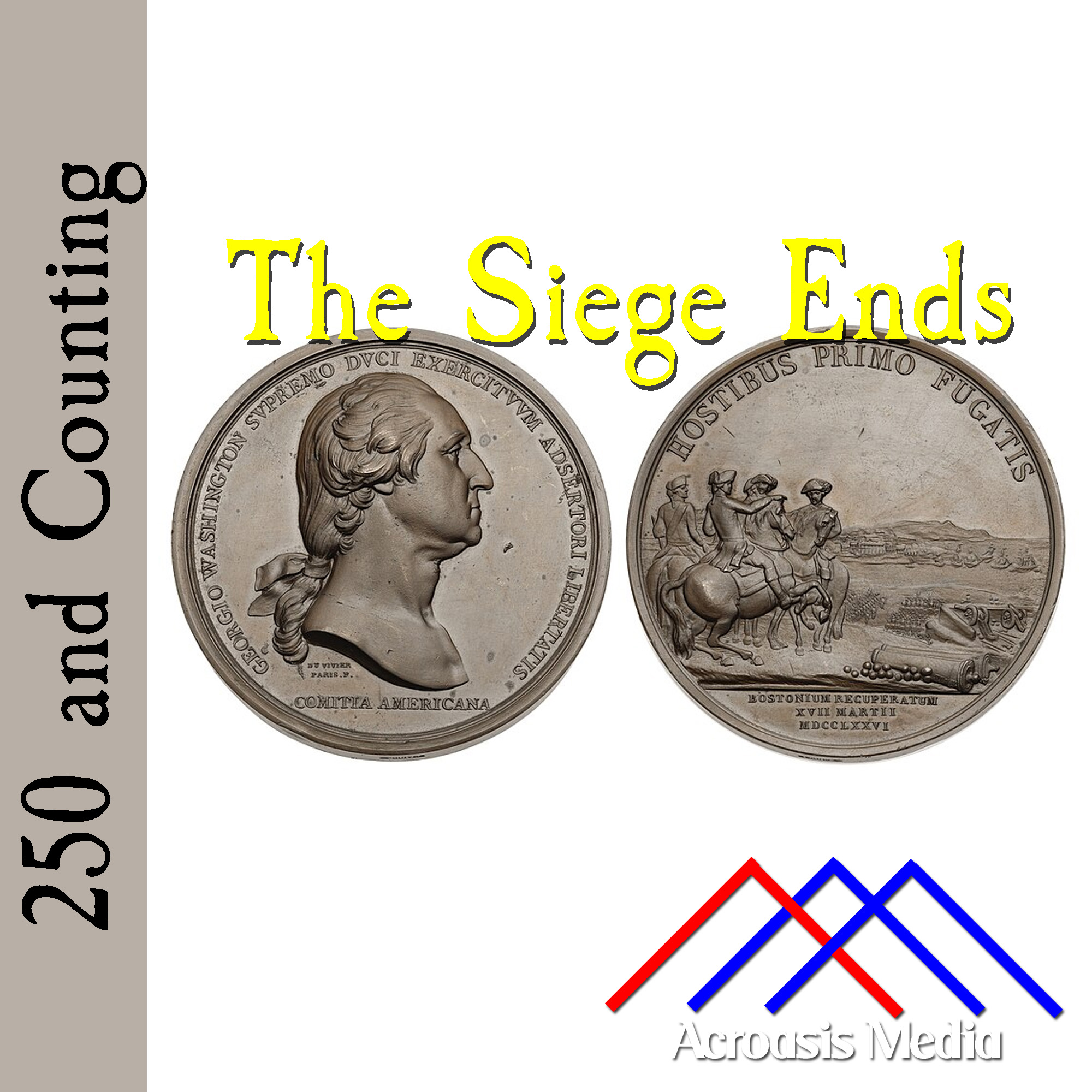
It’s been 333 days since Lexington and Concord, when the British were forced to retreat to Boston and were bottled up there by Colonial forces. It’s been a week since the British said “enough” and decided to effect their departure from the city as soon as the weather cooperated. But today, the day finally came. It took about five hours to launch over a hundred ships, carrying thousands of soldiers, women and children from the city. It was Washington’s first major win and the last time the British did anything of importance in New England. The war began to move south, to New York, New Jersey, and Pennsylvania. Virginia and the Carolinas also had their share of action, as we’ll see in the coming months. The post The Siege Ends–March 17, 1776 appeared first on 250 and Counting.
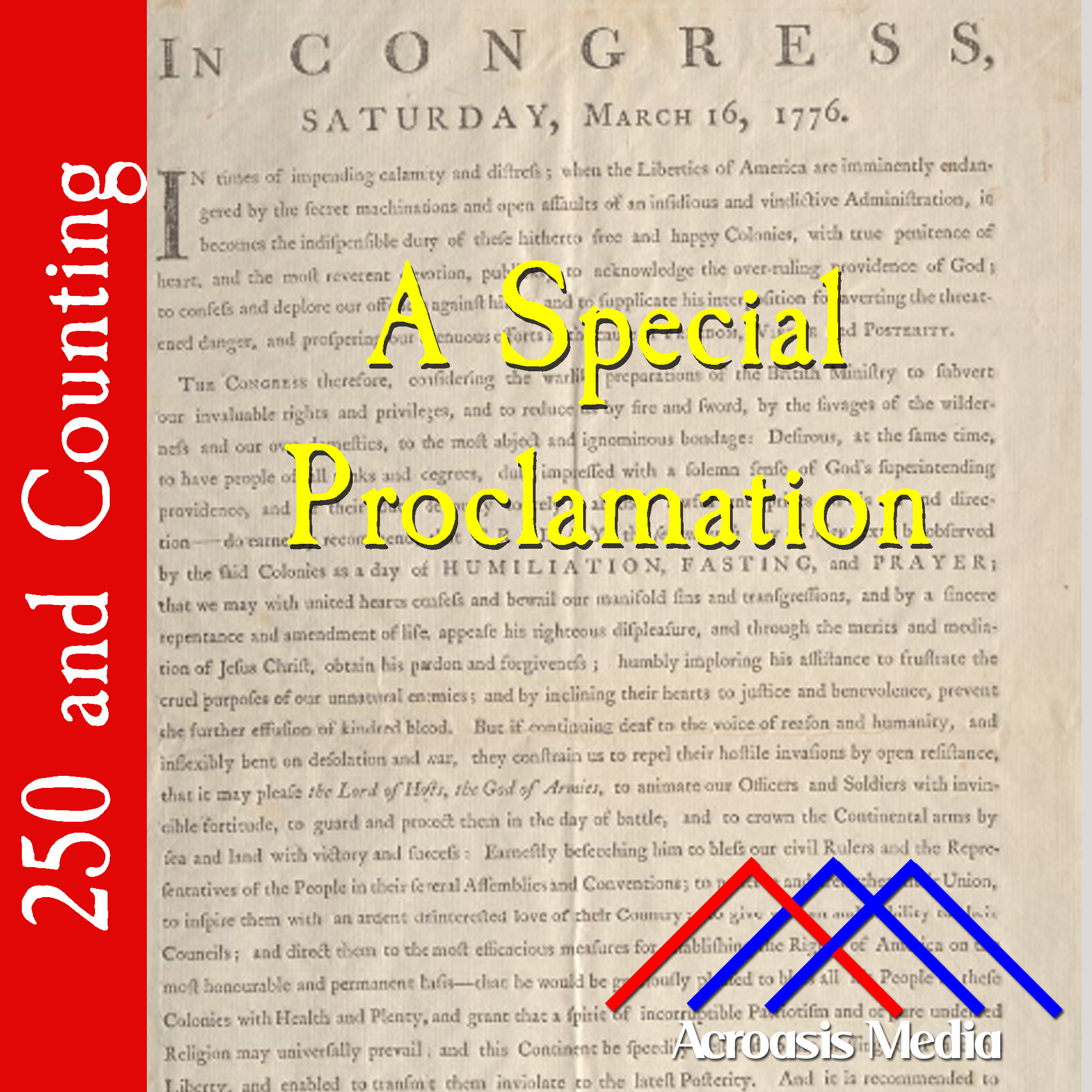
A Special Proclamation–March 16, 1776
As we noted back in July, a day of prayer, humiliation and fasting wasn’t new to the Continental Congress. (Go back to that episode’s show notes to see my explanation of the word “humiliation” in this context.) And, as Mike notes in the episode, it wasn’t even close to the last for this Congress. That’s neither good nor bad; it probably gave everyone the opportunity to simply stop and contemplate matters. Tensions were rising high by now, and it would have been easy to make a rash, emotion-based decision. So why not take a moment to ensure that whatever deity you subscribe to is inclined to help you? I don’t frame it that way to be provocative; we all too often hear rhetoric suggesting that all of the Founding Fathers were good Christians. In fact they ran the gamut from orthodox Christianity, through rationalistic theism, through Deism. Thomas Jefferson once edited a Bible which removed references to miracles and the divinity of Jesus. Even among the “orthodox Christian” crowd, one could find Quakers, Lutherans, Dutch Reformed, Anglicans, and Presbyterians. One of our first episodes featured a Jewish Patriot. And even though he didn’t appear to practice publicly, Alexander Hamilton was raised Jewish as a child. The point here is that when you’re in hopeless times—and fighting off the British was considered a lost cause in those days—you take the comfort where you can. Whether that’s in God, Buddha, Krishna, Zeus, Mohammed or another human being, it’s not wrong to give yourself some form of contemplation. Okay, rant over. The post A Special Proclamation–March 16, 1776 appeared first on 250 and Counting.
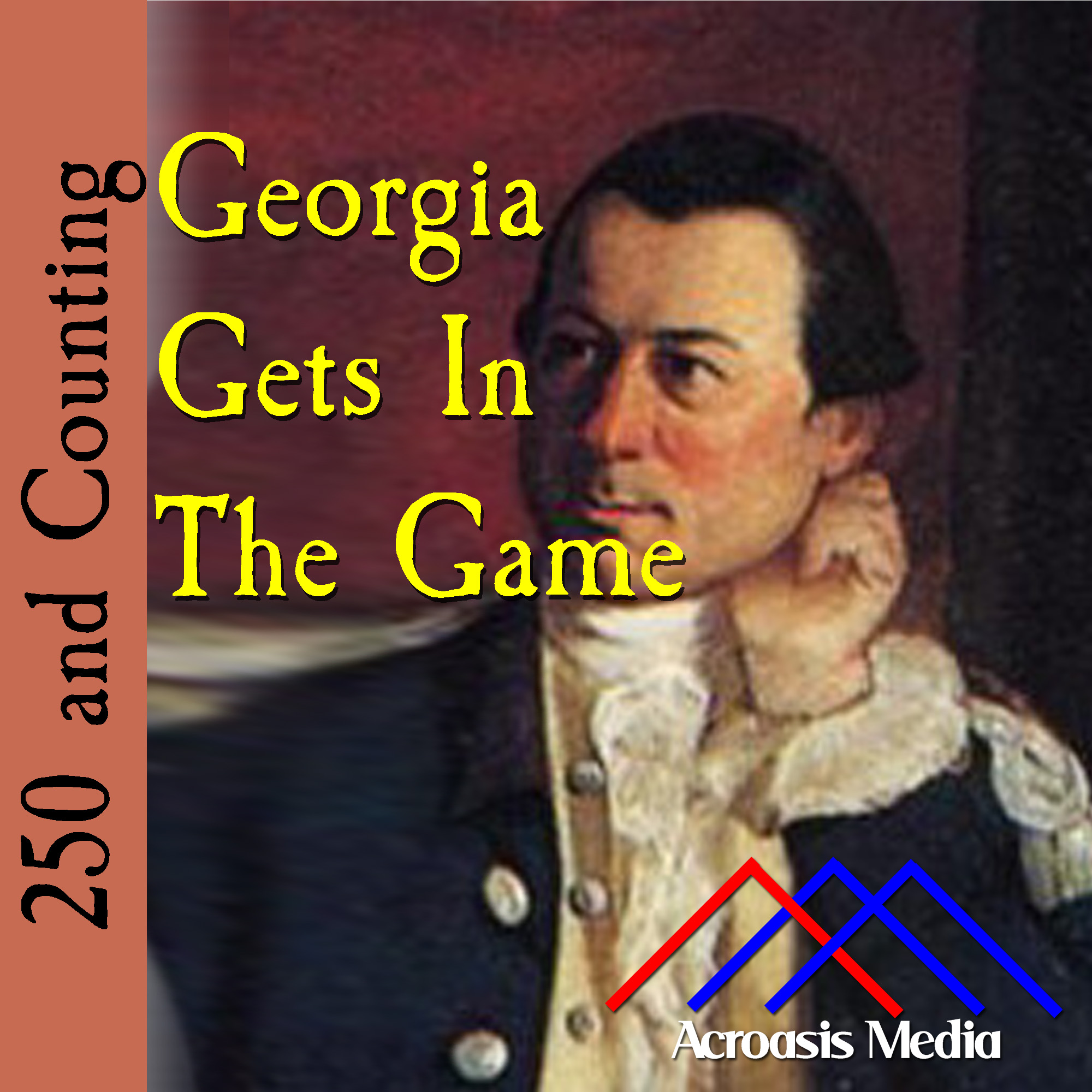
Georgia Gets In The Game–March 15, 1776
Georgia delegates to the Second Continental Congress numbered exactly one until around this time. That would be Dr. Lyman Hall, who didn’t believe it was ethical for him to represent the entire colony when he knew that feelings were largely divided back home. Then came the Battle of the Rice Boats, on March 2 and 3. After that, it seems, things moved very quickly for Georgians: the Royal Governor, who’d been in and out of custody, fled to a nearby warship, the Provincial Congress was left in charge, and they immediately began making plans to raise a more formal army than the militia that fought in the Battle of the Rice Boats, and Georgia delegates were sent to the Continental Congress with actual instructions. In addition, pieces were put in place to write a constitution for Georgia, a good first step toward the document that was created later in the year and adopted the following February. The post Georgia Gets In The Game–March 15, 1776 appeared first on 250 and Counting.

Congress Makes A Tough Call–March 14, 1776
There’s a ninth season episode of The Simpsons called “Sideshow Bob’s Last Gleaming” in which Bart’s nemesis, Sideshow Bob, steals a nuclear bomb and threatens to detonate it unless the town disables all of its television broadcasts. He delivers this ultimatum via a Jumbotron screen. Before ending the transmission, he says, “By the way, I’m aware of the irony of appearing on TV in order to decry it…so don’t bother pointing that out.” And to a certain extent, that’s what happened today in 1776 as well. The Colonies were protesting British oppression, but in order to do that successfully, they had to briefly resort to British tactics. It’s an unfortunate truism that the “good” side often has to resort to the “bad” side’s means of doing things to achieve an objective. On the other hand, the difference between the “good” and the “bad” side is that the “good” side is willing to undo the thing they did. I cited The Simpsons above, but I’m sure you could come up with your own specific television episodes in which this is what happens. (I’m sure you can because another one just came to mind, but I’m not sharing it.) The post Congress Makes A Tough Call–March 14, 1776 appeared first on 250 and Counting.
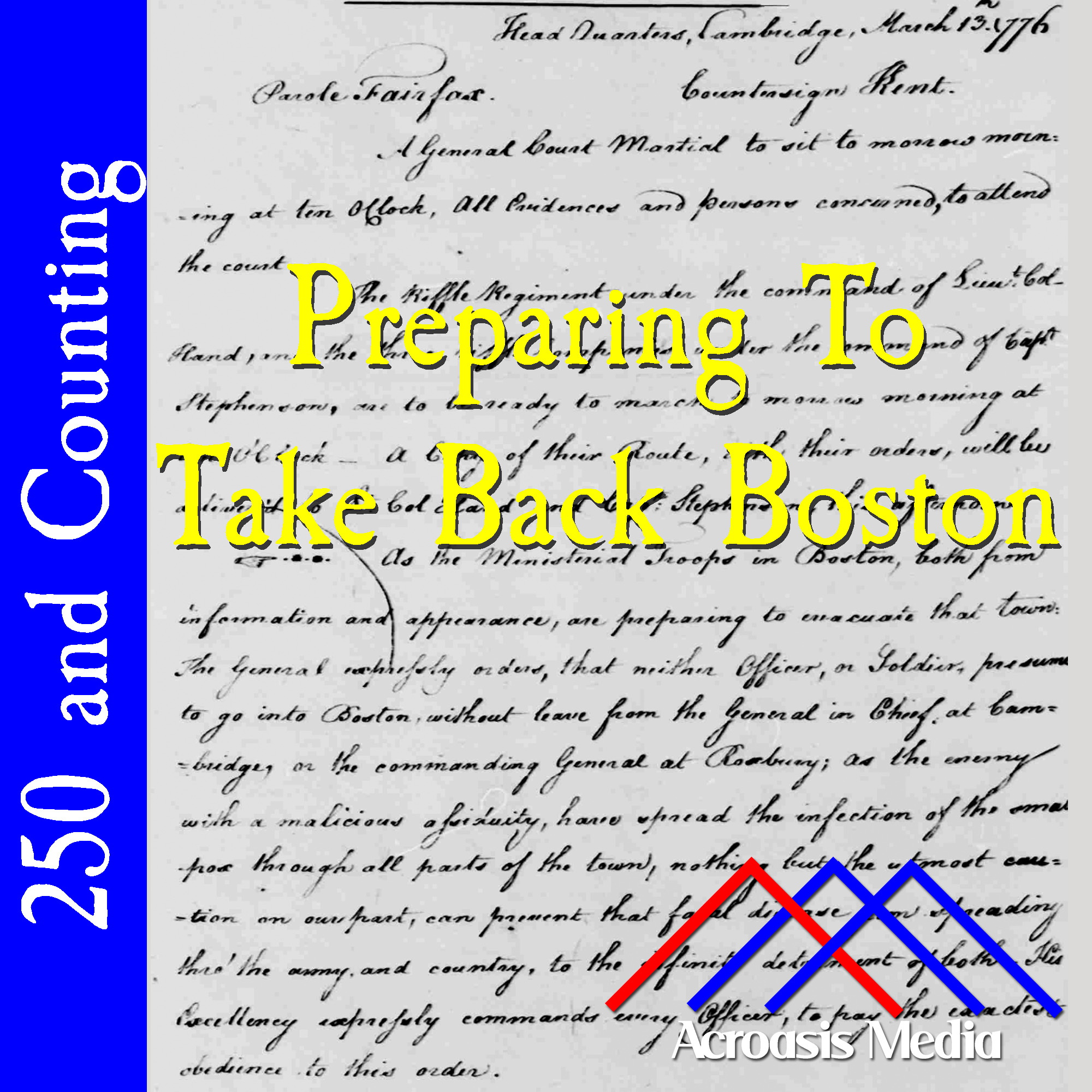
Preparing To Take Back Boston–March 13, 1776
First: let me apologize for the slight change in sound quality for today’s episode. I’m not in my usual recording space and I’m not especially happy with the equipment I brought. At worst you’ll have to put up with it just one more time. Next: George Washington was a gentleman through and through, so the fact that his general orders sometimes focused on the Continental soldier behavior shouldn’t be a surprise. In today’s episode he concerns himself specifically with that, but for two reasons. One is for the health and safety of the troops, but the other is because the Bostonians have been through enough, and he doesn’t want the Continental Army–the people supposedly on their side–to look like villains. In the meantime he’s already standing down a big chunk of soldiers and sending them to New York, where the next big battle is going to be, he thinks. (Again, he’s right, but he didn’t realize it at the time.) The post Preparing To Take Back Boston–March 13, 1776 appeared first on 250 and Counting.
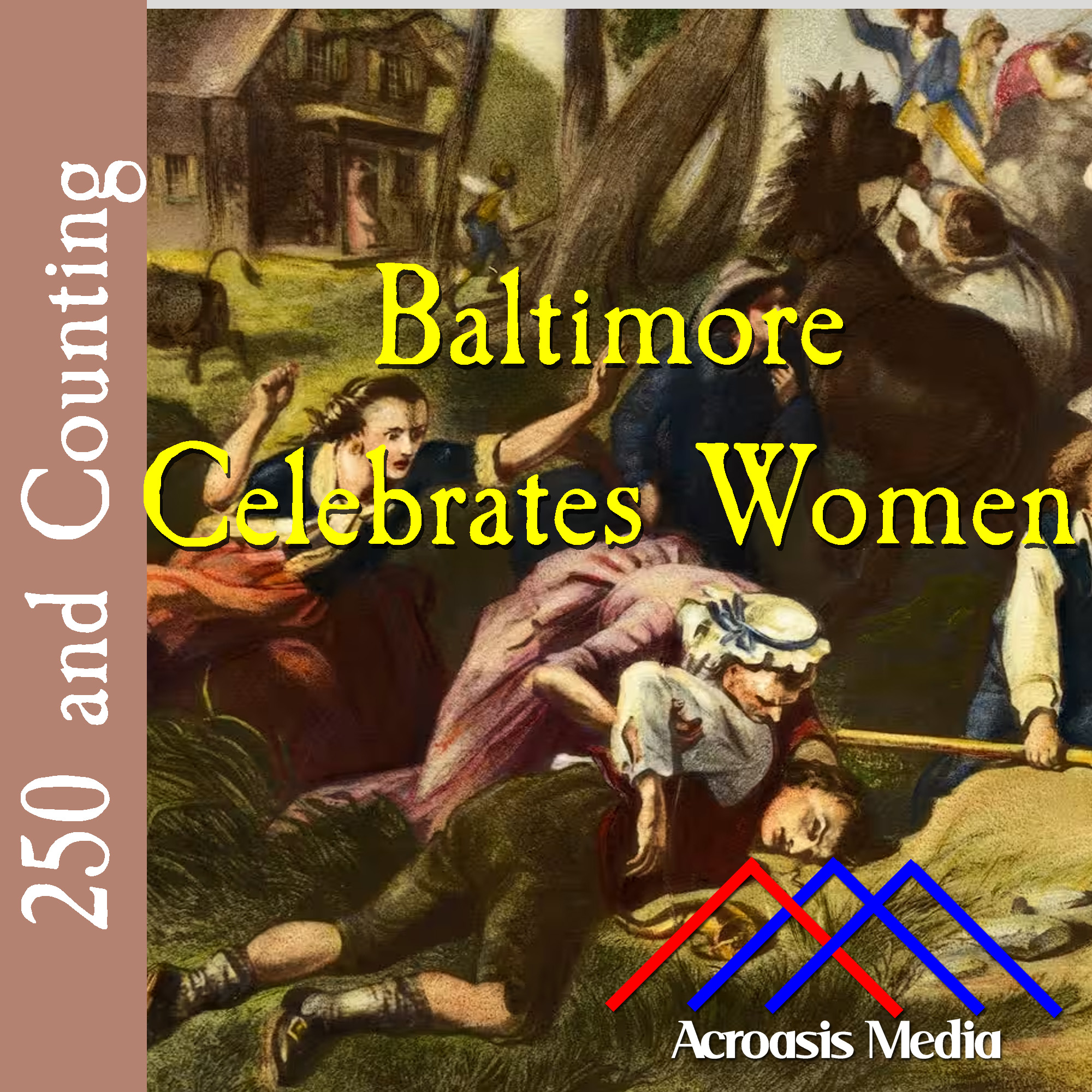
Baltimore Celebrates Women–March 12, 1776
Of course it’s coincidental, but it’s kind of cool that we’re able to bring you this episode during Women’s History Month and the same week as International Women’s Day. Believe it or not, Mike and I have struggled with the fact that there’s very little representation of anyone from this era who isn’t a white male. We’ve managed to touch on a few women and African-Americans from time to time, but after 435 episodes (including today) we’re probably still in the single-digit range. Mike doesn’t concentrate very much on the newspaper notice that appeared in Baltimore this day; he gives us a little perspective on some of the ripples created by events we’ve talked about so far. Sometimes the women’s history angle comes from the things that are mundane in print, but vital to the success of the war. It doesn’t make up for the lack of representation, but we hope it helps. The post Baltimore Celebrates Women–March 12, 1776 appeared first on 250 and Counting.
Getting Ready To Move–March 11, 1776
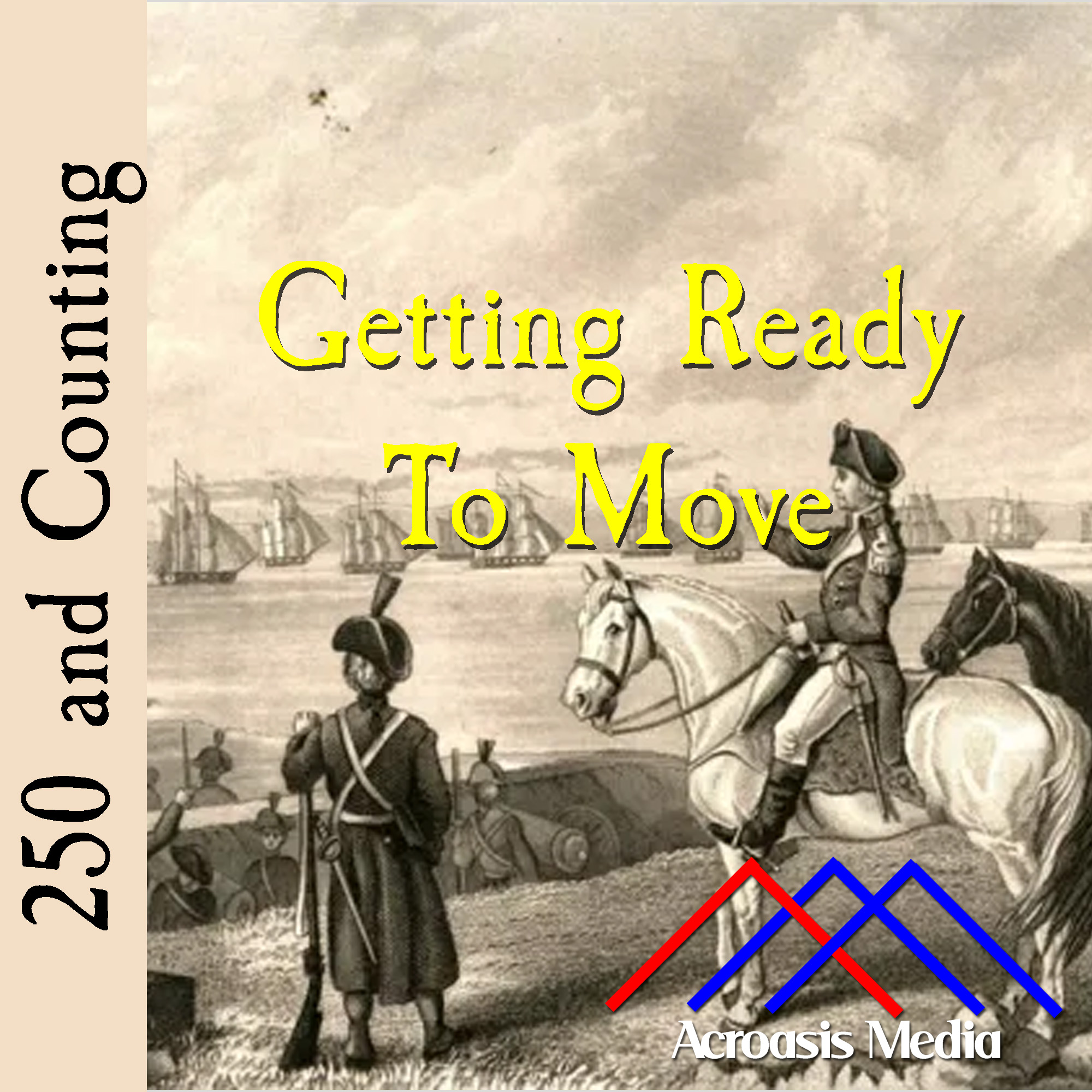
The focus today up in Cambridge, while waiting for the British to hightail it out of Boston, was getting the men ready to move to New York, and putting together Washington’s personal guard. Washington didn’t really need a personal guard in Cambridge, at least not much of one, because he was in the driver’s seat while he was there. The British were bottled up, and he was the stopper. But to move to New York and then defend that territory? Well, that was another project entirely. New York had more access points, more deepwater harbor, and more territory overall to defend. This wasn’t like keeping the British locked up on the peninsula that was the entirety of Boston. And while Washington probably considered it a bit of vanity at first (that’s a guess on my part) to even have a group of men dedicated to being “Washington’s personal guard”, he likely began to understand the inevitability of needing the guard as the Continental Army’s Commander-in-Chief. The post Getting Ready To Move–March 11, 1776 appeared first on 250 and Counting.
Laundry Day–March 10, 1776
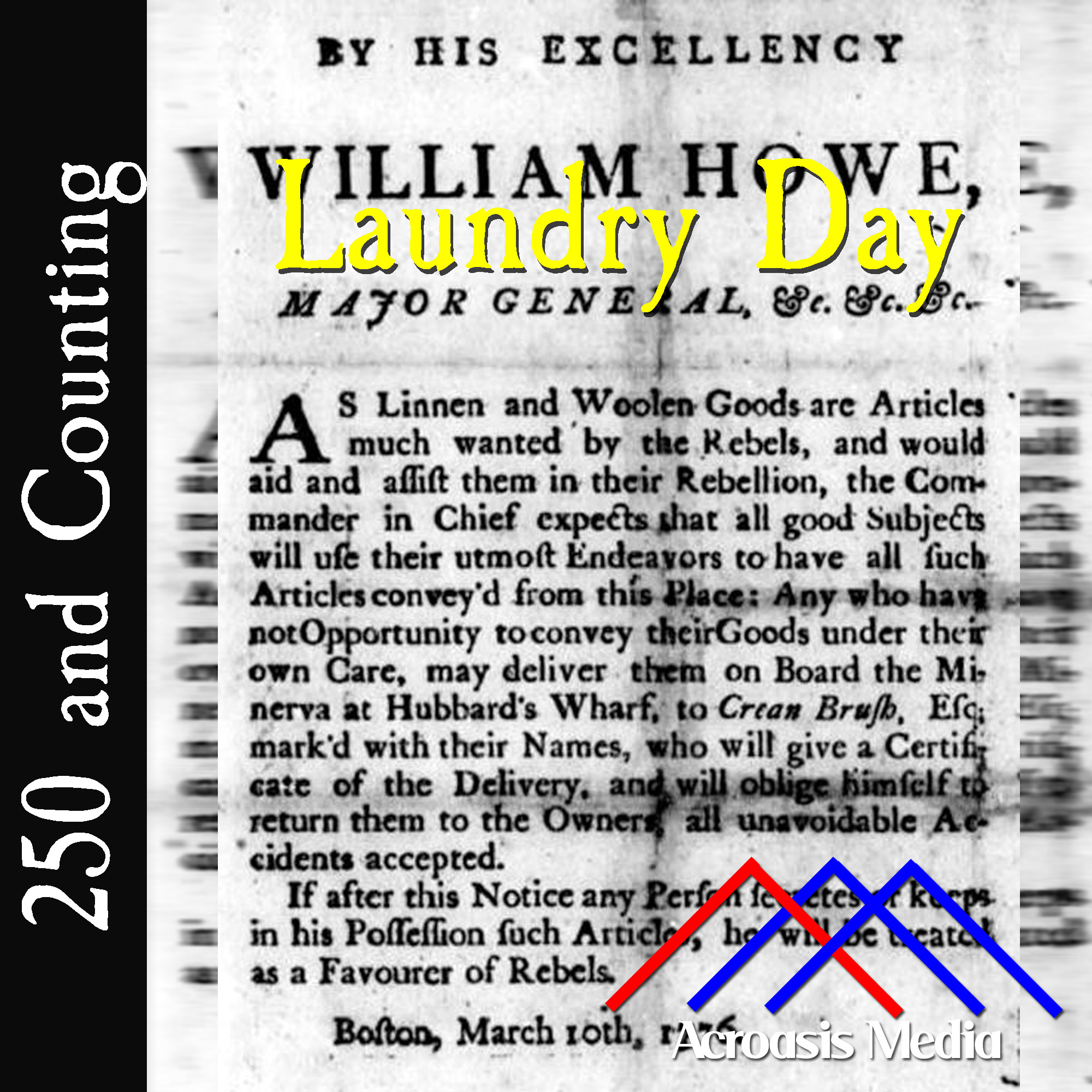
For a guy who’s technically on the wrong side of history, Crean Brush was a pretty interesting character. Mike mentions in the episode that Brush was jailed for some time during the Revolution, but time didn’t allow him to tell you how Brush managed to get out of jail. I’m not going to spoil it, but the truly fascinating story can be found in this article by Eric Weiser. This article was one of those serendipitous finds that turned up when I went looking for a picture of Crean Brush. It’ll take you about twenty minutes to read, but I guarantee it’s worth your time, and I’ll give you your money back if you disagree. General Howe’s demand that people turn their linen and wool goods over to Brush sounds a little weird on its surface, but once you look a little closer you’ll see that it’s more petty than anything else. That said, there was a pragmatic angle to it as well: the material could be used to keep their troops warm and/or bandage any wounded British. The post Laundry Day–March 10, 1776 appeared first on 250 and Counting.

The Big Guns In Boston–March 9, 1776
The occupation of Dorchester Heights, just across the river from Boston, was perhaps the final step that George Washington needed to end the siege that had gone on for nearly a year. Of course, it wasn’t just occupying Dorchester Heights; Washington could have pretty much done that at any time. It was occupying them with a terrifying speed, thanks to Rufus Putnam (the guy in today’s cover art, by the way) and his clever plan for assembling the defenses there. And thanks also have to go to the big cannons that had been brought down from Ticonderoga. These guns had the range that Washington needed to not only shoot at Boston if he needed to, but to fire upon British ships in Boston Harbor. Howe had a couple of moves left, but it was nearly over. The post The Big Guns In Boston–March 9, 1776 appeared first on 250 and Counting.
Samuel Tweedy–March 8, 1776
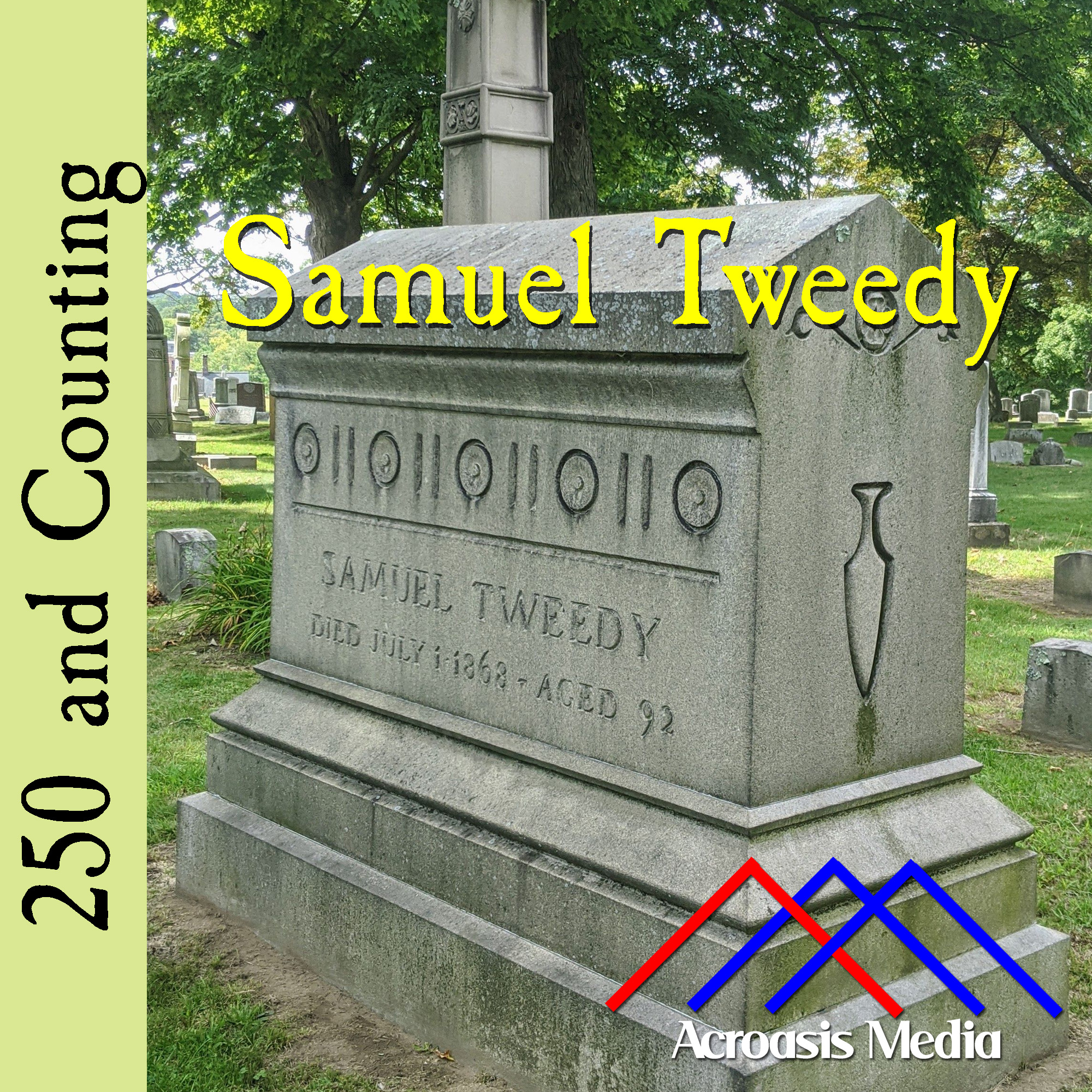
When Samuel Tweedy moved from Dutchess County, NY to Danbury, CT, it was a fortuitous time to do something like that. Danbury was undergoing an economic expansion as part of a post-war boom, which gave him extra opportunities to gain access to trade and manufacturing that he never would have seen back in New York, which was a largely agrarian economy at the time. Tweedy’s marriage to Ann Burr had both social and economic benefits, since Danbury was rather tight-knit as a community, and his having Ann for a spouse gave him an “in” where some of that was concerned. One of Danbury’s biggest products was hats, and Samuel Tweedy established his own business with the assistand of his father-in-law. He immersed himself in the craft of making hats, and ultimately established himself as a man capable of building smaller-scale workshops dedicated solely to producing unfinished hat blanks, which could then be sold to hatmakers. Since an efficient shop could only turn out a few dozen hat blanks in a week, having several shops meant that Tweedy could turn out more blanks than anyone else. Tweedy’s shops also specialized in making hat blanks with fur linings. And Tweedy benefitted from protective tariffs, which reduced the number of British imports when it came to hats. The post Samuel Tweedy–March 8, 1776 appeared first on 250 and Counting.

Congress and Military Matters–March 7, 1776
Congress had a lot of military-related activities to tend to, and one of them was Isaac Melchior. (If you look him up you’ll see an alternate spelling of him as “Melcher.” We’re sticking with “Melchior” because we saw that first.) March 7 was a Thursday, so the Congress was figuring out what do do about Melchior’s apparent insubordination the previous Saturday when he loudly and rudely insulted Congress in general, and John Hancock in particular, because he felt that the captaincy they’d offered him was inadequate. They actually considered banning him from future service, but the next day decided that his apology was sufficient, so he was dismissed without further punishment. Later on, he served as a brigade major for General Richard Montgomery, so at some point he managed to earn some additional rank. So in Isaac Melchior we have someone who is notable for his service to America, but whose historical reputation is tarnished because of his actions a week earlier. There’s a fictionalized version of this story in a book by Lars D.H. Hedbor called The Will: Tales From a Revolution—Pennsylvania, which is part of the “Tales from a Revolution” series. If you like historic fiction laid atop real-life events, you may enjoy these books. The post Congress and Military Matters–March 7, 1776 appeared first on 250 and Counting.

The Pennsylvania Thirteenth–March 6, 1776
The Pennsylvania State Rifle Regiment, also known as Miles’ Regiment, also known as the Pennsylvania 13th Regiment first came about when the Pennsylvania State Battalion of Musketry merged with Miles’ Reigment. We know it’s confusing, largely because there were so many names involved and that’s not even where the names ended. Samuel Miles was their commander when they were first raised, and he was their commander in 1777 at the Battle of Long Island. It’s especially notable because he allowed himself to be captured by British troops who thought he was George Washington, a ruse that allowed the real George Washington and many of his troops to escape. It was nearly two years before he would be released in a prisoner exchange. As for the regiment itself, that eventually got absorbed into the Continental Army in June of 1777, but they were still informally called the Pennsylvania 13th. The post The Pennsylvania Thirteenth–March 6, 1776 appeared first on 250 and Counting.

Taking Canada’s Temperature–March 5, 1776
So here’s a fun story about Charles Carroll. As I’ve mentioned many times before, lots and lots of place names in Baltimore have strong historical connections and Charles Carroll is no exception. There is, of course, a Carroll Street, which starts in the southeast neighborhood of Morrell Park. It doesn’t go quite through that neighborhood though; it gets broken up by a couple of blocks’ worth of houses and resumes again. There’s another break as a railroad right-of-way comes through—but there’s no train crossing; the road just terminates. Carroll Street resumes (we’re still in Morrell Park) on the other side, however, before it’s interrupted yet again. Now as I understand it, this particular part of the neighborhood was wiped out completely by Hurricane Agnes in the early 1970s, so the rebuild was kind of haphazard. Plus, I-95 was first constructed through this part of Baltimore City around this time, so you have to jump almost 3500 feet before Carroll Street resumes again. But now you’re not in a residential neighborhood; it’s series of warehouses and industrial buildings for a stretch until it gets back into a residential neighborhood known as Pigtown, so called because on Market days, pigs would be led through the streets to the market for sale and eventual slaughter. Carroll Street meets with Cross Street in that neighborhood, and that’s the northern terminus. However. There’s an elementary school in the area that’s also named after Charles Carroll. It’s not on Carroll Street (of course) but is about two blocks away, in Pigtown. Now, remember, Charles Carroll was a lawyer, or a “barrister” as the old-timey types like to say. So Elementary School #34 is officially “Charles Carroll, Barrister Elementary School”. Except everybody forgets the comma is there and says it like one long name. And chances are, they think there was a guy actually named Charles Carroll Barrister somewhere in history. And wasn’t that a long walk for a short drink of water. The post Taking Canada’s Temperature–March 5, 1776 appeared first on 250 and Counting.
Beginning of the End in Boston–March 4, 1776
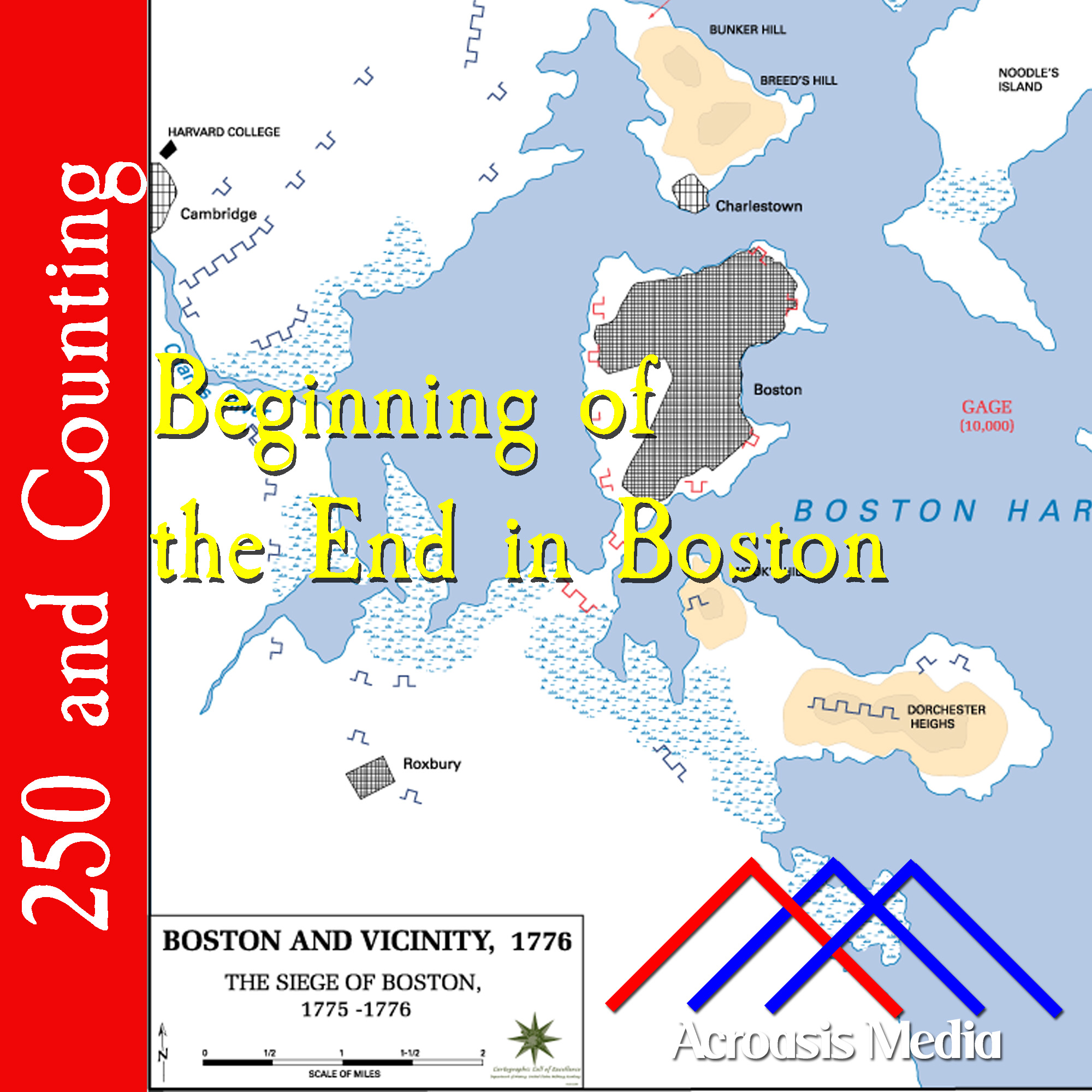
Colonel Henry Knox took about ten weeks to get from Ticonderoga to Cambridge rather than the two he anticipated. But his arrival meant the siege’s end in Boston would come soon. Knox had brought something like 60 tons worth of material overland using hand-built sledges and carts drawn by oxen. The last leg of the trip is still a mystery, because Knox’ diary ends about two weeks early. What is known is that as he passed through the occasional town, people would line up to watch. So we know when he was where, but the usual stuff that ran through Knox’ head for that portion of the trip is gone. Still, his arrival at Cambridge meant that Washington now had what he needed to fortify his position and do what he needed to drive the British out of Boston. After nearly a year, the siege’s end was actually in sight. The post Beginning of the End in Boston–March 4, 1776 appeared first on 250 and Counting.
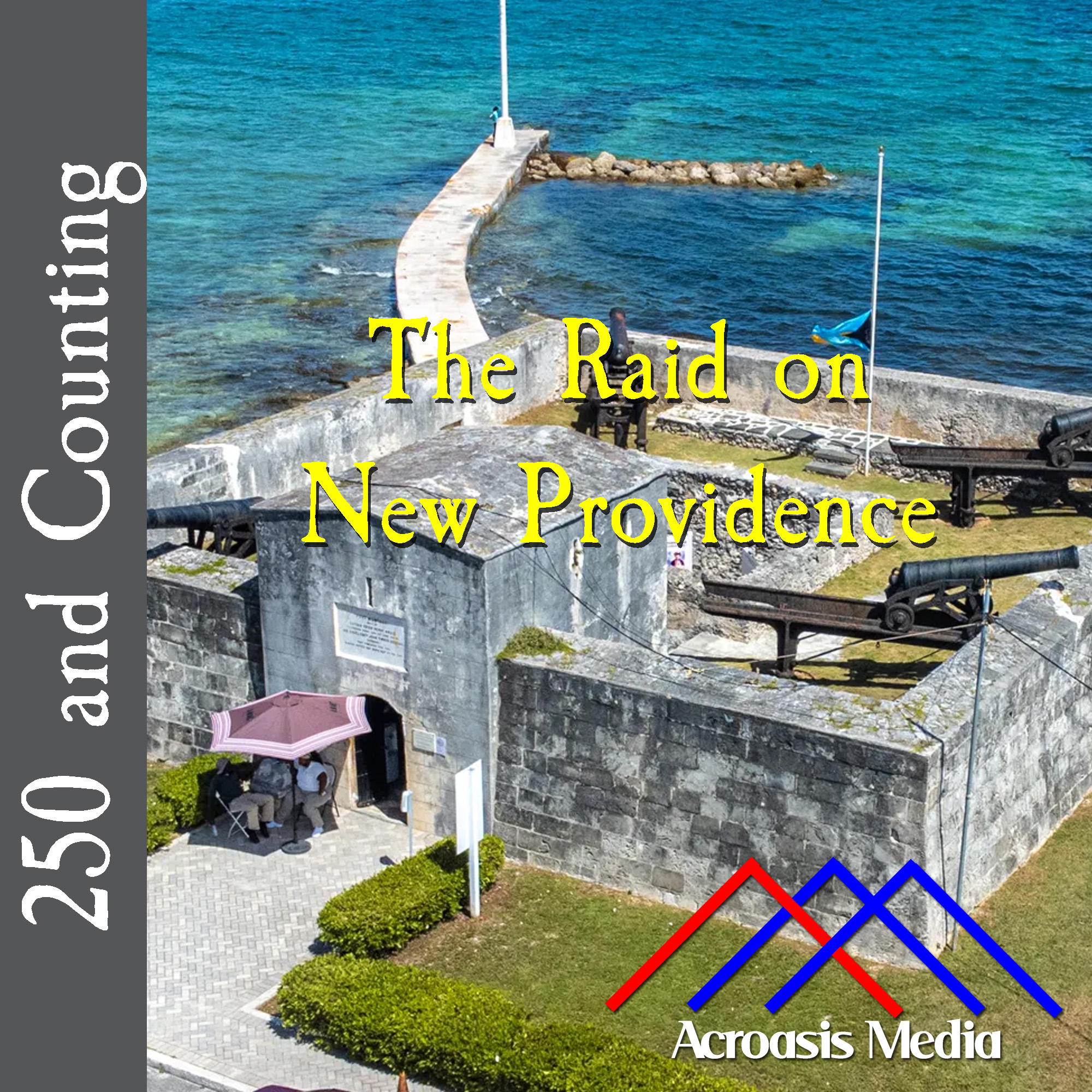
The Raid on New Providence–March 3, 1776
The raid on New Providence is probably one of those situations where we couldn’t really represent everything that was going on on this particular island, because there were a lot of moving parts. We especially overlooked the part at the end. Two of the ships went to St. Augustine, laden down mostly with gunpowder. Of the others, they headed further north, where they encountered the HMS Hawk and then the HMS Bolton. They ended up caputuring both ships. Then they bumped into the HMS Glasgow off the coast of Long Island. Despite being outnumbered, the Glasgow got away while simultaneously damaging one of the Navy ships. Initially, the Navy was given kudos for the raid, but the failure to capture Glasgow, plus complaints about some of the captains in the fleet led to investigations and courts-martial. One ship’s captain, that of the Providence, lost his command and it was given to John Paul Jones. Division of the spoils was also disputed. The commander of the entire action, Esek Hopkins, was censured for not patrolling the Virginia and Carolina Coasts (never mind he was secretly told to do so), and he was eventually dismissed from the Navy. What’s more, Nassau remained poorly defended and was subject to capture several times throughout the war. The post The Raid on New Providence–March 3, 1776 appeared first on 250 and Counting.
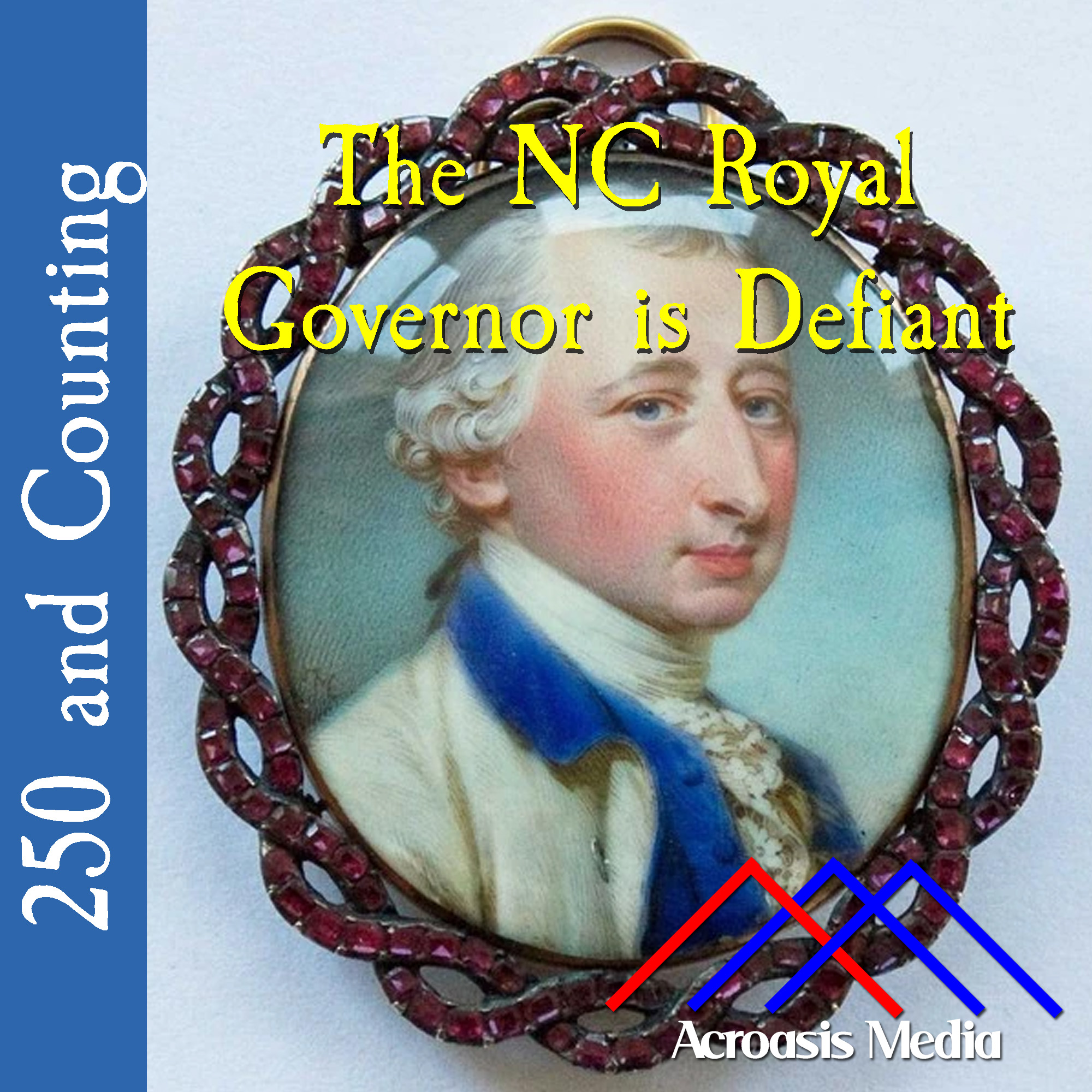
The NC Royal Governor is Defiant–March 2, 1776
Oh, that Royal Governor Josiah Martin. He might be defiant, he might be delusional. He might be in denial. What he was not, apparently, was cognizant of the effect that the Battle of Moore’s Creek Bridge had on Loyalist morale. Or, perhaps he did. At any rate, his order to raise the British flag anywhere a flag could be raised was more performative than anything else. This was Martin’s second big push to restore North Carolina to British control, but it wasn’t his last. Many months later the Carolina Campaign began. It went on for a long time and they very nearly succeeded. However, Martin finally had to leave, first for Long Island and then for Britain. The post The NC Royal Governor is Defiant–March 2, 1776 appeared first on 250 and Counting.

The French Connection–March 1, 1776
We bumped into a little dilemma when putting together this episode. Specifically, what do we do when 1776 doesn’t match up with 2026? As it turns out, 1776 was a leap year, so that year had a February 29, whereas 2026 does not. So we decided to do what most Leap Babies seem to do: mark the day on March 1. To that end, today marks two events: first, we take a look at an arrangement that France and Spain made to trade with America on a kind of gray market. That arrangement was first presented to King Louis XVI on February 29, 1776. From there we jump to March 1, the date that the Royal Navy began enforcing the Prohibitory Act in earnest. It was supposed to go into effect on January 1, but presumably the Navy didn’t know about it until after that date, so March 1 became the agreed-upon start date. Under the terms of the Prohibitory Act, the Colonies were banned from trading with other nations, in addition, any Colonial ships were considered enemy vessels and were subject to being captured and retained. Likewise, any sailors aboard those ships were enemies of the Crown and to be treated as such. This was almost certainly the last straw for many in the Colonies. The post The French Connection–March 1, 1776 appeared first on 250 and Counting.

Phyllis Wheatley Gets A Fan Letter–February 28, 1776
Phyllis Wheatley was an 18th century poet who was born in West Africa and sold into slavery as a small child, living with the Wheatley Family in Boston. Phyllis wrote a book of poems which was published in 1773, after which she was emancipated. This makes her the first African-American author of a published book of poetry. Phillis Wheatley married a grocer named John Peters around this same time. They had three children, but unfortunately all of them died quite young. Phyllis herself died in of pneumonia in 1784, not long after giving birth to a daughter, who also died that day. Per the Phyllis Wheatley Historical Society, this was the poem that moved George Washington to write to her: Celestial choir! enthron’d in realms of light,Columbia’s scenes of glorious toils I write.While freedom’s cause her anxious breast alarms,She flashes dreadful in refulgent arms.See mother earth her offspring’s fate bemoan,And nations gaze at scenes before unknown!See the bright beams of heaven’s revolving lightInvolved in sorrows and veil of night! The goddess comes, she moves divinely fair,Olive and laurel bind her golden hair:Wherever shines this native of the skies,Unnumber’d charms and recent graces rise. Muse! bow propitious while my pen relatesHow pour her armies through a thousand gates,As when Eolus heaven’s fair face deforms,Enwrapp’d in tempest and a night of storms;Astonish’d ocean feels the wild uproar,The refluent surges beat the sounding shore;Or thick as leaves in Autumn’s golden reign,Such, and so many, moves the warrior’s train.In bright array they seek the work of war,Where high unfurl’d the ensign waves in air.Shall I to Washington their praise recite?Enough thou know’st them in the fields of fight.Thee, first in peace and honours,—we demandThe grace and glory of thy martial band.Fam’d for thy valour, for thy virtues more,Hear every tongue thy guardian aid implore! One century scarce perform’d its destined round,When Gallic powers Columbia’s fury found;And so may you, whoever dares disgraceThe land of freedom’s heaven-defended race!Fix’d are the eyes of nations on the scales,For in their hopes Columbia’s arm prevails.Anon Britannia droops the pensive head,While round increase the rising hills of dead.Ah! cruel blindness to Columbia’s state!Lament thy thirst of boundless power too late. Proceed, great chief, with virtue on thy side,Thy ev’ry action let the goddess guide.A crown, a mansion, and a throne that shine,With gold unfading, WASHINGTON! be thine. The post Phyllis Wheatley Gets A Fan Letter–February 28, 1776 appeared first on 250 and Counting.
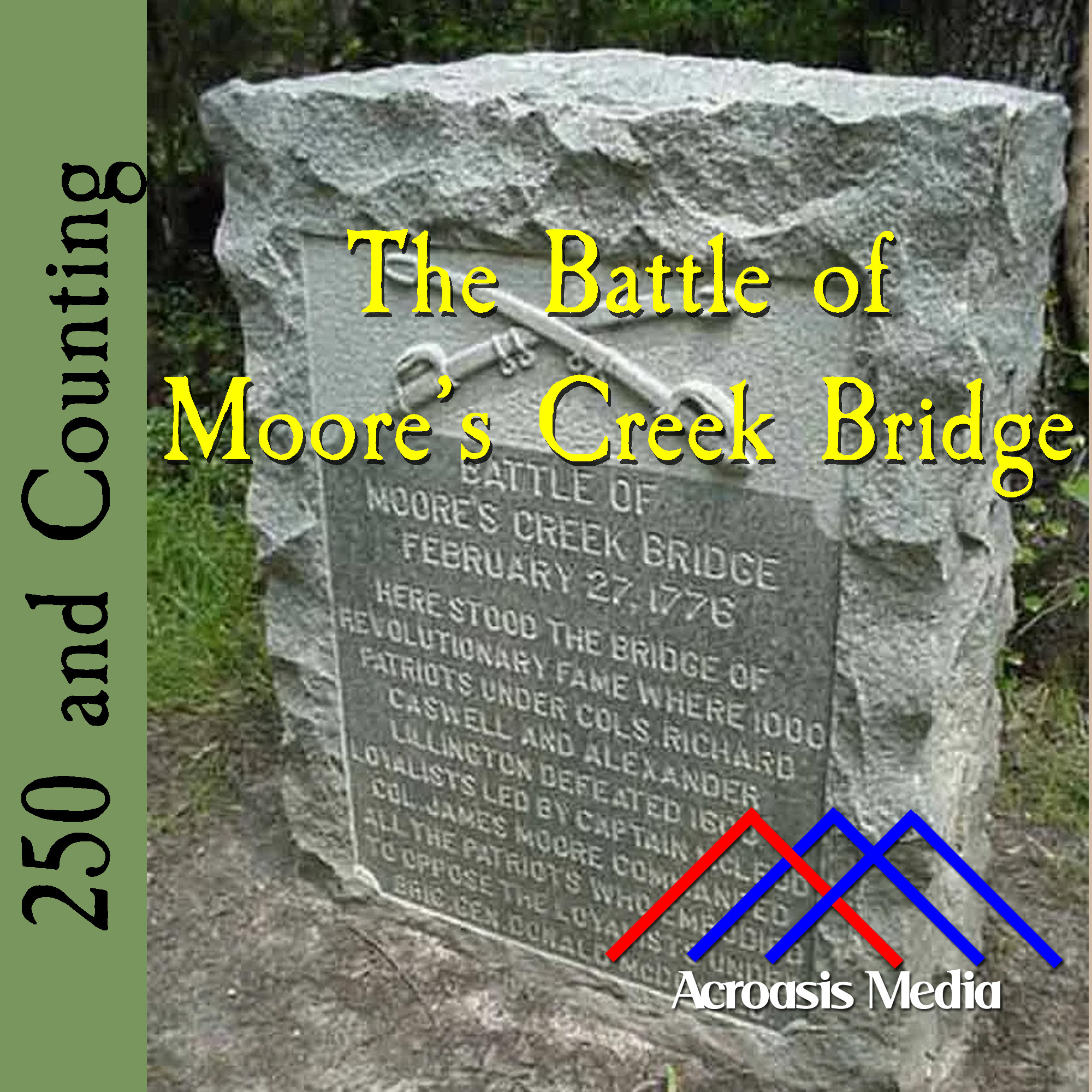
The Battle of Moore’s Creek Bridge–February 27, 1776
As Revolutionary battles go, the Battle of Moore’s Creek Bridge was relatively minor. It didn’t last very long, there weren’t a ton of losses on either side (though definitely more on the Loyalist side), and it led to the capture of hundreds of Loyalists. However, it changed the way the British viewed the Carolinas through the rest of the war. Overall, the perception was that the Carolinas were poor, and weak, and a stronghold of Loyalist sympathizers. And this was an easy assumption to make, especially when you think back to the Siege of Ninety-Six and the way that finally ended. British confidence was pretty high at that point, especially given the fact that it ended pretty much in a draw. But the lasting effect of The Battle of Moore’s Creek Bridge was more in the way it affected recruitment of Loyalist troops, in that the numbers plummeted. And, only about two months later, North Carolina delegates were among the first to vote for Independence. To read about the battle in greater detail, check out this website, which is also the source of today’s cover art. The post The Battle of Moore’s Creek Bridge–February 27, 1776 appeared first on 250 and Counting.
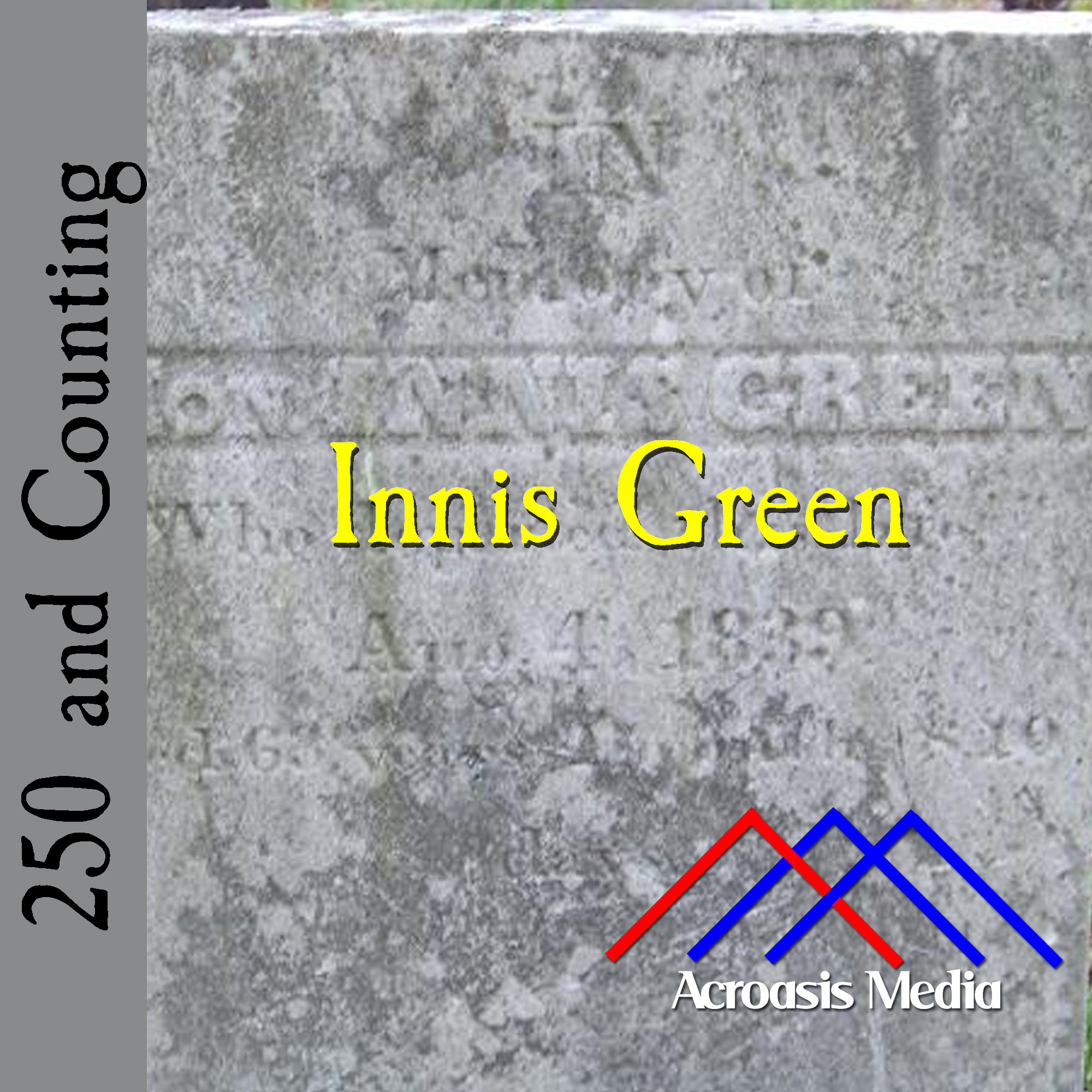
Innis Green–February 26, 1776
Innis Green served as a Jacksonian Democrat in the U.S. House of Representatives during the 20th (1827–1829) and 21st (1829–1831) Congresses, essentially holding the party’s populist line. But he did deviate from party alignment on May 26, 1830, when Green voted nay on H.R. 287, the Indian Removal Act. Despite this, the bill passed narrowly, 102-97. This stance positioned him among Pennsylvania Jacksonians influenced by local Quaker and moral opposition to forced tribal relocations, contrasting with southern and western Democrats who prioritized land acquisition for white settlement. Green’s vote highlighted intraparty tensions over executive-driven policies, though it did not derail his Jacksonian credentials amid broader support for Jackson’s anti-bank rhetoric and vetoes of federal internal improvements like the Maysville Road in 1830. The short version of all that is, while Green was a fairly reliable guy when it came to upholding Jacksonian politics, he often acted with his actual constituents in mind: if it wasn’t going to poorly affect the people in his district, he could get behind it. Otherwise, he would be willing to vote against it. Perhaps he didn’t make a huge splash politically, but there are some behavior lessons in there. The post Innis Green–February 26, 1776 appeared first on 250 and Counting.

Another Washington in Uniform–February 25, 1776
I mention in today’s episode that William Augustine Washington lived on a Virginia plantation he’d inherited, and that his first house burned down. The second house he moved to, on the same property but a mile away (yow!), was called Blenheim. Washington used some of the bricks from the original house to add on to the Blenheim house, but he also used a bunch of them to start on a house and barn on a separate property. What a thrifty fellow! For what it’s worth, Blenheim is still standing and is on the National Register of Historic Places. You may be able to see it from the street but it is privately occupied and not open to the public. The post Another Washington in Uniform–February 25, 1776 appeared first on 250 and Counting.
British People Noticing Things–February 24, 1776
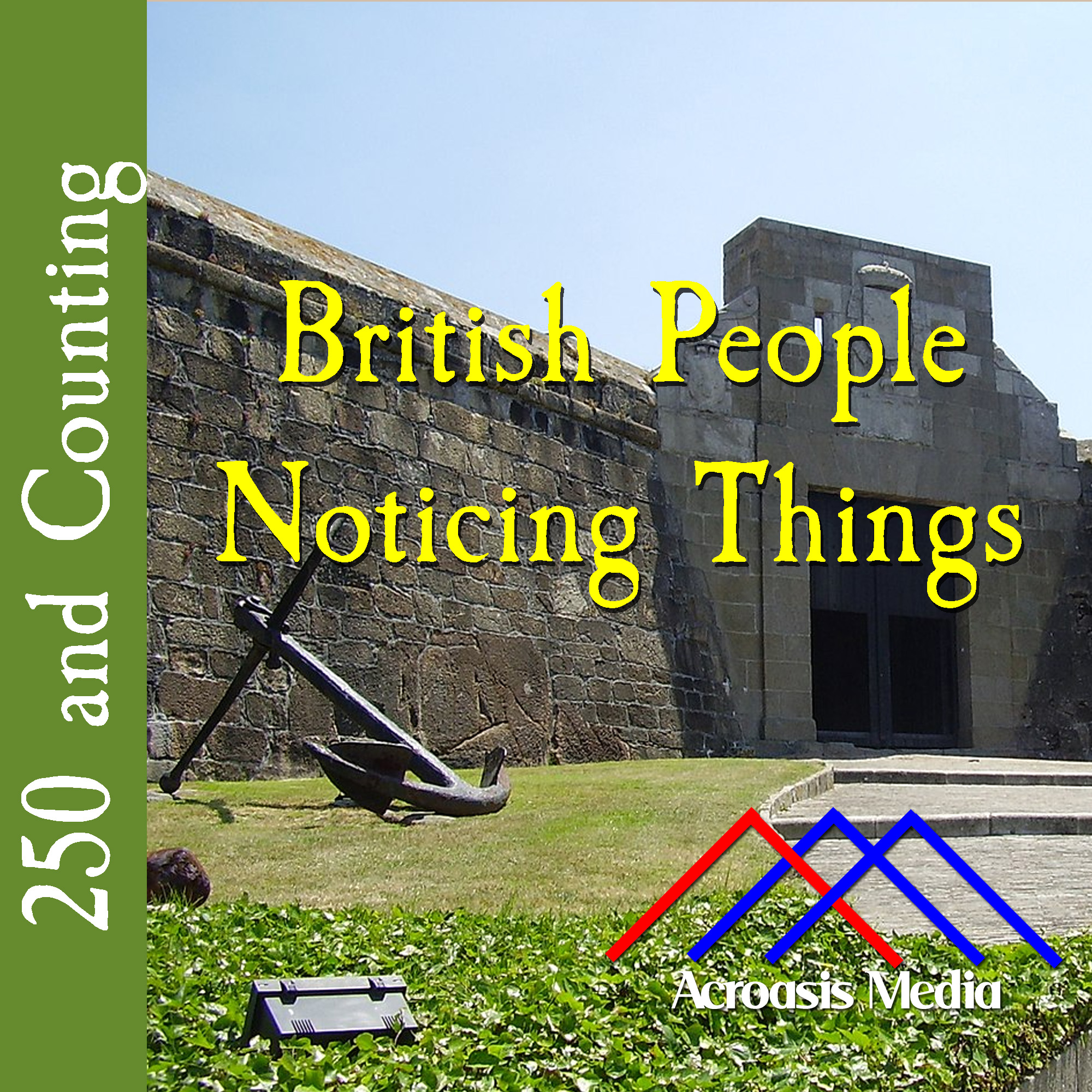
A Coruña is a coastal city in northeastern Spain that’s often stylized as La Coruña, as Mike says in this episode. Its location makes it an ideal port for trade with other nations, and the American Colonies was no exception. Now, France gets a lot of attention for the assistance they gave us during the Revolution, but Spain was at least as helpful as France was. They were just quieter about it. So it was probably just a matter of time before some British officials noticed ships in the Spanish harbors that appeared to be engaging in more than your typical trade. What’s more, the presence of Dutch materiel suggested that Spain may have been acting as a third party between Holland and America, to enact some nearly-clandestine trade with the Colonies for gunpowder and other stuff. As the year wore on, Spain would become a little more openly involved in the war effort. The post British People Noticing Things–February 24, 1776 appeared first on 250 and Counting.

Our New Man in Virginia–February 23, 1776
Carter Braxton was born into money, as his grandfather was probably the wealthiest man in Virginia. This gave him the “in” he needed to become a gentleman farmer and a public official. In 1761 he was elected to Virginia’s House of Burgesses, and in 1769 he was a signatory to the Virginia Resolves, which protested parliamentary interference with colony affairs. While he was a Patriot at heart, as 1776 rolled around and he replaced Peyton Randolph as one of Virginia’s delegates to the Continental Congress, he thought that independence from England was a little premature, but he did sign the Declaration of Independence when the time came. Not long after that he returned to Virginia and resumed his term in the state legislature. Carter Braxton had some notable progeny. His second great-grandson was William Tyler Page, composer of the Amercan’s Creed, which reads: I believe in the United States of America as a government of the people, by the people, for the people; whose just powers are derived from the consent of the governed, a democracy in a republic, a sovereign Nation of many sovereign States; a perfect union, one and inseparable; established upon those principles of freedom, equality, justice, and humanity for which American patriots sacrificed their lives and fortunes. I therefore believe it is my duty to my country to love it, to support its Constitution, to obey its laws, to respect its flag, and to defend it against all enemies. This was accepted by the US House of Representatives on April 3, 1918. The post Our New Man in Virginia–February 23, 1776 appeared first on 250 and Counting.
The South Carolina 5th Regiment–February 22, 1776
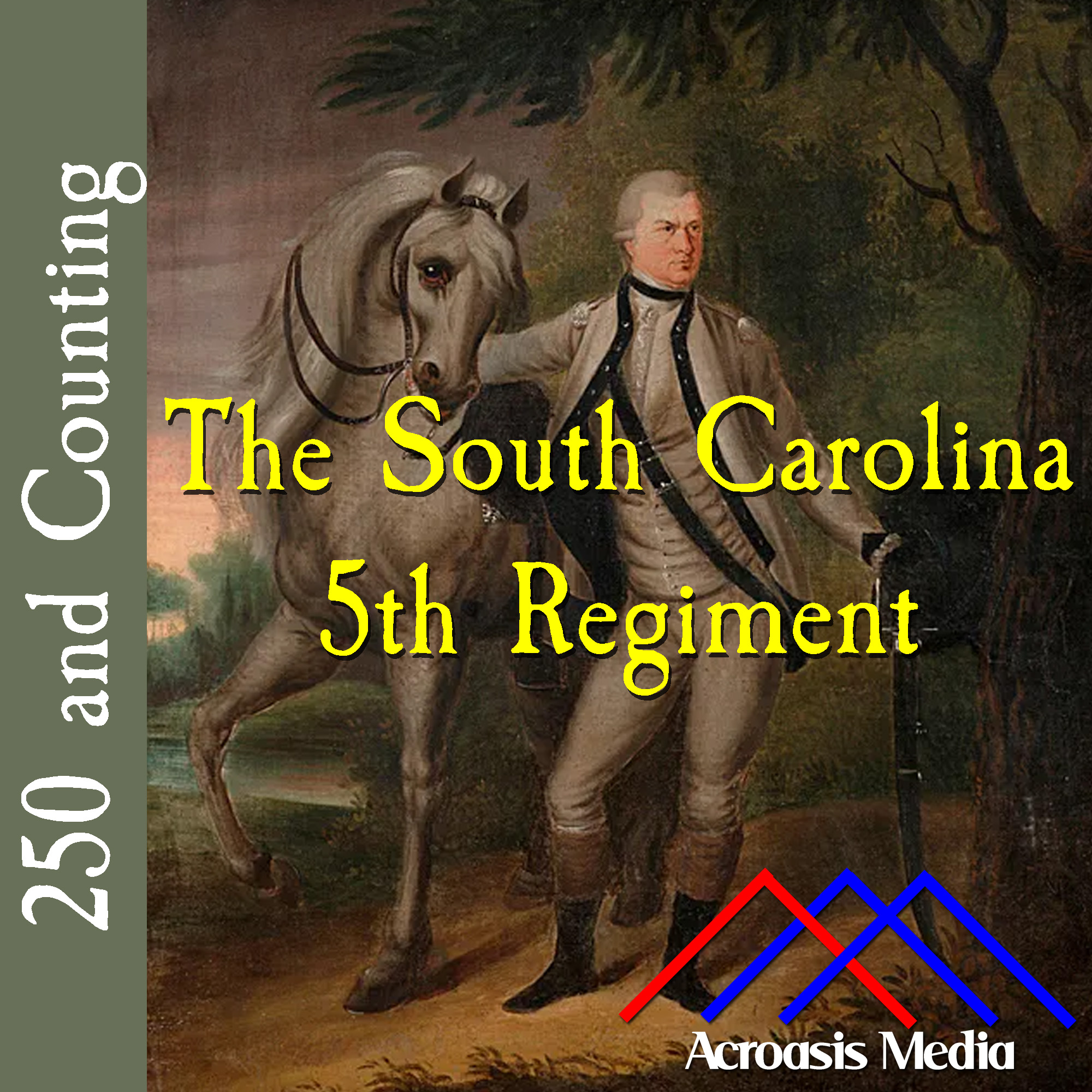
The South Carolina 5th Regiment ultimately wasn’t a huge success, with a single exception, which we’ll talk about in greater detail in a few months. But in those losses there were some long odds going on, so we’ll not judge too harshly. I learned a couple of things as a result of today’s episode. I own a piece of property in South Carolina, in the Myrtle Beach area, which is located in Horry County. I always wondered how it got that name, and now I’ve learned that Horry County was named after Peter Horry, who was a commander of the SC 5th. The other thing I learned was that when I looked for a picture of Peter Horry, I stumbled on his biography and learned that he was a great-grandchild of French Huguenot refugees who arrived in Charleston in the 1680s. And that is how I learned why Horry County is pronounced with a silent “H”. The post The South Carolina 5th Regiment–February 22, 1776 appeared first on 250 and Counting.

Helping New York Help Itself–February 21, 1776
There’s a line in the play 1776 about how everyone in the New York Legislature is very loud and talks very fast and as a result nothing ever gets done. This was likely a side effect of the fact that New York was so politically mixed at the time. Everyone hollering at rather than talking to each other means that nobody is truly connecting with anyone else. Thank goodness we’ve moved past THAT! <eyeroll> But New York and the Hudson Valley in particular held great strategic value for the various parties involved in the conflict we call the American Revolution. Britain taking that area would separate New England from the other Colonies. What’s more, George Washington knew it. So he devoted a lot of energy into ensuring that that territory remained defended, even while the British were nowhere in sight, because he knew it was a matter of time. And he was right: the British did show up ready for battle. It didn’t happen when he expected it to happen, and we’ll talk about that when things start heating up. The post Helping New York Help Itself–February 21, 1776 appeared first on 250 and Counting.

From Connecticut To Georgia–February 20, 1776
Oliver Wolcott was one of our Founding Fathers in that he was one of the men who signed the Declaration of Independence, but while he never achieved prominence on the level of Franklin or Adams, he nevertheless served an important role as a member of the Second Continental Congress. As the Revolution began, Wolcott was made a commissioner of Indian affairs, largely to work on ensuring that the northern tribes remained neutral. He was considered qualified for that position because he worked in that part of the continent during the French and Indian War. He was elected to the Continental Congress in 1775, and although he was quite ill for a chunk of 1776, he did sign the Declaration of Independence, although it was some time later than everyone else. He was also a signatory to the Articles of Confederation, but he did not sign the US Constitution because by then he was the Lieutenant Governor of Connecticut, becoming governor in 1796. A year later he died at the age of 71. The post From Connecticut To Georgia–February 20, 1776 appeared first on 250 and Counting.
Fort Moultrie–February 19, 1776
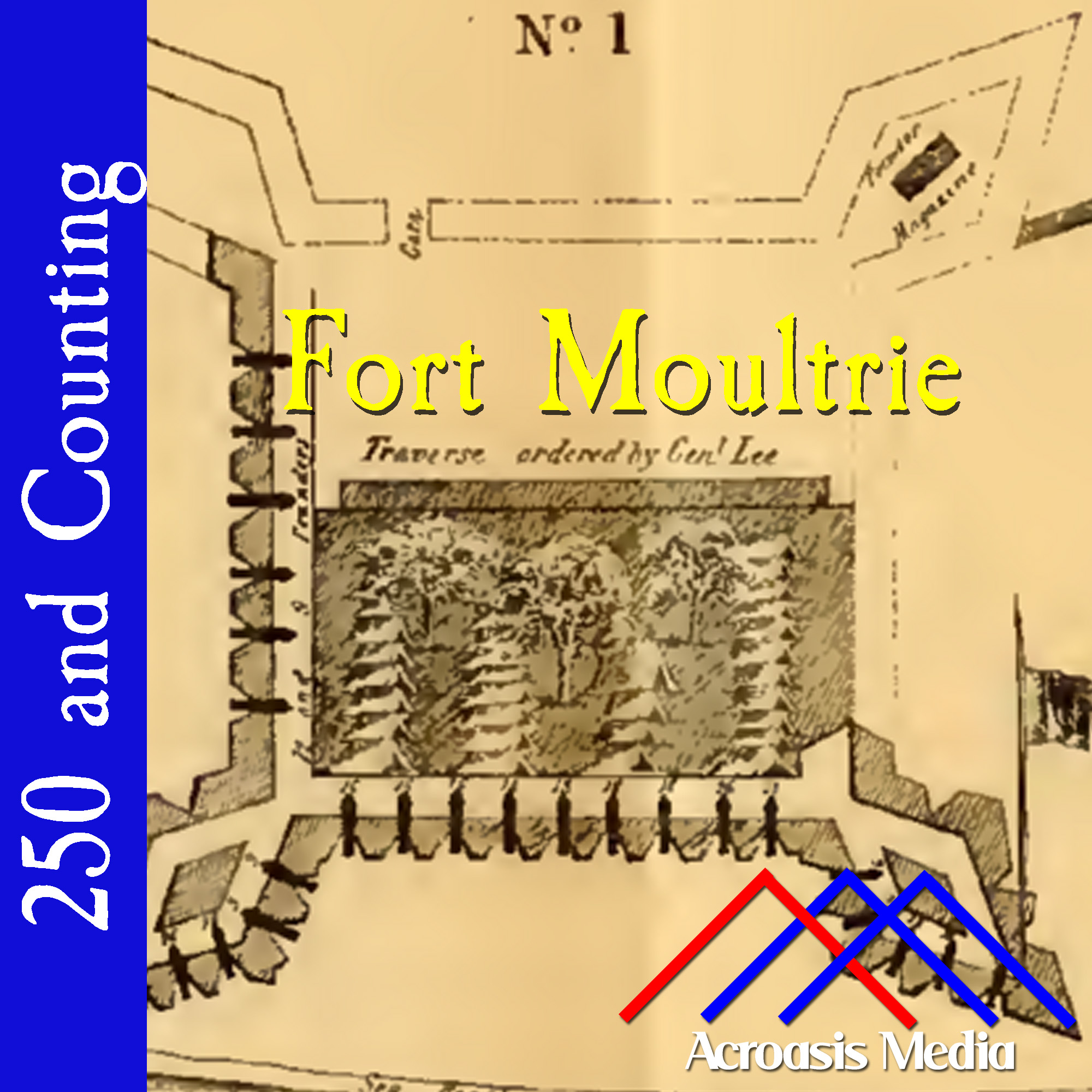
Today we’re looking at Fort Moultrie. I know, it wasn’t that long ago that I was gushing about Fort McHenry, but I live in Baltmore so it’s kind of the law around here to pump up the local history. Also, Fort, McHenry is a cool place to visit. And so is Fort Moultrie! In fact, Fort Moultrie itself was built several times, including its original Fort Sullivan incarnation, and as a result there are extensive historic exhibits throughout the park. The various forts went through three wars against America (see, I did a thing there), and consequently there are a lot of stories to tell here. And when you’re through touring the fort and the grounds, make sure you have your fishing pole with you, because there’s a fishing dock there (it’ll re-open sometime this spring); I hear the fishing is pretty good because of the location. The post Fort Moultrie–February 19, 1776 appeared first on 250 and Counting.
William Scarbrough–February 18, 1776
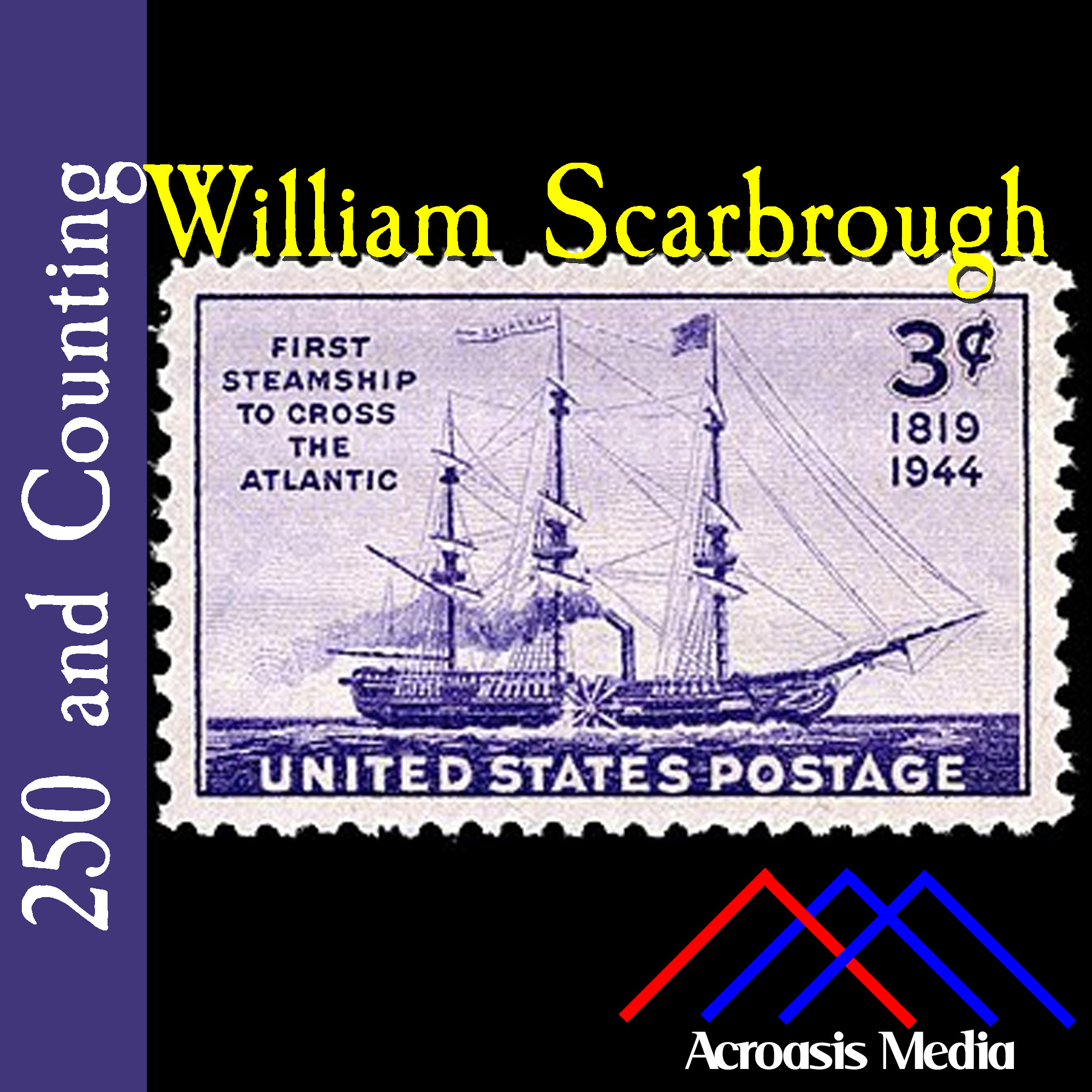
William Scarbrough, who was the owner of the USS Savannah more than he was anything else, purchased the ship when it was still on the slipway. It was purchased with the aim of converting it to an auxiliary steamship and give his company the distinction of offering the world’s first transatlantic steamship service. The Savannah had multiple sources of propulsion, though. The steam engine could drive the side paddlewheels on either side which were retractable when the engine wasn’t in use. But it also had rigging that allowed it to be used as a sailing ships. So when it made the crossing in 1819, the trip took the better part of a month because poor weather forced them to use the sails more than the steam engine, a ratio of about 89% to 11%. The ship wound up being more of a novelty than anything else, and unfortunately she ran aground off the south shore of Long Island and broke up. When Tropical Storm Ian passed through in 2022, some wreckage washed up on Fire Island that was thought to be part of the Savannah. You can visit those parts at the Fire Island Lighthouse Preservation Society‘s museum exhibit. The post William Scarbrough–February 18, 1776 appeared first on 250 and Counting.
Making Money–February 17, 1776
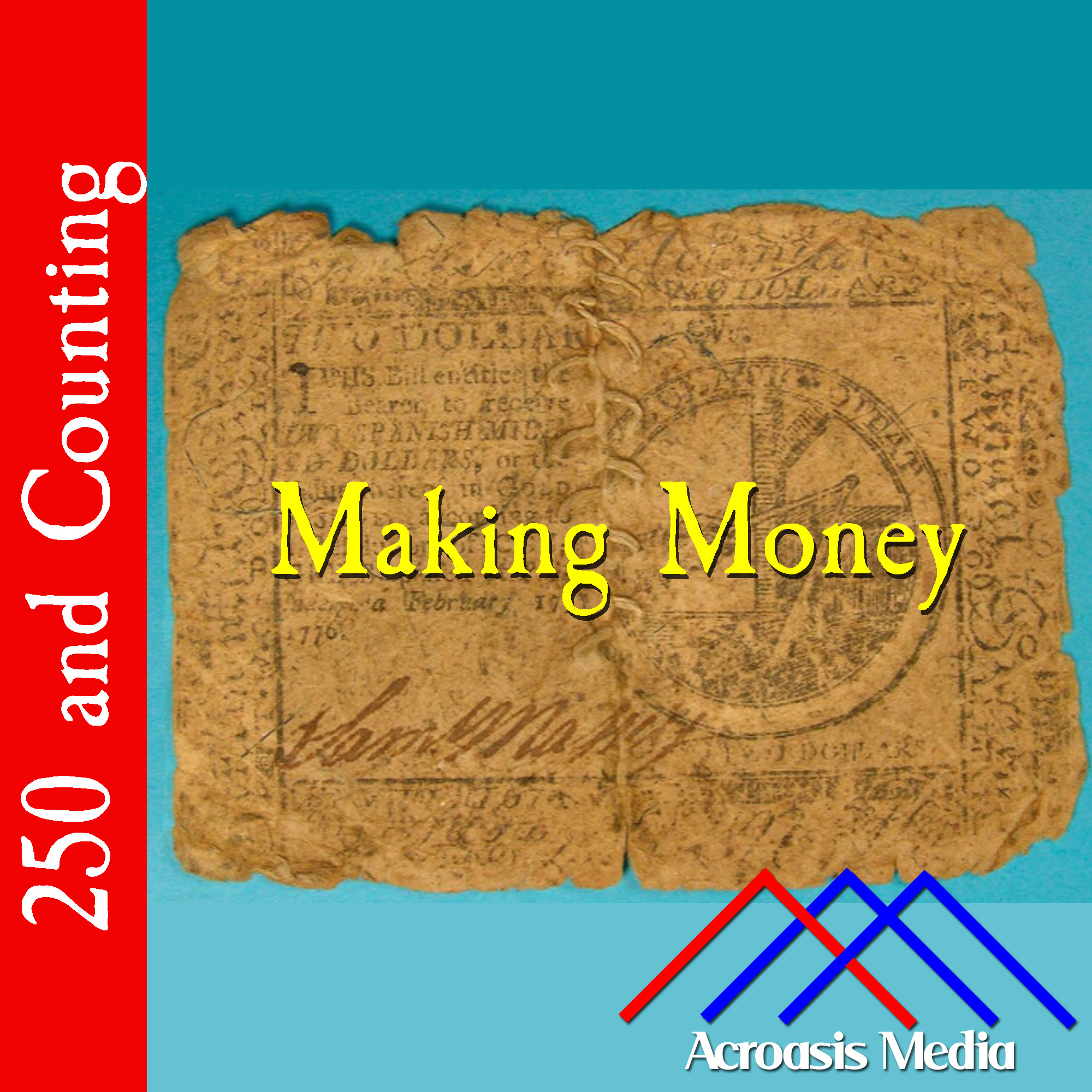
Back in June, Mike told you about the Continental Congress taking a stab at issuing common currency that could be used throughout the Colonies. It didn’t work out very well, and the Continentals became a joke because there was nothing backing them up. But this time around, they may have gotten it right, because the new Continental Currency had some specific backing to it. (We don’t even have that today, thanks to Richard Nixon.) Look carefully at the bill in the cover art and you’ll see that it tore in two at some point. It wasn’t clear whether a half-bill would be accepted by any merchants, so people came up with all kinds of clever ways to reunite the two halves; in this case it was a needle and thread. Many bills that have survived to this day used this method to repair them. The post Making Money–February 17, 1776 appeared first on 250 and Counting.

Nicholas Ware–February 16, 1776
Mike already tells you about all you need to know about Nicholas Ware in today’s episode, so let me focus on his home, which was derisively nicknamed “Ware’s Folly.” The house was completed in 1818 at a total cost of $40,000, which would be well over $12 million today. Part of this derives from the elaborate styling on the outside, and part of it is from the extravagant details on the inside, including a three-story elliptical staircase. The house, as Mike noted, is now the home of the Gertrude Herbert Institute of Art, which was founded in 1932 as the Augusta Art Club and later renamed in honor of founder Olivia Herbert’s daughter Gertrude Herbert Dunn. By 1936 the Art Club was in need of classroom and gallery space, and the house had been neglected for many years and was facing demolition. Olivia Herbert saved the building and donated the money for renovation. The following year the Institute was established and renamed after Gertrude, who had recently died of spinal meningitis. The house acts as the Main Gallery building and Administrative Offices for the Institute, while another house directly behind it was expanded, renovated and converted into classrooms in 2001. If you’re in Augusta, the Institute could make for an interesting diversion. The post Nicholas Ware–February 16, 1776 appeared first on 250 and Counting.