
250 and Counting
660 episodes — Page 10 of 14
July 29, 1775: Law and Moral Order
George Washington didn’t have a ton of military experience when he was named Commander-in-Chief of the Continental Army. But it’s clear that he gave the position a great deal of thought as he made his way from Philadelphia to Boston. When he arrived, he clearly had a lot of ideas about what an army should look like. Furthermore, he had ideas regarding the overall structure of things and the institutions that should be in place. Shortly after officially taking the position, Washington began petitioning Congress for various titles and positions, and groups. And it appears that Congress recognized that his ideas had merit, because there was very little that they actively turned down. (Obviously, there were some things that they were unable to provide because of shortages here and there, but they were typically behind him.) And today, Washington was able to get the ball rolling on two of them. The post July 29, 1775: Law and Moral Order appeared first on 250 and Counting.
July 28, 1775: Reaching Out to Ireland
We told you a short time ago about a document sent to Canada by the Second Continental Congress. It outlined the reasons we got into a shooting match with Britain. It also made a point of noting that we’re not asking them to join us, but we wouldn’t complain too loudly if they did. The Canadians declined and they maintain a connection to Britain even as an independent nation. (As this is written, King Charles III is considered the King of Canada.) Some time later, Congress sent a similar letter to Jamaica. For what it’s worth, Jamaica is still a “commonwealth realm”, with Charles III as king. (We didn’t do an episode on that one, but it also happened around this time.) And on this day in 1775, Congress sent yet another letter to Ireland. The Irish also managed to stick with the Mother Country for a while, but finally broke away themselves a few years ago. The post July 28, 1775: Reaching Out to Ireland appeared first on 250 and Counting.
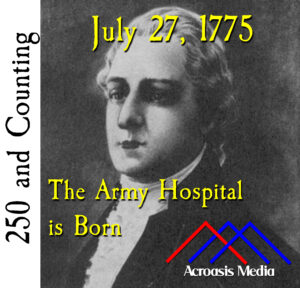
July 27, 1775: The Army Hospital is Born
The Continental Congress thought they had a strong candidate in Dr. Benjamin Church as their Surgeon General. And while Church was a generally good doctor as such, and a loyal member of the Sons of Liberty, he wasn’t especially good at leading others to do the same. This eventually turned into a big problem that came to a head in October, when George Washington needed to step in. The post July 27, 1775: The Army Hospital is Born appeared first on 250 and Counting.
July 26, 1775: Mailing It In
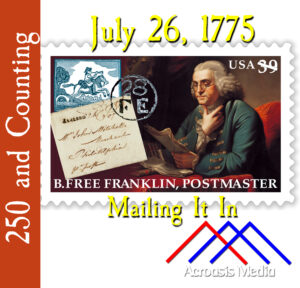
When the US Postal Service first began, it couldn’t even be called that, since there wasn’t a US yet. There was, of course, a postal service, but it was the Crown Post and it was subject to interception and investigation, and we really couldn’t have that and a revolution, now could we? In fact, there were competing services to the Crown Post, but there were also gaps in that service and general inefficiencies. For instance, most services transported parcels at a lower rate than letters. So, people worked around the rule by attaching letters to small, mostly empty parcels just to save money. One service, run by a man named Benjamin Mumford, carried both Royal Mail and that of his own service, which was cheaper than the King’s rates. About the artwork: that’s a picture of a 2006 stamp issued commemorating Ben Franklin’s tenure as the first Postmaster General. It’s marked “B. FREE FRANKLIN” because that’s how he often signed his name while in that position. Why? Because as the Postmaster General, he had franking privileges and didn’t have to pay his own postage. It was a privilege he took great advantage of. The post July 26, 1775: Mailing It In appeared first on 250 and Counting.
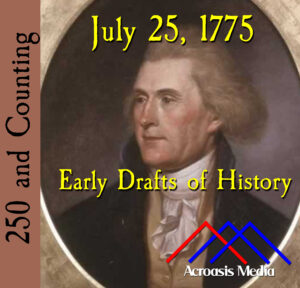
July 25, 1775: Early Drafts of History
First off, let me note that sometime this week we cracked the 1,000-download mark, and we have you to thank for that, especially inasmuch as 40% of that took place in the last 30 days or so. We’re grateful that you’re giving us this little slice of your life each day. We’re also happy to see that the number of daily downloads has grown, slowly but surely, so consider yourself ahead of the curve. You’ve got bragging rights, my friend. In yesterday’s episode, Mike teased the commandeering and re-outfitting of a British ship, but further research revealed that that took place on a different date, so we went with this short story plus my longer rant about historical documents. Okay…it’s not so much a rant as it is a hissy fit. It’s not even that. Look, just listen to it, all right? The post July 25, 1775: Early Drafts of History appeared first on 250 and Counting.
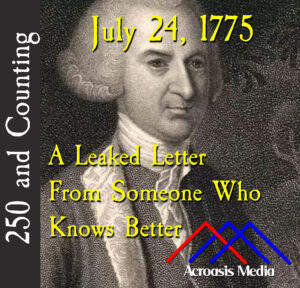
July 24, 1775: A Leaked Letter From Someone Who Knows Better
Even when it’s Mike’s voice you hear on the episode, it’s Claude who takes the blame for the episode titles. It wasn’t a bad thing for members of the Continental Congress to disagree, but some level of decorum was still expected from those members. And almost certainly, one of the commandments was Thou Shalt Not Trash Talk Thy Fellow Delegate. (I may have softened the language a little bit, there.) Still, Adams had a right to express whatever frustration he had with John Dickinson, unfortunately the letter in which he did it got intercepted by the British and publicly published; the mere suggestion that there was some dissention among the ranks of a group that typically presented its work as a united front was certainly a Big Deal. And it certainly didn’t grease the skids between Adams and Dickinson, nor was that rift ever truly healed. The post July 24, 1775: A Leaked Letter From Someone Who Knows Better appeared first on 250 and Counting.
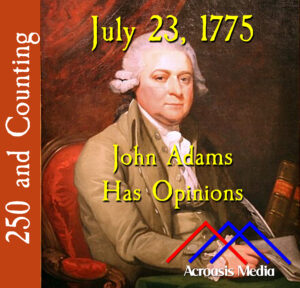
July 23, 1775: John Adams Has Opinions
John Adams wrote to his wife twice on this day in 1775. What did you do for your spouse that was such a big deal? In these letters, the sparks don’t fly the way they do in many others, but the affection he feels for her is still present nonetheless. That he took the time to write a second, more thoughtful letter after dashing off the first one is a nice measure of his esteem for her, and his ability to use her as a sounding board, even when she’s 300 miles and several days’ travel apart. The post July 23, 1775: John Adams Has Opinions appeared first on 250 and Counting.
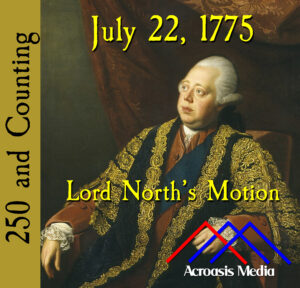
July 22, 1775: Lord North’s Motion
Lord North gets kind of a bad rap for being the Prime Minister who “lost the colonies.” But the fact is, he mostly understood their concerns and was sympathetic to them. However, Parliament was itching for a fight and not making life easy for anyone involved. Lord North put forth a proposal to the Colonies that, to be honest, didn’t offer a lot of change from the status quo. But once again, the slowness with which messages moved from one place in the world to another doomed its delivery to a date after the shooting started, and Congress deemed it as not worthy of serious consideration. The post July 22, 1775: Lord North’s Motion appeared first on 250 and Counting.
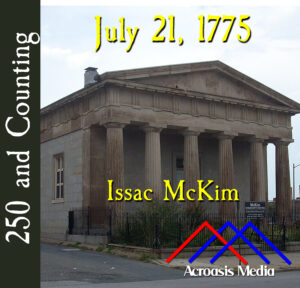
July 21, 1775: Isaac McKim
We know: when an episode is a biography, we typically use a portrait of the person born on this day 250 years ago. But this time around is special: the artwork on today’s episode is a building that was erected by the subject of the episode. The McKim Free School is now the McKim Community Center, and it’s just around the corner from McKim Park. In fact, between the time recording this episode and writing this, I learned that the McKim Center was a stop on the Underground Railroad, and while the neighborhood itself is officially called Jonestown, the residents refer to themselves as the McKim Community Association. The post July 21, 1775: Isaac McKim appeared first on 250 and Counting.
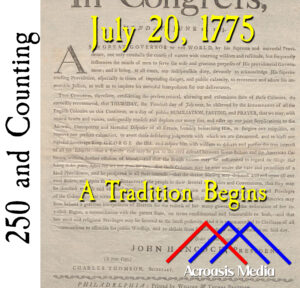
July 20, 1775: A Tradition Begins
As long as we’ve had a Constitution, the United States has had a nominal separation between church and state. What that means is that Congress isn’t able to establish a state-sanctioned religion. For longer than we’ve had a Constitution, Congress has proclaimed days of prayer of some kind or another. For a long time, these days were announced not as a National Day of Prayer (the current nomenclature), but rather as “a day of fasting, prayer and humiliation.” Now, this isn’t the old Christian kind of humiliation in which haircoats are worn, or self-flagellation is necessary. In this context, “humiliation” refers to self-reflection and expression of sorrow or remorse before God. In 1988 televangelist Jimmy Swaggert (who died just a couple of weeks ago) was caught with a prostitute. When he cried on television and gave his “I have sinned” speech, he was humiliating himself before God. Even if he hadn’t done it in front of an audience, it would still be an act of humiliation. Oddly enough, the national presbytery wasn’t buying it as genuine and stripped him of his credentials anyway. And they were right, considering that he was busted a second time with a prostitute a few years later. Anyway. “Fasting” and “prayer” retain their meanings to this day, so explanations probably aren’t necessary here. It’s worth noting, however, that fasting is meant to have a spiritual purpose and again, can show some level of humility. The post July 20, 1775: A Tradition Begins appeared first on 250 and Counting.
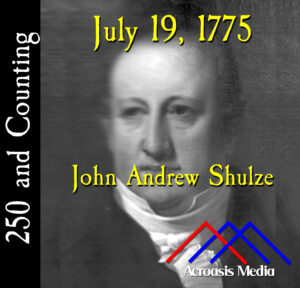
July 19, 1775: John Andrew Shulze
John Andrew Shulze was the sixth governor of Pennsylvania and a member of the Muhlenberg political clan. So this was a guy with some heavy firepower behind him, and he managed to use some of it in righteous ways. Shulze wasn’t completely successful with all of his endeavors, but even when he failed, he laid the groundwork for someone after him to succeed at it. After retiring from his job as governor, he was a delegate to the Whig Party’s first convention in 1839 and was president of Pennsylvania’s Electoral College in 1840, when William Henry Harrison became President of the United States. The post July 19, 1775: John Andrew Shulze appeared first on 250 and Counting.
July 18, 1775: The Burning of Fort Johnston
Although Fort Johnston was originally a British fort, a few years into the Revolutionary War, the Colonies recognized that it could be a valuable place to have a fort, and in 1778 they appropriated the money to have it rebuilt. That fort was also destroyed and, although reconstruction began in 1794, it took many years to complete the project. Time and again Fort Johnston was destroyed or abandoned, and then repaired or refurbished. The fort regained importance during the Civil War but was officially removed from seacoast defense in 1881. For many years it held multiple military-adjacent agencies or tasks, until it was finally decommissioned altogether in 2004. Today it holds the North Carolina Maritime Museum at Southport. The post July 18, 1775: The Burning of Fort Johnston appeared first on 250 and Counting.
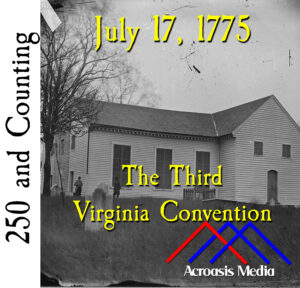
July 17, 1775: The Third Virginia Convention
Given the fact that the existing government of Virginia was technically extra-legal, it’s a little amusing to think that they themselves felt the need to conduct extra-legal activities of their own. A more cynical mind would think that they were hedging their bets, so that if anything Revolutionary were to come up and the British started rounding up people, they could say, “That wasn’t us…it was that Virginia Convention crowd!” A more cynical mind would think that. Heh. But the various conventions, while not having large agendas, did have important ones, and they managed to help the colony get their act together and improve their overall effectiveness during the Revolution. The post July 17, 1775: The Third Virginia Convention appeared first on 250 and Counting.
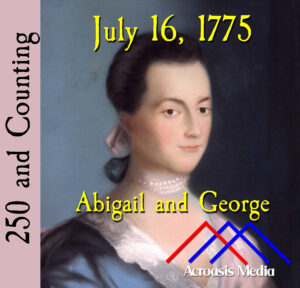
July 16, 1775: Abigail and George
As noted a couple of days ago, Abigail and John Adams wrote to each other quite frequently. Their relationship was not only deep with love, but with admiration for one another. If you get an opportunity, read David McCullough’s biography of John or, better yet, the Library of America’s volume of Abigail’s letters (not just to John but to many others). Their writing is florid without being mawkish. There’s a LOA volume of John’s correspondence as well. In today’s episode, they’re not pining for one another (as they so frequently are). Abigail is relaying to John the details of her meeting with George Washington. Spoiler alert: she found him impressive, despite what she knew about him before meeting him. The post July 16, 1775: Abigail and George appeared first on 250 and Counting.

July 15, 1775: Breakin’ the Law With Impunity
If you’re going to be in rebellion, you may as well do something rebellious. Thus was (presumably) the reasoning behind Ben Franklin putting forth a resolution that the Colonies would effectively ignore a ban on the importation of weapons and gunpowder to the Colonies. And while we’ve mentioned numerous times that the Congress doesn’t seem to do a lot more than form various Committees, again we need to stress that these were serious men, who gave serious thought to whatever they presented to the larger group, because they knew that any votes had to be unanimous. They took the job with great gravity, and in fact worked long hours. And in Philadelphia in the summer time…that is no joke, my friend. I mentioned it in a Baltimore context during the show, but remember that these cities aren’t very far apart, and thus have similar climates. The post July 15, 1775: Breakin’ the Law With Impunity appeared first on 250 and Counting.
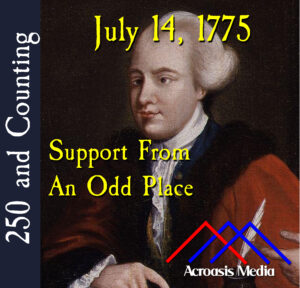
July 14, 1775: Support From An Odd Place
Lord John Wilkes was an interesting person who was always willing to run against popular opinion if he felt strongly that he was in the right. In 1769 he fought for the right of his voters – rather than the House of Commons – to determine their representatives. In 1761 he got Parliament to concede the right of publishers to print the content of Parliamentary debates. In 1776 he put forth a bill proposing Parliamentary reform. But on this day in 1775, Wilkes managed to anger a great number of people in Parliament when he expressed support for the Colonial rebels. Unfortunately, after one of his actions had an unfortunate effect, his politics became increasingly conservative and as a result he lost his seat in Parliament in 1790. Not long afterward he took a position as a magistrate, and he seemed to once again show more compassion toward the lower classes. The post July 14, 1775: Support From An Odd Place appeared first on 250 and Counting.
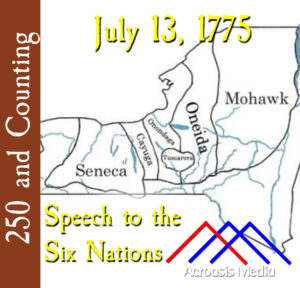
July 13, 1775: Speech to the Six Nations
The Speech to the Six Nations is one of those documents that pretty much answers what was going on with the Native Americans during the Revolution. Athough to be fair, it largely addresses what happened with the Native Americans in Upstate New York. But that area, being a border with Canada, was pretty important to the Independence cause. Part of the reason that the tribes took the document seriously is that each tribe received a series of belts which represented our intent and desire for peace. The belts themselves were reportedly larger than usual for such a task, in the hopes that the tribe leaders would understand the gravity of the situation. The post July 13, 1775: Speech to the Six Nations appeared first on 250 and Counting.
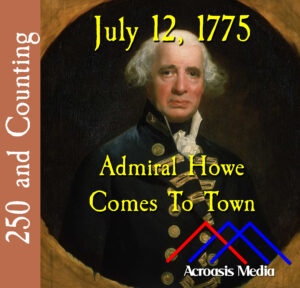
July 12, 1775: Admiral Howe Comes to Town
General Sir William Howe was already in Boston when his brother, Admiral Richard Howe, arrived. So, say what you will about Boston during the siege, but you can’t say there was a lack of no Howe. Hi-yooooooooooooooooo! I apologize. Richard’s biggest problem was that he was known to have been part of prior reconciliation efforts and therefore known to sympathize with the colonists. But even though he did his duty, he was sometimes short on materiel to get the job done, and as a result he took the blame for blockade failures. People thought he was deliberately letting blocked vessels through. But the fact was, he just didn’t have what he needed to do it properly. For some reason, William didn’t catch quite the same level of ire, though he was also part of the reconciliation effort. He did catch plenty of blame as the revolutionary dust began to settle, though. The post July 12, 1775: Admiral Howe Comes to Town appeared first on 250 and Counting.
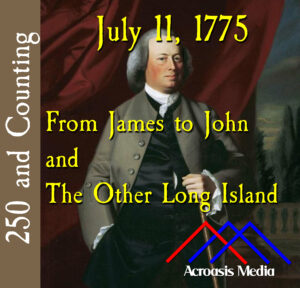
July 11, 1775: From John to James, and The Other Long Island
Oof, that’s a mouthful of title. Oh well, what’s done is done. As noted in today’s episode, James Warren was not related to Joseph Warren. On the other hand, he is related to Mercy Otis Warren, because he’s her husband. James and John Adams had a few ideas in common; the hard part was convincing a few others that they were in the right. Meanwhile, did you know there’s another Long Island? That sort of thing really plays havoc with our research. This one is in the Boston Bay, and it’s a familiar story because something similar happened a few weeks ago. But tune in anyway. The post July 11, 1775: From John to James, and The Other Long Island appeared first on 250 and Counting.
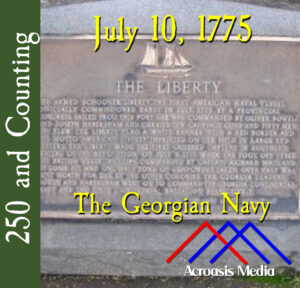
July 10, 1775: The Georgian Navy
Hey! We have a Navy now! Okay, it’s only one ship, but it’s a start. And to be clear, it’s Georgia’s navy, not the navy of the Continental forces. But we’re getting somewhere. And what’s more, on its first day it took on a British ship, with amazing results. Listen in and learn the story. The post July 10, 1775: The Georgian Navy appeared first on 250 and Counting.
July 9, 1775: Orders of the Day
Day Four of this thing and I’m still sounding kinda sexy. Or not, I have no idea. A look through George Washington’s orders of each day gives us an interesting peek into his mind. This was a guy who definitely had his finger on the pulse of what was going on with his troops. But if there was something he didn’t know about, he also recognized that there were things he didn’t know, so he would endeavor to find out. He was a strict commander; there are numerous accounts of his ordering courts martial for assorted men, with various punishments that we’d consider medieval today. One of these was the “Wooden Horse.” As described by Francis Grose, in 1786, “The wooden horse was formed of planks nailed together, for as to form a sharp ridge or angle about eight or nine feet long; this ridge represented the back of the horse; it was supported by four polls or legs, about six or seven feet long, placed on a stand made movable by trucks [wheels]; to complete the resemblance, a head and tail were often added. When a soldier or soldiers were sentenced by a court-martial, or ordered by the commanding officer of the corps, to ride this horse… they were placed [on the plank] with their hands tied behind them, and frequently, to increase the punishment, had muskets tied to their legs, to prevent, as it was jocularly said, their horse from kicking them off…” (At right: a Spanish version of this device.) Had enough? It was abandoned in the 1760s by the British because too many people had been permanently injured by it. However, its use persisted in the Colonies for another few years. Then it returned during the Civil War before being left behind permanently. The post July 9, 1775: Orders of the Day appeared first on 250 and Counting.
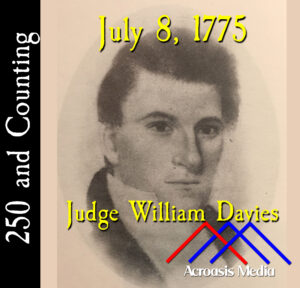
July 8, 1775: Judge William Davies
N.B. While it’s Mike recording today, I write this part and I’m still a little under the weather, so I’ll be brief again. It’s Cake and Candles today for William Davies, born in Savannah on this day in 1775. Davies enjoyed careers in both the legal and political fields, and appeared to do well in both of them. Also, my brain might be addled by the drugs the doctor gave me, but my calculation has him dying at the age of 54, so Mike was a little off, there. That’s probably why he teaches History and not Math. The post July 8, 1775: Judge William Davies appeared first on 250 and Counting.
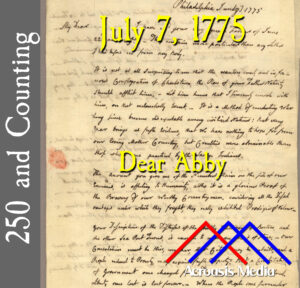
July 7, 1775 (no, really): Dear Abby
As you’ll hear today, I have a huge sinus infection and it took a lot of effort to get today’s episode recorded, so I hope you’ll excuse this part being rather brief. John and Abigail Adams was probably one of the best documented relationships of the Colonial Era, and it’s a ridiculously touching love story. It’s clear that they hated being apart, and you’d do well to watch the HBO/Max miniseries about him. In future episodes we’ll have to dedicate some portion to the literal language between the two. In the meantime, enjoy my Barry White impression. The post July 7, 1775 (no, really): Dear Abby appeared first on 250 and Counting.
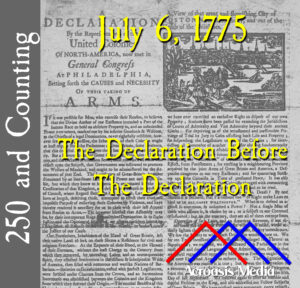
July 6, 1775: The Declaration Before The Declaration
Note: I realized belatedly that the episode that dropped yesterday was titled July 7, as was the audio file itself, but if you’ve listened, you know that it was in fact the July 5 file and what we’ve got here are a couple of typos that have mostly been fixed. My apologies for the error and thanks for your forbearance. While the Olive Branch Petition was a step toward reconciliation, and the Declaration that Congress adopted today was meant to be in the same vein, in fact it had the opposite effect. Even though the Olive Branch Petition arrived late, the fact that this one, outlining why we’re willing to go to war, effectively cancelled out the other one. Not that it mattered anyway, since King George III declared the Colonies to be in rebellion before he ever saw either one. Plus, much of Parliament was in the mood to squash the Colonies as flat as possible. The post July 6, 1775: The Declaration Before The Declaration appeared first on 250 and Counting.
July 5, 1775: The Olive Branch Petition
When the Second Continental Congress convened in May, there was a large faction of delegates who thought that peace with England was still possible, and made a specific effort to draft a message of reconciliation with King George III. They finished their document and presented it to the whole body of Congress on this day in 1775, which approved it and it was subsequently prepared and sent to Great Britain. In a few weeks we’ll talk a little bit about what happened at the other end. Note: I realize that the file reads “July 7,” as did the headline on this post originally. That was a typo that got carried over from one to the other via copy and paste. This was in fact the July 5 file and apologies for any confusion. The post July 5, 1775: The Olive Branch Petition appeared first on 250 and Counting.
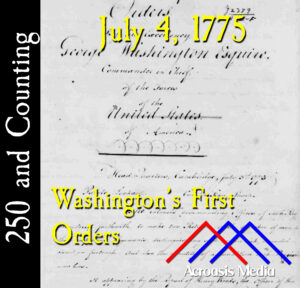
July 4, 1775: Washington’s First Orders
As mentioned yesterday, when George Washington came to Cambridge, he found a bit of a mess there: several disorganized groups of men, with more on the way, along with supplies still in transit. The first thing he needed to do was to get the fighting force organized, so he began a log book of his official orders. His first set, which came out on this day in 1775, took up about five pages of manuscript. But Washington wasn’t done, not by a long shot. Every few days he’d come up with something new, but it was all reasonable and made sense in the bigger picture. It’s not as though Washington had grabbed power with no intention of relinquishing it later on; he just wasn’t wired that way. Eventually his book of orders grew to over 500 pages over the next couple of years. P.S. Happy Independence Day! Our 250th anniversary is exactly one year away, but there’s a lot of stuff before, and after, that date that we’ll need to look at in order to get the entire story. The post July 4, 1775: Washington’s First Orders appeared first on 250 and Counting.
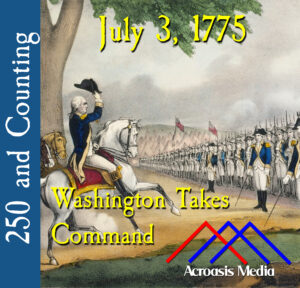
July 3, 1775: Washington Takes Command
On June 15, 1775, George Washington was appointed Commander of the newly-formed Continental Army. On July 2, Washington finally arrived in Cambridge after a few stops in Trenton, New York and presumably a couple of other places. What he found was a huge mess. So on July 3, he officially took command and started the work of turning this ragtag crew into some kind of organized fighting force. The post July 3, 1775: Washington Takes Command appeared first on 250 and Counting.
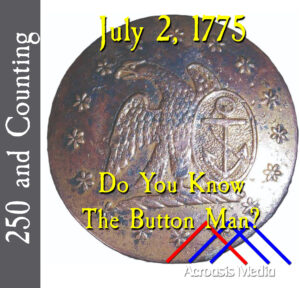
July 2, 1775: Do You Know the Button Man?
As you listen to today’s episode, it’ll become clear that Mike had way too much fun writing and recording this one. But then again, I wrote the title, so. There are plenty of jobs out there that are kind of obscure, in the sense that it’s a job that somebody has, but you never really thought about. For instance, did you know that with some high-end perfumes, the labels are put on manually? Someone’s out there sticking the labels on the bottles, because either the bottles don’t go through the machinery politely, or the levels of quality are low when they’re applied mechanically. So it’s easier to have someone stick on the labels. “Buttonmaker” is also a likely profession in this realm, largely because it is so automated these days. But back in the Colonial days, it was a specialty profession, especially since Aaron Peasley, the subject of today’s episode, refined the die sinking procedure used to make buttons then. And except for the specific means of creating the die (it’s done using electrical discharges nowadays), the overall technique hasn’t changed much. But his talent didn’t end there. Listen in and see what else he did. Additional note: the closeup photo of the button used in the cover art comes from a fascinating article written by 2ndLt. Kevin Rosentreter, USMC, who also took the photo. Mike and I alternate on the writing and recording, but the final steps of the show, including the artwork and the show notes, are entirely my responsibility. My sincere apologies for not giving appropriate credit. You can read his article here. The post July 2, 1775: Do You Know the Button Man? appeared first on 250 and Counting.
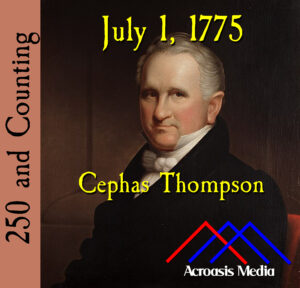
July 1, 1775: Cephas Thompson
Fun Fact: I say “Cephas Thompson” several times during this podcast, mostly because it’s fun to say. He wasn’t a formally-trained painter, but he had a good eye and some natural talent, and during his career he painted over 600 portraits, with roughly a fourth of those made entirely in Bristol, Rhode Island. Even after retiring from the itinerant artist life, he continued to work in Middleborough, Massachusetts until his death. The post July 1, 1775: Cephas Thompson appeared first on 250 and Counting.
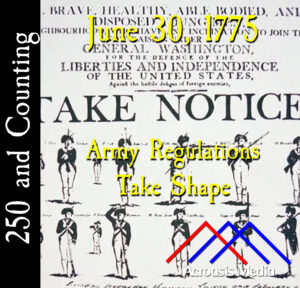
June 30, 1775: Army Regulations Take Shape
With the army being literally only a few weeks old, it was necessary to put together some regulations for this group, to ensure consistency throughout the Colonies. Interestingly enough, as the rules were revised over the next several years, a pattern of using another army’s regulations as a template began to emerge. This isn’t necessarily a bad thing: take what works and build on it, yes? A quick note about the cover art: it’s a recruitment poster from about that time, because a true Army Manual did not emerge until the third version was published in 1779. The post June 30, 1775: Army Regulations Take Shape appeared first on 250 and Counting.
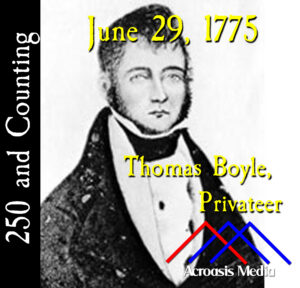
June 29, 1775: Thomas Boyle, Privateer
Thomas Boyle wasn’t born in Baltimore, Maryland, but when he was a young man he made it his home and became quite successful there, as a merchant marine and an overall businessman. And, of course, given Baltimore’s penchant for naming streets after historic people and events, there is a Boyle Street. It’s not very long; in fact you see the entire road in the photo below. In this picture the viewer is standing on Fort Avenue looking down toward Key Highway. The green structure in the background is the Baltimore Museum of Industry, and the Inner Harbor is just beyond that. Based on my research, Boyle didn’t live near this location; he’d settled in a part of town called Fell’s Point, which is on the other side of the harbor and about a mile to the east. If a person standing where the camera was for this photo turned to the right, they could probably see the entrance to Fort McHenry. The post June 29, 1775: Thomas Boyle, Privateer appeared first on 250 and Counting.
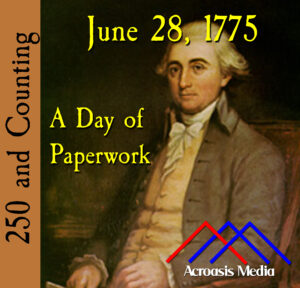
June 28, 1775: A Day of Paperwork
It feels like we’re selling the day a little short, but not every day has to be Bunker Hill. Also, we’re discovering (and we hope you are, too) that sometimes it’s the smaller moments between the bigger ones that give us better insight into the hearts and minds of the people who lived during that time. Today’s artwork is a portrait of Jonathan Trumbull (brother of John Trumbull, the guy who painted so many of the Founding Fathers), but this painting—which was created in 1880, long after he died—appears to show him as he was around the time of the Revolution. Compare that to the image we used for him back in April (right), which showed him in his later years as Governor of Connecticut. The post June 28, 1775: A Day of Paperwork appeared first on 250 and Counting.
June 27, 1775: The Northern Department
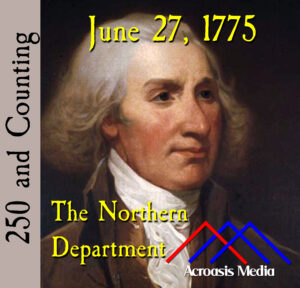
“Schuyler” is one of those names in New York history that pops up quite frequently, partly because they were a prominent family. But it’s also one of those names that you may suddenly realize you’ve heard many times. “Schermerhorn” is another one (no kidding). So is “Burr,” for that matter, as in Aaron and family. Several Burrs are buried very close to the Long Island town where I grew up. I have childhood memories of passing a cemetery in Smithtown and seeing BURR on a few of the tombstones. It wasn’t until later that I learned it was the same family. As far as the Schuylers, they were originally from the Albany area but after his father died he was raised in the New Rochelle area. Most of his military experience derived from fighting on the side of the British in the French and Indian War. Later in his life he lived on his estate in Saratoga, just north of Albany. He spent some time as a member of Congress and is also known for being Alexander Hamilton’s father-in-law. The post June 27, 1775: The Northern Department appeared first on 250 and Counting.
June 26, 1775: George Washington Visits New York City
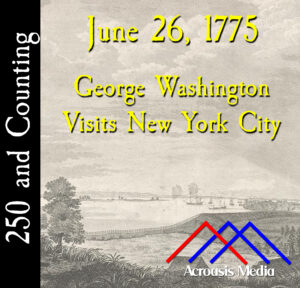
In 1775, New York didn’t have a Times Square, nor a Statue of Liberty, nor even a Brooklyn Bridge. Bagels hadn’t made it to the new world, and pizza wasn’t a thing yet. So why did George Washington feel it necessary to stop in New York City on his way to Boston? Short answer: he knew that some of the locals were nervous about his taking command of the army. Longer answer: oh no, you don’t. You’re going to have to listen to Mike tell you. The post June 26, 1775: George Washington Visits New York City appeared first on 250 and Counting.
June 25, 1775: Peter Brown Saw It All
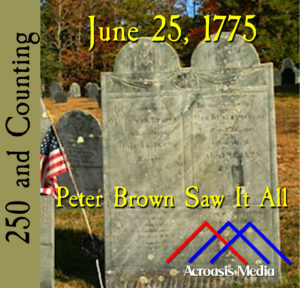
There are lots of times when historians have to pull a lot of small pieces together to get a decent picture of events. They use oddball clues such as artifacts in paintings to determine someone’s state of health, for instance. They have to take into account that published reports could be propaganda in nature. But once in a while, something turns up that was written more or less at the time it happened, and what’s more it was written by someone who doesn’t necessarily have an agenda. And in this case, nobody even knew it existed until a hundred years later. Exactly a hundred years later, in fact. A young soldier named Peter Brown wrote a letter to his mother just a few days after the Bunker Hill battle to tell her what happened. He spared few details and told a rather complete story of a couple of days’ worth of activity. And while he did mail the letter, and his mother did receive it, it mostly lay in family archives until 1875, when a descendant found it and realized that it might be important. If you’re interested in seeing the letter itself, or reading a transcription, it’s available at the Massachusetts Historical Society’s website. The post June 25, 1775: Peter Brown Saw It All appeared first on 250 and Counting.
June 24, 1775: The Committee of Seven
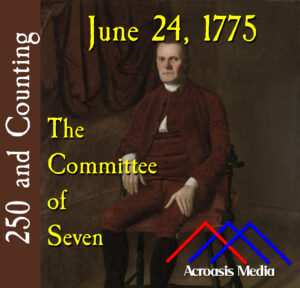
With the war in full swing and a Commander-in-Chief on his way to Boston, the Continental Congress took the next step of finding a way to organize the troops. So naturally they formed a committee. The Committee of Seven (maybe all the good names were taken?) worked diligently for about three weeks to put together a plan that would indicate just who could fight and how they would be organized. There were still some details to iron out, but in the meantime the disaggregated militias were getting the job done. All that remained was to aggregate them into a single fighting force. The post June 24, 1775: The Committee of Seven appeared first on 250 and Counting.
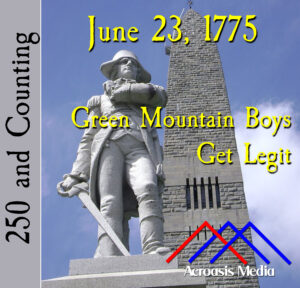
June 23, 1775: Green Mountain Boys Get Legit
While the Green Mountain Boys were very successful so far in their military exploits, they were still just some unaffiliated militia group. At best they were considered Patriot-sympathetic, but not much else. After the capture of Fort Ticonderoga and Fort Crown Point, two of their leaders decided that it was time to get official recognition. So they headed down to Philadelphia to bring their case to the Continental Congress. The post June 23, 1775: Green Mountain Boys Get Legit appeared first on 250 and Counting.
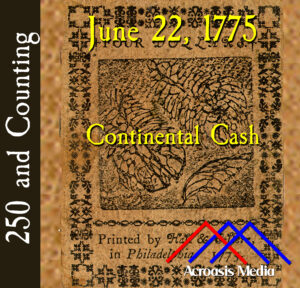
June 22, 1775: Continental Cash
Here’s a hard economic reality: if you want to break away from a parent nation, you need to stop using their currency. Here’s another one: if you’re going to issue currency, you certainly need to have the capital to back it up. And you also don’t want to make it easy to counterfeit. The post June 22, 1775: Continental Cash appeared first on 250 and Counting.
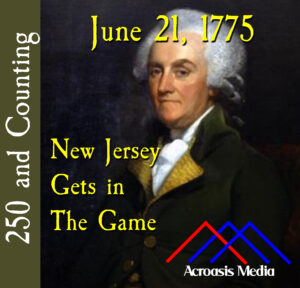
June 21, 1775: New Jersey Gets in the Game
New Jersey’s Provincial Congress first convened in May, but by now they’d gotten a bunch of stuff done. They’d already made arrangements to remove the Royal Governor from power, and resolved to do it like gentlemen (it didn’t work out that way, unfortunately). At this point the colony had only one delegate to the Continental Congress: a couple had resigned, one never showed up, and that left exactly one man holding down the fort. So the Provincial Congress appointed new delegates, with a specific mission. The post June 21, 1775: New Jersey Gets in the Game appeared first on 250 and Counting.
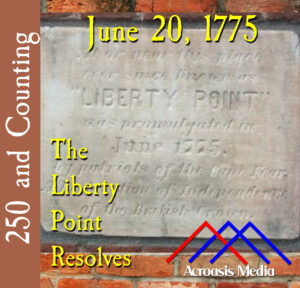
June 20, 1775: The Liberty Point Resolves
Mike has already mentioned the location of the historical marker in today’s art. It’s tough to read even when you’re standing there, so here’s the text: At or near this placeever since known as“Liberty Point”was promulgated inJune 1775,by patriots of the Cape FearA Declaration of Independenceof the British Crown. This was an extremely historic neighborhood, should you choose to visit. There are at least eight other historical markers within a short walking distance of this one, not all of them are connected to the American Revolution. In fact, one of them dates back to living memory of some of the locals. The post June 20, 1775: The Liberty Point Resolves appeared first on 250 and Counting.
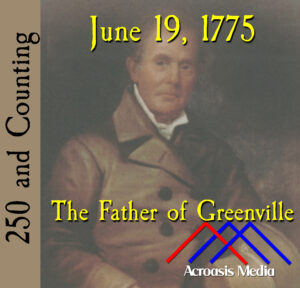
June 19, 1775: The Father of Greenville
Sometimes when you’re watching a movie or listening to music, you find yourself in the awkward position of separating the artist from the work, because it turns out that the artist has some shady stuff going on in the past, or even in the present. But the song/movie/book is just so good that you need to temporarily overlook that. Such is the case, we think, with Vardry Echols McBee, an entrepreneur and philanthropist who basically invented the town of Greenville, South Carolina. He was also a slave owner who sided with the Union but provided material assistance to the Confederacy. Mixed messages! Conflict of loyalty! But it’s also clear that he was instrumental in making the town of Greenville what it is today, even more than 150 years later. What’s more, by all contemporary accounts he did it “without pride, pretense or ostentation.” The post June 19, 1775: The Father of Greenville appeared first on 250 and Counting.
June 18, 1775: Orsamus Cook Merrill
It’s Cake and Candles today for a future State Representative of a future state. Orsamus Cook Merrill was born in Connecticut but moved to Vermont coincidentally the same year that the Vermont Republic was admitted to the Union as our fourteenth state. He spent the rest of his life in the Bennington area, working in jobs as diverse as newspaper editor or publisher, postmaster, attorney and Engrossing Clerk for the Vermont House of Representatives before becoming a Representative himself. (For those not in the know: an Engrossing Clerk is responsible for preparing prints of intermediate drafts of bills that a governing body is considering before they vote at the next stage.) By most accounts, he represented his constituents well, and he was largely done in by shifts in the political winds. He died in 1865 and is buried in Bennington Centre Cemetery. The post June 18, 1775: Orsamus Cook Merrill appeared first on 250 and Counting.
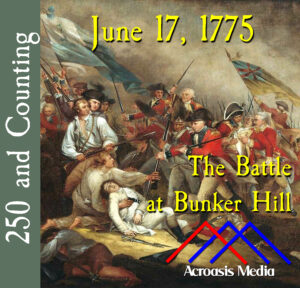
June 17, 1775: The Battle at Bunker Hill
In the long run, the Battle at Bunker Hill Breed’s Hill was a tactical win for the British, but they incurred heavy losses and it took three tries to get that win. So why is it one of the battles that so many Americans seem to remember all these years later? We’re speculating here, but it’s possible that, between this battle and the ones at Lexington and Concord, the Colonial forces realized that this was a war that they could actually win: it wasn’t crazy at all to fight the British army. It almost didn’t matter that we didn’t win this one; the colonial militiamen could stand up against the British and force them to work much harder for their victories. There’s a scene in The Godfather, Part II in which Michael describes an incident he’d seen earlier in the day. He says he saw some Cuban rebels being rounded up by the soldiers, and one of them, rather than being taken prisoner, detontated a grenade on his person, taking a Captain of the Guard with him. From that he concluded that because the rebels weren’t getting paid to fight, they can actually win. That’s pretty much what happened here. The post June 17, 1775: The Battle at Bunker Hill appeared first on 250 and Counting.
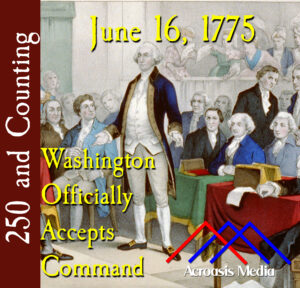
June 16, 1775: Washington Officially Accepts Command
Yesterday, George Washington was unanimously elected Commander in Chief of the Continental Army. Today he officially accepted the position. He won’t take actually begin until early July (we’ll get to that episode in a few weeks), but take a look at this image here. He’s already in the blue coat, and his hair is whiter than it was in yesterday’s art. The truth about his hair color is likely somewhere in between these two images, but of course he wasn’t wearing a coat like that just yet. This art is from a hundred years later, by Currier and Ives. What I found interesting is that some of the people in the background look a little put out by Washington, even though they’re the ones who elected him. I think Currier and Ives were trying to convey that it was a serious event, but everyone just looks angry. John Adams (in the dark blue to the right) appears especially annoyed, and he’s the one who nominated him in the first place. And check out the guy to Adams’ right, staring straight at us. There’s always one guy who can’t help but look at the camera. The post June 16, 1775: Washington Officially Accepts Command appeared first on 250 and Counting.

June 15, 1775: The Original G-Man
Jeez, I gotta stop writing these titles late at night. Sometimes the history books make it sound like some people just appeared out of nowhere, but they did have pasts. George Washington would be a good example. Washington has been nearly invisible since this show started on January 1, but that doesn’t mean that the Congress hollered “Anyone wanna be a general?” and he stepped up first. In fact, he was a delegate to the First Continental Congress in 1774, and for some time he’d been a member of the Virginia House of Burgesses, often simultaneously with the Congress thing. And he did have a commendable military background dating back to the French and Indian War, so appointing him the Commander of Colonial forces wasn’t part of someone’s crazy scheme: they thought he could really do it. And do it, he did. The post June 15, 1775: The Original G-Man appeared first on 250 and Counting.
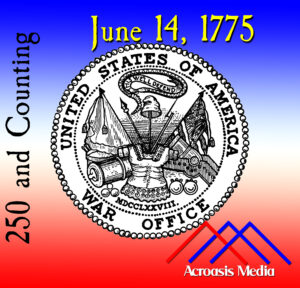
June 14, 1775: Cake and Candles for the US Army
No tongue-in-cheek for today. No weird jokes. No political stances. Just thanks for giving us America, and then helping us keep it. In today’s episode, Mike takes you back to the first day. The post June 14, 1775: Cake and Candles for the US Army appeared first on 250 and Counting.
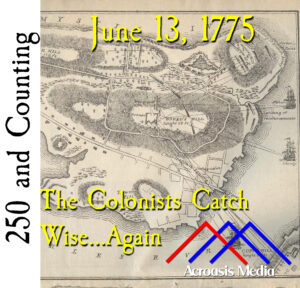
June 13, 1775: Colonists Catch Wise…Again
It wasn't even close to being the first time, but this was an important "get": the colonist forces learned that troops were coming to capture Charlestown and Dorchester in an effort to break the siege. They got lucky, it all led to some ugliness and eventually both sides could call it a win, and both sides could call it a loss. The post June 13, 1775: Colonists Catch Wise…Again appeared first on 250 and Counting.
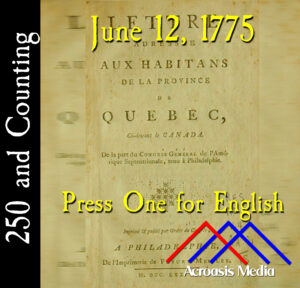
June 12, 1775: Press One for English
The folks in America wanted to ensure that the folks in Canada knew just how bad the conditions were, but the problem was that most of the regular inhabitants of Canada spoke French, so when the Continental Congress created documents meant to sway the Canadians to our side of the loyalty fence, they were written in French. But the problem was, they couldn’t use these documents as evidence for folks here in the Colonies, because not enough people understood French. What to do, what to do? The post June 12, 1775: Press One for English appeared first on 250 and Counting.

June 11, 1775: The Battle of Machias
Full Disclosure: I have no idea whether I pronounced “Machias” correctly. We’ll all have to live with that one, I suppose. The Battle of Machias was not exactly one of epic proportions. It was a couple of boats chasing after a couple of other boats, and one boat got away but the other one managed to damage itself and was ultimately boarded. So why is it significant? Well. Not only was it the first naval battle of the American Revolution, it was a battle that the Colonies won, no matter how you look at it. And every little win was, in fact, a big win. The post June 11, 1775: The Battle of Machias appeared first on 250 and Counting.
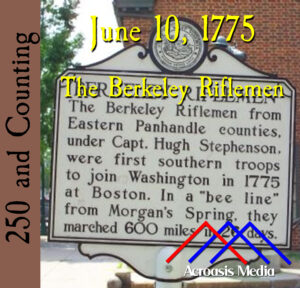
June 10, 1775: The Berkeley Riflemen
In the wake of Lexington and Concord, some places didn’t wait to start assembling troops to fight off the British. Most of them were in that part of the Colonies, though. Enter the Berkeley County Riflemen, from a section of Virginia that is now West Virginia. George Washington put out the word that soldiers were needed, and about a hundred men from Martinsburg stepped up, even going so far as to ensure that they dressed mostly alike, since there was no Continental Army just yet, and therefore there were no uniforms. And while the sign doesn’t really say much about it, the Berkeley County Riflemen are said to be the genesis of the United States Army. The post June 10, 1775: The Berkeley Riflemen appeared first on 250 and Counting.