Your Intended Message
311 episodes — Page 3 of 7
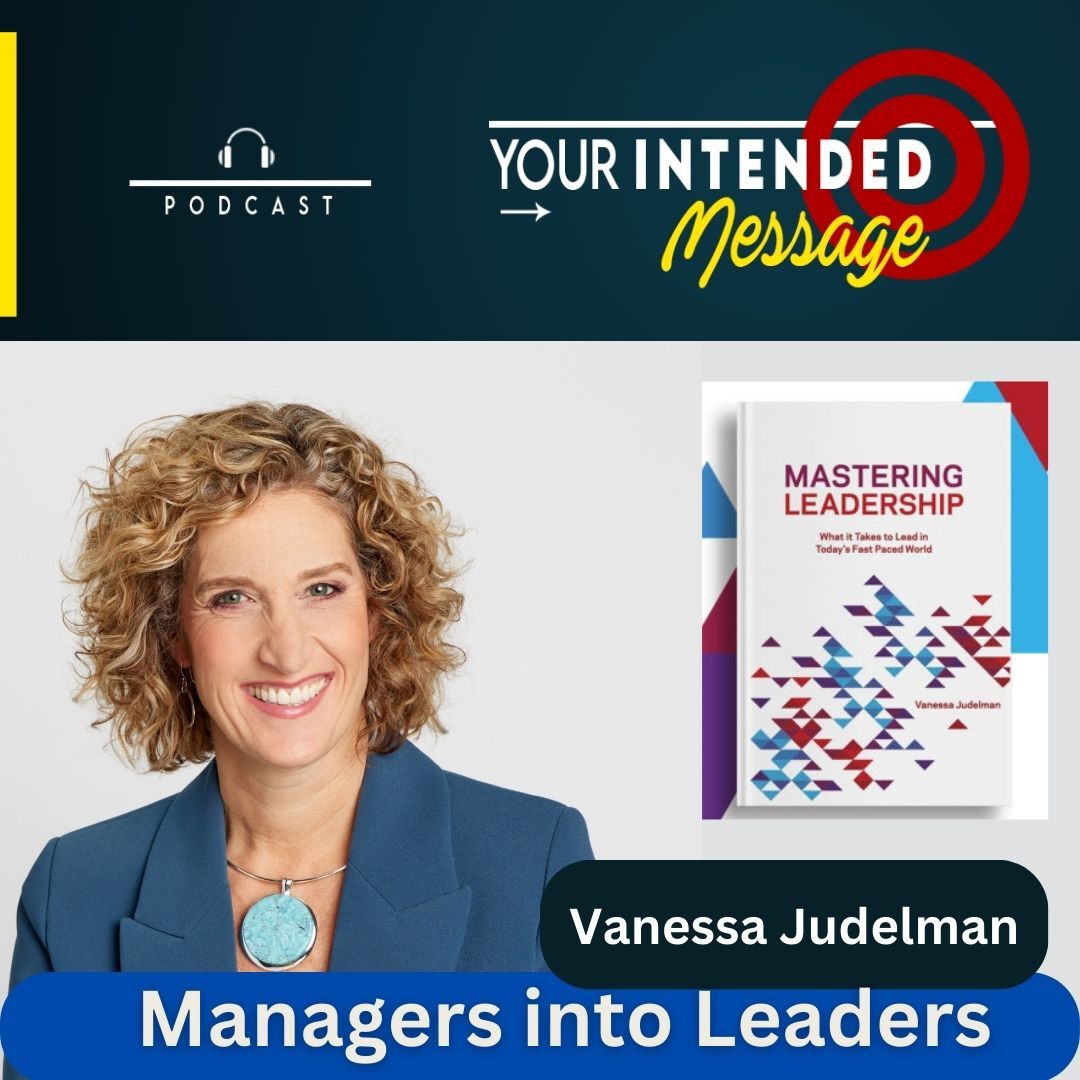
Ep 214Transform Managers into Leaders: Vanessa Judelman
Helping managers become executive leaders Leading is different from managing Episode 212 (Vanessa is based in Toronto, Canada) In this conversation with Vanessa Judelman we explore: The three aspects of being strategic How to conduct an accountability meeting The power of regular one-on-one meetings with your people How to build trust with your team How to become a leader who coaches your team Why and how to become a better listener How to delegate effectively About our guest, Vanessa Judelman: Vanessa is a leadership consultant and executive coach. Over the past 20 years she has trained and coached thousands of people across the globe in organizations including Campbells Soup, HelloFresh, the SickKids Foundation and the Four Seasons Hotels and Resorts. Learn more about her book "Mastering Leadership: What it Takes to Lead in Today's Fast Paced World" at: www.mosaicpd.com ------ Excerpts from this conversation with Vanessa Yudelman: And I just want to develop the muscle of listening because I it's not something that we were taught at school. ----- I always tell leaders, first of all, think about your intention for the meeting. Why do you want to meet with them? Is it an accountability meeting where you want to make sure they're, they're moving their goals forward? Is it a coaching meeting, where this is someone who's new, and you want to develop them? Like, what's the purpose? So that's the first place to start is, so I would recommend you identify the purpose, then share it with your team? You know, a lot of leaders think that just because they're a leader, they have to have all the answers. And I always say that's not true. You, as a leader need to have the questions. You don't necessarily need to have the answers. So say to your team, hey, you know, I really feel like I'm not getting you're new to the team and not giving you enough time to develop your skill in this area. And so I was thinking we could do a one on one. Would that be helpful for you? Again, check in? Oh, yeah, that'd be great. Okay, let's do the agenda together. Here's what I was thinking. I was thinking, like, I always asked, you know, what the suggestion I was thinking we could talk about, you know, this certain skill, what did you do to work on the skill last week? What are some of your gaps, what support you need for me? Right. And so again, it's a lot of questions. And by giving them the agenda in advance, people know what to expect, and they can prepare for the meeting. So they know, every Monday, you know, my leader is going to ask me what I did to work on the skill last week, and where I'm still feeling stuck. So you can either Yeah, so those are a couple of suggestions to get those meetings started. ----- ----more---- Your Intended Message is the podcast about how you can boost your career and business success by honing your communication skills. We’ll examine the aspects of how we communicate one-to-one, one to few and one to many – plus that important conversation, one to self. In these interviews we will explore presentation skills, public speaking, conversation, persuasion, negotiation, sales conversations, marketing, team meetings, social media, branding, self talk and more. Your host is George Torok George is a specialist in communication skills. Especially presentation. He’s fascinated by the links between communication and influencing behaviors. He delivers training and coaching programs to help leaders and promising professionals deliver the intended message for greater success. Connect with George www.SpeechCoachforExecutives.com https://www.linkedin.com/in/georgetorokpresentations/ https://www.youtube.com/user/presentationskills https://www.instagram.com/georgetorok/
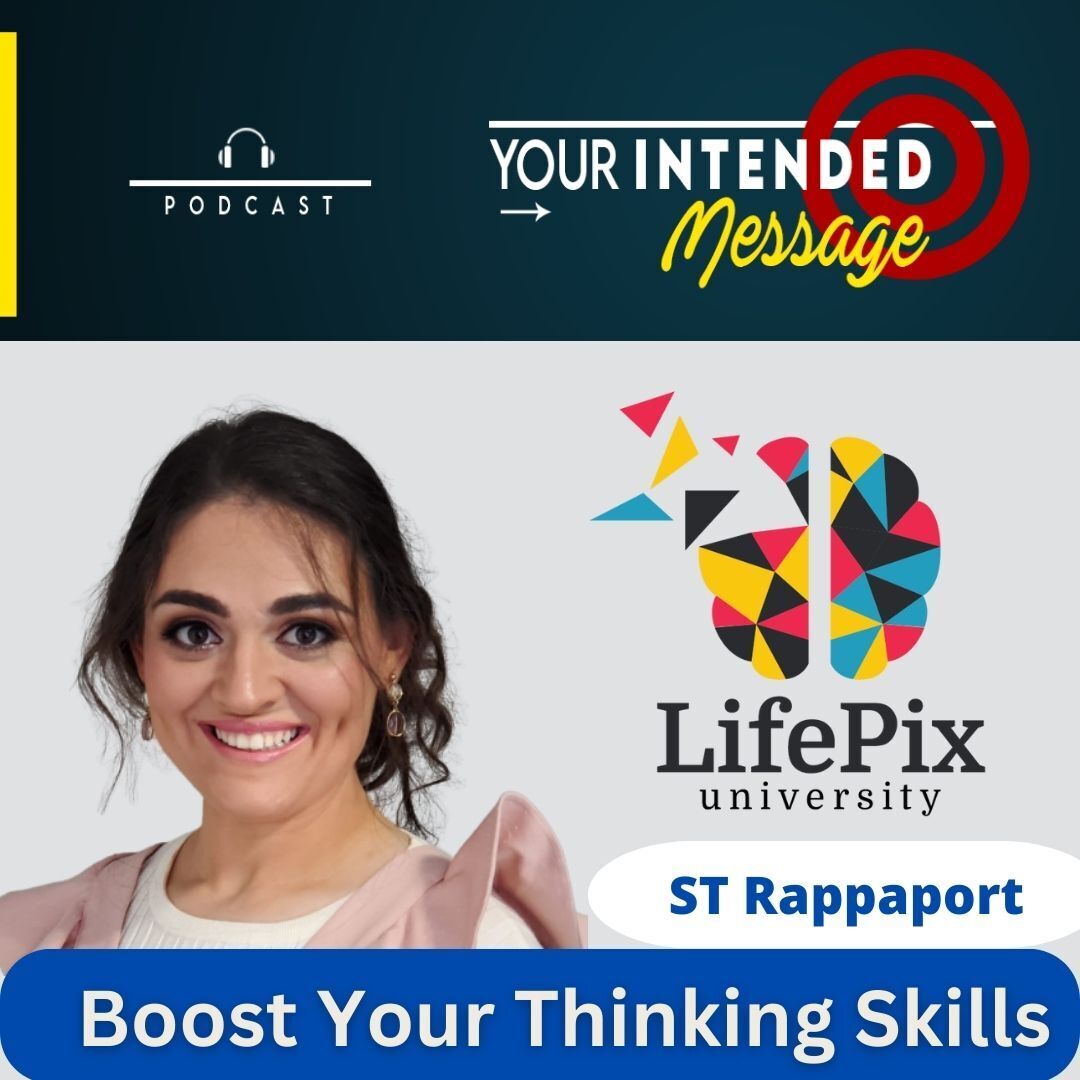
Ep 213Are You an Entrepreneur with ADHD? ST Rappaport
How to improve your thinking skills regardless of your strengths Strengths and opportunities for ADHD entrepreneurs Episode 211 (ST is based in Florida) In this conversation with ST Rappaport we explore: Appreciating the 28 thinking skills How to recognize ADHD challenges How to deal with overwhelm How to leverage our five senses to organize new information The three phases of thinking and how to Why ADHD people can be the movers and shakers How to use curious questions and learning to keep your brain young About our guest, St Rappaport: Been studying how the brain thinks (& what we can do to improve it) since the age of 11 Always looking to solve the root cause of any issue (instead of just putting on a band aid) Absolutely love learning but not school. Dropped out of school at 16 ST Rappaport Helping ADHD entrepreneurs optimize their brain so growing their business is easier. Grab your copy of Your Essential Guide to Cognitive Functions Free Thinking Skills Assessment: www.lifepixuniversity.com/brain ----- Excerpts from this conversation with ST Rappaport: I think that people with ADHD are the real movers and shakers of this world. Anyone who's done anything really big in this world, most definitely has ADHD. And I just love being around such people. ----- And sometimes it's a good idea not to consider all the details, because if you did, it would overwhelm you and scare you. ----- Do you believe that people can multitask? No. What we do is we task switch. Yes, we are switching tasks really, really quickly from tasks that is includes if you have ADHD, and a lot of people think they have ADHD, and they can multitask really well. But if you observe yourself, what you're actually doing is you're switching from task to task really, really quickly. only exception to this is when you're doing a task that doesn't require brainpower. Then let's say for example, if you're driving driving down the highway, 60 miles an hour, and it's like, just not thinking and you have a podcast playing, you could still be listening to your intended message, right? You're still listening to the podcast. However, if out of nowhere, a car comes and cuts you off. Or all of a sudden, like there's a bike that like a pedestrian or something that you think you weren't expecting those few seconds to settle and stop and you were focused on the road, You're more focused on the road, your brain didn't hear what was in that podcast, you will literally if you want to hear what was said, we'll have to go back there a couple of seconds to hear it because your brain was shut off. So you can multitask until one of the things don't need brain power. ----- You want to make sure you are always, always always always doing new and challenging tasks. If you want to keep your brain young, you want to do new and challenging, not just new and not just challenging, but those two together, those are the best way for you to keep your brain young and provide any of the elderly diseases that none of us want related to the brain. ------- ----more---- Your Intended Message is the podcast about how you can boost your career and business success by honing your communication skills. We’ll examine the aspects of how we communicate one-to-one, one to few and one to many – plus that important conversation, one to self. In these interviews we will explore presentation skills, public speaking, conversation, persuasion, negotiation, sales conversations, marketing, team meetings, social media, branding, self talk and more. Your host is George Torok George is a specialist in communication skills. Especially presentation. He’s fascinated by the links between communication and influencing behaviors. He delivers training and coaching programs to help leaders and promising professionals deliver the intended message for greater success. Connect with George www.SpeechCoachforExecutives.com https://www.linkedin.com/in/georgetorokpresentations/ https://www.youtube.com/user/presentationskills https://www.instagram.com/georgetorok/

Ep 211The Top Three Videos Your Business Needs: Mark Wonderlin
How to promote your business with video What are your video choices? Episode 209 (Mark is based in Austin, Texas) In this conversation with Mark Wonderlin we explore: Where to start with simple phone videos What are the different types of videos you can publish for your business Why value in the video content is more important than quality The best uses of selfie videos vs professional videos Understand the intent of viewers on the different social media How long to make your video depending on the platform How to split a longer video into to short videos in a funnel How to start by shooting your own video About our guest, Mark Wonderlin: Mark is owner of Mosaic Media Films, the highest-rated video company in Austin Texas. His team creates cinematic business videos with marketing in mind. He loves to travel and much as he loves creating video content. ----- You can access the free video resources at his site https://mosaicmediafilms.com/resources/ ----- Excerpts from this conversation with Mark Wonderlin: What kind of videos should they be producing at first? Where do you start that? So most of the time, when clients are looking for video from us, they're looking for typically what's called a business promo video. And that's usually where we try to steer them. So the conversation that we have about video is a little bit different than most other production companies out there. I really want to understand what are you doing for marketing? what's working, what's not working? What is the problem we're trying to solve that this type of video or other types of videos will help solve in your marketing strategy. So sometimes it's a promo video, sometimes it's a case story, or testimonial video, sometimes it's a series of videos that work in your funnel to increase trust and credibility. So we really try to understand what is the problem that they have? And how can video what type of video will work, or what series of videos will really help them. The two most popular videos that we do is what's called a business promo video. Some people call it a company video, some people call it a Brand Story Video, it's essentially a two minute video that tells the story about what you do, and what makes you uniquely different. And I say tells the story about you very lightly, because I often have to explain to clients that it's not really a story about you, as much as is a story about your customers journey. So it's really about what is the problem or the pain that your customer has? How could you uniquely solve that? And what does their life look like, once you've worked with them. And that's really what you want to do. Because However, people are seeking you out with your primary marketing objectives, whether it's SEO, or pay per click or social, when they come into your business or brand, they essentially are acknowledging that they have a problem. And they want to make sure that you can kind of solve that problem. They're there's a story that they're already playing in their head, and they want someone that's gonna help change and transform that story, whether it's in the form of a product for a result that they want, or a service, or an objective that they're trying to achieve in their life, whether it's their business, or personally. ----- ----more---- Your Intended Message is the podcast about how you can boost your career and business success by honing your communication skills. We’ll examine the aspects of how we communicate one-to-one, one to few and one to many – plus that important conversation, one to self. In these interviews we will explore presentation skills, public speaking, conversation, persuasion, negotiation, sales conversations, marketing, team meetings, social media, branding, self talk and more. Your host is George Torok George is a specialist in communication skills. Especially presentation. He’s fascinated by the links between communication and influencing behaviors. He delivers training and coaching programs to help leaders and promising professionals deliver the intended message for greater success. Connect with George www.SpeechCoachforExecutives.com https://www.linkedin.com/in/georgetorokpresentations/ https://www.youtube.com/user/presentationskills https://www.instagram.com/georgetorok/

Ep 210Feel more Confident and Appear more Confidence: George Torok
If you had to choose between feeling confident or appearing confident what would you choose? Listen in to discover the answer and why it is important to you. In this solo show George offers you a whole body. mind and soul experience to enhance your confidence. Insights from this episode about feeling and appearing confidence when you speak in public. These quotes from your episode were generated by Headliner AI. If you enjoy them please tell other podcasters by giving a shoutout to https://headliner.app in your episode ✨ --- 🗣️ Quotes from George Torok "How can you be more confident when it's your turn to speak?" "It's more important that you appear confident." "The audience doesn't need to know what's going on in your head or in your body." "Clarify your purpose by asking yourself this three-part question: As a result of this presentation, what do you want people to think, feel, or do?" "Don't read it, know it, and then deliver it." "Remember to breathe." "When you smile, you are more attractive." "Believe in yourself and your ability." "Your message has value." --- ----more---- Your Intended Message is the podcast about how you can boost your career and business success by honing your communication skills. We’ll examine the aspects of how we communicate one-to-one, one to few and one to many – plus that important conversation, one to self. In these interviews we will explore presentation skills, public speaking, conversation, persuasion, negotiation, sales conversations, marketing, team meetings, social media, branding, self talk and more. Your host is George Torok George is a specialist in communication skills. Especially presentation. He’s fascinated by the links between communication and influencing behaviors. He delivers training and coaching programs to help leaders and promising professionals deliver the intended message for greater success. Connect with George www.SpeechCoachforExecutives.com https://www.linkedin.com/in/georgetorokpresentations/ https://www.youtube.com/user/presentationskills https://www.instagram.com/georgetorok/

Ep 209Build the Conversation on Trust: Mary Schmid
Everything begins with a conversation A solid conversation starts with trust Episode 207 ( Mary is based in Minnesota) In this conversation with Mary Schmid we explore: Why do 9 out of 10 conversations fail? How are the chemical releases in the brain shaping your feelings? Why we don't trust when we are stressed or threatened Why we don't make pure logical decisions The three levels of conversation How to move conversation to cooperation How to lead with trust About our guest, Mary Schmid: Mary Schmid, MBA, has expertise in trust-based conversations. As the author of “Make or Break Conversations,” she offers valuable insights rooted in neuroscience. With her deep understanding of evidence-based neuroscience, Mary delivers transformative programs that elevate good conversation to trust building interactions. Mary’s unique ability lies in translating scientific knowledge into practical, actionable steps that you can apply in your next conversation, ensuring others feel heard, seen, and valued. ----- Connect with Mary on Linkedin https://www.linkedin.com/in/maryschmid/ Learn more about her services at the website https://maryschmid.com/ ----- Highlights from this conversation with Mary Schmid: Practice active listening skills like paraphrasing, asking open questions, and summarizing to build understanding. Slow down conversations and take time to discover other perspectives before deciding on solutions. Prepare for difficult conversations by getting clarity on the purpose and considering different perspectives. Use plain language instead of jargon to be understood and build connection. Get to know team members personally before instituting changes as a new leader. ----- Exactly. And what really happened in the brain before those good feelings, feeling in sync is that something happened in that conversation, who knows what it is, it's verbal, it's nonverbal is a feeling or a memory that you've had talking to a person perhaps like this person that was good, it just felt good. What really happened is your brain sensed respect, safety. And all of a sudden, it opened up. So what happened is when your brain senses this respect, and safety and going back and forth, talking with each other, there's a chemical release called oxytocin. And oxytocin opens up the prefrontal cortex, the smart part of our brain, the executive part of our brain that's responsible for innovation, problem solving, connection, cost, and it feels like a good conversation. But what happens preceding that feeling like it was a good conversation was this invisible chemical reaction that happens in your brain, and my brain and the brain of all humans. ----- There's three levels of conversation, and one is not better than the other. That's what people immediately think like, Oh, my God, I know that we need to understand the three levels, and how we can use them and how they impact the people so that our intended message reaches the people rather than go astray. So the first level of conversation is what I call an informational conversation. We use it all day long. In our life, you ask a question, I give an answer. Here's, where's the meeting? What time is this? What's where do we go for that? Question? Answer? That's fine. Sometimes that's all we need is to get the question answered, and get the information. However, when we're in conversations, when we're in meetings with other people, I think we need we may need more than just a question and answer to build trust. Because data, information, logic does not build trust. So we're in a meeting, perhaps, and we ask a few questions, you know, we're not totally blind to other people. So we ask a few questions. And what our brain does is it automatically says, Oh, I know the answer. I'm going to tell them. So with a few pieces of information, a little bit of data, lickety split, away we go, we talk to people and tell people what to do based on a limited amount of information. And we think that's going to do the trick. We're thinking that we're being helpful, but we're really not we're shutting them down. And so we not only tell them what to do, we are really helpful, George, and we're going to tell them how they need to do it. ------ ----more---- Your Intended Message is the podcast about how you can boost your career and business success by honing your communication skills. We’ll examine the aspects of how we communicate one-to-one, one to few and one to many – plus that important conversation, one to self. In these interviews we will explore presentation skills, public speaking, conversation, persuasion, negotiation, sales conversations, marketing, team meetings, social media, branding, self talk and more. Your host is George Torok George is a specialist in communication skills. Especially presentation. He’s fascinated by the links between communication and influencing behaviors. He delivers training and coaching programs to help leaders and promising professionals deliver the intended message for greate
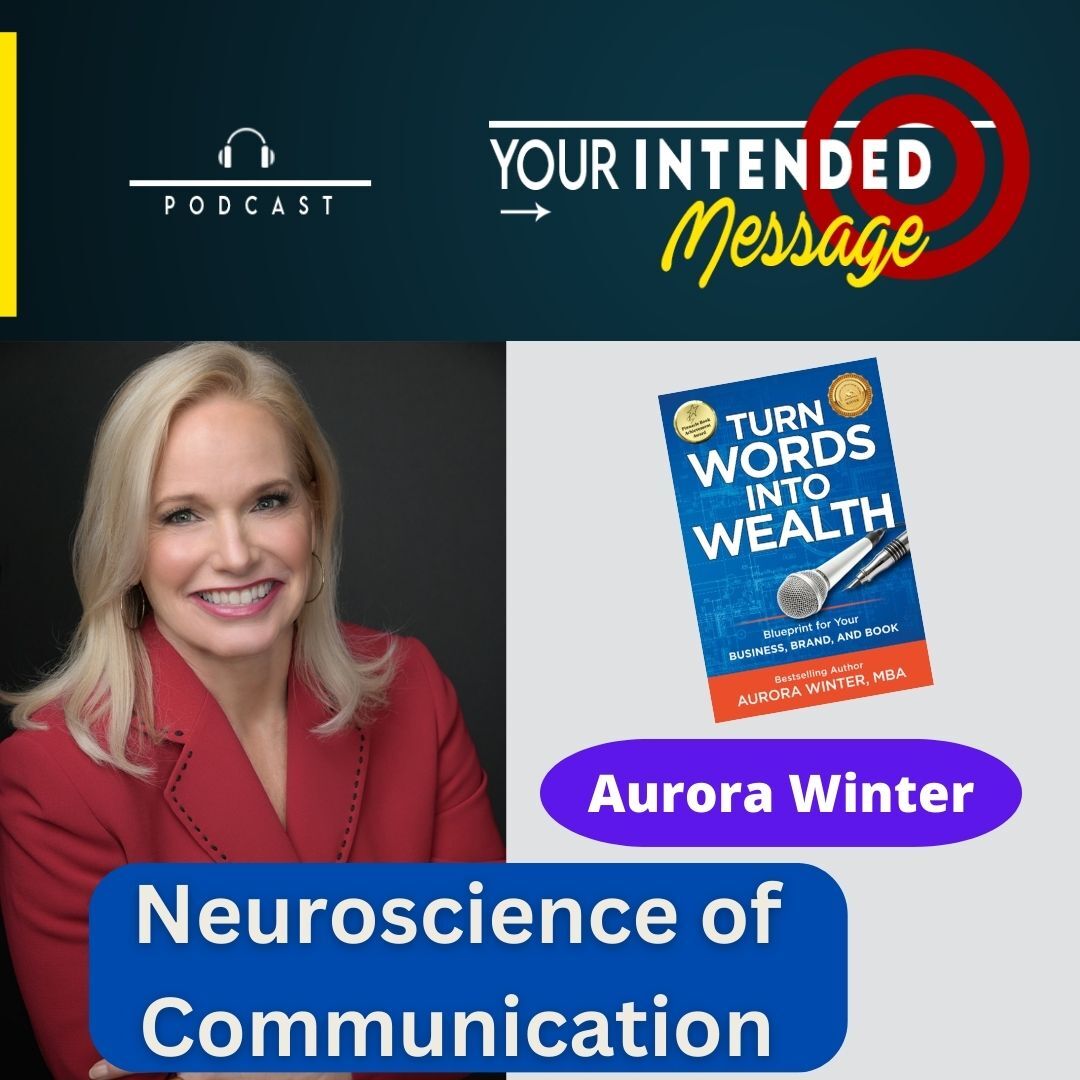
Ep 208Neuroscience of Communication: Aurora Winter
How to Turn Words into Wealth How to meet the needs of your three brain barriers Episode 206 (Aurora is based in Vancouver) In this conversation with Aurora Winter we explore: How does the brain understand words The wrong way to communicate The three levels of brain activity The critical role of the croc brain The connection between the mid brain and cerebral cortex The 27x effect of adding a story of significance About our guest, Aurora Winter: She's the award winning Best Selling Author of half a dozen books, including Turn Words into Wealth, A blueprint for your business brand and book to create multiple streams of income and impact Aurora learned how to reinvent herself and her life the hard way, when her 33 year old husband died suddenly leaving her widowed with a four year old son. She later learned how to master reinvention and pivoting and has launched three different businesses in different industries, which grew each to over seven figures. Learn more about Aurora and her services at: https://www.aurorawinter.com/ Check out her latest fiction books at MagicMysteryAndtheMultiverse.com ----- Excerpts from this conversation with Aurora Winter "It's our heart that provides the meaning and purpose and the values." "The right words in the right sequence, to the right audience, can change your mind, can change your business, can change your wealth in 20 minutes or less." "Human beings survived over the millennia by being cautious about where they want to expend calories or expend fat. The brain uses a lot of fat to process information." "We buy with emotion, we take action with emotion, either something we want to move toward or something we want to move away from." "People love to be a part of something that's bigger than themselves. People are hungry for meaning and purpose." ----- In the world of communication, the difference between a missed opportunity and a life-changing conversation can be as simple as choosing the right words. This week's podcast episode features Aurora Winter, a master of reinvention and a beacon of wisdom on how to leverage language for success. Aurora's journey is nothing short of inspiring. From the tragic loss of her husband to building million-dollar businesses, her experiences have culminated in a profound understanding of how to craft messages that resonate. In our conversation, Aurora delves into the neuroscience of communication, explaining how the brain processes information and why this matters for anyone looking to make an impact. With her book, "Turn Words into Wealth," Aurora provides a blueprint for those seeking to create influence and generate income through effective communication. She emphasizes the importance of addressing the 'croc brain' with a compelling hook, engaging the social 'midbrain', and finally, satisfying the intellectual 'cerebral cortex' with the substance of your message. But it's not just about the science. Aurora's approach is deeply rooted in the heart. She believes that numbers can't provide meaning and purpose—our values and passion do. Her insights on the emotional and social triggers that drive human behavior are invaluable for anyone from entrepreneurs to leaders to aspiring professionals. Listeners will find themselves armed with actionable tips, from crafting attention-grabbing titles to framing their offerings in a way that adds value and builds trust. Aurora's advice is a testament to the power of generosity and authenticity in building a brand and a legacy. This episode is a must-listen for anyone ready to elevate their communication game. Whether you're pitching a business idea, writing a book, or simply looking to connect more deeply with others, Aurora's guidance will help you turn your words into a wealth of opportunities. So, if you're eager to learn how to articulate your mission, convey your value, and truly connect with your audience, tune in to this enlightening conversation. It's time to transform your words into a tool for unparalleled success. Listen to the full episode now and join the ranks of those who know that the right message, delivered the right way, can indeed change the world. ----- ----more---- Your Intended Message is the podcast about how you can boost your career and business success by honing your communication skills. We’ll examine the aspects of how we communicate one-to-one, one to few and one to many – plus that important conversation, one to self. In these interviews we will explore presentation skills, public speaking, conversation, persuasion, negotiation, sales conversations, marketing, team meetings, social media, branding, self talk and more. Your host is George Torok George is a specialist in communication skills. Especially presentation. He’s fascinated by the links between communication and influencing behaviors. He delivers training and coaching programs to help leaders and promising professionals deliver the intended message for greater success. Connect with George www.SpeechCoachforExecuti
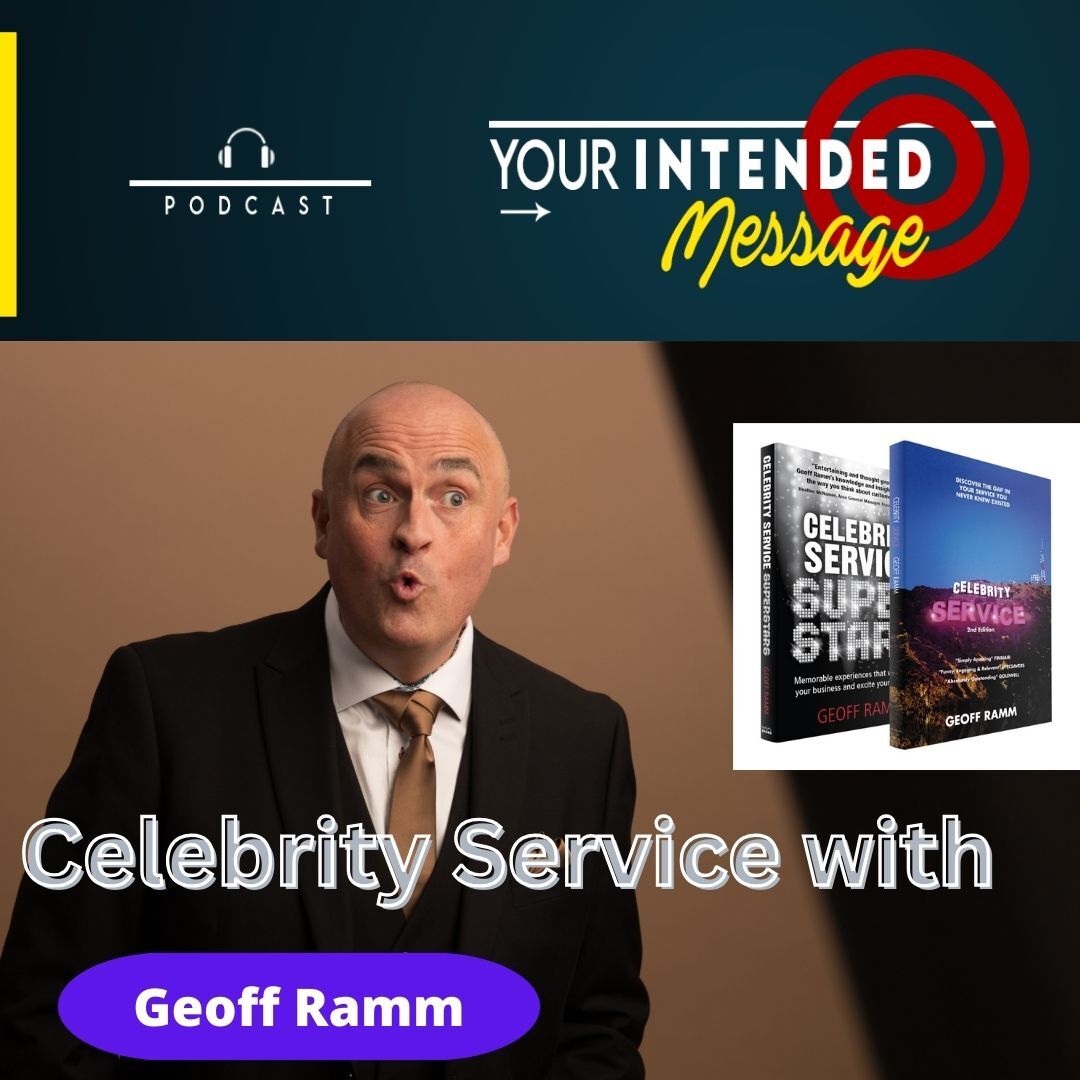
Ep 207How Can you Deliver Celebrity Service? Geoff Ramm
Why did Forbes call Geoff Ramm a Game Changer? Why the extra mile and exceeding expectations is not enough Episode 205 (Geoff is based in north east England) In this this conversation with Geoff Ramm we explore: What is the key question you need to ask to surpass the competition? How would you treat the A list celebrity differently? How would you serve George Clooney or Angelina Jolie? How big or small is the gap to deliver celebrity service? How to forge a strong emotional connection with your audience Why is personalization and how might you apply it to your business? What can you learn from successful customer service stories What's the difference between good service and celebrity service? About Our Guest Geoff Ramm: Forbes stated "Geoff Ramm is a Game Changer in the world of customer service". He is the author of two books, Celebrity Service and Celebrity Service Super Stars. He has delivered his message to audiences in 50 countries. Learn more about his books and service at https://www.geofframm.com/ ----- Excerpts from this conversation with Geoff Ramm: For anybody listening, I've got my hand up quite high, Jeff, we're pretty good. But there's always room for improvement. And I will challenge the audience and say, Where does that improvement come from? Because if you go the extra mile and exceed expectations, those are the words that your competition are talking about right now. And I said, in six months time, you'll have all got, you know, an extra mile further forward. But it's hardly the LEAP you could make unless you change your mindset. And you change your mindset with one question. And that question is a philosophy. It's a philosophy that I've wrote about, that I speak about all over the world. It's the philosophy that every audience, every team, every brand gets within seconds. And this is what I hope Forbes may have just seen in me. So as you write, how do you go from a seven to an eight to a nine to a 10? And beyond? It's this one question if your next customer, client, passenger member, guest, we're an A list, celebrity, Hollywood, God, or goddess, if your next client were Taylor Swift, George Clooney, Denzel Washington, what would you say? What would you do? How would you react? What would be the difference in the way that you would treat them? ----- But what I have George on screen, and you've seen this many times, when we've spoken internationally together, I show pictures of my daughter, and her love for coloring in and an art. And so I show these photographs of when she was little coloring in and so the audience can see what my dog, they know her name, they know what she loves. But now they can see her. And that connection to the audience is very, very strong. But I'm telling the story of this experience in a toy shop. But I see the funny and I see the quirky and all of the stories that I tell. And it was a beautiful piece of selling, it was a beautiful piece of customer experience. But it was all about personalization, which I talk a lot about, because people talk about personalization. But I don't see many examples. So when I deliver my stories, they're packed full of examples. But hopefully, there's some key tips and learnings from that that a business can go. ----- ----more---- Your Intended Message is the podcast about how you can boost your career and business success by honing your communication skills. We’ll examine the aspects of how we communicate one-to-one, one to few and one to many – plus that important conversation, one to self. In these interviews we will explore presentation skills, public speaking, conversation, persuasion, negotiation, sales conversations, marketing, team meetings, social media, branding, self talk and more. Your host is George Torok George is a specialist in communication skills. Especially presentation. He’s fascinated by the links between communication and influencing behaviors. He delivers training and coaching programs to help leaders and promising professionals deliver the intended message for greater success. Connect with George www.SpeechCoachforExecutives.com https://www.linkedin.com/in/georgetorokpresentations/ https://www.youtube.com/user/presentationskills https://www.instagram.com/georgetorok/

Ep 206Write Emails with Purpose, NOT by Accident: Liz Danziger
Write email that gets you the results you want. Avoid sending email that shows up in the news, or in court Episode 204 (repeat of #134, Liz is based in L.A.) Listen to this conversation with Liz Danziger before you send that toxic email and save yourself grief. About Liz Danziger: Liz is the author of four books published by major publishers including business writing guide, Get to the Point! She is also a columnist on Inc.com She has decades of experience in helping teams to write clearly and confidently. Her goal is to empower people to wield the power of words to create success. To receive her monthly writing tips called Writamins visit www,WorkTalk.com At the same site you can get your copy of Ten Tips for Communicating Effectively in a Fast-Paced World. You can arrange a complimentary 30-minute call to explore communication issues in your organization. Select a time on her calendar https://calendly.com/worktalk ------ Excerpts from this conversation with Liz Danziger: Mistakes that right off the bat, you could say, okay, stop doing this, this and this, and people's writing will dramatically improve? Yes, one thing is that they could know their purpose before they start and know their point before they start. My view is that most writing problems happen before a person starts to write. They happen in the thinking phase when people don't think about their purpose. And that's why I'm so pleased to be on this podcast, your intended message, because that's exactly what the worktop trainings are about is having people be clear on their intentions, and then target their readers. And so the first thing is to know your purpose and your point. The second thing would be to think about your reader it astonishes me sometimes, how people will just sit down and they're just tap it, tap it tap, but they're writing away. And then if I stopped them in coaching or in training, and I asked them, so what do you think your readers interested in? And they're like, oh, that's an interesting question. So they need to think about the reader and they need to use clear language. And the last thing I will say is, people have to reread before they send. It's a common common error that people just tap it tap and send without proofreading. And they live to bear the consequences.
Ep 205Stand out from the competition by being different: Daniel Den
Do you have copycat competitors? Does your message sound and look like everyone else? Episode 203 (Daniel is based in Florida) In this conversation with Daniel Den we explore: How to be so different that they can even begin to copy you What is the danger of looking like your competition? How can you position yourself in your niche? How to layer on more than one differentiating factor How to turn your product into an experience Why create a family of brands that support each other - like Apple How to start defining your difference How to describe your avatar to attract the right prospect About our guest Daniel Den: Daniel became fascinated with marketing and sales almost two decades ago. Today he is the co-creator of the X Factor Effect methodology where he and his team have helped over 20,000 students and clients grow their businesses. Daniel teaches that “Different is the new Better” and his framework includes nine pillars for differentiating your business so that you can become a market leader or category king or queen. Daniel Den is the author of the new book "Ideas That Influence," that was built to help business owners discover their own WILDLY SUCCESSFUL MARKETING IDEAS! ----- Get your Big Ideas Box at https://www.bigideasbox.com/free-box-ideas-that-influence ----- Excerpts from this conversation with Daniel Den: If we are doing things exactly like our competition, then we end up becoming the average of our competition and the average competition goes out of business within about five years. ----- And what we discovered is that if we take one big difference, but then stack that with another big difference, and then stack that with two or three big differences, additional differences, then you can get to the point where you become such a unicorn in your market, where the barrier of copy ability is just too high. And where it would be laughable if somebody decided to copy you, after you had implemented all of those differences. And so amongst the nine different pillars that we've come up with, we help people become drastically different to the point where they are a unicorn inside of their market, where they can quickly become a market leader, or a category king or category queen. And that makes all the difference that makes all the difference. ----- We call it joining the age of experience. And the age of experience, what we've found, George, is that we all have enough stuff. We all are blessed. Today, we all have lots of stuff. mass produced, we can pretty much get access to anything. And in today's world, stuff is not what people want anymore. What people want more, is a great experience, and they're willing to spend their disposable income on a great experience. ----- Any damn fool can put on a deal. But it takes genius, faith and perseverance to create a brand. Dan Ogilvy, ----- ----more---- Your Intended Message is the podcast about how you can boost your career and business success by honing your communication skills. We’ll examine the aspects of how we communicate one-to-one, one to few and one to many – plus that important conversation, one to self. In these interviews we will explore presentation skills, public speaking, conversation, persuasion, negotiation, sales conversations, marketing, team meetings, social media, branding, self talk and more. Your host is George Torok George is a specialist in communication skills. Especially presentation. He’s fascinated by the links between communication and influencing behaviors. He delivers training and coaching programs to help leaders and promising professionals deliver the intended message for greater success. Connect with George www.SpeechCoachforExecutives.com https://www.linkedin.com/in/georgetorokpresentations/ https://www.youtube.com/user/presentationskills https://www.instagram.com/georgetorok/

Ep 204PowerPoint Success: Ellen Finkelstein
Make PowerPoint Enhance Your Presentation Don't be a PowerPoint Fool Episode 202 (Ellen is based in Iowa) In this conversation with Ellen Finkelstein we explore: Common mistakes to avoid when presenting with PowerPoint How to take a more productive approach to your presentation How your words, slides and delivery contribute to your success Why text on your slides stop people from listening How non-designers can create attractive slides The importance of practicing your presentation Your secret helpers - Text Pane and Presenter View Guidelines and tests for effective slide design How to fix boring slides About our Guest Ellen Finkelstein: She's a PowerPoint MVP and has been one since 2010. That's a Microsoft award and it stands for Most Valuable Professional. There are only 18 in the United States. Ellen has been training and writing about PowerPoint since before 1999, including several books (written quite a while ago) and her PowerPoint Tip blog. She isn't a designer so she loves to help non-designers create great PowerPoint slides that communicate clearly, command attention, and help the audience understand and remember the message. ----- The Techniques that Will Make Designing Your Slides EASY!" https://www.ellenfinkelstein.com/pptblog/getstarted/ ----- And so that's what how you have to write the content. And I do recommend doing that outside of PowerPoint and it's thinking about what you're saying. So number two, I'll just go really quickly on the slide poor but everybody knows what death by PowerPoint is there's just lots and lots of text on a slide, slide after slide of text. There's a fair amount of research that shows that we can't listen and look at the same time. That research is why there are some states that have laws against even being on the phone while you're you're listening to someone and talking to somebody while you're driving. Okay, because you can't really listen and see at the same time, probably what the person is saying on the phone is a lot more interesting than what's in front of you. So when you put up a slide with a lot of text, people start to read it, we're more visual, the part of the brain that that takes in visual information is much bigger than the part that takes an auditory information. People read it, but they can read faster than you could speak. So they read ahead of you, they're not listening. And then when they're finished, they go back to listening to you. And they see that, oh, I've already read that. So why should I pay attention to the speaker? ----- That image should help people understand and remember what you are saying. ----- I mentioned that presenters screen which functions a little bit like a teleprompter, and so the audience doesn't see it, you see your notes that you've put in the Text Pane, but they just see the slides. ----- Never make text move. So don't make text fly in or fly up. It's almost always annoying to the audience. Because as the text is flying in, they see it and trying to read it, but it's moving. It gives people a headache. It's not nice to the audience to do that. So I would say I almost always use either appear or fade, if I'm using it on text, you know, it doesn't move at all. ----- ----more---- Your Intended Message is the podcast about how you can boost your career and business success by honing your communication skills. We’ll examine the aspects of how we communicate one-to-one, one to few and one to many – plus that important conversation, one to self. In these interviews we will explore presentation skills, public speaking, conversation, persuasion, negotiation, sales conversations, marketing, team meetings, social media, branding, self talk and more. Your host is George Torok George is a specialist in communication skills. Especially presentation. He’s fascinated by the links between communication and influencing behaviors. He delivers training and coaching programs to help leaders and promising professionals deliver the intended message for greater success. Connect with George www.SpeechCoachforExecutives.com https://www.linkedin.com/in/georgetorokpresentations/ https://www.youtube.com/user/presentationskills https://www.instagram.com/georgetorok/
Ep 203Story Telling for Business Leaders: Graham Brown
How to use Three-Box Storytelling to build Relationships A simple method to frame and tell your stories Episode 201 (Repeat of #68) At the time of this interview, Graham Brown was based in Singapore Highlights from this conversation about storytelling The Heart as an Analogy (00:00:00) An analogy for the heart as a symbol of music, love, and relationships. Introduction of Graham Brown (00:01:22) Overview of Graham Brown's background and achievements. Introduction to Three Box Storytelling Technique (00:02:45) Explanation of the three-box storytelling technique and its application in business communication and sales presentations. Three Scenes of a Story (00:04:03) Explanation of the three scenes in a story using the example of "A Christmas Carol." Application of Three Box Technique in Sales Presentation (00:06:07) Demonstration of how a business leader can use the three-box technique in a sales presentation. Transformation and Crossing the River (00:10:44) Discussion on the transformation journey in storytelling and the symbolism of crossing the river as a challenge. Importance of Trust in Storytelling (00:12:22) The significance of establishing trust through commonality and backstory in storytelling. Power of Analogies in Communication (00:14:52) Exploration of analogies as short form stories and their effectiveness in communicating unfamiliar concepts. Creating Familiar Territory in Communication (00:20:04) Emphasizing the importance of finding familiar territory in introducing new ideas or technologies. Behavior Change and Familiarity (00:21:48) Highlighting the role of familiarity in facilitating behavior change and acceptance of new concepts. The familiarity part (00:22:56) Neuropsychological studies show the brain can't distinguish between past, present, and future, making familiarity crucial in storytelling. Archetypes and plot lines (00:24:42) Joseph Campbell's hero's journey and the use of existing archetypes and plot lines in storytelling. Podcast guesting agency (00:27:03) Graham Brown's agency, Podcast Guesting Pro, helps people get booked on podcasts and navigate the process. Effective use of stories in sales presentations (00:29:52) Maya Angelou's advice on making people feel something, using the power of the backstory, and the importance of practice in storytelling. ---- Podcast Guesting Pro is a dedicated Podcast Booking Agency that works with B2B thought leaders. They help you reach new audiences and build your authority by booking you on podcasts to showcase your expertise and spread your message. Learn more here... https://www.podcastguesting.pro/ ----- ----more---- Your Intended Message is the podcast about how you can boost your career and business success by honing your communication skills. We’ll examine the aspects of how we communicate one-to-one, one to few and one to many – plus that important conversation, one to self. In these interviews we will explore presentation skills, public speaking, conversation, persuasion, negotiation, sales conversations, marketing, team meetings, social media, branding, self talk and more. Your host is George Torok George is a specialist in communication skills. Especially presentation. He’s fascinated by the links between communication and influencing behaviors. He delivers training and coaching programs to help leaders and promising professionals deliver the intended message for greater success. Connect with George www.SpeechCoachforExecutives.com https://www.linkedin.com/in/georgetorokpresentations/ https://www.youtube.com/user/presentationskills https://www.instagram.com/georgetorok/
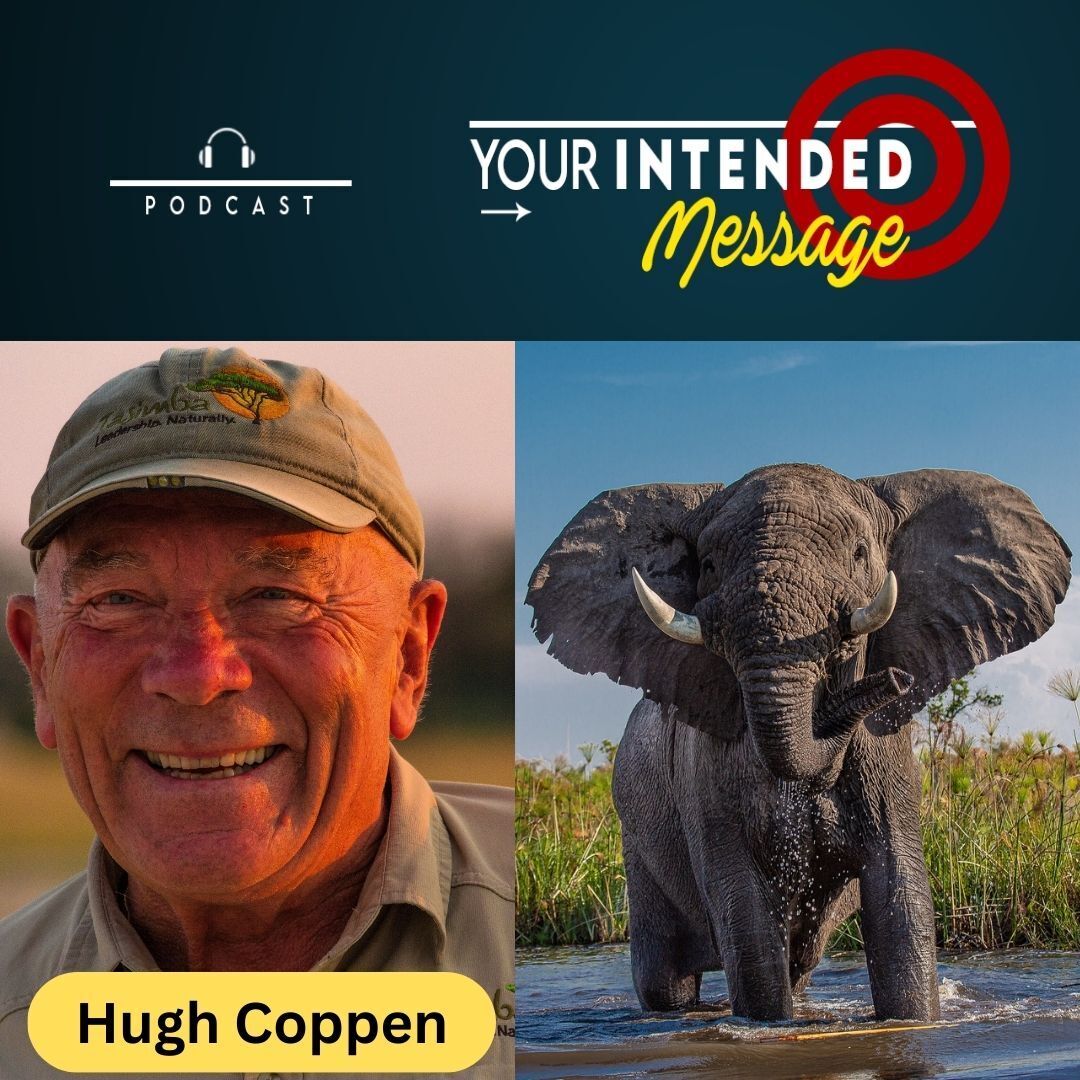
Ep 202Communication Lessons from Nature: Hugh Coppen
Why is listening a life saving skill in nature Let's learn communication skills from the elephants In this enlightening episode, host George Torok chats with leadership consultant and coach, Hugh Coppen. Episode #200 (Repeat of #57) When he's not on safari in Zimbabwe, Hugh lives in California. Coming from a Zimbabwean farm, Coppen has a deep-seated love for wildlife. Now, as a leadership consultant, he channels his passion into valuable lessons for CEOs worldwide. His company, Tasimba, provides immersive safari experiences in Zimbabwe, creating a unique environment for personal and professional growth. In this discussion, Coppin draws fascinating parallels between wild animal communication (especially elephants) and how we as humans can use similar communication methods. From understanding body language to acknowledging the power of silence, we explore lessons from the wild that can enhance our effectiveness in communication. We delve deeper into 'listening' - not just to spoken words, but to non-verbal cues and our surrounding environment. Given their lack of speech, wild animals embrace body language and other communication modes that are insightful to us. Coppen uses practical examples from the animal kingdom, like the positioning of an elephant's head or a flapping of the ears, to underline the importance of body language in effective communication and building listeners’ trust. This episode, combining adventurous storytelling with critical leadership insights, is a must-listen for professionals looking to enhance their communication skills or anybody interested in learning from nature. We also look at advanced communication skills in wilderness creatures like Rams and impalas,, especially during their mating seasons. These creatures have evolved complex vocalization methods and an astounding sense of sound, facilitating communication across great distances, safeguarding them from predators. Another point of discussion is the intricate sub-aural communication method elephant families use. These communications, mostly unheard by humans and predators, help elephants coordinate complicated activities and respect for each other. The example of Cape buffalo herds coming together in large numbers during scarce resources is another humbling lesson to humanity. Finally, we examine the immersive safari tours in Zimbabwe hosted by Tasimba. These tours provide a unique opportunity to understand nature’s wonders more deeply and learn valuable lessons about living harmoniously with nature. Many guests return with a renewed commitment to conserve wildlife and their habitats following these transformative experiences. Consider the perspective of how observing wilderness communication can provide profound insights into better communication, collective living, and harmonizing with nature's wisdom. ----- Enjoy the beautiful wilderness photos here. ----- ----more---- Your Intended Message is the podcast about how you can boost your career and business success by honing your communication skills. We’ll examine the aspects of how we communicate one-to-one, one to few and one to many – plus that important conversation, one to self. In these interviews we will explore presentation skills, public speaking, conversation, persuasion, negotiation, sales conversations, marketing, team meetings, social media, branding, self talk and more. Your host is George Torok George is a specialist in communication skills. Especially presentation. He’s fascinated by the links between communication and influencing behaviors. He delivers training and coaching programs to help leaders and promising professionals deliver the intended message for greater success. Connect with George www.SpeechCoachforExecutives.com https://www.linkedin.com/in/georgetorokpresentations/ https://www.youtube.com/user/presentationskills https://www.instagram.com/georgetorok/

Ep 201How to deal with angry people and calm them down: Doug Noll
You can calm that angry person in 90 seconds or less Treat anger as a normal emotional response that you can control Episode 199 (Doug is based in California and this is a repeat of episode 117) Why you need to listen to this episode now. If you ever need to face angry people and want a better way to manage the situation, listen to this conversation to save the situation and relationship. If you ever feel out of control from your own anger, examine this perspective to maintain your dignity while deescalating the situation. ----- George Torok and special guest, Doug Knoll - an attorney turned peacemaker - explore the nuanced world of anger and its impact on both personal and professional environments. Focusing on de-escalation strategies and the key role of active listening, this podcast sheds light on how to manage one's emotions, particularly anger, in challenging situations. Knoll provides a unique perspective on anger, viewing it as a response to boundary violations rather than labeling it as “good” or “bad”. His de-escalation strategies have found success in the most unlikely of places, including maximum-security prisons, attesting to their effectiveness. The takeaways from this episode can help leaders better understand their team's emotions, promote effective conflict resolution, and ensure a healthier, more empathetic workspace. The podcast dives deep into the concept of triggers and their role in hijacking rationality, offering effective tactics to anticipate, understand, and respond to these emotional triggers. The importance of self-awareness and self-regulation are highlighted, along with a novel approach to redirect the frustration caused by commonly-encountered triggers. Transitioning into the more sensitive realm of emotional invalidation, the episode examines its harmful effects in personal and professional relationships. The discussion is geared towards parents, teachers, team leaders, and anyone looking to foster emotional safety and create deeper, healthier relationships. The importance of emotional validation is underpinned, coupled with practical techniques to effectively validate and address emotions. Notably, this episode not only offers intellectual paths to managing anger but also guidance for those grappling with pervasive anger issues stemming from trauma. Prepare to be drawn into a riveting conversation about controlling anger for personal growth and professional success as you tune into this podcast. ----- About Doug Noll Doug Noll is a lawyer-turned-peacemaker. In addition to his law degree, he has a Masters Degree in Peacemaking and Conflict Studies. In 2000, he left a successful law practice as a civil trial lawyer to help people resolve conflicts without litigation or conflict. Doug was born nearly blind, partially deaf, and with two clubbed feet. His disabilities were challenging to overcome….and he did He’s a second-degree black belt and tai chi master, a certified ski instructor, an airplane and helicopter pilot, a white-water river rafter, and a jazz violinist. Doug teaches people how to de-escalate angry people in 90 seconds or less. His fourth book, an Amazon bestseller, is called De-Escalate: How to Calm an Angry Person in 90 Seconds or Less. Doug has online video courses and provides workshops and coaching to individuals and organizations desiring to increase their emotional competency. As a listener of Your Intended Message you are entitled to receive a free book, How to Listen Others into Existence. Learn more Doug Noll here https://dougnoll.com/ ----- ----more---- Your Intended Message is the podcast about how you can boost your career and business success by honing your communication skills. We’ll examine the aspects of how we communicate one-to-one, one to few and one to many – plus that important conversation, one to self. In these interviews we will explore presentation skills, public speaking, conversation, persuasion, negotiation, sales conversations, marketing, team meetings, social media, branding, self talk and more. Your host is George Torok George is a specialist in communication skills. Especially presentation. He’s fascinated by the links between communication and influencing behaviors. He delivers training and coaching programs to help leaders and promising professionals deliver the intended message for greater success. Connect with George www.SpeechCoachforExecutives.com https://www.linkedin.com/in/georgetorokpresentations/ https://www.youtube.com/user/presentationskills https://www.instagram.com/georgetorok/

Ep 200Seven Magic Words to Influence People: Tim David
The Magic Words to Motivate, Engage & Influence Seven simple words to boost the power of your message Episode 198 (Tim is based in Boston) In this conversation with Tim David we explore: What we can learn from magicians about recognizing other's perspective Magic techniques to grab the attention of your audience What is it about magic that capture our imagination? How to connect with people How to leverage intended mistakes or flaws to appear more human How your subconscious brain reacts to these magic words Why you pick words that sound like their name The sin of being an irresponsible communicator The five ways to get the best results from saying thanks About our Guest Tim David: Tim is the author of several books, including, "Magic Words: The Science and Secrets Behind 7 Words that Motivate, Engage and Influence". A CNN piece listed him as the 9th best motivational speaker in the world. For 8 years, he was a professional magician touring and delivering up to 300 shows a year. Learn more about his latest book here: Magic Words: The Science and Secrets Behind 7 Words that Motivate, Engage and Influence ----- Excerpts from this Conversation with Tim David: The thing that magicians really focus on is the other person's perspective. And if you think about it, a magician is going to practice for hours in front of a mirror so that we can see what you see, we're going to video record ourselves, we're going to hire coaches to sit in different seats of the theatre, so that we know exactly what each audience member is experiencing. In fact, there's a phrase that magicians tell each other all the time when they're critiquing each other. And the phrase is, watch your angles. ----- One of my speaking coaches said to me, I need you to pretend that half of your audience is blind, and half of your audience is deaf. That way you can cater your audio and you can cater your visual messages and treat each one independently. ----- The seven words are yes, but if because, help, thanks, and a person's name, and a person's name. ----- ----more---- Your Intended Message is the podcast about how you can boost your career and business success by honing your communication skills. We’ll examine the aspects of how we communicate one-to-one, one to few and one to many – plus that important conversation, one to self. In these interviews we will explore presentation skills, public speaking, conversation, persuasion, negotiation, sales conversations, marketing, team meetings, social media, branding, self talk and more. Your host is George Torok George is a specialist in communication skills. Especially presentation. He’s fascinated by the links between communication and influencing behaviors. He delivers training and coaching programs to help leaders and promising professionals deliver the intended message for greater success. Connect with George www.SpeechCoachforExecutives.com https://www.linkedin.com/in/georgetorokpresentations/ https://www.youtube.com/user/presentationskills https://www.instagram.com/georgetorok/

Ep 198Boost your Face-to-face Networking: Will Kintish
Face to Face Networking is back and more important How to get out and meet people in person Episode 197 (Will is based in the UK) In this conversation with Will Kintish, we explore: The three fears that people face when networking The myths and realities of face-to-face networking How to boost your self-confidence when attending an event How to go to an event with a friend for support Recognizing open versus closed groups How to introduce yourself to strangers Better ways to open the conversation How to build the relationships - the real purpose The importance of follow-up after the first meeting About our guest, Will Kintish: Will’s expertise and knowledge helps develop face-to face networking skills to ensure successful careers The key to success in todays’ modern world is to be visible and proactive. Will gives you the tools to be able to do these. Will is in his 60th year of work and knows his subject matter is as relevant today as it was when he started working Learn more about his book: Business Networking: The Survival Guide Excerpts from this conversation with Will Kintish: People have got to know who you are, people have got to know what you do. And people need to know what is going on in the marketplace. And those are the three key reasons why we all need to be out there. ----- if you're going to a networking event, people are there for the same reason you're there to meet other people. ----- They're all everybody's there for the same reason. They're looking for what I call the aha moment, the light bulb moment, we are looking to going back to our friend Dale Carnegie, we are there to make friends and influence people. Your program is called your intended message. And the message has to be you're just going to create new relationships, no selling whatever you do, don't go selling other than your personality. Simple as that. And, for example, how do we get the show on the road? How do we get that first question out? I mean, the easiest people to join, even if you go with if you go on your own, George that person standing alone against the wall is the easiest person to approach. You go up to them slowly, you smile at them, you look them in the eye and say "Hello there, please may I introduce myself?" I mean, what can be easier, or "Please may I join you?" Simple as that. And then you start with that, and you introduce yourselves. Now it's at this moment, a lot of people get it wrong, right from the start. Because 90% of people admit it to me. I'm rubbish with names, I forget their name immediately. And I say no, you don't forget their name. You didn't hear it good. You're not listening to names. When it comes to networking at relationship building is fundamental. So if I go up to you, I am going to concentrate on the listening for your name. If you say it very, very quickly, George Torok. And it's a noisy room and I don't hear, "Sorry, tell me again". you're never going to say to me, I've told you once, I'm not going to tell you again. You're never going people aren't ever going to say that. But by making sure you get their name, you use their name a couple of times, and make sure it sticks. You're not going to remember everybody's name at the event. But whilst I'm talking to you, George, I'm going to remember your name. Because what happens if my friend Mary comes over and I have to introduce you. And I've forgotten your name. That is very, very embarrassing. And you're not going to feel good about me. Because I've forgotten your name. So I work very hard at remembering your name. Now, maybe 20 minutes later, when I've gone off to meet other groups, I might have forgotten your name. But while you and I are in that conversation, your name is going to stick with me. ----- ----more---- Your Intended Message is the podcast about how you can boost your career and business success by honing your communication skills. We’ll examine the aspects of how we communicate one-to-one, one to few and one to many – plus that important conversation, one to self. In these interviews we will explore presentation skills, public speaking, conversation, persuasion, negotiation, sales conversations, marketing, team meetings, social media, branding, self talk and more. Your host is George Torok George is a specialist in communication skills. Especially presentation. He’s fascinated by the links between communication and influencing behaviors. He delivers training and coaching programs to help leaders and promising professionals deliver the intended message for greater success. Connect with George www.SpeechCoachforExecutives.com https://www.linkedin.com/in/georgetorokpresentations/ https://www.youtube.com/user/presentationskills https://www.instagram.com/georgetorok/
Ep 197Pause for Power: George Torok
Use the pause to emphasize your message when speaking Solo show featuring George Torok Episode 196 In this show you will hear 10 reasons to make tactical use of the pause in your speaking George Torok is known as the Speech Coach for Executives. He coaches executives to deliver more powerful and confidence presentations. https://www.speechcoachforexecutives.com/ He trains professionals to deliver Superior Presentations. ----- Excerpts from this episode about the pause: Pause for Power: Why you need to become comfortable with silence! Do you remember that cliché “Silence is Golden”? There are times when you might appreciate some silence in your life. On the other hand, silence can feel disquieting, disturbing and anxiety ridden. When you are speaking to an audience you might consider silence the enemy or the sign of a bad presentation. Imagine that you get lost in your thoughts and stop speaking. You go silent and anguish while trying to recover and start speaking again. You might even feel that any noise is preferable to silence. That’s when the umms and ahhs escape your lips. Don’t panic. Consider the positive benefits of pauses in your presentation. Even an unplanned pause can be perceived as a positive light. Imagine how you can improve the power of your presentation by inserting tactical pauses throughout the presentation. The ability to pause might be the most important technique that all speakers need to learn. It might sound simple but like many simple lessons, it’s not easy. It can be extremely difficult to pause when you are delivering a presentation. You might feel compelled to speak because you believe silence is the enemy. You perceive pausing as a sign of weakness. The reality is that silence could be your most powerful communication tool. Perhaps you’re not convinced. That’s understandable. Consider these examples and reasons to pause during your presentation. Let’s follow the advice from Simon Sinek and start with the why. Listen to these 10 reasons to use the pause in your presentation.

Ep 196Design Thinking for User Experience: Ben Sauer
How can you apply Design Thinking to your presentation? What is the total experience of your audience? Episode 195 (Ben is based in the UK) In this conversation with Ben Sauer, we explore: How might design thinking apply to presentation design and delivery? How to think from the audience perspective? Why the details mater How to design your presentation on the wall with post-it notes Why design is more about "how it works" vs "how it looks" What is the empathy gap that you need to recognize About our guest Ben Sauer: Ben is a designer who helped designers present more effectively. He's since learn how to apply design thinking to presentation development and delivery. He is the author of the book, Death by Screens, How to Present High Stakes Digital Work, Check out his book here. https://bensauer.net/deathbyscreens/ ----- Excerpts from this conversation with Ben Sauer: We're coming at communication from a different angle today from the concept of how designers think and what you've learned from that process and how you've translated that into better communication. So let's start with how do designers think and how do they communicate? That's a great question. Well, you know, I coached designers on how to communicate. So you know, they still have some ways to go. What I would say about that is, they really like to think in depth about how something affects the audience or the users. And so what I would suggest that other people can learn from designers is, if you can learn a bit about how they think it can really improve how you deliver your intended message. And then there's also the process. So how do they go about crafting a message or a piece of communication? These are all skills, you know, we tend to think of design. When most people hear the word design, they think of it in the aesthetic sense. But that's not really how most designers think they like to think about how something works, what the experiences that somebody is receiving at the other end. And I believe Steve Jobs, I'm paraphrasing badly, but he said something like this, you know, design people think design is the surface, but actually it's how something works. Yeah. Hmm. ----- So designers like to go into these details about what somebody is experiencing, whether it's the thing, the screen, as well as the voice and the story, the environment to you know, this is why we have this phrase called user experience design. So what is that person experiencing? ----- I think there's a, there's effectively an empathy gap. That's what you're talking about, right? Which is how does somebody with an idea about what should happen ie a designer, or somebody crafting a message, actually connect with the state of mind of the person who's going to receive it or use it? ----- ----more---- Your Intended Message is the podcast about how you can boost your career and business success by honing your communication skills. We’ll examine the aspects of how we communicate one-to-one, one to few and one to many – plus that important conversation, one to self. In these interviews we will explore presentation skills, public speaking, conversation, persuasion, negotiation, sales conversations, marketing, team meetings, social media, branding, self talk and more. Your host is George Torok George is a specialist in communication skills. Especially presentation. He’s fascinated by the links between communication and influencing behaviors. He delivers training and coaching programs to help leaders and promising professionals deliver the intended message for greater success. Connect with George www.SpeechCoachforExecutives.com https://www.linkedin.com/in/georgetorokpresentations/ https://www.youtube.com/user/presentationskills https://www.instagram.com/georgetorok/

Ep 195Your Linkedin Profile Might be Hurting You: Donna Serdula
What does your Linkedin profile say about you and your organization? Using Linkedin to project your personal brand Episode 194 (Donna is based in Pennsylvania) In this conversation with Donna Serdula we explore: What can executive leader gain from enhancing their Linkedin Profile Why Linkedin is more than a job board Why leaders should help their employees enhance their profiles How to clarify the purpose of your Linkedin presence Is your profile current or ancient history? Who are you and what do you stand for? Why your profile must not look like a resume even if you are searching Why the company might help their staff look better on Linkedin About our guest Donna Serdula: Donna wrote a "For Dummies" book on the topic of Linkedin profiles. She started her business in 2009 and has since branded over 8,000 executives, entrepreneurs and professionals on Linkedin and beyond. Review and upgrade your Linkedin profile by visiting https://www.linkedin-makeover.com/order-today/ ----- Excerpts from this conversation with Donna Serdula: The LinkedIn profile, it's not the resume. It's a digital introduction. It's a first impression, it is your manifesto. ----- If you want to be a thought leader, if you really want to dominate the platform, you want to post more than less, but at the same time, you can truly engage with your network and get seen by posting once a week. It's not so much the quantity as much as it's the quality. ----- LinkedIn wants fresh profiles showing up active people, people who have something to say. So by making sure that your profile is up to date, it would be more apt to show up in the search results, versus one that hasn't been touched in six months, right. When you think of it like that, it makes sense. Keep your profile fresh, you're going to do better in search results. ----- How do you decide when you connect versus simply let them follow? Oh, that's a great question because there is a difference right? connection versus a Follow Follow is one one way street. It's you saying, hey, I want to subscribe to that person's updates. Whereas when you connect, it's saying, Hey, I know this person, I like I trust this person. And not only am I subscribing to them, but they're going to subscribe to me, and they're going to be in my network, they're grew to become first degree connections, and all of their connections are going to become second degree connections, and all of those connections, connections are going to become third degree connections. So it really does extend your reach when you connect, when that's a good thing. ----- ----more---- Your Intended Message is the podcast about how you can boost your career and business success by honing your communication skills. We’ll examine the aspects of how we communicate one-to-one, one to few and one to many – plus that important conversation, one to self. In these interviews we will explore presentation skills, public speaking, conversation, persuasion, negotiation, sales conversations, marketing, team meetings, social media, branding, self talk and more. Your host is George Torok George is a specialist in communication skills. Especially presentation. He’s fascinated by the links between communication and influencing behaviors. He delivers training and coaching programs to help leaders and promising professionals deliver the intended message for greater success. Connect with George www.SpeechCoachforExecutives.com https://www.linkedin.com/in/georgetorokpresentations/ https://www.youtube.com/user/presentationskills https://www.instagram.com/georgetorok/
Ep 194Don't send that email yet: Grace Foster
How to write smarter emails Writing is a learned skill Episode 193 (Grace is based in Washington DC) In this conversation with Grace Foster we explore: Why we need to learn how to write smarter emails The danger of emotional writing Checking your writing for tone Consider the New York Times test Recognizing our negative bias Why you don't want to "bury the lead" How to kick start the writing process Recognizing the difference between the terrible drafts and final edit About our guest: Grace Aldridge Foster is co-founder of Bold Type, a WBENC certified 100% women owned company that trains people how to write more effectively in the workplace. Learn more about her company and services here https://www.boldtype.us/ Get the free guide to remove clutter from your writing https://www.boldtype.us/clutterbust ----- Excerpts from this conversation with Grace Foster: Your writing speaks for you when you're not in the room. So you have to work harder to make sure that that your message is being received the way you intended it, because you aren't there to walk it back or to course correct. ----- George, where do I start? I'll first say that I have a lot of sympathy for people writing emails, because we're all expected to do it. We write emails all day, every day, they are the cornerstone of workplace communication. And yet no one actually has been taught how to write good emails, what happens is we just get into the workplace, and we start observing how other people do it. And we start emulating them. Well, what happens if everyone who's already there is already writing terrible emails, you never sort of had a chance, right? So I just want to say there are a lot of people out there who are very smart, and actually very good writers, but who still write terrible emails. And mostly it's because they've never been taught to do better. Things that I noticed are, of course, terrible subject lines, mostly people actually include subject lines these days, thankfully, gone are the days of kind of empty subject lines, because their spam filters, you know, latch on to those completely. But a lot of times, folks are just way too vague in their subject lines. And I think one of the reasons for that is people forget one of the primary purposes of sending an email versus something else picking up the phone and calling for example, is that you have a record, your inbox is an archive, you can search your inbox looking for a particular conversation or message from someone. But when you have a very vague subject line, it gets much more difficult to search for a particular email or particular conversation that you had previously. So it's not just that they're vague, which is a problem the first time you receive them that it becomes a problem also, if you want to find that email again later. So that is certainly a common problem that I see. There. Also, too long. Emails are too long. They are too wordy. They're either too formal or not formal enough, right. The level of formality often doesn't fit the audience and the purpose of a particular message. And something that we may talk about is that the frustration that I hear over and over from managers who engage in bold type to do email training is why don't my employees just know how to do it right. It's a judgement call. All it's a judgement issue, you know, why don't they just understand why don't they just get that that email of a sent wasn't right. But that's a difficult thing to learn, it takes time. ----- You should email like, your messages might end up on the front page of The New York Times because it's happened. ----- ----more---- Your Intended Message is the podcast about how you can boost your career and business success by honing your communication skills. We’ll examine the aspects of how we communicate one-to-one, one to few and one to many – plus that important conversation, one to self. In these interviews we will explore presentation skills, public speaking, conversation, persuasion, negotiation, sales conversations, marketing, team meetings, social media, branding, self talk and more. Your host is George Torok George is a specialist in communication skills. Especially presentation. He’s fascinated by the links between communication and influencing behaviors. He delivers training and coaching programs to help leaders and promising professionals deliver the intended message for greater success. Connect with George www.SpeechCoachforExecutives.com https://www.linkedin.com/in/georgetorokpresentations/ https://www.youtube.com/user/presentationskills https://www.instagram.com/georgetorok/
Ep 193How to address the Toxic Rock Star: Dotty Posto
Help the toxic star and save your team "Does not play well with others" Episode 192 (Dotty is based in Milwaukee) In this conversation with Dotty Posto we explore: Why do some leaders get mean, and degrading? How to address this challenge with promising leaders Identifying the anger and frustration and how to redirect it Can we save this toxic person to become a true team supporter The process of diagnosing and correcting destructive behavior Looking for the balance in their life About our guest Dotty Posto: Dotty Posto helps CEOs and Senior Leaders ignite their stagnant culture to inspire their people to outstanding performance. Dotty began her coaching and consulting business after working in Organizational Development for Fortune 500 companies such as The Chicago Tribune, Aon-Hewitt and Harley-Davidson Motor Company. Dotty’s clients say, through their work with her, they’ve experienced new levels creativity, effectiveness, and well-being...without the struggle they'd become accustomed to. Learn more about Dotty and her services at her website https://inplainsightinc.com/ You can find a free Energy Assessment and the free videos for Leadership Development ----- Excerpts from this conversation with Dotty Posto: I've seen leaders really get mean, I've seen leaders get judgmental and degrading, and to me that has no place in the workplace. ----- And that's what's making that action, whatever action is causing the "does not play well with others" on my report card. Some people call it a personality conflict, which I do not like that term. It is,, we are in such a brain state of reactivity, that something happens out there that we've seen or heard or experienced before, and it's triggering us and our amygdala is saying that our brain is saying you're not safe. And it goes into fight, flight or freeze or there's also tend-to. befriend or fawn-on that some women do. A woman might go into people pleasing, might go into, oh, everything's great, everything's fine. And, and never challenge anyone, or someone might be in the fight, and really go into challenging others and, and being very defensive and angry and upset, and, and so there's these two sides of the spectrum that people can react to when they have those triggers. And it's creating what I work with people to do is create that space of choice to be able to first realize that it isn't what's out there. It's got nothing to do with what's out there. It's what's happening in here. And in here, what's going on in our body? What's going on with that anger, that frustration? And what are the thoughts that are sending me there from an anger, frustration perspective? ----- I think there's a few things. When I first started working at Harley, one of my managers gave me three leadership principles. And one of them was get curious. Before you get furious, I am a huge proponent of providing feedback. And if they see an escalating situation, it might even be get curious, ask a question. Say, Hey, you seem to be getting upset. What's happening that's creating this frustration, help us understand why you're getting frustrated here. ----- ----more---- Your Intended Message is the podcast about how you can boost your career and business success by honing your communication skills. We’ll examine the aspects of how we communicate one-to-one, one to few and one to many – plus that important conversation, one to self. In these interviews we will explore presentation skills, public speaking, conversation, persuasion, negotiation, sales conversations, marketing, team meetings, social media, branding, self talk and more. Your host is George Torok George is a specialist in communication skills. Especially presentation. He’s fascinated by the links between communication and influencing behaviors. He delivers training and coaching programs to help leaders and promising professionals deliver the intended message for greater success. Connect with George www.SpeechCoachforExecutives.com https://www.linkedin.com/in/georgetorokpresentations/ https://www.youtube.com/user/presentationskills https://www.instagram.com/georgetorok/

Ep 192The Human Side of AI: Manuj Aggarwal
Is your business ready for AI? Are you? Frankenstein technology or loyal servant? Episode 191 (Manuj is based in Vancouver BC) In this conversation with Manuj Aggarwal we explore: The promise and threat of Artificial Intelligence The possible impact of AI on your business success How AI can improve healthcare How to teach music to millions of students How you are already using AI almost every day And much more About our guest Manuj Aggarawal: He started as a $2/day factory worker. Now he is a global thought leader in Startups and AI who speaks in the boardrooms of Fortune 500 companies. President Obama and Bill Gates have praised his education technology. You can follow or connect with him on Linkedin https://www.linkedin.com/in/manujaggarwal/ ----- Excerpts from this conversation with Manuj Aggarwal: Whatever AI learns it is based on the data that humans produce through their real actions in the world. AI then uses that data and says, Oh, okay, this is how humans behave. So let me help them produce more data. So you know, it's a circle that we are in where technology and humans interact with each other to produce more and more data. ----- And the idea here, again, is lthe repetitive tasks, which we have come to know as our job that can be offloaded to AI. But what that will produce is more time for us to focus on more creative efforts, more efforts where we can really understand human needs for what people are looking for. I was talking to a neurosurgeon, and they said that 80% of their time goes into administrative work, like entering data about the patient and things of that nature. They imagine all that overhead is offloaded to AI, that will free up so much more time for the neuroscientists and physicians to focus on their patients. ----- We are working with a corporation, where they are trying to manage a lot of complex infrastructure that they have deployed in the field. And in order to manage all that people are spending like 20 hours a week, in meetings, and spreadsheets and emails. And that's not very good for productivity. So with automation, and the AI, we can bring it down to maybe a couple of hours of meeting a week, and you know, free up all that time for more growth oriented activities for the company. ----- So we really need to start thinking about how AI can solve some real problems, which tend to fall in three categories, save some time, help us save some money, or find areas to make more money. That's the definition of becoming more productive. Right now. We are not thinking deep enough. We are just trying to automate the existing flows that we have in our life. Of course, it will save money, but sometimes you also need to think whether we even need to do this step. And can we just eliminate it altogether ------ ----more---- Your Intended Message is the podcast about how you can boost your career and business success by honing your communication skills. We’ll examine the aspects of how we communicate one-to-one, one to few and one to many – plus that important conversation, one to self. In these interviews we will explore presentation skills, public speaking, conversation, persuasion, negotiation, sales conversations, marketing, team meetings, social media, branding, self talk and more. Your host is George Torok George is a specialist in communication skills. Especially presentation. He’s fascinated by the links between communication and influencing behaviors. He delivers training and coaching programs to help leaders and promising professionals deliver the intended message for greater success. Connect with George www.SpeechCoachforExecutives.com https://www.linkedin.com/in/georgetorokpresentations/ https://www.youtube.com/user/presentationskills https://www.instagram.com/georgetorok/

Ep 191Connect with your Customer: Chaya Glatt
Enter the mind of your prospects Create and convey a stronger Brand message Episode 190 (Chaya is based in New Jersey) In this conversation with Chaya Glatt we explore: How to charge more for your services Why do we need to discover our brand DNA? What makes up our brand DNA? Convince with words or the images for impact Your thought process in creating an effective message How to target the right customer How to prove your claims of excellence About out guest Chaya Glatt: Chaya Glatt is a brand strategist, business name specialist and copywriter who helps high-performing businesses transform into big-league brands. She's the creator of the MAD brand strategy formula and developer of Brand Authority, a training program for marketing creatives. Review the online courses and free resources to boost your brand marketing... https://chayaglatt.thrivecart.com/chaya-glatts-courses-and-guides/ ----- Excerpts from this conversation with Chaya Glatt: The MAD formula - Market, Audience, DNA When we talk about market, that's your competitors. What's already out there, what everybody else is already doing, then they're done that the audience is your audience who you're trying to sell to the DNA is who you are as a brand. What makes you awesome, the areas where you've innovated the team that you've put together, that is sometimes one of your biggest uniques. So we dig down into all those things, and that's your brand DNA. ----- Like the name of your podcast, your intended message is to tell the customer, why they should buy from you. And when the customer hears, we've been around for 25 years, we have good service, we have a guarantee. Those things are, one, something we hear from everybody else as well. It's very rare that a message like that is truly unique. And two, those things are hard to believe they're not persuasive. Right? So you've been around for 25 years. So what maybe you've been doing a terrible job for 25 years. So why should I care? We have good service, what does that even mean? Right? I want to know how that's going to change my life, how that's going to make a difference how that's going to solve a problem for me. And the guarantee, okay, but I don't even care about your guarantee, because I don't know you, if I want your product. Once I know I want your product. If I hear there's a guarantee. That's cool. That's the icing on the cake. Awesome, I have no reason to say no. But it doesn't make a difference to me yet, if I don't know that I want your product. And I think that's really like one of the biggest mistakes that brands may is just thinking that they can say whatever they want, and it doesn't need to really be met very meaningful at all. And somehow their customer is going to get it that they are an industry leader that they are truly experienced, they are not going to get it because you haven't said anything meaningful to them. ----- ----more---- Your Intended Message is the podcast about how you can boost your career and business success by honing your communication skills. We’ll examine the aspects of how we communicate one-to-one, one to few and one to many – plus that important conversation, one to self. In these interviews we will explore presentation skills, public speaking, conversation, persuasion, negotiation, sales conversations, marketing, team meetings, social media, branding, self talk and more. Your host is George Torok George is a specialist in communication skills. Especially presentation. He’s fascinated by the links between communication and influencing behaviors. He delivers training and coaching programs to help leaders and promising professionals deliver the intended message for greater success. Connect with George www.SpeechCoachforExecutives.com https://www.linkedin.com/in/georgetorokpresentations/ https://www.youtube.com/user/presentationskills https://www.instagram.com/georgetorok/
Ep 190Facilitate a Productive Strategy Meeting: Anthony Taylor
Align your team, strategy and actions How to get your team on the same page Episode 189 (Anthony is based in Vancouver, BC) In this conversation with Anthony Taylor we explore: The challenge and process of aligning the elements of the strategic plan The importance of focusing on one destination How to think of the organization first and your department second Why culture is central to strategy How long should your strategic plan be? The necessary questions around priorities and resources The relevance of vision, mission and values The importance of clarifying your intended message to your team How many pages should your strategic plan be? About our guest Anthony Taylor: Anthony is the CEO of SEM Strategy, which facilitates strategic planning for SME companies and non-profits. Learn more about Anthony and the services of his company here https://www.smestrategy.net/ ----- Excerpts from this conversation with Anthony Taylor: Anthony, as we prepare to wrap up, if you could sit down with a business leader, who's planning to have a how redoing type meeting, you know, let's review. We put together the strategy last year, and it's time for him to get him or her to get together with their team. And if you could give them one, two or three pieces of advice going into this meeting to make this meeting more effective checking in, how are we doing? What, one, two or three pieces of advice would you offer? Just before I do, I just want to say thank you for having me on that your intended message podcast. It's been super fun. I love this conversation. And so for leaders that are about to get into how we're doing meeting, and a couple kind of best practices, I think one is focus on creating a safe space with your team. Okay, and when we say safe, you know, we can't say necessarily psychological safe, we tried to talk about accountable, but really have the intention clear, you know, we're trying to focus on the process versus the people. So if you can kind of separate the individuals from the outcomes and just say, hey, the purpose is to look at the outcome. And I'll give you the agenda is what did we do well, and what didn't we do well, and focus not on who did it or who didn't do it. Look, as a company, you'll have everybody more willing to discuss criticism and challenges and that kind of thing. So focus on process versus people. Number two, is create the framework for like, why are we doing this? You know, we're doing this review, so that we can move forward to that next level. And so if everybody is clear about what the next level is, then they'll recognize kind of what's at stake for doing the review. And the way that I say it a different way or way to reframe it is the work that we put in is a function of our goals. If we have small goals, it'll be Don't we have to do less work for it. It's less challenging. So if we have big ambitious goals, then we need to do big ambitious work to get there. So it kind of helps you overcome those challenges. So one process and people to have something big at stake. And if there's a third one, just make it fun. team's got to be out, you know, sometimes it's stressful. They have to be out of work. It's psychologically heavy work. You know, just make it enjoyable. Say, Hey, we love our jobs. We'd like to work we do, hopefully, like your job. And saying, like, Let's just enjoy today. It doesn't need to be doom and gloom. Let's take the opportunity to celebrate all of the good things that happened in the year. And then you'll say, Wow, we actually accomplished more than we thought. Most people just focus on the negative versus looking at like, hey, the only reason we have as much negative bad stuff as much stuff we didn't do is because we did so much they built the next level that's more challenging. That's just levels. So if you can get your team doing that, and focus on continually improving, focusing on the process and having something bigger at stake, you'll have a great meeting, and your team will be even more aligned than before. ----- ----more---- Your Intended Message is the podcast about how you can boost your career and business success by honing your communication skills. We’ll examine the aspects of how we communicate one-to-one, one to few and one to many – plus that important conversation, one to self. In these interviews we will explore presentation skills, public speaking, conversation, persuasion, negotiation, sales conversations, marketing, team meetings, social media, branding, self talk and more. Your host is George Torok George is a specialist in communication skills. Especially presentation. He’s fascinated by the links between communication and influencing behaviors. He delivers training and coaching programs to help leaders and promising professionals deliver the intended message for greater success. Connect with George www.SpeechCoachforExecutives.com https://www.linkedin.com/in/georgetorokpresentations/ https://www.youtube.com/user/presentationskills https://w

Ep 189Leadership Lessons from a former Preacher :Richard Hagen
What can business leaders learn from religion and preaching? Model organization culture by studying religion Episode 188 (Richard is based in Glasgow UK) In this conversation with Richard Hagen we explore: How to tell an old story in a more compelling way How to craft a disruptive message to change the relevance How to place your audience on wobble boards when you start The difference between a gimmick and truly being disruptive How leaders can connect with their audience through empathy How to expose the controversy to grab their attention Why emotional connection must precede information About our guest Richard Hagen: Richard severed as a Catholic priest and preacher for 20 years. He runs a book, online course and transmedia publishing company. Learn more about his services at https://hagendoes.com/ ----- Excerpts from this conversation with Richard Hagen: What lessons can you take from there from being a preacher? To help business leaders improve their communication, and especially the presentation skills? What can you take right away, So you've hit on something quite profound about that kind of whole religious environment. It's an environment of rituals, of repeated practices, of physical movement of chants, of common phrases, common language, common stories and narratives. And that is both incredibly powerful, and incredibly constricting. And so as a preacher, what are the challenges is how the heck do you get someone to hear this story that one of the parables, for example, they've had, literally 1000 times? How do you get them to hear it, not just to let it kind of, boy, yeah, I know this one. But to hear it perhaps for the first time, in a really profound way, and be touched by it, be changed by it, and go out with your narrative shift. Because if you've been living in a constricted model, and you want to create an empowering vision for somebody else, then you've got to do something that the hearing that they feel it the case that the the the are inspired and moved by it. And that's the biggest challenge. And I think it's a it's a big challenge, any business leader or any business as when we are surrounded by by the a world of sameness, and a world where in your own business, there are rituals, there are narratives, there are common phrases, or we don't do it that way here or the said, do that. But you know, we'll just do what we've always done. You know, so these narratives are all operating these rituals are operating as a leader, what is it you need to do to disrupt that in a healthy dynamic way not to break it, but to disrupt it. ----- There's no question that if you keep saying everything the same way, people don't hear it anymore. It doesn't get noticed. And so you somehow need to disrupt how it's received or perceived, in order to for people to do exactly that saying, uh huh. I thought I understood that. But I didn't understand and now I do. ----- Shouldn't a business leader be presenting a vision, something that people want to stand behind and move forward. And that that is something that is not just data, it is something which is profoundly personal for everyone in that organization, it makes a difference for them. ----- ----more---- Your Intended Message is the podcast about how you can boost your career and business success by honing your communication skills. We’ll examine the aspects of how we communicate one-to-one, one to few and one to many – plus that important conversation, one to self. In these interviews we will explore presentation skills, public speaking, conversation, persuasion, negotiation, sales conversations, marketing, team meetings, social media, branding, self talk and more. Your host is George Torok George is a specialist in communication skills. Especially presentation. He’s fascinated by the links between communication and influencing behaviors. He delivers training and coaching programs to help leaders and promising professionals deliver the intended message for greater success. Connect with George www.SpeechCoachforExecutives.com https://www.linkedin.com/in/georgetorokpresentations/ https://www.youtube.com/user/presentationskills https://www.instagram.com/georgetorok/
Ep 187Diversity Plus Inclusion: Simma Lieberman
Diversity and Inclusion are two parts to the formula How to encourage those that are different to fit in? Episode 187 (repeat of #32) Simma is based in California In this conversation with Simma Lieberman we explore: The difference between diversity and inclusion What it means for people to feel safe, understood and valued How to encourage productive and creative workplaces The magic formula of "breaking bread" together Why we need to start with open conversations How leaders can encourage inclusion on their diverse teams How to tap into the hidden brilliance of people About our guest Simma Lieberman: Simma is known as the "Inclusionlist". She works with organizations to build upon diversity and enhance inclusion to tap into the brilliance of diverse people. It starts with an open conversation. You can start with the conversation with Simma to learn more about her programs and services at https://simmalieberman.com/ ----- Excepts from this conversation with Simma Lieberman: And I look at work cultures in terms of who's in the organization, how do people feel about working in the organization, if they feel included, if they really feel included, or if they're made to feel included, then they feel like they belong. If they feel like they belong, it means that then they're very comfortable to attributing their best work attributing the genius in the organization, they're willing to take risks, they're willing to stand to be willing to speak up. And when people don't feel included when they feel excluded, they don't feel part of the organization. And they're more afraid to share their ideas. They don't really see how they fit into the whole organization. They don't have a sense of belonging. And they're just there. And oftentimes, people will leave if people don't feel included in organizations, they don't feel like they're really being valued as an individual, they're gone. ----- Diversity is all the differences and similarities that people bring to the workplace and the complexities and tensions that go along with that. You want to have diversity. But oftentimes, when people think diversity, they just think representation of people who look different. ----- ----more---- Your Intended Message is the podcast about how you can boost your career and business success by honing your communication skills. We’ll examine the aspects of how we communicate one-to-one, one to few and one to many – plus that important conversation, one to self. In these interviews we will explore presentation skills, public speaking, conversation, persuasion, negotiation, sales conversations, marketing, team meetings, social media, branding, self talk and more. Your host is George Torok George is a specialist in communication skills. Especially presentation. He’s fascinated by the links between communication and influencing behaviors. He delivers training and coaching programs to help leaders and promising professionals deliver the intended message for greater success. Connect with George www.SpeechCoachforExecutives.com https://www.linkedin.com/in/georgetorokpresentations/ https://www.youtube.com/user/presentationskills https://www.instagram.com/georgetorok/

Ep 186Ask and Get More Referrals: Joanne Black
Get more referrals for your business If you hate cold calling - listen now! Episode 186 (repeat of #21) Joanne is based in California In this conversation with Joanne Black we explore: Why referrals can be a lucrative source of new business Why you need a repeatable referral getting process How to get over the fear of asking for referrals? How to stop cold calling and start warm calling The magic phrase to ask client to get more referrals And much more about referrals... About our guest Joanne Black: Joanne is considered to be America's leading authority on referral selling. She is the author of "Pick Up the Damn Phone" and "No More Cold Calling:. Visit her website https://www.nomorecoldcalling.com/ ----- Excerpts from this conversation with Joanne Black: Are you asking every one of your clients for referrals? ----- I added a question on the last round. Would you be willing to be a referral to this company? ----- Everybody loves referrals, and we just love receiving them. But it's not an outbound proactive, intentional approach. And so what I did is, I said, What do I need to do to close that gap? And make referrals? Not only common sense, but common practice? And, would you and I developed a very straightforward system to make it happen, because I'm a salesperson. I don't like complicated. So it's simple. It's not easy, because if it were, everyone would be doing it. And referrals are our biggest competitive differentiator, because when we're introduced, we get in, we get in early, we have time to build relationships and make connections. We get the inside track and we hear things no one else does. That's the power of referral selling. ----- And therefore a better way to ask the question would be, who are one or two people you know, I should meet? Or who are one or two people in your network? You can introduce me to? ----- ----more---- Your Intended Message is the podcast about how you can boost your career and business success by honing your communication skills. We’ll examine the aspects of how we communicate one-to-one, one to few and one to many – plus that important conversation, one to self. In these interviews we will explore presentation skills, public speaking, conversation, persuasion, negotiation, sales conversations, marketing, team meetings, social media, branding, self talk and more. Your host is George Torok George is a specialist in communication skills. Especially presentation. He’s fascinated by the links between communication and influencing behaviors. He delivers training and coaching programs to help leaders and promising professionals deliver the intended message for greater success. Connect with George www.SpeechCoachforExecutives.com https://www.linkedin.com/in/georgetorokpresentations/ https://www.youtube.com/user/presentationskills https://www.instagram.com/georgetorok/
Ep 185Take Control of Your Executive Career: Martin Buckland
How to package and sell yourself as a desirable product Why you need to be the brand manager of your career Episode 185 (repeat of #14) Martin is based in Horseshow Valley, Ontario In this conversation with Martin Buckland we explore: The most common and most damaging resume mistakes The pivotal mind shift that career builders need to face How to identify your key benefits and sell yourself Why accomplishments are far more relevant than responsibilities How to tell your STAR stories Get your resume past both computer and human screening And much more about career transition and building About our guest Martin Buckland: As a globally acclaimed Executive Career Coach and Executive Resume Writer, Martin has helped thousands of individuals across the world manage their careers, climb the corporate ladder, and land the job they deserve. Martin is a Subject Matter Expert in nurturing the careers of EMBA candidates and alumni, ambitious professionals, mining executives, and the C-Suite community in over 74 countries since 1993. After a distinguished Law Enforcement career, specifically with the renowned London Metropolitan Police and Scotland Yard, Martin retired and started Elite Resumes. Martin provides career management services customized to the client’s job level, sector and career goal. Learn more about Martin Buckland and his services at the website: https://aneliteresume.com/ Follow or connect with Martin on Linkedin at: https://www.linkedin.com/in/mbuckland/ ----- Excerpts from this conversation with Martin Buckland: Martin Buckland. What's your personal brand? I am an expert in helping nurturing coaching senior executives and other business professionals with a lot of ambition to reach their career goals. Now, I noticed a lot of specific words in there. So you're looking senior senior executives, and you're only looking for ambitious ones you're not looking for you don't want to help the lazy ones. lazy ones can stay away. Exactly. So if they come to you, they right off the bat. They're saying that okay, I'm willing to work at this. Yeah. So career management is a full time gig. You know, especially when you're in career transition. So you have to work at your career management. Sadly, people don't they have no idea on career management. So when you're when you're gainfully employed and you should always be managing your career, I don't want to see you disappear off LinkedIn, you don't have to be on LinkedIn as much as you did when you were in career transition. But once in a while, show me you're there it shows, do some activity, share some content, share a blog, or comment on something, or publish your own blog. ------ Be active on social media. If you avoid social media, I can't find you and you can't find them. On social media. If you haven't got LinkedIn profile, you're committing career suicide, but then not only just having a profile, you need to be active on that profile, you need to fill it in from top to bottom because it's, it's it's scroll, you can scroll all the way down. So make sure you're active on social media. Convert to the sales mode, which we talked about earlier. You are selling yourself to the market. And then make sure you have an up to date resume or CV ATS friendly. And then just keep up your network, your network you need to network network network. We're in a network age. If you don't network, that's going to bring that's going to diminish your chances of getting up to the top level. ----- ----more---- Your Intended Message is the podcast about how you can boost your career and business success by honing your communication skills. We’ll examine the aspects of how we communicate one-to-one, one to few and one to many – plus that important conversation, one to self. In these interviews we will explore presentation skills, public speaking, conversation, persuasion, negotiation, sales conversations, marketing, team meetings, social media, branding, self talk and more. Your host is George Torok George is a specialist in communication skills. Especially presentation. He’s fascinated by the links between communication and influencing behaviors. He delivers training and coaching programs to help leaders and promising professionals deliver the intended message for greater success. Connect with George www.SpeechCoachforExecutives.com https://www.linkedin.com/in/georgetorokpresentations/ https://www.youtube.com/user/presentationskills https://www.instagram.com/georgetorok/
Ep 184Persistent and Consistent Communication: Jeff Blackman
How can you be more persistent and consistent with your messages? What does intelligent valuable repetition feel like? Episode 184 (repeat of #11) Jeff is based in Chicago In this conversation with Jeff Blackman we explore: The correlation between intelligent repetition and execution The challenge of a first grade boy unable to pronounce "listen and rabbit" The lifelong impact of that first grade teacher How not to sound like everyone else when opening a first conversation How to instantly connect when you answer, "What do you do?" Critical words that enhance your credibility and perceived value About our guest Jeff Blackman: Jeff is a speaker, author, success coach, broadcast personality and lawyer. He heads Blackman & Associates—a results-producing business-growth firm. Jeff’s clients call him, a “business-growth specialist.” His customized Referrals: Your Road to Results learning-system, helped one financial services client—generate $230 million directly from referrals, in only 23 months! His bestselling books include; the new 5th edition of Peak Your Profits!®, Stop Whining! Start Selling!, Opportunity $elling®, RESULT$ and Carpe A.M. • Carpe P.M. – Seize Your Destiny™. Learn more about Jeff and his services and obtain free resources at the website www.jeffblackman.com ----- Excerpts from this conversation with Jeff Blackman: I really work with my clients on an ongoing basis with the significance of intelligent valuable repetition and I tell them that repetition and reinforcement is what eventually drives internalization and internalization is what drives execution. ----- George: Jeff so what do you do? Jeff Blackman: George my clients’ say, I’m a business growth specialist. I help folks like you CEOs, your senior leadership team, sales people and other executives sleep really well at night and then I pause and typically what happens is they say - well how do you do that? George everybody is different what’s cooking in your business. So, I make it all about you. It is not about me and that's when it leads into the ability to ask really good questions. So, at a minimum I’m going to encourage your listeners now to develop what I call their dynamic dozen and a dynamic dozen Georgia’s at least 12open-ended need development questions or power probes they begin with a who, a what, a when, a where, a why, a witch, a how or a tell me more about. They cannot be answered yes or no. ----- ----more---- Your Intended Message is the podcast about how you can boost your career and business success by honing your communication skills. We’ll examine the aspects of how we communicate one-to-one, one to few and one to many – plus that important conversation, one to self. In these interviews we will explore presentation skills, public speaking, conversation, persuasion, negotiation, sales conversations, marketing, team meetings, social media, branding, self talk and more. Your host is George Torok George is a specialist in communication skills. Especially presentation. He’s fascinated by the links between communication and influencing behaviors. He delivers training and coaching programs to help leaders and promising professionals deliver the intended message for greater success. Connect with George www.SpeechCoachforExecutives.com https://www.linkedin.com/in/georgetorokpresentations/ https://www.youtube.com/user/presentationskills https://www.instagram.com/georgetorok/
Ep 183The Dirty Dozen Words and Phrases that Sabotage your Intended Message: George Torok
What are the words that sabotage your intended message? Stop saying these words that label you as a poor communicator Episode 183 (repeat of #138) In this episode George Torok offers his insights about: Why your words matter and how to weed out the landmines The common phrases that we use without thinking about their meaning What perceptions people might form of you when you use these words Why you need to be in control of what you say and stop blaming others The dirty dozen phrases to stop using now! George Torok is a specialist in communication skills. He coaches executives to deliver their message more successfully. That might be in conversation or presentation. Learn more about his programs and the results of his clients at https://www.speechcoachforexecutives.com/ ----- Excerpts from this episode: Another one that might come under this category is - everybody knows. Well, maybe not. Maybe everybody doesn't know. And by the way, who is everybody? Who is the everybody you're talking about here, which is a vague reference. What does that mean? And when you say everybody knows what if someone in the audience doesn't know, how did you make them feel? So avoid these insulting phrases? The next category comes under self diminishing and false modesty, self diminishing and fall modesty. What does that mean? Well, how do you feel when you hear the speaker using these phrases? In my humble opinion? Are they really being humble? Are they being humble? If you say you're humble, you're not humble. The Dalai Lama is humble and never says, in my humble opinion. If you stating an opinion, then state your opinion. If you're stating a position based on your experience, by the way, your experience is more valuable than your opinion, in my experience in my observations, but my humble opinion, you right off the bat said, Okay, it's a humble opinion. So we might as well just not listen, a variation of this is my two cents worth. If all you've got is two cents, we don't want to hear it, keep it Keep the change. And we're only looking for the big dollar ideas here. Forget your keep your two cents to yourself, you're wasting your time. Another variation is, well, I'm just saying. I'm just saying. And people say that, almost as if they're apologizing for what they said, I'm just saying, well, if it's valuable, it's valuable. If it's not, you don't have to add saying I'm just saying adds no value it doesn't modify does nothing to make the point stronger. ----- If you're looking for more ideas on presentation skills, and you haven't yet, be sure to sign up for the weekly tips on present superior presentations. And you can do that at www.TorokTips.com Remember to come back every week because most of the time we interview guest experts on communication from around the world. So far, we've had guests from 14 countries, which gives us a terrific perspective. And every once in a while, you can tune into one of these solo shows where I will offer you some of my insights. Remember, if you want to get your message across, get rid of the dirty dozen words and phrases that sabotage your message so that you can deliver your intended message. If you liked what you heard, tell your friends and post your five star review on Apple podcasts because that helps more listeners find us come back every week for more practical insights to help you deliver your intended message. I'm your host, George Torok If you found this helpful and entertaining, be sure to listen to the upcoming Weed Word Alerts. They are short rants about silly words that people say. ----- What other silly words and phrases do you add to this list? ----more---- Your host is George Torok George is a specialist in executive communication skills. That includes conversation and presentation. He’s fascinated by way we communicate and influence behaviors. He delivers training and coaching programs to help leaders and promising professionals deliver the intended message for greater success. Connect with George www.SpeechCoachforExecutives.com https://www.linkedin.com/in/georgetorokpresentations/ https://www.youtube.com/user/presentationskills For weekly tips to improve your presentations visit https://toroktips.com/

Ep 182How to be more in control of your business: Erin Marcus
How to clarify your direction and stay on track The magic formula of intent, responsibility and action Episode 182 (Erin is based in Chicago) In this conversation with Erin Marcus we explore: The importance of being more in control of yourself The need for black and white language in a grey world How to develop and employ litmus tests for yourself The importance of debriefing every event, project or activity The role of both emotion and logic in every buying decision Recognizing the dangers of insecurity and desperation Aligning your marketing plan with your personality A powerful daily exercise to keep you moving toward your short term goals About our guest Erin Marcus: Erin Marcus is the founder and CEO of Conquer Your Business, an international company helping driven entrepreneurs and small business owners get the financial and emotional freedom they need to build a business and a life they're proud of. Having made the successful leap from corporate executive to entrepreneur, Erin uses that experience, along with her MBA education and street smart upbringing, to help her clients reach heights they never dreamed possible. And have fun doing it! She is host of the podcast, Ready Yet? Learn more about her podcast and her services at https://conqueryourbusiness.com/ ----- Excerpts from this conversation with Erin Marcus: You're either moving towards your goal or away from it. ----- And one of the things that I learned being immersed in that world is soft language and euphemisms, just give you an out rate soft language and euphemisms for the reality of your situation makes you think you have more time to take care of something makes you think things might not be as hard as they are. And so to your point, it's a test. I use very bumpers in my gutters, strong litmus tests to set my stage for better decision making. And that suggests that we need to be willing to make bad decisions and admit that. I make tons I do. Oh, my God. You can't screw things up more than I've screwed them up. However, it's your decision. And you can't sit back and say, well, it's not my fault. I tried. And they didn't let me. Yeah, I mean, and I watched that play out over and over and over again. Because the truth is, there's a lot of things in, you know, just, let's just keep in careers and business. There's so much that has to change. There's so much that has to change with discrimination and access and representation and opportunity. There is so much that has to change. However, you as one individual do not have time to sit back and wait for that change, before you create the life you want for you. That type of systemic institutional change can take a while. Why would you wait for it? Why would you give that much power away? By waiting for things to happen waiting for change. And I know it's you know, it's an outcome of different dynamics in our society, it's easier to blame other people than take responsibility to wait, you know, the litigiousness of if that's where it is that it is now. Right, the litigiousness to repeat a potentially new word of our society, like there's this thing we have done to create blame. And it doesn't have to be so myopic, right? It doesn't have to be you whether or not this institution is right or wrong doesn't mean that I don't have to take responsibility for myself. ----- And I'm a big fan of debrief. I analyze everything, as we record this, we're coming into November, and there's a lot of people that are going to be doing their business planning. Business Planning is something that happens daily. ----- ----more---- Your Intended Message is the podcast about how you can boost your career and business success by honing your communication skills. We’ll examine the aspects of how we communicate one-to-one, one to few and one to many – plus that important conversation, one to self. In these interviews we will explore presentation skills, public speaking, conversation, persuasion, negotiation, sales conversations, marketing, team meetings, social media, branding, self talk and more. Your host is George Torok George is a specialist in communication skills. Especially presentation. He’s fascinated by the links between communication and influencing behaviors. He delivers training and coaching programs to help leaders and promising professionals deliver the intended message for greater success. Connect with George www.SpeechCoachforExecutives.com https://www.linkedin.com/in/georgetorokpresentations/ https://www.youtube.com/user/presentationskills https://www.instagram.com/georgetorok/

Ep 181The Secret Language of Success: Jeff Buehner
How to leverage the power of imagination What is your super-power that you might have forgotten? Episode 181 ( Jeff is based in Utah) In this conversation with Jeff Buehner we explore: Lessons from the writings of the richest man on earth (its not who think) How to direct your self-talk for better results What are the seven secrets of Sultan Musa of Mali The special language that you can use everyday Why the words are less significant when using this language What can you find 'out there somewhere' The magic of an "out of body experience" Understanding the role you are playing and why How your subconscious mind controls your life The impact of your imagination, beliefs and feelings How to guide your feelings to boost your success How to create and maintain your vision The lesson metaphors from Aladdin and the Magic Lamp About our guest Jeff Buehner: Jeff is author of the bestseller, The Sultan's 7 Secrets. He started as a struggling concrete contractor who didn't like talking to people. Within a year of learning the secrets, he had a $20 million dollar company. You can buy his book on Amazon or get a free copy of the video version here https://sultans7secrets.com/ ----- Excerpts from this conversation with Jeff Buehner: Unless you're speaking this special language in a way that attracts it. So we're going to jump into that, because that's the intended message. And right now you are sending a message to the world. And you're getting back exactly what you're saying in this language. So if there's anything in your life that you're not happy with, you need to change your intended message. ----- The next thing he learned is that not only did he have two bodies, but he had two minds working simultaneously. So there's the conscious mind, that's the part of us that we think of us second. But then there's something called what he called the Veiled mind, the hidden mind. But we can relate to this, because we've all kind of been made aware of this concept of a subconscious mind. So if I use those two terms interchangeably, you'll understand the Veiled mind, and the subconscious mind. And he said, The veiled mind, is the mechanism that really controls and steers your life, it determines what you get out of life, what your personality is, where you're headed, what you experience, what how much money you're going to have, how many friends you're going to have, how energetic and vibrant you're going to be. Or if you're going to be like really tired all the time and sickly, it determines all of this. Now, it makes all these important decisions about your life, based on one criteria, and that is what it believes, is true for you. Or, in other words, what role you're playing what it believes your role is. Now, this is the part that really struck me, all of us are simply playing a role that we're dedicated to, we get into character, and we stay in character. So if you think of the conscious mind, as an actor, and the subconscious mind as a really good stage manager, that's what you're dealing with. Now, the stage manager is going to set the stage of your life, cars, houses, friends, money, career, all of its going to set the stage of your life with everything that it believes to be congruent with the role you're playing. And it will pretty much keep everything off the stage that isn't congruent with that role. ----- ----more---- Your Intended Message is the podcast about how you can boost your career and business success by honing your communication skills. We’ll examine the aspects of how we communicate one-to-one, one to few and one to many – plus that important conversation, one to self. In these interviews we will explore presentation skills, public speaking, conversation, persuasion, negotiation, sales conversations, marketing, team meetings, social media, branding, self talk and more. Your host is George Torok George is a specialist in communication skills. Especially presentation. He’s fascinated by the links between communication and influencing behaviors. He delivers training and coaching programs to help leaders and promising professionals deliver the intended message for greater success. Connect with George www.SpeechCoachforExecutives.com https://www.linkedin.com/in/georgetorokpresentations/ https://www.youtube.com/user/presentationskills https://www.instagram.com/georgetorok/
Ep 180How to look more confident when you speak: Dianna Booher
Convey more confidence in a meeting or hallway conversation Be intentional with your body language Episode 180 (Dianna is based in Dallas, Texas) In this conversation with Dianna Booher, we explore: Techniques to convey more confidence when surprised How to speak up in a meeting with more intention and confidence Nervous body ticks that can sabotage your message How to train your body to send positive signals How to slow down a conversation while demonstrating calm and comfort Handy transition phrases to keep audience attention How to handle a brain freeze How to encourage your team to participate more readily in meetings About our guest, Dianna Booher: Dianna Booher is the author of 50 books—all published by major US publishers (Penguin Random House, Simon and Schuster, HarperCollins, McGraw-Hill), with these available in 62 foreign editions. As a communication consultant and presentation coach, Dianna has among her clients more than one-third of the Fortune 500 organizations. Dianna hosts Booher Book Camps, where she helps professionals develop their own bestsellers to get their “intended message” out into the world. www.BooherBookCamp.com ----- Excerpts from this conversation with Dianna Booher: How people how business leaders can feel and look more confident when they are speaking whether it's a presentation or whether it's simply a meeting discussion, when you work with your clients to help them look and feel more confident. ----- One that sort of universally applicable is in your body language. When you start to speak. If you picture somebody right now standing up to give a briefing or something in your conference room. If they look like they're conferring on their notes, their their eyes are downcast, they're fidgeting, they're stepping back and forward, stepping back and forth. That's nervous movement. And that tells you that they're not confident about what they're about to say, that may not be your intention, that may not be what you're thinking. But that's how people interpret they interpret monotonous, or repetitive gestures. Like some people just swirl their hands around often, or they'll put their hands in the pocket out of the pocket in the pocket out of the pocket, or they take one step forward, one step back one step forward, one step back, I used to call that when I was teaching classes on presentation skills, the dance step, you know, the two step, Your body language communicates, I'm confident, I believe in what I'm about to say, I have some great information that's going to be useful to you. Or it says, I'm really not quite sure that this is going to land correctly, or got the right points with the right audience. They're picking up all of that, from the moment you stand up from your chair, to walk to the front of a conference room, to being on stage, seeing you walk up, you know, I don't care if you're a celebrity speaker walking down an aisle to music, you either look confident and like you're relaxed and going to enjoy the time with them. Are you down? And that communicates a great deal. ----- So larger movements look more confident. Yes, taking up more space. You walk into a room and somebody who's walked in, they put either their iPad or their their laptop right in front of them. And then they throw a jacket over the next chair, and then they pull that chair back so that they can see the angle, they want to be their perspective, they choose that they're taking up space. But I'm just saying that body language communicates attitude. ------ ----more---- Your Intended Message is the podcast about how you can boost your career and business success by honing your communication skills. We’ll examine the aspects of how we communicate one-to-one, one to few and one to many – plus that important conversation, one to self. In these interviews we will explore presentation skills, public speaking, conversation, persuasion, negotiation, sales conversations, marketing, team meetings, social media, branding, self talk and more. Your host is George Torok George is a specialist in communication skills. Especially presentation. He’s fascinated by the links between communication and influencing behaviors. He delivers training and coaching programs to help leaders and promising professionals deliver the intended message for greater success. Connect with George www.SpeechCoachforExecutives.com https://www.linkedin.com/in/georgetorokpresentations/ https://www.youtube.com/user/presentationskills https://www.instagram.com/georgetorok/

Ep 179How to leverage body language to be more persuasive: Melinda Marcus
How to read the body language of the room Master your body language to be more persuasive Episode 179 (Melinda is based in Dallas, Texas) In this conversation with Melinda Marcus we explore: Why it's important to show and move your hands when you speak The perceptions of freeze, fight or flight response What are the myths about body language How to detect the hidden message by combining verbal and nonverbal How to notice and decode hot spots or stress signals What do self self pacifying movements suggest? How to clarify a suspect stress signal from a meaningless fidget How to ready body language of people in a Zoom meeting How to use your body language to program your self conscious About our guest Melinda Marcus: As a consultant, Melinda has helped executives open doors and close multi-million-dollar deals by showing them how to leverage body language and persuasive psychology strategies. She is one of 5 people to earn her Master certification in Body Language from Joe Navarro, (the former special agent who trained the FBI). You can order her book, Read the Zoom here Find and follow Melinda on Linkedin https://www.linkedin.com/in/melinda-marcus-m-a-csp-6816484/ ----- Excerpts from this conversation with Melinda Marcus: When we are confident we tend to be big. When we are being more aggressive. We tend to be big. So again, privately, I like to do very big things, because nonverbals are a two way street, they are communicating to others, and they're communicating to your own brain. ----- Hotspots is referring to when I see stress signals every time, I asked you a question that is a hotspot for you. Okay, so I may just say something like, Where'd you go to lunch today? And if for some reason, you didn't want me to know about that? You may answer, but you may not tell me the truth, or you may dodge it, but you will probably show some stress signal with it. So once you know, I'll give you an example of a stress signal. One thing may be if you were asked me the same question, where did you go to lunch today, and who were you with or something, and I went, Oh, you know, I just went to a place locally around town, it was nothing. I mean, just like a hamburger, the hand coming up to the neck, that tends to be a very clear sign of stress. Now, it doesn't mean a lie, it means I have stress around that topic. And the reason we do that is the neck is very vulnerable part of the body. And our hand being there protects it. But also did you notice I started rubbing it, okay, we have something called the vagus nerve that goes down here. And if you massage that, it actually lowers your blood pressure and your pulse rate. So it will come you know, when I see people, when I ask them a question go in here, I know there's a little stress around that. Ah, so that's a self soothing move. ----- So a test of a stressful topic is to talk about it go away and come back later and look for a stress signal. ----- Your brain, your unconscious, is always trying to go to comfort. So it does little things to make you feel more comfortable. ----- ----more---- Your Intended Message is the podcast about how you can boost your career and business success by honing your communication skills. We’ll examine the aspects of how we communicate one-to-one, one to few and one to many – plus that important conversation, one to self. In these interviews we will explore presentation skills, public speaking, conversation, persuasion, negotiation, sales conversations, marketing, team meetings, social media, branding, self talk and more. Your host is George Torok George is a specialist in communication skills. Especially presentation. He’s fascinated by the links between communication and influencing behaviors. He delivers training and coaching programs to help leaders and promising professionals deliver the intended message for greater success. Connect with George www.SpeechCoachforExecutives.com https://www.linkedin.com/in/georgetorokpresentations/ https://www.youtube.com/user/presentationskills https://www.instagram.com/georgetorok/

Ep 178How to communicate within your organization: Alicia Webb
Keep the communication open within your company People need to know and want to know Episode 178 (Alicia is based in Chicago) In this conversation with Alicia Webb, we explore: How do discover gaps in internal communication Lessons from the pandemic to stay in touch The danger of out-of-sight on out-of-mind Why people leave when they don't feel connected The need to stay informed How might you keep your people engaged What options and tools might you consider? How to communicate major change to everyone effectively How to build trust, align goals and reinforce direction Why more meetings might not be the answer The importance of telling a story About our guest Alicia Webb: Alicia is founder and principal of Bright Spot Public Relations. She began her career as a general assignment reporter at an ABC affiliate. You can learn about her services at https://brightspotpr.com/ ----- Excerpts from this conversation with Alicia Webb: they were leaving, because they felt like they weren't part of the team. So internal communications is a good place to start. It's a good foundation, to get people keep people engaged, get them to stay ----- And I can see that failing to keep your employees informed demonstrates that one you don't trust them. You don't respect. That's a great way to put it. Now, what about the use of a video message from the CEO on a monthly basis? That's awesome. Great. I think I mean, that we've got great tools. That's the other thing. We're where we've come in our technology, those there's great tools out there that you can use, just make sure using them appropriately. A video message from the CEO announcing a brand new initiative, that type of thing, a very positive message, I think is great. I would not use a video message to announce significant layoffs or some type of organizational overhaul, I wouldn't do that. But if you've got some big exciting news and your your stock price has done well or something like that, absolutely, video was a great tool. And honestly, video was a good tool. And I think you know, the short, people don't read as much anymore. People have very, very short attention spans. So if you can put together a minute a minute 30 video, absolutely, it's a great way to still get your message out in a good way if your leader is is comfortable with it. I know some leaders don't particularly like video. So be mindful of that get to know your leader and how they feel about being on video because it's not everybody's favourite thing. But I think that this Brian, there's so many great tools out there monthly newsletters, there's so many great ways you can engage your your audience. And I suppose that you need to engage your audience in more than one way more than one channel. It's too easy to say well, didn't you read the newsletter? ----- ----more---- Your Intended Message is the podcast about how you can boost your career and business success by honing your communication skills. We’ll examine the aspects of how we communicate one-to-one, one to few and one to many – plus that important conversation, one to self. In these interviews we will explore presentation skills, public speaking, conversation, persuasion, negotiation, sales conversations, marketing, team meetings, social media, branding, self talk and more. Your host is George Torok George is a specialist in communication skills. Especially presentation. He’s fascinated by the links between communication and influencing behaviours. He delivers training and coaching programs to help leaders and promising professionals deliver the intended message for greater success. Connect with George www.SpeechCoachforExecutives.com https://www.linkedin.com/in/georgetorokpresentations/ https://www.youtube.com/user/presentationskills https://www.instagram.com/georgetorok/
Ep 177The Amazon Way on leadership and leadership: John Rossman
Leadership and innovation lessons from Amazon The communication tool that Amazon used to think clearly Episode 177 (John is based in Washington state) In this conversation with John Rossman, we explore: The Amazon principles of leadership How to drive innovation successfully The launch of Amazon's marketplace business How to build a trusted-customer experience How did Amazon push past the online ecommerce leader (EBay) Clarifying the mission and purpose of innovation How communicating and debating by memos leads to better thinking How Amazon made their meetings more productive Apply meeting hygiene Jeff Bezos' communication style About our guest John Rossman: A leadership and digital transformation expert, John Rossman is the author of four books on leadership and business innovation including the best seller "The Amazon Way". He is an early Amazon executive who played a key role in launching the Amazon marketplace business in 2002. His next book, Big Bet Leadership, will launch in Feb 2024. You can get a free copy of the ebook by registering here https://bigbetleadership.com/ ----- Excerpts from this conversation with John Rossman: Communication, I believe is one of the oftentimes forgotten, or underplayed elements of what makes successful innovation or transformation. Amazon has this culture of memo writing. And what we would do is we would write out any new proposal, any problematic situation, any new idea we wanted to do, we would write out and debate in memos. It takes both the writing and the debating to make these things work. And so Amazon, they call that approach working backwards. So starting with the customer, starting with the outcome that you want, and working backwards. And a lot of the work that I've done some since Amazon has been taking that philosophy and molding it and mixing it and adapting it into the client's situation. So I have a new book coming out in February of 2024, called Big Bet Leadership. Part of the underpinnings of Big Bet Leadership is about thinking about outcomes and using memos to help articulate what we believe the problem is that we are solving - what we believe the future state is that we are going to create - what the couple of critical assumptions or operating capabilities are there doing that and then debating those that is essential communication within a core team that has to decide is this the right Innovation? Is this the right idea? Is this the right big bet for us to do. And so that Amazon philosophy so back to 2002, the market the launch of the marketplace, I wrote the future press release for the marketplace business, there was one line in it that made all the difference to that line was... A third party should be able to register, sell an item fulfil an order and delight a customer as though Amazon the retailer had done it without talking to anybody in the middle of the night. ----- ----more---- Your Intended Message is the podcast about how you can boost your career and business success by honing your communication skills. We’ll examine the aspects of how we communicate one-to-one, one to few and one to many – plus that important conversation, one to self. In these interviews we will explore presentation skills, public speaking, conversation, persuasion, negotiation, sales conversations, marketing, team meetings, social media, branding, self talk and more. Your host is George Torok George is a specialist in communication skills. Especially presentation. He’s fascinated by the links between communication and influencing behaviours. He delivers training and coaching programs to help leaders and promising professionals deliver the intended message for greater success. Connect with George www.SpeechCoachforExecutives.com https://www.linkedin.com/in/georgetorokpresentations/ https://www.youtube.com/user/presentationskills https://www.instagram.com/georgetorok/

Ep 176How to Profit from Your Trade Show Exhibit: Anders Boulanger
Get a better return from your trade show booth How can you people to work the booth for maximum results Episode 176 (Anders is based in Winnipeg) In this conversation with Anders Boulanger, we explore: The importance of sticking your message to a visual metaphor How to find your visual metaphor How to grab attention and attract the right people to stop at your exhibit How to harness the power of engagement drivers How to leverage the power of inductive learning to stick your message Mistakes that booth staff make and how to avoid them How to attract prospect to stop instead of repelling them with your behavior To sit or not to sit in your trade show booth? About our guest Anders Boulanger: He has performed at over 200 trade shows. His exhibit clients average a 54% increase is trade show leads. As well as performing at trade shows, he offers Trade Show Infotaining to prepare your staff for a more productive trade show experience. Visit engagify.ai ----- Excerpts from this conversation with Anders Boulanger: We bring in our unique form of entertainment, that is often magic, mentalism mathematics, martial arts demonstrations, different visual metaphors that we can hang messaging on, to make it memorable and making it exciting and build crowds of people are. So that's kind of how we help our clients is by attracting attention, keeping them there qualifying the people that are qualified leads and then sending them on through the booth so that they can have that deeper, richer experience. ----- if you could sit down with a team leader that's about to head off to a trade show with their team, and they haven't been wise enough to hire you to help them out. But if you could still give them one, two or three pieces of advice that they can share with their team. What might be that one, two or three pieces of advice? Yeah, I would definitely say that, you know, to do a little talk before the show to talk about expectations and goals and unite the team around what is that? You know, what is the the objective that they have in front of them, if they want to kind of mention a few do's or don'ts to do at least a basic training, that would be a good idea. And then the last piece I think I would say Georgia is to really go for it. It's like swinging for the fences, the entire show, because so many people on that last day, they phone it in, they phone it in and nobody tries. And I find the last days my favourite day, because we still go for it. And we can build sometimes bigger crowds than we did on the other days because everyone else stopped trying. So you know really wring every dollar of value out of your tradeshow investments by working the entire three or four days however long the show is powerful advice. ----- ----more---- Your Intended Message is the podcast about how you can boost your career and business success by honing your communication skills. We’ll examine the aspects of how we communicate one-to-one, one to few and one to many – plus that important conversation, one to self. In these interviews we will explore presentation skills, public speaking, conversation, persuasion, negotiation, sales conversations, marketing, team meetings, social media, branding, self talk and more. Your host is George Torok George is a specialist in communication skills. Especially presentation. He’s fascinated by the links between communication and influencing behaviours. He delivers training and coaching programs to help leaders and promising professionals deliver the intended message for greater success. Connect with George www.SpeechCoachforExecutives.com https://www.linkedin.com/in/georgetorokpresentations/ https://www.youtube.com/user/presentationskills https://www.instagram.com/georgetorok/

Ep 175How leaders must communicate: Andy Bounds
A leader needs to communicate on many levels What must leaders learn about communication? Episode 175 (Andy is based in the UK) In this conversation with Andy Bounds we explore: Critical communications lesson from his blind mother The preparation technique of "guess and ask" What's more important than your intended message Why the message is simply part of the process How to cater your road show presentation to different audiences The power of changing the subtitle on your opening slide Why your message starts with the desired outcomes Why follow-up is crucial to achieving the end goal The four steps to achieve the goal About our guest, Andy Bounds: Award winning sales consultant – Andy was voted the UK’s Sales Trainer of the Year, as a result of all the sales that I helped my clients win (over $35billion so far) Best-selling author – his three books on leadership communication and sales are all international best sellers. In fact, the first of them was only kept off the Amazon #1 slot by the final Harry Potter book! Blind mother – his mum is blind. This has given Andy a lifetime’s experience of communicating from the other person’s point of view. A critical skill for leaders to master – especially since others who are blind to what they are trying to achieve! ----- Excerpts from this conversation with Andy Bounds: There is a wonderful quote by the Irish author, George George Bernard Shaw. And he said, the single biggest illusion with communication is the fact that it has taken place. In other words, let's use simpler language, the biggest mistake people make is they think they've done the communication so it's finished. Okay, or they do a 20 minute events and think that will change everybody for the next year. The world doesn't work that way. Yeah, bluntly, habits are long term things. And communication is a short term thing. So we need rigorous reinforcement. And that's another thing when I'm talking with leaders and how we're going to reinforce things, I say, what are the questions you're going to relentlessly ask? So make sure people have adopted the new strategy? So let's say we have a new strategy, and it's going to be I don't know, we're going to speak to our customers more? Well, the leader needs to ask their team almost every single time they see them. How many customers have you contacted this week? Every time so as you walk towards me, I want you thinking Andy's going to ask me how many customers I've contact because he always does. There has to be this relentless, consistent follow up. Because as a leader, if you ignore that behaviour, you empower it, right? If you ignore that behaviour, you empower it. So if someone doesn't do what you want, if you ignore that, you're empowering them not to do what you want. So you have to continually reinforce it, use charm, be persuasive, but you can't just ignore it. Otherwise, you're saying you just carry on. ----- ----more---- Your Intended Message is the podcast about how you can boost your career and business success by honing your communication skills. We’ll examine the aspects of how we communicate one-to-one, one to few and one to many – plus that important conversation, one to self. In these interviews we will explore presentation skills, public speaking, conversation, persuasion, negotiation, sales conversations, marketing, team meetings, social media, branding, self talk and more. Your host is George Torok George is a specialist in communication skills. Especially presentation. He’s fascinated by the links between communication and influencing behaviours. He delivers training and coaching programs to help leaders and promising professionals deliver the intended message for greater success. Connect with George www.SpeechCoachforExecutives.com https://www.linkedin.com/in/georgetorokpresentations/ https://www.youtube.com/user/presentationskills https://www.instagram.com/georgetorok/

Ep 174How to manage the fear of public speaking: Natasha Bazilevych
You can become a more confident public speaker How to beat speech anxiety and nervousness Episode 174 (This is a repeat of the popular episode #103 with Natasha) In this conversation with Natasha Bazilevych we explore: How to channel your anxiety as positive energy How to apply exposure therapy to your fears or anxieties What can you learn from running marathons to help your speaking skills How to develop your public speaking skills to boost your career How to tap your unique energy How to be a better speaker and still be you About Natasha Bazilevych: Natasha is a public speaking coach and trainer. As president of ChangeView Academy she helps entrepreneurs develop[ their business skills do they can create a successful business and life. Learn more about ChangeView here. She has run 7 marathons and 11 half-marathons. She hosts the podcast, Speak with Power Podcast. To learn more about Natasha and her services visit the website www.NatashaBazilevych.com When you are there you can sign up for the free Public Speaking 101 video course. ----- Excerpts from this conversation with Natasha Bazilevych: Natasha, were you a natural, natural, natural at public speaking? No, I wouldn't say that I was natural. I developed it as a skill. When I was young, I was really shy. I was very shy. People didn't notice me teachers wouldn't pick me for performances. I actually was kind of like, I was shy, but at the same time, I was an action taker. So I was initiating. There were several times that I remember I came to my teachers. And I said, can I go, we had this performance on the stage and one girl dropped out, they needed a replacement. So I remember I said, can I go and this teacher, she looks at me up and down like this. And he's like, No, you go, and then she picks another girl. And this goes into my brain so much. It's like, okay, and then there was one more moment was second grade, actually, when I came to teachers and said, I can sing this song. Then I started singing a song to them. And they, they smiled to each other and said, No, that's okay. You don't, you don't have to. It's like I tried. But I was not a person that was natural that people would just pick and teachers would think that I'm so great. No. And then eventually, I worked on this my best friend, and that was my teenage years. She said, When will you stop being so shy? After a couple of times when I just wouldn't do what we wanted to do together? And I thought, well, yeah, when enough is enough, I should develop my confidence. And I still have that entry. In my diary, when I wrote, I want to be confident because I wanted to be a journalist and an interpreter and travel the world. And Phil, I wrote, I want to develop confidence, I will do 123. And I was writing points. Because I've read so many different books, I was always this bookworm I loved different magazines and different educational pieces where I would learn how to develop my own personality, even being a teenager was into personal development. So I found ways of how to grow confidence. And my first public speaking experience was my valedictorian speech, when I shared on the stage. So from there, I went on, and I started teaching, training and speaking, but before that, no, I was not natural. ----- ----more---- Your Intended Message is the podcast about how you can boost your career and business success by honing your communication skills. We’ll examine the aspects of how we communicate one-to-one, one to few and one to many – plus that important conversation, one to self. In these interviews we will explore presentation skills, public speaking, conversation, persuasion, negotiation, sales conversations, marketing, team meetings, social media, branding, self talk and more. Your host is George Torok George is a specialist in communication skills. Especially presentation. He’s fascinated by the links between communication and influencing behaviours. He delivers training and coaching programs to help leaders and promising professionals deliver the intended message for greater success. Connect with George www.SpeechCoachforExecutives.com https://www.linkedin.com/in/georgetorokpresentations/ https://www.youtube.com/user/presentationskills https://www.instagram.com/georgetorok/
Ep 173Words to Influence people: Shelle Rose Charvet
Power Words to influence people What can you say to get more of what you want Episode 173 (Shelle is based in Hamilton, Canada) This is a repeat of the popular episode #10 from Oct 2020 In this conversation with Shelle Rose Charvet we explore: Recognizing that others don't think like you do The danger of trying to dig your way out of a hole Understanding the difference between suggestion and command language How to find the people who are most likely to say yes to your offer Why you might want to people around you who think differently What's the difference between "away from " vs "towards" language The difference between value and interesting How to decode their language before you respond When do you choose between options, process, details Internal vs external modes of influence Why you might use the phrase "but it's up to you" About our guest Shelle Rose Charvet: She is an expert in Influencing and Persuasion and author of Words that Change Minds. Shelle works with organizations around the world and now remotely to help them understand what really motivates their clients. When we recorded this interview she lived in Hamilton, Canada and spent time in Berlin. She speaks English, French, Spanish and is learning German. ----- Excerpts from this conversation with Shelle Rose Charvet: Well, the very first mistake that people make is that they unconsciously believe, like sometimes they are not aware of having this belief, they unconsciously believe that other people think the same way they do. So, the mistake they make is they use the same strategy to convince other people that they used to convince themselves of something and then they are shocked and dismayed when other people do not just leap onto their bus and go wherever they want, what is wrong with those people, do not they get it. Well, the issue is they need to get it in a way that is different than how I get it or how you get it and that is one of the very big mistakes. So, other people do not necessarily think like me. I cannot find it hard to believe. I know, is not it? Are they weird, is there something wrong with them? Did not they go to school, did not they learn anything? Clearly they must understand me. And I am a logical person, why are not they? So, how do we overcome that challenge? I suppose, the first thing we need to recognize is that they are not necessarily trying to be difficult. They just think differently and not necessarily wrong, just differently. So, how do we overcome that challenge? So, this is what the book words that change minds is all about. We need to understand that people have different values and criteria for making decisions so what is important to me may not be important to them, like one of the ways I like to convince people is I tell them things are interesting. Well, interesting is my word for valuable and worth looking at, would not it be great if you asked somebody, well how do something is worthwhile taking a look at? So, George, let me ask you just for a minute, how do you know that something is worthwhile to take a look at. ----- ----more---- Your host is George Torok George is a specialist in executive communication skills. That includes conversation and presentation. He’s fascinated by way we communicate and influence behaviors. He delivers training and coaching programs to help leaders and promising professionals deliver the intended message for greater success. Connect with George www.SpeechCoachforExecutives.com https://www.linkedin.com/in/georgetorokpresentations/ https://www.youtube.com/user/presentationskills https://www.instagram.com/georgetorok/
Ep 172Stop your geek speak and help me understand: Gary Simonds
Don't try to impress me with big words Speak so I understand you Episode 172 (Gary is based in North Carolina) In this conversation with Gary Simonds we explore: Recognizing the language of your profession and expertise The challenge that language creates for your patients, clients, colleagues Speaking to be clearly understood is not brain surgery How clear understanding builds trust How an analogy can help convey the message The damage when we assume that we speak the same language How ego of an expert can interfere with clear communication Are you aware of how many different technical languages you speak? Why you need to check with your audience on their understanding The power of analogy, simile and clichés Why you need to be prepared for how you present the message About our guest Gary Simonds: Gary is a neurosurgeon who created and developed a university-level neurosurgery department and residency training program at Virginia Tech and the Carilion Clinic in Virginia. He has written three non-fiction books and a a recently released novel, Death's Pale Flag, focusing on professional burnout and building personal resilience. Learn more about his books at https://garyrsimonds.com/ ----- Excerpts from this conversation with Gary Simonds: And quite often, you know, people would be there nodding as if everybody understood you would leave the room and they go, what the heck did they just tell us? ----- I think it also helps, after delivering your intended message to ask them specifically, what do you understand about what I've been telling you? What do you understand about the problem right now or the issue right now. And you can be really shocked sometimes, because you may think I've just made it as clear as can be. And they come back with something that is in no way close to what your message was. So then you're going to have to refine it and readdress it and repeat it. And Gary, I can see that same a similar scenario playing out in a meeting room. Perhaps the the president of the company, or maybe the VP of engineering has come in and explained a project or a problem. And simply believe that because they explained it for themselves that everyone in the room understands. And perhaps that's a good time to go to the room and saying, Who here would like to tell me what your understanding is of what I just said? And if anyone's brave enough to go and say that, then that leader might find that they didn't get across their message? I absolutely thinks that you have to have been in those scenarios, haven't you, George? Very much. So yes. And and there are times and I admit there were times when I was reluctant to speak up? Because I didn't want to be the only person that I thought who didn't understand. And so you're not going to say I didn't understand, please explain it to me, because you're you're the junior guy. Right? And you don't want to be the one person with and yet you look around the room and you notice that nobody else is getting it. ----- ----more---- Your host is George Torok George is a specialist in executive communication skills. That includes conversation and presentation. He’s fascinated by way we communicate and influence behaviors. He delivers training and coaching programs to help leaders and promising professionals deliver the intended message for greater success. Connect with George www.SpeechCoachforExecutives.com https://www.linkedin.com/in/georgetorokpresentations/ https://www.youtube.com/user/presentationskills https://www.instagram.com/georgetorok/
Ep 171Sell More with a Story that Sizzles: Bruce Scheer
How can you inspire your buyers with the right narrative? Why is it important for the leaders to get the stories straight Episode 171 (Bruce is based in Seattle, Washington) In this conversation with Bruce Scheer we explore: The dangers of radon acts and hence random results Is everyone on your team telling the same story? Why you need to identify the problem domain Clarifying the real target buyer - the bully with the juice Painting the picture of the big hairy problem Talking about the solution versus features and benefits How to remind the buyer that they might feel trapped Three traps that leaders need to avoid About our guest Bruce Scheer: His company has been on Delloite's fastest growing private companies 3 years in a row. He has won multiple b2b campaign of the year awards. His book achieved Amazon #1 Best Sell status across 5 categories. Get your copy of his books here https://inspireyourbuyers.com/books/ ----- Excerpts from this conversation with Bruce Scheer: Just to recap on this whole thing, my brother, he sold me a boat that I didn't know I needed or wanted. And I detested boats prior to that, thinking, you know, hey, they're polluting the world. And they're horrible. But you know, the first thing my brother did, he's not dumb. He targeted the right buyer, somebody that had money to buy that thing, but had a place to store it could maintain it. You know, he knew more than I did. But he tired the he targeted the right buyer. And then from there, he helped spotlight that problem, that big hairy problem I had being stuck on an island, especially when an earthquake came and I'm in the pandemic, I'm already afraid and scared, I don't want to die and I want to protect my family. I need that boat. That's enough of a reason that's a big problem that I needed to solve for. And he nailed that problem, name that problem and one word trapped. And then from there, once we had agreement there, then he moved forward then in remember, this is the next day where he started helping me paint a picture about, you know, this desired outcome that I was looking for. He helped me envision that you know, talking about the fun, I'd have some adventure cruising around on a boat and then a happy wife. Very important, George, you know, we've been married 32 years and I don't want to break that track record. So her happiness is a key feature in my my happy life. Then he took me to the solution. And he didn't sell me on a bunch of features, functions and benefits. And I normally see that mistake all the time. I didn't care. I all I cared about was not being trapped and having some fun and adventure with my wife and a happy wife. So he sold me on the concept of boating effectively. And then all he did is let me know that hey, what he had to offer my dad's boat fit within there and what's going to help me and then he just laid out these clear next steps. Of course I'm on my second boat now and I've been very close to getting the third but he got me on way, he all he exposed that unconsidered need that I had, in a way that... he really planted that big problem and just took me all the way through and helped me with that buyer journey that set up next steps. ----- ----more---- Your host is George Torok George is a specialist in executive communication skills. That includes conversation and presentation. He’s fascinated by way we communicate and influence behaviors. He delivers training and coaching programs to help leaders and promising professionals deliver the intended message for greater success. Connect with George www.SpeechCoachforExecutives.com https://www.linkedin.com/in/georgetorokpresentations/ https://www.youtube.com/user/presentationskills https://www.instagram.com/georgetorok/
Ep 170How will AI Affect Story Telling? Richard Rosser
What does a filmmaker and master storyteller say about AI? How might you use AI to help you tell your stories? Episode 170 (Richard is based in Los Angeles) In this conversation with Richard Rosser we explore: Communicating through story telling How can AI be use to enhance your stories? How AI is similar to the Gutenberg Press AI doesn't replace you because you need to separate the gems from the crap Effective use of AI means we need to ask better questions (prompts) AI is simply another tool How to use AI with your marketing plan The importance of personalizing the AI responses How to use AI to speak the language of your audience What is Narrative Transport and how can you use it? About our guest Richard Rosser: Richard is a filmmaker and master storyteller. He worked on the hit TV shows: Gray's Anatomy, Chicago Med, This is Us and 24. He is the author of "ChatGTP Simplified". To learn more and get you copy of this book visit https://aiexplained.ai/ ----- Excerpts from this conversation with Richard Rosser: The exciting part is the ability to create things that again, that we never conceptualize that we never thought of. If we go back in past, George, let's go back way into the past to the 1450s. And imagine that we are storytellers in the oral tradition. Right so I may be a bard, you're a you're a minstrel we have a friend of ours is a is a court jester. And we tell stories or we sing stories, or we regale stories to the masses. And all of a sudden, there's this new technology, the Gutenberg Press has just been invented. And there's this new technology, the printing press, and this new technology called books, that people won't need to hear stories anymore. They can just simply read them. Well imagine the anxiety that all of those performers in those in those oral storytellers went through at that point in time about this new technology books that was going to put them out of business and replace them. We'll think about now, how many ever years later, 600 years later, and now, how many people make their living as actors stand up comedians, singer, songwriters, performers, artists, there are so many ways of expressing ourselves other than just the written word, and a lot of those folks perform and perform in the oral tradition. And so, to me, this is sort of a sea change moment again, just like the printing press, AI It is going to usher in a new, a new time that we as creators can use a new technology just similar to the internet and, and create amazing things. And so so the folks who really embrace this technology and work to understand it, and how they can implement it can really benefit from it ----- And I get this excitement that bubbles up. And we can dive in a little bit more detail about that. But but as a storyteller, I love the creative process and the technology that can help me and you know, the folks that I work with amplify that creativity. ----more---- Your host is George Torok George is a specialist in executive communication skills. That includes conversation and presentation. He’s fascinated by way we communicate and influence behaviors. He delivers training and coaching programs to help leaders and promising professionals deliver the intended message for greater success. Connect with George www.SpeechCoachforExecutives.com https://www.linkedin.com/in/georgetorokpresentations/ https://www.youtube.com/user/presentationskills https://www.instagram.com/georgetorok/
Ep 169Permission to Brag about Yourself: Lisa Bragg
How to promote your success without feeling guilty You can be proud of your achievements Episode 169 (Lisa is based in Toronto, Canada) In this conversation with Lisa Bragg we explore: Why your success story can help others succeed Change the conversation from failure to talking about success Self promotion is self love Why did bragging get such a bad rap How bragging energizes you and moves you to more success How a culture of sharing success stories strengthens your team Don't make people feel like hidden gems The myths that holds people back You don't need to be loud and bombastic You can be a team player when you say "my contribution" What if people don't like to hear your success story Why start a brag book or smile file About our guest Lisa Bragg: Lisa is the author of the Bragging Rights: How to Talk about Your Work Using Purposeful Self-Promotion After a career as a journalist, she has been an entrepreneur for more than 16 years. You can find the book at all major retailers. Learn more about Lisa Bragg and her services at https://www.lisabragg.com/ ------------- Excerpts from this conversation with Lisa Bragg: Delighted to be talking with you today, in particular about your book Bragging Rights. Partly because bragging when I was a kid, it was a bad word, George, it's such a taboo topic. It really is. And that's why I really want us to start talking about it. Because, you know, we are products of where we've come from. So a lot of us, you know, our parents, it's the factory era. So they were taught to put your head down, do good work, and eventually someone will notice you. They've passed that on to us. But it's comes from the factory era where we were cogs in a machine. Before that, we wanted to just get a steady paycheck. But now I'm going to just quickly Fast Forward us. We're now in the information and imagination era. And we all know we compete and collaborate globally. So we need to shift the mindset of what bragging and self promotion is to what it really needs to be. And I'll get out right off the top for our audience and for everyone. Bragging means to talk about your success with pride. And pride means self love, and I believe we all need more of that self love. But we get it confused with self aggrandizement. I think it's because self aggrandizement is one of those mouthful words. It's a big word. So and that means that's the puffery that that achiness that we think is bragging, that's the oh, I'm better than you kind of attitude, which is not bragging, bragging is really talking about your success. ------ Talk from a scar, not a wound, when you're telling your stories, it shouldn't be something that you're writing right now and emotionally draining to you. ----- ----more---- Your host is George Torok George is a specialist in executive communication skills. That includes conversation and presentation. He’s fascinated by way we communicate and influence behaviors. He delivers training and coaching programs to help leaders and promising professionals deliver the intended message for greater success. Connect with George www.SpeechCoachforExecutives.com https://www.linkedin.com/in/georgetorokpresentations/ https://www.youtube.com/user/presentationskills https://www.instagram.com/georgetorok/
Ep 168Your Body Talks About You: Richard Newman
The mysteries, myths and magic of non-verbal communication How to better read and convey body language Episode 168 (Richard is based near London in the UK) In this conversation with Richard Newman: Why your words alone might not convey emotion Sending congruent messages from verbal and non-verbal channels The mistakes we make when we only hear the words Body language and tone of voice presents the palate The three minds that evaluate the message -survival emotional, logical Why you need to see and hear beyond the words How do we evaluate the truth Why the CEO and CFO need to align their body language with the words How to read body language in context and from clusters About our guest Richard Newman: Richard is the Founder of Body Talk. Over the past 23 years his team have trained over 120,000 business leaders around the world, to improve their communication and impact, including one client who gained over $1 Billion in new business in just one year, using the strategies that Richard teaches. Richard’s research on non-verbal communication was published in the Journal of Psychology. His study proved that you can increase your leadership ratings by 44% and win 59% more votes in an election by changing a few simple behaviors. Richard’s new book ‘Lift Your Impact’ explores how you can ‘Transform your mindset, influence and future, to elevate your work, team and life’. Learn more about Richard and his services at the website https://ukbodytalk.com/ ----- Excerpts from this conversation with Richard Newman: Do we use body language as an indicator of emotion or an indicator of truth versus untruth? Yeah, so I think a palette of emotions the great way to explain this and I should say that, I love words, I'm passionate about words. I've written a couple of books. I was very proud to win a speech writing award and going back a few years ago. And so words can be extraordinarily valuable. But then you got to think about if you are with people, then your body language and your tone of voice is there as the palette that brings this to life and though you don't want to just have a grey Canvas, you need to express it, you need to express what that message really means. ----- I was terrified to stand up and speak in class, because I just didn't have any confidence around communication. And now I was onstage teaching in front of 1000s of people and enjoying it not just teaching but teaching communication. And so it's one of those things that you can learn. And if you think about it a little bit like this, you know, it's worthwhile learning lessons where if you approach tennis the same way as as body language, if you think well, you're just a natural or you're not then imagine any of the great tennis players who's doing well at the moment like Novak Djokovic. If you imagine when he was five years old, his parents said to him, oh, there's a tennis court over there. Just go and be yourself just be natural, you'd be a terrible player, he wouldn't have any idea how to play the game, you wouldn't be a champion. But instead what happened is he had lessons around forehand backhand serve volley and everything else around the game. And then he built that up in his own way, his own method, his own style, too, as his own personality on the court. The same goes with body language is that you can start to learn what the principles are. And the important thing around that is that you make them your own. ------- ----more---- Your host is George Torok George is a specialist in executive communication skills. That includes conversation and presentation. He’s fascinated by way we communicate and influence behaviors. He delivers training and coaching programs to help leaders and promising professionals deliver the intended message for greater success. Connect with George www.SpeechCoachforExecutives.com https://www.linkedin.com/in/georgetorokpresentations/ https://www.youtube.com/user/presentationskills https://www.instagram.com/georgetorok/

Ep 167Facilitate and Lead Productive Meetings: Mark Ellwood
Stop wasting time in painful meetings and make them more productive Meetings can be useful when you prepare for the real purpose Episode 167 (Mark is based in Toronto, Canada) In this conversation with Mark Ellwood we explore: How to protect ourselves from painful meetings Clarifying and communicating the purpose of your meeting How might we train for effective meetings When the meeting is finished, how will you know if it was a success Why everyone is responsible for the meeting out come How to facilitate a planning meeting How to leverage meeting icebreakers How to harvest the diverse ideas while focusing the discussion Managing conflicting viewpoints without trying to convince Key questions to advance the conversation Managing facts versus feelings About our guest Mark Ellwood: Mark helps organizations develop their strategic plan. He serves as facilitator, trainer, team builder and time study consultant. He is an inventor, a poet and a keen puzzle solver. Learn more about Mark and his services at https://getmoredone.com/ https://terrificteams.com/ ----- Excerpts from this conversation with Mark Ellwood: Mark, we're going to take a look at what some people hate about business, and how to make it better. And that thing we hate is called meetings. Where do you come across a meeting? Should we have more meetings, Less Meeting shorter meetings, longer meetings? What the heck can we do at these meetings, We should have effective meetings, you know, you mentioned my sports. In the beginning, I was thinking about my son, who trains incredibly hard to, you know, rowing regatta and rowing races, like five minutes or so. And he really trains hard for that. How much training we do, or do we do for a meeting that lasts an hour or an hour and a half? Not much at all. And so the advantage of a meeting is you're bringing all these different people together, we've got different backgrounds and training and input and so on. And that's also the disadvantage, they all bring their own agendas or their own points of view. And that's why people have trouble with meetings, because all these different personalities. Whereas if you can get them to work, well, then you're on your way. And we talk about your intended message. And part of that is communicating well during the meeting, so that you're not going astray all over the place, I do have a definition of a meeting the purpose of a meeting, and people go, you know, what are we doing the weekly meeting updates this and that, and so on. I have studied this for many years, my definition of the purpose is quite simple. It's to convene stakeholders to make decisions that lead to action, to convene stakeholders who make decisions that lead to action, When you have that focus on decisions and action that gives a focus to your meeting. Now, there's a couple of exceptions, safety meetings and daily hubs and so forth. But for the most part, that will make our meetings more efficient. ----- ----more---- Your host is George Torok George is a specialist in executive communication skills. That includes conversation and presentation. He’s fascinated by way we communicate and influence behaviors. He delivers training and coaching programs to help leaders and promising professionals deliver the intended message for greater success. Connect with George www.SpeechCoachforExecutives.com https://www.linkedin.com/in/georgetorokpresentations/ https://www.youtube.com/user/presentationskills https://www.instagram.com/georgetorok/
Ep 166Intuition, the secret backdoor communication channel: Sunil Godse
Use Intuitive triggers to persuade and sell more Why are so many important decisions based on intuition? Episode 166 (Sunil is based in London, Ontario) In this conversation with Sunil Godse we explore: Why intuition is real and valuable to your decision making What does scientific research say about intuition How fast does it act and why is it so fast How does intuition affect your level of trust with others What is the connection with your subconscious What signals can you look for What are the four types of intuition The symptoms -this feels right, my gut, the voice in my head About our guest Sunil Godse: Sunil's intuitive branding services helped a struggling $400,000 company earn $3.5 million in just over 2 years. He is the author of two books, "Gut: What it is. How to trust it. How to use it." and "Fail Fast. Succeed Faster". Learn about about his intuitive branding services at https://sunilgodse.com/ Buy his books https://sunilgodse.com/books/ ----- Excerpts from this conversation with Sunil Godse: All because they finally listen to their intuition and their signals. And that's how it works for every single person. Sunil I'm hearing that what we initially thought intuition was just your body reactions might actually be or according to what you're saying there is actually something happening in in the brain in the amygdala, accessing our subconscious library of information experiences, conversations. And it happens quickly, so quickly that we can't quote the here's the source of the information. But we know the answer intuitively, we know the answer. And our body is telling us the answer. Absolutely, absolutely. There was a reporter that tested - he couldn't believe that this research paper is saying 33 milliseconds and 1014. That's impossible. He put a number of people in the MRI and an MRI machine showed a picture and the brain lit up when the picture came in within 3333 milliseconds. He said, we're measuring this look at this thing. And by the time they actually pressed a button 10 to 14 seconds, he goes oh my god, like it's actually he's testing it. Right. And that's one of the things you want to do is research really good research, there's got to be repeatability factor, right. So and I'm really trying to scrape YouTube to find this because this because I want to deal with this stuff. I can't just start putting these stats out if I if I can't believe the research, because it's very important for my reputation. But that's essentially what happened. And what happens is even if you fail, that failure goes also into the subconscious because now you're going to learn from that. So as you continually improve your intuition by by succeeding and failing, that's all going to subconscious. So failure is an amazing result. If you failed before, fantastic, you should celebrate that because there's lessons in what you've learned from those failures that your intuition is picking up on. Because it's gonna say don't do that again, steal it, just like the person who got shot and killed. I knew the signals the signals were I need to talk to her she was being stalked by someone and my intuitive signal saying meet with her that afternoon. But somebody else wanted to go for a beer. I said, Can you meet me two days later, and the very next day that shot that stalker? walked up through and put a bullet through her forehead. I'd never, I'm never going to make that mistake again. Or the business that was struggling at $400,000. Because of trust, nobody trusted the two CEOs. They didn't want to work for them. They were all the employees were looking to leave. They were six months cash left in their bank account I came in, because they needed somebody to help them. Very first thing I do is I increase the salaries of everyone, they were being grossly underpaid, there's a cash crunch. But I said, the first thing is I need to build trust. And I need to ask them how to fix the business. When I gained the employees trust, we were able to stabilise and they actually started helping me expand from the three and a half million year in your two. They're the ones that came up to the they spent extra time putting the procedure manuals and they started putting in, you know, extra time to help expand another location, even though was eight hours away, they wanted to do around by themselves. So that's where they went from struggling 400,000 to 10 million. ----- ----more---- Your host is George Torok George is a specialist in executive communication skills. That includes conversation and presentation. He’s fascinated by way we communicate and influence behaviors. He delivers training and coaching programs to help leaders and promising professionals deliver the intended message for greater success. Connect with George www.SpeechCoachforExecutives.com https://www.linkedin.com/in/georgetorokpresentations/ https://www.youtube.com/user/presentationskills https://www.instagram.com/georgetorok/

Ep 165I dare you, Make me Laugh: June Cline
Let's start by laughing at yourself Yes you can be funny if you are human Episode 165 (June is based in Georgia) In this conversation with June Cline we explore: Why use humor in a business presentation The risks of using humor and why some speaker avoid it How laughter can bring people together and move them towards a goal The undiscovered value of our flaws and foibles How to find your humor even if you believe you aren't funny How to use humor in your presentations The four humor styles and why some don't laugh You can still be taken seriously About our guest, June Cline: A certified, speaking professional showing you how to craft an engagingly powerful speech. She is an official coach for TEDx St. George, Utah, and known as “The Talking Strategist.” For 18 years, June has been known as the southern, sassy, and savvy Harley-riding Humorist. She named her motorcycle, "Good Golly Miss Molly". ----- Learn how June can work with you at https://standouttalking.com/ Take the humor quiz to determine your humor style at https://junecline.com/ Excerpts from this conversation with June Cline: 02:25 I've talked to some executives and they say, Well, you know, we're serious. This is serious business. This is this is trucking, or this is banking, or this is just serious business. We can't be laughing all the time and making jokes. What do you say to them? 02:42 You know what I, I've heard that. And I've gotten major pushback through the many, many years that I've been teaching this. And I just know that's wrong. And especially if you can come up with what I call an IMO, which executives and everybody hates because it's an idiot moment. But don't we all have them? Haven't we all experienced locking our keys in the car. And as one client executive found out after we'd call the tow truck and everything his window was down, all they had to do was reach. So it's just fun stuff like that. And there are some execs and entrepreneurs that will not go there. T hey just don't want to drop that wall down and allow people in but if you can tell, not a crazy idiot moment, but something that they all happen every day all the time. So I encourage you to find that IMO idiot moment that will connect you with others. ----- ----more---- Your host is George Torok George is a specialist in executive communication skills. That includes conversation and presentation. He’s fascinated by way we communicate and influence behaviors. He delivers training and coaching programs to help leaders and promising professionals deliver the intended message for greater success. Connect with George www.SpeechCoachforExecutives.com https://www.linkedin.com/in/georgetorokpresentations/ https://www.youtube.com/user/presentationskills https://www.instagram.com/georgetorok/
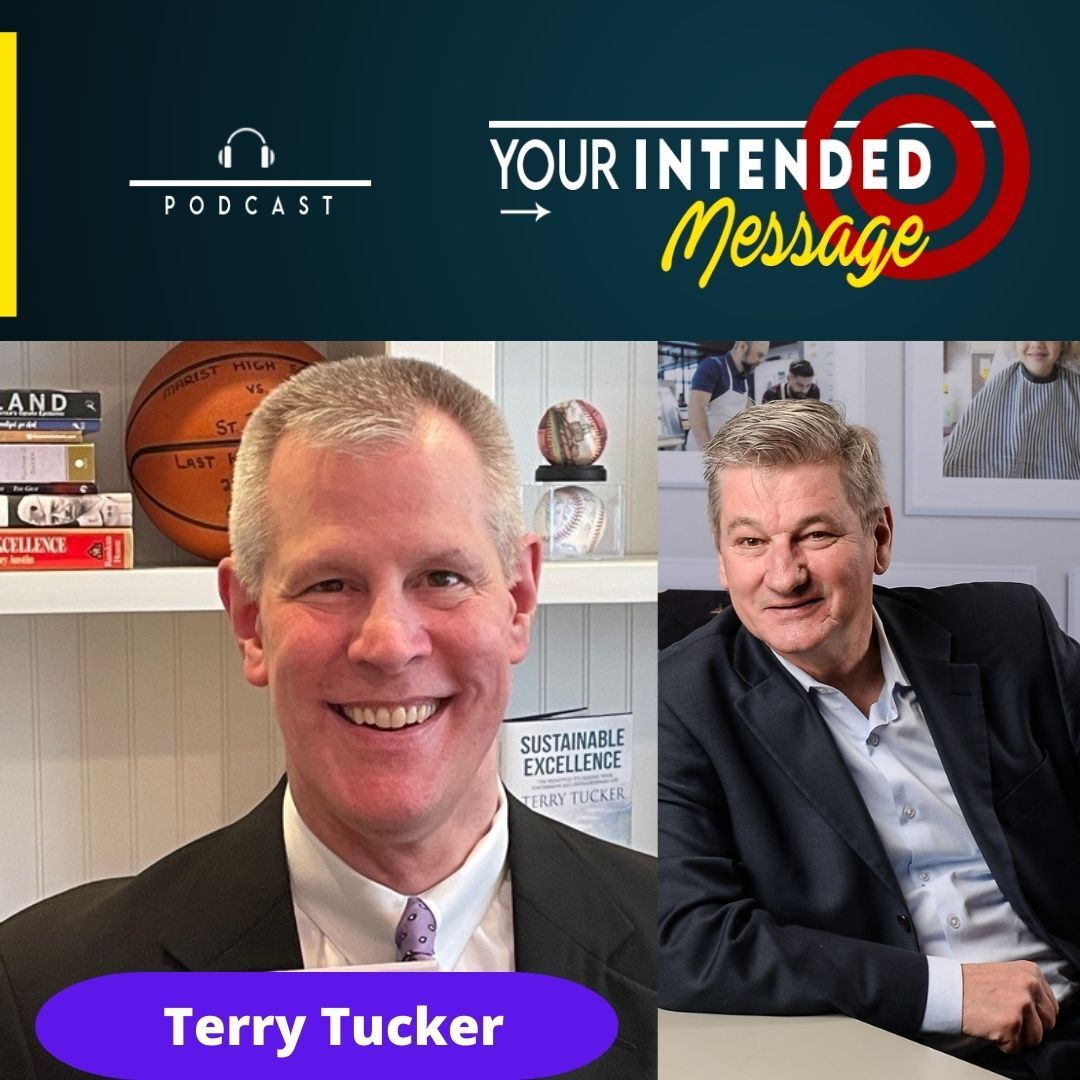
Ep 164What Message are You Telling Yourself? Terry Tucker
Control your Mind so it Doesn't Control You Imagine Your Life when you practice smarter self-talk Episode 164 (Terry is based in Denver, CO) In this conversation with Terry Tucker we explore: The self talk journey when facing horrible circumstances How to transition from blame to taking responsibility The positive energy from helping others How to listen to understand Communication lessons from hostage negotiation How to say constructive messages to self Start a new venture with baby steps Where to focus our energy when facing challenging conditions About our guest, Terry Tucker: Terry is a former SWAT Team Hostage Negotiator with the Cincinnati Police Department. He has trained with FBI's Hostage Negotiation Team. He's a cancer survivor. He is the author of the book, Sustainable Excellence, Ten Principles to Leading Your Uncommon and Extraordinary Life. Get your copy of his book ----- Excerpts from this conversation with Terry Tucker: And then she looked at me and she said, well, well, Coach, what do you think my purpose is, I said, I have no idea what your purpose is. But that's what your life should be about finding the reason you were put on the face of this earth, using your unique gifts and talents and living that reason. So that was one conversation. And then I had a young man reach out to me from college on social media and asked me what I thought were the most important things, he should learn not to just be successful in his job or in business, but to be successful in life. And you know, George, I didn't, I didn't want to give them that, you know, get up early, work hard, help others kind of not that those aren't important. Those are incredibly important. And I wanted to see if I could go deeper with them. So I spent some time taking some notes and eventually had these these 10 thoughts, these 10 ideas, these 10 principles. And so I sent them to him. And then I stepped back and I was like, you know, I got a life story that fits underneath that principle, or I know somebody's life emulates this principle. So literally, I've been battling cancer for 11 years after I had my leg amputated. And before I started chemotherapy, I had a three or four month period where I was healing. I sat down at the computer every day, and I built stories and there were real stories about real people underneath each of the principles. And that's how sustainable excellence came to be. ----- Most people think with their fears and their insecurities instead of using their minds. And I know I've done that in my life, Georgia, and I've been like, Oh, I'd like to do this. Oh, wait a minute, you know, Am I smart enough? Or do I have enough information? Or what will people think about me? If I fail in this endeavor that's thinking with our fears and our insecurities, that's not thinking with our minds. And I always tell especially when I speak in person to young people always tell him if there's something in your heart, something in your soul that you believe you're supposed to do, but it scares you. Go ahead and do it. Because at the end of your life, the things you're going to regret are not going to be the things you did, they're going to be those things you didn't do. And by then it's going to be too late to go back and do. ----- ----more---- Your host is George Torok George is a specialist in executive communication skills. That includes conversation and presentation. He’s fascinated by way we communicate and influence behaviors. He delivers training and coaching programs to help leaders and promising professionals deliver the intended message for greater success. Connect with George www.SpeechCoachforExecutives.com https://www.linkedin.com/in/georgetorokpresentations/ https://www.youtube.com/user/presentationskills https://www.instagram.com/georgetorok/

Ep 163All staff can be marketers: Laura Templeton
Workplace marketing, when everyone is marketing the organization Nurture the power of the people to spread your message Episode 163 (Laura is based in Tampa, Florida) In this conversation with Laura Templeton we explore: How to transform all employees into company marketers How to tap into the power of workplace referrals How to build stronger and stable teams with referrals Common values, common goals, common connections Talking about your customers and client testimonials Spreading the company stories on social media How to connect your passion at work and a play About our guest, Laura Templeton: Laura educates audiences about client attraction a d brand communication. She is the author of the bestselling book, 30 Second Success: Ditch the pitch and start connecting. Learn more about the website: https://30secondsuccess.com/ ----- Excerpts from this conversation with Laura Templeton Well, the first thing is, is if you have a referral program, review it to see how many people are actually using it. If they are great, if they're not ask your employees, if they know about it, when if they do, why they're not using it, your employees are going to tell you why. Okay, the other pieces is educating your organization, educating our everybody, you know, just give them tips, here's something that we're looking for, let them know, here's your, your ideal client, we need more clients like this. And then the third piece here testimonials, share the testimonials that your clients are getting in your organization. Hey guys, you You're doing a great job we just heard from you know, this client and this is what they had to say about our organization. You did this! Do you give your employees the credit when those testimonials come in, because everybody has a part in making those testimonials happen? Right. So when you start to share your your testimonials, you understand how your referral program is working, and then educating your everybody in your organization on how to use the referral program. It's going to change things for your company and your culture as a whole. ----- ----more---- Your host is George Torok George is a specialist in executive communication skills. That includes conversation and presentation. He’s fascinated by way we communicate and influence behaviors. He delivers training and coaching programs to help leaders and promising professionals deliver the intended message for greater success. Connect with George www.SpeechCoachforExecutives.com https://www.linkedin.com/in/georgetorokpresentations/ https://www.youtube.com/user/presentationskills https://www.instagram.com/georgetorok/

Ep 162How to Identify and Influence Company Culture : Michael Grochmal
What are the telltale signs of your company culture? How you contribute to the culture Episode 162 (Michael is based in Oakville, Ontario) In this conversation with Michael Grochmal we explore: What is company culture? How is culture set? Who influences the culture? What messages does culture send to the world about your organization? How to shape culture on purpose How to notice and identify current culture How culture influences relationships with your clients What are the various aspects of culture? How are emotions and personal energy affected How to align activities with the culture What is a Culture book and what might it include? About our guest, Michael Grochmal: Michael is Director of Culture for CEO Global Network. He's been a member for 14 years. Before selling the company. he was President of AtlasCare for 12 years. Learn more about CEO Global Network https://ceoglobalnetwork.com/ ----- Excerpts from this conversation with Michael Grochmal And that's the other part. I think when it comes to culture, it's about getting agreement. And so anyone thinking facilitator training would say, Do we all agree hands up, we're going to start this meeting on time. And everyone puts their hands up, look around the room, we've all agreed to this. And so we're now all in a position to hold each other accountable to this idea. It's not about shoving though it down people's throats. And we live in a world I think today where people want to know the why. Twenty-five years ago, you could just say do it. And they said, Okay, I'm following orders. I'm a good soldier. And I would say that people are struggling to some degree with younger generation. And a lot of times, we don't have a good why. So we say just do it. And the answer is they won't. They actually want to know why. But if you give them the why they will work every bit as part and smarter than previous generations. This kind of a while you're doing it. And so if you don't know why you can't tell them why and you can't tell them why that's not what you're gonna get. And so I really do believe that everything has to be purposeful as to why you're doing it. But if it is, the right people will say, Well, that makes sense. That's what we're gonna get dressed up, or that's why we're going to start on time, or that's why we're going to end on time, because they buy into the why, but they don't buy into the why. I don't know how to put controls in place that would just make people do stuff. And I think we actually have a lot of time and effort is spent trying to but it's really a false thought fallacy that you know, you have to win people's hearts and minds. And the way to do that is to explain why you're doing things. ----- ----more---- Your host is George Torok George is a specialist in executive communication skills. That includes conversation and presentation. He’s fascinated by way we communicate and influence behaviors. He delivers training and coaching programs to help leaders and promising professionals deliver the intended message for greater success. Connect with George www.SpeechCoachforExecutives.com https://www.linkedin.com/in/georgetorokpresentations/ https://www.youtube.com/user/presentationskills https://www.instagram.com/georgetorok/