
XtremeAg: Cutting The Curve Podcast
421 episodes — Page 8 of 9
Cattle Marketing and Risk Management Strategies
Beef production has a long timeline —more than a year from birth to processed beef and if you count in 9 months of gestation, you’re pushing two years from start to a finished product. So, just like every other form of Agricultural production, beef producers need tools to remain profitable. Jared Clark — a Texas cow/calf rancher and CEO of Silveus Financial and Fidel Burciaga, Cattle Risk Advisor join me to explain the nuances of beef marketing. ____ The risk of loss in trading futures and/or options is substantial and each investor and/or trader must consider whether this is a suitable investment. Past performance, whether actual or indicated by simulated historical tests of strategies, is not indicative of future results.

Short Cuts: Finding The Right In-Furrow Program For Cotton
Cotton is a plant that is born to die. It emerges and then it spends the rest of its life trying to die. Well, maybe not exactly, but, let's face it Cotton is finicky and requires a lot of attention. We are in Matt Miles' cotton field with Molly Alexander and Stephanie Zelinko from Agroliquid talking about in-furrow trials and needs of cotton.
Demystifying The Carbon Marketplace
We’ve been hearing about the financial promise of carbon markets in production Agriculture for a couple years. What’s the deal? What is required of you and your farm to get paid for carbon? What changes to your practices will be required? How long is the contract and who exactly pays the carbon bill? How much carbon are you sequestering? And most importantly, is the financial incentive enough to justify the work of signing up? Those questions and more are answered by Mariah Murphy with Truterra. Tune in to find out if carbon can be the next income diversification tool on your farm. This episode is presented by Advanced Drainage Systems with support from Agricen.

Identifying Your Farm’s Business Weaknesses
Nobody can excel at everything. Your farm operation is not an exception to this reality. As such, most farms excel at production while delicately managing around — or oftentimes overlooking — their weak spot. This isn’t criticism, it’s truth and it applies to every business, farm or non-farm. Reality: Farms are businesses and businesses are meant to be profitable. You can achieve profitability when you discover your vulnerable spots and go about fixing them. Jarod Creed of JC Marketing Services helps Kelly Garrett of Garrett Land and Cattle Company do just that. The two of them work together concentrating on their strengths while complementing the other’s weakness. Presented by AgXplore
Crop Stress Mitigation Strategies
Generally when we think of crop stress, we think of heat and drought. However there’s also stress of cold and wet and many other stressful occurrences that arise throughout a growing season. Successfully getting your crop through those stressful times can make a huge difference on your yield monitor. Mike Evans of Integrated Ag Solutions explains practices and products he’ll be deploying for Garrett Land & Cattle as well as his other farmer clients. Presented by Advanced Drainage Systems

The Highs And Lows of Cotton Farming
Matt Miles's father used to say, “Cotton is always looking for a reason to die.” Matt explains cotton production in the Arkansas delta — from moisture issues to managing a high maintenance crop to capitalizing (hopefully!) on record high cotton prices. As Matt explains, cotton is a high risk, high reward crop. With cotton picking equipment costing $900,000 new, it needs to be. This is XtremeAg’s first cotton-themed recording and Matt does a good job of explaining the nuances of cotton farming, which is in his heritage. Presented by AgXplore.

Why You Shouldn’t Panic Over The Weather….Yet
At the time of recording this episode, the Midwest is cold and wet. Less than ideal conditions for sure and planting progress is considerably below average. Toss record high input prices into the mix and we have the recipe for some very stressed farmers. But Kelly Garrett says, don’t sweat it. “It’s still early and conditions aren’t right.” Kelly defies the common recommendation to hold off on soybeans and race to put your corn in the ground. Listen to his reasons why you shouldn’t panic over the weather. Yet! Presented by Advanced Drainage Systems with support from Agricen.
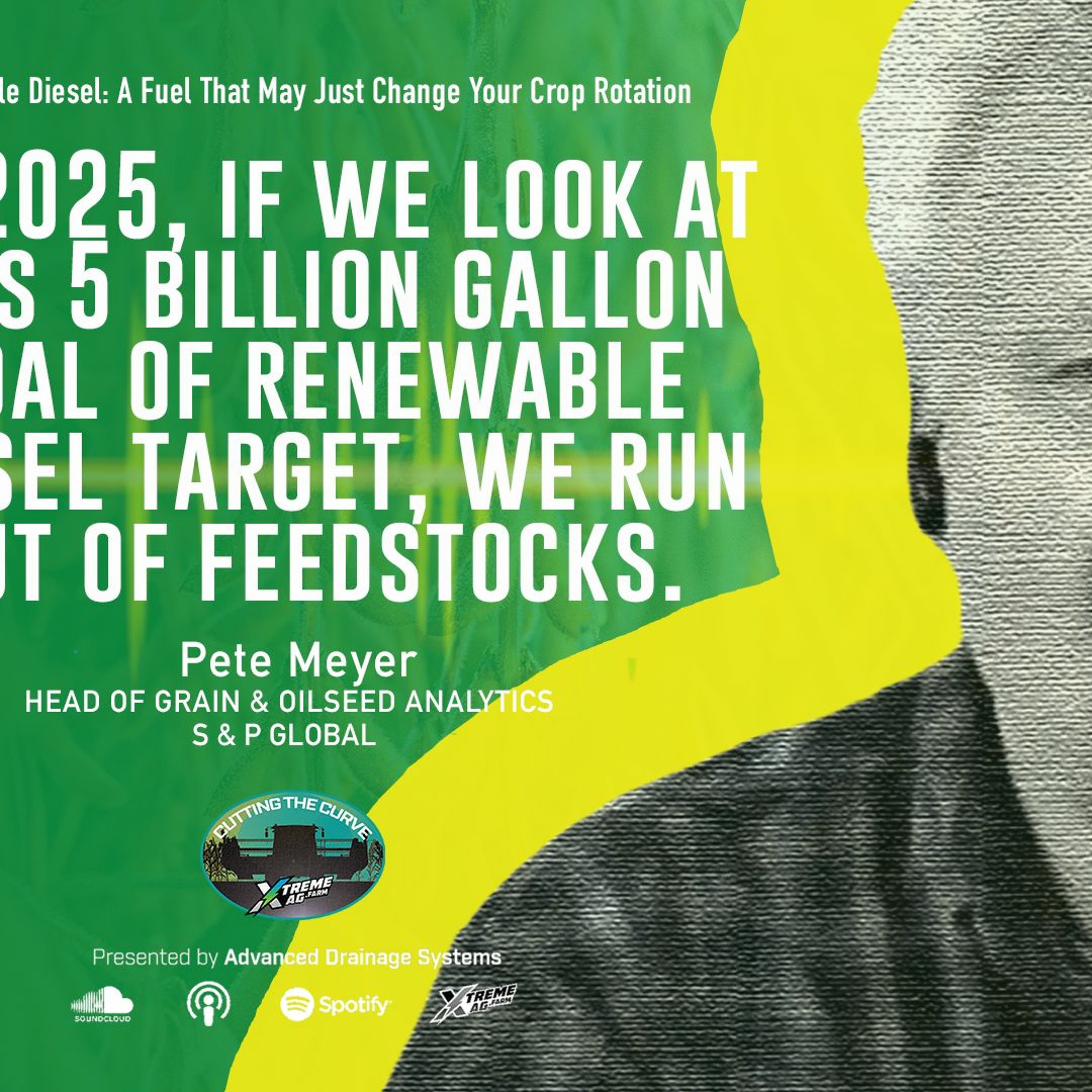
Renewable Diesel: A Fuel That May Just Change Your Crop Rotation
Renewable diesel isn’t the same as biodiesel because it’s made from a variety of oil seed crops and it’s not blended with fossil fuel. Why does any of this matter to American farmers? Because renewable diesel has the potential to gobble up trainloads of soybeans, increase demand for alternative crops such as Canola and Camelina, and improve the environment. Pete Meyer, head of grain, oilseed, and advanced feedstocks analytics for S&P Global Commodity Insights discusses the potential of renewable diesel and what it may mean for farmers. So far, some of the biggest names in fossil fuels are on board. Presented By Advanced Drainage Systems

How Precise Can You Get With Your Starter Application?
In the old days, we dribbled out fertilizer from our planters and hoped it found its way to the seed to boost early growth. Basically, as Stuart Meacham of CapstanAg says, it was a “controlled spill.” But with all the technological advancements in machinery, field mapping, and data analytics, isn’t it time for precision in-furrow fertilization? Lee Lubbers thought so, which is why he sought out CapstanAg’s Select Shot in-furrow fertility system. XtremeAg’s Lee Lubbers, Kelly Garrett, and Kevin Matthews will be running trial comparisons this season to measure fertilizer savings, analyze in-furrow fungicide application, and monitor plant and yield response. Presented by Advanced Drainage Systems
Commodity Marketing 101
Farmers wear a lot of hats and fill a lot of roles within their operations — with production being the most important and most focused on for the majority of operators. So where does that leave marketing one’s crop on the hierarchy of priorities? And with so many variables and the degree of complexities in commodity marketing, can a farmer really be as knowledgable about marketing as he or she should be? Sean Findley and Bryce Guse commodity traders with Silveus Financial join me for a tutorial on commodity marketing. Admittedly, this may be rudimentary for some of you. If so, please pass it along to the next generation who can benefit from hearing about the fundamentals of grain marketing. ____ The risk of loss in trading futures and/or options is substantial and each investor and/or trader must consider whether this is a suitable investment. Past performance, whether actual or indicated by simulated historical tests of strategies, is not indicative of future results.

Will The World — And Your Farm — Have The Fertilizer It Needs?
Fertilizer price spikes have been the subject of much media over the past six to twelve months. But what forces are at play globally that may make the problem worse or better? Bryan Bednarek fertilizer trading expert with StoneX Financial discusses the fertilizer supply chain, pricing, and explains why he’s not concerned about facing a full blown fertilizer shortage. He’s joined by XtremeAg’s Lee Lubbers for perspective on farm-level fertilizer availability and how to be prepared for the next season.
EP#64: Electric Vehicles, Sustainable Aviation Fuel & The Future of Corn Ethanol
American farmers will plant about 90 million acres of corn in 2022. Approximately 35% of that corn will find its way to an ethanol plant. In frank terms, ethanol has been good for corn farmers. But how long will ethanol demand persist amid the proliferation of electric vehicles combined with growing sentiment opposed to ethanol? Pete Meyer, head of grain, oilseed, and advanced feedstocks analytics with S&P Global Commodity Insights discusses the future of ethanol and corn demand to explain how it will impact corn producers. Presented by Advanced Drainage Systems

Fixing Limiting Factors By Going Back To The Basics
Kevin Matthews had been looking at soil sample results for decades before he finally realized the importance of calcium to magnesium ratios in his soils. This may seem like advanced agronomy to some but the reality is this: You can’t get to the next level of production without a firm foundation of soil basics. This is why Agroliquid created the Back2Basics educational series — so farmers can discover their next level ability by addressing the basics first. Or, as Kevin says, “fixing limiting factors in the soil begins with the basics.”
PGR’s — How They Work & Why You Should Use Them
Lee Lubbers began using Plant Growth Regulators 20 years ago, way before most conventional farmers had even heard of the product category. But PGR’s had been utilized in specialty crop production for years before Lee’s foray, which is why he brought the technology to his South Dakota operation. Today, PGR’s are standard practice at Lubbers Farms. Lee describes his results, mishaps, and outlook on plant growth hormones. He is joined by Matt Thompson of Hefty Naturals who explains modes of action and the technical aspect of this expanding crop input. Presented by Advanced Drainage Systems
Using Drip Irrigation to Improve The Agronomics Of Your Farm
Beyond just water delivery, can an irrigation system improve your soil? Yes, as a matter of fact, it can. Drip irrigation is installed approximately 12 inches underground, where it provides critical moisture at root level, while also delivering valuable nutrients. Kelly Garrett installed drip irrigation seven years ago and has seen improved agronomics because of it. Kelly explains the versatility and benefits of drip versus traditional center pivot irrigation. He’s joined by Netafim agronomist Tim Wolf and irrigation installer Kurt Grimm, of NutraDrip, to explain the agronomic advantages of drip irrigation. Presented by Advanced Drainage Systems

Make $100 More Per Acre By Switching Away From Triple Stack Corn?
Don’t tell your seed sales representative but...triple stack corn isn’t doing the job it once did. If you’re paying a premium for seed traits that aren’t giving you much return, it’s time to change your strategy. That’s what Iowa producer Kelly Garrett is doing — switching to more conventional (and less expensive!) seed corn while opting for in-furrow yield enhancement instead. Last year’s trial netted Mr. Garrett $100 more per acre using Ethos — an insecticide containing a biological fungicide. Presented by Advanced Drainage Systems.
Tile Drainage Explained: From Install to Benefits of The Investment (Part 2)
Tile drainage isn’t really tile — it’s corrugated, perforated, plastic pipe. Maybe you know that or maybe the concept of subsurface farm drainage is new to you. Either way, you should listen to this two-part episode about the benefits and payoffs of tile drainage. Tile drainage is water management and it is good for the environment, your soil, and your bottom line. Lee Lubbers says tile drainage is a triple payoff through appreciation, depreciation, and asset improvement! Lee is joined by Chad Henderson who explains his 90 acre project complete with lift station, and Kevin Matthews who began installing tile on his North Carolina farms 15 years ago. Presented by Advanced Drainage Systems

Mo’ Money — Can Your Crop Insurance Company Do That?
Farming is a business as well as a lifestyle. Fact: if you don’t operate your farm as the business it is, there will be no lifestyle. Jared Clark, CEO of Silveus Financial explains how to protect profits and make more money off your crop insurance by integrating it with commodity marketing. In a year like 2022 is shaping up to be — with escalating commodity prices and solid demand — you might be tempted to overlook crop insurance and simply swing for the fences. Jared explains why that’s likely a bad decision. Listen to this to make mo’ money!! The risk of loss in trading futures and/or options is substantial and each investor and/or trader must consider whether this is a suitable investment. Past performance, whether actual or indicated by simulated historical tests of strategies, is not indicative of future results.

Uncertainty, Ukraine & Managing Volatility (If Only In Your Head!)
Russia invaded Ukraine, global commodity markets are going crazy, supply chains continue to be disrupted, fertilizer may be unavailable, and then there are interest rate and inflation issues to sort out. In short, the world’s a volatile place. It’s normal to feel a little nervy! But what steps can each of us take to minimize stress, and even capitalize on the current volatility? Kelly Garrett discusses his strategies to profit during times of uncertainty along with Silveus Financial Risk Advisor Bryce Guse. The risk of loss in trading futures and/or options is substantial and each investor and/or trader must consider whether this is a suitable investment. Past performance, whether actual or indicated by simulated historical tests of strategies, is not indicative of future results.
Tile Drainage Explained: From Install to Benefits of The Investment (Part 1)
Tile drainage isn’t really tile — it’s corrugated, perforated, plastic pipe. Maybe you know that or maybe the concept of subsurface farm drainage is new to you. Either way, you should listen to this two-part episode about the benefits and payoffs of tile drainage. Tile drainage is water management and it is good for the environment, your soil, and your bottom line. Lee Lubbers says tile drainage is a triple payoff through appreciation, depreciation, and asset improvement! Lee is joined by Chad Henderson who explains his 90 acre project complete with lift station, and Kevin Matthews who began installing tile on his North Carolina farms 15 years ago. Presented by Advanced Drainage Systems
Xyway - Do’s And Don’ts For Using This Game Changing Fungicide
In 2021 FMC launched Xyway, a systemic fungicide engineered to be applied at planting as a tank mix with starter fertilizer. 95% of the farms that used the product saw great results. But those farmers who applied Xyway in-furrow, especially in cool, damp soil, experienced germination issues. Iowa farmer, Kelly Garrett, having heard of this potential issue through XtremeAg users, opted for a 2x2 application (2 inches deep and 2 inches away from the seed bed). His farm saw a 26 bushel yield bump using Xyway AND he didn’t have to perform a second fungicide treatment mid-Summer. Kelly is joined by FMC’s Gail Stratman to explain what we’ve learned about an effective and convenient fungicide. Presented by Advanced Drainage Systems

Capitalizing On High Cotton
Cotton prices are good, at the moment. Which means, as a cotton producer, you could make a few bad decisions and still be profitable. But that’s the path to take for long-term success. Arkansas cotton producer Matt Miles joins the guys from Silveus Financial to discuss cotton strategy heading into 2022. With input prices skyrocketing and the price of a cotton harvester pegged around $800,000, there’s plenty at stake. This is why you need a good plan and solid partnerships to capitalize on high cotton. Presented by Silveus Financial The risk of loss in trading futures and/or options is substantial and each investor and/or trader must consider whether this is a suitable investment. Past performance, whether actual or indicated by simulated historical tests of strategies, is not indicative of future results.

A Seed Treatment for Faster Emergence & Seasonal Stress Protection
South Dakota farmer Lee Lubbers likes making money and he likes making his job easier. That’s why he’s excited about biological seed treatment, Nutri-Shield from Hefty Naturals — It’s easy to apply and the product got results in his first year using it. Nutri-Shield is a talc-based seed treatment providing faster emergence, increased root development, and heat stress mitigation throughout the season. The best part: It’s applied in the planter box, which means everyone can use it, not just farmers who apply in-furrow treatment. Presented by Advanced Drainage Systems

4 Things You Should Know Before Buying Crop Insurance
Crop insurance isn’t always exciting but it can keep your farming operation profitable, or at least solvent to live for the next generation. When it comes to selecting the right crop insurance product for your operation are you asking the right questions and analyzing the pertinent parameters? Jared Clark and Bryce Guse with Silveus Financial share four things you should know before making your crop insurance decision. Presented by Silveus Financial The risk of loss in trading futures and/or options is substantial and each investor and/or trader must consider whether this is a suitable investment. Past performance, whether actual or indicated by simulated historical tests of strategies, is not indicative of future results.

Increasing Phosphorous Uptake (For An 8 To 1 Return?)
Robb Dedman was sitting in an Ag conference when he heard a presenter explaining how a product could increase phosphorous uptake in corn. As the crop consultant and biz partner to Matt Miles, Robb had been noticing that very problem at Miles Farms: The soil held ample “P” yet the crop tissue samples showed a deficiency. So, Mr. Dedman went on a search and discovery mission. He found a company named AgrotechUSA and conducted trials last year with their NutriCharge product, which increases phosphorous availability to plants. The results and the return on investment were significant. Presented by Advanced Drainage Systems

Can A Biological Made From Living Fungi Produce Better Crops?
Lee’s been using Heat Shield every crop year since 2016 with good results. The best part: with three options of application — seed treatment, in-furrow, or foliar — Lee likes the versatility as well as the results. What are the results, you ask? Trials show a 6 to 16 bushel corn yield bump at a cost of about 8$ per acre. Lee is joined by Hefty Naturals' Lead Agronomist Rob Fritz and Brand Manager Matt Thompson to explain the benefits of heat stress mitigation via biologicals. They also discuss handling differences between a living biological product and conventional crop chemistry. Presented by Advanced Drainage Systems
Why Did My Corn Mature Too Early?
Crop production presents a lot of challenges and dozens of variables. When a crop fails, or underperforms, you have to put on your detective hat to go about finding out what happened. Was it soil condition, fertility, water, the wrong input, seed germination issues? What if, as it turns out, it’s none of those things? Iowa farmer Kelly Garrett joins Tommy Roach, VP of technical services for NACHURS to discuss their detective strategy when investigating a crop problem and what they found — sometimes Mother Nature has the final say! Presented by Advanced Drainage Systems
ROI Driving Crop Rotation Decisions
There’s a lot to consider heading into any new crop year but especially as we prepare for 2022 with record run-ups in input prices, lack of input inventory, Covid marketplace impacts, and uncertainty. One consideration always in play is whether or not to alter the crop rotation. XtremeAg farmer, Chad Henderson explains why he’s staying the course in 2022 with his usual crop acreage splits. That is, unless the weather throws him a curve ball this spring. Chad explains the reasons and experiences that guided his decision against making radical changes to his cropping plan. Principal among them: "Crop rotation makes bushels and bushels make us money.” Presented by Advanced Drainage Systems.

4 things Lee Lubbers Learned in 2021
Lee Lubbers brought his notes on the lessons gleaned from last year that he thinks all of us can apply for a more prosperous 2022. Lee shares: - Experiences working with NRCS for an 1,100 acre drainage project. - The importance of soil fertility during a drought. - The value of advanced planning. - Why money management is crucial to longevity. - How interaction with your family’s next generation can be instructive as well as satisfying. Presented by Advanced Drainage Systems
Integrating Crop Insurance, Government Programs, And Crop Marketing To Achieve Profitability
Farmers tend to focus on production, which is important but production alone won’t guarantee profitability. That’s why business-minded operators devote energy to the other sources of farm revenue — crop insurance and government programs — and integrate them with crop marketing to achieve farm profitability. Bryce Guse and Jared Clark with Silveus Financial explain. Presented by Silveus Financial The risk of loss in trading futures and/or options is substantial and each investor and/or trader must consider whether this is a suitable investment. Past performance, whether actual or indicated by simulated historical tests of strategies, is not indicative of future results.
Nutrient Management With Drip Irrigation
Fertilizer and diesel prices are up considerably. Meanwhile farms are under increasing environmental pressure. These forces combine to create a real opportunity for manure utilization via drip irrigation. Drip irrigation, as we’ve discussed in previous episodes, is a more efficient means of delivering moisture to your crop. But drip is also a very effective means of nutrient management which saves time, machinery hours, and diesel all while eliminating the soil compaction common with manure application. Then there is the environmental concern and complaints associated with manure that are eliminated by using in-ground drip application. Kurt Grimm with NutraDrip joins XtremeAg’s Kelly Garrett to explain. Presented by Advanced Drainage Systems
What 2021 Taught Chad & Applying It To 2022
Winter is a good time to reflect back on what the prior farming season taught us and how we can apply those lessons for success in the new year. Alabama farm operator and XtremeAg co-founder Chad Henderson discusses some of his 2021 investments and ventures. He also covers the business and personal lessons he’s applying for a more prosperous 2022. From installing drainage (for the first time!), to practicing patience as a manager, Chad has plenty of lessons to share from the year that was. Presented by Advanced Drainage Systems

Perfecting Practices Learned In 2021
Kevin Matthews is always looking for a way to improve upon how he does what he does on his North Carolina farming operation. In 2021 he implemented changes in how he plants, how he sprays, and how he harvests. Looking ahead to crop year 2022, he discusses how he’ll perfect his newly implemented changes. Remember, if you always do what you’ve always done, you’ll always get what you’ve always gotten. And that simply won’t do for an XtremeAg producer!
Tax Management Versus Tax Avoidance
It’s the end of the year and the farm belt has made money. That means farmers will be at the implement dealer's counter, checkbook in hand, ready to get money off their books, right? Well, maybe, but not for Lee Lubbers. Mr. Lubbers shares tax strategy and how Lubbers Farms goes about making machinery and tax decisions on their operation. They don’t make any rash purchase decisions at new year’s time or solely based on the prior year’s profitability. The biggest tax management decision the Lubbers employ: they invite their lender into the tax planning meeting with their CPA! Lots of good info you can apply to your farm business — whether it’s year end or not! Presented by Advanced Drainage Systems.

Fertility Alternatives in the Face of Availability Issues and Cost Constraints
Fertilizer prices are up dramatically heading into 2022. You’re likely already familiar with that fact. But are you familiar with the range of alternatives you can employ to decrease your fertilizer input costs while still maintaining fertility levels in your soil? Kevin Matthews discusses alternatives from chicken litter to biologicals to less popular fertilizer products that’ll give you the nutrients you need without breaking the bank. The best part: you’ll still get a big crop and a profitable return! Presented by Advanced Drainage Systems
Talking About In Furrow Fertilizer
Kelly Garrett began using in-furrow fertilizer in crop year 2017. This year he opted to change to an updated product made by the same company as his previous treatment. Kelly discusses his results and is joined by Tommy Roach, VP of Product Development for NACHURS who provides technical background on using in-furrow fertilization. Presented by Advanced Drainage Systems
Income Diversification For Your Farm (Using Resources You Already Have!)
Over the years, American farms have become increasingly specialized. That’s been good for productivity but not necessarily for protecting farm profitability. Being too dependent on just a handful of crops -- or worse, a handful of buyers — puts farming operations in a precarious spot. Remember the old saying about having all your eggs in one basket? Sometimes the smart business move is to change up your offering to diversify your income stream. And if you can do it with resources, relationships, and knowledge you already have, all the better. Kelly Garrett discusses his budding direct-to-consumer meat enterprise. He explains his vision for retaining value that previously left the farm, how to exploit intentional congruencies, and how he once lost his shirt by getting too far out of his wheel house! Watch it here: https://www.xtremeag.farm/blog/xtremeag-blog/2021/12/13/income-diversification-for-your-farm-(using-resources-you-already-have!) Presented by Advanced Drainage Systems.
Releasing Fertility Within Residue Through Biologicals
On average — and at current fertilizer prices — there is $125 worth of N,P& K in each acre of corn stalks post harvest. Are you getting that fertility buck back for your next crop? As fertilizer prices skyrocket, it’s more important than ever to harvest nutrients already in your fields for your next harvest. Not to mention the importance of proper residue management — too much residue prevents solid seed-to-soil contact come next planting. Biological products such as Extract maximize nutrient release from residue while also breaking down that residue. Brian Cornelious and Steve Sexton from Agricen join XtremeAg farmer Kelly Garrett to discuss the results they’re seeing. Presented by Advanced Drainage Systems

Using Stress Mitigation Technologies To Maximize Return
Limiting crop stress is Kelly Garrett’s priority heading into 2022. The theory being — if we have ample fertility, let’s make a healthier plant to utilize that fertility. Stress on crops comes from three areas: cold, drought, and salt. Combine those stressors over a growing season and the bushels lost to stress add up. So, what can you do to reduce crop stress? Kelly plans to apply AccomplishMax — Agricen’s newest in-furrow product for corn, soybeans, cotton, and wheat.

New Biologicals To Reduce Stress On Your Crops
Marrone Bio is a 15 year old Agricultural company you’ve probably never heard of if you’re in the business of producing row crops. That’s because Marrone Bio’s roots are in products for horticulture and specialty crops. But that’s changing as the company is bringing innovative, abiotic stress reduction products to the marketplace. XtremeAg farmer Chad Henderson is trialing two Marrone products this year on 500 acres of corn and soybeans. Emergen (applied in-furrow) and Pacesetter (applied as a foliar at time of fungicide application), have one job: to reduce plant stress. Or, as Chad says, “they keep my crops from having a bad day.” And based on what he’s seeing on his farm, you’ll want to do the same. Presented by Advanced Drainage Systems
First Year Back Home On The Farm
97% of America's farming operations are family owned. This presents a set of challenges from a business and personal perspective as the next generation — and the in-laws — join the business. Connor Garrett sits down to discuss the challenges, opportunities, mistakes, and takeaways he’s seeing in his first year back at the family operation. Presented by Advanced Drainage Systems.

Getting The Most From Your Fall Nitrogen Application
Kelly Garrett applies anhydrous in the fall and swears by it. Why? Economics, yield bump, and time management. But despite the increased yield, cost savings, and time management, there is the issue of soil biology. Anhydrous can be damaging to our precious soil’s biological mix. So that’s why Mr. Garrett is experimenting with AgXplore’s NZoneGL — a nitrogen utilization product that protects soil biology. Presented by Advanced Drainage Systems.

Seeds Of Doubt — How To Make The Right Seed Decision On Your Farm
Your crop begins with a seed, and there are plenty of options when it comes to which seed to select. So how do you choose? What criteria should be part of the decision making? With so many seed companies, so many environmental factors, and so much marketing noise, how do you clearly make decisions about what seed to put in the ground? Lee Lubbers of Lubbers Farms in South Dakota and Alan Scott with Corteva, discuss how to sort through the vast amount of information and marketing to choose the genetics that can keep you profitable. Presented by Advanced Drainage Systems
Lessons Learned & Applied From 2021- Lesson #5- Calcium
Successful businesses analyze their successes and shortcomings so they know how to adjust moving forward. If you’re a farmer, you’re in the business of crop production, so what lessons have you learned that you’ll apply to next year? Kelly Garrett shares his 5 lessons from this year and explains how he’ll utilize those lessons for a successful 2022. Lesson #5 Calcium Presented by Advanced Drainage Systems.
Lessons Learned & Applied From 2021 - Lesson #4: Stress Mitigation
Successful businesses analyze their successes and shortcomings so they know how to adjust moving forward. If you’re a farmer, you’re in the business of crop production, so what lessons have you learned that you’ll apply to next year? Kelly Garrett shares his 5 lessons from this year and explains how he’ll utilize those lessons for a successful 2022. Lesson #4: Stress Mitigation Presented by Advanced Drainage Systems

Lessons Learned & Applied From 2021 - Lesson #3: Xyway in the 2x2
Successful businesses analyze their successes and shortcomings so they know how to adjust moving forward. If you’re a farmer, you’re in the business of crop production, so what lessons have you learned that you’ll apply to next year? Kelly Garrett shares his 5 lessons from this year and explains how he’ll utilize those lessons for a successful 2022. Lesson #3: Xyway in the 2x2 Presented by Advanced Drainage Systems

Lessons Learned & Applied From 2021- Lesson #2: Improved 2x2 Fertility Application
Successful businesses analyze their successes and shortcomings so they know how to adjust moving forward. If you’re a farmer, you’re in the business of crop production, so what lessons have you learned that you’ll apply to next year? Kelly Garrett shares his 5 lessons from this year and explains how he’ll utilize those lessons for a successful 2022. Presented by Advanced Drainage Systems

Lessons Learned & Applied From 2021 - Lesson #1: Populations
Successful businesses analyze their successes and shortcomings so they know how to adjust moving forward. If you’re a farmer, you’re in the business of crop production, so what lessons have you learned that you’ll apply to next year? Kelly Garrett shares his 5 lessons from this year and explains how he’ll utilize those lessons for a successful 2022. Lesson #1: Soybean Populations. Presented by Advanced Drainage Systems

Are Your Crops Lacking Boron? Probably.
Your grandfather probably applied boron to his crops but your father very likely didn’t. Why? Because boron was standard chemistry back in the old days, then boron became uncool as agriculture moved away from micro nutrients. But boron is back and proper application of this micro nutrient can make you money with a minimal investment. Wendall Boehlje with U.S. Borax joins yield record setter Chad Henderson to explain boron’s contribution to your yield.

Planting Less, Harvesting More — Results From Soybean Population Reduction
Planting fewer seeds to achieve more bushels seems counter intuitive. After all, more is more, right? Wrong. When it comes to seeding population in soybeans, “more" might simply mean more expense with less yield to show for it. Matt and Layne Miles of Miles Farms discuss the results of their planting population trials. The Miles' experimented with 140,000 population all the way down to just 60,000 seeds per acre. The results: Yields were almost identical. The Miles' explain opportunities this creates for cost savings and they also describe some of the risks associated with planting less to harvest more. Presented by Advanced Drainage Systems