
World Leaders Unveiled,
290 episodes — Page 1 of 6
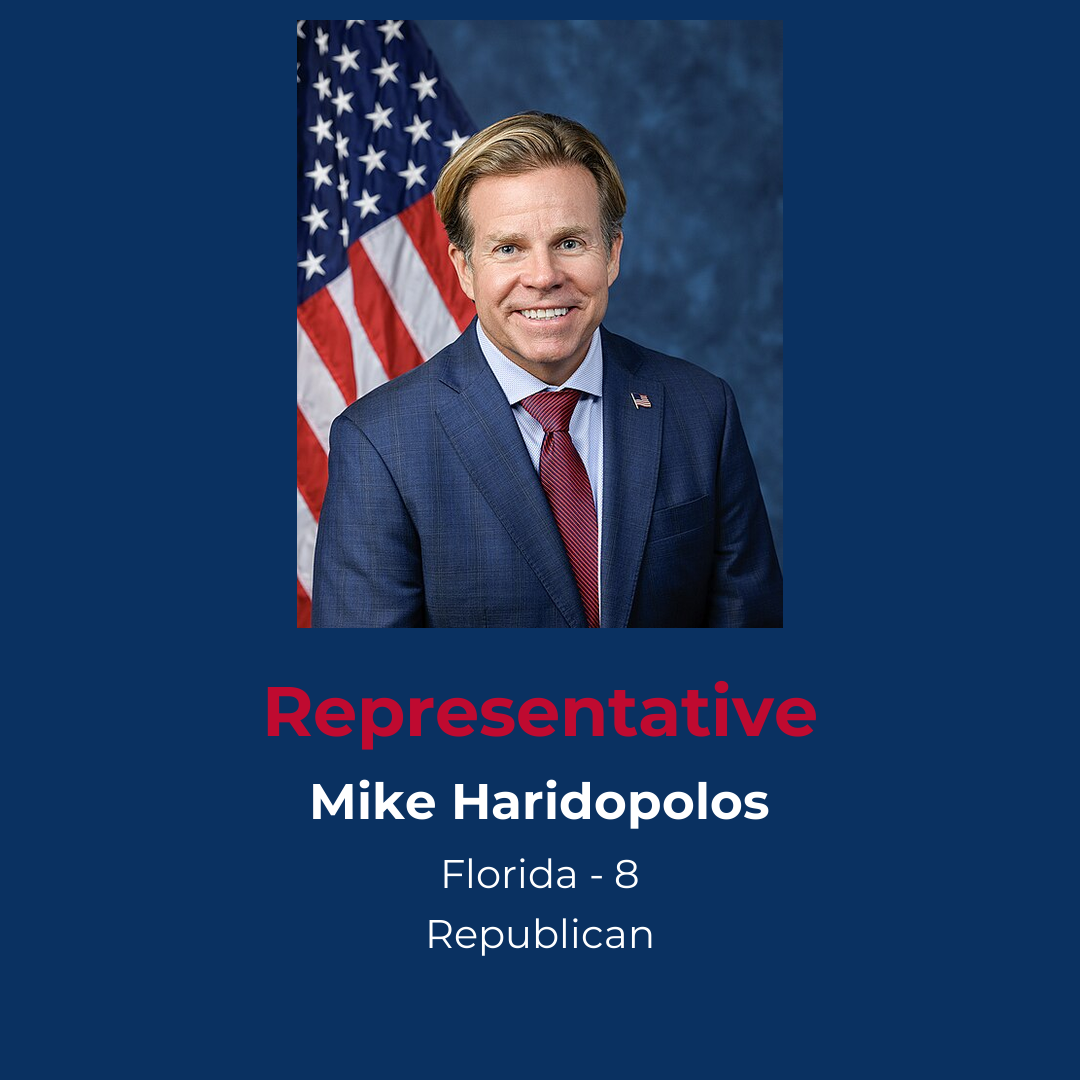
Profile of Republican Representative Haridopolos from Florida District 8
Mike Haridopolos is a seasoned conservative heavyweight who returned to public office after a 12-year hiatus. He previously served as the President of the Florida State Senate (2010–2012) before building a highly successful consulting firm. He easily won the 2024 election to succeed retiring Congressman Bill Posey. He represents Florida’s 8th District, famously known as the "Space Coast." The district covers Brevard, Indian River, and parts of Orange counties, and is the undisputed epicenter of the American commercial and federal aerospace industry. In the 119th Congress (2025-2026), his vast legislative experience meant he was not treated as a typical freshman. House leadership appointed him to the House Financial Services Committee and named him Chairman of the Space and Aeronautics Subcommittee on the Science, Space, and Technology Committee. The Space Coast Agenda: As Chairman, he holds immense leverage over federal aerospace policy. In early February 2026, he successfully advanced the bipartisan NASA Reauthorization Act of 2026 out of committee to solidify American dominance on the Moon and Mars against Chinese expansion. March 2026 Actions: Haridopolos is a staunch ally of the new Trump administration. On March 4, 2026, he delivered a high-profile House floor speech honoring Secretary of State Marco Rubio, and he is currently leveraging his Financial Services seat to aggressively push a national housing affordability agenda. "He spent a decade running the Florida State Senate before taking his talents to the private sector. Now, Mike Haridopolos is back, wielding a Chairman's gavel as a freshman to ensure the Space Coast dominates the stars." Day 72 | Mike Haridopolos: The Chairman of the Space Coast Mike Haridopolos’s political trajectory is a masterclass in timing and institutional experience. Born in New York but deeply rooted in Florida, he earned his degrees from Stetson University and the University of Arkansas. He began his career not in politics, but in academia, teaching U.S. History and Political Science at Eastern Florida State College and later the University of Florida. He was first elected to the Florida House of Representatives in 2000, quickly moving up to the State Senate in 2003. Known for his intense conservative discipline, he rose to become the President of the Florida Senate in 2010. During his tenure, he famously pushed to put the state's entire budget online and championed massive property tax reductions. In 2012, Haridopolos left elected office, transitioning into the private sector. He founded MJH Consulting, authored a book on the modern Republican Party, and remained a highly influential behind-the-scenes operative. However, when veteran Congressman Bill Posey announced his retirement in 2024, Haridopolos seized the opportunity. Running on a platform focused on border security, economic deregulation, and aerospace expansion, he easily secured the Republican nomination and coasted to victory in the general election, bringing a decade of heavy legislative experience back to Capitol Hill. Because of his profound resume, Haridopolos was not relegated to the back bench during the 119th Congress (2025-2026). Instead, Republican leadership handed the freshman lawmaker the incredibly powerful gavel of the Space and Aeronautics Subcommittee. This assignment perfectly aligns with the economic lifeblood of his district, giving him direct oversight over a $42 billion agency budget covering NASA and commercial spaceflight operations. In early 2026, Chairman Haridopolos has been moving at lightspeed. In the first week of February, he successfully shepherded the NASA Reauthorization Act of 2026 through his committee. He publicly framed the legislation as a vital national security imperative, arguing that the U.S. must cut bureaucratic red tape to beat China to the lunar surface. Simultaneously, he serves o...
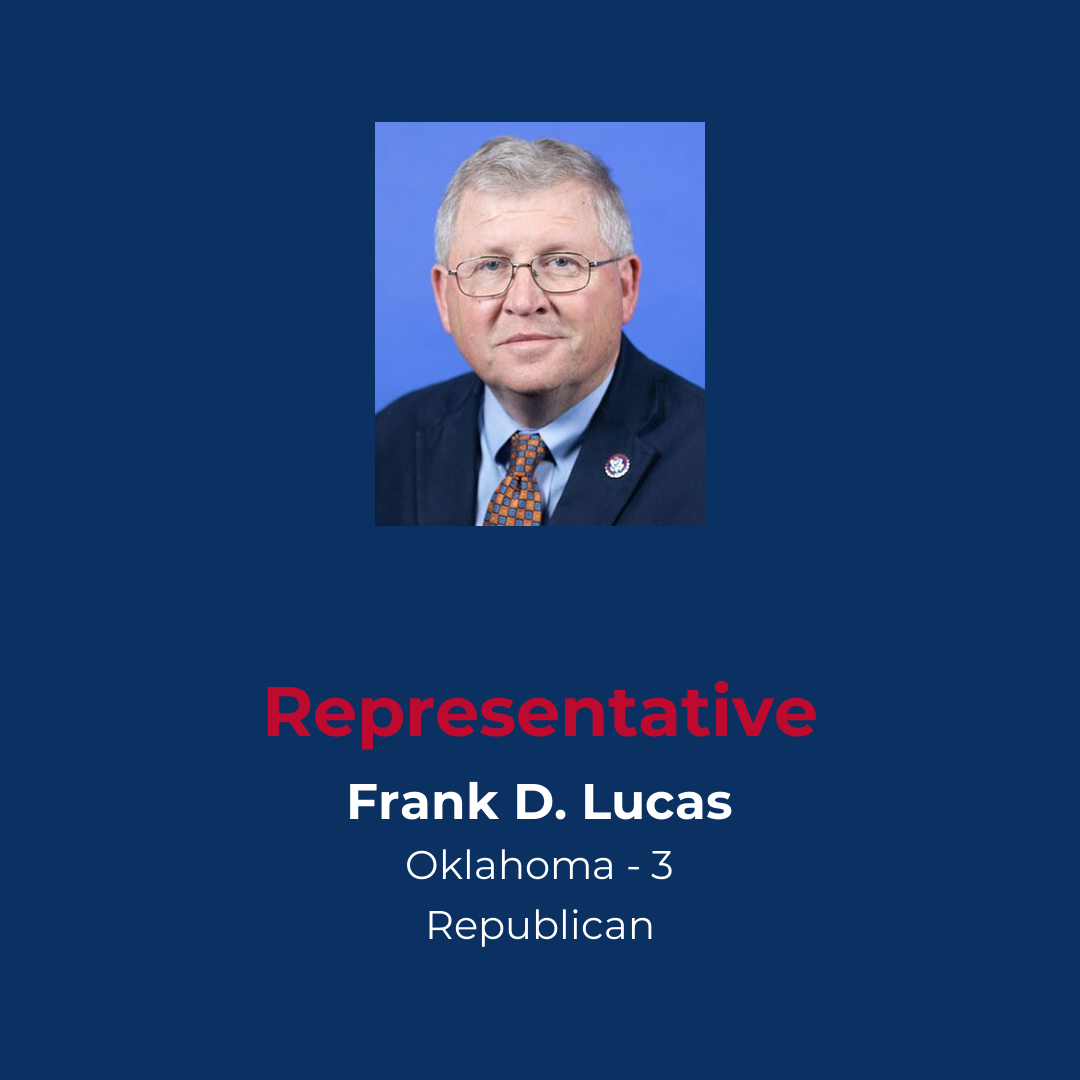
Profile of Republican Representative Lucas from Oklahoma District 3
Frank D. Lucas is the Dean of the Oklahoma congressional delegation and a towering, stabilizing force within the Republican Party. A lifelong farmer from Cheyenne, Oklahoma, he has served in the U.S. House since 1994, making him the longest-serving Republican on both the House Agriculture and Financial Services Committees. He represents Oklahoma’s 3rd District, a geographically massive, heavily rural district that covers almost half of the state's landmass, stretching from the panhandle all the way to the fringes of the Tulsa suburbs. In the 119th Congress (2025-2026), having reached his term limit as the Chair of the Science, Space, and Technology Committee, House leadership created a brand new, highly specialized role for him. He is currently the Chairman of the Task Force on Monetary Policy, Treasury Market Resilience, and Economic Prosperity on the Financial Services Committee. The PROTECT Taiwan Act: In early 2026, Lucas secured a massive foreign policy victory when his bill—the PROTECT Taiwan Act—officially passed the House, establishing strict financial penalties for China if they threaten Taiwan's security. March 2026 Battles: Lucas is currently navigating high-stakes economic hearings alongside the new Trump administration's cabinet. He recently held intense discussions with Treasury Secretary Scott Bessent on expanding deposit insurance for rural banks, and is heavily championing the President's nomination of Kevin Warsh for Federal Reserve Chairman. "He has spent over three decades quietly mastering the complex machineries of American agriculture and global finance. Frank Lucas is the undisputed, steady-handed Dean of Oklahoma politics." Day 72 | Frank D. Lucas: The Monetary Master of the Plains Frank D. Lucas’s political career is deeply tethered to the soil of Western Oklahoma. Born in 1960 in the small town of Cheyenne, Lucas is a fifth-generation Oklahoman whose family has been farming the exact same land for over a century. He earned a degree in agricultural economics from Oklahoma State University in 1982 and immediately returned to the family business of running a cattle and wheat operation. Experiencing the devastating 1980s farm crisis firsthand, Lucas entered politics to advocate for rural communities. He served in the Oklahoma House of Representatives before winning a special congressional election in 1994. Having served continuously for over 30 years, he officially became the Dean of the Oklahoma congressional delegation following the retirement of Senator Jim Inhofe. Lucas is a classic, traditional conservative. He does not seek out the cable news cameras; instead, he operates as a highly respected, institutional workhorse. Having previously chaired the powerful House Agriculture Committee (where he successfully navigated the bipartisan 2014 Farm Bill) and the Science, Space, and Technology Committee during the 118th Congress, Lucas faced Republican committee term limits entering the 119th Congress (2025-2026). Recognizing his unparalleled expertise, House leadership created an entirely new position for him in early 2025: Chairman of the Task Force on Monetary Policy, Treasury Market Resilience, and Economic Prosperity within the Financial Services Committee. In this role, Lucas is tasked with directly overseeing the Federal Reserve and ensuring the liquidity of the U.S. Treasury market amidst a ballooning national debt. His early 2026 agenda has been a masterclass in global finance and rural defense. In February 2026, he secured the House passage of the PROTECT Taiwan Act, a crucial piece of legislation that legally mandates the U.S. to push for China's exclusion from international financial organizations like the G20 if Beijing poses an immediate threat to Taiwan. Simultaneously, Lucas is working closely with the new Trump administration's economic cabinet. In early February, he held a hig...
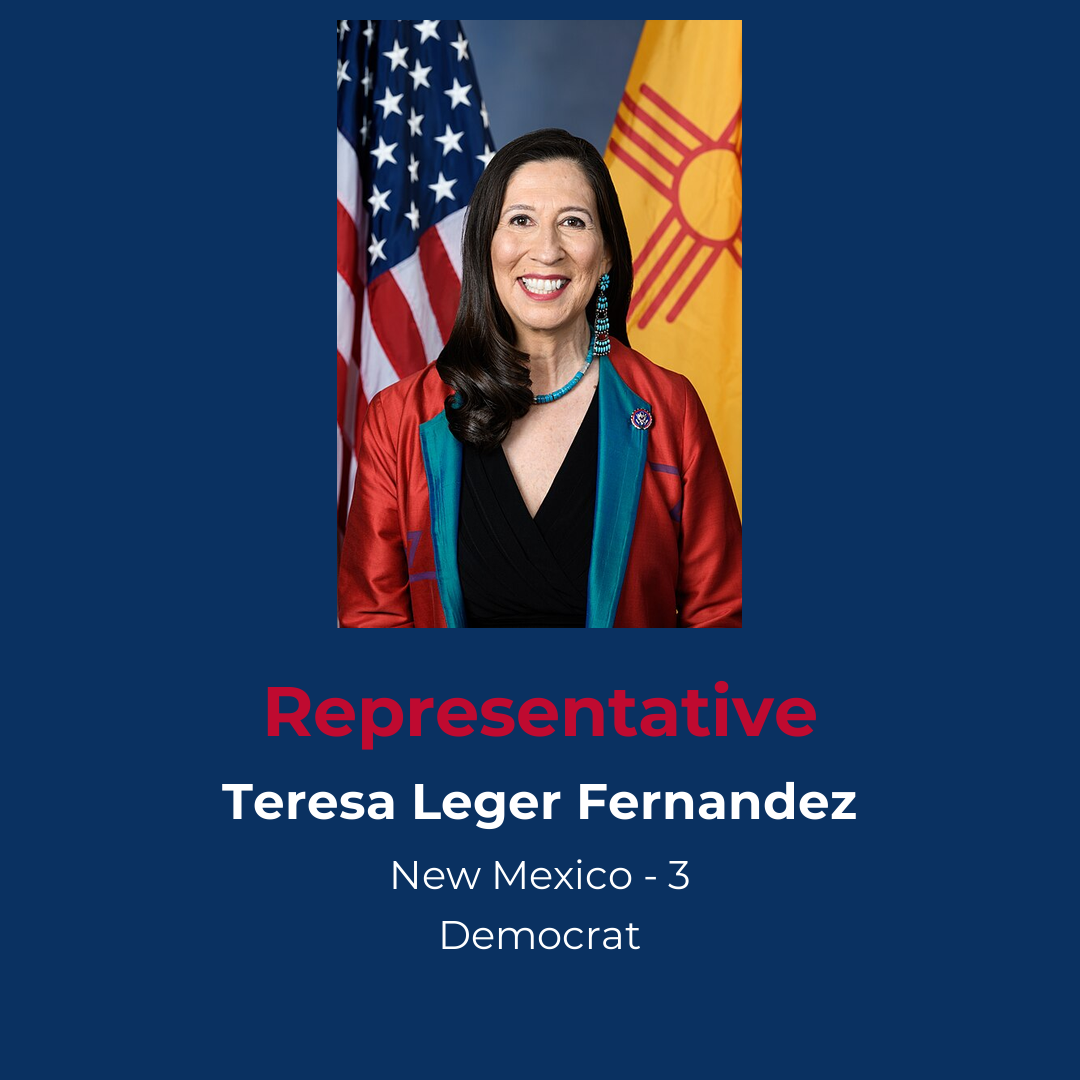
Profile of Democrat Representative Leger Fernandez from New Mexico District 3
Teresa Leger Fernández is a 17th-generation New Mexican and a veteran public interest lawyer. Before entering Congress, she spent decades working alongside Native American tribes to protect voting rights, secure funding for health clinics, and defend the state's historic acequias (communal irrigation canals). She represents New Mexico’s 3rd District, a breathtaking, culturally profound, and geographically massive district that covers the northern and eastern halves of the state, including the capital city of Santa Fe, Gallup, and significant portions of the Navajo Nation and Pueblo communities. It is the largest rural district held by a Democrat. In the 119th Congress (2025-2026), her influence has skyrocketed. She was elected Chair of the Democratic Women's Caucus, leading a record-breaking 96 members. She is one of only four Democrats on the powerful House Rules Committee and serves as the Ranking Member of the Indian and Insular Affairs Subcommittee. Breaking 2026 Battles: Leger Fernández is currently in a fierce standoff with the Department of Government Efficiency (DOGE). Just today, on March 12, 2026, she successfully pressured the Department of Health and Human Services (HHS) into sending a senior official to the Gallup Indian Medical Center to witness how the administration's staffing cuts have devastated Tribal patient care. Protecting the Vulnerable: In February 2026, she introduced the bipartisan Tribal Warrant Fairness Act to help Tribal police utilize U.S. Marshals to search for missing children, and she partnered with Senator Chuck Schumer to introduce "Virginia's Law" to eliminate the statute of limitations for survivors of sex trafficking. "A 17th-generation daughter of rural New Mexico who now leads the Democratic Women's Caucus. Teresa Leger Fernández uses her seat on the Rules Committee to aggressively defend the Tribal Nations and working families of the Southwest." Day 71 | Teresa Leger Fernández: The Civil Rights Anchor of Santa Fe Teresa Leger Fernández’s political identity is inextricably tied to the deep, complex history of New Mexico. Born in Las Vegas, New Mexico, she is a 17th-generation New Mexican whose roots in the region predate the founding of the United States. Earning her undergraduate degree from Yale and her law degree from Stanford, she could have easily pursued a lucrative corporate career. Instead, she returned home to establish herself as a formidable public interest and civil rights attorney. For over thirty years, she worked as a legal advocate for Native American tribes and Hispanic communities, securing nearly a billion dollars for infrastructure, building Head Start programs, and fighting to protect bilingual education and voting rights. Elected to the U.S. House of Representatives in 2020, she brought that exact same grassroots ferocity to Washington. Now serving her third term in the 119th Congress, Leger Fernández has amassed a staggering amount of institutional power. She was elevated to serve as the Chair of the Democratic Women's Caucus, coordinating the legislative strategy of a historic 96 female members. Democratic leadership also appointed her as the Deputy Whip for Policy and placed her on the incredibly powerful House Rules Committee, giving her a direct hand in shaping every major piece of legislation that reaches the House floor. As the Ranking Member of the Indian and Insular Affairs Subcommittee, her early 2026 agenda has been defined by an absolute refusal to let the new Trump administration marginalize Native American communities. In January 2026, she successfully fought off attempts to zero out funding for the Institute of American Indian Arts, securing $13.4 million for the Santa Fe-based institution, alongside massive funding for the Navajo-Gallup Water Supply Project. Just weeks later, in February, she introduced the Tribal Warrant Fairness Act to grant the U.S. Marsh...

Profile of Republican Senator Paul from Kentucky
Rand Paul is the unapologetic, libertarian-leaning junior Senator from Kentucky. An ophthalmologist and the son of former presidential candidate Ron Paul, he rode into Washington on the 2010 Tea Party wave and has spent his career as a fierce fiscal hawk and anti-interventionist. He represents Kentucky, a deeply conservative state known for its massive agricultural sectors, bourbon industry, and auto manufacturing, serving as a reliable stronghold for the Republican Party. In the 119th Congress (2025-2026), he holds massive oversight power as the Chairman of the Homeland Security and Governmental Affairs Committee (HSGAC), giving him direct jurisdiction over the Department of Homeland Security and the federal bureaucracy. The DOGE Rescission Push: While he supports the Elon Musk-led Department of Government Efficiency (DOGE), Paul is currently demanding that Congress hold official, filibuster-proof "rescission" votes to make DOGE's proposed federal budget cuts legally binding, arguing executive branch estimates aren't enough. March 2026 Battles: Just this week, Chairman Paul officially scheduled the fast-tracked confirmation hearing for Markwayne Mullin to become the new Secretary of Homeland Security. Simultaneously, he is fiercely clashing with his own party over foreign policy, actively supporting a War Powers Resolution to halt unauthorized U.S. military strikes in Iran. "He is the ultimate Washington contrarian. As Chairman of the Homeland Security Committee, Rand Paul is demanding legal votes on massive budget cuts while fiercely defending civil liberties from the surveillance state." Day 71 | Rand Paul: The Libertarian Chairman of the Bluegrass State Rand Paul’s political identity is defined by a fierce, unyielding commitment to libertarian principles, constitutional originalism, and extreme fiscal discipline. Born in Pittsburgh and raised in Texas, he is the son of Ron Paul, the legendary libertarian icon and former presidential candidate. After graduating from the Duke University School of Medicine, Paul moved to Bowling Green, Kentucky, where he spent nearly two decades running his own ophthalmology practice and performing pro bono eye surgeries. When the Tea Party movement exploded in 2010, Paul rode the wave of anti-establishment fervor directly into the U.S. Senate, successfully primarying the hand-picked candidate of the Republican establishment and easily winning the general election. Over the last fifteen years, Senator Paul has become famous for his marathon, talking filibusters—standing on the Senate floor for hours to block everything from the confirmation of CIA directors to the renewal of the Patriot Act and the expansion of the FISA surveillance courts. Now operating in the 119th Congress, the perpetual outsider has become a powerful insider. With Republicans taking the majority, Paul assumed the gavel as the Chairman of the Homeland Security and Governmental Affairs Committee (HSGAC). This committee serves as the Senate's chief oversight body, allowing Paul to aggressively investigate bureaucratic waste, government overreach, and federal border policy. In early March 2026, Chairman Paul is at the center of the administration's highest-profile cabinet shuffle. Following the abrupt exit of DHS Secretary Kristi Noem, President Trump nominated former Senator Markwayne Mullin to take over the sprawling agency. This week, Chairman Paul officially scheduled Mullin's fast-tracked confirmation hearing for March 18th, promising swift action while demanding transparency regarding recent, controversial ICE enforcement raids. Simultaneously, Paul is leading a highly technical crusade to ensure the new administration's massive budget cuts actually become law. While he is a massive supporter of Elon Musk's Department of Government Efficiency (DOGE), Paul has publicly warned that the executive branch cannot legally re...
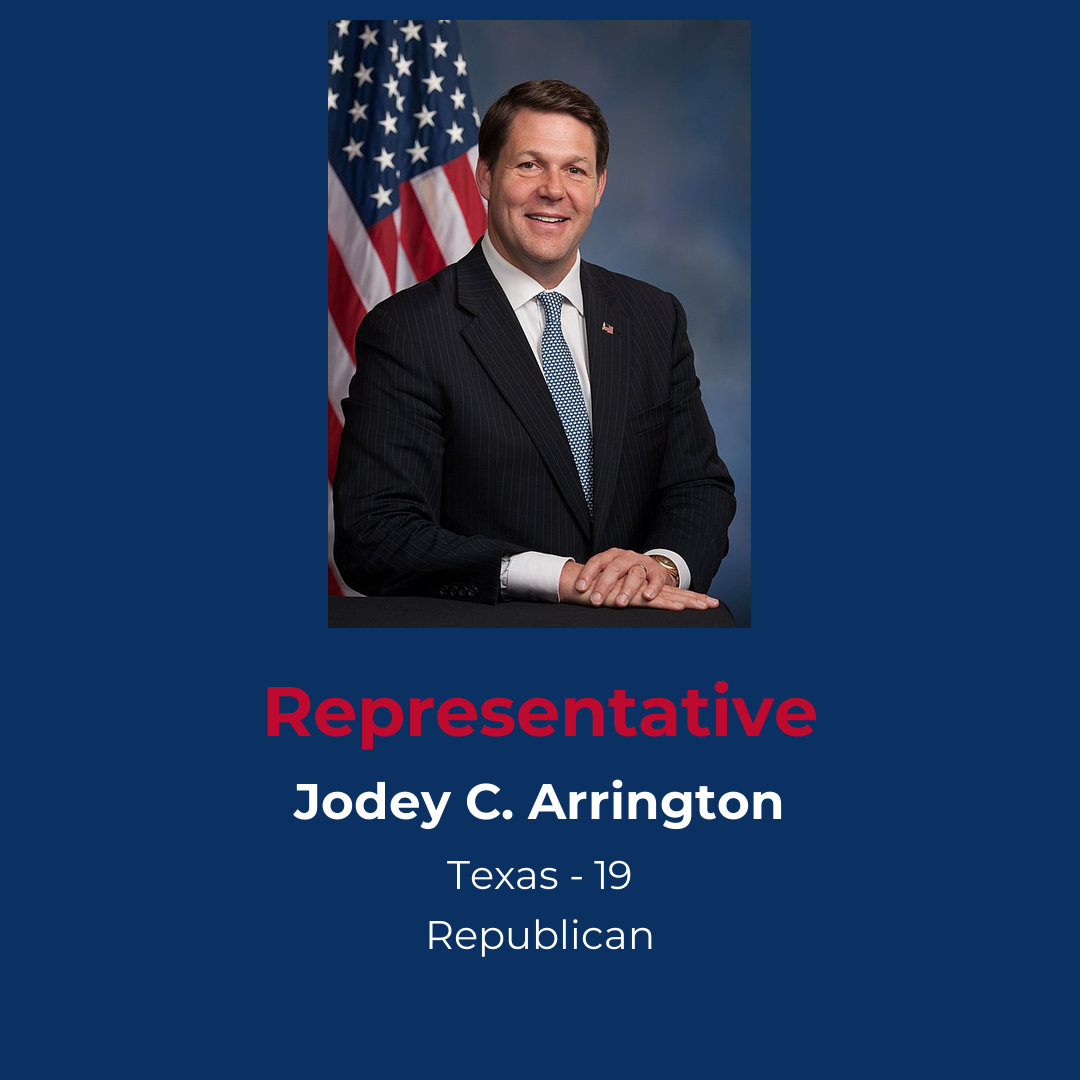
Profile of Republican Representative Arrington from Texas District 19
Jodey Arrington is the powerful Chairman of the House Budget Committee. A native of West Texas and a former advisor in the George W. Bush administration, he has spent his congressional career as a relentless fiscal hawk pushing for sweeping federal spending cuts. He represents Texas’s 19th District, a geographically massive, deeply conservative agricultural powerhouse that spans the rolling plains of West Texas, anchored by the cities of Lubbock and Abilene. The Retirement Announcement: In late 2025, Arrington sent shockwaves through Texas politics by announcing he will not seek re-election in 2026. After leading the passage of the administration's massive "One Big Beautiful Bill" reconciliation package, he stated he is leaving on a high note to return to his family, opening up one of the safest Republican seats in the country. The 2026 Farm Bill Victories: In early March 2026, Arrington secured massive wins for West Texas agriculture, successfully advancing his USDA CROP Act to check the EPA's power over pesticide regulations, and securing a new crop insurance pilot program to protect local cotton farmers. Current 2026 Battles: Arrington is dedicating his final year to an absolute war on federal waste and bureaucratic overreach. He recently introduced the Transparency in Federal Land Acquisitions Act to block federal wildlife agencies from secretly seizing private land, and is currently pitching "Reconciliation 2.0" to House leadership to slash the national debt. "He passed the largest tax and spending megabill in modern history and decided to walk away at the height of his power. Chairman Jodey Arrington is spending his final lap in Congress fighting for the plow boys and cowboys of West Texas." Day 70 | Jodey Arrington: The Budget Chairman's Final Stand Jodey Arrington’s political career is a masterclass in swift, highly effective conservative governance. Born in Plainview, Texas, he is the son of a tractor mechanic and a schoolteacher. He earned both his undergraduate and master's degrees from Texas Tech University in Lubbock, remaining deeply tethered to the cultural and economic rhythms of West Texas. Before entering elected office, Arrington served as an advisor to Governor George W. Bush in Austin, eventually following him to the White House as a senior advisor. After returning to Texas to serve as Vice Chancellor of the Texas Tech University System, he ran for the 19th Congressional District in 2016, running as a staunch, unapologetic fiscal conservative. During the 119th Congress (2025-2026), Arrington reached the absolute zenith of his legislative power. Serving as the Chairman of the House Budget Committee, he was the primary legislative architect behind the new administration's "One Big Beautiful Bill"—a massive reconciliation package that enacted historic tax and spending cuts, border security funding, and welfare reform. With that monumental achievement secured, Arrington stunned the political establishment in November 2025 by announcing he will retire at the end of his current term. Arguing that public office should be a "temporary stint in stewardship, not a career," Arrington chose to step away at the height of his influence. However, Chairman Arrington is not coasting toward the exit. His early 2026 agenda has been fiercely aggressive. Just days ago, in early March 2026, he responded to a terrifying new Congressional Budget Office (CBO) report projecting the gross federal debt to reach $182 trillion by 2056. Pointing out that this equates to $2 million per American family, Arrington is actively pushing House leadership to launch a bipartisan debt commission and is laying the groundwork for "Reconciliation 2.0" to gut federal fraud and autopilot entitlement spending. Simultaneously, he is delivering massive, hyper-local victories for the agricultural backbone of TX-19. In early March 2026, he successfully a...
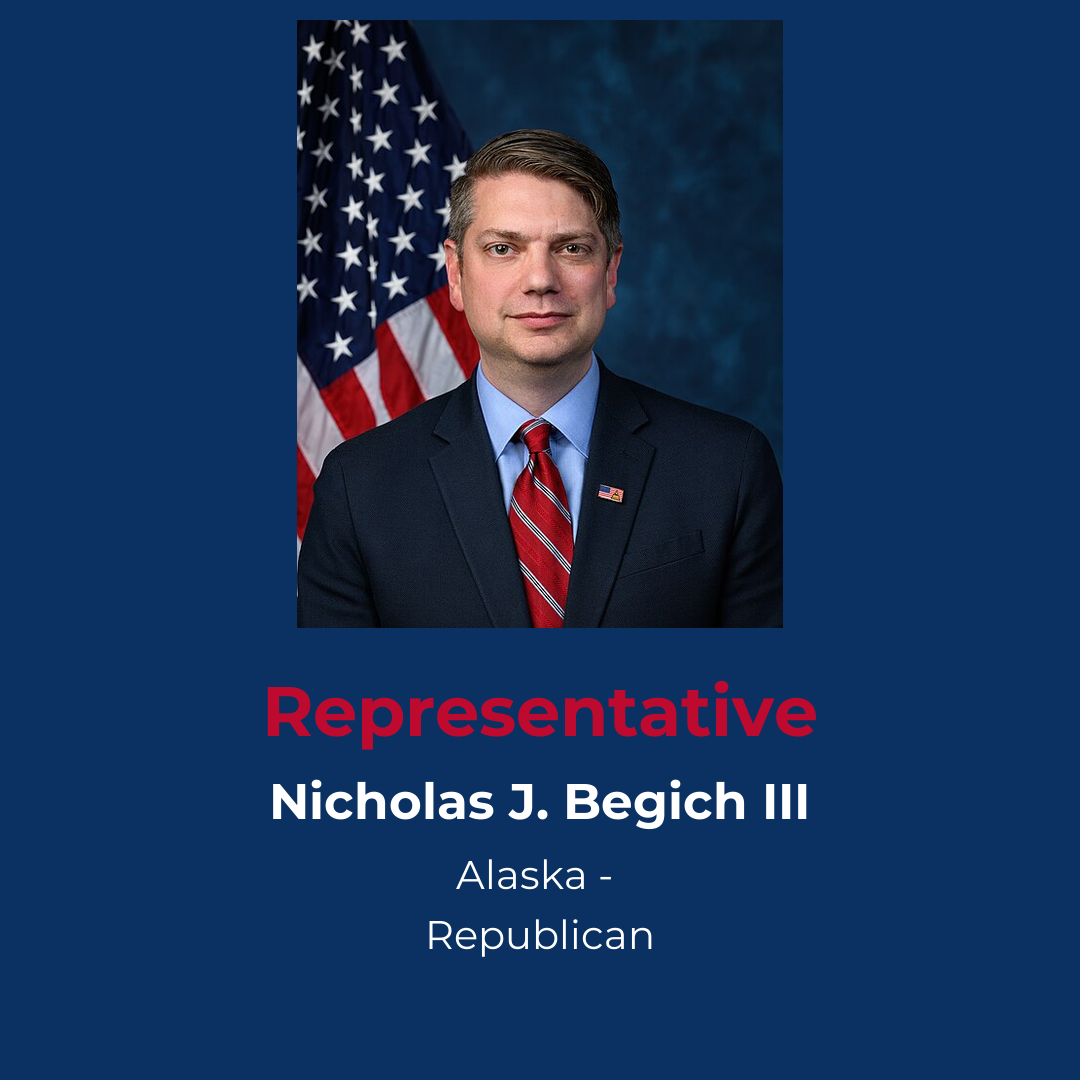
Profile of Republican Representative Begich from Alaska District 0
Nicholas J. Begich III is a conservative businessman who flipped Alaska’s sole congressional seat back to the Republican Party in the 2024 elections. He comes from Alaska's most famous Democratic political dynasty. His grandfather, Nick Begich Sr., was a Democratic Congressman who tragically vanished in a 1972 plane crash, and his uncle, Mark Begich, is a former Democratic U.S. Senator. Nick III, however, operates as a staunch, pro-business conservative. He represents Alaska’s At-Large District, the largest congressional district in the United States by land area, encompassing the entirety of the Last Frontier. In the 119th Congress (2025-2026), he is heavily focused on resource development, serving as the Vice Chair of the Energy and Mineral Resources Subcommittee on the House Natural Resources Committee. He also sits on the Transportation and Infrastructure Committee and the Science, Space, and Technology Committee. Unlocking Alaska: Begich's primary legislative focus is reversing federal land restrictions. In early 2026, he has actively pushed to open the National Petroleum Reserve-Alaska (NPR-A) and the Coastal Plain to responsible oil, gas, and mineral extraction. Recent 2026 Battles: Just yesterday, on March 10, 2026, Begich delivered his annual address to a Joint Session of the Alaska State Legislature in Juneau. On the national stage, he recently joined the DOGE Caucus to cut federal waste and issued a strong statement backing the late-February U.S. military strikes against Iran's nuclear programs. "He carries the most famous Democratic name in Alaskan political history, but Nick Begich III went to Washington as a fierce conservative determined to unlock the Last Frontier's massive energy potential." Day 70 | Nick Begich III: The Conservative Scion of the Last Frontier Nicholas J. Begich III's political career is a fascinating intersection of deep family legacy and sharp ideological independence. Born in Anchorage and raised in Chugiak, Begich grew up in the shadow of an Alaskan political dynasty. His grandfather, Nick Begich Sr., was Alaska's Democratic Congressman until his plane vanished over the Gulf of Alaska in 1972 alongside House Majority Leader Hale Boggs. His uncle, Mark Begich, later served as a Democratic U.S. Senator. However, Nick III charted a distinctly different path. Earning a business degree from Baylor University and an MBA from Indiana University, he entered the private sector, founding a successful software development company and co-founding a startup investment firm. Aligning with the Republican Party, Begich served as the co-chair of the late Congressman Don Young's 2020 re-election campaign. Following Young's passing and a highly complex ranked-choice voting cycle in 2022 that temporarily handed the seat to Democrat Mary Peltola, Begich mounted a relentless, highly disciplined campaign in 2024. Running on a platform of "Unlocking Alaska," he successfully united the conservative base, defeated Peltola, and returned the massive At-Large district to Republican control. Now serving in the 119th Congress, Begich was awarded an impressive slate of committee assignments tailored specifically to Alaska's unique economy. He serves as the Vice Chair of the Energy and Mineral Resources Subcommittee under the Natural Resources Committee. In this role, he is aggressively working alongside the new administration to dismantle the previous administration's environmental protections over the National Petroleum Reserve-Alaska (NPR-A) and the Coastal Plain, arguing that federal red tape is illegally choking off Alaska's economic lifeblood. Begich's legislative output has been remarkably efficient. During his first year, he passed 10 Alaska-specific bills out of the House. In early 2026, he successfully pushed the Alaska Native Settlement Trust Eligibility Act (H.R. 42) and the Alaska Native Village M...
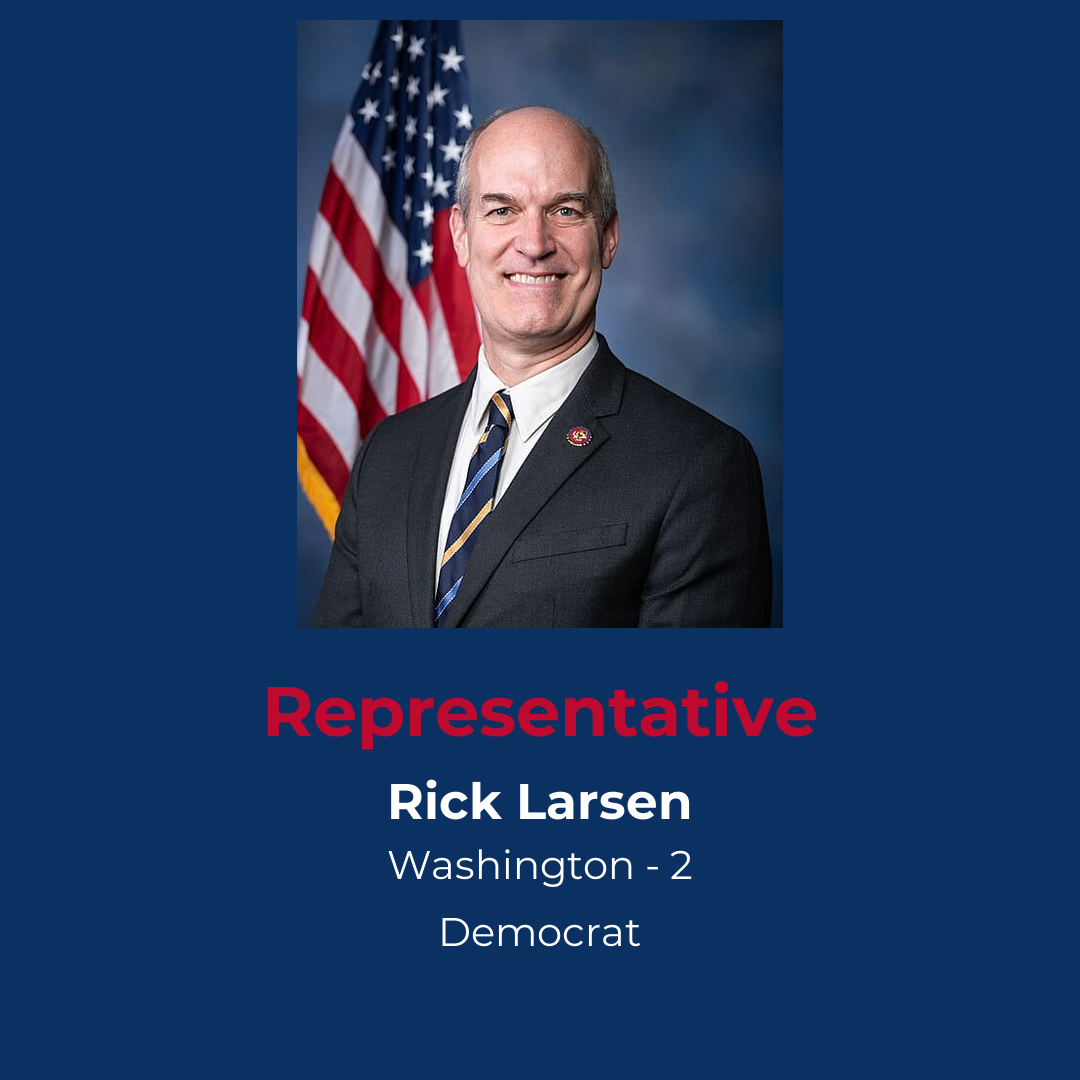
Profile of Democrat Representative Larsen from Washington District 2
Rick Larsen is a pragmatic, veteran Democratic lawmaker who has represented the Pacific Northwest for over two decades. Born and raised in Arlington, Washington, he is an undisputed policy heavyweight regarding aviation, maritime commerce, and national infrastructure. He represents Washington’s 2nd District, a stunning and economically critical region that encompasses the coastal and island communities north of Seattle, including Everett, Bellingham, and the San Juan Islands. In the 119th Congress (2025-2026), he holds one of the most powerful gavels in the minority, serving as the Ranking Member of the House Transportation and Infrastructure Committee. The Infrastructure Architect: Operating at the top of the T&I Committee, Larsen is currently leading the Democratic development of the Water Resources Development Act (WRDA) of 2026, directing billions of dollars toward port modernization, inland waterways, and coastal flood resilience. Recent 2026 Battles: Larsen's early March 2026 agenda has been explosive. Just days ago, he fiercely condemned the administration's military strikes in the Middle East, voting "Yes" on the War Powers Resolution to halt unauthorized conflict with Iran. Fighting Dark Money & ICE: On March 5, 2026, he reintroduced the massive DISCLOSE Act to ban "dark money" from federal elections, and voted against the Department of Homeland Security funding bill in protest of ICE's reckless enforcement agenda. "Whether he is fighting for aviation safety in the factories of Everett or standing up to the White House over unauthorized wars, Rick Larsen is the pragmatic, infrastructure-obsessed anchor of the Pacific Northwest." Day 69 | Rick Larsen: The Infrastructure Anchor of the Pacific Northwest Rick Larsen’s political career is deeply rooted in the physical and economic landscape of Washington state. Born and raised in Arlington, Washington, his family has lived in the region for over a century. After earning his master's degree in public administration from the University of Minnesota, he worked in economic development before serving on the Snohomish County Council. First elected to the U.S. House of Representatives in 2000, Larsen has spent over twenty years mastering the complex intersections of global trade, environmental protection, and federal transportation policy. Operating in the 119th Congress, Larsen is at the absolute zenith of his legislative influence. He serves as the Ranking Member of the House Transportation and Infrastructure Committee. Because his district is home to the massive Boeing manufacturing plants in Everett, Larsen is one of Congress's foremost experts on aviation safety, consistently demanding strict federal oversight of the aerospace industry and pushing the FAA to modernize its aging technology systems. Simultaneously, he is the primary legislative force behind the Water Resources Development Act (WRDA) of 2026. Through WRDA, Larsen is securing vital federal investments for the Army Corps of Engineers to dredge Pacific Northwest harbors, restore depleted salmon habitats, and protect coastal communities from increasingly severe, climate-driven atmospheric rivers. While he is a master of bipartisan infrastructure, Larsen's early 2026 tenure has been defined by fierce, uncompromising clashes with the new Trump administration over foreign policy and domestic accountability. In late February and early March 2026, as the administration launched massive military operations against Iranian targets, Larsen immediately went on the offensive. He publicly condemned the strikes as a "reckless war" that lacked congressional authorization, joining Democratic Leader Hakeem Jeffries to demand accountability. On March 6, 2026, Larsen formally voted in favor of the War Powers Resolution, arguing that his constituents want lower prices, not endless overseas conflicts. His domestic...
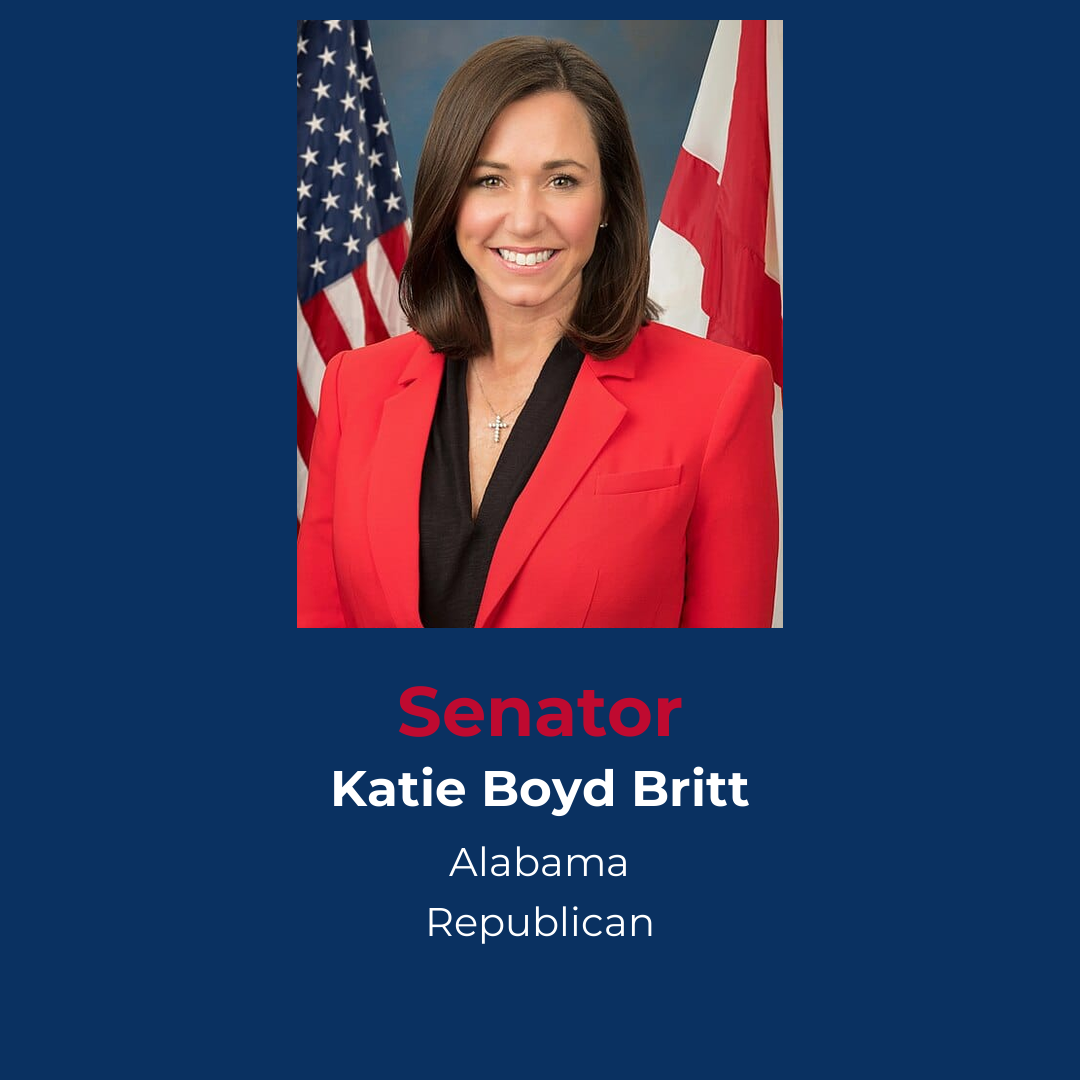
Profile of Republican Senator Britt from Alabama
Katie Boyd Britt is the junior United States Senator from Alabama. Taking office in 2023, she made history as the very first woman elected to the U.S. Senate from the state of Alabama. A lawyer and former CEO of the Business Council of Alabama, she previously served as Chief of Staff to her predecessor, the legendary Senator Richard Shelby. She represents Alabama, a deeply conservative Southern state with a massive agricultural sector, a thriving aerospace and defense industry, and a populace that heavily values traditional family policies. In the 119th Congress (2025-2026), she secured incredibly powerful gavels. She serves as the Chairman of the Homeland Security Appropriations Subcommittee and the Chairman of the Banking Subcommittee on Housing, Transportation, and Community Development. She also sits on the Judiciary and Rules committees. The Laken Riley Act: A fierce advocate for border security, Senator Britt was the driving force behind the Laken Riley Act. In early 2025, it became the very first piece of legislation signed into law during President Trump's second term. Recent 2026 Battles: Britt's early March 2026 schedule has been monumental. Just yesterday, she announced a massive victory, officially securing the former Birmingham-Southern College campus as the new national training center for the U.S. Coast Guard. She is currently navigating an intense fight to end a funding lapse at the Department of Homeland Security while aggressively pushing legislation to protect children on social media. "From serving as a Chief of Staff to wielding the gavel of the Homeland Security Appropriations Subcommittee. Katie Britt is the energetic, fiercely conservative voice of Alabama's next political generation." Day 69 | Katie Boyd Britt: The Chairman Defending the Homeland Katie Boyd Britt’s political ascent has been rapid, disciplined, and deeply rooted in Alabama's political establishment. Born in Enterprise, Alabama, she demonstrated leadership early on, serving as the president of the Student Government Association at the University of Alabama, where she later earned her law degree. Rather than seeking the spotlight immediately, Britt spent years mastering the intricate mechanics of Capitol Hill, serving as the Chief of Staff to Alabama's powerful, long-serving Senator Richard Shelby. She later returned to her home state to lead the Business Council of Alabama, advocating for local industries during the volatile pandemic years. When Senator Shelby announced his retirement, Britt jumped into the 2022 race, comfortably defeating her primary challengers and coasting to a general election victory, becoming the first elected female Senator in Alabama's history. Now operating in her fourth year during the 119th Congress, Britt has transformed from a rising freshman into a formidable committee leader. Through her seat on the Appropriations Committee, she serves as the Chairman of the Homeland Security Subcommittee. This position gives her direct oversight and massive financial leverage over agencies like ICE, Customs and Border Protection (CBP), and the Coast Guard. She used this leverage in early 2025 to successfully push the Laken Riley Act across the finish line—a landmark border security bill mandating the detention of undocumented immigrants arrested for theft. It was the first bill signed into law by the new administration. In early 2026, Chairman Britt has been fighting aggressive, multi-front battles regarding both national security and family policy. Currently, the Department of Homeland Security is operating under a tense funding lapse. Speaking to the media just yesterday on March 9, 2026, Britt demanded good-faith negotiations from her Democratic colleagues, stating that federal law enforcement officers cannot be expected to secure the homeland while worrying about missing their paychecks. Yet, even amidst the funding fight, sh...
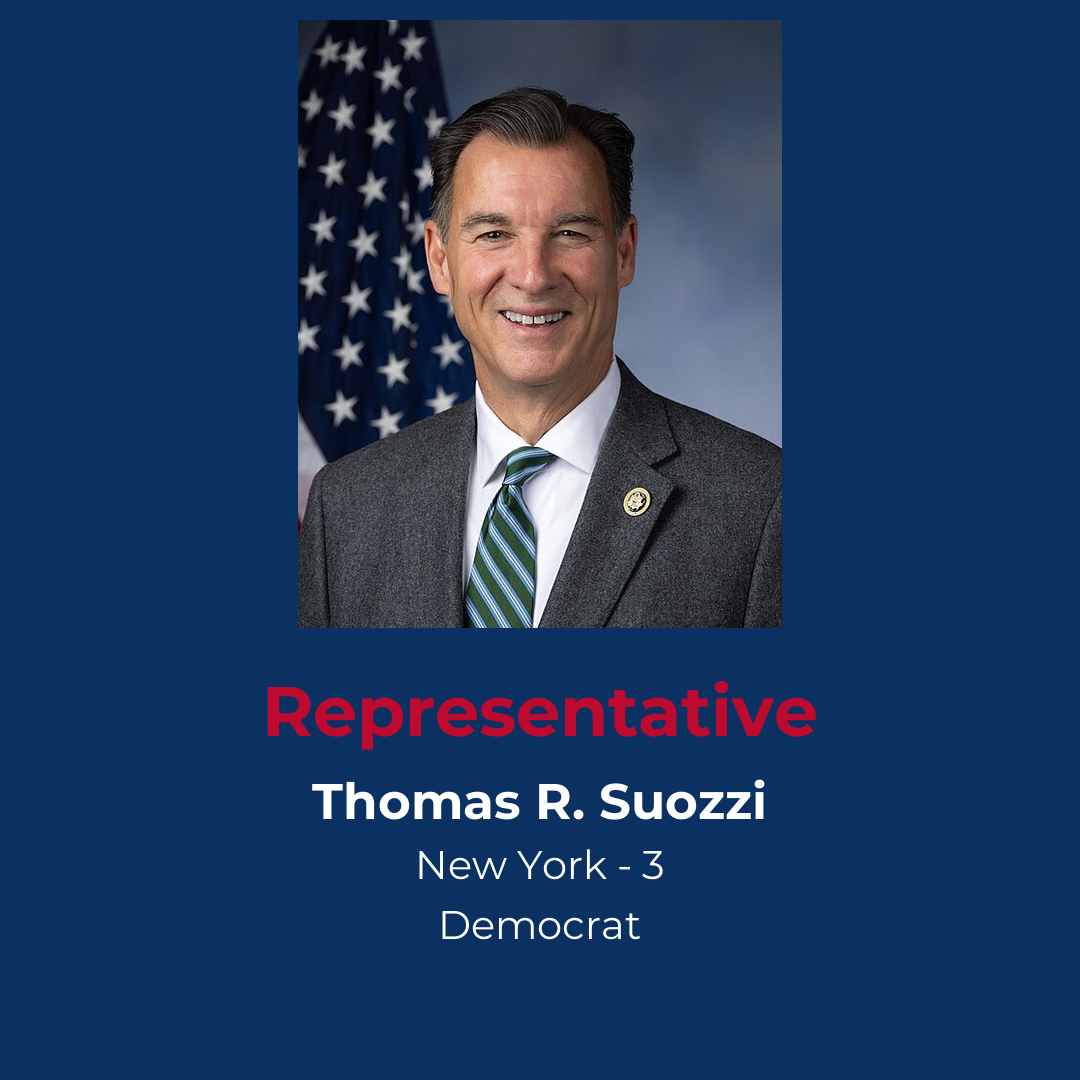
Profile of Democrat Representative Suozzi from New York District 3
Tom Suozzi is a seasoned, pragmatic centrist who successfully returned to Washington to stabilize a district rocked by scandal. He previously represented the district for three terms before stepping away, only to win a highly publicized special election in early 2024 to replace the expelled George Santos, subsequently securing a full term in the 119th Congress. He represents New York’s 3rd District, the wealthiest congressional district in the state. It encompasses the affluent North Shore of Long Island (Nassau County) and stretches into the northeastern neighborhoods of Queens. In the 119th Congress (2025-2026), Suozzi reclaimed his highly coveted seat on the powerful House Ways and Means Committee, serving on the Tax and Oversight subcommittees. The "Mr. SALT" Crusade: A self-described "Common Sense Democrat" and a leader in the Problem Solvers Caucus, Suozzi's defining domestic mission is repealing the $10,000 cap on State and Local Tax (SALT) deductions, arguing the cap acts as a devastating penalty on his high-tax Long Island constituents. Recent 2026 Battles: In early 2026, Suozzi is fighting aggressively on multiple fronts. He is fiercely combating the new administration's revocation of the EPA's greenhouse gas 'Endangerment Finding,' and demanding the immediate restoration of abruptly cut federal SAMHSA (mental health and substance abuse) grants. Bipartisan Healthcare Push: Teaming up with conservative Republicans, Suozzi recently introduced the Bipartisan HOPE Act to extend Affordable Care Act premium tax credits, preventing a massive spike in healthcare costs for working families. "He answered the call to restore dignity to Long Island's 3rd District. As a relentless centrist on the Ways and Means Committee, Tom Suozzi proves that common-sense pragmatism can still cut through Washington's extreme partisanship." Day 68 | Tom Suozzi: The Common Sense Anchor of Long Island Tom Suozzi’s political brand is entirely built on his willingness to operate in the ideological center. A trained lawyer and certified public accountant, Suozzi possesses a deep, granular understanding of municipal finance and local governance. He served as the Mayor of Glen Cove, New York, for four terms, followed by two terms as the Nassau County Executive, where he was credited with rescuing the county from the brink of bankruptcy. First elected to the U.S. House of Representatives in 2016, he spent three terms building a reputation as a fierce advocate for bipartisan problem-solving before stepping away in 2022 to launch a gubernatorial bid. However, his absence from Congress was short-lived, necessitated by one of the most bizarre political scandals in modern American history. After his successor, Republican George Santos, was expelled from the House for massive federal fraud and campaign finance violations, Suozzi answered the call from the Democratic Party to stabilize the district. Running on a platform of "Let's Fix This," Suozzi comfortably won the special election in February 2024, and successfully defended the seat in the November 2024 general election. Now serving in the 119th Congress, Suozzi is operating with immense leverage. He successfully regained his seat on the exclusive House Ways and Means Committee, serving on the critical Tax Subcommittee. With the massive 2017 Tax Cuts and Jobs Act set to expire at the end of 2025, Suozzi has spent early 2026 leading the charge to restore the full State and Local Tax (SALT) deduction. Because his Long Island district features some of the highest property taxes in the nation, Suozzi famously earned the nickname "Mr. SALT," threatening to block any sweeping tax legislation that does not lift the $10,000 cap that penalizes his constituents. Despite the intense polarization of early 2026, Suozzi continues to lean heavily into his role within the Problem Solvers Caucus. While he is f...
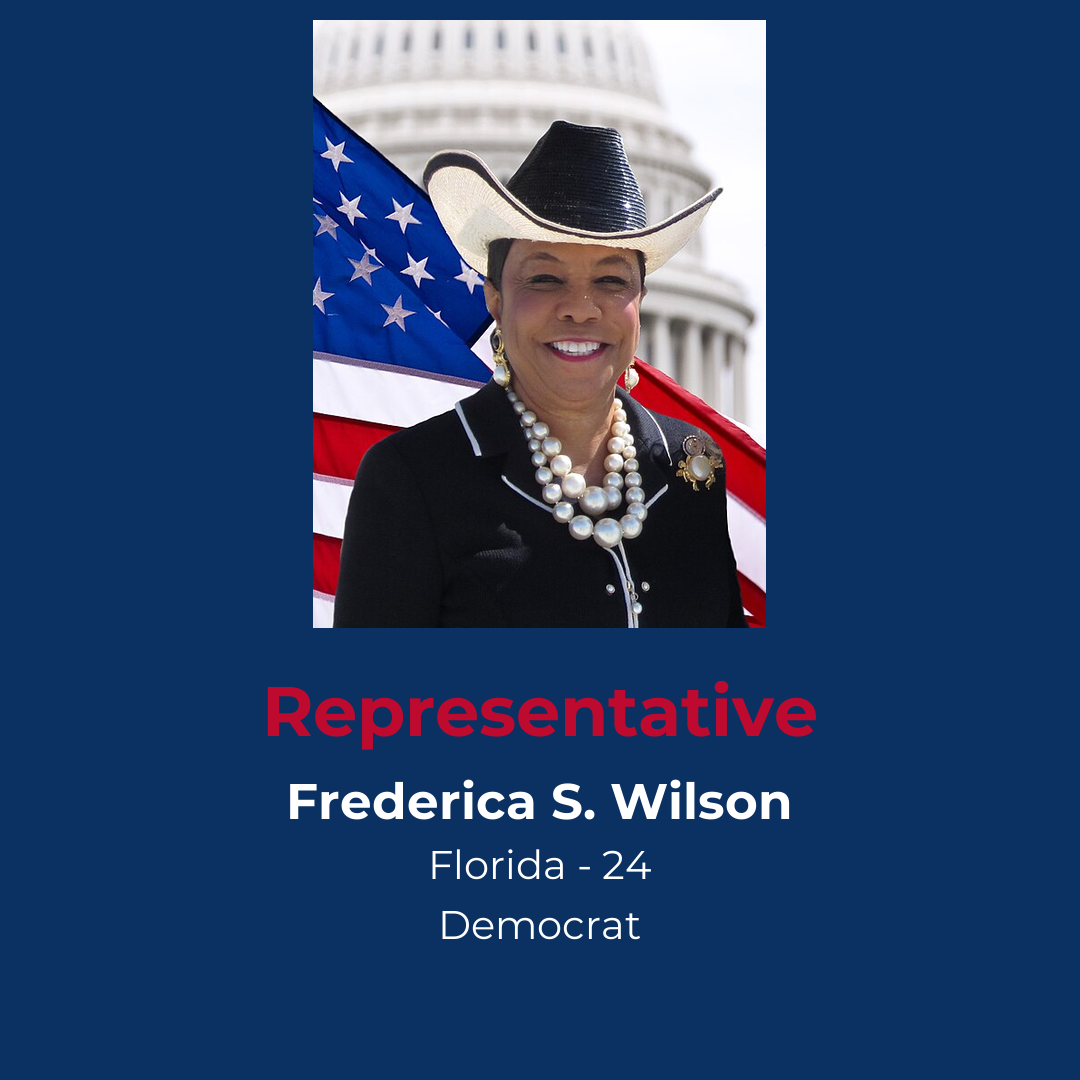
Profile of Democrat Representative Wilson from Florida District 24
Frederica S. Wilson is an iconic figure in South Florida politics, instantly recognizable on Capitol Hill by her brilliantly colored hats. Before entering Congress, she spent decades as an elementary school principal and a school board member, founding the 5000 Role Models of Excellence Project to mentor at-risk minority youth. She represents Florida’s 24th District, a deeply Democratic, incredibly diverse, and culturally vibrant urban district that spans the coastal and inland communities of northern Miami-Dade and southern Broward counties, including Miami Gardens and North Miami. In the 119th Congress (2025-2026), she secured a major leadership role, being elected as the Ranking Member of the Water Resources and Environment Subcommittee on the House Transportation and Infrastructure Committee. She also serves on the House Committee on Education and the Workforce. The 2026 SOTU Boycott: Wilson is currently taking a fiercely combative stance against the new Trump administration's agenda. She made national headlines in late February 2026 by officially boycotting the State of the Union address, stating she could not in good conscience attend a forum that ignored the urgent realities of minority communities. Recent 2026 Legislation: A lifelong educator, Wilson is aggressively pushing back against conservative education policies. On February 27, 2026, she teamed up with Reps. Maxwell Frost and Jamie Raskin to reintroduce the Fight Book Bans Act to combat the surging wave of book censorship in Florida public schools. "She spent decades as an elementary school principal before becoming the unapologetic voice of South Florida. Frederica Wilson is a fierce protector of public education, civil rights, and the working-class families of Miami-Dade." Day 68 | Frederica S. Wilson: The Unapologetic Voice of South Florida Frederica S. Wilson’s political brand is a vibrant, unmistakable mix of bold personal style and fierce, ground-level advocacy. Born and raised in Miami, Florida, she is the daughter of a prominent civil rights activist who instilled in her a deep commitment to social justice. Earning her degrees from Fisk University and the University of Miami, Wilson spent her early career in the trenches of the public education system. She served as a teacher, an elementary school principal, and eventually a member of the Miami-Dade County School Board. During her time in education, she recognized a massive crisis regarding the systemic marginalization of young minority men, leading her to found the 5000 Role Models of Excellence Project—a massive, highly successful mentoring program that has guided thousands of at-risk youth toward college and successful careers. Transitioning from education to politics, Wilson served in both the Florida State House and the State Senate before winning her U.S. House seat in 2010. Instantly recognizable by her massive, colorful hats—a tribute to her Bahamian heritage and her grandmother—Wilson quickly established herself as the "Voice for the Voiceless." She is a staunch, unapologetic progressive who views federal policy primarily through the lens of racial equity, public education, and workforce development. Operating in the 119th Congress, the veteran lawmaker secured a crucial leadership position. In January 2025, she was officially elected as the Ranking Member of the Water Resources and Environment Subcommittee on the Transportation and Infrastructure Committee. This is a deeply strategic role for a representative from South Florida, where rising sea levels, aging water infrastructure, and Everglades restoration are existential issues. Simultaneously, she remains a senior voice on the Education and the Workforce Committee, where she serves as the primary Democratic attack dog against the conservative push for school vouchers and charter school expansion. Her actions in early 2026 have been defined...

Profile of President James A. Garfield
James A. Garfield was the 20th President of the United States (1881). His presidency is one of the greatest "what-ifs" in American history, lasting just 200 days before he was tragically assassinated. He is the only sitting member of the United States House of Representatives to be elected directly to the presidency. The Accidental Nominee: Garfield did not want to be President. At the 1880 Republican National Convention, he delivered such a brilliant nominating speech for another candidate that the deadlocked convention unexpectedly drafted Garfield himself, nominating him on the 36th ballot. The War on the Spoils System: During his brief time in office, Garfield fiercely defended the power of the presidency against the corrupt "Stalwart" faction of the Republican Party led by Senator Roscoe Conkling, successfully dismantling their control over the lucrative New York Custom House. The Assassination: On July 2, 1881, Garfield was shot at a Washington D.C. train station by Charles J. Guiteau, a delusional and disgruntled office seeker who believed he was personally owed a government job in Paris. A Medical Tragedy: Garfield survived the initial shooting. He agonized for 79 days and ultimately died not from the bullet, but from massive infections caused by his incompetent doctors—led by Dr. Willard Bliss—who repeatedly probed his unsterilized wounds with unwashed fingers and instruments. "He was a brilliant scholar, a battlefield general, and a reluctant president. James A. Garfield's assassination robbed the nation of one of its most capable leaders, dying not from an assassin's bullet, but from the hubris of modern medicine." Day 67 | James A. Garfield: The Tragedy of the 20th President James A. Garfield possessed one of the most brilliant, intellectually gifted minds ever to occupy the Oval Office. Born in 1831 in a genuine log cabin in poverty-stricken rural Ohio, his father died when he was just an infant. Raised by his fierce, determined mother, Garfield developed an insatiable appetite for reading. He worked as a canal boy to earn money for school, eventually attending Williams College. By his mid-twenties, he was a classics professor and the president of the Eclectic Institute (now Hiram College). A legendary—if slightly mythologized—anecdote claims that Garfield was perfectly ambidextrous and could simultaneously write Greek with one hand and Latin with the other. When the Civil War began, Garfield proved his brilliance extended to the battlefield. Having no formal military training, he studied textbooks on strategy and was quickly promoted to Major General in the Union Army, serving with distinction at the battles of Shiloh and Chickamauga. At the explicit urging of President Abraham Lincoln, who desperately needed pro-Union military minds in Congress, Garfield left the army to serve in the U.S. House of Representatives. Over the next 18 years, he became the leading Republican intellectual in the House. The election of 1880 propelled him to the presidency completely by accident. The Republican Party was deeply fractured between the "Stalwarts" (who wanted a third term for Ulysses S. Grant and fiercely protected the corrupt patronage system) and the "Half-Breeds" (who supported James G. Blaine and favored civil service reform). Garfield went to the convention to support a third candidate, John Sherman. When Garfield gave a soaring, unifying speech on Sherman's behalf, the deadlocked delegates were so captivated that they began voting for Garfield instead. Despite his protests, he was nominated on the 36th ballot. Winning a narrow general election, Garfield took office in March 1881. He immediately went to war to protect the constitutional authority of the presidency. Senator Roscoe Conkling, the powerful boss of the New York political machine, demanded the right to control the lucrative appointments at the N...

Profile of President Rutherford B. Hayes
Rutherford B. Hayes was the 19th President of the United States (1877–1881). He assumed the presidency following the most intensely disputed and controversial election in American history, ultimately losing the popular vote but securing the Electoral College by a single vote. The Compromise of 1877: To secure the presidency, Hayes and the Republican Party struck a backroom deal with Southern Democrats. Hayes agreed to withdraw the remaining federal troops from the South, officially ending the Reconstruction Era and abandoning the federal protection of newly freed African Americans. He was a genuinely heroic Civil War veteran. Leaving his law practice to join the Union Army, he fought on the front lines, had his horse shot out from under him, and was wounded in combat five separate times, ultimately rising to the rank of brevet major general. During his single term, he became a fierce champion of civil service reform, attempting to dismantle the corrupt "spoils system" by demanding that government jobs be awarded based on merit and examinations rather than political patronage. He deployed federal troops to intervene in the Great Railroad Strike of 1877, the deadliest conflict between workers and strikebreakers in American history, marking a major escalation in federal involvement in domestic labor disputes. "He was a battlefield hero who won the White House through a backroom deal. Rutherford B. Hayes traded the promise of Reconstruction for the presidency, forever altering the trajectory of the American South." Day 66 | Rutherford B. Hayes: The Compromise President Rutherford B. Hayes possessed a resume that seemed practically engineered for the American presidency in the late 19th century. Born in Delaware, Ohio, in 1822, he was raised by a single mother after his father died just weeks before his birth. Highly educated, he graduated at the top of his class from Kenyon College and earned his law degree from Harvard Law School. Returning to Ohio, he established a successful law practice in Cincinnati, where he frequently defended runaway slaves who had escaped across the Ohio River from Kentucky, earning a reputation as a staunch, principled abolitionist. When the Civil War erupted, the 38-year-old Hayes left his comfortable legal career to join the 23rd Ohio Volunteer Infantry. Unlike many politicians who sought safe, administrative military posts, Hayes thrived in the brutal combat of the front lines. He fought bravely at South Mountain and Cedar Creek, sustaining five severe combat wounds and earning the intense loyalty of his men. While he was still fighting in the field, Ohio Republicans nominated him for the U.S. House of Representatives. Hayes famously refused to leave his troops to campaign, stating that any officer who abandoned his post to electioneer "ought to be scalped." He won the election easily, later returning to Ohio to serve three highly successful terms as Governor. His reputation for absolute personal honesty made him the perfect Republican nominee in 1876, a year when the country was deeply exhausted by the massive corruption scandals of the Ulysses S. Grant administration. However, the election against Democratic nominee Samuel J. Tilden became a national nightmare. Tilden decisively won the popular vote, but the electoral votes of three Southern states—Florida, Louisiana, and South Carolina—were fiercely disputed amid massive allegations of voter fraud and violent voter intimidation against African Americans. The crisis dragged on for months, bringing the nation to the brink of a second civil war. Finally, a special congressional commission awarded all the disputed electoral votes to Hayes, giving him the presidency by a margin of 185 to 184. The decision was secured through the Compromise of 1877, an informal agreement where Southern Democrats accepted Hayes’s victory in exchange for a massive conces...
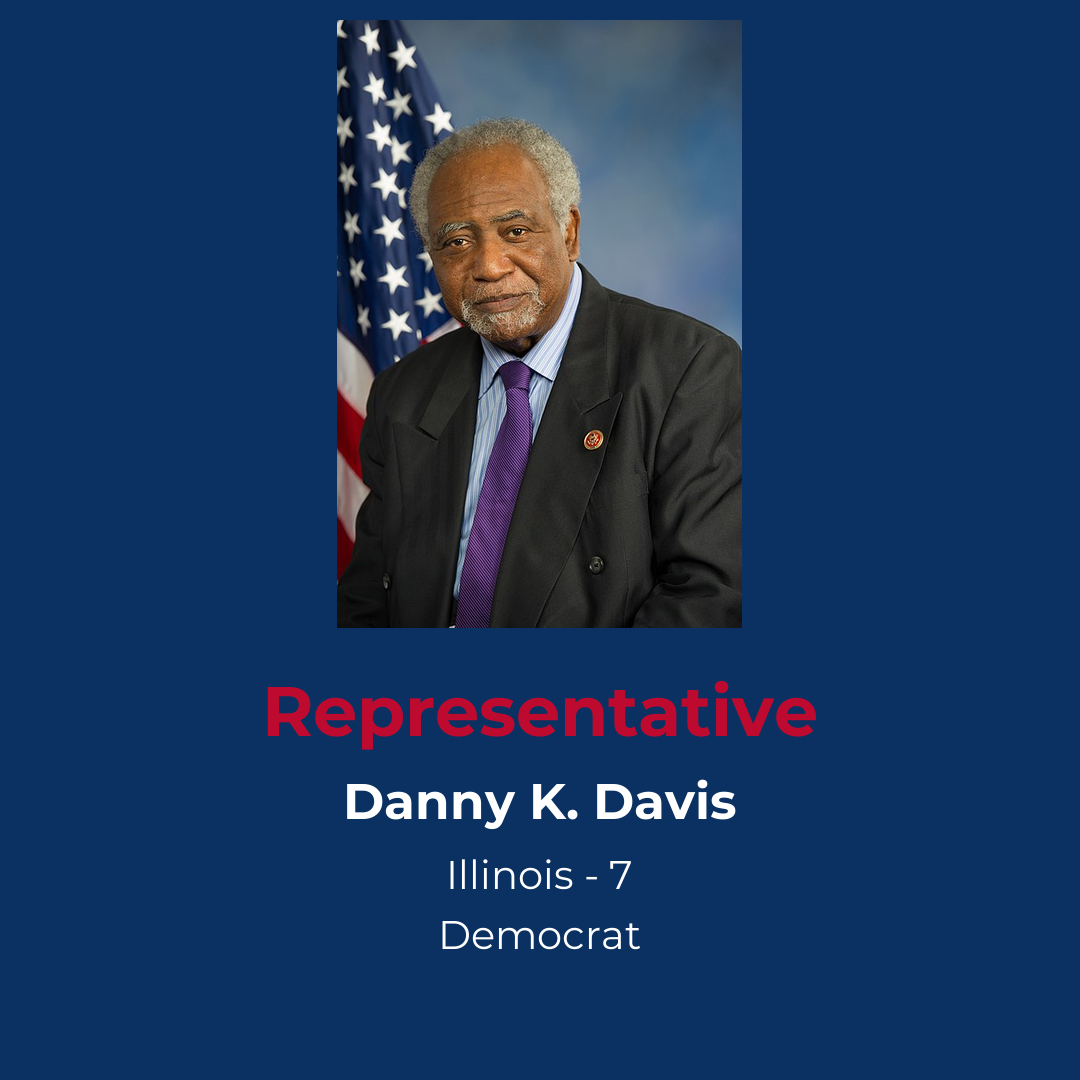
Profile of Democrat Representative Davis from Illinois District 7
Key Takeaways (Click to Expand) Danny K. Davis is an absolute institution in Chicago politics. Born in Arkansas during the Jim Crow era, he moved to Chicago during the Great Migration, earned a Ph.D. in public administration, and served on the Chicago City Council and Cook County Board before entering Congress in 1997. He represents Illinois’s 7th District, a profoundly diverse and economically stratified district that includes the immense wealth of downtown Chicago (The Loop) as well as the historic, working-class neighborhoods of the city's West Side and near-western suburbs like Oak Park. A Historic Retirement: In July 2025, Davis made a massive political announcement: he will not seek re-election and will officially retire at the end of the 119th Congress in January 2027, capping off a 30-year congressional career and sparking a fierce political scramble to succeed him. In his final term, he serves on the powerful House Ways and Means Committee, operating as the Ranking Member of the Subcommittee on Work and Welfare. In late 2025, the Center for Effective Lawmaking officially named him the most effective Democratic lawmaker on welfare policy in the House. Recent 2026 Battles: Davis is dedicating his final year to protecting the social safety net from the new Trump administration's agenda. In early 2026, he demanded the administration release $1 billion in withheld child care funding, and he is heavily promoting a grassroots counter-offensive he calls "Project 2026" to mobilize voters. Bipartisan Legacy: Despite his progressive roots, Davis is a master of bipartisan legislation. In late February 2026, he partnered with Republican Darin LaHood to introduce the Fresh Starts for Foster Youth Act, and he is currently pushing the House to pass the reauthorization of the Second Chance Act to support prison re-entry programs. "From the legendary Harold Washington era of Chicago politics to his final term on the Ways and Means Committee, Danny K. Davis has spent half a century operating as the ultimate defender of the social safety net." Day 65 | Danny K. Davis: The West Side Institution's Final Lap Danny K. Davis's life story is a quintessential reflection of the Great Migration and the evolution of Black political power in America. Born in 1941 in Parkdale, Arkansas, he grew up in the segregated South before migrating to Chicago's West Side in 1961. Driven by a relentless belief in education, Davis worked as a government clerk and a high school teacher while pursuing his own studies, ultimately earning both a master's degree and a Ph.D. in public administration. He plunged into community organizing and health administration before entering the political arena, serving as an alderman on the Chicago City Council during the legendary, transformative tenure of Mayor Harold Washington in the 1980s. Elected to the U.S. House of Representatives in 1996, Davis has held Illinois's 7th District for nearly three decades. His district is a study in extreme contrasts, encompassing the towering corporate skyscrapers of the Chicago Loop and the Gold Coast alongside communities on the West Side that have historically battled systemic poverty and underinvestment. Throughout his congressional career, Davis has operated as a steady, progressive anchor, focusing almost entirely on the mechanics of the federal safety net rather than chasing viral social media moments. Now operating in the 119th Congress, the 84-year-old lawmaker is taking his final lap. In July 2025, Davis officially announced his retirement, confirming he will leave office in January 2027. But rather than quietly coasting to the finish line, Davis is spending his final months locked in intense legislative combat. As the Ranking Member of the Ways and Means Subcommittee on Work and Welfare, he is fiercely defending anti-poverty programs against the new Trump administration's pro...
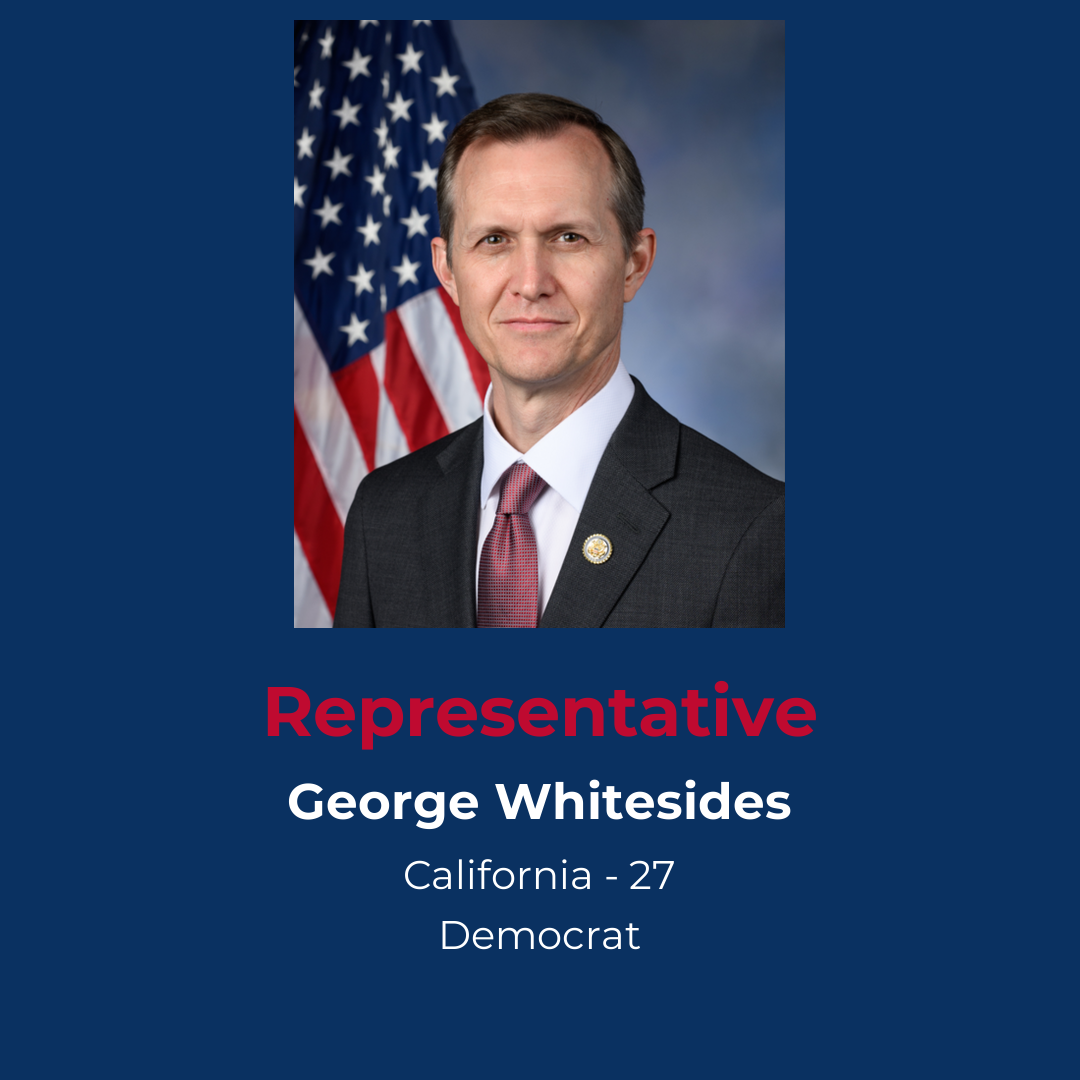
Profile of Democrat Representative Whitesides from California District 27
Key Takeaways (Click to Expand) George Whitesides is a freshman Democrat and a towering figure in the American aerospace industry. Before entering politics, he served as the Chief of Staff for NASA under the Obama administration and subsequently spent a decade as the first CEO of Richard Branson's spaceflight company, Virgin Galactic. He represents California’s 27th District, a pivotal, highly competitive swing district in northern Los Angeles County that includes the Antelope, Santa Clarita, and San Fernando Valleys. He successfully flipped the seat blue in the 2024 election by defeating Republican incumbent Mike Garcia. In the 119th Congress (2025-2026), his aerospace background earned him highly strategic assignments. He serves as the Vice-Ranking Member of the House Science, Space, and Technology Committee and sits on the House Armed Services Committee. Uniquely, he is the only Democrat selected to serve on three separate Armed Services subcommittees. The Megafire Crisis: A massive advocate for environmental resilience, Whitesides co-founded Megafire Action before entering Congress. He is currently pushing legislation to use advanced satellite technology to predict and prevent devastating Southern California wildfires. Recent 2026 Battles: In early 2026, Whitesides launched a fierce defense of his district's veterans and infrastructure. In January, he testified before Congress to push his VA Home Loan Program Reform Act. Last month, he aggressively condemned the new administration's partisan budget process for attempting to strip $25 million in localized public safety and water cleanup funding from his district. "He led NASA as Chief of Staff and launched the era of commercial spaceflight as the CEO of Virgin Galactic. Now, George Whitesides is bringing his high-tech, problem-solving mindset to the halls of Congress." Day 65 | George Whitesides: The Aerospace Executive Defending the Valleys George Whitesides’s resume reads unlike almost anyone else in the United States Congress; it is a masterclass in science, innovation, and global aerospace leadership. Born in Massachusetts, Whitesides earned his degree from Princeton University’s Woodrow Wilson School of Public and International Affairs, followed by a master's degree from Cambridge University. Drawn to the romance and reality of space flight, he served as the executive director of the National Space Society before working on the 2008 presidential transition team. President Obama subsequently appointed Whitesides as the Chief of Staff for NASA. During his tenure, he helped catalyze the massive innovations that drive the modern space sector, ultimately receiving the Distinguished Service Medal, NASA's highest honor. Leaving the public sector in 2010, Whitesides transitioned to the commercial frontier, becoming the first CEO of Virgin Galactic. Over the next decade, he transformed the company from a small startup into a global aerospace titan. He brought hundreds of high-paying, cutting-edge manufacturing jobs to the Mojave Air and Space Port near his current congressional district, successfully taking the company public and overseeing the first human spaceflight launched from U.S. soil since the retirement of the Space Shuttle. When Whitesides launched his campaign for California's 27th District in 2024, he faced an incredibly steep uphill battle against three-term Republican incumbent Mike Garcia. However, Whitesides ran a deeply pragmatic, locally focused campaign. He mobilized long-term care workers, championed reproductive freedom, and leaned heavily on his record as a job creator in the Antelope Valley. In one of the tightest and most pivotal races of the cycle, Whitesides flipped the district blue, ensuring the working families of northern Los Angeles County had a fierce new advocate in Washington. Arriving as a freshman in the 119th Congress, Whitesides's t...
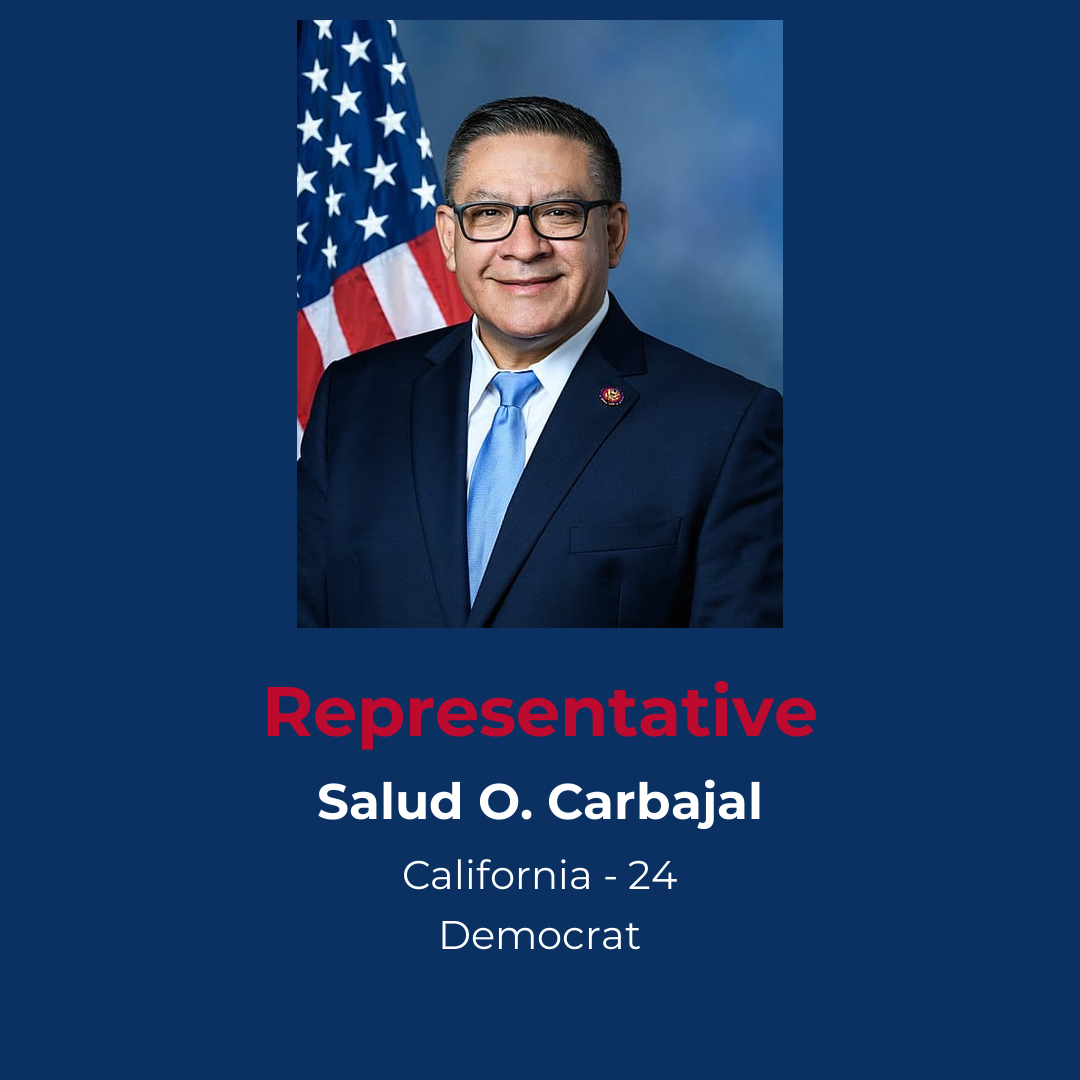
Profile of Democrat Representative Carbajal from California District 24
Salud Carbajal is a Marine Corps veteran and a fierce advocate for working-class families. Emigrating from Mexico as a young child, he grew up working alongside his father in the agricultural fields of California before becoming the first in his family to graduate from a university. He represents California’s 24th District, encompassing the stunning, economically vital Central Coast, including the entirety of Santa Barbara County and portions of San Luis Obispo and Ventura counties. In the 119th Congress (2025-2026), he serves on three major committees: the House Armed Services Committee, the House Agriculture Committee, and the House Transportation and Infrastructure Committee, where he holds the powerful role of Ranking Member on the Coast Guard and Maritime Transportation Subcommittee. The 2025 Healthcare Standoff: Carbajal emerged as one of the most vocal opponents of the new Trump administration during the late-2025 government shutdown. Fighting the administration's proposed massive cuts to Medicaid and the Affordable Care Act, Carbajal fiercely defended the ACA subsidies that prevent tens of thousands of his constituents from facing 300% premium spikes. Defending Veterans from DOGE: Drawing on his military background, Carbajal recently introduced the VA DATA Act of 2025 to explicitly block Elon Musk and the Department of Government Efficiency (DOGE) from accessing the private, sensitive medical and service records of U.S. veterans. "From working the agricultural fields of Oxnard to deploying with the Marine Corps and defending the Central Coast in Congress. Salud Carbajal never forgets the struggles of the working-class families who built California." Day 64 | Salud Carbajal: The Marine Defending the Central Coast Salud Carbajal’s journey to the United States Congress is a quintessential American story of resilience. Born in Moroleón, Mexico, he immigrated to the United States at the age of five, initially living in a small copper mining town in Arizona before his family settled in Oxnard, California. When the mines closed, his father became a farmworker, and Carbajal spent his summers performing grueling labor in the agricultural fields alongside him. Applying himself relentlessly to his education, he became the first in his family to graduate from college, earning a degree from UC Santa Barbara. He simultaneously served eight years in the United States Marine Corps Reserve, including a mobilization to active duty during the 1991 Gulf War. Before arriving on Capitol Hill, Carbajal spent 12 years serving on the Santa Barbara County Board of Supervisors. There, he built a localized political brand focused on environmental preservation, clean energy expansion, and health insurance access for children. Elected to Congress in 2016, he immediately established himself as a fierce protector of the Central Coast, making his very first piece of legislation the California Clean Coast Act to ban future offshore oil and gas drilling. Operating as a senior member of the 119th Congress, Carbajal utilizes his committee assignments to heavily insulate his district's unique economy. Sitting on the Armed Services Committee (Strategic Forces Subcommittee), he acts as the primary congressional defender of Vandenberg Space Force Base, a massive military and commercial spaceport located in his district. On the Transportation and Infrastructure Committee, his role as Ranking Member of the Coast Guard Subcommittee allows him to directly oversee maritime supply chains and environmental protections for the newly designated Chumash Heritage National Marine Sanctuary. His tenure in late 2025 and early 2026 has been defined by fierce, uncompromising clashes with the new Trump administration over domestic spending and the social safety net. When the federal government shut down in late 2025 over the administration's demands to slash Medicaid and ro...
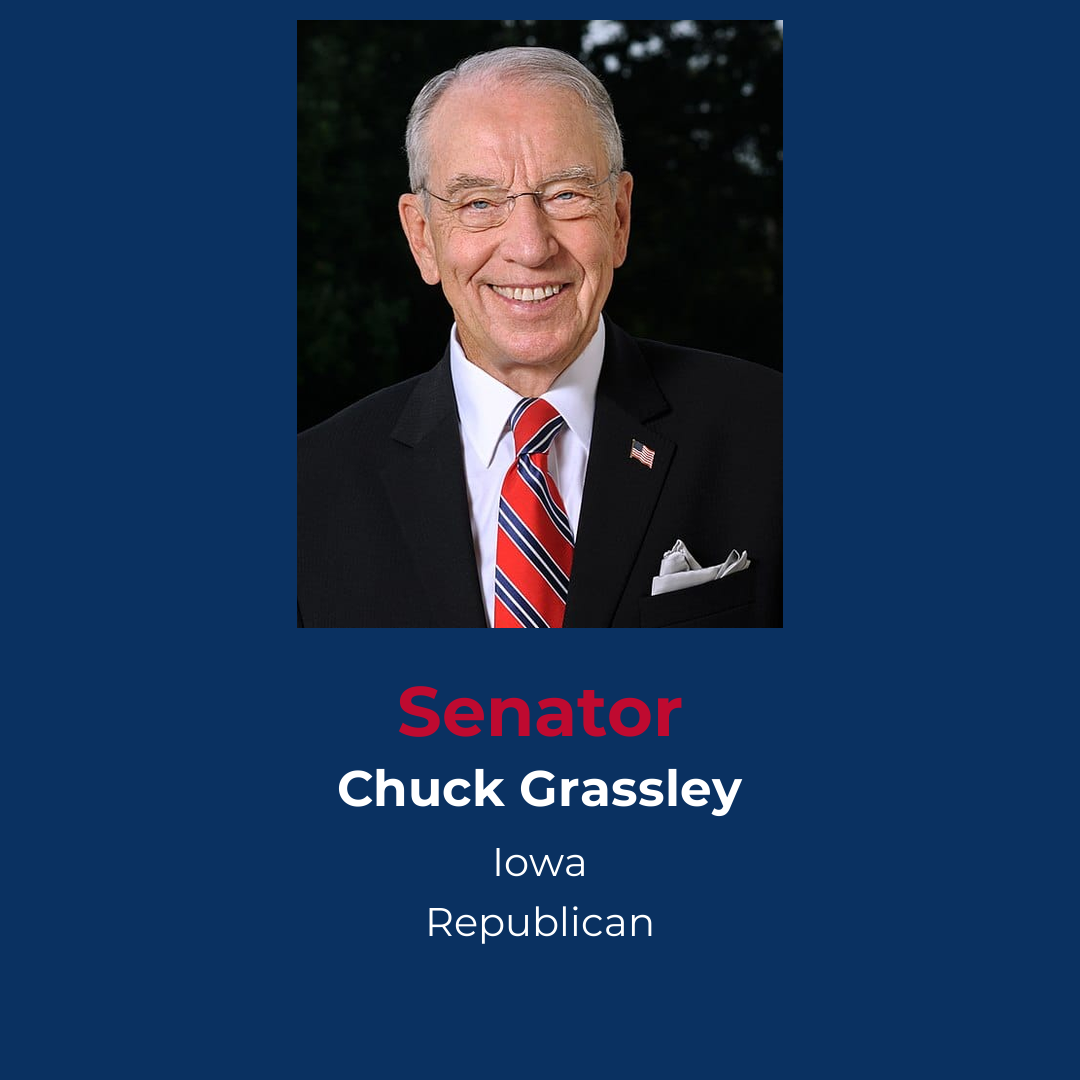
Profile of Republican Senator Grassley from Iowa
Chuck Grassley is an absolute institution in American politics. Having served in the U.S. Senate since 1981, he is the longest-serving Republican in congressional history and is famous for holding a town hall meeting in all 99 of Iowa's counties every single year—a tradition known as the "Full Grassley." He represents Iowa, a vital Midwestern agricultural and manufacturing powerhouse that has shifted over the last decade into a solid Republican stronghold. In the 119th Congress (2025-2026), the Republican Senate majority elevated Grassley to President pro tempore of the Senate, making him the second-highest-ranking official in the chamber and placing him third in the line of presidential succession. He has reclaimed the gavel as the incredibly powerful Chairman of the Senate Judiciary Committee, giving him direct oversight over the DOJ, the FBI, and federal judicial nominations. The 2026 Agenda: Grassley is leading a massive oversight campaign dubbed "Arctic Frost," investigating the FBI and former Special Counsel Jack Smith. He is also currently leading the charge to pass the bipartisan James T. Woods Act to crack down on online child exploitation. Current Crises (March 2026): Grassley is currently navigating the intense fallout of Operation Epic Fury. Just yesterday, he took to the Senate floor to mourn the deaths of Iowa Army Reserve soldiers killed in Kuwait, while warning that the Middle East conflict is actively driving up fertilizer costs for American farmers. "He is the President pro tempore of the Senate and the Chairman of the Judiciary Committee. At 92 years old, Chuck Grassley is still out-working politicians half his age on his legendary 99-county tour of Iowa." Day 64 | Chuck Grassley: The Institutional Titan of the Heartland Chuck Grassley’s political longevity is staggering, rooted in a relentless, distinctly Midwestern work ethic. Born in 1933 in New Hartford, Iowa, he earned his degrees from the Iowa State Teachers College before returning to the family farm. He spent the early years of his career working on assembly lines and farming corn and soybeans. Elected to the Iowa State Legislature in 1958, he moved to the U.S. House of Representatives in 1974, and ultimately captured his U.S. Senate seat in 1980. Over four decades later, Grassley’s defining hallmark remains his unbroken promise to visit every single one of Iowa’s 99 counties every year to hold Q&A sessions with his constituents. Operating in the 119th Congress, Grassley is at the absolute zenith of his political power. With Republicans taking control of the chamber in 2025, Grassley was sworn in as the President pro tempore, a constitutional office bestowed upon the longest-serving member of the majority party. Simultaneously, he reclaimed his position as Chairman of the Senate Judiciary Committee, while continuing to serve as a senior member of the Finance, Agriculture, and Budget Committees. As Judiciary Chairman, Grassley is utilizing his subpoena power to aggressively investigate the federal bureaucracy. Throughout late 2025 and early 2026, he has prioritized the "Arctic Frost" hearings, a massive oversight campaign examining the political weaponization of the DOJ and the FBI during the previous administration's investigations into President Donald Trump. However, Grassley is also passing sweeping bipartisan legislation. In late February 2026, he led the Judiciary Committee to officially advance the James T. Woods Act and the SAFE Act—landmark child safety packages designed to hold online platforms accountable for violent criminal networks and child exploitation. This week in early March 2026, Grassley is operating at the center of multiple national crises. On March 3rd, he chaired a highly combative DHS oversight hearing with Secretary Kristi Noem, demanding an end to a localized funding shutdown affecting federal agen...
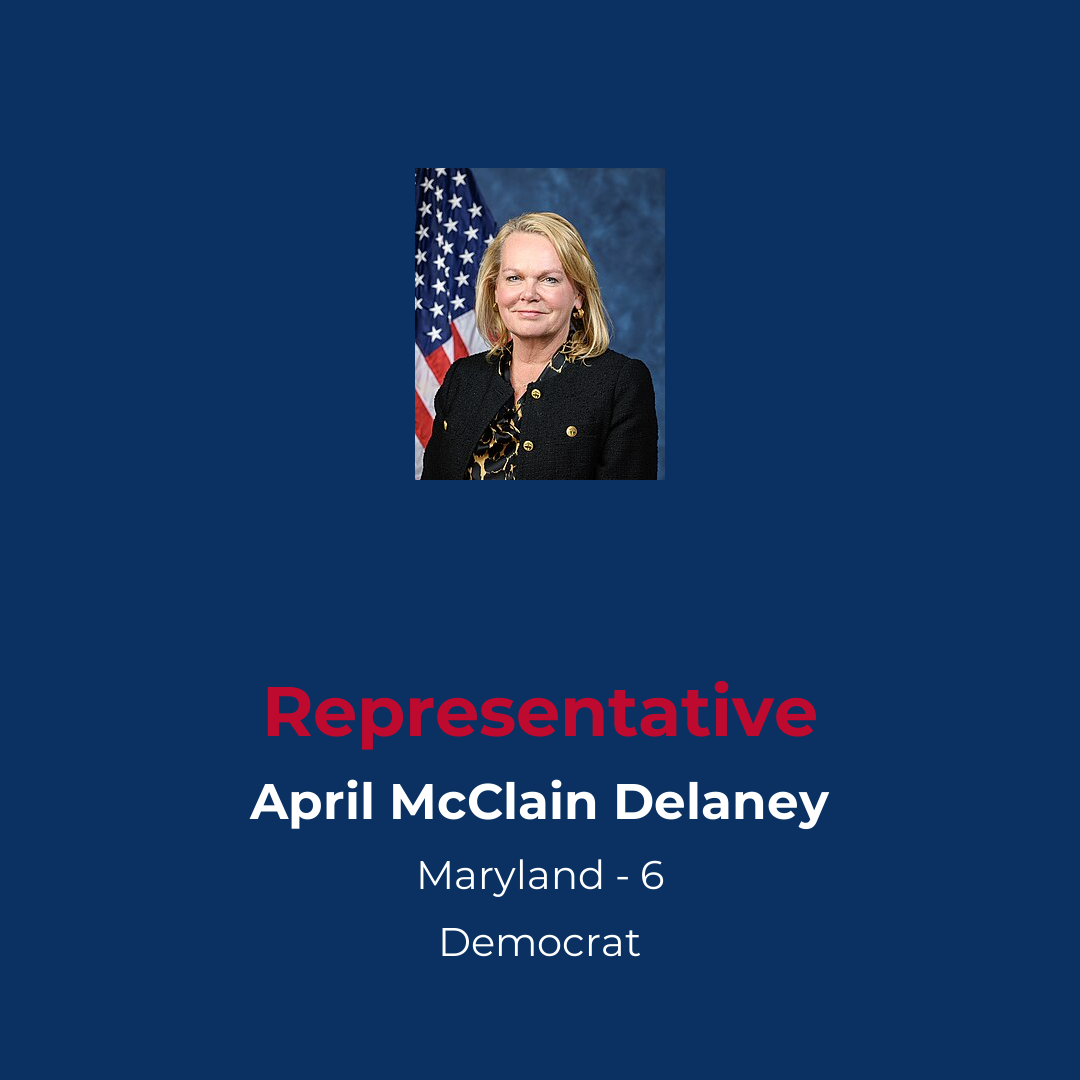
Profile of Democrat Representative McClain Delaney from Maryland District 6
April McClain Delaney is a freshman Democrat and a veteran communications lawyer. Before winning her highly competitive 2024 election to succeed David Trone, she served in the Biden administration as the Deputy Assistant Secretary for Communications at the National Telecommunications and Information Administration (NTIA). She represents Maryland’s 6th District, a geographically massive, highly competitive swing district that stretches from the deep-red rural panhandle of Western Maryland all the way down into the wealthy, deep-blue Washington D.C. suburbs of Montgomery County. In the 119th Congress (2025-2026), she secured assignments on the House Agriculture Committee and the House Science, Space, and Technology Committee. The War on DOGE: Representing a massive population of federal workers, McClain Delaney is fiercely fighting the new administration's efforts to gut the civil service. She recently introduced the Fiscal Harms of Federal Firings Act to combat the Department of Government Efficiency (DOGE) and is demanding an investigation into DOGE's access to sensitive Farm Service Agency databases. Recent 2026 Battles: In late February 2026, she introduced legislation to legally block the construction of a massive new ICE detention warehouse in Williamsport, Maryland. She also notably boycotted the February 2026 State of the Union address, citing the administration's relentless attacks on Maryland's working families. "From rolling out rural broadband at the Department of Commerce to fighting mass federal layoffs on Capitol Hill. April McClain Delaney is the pragmatic, tech-savvy defender of Maryland's ultimate swing district." Day 63 | April McClain Delaney: The Federal Defender of Western Maryland April McClain Delaney’s political brand is a unique blend of rural sensibility and high-level technological expertise. Raised on a potato farm in a tight-knit community in Buhl, Idaho, she understands the grueling realities of the agricultural sector. After earning her law degree from Georgetown, she spent over 30 years as a communications lawyer and regulatory expert. She spent 15 years in leadership at Common Sense Media, advocating for children's online safety and data privacy. In 2022, she joined the Biden administration's Department of Commerce, where she spearheaded the massive national rollout of rural broadband grants to close the digital divide. In 2024, when Congressman David Trone vacated Maryland's 6th District to run for the Senate, McClain Delaney jumped into a brutal, highly competitive race. Running a pragmatic, solutions-oriented campaign focused on infrastructure and tech equity, she successfully defeated Republican Neil Parrott, ensuring this highly coveted swing seat remained in Democratic hands. Arriving as a freshman in the 119th Congress, McClain Delaney was strategically placed on the Agriculture Committee and the Science, Space, and Technology Committee. These assignments are a perfect match for her district, allowing her to advocate for Western Maryland's 3,500-plus farms while defending the massive tech and research hubs (like the National Institute of Standards and Technology) located in Montgomery County. In late 2025, she flexed her agricultural muscle by introducing the American Farmers Act, a bold bill designed to strip $20 billion the Trump administration planned to use to stabilize the Argentine peso and redirect it directly to U.S. farmers. However, her early 2026 agenda has been entirely consumed by a massive defensive war against the new administration's domestic overhaul. Because her district borders Washington D.C., tens of thousands of her constituents are federal employees. As the Department of Government Efficiency (DOGE)—led by Elon Musk—attempts to fire thousands of civil servants, McClain Delaney has gone on the offensive. Calling the actions "lawless," she recently partnered with Se...
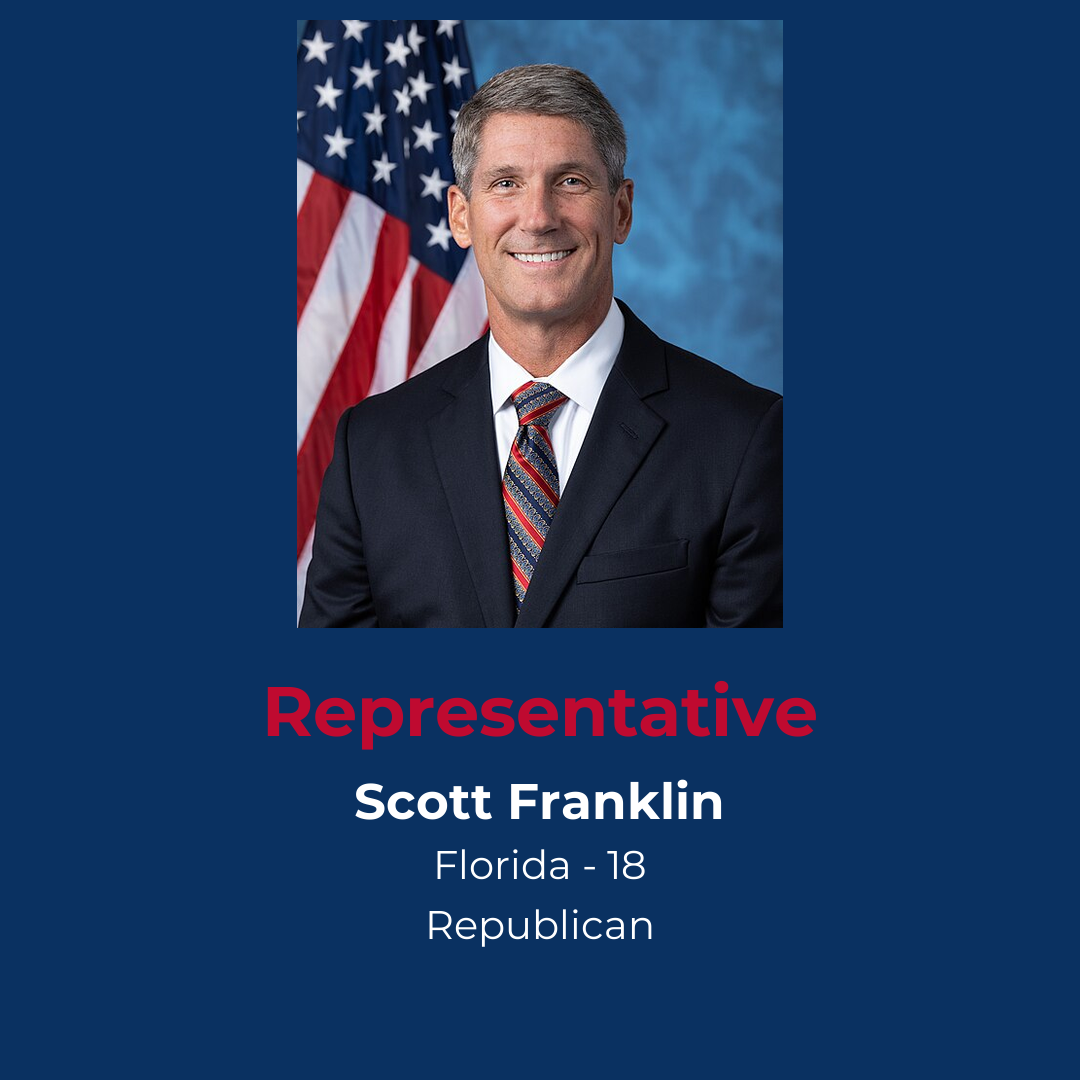
Profile of Republican Representative Franklin from Florida District 18
Scott Franklin is a fierce fiscal conservative and a highly decorated veteran. Before entering Congress, he served 26 years in the U.S. Navy and Naval Reserves as a Naval Aviator flying S-3 Vikings, followed by a 20-year career as the CEO of a successful insurance and risk management firm in Lakeland, Florida. He represents Florida’s 18th District, a sprawling, deeply conservative, and agriculturally vital district in south-central Florida that includes the city of Lakeland and the state's massive citrus and phosphate industries. In the 119th Congress (2025-2026), he holds the purse strings. He sits on the incredibly powerful House Appropriations Committee, serving as the Vice Chair of the Agriculture Subcommittee, while also sitting on the Military Construction/Veterans Affairs and Energy and Water subcommittees. He serves as the Chairman of the Environment Subcommittee on the House Science, Space, and Technology Committee, where he aggressively champions AI-driven weather modeling over traditional climate regulations. Recent 2026 Legislation: In late February 2026, Franklin launched a massive agricultural push, introducing the Land Grant Research Prioritization Act to boost AI-driven farming, and reintroducing the bipartisan TEMP Act to provide federal crop insurance to Florida citrus growers devastated by winter freezes. Foreign Policy Stance: A staunch ally of the new administration, Franklin recently released a strong statement backing the late-February 2026 U.S. and Israeli military strikes on Iran, arguing the action is a necessary return to "peace through strength." "He flew combat jets off thirteen different aircraft carriers before running a multi-million dollar business. Representative Scott Franklin brings the precision of a Naval Aviator and the discipline of a CEO to the House Appropriations Committee." Day 63 | Scott Franklin: The Naval Aviator Defending Florida's Heartland Scott Franklin’s political career is built on a foundation of intense military discipline and private-sector efficiency. Born in Georgia but raised in Lakeland, Florida, Franklin graduated from the United States Naval Academy in 1986. For the next 26 years—split between active duty and the Naval Reserves—he served as a Naval Aviator, flying jets from the decks of 13 different aircraft carriers. He deployed to the Mediterranean and the Persian Gulf, participating in combat operations in Bosnia, Kosovo, and the Middle East, and was actively recalled to U.S. Central Command immediately following the 9/11 attacks. Following his active-duty service, Franklin returned to Lakeland and transitioned into the business world, earning his MBA and eventually becoming the President and CEO of Lanier Upshaw, a prominent insurance and risk management firm. After spending twenty years meeting payrolls and fighting federal red tape, he entered local politics as a Lakeland City Commissioner. In 2020, he made a ruthless and calculated political gamble: he successfully primaried a scandal-plagued Republican incumbent, Ross Spano, ultimately winning the 15th District (later redrawn as the 18th District) and bringing his "America First" conservative ideology to Washington. Operating in the 119th Congress, Franklin wields massive financial influence as a member of the House Appropriations Committee. He despises the modern congressional habit of passing massive, trillion-dollar omnibus spending bills in the dead of night. Through his seats on the Agriculture, Military Construction, and Energy subcommittees, he is actively working to slash bureaucratic waste, defund progressive initiatives, and funnel money directly toward military lethality and infrastructure. His legislative output in early 2026 heavily reflects the specific needs of central Florida's massive agricultural economy. As the Vice Chair of the Agriculture Appropriations Subcommittee, he teame...
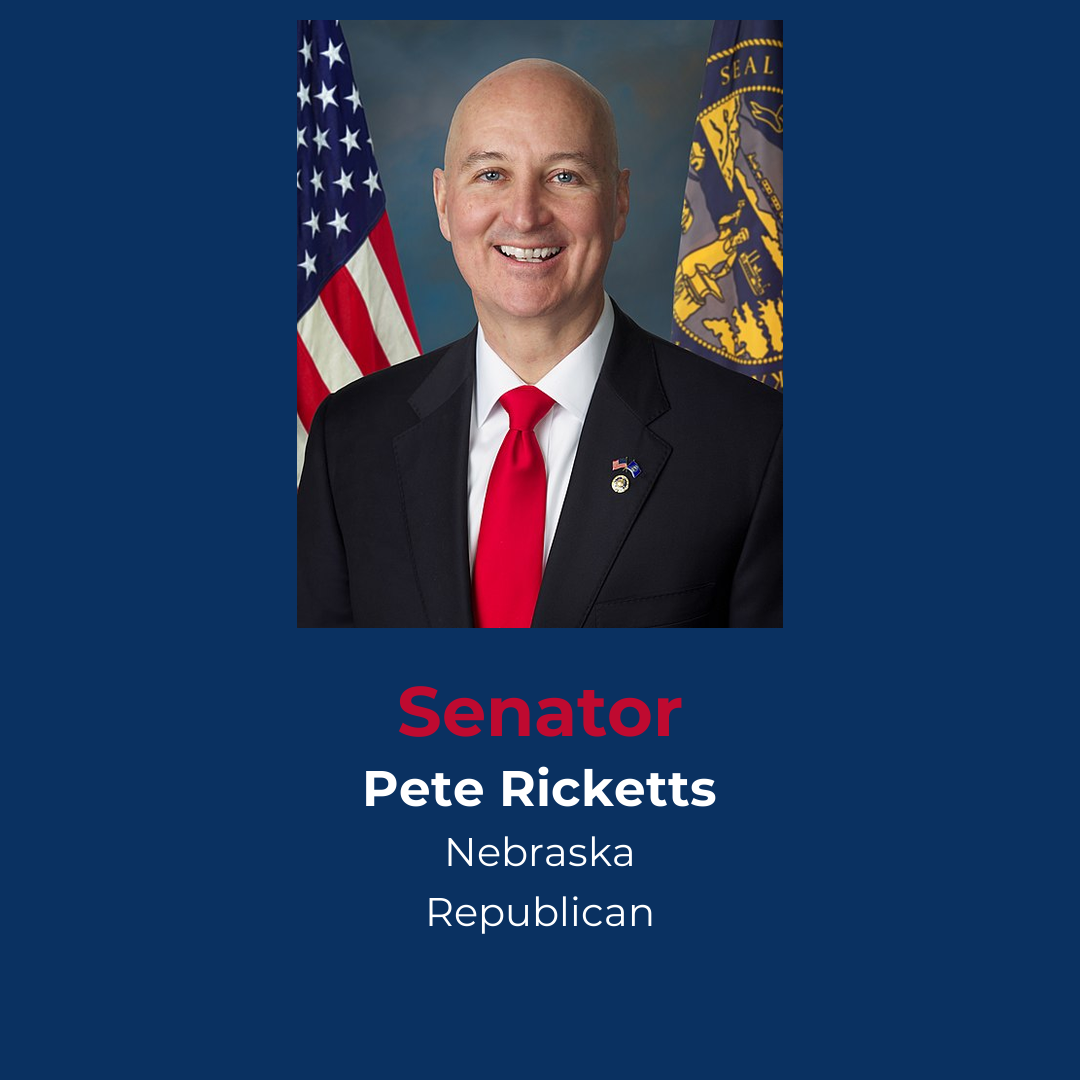
Profile of Republican Senator Ricketts from Nebraska
Pete Ricketts is the junior United States Senator from Nebraska. A prominent businessman whose family founded TD Ameritrade and owns the Chicago Cubs, he served two highly successful terms as the 40th Governor of Nebraska before being appointed to the Senate in 2023 to fill the seat vacated by Ben Sasse. He represents Nebraska, a deeply conservative, agricultural powerhouse in the Great Plains, where he maintains massive popularity among rural voters and the business establishment. In the 119th Congress (2025-2026), he secured powerful committee assignments following the Republican takeover of the Senate. He sits on the Budget Committee, the Banking, Housing, and Urban Affairs Committee, and the Environment and Public Works Committee. As a senior member of the Foreign Relations Committee, he serves as the Chairman of the Subcommittee on East Asia, the Pacific, and International Cybersecurity Policy, making him a leading voice in countering the Chinese Communist Party. Recent 2026 Actions: Ricketts is a staunch ally of the new Trump administration. Following the February 2026 State of the Union, he publicly praised the White House for restoring "peace through strength" and passing the Working Families Tax Cuts. He is currently pushing a massive "Back the Blue" legislative package to crack down on violent cartels like Tren de Aragua operating in the Midwest. The 2026 Senate Race: Running for a full six-year term in November 2026, Ricketts is facing a highly unconventional challenge from nonpartisan union leader Dan Osborn. The race recently made headlines over explosive allegations that the Ricketts campaign planted a fake candidate in the Democratic primary to split the opposition vote. "He spent eight years running Nebraska with the ruthless efficiency of a corporate executive. Now, Senator Pete Ricketts is using his powerful committee chairmanships to back law enforcement and cut the federal bureaucracy." Day 62 | Pete Ricketts: The Executive Conservative of the Great Plains Pete Ricketts’s path to the United States Senate was paved by massive corporate success and a highly disciplined approach to state governance. Born in Nebraska City, he is a member of one of the wealthiest and most influential families in American politics; his father founded the brokerage firm TD Ameritrade, and his family holds majority ownership of the Chicago Cubs. Ricketts earned his MBA from the University of Chicago and spent decades working in the family business, eventually rising to become the Chief Operating Officer of Ameritrade, where he specialized in streamlining corporate operations. He brought that exact private-sector mindset to the Governor's mansion. Serving two terms as the 40th Governor of Nebraska from 2015 to 2023, Ricketts operated the state like a business. He fiercely limited the growth of the state budget, delivered over $10 billion in property tax relief, and fully eliminated state taxes on veterans' retirement income and Social Security benefits. When Senator Ben Sasse resigned to become a university president in early 2023, the newly elected governor appointed Ricketts to fill the seat. Ricketts easily won the subsequent 2024 special election, cementing his grip on Nebraska federal politics. In the 119th Congress, Ricketts has rapidly ascended the ranks of the new Republican Senate majority. He secured highly strategic gavels, including the Chairmanship of the Environment and Public Works Subcommittee on Fisheries, Wildlife, and Water, where he aggressively defends Nebraska's agricultural sector against federal EPA overreach. Crucially, as the Chairman of the Foreign Relations Subcommittee on East Asia, he is heavily focused on the geopolitical threat of China, recently introducing legislation to ban the export of advanced integrated circuits to foreign adversaries. His early 2026 domestic agenda has been entirel...
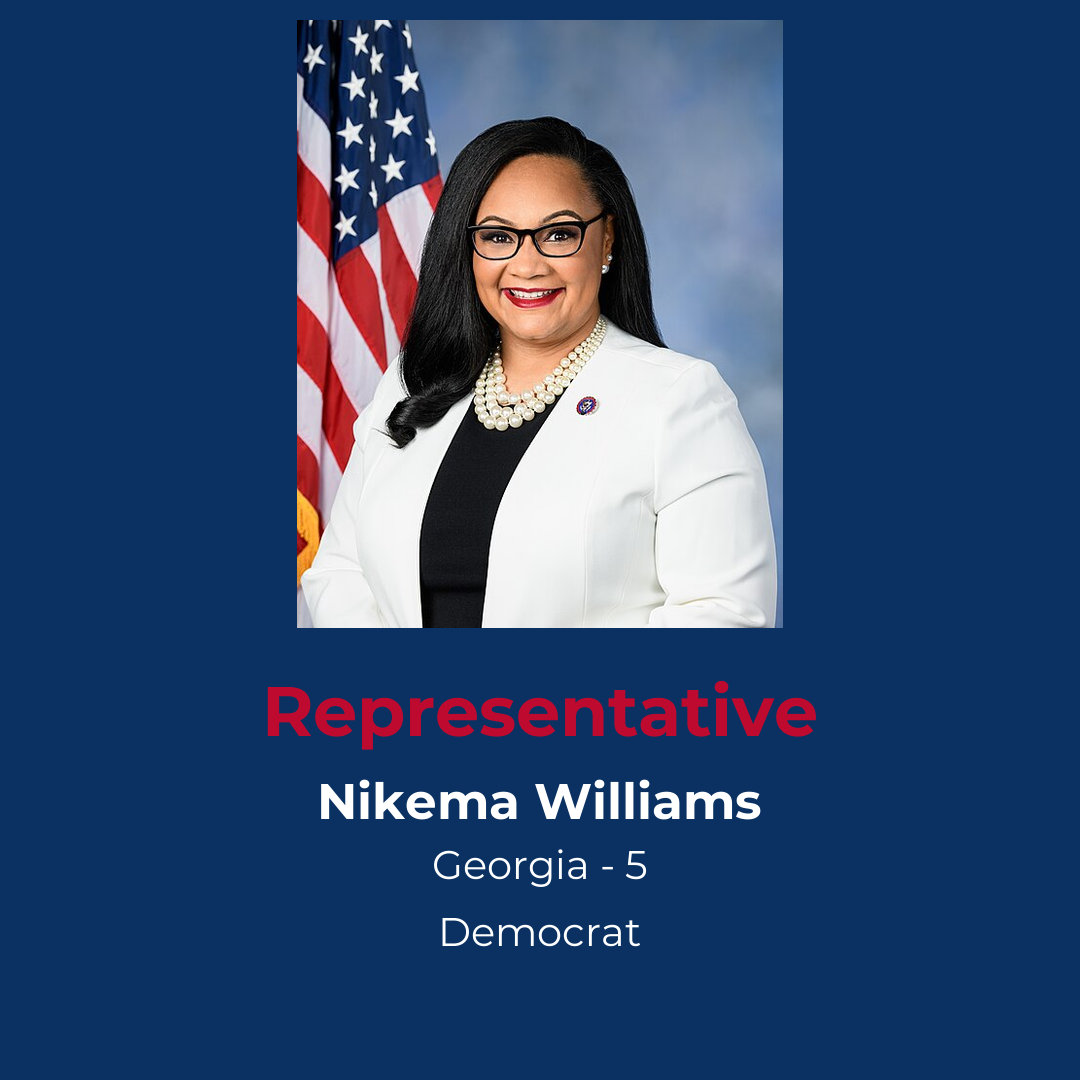
Profile of Democrat Representative Williams from Georgia District 5
Nikema Williams holds one of the most historically significant seats in the United States Congress. In 2021, she succeeded the late civil rights icon John Lewis. She actively carries his mantle of "Good Trouble," having famously been arrested in 2018 at the Georgia State Capitol while peacefully protesting voter suppression. She represents Georgia’s 5th District, a deeply Democratic, majority-Black urban powerhouse that encompasses almost three-quarters of Atlanta, serving as the undisputed economic and cultural heart of the American South. After serving as the trailblazing Chair of the Democratic Party of Georgia (the first Black woman to hold the role), Williams stepped down in early 2025 to focus entirely on her legislative duties in the 119th Congress (2025-2026). She serves on the powerful House Financial Services Committee, sitting on the Housing and Insurance Subcommittee, where she is aggressively targeting the national housing affordability crisis. Recent 2026 Legislation: Just days ago, in late February 2026, Williams introduced a massive bill aimed at restoring minority neighborhoods in Atlanta that were historically destroyed by highway construction. She also teamed up with Representative Veronica Escobar to introduce the urgent Stop ICE Election Militarization Act, directly pushing back against the new administration's efforts to deploy immigration agents near polling places. "She stepped into the shoes of a civil rights legend and immediately charted her own path. Known to her family as 'The Lorax' for her relentless advocacy, Nikema Williams is the unapologetic voice of modern Atlanta." Day 62 | Nikema Williams: Carrying the Torch of Good Trouble Nikema Williams’s political journey is a testament to the enduring legacy of the Southern civil rights movement. Born in Columbus, Georgia, she was raised by her grandparents across the river in Smiths Station, Alabama, in a home that initially lacked indoor plumbing. Politics and civil rights are quite literally in her blood; she is the great-niece of Autherine Lucy, the courageous student who integrated the University of Alabama in 1956. Following in those footsteps, Williams attended Talladega College—a historic HBCU—where she became a member of Alpha Kappa Alpha sorority. Before running for office, Williams built a formidable career in public advocacy. She served for a decade as the Vice President of Public Policy for Planned Parenthood Southeast and later as the Deputy Director of the National Domestic Workers Alliance. Elected to the Georgia State Senate in 2017, she quickly proved she was unafraid of confrontation. Following the highly controversial 2018 Georgia gubernatorial election, Williams was arrested on the floor of the State Capitol while standing with her constituents to demand that every vote be counted. It was exactly the kind of "Good Trouble" that endeared her to her mentor, Congressman John Lewis. When Lewis tragically passed away in 2020, the Democratic Party of Georgia overwhelmingly selected Williams to succeed him on the ballot. Arriving in Washington, Williams quickly ascended the leadership ranks, serving as the Freshman Class President for the 117th Congress and simultaneously leading the Democratic Party of Georgia through its most successful federal election cycles in a generation. In early 2025, she officially stepped down from her state party chairmanship to focus all of her firepower on the 119th Congress. Serving on the Financial Services Committee, Williams approaches economic policy through the lens of racial equity. Recognizing that homeownership is the foundation of generational wealth, she recently partnered with Republican Congressman Troy Downing to introduce the bipartisan Whole-Home Repairs Act, redirecting federal funds to help low-income seniors fix aging properties. In early 2026, she has taken a fierce, combativ...
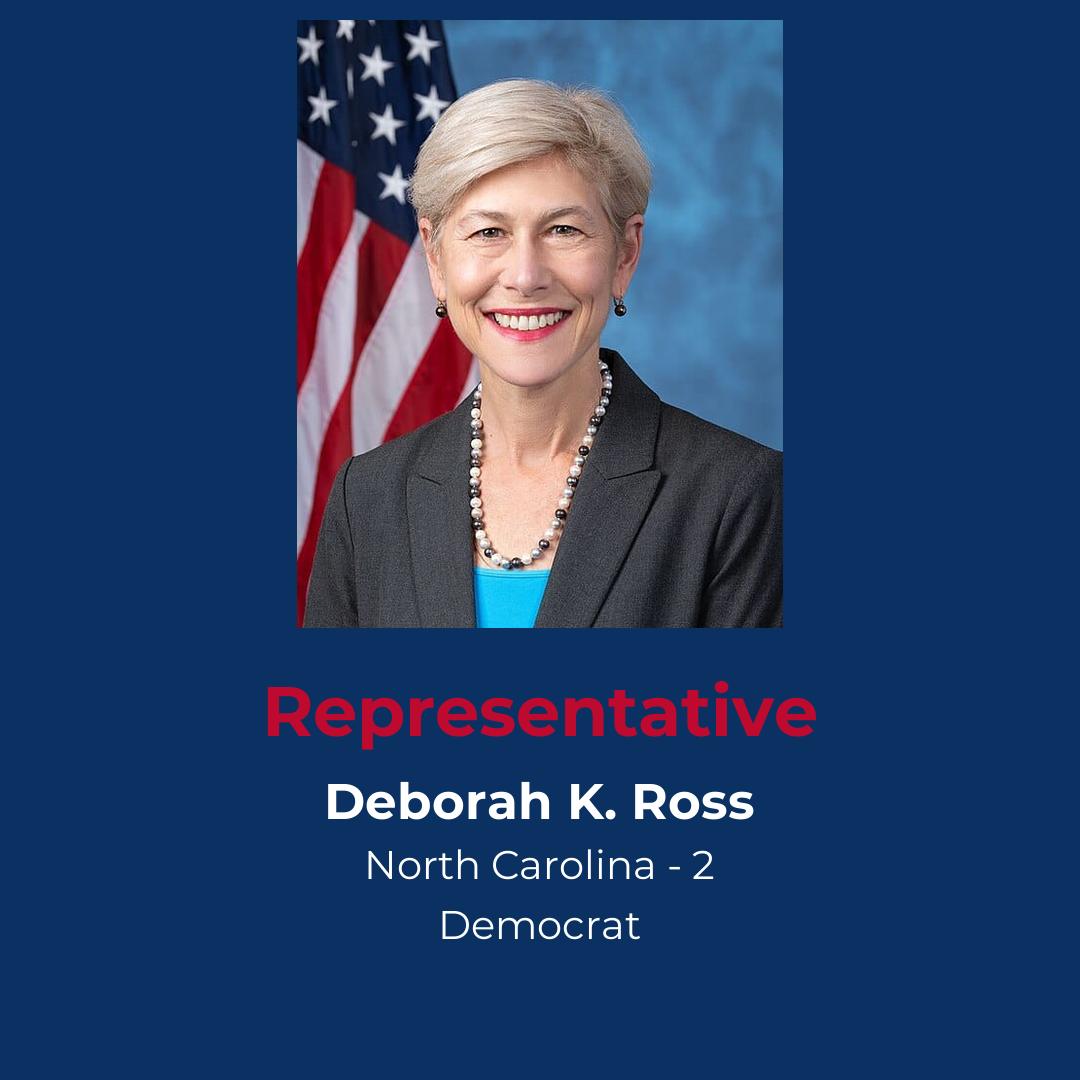
Profile of Democrat Representative Ross from North Carolina District 2
Deborah K. Ross is a seasoned civil rights attorney and a defining voice for the Democratic Party in the Research Triangle. Before her election to Congress, she spent nearly a decade serving as the state director for the American Civil Liberties Union (ACLU) of North Carolina, where she built a reputation as a fierce defender of the First Amendment and juvenile justice reform. She represents North Carolina’s 2nd District, a highly educated, rapidly growing economic powerhouse anchored by the state capital of Raleigh and the surrounding suburbs of Wake County. In the 119th Congress (2025-2026), Ross wields significant influence across multiple jurisdictions. She serves on the House Judiciary Committee, the House Ethics Committee, and the House Science, Space, and Technology Committee, where she operates as the Ranking Member of the Environment Subcommittee. The 2026 DHS Clash: In early 2026, Ross has taken a highly aggressive stance against the new administration's immigration policies. In January 2026, she voted against the Department of Homeland Security funding bill, issuing a blistering statement condemning federal agents for conducting masked, unaccountable raids that terrorized North Carolina communities. Recent 2026 Legislation: She is leading a massive bipartisan charge to lower healthcare costs. In January 2026, the House officially passed portions of her PBM Reform Act, a critical bill designed to stop corporate Pharmacy Benefit Managers from acting as unregulated middlemen and driving up the cost of prescription drugs. "She spent a decade leading the ACLU of North Carolina before bringing that exact same civil rights ferocity to Capitol Hill. Deborah Ross is the legal anchor defending the progressive heart of the Research Triangle." Day 61 | Deborah Ross: The Civil Rights Defender of the Triangle Deborah Ross’s political career is deeply rooted in constitutional law and grassroots civil liberties advocacy. Born in Philadelphia and raised in Connecticut, she earned her undergraduate degree from Brown University before moving south to earn her Juris Doctor from the University of North Carolina School of Law. After a brief stint in corporate law as a municipal bond lawyer, Ross found her true calling in public advocacy. In 1994, she was named the state director for the ACLU of North Carolina. Over the next seven years, she fought aggressively to overhaul the state's juvenile justice system and successfully pressured state police agencies to collect race-based statistics to combat racial profiling in traffic stops. Following her tenure at the ACLU, Ross served a decade in the North Carolina House of Representatives, eventually rising to become a Democratic Whip. She ran a high-profile, highly competitive U.S. Senate race in 2016 against Richard Burr, falling just short but cementing her status as a top-tier political talent. When court-ordered redistricting made North Carolina's 2nd District a secure Democratic seat in 2020, Ross easily won the election and returned to Washington. Operating in the 119th Congress, Ross utilizes her extensive legal background to navigate some of the most complex issues on Capitol Hill. Serving on the Judiciary Committee, she sits on the critical subcommittees handling Immigration Integrity and Intellectual Property. Simultaneously, as the Ranking Member of the Environment Subcommittee on the Science, Space, and Technology Committee, she is a fierce defender of federal climate research and clean energy investments—industries that are heavily concentrated in her district. Her legislative output in early 2026 has been incredibly aggressive. In January, she secured a massive bipartisan victory when the House passed key provisions of her PBM Reform Act, which forces massive corporate pharmacy middlemen to delink their compensation from the cost of medications, effectively lowering drug prices...
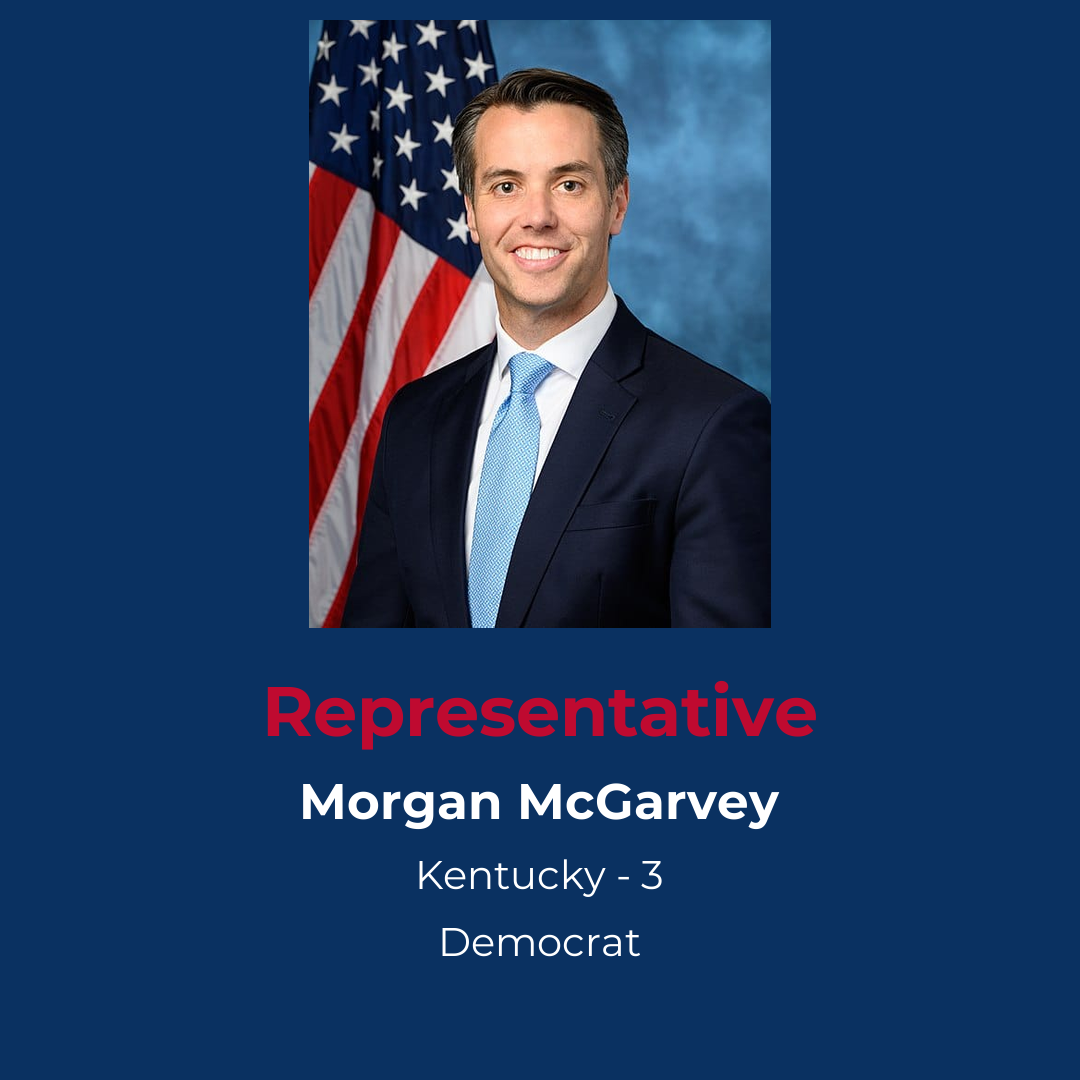
Profile of Democrat Representative McGarvey from Kentucky District 3
Morgan McGarvey is currently the only Democrat representing the state of Kentucky in the United States Congress. Before succeeding the legendary John Yarmuth in 2022, McGarvey spent a decade in the Kentucky State Senate, where he served as the Minority Floor Leader. He represents Kentucky’s 3rd District, a cosmopolitan, highly diverse, and overwhelmingly Democratic urban stronghold entirely contained within Jefferson County, anchoring the city of Louisville. In the 119th Congress (2025-2026), he serves on the House Budget Committee, the House Veterans' Affairs Committee, and the House Small Business Committee. He is also the Co-Chair and founder of the Congressional Child Labor Prevention Task Force, pushing back against the recent nationwide rollback of youth labor protections. The 2026 SOTU Boycott: McGarvey is currently taking a fiercely combative stance against the new Trump administration. He notably boycotted the February 24, 2026, State of the Union address, releasing a blistering statement accusing the administration of "slipping into authoritarianism" and stating he refused to normalize the President's agenda. Recent 2026 Battles: Just days ago, in late February 2026, McGarvey publicly condemned the administration's military strikes on Iran, demanding an immediate vote on the Iran War Powers Resolution to prevent an unauthorized war. He also recently celebrated the Supreme Court's decision to strike down the administration's new global tariffs, specifically highlighting how the trade war was devastating the Kentucky bourbon industry. "Serving as the lone Democrat in the Kentucky delegation, Morgan McGarvey is the progressive anchor of Louisville, fighting relentless battles on the Budget Committee while aggressively pushing back against the new administration's foreign policy." Day 61 | Morgan McGarvey: The Lone Blue Star of the Bluegrass State Morgan McGarvey’s political career is defined by his ability to legislate from the minority while fiercely protecting his progressive urban constituency. Born and raised in Louisville, McGarvey earned his journalism degree from the University of Missouri before returning home to get his law degree from the University of Kentucky. After working as a private practice attorney, he won a seat in the Kentucky State Senate in 2012. Operating in a chamber utterly dominated by a Republican supermajority, McGarvey rose to become the Minority Floor Leader, learning how to punch above his weight class, build tactical bipartisan coalitions, and defend public education from severe budget cuts. When Congressman John Yarmuth—a Democratic institution in Louisville—announced his retirement, McGarvey successfully consolidated the local Democratic establishment to win the 2022 election. Upon arriving in Washington, McGarvey immediately stepped into the unique and highly visible role of being the only Democrat representing Kentucky on Capitol Hill. In the 119th Congress, his committee assignments reflect a mix of national progressive defense and hyper-local constituent service. On the House Budget Committee, McGarvey has been a relentless attack dog against proposed conservative budget cuts, sharing emotional stories from his district to defend Medicaid and Head Start funding. On the Veterans' Affairs Committee, he has spent early 2026 pushing the bipartisan Veterans Accessibility Advisory Committee Act and the Ensuring Benefits for Disabled Veterans Act to cut through the 200,000-case backlog at the VA. Furthermore, responding to the alarming rise in corporate labor violations, he officially launched the Congressional Child Labor Prevention Task Force to aggressively crack down on the exploitation of minors in the workforce. However, McGarvey's defining moments of 2026 have been his explosive clashes with the new Trump administration. As the White House implements its sweeping "America First" a...

Profile of President Ulysses S Grant
Ulysses S. Grant was the 18th President of the United States (1869–1877). Before entering the White House, he was the legendary Commanding General of the Union Army who led the United States to victory over the Confederacy in the American Civil War. He is historically recognized as one of the greatest military commanders in American history, yet his two-term presidency is often debated due to a mix of monumental civil rights achievements and severe cabinet-level corruption. The Civil Rights Champion: Grant was fiercely dedicated to protecting the newly freed African American population during Reconstruction. He championed the 15th Amendment (guaranteeing voting rights for Black men), signed the Enforcement Acts, and created the Department of Justice specifically to crush the Ku Klux Klan and domestic terrorism in the South. The Scandals: While Grant himself was fundamentally honest, he was incredibly naive as a politician and notoriously loyal to a fault. His administration was plagued by massive corruption scandals—most notably the Whiskey Ring and the Crédit Mobilier scandal—which severely tarnished his reputation. A Heroic Final Act: After leaving office, Grant lost his entire life savings to a Wall Street swindler. Dying of throat cancer, he spent his final months in a desperate race against time to write his memoirs to save his family from financial ruin. Published by Mark Twain shortly after Grant's death, the memoirs became a massive financial success and a literary masterpiece. "He won the bloodiest war in American history and used the presidency to crush the Ku Klux Klan. Ulysses S. Grant was a brilliant general, a fierce defender of civil rights, and a man whose greatest flaw was trusting the people around him." Day 60 | Ulysses S. Grant: The General Who Fought for the Peace The life of Ulysses S. Grant is a story of profound failure followed by staggering, world-altering success. Born in Ohio in 1822, Hiram Ulysses Grant (a clerical error at West Point changed his name forever) was an unexceptional student who hated the sight of blood and had no desire to be a soldier. After serving with distinction in the Mexican-American War, he resigned from the Army amid rumors of heavy drinking. For the next decade, he failed at almost everything he tried: farming, real estate, and bill collecting. By the time the Civil War broke out in 1861, the 39-year-old Grant was working as a clerk in his father’s leather shop in Galena, Illinois, struggling to feed his family. The Civil War unlocked his latent genius. While other Union generals hesitated, Grant understood the brutal, mathematical reality of modern warfare. Following his massive victories at Shiloh, Vicksburg, and Chattanooga, President Abraham Lincoln promoted him to Commanding General of the entire Union Army. Grant waged a relentless, grinding campaign against Robert E. Lee in Virginia, finally forcing Lee's surrender at Appomattox Court House in 1865. Overnight, the failed leather clerk became the undisputed savior of the American Republic. Riding a wave of immense national popularity, Grant was unanimously nominated by the Republican Party and easily won the presidency in 1868. His campaign slogan was simply, "Let us have peace." However, the presidency required a different kind of warfare. Inheriting a deeply fractured nation from the disastrous Andrew Johnson administration, Grant used the power of the federal government to enforce Radical Reconstruction. He viewed the Ku Klux Klan not as a political organization, but as a violent domestic insurgency. To destroy them, Grant signed the Enforcement Acts and officially established the United States Department of Justice in 1870, directing his new Attorney General to dispatch federal troops and prosecutors to the South to hunt down and dismantle the Klan. Furthermore, he heavily pushed for the ratification of the 15th...

Profile of President Andrew Johnson
Andrew Johnson was the 17th President of the United States (1865–1869). He assumed the presidency following the assassination of Abraham Lincoln, inheriting the monumental task of reuniting the country after the Civil War. He was a lifelong Democrat from Tennessee who was placed on Lincoln's 1864 "National Union" ticket to project bipartisan unity. He was the only Southern senator who refused to secede with his state when the Civil War began. His presidency is widely regarded as a catastrophic failure. Johnson's deeply racist vision for Reconstruction allowed former Confederates to return to power and implement oppressive "Black Codes," essentially attempting to re-enslave the newly freed population in all but name. He engaged in an unprecedented, bitter political war with the "Radical Republicans" in Congress. Johnson aggressively vetoed the Freedmen's Bureau Bill and the Civil Rights Act of 1866, leading Congress to override his vetoes—the first time in American history that Congress overrode a President on major legislation. He was the first U.S. President to be impeached. After repeatedly clashing with Congress, Johnson violated the newly passed Tenure of Office Act by firing Secretary of War Edwin Stanton. He was impeached by the House but survived conviction in the Senate by a single vote. Despite his disastrous domestic legacy, his administration did achieve one massive foreign policy victory: Secretary of State William Seward's purchase of Alaska from the Russian Empire in 1867 for $7.2 million. "He inherited the victory of the Civil War and immediately surrendered the peace. Andrew Johnson's disastrous presidency allowed white supremacy to re-entrench itself in the South, delaying civil rights for a century." Day 59 | Andrew Johnson: The Sabotage of Reconstruction If Abraham Lincoln’s presidency represents the greatest triumph of the American experiment, Andrew Johnson’s presidency represents its most tragic missed opportunity. Born into severe poverty in North Carolina in 1808, Johnson never attended a day of school in his life. He worked as a tailor’s apprentice before running away to Tennessee, where his wife taught him how to read and write. Entering politics as a Jacksonian Democrat, Johnson possessed a furious, lifelong hatred of the wealthy, aristocratic Southern planter class. Yet, despite his hatred for the Southern elites, he was a staunch white supremacist who held a deep hostility toward the abolition of slavery. When the Civil War erupted, Johnson was serving as a U.S. Senator from Tennessee. He became the only Southern senator to remain loyal to the Union, a courageous stance that made him a hero in the North and a traitor in the South. To send a message of national unity in the 1864 election, Lincoln’s Republican Party temporarily rebranded as the "National Union Party" and selected the War Democrat Johnson as the vice-presidential nominee. It was a purely political marriage of convenience that became a national nightmare when John Wilkes Booth assassinated Lincoln just weeks into their second term. Taking the oath of office in April 1865, Johnson initially promised to hang Confederate traitors, delighting the "Radical Republicans" in Congress who wanted to completely rebuild the Southern social order. But as soon as Congress went into recess, Johnson executed a staggering political betrayal. Operating under his own executive authority, he implemented "Presidential Reconstruction." He granted sweeping pardons to thousands of wealthy former Confederates, returning their confiscated land and allowing the very men who had just waged a treasonous war to retake control of Southern state governments. Under Johnson's protection, the South immediately implemented "Black Codes," brutal laws designed to strip the newly freed African American population of their basic human rights, mobility, and econom...
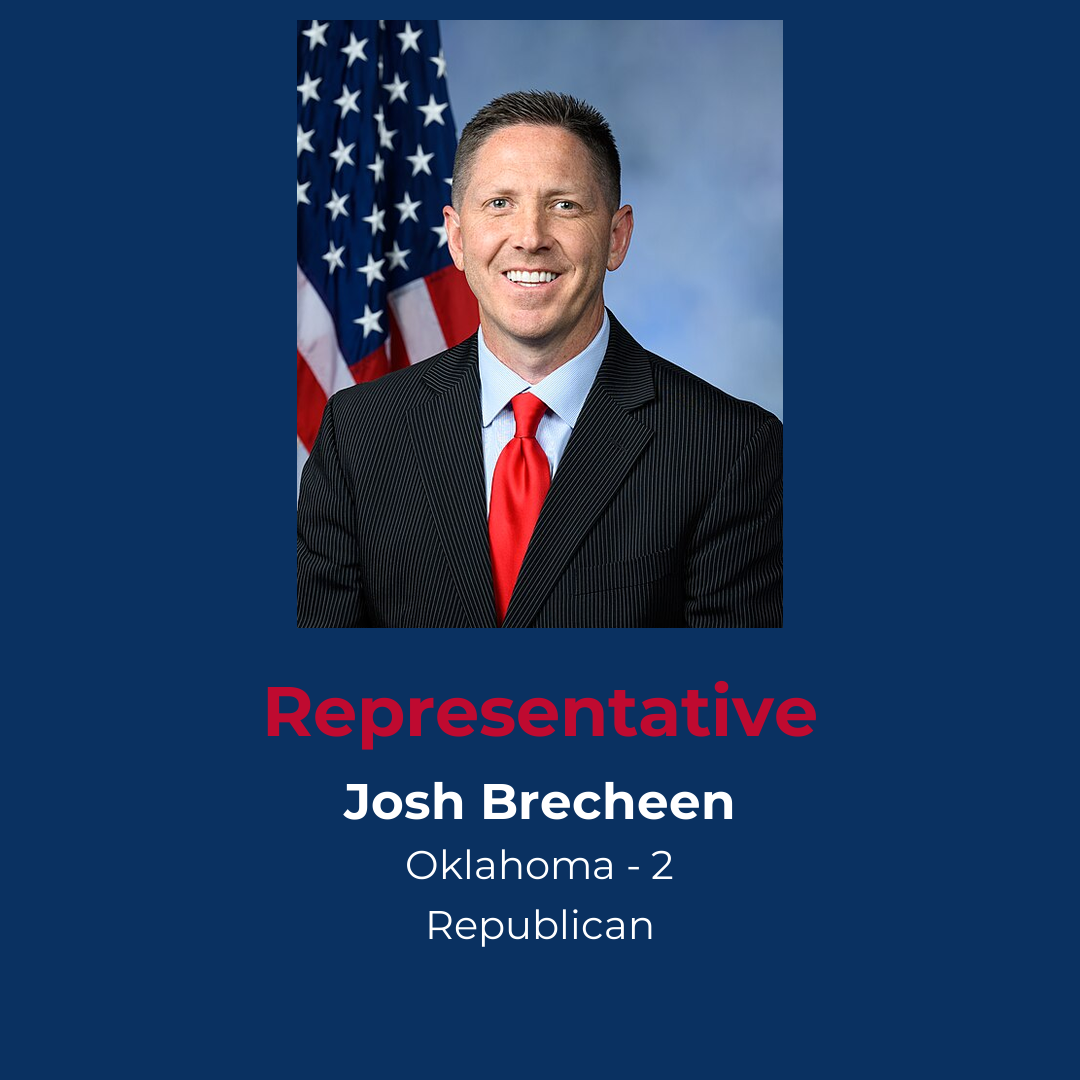
Profile of Republican Representative Brecheen from Oklahoma District 2
Josh Brecheen is a fierce, uncompromising conservative representing eastern Oklahoma. A rancher and a citizen of the Choctaw Nation, he built his political brand on strict constitutional adherence and absolute fiscal discipline. He represents Oklahoma’s 2nd District, a massive, deeply rural, and overwhelmingly Republican district that covers roughly the eastern third of the state and includes significant tribal jurisdictions. He is a committed member of the House Freedom Caucus and a rare politician who strictly honors term limits. After serving two terms in the Oklahoma State Senate, he voluntarily stepped down. He has publicly pledged to serve no more than four terms in the U.S. House. In the 119th Congress (2025-2026), he has secured immense oversight power as the Chairman of the Homeland Security Subcommittee on Oversight, Investigations, and Accountability. He also serves on the vital House Budget Committee. Recent 2026 Actions: In early 2026, Brecheen has been a driving force behind massive spending cuts, happily voting for the "One Big Beautiful Bill" to slash the federal bureaucracy. He also introduced the USA First Act (transferring foreign aid to FEMA) and the Energy Freedom Act (repealing green energy subsidies). Following the February 2026 State of the Union, he praised the administration's conservative agenda but notably pushed back against the President's expansion of tariffs. "He is a rancher who actually honors his term limit pledges. As a Freedom Caucus conservative and a Homeland Security Chairman, Josh Brecheen brings a relentless, 'America First' discipline to Capitol Hill." Day 58 | Josh Brecheen: The Freedom Caucus Rancher Holding the Line Josh Brecheen’s political career is defined by an absolute refusal to embrace the Washington establishment. Raised in southeastern Oklahoma, he is a fourth-generation rancher and a proud citizen of the Choctaw Nation. Before entering politics, he ran a successful motivational speaking business and operated his family's cattle ranch. When he was elected to the Oklahoma State Senate in 2010, he made a specific promise to his constituents: he would only serve two terms. In an era where politicians rarely relinquish power voluntarily, Brecheen kept his word, retiring from the state legislature in 2018. When Congressman Markwayne Mullin successfully ran for the U.S. Senate in 2022, Brecheen jumped into a crowded 14-person Republican primary to succeed him. Running as a strict constitutionalist and a protégé of the late conservative icon Tom Coburn, Brecheen won the seat and immediately aligned himself with the House Freedom Caucus. Upon arriving in Washington, he made another binding pledge: he will serve no more than four terms in the House of Representatives. Now operating in his second term during the 119th Congress, Brecheen is using his seniority to drive a massive, populist-conservative agenda. He was elevated to Chairman of the Homeland Security Subcommittee on Oversight, Investigations, and Accountability. In this role, he has been a relentless watchdog against the executive branch, demanding strict enforcement of federal immigration laws and utilizing his subpoena power to investigate massive bureaucratic overreach. Serving simultaneously on the Budget Committee, Brecheen is focused on aggressively dismantling what he views as wasteful, partisan spending. In late 2025 and early 2026, he introduced a flurry of hardline legislation. He pushed the Energy Freedom Act to completely repeal the multi-billion-dollar green energy tax subsidies created by the previous administration. He also introduced the USA First Act, designed to strip unobligated foreign aid from USAID and transfer it directly to FEMA to manage domestic disasters. While he is a staunch supporter of the new Trump administration's cultural and border policies, Brecheen is not a rubber stamp. Fol...
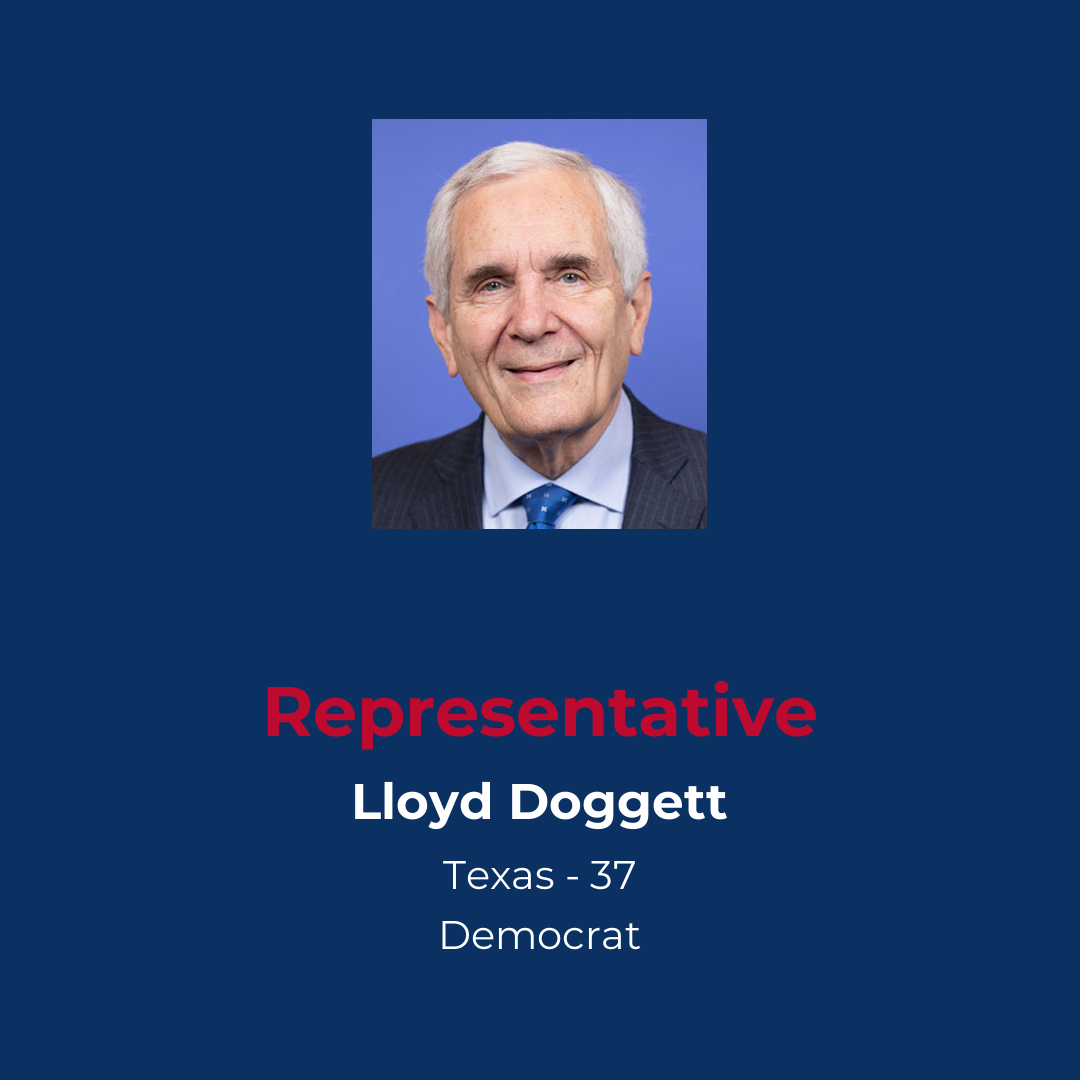
Profile of Democrat Representative Doggett from Texas District 37
Lloyd Doggett is the Dean of the Texas Democratic congressional delegation. A towering figure in state politics, his career spans over half a century, including time in the Texas State Senate and as a Justice on the Texas Supreme Court. He is retiring at the end of the 119th Congress in 2026. He represents Texas’s 37th District, a deeply progressive, highly educated Democratic stronghold anchored entirely within the city of Austin, including the University of Texas campus. He is widely known as the ultimate political survivor. Over his 30-year congressional career, Texas Republicans repeatedly gerrymandered his district to force him out of office, prompting Doggett to successfully run in four entirely different congressional districts (the 10th, 25th, 35th, and 37th) to retain his seat. In the 119th Congress (2025-2026), he serves as the Ranking Member of the Ways and Means Health Subcommittee. He is aggressively fighting against the new administration's efforts to roll back Affordable Care Act tax credits and freeze federal assistance programs. A History of Hard Calls: In July 2024, Doggett cemented his legacy as a pragmatic elder statesman by becoming the very first congressional Democrat to publicly call for Joe Biden to step aside from the presidential race for the good of the party. Recent 2026 Battles: In February 2026, Doggett led a massive push to investigate the new Department of Government Efficiency (DOGE), introducing a formal Resolution of Inquiry to probe Elon Musk’s access to the Treasury Department's confidential payment and tax systems. "From the legendary 'Killer Bees' of the Texas Senate to taking on the modern Department of Government Efficiency, Lloyd Doggett has spent fifty years proving he is the ultimate political survivor." Day 58 | Lloyd Doggett: The Dean of the Texas Delegation's Final Term Lloyd Doggett’s political career is practically a living history of modern Texas politics. Born and raised in Austin, Doggett attended the University of Texas, serving as student body president before earning his law degree. His entry into public office was explosive. Elected to the Texas State Senate in 1973, he cemented his legacy as an uncompromising political tactician in 1979 as a leading member of the "Killer Bees"—a legendary group of 12 Democratic state senators who secretly fled the Capitol and went into hiding for days to break quorum and stop a controversial election bill. After over a decade in the state legislature, he served as a Justice on the Texas Supreme Court, writing landmark opinions expanding the public's access to government information. Elected to the U.S. House of Representatives in 1994, Doggett's tenure in Washington has been defined by his sheer inability to be defeated. As the Texas political landscape shifted sharply to the right, Republican mapmakers led by Tom DeLay frequently attempted to surgically erase Doggett from the map, slicing Austin into various suburban and rural districts. Unfazed, Doggett simply moved his campaigns, successfully winning elections in four separate districts across three decades, building a massive, fiercely loyal grassroots coalition in the process. Doggett is an institutional heavyweight. Known for his policy rigor, he established himself as a champion for the Affordable Care Act and a relentless watchdog against corporate tax evasion on the powerful Ways and Means Committee. He also demonstrated a willingness to put strategy over party loyalty; in the summer of 2024, he stunned the political world by becoming the first congressional Democrat to publicly urge President Joe Biden to withdraw from the re-election campaign, a move that opened the floodgates for a historic party shift. Currently navigating the 119th Congress, Doggett is operating in his final term before his scheduled retirement. Free from the pressures of another re-election ca...
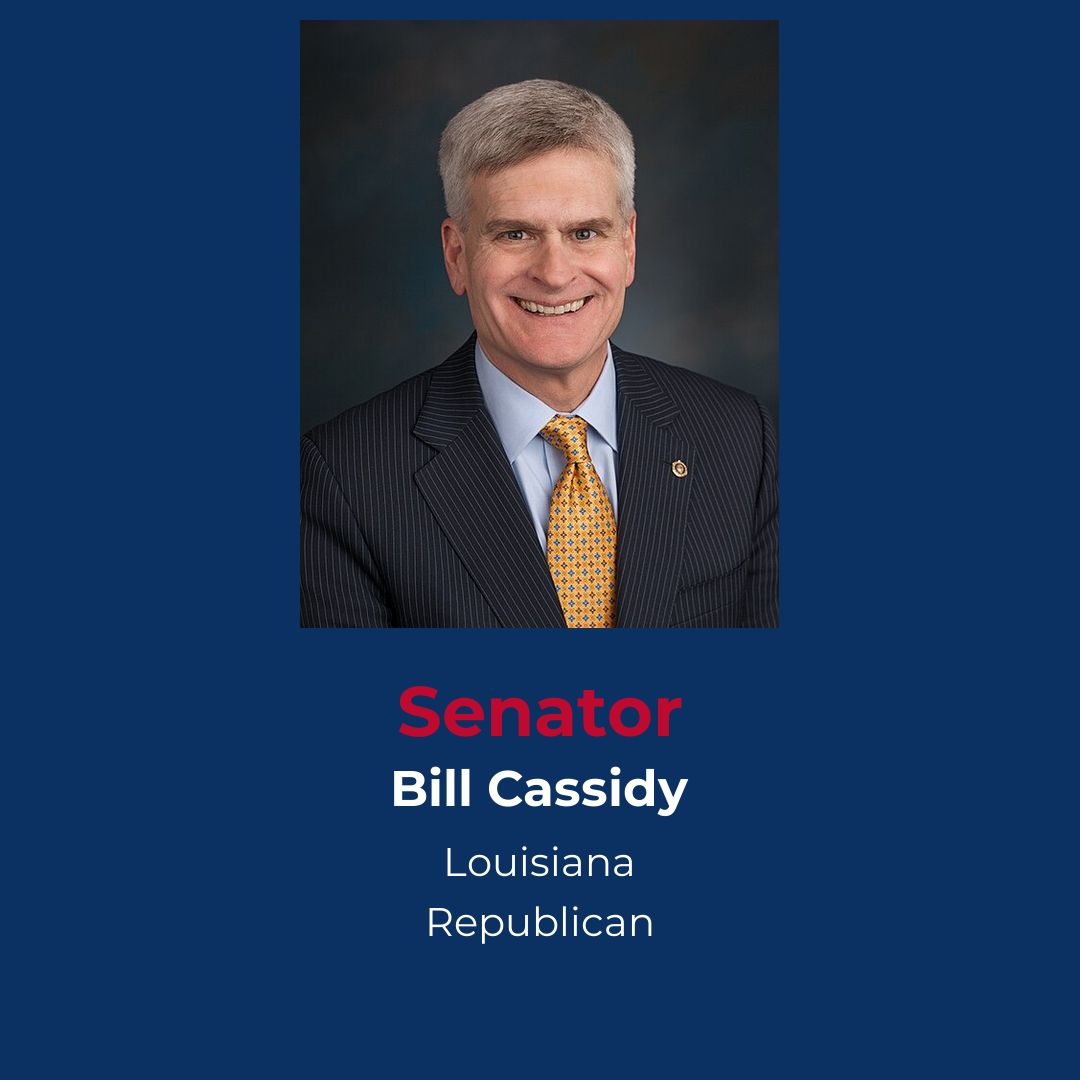
Profile of Republican Senator Cassidy from Louisiana
Bill Cassidy, M.D. is the senior United States Senator from Louisiana. Before entering politics, he spent decades as a gastroenterologist and a teacher of medical students at Earl K. Long Hospital, a charity hospital for the uninsured in Baton Rouge. He represents Louisiana, a Deep South conservative stronghold defined by its massive energy sector, vital shipping ports, and distinct cultural heritage. In the 119th Congress (2025-2026), following the Republican takeover of the Senate, Cassidy ascended to one of the most powerful positions in Washington: Chairman of the Senate Health, Education, Labor, and Pensions (HELP) Committee. He is the first physician to hold this gavel since 1933. As HELP Chairman, he has launched a massive conservative legislative blitz. He recently unveiled a sweeping labor reform package (including the Worker RESULTS Act and the NLRB Stability Act) to rein in union bosses and roll back Biden-era labor regulations. He is also aggressively investigating federal health agencies and driving the modernization of the FDA and NIH. The 2026 Primary Fight: Cassidy is currently locked in the absolute political fight of his life. Facing re-election in 2026, he is dealing with the fallout from his 2021 vote to convict Donald Trump during his second impeachment trial. President Trump has officially given his "Complete and Total Endorsement" to Cassidy’s primary challenger, Representative Julia Letlow, sparking a massive, high-stakes proxy war within the Louisiana GOP. "He spent decades as a doctor treating the uninsured before taking the gavel of the Senate HELP Committee. Now, Chairman Bill Cassidy faces the ultimate political survival test against the populist wing of his own party." Day 58 | Bill Cassidy: The Doctor Navigating the Political Storm Bill Cassidy’s approach to public policy is inextricably linked to his decades of experience as a medical doctor. Born in Illinois but raised in Baton Rouge, Cassidy earned his medical degree from Louisiana State University. For years, he worked as a gastroenterologist at Earl K. Long Hospital, treating uninsured and low-income patients. He co-founded the Greater Baton Rouge Community Clinic to provide free dental and health care to the working uninsured, and in the devastating aftermath of Hurricane Katrina in 2005, he famously led a group of volunteers to convert an abandoned K-Mart into a makeshift emergency health care facility. Transitioning from medicine to politics, Cassidy served in the Louisiana State Senate and the U.S. House of Representatives before defeating incumbent Democratic Senator Mary Landrieu in 2014. In the Senate, Cassidy operates with a distinctly analytical, diagnostic mindset. He is a pragmatic conservative who focuses heavily on the mechanics of healthcare finance, energy independence, and coastal restoration for Louisiana. The 119th Congress represents the zenith of his legislative power. In January 2025, Cassidy officially took the gavel as the Chairman of the Senate HELP Committee. This position gives him direct oversight over the nation's healthcare system, labor laws, and federal education funding. He has used this immense power to aggressively advance a conservative, pro-worker agenda. In late 2025 and early 2026, he introduced the Worker RESULTS Act to mandate secret ballot union elections and the Health Information Privacy Reform Act to close loopholes regarding consumer health data and artificial intelligence. He has also weaponized the committee's oversight powers, recently launching investigations into child care fraud in Minnesota and clashing with former Biden-era health officials over gender-transition protocols. Despite his massive institutional power, Cassidy’s political future is in serious jeopardy. In 2026, Louisiana is utilizing closed party primaries for the first time since 2010, abandoning its famous "jungle primary"...
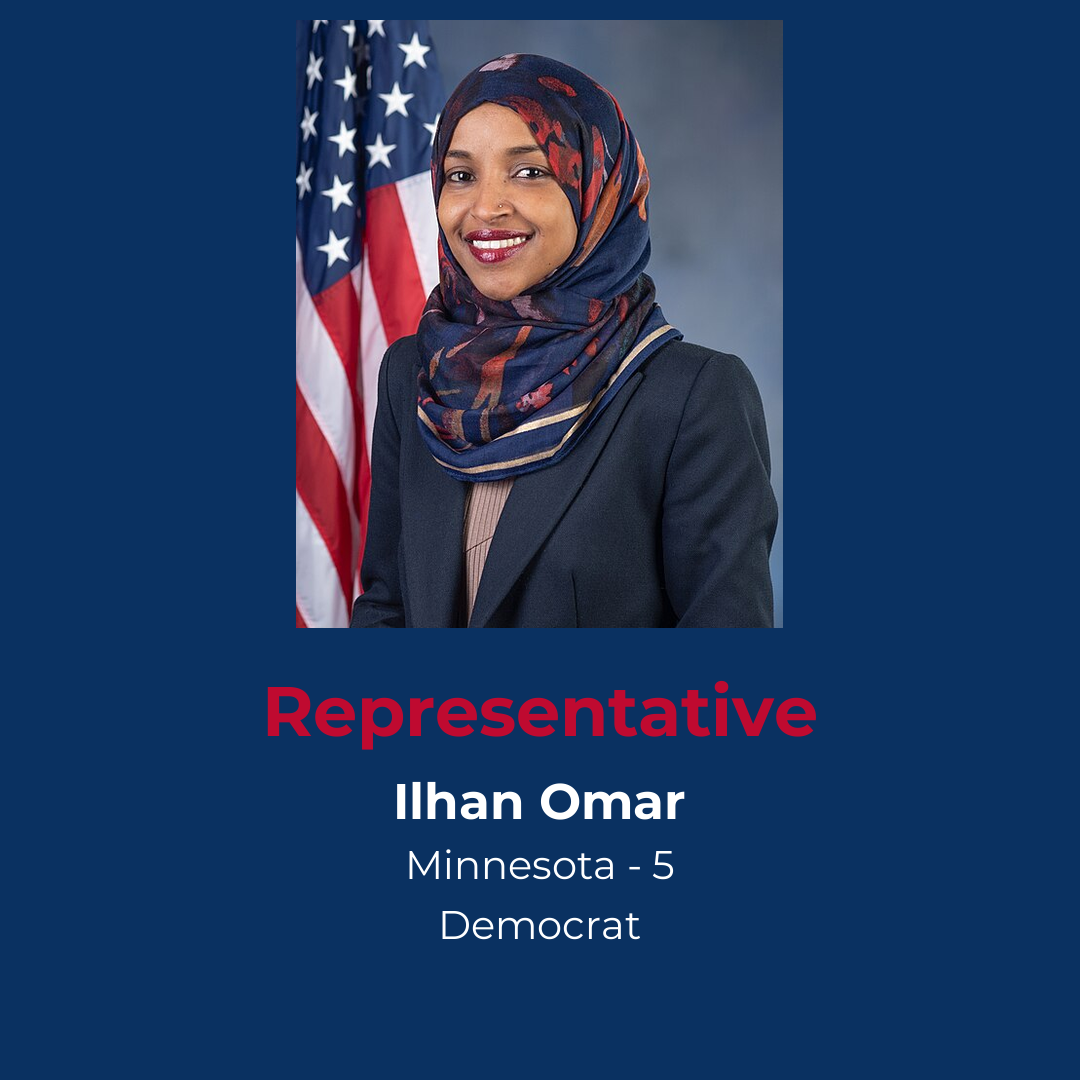
Profile of Democrat Representative Omar from Minnesota District 5
Ilhan Omar is a defining figure of the modern progressive movement. Arriving in the U.S. as a refugee from Somalia, she made history in 2018 as the first Somali-American and one of the first two Muslim women ever elected to Congress. She is a high-profile member of the progressive "Squad." She represents Minnesota’s 5th District, a deeply Democratic, vibrant, and diverse urban stronghold that encompasses the entire city of Minneapolis and its immediate surrounding suburbs. In the 119th Congress (2025-2026), she serves on the Committee on Education and the Workforce and the Committee on the Budget. She recently survived a September 2025 partisan censure attempt led by House Republicans seeking to remove her from her committees over controversial social media posts. The 2026 SOTU Clash: Omar is currently at the center of a massive national firestorm following the February 2026 State of the Union address. She engaged in a direct, explosive shouting match with President Trump on the House floor over his rhetoric regarding Somali immigrants and the administration's aggressive immigration raids in Minneapolis. Her legislative agenda is fiercely anti-interventionist. In early 2026, she introduced sweeping amendments to the National Defense Authorization Act (NDAA) attempting to slash the Pentagon budget by $150 billion and completely halt U.S. military funding to Israel. "From a refugee camp in Kenya to the halls of Congress, Ilhan Omar is the unapologetic, fiercely combative voice of the progressive left, constantly colliding with the Washington establishment." Day 58 | Ilhan Omar: The Progressive Lightning Rod of the Twin Cities Ilhan Omar’s biography is a stark departure from the traditional congressional resume. Born in Mogadishu, Somalia, she and her family fled the country's brutal civil war when she was eight years old. After spending four years in a refugee camp in Kenya, her family secured asylum in the United States, eventually settling in the Minneapolis area. She worked as a community nutrition educator and a policy analyst before winning a seat in the Minnesota House of Representatives in 2016. Elected to the U.S. House in 2018, Omar immediately became a national political phenomenon—and a permanent lightning rod for controversy. Operating as a foundational member of the progressive "Squad," Omar’s politics are rooted in democratic socialism and a fiercely anti-interventionist foreign policy. She frequently clashes not only with Republicans but with the moderate leadership of her own party, loudly demanding an end to U.S. military assistance to allies like Israel and Saudi Arabia due to human rights concerns. In the 119th Congress, her combative style has made her a primary target of the conservative majority. In September 2025, she faced a formal censure resolution introduced by Representative Nancy Mace (R-SC), which attempted to strip Omar of her seats on the Budget and Education committees following her reposting of a video that disparaged conservative activist Charlie Kirk. The motion to table the censure ultimately narrowly passed, allowing her to keep her gavels. However, her fiercest battles are currently being waged against the new Trump administration. This tension exploded into national headlines just days ago during the February 24, 2026, State of the Union address. When the President used his speech to highlight a massive federal welfare fraud investigation in Minnesota—referring to the perpetrators as "Somali pirates"—Omar furiously shouted, "You're a liar!" across the House chamber. Moments later, as the President praised his aggressive new immigration crackdowns, Omar shouted, "You are killing Americans!"—a direct reference to the recent shooting deaths of two U.S. citizens by federal agents during "Operation Metro Surge" raids in her Minneapolis district. The fallout from the SOTU has been un...
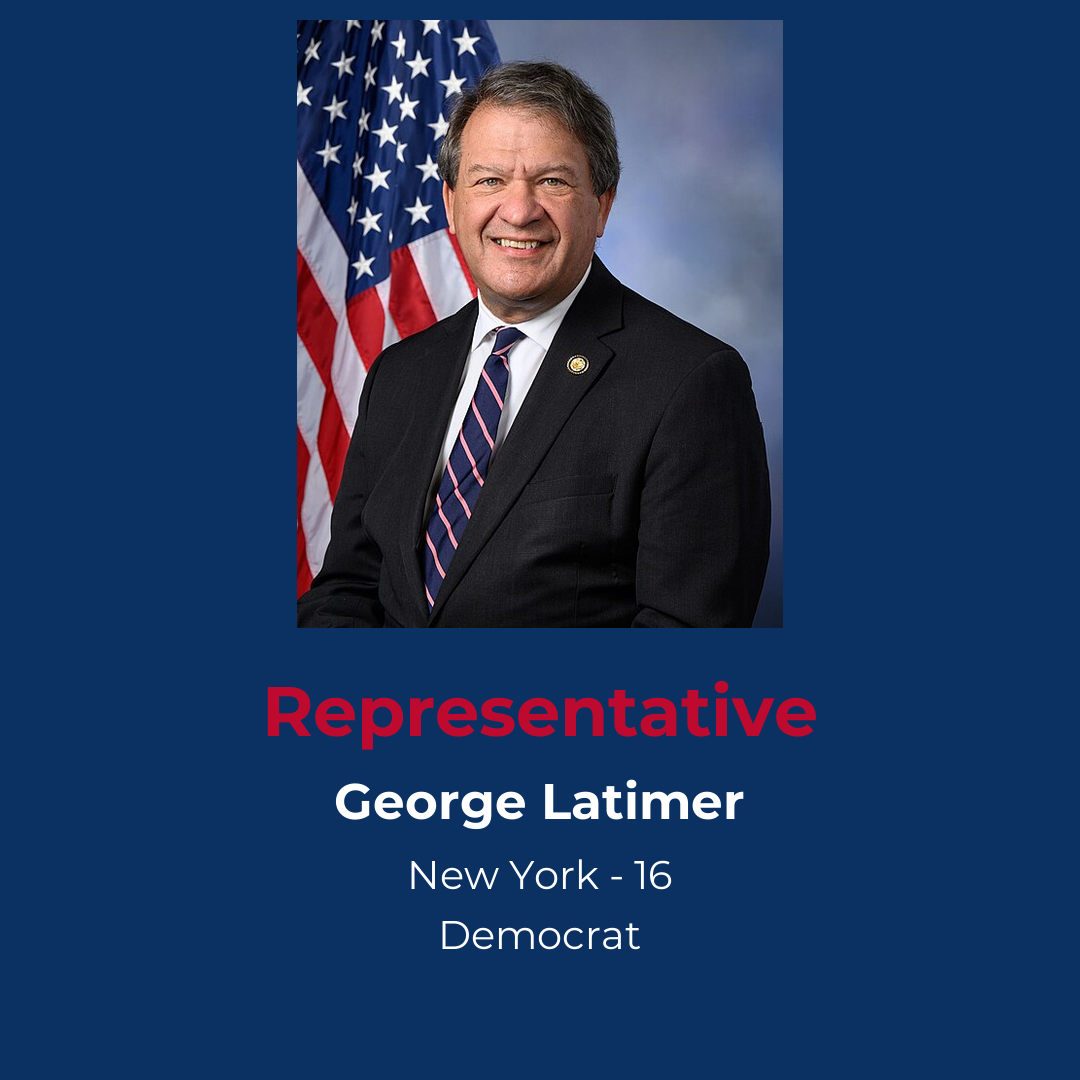
Profile of Democrat Representative Latimer from New York District 16
George Latimer arrived in Washington after winning what was, at the time, the most expensive and highly publicized congressional primary in American history. In 2024, he successfully defeated incumbent Jamaal Bowman, proving that pragmatic, establishment Democrats still wield massive influence in suburban battlegrounds against the progressive "Squad." He represents New York’s 16th District, a vibrant, diverse, and economically crucial district that spans the southern half of Westchester County and a small northern sliver of the Bronx. Unlike most congressional freshmen, Latimer brought over three decades of executive and legislative experience to Capitol Hill. He served as the Westchester County Executive from 2018 to 2025, where he famously stabilized the county's credit rating and cut property taxes without sacrificing social services. In the 119th Congress (2025-2026), he serves on the House Foreign Affairs Committee (sitting on the highly critical Middle East and North Africa Subcommittee) and the House Small Business Committee. Recent 2026 Legislation: Operating as a member of the pragmatic New Democrat Coalition, Latimer has launched an aggressive legislative blitz in early 2026 to protect local economies. In January 2026, he introduced the SBIR Administrative Funding Act to streamline federal grants for small tech innovators, alongside a bipartisan bill designed to combat the growing public safety hazard of electric vehicle (EV) battery fires. "He won the most expensive primary in congressional history by promising competence over chaos. George Latimer brings the pragmatic discipline of a County Executive to a deeply divided Capitol Hill." Day 57 | George Latimer: The Pragmatic Executive of Westchester George Latimer’s political brand is the absolute antithesis of viral, social-media-driven activism. Born in Mount Vernon, New York, he worked for two decades as a corporate marketing executive in the hospitality industry before dedicating his life to public service. His political resume is a masterclass in local governance: he served on the Rye City Council, chaired the Westchester County Board of Legislators, served in the New York State Assembly, and then moved to the New York State Senate. In 2017, he successfully unseated a Republican incumbent to become the Westchester County Executive, a role that functions essentially as the CEO of a county of one million people. Latimer's decision to run for Congress in 2024 was a seismic event in Democratic politics. Challenging two-term progressive incumbent Jamaal Bowman, Latimer positioned himself as a staunchly pro-Israel, pro-infrastructure pragmatist. The race became a national proxy war over the ideological direction of the Democratic Party and the U.S.-Israel relationship following the outbreak of the war in Gaza. Latimer won decisively, arguing that the voters of Westchester wanted a representative focused on building bridges, cutting red tape, and delivering federal funds, rather than engaging in performative partisan warfare. Entering the 119th Congress at the age of 71, Latimer is technically a freshman, but he commands the respect of a seasoned institutionalist. He immediately joined the New Democrat Coalition, aligning himself with the center-left bloc of the party. His assignment to the Foreign Affairs Committee—and specifically the Subcommittee on the Middle East and North Africa—allows him to fulfill his campaign promises, fiercely defending the U.S.-Israel alliance against growing isolationist pressures from the right and anti-Zionist pressures from the far left. Domestically, Latimer is leveraging his seat on the Small Business Committee to wage a defensive war against the new Trump administration's economic policies. In early 2026, he took to the House floor to denounce the White House's proposed sweeping tariffs on Canada and Mexico, warning that such a tra...
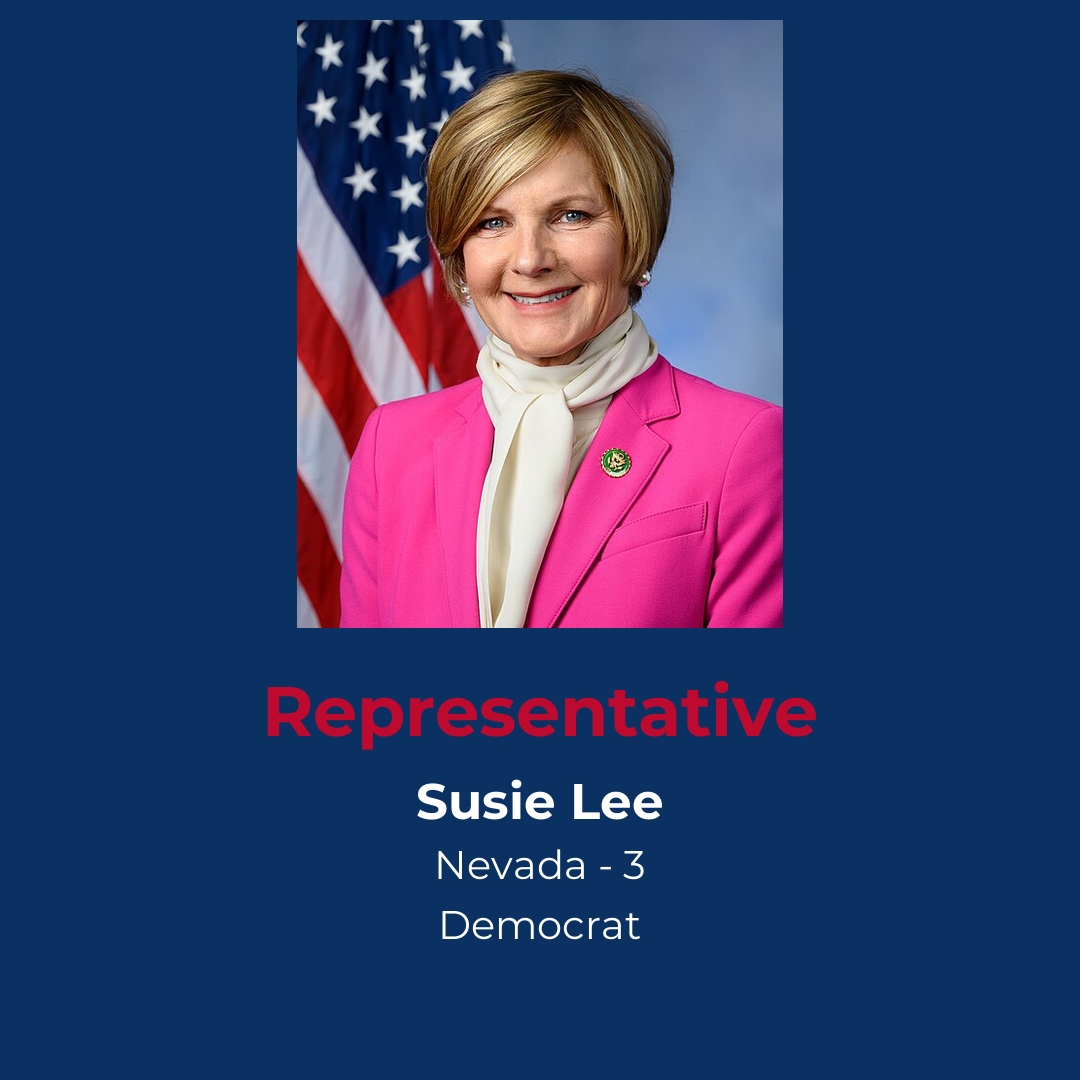
Profile of Democrat Representative Lee from Nevada District 3
Susie Lee is a battle-tested political survivor who represents one of the most competitive swing districts in the country. Before entering Congress, she spent decades as a prominent education advocate, serving as the President of the board for Communities In Schools of Nevada to combat high school dropout rates. She represents Nevada’s 3rd District, which encompasses the sprawling southern suburbs of Las Vegas, including Henderson, Boulder City, and the crucial Hoover Dam. It is a highly diverse, working-class district that relies heavily on the hospitality and gaming industries. In the 119th Congress (2025-2026), she solidified her influence by being elected as the Battleground Leadership Representative. This position—which she personally created—guarantees that vulnerable, swing-district "Frontline" Democrats have a dedicated seat at the party’s leadership table. She is southern Nevada's only voice on the incredibly powerful House Appropriations Committee, sitting on the Defense and Energy & Water Development subcommittees. She uses this leverage to fund Nellis and Creech Air Force Bases, block nuclear waste from being dumped at Yucca Mountain, and direct millions to drought prevention. Recent 2026 Battles: In early 2026, she unveiled her comprehensive Affordability Agenda to combat the rising cost of living. She is currently clashing with the new Trump administration over its freeze on federal financial assistance, while successfully passing bipartisan legislation like the Help Hoover Dam Act and the SHINE Act to cut red tape for residential solar power. "From fighting for school funding as an education advocate to commanding the federal checkbook on the Appropriations Committee, Susie Lee is the pragmatic powerhouse defending America's ultimate battleground." Day 57 | Susie Lee: The Frontliner of the Silver State Susie Lee’s path to Capitol Hill was paved by a lifelong dedication to public education and community intervention. Born in a working-class steel town in Ohio, she paid her way through Carnegie Mellon University with a mix of scholarships, student loans, and waitressing jobs. After moving to Las Vegas in the 1990s, Lee didn't initially jump into politics; instead, she focused on the systemic inequities in the local school system. She became the founding director of a homeless crisis intervention center and spent years as the board president for Communities In Schools of Nevada, a massive non-profit dedicated to providing wrap-around services to keep at-risk kids from dropping out of high school. Elected to Congress in 2018, Lee stepped into one of the most notoriously fickle swing districts in the United States. While many politicians in hyper-partisan districts retreat to their ideological corners, Lee’s survival in NV-03 requires constant, deliberate coalition-building. She operates as the Vice Chair of the bipartisan Problem Solvers Caucus and the Whip of the moderate New Democrat Coalition, establishing a reputation as a lawmaker who prefers passing infrastructure bills over seeking viral social media moments. Her political acumen was fully recognized at the start of the 119th Congress. Having successfully defended her toss-up seat in the 2024 elections, her Democratic colleagues elected her as the Battleground Leadership Representative for 2025 and 2026. This role is a massive testament to her influence; Lee actually created the position a few years prior to ensure that the "majority-makers" holding the toughest swing districts aren't drowned out by lawmakers from safe, coastal strongholds. Simultaneously, Lee is flexing massive financial muscle as a senior member of the Appropriations Committee. Sitting on the Defense Subcommittee, she recently cornered Secretary of Defense Pete Hegseth during early 2026 budget hearings, securing explicit commitments to invest in American critical mineral companies ope...
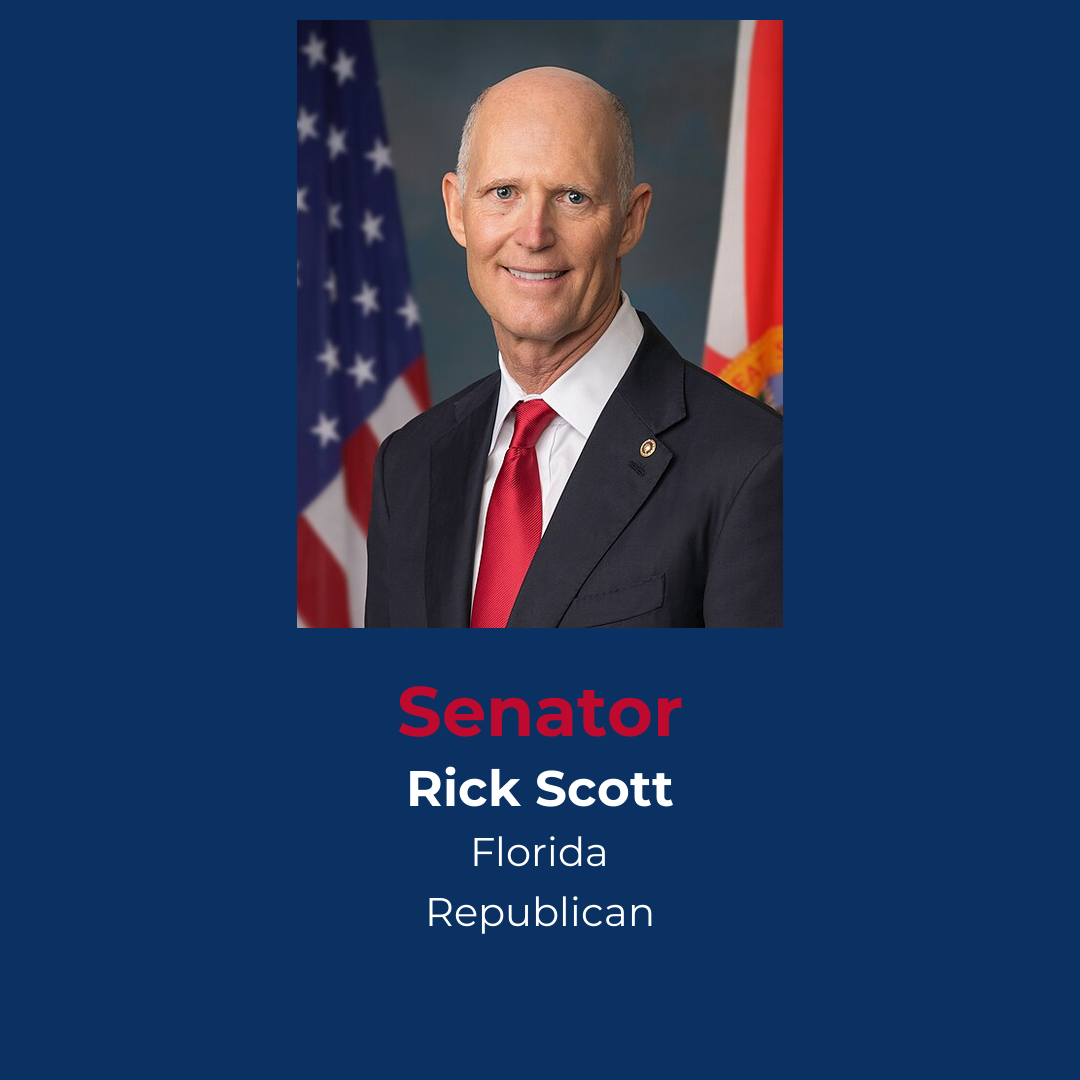
Profile of Republican Senator Scott from Florida
Rick Scott is a dominant force in Florida politics. Before his election to the U.S. Senate in 2018, he served two terms as the 45th Governor of Florida. Prior to politics, he was a highly successful businessman who built Columbia/HCA into the world's largest healthcare company. He represents Florida, a former swing state that has rapidly transformed into a solid Republican stronghold. He successfully won re-election to a second Senate term in November 2024. In the 119th Congress (2025-2026), following the Republican takeover of the Senate, Scott was elevated to Chairman of the Special Committee on Aging. This is a highly strategic gavel for a senator representing a state with one of the largest retiree populations in the country. He is heavily involved in the new administration's economic agenda. Serving on the Budget Committee, Scott is working closely with the Department of Government Efficiency (DOGE) to aggressively cut federal spending and overhaul bureaucratic agencies. Recent 2026 Legislation: In early 2026, Scott has been driving a massive legislative blitz. He introduced the Federal Disaster Tax Relief Act to extend critical IRS relief to hurricane and wildfire victims through 2026. He is also aggressively targeting the Chinese Communist Party, pushing the TSP Fiduciary Security Act to block federal retirement funds from investing in China, and leading a coalition to end visa programs that allow Chinese "birth tourism" in U.S. territories. "From growing up in public housing to building a healthcare empire and leading the Sunshine State. Rick Scott brings a relentless, CEO-mindset to the United States Senate." Day 55 | Rick Scott: The CEO Senator Navigating the New Washington Rick Scott’s journey to the highest levels of American government is rooted in an extraordinary rags-to-riches trajectory. Growing up in the Midwest in public housing, his adoptive father was a World War II veteran and truck driver, and his mother worked as a store clerk. After serving in the U.S. Navy as a radarman aboard the USS Glover, Scott utilized the G.I. Bill to attend college, eventually opening his first business—a donut shop. Through aggressive expansion and a sharp eye for corporate acquisitions, he went on to build and run Columbia/HCA, creating the largest healthcare company in the world. He brought that exact corporate, bottom-line mentality to politics. Serving as the Governor of Florida from 2011 to 2019, Scott aggressively championed over $10 billion in tax cuts, slashed thousands of state regulations, and oversaw massive job growth, cementing Florida's reputation as a pro-business haven. Elected to the U.S. Senate in 2018, Scott quickly positioned himself as a foil to the traditional Washington establishment, frequently demanding structural overhauls to how Congress handles the federal budget. The beginning of the 119th Congress marked a pivotal moment in Scott's career. Fresh off a comfortable re-election victory in 2024, Scott ran for Senate Majority Leader with the vocal backing of the MAGA base and prominent Trump allies like Elon Musk. While he ultimately lost that leadership race to Senator John Thune, Scott emerged as the undisputed ideological anchor for the populist, "America First" wing of the Senate Republican Conference. Now operating with immense seniority in 2025 and 2026, Scott has secured powerful committee assignments, including seats on Armed Services, Foreign Relations, and Homeland Security. Crucially, he holds the gavel as the Chairman of the Special Committee on Aging. In this role, he is fiercely defending the solvency of Medicare and Social Security while introducing the More Affordable Care Act, which seeks to implement HSA-style "Health Freedom Accounts" to drive down insurance costs. Simultaneously, Scott is waging a multi-front legislative war against the Chinese Communist Party. In early...
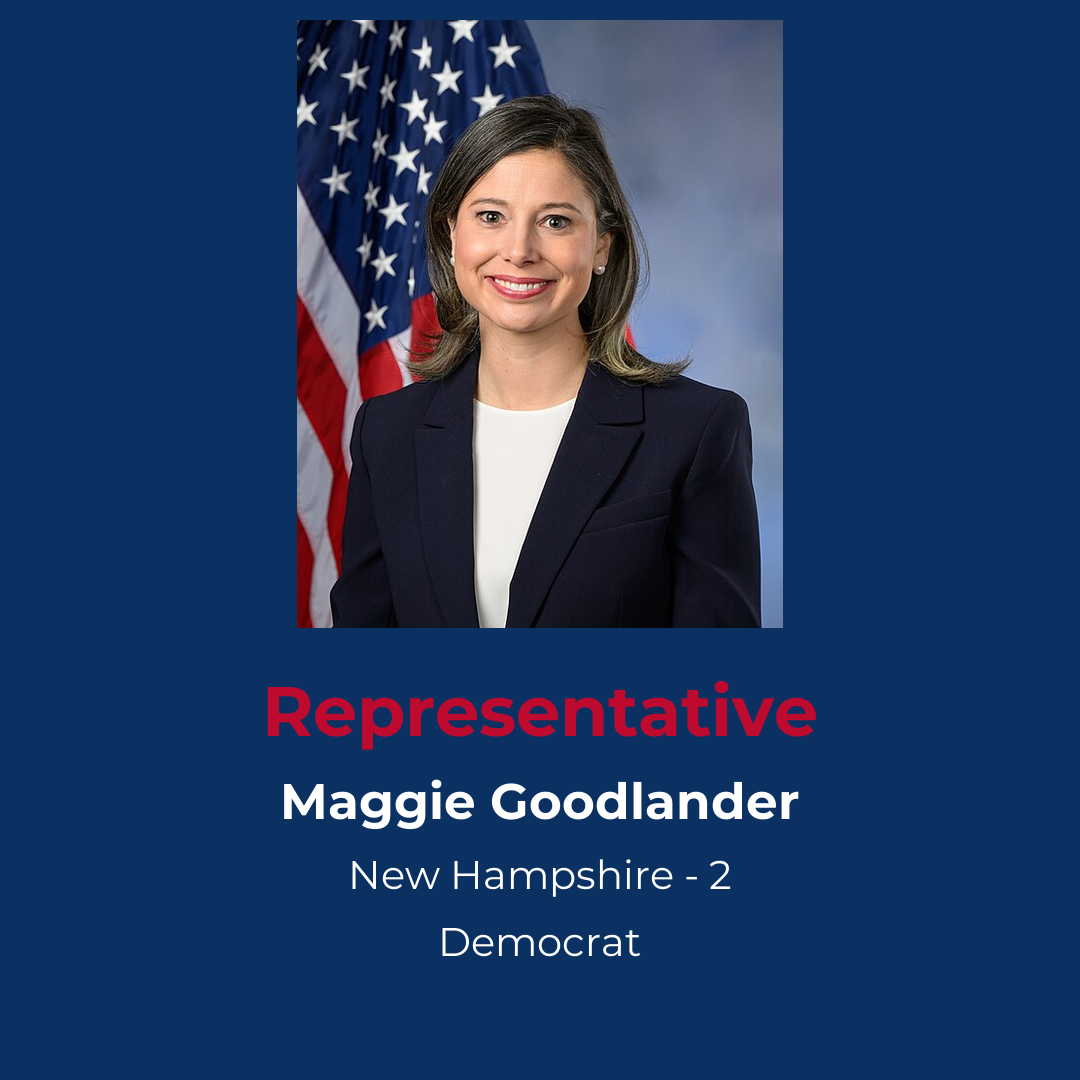
Profile of Democrat Representative Goodlander from New Hampshire District 2
Maggie Goodlander is one of the most uniquely qualified freshmen in the 119th Congress. Before winning the election to succeed Annie Kuster in 2024, she served as a U.S. Navy Reserve intelligence officer, a law clerk to Supreme Court Justice Stephen Breyer, and a senior White House advisor. She represents New Hampshire’s 2nd District, a vast, fiercely independent district that encompasses the western and northern parts of the state, including the cities of Nashua and Concord. In the 119th Congress (2025-2026), she secured powerful assignments on the House Armed Services Committee and the House Committee on Small Business. She is leveraging her DOJ background (having served as Deputy Assistant Attorney General in the Antitrust Division) to fight corporate monopolies that price-gouge Granite State consumers. She is currently engaged in a massive, high-profile clash with the White House. After participating in a late-2025 video reminding U.S. servicemembers of their duty to refuse "illegal orders," President Trump publicly attacked her and other Democratic lawmakers on social media, accusing them of treason. Recent 2026 Battles: In February 2026, Goodlander has been leading the grassroots fight alongside Rep. Chris Pappas against the Department of Homeland Security's proposal to build a massive new ICE warehouse facility in Merrimack, New Hampshire. She also recently celebrated the Supreme Court's decision to block the administration's new sweeping tariffs, arguing the taxes would have devastated local small businesses. "From the DOJ's antitrust division to the House Armed Services Committee, Maggie Goodlander is a former naval intelligence officer bringing a fierce defense of the rule of law back to her home state." Day 55 | Maggie Goodlander: The Legal Warrior of the Granite State Maggie Goodlander’s resume reads like a masterclass in American constitutional law and national security. Born and raised in Nashua to a prominent New Hampshire political family, she earned degrees from Yale University and Yale Law School. Her early career placed her squarely in the arena of global geopolitics; she served as a foreign policy advisor to Senators Joe Lieberman and John McCain, helping craft landmark sanctions legislation. She then spent over a decade as an intelligence officer in the United States Navy Reserve, giving her a profound, firsthand understanding of the military apparatus. Her legal career is equally formidable. Goodlander clerked for Chief Judge Merrick Garland and Supreme Court Justice Stephen Breyer, later teaching constitutional law at Dartmouth and the University of New Hampshire. She served as counsel on the House Judiciary Committee during the first impeachment of Donald Trump, and later joined the Department of Justice under the Biden administration as a Deputy Assistant Attorney General in the Antitrust Division. There, she built a reputation as a relentless opponent of corporate monopolies, fighting to lower costs for working-class families. Elected to Congress in 2024 to succeed the retiring Annie Kuster, Goodlander arrived in the 119th Congress as a highly visible, battle-tested freshman. She quickly joined the New Democrat Coalition and secured seats on the Armed Services Committee and the Small Business Committee. Her committee placements perfectly align with her district's needs, allowing her to advocate for the 1,200 active-duty service members and nearly 6,000 National Guard and reserve members in New Hampshire, while simultaneously fighting to cut red tape for the small enterprises that make up 99% of the state's businesses. However, her tenure in 2025 and early 2026 has been defined by fierce, national-level combat with the new Trump administration. In late 2025, she participated in a video explicitly reminding military personnel of their constitutional obligation to refuse illegal orders from the Command...
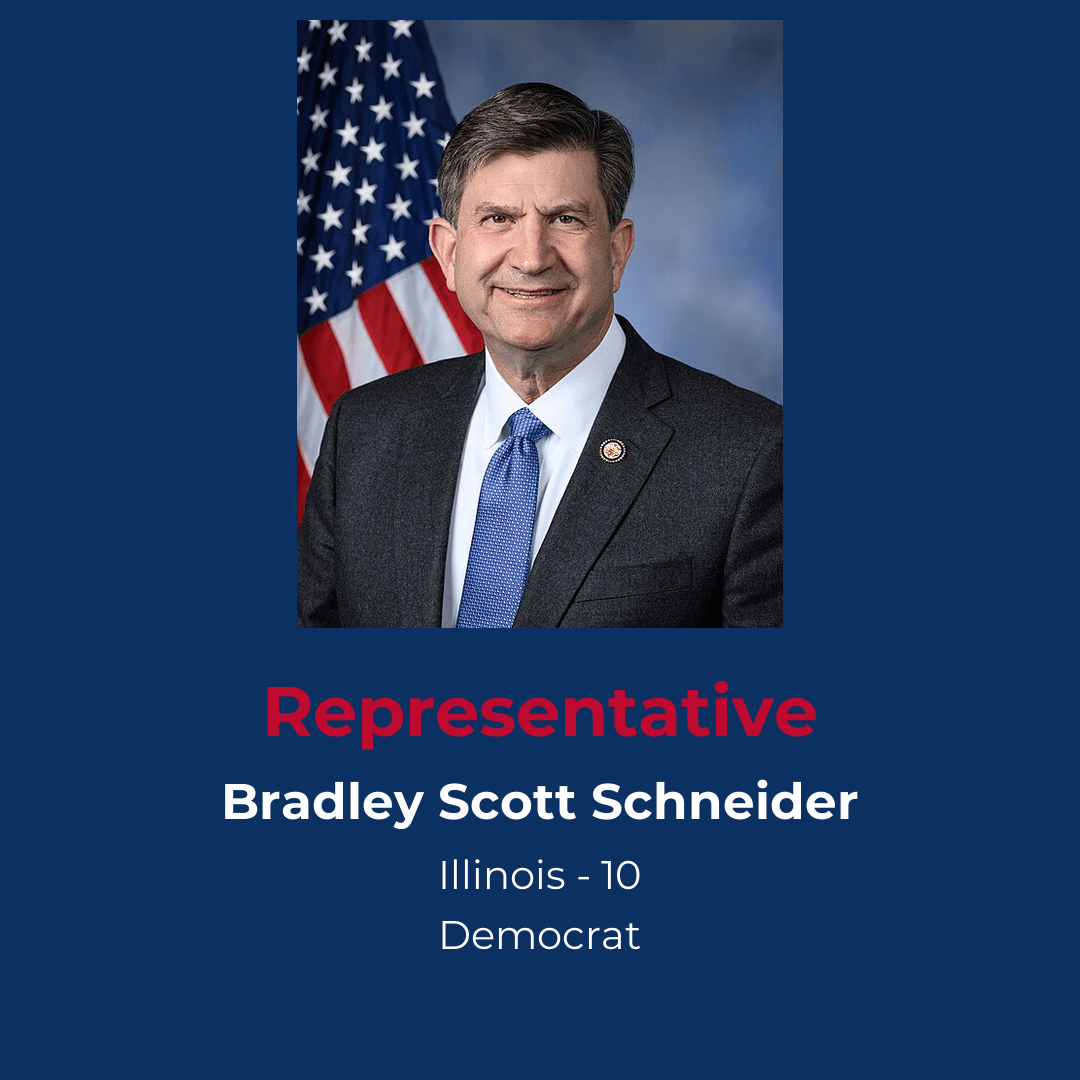
Profile of Democrat Representative Schneider from Illinois District 10
Brad Schneider is the newly elected Chair of the New Democrat Coalition for the 119th Congress. Managing a massive bloc of 108 center-left House Democrats (representing more than half of the Democratic Caucus), Schneider is now the undisputed leader of the party's pragmatic, pro-growth, and moderate wing. He represents Illinois’ 10th District, which encompasses the affluent, highly educated northern suburbs of Chicago along the shores of Lake Michigan. In the 119th Congress (2025-2026), his legislative power is anchored by dual assignments on the Committee on Ways and Means (sitting on the Tax and Trade subcommittees) and the Committee on Foreign Affairs. Domestically, his top priority in 2026 is stopping the massive spike in healthcare premiums. He is the lead author of the Keep Healthcare Affordable Act, an urgent 2026 bill designed to extend enhanced ACA premium tax credits through 2029 to prevent families from facing a looming 114% premium increase. He is one of the most prominent, fiercely pro-Israel voices in the Democratic Party and the co-founder of the Congressional Abraham Accords Caucus. However, he does not shy away from criticizing the Israeli government, making headlines in late 2025 by publicly demanding the removal of Israel’s National Security Minister, Itamar Ben Gvir, over human rights abuses. The 2026 Primary Fight: As the March 2026 Illinois primaries approach, Schneider is facing a vocal challenge from his political left. He is currently clashing with progressive challenger Morgan Coghill, whose campaign is entirely focused on demanding an end to U.S. military assistance to Israel. "As the new Chairman of the New Democrat Coalition, Brad Schneider is the pragmatic architect leading the centrist wing of the Democratic Party through a deeply divided Washington." Day 55 | Brad Schneider: The Pragmatic Powerhouse of the North Shore Brad Schneider’s political brand is built on moderation, economic pragmatism, and global diplomacy. Born in Denver, Colorado, Schneider earned his degree in industrial engineering from Northwestern University and later an MBA from the Kellogg School of Management. Before entering politics, he spent his early career working on a kibbutz in Israel, and later built a successful career in the private sector as a management consultant and managing principal of a life insurance firm. This deep background in business and finance fundamentally shapes his approach to legislating: he approaches the federal budget not as an activist, but as an industrial engineer looking for systemic efficiencies. First elected in 2012 in a notoriously swingy district, Schneider initially traded the seat back and forth with Republican Bob Dold before permanently securing it in 2016. Today, he represents a solidly blue constituency, but he has strictly maintained his center-left, pro-business philosophy. His influence in the 119th Congress reached new heights when his peers elected him to Chair the New Democrat Coalition. In this role, Schneider serves as the primary counterbalance to both the progressive wing of his own party and the sweeping conservative agenda of the new Trump administration. In February 2026, Schneider led the Coalition in unveiling their sweeping "Affordability Agenda," heavily focused on rolling back new tariffs, restarting the Affordable Connectivity Program, and cracking down on price-gouging to lower the cost of living. Simultaneously, Schneider is waging a massive fight on the Ways and Means Committee to protect the Affordable Care Act. In response to the administration's budget cuts, Schneider introduced the Keep Healthcare Affordable Act, warning that the expiration of ACA subsidies will throw millions off their insurance. Despite his pragmatic reputation, he has drawn hard lines, recently voting against stopgap funding for the Department of Homeland Security until the...
Profile of Republican Representative McCaul from Texas District 10
Michael T. McCaul is one of the most consequential foreign policy voices in modern American history. A former federal counterterrorism prosecutor, he served as the Chairman of the House Homeland Security Committee and, more recently, the powerful House Foreign Affairs Committee. Retirement Announcement: In September 2025, McCaul made the historic announcement that he will not seek re-election in 2026, concluding a 22-year career in the House. He stated he is looking for "a new challenge in 2027" within the national security and foreign policy realm. In the 119th Congress (2025-2026), having passed the Foreign Affairs chairmanship to Rep. Brian Mast, McCaul operates with the highly influential title of Chairman Emeritus. He uses this position to combat the growing isolationist wing of his own party, remaining a staunch advocate for American global engagement and defense of democratic allies. He is a massive opponent of the Chinese Communist Party and a fierce defender of Taiwan. He authored the CHIPS Act to bring semiconductor manufacturing back to the U.S. (driving billions to Texas), and he was subsequently sanctioned by the Chinese government for his aggressive support of Taiwanese independence. Recent 2026 Legislation: In February 2026, he introduced the bipartisan Decreasing Russian Oil Profits (DROP) Act of 2026 to impose severe sanctions on foreign entities trading in Russian oil. He is also actively pushing back against the administration's willingness to allow U.S. tech companies like Nvidia to sell advanced AI microchips to China, warning it has "the optics of selling our national security." "From prosecuting terrorists to defining American foreign policy for a generation, Michael McCaul is spending his final term fighting to keep the United States engaged on the global stage." Day 54 | Michael McCaul: The National Security Hawk's Final Tour Michael McCaul’s worldview was shaped by the Cold War and solidified by the War on Terror. The son of a World War II B-17 bombardier, McCaul earned his law degree from St. Mary’s University and spent his early career as a prosecutor. Serving as the Chief of Counterterrorism and National Security in the U.S. Attorney's office in Texas, he developed a rigid, threat-assessment approach to government. Elected to Congress in 2004, he applied that exact prosecutor’s mentality to Capitol Hill, quickly rising to chair the Homeland Security Committee and eventually taking the gavel of the prestigious Foreign Affairs Committee. For two decades, McCaul has been the intellectual anchor of the Republican Party’s traditional, "peace through strength" national security wing. He views global geopolitics as a stark battle between democratic alliances and authoritarian regimes, specifically identifying the alliance of China, Russia, and Iran as an existential threat. His legislative legacy is massive: he spearheaded the multi-year investigation into the disastrous 2021 Afghanistan withdrawal, aggressively whipped the votes to secure military aid for Ukraine, and authored the CHIPS for America Act, which triggered a multi-billion-dollar semiconductor manufacturing boom right in his Central Texas district. In the 119th Congress, McCaul is navigating a fundamentally shifted political landscape. Following his September 2025 announcement that he will retire at the end of his current term, he stepped into the role of Chairman Emeritus. However, his final year in office is proving to be incredibly combative. As his party trends toward isolationism, McCaul refuses to retreat. In early 2026, he has actively clashed with the new administration over technology exports. When the White House signaled a willingness to grant export licenses to companies like Nvidia and AMD to sell advanced semiconductors to China in exchange for revenue sharing, McCaul publicly blasted the move, arguing that American AI technol...

Profile of President Abraham Lincoln
Abraham Lincoln was the 16th President of the United States (1861–1865). The first President from the newly formed Republican Party, he successfully led the nation through its greatest moral, constitutional, and political crisis: the American Civil War. He fundamentally redefined the purpose of the United States. Initially declaring that his paramount objective was to save the Union—with or without slavery—he evolved to issue the Emancipation Proclamation in 1863, transforming the war into a crusade to abolish human bondage. Lincoln wielded unprecedented executive power. To prevent the border states from seceding and to suppress rebellion, he suspended the writ of habeas corpus, arrested secessionist lawmakers, and authorized the shutdown of anti-war newspapers, sparking intense debates about presidential overreach during wartime. Beyond the Civil War, his domestic legacy fundamentally built the modern American West. In 1862, he signed the Homestead Act (granting land to Western settlers), the Pacific Railway Act (funding the first Transcontinental Railroad), and the Morrill Land-Grant Act (creating agricultural and mechanical colleges). Just five days after the surrender of the primary Confederate army at Appomattox Court House, Lincoln was assassinated by Confederate sympathizer John Wilkes Booth at Ford's Theatre on April 14, 1865, becoming the first U.S. President to be assassinated. "He inherited a shattered nation, waged the bloodiest war in American history to save it, and destroyed the institution of slavery in the process. Abraham Lincoln is the definitive American President." Day 56 | Abraham Lincoln: The Savior of the Union The mythology of Abraham Lincoln is so universally known that it often obscures the brilliant, pragmatic, and fiercely ambitious politician underneath. Born in a dirt-floor log cabin in Hardin County, Kentucky, in 1809, Lincoln’s early life was defined by grueling physical labor and crushing poverty. Largely self-educated by reading borrowed books by the firelight, he moved to Illinois, where he failed in business but found his true calling in the law and Whig politics. Lincoln served a single, unremarkable term in the U.S. House of Representatives in the 1840s, where his opposition to the Mexican-American War made him deeply unpopular back home. He returned to his Springfield law practice, seemingly finished with national politics. However, the passage of the Kansas-Nebraska Act in 1854—which opened the Western territories to slavery—drew him back into the arena. Joining the newly formed Republican Party, Lincoln challenged political giant Stephen A. Douglas for the U.S. Senate in 1858. Though he lost the election, the legendary "Lincoln-Douglas Debates" elevated him to national stardom. His eloquent, razor-sharp argument that "A house divided against itself cannot stand" became the moral rallying cry for the North. Elected President in a four-way race in 1860, Lincoln won the Electoral College without carrying a single Southern state. In response to his election, seven Southern states seceded before he even took the oath of office, forming the Confederacy and seizing federal property. When Confederate forces fired on Fort Sumter in April 1861, the Civil War began. As Commander-in-Chief, Lincoln was a master of political strategy. He constructed a "Team of Rivals" cabinet, appointing the very men who had run against him for the Republican nomination—William Seward, Salmon P. Chase, and Edward Bates—ensuring every faction of the North was represented in his administration. He suffered through years of devastating military defeats and incompetent generals, constantly clashing with cautious commanders like George McClellan, before finally finding his relentless wartime architect in Ulysses S. Grant. Politically, his defining masterstroke was the Emancipation Proclamation. Waiting for a...

Profile of President President James Buchanan
James Buchanan was the 15th President of the United States (1857–1861). He remains the only President elected from Pennsylvania and the only President to remain a lifelong bachelor (his niece, Harriet Lane, served as First Lady). Despite possessing one of the most impressive resumes in American political history—having served as a Congressman, Senator, Secretary of State, and Minister to Russia and Great Britain—he is consistently ranked by historians as one of the worst presidents in U.S. history. His most disastrous and unethical action occurred just days before his inauguration. He secretly pressured Northern Supreme Court Justice Robert Grier to join the Southern majority in the Dred Scott decision, hoping a broad ruling denying citizenship to African Americans and allowing slavery in the territories would permanently settle the national debate. Instead, it enraged the North and accelerated the path to war. He exacerbated the violence of "Bleeding Kansas" by aggressively supporting the Lecompton Constitution, an illegitimately drafted, pro-slavery state constitution. His relentless push for its passage fractured the Democratic Party and sparked a bitter feud with Senator Stephen A. Douglas. When Abraham Lincoln was elected in 1860 and Southern states began to secede, Buchanan suffered a total failure of leadership. He argued that while secession was illegal, the federal government had no constitutional authority to stop it by force. He sat paralyzed as the Confederacy formed and seized federal arsenals, leaving a shattered nation for Lincoln to inherit. "He possessed the perfect resume and the absolute worst judgment. James Buchanan is the President who watched the Union fracture and decided that doing nothing was his constitutional duty." Day 52 | James Buchanan: The Architect of Inaction If the presidency were awarded purely on the basis of a resume, James Buchanan would have been considered one of the most qualified men to ever enter the Oval Office. Born into a wealthy Pennsylvania family in 1791, Buchanan was a gifted lawyer who spent decades navigating the highest levels of American government. He was a loyal Jacksonian Democrat who served in both houses of Congress, acted as Secretary of State during the Mexican-American War under James K. Polk, and served as a diplomat in Europe. In fact, his absence from the country as Minister to Great Britain during the explosive Kansas-Nebraska Act debates is precisely what allowed him to secure the 1856 Democratic nomination; he was viewed as an untainted, unifying statesman. The reality, however, was that Buchanan was the ultimate "Doughface"—a Northern politician with deeply ingrained Southern sympathies. He despised abolitionists, viewing them as dangerous radicals, and consistently allied himself with the Southern slaveholding elite to maintain his political coalition. His presidency was compromised before he even took the oath of office. In a shocking breach of the separation of powers, the President-elect secretly corresponded with the Supreme Court regarding the pending Dred Scott v. Sandford case. Buchanan improperly pressured a fellow Pennsylvanian, Justice Robert Grier, to join the Southern justices in issuing a sweeping ruling. When Chief Justice Roger Taney declared that African Americans could never be U.S. citizens and that Congress could not ban slavery in the territories, Buchanan foolishly believed the issue was legally resolved. Instead, the blatant partisanship of the ruling outraged the North and proved to abolitionists that the federal government had been hijacked by the "Slave Power." Buchanan's political incompetence was further exposed during the Kansas crisis. Despite clear evidence of massive voter fraud by pro-slavery "Border Ruffians," Buchanan threw the full weight of the presidency behind admitting Kansas as a slave state under the Lecompton Con...
Profile of Democrat Representative Pocan from Wisconsin District 2
Mark Pocan is one of the most powerful and strategic progressive voices in Washington. He serves as the Co-Chair of the Congressional Progressive Caucus, the Co-Chair of the LGBT Equality Caucus, and the Co-Founder of the Labor Caucus. He represents Wisconsin’s 2nd District, a deep-blue liberal bastion anchored by the state capital of Madison and the massive campus of the University of Wisconsin-Madison. Before arriving in Congress to succeed Tammy Baldwin in 2013, Pocan spent 14 years in the Wisconsin State Assembly. Crucially, his political identity is grounded in his background as a small business owner who ran a union specialty print shop, giving him unique credibility when bridging the gap between progressive activists and blue-collar labor organizers. In the 119th Congress (2025-2026), he serves as a senior member of the Appropriations Committee, specifically sitting on the powerful Labor, Health and Human Services, and Education subcommittee. He is using this perch to wage a massive legislative war against the privatization of federal healthcare. He has emerged as one of the most combative oversight critics of the new administration's Cabinet. In recent months, he has fiercely clashed with HHS Secretary Robert F. Kennedy Jr. over the defunding of LGBTQ+ health resources and confronted Secretary of State Marco Rubio over the incineration of international food aid. Recent 2026 Legislation: In February 2026, Pocan introduced the Audit the Pentagon Act of 2026, demanding fiscal accountability as the defense budget surges past $1 trillion. This follows his sweeping late-2025 legislative package targeting predatory practices in Medicare Advantage, headlined by the Denials Don't Pay Act. "He is a union print shop owner who became the strategic architect of the Congressional Progressive Caucus. Mark Pocan defends the liberal heart of Wisconsin by taking the fight directly to the administration's Cabinet." Day 51 | Mark Pocan: The Progressive Anchor of the Midwest Mark Pocan’s path to Washington was built on a foundation of local activism and blue-collar entrepreneurship. Raised in Kenosha, Wisconsin, he graduated from the University of Wisconsin-Madison and quickly integrated himself into the city's vibrant political scene. Before he was a national progressive leader, he was a small business owner. For decades, Pocan owned and operated a union-affiliated specialty print shop in Madison. This dual identity—a progressive LGBTQ+ activist and a small business employer who understands payrolls and union contracts—makes him uniquely effective at building coalitions across the often-fractured left wing of the Democratic Party. He served 14 years in the Wisconsin State Assembly before running for Congress in 2012 to succeed Tammy Baldwin (who was successfully running for the Senate). Upon arriving in D.C., Pocan methodically acquired power by co-founding the Labor Caucus, co-chairing the LGBT Equality Caucus, and eventually rising to co-chair the Congressional Progressive Caucus (CPC). He views progressivism not just as a set of social ideals, but as a rigid defense of the working class against corporate monopolies and Wall Street overreach. In the 119th Congress, navigating a hostile political environment under the new Trump administration, Pocan has taken off the gloves. Serving as a senior member of the Appropriations Committee, he has fiercely condemned the administration's sweeping budget cuts. When the new White House pushed a massive legislative package that Pocan dubbed the "Big, Beautiful Bill for Billionaires," he was one of its most vocal opponents, blasting the legislation for slashing federal healthcare and food aid to fund corporate tax cuts. His legislative and oversight agenda in 2025 and early 2026 has been hyper-focused on healthcare and defense accountability. Outraged by corporate insurance companies del...
Profile of Democrat Representative Nadler from New York District 12
Jerrold Nadler is a towering institutional figure in New York politics. First elected to Congress in 1992, he has spent over three decades representing the West Side of Manhattan. In September 2025, he made the historic announcement that he will not seek re-election in 2026, citing the need for "generational change" and marking the end of an era for the Democratic Party. He represents New York’s 12th District, arguably the most affluent and highly educated congressional district in the United States. Spanning both the Upper West Side and the Upper East Side of Manhattan, it is a dense, deeply Democratic urban fortress. In the 119th Congress (2025-2026), Nadler passed the torch as the top Democrat on the full House Judiciary Committee to Rep. Jamie Raskin. However, Nadler took on a highly targeted new role as the Ranking Member of the Judiciary Subcommittee on Administrative State, Regulatory Reform, and Antitrust, focusing his final term on combating corporate monopolies and preserving economic fairness. He is currently locked in an intense, highly combative standoff with the new Trump administration's Department of Homeland Security. Following a shocking May 2025 incident where a DHS agent handcuffed one of Nadler's own staff members in his Manhattan office, Nadler joined the push to impeach DHS Secretary Kristi Noem. In February 2026, he took a dramatic stand by voting against the massive Fiscal Year 2026 government funding package. He stated he could not in good conscience give a "blank check" to Immigration and Customs Enforcement (ICE), condemning the agency's aggressive tactics in immigrant communities. "For over thirty years, he has been the immovable liberal anchor of Manhattan. Now, in his final term, Jerry Nadler is taking off the gloves for one last battle against executive overreach." Day 51 | Jerrold Nadler: The Lion of the West Side's Final Roar Jerrold "Jerry" Nadler’s political journey is synonymous with the modern history of New York City. Born in Brooklyn and educated at Columbia University and Fordham Law School, Nadler’s career began in the grassroots of the 1970s anti-war and civil rights movements. He served 15 years in the New York State Assembly before winning a special election in 1992 to succeed the legendary Ted Weiss in Congress. For the next three decades, Nadler established himself as one of the most intellectually formidable legal minds in the Democratic caucus, serving as a fierce defender of civil liberties, LGBTQ+ rights, and reproductive freedom. Nadler is best known nationally for his tenure as the Chairman of the House Judiciary Committee during Donald Trump's first presidency, where he led two impeachment inquiries. However, the 119th Congress represents a profound shift. In September 2025, the 78-year-old statesman announced his impending retirement, declaring he would step aside at the end of 2026 to allow a new generation of leaders to take the reins. Concurrently, he stepped down as the top Democrat on the full Judiciary Committee, taking instead the Ranking Member spot on the Antitrust Subcommittee. In this targeted role, he has spent late 2025 and early 2026 fighting against algorithmic collusion in rental housing and demanding strict antitrust enforcement against tech monopolies. Despite his impending retirement, Nadler's final term has been incredibly combative. He has positioned himself as a primary antagonist to the new Trump administration's domestic agenda. When the President signed the massive "Big Ugly Bill" into law in July 2025—a sweeping package that severely cut Medicaid and SNAP food assistance while expanding immigration enforcement—Nadler was one of its loudest opponents. His ongoing war with the Department of Homeland Security reached a boiling point in May 2025 when a DHS officer detained and handcuffed one of Nadler's aides in his district office without a warrant...
Profile of Democrat Representative Tokuda from Hawaii District 2
Jill N. Tokuda represents one of the most geographically massive and diverse districts in the country, covering the "Neighbor Islands" of Hawaii and rural Oahu. Before her election to Congress in 2022, she spent 12 years in the Hawaii State Senate, where she chaired the powerful Ways and Means Committee and balanced the state's $14 billion budget. She is a prominent voice for Asian American and Pacific Islander (AAPI) leadership in Washington, serving as the Second Vice Chair of the Congressional Asian Pacific American Caucus (CAPAC). She also co-founded the Bipartisan Rural Health Care Caucus, leveraging her deep understanding of the medical shortages facing isolated island communities. In the 119th Congress (2025-2026), her influence stretches across three critical domains: Agriculture, Armed Services, and National Security. She was named the Ranking Member of the Agriculture Subcommittee on Conservation, Research, and Biotechnology, making her the lead Democrat negotiating resource conservation in the upcoming Farm Bill. She is a hawkish progressive regarding the Indo-Pacific. Serving on the Select Committee on the Chinese Communist Party, Tokuda recently introduced the bipartisan Rare Earth Magnet Market Revitalization Act in February 2026 to break America's reliance on Chinese supply chains for critical military and commercial components. She is aggressively fighting the new administration's immigration policies to protect local economies. In early 2026, she led a bipartisan coalition demanding that DHS Secretary Kristi Noem exempt healthcare workers from a newly implemented $100,000 H-1B visa fee, warning that the policy would decimate rural hospitals in Hawaii that rely on foreign-born doctors. "From protecting native canoe crops to confronting the Chinese Communist Party on the global stage, Jill Tokuda defends the unique culture and immense strategic value of the Hawaiian Islands." Day 51 | Jill Tokuda: The Guardian of the Neighbor Islands Jill Tokuda’s deep political roots are matched only by the vast geography of the district she represents. Born in Honolulu, she earned her degree in international relations from George Washington University before returning home to become a dominant force in local politics. Serving in the Hawaii State Senate from 2006 to 2018, Tokuda proved her legislative muscle by chairing the Ways and Means, Education, and Agriculture committees. She was instrumental in establishing the state's first Executive Office on Early Learning and protecting Important Agricultural Lands. Beyond elected office, her resume spans the private and nonprofit sectors, having served as Co-Director of CyberHawaii and Executive Director of the Nisei Veterans Memorial Center on Maui. Elected to the U.S. House in 2022, Tokuda quickly established herself as a highly effective, pragmatic progressive. In the 119th Congress, she has strategically positioned herself on committees that directly dictate the survival of the Hawaiian Islands. As the Ranking Member of the Agriculture Subcommittee on Conservation, Research, and Biotechnology, she is the lead Democratic voice fighting for specialized research funding for Hawaii's unique commodities—such as coffee, macadamia nuts, and traditional Native Hawaiian "canoe crops"—while battling the severe threat of invasive species. Her role on the Armed Services Committee and the Select Committee on the Chinese Communist Party places her at the center of the geopolitical struggle in the Indo-Pacific. Tokuda recognizes that Hawaii is the tip of the spear for the U.S. military, but she fiercely guards state sovereignty. In the FY2026 National Defense Authorization Act (NDAA), she explicitly secured provisions preventing the Department of Defense from using federal authority to condemn or seize state land in Hawaii. In early 2026, Tokuda’s legislative output has been relentless. She...
Profile of Republican Senator Hyde-Smith from Mississippi
Cindy Hyde-Smith made history in 2018 as the first woman to represent Mississippi in the United States Congress. Before arriving in Washington, she served 12 years in the Mississippi State Senate and was the first female to be elected as the Mississippi Commissioner of Agriculture and Commerce. She represents Mississippi, a deeply conservative, agriculture-heavy state in the Deep South. A lifelong cattle farmer herself, Hyde-Smith’s political identity is intrinsically tied to the state's $7.5 billion farming and forestry industries. In the 119th Congress (2025-2026), Hyde-Smith received a massive elevation in power. She was officially named the Chairman of the Appropriations Subcommittee on Transportation, Housing and Urban Development (THUD). This "Cardinal" position gives her direct control over the federal budget for highways, aviation, and national housing grants. She is currently the Chair of the Senate Pro-Life Caucus, making her a leading conservative voice on social issues. In early 2026, she introduced a resolution honoring Mississippi's Gestational Age Act and led a coalition urging federal health agencies to protect the "conscience rights" of medical residents who oppose performing abortions. Looking ahead to the 2026 midterms, Hyde-Smith is running for re-election in what promises to be a highly watched race. She is facing a prominent Democratic challenger in Scott Colom, a reform-minded District Attorney who recently secured the influential endorsement of Mississippi Congressman Bennie Thompson and has amassed a significant campaign war chest. "From the cattle pastures of Brookhaven to the chairman's gavel on the Appropriations Committee, Cindy Hyde-Smith is the quiet, agriculture-first conservative delivering federal dollars to the Deep South." Day 50 | Cindy Hyde-Smith: The Farmer with the Federal Checkbook Cindy Hyde-Smith’s political career is deeply rooted in the soil of Mississippi. A native of Brookhaven, she grew up in the agricultural industry and continues to operate a cattle farm with her husband. Her entry into politics was straightforward and hyper-local: she served as a conservative Democrat in the Mississippi State Senate for over a decade before switching her affiliation to the Republican Party in 2010. Shortly after, she was elected as the state’s Commissioner of Agriculture and Commerce, a role that perfectly aligned with her expertise and cemented her popularity among rural, working-class voters. Appointed to the U.S. Senate in 2018 to fill the seat vacated by Thad Cochran, Hyde-Smith won the subsequent special election and has since established herself as a reliable, institutional conservative. Unlike some of her more bombastic colleagues in the Senate, Hyde-Smith generally avoids cable news combat, preferring to focus her energy on the Appropriations Committee, where she methodically secures massive infrastructure and agricultural grants for her state. In the 119th Congress, her methodical approach paid off immensely. Taking over as the Chairman of the THUD Appropriations Subcommittee, Hyde-Smith now writes the funding bills for the Department of Transportation and the Department of Housing and Urban Development. She also secured a highly coveted new spot on the Military Construction and Veterans Affairs (MilCon-VA) subcommittee, meaning she now sits on six of the twelve Appropriations subcommittees. She has used this leverage to aggressively fund local priorities, recently voting in January 2026 to pass an Army Corps funding bill that directed $184.1 million to Mississippi projects, including the long-debated Yazoo Backwater Pumps. As she navigates her 2026 re-election campaign, Hyde-Smith is balancing her role as an Appropriations power broker with her status as a staunch cultural conservative. She has fully aligned herself with the new administration's "Peace Through Strength" agenda, vot...
Profile of Democrat Representative Adams from North Carolina District 12
Alma S. Adams is affectionately known in Washington as the "Godmother of HBCUs." Before arriving in Congress, she earned her Ph.D. in Art Education and spent 40 years as a professor at Bennett College, an all-women's Historically Black College in Greensboro. She famously coined the phrase, "Bennett Belles are Voting Belles." She represents North Carolina’s 12th District, which is entirely contained within Mecklenburg County and encompasses almost all of Charlotte. It is the most heavily Democratic district in the state. She is a historic figure in the chamber. Winning a special election in 2014, Adams was sworn in as the 100th woman to serve in the 113th Congress. She is easily recognizable in the halls of the Capitol by her signature, vibrant hats. In the 119th Congress (2025-2026), her legislative power is concentrated on two major fronts: Education and Agriculture. She serves as the Ranking Member of the Subcommittee on Higher Education and Workforce Development, and she is a senior member of the Agriculture Committee, where she fiercely defends federal nutrition programs. She operates her congressional office on a platform she calls "The 4 H's": Housing, Hunger, Healthcare, and Higher Education. In early 2026, she reintroduced the Improving Access to Nutrition Act to lift time limits on SNAP benefits, and she delivered her 2026 State of the District Address emphasizing the urgent need for billions in deferred maintenance funding for HBCU campuses. "She spent 40 years in the classroom before taking her signature hats to the halls of Congress. Alma Adams is the 'Godmother of HBCUs' and a relentless champion for the working families of Charlotte." Day 49 | Alma Adams: The Educator and The Advocate Alma S. Adams’s political philosophy is deeply rooted in her own family's story of sacrifice. Born in New Jersey and raised in poverty, Adams frequently speaks of her mother, who worked long, grueling hours as a domestic worker cleaning floors so that Alma could pursue the education her mother was denied. That sacrifice paid off: Adams earned her bachelor's and master's degrees from North Carolina A&T State University, and eventually a Ph.D. from The Ohio State University. For the next 40 years, Dr. Adams taught art at Bennett College, instilling a deep sense of civic duty in generations of young Black women. Her political career was built methodically. She served as the first African American woman on the Greensboro City School Board, spent nine years on the Greensboro City Council, and served ten terms in the North Carolina State House, where she pioneered the Displaced Homemakers Bill and led the North Carolina Legislative Black Caucus. When she was elected to the U.S. House in 2014, she immediately took her lifelong passion for education to the federal level, founding and co-chairing the Congressional Bipartisan HBCU Caucus. Adams is an institutional powerhouse for minority-serving institutions. She was the driving force behind the FUTURE Act, which permanently secured $255 million annually for Minority-Serving Institutions, and she continues to push the IGNITE HBCU Excellence Act to rebuild aging campus infrastructure. Beyond education, she is a trailblazer in public health. Alongside Rep. Lauren Underwood, Adams co-founded the Black Maternal Health Caucus, successfully passing the Protecting Moms Who Served Act and delivering hundreds of millions in federal funding to combat the maternal mortality crisis that disproportionately affects Black women. In the 119th Congress, navigating a deeply polarized Washington under the new administration, Adams has taken a highly combative stance to protect her constituents' safety nets. In January 2026, she joined House Democrats in introducing Articles of Impeachment against the new DHS Secretary, Kristi Noem, citing executive overreach and human rights concerns. In February 2026, sh...
Profile of Democrat Representative Ansari from Arizona District 3
Yassamin Ansari is a historic trailblazer in the 119th Congress. Born in 1992, she is currently the youngest woman serving in the U.S. House of Representatives, the President of the Democratic Freshman Class, and the first Iranian-American Democrat ever elected to Congress. She represents Arizona’s 3rd District, a deeply diverse, majority-Hispanic Democratic stronghold that encompasses the urban core of Phoenix. She won the seat in the 2024 election, succeeding Ruben Gallego after he ran for the U.S. Senate. Her political foundation is built almost entirely on climate advocacy. Before entering politics, she served as a senior policy advisor at the United Nations, working directly under Secretaries-General Ban Ki-moon and António Guterres to help deliver the historic Paris Climate Agreement. In the 119th Congress (2025-2026), Ansari has secured remarkable influence for a freshman. She serves on the Committee on Oversight and Government Reform and the Committee on Natural Resources, where she was immediately named the Ranking Member of the Energy and Mineral Resources Subcommittee. Her 2025 and 2026 legislative agenda is highly aggressive, heavily targeting the White House's environmental and immigration policies. She recently introduced a massive extreme heat legislative package (including the Excess Urban Heat Mitigation Act), the Artemis Act to protect asylum seekers from expedited removal, and the Dual Hatting Act to prevent executive branch officials from holding multiple simultaneous federal roles. "From negotiating the Paris Agreement at the United Nations to fighting the brutal realities of urban heat in Phoenix, Yassamin Ansari brings a global climate perspective to the desert." Day 49 | Yassamin Ansari: The Climate Champion of the Desert Yassamin Ansari’s rapid ascent to the halls of Congress is a story of fierce advocacy and deep-rooted immigrant resilience. Born in Seattle and raised in Scottsdale, Arizona, Ansari is the daughter of parents who fled Iran following the Islamic Revolution. That profound understanding of displacement and the search for freedom shaped her early activism; as a high school student, she organized for the Arizona Democratic Party and tutored Somali refugees alongside her mother. Ansari’s academic and professional trajectory is formidable. After earning degrees from Stanford University and the University of Cambridge, she was selected for the prestigious John Gardner Fellowship Program. This placed her at the highest levels of global diplomacy, serving as a senior policy advisor at the United Nations where she spent years working on the architecture of the Paris Climate Agreement. Realizing that global treaties require local action, Ansari returned to Arizona and ran for the Phoenix City Council in 2021. She became the youngest person ever elected to the council and the first Iranian-American elected to public office in the state. During her tenure, she spearheaded Phoenix's landmark Climate Action Plan, championed the transition to electric public transit, and crucially created the city’s first Office of Heat Response and Mitigation—a vital intervention in a city that routinely experiences deadly summer temperatures. Elected to the U.S. House in 2024 to represent Arizona's 3rd District, Ansari arrived in Washington as the President of the Democratic Freshman Class. In the 119th Congress, she has positioned herself as a primary antagonist to the new administration's agenda. Serving as the Ranking Member of the Energy and Mineral Resources Subcommittee, she is the lead Democratic voice fighting against the rollback of the Inflation Reduction Act and the expansion of fossil fuel drilling on public lands. Simultaneously, she uses her seat on the Oversight Committee to demand executive accountability, introducing legislation like the Dual Hatting Act to curb administrative corruption,...
Profile of Republican Senator Cornyn from Texas
John Cornyn is a towering figure of the Republican establishment and a seasoned institutionalist. Before his election to the U.S. Senate in 2002, he spent decades shaping Texas law as a district judge in Bexar County, a Justice on the Texas Supreme Court, and the Attorney General of Texas. He represents Texas, the largest red state in the nation. As the senior Senator, he serves as the state's primary legislative architect in Washington, focusing heavily on the state's massive military footprint, border security, and international trade. In the 119th Congress (2025-2026), Cornyn's committee portfolio became arguably the most powerful of any single senator. Already serving on the Finance, Judiciary, and Intelligence Committees, he added seats on the Foreign Relations and Budget Committees. He was also named the Chair of the Senate Caucus on International Narcotics Control. He is currently locked in the political fight of his life. Facing re-election in 2026, Cornyn is navigating a brutal Republican primary against Texas Attorney General Ken Paxton and U.S. Representative Wesley Hunt. The race is viewed nationally as the ultimate battle between the traditional GOP "old guard" and the populist "MAGA" wing. Early voting for this high-stakes March 3rd primary began today, February 17, 2026. His recent legislative victories are heavily focused on national security and defense. In the FY2026 NDAA, he successfully secured the FIGHT China Act (restricting U.S. investment in Chinese tech), the GUARD Act (establishing a DoD Artificial Intelligence institute), and the PARTNERS Act (training Mexican military forces in the U.S. to combat cartels). "He has been the steady, unshakeable hand of Texas politics for over two decades. Now, John Cornyn is deploying a massive war chest to defend the conservative establishment against a populist rebellion." Day 48 | John Cornyn: The Institutionalist John Cornyn’s path to the United States Senate was paved with legal briefs and judicial gavels. Born in Houston to a World War II B-17 pilot, Cornyn originally intended to become a doctor before pivoting to journalism and, ultimately, the law. Graduating from St. Mary’s University School of Law in San Antonio, he built his early career not as a firebrand politician, but as a meticulous jurist. He served as a district judge, ascended to the Texas Supreme Court in 1990, and became the Attorney General of Texas in 1998—the first Republican to hold that office since Reconstruction. Elected to the U.S. Senate in 2002, Cornyn quickly established himself as a master of the chamber's complex rules and procedures. He was chosen by his peers to serve as the Senate Republican Whip (the second-highest ranking position in the conference) from 2013 to 2019, whipping the votes for some of the party's largest legislative victories. Unlike his junior counterpart, Senator Ted Cruz, who often courts national controversy and viral media moments, Cornyn operates behind closed doors, negotiating massive bipartisan packages and securing billions of dollars for Texas military installations. In the 119th Congress, Cornyn is operating with unparalleled committee influence. Sitting on Finance, Judiciary, Intelligence, Foreign Relations, and the Budget Committee means that virtually no major piece of legislation can pass the Senate without crossing his desk. He has used this leverage to pass aggressive anti-cartel legislation, including the Counternarcotics Enhancement Act, and the Stop Illegal Aliens Drunk Driving Act introduced in early 2026. However, his pragmatic, institutional style has made him a target of the party's populist right wing. As he seeks a fifth term in 2026, he is facing a ferocious primary challenge from Attorney General Ken Paxton and Rep. Wesley Hunt. Cornyn has responded with overwhelming financial force, out-raising his opponents by millions and saturating...
Profile of Republican Representative Fleischmann from Tennessee District 3
Chuck Fleischmann is one of the most quietly powerful men in Washington. As a "Cardinal" on the Appropriations Committee, he serves as the Chairman of the Energy and Water Development Subcommittee in the 119th Congress (2025-2026). This position gives him direct control over the budget for the Department of Energy, the Army Corps of Engineers, and the National Nuclear Security Administration. He represents Tennessee’s 3rd District, a region defined by the scenic Tennessee River Valley and its two major anchor cities: Chattanooga and Oak Ridge. The district is the historical and modern epicenter of American nuclear science, dating back to the top-secret Manhattan Project. Fleischmann is the undisputed champion of the American "Nuclear Renaissance." He serves as the Co-Chairman of virtually every nuclear-related caucus in the House, including the Advanced Nuclear Caucus, the Fusion Energy Caucus, the National Labs Caucus, and the Nuclear Cleanup Caucus. Major 2026 Legislative Victory: On January 23, 2026, President Donald Trump signed Fleischmann’s Fiscal Year 2026 Energy and Water Development Act into law. The massive funding bill passed the House by an astonishing, bipartisan 419-6 margin. Fleischmann heralded the bill as the dawn of the "Golden Age of Appropriations," designed to unleash American-made energy dominance. He is heavily focused on the deployment of Small Modular Reactors (SMRs). Recognizing that the exploding energy demands of Artificial Intelligence data centers and cryptocurrency mining cannot be met by wind and solar alone, Fleischmann secured an $800 million federal grant program to help the Tennessee Valley Authority (TVA) build next-generation nuclear reactors. "He holds the purse strings for America's nuclear arsenal, its national laboratories, and its waterways. Chuck Fleischmann is the quiet 'Cardinal' engineering the future of American energy dominance." Day 48 | Chuck Fleischmann: The Cardinal of the Nuclear Renaissance Chuck Fleischmann’s political brand is built on profound, hyper-focused legislative influence rather than cable news theatrics. A conservative attorney who built a successful law practice in Chattanooga with his wife Brenda, Fleischmann ran for Congress in 2010 during the Tea Party wave. However, instead of remaining an outsider agitator, he methodically climbed the rungs of the House Appropriations Committee—the most exclusive and powerful committee in Congress, responsible for writing the federal checkbook. Today, in the 119th Congress, Fleischmann is a "Cardinal"—the prestigious insider title given to the chairs of the twelve Appropriations subcommittees. As Chairman of Energy and Water Development, he dictates how billions of taxpayer dollars are spent on the nation's most critical infrastructure. Fleischmann's worldview is entirely shaped by the unique geography and history of his district. Because he represents Oak Ridge—the "Secret City" that enriched the uranium for the atomic bomb during WWII and now houses the Oak Ridge National Laboratory (ORNL) and the Y-12 National Security Complex—Fleischmann views nuclear energy and nuclear security as the ultimate pillars of American hegemony. He argues relentlessly that the United States must rebuild its nuclear supply chain, expand the production of weapons-grade isotopes to deter global adversaries, and rapidly deploy civil nuclear power to meet surging domestic energy demands. In early 2026, Fleischmann achieved the legislative pinnacle of his career. Following the passage of H.R. 1 (the "One Big Beautiful Bill Act") which outlined the new administration's America First agenda, Fleischmann successfully navigated his FY2026 Energy and Water funding bill through a fractured Congress. Signed into law by President Trump on January 23, 2026, the legislation heavily defunded aggressive climate-change mandates in favor of expanding tradit...
Profile of Republican Representative Radewagen from AS District 0
Aumua Amata Coleman Radewagen is the first woman to serve in the U.S. House of Representatives from American Samoa. The title "Aumua" is a registered traditional Samoan chiefly title. She is a political trailblazer with deep historical roots; her father, Peter Tali Coleman, was the first popularly elected governor of the territory. She represents American Samoa as a non-voting Delegate. While she cannot cast a final vote on the House floor, she has full voting privileges in her committees, where she fiercely defends the unique economic and cultural interests of the most remote U.S. territory. In the 119th Congress (2025-2026), she is a critical voice on three major committees: Veterans' Affairs, Natural Resources, and Foreign Affairs. This trifecta perfectly aligns with the survival and strategic importance of her home islands. Veterans and Military: American Samoa boasts one of the highest military enlistment rates per capita of any U.S. state or territory. Consequently, Radewagen’s top priority is the VA. She relentlessly pushes for localized healthcare, telehealth expansion, and modernized VA clinics so that isolated Samoan veterans do not have to fly to Hawaii or the mainland for basic care. The Tuna Economy & Disaster Preparedness: The private sector in American Samoa is almost entirely dependent on the StarKist tuna cannery. Radewagen constantly battles against blanket federal regulations—such as mandatory mainland minimum wage hikes and expansive marine monument fishing bans—that threaten to bankrupt the industry. She is also a leading voice on emergency preparedness, constantly securing FEMA and infrastructure grants to protect the islands from devastating Pacific cyclones and tsunamis. "She holds a traditional chiefly title and represents the strategic heart of the South Pacific. Aumua Amata Coleman Radewagen is the guardian of American Samoa's veterans and its way of life." Aumua Amata: The Chief of the Pacific Aumua Amata Coleman Radewagen’s political pedigree is woven into the very history of American Samoa. Her father, Peter Tali Coleman, was a towering figure in the Pacific—a U.S. Army officer and the first person of Samoan descent to be appointed Governor of American Samoa, later becoming its first popularly elected governor. Amata inherited his dedication to public service, spending decades working in Washington as a staffer, a liaison for the Pacific territories, and a prominent organizer for the Republican National Committee before finally winning her seat in Congress in 2014. Serving as a Delegate for an unincorporated, geographically isolated territory presents a unique set of challenges. Radewagen cannot vote on final legislation, but she uses her committee assignments as a strategic shield for her islands. On the Natural Resources Committee, she is a fierce defender of the local fishing industry. Over 80% of American Samoa's private-sector jobs are tied to the tuna industry. She has spent the last decade fighting against environmentalist pushes to expand the Pacific Remote Islands Marine National Monument, arguing that banning commercial fishing in these waters would completely annihilate the Samoan economy and leave the territory dependent on federal welfare. In the 119th Congress, her role on the Foreign Affairs Committee has taken on massive global importance. With the new administration's intense focus on countering the Chinese Communist Party, Radewagen serves as a vital diplomatic bridge to the Indo-Pacific. China has aggressively attempted to buy influence and build infrastructure in neighboring independent Pacific island nations (like the Solomon Islands and independent Samoa). Radewagen leverages her position to remind Washington that American Samoa is an indispensable, sovereign U.S. strategic outpost that requires robust Coast Guard and military investment to counter Chinese naval expansion....
Profile of Democrat Representative Cleaver from Missouri District 5
Emanuel Cleaver II is a trailblazer in Missouri politics. Before heading to Washington, he made history in 1991 as the first African American Mayor of Kansas City, serving two terms and spearheading the revitalization of the city's historic 18th and Vine Jazz District. He is affectionately known as the "Pastor of the House." An ordained United Methodist minister, Cleaver served as the senior pastor at St. James United Methodist Church in Kansas City for over three decades. His pastoral background heavily influences his rhetorical style and his frequent, impassioned pleas for bipartisan civility in an increasingly polarized Congress. He represents Missouri’s 5th District, which is anchored by Kansas City. It is a diverse, culturally rich district that serves as the economic and cultural engine of western Missouri, balancing a deep-blue urban core with more moderate suburban and rural outskirts. In the 119th Congress (2025-2026), Cleaver holds significant influence on the House Financial Services Committee. As a senior member and leading voice on the Subcommittee on Housing and Insurance, he has dedicated his recent legislative efforts to combating the national housing affordability crisis, drawing directly from his own childhood experiences growing up in a home without indoor plumbing. He is a recognized leader on climate and infrastructure within the Democratic caucus. In early 2026, he has been aggressively advocating for the Green New Deal for Public Housing Act, arguing that retrofitting aging public housing units is essential for both environmental sustainability and the dignity of low-income families. "From a childhood shack in Texas to the Mayor's office, and finally to the halls of Congress. Emanuel Cleaver is the Pastor of the House who preaches the gospel of affordable housing and civility." Day 47 | Emanuel Cleaver: The Pastor of Kansas City Emanuel Cleaver’s life story is a testament to the sheer force of perseverance. Born in Waxahachie, Texas, in the 1940s, Cleaver grew up in grinding poverty. His childhood home was a shack that lacked indoor plumbing and electricity. His family eventually moved to public housing, an experience that permanently shaped his political priorities. He worked his way through college, eventually earning a Master of Divinity degree, and moved to Kansas City, Missouri, where he built St. James United Methodist Church from a small congregation of a few dozen people into a thriving community pillar with thousands of members. Cleaver's transition from the pulpit to politics was a natural extension of his community leadership. After serving on the City Council, he was elected as the first Black Mayor of Kansas City in 1991. His tenure was marked by a focus on economic development and preserving the city's rich cultural heritage, most notably the historic 18th and Vine Jazz District, which houses the Negro Leagues Baseball Museum and the American Jazz Museum. Since his election to Congress in 2004, Cleaver has carved out a unique identity as the "conscience" of the Democratic caucus. He is famously averse to the bitter, viral-chasing warfare that dominates modern politics. He routinely champions the "Civility Pledge" among incoming freshmen and frequently uses his floor speeches to remind his colleagues of their shared humanity. In the 119th Congress, the octogenarian lawmaker remains a legislative workhorse, focusing his energy almost entirely on the Financial Services Committee. With the nation facing a severe housing crunch in 2025 and 2026, Cleaver views housing not just as an economic issue, but as a moral imperative. He is a fierce defender of the Department of Housing and Urban Development (HUD) and has introduced legislation to protect first-generation homebuyers from predatory lending practices. While he operates as a reliable progressive, his pastoral, measured tone allows him to ma...

Profile of President President Franklin Pierce
Franklin Pierce was the 14th President of the United States (1853–1857). A Northern Democrat from New Hampshire who sympathized with the South—a political archetype known at the time as a "Doughface"—his presidency is widely considered one of the most disastrous in American history, directly accelerating the nation's path to the Civil War. His presidency was shattered before it even began. Just weeks before his inauguration, Pierce and his wife, Jane, witnessed the horrific death of their 11-year-old son, Bennie, in a train derailment. The trauma left Pierce psychologically broken and his wife in a state of severe, permanent depression, casting a dark pall over his entire administration. Pierce’s most consequential and destructive act was signing the Kansas-Nebraska Act of 1854. Orchestrated by Senator Stephen A. Douglas, the act repealed the Missouri Compromise of 1820, allowing new territories to vote on whether to permit slavery. This led to a violent, bloody proxy war known as "Bleeding Kansas," horrifying the North and leading directly to the birth of the modern Republican Party. His foreign policy was marked by aggressive expansionism that often backfired. He oversaw the Gadsden Purchase, acquiring land from Mexico for a southern transcontinental railroad, but his administration was humiliated by the Ostend Manifesto—a leaked, secret diplomatic memo that proposed purchasing or conquering Cuba from Spain to turn it into a new slave state. He is the only elected President in U.S. history to actively seek his party's nomination for a second term and be completely rejected. The Democratic Party, viewing him as a toxic liability, dumped him in 1856 in favor of James Buchanan. "His administration began with an unspeakable personal tragedy and ended in national catastrophe. Franklin Pierce was the broken man who let the nation bleed." Franklin Pierce: The Tragedy and The Tinderbox Franklin Pierce is a historical cautionary tale of a man entirely unsuited for the immense weight of the office he held. A charming, handsome lawyer and a brigadier general in the Mexican-American War, Pierce was well-liked in his home state of New Hampshire. In 1852, the Democratic Party, deadlocked over more prominent candidates, selected the relatively obscure Pierce as a compromise "dark horse." He won in a landslide against the crumbling Whig Party, but the victory would cost him everything. On January 6, 1853, just two months before he was to be sworn in, the Pierce family was traveling by train in Massachusetts when their car derailed and tumbled down an embankment. Pierce and his wife survived, but their 11-year-old son, Bennie—their last surviving child—was crushed to death before their eyes. Jane Pierce, deeply religious and opposed to her husband's political ambitions, believed the presidency was a curse from God that required the sacrifice of her son. Pierce entered the White House a hollowed-out, grieving shell. He delivered his inaugural address entirely from memory, but notably chose to "affirm" rather than "swear" his oath, refusing to place his hand on a Bible because he felt God had abandoned him. Politically, Pierce was a "Doughface"—a Northerner who appeased the Southern slaveholding power block to maintain party unity. He filled his cabinet with aggressive Southerners, including Jefferson Davis as his Secretary of War. His weakness was fatally exposed in 1854 when Senator Stephen A. Douglas pressured him into backing the Kansas-Nebraska Act. This legislation shattered the delicate peace of the 1820 Missouri Compromise by allowing settlers in the new territories to vote on whether to allow slavery (popular sovereignty). The result was an unmitigated disaster. Pro-slavery "Border Ruffians" from Missouri and anti-slavery "Free-Staters" flooded into Kansas, leading to widespread assassinations, rigged elections, and the burning of t...

Profile of President President Millard Fillmore
Millard Fillmore was the 13th President of the United States (1850–1853) and the last President to belong to the Whig Party. He ascended to the presidency following the sudden death of Zachary Taylor in July 1850, immediately pivoting the administration's stance to support the controversial Compromise of 1850. His defining legacy is signing the Fugitive Slave Act of 1850. While Fillmore personally found slavery repugnant, he believed signing the law was necessary to preserve the Union. Instead, the draconian law—which forced Northerners to act as slave catchers and stripped accused runaways of due process—outraged the North, inspired Uncle Tom's Cabin, and ultimately destroyed the Whig Party. Fillmore's origin story is one of extreme, desperate poverty. Born in a dirt-floor log cabin in upstate New York, he was apprenticed to a cloth maker in conditions bordering on slavery. He painstakingly educated himself, eventually marrying his teacher, Abigail Powers, and rising to become a wealthy lawyer and politician. In foreign policy, Fillmore's most significant achievement was dispatching Commodore Matthew C. Perry and a fleet of U.S. Navy warships to "open" Japan to Western trade in 1853, permanently altering the balance of global power in the Pacific. After being denied renomination by his fractured party in 1852, Fillmore ran for president again in 1856 as the candidate for the American Party (the "Know-Nothings"), a secretive political movement defined by intense anti-immigrant and anti-Catholic nativism. "He saved the Union for a decade, but the price was his reputation, his party, and his legacy. Millard Fillmore is the forgotten President who signed the most hated law in American history." Millard Fillmore: The Compromiser Millard Fillmore represents the ultimate "American Dream" origin story, yet his presidency is widely considered one of the most disastrous in history. Born in a freezing log cabin in the Finger Lakes region of New York in 1800, Fillmore endured a brutal childhood. Apprenticed to a cruel cloth dresser, he essentially bought his own freedom, walking a hundred miles home to educate himself. He borrowed books, attended a one-room schoolhouse, and fell in love with his teacher, Abigail Powers, who guided him toward a legal career. Rising through the ranks of New York politics, Fillmore became a protégé of the powerful Whig boss Thurlow Weed. He served in the U.S. House of Representatives, where he chaired the Ways and Means Committee, and was eventually elected Comptroller of New York. In 1848, the Whig Party selected him as Vice President to balance the ticket with Zachary Taylor, a Southern slaveholder. When Taylor suddenly died in July 1850 from a severe stomach ailment, Fillmore was thrust into the presidency during one of the most dangerous sectional crises in American history. The country was tearing itself apart over whether the massive new territories acquired in the Mexican-American War (like California and New Mexico) would allow slavery. Zachary Taylor had opposed a grand compromise, but Fillmore immediately reversed course. He fired Taylor's cabinet, aligned himself with Senators Henry Clay and Stephen A. Douglas, and threw the full weight of the White House behind the Compromise of 1850. The Compromise successfully admitted California as a free state and banned the slave trade in Washington, D.C. However, to appease Southern threats of secession, Fillmore signed the Fugitive Slave Act. This horrific piece of legislation denied accused runaway slaves the right to a jury trial and heavily fined federal marshals and ordinary citizens who refused to hunt down escaping slaves. The law radicalized the North, turning moderate abolitionists into militant activists. By prioritizing a temporary political truce over moral justice, Fillmore signed the death warrant of the Whig Party. Northern Whigs...
Profile of Republican Representative Cloud from Texas District 27
Michael Cloud is a staunch Constitutional Conservative and a board member of the House Freedom Caucus. Before entering politics in a 2018 special election, he was a small business owner (running a media consulting firm) and spent ten years serving on the staff of Faith Family Church in Victoria, Texas, giving him deep grassroots and evangelical credentials. He represents Texas’ 27th District, a geographically massive and economically vital region of the Texas Gulf Coast. The district stretches from the coastal plains down through Victoria and into Corpus Christi. It features a majority-Hispanic population (approx. 54%) that votes reliably conservative, driven by a regional focus on energy jobs, traditional values, and border security. In the 119th Congress (2025-2026), Cloud’s influence over the federal checkbook grew significantly. He serves on the powerful Appropriations Committee, where he was recently elevated to Vice Chairman of the Energy and Water Development Subcommittee, a critical post for funding Texas' ports, waterways, and energy infrastructure. He is at the forefront of the current national push to slash federal spending. He sits on both the Oversight Subcommittee on Delivering on Government Efficiency and the newly formed House Department of Government Efficiency Committee, where he targets what he describes as "woke, weaponized bureaucracy" and unnecessary federal regulations. His 2025 and 2026 legislative agenda is highly aggressive on culture and constitutional rights. He recently introduced the SAFE Olympic Sports Act (to strictly categorize sports by biological sex), the SHUSH Act (to deregulate firearm suppressors), and the Protecting the Right to Keep and Bear Arms Act of 2025, which prevents the government from using public health emergencies to enact gun control. "He spent a decade in church ministry and small business before taking on Washington. Now, as an Appropriations Vice Chair and a leader on Government Efficiency, Michael Cloud is wielding the power of the purse to dismantle the federal bureaucracy." Michael Cloud: The Grassroots Guardian Michael Cloud did not arrive in Washington via a political dynasty or a corporate law firm. He arrived as a frustrated small business owner and a devoted church leader. For ten years, Cloud served on the staff of Faith Family Church in his hometown of Victoria, Texas, while also running his own media consulting firm. This background forged a worldview that is deeply suspicious of federal overreach; he frequently notes that navigating government red tape as a small business owner is what convinced him that Washington was actively working against the American people. Elected in a 2018 special election, Cloud quickly aligned himself with the populist, America-First wing of the Republican Party, earning a spot on the board of directors for the influential House Freedom Caucus. He operates with a strict, unapologetic conservatism, focusing heavily on reducing the national debt, securing the southern border, and protecting the sanctity of life (he recently co-sponsored the No Taxpayer Funding for Abortion Act in early 2025). In the 119th Congress, Cloud has positioned himself at the exact center of the conservative movement's two biggest goals: achieving global energy dominance and gutting the federal administrative state. As the Vice Chair of the Appropriations Subcommittee on Energy and Water Development, he has immense power over how federal dollars are spent on energy production and infrastructure. He champions the Natural Gas Export Expansion Act alongside Senator Ted Cruz, seeking to permanently remove regulatory hurdles for LNG exports. Simultaneously, Cloud is a key player on the newly formed House Department of Government Efficiency Committee. Aligning perfectly with the new White House's mandate to slash the federal workforce and budget, Cloud uses this c...
Profile of Democrat Representative Norton from DC District 0
Eleanor Holmes Norton is a living legend of the Civil Rights Movement. Before entering Congress, she was an organizer for the Student Nonviolent Coordinating Committee (SNCC), worked alongside civil rights icon Bayard Rustin, and was appointed by President Jimmy Carter as the first woman to chair the Equal Employment Opportunity Commission (EEOC). She represents the District of Columbia as its sole, non-voting Delegate in the House. While she cannot cast a final vote on the House floor, she possesses full voting rights in her committees, can draft and introduce legislation, and wields immense influence over federal funding directed toward the capital. Breaking News (January 2026): After serving 18 terms and 35 years in Congress, the 88-year-old Delegate officially announced her retirement, declaring that she will not seek re-election in the 2026 midterms. She cited pride in her accomplishments and confidence in the "next generation" to take up the mantle of D.C. representation. She is the driving force behind the modern push for D.C. Statehood. For decades, she has introduced H.R. 51, the Washington, D.C. Admission Act, which would shrink the federal district to a small enclave encompassing the White House and Capitol, while admitting the residential and commercial areas as the 51st state: Washington, Douglass Commonwealth. In the 119th Congress (2025-2026), she is using her final term to fiercely defend D.C.'s "Home Rule" against aggressive federal interventions from the new administration. She sits on the Transportation and Infrastructure Committee (serving as Ranking Member of the Highways and Transit Subcommittee) and the Oversight and Accountability Committee. "She marched in the Civil Rights Movement, led the EEOC, and spent 35 years fighting for the disenfranchised citizens of the nation's capital. Eleanor Holmes Norton is Washington D.C.'s original 'Warrior on the Hill.'" Eleanor Holmes Norton: The Warrior on the Hill Eleanor Holmes Norton’s life is permanently woven into the fabric of American civil rights history. Long before she walked the halls of Congress as a legislator, she was organizing protests and legal strategies. A graduate of Antioch College and Yale Law School, Norton spent her early career on the front lines of the 1960s Civil Rights Movement. She was a key organizer for the Student Nonviolent Coordinating Committee (SNCC) and a dedicated civil liberties lawyer. In 1977, President Jimmy Carter recognized her brilliance by appointing her as the first female Chair of the U.S. Equal Employment Opportunity Commission (EEOC), where she shaped modern anti-discrimination workplace laws. In 1990, she was elected to represent the District of Columbia as a non-voting delegate. For 35 years, Norton has navigated one of the most uniquely frustrating positions in the U.S. government. Because D.C. is not a state, she cannot vote on the final passage of bills on the House floor. Yet, she has masterfully utilized the powers she does have. Through her committee assignments and relentless coalition-building, she has secured billions of dollars in infrastructure grants for the District and authored the law that allows D.C. high school graduates to attend any public university in the nation at in-state tuition rates. The defining battle of her congressional career is D.C. Statehood. Norton views the disenfranchisement of D.C.'s 700,000 residents—who pay more per capita in federal taxes than any state in the union—as the ultimate unresolved civil rights issue of our time. Her flagship legislation, H.R. 51, represents the most comprehensive and legally mature framework for granting the District statehood in American history. In the 119th Congress, Norton is facing a shifting political landscape. With a new administration in the White House exhibiting an aggressive posture toward the District—including the deployment of fed...