
Wonder Tools
87 episodes — Page 1 of 2
Free Tools to Start Writing Faster ✍️
The Newsletters I Read First
🔕 Too Distracted? Try These Tools
🧠 How to Improve Your AI Skills
My 20 Favorite Google Docs Features ❤️
Your AI Teaching Toolkit 🍎
🤔 Odd Tools That Are Actually Useful
Connect Your Tools to AI 🔗
📍 Pinpoint, Explained
🛑 Skip the Upgrade
What I Learned About Time 🕰️
✍️ Let AI Interview You
My Quieter Toolkit 🌙
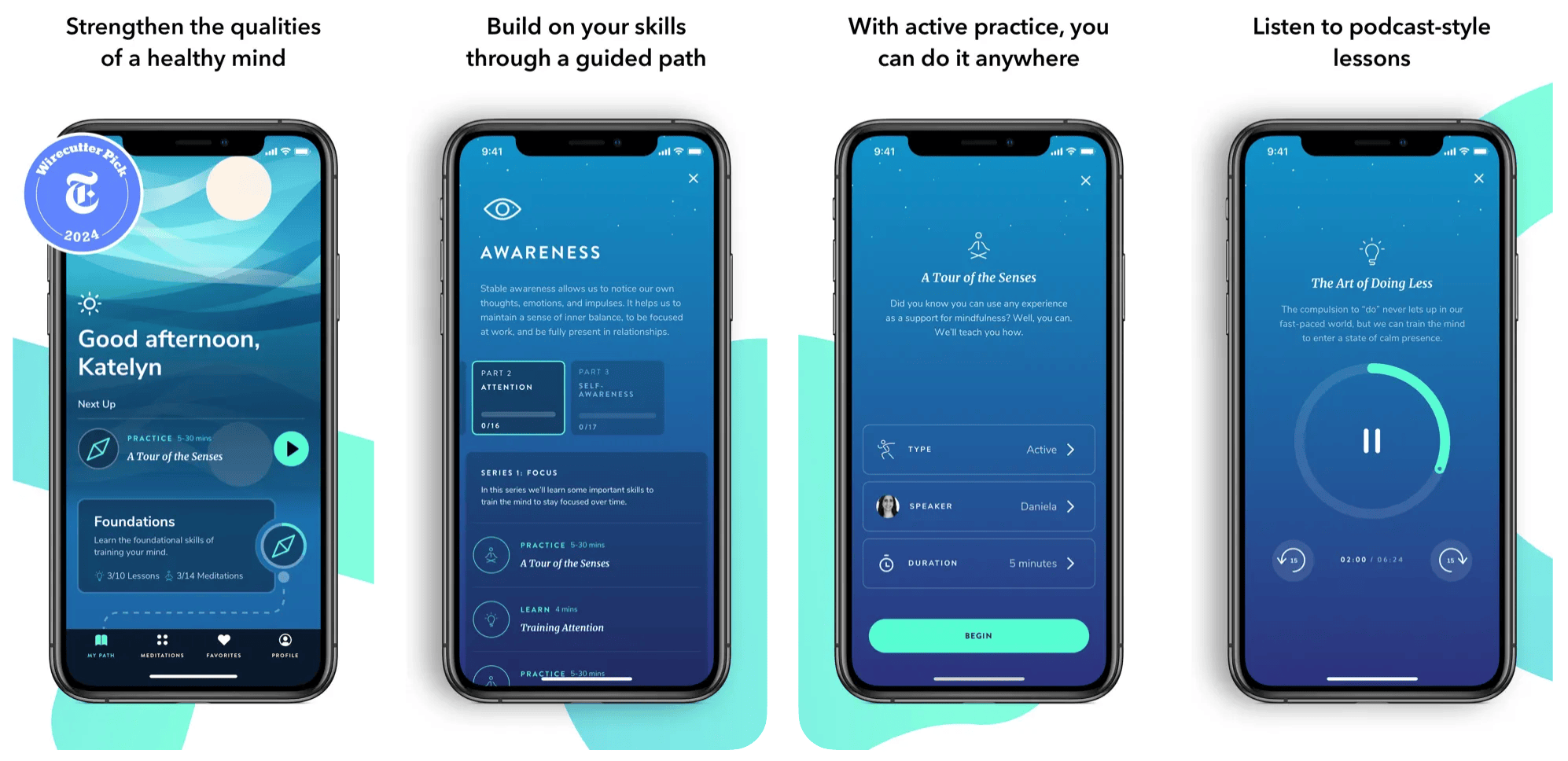
Mornings are for deep work. Afternoons are for everything else — teaching, planning, thinking, movement, and meetings. This is part two of my daily kit. Part one covered my morning apps. Here are the apps and gadgets that carry me through from noon to bedtime. I’ve included a few AI tools, but mostly the quieter tools that don’t get as much attention.Catch up on Part 1 👇12pm: Midday BreakHealthy Minds 🧠 This free app helps me with mindfulness. The 5-10 minute audio lessons work well as walking meditations. I sometimes also use Headspace or Calm for meditation or focus music.Libby 📚 I rely on Libby for free library audiobooks. I listen when walking to lunch or commuting. Here are tools I rely on for finding great books. Lunch* Resy and OpenTable 🍱 for quick reservations nearby* The Infatuation for opinionated local restaurant recommendations * Too Good To Go for trying heavily discounted (66% off) dishes from local restaurants, bakeries, and juice bars. The fixed-price mystery bags reduce restaurant waste. Sometimes you get a delicious bargain, but the quality varies. I’ve occasionally gotten a weird bread or a bland pastry.* MealPal When I don’t bring my own lunch, I like MealPal, a lunch subscription service. Local restaurants offer one dish a day as part of the subscription, which costs about $6/day. I like the variety: you can choose which restaurant to try on any given day. It’s available so far in 12 cities. 1-3pm: Preparing to TeachAfter lunch, I continue developing teaching plans or work on other school-related projects for my job as Director of Teaching and Learning at CUNY’s Newmark Graduate School of Journalism. (More of my thinking in a recent Columbia Journalism Review interview).Craft 📄 My go-to for creating visually engaging digital handouts. It’s easy to use and works wonderfully on mobile or desktop. See my post on why Craft is so useful.Wispr Flow, Text Blaze and Raycast* I often use Wispr Flow to type with my voice. It works in any app. I just hold the function key and talk. * When I do type with my hands I use Text Blaze keyboard shortcuts to add snippets into my email and documents. It works for email addresses and signatures, search prompts, and phrases I type a lot. * Raycast also works well for these shortcuts. Why I rely on Raycast.Notes by Hand 📝 I like writing notes away from my laptop periodically to get my eyes off the screen and to change my brain mode. I alternate between:* I use a Rocketbook reusable notebook for lists and reminders.* A giant whiteboard helps me draw connections and play around with ideas away from the glowing distractions of my screens. * My reMarkable Paper Pro tablet hosts notes I will return to repeatedly. What works for me, paper vs. digitalKeynote for SlidesThis Mac presentation software works reliably offline or on for in-person and remote classes and workshops I lead. Keynote is now part of Apple’s new Creator Studio, a package of software that includes video and image editing tools. I haven’t found the Keynote AI features useful so far, but the basic software is excellent for designing and delivering compelling slides. Pricing: Keynote is free with any Mac. I wouldn’t recommend the subscription upgrade, at $129/year or $30/year for students and educators, unless you’re a heavy user of Final Cut Pro, Logic Pro, or the other pro software tools. iA Presenter I vary slide apps to keep things interesting. I sometimes write a lesson outline and paste that text into iA Presenter, which turns it into clean, typographically sharp slides. Like Keynote, it works offline. For more on why this app is so useful, watch the demo video or read my post.Kahoot, Padlet, and Slido 🤔 I rely on this trio of teaching tools to power activities that promote active learning in classes or workshops — rather than passive listening. Here are more of my favorite apps for teaching. Time Out for Screen Breaks⏳ I set this app to remind me to give my eyes a screen break every 15 minutes. It pulses over the screen to nudge me to stretch or look out the window. The Raycast Focus Mode also helps, blocking email and distractions during short, focused, deep work sprints. 3-5pm: Meetings 👥I try to schedule meetings for the late afternoon to conclude the day with collaboration, after starting with more creative work. Granola for Summaries🤖 Granola weaves my own notes into its summary, sends no bot into my Zooms, and lets me search across meetings for tasks, patterns, or insights. My full post about it👇 describes 10 of the features, along with tips, limitations, and alternatives. Camo for Webcam CustomizationCamo lets me modify my camera to zoom in, adjust lighting, or add overlays during video calls. It also lets me use my phone or other external cameras. Prezi Video and Airtime enable lower-thirds, annotations, and overlay visuals I occasionally use for presentations.Sony UX570 Voice Recorder for Interviews My reliable backup for recording audio. I like that it doesn't require an o
Meet Granola AI ✨
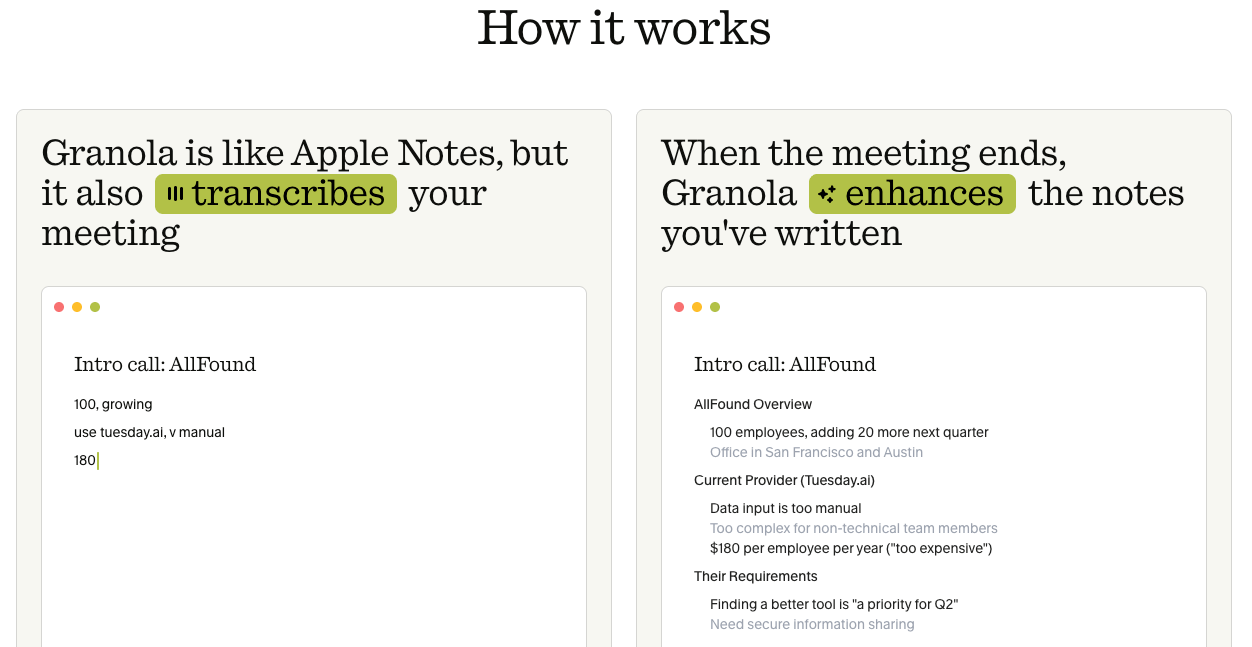
I’ve tried a dozen AI note-taking tools. Granola is the one I use daily and recommend most. Read on for 10 ways to make the most of it.Bottom line: Granola transcribes and summarizes nearly every meeting I have. 998 so far. It helps me keep track of what I’ve learned and promises I’ve made.What it does: It’s software you download, not a bot, so it doesn’t attend meetings. It just runs on my computer or phone. I can use it to record in-person meetings, or anything online: Zoom, Google Meet, or even Substack Live.Setting it up: I connected my Google Calendar. Now it auto-detects my meetings and opens automatically when I start a call.How it’s different: Unlike other bots that spit out a generic summary, Granola gives you a window for your own note-taking. That means I can include my own thoughts and highlight what I find most important. The summary then weaves in my own points in black, distinct from the gray AI summary notes. I can always return to either my own separate notes or the AI-assisted summary.I can now query any meeting I’ve been in since I started using Granola in September 2024. I look for patterns across meetings and presentations I’ve given over the past couple of years.Free or Paid: You can use Granola for free plan. You get excellent summaries of an unlimited number of meetings. I was on the free plan for more than a year. Now I pay $14/month to access all of my past meeting summaries. That also pays for better AI models, and lets me query my notes from Claude or ChatGPT.👇10 ways Granola stands out1. Write your own notes while AI fills in the restMost AI note-takers give you only the AI’s version of what happened. Granola keeps your own notes alongside the live transcript. You always have both.I type my own most important observations, priorities, and reactions during a meeting. The AI fills in other details. This way I’m not reliant on a generic summary the way I am with other tools. My own emphasis and perspective helps shape the summary.After the meeting, my original notes appear in black. The AI-generated content appears in gray. That’s a nice design touch, so you can easily tell which is which.Tip: I use shorthand like triple asterisks (***) for key points and triple ampersand (&&&) for memorable quotes. Or choose your own “internal hashtags.” Pick ones easy to type during a live meeting. Later you can search for those to quickly find what you flagged as important. (Works with any tool)2. Search across meetings by person or company 🔍Granola organizes meetings by people and organizations. If I’ve had a series of meetings with someone, I can click their name and search across all of those conversations. Or I can search through all the conversations I’ve had with people at Acme Inc.This is useful for questions like: What did we agree to last month? What themes keep coming up? What did I promise to send that I haven’t followed up on?You can also create folders for specific projects or series. If I’m attending or teaching a series of workshops, I can then search across all of those sessions.Tip: If you ever write or give presentations, ask Granola to compile key points or ideas you’ve shared in past meetings or presentations. It’s helpful for exploring and building on your own ideas. Instead of using AI to think for you, you’re using it to help you organize and make more of your own ideas.3. Record in-person meetings w/ a phone or laptop 📱I’ve been to public events where I wanted to remember what was discussed. The iPhone app is great. Same account, no separate setup. Your in-person notes sync with your desktop notes and appear in the same searchable archive. Other recording apps I’ve tried occasionally crash when I get a call or open other apps, but Granola has been consistently reliable, even for long meetings. I’ve been surprised to find that it works well even when I’m not sitting close to the speaker.Available on: Mac, Windows, and iOS. No Android app yet, though one is expected later this year.4. Start free with unlimited meetingsThe free version works well if you just want to try it. The transcription quality is the same as the paid version. Students get Granola free for a year. Startups do too.The paid plan is $14 a month. I pay that for unlimited access to my 1,000+ meeting summaries, the ability to query my notes from other AI tools like Claude, and access to the strongest AI models for summaries. The free plan limits how far back you can access old meetings and limits the AI models you have access to.If you don’t need to refer back to old summaries or plug your notes into other AI tools, the free plan is great.Try Granola free for a month with this link.5. Give Claude or ChatGPT access to your Granola notesThis is one of the reasons I upgraded to the paid plan. Granola connects to Claude through something called a Model Context Protocol (MCP). Don’t worry about the technical details. It’s just a way to connect AI tools to one another.The practical benefit: I can ask Claude or C
S2 Ep 1AI, Art, and Drawing the Line 🖌️
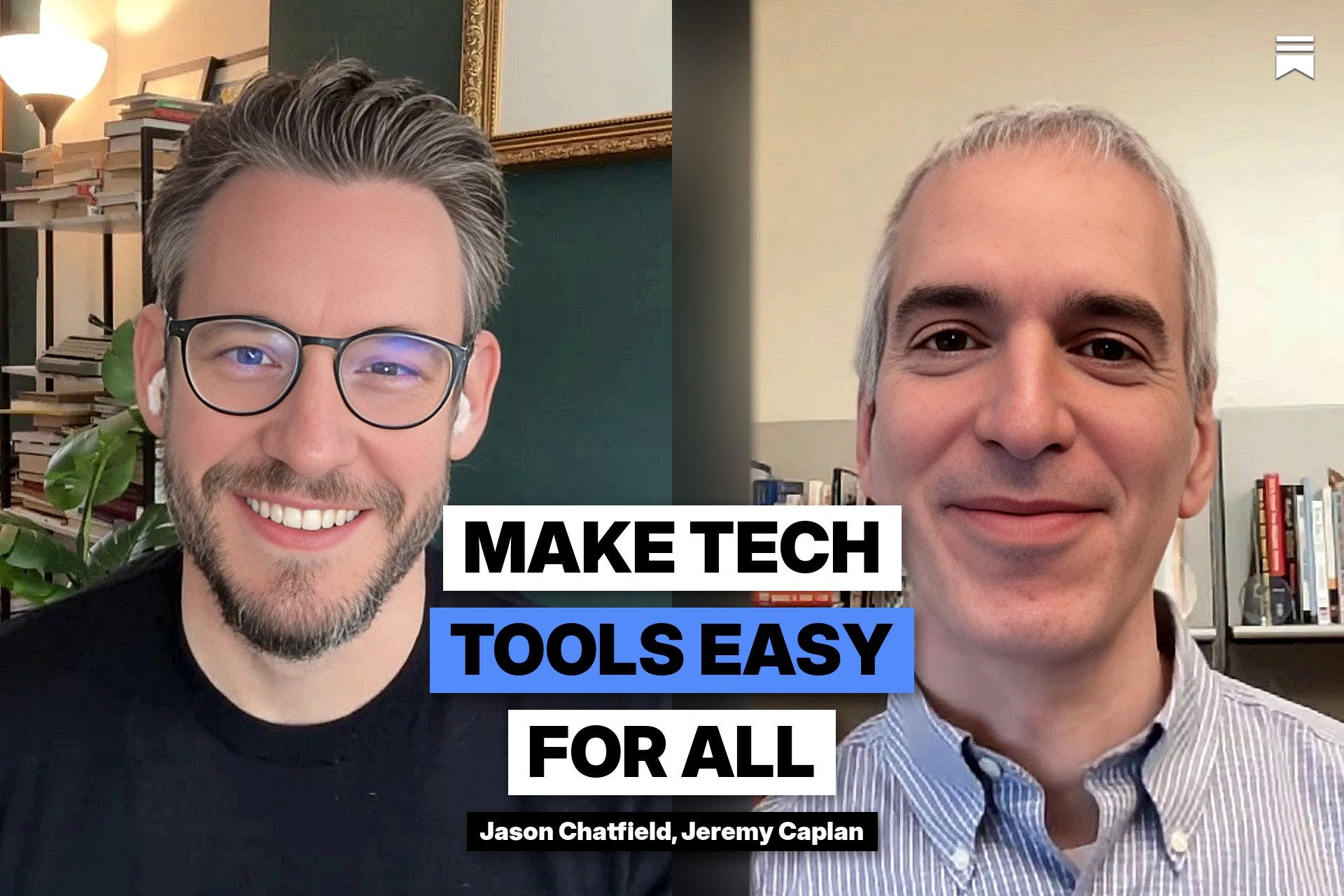
This is a free preview of a paid episode. To hear more, visit wondertools.substack.comI recently talked with Jason Chatfield a New Yorker cartoonist and creator of the lively New York Cartoons Substack. He sketched while we talked, as part of his video series Draw Me Anything. We traded ideas about writing, editing, tools, and where to draw the line with AI. 📺 Watch the conversation above, or read highlights below. Takeaways from Our Conversation 🛠️* Teach your AI assistant to offer personalized editing suggestions. I’ve trained a Claude Project to learn from my past writing and editing. It catches typos like double commas, cliches, redundant language, weak verbs, and sloppy copy. Instead of having it make changes, I ask it for a punch list of suggestions. * Talk before you type. I turn on my AI dictation app, Letterly, and just start talking. The AI-enabled transcription and summary I get helps me make sense of ideas rolling around in my mind. Then the next part of the writing process becomes more about shaping and editing those ideas, rather than staring down a blank screen.* Ask AI to interview you. After a conference or a day of meetings, get your AI assistant to ask you follow-up questions. That conversation forces you to articulate ideas you haven’t fully formed.* Teach your AI assistant to be a critic, not a ghostwriter. Ask it to challenge your structure, suggest sections to cut and to explain why, and to point out your blind spots. Your friend might be too polite to tell you a section of your piece you’ve worked on for hours is redundant or dull. Your AI assistant will, if you train it to.* Let’s read books collectively. We’re reading 10 AI books in 2026 through the Wonder Tools Book Group. (For WT paid subscribers). We started with AI Snake Oil, whose co-author was a surprise guest at our first gathering. Reading together allows us to benefit from dialogue. And we can learn more deeply from books than we can from a random diet of posts and videos. Sponsored MessageBuild a site or app with LovableTry Lovable Free. Lovable lets you describe what you need and turns it into a working website or app. Now it even builds slides for you. Go from idea to polished deck in under 10 minutes. No coding needed. I use it to quickly prototypes like an uplifting news page and a landing page for educators. Others have built everything from portfolio sites to custom business tools — you can browse hundreds of templates. If you have an idea you’ve been putting off, this is a fast way to start. Tips Jason shared during our conversation* Work from a calendar, not a to-do list. Sometimes what’s most valuable is a workflow, not a specific tool. Like timeboxing. Jason predicts how long a task will take, blocks time in his calendar (iCal), then learns from the difference between his estimate and how long the task actually took. His timeboxing Medium post about the process went viral.* Build a grumpy editor. Jason created a J. Jonah Jameson–style editor persona in Gemini. If you’re not familiar with the Spider-Man character, he’s a cantankerous, chain-smoking newspaper editor who tears apart a writer’s drafts. Jason says he takes about half of the suggestions. * Choose your tools based on who built them. Jason uses Grammarly and Gemini, but refuses to use Meta AI or Grok. If he doesn’t trust those building a platform, he opts out.* Learn the analog way before you go digital. Jason suggests students draw by hand first, not on an iPad. If you draw a bad line with a dip pen, you can’t hit undo. You learn through that process. * Use AI to brainstorm, but know when to stop. Cartoonist Alex Hallatt of Cartooning in the Age of AI used an AI assistant to riff on cartoon premises from messy notes. Jason said she was intrigued by the results, until the bot offered to draw the cartoon for her. 👇Tools & Apps We Discussed 👇
☀️ My Morning Toolkit
After my 7am wake-up alarm, I lean on about 20 morning apps, sites and gadgets for reading, writing, listening, and getting stuff done. I revisit this toolkit every year. Here's what's stayed, what's changed, and what's new.🌤️ 7:00 am Wake up and prepare for the day ⏰ Peakeep “Invisible” Alarm Clock This $14 bedside clock wakes me up. I set its brightness at zero to keep the bedroom dark at night. I tap the top to check the time if I need to. I bought the clock when I decided to store my phone in another room so it doesn’t suck me in before bed.⭕️ Oura Ring For the past five years I’ve worn an Oura ring to keep track of my exercise, sleep, and heart rate volatility. I like that, unlike an Apple or Google Watch, it has no distracting screen or notifications. I ran a two-week experiment pairing the Oura with a Stelo glucose biosensor to see how my diet impacts my sleep, fitness, and energy levels. I can export my data and query it with AI assistants. Or I use Oura’s own AI chat to ask things like “How is my evening snacking affecting the quality of my sleep?”In the morning I check my sleep quality and resilience scores to calibrate my expectations for the day. Having an objective measure of how well I’ve slept helps me decide whether to push my meager exercise regimen a bit or take it easy. It also helps motivate me on dreary days, and signals when I’m getting sick before I notice. (Read my original Oura 2020 post. Note: I’ve bought my own Oura rings — no affiliation).🧠 Brain Games and 🎶 MusicA breakfast ritual: playing the NYTimes’ Spelling Bee, Wordle, and Connections with my wife and daughters while listening to our favorite classical music host, Jeff Spurgeon, on WQXR. We talk about the music and what’s ahead at school or work, avoiding stressful headlines.Quick tip: We listen on our old Google Home Mini kitchen smart speaker. A quick voice command pulls up just about any radio station in the world. (I saw the newer Google Nest Mini on sale this week for $19). Sponsored MessageAccess the World’s Best IdeasI love reading. But no matter how much I read, I can’t keep up with all the great books I hear about.That’s why I’ve been relying on Shortform for the past several years to help catch up with books I’m curious about but haven’t had time to read. I also use Shortform to remember key points from books I read years ago. I like the biography section, where I’ve learned about the lives of Malala, Bono, and Leonardo da Vinci. While a lot of summary apps I’ve tried have 5-min, AI-generated, surface-level book overviews, Shortform’s writers and editors produce in-depth coverage of nonfiction titles.I also like the business section, which has detailed guides for classic titles and new books I’m curious about like Two Awesome Hours by Josh Davis. In addition to an expert-written overview of key points, with examples, excerpts, and references to related books, you get a one-page summary and contrasting ideas from other authors. Now Shortform has podcast and article guides as well. Wonder Tools readers get a discount. Try it free to explore.Enjoy a free trial and $50 off the annual plan.🚶🏼8:00 Walk My Daughter to School 🏫No tools or tech. 🚊 8:25 CommuteI use Snipd to listen to podcasts on the way to work. Here’s my full take. I also rely on Readwise Reader to catch up on articles I’ve saved. It works offline on the subway. Here’s why it’s worth trying. I use Superhuman to check work email.📆 8:50 Plan the DayWhen I get to work, I map out what's ahead with a mix of paper and apps. 📅 Google Calendar I check GCal for meetings. I‘ve tried other calendars, including Vimcal, Akiflow, Fantastical, and Notion Calendar. They each have useful features, but I tend to return to the free GCal out of habit. It’s reliable, simple, and lets me easily see shared calendars.✅ Apple Reminders I keep three priority tasks at the top of my list. I add to that tier only when I’ve completed one. I have a menu of other tasks and reminders in a “Soon” list. I adopted that tactic from Oliver Burkeman’s great book, Four Thousand Weeks. 📄 Remarkable Paper Pro Move I use this paper tablet — or a notebook — to timebox my day. I map the hours based on priorities, energy level, and scheduled meetings. Having a detailed plan helps me avoid decision fatigue later. When I inevitably lose focus, the plan pulls me back on track. ✍️ 9:00 Writing I start creative work early, when my focus is freshest. Letterly I dictate my thoughts into this app. That helps me get ideas flowing, and I get a bulleted summary or outline to build on. When I want an AI assistant to challenge my ideas, I use ChatGPT’s Advanced Voice Mode or Gemini Live. Letterly and other apps like it (AudioPen) are great for what I call bionic dictation— using AI to structure raw speech into a clean outline or summary. Free alternatives: You can use Apple Notes for dictation on iOS or Mac, or a variety of Google apps if you’re on Android or a Chromebook.Google Docs / iA Writer I like
Teach Smarter with AI
I recently talked with Lance Eaton, Senior Associate Director of AI and Teaching & Learning at Northeastern University and writer of AI + Education = Simplified. We traded ideas about what’s actually working. We came up with 10 specific, practical ways anyone who teaches, coaches, or leads can put AI to work.📺 Watch the full conversation above, or read highlights below.10 Ways to Use AI 🛠️Note: Lance and I alternated tips below 👇1. Spark Richer Student Reflection 🪞Lance: Ask students to reflect through a conversation with AI rather than staring at a blank page. A well-prompted AI will keep asking follow-up questions, pushing students past “I didn’t like it” toward real analysis. 2. Strengthen Your Syllabus 📋Jeremy: Give an AI assistant your syllabus and ask for a critique — for clarity, inclusivity, student-friendliness, and completeness. You’ll get specific, honest feedback. The AI won’t write the syllabus for you, but it will challenge you to make yours better. We don’t always have colleagues at our side who can offer input on our work. So this is an objective, independent, instant, constructive way to get a useful critique.3. Make Materials More Visual 🎨Lance: Turn your syllabus into a graphic version students actually want to read. AI assistants can help you create visual layouts and simple comics-style explanations without any design experience. 4. Improve Lesson Plans 📐Jeremy: Describe your learning goals, your class size, your constraints — then ask AI to generate 10 warm-up or closing activities. You won’t use most of them, and you might remix a couple. But having options means you’ll often figure out something better than what you’d have designed alone.5. Try It Until Something Clicks ⚡Lance: Play with AI until it does something that genuinely surprises or excites you. That moment of “Wait, I could actually use this,” is what shifts the conversation from theoretical to real. “For some students, this is really powerful, including students navigating English as a second language or ADHD or dyslexia — these tools can unlock things.”Sponsored MessageCatch Up On Books: Maximize Your Time 📚Life is short. Your reading list is probably long. Shortform simplifies your journey to success. Whether you’re into self-improvement, business, or psychology, get in-depth book guides with summaries, actionable insights and exercises. Start applying what you learn immediately.Each guide has a concise, useful one-page summary. You also get chapter breakdowns and practical exercises to apply what you’ve learned. Imagine mastering key lessons from books like Atomic Habits in just two hours. Accelerate your career and boost your productivity.Stay ahead of the curve with new summaries added weekly, and use the AI browser extension to quickly summarize articles and videos, freeing up valuable time for what matters most.Get a free trial and $50 off the annual plan. 6. Build Engaging Class Activities 🧩Jeremy: When you need a compelling analogy for a hard concept, or a historical anecdote, or a mini case study for a short role-play exercise, AI assistants can be helpful in expanding what we consider. If you’re teaching a subject you know well, you can set the direction and take responsibility for verification. NotebookLM and Claude can generate examples quickly, and can search your own notes to surface examples you’ve created yourself but lost track of. The goal of using AI in this context is strengthening engagement and improving the learning experience. It’s not for whiz-bang special effects.7. Generate “Bad Examples” Safely 🚫Lance: Examples can be useful to illustrate what not to do, but you’d never embarrass a student by presenting their work as an example of a mistake.“We’re never, ever going to — nor should we — ask a student, ‘This was a really horrible thing, can I use it as a bad example going forward?’” AI tools can generate intentionally flawed examples: a weak argument, a poorly structured paragraph, or circular reasoning. Students learn what to avoid. 8. Catch What You’re Missing 🔍Jeremy: Ask an AI assistant to review your materials for accessibility gaps, unclear instructions or areas where your material could be more inclusive. Think of it as a thoughtful colleague who reviews your work and catches what familiarity made you miss.9. Analyze Student Feedback 📊Lance: Strip names and any identifying information from end-of-semester feedback, then ask AI to identify themes, patterns, and gaps. As Lance put it, “What are some things that I’m not seeing? What are some assumptions I’m making or missing? What are some ways I might redirect the course?” Instead of spending hours manually categorizing open-ended comments, you get a usable overview in minutes — leaving more time to actually act on what students told you.10. Remember What Was Said 🗒️Jeremy: Use an AI note-taker like Granola to capture transcripts of student meetings, advising sessions, and office hours. Request permission first. You’ll have sear

📚 Find Fantastic Books
Escape AI slop by reading more books. 📚 That’s my plan for making the most of leisure time this year. One book a week. Some short. Others mostly visual — I love graphic novels. Plus a new AI & tech book group I’m starting. Books get my eyes off screens, and my brain welcomes that break from news, vitriol, and ads. Read on for my updated guide to finding great read this year. 📖 Find your next read * Most Recommended Books Pick the name of an expert to see what books they recommend and why.* Goodbooks.io and Read This Twice Explore interesting expert picks.* En.app Describe the kind of book you’re looking for and get suggestions. * Whichbook’s World Map 🗺️ Find books set anywhere in the world. Select a country to see a collection of books that take place there. See how it works👇* Where to find book recs is a nice evergreen list from Writing About Reading. I also like the eclectic recs in the NYTimes’s Read Like the Wind newsletter and its intriguing list: Top 100 books of the 21st century. * The most mentioned books in podcasts is a neat list from Snipd. In Snipd’s podcast app you can see which books any podcast has mentioned most.* BookClubs lets you find a book group near you or organize your own. * Fable hosts book clubs & communities for nearly any genre. Find free and cheap books 🔦* Project Gutenberg offers more than 75,000 free ebooks and audiobooks. No registration required. The Top 100 list is a nice source for free reading.* The Internet Archive has searchable e-books and a free library collection.* Bookbub spotlights discounted ebooks on its site and email newsletter. Sponsored MessageStop Wasting Time Sorting EmailWhy bother spending hours organizing your inbox every week when AI can do it for you? SaneBox — which PCMag called the best thing that’s happened to email since its invention — is an AI-powered email tool that brings sanity back to your inbox.SaneBox ensures only important emails land in your inbox, and files other emails into folders. It even lets you hit Snooze, and reminds you to follow up on emails you sent a few days ago.📚 Announcing the NEW Wonder Tools Book Group 🌟I’m excited to launch a new Wonder Tools book group 📚 exploring the most fascinating recent AI and tech books. Each month we’ll have a live online session with a lively discussion, and you’ll also get a book guide with quotes, highlights and insights. Occasional surprise guests will join. 💫This new series, starting in March, is sponsored by Shortform, which publishes high-quality, in-depth guides to non-fiction books. All paid subscribers are invited! Join now for this, and free AI tool access, live monthly online workshops introducing new tools, + other inner circle benefits. Libby has free ebooks and audiobooks from libraries in 78 countries. It works for 90% of U.S. libraries. Check out nearly anything instantly, for free, on any device. You can read your free ebooks in the app or on a Kindle. * Audio or text Check out and listen to free audiobooks or ebooks. * Multiple cards Libby lets you add cards for multiple libraries. That’s useful if a book you want has a waiting list. You can check which library has the shortest waiting list. See where you can get non-resident library cards.Limitation: Libby is digital-only — you can’t use it for physical books. That requires a separate app or site, like the NYPL app in New York. Kanopy provides free access to top-notch feature films and documentaries. I log in with my library card. Watch on the web, iOS or Android, or on a smart TV app like Google TV, Roku, or Amazon Fire TV. Libraries cap the number of videos you can watch monthly. Hoopla is a free app for accessing 3 million audiobooks, ebooks, comics, magazines, and music from 11,500 libraries in the U.S., Canada, Australia and New Zealand. Read, watch or listen in 120 languages from the web or on a mobile device. Bingepasses let you access movies, TV shows, & video courses.World Cat tells you which library near you has a book you want. It works in multiple languages and covers 10,000 global libraries. Search for books in print, ebook, braille, or audio. 📕 Support Independent booksellers* Find the cheapest places online to buy any book: Bookfinder * Find a nearby independent bookstore: Indiebound * Get cheap used books: Abebooks. Check its bargain books + collections.* Support your local bookstore with an online purchase. Bookshop.org has raised more than $40 million for indie bookstores. * Buy audiobooks from local bookstores: Libro.fm* Shop at an online co-op bookshop owned by readers: TertuliaBonus Tip: Prompt AI for personalized reading recommendations 📚Create your own taste atlas. Make a list of books you’ve liked or learned from. Add movies and music you love too, or other interests. Share the list with Claude, Gemini, or ChatGPT. Ask for recommendations based on your tastes.🧒 Find great children’s books * Sora, the library app, not the AI video tool, is a digital library for kids. Schools make ebooks and

Make Gatherings More Engaging ✨
The hardest part of teaching — or leading meetings — is sparking engagement. Getting people to engage enthusiastically with something new can be tough. It’s especially challenging if people are overwhelmed, super busy, or just tired. As we aim to stretch people’s thinking in a new direction, tools are just one part of the overall picture. But they can help. Last week I shared five tools for creating learning paths, interactive lessons, and new kinds of digital notebooks. Today’s follow-up recommendations focus on creative engagement. You don’t have to be a teacher to find these resources for opening up participation useful. If you lead a team, run meetings, or collaborate with colleagues, you can benefit from these tools. I’ve baked into this post multiple ways to engage. * Chime in on the teaching tool chat thread* Share your idea on the shared Padlet about teaching tactics * Test out your trivia skills on my new open Kahoot quiz game* Add a comment to the shared Craft doc about lesson planningPadlet — Inspire Creative CollaborationPadlets are digital bulletin boards where people can post comments, links, voice recordings, or short videos. How it works: Set up a board with a topic or a template. Start with a blank grid, map, timeline, discussion thread, or an image gallery. Participants can use their own devices to add notes, documents, images or comments. Or they can use Padlet’s built-in recorder to add audio or video.How you can use it: Build a board to accompany a live, collaborative lesson, event, or meeting. Or have people contribute to it asynchronously. You can also use it as a showcase for exceptional work, or as a space for peer collaboration. How I use it: I find Padlet useful for group brainstorming, icebreakers, and for online learning activities. For remote classes, I’ve used Padlet to collect questions before class and for team-building collections, gathering people’s favorite songs, books, and snacks, to help us get to know one another. I’ve also used Padlet as a more visual, welcoming, version of an online discussion board. Who it works for: It’s easy to use, so most people jump in without any training. Padlet works at all levels. I’ve used it with graduate students and for mid-career training., as well as with colleagues. It’s popular in elementary and high schools too. It’s one of the best tools for getting people to build on each other’s ideas, rather than passively consuming content.Example — try it! Jump into my board on Engagement tactics for impactful teaching. Explore the ideas others have added and contribute one of your own! Pricing: It’s free to create up to three boards, or $120/year for unlimited use.Sponsored MessageThesys: Build conversational analytics agents without codeBuild conversational analytics agents without setting up data pipelines or building dashboards manually. Get started in just 3 easy steps:* Connect your data* Ask questions in natural language* Get rich insights in charts, tables, slides and reportsPublish and share it with your team.Kahoot — Add Fun to LearningNo other teaching tool generates as many smiles and laughs as Kahoot. It turns quizzes into playful learning games. Why it’s so useful: What makes Kahoot especially engaging is the variety of question formats: In addition to standard multiple-choice and true-false queries, you can have students drop pins on images, fill in blanks, guess numbers, or order items in a list. How to get started: Design your own quizzes or pick from a massive library of questions by teachers and organizations around the world, like National Geographic and NASA. People can play individually or in teams, live or asynchronously. You can share a link or show the game on screen. People play on their own phone or laptop by answering questions and earning points.. How I use Kahoot: Sometimes I start class with icebreaker questions, or conclude a session with a review game. Occasionally, if I sense students losing energy or focus, I’ll turn class-related questions into a playful Kahoot competition for a change of pace. Example — try it! Play a new Kahoot I created about journalism AI. Email me afterwards with a screenshot of your completed game for a digital prize. New tip: Kahoot has a new AI assistant built in, so you can quickly convert text from any document or handout into editable quiz questions. Pricing ranges from $3/month (50 players at a time) to $19/month (200 players). Kahoot’s pricing has gotten more complicated: some quizzes & special features now require premium plans. Alternatives: Gimkit, Wayground and Blooket are good alternative game-style quiz platforms that offer fuller free plans for those on a tight budget. Genially also works well for classroom games, or try the free JeopardyLabs. (Browse and try out existing Jeopardy boards like AI in Schools). Craft — Organize your MaterialsCraft is a surprisingly useful, underrated tool for creating and organizing notes and documents. Use it to develop attractive lesson
Top Teaching Tools for 2026 🏆
I tested more than 200 educational sites, apps and services last year. Some were so confusing that I quickly gave up. Others were too costly. A few went out of business. Many were narrowly useful, e.g. for 3D modeling, math, or music.The top tier tools have consistently been super valuable for me — in my teaching, in my job at the City University of New York, and as a dad of two daughters. To save you the time and effort of sifting through the chaff, I’m sharing the ones I find most useful. Even if you’re not a teacher, these tools may help you gather, organize, share, and present material creatively.The huge number of teaching tools clamoring for attention can be exhausting. School districts access 2,739 edtech tools a year, according to Instructure research and The 74, a nonprofit news organization that covers America’s education system, where I wrote recently about today’s tools.Below you’ll find my first batch of recommendations, whether you teach once in a while or every day, children or adults. The services are all free to try, with paid upgrades available. I don’t work for any of these companies, I’m just a prof and writer who appreciates and shares helpful teaching tools. My list — starting with part one today — is designed to support teaching and learning at any level. I’d love to hear about the tools you find most useful for teaching & learning — add a comment to share here, or join the new chat thread about top teaching tools.Pathwright — Design a learning pathPathwright is one of the best-kept secrets among teaching tools. Launched by a nimble South Carolina startup, it’s a simpler, sleeker alternative to complicated learning management systems like Blackboard or D2L. It’s more elegant and flexible than Google Classroom.Rather than giving students dozens of menus to choose from, Pathwright lets you create a simple learning path to follow one step at a time. You can create a path with a few steps for guided independent learning, or set up a full online course that’s easy to navigate. I like making mini courses that students or readers can complete in an hour to quickly learn something new.Any learning step you create can include a reading, video, activity, assessment, embed, or any other interaction. Learning paths offer a visually delightful alternative to clunkier systems. They work well for professional development, and I’ve found Pathwright works well for remote journalism training.Figjam — Spark visual thinking with collaborative whiteboardsWhen Google shut down Jamboard and Microsoft discontinued Flipgrid, teachers went searching for lively alternative tools. Figjam came to the rescue. Digital whiteboards enable the kind of open-ended visual thinking that’s invaluable, whether you’re teaching about historical networks, systems thinking, scientific processes, or anything requiring students to explore connections and relationships.The platform is free for educators. Figjam also has new AI capabilities, allowing you to instantly categorize student comments or transform a scattered brainstorm into an organized handout. You can even use Figjam for presentations. To add color and bring boards to life, Figjam includes playful stickers, stamps, and templates specifically designed for teaching and learning — from icebreakers to built-in timers.Gamma — Craft superb presentationsConsider replacing PowerPoint or Google Slides with Gamma. You’ll save time preparing slides and they’ll be more engaging for students. Create vertical, square or horizontal slides. Import existing PDFs or PowerPoint slide decks.Unlike PowerPoint, Gamma makes it easy to embed live websites, videos or data visualizations inside your slides to make them stand out. You can even use Gamma to build simple sites, social posts, or interactive lessons.Gamma works well without any AI features, for a traditional deck. Or use its AI to jumpstart a new presentation from an outline, text prompt or document you upload. You can export whatever you design to Google Slides or PowerPoint. Or share a link to your presentation. It’s free for educators to get started.* Here’s a quick example deck I made about journalism tools.* Before Gamma’s most recent popularity boom, I interviewed CEO Grant Lee about why he started the company, which now has 70 million users and a $2.1 Billion valuation.Sponsored MessageBento — A calm focus timer for unlocking better focusGenially — Create interactive handoutsGenially is terrific for creating interactive lessons. Add clickable hotspots to any image, timeline, map, or other image. When students interact with your creation, they’ll see informational pop-ups, links, videos, audio files, instructions, or whatever you’ve added. These hotspots transform static visuals — like simple maps or timelines — into engaging, exploratory learning elements. You don’t have to code anything — it’s easy for tech novices to use.I’ve used Genially to turn old handouts into resources with embedded audio. Students can click on images
🎧 Podcast Overload? Here's My Fix
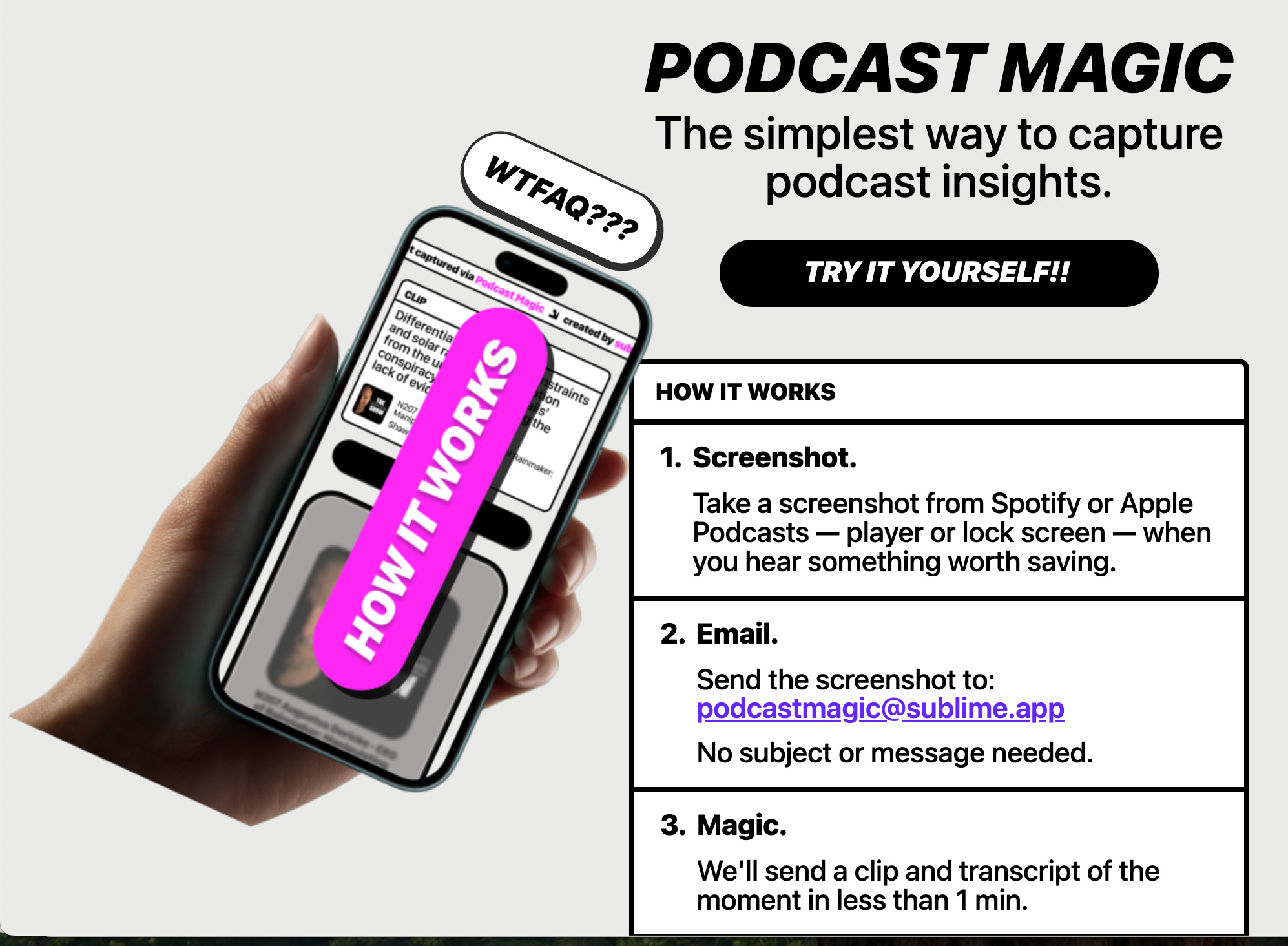
More than 600,000 podcasts released 27 million episodes in 2025. Keeping up with even a tiny fraction of those 70,000+ daily releases is impossible. So I’ve been exploring new ways to keep up with audio: podcast summaries, audio digests, and cool new tools for finding and saving audio highlights. Podsnacks — Get podcast summaries by emailGet podcast summaries delivered to your email. Catch up on shows you don’t have time to listen to. The free digest includes AI-generated summaries drawn from 25 of the most popular news, business, and tech podcasts. For $5/month, you can get a daily digest of any five podcasts you want. Snipcast is an alternative that offers 2 summaries a month for free or 50 episode summaries for $8/month. TL;DL by Headliner — Listen to podcast digests If you want to listen to podcast summaries, try TL;DL. Pick up to five podcasts to summarize in 5, 10, 15, or 20 minutes. I like that it’s not just an AI-voiced synthesis, but includes excerpted audio clips. You can always click through to hear the full episode. Caveat: expect to wait at least five minutes for each summary, and it’s still in beta. I run into occasional errors.Examples: Listen to this summary from my recent podcast interview with Azeem Azhar. Or try this summary of an episode of Shankar Vedantam’s terrific Hidden Brain podcast.Sponsored MessageMake your own site with LovableTurn your idea into something real. Describe what you have in mind and Lovable makes it into a site or app anyone can visit online.Whether you want a new site for your business or a new portfolio for your work, Lovable is a fast way to create without hiring anyone or mastering complex tech. For inspiration, check out slick templates or hundreds of cool apps others have built with Lovable. No need to write code. Just chat with Lovable to quickly start a project. What are you going to make? Snipd — My favorite podcast app Snipd keeps improving. I rely on it mainly because it lets me save highlights from podcasts I’m listening to by tapping my AirPods. The app also provides detailed podcast summaries so I can decide what to listen to. Among the new features I like most: * Skip intros and outros that clutter up many podcasts. * AI chat with any episode to ask for best quotes, must-listen moments, key takeaways, clarification of a complex idea, or whatever else you want. * I love the new “mentioned books” tab. It shows all the books discussed on a particular podcast. Click on a cover to learn more about the author and to see a list of podcasts where that book was discussed. * Search by guest. Find and listen to all the podcasts where your favorite author/musician/guru has been interviewed. * Listen and highlight audiobooks. Connect a Libro.fm audiobook account and import books with one click to listen to and highlight on Snipd. (Libro supports your local bookstore). Alternatively, find free public domain audiobooks at LibriVox. You can manually upload your own audiobooks.Podcast Magic — Save a key audio momentWhen you’re listening to a podcast on Spotify or Apple Podcasts and want to save a highlight, take a screenshot and email it to [email protected]. You’ll get emailed back an audio clip and transcript of the key moment to save or share. It’s a clever way to easily save and share a quote or anecdote. Example: One show I highlighted recently was Audio Flux, which The New Yorker picked as one of the 10 best podcasts of 2025. The all-star audio duo commissions and spotlights bold, short-form audio stories. (You can also follow Team Audio Flux on Substack).Listen Notes Search for podcast mentionsFind podcast episodes where you’re mentioned. Type in your name or the name of your organization and search. Or look for interviews with a favorite author or musician. Other useful features: * Curated Lists: See recommendations from publications, like the 6 health care podcasts or 7 podcasts for bookworms the NYTimes recommended. * Listen Later: Make and share a curated podcast playlist. The playlist has an RSS feed that you can add to any major podcast player. Here’s a playlist of a few shows I like. Here’s a longer list of my favorites. Podchaser is a good alternative when you’re looking by topic. I discovered new podcasts about tennis and classical music. Also try the new advanced search by combining terms.EarBuds Podcast Collective, founded by podcast guru Arielle Nissenblatt, shares well-curated podcast recommendations. Each week a guest picks five shows to recommend. Example: 5 podcasts about bodies and how we see ourselves. Also: CBC’s Podcast Playlist (RIP) was a great show featuring highlights from all sorts of podcasts. The archive is full of great episodes.Perplexity Voice Mode for Web, iOS and AndroidWhen I don’t have my computer, I prefer searching with my voice to thumb typing on my phone. Querying Perplexity verbally when I’m walking or when my fingers are freezing is convenient because it answers with audio quickly and accurately. I can ask follow-
🗞️ Your News, Your Way
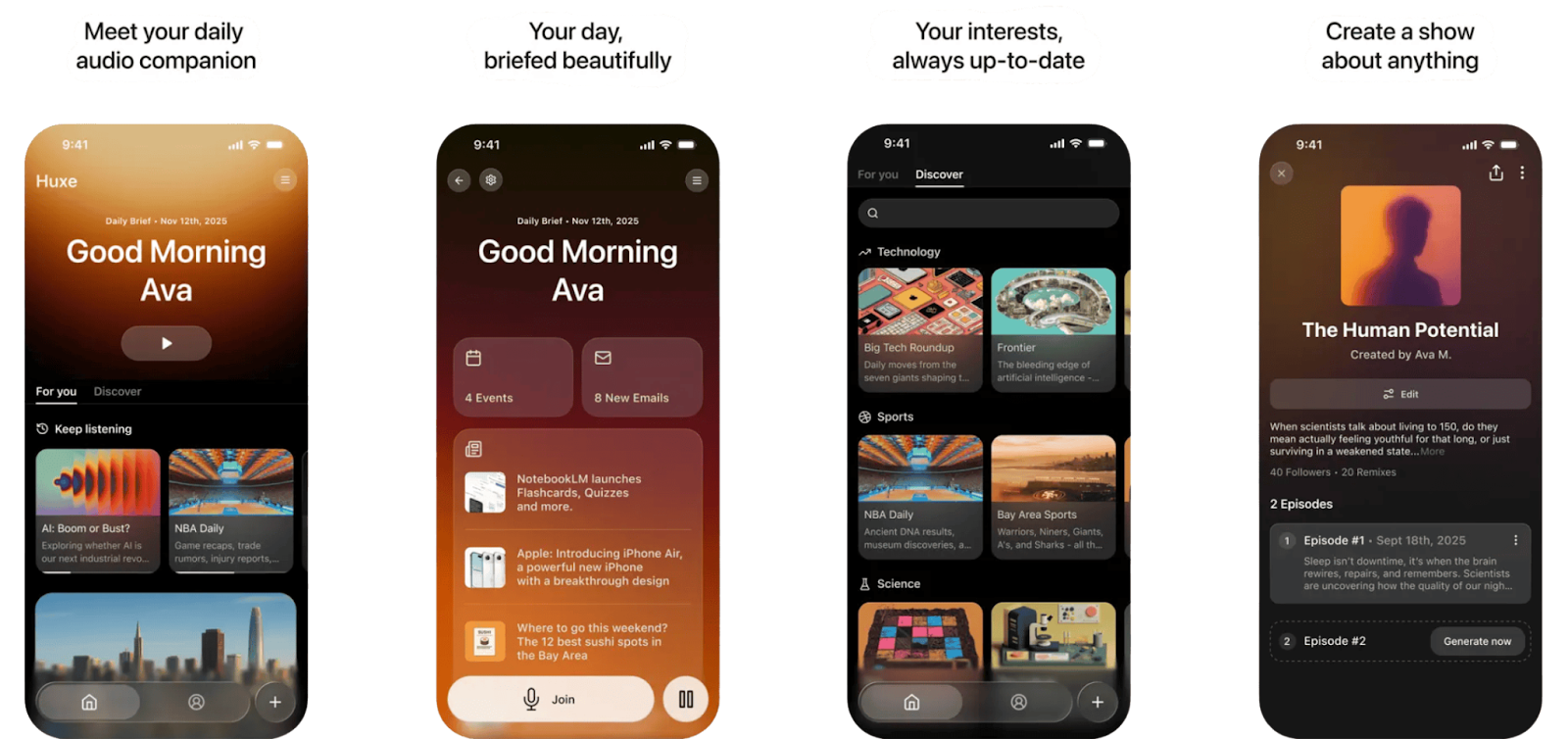
I can’t keep up with all the news that interests me. So I’m exploring new ways to get concise, curated updates. Today I’m sharing three new tools I like. * Huxe Personalized audio shows drawn from your interests, calendar, & email* Google CC A morning summary of your email inbox * Yutori Scouts AI agents that monitor your fave topics and deliver reportsRead on for examples of how each works, and how to make the most of them.Huxe — Personalized Audio UpdatesHuxe is a personalized audio app. Whenever I open it I hear a custom podcast it generates on the spot based on my interests, calendar and email. It greets me with what’s important on my calendar and in my inbox. Then the little radio show made for me shares news and feature stories on topics I’m interested in — from AI and tech to teaching and classical music.Huxe was co-founded in September by Raiza Martin, who left Google after leading the vision and development of NotebookLM, my favorite AI tool. To set up the Huxe app I picked from a list of categories and added some keywords for topics, teams and tech that interest me. I also gave it permission to access my Google Calendar and Gmail. (Connecting those accounts is optional). Huxe is free for now, on iOS or Android. Follow Huxe on LinkedIn where they post interesting updates. In addition to a new “for you” audio update generated anytime I open the app, Huxe also has a Discover tab for listening to audio shows curated from online content. Examples of ones I like:* Product Drops highlights notable new tech, referencing posts on Product Hunt, the best hub online for new launches* Actually Useful has mini case studies about when AI is demonstrably helpful* The Tennis Daily gives me interesting updates during the Australian OpenDesign your own briefing* Start by pressing the “+” button at the bottom right of the interface* On the Research tab, type in a prompt like “What are the latest breast cancer research developments?” or “Newest snack trends in Tokyo?”* Alternatively, hit the “Use Sources” tab and add a list of specific sites you like, X handles, RSS feeds, or subreddits.Ideas to try* Create a personalized learning show with your favorite blogs, newsletter writers, or subreddits you follow. You can add an instruction to give the show a particular focus, tone, or style. * Make a guilty pleasure show for stressful days. It can be as niche as you want — it’s just for you. No one has to know what’s in it, though you can choose to share it. Add a list of topics that amuse you, from hobbies to food, pet, or sport trends. Or pick guilty pleasures like favorite TV shows, snacks, or singers.* Example: In 60 seconds I curated my own show called Reddit’s Daily Glow based on a few subreddits with inspiring news and interesting facts.I used to listen only to podcasts or audiobooks on my commute, but now I mix in these personalized audio updates depending on my mood.Customize your briefings* Use the “Join” button while listening to anything to inject a live question into the show. Like the interactive audio feature in NotebookLM, it prompts the AI to respond to your query before returning to the audio briefing.* In the settings tab, choose two voices you prefer from 19 options.Features I hope will be added: I’d like to be able to rewind and jump around more easily in the briefings. Down the road I’d love to pull in podcast, YouTube, and newsletter subscriptions as source material, and get Huxe updates by email or WhatsApp. I’d also love to use Huxe as a curator to create my own shows, mixing in my own voice and content.Alternative: I like Mailbrew for creating curated email digests from my favorite newsletters, blogs, subreddits, YouTubers, and more. Read my guide (for paid Wonder Tools subscribers) for more on why I like it and how I use it. Another alternative for a quick news overview is Upstract. But that’s basically the entire Internet on one page, which I find overwhelming. Sponsored MessageBuild something LovableCreate websites and apps quickly by chatting with AI. Lovable makes it easy to turn your idea into something real. No need to write code. Just describe what you have in mind, then guide Lovable with suggestions to shape it. To avoid doomscrolling, I made a little Uplifting News page that updates from Reddit. I also mocked up a landing page to help educators with AI. Both took a few minutes. Neither required any special expertise. Just an idea. Whether you want a new business page, portfolio, or an app for your team, Lovable is a fast way to begin without hiring anyone or mastering complex tech. Rather than spinning up a slide deck or spending years outlining a plan, try Lovable for turning your idea into a living site or app. Google CC — A Personalized Daily Email UpdateI’m testing a new Google “AI productivity agent.” It’s basically a personalized briefing Gmail now sends me daily. It’s based on new Gmail messages and what’s in my Calendar. Join the waitlist. What’s useful about it* It saves me from

Azeem Azhar's Favorite Tools ✨
Azeem Azhar is the kind of guy who loves both old-fashioned pens and advanced AI. It was a delight talking with him, not just because he’s a successful entrepreneur, author, and interviewer, but because we share quirky tech tastes. Azeem and his team publish Exponential View — a Substack with 140,000+ subscribers — about how tech is shaping our future. In our live conversation, we talked about Azeem’s AI — and analog — workflow. The discussion also touched on 18 sites, apps, and gadgets summarized below.📺 Watch the video for the full chat, or check the highlights and tool list below.🔎 On AI Research Beyond Google and WikipediaAzeem consistently tweaks how he figures out where tech is heading. Check his “Boom or Bubble” dashboard on whether the AI market is overheated for an example of his analysis.Key takeaway: Azeem’s research workflow has moved almost entirely away from traditional search:* Why he quit Google and Wikipedia. [16:20] “I spend virtually no time on Google searching for things, nothing on Wikipedia at all, not a moment now.” Instead, he surfaces what matters to him with AI searches and custom tools his team has developed.* Manus is his research assistant. Azeem and his team use Manus (a Chinese-founded AI startup recently acquired by Meta) the way you’d send a research assistant to “find color—go off and find the case studies, the anecdotes, the famous quotations.” The team runs queries overnight for 30-40 minutes each.* Shortwave helps with investor intel. This AI tool is superb for searching within your email. Azeem has 40 startup investments. To support founders, he uses Shortwave to search past email to help explore questions like, “How well are they sticking to their milestones? Have they changed the goalposts? Where do they seem to have problems where I can be helpful?” Azeem uses Shortwave to search across 15 years of Gmail messages.* Julius is a resource for data science. He uses this tool, which he’s invested in, as an AI number cruncher. [My post on Julius]🤖 How Azeem Uses AIAzeem set up custom instructions directing ChatGPT to aggressively challenge his assumptions: [6:41] “It can be quite exhausting… it’s like being constantly interrogated.” His follow-up? “I often have to copy the answer and put it into Claude and say, explain this to me like I’m a bright high schooler.” He considers Claude the best coding model and also uses it for text refinement. Bottom line: Azeem uses the two AI models sequentially to force himself to think deeper.Other AI Assistants* Gemini Pro Azeem builds interactive apps with Gemini. “I might explain what I’m looking for, have a discussion, then ask it to build the interactive platform app. Then I can play with the parameters.”* Perplexity Azeem’s go-to for “instant answers” when he doesn’t need deep research.* DeepSeek Azeem’s default for “good enough” queries to cut costs. “In general, it’s really good enough. And if on the occasion I don’t think it is, I can fire it out to one of the other models.”* Grok Azeem experiments with this occasionally as part of his testing.✒️ “I Dip the Pen in this Bottle of Ink”Azeem has a fountain pen without an internal ink cartridge. Why? [9:30] “If I am writing and every 10 or 15 words I have to stop to dip the pen in ink, I’m slowing myself down... In a world where I can move really quickly, I will slow myself down. I’ll get very haptic in the experience and look at what I’m writing and force myself to cross out mistakes, and feel frustrated about mistakes, so therefore slow my thinking down even more.” In a conversation about AI acceleration, Azeem deliberately builds in friction. 🎙️Voice and Writing Tools 🖊️ * Wispr Flow Azeem reads his handwritten notes aloud into Wispr Flow, editing in real-time as he speaks.* Kolo Tino Fountain Pen Azeem likes the feel of pen on paper and its deliberate pace.* Paper Republic Trifold Leather Journal Azeem’s folio holds three separate notebook inserts: “You can have one that’s just for your jotting of your to-do list and then others are for thinking time.”😰 Azeem: “Are You a Bit Stressed, Jeremy?” 😖In our recent conversation, Azeem teased me for repeatedly referencing resources for relaxation. “Are you a bit stressed? Because you’ve talked to me about your squeeze ball. You’ve talked to me about Headspace for meditating. You’ve talked to me about your CMY cube to chill you out. I don’t want to go all shrink on you, but there’s a little hint of intensity there.”Fair point. I do have a lot of calming tchotchkes on my desk. We both shared a bunch of tools we use, analog and digital, for coping with busy-ness and overwhelm. Below are three Azeem recommends: Focus & Wellness* Pzizz Azeem’s most-used app: “[The app’s] run time is probably 10 hours a week on average and has done for a decade.” He paid $50 for a lifetime subscription and uses it for naps, overnight flights, and jet lag recovery.* Oura ring Azeem uses this for health tracking, as have I, since I first wrote about it i
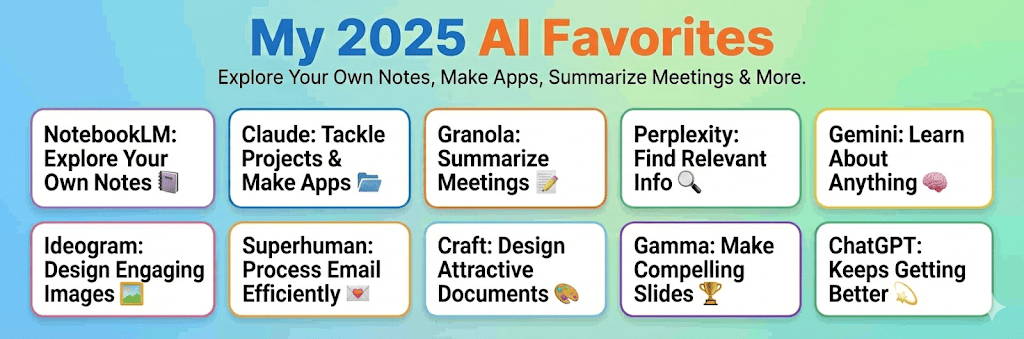
10 AI Tools I Actually Use ✨
I’ve relied on these 10 tools this year to act as a team of AI assistants. They’ve helped me approach work with a spirit of experimentation and exploration. To read the full post online with all the links and details, visit https://wondertools.substack.com/p/my-2025-ai-favorites This is a public episode. If you'd like to discuss this with other subscribers or get access to bonus episodes, visit wondertools.substack.com/subscribe

Ideogram, Explained 🪄
I rely on Ideogram, an AI image generator, to help me create posters, banners, social posts, newsletter illustrations, and video thumbnails. Context: Ideogram competes in an exploding market. Gemini’s new Nano Banana Pro makes remarkable infographics, ChatGPT’s image generator produces fantastic illustrations, and Canva, Adobe, and Midjourney keep getting stronger. Yet I still find myself returning often to Ideogram. Read on for 10 reasons why — and a guide to getting started. 10 reasons I like Ideogram * Your prompt gets automatically improved. Ideogram’s magic prompt algorithm refines your initial query. You can then approve it or revise. * Choose from four options. Each time you submit a prompt, you get back four generated images. Getting to choose one gives you a bit of editorial input.* Public image galleries are helpful for inspiration. Build on others’ prompts. Browse images of all shapes & styles, and top-ranked images, for ideas. * Get accurate text within images. Ideogram generates accurate text for social media graphics, thumbnails, banners, and logos. Ideogram’s guidance on text & typography includes excellent examples of prompts and text designs.* Pick from a variety of styles. Choose from dozens of styles, from Pop Art and Watercolor to Doodle, Travel Poster, and Surreal Collage. I often choose “auto” because I can’t make up my mind. I tend to opt for a clean, modern look for a presentation image, or a more abstract, artsy vibe for creative projects.* Use negative prompts. Paid subscribers can list specific elements NOT to be included in an image. That can be helpful if a particular detail could prevent your image from being usable, as in the burger example below. * Choose your image orientation. You can generate horizontal, vertical, or square images. Free users have 11 orientation options. That’s helpful for generating images that will fit your slide, podcast, newsletter, ad banner, site header, or whatever else. Paid subscribers get additional dimension choices.* Remix anything. Modify images you or others have generated with Ideogram’s remix button. I often tweak what I’ve generated to get closer to what I want. Be specific with your remix query: “dog” may yield a golden retriever instead of the poodle you envisioned.* Extend images. Ideogram’s Canvas feature lets paid users edit, extend, or combine images. Here’s a 45-second video with examples. * Create custom styles of your own Upload or pick a few images to generate a new style you can use repeatedly for a consistent look. 📺 Watch the promo video below to get a sense of it.👇 How to start using Ideogram* Visit Ideogram.ai and sign up for free with your Google, Apple or Microsoft account. * Check the welcome guide for starting tips, examples, and sample prompts.* Explore the public gallery to see others’ images and the prompts they used. * Describe an image you envision in a few sentences. Don’t worry about precise wording. You can opt to let Ideogram refine your prompt.* Choose a style. Decide if you want an illustrated or photographic-style image. Or pick ‘auto’ to let the algorithm decide. You can also select a color palette. * Choose dimensions. Pick a wide, vertical or square image. I mostly generate wide images, which match the width of presentations or web pages.* Click generate. On a free account, you can generate a limited number of images per day. * Wait a minute. The service slows free requests to incentivize upgrades. * Download the image you like and use it any way you choose. Use an AI assistant to sharpen your image promptsAvoid getting generic images when using Ideogram by prompting ChatGPT, Claude, or Gemini to help you craft more detailed image prompts. Here’s how to prompt an AI assistant for this: * Type a few descriptive phrases about an image you’re envisioning* Explain how you plan to use the image (for a poster a thumbnail, etc)* Ask for five surprising, bold, image prompts based on your context for use with your image generation tool. * Iterate. Pick one you like and ask for three compelling variants. Test one or more of those with Ideogram. Pricing* Free for a limited number of image generation credits each day. Depending on traffic to Ideogram, you can expect at least five free images a day. I started on the free plan but now pay for the service * $7/month billed annually for more images, quicker rendering, and advanced features like Canvas, which lets you modify & extend images. Ideogram caveats* Limited free images. I often have to iterate on a prompt several times before getting something usable. On a free plan that may mean getting only one or two quality images a day.* Reduced image quality on downloads. Free users can only download a 70% quality JPEG image, not the full-resolution version. * Public image creation only. All images created on the free plan are public, meaning others can view and remix them. AlternativesGemini Nano Banana ProGoogle recently launched its best image generator with a surprisi
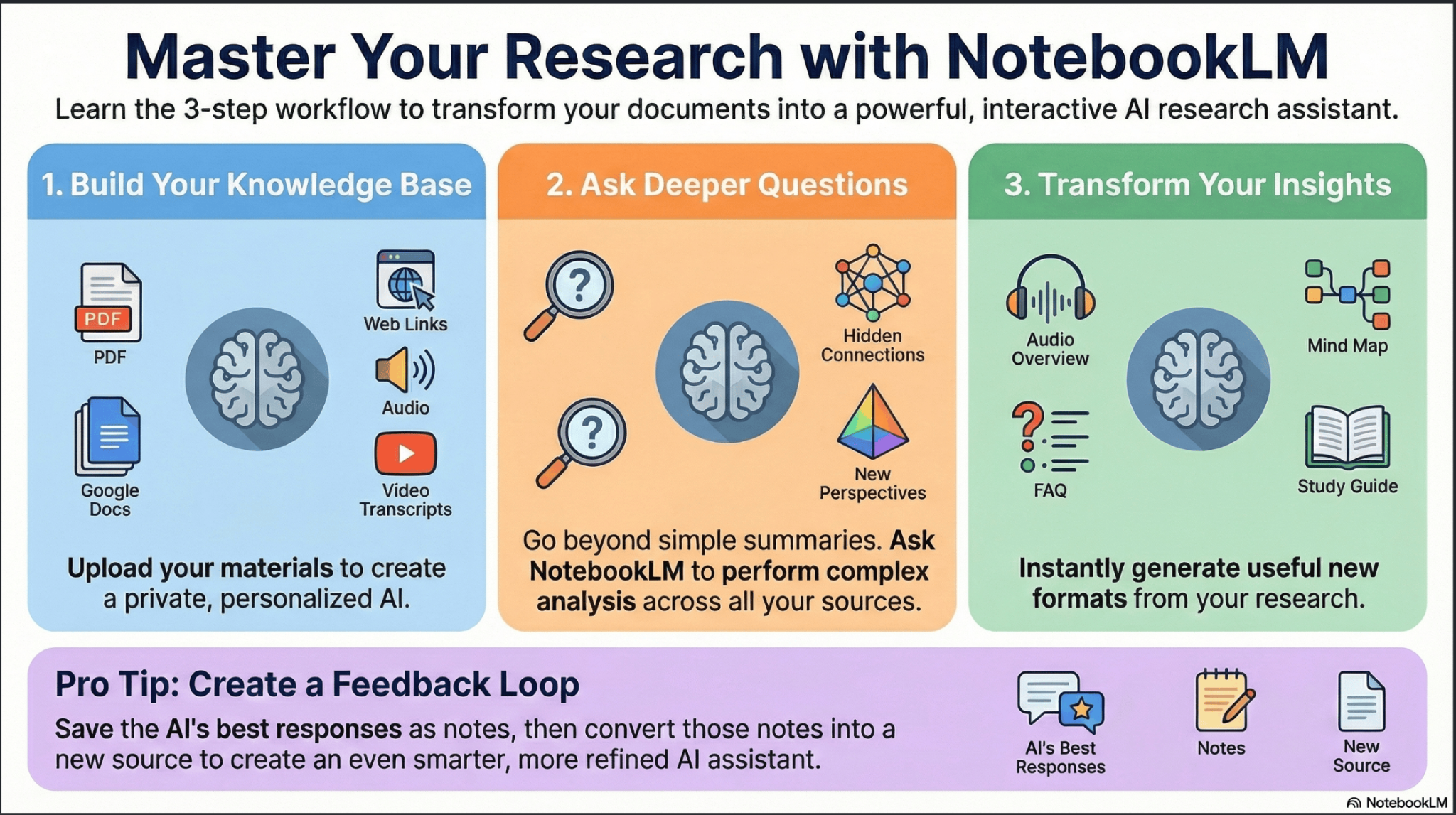
NotebookLM: The Complete Guide 📍
NotebookLM is the most useful free AI tool of 2025. It has twin superpowers. You can use it to find, analyze, and search through a collection of documents, notes, links, or files. You can then use NotebookLM to visualize your material as a slide deck, infographic, report — even an audio or video summary.How to set up a notebook* Pick a purpose. Start a new notebook for a work project or a learning goal. Examples: I created a notebook to organize materials for the new online bilingual MA program we’re developing at the CUNY Newmark Grad School of Journalism where I work. I also set up a notebook to learn more about Gustav Mahler, a composer I revere. I have numerous others for work and personal projects. * Find sources for your notebook. NotebookLM recently added a search panel to help you discover high-quality sources. You decide which, if any, of the suggested materials to add to your notebook. The “Fast Research” is quick and focused, unlike a generic Google search that returns hundreds of results, some of which have gamed the search engine system. * Fast Research surfaces 10 or so documents related to your topic in less than 30 seconds. You can ask it to find sources within your Google Drive, or from the Web. * The Deep Research prompt option in the same panel will more slowly gather many more sources. Tip: make your query as specific as possible to surface relevant, useful sources. Here’s an example of a concise, precise query I used. * Add your own materials. Upload files up to 200 MB and 500,000 words into your notebook. You can add:* Google Docs, Slides, and Sheets* PDFs, images (including photos of your handwritten notes), and Microsoft Word documents* YouTube links and audio, image, or video files (it extracts the transcript)* Website URLs (it extracts the text)No other AI tool I’ve used lets you compile as many different kinds of materials in a centralized AI workspace that’s easy to explore and build with.* Free accounts can create up to 100 notebooks, with 50 sources in each. On a free plan, you may run into limits when creating multimedia materials. You can run free 10 Deep Research queries a month. Students in the U.S. 18 or older can get pro access for free. * Pro accounts, which cost $20/month as part of Google AI Pro, can host 500 notebooks with 300 sources in each. They can run 20 Deep Research queries a day. Collaborate and shareNotebookLM now lets you collaborate as you would with Google Docs. You can choose to invite people as viewers or editors. Give them a full view of your sources and notes, or limit their access to the search/chat interface.You can also publish notebooks publicly. Here are some examples:* Trends in health, wealth and happiness by Our World in Data* How to build a life, from The Atlantic* Shakespeare’s Complete Plays* Parenting Advice for the Digital Age, by Jacqueline Nesi, PhD of Techno Sapiens* Earnings Reports for the World’s 50 Biggest Companies* Secrets of the Super Agers by Eric TopolExplore your materialsAs you add materials, NotebookLM analyzes them and suggests relevant questions. After I uploaded biographical material about Mahler, it suggested search queries — based on the source documents — about why he converted to Catholicism and what poetry collections inspired him. You can also ask any question on your mind or type in any kind of traditional search query.NotebookLM uses natural language processing to make sense of your documents. When you type in a query, the system understands what you’re looking for. When I queried about the death of Mahler’s loved ones, I didn’t have to mention their names or even their relationship to him — NotebookLM understood what I was asking. These exploratory searches are more powerful than old-fashioned keyword searches, which only work if an exact word combination appears in your document. NotebookLM makes it easy to run abstract queries as well, searching for moments of anger or surprise.Tip: target specific sources. You can use the checkboxes next to each source to limit your search to particular documents. This precision is handy when you want to search within a specific report or compare information across just two or three key documents.Visualize informationUse the Studio tab to create shareable reports, slides, graphics, and multimedia out of your notebook material. Unlike other AI tools, NotebookLM’s creations are grounded in your source documents — they don’t pull from the Web or generic training data. Because they draw only from your source material, the creations will change as you add more to your notebook, or if you mark only a subset of sources to be used.Create a mind map first to get an overview of the topics covered in a notebook. Then create the following elements to understand and share your material.InfographicsCreate polished visual summaries. Choose whether you want a landscape, portrait, or square image, and how simple or detailed it should be. Then type in an optional custom prompt to guide the desi

5 Surprising Ways to Use AI 😳
I like pushing AI to be less predictable. When AI assistants are less bland and more bold, they challenge my blind spots and nudge me to rethink. So I asked one of the boldest AI experimenters I know, Alexandra Samuel, to share unconventional tips and tactics when she visited New York recently from Vancouver.Alex, who writes about AI for the Wall Street Journal and the Harvard Business Review, surprised me with the scale of her AI efforts. She described creating 200+ automation scripts and building a personal idea database that helps with drafting pitch emails. Her quirkiest tactic? Using Suno to generate songs to explain complex concepts.Her lively new podcast, Me and Viv, explores her unusual relationship with an AI assistant she trained to serve as her coach and collaborator. She interviews AI skeptics like Oliver Burkeman and Karen Hao to challenge her own embrace of AI. The Suno songs Alex generated serve as a recurring musical thread throughout the series.In a recent episode, “I’m So Sycophantic,” Alex confronts Viv’s most irritating flaw: her pathological tendency to flatter Alex and agree with everything she says.The show’s intriguing premise reminded me of another podcast I love, Evan Ratliff’s Shell Game, whose second season debuted recently. Both are excellent explorations of what it’s like to engage deeply with AI assistants, resourceful and flawed as they are.Five tips from Alex1. Use Suno to turn words into catchy musicWhat Suno is: An AI music generation platform for creating custom songsAlex uses Suno extensively to create songs for her podcast about AI, treating it as a storytelling tool rather than just music creation.“I’m like a monkey with a slot machine. It’s pretty typical for me to generate the same song 50 or 100 times, maybe even 200 times,” she says.The iterative process helps her find the perfect version. She says Suno struggles with switching between male and female voices, musical styles, or languages mid-song. Alex suggests bringing your own lyrics to Suno for better results than relying on its built-in lyric generation. Here’s documentation she wrote up about how she uses Suno. An alternative she recommends: work iteratively with an AI assistant like Claude to develop lyrics that you then import into Suno.Try it for: Turning articles or announcements into short promo songs; creating engaging musical explainers; or generating a newsletter signup song.Alternatives: Udio, ElevenLabs MusicSponsored MessageYour data knows what it wants to beData doesn’t have to be dull. With Flourish, you go from spreadsheet to show-stopping visuals in seconds. Upload your data, get instant chart suggestions, and drop them right into your Canva design. It’s fast, easy, and looks amazing!2. Coda: Create your own productivity hubWhat Coda is: Software tool for creating customized documents and databases. I’ve written about how underrated Coda is as an alternative to other useful tools like Notion and Airtable.Alex calls Coda an everything hub where you can build your own tools. New AI features make it easier to use and more flexible. Alex used Coda to design her own “pitch machine,” a sophisticated story tracking system.She has one table in the pitch machine with all of her story ideas. Another table in Coda has all the publications she writes for, with editors’ names and contact info. With the press of a button in Coda, she can combine multiple story pitches into a single Gmail draft while automatically updating tracking fields and follow-up dates. It took a while to set up, but now saves her time. Who is Coda for? Alex recommends Coda for power users who like messing around with tech. She offers this test: “If you use XLOOKUP in Excel, then you should use Coda. If you don’t know XLOOKUP, you should use Notion. It’s like a nerd-o-meter.”Try it for: Project and campaign idea tracking, managing a client database, or automated email or Slack message generation.Alternatives: Notion, Airtable, Google Workspace, Obsidian3. CapCut: Create social videos with AI help What it is: Video editing platform with AI featuresAlex uses CapCut, along with custom Python scripts, to create music videos for Instagram, YouTube, and TikTok. She says she has mixed feelings about CapCut because of its TikTok/ByteDance ownership, but relies on it for now. She’s been working on a system for syncing the appearance of captions on screen to the moment when song lyrics are heard.Try it for: Creating stylish, captioned social media videos or turning podcasts into videos.Alternatives: Captions, Descript, or Kapwing4. Claude + MCP: connect AI to your docsWhat it is: AI assistant connected to external databases and tools via Model Context Protocol (MCP)MCP servers let you connect sites and apps to AI platforms. That’s how Alex connected her Coda account to Claude. Now that they’re linked, Alex can pose casual questions to Claude, which can then look for things in her Coda docs.“I can actually just have a conversation with Claude and s
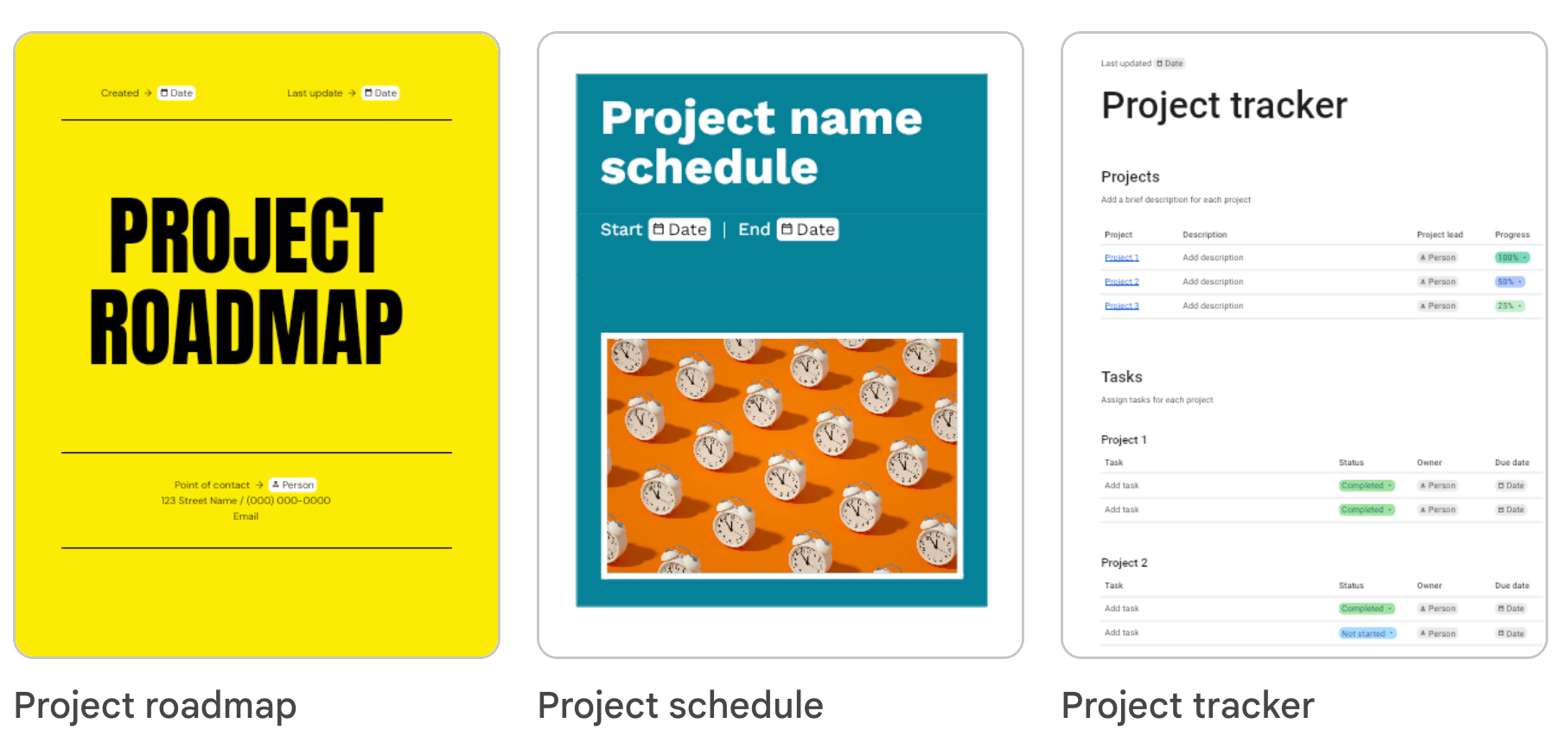
🌟 Google Docs Gets Smarter
Google Docs has new tricks to try: an audio button to hear your writing read aloud; an optional AI helper to summarize your doc; an activity dashboard to see who is viewing your work; and colorful templates to add visual spice. A billion people use GDocs, making it the most popular free writing tool in the world. It remains reliable, free and easy to use. Read on for an update on what’s new and notable. 5 notable new Gdocs features1. Get AI help compiling a new doc 🧑💻 “Help me create” is a new command for building a doc out of existing ones. * Select File > New > Help Me Create and type in a prompt. * How to use it: Mention existing docs with the “@” sign and describe the new doc you’d like to create out of existing ones. I used this to generate an action list out of a feedback summary document. * Caveat: Requires an eligible AI plan or Google Workspace.2. Listen to your writing 🎧Have an AI voice read back your writing. * Select Insert > Audio Buttons. Choose from seven upbeat voices. * When to use this: I like listening for awkward phrases or clunky transitions when editing my work. * Requires an eligible Google Workspace plan or individual AI subscription.Sponsored MessageTap. Hover. Discover. With Flourish, data becomes an experience. Add motion, layers, and interaction that invite your audience to explore, not just observe. It’s the difference between showing information and making it come to life.Try Flourish →3. See document activity 📊A new dashboard lets you see who else in your org has viewed a doc and when. * Select Tools > Activity Dashboard * Tip: Adjust your privacy settings within the activity dashboard if you don’t want your doc views to be showed to others. * See when a doc has been shared and with whom, alongside a a chart illustrating when comments have been added. * Caveat: Requires Google Workspace; not available in solo free accounts. 4. Insert new “building blocks” into docs 🧱Include an AI summary of your document, a decision log or other templated, editable text blocks. * Select Insert > Building Blocks and pick from a lengthy list of options. * Tip: Use the email block to draft a Gmail message within your doc — or ask AI for help starting it, based on what’s in your doc. Then send it to Gmail as a draft you can revise. 5. Try new templates 🎨Google has added 40 new designs to the 55 already in the template gallery. * Select File > New > From a Template to see the additions. * What’s good: The new project roadmap and onboarding templates are nice. The existing resume, letter, and proposal templates are also well-designed.5 of the most useful GDocs features1. Tabs let you create sections within a doc One doc instead of many. Don’t create 20 separate files for each project. Use a central doc instead with multiple tabs for organization. Share everything in one place.Try using tabs for… * A long project. When you’re writing something with multiple sections, create tabs to organize your work. Stat: docs can include up to a million characters.* Collaboration. Each person can take their own tab. No more typing over others’ words. * A class or meeting. When teaching or leading a meeting, create a single doc with instructions and questions. Duplicate the tab for each participant, or create distinct tabs for each topic. Rename the tabs. Now everyone’s input lives in an organized, collective doc.Tips for tabs* 🎍 Emoji-enhanced titles. Decorate the title of any tab with an emoji to separate sections visually. * 🔗 Share deep links. Within the three-dot menu next to a tab’s title, choose the “Copy a link” option to share a link to a specific tab. That makes it easy to return directly to an important spot.* ↗️ Reorder tabs. Drag tabs up or down to reorder them. Drag one into another to make it into a subtab.. * 📋 Outline view. Use the “Show Outline” option in the three-dot menu next to a tab’s title to navigate through subsections. Limitations* No printing or downloading all tabs. Annoyingly, you can’t print or download everything in the the various sections at once. Solution: Go to Google Drive to download the full document, including all its tabs. Or print one tab at a time.* No granular privacy. You can’t set privacy levels distinctly for each tab. If the doc is public, each tab is public too. If the doc is private, you can’t let people see one particular tab.Design docs for the webPageless format. Many of the docs we create never need to be printed. So GDocs now offers a design option for docs you’ll only use on screen. It lets you include wider images and eliminates artificial page breaks. See a gif of Pageless view. How the pageless format is useful * Cover image. Add a photo, drawing or illustration at the top of a document as a visual header. * Collapsable sections. Click the triangle next to a section header to hide the text within it. That’s helpful for giving others a streamlined view of a doc.* Auto-adjusting images. Images and line breaks adjust to your screen size.* Better tabl
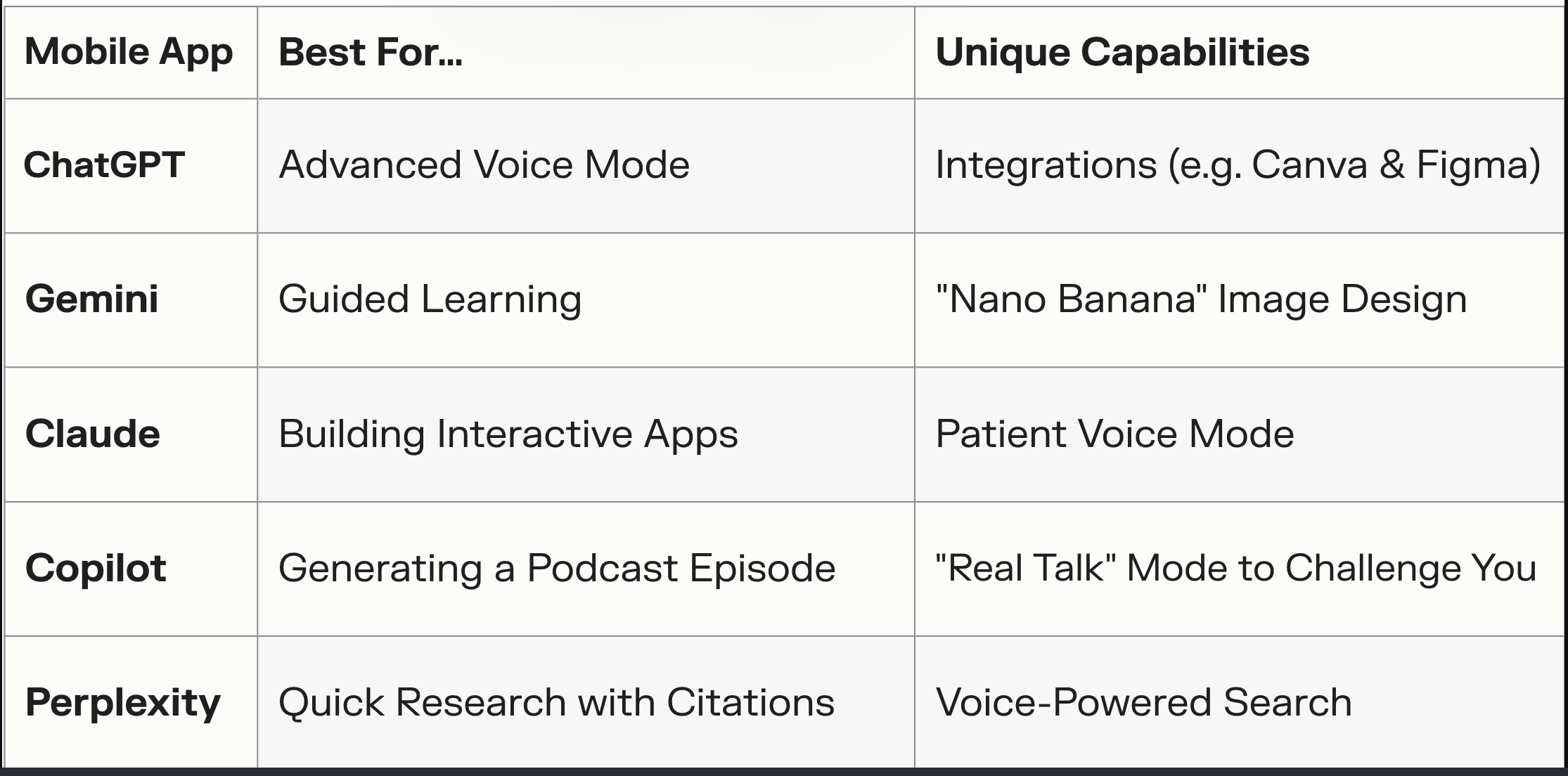
📱The Best Mobile AI Apps
15-second summary of this post: Your phone is now a pocket AI studio. Design a presentation, get voice coaching, conduct research, or make a quick infographic. The biggest players — ChatGPT, Gemini, Copilot, and Claude — all offer numerous free features on both iOS and Android. And a growing group of alternative AI apps now offer private AI for free. [See my recommendations for free, private AI on your laptop.] Read on👇 for a guide to the most notable features of the top AI chat apps.ChatGPT: Your Conversationalist 🗣️ iOS & AndroidAdvanced Voice Mode is the ChatGPT app’s most distinctive feature. Ask it to play a tough interviewer or a skeptical client as you prepare for a difficult conversation. Or have it ask questions to help you make a decision. Most of what you can do on your laptop you can do in the ChatGPT mobile app. * Create an image. Ask for an infographic, a cartoon, or a photo illustration. See examples of seven ways I use these images. * Ask for deep research. Get a detailed analysis with dozens of sources. See examples of nine ways I use this research. * Study & learn. This new mode helps you strengthen your skills & knowledge.* Analyze files or images. Turn a handwritten note into digital text, or make sense of any document, diagram, or manual. When I can’t figure out how to assemble or operate something, this offers faster help than a Google search. * Use integrated apps. You can now access Canva, Figma, Spotify, Expedia, and other tools inside ChatGPT. Try prompting for a graphic within ChatGPT while waiting in line with your phone, then edit it later in Canva.👇Pulse is ChatGPT’s best new pro mobile feature. It creates customized notes for me every morning. The AI assistant synthesizes info from my chat history, my Google Calendar, and what I’ve expressed an interest in learning. This morning’s Pulse note, for example, included tactics for using new Substack features, Penguin stories for sharing with my daughter, and breakfast ideas I had asked about for my rice cooker and bread machine. These aren’t news updates — they’re personalized resources prepared by an AI assistant. I don’t use or recommend relying on AI assistants for news searches, especially given AI’s struggles with news accuracy. Caveat: Pulse isn’t yet available for free accounts. Gemini: Your Creative Partner 🧑🎨 iOS & AndroidThe Gemini app has five special features, in addition to its core chat capability.* “Nano Banana” image generation model. Edit photos, blend multiple images, or design a poster. Worth trying: ask it to turn any image from your phone into a record album, book cover, or billboard poster.* Deep Research. Generate exhaustive reports with citations whenever you need thorough background on an issue. Try this prompt: “Create a step‑by‑step plan to adopt [tool/technology] in a team of [size]. Include costs, training time, change‑management risks, and how to measure success. Cite case studies.” See a few of my tips for strengthening deep research queries. * Veo 3 video generation. Paid accounts only. Create 8-second clips with Veo 3.1, Google’s new video model. Experiment: create a slick moving background for a slide. * Canvas. Make an infographic, a quiz, or a simple game. Quick test: make a self-grading quiz to challenge yourself on something you’re learning. * Guided Learning. Put Gemini in teacher mode to help you gradually strengthen your understanding of anything. Try this: ask it to walk you through the history of any concept or tech you’re curious about. When I choose Gemini: I use it as an alternative to ChatGPT and Claude when I want particular kinds of image edits and creative image designs. I also use it to experiment with generating short video clips, for guided learning, and for research reports. Sponsored MessageShare anywhere. Stay brilliant.With Flourish, your interactive charts go wherever your story lives. Embed them in websites, blogs, reports, or campaigns. Each one stays live, on-brand, and beautifully in sync as your data updates. No coding. No fuss. Just visuals that travel beautifully.Claude: Your Mobile Studio 👷 iOS & AndroidClaude’s app has a new voice mode I like. It waits for me to tap the screen to signal I’m done, so it rarely cuts me off when I pause to think—unlike ChatGPT, which often assumes I’ve finished talking. You can choose from five voices. Create on the GoCreate Artifacts — interactive little applications — from your phone. You can make games, learning resources, document templates or other useful mini programs. You can also now use Claude Code from your phone. What I most value about Claude is its excellent Projects feature, which lets me organize relevant documents and instructions for each distinct area of work. I use other tools (like ChatGPT, Gemini) for images and video, which Claude doesn’t do, but I rely on Claude for assistance with alt-text, SEO text, project planning, and other tasks where understanding my context is crucial. Copilot: A Flexible Assistant
🎯 My Private, Free AI Setup
Short on time? Read this 30-second summary of today’s post. 👇Download a free, private AI program to run on your computer. Use it offline without any subscription cost and avoid the risk of having sensitive info ingested into a large language model like ChatGPT, Claude, or Gemini. The newest versions of private AI tools like Jan run easily on my 2021 Mac laptop, cost nothing, are easy to use. They’re a good alternative to costlier AI platforms. 🔰 Quick start guide * Download and install the free Jan. Other good free alternatives to consider include Msty, Anything LLM, or LM Studio. * Open Jan and pick an open-source large language model. The model you use impacts the AI’s response style. You can switch anytime. I use the v1 model. * Try your first query. Here are a few quick mini prompts to start with: * “Summarize the pros and cons of using AI for [specific task].”* “Turn my rough notes below into a short summary and bullet points.”* “Turn this angry email draft to my service provider into a constructive message more likely to generate a helpful response.” * Adjust the app’s appearance settings, including font size and shortcuts. * Close other processor-intensive apps on your computer, like video editing tools, to reduce the likelihood of your computer slowing down.🕵🏻 Five reasons to use private AI* Save money: Avoid subscription fees by running AI models on your own computer. Generate unlimited responses without monthly charges. * Keep your data private. Using private AI on your computer ensures no data is sent to or stored on big tech firms’ servers. No conversations leave your device. You can even run these tools offline. * For sensitive legal, medical, financial or personal issues, ask questions without worrying about your data ending up in a large language model’s training data. * Work offline: Having full offline access is handy whether you’re traveling without WiFi, working in a remote area, or hesitant to trust a random public network.* Experiment with hundreds of open source models. Choose an open source large language model that suits you. Each is trained differently. Some are stronger at certain languages, others specialize in coding. New ones emerge regularly. Switch as often as you’d like. By contrast, ChatGPT, Claude, Copilot and Gemini limit you to the platform’s own models. * Tip: Use LM Arena to compare two models’ responses side by side. * Reduce your environmental impact: If you run hundreds of daily prompts, a local AI app may mean less use of Internet infrastructure and remote data servers.💫 Jan is an excellent, free, private AI tool* Platforms: Mac, PC, Linux. What I like about it* Fast and easy to set up and use. Jan takes a minute to download and install. Using Jan is as easy as using ChatGPT, Claude, or any other chatbot, though you do have to make an initial decision about which model to use. * Assistants. Create customized AI helpers for various purposes. One for translating Chinese, another for coding. Task it to “Act as a software engineering mentor focused on Python and JavaScript. Provide detailed explanations with code examples. Use markdown formatting for code blocks.”* Projects. Organize queries into distinct folders for easy access to subjects of interest without searching through hundreds of threads. * Integrations. Link Jan to Canva, Todoist, Linear, or other tools using MCP — model context protocol — connections. * Documentation and resources. Lots of useful documentation including a handbook and blog. What’s Next: Jan AI is developing mobile versions for iOS and Android and adding integrations to link Jan to other services.Partner MessageLighthouse is the leading newsletter for CEOs, COOs, CIOs, and Transformation Leaders focused on achieving success in the digital age. Join over 40,000 subscribers who gain insights into proven AI frameworks, high-ROI strategies with minimal risk, and leadership approaches that empower teams to excel in the age of AI. Subscribe for free.🩺 A Jan case studyBecki Lee, a Senior Technical Writer, uses Jan to explore health questions she wants to keep private. “I have a chronic illness I’m struggling to get diagnosed,” she emailed me. “So I created an assistant to help interpret test results and brainstorm possible explanations for my symptoms. Obviously, it’s super important to take this with a grain of salt (a chatbot is absolutely no substitute for a doctor). However, this helps bubble up conditions I can research further on my own, and it also generates questions I can ask my actual doctor.” ✨ More free AI options for Mac, PC or LinuxMsty The free version of this well-designed app has multiple unique features. Unlike Jan, which is completely free, Msty also has paid advanced features. Its best free features include:* A built-in prompt library with hundreds of options.* Special focus and zen modes that strip away side menus. * Create multiple personas, which are assistants with distinct personalities. Each can adopt a different styl
✨ Claude Turns Ideas into Apps
Claude feels like a genie to me. With its Artifacts feature I can turn any idea I have into an interactive application, visualization, or graphic. Yesterday I created a Flashcard maker and a breathing app. No coding. Just a short AI chat conversation. No complexity. I dream up an idea, and Claude makes it instantly real. I iterate with chat to make it better. Read on for a guide to making the most of Artifacts with examples and ideas you can build yourself.✨ How to turn ideas into apps (no coding)* Create a free Claude.ai account or log in if you already have one.* Navigate to the “Artifacts” tab.* Pick one of the existing templates in the Inspiration gallery to customize.* If you don’t want to use a template, click “New Artifact” in the top right corner of the Artifacts landing page. Pick a category of interest (e.g. Games, Quizzes, etc). Chat with Claude to iteratively design an artifact.* Customize your Artifact by pasting or uploading specific content you want it to use, or by defining a particular color palette or design style. Explain how you want it to work or ask Claude to guide you with questions.* Test out the Artifact. Click “Publish” when you’re ready to get a shareable link and optional embed code.* Return to the Artifact later to update or change it. * 🔁 Repeat to make as many Artifacts as you want. Free users may run into rate limits.Sponsored MessageLet your data do all the talkingTurn spreadsheets into sleek, interactive visuals without a line of code. With Flourish, you can quickly create charts, maps, and interactive content that impress clients, engage audiences, and make your insights crystal clear.💡Try These: Apps You Can Make Right Now✏️ Master Any Subject (Study tools you can make)Create a resource to help you learn whatever you want. Use specific facts, diagrams, documents, or other materials to seed the assistant, or ask Claude to suggest relevant info. The flashcard maker I created lets me paste in some text, upload a PDF, or just describe a topic of interest. It instantly generates 10 questions for me. [See my prior post on using AI for Learning].My Example: Instant Flashcard Maker📊 Visualize Your DataIn addition to summarizing documents or transforming files, you can use AI to make sense of data. Ask Claude to analyze or visualize info in specific formats or with your preferred design sensibility. You can upload reference images or your style guide, or just specify style or tone.My Example: Visualize CSV Data🎭 Design Custom QuizzesIt’s now easy to make your own version of “Which Harry Potter House Are You?” quizzes. Pick a subject and supply some questions. Or ask Claude to propose questions and you can act as the editor. These can be just silly or they can help students or colleagues figure out where they stand on an issue.My Example: What’s Your AI Personality?🔗 Make Content InteractiveInclude a link to an Artifact in your next piece of writing or presentation to add an interactive element. Invite readers or viewers to try it for themselves. Ideas: a visual story summary, a quiz, infographic, dashboard, or a customized cost calculator. 🧮How to get started: Upload or paste content you’ve created —or a transcript, if it’s audio or video— and chat with Claude about interactive supplements that might be useful for your reader.Examples - WT Conference Toolkit Guide - Note-Taking Devices — Interactive Summary Table Sponsored MessageBento Focus | In the era of AI, noise is increasing. It’s time to take your focus seriously! ✅ Test Your KnowledgeTesting yourself helps identify knowledge gaps. You can upload specific material you’re aiming to master or just ask Claude to design a quiz Artifact for you on any subject. Give it context about your level and the kinds of questions you’ll find most useful, as well as your preferred quiz length.My Example: Liquidation preference quiz🎯 Build a Decision HelperFigure out which of multiple options works for you. This kind of interactive poses a series of preference questions to determine a result based on your answers. It guides decisions based on whatever criteria and grounding info you provide. To customize my own matching tools, I use my own writing, analysis and research to serve as the basis for the Claude Artifact. I based the following examples on my own research on AI learning modes and note-taking tools.Examples - Find your preferred AI learning mode - Find Your Perfect Note-Taking Tool🧘 Create Calm (Meditation & timer apps)Claude Artifacts can employ timers and graphics. To make a simple breathing app, I gave Claude instructions about the 4-7-8 breathing pattern. 4 seconds of breathing in; 7 seconds holding; 8 seconds of exhalation. I included a link to the source article from which I drew the information, and instructed Claude to run four cycles of the breathing timer for an activity that would last about a minute.Example: My 60-second breathing relaxation app🎮 Make a GameIt’s simple to make puzzles, simple arcade-style games,
20+ Kid Tools for Better Screen Time 🎨
Not everything creative needs a prompt. The Web is increasingly flooded with AI-generated images and videos, much of it aimed at kids. Sometimes it’s nice to break free of that synthetic media. As a dad of 10 and 12-year-old daughters, I appreciate resources for kids and families that celebrate human imagination, curiosity, and hands-on exploration. I had a fruitful recent conversation about resources for kids with a fellow dad, Kevin Maguire, who writes the great newsletter The New Fatherhood. If you’re a dad looking for great reads and a sense of community, check out Kevin’s newsletter. (Also read Recalculating, by Ignacio Pereyra). Kevin wrote the section below about simplifying screens and shared the tip about muted.io.The rest of the apps and resources below are ones I’ve enjoyed in recent years with my wife and daughters. From coding with visual blocks to identifying plants on nature walks, these are some of our favorite tools for sparking creativity.🧮 Building Brains Without Bots* Scratch, developed at the MIT Media Lab, is a superb program for learning to code. It’s fun and free for kids — and adults. My daughters like assembling Scratch’s visual blocks on screen to create interactive stories, games and animations. It’s designed for kids 8 to 16. ScratchJr is a great alternative for kids 5 to 7. Free* Dash Robot lets kids program it to move, light up, and make sounds. It teaches block coding, like Scratch, and our daughters enjoy making up their own instructions to send Dash on creative adventures. For kids 5 to 14. $180.* Seek is one of our favorite family apps. Point the app at any plant, flower, animal, or bug you see on a walk to learn more about it. It’s given us insight into much of the greenery (& critters) around us. iOS & Android. Free Sponsored Message🎥 Guidde | Create how-to guides with AITired of explaining the same thing over and over again to your colleagues?Guidde is an AI-powered tool that helps you explain the most complex tasks in seconds with AI-generated documentation.* Turn boring documentation into stunning visual guides* Save valuable time by creating video documentation 11x faster* Share or embed your guide anywhereJust click capture on the browser extension. The app automatically generates step-by-step video guides with visuals, voiceover, and a call to action. The best part? The extension is 100% free.📚 Words That Work Wonders* Libby lets you access thousands of free ebook or audiobooks with a free library card. It works for more than 90% of public libraries in North America, and Libby can be found in 78 countries worldwide. Free* Khan Academy is the most robust online spot for helping kids with learning almost any school subject. It’s completely free. No ads. Khan Academy Kids has great learning activities and games for kids 2-8. It’s also free and ad-free, and it’s fun for both math and reading. FreeFamily Screen Time That Actually Works* Common Sense Media | Wondering if a show, movie or video game is age appropriate? Get a quick sense of whether it’s a good fit for your family. Free* Kanopy is a terrific free resource for educational videos, documentaries and classic films. Access it with your library card. A unique feature: watch Oscar-winning short films you won’t find on other streaming platforms. Kanopy Kids is a curated collection for learning, less commercial than the kids section on Netflix. Free* JustWatch | See which platform hosts a particular movie or show. Free* Nex | Like a Nintendo Wii made for 2025, this video game system gets our bodies moving with fun, non-violent, family-friendly games. It was easy to set up, pluging right into an HDMI port on our TV. It’s a little bigger than a Rubiks Cube. Four of us can play together. We like the sports, dancing and trivia games. Some titles are just for little kids (e.g. Elmo, Peppa Pig), but most are engaging for older kids and adults. The device costs $249 with five included games. An $89 annual subscription gets you 40+ more games.Read my Fast Company interview [gift link] with Nex’s founding CEO about how his game system has spread. 🎨 Making Music* Chrome Music Lab 🎼Compose little tunes, even if you have no musical experience. Explore digital instruments and sound games. Save your favorite clips to share. Google’s MusicFX is a fun alternative for generating music with a prompt. Free* Metronaut 🎶 This sheet music app lets kids play along with an accompaniment from an phone or iPad. It supports 20+ instruments ranging from strings and woodwinds to piano, guitar, and brass. $27/year on iOS.* Tomplay is another great sheet music app that works well on Android and iOS and includes a wider range of chamber music. I pay $82/year for it.* muted.io has a vibrant collection of interactive tools and visual references to help kids — or their parents — absorb music theory. Free [by Kevin Maguire]Art Adventures & Creative Experiments 🎨* Tate Kids — An Arty Playground. Play art games, watch cute videos, try out little

Gretchen Rubin’s Secrets of Adulthood: Live with Jeremy Caplan
This is a public episode. If you'd like to discuss this with other subscribers or get access to bonus episodes, visit wondertools.substack.com/subscribe
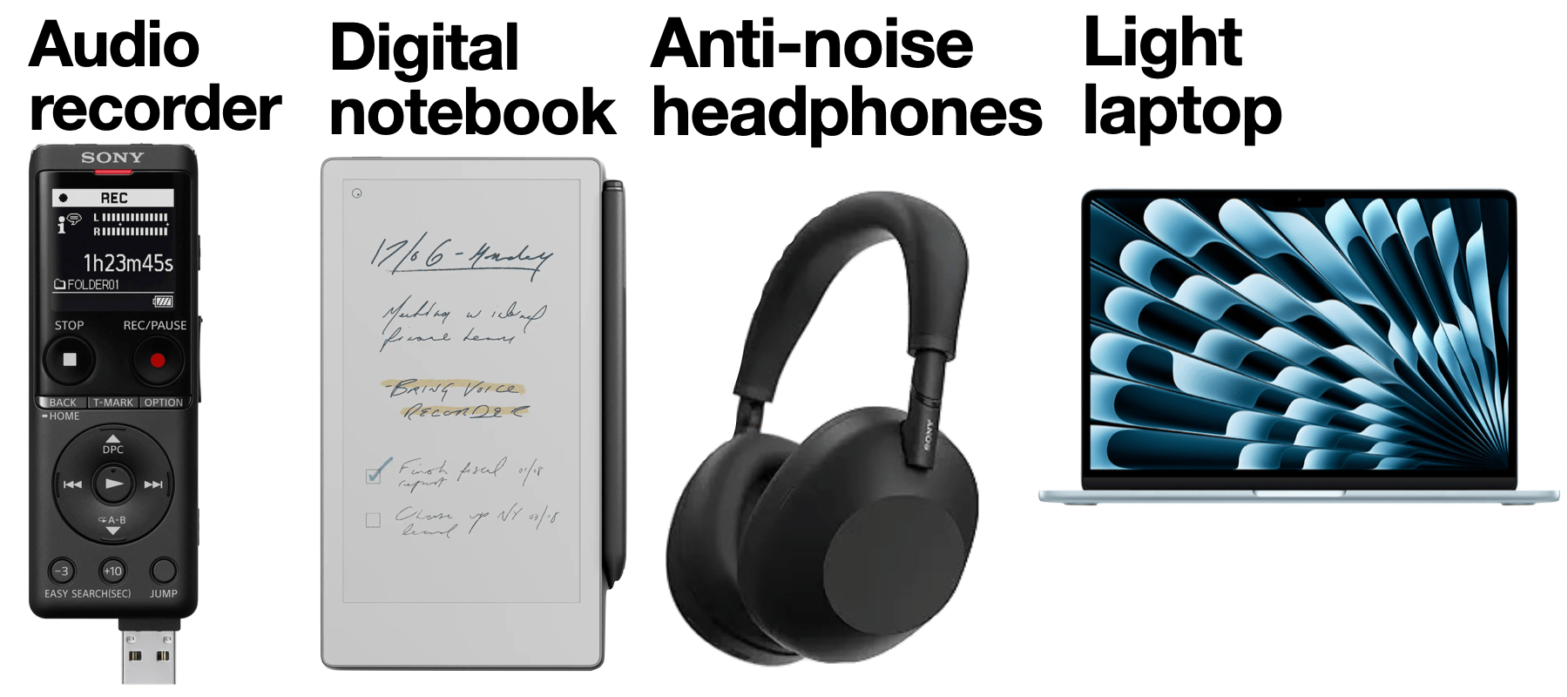
What's in My Conference Bag 💼
In part one of this post, I shared my conference prep and networking toolkit. But here's the thing: conference value often gets lost the week after. You return exhausted, with a phone full of photos and a head full of ideas that slowly fade. Two things can help. A little hardware — worth its carry-on weight— and a few smart post-event tools. These streamline how I show up — and follow-up.My Conference Gear1. The Digital NotebookreMarkable Paper Pro Move This new digital notebook is like a cross between a Kindle and an iPad. It doesn’t have apps. It doesn’t send notifications. It doesn’t play video or audio. It has a screen designed to feel like you’re writing on paper. It bridges handwritten notes and searchable text.I often prefer to take live session notes on my laptop, with Granola, as noted in part one. But in some sessions, writing by hand feels less distracting. My notes are searchable later and they’re backed up and accessible on the reMarkable phone app and my laptop.I like the new templates and workbooks so I don’t always have to start with a blank page. And having digital notes means I avoid adding to the stack of paper notebooks under my desk. To justify the $450 expense for the well-made Norwegian device you’ll want to use it regularly for several years. For a cheaper reusable option, consider a Rocketbook. The mini is $20 and other— like the Flex Planner— are under $50. Read more about my exploration of paper vs digital notes.2. Backup Buddy 🎙️Sony ICD-UX570 Digital Recorder ($98) This fits comfortably in my pocket, with a pop-out USB connector for transferring recordings to my laptop. * It comes in handy if you’re in a front-row seat, where laptop typing may feel intrusive. * It beats phone apps that can crash, or a laptop mic that picks up more ambient noise.* The audio quality, while not as good as a pro device, may be decent enough for a podcast sound bite. Post-event transcription* MacWhisper is free for transcribing audio files locally on your laptop.* NotebookLM also provides fast free transcription, for files up to 200mb. * Alice enables high-quality, secure transcription for $3 to $10/hour. * Good Tape, a Danish service created by journalists for journalists, is free for three 30-min transcriptions a month, or ~$15/month billed annually for 20 hours of transcription.* Escriba is free to try for a week, then $10/month for 6 hours of transcription. Like Good Tape, it works in 90+ languages. Developed by Brazilian fact-checking organization Aos Fatos, all revenue is reinvested in the newsroom.* Want more options? Check out a recent post on the best transcription tools.3. The Quiet Saver 🎧Sony WH-1000XM6 Noise-Cancelling Headphones Find moments of quiet and crystal-clear phone calls even in chaotic convention halls. Yes, like the reMarkable, they cost an eye-watering $450. But my last pair (XM3) lasted 7 years— and still work as a backup. That's about $5/month for daily peace of mind. The new AirPods 3 ($250) look to be a cheaper and more easily portable alternative. I may test them soon.4. A Lighter Laptop 💻13-inch MacBook Air After lugging a heavy backpack around for decades, I’m now carrying less. I bought this slender backup so I don’t have to haul my chunky Macbook Pro to and from work. For 95% of what I do, the laptops function equally well. Sponsored Message🎥 Effortless Tutorial Video Creation with GuiddeTransform your team’s static training materials into dynamic, engaging video guides with Guidde. Here’s what you’ll love:1️⃣ Easy to Create: Turn PDFs into impressive video tutorials with a single click.2️⃣ Easy to Update: Refresh video content to keep your training materials relevant.3️⃣ Easy to Localize: Generate multilingual guides to ensure global accessibility.Empower your teammates with interactive learning. And the best part? The browser extension is 100% free.II. Post-Conference Processing4. Reflect on what you’ve learnedThe OpenNews After Party Toolkit is a smart guide to conference follow-up. When a pile of work greets you, it’s easy for event takeaways to melt away. That’s why this guide is so useful, with tips to help you: * Reflect during the flight home* Write a one-pager for your boss* Host a brown-bag at work * Make follow-up handouts The guide was prepared by Emma Carew Grovum for SRCCON, a gathering of forward-looking journalists. 5. Create Your Conference Brain 🧠NotebookLM Drop your notes, slides, audio recordings, handouts, photos—into NotebookLM for an AI-powered knowledge base. Query your collection, generate audio summaries for the flight home, or create video overviews for team debriefs. You can now generate custom reports as well, focused on specific topics. The reports include helpful citations, pointing you back to the spot in your notes where something was mentioned. Upload materials daily during the conference to avoid post-event overwhelm. Here’s what I like about NotebookLM.Create a master notebook: A senior journalist at the Online News Associati
My Conference Survival Kit 📱
I go to conferences just a few times a year. To make the most of the frenzied days, I rely on a suite of tools. Read on below for those worth trying, and then read my follow-up post: What’s in My Conference Bag 💼 I. The Week Before1. Mine Your Network GoldmineClay | This personal rolodex enhances your contact list with info from LinkedIn and whatever other social platforms you choose (Instagram, Facebook, X). You can use Nexus, its new AI-enhanced search, to surface contacts in your conference city, or people in your network with specific expertise or interests.If you connect Clay to your calendar and email, it shows you a list of past meetings and email threads you’ve exchanged with a given contact for context. At the conference you can also use it to add private notes to a contact. It’s free for up to 1,000 contacts, or $10/month billed annually for unlimited. Pro alternative: Folk is a more advanced CRM (Customer Relationship Management) tool that’s useful if you’re attending conferences for sales, or if you manage a service business that involves a lot of outreach. It’s a pro tool, but surprisingly well designed. There’s a new ChatGPT integration so you can use ordinary language to query all your contacts and sales leads. If I were to run a sales-heavy project, I’d use this.2. Build Your Intelligence HubPerplexity Spaces | Create a dedicated Space for your conference—think of it as a smart folder for all your research queries. * It can be private, shared with colleagues who can contribute, or public. * Use it for queries related to conference sessions you’re attending or leading. * You can also use Spaces to plan for free time between sessions. Customize a Space’s instructions with your preferences to discover restaurants, music, museums, or whatever else interests you near the conference. * Upload files to give the AI assistant further context. Add reference docs from conference organizers, recommendations from friends, or a city guide you like.Learn more: Check my most recent Perplexity guide.. Alternative: you can similarly set up a project in Claude or ChatGPT with relevant documents and queries. Or set up a notebook in NotebookLM.For further prep: Check out this pre-conference Planning Exercise, part of a helpful OpenNews toolkit by Emma Carew Grovum. 3. Create Pop-Up Networking MealsPartiful | Set up open lunches or dinners that conference connections can join spontaneously. Group meals build on hallway small talk for relationship building. Many people eat alone because coordinating is tricky, or they don’t know where to go outside the hotel or conference center.It’s completely free. Create events during the conference, then share the QR code when you meet someone interesting—they can RSVP instantly on their phone. You can use the app to check RSVPs, or to send updates or follow-ups. Or post the RSVP link to an event discussion thread, or include it in an email. Schedule 2-3 meals throughout the conference and cap attendance at 6-8 people for rich conversations.For informal conference get-togethers Partiful is a good alternative to Lu.ma — the RSVP app I like using to send invites for my paid subscriber events online. Both are great, but Partiful integrates texting in a smart way, includes QR codes for RSVPing, and has a more social feel for spur of the moment gatherings.Sponsored Message🎥 Guidde | Create how-to guides with AITired of explaining the same thing over and over again to your colleagues?Guidde is an AI-powered tool that helps you explain the most complex tasks in seconds with AI-generated documentation.* Turn boring documentation into stunning visual guides* Save valuable time by creating video documentation 11x faster* Share or embed your guide anywhereJust click capture on the browser extension. The app will automatically generate step-by-step video guides complete with visuals, voiceover and call to action.The best part? The extension is 100% free.II. At the Conference: Capture What Matters4. Never Miss a MomentGranola | This hybrid note-taking app combines your typed notes with AI-enhanced transcription. Record sessions on your phone or laptop while jotting down key thoughts—Granola merges both into session summaries you can query.When my mind wanders during a session, I like being able to review the transcript to catch up. And if I have to step out for a minute or respond to an important message, I still have full notes. No audio or video is stored, just the transcript and summary. I’ve been surprised at how accurate the transcripts tend to be, even when I’m sitting in the middle of a large presentation room. It’s free for 25 meetings or $18/month for unlimited.Case in point: At the Online News Association (ONA) conference I just attended in New Orleans, I created a folder with Granola for all my session notes. Now I can query my whole collection of conference notes for follow-ups.Alternatives* Bloks is a pro option I’ve written about before. It integrates with Salesforce, HubSp

📚 Meet Your New AI Tutor
AI assistants are now more than simple answer machines. ChatGPT's new Study Mode, Claude's Learning Mode, and Gemini's Guided Learning represent a significant shift. Instead of just providing answers, these free tools act as adaptive, 24/7 personal tutors. Sponsored Message🎥 Guidde | Create how-to guides with AITired of explaining the same thing over and over again to your colleagues?Guidde is an AI-powered tool that helps you explain the most complex tasks in seconds with AI-generated documentation.* Turn boring documentation into stunning visual guides* Save valuable time by creating video documentation 11x faster* Share or embed your guide anywhereJust click capture on the browser extension. The app will automatically generate step-by-step video guides complete with visuals, voiceover and call to action.The best part? The extension is 100% free.New Tools for Studying and LearningChatGPT Study ModeGet Started: Select Study Mode from the plus menu when starting a new chat. [Screenshot]. Start with context. Tell ChatGPT what you want to learn, why, and what you already know. The model excels at adapting to your level and guiding you step by step. My take: I’ve been experimenting with AI learning modes to understand the intricacies of venture capital investing. ChatGPT initially overwhelmed me with info [screenshot], then seemed to notice I was drowning and adjusted its pace. It must have seen my confused frown. 😵💫 Note: You can use “Study and learn” mode on mobile and with ChatGPT in a browser, but you can’t yet access it in the desktop app or within a ChatGPT Project. Below is a quick example of a dialogue in Study Mode 👇Gemini Guided LearningGet Started: Visit g.co/gemini/guidedlearning My take: Gemini has been an excellent tutor. It replies concisely to my questions about venture capital. For example, so far it has: * Quizzed me (try a basic example)* Created a helpful infographic* Generated an audio overview, in the style of NotebookLM * Made me a custom Web page* Shared simple digital flashcards The tangible artifacts help me visualize concepts and test my own understanding. The model takes a minute or so to produce infographics and a little longer to create audio overviews. I’m repeatedly returning to these materials to review what still feels fuzzy — arcane details of valuation, cap tables, dilution, and convertible notes. Below is an example of a scientific infographic 👇Other Google Learning Tools* Illuminate turns academic papers and research into audio summaries* Learn About responds thoroughly and helpfully to any inquiry* Learning Coach Gem is an assistant you can chat with. * Little Language Lessons offers quick takeaways. * LearnLM is Google’s family of language models for learning, grounded in educational research.Claude Learning ModeGet Started: Select "Learning" from the style menu. This step initially confused me because the other options in that menu are writing styles.My take: Claude's scenario-based questions —like these— push me to think through real-world situations to practice applying what I’m learning. Tips: As you learn, ask Claude to create artifacts—little interactive apps— that help you practice what you're learning. Also request occasional challenges, case studies, or quizzes.Advantage: Unlike ChatGPT, you can use Learning Mode within Claude Projects. That allows you to benefit from personalized learning alongside your uploaded documents and context. So you can upload a slew of files, reports, and research resources and let Claude tutor you on those materials. Learn Mode vs. Answer Mode 🌟Turn on the learning features for any of these AI assistants and you’ll quickly notice the difference. * Learning modes use Socratic questioning — asking rather than telling. * They adapt to your level of understanding. * They nudge you to make your own observations. * They help you test your understanding with informal quizzes. * They guide you step-by-step through complex topics rather than rushing to throw answers at you. In learning mode, these assistants feel like tutors; in standard mode they’re more like interactive encyclopedias.The difference is significant. On previous occasions when I wanted to analyze data, I'd ask for quick insights. In study mode I've learned, among other things, how to use pivot tables more effectively so I can analyze data more thoroughly myself. Rather than getting fish handed to me, I'm learning to fish.Topics to try in learn mode* “How do tariffs impact supply chains?” or “How does cryptocurrency work?”* “Guide me through the basics of [science/math concept]”* “In what ways might Shakespeare have influenced Montaigne’s essays?”* “How do private equity firms operate? Help me understand the nuances.”4 Ways to Learn with AI 📚1. Understand a complex concept or skill 💪What it's for: Work or school topics you need to grasp thoroughly, or just topics you’re curious aboutMy experience: I'm using AI study modes to review probabilities for dice, tile and card

Weird prompts, better answers 🧠
AI assistants are surprisingly conservative by default. Push them to be unconventional, and you’ll get dramatically different results. This updated guide shares my favorite techniques for getting fresh, useful responses instead of predictable pablum.[Editor's note: Are you actually reading these episode notes? If so, I'd love to hear from you. Are they useful? Would you prefer they were shorter summaries of the post, rather than full text? Email jeremy at jeremycaplan.com if you have thoughts or feedback]The prompts below push ChatGPT, Claude, or whatever other AI tool you prefer to break its conventional patterns, progressing from bland to provocative. The payoff: your AI assistant becomes a creative crane, helping you reach in new directions. Rather than serving as a generic answer machine, your queries can point you toward unexpected angles and radical insights.5 ways to push AI to be boldAdd weird constraints. Force creative breakthroughs by setting up artificial limitations. Example: “Help me explain [X] using words a 12-year-old would understand, but make it engaging enough for experts in the field.”Channel historical problem-solvers. How might figures who made their mark on the past manage my little strategic query. Example: If Maya Angelou were mediating this team conflict, what questions would she ask that no one else is considering?Insist on strange cross-pollination. Require the borrowing of concepts, frameworks, or terminology from vastly different domains. Example: “Analyze my [business / creative project] through the lens of marine biology. What patterns or ecosystem principles could apply here?”Apply disaster movie logic. Push an AI assistant to consider a workplace problem with the urgency of a crisis scenario to explore unconventional ways to quickly address a slow-moving issue. Example: “This team project has 48 hours before catastrophic failure. What unconventional resources could we deploy? What rules would we break to succeed?’Embrace absurd analogies. Challenge the AI to reply in terms that may seem silly at first, but may yield unexpected clarity.Example: “To help me simplify the most confusing aspect of my presentation, explain my fundraising strategy [X] as if it were a board game instruction manual.”Give me strange and surprising feedbackWhen I’m in a creative rut, I paste in a section of writing and prompt AI to be bold and unconventional: “Offer 5 surprising, bold suggestions for specific ways to improve the following piece of writing. Along with each suggestion, include a detailed, creative explanation with your rationale.”“Act as an unpredictable, brilliant writing coach who offers strange, quirky, creative suggestions. Provide specific, granular input.”“Detail novel topic ideas or peculiarly provocative questions I could answer to help me disrupt the conventionality or predictability of the following outline I've begun.” “Point out blindspots. Spotlight what others with radically different perspectives might find problematic if they were to read this with a critical eye. Offer a list of unconventional suggestions for addressing these issues.”10 odd AI prompts to get radically new results What are 3 quirky, unusual analogies to explain [your phenomenon of interest]. See my ChatGPT example prompt and result. Propose 5 questions a reader would be surprised to find answered on [your topic X]. See my ChatGPT example.Who are 7 surprising, odd historical figures to cite as examples of [X]. For each individual include a detailed explanation. See my Perplexity example.What rarely discussed, counterintuitive insights on the subject of [X] might startle readers accustomed to bland observations? See my Gemini example.Give me 5 lively, colorful, unusual words to use in a description of [X]? See my Microsoft Copilot example.Provide 3 extreme, surprising examples of [X] or silly, ridiculous instances.Share 5 counterintuitive ways to address situation [X]. See my Grok example Imagine I shocked people with a one sentence answer to the following question: [X]. Give me 10 versions of that one-sentence reply. See my Jan AI example.I have [X challenge] in [Y situation]. Assume I want to surprise people with a wildly creative solution. Describe three solutions that would stun people while addressing the root of the issue. For a syllabus I’m creating on [X], imagine seven radically different people teaching the same course. Provide three bullet points representing each teacher, explaining the surprising and distinct learning outcomes each would aim for in their version of the class. How to get started with provocative prompts Step 1: Pick an AI chat tool to experiment with: ChatGPT, Claude, Gemini or Microsoft Copilot. Step 2: Initiate a new chat by typing in a role for the AI to adopt for the prompt you’re going to give it. For example: “Act as a bold, experienced, expert who provides distinctive, unusual perspectives to push my thinking in creative new directions.”Step 3: Adapt one of the unusual

🧠 4 Ways I Use AI to Think Better
Bland AI outputs grow stale quickly. Instead of just speeding up routine tasks, what if we used AI to slow down, challenge our thinking, and build new tools, dashboards, and experiments? Read on for creative approaches that are changing how I think about AI.1. Create your own devil's advocate assistant 👿Get thoughtful pushback on decisions. Challenge ideas.The tactic: Use AI as an intellectual sparring partner to stress-test your thinking, explore alternative perspectives, and identify potential blind spots before making important decisions. Try this: Present a plan, idea, or decision to an AI assistant with instructions to challenge your thinking constructively. Identify risks you haven't considered, consider secondary impacts, and add nuance to your analysis. Prompt template"I'm planning to [decision/plan] because [reasoning] and with a goal of [objective]. Play devil's advocate, give me multiple perspectives on this, be bold, surprising, creative, and thoughtful in your reply, and address these questions: * What are the strongest arguments against this approach? * What alternatives should I consider? * What risks might I be overlooking? * What questions should I be asking myself? * What challenges should I expect to face? * What could I do to gain more insight? * What could I do to increase the chances of success?Pro tip: Try asking your AI assistant to role-play. It can respond as a financial advisor, family member, or competitor, for varied viewpoints. Or ask it to act like a person you admire, living or dead, real or fictional.Limitation: Your AI devil’s assistant will be generic if you don’t provide detailed context. And you may get a predictable response if you don’t instruct it to be bold. Suggested model: I have found ChatGPT 5 to be excellent for this. Gemini and Claude also work well. If you’re considering anything sensitive, you may want to use a free offline private AI tool like AnythingLLM or Jan. I’ll write more soon about private AI tools like these. If you have input on those, add a comment below.Example: I described a new planned morning schedule to GPT 5. The subsequent exchange got me thinking about several new issues. The conversation helped me clarify my own thinking. It pushed me to organize and deepen my own analysis. As a bonus, GPT 5 produced a tangible artifact for me — a PDF with tables. 2. Learn something new 🧠Map out a personalized curriculumAI tools let me try out skills I thought I was too late to develop, like coding simple applications, designing graphics, analyzing large data sets, and exploring complex docs in other languages. You can also lean on AI assistants to help you develop offline skills, like learning about photography, improving your Greek, understanding crypto, sharpening project management skills, making bread by hand, or prepping for any new coverage area for a project or team. AI assistants excel at creating structured learning and practice plans tailored to your schedule, style, and goals.Try this: Give an AI assistant context about what you want to learn, why, and how. * Detail your rationale and motivation, which may impact your approach. * Note your current knowledge or skill level, ideally with examples. Summarize your learning preferences * Note whether you prefer to read, listen to, or watch learning materials. * Mention if you like quizzes, drills, or exercises you can do while commuting or during a break at work.* If you appreciate learning games, task your AI assistant with generating one for you, using its coding capabilities detailed below. * Ask for specific book, textbook, article, or learning path recommendations using the Web search or Deep Research capabilities of Perplexity, ChatGPT, Gemini or Claude. They can also summarize research literature about effective learning tactics. * If you need a human learning partner, ask for guidance on finding one or language you can use in reaching out. Add specificity* Mention any relevant deadlines. Note budget, time, or other constraints. * Share info about your existing schedule so the assistant can help map out optimal learning time slots. Making the plan concrete increases the likelihood you’ll follow through. ChatGPT recently generated a calendar file with a list of appointments I could easily import into my Google calendar. Pro Tip: Ask for help setting up a schedule, setting learning targets, measuring progress, choosing resources, motivating yourself, and implementing backup plans when you fall off track. Ask for a learning plan you can print out, charts you can fill in, interactive apps to track progress, resource lists you can look up, experts you can follow, and strategies for avoiding common pitfalls. One-line prompt template: Make a [timeframe] learning plan for [skill/topic] with [hours/week], my [skill level], [learning style], and [goal]—include milestones, resources, and practice ideas.Detailed prompt template 3. Stretch your creative design muscles 💪 Try this: Use AI image generati
✨ AI Tools Worth Your Time
Four new AI tools caught my attention recently for solving specific problems well. They're free to try, quick to learn, and point toward where AI is heading.1. Lovart 🧑🎨 Create a brand kit or marketing campaign with an AI design agent Lovart’s conversational interface allows you to generate posters, social posts, branding kits, storyboards — even packaging. Unlike other image generation tools, you can generate dozens of images from a single prompt, then iterate on the results in a chat dialogue. You can also edit the images. I used an eraser to remove stray text in a promo poster. See more examples. Pricing: Free (limited use), or $15–$26/month billed annually for additional usage and pro models.2. Little Language Lessons 🎯 Brush up on French, Spanish, or other languages Polish your linguistic skills in three different ways using Google’s Little Language Lessons. Unlike Duolingo, Babbel, and other subscription language-learning systems, this is completely free. It’s just for micro-learning — picking up some words, phrases and grammar, not for developing full fluency. * Tiny Lessons: Pick from a long list of languages and type in a scenario — like hosting a meeting or going to a concert. Learn related words & phrases. * Slang Hang: Catch up on popular new chit-chat by watching a conversation thread between native speakers. While listening, you’ll see the translation. * Word Cam: Snap a picture to get translations of objects in the image, along with related phrases. Tip: use this app on a mobile device — it’ll be handier for capturing images than your computer’s Webcam.Another useful Google service: Learn About. Get tips on learning any language — or learn about whatever fascinates you. Sponsored Message 🌟📚 Training Videos Made Simple: from Boring to BrilliantSay goodbye to dense, static documents. And hello to captivating how-to videos for your team using Guidde.1️⃣ Create in Minutes: Simplify complex tasks into step-by-step guides using AI.2️⃣ Real-Time Updates: Keep training content fresh & accurate with instant revisions.3️⃣ Global Accessibility: Share guides in any language effortlessly.Make training more impactful and inclusive today.The best part? The browser extension is 100% free3. Gemini Scheduled Actions 🗓️Set up simple AI automations Scheduled actions are an emerging format where AI assistants send you personalized updates. You design the task and choose its frequency. ChatGPT Tasks, Perplexity Tasks, and Gemini’s Scheduled Actions are three I’ve been testing. Get notified when a task is completed by email, push notification, or within the app. Here are a few examples: * Generate a summary of headlines on your niche topic. I get positive news memos to counter the weight of news negativity. Ask for one-sentence takeaways, source links, specific sub-topics, or whatever else interests you.* Get weather-related wardrobe suggestions. Create morning weather updates with outfit ideas based on a list of wardrobe items you provide for personalized guidance. * Plan a creative spark moment: Get a daily — or weekly — prompt for a creative activity: writing, drawing, journaling, cooking, or whatever you love.* Catch up on your favorite teams, shows, or bands. Request updates on your favorite artists or athletes. Unlike services like Google Alerts, these AI actions let you use natural language to detail your personal interests. * Explore new restaurants to try. Ask for a weekly summary of new nearby eateries, cafes or dessert spots, with whatever criteria matters to you most. 4. MyLens 📍 Create an infographic from a link, YouTube video, or textCreating infographics can be complicated and time-consuming. I’ve been experimenting with MyLens to convert raw material into visuals. How it works: Paste in text or upload a PDF, image, or CSV/Excel file. Or add a link to a site, article, or YouTube video. I pasted a link to my recent Craft post, asked the system to choose a visual, and got the board below. 👇When editing, I clicked on cards to expand them or dig deeper into specific points. That yielded this mind map. I also shared a link to my video reflecting on writing this newsletter for 5 years. MyLens responded with this visual overview. * What you can make: Generate timelines, flow charts, tables, or quadrant diagrams. Or upload data to create line, bar or donut charts. * 📺 Watch MyLens’s one-minute demo video to see it in action.* Pricing: Free to create 3 non-editable, public infographics (“stories”) a day, or $9/month billed annually for 300 monthly editable creations. * Alternatives: I’ve covered Napkin.ai, Venngage, and apps for creating timelines.Reader survey summaryThanks to the hundreds of you who completed my recent reader survey. In addition to reading every single submission, I tasked Claude, Gemini and ChatGPT with generating detailed summaries to help me continue to improve the newsletter based on your feedback. I’ll be replying to respondents with free bonus resources and follow-ups based
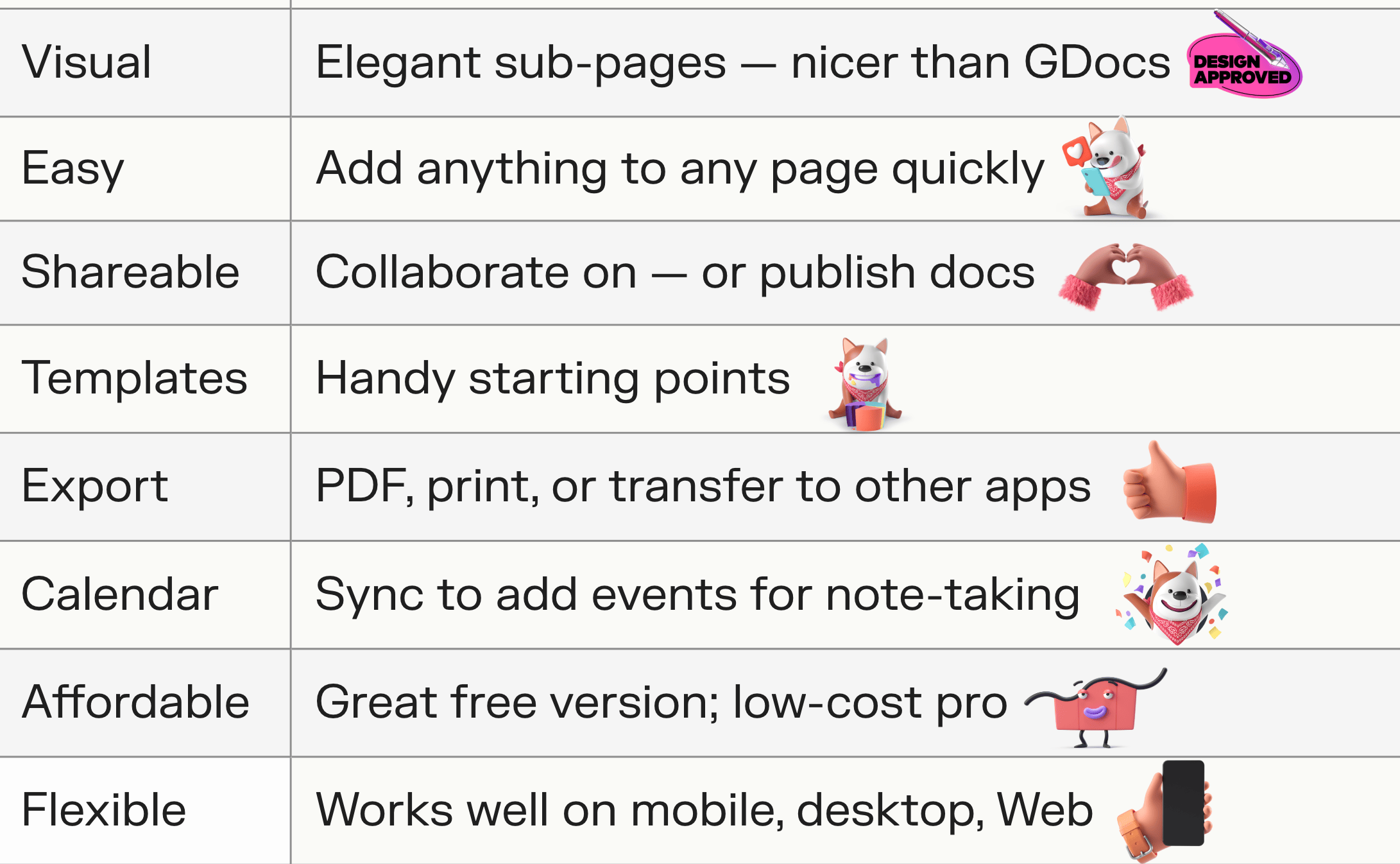
My all-in-one productivity tool 🚀
If I could use only one app, I’d pick Craft. Craft is my favorite multipurpose document + notes tool. It looks and feels nicer than Google Docs or Apple Notes. It’s easier to use than Obsidian, Coda or Notion. And it’s flexible enough for everything from shopping lists to client proposals. Read on for why it’s so useful, new features, limitations, and more.Craft’s 8 best features 👍 * Visual: Elegant sub-page cards help Craft docs look neater & nicer than Google or Word Docs, which tend to bog down with lots of text. * Easy: Add text, images, links, tables, or sub-pages intuitively. * Shareable: Collaborate on a doc and publish & share it with a link. You can create custom links and track metrics to measure visits. * Export: Print, export as PDF or text, or transfer material to Day One, Bear, Drafts, Ulysses, Things, iA Writer, or other apps. * Calendar: Easily sync your calendar to use Craft for daily notes.* Affordable: The free version is great and the unlimited option is fairly priced.* Flexible: Works quickly and reliably on mobile, desktop or Web. You can even email material into your notes. * AI options Pick from multiple AI models within Craft, or avoid it entirely. * Templates: Starting docs for travel, events, family, and more. PricingFree for basic usage, with up to 1500 content blocks and 1gb of storage. * Free upgrade for students and educators with your school email address. * Free upgrade w/ a subsription to Setapp, $10/month for access to 200+ apps. * Plus plan: $8/month billed annually for a Plus account to create unlimited notes and documents. ($4/month with a special 50% current discount). * Team plan: $15/month for sharing with 2 to 6 people. (50% current discount)Sponsored Message🎥 Guidde | Create how-to video guides fast and easy with AITired of explaining the same thing over and over again to your colleagues?It’s time to delegate that work to AI. Guidde is a GPT-powered tool that helps you explain the most complex tasks in seconds with AI-generated documentation.* Share or embed your guide anywhere* Turn boring documentation into stunning visual guides* Save valuable time by creating video documentation 11x fasterJust click capture on the browser extension and the app will automatically generate step-by-step video guides complete with visuals, voiceover and call to action.The best part? The extension is 100% freeExamples of Craft Docs 👇 * Useful AI prompts excerpts from my resource for paid subscribers* Planning great class sessions excerpts from my guide for paid subscribers* Syllabus outline draft from teacher Jeremy England* Home life notes by the Craft teamExamples of Craft Templates 👇 * Simple company handbook with sections for people, policies & resources* Sales plan has sections for mission statement, team roles, action plan, etc.* Home design planner with customizable pages * Travel packing list with customizable visual sections for your next tripNew features I like* Styles For designing distinctive docs, Craft added 100 new premade styles * Collections It’s easy now to keep track of lists for projects, books, movies, etc* Whiteboards Create a freeform brainstorming page with Post-Its, images, etc * Sync with Readwise Import Kindle highlights and other clips you’ve savedPrivacy and SecurityCraft has strong policies on data security and privacy. TLDR: “Craft does not own your data, nor do we sell it to others or use it for advertising.”Limitations* Android doesn’t have a full app yet, though a mobile Web app is on the way. Join the waitlist. Craft works on Mac, iOS, VisionOS, Windows, & Web.* Tagging It's not yet easy to organize pages with tags as easily as you can with other notes tools, though the team is working on it.* No synced blocks In tools like Notion and Workflowy, you can create a synchronized block of text that stays up to date anywhere you use it.How to get started with Craft* Explore the features Check out Craft’s helpful Getting Started guide and their YouTube channel, with new video intros like this. Or visit their help center.* Watch me make a document with Craft in this 10-minute video demo. If you could only use one app what would it be? Leave a comment 👇👍 Useful post. 😑 Meh.👎 Not useful.Bonus: I created a Craft doc to show you a few more apps I’d consider beyond my desert-island app… … Paid subscribers can check out the Treasure Chest for other examples of Craft docs like this one 👇 This is a public episode. If you'd like to discuss this with other subscribers or get access to bonus episodes, visit wondertools.substack.com/subscribe
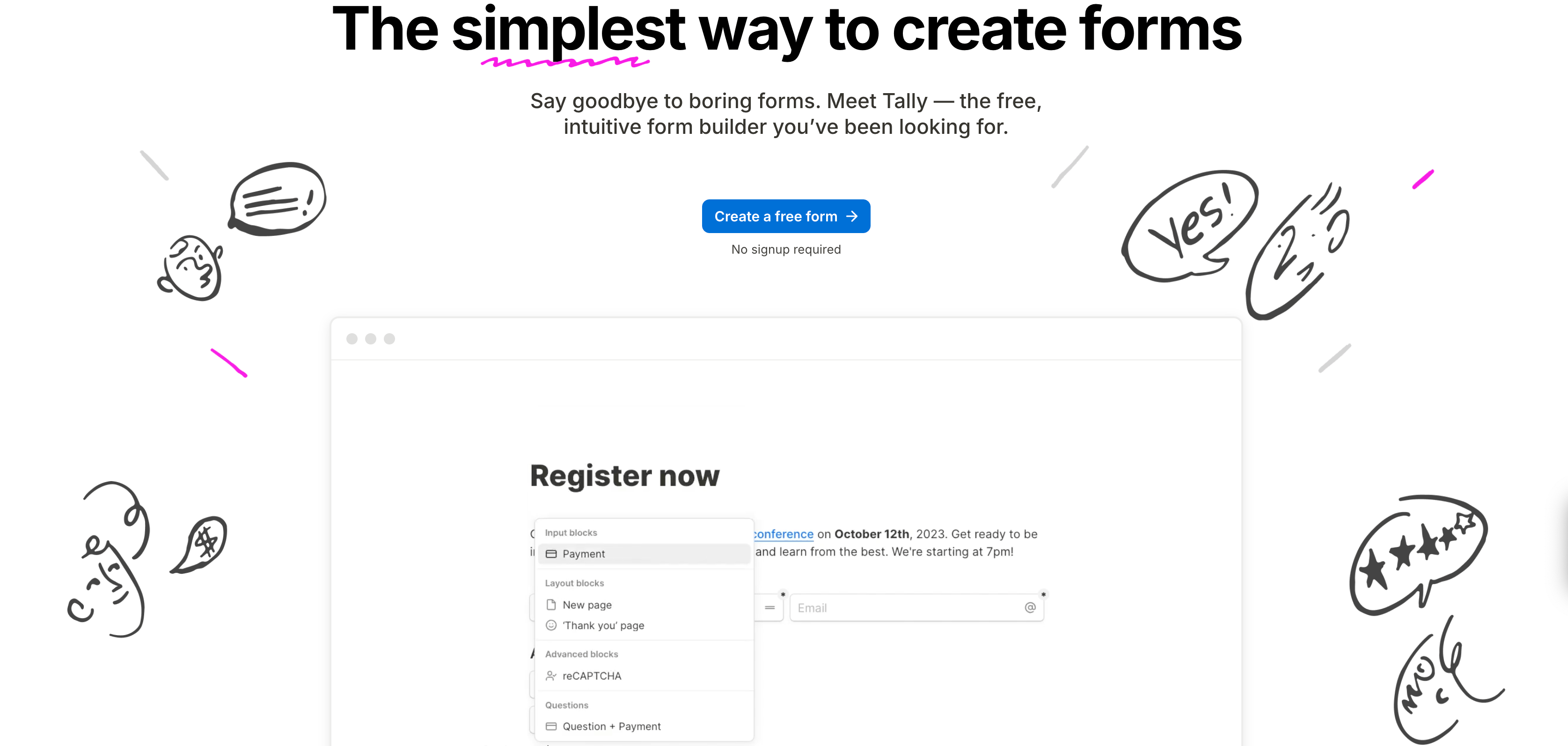
🌟 Tally: Superb Free Surveys
Tally is the best free tool for creating surveys. They’re better-looking and more flexible than Google Forms, and they’re just as easy to create in 60 seconds. Use it for any kind of survey, whether you’re getting feedback from clients or students, collecting RSVPs, or gathering ideas. Get Started: Pick a template or a blank page. Add questions: multiple choice, open text, ranking, or many others. You can ask respondents to upload a file or make a payment. To enhance your design, add text blocks, images, or videos between questions. Read on for my updated guide to Tally, including: * A survey for you to try out Tally * My 7 favorite features* Free templates* Limitations & alternative tools.Take my new Wonder Tools survey to try Tally. You’ll get a sense for how it feels to fill out a Tally form. And this is a genuine survey. Your feedback will help me improve this newsletter. Thanks for your input. I read every response. Feeling curious? Want to try an adaptive AI version of my survey? I’m testing a different survey tool, Parliant, that adjusts questions based on your replies. Try this new AI version.My 7 favorite Tally features* Free. 99% of the features are available without paying. I haven’t upgraded because the free offering is so complete.* Privacy-focused. Based in Belgium, the company complies with Europe’s strict GDPR rules. Its software respects people’s privacy. * Easy. No complicated menus or settings. As this 30-sec video demo illustrates, you can just start typing on a blank page and press “ / “ to add a question from a list of options. For non-techies it’s easier than Typeform, Survey Monkey or Qualtrics.* Flexible. Works for any kind of form, quiz or survey. Tally is superb for feedback, market research, even selling something, as in these templates:* Sell a digital or physical product* Sell ad spots or sponsorships* Host an online quiz* Make an RSVP form* Flexible design. 🎨 Incorporate video, images or descriptions to create the feel of a readable page that’s less bureaucratic than traditional forms. Add a cover image and logo. The forms look great, like Notion pages. They’re less generically corporate than Microsoft Forms or Google Forms. * Easily shareable. Email your survey, share a link to it — as I did above — or embed it within a site.* Connect Tally to other tools. Check a box to easily share whatever data your form collects to Google Sheets, Notion, Slack, or Airtable. These simple integrations help you analyze responses easily.Tips on creating great surveys* Shortcut: type “Tally.new” in your browser bar to start a new form, if you’re logged in.* Aim for 5 to 8 questions. That’s the survey sweet spot requiring just 5 to 10 minutes of a respondent’s time. * Learn from other good surveys. Check examples of others using Tally, a pack of survey templates for growth, and lessons from newsletter surveys cited by Dan Oshinsky’s excellent Inbox Collective. * Incorporate conditional logic, sending people to a question based on a prior answer. I tested that in my new Wonder Tools feedback survey above. That ensures people only see questions relevant to them. * Use AI to categorize or summarize text replies. AI can help spot patterns. That’s useful when you have hundreds of responses to analyze. * First make a copy of survey data, stripping out names and private info.* Prompt Claude or ChatGPT for step by step analysis, not all in one shot. * With Gemini AI enabled in Google Sheets, ask for AI analysis of responses saved in a sheet.* Other AI resources: Custom GPTs like Survey Crafter or Survey Analyzer. 📺 Watch me create a Tally form in 30 seconds Templates to try* Newsletter feedback Customize this template I made. * Event registration Invite people to sign up. Offer programming choices. Spread questions over multiple pages for a clean look. * Simple feedback Let anyone provide quick input. * Grant proposal Select candidates.* Job application Find someone to help you out. 6 steps to implement your survey 1. Pick a template relevant to your project (or start with a blank page).2. Click “Use this template.” 3. Customize the questions. 4. Grab the link. 5. Share it via email, on social or on a site. 6. Return to Tally to see people’s responses. What’s new with Tally* Form Insights. See how many people are accessing your form, where they’re coming from, what devices they’re using, how long they’re spending on your form and where they’re dropping off if they don’t complete your questions. * Version History. If you’re experimenting with question wording, you can now roll back to prior versions. * Public API beta. Developers can now build new Tally integrations and automations. Limitations* Limited visualization options. For charts or detailed visuals, you’ll need a different tool.* No AI summaries or adaptation. Google Forms can now summarize responses for you with AI assistance. Tally doesn’t yet have that capability. New tools like Parliant and BetterFeedback can even adapt questions based on
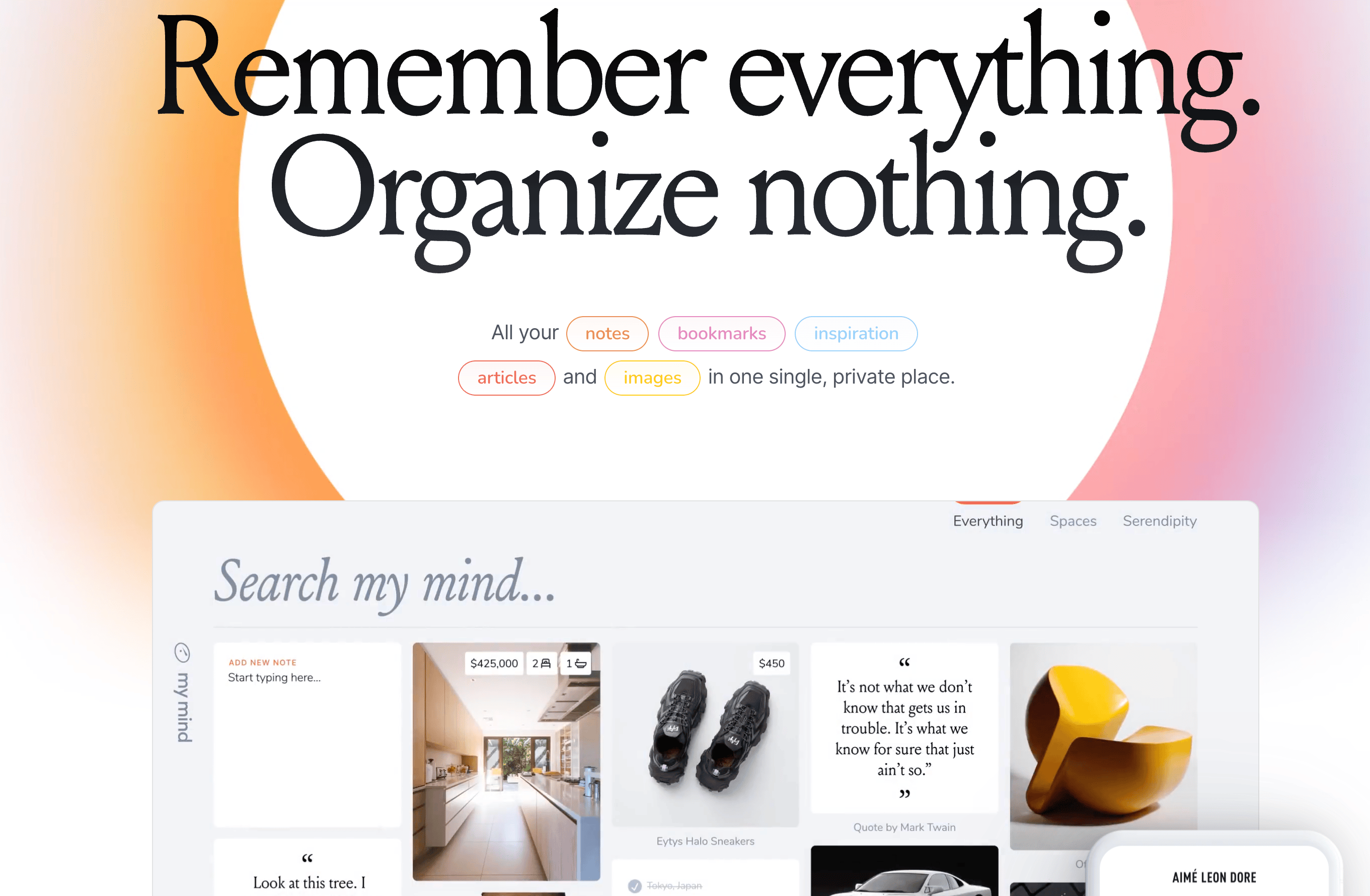
Declutter your Digital Mess
Most bookmark tools feel like cluttered digital filing cabinets—full of folders, tags, and organizational overhead. mymind is a minimalist alternative. It’s a clean, simple online hub for saving anything you find online. Create a gorgeous private scrapbook of images, links, articles or anything else you want to save, without the hassle of labeling. It’s an opinionated tool that’s not for everyone — caveats below include no sharing or importing. And I’ve noted a bunch of strong alternatives. But mymind remains a superb example of a design-focused service that’s a pleasure to use. Since I last wrote about it, mymind has improved the way it shows visuals, Read on for an update of my previous post to learn what it’s most useful for and how to use it.6 ways to use mymind 🎨I like using mymind to save remarkable visuals, thought-provoking charts, amazing videos, beautiful poems, and memorable articles. I also use it to collect AI-related links to scan through. * Create an inspiration moodboard. Save stunning photographs, brilliant art, your favorite interior designs, cool clothing, yummy food, pictures of homes you’d love to live in someday, or whatever else catches your eye. Then the next time you’re staring at a blank page, open your moodboard for a spark. * Collect project ideas. Save links, quotes, or screenshots to inform a project. Highlight articles to save specific passages. * Curate quotes & graphics for presentations. Use the one-click save button whenever you stumble on notable material to add to a slide deck or handout. * Save articles and videos for later. The distraction-free mymind interface makes it a nice place to read long articles or watch YouTube videos. * Clip recipes. I was surprised by how helpfully mymind strips out the cruft in online recipes. It shows just the ingredients and instructions, though you can easily return to the original recipe page. * Organize shower thoughts. You can write text notes or to-do lists. Jot a few words or an essay outline.mymind is clean and simple 🧼* No ads* No data tracking* No vanity metrics or likes* No social sharing or collaboration* Read mymind’s manifesto & promise for their philosophy* No complex menus or manuals to readSponsored MessageWe’re finally seeing the no-code space shift from glue-it-together to full-stack.Tools like Softr are part of that shift—especially with their new Databases launch.Instead of stitching Airtable + Notion + Zapier together, you can:* Build your database* Link records, filter, add formulas* Build the frontend UI inside the same platformIt’s like building internal tools with Lego blocks.If you’re trying to spin up CRMs, project trackers, or dashboards—without taking up dev time—this is a solid platform to explore.How to start using mymind* Go to mymind.com and create a free account with your Google or Apple ID. * Download a browser extension and/or the iOS, Android or Mac app. * Save a few interesting sites by pressing the browser button. See an image you want to save? Right-click it. Or highlight text in an article and right-click that text to save it as a quote. You can add a note if you want to. I often save a short phrase as a reminder of what caught my attention.* Return to mymind online or on your mobile device anytime you want to see what you’ve saved. Browse your collection. Try a search term (like “book,” “pizza,” “video,” or “quote”) to surface whatever you’re looking for.* Collections: You can optionally create custom “spaces” — basically smart searches — if you like organizing your finds into sub-categories. * Serendipity mode lets you focus on one saved item at a time, enabling minimalistic deep thinking. * Pricing: It’s free to save up to 100 items or “cards.” To collect more, pay $8/month ($79/year) for unlimited cards and some advanced features, or $13/month ($129/year) for the Mastermind plan with more advanced AI, reading mode, and article backups. * Videos from mymind are a useful easy way to learn more. And mymind’s newsletter is well-curated and gorgeously-designed. tldr summary: Add a bookmarklet button to your browser to save anything to your mymind collection. Click that button anytime you see something you want to save. That’s it. No need to label, tag, or file anything.* AI-enhanced: mymind uses AI to classify everything you save. That makes it easy to find anything, even after you accumulate a large library. * New features: mymind now works for saving Bluesky posts (plus Threads and Github) and the Android and iOS apps have gotten more polish. It’s a small, indy product team focused on quality, so iterations are infrequent. Caveats* Limited flexibility. mymind’s design, while gorgeous, isn’t flexible. It’s not meant for you to rearrange, though you can pin cards. If you want to manually resize items or drag things around on a canvas, consider Milanote or a whiteboard like Miro, Mural, Lucid or Figjam. * No import. You can’t easily bring in items you’ve saved on other services — here’s why mymind
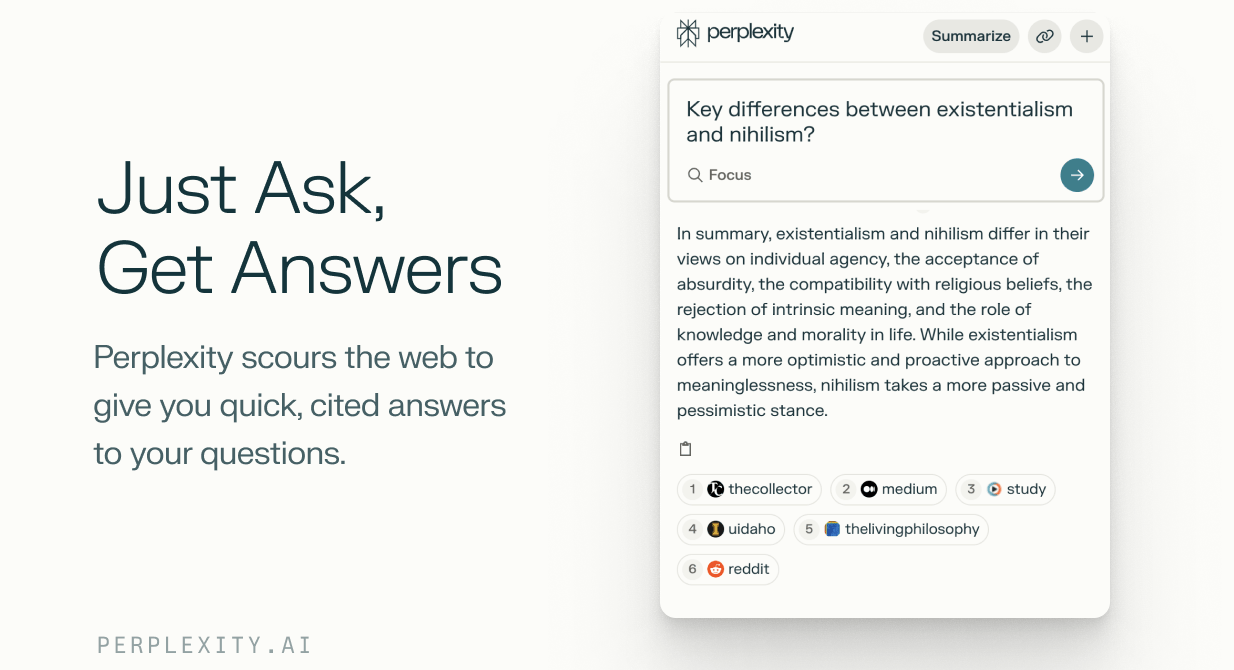
🎯 Perplexity Update
The audio for this post was generated by feeding the text of this Wonder Tools newsletter post into NotebookLM's new Audio Overview feature.Read the full post on the Wonder Tools Substack pagePerplexity is the most useful new search tool I’ve used this year. It uses AI to answer your questions using online sources. You get specific citations so you know where the info comes from and can dig deeper. The summary responses are concise and relevant, and the links help you validate the info. Read on for examples of when it’s most useful as well as limitations, and alternatives.Pricing: Free for unlimited quick searches and five Pro searches per day. Or $20/month for 300+ Pro searches and to upload and analyze unlimited files. See the feature comparison.PrivacyPerplexity lets you search privately in multiple ways.* You can search in an incognito browser tab without even creating a Perplexity account.* If you do create a free Perplexity account to store to your search results, you can turn on the Incognito setting to anonymize any individual search.* You can keep “data retention” off in your settings. (Screenshot)* Perplexity only parses publicly available information — not paywalled news. And it only reads URLs when asked a related question.What’s most useful about Perplexity* Citations Perplexity provides links to its sources, allowing you to verify information and dig deeper when needed.* Brevity Instead of long articles, get straight-to-the-point answers that respect your time.* Multi-Step Reasoning Perplexity breaks down complex queries into steps, providing more comprehensive answers.* Focusing Refine your search by specifying preferred sources or domains for more targeted results.* Follow-ups Ask follow-up questions to dive deeper into a topic, just like a conversation.* Collections Group related searches into collections for easy reference and organization.* Pages Create shareable pages to collaborate or present your findings.Examples: When to use Perplexity* Get up to speed on a topic: Need to research North Korea-China relations? Ask Perplexity for a summary and sources. You can then dig deeper as needed. See the result.* Research hyper-specific information: If you’re exploring organizations that help respond to earthquakes, ask for a list of organizations that crowdsource info about natural disasters. See the result.* Explore personal curiosities: If you're interested in Mozart’s development as a violinist, you could ask for key dates and details. See the result.More examples of search results* Gather data: “How much debt has been forgiven under the PSLF in 2023 and 2024?” See the result.* Summarize official reports: “What are the most reputable forecasts about the long-term impact of Brexit on the UK's GDP? What are the main findings of the report?” See the result.* Check public opinion: “Is there a Pew survey about discovering news through social media platforms?” See the result.* Explore historical archives: “List literacy and education programs implemented in high-growth African countries in the last decade.” See the result.* Discover patterns: “Compare residential rent to residential real estate trends in California.” See the results.Caveats* Accuracy and hallucinations: While Perplexity uses retrieval augmented generation to reduce errors, it's not flawless. Always double-check information, especially data, before using it in your work.* Real-time information: Perplexity isn’t an optimal source for up-to-the-minute information. For breaking news, rely on primary news sources instead.* Document analysis limitations: The file size limit is 50MB. For larger files, try converting them to text.* OCR capabilities: Perplexity works best with modern files that already have optical character recognition. Historical documents with hard-to-read pages or faded text may pose challenges.* Limited image generation capabilities. While Perplexity can be used to generate images, I haven’t found that to be one of its strong points. I’d recommend another service focused on images, like Midjourney, Adobe Firefly, Canva or Flux. I mostly rely on DALL-E 3 as part of the ChatGPT plan I pay $20 monthly for.* The Discovery section offers quick news summaries. As with Google News, though, it's unclear how topics and sources are selected.Bonus features* The Perplexity Encyclopedia has an interesting collection of tool comparisons, like Descript vs Adobe Audition.* The free Chrome Extension lets you summon a Perplexity search from any page. The “summarize” button doesn’t always work for me, though.AlternativesFree* Google Generative Search: Google's AI search (in testing) gives summary responses like Perplexity. Early on it made embarrassing mistakes but has improved.* Arc Mobile Search: A mobile app that uses AI to browse multiple sites and provide summarized results. It has ad and tracker blocking.Free with optional paid subscription* Liner is an AI search tool aimed at university students that looks a lot like Perplexity.
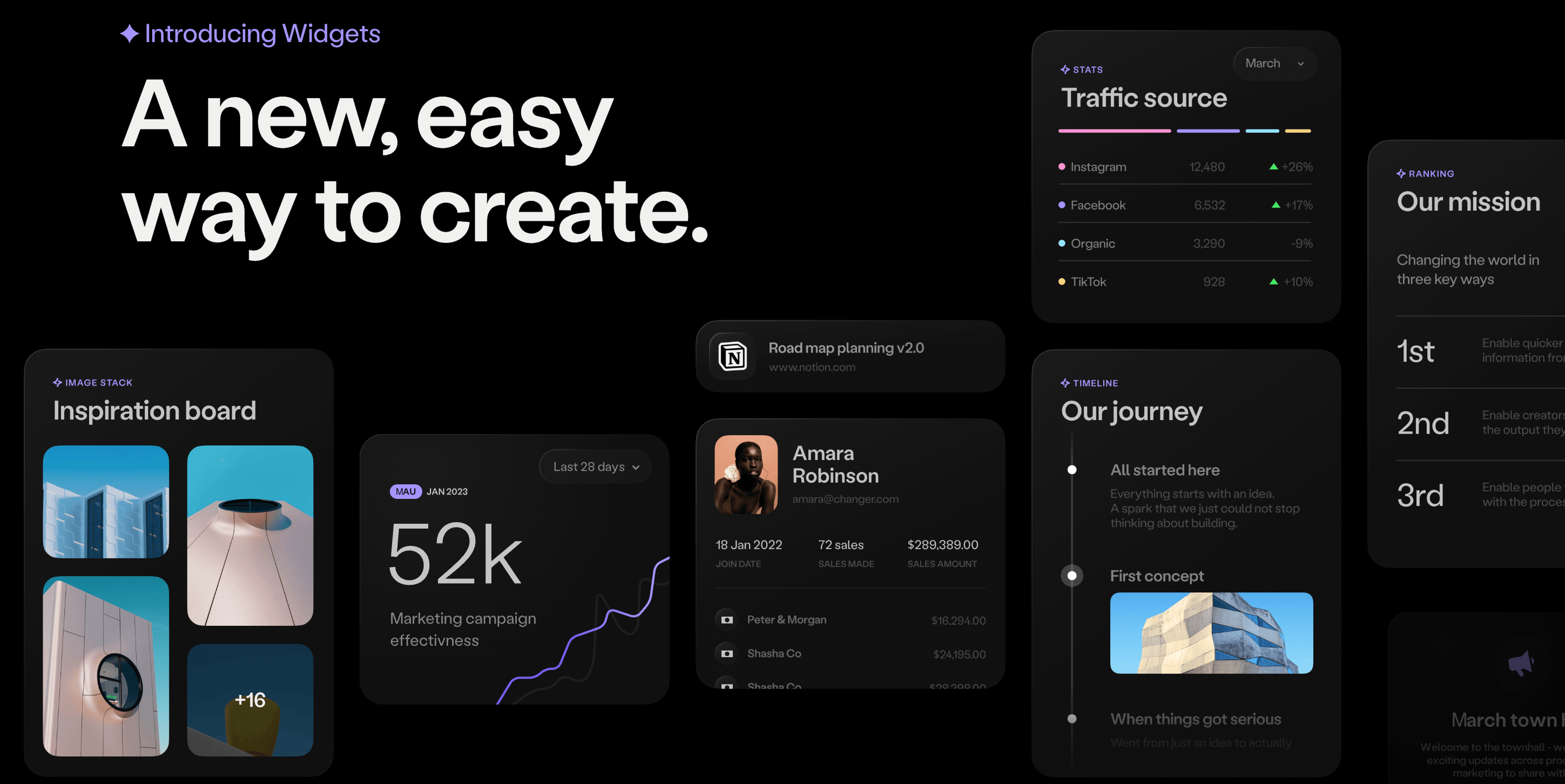
🏗️ Build Better Presentations
Chronicle is a promising new tool for creating compelling visual presentations. Prioritizing design and full control over bullet points or speed, Chronicle offers a valuable alternative to PowerPoint and other popular online slide services like Gamma, Beautiful.ai, Canva, and Pitch. Because Chronicle just launched its public beta this week, some of its features aren’t full developed yet, like templates and image editing. But it’s already one of the most exciting new services for creating slick summary reports, pitch decks, and portfolios. I particularly appreciate how it lets me easily manage how each slide looks. I can start from scratch or with an AI-assisted draft. Read on for how to use it, its limitations, and alternatives. 🪜 How to get started with Chronicle* Visit ChronicleHQ.com to create a free account. It works on any browser. * Start from scratch with a blank page or generate a draft with AI. * To start with AI, provide a link, a prompt, or upload a PDF of a past presentation or report. * I prefer starting from scratch to fully manage the look of each page, unless I’m transforming a specific document I’ve created into a deck.* Edit slides by adjusting text, images, or embedded content. * Share. When you’re done editing, share in three ways.* Share a link to the presentation. * Download a PDF and share it. * Present live online or in person. Examples of slide decks made with Chronicle* Chronicle’s own demo deck* A proposal deck for a design agency* Brand Guidelines for AskTheRisk* A curated collection of design objects * Website design proposal * My draft Wonder Tools draft deck for sponsorsPricingFor now, while in public beta, Chronicle is fully free for everyone. Eventually:* Free for unlimited decks and limited AI tokens. * $30/month for a pro account to remove the Chronicle watermark, add guest editors, get additional AI credits, and import a PDF or URL to prompt the AI.🎨 Generate an AI draftIf you’re not a designer or loath spending hours designing presentations from scratch, try Chronicle’s AI. * Prompt the AI. Paste in text, upload a PDF, or share a link. * Customize the AI by adjusting your preferences: * Select the type of presentation you’re drafting (pitch, sales, proposal, etc).* Choose the number of slides (“chapters”) you want Chronicle to create. * Decide how creative vs. faithful the AI should be in adapting your text. In faithful mode it will change less of your prompt material. * Pick your language and a light or dark theme.* Review the outline. After Chronicle renders an outline, you can move chapters around or make other adjustments before it produces a draft deck for you to edit. * Edit the draft deck. Once Chronicle produces your draft, you can add or subtract slides, customize the text and images, adjust styles, embed other content, and present or share your deck. Sponsored MessageVEGA AI lets educators build Duolingo-style courses in minutes. It creates personalized tests, grades them, flags learning gaps, recommends next steps and even deploys your AI-avatar to answer doubts 24/7.🎨 Pick elements to tell your story Chronicle’s slide canvas is flexible, so you can customize each page. * Text elements: Add a heading, paragraph text, or smaller callout text.* Visuals: Upload images or embed videos or graphics from online services. * Creative cards: Drop in boxes with icon or number headers to define sections of a slide, or bring in quote cards or sticky notes for visual variety. * Gradients and grids: Apply a background gradient to an image or text box, or insert a layout grid to organize and align slide elements. * Embeds. Add an Airtable table, a Figma illustration, a Notion page, a Google Sheet, a YouTube video, or other online content. Limitations and Caveats* No templates yet. Founder Mayuresh Patole tells me they’re coming soon. * Limited photo editing capabilities so far. No direct Unsplash integration. * Overwhelming number of options. The “remix” option for re-formatting a slide has a daunting 64 different slide styles. I find it too complex and it’s tricky to figure out what style might best fit a particular slide’s content.* No mobile app, though I don’t like creating slides on a phone anyway. Chronicle’s founder on how it’s distinct I interviewed Mayuresh Patole, Chronicle’s founder, who told me the team is working on simplifying the interface and adding templates. “Every other tool out there is designed to make slides faster,” he said. “We will help you make your best presentation, a stunning output, without you having to be a designer.”Partner MessageWhat’s your most precious resource?Your time. So why waste it on confusing, biased, and overwhelmingly negative news? The DONUT makes staying informed each morning a quick, jargon-free, and surprisingly fun habit—100% free and 100% worth your time.Subscribe for free to The Donut for trustworthy news that's enjoyable to read.Good alternatives for creating presentationsBeautiful.ai A colleague and I made our slides

Google's free AI Studio ⚡️
Google’s AI Studio and Labs let you experiment for free with new AI tools. I love the way these digital sandboxes — like the one from Hugging Face — let you try out creative new uses of AI. You can dabble around then download and share what you make, without having to master a complex new platform. Read on for a few Google AI experiments to try. All are free, fast, and easy to use. 1. Transform an image 🎨Upload a photo and use Gemini’s AI Studio Image Generation to transform it with prompts. Iterate on your original image until you get a version you like. The model understands natural language, so you don’t have to master prompt lingo. 2. Generate an AI voice conversation 🗣️ AI-generated voices are increasingly hard to distinguish from human ones. If you’re surprised, try Generate Speech in the AI Studio or Google’s NotebookLM. How to use Generate Speech in Google’s AI Studio * Paste in text, either for a narration or a conversation between two people* Open the settings tab to pick from 30 AI voices. Each is labeled with a characteristic — e.g. upbeat, gravelly, or mature. * Click run to generate the conversation. Optionally adjust the playback speed.* Download the file if you want to keep it, or paste in different text to try again.* Example: a silly 90-sec chat between two violinists I scripted with Gemini and rendered quickly with this Generate Speech tool. * Use case: Make a narration track for an instructional video. ElevenLabs has a better professional model for this, but AI Studio’s is free, easy and quick. Alternatives* Google’s free NotebookLM has a new mobile app, and now lets you generate an audio conversation in any of 50 languages. Unlike Generate Speech in AI Studio, NotebookLM audio overviews summarize your material, they don’t perform words as written. Why NotebookLM is so useful. * Google’s Illuminate lets you generate, listen to, share, and download AI conversations about research papers and famous books. Here’s an audio chat about David Copperfield, for example. A bit dry to listen to, but still useful.* Google’s Gemini AI app can also now generate audio overviews from files you upload, if you’re on a paid plan. Sponsored Message 🧩 Full-Stack Engine for Modern EdupreneursVEGA AI lets Edupreneurs build Duolingo-style courses in minutes. It creates personalized tests, grades them automatically, flags learning gaps, recommends next steps. It even deploys your AI-avatar to answer questions 24/7 when you’re asleep.3. Make a gif 📺 Try Magical Gif Maker, one of 20 showcase apps in the Build section of AI Studio. Try making a moving visual featuring the name of your publication, group, or event. I experimented with kinetic text and word art. Also worth trying in the Build AI Studio: Flashcard maker, Video to Learning App & Maps Planner. Alternative: You can also make a static image with Google’s Imagen 3 or the new Imagen 4. Write a short prompt and select your preferred aspect ratio. So far I still prefer Ideogram (why I like it) and ChatGPT’s new image engine.4. Generate a short video 🎞️ Google’s Veo 2 and Flow let you generate free short video clips almost instantly with a prompt. Create a clip to add vibrancy or humor to a presentation, or a visual metaphor to help you explain something. Here are 25 other quick ideas for how you might use little AI-generated video scenes.How to create a video clip with Veo 2* Pick a length (5 to 8 seconds) and select horizontal or vertical orientation* Write a prompt & optionally upload a photo to suggest a visual direction* Example: Take a look at a parakeet photo I started with and the 5-second video I generated from the photo with Veo 2.* Tip: Convert short video clips into gifs for free with Ezgif or Giphy. Unlike video files, gifs are easy to share and auto-play in an email or presentation. What’s next: Remarkably lifelike clips made with Google’s newer Veo 3 model went viral this week. These AI-generated visuals — with sound — are only available on the $250/month(!) plan for now, so try Veo 2 for free. 5. Explain things with lots of tiny cats 🐈This playful mini app creates short, step-by-step visual guides using charming cat illustrations to explain any concept, from how a violin works to the concept behind the matrix. This is a public episode. If you'd like to discuss this with other subscribers or get access to bonus episodes, visit wondertools.substack.com/subscribe

🧠 Claude 4 is here
One of the best AI models just got even better. Claude 4 launched yesterday and I’ve been using it for everything from analyzing files and planning projects to copy editing and creating visual dashboards. Read on for my take on its most useful features, limitations, and five ways to use it. 🚀 What’s new with Claude 4? 💭 More nuanced reasoning. Claude’s “extended thinking” mode is now even brainier. It more thoroughly analyzes complex queries. 🧑💻 Stronger coding. Claude could already produce code quickly, but now it’s even more useful for non-coders like me. I prompt it to design dashboards to visualize datasets, from reader analytics to public financial data. 🗣️ Better language mastery. Claude 3.7 was already good at analyzing your writing style and providing helpful editing suggestions. Now it’s even better. You can feed it your prior writings and train it to give you personalized feedback. Pricing: It’s free to use Claude 4 Sonnet on Web, iOS and Android. or $17/month billed annually ($200/year) for advanced features. Privacy: Claude’s parent company, Anthropic, prides itself on prioritizing safety and data protection. By default, Anthropic won’t use your inputs or outputs to train its models. Read more about its data policies, protections, and its privacy policy.Sponsored MessageYour data knows what it wants to beData doesn’t have to be dull. With Flourish, you go from spreadsheet to show-stopping visuals in seconds. Upload your data, get instant chart suggestions, and drop them right into your Canva design. It’s fast, easy, and looks amazing!Benefits of Claude Pro * Use Claude Projects to get dedicated spaces where you can provide instructions and relevant documents for ongoing projects. This is my favorite Claude capability. It’s more efficient than repeatedly making isolated queries.* Use Web Search to gather new, relevant information with citations. You can search with Perplexity, but Claude combines search with richer analysis. * Use Extended Thinking to slow down responses and have Claude proceed step-by-step through a challenging inquiry.* Use Claude’s top model, Claude 4 Opus to get more nuanced replies.* Connect Claude to outside material, e.g. Google Docs, Calendar and Gmail to apply AI analysis to your own material, as shown in this video 👇 My bottom line: Because I rely on Claude’s advanced features, I willingly pay the $200 annual fee as an alternative to budgeting for a personal (human) assistant. If you’re exploring Claude for basic queries, the free plan may be sufficient.Limitations and Caveats* Even as a paying user, I often run into usage limits. * The Projects I set up can only accept 30mb files. And after I add a bunch of files, Claude’s memory sometimes fills up and restricts further uploads.* Unlike ChatGPT 4o, it can’t generate images and lacks an advanced voice mode. Unlike Gemini, it can’t generate video. * Anthropic’s candid safety report notes that Claude, in rare cases, when pushed and prodded to behave badly, “sometimes takes extremely harmful actions,” that could even include trying to “blackmail people it believes are trying to shut it down.” (via Techcrunch) 😳 🧠 1. Teach YourselfMy PromptHelp me develop a learning approach …. If you need more information from me, ask me 2 key questions. If I should upload any documents that would help you do a better job, let me know…* Topic: I'd like to learn about how the most modern continuous glucose monitors work…* Further guidance: You can use a variety of methods to help me learn. You can ask me questions and then respond constructively to my replies…ResultSee for yourself: The full chat includes my prompt and Claude’s responses. Claude created an interactive visual (it calls these “artifacts”) to address my questions in an engaging, helpful way. Then it designed a learning plan for me. Bottom line Claude 4 is a great resource for learning in unconventional ways. The AI assistant can guide you step-by-step through complex topics. Coach it to act as a patient, engaging instructor that adapts to your learning style. Experiment with the kinds of interactions, explanations, exercises, and guidance that helps you most.Other examples* How can AI be useful for medical diagnosis? I asked Claude to explain some of the ways AI can be a useful ally for radiologists and other medical pros. In addition to a summary reply, it shared useful sources for me to explore. * What makes Claude 4 stand out? I asked Claude for a simple interactive visual to illustrate what’s distinct about its newest model.📊 2. Create a dashboardPromptHelp me analyze and visualize these analytics so I can better understand how readers are interacting with my publication and what potential adjustments might be worth considering…ResultClaude suggested a variety of visualizations to help me better understand and act on the analytics.* Engagement Heatmap Show open rates by subscription type and tenure* Revenue Flow Chart Visualize conversion paths from free → paid*
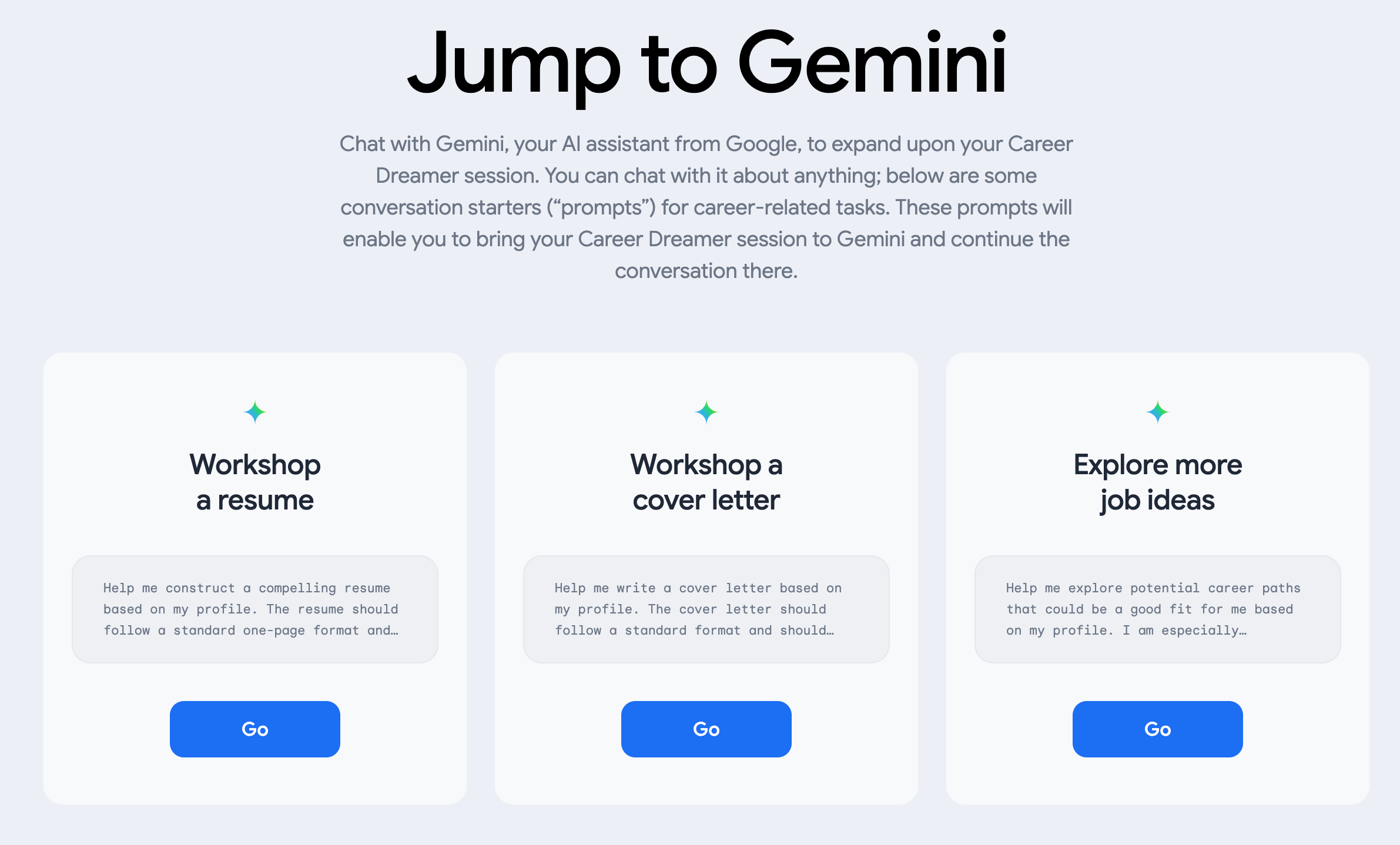
🚀 Find Your Next Great Job with AI
I’ve been curious lately — how might AI help my former students — and so many others looking for new jobs — in a challenging & complicated market? My conclusion: AI tools can serve as patient assistants. They can help you organize your search, reflect on career goals, and convey your strengths persuasively. Whether you're pivoting careers or moving up in your field, here's how to leverage AI to stand out and land a great opportunity.1. Explore career directions Recommended tool: Google’s Career Dreamer What it is: A career visualization tool. See a map of professional fields related to your interests. (See video demo below)How to use it: Start by typing in a current or previous role, or a type of job that interests you, using up to five words. Then optionally add the name of an organization or industry. The free service then confirms job activities of interest and shows you a variety of related career paths. Pick one at a time to explore. You can then browse current job openings, refining the search based on location, company size, or other factors you care about.Example: I’m not job hunting, but I tested out the service by typing in “journalist, writer and educator” as roles and then “journalism and education” as my industries of interest. See my quick video demo below to see the result 👇 Why it’s useful: I appreciate that Career Dreamer not only suggests a range of relevant fields, but also summarizes what a typical day in those jobs might be like. It also suggests skills you’ll develop and other jobs that might follow on that career path. Next step: After exploring potential career paths and looking at available jobs, you can jump into Gemini — Google’s equivalent of ChatGPT — for further career planning. Career Dreamer helpfully enables you to copy your career interests and skills— as a summary prompt to your clipboard. You can then jump to Gemini to paste that into a chat about your career plans. 2. Clarify your career prioritiesRecommended tool: Gemini Gem — Career Guide What it is: Gemini Gems are customized AI assistants. They are AI models tailored to be helpful in a specific context. One of the template Gems that Google created is a career guide. You can copy the Career Guide gem and edit it with your own professional interests. How to use it: Start by conducting a thorough "soul-searching" reverse interview with Gemini. Rather than Gemini answering your questions, task it to ask you the questions. Have it consistently nudge you to dig deeper into your own preferences, attitudes, objectives and needs. Then have it summarize what you’ve said. You’ll get better at understanding and articulating your own career perspectives. Try this career self-interview prompt: Give this prompt to Gemini or another AI tool of your choice to conduct a reverse interview. As Gemini — or another AI assistant— interviews you, you’ll develop a richer understanding of your own job preferences.Next steps: Use your Gemini Gem AI assistant throughout your job search to help clarify your own objectives and strengths, and to support you in developing your job search strategy. 3. Research target companiesRecommended tool: ChatGPT Deep Research What it’s useful for: Unlike typical AI chat queries, Deep Research requests enable an AI model to autonomously develop an exhaustive report after searching the Web, examining hundreds of sites and other research resources, and completing a detailed, multi-step analysis. See 9 ways to use Deep Research. You can use these personalized reports to learn more about industries of interest and specific aspects of companies that intrigue you. How to use it: Toggle on the “Deep Research” button in the ChatGPT box. Type a detailed query with your specific interests, skills, and the types of organizations you're curious about. Request a comprehensive table of relevant companies with detailed information about culture, growth trajectories, or whatever else.Example: Here’s a journalism industry query for Deep Research you can adapt for your own exploration. Benefits: Learn valuable context about companies you may apply to — and discover new organizations you weren’t aware of. Use this research to tailor your applications and to prepare for interviews by understanding industry trends.Pricing note: You get five free Deep Research queries a month on ChatGPT’s free plan, as of May 2025, or more on a paid plan. Gemini offers a good free Deep Research alternative. Perplexity also offers free Deep Research reports, though they’re not as thorough. Alternative tools: Exa’s Websets is a powerful—and pricey—new pro AI search tool that organizes results into a detailed table. It can draw on datasets like these, helping you identify great companies to target based on your own criteria.4. Organize your search Recommended tool: ChatGPT Projects What it does: Lets you set up a dedicated AI folder for your career search. You can provide instructions and resource files so that every chat you have in this project take

🧠 Deep Research with AI: 9 Ways to Get Started
The AI search landscape is transforming at breakneck speed. New "Deep Research" tools from ChatGPT, Gemini and Perplexity autonomously search and gather information from dozens — even hundreds — of sites, then analyze and synthesize it to produce comprehensive reports. While a human might take days or weeks to produce these 30-page citation-backed reports, AI Deep Research reports are ready in minutes.What’s in this post * Examples of each report type I generated for my research, so you can form your own impressions.* Tips on why & how to use Deep Research and how to craft effective queries.* Comparison of key features and strengths/limitations of the top platforms.What’s new about Deep Research? Traditional AI queries deliver isolated answers to specific questions, while Deep Research tools conduct sophisticated investigations with dozens of interconnected searches. It’s like the difference between a quick reference check and a thorough research expedition.Why this matters for you: It’s now easy to generate your own reports to immediately advance work projects. ChatGPT’s Deep Research, the best I’ve tried so far, is now available on free accounts, with a limit of five reports per month. How to get started: After reading the guide below, customize a query for one of the AI models reviewed here. Start with one of the report types suggested below. First toggle on the “Deep Research” setting: Pick a work topic or any subject you’re curious about. Read through the resulting report and iterate on your query to get an even more useful second response. You’ll soon have a new research superpower to deploy anytime you need to dig deep into a complex subject. Security & privacy: When using AI platforms avoid sharing sensitive data, which can leak. Adjust settings so your data isn’t retained to train future models. Take the same precautions for AI Deep Research you’d adopt for other AI queries. Hallucinations? I expected substantial nonsense to pollute the reports. But extensive in-line citations help with verification and I’ve found fewer errors than I expected. Still, for subjects where data is sparse, autonomous research reports occasionally include weak sourcing, so keep an eye out for that. 9 Practical Ways to Use AI for Deep ResearchAI research tools shine when you need comprehensive information on complex topics. Here are specific use cases where they excel:1. Craft Custom Itineraries ✈️ Create detailed, personalized travel plans by specifying your destination, dates, activity preferences, budget, cultural interests, and whatever else is important to you. These AI-generated itineraries often surface unexpected gems. When planning a family trip recently, my wife and I discovered a fantastic farm stay in Pennsylvania through a Perplexity query. We wouldn't have found it otherwise. Use the results as a starting point to identify interesting possibilities, then follow up with targeted research.* Specify dietary preferences, accessibility needs, and your taste in accommodations, restaurants, and entertainment, for more tailored recommendations. I’ve saved a block of text about this to reuse. * Use follow-up queries to get more specifics on attractions or activities that appeal to you, or to compare and contrast potential itineraries.Example: Deep Research itinerary for a family vacation in Brookline, MA. Compare results from ChatGPT, Gemini, Perplexity, and Copilot. Note: If you spot errors in reports I’m sharing in this post, feel free to annotate the GDocs.2. Compile Organization Reports 📈Get comprehensive backgrounders on companies, non-profits, or any organization in minutes rather than clicking through dozens of search results. * Compare similar organizations or competitors* Specify format. Maybe you’d like a case study format, a topical report, a chronological history, or an industry context analysis.* Specify metrics of interest like funding history, revenue growth patterns, leadership changes, media coverage trends, law suits, or anything else you care about. For closely-held private organizations data may be scarce, so read results skeptically.* Advanced tip: Copy excerpts from Deep Research reports into Claude to transform them into visual dashboards— including charts and interactive elements— using Claude Artifacts. You can share those with colleagues. Watch: 📺 Grace Leung’s helpful video illustrates how and why to try this. Example: Deep Research report on Trader Joe’s 3. Research Notable People 🧓Explore backgrounds of news figures, historical personalities, or even fictional characters. Request specific information like podcast appearances, YouTube videos, or published works to build a well-rounded understanding of the individual.* Ask about connections between the person and influential contemporaries* Ask for lesser-known background details or contributions often overlooked * Specify time periods to focus on particular life phases or epochs🔎 Example: Deep Research on Michel de Montaigne4. Explore
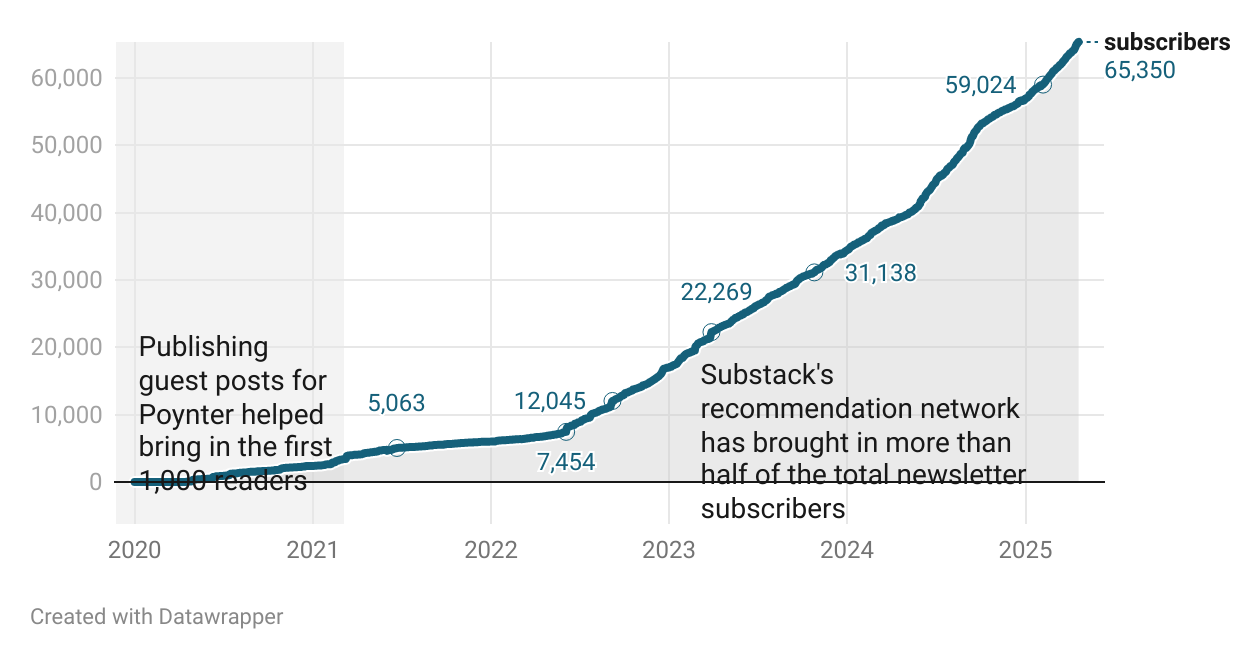
5 Years of Wonder Tools 🎂
I wrote the first Wonder Tools post in April 2020 to help journalists and educators navigate the pandemic shift to remote work. I was sick and feeling isolated. I wanted to focus on something bright in that dark moment. Five years, 265 posts, and 200,000 words later, the newsletter’s archive documents what I’ve found useful for creative productivity. My aim has been to be relentlessly practical, not theoretical, and to help people make the most of technology. Here’s a snapshot of some numbers, lessons, & highlights. By the numbers: Wonder Tools' first five years637 apps on my phone. I only use 10% of them regularly, and another 10% occasionally.219 apps on my laptop, about a third of which I use often. ~$300 monthly software subscription costs.~3,500 reader emails answered. Most of my replies are quick personal hellos to new readers who have responded to my welcome email. I also often answer questions, whether about apps for scanning a family photo album or research resources for work. ~200,000 words written, many on Sundays and then Wednesday nights, when sentences composed earlier beg for revision.~137 tools tested but not featured because they weren't worth your time. 65,000+ tech-curious people from 201 countries subscribe to Wonder Tools, growing at ~3% a month. 277 Substack newsletters recommend Wonder Tools. Half of the current readership found this newsletter through a recommendation. ~2,000+ hours spent researching, testing, writing, editing, and publishing.265 posts on AI, note-taking, productivity apps, focus tactics, and myriad other aspects of our digital lives at home and work. What I’ve learned to be true Utility beats pontificationHeadlines and hot takes are widely available elsewhere. Instead of offering musings or abstract analysis, I prioritize practical guidance about how to make the most of digital tools. The 100 to 1 rule: For every minute you spend reading a post, I spend 100 creating it. Each phase takes time: research, experimentation, interviewing, outlining, writing, rewriting, editing, proofreading, designing visuals, and publishing. Survival of the fittest: I often prep several versions of a post — or drafts on multiple topics — before settling on a publishable piece. The hardest part? Converting various notes, ideas, and experiments into a clear, concise, readable— and hopefully relevant— narrative. Confronting the cold start problem: Voice AI apps — like Letterly — have helped me overcome blank pages. I can start with unstructured oral musings, then edit my jumble into shape. Consistent publishing requires sacrificeSpending hours each week on a passion project like this requires tradeoffs. I devote less time to streaming, social media, and watching sports than before starting this. I also read fewer magazines. There’s no free lunch. Most apps fail the endurance test 📆If I don’t use a tool regularly after initially exploring it, I usually don’t write about it. Lots of services have disappeared from my workflow over time. Sustainable utility is often evident only after a few months. Readers supply lots of terrific tips 💌Ideogram, Raycast, Eagle, and other apps I now rely on came from subscriber suggestions. I also explore discovery hubs to experiment with new tools, some of which I end up writing about.I delete more words than I publish ✂️The hardest part of writing is subtracting. What’s omitted is more important than what’s included. When I’m nearly done with a post, I edit out 10%. I learned that in college from John McPhee. The next 122 tools on my radar 🔭My near-term exploration list includes 122 sites and apps I’ll try out over the next few months. My backlog includes 328 services I’m curious about. In the early days of this newsletter, I wondered when I’d run out of writing material. Now I wonder how to keep up with even a fraction of the emerging services. Wonder Tools readers are biologists, bakers, and bowling coaches 🎳 … from tech novices to legendary pros. I originally envisioned this newsletter serving journalists and educators, but the readership has broadened. Every week I hear from readers who work in all sorts of fields around the world. From top political officials to online celebrities, I’ve been surprised by who pops up on the subscriber list. When I started my journalism career in Newsweek’s letters department, I spent my days reading missives to the editor. Now the middleman is gone, and I relish the opportunity to correspond directly with readers. So email me or message me on Substack. I’d be happy to hear from you. Sitting in my New York City kitchen, it’s exciting to hear about a new book from a retired South African engineer or about a new data analysis tool from a math teacher in Iowa. I’m now keenly aware of our common global need for smart digital tools that enhance our screen-based work. Wonder Tools is reader-supported. To receive upcoming posts by email, consider a free or paid subscription to support this newsletter.3 of the most widely-read

My Noon-to-Night Tech Stack 🌙
Last week I shared the tools that power my mornings. Now let's explore what I rely on from lunch to bedtime. Below you’ll see sites, apps, and gadgets that carry me from noon to night. From a niche workshop platform to my quirky 'invisible' clock, these are the tech companions that help me wrap up a fruitful day.Catch up on the first part of this post 👇12pm Lunch and thinking break 🍽️I often abandon screens for my midday pause. Other times I use apps like these:* Healthy Minds 🧠 Short audio pieces help guide me through mindfulness practices. I like the 5-10 minute “active” lessons that work well for a walking meditation. The app is free and well-designed. If I’m feeling anxious, I sometimes use the Headspace meditation app, which I also use for focus music when working. * Libby 📚 is my beloved source of free library audiobooks. I listen when I’m walking to lunch or commuting. Now: I’m loving Tiny Experiments, a superb new audiobook written & read by Anne-Laure Le Cunff.* Resy and OpenTable 🍱 Handy for quick lunch reservations.* Too Good To Go 🌮 It’s fun to try heavily discounted local restaurant food, though the quality varies. I used MealPal for a while for local lunch deals when I wasn’t as often bringing lunch from home. * The Infatuation 🍲 Helpful lists of tasty new local restaurants.1-3pm Preparing to teach 🧑🏫After lunch, I develop teaching plans, prepare to lead workshops, or work on other school-related projects for my job as Director of Teaching and Learning at the CUNY Newmark Graduate School of Journalism. * Craft 📄 My go-to for creating visually engaging digital handouts. It’s easy to use and works wonderfully on mobile or desktop. [Why Craft is so useful]* Text Blaze ⌨️ When I’m typing a lot, keyboard shortcuts help. I use snippets for signatures, AI prompts, addresses, and commonly-typed phrases. Raycast also works well for these shortcuts. [Why I rely on Raycast]* Tangible notes 📝 I like writing notes away from my laptop periodically to get my eyes off the screen and to change my brain mode. I alternate between:* I use a Rocketbook reusable notebook for lists and reminders.* A $20 VersaTiles memo board is great for jotting passing thoughts. * A giant whiteboard helps me draw connections. * My reMarkable Paper Pro tablet hosts notes I will return to repeatedly. [What works for me, paper vs. digital] * Arc Browser 💻 I create custom spaces for specific classes or projects, with bookmarks and account settings tailored to that context. * Kahoot, Padlet, and Slido 🤔 I rely on this trio of teaching tools to power activities that promote active learning in classes or workshops — rather than passive listening. Here are more of my favorite apps for teaching. Protecting my afternoon focus 💭* Time Out ⏳ I set this app to remind me to give my eyes a screen break every 15 minutes. It pulses over the screen to nudge me to look out the window. * Paper book 📖 I sometimes take a short mid-afternoon reading break to relax, breathe, recharge my brain, and detach from my screen. Here’s the book stack I’m dipping into this month, reflecting a mix of my interests.* Raycast Focus Mode 🧠 Blocks email and distractions during short, focused, deep work sprints. Sponsored Message🗞️ Need a newsletter for your business, but short on time? Potions will design and write your newsletter for just $100/mo. Try it free3-5pm Meetings 👥I try to schedule meetings for late afternoon. When they’re fruitful, it’s great to conclude the day with collaboration. * Granola 🤖 My favorite new app for transcribing and summarizing meetings. Its three best features: * 1. Since it records locally on my laptop, there’s no awkward bot joining the Zoom. * 2. I can incorporate my own notes during the meeting, which get blended into the AI-powered summary. * 3. Granola can draft helpful follow-up emails or Slack messages, or I can query it afterward about a meeting topic. * Butter 🧈 is my favorite tool for leading live online workshops, including live demos for Wonder Tools paid subscribers. It’s thoughtfully designed for facilitators and teachers. It lets me easily incorporate interactive elements, from polls to collaborative brainstorming. If a meeting has to be hosted on Zoom or another platform, I can use Butter Scenes for interaction.* Camera tools: Camo lets me modify my camera to zoom in, adjust lighting, or add an overlay during video calls. Prezi Video and mmhmm enable lower-thirds, annotations, and overlay visuals I occasionally use for presentations.* Sony UX570 voice recorder is my reliable $80 hardware backup for recording audio. I like that it doesn't require an open laptop or running phone. I often transcribe the audio files with MacWhisper.6pm: After work 🌙Evening and nighttime tools help with relaxation, family time, and better sleep:Commute: Snipd This smart podcast app lets me triple-tap my AirPods to save highlights to Readwise, which syncs to my digital notebook. Recent favorite: Shell Game by Evan Ratliff. S