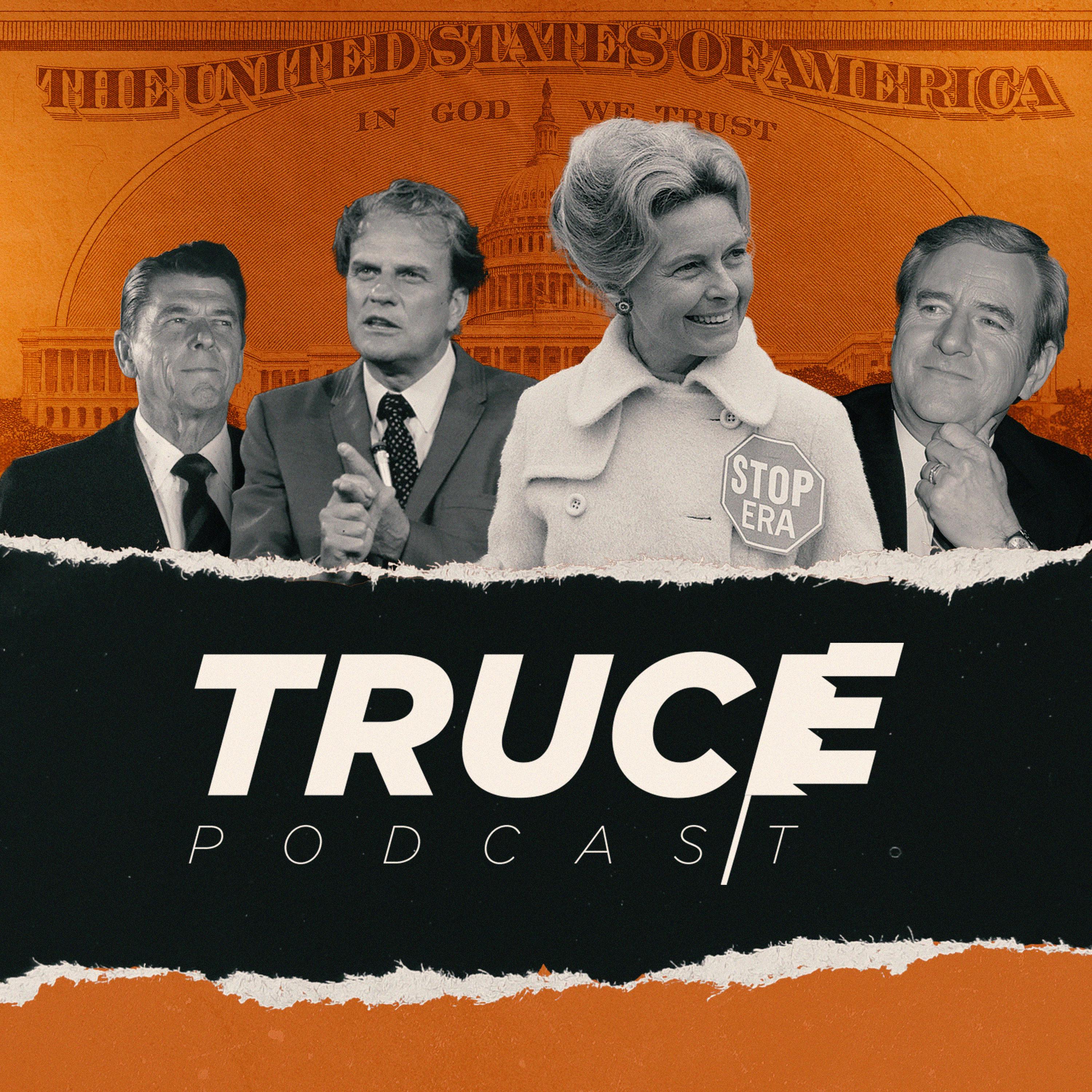
Truce - History of the Christian Church
225 episodes — Page 3 of 5
S5 Ep 11D.L. Moody | Christian Fundamentalism Series
DL Moody. The name may be familiar. There is a Moody Publishers, a Moody Bible Institute, Moody Radio. His name is all over evangelicalism. His remarkable life story is something worth noting. Though Moody was not a fundamentalist, some of the tactics he used to build his ministry would be employed by some of his lieutenants when they built the foundation of the movement. So we're going to spend this episode talking about this remarkable man. Born in poverty, educated to only about a 4th-grade level, he would rise to become one of the most important American evangelists. His folksy style and booming voice were winsome to the millions of people to whom he preached. In this difficult series about controversial ideas, why not take some time to discuss something that went right in the late 1800s? The ministry of Moody. I'm joined in this episode by Kevin Belmonte. He's the author of several history books including D.L. Moody: A Life. Check out his books and let me know what you think! Helpful Links and Sources Kevin Belmonte's book D.L. Moody: A Life The Evangelicals by Frances Fitzgerald A nice bio on Harry Moorhouse See the plaque where Moody was converted Discussion Questions Have you ever shared the gospel with someone like Mr. Kimball did in the shoe store? Why or why not? Is there someone you could pray for that they would be saved? Why do you think Moody was so popular in his day? Have you ever encountered Moody Radio, Publishers, or Bible Institute? The “Christian bubble” really started to take shape in the era of Moody. How has the “bubble” impacted your life? What are your views on poverty? How do people become poor and how can it be fixed? Do you think that all poor people are lazy? Why? Learn more about your ad choices. Visit podcastchoices.com/adchoices
S5 Ep 10Social Darwinism and the Spanish-American War | Christian Fundamentalism Series
The 1800s were an era of big questions, many of which we answered in cruel and selfish ways. Is one race better than another? Is one religion? If so, which one? In what ways? Is one economic system better than another? Is one system of governance like a democratic republic like the US, or socialist, or monarchy, theocracy, communism, best? Some people answered these questions with a resounding "yes". But if we think our people and ways are better than anyone else's, what responsibility do we have to spread those things? Men like Henry Cabot Lodge and Theodore Roosevelt were firm believers in social Darwinism, though their vision of it meant teaching those less "civilized" people our ways. And they were okay with the United States taking power over them. Meanwhile, there were men like William Jennings Bryan who refused to think of others in social Darwinism terms. He spent years fighting that dark philosophy, ultimately prosecuting the Scopes Monkey trial to stop the spread of social Darwinism. But the seeds of eugenics were planted. Caught in the middle were the people of Cuba, Puerto Rico, the Phillippines, and other colonies of the Spanish empire. Spain was busy imprisoning Cubans in concentration camps. Their ruthless behavior toward America's neighbors caught the attention of the US Senate, which was already champing at the bit for a fight. Men in the United States were worried about their waning influence on society. Groups bellyached about how men were not men anymore thanks to cities and offices. In the minds of some, war was the answer to weak-willed men. And Spain provided that war. Our guest today is Paul T. McCartney author of “Power and Progress: American National Identity, the War of 1898, and the Rise of American Imperialism”. He teaches at Towson University. **CORRECTION - In the original version of this story I referred to the USS Maine as the HMS Maine. That was incorrect. HMS stands for "Her Majesty's Ship", which makes no sense for American ships. The current version was changed for accuracy.** Discussion Questions: Do you believe your people are somehow superior to another people group? Why? Does that sound like an attitude Jesus would have? If you are somehow superior, what is your responsibility to other people? Should the US help people who are being oppressed around the world? When should we intervene? Do you think that men are in decline? If so, what is the answer to that? Do you better relate to Teddy Roosevelt or William Jennings Bryan when it comes to war? Or are you a pacifist? How would Jesus have responded to the cruelty of Spain? What do you think about social Darwinism? Helpful Links and Sources: "The Evangelicals" by Frances Fitzgerald "Church History in Plain Language" by Bruce Shelley "The War Lovers" by Evan Thomas "Power and Progress" by Paul T. McCartney "The Origin of Species" by Charles Darwin Britannica article on Darwin's Beagle voyage Britannica article about Darwin's London years and natural selection Bio of Henry Cabot Lodge Article abouhttp://nationalhumanitiescenter.org/pds/gilded/empire/text7/tillman.pdft Alfred Thayer Mahan Proctor's Speech Tillman's Speech Bryan's Speech "A Godly Hero" by Michael Kazin Learn more about your ad choices. Visit podcastchoices.com/adchoices
S5 Ep 9Populism | Christian Fundamentalism Series
Give to help Truce. www,trucepodcast.com/donate Populism is a tricky subject. We use it these days as a slur, but populism can be a useful phenomenon. History professor and author Michael Kazin says that populism is an important tool when it comes to regulating power. In the late 1800s, railroads and banks were out of control. Industrialists like John D. Rockefeller had uninhibited control of their markets. Rockefeller believed in social Darwinism and didn't mind using dirty tactics to undermine his competition. The Populist Party sprouted out of frustrations women had with the political machines of their day. Republicans and Democrats were not yet willing to accept women and the issues they cared about. Women were slowly becoming a force within politics, but neither party had the guts to accept them. So women and others decided to form their own party. But in the election of 1896, the Populist Party was worried about a split vote. They worried that if they were to run a candidate of their own then they might split the vote. So the Populist Party backed Democratic nominee William Jennings Bryan. Bryan was a man of God. He quoted the Bible extensively, talked about the example of Jesus. But he was soundly defeated by the Republicans and William McKinley. He had only about 4% of the budget of his opponents. The story of Bryan is an interesting one because it contains the building blocks of fundamentalism. Discussion Questions: What is a populist? Can you name some populists? What are the advantages of populism? The drawbacks? How are Donald Trump, Elizabeth Warren, and Bernie Sanders similar? William Jennings Bryan was one of the first presidential hopefuls from a major party to tour the country. How has this shaped American politics? Why do we like to see politicians in our home states? What do populism and fundamentalism have in common? Do you think that fundamentalism relies on strong figures as populism does? Why or why not? Helpful Resources: "A Godly Hero" and "What It Took to Win" by Michael Kazin Library of Congress collection of Chautauqua materials Bernie Sanders Clip from C-SPAN Elizabeth Warren Clip from C-SPAN Donald Trump clip from C-SPAN Article about Mary Lease "These Truths" by Jill Lepore Library of Congress collection of McKinley/Bryan campaign materials. It's worth searching the site in general for images from both of them. Learn more about your ad choices. Visit podcastchoices.com/adchoices
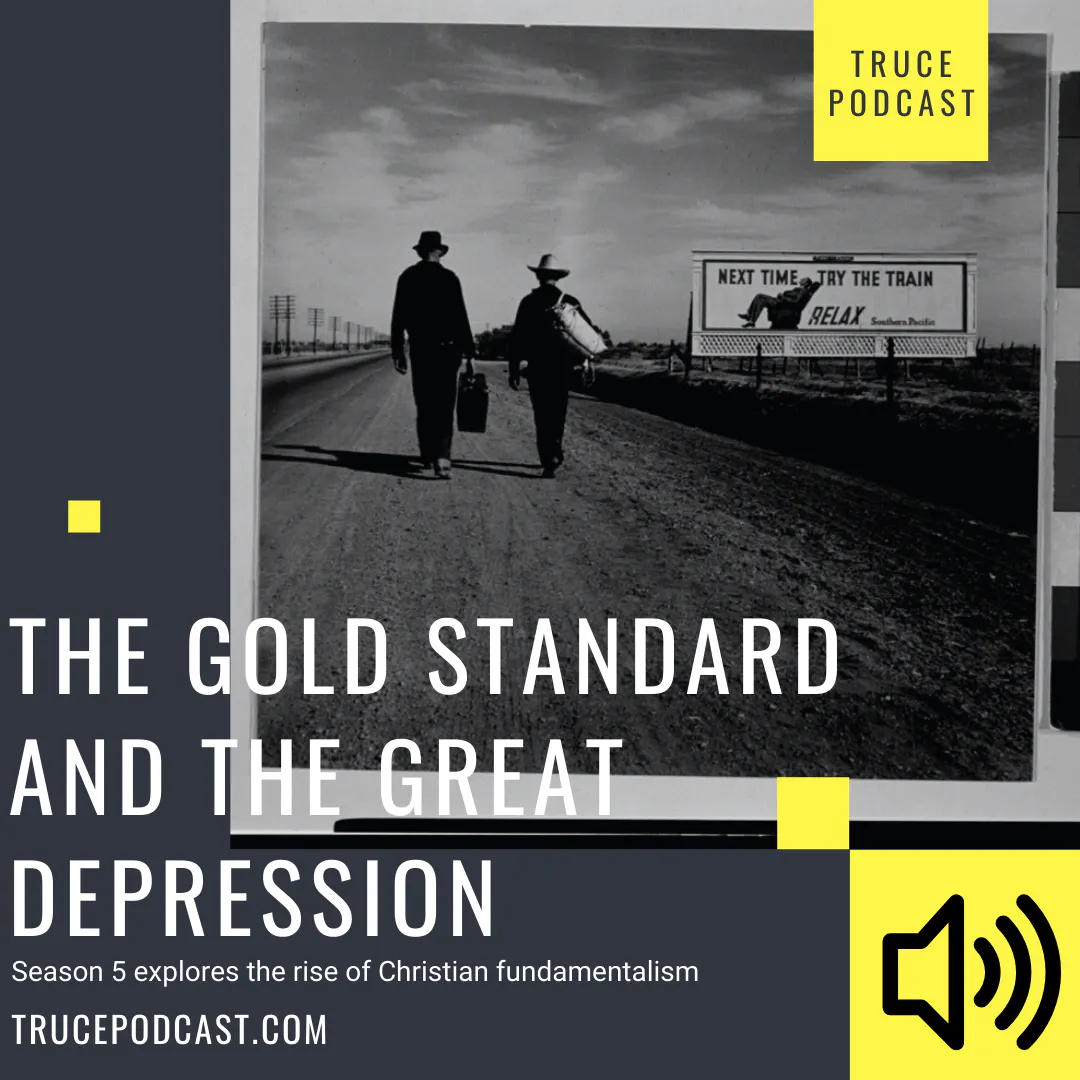
S5 Ep 8The Gold Standard and the Great Depression
bonusThe Great Depression. Some say that it was caused by a failure of the stock market. Well... that's not all. Jacob Goldstein, host of NPR's Planet Money podcast and author of "Money: the Truce Story of a Made-Up Thing" joins us to discuss the role the gold standard played in making the depression what it was. Here is why the gold standard made the Great Depression much worse. Simply put, the panic of 1929 caused people to run to the bank and demand their money back in the form of gold. We were on the gold standard back then and you could literally go to a bank and ask for them to get your money in gold. But banks were running out! There was only so much gold on hand because banks don't generally keep 100% of their money in the vault. And banks (for the ease of our understanding things) "create" money when they do loans. So it was possible for a bank only to have a certain percentage of their loans backed by actual gold. This created real trouble. If the banks ran out of gold, they'd go broke and have to close. So the Federal Reserve decided to raise interest rates. Raising interest rates gives people an incentive to leave their money in banks because then they get more interest. BUT it also made it harder for people to borrow money or refinance their existing loans. Which put a huge crimp on the American financial system. In order to keep gold in the banks, the Fed had to hobble the loan industry. That meant that businesses couldn't get loans to help with payroll, and people looking to start a business couldn't get the money they needed. And the economy froze. That is why the gold standard was bad for the economy. Preserving it meant sacrificing the loan industry. Helpful Sources: "Money: The True Story of a Made-Up Thing" Learn more about your ad choices. Visit podcastchoices.com/adchoices
S5 Ep 7The Gold Standard | Christian Fundamentalism Series
There was a time not so long ago when the value of an ounce of gold cost $20.67. That was true not just in one moment or one year. It was true in the 1880s, 1890s, 1900s, 1920s... This was the gold standard. A person could take $20.67 to a federal bank and receive an ounce of gold in return. This system worked really well... for a while. But by the 1890s the constant deflation caused by the increasing value of gold meant that people with loans had to work harder and harder to pay them back. The value of gold and the value of goods had an inverse relationship, like a seesaw. One side went up and the other went down. This is the topic William Jennings Bryan chose to discuss at the 1896 Democratic Convention. And it was that speech that won him the presidential nomination that year. Imagine that! Someone so passionate about inflating the cost of goods that they are chosen to be president! His bimetallism (he wanted to add silver into the mix to devalue the specie) stance came out of his social gospel leanings and his Christian faith. This was a high point for the social gospel. As the evangelical world was about to turn to the darker premillennialist view, Bryan made an impassioned plea that we could, in fact, make this world a better place. My guest for this episode is the amazing Jacob Goldstein. He's the author of the book “Money: the True Story of a Made-Up Thing”. He's also a former co-host of the Planet Money podcast and now hosts "What's Your Problem?", a show where he interviews guests about the issues in their industries. You'll also hear from Michael Kazin, professor of history from Georgetown and author of "A Godly Hero". Helpful Links "Money: The True Story of a Made-Up Thing" by Jacob Goldstein (makes a great gift!) "A Godly Hero" by Michael Kazin "The Cross of Gold" speech Discussion Questions Have you ever gotten so excited at a political speech that you would gladly carry the politician around the room? What is money? Why do some of us want our money to be backed by something else? Why gold? Is there something inherent in gold that you think makes it forever valuable? Do politicians and government officials have some responsibility to consider how monetary policy impacts those in the lower classes? What does that look like? How has your life been impacted by monetary policy? How do you feel about things like the FDIC? Learn more about your ad choices. Visit podcastchoices.com/adchoices
S5 Ep 6How Do We Deal with Christian Fundamentalism? | Christian Fundamentalism Series
This season of the Truce Podcast tracks the history of Christian fundamentalism. So far we've covered the rise of para-church ministries through preachers, the creation of dispensationalism, and the rising threat of modernist theology in the late 1800s. That is a lot to digest! So in this episode, I thought it would be helpful to sit down with some of the smartest guys I know and ask them, "how do we deal with Christian fundamentalism?" Christian fundamentalism has impacted our lives in various ways. Ray McDaniel (pastor of First Baptist Church in Jackson, WY) shares that he grew up under fundamentalist teaching. Chris Staron (host of the Truce Podcast) talks about his childhood and teen years listening to fundamentalist radio. Nick Staron discusses the last few years when he has seen fundamentalism rise inside his own circle of friends. Here are some things to consider from this episode: Modernist theology can be seen as an actual threat to evangelical theology. How should we deal with threats in a godly way? Do end times teachings open doors for sharing the gospel? How much do we really know about the end times? And how should that shape the way we live today? What does it really mean to love people who are from a different denomination? Do we still need denominations today? How can we keep ministries accountable? Helpful links: The Late Great Planet Earth - hosted by Orson Welles Learn more about your ad choices. Visit podcastchoices.com/adchoices
S5 Ep 5The Liberals | Christian Fundamentalism Series
George Marsden characterized Christian fundamentalism as "militantly anti-modernist protestant evangelicalism". Right there you see that fundamentalism is a reaction against something. And that something is modernist theology. Modernism is a broad term used to describe a few different schools of liberal theology. In this episode, we discuss the Tubingen and Berlin schools. Modernist theology is often marked by the desire to discuss the "historic Jesus". This term can be a bit confusing because it is less about understanding what historic texts say about Jesus and more about discussing the non-miraculous aspects of Jesus' life and ministry. Our special guest this episode is Chris Evans, professor of Christian History and Methodist Studies at Boston University and author of "Do Everything" a biography of Francis Willard. Discussion Questions: What does it mean that fundamentalism is a reaction to modernist theology? What is modernist theology? Do you know any theologically liberal people? Do you find it difficult to both love the Lord and love your neighbor? What makes someone a Christian? Does your view include theologically conservative people? What about theologically liberal people? Where is the line for you? How vital are Jesus' miracles to your life and faith? Is there a tension in Christianity where it is culturally difficult to be theologically conservative and still want to love our neighbors? Helpful Links and Sources: "The Evangelicals" by Frances Fitzgerald An interesting article on Arminius "Church History in Plain Language" by Bruce Shelley "Who is An Evangelical?" Thomas Kidd Historical Handbook of Major Biblical Interpreters edited by Donald K. McKim p 350 Matthew 22:36-40 Learn more about your ad choices. Visit podcastchoices.com/adchoices
S5 Ep 4The End of Reconstruction | Christian Fundamentalism Series
The 1800s were a time of milking cows and going to the county fair. Sure... but what else? We tend to think of this century as a quiet, pastoral era when people were friendly and life was simple. But the 1800s were a crazy time! The American Civil War, the Napoleonic Wars, the Spanish-American War, conquest, the suffrage movement, the prohibition movement, massive technological changes. It's a wonder we ever made it out alive. In this episode, we explore the early life of William Jennings Bryan and the Democratic Party, the party of Jim Crow that he would soon lead. After the Civil War, it was the Democrats who created Black Codes in the South to restrict the upward mobility of African Americans. They were the party of white farmers and soon transitioned into representing labor unions and, eventually, many black people in the United States. Bryan was one of the men responsible for that transition. Helpful Links and Sources: "A Godly Hero" by Michael Kazin Truce episode about the Woman's Christian Temperance Union (WCTU) Meeting notes of the 1873 Evangelical Alliance "Fundamentalism and American Culture" by George Marsden "A Righteous Cause" by Robert W. Cherny (book on William Jennings Bryan) Interesting bio on Stephen Douglas President Hays' acceptance speech Discussion Questions: What do you think of when you think of the 1800s? Was the 1800s a simpler time? What mistakes did the Republican Party make in ending Reconstruction? How should abolitionists have handled the South after the Civil War? Can a Christian lead a racist political party? Should they? What were some technological advances that came about in the 1800s? How might they have shifted the way people lived and thought back then? Are there technological changes going on now that could shift the way we think and interact with each other? Chris ends the episode by talking about how Christians should be a people of the means, not necessarily the ends. Do you think the ends ever justify the means for Christians? Learn more about your ad choices. Visit podcastchoices.com/adchoices

S5 Ep 3Dispensationalism and John Nelson Darby | Christian Fundamentalism Series
Become a patron of the show and help make the Truce episodes you love. This season we're tracing the history of Christian fundamentalism through the life of William Jennings Bryan. But first, we need to learn some important definitions. Our big word of the week is dispensationalism. It's not as complicated as it sounds. Dispensationalism is (in part) the notion that God treats humankind differently depending on what era we are in. It is not accepted by all Christians, but it is a building block of fundamentalism. Another component of dispensationalism is the secret rapture--the idea that God will take His elect to heaven just before the tribulation. It also asserts that the Christian Church will become apostate before the end times. This last tidbit is important! Premillennialism made Christians suspicious of the outside world, but it was dispensationalism that made us suspicious of each other. John Nelson Darby is often credited as the father of dispensationalism. He came up with the idea of the rapture and is the man who packaged a bunch of existing ideas into this systematized vision of the Bible. In the 1700s and 1800s, people adapted the scientific notion of categorizing everything into genus and species and applied it to all areas of study, even when reading the Bible. This encouraged people like Darby to break the Bible into "dispensations" or eras. Our guest this week is George Marsden. He's the author of "Fundamentalism and American Culture". Discussion Questions: Are you suspicious of other Christians? Why is that? Do you believe in the rapture? Why? Does the God of the Bible behave differently in different parts of the Bible? Or is He the same throughout? Do you believe that Jewish people were destined to return to Israel based on Matthew 24:32-33 or Romans 11:25-26? What did you know about the French Revolution before our recent episodes on it? Do you think it was a significant event in world history? If so, why? Helpful Links: "Fundamentalism and American Culture" by George Marsden (book) "The Evangelicals" by Frances Fitzerald (book) "Who is an Evangelical?" by Thomas S. Kidd (book) Interesting article about Napoleon, the Pope, and the French Revolution A fantastic book about Napoleon (one of my fav books) is "Napoleon: A Life" by Andrew Roberts "American Apocalypse" by Matthew Avery Sutton (note: only the first few chapters influenced this episode) "The Roots of Fundamentalism" by Ernest Sandeen. 1 Corinthians 1:8 Helpful article about Common Sense Realism Fascination Smithsonian article about Mount Tambora Learn more about your ad choices. Visit podcastchoices.com/adchoices

S5 Ep 2Premillennialism and Postmillennialism | Christian Fundamentalism Series
Give to help keep Truce going! What is the difference between premillennialism and postmillennialism? And what does it matter? After the French Revolution in the late 1700s, Christians began to see the world as coming to an end. Daniel 7 and Revelation 13 describe an oppressor who will wear the people out for a period of time. Some Christian interpret that as being 1260 years. That 1260 years can be placed over the reign of Justinian all the way through history up until the French Revolution. That is just one interpretation that not everyone shares. But if you hold that view then this event was HUGE. It meant that the end of the world was super close. It has now been over 200 years since that event, but many premillennialists still hold up this prophecy as proof of the fulfillment of scripture. Many Christians were sparked to uncover the meaning of it all. Some turned to an old idea -- premillennialism. It's the notion that the world is on a downward trajectory. Things are going to get really bad and then Jesus will return. Before this time, many evangelicals were postmillennialism. They thought the world was going to get better over time. This split was an important part of what would become the fundamentalist/ modernist debate. Premillennialism has some dark "logical" conclusions to it. Some premillennialist like pastor John MacArthur argue that since the world is going to burn anyway, we humans shouldn't worry about things like global warming. Discussion Questions: Why was the French Revolution such an important moment in world history? Pre-Revolution the nobles and clergy controlled much of the power in France. They could out-weigh 98% of the population of France. Is this perhaps a reason why the French people turned against them? Are you a premillennialist, a postmillennialist, or neither? Did you read the Left Behind books? What do you remember? How did they impact you? Do you think you have a positive or negative view of world history? How does that impact the way you act? Should premillennialists see Jesus' second coming as a reason to avoid taking care of the planet? Helpful Links: The Victoria and Albert Museum's article about Mysore and Tipoos Tiger "Fundamentalism and American Culture" by George Marsden (book) "The Evangelicals" by Frances Fitzerald (book) "Who is an Evangelical?" by Thomas S. Kidd (book) Interesting article about Napoleon, the Pope, and the French Revolution A fantastic book about Napoleon (one of my fav books) is "Napoleon: A Life" by Andrew Roberts John MacArthur sermon excerpted and used with permission from "Grace to You" Learn more about your ad choices. Visit podcastchoices.com/adchoices

S5 Ep 1What Is An Evangelical? | Christian Fundamentalism Series
Donate to support the Truce Podcast! Correction: The original version of this episode incorrectly represented Arminian belief. It involves the belief that once grace is offered by God that a sinner can reject the offer. The original version stated that the sinner made the first move to initiate a relationship. That is incorrect. Arminians believe that God makes the first move, but His offer can be rejected. The error has been corrected in this version, My apologies for any confusion. Who is an evangelical? If you go by the news today, you probably think evangelicals are all American middle-class white men. Nope! Evangelical Christians come in all shapes, colors, and sizes. They can be men or women from anywhere in the world. They can speak any language. And they can have a lot of variety in their beliefs. This season on the Truce Podcast we are examining the history of Christian fundamentalism. How did fundamentalism begin? What is Christian fundamentalism? Is Christian fundamentalism a good thing, a bad thing, or somewhere in between? In this episode, we're joined by author and professor George Marsden. He's the author of Fundamentalism and American Culture, which is THE book everyone else refers to when they talk about fundamentalism. According to Marsden, fundamentalism is "militantly anti-modernism protestant evangelicalism". That is a lot of big words! By the end of the season, you should understand all of that. One important part of that definition is the word "evangelicalism". It is one of those words that has been used so much in so many different ways that it can be difficult to define it. There are whole movements to create new definitions these days. But in order to move forward this season, we need to pick some frame of reference. I chose David Beggington's definition of what defines an evangelical: Bebbington's Quadrilateral Biblicism (a focus on the Bible) Conversionism (an emphasis on evangelism) Crucicentrism (the centrality of the cross) Activism Those four things, according to Bebbington, are what make up an evangelical. Again, it is a hotly debated subject. So when did evangelicalism begin? Many of the sources that I found pointed to the revivals in the decades leading up to the American Revolution. Evangelists like Jonathan Edwards and George Whitefield spread the gospel using a post-millennialist vision of the end times mixed with Calvinism. This was part of the First Great Awakening. Then there were others after the revolution who spread an Arminian view of salvation. Guys like Finney. Belief in God became more personal, without the direct oversight of a priest or minister. It became an individual's responsibility to look after their spiritual growth. Welcome to season 5! God willing, I'll be releasing new episodes every other week. Discussion Questions: What is an evangelical? What is a fundamentalist? If fundamentalists are evangelicals who are angry at something, what are they angry at? Are you one of those people? Do you believe in the Calvinist view of salvation or the Arminian one? Does it matter? Why? The Great Awakening movements established a sense that belief in God was not something that needed to be handed down by a priest or minister. Do you think that was a positive move? What are some potential drawbacks (if any)? Helpful Links and Sources: "Fundamentalism and American Culture" by George Marsden (book) "The Evangelicals" by Frances Fitzerald (book) "Who is an Evangelical?" by Thomas S. Kidd (book) "A Godly Hero" by Michael Kazin (book) Transcript of the Scopes trial (book, though you can find it free online) Learn more about your ad choices. Visit podcastchoices.com/adchoices

Season Five Trailer - The History of Christian Fundamentalism
trailerBecome a patron of the Truce Podcast! In our present moment, it seems that people are inclined to extremes. Christian fundamentalism seems to be on the rise. This season we're examining the history of Christian fundamentalism. We'll start by defining terms like "evangelical", "premillennialism", "dispensationalism", "modernist theology", and "fundamentalism". Then we'll work our way to the Scopes Monkey Trial, that massive media event in 1925 that pitted fundamentalism against evolution. Our guests this season include George Marsden, Joel Carpenter, Kevin Belmonte, Edward Larson, Paul T. McCartney, and Michael Kazin. We'll also feature a fascinating conversation with Jacob Goldstein, co-host of the Planet Money podcast. We can never hope to cover every facet of a subject this huge. Instead, the goal is to help normal people like us understand the basics of this movement that is actively shaping world history. Subscribe so you get every new episode as it is released. Learn more about your ad choices. Visit podcastchoices.com/adchoices

S4 Ep 18Christmas and the Sermon on the Mount
bonusChristmas can be a difficult time for many of us. How do we love people who disagree with us? How do we cope with people who don't seem to make sense anymore? In this bonus Christmas message, I just want to remind all of us of Jesus' command to both love our God AND love our neighbor. How has 2021 been for you? Leave a comment on social media or on the website at www.trucepodcast.com. God willing, season 5 of Truce will begin in winter 2022. Merry Christmas, Chris Learn more about your ad choices. Visit podcastchoices.com/adchoices

S4 Ep 13King Leopold's Ghost (feat. Adam Hochschild)
Become a patron of the show and help me make even more great episodes! Donate by visiting www.patreon.com/trucepodcast When you think of the world's worst mass murderers, King Leopold II doesn't usually come up. But due to his forced labor practices in the Congo, nearly 10 million people lost their lives. He did this by pretending that his actions in that region were a missionary effort. In reality, he forced Africans to harvest wild rubber or risk having their hands cut off. The truth is even darker than that: it turns out that Leopold was far from the only person doing this. This same era was marked by many major world powers engaging in forced labor. From the US in the Philippines to Arab countries in eastern Africa, much of the modern world was built on forced labor. Author Adam Hochschild joins us for this episode to discuss his book "King Leopold's Ghost". I first heard about this story on the Noble Blood podcast and their episode "The Red Paint on Leopold II". Discussion Questions: Had you heard of King Leopold II before this? Leopold did send missionaries to the Congo. Was that a positive or negative thing for our Christian witness? Did you know that other major countries were engaged in forced labor into WWII? What do you think of the US-backed coup in Congo? Is it okay for the US to get involved in the politics of another nation? Learn more about your ad choices. Visit podcastchoices.com/adchoices

S4 Ep 12Christians and the British Slave Trade (feat. Adam Hochschild)
Become a patron of the show and help me make even more great episodes! Donate by visiting www.patreon.com/trucepodcast The British slave trade had several well-known opponents: William Wilberforce and John Newton (who wrote "Amazing Grace") to name a few. But historian Adam Hochschild ("King Leopold's Ghost", "To End All Wars") argues that history has largely forgotten the most valuable member of the abolition movement: Thomas Clarkson. Clarkson was in charge of gathering and disseminating information across the British Isles. He fought for years to end the slave trade and then slavery itself. This movement is important for many reasons. It was the first to use logos, a coordinated marketing campaign, and it established a high bar for investigative journalism. It was also an ecumenical movement. In this episode we explore slavery, the importance of slave rebellions, the power of ecumenical efforts, and the book "Bury the Chains". I mentioned the so-called Curse of Ham in the episode. Learn more about it here. Helpful discussion questions: Had you heard of Thomas Clarkson before this episode? Do you participate in any cross-denominational movements? Where do you draw the line? Has your church ever participated in anti-racism movements? Was there any wisdom in ending the slave trade first? Why do you think John Newton didn't give up the slave trade as soon as he became a Christian? Was it possible to be a Christian and own slaves? Do you think humanity will ever go back to slavery? Do modern payday loans keep people in bondage in the way that debt kept people in bondage in the 1700s? Learn more about your ad choices. Visit podcastchoices.com/adchoices

S4 Ep 8Can I Still Love the Church?
Become a patron of the show and help me make even more great episodes! Donate by visiting www.patreon.com/trucepodcast So many Christians are angry at the Church. Not just the Church but their local churches as well. Producer Chris Staron decided to take a look inside one small congregation to see how Black Lives Matter, COVID, the 2020 Presidential Election, and more have impacted one community. How are people in Jackson, Wyoming responding in a time of dissension and deconstruction in the body of Christ? Special thanks to Ray McDaniel and Karl Klemmer for talking with Chris for this interview. Helpful Links: Alcoholics Anonymous 12 Steps First Baptist Church Discussion Questions: How have the last few years changed your ideas about the global Church? How have they changed your ideas of your local church? How would you respond if you were the pastor of a local church today and your congregation wanted you to pick a political side? Should pastors speak about politics from the pulpit? Why do we put so much emphasis on messages from the pulpit and discount the ability for congregants to have meaningful conversations on their own? Are you deconstructing your faith? What does that term mean to you? If you are deconstructing your faith, have you removed the local church? The Bible? If so, how has that impacted your faith? Are you open to people who have different opinions? How do you interact with those people? Is it in person? Do you have friends with different opinions than you? How can you get some if you don't? Do you see the Church as a "we" and "us" or as a "them"? Why? Learn more about your ad choices. Visit podcastchoices.com/adchoices

S4 Ep 7100th Episode
Become a patron of the show and help me make even more great episodes! Donate by visiting www.patreon.com/trucepodcast Truce usually uses research, music, sound effects, and expert interviews to tell complicated stories about the Christian Church. We've made something like 100 episodes! Our listeners recommended that we celebrate by asking Chris questions submitted by audience members. Special thanks to Melvin Benson of the Cinematic Doctrine podcast for asking the questions! Learn more about your ad choices. Visit podcastchoices.com/adchoices

S4 Ep 6The American West: Is It A Sin to Be Wealthy? (featuring Yale Professor Justin Farrell)
Become a patron of the show and help me make even more great episodes! Donate by visiting www.patreon.com/trucepodcast Jackson, Wyoming is a small tourist town in the middle of nowhere. It is just a few miles south of Grand Teton National Park and Yellowstone. Millions of people pass through each year as tourists. It's a vacation hotspot. But for those who choose to stay in this region, Teton County is anything but a vacation. Rising income inequality and housing costs have created a hostile environment for working people. The median home price in Jackson went up 47% in 2020 alone, rising to $2.2 million while wages remain stagnant. We've been talking for the last few episodes about myths of the American West, how cowboy myths about a lone rugged individual have shaped the US. Now it's time to understand how cowboy myths have impacted American Christianity. Our guest today is Justin Farrell. He's a sociologist and professor at Yale. His book is Billionaire Wilderness. In it, Farrell recounts his studies of the ultra-wealthy. What makes them tick? What are they afraid of? Why do they dress the way they do? And what draws them to the far western border of Wyoming? Discussion Questions: Read the story of the rich young ruler (Mark 10:17-27). What do you think of Jesus' warning about wealthy people entering the kingdom of God? Many of the tax avoidance practices discussed in this series are legal (except pretending to live in one place while living in another). Do you think that legality and morality are tied together? Are these practices moral? What types of friction do you experience in your own life? How would more money change the level of friction you encounter? How would less money change the level of friction you encounter? Do you think that friction is a valuable thing to pay attention to in our lives? What is the role of empathy in a Christian's life? How do you use money to benefit yourself as opposed to others? Helpful Links: Justin Farrell's book Billionaire Wilderness NY Times article about President Trump changing his residence to get out of paying taxes Book The Velvet Rope Economy about inequalities in health care, airlines, services, and even Disney World. Learn more about your ad choices. Visit podcastchoices.com/adchoices

S4 Ep 5The American West: Conservation Easements
Become a patron of the show and help me make even more great episodes! Donate by visiting www.patreon.com/trucepodcast Some of the wealthiest people in the world live (or pretend to live) in Jackson, Wyoming. That includes some of the biggest names in Hollywood. Digging into the property tax records, we discovered that one of the most successful actors in film history pays less in property tax than a single mom living on less land. What gives? Why are rich people paying less in property tax than working people? The answer has to do with a thing called a conservation easement. A conservation easement is essentially an agreement between a landowner and the government that says, "I promise I'll keep my property from certain kinds of building projects". In return, the government gives the landowner massive tax benefits on the federal and local levels. In this episode, Chris digs into the history of these instruments to understand what they are and how they are impacting rural Wyoming and the rest of the country. UPDATE: The original version of this episode contained an error that has since been corrected. The original version stated that getting an $800,000 tax deduction was essentially the same as getting an $800,000 refund. That is incorrect. My apologies. Helpful links: Helpful article about conservation easements Excellent pamphlet with information about easements YouTube video about how taxes are assessed Search the Teton County property tax records Discussion Questions What do you think about public land? Do conservation easements seem fair? Are conservation easements a helpful way to preserve the environment or government-sponsored private land? Both? What should Jackson locals do to make the property taxes fair? How do you feel when you learn that taxation practices favor the rich? Are there conservation easements where you live? Learn more about your ad choices. Visit podcastchoices.com/adchoices

S4 Ep 4The American West: Johnson County War
Become a patron of the show and help me make even more great episodes! Donate by visiting www.patreon.com/trucepodcast The myth of the American cowboy features a lone man who makes his fortune on the open plains. He doesn't need the government, and he doesn't need some big corporation telling him what to do. But that myth is far from the reality in the west. Many cowboys worked for large corporate cattle operations. And when those operations were in danger, he relied on the government for help. The Johnson County War started when the Homestead Act of 1862 brought new people to central Wyoming. The area just west of the Big Horn Mountains had been free-range grassland where anyone could let their cattle run free. The large cattle operations loved this setup because it saved them an immense amount of money and infrastructure. The new homesteads threatened their empires because they divided up the land and restricted their access. So the Wyoming Stock Growers Association banded together to send a message: get off our land. They send a murder squad to Johnson County, Wyoming to scare the people of Buffalo with a series of brutal murders. What followed was one of the darkest chapters in Wyoming history. Where big businesses murdered with impunity, aided by the governor and sitting president. Helpful links: The Jim Gatchell Museum in Buffalo, WY The TA Ranch (where the siege took place) Book used for research: Wyoming Range War by John W. Davis Discussion Questions: What role did the Homestead Act play in stirring up trouble in central Wyoming? Is there a character in the story that you identify with? Is there any part of you that sympathizes with the WSGA? How does this story challenge your concept of the American cowboy? What role does the government have in protecting an industry? How do you feel about the government's failure to punish the invaders? Learn more about your ad choices. Visit podcastchoices.com/adchoices

S4 Ep 3The American West: Jesus and John Wayne (feat. Kristin Kobes Du Mez)
Become a patron of the show and help me make even more great episodes! Donate by visiting www.patreon.com/trucepodcast What do you think of when you picture a cowboy? A rugged, handsome individual? A lover? Someone who doesn't need the government's help? Evangelicalism has long pushed this as the ideal model for the Christian man. What is the impact of that set of ideas? John Wayne and Ronald Reagan have both become popular figures in American men's ministries. Their names come up often, they both played cowboys in Hollywood. But they are unlikely heroes. Both men were divorced. Wayne wasn't an evangelical, and Reagan had once been a democrat. But both men were instrumental in whipping up anti-communist sentiment in the US, building credibility with a religion focused on individualism. You can draw a line from them straight to former president Donald J. Trump. All three had questionable public morals but were seen as strong, uncompromising figures. They are seen in many men's books as the epitome of masculinity. That idea, though, comes in contrast with Jesus' own words about turning the other cheek, forgiving our enemies, and loving our enemies. In this episode, Chris talks with Kristin Kobes Du Mez, author of "Jesus and John Wayne: How Evangelicals Corrupted a Faith and Fractured a Nation". Discussion Questions What do you think of when you picture a cowboy? How have you heard cowboys, soldiers, and fighters discussed in evangelical circles? What books have you read that stressed the importance of tough men? What do you picture when you think of a Christian man? How has that been shaped? What do you picture when you think of a Christian woman? How has that been shaped? What is your idea of Jesus like? Is He a warrior, a gentle savior, or both? Can you see the link between the cowboy image and Donald Trump? Learn more about your ad choices. Visit podcastchoices.com/adchoices

S4 Ep 2Kaitlyn Schiess and Our Four False Gospels
Become a patron of the show and help me make even more great episodes! Donate by visiting www.patreon.com/trucepodcast Christians throughout history have responded to politics in different ways. In our modern era, it can seem like Christianity and Republican politics are one and the same. But what do we do when the Bible clashes with our political party? What if our economic model leaves no room for the poor? Author and theologian Kaitlyn Schiess joins us to talk about her book, "The Liturgy of Politics", as well as how we can heal as a church. Discussion Questions How have you seen politics and Christianity mixing in the US? Is there are healthy way for Christians to engage in politics? How have your politics informed your ideas of the poor? Do you think that all poor people are lazy? How can your local church reach out to people who look/speak/act differently that you do? How have you see Kaitlyn's four false gospels play out in your life and church? Prosperity Patriotism Security Supremacy Learn more about your ad choices. Visit podcastchoices.com/adchoices

S4 Ep 1Jemar Tisby and How to Fight Racism
Become a patron of the show and help me make even more great episodes! Donate by visiting www.patreon.com/trucepodcast Do systems really keep minorities down? Even asking the questions sound socialistic to some. But we need to go through our society to root out systems that breed inequality. But how? Sometimes discussions of racism can make us feel helplessly lost. That's why I called in an expert. Jemar Tisby is a Christian speaker, author of “The Color of Compromise” and “How to Fight Racism”. He's also an important voice in modern America. Even if you don't agree with everything he writes in his books, it's important to hear what he's saying here. What are the systems that separate black and white people? How can we learn to grieve as a people, as a local church, and as a community? Discussion Questions: How can you organize an event at your church (online) to discuss the history of racism in your church, community, schools, and hearts? Have you ever stopped to do a racial autobiography? (my questions, not Jemar's) When was the first time you met someone of a different race? What did your parents teach you, consciously or unconsciously, about race? Have you ever used a racial slur? Why? How did you feel about it then? How do you feel about it now? What is the power of those words? Have you ever been afraid of someone from another race? Why? When? Do you regularly come in contact with people of a different race? How do you feel when you see a police officer? Why might someone else have a different reaction? How did you come to feel that way? Are there distinct, racially divided neighborhoods in your area? How did they get there? Do you ever go to a different neighborhood? Why or why not? Are discussions of race inherently socialistic? Are discussions of class inherently socialistic? Learn more about your ad choices. Visit podcastchoices.com/adchoices
S3 Ep 46Takeaway 5: It's Easier to Call People to a Heritage Than A Saving Faith
Become a patron of the show and help me make even more great episodes! Donate by visiting www.patreon.com/trucepodcast Some of the most common feedback I heard about season 3 of Truce is that I didn't give the Christian America camp enough time to back their opinion. In this mini-episode, I discuss my reason for leaving people like David Barton of Wall Builders off of the show. I also play a short clip from Gregg L. Frazer who was on our Christian America episodes. His book is "The Religious Beliefs of America's Founders". Learn more about your ad choices. Visit podcastchoices.com/adchoices
S3 Ep 45Takeaway 4: Complexity is Cool
Become a patron of the show and help me make even more great episodes! Donate by visiting www.patreon.com/trucepodcast At the 2019 National Religious Broadcasters Convention in Los Angeles, I had a chance to sit down with Dr. Richard Land. Dr. Land is a man of the company line who mixes Republican thought with Christianity. At this interview, Dr. Land said (off mic) that the reason this generation struggles so much is that we are unwilling to see the issues of our time as black and white. Good vs. Evil. I disagree. I think the opportunity our generation has is that we can finally think of this complex world as complex. This mini-episode is just one of several meant to help sum up season 3 of Truce. Learn more about your ad choices. Visit podcastchoices.com/adchoices
S3 Ep 44Takeaway 3: Treat Labor Well
Become a patron of the show and help me make even more great episodes! Donate by visiting www.patreon.com/trucepodcast A few months ago I produced two episodes about the Christian roots of American labor unions. And... a bunch of people stopped listening to the show. It turns out that many American Christians are conservative and, therefore, anti-union. This mini-episode is the counterbalance to that series. Here we discuss the inefficient practices at General Motors in the 1980s. It was an era where GM slipped from holding over 40% of the market share to 17%. What happened? It's a story of unions, gasoline, and the reasons we treat labor well. Resources used: “Rude Awakening: The Rise Fall and Struggle for Recovery of General Motors” by Maryann Keller "Crash Course" by Paul Ingrassia Discussion Questions: Do you have a bias for or against labor unions? Who do you know who is or was in a union? What is their work ethic? The labor unions in GM in the 1980s were inefficient. Does that make all labor unions inefficient? Does specialization in factories help or hurt in the long run? Do you have a bias for employers or employees? Do you work as unto Christ in your own job? What is the Christian way to work? To employ someone? Learn more about your ad choices. Visit podcastchoices.com/adchoices
S3 Ep 43Takeaway 2: Communism as a Scapegoat (feat. Jemar Tisby)
Become a patron of the show and help me make even more great episodes! Donate by visiting www.patreon.com/trucepodcast Season three of Truce has been all about how the rise of communism in Russia impacted the Christian Church. As we approach the end of the season, I want to highlight some of the important takeaways. One of them is that communism can be used as a scapegoat. That is used by some people to get the public to hate or disregard something they don't like. That could be the COVID crisis or Black Lives Matter. Our guest today is Jemar Tisby. He's the author of the New York Times Bestseller "The Color of Compromise" and "How to Fight Racism". He's also a frequent voice on the Pass The Mic Podcast. You can access his Substack email list here. Helpful links: Article about the Wyoming Health Department official who resigned due to his denial of COVID 19. Learn more about your ad choices. Visit podcastchoices.com/adchoices
S3 Ep 42Takeaway 1: Think Deeper About the Past
Become a patron of the show and help me make even more great episodes! Donate by visiting www.patreon.com/trucepodcast MAGA folks look back on the history of the United States and see a golden era: the 1950s. When religion was in the public eye, television and movies were clean, and father came home from work with dinner hot on the table. The trouble is that this vision of the 1950s only existed in our imaginations or if we chose to ignore the world around us. The 1950s were an era of great upheaval, with public monuments to religion being erected at the same time as heavy censorship, McCarthyism, wars, racism, and sexism. For the next few weeks we'll be revisiting themes from season three of Truce to pull out some important takeaway. Takeaway 1: Think Deeper About the Past. Helpful links: The trailer for Secrets of Jonathan Sperry Chris' interview with director Rich Christiano Discussion Questions: What do you think of when you think of the 1950s? When is it okay to remember just part of history, and when do we need to consider the whole picture? What era do people who wear MAGA hats want to return to? In other words, when was America greater than it is now? When you think of your own childhood, what comes to mind? Do world or social issues play into that? How is nostalgia a helpful tool? How can nostalgia shape our memory of the past? Is there an era you wish to return to? What can we do to create a fuller picture of the past when we retell it? Learn more about your ad choices. Visit podcastchoices.com/adchoices

S3 Ep 41How to Deal With Christian Nationalism
Become a patron of the show and help me make even more great episodes! Donate by visiting www.patreon.com/trucepodcast The January 6, 2021 riot at the US Capitol demonstrated the dangers of extreme Christian nationalism. When we allow our ideas about God and His protection to overrun the Bible, we get into serious trouble. Now, many Christians are questioning their faith. Why does the Jesus of the Bible look so different from us and our country? In this episode, Chris discusses our strange relationship with the United States. We love it when it affirms us, but we don't know what to do when the US behaves in an evil manner. How do we unify the Church in an era of division? Helpful Discussion Questions: How have you seen the United States tied to Christianity? What do you think people mean when they say the US is a Christian nation? When have you seen the US behave in a Christian manner? When have you seen it wander from Christian principles? Do you follow the Jesus of the Sermon on the Mount, or an economic Jesus? How can you love people in your local church who believe different things about Jesus than you do? Helpful links: You can learn more about the Virginia Law Codes in Rebecca Cox Richardson's book "How the South Won the Civil War". In the episode, I reference that the US provided rebels in Afghanistan with copies of the Koran and VHS bootlegs of the movie "Rambo". You can learn about that in Steve Coll's book, "Ghost Wars" pages 90 and 194-197. Learn about John Adam's day of fasting The Treaty of Tripoli More about Dalton Trumbo "Trumbo" movie trailer Learn more about your ad choices. Visit podcastchoices.com/adchoices
S3 Ep 40Skye Jethani and Post-Christian America
Become a patron of the show and help me make even more great episodes! Donate by visiting www.patreon.com/trucepodcast How should Christians react in a post-Christian society? Many theologians describe our modern era as being post-Christian. Meaning that religion was once public in the United States, and it is slowly disappearing. Is that okay? Is it possible that now is a great time to be doing ministry? In this episode Chris interviews pastor/ author/ podcaster Skye Jethani. He's the author of the book "What if Jesus was Serious?" and co-host of The Holy Post podcast with Phil Vischer. Skye's wisdom for this time helps Christians put today in perspective. Discussion Questions: What is meant by the term "post-Christian"? Do you think we're living in a post-Christian world? How do our environment and culture impact Jesus' words in the Sermon on the Mount? What does it mean to love our neighbors? Turn the other cheek? Do you agree with Skye when he says that we are to obey our leaders, and yet we are the leaders in the US? If so, how does that impact how you live and work? Have you ever lived in an environment that was non-Christian? How does that differ from a culturally Christian area? Was it easier to do ministry in one over another? Learn more about your ad choices. Visit podcastchoices.com/adchoices
S3 Ep 39Is School Prayer Illegal?
Become a patron of the show and help me make even more great episodes! Donate by visiting www.patreon.com/trucepodcast When did school prayer end? When was school prayer made illegal? American Christians have disagreed about school prayer ever since it was declared illegal in the 1960s by the Supreme Court of the United States. But what were the conditions surrounding that debate? In this episode of Truce, we break down the debate using Justice Hugo Black's majority argument against school prayer. It goes all the way back to the founding of the Church of England when Thomas Cranmer wrote the Book of Common Prayer and helped the king solidify his divorce. Thomas Cranmer was made Archbishop of Canterbury, the highest role in the Church of England. But when Mary Tudor became queen, she executed Cranmer because she was Catholic and he was Protestant. Justice Black's decision hinged on the story of Cranmer. England was thrown into turmoil with every new regent because they could change the religion. The US, he argued, was founded on principles that would keep that from happening. The Establishment Clause of the US Constitution prohibits the government from establishing a religion. So... is school prayer a violation of the Establishment Clause? What do you think? Discussion Questions: Have you ever used prayer as a weapon like Chris did in the locker room for his school play? What are the benefits of prayers that are written down? What are the drawbacks? Do you recite written prayers? Why or why not? Was the Regent's Prayer right in being non-specific about which God it referred to? Do you think your country would benefit from a national religion? What if that religion could be changed over time? Did you ever pray in school? Should we pray in schools? What did you think of Justice Hugo Black's majority opinion which used the example of the Church of England in the 1500s as a reason why we should not have school prayer? Helpful links: One Nation Under God by Kevin Kruse (book used for research) Helpful site about Thomas Cranmer Supreme Court audio of the deliberations for Engel v. Vitale on Oyez.org Justice Black's majority opinion Learn more about your ad choices. Visit podcastchoices.com/adchoices
S3 Ep 38Jerry Falwell and Apartheid (feat. Melani McAlister)
Become a patron of the show and help me make even more great episodes! Donate by visiting www.patreon.com/trucepodcast Jerry Falwell Sr. was one of the most outspoken evangelical Christians in the 1980s. He founded Liberty University and the Moral Majority political movement. In 1985 he went on a trip to visit South Africa, which was then engaged in its apartheid practices. That meant keeping 80% of the land for white use only and moving black people to reservations. It was a black majority country controlled by the white minority. Upon his return, Falwell made some controversial statements. Including one that American Christians should not protest South Africa or demand sanctions. Seems crazy, right? But South African guerillas were being funded (in part) by the Soviet Union. The worry that communism would take over South Africa was real. Which of the two evils would Christians choose? Backing an apartheid government, or potentially supporting the Soviet-sponsored rebels? Our guest today is Melani McAlister, author of the excellent book "The Kingdom of God Has No Borders". She is also professor of American Studies and International Affairs at George Washington University. Discussion Questions: What do you think of Falwell's position on apartheid? Do you think the US concern about communism was appropriate? What were Americans afraid of when it came to communism? When in history have you or the Church had to choose between the lesser of two evils? How could that have been handled differently? Helpful Links: C-SPAN video of Jerry Falwell (edited for the show) George Washington University video featuring Melani Learn more about your ad choices. Visit podcastchoices.com/adchoices
S3 Ep 37Exporting Jesus and the American Way (feat. Melani McAlister)
Become a patron of the show and help me make even more great episodes! Donate by visiting www.patreon.com/trucepodcast Melani McAlister, author of "The Kingdom of God Has No Borders" and Professor of American Studies and International Affairs at George Washington University joins us to discuss how we export Christianity. In the 1950s and 1960s, American denominations sent white missionaries to Africa to share the good news. But with them went their bias and racism. This was the era of Jim Crow laws. Some missionaries took those laws to Africa, not allowing black people to eat at their tables. In this episode, we examine the problem of tying the United States to Christianity. When the US makes mistakes or does evil, how does that reflect back on the church? Christian missionaries sometimes export the United States with their messages. What else is going with our missionaries? Discussion Questions: Have you ever been on a mission trip before? What was your motivation for going? Do you think that it is possible to marginalize the people we are trying to witness to? How do you feel about showing pictures of poor people in church presentations? How might that practice encourage churchgoers to marginalize a people group? Do you think poor people in other countries are happier? Is it okay for us to export the American way with the gospel? If yes, then which things should we export? Links: The Kingdom of God Has No Borders An interesting introduction to the British Empire and their withdrawal from colonialism An introduction to the troubles in Congo An NPR article about US-backed rebels Learn more about your ad choices. Visit podcastchoices.com/adchoices
A Christian Response to the Attack on the US Capitol
bonusWhen I was a kid, we were playing at a friend's house. I fell and scraped up my knee pretty badly. Dirt and rocks were in the wound. My friend's mom was a nurse, so she got out her medical kit. She did her best to pick out what she could and then showed me her bottle of iodine. Iodine is a strong anti-microbial. Highly effective for cleaning wounds. But, like rubbing alcohol, it stings pretty bad. Pain, she said, is not always a bad thing. Pain is what our body uses to tell us something is wrong. That we need to make a change. If your appendix hurts, it's helpful. Because if they didn't, you'd have no way of knowing that they were going to burst. Sometimes, we need to feel pain. I don't know about you, but I'm pretty raw today. I haven't been able to focus on much. Yesterday, January 6, 2021, a mob of Trump supporters, incited by Donald Trump, stormed the Capitol building in Washington DC. It was an act of terrorism. A coup attempt on US soil. I'm angry. I'm scared. And what hurts the most is to know that evangelical Christians share the blame. We were a big part of his support base. Despite his stirring up rebellion, his lies about everything from the size of his inaugural audience to the shameful claims of a rigged election, his obvious conflicts of interest, racism, sexism, and potentially criminal dealings with Deutsche Bank, many of my people stand by his side. And there is nothing he can do to break that spell. Some Christians will support him no matter what. I started this podcast three years ago for a lot of reasons. There is one big reason, though. I wasn't public about it. I've spent a lot of hours debating whether or not I should tell you. But I started Truce because I think my people, Christians, are headed for persecution. Not because of the Bible. Not because we believe in Jesus, and the world hates Jesus. But because we're acting like children. We worship oligarchs and their money, even though Jesus told us not to. We ignore the poor, even though Jesus commanded us to take care of them. We've acquired a taste for hate, even though the Bible says to love our neighbors. We've sought vengeance when it's clear that vengeance belongs to the Lord. I don't think anyone deserves to be persecuted. Hear that. Nobody deserves persecution. But I think we're building a pretty strong case against ourselves. Christian media will try to put a positive spin on it, say it's not our fault. That the heathens hate Jesus. Know that this is the reason: because we turned our back on our calling in pursuit of power. I probably wounded you in saying that. That's okay. We've grown so used to thinking that we deserve a life free from pain. I want to remind you that pain is not always a bad thing. It tells us when we're bleeding, when we're wounded, when we're sick. I think a lot about the Babylonian's taking over Judah in the Old Testament. God's people acted wickedly generation after generation. So they paid for their wickedness. I won't offer us comfort today. I just won't. Because we won't change until it hurts. Our positive and uplifting media outlets have robbed us of our ability to lament. To grieve. Yes, pray for this country. But if we stop there, we're missing the point. We need to repent, turn from our evil ways, humbly and graciously serve others as Jesus served. Repent. Until we do, let it hurt. Let today hurt. God help us. Learn more about your ad choices. Visit podcastchoices.com/adchoices
S3 Ep 36McCarthyism Before McCarthy
Become a patron of the show and help me make even more great episodes! Donate by visiting www.patreon.com/trucepodcast Many of us are familiar with Joseph McCarthy and his infamous hearings on Communism in the US government. What we don't know is that McCarthy was far from the first person to use these tactics. In this episode of the Truce Podcast we examine the Rapp-Coudert Committee-- an effort in the New York City school system to root out Communists, Fascists, and Nazis who might be teaching students. In the end, even outspoken Christians participated in this witch hunt, which targeted mostly Jewish teachers and staff. Discussion Questions: Why were Americans so afraid of Communists? Was it against the constitution to withhold rights from people because Rapp-Coudert was just a hearing? What would you have done if you were accused of being a communist? Would you have named names? Why were Jewish people targeted for violence by the Christian Front? Do the actions of one part of a group define the entire group? In this episode, some communists advocated for using schools to teach communism. But, to our knowledge, nobody in the district did that. Yet they were accused of having done so. Who do we scapegoat today in our society? Knowing that the Soviets did have spies working in the US government (like Klaus Fuchs who stole nuclear secrets), what should the government have done to root out spies? Helpful Links: Bad Faith: Teachers, Liberalism, and The Origins of McCarthyism by Andrew Feffer Fatty Arbuckle and the MPAA: episode of the Truce Podcast where we talk about how Christians censored the golden age of cinema The Santa Clause comic strip from the top of the show Smithsonian article about Soviet spies Brief article about the House Un-American Activities Committee Helpful article about the Communist Control Act Learn more about your ad choices. Visit podcastchoices.com/adchoices
Positive Memories of 2020
bonusGive a little money to help support Truce! Details are at www.trucepodcast.com/donate 2020 has been a difficult year for many. I wanted to take a few minutes to discuss things that went well. So I opened up a phone line to collect stories from you, the listeners. Thanks to everyone who submitted their stories! I'll be opening up the phone lines again in another month to collect more listener feedback. Happy New Year and thanks for supporting Truce! Learn more about your ad choices. Visit podcastchoices.com/adchoices
S3 Ep 35Christmas Episode Exchange
bonusBecome a patron of the show and help me make even more great episodes! Donate by visiting www.patreon.com/trucepodcast It's time for our second annual Christmas Episode Exchange! Each year I put out a call on the Christian Podcasters Association Facebook page for 5-minute mini-episodes based on the theme of Christmas. Now I'm going to present several of the best from that group. 1) An Endurance Christmas from the Truce Podcast www.trucepodcast.com http://www.facebook.com/trucepodcast http://www.twitter.com/trucepodcast 2. Letters from Home Podcast by Meg Glesener https://lettersfromhomepodcast.com/ https://www.Twitter.com/letters_podcast 3. Life, Repurposed Podcast by Michelle Rayburn http://www.liferepurposed.me https://twitter.com/michellerayburn 4. Moments with Moni Podcast by Monika Hardy https://www.momentswithmoni.com https://twitter.com/Monika_Hardy Learn more about your ad choices. Visit podcastchoices.com/adchoices
S3 Ep 34Are Nativity Scenes Illegal on Public Land?
Become a patron of the show and help me make even more great episodes! Donate by visiting www.patreon.com/trucepodcast The 1983 Supreme Court case Lynch v Donnelly brought church and state together in one important decision. In it, the court decided that a city-owned creche (also known as a manger scene) could remain on private land because it was part of a greater display. It wasn't a stand-alone creche. It was surrounded by Christmas trees, a Santa's village, and more. The diorama could stay because it held no significant religious value. It was, in their words, "ceremonial deism". In this modern era where it seems like religion is slipping away from public life, it's good to stop and ask what we're losing. Do our public displays of piety have any real Christian weight to them in the first place? What are we fighting for if "In God We Trust" doesn't specify which God it's referring to? Supreme Court audio for this episode was used with a Creative Commons License from Oyez.org. The audio was edited from it's original form. Helpful Links: Full Lynch v. Donnelly audio US Treasury article about symbols on money One Nation Under God - book by Kevin Kruse Helpful Slate article about Christmas displays Helpful article about ceremonial deism Ligonier article about Festival of the Booths Pawtucket and the Industrial Revolution Majority opinion on Lynch v. Donnelly from Justia.com Discussion Questions: Where do you see examples of ceremonial deism? What do expressions of ceremonial deism hope to achieve in our society? Does it work? How can we make them better? Do you like seeing God on the money? Why? Where would you like to see more of God in the public square? Where would you like to see less? Should we be more specific in our public displays? Do you think the manger scene can be both religious and non-religious? Learn more about your ad choices. Visit podcastchoices.com/adchoices
S3 Ep 33The American Coup in Guatemala
Become a patron of the show and help me make even more great episodes! Donate by visiting www.patreon.com/trucepodcast In 1954 the United States government, led by Secretary of State John Foster Dulles, staged a coup to oust President Jacobo Arbenz of Guatemala. For what reason? To help the United Fruit Company. United Fruit was a giant company, capturing over 90% of the market in its heyday. The juggernaut found President Arbenz to be a nuisance when his agrarian reform meant they would be paid for some of their unused land, which would be given to peasants. With the help of powerful friends like Allen Dulles (the Director of the CIA), the United States staged a coup, installing Castillo Armas in his place. All of this took place while the USA was busy framing itself as a Christian nation. What does that mean for the Christian Church today? Are we a nation that supports that kind of behavior? Our special guest for this episode is Stephen Schlesinger, co-author of the excellent book "Bad Fruit: The Story of the American Coup in Guatemala". Discussion Questions: What threat did President Jacobo Arbenz pose to United Fruit? United Fruit owned many utilities in Guatemala from the trains to telephone lines. How would you feel if our utilities were owned by foreign entities? If they controlled our natural resources? Do you think the land reform deal was a good one for their country? Were people like John Foster Dulles right to overthrow Arbenz? How might it have benefited them to do so? In what way could the actions of the US in the 1950s reflect poorly on Christianity domestically and abroad? It has been argued that American consumers benefit when Latin American and African countries are thrown in disarray. It means cheaper diamonds, gold, rubber, and more while also stranding the people in those countries in poverty. Does it bother you that you may be benefiting from unbalanced countries? Do you find the assumption that we are benefiting to be offensive? Why? Is there anything we can do about it? Sources: "Bad Fruit: The Story of the American Coup in Guatemala" by Stephen Schlesinger and Stephen Kinzer CIA Document profiling Arbenz YouTube clips of a documentary on the Guatemalan coup Then Vice President Nixon talking with Armas after the overthrow Statistics on Fruit Financial Times article about United Fruit Book "One Nation Under God" by Kevin Kruse (for the bio info on the Dulles brothers) Peurifoy's cable to Washington President Arbenz's farewell speech List of governments that the US has overthrown Learn more about your ad choices. Visit podcastchoices.com/adchoices
S3 Ep 32Billy Graham v. Communism (feat. David Aikman)
Become a patron of the show and help me make even more great episodes! Donate by visiting www.patreon.com/trucepodcast Billy Graham may have been the most important evangelist of the 20th century. His words were heard by millions of people around the world. He preached in person, on television, magazines, radio, and film. His impact is still felt today. He is also one of the people most responsible for tying Christianity, Capitalism, and the United States. But his legacy didn't stop there. While he denounced communism, he went to great lengths to ensure that communists had access to the gospel too. Our guest this episode is David Aikman, author of "Billy Graham: His Life and Influence". Discussion Questions: Is Jesus' message individualistic, collectivist, or something in between? If the majority of a nation's citizens say they are Christians, does that make it a Christian nation? Does hobnobbing with the wealthy and politically connected occasionally backfire? Like, say, when you've come out backing Richard Nixon during the Watergate scandal as Graham did? Is it possible to cross political and theological lines today in order to spread the gospel? When do we prioritize the gospel over social issues and when do we have to put our foot down? When do you walk out into the stadium and take down the ropes that divide us and when do you leave the ropes where they are? Helpful Links: Graham sermon "A Way of Life" from this episode. Newsreel of his 1949 crusade Truman's statement on the Soviets having the bomb Decision Magazine article about Graham's crisis of faith The Evangelicals by Frances Fitzgerald One Nation Under God by Kevin Kruse Topics Discussed: Billy Graham's evangelistic efforts in Romania, Hungary, and China Was Billy Graham anti-communist? Billy Graham's sermons Liberal Christians Was Billy Graham a fundamentalist? What is the difference between fundamentalist and mainline churches? Learn more about your ad choices. Visit podcastchoices.com/adchoices
S3 Ep 31We Want a King
Become a patron of the show and help me make even more great episodes! Donate by visiting www.patreon.com/trucepodcast What do American Christians really want in the Trump era? I think that we just want representation. We want someone to stand for us, to fight out battles. But that gets tricky. There is a story in the Old Testament that gives us some clues about how that temptation can hurt us in the end. Discussion Questions: Have you ever received a gospel tract? What was your reaction? What kind of information do you think is essential on a tract? Have you ever received a tract for a different religion? How did that make you feel? How did you know it was from a different religion? Is it okay for corporations to evangelize? What are the risks of that? The benefits? Are capitalism and Christianity the same thing? If so, where does it say that in the Bible? Does it feel threatening to question the connection between capitalism and Christianity? Why? Learn more about your ad choices. Visit podcastchoices.com/adchoices
Rebrodcast: Why Does Donald Trump Appeal to Evangelicals?
bonusBecome a patron of the show and help me make even more great episodes! Donate by visiting www.patreon.com/trucepodcast This was one of our first ever episodes! We're rebroadcasting it today because the 2020 US Presidential election is upon us. One of the questions that keeps coming up is: why does Donald Trump appeal to white evangelical Christians? This episode was produced three years ago, so it may sound a little different, but the information is still relevant to today. President Trump has made it pretty clear that he does not know the basic tenants of Christianity. So why do we say that he is one? Learn more about your ad choices. Visit podcastchoices.com/adchoices
S3 Ep 30The Ad Council, CIA, and Christian America (feat. Wendy Melillo)
Become a patron of the show and help me make even more great episodes! Donate by visiting www.patreon.com/trucepodcast The CIA, big business, and the Ad Council worked together to create the America that we know and love today. Together, they bonded our ideas of patriotism, capitalism, and religion. But not many of us know who the Ad Council is. Sure they created Smokey Bear, the Crash Test Dummies, and the Crying Indian ads... but who are they? Wendy Melillo, author of "How McGruff and the Crying Indian Changed America: A History of Iconic Ad Council Campaigns" and professor at American University, joins us to discuss her research into the Ad Council. Helpful Links: Religion in American Life Video Ad Wendy Melillo's fascinating lecture on her book The creepy "Why?" ad we referenced in the episode Ad Council's own history website Discussion Questions: Have you ever been impacted by advertising? How did it make you feel? Does it matter where our ads come from? Even public service announcements? How do you feel about the CIA paying for ads to impact Americans? Should responsibility for big problems like plastic waste fall on individuals, big corporations, or both? Do you think the Bible says anything about one economic model over another? Learn more about your ad choices. Visit podcastchoices.com/adchoices
Rebroadcast: Fatty Arbuckle and the MPAA
bonusBecome a patron of the show and help me make even more great episodes! Donate by visiting www.patreon.com/trucepodcast Did Roscoe "Fatty" Arbuckle murder Virginia Rappe? That questions defined the film industry for thirty years. Upset with Hollywood's moral failures, Christians demanded changes. We took over, fighting until the studios decided to censor themselves. This special episode of Truce ties into our last episode with Abby Johnson of the Unplanned movie. This episode explores: * Who was Fatty Arbuckle? * Who was Virginia Rappe? * Did Fatty Arbuckle murder Virginia Rappe? * What is the MPAA? * What started the Motional Picture Association of America? * Did Christians really censor the golden age of films? Learn more about your ad choices. Visit podcastchoices.com/adchoices
S3 Ep 29Marketing Christian Libertarianism
Donate to help keep Truce going. Visit www.trucepodcast.com/donate for information James Fifield was a pastor, radio personality, publisher, and outspoken libertarian. He hated the New Deal and its restrictions. His organization, Spiritual Mobilization, created a marketing campaign that would bond Christianity to capitalism and the United States for decades to come. Also... you know those Ten Commandments monuments all over the country? Well, it turns out that many of them were built to advertise for one of the highest grossing movies of all time: Cecil B. Demille's "The Ten Commandments". Helpful links: List of Ten Commandments monuments placed by the Eagles Ten Commandments trailer featuring Cecil B. Demille One Nation Under God by Kevin Kruse The Evangelicals by Frances Fitzgerald Discussion Questions: Is it creepy when corporations tell people how to behave? Do you like it when companies tie religion to business? Is Christianity an individualistic religion? A collectivist one? Neither? Both? Does Leviticus 25:10 mean that we have a right to liberty? Or does it mean something else? Should monuments to the 10 Commandments be allowed on public land? Learn more about your ad choices. Visit podcastchoices.com/adchoices
S3 Ep 28The National Prayer Breakfast and The Family
Become a patron of the show and help me make even more great episodes! Donate by visiting www.patreon.com/trucepodcast When strikes broke out in the 1930's, some wealthy members of the US elite got together... to pray. One of the organizers of prayer groups across the country was Abraham Vereide. In this episode of Truce we tell the story of how Vereide became one of the most influential non-elected men of his time... and how his movement took a dark turn as revealed in Netflix's The Family. Contributed Voices (not all were used): Sharon Campbell - All God's Women Podcast Shea and Michelle Watson - The Pantry Podcast Annie Quinnell - The Unstoppable Solo Mom Podcast Tim and JK Winders - Seek Go Create Podcast Holland Webb - The Afterword Podcast Markus Watson - Spiritual Life and Leadership Podcast Discussion Questions: When is it an appropriate time for a labor strike? How bad do things have to get before a strike can shut down the economy? Is there a Christian perspective on labor strikes? Is there anything wrong or creepy about Christian businessmen praying to end a strike? Do you think the National Prayer Breakfast is an event focused on piety? Read Matthew 6 in the Bible. What do you think it means for public prayer? Jesus prayed in public. Is all public prayer wrong, or just some of it? Where is that line? Vereide's legacy created "The Family", a shadowy organization that tries to create male Christian leaders. Is this good, bad, creepy, or some combination of the three? "The Family" is focused on male leaders. Why do we struggle as Christians to let women lead? Helpful Links: One Nation Under God by Kevin Kruse Britannica article about The Family History of the Prayer Breakfast 90% of Everything - book about shipping containers Crash Course - Great book about unions and the US auto manufacturers Helpful history of the San Fransisco and Seattle strikes and Bloody Thursday YouTube video of West Coast during the strikes "The Family" - the Netflix "documentary". Learn more about your ad choices. Visit podcastchoices.com/adchoices
An Evaluation
bonusBecome a patron of the show and help me make even more great episodes! Donate by visiting www.patreon.com/trucepodcast In this bonus episode, host Chris Staron does his best to quiet fears about where Truce is headed. Is this show pushing a political motive? What about an economic system? Nope. Truce is about exploring our past in order to make us better. The goal is to remain orthodox and a-political. Learn more about your ad choices. Visit podcastchoices.com/adchoices
S3 Ep 27The New Deal (feat. Justin Rosolino)
Partner with us by donating at: www.trucepodcast.com/donate Many Christian leaders came to hate the New Deal, especially libertarians. Their opposition to the New Deal as creeping socialism sparked the National Prayer Breakfast, some of Billy Graham's speeches, and the bonding of capitalism to Christianity and the US. So we should probably know what the New Deal was! Our guest this episode is Justin Rosolino. He's a high school history teacher and the author of the book "Idiot Sojourning Soul". You can find pictures of Chris' 50 mile New Deal Bike Tour on the website at www.trucepodcast.com. Helpful Links: FDR's Inauguration Speech on C-SPAN Interesting YouTube video about the causes of the Great Depression Topics Discussed: What was the Social Gospel? Who was Franklin Roosevelt? What was the New Deal? The Civilian Conservation Corp The Works Progress Administration Jenny Lake - Grand Teton National Park Unemployment We're focused on making Truce the best Christian podcast on the market. Partner with us by donating at www.trucepodcast.com/donate Learn more about your ad choices. Visit podcastchoices.com/adchoices
S3 Ep 26Is the Church with Workers? (feat Heath Carter)
Become a patron of the show and help me make even more great episodes! Donate by visiting www.patreon.com/trucepodcast Does the church represent working-class people or are we too focused on the wealthy? During the Industrial Revolution many saw churches as clubs for rich people. So working folks formed their own churches, unions, and organizations. In this episode Heath Carter, professor at Princeton and author of "Union Made" and "The Pew and the Picket Line", talks labor. Helpful Links: Rerum Novarum - the decree by the Pope about labor Interesting video featuring Heath Carter The Evangelicals by Francis Fitzgerald One Nation Under God by Kevin Kruse Topics Covered: Are labor unions Christian? What is Christian socialism? Were the apostles socialists? Does the book of Acts demonstrate socialism? What does James 5 say about the wealthy? What does the Bible say about work? What does the Bible say about asking for a raise? Learn more about your ad choices. Visit podcastchoices.com/adchoices
S3 Ep 25The Pew and the Picket Line (feat. Heath Carter)
Donate to support the Truce Podcast at www.trucepodcast.com/donate The United States and Russia ran along parallel tracks in the late 1800s and 1900s. Both were empires. Both were tangled in war. Both were feeling the weight of the Industrial Revolution. But they divided in how they would deal with labor. That critical difference changed the history of the world. In this episode, Professor Heath Carter of the Princeton Theological Seminary starts the first of a two-episode conversation about Christianity and labor. Mr. Carter is the author of Union Made and editor of books such as The Pew and the Picket Line. Helpful Links: Heath Carter on Twitter New York City in 1903 video (Library of Congress) Interesting video of Heath Carter talking about labor Article about the Native American from the top of the show Topics Discussed: Do Christians support unions? The F. Scott Fitzgerald quote about first-rate intelligence and two ideas Working conditions in the 1800s in Chicago Pew rents How do churches make their money? Learn more about your ad choices. Visit podcastchoices.com/adchoices