Truce - History of the Christian Church
A history podcast about the Christian Church. Pyramid schemes, political campaigns, and all the big questions.
Chris Staron
Show overview
Truce - History of the Christian Church has been publishing since 2018, and across the 8 years since has built a catalogue of 216 episodes, alongside 46 trailers or bonus episodes. That works out to roughly 110 hours of audio in total. Releases follow a fortnightly cadence, with the show now in its 6th season.
Episodes typically run twenty to thirty-five minutes — most land between 20 min and 39 min — though episode length varies meaningfully from one episode to the next. None of the episodes are flagged explicit by the publisher. It is catalogued as a EN-language History show.
The show is actively publishing — the most recent episode landed 2 weeks ago, with 10 episodes already out so far this year. The busiest year was 2020, with 36 episodes published. Published by Chris Staron.
From the publisher
Truce explores the history of the evangelical church in America, from fundamentalism to pyramid schemes to political campaigns. Host Chris Staron uses journalistic tools to investigate how the church got here and how it can do better. The current season follows the rise of the Religious Right, examining the link between evangelicals and the Republican Party. Featuring special guests like Rick Perlstein, Frances Fitzgerald, Jesse Eisinger, Daniel K. Williams, and more.
Latest Episodes
View all 216 episodesRepublicans and Evangelicals | Ronald Reagan's Star Wars
Republicans and Evangelicals I Reagan's Shibboleths
Republicans and Evangelicals | Ronald Reagan's Double Cross
S6 Ep 44Republicans and Evangelicals | Why Christians Didn't Vote for Carter
Give to help Chris make Truce Boy, the Religious Right did not like Carter, at least by 1980. Some of them, like Pat Robertson, had high hopes for him at the start. But they quickly grew to distrust the man from Georgia. Why? In this episode, Chris goes through some of the top issues that evangelicals had with Jimmy Carter. They include his article in Playboy Magazine that mentions his struggles with sex (but also featured a strong gospel message), his support of the ERA, and his lackluster responses to their questions about abortion. But... It's not as if Ronald Reagan was significantly better. Reagan was not a regular churchgoer like Carter. He consulted a medium for his decisions. He was a divorced former actor in a time when evangelicals didn't like Hollywood. So... how bad was this Carter guy that they didn't vote for him? Our special guest for this episode is historian and author Rick Perlstein. Sources: Today story on Carter's church Tampa Bay Times story on Carter's church Associated Press story on Carter's church Christianity Today article on Carter's 100th birthday Reaganland by Rick Perlstein Document the interview the Religious Right guys did Criswell ad Strom Thurmond ad Playboy Magazine, November 1976 Reagan: An American Journey by Bob Spitz White House Conference on Families: Listening to America's Families. Pamphlet God's Own Party by Daniel K Williams The Evangelicals by Frances Fitzgerald The Surprising Work of God by Garth Rosell Jimmy Carter Library interview with Robert Maddox Carter's speech to NAE (courtesy of Jimmy Carter Presidential Library) Discussion Questions: Why did some evangelicals so strongly oppose the ERA? What did you see in the Playboy article that might be construed as unappealing to Christians? If Reagan engaged in fortunetelling, why did some evangelicals follow him and not Carter? Why have evangelicals become enamored of leaders? What has that done to our witness? Learn more about your ad choices. Visit podcastchoices.com/adchoices
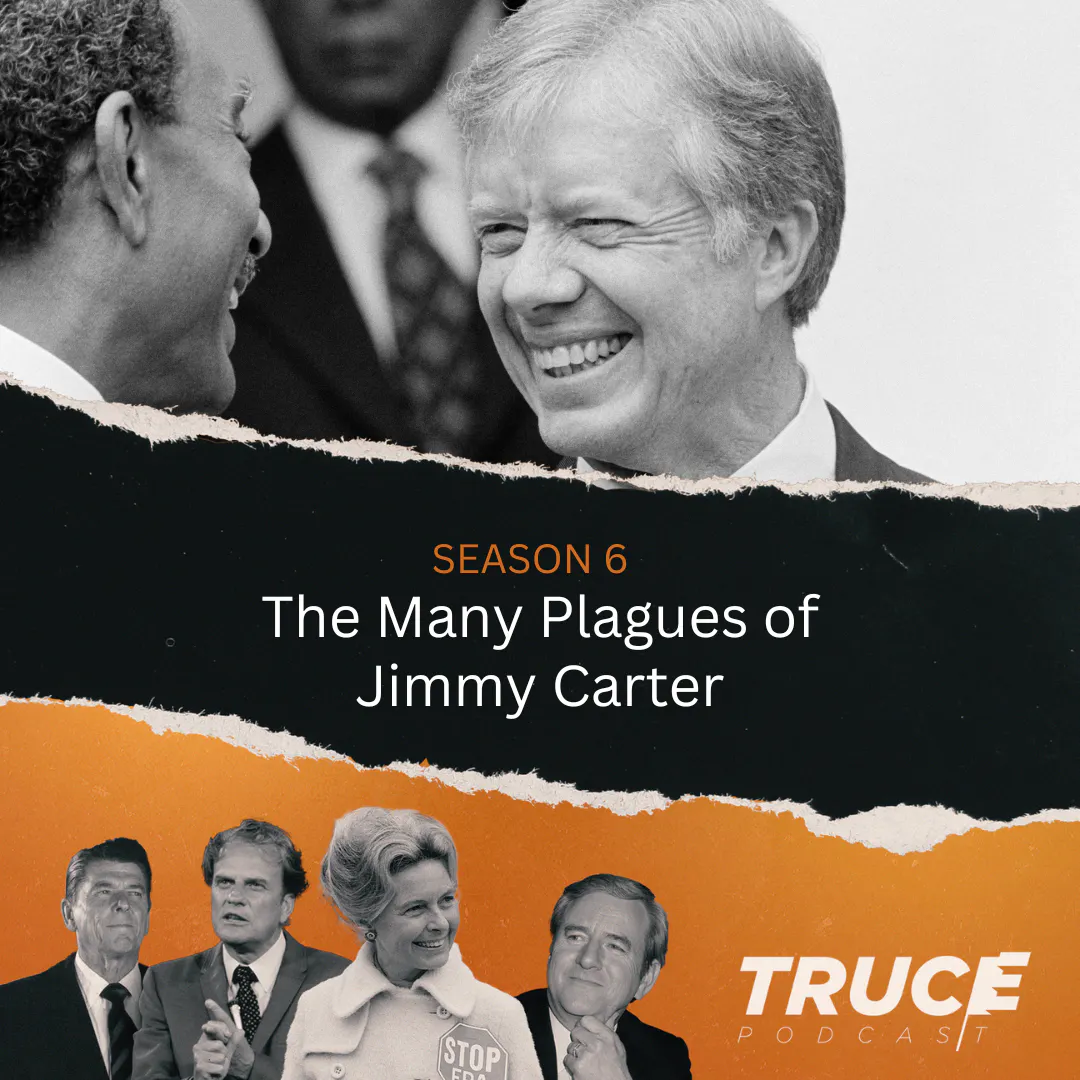
S6 Ep 43Republicans and Evangelicals | The Many Plagues of Jimmy Carter
Give to help Chris make Truce President Jimmy Carter's presidency (1977–1981) faced several major challenges, both domestically and internationally. One of the biggest domestic issues was the struggling U.S. economy. Carter inherited high inflation and unemployment, problems that worsened during his term. The country experienced "stagflation" — a combination of stagnant economic growth and high inflation. The energy crisis, marked by oil shortages and skyrocketing gas prices, further fueled economic instability. Though Carter promoted energy conservation and alternative energy development, many Americans viewed his efforts as inadequate or overly pessimistic. Internationally, Carter faced major challenges in foreign policy. One of the most significant was the Iran Hostage Crisis, which began in November 1979 when 52 American diplomats and citizens were taken hostage at the U.S. Embassy in Tehran. The crisis lasted 444 days and was a major blow to Carter’s administration, especially after a failed rescue attempt. It deeply affected U.S. relations with Iran and damaged public confidence in Carter’s leadership. Though Carter did achieve a major diplomatic success with the Camp David Accords — a peace agreement between Egypt and Israel — the Iran Hostage Crisis ultimately overshadowed much of his foreign policy work. Another major issue during Carter’s presidency was a perceived lack of effective leadership. Carter, known for his integrity and moral outlook, struggled to build strong relationships with Congress and the media. He often took a technocratic, detail-oriented approach to governing, which alienated many political allies. Critics saw his administration as indecisive and overly focused on long-term goals rather than immediate results. These perceptions contributed to a loss of public confidence and were a key factor in his defeat by Ronald Reagan in the 1980 presidential election. The special guest for this episode is historian and author Rick Perlstein. Sources: Phyllis Schlafly's debate with Buckley Reaganland by Rick Perlstein Slate story on Chisholm Video showing Carter's opposition to integrated busing Reagan by Bob Spitz The Invisible Bridge by Rick Perlstein These Truths by Jill Lepore Crash Course by Paul Ingrassia C-SPAN clip of Carter's malaise speech Who is Government? by Michael Lewis Discussion Questions: What do you find appealing about Carter? How do voters sometimes use issues that are beyond a politician's control to judge them? Why would Carter and his predecessors choose to give the Panama Canal to Panama? How would an event like the hostage crisis impact an election? Learn more about your ad choices. Visit podcastchoices.com/adchoices
S6 Ep 42Republicans and Evangelicals | The Council for National Policy: Dark Money in the Church
Give to help Chris make Truce Dark money is a problem in American politics and religion. What is it? Untraceable money that often comes from big donors, which is channelled through non-profits to hide the identity of the donor. This money is then able to back causes that may or may not be positive. The Council for National Policy is an organization in the pipeline for Christian dark money. It finances groups like the Heritage Foundation, Focus on the Family, pro-life groups, Turning Point USA, and more. They also coordinate language around denial of climate change, COVID, and election results. Their first president was Tim LaHaye, but he is just the tip of the iceberg. Our guide through this story is Anne Nelson, author of Shadow Network: Media, Money, and the Secret Hub of the Radical Right. It is an excellent resource that is critical for anyone interested in how some evangelicals tied themselves to the Republican Party. Sources: Biographical video from Turning Point USA about Foster Friess Shadow Network by Anne Nelson Christian Reconstruction: RJ Rushdoony and American Religious Conservatism by Michael McVicar 100 Things to See in the Night Sky Expanded Edition. By Dean Regas Christianity and Oil in US History Article on Nelson Bunker Hunt Birchers by Matthew Dallek The Road to Serfdom (comic version) adapted from Hayek Reaganland and Before the Storm by Rick Perlstein "Information Sheet, Council for National Policy," May 1984 Dark Money by Jane Mayer article on Betsy DeVos as Secretary of Education Ponzinomics by Robert Fitzpatrick Justice Department article about Blackwater/ Prince Adams, D. C., Robles, F., & Mazzetti, M. (2025). A Desperate Haiti Turns to Erik Prince, Trump Ally, In Fight Against Gangs. New York: New York Times Company. Census data on Wyoming Pat Robertson: A Life and Legacy by David Edwin Harrell Jr. Leadership Institute website (accessed 8/8/25) Email blast from National Religious Broadcasters titled: “NRB President & CEO to Advocate on Capitol Hill for AM Radio for Every Vehicle Act” released July 14, 2025 Salem Media website NRB Article about Bott Radio PRwatch.org article and video about CNP Jackson Hole News and Guide article about Donald Trump Jr.'s visit to Jackson in 2016 New York Times article on Foster Friess Tax documents from Turning Point USA, courtesy of Pro Publica 2017 Jane Mayer profile of Turning Point USA ProPublica article on the Kochs Time article on the Koch's and i360 Article on how many people didn't vote in 2024 New York Times article about Trump's call to the Georgia election rep The Guardian article about Kirk's busing of people to the January 6, 2021, riot EPA article about its origins Discussion Questions: What is dark money? Should Christians participate in it? What are the functions of groups like the Council for National Policy? Who was Foster Friess? Why is it important to include a discussion of dark money when talking about things like Turning Point USA? What is the connection between evangelicalism and oil? Learn more about your ad choices. Visit podcastchoices.com/adchoices
S6 Ep 41Republicans and Evangelicals | The Battle for the Mind
Give to help Chris make Truce Tim LaHaye wrote different kinds of books. Books on marriage, sexuality, the end times, and those involved in social and political movements. In his young years, Tim LaHaye taught for the John Birch Society. His conspiratorial view of the world carried over into his theology, evidenced by the Left Behind series, as well as the topic of the show today, The Battle for the Mind. Published in 1980, this little book takes a negative view of humanism. He defines humanism as, essentially, everything that has gone with society in the last 2,000 years. It's a very broad, almost useless definition. Humanism is actually a movement that started in Northern Italy around the 1200s, which tries to lift up the value of the human person. That takes a lot of different shapes, from secular or atheistic humanism to Christian humanism. In fact, as we argue in the episode, LaHaye's view misses the positive ways that humanism has shaped the United States and evangelicalism. My guest today is Dr. Darrell Bock. He is the author or editor of over 45 books, including commentaries on Luke and Acts. He is the Executive Director of Cultural Engagement and Senior Research Professor of New Testament Studies at Dallas Theological Seminary. He's also a host of DTS' podcast The Table. Sources: The Battle for the Mind by Tim LaHaye (1980) Listen, America! by Jerry Falwell The Oxford English Dictionary Encyclopedia Britannica Francis Schaeffer and the Shaping of Evangelical America by Barry Hankins Fact-checking Chris on the Prohibition thing? Start here. Discussion Questions: Have you read anything by Tim LaHaye? What was it? Are Christian books like this useful? Not useful? Why? What is "humanism"? (it may be helpful to look it up outside the book) Why is it important that LaHaye mischaracterized humanism? What were LaHaye's ideas about education? Learn more about your ad choices. Visit podcastchoices.com/adchoices
S6 Ep 40Republicans and Evangelicals | What Scared Tim LaHaye
Give to help Chris make Truce Tim and Beverly LaHaye were a prominent American evangelical Christian couple known for their influential work in ministry, literature, and conservative activism. Tim LaHaye, born in 1926 in Detroit, Michigan, was a pastor, author, and speaker who gained national recognition through his work in Christian fiction and prophecy interpretation. He served as a pastor for over 25 years before turning to full-time writing and speaking, often focusing on end-times theology and family values. Beverly LaHaye, born in 1929, was a vocal advocate for conservative Christian values and women’s roles in society, founding the organization Concerned Women for America in 1979. Tim LaHaye is perhaps best known as the co-author of the Left Behind series, a best-selling collection of apocalyptic novels written with Jerry B. Jenkins. The series dramatizes a fictionalized version of the Rapture and subsequent tribulation, based on Tim’s interpretation of Biblical prophecy. These books sold over 80 million copies worldwide and sparked renewed interest in eschatology within evangelical circles. In addition to fiction, he wrote numerous nonfiction books addressing topics such as marriage, politics, and spirituality, always with a conservative Christian perspective. Together, Tim and Beverly LaHaye were a formidable force in American evangelicalism, combining their talents in writing, activism, and public speaking to influence both Christian thought and conservative politics. Married for over 60 years until Tim's death in 2016, they left behind a legacy of fervent advocacy for their faith and values. While supporters praised their dedication to scripture and family, critics often challenged their political and theological positions. Regardless, their impact on late 20th and early 21st-century evangelicalism remains significant. Sources: Dreyfuss, R. (2004, Feb). "Reverend Doomsday". Rolling Stone, pp. 46-49. White, G. (2001, Jul 07). "Evangelical power couple authors Tim and Beverly LaHaye, with scores of books between them, rank as four-star generals to many conservative Christians." [home edition]. The Atlanta Journal The Atlanta Constitution God's Own Party by Daniel K Williams PBS article on Comstock Laws "The men from CLEAN". (1966, Sep 05). Newsweek, 68, 23-24. Before the Storm by Rick Perlstein How to Be Happy Though Married by Tim LaHaye Divided We Stand by Marjorie Spruill The Unhappy Gays by Tim LaHaye For a Christian America by Ruth Murray Brown Carlin v. Board of Education Listen, America! by Jerry Falwell With God on Our Side by William C Martin Christianity Today article about Carter's presence at NRB “Tim LaHaye--Waging War Against Humanism” Skelton, Nancy Los Angeles Times (1923-1995); Feb 22, 1981 BATTIATA, M. (1987, Oct 03). "Beverly LaHaye leads a powerful force from the right": [CITY edition]. St.Petersburg Times Hacker, K. (1988, Mar 06). "A WOMAN OF ACTION: FUNDAMENTALIST BEVERLY LAHAYE IS BUSY RALLYING HER 'KITCHEN-TABLE LOBBYISTS' TO ALL SORTS OF POLITICAL CAUSES". Philadelphia Inquirer NPR article about Moonies The Evangelicals by Frances Fitzgerald McMahon, M. (1999, Dec). Come, all ye faithful. The Spectator, 283, 18-19 The United States of Paranoia by Jesse Walker Discussion Questions: How have the LaHaye's impacted you? Does it matter that Tim had so many fears? He went on to help found the Council for National Policy, the far-right Christian dark money organization. Why does that feel ironic? How was Tim tied to the battle over segregated academies? How did LaHaye's background with the John Birch Society fit with his other beliefs? Learn more about your ad choices. Visit podcastchoices.com/adchoices

S6 Ep 39Republicans and Evangelicals | Pat Robertson and the Prosperity Gospel
Donate to help Chris make Truce Christians were involved with many forms of media from their inception. They were there at the dawn of radio, with the first commercial broadcast of music being played around Christmas in 1906, and the gospel of Luke was read. A similar story is true for television. Evangelists loved the new medium, with preachers like Oral Roberts using it to spread their brand of Pentecostalism. Pentecostalism was made for television. Where many denominations featured calm worship services, it seemed like anything could happen with Oral Roberts' brand of Pentecostalism. He healed, he made big claims, and he made a lot of money. Roberts' format was followed by people like Jim Bakker and Pat Robertson. Pat Robertson created the Christian Broadcasting Network, which later functioned as his platform for launching the political careers of politicians and, eventually, himself. Robertson's influence is all over evangelicalism, from the ubiquity of consumerism and prosperity ideology to our involvement in political movements. He formed the Christian Coalition and was a leader in the Council for National Policy. Robertson attended many of the seminal meetings of the Religious Right. And his message was amplified by his powerful television platform. Sources: Pat Robertson: A Life and Legacy by David Edwin Harrell Jr. PTL: The Rise and Fall of Jim and Tammy Faye Bakker’s Evangelical Empire by John Wigger Oral Roberts and the Rise of the Prosperity Gospel by Jonathan Root The US Census Farnsworth TV and Pioneer Museum in Rigby, ID The Surprising Work of God: Harold Ockenga, Billy Graham, and the Rebirth of Evangelicals by Garth Rosell The Evangelicals by Frances Fitzgerald Prime Time Preachers by Jeffrey K Hadden and Charles E Swann "Oral Roberts Dead at 91" from CBS News Report on Strom Thurmond's role in the Southern Manifesto The Miracle of Seed Faith by Oral Roberts. I used the revised August 2012 version Reaganland by Rick Perlstein “Remarks in Support of Senate Joint Resolution 199” Aug 18, 1982. (for Robertson's testimony) Christian Reconstruction: RJ Rushdoony and American Religious Conservatism by Michael McVicar Newsweek article about Joe Rogan stats Video of Oral Roberts healing Discussion Questions: What is the prosperity gospel? How has it impacted you? Your church? The Church in general? Why is it important to note that the Religious Right guys controlled Christian media outlets? How does that kind of thing shape our theology? How was Robertson impacted by Roberts? What is "seed faith"? Does the Bible provide ground for it? How has consumerism shaped American evangelicalism? How does it tie into prosperity theology? Learn more about your ad choices. Visit podcastchoices.com/adchoices

An American Coup in Guatemala
Give to help Chris make Truce Given the recent events in Venezuela, I have decided to run a classic episode from season 3. The question of our era is not "why did we do this?" but "why do we keep doing this?" Why does the United States continue to overthrow other countries? God willing, I'll be back next week with a new episode about Pat Robertson. Discussion Questions: What threat did President Jacobo Arbenz pose to United Fruit? United Fruit owned many utilities in Guatemala from the trains to telephone lines. How would you feel if our utilities were owned by foreign entities? If they controlled our natural resources? Do you think the land reform deal was a good one for their country? Were people like John Foster Dulles right to overthrow Arbenz? How might it have benefited them to do so? In what way could the actions of the US in the 1950s reflect poorly on Christianity domestically and abroad? It has been argued that American consumers benefit when Latin American and African countries are thrown in disarray. It means cheaper diamonds, gold, rubber, and more while also stranding the people in those countries in poverty. Does it bother you that you may be benefiting from unbalanced countries? Do you find the assumption that we are benefiting to be offensive? Why? Is there anything we can do about it? Sources: “Bad Fruit: The Story of the American Coup in Guatemala” by Stephen Schlesinger and Stephen Kinzer CIA Document profiling Arbenz YouTube clips of a documentary on the Guatemalan coup Then-Vice President Nixon talking with Armas after the overthrow Statistics on Fruit Financial Times article about United Fruit Book “One Nation Under God” by Kevin Kruse (for the bio info on the Dulles brothers) Peurifoy’s cable to Washington President Arbenz’s farewell speech List of governments that the US has overthrown New intro sources: CSPAN's coverage of the January 3, 2026, speech given by President Trump The New York Times' coverage of the capture of Maduro The New York Times' coverage of the oil angle Learn more about your ad choices. Visit podcastchoices.com/adchoices

S6 Ep 38Republicans and Evangelicals: Bill Bright, Campus Crusade, and Cru
Give to help Chris continue to make Truce William R. “Bill” Bright was born in 1921 in Coweta, Oklahoma. Though raised in a religious environment, he initially pursued business success and personal ambition. While attending the University of Southern California, Bright experienced a dramatic spiritual transformation through the influence of Christian leaders like Henrietta Mears. This encounter led him to surrender his life to Jesus Christ and ultimately shaped his calling toward full-time evangelism. In 1951, Bill and his wife, Vonette, founded Campus Crusade for Christ at UCLA with a vision to reach college students with the Gospel. He later developed The Four Spiritual Laws, a simple evangelistic tract that became one of the most widely distributed Christian tools in history. Under his leadership, Campus Crusade grew into a global movement with ministries focused on students, athletes, families, the military, and professionals. Bright also launched the Jesus Film Project in 1979, which became one of the most-translated and widely viewed films in the world. What's missing from most short bios of Bright is the depth of his involvement in the Religious Right. He organized or was present at some of their key gatherings, founded a publishing house to print their words, and raised funds among them. Bill Bright remained dedicated to fulfilling the Great Commission, often engaging in long periods of fasting and prayer for spiritual guidance. He received the prestigious Templeton Prize in 1996 for his contributions to religion and reinvested the award into Christian ministry. When he died in 2003, Campus Crusade for Christ had expanded into nearly every nation, with thousands of staff and volunteers sharing the Gospel worldwide. Bright’s life stands as a testament to the global impact one person can have through faith, vision, and relentless obedience to God’s call. My guest for this episode is historian John G. Turner, author of Bill Bright and Campus Crusade for Christ: The Renewal of Evangelicalism in Postwar America. Sources: Bill Bright and Campus Crusade for Christ: The Renewal of Evangelicalism in Postwar America by John G. Turner The Evangelicals by Frances Fitzgerald Reaganland by Rick Perlstein God as Capitalist: Seminar Promotes Religion and Riches by Russell Chandler. Los Angeles Times (1923-1995); Jun 1, 1981; starts on page B3. Accessed via ProQuest (thanks to the Teton County Library for access!) Tract: The Four Spiritual Laws The Politics of Rage by Dan T. Carter The Invisible Bridge by Rick Perlstein Before the Storm by Rick Perlstein God's Own Party by Daniel K. Williams One Nation Under God by Rus Walton (page numbers mentioned in the episode correspond to the 1993 paperback edition). I also used the 1987 version from archive.org Birchers by Matthew Dallek In the Spirit of '76, published by Third Century Publishers Inc. Jimmy Carter, the Politics of Family, and the Rise of the Religious Right by J. Brooks Flippen The 700 Club's coverage of the "Washington for Jesus Rally" Also, my guest, Dave Hopping, used to be in the comedy duo "Dave and Brian". They were pretty big! Here is one of their videos. Discussion Questions: Have you read The Four Spiritual Laws? How has Campus Crusade/ Cru impacted your life? The life of your loved ones? What threats did Bright perceive to American Christians? Where was he right? Where was he wrong? What did you think of Rus Walton's book One Nation Under God? Was Bright part of the Religious Right? To what degree? Learn more about your ad choices. Visit podcastchoices.com/adchoices

S6 Ep 37Republicans and Evangelicals I Jerry Falwell (part 2)
Give to help Chris make more Truce The New Right had a plan--to bring evangelical Christians together as a voting bloc. But how to do that? They chose a few targets, people with big followings, and courted them. Jerry Falwell was an obvious choice. He was a fundamentalist preacher, televangelist, and the founder of Liberty University. He also had a propensity for the dramatic, seeing the end of days around every corner. The New Right did not like President Jimmy Carter and did their best to turn evangelicals against him. A big job considering that Carter was an evangelical and often talked about his faith. Still, they wanted Ronald Reagan (a divorced actor with a reputation with the ladies) to be their man. In this episode, Chris is joined by author and historian Rick Perlstein. Sources Reaganland by Rick Perlstein article about Reinhold Niebuhr God's Own Party by Daniel K. Williams The Evangelicals by Frances Fitzgerald Listen, America! by Jerry Falwell Discussion Questions What was the role of the New Right in recruiting religious people? Why was Falwell an ideal candidate for the New Right? A higher percentage of evangelicals voted for Nixon than for Reagan. So why do we talk so much about Reagan as a turning point? What was the Moral Majority? How do we see groups like them operating today? Learn more about your ad choices. Visit podcastchoices.com/adchoices

S6 Ep 36Republicans and Evangelicals I Jerry Falwell (part 1)
Give to help Chris make Truce Jerry Falwell was a prominent American pastor, televangelist, and conservative political activist whose life and ministry had a significant impact on American evangelicalism and politics. Born on August 11, 1933, in Lynchburg, Virginia, Falwell grew up in a family that was not particularly religious. However, after becoming a Christian during his college years, he dedicated his life to ministry. He attended Baptist Bible College in Missouri, where he developed the theological convictions that would shape his future work. In 1956, at the age of 22, he returned to his hometown to found the Thomas Road Baptist Church, beginning his long journey as a spiritual and cultural leader. Falwell’s ministry expanded rapidly through the use of media. He launched the “Old-Time Gospel Hour” television program, which gained national attention and allowed him to reach millions of viewers. His style combined traditional evangelical preaching with a strong emphasis on conservative values. The success of his broadcast ministry helped him establish a broad base of support and financial backing, enabling the growth of both his church and other initiatives. By the 1970s, Falwell had become one of the most recognizable faces of American evangelicalism. In 1971, Falwell founded Liberty University in Lynchburg. Perhaps Falwell’s most politically influential move came in 1979 with the founding of the Moral Majority, an organization that mobilized conservative Christians to become involved in American politics. Through the Moral Majority, Falwell encouraged evangelicals to support Republican candidates who aligned with their views on issues like abortion, school prayer, and family values. The group played a crucial role in the election of Ronald Reagan in 1980, signaling a new era of religious involvement in American political life. Falwell's efforts helped to solidify the alliance between evangelical Christians and the Republican Party that persists to this day. Falwell’s outspoken views often sparked controversy. He was a staunch opponent of abortion, LGBTQ rights, and the feminist movement, and he frequently spoke out against what he saw as the moral decline of American society. Critics accused him of promoting intolerance and mixing religion with politics in divisive ways. Nevertheless, his supporters praised him for standing up for biblical principles and being unafraid to speak his mind in a secularizing culture. Falwell saw himself as a defender of traditional American and Christian values, even as the country grew increasingly polarized. Jerry Falwell died on May 15, 2007. My guest for this episode is Daniel K Williams, author of God's Own Party. Sources: God's Own Party by Daniel K Williams American Sermons: The Pilgrims to Martin Luther King Jr. (for the Danforth sermon) I first heard the Danforth sermon mentioned on the Now and Then podcast The Evangelicals by Frances Fitzgerald Falwell: An Autobiography by Jerry Falwell Falwell's "Ministers and Marchers" sermon Discussion Questions What do you think of Danforth's sermon? Why is it important to understand that preachers have been concerned about the US since before it became a country? Why is it valuable to understand Falwell's early opposition to integration? We know that much of the season is related to education. Why is it significant that Falwell was an educator? How should we as a society adapt when a leader repents of their racism? What role did Frances Schaeffer play in shaping Falwell? Learn more about your ad choices. Visit podcastchoices.com/adchoices

S6 Ep 35Republicans and Evangelicals: Abortion
Give to help Chris continue to make Truce A lot of evangelicals are now single-issue voters, and that issue is abortion. But that was not always the case. In fact, for a great deal of American history, abortion was largely seen as a Catholic issue. There are, of course, exceptions. But most evangelicals and Protestants were divided on the subject, even favoring abortion when it came to preserving the health of the mother, or in cases of rape and incest. On this episode, Chris interviews historian and author Daniel K. Williams about the history of the abortion debate in the United States. A major turning point was the availability of elective or "on-demand" abortions in places like New York. As evangelicals grew more upset with the moral decline of the country, they lumped abortion together with gay and lesbian rights fights, the proliferation of pornography, and decided that it needed to stop. Plus, big money through New Right PACs entered the field, and politicians were soon chosen on their allegiance to pro-life legislation. Sources: Defenders of the Unborn: The Pro-Life Movement before Roe v. Wade by Daniel K Williams Reaganland by Rick Perlstein The Evangelicals by Frances Fitzgerald Romper Room on YouTube CBS Sunday Morning excellent story on Sherri Chessen Article on thalidomide Oyez.org for the Supreme Court cases Church History in Plain Language by Bruce Shelley American Experience article on Comstock Laws New York Times video on the Population Bomb (good stuff!) The US Constitution Frances Shaeffer and the Shaping of Evangelical America by Barry Hankins Discussion Questions: Why was abortion considered a Catholic issue in the mid-1900s? How did the Griswold case impact the Roe case? How did changing sexual mores contribute to the pro-life movement? How did the 1970 opening of New York to elective abortions impact public opinion? What is "abortion on demand"? How did Reagan's endorsement of the HLA shift Republican politics? Was Reagan successful in helping the pro-life movement, or was he merely throwing them a bone to get votes? Learn more about your ad choices. Visit podcastchoices.com/adchoices

S6 Ep 34Republicans and Evangelicals: The Death Penalty
Give to help Chris continue making Truce In the late 1960s and early 1970s, the United States went years without using the death penalty. Not a single person was killed by injection, firing squad, hanging, or electric chair. But by the late 90s, we were killing around 100 convicted criminals per year. What happened? In 1972, the Supreme Court handed down its decision Furman v. Georgia, which negated state capital punishment laws across the country. This meant that some of the worst criminals in the country were suddenly given new sentences. And Americans... lost their minds. Within just a few years, new laws were written, and the Court decided to approve many of them. The death penalty long had a prejudiced bent, disproportionately killing people of color. The NAACP worked hard to end the practice, but those efforts were soon undone as American opinions toward the death penalty abruptly changed. My special guest for this episode is Maurice Chammah, author of Let the Lord Sort Them: The Rise and Fall of the Death Penalty Sources: Let the Lord Sort Them: The Rise and Fall of the Death Penalty by Maurice Chammah The Death Penalty: An American History by Stuart Banner (an excellent source!) Reaganland by Rick Perlstein The Hijacking of American Flight 119: How D.B. Cooper Inspired a Hijacking Craze and the FBI's Battle to Stop It. by John Wigger Listen, America! by Jerry Falwell Romans 13 (and 1 for a fact check) The US Constitution September 26, 1973 (page 94 of 98). (1973, Sep 26). The Ottawa Citizen (1954-1973) Retrieved from https://wsl.idm.oclc.org/login?url=https://www.proquest.com/newspapers/september-26-1973-page-94-98/docview/2338669544/se-2 Oyez.org coverage of Furman v. Georgia Oyez.org coverage of Gregg v. Georgia https://www.youtube.com/watch?v=U4G_O_Z55fQ Pew Research data on crime Discussion Questions: What are your thoughts on the death penalty? Why was the Furman case so important? What did it decide? Should juries have guidelines when considering a death penalty case? Why is the death penalty so popular among evangelicals? Learn more about your ad choices. Visit podcastchoices.com/adchoices

S6 Ep 33Republicans and Evangelicals | Bob Jones University v. The United States
Give to help Chris continue to make Truce Bob Jones University v. United States (1983) was a landmark U.S. Supreme Court case that addressed whether the Internal Revenue Service (IRS) could deny tax-exempt status to private religious schools that practiced racially discriminatory policies. Bob Jones University, a fundamentalist Christian institution, prohibited interracial dating and marriage among its students based on its religious beliefs. In 1970, the IRS revised its policy to deny tax-exempt status to private schools with racially discriminatory admissions policies, prompting Bob Jones University to file suit after losing its exemption. The university argued that the IRS's actions violated its First Amendment rights to free exercise of religion. The central question for the Court was whether the government's interest in eradicating racial discrimination in education outweighed the burden on religious freedom imposed by the denial of tax-exempt status. The case thus pitted two core constitutional principles against each other: religious liberty and the government's interest in promoting equality. In an 8–1 decision, the Supreme Court upheld the IRS’s position. Chief Justice Warren Burger, writing for the majority, stated that tax-exempt status is a form of government subsidy and that organizations seeking this benefit must serve a public interest. The Court held that eliminating racial discrimination in education was a "fundamental, overriding interest" that justified the burden on the university’s religious practices. It emphasized that the government is not required to subsidize discriminatory behavior, even when it is religiously motivated. The ruling had significant implications. It clarified that tax-exempt status is conditional upon compliance with fundamental public policy, including civil rights laws. The decision reinforced the principle that religious freedom, while protected, does not allow institutions to violate core public values when receiving government benefits. This case remains a key precedent in balancing religious liberty with broader societal interests in equality and nondiscrimination. Sources: The Story of Bob Jones University v. United States: Race, Religion, and Congress's Extraordinary Acquiescence by Olati Johnson. Paper Number 10-229. God's Own Party by Daniel K Williams https://supreme.justia.com/cases/federal/us/461/574/#tab-opinion-1955051 1980s Republican Party Platform In Search of Another Country by Joseph Crespino McNamar's testimony, pp.225, Hearing Before the Committee on Finance, United States Senate, Ninety-Seventh Congress, Second Session, February 1, 1982. (Thanks to the Senate Historian's Office) “The Bob Jones Decision: A Dangerous Precedent” by Kenneth S. Kantzer. September 2, 1983, issue of Christianity Today. Randall Balmer article for Politico that narrows the blame for the bonding of evangelicals to the GOP to race Before the Storm by Rick Perlstein Majority opinion in the Bob Jones case New York Times article in which Bob Jones assails the Supreme Court (page A23), May 25, 1983 “Bob Jones, in Sermon, Assails Supreme Court” Discussion Questions: Why is the tax exemption so important to this story? Why is it important to churches and religious institutions? How would revoking the tax exemption change giving to those institutions? Some evangelicals (like CT) denounced the racism of BJU, but still thought the IRS overstepped its bounds. What do you think? Which institutions in the US should be tax-exempt? Which shouldn't? Learn more about your ad choices. Visit podcastchoices.com/adchoices

S6 Ep 32Republicans and Evangelicals | George Wallace
Give to help Chris continue to make Truce George Wallace was, as historian Dan Carter put it, "the most influential loser in American history". He was the governor of Alabama and lost multiple bids for president of the United States. In the process, he spread his racist views throughout the country. Wallace is a vitally important figure in American history. His success in pulling in votes from racists attracted the attention of establishment politicians. He showed men like Richard Nixon that there was a significant voting bloc out there willing to vote based just on their fears about race. In this episode, Chris speaks with historian and author Dan T. Carter about his book The Politics of Rage. Wallace Bio (AI Generated) George Corley Wallace Jr., born on August 25, 1919, in Clio, Alabama, rose to prominence as a controversial figure in American politics. A graduate of the University of Alabama School of Law in 1942, he served in the U.S. Army Air Forces during World War II. After the war, Wallace embarked on a political career, serving in the Alabama House of Representatives from 1947 to 1953 and as a circuit court judge until 1959. His early political endeavors were marked by a moderate stance on racial issues. However, his political trajectory shifted dramatically in the early 1960s. In 1962, Wallace was elected governor of Alabama, campaigning on a platform of staunch segregationism. His infamous declaration, "Segregation now, segregation tomorrow, segregation forever," during his inaugural address in 1963, epitomized his commitment to maintaining racial segregation. That same year, he attempted to block the enrollment of African American students, Vivian Malone and James Hood, at the University of Alabama, an event that became known as the "Stand in the Schoolhouse Door." This act of defiance against federal desegregation efforts brought national attention to Wallace and solidified his reputation as a symbol of resistance to civil rights advancements. Wallace's political influence extended beyond state politics. In 1968, he ran for president as the candidate of the American Independent Party, advocating for states' rights and appealing to disaffected white voters. He carried five Southern states and secured 13.5% of the national vote, demonstrating significant support for his segregationist views on a national scale. Despite his presidential aspirations, Wallace's influence remained strongest in Alabama, where he served multiple non-consecutive terms as governor. A pivotal moment in Wallace's life occurred in 1972 during his campaign for the Democratic presidential nomination. While campaigning in Laurel, Maryland, he was shot by Arthur Bremer, leaving him permanently paralyzed from the waist down. Despite this setback, Wallace returned to Alabama politics, winning the gubernatorial election in 1974. His later years in office were characterized by a shift in his political ideology, as he sought to distance himself from his earlier segregationist positions. Sources: The Politics of Rage by Dan T. Carter National Park Service article about the 16th Street Baptist Church Curtis LeMary's announcement speech History.com article about George Wallace being shot Nixon Library audio tapes collection Nixon talking about Wallace on tape Rolling Stone magazine, October 24, 1974, “The Ministry of George Wallace” by Joe Klein. Questions: Had you heard of George Wallace before? Why was Wallace important? How did Wallace's moderate successes change politics in his era? One prominent person speaking negatively about another race can significantly impact public opinion. How could his bloviating give permission to white people in the north to be openly racist? Learn more about your ad choices. Visit podcastchoices.com/adchoices

S6 Ep 32Republicans and Evangelicals I Boston Against Busing
Give to help Chris make Truce We talk about racism in the United States like it only happens in the South. But the nasty truth is that the North is also guilty of racist behavior. This is evident in the way that we behaved when schools were integrated by bus. Brown v. Board of Education called for public schools to integrate. However, it took decades for many public schools to carry out this directive. It wasn't until the 1970s that the Boston schools were forced to integrate. But how? Schools are frequently attended by children who live in a given school district. But the North had divided itself up by race, forcing black people to live only in certain areas of a city. Black children were not going to white public schools because they simply didn't live in white neighborhoods. This was de facto segregation at work. So when schools were called to integrate, they had to come up with a plan. They would bus students between schools, thus integrating them. But there were problems. In Boston, they started this program by cross-populating poor schools with poor schools. So the quality of education didn't go up. Violence broke out across the city as parents and children alike struggled to welcome people who looked different than them. In this episode, I'm joined by Dr. Zebulon Miletsky, Associate Professor, Africana Studies and History at Stony Brook University. Sources: Before Busing: A History of Boston's Long Black Freedom Struggle by Dr. Zebulon Miletsky Boston Against Busing by Ronald P Formisano Boston Globe (1960-); Sep 26, 1968; ProQuest Historical Newspapers: The Boston Globe pg. 1 and 32 Nixon's radio address about integration The Busing Battleground PBS documentary (worth a watch!) GBH's coverage of busing American Archive video collection on busing Discussion Questions: Integration was going to be difficult. How should it have been handled? Would you send your kids to a potentially unsafe school? What if it meant helping to integrate it? Was the uproar over integrated busing about more than just race? Why is it that black parents sometimes didn't want their kids going to formerly white schools? How do people like Ms. Hicks build a political career on a single issue? Learn more about your ad choices. Visit podcastchoices.com/adchoices

S6 Ep 30Republicans and Evangelicals I Segregation Academies (part 2)
Give to help Chris make the Truce Podcast In 2 Samuel 24 David is told that he must buy a certain piece of land in an act of repentance for his sins. The man who owns the land says that he'd like to give David the land and the animals to sacrifice. But David turns him down, insisting that he won't give to God something that cost him nothing. This story demonstrates something that may be missing from the Christian world today. Sacrifice should cost us something. Sacrifice should be a sacrifice. In the 1970s, school districts in the North and South were told that they had to integrate schools. This move was opposed by people of all sorts, including some Christians who worried that if segregation academies lost their tax-exempt status then Christian schools would too. This is the sad story of how some evangelicals with large followings came to oppose school integration. Our special guest is Daniel K. Williams, author of the excellent book God's Own Party. I also feature a clip from Angie Maxwell author of The Long Southern Strategy. Sources In Search of Another Country by Joseph Crespino Boston Against Busing by Ronald Formisano Reaganland by Rick Perlstein The Evangelicals by Frances Fitzgerald 2 Samuel 24 Article on NPR God's Own Party by Daniel K. Williams Discussion Questions Sacrifice requires sacrifice. What are your thoughts on that statement? Do you believe in school integration? How should it have happened in the 1970s? Would you have wanted your kids to be bused to a different town if it meant a more multicultural experience? Why did some evangelicals with large followings think they needed to tie themselves to the GOP? How do we reconcile with the history of religious segregation academies? Learn more about your ad choices. Visit podcastchoices.com/adchoices

S6 Ep 29Republicans and Evangelicals I Segregation Academies (part 1)
Give to help Chris continue Truce. Update: I would like to apologize for an error I made in the original version of this story. I stated that tuition payments to private schools are tax-exempt on the federal level. They are not. They sometimes are on the state level. The episode has been edited to reflect the correct information. When Brown v. Board of Education passed the Supreme Court in 1954, segregationists stepped up their efforts to keep black children out of their schools. If they couldn't use public schools, they'd establish their own private academies. In the 60's the Supreme Court struck down mandatory Bible reading and prayer in schools, causing some Christians to establish private Christian schools. This movement had unfortunate timing in that it lined up with the segregation academy movement. To our shame, many Protestant schools were segregation academies. But this story isn't so easy. In this episode and the next, we'll explore the strange twists and turns of the private school movements of the 1960s and 70s. They illustrate just how tangled evangelicals are with schools, taxes, and racism. Sources: In Search of Another Country by Joseph Crespino Reaganland by Rick Perlstein The Evangelicals by Frances Fitzgerald Article on Jeffersonian Ideology The Years of Lyndon Johnson by Robert Caro (especially books 1 and 2) Oyez.org article about the McCullum Case Interview with Austin Steelman, professor at Clemson University Oyez.org article about the Plessy case Oyez.org article about Brown v. Board Department of Labor article about the 1964 Civil Rights Act Oyez.org article about the Green case Learn more about your ad choices. Visit podcastchoices.com/adchoices