Truce - History of the Christian Church
225 episodes — Page 2 of 5

S6 Ep 13Republicans and Evangelicals I Francis Schaeffer and the Shaping of Christian Nationalism (feat. Barry Hankins)
Give to help Chris make Truce. Francis Schaeffer is one of the most important theological thinkers of the 20th century. He urged fundamentalists and evangelicals to think outside of their separatism and consider how they could reach the world and expand their worldview. He began his career as a preacher in the United States, but a foreign missions board asked him to assess the state of fundamentalism in Europe after WWII. While there he saw great works of art and met fascinating people. Eventually, Schaeffer moved to Switzerland to start L'Abri, a chalet community where wanderers could come, live, and discuss the gospel. That's where the story may have ended. But his lectures were turned into audio cassettes and books. Then, from this small mountain village, Schaeffer became one of the best-known evangelicals in the world. Once he returned to the United States, his books took on a Christian nationalist tone which sticks with us today. Our guest for this episode is Barry Hankins. He's the author of Francis Schaeffer and the Shaping of Evangelical America. He is a professor of history at Baylor University. Sources: Francis Schaeffer and the Shaping of Evangelical America by Barry Hankins The Evangelicals by Frances Fitgerald Reaganland by Rick Perlstein A helpful article about the Renaissance A helpful article about the Enlightenment Schaeffer's film How Should We Then Live? Gospel Coalition article about secular humanism A Christian Manifesto by Francis Schaeffer Discussion Questions: Have you read any of Schaeffer's work? What is your "worldview"? How did you get it? How did you become aware of that concept? Should all Christians have an idea of their worldview? Should it look a certain way? What do you think about the middle part of Schaeffer's ministry when he was preaching in L'Abri? How does it differ from the last third of his ministry? How have you seen Christian nationalism? What parts of the Bible do people use to justify it? Learn more about your ad choices. Visit podcastchoices.com/adchoices

S6 Ep 12Republicans and Evangelicals I Women's Roundtable Book Discussion
Give to help Chris continue making Truce Betty Friedan's The Feminine Mystique kicked off second-wave feminism in the United States. The book was published in 1963 and addressed what she called "the problem that has no name". As women's roles shifted with the invention of electricity and the number of workers needed to run farms decreased, women's roles shifted. The idea of a "traditional" woman went from a farm laborer or factory worker to someone who kept the home and managed her children's schedules. This left many women feeling unsatisfied and searching for their purpose in life. Friedan's book addressed those issues and inspired more extreme views of women. Several "Christian" books were published to respond to Friedan and second-wave feminism. One was The Total Woman, the number one bestselling nonfiction book of the year which has sold over 10 million copies. Published in 1973, it was the genesis of the scene in Fried Green Tomatoes where Kathy Bates goes to the door to meet her husband wrapped in Saran Wrap. It encouraged women to use costumes to greet their husbands, to avoid being "shrewish", and to use Norman Vincent Peele's philosophy of positive thinking. Another book was The Spirit-Controlled Woman by Beverly LaHaye. This was a companion piece to a book written by her husband Tim LaHaye, but it somehow managed to avoid telling women how to live by the Spirit. Special guests join Chris for this episode. Each took a different book so we can better understand this movement and counter-movement. Special Guests: Amy Fritz of the Untangled Faith podcast Anna Tran of the Love Thy Neighborhood podcast Jen Pollock Michel author of In Good Time, A Habit Called Faith, and Surprised by Paradox Sources: The Feminine Mystique by Betty Friedan The Spirit-Controlled Woman by Beverly LaHaye The Total Woman by Marabel Morgan Discussion Questions: What is your relationship to the books we discussed in these episodes? What is the difference between first-wave feminism and second-wave feminism? How have the roles of women changed in society in the last 200 years? What role did electricity, the Industrial Revolution and wars shaped those roles? What was the "problem that has no name"? How did/does it impact women's lives? How does this vision of feminism compare and contrast to biblical images of women? How have we added or subtracted from what the Bible says about women to create our modern image of a "Christian woman"? Morgan advised her readers to meet their husbands at the door in costumes. What is your opinion of this idea? What did she mean when she said she had been "shrewish"? Is that term insulting to women? Why? Is the "Christian ideal" vision of women one that requires women to stay home with children? Learn more about your ad choices. Visit podcastchoices.com/adchoices

Compelled - KKK Terrorist Finds Christ
bonusDonate to help Chris make Truce In the 1960s, Tom Tarrants was a young man on a mission - to save America from Communism, Marxism, and desegregation. He was prepared to do anything, including joining the Ku Klux Klan, drive-by shootings, or even dying for his cause. Yet God had a far greater plan for this would-be revolutionary. Find the Compelled Podcast at https://compelledpodcast.com/ Learn more about your ad choices. Visit podcastchoices.com/adchoices

S6 Ep 12Republicans and Evangelicals I National Women's Conference Part 2 (featuring Marjorie Spruill)
Give to help Chris continue making Truce The National Women's Conference was set to take place. State meetings were overrun by conservative women causing disruptions to the meetings as they paid the entrance fee with pennies or made noises during the discussions. But liberal women were not angels either. Some went so far as to accuse the conservatives of sending in mental patients to do their voting. It's easy in all of the noise to forget that this was a monumental meeting. Women from all over the country gathered together to discuss issues that impacted them. They ran the show. They set the agenda. Conservative women, by and large, didn't show up for the main meeting. Why? Because of conspiracy theories circulated by groups led by people like Phyllis Schlafly saying that the elections would be rigged. Also, they started their own conference across town. This pro-life, pro-family rally was only about three hours long. But it packed a big punch. People from all over the country took busses overnight to attend. They couldn't stay the night because hotels were already booked up for the main meeting. So they came and went on the same day, taking the pro-family, pro-life movement with them. In this episode, Chris winds up a three-part mini-series that takes us from Phyllis Schlafly's turn against the ERA to this momentous weekend in 1977. The fallout of the conference is still with us today as religious people on the right work together to accomplish their goals, often trying to undo what liberals on the far left have already done. Extremes continue to snipe at extremes as the middle tries to get things done. Our guest for this episode is Marjorie Spruill, author of the book Divided We Stand. It is an excellent resource that is balanced and well-notated. Sources: Divided We Stand by Marjorie Spruill Reaganland by Rick Perlstein Interviews from the National Women's Conference Phyllis Schlafly Report from December 1977 NBC's coverage of Phyllis Schlafly's funeral with Donald Trump's eulogy Discussion Questions: What were some positive outcomes of the National Women's Year conference? What were some challenges they faced? Why did conservatives feel shut out of the conference? What do you think about the role of conspiracy theories in conservative circles (example: Schlafly's insistence that the meeting votes were rigged)? Schlafly was overlooked in the Reagan administration. Why do you think that is? Why is it so hard for people of different beliefs to work together, even for the common good? What do you think would have happened if the IWY conference had not featured lesbian rights? Should it have avoided that controversial topic, or was it an issue whose moment had come? Learn more about your ad choices. Visit podcastchoices.com/adchoices

S6 Ep 10Republicans and Evangelicals I National Women's Conference Part 1 (featuring Marjorie Spruill)
Give to help Chris make the Truce Podcast In 1977, the Congress of the United States allotted $5 million for the National Women's Conference. The money was intended to bring together women from around the country so that they could put together recommendations for the Congress and President. It would highlight women of color, and those minorities who were sometimes overlooked like Native American women. But there was conflict from its inception. Liberal women, some of the same who turned NOW into a liberal group, took control. They did not want the far-right to participate, women like Phyllis Schlafly who had fought so hard to stall the ERA. This only made conservative women more bitter. There was more fuel for the fire. Gay and lesbian rights were added to the discussion topics of the convention. That was a big deal in 1977 when conservative women rallied around Anita Bryant and her fight against equal rights for homosexuals in Miami, Florida. The Bible says that homosexuality is a sin, so some conservative religious people did not want to give homosexuals rights in the US. So for liberal women to incorporate a gay and lesbian plank into the National Women's Conference was a BIG deal. And a way to pick a fight with conservatives. The battle ultimately led to conservatives hosting their own conference a few miles away. This gathering ultimately united the Religious Right and kicked off the Pro-Life, Pro-Family movement that we know today. How did women play a role in uniting evangelicals with the Republican Party? Our guest today is Marjoie Spruill. She is the author of the fantastic book Divided We Stand. She is a distinguished professor emerita of history at the University of South Carolina. Sources: Divided We Stand by Marjorie Spruill Reaganland by Rick Perlstein The Evangelicals by Frances Fitzgerald Anita Bryant's orange juice commercial Phyllis Schlafly on PBS video Former President Trump's eulogy for Phyllis Schlafly Andy Warhol's cover art for Time Magazine of Bella Abzug New York Times article about women swinging while their husbands were in Vietnam "Revive Us Again" by Joel Carpenter Discussion Questions: What is your impression of Anita Bryant? Do you remember her? What rights should homosexuals have in the United States? In the last episode about Phyllis Schlafly, we looked at conflicting opinions of what equal rights look like for women. Should they be treated the same as men or have equality plus protections? Let's transfer that question to homosexuals. Should they have equal rights, fewer rights, or equal rights plus protections? Should women on the president's council have opened the National Women's Conference to women on the far right? What do you think will happen once the conference is launched? Learn more about your ad choices. Visit podcastchoices.com/adchoices

Chris Quits Driving A School Bus
bonusGive to help Chris make Truce Paypal Venmo Patreon Help via check at: Chris Staron PO Box 3434 Jackson, WY 83001 Learn more about your ad choices. Visit podcastchoices.com/adchoices

S6 Ep 9Republicans and Evangelicals I Phyllis Schlafly and the ERA (featuring Marjorie Spruill)
Give to help Chris continue the Truce Podcast. Phyllis Schalfly was a remarkable woman. Regardless of your politics, you have to admire the impact that one person, who was never elected to office, could have on national political conversations. Schlafly was already part of the in-crowd in Washington when she took a stance against the Equal Rights Amendment (ERA). She was an exercise in nuance herself-- a woman who fought for traditional views of women in society, while also earning a law degree and touring the nation on speaking tours. She had a family and held a prominent position in the national zeitgeist, even building on battles fought by Anita Bryant. But who was Phyllis Schlafly? She was a Catholic woman, which is important because Catholics had long been the victims of prejudice in the United States. She was a mother, a popular speaker, publisher of The Phyllis Schlafly Report newsletter, and author of books like A Choice, Not An Echo, which was a conspiratorial screed about stealing elections. This lady knew how to turn a story. She ran for Congress in 1955 and again in 1970, losing both times. Then in 1972, she learned about the ERA. The Equal Rights Amendment was first proposed by Alice Paul in 1923. The goal was to have men and women treated equally under the law. That means that women would no longer receive special protections either. So... a double-edged sword, right? Women in the 1960s and 70s still had a ways to go when it came to equality. It brought forth some big questions about how to achieve it. Schlafly wanted to protect the protections. So she formed STOP ERA (Stop Taking Our Protections, ERA) to rally her followers against the ERA. This was a big twist because state after state had rushed to ratify the amendment. But once Phyllis got going, they applied the brakes and waited. Schlafly may have single-handedly stopped an Amendment to the Constitution. In this episode, we're going to learn about this dynamo. A woman who is both loved and hated. An intelligent woman, and someone who traded in falsities. Our guests for this episode are Marjorie Spruill, author of Divided We Stand and Angie Maxwell, author of The Long Southern Strategy. Important Sources: Divided We Stand by Marjorie Spruill The Long Southern Strategy by Angie Maxwell Reaganland by Rick Perlstein A helpful list of milestones in women's rights Video of Esther Peterson Video of Phyllis Schlafly talking about A Choice, Not An Echo on C-SPAN A copy of Ladies, Have Ya' Heard? as mentioned in the episode Illinois State Archives interview with Phyllis An article from Time Magazine about the ERA's history Britannica article about The Fairness Doctrine Smithsonian article about Phyllis Schlafly Discussion Questions: What do you think about legal protections for women? Are you an Esther, an Alice, or a Phyllis? The ERA is really short. Do you think it should be more specific to clarify its position? How have you seen sexism? How has it impacted your life? Have you seen women treated well in the workplace? What made the difference? Are stay-at-home mothers respected in our society? If not, what can you and your church do to support them? What are your impressions of Phyllis? Are you okay with people using conspiracy theories to bolster their followings? We've spent a fair bit of time this season talking about parachurch organizations. What are your thoughts on them? Learn more about your ad choices. Visit podcastchoices.com/adchoices

S6 Ep 8Republicans and Evangelicals I RJ Rushdoony and Christian Reconstruction
Give to help Chris make Truce RJ Rushdoony is not a household name. But he influenced a lot of interesting people, from members of the New Right to the Christian homeschooling movement. His books and lectures inspired people to pull their kids out of public schools and teach them at home. But who was RJ Rushdoony? He was deeply impacted by his time doing missionary work on a Native American reservation. There he saw how difficult it was to get anything done and to give people proper access to their government. He went on to work with libertarian organizations like Spiritual Mobilization and the Volker Fund. His mentor Cornelius Van Til taught him to see the triad of government, church, and family in a new way. In Rushdoony's mind, those three spheres should not interfere with each other. BUT, he did want Christians to run the government. Instead of doing a top-down change, he wanted change to begin with families, then rise to the church, eventually taking over the political sphere. Howard Phillips, one of the founders of the New Right, was a disciple of Rushdoony. So was his son, Doug Phillips, who founded the homeschooling movement known as Vision Forum. In this episode, Chris interviews Paul Hastings of the Compelled podcast about how they met at a Vision Forum film festival. The special guest for today is Michael McVicar, author of "Christian Reconstruction: R.J. Rushdoony and American Religious Conservatism." Sources: Christian Reconstruction: R.J. Rushdoony and American Religious Conservatism by Michael McVicar Reaganland by Rick Perlstein The Evangelicals by Frances Fitzgerald Helpful article about libertarian philosophy One Nation Under God by Kevin Kruse Discussion Questions: How do you think Rushdoony was impacted by his experiences on the reservation? What is libertarianism? What do you think about it? In what ways have you seen libertarianism presented in evangelical culture? What did Rushdoony think about public schools? How was this a departure from progressive-era Christian thinkers? How does Christian homeschooling differ from other forms of homeschooling? Why did homeschooling take off in the 1980s and 1990s? What role, if any, should Christians play in public schools? Learn more about your ad choices. Visit podcastchoices.com/adchoices

S6 Ep 7Republicans and Evangelicals I Kanawha County Textbook War
Give to help Chris make Truce In 1974, Alice Moore was a member of the school board in Kanawha County, West Virginia. The board met to hear the recommendations of the textbook committee and approve them. But Alice protested when she read a portion from the Autobiography of Malcolm X, which thanked Allah for preventing Malcolm X from being a black Christian. From there they uncovered a number of potentially offensive texts, some because of language, others because of discussions of rape. Race was likely a factor as well, though Moore denied it. Local pastors decried what they saw as secularism and humanism creeping into public schools. Parents blocked school buses, and others kept their children at home. Soon, there were fights, and dynamite was used to blow up school buildings. What started as a disagreement over books erupted into an all-out war. One that echoed in other parts of the country at the same time as families wrestled with changes in education. Sources: "The Great Textbook Wars" - award-winning documentary on the battle "The Invisible Bridge" by Rick Perlstein "Soul on Ice" by Eldrige Cleaver (archive.org) "Androcles and the Lion" by Aesop Texas Monthly article about the Gablers Video of the Gablers talking to William F Buckley on "Firing Line" The New York Times article about schools closed in WV The New York Times article about the textbook war Radio interview about the John Birch Society Discussion Questions: Had you heard of the textbook war before? What did you think of the passage from "Soul on Ice"? Should it be read by senior students headed for college? What about other students? Who should decide what gets taught in local school districts? How about nationally? How did Alice Moore and others act appropriately? How about inappropriately? The KKK and John Birch Society show up a few times this season, often opportunistically. Does their appearance automatically smear all participants as racist? What else was going on in 1974 that could have escalated the panic of the era? Learn more about your ad choices. Visit podcastchoices.com/adchoices

Republicans and Evangelicals I The New Deal
bonusPartner with us by donating at: www.trucepodcast.com/donate Something had to be done. The Great Depression meant the loss of a vast number of jobs and left families waiting on bread lines. Economists like John Meynard Keynes puzzled over what to do. President Hoover took a laissez-faire approach to the catastrophe, only to have matters get worse. Then Franklin D. Roosevelt came into office and his administration kicked The New Deal into gear. It was a program that offered diverse aid to citizens from protections for money in banks to homeowner assistance. Many Christian leaders came to hate the New Deal, especially libertarians. Their opposition to the New Deal as creeping socialism sparked the National Prayer Breakfast, some of Billy Graham's speeches, and the bonding of capitalism to Christianity and the US. So we should probably know what the New Deal was! Our guest on this episode is Justin Rosolino. He's a high school history teacher and the author of the book "Idiot Sojourning Soul". You can find pictures of Chris' 50-mile New Deal Bike Tour on the website at www.trucepodcast.com. Helpful Links: FDR's Inauguration Speech on C-SPAN Interesting YouTube video about the causes of the Great Depression Topics Discussed: What was the Social Gospel? Who was Franklin Roosevelt? What was the New Deal? The Civilian Conservation Corp The Works Progress Administration Jenny Lake - Grand Teton National Park Unemployment Discussion Questions: Why do some people dislike the New Deal? Which of the programs most impacts you? What do you think of the New Deal? Was it a form of socialism? Do you think there will ever be another New Deal in the US? Learn more about your ad choices. Visit podcastchoices.com/adchoices

S6 Ep 6Republicans and Evangelicals I End of School Prayer
Give to help Chris make the Truce Podcast In 1955, the Board of Regents for New York issued an optional prayer to be used in public schools. It became known as the "Regent's Prayer". Here it is: "“Almighty God, we acknowledge our dependence upon Thee, and we beg Thy blessings upon us, our parents, our teachers, and our Country.” That short prayer was contested not only by non-religious people but also by Protestants who thought that it was too vague. What God is it talking about? Where is the mention of Jesus or the Holy Spirit, salvation, sin, grace, etc.? With help from the ACLU, parents sued and the case made it all the way to the US Supreme Court. It was known as Engle v. Vitale. It overturned prescribed prayer in schools. In this episode, Chris goes through the arguments the court and Justice Hugo Black made during this landmark decision. A year later, the Court heard Abington School District v. Schempp, which ended prescribed Bible reading in public schools. This season we're covering how American evangelicals bonded themselves with the Republican Party. There are a lot of reasons that evangelicals started to vote as a block in the late 70s and early 1980s. They range from women's liberation, changes in attitude toward taxation, and battles over gay and lesbian rights, to education. This is part of our coverage of the education section. This episode has been rewritten and recorded, updating an episode from season 3. Sources: "One Nation Under God" by Kevin Kruse Transcript of Abington School District v Schempp Census data about public and private schools Transcript and audio of Engel v Vitale Discussion Questions: Did you ever pray in school? What did you pray? Did you ever read the Bible in school? Is there an "ideal" prayer that should be read in schools? If so, what is it? What objections might parents have? Is it important for school children to learn about religions in school? Do you agree or disagree with Justice Hugo Black? Learn more about your ad choices. Visit podcastchoices.com/adchoices

S6 Ep 5Republicans and Evangelicals I Can I Love Extremists?
Give to support the Truce Podcast It seems like so many people define their faith by what they believe about Donald Trump. How can godly Christians return to the gospel to get us back on track? In this round table discussion episode, Chris is joined by Pastor Ray McDaniel of First Baptist Church in Jackson, WY and Nick Staron to prepare us for the season. Topics Discussed: What is Christianity? The importance of forgiveness and going to those who are angry with us Why it is important to cover things like the Watergate scandals of the 1970s in a Christian podcast The need for humility in our lives The gospel in 10 words or less Do you have a gospel message in 10 words or less? Find Truce on social media and let us know! Learn more about your ad choices. Visit podcastchoices.com/adchoices

S6 Ep 4Republicans and Evangelicals I Long Southern Strategy (featuring Angie Maxwell)
Give a little to help support the Truce Podcast When did Republicans, the party of Abraham Lincoln, start courting the American South? It's a big question! For decades, Republicans were known as the party that helped black people (except, you know, for ending Reconstruction to help gain the White House). Then, with the nomination of Barry Goldwater, the tide turned. Goldwater's team promoted him as a racist when he toured the South. And... he won some ground in the traditionally Democratic region. So when it came time for Richard Nixon to run in 1968, his team decided to court the South. Not out in public like Goldwater had. Instead, they decided to operate a campaign of "benign neglect" where they would not enforce existing laws meant to protect African-Americans. Our special guest this week is Angie Maxwell, author of The Long Southern Strategy. Discussion Questions: What caused the rift in the Democratic Party that made Strom Thurmond leave (hint: it has to do with Truman)? What was the Democratic Party like before Truman? What influence did Strom Thurmond have on Nixon? Who was Barry Goldwater? How did he change the Republican Party by courting white Southerners? How might the idea of the South being "benighted" impact them as a people? Why do so many evangelicals see themselves as "benighted"? Sources: "The Long Southern Strategy" by Angie Maxwell and Todd Shields. "Reaganland" by Rick Perlstein YouTube clip of Nixon not wanting "Law and Order" to mean "racist" Nixon talking about "law and order" in a speech Nixon's campaign ad about protests and tear gas Article about Nelson Rockefeller Nixon's civil rights ad Helpful Time Magazine article "These Truths" book by Jill Lepore Bio on Strom Thurmond Article about Reconstruction "The Evangelicals" book by Frances Fitzgerald Truman's speech to the NAACP Learn more about your ad choices. Visit podcastchoices.com/adchoices
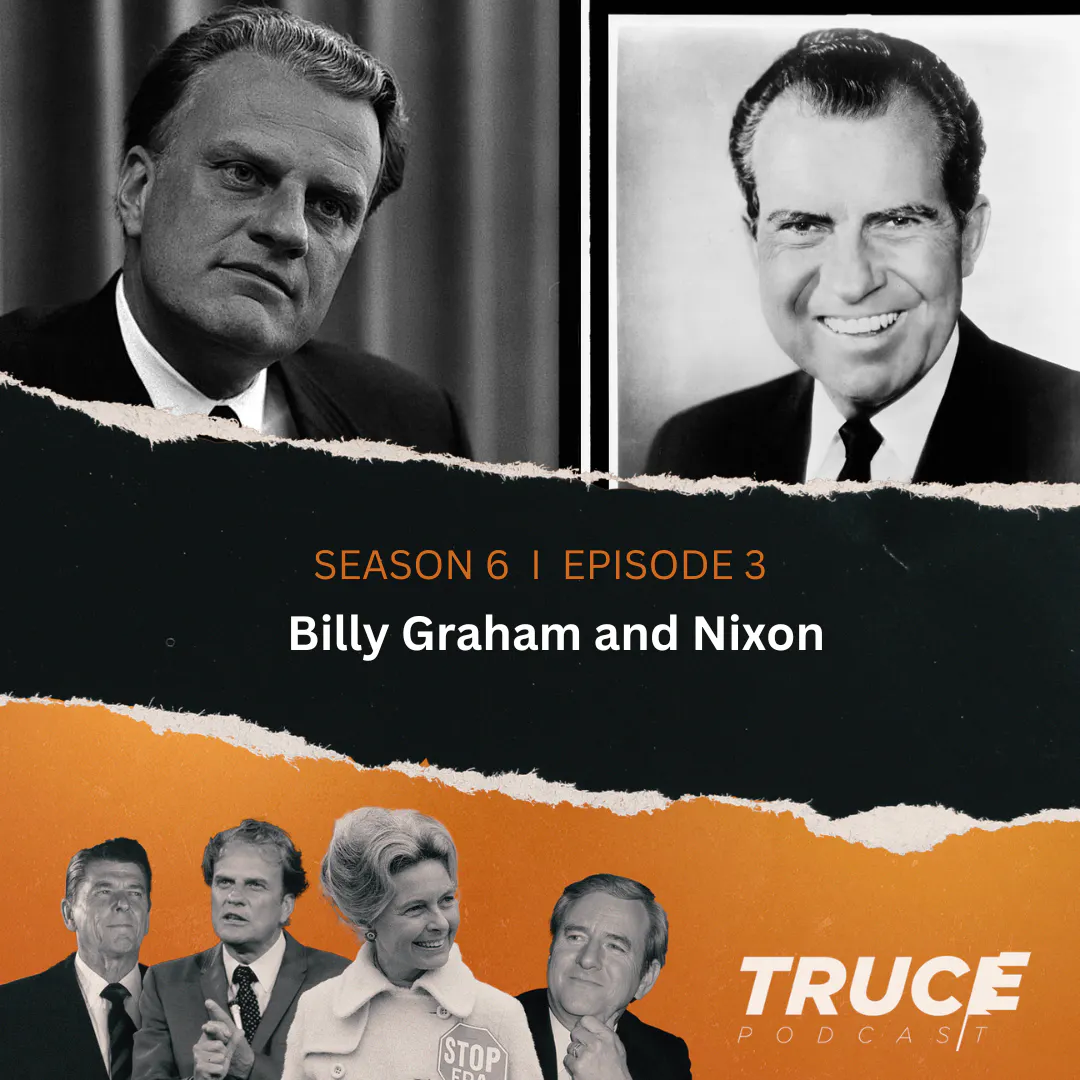
S6 Ep 3Republicans and Evangelicals I Billy Graham and Nixon
Give to help make Truce! Billy Graham, the famous evangelist, was good friends with Richard Nixon. The two played golf and gave each other advice. Graham was the person who encouraged Nixon to run for president a second time. He also encouraged Nixon to regularly attend church, so Nixon started the first regular church service in the White House, only to make it another "it" place to be seen. But when Nixon's crimes were made public, Graham continued to support him, commenting only on the strong language used by the president. What does it mean for Christian leaders to stand behind a corrupt president? In this episode, Chris interviews David Bruce, a historian at the Billy Graham Evangelistic Association. NOTE: I thought it was especially important to outline the many crimes of the Nixon administration. Today these crimes are downplayed by bad actors wishing to rewrite history. It is important to emphasize that not only were there immoral acts of shenanigans, there were real crimes perpetrated against individuals, organizations, and the American people. Sources "The Surprising Work of God" by Garth M. Rosell An article from The Atlantic about the Pope and Mussolini "The Popes Against the Protestants" by Kevin Madigan NPR interview with Kevin Madigan "A Prophet With Honor" book by William Martin "The Invisible Bridge" by Rick Perlstein "The Evangelicals" by Frances Fitzgerald "The Failure and the Hope: Essays of Southern Churchmen" book of essays accessed on Google Books New York Times article about how the Watergate break-in was financed Pat Buchanan hearings during the Watergate investigation Frost/Nixon transcript Discussion Questions: Was Billy Graham being a good friend by supporting Nixon after Watergate? Should religious leaders maintain a certain amount of distance between themselves and people of power? Why do we like to see our governmental leaders as religious people? Was Nixon's church service in the Whitehouse wrong to be a gathering place of the rich and famous? How bad was the Watergate break-in? How does it change your mind about Nixon to know about the other criminal activity? Learn more about your ad choices. Visit podcastchoices.com/adchoices
S6 Ep 2Republicans and Evangelicals I Harold Ockenga - Can Christians Unite? (featuring Joel Carpenter)
Give to help the Truce Podcast! Harold Ockenga was a famous fundamentalist(ish) pastor from Boston. And he had a problem. Liberal Christians had the ear of the government. That meant that military chaplain positions and free radio time were going to liberals, not conservatives. Why shouldn't conservatives have access to the radio waves like theologically liberal Christians? But that would take unity among evangelicals, or, what he called neo-evangelicals. Neo-evangelicals were evangelicals who didn't separate from the world. In Ockenga's case, this meant maybe going to the movies or an opera. So he, along with other preachers like Billy Graham, founded the National Association of Evangelicals with the hope of uniting neo-evangelicals under one banner. It didn't work. The real story, though, sometimes gets lost. The was a big boom in evangelism in the 1940s as WWII wrapped up. Evangelists targeted the youth with organizations like Campus Crusade for Christ springing up left and right. This boom meant that churches swelled in the 1950s, only to begin their long slide a few decades later. In this episode, Chris speaks with Joel Carpenter, a senior research fellow at Calvin College and author of "Revive Us Again". Resources Used: "Revive Us Again" by Joel Carpenter "The Evangelicals" by Frances Fitzgerald "The Surprising Work of God" by Garth Rosell "Reaganland" by Rick Perlstein NPS article about the Bonus Army “After the Ivory Tower Falls” book by Will Bunch Billy Graham audio National Association of Evangelicals "The New Treason" Interviews from Harold Ockenga at Wheaton College Discussion Questions: What spurred the revivals of the 1940s? How has youth evangelism shaped American society? Why is it important to understand the role that cheap higher education played in shaping the 1960s? Why did neo-evangelicals feel that they needed access to the radio waves? Is unity important to the Christian walk? Learn more about your ad choices. Visit podcastchoices.com/adchoices
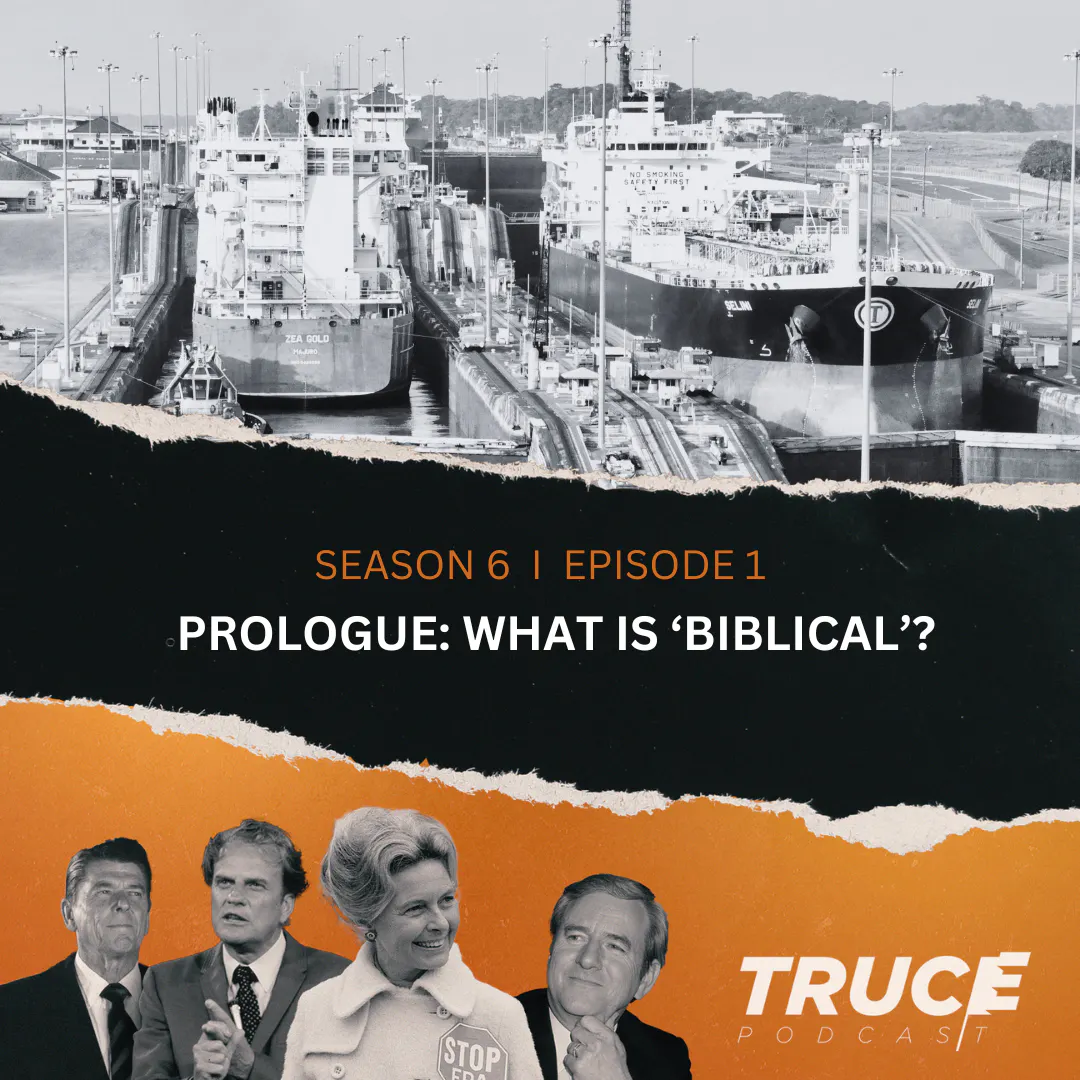
S6 Ep 1Republicans and Evangelicals I Prologue: What Is Biblical?
Give to help the Truce Podcast Thomas McIntyre stood before the US Congress to deliver a moving speech. The man was being hounded by a fringe movement known as the New Right. The movement came from the work of men like Paul Weyrich, Howard Phillips, and Richard Viguerie. Their goal was to disrupt the Republican Party. They wanted to do away with much of the federal government and program to help the poor while simultaneously cutting taxes and increasing the military. They hoped to accomplish this by controlling direct mail. Direct mail! It sounds silly, but by inundating voters and congressional offices with bulk mail they could control the story. Men like McIntyre and Senator Mark Hatfield didn't know what to do with this influx of petty politics. Someone had even gone so far as to question Hatfield's Christian salvation just because of how we was going to vote on the Panama Canal treaty. What does giving the Panama Canal back to Panama have to do with salvation? Almost nothing. Today, we're going to explore this wacky phenomenon where we call something "Christian" or "biblical" if it fits out politics not if it is addressed in the Bible. How are we being manipulated by propaganda like this? And what can we do about it? Discussion Questions: Was the United States responsible in its claiming the Panama Canal as a territory? Are there things in your life that you mix with Christianity? How have your politics gotten confused with your faith? Does the Bible have anything to say on the Panama Canal treaty? Sources: "Reaganland" book by Rick Perlstein Handy article on the history of the Panama Canal Congressional record including the speeches Learn more about your ad choices. Visit podcastchoices.com/adchoices
Behind the Scenes Bonus
bonusGive to help Chris make Truce In this special bonus episode, Truce host Chris Staron walks you through a day in the life of a podcast host. He works about 11 hours per day between this show and his full-time job driving a school bus. Imagine what he could do if he were doing this show full-time!!!! Chris has worked on Truce for 6 1/2 years and is ready to make the show his main focus. We could make that happen if every listener gave $15 per year! Learn more about your ad choices. Visit podcastchoices.com/adchoices
Season 6 Trailer
trailerGive to help Chris make Truce Season six is almost here! This season we're exploring the backstory of why so many evangelicals turned to the Republican Party in the 1970s and 80s. It's a huge story that involves murder, corruption, greed, taxes, school choice, racism, and a lot of big questions. Special guests include Rick Perlstein, Frances Fitzgerald, Marjorie Spruill, Jesse Eisinger, and so many more. Subscribe to Truce wherever you get your podcasts, or listen at trucepodcast.com Learn more about your ad choices. Visit podcastchoices.com/adchoices
Advertising, New Cover Art, Season 6 Update
bonusGive to help Chris keep Truce going! Season six is coming along nicely! I'm super busy trying to get it all put together before I start releasing episodes. But I want to also make everyone aware that I'm looking for more advertisers for the show. Want to participate? Visit www.trucepodcast.com/advertise to get started! Learn more about your ad choices. Visit podcastchoices.com/adchoices
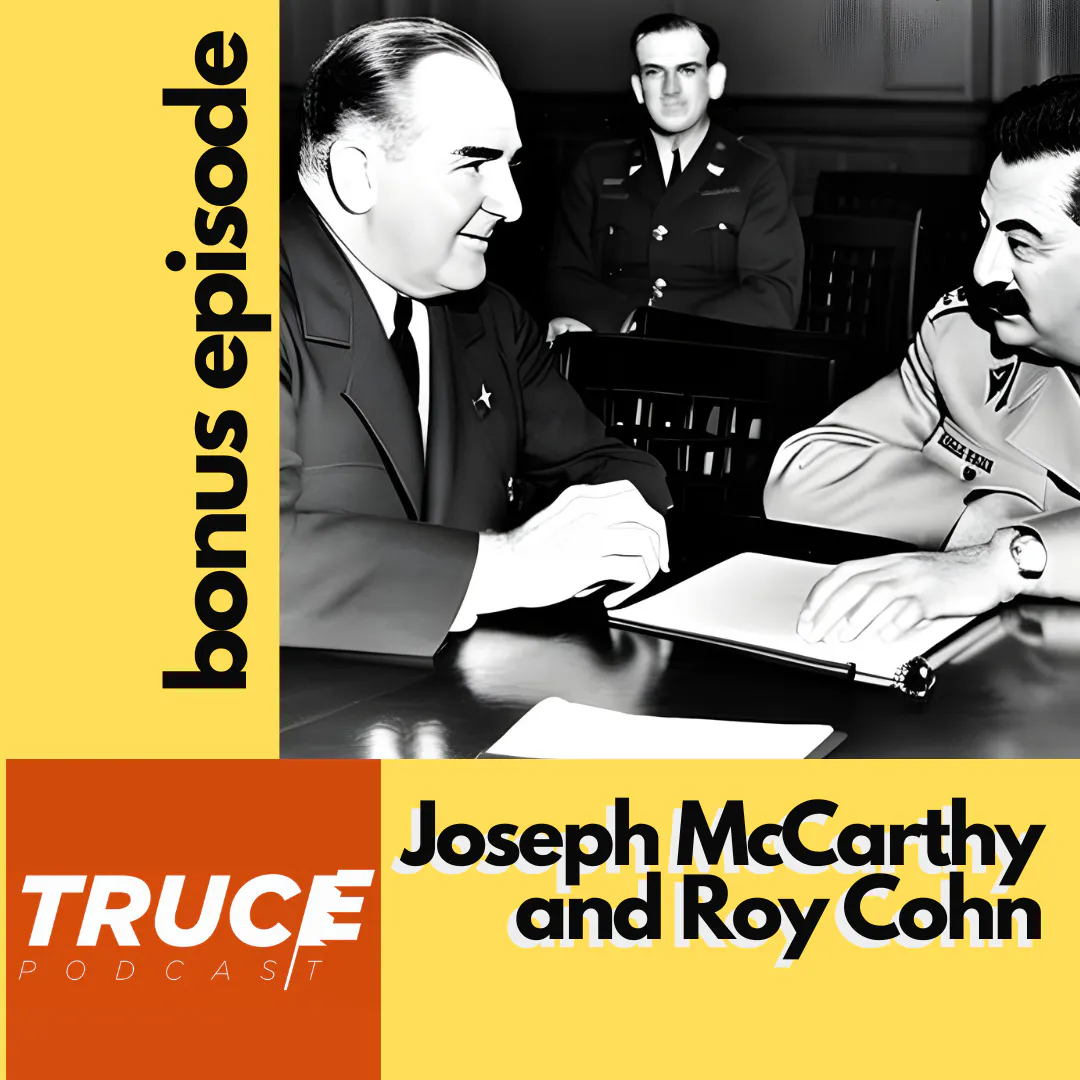
S5 Ep 38Joseph McCarthy and Roy Cohn (featuring Larry Tye, author of Demagogue)
Give to help Chris make Truce! Joseph McCarthy was an unexceptional junior congressman from Wisconsin. He grew up brawling in the streets, playing cards, and embellishing his stories. Then, during a Lincoln Day address in 1950, Joseph McCarthy told an audience that he had a list of 205 communists working in the government. Within days, he was a household name. McCarthy started "investigating" suspected communists in the American government, focusing on the US State Department. Along the way, he brought in a young lawyer named Roy Cohn. Cohn was already known for his work sending Julius and Ethel Rosenberg to the electric chair. Now, he and McCarthy bullied and cajoled during private hearings. Being labeled a communist, or even a suspected communist could ruin a person's career. People committed suicide rather than face their scrutiny. Their reign lasted four years, ending in the televised broadcasts of the Army-McCarthy hearings in which a lawyer asked if McCarthy had any decency. That was pretty much it for McCarthy. But Roy Cohn went on to have a well-connected career, providing legal services for the mob and Rupert Murdoch, owner of Fox News. He also became a mentor to a young real estate mogul named Donald Trump. Famous people like Andy Warhol attended his birthday party at Studio 54. Cohn died of AIDS, something that was killing gay men rapidly in the 1980s, though he denied he ever had it. This is the story of two men allowed to prey on the fears of the American people for their own gain. One fell hard, the other found himself fighting against his own people. In this episode, Chris interviews Larry Tye, author of the book "Demagogue". He's also the author of "Satchel: The Life and Times of an American Legend" and "Bobby Kennedy: The Making of a Liberal Icon". Sources: "Demagogue" by Larry Tye Helpful article about the Rosenbergs Article about Klaus Fuchs McCarthy's speech in Wheeling, WV New York Times, February 23, 1954. Pages 16-17 “Transcript of General Zwicker's Testimony Before the McCarthy Senate Subcommittee” Video from Army-McCarthy hearings (forward to the last 20 minutes if you want to jump to the stuff I used) The guest list for Roy Cohn's birthday at Studio 54 Discussion Questions: Why do we love demagogues? Who are other demagogues in American history? The threat of communists in the government in the 1950s is sometimes downplayed. Do you think it was a real concern? McCarthy ran for Congress in an illegal way while still in the Marines. How do you feel about that? Roy Cohn sometimes went against his own people, claiming that gay people did not deserve equal rights. What might have been his motivation? Do you see any crossover between McCarthy, Cohn, and Donald Trump? Cohn died of AIDs in the 1980s when the disease was at its peak. Why might he have wanted to keep his illness a secret? Learn more about your ad choices. Visit podcastchoices.com/adchoices

S5 Ep 37Love Thy Neighborhood - Where the Gospel Meets Artificial Intelligence
bonusGive to help Chris make the Truce Podcast! The Love Thy Neighborhood podcast is really well produced. But they also take deep dives into some of the things going on in modern Christianity that I can't cover on Truce. They are a good supplement to the stuff we cover on this feed. So we thought... why not share each other's show? In this bonus episode, you'll hear Chris talking with Anna Tran and Jesse Eubanks about their episode "Where the Gospel Meets Artificial Intelligence". It is a look into the ways in which AI may someday try to gain ground in the spiritual realm. Also, they do an interview with TikTok evangelist York Moore who uses that medium to share the gospel. I was especially interested in the ways in which AI chatbots are building false relationships with people, taking the place of human interactions. They cover a lot of ground! Let them know that you heard about their show from the Truce Podcast! Season six starts in just a few months, but I will be launching a bonus episode in a few weeks. Subscribe so you get every new episode as it's released. Learn more about your ad choices. Visit podcastchoices.com/adchoices
Season 6 Update
bonusSeason 5 of the Truce Podcast was a blast! I'm hard at work on season 6, which will discuss how American evangelicals got tied to the Republican Party. It is already coming together so well! I can't wait to share it with you. God willing, season 6 will drop in the fall or early winter of 2023. Like, subscribe, sign up for the email list, and remember the show in your prayers! Godspeed! Learn more about your ad choices. Visit podcastchoices.com/adchoices
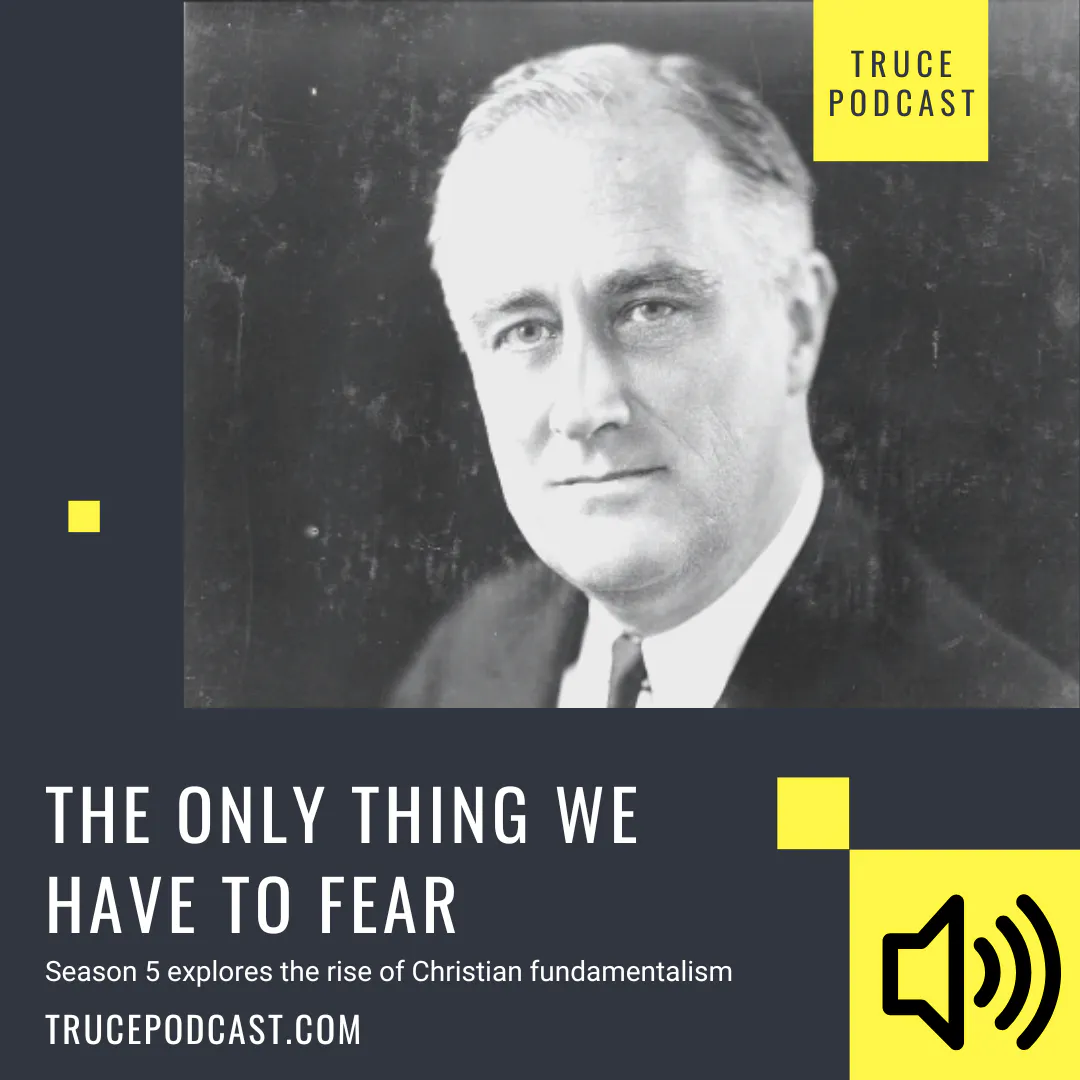
S5 Ep 36Takeaway #5 - The Only Thing We Have to Fear
bonusGive to support the Truce Podcast On March 4, 1933, FDR delivered his inaugural address. In it, he used the phrase "the only thing we have to fear is fear itself". I did a little searching and this phrase is used a LOT in Christian books. So often. But it almost always refers to the fear one person has in their heart. In reality, it is a comment on collective fear. The Great Depression started in 1929 and was exacerbated by a bank run in which Americans lost faith in the value of our currency and the banking systems. That is an important distinction. FDR's speech is about collective fear. As I've contemplated the modernist/fundamentalist debate this season, I keep returning to the idea of fear, not in the US economy but in God's economy. He commands us to love the Lord, keep His commands, love our neighbors, turn the other cheek, and give to those who ask of us. Why do we forget to do this important work? Could it be because we've lost faith in God's economy? This episode features a clip from my discussion with Jacob Goldstein, former host of NPR's Planet Money podcast and the current host of Pushkin's What's Your Problem? podcast. His book is Money: The True Story of a Made-up Thing. Select Sources FDR's Inaugural Address Jacob Goldstein's Money: The True Story of a Made-Up Thing Movie: It's a Wonderful Life Discussion Questions: Why does it matter that FDR's quote "...the only thing we have to fear is fear itself" is a collective statement and not one about individual fear? What are some identifying features of God's economy? Do you trust in the way that God tells us to do things? When was the last time you prayed for someone who you don't like? Do you believe in turning the other cheek? Learn more about your ad choices. Visit podcastchoices.com/adchoices
S5 Ep 35Takeaway #4 - We Are A People of the Means
Love Truce? Give a little to help support the show! "The ends justify the means" is a phrase we hear occasionally. Often it is used to justify bad behavior, so long as it creates a profitable outcome. But we Christians know that we are called to live righteous lives. Are we people of the ends, or should we be known as a people of the means? Chris is joined this week by Pastor Ray McDaniel of First Baptist Church in Jackson, WY, and his twin brother Nick Staron to discuss this important issue. Discussion Questions: What does "the ends justify the means" mean? How have you seen that philosophy played out? Is that something you believe? How would things change if we focused more on the way we do things instead of our goals? How have fundamentalists justified their goals with poor behavior? How have modernists? Learn more about your ad choices. Visit podcastchoices.com/adchoices
S5 Ep 34Takeaway #3 - The Great Divorce
bonusGive a little to help Chris continue to make Truce! In 1945, C.S. Lewis published his excellent book "The Great Divorce". It happens to be one of my favorite books. It has many themes, the biggest of which is that there can be no hell in heaven. The two are divorced from each other (hence the title). Another is that humans are easily distracted from God's work and the gospel. This season I've been telling the backstory of Christian fundamentalism. I think many of us have been distracted from the gospel because of politics or the people around us. If you were joined by a loved one who passed away or an angel who challenged you to walk to heaven, would you? What distracts you from following Jesus? From really going for it? Special thanks to my improv troupe (Nick, Josh, and Jackie) who helped with voices. Additional vocal work came from Paul Hastings from the "Compelled" podcast and Jerry Dugan from "Beyond the Rut". Give their shows a listen and let me know what you think! Sources: The Great Divorce by C.S. Lewis (though I only used some concepts) Discussion Questions: What distracts you from following God? Are you tied too strongly to things? Safety? Your family? Your job? Your identity? Your politics? What books do you read over and over again? Why? How can a person's own love of intellectualism be a distraction? How can we have compassion? Learn more about your ad choices. Visit podcastchoices.com/adchoices
S5 Ep 33Takeaway #2 - Extremes Lead to Extremes
bonusIn the fall of 1814, the powers of Europe gathered together to discuss what to do with the continent after the Napoleonic Wars. Napoleon had changed a lot in his time in power! He cowed the Roman Catholic Church, ended serfdom where he went, freed Jews from their ghettos, took away kingdoms, and placed new kings in charge. The Congress of Vienna was tasked with a Humpty Dumpty scenario and they couldn't put Europe back together again. The various countries also wanted to be compensated for their efforts to stop Napoleon. Couldn't they take a little piece of land? Encroach on one of the lesser kingdoms? Install their own puppet governments? In trying to undo all of the changes Napoleon made, they became little Napoleons themselves. In the same way, when we confront extremism with extremism we become exactly what we dislike. Shouldn't Christians be more focused on simple righteousness than culture wars? Select Sources: The Rites of Peace by Adam Zamoyski Napoleon: A Life by Andrew Roberts (a great place to start if you want to learn about Napoleon) Discussion Questions: What was the Congress of Vienna? Why did the congress matter? Have you ever served God to the point where it cost you something big to do so? How have you seen the modern Church become what it opposes? Have you seen Christians or churches act in a righteous way? Learn more about your ad choices. Visit podcastchoices.com/adchoices
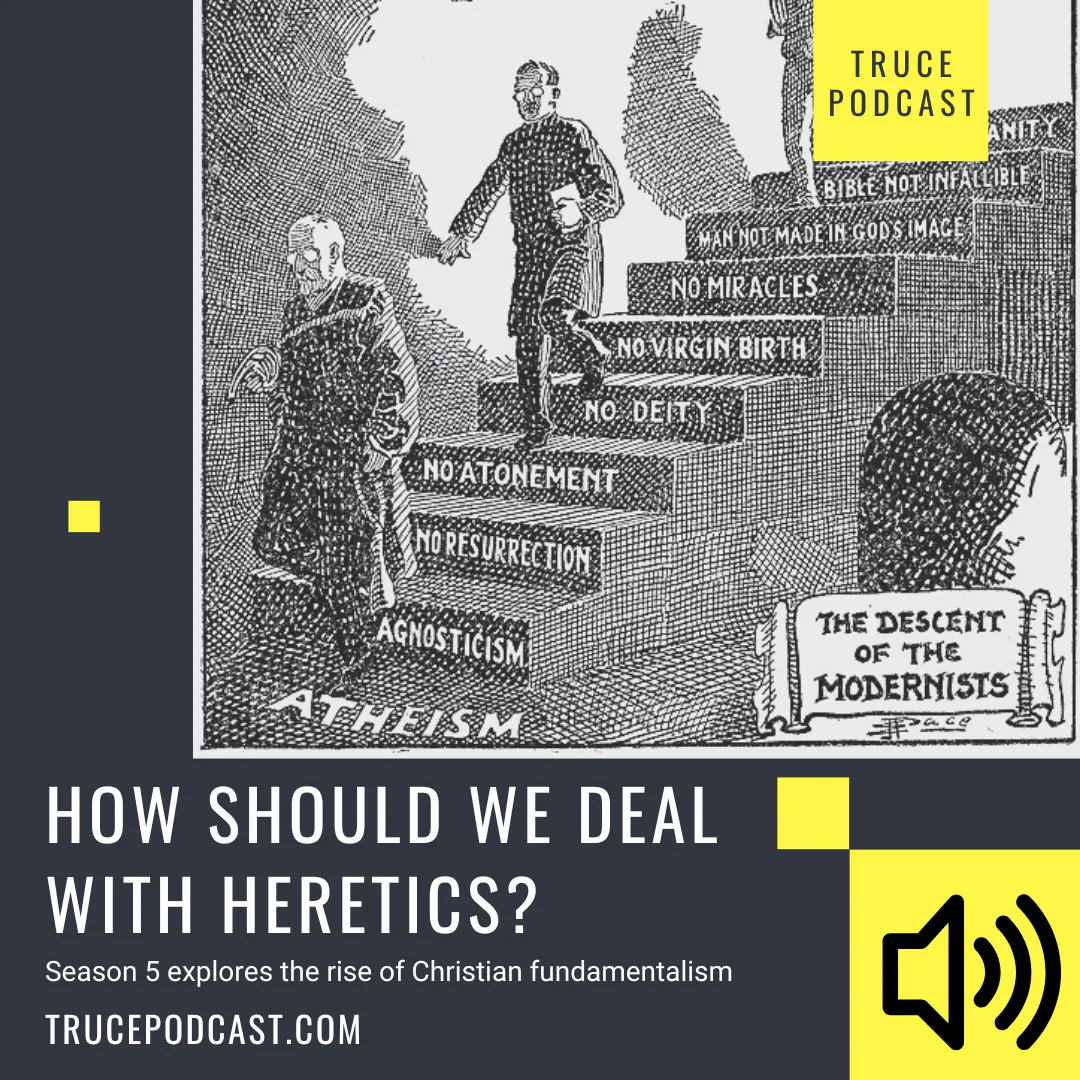
S5 Ep 32Takeaway #1 - How Should We Deal With Heretics?
bonusDonate to help Chris make Truce! The first-century Christian Church had a lot going on. Their Savior died and was resurrected, sending the Holy Spirit and leaving them with the command to take this new message to all tribes and tongues. The book of Acts records some of their travels, as they went all over the known world with this good news. But they were not the only people evangelizing. So were the gnostics. Gnosticism takes a lot of different shapes. It was a belief system that challenged Christianity, even as some tried to incorporate elements into the faith. Now consider modernist theology - what we've been talking about all season. It is a belief system that doesn't believe in the miracles or the divinity of Jesus. To evangelicals of the 1800s and 1900s, this was a real threat. Like Gnosticism before it, modernism threatened to destabilize the gospel message. What to do? In this bonus episode, Chris takes a look at 1-3 John to see what they have to say about dealing with heresy. Chris is hard at work on season 6! He'll be presenting these short episodes in the meantime to recap some of the themes of season 5. Discussion Questions: If you were alive in the mid-1800s and saw modernism rising, what would you do? Do you think modernism is a heresy? How should Christians today deal with heresy? What did the fundamentalists get right and how did they mess up when approaching heresy? Selected Source Materials: 1-3 John "The Early Church" by Henry Chadwick Learn more about your ad choices. Visit podcastchoices.com/adchoices
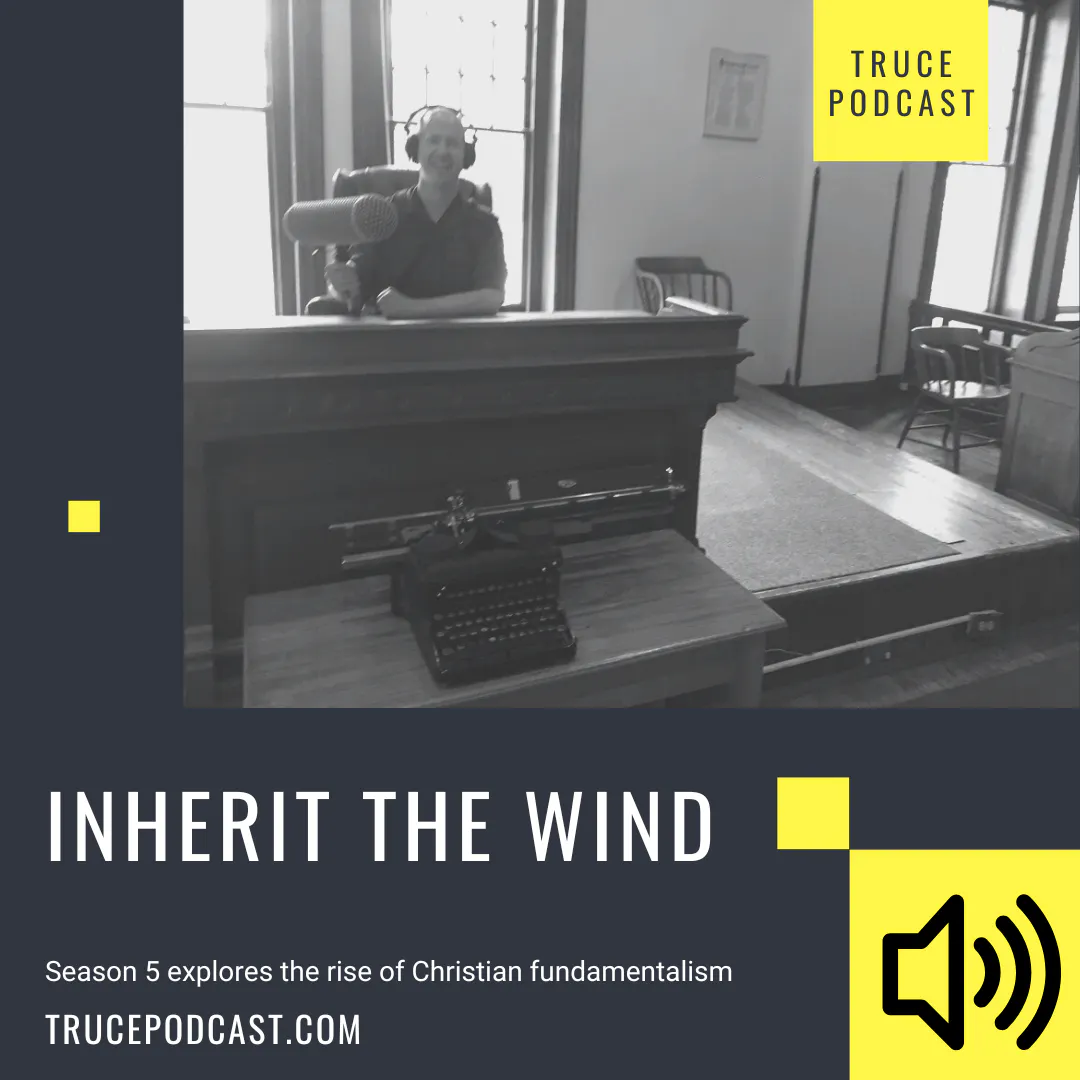
S5 Ep 31Inherit the Wind | Christian Fundamentalism Series
US Senator Joseph McCarthy unleashed an era of suspicion on the American people as he went looking for communists. His trials, both public and behind closed doors, focused on the government as well as Hollywood and the Army. He claimed that he had lists of communists, but failed to produce that list. It wasn't until the Army-McCarthy hearings in the spring and summer of 1954 that his unfounded hearings were put to rest. One year later the play Inherit the Wind opened. It was supposed to be a critique of the McCarthy era set inside of a re-telling of the Scopes "monkey" trial. In doing so, it got many of the facts wrong. John Scopes never spent any time in jail. He didn't have a girlfriend, and that girlfriend was not berated on the stand. The townspeople of Dayton, TN were welcoming to both Bryan and Darrow. To explore this work of art and revisionist history I spoke with the hosts of the Seeing and Believing podcast Kevin McLenithan and Sarah Welch-Larson. Select differences between the Scopes trial and Inherit the Wind John Scopes was arrested but never spent time in jail. He was "arrested" in a soda fountain where the test trial was conceived and not in school. Scopes later claimed he never taught evolution, which is why he never took the stand in real life. The entire case was set up as a publicity stunt to bring attention to the town of Dayton, TN. They got the idea when they saw an ad placed by the ACLU. The character of Rachel did not exist in real life. The people of Dayton were welcoming to both Darrow and Bryan and Scopes was loved by many. He even spent time swimming with the prosecution between trial sessions. The moment when Bryan was on trial was held outdoors. H.L. Mencken was not some loveable curmudgeon. He was an anti-semite and a racist. Dayton largely did not vote for Bryan when he ran for president. Bryan died a few days after the trial, not while in the courtroom. Darrow did not carry a copy of the Bible and Darwin out of the courtroom. The textbook in question during the trial was clearly pro-eugenics, was sold in the soda fountain, and had been approved by the state textbook committee. The preachers of the town were kind. The odd sermon given the night of the trial never happened and the script adds a lot of strange things that are not in the Bible. Bryan wished the law to have no penalty, unlike his stand-in in the movie who hoped for a harsher punishment. Sources Inherit the Wind (1960 version) starring Spencer Tracy Summer for the Gods by Edward Larson Chris' own visit to the Dayton museum dedicated to the trial Helpful video about the Napoleon painting Discussion Questions: Where is the line between art and propaganda? Does art have an obligation to the truth? Do you see McCarthyism in Inherit the Wind? Is Inherit the Wind a fair way of discussing the Scopes trial, or a work of revisionist history? Why does it matter? What would it mean for a group that feels maligned and misunderstood to have a film misrepresent them? Learn more about your ad choices. Visit podcastchoices.com/adchoices
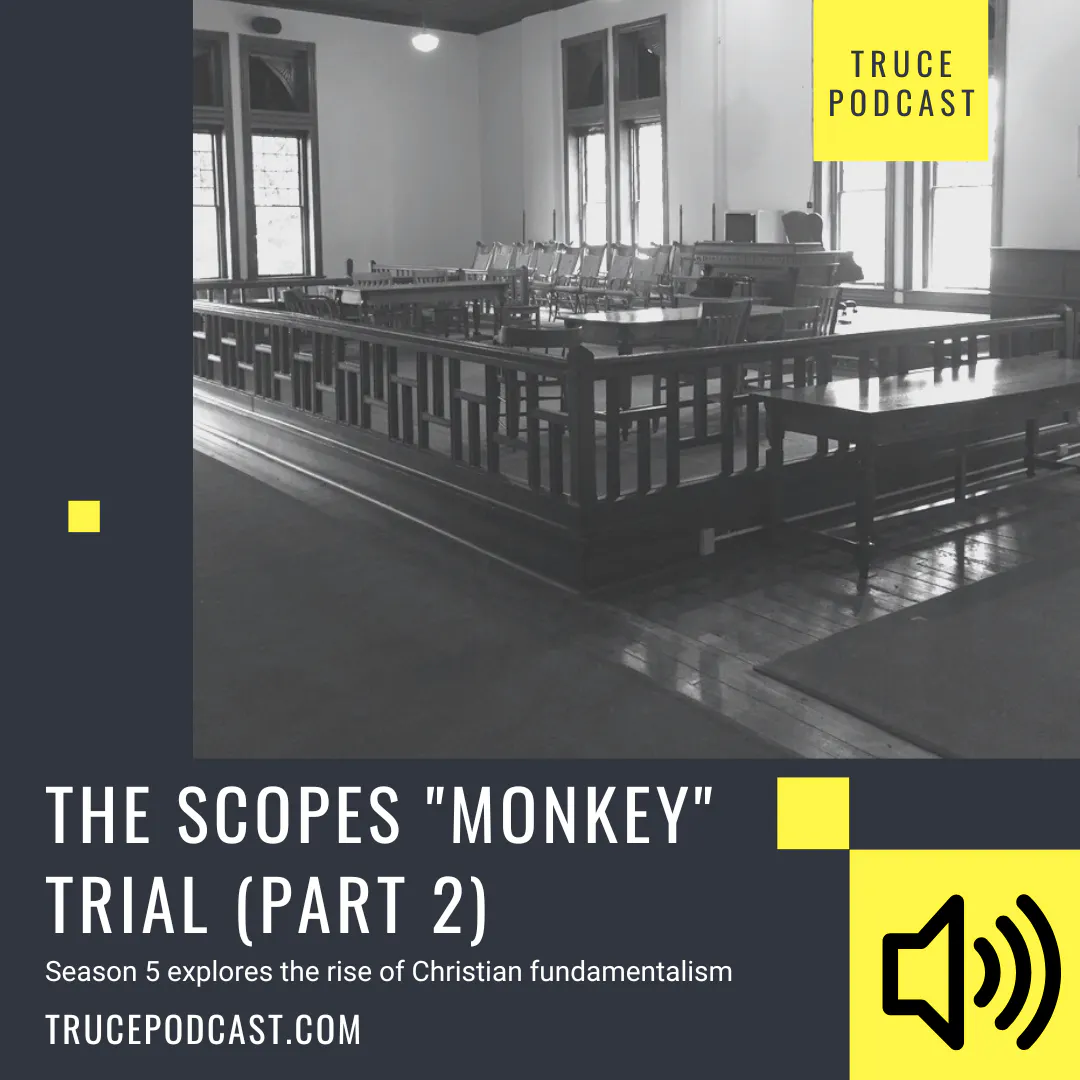
S5 Ep 30The Scopes "Monkey" Trial Part Two | Christian Fundamentalism Series
Love Truce?? Donate to keep the show going! The trial was basically over. The prosecution won. John Scopes was moments away from being convicted of teaching evolution in Dayton, Tennessee. The ACLU and the prosecution had what they wanted. But Clarence Darrow did not. He wanted to make a monkey out of William Jennings Bryan, the famous "fundamentalist". But how? Darrow knew that if he turned down the chance to make a closing argument that Bryan would not be able to make one either. That meant that Bryan's carefully crafted words would never get heard. But he had one more trick up his sleeve. He would call Bryan, the lawyer for the prosecution, to the stand. Imagine that! The case was no longer about the defendant. It was about the lawyers trying to flex. Bryan took the bait. He got on the stand outdoors next to the Rhea County Courthouse in front of an audience of millions. Darrow, in a masterstroke, hit him over and over with the questions of any village atheist. Did Jonah really get swallowed by a large fish? Did the sun really stand still because Joshua prayed that it would? And Bryan... floundered on live radio. This event was made even more famous by the long-running play Inherit the Wind on broadway, which was followed up by a movie adaptation. But the play got it all wrong. Edward Larson, professor at Pepperdine University, and author of the Pulitzer Prize-winning book Summer for the Gods, joins Chris to uncover what really happened on that muggy summer day. Helpful Sources: "Summer for the Gods" by Edward Larson Rhea County Heritage and Scopes Trial Museum Worth a visit! Court Transcript of the Scopes Trial (easy to find online) "A Godly Hero" by Michael Kazin Discussion Questions: Bryan believed in majoritarianism. What is that idea? What do you think of it? Do you think Bryan should have gotten on the stand? Why or why not? How did Bryan do on the stand in your opinion? Does this court case matter in your understanding of fundamentalism? How and when should Christians make stands for their beliefs? When should we stay quiet? Learn more about your ad choices. Visit podcastchoices.com/adchoices
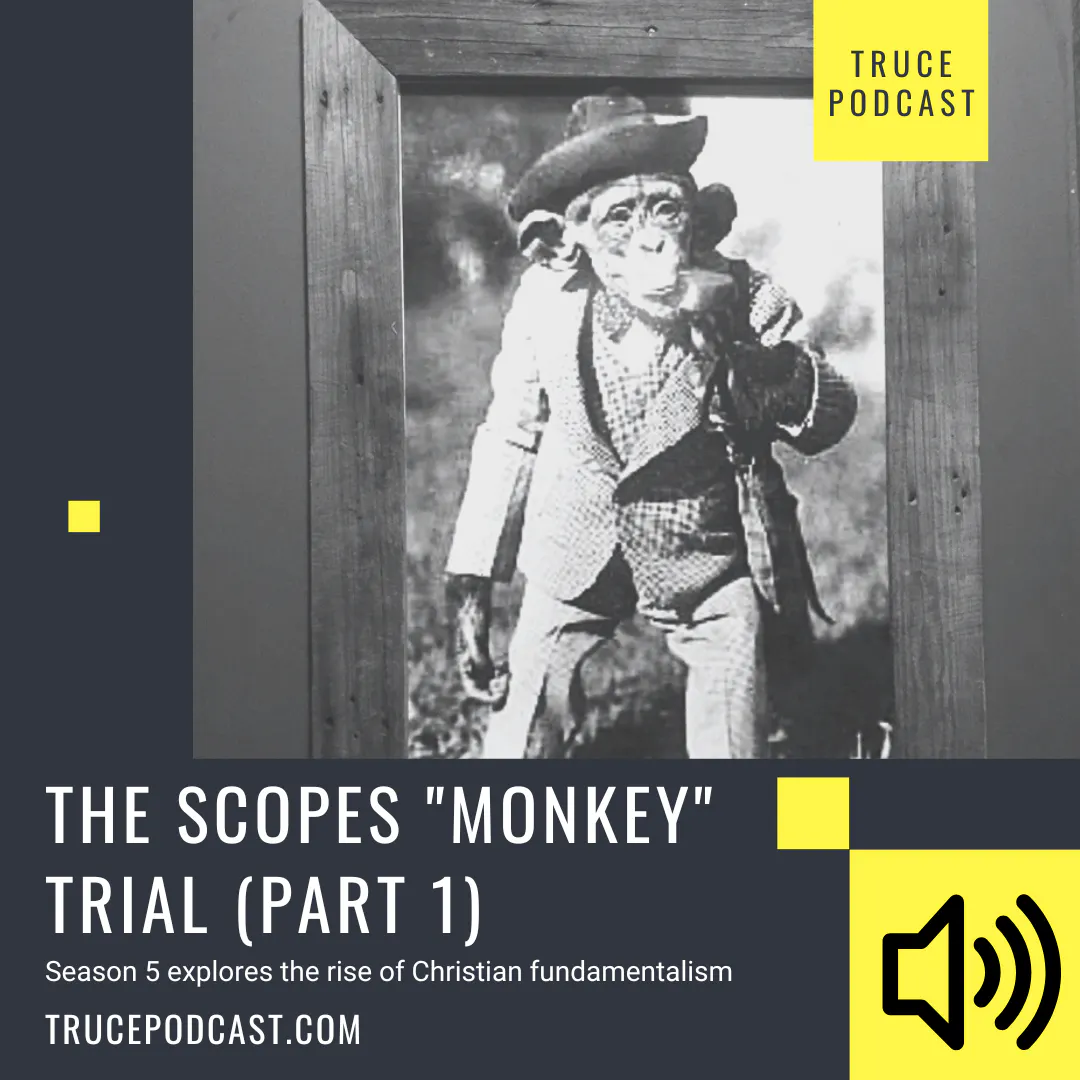
S5 Ep 29The Scopes "Monkey" Trial Part One | Christian Fundamentalism Series
Give to help Chris do Truce full time! Tennessee was the first state in the United States to crack down hard on the teaching of evolution in public schools. Others had dabbled, but Tennessee went all the way. The ACLU wanted to challenge the validity of the case in the courts. In order to do that they needed an educator to teach it, get busted, and be brought to trial. At the same time, the town of Dayton, TN needed a boost. After the biggest employer closed down it faced serious economic trouble. What if the men of Dayon could manufacture a court case to draw the attention of the nation? They found a young teacher named John Scopes and convinced him to participate in their scheme. They booked Scopes, even though he probably never taught evolution. The ACLU had its case. Soon William Jennings Bryan and Clarence Darrow hopped on board and it went from a publicity stunt to something for the history books. This is the event that some historians (wrongly) point to as the death of Christian fundamentalism in the United States until it was revived by the Moral Majority. One man fighting for the biblical idea of creation and another for godless atheism. But the real history is far more complex. Edward Larson, professor at Pepperdine University, joins us to discuss the trial and his Pulitzer Prize-winning book "Summer for the Gods". Helpful Sources: "Summer for the Gods" by Edward Larson Rhea County Heritage and Scopes Trial Museum Worth a visit! Court Transcript of the Scopes Trial (easy to find online) "A Godly Hero" by Michael Kazin Discussion Questions: What events led to the Scopes trial? Why did the ACLU feel they had to try the Tennessee Law? Who should decide what is taught in schools? Teachers? Parents? Lawmakers? Or some combination? What were William Jennings Bryan's motives for joining the prosecution? What were Clarence Darrow's motives for joining the defense? Should prayer be allowed before a trial about religion? Should Christians get involved in what is taught in schools? To what degree? Learn more about your ad choices. Visit podcastchoices.com/adchoices
S5 Ep 28Are All Christians Anti-Evolution? | Christian Fundamentalism Series
Give to help Truce! Donate here. In the 1600s, an Irish Archbishop named James Ussher did a bunch of math. The Bible is full of numbers and genealogies. He sat down and calculated that, in his opinion, the Bible dated creation at 4004 BC. According to Ussher, that is when God created man. That number has really stuck around! I gathered my small group together to explore the Adams Synchronological Chart. It is a 23-foot-long timeline of human history, beginning in 4004 BC and ending in 1900. There it was! The 4004 BC number! Which brings up an interesting question, right? What did Christians really believe about evolution just before it became a linchpin battle for fundamentalists? I turned to Edward Larson for answers. He's a professor at Pepperdine University and the author of the Pulitzer Prize-winning book "Summer for the Gods". The book chronicles the Scopes "Monkey" trial that we'll be covering in the next two episodes. But it also gives us a great introductory look at what Christians believed about evolution in the build-up to the trial. It turns out that evangelical Christians and even fundamentalists were all over the place when it came to ideas of evolution. Many Christians, like William Jennings Bryan, believed in an old earth and even some forms of evolution. But they thought that it was God who caused that evolution. Charles Darwin, though, said that evolution was a matter of chance adaptations, thus cutting God out of the equation. Fundamentalists like Bryan were determined to stop the spread of Darwinian evolution for that very reason. They believed that if young people were taught that they were the result of grand mistakes then what reason did they have to treat each other with respect? To be good citizens? Helpful Sources "Summer for the Gods" by Edward Larson "A Godly Hero" by Michael Kazin "The Birth of a Nation" on YouTube Article about James Ussher and his burial in Westminster Abbey Helpful article about Lamarck "The Evangelicals" by Francis Fitzgerald More about Henry Ford's Anti-Semitism An interesting article about "The Birth of a Nation" Discussion Questions: How did Cuvier and Lamarck differ in their ideas about evolution? Do you believe in a young or old earth? Do you believe in some evolution, macro-evolution, or no evolution at all? What is the best way to oppose an idea? When should we propose laws to combat ideas we don't like and when should we allow others to believe what they like? Do you think the fundamentalists were right to combat teaching evolution in schools? Now that you know about Bryan's failure to call out the KKK, what do you think of him? "Birth of a Nation" shaped American views about black people. Are there more modern films and series that have shaped society in similar ways? Or changed public opinion in other ways? Learn more about your ad choices. Visit podcastchoices.com/adchoices
S5 Ep 27Leopold and Loeb | Christian Fundamentalism Series
Give to help Chris make Truce! Nathan Leopold and Richard Loeb were wealthy young men in the early 1920s. They lived in big homes in Chicago and had world-class educations. They were both pushed hard academically, and Richard was sexually abused as a child. Both graduated early from high school and college. The two were an odd pairing. Nathan was quiet and awkward, not particularly handsome. Richard was gregarious and outgoing, good-looking... and a psychopath. Nathan loved Richard, and the two sometimes had sex with each other. Richard realized he could control Nathan by trading intimacy for criminal activity. They started with typical juvenile delinquent behavior. Soon, though, Richard wanted more. He considered himself a master criminal, someone too smart to get caught. He and Nathan were exposed to the ideas of Friedrich Nietzsche. Nietzsche wrote that the ultimate purpose of humanity was to evolve into what he called the ubermensch or superman. Leopold and Loeb thought they were that evolved human. Therefore, they should be able to plot and execute the murder of a young boy without ever getting caught. Only, they were so bad at it that it took very little time to pin it on them. Only the brilliance of Clarence Darrow, the country's most prominent defense attorney, could save their lives. In this episode, we're joined by Candace Fleming. She's the author of the book Murder Among Friends about the crime. The version of Also Sprach Zarathustra used in this episode is courtesy of the Creative Commons License and was produced by Kevin MacLeod. Sources: Murder Among Friends by Candace Fleming Helpful article on the Houston Symphony's website about Also Sprach Zarathustra Article about what Nietzsche meant by "God is dead" Full text of Also Sprach Zarathustra Helpful video about Nietzsche's work Smithsonian article about Leopold and Loeb William Jennings Bryan's closing arguments of the Scopes trial Clarence Darrow's closing arguments of the Leopold and Loeb trial Discussion Questions: Now that you know what the song Also Sprach Zarathustra is about, does it change your opinion of the piece? Do you think Nietzsche was right to worry about what would happen after Christianity took a back seat to world events? What should have been our response? With this little bit we covered about Nietzsche today, what do you think of his work? Can you see why it makes Chris nervous just to mention it in an episode? Do you see the connection between evolution and superman? Were people like Darrow and Bryan right to be concerned about young people learning Nietzsche's philosophy? Learn more about your ad choices. Visit podcastchoices.com/adchoices

S5 Ep 27Eugenics (Featuring Paul Lombardo) | Christian Fundamentalism Series
Eugenics. It's one of those words that gets thrown around these days, often by people accusing "the other side" of wrongdoing. But what is eugenics? I invited law professor Paul Lombardo, author of "Three Generations, No Imbeciles", to join me to try to answer that very question. It turns out that that question is harder to answer than you'd think. In the early 1900s, the word "eugenic" was often used to mean "pure" or to imply that a product was healthy for babies. But that word also extended into segregating certain populations from society and forced sterilizations. It is important to understand the history of eugenics because some Christians use the fear of eugenics as a lens to understand the Scopes "Monkey" trial. I think that is an accurate connection, but we really should understand it. Did William Jennings Bryan support eugenics? Can Christians support eugenics? Many did. There were even competitions that rewarded pastors for writing pro-eugenics sermons. That was especially true for liberal pastors. In this episode, we attempt to answer some tough questions. I hope you enjoy it! Helpful Sources: "Three Generations, No Imbeciles" by Paul Lombardo "Preaching Eugenics" by Christine Rosen "Summer for the Gods" by Edward Larson An article from Smithsonian Magazine about Herbert Spencer Paul's article about William Jennings Bryan's support of the WCTU and eugenics CDC article about syphilis Helpful article about the immigration act Helpful Focus on the Family article about how some Christians don't believe that the sins of the father carry over Washington Post article about the "welfare queen" of the Reagan era Discussion Questions: What is eugenics? How did the term "eugenics" differ in the early 1900s from today? Are you in favor of eugenics? Why or why not? How is eugenics tied to evolution? How is it not? Do Christians have a responsibility to play when it comes to protecting people with special needs? What can we do to help those with special needs? Learn more about your ad choices. Visit podcastchoices.com/adchoices

Christmas 2022
bonusTruce will be back on January 10th! Chris is working through the whole break in order to prepare for his big presentation in front of his church. He's trying to get Truce fully funded for 2023. New episodes are already done, but he's trying to create a little cushion of extra episodes in case of emergencies. Thanks for your support of the show!!! Learn more about your ad choices. Visit podcastchoices.com/adchoices
S5 Ep 25The Battle for the Presbyterian Soul | Christian Fundamentalism Series
Love Truce? Donate to help Chris make the show! Harry Emerson Fosdick had a certain reputation. He was the theological "bad boy" of modernist theology when he stood at a lectern in the 1920s and delivered his famous sermon "Shall the Fundamentalists Win?". He was in New York City. One preacher, preaching one sermon. But this one talk spread all over the country and created real upset. Could modernist theology win in the Northern Presbyterian denomination? J. Grescham Machen didn't think it should. He was a fundamentalist and wrote in response to Fosdick's sermon. But how does one keep out heresy? The fundamentalists decided to call in a big-name Christian celebrity -- William Jennings Bryan. He was on a cross-country crusade to stop the teaching of evolution in public schools. Not because he didn't believe in science. He did. The problem that Bryan saw with teaching evolution in school was the cruelty that humanity would express if they believed they were nothing more than animals. The battle between liberal and conservative Christians was a public one. William Jennings Bryan and Harry Emerson Fosdick wrote competing articles in The New York Times. Would it cause a split in the Northern Presbyterian denomination? Sources for this episode: "Fundamentalism and American Culture" by George Marsden "The Evangelicals" by Frances Fitzgerald "A Godly Hero" by Michael Kazin Articles about Fosdick on Christianity Today and the Gospel Coalition Fosdick's sermon Machen's response Westminster Confession of Faith Discussion Questions: What do you think are the basic beliefs required to call something "Christianity"? What if someone does not believe those things but still calls themselves a Christian? Does it matter when people try to use a word to describe themselves that does not apply to them? What is to be our response when we encounter someone who spreads false doctrine? Learn more about your ad choices. Visit podcastchoices.com/adchoices
S5 Ep 24Mr. Fundamentalist | Christian Fundamentalism Series
Love Truce? Donate to help Chris make the show! So far this season I've covered William Jennings Bryan, a man who enjoyed the nickname "Mr. Fundamentalist". But he wasn't really a fundamentalist. Experts point to another man as the true face of fundamentalism. That man was William Bell Riley. He was a famous preacher in his day, bouncing around the midwest until he settled in Minnesota. He founded the Northwestern schools to spread his vision of Christianity and picked debates with modernists at the University of Chicago. He formed the World's Christian Fundamentals Association to help deliver denominations from modernism. But... he lost. A bunch. In this episode we explore the life of William Bell Riley to discover why he and the fundamentalists burned brightly, only to fizzle out a few years later. Helpful Links: God's Empire by William Vance Trollinger Minnesota History article about Riley New Hampshire Confession Fundamentalism and American Culture by George Marsden The Evangelicals by Frances Fitzgerald Discussion Questions: How should we react to heresy? Do you look for strong leaders like William Bell Riley or do you prefer calm leaders? Why? Do you have a creed you live by? Does your church profess one? Why or why not? How do Bible schools shape our world? Have they impacted your life or the lives of friends? Riley and his friends lost in part because they were all trying to be leaders. Do you think you could submit to the leadership of others? If so, who? Learn more about your ad choices. Visit podcastchoices.com/adchoices
S5 Ep 23World War One I Christian Fundamentalism Series
Love Truce? Donate to help Chris make the show! Send checks to: Truce Media LLC PO Box 3434 Jackson, WY 83001 The modernish/ fundamentalist controversy was heating up in the early 1900s. Conservatives saw this coming a long way off but could not stop modernism from taking control of seminaries and popular pulpits. It was everywhere. It all came to a head with WWI. Theological conservatives saw WWI as evidence that the world was getting worse. To them, it was a chance to fight for patriotic reasons. Modernists were also pro-war because they thought this was the "war to end all wars". There would be no more war after this and democracy would take over the world. The liberals fired the first shots in this theological battle because they thought that premillennialism encouraged people to root for the end of the world. William Jennings Bryan was Secretary of State in the US during this time and did his best to keep us out of the war. This episode features the voices of George Marsden (author of "Fundamentalism and American Culture") and Michael Kazin, professor at Georgetown University and author of "What it Took to Win". Sources: Fundamentalism and American Culture by George Marsden The Evangelicals by Frances Fitzgerald A Godly Hero by Michael Kazin What it Took to Win by Michael Kazin These Truths by Jill Lepore To End All Wars by Adam Hochschild Dead Wake by Erik Larson (about The Lusitania) Woodrow Wilson's second inauguration Short article about Billy Sunday Discussion Questions: What was the purpose of WWI? What caused it? Would you have been for or against the war in the 1900s? How can pre and post-millenniallism shape a person's view of the world? Does it have to? How does social Darwinism tie into WWI and WWII? Is WWI an outcome of changing morality? How would you tell a large audience of Christians to adapt to changing morality? Learn more about your ad choices. Visit podcastchoices.com/adchoices
Exciting News About the Future!
bonusWant to help Truce? Give via Venmo at: https://account.venmo.com/u/trucepodcast Help via Paypal Help via Patreon Pledge to help Truce Or support Truce via check by sending it to: Truce Media LLC PO Box 3434 Jackson, WY 83001 Learn more about your ad choices. Visit podcastchoices.com/adchoices
S5 Ep 22Walter Rauschenbusch and the Great Reversal | Christian Fundamentalism Series
Love Truce? Donate to help Chris make the show! Walter Rauscenbush published his classic book Christianity and the Social Crisis in 1907. It went on to become a defining work of the social gospel movement. We've spent a lot of time talking about the social gospel this season. That is because it has been identified by historians as the key movement that fundamentalists rebelled against. So we really should understand it, right? In this episode, Chris takes us through highlights of this classic book in order to understand how the social gospel differed from evangelical Christianity. While it lifted up the necessity of doing good works, the social gospel often omitted salvation altogether. Contrast that to evangelical preachers like D.L. Moody who lived their lives with the sole purpose of evangelism. This division between evangelicalism and liberal theologies led to the Great Reversal when theologically conservative Christians went from participating in public acts of goodwill to distancing themselves from it. Breakdown of points made from Christianity and the Social Crisis Rauschenbush's thoughts on socialism (p152) Theories on prophets of the Old Testament creating Judaism - p3 - 5 Amos and Jeremiah denied that God ever told them to sacrifice - p6 Morality is the only thing God cares about - p6 God is interested in the morality of the nation over the individual - p11, 29 The Bible has been altered when it comes to the stories of Jesus - p62-63 Wealth is associated with the wicked in the Bible - p13 Jewish people distributed land in communistic ways - p14 John the Baptist and Jesus both wanted to restore theocracy to Israel - p53 Rauschenbush's ideas about how industry chews people up - p370 Socialism is inevitable - outside link page 153 Discussion Questions: What is Christianity? How much of Christianity can you remove before it becomes something else? Why are we so split between those of us who think of good works and those of us who think of salvation? What is the role of Christians in society? Now that you've decided on the role of Christians in society, how do you match up with your own expectations? Select Sources: Google Books version of Christianity and the Social Crisis Fundamentalism and American Culture by George Marsden More on the ship of Theseus Learn more about your ad choices. Visit podcastchoices.com/adchoices
S5 Ep 21The Fundamentals | Christian Fundamentalism Series
Between 1910 and 1915 a collection of 90 essays was distributed by two wealthy oil magnates. These essays attempted to nail down the basics of the Christian faith and counteract the growing modernist movement. "The Fundamentals" is often mentioned in history books about Christian fundamentalism, but it is rare for anyone to discuss the essays themselves. So I thought we should break down at least 6 of them together! I'm joined this episode by some good friends to introduce you to "The Fundamentals". This influential time capsule document takes us inside the proto-fundamentalist movement, just before it really took off. Discussion Questions: What would you include in your own list of fundamentals? Is creationism fundamental? What is the role of evolution in our modern theology? The fear of evolution wasn't just about people thinking we'd come from chimps. It also revolved around concerns of people applying evolution to other areas of life. How have you seen evolution applied to other studies? Is the Bible inerrant? What does that mean? Have you read the full Bible yourself? Why or why not? Essays we read: “My Experience With the Higher Criticism” by JJ Reeve "The Deity of Christ" by BB Warfield “The Certainty and Importance of the Bodily Resurrection of Jesus Christ from the Dead” by Reuben Torrey “Science and Christian Faith” by James Orr “Evolutionism in the Pulpit” by “An Occupant of the Pew” Learn more about your ad choices. Visit podcastchoices.com/adchoices
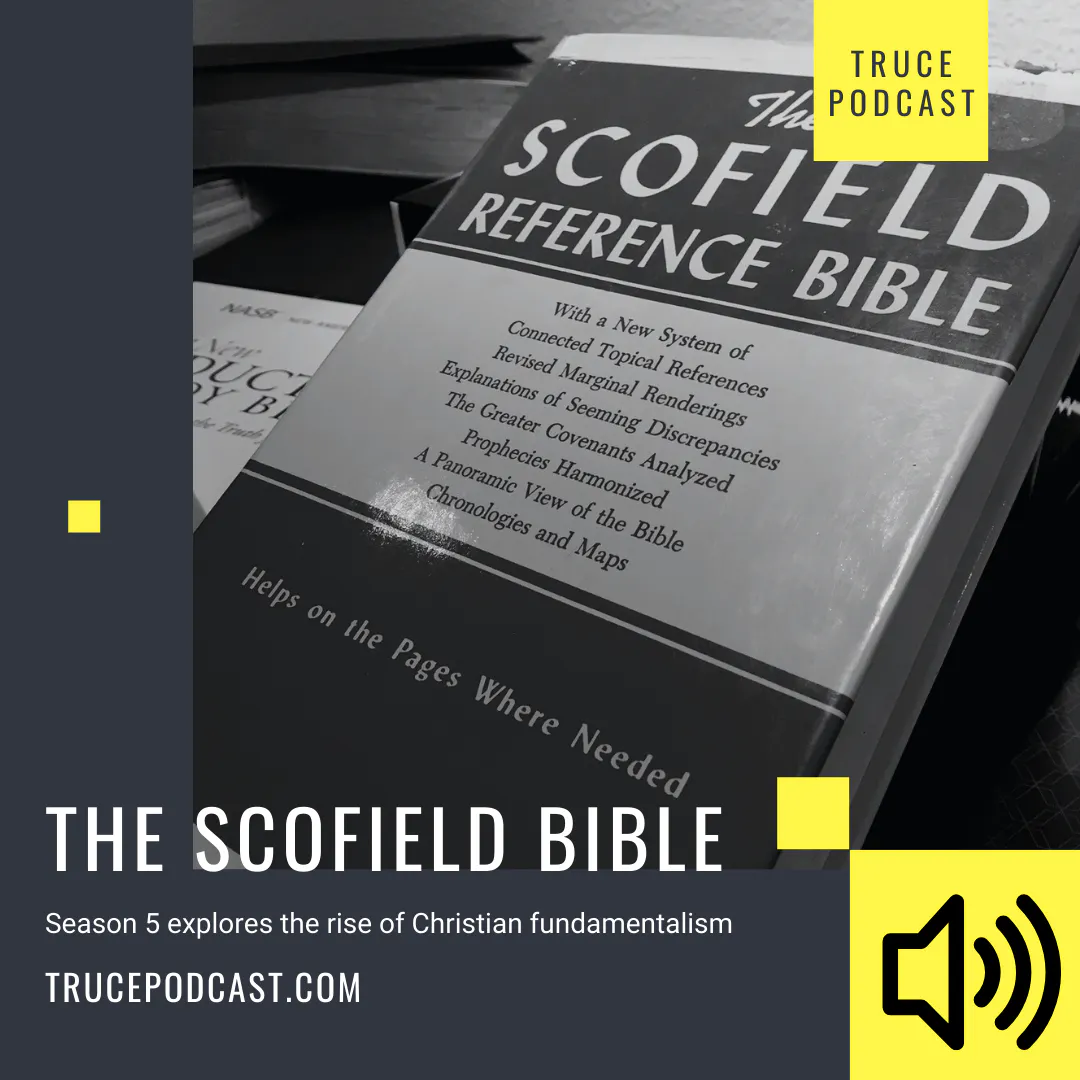
S5 Ep 20The Scofield Reference Bible | Christian Fundamentalism Series
What kind of Bible do you have? Most of us would answer with the translation we carry. Maybe it's New Living, the King James, or the New International Version. I've heard plenty of conversations about translations in my life. But I've never heard a serious discussion about the notes in various Bibles. Continuing our long exploration of the Christian fundamentalist movement, we explore the Bible version that nudged the United States toward a particular negative theology. One that encouraged people to question the trajectory of history itself. That was one of the purposes of the Scofield Reference Bible, named for its author C.I. Scofield. The Scofield Reference Bible emphasizes the premillennial dispensationalist theology we've been talking about all season. It expects that world history is sliding into chaos. That was not the primary view in the late 1800s and early 1900s in the US. Most people thought that humanity could improve things until Jesus returned. This Bible is one of the things that changed that. Special thanks to Nick, Melanie, Hannah, Marc, and Marian for their help with this episode! Discussion Questions: What kind of Bible do you have? Why did you choose it? What agenda does your Bible have? What audience is it intended for? Who wrote your Bible notes? Flip to Genesis 1 and Revelation 1. What position does it take on creationism? The end of the world? Have you ever considered the origins of your study notes? How do you feel about us having so many different targeted Bibles? Select Sources for this Episode: The History of the Scofield Reference Bible by Arno C. Gaebelein The Evangelicals by Frances Fitgerald Fundamentalism and American Culture by George Marsden Article on Lyman Stewart who financed this Bible A Godly Hero by Michael Kazin Isaiah 37 A Christianity Today article about the changes made to the Scofield Bible (material not used for the episode, but still interesting) The Scofield Reference Bible (1945 edition) The MacArthur Study Bible The Founders Bible The Battlefield of the Mind Bible Learn more about your ad choices. Visit podcastchoices.com/adchoices
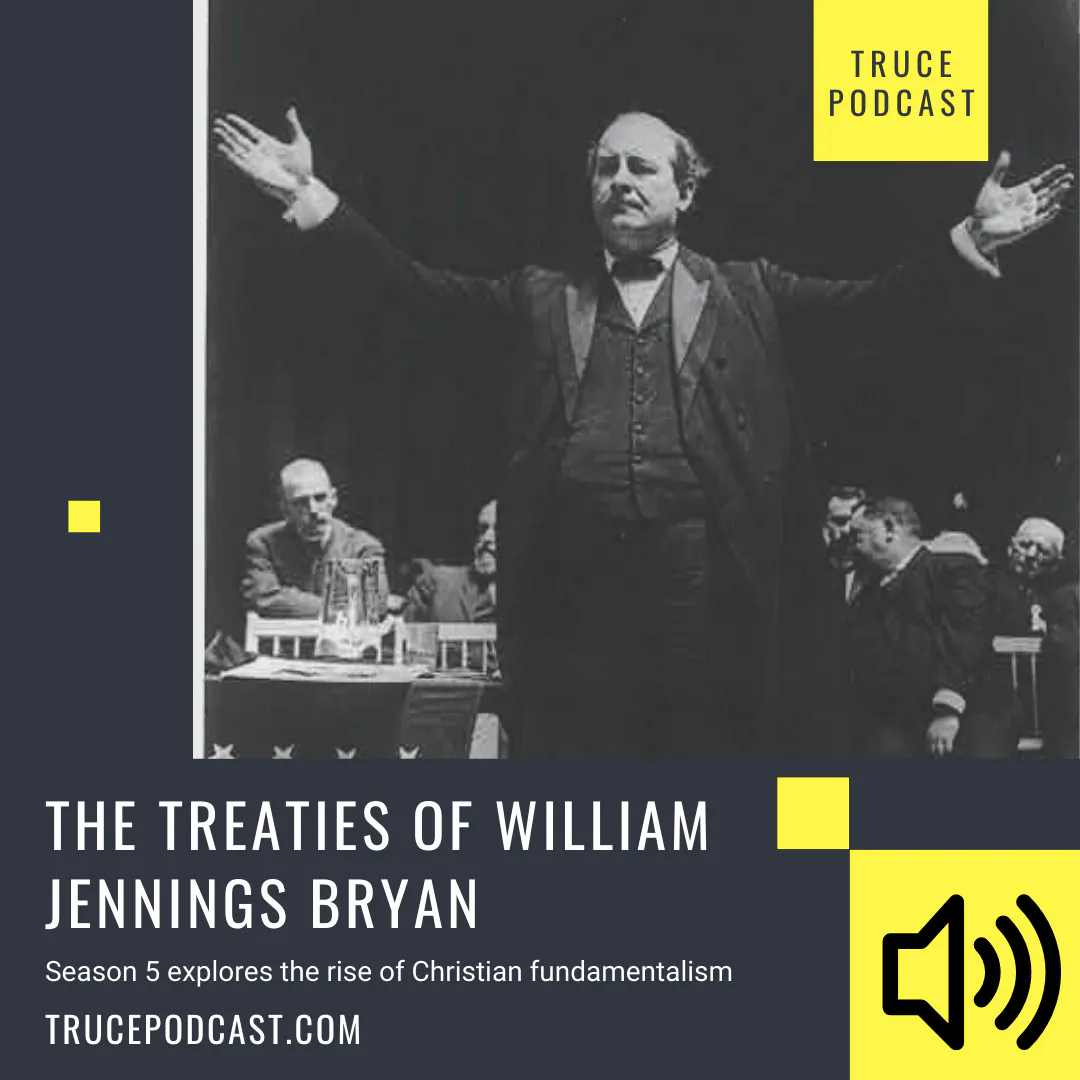
S5 Ep 19The Treaties of William Jennings Bryan | Christian Fundamentalism Series
William Jennings Bryan. If we know him at all it is from the Scopes Monkey Trial at the end of his life. Or maybe we know of his 3 failed campaigns for President of the United States on the Democratic ticket. But many of us are unaware of his efforts to establish world peace. William Jennings Bryan hated war. He wasn't a pacifist - he enlisted for the Spanish-American War after all. But he saw the meaningless carnage of war and vowed to do his best to reduce the amount of bloodshed. So "The Commoner" used his position as Secretary of State under President Wilson to establish 30 peace treaties. In this mini-episode, we revisit his career and talk about the impact this man might have had if WWI hadn't slowed his progress. God-willing I'll be back soon with a full episode! Thanks for your patience! Helpful Sources: "A Godly Hero" book by Michael Kazin "A Righteous Cause" book by Robert Cherny "The Evangelicals" by Frances Fitgerald "Money: The True Story of a Made Up Thing" by Jacob Goldstein "What's Your Problem?" podcast from Pushkin Industries, hosted by Jacob Goldstein Discussion Questions: William Jennings Bryan was the head of the party of Jim Crow. Do his actions to stop imperialism or war shape how you feel about him? Would a conciliation treaty policy work today? Is world peace a worthy goal today? What role do weapons play in that? How might this tie into fundamentalism? Learn more about your ad choices. Visit podcastchoices.com/adchoices
S5 Ep 18Looking Backward | Christian Fundamentalism Series
Now that we've read In His Steps together and discussed it, let's talk about another work of fiction. Looking Backward was written by Edward Bellamy. That name may sound familiar! We talked about his cousin Frances Bellamy in the episode about the Pledge of Allegiance. Frances was a Christian socialist. Edward wrote his famous book looking forward to the year 2000. He predicted that the United States would be a socialist paradise. People would work hard, retire early, and equality would reign. None of that came true. We're talking about it today in order to understand the zeitgeist in the late 1800s. This book sold over half a million copies in its first few years of publication. It is now over a million copies. That doesn't happen without stirring something in society. As we'll see, socialism was tied to the Social Gospel. The opposition to the Social Gospel is what would go on to create the Christian fundamentalist movement. Helpful Links: What's the Difference Between Communism and Socialism? - Episode of Truce from season 3 A helpful New York Times article about Looking Backward Discussion Questions: How have fictional books you've read impacted your worldview? What do you think about Bellamy's predictions? How does the fear of socialism and communism impact evangelicalism? What real threats were facing evangelicalism in the 1800s? How about now? Learn more about your ad choices. Visit podcastchoices.com/adchoices
S5 Ep 17In His Steps Discussion
Support the Truce Podcast via Patreon or through the website you can do Paypal, check, or Venmo! We've been reading the book "In His Steps" together for the last few weeks. It was written by Charles Sheldon, a man whose book is often associated with the social gospel movement. While some historians struggle over the significance of this work, it's pretty plain how it fits this movement. I invited patrons of the show to listen early and then discuss their thoughts on this controversial book. What did you think about the audiobook? Should I record other books this same way? Discussion Questions: Did you enjoy "In His Steps"? Why or why not? How do you think women were portrayed in "In His Steps"? What do you think about the Home Economics movement? How did you see the social gospel in the book? Is the book evangelistic? At which points? If not, why not? Does Christian media need to be "heavy handed"? Recommended Resources: In His Steps by Charles Sheldon The Secret History of Home Economics Learn more about your ad choices. Visit podcastchoices.com/adchoices
S5 Ep 16In His Steps (part 3)
This is part 3 of an audiobook presented on Truce. Please start at part 1! Become a patron of the show to keep more content like this coming your way! In His Steps by Charles Sheldon is a classic of Christian fiction. It is also one of the top-selling Christian books of all time. We've been running through the history of Christian fundamentalism this season. It's worth noting that fundamentalism was a reaction to liberal theology, especially modernism. Another form of liberal theology was the "Social Gospel". It was a movement led by people like Walter Rauschenbusch that emphasized the socially conscious aspects of Christianity, while simultaneously downplaying evangelism. Christian fundamentalists did not like the Social Gospel. For one thing, it had a positive view of human progress. It said that the world could get better and better and then Jesus would return. Christian fundamentalists generally think that world history trends downward. I'm presenting this original audio recording for many reasons. I think this book offers a great window into the era in which it was created (the late 1800s). It also represents the Social Gospel and a slice of the Holiness movement quite well. Finally, I think we need to hear this story in our modern context. Modern Christian churches are divided. What would happen if we dared to ask "What Would Jesus Do?" Things to track as you listen: The role of women in this society Wealthy attitudes toward the poor The genesis of financial woes in this book is sometimes economic crisis (the late 1800s was full of panics and recessions) and sometimes sin based The Holiness movement and those who object to it Is this book evangelistic? If so, how is the gospel presented? If not, what does this book leave out? The overall positive view of human progress Social movements like the pure foods movement, temperance, suffrage, anti-gambling In His Steps resides in the public domain, but this recording is copyrighted in 2022 by Truce Media LLC. Learn more about your ad choices. Visit podcastchoices.com/adchoices
S5 Ep 15In His Steps (part 2)
This is the second part of the series. Please start with part 1. In His Steps by Charles Sheldon is a classic of Christian fiction. It is also one of the top-selling Christian books of all time. We've been running through the history of Christian fundamentalism this season. It's worth noting that fundamentalism was a reaction to liberal theology, especially modernism. Another form of liberal theology was the "Social Gospel". It was a movement led by people like Walter Rauschenbusch that emphasized the socially conscious aspects of Christianity, while simultaneously downplaying evangelism. Christian fundamentalists did not like the Social Gospel. For one thing, it had a positive view of human progress. It said that the world could get better and better and then Jesus would return. Christian fundamentalists generally think that world history trends downward. I'm presenting this original audio recording for many reasons. I think this book offers a great window into the era in which it was created (the late 1800s). It also represents the Social Gospel and a slice of the Holiness movement quite well. Finally, I think we need to hear this story in our modern context. Modern Christian churches are divided. What would happen if we dared to ask "What Would Jesus Do?" Things to track as you listen: The role of women in this society Wealthy attitudes toward the poor The genesis of financial woes in this book is sometimes economic crisis (the late 1800s was full of panics and recessions) and sometimes sin based The Holiness movement and those who object to it Is this book evangelistic? If so, how is the gospel presented? If not, what does this book leave out? The overall positive view of human progress Social movements like the pure foods movement, temperance, suffrage, anti-gambling In His Steps resides in the public domain, but this recording is copyrighted in 2022 by Truce Media LLC. Learn more about your ad choices. Visit podcastchoices.com/adchoices
Bonus Episode - In His Steps
bonusWant more Truce? Give a little bit each month and you'll gain access to a patrons-only Zoom event! We'll be getting together to discuss "In His Steps" and answer listener questions. This event is open to anyone who gives $10/month or more on Patreon. Link: https://www.patreon.com/trucepodcast Event details: Tuesday August 9, 2022 at 8pm EST/7pm CST/ 6pm MT/ 5pm PST. Zoom link will be posted on Patreon for those who give $10/month or more. If you cannot give to help the show, but still really want to participate, please get in touch with @trucepodcast on Twitter, Instagram, or Facebook and Chris will try to squeeze you in. Potential discussion topics: How "In His Steps" ties into the Holiness and Social Gospel movements What is the role of the female characters in this book? The role of wealth and poverty in the story What this book means to us Is "In His Steps" an evangelistic book? Learn more about your ad choices. Visit podcastchoices.com/adchoices
S5 Ep 14In His Steps (part 1)
In His Steps by Charles Sheldon is a classic of Christian fiction. It is also one of the top-selling Christian books of all time. We've been running through the history of Christian fundamentalism this season. It's worth noting that fundamentalism was a reaction to liberal theology, especially modernism. Another form of liberal theology was the "Social Gospel". It was a movement led by people like Walter Rauschenbusch that emphasized the socially conscious aspects of Christianity, while simultaneously downplaying evangelism. Christian fundamentalists did not like the Social Gospel. For one thing, it had a positive view of human progress. It said that the world could get better and better and then Jesus would return. Christian fundamentalists generally think that world history trends downward. I'm presenting this original audio recording for many reasons. I think this book offers a great window into the era in which it was created (the late 1800s). It also represents the Social Gospel and a slice of the Holiness movement quite well. Finally, I think we need to hear this story in our modern context. Modern Christian churches are divided. What would happen if we dared to ask "What Would Jesus Do?" Things to track as you listen: The role of women in this society Wealthy attitudes toward the poor The genesis of financial woes in this book is sometimes economic crisis (the late 1800s was full of panics and recessions) and sometimes sin based The Holiness movement and those who object to it Is this book evangelistic? If so, how is the gospel presented? If not, what does this book leave out? The overall positive view of human progress Social movements like the pure foods movement, temperance, suffrage, anti-gambling In His Steps resides in the public domain, but this recording is copyrighted in 2022 by Truce Media LLC. Learn more about your ad choices. Visit podcastchoices.com/adchoices
S5 Ep 13The Holiness Movement | Christian Fundamentalism Series
Can a Christian be holy? Can we go a week, a day, or an hour without sinning? These are questions that modern Christians struggle with. They have their origin in John Wesley, a hymn writer, preacher, and one of the founders of Methodism. In this episode of Truce, we track how this seemingly simple concept got tied up in movements from fundamentalism to Pentecostalism. This episode is going to seem a bit "out there". But this information is important to fundamentalism. Keswick Holiness in particular created an "us and them" scenario where there are Christians who "get it" and those who don't. The divide is between "carnal" Christians and those who are really saved. This impulse makes it easier for fundamentalists to see themselves as set apart from other Christians. We're joined by Chris Evans, author of "Do Everything" which is a biography of suffragette Frances Willard. Helpful Sources and Links: D.L. Moody: A Life by Kevin Belmonte The Evangelicals by Frances Fitzgerald John Wesley's tract on perfection Fundamentalism and American Culture by George Marsden Church History in Plain Language by Bruce Shelley Discussion Questions: How long can a Christian go without sinning? Do you see yourself as "better" or "different" from other Christians? Why? How does that impact the way you treat them? How did the holiness movement shape Pentecostalism? Do you see history and ideas as straight lines, or as a tangle? Learn more about your ad choices. Visit podcastchoices.com/adchoices
S5 Ep 12Moody's Lieutenants | Christian Fundamentalism Series
After the evangelist D.L. Moody died at the end of the 1800s, he left behind a series of lieutenants, guys who carried on the work of sharing the gospel and shaping culture. It was these men who went on to set the foundation of the fundamentalist movement in the United States. James Gray, Arthur Pierson, A.J. Gordon, Charles Blanchard, and William Erdman, C.I. Scofield, and William Bell Riley. These guys went on to found schools, start radio ministries, spearhead publications, and amass large followings. They wrote the influential (if under-read) pamphlet series “The Fundamentals” and would fight the rise of Darwinism in schools and liberal theology in denominations. In this episode, we'll explore the emergence of fiefdoms in evangelicalism—ministries with little or no denominational oversight. This method of ministry was crucial in landing us where we are today. Could the evangelicals Church of today use a Magna Carta of sorts to keep ministries under accountability? Helpful Sources and Links: D.L. Moody: A Life by Kevin Belmonte The Evangelicals by Frances Fitzgerald A helpful article on the Magna Carta https://www.britannica.com/topic/Magna-Carta Fundamentalism and American Culture by George Marsden Short bio on Reuben Torrey Forbes article about Christianity in Ivy League Colleges Church History in Plain Language by Bruce Shelley Discussion Questions: Do you think that ministry leaders should be held accountable? Should accountability be external or is it okay to limit it to internal accountability? Are there steps that Truce can take as a show to introduce accountability without bogging Chris down with too many requirements? Do you live in a Christian “bubble”? What are the advantages and disadvantages of the bubble? Would you let your kids go to a secular school? Why or why not? It's interesting that Reuben Torrey was seen as snooty. Do you think that attitude is compatible with humble Christian service? Learn more about your ad choices. Visit podcastchoices.com/adchoices