Bill Rotsler’s Gruesome Foursome – Part 3: Uschi Digard
Audio is streamed directly from the publisher (traffic.libsyn.com) as published in their RSS feed. Play Podcasts does not host this file. Rights-holders can request removal through the copyright & takedown page.
Show Notes
Charles William Rotsler (1926–1997) was an award-winning artist and science fiction author.
Bill was also involved in the burgeoning adult film industry starting in the late 1950s, first as a stills photographer on the set of adult films, and later when he wrote, directed, or acted in over 20 adult films during his career with Boxoffice International Pictures,
In 1966, he created Adam Film Quarterly, later called Adam Film World, one of the earliest magazines to provide commentary on pornographic films. He wrote hundreds of articles using a plethora of pseudonyms including ‘Shannon Carse’, ‘Cord Heller’, ‘Clay McCord’, and ‘Merrill Dakota’ – sometimes even interviewing himself. He also wrote the seminal book, Contemporary Erotic Cinema in 1973.
But this series of articles is not about Bill Rotsler. It’s about a group of friends of his. Four friends. Four women, to be more specific, who at various times lived with him, and featured in his films, photographs, and magazines. Their lives intersected in his house, as they played their parts in helping establish the adult film industry in Los Angeles.
He called this group, ‘The Gruesome Foursome.’
The Rialto Report tracked down each of the four to hear about their lives. This is the third part: Uschi Digard.
The interview is taken from our podcast with Uschi. We have added additional information taken from lengthier conversations we have had with Uschi over the years.
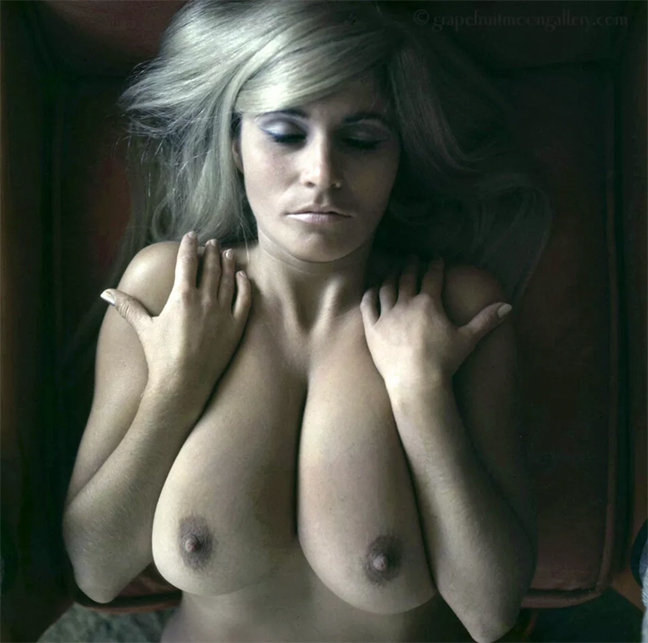
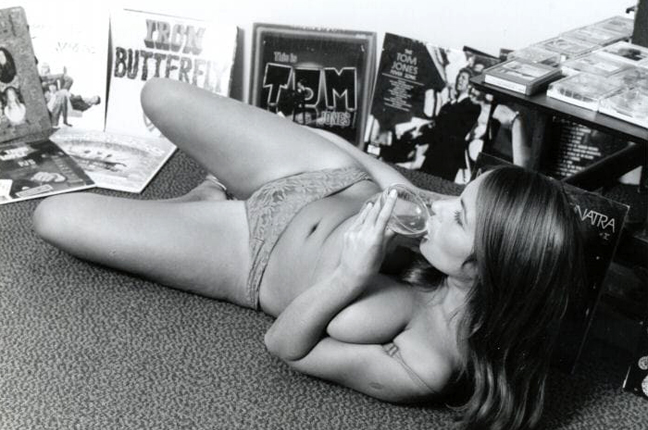
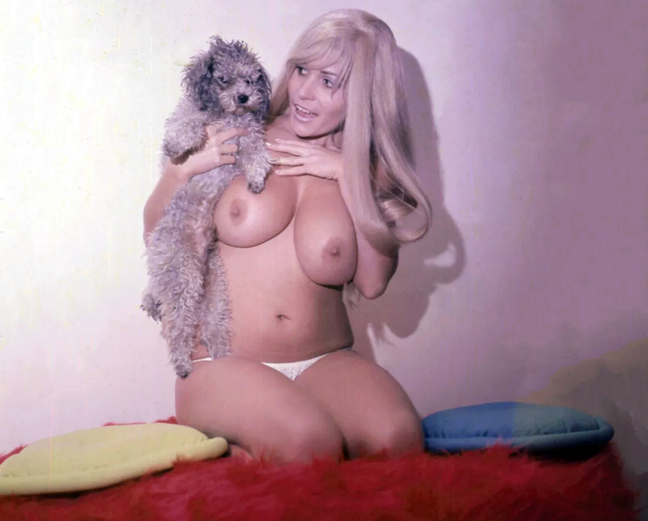
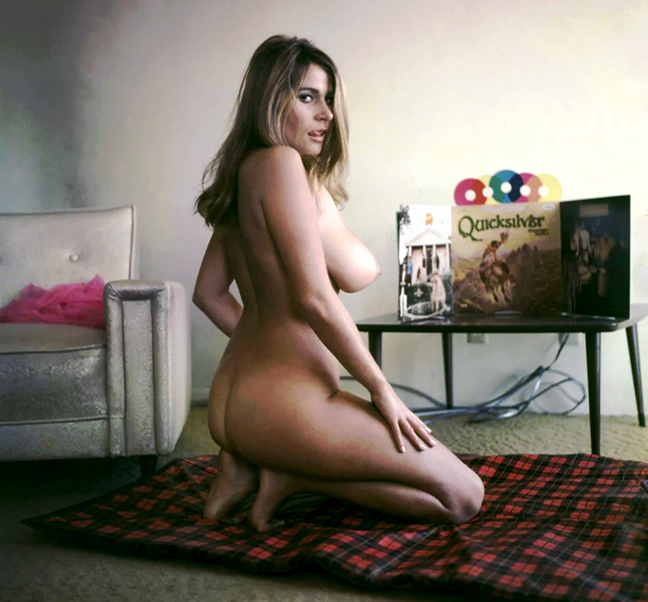
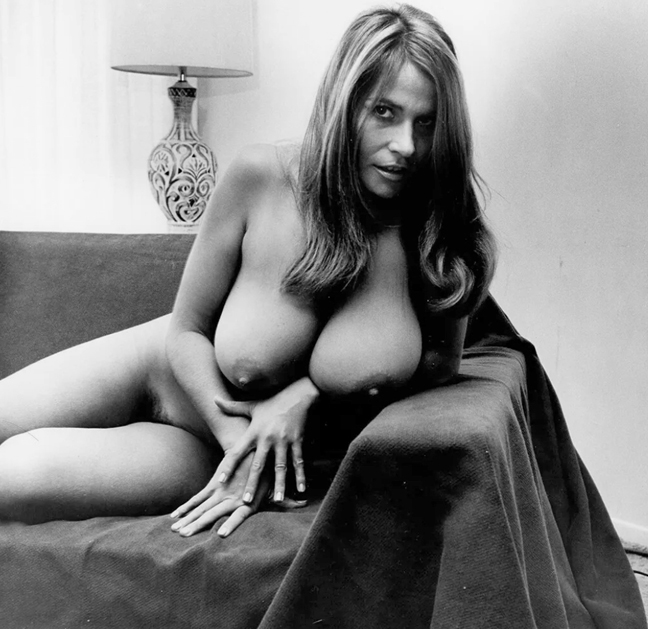
All photographs are taken by Bunny Yeager, and are courtesy of Grapefruit Moon Gallery.
You can read Part 1, the story of Kathie Hilton (and Gerard Broulard) here , and Part 2, Malta’s story here.
———————————————————————————————————————————————-
Uschi Digard
Uschi Digard always seemed to be larger than life. She was an indestructible, formidable, pinup beauty who was emblematic of the sexual revolution in California. From the late 1960s through to the early 1980s, she was in hundreds of magazine spreads, had many issues dedicated to her, and appeared in countless softcore films, too. Her Amazonian features and natural good looks meant she was always in demand as she proved popular with fans. Or in the words of director Russ Meyer, her close friend and frequent collaborator, “She was a buxom cantilevered barracuda who was a Trojan at work.”
Russ was a man’s man, a World War II veteran, and a tough task master, and in Uschi he met his match and found the perfect foil. The combination of her sex appeal with her own sentimental tireless work ethic resulted in a close friendship that lasted decades. But for someone with such a larger than life presence, Uschi was also elusive and deeply private. Her face and body may have been all over the magazines, but her own voice was notably absent. Throughout her long career as a nude model and actress, she revealed everything, but revealed nothing. She rarely gave interviews, and the scant biographical information that was published was often fabricated. It was said that she was an interpreter of the United Nations. She came from Sweden. She had a perfume line that was big in Asia. And if her published birthdate is to be believed, then she recently celebrated her 70th birthday. All this is false. And as it turns out, the wealth of untrue information bothers Uschi herself as well.
The trouble is how do you correct so many misconceptions without drawing attention to yourself? How do you go public, but stay private?
*
1. Childhood
I suspect the theme of our conversation today is going to be the rumors and misinformation that have circulated over the years, which I’m hoping we can set the record straight. So let me start with one right at the beginning. There’s been much conjecture about where you’ve come from. I’ve seen references to Sweden, Switzerland, Holland, and my favorite is Bismarck, North Dakota. So where were you actually born?
Actually born in Switzerland, but lived in all those countries, apart from Bismarck, North Dakota.
I don’t want to be indiscreet and ask your birthdate, but there is a birthdate that’s widely quoted as being August the 15th, the 1948.
Totally wrong. Couldn’t be wronger.
Well, let’s leave the mystery there. What was the nationality of your family?
Swiss French.
Did you have a big family?
Yeah. I was the youngest by eight years.
How did that shape your character?
It kind of made me think more like an adult and be more independent. And I always did my own ship. I remember when I was little – and things didn’t go the way I want – I would move out temporarily. I had two neighbors that would put me up. So if my mother rubbed me the wrong way, I would have a little bag and I’d pack it and I’d move next door. Just wherever the smells were better.
How did everyone treat you?
I always got treated as an adult because my siblings were adults practically when I was born. They treated me like one of them, and I appreciated it. So I never got treated like a little kid, and I loved it and I respected them for it.
What kind of school did you go?
I went to boarding school for many, many, many years with nuns. They were like convent nuns.
How strict was this convent school?
Very strict. We didn’t go home at night. We could only go home three times a year for holidays. We were never allowed anywhere. If we went for walks, it would be two by two with a nun in the middle and a nun in front. And we slept in huge dormitories in kind of tent like surroundings and no privacy whatsoever. And I hated it. To me, it was like prison.
How did that shape your feelings about religion?
Made me realize that (religion) wasn’t anything I ever wanted to do, that religion was a very personal thing and nobody should be forced to go to church three times a day or be forced to believe in a doctrine and find their own way. So it strengthened me actually, because it made me start to think about what I thought about life and God. So it was good for me.
Given that it was very strict, how did you react against that? What was your outlet?
Oh, I read a lot. We had a library there in the boarding school, and I must have read every book in that library and then realized that I couldn’t stand any translated book. So my ambition was to learn languages so I wouldn’t have to read anything that was translated. And I did that.
Did you actually start learning foreign languages when you were at school?
Yeah. I started with Italian. See, because of being brought up in Switzerland, we have three national languages, Italian, French and German. Before you can even attempt to take English, you have to learn those three languages. So I got fluent in Italian, German, and French – and then proceeded from there.
If you were in a convent environment, did this mean your contact with the opposite sex was restricted as well? Did you meet many boys?
None. Oh, no. None. Absolutely nothing. No. We were just girls.
How did that impact you in terms of not having boyfriends?
Well, I was a virgin, so it was no big deal.
When you lived back in home environments, were your parents quite strict about that side of things?
Yeah. Very, very religious.
And I presume that the prevailing standards of the time as well were quite restrictive.
That’s right. Yeah.
You always had a really healthy outdoor image in a lot of the later photographs that were taken of you. Does that fit in with your upbringing as well? Were you a very outdoorsy type?
Yeah. I skied. From the minute I started to walk, I skied. I became a pretty good skier, swam every summer, and just loved outdoor life.
Were you a confident child?
Very much so. Yeah. And pretty much set in my ways from a very early age. I knew what I liked and I knew what I didn’t like. I loved reading. Reading, reading, reading, and skiing. Yeah. Those were my two loves, reading and skiing.
What sort of reading did you like?
Spiritual, like Hermann Hesse type stuff, and a lot of biographies.
And what didn’t you like?
I didn’t like gossip and I didn’t like name conversations. So I kind of steered away from people that were boring or gossipy or liars, and went in my own direction.
How attractive did you consider yourself when you were a teenager?
Not very. Never gave it much thought, actually. No.
Were you an early bloomer physically?
Yeah. I had big breasts from the age of 11, and I wasn’t too pleased about that. I tried to hide them. So I usually would wear sweaters that were kind of large and bras that were too small so that I could let something hang underneath and something on the side and then covered it all up. And that made me look smaller.
So it doesn’t sound that boyfriends or sex was a big part of your teenage years.
No. Wasn’t even on the agenda.
*
2. Leaving Home
So when you left school, you finally got the chance to fulfill your ambition of learning languages. And you embarked on a multi-year European tour.
I’d work during the day and go to school at nights and stay in each country until I passed the degree, and then move on to the next country.
Where did you start first?
My Italian wasn’t too good, so I went to Italy to perfect my Italian. After a year in Italy, then I went to France and worked on my French. It was all right, but it wasn’t perfect. Then once I knew my French, I wanted to learn English. Written English, not just spoken English. And I went to the Channel Islands, Jersey.
Did you pick up English quickly there?
Unfortunately, I didn’t learn any English at all because all the other people were also continental so we never spoke in English. So winter came and Jersey got cold, (and) I thought, “Well, I’ve got to get a degree in English.” And so I got myself a job in London at The Regent Palace Hotel, which in those days was the largest hotel in Europe.
What was it like working there?
I am almost like a retard when it comes to directions. I’m normally a left-handed, but in boarding school, they tied my left hand behind my back and forced me to be a right-handed. And so all the things from school I do with my right hand, but everything that I do out of joy like tennis I do with my left hand. I think this is one of the reasons I have no sense of direction. And this hotel being so huge, it took me three weeks just to find the way to my room because every day I got lost.
Do you still have that problem?
I’m still abysmal. When we first came to L.A. and started driving a car in L.A…. those freeways, San Diego Freeway, east, west, north, south, it’s all the same to me. It would take me hours to get home because I’d get so lost. Still to this day, I have a horrible sense of direction.
What was it like living in London at that time? It must have been an exciting time.
I loved it. It was a beautiful time. Yeah. And I had my first boyfriend in London. Actually met him in Jersey, and then we came to London. It was wonderful, exciting time. And also musically listening to big dance, and living on my own, and no longer being affected by the church or by nuns was a great freedom. I enjoyed it thoroughly.
In the early 1960s, I’m guessing it was still relatively uncommon for a single female to be such an independent traveler.
I never really gave it much thought, because whenever I went somewhere I had gotten myself a job beforehand. Before I went to London, I got myself a job at The Regent Palace so I had somewhere to go. Or when I went to France, I got myself a job. And then immediately when you work somewhere, you meet other workers. So I always had a little family around me and I never felt lonely or estranged. I always felt very good.
So you’ve been to Italy, France, and then England. Where do you go next?
I first went to a little place called Cubelles, which is outside Barcelona, to learn Spanish. And then when the winter came and it got cold and I hadn’t learned enough Spanish, and someone told me, “There are these islands called the Canary Islands where they speak Spanish, and the weather is beautiful, and it’s gorgeous…”
This time you didn’t have any work lined up, though.
The first time I went somewhere without a job.
How did you get to the Canary islands, because it was quite a journey at that time?
I took one of those boats that only travels in the night, the cargo boat, and it went through Spain, Malaga, Alicante, then it went over to Tangier, Marrakech and finally arrived in the Gran Canarias after three weeks, and I was there without a job.
So what did you do?
Again, I helped myself, got myself with job, and indeed ended up spending four or five winters there working, and then in the summer I would travel around.
What kind of work did you find in the Canary islands?
By then, I already knew Italian, French, German, and English, so I immediately got a job as a linguist.
That must have been useful because of the tourist trade out there.
A lot of foreigners, particularly German and English people would vacation in Canary Islands. And I worked in the jewelry business, and the jewelry there was very cheap in comparison to the rest of Europe. People got to know me, so they would come from England and say, “We saved up four or 5,000 pounds. What you think we should invest in this year?” And I would show them the baubles that I thought would be of interest to them.
And how did you get paid?
I worked at a percentage. So whatever I sold, I would get my certain percentage, so I made a lot of money.
That sounds like a lot more than just linguistic work. You sound like you were a salesperson who had some understanding of the product as well.
I kind of learned it as I went along. And indeed, I then worked in Europe – in Sweden and Switzerland – in foremost jewelry stores as a jewelry sales lady.
Would you say you’re good at the sales side?
Yes. Excellent. Because I don’t try and sell something that I don’t think is right for someone. If I feel it is too much for a person to spend or whatever, I would steer them in the direction of something that would be a little more modestly priced. And I always had the customer’s interest at heart, not the seller’s interest. And I think that’s why people kept coming back to me and I became an excellent sales lady.
So you would work the winter in the Canary islands and get commission from the sales, and that would presumably give you enough money for the rest of the year to travel.
That’s right.
It was in the Canary Islands that you met your husband.
I had actually seen him before when I lived in Jersey. There was this night club called The Watersplash. A very fancy night club. And I used to go there, and Ron was there with a band. But we never met. I just would admire his drumming, but that was it. And I didn’t really meet him until four years later on the beach.
Was he in the Canary Islands to play music as well?
He had his own band there.
Was it love at first sight then, once you saw him in the Canary Islands?
Interest at first sight. Ron and I have been married for almost 50 years.
What kind of music did he play?
He had his own band, and they were brilliant. They were bass, drums, piano and horns. And they played jazz, rock n’ roll. They also sang in harmony. If you remember a band called The Hi-Lo’s. They were very well liked because they were different.
So having met Ron, you have this job in the jewelry business and he has his job that I suppose involves a lot of traveling as a musician, where did you go next?
We went to Israel and we were there during the Seven-Day War. (His band) became a big hit in Israel.
This was a troubled time in the history of Israel.
It was very interesting because there was still a lot of fighting going on. In fact, I remember we would have fans that would come one week to listen to the band, and the next week two or three people would be missing and we’d inquire and they’d say, “Oh, they got shot during the week.” It was a very terrible time and a very unhappy time for the Israelis. But we found them to be very, very generous, good human beings, and we admired them very much for what they stood for.
And the reason you went to Israel was because of Ron’s music?
Yeah. He had an agent and he got a great contract in Tel Aviv.
Was it at this stage that you got married?
We got married in 1967 because it became a hassle when you weren’t married with hotel rooms. So it was easier to be married. That’s why we got married.
And after Israel, you went to Sweden.
That’s correct. (His band) became the hot band, and they had a weekly TV show. I worked in the jewelry business because in the Canary Islands, I had met a jeweler who had a jewelry shop there and he says, “If you ever want to work for me, just give me a call.” In those days he had 40 jewelry shops all over Scandinavia.
As soon as I contacted him he said, “How soon can you start?” And I started working for him in one of the best jewelry stores in Scandinavia, and ended up buying diamonds for all the stores all over Scandinavia. I was the main buyer for the 40 stores. And we liked Sweden.
What was Sweden like at that time?
Very interesting. We just did like the winters. Boy, can it get cold! We stayed there during the winters because Ron’s band got steady work, and they had their TV show, which was very much like the Beatles had later on – where they did scenes, like they would ride elephants and then they’d play ‘Baby Elephant Walk’, or they’d be skiing down a hill. The show became a huge hit. They did very well in Sweden, so we stayed there for three years.
So where did you go to next?
Then to Mexico. We were in Mexico during the Olympics.
Oh, the 1968 Mexico City Olympics.
Right. They opened a new hotel there called Camino Real, and they booked Ron’s band for the opening.
What did you do in Mexico? Did you continue to do the jewelry work?
I tutored college students in language work
Was that relating to the Olympics?
Yeah. I did that too. I had to pass an exam, and then I started translating for the Olympic Committee.

*
3. Modeling in the United States
So in 1968, you decide to move to the U.S. and to Los Angeles. Was that to pursue Ron’s music career?
He got a contract with a band called Les Brown and His Band of Renown. Les Brown’s band was very famous in those days. So we came to the United States and we lived in Venice, California.
What was that part of L.A. like in the late 1960s?
It was the best time I think of the L.A. era to live in L.A. because it was the hippie era. They had these ‘love-ins’ at the beach, and it was just so free… flower-power and grass. It was just a very, very happy time in L.A. Now, L.A. is unbelievable. It’s horrible. But in those days it was really, really the place to be.
And I would imagine that there was plentiful work for Ron as well due to the music scene there. Who were the sort of people that he played with over the next few years?
He was on the road with Ray Charles for many years. Then he joined an avant garde band with Don Ellis. Don Ellis was the one that played in the unusual time signatures, which most musicians found very difficult to play. Instead of 4/4, they played 8/9, 12, 15 beat. And it was a big challenge and he enjoyed that. (Then ) he went on the road with a lot of people… Jack Jones, Marie and Donny Osmond. You name it, he went on the road with them.
Now, I imagine it was not easy for you to get work straight away when you got to the U.S. because of the situation regarding work permits and green cards.
We didn’t have working permits right at the beginning. I immediately went to the language school, Berlitz. They had one on Hollywood Boulevard and I asked them if they could employ me as a linguist or translator or teacher. And they said, “Yes, of course. Just bring us your green card and you’ll get to work.” (But) I didn’t have a green card, so that was that.

I presume that’s how you got into modeling, because that was one type of work that didn’t necessarily need…
I didn’t need a green card for that.
Yeah. So how did you find your first modeling work?
I saw an ad in the Los Angeles Free Press, and they were asking for models, and there was a model agency on Hollywood Boulevard called Pretty Girl Agency.
Do you remember the guys who ran the Pretty Girl Agency?
Hank Cline and Dick James. And I went in there and said, “Do you think you could use somebody like me?” They immediately put me to work, and I worked every day. And from earning modest fees like $50 a day, I ended up getting a $1,000 a day.
So that became your full-time job for a while.
Yeah. I thought, “Translating can wait.”
What was it like at first? Was it typically just you in a shoot, or was there other models in the same shoot?
No. In those days, you had all those pretty girl magazines, like ‘She’ and ‘Modern Man’ and ‘Allure’. There were a lot of pretty girl magazines, which are pretty modest in today’s standards. They barely showed pubic hair.
Then you also worked for the Japanese market a lot, which meant absolutely no pubic hair and no nipples. Just a swell of the breast, but no nipples. You had to cover it up. They’d have these gory magazines like with executions and blood, but the girls couldn’t show their nipples or the pubic hair! It’s amazing the way you look at life. So it was pretty modest in those days.

How much modeling work did you get?
I got so busy modeling; I could have worked seven days a week if I wanted to. And the money got bigger and bigger all the time, and everything was on my terms.
Did you have any inhibitions about posing for the magazines at first, or was it fairly natural?
No, it became very natural. As soon as we were in L.A., we also joined a nudist place called Elysium Fields up in Topanga Canyon. It’s a beautiful place. In fact, we were some of the first people there. When Elysium Fields was (first) opened, we were part of the group of people that planted some of the trees to made it pretty. And we helped build the tennis court.
Nudity was just part of our life. It just felt very natural to be nude. So if somebody was willing to pay me and carry me until I could get a real job, I was very happy to just pose nude. It never, never bothered me.
It was a real heyday for nudism. And what was the attraction to you?
It’s just totally natural. I always felt that when people went nude, you knew whom you were dealing with. Very often people are hiding their character between fat suits and briefcases. Once they’re stripped of all that, what you see is what you get and people are more honest. That’s what attracted me.
Swingers clubs were starting to be big around that time too. Did you find that there was a crossover between the two?
Well, it was kind of a two-faced. Apart from Elysium Fields, there was another nudist place, and it was higher up on the same canyon, and it was a swingers club. I can’t think what it was called right now. And because they knew of me because my modeling, they invited us to go up there once. And so Ron and I went and we hated it. One of the scenes was there was a big, big hangout room and there was this huge water bed, and there were about five couples making love on that water bed. And then there were two guys with a stopwatch timing them to see who came first, and we just found it horrible. You had to be careful you weren’t standing freely because somebody would sneak in behind you. It was just so horrible that we left.
The Elysium Fields was just delightful. It was a nudist place, it was free, it was just great. And it did have little rooms if people wanted to go in and make love, but then that was private. It wasn’t a huge orgy place.
I remember reading an interview with British actor, Patrick Macnee, who stared in The Avengers, the television series. And he mentioned that he used to go to the Elysium Fields as well around about that time.
Yeah, it’s funny. That’s where we met Patrick and became good friends. In fact, we had a little routine while we were in L.A. He would come to lunch at our house every Monday, and every Friday he would take us out to lunch somewhere.
Once when we were at Elysium Fields, I was reading a magazine, and I turned around to Patrick and said, “Hey, Patrick. You’re called Best Dressed Man of the Year. Isn’t this funny? I never seen you with any clothes on!”

Was your experience of modeling all good?
I have to say that although many girls that I later worked with said how abysmally they got treated by photographers, I never had a bad experience. I always got treated the way I wanted to be treated, and I always got paid, and in fact I got spoiled. They would bring me flowers and God knows what. So I had no bad experiences.
Why do you think you were always treated so well?
I think to a great extent, a person gets treated the way they want to be treated. You give off an aura, and my aura was, “Okay, you take me at my beckon. Whatever I say goes, not what you say.” And so it worked.
Did Ron ever join you on any of the photo shoots?
Ron did a couple of shoots with me. Actually, he kind of fell into it because in those days I didn’t drive, and so he had to take me to my modeling assignments, and one of the male models didn’t show up. So they used to Ron. And so he got involved in a few of the modeling shoots.
You know those big matches, those long matches for fire places that come in these long boxes? For a while, they sold these long boxes, and there was a picture of Ron standing on the box, and I was cuddling his leg. Both of us were nude, and it’s a great matchbox cover. He did quite a few shoots with me.
So he was a musician and a model then?
No. Not really a model, but he did it a few times.
One photographer that you worked with at the beginning was Bill Rotsler.
Oh, I adored Bill Rotsler. I worked a lot for him. In fact, he’s one of the first people I worked for. When I started to work for a photographer, normally a girl shoots with them once or twice. Bill would book me for a month, like five days a week for a month. And so I started working for Bill on a regular basis.
In those days I didn’t drive a car, and Bill wasn’t too happy to drive me home. I spoke eight languages, but I couldn’t drive a car. I thought I’d gladly give a language to drive a car. So I always needed a lift home so Ron would have to come and find me and pick me up.
Bill lived in the Hollywood Hills, and Bill had a house which was like a Turkish harem. It was all Turkish carpets and huge pillows. And it was just a party house. It looked like a tent in the Arabian night. We spent a lot of time hanging out there and having a wonderful time. It was like a second home for us. We just ended up always hanging out there after work. And Bill became a dear, dear friend.

People like Harlan Ellison used to hang out there as well.
Harlan Ellison? Yeah, he was there a lot.
And wasn’t Bill a really good cook?
Well, actually he was great at putting pouches into boiling water, and then cutting the pouches open and the food was delicious. That’s the first time I ever saw people cooking with pouches, and boy, did it taste good. Like curried rice and tikka masala chicken all out of pouches. Delicious. And he was always very generous.
You worked with Bill for several years.
He started to have a problem with his hands.
You mean like arthritis or something?
No. The thing is they’re like paralyzed. Because he was a photographer, he couldn’t take pictures anymore because he couldn’t move his fingers. And it was very painful, and that started to get worse and worse. So he started to run into money problems because he couldn’t take pictures anymore. And so he didn’t have such a good end.
Were you ever interested in actually buying the magazines in which you appeared?
I have a lot of the magazines. I don’t think I ever bought one, but they were given to me or sent to me. So I have a whole bunch of them, and there are two or three books that are just Uschi books. I think I have those, but I don’t think I ever paid money for any of those.
*
4. Working in Films
So most of the modeling work I guess you get through the Pretty Girl Agency.
Yes, and then later on with the guy by the name of Hal Guthu.
Yes. Hal found you more work in films.
That’s right. Yes.
What was Hal like?
I liked him a lot too. Very shy. I think he had a hindrance, maybe clubfoot or something. He was limping a little bit, but very sweet, very honest. If Hal would recommend me for a gig, I knew it was upfront, the money was all right, and I could trust him. And I liked him enormously.
Hal was the agent for a lot of actors at that time. In fact, he managed Rene Bond, for example. Hal passed away in 2000 after a fire in his office and he was found shot in the head. It was ruled a suicide at the time. What’s your take on this?
I have no idea what happened. When his place went up in flames, his parrot also burned with him, and that parrot was his life. It just doesn’t make any sense.
Starting in 1969, you start to work in films in addition to the modeling.
It’s all called sexploitation films, which were like softcore nudie films.
Did the films pay more than the modeling?
It depends. In the beginning, as I say, I only got $50 a day for the modeling, but then later I got so much money that it would pay more than films. It’s just that films would last one week, two weeks, sometimes three weeks in this one location, and so you’d make regular money in the long run.
Let’s talk about your film work. And I’d like to start at the first film you did with Russ Meyer, Cherry, Harry, & Raquel!
That film was already finished and it didn’t work. For some reason, Russ didn’t like the way it showed. And then I came into it. He saw me and he cast me, and he would go and get me in different situations like underwater in a pool, or in the desert on a railway station, or like a secretary, or running up the mountain in boots… and wherever the film wasn’t working, he would put in little shots of me. And really, with no sequence or no rhyme or reason. And for some reason, it pulled the film together and then we released it.
What do you remember about meeting him for the first time?
Well, he was very Germanic, because his father was a policeman and he came from German stock, so I knew exactly what to think of him. I knew what he liked because I’m a Germanist, so we got along just great.
It sounds like you had very similar backgrounds.
Right. And indeed, I ended up working a lot for Russ not just in the films, but as co-producers – and doing everything from casting to makeup to cooking to you name it. To paying the bills.
Had you seen any of Russ’s films before you actually met him for the first time?
I’ve never seen one of Russ’s films.
Still to this day?
No. Never.
Did this extend to all the other films you made?
I’ve never seen one. I’ve never, ever seen one. I’ve just never gave it a thought.
Why do you think that is?
I think it’s (that) I don’t particularly like to watch myself, because I immediately think what I could have done better, or awkward pose or whatever. So I never put myself into that situation where I have to critique myself.

That makes a lot of sense.
So I never bothered.
I read a quote that he said about you. He said that you, “had the dedication of a Watusi gun bearer, and was somebody who could run over cut glass,” which I guess really appealed to him because you had the sex appeal that he was so interested in, but at the same time you had the work ethic and the strength of character that he obviously admired.
I remember in ‘Harry, Cherry & Raquel!’ that on one shoot, I had to wear thigh-high boots and run up a mountain in these boots. The boots were two sizes too small, and he wanted to get the sun coming down, me going up the mountain and topless, and it had to be just right. And I also had to run down again. Now, running up wasn’t so bad, but coming down, the breasts really hurt. And then he had a little Jeep with a red light flashing all the time, and that was an effect. By the time we were finished shooting, his battery had died because he used the battery of his Jeep all day long to get the light going. And here we were stuck in I think it was Death Valley. Stuck in the desert, no car, and he said, “Okay, let’s use the last light to take a few stills.”
And he’s shooting stills, and I hear this clicking, and there’s this rattler right next to me. I say, “Snake!” And he says, “Don’t move.” He always had a gun with him. He shot the snake’s head off, never said a word, and we continued shooting. He says, “Okay, move more to the left. The breasts are not at the right angle.” And that’s how he was. That was rough. We didn’t have a battery, so he ended up starting the battery of his Jeep with the battery of his camera, and he got us home. And he just was a task master.
Then at the end of the shoot, he’d wine and dine us and take us to the best restaurants. He was a good guy. He was just old school. You know, German old school. Work, work, work, and then play.
Russ used the name Astrid Lillimore for you I think in that movie. I guess the reason why you had so many different names at that time was because you still were getting your green card and your papers in order, and therefore used different names to hide your identity. Would that be fair?
You got it in one. I got paid cash and I didn’t want to be recognized. I remember I went to a book signing in Newport Beach, and the press came, and there were some books that I was involved with, and the press wanted to have interviews. And so I always would push everybody else in front of me, and I would go to the bathroom until they’d be gone because I didn’t want to have any press or any celebrity or anything like that.
But I have to add, even though I worked all these years so-called illegally, I paid taxes right from the beginning. I never did not pay taxes. I was very strict about that, because I knew one day I’m going to be legal. But I just didn’t want them publicly. I just wanted to get my money and disappear.
You acted in a lot of films at this time, but a lot of the roles were very small and you were uncredited. I presume that was for the same reason then.
That was my wish. Whenever they wanted to give me something bigger, I asked them not to. I got a part in a film actually with Richard Burton in Acapulco, and the part I got was to be a band leader, and I turned it down because I felt it would be a little too much publicity. Too big a film. So I never did it.

Let me ask you about the name that you eventually decided upon, Uschi Digard. Where did the Uschi part come from?
Ron had a girlfriend and really liked the name Uschi. Uschi is an abbreviation for Ursula.
That’s the real name, Ursula. And so we used that. Digard got used by one of the guys I worked for, a black guy (called) Ted Williams. He worked for a lot of magazines. He was an excellent photographer, who was famous for photographing jazz music legends.
I said, “Okay, Uschi what? Uschi what?” He says, “Oh, Uschi