Show overview
The Rialto Report has been publishing since 2013, and across the 13 years since has built a catalogue of 196 episodes. That works out to roughly 230 hours of audio in total. Releases follow a monthly cadence.
Episodes typically run an hour to ninety minutes — most land between 52 min and 1h 32m — though episode length varies meaningfully from one episode to the next. None of the episodes are flagged explicit by the publisher. It is catalogued as a EN-US-language TV & Film show.
The show is actively publishing — the most recent episode landed 2 weeks ago, with 7 episodes already out so far this year. The busiest year was 2013, with 28 episodes published. Published by Ashley West.
From the publisher
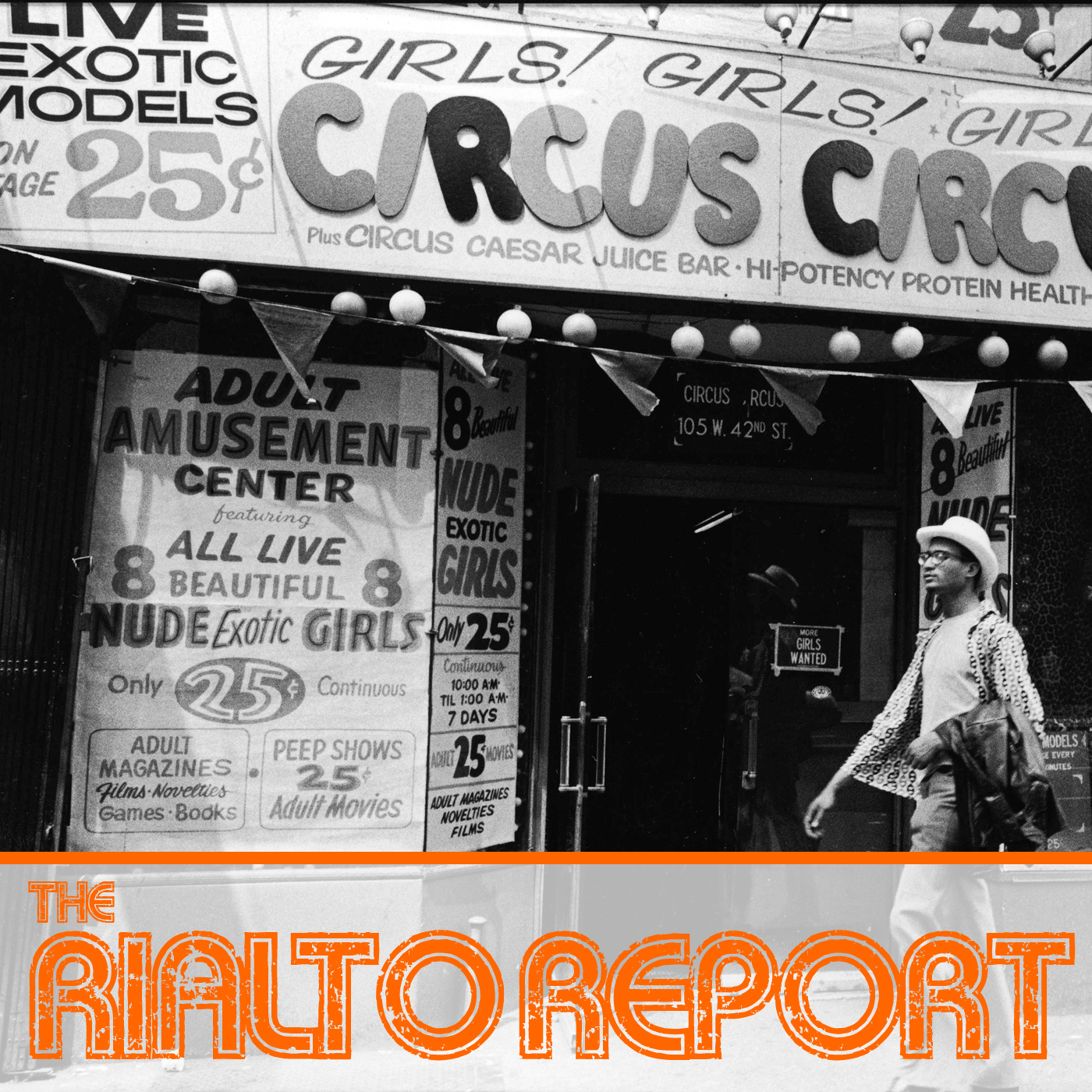
Audio, photo, and documentary archives from the golden age of adult film in New York, and beyond. Established 2013.
Latest Episodes
View all 196 episodesTiffany Clark (1961-2026), R.I.P.
Beth Anna – Sweet & Savage: Podcast 162
Zebedy Colt – Shooting the Breeze with the Eccentric Thespian of XXX: Podcast 161
Ep 160The Gospel According to Ron Jeremy in 1986, with Barbara Nitke – Podcast 160
Back in the day, everybody seemed to have an opinion about Ron Jeremy – and maybe that was part of his appeal. He was probably the most ubiquitous of all male adult film stars, and certainly the most polarizing. In the early days of The Rialto Report, I was keen to interview him. My interest has always been in tracking down stories from the golden age of adult cinema that have never been revealed – but even though Ron’s story had been told many times before, I was still keen to ask him about his life and career. After all, Ron was ranked by Adult Video News at No. 1 in their “50 Top Porn Stars of All Time” list, who described him as the most recognizable porn ambassador to the world, ranking him ahead of people like Jenna Jameson, Marilyn Chambers, and John Holmes. In addition to his hundreds of adult films – both as an actor and director, he appeared in countless mainstream movies and music videos, there was a documentary and a best-selling biography, he was hired for personal appearances all over the country, and he was a brand spokesperson for products that included rum, cigars, beef jerky, and of course, male enhancement pills. I met up with him at his home in Los Angeles on several occasions, and we often spoke about doing an interview – or rather I listened to him talk in what seemed like one continuous sentence, unable to get a word in between all of his detailed anecdotes and memories. And then came 2017, and the multiple allegations of years of sexual misdemeanors. In truth, the stories had circulated for a long time before that. It’s just that now they were suddenly taken more seriously in the era of Me Too, splashed across newspapers, magazines, and social media. I’d heard the accusations for years too – just as I’d interviewed people who worked with him, who’d described him as respectful and considerate, I’d also met ex-colleagues who criticized him for being predatory. My interest was centered on his early career, which was why I was excited when I came across a previously unpublished interview with him from the late 1980s. It was a conversation between Ron and Barbara Nitke that took place in, where else, a New York diner, not far from Queens where Ron was born and raised. At the time, Barbara was carving out a career as a still photographer on adult film sets in New York, and she was putting together a book of her pictures that she intended to be accompanied by a series of interviews with the stars. The book, ‘American Ecstasy,’ was eventually published as a picture book with short clips from the interviews, many years later in 2012. It’s a fine testament to the mid-1980s industry in crisis, transitioning from high budget, scripted film productions to smaller and cheaper video shoots. When Barbara interviewed Ron, he was experiencing the same transition – and the same existential doubts that came with it. Barbara asks about this – and more, in this conversation, which is presented here for the first time. Remarkably, given this was almost 40 years ago, she also asks about the women who were refusing to work to him at the time. Many thanks to Barbara Nitke for sharing the interview with us. You can find more details about her work at Barbara’s website and hear our podcast interview with her here. Copies of ‘American Ecstasy’ can be purchased here. Thanks too to NSS for the audio restoration and mastering. This podcast episode is 50 minutes long. ———————————————————————————————————————————- * The post The Gospel According to Ron Jeremy in 1986, with Barbara Nitke – Podcast 160 appeared first on The Rialto Report.
Ep 159The Porn Star and the Foodie: Jamie Gillis & Gael Greene in 1978 Part 2, Lorey Sebastian – Podcast 159
In 1964, Lorey Kaye, a twenty-year-old from New Haven, CT, moved to Manhattan to start a new life in the big city. Lorey was a fresh-faced, dark-haired hippie, who attracted attention as much for her headstrong, determined, street smart attitude as for her striking good looks. She was hired as a waitress in a new nightclub that had just opened in Times Square – called Steve Paul’s ‘The Scene’. The club was an immediate hit with gigs by the likes of BB King, Jimi Hendrix, and Sammy Davis Jr., regular visitors like Andy Warhol and Edie Sedgwick – and Lorey was at the heart of the action. Another group, The Lovin’ Spoonful, also played there regularly, and their lead singer, John Sebastian, took a shine to her. John and Lorey started seeing each other, and Lorey became his muse, inspiring him to compose a number of the group’s hit singles about her, such as ‘She’s A Lady’ and ‘Rain on the Roof’, even mentioning her by name in some of the lyrics. Lorey and John Sebastian (1967) They got hitched in 1966 – by then Lorey had started work as an insider gossip columnist at Hit Parade magazine – and now known as Lorey Sebastian, she became a popular staple in the 1960s Greenwich Village folk-rock music scene. Lorey and John’s relationship was glamorous, high-profile, and short-lived. Lorey broke up with John in 1968 when they were in Ireland. The legend is that she fell in with a group of gypsies, and felt compelled to tune in, drop out, and join them instead. It was said that John never fully recovered from the breakup. Lorey (right), with John Sebastian and Mama Cass (1967) Fast forward to the mid 1970s. Lorey was back in New York, now in her mid 30s and looking for a purpose. She’d become a member of the television and film workers union, with the vague ambition of being a still photographer on movie sets. To make a little extra money, she also did work as a crew member on sex films. It was on a Gerry Damiano movie that she met Jamie Gillis. Jamie sidled up to her, pushing her in the back, and exclaiming, “What a place to bump into a girl like you!” It was corny but it worked, and Lorey invited him back to her place. The mutual attraction was instant and sexual – but, for Jamie, there was something more this time. For a confirmed promiscuous bachelor, Jamie confided to friends that, whisper it quietly, Lorey might actually be the one. He spent time with her, encouraged her photography ambitions, taking her to exhibitions and galleries, and was tickled that one of his favorite songs, The Lovin’ Spoonful’s ‘Daydream,’ had been written for her. Not to suggest that Jamie’s relationship with New York magazine’s Insatiable Critic, Gael Greene, was over. Far from it. Even if the novelty of Jamie and Gael’s physical and emotional relationship had subsided, they were still intent on documenting their lives, in and out of bed, for a proposed joint-autobiographical book. They continued to go the city’s restaurants, cultural events, and glamorous parties, while Jamie spent his in-between time wrestling with whether he wanted an acting career, playing poker, going to the occasional audition, and making semi-regular starring appearances in adult films. In short, Jamie wanted to pursue Lorey, but not give up the affair with Gael. This is Part 2 of the story of Jamie Gillis and Gael Greene in 1978. Jamie This podcast is 49 minutes long. Listen to Part 1 of The Porn Star and the Foodie: Jamie Gillis & Gael Greene in 1978 here. * The post The Porn Star and the Foodie: Jamie Gillis & Gael Greene in 1978 Part 2, Lorey Sebastian – Podcast 159 appeared first on The Rialto Report.
Ep 158The Porn Star and the Foodie: Jamie Gillis & Gael Greene in 1978 Part 1, The Other Taxi Driver – Podcast 158
In ‘Taxi Driver’ (1976), Travis Bickle railed against social decay, moral corruption, and the depraved filth he perceived in the near-bankrupt New York City of the mid 1970s. An insomniac, alienated Vietnam War vet, his taxi trips revealed the city to him as a “sewer” filled with “scum” that needed to be “cleansed”. Around the same time, another taxi driver, a real one, Jamie Gillis, was also recording audio diaries in a similar way. Jamie worked in cabs on and off in the 70s while he acted in adult films and the occasional play. But his tapes were the opposite of Travis Bickle’s: Jamie reveled in the city’s seediness and the sexual possibilities it offered, and he documented his days with a detail that was as graphic as it was honest. And so, perhaps Jamie Gillis was what Travis Bickle feared: Jamie was the moral decay. He was the other Taxi Driver. Not to say that Jamie was untroubled. He was plagued by doubts, questions, and phobias – his “sickness”, he called it. He feared that the initial promise of the porn film business, that had made him a star of sorts after his leading turn in The Opening of Misty Beethoven (1976), was about to come crashing down – that adult films would never live up to his high expectations, that he was turning into a sexual jester, and that he would never fulfill his potential. So what is the story behind his recordings? In 1976, Jamie met Gael Greene, a well-known character in the city. She belonged to the blue bloods of Manhattan society, having been New York magazine’s high-profile restaurant critic for the previous decade. She was a smart, sleek, feline blonde, ten years older than Jamie, well known and well-regarded in polite and cultured circles. And she was obsessed by Jamie’s sexually wanton lifestyle. They first met when she was promoting her erotic novel, ‘Blue Skies, No Candy’: “He knew my work. I knew his,” she later wrote. Jamie stopped, picked up the book, read a few lines, and laughed. “You’re the food writer from New York magazine,” he said to her. “And your hero has my name.” Gael replied: “And you’re that actor. From those movies.” She described him at the time as young, surprisingly shy, with shiny black curls and perfect posture. Even better-looking in person, she noted. “You were wonderful in Misty Beethoven,” she told him. “That was fun to make,” Jamie replied,” because I liked the woman in that one.” “What do you do when you don’t like the woman?” Gael asked. Jamie looked her straight in the eyes, and said, “I can always get myself in the mood.” They started a relationship that was tempestuous and torrid. They were an odd couple, but well-suited too: Jamie’s business was sex and his passion was food. And Gael’s interest and passion were, well, sex and food. She claimed that “the two greatest discoveries of the 20th century were the Cuisinart and the clitoris,” and she was quick to reach for sexual metaphors whenever describing the ecstasy of tasting food in the upper crust restaurants of the city. “Sex and food have been completely intertwined since the beginning of time,” she said. They saw each other often, dealing with the pleasures, jealousy, and complications that resulted. Gael couldn’t get enough of Jamie’s sexual explorations, and Jamie slipped into her world – overnight becoming her guest at places that had never been available to him. But Gael, the insatiable critic as she was called, wanted more from their union. She believed Jamie could, and should, be a big-name actor, and so she connected him with A-list players in the industry – auditions with directors like Mike Nichols, strategy meetings with super agents like Sue Mengers. She took him to Europe to try new restaurants, and stay with friends like Julia Childs. And came the book: it was Gael’s idea. She persuaded Jamie they should write their story by documenting their hedonistic life together. It would capture the era through the eyes of two disparate people with similar lusts and appetites. Jamie agreed: he figured that with Gael’s literary track record and contacts, it could be a hit, raising his profile, and enabling him to fulfill his vague dream of becoming a full-time theater actor. Gael suggested Jamie keep an audio diary for one year. He would tape his innermost thoughts, feelings, desires, and the crude, unexpurgated details of his everyday life in all its seamy detail. In return, she would add her own experiences – and they would turn it all into a biographical tale of two lovers crisscrossing 1970s New York, slipping between the city’s high society events and its grimy porn film scene. So Jamie started recording: but his tapes ended up being more than a diary. They document a spiral – a downward journey into a damaged soul as he dealt with questions that plagued him: ambition, sexuality, art, talent, lust, and lov
Jeffrey Hurst (1947-2025), R.I.P.
It all started over thirty years ago. I thought it would be interesting to track down people who’d been involved in the very first adult films because I was intrigued to learn what they remembered about the time – and find out how the experience had affected their lives afterwards. Bear in mind, this was over 30 years ago, before the era of social media, search tools, and online databases, so I had no idea how difficult this endeavor would be. But I also didn’t know how unwelcome my inquiries would prove – even if I did manage to find anyone to talk to. After all, most of the early pioneers used different names to conceal their identities, and therefore protect their future lives. A few of them – people like Annie Sprinkle, Jamie Gillis, or Ron Jeremy for example – were still around, quasi-public figures who’d been interviewed many times about their history. But I was more interested in finding the bit-part players, lesser-known figures, people whose involvement had been short, before disappearing, presumably blending back into more conventional 9-5 existences. What did they think about their involvement in such a salacious, unprecedented activity years earlier? One of these was the actor, Jeffrey Hurst. He’d been a handsome, friendly-looking, more-than-competent actor back in early films, always entertaining and engaging, and not just because of his standard-issue, best-in-class, 1970s porno mustache. Who was he, and what was his story? Well, his name wasn’t Jeffrey Hurst for a start: I met a director who’d known him and who reluctantly told me that his real name was Jeff Eagle. I misheard him – and so for the next five years, I searched high and low – and unsuccessfully – for an ex-sex film actor called ‘Jeff Feagle.’ Not my proudest moment, and a lot a wasted effort ensued. And then I met someone who was still in touch with Jeff, and who told me that Jeff was now a massage therapist living a quiet life in Tucson, Arizona. What’s more, apparently Jeff loved talking about his semi-scandalous past. I contacted him, and quickly became friends with one of the sweetest people I’ve ever come across. And so, when I started The Rialto Report, my interview with Jeff was one of the first that I put out as a podcast. Jeff died last November. He is much missed. This is our conversation. This episode running time is 61 minutes. ______________________________________________________________________________________ Jeffrey Hurst photographs: The post Jeffrey Hurst (1947-2025), R.I.P. appeared first on The Rialto Report.
Ep 157Jeanna Fine: The Lost Interview – Podcast 157
Jeanna Fine passed away last month. If you’re a regular listener to The Rialto Report, you’ll know that we like to interview a person from a different angle. It’s a more intimate and personal exploration, rather than just revisiting someone’s fleeting moments on camera. And it can be a challenge to convince someone to open up in that way. Sometimes it’s quick and easy to persuade a person to talk, but many others are more difficult: some interviews have simply ended up being off the record, or subjects changed their minds after finishing the conversation. A few decided that their interview shouldn’t be released until after they pass, while others just weren’t very interesting. And then there was my interview with Jeanna Fine. We’d originally contacted her for all the usual Rialto Report reasons: Jeanna had been one of the adult industry’s biggest, and longest lasting, A-list stars, and I was keen to hear her personal story. She’d first appeared in X-rated films in the mid 1980s – getting her name supposedly when Barbara Dare told her that Jeanna looked so fine. It was the tail period of the so-called ‘golden age’, just as the business was changing into a more corporate, studio-driven, rinse-and-repeat video industry. But there was nothing standard about Jeanna. She stood out from pack, fiercely individual, different from many other identikit, girl-next door performers, with her short platinum-blond spiky punk hair, or later, long dark hair that turned her into a scowling femme fatale. She was androgenous, full of confrontational attitude – and her scenes bristled with a bad-ass aggression. And Jeanna’s rebellious streak didn’t seem confined to her appearance, and the word was that she would turn up to shoots when and where she felt like it, and sometimes not at all. Sometimes she made scores of films in a matter of weeks, and then disappeared for months, even years. She had a long-term, and volatile, relationship with fellow actress Savannah. Jeanna eventually walked away from it – just before Savannah killed herself. On one of her breaks from the world of X, she got married and had a son, only to return to making films a few years later. Her on/off career continued into the 2000s. But, and there’s always a but, I wanted to know more about the woman behind the strong, confident, and forthright exterior, this character so full of piss and vinegar. I sensed a vulnerability, that her glamorous life in front of the camera perhaps masked secrets that were a world away from adult films. In short, who was the woman that created Jeanna Fine? So I reached out to her, and over the next 10 years, we became friends and confidants through a series of conversations, phone calls, emails, and texts. When we first spoke, she’d been living a rural life in upstate New York for over a decade, and was experiencing something of an existential crisis. She was at a crossroads in her life: she’d experienced recent tragedies – the suicides of both her husband and brother, she was empty-nester, and she was trying to figure out what she should do next. Intriguingly, she decided to emerge from anonymity and return to the X-rated industry. She turned up at an adult fan convention, she’d set up a Twitter account (as it was back then), and had a friend show her how she could earn money with a web-cam. But the return to the sex industry was problematic, and I could see that she hadn’t expected the extent of the emotions, the old secrets and lies, that this new direction was bringing back to the surface. What was being stirred in her past, I wondered? Jeanna insisted that she was keen to do the interview – she announced it on Twitter – but I was worried that she was feeling fragile. This podcast is the result of that conversation. With big thanks to Patrick Kindlon and Self Defense Family – for the wonderful monologue, and to Steven Morowitz and Melusine – for the Video-X-Pix photographs. This podcast is 52 minutes long. —————————————————————————————————————————————————————————– Jeanna Fine – Video-X-Pix photos * Jeanna Fine portfolio * The post Jeanna Fine: The Lost Interview – Podcast 157 appeared first on The Rialto Report.
Ep 156Bud Lee – From Hyapatia and Asia to Only Fans, Part 2 – Podcast 156
Regular listeners will know that over the last few years, I’ve spoken to many female adult film actors who were active from the 1960s through to the late 1980s, and, as interesting as their experiences were, it also made me intrigued to find out what it was like to be a male in the business during the same time. So a few months ago, I contacted actor/director/agent and X-rated film producer, Bud Lee, to hear about his life – which I was curious to hear about, not only because of his career, but also due to his marriages to two of the biggest stars of the 1980s and 90s, Hyapatia Lee and Asia Carrera. In the first part of my conversation with Bud, he spoke about how he got into the industry with Hyapatia and the struggles they encountered being a couple in the business. This episode picks up in the late 1980s, when their relationship broke down just while Bud’s career making films for companies such as Vivid, Playboy, and Adam and Eve, was taking off. And Bud is still working today – filming scenes and being an agent – and he reflects on the significant changes that he’s seen in the industry, as well as the people involved. You can hear Part 1 of the podcast here. We have also included the transcript of an episode of the Donahue television show from 25 November 1986 which featured a conversation with Bud Lee, Hyapatia Lee, Jeanna Fine, Tony Rush, Nina Hartley, and David Hartley. The full episode can be viewed here. This podcast is 49 minutes long. ——————————————————————————————————————————————————– Bud Lee and Hyapatia Lee – on the Donahue show: full transcript * The post Bud Lee – From Hyapatia and Asia to Only Fans, Part 2 – Podcast 156 appeared first on The Rialto Report.
Ep 155Bud Lee – From Hyapatia and Asia to Only Fans, Part 1 – Podcast 155
The adult film business is unique in that it has usually focused on women as the figureheads and main stars, and therefore often relegated men to the background. Over the last years, I’ve spoken to many female adult actors – from the 1960s through to the late 1980s, and it’s been interesting to see how their memories, experiences, and lives were affected as the sex film business changed. But I also wanted to hear from someone on the other side of the equation – and find out what it was like to be a male in the business, perhaps a partner of a major sex film star, or someone who was a performer, director, or agent in the business. Bud Lee is unique in that he has been – and still is – all of these things and more. And what’s remarkable about his life is that it mirrors the history of the industry itself: consider this – after meeting and marrying Hyapatia Lee, one of the biggest stars of the 1980s, they appeared in adult films together, before Bud became a director for adult industry mogul, Harry Mohney, directing large and expensive productions like ‘The Ribald Tales of Canterbury’ before working for Vivid Video, one of the biggest production companies of the era. Then Bud married Asia Carrera, one of the biggest names of the 1990s adult film industry, making films for Playboy and Adam and Eve, before becoming a talent agent. Today he’s still filming, for performers wanting content for their OnlyFans accounts – a far cry from the golden age, and a stark reflection of just how much the business has changed. All this from someone who had no background in the sex film business before he met Hyapatia back in the 1970s – in fact he was a plumber who’d briefly considered divinity school and a theological life. This podcast is 65 minutes long. ——————————————————————————————————————————– Bud and Hyapatia Lee Bud and Hyapatia Lee, 1984 AFAA red carpet * The post Bud Lee – From Hyapatia and Asia to Only Fans, Part 1 – Podcast 155 appeared first on The Rialto Report.
Ep 154Wade Nichols: ‘Like an Eagle’ – His Untold Story Part 3: The Soap Opera King – Podcast 154
In 1979, Dennis Posa was on the verge of stardom. Against all odds, as Dennis Parker, he’d just released a disco record on a major recording label and was managed by the same team responsible for many of the biggest disco acts of the time. I say, against all odds, because less than 10 years earlier, he’d been a college dropout, the product of a difficult childhood on Long Island who struggled with his sexuality, who had moved to New York to unsuccessfully pursue a career as a theater actor. Dennis was always a collection of contradictions: he was a private loner – who could also be the popular and gregarious center of attention socially; he took a desk job on Madison Avenue like a latter day backroom character in ‘Mad Men’ but he dreamed of acting and singing; he seemed happiest when he was in his beloved apartment painting a landscape or doing his carpentry listening to his jazz records but he also enjoyed hitting the road on his motorbike and driving across the country, or hanging out in the city’s gay bars at night. And then in the mid 1970s came adult film stardom – in straight sex films no less. His face – and body – adorning movie posters and adult film screens across the country as one of the industry’s top stars. That level of fame would be eclipsed however when he met the superstar disco music producer, Jacques Morali. They became a couple, and Jacques wanted to cast him as one of the Village People, before deciding to make Dennis a solo star. They recorded an album for Casablanca Records. This is what happened next. This podcast is 38 minutes long. ————————————————————————————————————————————– When Dennis’ LP, ‘Like an Eagle,’ was released in 1979, the promotional rollercoaster started in earnest. Early that year, Dennis made an appearance on The Merv Griffin Show. This was a big deal. The Merv Griffin Show was an American television talk show institution. It had run from 1962, and by the late 1970s was one of the most prestigious shows for celebrities to appear on. It was nominated for Emmy awards most years, and more often than not, won them. Just take a look at the guest list on the day that Dennis first appeared on it: it featured Glenda Jackson, David Soul of Starsky and Hutch, and Brooke Shields. Needless to say, Dennis sung ‘Like an Eagle’. Sadly, recordings of the episode have never been released, so we have to rely on the memories of those who tuned in to see it – and they vary somewhat. Henri Belolo, Dennis’ record producer, was over the moon: “I was just so happy to see Dennis on television,” he remembered. “Dennis was broadcast from coast to coast singing his heart out, and that was when there were just three or four TV channels – so everyone in the country could see him.” For Skip St. James, Dennis’ ex-partner from the early 1970s, the memories have a bittersweet tinge: “I didn’t see much of Dennis after he moved in with Jacques,” he said. “Then one night, out of the blue, he invited me over for dinner, and he turned on the Merv Griffin show, and there he was singing ‘Like an Eagle’ on TV – all dressed up in shiny silver clothes. He’d invited me over because he wanted me there to share it. I was impressed, although it was strange seeing him sing that kind of music. He hated disco and he hated dancing! Dennis was a jeans-and-leather guy, and was clearly uncomfortable in that silver lame’ jumpsuit. I thought he looked ridiculous. And when he smiled… it was like neon on his teeth. They were way too bright. But he was very proud of it, and I was very proud of him for it. We stayed in touch, but I never saw him again after that evening.” As for Steven Gaines, the co-writer of the big two songs on Dennis’ album, ‘Like an Eagle’ and ‘New York By Night’, well, his memory was less favorable: “When Dennis premiered ‘Like an Eagle’ on the Merv Griffin Show,” he said, “I invited a whole bunch of people over to my house. We all watched and suddenly Dennis appeared – and he looked like the Tin Man from The Wizard of Oz! And he couldn’t really dance or move either. It was very artificial and clumsy. It was so bad that we started laughing. There were six or seven of us there just rolling around on the floor because it was so bad.” Whatever people thought, Dennis was a hit, and he was in demand: he went on to make more television show appearances, including further bookings on The Merv Griffin Show, including a disco-themed episode on May 3, 1979, where he appeared with The Village People, The Ritchie Family, Patrick Juvet, and his partner, Jacques Morali. Jacques felt that it was his responsibility to get Dennis maximum exposure for the new record, and so he set up a list of high-profile engagements that included The Mike Douglas
Ep 153Wade Nichols: ‘Like an Eagle’ – His Untold Story Part 2: Disco! – Podcast 153
I’ve always loved movies, especially the films I grew up with in the 1970s. I was seduced by their gritty realism, social commentary, complex characters, and a more honest portrayal of the human condition. And I was fan of that generation of film stars too: always surprising, sometimes conflicted figures, artists more than the celebrities that we have today. Movie genres seemed less important to me, so when I first saw Wade Nichols in an adult film on the big screen, it had just as big effect on me as, say, seeing Brando in ‘The Godfather’, De Niro in ‘Taxi Driver,’ or that fish thing in ‘Jaws.’ Ever since then, it feels that Wade Nichols has always been a part of my life, never far away from my thoughts. I’ve sometimes found myself wondering what it would’ve been like if Wade Nichol’s career had continued into the mainstream. Wade Nichols is Indiana Jones in ‘Raiders of the Lost Ark,’ perhaps. Or how about John McLane in ‘Die Hard.’ Mr. Miyagi in ‘The Karate Kid.’ Ok, scrub that last one. The point is that he captured my imagination in a way that was just as powerful as many of the recognized greats, and so I wondered about the possible twists and turns of his life that were prevented by his death. Years ago, I turned my attention to finding who he really was, and perhaps also, why he’d remained important to me ever since my teenage years. That disproportionate impact of an early moment in your life that is instrumental in creating your adult sense of self. This is Wade Nichols: ‘Like An Eagle’ – His Untold Story. This is Part 2. Parental Advisory Warning for those not familiar with The Rialto Report: this podcast episode contains disco music. This may be disturbing for younger listeners who may wish to switch off. As for the rest of you, clear a space on the dance floor and let’s get down. This podcast is 42 minutes long. ————————————————————————————————————————————– In 1975, Donna Summer was a little-known American singer who’d been living in Germany for eight years where she’d appeared in stage musicals. One day, she was playing around with a single lyric, ‘Love to Love You Baby,’ which she sang to an Italian musician and record producer, Giorgio Moroder. He liked the hook, and came back a few days later, having turned it into a three-minute disco song. He suggested to Donna they record it together. She wasn’t sure about the idea, mainly because the whole thing that Giorgio had come up with just sounded so damn sexual. In the end, she agreed to sing it as a demo which they could give to someone else. So she did, but the trouble was that her erotic moans and groans so impressed everyone who heard it that, they decided to release it as a Donna Summer single anyway, and ‘Love to Love You’ went on to become a small-time hit in Europe. Fast forward a few weeks, and a tape of the song found its way to Neil Bogart, who was the president of Casablanca Records in the U.S. He listened, liked it, and decided to play it at a party at his home the same night. Next day, Bogart got Moroder on the phone. There was a problem with the song, he said: at the party, he’d started playing the song and approached a girl, but by the time he’d started speaking to her, the three-minute single had come to an end. So he had to run back to the tape deck, rewind it, and start playing it again before resuming his pick-up lines with the girl. Just as he got to the stage of propositioning her, the damn song ended again. Same drill: rewind the tape, and start it over again. A few minutes later, he was at the point of asking the girl to join him in the bedroom when, you guessed it, the song finished once more. So, as Bogart protested to Moroder, “How is this meant to work?” Giorgio threw the question back to him: “How long do you need to meet a girl, chat her up, seal the deal, take her to the boudoir, and do the deed?” he asked. Bogart paused, doing the sexual math in his head: “I reckon sixteen minutes should be enough,” he said. And so, sure enough, Moroder and Donna Summer made a recording of the song that lasted just over 16 minutes, and released that version in the U.S. In fact, it took up the entire first side of the album of the same name. But it worked, and the single hit number one on the Dance chart and became one of the great disco songs of all time. I once read that a group of scientists estimated than 1.5 million babies had been conceived to that 16-minute record. The time was right for music and explicit sex to be combined. And so who was better placed to take advantage than Dennis Parker? * 1976 Let’s go back to 1976. They say when a man makes plans, God laughs. Certainly, Dennis’ life was nothing like he’d planned, but he had few complaints. For a start, he
R.I.P. Paul Thomas (1949 – 2025) – Podcast Reprise
This past week I phoned Paul Thomas, former adult performer and film director, also known as PT. I’m heading out to LA shortly and was calling to set up a date with him and his wife. Seeing the two of them when I’m out west is one of my favorite things. It starts sitting together in their backyard under the Los Angeles sun, catching up on what’s been happening since my last visit. Then strolling slowly through the Venice canals as PT pontificates on one thing or another and his wife and I roll our eyes at him, before we end up at a local restaurant lingering over a meal and drinks. PT’s wife picked up his phone. I said I was calling to make a date with them. She told me she’d found PT dead in their home a few hours earlier. She spoke with disbelief. PT had endured a few health challenges in recent years and apparently had been feeling ill over the past few days, but nobody saw this coming. On the contrary, he’d recently suggested to me that we all take a biking holiday together in the south of France. PT’s wife said she couldn’t believe she’d never get to speak with him again. I feel the same way. PT and I had a playful relationship from the very start. While some found PT’s arrogance to be a flaw in his character, I always found it endearing – a feature, not a bug. And not because I enjoy egotism – humility is one of my favorite traits. But because with PT, you could put a pin in his balloon of self-importance and it would fast deflate, leaving us both laughing. I last texted PT a few weeks ago to ask him what he remembered about a director of one of the old adult films he’d acted in. PT wrote back that the director was short and fat and could be overly prescriptive in choreographing the sex scenes. Then he countered saying actually the man was tall and skinny and that he left the performers to direct the scene themselves. Either way, he said, it was too early in the day to be sure, and that he was too sober to think properly about these questions. He wrote, “You know me well enough to know that I’d like to make up all sorts of shit right now because it would make good copy, but I know you don’t want me to stray too far from facts.” He closed the text saying “We have much to talk about. I’ll leave the light on for you when you next come to California.” He was one of the true originals: a talented performer, adult film director, husband, father, and my friend. I’m April Hall, and this is a reprise of my interview with PT. Please leave the light on for when we meet again. This podcast is 169 minutes long. _____________________________________________________________________________________ Paul Thomas Paul Thomas, or PT as he’s typically known, is one of the iconic names of the adult film industry. He was born Philip Toubus, and started out as a porn performer for the Mitchell Brothers in mid-1970s San Francisco. Until the last few years, was still in the business as a director. During the past four decades, PT won every kind of adult award – from Best Actor to Best Director, and was inducted into every Hall of Fame the sex film industry has ever invented. But there are two aspects to PT’s background that make his presence and success in adult film even more interesting. First he came from a wealthy family – one that owned household-name businesses like Sara Lee and Jim Beam – and he was brought up in relative luxury. And secondly, by the time PT started his career in sex films in his mid 20s, he’d already achieved considerable success and fame on stage in musical theater. He’d starred on Broadway in Hair and played the role of Peter in the 1973 film version of Jesus Christ Superstar. In fact, he was being groomed by the William Morris Agency in Hollywood for a big career in mainstream television and movies. So with all the money and success, what motivated PT to move into the newly formed adult industry – a business frowned upon by much of mainstream society, not to mention full of legal and reputational risks for its participants? It all comes down to a series of questions: Why? Why did he do it, when he had so many alternatives? Why did he stay in the business for so long? And what effect has it had on him? These questions have stayed with PT to this day. I’ve known PT for years, and we’ve talked about doing an interview for almost as long as I’ve known him. We actually started once, but after over five hours of conversation, we realized that we hadn’t even reached the time he’d started school, so we scrapped the idea. Recently though we decided to try again, and this time I got PT to agree to a strict format. I would pick ten areas of his life that have shaped him. Ten provocations – in keeping with the biblical theme of his most famous role in Jesus Christ Superstar. I would ask him whatever I liked about these subjects – and nothing would be off the table. We’d cover adult films, both as an actor and as a director, his troubled relationships, his experiences wi
Ep 152Wade Nichols: ‘Like an Eagle’ – His Untold Story Part 1: The Early Years – Podcast 152
Years ago, I first saw the 1970s adult film Barbara Broadcast (1977) on the big screen, and it made a big impression. In the film, there’s a scene which shows a man standing behind an industrial kitchen worktable, a shirtless, mustached piece of beefcake that was Wade Nichols. Rugged yet pretty. Lean, toned, and handsome. He looked like the Marlboro man from the distant plains, if that cowboy had inexplicably turned up in New York and started moonlighting as a Manhattan sous-chef. He had the appearance of a man in love, or a rather a man in lust, most likely with himself. He was the perfect embodiment of the era, that made you wonder if you were to look up ‘1970s America’ in the dictionary, there could well be a picture of Wade Nichols there. I immediately wanted to know more. It turned out he’d been a prolific actor in many adult films over a four-year period in the late 1970s, much loved and much missed. Slowly over the years, I found other details, but often they were in the form of conflicting rumors. Though he’d been the leading man in many straight sex films, he was supposedly gay, or maybe bisexual? Some remembered him better as the lead actor of a popular TV soap opera, while others said he was a big disco recording star who’d come close to being one of the original Village People. And then there was the question of how he’d died: it had been reported that he shot himself in 1985, but others insisted he was a victim of AIDS. I was hooked on finding more. But because it was before the internet age, I had no way of finding out much about him. So, years ago, I started to track down anyone who had known him, from his family, to acquaintances from the New York club, bar, and disco scene, adult film actors and directors, music and television industry friends, and many more, to try and find who he really was. I ended up writing an article for The Rialto Report with the information I learned. But my interest didn’t end then, and I continued to track down, reach out, and contact anyone with memories of him. This is Wade Nichols’ story – in podcast form. This podcast is 50 minutes long. ———————————————————————————————————– Why is that so many of the movies we first saw as teenagers remain important and enduring to us for the rest of our lives? Same thing for the music and books that we discovered back then. And, why does it become rarer that we have that same deep connection to films we discover as we grow older? Psychologists have suggested it’s because our teen years coincide with the period referred to as “the emergence of the stable and enduring self.” Basically, the thinking is that this period, occurring between the ages of 12 and 22, is the time when you become you. As a result, the experiences that contribute to this process become uncommonly, and disproportionately, important to you throughout the rest of your life. This is because they didn’t just contribute to the development of your self-image; they are part of your self-image. In other words, these experiences and memories become an integral part of your sense of self. Ok, ok, so much for the theory, but what does that have to do with the life of an adult film actor who died 40 years ago? The answer is that today’s story is personal. Well, all the stories that I cover are personal in some way, but this one is perhaps even more so than the rest. When I first saw the 1977 adult film ‘Barbara Broadcast’ as a teenager, I knew nothing about the male lead, Wade Nichols, but he made an impression on my teenage self. I know, I shouldn’t have been in the porn theater in the first place. Wholly inappropriate, too young, etc. and so on. I get it. But I was there, and I watched it. And I liked the film. And yes, just like some of the other films I discovered then, it stayed with me in a strangely meaningful way. It’s part of the reason I wanted to find and tell the stories that I share on The Rialto Report, I think. It became part of understanding that moment as a teen when I sat wide-eyed in a theater. Perhaps part of the memory that had created that sense of self all those years ago. * 1. Freeport, NY (1950s): The first information to know is that ‘Wade Nichols’ was really a fictional character, existing only for the sex film screen. Wade’s real name was Dennis Posa. He was of Italian heritage – a fact that he was proud of. I found out that Dennis’ father originally came from Casamassima, a small town in southern Italy. That was the first surprise to me in this story, because the summer before I saw ‘Barbara Broadcast’ all those years ago, I’d actually visited Casamassima as a young boy. I remember it being a tiny, picturesque place, notable mainly because it was called ‘The Blue Town’. That name dated back to the 1600s when a ship arrive
Ep 151Sue Flaken’s Sliding Doors – The Mystery of the Original Miss Jones – Podcast 151
Who was the original actor cast in the lead role of the golden age blockbuster, The Devil in Miss Jones (1973)? Not Georgina Spelvin, the talented doyenne of adult films who starred in many pre-video era features, first in New York then in California, and who was the eventual star of the film as ‘Miss Jones.’ No, Gerard Damiano first chose another actress, Sue Flaken, to fill the role, only to change his mind at the last minute. The movie went on to become one of the biggest hits of the era, making Spelvin one of the most famous of the first generation of porn stars. The sliding doors moment changed Georgina Spelvin’s life forever. But what of Sue Flaken, who was instead relegated to a minor, non-speaking part in the film? Who was she, why did she miss out on the life-changing role, and what happened to her afterwards? The answer includes supporting involvement for Allen Ginsberg, Tommy Lee Jones, Georgina Spelvin, Harry Everett Smith, Al Gore, the Chelsea Hotel, Joe Sarno, Terry Southern, industrial quantities of hallucinogenic drugs, and much more. This is the untold story of ‘Sue Flaken.’ This podcast is 35 minutes long. ——————————————————————————————————————————- sliding doors /ˈslīdiNG dôrs/ plural noun definition: a seemingly insignificant moment that has a profound and lasting impact on a person’s life or the trajectory of a relationship. These moments, while often unnoticed, can dramatically alter the course of events and significantly affect future outcomes. * What if Franz Ferdinand hadn’t been shot, and the event that triggered World War I hadn’t happened? What if young Adolf Hitler hadn’t been rejected twice from the Academy of Fine Arts in Vienna, and instead had gone on to became an artist instead of pursuing politics? Butterfly-effect inflection points which, if they had turned out differently, might have caused a different world. Or another example, only less consequential perhaps: what if Gerard Damiano hadn’t decided at the last moment to promote Georgina Spelvin from her role as the cook for the cast and crew on The Devil in Miss Jones (1973) and instead given her the starring role? The story is oft-told: Damiano was shooting the follow-up to Deep Throat (1972) in a converted apple-packing plant in Milanville, Pennsylvania, and needed someone to provide craft services for the long-weekend location shoot. He offered the job to Chele Graham, an ex-Broadway chorus girl who’d featured in stage productions such as ‘Cabaret’, ‘Guys and Dolls’, and ‘Sweet Charity’ before being timed-out by her age – she was a near-ancient 36 by the time of ‘Miss Jones’. Chele accepted the catering job, needing the money for a film collective that she and her lover were setting up in lower Manhattan. Damiano had already hired someone for the all-important lead role of Miss Jones – a newcomer named Ronnie, an actress he was raving about – but by the time production started, Chele had become Georgina Spelvin and assumed the role of Miss Jones, instantly creating one of the more memorable characters in adult film history – as was borne out by the contemporary critics. Roger Ebert wrote in the Chicago Sun-Times, “‘The Devil in Miss Jones’ is good primarily because of the performance of Georgina Spelvin in the title role. Miss Spelvin, who has become the Linda Lovelace of the literate, is something of a legend. There burns in her soul the spark of an artist, and she is not only the best, but possibly the only actress in the hardcore field.” Addison Verrill writing in Variety wondered, “If Marlon Brando can be praised for giving his almost-all in ‘Last Tango in Paris,’ one wonders what the reaction will be to ‘Miss Jones’ lead Georgina Spelvin? Though she lacks the specific sexpertise of Linda Lovelace and she’s no conventional beauty, her performance is so naked it seems a massive invasion of privacy.” So the sliding doors of history closed shut, Georgina was unexpectedly immortalized as an improbable sex star, and Damiano had another sex film hit. History is often written by the protagonists, but truth is most often found in silence and the quiet places. Everyone else has told their story about the film, so what about Ronnie, the original Miss Jones? When Georgina was catapulted into A-lister sex-film stardom for the next decade, Ronnie disappeared without a trace. She became a parenthesis in a footnote to the appendix of adult film history. Who was she, and what happened to the original Miss Jones? * Gerry Damiano had rated Ronnie highly: “She’s really a dynamo,” he said to Harry Reems, the movie’s male lead, who wrote about her in his autobiography, ‘Here Comes Harry Reems’ (1975). Gerry continued, “She’s voluptuous, she’s got a wild afro
Ep 150Susan Hart – Confidences and Confidence, Part 2: Podcast 150
In the first part of our interview with Susan Hart, we heard about Sue’s early years in 1970s Los Angeles, growing up in a strict Catholic family, running away from home when she was 15, and becoming involved in a bad relationship. She escaped – into the army of all places, before finding a different kind of home, of sorts, as a prolific performer in the early adult video industry. But what is unusual and remarkable about her story is that Susan is willing to tell it at all. As you will hear in this concluding episode, Susan left Los Angeles in the late 1980s and pursued a professional career, living in constant fear of being confronted by her past. When we contacted her, we had no idea that it would bring out many of her worst fears. This is Sue’s story. You can hear the first part of our interview with Susan Hart here. This podcast is 60 minutes long. —————————————————————————————————————————————- Susan Hart: Adult Industry Photos * The post Susan Hart – Confidences and Confidence, Part 2: Podcast 150 appeared first on The Rialto Report.
Ep 149Susan Hart – Confidences and Confidence, Part 1: Podcast 149
Perhaps one of the less obvious aspects of The Rialto Report is that it may lead to the impression that people involved in the adult industry forty or fifty years ago are all pretty comfortable talking about their pasts and have led serene lives, free of incident, since they stopped making sex films. After all, our podcasts and interviews are filled with people talking pretty openly about their experiences. In fact, quite the opposite is normally the case. You see, the truth is that the majority of people we approach – actors, directors, producers – are usually rather keen to not go public with their memories. And that’s understandable: despite the length of time that’s passed since their images and names were splashed across posters and theater screens, the reality is there is still a very real stigma in current day America for something they did all those years ago. The result is that, sadly, these voices are largely absent from the selection of oral histories that we present in The Rialto Report. So all that begs the question: why on earth did Susan Hart agree to an interview? You see, Susan was a prolific actress in the California video explosion of the mid 1980s. She appeared in a hundred or so movies and countless spreads in men’s magazines. She had an interesting backstory too: a Latina from Los Angeles, the product of a Catholic upbringing, she joined the Army to break free. Then, she became an adult film performer and later was approached to take part in a sting operation against the sex film business. She was pretty, happy-looking, popular, and we always wondered about her. So we sent her a letter. Little did we realize that she’d spent the last 40 years terrified that her past would catch up with her, and that her biggest nightmare was someone like us contacting her and asking her to reveal who she was, and is. But we spoke, and Sue agreed to tell all – including exploring how she feels about it today. She still can’t quite understand why she did adult films, but we hope she’s happy about this interview. This podcast is 60 minutes long. —————————————————————————————————————————————- Susan Hart: Personal Photos * The post Susan Hart – Confidences and Confidence, Part 1: Podcast 149 appeared first on The Rialto Report.
Ep 148Chasing Butterflies: Stories of Cubans in Exploitation-Era Florida – Part 4, Rafael Remy’s Story – Podcast 148
Previously on Chasing Butterflies – Stories of Cubans in Exploitation-Era Florida: After Dolores Carlos’ retirement from acting in South Florida nudie films in the late 1960s, she still remained close to her circle of Cuban filmmaker friends, and none more so than José Prieto, Greg Sandor, and Rafael Remy. They would still meet regularly, and all three took an active interest in her daughter Marcy’s well-being. From time to time, they would joke about the fortune teller that the three men had consulted when they escaped from Cuba. Greg Sandor had moved out the California and had indeed found the money and respect that had been predicted for him. Similarly, José Prieto had found a degree of fame and notoriety following the success and outcry that followed the release of films he made, such as Shanty Tramp (1967) and Savages from Hell (1968). The only exception to the mystic’s forecast was Rafael Remy: he’d fared well and was not seeing the trouble and strife that had been foreseen in his future. Rafael had lived a lower profile existence but with more regular work than his two friends: due in part to his jack-of-all-trades skill-set and willingness to get involved in anything, he was always in demand. He was a cameraman, editor, lighting, gaffer, soundman, and production manager who was cheap and could always be relied on to deliver a decent job. But as the 1960s turned into the 70s, the film business was changing: the innocent exploitation films that had greeted them when they arrived from Cuba were giving way to more explicit sex movies whose legality was questionable, and Rafael was suddenly being offered an altogether different kind of job. Over the last twenty years, I’ve tracked down and spoken to many people involved in the Florida film business of the 1960s and 1970s. Their overlapping personal histories reveal an untold chapter of adult film history – and the hidden role that Cubans played in shaping it. These are some of their stories. This is the concluding episode of Chasing Butterflies, Part 4: Rafael Remy’s story. You can listen to the Prologue: Dolores Carlos’ story here, Part 1: Manuel Conde’s story, Part 2: José Prieto’s story, Part 3: Marcy Bichette’s story. With thanks to John Minson, Tom Flynn, Ronald Ziegler, Leroy Griffith, Veronica Acosta, Marcy Bichette, Mikey Bichette, Lousie ‘Bunny’ Downe, Mitch Poulos, Sheldon Schermer, Ray Aranha, Manny Samaniego, Barry Bennett, Randy Grinter, Herb Jeffries, Tempest Storm, Chester Phebus, Michael Bowen, Norman Senfeld, Richard Falcone, Lynne O’Neill, Something Weird Video, and many anonymous families and friends who have offered recollections, large and small, over the years. This podcast is 45 minutes long. * 1. Rafael Remy, the fortune-teller’s prediction – and Emile Harvard In the late 1960s, Rafael received a called from someone called Emile Allan Harvard. In a strong Eastern European accent, Harvard explained that he was new to Florida and was looking for a film man: someone who knew how to put a movie together, someone who knew where to find actors, crew, locations, and equipment. Harvard had heard that Rafael could be the man to assist him, and that Rafael was a man with expertise who’d built an extensive network of contacts in the years since he’d arrived penniless from Cuba. But Rafael was wary: he asked around about this new arrival in the state, but could find no one who knew anything about Harvard. Rafael was right to be cautious: Harvard was a mysterious hustler with an unusual history. Emile Harvard was a Romanian Jew, who’d started his adult life in 1930s Bucharest training to be a cameraman. And then in the build-up to World War 2, Harvard became a spy for the British. It was a volatile period in Romania as the country’s fascist dictatorship was aligned to Nazi Germany and the government was suppressing any opposition by force. Despite the dangers, Harvard loved the subterfuge. He was given a cover profession to conceal his espionage activity which was to be a newsreel cameraman for British Movietone News. He used these media credentials to gain access to key government sites and report on them to his British paymasters. It was a perilous assignment, but one he performed with alacrity. Romania was a key supplier of the oil for the Nazi war effort and so he also gathered information on the refineries and transport routes. Then he captured footage of Romanian military operations, like airfields and supply depots. But Harvard never seemed happy doing the same activity for long, and soon he was suggesting ways that he could sabotage Nazi efforts. His motivation was less born out of deeply-held ideological convictions, but rather out of a love of excitement and intrigue. A later acquaintance described Harvard as “an enigma, rather than a real person, a shady, shape-shifting person with many identities, a man who you felt you could never truly know.” The useful life of a spy is a limited one – and in 1
Ep 147Chasing Butterflies: Stories of Cubans in Exploitation-Era Florida – Part 3, Marcy Bichette’s story – Podcast 147
Previously on Chasing Butterflies – Stories of Cubans in Exploitation-Era Florida: You may remember Marcy Bichette’s start in life from our earlier episodes: she was born Marcelle Denise Bichette in St Petersburg, Florida in August 1950 to a young married couple who had distinctly different ambitions in life. Her father, Maurice Bichette, had married looking for a settled, quiet existence, but her mother, Dolores, wanted to live her life moving in the opposite direction. Dolores had come from a protected, patriarchal, patriotic Cuban household, and she longed for the excitement and glamor that she saw onscreen in her favorite Hollywood movies. Maurice and Dolores’ marriage couldn’t, and didn’t, last. They divorced, and Marcy lived with her father and his new wife Mary, while Dolores, moved to Miami to pursue a modeling career. Dolores did well, changing her name to Dolores Carlos, her photos featuring in magazines and newspapers, winning beauty contests, and then, starring (and being arrested) for a hit nudie film, Hideout in the Sun. The success of that film led to her appearing in other films such as Pagan Island (1961), Diary of a Nudist (1961), and Blaze Starr Goes Nudist (1962) in quick succession, and thereby becoming the unofficial pin-up queen for nudists. But perhaps Dolores’ biggest impact came in the way that she became a tireless advocate, promoter, and organizer of the Cuban immigrant film talent that had arrived in Miami, a group of people keen to make a new life in the U.S. after escaping the Castro revolution. Her friendships with local film producers and theater owners like K. Gordon Murray and Leroy Griffith kick-started the American careers of many of these Cubans in Florida, including men such as Manuel Conde, José Prieto, and Rafael Remy. The only downside in Dolores’ new life in the early 1960s was that she was separated from her adored daughter Marcy, a problem that she longed to fix. Over the last twenty years, I’ve tracked down and spoken to many people involved in the Florida film business of the 1960s and 1970s. Their overlapping personal histories reveal an untold chapter of adult film history – and the hidden role that Cubans played in shaping it. These are some of their stories. This is Chasing Butterflies, Part 3: Marcy Bichette’s story. You can listen to the Prologue: Dolores Carlos’ story here, Part 1: Manuel Conde’s story , and Part 2: José Prieto’s story. With thanks to John Minson, Tom Flynn, Ronald Ziegler, Leroy Griffith, Veronica Acosta, Marcy Bichette, Mikey Bichette, Lousie ‘Bunny’ Downe, Mitch Poulos, Sheldon Schermer, Ray Aranha, Manny Samaniego, Barry Bennett, Randy Grinter, Herb Jeffries, Tempest Storm, Chester Phebus, Michael Bowen, Norman Senfeld, Richard Falcone, Lynne O’Neill, Something Weird Video, and many anonymous families and friends who have offered recollections, large and small, over the years. This podcast is 39 minutes long. Marcy Bichette * 1. Marcy Bichette, beginnings After the divorce, Maurice had quickly remarried. This new wife was his third and final: his new bride, Mary, had already been married four times before, and together they would enjoy, or rather endure, a decades-long relationship. Mary was a difficult character and Marcy, her step-daughter who lived with them, would suffer as a result. Marcy, age 7 Maurice and Mary quickly started another family, which would grow to include three children of their own, Maurice Jr, known as Mikey, Valerie, and Dante. Mikey, the oldest of the three, remembers growing up with his step-sister Marcy as being one of the best parts of his childhood. Marcy was eight years older and took over maternal tasks from Mary, such as playing and dressing him. The kids also remember Dolores coming to see Marcy whenever she had breaks from modeling and filming in Miami: they loved Aunt Dolores’ visits and all her glamorous, exciting stories. Needless to say, Maurice’s feelings were less enthusiastic – he still didn’t approve of Dolores’ lifestyle – but his problems with his ex-wife didn’t stop them both from being close to Marcy. Everyone recalls Marcy was his favorite out of all the kids – in truth, Marcy was everybody’s favorite – and, despite their separation, Maurice and Dolores doted on her. Marcy and Dolores For someone who’d had an unconventional home life, Marcy seemed the most normal girl in the world. Family members today describe her as an unusually gentle and thoughtful person. They talk about her kindness and the way she saw the good in everything and everyone. She was unfailingly happy and positive. She never had a cross word or thought, never had an argument, and made everyone feel special. One person however wasn’t a fan, and that was her step-mother, Mary. Mikey, Mary’s eldest son, pulls no punches in a description of his mother: “My mother could be a bad person, a monster at times. She resented the attention and love that Marcy had – especially from her father – a
Ep 146Chasing Butterflies: Stories of Cubans in Exploitation-Era Florida – Part 2, José Prieto’s story – Podcast 146
Previously on Chasing Butterflies – Stories of Cubans in Exploitation-Era Florida: Manuel Conde had lived several lives even before he moved to Miami, Florida. He’d been born José Conde Samaniego in 1917 in Galicia, in northern Spain, though his family fled to Cuba after General Franco’s fascist coup d’état in the 1930s. And then, in 1959, Castro overthrew the government and enforced Communist rule over Cuba. Manuel, having already fled one dictatorship in Spain a few years earlier, took his family and fled to Miami, Florida, smuggling out a sexploitation film that he’d just made, called Girls on the Rocks. In Miami, Manuel met Dolores Carlos. Dolores was a newly semi-famous actress and model on the local scene, having starred in (and been arrested for) a successful nudism film, Hideout in the Sun (1960) made by Doris Wishman, which she followed by appearing in a handful of other nudie cutie films. Dolores introduced Manuel to the growing community of ex-pat Cuban filmmakers that had settled in south Florida after Castro’s coup, and together they shot a nudie short in 1961, Playgirl Models. Dolores and Manuel arranged a meeting with Leroy Griffith, an energetic, entrepreneurial force of nature, who’d recently moved to Miami and made a name for himself by acquiring a string of theaters where he exhibited burlesque shows and then adult sex films. The three of them made a full-length feature was called Lullaby of Bareland (1964). In 1966, Manuel and Dolores teamed up with Leroy Griffith to make a film with a decent budget – Mundo Depravados – starring Tempest Storm, one of the country’s best-known burlesque performers, and the movie was ostensibly directed by her husband Herb Jeffries, a suave and seductive film and television actor and popular jazz singer who had a large following in the African American market. ‘Mundo Depravados’ was released with eye-catching promo material – “A Sinerama of Sex and Fear!” – and is one of the most bizarrely entertaining film experiences you can have. Over the last twenty years, I’ve tracked down and spoken to many of these people. Their overlapping personal histories reveal an untold chapter of adult film history and the hidden role that Cubans played in shaping it. These are some of their stories. This is Chasing Butterflies, Part 2: José Prieto’s story. You can listen to the Prologue: Dolores Carlos’ story here, and Part 1: Manuel Conde’s story here. With thanks to John Minson, Tom Flynn, Ronald Ziegler, Leroy Griffith, Veronica Acosta, Marcy Bichette, Mikey Bichette, Lousie ‘Bunny’ Downe, Mitch Poulos, Sheldon Schermer, Ray Aranha, Manny Samaniego, Barry Bennett, Randy Grinter, Herb Jeffries, Tempest Storm, Chester Phebus, Michael Bowen, Norman Senfeld, Richard Falcone, Lynne O’Neill, Something Weird Video, and many anonymous families and friends who have offered recollections, large and small, over the years. This podcast is 40 minutes long. José Prieto * 1. José Prieto – Timing They say timing is everything. Sometimes it’s a well-oiled, precision-calibrated clock, but other times it just kicks you in the balls. Take José Prieto, for example. It was the late 1950s, and here was a man who’d spent his entire life waiting for that big break that would give his life meaning, that would fulfill his dreams, but fate always seemed to be a case of wrong place, wrong time, and that elusive, life-changing moment of success remained forever out of reach somewhere off on the horizon. José was a small, wiry man, consumed by nervousness, and his world-weariness hung on him a cheap, oversized suit. His head seemed constantly lowered as if trying to figure out the answer to life’s latest conundrum. Some dismissed him as dour and uncommunicative, but José had close friends who knew the truth. Guys like Greg Sandor or Rafael Remy. They’d worked with him in the Cuban movie business over the years, stuck around to get to know the real José, and found him a quiet, thoughtful, smart, and diligent man. Funny and mischievous even, especially when he’d had a few El Presidentes in him. José Prieto was Cuban-born and Cuban-raised. He’d lived in the country’s capital, Havana, all his life: it was a city of well over one million inhabitants, but it felt like a village to him. He mixed unobtrusively with everyone, from high-level government officials to pimps, petty criminals, and low-level gangsters. It wasn’t that he was particularly affable, but more because he wasn’t considered a threat to anyone. He knew his country wasn’t perfect: it was overseen by Fulgencio Batista, an un-elected right-wing military dictator who’d taken power by force in 1952. Batista’s regime was corrupt and becoming increasingly repressive, but José was smart enough to know the secret to living a comfortable life in Cuba was to fly below the radar and avoid the attentions of the men in power. If you kept your nose clean and your wits sharp, you could navigate this world comfor