
Chasing Butterflies: Stories of Cubans in Exploitation-Era Florida – Part 3, Marcy Bichette’s story – Podcast 147
Audio is streamed directly from the publisher (traffic.libsyn.com) as published in their RSS feed. Play Podcasts does not host this file. Rights-holders can request removal through the copyright & takedown page.
Show Notes
Previously on Chasing Butterflies – Stories of Cubans in Exploitation-Era Florida:
You may remember Marcy Bichette’s start in life from our earlier episodes: she was born Marcelle Denise Bichette in St Petersburg, Florida in August 1950 to a young married couple who had distinctly different ambitions in life. Her father, Maurice Bichette, had married looking for a settled, quiet existence, but her mother, Dolores, wanted to live her life moving in the opposite direction. Dolores had come from a protected, patriarchal, patriotic Cuban household, and she longed for the excitement and glamor that she saw onscreen in her favorite Hollywood movies. Maurice and Dolores’ marriage couldn’t, and didn’t, last. They divorced, and Marcy lived with her father and his new wife Mary, while Dolores, moved to Miami to pursue a modeling career.
Dolores did well, changing her name to Dolores Carlos, her photos featuring in magazines and newspapers, winning beauty contests, and then, starring (and being arrested) for a hit nudie film, Hideout in the Sun. The success of that film led to her appearing in other films such as Pagan Island (1961), Diary of a Nudist (1961), and Blaze Starr Goes Nudist (1962) in quick succession, and thereby becoming the unofficial pin-up queen for nudists.
But perhaps Dolores’ biggest impact came in the way that she became a tireless advocate, promoter, and organizer of the Cuban immigrant film talent that had arrived in Miami, a group of people keen to make a new life in the U.S. after escaping the Castro revolution. Her friendships with local film producers and theater owners like K. Gordon Murray and Leroy Griffith kick-started the American careers of many of these Cubans in Florida, including men such as Manuel Conde, José Prieto, and Rafael Remy.
The only downside in Dolores’ new life in the early 1960s was that she was separated from her adored daughter Marcy, a problem that she longed to fix.
Over the last twenty years, I’ve tracked down and spoken to many people involved in the Florida film business of the 1960s and 1970s. Their overlapping personal histories reveal an untold chapter of adult film history – and the hidden role that Cubans played in shaping it.
These are some of their stories. This is Chasing Butterflies, Part 3: Marcy Bichette’s story.
You can listen to the Prologue: Dolores Carlos’ story here, Part 1: Manuel Conde’s story , and Part 2: José Prieto’s story.
With thanks to John Minson, Tom Flynn, Ronald Ziegler, Leroy Griffith, Veronica Acosta, Marcy Bichette, Mikey Bichette, Lousie ‘Bunny’ Downe, Mitch Poulos, Sheldon Schermer, Ray Aranha, Manny Samaniego, Barry Bennett, Randy Grinter, Herb Jeffries, Tempest Storm, Chester Phebus, Michael Bowen, Norman Senfeld, Richard Falcone, Lynne O’Neill, Something Weird Video, and many anonymous families and friends who have offered recollections, large and small, over the years.
This podcast is 39 minutes long.
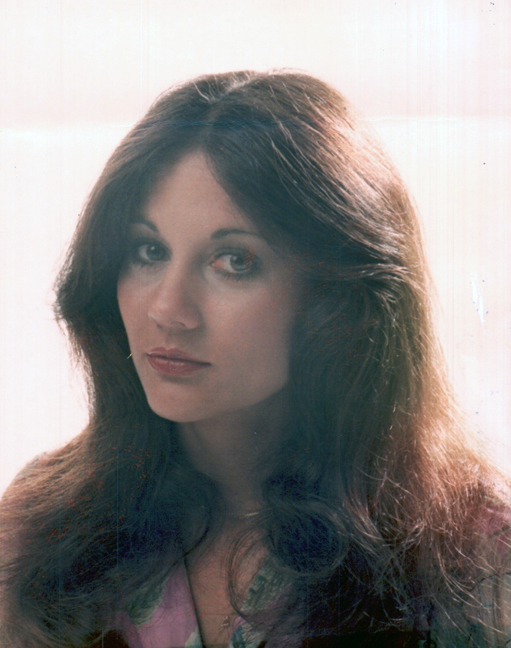 Marcy Bichette
*
1. Marcy Bichette, beginnings
After the divorce, Maurice had quickly remarried. This new wife was his third and final: his new bride, Mary, had already been married four times before, and together they would enjoy, or rather endure, a decades-long relationship. Mary was a difficult character and Marcy, her step-daughter who lived with them, would suffer as a result.
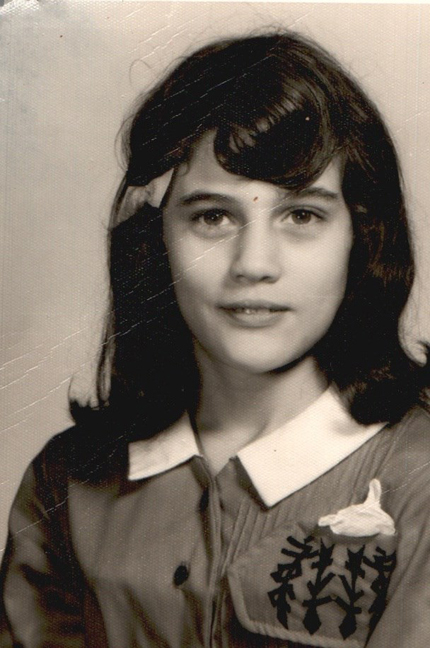 Marcy, age 7
Maurice and Mary quickly started another family, which would grow to include three children of their own, Maurice Jr, known as Mikey, Valerie, and Dante. Mikey, the oldest of the three, remembers growing up with his step-sister Marcy as being one of the best parts of his childhood. Marcy was eight years older and took over maternal tasks from Mary, such as playing and dressing him. The kids also remember Dolores coming to see Marcy whenever she had breaks from modeling and filming in Miami: they loved Aunt Dolores’ visits and all her glamorous, exciting stories. Needless to say, Maurice’s feelings were less enthusiastic – he still didn’t approve of Dolores’ lifestyle – but his problems with his ex-wife didn’t stop them both from being close to Marcy. Everyone recalls Marcy was his favorite out of all the kids – in truth, Marcy was everybody’s favorite – and, despite their separation, Maurice and Dolores doted on her.
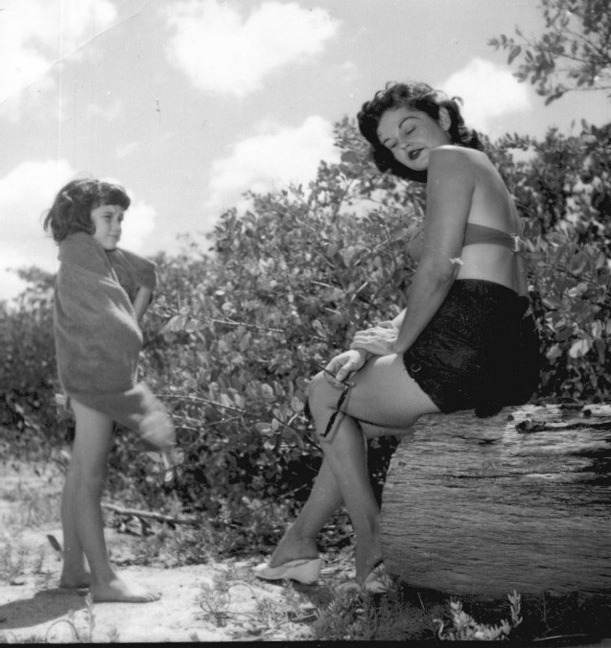 Marcy and Dolores
For someone who’d had an unconventional home life, Marcy seemed the most normal girl in the world. Family members today describe her as an unusually gentle and thoughtful person. They talk about her kindness and the way she saw the good in everything and everyone. She was unfailingly happy and positive. She never had a cross word or thought, never had an argument, and made everyone feel special.
One person however wasn’t a fan, and that was her step-mother, Mary. Mikey, Mary’s eldest son, pulls no punches in a description of his mother: “My mother could be a bad person, a monster at times. She resented the attention and love that Marcy had – especially from her father – and so she made Marcy suffer, and treated her terribly. But how did Marcy respond? Marcy respected my mom no matter what: she never reacted, never said anything bad against her. She just bore the brunt of all the evil and turned the other cheek.”
Mary’s neglect of Marcy continued when Marcy developed an infection in her heart in 1959, and spent four months recovering in hospital. Marcy returned home with a permanent heart murmur and more ill treatment from her step-mother. It got so bad that her father Maurice eventually called Dolores, and they agreed that Marcy had to move out, go down to Miami, and start a new life living with Dolores. It was heart-breaking for Maurice and his other children who never forgave Mary for her behavior.
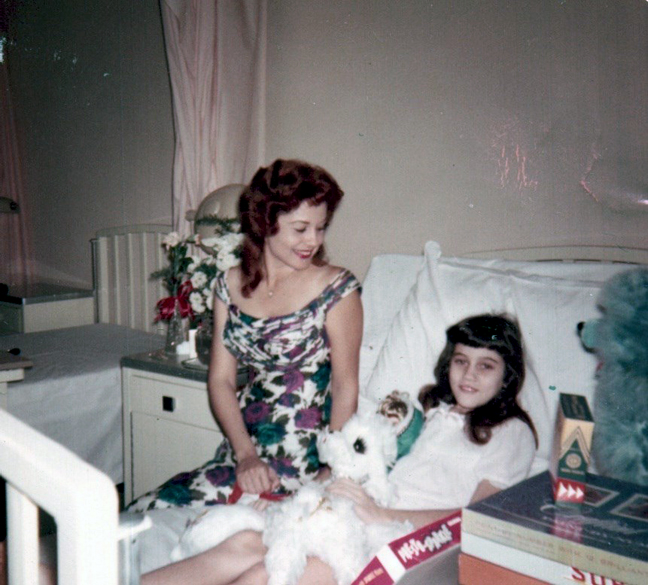 Dolores and Marcy, hospital in 1959
Dolores however was over the moon. Sure, it could’ve been a difficult situation for her: Dolores’ career was taking off – and hers was hardly a kid-friendly lifestyle. She was appearing in racy, not to mention scandalous, nudie films, arranging meetings for her coterie of Cuban filmmaker friends, and hustling her own sex film projects around town to potential financial partners.
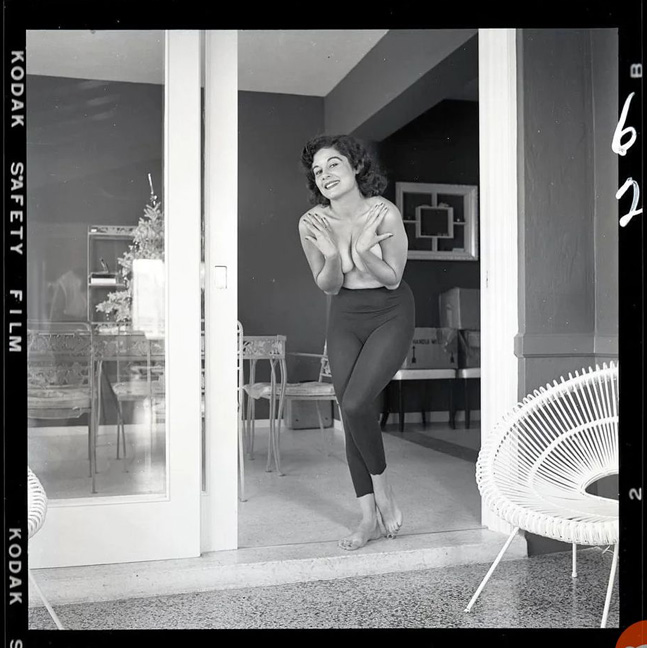 Dolores, photographed by Bunny Yeager
It made their everyday life complicated, but Dolores and Marcy both loved the new arrangement and Dolores relished living with her daughter in her small apartment on NW 1st St. And despite her physical distance from her father, Marcy called Maurice every Sunday without fail, something she continued to do for decades. However busy she was, Marcy made regular trips to visit him and his family, where she loved taking care of her step-brothers and sister. Despite her parents’ acrimonious separation, Marcy harbored no favoritism, loving them both equally as if they were still together.
In Miami, Marcy started attending the city’s Senior High School where she fit in immediately. She was popular there, acting in the lead roles in high school productions and playing the piano and guitar in music groups. She had a sweet singing voice, and teenage friends still remember her carrying a guitar everywhere. She loved singer-songwriters and sung in music groups, transforming Dolores’ apartment into a rehearsal space for her latest musical project. She was Dolores’ daughter in every way, loving performing and dreaming of a career in show business.
But her biggest passion was animals, especially dogs, and she spent hours training them and playing with them. She signed up for animal welfare organizations in her neighborhood, always taking in strays. One of her friends said of her: “Marcy had such a passion for life and animals, and everyone loved her. I almost hate to say it because I’d love to give you some gossip or salacious stories, but that’s the truth. She was a sweetheart. I still picture her running around the back yard as a teen chasing butterflies.”
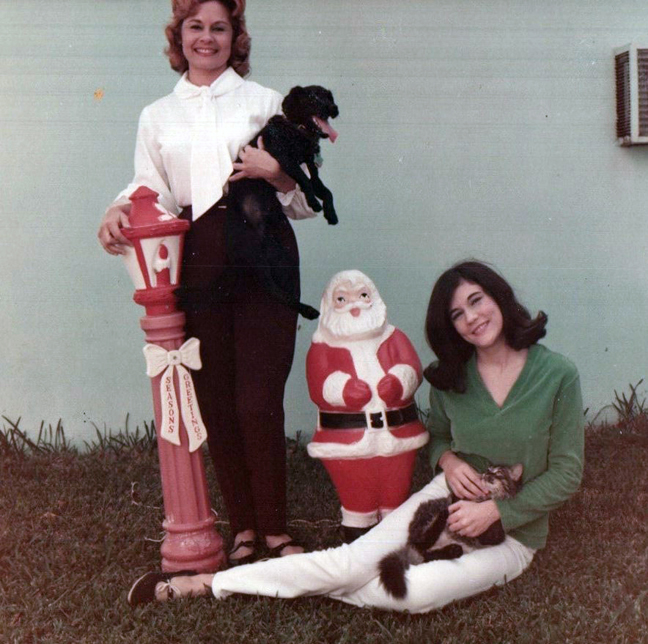 Dolores and Marcy
*
2. Dolores Carlos – The Nudie Queen Single Mother
In the mid 1960s, Dolores told friends she’d never felt happier and yet somehow, she still felt strangely unfulfilled. Deep down, she knew she couldn’t live this life forever. Time moves slowly but passes quickly, and she wanted to remain relevant and use her accumulated knowledge and connections to create a more lasting career. She argued that she’d made as many films as anyone else, she had well-connected and powerful friends, and she could mobilize a Cuban film crew at the drop of a hat, so why was it so difficult to get someone, anyone, to take the chance and invest in her?
She wondered out loud about whether it was because she was a woman, or a Latina, or that she was in a business that prized youth and beauty – and there she was, a single mother now in her mid 30s. Or perhaps it was because everyone still thought of her as being just a sex film actress? She knew that success was a double-edged sword – on the one hand, she was still offered plenty of nude film and modeling work which helped pay the extra bills after Marcy moved in, but it also perpetuated the stereotype of her as being just a sex object.
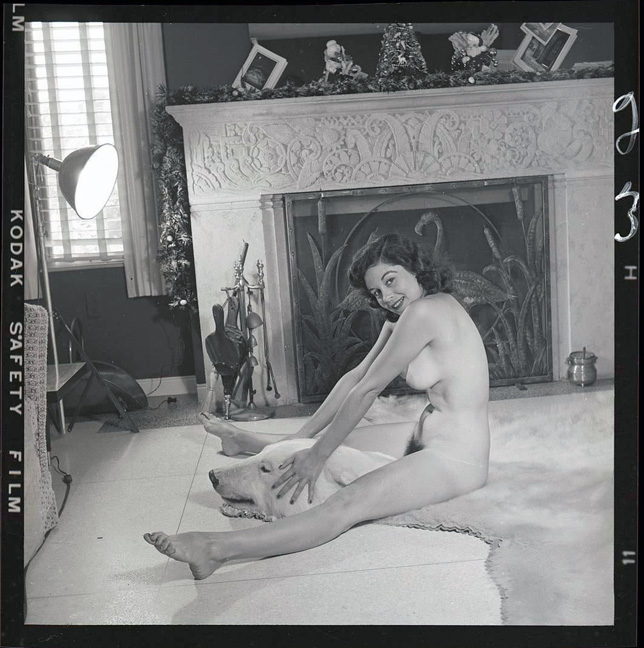 Dolores, photographed by Bunny Yeager
She did much more than that, she said, and the variety of her work did have a striking range: she was called upon by film production honchos like K. Gordon Murray to assist and advise in their film productions; she advised theater chain managers like Leroy Griffith on new film ideas; she found work for scores of Cubans; and she’d started writing film scripts and movie pitches. She knew she was appreciated, admired, cherished even, but whatever she did, she never seemed to be able to parlay her success into a more profitable, respectable, and permanent career: “I could be a powerful rocket, but at the moment, I’m a failure to launch,” she told a friend.
And Dolores worked more regularly than most. In the 1960s, she appeared in a lengthy sequence of sex films that reads like a history of South Florida sexploitation: there was Bunny Yeager’s Nude Camera (1963) – a Barry Mahon effort which featured many models shot by Bunny Yeager including Dolores’ friend Bunny Downes; she work again with Doris Wishman in Gentlemen Prefer Nature Girls (1963), shot at Sunny Palms Lodge nudist reserve; there were two more Barry Mahon films – both nudist roles – in Crazy Wild and Crazy (1964) and International Smorgas-Broad (1964); a rare though brief role in a mainstream film, How to Succeed with Girls (1964) – perhaps interesting mainly for the presence of future Golden Girl, Rue McClanahan; then a part in Eve and the Merman (1965) where she was typecast as a pin-up; and then the lead role of sorts in The Beast That Killed Women (1965), a breathtakingly strange film by returning champion Barry Mahon, about a rampaging gorilla who disrupts the calm of a Miami nudist resort – this time Spartan’s Tropical Gardens Nudist Camp – by kidnapping and murdering nude women.
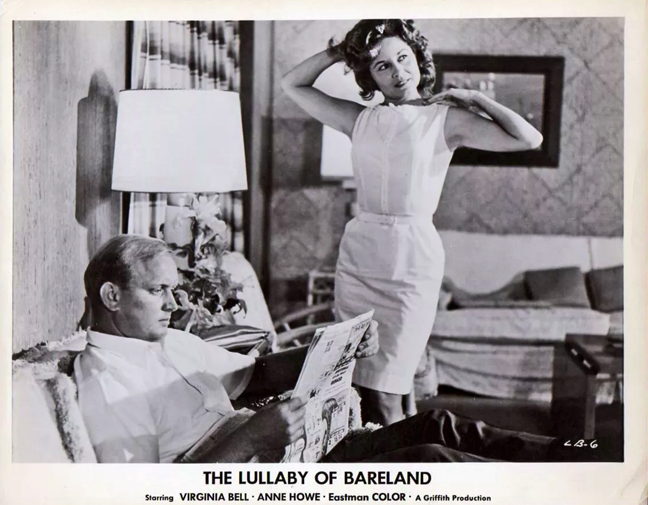
She wasn’t short of male attention either: when she and Bunny Downe appeared as two of the nudists in Herschell Gordon Lewis and Dave Friedman’s Goldilocks and the Three Bares (1963) – Dolores had a brief, behind-the-scenes fling with the film’s star, Joey Maxim, the recently-retired but still handsome heavyweight boxing champion from the 1950s. All the experiences were fun, all kept her in the public eye, and all paid a little spending cash, which was increasingly important as Dolores’ savings had started to dwindle – but she wanted, and needed, more.
While Dolores was toiling in Southern Florida’s exploitation film business, her teenage daughter was an interested and empathetic observer. Marcy may have made life more costly, but she had become her mother’s best friend. Marcy could see the pleasure her mother derived from performing and putting films together, and friends still talk about how the two would talk together about all aspects of the production, distribution, and exhibition of Dolores’ films.
 Marcy
Marcy
And then Dolores did make a film of her own. It was produced with a close friend, Richard Falcone, with whom she’d acted on the set of her first movie, ‘Hideout in the Sun’ (1960). Falcone was a polymath – if a polymath means an Italian who combined being a property developer, interior designer, bodybuilder, butterfly collector, the founder of Sunshine Beach Naturist Club in Tampa, and a keen photographer who snapped primarily nudist pictures to sell to naturist magazines.
There was a reason for them making the film. Falcone had gone through a tough time after appearing in ‘Hideout in the Sun’: in 1961, he’d been arrested as the supposed mastermind of a prostitution and pornography ring when police broke down his door and confiscated all his nudist photos. Falcone insisted he was entirely innocent and said that this was a simple case of harassing an honest man who just happened to have an alternative lifestyle. But this was the early 1960s and Falcone was fighting a losing battle to make his case. The media coverage treated him as a pervert which in turn caused him to lose his real estate business, his photography job, and then his apartment lease. No matter that the charges were eventually thrown out when the initial police search was deemed unlawful. Dolores, ever the supportive friend, was one of the few who remained by his side helping him rebuild his life.
One of her ideas to get him out of the hole he was in was for them to make a film together, and they hatched a plan to produce a nudist movie based on a script that Dolores had written, Naked Complex (1963). The story was admittedly contrived: Johnny is a playboy and an expert at sports – from water skiing, golf, and racing cars, but he’s hopeless around women. Somehow, after being humiliated by the newspapers who reveal his inadequacy, he crash-lands his personal airplane on a remote island where nude women cure him of his problem. It wasn’t ‘Gone With The Wind’ but it was exciting for the pair to be putting their own movie together for the first time.
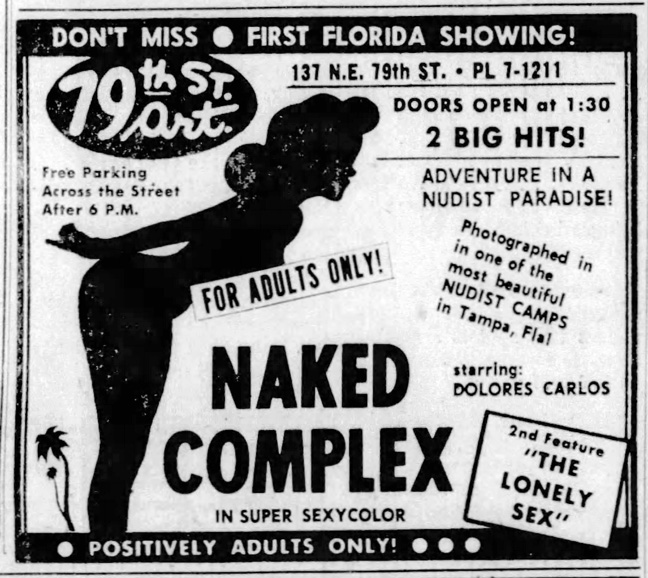
Dolores assembled an entirely Cuban production team to shoot the movie, and gave acting roles to some of her Cuban friends from Little Havana, including a female snake dancer who’d just arrived from Cuba smuggling her three exotic serpents into the country. They shot the story at – where else? – the Sunshine Beach Naturist Club, the nudist resort which Falcone had founded. Oh, and Dolores starred in the movie as well, of course.
Their film wasn’t hit – or even that great, but the budget was minimal, Dolores had shown she could both produce and star in a movie, and it made a little money. Unfortunately, the experience still failed to open any new doors.
Chastened by the experience, Dolores sat down with Marcy to figure out next steps. The truth was that she didn’t have a lot of money left in the bank, and she was getting aged out of the nudie films that had been such a cash cow for her. She needed a new plan. It wasn’t a decision she wanted to take, but Dolores decided she had to get a more regular paycheck.
And so the Queen of the Nudies took a position as a teller in a local Miami bank.
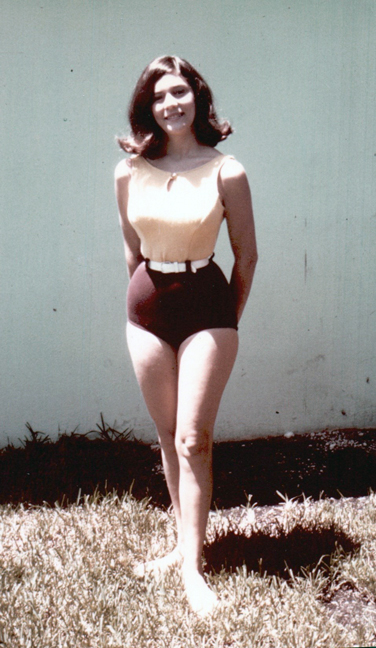 Marcy
Marcy
*
3. ‘The Nazi film’
When Marcy was fifteen, she asked Dolores if she could get some semi-professional acting work.
Dolores had seen Marcy’s talent in school plays and so took her for an audition at Miami’s Merry Go Round Playhouse Theater on Miracle Mile in the Coral Gables neighborhood. The Merry Go Round was a staple of Miami’s theater scene, part of a broad trend at the time to present plays ‘in the round’ – a more immersive experience by placing the stage at the center with seating surrounding it. Marcy was transfixed by the theater from the first moment she saw it – and the Merry Go Round management liked her too, offering her a contract to appear in their children’s productions.
Marcy snatched the opportunity and started appearing in bit parts straight away. She was mentored in the theater by a black actor, Ray Aranha, a local probation officer who did acting in his spare time. Ray was a decade older that Marcy but he saw that her talent and enthusiasm made her a natural, as he remembered years later: “Marcy was a ray of sunshine. I couldn’t help feeling happy whenever she walked into the room. She was a rare person. And she was a talented actress… I used to coach her and read lines with her: she took direction well, and we were all convinced that she was going to end up in Hollywood starring in movies someday.”
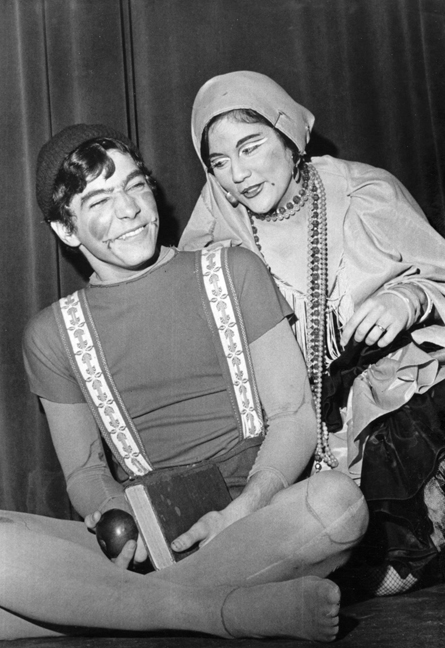 Marcy, at the Merry Go Round Playhouse
Marcy loved the theater, and it wasn’t long before she started to pester Dolores for film roles too. Her father, Maurice, was horrified at the thought of his daughter appearing in sex movies, and made Dolores promise that she would keep their daughter far away from the sex film business.
In 1966, Dolores became friends with Norman Senfeld, a virulently anti-Castro Nicaraguan, who she met in a bar in Little Havana. Senfeld was an ardent activist who was intent on raising awareness of the evils of the Cuban regime, as well as raising money to overthrow it. The Cuban expats liked him, even though there were rumors that he was involved in some illicit money-laundering activity to fund his efforts to subvert and destabilize Castro’s government.
Senfeld told Dolores he wanted to move into films and maybe she could help him. He said he was impressed with her extensive connections. Together they formed a company, called Stage Four, with another wannabe filmmaker, Bobby O’Donald. The new company was set up quickly, suspiciously quickly in fact, and from the start it seemed to be awash with cash. The mystery was where the money had come from. Friends of Dolores from this time still speak about their surprise – and suspicion – at the large sums of money that Senfeld and O’Donald, two inexperienced and unknown newcomers on the film scene, had available to make their films.
In April 1966, they made a film called Full House (later renamed ‘Mafia Girls’). Dolores got Manuel Conde onboard to shoot it, which was his final film before he left for California. The movie was about a crime syndicate in Miami Beach that extorts politicians by filming them at sex parties, and Dolores had a starring role taking time off from her bank job. Despite its supposedly large budget – and extensive press coverage, the resulting film seemed to disappear without a trace, with a number of its crew claiming, years later, that it was never actually released theatrically.
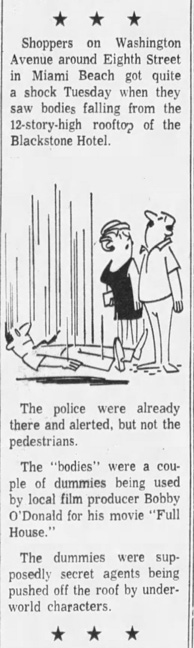
For their next movie, Dolores volunteered a script that she’d been developing for years. It was supposedly an action-packed exploitation thriller that was far from the nudist camp flicks for which she was known. She’d already pitched different drafts to her usual trusted benefactors, men like K. Gordon Murray and Leroy Griffith, but they showed little interest in financing it.
The script was called ‘Revenge of the Swastika’: it told the story of the Miami branch of the American Nazis headed up by a Colonel von Stissen who was supported by his right-hand gal, Major Olga. (Bear with me here.) Their fascist group is about to launch ‘Operation 11’, a plan that will destabilize society and bring them to power. First, they have to take over the William Penn hotel in Miami and hold the vacationers and staff hostage. The twist was that the FBI had already infiltrated the group of Nazis and was aware of their plan, but they decided to wait and see how the insurrection would play out. Got that?
Quite how much of this plot was Dolores’ work or how much was embellished by Norman Senfeld after he got hold of it is unknown. Senfeld himself described the story as a metaphor about authoritarianism, and by implication, the Castro regime that he despised. He agreed it should be the next Stage Four production. Dolores was amused by Senfeld’s political interpretation but pleased that her script would finally be made into a feature.
If you wanted to be generous, you could say the story was ahead of its time, as nazi-sploitation films like Love Camp 7 (1969), Ilsa, She Wolf of the SS (1975), and countless others would follow in the years ahead. But in truth, this was a bizarre story that was every bit as strange as it sounds.
The film was shot in the second half of 1966 – but with a different title, Storm Troopers U.S.A. By the time of the shoot, Dolores was no longer a producer, but involved instead, behind the scenes, as a production manager though she received no on-screen credit. The shoot received a large amount of press coverage in the local newspapers, with Miami residents complaining about the unannounced extras wearing Nazi regalia who suddenly appeared on their streets. The producers proudly stated that the film would be released within 90 days – though they admitted it probably wouldn’t be seen in Miami theaters. Dolores had an acting part in the film, and they found a role for Marcy too, her first appearance in front of the camera. In fact, both can be seen in stills from the movie wearing Nazi armbands – though neither of them featured in the credits.
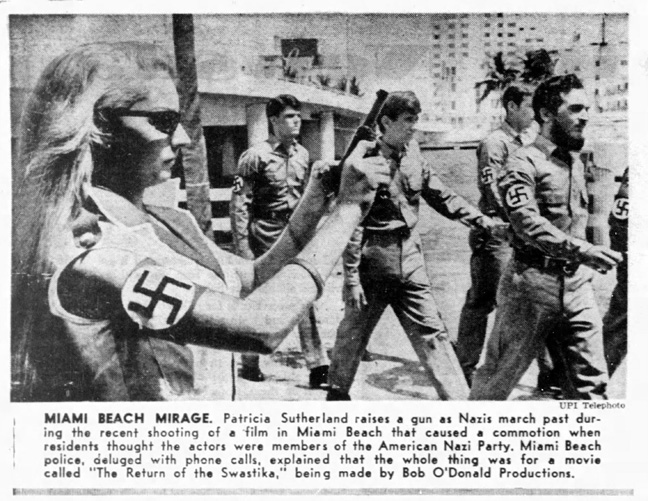
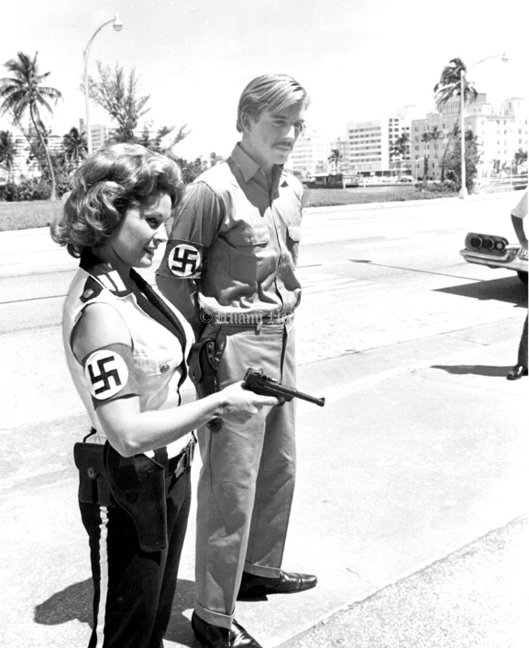 Dolores, on set of Storm Troopers U.S.A. in 1966
The finished film was heavily padded with stock footage from World War II and was nothing like the serious action thriller that Dolores had originally intended it to be. Worse, it did exactly what she vowed not to do and it succumbed to amateurish sex film tropes.
What happened next is another mystery. What is known is that, just like ‘Mafia Girls’, the movie disappeared and doesn’t seem to have been released theatrically. And there’s a strange postscript twist to the story: for years to come, Dolores claimed she made a large sum of money from the film. In fact, she claimed the money was so substantial that she used it to buy her first home, which enabled Marcy and her to move from their small apartment to a comfortably sized house at 3790 SW 121st Ave, Miami in 1967. This story became part of family lore, and for years, they would all talk about how “the Nazi film” that no one ever saw had made Dolores a small fortune.
This made some friends skeptical, suspicious even, and there were rumors that the film had been made as a front for money-laundering activity. Others wondered if Dolores’ windfall was actually a hush-money payment she received when she discovered that the company was involved in illegal activity.
So what is truth behind what happened to the film, and the source of the money that Dolores said that she received?
A few years ago, I tracked down and interviewed the director, Norman Senfeld. He spoke at length about how he got to know the Miami Cuban filmmaking collective through Dolores and his anti-Castro activism. He spoke fondly of her, and the few films they made together. He said that both ‘Mafia Girls’ and ‘Storm Troopers U.S.A.’ had indeed been released in theaters at the time, and he claimed that he had bought Dolores out of Stage Four, the film company they created, so that he could exert greater control.
But when I asked about where the company’s funding had come from, and about the rumors of money-laundering, Senfeld claimed it all happened a long time ago and that he couldn’t remember much anymore. I pressed further suggesting it was strange to have made two films – that received much so publicity – but that didn’t seem to have been released. And what about the large payoff that Dolores received that enabled her to buy a house. Senfeld claimed ignorance, and then quickly and quietly made his excuses and hung up. I’d like to claim to have found the answers but, for now at least, the story remains a mystery. Senfeld died in 2016.
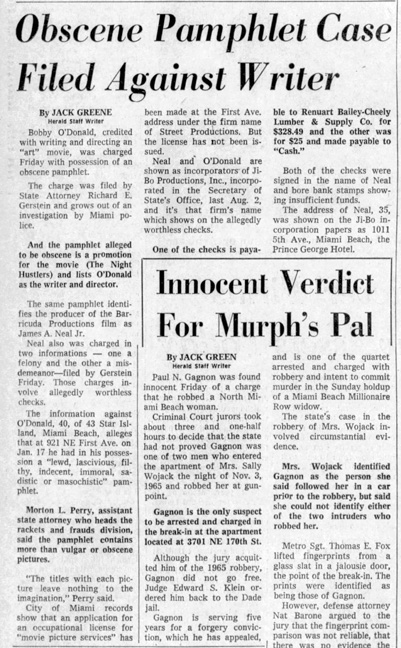
As for the Stage Four production company, it came to a sudden end in 1968, when Bobby O’Donald, Senfeld’s partner, was arrested for owning what the feds described as an obscene pamphlet. It turned out the booklet in question was nothing more than the pressbook for their next film, Night Hustlers (1968). Whatever the merits of the case, the accompanying scandal signified the end of the film company.
As for Dolores, she went back to her job working as a teller in the bank.
*
4. Marcy Bichette: The Film Actress
While Dolores was busy juggling her 9-5 job with occasional film work, she was unfailing in her support of Marcy’s regular acting roles in children’s plays at the Merry Go Round Playhouse. Marcy was now 16, and had progressed from walk-on parts to lead roles, garnering good reviews in the local newspapers. And when she wasn’t acting, she was singing in a band that covered 1950s and 1960s rock n’ roll standards and volunteering at animal rescue centers. She’d also started modeling.
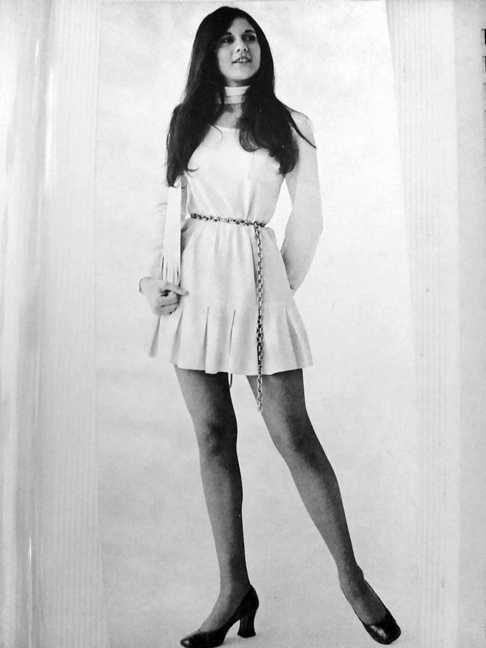
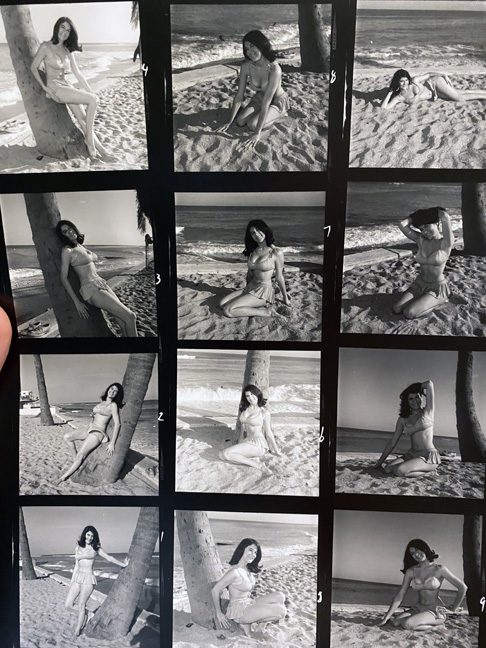
Just like Dolores had done fifteen years previously, Marcy’s modeling work led her to enter beauty contests – with some success. Dolores saw a chance to help advance Marcy’s ambitions, so she called up Bunny Yeager who’d photographed her for various pin-up magazines at the start of her career. Bunny suggested something different – her first mother/daughter pictorial. The shoot took place on the sidewalk by Miami Beach in December 1966. The resulting bikini photos are as unglamorous as they are touching: Dolores looks very much the older, wiser mother, and Marcy the self-conscious, awkward, but pretty and happy-go-lucky teen.
 Dolores and Marcy, photographer by Bunny Yeager in 1966
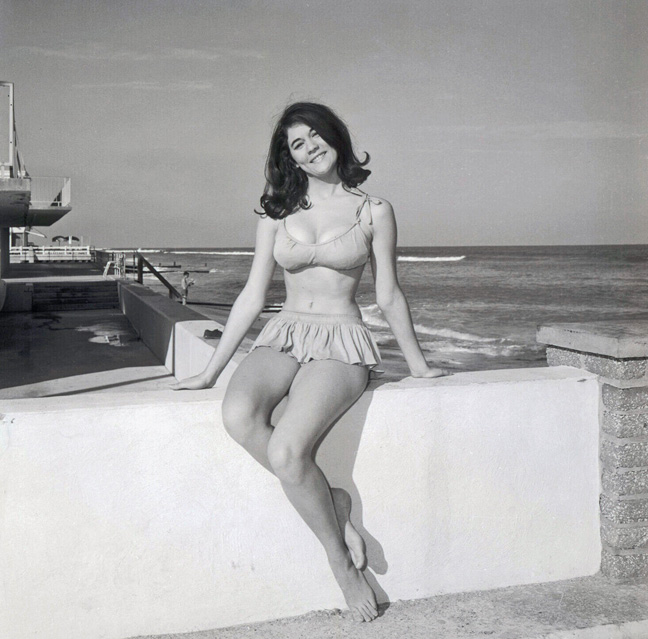 Marcy, photographed by Bunny Yeager in 1966
Dolores also found another film role for Marcy, through her long-time friend, Louise ‘Bunny’ Downe. In the years since they started in sex films together, Downe had started working exclusively for Herschel Gordon Lewis, the Florida-based director, who was making a name for himself as the ‘Godfather of Gore’ through a series of gory and grisly, low-budget, splatter films. Downe had worked on the script for their next film, The Gruesome Twosome (1967), about a demented elderly woman who has her mentally challenged son kill and scalp various young women to use their hair for her wig shop. Downe told Dolores she had a role for Marcy – and Marcy jumped at the chance to be in the movie. She loved it too: no matter that the production was a pantomime of incompetence at times, with supposedly dead bodies blinking and breathing after their bloody demise. The film set was exciting – and Marcy wanted more of this in her life.
Back at the Merry Go Round Playhouse, Marcy was now impatient. She’d been in a movie, and was growing tired of the children’s matinée parts. She wanted to be involved in the more senior productions of the theater. Marcy spoke to her friend Ray Aranha, the probation officer/actor who she trusted and who helped guide her developing acting career. Ray’s presence was always calming and he reassured her: there was no need to hurry. She was talented, she’d been identified as an actor the theater wanted to develop, and more serious roles would come her way. He would personally make sure of that.
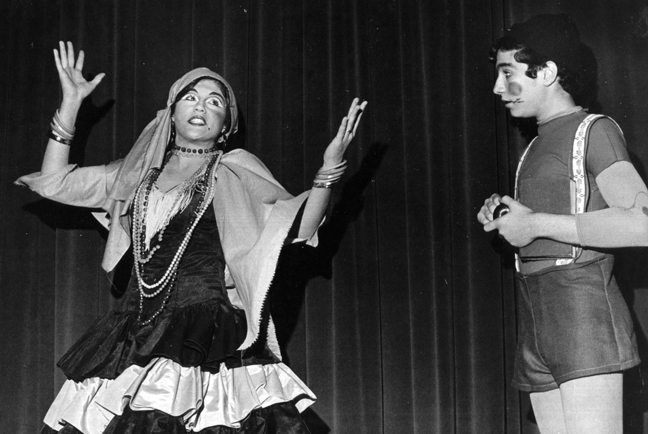 Marcy, at the Merry Go Round Playhouse
And then Ray’s theatrical career blew up in his face: newspapers ran stories about his appearance in Shanty Tramp (1967), a sexual film of miscegenation that was shocking Florida. The scandal led to him being fired from his day job and hounded out of the south Miami theater scene. Dolores and Marcy were particularly shocked by the events: it had been Dolores who had recommended him for the role, and she felt personally responsible, and Marcy had lost someone she viewed as an older brother. Both of them were devastated. When I spoke to Ray years later, Ray still spoke warmly, though sadly, of his friendship with Marcy, wondering what had happened to her in the years after the scandal.
But if the fall-out from ‘Shanty Tramp’ had been a firestorm causing the lives of some of the protagonists to be affected forever, others were quietly pleased with how the film had been received. The three people behind it, producer K. Gordon Murray, director José Prieto, and writer Reuben Guberman, saw their film break out of the usual ghetto of B-movies and into the mainstream, and that meant mucho boffo at the box-office – as they probably don’t say in Cuba.
For the writer, Reuben Guberman, the question was slightly more complicated. Guberman, you may recall from the last episode, was the New Yorker, the ex-hamburger cook, drive-in restaurant manager, radio announcer, newspaper editor, and one-time political candidate, and as pleased as he was with the outraged reaction his script had elicited, deep down he had loftier aspirations to be a serious writer. Sure, he was happy to write another potboiler, but he wanted some critical admiration too. So he decided to seek redemption by writing a play, ‘Social Trip’, which would be a morality piece warning kids against the dangers of drugs. As usual, Dolores was on hand to help, and she arranged for the Merry-Go-Round Playhouse to put it on in January 1968 – with Marcy in the lead role, of course. It may have been a cynical ploy for Guberman to rehabilitate himself – but it worked. Dolores pulled strings to get the newspapers to run positive stories about how instructional and moving the play was, and many who had attacked ‘Shanty Tramp’ now came out to endorse and praise the new play.

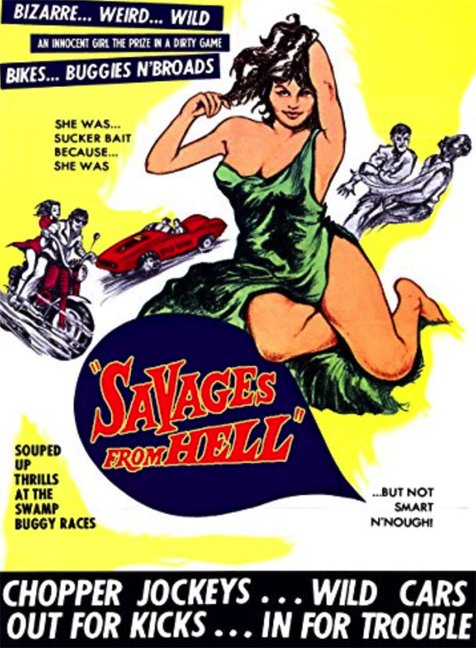
Meanwhile, K. Gordon Murray was waiting in the wings. After ‘Shanty Tramp’, the only question he had was how could he follow it up – and produce another profitable smash hit? Murray asked, nay demanded, a new script, and so Guberman offered him something he’d written called Savages from Hell (1968). It was a biker movie about a vicious gang who pick a violent fight with a farmworker and his family. Murray liked it enough and offered it to José Prieto, by now his go-to director. José assembled a crew consisting almost exclusively of Cubanos to film it, including his best friend Rafael Remy, who did the cinematography and editing. Of course, Dolores insisted that there was a prominent role for Marcy in the cast too, alongside Cyril Poitier, brother of Sydney.
‘Savages from Hell’ was released in a blaze of publicity, with lurid posters blaring that the film “Makes the Hell’s Angels look like Boy Scouts!”. In truth, Guberman’s script was an under-cooked effort lacking the elements that had made ‘Shanty Tramp’ so enjoyably bad, and it would be his last involvement in film. The movie failed to attain the success of their previous effort, the only semi-scandal being a lawsuit from American International who sued K. Gordon Murray for imitating its biker films.
The movie was notable for one reason, however. It was Dolores’ last appearance in front of a film camera. It was a small role as a redhead at the Roadhouse bar. She was in her late 30s now, with a steady job at the bank, and happily living in her new house financed by ‘Storm Troopers U.S.A.’. She’d also just got married, and she figured it was finally time to settle down.
*
5. Marcy in the 1970s
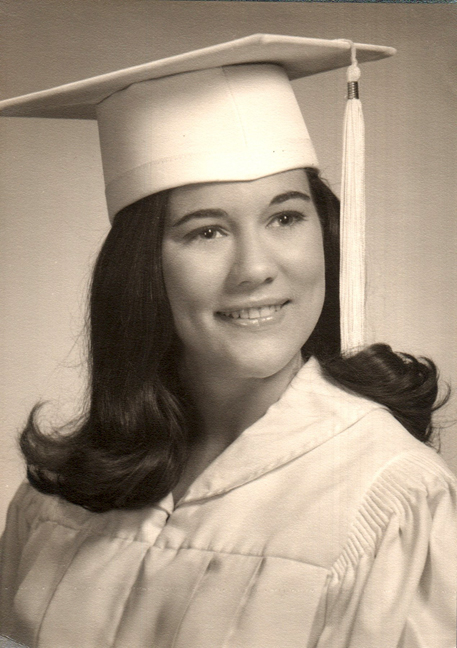
Marcy had made just two films – three if you count ‘Storm Troopers U.S.A.’ – but after she turned eighteen, she started getting more offers. The problem was they were nearly all for sex movies and Marcy was more interested in stretching her acting abilities. She had no judgement against the increasingly explicit trend in movies – after all, she knew her mother had made a career out of the early nudie-cutie films – but as Dolores kept repeating to her: “I made those films so that you don’t have to.” Also, Marcy had seen how Ray Aranha had been hounded out of theater work after the sexual shenanigans of ‘Shanty Tramp’ – and she didn’t want the same to happen to her. After she graduated high school, many of her friends on the theater scene encouraged her to go west and try her luck in Hollywood.
The Miami theater worl