The Purple Principle
101 episodes — Page 2 of 3

S3 Ep 1Messing with that Texas Identity? These Not So United States (TX Part 1)
The Purple Principle kicks off its extended Season Three series on state level polarization with a mini-series on the great state of Texas. And who better to discuss Texas politics than the co-hosts of the artfully named podcast, Y’all-itics: Jason Wheeler (Senior News Reporter) and Jason Whitely (News Anchor) of the ABC Dallas affiliate, WFAA. Both Jasons concur that polarization has been eating away at that powerful Texas identity in recent times. “People do like to maintain that they have that independent streak,” says Wheeler, pointing to both Texas Republicans and Democrats. “And I think that one of the things you have in common is that you like to think that you're perhaps more of an independent thinker than you are.” What factors are contributing to erosion of that common Texas identity? One party rule, without real need for bipartisanship, certainly plays a role. And gerrymandering has helped maintain Republican domination of Texas politics over the past two decades. Therefore, Republican office holders often look over their right shoulders at primary battles rather than ahead to general elections and swing voters. The most recent Texas legislative session put forth a number of bills catering to that small subset of Republican primary loyalists, including restricted abortion and voting access, yet unrestricted open carry of firearms. Will this “red meat” legislation invoke electoral backlash? That’s a point of discussion in this episode, along with last year’s major power failure and the continuing movement of California companies and workers into Texas. Tune in for a “Y’all-itical Science” mini-course with the equally articulate, almost equally named hosts of Y’all-itics, Jason Wheeler and Jason Whitely, as The Purple Principle kicks off our extended state polarization series in the vast, varied, and vocal Lone Star State. Original Texas–themed music this episode by Ryan Adair Rooney. SHOW NOTES Our Guests Jason Whitely: co-host of the podcast Y’all-itics, Senior News Reporter at WFAA in Dallas, Texas. Host of WFAA’s Inside Texas Politics. Jason Whitely’s Twitter Jason Wheeler: co-host of the podcast Y’all-itics, News Anchor at WFAA, and Editor of WFAA’s Right on the Money. Jason Wheeler’s Twitter Find the Y’all-itics podcast on WFAA.com, Apple Podcasts Additional Resources Why “heartbeat bill” is a misleading name for Texas’ near-total abortion ban (Texas Tribune) Gov. Greg Abbott signs Texas voting bill into law, overcoming Democratic quorum breaks (Texas Tribune) Permitless Carry Becomes Legal In Texas Next Week. Here’s What You Need To Know (Houston Public Media) Texas Partisan Index: Rating New Senate Seats From Most Republican to Most Democratic (The Texan) Ken Paxton - About the Attorney General Texas attorney general refuses to hand over Jan. 6 records (AP) With primaries under way in Texas, Ken Paxton’s bid for a 3rd term is marked by legal troubles (Houston Public Media) Why Texas Democrats lost the 2020 voter turnout battle, even among Latinos (NBC News) Texas President Results, 2020 (CNN) Triumph The Insult Comic Dog Meets Beto And Cruz Pandemic politics fuel long-shot Republican challenges to Texas Gov. Greg Abbott (NBC News) Governor Abbott Issues Executive Order Prohibiting Government Entities From Mandating Masks Surreal photos and videos capture dangers of severe winter storm across the South (Today.com) Colin Allred - U.S. House of Representatives Van Taylor - U.S. House of Representatives Join Us for Premium Content: Apple: https://link.chtbl.com/PurpleApple Patreon: patreon.com/purpleprinciplepodcast Find us online! Twitter: @purpleprincipl Facebook: @thepurpleprinciplepodcast Instagram: @thepurpleprinciplepodcast Our website: https://bit.ly/2ZCpFaQ Sign up for our newsletter: https://bit.ly/2UfFSja

S2 Ep 26Heard the One About a Centrist Congressman? Carlos Curbelo on Polarization in the House
What’s it like to represent one of the very few remaining swing districts on the U.S. Congressional map, and be virtually the only Republican member at that time to publicly address climate change? Former Congressman Carlos Curbelo from Florida’s 26th district (including southwest Miami and the Florida Keys) fields these questions in a season-ending Purple Principle episode entitled, Heard the One About a Centrist Congressman? Curbelo also recounts some telling anecdotes from his time in the U.S. House, such as his application to the Congressional Hispanic Caucus (traditionally bipartisan but now controlled by Democrats), which was ultimately rejected. “Polarization in the House” is the subtitle and subtext of this episode, which also includes intel on the polarization of music choices in the House members' gym. There’s also a more serious discussion of the populist drift of his Republican Party. “I told people that I was not gonna let Donald Trump define this party, or kick me out of it,” says Curbelo, now a political analyst for NBC and Visiting Fellow at the University of Chicago. This episode also marks Jillian Youngblood’s last co-hosting stint for the foreseeable future as she turns full attention to an innovative new round of Civic Genius engagement programs nationwide. Tune in to learn more about these efforts and get a refreshingly non-partisan perspective on the U.S. House from former Congressman Carlos Curbelo. Original music by Ryan Adair Rooney SHOW NOTES Our Guest The Hon. Carlos Curbelo: Twitter page, Unite America, University of Chicago’s Energy Policy Institute Check out Carlos as a regular contributor to Telemundo, NBC News, MSNBC and NBC 6 Additional Resources Rep. Carlos Curbelo - House of Representatives 2021 Partisan Voter Index Scores by Congressional District (Cook Political Report) The GOP Just Lost Its Most Important Climate Moderates (The Atlantic) Ryan and McCarthy split on Dreamers (Politico) The Congressional Hispanic Caucus and Conference (U.S. House of Representatives) Curbelo hands in formal request to join Congressional Hispanic Caucus (Miami Herald) Curbelo calls rejection from Hispanic Caucus "shameful" (USA Today) Rep. Xavier Becerra - House of Representatives Ex-GOP Rep. Curbelo to testify at climate change hearing (The Hill) House panel yanks Curbelo invite amid furor from top Democrats (Politico) Republican introduces bill calling for carbon tax (Reuters) Florida Amendment 3 Election Results: Establish Top-Two Open Primary System (New York Times) Read Trump's Jan. 6 Speech, A Key Part Of Impeachment Trial (NPR) Congressional Democrats fear losing majority in midterms (NPR) Rep. John Katko to retire from Congress, ending bid for 5th term (Syracuse.com) Join Us for Premium Content: Apple: https://link.chtbl.com/PurpleApple Patreon: patreon.com/purpleprinciplepodcast Find us online! Twitter: @purpleprincipl Facebook: @thepurpleprinciplepodcast Instagram: @thepurpleprinciplepodcast Our website: https://bit.ly/2ZCpFaQ Sign up for our newsletter: https://bit.ly/2UfFSja

S2 Ep 25Voice of Reason for Independent Minds: Talking Media & Polarization with CNN's Michael Smerconish
“I have been paying attention for thirty years,” CNN and SiriusXM host & commentator Michael Smerconish tells us. “And during that time the country has been driven into a partisan ditch.” A well-known visage from his CNN show, Smerconish is also a widely recognized voice, having started on “terrestrial” AM radio two decades before migrating to his current SiriusXM show and podcasts. The Purple Principle wanted to know more about Michael Smerconish, the individual, who features more indie-minded segments on his shows and podcasts as well as his platform, Smerconish.com. Smerconish details his 2010 decision to break with the Republican Party he grew up in, citing the reckless expansion of the War on Terror and the nasty tone of 2010 Tea Party congressional campaigns. He bemoans the loss of moderate Republicans like Senator Arlen Specter (PA) and Congressman Mike Castle (DE) in that period, expressing current concern that incivility and vitriol is creeping down from the national and state to the local level. “There have been a number of nasty exchanges at school board meetings pertaining to masks or vax policy,“ he observes. “And they’re probably driving reasonable people right out of the discourse.” Smerconish is also a frequent critic of the media, such as in his 2021 Reagan Library speech, “It’s Time to Change the Channel.” “Division sells,“ he states emphatically, noting the extreme voices from both parties manipulating that business model to raise money and further congressional careers without legislative success. Join us today for this master class from Michael Smerconish on partisan politics in the media and partisan media in politics, the tightly-wound symbiosis driving polarization in our country. No magic solutions offered for this trend, but lots of enlightening anecdotes and insights in this episode, Voice of Reason for Independent Minds with Michael Smerconish. Original music by Ryan Adair Rooney SHOW NOTES Our Guest Michael Smerconish: Twitter, Smerconish.com, CNN’s Smerconish, SiriusXM Radio’s “The Michael Smerconish Program”, and SXM podcasts “Book Club with Michael Smerconish” and “The Smerconish Podcast”. Additional Resources CNN’s Michael Smerconish - Bio (CNN) Michael Smerconish’s Reagan Library Speech (YouTube) James E. Beasley Sr. Sen. Ted Cruz says it was a 'mistake' to call Jan. 6 a 'terrorist attack' after GOP blowback (USA Today) Sorry, but for me, the party is over: Michael Smerconish (Cleveland.com) A day of reflection in a Bucks County community hit hard on 9/11 (Philadelphia Inquirer) The Tea Party Didn’t Get What It Wanted, but It Did Unleash the Politics of Anger (New York Times) Senator Goes Face to Face With Dissent (New York Times) Specter Leaves GOP, Shifting Senate Balance (Washington Post) Christine O'Donnell: "I Dabbled Into Witchcraft" (CBS News) Central Bucks adopts state ordered mask rule, Gamble resigns board after death threats (Bucks County Courier Times) Americans’ immigration policy priorities: Divisions between – and within – the two parties (Pew Research Center) As public safety tops the agenda, Americans want both order and justice (Ipsos) The Common Ground of the American People: Policy Positions Supported by Both Democrats and Republicans (UMD School of Public Policy) GOP Rep. Adam Kinzinger, who voted to impeach Trump, won't run for reelection (NPR) VoteSafe - Co-Chair Tom Ridge Pursuit of unity: Do history & civics education need a revamp? (CNN’s Smerconish) Problem Solvers Caucus bucks the flame-throwing norm (CNN’s Smerconish) Find us online! Patreon: patreon.com/purpleprinciplepodcast Twitter: @purpleprincipl Facebook: @thepurpleprinciplepodcast Instagram: @thepurpleprinciplepodcast Our website: https://bit.ly/2ZCpFaQ Sign up for our newsletter: https://bit.ly/2UfFSja

S2 Ep 24The United States of Narcissism? Speaking of Democracy’s Worst Enemies
“If we believe democracy has failed us,” writes author and scholar Tom Nichols in his latest book, Our Own Worst Enemy, “we should first ask ourselves whether we have failed the test of democracy.” In this Purple Principle episode entitled “The United States of Narcissism,“ co-hosts Rob Pease and Jillian Youngblood ask Nichols why many Americans seem to be enthusiastically failing that test in recent times. A longtime Soviet Union—then Russia expert—Nichols points back to the US triumph at the end of the Cold War as a tipping point from civic seriousness toward national narcissism – an event he likens to winning the lottery. “And anybody who's followed the history of lottery winners can tell you,” Nichols observes, “winning the lottery never goes well.” The bleakness of 1970s’ industrial decline initially turned Nichols into a young, Reaganite Republican, setting him on the path of Russian language and history study to understand the necessity of a strategic air command post in his hometown. However, by 2018, Nichols believed that same party was no longer taking international security threats seriously enough. “We were the first to defect from the Republicans,” says Nichols of he and many fellow security experts, “because we were primarily concerned about national security and about putting the nuclear codes in the hands of an unstable sociopath.” Not one to shy away from bold statements, Nichols has seen what lack of freedom means in today’s Russia and other autocratic nations. As a result, he’s issued an urgent plea in this latest book, Our Own Worst Enemy, for Americans across the political spectrum to re-embrace civic values, abstain from biased media, and resist the siren call of autocratic solutions. Join us on The Purple Principle for an impassioned discussion with Dr. Tom Nichols, Professor of National Security Affairs at the Naval War College and author of the new Oxford University Press book, Our Own Worst Enemy: The Assault from within on Modern Democracy. Original music by Ryan Adair Rooney SHOW NOTES Our Guest Tom Nichols: Twitter, Faculty Page, The Atlantic Buy his latest book: Our Own Worst Enemy: The Assault from within on Modern Democracy Additional Resources Tom Nichols, 'Death of Expertise' Author, Is Profiled (Harvard Magazine) How Sen. John Heinz’s tragic death, 30 years ago, changed Pa.’s politics then and now | Opinion (Philadelphia Inquirer) House Republicans Who Backed Infrastructure Bill Face Vicious Backlash (New York Times) Watch John McCain defend Barack Obama against a racist voter in 2008 (Vox) Reagan Aides Bullish on 'The Bear' Ads (Washington Post) 10 Shocking Revelations From the Facebook Papers (Rolling Stone) A Wider Ideological Gap Between More and Less Educated Adults (Pew Research Center) Pizzagate, the fake news conspiracy theory that led a gunman to DC’s Comet Ping Pong, explained (Vox) Gary Kasparov-Biography Vietnam Era-A History of Westover Air Force Base Find us online! Patreon: https://www.patreon.com/purpleprinciplepodcast Twitter: @purpleprincipl Facebook: @thepurpleprinciplepodcast Instagram: @thepurpleprinciplepodcast Our website: https://bit.ly/2ZCpFaQ Sign up for our newsletter: https://bit.ly/2UfFSja

S2 Ep 23Wait, I’m Not the Crazy One! Sarah Longwell, Conservative Watchdog of Republican Sanity
“I'm watching everybody slowly turn into a pro-Trump zombie that I've ever worked with or been around; everyone's doing their rationalizations.“ So recalls special guest this episode, Sarah Longwell, conservative strategist turned watchdog of Republican populism as Executive Director of the Republican Accountability Project and Publisher of The Bulwark. “The fact that there were a bunch of people that I respected who I had been intellectually interested in for many years — when those people saw the world the same way I did, it kept me from feeling insane." Those people included highly respected conservative journalist Charles Sykes, founder of The Bulwark, and William Kristol, veteran of several Republican White House positions, now Chairman of the Republican Accountability Project (RAP). Longwell goes on to describe perhaps the most visible outcome of her partnership with Kristol thus far, the “Republican Voters Against Trump” campaign, which ran throughout the 2020 election. Not sparing in her criticisms of the left, Longwell also calls out the political hazards of progressive pronoun obsession and legislative overreach by the White House. “Especially if you think that the Republican Party is as dangerous as we do,” she cautions, “you really are rooting for the Democrats to build a broad coalition. And that's not what's happening at the moment.” So much happening yet not happening in US politics these days, with legislation gridlocked but primary elections coming up soon. Join us for a fast-paced, no-holds-barred discussion with one of Washington’s keenest minds and sharpest wits, Sarah Longwell of the Republican Accountability Project and The Bulwark. SHOW NOTES Our Guest Sarah Longwell: Twitter, Defending Democracy Together, The Bulwark Additional Resources ‘I Can Talk To Anyone’: McCarthy Defends His Visit To See Trump At Mar-A-Lago (Forbes) McConnell endorses Herschel Walker, solidifying GOP establishment support for Senate candidate in Georgia (Washington Post) The 147 Republicans Who Voted to Overturn Election Results (New York Times) The 2020 Election Was A Good One For Republicans Not Named Trump (NPR) All The Trump Family Members Who Might Launch Their Own Bids For Office (Forbes) Trump Lost the 2020 Election. He Has Raised $207.5 Million Since (New York Times) House Republicans oust Cheney for calling out Trump’s false election claims, minimize Jan. 6 attack on Capitol (Washington Post) Spanberger, one of most vulnerable House Dems, announces she'll run in redrawn Virginia district (The Hill) Bill Kristol (Twitter) Charlie Sykes (Twitter) Find us online! Patreon: patreon.com/purpleprinciplepodcast Twitter: @purpleprincipl Facebook: @thepurpleprinciplepodcast Instagram: @thepurpleprinciplepodcast Our website: https://bit.ly/2ZCpFaQ Sign up for our newsletter: https://bit.ly/2UfFSja

S2 Ep 22Speaking Truth in Polarized Times: Top Guest Insights from 2021
Cast your votes here! The year 2021 would certainly be worth forgetting if its worst elements weren’t so clearly continuing on into the New Year 2022 and very likely beyond: the Omicron surge, the worst U.S. inflation in decades, and the maelstrom of misinformation swirling around the clear benefits of vaccination and the equally obvious outcome of the 2020 election. In this episode entitled Speaking Truth in Polarized Times, we ask what TPP guests in 2021 speak most insightfully to the challenges of this era. We’ve highlighted ten great insights, asking listeners to select the best of them, to be announced early in 2022. We kick off our 10 nominees with Harvard University political geographer Ryan Enos on the trend of political polarization right down to the neighborhood level, where Republicans and Democrats cluster apart from each other. Did we suddenly arrive at this moment of hyperpartisanship and rabid misinformation? Princeton historian Julian Zelizer explains that the blueprint for Congressional polarization was laid decades ago by a young firebrand named Newt Gingrich whose accusations brought down Speaker of the House Jim Wright in 1989. And are there any clear routes out of this gordian knot of political identities, where every issue is immediately politicized making consensus solutions all but impossible in our highly antagonized zero-sum polity and society? New York Times Contributing Writer Thomas Edsall places the burden on the more rational of the two major parties, the Democrats, to ameliorate the sense of threat perceived by the American right. And Dr. Omar Ali finds inspiration in the resilience of independent black American leaders as far back as Frederick Douglass and as recently as Lenora Fulani. There’s something for every inquiring mind here in our list of Top Guest Insights from 2021. Which speaks most directly to your hopes and concerns? We hope you’ll listen through this episode, then click the link in our show notes to complete the website poll. SHOW NOTES Cast your votes here! This episode features: Ryan D. Enos: Website, Episode 3 Nick Andert: Behind the Curve, Episode 8 Julian Zelizer: Princeton University, Episode 1 Katherine Gehl: Institute for Political Innovation, Episode 5 Jeanine Guidry: VCU, Episode 6 Steven Hassan: Freedom of Mind, Episode 7 Rod Lurie: IMDB, Episode 11 Beth Silvers: Pantsuit Politics, Episode 16 Omar Ali: UNC Greensboro, Episode 16 Thomas Edsall: NYT, Episode 13 Find us online! Join & Support us on Patreon! Twitter: @purpleprincipl Facebook: @thepurpleprinciplepodcast Instagram: @thepurpleprinciplepodcast Our website: https://bit.ly/2ZCpFaQ Sign up for our newsletter: https://bit.ly/2UfFSja

S2 Ep 21Celebration & Polarization, Holiday Survival Kit (Part 3): Identity with all the Trimmings
Support us on Patreon! Can a German town be socially divided by sneakers? Or the Canadian landmass united by a beer commercial? And is US individualism more a group identity than its individualistic citizens would ever admit? Tune into the third and final episode in our Holiday Survival Kit, Identity with All the Trimmings, featuring Psychology Professor Dominic Packer of Lehigh University for answers to these and other important questions around the topic of social identity. Dr. Packer is the co-author, along with Jay Van Bavel of NYU, of the new book, The Power of Us: Harnessing Our Social Identities to Improve Performance, Increase Cooperation and Promote Social Harmony. We kick off the interview with Packer’s retelling of the book’s opening tale: how tensions (and odors) created by Van Bavel’s hockey bag were erased by a life-saving intervention at an academic reception. We’ll also hear Dr. Packer’s thoughts on why COVID became more politically polarized in the US than any other nation. Finally, we’ll test Dr. Packer’s ability to implement his research in an all-too-common (if fictionalized) role play with TPP host Rob Pease playing Dominic’s anti-vax Cousin Rob. Can Dominic sway Cousin Rob toward vaccination prior to the family holiday gathering? Join us for an informative and entertaining discussion with Dr. Dominic Packer. And be prepared to discover a few things about your own identity in the process. SHOW NOTES Our Guest Dominic Packer: Twitter, Faculty Page, Google Scholar Buy his book, co-authored with Jay van Bavel: The Power of Us: Harnessing Our Shared Identities to Improve Performance, Increase Cooperation, and Promote Social Harmony Additional Resources Shifting attention to accuracy can reduce misinformation online (Nature) Emotion shapes the diffusion of moralized content in social networks (PNAS) Who voted for the People’s Party of Canada? Anti-vaxxers and those opposed to vaccine mandates (The Conversation) I Am Not American: What can beer ads tell us about our national identity? (National Post) Where Puma and Adidas Were Like Hatfields and McCoys (Wall Street Journal) The Herd of Independent Minds: Has the Avant-Garde Its Own Mass Culture? (Commentary Magazine) WT.Social DiscussIt Find us online! Twitter: @purpleprincipl Facebook: @thepurpleprinciplepodcast Instagram: @thepurpleprinciplepodcast Our website: https://bit.ly/2ZCpFaQ Sign up for our newsletter: https://bit.ly/2UfFSja

S2 Ep 20Celebration & Polarization, Holiday Survival Kit (Part 2): When Anti-Science Makes the Menu
It’s tempting to think of anti-science sentiments, such as the current pushback against COVID vaccination, as the disparate sum of misinformed individuals. But Lee McIntyre, author of the recent book, How to Talk to a Science Denier, has found otherwise. “All science denial is really organized. It’s a campaign,” explains McIntyre. “And as a campaign it deserves some pushback, which is what I do.” In this Purple Principle Part Two of our Holiday Survival Kit, we learn from Lee McIntyre how artful pushback must be to reach skeptical counterparts with identities defined by anti-science belief. In the episode, we first discuss Lee’s background in the philosophy of science, then his decision to leave the relative comfort of scholarly research to engage with science deniers. Here he learns firsthand the surprisingly common elements across such disparate groups as flat earthers, GMO skeptics, and anti-vaxxers. “They all followed the same reasoning strategy,” McIntrye tells us. “They cherry-picked facts, believed in conspiracy theories, engaged in illogical reasoning, relied on fake experts, and thought that science had to be perfect in order to be believed.” Do you have friends, colleagues, or family members prone to anti-science beliefs? Then join us on Episode Two of the Celebration & Polarization, Holiday Survival Kit: When Anti-Science Makes the Menu for helpful insights from Philosopher of Science, Lee McIntyre. His latest book, How to Talk to A Science Denier, comes at a time when these difficult discussions are vital to our families, our workplaces, and our democracy. SHOW NOTES Support us on Patreon! Our Guests Lee McIntyre: Website, Twitter How to Talk to a Science Denier: Purchase Additional Resources The 5 Characteristics of Scientific Denialism Focus Group: Exploring GOP Views on Vaccines Rising Out Of Hatred by Eli Saslow Combatting Cult Mind Control by Steven Hassan Fact Checks The CDC does not recommend wearing a face mask outdoors unless you are in a large gathering or in close proximity. While there have been some published studies that were interpreted as suggesting GMOs may be harmful to health if ingested, other scientists have pointed out the errors in the methods or interpretation, and the general scientific consensus is that consuming GMOs has not been shown to be harmful to health. Documented reports of missed menstrual cycles after COVID vaccine administration are common enough that it is currently under investigation. However, typically menstruation returns after one missed cycle and there has yet to be any evidence that Covid vaccines affect fertility. Missed menstruation is also common amongst women who have had COVID. A recent study suggests that the benefits of taking a daily dose of aspirin outweighs the risk of bleeding problems only for people with specific risk factors, such as high blood pressure. Find us online! Twitter: @purpleprincipl Facebook: @thepurpleprinciplepodcast Instagram: @thepurpleprinciplepodcast Our website: https://bit.ly/2ZCpFaQ Sign up for our newsletter: https://bit.ly/2UfFSja

S2 Ep 19Celebration & Polarization, Holiday Survival Kit (Part 1): Deflating Political Football
Are we Americans trapped in our end zones of polarized bubbles ever more motivated to reason away conflicting information or viewpoints? Our featured guest, psychologist Tania Israel, thinks not and should know. Dr. Israel has been holding workshops over the past two decades to help participants bridge political and social divisions. In this Purple Principle episode, the first in a three-part series on holiday survival amidst polarization, co-hosts Rob Pease & Jillian Youngblood speak with Tania about these workshops, her flowchart that (almost) solved political polarization, and her new book, Beyond Your Bubble: How to Connect Across the Political Divide. With Dr. Israel’s facilitation, we apply the bubble bursting toolkit to a serious in-house case of affective (e.g negative) polarization -- Jillian’s deep dislike of the New England Patriots, especially ex-Patriot and presumptive GOAT (greatest of all time), quarterback Tom Brady, stemming from her identity as a New York Jets Fan. “I’m so glad you brought up something that’s so central to our democracy.” quips Tania, who gamely plays along as we advance this metaphor down the political football field. Family gatherings were never friction-free. Then polarization came along. Tune in for helpful advice from an all-star in respectful and compassionate dialogue, just in time for Thanksgiving. Author and scholar Dr. Tania Israel is the first guest in our three-part Holiday Survival Kit. SHOW NOTES Please Support us on Patreon! Our Guests Tania Israel: Website, Twitter, Book, Faculty page. Additional Resources How to Win a Political Argument | Dr. Tania Israel | TEDxSanLuisObispo Moderates are less likely to post about their political views on social media | Pew Research Bipartisan Public Consensus Offers Direction for US Foreign Policy in Second Bush Term | Dr. Steven Kull The Bias Blind Spot: Perceptions of Bias in Self Versus Others Motivated Skepticism in the Evaluation of Political Beliefs | AJPS Tom Brady suspension case timeline NFL History - Super Bowl Winners | ESPN Find us online! Twitter: @purpleprincipl Facebook: @thepurpleprinciplepodcast Instagram: @thepurpleprinciplepodcast Our website: https://bit.ly/3cgyaeq Sign up for our newsletter: https://bit.ly/2UfFSja

S2 Ep 18Hollywood Presidents for a Partisan Nation (Part Four): Romance, Grandeur & Smugness on The West Wing
Our Purple Principle series on Hollywood Presidents would not be complete without a stroll back in time through that show of all Potus shows, The West Wing, featuring Martin Sheen as President Josiah “Jed” Bartlet. We speak with award-winning West Wing writer, Paul Redford, a former Shakespearean actor turned screenscribe, who recalls: “West Wing came along and...filled a need that nobody knew was there… a need to believe again.” Canadian writer and cultural critic, Luke Savage, thinks the show gave American Democrats a little too much of what they wanted to believe. One of his prominent critiques is entitled, “How Liberals Fell in Love with The West Wing,” describing it as “a series of glittering illusions to be abandoned.” In our TPP interview, Savage points to the smugness of the show, as well as naivete regarding possibilities for bipartisanship, as two of the more obvious weaknesses. Redford concurs that The West Wing was created at a less partisan political time. In fact, following that show, he went on to write for two TV series deploying fictional independent Presidents to reach a wider audience -- Madam Secretary starring Téa Leoni and Designated Survivor starring Kiefer Sutherland. And regarding Designated Survivor, Redford agrees with the show creator David Guggenheim (TPP Season 2, Episode 12) that this was an effort to make an anti-West Wing, with not a lofty Bartlet but an everyman figure as President. Our third guest, the Greece-based media scholar Dr. Betty Kaklamanidou, sees not so much distinction as similarity among The West Wing, Madam Secretary, Designated Survivor and Commander in Chief (starring Geena Davis as independent President Mackenzie Allen), whose creator, Rod Lurie, was featured in TPP Season 2, Episode 11, the kick-off to this series. “It doesn't matter whether they are Independents, Republicans or Democrats,” observes Dr. Kaklamanidou, co-editor of Politics and Politicians in Contemporary US Television. “They are idealists. They want to do the right thing, irrespective of political games.” Is the lofty idealism of West Wing a relic of the past or part of a cycle coming back into play? Dr. Kaklamanidou feels political idealism will always find new forms and variations. But looking back over two decades of polarizing tumult, Paul Redford is not sure a West Wing reboot could sustain a large audience today. Still, he argues that it’s not for political leanings but dramatic tension that West Wing has resonated so widely for so long. And he credits the show’s creator and principal writer, Aaron Sorkin, for this enduring appeal. “Honestly, I think it ultimately came from Aaron and his vision for the show, because his constant demand from the other writers was, I need an argument,“ Redford recalls of Sorkin. “[G]ive me a good argument, I can write a scene.“ Tune in for a good argument among three uniquely informed guests on the iconic TV series The West Wing, and other TV Potuses, in: Hollywood Presidents for a Partisan Nation (Part 4): Romance, Grandeur & Smugness on The West Wing. Please Support us on Patreon! Our Guests Paul Redford: LinkedIn, IMDb Luke Savage: Twitter, website Betty Kaklamanidou: Twitter, book, LinkedIn Additional Resources Season 2 Episode 11: Hollywood Presidents Part 1 Season 2 Episode 12: Hollywood Presidents Part 2 Season 2 Episode 12: Hollywood Presidents Part 3 How Liberals Fell in Love With The West Wing-Current Affairs Canada's cliffhanger election is heating up. Some fear US-style political polarization will follow-CNN Henry Brooks Adams 1838–1918 American historian Borgen (TV Series): 2010-2013 Succession-Emmys Mr. Smith Goes to Washington-IMDb Find us online! Twitter: @purpleprincipl Facebook: @thepurpleprinciplepodcast Instagram: @thepurpleprinciplepodcast Our website: https://bit.ly/3jh9QwK Sign up for our newsletter: https://bit.ly/2UfFSja

S2 Ep 17Hollywood Presidents for a Partisan Nation (Part Three): Hail the Flip-Flopping Egomania of Veep
ESupport us on Patreon! HBO's Veep, starring Julia Louis-Dreyfuss, is likely the most successful American political satire in television history. Yet, in seven seasons, the show never mentions the party labels "Democrat" or "Republican," instead using terms like "the enemy camp" or "my extremist colleague from across the aisle." In "Hollywood Presidents for a Partisan Nation (Part Three)," The Purple Principle speaks with Veep showrunner and head writer David Mandel, about this convention and the many challenges to creating a popular political satire at a time when real-world norms are shattered week after week. Mandel is a blue ribbon comedy A-lister, having written for SNL, Seinfeld, Curb Your Enthusiasm, and the occasional Simpsons episode prior to the Veep showrunner role. He led the show for its final three seasons, winning an Emmy for Best Comedy Series in two of those three years. As a result, it was no easy decision to end Veep with Season 7. Veep protagonist, Selina Meyer, was "a horrible person...who was also a politician," Mandel explains, looking back over this remarkable run. "That doesn't mean that the writers… were endorsing the offensive things she was saying." Fortunately, a large, still loyal audience appreciates the satirical brilliance of Veep—sharp, topical writing and pitch-perfect performances from a true ensemble cast. Tune into "Hollywood Presidents for a Partisan Nation (Part Three)" for more on the show's enduring appeal across the political divide from Hollywood comedy writer extraordinaire, David Mandel. Original Music by Ryan Adair Rooney Our Guest David Mandel, writer and producer for HBO's Emmy-winning political satire Veep. Follow him on Twitter: @DavidHMandel Additional Resources Funny Because It's True, Harvard Magazine Robert Caro '53 Awards Prize for Literary Excellence in the Writing of History at Horace Mann School David Mandel '88: a career in comedy, The Record Armando Iannucci, Rotten Tomatoes WATCH: Trump asks what to do about migrants crossing border. Rallygoer suggests 'shoot them', PBS Find us online! Twitter: @purpleprincipl Facebook: @thepurpleprinciplepodcast Instagram: @thepurpleprinciplepodcast Our website: https://bit.ly/3jh9QwK Sign up for our newsletter: https://bit.ly/2UfFSja

S2 Ep 16Amazing Grace For Our Partisan Times: Sarah and Beth, Creators of Pantsuit Politics
Is it possible to have grace-filled conversations during these ingracious times of ours? After 500 episodes heard by hundreds of thousands of listeners, Sarah Stewart Holland and Beth Silvers, Kentucky-based creators of Pantsuit Politics, can decisively say that it is. In Episode 16, “Amazing Grace for Our Partisan Times,” they share some of the secrets to their podcasting and publishing success. But that doesn’t mean the two long-time friends agree on all things political. In fact, disagreement is common currency on the show. But it’s the respectful nature of their disagreement, with each other as with guests and listeners, that makes for great discussion. The two-point to a series of shows on the Kavanaugh hearings as a case in point. There’s barely an issue that Pantsuit Politics has not tackled in nearly five years on the digital air: COVID, gun violence, police reform, global warming, etc. The list is impressive, if daunting. Yet Beth and Sarah conduct all show research themselves, podcasting twice weekly to listeners throughout the US and internationally. Tune into the Purple Principle episode, “Amazing Grace for Our Partisan Times,” to meet Beth and Sarah and learn how we all might communicate more artfully in these polarized times. Original Music by Ryan Adair Rooney Our guests @bluegrassred @nkybeth Listen to the Pantsuit Politics podcast on their website. Purchase their book, I Think You’re Wrong (But I’m Listening). Additional Resources: Kentucky’s closed primaries Find us online at: The Purple Principle Podcast (website) Twitter Facebook Sign up for our newsletter: The Purple Principle in Print

S2 Ep 15Liberty & Justice For Some: Two Centuries of Independent Black Leaders & Political Movements
Here’s a seemingly inexplicable historical event: How did the anti-slavery Republican party take the White House in 1861, only six years after its formation? Thanks to the work of our special guest, Dr. Omar Ali, a historian at UNC-Greensboro, we know this accomplishment is largely due to the earlier work of the abolitionist Liberty Party beginning in the 1840s and continued by the Free Soil Party, which worked against the extension of slavery. Author of In the Balance of Power: Independent and Third Party Black Politics in the United States, Dr. Ali emphasizes the importance of looking twenty years prior to fully understand these events. By this method, he describes the Civil Rights movement as an independent mobilization that rose outside the two-party structure in the 1950s and 60s. In this Purple Principle episode, “Liberty & Justice for Some,” we find that the history of independent and third-party black political mobilization is rich, significant, and long-running, with notable modern accomplishments as well. These include Mayor Harold Washington's defeat of Chicago Democratic machine candidates in the 1980s and Lenora Fulani’s 1988 independent campaign for President. In an age where two parties seem to have a solid lock on our politics, it’s important to highlight periods when independents and third parties have had a significant impact. And at a time when issues of race and identity polarize our politics and society, it’s vital to understand the fluid nature of issues over time. Tune into Season Two, Episode 15, “Liberty and Justice for Some,” for an in-depth discussion with Dr. Ali as well as archival audio of some important voices in this throughline, including Frederick Douglass (courtesy of James Earl Jones), W.E.B DuBois, Jesse Jackson, Lenora Fulani, and others. Original Music by Ryan Adair Rooney Show Notes Our Guest Dr. Omar Ali, Professor of Comparative African Diaspora History, African American & African Diaspora Studies, University of North Carolina at Greensboro @AliNCInd In the Balance of Power: Independent Black Politics and Third-Party Movements in the United States, Ohio University Press, 2008. Additional Resources Frederick Douglass, “What to the Slave is the Fourth of July?” July 5, 1852. Frederick Douglass. Stanford Encyclopedia of Philosophy. W.E.B. Du Bois. Library of Congress. W.E.B. Du Bois. Stanford Encyclopedia of Philosophy. Jesse Jackson and the Rainbow Coalition, 1984 and 1988. Digital Public Library of America. Lenora Fulani Find us online! Twitter: @purpleprincipl Facebook: @thepurpleprinciplepodcast Instagram: @thepurpleprinciplepodcast Our website: https://fluentknowledge.com/shows/the-purple-principle/liberty-and-justice-for-some Sign up for our newsletter: https://bit.ly/2UfFSja
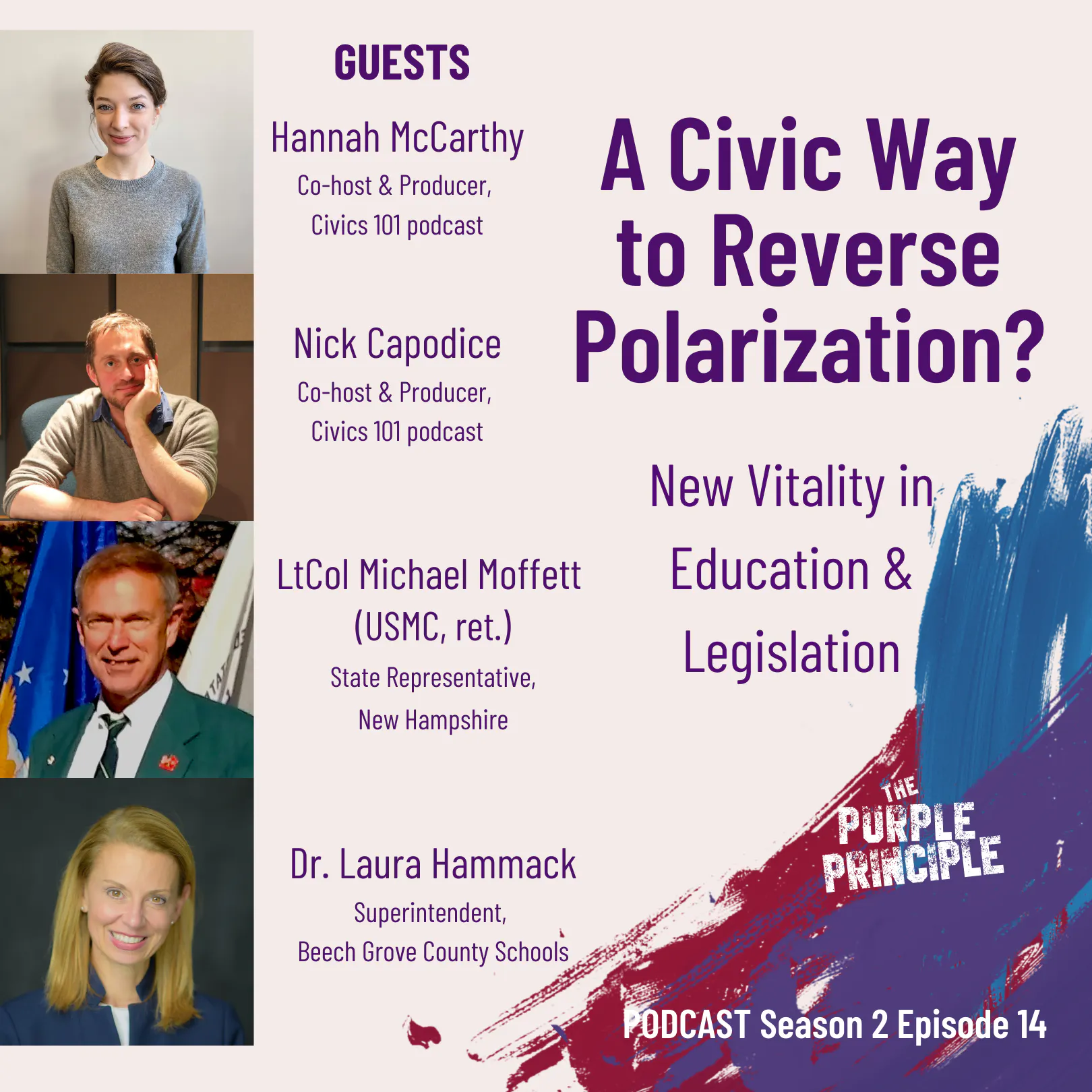
S2 Ep 14A Civic Way to Reverse Polarization? New Vitality in Education & Legislation
Is civics education in the U.S. having a moment, as in a long-overdue upgrade, for a topic essential to our democracy? And will that moment translate into more substantial education on the rights and obligations of our citizens and voters-to-be? In “A Civic Way to Reverse Polarization,” The Purple Principle takes on these questions with four special guests well versed in civics, kicking off with the producer-hosts of the popular NHPR radio show, podcast, and educational series Civics 101, Hannah McCarthy and Nick Capodice. Civics 101 has produced 250 episodes to date on topics ranging from the electoral college to Supreme Court decisions and Executive Orders. In recent years, it has also expanded its educational outreach to middle and high school classrooms around the country. But can the rights and responsibilities of citizens really engage kids in the age of Tik Tok or House Party? In her TPP interview, Superintendent Dr. Laura Hammack attests that civics can engage kids, particularly when a well-conceived curriculum with some competition is attached – at least this was the case with her former school district and the We the People competition created by the Center for Civic Education. Also in this episode, Lt. Colonel Michael Moffett, a former Marine, teacher of Civics, and now state legislator, underscores the importance of assessments of civics education. Lt.Col. Moffet sponsored New Hampshire House Bill 320, which mandates the citizenship test for high school graduates in the state. Civics may not have had this much attention since the “I’m Just A Bill” song aired on Schoolhouse Rock in the mid-1970s or Lisa earned extra points for her civics speech after the judge met her father in a 1990s Simpsons episode. Tune into The Purple Principle’s “A Civic Way to Reverse Polarization?” to learn more. Original Music by Ryan Adair Rooney Show Notes Our Guests @Capodice @HMcCarthyNHPR @Civics101pod @BeechGroveSupt @MofMichael Civics 101: A Podcast Nick Capodice & Hannah McCarthy, A User’s Guide to Democracy: How America Works Additional Resources Center for Civic Education iCivics Tufts' CIRCLE Annenberg Classroom – Resources For Excellent Civics Education Civics Renewal Network Center for Political Thought and Leadership at ASU Democratic Knowledge Project Institute for Citizens & Scholars at Princeton University Generation Citizen Find us online! Twitter: @purpleprincipl Facebook: @thepurpleprinciplepodcast Instagram: @thepurpleprinciplepodcast Our website: https://fluentknowledge.com/shows/the-purple-principle/a-civic-way Sign up for our newsletter: https://bit.ly/2UfFSja

S2 Ep 13Woking up to Backlash: New York Times Contributing Writer Thomas Edsall on Reason & Responsibility in Polarized Politics
“The rise of the conservative movement on the right and the decline of liberalism on the left have been a preoccupation of mine for 40 years or more,” Thomas Edsall confides in our latest Season Two episode, “Woking up to Backlash.” Edsall describes for us the high amperage polarities between the two parties – how the far left can be the right’s greatest ally, and vice-versa. He further notes that while the excesses of each party are not morally equivalent, they can often be politically equivalent. And he firmly states that the Republican Party under Trump’s influence has become delusional with regard to the previous election, among other issues, leaving the Democratic Party the more rational of the two. Rationality, however, brings responsibility. And, according to Edsall, if “big D” Democrats wish to preserve “small d” democracy, they must accept the lion’s share of responsibility in ratcheting down the political temperature in our polarized climate. Tune in to learn more from Thomas Edsall, one of the most objective, thoughtful, and distinguished American journalists writing today. And meet new Purple Principle co-host Jillian Youngblood, Executive Director of the non-profit, non-partisan, Civic Genius. Jillian brings two decades of frontline political experience to the show along with wit, wisdom, and passion for a more perfect union. Original Music by Ryan Adair Rooney Our Guest Tom Edsall: Columbia Journalism School Thomas B. Edsall - The New York Times Thomas B. Edsall. Building Red America: The New Conservative Coalition and the Drive for Permanent Power, 2006. @Edsall Additional Resources Lilliana Mason Lilliana Mason, Julie Wronski, & John V. Kane (2021). “Activating Animus: The Uniquely Social Roots of Trump Support.” American Political Science Review. Shanto Iyengar Jonathan Haidt Julie A. Wronski Ashley Jardina D-Nominate after 10 Years: A Comparative Update to Congress: A Political-Economic History of Roll-Call Voting Emily Cochrane (8/10/21). “Senate Passes $1 Trillion Infrastructure Bill.” The New York Times Texas House Election Results 2020 Florida Election Results 2020 Rashawn Ray (11/24/20). “How Black Americans saved Biden and American democracy.” The Brookings Institute. Find us online! Twitter: @purpleprincipl Facebook: @thepurpleprinciplepodcast Instagram: @thepurpleprinciplepodcast Our website: fluentknowledge.com/shows/the-purple-principle/woking-up-to-backlash Sign up for our newsletter: https://bit.ly/2UfFSja

Passing of the Mic: New Co-Host Jillian Youngblood Gets a Bit of Purple Orientation
bonusThis bonus episode features the passing of the ceremonial mic from Emily Crocetti to our new co-host, Jillian Youngblood, Executive Director of Civic Genius. After a full year and 35 episodes, Emily is moving onto a newspaper position in a breathtakingly beautiful area of California which is, unfortunately, clouded in fire smoke at this moment. While a co-host a few months ago, Emily interviewed Jillian in the early Season Two episode, “When Martians Land, Pigs Fly, and Americans Reach Consensus,” noting her respect for the work done at Civic Genius. Jillian is a former Capitol Hill staffer who also worked in the Bloomberg administration. She currently directs the nonpartisan efforts at Civic Genius, an organization that works toward reducing political polarization and rebuilding American civic culture: a perfect fit with many themes and topics explored on The Purple Principle. Tune in to hear a bittersweet sign-off by Emily Crocetti, who will revisit the show periodically. But please get to know our new Purple Principle co-host, Jillian Youngblood. She brings a decade of frontline political experience to the show along with wit, wisdom, and the passion for a more perfect union.

S2 Ep 12Hollywood Presidents for a Partisan Nation (Part Two): Hail the Independent & Designated Survivor
Imagine creating a television series premised on a U.S. Capitol building attack, then watching a less-lethal yet all too real version of that event unfold years later. Writer/Creator David Guggenheim relates how that felt in the second part of our Purple Principle series on Hollywood Presidents. “When the insurrection happened at the Capitol,” recalls Guggenheim, “so many people were emailing…‘Oh my God, this is like straight out of the show.’” That show was Designated Survivor, which aired on ABC in 2016 and starred Kiefer Sutherland as the low-level independent cabinet member Tom Kirkman, elevated to the Oval Office when a Capitol bombing decimates other high-ranking members of the government. Kiefer Sutherland, a grandson of a famous Canadian politician, was entirely on board with the notion of a more independent, more pragmatic American POTUS, according to Guggenheim. As with previous series guest Rod Lurie (creator of Commander in Chief), Guggenheim confides that creating an independent POTUS was a commercial decision to reach the largest audience possible. Having made that decision, his team portrayed the unique dilemmas faced by a more centrist President lacking major party backing. Tune in to learn more about those dilemmas and the challenges of attracting viewers in our partisan age on “Hollywood Presidents for a Partisan Nation (Part Two): Hail the Independent & Designated Survivor.” Original music by Ryan Adair Rooney. Our guest David Guggenheim @DBGuggenheim Designated Survivor Additional Resources Simone Del Rosario (9/4/12). “Kal Penn: From White Castle to the White House.” The Washington Post. Tommy Douglas, “History of Canadian Medicare.” Canadian Museum of History. Richard Klein Find us online! Twitter: @purpleprincipl Facebook: @thepurpleprinciplepodcast Instagram: @thepurpleprinciplepodcast Our website: https://fluentknowledge.com/shows/the-purple-principle/hollywood-presidents-two Sign up for our newsletter: https://bit.ly/2UfFSja

S2 Ep 11Hollywood Presidents for a Partisan Nation (Part One): Hail the Independent Commander in Chief
EIn a time of extreme polarization, how does Hollywood portray a POTUS with broad audience appeal? That question is at the heart of our multi-part series on Hollywood Presidents, starting with special guest Rod Lurie, the first to create an independent President in a major TV series, Commander in Chief (starring Geena Davis as President Mackenzie Allen in 2005). “I definitely made her an independent, then tried to keep the topics we were dealing with something that both sides could relate to,” says Lurie. Lurie himself has a plotline worth tracing. A West Point-educated military veteran, his 1999 film Deterrence featured the first Jewish American President negotiating a nuclear conflict with Iraq. “I always figured that you shouldn't go to school to study film,” Lurie confides. “ You should go and study what you want to make movies about. I was always fascinated by leadership and character. And there's no better school for leadership than West Point.” Lurie also weighs in on the many high-level military appointees who didn’t last long in the Trump White House, the sadly performative nature of our current Congress, and the even greater difficulties of creating a mainstream show or movie today with political content. Entertaining and insightful, profane yet profound, Lurie provides a memorable half-hour on the cultural dimensions of hyperpartisanship and polarization. How does Hollywood choose its Presidents? Let’s hear from one who’s created a few: Rod Lurie, a product of West Point and a Hollywood original. Original Music by Ryan Adair Rooney Our Guest Rod Lurie Twitter: @RodLurie Instagram: @RodLurie Commander in Chief (TV Series 2005–2006) Deterrence (1999) The Contender (2000) The Outpost (2020) Additional Resources Jeffrey Resner (4/6/08). “Guns and Moses.” Politico Hollywood’s Fictional Presidents & the Challenges of a Polarized Audience. The Purple Principle in Print Find us online! Twitter: @purpleprincipl Facebook: @thepurpleprinciplepodcast Instagram: @thepurpleprinciplepodcast Our website: https://fluentknowledge.com/shows/the-purple-principle/ Sign up for our newsletter: https://bit.ly/2UfFSja

S2 Ep 10Nicest Troll in Town: On and Offline identity, Extremism, and Polarization
"Social media is not fundamentally a source of information or a competition of ideas, but a competition of identities." With that and other provocative findings, Dr. Chris Bail, Director of the Duke University Polarization Lab and author of Breaking the Social Media Prism (Princeton U. Press) challenges what we know about social media – its uses and abuses. Dr. Bail and his colleagues delineate the strong incentives to create online alter-egos, especially more extreme ones, that command so much more attention. Social and political identity is dangerously challenging to shift. And Dr. Bail’s experiments underscore this point. His team exposed hundreds of Democrats and Republicans to media feeds from the other point of view – but with completely unexpected results. Virtually no one became more moderate from this exposure and many participants, especially Republicans, doubled down on their identity. Bail’s broader point is how social media amplifies extremism and mutes moderation. His team has built tools to help users understand trolling, gauge online identity, and create more civil discourse through anonymity, guided discussion, and other techniques to reverse that trend. To learn more about Polarization Lab tools, experiments, and why you really spend all those hours on social media, tune into “Nicest Troll in Town: On and Offline identity, Extremism, and Polarization,” with Dr. Chris Bail, Director of the Duke University Polarization Lab and author of the challenging new book, Breaking the Social Media Prism: How to Make Our Platforms Less Polarizing (Princeton University Press, 2021). Original Music by Ryan Adair Rooney Our Guest Chris Bail The Polarization Lab Chris Bail. Breaking the Social Media Prism: How to Make Our Platforms Less Polarizing. Princeton University Press, 2021. Additional Resources Adam Hughes (10/23/19). “A small group of prolific users account for a majority of political tweets sent by U.S. adults.” Pew Research Foundation. Emma Francois (2/9/21). “Always swipe left on a moderate.” Amanda Ripley. Alex Horton (4/11/18). “Channeling ‘The Social Network,’ lawmaker grills Zuckerberg on his notorious beginnings.” The Washington Post. Find us online! Twitter: @purpleprincipl Facebook: @thepurpleprinciplepodcast Instagram: @thepurpleprinciplepodcast Sign up for our newsletter! https://bit.ly/2UfFSja Our website: https://fluentknowledge.com/shows/the-purple-principle/nicest-troll-in-town
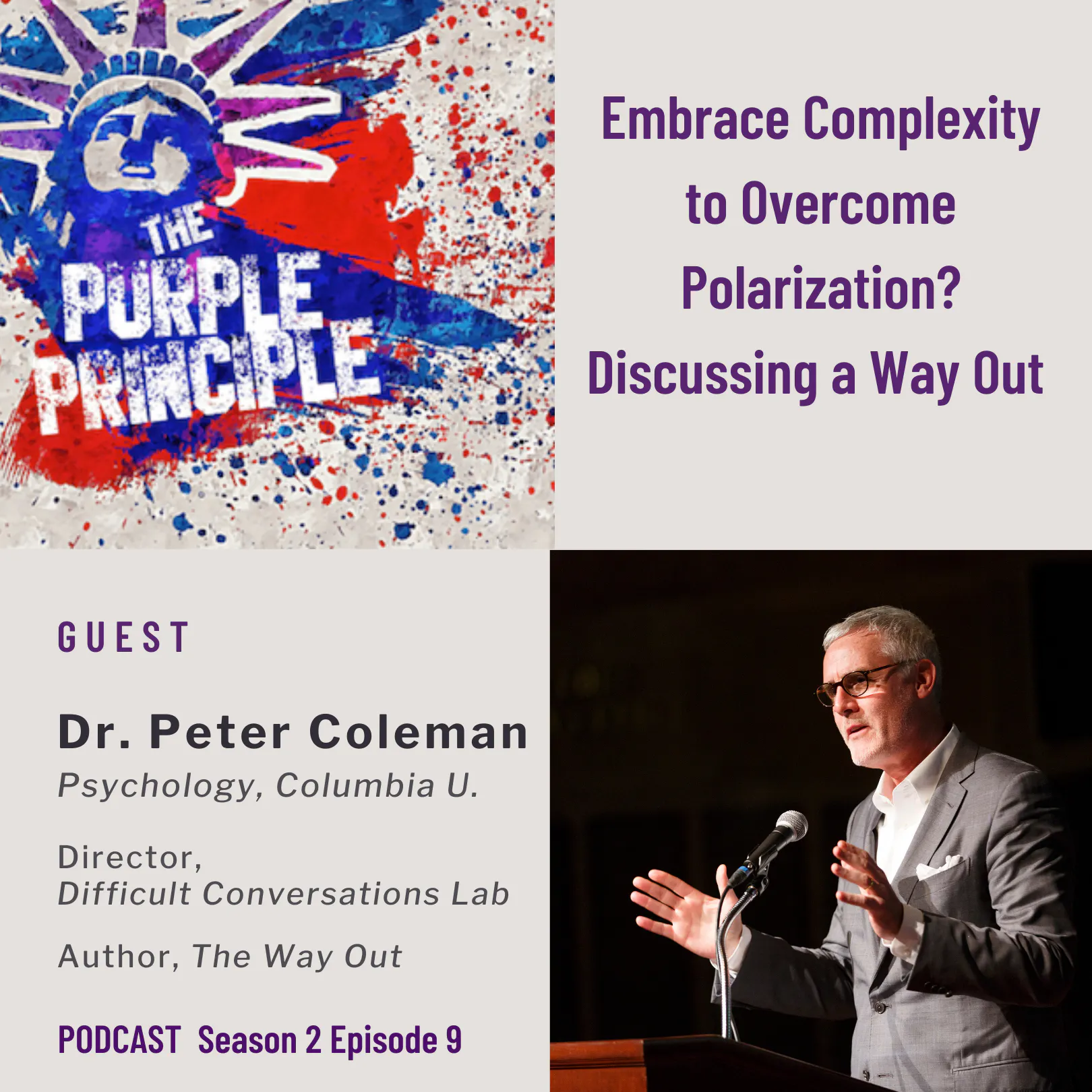
S2 Ep 9Embrace Complexity To Overcome Polarization? Discussing a Way Out with Dr. Peter Coleman of The Difficult Conversations Lab
Police reform, gun violence, global warming... When did you last have a civil, informative, productive conversation with someone of differing opinions on any of these vital but polarizing topics? In the current U.S. climate, such conversations range from difficult to impossible to regrettable. The eminent social psychologist, Peter Coleman (Director of The Difficult Conversations Lab at Columbia University) is deeply familiar with such conversations and with longstanding group conflicts among nations. Yet he remains optimistic enough to suggest a blueprint for reversing the toxic polarization currently afflicting the U.S. In Episode 9, “Embrace Complexity to Overcome Polarization,” we speak with Dr. Coleman about the methods and examples at the heart of his book, The Way Out, recently published by Columbia University Press. In his view, embracing complexity is a first essential step on the way toward real dialogue and away from weaponized debates. Dr. Coleman also describes examples suggesting seemingly intractable conflicts can improve over time. Costa Rica emerged from a bloody civil war with a broad consensus for change, resulting in the disbanding of the armed forces and mandatory peace instruction in the schools. Sitting in a deep red upstate New York territory, the town of Watertown rates as one of the least polarized in the country by several measures, including intermarriage between “reds” and “blues”. To learn more about the art of real dialogue and the science of reconciliation, tune into Episode 9, “Embrace Complexity to Overcome Polarization: Discussing a Way out with Dr Peter Coleman, of Columbia University.” Original Music by Ryan Adair Rooney Our guest Peter T. Coleman, Columbia University @PeterTColeman Additional Resources The Way Out: How to Overcome Toxic Polarization (Columbia University Press) Gottman Love Lab Bridging Divides Initiative Costa Rica: Choosing a Path to Build and Sustain Peace. Support for universal background checks on gun buyers is near 90% Find us online! Twitter: @purpleprincipl Facebook: @thepurpleprinciplepodcast Instagram: @thepurpleprinciplepodcast Our website: https://fluentknowledge.com/shows/the-purple-principle/the-way-out Sign up for our newsletter! https://bit.ly/2UfFSja

S2 Ep 8Online Conspiracies & Virtual Cults, Part 2: Celebrity Makes the World Go Flat
Do we live in an age where online conspiracies and cults proliferate ever more frequently and powerfully? We continue to explore this question by focusing on the growth of the flat earth movement in “Online Conspiracies & Virtual Cults, Part 2: Celebrity Makes the World Go Flat.” Our special guests for this episode, filmmakers Daniel Clark and Nick Andert, gained unprecedented access to the flat earthers for their insightful Netflix documentary, Behind the Curve. The central character in their film is the surprisingly engaging flat earth celebrity, Mark Sargent, whose Youtube videos have had over 19 million views. In addition to interview discussion, this Purple Principle episode features numerous audio highlights from Behind the Curve, including interplay between Mark and his ever-tolerant Mom, other flat earth celebrities and adherents, as well as scientists commenting on the challenges of combating conspiratorial thinking. Tune in to learn more about the making of Behind the Curve and the window it offers onto conspiratorial thinking and cultic identities, including Qanon and other polarizing ideologies, along our political and social fault lines. Original Music by Ryan Adair Rooney Twitter: @purpleprincipl Facebook: @thepurpleprinciplepodcast Instagram: @thepurpleprinciplepodcast Our website: https://fluentknowledge.com/shows/the-purple-principle/celebrity-makes-the-world-go-flat Subscribe to our newsletter: https://bit.ly/3sSOTKL Our guests: Daniel Clark, @djcfilm Nick Andert, @nickandert Additional Resources: Behind the Curve. Netflix. Behind the Curve Behind the Curve. International Documentary Association Delta-v Productions Rachel Brazil (7/14/20). “Fighting flat-Earth theory.” Physics World Rhett Herman (10/26/98). “How fast is the earth moving?” Scientific American. “Who started the flat earth conspiracy theory, how many actually believe this, and what do they believe exactly?” QRIS. Spiros Michalakis (5/22/18). “As a scientist, 'flat earthers' ought to be my enemy. Here's why I listen, instead.” MacLean’s. Rob Picheta (11/18/19). “The flat-Earth conspiracy is spreading around the globe. Does it hide a darker core?” CNN.

S2 Ep 7Online Conspiracies & Virtual Cults: Social Extremes in Our Hyperpartisan Age
Our digital universe is full of information, and misinformation, swirling about constantly, sampled in bits and bytes, most of it rarely gaining more than passing attention. How then does misinformation swirl up into a popular conspiracy theory? How do some conspiracy theories, such as Qanon, eventually gain a loyal cult-like following without physical contact between members or between leaders and followers? In this episode, The Purple Principle speaks with three noted cultic experts on these issues as well as the cult-like aspects of the recent Trump Presidency. Dr. Steven Hassan, author of the 2019 book The Cult of Trump, is uniquely positioned to discuss the Trump years and the differences between healthy and not-so-healthy group identification. He was recruited into the Unification Church from his college cafeteria at age 19. Prof. Doni Whitsett of the USC School of Social Work reminds us that cults formed decades ago, such as Scientology and the Unification Church, are still with us but not garnering much media attention. She further explains that, historically, cults arise when and wherever individuals have a longing for group identity. Rachel Bernstein, cultic therapist and host of the podcast IndoctriNation, observes that today’s online cults still occupy a physical space, but mainly within our brains. Join us for “Online Conspiracies & Virtual Cults” and reflect whether group dynamics have overwhelmed logic and conviction in your life, or that of a loved one. And consider the purple and principled advice our cultic experts convey: the important issue is not where groups fall on the political spectrum, left or right or center, but rather, whether the elements of real democracy are at work, such as consulting external information and questioning internal authority. Original Music by Ryan Adair Rooney Twitter: @purpleprincipl Facebook: @thepurpleprinciplepodcast Instagram: @thepurpleprinciplepodcast Our website: https://fluentknowledge.com/shows/the-purple-principle/online-conspiracies Subscribe to our newsletter: bit.ly/3wDbr4o Our guests Doni Whitsett, USC Dr. Steven Hassan's Freedom of Mind Resource Center @CultExpert @RBersteinLMFT Rachel Bernstein, MFT IndoctriNation Podcast Steven Hassan (2020). The Cult of Trump: A Leading Cult Expert Explains How the President Uses Mind Control. Simon & Schuster. Additional Resources Heaven's Gate. Encyclopedia Britannica. The Family International. Encyclopedia Britannica. Unification Church. Encyclopedia Britannica. Karen M. Douglas, Robbie M. Sutton, and Aleksandra Cichocka (2017). “The Psychology of Conspiracy Theories.” Current Directions in Psychological Science Vol. 26(6) 538–542. Evita March & Jordan Springer (2019). “Belief in conspiracy theories: The predictive role of schizotypy, Machiavellianism, and primary psychopathy.” PLOS One. Aleksandra Cichocka, Marta Marchlewska, Agnieszka Golec de Zavala (2016). “Does Self-Love or Self-Hate Predict Conspiracy Beliefs? Narcissism, Self-Esteem, and the Endorsement of Conspiracy Theories.” Social Psychology and Personality Science Vol. 7(2):157-166. Diana Tumminia (1998). “How Prophecy Never Fails: Interpretive Reason in a Flying-Saucer Group.” Sociology of Religion, Vol. 59(2), 157–170. Richard Ostling (2/22/82). “Witness Under Prosecution.” Time.

S2 Ep 6Vaccines Prevent Viruses; What Combats COVID Vax Skepticism? An Interview with Dr. Jeanine Guidry, Director of VCU’s Health & Media Lab
Battling the COVID pandemic has been a war on many fronts – disease management, the race to develop effective vaccines, and now the equally tricky PR battle against vaccine misinformation and skepticism. In this episode, the Purple Principle speaks with Dr. Jeanine Guidry, Director of the Media and Health Lab at Virginia Commonwealth University, on the varied approaches needed to address the multiple forms of COVID vaccine anxiety: concerns about effectiveness, safety, fertility, and personal liberty. No easy task, but Dr. Guidry has been waging similar battles well before founding the Media and Health Lab at VCU. As a graduate student not long ago, she discovered that the vast majority of vaccine-related discussions on Pinterest were anti-vaccine in nature, and her paper on that topic helped alert Pinterest to the issue. Today, Dr. Guidry feels the social media platforms are doing more to combat misinformation in the case of COVID vaccination. But by its very nature, social media misinfo is impossible to quell completely. Thus personal communications with friends, family, clergy, and primary care doctors are an essential front in this war. Purple Principle listeners, and anyone with empathy and accurate info, can be part of current efforts against vaccine skepticism and misinformation within their social networks. Tune in to learn more about challenges of vaccine science communication in “Vaccines Prevent Viruses; What Combats COVID Vax Skepticism?” with featured guest Dr. Jeanine Guidry of Virginia Commonwealth University. Original music by Ryan Adair Rooney Subscribe to our newsletter! https://fluentknowledge.us7.list-manage.com/subscribe?u=a805f5f26b01137e6d893f779&id=e49bf57788 Visit our website https://fluentknowledge.com/shows/the-purple-principle/vaccines-prevent-viruses Follow us on social media https://twitter.com/purpleprincipl https://www.instagram.com/thepurpleprinciplepodcast/ https://www.facebook.com/thepurpleprinciplepodcast Recommended resources from Dr. Guidry How to fight misconceptions about COVID-19 vaccines: A VCU expert in media and health explains Building Confidence in COVID-19 Vaccines. CDC. Benefits of Getting a COVID-19 Vaccine. CDC. Vaccines Coronavirus disease (COVID-19): Vaccines. World Health Organization.

S2 Ep 5The Politics Industry at Work: And How Would You Like Your Gridlock?
Our national legislative agenda hinges on any one Senator’s vote or abstention or last minute demand… A few months into term and the majority of U.S. House Members already anticipate their next primary battle… Meanwhile, bridges crumble, the border crisis deepens, and gun carnage continues unabated… Might be time to take a fresh look at our political gridlock. This episode’s featured guest, Katherine Gehl (co-author of The Politics Industry) provides a sorely needed new perspective on our two-party duopoly. Applying the “five forces” strategic analysis of her co-author, renowned HBS Professor Michael Porter, Katherine describes her “eureka” moment of recognition: politics industry “suppliers” (meaning, politicians) have so much power while “consumers” (we, the voters) have so very little. How do we unshackle from politics industry gridlock? Katherine’s plan for Final Five voting is the designated first step in changing the incentive structure of politics-as-usual. Combining the benefits of open primaries with ranked choice voting, Final Five voting reduces the polarizing effects of primaries and eliminates the spoiler effect that locks in our two party duopoly. For a master-class in politics industry reform, tune into “The Politics Industry at Work: And How Would You Like Your Gridlock?” Featuring Katherine Gehl, Founder of the Institute for Political Innovation and co-author of The Politics Industry: How Political Innovation Can Break Partisan Gridlock and Save Our Democracy (HBR Press, 2020). Original music by Ryan Adair Rooney Check out our website for show notes, transcripts, and more: https://fluentknowledge.com/shows/the-purple-principle/the-politics-industry Follow us on social media! Twitter: https://twitter.com/purpleprincipl Facebook: https://www.facebook.com/thepurpleprinciplepodcast Instagram: https://www.instagram.com/thepurpleprinciplepodcast/ Show Notes: Katherine M. Gehl & Michael Porter (2020). The Politics Industry: How Political Innovation Can Break Partisan Gridlock and Save Our Democracy. Harvard Business School Press. The Institute for Political Innovation Katherine M. Gehl & Michael Porter (2020). “Fixing U.S. Politics: What business can—and must—do to revitalize democracy.” The Harvard Business Review. “The Progressive Era: 1895-1925.” The Wisconsin Historical Society. “President Theodore Roosevelt.” The Miller Center. Michael Porter (1979). “How Competitive Forces Shape Strategy.” The Harvard Business Review. Party Affiliation: Gallup Historical Trends. Gallup Polls. A.B. Stoddard (4/19/21). “Can 'Final Five Voting' Cure Our Sick Politics?” Real Clear Politics. Mickey Edwards. Library of Congress. Mickey Edwards (1/13/21). “A Republican Journey.” The Bulwark. Mickey Edwards (2013). The Parties Versus the People: How to Turn Republicans and Democrats Into Americans. Yale University Press. “The Spoiler Effect.” The Center for Election Science. The Bridge Alliance National Association of Nonpartisan Reformers
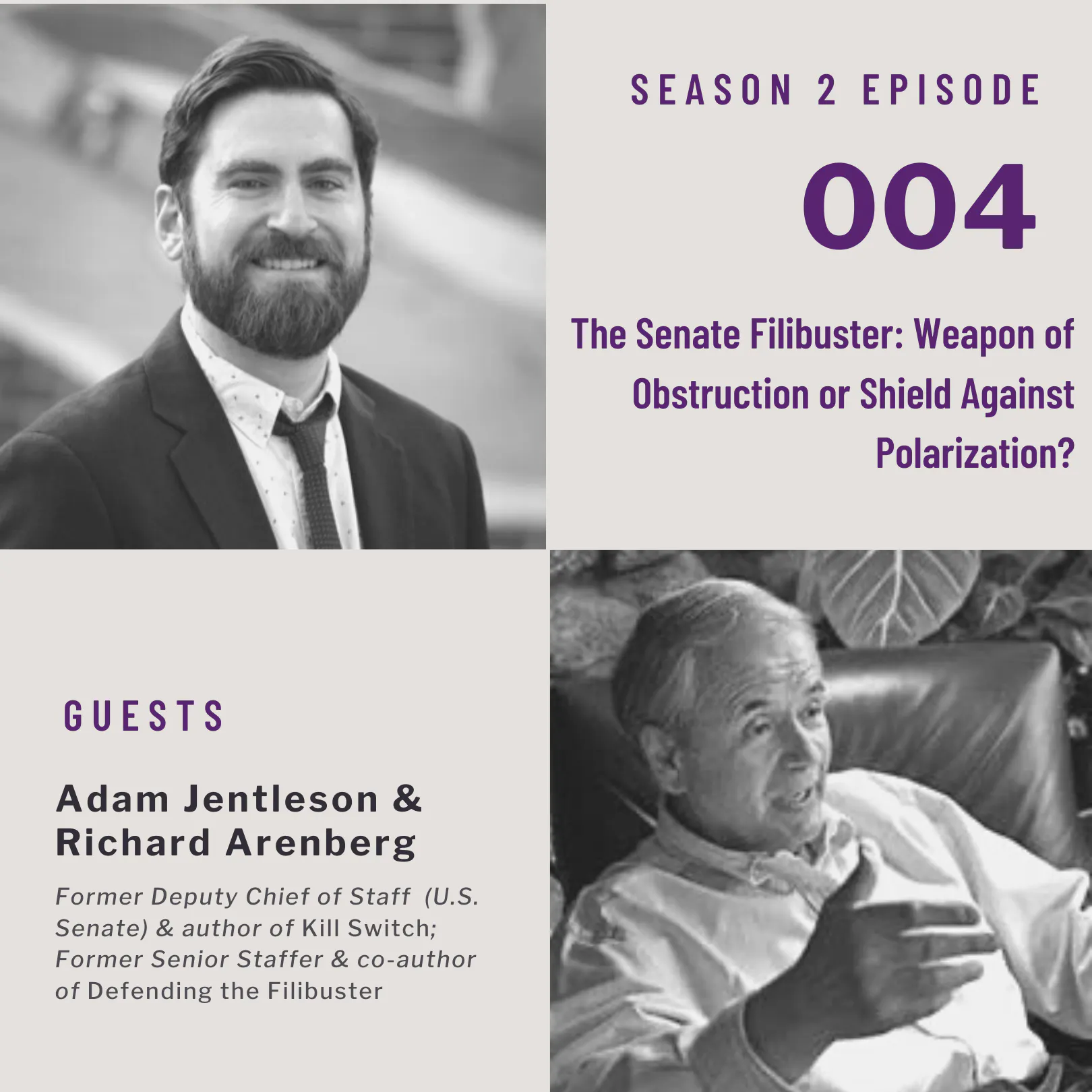
S2 Ep 4The Senate Filibuster: Weapon of Obstruction or Shield Against Polarization?
The U.S. system of government is commonly known as one of checks and balances. But a careful review of legislative efforts over the past century might need to revise that description to checks and balances and filibusters. In this episode of The Purple Principle, we look at that awkwardly named but often-debated tactic unique to the U.S. Senate, the filibuster. This rule currently allows any Senator to silently delay a vote on a piece of legislation until a supermajority of 60 Senators votes otherwise. Our guests on Season 2, Episode 4 are two of the most informed writers on this topic: Adam Jentleston, former Deputy Chief of Staff to Democratic Majority Leader Harry Reid and author of the recent book, Kill Switch (LiveRight Press, 2021); and Richard Arenberg, former Senior Staffer (to Democratic Senators Levin, Tsongas, and Mitchell) and author of the 2012 book, Defending the Filibuster (Indiana U. Press). Jentleson describes the filibuster as the tool which grinds the government to a halt by presenting an impossibly high 60 vote threshold for major legislation. He cites the failure to pass a bipartisan bill on background checks after the Sandy Hook Elementary School massacre as one of many cases in point. Arenburg agrees that polarization is afflicting the current U.S. Senate. But he argues that repealing the filibuster will only exacerbate, not ameliorate, that disease. He also suggests that progressives pushing for filibuster reform today do not fully appreciate what will happen when “the keys to the legislative bulldozer are stolen” and Democrats are no longer in the majority. Both viewpoints have merit. Tune in to learn how we arrived at this moment where so much hinges on this thing called filibuster. And make up your own independent mind whether the filibuster has to go in favor of majority-backed legislation; must stay in favor of minority rights; or needs reform to create a better balance. Original Music by Ryan Adair Rooney. Visit our website: fluentknowledge.com/shows/the-purple-principle/the-senate-filibuster Subscribe to our newsletter, The Purple Principle in Print Show Notes: Adam Jentleson (2021). Kill Switch: The Rise of the Modern Senate and the Crippling of American Democracy. Liveright Publishing Corporation. Richard Arenberg & Robert Dove (2014). Defending the Filibuster, Revised and Updated Edition: The Soul of the Senate. Indiana University Press. Richard Arenberg: Watson Institute Alex Tausanovitch and Sam Berger (12/5/19). "The Impact of the Filibuster on Federal Policymaking." Center for American Progress. Carl Levin & Richard A. Arenberg (3/29/21). “Progressives Would Miss the Filibuster.” The Wall Street Journal. Sarah Binder (4/22/10). "The History of the Filibuster." The Brookings Institute. Anthony Madonna (2010). “Senate Rules and Procedure: Revisiting the Bank Bill of 1841 and the Development of Senate Obstruction.” University of Georgia.

S2 Ep 3What’s Behind Those Red and Blue Maps? The Social Geography of U.S. Polarization
In this episode of The Purple Principle, we wonder, what’s behind those red and blue maps of American political and social geography and our deepening urban-rural divide? To find out, we consult not one but two political scientists named Ryan who have extensively researched the social geography of polarization in the U.S. – Ryan Enos of Harvard University (author of The Space Between Us) and Ryan Strickler of Colorado State ( co-author of Demography, Politics and Partisan Polarization in the US from 1828 to 2016). We start with Dr. Enos by asking what led him to study the politics of place and what factors contribute most to the deepening divisions among those blue and red map areas. The conversation quickly turns to social psychology, as Enos emphasizes the importance of neighbors and neighborhoods in shaping our political views. Ryan Strickler of Colorado State also notes the dangers of our polarizing trends. He notes how much attention is devoted to the siloing effects of social media, while the siloing of physical spaces, such as our neighborhoods, is underappreciated. Is there hope for bridging this chasm? The Purple Principle throws out the possibility of mandatory empathy zones and summer picnics with grape popsicles. But it’s likely that Dr. Enos’ recommendation for changes to housing policy may be more substantive. Tune into Season 2, Episode 3, “What’s Behind Those Red and Blue Maps?” for these other salient insights into the social and political polarization on our maps, across our cities, counties, and right down into our neighborhoods. Original Music by Ryan Adair Rooney. For show notes, transcripts, and to sign up for our newsletter, The Purple Principle in Print, please visit our website: fluentknowledge.com/shows/the-purple-principle/the-geography-of-polarization Show Notes Ryan D. Enos Ryan Enos (2017). The Space Between Us: Social Geography and Politics. Cambridge University Press. Brown, J.R., Enos, R.D. The measurement of partisan sorting for 180 million voters. Nature Human Behavior (2021). Emily Badger, Kevin Quealy, Josh Katz (3/17/21). “A Close-Up Picture of Partisan Segregation, Among 180 Million Voters.” The New York Times. Ryan Strickler David Darmofal & Ryan Strickler (2019). Demography, Politics, and Partisan Polarization in the United States, 1828–2016. Thomas Pettigrew & Linda Tropp (2008). “Allport's Intergroup Contact Hypothesis: Its History and Influence.” Mark DiCamillo (2020). “The profound changes that have occurred in the California electorate over the past thirty years.” UC Berkeley Institute of Government Studies. Israel Shenker (12/28/72). “2 Critics Here Focus on Films As Language Conference Opens.” The New York Times. Laura J. Nelson, Joe Mozingo (2/14/19). “Bullet train went from peak California innovation to the project from hell.” Los Angeles Times.

S2 Ep 2When Martians Land, Pigs Fly, and Americans Reach Consensus: Civic Genius & Citizen Panel Forums
We’ve all seen and heard the sad decline of civil discussions at congressional town hall forums over the past decade or two. The anger, the shouting, the gotcha questions. Not to mention generous amounts of obfuscation from congressional representatives. The result being that even before COVID, many members of Congress and other elected officials began to abandon town halls all together. But the non-profit, non-partisan group Civic Genius sensed opportunity where others just heard shouting. One of several deliberative democracy efforts, Civic Genius, in partnership with the survey group Voice of the People, holds surprisingly civil and productive “Citizen Panel” forums, where participants deliberate and present bipartisan recommendations to their district’s Congressional Representative. In the process, the group aims to revive the Congressional town hall tradition and give civil society a shot in the arm. This episode features interviews with Civic Genius’s Executive Director, Jillian Youngblood, who leads the Citizen Panel effort, as well as Dr. Steve Kull of Voice of the People, the survey group facilitating selection and orientation of citizens on topics as tricky and timely as police reform and immigration, among others. Tune into Episode Two (Season Two) of the Purple Principle, “When Martians Land, Pigs Fly, and Americans Reach Consensus,” for a refreshing earful of civility. And please visit our website for info on past and future episodes, as well as access to our newsletter, The Purple Principle in Print. For this episode's show notes, transcript, and more, visit our website. Original Music by Ryan Adair Rooney.

S2 Ep 1Portrait of the Arsonist As Young Congressman: Historian Julian Zelizer (Burning Down the House) on the inflammatory influence of Newt Gingrich
Does history create vulnerabilities that any number of populist politicians could seize upon? Or do exceptional populists create those opportunities only he or she can exploit? There’s no simple answer to that question. But it does frame the informative discussion we have surrounding a major populist figure, Newt Gingrich, on our first Season Two episode with Princeton historian Julian Zelizer. Zelizer’s most recent book is Burning Down the House: Newt Gingrich, the Fall of a Speaker, and the Rise of the New Republican Party. A 2020 New York Times Notable selection, Burning Down the House focuses on Gingrich’s unprecedented 1989 takedown of then-Speaker of the House, Jim Wright, on relatively minor corruption charges. In our Purple Principle interview, Dr. Zelizer points to this as a major turning point on our unfortunate path toward greater polarization. Please tune in for Season 2, Episode 1, “Portrait of the Arsonist as Young Congressman: historian Julian Zelizer on the inflammatory influence of Newt Gingrich.” Original Music by Ryan Adair Rooney Music by The Talking Heads licensed by Rhino Entertainment Company (A division of Warner Music Group) & Warner Chappell Music (Index Music Inc.; WC Music Corp). For show notes and transcript, please visit our website: https://fluentknowledge.com/shows/the-purple-principle/portrait-of-the-arsonist-as-young-congressman Source Notes Julian Zelizer, Malcolm Stevenson Forbes, Class of 1941 Professor of History and Public Affairs, Princeton School of Public & International Affairs Newt Gingrich: Rise to Power" (July 30, 1999) C-SPAN Julian Zelizer (2020). Burning Down the House: Newt Gingrich, the Fall of a Speaker, and the Rise of the New Republican Party. Penguin Press. Associated Press (January 27, 2012) Coach honed debating skills of young Newt Gingrich. Associated Press (5/2/76). Humphrey Reports Rockefeller Rejected Role as Running Mate. The New York Times. John J. Pitney, Jr. (11/22/11). “Five myths about Newt Gingrich.” The Washington Post. Charles Coles Diggs, Jr. U.S. House of Representatives. History. Congressional Black Caucus Jo Thomas (March 24, 1978). Rep. Diggs of Michigan Indicted On 35 Counts in Kickback Case. New York Times. Gail Sheehy (Sep. 1995) The Inner Quest of Newt Gingrich. Vanity Fair. Newt Gingrich. U.S. House of Representatives. Party Divisions of the House of Representatives, 1789 to Present Thomas P. O'Neill. Encyclopedia Britannica. Ron Elving (4/12/18) Ryan's Speakership Makes 7 In A Row Ending In Frustration — Or Worse. NPR House Speaker Jim Wright - Resignation Address (5/31/89). Steven V. Roberts (12/8/86). “For new Speaker, new role is seen.” The New York Times. Julian E Zelizer, Kevin M Kruse (2017). Fault Lines: A History of the United States Since 1974. WW Norton & Company. A 1978 Speech By Gingrich. The Long March Of Newt Gingrich: PBS. Howard Fineman (4/3/89), “For the Son of CSPAN, Exposure = Power.” Newsweek.

S1 Ep 23We're Polarized; Now What? The Hard Work of Depolarization: Season One Finale (Part Two of Two)
To some degree, all Americans realize we’ve become more polarized in recent times. Those at one extreme obsess about the other, while those in between wonder if that incessant tug of war will fray our social fabric to the breaking point. Fortunately, there are committed individuals and groups working hard to combat polarization. In Part Two of our season finale (“We’re Polarized; Now What?”), we highlight this important work. First off, the anti-gerrymandering efforts of the Campaign Legal Center, founded by Trevor Potter (former Chair of the Federal Election Commission). Then John Opdycke, President of the non-profit Open Primaries, explains why the opening of closed primaries to independent voters is an important means of combating gerrymandering and polarizing primaries. And Scott Siebel of Fair Vote discusses why Ranked Choice Voting (now adopted in Maine and Alaska at the state level) is an important prescription for our political ills. And what analysis of U.S. politics would be complete without discussion of money? In light of the new high of $14 billion spent on the 2020 election cycle, Joan Mandle, Executive Director of Democracy Matters, outlines some methods for reigning in the influence of money on elections and policy. Last but not least, we visit with Charles Wheelan, founder of Unite America and our first featured guest on Season One of the Purple Principle. He recounts the strategic shifts at Unite America toward electing moderates from both parties and the legislative progress that might then accrue. If you think U.S. politics is broken, you might be right. But these and other democracy repair experts are hard at work. Tune in to restore some optimism on the path ahead, daunting as that may seem. And please stay tuned to Season Two of the Purple Principle, launching in March. Original music by Ryan Adair Rooney. For show notes and transcript, please visit our website: www.fluentknowledge.com/shows/the-purple-principle/were-polarized-now-what-the-hard-work-of-depolarization

S1 Ep 22Polarization as Plague: Season One Finale (Part One)
A first presidential impeachment… the COVID pandemic with great dissension over shutdowns, social distancing and mask-wearing…Our hotly contested 2020 election followed by major efforts at election reversal culminating with insurrection and a second impeachment trial... It’s been quite a year, much too full of subject matter since we started researching and producing Purple Principle episodes on the theme of polarization. Episode 22, “Polarization as Plague,” is Part One of our two-part season finale. We start off in the neuroscience laboratory with previous featured guests, Dr. Abigail Marsh of Georgetown (Ep 4, “Heard from the Herd”) and Dr. Jay Van Bavel (Ep 9, “Your Brain on Partisanship”) for a quick lesson on the brain structures underlying political orientation and the brain functions fueling partisanship. Yet brains haven’t changed in millenia. Why are we more partisan of late? Look no further than the polarizing nature of our two party political system, as noted by both Dr. Van Bavel and noted author and historian, Dr. Geoffrey Kabaservice (author of Rule and Ruin, Oxford Press). We also consult media experts from two different but equally influential domains: Dr. Robert Elliott Smith (University College London) on the polarizing algorithms of social media and Dr. Dominik Stecula on opinion-based Cable News. What is a polarized nation and society to do? Several experts weigh in on that question during this fast-moving finale focused on the hyperpartisan plague. Please tune in, share us on social media, review us on Apple Music, and subscribe to our newsletter, The Purple Principle in Print, which collects the latest and greatest articles, trends, and issues around the perils of partisanship. Original Music composed by Ryan Adair Rooney. For show notes and transcript, please visit our website: www.fluentknowledge.com/shows/the-purple-principle/polarization-as-plague Source Notes: Keith Poole Data. Voteview. Lauren Sibilia. Vermont General Assembly. Party Affiliation. Gallup. Abigail Marsh. Georgetown University. Abigail Marsh. The Laboratory on Social and Affective Neuroscience. Across the Table. Pew Research Center. Political Polarization in the American Public. Pew Research Center. DeAngelis, T. (2001). “All you need is contact.” American Psychological Association 32:10. Robert Elliott Smith. Dominik Stecula Kate Kenski et. al. (2017). "Broadcasting versus Narrowcasting: Do Mass Media Exist in the Twenty-First Century?." In The Oxford Handbook of Political Communication. : Oxford University Press. “Fourth Congressional District.” Congressman Jason Altmire. Jason Altmire (2017). Dead Center: How Political Polarization Divided America and What We Can Do About It. Sunbury Press. E. McGhee et. al. (2014). A Primary Cause of Partisanship? Nomination Systems and Legislator Ideology. American Journal of Political Science, 58(2), 337-351. Myq Kaplan. Jay Van Bavel Cikara, M., & Van Bavel, J. J. (2014). The Neuroscience of Intergroup Relations: An Integrative Review. Perspectives on Psychological Science, 9(3), 245–274. Carolyn Funk et. al. (10/17/12). Genetic and Environmental Transmission of Political Orientations. Political Psychology 34 (6). Trevor Potter. Campaign Legal Center. “A primer on gerrymandering and political polarization.” Brookings Institute. Geoffrey Kabaservice (2011).Rule and Ruin: The Downfall of Moderation and the Destruction of the Republican Party, From Eisenhower to the Tea Party Geoffrey Kabaservice, Niskanen Center Andrew Gelman More in Common The Hidden Tribes of America India Opzoomer (9/24/20). “America Speaks: What do they think about cross-party marriages?” YouGov. Alaskans for Better Elections - Yes on 2 for Better Elections “Ranked Choice Voting 101.” FairVote. John Opdycke. Open Primaries.

S1 Ep 212020 Polling in Hindsight: Someone Please Answer the Phone
Anyone casually following the 2020 election this year may have noticed a particular pattern in polling trends and election results. That pattern, in key presidential states as well as Senate races, went something like this: Democrat ahead… Democrat still ahead... Democrat a bit ahead, days away from the election… But then: Republican wins by a fair amount. How was so much polling inaccuracy possible again in 2020 at nearly all levels? Episode 21 of the Purple Principle, “2020 Polling in Hindsight,” attempts to answer that vexing question by consulting two polling experts – Dr. Natalie Jackson, Director of Research at PRRI and Dr. Brian Schaffner of Tufts University. Dr. Jackson gives a sense of the technological challenges faced today by pollsters now that few individuals answer their phones, both landline or mobile. On top of that, a sizable number of bright red Republicans are mistrustful of pollsters and unlikely to participate even when contacted. But for indie-minded Purple Principle listeners, Dr. Jackson does confirm that the independent position often predicts which way the American majority will swing. Dr. Shaffner mentions that in today’s polarized environment, some respondents deliberately give dishonest answers to pollsters, often venting ideological views in the process. It also appears a “non-trivial” number of voters split their tickets in 2020, marking the Pro-Biden (or anti-Trump) box up top, but hedging against Democratic control down-ballot as well. What’s a pollster to do in a polarized age with a mistrustful slice of electorate and a shifting political landscape? No simple answers but a lot of helpful insights and information in Episode 21, “2020 Polling in Hindsight (Someone Please Answer the Phone)”. Original music by Ryan Adair Rooney. For show notes and transcript, please visit our website: www.fluentknowledge.com/shows/the-purple-principle/2020-polling-in-hindsight Source Notes: Changing Attitudes on Same-Sex Marriage, Pew Research Center Increasing Support for Religiously Based Service Refusals, PRRI National Council on Public Polls Analysis Of Final 2012 Pre-Election Polls Raymond La Raja and Brian Schaffner (2015). Campaign Finance and Political Polarization. University of Michigan Press. Nick Hatley and Courtney Kennedy. “State Election Polls and Weighting Factors.” Pew Research Center Methods. Brian F Schaffner, Samantha Luks, Misinformation or Expressive Responding? What an Inauguration Crowd Can Tell Us about the source of Political Misinformation in Surveys, Public Opinion Quarterly, Volume 82, Issue 1, Spring 2018, Pages 135–147. Danielle Kurtzelben (11/19/20). “Why Were The Polls Off? Pollsters Have Some Early Theories.” NPR. Lila Harakles (11/9/20). “The 2020 election showed that polls could not anticipate voter turnout.” The Maine Campus. Parker Richards (11/3/18). “Republican Governors in New England Defy the Blue Wave.” The Atlantic. Deja Thomas and Juliana Menasce Horowitz (9/16/20). “Black Lives Matter support down since June, still strong among Black adults.” Pew Research Center. Jasmine Aguilera (11/5/20). “The Complexities of the 2020 'Latino Vote' Were Overlooked, Again.” Time. Elaine Kamarck and Alexander Podkul (10/23/18). “Political polarization and voters in the 2018 congressional primaries.” Brookings Institute. Christine Zhang and Courtney Weaver (12/30/20). “Underestimating Trump: the US polling industry under fire.” The Financial Times. Eli Yokley (1/25/21). “Biden's Initial Approval Rating Is Higher Than Trump's Ever Was.” Morning Consult. Dhrumil Mehta (6/19/18). “Separating Families At The Border Is Really Unpopular.” FiveThirtyEight. Natalie Jackson (12/5/20). “Trump-Biden polls damaged trust because voters saw them as predictions.” USA Today.

S1 Ep 20Polarization at the Tipping Point: The Long Term and Wide-Angled Views
A Major Pandemic… Election 2020 that lasted weeks… Election Denial 2020 is still going months later… Insurrection… Impeachment… And possibly more to come. There’s been a lot of polarized and polarizing events over the past few months. So it seems time to step back and take a longer range, wider-angle view of partisanship in our DisUnited States. The Purple Principle does that in Episode 20 with featured guests Dr. Andrew Gelman of Columbia University (Departments of Political Science and Statistics) and Stephen Hawkins, Research Director of the international non-profit, More in Common, authors of the seminal study on American political identity, The Hidden Tribes. Dr. Gelman explains how polarization is measured over time with modern statistical techniques, which reveal how seemingly unrelated issue positions can form into partisan constellations. Why, for example, should someone’s position on the minimum wage correlate with their view on global warming? Logically, there’s little connection. But in our partisan age, these correlations are increasing over time, if not yet fully correlated. Stephen Hawkins of More in Common defines the seven tribal identities identified through extensive psychology-driven polling. More in Common defines the four groups in the American center as “The Exhausted Majority.” Hawkins explains that those suffering from partisan exhaustion tune out from political news while our tribal wings consume more media, thus incentivizing media companies to play to their outrage. What’s a polarized nation to do? Hawkins suggests the answer may lie back in the Cold War, when a common enemy solidified American identity. Tune in to learn more about the major trends in polarization and our surprisingly complex political tribalism in Episode 20, “Polarization at the Tipping Point.” Original music composed and created by Ryan Adair Rooney. For show notes and transcript, please visit our website: www.fluentknowledge.com/shows/the-purple-principle/polarization-at-the-tipping-point

S1 Ep 19Repodcast of Declaration of Independents, Alaska Style: Ballot Measure Two Takes on Polarization
bonusThe Year 2020 has not exactly been brimming with good news. Certainly in terms of public health and the economy, you could say it was the worst of times and the worst of times. But we did find a bright audio spot in Purple Principle Episode 13, which we repodcast today with important new information, most notably that Alaska’s ambitious Ballot Measure Two has officially passed. Ballot Measure Two packaged together the opening of statewide primaries to non-partisan or independent voters with top four ranked choice voting and greater campaign finance transparency – all in one referendum! But Alaskan politics is different. A remarkable 57% of Alaskan voters are registered as either non-partisan or unaffiliated voters. The drafters of Alaska Ballot Measure Two sought to preserve and enhance this non-partisan political culture toward more cooperative governance. This repodcast features excerpted interviews with the successful Campaign Manager of Alaskans for Better Elections, Shea Siegert, on the challenges surmounted by Ballot Measure Two. Join us as The Purple Principle takes an audio cruise through our nation’s most indie-minded state while asking if Alaska might inspire similar efforts against polarization among the lower 48. Original Music by Ryan Adair Rooney. For show notes and transcript, please visit our website: www.fluentknowledge.com/shows/the-purple-principle/repodcast-of-declaration-of-independents-alaska-style

S1 Ep 18Civil Society and Campus Politics: Two Collegians Take on Polarization
Colleges have come to be known as havens for divisive politics, cancel culture, and trollism, all miserably co-existing with academic stress, social pressure and stale pizza. In Episode 18, “Civil society and Campus Politics,” The Purple Principle profiles two college students pushing back against the polarizing forces on college campuses and the nation writ large. Avinash Bakshi, President of the Penn State College Independents, describes the importance of having a third, less tribal option among political groups on his campus of 40,000 undergraduates. While Tyler Swanson, sophomore at University of Illinois Champaign-Urbana and founder of the student-run Bipartisan Post, decided fact-based reportage was the best method to counter disinformation, echo chambers, and polarization on his and other campuses around the country. Tune in to hear that all is not quite lost in our not so United States, assuming a growing number of college students like Avinash and Tyler join the fight against polarization as a true threat to American higher education, politics, and society. Original Music by Ryan Adair Rooney. For show notes and transcript, please visit our website: www.fluentknowledge.com/shows/the-purple-principle/civil-society-and-campus-politics
S1 Ep 17Party Dynamics and the 2020 Election in Context: A Discussion with Historian Geoffrey Kabaservice (Niskanen Center)
Inaccurate polling… Split-ticket results… Denial of election results by large numbers of Republican voters and members of Congress... There have been plenty of head-scratching developments related to the 2020 election. In Episode 17, “Party Dynamics in Context,” we turn to noted historian and columnist, Geoffrey Kabaservice, for 2020 election analysis. Given the demise of moderates in the Republican party, Dr. Kabaservice explains that today’s unprecedented Republican loyalty to Donald Trump, the individual, rather than to the party, is not entirely surprising. He also explains why swing voters seem to have gone for President-elect Joe Biden but not for Democrat candidates down ballot, as had been expected. What about the future of the Republican Party and for bipartisan governance within a closely divided Congress? Dr. Kabaservice is not optimistic about major legislation but does see some hope for a centrist coalition in the House of Representatives. For an informed, contextual view of the 2020 election and current party dynamics, tune into Episode 17 of the Purple Principle with Dr. Geoffrey Kabaservice, author of Rule to Ruin (Oxford Press) and Director of Policy Studies, Niskanen Center. Original music composed and created by Ryan Adair Rooney. For show notes and transcript, please visit our website: www.fluentknowledge.com/shows/the-purple-principle/party-dynamics-and-the-2020-election-in-context

S1 Ep 16Democracy & Elections Under Stress: A Discussion with Trevor Potter of the Campaign Legal Center
The 2020 election has revealed the partisan state of American politics and society like no other event in recent history. How did we get to this point? Our special guest today, Trevor Potter, Founder and President of the Campaign Legal Center (CLC), provides insight into that question and suggestions for rehabilitating our polarized polity. Gerrymandering, the partisan drawing of electoral districts, is one major factor. In Episode 16, “Democracy & Elections Under Stress,” Trevor Potter (a former Chairman of the Federal Election Commission) describes how the long-practiced art of gerrymandering has become a polarizing science in the age of big data. Potter’s nonpartisan group, the CLC, is working to combat gerrymandering through litigation and the establishment of independent redistricting commissions at the state level. Potter also outlines CLC initiatives in campaign finance transparency and ranked choice voting. Last but not least, Trevor Potter (General Counsel to John’s McCain’s presidential campaigns) comments on attempts by the Trump campaign to block and overturn 2020 election results in several pivotal states. He commends the courage and professionalism of Secretaries of State and election officials from both parties for adhering to democratic process. Tune in to learn more about our democracy and our elections under stress in Episode 16, with Trevor Potter, Founder and Chairman of Campaign Legal Center, and Former Chairman of Federal Election Commission. Original music composed and created by Ryan Adair Rooney. For show notes and transcript, please visit our website: www.fluentknowledge.com/shows/the-purple-principle/democracy-elections-under-stress-a-discussion-with-trevor-potter-of-the-campaign-legal-center

S1 Ep 15The Second Coming Turns 100 (Part II): A Discussion of W.B. Yeats’ Classic Poem of Polarization with Briona Nic Dhiarmada, documentary filmmaker & Concurrent Professor of Film & Irish Studies (University of Notre Dame)
Exactly one hundred years ago this month, at a time of political polarization and the Spanish Flu pandemic, William Butler Yeats published “The Second Coming,” a poem premised on the cycles of history that resonates today with striking immediacy. Things fall apart, the center cannot hold, the worst are full of passionate intensity... These and other enduring lines from “The Second Coming” are now part of our collective vocabulary. In Episode 15, “The Second Coming Turns 100," we look at the historical context in which Yeats conceived and published the poem with special guest, prize-winning documentary filmmaker Briona Nic Dhiarmada, Professor of Film and Irish Studies at Notre Dame University. Find out more about the poem, its birthplace, and remarkable composer, Nobel Prize-winning poet, W.B. Yeats, in Episode 15, “The Second Coming Turns 100," Part 2. Original music composed and created by Ryan Adair Rooney. For show notes and transcript, please visit our website: www.fluentknowledge.com/shows/the-purple-principle/the-centennial-of-w-b-yeats-the-second-coming-part-2

S1 Ep 14The Second Coming Turns 100 (Part I): A Discussion of W.B. Yeats’ Classic Poem of Polarization with Pulitzer Prize-winning poet, Paul Muldoon (Princeton University)
How does a century-old poem written in Ireland as European civil wars erupted in the aftermath of World War I still resonate in our own partisan era? That is the central question The Purple Principle asks in both Episode 14 and 15, as the classic poem, “The Second Coming”, by William Butler Yeats, turns one hundred years young. In Episode 14, our special guest is another great Irish poet, Paul Muldoon, author of 15 collections of poetry, winner of the Pulitzer Prize, and Professor of Poetry at Princeton University. Muldoon speaks about the poem’s insight and longevity, the influences at work on Yeats as he wrote it, and the impact Yeats still exerts on poetry today. The center cannot hold.. The best lack all conviction, while the worst are full of passionate intensity… Lines published one hundred years ago this month (November 1920) that still speak to us today here in the U.S., as we polarize over COVID, election results, and other issues. Tune in to learn more about the remarkable relevance and endurance of “The Second Coming” by W.B. Yeats with special guest, the renowned Irish poet, Paul Muldoon. Original music composed and created by Ryan Adair Rooney. For show notes and transcript, please visit our website: www.fluentknowledge.com/shows/the-purple-principle/the-second-coming-turns-100

S1 Ep 13Declaration of Independents, Alaska Style: Ballot Question Two Takes on Political Partisanship
The great state of Alaska is different in many ways – its vast size, low population, and great distance from “the lower 48” (states). Politics in Alaska is different as well: a remarkable 57% of Alaskans are registered as either non-partisan or unaffiliated voters. The proponents of Alaska Ballot Measure 2 would like to preserve and enhance the state’s non-partisan political culture. This measure would create an open unified primary system, top four ranked choice voting, and greater campaign finance transparency. If passed this year, it would be one of the most comprehensive and significant reforms to state level elections in U.S. history. Episode 13 features Campaign Manager of Alaskans for Better Elections Shea Siegert on both the challenges and rewards of Ballot Measure 2. Join The Purple Principle as we take an audio cruise through our nation’s most independent-minded state, meeting notable Alaskans along the way, and learning that electoral change never comes easy. Original music composed and created by Ryan Adair Rooney. For show notes and transcript, please visit our website: www.fluentknowledge.com/shows/the-purple-principle/declaration-of-independents-alaska-style
S1 Ep 12Non-Partisan David vs. the D.C. Disenfranchisement Goliath: Independent Krucoff Promotes Douglass County MD as the Future of Washington DC
Independent candidate David Krucoff is running for the non-voting D.C. Congress position without much hope of unseating incumbent Democrat Eleanor Holmes Norton for her 16th term. Instead, Krucoff seeks to call attention to his non-partisan “retrocession” solution to D.C. disenfranchisement – the creation of Douglass (as in Frederick Douglass) County, Maryland as the new and fully enfranchised home for Washington, D.C. citizens. Could David’s retrocession proposal slay the D.C. disenfranchisement Goliath? Krucoff says he’s in it for the long game with the hope of seeing Douglass County, Maryland created before the 2030 census. Tune in to find out how non-partisan candidates and proposals can take on partisan politics on Episode 12 of The Purple Principle. Original music composed and created by Ryan Adair Rooney. For show notes and transcript, please visit our website: www.fluentknowledge.com/shows/the-purple-principle/a-discussion-with-non-partisan-dc-candidate-for-congress-krucoff

S1 Ep 11Science, Comedy & Partisanship
What makes a stand-up comedian wake up one day and decide comedy needs more science? A road comic for 13 years, Shane Mauss made this enlightened decision 5 years ago in launching his science podcast, Here We Are, and then expanded it by creating Stand Up Science comedy shows, inviting local professors around the country on stage to discuss their research. We asked Shane about the origin of his scientific interests, as well as the challenges of doing regular and Stand Up Science shows around our highly partisan nation. The result is that science has a lighter side, and comedy an important edge, on this episode of the Purple Principle, Science Comedy & Partisanship, with featured guest, Shane Mauss. Original music composed and created by Ryan Adair Rooney. For show notes and transcript, please visit our website: www.fluentknowledge.com/shows/the-purple-principle/science-comedy-partisanship-shane-mauss-stands-up-and-speaks-out

S1 Ep 102020 Election Polling: The Science & Psychology of Polls in a Partisan Age
How much trust can independent-minded voters place in polling this 2020 election season? It seems not a day goes by without multiple new poll results blaring from cable networks and rebounding across the Web. But how accurate are these polls? What’s been learned from the 2016 polling fiasco where many polls predicted a large Clinton for President victory? And how much more difficult is election polling in our highly partisan age? The Purple Principle asks these questions of veteran pollster and Director of the University of New Hampshire Survey Center, Dr. Andrew Smith. In Episode 10, Dr. Smith details lessons learned from 2016 currently in force for 2020 election polling. He also describes ongoing challenges faced by pollsters such as the “spiral of silence,” when respondents fail to reveal true preferences. And he issues a provocative challenge to American voters this 2020 election. To hear that challenge, tune into Episode 10 of The Purple Principle with Dr. Andrew Smith, Associate Professor of Political Science and Director of the University of New Hampshire Survey Center. Original music composed and created by Ryan Adair Rooney. For show notes and transcript, please visit our website: www.fluentknowledge.com/shows/the-purple-principle/2020-election-polling-primer-the-science-psychology-of-polls-in-a-partisan-age

S1 Ep 9The Brain on Partisan Politics: Why Not So Great Minds Polarize Alike, with NYU Neural Scientist, Dr. Jay Van Bavel
Let’s say, for the sake of Episode 9: The Brain on Partisan Politics, that identical twins are separated at birth and raised in different families, politically speaking: one deep blue, the other deep red. They’re bound to have different political leanings as adults, correct? Actually, probably not, according to Dr. Jay Van Bavel, NYU Neural Scientist and our featured guest in Episode 9, The Brain on Partisan Politics. Genetics account for nearly half of our political inclinations. Then what about the independent brain, you indie listeners out there are asking? We’ll get to that as well. To learn where your gray matter concentrates, tune into Episode 9, The Brain on Partisan Politics, with featured guest Dr. Jay Van Bavel, Associate Professor of Psychology and Neural Science at NYU. Original Music by Ryan Adair Rooney. For show notes and transcript, please visit our website: www.fluentknowledge.com/shows/the-purple-principle/the-brain-on-partisan-politics

S1 Ep 8Comedy & Partisanship: The Transcendent Laugh with Special Guest, Myq Kaplan
Ok, Comedians, make America laugh with surprising, original jokes that offend absolutely no one and work equally well in our very blue, very red and very antagonized parts of the country... To the Purple Principle team, that seemed a near-impossible challenge in today’s partisan environment. With Episode 8, The Purple Principle begins a series of related discussions with comedians starting with Myq Kaplan, who has performed on Conan, The Tonight Show, The Late Show and put out 7 solo comedy albums, including his latest, AKA. Can stand-up comedy survive the triple threat of polarization, political correctness and cancel culture? Myq Kaplan asserts that comedy is up to the challenge and deftly destroys our carefully constructed hypotheses. Tune in to learn, laugh and appreciate the art of comedy in a challenging age. Original music composed and created by Ryan Adair Rooney. For show notes and transcript, please visit our website: www.fluentknowledge.com/shows/the-purple-principle/comedy-partisanship-the-transcendent-laugh-with-special-guest-myq-kaplan

S1 Ep 7Congress and Partisanship: The Outlook from Dead Center with Former US Congressman, Jason Altmire
Did you hear the one about bipartisanship? Two opposing congressmen walk into a town hall…and civil discussion breaks out. Hard to believe in the current climate, but former three-term Congressman Jason Altmire recounts the origin and unfortunate demise of these bipartisan town halls in Episode 7, Congress and Partisanship. Author of Dead Center: How Political Polarization Divided America, Altmire was rated the most centrist member of the U.S. Congress during his three terms, 2007-2013. The Purple Principle discusses a range of issues with Hon. Jason Altmire, including the 2020 election, the Trump presidency, the role of partisan media in both parties, and the deep-rooted psychology underlying polarization. Original music composed and created by Ryan Adair Rooney. For show notes and transcript, please visit our website: www.fluentknowledge.com/shows/the-purple-principle/congress-and-partisanship-the-outlook-from-dead-center-with-former-us-congressman-jason-altmire

S1 Ep 6Social Media & Partisanship: Polarizing Algorithms and a Blind Date with Dividends, featuring Dr. Robert Elliott Smith
How do social media algorithms feed us news, entertainment, advertisements, even suggesting friends and lovers? By grossly simplifying human nature, according to featured guest Dr. Robert Elliott Smith, Research Fellow in Computer Science at University College London and author of Rage Inside the Machine: How to Prevent the Internet from Making Bigots of Us All. Dr. Smith details how the same Artificial Intelligence (AI) that reaps engineering benefits has disastrous consequences for civil society. Raised in Birmingham Alabama in the 1960’s, he knows something about polarized situations. That upbringing, and his 30-year career in AI, informs Dr. Smith’s warnings about polarizing algorithms and advice on how to mitigate that damage. Original music composed and created by Ryan Adair Rooney. For show notes and transcript, please visit our website: www.fluentknowledge.com/shows/the-purple-principle/social-media-partisanship-polarizing-algorithms-and-a-blind-date-with-dividends-featuring-dr-robert-elliott-smith

S1 Ep 5Broadcast Media and Partisanship: Side of Spin with Your Nightly News
bonusWhat the heck happened to broadcast news in recent decades? That is the burning question we ask of Dr. Dominik Stecula, Assistant Professor of Political Science at Colorado State University and expert on broadcast media trends in the US over the past fives decades. Dr. Stecula contrasts the more fact-based, consolidated and regulated broadcast news industry of the 1970’s and 80’s with the highly fragmented, largely partisan news environment of today. And what’s an independent-minded American to do for objective news content these days? Tune into this bonus episode (Ep 5) for insights on these and other polarizing elements in US politics, society and just plain daily life. Original music composed and created by Ryan Adair Rooney. For show notes and transcript, please visit our website: www.fluentknowledge.com/shows/the-purple-principle/broadcast-media-andpartisanship
S1 Ep 4Psychology and Partisanship: Heard from the Herd, featuring Dr. Abigail Marsh, Georgetown University
In this interview-based episode, Dr. Marsh explains the centrality of fear in human behavior, which motivates any social species (whether musk ox or democrats or republicans) to cluster together against perceived threats. The unfortunate result is the formation of tribes, demonization of others, and the filtering of information leading to stark, unhealthy divisions. In Part I of the interview, staff reporter Emily Crocetti queries Dr. Marsh on how the US became so partisan. In response, Dr. Marsh emphasizes the importance of social situations in determining emotions and behavior. And she points to the substantial sorting of US citizens along political lines in recent decades as a major factor. In Part II, Dr. Marsh discusses methods by which Americans might become less partisan, pointing to seminal psychology studies and methods used in her own classes. Here, students with opposing viewpoints are guided through civil discussions on hot topics of the day. In Part III, Dr. Marsh emphasizes she is not a political scientist yet offers great insights into whether independent-minded Americans can help bridge the political divide. She proposes that independents are better able to deal with the cognitive complexity of different life experiences and viewpoints. As a result, independents might be able to have the sensitive, trust-based conversations on political issues sorely lacking in the US today. Original music composed and created by Ryan Adair Rooney. For show notes and transcript, please visit our website: www.fluentknowledge.com/shows/the-purple-principle/heard-from-the-herd-psychology-and-partisanship-featuring-dr-abigail-marsh-author-of-the-fear-factor-professor-of-psychology-neuroscience-georgetown-university

S1 Ep 3America’s Independent Voters and Voices: The Forty Million Missing
By most measures, the US has over 40 million independent or unaffiliated voters representing a third or more of the electorate. Yet despite large and growing numbers, independents are often missing from the national conversation. Independents have no cable channel or national newspaper. You rarely encounter independent viewpoints on major networks or opinion pages. And there’s a surprising lack of scholarship on independents as well. Who are American’s prominent, politically-engaged political independents? We’ll meet four in Episode 3: Laura Sibilia, a three-term independent legislator in the Vermont Assembly; John Opdycke, President of Open Primaries; Thom Reilly, Chancellor of the Nevada System of Higher Education; and Jacqueline Salit, President of Independentvoting.org. Original Music by Ryan Adair Rooney For show notes and transcript, please visit our website: www.fluentknowledge.com/shows/the-purple-principle/americas-independent-voters-and-voices

S1 Ep 2Front Lines of Partisanship with Dr. Charles Wheelan and Unite America
Our Episode 2 guests include a former Republican speechwriter, a former centrist Democratic congressional candidate, a former Economist Magazine correspondent, a current Professor of Public Policy (Dartmouth College) and the founder of the non-partisan group, Unite America, working to bridge our partisan divide. Lots of voices for one podcast? In fact, each of these perspectives come from a single featured guest this episode, Dr. Dr. Charles Wheelan (a.k.a. all of the above), who has been working to overcome partisanship and legislative gridlock in the U.S. for three decades. Tune in for an expertly guided tour along the Front Lines of Partisanship with Charles Wheelan. Original music composed by Ryan Adair Rooney. Episode Guest Dr. Charles Wheelan, Founder & Co-Chair, Unite America Guest Books The Centrist Manifesto; Naked Statistics; Naked Economics, (W.W. Norton & Company) For show notes and transcript, please visit our website: www.fluentknowledge.com/shows/the-purple-principle/episode-2-is-live