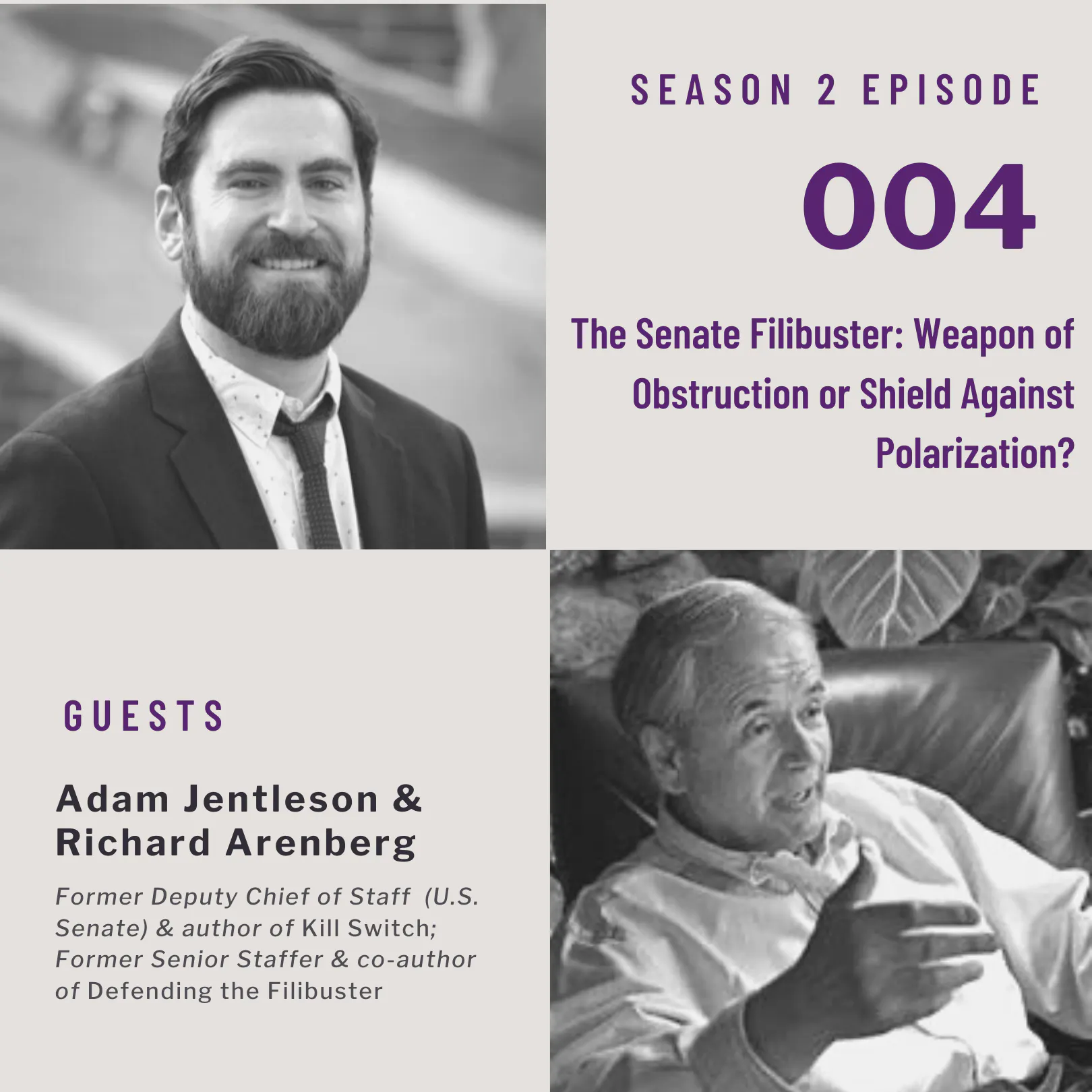
The Senate Filibuster: Weapon of Obstruction or Shield Against Polarization?
Weapon of Obstruction or Shield Against Polarization?
Audio is streamed directly from the publisher (podtrac.com) as published in their RSS feed. Play Podcasts does not host this file. Rights-holders can request removal through the copyright & takedown page.
Show Notes
The U.S. system of government is commonly known as one of checks and balances. But a careful review of legislative efforts over the past century might need to revise that description to checks and balances and filibusters. In this episode of The Purple Principle, we look at that awkwardly named but often-debated tactic unique to the U.S. Senate, the filibuster. This rule currently allows any Senator to silently delay a vote on a piece of legislation until a supermajority of 60 Senators votes otherwise.
Our guests on Season 2, Episode 4 are two of the most informed writers on this topic: Adam Jentleston, former Deputy Chief of Staff to Democratic Majority Leader Harry Reid and author of the recent book, Kill Switch (LiveRight Press, 2021); and Richard Arenberg, former Senior Staffer (to Democratic Senators Levin, Tsongas, and Mitchell) and author of the 2012 book, Defending the Filibuster (Indiana U. Press).
Jentleson describes the filibuster as the tool which grinds the government to a halt by presenting an impossibly high 60 vote threshold for major legislation. He cites the failure to pass a bipartisan bill on background checks after the Sandy Hook Elementary School massacre as one of many cases in point.
Arenburg agrees that polarization is afflicting the current U.S. Senate. But he argues that repealing the filibuster will only exacerbate, not ameliorate, that disease. He also suggests that progressives pushing for filibuster reform today do not fully appreciate what will happen when “the keys to the legislative bulldozer are stolen” and Democrats are no longer in the majority.
Both viewpoints have merit. Tune in to learn how we arrived at this moment where so much hinges on this thing called filibuster. And make up your own independent mind whether the filibuster has to go in favor of majority-backed legislation; must stay in favor of minority rights; or needs reform to create a better balance.
Original Music by Ryan Adair Rooney.
Visit our website: fluentknowledge.com/shows/the-purple-principle/the-senate-filibuster
Subscribe to our newsletter, The Purple Principle in Print
Show Notes:
Richard Arenberg: Watson Institute
Sarah Binder (4/22/10). "The History of the Filibuster." The Brookings Institute.