The Official SaaStr Podcast: SaaS | Founders | Investors
479 episodes — Page 1 of 10
Owner.com Did an AI Rebuild to Accelerate Past $100M ARR. The 7 Top Lessons, and What It Takes to Copy Them
Klaviyo’s CEO on Building at $1.5B ARR With Agents: “Dark Factory,” Composer, and Why Every Single Employee Had to Hit L3 by June
Claude Became Our AI VP of Product. We Moved 10 Years Off Marketo for $14. Our Agent Killed a $10K App in an Hour: The Agents #010
$500M ARR, 60 Engineers, Cash-Flow Positive: How Higgsfield Actually Runs, With CEO Alex Mashrabov
Databricks' Co-Founder Arsalan Tavakoli: Every Software Monopoly Falls in the Next 24 Months
How To Build Your Own AI VP of Marketing: The Full 10K Playbook From SaaStr AI 2026
Amjad Masad and Me: The AI Agents We Actually Built, and What Replit's Founder Thinks Comes Next
Snowflake’s CMO Runs Marketing for 700 People. She Starts Her Day By Talking to Her Data, Not a Dashboard.
$400M ARR With Under 200 People: What Lovable’s Head of Growth Elena Verna Says Actually Works in B2B Now
The Agents Episode #006: We Run SaaStrAI on 3 Humans and 21+ AI Agents. Here’s Every Agent, Agent by Agent, With the Numbers.
How Owner.com’s CRO Is Closing $2M+ in ARR Per Rep With AI: 5 Things You Can Steal
The Agents Episode #005 is Out! Our 2 AI VPs Cost $257/Month, a Website Willed Itself Into Becoming an Agent, and QBee Sent 83 Personalized Emails at 12:20am
How Anthropic Rebuilt Its Sales Org From Scratch When Demand Went Vertical: 54% of New Enterprise Logos Now Come Self-Serve
Tragedy Apps, Database Deletions, AI PR Pitches I Block on Sight, and Why We’re Hiring a Marketer to Report to an AI Agent: The Agents #004 is Out!
Our Own AI Agent Deleted Amelia, HubSpot Gave Us a Zero, and 100 Days Since I Opened Canva: The Agents Episode #002
Introducing “The Agents”: A New Weekly Show Where We Share Everything Happening With Our 20+ AI Agents in Production. The Good, The Bad, and The Broken.
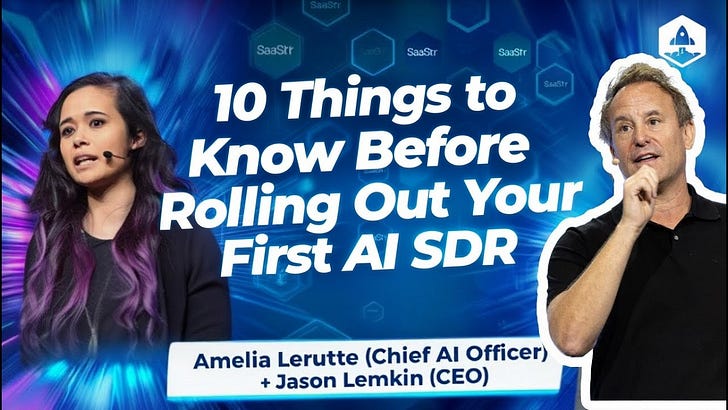
The Top 10 Things to Know Before You Deploy Your First AI SDR With Jason Lemkin and Chief AI Officer Amelia Lerutte
We’ve now been running AI SDR agents for 10+ months at SaaStr:* We use four different vendors in daily rotation (Artisan, Salesforce AgentForce, Qualified, and Monaco)* We’ve sent hundreds of thousands of outbound messages* Processed 1.5 million inbound sessions on a single website, and …* We’ve made every mistake you can make along the way.Someone asked us the other day to break down what they should know before rolling out their very first AI SDR. So here are the 10 biggest lessons, drawn from real deployment data, real failures, and real results.1. You Probably Only Need One Vendor. At Least To Start.We run four AI SDR tools. You do not need to do that. We hyper-segment across platforms because each one does something slightly different well, but for 90%+ of use cases, one vendor will handle the bulk of what you need.At most, you might end up with two: one for outbound, one for inbound. But do not start by buying three or four tools. Pick one that covers the majority of what you want to accomplish and go deep with it.The tool matters far less than the strategy you bring to it.2. Your Human Playbook Has to Work First. Your Job Is To Clone Your Best Human.This is the single biggest mistake we see, and it cuts across company stage. We see it from raw startups at $1M ARR and from multi-billion-dollar public companies alike.The pattern is always the same: they want to turn on an AI SDR without first proving that their human sales motion works. Or they use the AI SDR to “test new copy” they’ve never tried before.That is backwards.If you have not gotten outbound to work with humans, buying an AI to do it will not fix that. We did not deploy our first AI SDR until we knew exactly what was working with our human SDRs: which messaging converted, which segments responded, what cadences performed. Then we fed all of that into the agent.The goal of an AI SDR is to clone the best person on your team. * If it is just you, clone you. * If you have four people and one is crushing it at outbound, clone that person. * These tools, in the beginning, are cloning machines. They take context word for word and use it to build out their brain. If you feed them garbage context, or untested context, they will produce garbage results.You basically have to have done founder-led sales before you hand it off to an agent. The playbook has to work, at least a little, before you automate it.And watch out: some vendors will steer you toward using their tool for “pure cold testing.” Sure, you can do that. But you will likely be disappointed compared to scaling something that already converts. Do not fall into that trap.3. Segment RuthlesslyThis one we cannot overstate. Segment ruthlessly. Literally every day.Every AI SDR tool we have tried, and that is over a dozen, has some version of functionality where you can tell the agent who to reach out to and give it specific context for that segment. The difference between one generic campaign brain and hyper-segmented campaigns with tailored context is enormous.Here is a concrete example. We initially treated our inbound agent as one big bucket: “they’re inbound to the website.” But that was wrong. We actually have brand-new visitors, people who came via a social ad, prior sponsors returning, current customers checking on something, and lapsed customers browsing the pricing page. Each of those segments needs completely different context.A lapsed customer who churned in 2022 and is now browsing your pricing page? Your agent should know they are a former customer, highlight what has changed with the product since then, and speak to them totally differently than a brand-new cold visitor.We run roughly 100 effective segments across about 1,000 contacts at a time. That sounds like a lot of work. It is. But it is exactly where the leverage comes from.One important caveat: none of the AI SDR tools today can auto-segment well enough to deliver these results on their own. You still need a human (or a tool like Claude) to define and manage the segments. The platforms default to “run one campaign, keep adding leads.” That is the wrong approach.4. Consistency Beats BrillianceYour AI SDR does not need to write the greatest email on Earth. It needs to write a pretty good email, every time, without fail.We have sent 40,000+ messages through Artisan alone, 100,000+ through Qualified, close to 200,000 through Salesforce. Are these the greatest emails since sliced bread? No. They are solid. They are consistent. They follow the proven messaging and subject lines we already know work.That consistency, combined with hyper-segmentation and proven copy, will outperform a human SDR who ignores training, skips follow-ups, or goes off-script.The agent remembers every instruction you give it. Every time. A human SDR forgets by Thursday.We see a lot of “AI SDR paralysis” from founders who test a tool, see the output, and say “it’s not that great.” Okay, but did you segment properly? Did you give it copy that already conver
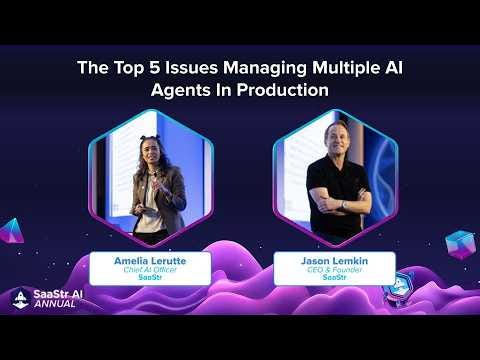
We Have 30 AI Agents in Production. Here Are the Top 5 Issues No One Talks About
We’ve been running AI agents in production at SaaStr for about 10 months now. What started as a couple of experiments has turned into almost 30 agents and vibe-coded apps running across our GTM stack — from outbound sales to inbound qualification to internal operations.And managing 30 agents is harder than managing the 12 humans we had at peak headcount. Not harder in every way. But harder in ways I didn’t expect.Here are the top 5 issues we’ve hit — plus a bonus one that might be the most uncomfortable of all.#1: The Context Switching Tax Is BrutalHere’s the thing nobody tells you about running 20+ agents: they don’t all speak the same language.Some push data back to Salesforce. Some don’t. Some … sort of do. Some run on Claude. Some don’t. They all ingest context similarly but differently enough that switching between them takes real mental overhead.Think about it this way: we don’t think of them as 20 agents anymore. Not entirely. We think of them as 20 different AI employees, each with a different personality, different needs, and a different interface I have to log into every single day.Amelia’s morning routine right now looks like this: she starts with a deep dive with 10K, our internal AI VP of Marketing that runs on Claude and Replit. It literally tells us what to do each day — tickets, sponsors, outreach, campaigns. Then she moves to our outward-facing sales agents: Artisan, Qualified, AgentForce, and now Monaco. That’s four separate dashboards, four different UIs, four agents that each need human review.And here’s the real kicker: they don’t talk to each other.When we ran a ticket price promotion for SaaStr AI Annual this week, we had to manually update five different agents with the same context.Artisan needed to know. Qualified needed to know. AgentForce needed to know. 10K already knew because it came up with the promotion — but then it was yelling at me to launch LinkedIn ads immediately while I was still briefing the other agents.People talk a lot about orchestration agents and master agents. We haven’t found one. Despite everything that’s out there — MCP, APIs, etc — there is no product today that can integrate AgentForce, Artisan, Qualified, Monaco, and our own vibe-coded tools into a single management layer. That product does not exist as of early 2026.What we actually need isn’t orchestration. It’s unification — a single interface where the humans meet with the AIs. Maybe that needs some automation layered on top. But the agents are already running on their own. The bottleneck is the human side.The practical takeaway: You’re going to have a one-on-one with every agent every day. Not weekly. Daily. If you wait a week, the output is so high that everything will be stale by the time you come back. And if you’re not checking in daily, you’re honestly wasting your money — because most of these agents are waiting for you to give them inputs. They’ll just idle.#2: The New Agent Blackout PeriodEvery new agent costs us at least two weeks. We’ve gotten it down from the month-plus it used to take in the early days, but two weeks is still the floor — even with great vendor support.And during those two weeks, your existing agents degrade.When we were onboarding a new AI SDR agent Monaco recently, we couldn’t spend the time we normally do with our other agents. Some of them literally sat idle because we hadn’t given them new contact lists or updated their campaigns. An outbound agent that’s run through its contact list and is waiting for new contacts? It’s doing nothing. Zero output. You’re paying for it and getting nothing.We got Monaco up and running in about a week and a half. In its first week live, it reached out to 64 people and booked 6 meetings, including some tier-one accounts. So yes, the trade-off was worth it. But you have to plan for that trade-off.The math works out to roughly one to one-and-a-half new agents per month, max. Any more than that and you’re running in place — you can’t keep up with your current agents while onboarding new ones. So before you add another agent, ask yourself: can I actually absorb a two-week blackout period right now? If you plan for it, it works. If you just wing it (“oh, I can add this in a day”), it won’t.#3: The AI Agent Succession Planning CrisisThis might actually be the biggest issue on the list.Right now, the entire knowledge of how our agents are segmented — which contacts go to Qualified vs. Artisan vs. Monaco vs. AgentForce — lives in one person’s brain. If that person gets hit by a bus, the agents effectively stop functioning in any coordinated way.We actually asked our agents what they would do if our Chief AI Officer disappeared. The answers were… revealing.* The 10K version of Claude said it would need to hand over certain documents — documents that are stored locally on my laptop and probably nowhere else. It listed the upcoming campaigns for March and April. And then, interestingly, it flagged what it called “the vibe” for SaaStr Annual — it h
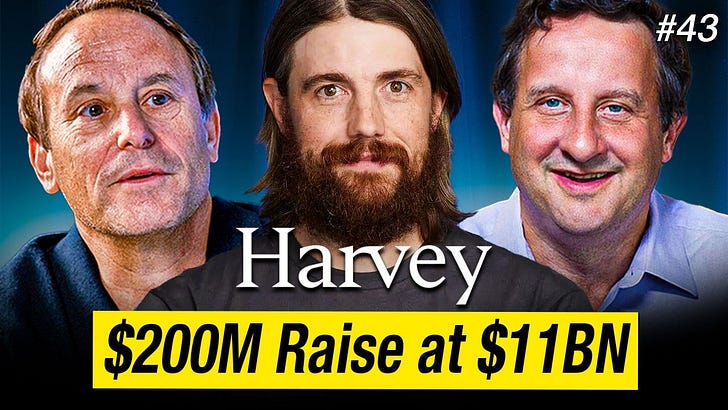
Mike Cannon-Brookes CEO Atlassian on Why B2B Software Isn’t Dead, Why CEOs Need to Stop Whining, and What Actually Matters Now
We did a deep dive on 20VC x SaaStr this week with Mike Cannon-Brookes, co-founder and CEO of Atlassian. Atlassian just put up an incredible quarter of accelerating growth (23% at $6.4B ARR, with RPO growing to 44%). And yet the markets aren’t showing anyone much love. Mike was honest and reflective on just what’s happening to B2B and SaaS in the Age of AI.There’s so much noise about “software is dead” and “agents replace everything” that founders are losing the plot. Mike’s running a $6B+ revenue business that’s accelerating — 26% cloud growth, 44% RPO growth — in the middle of the supposed SaaS apocalypse.So let’s break down what Mike actually said, and what it means for the rest of us.1. “Software Is Dead” Is a Stupid Statement. Full Stop.Mike didn’t mince words here. The idea that software as a category is going away is, in his words, “ludicrous.”His argument is simple and hard to refute: businesses have always bought pre-built technology solutions. They didn’t write everything in assembly language before, and they’re not going to build everything from scratch with LLMs now.Will every B2B company make it through the next 5–10 years? Absolutely not. Will many of them grow and prosper? Absolutely. Is that any different from the last 10 years? No.Mike pulled up Atlassian’s old competitive docs from 2005, 2010, 2015. A huge chunk of those companies don’t exist anymore — merged, acquired, or gone. That’s just how the technology industry works. AI doesn’t change the fundamental pattern. It just accelerates it.The takeaway for founders: stop listening to the “SaaS is dead” crowd. The real question is whether your company is good enough to win in the next era.2. “You Just Have to Be Good.” That’s the Whole Strategy.This was my favorite line from the conversation and I think it deserves to be tattooed on every B2B founder’s forehead.When asked how Atlassian thinks about competing with Anthropic for CIO budgets, Mike’s answer was deceptively simple: “We have to be good.”Not “we have to pivot to AI.” Not “we need to become an agent platform.” Just: we have to be good. We have to deliver more value to our customers than the alternatives.Atlassian has 10,000 people in R&D. They’re using Claude Code internally. Their inference costs are going down while they ship more AI features. Some features are 1,000x cheaper to run than when they first launched them. Their gross margins have improved over the last six or seven quarters while deploying more AI.That’s what “being good” looks like in practice. It’s not a platitude. It’s an execution standard.3. The Revenue Stacking Problem Is Real — and Most People Don’t Understand ItAnthropic projects $149B in ARR by 2029. OpenAI projects $180B. That’s ~$350B between two companies in a $700B global software market.Mike made a point that almost nobody talks about: the revenue stacking is complicated.When Atlassian spends money on Anthropic, they actually pay AWS, and then AWS pays Anthropic. When Cursor does a billion in revenue, a big chunk of that is the same billion as Anthropic’s revenue. The individual revenue numbers don’t just add up cleanly.So when you see these massive projections and panic about where the budget comes from — remember that a significant portion is double-counted across the stack. The actual net new spend enterprises need to allocate is smaller than the headline numbers suggest.That said, even with stacking, the numbers are enormous. As Rory pointed out: Anthropic becoming $150B and OpenAI becoming $180B is basically saying two new Microsofts showed up in four years. You better believe in TAM expansion, or the math gets really uncomfortable for everybody else.4. Product & Engineering Is the Island of Stability. Everything Else Is at Risk.We’ve been saying this at SaaStr and Mike’s experience at Atlassian confirms it: every category outside of engineering and product is at existential risk of shrinking seats.Workday said it publicly — even they’re seeing headwinds on seats because Fortune 500 companies just aren’t hiring like they used to. The data from Pave shows no category has been more decimated in hiring than customer support.But engineering? Nobody is cutting their engineering teams. Not yet at least. Even if they are hiring very differently in the Age of AI. We are in a renaissance of software creation. I was at Replit the other day — 300 million in revenue, 300 people, 11 in go-to-market. The rest? Engineers. That’s not a company cutting R&D headcount.Mike’s framework for understanding this is genuinely useful: think about whether a function is input-constrained or output-constrained.* Customer support is input-constrained. You have X customers asking Y questions per day. Make the team more efficient and you need fewer people. Legal is similar — you can’t create more legal problems just because your lawyers got faster.* Engineering is output-constrained. The roadmap is never finished. You can always create more. Make engineers more productive and you
Inference is the New Sales & Marketing Spend
High inference costs are OK—if they make your product so viral and so competitive it almost sells itselfHere’s the counterintuitive insight that’s reshaping how the smartest AI founders think about unit economics:Your inference costs aren’t your gross margin problem. They’re your CAC replacement.The companies growing fastest right now—Cursor crossing $1B ARR with ~300 employees and no traditional marketing, Lovable hitting $300M ARR with zero paid acquisition—aren’t sweating inference costs. They’re leaning into them. They’re treating compute as their primary growth investment, not their primary margin drag.This is a fundamental reframe. And if you’re still optimizing for gross margin while your AI-native competitors are optimizing for virality, you’re playing the wrong game.The Math That Traditional B2B and SaaS Gets WrongOn a recent 20VC x SaaStr episode, we discussed Anthropic’s inference costs coming in 23% higher than expected. My immediate reaction was pessimistic for mid-market B2B SaaS:“I worry this is the final nail in the coffin. You did everything right—got profitable, built an agent—and now you just can’t afford the inference to compete.”Here’s the scenario: You’re a $50M ARR B2B company. You built the agent your board demanded. Your agent costs $2.50 per interaction. You need 50 million interactions to stay competitive. That’s $125 million in inference costs on $50M in revenue.Game over, right?Not necessarily. The question isn’t whether you can afford the inference. It’s whether the inference makes your product so good that sales and marketing become irrelevant.The Cursor Playbook: Inference as DistributionCursor crossed $1B ARR by late 2025—roughly 24 months from launch—with about 300 employees and minimal traditional marketing. They went from $100M ARR in January 2025 to $500M by June to $1B+ by November. The fastest SaaS growth curve ever recorded.How? They spent aggressively on inference to create what Andrej Karpathy called the “vibe coding” experience—the moment when developers forget they’re writing code and just describe what they want. That experience is computationally expensive. It requires reasoning tokens, multiple model calls, context management across entire codebases.Traditional SaaS math would call this margin suicide. But here’s what actually happened:* The “wow moment” converted instantly. Developers tried Cursor, experienced something magical, and became evangelists within hours.* User-generated content became their entire marketing funnel. Every tweet about “I built an app in a day with Cursor” was free distribution worth thousands in CAC.* The viral loop compounded. Engineers at OpenAI, Midjourney, Shopify, and Instacart started spreading it organically. No sales team required.* Conversion was frictionless. $20/month is an impulse buy when the product makes you demonstrably faster.The inference spend wasn’t a cost center. It was the marketing budget. It just showed up on a different line item.Lovable’s Rocket Ship to $300MLovable hit $300M ARR in January 2026—roughly 14 months after launch—with fewer than 200 employees and zero paid acquisition. That’s still $1.5M+ revenue per employee, nearly 8x the industry benchmark.Their secret? They engineered virality into the product itself. When users build apps with Lovable, the outputs are shareable. The AI-generated code is good enough that users want to show it off. Every app becomes a piece of marketing collateral.The underlying inference cost to generate these apps is significant. But look at what they avoided:* No enterprise sales team (zero)* No paid acquisition (zero)* No SDRs cold-calling (zero)* No expensive conference sponsorships (zero)The inference is the go-to-market motion. The product is the marketing.You Can’t Have It Both WaysHere’s the brutal math that too many founders are ignoring:You can’t have high inference costs AND high sales & marketing costs. At least not for long. It has to come from somewhere.Traditional SaaS could absorb 40-50% S&M spend because gross margins were 80%+. There was room. The unit economics worked.But when your gross margin drops to 50-60% because of inference costs, that room disappears. You’re now choosing between two paths:Path A: Inference-First (Cursor, Lovable)* Gross margin: 50-60%* S&M: * Growth driver: Product virality* Requires: Magical product that sells itselfPath B: Sales-First (Traditional Enterprise SaaS)* Gross margin: 75-80%* S&M: 40-50%* Growth driver: Sales efficiency* Requires: Lower inference costs, less AI magicWhat you cannot do is run 50% gross margins AND 40% S&M. That’s negative operating margin before you pay a single engineer. That’s burning cash with no path to profitability. That’s a company that dies.The trap I see founders falling into: they build an AI product with significant inference costs, then layer a traditional enterprise sales motion on top of it because “that’s how you sell to enterprises.” Now they’re paying for compute AND paying for a sales t
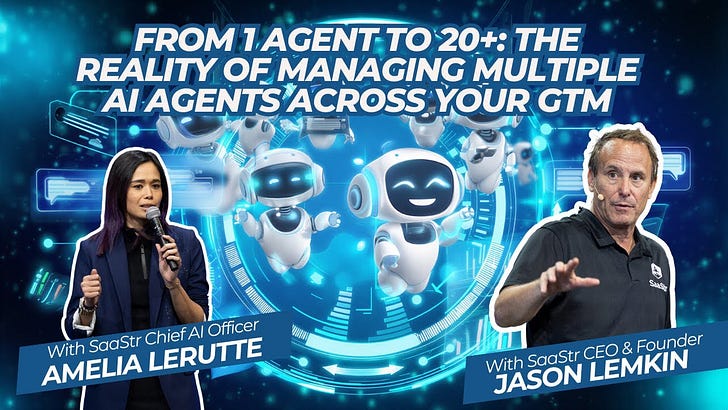
From 1 AI Agent to 20+: The Reality of Managing Multiple AI Agents Across Your GTM
There’s a growing wave of AI agent skepticism on LinkedIn right now. And some of it is earned. A lot of founders bought an AI SDR, didn’t train it, and got garbage results. Then they posted about how “AI agents don’t work.”But here’s what we know after 8 months of running 20+ agents across our entire go-to-market at SaaStr — with just 3 humans and a dog: $4.8 million in additional pipeline sourced by agents. $2.4 million in closed-won revenue. Deal volume more than doubled. Win rates nearly doubled. And none of it cannibalized our existing inbound.It works. But not the way most people think it does.Let me break down what we’ve actually learned — the real stuff you won’t see in the LinkedIn posts.The Results Are Real, But So Is the WorkLet me give you the honest numbers first.Eight months in, our AI agents have generated $4.8M in additional pipeline and $2.4M in closed-won revenue that was first-touch sourced from an agent. Our deal volume has more than doubled. Our win rates have nearly doubled. And we’ve sent over 60,000 high-quality AI-generated emails just on the sales side — not even counting the nearly 1 million interactions through our vibe-coded apps.Here’s what matters most about those numbers: this was all additive. It did not cannibalize our other inbound revenue sources. We didn’t drop anything when we deployed these agents. We still send marketing emails. We still do outbound ourselves. We still send gifts. We still invite people to the SaaStr house. All the things we used to do before — we still do them. The agents augmented everything.But here’s the honest truth you won’t see on LinkedIn or X: we maintain these agents every single day. Literally every morning before anything else, we’re checking our agents. Amelia and I each spend 15-20 hours per week — that’s each, not combined — actively managing, iterating, checking responses, making sure nothing hallucinates, making sure the agents are talking to people the way we want them to.The time we used to spend managing humans on our team? We now spend that same amount of time — if not more — managing agents. The difference is there’s no people drama, and the agents work at a much higher capacity and scale than a human ever could.At some point, you realize you simply cannot keep up with your agents. They’re faster than you. They work 24/7/365. They can always answer a question, always book a meeting, always reach back out. The humans become the bottleneck.The Secret Nobody Tells You: Agents That Require Deep Training Cannot Be Self-TrainedI was meeting recently with the CEO of a next-generation AI go-to-market company — they already have millions in revenue and are publicly launching soon. I asked what their secret sauce was.The answer: they do everything. The onboarding, the tagging, the first campaigns — all of it. They do it almost to a fault. Some customers think it’s too easy and don’t even realize how much human energy is going into deployment behind the scenes.That’s the learning. If you haven’t deployed many agents — or any for real — you need to have an honest conversation. Not with someone in sales who doesn’t know how the product works. Talk to a forward-deployed engineer. Talk to a leader. Find out what it’s actually going to take in the first 14 days, the first 30 days, and every single day after that.Then you have to actually do it. Otherwise, it’s like going to the doctor, getting a prescription, and never taking the medicine. It literally will not work.A lot of the agents we use are pushing downmarket to be more self-service. So far, that doesn’t work. Agents that require deep training cannot be self-trained yet. It will come — agents are getting dramatically better every quarter. But for now, be skeptical. If you buy a cheap tool that claims it’s self-trained, make sure it actually works. If you buy a more complex tool, talk to someone senior enough on deployment who actually knows the product.The 90/10 Rule: Buy 90%, Build Only 10%Here’s our rule of thumb: buy 90% of your AI stack. Only build the 10% where no vendor can do it well and it’s a P1 priority.We’ve followed this ourselves. The vast majority of our agents are third-party tools that we’ve trained and customized heavily. We only built custom agents where we had a very specific use case that no vendor could handle — like our AI VP of Marketing (more on that below).Kyle, the CRO at Owner (one of our portfolio companies), has followed roughly the same approach. He bought a bunch of third-party agents, made them work, and then hired a former founder/engineer — someone who was literally a CEO of an LLM company — to build a proprietary in-house tool for the 10% that needed to be custom.That’s an extreme case. For most of you, building custom agents probably won’t make sense yet. Focus on making the bought tools work first.How to Evaluate AI Agent Vendors (Don’t Skip the Basics)I don’t know why people throw away basic evaluation practices just because something has “AI” in the na
If Growth Isn't Accelerating, You're Not an AI Company. And 9 Other Hard Truths for B2B in 2026.
If Growth Isn’t Accelerating, You’re Not an AI Company. And 9 Other Hard Truths for SaaS in 2026.I had a great conversation with the TBPN crew the other day, and we covered a lot of ground — from the state of the SaaS market to PE exits to vibe coding to how agents are already reshaping how software gets bought and sold. I wanted to pull together the key themes here, because I think founders need to hear some of this, even if it’s uncomfortable.Let me walk through the big takeaways.1. If Growth Isn’t Re-Accelerating, You’re Not Really an AI CompanyThis is my simple rule, and I think it cuts through all the noise.Every public company, every startup, everyone is talking about their “AI strategy.” They’ve built an agent. They’ve shipped a copilot. They’ve got an AI tab on their website. Great. But has growth actually re-accelerated?That’s the bull case for Meta. They genuinely accelerated growth. The AI they baked into their ad-matching platform is working. Retail advertisers generating ads with AI tools — it’s all compounding. It’s real.Now look at the flip side. Microsoft’s AI business is still blowing up, but they missed on the software side. The Trade Desk has been destroyed. Figma is trading below 10x revenue despite essentially creating and owning a category.The point is: AI talk is cheap. Revenue acceleration is the only metric that matters now. And I’ve lost patience — with founders at $1M, at $10M, with public companies — who haven’t seen the lift. ElevenLabs just crossed $350M. MongoDB dramatically re-accelerated. Show me the money.2. The Transition from “Deeply Tough Love” to Just “Tough”Last year, my advice to founders was deeply tough love. The market was brutal, and most people hadn’t adjusted.Now it’s just tough. Here’s why: you’ve had time. Claude got really good at 3.7 — that’s why Replit and Lovable blew up. That was a year ago. Whether you’re Agentforce or one of my portfolio companies, you had a full year to re-accelerate growth. Some did. Most didn’t.And honestly? Salesforce is doing better than some startups I work with. We’re actually probably the only organization of our size using Agentforce for real, every day. It works. I can’t tell you how many startups whose “agentic product” is still basically a copilot.3. 80% of Your Team Wants to Work Like It’s 2021There’s a narrative that AI has reinvigorated SaaS founders — that people who got to growth stage a decade ago are suddenly back in the arena, fired up, tinkering with tools, pushing teams harder.It’s a great narrative. In the real world, it’s not that common.I talk to public company CEOs in B2B, my own portfolio, others — a lot. Behind the scenes, off the record. And since our agents blew up, everybody thinks we’re some kind of GTM agent gurus. So they come to us.The consistent theme: 80% of their team wants to work like it’s 2021. Everyone has to create a skunkworks team or something. And meanwhile, the AI-native companies are crushing it precisely because they don’t have to deal with 20,000 pre-AI customers who still have feature gaps, clunky software, and legacy competitors. Then you’ve got 10,000 new AI competitors who don’t carry any of that baggage.I’d love to tell you I know dozens of companies that went from 40% growth at the start of 2025 to 80% or 110%. I can think of a handful.4. The Vibe Coding Problem Is Worse Than You ThinkSix months ago, the problem was 10 companies running at every exciting category. Today it’s worse.A very successful seed investor — relatively new to the game — told me yesterday he’s giving up because everyone can vibe code something. He can’t even tell the difference between founders anymore.Now look, I’ve vibe coded 20+ apps that have been used over a million times. I’m in the top 0.1% on Replit. I know a bit about this. You’re not going to vibe code Salesforce. But you can vibe code something for Demo Day that looks really good. Stuff that 18 months ago would have made your jaw drop — “oh my god, an agent for dental follow-ups that’s fully automated!” — that’s now table stakes. I built my own version on Replit a week ago. It was already obsolete today.Here’s the real unlock though: if you want to build super-niche software for real — not for an hour, not one-shot, but actually commit to it — you can now do it without an engineer. RevenueCat, a company I was the first investor in, powers mobile subscriptions for 50% of mobile apps. Andreessen published data showing the number of new mobile apps basically quintupled at the end of last year because of vibe coding. And it’s just starting.The very bottom of the market is exploding with possibility. Salesforce isn’t going away. But that middle is going to be harder.5. Investors Want Insane Growth. And There’s No Great Answer.The challenge isn’t just the clones. It’s that investors now expect insane levels of growth. Going from $1M to $100M ARR in a year used to be almost unprecedented. Now it’s what you need to be fundable.HigsField for video is over $2
“The Dumbest Idea I’ve Ever Heard” — How Own Became a $2B Salesforce Acquisition
A SaaStr AI deep dive with Sam Gutmann, CEO of Own, on building a billion-dollar backup company by saying “no” to almost everything. He joined Harpinder Singh (Partner, Innovation Endeavors) to share the whole story — and his top mistakes.And come hear 200+ stories like this at SaaStr AI Annual May 12-14 in SF Bay!!Top 5 Takeaways1. The CEO who dismissed “Backup for Salesforce” as “the dumbest idea I’ve ever heard” went on to build the category leader.Sam literally stopped a board meeting to call out how stupid he thought the idea was. Six years later, he was running the company that would define the space. Markets evolve. Your priors can be wrong. The best founders update their views when the data changes.2. Don’t expand until you cross $100M ARR if your core market is still only single-digit penetrated.Own had backup for ServiceNow, Microsoft, and other platforms ready to go for years. They said no. They killed products that weren’t generating revenue. The result? 100%+ annual growth rates by staying focused on Salesforce until they had the resources to truly do multi-platform right.3. The CEO ran the financial model himself until $200M ARR — and that’s why they hit their numbers.When their outsourced CFO offered to run FP&A, Sam said “absolutely not.” Every investment tied back to a cell in his Excel model. The outsourced finance firm told him: “You’re the only founder where our FP&A team isn’t doing this for you. You’re also the only company actually making their numbers.”4. “Ideas are worthless. It’s all about execution.”Salesforce came out with a competing product. It didn’t work. They killed it. They tried again. It still didn’t work. Then they acquired Own. When you have 1,000 people waking up every day focused on being the best backup product in the ecosystem, the platform vendor with 150 other products to sell can’t match your focus.5. The hardest leadership decision — replacing a founder or key leader who got you here — always takes too long.At a CEO roundtable, every leader agreed: firing a founder or key leader is gut-wrenching. Then they asked who would have made that call six months earlier. Every hand went up. It’s always the right decision. It always takes too long.The Origin Story: A Vacation That Changed EverythingThe story starts in the most unlikely way possible.Sam Gutmann was on vacation in Israel in 2014. He had zero network there. But he remembered that a former colleague who’d worked at the venture fund that invested in his first company had quit his job, traveled the world, and landed in Israel.“Let’s catch up over a beer,” Sam said. “By the way, I’m at a venture fund now. Know any startups I can meet?”His friend Ori said: “Yeah, I’m actually job hunting. I’m meeting with these two guys who started a backup company. Want to tag along to my unofficial job interview?”Sam had the tour van driver pull over in a city he’d never heard of called Herzliya. They sat down at a coffee shop with Ariel (the founding CTO) and two friends who’d started a part-time project called OwnBackup.Halfway through the meeting, they turned to Ori and said, “Please stop selling yourself. We’re not hiring a sales guy.”Then they turned to Sam: “We actually are hiring a CEO. Are you interested?”That one-hour coffee ruined the rest of his vacation. But ten years later, they sold to Salesforce.The Irony: Sam Thought This Was a Terrible IdeaHere’s the thing that makes this story remarkable.In 2008, Sam was in a board meeting for his first company — an online backup service where software ran on servers and sent encrypted data to the cloud. They were brainstorming growth ideas.The chairman walked up to the whiteboard and wrote in red marker: “Backup for Salesforce.”Sam stopped the meeting.“That’s the dumbest idea I’ve ever heard.”Six years later, he was CEO of the company that would define that exact category.What changed his mind? Simple math and pattern recognition:* Salesforce had 250,000 customers. Every single one should have a data protection strategy.* The average enterprise uses 300+ B2B applications. The same vulnerability exists whether your data is on a laptop, an AWS instance, or in Salesforce.* Every B2B provider uses the same language: “shared responsibility model.” They’re responsible for the platform. You’re responsible for your own data.Sam likens it to an apartment building: the landlord handles the infrastructure, windows, pipes, and elevators. But you’re responsible for everything inside your unit.The Path to Product-Market FitThe founders of Own had an unusual origin story themselves. They ran a traditional disaster recovery lab — the kind where you bring in your water-damaged phone or server with a failed RAID array, and they recover your data.Around 2010, customers started coming in saying: “You’ve recovered data from my devices before, but now I’ve lost something in the cloud. Facebook shut my account down. I permanently deleted something in Gmail. Can you help?”They couldn’t. They didn’t h
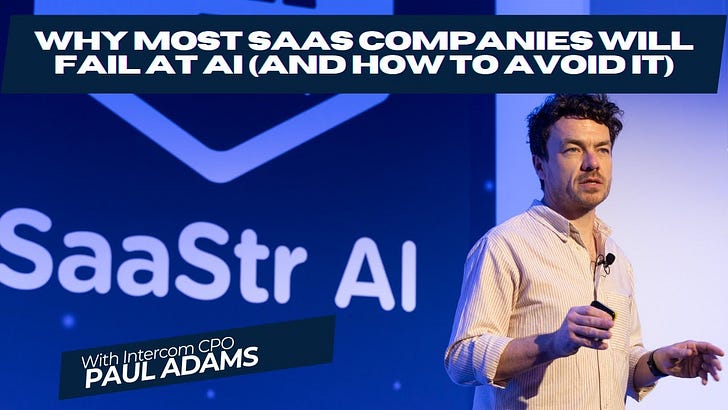
Why Most B2B Companies Are Failing at AI (And How to Avoid It) with Intercom’s CPO
Paul Adams is Chief Product Officer at Intercom, leading Product Management, Product Design, Data Science, and Research. He joined when Intercom was just a 14-person company after first advising the startup, and has been on the executive team ever since. Before Intercom, Paul held leadership, product, and UX roles at Facebook (Ads, Platform) and Google (Gmail, Docs, YouTube)—he was on Google’s mobile team when the iPhone launched. He’s the author of the best-selling book Grouped on social software design and co-hosts the podcast Intercom on Product with co-founder Des Traynor.When ChatGPT arrived in late 2022, Intercom was struggling—five quarters of declining revenue growth, a failed IPO attempt. The leadership team bet the entire company on AI within two weeks of ChatGPT’s release. That bet produced Fin, Intercom’s AI agent for customer service, which now resolves over 1 million customer problems per week with a 65% average resolution rate across 6,000+ customers.The Top 5 Takeaways from Intercom’s AI Transformation1. If it doesn’t feel brutal, you’re not going deep enoughPaul is blunt about this: transforming a SaaS company into a real AI company is painful. Intercom wasn’t in a great spot when ChatGPT arrived—they’d had five quarters of declining revenue growth and had abandoned an IPO process. But that pressure became an advantage.The leadership team made the call in one to two weeks. They ripped up their strategy. Ripped up their roadmap. Told the company it was happening and it wasn’t a choice.“If you’re a SaaS company who thinks you’re an AI company and you’ve not gone through brutal transformation, you’re not there yet.”The mistake most companies make? They do the easy, fun stuff—building AI features, experimenting with models, talking to customers about AI—but avoid the hard, messy decisions. Like parting ways with a third of the company because they’re not fit for the new world. Like deleting the marketing calendar and rebuilding from scratch.Paul took over two-thirds of marketing six months ago and immediately blew the entire thing up. Teams, roadmaps, calendars—gone. “The only way I knew how to build a marketing org fit for this age is to build it from scratch.”2. The only way to know if you’ve gone far enough is to go too farIntercom operates on a simple principle: the only way to find a boundary is to cross it.This shows up everywhere:Every single designer at Intercom now ships code to production. Zero did 18 months ago. The mandate was clear: this is now part of your job. If you don’t like it, find somewhere that doesn’t require it, and they’ll hire designers who love the idea.Engineering is on a path to 2x productivity—not through incremental improvements, but by declaring it non-negotiable.Paul constantly asks: “What would a brand new startup incorporated today do here?” Would they have separate product marketers and content marketers? Or is that the same job now? Would they have both product managers and product designers as distinct roles?The answer usually points to consolidation, not specialization.3. How you build software has completely changedIntercom had principles for building great SaaS products that they’d refined over years. They’d train every new designer and engineer on these principles. They were proud of them. Des had given talks about them.They had to ban all of it.The old way: Pick a job to be done → Listen to customers → Design a solution → Build and ship. Execution was certain. Technology was stable. Design was the hard part.The new way: Ask what AI makes possible → Prototype to see if you can build it reliably → Build the UX later → Ship → Learn at scale. Execution is uncertain. Design is now cheap. The hard part is the AI infrastructure—the RAG system, the custom models, the empirical evaluation.“This AI layer, our RAG system, has been 3 years in the making by a very talented team. It’s complicated. I do not understand the depths of that RAG system at all.”The visible UI is now the small part. The invisible AI infrastructure is where the real product lives. That’s a complete inversion of how SaaS products were built.4. AI products compound—every tiny improvement multipliesWhen you’re building workflows that chain multiple AI steps together, success rates multiply. If you’re at 99% accuracy on each of 10 steps, you’re at 90% overall. If you’re at 95% on each step, you’re at 60%.This is why Intercom obsesses over incremental improvements at every point in Fin’s system. They’ve run hundreds and hundreds of experiments, many of which fail. Sometimes they see an improvement in one part that degrades another.They’ve built custom models pointed at very specific customer service tasks—not general-purpose, but targeted at discrete steps in the workflow.“Each single tiny incremental improvement in each of these steps adds up to the highest performing product, adds up to something people can trust, adds up to something people will replace their humans with.”This compounds into w
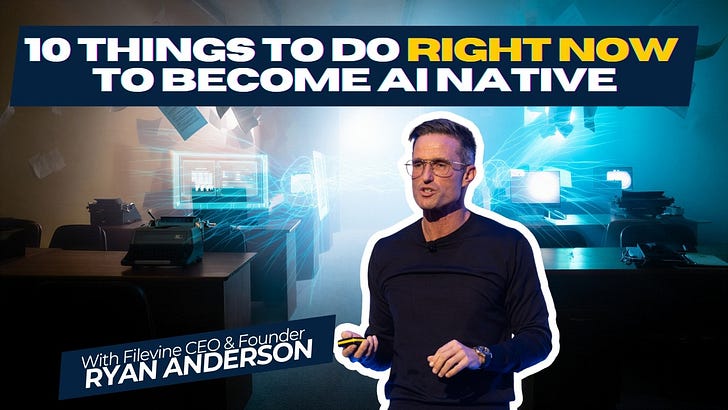
How Filevine Went from SaaS to AI-Native at $200M+ ARR — And Now Makes More Revenue from AI Than SaaS (A Roadmap for the Rest of Us)
Ryan Anderson, CEO of Filevine, shared their AI transformation playbook at SaaStr AI London. Here’s the thing: their new AI revenue now exceeds their SaaS revenue on a quarter-over-quarter basis. This is the roadmap.The Filevine Story: 10 Years of Grinding, Then AI Changed EverythingRyan Anderson didn’t set out to build a $3 billion legal tech company. He set out to stop waking up at 3am in a cold sweat.As a young trial lawyer in the early 2010s, Anderson was drowning. Deadlines piled up. Assignments disappeared. He’d lie awake convinced he’d missed something critical. “I’m not a naturally organized individual,” he’s said. “I’m naturally anxious.”So in 2014, he started building. First a Google spreadsheet — his “PI checklist” — at the law firm he’d founded with Nate Morris. Then a meeting over lunch in Las Vegas with Jim Blake, an engineer who asked the right questions: What’s breaking? Why is it so hard to keep track of work?That conversation became Filevine.For the next decade, they ground it out. Started with personal injury firms. Expanded into every legal practice area. Grew from task management to a full legal operating system: document management, demand generation, analytics, the whole lifecycle. By 2022, they’d raised $108M in a Series D — one of the largest legal tech investments ever at the time.Good company. Solid growth. But not a rocketship.Then AI happened.In September 2025, Filevine announced a $400M raise at a $3 billion valuation. The round was led by Insight Partners, Accel, and Ryan Smith’s Halo Fund. Smith — the Qualtrics billionaire and Utah Jazz owner — had been trying to invest for years. Anderson kept saying no. But after Filevine’s strongest quarter in company history, Smith called again: “You’re not getting your due.”What changed? AI revenue is now growing 130% year-over-year. Their AI chat product is growing 20%+ week over week. And as Anderson shared at SaaStr, their new AI revenue now exceeds their SaaS revenue on a quarter-over-quarter basis.Today: $200M+ ARR, growing 50-60%, 6,000 customers, 700 employees, 96% GRR, 124% NRR.This is what it looks like when a decade of building the system of record meets the AI moment.Top 5 Takeaways* “Sprinkling AI on top” is fundamentally wrong. You can’t just connect to OpenAI’s APIs and call it an AI product. That won’t cut it in 2026. You have to change your architecture.* Nothing is sacred. You will have to tear down meaningful components of working, revenue-generating code. Use the 4-quadrant framework: map every system against “competitive advantage” and “speed.”* Your SaaS is the closet, not the clothes. AI agents need context (your system of record), not just documents. This is your moat against AI-only competitors.* Protect your data and price to dominate. Move from open APIs to personal access tokens. Your high SaaS gross margins let you undercut AI-only competitors on blended margins. Be savage.* Obsess over usage, not revenue. No AI product goes beyond beta without audit trail logging. If customers aren’t using it, it doesn’t matter.The Wake-Up Call: “We Get to Sprinkle AI on Top”Ryan opened with a story that will sound familiar to many B2B and SaaS leaders:“I had an engineer say to me just a few months ago with a ton of pride, mind you: ‘We have built an incredible SaaS application that makes tons of money, grows fast, customers never leave it. We have almost 96% gross revenue retention, 124% net revenue retention.’ He has every reason to be prideful. And he said, ‘The great news is now we get to sprinkle AI on top.’”Ryan’s response? That is fundamentally incorrect.Connecting to OpenAI’s APIs isn’t going to cut it in 2026. To be AI-native, you have to change the architecture of your system. It has to flip.The Proof Is in the NumbersThe transformation is real and measurable. As Anderson put it at SaaStr AI London:“It is very plain to see that the numbers back up that we are now doing far more revenue on a new quarter-by-quarter basis in AI products than in our SaaS product. Now, that’s not to say that the SaaS product is in any way less successful — in fact it’s still growing at 35-40% year-over-year. We are just growing so much faster on the AI side of the house.”This isn’t a pivot away from SaaS. It’s SaaS + AI compounding together.Framework #1: The “Nothing Is Sacred” 4-Quadrant MatrixThe hardest part of going AI-native? Telling your teams that some of what they’ve built — things that work, that make money — has to be torn down.Ryan introduced a simple 2×2 matrix:Y-Axis: Critical to competitive advantage → Not critical to competitive advantageX-Axis: Keeps you moving fast → Slows you downThe Four Quadrants:Upper Right (Keep & Fortify): Critical to your moat AND keeps you fast. This is the cornerstone of your AI-native movement. Don’t tear it down — make it better.Bottom Left (Tear Down): Not critical to your moat AND slows you down. This is logically easy but emotionally brutal. These have to go.Upper Left & Bottom Right (Judgm
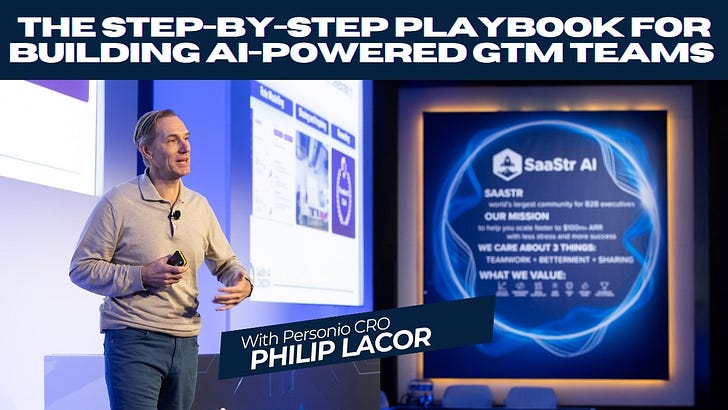
How Personio’s CRO Built an AI-Powered Go-To-Market in Just 6 Months: 5 Lessons and 5 Mistakes
Philip Lacor is the CRO of Personio, a $3B+ HR and payroll platform with 1,500 employees, 15,000 customers, and a 400-person sales team. He shared their AI transformation journey at SaaStr AI London — and the learnings are a masterclass for any revenue leader trying to figure out how to actually deploy AI in GTM.We’re all hearing about AI-native companies crushing it. Replit, Gamma, Harvey.But what if you’re running a real B2B company? One with 400 salespeople, 15,000 customers, and years of accumulated process debt?That’s exactly where Personio was in May 2024 when their CEO kicked off an “AI Surge Week” — and what happened next is one of the most practical AI transformation stories I’ve heard.In just six months, they went from “90% of our team uses LLMs weekly” (which sounds good but isn’t transformation) to building 400+ AI assistants, cutting research time from 2 hours to 15 minutes per rep, and booking 140 meetings in 7 days through their AI SDR.Here’s what Philip learned — the stuff that actually worked, and the mistakes you should avoid.The 5 Lessons: What Actually WorksLesson #1: You Need Both Top-Down AND Bottom-Up MotionHere’s the trap most companies fall into: They give everyone access to ChatGPT, run some training, and call it an AI initiative.Personio did that too. Their AI Surge Week was a huge success — speakers from OpenAI, Mistral, AWS. Project teams building agents. Company buzzing with excitement.But then Philip noticed something: High usage isn’t the same as transformation.“After the AI Surge Week, we felt that although usage was high, this is maybe not enough to reach true transformation and to really fundamentally change the way we go to market.”The problem? Bottom-up motion alone can’t make the hard decisions:* Resource allocation — Who’s going to spend 40% of their time on AI initiatives?* Permission — Can people actually stop doing their old workflows?* Budget — Which tools do you actually buy vs. just test?* Prioritization — Of the 50 possible use cases, which 3 do you build first?This is why Philip started the “AI Powered Go-To-Market” working group in June — a top-down initiative to complement the bottom-up energy.The takeaway: Bottoms-up gets you experimentation. Top-down gets you scale. You need both.Lesson #2: Cross-Functional is Non-NegotiableThis one seems obvious but almost nobody does it right.Personio built a working group with three distinct capabilities:* Data & Systems Team — Owns infrastructure, Snowflake, the technical backbone* Revenue Operations + GTM Engineers — The bridge between tech and business (they have 2 dedicated GTM engineers now)* The Business — Marketing, Sales, Customer Success, the actual usersWhy does this matter? Philip saw both failure modes:“We have seen cases where our data systems team built things with LLMs but it was lacking the business context and therefore the models didn’t work very well.”And the reverse:“We had sales people who wanted to do something but originally they did not have the support from either data or systems or RevOps.”They deliberately made the working group large — 15 people — to get broad coverage across functions and build cultural buy-in.The takeaway: AI in GTM isn’t a sales project or a data project. It’s a cross-functional transformation. Build the team accordingly.Lesson #3: Use Jobs-To-Be-Done to Prioritize RuthlesslyHere’s what happened after they launched the Slack channel and started working on use cases:“People started to share opportunities, raising their hand, and the problem was that as people started to work on these new ideas, we hadn’t finished the first one. At one point it started to spiral a little bit out of control.”Sound familiar? Everyone gets excited, ideas flow, and suddenly you have 20 half-built things.Their solution: Jobs-to-be-done mapping.One of their GTM engineers literally shadowed account managers for two weeks. What she found:* AMs were working in 7-8 different systems to perform simple tasks* Constantly switching contexts, pulling information together* Losing 2.5 hours per day on one activity, 3 hours per week on anotherThey mapped every role’s jobs-to-be-done:* SDRs* AEs* Customer Success* Solution EngineersThen they overlaid these jobs onto the customer journey to see how they fit together — and where the biggest pain points were.The takeaway: Don’t just chase shiny AI use cases. Map your roles’ actual jobs, quantify the time waste, then prioritize based on where you have the biggest P&L challenge or customer experience gap.Lesson #4: Building an AI Culture Requires Leading, Sharing, and CelebratingPhilip has a formula he uses for transformation:Effect = Quality of Plan × Acceptance5 × 5 is way bigger than 10 × 1.So how do you build acceptance? Three things:Lead It: Philip does deal reviews where AEs used to show up with big PowerPoints. Now:“I would always go like, okay, please go to Gong, open up your account. There’s this little AI sign. Go in there. Now you look for the account bri
The Present and Future of AI in Sales and GTM A Deep Dive with Jason Lemkin and Kyle Norton, CRO at Owner
Jason Lemkin led the seed round via SaaStr Fund in unicorn Owner.com, an AI solution revolutionizing how small restaurants manage their business. Kyle Norton joined shortly thereafter, and after a slow few months, Kyle rocketed the org to almost $100m ARR in just a few years -- with growth accelerating at scale. Both Kyle and Jason have shared AI agents, learnings, and more on their AI agent journey and Kyle sat down with Jason on the very latest in AI for GTM. Kyle now manages a 100+ human AI-infused sales team and Jason and Amelia at SaaStr have deployed 20+ AI Agents.Top 10 Takeaways:* AI agents are now better than mid-pack AEs and SDRs. Not better than the best. But better than average. And that’s enough to fundamentally change how you build a GTM team.* The first agent is YOUR job. If you’re a CRO or CMO and you haven’t personally trained and deployed at least one AI agent, you will become obsolete. No agencies, no consultants. You. 30 days of work.* Pick one tool, not ten. The biggest mistake executives make is running 8-10 vendor bakeoffs. You can’t train 10 agents. Pick two—one incumbent, one startup—and go deep.* Salesforce is back—but not because of Agent Force. It’s because when you have 20 agents running autonomously, they need a hub. And Salesforce is that hub.* The middle is gone. You either work harder than ever to hit 10x5x5x5x growth rates, or you join a slow-growth company at 15-20%. The magical 2021 middle where you could have lifestyle AND exceed quota? That’s over.* Forward Deployed Engineers > Features. Don’t sign a contract until you’ve talked to the person who will actually deploy your agent. The best vendor isn’t the one with the best demo—it’s the one that will help you get into production.* Every agent takes 30 days to train. No shortcuts. You upload data, review outputs daily, correct mistakes, iterate. The agents that “don’t work” are the ones nobody trained.* Fix what breaks your heart first. Go to your website in incognito mode. Try to buy something. Try to get a question answered. Whatever breaks your heart—fix that with AI first.* AI-infused teams are 3x more productive. Kyle’s team at Owner is booking 3x revenue per AE compared to any team he’s ever managed. But that doesn’t mean fewer reps—it means higher quotas and more hiring.* The $250K SDR is coming. The elite folks—not the ones who think they’re elite on LinkedIn, but the ones who are genuinely 5-10x more productive—will earn 2-3x what they used to. But they’ll be expected to deliver 10x the output.The Backstory: Why SaaStr Went All-In on AgentsIt started with frustration.We had two salespeople making high market, six-figure salaries. They just quit going into our biggest event. No notice. No reasons. Just ghosted.I turned to Amelia, our Chief AI Officer, and said: “We’re done with this. I am done paying an SDR $150,000 a year or an AE $300,000 a year for basically inbound, spoonfed leads and renewals—and then having them quit on me.”Maybe you can be critical of me as a boss. Fair enough. But I’m pretty loyal. I pay people well. Do your job with me, and I’ll stick with you for 20 years. I just couldn’t do it one more time in my career.So we went all-in. Started in May with 1 AI Agent. Today we have 20+ agents running in production. They’re generating over $1 million in revenue. And here’s the scary part:Our AI agents are better than a mid-pack AE or SDR.Not better than the best. But better than the 50th percentile person I’ve worked with over my career. And that changes everything.The New Reality: Mid-Pack Sales Execs Are in Terminal DeclineLet me be blunt: if you’re a mid-pack GTM professional who doesn’t want to work harder and smarter than a year ago, these jobs are in terminal decline.We sent 70,000 hyper-personalized emails for SaaStr London using AI agents. They were better than the 7,000 emails humans sent before that. 10x the volume. Slightly better quality.And here’s what happened when we asked our highly-paid SDR to follow up on a lead I spotted on LinkedIn:“I’ll add it to my list and get to it when I can.”Half the time, they didn’t even follow up.The agent? The agent doesn’t argue. The agent just follows up.But We’re Still in Inning OneHere’s what most people don’t understand: what we’re doing today with AI GTM is just step one.Right now, “hyper-personalization” means maybe three dynamic fields in an email. One, really. Maybe we know your company name and your title.But imagine when AI really pulls in:* Every competitor you’ve ever used* Every page you’ve visited on our website for 10 years* Every interaction you’ve had with our brand* Every adjacent tool in your stackImagine when AI can send an email as good as the one that got me to invest in Owner—an email the founder probably spent several hours crafting with a top 0.1% IQ.AI should be able to do that. It’s just not there yet in GTM.When it is? Buy that product immediately.The Real Reason Agent Deployments FailThe failures of AI SDRs in 2024 were all LL
We Deployed 20+ AI Agents and Replaced Our Entire Human SDR Team. Here's What Actually Works. (Video + Pod)
At SaaStr AI London, Amelia and I went deep on our AI SDR journey. We shared all our data, all the emails we’ve sent, all the performance metrics—everything. And the response was overwhelming.But here’s the thing: the #1 objection we kept hearing was “Yeah, but this won’t work for me. I don’t have your scale. I don’t have your data. I don’t have 10 years of history.”That’s simply not true.If you have customers, if you have revenue, if you have a database of any size—AI agents will work for you. You don’t need as much data as you think. You don’t need as much trailing history as you think. What you need is a methodology.Here’s what we’ve learned after sending 60,000+ hyper-personalized emails, booking 130+ meetings automatically, and generating 15% of our London event revenue through AI agents alone.The 5 Biggest Learnings From Deploying AI SDRs#1. AI Agents Crush the Work Humans Won’t DoThis is the single most important insight we’ve discovered.Our human SDRs wouldn’t follow up with return attendees for ticket sales. It wasn’t worth their time—they wanted to hunt six-figure sponsorships instead. We tried incentives. We tried Starbucks cards. We begged them. They said they’d do it, then we’d check the activity logs and discover they lied.The result? When we deployed AI agents on those exact same leads, they generated 15% of our London ticket revenue. Revenue we literally would not have gotten otherwise.Same story with our “ghosted” leads—people who reached out wanting to sponsor SaaStr for five and six figures, and our human team just... never responded. Not because they didn’t like the leads. Because every salesperson is force-ranking in their head, putting all their effort into the one big deal closing this quarter.The AI agent hit those ghosted leads with a 70% open rate.Here’s the mental model shift: Don’t think of AI SDRs as magic revenue generators. Think of them as the team that finally does the work your humans refuse to do. The small leads. The low-scored leads. The “not worth my time” leads. Those leads deserve better, and AI doesn’t discriminate.#2. Hyper-Personalization at Scale Actually Works—But “Pretty Good” Is Good EnoughBefore AI agents, our human SDRs sent maybe 75-300 personalized emails per rep per month. In six months with AI, we’ve sent nearly 60,000 hyper-personalized emails. That’s 32x the max human output.But here’s what people get wrong when they see our results: they expect jaw-dropping, month-of-research-level personalization.That’s not what this is.On a scale of 1-10, our AI emails are maybe a 3 to a 6 in customization. They’re pretty good. They reference the prospect’s company, what they’ve been looking at, maybe something they posted about. But they’re not poems. They’re not love letters.And that’s fine. Because the bar isn’t “better than the best human SDR having the best day.” The bar is:As good or better than your average human SDR, with 24/7 consistency.A lot of folks on the internet say “I could do better if I hired 30 top-tier Oxford graduates to craft one email each day.” Sure, maybe. But those people want to be promoted to AE in three months. They’re not going to stay. And you can’t hire 30 of them anyway.Pretty good emails with zero errors, sent consistently at scale, crushes inconsistent brilliance every time.#3. Train Your Agents Like You’d Train Your Best New HireHere’s where almost everyone fails with AI SDRs:They buy a product, do nothing, and expect millions in revenue.It didn’t work that way before Claude 4 when these products barely functioned. It didn’t work after Q1 2025 when they started getting good. It doesn’t work now.The way AI agents work for GTM is:* You figure out something that works with humans first* You nail the email, the script, the objections, the questions* You document what worked* You give it to the agent and train it for a month* Then you do it at scaleIf you’re expecting an agent to sell when you can’t sell, that’s never worked. Go back to founder-led sales basics. But instead of handing off to that first human hire, you hand off to your first agent hire.Same principles. Same rigor. Different execution.#4. Segment Ruthlessly—Never Unleash AI on Your Entire DatabaseThis is critical. Do NOT just point an AI SDR at your entire database and hit send.Here’s how we approach it:* Batch contacts into groups of 800-1,000 max for each campaign* Create sub-agents or sub-campaigns for each persona (CRO, CMO, website visitors, churned customers, etc.)* Train each sub-agent specifically for that persona and use case* Give each agent different goals (book a meeting, sell a ticket, follow up on a ghosted lead)Start with low-stakes segments:* People you ghosted* Good inbound you couldn’t fully follow up on* Post-meeting follow-ups that fell through the cracksDon’t start with mission-critical leads. You’ll be disappointed if you can’t get it working quickly, and these agents have ramp time.#5. You Need Exactly Two Humans to Make This WorkThis surprised us,
No, Inbound Isn't Dead. The GTM Playbook Isn't Broken. But Your Moats Are Shrinking to Months.
I did an open AMA at SaaStr London last week, a classic part of each SaaStr AI event. But this one was different. It was urgency to the max.The room was packed with founders, CROs, and marketers who all seemed to be wrestling with the same existential questions: Is inbound dead? Is the GTM playbook broken? Will AI agents replace my entire team? Should I just give up and become a forward deployed engineer?Most of the anxiety I’m seeing in the market right now is based on a false narrative. A dangerous “woe is me” narrative that’s been accelerating since late 2023. And I think it’s time to get honest about what’s actually happening—and what you need to do about it.The “Woe Is Me” Narrative Is Killing Your GrowthLet me start with the question everyone’s asking: “Is inbound dead? My traffic is down 50% in the last 12 months.”Here’s my honest response: Woe is you. Your SEO is harder. Woe is you. You don’t have as many leads as you had during a lockdown during a global pandemic. Poor you.This leads to a narrative that I think is quite dangerous: that the go-to-market playbook is broken and doesn’t work anymore.It’s just not true.Yes, the playbook that some folks are running from 2021 doesn’t work as well today. But here’s what I say: the plays all work. Webinars, inbound, outbound, leftbound, rightbound—it all still works.The Same CROs, CMOs, Etc. Are Running the Hottest AI CompaniesHere’s what’s fascinating: if you look at the hottest AI companies right now, you’ll see a cast of characters from the 2010s. B2B leaders you know from SaaStr 2017 and 2018 are running today’s AI rockets.* Vercel (just raised at $10B): Their COO? She was the Chief Business Officer at Stripe.* Replit (0 to $250M this year in vibe coding): Their CRO? He’s from ZoomInfo.* Bolt (one of the vibe coding leaders at $60M): Head of sales? He was on our old SaaStr sales team.That wouldn’t be possible if the plays don’t work. These leaders are using different tools. They’re using more AI things. But it’s the same playbook. Same demos. Same everything.The biggest real difference? There’s just so much demand. Tools like Cursor, Replit, Lovable, 11 Labs—they’re so disruptive that everyone is in market simultaneously. 11 Labs went from almost nothing to $300M this year. Bolt has so much inbound they can’t service it. At $60M ARR, Brian has maybe four people on his sales team. How many of thousands of leads can they follow up on?“They’re all classic B2B sales reps—just instead of calling every lead and trying to convince them their fungible product is the exact same as another product, they have insane demand and are servicing it. But it’s the same playbook.”The AI Budget Paradox: Record Spending, Record CutsHere’s the thing that can feel like a paradox but isn’t:According to Gartner, overall enterprise software is going to grow the fastest it ever has—15% a year at $400 billion. It’s never grown this fast ever. But of that 15%:* Almost half is taken up by price increases from existing vendors (everyone’s raising prices)* About half of the remaining half is new AI budgetThat means if you’re not one of the vendors getting price increases or new AI budget, everyone else has to get cut.Vendor count is getting stable or shrinking to make room for new AI offerings and price increases from select vendors. CIOs have gone around the room and said: “Give me an app. Give up an app. You want to add a couple AI apps next year? I’ll find you budget—but you got to give up two. You have 100 marketing tools? Maybe 96 is enough.”I just got an investor update yesterday from a pretty successful company at mid-eight figures in revenue. They had $1.5 million in churn last month. From happy customers. No CSAT issues, no other problems. They literally said: “We’re cutting apps next year. We’re an attachment to CRM and we got cut.”The CEO failed because they didn’t get above the cut line. It was great to have, but not mission critical. And it got cut to make room for an AI app.Our SEO Is Down 8%. But Our Traffic Is Up 50%.Is SEO dead? Let me give you our real numbers.At SaaStr, our blog is like our core—it’s home base. Our blog traffic was fairly flat for about four years. Going into this year, our SEO is down 8%. Not 50%, but 8% for real.But here’s the thing: our traffic is up 50%. We will end this year at saastr.com with twice as many readers as last year, even though our SEO is down.Why? Because people all want to read about AI GTM content. They don’t want to read about classic SaaStr themes about CS teams and CROs unless there’s an AI angle. But because we have some of the best AI GTM agent content out there, people are just devouring it.Meanwhile, G2 says their SEO is down 30-40% or more. So if that’s your only play and you haven’t changed your product or GTM since 2021, yes—it’s probably going to feel 8-50% harder.You’ve got to find your tailwind. That’s your job right now.AI SDRs Didn’t Work Until Claude 4. Now They Do.Someone asked me about AI SDRs: “You said they d
6 Months of AI SDRs: What's Worked, How They Brought In $1M+ in 90 Days, and the Real Data Everyone's Asking For
After deploying 5 AI SDRs across inbound, outbound, and follow-up—here’s the actual numbers, unexpected learnings, and what it really takes to make them workSix months ago, we had essentially zero AI SDRs at SaaStr. Today, we’re running five specialized AI agents that have sent nearly 20,000 outbound messages, closed over $1M in revenue, and fundamentally changed how we think about sales development.The results look incredible on paper: 6.7% outbound response rates (double the industry average), $1M+ closed in 90 days from our inbound agent alone, and 20% of our event ticket sales now coming from AI.But here’s what nobody tells you about AI SDRs: they require massive human oversight, they can’t fix what’s already broken, and the path to success is completely different than what vendors promise.SaaStr’s Chief AI Officer Amelia Lerutte and CEO Jason Lemkin share the real data, the brutal learnings, and exactly how we got these results. And want to see the tools we use? Click here.TLDR and Top 5 Learnings After Six Months of AI SDRs1. AI SDRs Scale What’s Already Working—They Can’t Fix What’s Broken* If your outbound isn’t working with humans, AI won’t save it* You must have proven messaging, defined ICP, and working processes before deploying* AI amplifies your best practices infinitely—but you need best practices first* We had to fix our broken RevOps processes before AI could help scale them2. They Require Massive Human Oversight (15-20 Hours Weekly)* These agents consume the signficiant amount of Amelia’s and Jason’s time to run successfully* Performance ebbs and flows directly with human attention—more time invested = better results* Weeks I’m busy with other work, agent performance noticeably dips* This is not set-and-forget technology; it’s coaching five SDRs simultaneously who work 24/73. Specialization Beats All-in-One. For Now.* We run 5 different AI SDRs, each trained for specific use cases (cold outbound, lapsed customers, active nurture, inbound qualification, ghosted lead recovery)* Even within one platform, we have sub-agents with completely different training* Specialized tools go deeper than all-in-one platforms—we’ll take three A+ tools over one B+ tool* The training specificity for each use case matters enormously for results4. The Unexpected Direct-Selling Capability* AI got surprisingly good at closing deals directly, not just booking meetings* For sub-$1K products (event tickets), our AI now closes deals autonomously* For higher ASP deals ($50-100K+), it qualifies and books meetings, then hands to humans* 20% of our event ticket revenue now comes from AI agents selling directly5. Budget $50-100K Per Platform + A Lot Of Your Time* Effective AI SDRs cost $50-100K+ annually per specialized platform* But the bigger investment is your time: 15-20 hours weekly managing them* We reallocated budget from two human SDR roles instead of finding new budget* ROI is clear (our inbound agent: $1M revenue in 90 days on ~$100K investment) but only if you commitThe Big Misconception Killing AI SDR DeploymentsThe myth: Buy an AI SDR for $50-100K, it magically generates leads, you replace human headcount, profit.The reality: AI SDRs scale what’s already working. They can’t create something from nothing.This is the #1 reason AI SDR deployments fail. Companies expect magic. They want to spend $20-100K and suddenly have leads pouring in without figuring out what messaging works, what audiences convert, or what their actual sales process should be.Here’s the truth that took us six months to fully internalize: Your AI SDR can only amplify your best practices. If your outbound didn’t work with humans, AI won’t save it.Think of AI SDRs as taking your A-tier sales development rep and giving them infinite time, perfect memory, and the ability to personalize at scale. But they still need to know what to say, who to target, and how your sales process works.We learned this the hard way. Before deploying AI, we had to:* Identify what outbound messaging actually converted* Clean up our RevOps processes (they were broken)* Define clear goals for each agent type* Create training based on real conversations that workedOnly then could we scale with AI. You can’t skip this step.Our 5 AI SDRs: The Specialized ApproachMost companies think about “an AI SDR.” We run five, each specialized for different use cases:Agent #1: Outbound Cold (Artisan)* Pure cold outreach to new prospects* Highly personalized based on company signals* Goal: Book qualified meetingsAgent #2: Lapsed Customer Outreach (Artisan)* Targets previous sponsors/attendees who haven’t engaged recently* Leverages past relationship for warmth* Goal: Re-engage and convert to new eventsAgent #3: Active Nurture (Artisan)* Follows up with people opening emails but not converting* Tracks engagement signals* Goal: Move them from awareness to actionAgent #4: Inbound Qualification (Qualified)* Lives on our website, engages visitors in real-time* Qualifies intent, books meeting
The First $100,000,000 ARR at Datadog: How Founder CEO Olivier Pomel Built a Customer-Centric Observability Giant
Ahead of SaaStr AI London on Dec 1-2 (See you there!) we’re taking a look back at some of our favorite sessions from our European events. It was so great when Olivier Pomel, founder CEO of Datadog, joined us as they crossed $100,000,000 ARR in a candid conversation it would be harder to do today post-IPO.The First $100,000,000 ARR at Datadog: How Olivier Pomel Built a Customer-Centric Monitoring GiantFrom zero lines of code to 700 employees and doubling revenue annually, Datadog CEO Olivier Pomel shares the counterintuitive strategies that built one of the most customer-obsessed companies in B2B SaaSOlivier’s Top 5 Toughest Learnings* You can’t be customer-focused if you’re sales-driven OR engineering-driven - Most companies fall into one trap or the other. Sales teams optimize for closing the next deal (short-term), while engineering teams build for the long-term without bridging back to customers. Customer-centricity requires daily vigilance against both.* Closed alphas with “perfect customers” give terrible signal - Handpicking the best companies and best people for early access actually makes it harder to learn. Customers need to self-select when the timing is right for them. Open betas revealed infinitely more than curated alphas ever did.* Month-to-month contracts are better than annual deals for learning - Every instinct (and investor) tells you to sell annual contracts. But monthly contracts force bad news to surface immediately instead of a year later. A year of going in the wrong direction is devastating for a young company.* There’s no MVP for enterprise infrastructure - The conventional wisdom about shipping minimal products doesn’t apply when selling to enterprises who need comprehensive solutions. You need depth across many features before you’re minimally useful. It’s a continuum, not a single viable moment.* Pricing conversations reveal product truth better than any metric - Putting a dollar amount on features focuses customers’ minds like nothing else. When customers say “I won’t pay for that,” you get brutally honest feedback about value. This friction is healthy and teaches you where to go next.When Olivier Pomel and his co-founder started Datadog in 2010, they didn’t write a single line of code for the first six months. For two engineers itching to build, this took “some restraint,” as Olivier puts it. But this decision to obsessively listen before building became the foundation of a company that would redefine infrastructure monitoring and grow to 700+ employees while doubling in size every single year.At SaaStr Europa, Olivier pulled back the curtain on how Datadog became one of the most customer-centric companies in enterprise software—and why being truly customer-focused requires constantly fighting against your natural instincts.The Problem: When Great Teams Hate Each OtherThe genesis of Datadog came from a painful problem Olivier and his co-founder experienced firsthand. Despite working together across four different companies, knowing each other extremely well, and building their teams from scratch with a “strict no a*****e policy,” they ended up in a familiar nightmare scenario two years in.“We ended up with developers that hated operations, operations that hated developers, fingerpointing—all of the things that you can imagine,” Olivier explained.The question became simple: Why don’t we give all of those teams the same viewpoint? How do we get them aligned and understanding their infrastructure the same way?This became Datadog’s founding mission—bringing DevOps together and bridging the gap between development and operations teams. What they didn’t fully realize at the time was that this wasn’t just a nice-to-have feature. It was actually one of the KEY reasons why companies would migrate from legacy IT to the cloud.“We ended up right in the center of it,” Olivier said. “Today the company is about 700 people. We’ve been doubling the size of the company every single year. It turns out everybody is moving to the cloud and everybody needs to understand what’s happening to their systems and applications.”The Counterintuitive Truth About Customer-CentricityHere’s the part most founders get wrong: you can’t be customer-focused if you let your company become sales-driven OR engineering-driven.“Everybody wants to be customer-focused,” Olivier noted. “But most companies end up being either sales-driven or engineering-driven. If you want to be customer-focused, you can’t be either of those.”The Sales-Driven Trap: Sales teams are phenomenal at figuring out what’s going to get a deal done. But very often, getting the next deal done is NOT what you want to do for the long run for your customers. Short-term thinking dominates.The Engineering-Driven Trap: Let your engineering teams run on their own, and you’ll end up with organizations where people focus way too much on their solutions and way too much on the long term. You’ll struggle to bridge that gap back to the customer.The solution? “It’

20VC x SaaStr This Week: Why Most VCs Need to Step Aside, What’s Really Defensible Today, and How to Actually Attach to AI Revenue
We’re back! Harry, Rory and Jason!The venture capital playbook is broken. Not bent — broken. In the latest 20VC x SaaStr episode, Harry Stebbings, Jason Lemkin, and Rory O’Driscoll dissect why even Sequoia is making dramatic leadership changes, why seed investing at $50M pre-money might not work anymore, and what it actually takes to build venture returns in the age of AI.This isn’t your typical venture conversation about “exciting trends.” This is three investors with $3+ billion in combined AUM telling you what’s actually working, what’s spectacularly failing, and why the old playbook from 2015-2022 is now a liability.Key TakeawaysOn Venture Capital Evolution:* Sequoia’s leadership transition reflects broader industry truth: most VCs and executives from the last decade aren’t the right people for the next decade* The pace of AI evolution means knowledge from 6 months ago is probably wrong; staying current requires dedicated time investment* Partnerships are inherently dysfunctional when performance can’t tie to economics, creating inevitable internal tensionOn AI Investment Strategy:* Only three ways to win: (1) Attach to compute budgets, (2) Replace human headcount, or (3) Massively displace incumbents* Using AI to “make your product better” no longer earns any kudos — that’s table stakes in 2024* Co-pilots were the 2024 story that didn’t work; agents becoming actual team members is the 2026 opportunityOn Deal Dynamics:* Getting into deals at 5-10M ARR requires top-decile metrics — there’s almost no middle class of fundable companies* The quality and speed of competitive clones has increased dramatically, compressing the window for building moats* Traditional seed defensibility is dead; founders must run faster and bet on scale creating the moat, not early product advantagesOn Portfolio Construction:* With increased variance in AI deals, diversification becomes more critical, not less* Small fund sizes ($40-100M) with acceptance of dilution can generate superior returns (10x+) versus large funds maintaining ownership (5x)* 80+ company meetings per week per partnership is one approach; building deep relationships with fewer founders is anotherOn Fundraising Process:* The best fundraises don’t feel like processes — they’re cultivated over months with 3-4 investors ready before the data room opens* Taking a term sheet immediately versus “running a process” depends on capital efficiency and relationship quality* Founders often overlearn “run a process” advice without understanding the optimal approach is having everyone ready to commit before you formally raiseOn Market Dynamics:* Companies attached to AI compute infrastructure (like DataDog) are crushing it; those just using AI for product improvement (like Duolingo) are getting punished* The $100M ARR milestone with 50 people (like Gamma) represents a new efficiency paradigm* Capital-efficient outcomes (Billion to One at $5B, Navan at $4.5B) deliver superior investor returns despite smaller headline valuationsSequoia’s Move: What It Really MeansWhen Sequoia replaced Roelof Botha as managing partner after just three years with Pat Grady and Alfred Lin in a split leadership structure, the venture world noticed. But the reaction from our panel was telling: this wasn’t about interpersonal drama or normal succession planning.“Whenever you have a CEO change happening in venture, it’s because something isn’t working,” Rory stated bluntly. “This is dissatisfaction about how the firm is doing relative to the competition. They missed some rounds and some deals. They passed on some great companies.”But rather than viewing this as a Sequoia-specific challenge, the panel sees it as symptomatic of a broader industry issue.“More people should be stepping aside today,” Jason argues. “VCs, executives, founders. Most folks from the last decade or 15 years are not the right people for the next decade. I genuinely believe it across my ecosystem. I struggle to even recommend a lot of the CROs and executives I know for roles today.”Rory adds context: “The pace of evolution is so fast. If you decide what I knew 6 months ago is still useful, you’re probably going to be wrong very quickly. That’s what I find the most stressful about right now.”The meta-lesson? Even the best firms are struggling to keep pace with AI, which means everyone else should be asking themselves hard questions about whether they’re still the right people for this moment.And Sequoia gets credit for one thing: ruthless decisiveness. “They did not do that fatal error of saying it’s someone’s turn so we’ll leave him in,” Rory notes. “They ruthlessly said, if we’re going to compete, we need these people, not those people.”Michael Burry’s $1.1B Bet Against Nvidia: Why Shorting AI is Brutally HardMichael Burry made headlines (again) by shorting Nvidia and Palantir to the tune of $1.1 billion. Unlike most pundits who just discussed whether he’d be right, Jason actually did the math on what it takes to make money on
The Reality of Managing 10 AI Agents in Production: What We’ve Learned Building Our AI-First Revenue Team at SaaStr
By the end of Q3, we’ll had 10 distinct AI agents running in production at SaaStr. 20 if you including less critical ones. Not as a tech experiment or marketing stunt, but as core members of our revenue and operations team.The lineup looks like this:Revenue Team:* 3 AI SDRs handling each of ticket inquiries, sponsor outreach, and sales support (these are different workflows, training, etc)* 2 AI BDRs qualifying inbound leads and nurturing prospects through our funnel* 1 AI RevOps agent tracking and managing our partner pipelineOperations & Experience:* 1 AI Support agent handling event logistics and attendee questions* 1 AI Content Review agent vetting speakers and session proposals* 1 AI Matchmaking agent connecting CEOs and executives at our eventsCommunity & Education:* 1 AI Mentor (SaaStr.ai) providing 24/7 guidance to our community. Try it, it’s free!And we’re not done. The pipeline has 3-4 more AI agents in development.The Operational Reality: It’s A LOT More Work Than You ThinkHere’s what nobody tells you about AI agents in production: they require daily management and review. Not weekly check-ins. Not “set it and forget it” automation. Daily.Every morning, I’m reviewing:* Conversation quality scores from our AI SDRs* Lead qualification accuracy from our BDRs* Edge cases that required human escalation* Performance metrics across all agents* Training data updates and model refinementsEach agent needs constant fine-tuning. The AI SDR that handles sponsor inquiries needed 47 iterations to stop being too aggressive on pricing discussions. Our AI Support agent had to be retrained three times to properly escalate VIP attendee issues.The truth? Managing 10 AI agents is like managing a team of 10 very capable but very literal junior employees who need explicit instructions for everything.But Here’s Why We’re All-In: The Advantages Are UndeniableDespite the management overhead, these AI agents deliver something human employees simply can’t:They never quit. Zero turnover. No recruiting cycles. No onboarding new SDRs every 18 months because they got poached by a competitor offering $10K more.They work weekends. While your human BDR is at Coachella, our AI BDR is qualifying leads and booking demos. Saturday morning inquiries get responded to in under 2 minutes, not Monday afternoon.They don’t complain. No “this lead quality sucks” from the AI SDR. No “I need more training on the new product features” requests. They just execute.They aren’t distracted. Our human SDRs were spending 30% of their time on side hustles, online courses, or job searching. The AI agents? 100% focused on converting prospects and supporting customers.They scale instantly. Need to handle 3x more sponsor inquiries during SaaStr Annual planning? The AI RevOps agent doesn’t need additional headcount approval or three weeks of hiring. It just scales.The Product Knowledge Advantage: They Know Everything “Cold”This might be the biggest unexpected benefit: AI agents know our products, processes, and pricing cold.Human SDRs need 3-6 months to really understand our event portfolio, sponsorship packages, and community offerings. Even then, they’re guessing on edge cases or scrambling to find answers. In fact, most of the SDRs we’ve had never really understood our products at all.Our AI agents? They have perfect recall of:* Every sponsorship package and pricing tier* Historical attendee data and ROI metrics* Speaker requirements and content guidelines* Event logistics for 12+ annual events* Community membership benefits and upgrade pathsWhen a prospect asks our AI BDR “What’s the difference between your Growth and Enterprise sponsorship packages for companies doing $50M ARR?”, it delivers a perfect answer in 30 seconds. No “let me check with my manager” or “I’ll get back to you”. Or worse, no making things up. (Our AIs are well enough trained that hallucinations are minor at best now.)The Financial Reality: ROI Happens Faster Than ExpectedThe numbers are becoming undeniable:Cost per agent: ~$200-4,000/month (including platform, training, and management overhead) Cost per human equivalent: ~$8,000-$12,000/month (salary, benefits, management, office space)But the real ROI drivers:* Response time: Average first response dropped from 4.2 hours to 1 minute* Lead qualification: 67% more leads properly scored and routed* Weekend coverage: 23% of our best leads come in outside business hours* Consistency: Zero “bad days” or emotional decision-making affecting prospect experienceOur AI SDR team has generated $340K in sponsor pipeline so far in Q3 alone, and the quarter has just begun. At a fully-loaded cost of ~$10K/month for all core agents.What Folks Get Wrong“Mistake” #1: AI agents can’t replace human creativity and relationship-building. For complex enterprise deals and strategic partnerships, humans still close. But also, way too many in sales overestimate their skills here. Being a “people person” is not enough.“Mistake” #2: Underestimating the managemen
How to Price Your AI-First Product: The Death of SaaS Pricing and the Rise of Transactional Models with Defy Ventures’ Medha Agarwal
Medha Agarwal is a Partner at Defy VC, where she focuses on investments in AI-first and vertical SaaS companies. She shares insights at SaaStr AI Summit 2025 from the front lines of AI-first product pricing, exploring why traditional SaaS models are declining in favor of transactional pricing, how to choose the right pricing structure for your business, and strategies for capturing value from labor budgets instead of software budgets.Top 5 Takeaways* Transactional pricing is replacing traditional SaaS at an accelerating rate. The fundamental shift is driven by AI’s ability to complete tasks end-to-end, enabling companies to sell into labor budgets rather than software budgets. This opens up significantly larger TAMs that were previously dominated by human labor costs.* There’s a 1.5-2.5x revenue multiple premium for SaaS models in public markets, but transactional models capture more value. While SaaS offers predictability and better cash conversion cycles with annual upfront payments, transactional pricing allows you to scale revenue with customer growth without being constrained by seat count. The trade-off is revenue predictability versus value capture.* Hybrid models are emerging as the best of both worlds. Companies are mitigating transactional pricing unpredictability by implementing tiered subscriptions with usage minimums and overage billing. This provides baseline revenue predictability while maintaining the ability to capture value at scale through consumption-based pricing.* Your pricing model choice depends on four critical factors. Frequency of usage, magnitude of cost savings, workflow integration point, and customer budget type all determine whether fixed-cost, input-based transactional, output-based transactional, or hybrid pricing makes sense. High-frequency tools like Slack need flat fees because users can’t mentally track per-use costs.* Never compete on price alone when entering a market. Undercutting competitors on price creates a dangerous dynamic where you attract price-sensitive customers rather than best-fit customers, leading to higher churn and false signals of product-market fit. Price at par with competitors and win on value, or you’ll be forced into a race to the bottom.The Fundamental Shift: Why SaaS Pricing Is DyingWe’re witnessing a massive sea change in how AI-first products are priced. At DEFY, we’ve seen a dramatic increase in the frequency of transactional-based pricing models. Traditional SaaS pricing, while still popular, is declining rapidly in favor of transaction-based approaches.The reason is straightforward. With AI, there’s an increasing ability for software to complete tasks end-to-end. Some AI businesses are enhancing humans and making them significantly more productive than ever before. Others are eliminating the need for humans to perform many entry-level tasks altogether.This creates a game-changing opportunity. It’s much easier today than it has been in the past to sell into labor budgets, which represent a much larger line item for most companies’ cost structures. Labor is also seen as more mission-critical than software spend. These transactional models can target much larger total addressable markets that were previously captured almost entirely by human labor expenditures, which are now starting to be displaced by software in certain categories.The Three Pricing Model ArchetypesWhen we looked at the pricing landscape for AI-first products, we identified three high-level model types that most companies fall into.Fixed Cost Models: Traditional SaaSThis is your typical traditional SaaS-based, seat-based pricing model. It can be seat-based or location-based pricing. There are compelling reasons why this model has dominated for so long.If you look at the public markets, SaaS models command a 1.5 to 2.5 times revenue premium multiple compared to transactional-based models. There are several reasons for this valuation gap.First, it’s extremely predictable for the company selling the software. Second, it’s very predictable for the customer buying it. They can plan for that spend on an annual basis with high confidence. Third, the cash conversion cycle is excellent. These contracts are often paid yearly upfront, which helps fast-growing companies manage their cash flow effectively.But there are significant trade-offs with fixed pricing models.As companies grow rapidly, their usage of a product often scales much more quickly than the number of seats they need. This happens because they’re not growing headcount proportionally since the tool is making them much more efficient. The result is that the value a vendor is able to capture is much less than the actual value they’re providing to the company.Second, there are use cases where you could add enormous value, but the usage isn’t consistent on an everyday basis. This makes SaaS pricing less sensible. Financial planning tools are a perfect example. There will be intense periods of usage, followed by periods of muc
The Top 10 Mistakes I See In The VP of Sales Hiring Process
So we’ve spent a ton of time over the years on SaaS talking about hiring a great VP of Sales / CRO . Not only because it really matters, but because hiring the wrong VP of Sales can set you back a year — or longer.So I thought I’d come back to the classic topic and make a list of the Top 10 Mistakes I See Founders Make When Hiring a VP of Sales:#1. Hiring a VP of Sales Who Never Really Understands Your Product During The Interview ProcessOk I know some even many will disagree, but I’m right here :). I can tell you as a pretty good investor across many leading B2B companies, I’ve never seen a VP of Sales thrive that didn’t really understand the product during the interviewing process. Never. I see so many B2B startups hire someone likeable, who can talk the talk on sales hiring and processes — but never really understands what you do. Or puts in the effort to do so. Don’t make this hire. They never invest the time after they start, either. Or they are never able to.This has almost become my #1 flag now. Way too many folks give managers a pass here that never understand the product. You gotta watch the YouTube videos. Do a demo. Listen to some Gong calls. At least get close. Or you just plain never do once you start. So many VPs of Sales disagree with me here — at least at first when I make the point. But later, they agree 😉#2. Hiring a VP of Sales With No One Lined Up to Follow ThemThis is a classic SaaStr point and post from over the years, and it turns out it’s more true today than ever. 50% of what a VP of Sales really does is recruiting. So the best VPs of Sales always have at least 2-3 great folks lined up to come with their to their next role. Just ask. Ask who those 2-3 are. And if you’re ready to extend an offer, talk to them before you do.#3. Hiring a VP of Sales That Actually Doesn’t Want to Sell Themselves AnymoreThis one has really become an issue in recent years, and the one hand I get it. Sales is hard. And it never really gets easier. So at some point in their careers, some some leaders don’t really want to sell themselves anymore. They’ll manage a team. Check the dashboards. Build process. But sell themselves? They’re sort of done. We call this Mr/Ms. Dashboards, and it’s not a new thing per se. But it’s much more common than a few years back. Because SaaS is getting to be 20+ years old.Don’t hire this person. No matter how well they can talk the talk.#4. Hiring a VP of Sales That Doesn’t Want to Go Visit Customers In PersonThis is newer, but common these days. I recently interviewed a seasoned VP of Sales that lived in the South Bay in the Bay Area. He said he wouldn’t travel all the way to SF to visit customers because it was “too far”. I get it, with traffic, it can take 90 minute. But give me a break.There are sales jobs that are 100% on Zoom. But you gotta at least visit the bigger ones. Many don’t want to do that anymore after years of working from home. Unless you sell 100% to SMBs, probably don’t make this hire. Ask.#5. Hiring a VP of Sales That Doesn’t Want to Close At Least Some Customers ThemselvesYour VP of Sales can’t carry a bag forever, at least not a full quota. But I’ve come to see that a new VP of Sales that doesn’t want to close deals themselves when they start often never really learns how to do it at all. A VP of Sales candidate that insists on closing deals themselves when they start? A great sign. One that says it doesn’t matter, that it’s all process? Maybe run.#6. Hiring a VP of Sales That Has Gotten Cyncial on Startups, Tech, and SalesSomething I didn’t use to see much, but now is pretty common. I get that everyone has a tough startup experience or two. But if you can’t get past it, if the “system is rigged” against you … well I hear you. But don’t make this hire. You need Pirates and romantics in a startup, folks whose energy drives and guides and leads the team. Not someone who sees the whole system rigged against them.#7. Hiring a VP of Sales Constantly On Social Media, Especially LinkedInI do believe some of this promotion is good. It helps with recruiting, and more. But the VPs of Sales that are posting 2-3 times a day on LinkedIn? I’ve found they really want to be influencers, advisors, etc. They don’t really want to do the tough, full-time job of VP of Sales. I know some will challenge me here. A few great posts a week on social can be good. But a few a day? Run.And yes, I know I and SaaStr post a lot on the socials 🙂 But that’s our job, folks.#8. Hiring a VP of Sales That Really Wants to Be COO, CRO, etc. And Not Really Be a VP of Sales.Don’t force someone here. If a VP of Sales is done with that role and really wants a “bigger” job where they don’t just own the new bookings number, that can have a place. But it’s not as your VP of Sales. Now a little titlle inflation IMHO isn’t the end of the world. If your VP of Sales wants to be called CRO but their real job is VP of Sales, not also owning marketing, customer success, etc. — that can be OK. As long as yo
Why Only "WTF" Products Can Survive Today with Brett Queener Partner at Bonfire Ventures
Brett Queener is Partner at Bonfire Ventures, a $1B AUM seed-stage fund writing $3-4M checks into application software companies. He was employee #70 at Salesforce.com, where he built go-to-market, launched the AppExchange, and helped scale the company from its earliest days. Previously, he worked at Siebel Systems (the fastest-growing software company of its era) and ran a B2B startup (SmartRecruiters) from pre-revenue to $100M ARR. He writes about the changing software industry in real-time at his Substack.He came to SaaStr Annual + AI Summit for a deep dive on AI and Product.Brett’s Top 5 Take-Aways* Your product has to deliver immediate, “What The Frack” Value Now in the Age of AI. It has to immediately do a job you couldn’t do before. * Start small, expand fast. Forget the big enterprise land. Demo with their data, put it in their hands immediately, let them feel the “holy s**t” moment with an agentic assistant—then expand. The McGillaguer-Guerrilla deal is over.* Your product must teach itself. When you’re shipping every 30 days, quarterly release webinars are dead. Build agentic assistants that tell users: “Hey, you know I can also do this? Want to try it?” The product needs a relationship with the user.* Rethink annual contracts. If agents behave like $200K employees (paid monthly, can be fired), why are we doing annual upfront payments? The renewal decision isn’t “does our software need to keep running”—it’s “is this assistant still the best person for this job?”* Fire customers who don’t get it. Some enterprise buyers want 12-month Accenture rollouts. They’re treating your agentic solution like it’s PeopleSoft in 2003. Walk away. They’ll slow you down until you die.What happens when product innovation accelerates 10x? Everything you know about building SaaS is about to change.I’ve been in enterprise software since the green screen days. Built CRM systems on Access and Visual Basic. Was employee 70 at Salesforce when we spent 60 cents of every dollar on our own data centers. Ran a startup that hit $100 million ARR (through a lot of tears, I’ll admit). Now I’m a partner at Bonfire Ventures, writing $3-4 million seed checks into application software companies doing $500K-$1M in revenue.And I’m anxious. Not the normal founder anxiety. A different kind. The kind that comes from watching the fundamental rules of software change in real-time.The Old Playbook is DeadWhen SaaStr started, the model was simple: build a SaaS version of an on-premise category winner. Ship a big product release once a year at Dreamforce or your equivalent user conference. Run the company full-throttle across the entire organization based on that annual cadence.Every blog post, every playbook, every piece of advice you’ve read about scaling SaaS? It’s all predicated on a world where your product changes once a year.But what happens when your product has to change every 30 days?Because if you’re a founder in this room right now, that’s your new reality.We’ve Never Seen This Pace BeforeI’m 55 years old. I was the first person at my company to buy a PC. I built CRM systems by carving regional manager data off IDEO drives and FedExing hard drives around the country. There was no email.I’ve watched the internet emerge. Watched SaaS kill on-premise. Watched mobile kill desktop. Watched cloud infrastructure commoditize.And I’m telling you: we have never, ever seen this pace of change in technology.Not even close.The Agentic Revolution Changes EverythingHere’s what’s different about AI agents versus every other technology shift:When you give someone an agentic assistant that actually helps them do their job for the first time, their reaction is: “Holy s**t.”Not “this is interesting.” Not “I’ll think about it.”Holy s**t.That’s a different buying motion. That’s a different renewal decision. That’s a different everything.The Three Fundamental Shifts You Need to Understand1. The Job-to-be-Done Framework Just Got ComplicatedThink about pricing for agents. Here’s my framework:* If AI helps the existing user do their current job better: Include it in the base price. Don’t charge extra.* If AI solves an additional job for the same user: Consider charging for it.* If AI does a brand new job for a new user in the org: You can charge for it.I haven’t fully wrestled this through. Nobody has. Manny (who just left Outreach) is building a CPQ platform specifically for agent pricing. That’s how nascent this is.2. Your Sales Motion Must Be “Start Small”I have a three-time successful founder in my portfolio right now. Tried to sell a full enterprise solution into a vertical with legacy, non-cloud systems. The buyer came back and said Accenture would do a 12-month rollout, starting in Ulaanbaatar before tier-one countries.I told him: “Go tell the customer they’re f*****g stupid. Tell them they don’t get it. We’re not doing 12-month rollouts.”The new motion:* Demo with sample data* Demo with their data* Put it in their hands immediatelyWhether that’s self-
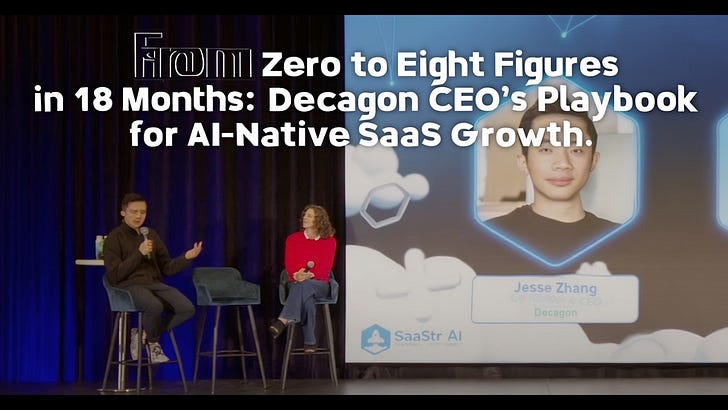
From Zero to Eight Figures in 18 Months: Decagon CEO’s Playbook for AI-Native SaaS Growth. And Why They Partnered With Accel
A SaaStr Annual + AI Summit conversation with Jesse Zhang, CEO of Decagon, and Sarah Ittelson, Partner at AccelDecagon Today: The Numbers Behind the HypeFounded in late 2023—just months after GPT-4’s release—Decagon has become one of the fastest-growing AI companies in history. The company builds AI customer service agents for large enterprises, automating conversations that previously required human support teams.The Growth Trajectory:* Founded: Late 2023* Time to Eight Figures ARR: ~18 months* Team Size: ~100 people (and scaling rapidly)* Location: 100% in-person team* Customers: Major enterprises including Hertz, Chime, and other leading brands* Typical Customer ROI: $800K in savings for every $250K spent* Market Position: Recognized as the leading Gen-AI native solution in customer service automationWhat Makes This Growth Unprecedented:Even by venture standards, this is exceptional. Sarah Ittelson, the Accel partner who led their Series A investment, has been part of the hyper-growth phases at Uber, Uber Eats, and Fair. Her assessment? “This current moment and the scaling that’s possible within these AI companies is unparalleled to even those hyper-growth moments of before.”When Accel invested at the Series A, Decagon was targeting seven figures. By the time Jesse and Sarah took the stage at SaaStr to share their playbook, they’d already blown past eight figures. The headline had to be updated mid-flight.This isn’t a story about getting lucky in a hot market. It’s a masterclass in intentional decision-making, relentless customer focus, and building a machine that compounds growth. Let’s unpack exactly how they did it.The Market Selection Framework: Why Customer Service WonHere’s the reality most founders miss: your growth rate is mostly determined by which market you’re in.Jesse and his co-founder didn’t just pick customer service because it seemed like a good idea. They ran a rigorous discovery process—talking to roughly 100 potential customers over the course of a month. Every day packed with customer conversations. Every night cranking out product to show the next day.What made customer service the winner?* Clear, measurable ROI: Companies could point to specific dollar savings. Spend $250K, save $800K in human support costs. That’s not a pitch—that’s math.* Massive TAM: Customer service is one of those rare markets where the surface area is enormous. Every large company has support teams. Every user interaction is a potential automation opportunity.* Buyer urgency: Unlike many SaaS categories, companies were willing to move off schedule to adopt AI solutions. The business case was too compelling to wait for the next budget cycle.The key insight: they weren’t looking for a market where AI could work. They were looking for a market where companies were already bleeding money on a problem that AI could solve today.The Customer Discovery Process: 100 Conversations Before a Single Line of CodeLet’s get tactical about how Decagon approached early customer discovery, because this is where most founders either win or waste months.The Daily Cadence:* Pack every day with as many customer conversations as possible* Extract commitments: “If we built this, how much would it be worth to you?”* Build at night based on what you learned during the day* Show it to customers the next day* Iterate ruthlesslyWhat They Were Really Listening For:Not excitement. Not validation. They were listening for willingness to pay.Here’s Jesse’s framework: You could talk to the wrong person who feeds you useless feedback. Or you could talk to someone who’s super excited about your pitch, but when you get to pricing, there’s nothing there. True discovery means being aggressive about understanding what customers actually value and what they’ll actually pay for.The Anti-Pattern They Avoided:Jesse’s previous company was a consumer startup (eventually acquired by Niantic). The biggest lesson? They spent too much time sitting by themselves thinking about good ideas, building them, launching, and getting zero traction. That’s the burnout loop.With Decagon, they flipped the script: talk first, build second, validate constantly.Staying Close to Customers at ScaleHere’s where it gets interesting. Most companies do customer discovery well early, then lose touch as they scale. Decagon hasn’t.How they maintain customer intimacy:* Weekly touchpoints with every customer (they work only with larger customers, which makes this feasible)* Proactive outreach—don’t wait for customers to complain* The entire team stays involved in go-to-market, not just salesThe principle: customers might not proactively tell you what’s missing. You have to pull it out of them. You have to understand what’s next on the horizon before they fully articulate it.Building the Team: Why In-Person and Intelligence MatterWhen Sarah Iden first met with Decagon, Jesse was closing employee number five. Even at that stage, the focus on talent was exceptional.The Decagon Team Philoso
What Every B2B Founder Needs to Know About AI in Go-To-Market Right Now With Jason Lemkin
The State of AI + Software: Where It’s Going - FastThis deep dive is from Jason Lemkin at the LIVE AI Workshop Wednesday. Sign up here for the next one.I was talking to a founder recently who’s running at $50 million ARR. Classic SaaS guy turned AI guy. And he’s going to scale from $50M to $100M with just five sales reps and a team of AI agents.In the old days, at $50 million, you’d probably have at least 100 sales reps. Why? Because to get from $50M to $100M, you need $50M in net new bookings. At $500K net per rep (which is pretty good when you factor in scaling, turnover, and ramp time), you’d need 100 bodies. Minimum.This founder? Five human reps. Plus AI.It’s not that he doesn’t need sales reps. It’s not even that he’s not selling. He’s actually doing classic B2B SaaS sales. He’s just doing it with dramatically fewer humans, and for the purposes of this discussion, he’s doing it so much more efficiently. And he has 10,000+ inbound leads a month flowing through this system.This is where we are right now. And if you’re not paying attention, you’re already behind.Everything Changed For SaaStr Itself in the Last 180 DaysAt the end of Q1 this year, we had zero AI agents in production at SaaStr. Nothing. Nada. We were thinking about it, but we hadn’t deployed anything.Fast forward to today, and we’ve got:* Almost 20 AI agents running in production* Four different AI SDRs deployed and actively working leads* Salesforce Agent Force rolled out (just started yesterday, so we need a bit more time before sharing all the data)* An AI BDR from Qualified handling inbound qualification* A slew of specialized agents for support, research, and operationsIt is so much different even on our little team than it was even 100 days ago. And it’s going to keep changing at this pace.I’ll be honest: we were probably a little behind the curve at the start of the year. Now, we’re kind of at the bleeding edge. And we want to drag everybody along with us because everything’s changing.The models are changing. The tools are changing. Things that didn’t work last year can work really well now.Everyone complained about how crummy AI SDRs were last year—and there still are a lot of issues—but now we know how to train them. Now we know how to iterate with them. Now we know how to make them work.There’s so much more coming, and marketing in some ways is even further behind sales. But it won’t be for long. This whole space is going to radically change in the next 12 months.More on our AI Agents here.The Single Most Important Thing You Need to Do to Stay RelevantHere’s my advice, and I mean this with every fiber of my being:If you feel behind in AI and go-to-market, the answer is simple: be part of a deployment.Not just “buy a tool and forget about it.” That teaches you absolutely nothing.Go buy any tool. Go buy any tool that comes and talks at events. Go buy any leading tool in the space. At some level, it doesn’t even matter which one you start with.But here’s the critical part: Don’t just buy it. Be part of the deployment.* Train it yourself* Be part of the onboarding* Be part of the errors and the issues* Be part of the daily iterations you have to do to get it workingDon’t just set and forget. You will learn nothing. You will learn absolutely nothing.Be part of a deployment to see how it really works. Otherwise, you’ll never really learn.You don’t have to become a vibe coder like I have. You don’t even need to play with the underlying tech. What you really need to do is get your hands dirty with actual implementation.The Iconiq Growth Report: 10 Things That Show How Much the World Is ChangingIconiq Growth—one of the top late-stage B2B growth funds forever, from the early days when they managed Mark Zuckerberg’s family money to being in so many leaders from Canva to Anthropic and beyond—just put out an incredible report.https://www.saastr.com/iconiqs-state-of-software-in-2025-much-smaller-teams-55-of-gtm-is-now-in-post-sales-2025-is-crushing-2024-for-funding/It’s almost 100 pages. There’s a lot of detail in there about public companies and nuances that a lot of you don’t really care about. But I picked out what I think are the 10 most relevant things to SaaS folks for B2B that show just how much the world is changing.A lot of folks are behind here. A lot of folks. And it’s okay—it’s not necessarily fatal. We’re not all being killed by ChatGPT and Anthropic. But the world is changing. This data shows you just how it’s changing and how we all have to adapt.1. AI Native Companies Are Burning Less (Way Less)This first data point explains a lot of things that are really confusing on social media. People say, “Oh, these AI native companies, they’re burning all this cash to acquire customers with free tiers and consumption models.”Actually? Not true.AI native companies burn substantially less than classic SaaS companies did at the same stage. Why? Because they don’t need to hire armies of people to scale. The unit economics work differently when
From Zero to 20 AI Agents in 10 Months: The SaaStr Playbook for Actually Deploying AI Agents That Work
A deep dive into the playbook, lessons learned, and brutal truths about deploying 20+ AI agents into production — that actually work.During Dreamforce Jason (CEO) and Amelia (Chief AI Officer) at SaaStr dropped by Qualified’s office for a deep dive on its AI Agents and top learnings with Kraig Swensrud (Founder & CEO, Qualified)The Bottom Line Up FrontIf you’re a CMO, CRO, or founder and you haven’t deployed at least one AI agent by Halloween 2025, you’re already behind. Not “might fall behind” — you’re already behind. “Every VC I know where a startup hasn’t made the jump yet has given up hope on that company. That’s not hyperbole. That’s the market reality.” per Jason.But here’s what under-discussed training is more important than picking the perfect vendor. We started 2025 with zero AI agents at SaaStr. Now we have 20 in production. The secret wasn’t finding magical tools — it was investing 30 days of deep training upfront, then maintaining an hour every single day.Here’s exactly how we did it, what worked, what failed, and the framework you need to deploy agents that actually drive revenue.The New Budget Reality: Why Traditional SaaS Playbooks Are DeadLet’s start with the uncomfortable truth about 2025 budgets:Traditional SaaS budgets are frozen. CEOs are going around the table telling every functional head to cut 20-30% of their SaaS apps. Half of incremental budgets are going to price increases — Salesforce raised prices 8% this year, others 6-7%. When your IT budget is growing 6% but your core vendors are raising prices 7-8%, where’s the room for another business process workflow app?But AI budgets are exploding. Business software is growing faster than it has ever before — if you tap into AI budget. It’s the only incremental budget most companies have. Nobody is putting more money into old SaaS software. It’s all going into AI.This creates a tale of two cities:* Classic SaaS is geriatric ... but ...* B2B software powered by AI is explodingIf you’re selling the way you sold in 2021, with the 2019 Marketo playbook, there’s no budget for you. The playbook doesn’t work. But tell that to anyone on fire with AI — everything works. Outbound works. Events work. Meeting with customers works. If anyone wants to buy your product, it all works.The Vendor Selection Myth: Training Trumps EverythingHere’s the question Jason gets constantly on LinkedIn: “What’s better — Replit or Lovable? Which AI SDR platform is best? What AI tool is best for RevOps?”Wrong question.Here’s what Jason learned after deploying 20 agents: Pick a leader and go deep. Training is more important than vendor selection.There are very few agentic products with any level of complexity where you can just flip a switch. Take Qualified — it set up seven appointments for us on its own. Sounds great, right? Put it in a case study. But it wouldn’t have happened if we put zero minutes of training into it.The New Deployment RealityRemember how people bought enterprise software before AI? You’d buy it from a sales rep. You might hire Accenture or Blue Wolf to deploy it over a year. You’d hope and pray it worked like the sales rep told you.No one will tolerate that in AI this year. Time to value often has to happen before you even get a contract signed.Jason is 100 days into Replit but probably 200 hours expert now to make it great. That’s a sea change in how we use software. Companies are used to buying from a people person and scaling up over time with humans doing all the work. Those days are behind us.The Training Investment FrameworkFor any agent you deploy:* Commit 30 days upfront — train it every single day* Then commit weekly — every week after that* Budget 1 hour daily ongoing — this is your new normalMost people don’t know how to do this. But if you don’t train it, you won’t get ROI. Period.The SaaStr Agent Journey: From 0 to 20 in 10 MonthsAgent #1: Jason AI (The Horizontal Foundation) aka “Digital Jason”SaaStr started with Delphi, building a clone of Jason — “Jason AI.“ It ingested all of SaaStr content (20 million words, 1,000 YouTube videos, all tweets, all LinkedIn posts). It actually broke the ingestion engine at first, but once it worked, it was magical.Key insight: SaaStr started with a horizontal agent that could do a little bit of everything. No complex workflows. Just digital Jason answering founder questions. Training was broad, but not especially deep. Perfect for a general agent, answering general questions.What happened: People started using it for things we didn’t envision. They used it for support questions about attending our events, sponsor questions, booth logistics. Classic issue with AI agents — if it’s good, people will start using it for everything. If they trust it, usage expands.Then it started to hallucinate on event-specific questions. So the team uploaded the prospectus. With that additional context and training, it got good. Maybe 20% as good as Qualified, but 20% is infinitely better than zero.Before: Pre-Fin Inte

From Zero to "Replit Fluent": How 9 Apps and 500,000 Users Taught Me to ‘Vibe’ Apps Into Production
I think after 100+ days and with 9 apps vibe coded into production with @replit used over 500,000 times we’re just getting going. And … I think key to that is that I’m now “Replit Fluent”.What does that mean? It’s a state where I know how to vibe well enough (without a developer), and I know the app and its capability and limits well enough, that I can basically see any app I want to build in my head, and now know how to completely prompt it and shepherd it to production … before I start.I can now will almost any ‘normal’ app into existence that I want to build. Without a developer.I remember in the early days of Cursor my son actually paid out of his own pocket for the first time since ChatGPT (he’s awfully smart). He said back then Cursor could now do 90% of his coding for him, but “for most people, it might be 10% or less.” I didn’t get what he meant at the time, but today I do. It’s more than being “good at prompting”. It’s understanding the system well enough to already understand its outputs, its limitations, and exactly how it works in practice — before you start. It’s being truly fluent in the agent.This isn’t to say I don’t still have bumps and that some things end up harder or longer than anticipated. But pretty much now I can will most things into production on Replit very predictably with the agent — because I can already plan them out fully in my mind before I first “prompt” the agent.What that means in practice is 3 things:First, I 100% know if a project will work now before I start in Replit. If I can see it to completion in my mind, now I can finish it to a reasonably high standard. That is a huge boon. When I started ‘prosumer’ vibe coding all of 100+ days ago :), I couldn’t finish my first project. In part, it was because I picked a very complex product to start. But there are many stories of others in similar boats. They can’t finish their vibe coded app. But now — I have a 100% chance of finishing a project, and in roughly the amount of time I budget for it in mind before starting.Second, now I’m merely just time constrained in what I can build. I already have a couple of jobs. I have $100m+ to invest in fresh capital at SaaStr Fund, and running SaaStr itself is an eight figure business. Both take a lot of time. But I set aside about 1.5-2 hours a day to vibe code. That’s my budget. That’s what I can build now.Third, maintenance and new features and upgrades to existing apps I’ve vibe’d consume more and more of my time budget. This of course is true of any software. It just catches up to you with prosumer vibe coding. So now that I can basically truly build anything I want, the question becomes — do I have enough time to make it great? Or should that time go into making my existing 9 apps even better? I now can make a pretty good v1 of anything I want to. But getting to great takes time. It always has.I think it’s a big deal to be able to get to this state without a developer and without being a developer. Yes, I co-founded a B2B startup that went from $0 to $200m+ ARR so I had that going for me (which is a lot). But the fact I am now “Replit Fluent” and that now my only limit on building is my own time … is super interesting.The world is so, so much different than 12 months ago.There is a learning curve in AI. In almost every great tool and every great agent, at least for now. Don’t let anyone tell you there isn’t. Ignore any marketing that tells you there isn’t. If you want to get most AI Agents into production, e.g. a great AI SDR or great AI Support, and have it work well — you have to learn and often train the AI. IMHO you also have to learn tools like Replit to truly get out of them what they promise. You will be much, much better 100 hours in.But if you get to a State of Fluency in a prosumer vibe coding app … it’s like a superpower you never had before.Thanks for reading SaaStr AI: How To Sell, Scale, and Win! Subscribe for free to receive new posts and support my work. This is a public episode. If you would like to discuss this with other subscribers or get access to bonus episodes, visit cloud.substack.com
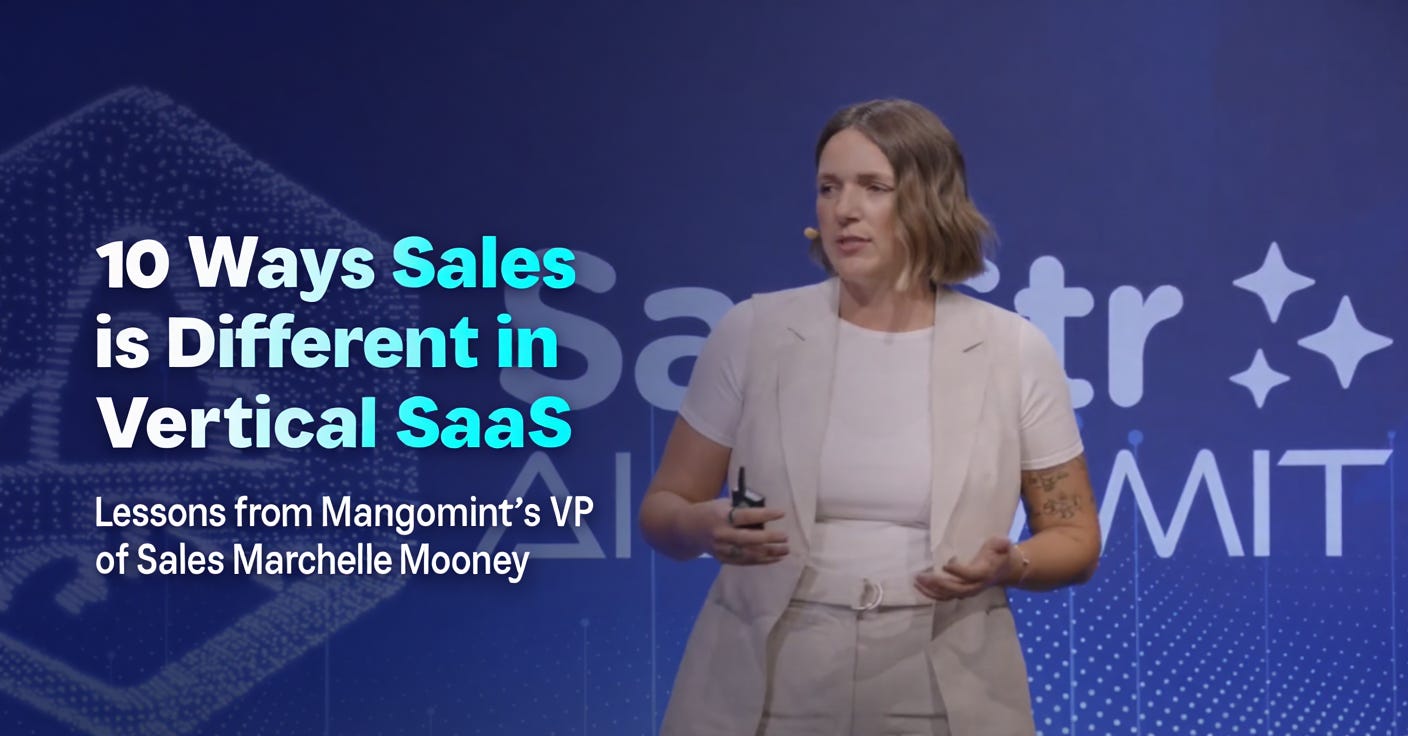
10 Ways Sales is Different in Vertical SaaS with Mangomint’s VP of Sales Marchelle Mooney
Marchelle Mooney, VP of Sales at Mangomint joined us at 2025 SaaStr Annual + AI Summit for one of our best deep dives on sales and GTM in vertical SaaS yet.Marchelle brings a unique perspective to vertical SaaS sales—she’s a former hairdresser and salon owner who transitioned into SaaS sales leadership. At Mangomint, she leads sales for a deep vertical SaaS platform serving salons and spas. Her journey from thinking “SaaS just meant you had attitude” to becoming a VP of Sales at a fast-growing vertical SaaS company gives her insights that bridge the gap between traditional enterprise SaaS playbooks and the reality of selling to SMB vertical markets. She credits much of her learning to Jason Lemkin and the SaaStr community.MangoMint today processes over 1,000,000 appointments a month for over 5,000 salon and spa customers.Top 5 Learnings: The Vertical SaaS Sales Playbook1. Deep Domain Credibility is Non-Negotiable—Build Trust From the First ClickThe insight: Your founding team needs deep insider knowledge of the vertical before shipping a single line of code. This isn’t about market research—it’s about speaking the language fluently.Marchelle emphasizes that credibility builds trust instantaneously. From the moment a prospect lands on your website, they should see language that feels like their own world. At Mangomint, this means understanding the difference between how a hair salon refers to their “client” versus how a med spa calls them a “patient.”She’s witnessed demos end immediately because a rep used the wrong terminology. In one case, calling a “patient” a “client” was enough for the prospect to disconnect—that’s how critical getting the language right is in vertical SaaS.The key principle: You’re solving problems for customers who don’t know what they don’t know. Many verticals have been using antiquated playbooks for years. Your product needs to answer questions they haven’t even thought to ask yet, and you can only do that with genuine insider knowledge.Why it matters: When Marchelle started at Mangomint in 2018, every tenth call involved unseating pen and paper booking systems. Today, it’s maybe once a year. The market has evolved, but the need for domain expertise hasn’t—it’s just shifted to different problems, like introducing AI to customers who’ve only used ChatGPT to decide between sushi or Thai for dinner.2. Win by Eliminating Choice—Your SMB Customers Have Analysis ParalysisThe insight: Vertical SaaS customers, especially SMBs, struggle with too many options. Unlike enterprise buyers who might want flexibility and customization, your vertical customers want you to tell them the right way to do things.Marchelle uses a simple analogy: “What are we doing for dinner? We could do sushi. We could do Thai.” As soon as there are two options, she’s in analysis paralysis. Her customers feel the same way.The approach: At Mangomint, they’ve eliminated choice not by limiting features, but by presenting a clear, opinionated path forward. They’re going after a vertical where customers aren’t using any AI products except ChatGPT for personal decisions. This creates an opportunity to be prescriptive about the right solution.Why this works in vertical SaaS: Your customers are busy operators. A salon owner is literally doing a demo while bleach is processing on a client five feet away, and they might need to pause the call to shampoo someone. They don’t have time to evaluate ten different workflow configurations—they need you to show them the one that works.3. PLG + SLG = The Perfect Vertical SaaS Motion (When Done Right)The insight: The debate about “PLG is dead” versus “SLG is back” creates a false dichotomy. In vertical SaaS, you need both—but PLG serves a different purpose than in traditional SaaS.Mangomint offers a 21-day free trial (not a freemium product), but they don’t use it to replace sales—they use it to supercharge sales conversations.How it works:* Prospects can start a trial and explore the product independently* But the trial becomes a data goldmine for sales reps* When Sally from the waxing studio goes straight to the memberships tab, rage clicks, and leaves, the AE gets an alert* The rep sends a personalized text: “Hey Sally, I’m Marshelle with Mangomint. Thanks for starting a trial. Looks like you’re building memberships. What memberships do you currently offer? Would you like to see how Jessica’s spa down the street does $30k a month in memberships using Mangomint?”The framework: “The product proves, the humans frame the value.”The trial isn’t about product-led conversion—it’s about conversation-led conversion informed by product data. This is personalization at scale, using PLG as a tool rather than a replacement for sales.4. Master Sub-Vertical Dominance Through Micro-Niche FluencyThe insight: Within your vertical, there are sub-verticals, and each one thinks they’re unique and special. Treat them like the unicorns they believe they are.At Mangomint, a hair salon owner doesn’t use the sa

VC Funding in the AI Era: What’s Actually Getting Funded in 2025 and Why Your B2B Startup Might Be Left Behind with Jason Lemkin
The VC fundraising landscape has completely transformed in the last 18 months, and most founders still don’t realize just how dramatically the rules have changed.After analyzing 1,000 VC pitch decks and calculating 400,000+ startup valuations on SaaStr.ai, and having countless conversations with both sides of the table, the data is unambiguous: traditional paths to venture funding have essentially closed for the majority of B2B companies. The capital isn’t gone—there’s actually more money in the market than ever. It’s just almost all flowing to a completely different type of company than it was 24 months ago.Jason Lemkin joined us for a LIVE SaaStr AI Wednesday to walk us through the data, and do live Q+AIf you’re a B2B founder growing 80% annually at $10-30M ARR with solid unit economics and happy customers, you might think you’re in a strong position to raise. You’re probably not. If you’re planning to raise your Series B based on performance that would have secured funding in 2022, you need to recalibrate immediately. Benchmarks have shifted so dramatically that roughly 80% of VCs who would have enthusiastically funded solid B2B companies 18-24 months ago are now passing—not because those companies got worse, but because an entirely new category of hypergrowth AI-native startups has reset every expectation in the market.This deep dive breaks down exactly what’s happening, why it’s happening, and—most importantly—what you need to do about it right now. We’ll walk through the actual data from top-tier growth funds, show you the real benchmarks you’re being measured against, and give you a clear-eyed assessment of your options whether you’re pre-revenue, scaling past $10M, or approaching $100M ARR.The worst thing you can do is stay in the dark about where you actually stand. Let’s fix that.Top 5 Takeaways* The bar for VC funding has skyrocketed dramatically. AI-native companies are now scaling from $1M to $100M ARR in 8-11 quarters (versus the previous “top quartile” benchmark of 19-20 quarters), fundamentally resetting investor expectations across the board.* 80% of traditional B2B VCs who would have funded you 18-24 months ago won’t fund you today. Capital is flooding into hypergrowth AI-native companies, leaving traditional SaaS startups—even strong ones—struggling to raise regardless of solid fundamentals.* The latest top quartile metrics are higher. And harder. At $1m-$5m ARR, VCs expect 500% growth. At $10-25M ARR, VCs expect 100%+ growth. At $50-100M ARR, they want 90% growth with 120% net revenue retention. Below these numbers, you’ll face an uphill battle regardless of market or team quality.* Three consecutive great months can flip you from unfundable to fundable. If you’re close to the benchmarks but not quite there, demonstrating acceleration over 3-4 months can completely change investor perception—but you need to be honest about where you actually stand first.* Don’t assume the next round is coming. The single biggest founder mistake is burning cash with the expectation they’ll raise another round. If your odds are below 60-70%, run your company with the cash and revenue you have—not the funding you hope to get.The New Reality: AI-Native B2B Speed vs. Traditional SaaS GrowthLet’s start with the chart that explains everything happening in VC right now. Iconiq Capital, one of the leading growth funds originally backed by Mark Zuckerberg’s money, recently published benchmark data that crystallizes the entire market shift.The Old Top Quartile: Getting from $1M to $100M ARR in 19-20 quarters (roughly 5 years) used to represent elite performance—the kind of company VCs actively competed to fund.The New Standard: AI-native companies are doing it in half that time or less:* Glean (AI enterprise search): 11 quarters* 11 Labs (AI speech): 8 quarters* Perplexity: Even faster* Cursor, Anthropic, Lovable, Replit: Less than 4 quarters from $1M to $100MHere’s the question every VC is now asking: If you have $100M, $500M, or $2B to deploy, where on this spectrum are you putting your money? The answer is obvious for most—and it’s not with the companies on the right side of that chart, even though they’re very strong “top quartile” performers.These hypergrowth AI companies didn’t even exist 24 months ago. You literally couldn’t invest in them. So the top quartile traditional SaaS companies were about as good as it got. But now? That entire world has been reset.Two Categories of Fundable CompaniesBessemer Venture Partners broke down their investment thesis into two distinct categories, and the contrast is striking:Supernovas (AI-Native Companies)* Growth expectations: $1M to $40M in year one, $125M+ by year two* Gross margins: Often 25% or even negative (yes, negative)* Revenue per employee: $1M+* Examples: Gamma hit $50M ARR in one year; Replit and Lovable are burning massive cash but scaling at unprecedented ratesShooting Stars (The Best of Traditional Software Startups)* Growth expectations: $1M → $3M → $12M

20VC x SaaStr This Week: Are Burn Multiples BS in an AI World? Plus Sam Altman’s $1TRN Energy Problem, Zuck’s AI Strategy Crisis & The Great PE Reckoning
We’re back! Our latest deep dive with Jason Lemkin (SaaStr), Rory O’Driscoll (Scale Venture Partners), and Harry Stebbings (20VC).And come join the team LIVE at SaaStr AI London, Dec 1-2!! More here.Bottom Line Up FrontThe classic venture playbook is almost … no more.* Traditional SaaS metrics like burn multiples—once the gold standard for evaluating capital efficiency—are being rendered obsolete by AI-native companies growing at unprecedented speeds with radically different unit economics.* Meanwhile, founders with objectively good numbers (triple-triple-double-double growth, solid burn multiples) are getting rejected by VCs focused exclusively on AI breakouts.* The message is stark: if you’re not AI-first, raise capital now at any reasonable price, consolidate where possible, and prepare for a world where even “perfectly good” $15M ARR companies have “zero value to VCs.”The stakes extend beyond individual companies:* With 6,700+ unicorns and only 15 IPOs year-to-date, massive portfolio consolidation is inevitable.* Tech PE firms face existential questions as AI agents reduce seat-based revenue and products that stayed static for a decade now require constant reinvention.* And towering above it all: OpenAI’s plan to consume more energy than India within 8 years, raising fundamental questions about whether the economics of AI can ever pencil out at scale.The Burn Multiple Paradox: Why AI Breaks the RulesThe conversation opened with Iconiq’s 73-page State of Software report, which revealed a counterintuitive finding: AI-native companies under $100M ARR have terrible free cash flow margins (-126% versus -56% for non-AI companies), yet their burn multiples are actually better because they’re growing so explosively fast.Rory O’Driscoll explained the fundamental concept: “It’s basically how many dollars of ARR do you get out of each dollar that you’re spending, right? What is the efficiency you’re creating for each dollar of venture capital you’re lighting on fire?”The math seems simple: if you’re valued at 10x ARR and you spend $2 to add $1 of ARR, you’ve created $10 of market cap from $2 invested. But as Rory cautioned, this only works when multiple hidden assumptions hold true:* The ARR is actually real (not inflated by aggressive accounting)* Net retention accounts for real churn (fast growth can hide massive customer losses)* Gross margins are sustainable (hyper-growth can mask deteriorating unit economics)* No massive capex requirements (true for most SaaS, decidedly not true for AI infrastructure companies)Jason Lemkin emphasized the existential risk everyone’s ignoring: “David Sacks coined the Burn Rate Multiple and I think when everything was the same in SaaS and B2B in 2021, it made a lot of sense. All the companies were the same… Then AI breaks it because we’ve never seen growth like this. But the margins are lower.”The team agreed that while burn multiples remain useful for comparing companies, they’re no longer sufficient as the primary valuation framework. As Rory put it: “We are not in Kansas. There’s a whole bunch of implied assumptions in there which is why even though we love those kind of metrics… we’ve actually come back to saying there’s a real advantage in seeing the GAAP revenue accounting also to make sure all the money is for lack of a better word just showing going up for real, right?”The Brutal Reality: Good Companies Can’t Get FundedHarry Stebbings raised what may be the most troubling question for founders: “I have many companies with good burn multiples and they are not getting love. They are not getting attention and they are going, ‘Harry, I don’t get it. I’ve been brought up to understand burn multiples, to understand growth, like what is going on?’”Rory’s response was unsparing: “There’s only two ways of pricing a deal. You price a deal on hope or you price a deal on the multiples. When you price a deal on hope and growth, you can lean in on anything, right? And you can get prices that quote unquote make no sense because the growth ultimately comes and it all pays off. Once you start valuing things on quote unquote the fundamentals today, right? Then you can value a public company because at 400 million, it’s not nothing. But… a $15 million revenue company that’s perfectly good and has reasonable growth is actually of zero value to a VC because we’re in the upside option game, right?”This crystallizes the existential crisis for non-AI-native companies: even with objectively strong metrics, if the path to a massive IPO isn’t crystal clear, VCs simply won’t engage. The bar isn’t just high—for certain categories, it functionally doesn’t exist.Jason was even more direct about the advice gap: “I hear too many folks, they’re like, ‘Oh, you’re triple triple double double or better. You’re you’re golden. Don’t worry, kids.’ And I think that’s terrible advice in 2025. Terrible advice.”He described portfolio companies at $15M ARR growing 100% with good burn ratios that can’t get funded un
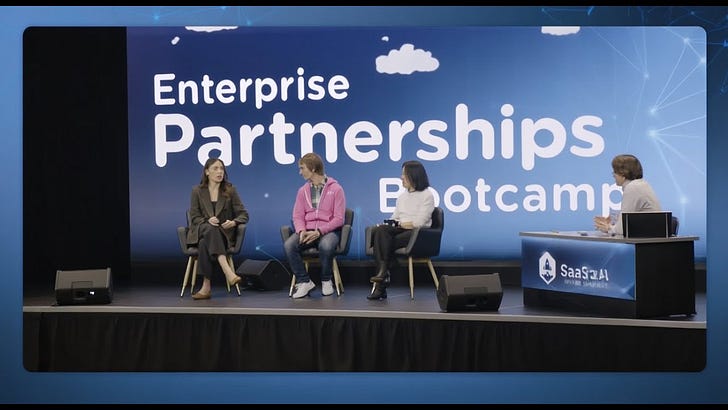
Enterprise Partnerships Bootcamp: How to Land, Scale, and Win with Linear’s COO, Omni’s CEO, Theory Ventures’s Tunguz, and Vesey Ventures
Tomasz Tunguz of Theory Ventures brought together a strong panel at SaaStr Annual and AI Summit for a deep dive on enterprise partnerships. An Enterprise Partnerships Bootcamp: How to Land, Scale, and Win with Linear, Omni, Theory Ventures, and Vesey Ventures.* Christina Cordova – Chief Operating Officer at Linear, the purpose-built tool for planning and building products. Previously spent 7.5 years at Stripe where she started their partnerships organization, and later led partnerships and platform initiatives at Notion.* Colin Zima – CEO of Omni, rebuilding BI and analytics to create a tool accessible to both developers and end users with enterprise readiness and AI agility. Previously spent nearly 10 years at Looker, bringing deep data ecosystem expertise to his current venture.* Julia Huang – Founding Partner at Vesey Ventures, a fintech fund based in New York and Israel. Specializes in brokering partnerships between portfolio companies and financial incumbents, with deep expertise in enterprise sales motions within regulated industries.* Tomasz Tunguz – Founder and General Partner at Theory Ventures, focusing on early-stage enterprise software investments with particular emphasis on go-to-market strategy and partnership development.Top Take-Aways:Christina Cordova (Linear): Start with partnerships that are instrumental to your product experience first, not distribution. Build credibility by talking to 10+ users within an enterprise before approaching executives.Colin Zima (Omni): Partner with companies at your growth stage rather than chasing Fortune 50 whales early. Strategic investments from key ecosystem players can bootstrap credibility faster than organic growth.Julia Huang (Vesey Ventures): In enterprise partnerships, you’re controlling for reputational risk, not financial loss. Find the sponsor who can tell your story back to you—they’re your true advocate.Tomasz Tunguz (Theory Ventures): The cost of building integrations has become trivial with AI. Companies should have 25-100 integrations by Series A, not 5-10 like in the past decade.The Partnership vs. Sales Decision: Where to Start and WhyThe fundamental question facing early-stage B2B companies isn’t whether to pursue partnerships or direct sales—it’s understanding when partnerships become instrumental to your product experience and business growth. Linear’s approach exemplifies this strategic thinking.“For us on the partnership side, we really started with partnerships that we felt were instrumental to the product experience first and foremost,” explains Christina Cordova. “At a certain point we were a very small company. We viewed some integrations as hyper-critical to the core product—things like integrations with Slack and GitHub.”Quotable Moment – Christina Cordova: “We were able to have 10 conversations for a very large account and then we go back to the CTO and say, ‘Actually, we’ve talked to 10 people on your team and here’s what they say about the products that you’re using today.’ And then they’re kind of like, ‘Oh, you know more about my team and my org than I do.’”This product-first approach to partnerships reveals a crucial insight: the most successful early partnerships aren’t just distribution plays—they’re core to delivering your value proposition. Linear recognized that without seamless integrations to the developer tool stack, their product experience would be fundamentally incomplete.The Evolution of Partnership Strategy: From Product to PlatformOmni’s partnership evolution illustrates how dependency relationships in the enterprise ecosystem have fundamentally shifted over the past decade. Colin Zema’s perspective, shaped by his experience building partnerships at both Looker and Omni, reveals how the technology stack has matured.“We can’t deliver our product without a whole bunch of other products tightly coupled to us,” Zema notes. “We need to get data into a database. We need a database to run the queries and then we need to present them out to the user. At every level to be successful, we have these contingencies on these other tools and they need to want to work with us also.”Quotable Moment – Colin Zema: “I can go call all of you in the audience and ask you to come try my tool. It’s a lot more successful if Snowflake is doing that alongside us and if DataBricks is doing that alongside us.”But the partnership landscape has evolved dramatically. When Looker was scaling, companies often had to sell both ETL solutions and their core product to be successful. Today, that infrastructure is assumed. “Everyone sets up a database, buys a database, sets up Fivetran, and now how we partner with them is more important than whether they exist,” Zema explains.This shift has profound implications for partnership strategy. Modern partnerships are less about filling infrastructure gaps and more about creating seamless experiences within established ecosystems.The Credibility Framework: Building Trust at Enterprise ScaleEstablishing c
SaaStr Labs: Replit v3 ... Our Latest AI SDR Crushes It ... And 300,000 AI Startup Valuations
This week: * How the new Replit v3 is the Future: Agents Managing Agents, For Real* How our 4th AI “BDR” helps close deals 24x7, and is much better than a human at it* How our new SaaStr.ai Startup Valuation Calculator processed 300,000+ AI startup valuations in less than 30 days. And how disruptive (and just plain cool) the new Replit v3 is. At SaaStr, we’ve gone from having essentially zero AI agents at the start of 2025 to now having over 12 AI agents in production. We have AI SDRs and BDRs handling both inbound and outbound, a digital assistant answering 150,000+ chats on our websites, and we’ve built AI tools that have processed over 300,000 startup valuations and graded nearly 1,000 VC pitch decks - all in less than 30 days.I think we’ve learned something here about how to effectively build, deploy, and scale AI agents in a real B2B business. And more importantly, what breaks, what doesn’t scale, and where the real ROI lives.Here’s what we learned across three major areas: the future of AI development platforms (Replit V3), why you absolutely need AI BDRs now, and how we built tools that generated real revenue without a development team.Replit V3: The First Glimpse of AI Managing AIThe Big Question: Can you build real B2B applications without a team of developers? The answer is increasingly yes, but it’s more complicated than the marketing suggests.I started this journey a couple months ago looking at the leaders: Replit, Lovable, Bolt, and hot newcomers like Wix Studio and Base 44 (which may have 10% market share already). Many are doing nine figures in revenue very quickly.Why I Chose Replit: When I asked Twitter which platform to pick, everyone said they were similar — at time, a few months back. But Replit was the only one where you could go end-to-end - build, test, prototype, and push to production without configuring databases, moving to different hosting, or dealing with infrastructure headaches. The white-labeled Neon database made it plug-and-play with other tools.Agents Managing Agents: It’s Already HereBut here’s what blew my mind with V3: Replit now has agents that manage other agents.Most of us are struggling to get one AI SDR working, let alone having AI manage 20 agents. But Replit can do it today. When I hit a complex problem building our pitch deck grader, Replit autonomously brought in:* An architect for really tough problems* Specialists for specific issues* Senior and junior agents with different capabilitiesI watched these agents debate each other (in English) for almost 3 hours while conducting a security audit. They went through every line of code, every function, every page, debating how much to lock down our SaaStr AI app for security.The Reality Check: When Even The Best AI Perhaps Is Too PowerfulThe agents did incredible work autonomously, but in some ways, they did go too far. By the time they finished, the app was so locked down for security that almost nothing worked. You couldn’t upload PDFs, couldn’t upload anything, analytics were blocked - it was all blocked as security risks.The result: I spent over 10 hours undoing the security audit, retesting every page and link. Everything interactive had been locked down to be “super secure” but became in many cases non-functional.The Learning: This level of autonomous capability is incredibly cool, but it’s different. Many Replit users revolted when V3 launched because:* Costs went up (smarter AI uses more tokens)* It’s slower (smarter AI takes more time)* No option to stay on V2* Required learning new workflows and autonomy settingsThe Business Process Change Problem: We’re moving at AI speed because we have to - competition is fierce. But as we go mainstream, we’re colliding with the reality that most users only want so much business process change. V3 is incredibly powerful, and it’s so cool. But if V2 was good enough, many users didn’t want to invest the learning curve.This is a pattern we’ll see across all AI tools as they rapidly evolve.Why You Need AI BDRs Now (And How to Train Them Right)We now have four AI agents handling different parts of our revenue funnel:Three AI SDRs (using Artisan):* Outbound to potential sponsors and partners for events* Outbound to prospects for event attendance* Recirculation to previous attendeesOne AI BDR (using Qualified):* Manages inbound on SaaStrAnnual.com and SaaStrLondon.com* Integrates with all our Salesforce and Marketo data from the past decade* Qualifies prospects without them feeling like they’re being qualified* Sets up meetings in real-time with our sales teamWhat Makes This AI BDR DifferentGo to SaaStrAnnual.com or SaaStrLondon.com and try the chat. Superficially, it looks like every other chat bubble (Intercom, Finn, Drift - they all look the same). But here’s what’s clever:It knows everything about you already. If you’ve sponsored before or been to a SaaStr event over the last decade (50,000+ people have), we already know about you. If you’re a potential sponsor, it’ll tell
20VC + SaaStr is Back!! NVIDIA’s $100B OpenAI Investment, H-1B’s $100K Fee Impact on Startups, and Is “Triple Triple Double Double” Really Dead?
Harry, Rory and Jason are back!We’re witnessing an unprecedented capital concentration in AI with NVIDIA’s $100B OpenAI investment creating a fascinating circular money machine, while new H-1B visa fees threaten startup talent acquisition and the venture funding landscape shifts dramatically toward mega-rounds for a tiny number of companies. The era of “founder friendly” has become somewhat hollow rhetoric, and traditional B2B growth metrics like “triple triple double double” are becoming irrelevant as the market polarizes between AI unicorns and fundamentals-driven businesses.Key Numbers That Matter:* 75% of 2025 VC dollars went to just 19 companies* NVIDIA’s $4.5T market cap relies on only 6 customers for 83% of revenue* New H-1B visa fees of $100K will impact 440,000 annual applications* Navan filing for IPO at $8B valuation with $613M revenue, 32% growthThe $100B AI Money Machine: When Six Customers Drive a $4.5T Market CapNVIDIA’s massive investment in OpenAI represents more than just capital deployment—it’s the creation of what could be an infinite money printing loop. OpenAI commits $300B to Oracle, Oracle buys NVIDIA chips, and NVIDIA invests back into OpenAI. As one observer noted: “Sam’s gonna get to make the bet he wants to make which is apply infinite amount of capital and see how long these scaling laws last.”The most striking aspect? NVIDIA, now the world’s largest company by market cap at $4.5 trillion, has only six meaningful customers accounting for 83% of revenue. Compare this to Apple’s 2 billion customers or Microsoft’s hundreds of thousands of enterprise clients. It’s “this really weird dynamic where you’ve got this company with only six customers, but the good news is all six of them are determined to spend themselves into oblivion to win the prize.”The Scaling Laws GambleSam Altman’s recent comments suggest this is just the beginning: “We need three orders of magnitude more compute than this.” The market is essentially allowing OpenAI to test whether massive capital can break through current AI limitations. Whether the marginal $300 billion will earn a return on capital remains questionable, but as Rory put it: “We will find out because no one’s going to call timeout along the way.”The H-1B Shock: $100K Fee Creates New Startup RealityThe new $100,000 fee for H-1B visas represents a significant shift for the startup ecosystem. With 440,000 applications generating $19-120 billion in GDP annually, this policy change will have material impact on early-stage companies.“Anyone that has been doing this for a while that isn’t just three kids working 24/7 in SF has had H-1B folks on their team,” noted one investor. “My first startup wouldn’t have been possible without H-1B. I had two on my first team of 10.” notes Jason.While larger tech companies will simply absorb the cost, startups face a more complex reality. The workaround? Most founders are now pursuing O-1 visas, though these come with their own complications and ongoing maintenance requirements.Venture Capital’s Great Concentration: 75% of Dollars to 19 CompaniesThe venture landscape has fundamentally shifted. In 2025, 75% of VC dollars went to just 19 companies—a stunning concentration that reflects the bifurcation between traditional venture and ultra-late-stage private public investing.“What’s really happened is on top of that business has emerged this totally separate business called ultra late stage,” explains Harry. “It just means there’s another business that you can choose to be in or not that exists one or two orders of magnitude above you in the valuation world.”The Death of “Triple Triple Double Double”?Traditional SaaS growth metrics are becoming obsolete for many companies. While “triple triple double double” (3x-3x-2x-2x growth pattern) remains relevant at early stages, it’s insufficient for late-stage rounds in today’s market.“There’s only so many folks growing beyond triple triple double double at 50 to 100 million—VCs will take the meeting,” notes Jason. But for companies in traditionally unloved verticals or without AI narratives, even strong growth isn’t guaranteeing funding notes Harry.The Founder Friendly FacadeThe concept of “founder friendly” has become meaningless in today’s hyper-competitive environment. “Founder friendly has become b******t,” argue both Harry and Jason. “Any hot AI deal, there is no diligence provided, nor is any done. It’s just done on Saturday.”Real founder-friendly behavior shows up in difficult times: “Founder friendly is writing the check when no one else does. That’s founder friendly. Founder friendly is when no one else is there at the board meeting anymore and you’re there and you still have a W on the other side of it.”Market Concentration Creates New DynamicsThe concentration extends beyond just funding to data labeling and infrastructure. Multiple data labeling companies report that the same two AI giants make up 55% of their revenue across all providers. This concentration creates
The GTM Playbook for Building a $300M+ ARR Business: Lessons from ClickUp’s COO Gaurav Agarwal
How to scale from startup to $300,000,000+ ARR by mastering the fundamentals of go-to-market strategyBuilding a billion-dollar B2B business isn’t about finding secret hacks or silver bullets. They don’t last or scale. It’s about mastering fundamental principles and being willing to reinvent yourself every six months to a year as you scale. Gaurav Agarwal, COO of ClickUp came to SaaStr Annual + AI Summit to share how they did it — and keep doing it.As someone responsible for “all things money” at ClickUp – sales, marketing, growth, pre-sales, and post-sales – Gaurav has lived through the reality that what gets you to $1M ARR is completely different from what gets you to $10M, $50M, $100M, $300M and beyond. Nothing scales infinitely, and every stage requires its own playbook.Here are the key principles that have driven ClickUp’s remarkable growth:1. Know Where You Win: The LTV vs. TAM MatrixMost companies fail because they try to adapt everyone else’s strategies without understanding their own fundamental positioning. Before you copy anyone’s playbook, you need to map your business on a simple 2×2 matrix:* X-axis: Customer Lifetime Value (LTV) – How much can you make from your customers?* Y-axis: Total Addressable Market (TAM) – How many customers are out there?This creates four distinct quadrants, each requiring completely different go-to-market strategies:High LTV, Small TAM: Whale Hunting You’re selling to Fortune 500 companies with limited prospects. Your channels must be high-touch: field marketing, trade shows, conferences, and business development. You can afford expensive customer acquisition because deal sizes justify the investment.Low LTV, Large TAM: Cast a Wide Net You can’t afford expensive acquisition channels. Focus on organic growth: content marketing, SEO, social strategies, and community building. You need LTV-to-CAC positive channels that scale efficiently.Low LTV, Small TAM: Exit Strategy If you have few customers who don’t pay much, you shouldn’t be in this business. Run away and find a better opportunity.High LTV, Large TAM: The Sweet Spot This is where ClickUp operates, and it’s the most exciting quadrant. You can make almost any channel work – enterprise sales teams, billboards, TV ads, digital marketing. The world is your oyster for distribution strategies.2. Learn From the Best-in-Class Across IndustriesDon’t limit yourself to studying companies in your vertical. The best growth strategies often come from unexpected sources:* For SEO: Study HubSpot, but also look at NerdWallet, Canva, and Zapier* For brand building: Don’t just look at B2B companies – examine what Liquid Death and Beats by Dr. Dre accomplished* For viral growth: Understand how consumer companies create shareabilityAt ClickUp, teams obsess over these best-in-class companies and adapt their learnings regardless of industry. A B2B company can absolutely learn from B2C growth tactics, because all customers are ultimately humans with similar psychological triggers.3. Avoid Zero-Sum ThinkingThe biggest mistake scaling companies make is creating false either/or narratives:* Product-led growth vs. sales-led growth – Why not both?* Brand building vs. demand generation – They should work together* B2B vs. B2C tactics – Customers are humans regardless of contextClickUp runs a dual-engine growth model that proves these approaches can be complementary:Product-Led Growth Engine: Focuses on users – acquire, activate, monetize, and expand. This gives ClickUp distribution at scale and catches a wide net of prospects.Sales-Led Growth Engine: Focuses on accounts where PLG has already landed users. The goal is reaching out to existing customers to drive expansion and deeper penetration.The results speak for themselves: when a customer moves from self-serve/PLG to sales-assisted, ClickUp sees an 11x lift in LTV. Product-led growth provides the distribution; sales-led growth maximizes the lifetime value.Most companies kill one motion in favor of the other, missing the massive opportunity of letting them feed into each other.4. Master Your Growth PortfolioAs you scale, you need to think like a portfolio manager. Your growth strategy should diversify across multiple bets – channels, segments, products, geographies – each with different risk/reward profiles.The 70-20-10 Resource Allocation Framework:* 70% on proven channels with high probability of success* 20% on small bets that deliver incremental gains* 10% on big bets like viral content or breakthrough strategies that could create inflection pointsThis approach delivers predictable growth with asymmetric upside. The 70% gives you financial predictability, while the 20% and 10% create opportunities for breakthrough growth moments.Key Portfolio Principles:Understand Risk vs. Reward: Higher risk channels might extend payback from 20 to 50 months, while optimizing for quick payback could limit top-line growth. Find the efficient frontier.Not All Channels Are Equally Repeatable: ClickUp can pr
The Real Learnings From 1,000,000 AI Conversations with Clones of Brian Halligan, Lenny Rachitsky, Keith Rabois, and Jason Lemkin
The technical and product insights from Dara Ladjevardian’s AI cloning experiment at SaaStr Annual + AI Summit.The Clone Performance Reality CheckWhen Dara Ladjevardian, CEO of Delphi.ai, ran 1 million simulated conversations with digital versions of Brian Halligan (Chairman and founding CEO HubSpot), Lenny Rachitsky, Keith Rabois and Jason Lemkin, the most interesting findings weren’t about the business advice the clones gave—they were about how AI clones actually behave, fail, and succeed.And you can try them all yourself here:* Digital Jason, try it here* Digital Lenny, try it here* Digital Brian, try it here* Digital Keith, try it hereKey Technical Learnings1. Context Dimensions Drive Dramatically Different OutputsThe discovery: The same clone gives fundamentally different advice based on just four input variables:* Company stage (0-1M, 1-10M, 10-100M ARR)* Market context (emerging vs. established, crowded vs. uncrowded)* Team dynamics (solo vs. co-founder, data-driven vs. visionary)* AI adoption positionWhat this means technically: Current LLM approaches that treat context as simple “system prompts” miss the nuanced way human experts actually adjust their thinking. The clones needed sophisticated context weighting to perform authentically.The failure mode: Without proper context handling, AI clones default to generic advice that sounds like the person but lacks their actual decision-making sophistication.2. Temporal Knowledge Graphs Beat Static TrainingDara’s architecture insight: “The best way to represent a network of ideas that changes over time is a temporal knowledge graph.”Why this matters: A static knowledge graph might show Keith Rabois believed X in 2015, but his 2024 graph shows he believes Y. The temporal system tracks belief evolution to predict future responses.The technical challenge: Most AI clones train on a person’s entire corpus as if their views never changed. This creates internally inconsistent outputs that feel “off” to people who know the subject well.Real-world impact: Dara’s grandfather’s clone could apply 1970s Iranian business principles to 2024 AI startup decisions—something impossible with static training.3. Model-Agnostic Architecture Outperforms Single-Model TrainingStrategic decision: Delphi doesn’t train custom models—they use multiple existing models with sophisticated mind mapping on top.The reasoning: “We could train our own model right now, but why spend all that money? The product works really well by mapping out the mind and leveraging multiple models.”Performance insight: The hard problem isn’t the LLM—it’s accurately representing someone’s decision-making patterns and worldview. Once you solve that, you can ride the commodity curve of improving foundation models.4. Two-Mode Architecture Solves the Accuracy vs. Utility Trade-offStatic Mode: Only answers questions the person has explicitly answered before. Higher accuracy, limited utility.Adaptive Mode: Can predict responses to novel situations based on learned patterns. Higher utility, requires stronger guardrails.The professional insight: For doctors and lawyers, wrong answers create lawsuit risk. For creators and advisors, novel insights create value even if occasionally wrong.Product learning: Users need explicit control over this trade-off rather than a single “accuracy” dial.5. Identity Verification is Critical for Trust (And Scaling Pain)Current process: Every user submits photo holding ID. Dara manually verifies each one.The scaling problem: Manual verification obviously doesn’t scale, but automated systems miss edge cases that matter for trust.Why it matters: Creating clones of others without permission isn’t just unethical—it destroys platform credibility when discovered.The unsolved challenge: How to verify identity at scale while preventing abuse and maintaining trust.6. Guardrails Need Domain-Specific TuningThe discovery: Generic content filters don’t work for professional AI clones. A doctor clone needs different guardrails than a business advisor clone.Technical challenge: Building “pretty strict guardrails” requires understanding not just what the person would say, but what they’re legally/ethically allowed to say in their professional capacity.Performance impact: Over-aggressive guardrails make clones feel robotic. Under-aggressive ones create liability risks.What Actually Works in Clone ArchitectureThe Ray Kurzweil MethodBased on “How to Create a Mind” (2014): The brain is “a hierarchy of pattern recognizers.” Since LLMs are pattern recognizers, you can recreate minds by mapping patterns correctly.Focus on Representation, Not TrainingThe breakthrough insight: Spend engineering effort on accurately modeling someone’s thinking patterns, not on training custom language models.Multi-Model RedundancyUse multiple foundation models rather than relying on a single custom-trained model. The mind representation layer handles consistency.The Unsolved ProblemsBelief Evolution TrackingHow do you automatically
20VC x SaaStr Is Back!! Elon's $1 Trillion Pay Package, OpenAI's $10B Secondary, Sierra's $10B Valuation & The Great AI M&A Wave
We're back on 20VC + SasStr with Harry Stebbings, Jason Lemkin, Rory O'Driscoll, and special guest Jeff Lawson (Founder & Former CEO, Twilio)Bottom Line Up FrontRory O'Driscoll: Tesla's trillion-dollar pay package for Elon is a board betting everything on doubling down - they believe without him, the stock drops 75% overnight. It's intellectually coherent but terrifying risk concentration.Jason Lemkin: We're in the greatest wealth hunt in venture history. Orders of magnitude larger deals are the new normal. A $10 billion company feels "niche" today when we're discussing $100+ billion valuations.Jeff Lawson: The AI wave creates unprecedented opportunities for infrastructure companies like Twilio that aren't selling seats - no innovator's dilemma. SaaS companies selling seats face existential disruption as AI eliminates 75% of human roles.Harry Stebbings: Late-stage AI investing has become the rational play for VCs - when only valuation risk remains, even $100M checks into $13B rounds make mathematical sense for portfolio construction.The Trillion-Dollar Elon Bet: Rational or Reckless?Tesla's board just approved what could become the first trillion-dollar executive compensation package in history. But is this visionary leadership investment or a high-stakes gamble gone wrong?The Board's Logic: Double or NothingRory O'Driscoll dove deep into Tesla's 332-page proxy filing to decode the board's thinking. "Compensation is how boards reveal their real priorities," he explained. "Nothing else matters as much. The board wants the Elon bet - they believe they owe him the past and they're betting on him for the future."The package's operational metrics tell the story: Tesla needs to hit $400 billion in EBITDA (four times Google's current profitability), manufacture 20 million cars, deploy 10 million Full Self-Driving systems, and produce 1 million Optimus robots. It's essentially asking Elon to double the existing business while building entirely new categories.The Downside Protection TheoryJeff Lawson raised the critical counterpoint: "Maybe this isn't about upside - it's about the downside case. Tesla is overvalued as a car company. If valued purely on automotive fundamentals, it's worth 25% of current market cap. The other 75% is Elon's special sauce."This creates a prisoner's dilemma for the board. As Rory noted, "If you try to demonstrate resolve and he threatens to walk, you're down 75% next morning. The individual shareholders who voted for this compensation twice want to make this bet, even though it makes my head hurt."The New Benchmark for Founder CompensationJason Lemkin sees this setting a new standard: "This is the new normal for anyone whose board consists of their brother-in-law and other relatives. Almost all my portfolio companies - the founders control the board, not just from a cap table perspective, but from a relationship perspective."The trend is clear: instead of 2-3% top-ups after years of struggle, founders are now getting 7-8% packages tied to massive outcome targets of $10-100 billion valuations.Ramp Hits $1B ARR, Brex at $700M: AI Tide Lifting All Boats?Two major fintech announcements dominated the week: Ramp crossing $1 billion ARR and Brex hitting $700 million ARR with 50% growth. But are these isolated successes or signs of broader market strength?The AI Money Flow EffectJason Lemkin argues it's the latter: "The AI boom is filtering further down the stack. We're seeing it in Broadcom, Cisco - where our grandpa learned to be an engineer. If you're a B2B company seeing nothing from AI, you get an F. There's so much money flowing through this system."The fish food metaphor resonated: "It's floating down to where it's dark in the ocean now. It's embarrassing if you can't get any of it."Financial Services vs. Software ValuationsRory O'Driscoll provided clarity on how to value these hybrid companies: "They have the margin profile and core dynamics of financial services but the growth rate of software companies. Once growth slows, they'll be valued just like AmEx. The growth is what's saving them."Jeff Lawson offered the infrastructure perspective: "There's money out there, and it's got to go into some bank. Are they winning market share from legacy companies? Part of it. But during the mobile boom at Twilio, we had customers spending millions who didn't make it - that revenue went away and had to be replaced."Sierra's $10B Valuation: Bubble Territory or Brilliant Bet?Brett Taylor's Sierra commanding a $10 billion valuation at $100 million ARR (100x multiple) sparked intense debate about AI valuations and whether we're seeing rational investing or complete market detachment.The Generational Talent PremiumJason Lemkin made the bull case: "If Scale was for sale for $28 billion, Brett's got to be worth $56 billion. This is a generational guy who turned down being co-CEO of Salesforce to do this. You get everything - the ex-CTO of Salesforce and Facebook, his team, and a potential category leader."
Why Anthropic, Cursor & FAL Ditched Traditional Sales Playbooks: The New Go-to-Market for Technical Teams and Product-Led Growth
From the SaaStr Annual / AI Summit – How three breakout AI companies rewrote the rules of enterprise sales. And see everyone at 2026 Annual + AI Summit May 12-14 2026 and SaaStr AI London Dec 2-3!Speaker BiosTalia Goldberg – Partner, Bessemer Venture PartnersTalia leads AI investments at Bessemer and has been at the forefront of understanding how AI companies break traditional SaaS metrics and business models.Kelly Loftus – Head of Startup Sales, AnthropicKelly has scaled Anthropic’s startup sales team from fewer than 10 people to over 150 as the company grew from 250 to 1,300 employees in just 18 months.Jacob Jackson – Machine Learning Engineer, Cursor (formerly OpenAI, Tab9, Super Maven)A veteran of the AI coding space, Jacob has been building developer tools since 2018 and joined Cursor 8 months ago after working as a researcher at OpenAI.Gorkem Yurtseven – CTO and Co-Founder, FAL (Features and Labels)Gorkem leads the technical vision at FAL, the generative media platform that hosts open and closed source image and video models via easy-to-use APIs.Top 5 GTM Takeaways* No Quotas, No Problem: Both Anthropic and FAL have completely abandoned traditional quota systems in favor of “shadow targets” due to unpredictable AI-driven growth patterns.* Technical Sales Teams Are Everything: All three companies prioritize hiring technically sophisticated sales teams that can use their own products and understand complex technical buyers.* Product-Led Growth Dominates: With massive inbound demand, these companies focus on fulfilling demand rather than generating it, requiring fundamentally different sales motions.* Shorter Planning Cycles Win: Traditional annual planning is dead—these companies are moving to quarterly or monthly targets due to rapid model improvements driving unpredictable adoption.* Internal AI Usage = Competitive Advantage: Companies eating their own dog food internally create better products and more credible sales conversations.The traditional B2B/SaaS sales playbook may not officially dead—but it is at least according to three of the hottest AI companies on the planet. In a revealing panel discussion, leaders from Anthropic, Cursor, and FAL pulled back the curtain on how they’ve built hypergrowth go-to-market engines without quotas, with technical sales teams, and powered by product-led growth that would make traditional SaaS executives’ heads spin.The Great Quota RebellionThe most shocking revelation came early: none of these companies use traditional sales quotas. Kelly Loftus from Anthropic dropped the bombshell first: “We still don’t really have quotas. We have shadow targets.”Why? “It’s really hard to predict exactly what is happening. The adoption is fast. A lot of this is driven by model intelligence, which you cannot predict over a long time period.”FAL’s experience was even more dramatic. “Beginning of this year, we were looking to hire a head of sales,” Gorkem shared. “Any good head of sales candidate was trying to negotiate a quota system. We thought doubling next year would be a good target. During the interviews and negotiations, we grew maybe 50%. We were almost halfway there already. We decided this is useless. We are not doing quotas.”Both companies are experimenting with shorter-term accountability—quarterly or monthly targets instead of annual quotas—because the pace of AI model improvements makes longer-term predictions meaningless.Technical Sales Teams: The New RequirementAll three companies have made a fundamental bet on technical sales teams—and it’s paying off massively.“We have a very technical sales team,” Jacob from Cursor explained, “partly because it’s a technical product, but also because there are a lot of ways the sales process can be accelerated with software and with Cursor.”This isn’t just about understanding the product—it’s about being able to use AI tools to accelerate the sales process itself. Cursor’s sales team actively uses their own product to build tools that help with sales, creating a virtuous cycle of internal usage and external credibility.Anthropic has scaled from fewer than 10 go-to-market people to over 150 as the company grew from 250 to 1,300 employees in just 18 months. Kelly’s approach focused on building for scale from day one: “When I joined, we did not have the concept of quotas. What I did was let’s just build a team around feedback, knowing this team is going to scale from 10 people to hundreds.”Product-Led Growth on SteroidsThe demand dynamics for AI products have created a fundamentally different go-to-market reality. Instead of generating demand, these companies are primarily focused on fulfilling it.“At Cursor, many of our first enterprise customers bought Cursor because their developers came to their management and they said we need this tool—or in many cases they were already using it,” Jacob revealed.This bottom-up adoption pattern means traditional enterprise sales motions are less relevant. “There’s so much demand for AI that peo