PLAY PODCASTS
The Official SaaStr Podcast: SaaS | Founders | Investors

The Official SaaStr Podcast: SaaS | Founders | Investors

Getting From $0 to $100m ARR Faster

Jason M. Lemkin 🦄

471 episodesEN

Show overview

The Official SaaStr Podcast: SaaS | Founders | Investors has been publishing since 2016, and across the 10 years since has built a catalogue of 471 episodes. That works out to roughly 200 hours of audio in total. Releases follow a weekly cadence.

Episodes typically run twenty to thirty-five minutes — most land between 22 min and 30 min — and the run-time is fairly consistent across the catalogue. None of the episodes are flagged explicit by the publisher. It is catalogued as a EN-language Business show.

The show is actively publishing — the most recent episode landed earlier today, with 18 episodes already out so far this year. The busiest year was 2020, with 98 episodes published. Published by Jason M. Lemkin 🦄.

Episodes
471
Running
2016–2026 · 10y
Median length
26 min
Cadence
Weekly

From the publisher

The Official SaaStr Podcast is the latest and greatest from the world of SaaStr, interviewing the most prominent operators and investors to discover their tips, tactics and strategies to attain success in the fiercely competitive world of SaaS. On the side of the operators, we center around getting from $0 to $100m ARR faster, what it takes to scale successfully and what are the core elements of hiring. As for the investors, we learn what metrics they hone in on when examining SaaS business, what type of metrics excites them and what they look for in SaaS founders. cloud.substack.com

Latest Episodes

View all 471 episodes

$400M ARR With Under 200 People: What Lovable’s Head of Growth Elena Verna Says Actually Works in B2B Now

Jun 5, 20263 min

The Agents Episode #006: We Run SaaStrAI on 3 Humans and 21+ AI Agents. Here’s Every Agent, Agent by Agent, With the Numbers.

Jun 2, 20264 min

How Owner.com’s CRO Is Closing $2M+ in ARR Per Rep With AI: 5 Things You Can Steal

May 27, 20264 min

The Agents Episode #005 is Out! Our 2 AI VPs Cost $257/Month, a Website Willed Itself Into Becoming an Agent, and QBee Sent 83 Personalized Emails at 12:20am

May 23, 20261 min

How Anthropic Rebuilt Its Sales Org From Scratch When Demand Went Vertical: 54% of New Enterprise Logos Now Come Self-Serve

May 20, 202630 min

Tragedy Apps, Database Deletions, AI PR Pitches I Block on Sight, and Why We’re Hiring a Marketer to Report to an AI Agent: The Agents #004 is Out!

May 7, 20264 min

Our Own AI Agent Deleted Amelia, HubSpot Gave Us a Zero, and 100 Days Since I Opened Canva: The Agents Episode #002

Apr 24, 20264 min

Introducing “The Agents”: A New Weekly Show Where We Share Everything Happening With Our 20+ AI Agents in Production. The Good, The Bad, and The Broken.
Apr 15, 20261 min

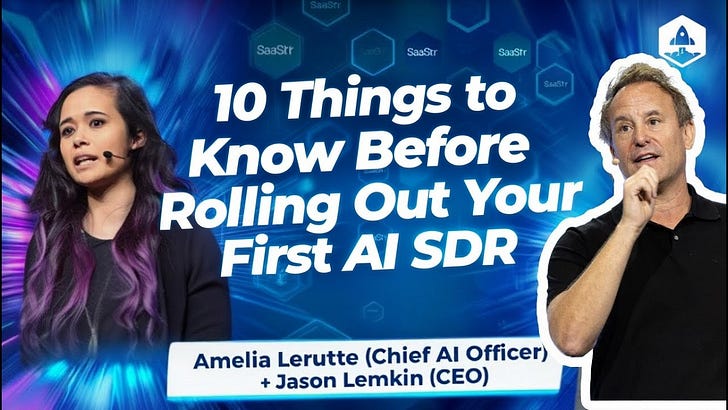
The Top 10 Things to Know Before You Deploy Your First AI SDR With Jason Lemkin and Chief AI Officer Amelia Lerutte

We’ve now been running AI SDR agents for 10+ months at SaaStr:* We use four different vendors in daily rotation (Artisan, Salesforce AgentForce, Qualified, and Monaco)* We’ve sent hundreds of thousands of outbound messages* Processed 1.5 million inbound sessions on a single website, and …* We’ve made every mistake you can make along the way.Someone asked us the other day to break down what they should know before rolling out their very first AI SDR. So here are the 10 biggest lessons, drawn from real deployment data, real failures, and real results.1. You Probably Only Need One Vendor. At Least To Start.We run four AI SDR tools. You do not need to do that. We hyper-segment across platforms because each one does something slightly different well, but for 90%+ of use cases, one vendor will handle the bulk of what you need.At most, you might end up with two: one for outbound, one for inbound. But do not start by buying three or four tools. Pick one that covers the majority of what you want to accomplish and go deep with it.The tool matters far less than the strategy you bring to it.2. Your Human Playbook Has to Work First. Your Job Is To Clone Your Best Human.This is the single biggest mistake we see, and it cuts across company stage. We see it from raw startups at $1M ARR and from multi-billion-dollar public companies alike.The pattern is always the same: they want to turn on an AI SDR without first proving that their human sales motion works. Or they use the AI SDR to “test new copy” they’ve never tried before.That is backwards.If you have not gotten outbound to work with humans, buying an AI to do it will not fix that. We did not deploy our first AI SDR until we knew exactly what was working with our human SDRs: which messaging converted, which segments responded, what cadences performed. Then we fed all of that into the agent.The goal of an AI SDR is to clone the best person on your team. * If it is just you, clone you. * If you have four people and one is crushing it at outbound, clone that person. * These tools, in the beginning, are cloning machines. They take context word for word and use it to build out their brain. If you feed them garbage context, or untested context, they will produce garbage results.You basically have to have done founder-led sales before you hand it off to an agent. The playbook has to work, at least a little, before you automate it.And watch out: some vendors will steer you toward using their tool for “pure cold testing.” Sure, you can do that. But you will likely be disappointed compared to scaling something that already converts. Do not fall into that trap.3. Segment RuthlesslyThis one we cannot overstate. Segment ruthlessly. Literally every day.Every AI SDR tool we have tried, and that is over a dozen, has some version of functionality where you can tell the agent who to reach out to and give it specific context for that segment. The difference between one generic campaign brain and hyper-segmented campaigns with tailored context is enormous.Here is a concrete example. We initially treated our inbound agent as one big bucket: “they’re inbound to the website.” But that was wrong. We actually have brand-new visitors, people who came via a social ad, prior sponsors returning, current customers checking on something, and lapsed customers browsing the pricing page. Each of those segments needs completely different context.A lapsed customer who churned in 2022 and is now browsing your pricing page? Your agent should know they are a former customer, highlight what has changed with the product since then, and speak to them totally differently than a brand-new cold visitor.We run roughly 100 effective segments across about 1,000 contacts at a time. That sounds like a lot of work. It is. But it is exactly where the leverage comes from.One important caveat: none of the AI SDR tools today can auto-segment well enough to deliver these results on their own. You still need a human (or a tool like Claude) to define and manage the segments. The platforms default to “run one campaign, keep adding leads.” That is the wrong approach.4. Consistency Beats BrillianceYour AI SDR does not need to write the greatest email on Earth. It needs to write a pretty good email, every time, without fail.We have sent 40,000+ messages through Artisan alone, 100,000+ through Qualified, close to 200,000 through Salesforce. Are these the greatest emails since sliced bread? No. They are solid. They are consistent. They follow the proven messaging and subject lines we already know work.That consistency, combined with hyper-segmentation and proven copy, will outperform a human SDR who ignores training, skips follow-ups, or goes off-script.The agent remembers every instruction you give it. Every time. A human SDR forgets by Thursday.We see a lot of “AI SDR paralysis” from founders who test a tool, see the output, and say “it’s not that great.” Okay, but did you segment properly? Did you give it copy that already conver
Mar 13, 20261h 5m

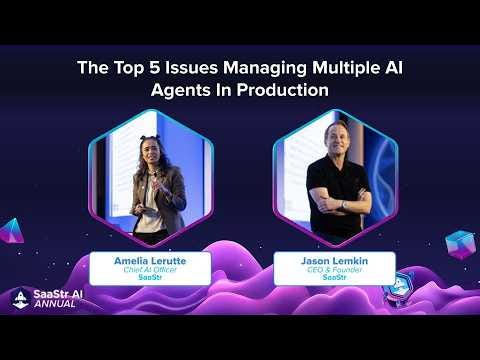
We Have 30 AI Agents in Production. Here Are the Top 5 Issues No One Talks About

We’ve been running AI agents in production at SaaStr for about 10 months now. What started as a couple of experiments has turned into almost 30 agents and vibe-coded apps running across our GTM stack — from outbound sales to inbound qualification to internal operations.And managing 30 agents is harder than managing the 12 humans we had at peak headcount. Not harder in every way. But harder in ways I didn’t expect.Here are the top 5 issues we’ve hit — plus a bonus one that might be the most uncomfortable of all.#1: The Context Switching Tax Is BrutalHere’s the thing nobody tells you about running 20+ agents: they don’t all speak the same language.Some push data back to Salesforce. Some don’t. Some … sort of do. Some run on Claude. Some don’t. They all ingest context similarly but differently enough that switching between them takes real mental overhead.Think about it this way: we don’t think of them as 20 agents anymore. Not entirely. We think of them as 20 different AI employees, each with a different personality, different needs, and a different interface I have to log into every single day.Amelia’s morning routine right now looks like this: she starts with a deep dive with 10K, our internal AI VP of Marketing that runs on Claude and Replit. It literally tells us what to do each day — tickets, sponsors, outreach, campaigns. Then she moves to our outward-facing sales agents: Artisan, Qualified, AgentForce, and now Monaco. That’s four separate dashboards, four different UIs, four agents that each need human review.And here’s the real kicker: they don’t talk to each other.When we ran a ticket price promotion for SaaStr AI Annual this week, we had to manually update five different agents with the same context.Artisan needed to know. Qualified needed to know. AgentForce needed to know. 10K already knew because it came up with the promotion — but then it was yelling at me to launch LinkedIn ads immediately while I was still briefing the other agents.People talk a lot about orchestration agents and master agents. We haven’t found one. Despite everything that’s out there — MCP, APIs, etc — there is no product today that can integrate AgentForce, Artisan, Qualified, Monaco, and our own vibe-coded tools into a single management layer. That product does not exist as of early 2026.What we actually need isn’t orchestration. It’s unification — a single interface where the humans meet with the AIs. Maybe that needs some automation layered on top. But the agents are already running on their own. The bottleneck is the human side.The practical takeaway: You’re going to have a one-on-one with every agent every day. Not weekly. Daily. If you wait a week, the output is so high that everything will be stale by the time you come back. And if you’re not checking in daily, you’re honestly wasting your money — because most of these agents are waiting for you to give them inputs. They’ll just idle.#2: The New Agent Blackout PeriodEvery new agent costs us at least two weeks. We’ve gotten it down from the month-plus it used to take in the early days, but two weeks is still the floor — even with great vendor support.And during those two weeks, your existing agents degrade.When we were onboarding a new AI SDR agent Monaco recently, we couldn’t spend the time we normally do with our other agents. Some of them literally sat idle because we hadn’t given them new contact lists or updated their campaigns. An outbound agent that’s run through its contact list and is waiting for new contacts? It’s doing nothing. Zero output. You’re paying for it and getting nothing.We got Monaco up and running in about a week and a half. In its first week live, it reached out to 64 people and booked 6 meetings, including some tier-one accounts. So yes, the trade-off was worth it. But you have to plan for that trade-off.The math works out to roughly one to one-and-a-half new agents per month, max. Any more than that and you’re running in place — you can’t keep up with your current agents while onboarding new ones. So before you add another agent, ask yourself: can I actually absorb a two-week blackout period right now? If you plan for it, it works. If you just wing it (“oh, I can add this in a day”), it won’t.#3: The AI Agent Succession Planning CrisisThis might actually be the biggest issue on the list.Right now, the entire knowledge of how our agents are segmented — which contacts go to Qualified vs. Artisan vs. Monaco vs. AgentForce — lives in one person’s brain. If that person gets hit by a bus, the agents effectively stop functioning in any coordinated way.We actually asked our agents what they would do if our Chief AI Officer disappeared. The answers were… revealing.* The 10K version of Claude said it would need to hand over certain documents — documents that are stored locally on my laptop and probably nowhere else. It listed the upcoming campaigns for March and April. And then, interestingly, it flagged what it called “the vibe” for SaaStr Annual — it h
Mar 3, 20261 min

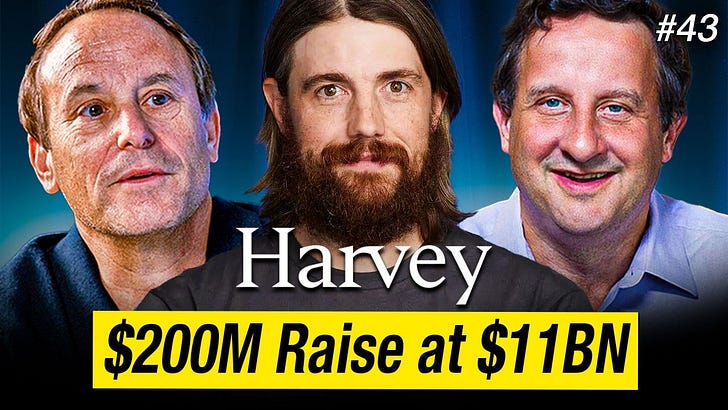
Mike Cannon-Brookes CEO Atlassian on Why B2B Software Isn’t Dead, Why CEOs Need to Stop Whining, and What Actually Matters Now

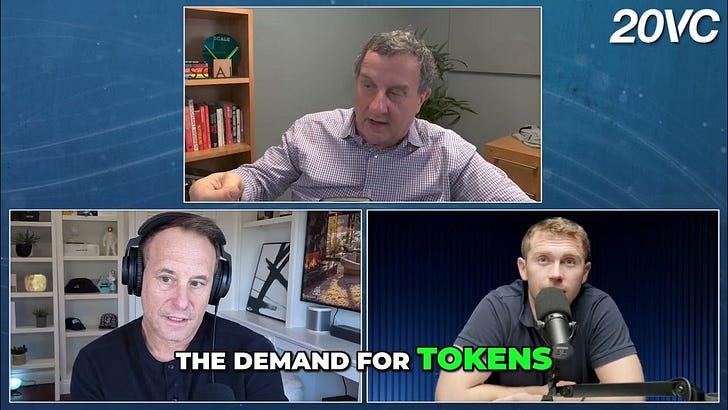
We did a deep dive on 20VC x SaaStr this week with Mike Cannon-Brookes, co-founder and CEO of Atlassian. Atlassian just put up an incredible quarter of accelerating growth (23% at $6.4B ARR, with RPO growing to 44%). And yet the markets aren’t showing anyone much love. Mike was honest and reflective on just what’s happening to B2B and SaaS in the Age of AI.There’s so much noise about “software is dead” and “agents replace everything” that founders are losing the plot. Mike’s running a $6B+ revenue business that’s accelerating — 26% cloud growth, 44% RPO growth — in the middle of the supposed SaaS apocalypse.So let’s break down what Mike actually said, and what it means for the rest of us.1. “Software Is Dead” Is a Stupid Statement. Full Stop.Mike didn’t mince words here. The idea that software as a category is going away is, in his words, “ludicrous.”His argument is simple and hard to refute: businesses have always bought pre-built technology solutions. They didn’t write everything in assembly language before, and they’re not going to build everything from scratch with LLMs now.Will every B2B company make it through the next 5–10 years? Absolutely not. Will many of them grow and prosper? Absolutely. Is that any different from the last 10 years? No.Mike pulled up Atlassian’s old competitive docs from 2005, 2010, 2015. A huge chunk of those companies don’t exist anymore — merged, acquired, or gone. That’s just how the technology industry works. AI doesn’t change the fundamental pattern. It just accelerates it.The takeaway for founders: stop listening to the “SaaS is dead” crowd. The real question is whether your company is good enough to win in the next era.2. “You Just Have to Be Good.” That’s the Whole Strategy.This was my favorite line from the conversation and I think it deserves to be tattooed on every B2B founder’s forehead.When asked how Atlassian thinks about competing with Anthropic for CIO budgets, Mike’s answer was deceptively simple: “We have to be good.”Not “we have to pivot to AI.” Not “we need to become an agent platform.” Just: we have to be good. We have to deliver more value to our customers than the alternatives.Atlassian has 10,000 people in R&D. They’re using Claude Code internally. Their inference costs are going down while they ship more AI features. Some features are 1,000x cheaper to run than when they first launched them. Their gross margins have improved over the last six or seven quarters while deploying more AI.That’s what “being good” looks like in practice. It’s not a platitude. It’s an execution standard.3. The Revenue Stacking Problem Is Real — and Most People Don’t Understand ItAnthropic projects $149B in ARR by 2029. OpenAI projects $180B. That’s ~$350B between two companies in a $700B global software market.Mike made a point that almost nobody talks about: the revenue stacking is complicated.When Atlassian spends money on Anthropic, they actually pay AWS, and then AWS pays Anthropic. When Cursor does a billion in revenue, a big chunk of that is the same billion as Anthropic’s revenue. The individual revenue numbers don’t just add up cleanly.So when you see these massive projections and panic about where the budget comes from — remember that a significant portion is double-counted across the stack. The actual net new spend enterprises need to allocate is smaller than the headline numbers suggest.That said, even with stacking, the numbers are enormous. As Rory pointed out: Anthropic becoming $150B and OpenAI becoming $180B is basically saying two new Microsofts showed up in four years. You better believe in TAM expansion, or the math gets really uncomfortable for everybody else.4. Product & Engineering Is the Island of Stability. Everything Else Is at Risk.We’ve been saying this at SaaStr and Mike’s experience at Atlassian confirms it: every category outside of engineering and product is at existential risk of shrinking seats.Workday said it publicly — even they’re seeing headwinds on seats because Fortune 500 companies just aren’t hiring like they used to. The data from Pave shows no category has been more decimated in hiring than customer support.But engineering? Nobody is cutting their engineering teams. Not yet at least. Even if they are hiring very differently in the Age of AI. We are in a renaissance of software creation. I was at Replit the other day — 300 million in revenue, 300 people, 11 in go-to-market. The rest? Engineers. That’s not a company cutting R&D headcount.Mike’s framework for understanding this is genuinely useful: think about whether a function is input-constrained or output-constrained.* Customer support is input-constrained. You have X customers asking Y questions per day. Make the team more efficient and you need fewer people. Legal is similar — you can’t create more legal problems just because your lawyers got faster.* Engineering is output-constrained. The roadmap is never finished. You can always create more. Make engineers more productive and you
Feb 15, 20261 min

Inference is the New Sales & Marketing Spend

High inference costs are OK—if they make your product so viral and so competitive it almost sells itselfHere’s the counterintuitive insight that’s reshaping how the smartest AI founders think about unit economics:Your inference costs aren’t your gross margin problem. They’re your CAC replacement.The companies growing fastest right now—Cursor crossing $1B ARR with ~300 employees and no traditional marketing, Lovable hitting $300M ARR with zero paid acquisition—aren’t sweating inference costs. They’re leaning into them. They’re treating compute as their primary growth investment, not their primary margin drag.This is a fundamental reframe. And if you’re still optimizing for gross margin while your AI-native competitors are optimizing for virality, you’re playing the wrong game.The Math That Traditional B2B and SaaS Gets WrongOn a recent 20VC x SaaStr episode, we discussed Anthropic’s inference costs coming in 23% higher than expected. My immediate reaction was pessimistic for mid-market B2B SaaS:“I worry this is the final nail in the coffin. You did everything right—got profitable, built an agent—and now you just can’t afford the inference to compete.”Here’s the scenario: You’re a $50M ARR B2B company. You built the agent your board demanded. Your agent costs $2.50 per interaction. You need 50 million interactions to stay competitive. That’s $125 million in inference costs on $50M in revenue.Game over, right?Not necessarily. The question isn’t whether you can afford the inference. It’s whether the inference makes your product so good that sales and marketing become irrelevant.The Cursor Playbook: Inference as DistributionCursor crossed $1B ARR by late 2025—roughly 24 months from launch—with about 300 employees and minimal traditional marketing. They went from $100M ARR in January 2025 to $500M by June to $1B+ by November. The fastest SaaS growth curve ever recorded.How? They spent aggressively on inference to create what Andrej Karpathy called the “vibe coding” experience—the moment when developers forget they’re writing code and just describe what they want. That experience is computationally expensive. It requires reasoning tokens, multiple model calls, context management across entire codebases.Traditional SaaS math would call this margin suicide. But here’s what actually happened:* The “wow moment” converted instantly. Developers tried Cursor, experienced something magical, and became evangelists within hours.* User-generated content became their entire marketing funnel. Every tweet about “I built an app in a day with Cursor” was free distribution worth thousands in CAC.* The viral loop compounded. Engineers at OpenAI, Midjourney, Shopify, and Instacart started spreading it organically. No sales team required.* Conversion was frictionless. $20/month is an impulse buy when the product makes you demonstrably faster.The inference spend wasn’t a cost center. It was the marketing budget. It just showed up on a different line item.Lovable’s Rocket Ship to $300MLovable hit $300M ARR in January 2026—roughly 14 months after launch—with fewer than 200 employees and zero paid acquisition. That’s still $1.5M+ revenue per employee, nearly 8x the industry benchmark.Their secret? They engineered virality into the product itself. When users build apps with Lovable, the outputs are shareable. The AI-generated code is good enough that users want to show it off. Every app becomes a piece of marketing collateral.The underlying inference cost to generate these apps is significant. But look at what they avoided:* No enterprise sales team (zero)* No paid acquisition (zero)* No SDRs cold-calling (zero)* No expensive conference sponsorships (zero)The inference is the go-to-market motion. The product is the marketing.You Can’t Have It Both WaysHere’s the brutal math that too many founders are ignoring:You can’t have high inference costs AND high sales & marketing costs. At least not for long. It has to come from somewhere.Traditional SaaS could absorb 40-50% S&M spend because gross margins were 80%+. There was room. The unit economics worked.But when your gross margin drops to 50-60% because of inference costs, that room disappears. You’re now choosing between two paths:Path A: Inference-First (Cursor, Lovable)* Gross margin: 50-60%* S&M: * Growth driver: Product virality* Requires: Magical product that sells itselfPath B: Sales-First (Traditional Enterprise SaaS)* Gross margin: 75-80%* S&M: 40-50%* Growth driver: Sales efficiency* Requires: Lower inference costs, less AI magicWhat you cannot do is run 50% gross margins AND 40% S&M. That’s negative operating margin before you pay a single engineer. That’s burning cash with no path to profitability. That’s a company that dies.The trap I see founders falling into: they build an AI product with significant inference costs, then layer a traditional enterprise sales motion on top of it because “that’s how you sell to enterprises.” Now they’re paying for compute AND paying for a sales t

Feb 13, 20263 min

From 1 AI Agent to 20+: The Reality of Managing Multiple AI Agents Across Your GTM

There’s a growing wave of AI agent skepticism on LinkedIn right now. And some of it is earned. A lot of founders bought an AI SDR, didn’t train it, and got garbage results. Then they posted about how “AI agents don’t work.”But here’s what we know after 8 months of running 20+ agents across our entire go-to-market at SaaStr — with just 3 humans and a dog: $4.8 million in additional pipeline sourced by agents. $2.4 million in closed-won revenue. Deal volume more than doubled. Win rates nearly doubled. And none of it cannibalized our existing inbound.It works. But not the way most people think it does.Let me break down what we’ve actually learned — the real stuff you won’t see in the LinkedIn posts.The Results Are Real, But So Is the WorkLet me give you the honest numbers first.Eight months in, our AI agents have generated $4.8M in additional pipeline and $2.4M in closed-won revenue that was first-touch sourced from an agent. Our deal volume has more than doubled. Our win rates have nearly doubled. And we’ve sent over 60,000 high-quality AI-generated emails just on the sales side — not even counting the nearly 1 million interactions through our vibe-coded apps.Here’s what matters most about those numbers: this was all additive. It did not cannibalize our other inbound revenue sources. We didn’t drop anything when we deployed these agents. We still send marketing emails. We still do outbound ourselves. We still send gifts. We still invite people to the SaaStr house. All the things we used to do before — we still do them. The agents augmented everything.But here’s the honest truth you won’t see on LinkedIn or X: we maintain these agents every single day. Literally every morning before anything else, we’re checking our agents. Amelia and I each spend 15-20 hours per week — that’s each, not combined — actively managing, iterating, checking responses, making sure nothing hallucinates, making sure the agents are talking to people the way we want them to.The time we used to spend managing humans on our team? We now spend that same amount of time — if not more — managing agents. The difference is there’s no people drama, and the agents work at a much higher capacity and scale than a human ever could.At some point, you realize you simply cannot keep up with your agents. They’re faster than you. They work 24/7/365. They can always answer a question, always book a meeting, always reach back out. The humans become the bottleneck.The Secret Nobody Tells You: Agents That Require Deep Training Cannot Be Self-TrainedI was meeting recently with the CEO of a next-generation AI go-to-market company — they already have millions in revenue and are publicly launching soon. I asked what their secret sauce was.The answer: they do everything. The onboarding, the tagging, the first campaigns — all of it. They do it almost to a fault. Some customers think it’s too easy and don’t even realize how much human energy is going into deployment behind the scenes.That’s the learning. If you haven’t deployed many agents — or any for real — you need to have an honest conversation. Not with someone in sales who doesn’t know how the product works. Talk to a forward-deployed engineer. Talk to a leader. Find out what it’s actually going to take in the first 14 days, the first 30 days, and every single day after that.Then you have to actually do it. Otherwise, it’s like going to the doctor, getting a prescription, and never taking the medicine. It literally will not work.A lot of the agents we use are pushing downmarket to be more self-service. So far, that doesn’t work. Agents that require deep training cannot be self-trained yet. It will come — agents are getting dramatically better every quarter. But for now, be skeptical. If you buy a cheap tool that claims it’s self-trained, make sure it actually works. If you buy a more complex tool, talk to someone senior enough on deployment who actually knows the product.The 90/10 Rule: Buy 90%, Build Only 10%Here’s our rule of thumb: buy 90% of your AI stack. Only build the 10% where no vendor can do it well and it’s a P1 priority.We’ve followed this ourselves. The vast majority of our agents are third-party tools that we’ve trained and customized heavily. We only built custom agents where we had a very specific use case that no vendor could handle — like our AI VP of Marketing (more on that below).Kyle, the CRO at Owner (one of our portfolio companies), has followed roughly the same approach. He bought a bunch of third-party agents, made them work, and then hired a former founder/engineer — someone who was literally a CEO of an LLM company — to build a proprietary in-house tool for the 10% that needed to be custom.That’s an extreme case. For most of you, building custom agents probably won’t make sense yet. Focus on making the bought tools work first.How to Evaluate AI Agent Vendors (Don’t Skip the Basics)I don’t know why people throw away basic evaluation practices just because something has “AI” in the na

Feb 10, 20261 min

If Growth Isn't Accelerating, You're Not an AI Company. And 9 Other Hard Truths for B2B in 2026.

If Growth Isn’t Accelerating, You’re Not an AI Company. And 9 Other Hard Truths for SaaS in 2026.I had a great conversation with the TBPN crew the other day, and we covered a lot of ground — from the state of the SaaS market to PE exits to vibe coding to how agents are already reshaping how software gets bought and sold. I wanted to pull together the key themes here, because I think founders need to hear some of this, even if it’s uncomfortable.Let me walk through the big takeaways.1. If Growth Isn’t Re-Accelerating, You’re Not Really an AI CompanyThis is my simple rule, and I think it cuts through all the noise.Every public company, every startup, everyone is talking about their “AI strategy.” They’ve built an agent. They’ve shipped a copilot. They’ve got an AI tab on their website. Great. But has growth actually re-accelerated?That’s the bull case for Meta. They genuinely accelerated growth. The AI they baked into their ad-matching platform is working. Retail advertisers generating ads with AI tools — it’s all compounding. It’s real.Now look at the flip side. Microsoft’s AI business is still blowing up, but they missed on the software side. The Trade Desk has been destroyed. Figma is trading below 10x revenue despite essentially creating and owning a category.The point is: AI talk is cheap. Revenue acceleration is the only metric that matters now. And I’ve lost patience — with founders at $1M, at $10M, with public companies — who haven’t seen the lift. ElevenLabs just crossed $350M. MongoDB dramatically re-accelerated. Show me the money.2. The Transition from “Deeply Tough Love” to Just “Tough”Last year, my advice to founders was deeply tough love. The market was brutal, and most people hadn’t adjusted.Now it’s just tough. Here’s why: you’ve had time. Claude got really good at 3.7 — that’s why Replit and Lovable blew up. That was a year ago. Whether you’re Agentforce or one of my portfolio companies, you had a full year to re-accelerate growth. Some did. Most didn’t.And honestly? Salesforce is doing better than some startups I work with. We’re actually probably the only organization of our size using Agentforce for real, every day. It works. I can’t tell you how many startups whose “agentic product” is still basically a copilot.3. 80% of Your Team Wants to Work Like It’s 2021There’s a narrative that AI has reinvigorated SaaS founders — that people who got to growth stage a decade ago are suddenly back in the arena, fired up, tinkering with tools, pushing teams harder.It’s a great narrative. In the real world, it’s not that common.I talk to public company CEOs in B2B, my own portfolio, others — a lot. Behind the scenes, off the record. And since our agents blew up, everybody thinks we’re some kind of GTM agent gurus. So they come to us.The consistent theme: 80% of their team wants to work like it’s 2021. Everyone has to create a skunkworks team or something. And meanwhile, the AI-native companies are crushing it precisely because they don’t have to deal with 20,000 pre-AI customers who still have feature gaps, clunky software, and legacy competitors. Then you’ve got 10,000 new AI competitors who don’t carry any of that baggage.I’d love to tell you I know dozens of companies that went from 40% growth at the start of 2025 to 80% or 110%. I can think of a handful.4. The Vibe Coding Problem Is Worse Than You ThinkSix months ago, the problem was 10 companies running at every exciting category. Today it’s worse.A very successful seed investor — relatively new to the game — told me yesterday he’s giving up because everyone can vibe code something. He can’t even tell the difference between founders anymore.Now look, I’ve vibe coded 20+ apps that have been used over a million times. I’m in the top 0.1% on Replit. I know a bit about this. You’re not going to vibe code Salesforce. But you can vibe code something for Demo Day that looks really good. Stuff that 18 months ago would have made your jaw drop — “oh my god, an agent for dental follow-ups that’s fully automated!” — that’s now table stakes. I built my own version on Replit a week ago. It was already obsolete today.Here’s the real unlock though: if you want to build super-niche software for real — not for an hour, not one-shot, but actually commit to it — you can now do it without an engineer. RevenueCat, a company I was the first investor in, powers mobile subscriptions for 50% of mobile apps. Andreessen published data showing the number of new mobile apps basically quintupled at the end of last year because of vibe coding. And it’s just starting.The very bottom of the market is exploding with possibility. Salesforce isn’t going away. But that middle is going to be harder.5. Investors Want Insane Growth. And There’s No Great Answer.The challenge isn’t just the clones. It’s that investors now expect insane levels of growth. Going from $1M to $100M ARR in a year used to be almost unprecedented. Now it’s what you need to be fundable.HigsField for video is over $2

Feb 8, 20265 min

“The Dumbest Idea I’ve Ever Heard” — How Own Became a $2B Salesforce Acquisition

A SaaStr AI deep dive with Sam Gutmann, CEO of Own, on building a billion-dollar backup company by saying “no” to almost everything. He joined Harpinder Singh (Partner, Innovation Endeavors) to share the whole story — and his top mistakes.And come hear 200+ stories like this at SaaStr AI Annual May 12-14 in SF Bay!!Top 5 Takeaways1. The CEO who dismissed “Backup for Salesforce” as “the dumbest idea I’ve ever heard” went on to build the category leader.Sam literally stopped a board meeting to call out how stupid he thought the idea was. Six years later, he was running the company that would define the space. Markets evolve. Your priors can be wrong. The best founders update their views when the data changes.2. Don’t expand until you cross $100M ARR if your core market is still only single-digit penetrated.Own had backup for ServiceNow, Microsoft, and other platforms ready to go for years. They said no. They killed products that weren’t generating revenue. The result? 100%+ annual growth rates by staying focused on Salesforce until they had the resources to truly do multi-platform right.3. The CEO ran the financial model himself until $200M ARR — and that’s why they hit their numbers.When their outsourced CFO offered to run FP&A, Sam said “absolutely not.” Every investment tied back to a cell in his Excel model. The outsourced finance firm told him: “You’re the only founder where our FP&A team isn’t doing this for you. You’re also the only company actually making their numbers.”4. “Ideas are worthless. It’s all about execution.”Salesforce came out with a competing product. It didn’t work. They killed it. They tried again. It still didn’t work. Then they acquired Own. When you have 1,000 people waking up every day focused on being the best backup product in the ecosystem, the platform vendor with 150 other products to sell can’t match your focus.5. The hardest leadership decision — replacing a founder or key leader who got you here — always takes too long.At a CEO roundtable, every leader agreed: firing a founder or key leader is gut-wrenching. Then they asked who would have made that call six months earlier. Every hand went up. It’s always the right decision. It always takes too long.The Origin Story: A Vacation That Changed EverythingThe story starts in the most unlikely way possible.Sam Gutmann was on vacation in Israel in 2014. He had zero network there. But he remembered that a former colleague who’d worked at the venture fund that invested in his first company had quit his job, traveled the world, and landed in Israel.“Let’s catch up over a beer,” Sam said. “By the way, I’m at a venture fund now. Know any startups I can meet?”His friend Ori said: “Yeah, I’m actually job hunting. I’m meeting with these two guys who started a backup company. Want to tag along to my unofficial job interview?”Sam had the tour van driver pull over in a city he’d never heard of called Herzliya. They sat down at a coffee shop with Ariel (the founding CTO) and two friends who’d started a part-time project called OwnBackup.Halfway through the meeting, they turned to Ori and said, “Please stop selling yourself. We’re not hiring a sales guy.”Then they turned to Sam: “We actually are hiring a CEO. Are you interested?”That one-hour coffee ruined the rest of his vacation. But ten years later, they sold to Salesforce.The Irony: Sam Thought This Was a Terrible IdeaHere’s the thing that makes this story remarkable.In 2008, Sam was in a board meeting for his first company — an online backup service where software ran on servers and sent encrypted data to the cloud. They were brainstorming growth ideas.The chairman walked up to the whiteboard and wrote in red marker: “Backup for Salesforce.”Sam stopped the meeting.“That’s the dumbest idea I’ve ever heard.”Six years later, he was CEO of the company that would define that exact category.What changed his mind? Simple math and pattern recognition:* Salesforce had 250,000 customers. Every single one should have a data protection strategy.* The average enterprise uses 300+ B2B applications. The same vulnerability exists whether your data is on a laptop, an AWS instance, or in Salesforce.* Every B2B provider uses the same language: “shared responsibility model.” They’re responsible for the platform. You’re responsible for your own data.Sam likens it to an apartment building: the landlord handles the infrastructure, windows, pipes, and elevators. But you’re responsible for everything inside your unit.The Path to Product-Market FitThe founders of Own had an unusual origin story themselves. They ran a traditional disaster recovery lab — the kind where you bring in your water-damaged phone or server with a failed RAID array, and they recover your data.Around 2010, customers started coming in saying: “You’ve recovered data from my devices before, but now I’ve lost something in the cloud. Facebook shut my account down. I permanently deleted something in Gmail. Can you help?”They couldn’t. They didn’t h

Feb 3, 20261 min

Why Most B2B Companies Are Failing at AI (And How to Avoid It) with Intercom’s CPO

Paul Adams is Chief Product Officer at Intercom, leading Product Management, Product Design, Data Science, and Research. He joined when Intercom was just a 14-person company after first advising the startup, and has been on the executive team ever since. Before Intercom, Paul held leadership, product, and UX roles at Facebook (Ads, Platform) and Google (Gmail, Docs, YouTube)—he was on Google’s mobile team when the iPhone launched. He’s the author of the best-selling book Grouped on social software design and co-hosts the podcast Intercom on Product with co-founder Des Traynor.When ChatGPT arrived in late 2022, Intercom was struggling—five quarters of declining revenue growth, a failed IPO attempt. The leadership team bet the entire company on AI within two weeks of ChatGPT’s release. That bet produced Fin, Intercom’s AI agent for customer service, which now resolves over 1 million customer problems per week with a 65% average resolution rate across 6,000+ customers.The Top 5 Takeaways from Intercom’s AI Transformation1. If it doesn’t feel brutal, you’re not going deep enoughPaul is blunt about this: transforming a SaaS company into a real AI company is painful. Intercom wasn’t in a great spot when ChatGPT arrived—they’d had five quarters of declining revenue growth and had abandoned an IPO process. But that pressure became an advantage.The leadership team made the call in one to two weeks. They ripped up their strategy. Ripped up their roadmap. Told the company it was happening and it wasn’t a choice.“If you’re a SaaS company who thinks you’re an AI company and you’ve not gone through brutal transformation, you’re not there yet.”The mistake most companies make? They do the easy, fun stuff—building AI features, experimenting with models, talking to customers about AI—but avoid the hard, messy decisions. Like parting ways with a third of the company because they’re not fit for the new world. Like deleting the marketing calendar and rebuilding from scratch.Paul took over two-thirds of marketing six months ago and immediately blew the entire thing up. Teams, roadmaps, calendars—gone. “The only way I knew how to build a marketing org fit for this age is to build it from scratch.”2. The only way to know if you’ve gone far enough is to go too farIntercom operates on a simple principle: the only way to find a boundary is to cross it.This shows up everywhere:Every single designer at Intercom now ships code to production. Zero did 18 months ago. The mandate was clear: this is now part of your job. If you don’t like it, find somewhere that doesn’t require it, and they’ll hire designers who love the idea.Engineering is on a path to 2x productivity—not through incremental improvements, but by declaring it non-negotiable.Paul constantly asks: “What would a brand new startup incorporated today do here?” Would they have separate product marketers and content marketers? Or is that the same job now? Would they have both product managers and product designers as distinct roles?The answer usually points to consolidation, not specialization.3. How you build software has completely changedIntercom had principles for building great SaaS products that they’d refined over years. They’d train every new designer and engineer on these principles. They were proud of them. Des had given talks about them.They had to ban all of it.The old way: Pick a job to be done → Listen to customers → Design a solution → Build and ship. Execution was certain. Technology was stable. Design was the hard part.The new way: Ask what AI makes possible → Prototype to see if you can build it reliably → Build the UX later → Ship → Learn at scale. Execution is uncertain. Design is now cheap. The hard part is the AI infrastructure—the RAG system, the custom models, the empirical evaluation.“This AI layer, our RAG system, has been 3 years in the making by a very talented team. It’s complicated. I do not understand the depths of that RAG system at all.”The visible UI is now the small part. The invisible AI infrastructure is where the real product lives. That’s a complete inversion of how SaaS products were built.4. AI products compound—every tiny improvement multipliesWhen you’re building workflows that chain multiple AI steps together, success rates multiply. If you’re at 99% accuracy on each of 10 steps, you’re at 90% overall. If you’re at 95% on each step, you’re at 60%.This is why Intercom obsesses over incremental improvements at every point in Fin’s system. They’ve run hundreds and hundreds of experiments, many of which fail. Sometimes they see an improvement in one part that degrades another.They’ve built custom models pointed at very specific customer service tasks—not general-purpose, but targeted at discrete steps in the workflow.“Each single tiny incremental improvement in each of these steps adds up to the highest performing product, adds up to something people can trust, adds up to something people will replace their humans with.”This compounds into w

Jan 28, 20264 min

How Filevine Went from SaaS to AI-Native at $200M+ ARR — And Now Makes More Revenue from AI Than SaaS (A Roadmap for the Rest of Us)

Ryan Anderson, CEO of Filevine, shared their AI transformation playbook at SaaStr AI London. Here’s the thing: their new AI revenue now exceeds their SaaS revenue on a quarter-over-quarter basis. This is the roadmap.The Filevine Story: 10 Years of Grinding, Then AI Changed EverythingRyan Anderson didn’t set out to build a $3 billion legal tech company. He set out to stop waking up at 3am in a cold sweat.As a young trial lawyer in the early 2010s, Anderson was drowning. Deadlines piled up. Assignments disappeared. He’d lie awake convinced he’d missed something critical. “I’m not a naturally organized individual,” he’s said. “I’m naturally anxious.”So in 2014, he started building. First a Google spreadsheet — his “PI checklist” — at the law firm he’d founded with Nate Morris. Then a meeting over lunch in Las Vegas with Jim Blake, an engineer who asked the right questions: What’s breaking? Why is it so hard to keep track of work?That conversation became Filevine.For the next decade, they ground it out. Started with personal injury firms. Expanded into every legal practice area. Grew from task management to a full legal operating system: document management, demand generation, analytics, the whole lifecycle. By 2022, they’d raised $108M in a Series D — one of the largest legal tech investments ever at the time.Good company. Solid growth. But not a rocketship.Then AI happened.In September 2025, Filevine announced a $400M raise at a $3 billion valuation. The round was led by Insight Partners, Accel, and Ryan Smith’s Halo Fund. Smith — the Qualtrics billionaire and Utah Jazz owner — had been trying to invest for years. Anderson kept saying no. But after Filevine’s strongest quarter in company history, Smith called again: “You’re not getting your due.”What changed? AI revenue is now growing 130% year-over-year. Their AI chat product is growing 20%+ week over week. And as Anderson shared at SaaStr, their new AI revenue now exceeds their SaaS revenue on a quarter-over-quarter basis.Today: $200M+ ARR, growing 50-60%, 6,000 customers, 700 employees, 96% GRR, 124% NRR.This is what it looks like when a decade of building the system of record meets the AI moment.Top 5 Takeaways* “Sprinkling AI on top” is fundamentally wrong. You can’t just connect to OpenAI’s APIs and call it an AI product. That won’t cut it in 2026. You have to change your architecture.* Nothing is sacred. You will have to tear down meaningful components of working, revenue-generating code. Use the 4-quadrant framework: map every system against “competitive advantage” and “speed.”* Your SaaS is the closet, not the clothes. AI agents need context (your system of record), not just documents. This is your moat against AI-only competitors.* Protect your data and price to dominate. Move from open APIs to personal access tokens. Your high SaaS gross margins let you undercut AI-only competitors on blended margins. Be savage.* Obsess over usage, not revenue. No AI product goes beyond beta without audit trail logging. If customers aren’t using it, it doesn’t matter.The Wake-Up Call: “We Get to Sprinkle AI on Top”Ryan opened with a story that will sound familiar to many B2B and SaaS leaders:“I had an engineer say to me just a few months ago with a ton of pride, mind you: ‘We have built an incredible SaaS application that makes tons of money, grows fast, customers never leave it. We have almost 96% gross revenue retention, 124% net revenue retention.’ He has every reason to be prideful. And he said, ‘The great news is now we get to sprinkle AI on top.’”Ryan’s response? That is fundamentally incorrect.Connecting to OpenAI’s APIs isn’t going to cut it in 2026. To be AI-native, you have to change the architecture of your system. It has to flip.The Proof Is in the NumbersThe transformation is real and measurable. As Anderson put it at SaaStr AI London:“It is very plain to see that the numbers back up that we are now doing far more revenue on a new quarter-by-quarter basis in AI products than in our SaaS product. Now, that’s not to say that the SaaS product is in any way less successful — in fact it’s still growing at 35-40% year-over-year. We are just growing so much faster on the AI side of the house.”This isn’t a pivot away from SaaS. It’s SaaS + AI compounding together.Framework #1: The “Nothing Is Sacred” 4-Quadrant MatrixThe hardest part of going AI-native? Telling your teams that some of what they’ve built — things that work, that make money — has to be torn down.Ryan introduced a simple 2×2 matrix:Y-Axis: Critical to competitive advantage → Not critical to competitive advantageX-Axis: Keeps you moving fast → Slows you downThe Four Quadrants:Upper Right (Keep & Fortify): Critical to your moat AND keeps you fast. This is the cornerstone of your AI-native movement. Don’t tear it down — make it better.Bottom Left (Tear Down): Not critical to your moat AND slows you down. This is logically easy but emotionally brutal. These have to go.Upper Left & Bottom Right (Judgm

Jan 14, 20264 min

How Personio’s CRO Built an AI-Powered Go-To-Market in Just 6 Months: 5 Lessons and 5 Mistakes

Philip Lacor is the CRO of Personio, a $3B+ HR and payroll platform with 1,500 employees, 15,000 customers, and a 400-person sales team. He shared their AI transformation journey at SaaStr AI London — and the learnings are a masterclass for any revenue leader trying to figure out how to actually deploy AI in GTM.We’re all hearing about AI-native companies crushing it. Replit, Gamma, Harvey.But what if you’re running a real B2B company? One with 400 salespeople, 15,000 customers, and years of accumulated process debt?That’s exactly where Personio was in May 2024 when their CEO kicked off an “AI Surge Week” — and what happened next is one of the most practical AI transformation stories I’ve heard.In just six months, they went from “90% of our team uses LLMs weekly” (which sounds good but isn’t transformation) to building 400+ AI assistants, cutting research time from 2 hours to 15 minutes per rep, and booking 140 meetings in 7 days through their AI SDR.Here’s what Philip learned — the stuff that actually worked, and the mistakes you should avoid.The 5 Lessons: What Actually WorksLesson #1: You Need Both Top-Down AND Bottom-Up MotionHere’s the trap most companies fall into: They give everyone access to ChatGPT, run some training, and call it an AI initiative.Personio did that too. Their AI Surge Week was a huge success — speakers from OpenAI, Mistral, AWS. Project teams building agents. Company buzzing with excitement.But then Philip noticed something: High usage isn’t the same as transformation.“After the AI Surge Week, we felt that although usage was high, this is maybe not enough to reach true transformation and to really fundamentally change the way we go to market.”The problem? Bottom-up motion alone can’t make the hard decisions:* Resource allocation — Who’s going to spend 40% of their time on AI initiatives?* Permission — Can people actually stop doing their old workflows?* Budget — Which tools do you actually buy vs. just test?* Prioritization — Of the 50 possible use cases, which 3 do you build first?This is why Philip started the “AI Powered Go-To-Market” working group in June — a top-down initiative to complement the bottom-up energy.The takeaway: Bottoms-up gets you experimentation. Top-down gets you scale. You need both.Lesson #2: Cross-Functional is Non-NegotiableThis one seems obvious but almost nobody does it right.Personio built a working group with three distinct capabilities:* Data & Systems Team — Owns infrastructure, Snowflake, the technical backbone* Revenue Operations + GTM Engineers — The bridge between tech and business (they have 2 dedicated GTM engineers now)* The Business — Marketing, Sales, Customer Success, the actual usersWhy does this matter? Philip saw both failure modes:“We have seen cases where our data systems team built things with LLMs but it was lacking the business context and therefore the models didn’t work very well.”And the reverse:“We had sales people who wanted to do something but originally they did not have the support from either data or systems or RevOps.”They deliberately made the working group large — 15 people — to get broad coverage across functions and build cultural buy-in.The takeaway: AI in GTM isn’t a sales project or a data project. It’s a cross-functional transformation. Build the team accordingly.Lesson #3: Use Jobs-To-Be-Done to Prioritize RuthlesslyHere’s what happened after they launched the Slack channel and started working on use cases:“People started to share opportunities, raising their hand, and the problem was that as people started to work on these new ideas, we hadn’t finished the first one. At one point it started to spiral a little bit out of control.”Sound familiar? Everyone gets excited, ideas flow, and suddenly you have 20 half-built things.Their solution: Jobs-to-be-done mapping.One of their GTM engineers literally shadowed account managers for two weeks. What she found:* AMs were working in 7-8 different systems to perform simple tasks* Constantly switching contexts, pulling information together* Losing 2.5 hours per day on one activity, 3 hours per week on anotherThey mapped every role’s jobs-to-be-done:* SDRs* AEs* Customer Success* Solution EngineersThen they overlaid these jobs onto the customer journey to see how they fit together — and where the biggest pain points were.The takeaway: Don’t just chase shiny AI use cases. Map your roles’ actual jobs, quantify the time waste, then prioritize based on where you have the biggest P&L challenge or customer experience gap.Lesson #4: Building an AI Culture Requires Leading, Sharing, and CelebratingPhilip has a formula he uses for transformation:Effect = Quality of Plan × Acceptance5 × 5 is way bigger than 10 × 1.So how do you build acceptance? Three things:Lead It: Philip does deal reviews where AEs used to show up with big PowerPoints. Now:“I would always go like, okay, please go to Gong, open up your account. There’s this little AI sign. Go in there. Now you look for the account bri

Jan 7, 20263 min

The Present and Future of AI in Sales and GTM A Deep Dive with Jason Lemkin and Kyle Norton, CRO at Owner

Jason Lemkin led the seed round via SaaStr Fund in unicorn Owner.com, an AI solution revolutionizing how small restaurants manage their business. Kyle Norton joined shortly thereafter, and after a slow few months, Kyle rocketed the org to almost $100m ARR in just a few years -- with growth accelerating at scale. Both Kyle and Jason have shared AI agents, learnings, and more on their AI agent journey and Kyle sat down with Jason on the very latest in AI for GTM. Kyle now manages a 100+ human AI-infused sales team and Jason and Amelia at SaaStr have deployed 20+ AI Agents.Top 10 Takeaways:* AI agents are now better than mid-pack AEs and SDRs. Not better than the best. But better than average. And that’s enough to fundamentally change how you build a GTM team.* The first agent is YOUR job. If you’re a CRO or CMO and you haven’t personally trained and deployed at least one AI agent, you will become obsolete. No agencies, no consultants. You. 30 days of work.* Pick one tool, not ten. The biggest mistake executives make is running 8-10 vendor bakeoffs. You can’t train 10 agents. Pick two—one incumbent, one startup—and go deep.* Salesforce is back—but not because of Agent Force. It’s because when you have 20 agents running autonomously, they need a hub. And Salesforce is that hub.* The middle is gone. You either work harder than ever to hit 10x5x5x5x growth rates, or you join a slow-growth company at 15-20%. The magical 2021 middle where you could have lifestyle AND exceed quota? That’s over.* Forward Deployed Engineers > Features. Don’t sign a contract until you’ve talked to the person who will actually deploy your agent. The best vendor isn’t the one with the best demo—it’s the one that will help you get into production.* Every agent takes 30 days to train. No shortcuts. You upload data, review outputs daily, correct mistakes, iterate. The agents that “don’t work” are the ones nobody trained.* Fix what breaks your heart first. Go to your website in incognito mode. Try to buy something. Try to get a question answered. Whatever breaks your heart—fix that with AI first.* AI-infused teams are 3x more productive. Kyle’s team at Owner is booking 3x revenue per AE compared to any team he’s ever managed. But that doesn’t mean fewer reps—it means higher quotas and more hiring.* The $250K SDR is coming. The elite folks—not the ones who think they’re elite on LinkedIn, but the ones who are genuinely 5-10x more productive—will earn 2-3x what they used to. But they’ll be expected to deliver 10x the output.The Backstory: Why SaaStr Went All-In on AgentsIt started with frustration.We had two salespeople making high market, six-figure salaries. They just quit going into our biggest event. No notice. No reasons. Just ghosted.I turned to Amelia, our Chief AI Officer, and said: “We’re done with this. I am done paying an SDR $150,000 a year or an AE $300,000 a year for basically inbound, spoonfed leads and renewals—and then having them quit on me.”Maybe you can be critical of me as a boss. Fair enough. But I’m pretty loyal. I pay people well. Do your job with me, and I’ll stick with you for 20 years. I just couldn’t do it one more time in my career.So we went all-in. Started in May with 1 AI Agent. Today we have 20+ agents running in production. They’re generating over $1 million in revenue. And here’s the scary part:Our AI agents are better than a mid-pack AE or SDR.Not better than the best. But better than the 50th percentile person I’ve worked with over my career. And that changes everything.The New Reality: Mid-Pack Sales Execs Are in Terminal DeclineLet me be blunt: if you’re a mid-pack GTM professional who doesn’t want to work harder and smarter than a year ago, these jobs are in terminal decline.We sent 70,000 hyper-personalized emails for SaaStr London using AI agents. They were better than the 7,000 emails humans sent before that. 10x the volume. Slightly better quality.And here’s what happened when we asked our highly-paid SDR to follow up on a lead I spotted on LinkedIn:“I’ll add it to my list and get to it when I can.”Half the time, they didn’t even follow up.The agent? The agent doesn’t argue. The agent just follows up.But We’re Still in Inning OneHere’s what most people don’t understand: what we’re doing today with AI GTM is just step one.Right now, “hyper-personalization” means maybe three dynamic fields in an email. One, really. Maybe we know your company name and your title.But imagine when AI really pulls in:* Every competitor you’ve ever used* Every page you’ve visited on our website for 10 years* Every interaction you’ve had with our brand* Every adjacent tool in your stackImagine when AI can send an email as good as the one that got me to invest in Owner—an email the founder probably spent several hours crafting with a top 0.1% IQ.AI should be able to do that. It’s just not there yet in GTM.When it is? Buy that product immediately.The Real Reason Agent Deployments FailThe failures of AI SDRs in 2024 were all LL

Dec 17, 20251 min

We Deployed 20+ AI Agents and Replaced Our Entire Human SDR Team. Here's What Actually Works. (Video + Pod)

At SaaStr AI London, Amelia and I went deep on our AI SDR journey. We shared all our data, all the emails we’ve sent, all the performance metrics—everything. And the response was overwhelming.But here’s the thing: the #1 objection we kept hearing was “Yeah, but this won’t work for me. I don’t have your scale. I don’t have your data. I don’t have 10 years of history.”That’s simply not true.If you have customers, if you have revenue, if you have a database of any size—AI agents will work for you. You don’t need as much data as you think. You don’t need as much trailing history as you think. What you need is a methodology.Here’s what we’ve learned after sending 60,000+ hyper-personalized emails, booking 130+ meetings automatically, and generating 15% of our London event revenue through AI agents alone.The 5 Biggest Learnings From Deploying AI SDRs#1. AI Agents Crush the Work Humans Won’t DoThis is the single most important insight we’ve discovered.Our human SDRs wouldn’t follow up with return attendees for ticket sales. It wasn’t worth their time—they wanted to hunt six-figure sponsorships instead. We tried incentives. We tried Starbucks cards. We begged them. They said they’d do it, then we’d check the activity logs and discover they lied.The result? When we deployed AI agents on those exact same leads, they generated 15% of our London ticket revenue. Revenue we literally would not have gotten otherwise.Same story with our “ghosted” leads—people who reached out wanting to sponsor SaaStr for five and six figures, and our human team just... never responded. Not because they didn’t like the leads. Because every salesperson is force-ranking in their head, putting all their effort into the one big deal closing this quarter.The AI agent hit those ghosted leads with a 70% open rate.Here’s the mental model shift: Don’t think of AI SDRs as magic revenue generators. Think of them as the team that finally does the work your humans refuse to do. The small leads. The low-scored leads. The “not worth my time” leads. Those leads deserve better, and AI doesn’t discriminate.#2. Hyper-Personalization at Scale Actually Works—But “Pretty Good” Is Good EnoughBefore AI agents, our human SDRs sent maybe 75-300 personalized emails per rep per month. In six months with AI, we’ve sent nearly 60,000 hyper-personalized emails. That’s 32x the max human output.But here’s what people get wrong when they see our results: they expect jaw-dropping, month-of-research-level personalization.That’s not what this is.On a scale of 1-10, our AI emails are maybe a 3 to a 6 in customization. They’re pretty good. They reference the prospect’s company, what they’ve been looking at, maybe something they posted about. But they’re not poems. They’re not love letters.And that’s fine. Because the bar isn’t “better than the best human SDR having the best day.” The bar is:As good or better than your average human SDR, with 24/7 consistency.A lot of folks on the internet say “I could do better if I hired 30 top-tier Oxford graduates to craft one email each day.” Sure, maybe. But those people want to be promoted to AE in three months. They’re not going to stay. And you can’t hire 30 of them anyway.Pretty good emails with zero errors, sent consistently at scale, crushes inconsistent brilliance every time.#3. Train Your Agents Like You’d Train Your Best New HireHere’s where almost everyone fails with AI SDRs:They buy a product, do nothing, and expect millions in revenue.It didn’t work that way before Claude 4 when these products barely functioned. It didn’t work after Q1 2025 when they started getting good. It doesn’t work now.The way AI agents work for GTM is:* You figure out something that works with humans first* You nail the email, the script, the objections, the questions* You document what worked* You give it to the agent and train it for a month* Then you do it at scaleIf you’re expecting an agent to sell when you can’t sell, that’s never worked. Go back to founder-led sales basics. But instead of handing off to that first human hire, you hand off to your first agent hire.Same principles. Same rigor. Different execution.#4. Segment Ruthlessly—Never Unleash AI on Your Entire DatabaseThis is critical. Do NOT just point an AI SDR at your entire database and hit send.Here’s how we approach it:* Batch contacts into groups of 800-1,000 max for each campaign* Create sub-agents or sub-campaigns for each persona (CRO, CMO, website visitors, churned customers, etc.)* Train each sub-agent specifically for that persona and use case* Give each agent different goals (book a meeting, sell a ticket, follow up on a ghosted lead)Start with low-stakes segments:* People you ghosted* Good inbound you couldn’t fully follow up on* Post-meeting follow-ups that fell through the cracksDon’t start with mission-critical leads. You’ll be disappointed if you can’t get it working quickly, and these agents have ramp time.#5. You Need Exactly Two Humans to Make This WorkThis surprised us,

Dec 12, 20252 min
Jason M. Lemkin 🦄