
The Machinist
304 episodes — Page 4 of 7

The Dark History of the Information Age
FullPodcast: The Lawfare Podcast (LS 68 · TOP 0.05% what is this?)Episode: The Dark History of the Information AgePub date: 2023-05-23Get Podcast Transcript →powered by Listen411 - fast audio-to-text and summarizationHacking and cybersecurity are evergreen issues, in the news and on Lawfare. Scott Shapiro, the Charles F. Southmayd Professor of Law and Professor of Philosophy at Yale Law School, has a new book on how and why hacking works and what to do about it, called “Fancy Bear Goes Phishing: The Dark History of the Information Age, in Five Extraordinary Hacks.”Scott joined Jack Goldsmith to talk about how his pre-law-professor obsession with computers combined with his recent work in international law led him to write the book. They also discussed the lessons that the five hacks discussed in the book teach, including the limits of technology and solving cybersecurity problems, the importance of the human dimension to cybersecurity, and why we shouldn't be panicked about the state of cyber insecurity.Support this show http://supporter.acast.com/lawfare. Hosted on Acast. See acast.com/privacy for more information.The podcast and artwork embedded on this page are from The Lawfare Institute, which is the property of its owner and not affiliated with or endorsed by Listen Notes, Inc.

Dru Oja Jay & James Steinhoff guide us through the hype & hysteria around AI
FullPodcast: Pretty Heady Stuff (LS 27 · TOP 10% what is this?)Episode: Dru Oja Jay & James Steinhoff guide us through the hype & hysteria around AIPub date: 2023-05-12Get Podcast Transcript →powered by Listen411 - fast audio-to-text and summarizationDru Oja Jay is an author, organizer and web developer who currently serves as Executive Director of CUTV and Publisher of The Breach. He’s also a co-founder of the Media Co-op and Friends of Public Services. He wrote a book with Nikolas Barry-Shaw called Paved with Good Intentions: Canada's Development NGOs from Idealism to Imperialism. James Steinhoff is an Assistant Professor and Ad Astra Fellow in the School of Information and Communication Studies at University College Dublin. His research focuses on the political economy of algorithmic technologies, data and digital labour. We talk about his stunning, insightful book Automation and Autonomy: Labour, Capital and Machines in the Artificial Intelligence Industry, which is chock full of information about the history of AI and its relationship to capitalist modes of production. I should note, too, that he co-authored a book called Inhuman Power: Artificial Intelligence and the Future of Capitalism in 2019, which is also a great book on AI. It feels as though every other day we encounter a new angle or emerging fact around machine learning, generative AI, and the incipient market for these sorts of data-driven digital products. Whether it’s the billions of investment dollars that are driving the sudden boom in startups focusing on applications of generative AI, concerns about automation and job loss, concerns about plagiarism with the saturation achieved by ChatGPT, or important discussions about the exploited labour force that makes ChatGPT’s core functions possible (an army of US contractors are being paid about $15 per hour to perform the pivotal work of data labeling that enables the platform), we’re being inundated by information about this supposed technological revolution. And that inundation is firing up the hype cycle, further fueling investment. Here we talk about the goals of the capitalist class in determining the future of AI. What will fragmentation of the labour force look like in the wake of this technological change? Are large language models going to replace human communicators? Does this signal a last shifting in the market for intellectual labour? What about all of the data that is collected to drive the creation of those large language models? Can we imagine ways to produce machine learning out of that massive corporate capture of our data? Whose data is it anyway? There are lots of changes coming, there is no question. But the question too few of us are asking is: who will be in command of that change? In the EU, there is the AI Act, which Steinhoff calls a “watershed moment” in the regulation of private business and its enclosure of AI technology. Jay reminds us that, when it comes to the potential for public and democratic control of data, even though it seems like an unfair fight, we still “have to start building power somewhere.” We also dig into fictional representations of AI. We ponder what movies like Terminator 2: Judgment Day get right in terms of AI generating its own programs—generating, as it were, its own ideas about function. Or, as James puts it, creating a situation where the “program is the output rather than the input.” Steinhoff and Jay share some insights on potential avenues of resistance, too. Not just resistance in the classical political sense, but also a kind of imaginative or intellectual resistance. They discuss their research into the history of AI, and unpack these moments of “AI winter” or “AI depression” where social or technological barriers shut down the hype cycle, they demystify machine learning, and also talk out some of the basic facts around AI-generated art and text.The podcast and artwork embedded on this page are from Pretty Heady Stuff, which is the property of its owner and not affiliated with or endorsed by Listen Notes, Inc.

The promise and the pitfalls of everyday artificial intelligence.
FullPodcast: The Codcast (LS 31 · TOP 5% what is this?)Episode: The promise and the pitfalls of everyday artificial intelligence.Pub date: 2023-05-01Get Podcast Transcript →powered by Listen411 - fast audio-to-text and summarizationThis week on the Codcast, Jennifer Smith explores artificial intelligence’s growing prominence in our everyday lives with Dr. Nir Eisikovits, professor of philosophy at the University of Massachusetts Boston. Eisikovits founded the school’s Applied Ethics Center (https://www.umb.edu/ethics) and has spent the past years thinking about the impact of AI on moral decision making and its unique relationship to work and creativity.The podcast and artwork embedded on this page are from CommonWealth Beacon, which is the property of its owner and not affiliated with or endorsed by Listen Notes, Inc.
AI, Avatars, and Augmented Reality
FullPodcast: Data Nation (LS 32 · TOP 5% what is this?)Episode: AI, Avatars, and Augmented RealityPub date: 2023-05-02Get Podcast Transcript →powered by Listen411 - fast audio-to-text and summarizationLiberty Vittert and Munther Dahleh dive into the world of augmented and virtual reality this month with Professor Fox Harrell. Harrell is Professor of Digital Media & AI in both the Comparative Media Studies Program and the Computer Science and Artificial Intelligence Laboratory at MIT. Is the world ready for what's coming? Will augmented reality and virtual reality be a force for good or for evil, and what can you do to prepare yourself? You can follow us on Twitter and Instagram @mitidss. Thanks for listening to Data Nation from the MIT Institute of Data Systems and Society. The podcast and artwork embedded on this page are from MIT-IDSS, which is the property of its owner and not affiliated with or endorsed by Listen Notes, Inc.

Does Banning TikTok Make Sense? w/ Shoshana Wodinsky & Daniel Greene
FullPodcast: Tech Won't Save Us (LS 58 · TOP 0.5% what is this?)Episode: Does Banning TikTok Make Sense? w/ Shoshana Wodinsky & Daniel GreenePub date: 2023-04-27Get Podcast Transcript →powered by Listen411 - fast audio-to-text and summarizationParis Marx is joined by Shoshana Wodinsky to discuss the unconvincing arguments being made for a TikTok ban in the United States, then by Daniel Greene to explore how the turn against Chinese technology signals a shift in US policy on the internet and technology. Shoshana Wodinsky is a freelance reporter, previously at Marketwatch and Gizmodo. She writes the Tubes newsletter. Daniel Greene is an assistant professor at the University of Maryland’s College of Information Studies and the author of The Promise of Access: Technology, Inequality, and the Political Economy of Hope. Follow Shoshana on Twitter at @swodinsky and Daniel at @Greene_DM.Tech Won’t Save Us offers a critical perspective on tech, its worldview, and wider society with the goal of inspiring people to demand better tech and a better world. Follow the podcast (@techwontsaveus) and host Paris Marx (@parismarx) on Twitter, and support the show on Patreon.The podcast is produced by Eric Wickham and part of the Harbinger Media Network. Also mentioned in this episode: Paris wrote about the effort to ban TikTok and why it shows the US desire to protect its technological dominance. Shoshana broke down the Congressional hearing with TikTok’s CEO in her newsletter and explained how data brokers get data from many social media apps. A priest was outed through his Grindr data, which was part of a campaign by Catholic conservatives to identify priests using gay dating apps. The Strava fitness app gave away the location of secret US military bases when soldiers used the app on their runs. The FBI and Department of Homeland Security have been buying US phone data. Meta paid a firm linked to the Republican Party to smear TikTok. In Foreign Affairs, Dan Wang explained how China has developed its tech industry with insights gained through the manufacturing process. After TikTok, there’s a campaign to get Shein in the crosshairs of lawmakers. Adam Tooze wrote for Foreign Policy about why the US shouldn’t feel it can dictate the path of China’s development. Support the showThe podcast and artwork embedded on this page are from Paris Marx, which is the property of its owner and not affiliated with or endorsed by Listen Notes, Inc.
106 - Why GPT and other LLMs (probably) aren't sentient
FullPodcast: Philosophical Disquisitions (LS 35 · TOP 3% what is this?)Episode: 106 - Why GPT and other LLMs (probably) aren't sentientPub date: 2023-04-11Get Podcast Transcript →powered by Listen411 - fast audio-to-text and summarizationIn this episode, I chat to Robert Long about AI sentience. Robert is a philosopher that works on issues related to the philosopy of mind, cognitive science and AI ethics. He is currently a philosophy fellow at the Centre for AI Safety in San Francisco. He completed his PhD at New York University. We do a deep dive on the concept of sentience, why it is important, and how we can tell whether an animal or AI is sentient. We also discuss whether it is worth taking the topic of AI sentience seriously. You can download the episode here or listen below. You can also subscribe the podcast on Apple, Spotify, Google, Amazon or whatever your preferred service might be. #mc_embed_signup{background:#fff; clear:left; font:14px Helvetica,Arial,sans-serif; } /* Add your own MailChimp form style overrides in your site stylesheet or in this style block. We recommend moving this block and the preceding CSS link to the HEAD of your HTML file. */ Relevant LinksRobert's webpageRobert's substack Subscribe to the newsletterThe podcast and artwork embedded on this page are from John Danaher, which is the property of its owner and not affiliated with or endorsed by Listen Notes, Inc.
A US-EU Trade War?
FullPodcast: Hopkins Podcast on Foreign Affairs (LS 44 · TOP 1% what is this?)Episode: A US-EU Trade War?Pub date: 2023-04-05Get Podcast Transcript →powered by Listen411 - fast audio-to-text and summarizationMany countries have expressed concern over a number of subsidies passed by the Biden Administration mainly targeting green energy. In this episode we explore why some European countries view American subsidies as a provocation, why they are pursuing competing subsidies, and how this may affect the relationship between the United States and its European allies. To discuss the US-Europe trade dispute, Edward Alden, the Ross Distinguished Visiting Professor at Western Washington University and the Bernard L. Schwartz Senior Fellow at the Council on Foreign Relations, joins us today. A US-EU Trade War? Episode Credits: Editor: Leo Kamer Hosts: Leo Kamer and Max Readinger Music: Zee YuenThe podcast and artwork embedded on this page are from Hopkins Podcast on Foreign Affairs, which is the property of its owner and not affiliated with or endorsed by Listen Notes, Inc.

Can we control Artificial Intelligence?
FullPodcast: The Real Story (LS 53 · TOP 0.5% what is this?)Episode: Can we control Artificial Intelligence?Pub date: 2023-04-07Get Podcast Transcript →powered by Listen411 - fast audio-to-text and summarizationLast month a company in San Francisco called OpenAi released an artificial intelligence system called GPT-4 - a successor to its hugely popular AI chatbot ChatGPT. The latest version can respond to images, write captions and descriptions - processing up to 25,000 words at a time. Researchers claim GPT-4 shows “sparks of artificial general intelligence” - in other words it can match or exceed human capabilities in tasks a person can do.But there are concerns this latest technology could be used to spread disinformation alongside worries over privacy, jobs and even society itself if more rules aren’t quickly introduced. Key figures in the tech industry - including Tesla’s CEO, Elon Musk, and Apple’s co-founder Steve Wozniak - have signed an open letter asking for a pause on “giant AI experiments” so that policymakers can catch up. There are potentially wide-ranging benefits to these advances. In recently published guidance on the responsible use of AI, the UK government described it as one of the "technologies of tomorrow” contributing £3.7bn ($5.6bn) to the UK economy last year alone. So what might the social impact of these increasingly powerful AI systems be? If greater regulation is needed, who is responsible? And, if we don’t control it, is there a chance that one day these machines will outsmart and replace us?Celia Hatton is joined by:Prof Yoshua Bengio - professor at the Department of Computer Science and Operations Research at the Université de MontréalBoaz Barak - the Gordon McKay Professor of Computer Science at Harvard UniversityLindsay Gorman - a former advisor to the Biden administration on tech strategy. She's currently a Senior Fellow for Emerging Technologies at the German Marshall Fund's Alliance for Securing Democracy in Washington DCAlso featuring:Greg Clark – a Conservative MP and chair of the UK government’s science and technology committee Stuart Russell - Professor of Computer Science at the University of CaliforniaPhoto: Ai-Da Robot poses for pictures with a self portrait in the Houses of Parliament in London before making history as the first robot to speak at the House of Lords / Credit: Stefan Rousseau/PA WireProduced by Pandita Lorenz and Ellen OtzenThe podcast and artwork embedded on this page are from BBC World Service, which is the property of its owner and not affiliated with or endorsed by Listen Notes, Inc.

Samuel Woolley on Bots, Artificial Intelligence, and Digital Propaganda
FullPodcast: Democracy Paradox (LS 43 · TOP 1.5% what is this?)Episode: Samuel Woolley on Bots, Artificial Intelligence, and Digital PropagandaPub date: 2023-03-28Get Podcast Transcript →powered by Listen411 - fast audio-to-text and summarizationOne of the things that we see happening online is sort of a democratization of propaganda.Samuel WoolleyBecome a Patron!Make a one-time Donation to Democracy Paradox.A full transcript is available at www.democracyparadox.com.Samuel Woolley is an assistant professor in the School of Journalism at the University of Texas at Austin and the project director for propaganda research at the Center for Media Engagement. His most recent book is Manufacturing Consensus: Understanding Propaganda in the Era of Automation and Anonymity.Key HighlightsIntroduction - 0:43Background on Technology (including Bots) - 3:00Artificial Intelligence - 10:17Democratization of Propaganda - 20:44The Legitimation of Ideas - 30:48Key LinksManufacturing Consensus: Understanding Propaganda in the Era of Automation and Anonymity by Samuel Woolley"Digital Propaganda: The Power of Influencers" in the Journal of Democracy by Samuel WoolleyCenter for Media EngagementDemocracy Paradox PodcastRichard Wike Asked Citizens in 19 Countries Whether Social Media is Good for DemocracyRonald Deibert from Citizen Lab on Cyber Surveillance, Digital Subversion, and Transnational RepressionMore Episodes from the PodcastMore InformationDemocracy GroupApes of the State created all MusicEmail the show at [email protected] on Twitter @DemParadox, Facebook, Instagram @democracyparadoxpodcast100 Books on DemocracyDemocracy Paradox is part of the Amazon Affiliates Program and earns commissions on items purchased from links to the Amazon website. All links are to recommended books discussed in the podcast or referenced in the blog.Support the showThe podcast and artwork embedded on this page are from Justin Kempf, which is the property of its owner and not affiliated with or endorsed by Listen Notes, Inc.

230 | Raphaël Millière on How Artificial Intelligence Thinks
FullPodcast: Sean Carroll's Mindscape: Science, Society, Philosophy, Culture, Arts, and Ideas (LS 69 · TOP 0.05% what is this?)Episode: 230 | Raphaël Millière on How Artificial Intelligence ThinksPub date: 2023-03-20Get Podcast Transcript →powered by Listen411 - fast audio-to-text and summarizationWelcome to another episode of Sean Carroll's Mindscape. Today, we're joined by Raphaël Millière, a philosopher and cognitive scientist at Columbia University. We'll be exploring the fascinating topic of how artificial intelligence thinks and processes information. As AI becomes increasingly prevalent in our daily lives, it's important to understand the mechanisms behind its decision-making processes. What are the algorithms and models that underpin AI, and how do they differ from human thought processes? How do machines learn from data, and what are the limitations of this learning? These are just some of the questions we'll be exploring in this episode. Raphaël will be sharing insights from his work in cognitive science, and discussing the latest developments in this rapidly evolving field. So join us as we dive into the mind of artificial intelligence and explore how it thinks. [The above introduction was artificially generated by ChatGPT.] Support Mindscape on Patreon. Raphaël Millière received a DPhil in philosophy from the University of Oxford. He is currently a Presidential Scholar in Society and Neuroscience at the Center for Science and Society, and a Lecturer in the Philosophy Department at Columbia University. He also writes and organizes events aimed at a broader audience, including a recent workshop on The Challenge of Compositionality for Artificial Intelligence. Web site Columbia web page PhilPeople profile Google Scholar publications Twitter The podcast and artwork embedded on this page are from Sean Carroll, which is the property of its owner and not affiliated with or endorsed by Listen Notes, Inc.
Silicon Valley Bank Failure Roils Tech and Finance Industries
FullPodcast: KQED's Forum (LS 53 · TOP 0.5% what is this?)Episode: Silicon Valley Bank Failure Roils Tech and Finance IndustriesPub date: 2023-03-14Get Podcast Transcript →powered by Listen411 - fast audio-to-text and summarizationAfter experiencing a classic bank run with depositors withdrawing $42 billion in one day, Silicon Valley Bank was shut down by federal regulators on Friday. For many startups, SVB was the bank of choice, and its closure has roiled the tech industry. While federal regulators announced on Monday that 100% of Silicon Valley Bank’s deposits would be repaid, that has not stopped turmoil in the market. Shares in San Francisco-based First Republic Bank dropped over 60% on Monday with other bank stocks following suit. Added to this are last week’s failures of both Signature Bank, a regional bank in New York closed by regulators this weekend, and Silvergate, a banking concern favored by cryptocurrency investors. We’ll talk about how these banking issues are impacting the Bay Area and what it means for customers and the tech industry.Guests:Natasha Mascarenhas, senior reporter, TechCrunchMark Calvey, senior reporter covering banking and finance, San Francisco Business TimesMargaret O'Mara, historian of the modern United States, University of Washington - She writes and teaches about the growth of the high-tech economy, the history of American politics, and the connections between the two.Lizette Chapman, reporter, Bloomberg Learn more about your ad choices. Visit megaphone.fm/adchoicesThe podcast and artwork embedded on this page are from KQED, which is the property of its owner and not affiliated with or endorsed by Listen Notes, Inc.

24 | Cathy O'Neil, Algorithm Auditor, Author of WMathD
FullPodcast: The Performance Audit ReportEpisode: 24 | Cathy O'Neil, Algorithm Auditor, Author of WMathDPub date: 2023-02-28Get Podcast Transcript →powered by Listen411 - fast audio-to-text and summarizationOur guest is Cathy O'Neil, author of Weapons of Math Destruction: how big data increases inequality and threatens democracy.Cathy joined us to discuss critical aspects for auditors to consider, including:The human element: why understanding 'for whom an algorithm might fail' is more important than the detailed technical design of an algorithm.Algorithm testing: the importance of post-deployment testing to ensure there are no unintended adverse outcomes. Setting standards: the need for industry-wide standards so that regulators can ensure there is no bias or discrimination in how algorithms operate. Laggers and leaders: the four big industries/domains using algorithms that need to step up audit in their space and how law-makers and regulators are catching up.Emerging AI, e.g. language models/chatbots - why trust by users is key, and the pros and cons of using these models.LinksCathy's company, ORCAA Weapons of Math Destruction (book) This episode's web page: https://pareports.com/podcast/24 About this podcast The podcast for performance auditors.Hosted by Conor McGarrity and Yusuf Moolla.Produced by PA Reports - Performance Audit Research. Get updates New episodes, and a fortnightly newsletter with a selection of PA reports and practices from audit offices. https://pareports.com/#cta-subscribe This is a public episode. If you would like to discuss this with other subscribers or get access to bonus episodes, visit performanceaudit.substack.comThe podcast and artwork embedded on this page are from Conor McGarrity and Yusuf Moolla, which is the property of its owner and not affiliated with or endorsed by Listen Notes, Inc.

Protopia, Not Utopia
FullPodcast: Discourse ZAEpisode: Protopia, Not UtopiaPub date: 2023-03-16Get Podcast Transcript →powered by Listen411 - fast audio-to-text and summarizationBronwyn Williams & Monika Bielskyte | The Small Print In this episode, Bronwyn speaks to futurist Monika Bielskyte. They talk about Monika’s latest project, “Protopia Futures”, which rejects the false binary of dystopian and utopian visions, and is based on principles of plurality, creativity, and the evolution of values. They also discuss the issues of gatekeeping in the futurist space, and some of the problems with the “longtermism” movement. Bronwyn Williams is a futurist, economist, trend analyst and host of The Small Print. Her day job as a partner at Flux Trends involves helping business leaders to use foresight to design the future they want to live and work in. You may have seen her talking about Transhumanism or Tikok on Carte Blanche, or heard her talking about trends on 702 or CNBC Africa where she is a regular expert commentator. When she's not talking to brands and businesses about the future, you will probably find her curled up somewhere with a (preferably paperback) book. She tweets at @bronwynwilliams. Twitter Flux Trends Website Monika Bielskyte is a futures researcher working at the intersection of science/tech-culture-politics. Her clients include Google, Nike, Universal, Disney Marvel, BBC, and Microsoft. She is currently developing @protopiafutures — a platform for research & creative collaborations challenging & offering alternatives to dystopian/utopian stereotypes. Protopia explores visions of radically hopeful & inclusive futures centering Queerness, Indigeneity, Disability & previously marginalized cultural perspectives. Twitter LinkedIn Protopia Futures Subscribe to our Substack. Follow us on Social Media: YouTube LinkedIn Facebook Twitter Instagram Subscribe to the Discourse ZA Podcast: iTunes Stitcher Spotify RSS feed The podcast and artwork embedded on this page are from Discourse ZA, which is the property of its owner and not affiliated with or endorsed by Listen Notes, Inc.

S02E41 - Antoinette Rouvroy on Algorithmic Governmentality
FullPodcast: Future Histories (LS 43 · TOP 1% what is this?)Episode: S02E41 - Antoinette Rouvroy on Algorithmic GovernmentalityPub date: 2023-03-05Get Podcast Transcript →powered by Listen411 - fast audio-to-text and summarizationFuture Histories LIVE The interview with Antoinette Rouvroy is part of the format “Future Histories LIVE”. At irregular intervals, individual episodes are recorded live in front of an audience. This episode of Future Histories was recorded on December 2nd, 2022 in Vienna at Part 1 of the Political Cybernetics Workshop Series “Biological Life and Political Cybernetics”. Future Histories International Find all English episodes of Future Histories here: https://futurehistories-international.com/ and subscribe to the Future Histories International RSS-Feed (English episodes only) Collaborative Podcast Transcription If you would like to support Future Histories by contributing to the collaborative transcription of episodes, please contact us at: [email protected] (German) Kollaborative Podcast-Transkription FAQ: shorturl.at/eL578 Shownotes Antoinette Rouvroy (University of Namur): https://unamur.academia.edu/AntoinetteRouvroy Antoinette Rouvroy (Monoskop): https://monoskop.org/Antoinette_Rouvroy Antoinette on Twitter: https://twitter.com/arouvroy Rouvroy, Antoinette. 2016. Algorithmic Governmentality: Radicalization and Immune Strategy of Capitalism and Neoliberalism?, trans. Benoît Dillet, La Deleuziana 3: "Life and Number", pp 30-36. [PDF available] http://www.ladeleuziana.org/wp-content/uploads/2016/12/Rouvroy2eng.pdf Rouvroy, Antoinette & Berns, Thomas. 2013. Algorithmic Governmentality and Prospects of Emancipation: Disparateness as a Precondition for Individuation through Relationships?, trans. Elizabeth Libbrecht, Réseaux 177, [3] [PDF available] https://www.cairn-int.info/article-E_RES_177_0163--algorithmic-governmentality-and-prospect.htm?contenu=article Critical Data Lab: https://www.criticaldatalab.org/ Political Cybernetics Workshop: https://philtech.univie.ac.at/political-cybernetics-workshop/ Further Shownotes Félix Guattari (Wikipedia): https://de.wikipedia.org/wiki/F%C3%A9lix_Guattari McKenzie Wark (Monoskop): https://monoskop.org/McKenzie_Wark The Vectoralist Class - McKenzie Wark: https://www.e-flux.com/journal/65/336347/the-vectoralist-class/ Karen Barad: https://people.ucsc.edu/~kbarad/about.html Castoriadis, Cornelius. 1987. The Imaginary Institution of Society. The MIT Press: https://mitpress.mit.edu/9780262031349/the-imaginary-institution-of-society/ https://www.youtube.com/watch?v=6O7_YswJOXY Thomas Berns: https://www.editions-ulb.be/en/author/?person_id=5 Gary Backer (Wikipedia): https://en.wikipedia.org/wiki/Gary_Becker B. F. Skinner (Wikipedia): https://en.wikipedia.org/wiki/B._F._Skinner Amazon Workers Against Surveillance: https://organizeawas.de/en/ Georgescu-Roegen, Nicholas. 1971. The Entropy Law and the Economic Process. Cambridge, MA and London, England: Harvard University Press.: https://www.hup.harvard.edu/catalog.php?isbn=9780674281653 Adolphe Quetelet (Wikipedia): https://en.wikipedia.org/wiki/Adolphe_Quetelet Konings, Martijn. 2018. Capital and time: For a new critique of neoliberal reason. Stanford University Press.: https://www.sup.org/books/cite/?id=29233 David Hume (Wikipedia): https://de.wikipedia.org/wiki/David_Hume Nick Land (Wikipedia): https://en.wikipedia.org/wiki/Nick_Land Alain Supiot (Wikipedia): https://en.wikipedia.org/wiki/Alain_Supiot Donna Haraway (Monoskop): https://monoskop.org/Donna_Haraway Slavoy Žižek (Monoskop): https://monoskop.org/Slavoj_%C5%BDi%C5%BEek Further Future Histories Episodes on related topics [German] S02E36 | Thomas Lemke zum Regieren der Dinge: https://www.futurehistories.today/episoden-blog/s02/e36-thomas-lemke-zum-regieren-der-dinge/ [German] S02E17 | Robert Seyfert zu algorithmischer Sozialität: https://www.futurehistories.today/episoden-blog/s02/e17-robert-seyfert-zu-algorithmischer-sozialitaet/ [German] S02E04 | Vincent August zu technologischem Regieren: https://www.futurehistories.today/episoden-blog/s02/e04-vincent-august-zu-technologischem-regieren/ [German] S01E04 | Felix Stalder zu Machtausübung durch Algorithmen: https://www.futurehistories.today/episoden-blog/s01/e04-felix-stalder-zu-machtausuebung-durch-algorithmen/ If you like Future Histories, you can help with your support on Patreon: https://www.patreon.com/join/FutureHistories? Write me at [email protected] and join the discussion on Twitter (#FutureHistories): https://twitter.com/FutureHpodcast or on Mastodon: @[email protected] or on Reddit: https://www.reddit.com/r/FutureHistories/ or on YouTube: https://www.youtube.com/channel/UCfRFz38oh9RH73-pWcME6yw www.futurehistories.today Episode Keywords: #AntoinetteRouvroy, #JanGroos, #FutureHistories, #FutureHistoriesInternational, #FutureHistoriesLive, #Podcast, #Interview, #algorithmicGovernmentality, #algorithms, #governmentality, #digitalizati

236. Butterflies on History’s Collage (ft. Malcolm Harris)
FullPodcast: This Machine Kills (LS 49 · TOP 0.5% what is this?)Episode: 236. Butterflies on History’s Collage (ft. Malcolm Harris)Pub date: 2023-03-02Get Podcast Transcript →powered by Listen411 - fast audio-to-text and summarizationWe are joined by Malcolm Harris—author of Palo Alto: A History of California, Capitalism, and the World—to discuss his magisterial book on how a hellmouth in Northern California has, for the last two hundred years, been a vortex of power for capital. We discuss some of the lesser known people and products of Palo Alto—like Herbet Hoover and William Shockley—that have had very important impacts (for worse and worse) on the direction of modern society, but have largely been looked back on in very myopic ways. We only scratch the surface of the amazingly detailed histories, social maps, and historical materialist analysis that Malcolm digs up in his book. Buy a copy right now! ••• Palo Alto: A History of California, Capitalism, and the World | Malcolm Harris: https://www.littlebrown.com/titles/malcolm-harris/palo-alto/9780316592031/ ••• Follow Malcolm: https://twitter.com/BigMeanInternet Subscribe to hear more analysis and commentary in our premium episodes every week! https://www.patreon.com/thismachinekills Hosted by Jathan Sadowski (www.twitter.com/jathansadowski) and Edward Ongweso Jr. (www.twitter.com/bigblackjacobin). Production / Music by Jereme Brown (www.twitter.com/braunestahl)The podcast and artwork embedded on this page are from This Machine Kills, which is the property of its owner and not affiliated with or endorsed by Listen Notes, Inc.

Curate
FullPodcast: The Digital Human (LS 45 · TOP 1% what is this?)Episode: CuratePub date: 2023-02-27Get Podcast Transcript →powered by Listen411 - fast audio-to-text and summarizationIn recent months anxiety around what algorithms will do to the arts has become a hot topic. Art, Literature, Music, all are being generated by AI systems. Even we explored what these algorithms may do to how art is created - just one episode ago.But, we missed something. Algorithms are not just changing how we create art, they’ve been curating everything we see and hear online for years. But they don't explain why. How have these bits of code reshaped our relationship with culture?In this episode Aleks discovers the very different values and meanings in what a human, or an algorithm chooses to present to us. Unpacks the anxiety of what our raw data tells us about our desires, compared to what we believe about ourselves. Finds out how gaming the algorithm to succeed may result in creative stagnation, and a narrowed view of the world. But also how some algorithms could break us free of the boxes we have been slotted into, if things could be done a little differently.The podcast and artwork embedded on this page are from BBC Radio 4, which is the property of its owner and not affiliated with or endorsed by Listen Notes, Inc.

Episode 4.9: Black Software: The Technological Lead-ups to Black Lives Matter – Charlton McIlwain
FullPodcast: The Andrea Mitchell Center Podcast (LS 27 · TOP 10% what is this?)Episode: Episode 4.9: Black Software: The Technological Lead-ups to Black Lives Matter – Charlton McIlwainPub date: 2023-02-24Get Podcast Transcript →powered by Listen411 - fast audio-to-text and summarizationInterviewer: RAFAEL KHACHATURIAN. As with all aspects of American life, Black people were part of the digital revolution from the beginning. CHARLTON MCILWAIN's work explores multiple strands of this history, in which African Americans appear as both creative subjects and objects of social control. In his discussion with political theorist Rafael Khachaturian, he tells of early pioneers who developed software and created networked digital communities before the Internet became widespread. In a second strand, however, he reveals that computational science focused on crime in minority communities as one of its central problems in the late 1960s and 1970s, providing the groundwork not only for the NYPD's COMPStat system, but much of the AI-assisted surveillance technology that has become so widespread today. These strands came together in the Black Lives Matter movement: a distinctively Black use of social media to counter police violence. McIlwain is the author of Black Software: The Internet & Racial Justice, from the AfroNet to Black Lives Matter.The podcast and artwork embedded on this page are from Matthew Roth, which is the property of its owner and not affiliated with or endorsed by Listen Notes, Inc.
The Consequences of Leaving Tech to the Private Sector w/ Rosie Collington
FullPodcast: Tech Won't Save Us (LS 58 · TOP 0.5% what is this?)Episode: The Consequences of Leaving Tech to the Private Sector w/ Rosie CollingtonPub date: 2023-02-23Get Podcast Transcript →powered by Listen411 - fast audio-to-text and summarizationParis Marx is joined by Rosie Collington to discuss the consequences of outsourcing tech to the private sector, how it causes governments to lose important capacities to serve the public, and how the push for open government data empowered large tech firms.Rosie Collington is a PhD candidate at the Institute for Innovation and Public Purpose at University College London. She’s also the co-author of The Big Con: How the Consulting Industry Weakens Our Businesses, Infantilizes our Governments and Warps our Economies with Mariana Mazzucato. You can follow Rosie on Twitter at @RosieCollingto.Tech Won’t Save Us offers a critical perspective on tech, its worldview, and wider society with the goal of inspiring people to demand better tech and a better world. Follow the podcast (@techwontsaveus) and host Paris Marx (@parismarx) on Twitter, and support the show on Patreon.The podcast is produced by Eric Wickham and part of the Harbinger Media Network.Also mentioned in this episode: Rosie wrote a paper called “Disrupting the Welfare State? Digitalisation and the Retrenchment of Public Sector Capacity” for New Political Economy, and a report calling “Digital Public Assets” for Common Wealth. Palantir has a massive and controversial contract with the NHS. That hasn’t stopped Peter Thiel from criticizing the UK’s public healthcare system. Mar Hicks wrote about the masculinization of the computer workforce in Programmed Inequality: How Britain Discarded Women Technologists and Lost Its Edge in Computing. Support the showThe podcast and artwork embedded on this page are from Paris Marx, which is the property of its owner and not affiliated with or endorsed by Listen Notes, Inc.

AI's Regulatory Future in the US, China, and EU
FullPodcast: ChinaTalk (LS 39 · TOP 2% what is this?)Episode: AI's Regulatory Future in the US, China, and EUPub date: 2023-02-20Get Podcast Transcript →powered by Listen411 - fast audio-to-text and summarizationWith AI on the verge of transforming the world, how are regulators across the globe approaching the challenges the technology might pose?Also, what does US-China AI collaboration look like today, and will it get caught up in broader tensions in the relationship?Matt Sheehan and Hadrien Pouget, who are both at Carnegie, come on to discuss.Matt's paper on US-China collaboration: https://www.brookings.edu/research/can-democracies-cooperate-with-china-on-ai-research/Matt's work on Chinese algorithmic regulation: https://carnegieendowment.org/2022/12/09/what-china-s-algorithm-registry-reveals-about-ai-governance-pub-88606Hadrien's article about the EU: https://www.lawfareblog.com/eus-ai-act-barreling-toward-ai-standards-do-not-existOuttro Music: Monkey Bee: A Short Film by Jamie Hewlett https://www.youtube.com/watch?v=y90ONojCc6QSubscribe to the newsletter! https://www.chinatalk.media/ Learn more about your ad choices. Visit megaphone.fm/adchoicesThe podcast and artwork embedded on this page are from Jordan Schneider, which is the property of its owner and not affiliated with or endorsed by Listen Notes, Inc.
How the Xerox Machine Launched A Bay Area Art Movement
FullPodcast: KQED's Forum (LS 53 · TOP 0.5% what is this?)Episode: How the Xerox Machine Launched A Bay Area Art MovementPub date: 2023-02-10Get Podcast Transcript →powered by Listen411 - fast audio-to-text and summarizationThe humble copy machine was meant to revolutionize office work. But when the Xerox 6500 color copier was introduced in 1973, its ability to print in saturated colors on plain paper jump started an avant garde Bay Area art movement. Copy machines offered artists a chance to play with color, form and image as copies were made of copies and the piece changed form. The copier also democratized art by making prints cheap and easily available. We’ll talk with the curators and artists featured in “Positively Charged,” a new art exhibit that looks at the evolution of copy art and zines in the Bay Area. Have you ever created art on a copy machine?Guests:Maymanah Farhat, writer; editor; curator, "Positively Charged: Copier Art in the Bay Area Since the 1960s"Jennie Hinchcliff, curator, "Positively Charged: Copier Art in the Bay Area Since the 1960s"; exhibitions and events manager, San Francisco Center for the BookEnrique Chagoya, professor of art practice, Stanford University. Chagoya's work is featured in the exhibit "Positively Charged."Sally Wassink, artist. Wassink's work is featured in the exhibit "Positively Charged." Learn more about your ad choices. Visit megaphone.fm/adchoicesThe podcast and artwork embedded on this page are from KQED, which is the property of its owner and not affiliated with or endorsed by Listen Notes, Inc.
Chokepoint Capitalism
FullPodcast: Burning PlatformsEpisode: Chokepoint CapitalismPub date: 2023-02-12Get Podcast Transcript →powered by Listen411 - fast audio-to-text and summarizationWelcome to Burning Platforms: De-Coding the Power and Politics of Big Tech. This week, we speak with Rebecca Giblin and Cory Doctorow, authors of new book 'Chokepoint Capitalism' and explore how creatives can break free of Big Tech and Big Content Burning Platforms is brought to you by the Centre of the Public Square - an initiative of Per Capita.The podcast and artwork embedded on this page are from Per Capita Australia, which is the property of its owner and not affiliated with or endorsed by Listen Notes, Inc.

Gendered Labor, Food Security, and Technology in 20th Century Mali
FullPodcast: New Books in African Studies (LS 38 · TOP 2% what is this?)Episode: Gendered Labor, Food Security, and Technology in 20th Century MaliPub date: 2023-02-06Get Podcast Transcript →powered by Listen411 - fast audio-to-text and summarizationLaura Ann Twagira, an associate professor of history, head of African Studies, and an affiliate with science in society program and feminist gender sexuality studies program at Wesleyan University, talks about her book, Embodied Engineering: Gendered Labor, Food Security, and Taste in Twentieth-Century Mali with Peoples & Things host, Lee Vinsel. Embodied Engineering examines how women in rural Mali have used technology to ensure food security through the colonial period, environmental crises, and postcolonial rule. Twagira charts how women in Mali resisted some technological changes in agriculture and kitchens while embracing others, often in the name of pursuing their own notions of how food should taste. Twagira and Vinsel also talk about the need to redefine concepts, such as engineering and technology, in different contexts, and how doing so challenges reigning paradigms, such as that the goal of technology adoption should be increasing productivity and replacing labor - two values that women in Mali rejected. Learn more about your ad choices. Visit megaphone.fm/adchoicesSupport our show by becoming a premium member! https://newbooksnetwork.supportingcast.fm/african-studiesThe podcast and artwork embedded on this page are from Marshall Poe, which is the property of its owner and not affiliated with or endorsed by Listen Notes, Inc.

Wendy Chun - Engineering, Networks, and Social Justice Across Disciplines
FullPodcast: Digital AlchemyEpisode: Wendy Chun - Engineering, Networks, and Social Justice Across DisciplinesPub date: 2023-01-31Get Podcast Transcript →powered by Listen411 - fast audio-to-text and summarizationIn this episode of Digital Alchemy, Moya Bailey interviews Wendy Chun, the Canada 150 Research Chair in New Media at Simon Fraser University and leader of the Digital Democracies Institute. Dr. Chun discusses how her personal and academic histories converged, motivating her interdisciplinary leadership in digital network and social justice research. She offers a behind-the-scenes take on her book, Discriminating Data: Correlation, Neighborhoods, and the New Politics of Recognition, and discusses how Digital Alchemy has influenced her work. Click here for the episode transcript FeaturingMoya BaileyWendy Hui Kyong Chun Sponsor:Northwestern University School of CommunicationMore from the host & speakers: Moya BaileyAssociate Professor | Department of Communication StudiesNorthwestern UniversityTwitter - @MoyazbInstagram - @TransforMysogynoirWendy Hui Kyong ChunCanada 150 Research Chair in New Media | School of CommunicationDirector | Digital Democracies InstituteSimon Fraser UniversityTwitter - @whkchunTwitter - @SFU_DDI Works referenced in episode: Chun, W. H. K. (2021). Discriminating data: Correlation, neighborhoods, and the new politics of recognition. MIT Press.Chun, W. H. K. (2016). Updating to remain the same: Habitual new media. MIT Press.Chun, W. H. K. (2011). Programmed visions: Software and memory. MIT Press.Chun, W. H. K. (2008). Control and freedom: Power and paranoia in the age of fiber optics. MIT Press.Copy and Audio Editors:Kate InExecutive Producer:DeVante BrownThe podcast and artwork embedded on this page are from ICA Productions, which is the property of its owner and not affiliated with or endorsed by Listen Notes, Inc.

Inventing American Telecommunications
FullPodcast: New Books in Science, Technology, and Society (LS 35 · TOP 3% what is this?)Episode: Inventing American TelecommunicationsPub date: 2023-02-01Get Podcast Transcript →powered by Listen411 - fast audio-to-text and summarizationHistorian Richard John, professor of journalism at Columbia University, talks about his book, Network Nation: Inventing American Telecommunications, with Peoples & Things host, Lee Vinsel. Network Nation is a history of the telegraph and telephone in the United States, and one of its key findings is that, from the very beginning of these technologies, thinking about the state, regulation, and ideas of political economy was at the heart of business strategy. John and Vinsel also talk about the nature of historical research and why it is so important to go back to primary sources. Learn more about your ad choices. Visit megaphone.fm/adchoicesSupport our show by becoming a premium member! https://newbooksnetwork.supportingcast.fm/science-technology-and-societyThe podcast and artwork embedded on this page are from New Books Network, which is the property of its owner and not affiliated with or endorsed by Listen Notes, Inc.

Prof. Julia Lane from NYU on AI policy
FullPodcast: Scientific Sense ® (LS 32 · TOP 5% what is this?)Episode: Prof. Julia Lane from NYU on AI policyPub date: 2023-01-30Get Podcast Transcript →powered by Listen411 - fast audio-to-text and summarizationScientific Sense ® by Gill Eapen: Prof. Julia Lane is a Professor at the NYU Wagner Graduate School of Public Service. She served in the National AI Research Resources task force and also on the advisory committee on data for evidence building. Her book democratizing our data a manifesto was published in 2020 and she was one of the early guests on this podcast. Please subscribe to this channel: https://www.youtube.com/c/ScientificSense?sub_confirmation=1The podcast and artwork embedded on this page are from Gill Eapen, which is the property of its owner and not affiliated with or endorsed by Listen Notes, Inc.

Ep. 378: Ruha Benjamin on the Digital Divide and the "New Jim Code"/Did You Know That People are "Racist" Against Black Robots?
FullPodcast: The Chauncey DeVega Show (LS 46 · TOP 1% what is this?)Episode: Ep. 378: Ruha Benjamin on the Digital Divide and the "New Jim Code"/Did You Know That People are "Racist" Against Black Robots?Pub date: 2023-01-31Get Podcast Transcript →powered by Listen411 - fast audio-to-text and summarizationThere are two guests on this special January 2023 fundraising episode of The Chauncey DeVega Show. ***Your generosity and support help to sustain the podcast and to keep it free, not behind a paywall and available to all listeners.*** Ruha Benjamin is a sociologist and a Professor in the Department of African American Studies at Princeton University. She is the author of several books including Race After Technology and Viral Justice: How We Grow the World We Want. She explains how technology is not socially or politically neutral and actually does the work of power and maintaining inequality along the color line through what she has termed "the new Jim Code". Benjamin also highlights the ways that technologies such as search engines, algorithms, "big data", the surveillance society and other digital tools have disproportionately negative impacts on black and brown and other marginalized communities. She also encourages us to take back our agency by finding ways to use these new technologies to do the work of creating a more humane and just society. Christoph Bartneck is an associate professor in the department of Computer Science and Software Engineering at the University of Canterbury where his research focuses on human-computer interaction, science and technology Studies, and visual design. He explains how racism and other forms of animus influence how human beings treat "black" and "brown" robots much worse than "white" robots. Bartneck also reflects on the human-machine interface and how algorithms and other technologies inevitably reflect the biases of their designers, engineers, and programmers. He also shares his thoughts on artificial intelligence, "the Singularity", and the exaggerated and fantastical claims that are made by many futurists and technologists. On this episode of the podcast, Chauncey DeVega honors two people who recently passed away and who meant, albeit in very different ways, a great deal to him. Professional wrestling star and ROH World Tag Team Champion "Jay Briscoe" (Jamin Dale Pugh) was killed in a car accident on Tuesday Jan 17 in Laurel, Delaware. Chauncey's cat nephew Stoli passed away last week on Monday Jan 23. Episode 378 of The Chauncey DeVega Show is dedicated to both of their memories. Chauncey reflects on grieving, emotional ups and down, and how he is being weathered and assaulted by dark and other unjust forces during these last two weeks – and how he will overcome them and get his bounce back. As part of that effort Chauncey shares an animal friend story about a turkey person who is being unfairly maligned and harassed by the humans in her neighborhood. WHERE CAN YOU FIND ME? On Twitter: https://twitter.com/chaunceydevega On Facebook: https://www.facebook.com/chauncey.devega My email: [email protected] HOW CAN YOU SUPPORT THE CHAUNCEY DEVEGA SHOW? Via Paypal at ChaunceyDeVega.com Patreon: https://www.patreon.com/thechaunceydevegashowThe podcast and artwork embedded on this page are from Chauncey DeVega, which is the property of its owner and not affiliated with or endorsed by Listen Notes, Inc.

The far-right origins of Bitcoin and cryptocurrency
FullPodcast: Theory of Change Podcast With Matthew Sheffield (LS 38 · TOP 2% what is this?)Episode: The far-right origins of Bitcoin and cryptocurrencyPub date: 2023-01-28Get Podcast Transcript →powered by Listen411 - fast audio-to-text and summarizationThis is a free preview of a paid episode. To hear more, visit plus.flux.communityEpisode Summary“The personal is political” was one of the early rallying cries of the Second Wave feminist movement. Decades later, the universal adoption of the internet has led to a new culture around cryptocurrencies with an ethos that could be summarized via similar phrasing: “The personal financial is political.”After decades of languishing in rightful obscurity, extreme forms of anti-government libertarianism have seen a massive influx of converts by melding crank views about the Federal Reserve and fiat currency with a desire to get rich quick through buying and selling made-up digital tokens like Bitcoin, Ethereum, even joke ones like Dogecoin.Most people don’t understand how cryptocurrencies work as a technical matter. But they also don’t understand the politics behind cryptocurrencies either. That’s a serious problem because underneath all the hype is a radical anti-government ideology that seeks not just to overthrow government currency but even democracy itself.For this discussion, we’re featuring David Golombia, the author of the book, “The Politics of Bitcoin: Software as Right Wing Extremism.” He’s also a professor of English at Virginia Commonwealth University.The lightly edited video of our conversation is below. The transcript of the edited audio follows. Please note that you must be an active Flux subscriber to access the entirety of this discussion. Thank you so much for your support. Please subscribe today for as little as $3 per month.TranscriptMATTHEW SHEFFIELD: Welcome to Theory of Change, David.DAVID GOLUMBIA: Thanks very much for having me.SHEFFIELD: All right. Well, as I mentioned in the intro, I think a lot of people know cryptocurrencies exist. They know that Bitcoin exists. They don’t really understand how it works.So why don’t you, before we get started into more of the discussion here, just give us an overview of when did cryptocurrencies get started, and how do they work?GOLUMBIA: Sure. Well, the history here is kind of complicated for a lot of different reasons, which we might be able to get into.One of the most important historical strands for understanding them is the operations of a group of people who we should talk more about variously called the “cypherpunks” or the crypto anarchists, who since the late 1980s had seen a number of digital technologies as being tools with which they could attack what they call the state, but which I prefer to call democracy.And it’s pretty clear that to them, these two things are identical. What they hate is democracy, and they are doing whatever they can to destabilize democracy. One of the things that these people saw from the very beginning was– in their own view, which is a conspiracy theory type view– that because in their view the state controls money, and we can talk about what that means exactly, but they thought, oh, well, we should have our own form of money that the state won’t be able to control.And since the early 1990s, these cypherpunks have been trying to develop alternative currencies that would sit outside of the quote unquote state financial system.What they mean by that is always very unclear, especially as we get into practice. But during the 1990s and early 2000s, they iterated several versions of a currency that could somehow sit outside the regular financial system. And Bitcoin was probably, it was probably the 20 or 25th version they came up with in practice.Several of the earlier versions were taken down by law enforcement because one of the ideal functions of cryptocurrency is to purchase services and products that are illegal otherwise.SHEFFIELD: So the idea though of crypto, what the crypto in cryptocurrency, what does that mean?GOLUMBIA: Well, it’s funny. It comes out of the fact that these cypherpunks, the thing they are obsessed with is encryption. And encryption technology brought– I mean, encryption isn’t even a technology, it’s just a method, it’s the thing that spies use to communicate with each other. It’s any form of obscuring a message using some kind of regular technique that then the person who is supposed to get the message can und decipher, can decipher for themselves, right?So any kind of code into which something can be encoded and then later can be decoded as a form of encryption, the cypherpunks realized early on that.Machine encryption, machine enabled encryption could potentially make messages very difficult for somebody to intercept and decode on their own. Because in the real world of encryption, there are three parties. Right? There is the person who writes the message and encodes it, and the person who is supposed to receive the message and has th
Ajay Agrawal et al., "Power and Prediction: The Disruptive Economics of Artificial Intelligence" (HBR Press, 2022)
FullPodcast: New Books in Economics (LS 37 · TOP 2.5% what is this?)Episode: Ajay Agrawal et al., "Power and Prediction: The Disruptive Economics of Artificial Intelligence" (HBR Press, 2022)Pub date: 2023-01-24Get Podcast Transcript →powered by Listen411 - fast audio-to-text and summarizationDisruption resulting from the proliferation of AI is coming. The authors of the bestselling Prediction Machines describe what you can do to prepare. Banking and finance, pharmaceuticals, automotive, medical technology, retail. Artificial intelligence (AI) has made its way into many industries around the world. But the truth is, it has just begun its odyssey toward cheaper, better, and faster predictions to drive strategic business decisions--powering and accelerating business. When prediction is taken to the max, industries transform. The disruption that comes with such transformation is yet to be felt--but it is coming. How do businesses prepare? In Prediction Machines, eminent economists Ajay Agrawal, Joshua Gans, and Avi Goldfarb explained the simple yet game-changing economics of AI. Now, in Power and Prediction: The Disruptive Economics of Artificial Intelligence (HBR Press, 2022), they go further to reveal AI as a prediction technology directly impacting decision-making and to teach businesses how to identify disruptive opportunities and threats resulting from AI. Their exhaustive study of new developments in artificial intelligence and the past history of how technologies have disrupted industries highlights the striking phase we are now in: after witnessing the power of this new technology and before its widespread adoption--what they call "the Between Times." While there continue to be important opportunities for businesses, there are also threats of disruption. As prediction machines improve, old ways of doing things will be upended. Also, the process by which AI filters into the many systems involved in application is very uneven. That process will have winners and losers. How can businesses leverage, or protect, their positions? Filled with illuminating insights, rich examples, and practical advice, Power and Prediction is the must-read guide for any business leader or policy maker on how to make the coming AI disruptions work for you rather than against you.Interviewee Avi Goldfarb is the Rotman Chair in Artificial Intelligence and Healthcare and a professor of marketing at the Rotman School of Management, University of Toronto. Avi is also Chief Data Scientist at the Creative Destruction Lab and the CDL Rapid Screening Consortium, a faculty affiliate at the Vector Institute and the Schwartz-Reisman Institute for Technology and Society, and a Research Associate at the National Bureau of Economic Research. Avi’s research focuses on the opportunities and challenges of the digital economy.He has published academic articles in marketing, statistics, law, management, medicine, political science, refugee studies, physics, computing, and economics. Avi is a former Senior Editor at Marketing Science. His work on online advertising won the INFORMS Society of Marketing Science Long Term Impact Award. He testified before the U.S. Senate Judiciary Committee on competition and privacy in digital advertising. His work has been referenced in White House reports, European Commission documents, the New York Times, the Economist, and elsewhere.Peter Lorentzen is economics professor at the University of San Francisco. He heads USF's Applied Economics Master's program, which focuses on the digital economy. His research is mainly on China's political economy. Learn more about your ad choices. Visit megaphone.fm/adchoicesSupport our show by becoming a premium member! https://newbooksnetwork.supportingcast.fm/economicsThe podcast and artwork embedded on this page are from Marshall Poe, which is the property of its owner and not affiliated with or endorsed by Listen Notes, Inc.
When States Make Tech Policy
FullPodcast: The Lawfare Podcast (LS 68 · TOP 0.05% what is this?)Episode: When States Make Tech PolicyPub date: 2023-01-23Get Podcast Transcript →powered by Listen411 - fast audio-to-text and summarizationTech policy reform occupies a strange place in Washington, D.C. Everyone seems to agree that the government should change how it regulates the technology industry, on issues from content moderation to privacy—and yet, reform never actually seems to happen. But while the federal government continues to stall, state governments are taking action. More and more, state-level officials are proposing and implementing changes in technology policy. Most prominently, Texas and Florida recently passed laws restricting how platforms can moderate content, which will likely be considered by the Supreme Court later this year.On this episode of Arbiters of Truth, our occasional series on the information ecosystem, Lawfare senior editor Quinta Jurecic spoke with J. Scott Babwah Brennen and Matt Perault of the Center on Technology Policy at UNC-Chapel Hill. In recent months, they’ve put together two reports on state-level tech regulation. They talked about what’s driving this trend, why and how state-level policymaking differs—and doesn’t—from policymaking at the federal level, and what opportunities and complications this could create.Support this show http://supporter.acast.com/lawfare. Hosted on Acast. See acast.com/privacy for more information.The podcast and artwork embedded on this page are from The Lawfare Institute, which is the property of its owner and not affiliated with or endorsed by Listen Notes, Inc.

SPOS #863 - Cory Doctorow On The Future of Business, Technology and Society
FullPodcast: Thinking With Mitch Joel (LS 47 · TOP 1% what is this?)Episode: SPOS #863 - Cory Doctorow On The Future of Business, Technology and SocietyPub date: 2023-01-22Get Podcast Transcript →powered by Listen411 - fast audio-to-text and summarizationWelcome to episode #863 of Six Pixels of Separation - The ThinkersOne Podcast. Here it is: Six Pixels of Separation - The ThinkersOne Podcast - Episode #863. It's hard to describe the work that Cory Doctorow does. One part author, one part journalist, one part activist, one part media theorist, one part thought leader... how many parts is that? How about we just settle on the term, "Polymath." Cory is as known for his thought-provoking science fiction novels and he is for doing his best to level the playing field for all consumers and businesses. He works and explores the intersection of technology, society, and politics. He was the co-editor of the popular blog Boing Boing, and has written numerous books, including the bestselling Little Brother and Homeland. He maintains a daily blog at Pluralistic.net. He works for the Electronic Frontier Foundation, is a MIT Media Lab Research Affiliate, is a Visiting Professor of Computer Science at Open University, a Visiting Professor of Practice at the University of North Carolina's School of Library and Information Science and co-founded the UK Open Rights Group. He is also a frequent speaker at technology conferences and events, and is known for his engaging and thought-provoking presentations. His latest book, Chokepoint Capitalism (which he co-authored with Rebecca Giblin), argues that we're in a new era of "chokepoint capitalism," with exploitative businesses creating insurmountable barriers to competition that enable them to capture value that should rightfully go to others. Ultimately, his work will leave you questioning the role of technology in our lives and the future of our economy. Enjoy the conversation... Running time: 1:01:54. Hello from beautiful Montreal. Subscribe over at Apple Podcasts. Please visit and leave comments on the blog - Six Pixels of Separation. Feel free to connect to me directly on Facebook here: Mitch Joel on Facebook. Check out ThinkersOne. or you can connect on LinkedIn. ...or on Twitter. Here is my conversation with Cory Doctorow. Chokepoint Capitalism. Rebecca Giblin. Pluralistic.net. Follow Cory on Twitter. Follow Cory on LinkedIn. This week's music: David Usher 'St. Lawrence River'. The podcast and artwork embedded on this page are from Mitch Joel, which is the property of its owner and not affiliated with or endorsed by Listen Notes, Inc.
The Politics of Digital Technology
FullPodcast: New Books in Science, Technology, and Society (LS 35 · TOP 3% what is this?)Episode: The Politics of Digital TechnologyPub date: 2023-01-14Get Podcast Transcript →powered by Listen411 - fast audio-to-text and summarizationMeredith Whittaker, co-founder and faculty director of the AI Now Institute and Minderoo Research Professor at New York University, talks about the politics of digital technologies with Peoples & Things host Lee Vinsel. The conversation examines Whittaker’s fascinating career moving between industry and academia, her role in the Google walkout, and her hopes for the future, including the role of social movements in fomenting political change. Learn more about your ad choices. Visit megaphone.fm/adchoicesSupport our show by becoming a premium member! https://newbooksnetwork.supportingcast.fm/science-technology-and-societyThe podcast and artwork embedded on this page are from New Books Network, which is the property of its owner and not affiliated with or endorsed by Listen Notes, Inc.
225. How AI Makes Living Labor Undead
FullPodcast: This Machine Kills (LS 49 · TOP 0.5% what is this?)Episode: 225. How AI Makes Living Labor UndeadPub date: 2023-01-19Get Podcast Transcript →powered by Listen411 - fast audio-to-text and summarizationWe spend more time talking about the political economy of AI – the production and application of AI within a capitalist system and how it might (and should) differ within a socialist or communist system. We pay particular attention to discussing the growing and specialized industries for producing, supporting, propping up, and stepping in for AI in a variety of applications. Living labor creates the machinery of dead labor, which then acts as an agent of capital to discipline and dominate living labor, making it more machine-like, thus turning the living into the undead. Stuff we reference ••• Seven questions to ask about AI https://maxread.substack.com/p/seven-questions-to-ask-about-ai ••• Human_Fallback https://www.nplusonemag.com/issue-44/essays/human_fallback/ ••• The Worldwide Data Annotation Tools Industry is Expected to Reach $13.2 Billion by 2030 https://www.businesswire.com/news/home/20220824005423/en/The-Worldwide-Data-Annotation-Tools-Industry-is-Expected-to-Reach-13.2-Billion-by-2030---ResearchAndMarkets.com Subscribe to hear more analysis and commentary in our premium episodes every week! https://www.patreon.com/thismachinekills Grab TMK gear: https://www.bonfire.com/store/this-machine-kills-podcast/ Hosted by Jathan Sadowski (www.twitter.com/jathansadowski) and Edward Ongweso Jr. (www.twitter.com/bigblackjacobin). Production / Music by Jereme Brown (www.twitter.com/braunestahl)The podcast and artwork embedded on this page are from This Machine Kills, which is the property of its owner and not affiliated with or endorsed by Listen Notes, Inc.

Secret Power: WikiLeaks and its Enemies / Stefania Maurizi
FullPodcast: This Is Hell! (LS 57 · TOP 0.5% what is this?)Episode: Secret Power: WikiLeaks and its Enemies / Stefania MauriziPub date: 2023-01-10Get Podcast Transcript →powered by Listen411 - fast audio-to-text and summarizationStefania Maurizi is an investigative journalist currently contributing to the major Italian daily Il Fatto Quotidiano after working for the last 14 years for la Repubblica, consistently rated among the top two Italian newspapers, and for the italian newsmagezine l’Espresso. She has worked with Julian Assange and his organization WikiLeaks since 2009, teaming up with large teams of international media to cover and investigate all WikiLeaks' secret documents Stefania speaks with host Chuck Mertz about her book "Secret Power: WikiLeaks and Its Enemies" recently published by Pluto Press. This episode also features new responses to the Question from Hell and this week in Rotten History. https://www.plutobooks.com/9780745347615/secret-power/ https://stefaniamaurizi.it/en-idx.html https://twitter.com/SMaurizi www.fattoquotidiano.it twitter.com/fattoquotidian www.repubblica.it twitter.com/repubblicaThe podcast and artwork embedded on this page are from This Is Hell!, which is the property of its owner and not affiliated with or endorsed by Listen Notes, Inc.

Digital surveillance in the Middle East
FullPodcast: Essential Middle East (LS 34 · TOP 5% what is this?)Episode: Digital surveillance in the Middle EastPub date: 2023-01-05Get Podcast Transcript →powered by Listen411 - fast audio-to-text and summarizationFor many of the authoritarian regimes in the Middle East, technology has long been a tool to enable digital repression. These states are increasingly using information technology to suppress the flow of information, censor content, and even surveil citizens. In this episode: Marc Owen Jones (@marcowenjones), associate professor of Middle East Studies at Hamad Bin Khalifa University Episode credits: This episode was produced by Khaled Soltan. Research done by our intern Nada Shakir. The lead engagement producer is Aya Elmileik and the assistant engagement producer is Munera Al Dosari. Our executive producer is Omar Al Saleh. Ney Alvarez is the head of audio. The show is hosted by Sami Zeidan. Connect with us: @AJEPodcasts on Twitter, Instagram, and Facebook The podcast and artwork embedded on this page are from Al Jazeera, which is the property of its owner and not affiliated with or endorsed by Listen Notes, Inc.

Cloud Empires: Governing State-like Digital Platforms & Regaining Control with Prof Vili Lehdonvirta
FullPodcast: Bridging the Gaps: A Portal for Curious Minds (LS 25 · TOP 10% what is this?)Episode: Cloud Empires: Governing State-like Digital Platforms & Regaining Control with Prof Vili LehdonvirtaPub date: 2023-01-08Get Podcast Transcript →powered by Listen411 - fast audio-to-text and summarizationThe rise of the platform economy puts state-like power in the hands of platform owners with little or no accountability. Over the past few decades, the chaotic and lawless early Internet evolved into a digital reality where e-commerce and digital services platform owners dictate decisions that affect millions living in different countries and jurisdictions. In his book “Cloud Empires: How Digital Platforms Are Overtaking the State and How We Can Regain Control” professor Vili Lehdonvirta explains how tech platforms got to where they are. The book outlines the history and evolution of tech platforms by telling the stories of individuals, the role they played in shaping and reshaping the Internet leading to the present day digital reality. Lehdonvirta emphasises that we can only begin to democratise digital platforms if we recognize them for what they are: institutions as powerful as the state. In this episode of Bridging the Gaps, I speak with Professor Vili Lehdonvirta; we discuss the book, the new social order established by the digital platform companies, and how the accumulated power of platforms could be challenged to hold them more accountable and to regain control. Vili Lehdonvirta is Professor of Economic Sociology and Digital Social Research at the Oxford Internet Institute at the University of Oxford. His research examines how digital technologies are used to reshape the organisation of economic activities in society. His research focuses on the questions such as what are the implications to workers, entrepreneurs, and states, and how can this digital economy be governed? His research draws on theories and approaches from economic sociology, political economy, industrial relations, new institutional economics, and science and technology studies. We begin by discussing the chaotic and lawless days of the early Internet. We explore the emergence of the underlying theme to resist the undue influence of outsiders and to resist government regulations in favour of giving users more control, even in the early days of Usenet. We then discuss the emergence of Bitcoin in the context of a number of historic parallels such as the medieval economy and the Athenian peasant revolt. We explore the possibility, or perhaps the impossibility, of achieving true neutrality and privacy using BitCoin. At this point we start looking at the true nature of state-like powers accumulated by today’s cloud empires. An interesting point we touch upon is that similar to independent states and sovereign countries, are these state-like cloud empires protecting their users. We then look at the legal rights of employees working in these giant organisations. Finally we look at the two questions that emerge from the subtitle of the book “How digital platforms are overtaking the state and how we can regain control”. The first question is why it is important that we take back control, and the second question is, how should we do this. This has been an enlightening and thought provoking discussion. Complement this discussion with ““Working with AI: Real Stories of Human-Machine Collaboration” with Professor Thomas Davenport and Professor Steven Miller” available at: https://www.bridgingthegaps.ie/2022/10/working-with-ai-real-stories-of-human-machine-collaboration-thomas-davenport-steven-miller/ And then listen to ““Philosophy of Technology” with Professor Peter-Paul Verbeek” available at: https://www.bridgingthegaps.ie/2021/01/philosophy-of-technology-with-professor-peter-paul-verbeek/The podcast and artwork embedded on this page are from Dr Waseem Akhtar, which is the property of its owner and not affiliated with or endorsed by Listen Notes, Inc.

FTX and the Fall of Cryptocurrency with Robert Hockett
FullPodcast: Macro N Cheese (LS 46 · TOP 1% what is this?)Episode: FTX and the Fall of Cryptocurrency with Robert HockettPub date: 2022-12-24Get Podcast Transcript →powered by Listen411 - fast audio-to-text and summarizationAll digital currency is not created equal. Its technology can potentially be used as a force for good or a force of evil. Robert Hockett joins Steve to discuss both. Let’s start with the evil. The collapse of FTX, one of the world’s largest crypto exchanges, is still sending shock waves through the mainstream and financial media. It seems that only MMTers are unsurprised by it or the chain reaction, as other crypto schemes are tumbling apace. Bob describes how the collapse follows the same pattern as the junk bond bubble of the 80s and the sub prime mortgage crisis in the aughts. Prices are driven up as more people crowd the market, eager to hop aboard a new investment opportunity. You don’t need a Ponzi to have a Ponzi scheme. And apparently you don’t need to produce anything of value in order to generate huge profits... for a while. “The irony is that in every one of these cases, there is a clue in the name of the product in question that ought to warn you. If it's called a junk bond, there's a reason for that word "junk" being used. And if it's called a sub prime mortgage loan or sub prime mortgage-based product, there's a reason for that “sub prime” term. Similarly with cryptocurrency or crypto assets, one of the most ironical names ever conceived for this kind of product. If the word "crypto" comes into it, then that's a pretty good tip-off that there's something non-transparent about it, that there's something opaque and occluded and difficult to understand about it.” Bob and Steve talk about the development of Central Bank Digital Currency, or CBDC, which will be as safe as a nation’s fiat currency—Bob likens it to the introduction of the greenback dollar in the 1800s. None of this is to say that we at Macro N Cheese approve of the Federal Reserve’s ideology or actions; a neoliberal system will have a neoliberal central bank. No big surprise there. Robert C. Hockett is an American lawyer, law professor, and policy advocate. He holds two positions at Cornell University and is senior counsel at investment firm Westwood Capital, LLC. His latest book is The Citizens’ Ledger: Digitizing Our Money, Democratizing Our Future. @rch371 on TwitterThe podcast and artwork embedded on this page are from Steven D Grumbine, which is the property of its owner and not affiliated with or endorsed by Listen Notes, Inc.

Heather Ford, "Writing the Revolution: Wikipedia and the Survival of Facts in the Digital Age" (MIT Press, 2022)
FullPodcast: New Books in Sociology (LS 40 · TOP 2% what is this?)Episode: Heather Ford, "Writing the Revolution: Wikipedia and the Survival of Facts in the Digital Age" (MIT Press, 2022)Pub date: 2022-12-21Get Podcast Transcript →powered by Listen411 - fast audio-to-text and summarizationA close reading of Wikipedia's article on the Egyptian Revolution reveals the complexity inherent in establishing the facts of events as they occur and are relayed to audiences near and far.Wikipedia bills itself as an encyclopedia built on neutrality, authority, and crowd-sourced consensus. Platforms like Google and digital assistants like Siri distribute Wikipedia's facts widely, further burnishing its veneer of impartiality. But as Heather Ford demonstrates in Writing the Revolution: Wikipedia and the Survival of Facts in the Digital Age (MIT Press, 2022), the facts that appear on Wikipedia are often the result of protracted power struggles over how data are created and used, how history is written and by whom, and the very definition of facts in a digital age.In Writing the Revolution, Ford looks critically at how the Wikipedia article about the 2011 Egyptian Revolution evolved over the course of a decade, both shaping and being shaped by the Revolution as it happened. When data are published in real time, they are subject to an intense battle over their meaning across multiple fronts. Ford answers key questions about how Wikipedia's so-called consensus is arrived at; who has the power to write dominant histories and which knowledges are actively rejected; how these battles play out across the chains of circulation in which data travel; and whether history is now written by algorithms.Jen Hoyer is Technical Services and Electronic Resources Librarian at CUNY New York City College of Technology and a volunteer at Interference Archive. She is co-author of What Primary Sources Teach: Lessons for Every Classroom and The Social Movement Archive. Learn more about your ad choices. Visit megaphone.fm/adchoicesSupport our show by becoming a premium member! https://newbooksnetwork.supportingcast.fm/sociologyThe podcast and artwork embedded on this page are from New Books Network, which is the property of its owner and not affiliated with or endorsed by Listen Notes, Inc.

Soviet Cybernetics and the Promise of Big Computer Socialism
FullPodcast: Cosmopod (LS 43 · TOP 1% what is this?)Episode: Soviet Cybernetics and the Promise of Big Computer SocialismPub date: 2023-01-03Get Podcast Transcript →powered by Listen411 - fast audio-to-text and summarizationAmelia, Djamil, Christian, and Rudy join for a discussion on the history of Soviet Cybernetics and the use of computers for socialist planning. We discuss the origins of Cybernetics, its role as a reform movement in the sciences, and why cybernetics became attractive to the Soviet academy in the 50s, before moving to the biographies and projects of Anatoly Kitov and Viktor Glushkov. We reflect on the failures of OGAS, and what could have been done better, as well as its positive legacy and finish by discussing the ways in which cybernetics was kept alive until the collapse of the USSR and the remaining possibilities for computerized planning. References: B. Peters - How Not to Network a Nation: The Uneasy History of the Soviet Internet L. Graham - Science, Philosophy and Human Behavior in the Soviet Union S. Gerontovich - InterNyet: Why the Soviet Union did not build a nationwide computer network S. Gerontovich - From Newspeak to Cyberspeak: A History of Soviet Cybernetics O. V. Kitova & V. A. Kitov - Anatoly Kitov and Victor Glushkov: Pioneers of Russian Digital Economy and Informatics V. Pikhorovich - Glushkov and His Ideas: Cybernetics of the Future Y. Revich - The Story of How the USSR Did Not Need the Pioneer of Cybernetics D. West - Cybernetics for the command economy: Foregrounding entropy in late Soviet planningThe podcast and artwork embedded on this page are from Cosmonaut Magazine, which is the property of its owner and not affiliated with or endorsed by Listen Notes, Inc.
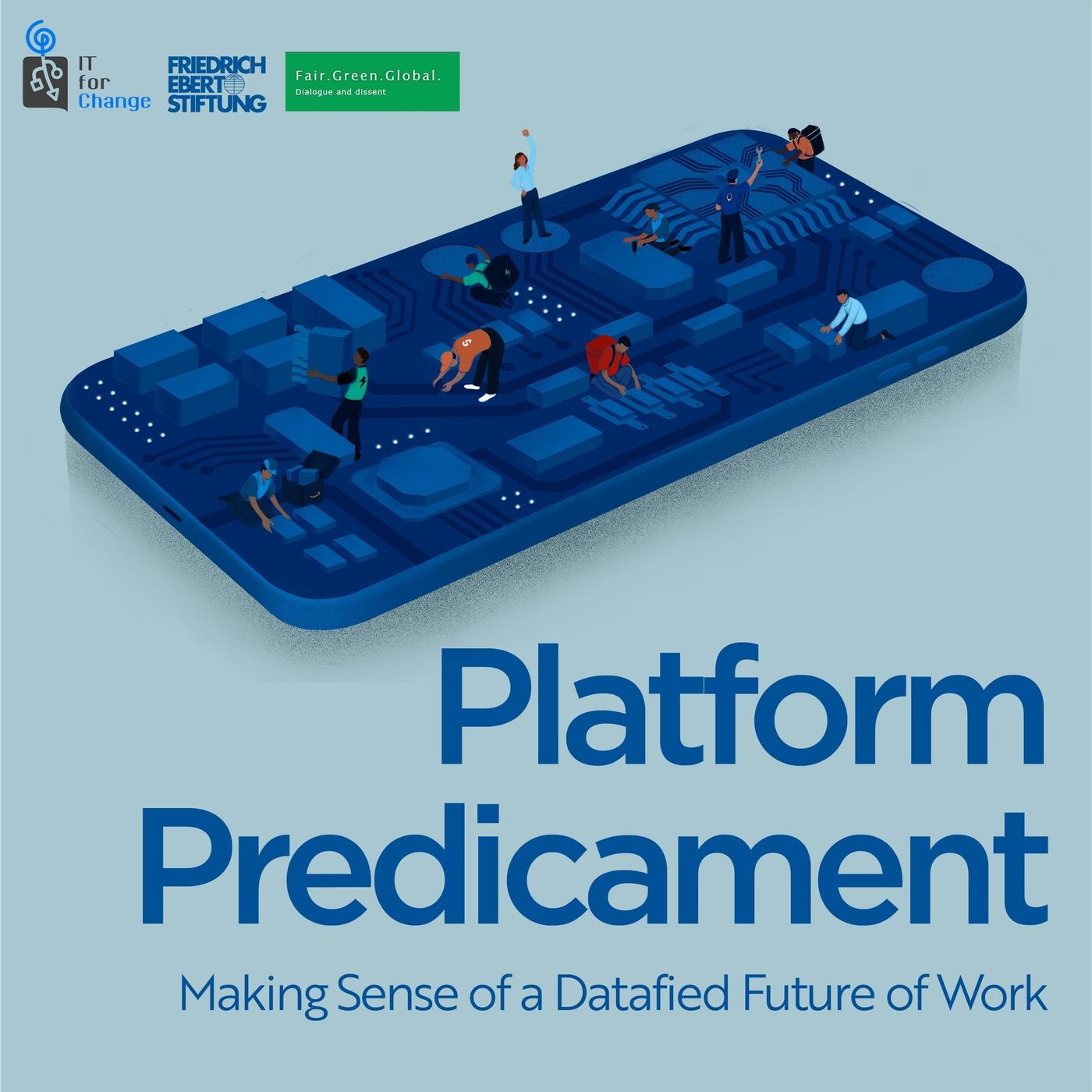
Ep 2: Who Run the World (of platforms)? Algorithmic Bosses and Workers’ Rights
FullPodcast: Platform Predicament – Making sense of a datafied future of workEpisode: Ep 2: Who Run the World (of platforms)? Algorithmic Bosses and Workers’ RightsPub date: 2022-12-15Get Podcast Transcript →powered by Listen411 - fast audio-to-text and summarizationThe second episode delves into the power that algorithms and data hold, in running this platform model of work. Experts explain how algorithmic management and control by platform apps has major implications for working conditions and worker autonomy, and how workers’ groups, through new-age organising, are negotiating workers’ rights in this algorithmmified world of work. This podcast series is brought to you by IT for Change, and supported by Friederich Ebert Stiftung (FES) and Fair Green Global (FGG).Host – Sonakshi Agarwal (IT for Change)Expert Speakers:Shaikh Salauddin (Indian Federation of App-based Transport Workers)Basudev Barman (International Transport Workers’ Federation)Spandan Pratyush (All India Gig Workers Union)Gayatri Singh (Senior Advocate)Salonie Hiriyadur (SEWA Cooperative Federation)Uma Rani (International Labour Organisation)References and Additional Reading:1. Workers’ Data Rights in the Platformised Workspace (IT for Change) - https://itforchange.net/node/20312. The Macro Frames of Microwork: A Study of Indian women workers on AMT in the post-pandemic moment (IT for Change) - https://itforchange.net/sites/default/files/1739/The-Macro-Frames-of-Microwork-Full-Report-ITfC-2021.pdf3. WeClock – The app for workers (The Why Not Lab) - https://www.thewhynotlab.com/post/weclock4. 10 Principles for Workers’ Data Rights and Privacy (UNI Global Union) - https://uniglobalunion.org/report/principles-for-workers-data-rights/5. R198 - Employment Relationship Recommendation, 2006 (International Labour Organisation) - https://www.ilo.org/dyn/normlex/en/f?p=NORMLEXPUB:12100:0::NO::P12100_INSTRUMENT_ID:3125356. ‘We’re being pushed into poverty’: Voices of women who took on the unicorn start-up Urban Company (Scroll) - https://scroll.in/magazine/1014700/were-being-pushed-into-poverty-voices-of-women-who-took-on-the-unicorn-start-up-urban-companyThe podcast and artwork embedded on this page are from IT for Change, which is the property of its owner and not affiliated with or endorsed by Listen Notes, Inc.

The charm of central bank digital currencies in a polarised world
FullPodcast: The Sound of Economics (LS 33 · TOP 5% what is this?)Episode: The charm of central bank digital currencies in a polarised worldPub date: 2022-12-08Get Podcast Transcript →powered by Listen411 - fast audio-to-text and summarization95 percent of the world economy (measured by GDP) is exploring the idea of launching a central bank digital currency (CBDC), and many countries including Nigeria and China are entering into the close-to-launch or fully launched phase. But what is the hype about?In this episode of the Sound of Economics, Maria Demertzis invites Grégory Claeys and Josh Lipsky to discuss the purpose of having a CBDC from both a retail and a wholesale perspective. Particularly, they raise the geopolitical importance of CBDCs, with the example of the G7’s financial sanctions against Russia that ruled out several Russian banks from the SWIFT system and froze Russian Foreign Exchange Reserves.However, if CBDCs are largely implemented, whilst they could help the EU achieve more autonomy in international finance, they could also be used by countries to bypass western sanctions and challenge the dollar hegemony in the current international financial system. The podcast and artwork embedded on this page are from Bruegel, which is the property of its owner and not affiliated with or endorsed by Listen Notes, Inc.
David Gunkel on robot rights
FullPodcast: The Sentience Institute Podcast (LS 29 · TOP 10% what is this?)Episode: David Gunkel on robot rightsPub date: 2022-12-05Get Podcast Transcript →powered by Listen411 - fast audio-to-text and summarization“Robot rights are not the same thing as a set of human rights. Human rights are very specific to a singular species, the human being. Robots may have some overlapping powers, claims, privileges, or immunities that would need to be recognized by human beings, but their grouping or sets of rights will be perhaps very different.”David GunkelCan and should robots and AI have rights? What’s the difference between robots and AI? Should we grant robots rights even if they aren’t sentient? What might robot rights look like in practice? What philosophies and other ways of thinking are we not exploring enough? What might human-robot interactions look like in the future? What can we learn from science fiction? Can and should we be trying to actively get others to think of robots in a more positive light? David J. Gunkel is an award-winning educator, scholar, and author, specializing in the philosophy and ethics of emerging technology. He is the author of over 90 scholarly articles and book chapters and has published twelve internationally recognized books, including The Machine Question: Critical Perspectives on AI, Robots, and Ethics (MIT Press 2012), Of Remixology: Ethics and Aesthetics After Remix (MIT Press 2016), and Robot Rights (MIT Press 2018). He currently holds the position of Distinguished Teaching Professor in the Department of Communication at Northern Illinois University (USA). Topics discussed in the episode:Introduction (0:00)Why robot rights and not AI rights? (1:12)The other question: can and should robots have rights? (5:39)What is the case for robot rights? (10:21)What would robot rights look like? (19:50)What can we learn from other, particularly non-western, ways of thinking for robot rights? (26:33)What will human-robot interaction look like in the future? (33:20)How artificial sentience being less discrete than biological sentience might affect the case for rights (40:45)Things we can learn from science fiction for human-robot interaction and robot rights (42:55)Can and should we do anything to encourage people to see robots in a more positive light? (47:55)Why David pursued philosophy of technology over computer science more generally (52:01)Does having technical expertise give you more credibility (54:01)Shifts in thinking about robots and AI David has noticed over his career (58:03)Resources discussed in the episode are available at https://www.sentienceinstitute.org/podcastSupport the showThe podcast and artwork embedded on this page are from Sentience Institute, which is the property of its owner and not affiliated with or endorsed by Listen Notes, Inc.
Regulating AI with Alex Engler
FullPodcast: The Lawfare Podcast (LS 68 · TOP 0.05% what is this?)Episode: Regulating AI with Alex EnglerPub date: 2022-12-07Get Podcast Transcript →powered by Listen411 - fast audio-to-text and summarizationEarlier this fall, the Biden administration released what it called a “Blueprint for an AI Bill of Rights,” a policy document that lays out a five-pillar strategy for how the United States intends to wrestle with and regulate the challenges arising from the increasingly common use of artificial intelligence. In recent weeks, the European Union has been wrestling with its own AI regulation challenges and is now on the verge of releasing its own similar strategy. Lawfare senior editor Scott R. Anderson sat down with Alex Engler, a fellow in Governance Studies at the Brookings Institution, who has been closely tracking these policies. They talked about the challenges AI poses to policymakers, the strategy the United States is set to pursue, and how it is both different from and similar to the EU’s approach.Support this show http://supporter.acast.com/lawfare. Hosted on Acast. See acast.com/privacy for more information.The podcast and artwork embedded on this page are from The Lawfare Institute, which is the property of its owner and not affiliated with or endorsed by Listen Notes, Inc.

S3, E5 Panel on Platforms for deliberation or disinformation? social media and development
FullPodcast: Cutting Edge Issues in Development Thinking & Practice (LS 24 · TOP 10% what is this?)Episode: S3, E5 Panel on Platforms for deliberation or disinformation? social media and developmentPub date: 2022-12-05Get Podcast Transcript →powered by Listen411 - fast audio-to-text and summarizationThis panel examines the record of digital technologies and asks what we might do to re-engineer them to fulfil their early promise.Fibre optic internet cables have now connected almost every part of the world into a giant web of networks. Pundits once claimed this infrastructure would allow everyone to raise her voice, speak her mind, learn from others and hold authorities to account. A decade on, a far more subdued mood has settled, with reports of targeted misinformation campaigns and nefarious surveillance the world over. This panel examines the record of digital technologies and asks what we might do to re-engineer them to fulfil their early promise. How might these infrastructures be used to generate more accurate information about contexts usually ignored or misconstrued by mainstream news outlets? How might we encourage users to actually listen and learn from those outside their own networks? How might we reconfigure these systems for deliberation and transparency, rather than divisiveness?SpeakersNanjala Nyabola is a writer and researcher based in Nairobi, Kenya. Her work focuses on the intersection between technology, media, and society. She is the author of Digital Democracy, Analogue Politics: How the Internet Era is Transforming Politics in Kenya (Zed Books, 2018) and Travelling While Black: Essays Inspired by a Life on the Move (Hurst Books, 2020).Idrees Ahmad, is the Director of Journalism at the University of Essex. He is a founding editor of New Lines magazine and a contributing editor at the Los Angeles Review of books. He writes for the New York Review of Books, Foreign Policy, The Washington Post, Times Literary Supplement, The Observer among others. He is on Twitter: @im_pulse.Amil Khan is a former Reuters foreign correspondent and BBC investigative journalist. He started working with right-based groups in the Middle East when the Arab Spring kicked off. In 2020, seeing online manipulation emerge as a critical threat to journalists, activists and political movements across the world, he founded Valent Projects with the aim of levelling the playing fieldKecheng Fang is an Assistant Professor at the School of Journalism and Communication, The Chinese University of Hong Kong. His research interests include digital media, journalism, and political communication.ChairLaura Mann is a sociologist whose research focuses on the political economy of development, knowledge and technology. Her regional focus is East Africa (Sudan, Kenya and Rwanda) but she has also worked on collaborative research on ICTs and BPO in Asia and has conducted fieldwork in North America as part of a project on digitisation within global agriculture.This talk is part of the Cutting Edge Issues in Development Thinking & Practice 2022 series, a high-profile lecture series run by the Department of International Development at LSE and organised by Dr Laura Mann and Professor in Practice Duncan Green.The Department of International Development promotes interdisciplinary postgraduate teaching and research on processes of social, political and economic development and change. The podcast and artwork embedded on this page are from LSE Department of International Development, which is the property of its owner and not affiliated with or endorsed by Listen Notes, Inc.

Agroecological Farming: Prehistories of Agriculture’s Digital Turn with Alexander Liebman
FullPodcast: Hagley History HangoutEpisode: Agroecological Farming: Prehistories of Agriculture’s Digital Turn with Alexander LiebmanPub date: 2022-11-28Get Podcast Transcript →powered by Listen411 - fast audio-to-text and summarizationHistorians of technology once famously asked, “does technology drive history?” Their answer was, “it depends.” The phenomena of history do not float atop of the changes within material practices and technology, but neither do they stand apart from them; the two are intimately entwined in the contingent, intermittent unfolding of history. The challenge for the historian is to open the black box of technology, and to make its social setting and connection explicit to allow for a better understanding of its role in continuity and change over time. Alexander Liebman, geographer and PhD candidate at Rutgers University, asks how this complicated set of interrelated factors have ramified upon the ground in agricultural spaces as twentieth-century engineers, planners, and others applied the technologies of computation and automation to farming. Among the major figures in this story was Arthur Hall, an engineer at Bell Laboratories and innovator in computerized agriculture. His patented 1970s-era “autofarm” aimed to save the small family farm by promoting the farmer from laborer to manager, and equipping him or her with a system of computerized, automated tools to grow, harvest, and process crops from a central indoor terminal. While Hall’s particular system did not change the world of agriculture, his ideas were part of a wider turn toward computer technologies as a solution to problems in American farming. In that regard, the “autofarm” is still with us, and is a touchstone in the history that has led to self-driving tractors and drone fleets of twenty-first-century American farms. In support of his research Liebman received funding form the Center for the History of Business, Technology, & Society at the Hagley Museum & Library. For more Hagley History Hangouts and more information, visit us online at hagley.org.The podcast and artwork embedded on this page are from Hagley Museum and Library, which is the property of its owner and not affiliated with or endorsed by Listen Notes, Inc.

Art and Religion as Technology
FullPodcast: Harvard Divinity School (LS 32 · TOP 5% what is this?)Episode: Art and Religion as TechnologyPub date: 2022-11-25Get Podcast Transcript →powered by Listen411 - fast audio-to-text and summarizationProfessor Terrence L. Johnson facilitated a conversation with Professor Anthony Pinn, Agnes Cullen Arnold Professor of Humanities and Professor of Religion at Rice University, who is a Visiting Scholar at the Harvard Divinity School for the academic year 2022-23, focused on Professor Pinn’s most recent book, The Interplay of Things. In The Interplay of Things, Pinn theorizes religion as a technology for interrogating human experiences and the boundaries between people and other things. Rather than considering religion in terms of institutions, doctrines, and creeds, Pinn shows how religion exposes the openness and porousness of all things and how they are always involved in processes of exchange and interplay. This event took place on November 7, 2022 Learn more: https://hds.harvard.edu/ Full transcript: https://hds.harvard.edu/news/2023/1/2/video-art-and-religion-technologyThe podcast and artwork embedded on this page are from Harvard Divinity School, which is the property of its owner and not affiliated with or endorsed by Listen Notes, Inc.

Moving Images In Absentia Courtroom Looking In The Age Of Hyper - Mediation
FullPodcast: MIT Comparative Media Studies/Writing (LS 38 · TOP 2% what is this?)Episode: Moving Images In Absentia Courtroom Looking In The Age Of Hyper - MediationPub date: 2022-10-05Get Podcast Transcript →powered by Listen411 - fast audio-to-text and summarizationKelli Moore is an Assistant Professor of Media, Culture, and Communication at New York University who examines how media and technology produce legal and political knowledge to inform public debates on visual literacy, race, and other issues.The podcast and artwork embedded on this page are from Massachusetts Institute of Technology, which is the property of its owner and not affiliated with or endorsed by Listen Notes, Inc.

Al, Anti-Discrimination Law, and Your (Artificial) Immutability
FullPodcast: TEC TalksEpisode: Al, Anti-Discrimination Law, and Your (Artificial) ImmutabilityPub date: 2022-11-16Get Podcast Transcript →powered by Listen411 - fast audio-to-text and summarizationHow could a personal characteristic like eye movement affect, say, whether you get a loan?Host Kirsten Martin is joined by Sandra Wachter, a professor of technology and regulation at the Oxford Internet Institute (OII) at the University of Oxford. She founded and leads OII’s Governance of Emerging Technologies (GET) Research Programme that investigates legal, ethical, and technical aspects of AI, machine learning, and other emerging technologies.Sandra came on the show to talk about her paper “The Theory of Artificial Immutability: Protecting Algorithmic Groups under Anti-Discrimination Law,” which is forthcoming in the Tulane Law Review.Most people are familiar with the idea of anti-discrimination law and its focus on protected-class attributes—e.g., race, national origin, age, etc.—that represent something immutable about who we are as individuals and that, as Sandra explains, have been criteria humans have historically used to hold each other back.She says that with algorithms, we’re now being placed in other groups that are also largely beyond our control but that can nevertheless impact our access to goods and services and things like whether we get hired for a job. These groups fall into two main categories: people who share non-protected attributes—say, what type of internet browser they use, how their retinas move, dog owners, etc.—and people who share characteristics that are significant to computers (e.g., clicking behavior) but for which we as humans have no social concept.This leads to what Sandra calls “artificial immutability” in the attributes used to describe us, or the idea that there are things about ourselves we can’t change not because they were given by birth but because we’re unaware they’ve been assigned to us by an algorithm. She offers a definition of what constitutes an immutable trait and notes that there can be legitimate uses of them in decision-making, but that in those cases organizations need to be able to explain why they’re relevant.Episode LinksPaper Discussed in the Episode: “The Theory of Artificial Immutability: Protecting Algorithmic Groups under Anti-Discrimination Law”Sandra’s BioEpisode TranscriptAt the end of each episode, Kirsten asks for a recommendation about another scholar in tech ethics whose work our guest is particularly excited about. Sandra highlighted University of Cambridge psychologist Amy Orben and her research on online harms, particularly in the context of young people’s use of social media.Follow ND TEC on Twitter and LinkedInThe podcast and artwork embedded on this page are from Notre Dame Technology Ethics Center, which is the property of its owner and not affiliated with or endorsed by Listen Notes, Inc.

The collapse of the ‘Crypto King’
FullPodcast: Front Burner (LS 66 · TOP 0.05% what is this?)Episode: The collapse of the ‘Crypto King’Pub date: 2022-11-15Get Podcast Transcript →powered by Listen411 - fast audio-to-text and summarizationIn the last two years, cryptocurrency exchange FTX spent millions of dollars on advertisements with the likes of NFL quarterback Tom Brady and Curb Your Enthusiasm’s Larry David. FTX also sponsored Major League Baseball, the Mercedes Formula One racing team and Canadian businessman Kevin O’Leary. Earlier this month, Bloomberg ranked the platform’s founder, Sam Bankman-Fried, as one of the world’s 100 richest people. He was sometimes referred to as the “King of Crypto.” But now, after financial leaks triggered mass withdrawals and a halt in trading, Bankman-Fried is worth effectively nothing. FTX has gone from a recent $32-billion US evaluation to bankruptcy. Today, CBC News senior business writer Pete Evans returns to explain how one of the world’s three biggest crypto exchanges was brought down so quickly.The podcast and artwork embedded on this page are from CBC, which is the property of its owner and not affiliated with or endorsed by Listen Notes, Inc.
Belabored: Courier Class War
FullPodcast: Belabored (LS 48 · TOP 1% what is this?)Episode: Belabored: Courier Class WarPub date: 2022-11-11Get Podcast Transcript →powered by Listen411 - fast audio-to-text and summarizationSubscribe to the Belabored RSS feed here. Support the podcast on Patreon. Subscribe and rate on iTunes, Stitcher, and Spotify. Tweet at @DissentMag with #Belabored to share your thoughts, or join the conversation on Facebook. Check out the full archive here. Belabored is produced by Colin Kinniburgh. While the pandemic brought turmoil and massive job losses to many sectors of the economy, some industries flourished during the many months of lockdowns, quarantines, and remote work and schooling. We came to rely on Zoom and Amazon as basic means of communication and consumption, and when it came to staying fed, many of us turned to food platforms like Grubhub, DoorDash, or Uber Eats. Food couriers became part of the essential workforce of the pandemic, toiling for long hours on the streets and often putting their own health at risk to serve the public. With many people seeking work after restaurants and other businesses shuttered, the ranks of delivery workers expanded massively, as did the health and safety risks endemic to their trade. Many began organizing to improve their pay and seek more protections at work. The transnational struggles of couriers sparked innovative ways of networking and mobilizing, as workers discovered they could use their phones not just to pick up gigs but also to connect with fellow couriers. To learn more about organizing food delivery labor during the pandemic, we spoke with Antonio Solis, a member of Los Deliveristas Unidos—an organization of app-based delivery workers in New York City—and with Ahmed Hafezi and John Kirk, Deliveroo couriers and organizers with the Independent Workers’ Union of Great Britain. Read a transcript of Michelle’s interview with Antonio Solis here. In other news, we look at allegations of worker abuse in the House of Bezos, the Gannett newsroom strikes, Chinese iPhone workers struggling under a COVID-19 lockdown, and labor ballot measures. Thank you for listening to our 259th episode! If you like the show, you can support us on Patreon with a monthly contribution, at the level that best suits you. If you’re interested in advertising on the show, please email ads@dissentmagazine.org. And as always, if you have any questions, comments, or tips, email us at belabored@dissentmagazine.org News David K. Li and Diana Dasrath, Housekeeper’s claims that Jeff Bezos made staff go ‘without rest or meal breaks’ are without merit, his lawyer says, NBC News Josh Eidelson, Lawyer Suing Twitter Over Layoffs Says Musk Trying to Comply, Bloomberg News Sam Hancock, Apple: Chinese workers flee Covid lockdown at iPhone factory, BBC News New York rally in solidarity with Foxconn workers; Apple’s new statement hides the truth, change.org Aaron Morrison, Slavery, involuntary servitude rejected by 4 states’ voters, AP News Daniel Wiessner, Voters in Illinois, Tennessee approve dueling measures on union membership, Reuters Pittsburgh Union Progress Gannett Union Press Conversation Los Deliveristas Unidos Independent Workers’ Union of Great Britain Michelle Chen, Los Deliveristas Unidos Demand Justice, Dissent Michelle Chen, Your Rent or Your Life, The Nation Sarah Jaffe and Michelle Chen, Belabored: Riding for Deliveroo, with Callum Cant, Dissent Kimiko de Freytas-Tamura, Food Delivery Apps Are Booming. Their Workers Are Often Struggling, New York Times The Transnational Courier Federation, Notes From Below Thanks to the Ford Foundation of Social Justice for sponsoring this series. The post Belabored: Courier Class War appeared first on Dissent Magazine.The podcast and artwork embedded on this page are from Dissent, which is the property of its owner and not affiliated with or endorsed by Listen Notes, Inc.

The Perils of Artificial Intelligence in Academic Publishing
FullPodcast: Unsettling Knowledge Inequities Episode: The Perils of Artificial Intelligence in Academic PublishingPub date: 2022-11-01Get Podcast Transcript →powered by Listen411 - fast audio-to-text and summarizationOne of the key themes that intersects across all of our episodes this season is the surveillance and highly extractive and harmful economic practices of big corporations in the academic publishing sector, whose artificial intelligence tools are creating new forms of control and governance over our daily and professional activities.In this episode, we are joined by Christine Cooper, Yves Gendron, and Jane Andrew - co-editors of the Critical Perspectives on Accounting journal and co-authors of the article: “The perils of artificial intelligence in academic publishing.”We reflect on how automated decision making algorithms are deployed in academic publishing, particularly for peer review and related editorial decision making - and explore the implications of these technologies on research practices, scholarly expertise and autonomy, and the struggle for control over the future of “sustainability, creativity, and critical values of the academic world.”The podcast and artwork embedded on this page are from Knowledge Equity Lab, which is the property of its owner and not affiliated with or endorsed by Listen Notes, Inc.