The History of the Christian Church
248 episodes — Page 3 of 5

The First Centuries Part 08 – Art
This episode is a bit different from our usual fare in that it’s devoted to the subject of art in Church History. It’s in no way intended to be a comprehensive review of religious art. We’ll take just a cursory look at the development of art in the early centuries.Much has been written about the philosophy of art. And as anyone who’s taken an art history course in college knows, much debate has ensued over what defines art. It’s not our aim here to enter that fray, but instead of step back and simply chart the development of artistic expression in the First Centuries.It’s to be expected the followers of Jesus would get around to using art as an expression of their faith quickly in Church History. Man is, after all, an emotional being and art is often the product of that emotion. People who would convert from headlong hedonism to an austere asceticism didn’t usually do so simply based on cold intellectualism. Strong emotions were involved. Those emotions often found their output in artistic expression.Thus, we have Christian art. Emotions & the imagination are as much in need of redemption and capable of sanctification, as the reason and will. We’d better hope so, at least, or we’re all doomed to a grotesquely lopsided spiritual life. How sad it would be if the call to love God with all our heart, soul & mind didn’t extend to our creative faculty and art.Indeed, the Christian believes the work of the Holy Spirit after her/his conversion, is to conform the believer into the very image of Christ. And since God is The Creator, it’s reasonable to assume the Spirit would bend humanity’s penchant for artifice to serve the glory of God and the enjoyment of man.Scripture even says we are to worship God “in the beauty of holiness.” A review of the instructions for the making of the tabernacle make it clear God’s intention was that it be a thing of astounding beauty. And looked at from what we’d call a classical perspective, nearly all art aims to simply duplicate the beauty God as First Artist made when He spoke and the universe leapt into existence.Historians tend to divide Early Church History into two large blocks using The First Council of Nicaea in 325 as the dividing line. The Ante-Nicaean Era runs from the time of the Apostles, the Apostolic Age, to Nicaea. Then the Post-Nicaean Era runs from the Council to The Medieval Era. This was the time of the first what are called 7 Ecumenical Councils; the last of which, is conveniently called the 2nd Nicaean Council, held in 787. So the Ante-Nicaean Era lasted only a couple hundred yrs while the Post-Nicaean Age was 500.It would be nice if Art Historians would sync up their timelines to this plan, but they divide the history of Church Art differently. They refer to Pre-Constantinian Art, while From the 4th thru 7th Cs is called Early Christian Art.The beginnings of identifiable Christian art are located in the last decades of the 2nd C. Now, it’s not difficult to imagine there’d been some artistic expression connected to believers before this; it’s just that we have no enduring record of it. Why is easy to surmise. Christians were a persecuted group and apart from some notable exceptions, were for the most part comprised of the lower classes. Christians simply didn’t want to draw attention to themselves on one hand, and on the other, there wasn’t a source of patronage base for art in service of the Gospel.Another reason there wasn’t much art imagery generated before the 2nd C is because early generations of believers were mostly Jewish with a long-standing prohibition of making graven images, lest they violate the Commandments against idolatry. By the mid 2nd C, the Church had shifted to a primarily Gentile body. Gentiles had little cultural opposition to the use of images. Indeed, their prior paganism encouraged it. They quickly learned they were not to make idols, but had no reluctance to use images a symbols and representations to communicate the Gospel and express their faith.The style of this early art is drawn from Roman motifs of the Late Classical style and is found in association with the burial of believers. While pagans generally practiced cremation, the followers of Jesus shifted to burial as an expression of their hope in the Resurrection. So outside Rome’s walls near major roadways, numerous catacombs were excavated where Christians both met when the heat of persecution was up, and where their dead were interred. Some of the oldest of Christian imagery is a simple outline of a ship or an anchor scratched into the wall of a crypt. Both were symbols of the Church. The anchor is drawn from the NT Book of Hebrews which refers to the hope of the believer as an anchor or the soul. The ship was an apt picture for the Church. A vessel which is IN the Sea, but mustn’t have the sea in it, just as the Church is to be in the World, but the World is not to be in the Church. Another symbol used to make the resting place of Christians was the ubiquitous fish. A

The First Centuries – Part 07 – Origen
As I record & post this episode, a new movie’s out called Logan. It’s appears to be the last installment for the venerable X-Men character Wolverine, played by Hugh Jackman. Logan was an immortal who became the subject of a secret military experiment gone wrong. His skeleton was infused with a fictional metal called adamantium that bears the hardness of a diamond. (more…)

The First Centuries Part 06 / Tertullian & The Montanists
This is part 6 of our series titled The First Centuries, in Season 2 of CS. In the last episode we took a look at the Church Father Irenaeus. This episode we’ll consider Tertullian.That may prompt some to wonder if we’re going to work our way through ALL the church fathers of the Early Church. Uh, no – we won’t. Just a few.While he’s known to history as Tertullian, his full name was Quintus Septimius Florens Tertullianus. (more…)

The First Centuries Part 05 / Irenaeus
The First Centuries – Part 5 // Irenæus The historical record is pretty clear that the Apostle John spent his last years in Western Asia Minor, with the City of Ephesus acting as his headquarters. It seems that during his time there, he poured himself into a cadre of capable men who went on to provide outstanding leadership for the church in the midst of difficult trials. Men like Polycarp of Smyrna, Papias & Apolinarius of Hierapolis, & Melito of Sardis. These and others were mentioned by Polycrates, the bishop of Ephesus in a letter to Victor, a bishop at Rome in about AD 190.These students of John are considered to be the last of what’s called The Apostolic Age. The greatest of them was Irenæus. Though he wasn’t a direct student of the Apostle, he was influenced by Polycarp, & is considered by many as one of the premier and first Church Fathers.Not much is known of Irenæus’ origins. From what we can piece together from his writings, he was most likely born and raised in Smyrna around AD 120. He was instructed by Smyrna’s lead pastor, Polycarp, a student of John. He says he was also directly influenced by other pupils of the Apostles, though he doesn’t name them. Polycarp had the biggest impact on him, as evidenced by his comment, “What I heard from him, I didn’t write on parchment, but on my heart. By God’s grace, I bring it constantly to mind.” It’s possible Irenæus accompanied Polycarp when he traveled to Rome and engaged Bishop Anicetus in the Easter controversy we talked about last episode.At some point while still a young man, Irenæus went to Southern Gaul as a missionary. He settled at Lugdunum where he became an elder in the church there. Lugdunum eventually became the town of Lyon, France. In 177, during the reign of Marcus Aurelius, the church in Lugdunum was hammered by fierce persecution. But Irenæus had been sent on a mission to Rome to deal with the Montanist controversy. While away, the church’s elderly pastor Pothinus, was martyred. By the time he returned in 178 the persecution had spent itself and he was appointed as the new pastor.Irenæus worked tirelessly to mend the holes persecution had punched in the church in Southern Gaul. In both teaching and writing, he provided resources other church leaders could use in faithfully discharging their pastoral duties, as well as refuting the various and sundry errors challenging the new Faith. During his term as the pastor of the church at Lyon, he was able to see a majority of the population of the City converted to Christ. Dozens of missionaries were sent out to plant churches across Gaul.Then, about 190, Irenæus simply disappears with no clear account of his death. A 5th C tradition says he died a martyr in 202 in the persecution under Septimus Severus. The problem with that is that several church fathers like Eusebius, Hippolytus, & Tertullian uncharacteristically fail to mention Irenæus’ martyrdom. Because martyrs achieved hero status, if Irenæus had been martyred, the Church would have marked it. SO most likely, he died of natural causes. However he died, he was buried under the altar St. John’s in Lyons.Irenæus’ influence far surpassed the importance of his location. The bishopric of Lyon was not considered an important seat. But Irenæus’ impact on the Faith was outsized to his position. His keen intellect united a Greek education with astute philosophical analysis, and a sharp understanding of the Scriptures to produce a remarkable defense of The Gospel. That was badly needed at the time due to the inroads being forged by a new threat – Gnosticism, which we spent time describing in Season 1.Irenæus’ articulation of the Faith brought about a unanimity that united the East & Western branches of the Church that had been diverging. They’d end up reverting to that divergence later, but Irenæus managed to bring about a temporary peace through his clear defense of the faith against the Gnostics.Irenæus admits he had a difficult time mastering the Celtic dialect spoken by the people where he served but his capacity in Greek, in which he composed his writings, was both elegant & eloquent without running to the merely flowery. His content shows he was familiar with the classics by authors like Homer, Hesiod, & Sophocles as well as philosophers like Pythagoras & Plato.He shows a like familiarity with earlier Christian writers such as Clement, Justin Martyr, & Tatian. But Irenæus is really only 1 generation away from Jesus and the original Apostles due to a couple long life-times; that of John, and then his pupil, Polycarp. We find their influence in Irenæus’ remark impugning the appeal of Gnosticism, “The true way to God, is through love. Better to know nothing but the crucified Christ, than fall into the impiety of overly curious inquires & silly nuances.” Reading Irenæus’ work on the core doctrines of the Faith reveal his wholehearted embrace of Pauline theology of the NT. Where Irenæus goes beyond John &

The First Centuries – Part 04 / An Easter Tussle
Have you noticed that, generally-speaking, Christians like to argue?Maybe we get it from our spiritual ancestors, the Jews. Once while on a tour of Jerusalem at what are called the Southern Steps of the Temple Mount, our Jewish guide told us that a frequent joke among his people was that where there are 2 Jews, there’s 3 opinions.Yeah; it seems controversy has been a part of the history of The Church since its inception. And maybe that’s really more a “human” tendency than something unique to, or the sole prerogative of the followers of Jesus. (more…)

The First Centuries Part 03
In part 1 we took a look at some of the sociological reason for persecution of Christians in the Roman Empire. Then last time we began a narrative-chronology of the waves of persecution and ended with Antonius Pious.A new approach in dealing with Christians was adopted by Marcus Aurelius who reigned form 161–180. Aurelius is known as a philosopher emperor. He authored a volume on Stoic philosophy titled Meditations. It was really more a series of notes to himself, but it became something of a classic of ancient literature. Aurelius bore not a shred of sympathy for the idea of life after death & detested as intellectually inferior anyone who carried a hope in immortality. (more…)

The First Centuries – Part 02
This is part 2 in our follow-up series on the first centuries in Church History. We’re concentrating on the persecution Jesus’ followers endured. In part 1, we examined the social & civic reasons for persecution in the Roman Empire.The suspicion of nefarious intent by Christians, fueled by their withdrawal from society due to its tacit connection to paganism, morphed into a suspicion of covert actions Jesus’ followers were taking to subvert society. Why were Christians so secretive if they weren’t in fact doing something wrong? And if the rumors were true, Christians WERE doing odd things; like pretending slaves had the same dignity as freemen; that women and children were to be honored as equal to men; and they rescued exposed infants. Why, if they kept all that up, and more joined their cause, what was to become of the world? It would look very different from the one that had been. (more…)

The First Centuries – Part 01
Welcome BACK to Communion Sanctorum: History of the Christian Church.We ended our summary & overview narrative of Church History after 150 episodes; took a few months break, and are back to it again with more episodes which aim to fill in the massive gaps we left before.This time, we’ll do series that go into detail on specific moments, movements, people, places, and other topics. (more…)

140-The End
The final episode of Communio Sanctorum. We look briefly at the reaction of some Protestants to Manifest Destiny. DL Moody, The Holiness Movement, Phoebe Palmer, The Azusa Street Revival.This 150th episode of CS is titled The End.150 episodes! And this is the rebooted v2. We had a hundred episodes in v1 before I started over again in an attempt to clean up the timeline and fill in some gaps. (more…)

139-Evangementalism
This 139th episode is titled Evangementalism,We’ve spent a couple of episodes laying out the genesis of Theological Liberalism, and concluded the last episode with a brief look at the conservative reaction to it in what’s been called Evangelicalism. Evangelicalism was one of the most important movements of the 20th C. The label comes from that which lies at the center of the movement, devotion to an orthodox and traditional understanding of the Evangel, that is, the Christian Gospel - the Good News of salvation through faith in Jesus Christ.While Evangelicalism is used today mainly to describe the theological movement that came about as a reaction to Protestant theological liberalism, the term can be applied all the way back to the 1st C believers who referred to themselves as “People of the Gospel,” the Evangel. The term was resurrected by Reformers to call themselves “evangelicals” before identifying as Protestants or any of the other labels used for protestant denominations today.The modern flavor of Evangelicalism came about as a merging of European Pietism and revivals among Methodists in England. We might even locate the origin of modern Evangelicalism in the First Great Awakening of the mid-18th C. Its midwives were people like Whitefield, Tennent, Freylinghuysen, and of course Jonathan Edwards.Since major stress of all these was the need for a conversion experience and spiritual new birth, revivalism and an emphasis on the task of evangelism have been front and center in Evangelicalism.As we’ve seen in a past episode, the First Great Awakening was followed a century later by the Second which began in the United States and spread to Europe, then the rest of the world and had a huge impact on how Christians viewed their Faith. What’s remarkable about the Second Great Awakening, is that it came at a time when many church leaders lamented the low state of the Church in Western Civilization. Christianity’s enemies gleefully wrote its obituary. Theological Liberalism helped to push the Faith toward an early grave. But the Second Great Awakening literally shook North American and Europe to their core. A wave of missionaries went out across the globe as a result, spreading the Faith to places no church had existed for hundreds of years, and in some cases, ever before.In newly settled regions on the American frontier, Evangelicalism was carried out in week-long “camp meetings.” Think of a modern concert with multiple bands. Camp meetings were like that, except in place of bands playing music were preachers passionately preaching the Gospel. Might not sound too appealing to our modern sensibilities, but the lonely pioneers of the frontier turned out in large crowds. They’d been too busy building homesteads to consider constructing frontier churches. But now they returned home to do that very thing.One of the largest of these camp meetings took place at Cane Ridge in Kentucky in August 1801. Upwards of 20,000 gathered to listen to Protestant preachers of all stripes.Methodist minister Francis Asbury was just one of several circuit-riders who carried the Gospel all over the frontier. Both Baptists and Methodists worked tirelessly to bring the Gospel to blacks. But the fierce racism of the time refused to integrate congregations. Separate churches were plated for black congregations, of which there were many. In the early 19th C, Richard Allen left the Methodist Church to found the African Methodist Episcopal Church. In the US, it wasn’t long before Evangelical Baptists and Methodists outnumbered older denominations of Episcopalians and Presbyterians, groups where theological liberalism had infiltrated.Charles Finney was an attorney-turned-revivalist who transferred the excitement and energy of the rural camp-meetings to the urban centers of the American Northeast. An innovator, Finney encouraged the newly converted to share the story of how they came to the Faith – called ‘giving your testimony.’ He set what he called an “anxious bench” near the front of rooms where he spoke as a place where those who wanted prayer or to make a profession of faith in Christ could sit. That eventually turned into the modern ‘altar call’ that’s a standard fixture of many Evangelical churches today.By the start of the American Civil War in the mid-19th C, Evangelicalism was the predominant religious position of the American people. In an address delivered 1873, Rev. Theodore Woolsey, one-time president of Yale could say, without the least bit of controversy; “The vast majority of people believe in Christ and the Gospel. Christian influences are universal. Our civilization and intellectual culture are built on that foundation.”While there are many brands, flavors, and emphases inside modern Evangelicalism, it’s safe to characterize an Evangelical as someone who holds to several core beliefs: those being à1) The authority and sufficiency of Scripture2) The uniqueness of salvation through the cross of Jesus Christ,3) The need for per

138-Liberal v Evangelical
The title of this 138th episode is Liberal v EvangelicalIn our last episode, we considered the philosophical roots of Theological Liberalism. In this, we name names as we look at its early leaders and innovators.When I took a philosophy course in college, the professor dispensed on us sorry, unwashed noobs his understanding of faith and reason. After a lengthy description of both, he concluded by saying that faith and reason had absolutely nothing to do with each other. Reason dealt with the evidential, that which was perceived by the senses, and what logic concluded were rationally consistent conclusions drawn from that evidence. Faith, he declaimed, was a belief in spite of the evidence. When I asked if he was thus saying faith was irrational, he just smiled.That professor was an adherent of Immanuel Kant’s philosophy. In Kant’s work Critique of Pure Reason, published in 1781, Kant argued reason is able to comprehend anything in the realm of space and time; what he called the phenomenal realm. But reason is useless in accessing the noumenal, or spiritual realm transcending time and space.Kant didn’t argue against the existence of the spiritual realm. He simply said it’s only something we can experience by feelings. We can’t really THINK about it in the sense that it touches the rational mind.Traditional, orthodox Christians pushed back against the Kantian view of faith as feeling by reminding themselves Jesus said the greatest command was to love God with all they had, including their minds. But liberals found in Kant’s philosophy a justification for unhitching reason from faith and for allowing modern people to live in a secular world while still enjoying the benefits of religious sentiments about ultimate meaning. In other words, it allowed them to get along content with the WHAT of life in the world, without having to bother much with the HOW, or concern themselves at all with WHY.A few years after the publication of Kant’s Critique, the German theologian Friedrich Schleiermacher, going against the heart and soul of Christian apologetics dating back hundreds of years, said the heart of Christian Faith isn’t a historical event, like the Resurrection. It was, he argued, a feeling of one’s absolute dependence on a reality beyond one’s self. That awareness, he claimed, could be developed to the point where a person would be able to imitate Jesus’ own good deeds.He wrote, “The true nature of religion is immediate consciousness of Deity as found in ourselves and the world.” This earned Schleiermacher the title, Father of Theological Liberalism. Schleiermacher was born in a pious Moravian home, but as a young man, he imbibed the rationalism of the Enlightenment and became an ardent apologist for accommodating Christianity to popular society. As a professor of the newly founded University of Berlin, he insisted debates over proofs of God’s existence, the authority of Scripture, and the possibility of miracles weren’t the issues they ought to focus on. He said that the heart of religion had always been feeling, rather than rational proofs. God is not a theory used to explain the universe. Rather, God is to be experienced as a living reality. For Schleiermacher, religion isn’t a creed to be pondered by the rational mind. It’s based on intuition and a feeling of dependence.Orthodox Christians who identified religion with creedal doctrines, Schleiermacher maintained, would lose the battle for the Faith in the Modern world because those creeds were no longer rationally acceptable. Religion needed to find a new base. He located it in feelings.Sin, Schleiermacher said, was the result of people living by themselves, isolated from others. To overcome the sin that makes man independent from God and others, God sent a mediator in Jesus Christ. Christ’s uniqueness wasn’t in doctrines about his virgin birth or deity. No à What made Jesus a Mediator who can help us is the perfect example he was of one utterly dependent on God. By meditating on Christ’s example, and feeling our own inner sense of dependence on the universe around us, we too can experience God as Jesus did.In Schleiermacher’s theology, the center of religion shifts from Scripture to experience. So, the Biblical criticism we looked at in the last episode can’t harm Christianity, since the real message of the Bible speaks to an individual’s own subjective pursuit of the divine. The Bible doesn’t need to be factual or true, as long as it affects the feeling of dependence that is the spark that leads to spiritual illumination.Albrecht Ritschl enlarged on Schleiermacher’s ideas, taking them mainstream.For Ritschl, religion had to be practical. It began with the question, “What must I do to be saved?” But he eschewed the merely theoretical. So the question “What must I do to be saved?” can’t just mean, “How do I get to heaven after I die?” Ritschl said salvation meant living a new life, free from sin, selfishness, fear, and guilt.Ritschl’s practical Christianity ha

137-Why So Critical
The episode is titled Why So Critical?Two episodes back we introduced the themes that would lead eventually to Theological Liberalism. The last episode we talked a bit about how the church, mostly the Roman Catholic church, pushed back against those themes. In this episode, we’ll go further into the birth of liberalism.The 20th century was unkind to Theological Liberalism, with its shining vision of the Universal Brotherhood of Man under the Universal Fatherhood of God. Yet, many mainline Protestant denominations still hold solidarity with Liberalism. It was Professor Sydney Ahlstrom’s view that liberals had provoked as much controversy in the 19th century as the Reformers did in the 16th. The reason for that controversy lay in their objective, stated by one of its premier advocates and popularizers - Harry Emerson Fosdick. In his autobiography, The Living of These Days, the influential pastor of the famous Riverside Church in New York City, said the aim of liberal theology was to make it possible “to be both an intelligent modern and a serious Christian.”Liberals hoped to address a problem may be as old as The Faith itself: That is, how can Christians reconcile their faith to the intellectual climate of their time without compromising the Essentials of The Gospel? By the evaluation of modern Evangelicals, Liberalism failed in that quest precisely because they DID compromise those essentials in their desire to be relevant among their unbelieving peers. Richard Niebuhr expressed the irony of theological liberalism when he said in liberalism “a God without wrath brought men without sin into a kingdom without judgment through the ministrations of a Christ without a Cross.”Personally, I’ve been reluctant to produce this episode because the more I’ve studied Theological liberalism, the less certain of being able to handle it competently I’ve grown. Definitions for it are no easier than for political liberalism. In fact, many deny that Protestant liberalism is a theology at all. They refer to it as an “outlook,” or “approach.” Henry Coffin of Union Seminary described liberalism as a “spirit” that honors truth so supremely and it craves the freedom to discuss, publish, and pursue what it believes to be true.But then, if THAT is true, it must certainly lead to certain convictions that derive values and produce judgments. And THAT is precisely what we see the history of Protestant liberalism producing.In the words of Bruce Shelley, “Liberals believed Christian theology had to come to terms with modern science if it ever hoped to claim and hold the allegiance of intelligent men.” So liberals refused to accept religious beliefs on authority alone. They insisted faith must submit to reason and experience. Following the thinking of the Enlightenment, of which they were the spiritual children, they claimed the human mind was capable of thinking God’s thoughts after Him. So, the best insight into the nature and character of God wasn’t His self-revelation in Scripture, which smacked of the old authoritarianism they eschewed; it was human intuition and reason.By surrendering to what we’ll call “the modern mind” liberals accepted the assumption of their time that the universe was a massive but synchronized machine, like a well-made watch. The key to this machine was Unity.I’ll come back to that in a moment, but a little editorializing seems in order. And while some may be rolling their eyes, I think this is germane to what this podcast is – a review of History – specifically Church History. I just made reference to “the modern mind.”Modern is another term that has multiple meanings. Historians use it to refer to the Modern Era, which they debate over the time span of, but let’s go with the common view that it runs from about 1500 to 1900-ish. So wait! IF the Modern Era ended at the beginning of the 20th century, what Era are we in now? The Atomic or Nuclear Era, the Post-Modern Era, the Information Age? Different labels get assigned to the current historical epoch. But don’t we still refer to current trends and fashions as being “modern”? Aren’t we “moderns” in the sense that we’re living NOW? Not many people would want to be considered not modern.It gets confusing because the word modern is plastic with a lot of different meanings and connotations. But here’s where it adds to the confusion as it relates to our discussion on theological liberalism, and some of this spills over into political liberalism. There was a desire to accommodate Christian theology to the modern mind. By which emerging liberals meant accepting the findings of “modern science” as (air-quote) fact and making theology fit into those supposed facts. But there’s a difference, a vast difference between facts and interpretations of facts. A few years after a so-called “Fact” was established by science, others came along to say, “Yeah, uh, we weren’t quite right about that. It’s actually this.” And, it wasn’t uncommon for even that revised new paradigm to be

136-Push Back
The title of this episode is Push-BackAs we move to wind up this season of CS, we’ve entered into the modern era in our review of Church history and the emergence of Theological Liberalism. Some historians regard the French Revolution as a turning point in the social development of Europe and Western Civilization. The Revolution was in many ways, a result of the Enlightenment, and a harbinger of things to come in the Modern and Post-Modern Eras.At the risk of being simplistic, for convenience sake, let’s set the history of Western Civilization into these eras of Church History.First is the Roman Era, when Christianity was officially opposed and persecuted. That was followed by the Constantinian Era, when the Faith was at first tolerated, then institutionalized. With the Fall of the Roman Empire in the West, Europe entered the Middle Ages and the Church was led by Rome in the West, Constantinople in the East.The Middle Ages ended with the Renaissance which swiftly split into two streams, the Reformation and the Enlightenment. While many Europeans broke from the hegemony of the Roman Church to launch Protestant movements, others went further and broke from religious faith altogether in an exaltation of reason. They purposefully stepped away from spirituality toward hard-boiled materialism.This gave birth to the Modern Era, marked by an ongoing tension between Materialistic Rationalism and Philosophical Theism that birthed an entire rainbow of intellectual and faith options.Carrying on this over-simplified review from where our CS episodes have been, the Modern Era then turned into the Post-Modern Era with a full-flowering and widespread academic acceptance of the radical skepticism birthed during the Enlightenment. The promises of the perfection of the human race through technology promised in the Modern Era were shattered by two World Wars and repeated cases of genocide in the 20th and 21st Cs. Post-Moderns traded in the bright Modernist expectation of an emerging Golden Age for a dystopian vision of technology-run-amuck, controlled by madmen and tyrants. In a classic post-modern proverb, the author George Orwell said, “If you want a vision of the future, imagine a boot stamping on a human face – forever.”In our last episode, we embarked on a foray into the roots of Theological Liberalism. The themes of the new era were found in the motto of the French Revolution: “Liberty, Equality, and Fraternity.”Liberty was conceived as individual freedom in both the political and economic realms. Liberalism originally referred to this idea of personal liberty in regard to economics and politics. It’s come to mean something very different. Libertarian connects better with the original idea of liberalism than the modern term “liberalism.”In the early 19th C, liberals promoted the political rights of the middle class. They advocated suffrage and middle-class influence through representative government. In economics, liberals agitated for a laissez faire marketplace where individual enterprise rather than class determined one’s wealth.Equality, second term in the French Revolution’s trio, stood for individual rights regardless of legacy. If liberty was a predominantly middle-class virtue, equality appealed to rural peasants, the urban working class, and the universally disenfranchised. While the middle class and hold-over nobility advocated a laissez-faire economy, the working class began to agitate for equality through a rival philosophy called socialism. Workers inveighed for equality either through the long route of evolution within a democratic system or the shorter path of revolution via Marxism.Fraternity, the third idea in the trinity, was the Enlightenment reaction against all the war and turmoil that marked European history till then; especially the trauma that had rocked the continent through endless political, economic, and religious struggle. Fraternity represented a sense of brotherhood that rolled across Europe in the 19th C. And while it held the promise of uniting people in the concept of the universal brotherhood of man under the universal Fatherhood of God, it quickly devolved into Nationalism that would only lead to even bloodier conflicts since they were now accompanied by modern weapons.These social currents swirled around the Christian Faith during the first decades of the Age of Progress, but no one predicted the ruination they’d bring the Church of Rome, steeped as it was in an inviolable tradition. For over a thousand years she’d presided over feudal Europe. She enthroned dozens of monarchs and ensconced countless nobles. And like them, the Church gave little thought to the power of peasants and the growing middle class. In regards to social standing, in 18th C European society, noble birth and holy calling were everything. Intelligence or achievement meant little.Things began to heat up in Europe when Enlightenment thinkers began to question the old order. In the 1760s, several places around the wo

135-Liberal
The title of this episode of CS is Liberal.The term “modern” as it relates to the story of history, has been treated differently by dozens of authors, historians, and sociologists. Generally speaking, Modernization is the process by which agricultural and rural traditions morph into an industrial, technological, and urban milieu that tends to be democratic, pluralistic, socialist, and/or individualistic.In the minds of many, the process of modernization is evidence of the validity of evolution. The idea is that evolution not only applies to the increasing complexity and adaptation of biological life, it also applies sociologically to civilization and human systems. They too are evolving. So, progress is good; a sign of societal evolution.But critics of modernization decry the abuses it often creates. Not all modern innovations are beneficial. The increased emphasis on individual rights can weaken a person’s sense of belonging to and identity in a family and community. It weakens loyalty to valuable traditions and customs. Modernization builds new weapons that may encourage their inventors to assume they’re superior, then use them to subjugate and dominate those they deem inferior, appropriating their land and resources.Modernization is often linked to a creeping secularization, a turning away from theistic religion. Periodic revivals are viewed as just momentary blips in societal evolution; temporary distractions in progress toward the realization of the Enlightenment dream of a totally secular society.It was during the 19th C that the rationalist ideas of the Enlightenment finally moved out of the halls of academia to settle in as the status quo for European society. Christians found themselves caught up in a world of mind-numbing change. Their cherished beliefs were assailed by hostile critics. Authors like Marx and Nietzsche attacked the Christian Faith from a base in Darwin’s popular new theory.In an attempt to accommodate Faith and Reason, Ludwig Feuerbach, author of The Essence of Christianity, published in 1841, reduced the idea of God to that of a man. He said God is really just the projection of specific human qualities raised to the level of perfection.In 1855, Ludwig Büchner suggested that science dispensed with the need for supernaturalism. A materialist, he was one of the first to say that the advent of modern science meant there was no longer a need to explain phenomena by appealing to the miraculous or some ethereal spiritual realm. No such realm existed, except in the minds of those who refused to accept what science proved. He said, “The power of spirits and gods dissolve in the hands of science.”During the last half of the 19th C, Frederic Nietzsche made the case for atheism. Son of a Lutheran pastor, Nietzsche received an education in theology and philology at the Universities of Bonn and Leipzig.An amateur musician, Nietzsche became friends with composer Richard Wagner, who like Nietzsche, admired the atheist Schopenhauer.In Nietzsche’s philosophy, we see the fruit of something we looked at in an earlier episode. The rationalist emphasis on reason divorced from faith leads ultimately to irrationality because it claims omniscience. By saying there IS no realm but the material realm, it closes itself off to even the possibility of a non-material realm. Yet the process of reason leads inevitably and inexorably to the conclusion there MUST be a realm of being, a category of existence beyond, apart from the material realm of nature.So Nietzsche embraced what has to be called non-rational ideas as the source for creativity, what he called “true living,” and art. An early indication his mind was fracturing, he identified as a follower of Dionysus, god of sexual debauchery and drunkenness. It’s no surprise he indicted Christianity as promoting all that which was weak. He hated its emphasis on humility and its acceptance of the role of guilt in aiming to better people by moving them to repentance and renouncing self. For Nietzsche, the self was the savior. He advocated for people to exalt themselves and unapologetically assert their quest for power. He coined the term Übermensch, the superman whose been utterly liberated from the outdated mores of Biblical Christianity and governed by nothing but truth and reason. This superman decides for himself what’s right or wrong.Nietzsche claimed “God is dead,” so no absolutes exist. There were no facts, only interpretations. Many creatives; authors, painters, and researchers were inspired by Nietzsche and used his writings as inspiration.It was at this time that advocates for what was called comparative religions argued Christianity ought to be studied as just one of several religions rather than from a confessional perspective that views it as TRUE. The assumption was that religion, just like everything else, had evolved from a primitive to a more complex state. A comparative study might find the core idea that united all religions, just as paleontologis

134-Coping
The title of this episode is Coping.It’s time once again to lay down our focus on the Western Church to see what’s happening in the East.With the arrival of Modernity, the Church in Europe and the New World was faced with the challenge of coping in what we’ll call the post-Constantine era. The social environment was no longer favorable toward Christianity. The institutional Church could no longer count on the political support it enjoyed since the 4th C. The 18th C saw Western Christianity faced with the challenge of secular states that may not be outright hostile but tended to ignore it.In the East, Christianity faced far more than benign neglect for a long time. When Constantinople fell in 1453 to the Turks, The Faith came under a repressive regime that alternately neglected and persecuted it.While during the Middle Ages in Europe, Popes were often more powerful than Kings, the Byzantine Emperor ruled the Church. Greek patriarchs were functionaries under his lead. If they failed to comply with his dictates, they were deposed and replaced by those who would. When the Emperor decided reuniting with Rome was required to save the empire, the reunion was accomplished against the counsel of Church leaders. Then, just a year later, Constantinople fell to the Ottomans. Many Eastern Christians regarded this calamity as a blessing. They viewed it as liberation from a tyrannical emperor who’d forced them into a union with a heretical church in Rome.The new Ottoman regime initially granted the Church limited freedom. Since the patriarch fled to Rome, the conqueror of Constantinople, Mohammed II, allowed the bishops to elect a new patriarch. He was given both civil and ecclesiastical authority over Christians in the East. In the capital, half the churches were converted to mosques. The other half were allowed to continue worship without much change.In 1516, the Ottomans conquered the ancient seat of Middle Eastern Christianity in Syria and Palestine. The church there was put under the oversight of the Patriarch of Constantinople. Then, when Egypt fell a year later, the Patriarch of Alexandria was given authority over all Christians in Egypt. Under the Ottomans, Eastern Church Patriarchs had vast power over Christians in their realm, but they only served at the Sultan’s pleasure and were often deposed for resisting his policies.In 1629, the Patriarch of Constantinople, Cyril Lucaris, wrote what was considered by many, a Protestant treatise titled Confession of Faith. He was then deposed and executed. Fifty years later, a synod condemned him as a “Calvinist heretic.” But by the 18th C, the Reformation wasn’t a concern of the Eastern Church. What was, was the arrival of Western philosophy and science. In the 19th C, when Greece gained independence from Turkey, the debate became political. Greek nationalism advocated Western methods of academics and scholarship. The Greeks also demanded that the Greek Church ought to be independent of the Patriarch of Constantinople. Conservatives wanted to subsume scholarship under tradition and retain allegiance to Constantinople.During the 19th and early 20th Cs, the Ottoman Empire broke up, allowing national Orthodox churches to form in Greece, Serbia, Bulgaria, and Romania. The tension between nationalist and conservative Orthodoxy dominated the scene. In the period between the two world wars, the Patriarch of Constantinople acknowledged the autonomy of Orthodox churches in the Balkans, Estonia, Latvia, and Czechoslovakia.Early in the 20th C, the ancient patriarchates of Jerusalem, Alexandria, and Antioch were ruled by Arabs. But the newly formed states existed under the shadow of Western powers. This was a time when out of a desire to identify with larger groups who could back them up politically and militarily, a large number of Middle Eastern Christians became either Catholic or Protestant. But an emergent Arab nationalism reacted against Western influence. The growth of both Protestantism and Catholicism was curbed. By the second half of the 20th C, the only nations where Eastern Orthodox Christianity retained its identity as a state church were Greece and Cyprus.The fall of Constantinople in 1453 was viewed by Russian Christians as God’s punishment for its reunion with the heretical Rome. They regarded Moscow as the “3rd Rome” and the new capital whose task was to uphold Orthodoxy. In 1547, Ivan IV took the title “czar,” drawn from the ancient “Caesar” a proper name that had come to mean “emperor.” The Russian rulers deemed themselves the spiritual heirs to the Roman Empire. Fifty years later, the Metropolitan of Moscow took the title of Patriarch. The Russian Church then churned out a barrage of polemics against the Greek Orthodox Church, Roman Catholics, and Protestants. By the 17th C, the Russian Orthodox Church was so independent when attempts were made by some to re-integrate the Church with its Orthodox brothers, it led to a schism in the Russian church and a bloody rebell

133-Coming Apart
This episode is titled Coming ApartEurope in the late 19th C was recovering from the Napoleonic Wars. War-weary, nations longed for a prolonged peace in which to take a breath, and consider HOW they were going to rebuild from the devastation recent conflicts had left. A plethora of new economic and political theories were available for them to choose from as they rebuilt. Most settled on economic and political ideas that were more liberal toward individual rights. The prosperity that marked Holland became a model for a good part of Europe as they moved to a free-market system. With few exceptions, the governments of Europe adopted modified parliamentary systems.This is the time when Europe moved from kingdoms to the more modern notion of nation-states. Religious affiliation keying off the Reformation and Counter-reformation often played a part in defining borders. For instance, under the influence of Prussian leadership, Germany was fiercely Protestant while Austria was doggedly Roman Catholic. Belgium was Catholic while The Netherlands were Protestant.But maybe the most important development that occurred from the mid to late 19th C in Europe was the escalating divide between church and state.Following the Reformation, in those regions where Protestantism reigned, the church maintained a relationship with the State, much as the Catholic Church had before. But after the French Revolution, things changed. This was due to the emerging power of civil governments no longer beholden to clerical authority. The laisse-faire economics practiced across Europe birthed an economic boom that had a remarkable impact on the way people regarded much more than just economics. While many nations kept a State church subsidized by public funds, there was a boom in free churches supported solely by the offerings of their members. Being economically independent, they didn’t see the need to comply with some overarching ecclesiastical hierarchy. Freedom of thought and the freedom of the individual conscience so exalted by Enlightenment philosophy was linked solidly to the Reformation principle of Sola Scriptura, so that people valued their right to read and interpret the Bible for themselves. It got to the point where the free churches considered themselves as the real bastions of orthodoxy since their doctrine wasn’t tainted by economic interests and the need to endorse the State in order to keep their subsidy.While Great Britain followed a parallel track to that of the Continent in the 19th C, the Industrial Revolution had a greater impact there. The Industrial Revolution benefitted the middle class and those entrepreneurs who rode its wave, while diminishing the wealth and influence of the old nobility and pulverizing the poor. The too-rapid growth of cities led to overcrowding, slums, and increased crime. The poor lived in miserable conditions and were exploited at work. That led to a mass migration to the United States, Canada, New Zealand, and Australia. It also led to the birth of the Labor Party which became a potent force in British politics. It was in England, against the back-drop of the abuses of the Industrial Revolution, that Karl Marx developed many of his economic theories.All this influenced the Church in England. During the French Revolution, it held several of the evils that had characterized the worst of the medieval church: Errors such as clerical absenteeism and holding multiple church offices for nothing more than personal gain. Then, a major renewal shook the Church of England. A reform-minded clergy took charge and bolstered by laws enacted by Parliament, were able to roll back the abuses. These reformers where of the Evangelical movement within Anglicanism, Pietists who longed to move away from the high-church magisterialism of Anglicanism to a greater solidarity with Continental Protestantism. A counter-movement responded in the Oxford movement, which produced a kind of Anglo-Catholicism. Heavily influenced by Romanticism and Eastern Orthodoxy, the Oxford movement emphasized the authority of tradition, apostolic succession, and Communion, rather than preaching, as the center of Christian worship.But it was in the free churches in England that most spiritual vitality was found during the late 19th C. The growth of the middle-class resulted in an surge in membership at free churches. Outreaches to the poor helped alleviate the suffering of tens of thousands. Others worked to enact laws to curb abuse of workers. This was also a time a massive missionary outreach from England. In a desire to help the poor, Sunday Schools were started. Others organized the Young Men’s Christian Association, the YMCA, as well as a women’s version, YWCA. New denominations were born, like the Salvation Army, whose primary focus was to help urban poor.Methodists, Quakers, and others led in the founding of labor unions, prison reform, and child labor laws. But the most important accomplishment of British Christians during the 19t

132-Off with Their Heads
The title of this 132nd episode is “Off with Their Heads.”In this installment, we give a brief review of the French Revolution, which may not seem at first blush to have much to do with Church History. Ahh, but it does. For this reason: What we see in the French Revolution is a proto-typical example of the Church, by which the institutional church, not necessarily the Christian Gospel and Faith, collided with Modernity.Some astute CS subscribers may take exception to this, but I’ll say it anyway è In the French Revolution we see the boomerang of the Enlightenment that sprang FROM the Renaissance, come back round to give the Church a mighty slap in the face. The Renaissance opened the door to new ways of thinking, which led first to the Reformation, which cracked the Roman Church’s monopoly on religion and made it possible for people to not only believe differently, but to go even further to choose not to believe at all. Rationalism may have ended up agnostic and atheistic, but it didn’t begin there. Some of the first and greatest scientists worked their science in the context of a Biblical worldview, as we’ve shown in previous episodes. And the earliest rationalist philosophers based their work on the evolving theology of Protestant scholastics.It was during the French Revolution when the dog bit the hand that had fed it. Or maybe better, when the lion mauled its trainer.The French monarch Louis XVI was a weak ruler and an inept politician. Economic conditions grew worse, especially for the poor, while of the king and his court were profligate in spending. In a desperate need to raise funds, the king convened the Estates General, the French parliament.It was composed of three orders, three Estates; the clergy, the nobility and the middle-class bourgeoisie. Louis’ advisors suggested he enlarge that Third Estate of the middle class so he could coerce the other two estates of clergy and nobility to comply with his request for more taxes. The ranks of the clergy were then enlarged as well by adding many parish priests to offset the bishops who were largely drawn from the French nobility. These priests were no friend to the nobles.When the assembly gathered in early May, 1789, the Third Estate had more members than the other two combined. And among the clergy less than a third were nobles. The Third Estate insisted the Parliament function as a single chamber. The Clergy and Nobility were used to operating separately so that there were three votes. They usually united to vote down anything the Third Estate of the Middle class came up with. A row ensued, but when priests sided with middle class members, it was decided things would be decided by a united house and simple majority vote. The nobility balked so Priests and Bourgeoisie formed anew body they called the National Assembly, claiming they were now the legal government and represented the nation. Two days later the entire Clergy joined the National Assembly.The economy worsened, and hunger was widespread. Fearing what the National Assembly might do, the Crown ordered it to disband and forcibly closed the doors. Its members refused to comply and continued working on a new Constitution. The king moved troops to the outskirts of Paris and deposed a prominent and popular member of the opposition government named Jacques Necker. Parisians expressed their outrage by rioting in a bout of civil unrest that reached a climax on July 14, when they took the Bastille, a fortress that served as an armory, bunker, and prison for those who’d run afoul of the Crown.From that point on, things moved quickly toward full-fledged revolution. Three days later the king capitulated and recognized the authority of the National Assembly as the new government. The Assembly then issued the Declaration of the Rights of Man and the Citizen, which became foundational to democratic movements in France and other nations. But when Louis reneged and refused to accept the Assembly’s decisions, Paris rioted yet again. The royal family became prisoners in the capital.The National Assembly then moved to reorganized France’s government, economy, and religion. The most important step in this was the Civil Constitution of the Clergy, put into effect in 1790.For centuries the French church had been governed by Gallican liberties, protecting it from interference by Rome. French bishops had a buddy-system with the French Throne. But now, with the Crown gutted of authority, the National Assembly assumed the role in the Church the king had played. Recognizing the need for reform, they set to work. A the peak of church hierarchy were members of the aristocracy. These prelates weren’t used to the real work of shepherding God’s flock. Their seat was a matter of income and prestige, pomp and ceremony. Monasteries and abbeys had become private clubs filled with debauchery. Abbots were known, not for their simple homespun smocks and bare feet, but for their excessive luxury and crafty political intrigues.Some m

131-Behind Enemy Lines
This 131st, episode is titled, Behind Enemy Lines.Following up their conquest of Constantinople in 1453, the Turks conquered most of the Balkans. They now controlled the former Byzantine Empire and the substantial region of Armenia. They required the Eastern Orthodox patriarchs in Constantinople to obey their rules and policies. Ottoman Turks employed their Christians subjects in key positions in the military and government. Bureaucrats who’d served the labyrinthine Byzantine system made excellent court officials in the new realm. And thousands of young Christian boys were inducted into the Janissaries; elite fighting units renowned for their ferocity and loyalty to the Sultan. If you want to read some fascinating history, dig into the story of the Janissaries.Throughout Turkish lands, Christians and Jews were given a measure of autonomy in running their own affairs. Note I said “a measure.” They weren’t free to live however they pleased. While there was a general, persistent low-grade animosity between Christians and their Turkish masters, there were periods of intense oppression and outright persecution.Western Europeans were indifferent to the plight of Eastern Christians. They were anxious to maintain a favorable posture toward the Ottomans so as to have access to the rich trade that flowed between East and West. The conspiracies and conniving that went on between the competing nations of Europe for this rich trade was a thing of legend. Sadly, it was a prime example of how the desire for wealth trumped a deeper and more pressing humanitarian directive.Thank God we’ve moved past that today, huh?Keeping our historical perspective, the lack of concern on the part of Western Europeans for their Oriental brothers and sister living under the Ottoman yoke isn’t so hard to understand. After all, how many years had it been since the rift broke East from West? It had been almost exactly 400 years. And the LAST time West met East was in the brutality of the Fourth Crusade that shattered Constantinople and ultimately left it vulnerable to the Turkish conquest.At the end of the 16th century, Jeremias II, patriarch of Constantinople, ordained Bishop Job as the first patriarch of Russia. That made Moscow a patriarchate on the same footing as the much older centers of Rome, Constantinople, Alexandria, Antioch, and Jerusalem.In the final yrs of the 16th century, four bishops along with the metropolitan of Kiev, created what became known as the Uniate Church. These churches became an Eastern branch of the Catholic Church. They looked to the Roman Pope as their spiritual head and embraced Roman doctrine. But they kept the Byzantine liturgy and the right of their priests to marry. For three centuries, Uniate Christians were the target of fierce persecution by Cossacks. During the Cossack-Polish War of 1648–57, many Uniates were slaughtered.Eastern Orthodox or as they’re sometimes called, Greek Orthodox, theologians rejected the Protestant Reformation’s emphasis on the doctrine of justification by faith alone. But when Cyril Lucaris, patriarch of Constantinople, published a work in 1629 that seemed influenced by the theology of John Calvin, it sparked a firestorm of controversy and fierce opposition from other Orthodox theologians. One chapter said Scripture was infallible and inerrant, its authority superseding that of the Church. Another chapter said sinners are justified by faith rather than works and that it’s Christ’s righteousness applied by faith to repentant sinners that alone justifies.The Turk Sultan Murad IV conspired to assassinated Patriarch Cyril Lucaris, because he was regarded as a theological as well as a political troublemaker. The Janissaries were sent to kill him on June 27, 1638; his body was dumped over the side of a ship.The years 1598-1613 we labeled the “Time of Troubles” in Russia. It was a time of transition from the Rurik Dynasty to the Romanovs. The years saw a famine that killed some two million Russians, one-third of the populace. It also witnessed the Polish-Muscovite War when Russia was occupied by a Polish-Lithuanian Consortium and endured endless civil uprisings. The Romanovs went on to rule Russia for the next 300 years. During the period from Peter the Great thru Catherine the Great, Russia emerged as a military competitor to the French, Spanish, English, Prussians, and Hapsburgs. Her army and navy grew and she gained large tracts of land at the expense of Sweden, Poland, and Turkey.Russia’s conquests brought many non-Orthodox Christians under her control; mostly Roman Catholics. It also brought in many Jews. East European rulers were wary of the new Russian bear and how it’s aggression could unsettle the careful balance European diplomats had managed to secure. In 1763, King Louis XV of France declared, “Everything that may plunge Russia into chaos and make her return to obscurity is favorable to our interests.”The impact of the reign of Peter the Great on Russian society was profound.

130-Up North, Then South
This 130th episode is titled Up North, Then South.This is the last episode in which we take a look at The Church in Europe following the Enlightenment. The narrative is nowhere near exhausTIVE. It’s more an exhaustING summary of Scandinavia, the Dutch United Provinces, Austria, and Italy. We’ve already looked at Germany, France, and Spain.The end of the 17th century proved to be a brutal time in Scandinavia. Some 60% of the population died from 1695-7 due to warfare and the disease and famine of its aftermath. As if they hadn’t had enough misery, the Great Northern War of 1700–1721 then followed. In the desperation of the times, Lutherans provide devotionals offering hope and comfort, while calling for prayer and repentance.Along with northern Germany -- Denmark, Norway, Sweden, and Finland were Lutheran strongholds. Citizens were required to swear loyalty to a Lutheran State Church in league with absolutist monarchs.But during the Great Northern War, Swedish King Charles XII suffered a massive defeat by the Russian armies of Peter the Great. Sweden lost large tracts of land and the throne lost clout with the people. A so-called “Age of Liberty” followed that lasted most of the rest of the 18th century. The Swedish Parliament gained power and reformers gave a rationalist slant to Swedish education. They battled with Lutheran clergy who wanted to retain some theology in the education of Sweden’s young.Many returning captured Swedes imprisoned in Russia, had converted to Pietism by missionaries sent by Francke and the University at Halle we talked about last time. The soldiers became advocates for Pietism back home. Moravians also promoted revivals in Scandinavia.After a grab for power in 1772, Gustavus III nullified the Swedish Constitution restraining the reach of royal power. He imposed a new Constitution designed to reinforce Lutheranism as the basis of government. He said, “Unanimity in religion, and the true divine worship, is the surest basis of a lawful, concordant, and stable government.” But in 1781, limited toleration came to Sweden when other Protestant groups were once again allowed. Catholicism, however, remained banned.From 1609, when the Dutch won their liberty from Spain, until Louis XIVth’s invasion in 1672, the Dutch United Provinces had its “Golden Age” and enjoyed what Simon Schama called an “embarrassment of riches.” This was due mostly to their lucrative international trade and free market economy. The Dutch eschewed the traditional monarchy dominating the rest of Europe in favor of a far more egalitarian Parliamentary system.Amsterdam was a thriving commercial and cultural center. Its population more than doubled from 1600 to 1800. Amsterdam’s docks were always packed. Its warehouses stuffed with goods from all over the world and the trade of the massive and powerful Dutch East India Company. From its earliest days, this trading enterprise supported Reformed missionary work at posts in the Malay Archipelago, Sri Lanka, and South Africa. In July 1625, Dutch traders established New Amsterdam, later known as New York City.The United Provinces were intellectual a religious crossroads for Europe through its universities, publishing houses, and churches. Protestant students from Germany, Finland, and France flocked there to study at the University of Leiden and other schools.The main task of the faculty at the University of Leiden was the study of Scriptures. Its chief professor was Joseph Scaliger whose knowledge of the classics and biblical textual criticism made him one of Europe’s premier scholars. Others notable scholars were scholars included Arminius and Gomarus.As many of our listeners know, the 17th century was the Dutch golden age of art. Thousands of painters created millions of paintings with scenes ranging from battles and landscapes, to churches, still life, and portraits. Among the more famous masters were Rembrandt, Frans Hal, and Vermeer. But by the 18th century, the quality of Dutch art had somewhat fallen.The Dutch Reformed Church affirmed the 1561 Belgic Confession of Faith. It addressed topics ranging from the Trinity, the work of Christ, and the sacraments, to Church-State relations. Although the Reformed Church was the “official” faith, the United Provinces were known for their toleration of other groups. That didn’t mean there weren’t heated theological rows. Two parties emerged in the Dutch Reformed Church: the “precise” Calvinists who wanted churches to possess binding doctrinal authority, and the “loose or moderate” Calvinists who desired greater freedom of religious thought.The Dutch Provinces often served as a haven for those seeking relief from persecution in other parts of Europe. Amsterdam was a notable home to a large Jewish community. Some 70,000 French Huguenots took refuge there and married into the populace. An Anabaptist community flourished. Religious dissidents like Baruch Spinoza and Anthony Collins, an exile from England, weren’t much respected but t

129-Pressed
This episode is title “Pressed.”In our last episode, we took a look at the French church of the 17th C and considered the contest between the Catholic Jansenists and Jesuits.It’s interesting realizing the Jansenists began as a theological movement that looks quite similar to Calvinism. Their theology eventually spilled over into the political realm and undercut the Divine Right of Kings, a European political system that had held sway in for centuries, and reached its apex in France under Louis XIV, granting him the august title of The Sun KingIn this episode, we’ll take a look at what happened to the French Protestants, the Huguenots.By the mid 16th century, Huguenots were 10% of the French population. They hoped all France would one day adopt the Reformed Faith. But their hopes were shattered by defeat in nine political and religious wars.You may remember from an earlier episode that Henry IV, a convert to Catholicism from Protestantism, that conversion being a purely pragmatic and political maneuver, granted the Huguenots limited rights in the Edict of Nantes in 1598. Thirty years later, those rights were revoked by the Peace of Alais. Then the fortified Protestant city of La Rochelle surrendered in 1628, ending any hope of France’s conversion to Protestantism.For twenty-four years, Louis XIV waged a devastating anti-Protestant campaign. Nearly 700 Reformed churches were closed or torn down. And in 1685, Louis replaced the Edict of Nantes with the Edict of Fontainebleau.He ordered uniformed troops called dragoons to move into the Huguenot homes in Protestant centers. These troops were allowed by the king’s decree to use whatever means they wanted, short of murder and rape, to intimidate Huguenots into converting to Catholicism.Some 200,000 Huguenots fled France. They took refuge in Geneva, Prussia, England, and North America. Those refugees were often people of great learning and skill who enriched the intellectual and economic life of their adopted realms.But thousands of Huguenots stayed in France. Many made a show-conversion to Catholicism, while secretly remaining Protestants. They formed an underground church known as the “Church of the Desert.” From 1684 to 98, twenty Huguenot pastors were hunted and killed.Louis XIV feared the Huguenots because he equated them with the Puritan rebels who’d executed Charles I in England in 1649. Louis was also in competition with the Holy Roman Emperor, Leopold I, for hegemony in Europe. Allowing a large and politically powerful Protestant base in his realm didn’t commend Louis as a strong Catholic leader. He already faced criticism for not sending troops to defend Vienna from invading Turks while Leopold had. It was Louis’s plan to attack the Turks AFTER they’d taken Vienna! His plan fell apart when the Europeans managed to defeat the enemy before Vienna’s walls.Louis’ suspicion of the Huguenots seemed justified by the Camisard War of 1702 to 4. They called for “freedom of conscience” and “no taxes.” Protestant prophets predicted a liberation from their oppressors. But the prophets were proven to be of the false variety when the revolt was put down.In 1726, an underground seminary for young men was established in Lausanne, Switzerland. It received financial support from Protestants in Switzerland, England, and the Netherlands. Studies lasted from six months to three years. After that, graduates returned to minister to outlawed churches in France. If captured, they were executed.During the Seven Years War, known in the US as the French and Indian War, French Protestants became the beneficiaries of unofficial toleration. While no friend to Christianity, Voltaire assisted Huguenots by writing a book defending toleration. Finally, in the Edict of Toleration of 1787, Louis XVI gave Huguenots the right to worship.But in the three years BEFORE that, 7000 Huguenots were executed, another 2000 forced to serve in the French Navy, a kind of living death if you know anything about the life of a lowly sailor at that time.After 1760, some Reformed pastors, influenced by Voltaire, moved toward theological liberalism.From the late 17th to late 18th century, what we know as Germany today was a patchwork quilt of over 300 mostly autonomous principalities, kingdoms, electorates, duchies, bishoprics, and other political enclaves. Rarely used, the term “Germany” meant a nebulous region that included many of these regions, much like the term “Europe” refers to a continent with many nations. Germany was just one part of a larger entity known as the Holy Roman Empire. That realm included 1,800 territories. Places like Poland, the Hapsburg Empire, Bohemia, Moravia, Austria, Hungary, Serbia, Transylvania, and Italy.A Council of Electors, ranging from seven to nine, picked the Holy Roman Emperor.The Emperor’s ability to raise armies, collect taxes, and make laws was often hampered by the many groups in the empire that enjoyed a measure of their own sovereignty. The fiction known as the Holy

128-Backing Up
The title of this 128th Episode is Backing Up.… because once again we’re backtracking a bit to hop into the story of Church History earlier than where our last few episodes have taken us. We’re focusing this time on what happened in France during the late 17th and into the 18th century.This period saw a massive struggle between the French monarchy and two groups; Catholic Jansenists and Protestant Huguenots. At stake was the throne’s claim that it alone had the power to determine the religion of the French people.France was the most populous and wealthy country in Europe. It was also the most feared, admired, and imitated. By the time of the French Revolution in 1789, the population was 28 million.From the late 17th century to the Revolution, the Court at Versailles, the main residence of the French kings, was the center of political life. But a mix of disparate factors led to a growing disillusionment with the Crown. Philosophes engaged each other in Parisian salons in political discussions that implemented dangerous new ideas; to the Crown anyway. And once the King found out about these dangerous liaisons, they became downright lethal to those who engaged in them. As the power of the French court grew, Masonic lodges popped up all over, advocating more subversive ideas. Illegal books and broadsides were printed by a clandestine press. All these challenged Versailles’s political dominance in the second half of the 18th century. A powerful “court of public opinion” emerged to dare the status quo into change.France’s monarchs wanted to protect their inheritance rights while expanding the kingdom’s economic and political power over more of Europe and overseas. Continental Wars often spilled over into the colonies. Louis XIV occasionally referred to “French Europe” and France’s ongoing conflict with Spain. But after his passing, France often teamed with Spain in opposition to England and other European powers.After the American victory at the Battle of Saratoga in 1778 during the War for Independence, Louis XVI, to spite the English, supported the Americans in their quest to gain independence from the British. But this French aid took an ironic turn. Louis abetted revolutionaries who aimed to throw off a monarchy in favor of a democratic republic, while at the same time adding to France’s already massive debt.In Late Spring of 1789, Louis was forced to call a meeting of the French Parliament, called the Estates-General to deal with the now intense fiscal crisis. After intense debate, delegates of the French people declared they represented the “nation” choosing that word rather than ”kingdom” and invited members of the clergy and nobility to join them. Many did. On June 17, the Assemblée Nationale formed and claimed it, rather than the King, represented the realm.This was a severe blow to a principle that had found varying degrees of expression in Europe for hundreds of years; that is, the Divine Right of Kings.Earlier, in his work Politics Drawn from the Very Words of Holy Scripture, Jacques Bossuet [boo-sway], advisor to Louis XIV, justified the divine right of kings by citing Scripture. He wrote, “God is the King of kings: it is for Him to instruct them and to rule them as His ministers. Listen then, Monseigneur, to the lessons which he gives them in His Scripture, and learn from the examples on which they must base their conduct.” He said, “Rulers act as the ministers of God and as his lieutenants on earth. It is through them that God exercises his empire.” Bossuet argued the king’s power was absolute. But the king wasn’t to act like a despot issuing arbitrary and selfish decrees. He was in covenant with his subjects and was called to care for them the way a father cares for his children.According to divine right theory, kingship was a sacred position, manned by someone uniquely called to occupy the center of the religious sphere. Without him, chaos would descend. His lineage stretched back to Adam thru mythical figures like Pharamond, Clovis, Pepin, and Charlemagne. From the Middle Ages on, writings knowns as the Mirrors of Princes called on the French monarch to be pious, just, and good; while avoiding wanton luxury, cruelty, and moral weakness.At the king’s coronation, the archbishop of Reims anointed him with sacred oil and blessed his gloves, scepter, and ring. The king swore an oath to uphold the Catholic faith. If his subjects rebelled against, since he was a God-ordained sacred person in a sacred office, they deserved death. In 1757, Robert Damiens attempted to assassinate Louis XV. He was pulled apart before a cheering crowd of thousands. A subversive word against His Majesty earned the author time in prison.Louis XIV became king at age five but due to his age, wasn’t allowed to rule till he was 22. As he waited for the throne, France was torn apart by civil war in which his agents were barely able to eke out a victory. Traumatized by what he saw during this time, Louis determined to short-circuit

127-Then Away
In this 127th episode of CS, titled “Then Away,” we give a brief account of the rise of Theological Liberalism.In the previous episodes, we charted the revivals that marked the 18th and 19th centuries. Social transformation is a mark of such revivals. But not all those engaged in the betterment of society were motivated by a passion to serve God by serving their fellow Man. At the same time that revival swept though many churches, others stood aloof and held back from being carried away into what they deemed as “religious fanaticism.”As Enlightenment ideas moved into and through the religious community, some theologians shifted to accommodate what had become the darling ideas of academia. Instead of becoming outright agnostics, they sought to wed rationalism with theology and arrived at an amalgam we’ll call Theological Liberalism.Not to be outdone by Revivalists transforming culture through the power of The Gospel and a conviction they were to be salt and light in a dark and decaying world, Liberalism developed what came to be called The Social Gospel; a faith that emphasized doing as much, if not more than, believing.The name most associated with the Social Gospel is Walter Rauschenbusch. He began pastoring a Baptist church in New York in 1886. It was there that he came face to face with the desperate condition of the poor. He joined the faculty of Colgate-Rochester Theological Seminary, where over the course of 10 years he wrote 3 books that were hugely influential in promoting the Social Gospel.Someone might say at this point >> You’ve used that phrase a couple of times now. What’s ‘The Social Gospel’?”The Social Gospel was a movement among Protestant denominations in the early 20th century, mainly in the United States and Canada, but a limited expression in Europe. It addressed social problems with Christian ethics. Its main targets were issues of social justice like poverty, addiction, crime, racism, pollution, child labor, and war. Advocates of the Social Gospel sought to implement that line in the Lord’s Prayer that says, “Your Kingdom Come, Your will be done, on Earth as it is in Heaven.”Advocates of the Social Gospel were usually post-millennialists who believed the Second Coming would not occur unless humanity rid itself of injustice and vice. The leaders of the movement were largely connected to the liberal wing of the Progressive Movement.The Social Gospel movement peaked in the early 20th century. It began to decline due to the trauma brought about by WWI, when the ideals of the movement were so badly abused by world events. A couple of under-pinnings of theological liberalism are the Brotherhood of Man and the innate goodness of human beings. WWI conspired to prove the lie to both assumptions and create doubt in the minds of millions that humans are good or could be a brotherhood.Though Rauschenbusch’s early theology included a belief in original sin and the need for personal salvation, by the time he’d written his last tome, he regarded sin as an impersonal social ill and taught that reform would arrive with the demise of capitalism, the advance of socialism, and the establishment of the Kingdom of God by human effort. His views were accepted by such prominent spokesmen as Shailer Matthews and Shirley Jackson Case of the University of Chicago.Rauschenbusch’s impact was combined with other developments in liberalism during the 19th century. Unitarianism had made deep inroads into mainline denominations under the leadership of William Ellery Channing and Theodore Parker. Channing’s sermon “Unitarian Christianity” in 1819, deserves credit for launching the Unitarianism movement.Another influential figure of the 19th C was Horace Bushnell. He published Christian Nurture in 1847, arguing that a child ought to grow up in covenant with God, never knowing he was anything but a Christian. This was contrary to the Pietist emphasis on having a datable conversion experience. Bushnell’s ideas of growing a child up from birth in a covenant of grace had a huge impact on Christian educators for generations.In addition to Theodore Parker’s support of Unitarianism, he introduced German biblical criticism into American Christianity. By doing so, the way was opened for Darwinian evolution and the ideas of Julius Wellhausen. Wellhausen was one of the originators of the Documentary Hypothesis, which forms the core of much of modern liberal scholarship on the Bible to this day.These influences led to a creeping theological liberalism based on the twin postulates of the evolution of religion and a denial of the supernatural. In their place emerged the idea of the Fatherhood of God, the Brotherhood of Man, and the establishment of God’s Kingdom as a natural outcome of evolution.Three German scholars were also central to the development of Theological liberalism: Schleiermacher, Ritschl, and Harnack.Friedrich Schleiermacher adapted the ideas of Existentialism to Christianity and said that the core of faith wasn

126-Yet Again
This 126th episode of CS is titled, Yet Again.Donations to keep the CS host site up are welcome and needed. You can do so at sanctorum.us. Just look for the “Donate” link.In the last episode, we considered the Second Great Awakening and ended with this . . .By the 1850s the United States was thriving, largely because of the benefits brought by the Awakening. The Mid-West was being developed, the economy booming. People made 18% interest on their investments. But as is so often the case, economic prosperity turned into a neglect of the Spirit. The pursuit of pleasure replaced the pursuit of God. The nation was politically divided over the issue of slavery. And it wasn’t just States that were divided. Churches and denominations split over itInto this national argument that ended up tearing the country in two was added a dose of religious turmoil.A veteran and farmer named William Miller rediscovered the doctrine of the 2nd Coming. For generations, most of the Church considered Bible prophesy a closed book. Miller began teaching on the Return of Christ. But he made the mistake many have and said Christ would return in 1844. About a million people followed his views. When it didn’t happen, they were bitterly disillusioned because they’d sold their homes, businesses, and farms. Skeptics piled on the fanaticism of the Millerites and fired up a new round of mocking faith. Then, in 1857, things began to change.Another revival began as a movement of prayer. It was leaderless, though it produced several notable leaders.In September 1857, a businessman named Jeremiah Lanphier printed up a leaflet on the importance of prayer. It announced there would be a weekly prayer meeting at Noon, in the upper room of the North Dutch Reformed Church in Manhattan. When the time for the first meeting came, only Lanphier was there. He prayed anyway and at 12:35, six more businessmen on their lunch break came up the stairs. They prayed till 1 pm. As they broke up to return to work, they agreed they’d been so moved, they’d meet the following week at the same time and place.The next week, their number doubled to 14. They sensed something special was about to happen and agreed to meet every day, Monday-Saturday in that room at Noon. A few weeks later the room overflowed and they filled the basement, then the main sanctuary. A nearby Methodist Church opened its doors for noontime prayer. When it filled, Trinity Episcopal Church opened. Then church after church filled with people praying at noon, Monday-Saturday; mostly businessmen on their lunch break.Throughout the remainder of 1857, prayer meetings spread throughout the States. In Feb. 1858, New York newspaper editor Horace Greeley sent a reporter out to cover the story of the growing movement. The reporter went by horse and buggy and was able to make a dozen stops during the noon hour. He estimated there were over 6000 businessmen praying at those stops. Greeley was so surprised he made the story the next day’s headline. Other papers didn’t want to be outdone, so they began to report on the revival.The publicity further fanned the flames and more began showing up. Soon every auditorium and hall in downtown NY was filled. Then, theaters filled.We might wonder what were these prayer meetings like. They were run by laymen, not professional clergy. Pastors were often present but did not conduct the meetings. They might be asked to open pray or read a scripture, but then the meeting was turned over to fifty minutes or more of prayer.There was a remarkable sense of unity that marked the meetings. Those who attended came from different churches but were cautious about debating doctrines. There was more a concern to focus on the things they agreed on. They were there to pray and that’s what they did.At one prayer meeting in Michigan led by a layman, he said, “I see my pastor and the Methodist minister are here. Will one of you read a scripture and the other pray, then we’ll get started.” They did, then the laymen said, “I’m not used to this kind of public and impromptu prayer so we’ll follow the example we’ve read about in the NY papers. We have so many here today please write your request down then pass them to the front. We’ll read them one at a time, and pray over each one.”The first request said, “A praying wife asks the prayers of this company for the conversion of her husband who’s far from God.” (That’s certainly a common request.) But immediately a blacksmith stood up and said, “My wife prays for me. I must be that man. I need to be converted. Would you please pray for me?” A lawyer said, “I think my wife wrote that note because I know I’m far from God.” Five men all claimed the request was surely for them. All were converted in a matter of just a few minutes.This was common at the beginning of the revival. People were converted during the prayer meetings. They’d simply express their need for salvation then would be prayed for by the rest.One minister stood up and said he’d stayed till

125-A Second Awakening
This 125th episode of CS is titled A Second Awakening.I usually leave this announcement for the end but will insert it here at the beginning.Donations to keep the CS host site up are welcome and needed. You can do so at sanctorum.us. Just look for the “Donate” link.We ended our last episode with the dour spiritual condition of both the United States and Europe at the end of the 18th C.I mentioned Dr. J Edwin Orr a couple of episodes back. He was the 20th C’s foremost expert on Revival and Spiritual renewal. While he could speak with eloquence on literally dozens of Revivals, one of his favorite subjects was what’s come to be known as the Second Great Awakening.Before it began, there were many who worried if God did not intervene, Christianity might die out of Europe and the US.Following Independence from England, many American intellectuals fell in love with France. But France was throwing off religious faith as fast as it could. The French Revolution made a mockery of the Church and Christianity. A well-known prostitute in Paris was crowned Goddess of Reason IN the Cathedral of Notre Dame. A majority of churches in France closed and the famous skeptic Voltaire claimed Christianity would be consigned to the dustbin of history in only 30 years. Germany, Switzerland, and the Netherlands were taken over by Rationalism. England was afflicted by a sophisticated Skepticism led by the philosopher David Hume. His attacks on faith are still used on campuses today.French radicals contributed millions of francs to propagandize and seduce American students. In Christian colleges like Harvard, Yale, and Princeton, students welcomed the new French ideas, not because they promised justice, but because of they welcomed immorality. It was a time of great moral decline. Of a population of 5 million--300,000 were alcoholics. They buried 15,000 of them annually.To give you an idea of just how prolific drinking was, President Washington had to call out troops to put down an armed revolt over alcohol in what’s come to be known as the Whiskey Rebellion. There was a plague of lawlessness with bank robberies a daily occurrence. Out-of-wedlock births and STDs sky-rocketed. Public profanity soared, cheating was epidemic. The turn toward immorality was so dramatic Congress appointed a special commission to investigate what had happened and how to correct it. The Commission discovered that in Kentucky, there’d been only one court of law held in five years. They simply could not administer justice on the frontier. It became so bad, a group of vigilantes formed and fought a pitched battle with the outlaws è and LOST!A poll taken at Harvard found most students were atheists. At Princeton, a far more evangelical college; there were only two believers in the entire student body. All but five were members of the Filthy Speech Movement. Christians were so unpopular they had to meet in secret. Students burned down buildings and forced college presidents to resign. A mob of students attacked a Presbyterian church, breaking windows and burning the pulpit Bible. Students often entered churches during Communion to interrupt the service by spitting on the floor.The largest and fastest-growing denomination had been Methodists. But they were now losing thousands each year. The second-largest were the Baptists. They described this time as their “most wintry season.” Presbyterians met in Philadelphia to express their dismay at the immorality of the nation. Lutherans and Episcopalians were so far gone they held talks to consider merging.Samuel Provost, Bishop of NY had not confirmed anyone as a new member in so long, he quit and looked for other work. Chief Justice of the Supreme Court John Marshal wrote to Bishop Madison of Virginia that the Church in the US was too far gone to ever recover. Charles Lee, a popular hero of the Revolutionary War loudly advocated pulling down all the churches claiming they were obstacles to progress.The church historian Dr. Kenneth Scott Latourette summed it up by saying it looked as though Christianity was about to be ushered out of the affairs of man. But it wasn’t. On the contrary, a mighty outpouring of God’s Spirit was about to come.In 1784, Pastor John Erskin of Edinburgh, Scotland published a plea for prayer by all Christians in Scotland. He sent a copy to Jonathan Edwards in America. Edwards replied in what became a book titled A Humble Attempt to Promote Explicit Agreement and Visible Union of God's People in Extraordinary Prayer for the Revival of Religion and the Advancement of Christ's Kingdom on Earth.Erskin published both his book and Edwards’ reply as one-volume and sent it to Dr. John Rylands, a Baptist leader in Britain. Rylands read it, was profoundly moved, and pondered what to do with it.He gave it to two men of prayer who determined to spread it among church leaders. They convinced dozens of Baptist churches to set aside the first Monday of each month to pray for a spiritual awakening. Other denominat

124-Decline
This is episode 124-Decline.Following the Great Awakening, which produced a deep-seated sense of Faith in so many Americans prior to the Revolutionary War, as the new nation organized itself around its new national identity, it realized something unique was taking place. A genuine religious pluralism had taken root. That was very different from the centuries of conflict that marked the Europe their ancestors had come from.There are several reasons for the religious pluralism of the United States. But when we speak of pluralism at that point in history, let’s make sure what we mean is a lack of the establishment of a specific Christian denomination as a National or Federal Church. 18th Century pluralism didn’t extend to other major religions. There were no Buddhist or Hindu temples; no Islamic mosques nor Shinto shrines. Americans were Christians, if not of the committed stripe, at least nominally.The first reason for the religious pluralism of the US was immigration after 1690. It brought a mixture of people with various faiths so that no group was dominant. The Quakers of Pennsylvania opposed a formal church structure which prevented the rise of a State church there. Please note this: While the first Amendment prohibited the FEDERAL govt from establishing a National Church, there was no ban on the States establishing a State Church. Several states in fact HAD State churches. But the Quaker dominance of Pennsylvania resisted an established church. Their presence in New Jersey contributed to the religious mixture in that colony, and Pennsylvania’s control over Delaware during most of the colonial period meant freedom of religion there as well. French Huguenots took refuge in several colonies. Having suffered brutal persecution back home, they had no desire to persecute others.A second wave of immigrants in 1700, consisted mostly of some 200,000 Germans. While most were either Lutheran or Reformed, several smaller sects were also present. Most shared the Pietistic emphasis on a deeply felt personal faith. They had no desire to dominate others’ religious persuasion. These Germans settled in Pennsylvania and northern New York.Last came a wave of about a quarter-million Scotch-Irish from Northern Ireland. Nearly all Presbyterians, they’d been persecuted by the Anglican Church of Ireland. They spread throughout the Middle & Southern colonies. By 1760, the population of the colonies was about 2½ million. A third born in a foreign land.A second influence favoring religious pluralism was that many of the colonies were Proprietary, meaning they were business ventures. For the sake of the business, religious feuds needed to be tamped down lest they prove a distraction to the colony’s profitability. Even where a specific church or denomination was favored, large numbers of people from others faiths meant the requirement to get along for the greater good.Third, the revivals we looked at in the last episode proved a leveling influence. They crossed denominational lines as if there was no distinction whatever. Revival preachers and promoters universally stressed the equality of all in the sight of God.Fourth, the Western frontier was another leveler. Pioneers were self-reliant individualists or they didn’t survive. In case you haven’t noticed, rugged individualism and religious institutionalism don’t mix. Frontiersmen were suspicious of and opposed to attempts by them City-folk back East asserting their will over the Frontier – in any form, including dictating what church would be built where and led by who.Fifth, following the revivals of the 18th century, spiritual apathy began to grow once more. The churches that had filled during the Great Awakening began to empty. And without new ministers in training, it meant more churches were left without gifted leaders. Let me be clear—While the Frontier resisted Eastern denominations reaching into their realm, they still wanted their own churches. But the rapid evolution of the Western Frontier meant churches weren’t built or manned quickly enough. The Frontier became a largely unchurch region. In proportion to the population, probably more than anywhere else in Christendom during the first third of the 18th century, the Western frontier of the British colonies was the least churched.Sixth, the philosophy of natural rights percolating for a couple of centuries coalesced during the Enlightenment. It now began to influence many. One of those natural rights people came to accept was the privilege of deciding what religion they’d follow. John Locke’s Letters on Toleration argued for the separation of church and state and a voluntary religious affiliation for any and all. Most leaders of the generation that saw the American Revolutionary, such as Thomas Jefferson, were enamored with this philosophy and were active in bringing down the church establishment in Virginia soon after the new nation won its independence.When the Revolution began, the Anglican church suffered greatly be

123-Awakening
This episode of CS is titled Awakening.The tide of Pietism that swept portions of Europe in the 17th C, arrived in North America in the 18th. Like the Charismatic Movement of the 1960s, Protestant denominations were split over how to respond to Pietism. Presbyterians were divided between those who insisted on strict adherence to the teachings of the Westminster Confession and those whose emphasis was on having an experience of saving grace. The two sides eventually reunited, but not before the contention became so sharp, it led to a rift. That reached its zenith, or nadir might be a better descriptive, during The Great Awakening.As we saw in our last episode, the Half-Way Covenant of New England allowed people to be members of the Church, without being saved; a formula for disaster. The Half-Way Covenant, along with the assault of the pseudo-intellectualism of the Enlightenment, resulted in a creeping spiritual lethargy among the churches of the English colonies. Jonathan Edwards, who became one of the main luminaries of The Great Awakening, remarked before it began that the spiritual condition of New England was abysmal.The first stirrings of revival began as movements in local churches five to ten years before the Great Awakening. There’d even been some minor revivals in Northampton during the time of Edwards’ grandfather, Solomon Stoddard in the 1720s.Theodore Frelinghuysen was a Dutch Reformed pastor who’d come to North America to pastor four churches in New Jersey. Frelinghuysen was what’s called a Precisionist, a Dutch version of an English Puritan. Puritanism was exported to Holland by William Ames where it was referred to as Precisionism.Pastor Frelinghuysen discerned a general spiritual malaise in all four of his congregations there in New Jersey; an appalling lack of practical piety. So he decided to embark on a program of reform. He started visiting people in their homes. He enforced church discipline and preached fervent evangelistic sermons. A few opposed these innovations, but he persevered and the churches began to grow with genuine conversions resulting in a warming up of the entire congregation in their fervency for the things of God. It was the first stirrings of revival, which spread to other Dutch Reformed churches. By 1726, Frelinghuysen was recognized as a leader of revival.The Presbyterians of New Jersey saw what was happening among their Dutch neighbors and soon joined the revival under the work of the father and son team, William and Gilbert Tennent.But when it comes to The Great Awakening, the name most closely associated with it is Jonathan Edwards.Edwards is considered by many to be one of the most brilliant minds in American history. He wasn’t just a great theologian. He was a top-rank philosopher and scientist. Edwards is sometimes presented as a fiery preacher in the Puritan vein. The popular notion of him is that he was a revivalist-preacher of a mien similar to George Whitefield. His most famous sermon was Sinners in the Hands of an Angry God. The title alone gives one the impression of a wild-eyed and crazy-haired pulpit-pounder. But that image is far from what Edwards was really like. He was reserved and tended toward shyness. He was more at home in his study among his books than in a pulpit. Edwards spent ten hours a day studying. His messages were filled with theology and their delivery was not the kind of fire and brimstone preaching many assume. His style was to virtually read his messages. That’s not to say his delivery was wooden, but descriptions of it remarked on the lack of gestures or inflection of voice. Flamboyance was nowhere in sight when Edwards spoke. He trusted in the eloquence and logic of his message to persuade, rather than by affecting a dramatic persona. If there was grandeur in his message, it was due to WHAT he said, rather than in HOW he said it.Edwards was a PK; a pastor’s kid. His father Timothy was a minister in the town of East Windsor, Connecticut. By the age of thirteen, he’d master Greek, Hebrew, and Latin. He wrote essays on scientific matters and penned one on the behavior of insects that became famous. As a teen, he read and consumed the ideas of Sir Isaac Newton. He graduated from Yale at seventeen.It was during his college years his relationship with God deepened into rich intimacy. All of that grew out of the time he spent studying the nature and character of God.Edwards added two more years of post-graduate studies then took a pastorate at a small church in New York for only a couple of months. That was followed by a stint as a tutor at Yale for another two years. In 1727, he became an assistant pastor to his grandfather, Solomon Stoddard at Northampton, Mass. Also at that time, he married Sarah Pierpont.When Edwards took up his ministry at Northampton in 1727, he found the church to be spiritually dull, even though it had been the scene of earlier stirrings of the Spirit under Stoddard’s leadership. When Stoddard died in 1729, Edward

122-Colonies
This episode is titled Colonies.The 16th C saw the growth of the Spanish and Portuguese overseas empires. The Spanish Empire included Mexico, extending well into what is now the western half of North America. In the 17th C, other Europeans began their own empire-building. The most successful of the new colonial powers was Great Britain. Among its first overseas enterprises were the thirteen colonies in North America. Though we’ve already talked about the settling of Plymouth and the Puritan settlements of Massachusetts, we’ll do a little review.The first British colonial ventures in North America failed. In 1584, Sir Walter Raleigh was granted a charter for colonization. He named the area Virginia, after the Virgin Queen Elizabeth. But his first two ventures failed. The first group of settlers returned to England, while the second disappeared.Then, in 1607 the first permanent colonization of Virginia began at Jamestown, named after the new British King James. There was a chaplain among them since the Virginia Company who sponsored the venture hoped to establish the Church of England in the new land and to offer its services both to the settlers and Indians. It also hoped the new colony would halt Spanish expansion, which was feared for its spread of the dreaded “popery,” as Puritans called Catholicism. But the colony’s main purpose was economic rather than religious. The Church of England never had a bishop in Virginia or in any of the other colonies. The stockholders of the Virginia Company simply hoped trade with the Indians, along with whatever crops the settlers grew, would bring a profit.The founding of Virginia took place at the high point of Puritan influence in the Church of England. // Several of the stockholders and settlers believed the colony should be ruled by Puritan principles. Its early laws required attendance at worship twice a day, strict observance of Sunday as a day of rest and worship, and the prohibition of profanity and immodesty. But King James detested Puritans, and would not allow his colony to be ruled by them. A war with the native Americans in 1622 became the excuse to bring Virginia under his direct rule. After that, Puritan influence waned. Later Charles I, following James’s anti-Puritan policy, carved out a large part of Virginia for a new colony called Maryland and placed it under the Catholic proprietor, Lord Baltimore. Maryland was intended to be a Roman Catholic enclave in the British North American colonies. While many Catholics did move there, Protestants outnumbered them.The Puritan Revolution in England made little impact on Virginia. The colonists were more interested in growing the new cash crop of tobacco and opening new lands for its cultivation than in the religious strife going on back in merry old England. Puritan zeal lost its vigor in the midst of economic prosperity. One of the things that led to this spiritual decline was the acceptance of slavery.Tobacco is a labor-intensive crop. The importation of cheap labor in the form of African slaves allowed the colonists to grow the tons of tobacco now all the rage in Europe. But the Protestant work ethic that lay at the heart of so much of the Puritan mindset was gutted by slavery. Simply put, Puritan colonists lost touch with why the Puritans back in England wanted to reform the government and Church of England.Prior to Abolition, the Church of England neglected evangelizing slaves. They did so because of an ancient principle prohibiting Christians from holding fellow believers in slavery. If a slave got saved, his owner was obliged to free her/him. Then, in 1667, a law was passed saying baptism didn’t change a slave’s legal status as the property of his owner.While the new and emerging American aristocracy of Virginia remained Anglican, many in the lower classes turned to dissident movements. When strict measures were taken against them, hundreds migrated to Catholic Maryland, where there was greater religious freedom. The Quakers and Methodists took turns making successful forays into Virginia’s church scene.Other colonies were founded south of Virginia. The Carolinas, granted by the crown to a group of aristocratic stockholders in 1663, developed slowly. To encourage immigration, the proprietors declared religious freedom, which attracted dissidents from Virginia and England. It didn’t take long before the people who settled in the new colonies claimed little to no religious affiliation other than a generic “Christian.”Georgia was founded for two over-arching reasons. The first was to halt Spanish expansion. The second was to serve as an alternative for England’s overcrowded debtors’ prisons. At the beginning of the 18th C, there were many who wanted to help the sorry lot of those in England who’d fallen into poverty and couldn’t get out. One of the leaders of this campaign was a military hero named James Oglethorpe. He thought a colony ought to be founded in North America to serve as an alternative to the im

121-Results
This episode of CS is titled Results.Now that we’ve taken a look at some of the movements and luminaries of the Renaissance, Reformation, and Enlightenment, it’s time for a review of the results and their impact on The Church.Once we embark in the next Era of Church History, we’ll find ourselves in the weeds of so many movements we’re going to have to back up and take it in an even more summary form than we have. Turns out, the warning Roman Catholics sounded when Protestants split off turned out to be true. They warned if Luther and other Reformers left the Mother Church, they’d commence a fragmenting that would never end. They foretold that anyone with their own idea of the way things ought to be would run off to start their own group, that would become another church, then a movement of churches and eventually a denomination. The hundreds of denominations and tens of thousands of independent churches today are testimony to that fragmenting.The problem for us here with CS is this – There’s no way we can chronicle all the many directions the Church went in that fragmenting. We’ll need to stand back to only mark the broad strokes.Though the Enlightenment heavyweight John Locke was an active advocate of religious tolerance, he made it clear tolerance didn’t apply to Catholics. The fear in England of a Catholic-Jacobite conspiracy, valid it turned out, moved Locke and the Anglican clergy to be wary of granting Catholics the full spectrum of civil rights. On the contrary, the English were at one point so paranoid of Rome’s attempt to seize the throne, a 1699 statute made the saying of a Latin mass a crime.Many Roman Church apologists were talented writers and challenged Anglican teachings. In 1665, Bishop Tillotson answered John Sergeant’s treatise titled Sure Footing in Christianity, or Rational Discourses on the Rule of Faith. Sergeant worried some Protestants might convert to Catholicism for political reasons. His anxiety grew in 1685 when the Roman Catholic Duke of York, James II, became king. King James’s Declaration of Indulgences removed restrictions blocking Catholics from serving in the government.The arrival of William III and the Glorious Revolution ended James’ efforts to return England to the Catholic fold. He was allowed to leave England for France at the end of 1688. Then in 1714, with the Peace of Utrecht ending the War of the Spanish Succession, France’s King Louis XIV, promised he’d no longer back the Stuart claim to England’s throne.During the 18th C, Catholics in England were a minority. At the dawn of the century, there were only two convents in England, with a whopping 25 nuns. By 1770, the number of Catholics still only numbered some 80,000. They lacked civil and political rights and were considered social outsiders. The Marriage Act of 1753 disallowed any wedding not conducted according to the Anglican rite, excepting Quakers and Jews.This is not to say all English Protestants were intolerant of Roman Catholics. Some of the upper classes appreciated varied aspects of Roman culture. They owned art produced by Catholic artists and thought making the continental Grand Tour a vital part of proper education. One of the chief stops on that Tour was, of course, Rome.Still, anti-Catholic feelings on the part of the common people were seen in the Gordon Riots of 1780. When the 1699 statute banning the Mass was removed, a mob burned down Catholic homes and churches. Catholics didn’t receive full civil liberty until the Emancipation Act of 1829.While Anglicans, Baptists, and Catholics sniped at each other, they all agreed Deism represented a serious threat to the Christian Faith. England proved to be Deism's most fertile soil.In 1645, Lord Herbert of Cherbury, Father of English Deism, proposed five articles as the basis of his rationalist religion.1) God exists;2) We are obliged to revere God;3) Worship consists of a practical morality;4) We should repent of sin;5) A future divine judgment awaits all people based on how they’ve lived.Charles Blount published several works that furthered the Deist cause in England. John Toland’s Christianity not Mysterious in 1696 opened the floodgates of Deistic literature. Contemporaries of John Locke viewed his The Reasonableness of Christianity as preparing the way for Toland’s explicitly Deist work. Locke tried to blunt the accusation by saying while Toland was a friend, his ideas were his own and had no connection to his own.The first half of the 18th C saw an onslaught of literature from Deists that seemed to batter Anglicans into a corner and make the Gospel seem insipid. So much so that in 1722 Daniel Defoe complained that “no age, since the founding and forming the Christian Church was ever like, in openly avowed atheism, blasphemies, and heresies, to the age we now live in.” When Montesquieu visited England in 1729 he wrote “There is no religion, and the subject if mentioned, excites nothing but laughter.” The Baron certainly over-stated the case since o
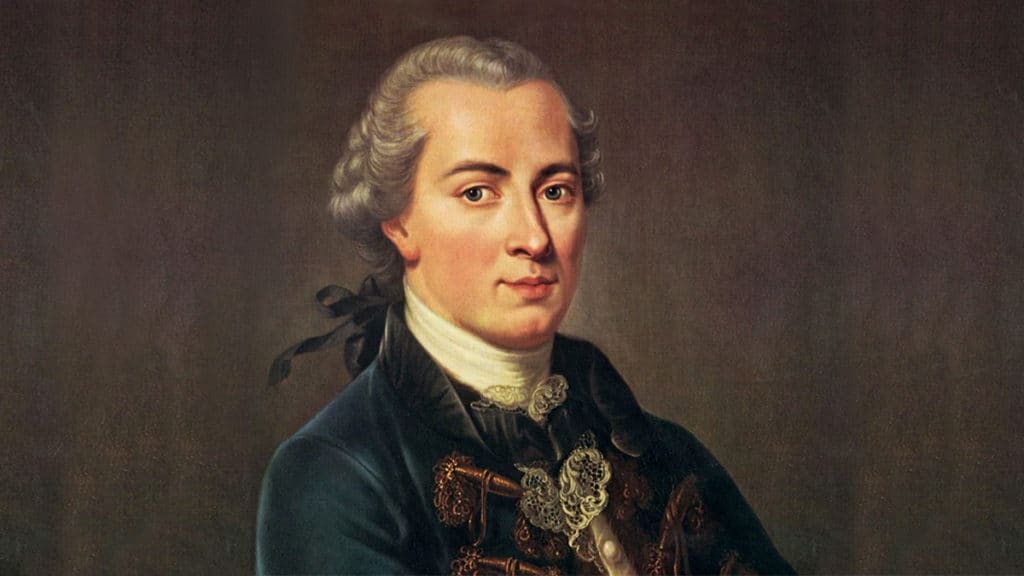
120-Kant
This episode is titled, Kant.At the conclusion of episode 115 –Part 2 of The Rationalist Option, I said we’d return later to the subject of the philosophy of the Enlightenment to consider its impact on theology and Church History. We do that now.We saw that John Locke placed a wedge between faith and reason when his system of Empiricism said the only genuine knowledge was that of experience. But repeated experiences generated a kind of knowledge he called probability. Because we experience the same thing again and again, we have reason to assume the likelihood of it continuing to happen. I used the example of a friend we’ll call “George.” We see and hear George at least weekly. So, even when George isn’t in our immediate presence, we have good reason to conclude he probably still exists.Using the rule of probability, Locke regarded the Christian Faith as reasonable. His repeated experience of the world logically required a sufficient cause for it. He found the Bible’s explanation of creation and the subsequent course of history to align with his experience of it. But, Locke maintained, Christianity provided no knowledge a reasoned examination of experience would discover on its own.Then along came the empiricist David Hume who wielded Doubt like a cudgel. If Locke placed a wedge between faith and reason, Hume is the one who wielded the sledge and broke them apart. His skepticism went so far as to claim the common-sense notion of cause and effect was an illusion. He had nothing but disdain for Locke’s idea of Probability.Hume said all we can know for certain is what we are experiencing at that moment, but we can’t know with certainty that one thing gives rise to another, no matter how many times it may be repeated. It may in fact at some time and place NOT repeat that pattern. So to draw universal laws from what we experience is forbidden. Hume didn’t just regard faith as irrational, his critique cast doubt on reason itself. Empiricists and Rationalists were set at odds with each other.Hume and his Empiricist buddies weren’t without their opponents. A Scot named James Reid published An Inquiry into the Human Mind on the Principles of Common Sense in 1764. Reid argued for the value of self-evident knowledge or what he called “common sense.” His position came to be known as Common Sense Philosophy. It had many adherents among the growing number of Deists.In France, Baron de Montesquieu, applied the principles of reason to theories of government. He came to the conclusion a republic was the preferred form of government. Since power corrupts, Montesquieu said government ought to be exercised by three equal branches that would balance each other: the legislative, executive, and judicial. He proposed these ideas thirty years before either Americans or the French adopted them for their political systems.Shortly after Montesquieu, Jean Jacques Rousseau suggested what the rationalists called Progress, wasn’t! Enlightenment thinkers generally regarded human history as a record of advance from lesser to greater sophistication = Progress! Societies were moving on from backward barbarianism to advanced civilization. The Enlightenment’s emphasis on Reason was evidence humanity was emerging from the pre-scientific belief in religious superstition into a new era of rationalism. But Rousseau argued much of what people considered progress was in reality a departure from their natural state that was contrary to human flourishing. He called the modern world of his day “Artificial.” Rousseau advocated a return to the original order, whatever that was. He lauded the noble savage who lived in a pure state unfettered by the conventions and inventions of modernity. Whatever government there was ought to serve rather than rule. Religion ought to be a thing of the lowest common denominator with no one telling anyone else what to believe or how to worship. Rousseau defined that lowest common religious denominator as belief in God, the immortality of the soul, and moral norms. Which sounds a lot like Rousseau contradicted the very thing he said no one could do; tell others what to believe. It’s a classic case of “Believe whatever you want, as long as you agree with me.” An oft-repeated position of skeptics.At the close of the 18th C, along came a German philosopher who blew everything up. Many consider Immanuel Kant the central figure of modern philosophy.Before we dive in, I need to pause and say I barely grasp Kant’s ideas. Seriously. Right about the time I think I’m getting a handle on his philosophy, he says something that makes it all slip away. I hope when I teach, I make things clearer, not more obscure. Kant tries to clarify but his thoughts move in a realm far beyond my minuscule capacity. I just can’t get Kant.The best I can do is seek to explain Kant’s ideas as others have expressed them.Kant was born in 1724 in the city of Konigsberg in Prussia to Pietist parents. He was a capable student but no standout. At 16, he began stu

119-Moravians & Wesley
The title of this episode is Moravians and Wesley.We took a look at Pietism in an earlier episode. Pietism was a reaction to the dry dogmatism of Protestant Scholasticism and the reductionist rationalism of Enlightenment philosophers. It aimed to renew a living faith in a living Christ.As a movement, it was led in the 17th C by Philip Jakob Spener and August Francke.Spener’s godson was a German Count named Nikolaus Ludwig von Zinzendorf, who even as a child bore a deep devotion to God. His parents were devout Pietists and sent him to the University of Halle, where he studied under the Pietist leader Francke. Later he went to Wittenberg, a center of Lutheran orthodoxy, where he repeatedly clashed with his teachers. After travel and study at law, he married and entered the service of the Court of Dresden. There Zinzendorf first met a group of Moravians who changed the course of his life.Moravia lies in the southeast of what today is the Czech Republic. Moravians were Hussites; long-time adherents to the renewal begun by Jan Hus. They were forced by persecution to forsake their native lands. Zinzendorf offered them asylum. There they founded the community of Herrnhut. It so appealed to Zinzendorf he resigned his cushy post in Dresden and joined it. Under his direction, the Moravians became part of the local Lutheran parish. But the Lutherans were unwilling to trust foreigners who were also Pietists.In 1731, while visiting Denmark, Zinzendorf met a group of Inuit believers brought to faith in Christ by the Lutheran missionary Hans Egede. This kindled in the Count an interest in missions that would dominate the rest of his life. Soon the community at Herrnhut was on fire with the same zeal, and in 1732 its first missionaries left for the Caribbean. A few years later there were Moravian missionaries in Africa, India, and the Americas. They founded the communities of Bethlehem and Nazareth in Pennsylvania, and Salem, North Carolina. In just twenty years a movement that began with two hundred refugees had more missionaries overseas than had been sent out by all Protestant churches since the Protestant Reformation a couple of centuries earlier.In the meantime, conflicts with Lutherans back home in Germany grew. Zinzendorf was banned from Saxony and traveled to North America, where in 1741 he was present at the founding of the Bethlehem township. Shortly after his return to home, peace was hammered out between Lutherans and Moravians. It failed to last. Zinzendorf agreed to become a bishop for the Moravians, from a spiritual line of ecclesiastical authority reaching back to Jan Hus. Lutherans didn’t recognize Hus; they wanted the Count’s authority to link to Luther. This is odd since Luther honored Hus as an influence in the development of his own ideas.A personal aside. What silly things Christians bicker over. Doesn’t a person’s spiritual authority rest in their being called by God, not man? What matter is it that it comes through this or that one-time leader? It’s the original source that matters.Zinzendorf died at Herrnhut in 1760, and shortly after, his followers broke with Lutheranism. Although the Moravian church never had a large membership and was unable to continue sending so many missionaries, its example contributed to the great missionary awakening of the 19th C. Perhaps the greatest significance of the movement was its impact on John Wesley and, through him, the Methodist tradition.In late 1735, early ‘36, a group of Moravians sailed to North America hoping to preach to the Indians of Georgia. Onboard was a young Anglican priest, named John Wesley, whom the Georgia Governor Oglethorpe had invited to serve as a pastor in Savannah. The young Wesley accepted the offer and hoped to preach to Indians. The early part of the voyage was calm and Wesley learned enough German to communicate with the Moravians. Then the weather turned and the ship was soon in real danger. The mainmast split, and panic nearly ruined the crew. The Moravians, by contrast were utterly calm and sang hymns throughout the ordeal. Meanwhile, Wesley, chaplain of the vessel, came to the realization he was more concerned for himself than his shipmates. After the storm, the Moravians told him they were able to brave the storm and reality of death because of their conviction their lives were in God’s hands, and should they perish at sea, they would but pass into the Hands of their glorious King. Wesley simply couldn’t relate to that kind of peace born of faith in the God he served.Arriving in Savannah, Wesley asked one of the Moravians named Gottlieb Spangenberg for advice regarding his work as a pastor and missionary. He left a record in his diary of the conversation:Spangenberg asked, “My brother, I must first ask you one or two questions. Have you the witness within yourself? Does the Spirit of God bear witness with your spirit, that you are a child of God?”Wesley wrote, “I was surprised, and knew not what to answer. He observed it, and ask

118-The Spiritualist Option
In this episode, we’ll take a brief look at what came to be called Spiritualism.Coming out of the 16th C, the, what seemed to many at the time,endless debates on doctrine and dogma,the intolerance of Christians toward one another,and the lack of any apparent movement toward resolving the mess, moved many across Europe and the New World to seek refuge in more of an abstract religious sentiment than a rigid faith of set doctrines. Another factor encouraging this mindset was a burgeoning European middle-class. You see, it was only the wealthy nobility who possessed the resources for higher education need to foster an excessive emphasis on correct doctrine. Those who didn’t have that opportunity; who couldn’t wax eloquent on complicated matters of theology, were regarded as unsophisticates who depended on their betters to tell them what to believe.The Spiritualist Movement of the 17th and 18th Cs attracted people from all classes. From the cultured who’d tired of narrow-minded dogmatism, to uneducated commoners tired of having their lives turned over by endless religious tussles.The history of the Spiritualist movement is difficult to trace because it devolved into several streams that constantly mixed. Just as its beliefs were a hodge-podge, so is its history. We’ll examine it by taking a look at three of its leaders.Jakob Boehme was born in Silesia, Germany in 1575. His parents were strict Lutherans of humble means. By all accounts, the young Jakob had a real and rich faith.The sermons of that time were long dissertations on the theological debates of the day. These bored Jakob to tears and did nothing to spark a relationship with God.At fourteen, he was apprenticed to a shoe-maker. Shortly after, he began having visions. It might have been one thing if he’d kept these to himself, but he didn’t; he shared them. His master threw him out, saying he wanted an apprentice, not a prophet.Boehme became a traveling cobbler, moving here and there mending shoes. As he traveled and visited different churches, he came to the conclusion Church leaders had built a kind of confusing doctrinal Tower of Babel. He determined to set dogmatics aside and cultivate his inner spiritual life. He read everything he could lay his hands on that might help in that pursuit.His meditations led him to some conclusions on the nature of the world and man’s place in it. These were then “confirmed” by visions and other spiritual experiences. But he kept his new-found convictions to himself for a time as he plied his shoe-mending-trade.At twenty-five, Jakob ended his wanderings and set up shop in Goerlitz, on the border between Germany and Poland, where he made a comfortable living as a cobbler.Although Boehme didn’t see himself as a preacher, he was convinced God wanted him to record his visions. The result was a book titled Brilliant Dawn. In it, Boehme repeatedly asserts he’s writing what God dictated word for word, and that he’s no more than a pen in His hand. Boehme didn’t publish, but a manuscript reached a local pastor, who accused Boehme to the magistrates. Under threat of exile, Boehme promised to teach or write no more on religious matters. For five years he kept his promise. But in 1618, compelled by new visions and the encouragement of admirers, he wrote anew. Without permission, one of his followers published three of his works. These reached the same pastor, who again accused Boehme of heresy. He was forced to leave Goerlitz.He ended up in the court of the Elector of Saxony, where several theologians examined his teachings without reaching a conclusion. They confessed themselves unable to understand his meaning. They recommended Boehme be given time to clarify his ideas. Not long after, he fell ill and returned to Goerlitz to die among friends and followers. He passed at the age of fifty.The Saxony theologians’ response wasn’t just a dodge to avoid passing judgment on a likable guy. Boehme’s writings continue to be difficult to sort out. They’re a confusing mish-mash of this and that; which, to be frank, is a hallmark of much of what goes under the title “spiritualism.” Boehme’s tomes are a mixture of traditional Christian themes with others taken from magic, alchemy, occultism, and theosophy. At points, it looks like Boehme gives a metaphor to help explain his point, but it never does. You read it and say, “What does THAT have to do with anything?” So the metaphors, striking as they may be, only serve to add to the confusion. And THAT may very well be the overall point of his inkings. There may not BE a meaning to be parsed from it all. There’s every possibility Boehme used words to produce phrases that conveyed singular ideas that weren’t connected. He may have aimed for a state of mind that suspended rationality and logic; one that arises out of frustration at trying to make sense of what is senseless, so one gives up, lays reason down, and becomes hyper-suggestible.While the specifics of what Boehme aimed for aren’t clear, the

117-Which Witch
This, the 117th episode of CS is titled, “Which Witch?” and is a brief review of the well-known but poorly understood Salem Witch Trials.They’re often brought up by critics of Christianity as examples of religious intolerance and superstition. And while they did indeed carry a bit of that, they were far more a case of a breakdown in the judicial system. The phrase “witch-hunt” refers to an attempt to find something damning in an otherwise innocent victim. What’s rarely mentioned is that while there was a brief flurry of witch-hunting that went on in the New England colonies, it was a long practice in Europe from the mid-15th thru mid-18th Cs. It reached its peak in the about fifty-year span from between 1580 and 1630. It’s difficult to sort out how many were executed but scholars say it was from a low of 40,000 to as high as 60,000.In light of such large numbers, the twenty executed in the Salem Trials seems trivial. But that even a single person was executed on the charge of witchcraft was a travesty of justice.Witch hunts began in the 15th C in southeast France and western Switzerland. The European witch craze was fueled by the publication of The Hammer of the Witches in 1486, by the inquisitors Heinrich Kramer and Jacob Sprenger.The trials included men and women of all ages and classes.In New England, there’d been three hangings for witchcraft prior to Salem. But the first sign of trouble in Salem Village occurred during the winter of 1692, when Elizabeth Parris the nine-year-old daughter of the village pastor and her eleven-year-old cousin Abigail Williams, began displaying bizarre behavior. The girls screamed uncontrollably, hurled items, groaned, and threw fits of wild contortions. Witchcraft immediately surfaced as a possible explanation.Suspicion quickly centered on three women living on the margins of village life. One was a homeless woman named Sarah Good. Another was an infrequent church-attender and so obviously suspicious woman named Sarah Osborne. The third was Tituba, a slave known for fortune-telling. These three were interrogated in March, 1692 and sentenced to jail.Tituba’s ethnic origins are difficult to sort out but she appears to have been an African slave brought from the Caribbean to serve in the home of Pastor Samuel Parris, Elizabeth’s father. She regaled the young girls with tales of the occult and indulged their desire to have their fortunes read. When the girls were caught gazing into a crystal ball, they tried to shift blame by affecting bizarre behavior that made them appear victims of spells cast on them by something malevolent or better, some-one.For anyone’s who’s worked with adolescent girls likely knows, it didn’t take long before others of their age saw all the attention this gained them. So they affected similar behavior to get a slice of the attention pie. They accused the soft targets of women already considered odd and suspicious. Tituba was the first to be accused, but soon Sarah Good and Sarah Osborne were also implicated, questioned, and remanded to custody.Making matters more complicated was a long-running feud between the Putnam and Porter families. Charges and counter-charges of the damning charge of devil-worship flew on both sides. Pastor Parris used his pulpit to fan the flames of superstition that ANYONE in Salem might in fact be in league with Satan.In March, several more women were accused. Then, anyone who questioned the girl’s veracity was suspected. Sarah Good’s four-year-old daughter Dorothy was arrested and interrogated.Accusations began pouring in. More arrests made. But now many of those arrested weren’t just on the fringe of Salem village life. They were upstanding members of the community and church. As tension grew, Governor William Phips set up a special court to adjudicate the cases.The first to be brought to trial was Bridget Bishop, who was accused of being a witch because her immoral lifestyle and affinity for darks clothes suggested she was in league with hell. She was found guilty and was executed by hanging in June, 1692. Five more women were executed in July, and then four men and one woman in August. The last executions took place in September when six women and three men were hung.Some of those arrested confessed they had practiced witchcraft, and accused others of being their mentors. But scholars now believe these confessions were made under duress and with the promise that by implicating others they might be allowed to go free.Giles Corey, an eighty-year-old farmer and husband of one of the accused, was also arrested in September. Corey refused to cooperate with the authorities and was subjected to a form of torture in which the subject is placed beneath an increasingly heavy load of stones in an attempt to compel him to enter a plea. After two days, Corey died without confessing.The last trial occurred at the end of April, and all five accused were found not guilty, bringing an end to the episode. In the final count, twenty were hu

116-A City on a Hill
This episode is titled, A City on a Hill, and returns to our look at the Propagation of the Christian Faith in the Americas.Back in Episodes 105 and 6, we breached the subject of Missions in the New World. We looked at the role the Jesuits played in the Western Hemisphere. While the post-modern view of this era tends to reduce all European missionaries in a monochromatic Euro-centrism that leveled native American cultures, that simply wasn’t the case. Yes, there were plenty of Catholic, Orthodox, and Protestants who conflated the Gospel with their mother culture. But there were not a few missionaries who understood the difference and valued the uniqueness that was native American cultures. They sought to incarnate the Christian message in those cultures and languages. That often got them in trouble with officials back home who wanted to exploit indigenous peoples. In other words, it isn’t just modern Liberation Theology advocates who sought to protect the peoples of the New World from the exploitive injustices of the Old. Many early missionaries did as well.So, we considered the work of men like Jean de Brébeuf and Madame de la Peltrie in the northeast of North America. We considered the work of the Russian Orthodox Church in the far northwest and down the west coast to California. They were met by the Spanish coming north out of Central America.Protestants were a bit late to the game. One of the first real attempts was near Rio de Janeiro when the French Huguenot Admiral Villegagnon established a short-lived Calvinist settlement in 1555. It folded when the French were expelled by the Portuguese. A more permanent settlement was made by the Dutch when they captured Pernambuco at the easternmost tip of Brazil. This settlement remained a Calvinist enclave for forty years.North America presented a very different scene for missions than Central and South America. The voyage of the Mayflower with its ‘Pilgrims’ in 1620 was a historical pointer to the strong influence of Calvinism in what would become New England. The states of Massachusetts, Connecticut, and New Hampshire were strongly Congregationalist or Presbyterian in terms of church polity and heavily influenced by English Puritanism. At least some of these pioneers felt a responsibility for spreading the Christian faith to native Americans.In episode 106, we talked about John Eliot, the Mayhews, William Carey, David Livingstone, David Brainerd, and, Jonathan Edwards. Besides Presbyterians and Congregationalists, Episcopalians achieved some success in evangelizing the Indians.And again, for those who missed my earlier comment … While it’s fashionable in some circles to eschew the use of the label “Indian” in favor of the assumed-moniker “Native American” for indigenous people of the New World, many of their modern day descendants have made clear their desire to be called “Indians” or referred to by their tribal identity, rather than “Native American.” So please, those of non-New World descent who take umbrage at the label “Indian” on behalf of others, assuming you’re defending People of Color, no nasty emails or snarky reviews because you speak that of which you know not.If some frustration came through in that >> Sorry, Not Sorry. It’s just tiresome dealing with the comments of those who want to apply fleeting social concepts that appeared two-seconds ago as a blanket over hundreds and even thousands of years of history. It’s simply unconscionable to apply contemporary values and untested, highly-questionable social theories on prior ages, as though just because we live now, we’re somehow more enlightened, more civilized, in a word better than those who are thus cast as “worse” only because they lived before this moment of grand-enlightenment. The arrogance of that perspective is stunning.Okay, end of my tirade of personal pique …Being that we’ve just come up to the age of the Puritans in England, now would be a good time to take a little closer look at Puritanism in the New World.During the reign of James I, some Puritans grew discouraged at the pace of reform in England and separated entirely from the Church of England. After a sojourn of about eleven years in the Netherlands, a group of these “separating Puritans,” known to us as “Pilgrims,” set sail for the New World. The Dutch were generally welcoming of these English dissenters because they shared the same faith and as the English were such hard workers, added to their booming economy. But the English grew distressed after a little more than a decade that their children were becoming more Dutch, than English. They couldn’t return to England where tension was thick between the Crown and Puritans. So they decided to set sail for the New World and try their fortune there. They established a colony at Plymouth in 1620 in what is now southeastern Massachusetts.While it struggled greatly, it eventually succeeded and became something of a model for other English settlements in the region.Back in Englan

115-The Rationalist Option Part 2
This is Part 2 of The Rationalist Option on Communio Sanctorum, History of the Christian Church.In our last episode, we took a look at the genesis of the Enlightenment in England and France. We’ll come back to France a bit later after taking a brief look at the Enlightenment in German and Russia.Germany took a bit longer to join the Enlightenment. That was due in part to the condition of the land following the Thirty Years War. It’s estimated the population shrank from twenty million to just seven after it. There’s also the issue of Germany not really being a country. It was at that time a collection of independent statelets, united by language and culture, but divided between Catholics and Lutherans.The low regard for contemporary culture at that time in Germany is illustrated by the fact that while Newton, Locke, and Voltaire were regarded as heroes in their realms, Germany’s equivalent, Gottfried von Leibniz, was never popular during his lifetime. Yet he was one of the most brilliant men, not just of his day, but of all time. Born in 1646 in Leipzig, Leibniz was the son of a professor of philosophy. He studied law before taking up with a disreputable group of alchemists and worked for the Elector of Mainz.Leibniz came to the attention of the world in 1672, when he was sent on an unofficial ambassadorial mission to Paris. The purpose of this trip was to present Louis XIV with a plan he’d worked out for the invasion of Egypt, by which he hoped to distract the Sun King from ambitions he might have toward Germany. Nothing came of Leibniz’s diplomacy, although Napoleon seems to have adopted his strategy a century later. In any case, while in Paris, Leibniz took the opportunity to meet with all the luminaries in the foremost city of culture in Europe. He studied mathematics, quickly becoming one of the foremost mathematicians in the world, and made a number of important discoveries, including differential calculus, for which tens of thousands of students have hated him ever since. He also proudly demonstrated an extraordinary mechanical calculator he had built.Leibniz’s interests were so wide-ranging he could never keep his mind on what he was doing. In 1676, he became Court Chancellor of Hanover and was put in charge of the library. But he was more interested in the mines at Harz and spent several years devising increasingly ingenious devices to solve the problem of draining them. He eventually worked for several German states, as well as the cities of Berlin and Vienna, for which he designed a number of civic improvements. In his spare time, he traveled extensively around Europe, meeting other rationalist luminaries, and carrying out his work in mathematics, chemistry, physics, metaphysics, and theology. He produced hardly any books of importance, but his vast correspondence, much of which is still in the process of being edited and published, dwarfed the output of most of his contemporaries; and there cannot have been any subject, however obscure, with which he did not deal, and on which he was not an authority. Leibniz died in 1716, an increasingly marginalized figure, defiantly wearing his long brocade coat and huge wig which had gone out of style decades before.Despite Leibniz’s virtual single-handed attempt to kick-start the German Enlightenment, it didn’t get rolling until the 18th C. Prussia, the largest of the German states, took the lead, as its rulers sought to drag their country into the modern era. Frederick Wilhelm, who came to the throne in 1713, reformed the economy after staying with relatives in the Netherlands.Wilhelm, a careful Lutheran, had no love for Catholic France, but his son, Frederick II, known as Frederick the Great, was a quite different person than his father. Upon his accession to the throne in 1740, he set about building on his father’s practical reforms with a program of cultural renovation. Among his first acts as ruler was to recall from exile Christian Wolff, the leading German philosopher, and Leibniz’s heir. Frederick II’s enthusiasm for French culture meant the usual coldness between the two realms saw a remarkable thaw. French was even spoken in his court, and it was at his invitation Voltaire moved to Prussia in 1749. Frederick was also keen to bolster the position of Prussia in Europe, which he did by engaging in a series of wars between the 1740s and 60s.During the late 17th C, the Russian Czar Peter the Great traveled all over Europe on a mission to learn all he could about the Enlightenment. He was eager to see what impact it had had on the realms of culture, economics, and engineering. His plan was to return to Mother Russia and drag it, if need be, into the modern world.Although Western Russia geographically is considered a part of Europe, it had for centuries been isolated. It was ruled by the Mongols for much of the late Middle Ages and was a bastion of Orthodox Christianity, a separate denomination from the Catholics and Protestants in the West. Westerners kn

114-The Rationalist Option Part 1
The title of this episode is, The Rationalist Option Part 1. I want to give a brief comment at the outset that this episode doesn’t track much of church history per se. What we do over the next minutes is take a brief look at the European Enlightenment. We need to because the ideas that came out of the Enlightenment influenced theology and the modern world.The 30 Years War ended in 1648 with the Peace of Westphalia. But decades of bitter conflict left Europe a ravaged land. People were weary of conflict whatever its nature; political, religious, or martial. And though the War was over, the following decades were by no means peaceful. Among other things, they witnessed the English Civil War with its execution of Charles I, and yet more wars between European powers, albeit on a smaller scale. Against this turmoil-laden backdrop, a new spirit was brewing in Europe: one desperate to make a break with the past with its religious tension, dry scholasticism, incessant bickering and the numerous occult fetishes the Renaissance spun off. By the mid-17th C, the seeds of the Enlightenment were well sown.A new breed of thinkers inhabited a Continent quite different from their ancestors. At the dawn of the 16th C Europe was dominated by the resolute Catholic power of Spain. In 1492, Spain both ended the lingering presence of Islam and discovered the New World. Italy, while having little political power, exercised massive cultural influence due to its claim as the birthplace of the Renaissance.Fifty years later, everything had changed. Spain was exhausted by the 30 Years War and political hegemony had moved to France, finally free of the threat of its powerful neighbors, Spain and Germany. The Netherlands, previously under Spanish rule, won their freedom with the Treaty of Westphalia and almost overnight became the world’s leading trade nation. Amsterdam was the exchange capital of the world, and the Dutch merchant fleet was the largest on the planet.The threat once posed by Islam was uprooted. Though Constantinople fell to the Ottomans in 1453, 40 years later saw the Spanish remove the last Muslim strongholds from the Iberian Peninsula. In 1683, despite being outnumbered five to one, the Polish king Sobieski routed the Ottomans besieging Vienna.Europe was a land of independent nations: of trade and colonialism, and a rising middle-class. Instead of the hegemonies of the past, when a single power, whether emperor or pope, sought to govern the Continent, a new idea arose of a ‘balance of power’ between states—and between churches too. The Pope’s hand was declawed, even in Catholic countries, by the Treaty of Westphalia, which permitted every state to follow whatever religion it saw fit. Although France, the new dominant force in Europe, was mostly Catholic, it tended not to listen too closely to Rome. The Netherlands were strict Calvinists. It was a world in which the notions of nationhood, human rights, and law were going to play an increasingly important role, and they were going to be rethought along rationalist rather than religious lines.The most vaunted ideal of the Age of Reason was Reason itself: the human capacity, by means of investigation, rather than by relying on external authority, to, in a word = Understand. In the first half of the 17th C, two philosophers, the Englishman Thomas Hobbes and the Frenchman René Descartes pioneered a new way of understanding the world and the mind. Instead of the Neoplatonic world of the Renaissance, dominated by occult forces, where objects exerted mysterious ‘influences’ on each other, they sought to understand the world in mechanistic terms. The universe was conceived as a complicated system of levers, pulleys, and bearings. Given enough time and the proper intellectual tools, the cosmos was comprehensible to almost anyone who took the time to study it.At the same time, there was a desire to forget the old divisions of the past and embrace what was common to all humanity. One important movement of the time we’ll talk about later was ‘syncretism’, which sought to reunite the churches of Europe. A leading figure in this was the Dutch Reformed thinker Hugo Grotius, who contended Christians of all denominations should come together on the basis of their common faith and heritage. Grotius was arrested in The Netherlands and spent some years in prison until he made a daring escape and fled the country.Despite his work as a theologian, Grotius is most remembered as a legal theorist. His On the Law of Peace and War of 1625 was the first major study of the theory of international law. In it, he sought to place binding human laws—transcending national boundaries—on a naturalistic and rational footing. This vein of thought was the result of the application to philosophy and theology of the laissez-faire principles which nations like the Netherlands applied to economics with such remarkable success.It took eighty years of on-and-off warfare before the Netherlands finally achieved its i
113-Yep, Those English
This is the second episode in which we look at English Puritanism.We left off last time with King Charles I fleeing London after breaking into The House of Commons to arrest the Puritan members of Parliament he accused of treason. The men had been warned and had fled. What Charles had hoped would be a dramatic show of his defense of the realm against dangerous elements, ended up being an egregious violation of British rights. So in fear for his own life, he packed up his family and headed out of town.Back in London, John Pym, a leader of Parliament, ruled as a kind of king without a crown. The House of Commons proposed a law excluding the royalist faction of bishops in the House of Lords from Parliament. Other members of the House of Lords surprisingly agreed, so the clergy were expelled. This commenced a process that would eventually disbar anyone from Parliament who disagreed with the Puritans. The body took on an ever-increasing bent toward the radical. Feeling their oats, Parliament then ordered a militia be recruited. The king decided the time had come to respond with decisive action. He gathered loyal troops and prepared for battle against Parliament’s militia. Civil War had come to England.Both sides began by building forces. Charles’ support came from the nobility, while Parliament found it among those who’d suffered most in recent royal shenanigans. Parliament’s army came from the lower classes, to which were added some from the emerging merchant middle-class, as well as a handful of those nobles who’d not been in favor at Court. The king’s strength was the cavalry, which of course was traditionally the noble’s military specialty. The Parliamentary forces strength was in their infantry amd navy, which controlled trade.At the outset of the war, there were only minor skirmishes. Parliament sought help from the Scots, while Charles sought it from Irish Catholics. In its efforts to attract the Scots, Parliament enacted a series of measures leaning toward Presbyterianism. English Puritans didn’t agree with the Presbyterian plan for church government, but they certainly didn’t like the episcopacy of the Church of England’s royalist bishops. English Puritans ended up adopting the Presbyterian model, not only because it irked those Bishops, but because it made more Biblical sense at the time, and because confiscation of bishops’ property meant Parliament could fund the war without creating new taxes.Parliament also convened a groups of theologians to advise it on religious matters. The Westminster Assembly included 121 ministers, 30 laymen and 8 Scottish representatives. Being that the Scots had the strongest army in Great Britain, though they numbered only 5% of the total participants in the assembly, their influence was decisive. The Westminster Confession which they produced became one of the fundamental documents of Calvinist orthodoxy. Although some of the Assembly’s members were Independents who followed a congregational-form of government, and others still leaned toward an episcopacy, the Assembly settled on a Presbyterian church government, and urged Parliament to adopt it for the Church of England. In 1644, Parliament joined the Scots in a Solemn League and Covenant that committed them to Presbyterianism. The following year the Archbishop of Canterbury, William Laud, was executed on the order of Parliament.As Parliament built up its army, Oliver Cromwell came to the fore. A relatively wealthy man, he descended from one of Henry VIII’s advisors. Oliver was a devoted Puritan, convinced that every decision, both personal and political, ought to be based on the will of God as revealed in Scripture. Though he was often slow in coming to a decision, once set upon a course, he was determined to follow it through to its conclusion, believing it to be, in fact, God’s Will. Respected by fellow Puritans, until the Civil War he was simply known as a member of the House of Commons. But when he was convinced armed conflict was inevitable, Cromwell returned home where he recruited a cavalry corps. He knew cavalry was the king’s main weapon, and that Parliament would need their own. His zeal was contagious, and his small force accomplished great deeds. They charged into battle singing psalms, convinced they were engaged in a holy cause. That attitude spread to the rest of the Parliament’s army which crushed the royal army at the Battle of Naseby.That was the beginning of the end for the king. The rebels captured his camp, where they found proof he’d been asking foreign Catholic troops to invade England. Charles then tried to negotiate with the Scots, hoping to win them with promises. But the Scots took him prisoner and turned him over to Parliament. Having won the war, Parliament adopted a series of Puritan measures, including setting the precedent that Sunday was to be reserved for solemn religious observances rather than the frivolous pastimes increasingly being adopted by the English nobility and emerging midd

112-Those English
In this episode, we’ll take a look at English Puritanism.In Episode 96, English Candles, we considered the arrival of the Reformation in England and the career of Thomas Cranmer, Archbishop of the Anglican Church. When Catholic Queen Mary ascended the throne, she persecuted Protestants. But when Elizabeth became queen, a new day dawned for the Reformation there.Queen Elizabeth followed a median course between religious conservatives who sought to retain as much of the ancient practices and beliefs as possible, and Reformers who believed the entire life and structure of the church ought to adjust to what they saw as a Biblical norm. During Elizabeth’s reign, that delicate balance was maintained though tensions surfaced repeatedly. Her strength and decisiveness managed to restrained both sides, barely.Elizabeth left no heir when she died in 1603. But she’d made arrangements for the succession to pass to James, son of Mary Stuart, already serving as king of Scotland. The transition was fairly smooth, bringing the House of Stuart to reign over England. James VI of Scotland became James I of England. He didn’t find ruling his expanded realm an easy matter. The English regarded him a foreigner. His plan to unite both kingdoms earned him determined opponents on both sides.Elizabeth’s reforms of England’s economic policies were bearing fruit, especially among the growing merchant class, who resented the James’ royalist policies favoring the nobility. But James’s greatest troubles were with Reformers who wanted to see the English church purged of all Romanish influences. They regarded James as standing in the way. His native Scotland had moved further along that Reformation Road under the work of John Knox. English Calvinists felt the time was ripe for similar changes in their land.These Reformers didn’t comprise a single group, nor did they agree on all matters. So it’s difficult describing them in general terms. One of the most influential groups was given the name Puritans because they insisted on the need to purify the Church. They opposed many of the traditional aspects of worship the Church of England retained; things like the use of the Cross as a symbol, priestly garments, and the celebration of communion on an altar. They differed over whether there even ought to be an altar; wasn’t a simple table good enough? And if a table, should it be placed so as not to give anyone the idea it WAS an altar. Things like this led to bitter disputes They may have left behind the Scholastic argument of how many angels can dance ion the head of a pin, but they argued over now less inconsequential issues as how much lace their ought to be in a collar.Puritans insisted on the need for a sober life, guided by the commands of Scripture, and abstinence from luxury and ostentatious displays of wealth. Since a great deal of the worship of the Church of England appeared to them as needlessly elaborate, this caused further objection to such worship. Many insisted on the need to keep the Lord’s Day sacred, devoting it exclusively to religious exercises and charity. They also rejected the Anglican Book of Common Prayer and the use of written prayers in general, declaring such led to insincerity, so that even the Lord’s Prayer, rather than a set of words to be repeated, was to be used as a model for prayer. They weren’t opposed to the use of alcohol, for most of them drank moderately, but they were quite critical of drunkenness. They were also critical of all they considered licentious; like the theater, because immorality was often depicted and because of the inherent duplicity required for acting. They considered it a kind of lying because someone pretended to be someone else.This tone of super-critical Puritanism would much later move HL Mencken to describe Puritanism as, “the haunting fear that someone, somewhere, may be having a good time.”A precise definition of Puritanism has been a matter much debate, due in part to its multifaceted influence in not only religious and theological matters but in its impact on England’s politics and society.Some of the difficulty in defining Puritanism comes from its caricatures that began in the 16th C. As with so many of the labels that have been attributed to movements in Church History, the word “Puritan” was originally a slam applied by critics. They considered Puritans to be peevish, censorious, conceited hypocrites. That reputation, once applied, stuck to them all the way to our day.In truth, there was a surprising diversity among Puritans. They shared a common theological confession, while differing on how the Church ought to be organized. Some Puritans thought the existing Anglican hierarchy of bishops was fine while others wanted to restructure the Church along more Presbyterian lines. Still others embraced a congregational form of church government. Some advocated separation from the established church, while others remained. Some were royalist, others revolutionary, even to the point

111-Looking Back to Look Ahead
Although it surely would have grieved him had he lived to see it, Martin Luther’s legacy in the years after his death a Century of war. This war didn’t only pit Catholics against Protestants. Various factions among the Protestants warred with each other. If the Reformers hoped to purify the Church of both theological error and political corruption, they may have succeeded in the first endeavor but failed miserably in the second. Those who want to use religion for personal ends don’t care what face the mask bears, so long as it gets the job done. Some of the more devastating wars included the French wars of religion, the Dutch revolt against Philip II of Spain, the attempted invasion of England by the Spanish Armada, the 30 Years War in Germany, and the Puritan revolution in England.The 17th C was a time of theological and political entrenchment. European Christendom was now divided into four groups: Roman Catholic, Lutheran, Reformed, and the Anabaptists. The first three became officially associated with regions and their governments, while Anabaptists, after their disastrous failure at Munster, learned their lesson and sought to live out their faith independently of entanglements with civil authority. During the 17th C, Catholics, Lutherans, and Reformed developed impenetrable confessional bulwarks against one another.As we saw in a previous episode, Catholic orthodoxy achieved its definitive shape with the Council of Trent in the mid-16th C. The Jesuits played a major role at Trent, especially in answering the challenge presented by Luther’s view on justification and grace. The Council affirmed the importance of the sacraments and the Roman church’s theological position on the Eucharist. At Trent, the Jesuits affirmed the importance Thomism, that is, the work of Thomas Aquinas, in setting doctrine. The triumph of Thomism at Trent set the future trajectory of Catholic theology.In the last episode, we looked at the rise of Protestant Scholasticism in post-reformation Europe. While Protestant orthodoxy is concerned with correct theological content, Protestant Scholasticism had more to do with methodology.From the mid-16th thru 17th C, Protestant orthodoxy clarified, codified, and defended the work of the early Reformers. Then, after the careers of the next generation of Reformers, it’s convenient to identify three phases orthodoxy moved through. Early orthodoxy runs from the mid-16th to mid-17th C. It was a time when Lutheran and Reformed groups developed their Confessions. High orthodoxy goes from the mid- to late 17th C. This was a time of conflict when the Confessions hammered out earlier were used as a litmus test of faith and formed battlelines to fight over. Late orthodoxy covers the 18th C, when the people of Europe began to ask why, if Protestant confessions were true, rather than leading to the Peace the Gospel promised, they lead instead to war, death, and widespread misery.In truth, people had been asking that question for a lot longer than that; ever since the Church and State became pals back in the 4th C. But it wasn’t till the 18th they felt the freedom to voice their concerns publicly without the certainty they’d be set on by the authorities.As Protestants and Catholics identified their differing theological positions, they became increasingly mindful of their methodology in refining their Confessions. Each appealed to the intellectual high ground, claiming a superior method for defining terms and reasoning. This was the age when there was a return by Christian theologians to Aristotelian logic.Once the Council of Trent concluded and the Roman Church fixed its position, the opportunity for theological dialogue between Protestants and Catholics came to a firm end. After that it was simply up to the various major groups to fine tune their Confessions, then fire salvos at any and everyone who differed. It was the Era of Polemics; of diatribes and discourses disparaging those who dared to disagree.In a previous episode we dealt with the career of Jacob Hermanzoon; AKA Jacobus Arminius. Arminius rejected the Calvinism promulgated by Calvin’s protégé Theodore Beza. Arminius’ followers developed what they called the Remonstrance, a five-part summary of what they understood Arminius’ positions to be on key issues of Reformed Theology. A theological and, wouldn’t you just know it, political controversy ensued that was addressed at the Synod of Dort. The Synod declared Arminius a heretic, the Remonstrance in error, and the five-petals of the Calvinist Tulip were framed in response to the five-points of the Remonstrance. A few Arminianist leaders were either executed or jailed while some two-hundred pastors were removed and replaced with Dort-aligned ministers. Despite this, the Arminianist-position endured and continued to hold sway over the conscience of many.A couple decades after the Synod of Dort, another controversy surfaced among Reformed churches in France. It centered on the work of the brillia

110-Faith in the Age of Reason – Part 2
The title of this episode is Faith in the Age of Reason, Part 2.In our last episode we briefly considered Jakob Hermanzoon, the Dutch theologian who’d sat under the tutelage of Theodore Beza, John Calvin’s successor at the Academy in Geneva. We know Hermanzoon better by his Latin name Jacobus Arminius. Arminius took exception to Beza’s views on predestination and when he became pastor of a church in Amsterdam, created a stir among his Calvinist colleagues. It was while teaching a series of sermons on the Book of Romans that Arminius became convinced Beza had several things wrong. The implication was that because Beza was Calvin’s successor and the standard-bearer for Calvinism, Arminius contradicted Calvin. Things came to a head when Arminius’ colleague Peter Planck began to publicly dispute with him.Arminius hated controversy, seeing it as a dangerous distraction to the cause of the Gospel and pressed for a synod to deal with the matter, believing once his views were set alongside Scripture, he’d be vindicated.In 1603, Arminius was called to the University at Leiden to teach when one of the faculty members died. The debate Arminius had been having with Planck was shifted to a new controversy with one of the other professors at Leiden, François Gomaer.This controversy lasted the next six yrs as the supporters of both Calvinism and Arminius grew in number and determination. The synod Arminius had pressed for was eventually held, but not till nine years after his death in 1609.In the meantime, just a year after his death, Arminius’ followers gathered his writings and views and issued what they regarded as a formal statement of his ideas. Called the Five Articles of the Remonstrants, or just the Remonstrance, it was a formal proposal to the government of Holland detailing the points of difference that had come to a head over the previous years in the debate between Arminius and Gomaer.Those 5 points were –That the divine decree of predestination is conditioned on Faith, not absolute in Election.That the intent of the Atonement is universal;Man cannot of himself exercise a saving faith;That though the grace of God is a necessary condition of human effort it does not act irresistibly in man; and finally -By the enabling power of the Holy Spirit, believers are able to resist sin but are not beyond the possibility of falling from grace. In 1618, the Dutch Church called the Synod of Dort to answer the Remonstrance. The results of the Synod, called the Canons of Dort, strongly upheld Theodore Beza’s formulation of the Calvinist doctrine of predestination and developed their own five-point response to the Remonstrance.It comes as a major surprise to most students of Church history to learn that TULIP, or the famous Five Points of Calvinism were a RESPONSE to the challenge of Arminianists; that they’d come up with their 5 points first. Most people who’ve heard of Calvinism and Arminianism have never even heard of the Remonstrance; yet it’s the thing that formalized the debate between the two camps; a debate that’s continued to today and has led to some prolific arguments and controversies among Christians.Put a Presbyterian elder and Methodist deacon in a room together and let the fun begin!Now, lest we think the Protestants fell out in the Calvinist-Arminianist brouhaha while the Catholics sat back, ate popcorn and watched the show, realize things were FAR from being all united and just one big happy family over in the Roman sector of the Church. Catholics were no monolithic entity at this time. It was a mixed bag of different groups and viewpoints with their own internal disagreements.In the late 16th and early 17th Cs there was a long dispute between the Jesuits and the Dominicans over how divine grace and human free-will interacted.In the late 17th C, Pope Innocent XI, spent his reign playing a power game with Louis XIV and the Gallic theologians who believed in the authority of the Church, but not the Pope.More serious was the rise of Jansenism. This movement grew out of the work of Cornelius Jansen, a professor at Louvain University. Jansen published a book in 1640 titled Augustinus, in which he stated what he believed were the doctrines of Augustine. Jansen sounded a lot like Calvin and argued that divine grace can’t be resisted, meaning it overrides the human will. He fiercely opposed the doctrine of the Jesuits that salvation depended on cooperation between divine grace and human will. So, the Jansenists believed in predestination, which meant that although they were Catholics they were in some ways more like Calvinists.Jansenism proved a thorn in the side of the Catholic Church, and especially the Jesuits, for quite a while. Its leading exponent after Jansen himself was Antoine Arnauld, an intellectual and cultural giant of the 17th C. Arnauld corresponded with such philosophical luminaries as Descartes and Leibniz. He possessed a penetrating critical faculty; and as a theologian he was no less brilliant.But

109-Faith in the Age of Reason – Part 1
The title of this episode, is Faith in the Age of Reason. Part 01After the first flush of Reformation excitement died down, the Protestant churches of Europe went into a long period of retrenchment, of digging in both doctrinally and culturally. This period lasted from the late 16th to the later 17th C and is referred to by church historians as the Age of Confessionalism. But “confession” here isn’t the personal practice of piety in which someone admits error. Confessionalism is the term applied to how the various Protestant groups were increasingly concerned with defining their own beliefs, their confessions, in contrast to everyone else. It resulted in what is sometimes referred to as Protestant Scholasticism, called this because the churches developed technical jargon to describe their doctrinal positions ever more accurately—just as medieval Roman Catholic scholastics had done three Cs before.Don’t forget; Roman Scholasticism helped spark the Reformation. It was the scholastics devotion to correct theology that highlighted the doctrinal and practical errors many in the Church began to call for reform over. But it was also the tendency of some Scholastics to forsake practical theology in favor of the purely hypothetical that fueled the Reformation’s drive to return the practice of faith to everyday life and made religion the sphere, not just of academics and sequestered clerics, but the common people.So, we might conclude Protestant churches were now headed down the same path with their own version of Scholasticism. And in some cases, that’s what happened. But instead of turning a theology back to Scripture as the Protestant Reformation had done in reaction to Roman Scholasticism, the reaction to Protestant Scholasticism was a decided turn away from Scripture to a decidedly irreligious philosophy.Many of the discussions of the Protestant Scholastics became dry and technical. Martin Luther sought to overturn centuries of medieval religious jargon and get back to the original message of the NT. John Calvin is often thought of as a more ‘systematic’ theologian, but his Institutes of the Christian Religion, though carefully arranged by topics, was intended to be no more than a faithful exposition of Scripture.Luther’s and Calvin’s heirs, however, went beyond their intended simplicity. They didn’t abandon the Reformation principle of Sola Scriptura, but they sought answers to questions not found in the Bible. A prime example was the issue of predestination and the relation between grace and free will—which, at the start of the 17th C was THE hot theological topic among Protestants and Catholics. A new kind of scholasticism was produced with some Protestant theologians happy to use the terminology of Aristotle and regarding the premier Roman Catholic Scholastic Thomas Aquinas as an authority.One of the key figures of this era was Theodore Beza, an aristocratic Frenchman who, although only ten yrs younger than Calvin, outlived him by forty and was widely regarded as Calvin’s successor. It was Beza, rather than Calvin, who was regarded by most Reformed theologians of the 17th C as the theological authority. He was especially good at recasting the terminology of Aristotle and the medieval scholastics in disputing with his opponents, who were most often Lutherans and Catholics.Beza defined the doctrine of predestination and its role in Reformed theology. In doing so, he developed the doctrine of ‘double predestination’, the notion that God deliberately predestines the reprobate to damnation and the elect to salvation. He put forward the ‘prelapsarian’ position, which says God planned the Fall and the division of humanity into elect and reprobate before Adam sinned. These ideas were present in germ-form in Calvin, but weren’t the touchstones of Reformation orthodoxy they later become.Beza was an eloquent author. That can’t be said of all who took up their pens in the service of the Lutheran and Reformed cause. In place of Luther’s and Calvin’s attempts to simply expound what Scripture said about doctrine and theology, the Protestant Scholastics were all about logical consistency and adherence to a pre-established orthodoxy.The Age of Confessionalism is often thought of as a time when theologians conducted a war of words with sharp pens, rather than sharp swords. What comes as a surprise is how so much of their angry rhetoric was aimed, not at people far across the theological divide from themselves, but at their own, much closer colleagues.With the hardening of orthodoxy, there were inevitable splits within churches as some rebelled against what their colleagues were laying down as required doctrine. The greatest of these fractures occurred in the Reformed Church at the end of the 16th C, after the preaching of Jacobus Arminius, a Dutch minister and professor taught by Beza himself. Arminius was initially a supporter of Beza’s views. But he rebelled against Beza’s distinctions regarding predestination and prelapsar

108-Overview 03
This episode of CS is the 3rd Overview in the series so far.We’ve spent quite a bit of time tracking the Reformation and need now to give a brief overview and analysis of what we’ve seen as we prepare for launching into the next era of Church History.There’s a well-worn saying in English I’m not sure other languages duplicate. It says that “you can’t see the forest for the trees.” The idea is that details can obscure the bigger picture. You fail to see a forest because all you see is a lot of trees.As we’ve spent many episodes tracking the Reformation and Counter-Reformation, we may be so distracted by all the names, places, dates and movements, we miss the larger picture and the summary effect of all this on the people of 16th C.Trends from the previous century came to fruition in the 16th that made for a monumental shift in people’s idea of what The Church was. Consider a couple of the things that happened in the 15th C.Constantinople fell to the Turks in 1453.The New World was opened to Europe at the close of the Century. Till then, European Christians felt hemmed in by Muslims to the S and E, and by the Atlantic to the W. Missions were conceived of almost exclusively as the conversion of Muslims. Challenges to Christianity were pretty much limited to the threat of an aggressive Islam. That view seemed potent when news of the Fall of Constantinople washed over Western Europe.Yet in the hundred years of the 16th C, the situation changed dramatically. To the E and S, Islam was countered by the Spanish Reconquista and the failure of the Turks to take Vienna. The Battle of Lepanto in 1571 saw the end of Muslim naval power in the Mediterranean. Muslims armies, which had seemed irresistible till then, began to roll back.Then, the Atlantic, once an impassable barrier, suddenly became a highway. New worlds opened with the discovery of The New World. Sailing W, Spanish conquistadors conquered a realm far larger than their homeland.The Portuguese sailed S around Africa, setting up trade centers and missions in the Far East. And Islam, which had appeared the greatest barrier to Christian expansion, saw its main territory surrounded by the growing economic and military power of Europe. North Africa and western Asia shifted from being Muslim realms to European colonies.In all these lands newly opened to Europeans, Christianity established a foothold. Some of them would centuries later become their own vibrant center of missionary outreach at a time when Europe was growing increasingly secular.But, few who lived in the 15th C could comprehend the massive consequences of the events they witnessed. When Spain and Portugal came near to blows over who had the rights to what, the pope thought he could work a compromise by decreeing the W belonged to Spain while the E belonged to Portugal. But what about when sailing W leads to the E, and vice versa? The inevitable conflict was played out in the Philippines.King Ferdinand of Spain and his grandson, the famous Emperor Charles V, before whom Luther appeared at the Diet of Worms, were far more concerned with the politics of Europe than the promises of a New World. That would be like a company in the Year 2000 being more concerned with the telegraph than mobile cellphones.During the 16th C, when these vast geopolitical changes were taking place, the towering edifice of medieval Christianity collapsed. The Council of Trent tried to salvage what it could and set the scene for what became modern Catholicism. Protestantism diffused into dozens of groups amid the ruins of the medieval Church. The long-held ideal of a single church, with the vicar of Christ as its visible head, never a view held by the Eastern Church, lost its power in the West as well. From then on, Western Christianity was divided among a plethora of groups divided up along cultural and doctrinal differences.In spite of corruption and the many voices calling for reform, there was agreement among Christians the Church was in essence one, and its unity ought to be manifest in its organization. Most chief figures of the Reformation at first held such an understanding of the Church. Only a few rejected it. Most Protestant leaders believed the unity of the Church was crucial to its nature, and that although it was temporarily necessary to break unity to be faithful to God’s Word, that faithfulness demanded all effort at regaining unity.As in the Middle Ages, people of the early 16th C took for granted that the survival of a nation-state required religious agreement among its subjects. That notion, which Christians rejected when a minority in the old Roman Empire, became the prevailing view after the conversion of Constantine. All who lived in a Christian state must be Christian and faithful members of THE Church. A bare-few places allowed Jews and Muslims to live among them but only as a lower-class, disenfranchised and persecuted.This view of national and concomitant religious uniformity is what led to the many wars of

107-Reform Around the Edges
This 107th episode is titled, “Reform Around the Edges.”It’s difficult living in the Modern World to understand the Late Medieval norm that a State had to have a single religion all its subjects observed. You’d be hard pressed to find a European of the 16th C who didn’t assume this to be the case. About the only group who didn’t see it that way were the Anabaptists. And even among them there were small groups, like the extremists who tried to set up the New Jerusalem at Munster, who did advocate a State Church. Mainstream Anabaptists advocated religious tolerance, but were persecuted for that stance.As we’ve seen in the story of the Church in Germany and as was hammered out in the Peace of Augsburg, peace was secured by deciding some regions would be Lutheran, others Catholic by the principle of cujus regis eius religio [coo-yoos regio / ay-oos rel-i-gio] meaning, “Whose realm, whose religion.” The religion of a region’s ruler determined that regions subjects’ religion. Under Augsburg, people were supposed to be free to relocate to another region if a ruler’s religion didn’t square with their convictions.Sounds simple enough >> for moderns who are highly mobile and have little sense of the historic connection between identity and place. Many think nothing today of packing up and moving to a new place across town, or across a state, nation, or even some other part of the globe. Not so most Europeans for most of their history. Personal identity was intimately connected to family. And Family was identified by location. That’s why long before people had surnames, they were identified by their town. John of Locksley. William of Orange. Fred of Fillsbury. Families built a house and lived in it for many generations. Losing that home to whatever cause was one of the great tragedies that could befall one. It was a betrayal of previous generations who’d handed down both a family name and home, as well as all those future generations who now would have no home to call their own.On the surface, the Peace of Augsburg sounded like a sound solution to the religious conflicts that raged after the Reformation. But it was in fact, a highly disruptive force that ultimately helped spark the Thirty Years War.The wars of religion that washed over Europe in general and France in particular is evidence that the rule a region could have but one religion wasn’t workable. Even the Edict of Nantes, passed by French King Henry IV after the bloody St. Bartholomew’s Day Massacre, only guaranteed the survival of French Protestantism by granting a number of Protestant cities as enclaves in an otherwise Roman Catholic realm.We’ve given a thumbnail sketch of the spread of the Reformation over Germany, France, England, Scotland, the Low Countries and in Scandinavian.Let’s take a look now at Spain.Before the Reformation reached the Iberian Peninsula, many hoped the Spanish Church would lead the way in long-overdue reform. Queen Isabella’s faith was earnest. She and Cardinal Jiménez de Cisneros implemented a massive reform—including a renewal of biblical studies centered on the Complutensian Polyglot Bible. Today a polyglot is known as a parallel Bible, where multiple versions of the bible are arranged in side-by-side columns for comparison. But in parallel Biblr, these version are all the same language. A polyglot is the comparison of different languages. The Complutensian Polyglot had the Hebrew, Latin and Greek texts of the OT as well as the Aramaic of the Torah. The NT was both Greek and Latin. Spain also had many humanists scholars similar to Erasmus—some of them in high places—who longed for reform.The arrival of the Protestant Reformation saw attitudes in Spain changed. At Worms, the upstart monk Martin Luther defied Emperor Charles V, who just happened to be King Charles I of Spain. Charles became the champion of opposition to Protestantism. The Spanish Inquisition, previously aimed at Jews and occultists, turned its attention toward those calling for reform and anything that smacked of the now-dreaded Lutheranism. Several leading humanists fled to places like the Low Countries where they were welcomed. Others stayed in Spain and tried to lay low, devoting themselves to their studies and hoping the storm would pass them by.The Inquisition wasn’t able to halt the “Lutheran contagion,” as it was called. Valladolid and Seville became centers of Reformation despite frequent burnings at the stake by the Inquisition. A monastery in Santiponce near Seville was a reform center where Bibles and Protestant books were smuggled in barrels labeled as oil and wine. When one of the smugglers was captured and burned, a dozen of monks fled, agreeing to meet in a year in Geneva. One of them became pastor to a Spanish congregation there. Another, Casiodoro de Reina, spent the rest of his life translating the Bible into Spanish; a recognized masterpiece of Spanish literature released in 1569. A few years later, another of the 12, Cipriano de Valera,

106-Westward HoHo
Since last week’s episode was titled Westward Ho! As we track the expansion of the Faith into the New World with Spain and Portugal’s immersion, this week as we turn to the other Europeans we’ll title this week’s episode, Westward Ho-Ho, because I’m tired of saying Part 2. I know it’s lame, but hey, it’s my podcast so I’ll call it what I want.Before we dive into this week’s content, I wanted to say a huge thanks to all those who’ve left comments on iTunes and the CS FB page.Last week we ended the episode on the expansion of the Faith into the New World by speaking of the Spanish missions on the West Coast. The Spanish were urgent to press north from what would later be called Southern CA because the Russians were advancing south from their base in Alaska. And as any history buff knows, they’d already established a base at San Francisco.Russians weren’t the only Old World power feared by Spain. The French had New World possessions in Louisiana and French Jesuits were active in the Mississippi Valley. Some dreamed of a link between French Canada and the South down the Mississippi River. The gifted linguist Father Marquette, sailed south along the Mississippi and attempted a mission among the Illinois Indians. While in Quebec, he’d made himself master of 7 Algonquin languages and gained a mighty reputation as an Indian-style orator. He combined preacher, pastor, explorer and geographer in one. His writings contributed to local knowledge of Indian peoples, culture, and agriculture. As any high school student knows, the French were to lose New Orleans and Western Mississippi to Spain, while Eastern Mississippi went to the British. But French Carmelites, a 16th C branch of the Franciscans known as the Recollects, and the Jesuits accomplished much in French possessions before the expulsion of the Jesuits in 1763. They’d attempted a failed mission to the Sioux. Nevertheless, French Roman Catholic influence remained strong in Canada.As I tell these ultra-bare sketches of mission work among New World Indians, it can easily become just a pedantic recounting of generalized info. A sort of, “Europeans came, Indians were preached to. Churches were planted. Movements happened, some guys died - blah, blah, blah.”Our goal here is to give the history of the Church in short doses. That means, if we’re to make any headway against the flow of it all, we have to summarize a LOT. But that works against real interest in the history and what makes the story exciting.It’s the individual stories of specific people that make the tale come alive. à Jesuit, Franciscan, and Protestant missionaries; and just ordinary colonists who weren’t set on a specific mission but were real-deal born again followers of Jesus who came to the New World to make a new life for themselves and their descendants, and just happened to share their faith with the Native Americans and they got saved and started a whole new chapter in the Jesus story. è THAT’S where the good stuff is.So, let me mention one of these Jesuit missionaries we’ve been talking about who brought the Gospel to Canadian Indians.Jean de Brébeuf was born to a family of the French nobility and entered the Jesuit order in 1617. He reached Canada 8 yrs later. He learned Algonquin and lived among the Huron for 3 yrs. After being captured by the British, he returned to France but renewed his mission in 1633. He founded an outpost called St Marie Among the Hurons in 1639. The Mission was destroyed by the Iroquois a decade later.Because De Brébeuf was tall and strongly built, he became known as the Gentle Giant. Like the Jesuits in Paraguay we looked at in the last episode, he could see ahead into how European colonists would bring an unstoppable challenge to the Indian way of life and advocated the Hurons withdraw into a secluded missionary settlement in order to preserve their culture. He’s an example of the heroic pioneer Jesuit, of which there were many, whose missionary life ended in martyrdom in the field.De Brébeuf stands as a little known, but ought to be lauded, example of the fact that not all Europeans who came to the New World, especially not all missionaries, conflated following Christ with European culture and lifestyle. That’s an assumption many moderns have; that it wasn’t until the modern era that missionaries figured out people could remain IN their culture and follow Jesus, that they didn’t have to become converts to Western Civilization BEFORE they could become Christians. While it has certainly been true that some missions and eras equated the Faith with a particular cultural milieu, throughout history, MOST believers have understood that the True Gospel is trans-cultural, even super-cultural.Many Jesuit missionaries in the New World like De Brébeuf tried to preserve the native American cultures – while filling them with the Gospel. They saw the emerging European colonies as a THREAT to the Indians and wanted to protect them.With the end of the 7 Years War, or as it’s known in

105-Westward Ho!
In this episode of CS, we take a look at the Expansion of Christianity into the New World.Following Columbus’s voyages at the end of the 15th C to the Caribbean, the expansion of Christianity into the New Word was chiefly dependent on the 2 great colonial powers, Portugal and Spain. From the outset of their adventures in the New World, a religious intention was central to the efforts of the explorers, however secondary it may have become to conquest and treasure-seeking of their royal patrons back in Europe.By means of a papal bull in 1493, Pope Alexander VI, divided the world between the 2 kingdoms. Although the line was later moved to allow Portugal to colonize Brazil, the original division was a line drawn from North to Southwest of the Azores [ah-zores] Islands. Spain was given the West Indies and the Americas; while Portugal, because it had already explored the west coast of Africa and moved towards India thru Vasco da Gama’s explorations, was given the right to colonize Africa, India and the East.It seems monumentally arrogant to us today that these Europeans assumed they were “discovering” lands that already had people living there for generations. And how do you plant a colony in a place indigenous people had called their home for centuries? Yet that was the attitude of many Europeans in the late 15th C and as the scope of geography for the New World was understood, other Europeans joined the rush to grab as much territory as they could. è Because religion was a central and defining part of the European worldview, they took their Faith with them.Priests accompanied da Gama’s voyages as they were a central part of Spanish colonization, combining the roles of missionaries, explorers, secretaries and chroniclers. Often they belonged to religious orders like the Franciscans and Dominicans, then later, the Jesuits.It was with a sense of religious mission, as well as the longing to acquire wealth from indigenous peoples, that men like Cortez and Pizarro began their conquest of the Aztec and Incan empires. Modern students of history know that the Spanish conquistadors seemed not to think forced baptisms of native Americans was all that bad of an option. What we do well to remember was that these explorers didn’t originate the policy. Charlemagne had practiced a similar program of forced conversions. That doesn’t make it right, but it provides a little historical context.Cortez was born in Medellin, Spain. He attended the University of Salamanca and left Spain for Cuba in 1511. At the age of 33 he mounted an expedition against the Aztec capital in Mexico with only 700 fellow Spaniards, but equipped with canons and muskets, reinforced by thousands of Indian allies who’d been brutally dominated by the blood-thirsty Aztecs for generations.Although he experienced a serious reverse after a massacre of Aztec nobles and temporarily had to withdraw from the capital of Tenochtitlan, he returned to the city in August 1520 and systematically destroyed it. He founded and built Mexico City on the same site, then became governor of New Spain and captain-general of the forces in 1522, titles that were confirmed by Emperor Charles V, when Cortez returned to Europe in 1529. He was later replaced by a viceroy and died in 1547.His contemporary, Pizarro, directed his attention to the Inca Empire in what would later be the nation of Peru. He obtained authority from Spain for its conquest in 1528–29 and attacked the Incas in 1530. A massacre of native Americans assembled at Cajamarca was followed by the capture of the Inca capital of Cuzco in November 1530.You may remember from an earlier episode, one of the major debates between the Church and civil rulers of Europe was over who had the right to appoint bishops. While there were seasons when civil rulers took control of this, it was usually the Church that maintained control over church appointments. The New World presented a new challenge and opportunity. The Pope was already busy enough with internal affairs and the threat of the Reformers to be bothered with selecting hundreds of new bishops for lands that hadn’t even been properly mapped yet. So he granted the monarchs of Spain and Portugal the right to select church leaders in their new colonies.On the colonialist front, a system was developed called encomienda. By this method, a number of native Americans were assigned to a colonist-landlord. He was given rights to both tribute and labor but it was understood he was responsible for Christianizing those committed to his charge. As we’d suspect, the encomienda system became a by-word for oppression and cruelty and resulted in the virtual slavery of the Indians after its introduction in 1503. Brave Dominican priests denounced the system with one of the earliest protestors being Antonio de Montesinos on the island of Hispaniola in 1511.Bartholemew de las Casas was another Dominican, whose father accompanied Columbus on one of his voyages. When he witnessed the live burial of

104-A Needless Tragedy
The title of this episode is – A Needless Tragedy.We backtrack now a bit. We’re going back to that period of European history following the Reformation called the Wars of Religion. We do so to take a look at a single day; Aug 24, 1572 in Paris, and the infamous event that happened then and there = the St. Bartholomew’s Day Massacre.We do this because while it’s a lot more detailed look at something than we usually get into, it illustrates the impact the Reformation had on Europe and, I think, the Modern World.John Calvin was French but his reforming work was centered in Geneva, Switzerland. It didn’t take long for his influence to spread back to his native homeland so that by 1555, Calvinism had firm roots there. French Calvinists were called Huguenots – a word of unknown origin but was meant as a mockery of Protestants. Calvinism spread rapidly and soon there were a couple thousand French Reformed churches with close to half the French switching from Catholic churches to Huguenot fellowships.What made things difficult for the French Monarchy, which remained firmly Catholic, was that many of the nobility were Huguenots. Bear in mind that at that time, religious affiliation and political alignment were regarded by most Europeans as one and the same. A showdown between French Catholics and Protestants seemed inevitable.Enter the scheming Queen Mother of France, Catherine de Medici; a die-hard Roman Catholic. She arranged for her daughter, Margaret of Valois, to be married on August 18th of 1572 to the Protestant King, Henry of Navarre. The hope in Paris was that this marriage would bring peace between warring Catholics and Protestants. Nobles who’d fought each other the previous decade turned out for the celebration. Thousands of Protestants came to Paris for the wedding, and the festivities lasted for days.But while Catherine de Médici planned her daughter’s wedding, she was also plotted the assassination of Admiral Gaspard de Coligny [koh-LEE-nee], one of the main leaders of the Huguenots.On Aug. 22nd, the assassination attempt failed. The plot, so soon after the royal wedding, threatened to badly embarrass the royal family. Near midnight the following day, Charles IX, the 22 yr-old French king and brother of the bride, in a fit of rage, screamed at his mother, “If you’re going to kill Coligny, why don’t you kill all the Huguenots in France, so there’ll be none left to hate me.”Catherine wasn’t one to put up with the pique of her petulant son and decided to follow up on his suggestion. She ordered the murder of all Huguenot leaders still in Paris, including those who’d attended the wedding. The massacre began on Aug 24, 1572, St. Bartholomew’s Day. Admiral Coligny was murdered first as he knelt in prayer.Many of the Huguenot nobles were lodged at the Louvre. They were called into the courtyard and shot one by one as they appeared. During the night, the homes of Paris Huguenots were each marked with white crosses. Before daybreak, messengers were sent throughout the city crying out, “Kill! Kill! The King commands it.” A murdering frenzy fell on the whole city. Entire Huguenot families were taken into the streets and murdered. The dawn of St. Bartholomew’s Day revealed many thousands of martyred Huguenots.The craze spread to the provinces in the following days and weeks, the death toll somewhere between 30 and 40 thousand. Admiral Coligny’s head was embalmed and sent to Rome as a gift to Pope Gregory XIII. When it reached Rome, the Pope and his cardinals staged a Mass of Thanksgiving.The massacre was not without cost to Charles IX. He began having horrific nightmares. In less than two years, he lay dying at the age of only 24. His last days were plagued with visions of his victims. He cried to his nurse, “What bloodshed, what murders! What evil counsel have I followed? O my God, forgive me!. . . I am lost!”That’s the short version of the St. Bartholomew’s Day Massacre. Now for a little more depth.The massacre marked a turning point in the French Wars of Religion. The Huguenot political movement was crippled by the loss of many of its most prominent leaders, as well as many re-conversions by commoners back to Catholicism while those who remained Protestant were increasingly radicalized.Though by no means unique, the St. Bartholomew’s Day Massacre was the worst of the century's religious atrocities. Throughout Europe, it impressed on Protestants the firm conviction Catholics were bloody and treacherous. But some of those Protestants ought to have seen how they treated other Protestants of a different flavor, as well as Catholics, with the same kind of brutality when they had the chance.While the Saint Bartholomew’s Day Massacre seems a violent but quickly burnt-out fit of hatred, it was in truth the culmination of a series of events.1st – The Peace of Saint-Germain in 1570 put an end to 3 years of terrible civil war between French Catholics and Protestants. But the peace was precarious since many Catholics refu

103-Back in the East Part 2
This episode of CS is titled, Back in the East – Part 2Last time we took a brief look at the Jesuit missions to the Far East; namely Japan, China, Vietnam and India.We encountered the revolutionary approach to mission work of Alessandro Valignano and his spiritual heirs, Michele Ruggieri and Matteo Ricci. Their accomodationist approach to evangelism, where the Gospel was communicated by seeking to build a cultural bridge with the high civilizations of the Far East, was officially suppressed by Rome, even though it had amazing success in planting a healthy and vibrant church. So healthy was the Church in Japan it came under fire from a fierce resurgence in Japanese nationalism that expelled the Jesuits and persecuted the Church, driving it underground.From the dawn of the 17th C, both Dutch and English trading interests moved into Asia. Their commercial and military navies dominated those of other European nations.The Dutch established bases in Indonesia and created a center at Jakarta. The Dutch East India Company was founded in 1602, and carried the Dutch Reformed Church to the East Indies. But don’t think this means the Dutch conducted missionary work among indigenous peoples. It merely means they carried their religious institution with them and built chapels so Dutch nationals had a place to worship when doing business there. Any converts from among the native population was by accident, not any kind of planned outreach. Dutch interests in the Far East were exclusively commercial.The English equivalent of the Dutch East India Company was, the creatively named à English East India Company. Though the directors of the Company were suspicious of missionaries, they appointed chaplains to their trading communities. This provided an opening for those with missionary vision in England and India, such as Parliamentarian William Wilberforce and Charles Grant, an employee of the company.Two outstanding East India Company chaplains were Henry Martyn and Claudius Buchanan. Martyn was a leading Cambridge intellect and winner of numerous academic prizes. He and other Cambridge students were influenced by the long ministry of Charles Simeon, whose preaching urged that the Gospel be taken to All Peoples. Martyn was a brilliant linguist and translator. He was appointed a chaplain in 1805, translated the NT into Urdu and Persian and prepared an Arabic version before his early death from tuberculosis at 31. His Indian assistant, Abdul Masih, converted from Islam to become a Christian missionary and advocate of the Faith. He was ordained in 1825 as the first Indian Anglican clergyman. Many others were inspired by Martyn’s life of scholarship and devotion.William Carey, often regarded as the father of Protestant English missions, was both a shoemaker and Baptist preacher in Northamptonshire. He arrived in India in 1793. He was soon joined by 2 other Baptist giants, Joshua Marshman and William Ward, making what came to be known as the ‘Serampore Trio.’ Serampore being the region where they lived and worked. The trio greatly admired the Moravians and shaped their community on the Moravian model.Carey’s passage to India had been denied by the East India Company, the de facto government of English holdings in India, with their own hired army enforcing their will on the regions they operated. That would be like Amazon being the City Council and Law Enforcement for Seattle. Later British colonies and India came under control of the Crown. The East India Company opposed Carey’s plan to take the Gospel to the Indians. Chaplains for the British in India was fine, but they didn’t want to foment hostility with the faiths of their trading partners. Carey had ONE goal in going to India; to evangelize the lost. His passion to raise support in England for foreign missions led to his being derided by critics like Sydney Smith, a clergyman and author of satire who wrote for the Edinburgh Review.But by steady perseverance, monumental labor at biblical translation, longsuffering through family tragedies and the loss of precious manuscripts by fire, Carey faced down all critics, became Professor of Sanskrit at Fort William College and earned the accolade from Bishop Stephen Neill, himself a missionary in India: “In the whole history of the Church, no nobler man has ever given himself to the service of the Redeemer.”For North Americans, an equivalent figure to Carey as a pioneer was the great missionary to Burma, Adoniram Judson. Judson received his inspiration to become a missionary from reading the sermons of Claudius Buchanan in 1809. After ordination as a Congregationalist minister, he applied to the American Board of Commissioners for Foreign Missions. On his voyage to India, he and his wife adopted a Baptist statement of Faith. On arrival in India he was baptized, having made his change of mind known to William Carey. He was refused permission to work by the East India Co as a Baptist missionary in India but began work in Rangoon in 1813.

102-Back in the East – Part 1
This episode of CS is titled, Back in the East – Part 1In our last foray into the Church in the East, we stopped our review with the Mongols. You may remember while the Mongols started out generally favorable to Christianity, when later Mongol Khans became Muslims, they embarked on a campaign to eradicate the Gospel from their lands. That rang the death knell to The Church in the East, which for centuries boasted far more members and covered a wider area than the Western Church.And again, let me be clear to define our terms, when I speak of the Church in the East, I’m not referring to the Eastern Orthodox Church HQ’d in Constantinople; not the Greek Orthodox Church or it’s close cousin, the Russian Orthodox Church. The Church in the East was also known as the Nestorian Church and looked to the one-time Bishop of Constantinople, Nestorius who was officially labeled a heretic, but who became the patriarch of a wide-ranging church movement that reached all the way to Japan.While today, Nestorianism is officially labelled a heresy in its view of the nature of Christ, it’s doubtful Nestorius taught that. Nor did The Church in the East believe it. The Nestorianism that bears the label “Heresy” is more a thing found in books than in the hearts and minds of the people who made up The Church in the East.In any case, the once vibrant Church in the East came to a virtual end with the Mongols. It wasn’t till the 16th C that the Faith began a renewed mission to the East, and this time it was by a concerted effort of Europeans. It came because of the expansion of the Portuguese and Spanish empires in the 16th and 17th Cs, then to Dutch, English, French and Danish traders in the 18th and 19th.Even before the Jesuit order was recognized by Rome, Ignatius Loyola was aware of the need for an able overseer of missions to the East. Though loath to lose his assistant, in 1540 Loyola sent his ablest lieutenant and close friend, Francis Xavier to the Portuguese colony of Goa in India. Xavier remains one of the greatest of all Christian missionaries. He possessed an immensely attractive personality and a Paul-like determination to preach the Gospel where Christ had not been named.Xavier moved from Goa to the fishermen of the Coromandel coast of India, where he baptized thousands and engaged in discipleship, though by his own admission his command of the language was marginal. He visited Sri Lanka from 1541–45, and Indonesia for 2 years before entering Japan in 1549. He established a Jesuit mission there and had a couple Christian books translated into the language. Exposure to Japan, with its, at that time, deep respect for all things Chinese, convinced him to do whatever it took to enter China. He was poised to do so when he died in 1552.Allesandro Valignano was born to Italian nobility and obtained a Doctor of Law degree at the University of Padua. But a profound religious experience we’d have to call a dramatic and genuine conversion, hijacked his previous career path and set him on mission. He became a Jesuit in 1566 because they were about the only ones doing missions at the time. He was appointed Visitor to Eastern Missions in 1573 and sailed to Goa from Lisbon in 1574.After a period of study in Macau, he came to the conclusion the Church was going about the task of spreading the faith to new people all wrong. He was determined to take the Gospel into China, but realized that meant he’d need to learn the language and customs. The Chinese were an ancient and proud race. They weren’t going to be wowed by relatively uneducated and backward Europeans, regardless of how superior they might think they were. Valignano knew learning Chinese would open a door for the Gospel.He vehemently opposed the conquistador approach to China and Japan both Portugal and Spain used in their conquest of the Philippines. He made 3 trips to Japan from 1578 to 1603. Like Francis Xavier, Valignano was convinced of China’s importance as a mission field but failed to make it there.That would be left for 2 other Jesuits who carefully followed his missions philosophy - Michele Ruggieri and Matteo Ricci [Richie].Ricci and Ruggieri entered China in 1583. They and their successors earned the deep respect of the Chinese, not least for their mathematical and astronomical abilities but because of their high regard for Chinese culture.Ruggieri, a lawyer from Italy, worked with Ricci in Portuguese Macau before moving to the mainland. Together, they produced a Portuguese—Chinese dictionary, and Ruggieri later composed the first Chinese-Catholic catechism. He was proficient enough in the language to compose Chinese poetry.Ricci, an outstanding intellectual, mastered the Confucian classics and came to believe that the kind of grounding he’d received in the works of Thomas Aquinas and his use of Aristotle was compatible with the moral ideals set out by Confucius. Ricci’s work of 1603, titled The Meaning of the Lord of Heaven, adopted this approach in reaching the Chin

101-And to the South
This episode of CS is titled, “And to the South . . . ” -- We move aside now from our review of the Reformation in Europe to get caught up with what’s happening in Africa.In many, maybe most, popular treatments of Church history, the emphasis is on what’s going on in Europe. That’s what most church-based Christian history courses and many western colleges and seminaries focus on. We’ve already devoted several podcasts to the Church in Asia, both the Eastern or Greek Orthodox church, as well as what’s called “THE Church IN the East,” AKA the Syrian, sometimes and the Nestorian Church.We’ll soon jump the Atlantic to take a look at the Church in the New World. But before we do, we shift our attention south, to Africa.As we’ve seen, North Africa was one of the formative cradles of Christianity. That’s where Tertullian, Cyprian and Augustine, 3 of the great Latin Fathers of the Faith kicked it. The Church at Alexandria was 1 of the 4 main churches in the early centuries. Egypt was highly influential in defining what the Faith looked like throughout much of Christendom because of men like Antony and Pachomius; the “desert fathers.” Their strict asceticism is credited with forming the early picture of what popular, but not necessarily Biblical, holiness looked like and which framed the thinking of Christians for hundreds of years. It led in large part to monasticism.In this episode, we’ll track the course of Christianity as it made its way across the African continent.The genesis of Ethiopian Christianity rests in Acts 8 where a deacon in the Jerusalem church named Philip was used by God to lead an Ethiopian eunuch and royal treasurer to Faith in Christ. There’s no record of what impact this man had when he returned home, but the fact he made a special trip to Jerusalem in the 1st C reinforces the idea that there was already a Jewish-influenced community in Ethiopia. Like so many of the Jews scattered around the world, meeting in local synagogues, these were prime candidates for the preaching of the Gospel because Jesus was indeed the Jewish Messiah. The Book of Acts shows us it was among God-fearing Gentiles who attended synagogues that the Gospel found it most receptive audience. So it’s likely when the Ethiopian eunuch returned home, he shared what he’d learned and a church was birthed. But not nurtured by apostolic leadership in Jerusalem, it went into decline. Before doing so, it may have left some seeds behind waiting for a later watering.The best record we have attaches the planting of the church in Ethiopia to a slave named Frumentius around ad 300. Frumentius was on a trading voyage when he was captured by pirates and sold to the king of Axum. He proved of such service to the king, he was granted his freedom 40 years later. He immediately went to Athanasius, bishop of Alexandria, telling him of Ethiopia’s need of missionary activity. Athanasius consecrated Frumentius as bishop of Axum. Thus began a long tradition, in which Ethiopian Orthodoxy looked to Alexandria and later, the Egyptian Coptic church to appoint its leaders. This continued all the up to 1959.Frumentius’s pioneering work was furthered by what are known as the Nine Saints from Syria who arrived about 150 years after Frumentius. Their work saw Ethiopia become a Christian kingdom. The government remained focused on a Christian monarch in several periods of upheaval thru the centuries, till the reign of Haile Selassie in the 20th C.There are characteristics of Ethiopian Christianity that deserve notice. It was an extremely Jewish form of Christian tradition and for long periods observed a Saturday-Sabbath rather than Sunday as the day of worship. It shared with the Falasha Jews of Ethiopia a great respect for the history of King Solomon and his visitor, the Queen of Sheba. They bore a tenacious legend that, after their meeting, the Ark of the Covenant was removed from Jerusalem and taken to Ethiopia where it was stored in secret. Various reasons were given for this; most notably that as Solomon began his slide into apostasy, a faithful priest recognized the day would come when foreigners would destroy the temple. To preserve the ark, a duplicate was made, switched out with the real ark, which was then packed off for safe-keeping to Ethiopia. This led to the production of multitudes of miniature ‘arks’, called ‘tabot’, displayed in places of Christian worship. The Ethiopian account of the royal meeting between Solomon and the Queen of Sheba is a document called the Kebra Nagast, which dates to the early 6th C. Ethiopian Christians considered themselves Christian-Jews. They retain the practice of circumcision alongside baptism. Monarchs regard their dynasty as from Solomon. One of Haile Selassie’s titles was ‘Lion of Judah’.Like the Egyptian church it’s derived from, the Ethiopian church has a strong monastic tradition. The Nine Saints founded a number of communities around Axum; places like Dabra Damo, which lasted 1,000 years. Around 1270, the

100-CS Anniversary
This is the 100th episode of CS.Because this is something of a milestone for the podcast, we’re taking a break from our usual episodic fare for something different.For those listeners who subscribe only for the historical narrative, you’ll want to skip this one altogether because we won’t be looking at Church History at all in this episode. This Century mark for CS will be about the podcast itself.I need to make comment at this point. This recording is a revision of an original made some years ago. While the content is essentially the same, the original series used a sound bed under the material I decided after a while I didn’t like. There was also a lot of time-sensitive material and news in the original that no longer applied. So I began this revision of the podcast, cutting out all that.I thought about just cutting this episode altogether but remembered how many listeners said they appreciated the original.At one point on the CS Facebook page, I posted a question, asking who’d be interested in an episode that was a personal look at CS & the host. There were enough positive replies that made doing it reasonable.I remember listening to my first podcast years ago now; Mike Duncan’s stellar podcast, The History of Rome. About a dozen episodes in, I began to look for Duncan’s cryptic personal comments, rare as they were. Then as the series progressed, he’d share a few more details about himself. Though the content on Rome was sterling, it was those personal comments & his dry wit that kept me interested à & in an odd way, seemed to personalize the information so that it wasn’t just a dry academic pursuit. I suppose some prefer the personal element of a podcast be left out. But I suspect that’s the exception rather than the rule.So, this being a 100th episode of CS, I thought we’d do a kind of history of Communio Sanctorum-History of the Christian Church.As I just said, my introduction to the amazing world of podcasting was listening to The History of Rome by Mike Duncan. I’m a bit of a nut for all things Roman and found his podcast on iTunes without much of a search. I even have a full set of Roman armor in my office. No – I do not dress up and do re-enactments.When I finished listening to The History of Rome, I wanted more, so I subscribed to Lars Brownworth’s Twelve Byzantine Emperors; another outstanding podcast. Next I decided to find something similar to Duncan’s podcast on Church History. By similar, I mean, short episodes of about 15 to 20 mins in length. That had proven perfect for listening while working out, doing yardwork, going for a run and so on. But my search for something in the Church History genre was unfruitful. What I found were long lectures delivered in college & seminary classrooms. And while the content was, I’m sure, solid, they tended to be rather dry and tedious.So, drawing inspiration from Duncan, who really did sound like a guy with a computer, a mic, and a love for his subject, I decided to give it a shot and do my own church history podcast. What it meant was that I was going to need to do what Duncan had done, and that was - read a lot and seek to cull the material from trusted sources.So, I got started and over the next couple years churned out a hundred episodes. It didn’t take long before I realized the early episodes were of poor audio quality. And as the narrative progressed, the timeline got jumbled and confused. That was probably inevitable for a noob like myself since the history of Christianity means following the Faith where ever it went. But I grew increasingly dissatisfied with the number of times the narrative jumped around. So I decided to stop at a hundred episodes and go back to redo the series to that point. As we slowed down a bit, the first version’s about 80 episodes became version 2’s 100. Not including a dozen episodes in the first version on the difference the Christian faith has made in World History & Modern Civilization. Those episodes became the upcoming “The Change” series.Some subscribers asked how far we’ll go in CS. The plan is to track Church History up to the dawn of the 21st C. Then I’d like to go back and do some far more in-depth studies in certain moments, places, trends, and figures in the History of the Faith. These will be spotlight episodes that will drill down into a lot more depth on key chapters in the story.Here’s a little about your host for CS.As of this recording in February of 2021, I’m 65, blissfully married to Lynn for 41 years. We have 3 adult children and 4 grandchildren.My favorite era of history is the Roman Era, everything from the later Republic through Constantine. I’ve read a few dozen books on the subject and as I said, have a complete set of Roman armor. I once wore it while presenting the story of the resurrection from the perspective of the Centurion assigned the task of guarding Jesus’ tomb.I love backpacking in the Sierra Nevada mountains of CA, word-working in the garage, vacationing in Maui,

99-In the Low Countries
This episode is titled “In the Low Countries.”Belgium, The Netherlands, and Luxemburg are referred to as “the Low Countries.” The get this name because laying along the coast NW of Germany and NE of France, they are at or slightly below sea level. That and there’s not really much in the way of mountains. There are some low hills, but for the most part the region today called Benelux is pretty flat.During the Reformation, as in most of northern Europe, Protestantism in the low countries gained adherents early on. In 1523, in Antwerp, the first two Protestant martyrs were burned. From that point on, there’s solid evidence Protestantism made headway across the region. But the political situation there hitched the advance of Protestantism to a long and bitter struggle for independence.Near the mouth of the Rhine River, there was a region known as the Seventeen Provinces, in what today is the Netherlands, Belgium, and Luxembourg. These territories were part of the holdings of the Hapsburgs. The Holy Roman Emperor Charles V was born and raised there. So he was well-liked by the people, and under his rule the Seventeen Provinces grew close -er. That is,c loser than they’d been before, but not in fact, close.Their political unity was fragile since each province had a unique identity, traditions, and ruling nobles. Cultural unity was lacking since the French-speaking south and Dutch-speaking north were at ever at odds. Then there was the problem of ecclesiastical complexity with bishops vying with one another other over who’s domain was the most prestigious.In 1555, Charles placed the Seventeen Provinces under the rule of his son Philip. He assumed the young man would continue his rule of slow-paced unification. But it was under Philip that what little unity there was cam apart. The low countries honored Charles because of his Flemish roots. Flemish was his mother-tongue. But Philip was raised in Spain. Both his language and outlook were Spanish. In 1556, having received the crown of Spain, he became Philip II, and made it clear his most important possession was the Iberian Peninsula. The Low Countries were put at the service of Spain and her interests. This provoked the resentment of the Seventeen Provinces, who resisted Philip’s efforts to complete their unification, and to treat it as part of the hereditary possessions of the Spanish crown.Even before the Reformation broke out in the Low Countries, there’d been a strong movement toward reform. This was the birthplace of the Brethren of the Common Life, and of the greatest of humanist reformers, Erasmus of Rotterdam. One of the major themes of the Brethren was the reading of Scripture in the native language of the people. So the Protestant Reformation found fertile ground in the Low Countries.It wasn’t long before Lutheran preachers entered the area, gaining large numbers of converts. Then the Anabaptists made headway. Last, there was an influx of Calvinist preachers from Geneva, France, and southern Germany. Eventually, these Calvinist preachers were most successful, and Calvinism became the main brand of Protestantism.That’s not to say the advance of the movement went without opposition. Charles V took strong measures against the spread of Protestantism there. He issued edicts against it, in particular against Anabaptists. The frequency with which these edicts followed one another is proof of their failure to stem the tide of Protestant conversions. Tens of thousands died for their faith. Leaders were burned, their followers beheaded, and many women were buried alive. But, in spite of such punishments, the Reformation continued its advance. Toward the end of Charles’s reign there was growing opposition to his religious policies. But Charles was a popular ruler, and many in Central Europe were convinced Protestants were heretics who deserved their punishment.Philip, on the other hand, never popular in the Low Countries, prompted even greater ill will through a combination of folly, stubbornness, and hypocrisy. When he returned to Spain and left the Provinces under the regency of his half-sister Margaret of Parma, he sought to strengthen her authority by quartering Spanish troops in the Low Countries. These troops were sustained financially by the locals. Clashes soon developed between the Spanish soldiers and the natives, who chafed under the presence of foreign troops. Since there was no war requiring their presence, the only possible explanation was that Philip doubted their loyalty. And if they were going to be assumed to be disloyal, why not actually BE disloyal?To this was added the appointment of new bishops given inquisitorial powers. But the locals said, “Wait! What? We’ve heard about the Spanish Inquisition. We do NOT want that here! NO way, NO How! Our King isn’t treating us like citizens; He’s treating us like the worst kind of enemy.”Philip and his regent Margaret paid no attention to their most loyal subjects. William, Prince of Orange, a close frien