
The Gravel Ride. A cycling podcast
198 episodes — Page 1 of 4

The 2025 Gravel Ride Holiday Gift Guide: Tools, Gear & Wellness Every Rider Will Love
This week on the show, Craig rolls solo for a special 2025 Gravel Ride Holiday Gift Guide — a curated list of the gear, tools, apparel, and wellness upgrades that have genuinely made a difference in his riding this year. From multi-tools that saved a ride on Mt. Tam, to suspension stems that smooth out rough descents, to merino layers that work year-round, and even at-home blood testing that helps older athletes stay healthy — this list is built from real-world use, real stories, and real benefit. Whether you're buying for a cyclist in your life, or you are the cyclist in your life, this guide captures a range of thoughtful gifts across all budgets. Products featured: Wolf Tooth — 8-Bit Pack Pliers, Color Shop accents Redshift Sports — ShockStop Pro Stem, Arclight Pro Clipless Pedals Pinebury — Merino Wool Tee Topeak — JoeBlow Floor Pump, Digital Mini Pump, Torque Ratchet Set Dynamic Cyclist — Stretching & Strength Program (THEGRAVELRIDE - 10% off) MTB Hopper — Core Balance Board Rhythm Health — At-home blood testing (Use my code VGVSY1GY for $20 off) Affiliate links may be used at no additional cost to you — they help keep the podcast rolling. Thanks for supporting the show!

Rallying Across Europe: Inside the Aurora Gravel Adventure Series
Exploring Aurora's unique multi-day rally format and the people bringing gravel culture to Cyprus, Switzerland, and Portugal. This week, we're heading overseas for a new kind of gravel adventure. The Aurora Gravel Rally Series blends the spirit of exploration with the thrill of competition — taking riders across stunning landscapes in Cyprus, Switzerland, and Portugal. Craig sits down with Fiona, Race Director for the Portugal event, to unpack what makes the Aurora Gravel format so special. From timed rally segments to all-inclusive multi-day experiences, Fiona shares how Aurora is redefining what it means to race and travel on gravel. Expect insights on: How rally-style racing works and why it opens gravel to more riders The cultural flavor of each European stop — from the Mediterranean to the Alps Aurora's vision for balancing community, challenge, and discovery What makes Portugal a hidden gem for gravel cyclists If you've ever dreamed of combining racing with real adventure, this one's for you. Links Mentioned: 🌍 Aurora Gravel Website 🔧 Logos Components – Fall Super Sale (Sponsor) Credits: Hosted by Craig Dalton Produced by The Gravel Ride Podcast Transcript: Craig Dalton (00:29) Today's episode is brought to you by our longtime friends at Logos Components, who are making their award-winning wheels more accessible than ever, with discounts up to 40 % in their entire lineup during the fall super sale, now through November 2nd. If you're a regular listener, you may recall an episode I did with Logos co-founder and longtime podcast contributor, Randall Jacobs, talking about what makes a great wheel set. If you haven't heard it, it's definitely worth a listen, especially if you're in the market for new wheels. In that episode, Randall laid out Logos' core philosophy. Start with proven open standards and non-proprietary parts for unmatched durability and serviceability. Then push the boundaries with advanced materials, precision manufacturing to achieve high strength at impressively low weights. Logos wheels feature famously reliable dual spring star ratchet, engagement mechanism, mixed modulus layups for superior strength to weight ratio, tough molded in bead hooks on road and gravel rims for tire security, and brass nipples that won't corrode, seize, or fail like their aluminum alloy counterparts. Every detail is meticulously engineered for performance, versatility, and longevity. Logos wheels are so good that BikePacking.com named them gear of the year. and Pink Bike's Dario DiGuglio liked his review wheels so much he purchased them. These wheels are seriously reliable too. Logos backs every wheel with a lifetime warranty and a lifetime no fault incident protection program that even transfers to future owners. So yeah, they've got you covered for life. And if you don't believe those professional reviewers accolades, maybe you'll believe my story. I've been riding Logos wheels for years now. In fact, my daily 650 wheel set that I absolutely hammer on Mount Tam on my gravel bike is of course manufactured by my friends at Logos. Head on over to LogosComponents.com to explore the full lineup, including recent additions like their next generation EPOCHE G2 and G2SL gravel wheels and the JIDA G2SL XC race wheel. Remember the logo Super Sale wraps up on November 2nd. So head on over there now and make sure to tell Randall and the team that Craig sent you. Now onto the show. Craig Dalton (02:51) This week we're heading overseas to talk about a new kind of gravel adventure, the Aurora Gravel Rally Series. Born out of the idea that gravel racing should be equal parts challenge and exploration, Aurora takes riders to stunning destinations around Europe, including Cyprus, Switzerland, and Portugal. Today I'm joined by the race director for the Portugal event, who will share how the series came together what makes their rally format unique and stand out, and why these races are much more than about watts. They're about community, culture, and the ride of a lifetime. So grab your bottles and settle in. This one's gonna be a fun one. With that said, let's welcome Fiona to the show. Craig Dalton (03:31) Fiona, welcome to the show. Fiona (03:32) Hi, thanks so much for having me. Craig Dalton (03:34) Good to see you. What time is it in Portugal? Fiona (03:36) It is currently 4.40 in the afternoon. Craig Dalton (03:39) Okay, well I appreciate you spending a little bit of your late afternoon with us today. Fiona (03:43) I appreciate you getting up early to speak with me, but we've made it work. Craig Dalton (03:46) Yeah, we sure have. I'm excited to talk about the Aurora Gravel Rally Series. I knew it was going to be a tongue twister for me, but it's such a cool event. Events, I should say, three events in one. So why don't you give us just a high-level overview of the series, and then we can talk maybe about the founder and his vision, and we'll get into obviously each of the three events in some detail. Fiona (03:54) Hah

Crafting Adventure: The Outer Shell Bag Company Story
In this conversation, Craig Dalton and Jim Santos delve into the origins and evolution of Outer Shell, a cycling bag company based in San Francisco. They discuss the Bay Area's coffee culture, the shift in cycling trends towards comfort and convenience, and the thoughtful design and material choices that set Outer Shell apart. Jim shares insights into their product line, warranty policies, and the challenges of scaling production while maintaining quality. The discussion also touches on unique products like the Magic Musette and Pico Pannier, highlighting the brand's commitment to innovation and customer satisfaction. Takeaways: Outer Shell started as a response to a local coffee culture in San Francisco. The company was founded by Kyle, who has a background in mechanical engineering and a passion for cycling. Sewing allows for creative freedom in product design compared to other manufacturing methods. Cycling trends have shifted towards comfort and carrying more gear for enjoyment. Outer Shell aims to be the second or third bag purchase for customers, focusing on quality and design. The materials used are rugged and designed for durability, with a focus on repairability. The company offers a lifetime warranty, emphasizing customer service and product confidence. Production is done in-house, allowing for quick adjustments based on customer feedback. The brand explores unique colors and patterns, often inspired by current trends. Chapters 00:00 Exploring the Bay Area Coffee Culture 05:03 The Birth of Outer Shell Bags 09:56 Shifting Trends in Cycling Gear 13:53 Product Line Overview and Design Philosophy 20:19 Material Choices and Warranty Insights 27:45 Scaling Production and Future Plans 32:41 Unique Products: Magic Musette and Pico Pannier

Lost & Found: The Singular Cycles Story with Sam Alison
In this special "lost episode," I sit down with Sam Alison, the founder of Singular Cycles — a UK-based brand that's been quietly ahead of the curve since 2006. Sam shares how his journey from Australian shop rat to UK-based frame designer was shaped by a lifelong love of bikes, and how his early experiments with 29ers and drop bars paved the way for what we now call gravel bikes. We talk about his iconic models like the Swift, Peregrine, and Griffin, the rebirth of Singular with titanium offerings, and his philosophy on timeless design, frame material, and rider-first geometry. Whether you've seen a Singular bike roll by and thought "what is that," or you're just curious about the origins of modern gravel geometry, this conversation is well worth the listen. 🔧 Topics we cover: Sam's early days in Australia and the 90s MTB boom What inspired the first Singular frame Drop bars on MTBs and the road to 29ers Why steel (and now titanium) still matters Designing for versatility without compromise Thoughts on "gravel" as a category — and where we go from here 🚲 Learn more about Singular: https://singularcycles.com 📸 Follow on Instagram: @singularcycles

Beyond Aero: How KAV is Reinventing the Bike Helmet from the Inside Out
Craig welcomes back Whitman Kwok, founder of KAV Helmets, to talk about the launch of their latest high-performance helmet, the Rhoan. They dive into the evolution of 3D-printed custom helmet technology, the bold move to open a new U.S.-based manufacturing facility in Buffalo, and how pro rider feedback helped shape the future of bike safety and performance. From tech talk to trail stories, this episode is a must-listen for gearheads and gravel cyclists alike. keywordsKAV Helmets, 3D printing, custom helmets, helmet technology, cycling safety, helmet design, manufacturing, aerodynamics, crash replacement, cycling gear summaryIn this conversation, Craig Dalton speaks with Whitman Kwok, founder and CEO of KAV Helmets, about the evolution of the KAV brand, the innovative technology behind their custom 3D-printed helmets, and the recent launch of the Rhoan helmet. They discuss the challenges and successes of expanding manufacturing operations to Buffalo, the importance of aerodynamics and ventilation in helmet design, and the rigorous testing and safety standards that KAV Helmets adheres to. Whitman shares insights into the company's mission to provide confidence and safety for cyclists, as well as their unique crash replacement policy. takeaways KAV Helmets custom makes helmets using 3D printing technology. The process involves taking a single photo to create a custom fit. 3D printing allows for innovative designs not possible with traditional methods. KAV expanded its manufacturing to Buffalo for better efficiency. The Rhoan helmet was designed for both aerodynamics and ventilation. Testing involved extensive wind tunnel analysis for validation. KAV Helmets has a one-time crash replacement policy for safety. The company adheres to high safety standards beyond regulatory requirements. KAV Helmets aims to provide confidence in cycling activities. The customization options allow users to express their creativity. titles Revolutionizing Cycling Safety with KAV Helmets The Future of Custom Helmets: KAV's Journey Chapters 00:00Introduction and Background of Kav Helmets 02:00Custom 3D Printing Technology 04:19Advantages of 3D Printing in Helmet Design 08:17Expansion and Manufacturing Journey 13:22New Manufacturing Facility in Buffalo 16:40Launch of the New Rhoan Helmet 18:22Innovative Design Features of the Rhone Helmet 22:32Innovative Helmet Design and Air Fit Suspension 24:58Aerodynamics and Wind Tunnel Testing 26:59Balancing Aesthetics and Performance 30:45Customization and User Experience 33:00Collaboration with Professional Athletes 34:38Crash Replacement Policy and Safety Standards 36:05Testing Standards and Internal Validation 40:10In-House Testing and Product Development 42:18The Evolution of Helmet Design and Safety Features 42:38New Chapter

Conquering the White Roads with Trek Travel: A Thrilling Gravel Experience at Strade Bianche Gran Fondo
Join host Craig Dalton and Trek Travel's Rich Snodsmith as they take you on an exhilarating journey through the heart of gravel cycling in Italy. In this episode of The Gravel Ride podcast, they share their recent experience at the Strade Bianche Gran Fondo trip organized by Trek Travel. With over three decades of friendship, these two avid cyclists reminisce about their chance meeting at the Lugano Cycling World Championships in 1996 and their shared passion for the sport. Throughout the episode, Rich and Craig discuss their incredible adventures, from vintage bikes at L'Eroica and witnessing the Strade Bianche professional bike race, to participating in the challenging 140-kilometer Gran Fondo alongside 7,000 other riders. They also share their encounters with pro cyclists and the camaraderie of the Trek Travel group. If you're looking for an immersive and unforgettable gravel cycling experience, this episode will inspire you to find dirt under your wheels and explore the breathtaking landscapes of Italy. Topics discussed: Introducing the Strade Bianche Gran Fondo trip with Trek Travel Riding an international Gran Fondo Experiencing the energy and spectacle of professional bike races Meeting pro cyclists and gaining insights into the sport Challenges and rewards of gravel riding in Italy Stunning scenery, castles, and brick towns on the route The supportive and well-organized nature of Trek Travel trips Exciting plans for future cycling adventures Full Transcript: Craig Dalton (Host) | 00:00:03 to 00:00:33 Hello and welcome to the Gravelride podcast, where we go deep on the sport of gravel cycling through in depth interviews with product designers, event organizers and athletes who are pioneering the sport. I'm your host, Craig Dalton, a lifelong cyclist who discovered gravel cycling back in 2016 and made all the mistakes you don't need to make. I approach each episode as a beginner to unlock all the knowledge you need to become a great gravel cyclist. This week on the show, we welcome Rich Snodsmith from Trek Travel. Rich is one of my oldest cycling friends. Craig Dalton (Host) | 00:00:33 to 00:01:00 We met over 30 years ago, actually, in Italy. As you'll hear from our story, Rich and I were recently in Siena in Italy for the Strada Bianchi Gran Fondo trip. With track travel, we were able to watch both the professional bike race as well as participate in a 140 kilometer mass start. Gran Fondo across the white roads, the white gravel roads of Siena. Fantastic trip. Craig Dalton (Host) | 00:01:00 to 00:01:10 I can't wait for you to hear more of the details. With that said, let's jump right into the show. Hey, Rich, welcome to the show. Hey, Craig, good to see you. Thanks for having me on. Craig Dalton (Host) | 00:01:10 to 00:01:36 Yeah, absolutely. You and I just shared a magical experience on the roads and trails of Italy, which is the purpose of you joining this call. But you, you and I have a rich history, no pun intended, of cycling experiences in Italy. That's right. We met randomly in 1996 at the Lugano Cycling World Championships and have stayed friends ever since. Craig Dalton (Host) | 00:01:36 to 00:01:51 Yeah, fortunately I. I eventually moved to San Francisco a few years later. So we were able to ride together, right? Yeah, yeah, yeah, we were able to ride together for. Gosh, it's hard to believe it's three decades at this point, which is crazy to think about. Craig Dalton (Host) | 00:01:51 to 00:02:14 My end of our Lugano story was I was working in Italy and my colleague, who we both know, Jeff Sanchez, said to me, going to go to the World Championships and oh, by the way, we have to go pick up Rich. He's going to be at the Duomo in Milan on the way. Pre cell phones, be there at 5:00. Don't be late. Yeah, exactly. Craig Dalton (Host) | 00:02:14 to 00:02:34 So super fun to finally go back to Italy together. Obviously, we've been riding on the roads and trails of Marin county for a long time, but to finally have the stars align on this trip was fantastic. Yeah, it was great to get out there and do that again. We also saw another World Championships together in Richmond, Virginia. That's right, yeah. Rich Snodsmith (Guest) | 00:02:34 to 00:02:40 The thing for the World Championships, you've. Seen a few and we've got a future one. I Think in our plans, right? Oh, yeah. Montreal 2026. Rich Snodsmith (Guest) | 00:02:40 to 00:02:55 Let's go. There we go. See you there. So this, you put the idea of this trip in my mind probably December of last year. And the trip, to be specific, because I don't think we've mentioned it, although I probably mentioned it in the intro. Craig Dalton (Host) | 00:02:55 to 00:03:09 Is the Strada Bianchi professional bike race trip with Trek Travel. Was it me that put it in your mind? I was asking you where you were going to go. I thought you. I thought you convinced me, but I was down as soon as you suggested it. Craig Dalton (Host) | 00:03:11 to 00:03:52 It's interesting. O

Tackling the 2024 UNBOUND 200 with Coach Justin Bowes
In this episode, Craig Dalton and Justin Bowes reflect on the lead-up to the Unbound Gravel 200 race, sharing insights into the unique training approach adopted to prepare for the challenging event. They discuss the strategic training block, the importance of quality over quantity, utilizing power meters for training effectiveness, and the significance of recovery in a compressed time frame. The conversation dives into the pivotal four-day mini camp, highlighting the benefits of stacking workload and the nuances of balancing intervals and endurance rides. Support the Podcast Join The Ridership Key themes include strategically structuring training around time constraints, leveraging prior endurance experience, the impact of power meter training, optimizing recovery for peak performance, and the mental challenges faced leading up to a formidable gravel race like Unbound. Key Takeaways: Strategic training plans can be tailored effectively to accommodate time constraints and previous endurance experience. Balancing interval workouts with endurance rides is crucial for building strength and endurance for challenging events. Utilizing power meters can provide valuable insights into training progress and help optimize performance. Adequate recovery periods are essential for the body to absorb training load effectively, leading to improved performance. Mental preparation and breaking down the race into manageable segments can help athletes. Transcript: [00:00:00] - (): Craig Dalton: Justin, welcome back to the show, [00:00:02] - (): Justin Bowes: Craig. Thank you for having me. It's good to see you again. [00:00:05] - (): Craig Dalton: Post Unbound. We did it. [00:00:07] - (): Justin Bowes: That's right. You did it. Yeah, you did it a big way. [00:00:12] - (): Craig Dalton: I appreciate you coming on board and being my muse to help me tell my story. I feel like you were an integral part of my life for a while this year. **** - (): In our last episode, we talked about kind of what the run up to my non cycling related vacation looked like. And maybe we pick up the story post that vacation. [00:00:33] - (): Justin Bowes: Sure. Yeah, it was, we discussed on the, on the first pod that, we, we were having a little bit uncharacteristic buildup, um, not only because you had some, prior work, obligations with, as far as travel, but we were starting quite late, um, as well. **** - (): So we had to, be a little creative in how we wanted to, to approach your training. So, right when you were, uh, leaving, we had really built up your training load, um, because obviously we knew that you were going to be leaving and you're gonna have time off the bike. You weren't gonna be. **** - (): Completely immobile. I mean, you were, we're going to be able to, do some running and walking and some lifting and, and, um, a few stationary bike sessions in there and things like that, but it's not the most ideal unbound training, especially when you're training for the 200 and. We're only a couple months into it or, a couple of months out from it, I should say. **** - (): And so, uh, the thought behind, how I wanted to structure your training was to take advantage of the, the, the amount of time that you did not have to train. And so where a traditional buildup would have multiple big ride days on the weekends, um, not only that, but then also, during the week, You would have your meat and potato interval session, but also bookend it with some big endurance rides on the front and the back end of it, but you just didn't have that available to you. **** - (): So, um, I needed to make sure that we were going to take advantage of not only the lack of time that you had available to you, but also you're, you're no stranger to endurance, um, athletics. So you had a background that I could work with. And that makes all the difference. If you were just coming to me off the street and say, Hey, can you get me ready? **** - (): And less than four months, for a 200 mile gravel race, the hardest 200 mile gravel race in the world. It would, that would be a different story, but thankfully you, you had some background in endurance, so it wasn't. A foreign concept to your body. [00:02:48] - (): Craig Dalton: It was interesting in my training block leading up to Cuba because we really didn't do a lot of meaningfully long rides, but I also understood like, I'd never really done meaningful intervals before. **** - (): And clearly like the workouts you were prescribing to me that were one hour in duration. Pretty tired afterwards. Like I felt like I really gassed myself because now that we're looking at a power meter and we're really saying it's not like perceived level of exertion. It's like, here's the exertion you need to achieve. **** - (): Um, and it was really, I mean, frankly, it was like, I was burying myself on a lot of those workouts, which was very different than anything I'd been done doing in the, the decade before, to be honest. [00:03:32] - (): Justin

Exploring the Gravel Roads of Colombia with Arriba Travel
This week we welcome Tomas Castrillon, the founder of Arriba Travel, to talk about the joys of gravel cycling in Colombia. We discuss the allure of traveling by bike, the unique cultural experiences that can be found off the beaten path, and the incredible diversity of Colombia's landscapes. Tomas shares his personal journey into the world of cycling and how it led him to create a bicycle travel company. He also provides insights into the specific route of Arriba Travel's Bogota to Medellin gravel trip, highlighting the challenging climbs, beautiful scenery, and rural communities that participants will encounter along the way. Arriba Gravel Colombia Website Support the Podcast Join The Ridership About the Guest(s): Tomas Castrillon is the founder of Arriba Travel, a bicycle travel company based in Colombia. With a passion for cycling and a desire to share the beauty of his country with others, Tomas started Arriba Travel in 2011. He has been organizing and leading road bike tours in Colombia for over a decade, and more recently, he has expanded into gravel bike tours. Tomas is dedicated to providing a premium experience for his clients, combining challenging rides with comfortable accommodations and delicious cuisine. He believes that cycling is a way to explore and connect with the diverse landscapes and communities of Colombia. Key Takeaways: Gravel cycling in Colombia offers a unique opportunity to explore the country's diverse landscapes and connect with local communities. Colombia has a strong cycling culture, with cyclists of all skill levels and backgrounds enjoying the sport. Arriba Travel's Bogota to Medellin gravel trip is a challenging and beautiful adventure, featuring steep climbs, stunning views, and comfortable accommodations. The trip takes riders through rural communities where they can experience the agricultural traditions and warm hospitality of the Colombian people. Safety is a top priority for Arriba Travel, and the support team ensures that all participants have a positive and enjoyable experience. Automated Transcription, please excuse the typos: [00:00:00] - (): Craig Dalton: Tomas, welcome to the show. Thank you so much for having me, Craig. How are you? I'm doing great. And, um, yeah, good evening to you. I'm super excited to have this conversation. We've been chatting a few minutes offline and I was just sharing, and the listener knows this well, I love gravel travel. I just love the idea of a exploration in foreign lands by bike. **** - (): And in particular, the. Kind of versatility, a drop bar gravel bike gives you in your exploration. Of course, [00:00:32] - (): Tomas Castrillon: it's great. What, what is it that attracts you about traveling with your bicycle? I mean, you're, you're, you mentioned it a little bit, but what's like, let's put it this way. What has been like the greatest adventure that you have been, uh, that you have had while, uh, traveling with a gravel bicycle so far? **** - (): I think it's just, [00:00:51] - (): Craig Dalton: you know, it's the idea that culture can unfold slowly. So as a tourist, you might go to a city and you might read a tourist map and go do this, that, and the other things, but there's so many things in between that a bike enables you to see along the way. And obviously as, as gravel cyclists, we're looking to get out into the wilderness and out into destinations unknown. **** - (): And surely if the route is well designed. , you're, you're going well off the beaten path. Correct. So you're, you're interacting with a part of the culture that may not see so many foreign travelers. Mm-Hmm. . So you're gonna get a really authentic experience versus sort of a whitewash tourist experience you might get in a major city. [00:01:34] - (): Tomas Castrillon: Correct? Correct. And, and what has been like the place that you said like, oh, I want to come back to this place? Or is there a place that you said like, oh, I would love to, uh, go and see that place on my, on my gravel bicycle. [00:01:45] - (): Craig Dalton: Well, I'm going to give you two answers. One self serving in this conversation is Columbia, which is where I'm talking to you. **** - (): And we'll get to that and why I have that in my head. Second is, is Girona. I went to Girona last year in Spain, and I think, just think there's miles and miles of gravel to explore there. And Girona itself is a great, City hub for these kinds of adventures. So as someone who, you know, I enjoy being in European cities, so you can have enough of that in the evenings, but still go spend your entire day riding your, riding your head off into the Spanish countryside. [00:02:24] - (): Tomas Castrillon: Of course. Of course. Of course. Yes. Yes. I, I think that, uh, like coming a little bit back to me, I, I fell in love with cycling like from a very early age. Uh, maybe you're aware of these, like you were telling me, they told me before we started this conversation that your father used to be a racer,

I'm doing the UNBOUND 200 with FasCat Coach Justin Bowes
This week on the podcast we welcome Justin Bowes, a coach at FasCat Coaching. We discuss the evolution of Fastcat Coaching and the development of their training app, Optimize. Craig shares he'll be lining up for the UNBOUND 200 in June and Justin has the tough job of getting him ready. Justin shares his background in racing and coaching and his love for gravel racing. They also dive into the specific challenges and strategies for training for the Unbound Gravel 200, including nutrition, hydration, and pacing. Justin provides valuable insights and tips for preparing for a long-distance gravel race. FasCat Coaching Optiimize App Support the Podcast Join The Ridership About the Guest(s): Justin Bowes is FasCat cycling coach with over 20 years of experience in the sport. He started racing at the age of 15 and has competed in road cycling, triathlon, mountain biking, and gravel racing. Justin has raced professionally and has coached numerous athletes, including national champions in road cycling, mountain biking, and cyclocross. He is passionate about gravel racing and has an active 2024 gravel race calendar. Episode Summary: This week on the podcast we welcome Justin Bowes, a coach at FasCat Coaching. We discuss the evolution of Fastcat Coaching and the development of their training app, Optimize. Craig shares he'll be lining up for the UNBOUND 200 in June and Justin has the tough job of getting him ready. Justin shares his background in racing and coaching and his love for gravel racing. They also dive into the specific challenges and strategies for training for the Unbound Gravel 200, including nutrition, hydration, and pacing. Justin provides valuable insights and tips for preparing for a long-distance gravel race. Key Takeaways: Fastcat Coaching has evolved over the years and now offers personalized coaching as well as an app called Optimize, which provides real-time analysis and feedback for athletes. Training for a long-distance gravel race like Unbound Gravel 200 requires a strategic approach, including proper nutrition, hydration, and pacing. It is important to listen to your body and adjust your training based on factors like recovery, sleep, and overall fatigue. Simulating race conditions and practicing your nutrition and hydration strategy during training rides is crucial for success on race day. Having a support crew and a well-thought-out plan for aid stations and resupply points can make a big difference in your race experience. Notable Quotes: "Unbound Gravel is a challenging event, but with proper training and preparation, you can enjoy the ride and achieve your goals." - Justin Bowes "Training for a long-distance gravel race requires a balance of endurance, strength, and mental fortitude Transcription: [TRANSCRIPT] [00:00:00] - (): Craig Dalton: Justin, welcome to the show. [00:00:04] - (): Justin Bowes: Hey, Craig, how are you doing? [00:00:05] - (): Craig Dalton: Um, excellent. I'm excited to have another fast cat on the podcast. Frank on his gosh, it must've been like a year plus ago that we had Frank on board. [00:00:14] - (): Justin Bowes: Yeah. That's what he mentioned that, uh, when we first started talking about, uh, bringing you on is I hope you don't mind a project. **** - (): Um, he said, yeah, it was almost two years ago, I think that he was on. So yeah, this is cool to be on with you. [00:00:28] - (): Craig Dalton: Yeah. It's been awesome. I mean, I've been a big fan of the fast cat podcast over the years and I've picked up a bunch. I've never really in the last couple of years had anything super substantive to train for something that terrified me. **** - (): So we'll get to what that is and why I came back to you guys. But the evolution of fast cat over that time, obviously. That brought on additional coaches, but also built out a pretty amazing application, uh, iPhone app and Android app, I assume. [00:00:59] - (): Justin Bowes: Yeah, it's as, as Frank says, you can actually feel us getting faster and it's like you can feel us growing as well. **** - (): Um, yeah, with, you know, not only the, the success that Frank and the other coaches have had previous to me coming on, uh, which is the one on one coaching, but implementing. new AI, uh, scripts to, you know, a coaching app that can give you this amazing analysis, just as if you're communicating with a human. **** - (): Cause it takes all of Frank's 20 years of training peak comments and puts them into this app. And so when you get done with the ride, you get that instant feedback as if, Coach Kat, who is coach Frank, you know, is giving you, you know, that real time analysis just as you've uploaded that ride. Whereas me as a coach, you know, I may see that you've uploaded a ride, but I probably won't make a comment or analyze that ride until like the next day. **** - (): But with fast cat. It's there and it's right there for you. And, you know, as a coach, it's just like having a, uh, you know, a 24 seven virtual assistant. So

Have a Good Ride Gravel: Building a Vibrant Community of Gravel Cyclists
In this episode, host Craig Dalton interviews Dean Dahl, the founder of Good Ride Gravel, about his journey into gravel cycling and the upcoming gravel event he is organizing in Chilliwack, British Columbia. Dean shares his background in skateboarding and mountain biking and how he found a similar sense of adventure and exploration in gravel cycling. He discusses the unique characteristics of the Chilliwack area, including its diverse terrain and the growing gravel cycling community. Dean also explains his vision for the Good Ride Gravel event, which focuses on creating a community-oriented experience that celebrates both the sport of gravel cycling and the natural beauty of the region. He highlights the different routes available for participants, ranging from a beginner-friendly 50-kilometer ride to a challenging 150-kilometer route with significant elevation gain. Dean emphasizes the importance of sustainability and community engagement in organizing the event and shares his plans for a lively post-event atmosphere with local sponsors providing ice cream, craft beer, coffee, and food. Good Ride Gravel Support the Podcast Join The Ridership About the Guest(s): Dean Dahl is an event organizer and gravel cyclist based outside Vancouver, British Columbia. He grew up in the Vancouver area and has always had a passion for outdoor activities. Dean has a background in skateboarding and mountain biking, which eventually led him to discover gravel cycling. He currently resides in Yarrow, British Columbia, a small town just outside of Vancouver, where he enjoys the quiet and scenic surroundings. Dean has experience organizing events in the nonprofit sector and has a deep understanding of the cycling community. He is the founder of Good Ride Gravel, an event that aims to bring together gravel cyclists of all levels and create a vibrant and inclusive community. Episode Summary: In this episode, host Craig Dalton interviews Dean Dahl, the founder of Good Ride Gravel, about his journey into gravel cycling and the upcoming gravel event he is organizing in Chilliwack, British Columbia. Dean shares his background in skateboarding and mountain biking and how he found a similar sense of adventure and exploration in gravel cycling. He discusses the unique characteristics of the Chilliwack area, including its diverse terrain and the growing gravel cycling community. Dean also explains his vision for the Good Ride Gravel event, which focuses on creating a community-oriented experience that celebrates both the sport of gravel cycling and the natural beauty of the region. He highlights the different routes available for participants, ranging from a beginner-friendly 50-kilometer ride to a challenging 150-kilometer route with significant elevation gain. Dean emphasizes the importance of sustainability and community engagement in organizing the event and shares his plans for a lively post-event atmosphere with local sponsors providing ice cream, craft beer, coffee, and food. Key Takeaways: Dean Dahl's passion for outdoor activities, including skateboarding and mountain biking, eventually led him to discover gravel cycling. Chilliwack, British Columbia, offers a unique mix of flat, smooth trails and challenging mountainous terrain, making it an ideal location for gravel cycling. The Good Ride Gravel event aims to bring together gravel cyclists of all levels and create a vibrant and inclusive community. Participants can choose from three different routes, ranging from a beginner-friendly 50-kilometer ride to a challenging 150-kilometer route with significant elevation gain. The event will feature a lively post-event atmosphere with local sponsors providing ice cream, craft beer, coffee, and food. Notable Quotes: "I realized this is actually a lot like the feeling I used to have as a skater... discovering strange little places and hitting obstacles. I get that same feeling when I'm gravel riding." - Dean Dahl "We want to be able to provide something that is an amazing opportunity, a gravel adventure that has a high-end component to it." - Dean Dahl "We're celebrating gravel, but we're celebrating you as an individual. And we're celebrating the fact that you want to be a part of something good." - Dean Dahl Resources: Good Ride Gravel - Official website of the Good Transcript: [TRANSCRIPT] [00:00:00] - (): Craig Dalton: Hey Dean, welcome to the show. [00:00:05] - (): Dean Dahl: Hi there Craig, it's good to be here. [00:00:08] - (): Craig Dalton: Yeah, good to finally connect. I'm glad to see you got a sip of water right in before we started recording. I thought I had a sneeze teed up, but it seems to be holding itself. Well, you're welcome [00:00:17] - (): Dean Dahl: to go for it. We can edit that out, right? [00:00:20] - (): Craig Dalton: Yeah, exactly. Although the listener knows that I'm not much of an editor, so it is what it is. [00:00:27] - (): Dean Dahl: Getting live and real. On the podcast. [00:00:30] - (): Craig Dalton: Let'

Andrew L'Esperance - professional gravel and MTB racer
In this episode, Craig Dalton interviews Andrew L'Esperance, a professional cyclist from Canada. Andrew shares his journey in the world of cycling, starting from his early days racing with his brothers to becoming a professional athlete. He discusses the challenges and opportunities he has encountered along the way and how he has managed to make a career out of his passion for cycling. Andrew also talks about his transition to gravel racing and the different strategies and equipment choices involved in this discipline. He shares his experiences in races like Unbound and Sea Otter Classic and provides insights into the world of professional cycling. Support the Podcast Join The Ridership About the Guest(s): Andrew L'Esperance is a professional cyclist from Nova Scotia, Canada. He grew up in a family that spent a lot of time outdoors and started racing bikes at the age of 12. Andrew has been racing ever since, climbing the ladder and participating in various disciplines such as road cycling, cyclocross, and mountain biking. He holds a degree in mechanical engineering and has always had ambitions to be a full-time athlete. Andrew has raced for Norco Bicycles and is currently racing for Maxxis Factory Racing. He has also ventured into gravel racing and is excited about the opportunities it presents. Episode Summary: In this episode, Craig Dalton interviews Andrew L'Esperance, a professional cyclist from Canada. Andrew shares his journey in the world of cycling, starting from his early days racing with his brothers to becoming a professional athlete. He discusses the challenges and opportunities he has encountered along the way and how he has managed to make a career out of his passion for cycling. Andrew also talks about his transition to gravel racing and the different strategies and equipment choices involved in this discipline. He shares his experiences in races like Unbound and Sea Otter Classic and provides insights into the world of professional cycling. Key Takeaways: Andrew L'Esperance started racing bikes at a young age and has been racing ever since, participating in various disciplines such as road cycling, cyclocross, and mountain biking. He has always had ambitions to be a full-time athlete and has found ways to make it work alongside his engineering degree. Andrew's transition to gravel racing has opened up new opportunities and challenges, and he enjoys the adventure and technical aspects of this discipline. He emphasizes the importance of equipment choices in gravel racing, including tire selection and the use of suspension forks. Andrew's favorite gravel races include Unbound and Sea Otter Classic, where he enjoys the competitive atmosphere and the chance to showcase his skills. Notable Quotes: "I've always ridden a drop bar bike off-road. My first bikes were mountain bikes, and then I started doing cyclocross, which was my road bike, my winter bike, my cross bike. So, I've always had that mix of riding different disciplines on the same bike." - Andrew L'Esperance "I love the adventure of riding a bike, and it's a lot easier to find adventure on a gravel bike. In general, in the places that I spend the most time riding." - Andrew L'Esperance "If it's going to give you an advantage in the race, sometimes it will, sometimes it won't, and it needs to be at the right time in the race." - Andrew L'Esperance on using a suspension fork in gravel racing "Gravel racing is a combination of endurance, technical skill, and equipment choices. It's about finding the right balance and making the most of each race." - Andrew L'Esperance Transcription: [TRANSCRIPT] [00:00:00] - (): Craig Dalton: Andrew, welcome to the show. Thanks. Thanks for having me, Craig. Yeah. I'm excited to have this conversation. I know you're, you're off to Europe tomorrow, so I appreciate you squeezing us in before you [00:00:13] - (): Andrew L'Esperance: go. Yeah. Thanks for you making it happen too. I think you were just on traveling as well. So thanks for making it work with your [00:00:20] - (): Craig Dalton: schedule. **** - (): Yeah, absolutely. We always like to start off by learning a little bit more about you. Where, where'd you grow up and how'd you originally find the bike? [00:00:28] - (): Andrew L'Esperance: Uh, I grew up on the east coast of Canada, uh, in the province of Nova Scotia, just outside the main city there, which is Halifax. Uh, and yeah, kind of grew up in a family that, you know, spent a lot of time outdoors and we rode bikes together as a family on vacations. **** - (): And I'm the youngest of four boys. In the family, so I have three older brothers, and as you can imagine, like, I just looked up to my brothers big time, and especially my oldest brother, and he did a bike race once, so it was basically like, oh, I've gotta do a bike race, and yeah, I just kind of did my first race when I was 12, and ran, what's that, and, um, I've been racing ever since, kind of climbing the ladder, doing some education in

Andy Lydic - the unofficial U23 Gravel World Chammpion
In this episode, host Craig Dalton interviews professional cyclist Andy Lydic. They discuss Andy's journey in the world of cycling, from his early days in high school to his decision to pursue a career as a professional cyclist. Andy shares his experiences racing for amateur teams in Spain and his transition to gravel racing. He also talks about his participation in the UCI Gravel World Championships and his goals for the future. The conversation highlights the growing popularity of gravel racing and its potential as a pathway to professional cycling. Episode brought to you by AG1. Support the Podcast Join The Ridership About the Guest(s): Andy Lydic is a professional cyclist from Boulder, Colorado. He began his cycling journey in high school, transitioning from track and cross country to mountain biking and road racing. Andy joined the Boulder Junior Cycling team and quickly progressed in the sport. He decided to pursue a career as a professional cyclist and moved to Europe to race for amateur teams in Spain. After facing challenges with team closures, Andy shifted his focus to gravel racing. In 2023, he participated in the UCI Gravel World Championships and had a standout performance as the unofficial under 23 world champion. Andy continues to pursue his passion for gravel racing and aims to make a mark in the professional cycling world. Episode Summary: In this episode, host Craig Dalton interviews professional cyclist Andy Lydic. They discuss Andy's journey in the world of cycling, from his early days in high school to his decision to pursue a career as a professional cyclist. Andy shares his experiences racing for amateur teams in Spain and his transition to gravel racing. He also talks about his participation in the UCI Gravel World Championships and his goals for the future. The conversation highlights the growing popularity of gravel racing and its potential as a pathway to professional cycling. Key Takeaways: Andy Lydic's passion for cycling began in high school when he transitioned from track and cross country to mountain biking and road racing. He joined the Boulder Junior Cycling team and received mentorship from experienced cyclists, which helped him progress in the sport. After facing challenges with team closures in Europe, Andy decided to focus on gravel racing as a pathway to professional cycling. Gravel racing offers a unique combination of physical and technical challenges, making it an exciting and competitive discipline. Andy's participation in the UCI Gravel World Championships showcased the potential of gravel racing and its ability to attract top-level riders. Notable Quotes: "I want to use gravel as my pathway to pro... I want to write the story of what is the future of gravel." - Andy Lydic "Gravel racing is a true test of a rider's strength, endurance, and technical skills." - Andy Lydic "The U.S. has limited opportunities for young American riders to race in Europe, and gravel racing can provide a unique pathway to professional cycling." - Andy Lydic Resources: BMC (Andy Lydic's bike sponsor) It Could Be Me (Andy Lydic's title sponsor) Maurten (Andy Lydic's nutrition sponsor) Northwave (Andy Lydic's shoe sponsor) Don't miss this engaging conversation with Andy Lydic as he shares his journey in the world of cycling, his experiences in gravel racing, and his aspirations for the future. Tune in to gain insights into the growing popularity of gravel racing and its potential as a pathway to professional cycling. Automated Transcript (please excuse the typos): [TRANSCRIPT] [00:00:00] - (): Craig Dalton: Andy, welcome to the show. [00:00:04] - (): Andy Lydic: Thanks so much for having me. I'm stoked to be here. [00:00:07] - (): Craig Dalton: I'm excited to get into a little overview of your career and What's in store for you in 2024. I always love to start these conversations by just learning a little bit more about you. I mean, you've been involved in bike racing for a long time since your junior days, but why don't you just say, you know, where did you grow up and how did you originally get into cycling? **** - (): And we can kind [00:00:26] - (): Andy Lydic: of go from there. Yeah, totally. So I'm from Boulder, Colorado, grew up here in Boulder, Colorado, and got into cycling in high school, probably my junior year of high school. I used to run track and cross country, and I used to also be a downhill ski racer previous to that, and I was pretty burnt out on track and cross country as a high schooler, just didn't find it that fun. **** - (): And a bunch of my friends were doing high school mountain biking. A couple people that I knew, but weren't really my friends at the time were doing road racing as well. And my dad was pretty into the cyclocross scene here in Boulder. We've got quite a few local events in the front range area. So he got super into that and there was sunshine hill climb my junior year. **** - (): Sunshine's a big climb here in Boulder. It takes like 45 minutes or a

Gravel Community Organizer, Andy Chasteen, Discusses the Rule of Three Event in Bentonville, AR.
Andy Chasteen, co-director of the Rule of Three gravel event in Bentonville, Arkansas, joins host Craig Dalton to discuss the vibrant gravel cycling community in Northwest Arkansas. They delve into the importance of connectivity and safe infrastructure for cyclists, the origins of the Rule of Three event, and the unique experience it offers with a combination of pavement, gravel, and singletrack. Andy also shares his perspective on event organization and the value of creating a memorable and enjoyable experience for participants. Don't miss this engaging conversation about the growth and excitement surrounding gravel cycling in Bentonville. Rule of Three Website Episode sponsor: Pillar Performance (use code CRAIG for 15% off) Support the Podcast Join The Ridership About the Guest(s): Andy Chasteen is an avid cyclist and the co-founder of Rule of Three, a unique gravel cycling event held in Bentonville, Arkansas. He has a background in rock climbing and ultra marathoning, which led him to discover his passion for cycling. Andy is also a consultant in the outdoor industry and has worked with brands like Allied Cycle Works. He is dedicated to creating a vibrant cycling community in Northwest Arkansas and promoting the gravel riding experience. Episode Summary: In this episode, Craig Dalton interviews Andy Chasteen, co-founder of Rule of Three, about the vibrant gravel cycling community in Northwest Arkansas and the unique gravel event they organize. They discuss the growth of Bentonville as a cycling destination, the importance of connectivity and safe infrastructure, and the origins of Rule of Three. Andy shares his journey from rock climbing to cycling and his passion for creating events that offer a challenging yet enjoyable experience for participants. He also emphasizes the value of different types of gravel events and the need for inclusivity in the cycling community. Key Takeaways: Bentonville, Arkansas, has become a thriving cycling destination with a strong focus on connectivity and safe infrastructure. Rule of Three is a gravel cycling event that combines pavement, gravel, and single track sections to create a challenging and engaging experience. The event aims to provide a unique and fun atmosphere for participants, with a focus on community building and inclusivity. Andy Chasteen believes that gravel cycling offers a more accessible and enjoyable experience for riders of all skill levels. Rule of Three is committed to delivering a high-quality event and prioritizes participant experience over profit. Notable Quotes: "We're building gravel connectors that are not used by cars. They're just for cyclists to get from the center of Bentonville out into these rural areas." - Andy Chasteen "Gravel riding resonated with my culture and personality. It felt like home." - Andy Chasteen "Our goal is to put on the best event possible for the people that show up." - Andy Chasteen Automated Transcription. Please excuse the typos: [TRANSCRIPT] [00:00:00] - (): Craig Dalton: Andy welcome to the show. [00:00:03] - (): Andy Chasteen: Thank you. It's an honor to be here. I've been listening to you for a long time. [00:00:08] - (): Craig Dalton: That's amazing [00:00:09] - (): Andy Chasteen: to hear Andy. Well, sometimes it's just weird to be on a podcast that you've been listening to and you're talking to the person that you listen to all the time. So it's. It can be awkward, but it's great. **** - (): It's an honor to be here. Thank you. [00:00:20] - (): Craig Dalton: Yeah, a hundred percent. And I feel like I've been observing your antics from afar for a while. So I feel like I know you a little bit, but it's the first time I think that we've actually got a chance to chat. [00:00:30] - (): Andy Chasteen: Yeah. Yeah. I'm S I'm super stoked to talk to you. So sweet, [00:00:34] - (): Craig Dalton: well, a lot of people will have heard of rule of three, and I definitely want to get into that event. **** - (): Super excited to talk to you about that and, um, gravel cycling in Northwest Arkansas as well. Just as a general topic, because I know as we were talking about offline, that community that you're part of cultivating and a member of is just. So vibrant that, uh, you know, I just love to hear stories from the ground and how other communities can mimic what you're doing and the passion that the community seems to have for gravel riding. [00:01:04] - (): Andy Chasteen: Yeah. It's, uh, you know, as we were, as we were talking a few minutes ago, there's a lot going on here and, uh, it's quite exciting. And as we like to stay around here, we're, uh, we're just on first base, which is kind of, which is kind of exciting to, to even say, yeah. [00:01:19] - (): Craig Dalton: And for those of us who have been to Bentonville to. **** - (): To, to hear you describe it as first base is insane because you've got great infrastructure. You can get around town on bike paths, but that's just the tip tip tip of the iceberg. There's a c

Trek Travel Introduces Epic Gravel Tour from Provence to Girona
This week on the podcast we welcome Thomas English from Trek Travel to discuss the Provence to Girona gravel tour. Thomas shares his personal experience growing up in the Camargue National Park and how he discovered his love for cycling. He discusses the inspiration behind the Provence to Girona tour and the unique landscapes and cultural experiences that participants can expect. Thomas provides a detailed overview of the nine-day trip, highlighting the diverse terrain, cultural differences, and the sense of adventure that comes with gravel cycling. He emphasizes the importance of local expertise and the immersive experience that Trek Travel provides for its guests. Trek Gravel Trips Support the Podcast Join The Ridership About the Guest(s): Thomas English is a guide for Trek Travel, a company that specializes in guided cycling trips. Based in Lyon, France, Thomas grew up in the Camargue National Park and developed a love for cycling at a young age. He has a background in field medical engineering but decided to pursue his passion for cycling and guiding. Thomas has been working for Trek Travel since 2019 and has guided numerous trips, including the Provence to Girona gravel tour. Episode Summary: In this episode, Craig Dalton interviews Thomas English from Trek Travel about the Provence to Girona gravel tour. Thomas shares his personal experience growing up in the Camargue National Park and how he discovered his love for cycling. He discusses the inspiration behind the Provence to Girona tour and the unique landscapes and cultural experiences that participants can expect. Thomas provides a detailed overview of the nine-day trip, highlighting the diverse terrain, cultural differences, and the sense of adventure that comes with gravel cycling. He emphasizes the importance of local expertise and the immersive experience that Trek Travel provides for its guests. Key Takeaways: The Provence to Girona gravel tour is a nine-day point-to-point cycling adventure that takes participants from the south of France to Catalonia, Spain. The trip offers a diverse range of terrain, including salt flats, vineyards, pine forests, and limestone rock formations. Participants will experience the cultural differences between the French and Catalan regions, including language, cuisine, and architecture. The tour provides an immersive and authentic experience, with opportunities to interact with locals, visit historic sites, and enjoy the natural beauty of the landscapes. Trek Travel focuses on building relationships with local partners and creating a supportive and enjoyable experience for guests. Notable Quotes: "Gravel in many ways has an adventurous spirit. It takes you off the road and allows you to explore quieter and more remote areas." - Thomas English "Cycling is a universal language, but the culture and use of bikes can vary between regions. Gravel cycling allows you to experience the local culture and landscapes in a unique way." - Thomas English Automated Transcription: [TRANSCRIPT] [00:00:00] - (): Craig Dalton: Hello, and welcome to the gravel ride podcast, where we go deep on the sport of gravel cycling through in-depth interviews with product designers, event organizers and athletes. Who are pioneering the sport **** - (): I'm your host, Craig Dalton, a lifelong cyclist who discovered gravel cycling back in 2016 and made all the mistakes you don't need to make. I approach each episode as a beginner down, unlock all the knowledge you need to become a great gravel cyclist. **** - (): Yeah. This week on the podcast, we welcome Thomas English from Trek, travel to the show. To talk to us about a new gravel tour they're doing from Two Jarana. The trip looks absolutely amazing. So super excited. To dig in with it and learn more about it and how it came to be. Truck travel since our last conversation with them on the podcast. Has really gone deep on gravel travel, building out several new trips this year, including one in the black Hills of South Dakota. An ACIAR ago to the Dolomites trip in Italy, as well as this To Jerome and a trip that we're going to be digging into today. **** - (): I had a great experience. In 2022 on my truck travel trip to Jarana and was doing everything I could to join this trip in April. I don't think this particular one's going to happen. Because of some other commitments, **** - (): . But I'm pleased to have this conversation with Thomas. So you can learn more about it. **** - (): before we jump in, I do need to thank this week sponsor. **** - (): A G one. The last few weeks, I've been talking a little bit more about my sleep routine, but today I want to talk about age one and my morning routine. Taking care of your health, isn't easy, but it should at least be simple. That's why for the last 10 years I've been drinking AIG one every day. No exceptions. **** - (): It's just one scoop mixed with water. My personal preference is through a few ice cubes in there. Once a day, every day and it makes

Training for Ultra Cycling and Bikepacking: Insights from Author and Coach Stefan Barth
In this episode, host Craig Dalton interviews Stefan Barth, author of the book "Ultra Cycling and Bikepacking: All You Need to Know." Stefan shares his journey into ultra cycling and bikepacking, discussing the challenges and unique aspects of these long-distance events. He highlights the importance of sleep, nutrition, and positioning in preparing for and competing in ultra cycling races. Stefan also emphasizes the need for a strong physical foundation and the role of mindset in overcoming obstacles during these demanding events. Ultra Cycling and Bike Packing. All you need to know (Amazon link) ISBN: 978-3-910501-03-4 Episode Sponsor: Pillar Performance (use code: CRAIG for 15% off) Support the Podcast Join The Ridership About the Guest(s): Stefan Barth is an author and coach specializing in ultra cycling and bikepacking. Based in Frankfurt, Germany, Stefan has a passion for long-distance cycling events and has participated in races such as the Race Across America and the Transcontinental. With a background in medical fitness coaching, Stefan combines his knowledge of training, nutrition, and mindset to help athletes prepare for and succeed in ultra cycling events. Episode Summary: In this episode, host Craig Dalton interviews Stefan Barth, author of the book "Ultra Cycling and Bikepacking: All You Need to Know." Stefan shares his journey into ultra cycling and bikepacking, discussing the challenges and unique aspects of these long-distance events. He highlights the importance of sleep, nutrition, and positioning in preparing for and competing in ultra cycling races. Stefan also emphasizes the need for a strong physical foundation and the role of mindset in overcoming obstacles during these demanding events. Key Takeaways: Ultra cycling and bikepacking require a different approach to training compared to shorter races. Factors such as sleep, nutrition, and positioning become crucial in ensuring success. Sleep strategies vary depending on the duration of the event. While shorter races may not require sleep, longer races necessitate planned sleep breaks to maintain physical and mental well-being. Nutrition plays a vital role in sustaining energy levels during ultra cycling events. Experimenting with different foods and finding what works best for individual digestion is essential. Positioning on the bike is crucial for efficiency and energy conservation. An aggressive position, combined with flexibility and mobility training, can improve performance and reduce energy expenditure. Building endurance for ultra cycling involves training at or just below threshold levels for extended periods. Long intervals of 20-30 minutes at high intensity can help increase the ability to sustain effort near threshold. Notable Quotes: "Just because it's possible to push through doesn't mean it's fun. Cutting off sleep is a sure way to get rid of the fun." - Stefan Barth "Your base or your fundamentals are always a good physical condition. That's what you really need to finish those events." - Stefan Barth Automated Transcription, please excuse the typos: [TRANSCRIPT] **** - (): . [00:00:00] - (): Craig Dalton: Hello, and welcome to the gravel ride podcast, where we go deep on the sport of gravel cycling through in-depth interviews with product designers, event organizers and athletes. Who are pioneering the sport **** - (): I'm your host, Craig Dalton, a lifelong cyclist who discovered gravel cycling back in 2016 and made all the mistakes you don't need to make. I approach each episode as a beginner down, unlock all the knowledge you need to become a great gravel cyclist. **** - (): This week on the podcast, I've got the great pleasure of welcoming author and coach Stefan Barth. He's the author of a book called ultra cycling and bike packing. All you need to know that was recently translated from German to English. It's a very deep technical book. About ultra cycling and these long distance events. Highlighting how different the training. Preparation and otherwise competing successfully the events. Needs to occur. **** - (): Stefan noted that in his preparation for ultrasonic. Recycling events. While he could cobble together a number of resources, podcasts, videos, et cetera. There was no singular location. That highlighted insights and philosophies and training methodologies. That he could find. So he sat on a journey to create the, this book. They look forward to jumping into the conversation with Stefan. **** - (): Okay. Before we jump in, I do need to thank pillar performance for their support of this episode. Pillars of sports, micro nutrition company. Who's developed products that intersect between pharmaceutical intervention and sports supplements for athletes. As I mentioned previously, I'm really thinking about my overall health and wellbeing this year. **** - (): Trying to make some changes from a lackluster 2023. **** - (): My nighttime routine and sleep has become a crucial part of being able to perform my best pi

Time Bicycles CEO Tony Karklins discusses the brand's journey and new gravel models
In today's episode, we interview Tony Karklins, the owner of Time Bicycles. We discuss Tony's journey in the bike industry, from working in a bike shop to becoming a distributor and eventually acquiring Time Bicycles. Tony shares insights into the evolution of the bike industry, particularly the impact of carbon fiber technology. He also talks about the acquisition of Time Bicycles and the company's focus on manufacturing and innovation. The conversation then shifts to the new gravel models introduced by Time Bicycles for 2024 and the unique features that set them apart. Tony explains the importance of staying true to the Time brand while catering to the evolving needs of the market. He also discusses the future plans for Time Bicycles, including expanding manufacturing in the United States. Time Bicycles Episode Sponsor: Pillar Performance (use code Craig for 15% off) Support the Podcast Join The Ridership Automated Transcription, please excuse the typos: About the Guest: Tony Karklins is the owner of Time Bicycles, a storied brand in the cycling industry. With over 40 years of experience in the bike industry, Tony has a deep understanding of the market and has played a significant role in the growth and development of various bike brands. He started his career in a neighborhood bike shop in the early 1980s and went on to become a bike shop owner. Tony then ventured into distribution and agent deals with European bike brands before joining Orbea as the managing director of the Americas. After his time with Orbea, Tony acquired the Guru Bicycle Factory and later acquired Time Bicycles from the Rossignol group. He is now focused on expanding Time Bicycles and bringing manufacturing back to the United States. Key Takeaways: Tony Karklins has over 40 years of experience in the bike industry and has played a significant role in the growth and development of various bike brands. Time Bicycles is a storied brand in the cycling industry, known for its high-performance carbon fiber bikes. The acquisition of Time Bicycles by Tony Karklins was driven by the desire to acquire the company's manufacturing capabilities and continue the legacy of the brand. Time Bicycles is focused on innovation and manufacturing, with a particular emphasis on resin transfer molding technology. The introduction of new gravel models for 2024 reflects Time Bicycles' commitment to meeting the evolving needs of the market while staying true to the brand's identity Transcript: [TRANSCRIPT] **** - (): time_bicycles _ jan 19, 2024 001_riverside [00:00:00] - (): Craig Dalton: Tony, welcome to the show. **** - (): Tony Karklins: Thank you very much. Thanks for inviting me. Uh, **** - (): Craig Dalton: as, as a fan of the sport and someone who's been around the sport from my bike shop days in college till now, I'm excited to talk about Time Bicycles. It's such a storied brand in the industry. And having spoken to you a little bit offline, your journey to get there, I think is going to be fascinating for the listener to learn about. **** - (): Craig Dalton: And ultimately we want to talk about the new gravel models you've got for 2024. Sounds great. Where do you want to start? Let's start off just by a little bit of your background. Where are you located and how'd you get into the sport of cycling and what led to you working in the bike industry? All **** - (): Tony Karklins: right. **** - (): Tony Karklins: I, uh, I live in Little Rock, Arkansas. You know, Arkansas is the new hotbed of cycling globally now. So, uh, I've been in the bike industry here for about 40 years. I started to work in the neighborhood bike shop in the early eighties. Became a bike shop owner in the mid 80s, and I ran 2 retail stores here until 99, 2000. [00:01:00] - (): Tony Karklins: It's almost made it 20 years in bike retail here, and I decided that I wanted to stay in the bike industry, but I was kind of done with retail. I'd taken my turn there, and so I started traveling to the European trade shows. Looking for bike brands that were established in Europe that maybe needed help in the United States. **** - (): Tony Karklins: Um, and did a few small distribution and agent deals with some, you know, really neat, small artists and Italian brands and kind of 1 deal led to the next. And then, uh, late 99 or early 2000. I was introduced to this brand that I had never heard of. And no 1 in America had at that time was called. And it was a tiny little, uh, BASC company that was moving out of kind of mass production bikes, and they wanted to get into high performance, and they wanted to get their brand on the Tour de France, and they wanted to see if they could produce, you know, a leading global brand, and started as a distributor for them for a couple of years. [00:02:00] - (): Tony Karklins: It went really well, uh, and then we built it into a joint venture, and I ran that joint venture as the managing director of the Americas until 2014. So, uh, yeah. And we built Orbea in th

Call of a Lifetime Season 2 with director Shannon Vandivier
In this episode, we sit down with cinematographer and director Shannon Vandivier to discuss his work on the Life Time Grand Prix series "Call of a Life Time." Shannon shares his journey into the world of filmmaking and storytelling, influenced by his father's career as a photojournalist. He explains how he approaches the editing process as a second director and the importance of having a clear vision for the story. Shannon also delves into the challenges of filming off-road racing events and the strategies his team employs to capture the essence of each race. He highlights the importance of building trust with the athletes and creating a connection that allows for vulnerability and authentic storytelling. Throughout the conversation, Shannon emphasizes the goal of the series: to showcase the dedication and inspiring stories of off-road athletes and to foster a sense of fandom within the community. Episode supported by AG1 Support the Podcast Join The Ridership About the Guest(s): Shannon Vandivier is a cinematographer, director, and camera operator based in Austin, Texas. With a passion for storytelling and a background in photography, Shannon has honed his skills in capturing powerful imagery and using it to tell compelling stories. He started his own company in 2013 and has since worked with notable clients such as Netflix, BBC, and PBS. Shannon's work can be seen in various projects, including the Lifetime Grand Prix series "Call of a Lifetime." Key Takeaways: Shannon Vandivier's passion for storytelling and capturing powerful imagery stems from his father's career as a photojournalist. The editing process in filmmaking is akin to being a second director, and it requires a clear vision for the story. Filming off-road racing events presents unique challenges, and Shannon's team employs various strategies to capture the essence of each race. Building trust with the athletes is crucial for creating authentic and vulnerable storytelling. The goal of the Lifetime Grand Prix series "Call of a Lifetime" is to showcase the dedication and inspiring stories of off-road athletes and foster a sense of fandom within the community. Notable Quotes: "The power of editing comes with a clear vision. You don't know how your story is changing unless you know what your story is." - Shannon Vandivier "The bike has always been the vehicle to fun. And as I've matured through life, I've continued to stay on the bike." - Shannon Vandivier "The reality is, editing is second directing. The power of editing comes with a clear vision." - Shannon Vandivier Resources: Shannon Vandivier's website: shannonvandivier.com Lifetime Grand Prix series "Call of a Lifetime" on YouTube: youtube.com/lifetime Automated transcription, please excuse the errors: [TRANSCRIPT] [00:00:00] - (): Craig Dalton (host): Welcome to the show. How you doing, man? [00:00:04] - (): Shannon Vandivier: Man, I'm glad to be here. I'm glad to be with you. [00:00:07] - (): Craig Dalton (host): I'm excited to have this conversation. It's probably a, an outlier. If I think back to the catalogs of conversations I have, it's usually athletes, event organizers, and event producers. So you're my first cinematographer, director, camera guy. **** - (): Super excited to have this conversation. Cause I think a lot of us have seen your work in Certainly Lifetime, uh, Call of a Lifetime Season 1, which followed the Lifetime Grand Prix. But after looking at your website, I think there's probably a bunch of other things that we've probably seen of you over [00:00:41] - (): Shannon Vandivier: the years. **** - (): Thank you. Well, maybe, maybe not. It depends. Uh, it's a big world out there. There's a lot of content, but I certainly am honored, you know, um, to be your first. Uh, camera nerd and a storyteller on your podcast. So for those of you listening who are hoping to learn anything about power numbers or Watts or course design, uh, you will be disappointed. **** - (): Uh, but if you want to learn about storytelling and how incredibly, um, challenging it has been, and at the same time, rewarding, um, to spend a year at this point, two years with all the top off road athletes, um, in North America and now also internationally. You're in the right spot and I will, I will tell all right now. **** - (): I'm [00:01:26] - (): Craig Dalton (host): excited to get into some of those challenges. Shannon, just to set the stage, where, where are you located and what's your relationship been to the bike? [00:01:36] - (): Shannon Vandivier: Um, let's see here. Most I'm 36 years old, born in 87 and, um, I was born here in Austin, Texas. I'm currently in Austin, Texas. Um, it's a great base camp and we have good airport hub. **** - (): So I've never found an excuse to leave other than maybe my draw to the mountains. Um, and so, you know, like most nineties kids, like the bike was the vector to get around the neighborhood, and it's always been about. Um, for me, the bike has always just been the

UCI Gravel World Series with Erwin Vervecken
Erwin Verveken, former professional cyclocross rider and organizer of the UCI World Gravel Championships, discusses the history and growth of the UCI Gravel Series. He explains how the series was created to provide a more diverse and competitive experience for riders, and how it has quickly gained popularity and attracted top riders from around the world. Erwin also shares insights into the qualification process, the different types of gravel courses, and the future of gravel racing. Episode sponsor: Dynamic Cyclist (TheGravelRide for 15% off) Support the Podcast Join The Ridership Automated Transcription, please excuse the typos: Key Takeaways: The UCI Gravel Series was created to provide a more diverse and competitive experience for riders, with a variety of courses and race formats. The series has quickly grown in popularity, attracting top riders from around the world and expanding to include more events each year. Gravel racing is a unique blend of road racing and off-road riding, with courses that can vary in technicality and terrain. The UCI Gravel World Championships allows both elite riders and amateurs to compete together, creating a unique and inclusive racing experience. The series is constantly evolving, with new events being added each year and plans to expand to more countries in the future. [TRANSCRIPT] [00:00:00] - (): Craig Dalton (host): Erwin, welcome to the show. [00:00:02] - (): Erwin Verveken: Thank you. Thank you. It's a pleasure of being here. [00:00:06] - (): Craig Dalton (host): I'm excited to talk to you and learn more about the UCI World Gravel Championships and a little bit of the history there. But as always, I'd just love to start out with learning a little bit about you. I know you've got a, a strong history in the sport of cycling. So just a quick overview of how you got involved in the sport. **** - (): And then let's talk about how you got involved in. Kind of the event organizing side of the sport with UCI. [00:00:29] - (): Erwin Verveken: Yeah. So I, I've been a pro rather mainly in cyclocross, uh, from 1995 till 2010. So a 16 year career in cyclocross, uh, uh, from the age of 22 to 38. And then when I retired from cycling in 2010, I started to work as a cyclocross and also a bit of model by coordinator at a lot. So lots of is a Belgian sports marketing company. **** - (): Um, uh, at that time we were, I wouldn't say small, but yeah, it's, it's, it's grown a lot in, in the last, uh, 15 years. Um, and so initially I was only doing. Cyclocross, uh, in winter and mountain bike in summer. And then gradually, uh, I got other projects and in 2011, we started to talk to the, to the UCI to, uh, well, to reform a bit, the, the masters road world championships. **** - (): So, um, yeah, everybody knows Ironman, Ironman, uh, and triathlon. You have to. Qualify somewhere in an arm and worldwide, uh, to get your ticket for the World Championships and, uh, well, the, the, the road Masters World Championships, uh, at the UCI, they were always organized in the same city in, in the same period for, for 20 years in Austria, uh, and there were some complaints of course, because the, the, yeah, always the same course, uh, the same type of riders, um, yeah, World Championships should move, uh, uh, you know, One day it should be a flat and fast race and then a race for climbers or for classical riders. **** - (): So we came with a proposal to reform it like in Ironman with the qualifier series, uh, which, which started in 2011 with seven qualifier events and then a world championships. And well, it moved from seven the next year to 20. And yeah, now for next year, it's. events. It's the biggest series we've ever had. **** - (): 2024. I mean, [00:02:26] - (): Craig Dalton (host): curious, Erwin, when, when you expanded the qualification, the number of qualification races, did you end up expanding the number of athletes that could actually compete in the world championships for the masters? [00:02:38] - (): Erwin Verveken: Yeah. Uh, so it has always been 25 percent per age group will qualify for the world championships. And so the results are major made up per age group. Um, and, and, uh, yeah. So from that, uh, point, uh, Uh, yeah. First year I think we had 700 drivers at the world championships. Uh, and then it grew to over a thousand thousands, 500, 2000. **** - (): And in the last few years, we are in between two and a half and 3000, which is still okay. Uh, one year we decided to lower the percentage of qualified rider from 25 to 20 because of safety. Uh, we, we got 3000 riders at the start of, uh. Of one single event on a day, uh, so the Grand Fonda World Championships, but then it was, uh, yeah, 2020, the COVID year, so, and, and, and afterwards, uh, yeah, it took some time for riders to start traveling again. **** - (): So we, we went back to 25%. And in that idea in 2019 at the end of the season in a debriefing with UCI, we proposed also to make up a similar series of gravel events. Gr

Made Bicycle Show 2024 with Billy Sinkford
Billy Sinkford, Vice President of Echos Communications, discusses the genesis of the MADE show and its impact on the handmade bike community. He shares his experience as a former bike messenger and how it led him to work in the urban cycling industry. Billy also highlights the importance of brand representation and storytelling in the cycling industry. He provides insights into the success of the first MADE show and gives a preview of what to expect in the upcoming shows in Portland and Melbourne. Don't miss this exciting conversation about the future of the handmade bike community. Episode Sponsor: AG1 MADE Bicycle Show Support the Podcast Join The Ridership Automated Transcription, please excuse the typos: [00:00:00] Craig Dalton: Hello, and welcome to the gravel ride podcast, where we go deep on the sport of gravel cycling through in-depth interviews with product designers, event organizers and athletes. Who are pioneering the sport I'm your host, Craig Dalton, a lifelong cyclist who discovered gravel cycling back in 2016 and made all the mistakes you don't need to make. I approach each episode as a beginner down, unlock all the knowledge you need to become a great gravel cyclist. [00:00:29] Craig Dalton (host): This week on the show. I welcome Billy. Sinford from the maid bicycle show in Portland, Oregon. You may recall if you're a listener from last year that I attended the show. In 2023 and had dozens of interviews with fantastic frame builders from around the country. I super enjoyed the show, the experience, the overall vibe of the show. So I was thrilled to get some communication from echos communications that the show is on. Again for 2024, I wanted to get a little bit of the backstory and inspiration for the show. And learn some secrets about the upcoming show in 2024. Little did I know at the end of this episode, I was going to learn about yet another exciting new development. I'll leave you with that. And we'll wait till the end, until we find out that secret from Billy. But before we get started, I do need to thank this week. Sponsor a G one. Taking care of your health. Isn't always easy, but it should at least be simple. That's why for me, for the last decade, I've been drinking age one every day, no exceptions. It's just one scoop mixed in water once a day, every day. And it makes me feel energized and ready to take on the day. That's because each serving of AIG one delivers my daily dose of vitamins minerals and pre and probiotics and more, it's a powerful, healthy habit that also is powerfully simple. Okay, let me go back a decade and explain why. became an essential part of my daily routine. I come to recognize that nutritionally, I just wasn't covering my bases with my diets. I was often cutting corners and just not getting the nutrients and vitamins I was looking for. I started thinking about taking a multivitamin or multiple multivitamins. And that didn't drive with me as well. I knew I wasn't going to be able to maintain consistency. Without something simple in my life. But with ag one, I discovered that it's a simple powder that's mixed with water. Can do it very quickly. And it has everything and more than I was looking for. So I introduced into my life and I haven't gone back. Over a decade, which is pretty incredible for a product like this. So if there's one product I had to recommend to elevate your health that's ag one. And that's why I've partnered with them for so long. I think they've been part of the show for over three years now. So, if you want to take ownership of your health, start with a G one. Tri AIG one and get a free one-year supply of vitamin D plus K2. And five free AIG one travel packs with your first purchase. Exclusively at drink, AIG one.com/the gravel ride. That's drink AIG one.com/the gravel ride to check it out today. Without behind us, let's jump right into my conversation with Billy. [00:03:24] Craig Dalton (host): Billy, welcome to the show. [00:03:25] Billy Sinkford: Thank you for having me, Craig. It's a pleasure to be here. [00:03:29] Craig Dalton (host): I know it's a busy week for you guys at MADE, so I appreciate you making the time and I'm excited to kind of just talk about the show. I did a bunch of episodes and Certainly had a bunch of conversations with frame builders during my visit to made in 2023. So I'm excited to just talk about the plans for 2024, but to set the stage for the conversation, we always like to kind of roll back a little bit and just understand, how did you develop a passion for the bike? Did you grow up riding? So why don't you start off by just letting us know where you grew up and how you discovered the bike and how that journey ultimately took you to kind of being in the industry as a professional. [00:04:10] Billy Sinkford: Well, first off, thanks for coming to MAID in 2023. It was awesome to have you and love the videos that you put out surrounding it. And we're stoked for 2024. We'll get, we'll get there though. I was

Kowtown Gravel: Another secret stash of great Colorado gravel with Laura Wisner
Laura Wisner joins the podcast to discuss Kowtown Gravel, a gravel cycling event that takes place in Kremmling, Colorado. She shares her background in cycling and how she found her way to gravel cycling. Laura talks about her connection to Kremmling and the beautiful gravel roads in the area. She describes the different terrains and challenges that riders can expect on the Kowtown Gravel course. Laura also discusses the spirit of the event and how it is a fundraiser for the community gym in Kremmling. She invites cyclists to come and experience the unique gravel roads and welcoming community of Kowtown Gravel. Key Takeaways: - Kowtown Gravel is a gravel cycling event that takes place in Kremmling, Colorado. - The event offers three course lengths: the Bull (90 miles), the Cow (60 miles), and the Calf (35 miles). - The course features a mix of smooth gravel roads, chunkier sections, and climbs. - Kowtown Gravel is a fundraiser for the community gym floor in Kremmling. - The event welcomes both competitive riders and those who want to enjoy a scenic ride. Kowtown Gravel Website Episode Sponsor: Dynamic Cyclist (code TheGravelRide for 15% off) Support the Podcast Join The Ridership Automated Transcription, please excuse the typos: [00:00:00] Craig Dalton: Hello, and welcome to the gravel ride podcast, where we go deep on the sport of gravel cycling through in-depth interviews with product designers, event organizers and athletes. Who are pioneering the sport I'm your host, Craig Dalton, a lifelong cyclist who discovered gravel cycling back in 2016 and made all the mistakes you don't need to make. I approach each episode as a beginner down, unlock all the knowledge you need to become a great gravel cyclist. [00:00:26] Craig Dalton (host): This week on the podcast. We welcome Laura Wizner to the show to talk about cow town, gravel Cowtown gravel is a Colorado event happening on July 6th, 2024 in Kremmling, Colorado. Kremmling as a town you might've been through on your way to Steamboat Springs, but it's a town. The race organizers want you to remember as the gravel is fantastic as are the views. Laura's come on to talk to us about all you can expect from Cowtown, gravel, and an interesting story about how she became familiar with crumbling in the first place. I hope you enjoy this episode. Before we jump in, I did need to thank this week. Sponsor, dynamic cyclist. Dynamic cyclist has been producing, cycling, specific stretching and strengthening routines for many years. Now. They've got a vast library of content, both focused on you as a general cyclist, but also many different programs based on specific areas of weakness. It's during this period every year in the winter that I start thinking about how limiting my personal low back problems have made my cycling. So I love to dig into the dynamic cyclist. Low back routine six week program, just focusing on getting those stretches needed, to get deep into everything related to my hip flexors and lower back. It's a great reminder that stretching only takes a short amount of time for having a huge impact. All their videos are no longer than 15 minutes. So none of us has any excuses not to squeeze them into our winter routines to get us prepped for this season. I say that, and I'm not going to lie. I miss a day or two here or there, but it's on my mind, frankly, constantly this idea that stretching is probably one of the most important things I can do to set myself up for success in 2024. So go on over to dynamic cyclists.com. They've got a seven day free trial. So it's easy to see if, if it's something that you would like, they're also offering our listeners a 15% off discount on any of their programs. Which include either monthly or annual billing. So it's pretty flexible. If you're someone who just wants to do some routines in the winter, for example, anyway, head on over to dynamics, cyclists.com. Use the coupon code, the gravel ride, or follow the link in the show notes to get directly over there. With that business behind us, let's jump right into my conversation with Laura. [00:03:01] Craig Dalton: Laura, welcome to the show. [00:03:02] Laura Wisner: I'm so glad that you have me here. Thank you. [00:03:05] Craig Dalton: Where are you sitting today? [00:03:07] Laura Wisner: I am based in Boulder, [00:03:08] Craig Dalton: Colorado. Okay, and I'm excited to get you on to talk about Cowtown Gravel, which is not in Boulder, Colorado. So why don't you just set the stage by telling us where Cowtown Gravel takes place, and why don't you drop the, the month it takes place as well. [00:03:24] Laura Wisner: Okay, so Cowtown Gravel is in Kremling, Colorado. Um, it's going to take place for the second time on July 6, 2024. And Kremling, for those who have been to Steamboat, if you are coming from the Front Range Denver area, and you get a high 70, you go, um, north, we are the crook in the road in between Silverthorne and Steamboat Springs. Um, so Kremling is that, that li

Gravel Del Fuego Race - a Patagonian adventure with Tito Nazar
Tito Nazar, the founder of Gravel de Fuego, discusses the growth of gravel cycling in Chile and the unique challenges and beauty of the Patagonia region. He shares his personal journey from mountaineering to ultra running to gravel cycling, and how he was inspired to create the Gravel de Fuego event. The event features a sprint loop of 252 km and a 1000k race, both showcasing the stunning landscapes of Patagonia. Tito emphasizes the importance of experiencing nature and the sense of adventure that comes with ultra cycling. The event takes place in April and participants can fly into Santiago before traveling to Punta Arenas. Gravel Del Fuego Website and Instagram Episode Sponsor: Dynamic Cyclist (15% off with code TheGravelRide) Support the Podcast Join The Ridership About The Guest(s): Tito Nazar is a gravel cyclist and race organizer from Chile. He grew up in Patagonia and has a deep connection with the region. Tito is the co-founder of Gravel de Fuego, a gravel race that takes place in the stunning landscapes of Patagonia. Summary: Tito Nazar, a gravel cyclist and race organizer from Chile, joins the show to discuss the Gravel de Fuego race and the beauty of Patagonia. Tito shares his background in mountaineering and ultra running before discovering gravel cycling. He talks about the growth of the gravel community in Chile and the unique challenges of gravel riding in Patagonia. Tito then dives into the details of the Gravel de Fuego race, including the sprint loop and the 1000k event. He highlights the breathtaking scenery, the logistics of the race, and the opportunity for riders to connect with nature. Tito also discusses the importance of timing the race in April to avoid extreme winds and rains. The conversation concludes with Tito explaining the process of crossing the waterway and the unique experience of finishing the race. Key Takeaways: - Gravel cycling is growing in popularity in Chile, particularly in Santiago. - Gravel de Fuego offers riders the opportunity to experience the stunning landscapes of Patagonia. - The sprint loop of the race showcases the iconic Torres del Paine mountains. - The 1000k event takes riders through diverse landscapes, including flat pampas and mountain ranges. - The race provides support and accommodations for riders, ensuring their safety and comfort. Automated Transcription, please excuse the typos: [00:00:00] Craig Dalton: Hello, and welcome to the gravel ride podcast, where we go deep on the sport of gravel cycling through in-depth interviews with product designers, event organizers and athletes. Who are pioneering the sport I'm your host, Craig Dalton, a lifelong cyclist who discovered gravel cycling back in 2016 and made all the mistakes you don't need to make. I approach each episode as a beginner down, unlock all the knowledge you need to become a great gravel cyclist. [00:00:28] Craig Dalton (host): This week on the podcast that got the great pleasure of welcoming Tito Nazar founder of gravel Delph Wigo out of Chile. To discuss the event, the growth of gravel in Chile and Patagonia. And the beauty of the region of Patagonia, he's going to share his personal journey from mountaineering to ultra running to gravel cycling and how he was inspired to create gravel the flag out. As an homage to his home region. Of Patagonia. As someone who's had the great pleasure of visiting Patagonia on a hiking trip previously, I would double click on that and encourage you to run over to Instagram and follow the gravel dove Wagga site. To see just what we're talking about. As we have this conversation. Before we jump into this conversation. I need to thank this week sponsor. Dynamic cyclist. If you're not familiar with dynamic cyclist. It's a video base, stretching and strength program focused on cyclists. The team over there has created a vast library of stretching and strengthening routines. Focus specifically on those problem areas that us as cyclists constantly endure as someone who's always struggled with mobility and flexibility, I've really welcomed these training sessions. Because there are only 15 minutes long, which means you can fit them into almost any day of the week. They focus on the various body parts that we overuse at cyclist and even have specific stretching programs for those problem areas. For me, it's the low back. So each winter. I follow their six week low back training program. In addition to the general stretching and strengthening training advice. They provide. Go on over to dynamics, cyclist and check it out. You can use the coupon code. A gravel ride. To get 15% off any of their plans, they do have a free trial. So there's no reason. Not to head on over to dynamics, cyclist.com and give it a try. With that business behind us, let's jump right into my conversation with Tito. [00:02:35] Craig Dalton (host): Tito, welcome to the show. [00:02:38] Tito Nazar (guest): Hello. [00:02:39] Craig Dalton (host): I'm super excited to have this conversation. It

Fresh eyes: Jonathan Hornell-Kennedy's (Framework Bikes) unique vision of the modern gravel bike construction
This week we welcome Jonathan Hornell-Kennedy from Canada's Framework Bikes. Jonathan is a relative newcomer to the world of bicycle framebuilding, but his background in manufacturing and design supporting the aerospace industry provided him with some unique skills and insights he brings to his craft. Jonathan sheds light on his entry into custom bike building, sharing the evolution of his process. He explains the meticulous method behind the creation of his unique carbon fiber tubes and aluminum lugs. We delve into what makes these bikes versatile on various terrains, and the challenges and decision-making involved in custom builds. Jonathan also touches on the struggles of establishing his brand within the competitive bike industry. The conversation rounds off with discussions about the future of Frameworks. Join us for an insightful conversation, as we delve deeper into the fascinating world of custom bike building. Framework Bikes Instagram Episode sponsor: Hammerhead Karoo 2 (Use code: TheGravelRide for free HRM) Support the Podcast Join The Ridership Automated Transcription, please excuse the typos: [00:00:00]Craig Dalton: Hello, and welcome to the gravel ride podcast, where we go deep on the sport of gravel cycling through in-depth interviews with product designers, event organizers and athletes. Who are pioneering the sport I'm your host, Craig Dalton, a lifelong cyclist who discovered gravel cycling back in 2016 and made all the mistakes you don't need to make. I approach each episode as a beginner down, unlock all the knowledge you need to become a great gravel cyclist. [00:00:25]Craig Dalton (Host): This week on the broadcast. I bring you Jonathan Cornell Kennedy from frameworks out of Canada. You might've heard Jonathan briefly on the podcast. When I did one of my made bicycle show recap shows. I was captivated by his designs at the show as they were relatively unique amongst the field of titanium and steel welded bicycles. I'd been familiar with lugged carbon construction from a number of other builders along the years, but I hadn't seen his particular approach. And after following him on Instagram, which I definitely recommend you do, I became a NABARD with the manufacturing process. So I was excited to have him back on board to learn a little bit more about his history. He's a relative newcomer to the world of bicycling, which I think always yields interesting and innovative approaches to things. That's builders who have been around forever. Might not care to revisit as an approach. . So. I'm excited to have this conversation before we jump in. I do need to thank this week sponsor hammer had, and the hammer had Caru to computer. Maybe you've been thinking about updating your gravel cycling GPS computer. This time of year, the hammer head crew two is the most advanced GPS cycling computer available today. With industry leading mapping navigation and routing capabilities that set it apart for other GPS options, it has free global maps with points of interest included like cafes and campsites. So you can explore with confidence and on the go flexibility. One of the things I always talk about when talking about my hammerhead crew too. Is the ongoing software updates that they ship. You never have to feel left behind from a new feature coming out in the world because the team at hammerhead are always looking to improve. The device, the climber feature is one that I always call out as it notably has this predictive path technology. Which lets you visualize for the upcoming gradient changes in real time, whether without a root loaded. That is something that I particularly lean on when I'm doing. An event in terrain that I don't. I have familiarity with, or I'm on some sort of adventure ride for me. I really just love to see what's ahead of me in the climb. So I can just think about my cadence and effort level. Et cetera. The other big update that I saw come through was around this new e-bike integration, which brings detailed battery usage data right onto this. The display. As the new owner of N E MTB, I'm excited to explore this feature. Because I do have a bit of range anxiety. So having those battery details right in the display unit. By which you can access via a specific persona on the head unit. So I can switch between things I need on an e-bike ride versus things I need on a traditional gravel ride. Anyway, I encourage you to give. The Karoo to a look right now, our listeners can get a free heart rate monitor with the purchase of our hammerhead kuru two. Just visit hammerhead.io right now and use the promo code, the gravel ride at checkout today. This is an exclusive offer for my listeners. So don't forget that promo code, the gravel ride. You'll get a free heart rate monitor with your purchase of our crew to just go to hammerhead.io today at both items to your cart and use that promo code, the gravel ride. With that business behind us, let's jump right in to my conversation with Jonathan. Jo

American-Made Performance Apparel: The Pinebury story with Kyle Rancourt
Welcome to another episode of The Gravel Ride Podcast 🎙️. Today, our guest is Kyle Rancourt from Pinebury Clothing, a quality-focused, US-manufactured cycling 🚴♀️ apparel brand. Kyle takes us through his journey into the cycling industry 🛠️ and Pinebury's specific focus on Merino wool for its inherent performance benefits. He walks us through his vision, design and the critical role manufacturing in the US plays in their brand's commitment to quality, and sustainability 🌎. One thing is for sure after this conversation, Pinebury's Nuyarn performance wool isn't the wool of yester-year! Give a listen to learn more 🎧. Pinebury Website Episode sponsor: AG1 Support the Podcast Join The Ridership Automated Transcription, please excuse the typos: [00:00:00]Craig Dalton: Hello, and welcome to the gravel ride podcast, where we go deep on the sport of gravel cycling through in-depth interviews with product designers, event organizers and athletes. Who are pioneering the sport I'm your host, Craig Dalton, a lifelong cyclist who discovered gravel cycling back in 2016 and made all the mistakes you don't need to make. I approach each episode as a beginner down, unlock all the knowledge you need to become a great gravel cyclist. [00:00:28]Craig Dalton (host): This week on the show. I welcome Kyle rang court from pine Berry clothing. Onto the show. Kyle and I first got connected at the Maine bicycle show in Portland, Oregon, and I was super excited to talk to them about the new type of wool he's using in conducting this clothing line. And I was incredibly excited to learn that all of their manufacturing for pine Barre happens in the United States. After this conversation, you'll learn a little bit more about his history and his family's history in manufacturing in the United States. So I hope you give them a [email protected]. Before I jump in. If you're a long time listener, you might know I've been drinking. One for over five years, I started drinking age one. One daily after my chemotherapy treatment for Hodgkin's lymphoma. It feels like ages ago, I was looking for something to support my overall health and nutritional needs. And I stumbled upon ag one that's because ag. One is a foundational nutritional supplement that supports one's body's universal needs. Like gut optimization, stress management and immune support. Since 2010 ag one has led the future of foundational nutrition. Continually refining their formula to create a smarter better way to elevate your baseline health. So suffice it to say I've recommended AIG. To my friends and family for many years. And for those of you who are competitive athletes. No fear. AIG one is also and S F certified for sport it's formulated based on the latest science. And maintains the highest quality standards. If you want to take ownership of your health, it all starts with a G. try AIG one and get a free one year supply of a vitamin D three K two and five free AIG one travel packs with your first purchase. Simply go to drink. Dot com slash the gravel ride. That's drink AIG one.com/the gravel ride. To check it out today. Would that business behind us, let's jump right in to my conversation with Kyle. Hey, Kyle, welcome to the show. [00:02:41]Kyle Rancourt: Hey, thanks for having me. Happy to be here. [00:02:44]Craig Dalton (host): I feel like this is the second week in the row where I have to say to the guests, like, sorry for the trials and tribulations of getting you on. We've had some fits and starts trying to record this, but we're finally getting it done. [00:02:54]Kyle Rancourt: Yeah, that's that's the important thing is we're here now. So glad to be here. [00:02:59]Craig Dalton (host): Yeah. I can't wait to, to sort of explore your story a little bit. We met at the maid bike show in Portland, Oregon, where you were there representing your brand Pineberry. Um, with jerseys and arm warmers and socks, but there's so much to the story as I got to know you a little bit in Portland, I'd love to just step back and just get to know you a little bit and sort of follow your journey into cycling first and then into manufacturing and creating this brand. [00:03:28]Kyle Rancourt: Yeah, actually it's funny you bring up the maid show I got an email today from the organizers of maid that they're it's on again for next year and They're already planning it and I reserved my booth. So Uh, hopefully i'll see you there again excited to to be part of it. [00:03:45]Craig Dalton (host): Yeah. It was such a. Just a great show. I mean, as someone who's been to like Interbike and CABDA and some of these old industry shows and then the North American Handmade Bike Show, this was just a nice amalgamation of them all. It was small and intimate. And I feel like around every single corner of that show, I was finding brands that I loved or wanted to talk to the founders. So much fun. Highly recommend it. And hopefully I'll be back there again myself. [00:04:12]Kyle Rancourt: Yeah, I totally agree. It

Open Range 200k with Eric Sutter: Exploring South Central Kansas.
This week we are joined by Eric Sutter, race director and founder of the Open Range 200k in Kansas. Learn Eric's unexpected journey to becoming a race director and why the southern region of Kansas deserves its own exploration. Open Range 200k Episode sponsor: Hammerhead Karoo 2 (use promo code: TheGravelRide for free HRM) Support the Podcast Join The Ridership Automated Transcription, please excuse the typos: [00:00:00]Craig Dalton: Hello, and welcome to the gravel ride podcast, where we go deep on the sport of gravel cycling through in-depth interviews with product designers, event organizers and athletes. Who are pioneering the sport I'm your host, Craig Dalton, a lifelong cyclist who discovered gravel cycling back in 2016 and made all the mistakes you don't need to make. I approach each episode as a beginner down, unlock all the knowledge you need to become a great gravel cyclist. This week on the podcast, I'm welcoming Eric Sutter. He's the race director and founder of open range gravel in Kansas . The event takes place in April every year and is going on to its seventh edition in 2024. I'm going to flag this right away. Registrations opening this coming weekend. November 25th after Thanksgiving. So make sure to check it out. If you're interested after hearing. Eric's journey to becoming a gravel race organizer. It's quite a fascinating journey. It's not as someone who started. Riding gravel bikes ages ago. He picked it up after coming into the world of endurance athletics via kayaking. Of all things. I hope you enjoy the conversation, but before we dive in, I do need to thank this week sponsor, hammerhead and the hammerhead crew to. Computer. It's been a minute since I've spoken about the hammerhead crew to computer. It's my daily computer on my gravel bike. I enjoy it. A whole hell of a lot. If you'll pardon my French. It's one of those devices that continues to grow and evolve over time. And I think that's what I like so much about the hammerhead device. I'm getting a software update every few weeks and sometimes it's spot on and something I'm using. And sometimes it's something that I don't know, I need to use. Or would even want to use. For example, it was probably three or four months ago. I got an update around accommodating e-bike features. And since I wasn't an e-bike rider. I didn't have a lot of need for it, but lo and behold, and this is my dirty little secret. I am now the owner of a mountain bike. So I'm excited to explore the features and functionality that I can bring to the crew too. Just to understand battery life of my motor and my battery and make sure I don't get lost out there without the power to come home. Don't worry. I'm still a fan of peddling my bike. I just thought it would be a lot of fun. Getting an E mountain bike. The other thing, as you know, if you've heard me talk about the hammerhead career to you before. I love the elevation and climb feature that they rolled out quite some time ago with the climbing feature, you can see what's ahead of you in any climb that you're approaching, whether you have a map loaded or not. For me, it's really helpful if I'm a new terrain, just understanding am I in for a long grind or is this a shorter climb where I can really push. As we're coming into winter, it's important that the crew too has both touchscreen capabilities. But also physical buttons. So if you've got some heavy duty gloves on, you can still manipulate the device and go to all the screens. You need. Right now our listeners can get a free heart rate monitor with the purchase of our hammerhead crew to simply visit hammerhead.io right now and use the promo code. The gravel ride at checkout. To get yours today. This is an exclusive offer. So don't forget that promo code, the gravel ride. You'll get that free heart rate monitor with the purchase of your career to go to hammerhead.io today. Add both items to your cart and use the promo code, the gravel ride. Would that business behind us let's get right into my conversation with Eric. [00:03:39]Craig Dalton (host): Eric, welcome to the show. Thanks, Craig. Thanks for having me on. I didn't think this was a long time coming, but as we just remembered, this is about three and a half years in the making since our first email exchange. [00:03:52]Eric Sutter: That's right. Yeah. We, uh, we sent a couple of emails back and forth and then I think life just happened and, you know, stuff gets, uh, gets passed on and, and, uh, but it's good to, it's good to be here. Good to finally be on and, uh, and get to talk with you and your, your listeners. [00:04:05]Craig Dalton (host): Right on. Yeah. Shout out to Wade for reconnecting us. Telling me a little bit about your story, which I see you gave me in your 2020 email. So I'm excited to talk about both the OpenRange 200k, but also I think it's important when we talk about events and event organizing, just to hear a little bit about your backstory. So to set the stage, why don't you just le

Uncovering the Dust Bowl 100: Exploring Indiana's gravel with Mark O'Leary
This week on the pod we welcome Mark O'Leary, founder of Dust Bowl 100 event in Indiana. Learn the backstory and inspiration of the Dust Bowl 100 - a mix of historic landscapes and a balance of festivity and welcoming avenue for fresh gravel riders. Participants are welcomed with a fast and dynamic race course followed by delicious food, live music, and bike aid stations. Expanding rapidly, Dust Bowl 100 aims for nationwide participation with registrations opening January 1st. Website: https://www.dustbowl100.com/ Instagram: https://www.instagram.com/dustbowl100 Facebook: https://www.facebook.com/dustbowl100 Episode Sponsor: Dynamic Cyclist (code: TheGravelRide for 15% off) Support the Podcast Join The Ridership Automated Transcription, please excuse the typos: [00:00:00]Craig Dalton: Hello, and welcome to the gravel ride podcast, where we go deep on the sport of gravel cycling through in-depth interviews with product designers, event organizers and athletes. Who are pioneering the sport I'm your host, Craig Dalton, a lifelong cyclist who discovered gravel cycling back in 2016 and made all the mistakes you don't need to make. I approach each episode as a beginner down, unlock all the knowledge you need to become a great gravel cyclist. [00:00:28]Craig Dalton (host): This week on the podcast. We welcome Marco Leary from the dust bowl. 100 in the Indiana. Got a funny story. One of my oldest cycling buddies, John Grantland. Texted me and asked me if I had ever heard of the Dustbowl 100. At event he'd done before that he had a blast at, I said, no, I hadn't heard of it. As I started digging in, I started to understand this is a really great event in Indiana. So I was super stoked to get mark on board to talk about the event. Super nice guy looks like he creates a really fun event with, um, dynamic and fundraising. So all those great to hear about new gravel and new parts of the country. So I hope you enjoy this episode. Before we jump in, I did want to apologize for the month long break, unexpected break that I took in publishing. It was kind of a combination of things in my life that ended up. Making the podcast difficult to schedule and produce. I got COVID. I had whatever the podcasting equivalent of writer's block is and just couldn't get off the ball and fell behind. And it started to feel like I just couldn't handle everything. That was going in on, in my life. So rather than force it, I decided to kind of forgive myself a little bit, take a step back, take a little bit of time off, but I'm excited to get back in the swing of things. I'm not quite out of the woods in terms of scheduling, but as always, I've got a great backlog of guests that I'm trying to reach out to and find time with. So, anyway, thanks for bearing with me. Look forward to getting back into the swing of things as always, we've got a vast back catalog. Of content you can tap into. If you ever miss my voice. I did need to thank this week. Sponsor, dynamic cyclist. This is always the time of year when I start seriously thinking about stretch. When I start seriously thinking about stretching and strengthening, I guess it's kind of natural. Given the ebb and flow of anybody's cycling season. But every year I say, this is the year I got a buckle down. And honestly it wasn't until I connected with the team at dynamic cyclist. And started doing their 15 minute or so videos on stretching that are focused on the needs of cyclists. That I kinda really crack the code and I need to recommit again this year because I do see a lot of benefit. Certainly if you're riding hard and riding technical terrain, it's just critical to remain limber and it gives your muscles a little bit of break and ease. Something, I think we could all use. So dynamic cyclists has a vast library of content. They've got injury, specific content that you can tap into. So if you've got a knee problem or back problem, they've got specific routines that can help support. Getting limber in those areas that are going to support say your low back, which is my consistent problem. Anyway, check them [email protected]. You can get 15% off a monthly or annual membership. Using the code that gravel ride or by checking the link in the show notes. They also have a free one week trial. So now's the time to give dynamic cyclist a try. Where that business behind us. Let's jump right into my conversation with mark and the Dustbowl 100. Mark, [00:03:53]Craig Dalton (host): welcome to the show. [00:03:54]Mark O'Leary: You're glad to be here, Craig. It's a, it's exciting. I've been a listener to the podcast for a long time and I'm excited to be here to tonight to talk about the dust bowl. [00:04:04]Craig Dalton (host): I love it. And as a introduction to how I discovered the dust bowl, 100, I got a, uh, I got a text message from my long term cycling friend, a guy I used to work in a bike shop with when we were both in college, and he's like, Hey Craig, are you familiar with the Dust Bowl 100

Paris Brest Paris (part 2) with James Gracey
Welcome to part 2 of Paris Brest Paris with James Gracey. This episode concludes James's intense 1,200-kilometer ride filled with unexpected obstacles and unexpected friendships. Faced with numerous challenges, from illness to malfunctioning electronics, James's determination powers him through, making his journey a testament to sheer grit. Halfway through, with 600-kilometers still to go, he contemplates quitting but finds encouragement in the unity of fellow riders. Each twist and turn loaded with his physical and mental endurance eventually leads to the finish line. As he crosses it with newfound friends by his side, James's story evolves into not just an adventure, but a celebration of camaraderie and the human spirit. Don't miss out on this extraordinary account of grit and determination that will surely inspire. Support the Podcast Join The Ridership Automated Transcription, please excuse the typos: [00:00:00]Craig Dalton (host): Hello, and welcome to the gravel ride podcast, where we go deep on the sport of gravel cycling through in-depth interviews with product designers, event organizers and athletes. Who are pioneering the sport I'm your host, Craig Dalton, a lifelong cyclist who discovered gravel cycling back in 2016 and made all the mistakes you don't need to make. I approach each episode as a beginner down, unlock all the knowledge you need to become a great gravel cyclist. This week on the podcast, we've got part two of my discussion with James Gracey. And his Perry Brest Paris ride in 2023. If you haven't listened to the episode last week. Press stop or pause. Go back and listen to that episode because we're going to catch up with it halfway through. James is about 600 kilometers into Perry, breast Paris. Uh, 1200 kilometer ride from Paris to the town of Brest in France, back to Paris. Let's jump right in midstream to my conversation with James Gracey. [00:01:02]James Gracey: So the way out [00:01:03]Craig Dalton: to breast is your first 600 kilometers. And this is a distance that you've now done pre once previously before. Yeah, I'm a, this is all you're [00:01:12]James Gracey: ready to go. So [00:01:14]Craig Dalton: did you, did you sleep at all on the first six? I [00:01:16]James Gracey: slept, uh, Lodiak is the, is the 400 K point. It's also where the bag drop point was and so unfortunately one of the gentlemen that is Responsible for san francisco randonneurs. He's he runs the organization Uh, and I think he's affiliated also with rusa He got sick and so he's coming over to do the ride He has gone way out of his way to make sure everybody has what they we took 106 people from san francisco Which is a huge contingent bigger than most And he, his name is Rob Hawks, and he got sick, uh, like to the hospital in the emergency room, sick when he landed. And so he had, uh, he had some hotel rooms in Lodiak that he was, when he realized he's not going to be able to, to utilize them, it was two days before, and I was sick. And so I was up at two in the morning being sick. And I got. noticed that these hotel rooms were available. So, because I was sick, I was like, done. I'll take, I'll take them both. They were both in Lodiak the first night and then the second night coming back. And so I did grab all my gear, my drop bag, go to the hotel, took a shower. And uh, lay down for like two hours. [00:02:39]Craig Dalton: And we, so were you, was it going to work? The math going to work out that you were going to be in the same hotel the next night? [00:02:45]James Gracey: Yeah. I just left my gear. Oh, that's amazing. Yeah. So it saved me a little bit of time. So I didn't have to go check in to get gear. Yeah. It, it didn't work out quite that way because I was so far behind when I returned to Lodiak. I had to go to the hotel, get my gear packet, no shower. I changed kits. And went, uh, and had to go back and drop the bag because they're leaving. The bag drop people are leaving. That's how close we are. And that's one of the bigger problems with starting at the end. That when it's at the end, if you start at the beginning and you fall six hours behind, no big deal. There are people that are, you know, twelve or thirteen hours behind you still. But when you start at the end and you get hours behind, you're at the end. And they are closing down the control station. Um, what was your, [00:03:34]Craig Dalton: what was your kit set up? Like, it sounds like you brought two, [00:03:37]James Gracey: two sets of. I had three, I had one for one for each day. And I planned on, I planned on changing them. And, uh, they were just my regular road. Yeah. But just for [00:03:46]Craig Dalton: like general cleanliness [00:03:48]James Gracey: and yeah. You want to get out, you want to get out of that. And, um, like I was in my, my second kit for 40 hours or something like that. Um, coming, coming back. And. Yeah feels pretty gross. So if you're [00:04:04]Craig Dalton: back in what was the town called? Lodiak you're now i'

Paris Brest Paris with James Gracey (part 1)
Bonjour listeners! This week we bring you part 1 of my discussion with James Gracey and his experience at the 2023 Paris Brest Paris ride. Starting with his beginnings in Mississippi to braving the awe-inspiring 1200-kilometer cycle race, James offers us a riveting account. It's an ultimate test of endurance, perseverance, and grit, accompanied by the impressive camaraderie of the cycling community. We touch upon the importance of mental preparation, time-management, and effective strategies to conquer challenges. Support the Podcast Join The Ridership Automated Transcription, please excuse the typos: [00:00:00]Craig Dalton (host): Hello, and welcome to the gravel ride podcast, where we go deep on the sport of gravel cycling through in-depth interviews with product designers, event organizers and athletes. Who are pioneering the sport I'm your host, Craig Dalton, a lifelong cyclist who discovered gravel cycling back in 2016 and made all the mistakes you don't need to make. I approach each episode as a beginner down, unlock all the knowledge you need to become a great gravel cyclist. This week on the show, I'm welcoming my friend, James Gracey to come on and talk about Perry breasts, Paris. In fact, our conversation went so long. I'm going to break it up into two episodes. Have you ever seen those riders typically on steel bikes with maybe a rack up front and certainly a bag on the front of their bars, riding the roads potentially coming home at six, 7:00 PM. As you've long shelf to your gravel bike and been doing something else. The type of rider that's been out all day. Maybe they're wearing wool clothing, but they've got a little bit of a throwback vibe. I was a little bit unfamiliar with the sport of Renda nearing. But along the way, I've actually had a couple guests. I remember Yon from Renee. Hers was a big, random. And a rider. And also Tim from Kitzbuhel. I showed up one day riding one of those bikes on a ride I was on. I never really thought too much about it and about the history of this sport, but with James signing up or attempting to sign up for Perry, Brest, Paris this year. I dug it a little bit more and learn the history of the sport. Learned that it's a hundred year old event. It's the oldest cycling event in the world. Learned a little bit about what it takes to qualify I became fascinated by both the sheer endurance challenge of this 1200 kilometer ride, but also the culture around it. Now as James will mention in our conversation, he's relatively new to the scene. I've known him for 25 years and always known him to attack many, a cycling challenge, but he wasn't part of that random air culture. Much more than six, eight months ago. But he dove right in God has qualification for Perry brass Paris. And completed. The 1200 kilometer journey. Just in a Nick of time under his 84 hour time limit that he set off for himself. I thought the story was so fascinating. I thought I would share it with you. With gravel bikes, we have a similar type setup to these random airbikes they're often. They're designed around comfort and obviously long distance performance, just like many of our gravel bikes. So the way I think about it is the Renda near community. Is the kissing cousin, the older cousin. Of the gravel cycling community so i hope you enjoy the conversation as i said i'll break it up in the middle to put it into two roughly 45 minute episodes and with that here's my conversation with james gracie James, welcome to the show. [00:03:04]James Gracey: Thanks. Thanks for having me Craig Dalton. Welcome to the kitchen. Welcome to the kitchen This is where it all happens [00:03:09]Craig Dalton: this is a little bit of a detour for the gravel ride podcast because there wasn't a lot of gravel in Paris Brest Paris, but Talking to you over the months in preparation for this and talking to you during the event It just seems too good not to capture these stories Because i've always thought after I had learned about randoneering through a couple past guests I've always felt like it's the kissing cousin of gravel and a lot of the mentality is similar to some of these gravel events. So that's a long introduction, but I want to first start off by just asking a little bit about your background. Super quickly, where'd you grow up and how'd you discover the [00:03:46]James Gracey: bike? Uh, I grew up in Mississippi, uh, which is not a super bike heavy, uh, area. And I, um, bought a bicycle. When I was 12 years old for 120 from Sears, I thought it was awesome. And I remember going, uh, my very first time that I reached another city limit sign, which was like four miles from where I lived, I was like, I just rode to another city. It was Marion, and I was like, that is awesome. I was like, I went home, I rode to another town. And then after that, for years, I would ride to another town, or ride to another town, and I thought it was incredible. And so I kept buying bicycles that were, You know, probably beyond my capac

Crafting the Perfect Ride: Inside the World of Titanium Frame Building with Brad Bingham
This week we dive into the world of titanium frame building with Brad Bingham. Based in the Steamboat Springs, Colorado, Brad has been crafting custom frames for an impressive 27 years. Starting his journey as a welding enthusiast in high school, Brad's passion for making things led him to the art of bike building. But his skills go beyond frames – he even built his own home with the help of his retired custom home builder father. In this episode, Brad reveals the importance of learning how to do things for oneself and consulting experts. He shares his experience working for a dental equipment manufacturer before diving headfirst into the world of bikes. From working at renowned bike manufacturer Moots to eventually taking over Kent Erickson Cycles, Brad's journey is a testament to his dedication and expertise. Brad and our host, Randall Jacobs, delve into the nitty-gritty details of bike design. They discuss everything from tube selection and mitering to the impact of weight bias and alignment. Brad's deep knowledge of geometry, materials, and manufacturing processes makes this episode a must-listen for any bike enthusiast or aspiring frame builder. But what sets Brad apart from the rest? Well, his attention to detail and commitment to customer satisfaction are second to none. As the owner of Bingham Built Bikes, he prioritizes open communication and mutual respect. With his wife, Hannah, by his side, they handle everything from bike design and production to backend operations. Their tiny operation may be limited in size, but it's big on passion and craftsmanship. Binghm Built Bicycles Website Support the Podcast Join The Ridership Automated Transcription, please excuse the typos: [00:00:00]Brad Bingham: Yeah. So I'm, I'm Brad Bingham. I'm, uh, based out of Steamboat Springs, Colorado, and I'm a custom titanium frame builder. Uh, been doing that here in Colorado for, gosh, going on what, 27 years? [00:00:17]Randall Jacobs (host): Wow. 20, 27 years, [00:00:20]Brad Bingham: Correct. Yep. [00:00:21]Randall Jacobs (host): you don't look, you started welding when you were like eight. [00:00:27]Brad Bingham: Uh, no. I, I really started welding in earnest, um, senior in high school. I. [00:00:35]Randall Jacobs (host): No kidding. [00:00:36]Brad Bingham: And then, yeah, I moved here to, to Steamboat right after I turned 20. And [00:00:41]Randall Jacobs (host): so me about those first welding experiences. How'd you get into it? Was it starting with bikes or was it, uh, a general, was it a vocational program? What was the nature of [00:00:51]Brad Bingham: it, it was very bike centric, so I, I knew that I wanted to construct bike frames, uh, mountain bikes specifically. And to do that, I needed to know how to, you know, join two tubes together. And at the time, I mean, I was 18 years old and didn't have any welding experience whatsoever. So I went and took a, uh, evening like, uh, community college TIG welding course. It was like a 75 hour course and took that in the, in the evenings after work. Um, And I walked in there with a couple of parted off pieces of Reynolds bike tubing and I said, I just need to know how to put these two things together. [00:01:40]Randall Jacobs (host): And so this is really, I mean, this has been your path in life since [00:01:45]Brad Bingham: Mm-hmm. [00:01:45]Randall Jacobs (host): beginning. [00:01:46]Brad Bingham: Mm-hmm. [00:01:46]Randall Jacobs (host): Um, that's, uh, it seems like an increasingly rare phenomenon to have such clarity at a young age at what you wanna do and then to go out and do it. So, uh, good on you. Some of us, some of us, it takes a lot longer. [00:01:58]Brad Bingham: Oh, sure. Yeah. I mean, I was, I was always really passionate about making things. I, I just always needed to be making something or working on something. And luckily the bikes found me, you know, 'cause I was a rider and, um, the idea of building bikes was, you know, not, not anything that crossed my mind until a good friend of mine said, well, why don't you just build your own. And that was, that was the genesis. [00:02:31]Randall Jacobs (host): So, and we were just talking a moment ago, I, I, I was apologizing for the, the state of affairs in my house. 'cause I'm in the process of building a new house around the husk of a, of a old derelict, but, but lovely, uh, home that I just purchased. And you mentioned you built your home as well. So tell me a little bit about that. I'm kind of curious about this builder mentality, [00:02:53]Brad Bingham: yeah. So yeah, I did not, you know, obviously I did not build the entire home myself. Um, my dad was a, um, was a custom home builder for 25 years, and so he was retired at the time, and this was 2000, like 2002 to 2004. Um, he had just recently finished a home helping out my sister build, build a home in Bend, Oregon. And so about a, uh, about a year, year and a half after that, Um, I talked him into coming out here and, and helping me build a home. So it

Joe Early: Behind the lenses at Tifosi Optics
This week we sit down with Joe Earley, the driving force behind Tifosi's remarkable success. Earley traces his roots in mountain biking back to college years in Georgia, where the community's vibrant cycling culture exerted a significant influence. Joe describes his early days as a outside rep in the cycling industry alongside his wife which laid crucial groundwork to the founding of Tifosi. They recognized an opportunity in the world of sunglasses, spurred by the market's demand for cost-effective yet quality options. The Tifosi brand was established in 2003. Joe describes Tifosi's in-depth attention to the smallest details. Adjustable ear pads, nose pads, innovative ventilation, and photochromic lenses - everything designed with the athlete in mind. They have integrated style with utility in the 'Swank', a lifestyle-looking glass that showcases their commitment to high-quality materials. For gravel cyclists, Earley recommends the fog-resistant, rimless glasses from the rail series. With an easy lens-swapping mechanism, users can adjust according to different lighting situations. Tifosi Optics Website Support the Podcast Join The Ridership Automated Transcription, please excuse the typos: [00:00:00]Craig Dalton (host): Hey Joe, welcome to the show. [00:00:02]Joe Earley: Thanks for having me. [00:00:04]Craig Dalton (host): I'm excited to get into the story of Te Foci. As I was saying to you offline, I've been aware of the brand for, it feels like my entire cycling career, so it's great to have you on and just kind of learn a little bit more of the backstory and why don't we use that as our starting point. Let's learn a little bit about your backstory. How'd you just, how'd you find cycling to begin with in your life, and where'd you grow up? [00:00:26]Joe Earley: know, um, I think, uh, similarly to you, um, You know, at college, mountain biking was catching on like crazy in the early nineties. And, uh, I was spending a summer with my, my older brother who had a mountain bike and I borrowed a mountain bike and instantly, as soon as I went, uh, I was hooked and, uh, really have been in, in the sport of cycling ever since. So, you know, early nineties got into mountain biking that transitioned to road cycling and then cycl across, and then now, Gravel road mountain bike, although I am recovering from a rotator cuff surgery, so I'm just on the road in gravel now. No mountain biking for a bit longer, but, uh, but yeah, that's how I got, um, got started in, uh, in the sports, uh, was really just through my, through my brother and, uh, Through college, just jumping on a mountain bike. So, um, you know, and then similarly to you, I had a, just a passion, um, for cycling. Just loved it. And, um, got my first job outta college and went and did that for a while. Sales managing for, for a, a boat dealership of all things. And then, um, my wife, uh, Elizabeth, who runs the business with me, her dad was a, a rep in the cycling, in the tractor industry. So he sold like tractor attachments. And I said, you know what, what Henry does, I, I could probably do that in, in cycling, right? There's gotta be some of those out there. So I picked up like a mountain bike action. I flipped to the back, to the list of advertisers and I just started calling companies. And, um, we started our own, um, independent cycling agency first. So that was our, our first business in the, in the cycling space. Um, we ended up having a very successful agency here in the southeast. So we're based right [00:02:08]Craig Dalton (host): gonna ask Joe, where, [00:02:09]Joe Earley: Georgia. [00:02:11]Craig Dalton (host): where were you in, where were you in college when you first discovered mountain [00:02:14]Joe Earley: Uh, so I was at University of Georgia. Uh, I spent a, a summer in Birmingham, actually in, uh, Oak Mountain State Park. Any listeners in that area? Uh, one of the best mountain bike places I've ever been to still today, and I've been riding for 30 plus years. Um, so that was one of the first places I was exposed to, to mountain biking, but then came back here, uh, to college in the fall and, uh, Go Dogs, university of Georgia Town here. We're in Watkinsville, Georgia, which is about 10 minutes from the University of Georgia in Athens. So, um, [00:02:42]Craig Dalton (host): And, and I feel like in that sort of early to mid nineties, Georgia actually had a nor national race over in, in the [00:02:49]Joe Earley: yeah, so actually we had, we had some interesting things. We actually hosted the, uh, the first Olympic mountain bike race here in Atlanta. We went to see that, that was crazy. It's, it's so hot here, uh, in the summer. So it was, uh, it was interesting seeing those guys hammer along. But yeah, there's been, um, you know, there's, there's also I think been a Norman National that used to be up at Sly, uh, in North Carolina, which is right over the, the border. But, um, really active, um, mountain bike scene and, and cycling scene in ge

Gray Duck Grit: Unleashing Your Endurance in the Driftless Region of Minnesota
Looking for a unique and challenging gravel cycling experience? Look no further! In this episode of the podcast, host Craig Dalton introduces the founders of Gray Duck Grit, an exciting grass roots gravel cycling event in Southern Minnesota. Joining Craig are Kris Jesse, Nate Matson, and Mark Jesse, who share their passion for gravel cycling and the origin story behind Gray Duck Grit. Kris Jesse discusses her journey into gravel cycling, inspired by a friend's social media post, and her background in distance running. Mark Jesse, having participated in the Day Across Minnesota event and other ultra-endurance events, shares his love for gravel cycling's magical moments in solitude. They also delve into the details of the challenging 240-mile Day Across Minnesota event, which takes riders on a scenic route from Gary, South Dakota, to Hager City, Wisconsin. The founders highlight the unique aspects of Gray Duck Grit, including atypical distances and the creation of an ultra-endurance event. They discuss the beautiful terrain of the Driftless region near Northfield, Minnesota, where the event takes place, and the challenges riders may face, such as unpredictable weather and relentless winds. The episode wraps up with a discussion about the event's inclusive atmosphere, its charitable aspect in supporting Fraser of Minnesota, and a warm invitation to join the Gray Duck Grit experience. Topics discussed: Introduction of Gray Duck Grit founders The inspiration behind Gray Duck Grit The Day Across Minnesota event The challenging terrain of the Driftless region Weather conditions and preparation Inclusivity and the event's charitable aspect If you're a gravel cyclist seeking an unforgettable adventure and an opportunity to push your limits, Gray Duck Grit is the event for you. With its scenic routes, challenging terrain, and an inclusive atmosphere, this event promises an experience like no other. So, buckle up, find some dirt under your wheels, and join the Gray Duck Grit community. Episode Sponsor: Dynamic Cyclist (code: THEGRAVELRIDE for 15% off all plans) Support the Podcast Join The Ridership Automated Transcription, please excuse the typos: [00:00:00]Craig Dalton: Hello, and welcome to the gravel ride podcast, where we go deep on the sport of gravel cycling through in-depth interviews with product designers, event organizers and athletes. Who are pioneering the sport I'm your host, Craig Dalton, a lifelong cyclist who discovered gravel cycling back in 2016 and made all the mistakes you don't need to make. I approach each episode as a beginner down, unlock all the knowledge you need to become a great gravel cyclist. [00:00:28]Craig Dalton (host): This week on the podcast. I welcome the founders of a grassroots cycling event in Southern Minnesota called gray duck grit. It's happening this upcoming October 6th and seventh. Yes. I said two dates in there because there's multiple distances. They're offering a 333 mile race, a 222 mile race. Uh, 111 mile race. And a 69 mile race. Each of these distances has a significance. That we'll learn about during the conversation with this trio. This is the first time I've had three guests on at one time. There's a lot of fun. I wanted to push the podcast out as early as possible. To give anybody in the Southern Minnesota and surrounding area, an opportunity to jump on this event. It looks like a lot of fun. It's presented by the angry catfish bicycle shop and has a lot of great local sponsors and supports a great cause. Before we jump in i do need to thank this week sponsor dynamic cyclist The team at dynamic cyclists offers video based stretching and strengthening and mobility routines focused on cyclists. As you can imagine from their name. They just recently dropped an updated injury prevention program. The one I like to follow, which is the six week low back injury prevention program. It's always timely. Getting an update from my friends at dynamic cyclists. Because it reminds me that I have absolutely no excuse. To not fit these 10 to 15 minute routines into my day. I waste 10 or 15 minutes doing something not productive for my body. So it's a constant reminder that I should be stretching. I've dedicated myself this year to try to strengthen my lower back. In particular to improve my longevity as a cyclist for these long gravel cycling events. And I've found the stretching routines, particularly the injury prevention routines of dynamic cyclists to be super helpful. It's very focused on what we need as gravel, cyclists for me. It's tight hip flexors. It bands everything around my low back seems to draw everything in a tight bundle if I'm not careful. So having access to a content catalog of different stretching routines has been super important to me and motivating to just kind of frankly, get off my ass. And do the stretching I need to do. If you're interested in giving it a shot, dynamic cyclist always offers free access to, I think, a week's worth of content. For you

Made Handmade Bike Show part 2
This week's episode is part 2 of our interviews from the Made Bike Show in August 2023. We speak with Moots, Fat Chance, Hot Salad, Seeker, Neuhaus, Pinebury, Circa, Story Street, Paul's Components, Stinner, Horse, Frameworks and Bosch. Episode Sponsor: Hammerhead Karoo 2 (promo code:THEGRAVELRIDE) Support the Podcast Join The Ridership Automated Transcription, please excuse the typos: [00:00:00] Craig Dalton: Hello, and welcome to the gravel ride podcast, where we go deep on the sport of gravel cycling through in-depth interviews with product designers, event organizers and athletes. Who are pioneering the sport I'm your host, Craig Dalton, a lifelong cyclist who discovered gravel cycling back in 2016 and made all the mistakes you don't need to make. I approach each episode as a beginner down, unlock all the knowledge you need to become a great gravel cyclist. This week on the podcast, I've got round two of my interviews from the made bike show in Portland, Oregon. In this week's episode, we've got John from moots. It's talking about that seven 50 B wheel size got Chris from fat chance. Be vivid from hot salad. Chris McGovern from seeker and McGovern cycles. Nick new house, the pine Berry team, circa story street. Paul's components, Aaron from Stenner. A horse. Frameworks Bosch. We've got it all. Another exciting episode. Can I tell you how jazz that was to attend this show and get all these great interviews And I guarantee I'll have some of them on, for longer form interviews so we can get an even deeper dive as to their backstory and what they're all about as a brand. And frame builder. Before we jump in, I do need to thank this week. Sponsor hammerhead. And the hammerhead crew to computer. As many of you wind down your advent seasons, you may be looking forward to a winter filled with exploration and adventure rides. And there's no better device than the hammerhead crew too, for those adventures. It's the most advanced GPS cycling computer available today with industry leading mapping navigation and routing capabilities that set it apart from other GPS had units. You can seamlessly import. Roots from Strava commute and more you can route and reroute on the fly and create pin dropping routing with all with turn by turn directions. With upcoming elevation changes. You know, this device is always up to date with the latest software as they do biweekly software updates, making sure that they're adding the latest features, whether you bought the device two years ago or tomorrow, you're ready to go with a hammerhead kuru too. For a limited time, our listeners can get a free heart rate monitor with the purchase of the crew to visit hammerhead. Dot IO right now and use the code, the gravel ride. At checkouts today, it's an exclusive limited time offer for our podcast listeners. So don't forget that promo code. Just add the heart rate, monitor to your cart, along with the crew too, and use the code, the gravel ride today. With that said let's jump right in to all these conversations from the made bike show in portland oregon [00:02:48] Jon | Moots: Can I get your name and brand? John Caribou from moots based outta Steamboat Springs, Colorado. Good to see you again, John. You too. One of the like, moots doesn't need a lot to draw attention to itself. The titanium frames have always been gorgeous. We've had you on the pod. I've toured the factory. I know the type of work you do, but one of the bikes you have today is making a lot of noise here at the Maid show for a very specific reason. Can you talk about that? Yeah. It's Yeah very much in prototype stage right now. But the seven 50 D wheel size seems to be catching a lot of people interest and, comments out there on the social medias. But yeah, it's, I think it just lends itself to the lineage and the heritage of Moots over time. Just always being on that forefront of innovation and trying different things. It doesn't mean that. This is a defacto new standard by any stretch. It's definitely a new option and honestly that, that wheel size been, has been ridden for some over the last four to five years. We just haven't seen it. Gotcha. And you W t B was the partner who came to you with the rim and the tire, presumably, to explore this. People who've been around mountain bikes for a while will remember that. 26 to 29 moments. Can you talk about what's the rationale behind a bigger wheel size? Yeah. It's, to me being around the industry long enough, I do remember the introduction of the 29, and it was the same company that, W t V that came to us with a rim and a tire at, in 98 and said, what do you think about this? Let's, do you want to build maybe a test bike? And we all know, the. History of the 29 inch proliferation in the bike world, and not that this is gonna happen there, but always nice to be nimble enough to set up and build a frame around a given wheel size. And Moots is in that position to be able to do that. Yeah I remember that moment and getting on the

Made Handmade Bike Show Part 1
This week's episode is a compilation of chats with builders from the MADE handmade bike show in Portland, Or. This week included Rodriguez Cycles, Destroy Bicycles, Battaglin, Argonaut, Wren Sports, Velo Orange, Rizzo Cycles, WH Bradford, Speedvagen, Celilio Cycles, Wheatfall, DeSalvo, Larkin Cycles, Sage Cycles, Wolf Tooth, and Onguza Cycles. Episode Sponsor: Dynamic Cyclist (use code: THEGRAVELRIDE) Support the Podcast Join The Ridership Automated Transcription, please excuse the typos: [00:00:00] Craig Dalton: Hello, and welcome to the gravel ride podcast, where we go deep on the sport of gravel cycling through in-depth interviews with product designers, event organizers and athletes. Who are pioneering the sport I'm your host, Craig Dalton, a lifelong cyclist who discovered gravel cycling back in 2016 and made all the mistakes you don't need to make. I approach each episode as a beginner down, unlock all the knowledge you need to become a great gravel cyclist. This week on the podcast, I'm sharing a bunch of interviews with frame builders from the made handmade bicycle show in Portland, Oregon. This past weekend, the event was so packed with builders and bike brands that I'm actually going to have to divide this into two episodes and each of them are going to be longer than I typically would release. I'm hoping you'll enjoy these little snippets to get to know some brands that might not otherwise be familiar to you. So many great hand-built bicycles up there. Very enjoyable show, and I hope you enjoy these interviews. Before we jump in, I do need to thank this week. Sponsored dynamic cyclist. The team at dynamic cyclist has built cycling, specific stretching and strength training routines. That are available from an app. Or directly from the web. Go visit dynamic cyclists.com to check out the videos. They have a free one week trial and gravel ride podcast. Listeners can get 15% off. All plans using the code, the gravel ride. Stretching is one of those things that I've committed to over the last year to try to get over the hump on a back issue. And I found the dynamic cycles program, very easy to follow. They've got a bunch of different routines. They somewhat trick me into doing a little core work, which I appreciate, but I appreciate very much the specific intention of the program directed at us cyclists so if that's of interest to you, go visit dynamic cyclists.com. And remember that code, the gravel ride for 15% off. With that said, we're going to slam all these interviews together. So we're going to jump around a little bit, but each of the builders and brands introduces themselves. So hopefully it's easy to follow and remember i'll have part two coming next week as well [00:02:24] Alder | Rodriguez Bicycles: My name is Alder Keld and I work for Rodriguez Bikes Alder. Tell me about Rodriguez and where you're from and what you, what your vibe is on the gravel scene. Rodriguez's bike shop over in Seattle on, on the Ave and we've been around for 50 years. I feel like only recently. We've really kind of tap, started tapping into maybe in the past like three years or so, the, the gravel market. You know, a lot of our disc brake bikes have gone like really popular now. As the road bike trend, kind of like, you know, starts to fade away. But we have our gravel models of Finney Ridge and the Bandido. That's Bandido. There's also Bandido and that's, that's a Finney Ridge right there. Let's talk about the differences between those two models. I mean this, this one looks pretty amazing with that old kind of GT inspired rear triangle. Yeah. Triple triangle there is is really nice. The, the line gets a little blurry between the two models. You know, it's mostly the way the break mounts. So the Finney Ridge is gonna be post mount, is post mount, and then the bandidos gonna be flat mount. But you know, we are completely custom. You can choose whatever tire, tire clearance you want, either one. And if you put a carbon fork on it, you're generally gonna get a flat mountain up front. So the, the line gets very blurred between which one is which. It's kind of, they both come through axle if you want, so. Gotcha. And does one have more of like a, a bike packing orientation and the other, more of a kind of race ride orientation? I would say the Bandido is definitely kind of on the race here, side of things. Just like the, the fitting of ridge, you know, I mean it's again, like this is a bandido, but it has three pack bounce on the fork. Yeah. And that's Finney Ridge and it has three pack bounce. You can really do whatever you want. And what, what frame materials are you building out of? So we do, for our lowest end one is 7 25, which is still much better than a lot of production bikes out there. And then we do velo spec and then we have like an ultralight blend that we have. And we do, we actually velo spec makes a lot of our tubing custom for us. So we get our specific Rockwell hardness and budding and tomb shape that

The Sklar Super Something: A versatile new gravel bike from Adam Sklar
In this episode of the podcast, we interview Adam Sklar, the founder of Sklar Bikes. Adam shares his journey into cycling, starting with his entry into mountain biking through his ski friends during his childhood in Boulder, Colorado. He talks about his early experiences in bike racing and how he discovered his passion for frame building during his time in college in Montana. Adam discusses the challenges and joys of building custom bikes for his friends and the process of transitioning from custom bikes to smaller batch production. He also talks about the design philosophy behind Sklar Bikes, which focuses on creating versatile and fun bikes that offer different riding experiences. Craig and Adam touch on various topics, including the materials used in frame building, the process of designing and manufacturing custom bikes, the popularity of gravel bikes, and the unique features of Sklar Bikes, such as the adjustable dropouts and external cable routing. Throughout the episode, Adam's passion for building bikes and creating unique riding experiences shines through. Listeners are encouraged to check out the Sklar Bikes website and reach out to Adam with any questions or inquiries. Episode Sponser: AG1 Sklar Bikes Support the Podcast Join The Ridership Automated Transcription, please excuse the typos: [00:00:01]Craig Dalton (host): Adam, welcome to the show. [00:00:03]Adam Sklar: for having me. I feel like I've been [00:00:05]Craig Dalton (host): I feel like I've been admiring your bikes from afar for a while, so I'm excited to have this conversation and just learn a little bit more about the origin story of the brand. [00:00:15]Adam Sklar: Cool. Yeah, I'm excited to talk about it. start off with, [00:00:18]Craig Dalton (host): Let's start off with, uh, just learning a little bit about you. Where'd you grow up and how'd you discover cycling in the first place? [00:00:24]Adam Sklar: Cool. Yeah, so my name is Adam Lar. Um, People know me for my bike brands, car bikes. Um, so yeah, I grew up in Boulder, Colorado, and I guess my entry to bikes was through my ski friends. I grew up ski racing and then in the summers all my ski friends were into cross country mountain biking, like mountain bike racing as you were if you were a kid who grew up in Boulder. Um, and so after a couple summers of them, Like begging me to go mountain biking with them. I finally tried it and it, um, hooked. I guess I got hooked super hard. It was sort of the thing we could do where we went outside all day and our parents wouldn't bug us, um, or like ask questions about what we were doing. So we would go up in the mountains and pack our lunch and go on these big long rides. Um, and that was, so that's sort of, yeah, what my entry point into cycling was. Um, amazing. [00:01:21]Craig Dalton (host): Amazing. And then did you catch the racing bug from your [00:01:24]Adam Sklar: Not really. They, I tried to make it, make it go. Um, I definitely, my last year of high school was the first year of Nica in Colorado, and that was cool. And I thought I would get into racing, but I moved to Montana and they didn't really have bike races there. Um, so I never, I never really got super vacy, but I, I wanted to be for sure. And what, what [00:01:52]Craig Dalton (host): And what, what led you to move to [00:01:53]Adam Sklar: Um, I came to Montana for college, so I went, I went to engineering school at Montana State in Bozeman, and yeah, that's how I ended up in Bozeman. Gotcha. [00:02:04]Craig Dalton (host): And in the course of your education there, did you learn to weld? [00:02:08]Adam Sklar: a little bit, yeah. So I, I built my first frame, winter break of my freshman year of college, so I was, um, or well built as, Maybe a generous word, but I, I got some tubes and stuck 'em together with like, stuff from Home Depot. And at, at the end of my time in Boulder, I'd met this guy Walt, who does, Walt works. And uh, he built me a fork for my mountain bike. 'cause we were all into rigid 29 ERs, single speeds, you know, very bolder. And, uh, I showed it to Walt and he felt bad for me, and so he gave me a brazing lesson and taught me how to do it. So then I, I did a couple more on my own and then, yeah, went back to school. I got a job in the machine shop on campus and it just so turned out that the guy who ran that shop had built frames in the seventies and eighties, and so he really took me under his wing. And so I was working in the machine shop helping engineering students with like their senior projects, machining stuff, and then, Some nights there would be no one there, so I would just machine bike tools or work on bikes and that's sort of how I built up a lot of my, my shop and experience. Amazing. If you had [00:03:24]Craig Dalton (host): amazing, if you had to guess, how many bikes did you make while you were in school? Cool [00:03:28]Adam Sklar: Oh, probably, I bet like 20. I ended up, I think I met Tom, like I, Tom Youngs, who was the shop guy. I thi

Joe Concra | The O+ Festival: Apply Pressure & Elevate
Community, exchange, interdependence, celebration, purpose: in this episode, Randall and O+ Founder Joe Concra share an example of bicycles serving as a vehicle first for connection, and from there serendipity, collaboration, and the creation of meaning. Join Joe, Randall, and other members of the community at the O+ Festival in Kingston, NY from October 6-8 for a weekend of music, art, riding, and wellness. https://opositivefestival.org/ Episode sponsor: Hammerhead Karoo 2 (use code THEGRAVELRIDE for free HRM) Support the Podcast Join The Ridership Automated Transcription, please excuse the typos: [00:00:00] Craig Dalton: Hello, and welcome to the gravel ride podcast, where we go deep on the sport of gravel cycling through in-depth interviews with product designers, event organizers and athletes. Who are pioneering the sport I'm your host, Craig Dalton, a lifelong cyclist who discovered gravel cycling back in 2016 and made all the mistakes you don't need to make. I approach each episode as a beginner down, unlock all the knowledge you need to become a great gravel cyclist. This week on the podcast, I'm going to hand the mic over to my co-host Randall Jacobs. Who's joined by Joe conqueror. Joe is the founder of the O positive festival. In New York. He's joining. Randal's talk about community and how the bicycle serves as a vehicle for connection. I think you'll enjoy this conversation. But before we jump in i need to thank this week sponsor hammerhead and the hammerhead crew to computer The hammerhead crew too, is the most advanced GPS cycling computer available today with industry leading mapping navigation and routing capabilities. That set it apart from other GPS options, free global maps and points of interest included like cafes and campsite. It means you could explore with confidence and on the go flexibility. Once again, the other night I was hit with hammerheads bi-weekly software update where new features are released so unlike other head units, your crew too continues to evolve and improve each ride, getting better than the last. Personally, I love the climbing feature. That's available on the crew too. One thing I noted in comparison to some of the other devices I've used is that now the climber feature kicks in whether or not you've got a route loaded or not. That's super important. I was riding the other day, testing out another device and I had a climb that's very known, but I didn't have a route loaded. And all of a sudden that climbing feature wasn't available. I very much appreciate what the engineers at hammerhead have done to make this computer as good as it can be, but to continue to improve it. For a limited time, our listeners can get a free heart rate monitor with the purchase of our hammerhead crew to just visit hammerhead.io right now, and use the promo code, the gravel ride at checkout to get yours today. This is an exclusive limited time offer for our podcast listeners. So don't forget to use the code. Duck gravel ride. That's a free heart rate monitor with your purchase of a career to. From hammerhead.io. With that business behind us. I'm going to hand the mic over to Randall and I'll talk to y'all next week. [00:02:33] Randall Jacobs (host): Where do we [00:02:33] Joe Concra: begin? I don't know. The Randall Joe Comedy Hour. I have no idea. Where do you wanna start? Well, [00:02:38] Randall Jacobs (host): how about origin story because people have asked me this a number of times and I actually don't know if I get it right. I think I get the high level of it, like how we met, [00:02:47] Joe Concra: how we met. Huh? How did we, you you go back a little ways now. Yeah. So here, this is what I remember. It was a dark and stormy night. And, uh, now if I remember correctly, so I'm sure we'll get into o positive and what O positive is at some point, but I was doing. As I often do research on partners for O positive to help this crazy experiment continue. But I'm also like a mad cyclist, mad being the operative word. And I somehow found thesis and I think I just wrote to the info at and was like, I think this model's really awesome. And I do this festival where we exchange for healthcare, which probably doesn't make any sense at all. And. Would you like to come talk about being a sponsor or a partner? Yeah. And then you said, we're actually gonna be on the east coast. And then I ridiculously said, well, why don't you swing through Kingston and we can demo a bike? Which then I had to buy a bike. That's how [00:03:51] Randall Jacobs (host): that why you bought a [00:03:51] Joe Concra: bike. Well, I rode it. Okay. I mean, it was pretty simple. Once you ride it, you're like, okay, this bike's amazing. I should probably ride more gravel and get off the road. I've survived this long in my life without being killed by a car. So, uh, yeah, that's why. Is that close to what you remember? That's [00:04:07] Randall Jacobs (host): more or less exactly the way I tell the story. Yeah. So essentially

Inside the world of gravel with Veloworthy's Brian Co
In this episode, we host a dialogue with Brian Co from Veloworthy. Brian shares his journey as a cyclist, becoming a podcaster and ultimately founding Veloworthy to explore video storytelling. The talk shifts towards Brian's recent dive into gravel riding during the pandemic - a pursuit aligning smoothly with his interest in digital media and videography. Despite the challenges of filming races and representing cycling's diverse stories, Brian consistently seeks truth in his work. Brian continues to explore the world of gravel through his lenses on this YouTube Channel, Veloworthy. Episode Sponsor: Hammerhead Karoo 2 (use code THEGRAVELRIDE for free HRM) Veloworthy YouTube Support the Podcast Join The Ridership Automated Transcription, please excuse the typos: [00:00:00]Craig Dalton (Host): Brian, welcome to the show. [00:00:03]Brian Co: Thanks. It's so good to be here. I am so excited to be on your podcast. Uh, you know, we, we've been both been doing this for a while, but you've obviously surpassed many of the hobbyists, uh, in the, in the cycling podcast scene, so you're definitely authority when it comes to podcasts, cycling, podcasts. [00:00:24]Craig Dalton (Host): I appreciate it. And, um, you know, as we were reminiscing offline a little bit, your original podcast, the SoCal Cyclist, was one of those that was in my steady rotation as I started getting into listening to podcasts and thinking about doing one myself. [00:00:41]Brian Co: Well, thanks. I'm, uh, do I get a royalty from each episode? [00:00:47]Craig Dalton (Host): Well, you know how cycling media works so you can get a royalty, but it's not gonna do much for you. [00:00:52]Brian Co: It, it'll be, it'll, it'll be, uh, fractions of as cent, I'm sure. [00:00:57]Craig Dalton (Host): Exactly. Hey Brian, as you know, we all start the show. I love to learn like where'd you grow up and how did you find cycling originally? [00:01:05]Brian Co: You know, ironically, you know, I'm kind of, before velo worthy was known as SoCal Cyclist or SoCal Cyclist podcast, and I've ridden all over Southern California, LA Verdugo Hills, San Diego mostly. I'm based out of North County. Uh, but I actually grew up in Northern California. Um, where I think I'll, I'm a little bit biased. I think Northern California when I was growing up had a. And more robust cycling scene than Southern California, which was mostly crit heavy. Uh, so I grew up in the flat heat of Sacramento and um, you know, I think when I was, I. Probably two years old. My dad took me, my brother and all my cousins to this grassy park area called Ansel Hoffman Park and just said, I'm gonna teach you all how to ride a bike in one day. And we just, you know, the age gap between me and my cousins is about five years, and I was the youngest and we all learned the exact same day how to ride bikes. And then so like, Seven, six years later, uh, I entered my first bike race. Um, I was eight years old and it was a B M X race and I just loved it. You know, B M X was very, very big in the eighties and, uh, you know, the movie ET had just come out and there's a scene where they had take ET on the bike and they're like going down the hills and stuff, and I wanted to be Elliot from et I even remember wearing a red hoodie with the hood on. Just so I could pretend to be Elliot from et. And then when I was nine years old, I got introduced to, uh, road cycling, uh, by my cousins. And they all took this trip on the bike from LA to San Diego. I was too young to go, so I was there, but my brother and my cousins, three of 'em all went and they were, you know, 12. 13 years old. Uh, and, and they all did it. And then since after that I was like, I gotta get into bikes. Luckily there was this, this race, it was the biggest race in America at the time, equivalent to like the tour of California was. It was called the Chorus Classic. And it went through my town and it was the first time I actually. Got to meet Greg Lamond in person. And you know, I'm a little kid trying to get an autograph and I'm like tugging at his la claire jersey and he turns around and just gives me a smile because he was being surrounded by people. He had just won the tour of France, uh, for the first time. And, uh, since that point, cycling has, has been the only sport I've ever really known other than like high school, cross country and track. [00:03:59]Craig Dalton (Host): Okay. Interesting. So while you were in high school, I know, I know a lot of kids sort of end up leaving the sport in high school because of social pressures or other sports. Sounds like you kind of maintained and were still riding at that point. [00:04:14]Brian Co: Well, I think it was, it comes down to luck because I was just born at the right time. Like when I was a junior. I remember races being so full that they'd have to have heats and. It was actually cool to be a young junior cyclist. This is, I'm a few years younger than the Lance Armstrong sort of generation of guys like him a

Wilde Bicycle Co - Founder, Jeffrey Frane
This week on the podcast we dive into the origin story of Wilde Bicycle Co with founder, Jeffrey Frane. As a child, Jeffrey found the bike and along the way found freedom, adventure, and ultimately, a calling. Jeffrey has spend over twenty years in the bike industry finding himself at QBP managing the All City Brand since its earliest days. His experience and passion has led to the founding of Wilde Bicycle Co. Wilde Bicycle Co. website Episode Sponsor: Hammerhead Karoo 2 (use THEGRAVELRIDE for free HRM) Support the Podcast Join The Ridership Automated Transcription, please excuse the typos: [00:00:00]Craig Dalton (Host): Hey Jeff, welcome to the show. [00:00:04]Jeff Frane: Uh, hey Craig. It's great to be here. [00:00:06]Craig Dalton (Host): Yeah, this is gonna be a lot of fun. I'm excited to learn more about you and more about the Wild Bicycle brand. So let's, let's start off by where, where'd you grow up and how'd you discover the bike? [00:00:16]Jeff Frane: All right, so, uh, for the listeners joining us, uh, my name is Jeffrey Frame and I am from, I grew up in the North Woods of Wisconsin. In a small logging slash milltown called Rhinelander, Wisconsin. A shout out to the Hoda. Um, so I grew up small town Wisconsin and luckily there were a bunch of mountain bikers around and we had, you know, several mountain bike races like twice a year. And, um, all these woods to explore. And got hooked on bikes as a kid because it was the only way I could leave my neighborhood. I lived outside of town where most of my friends lived in town, so I had to get there somehow. And my parents had jobs, so it was ride the bike and I just never stopped. You know, when I was 16, when most people, you know, kind of put down the bike. I was really afraid of killing somebody. I was, I was immature. I'm, you know, I, I, up until like my 40th birthday, I was pretty immature. Um, but I was afraid of hurting somebody with, you know, the power of an automobile scared the crap out of me. So I just like never got my license and I just kept riding. I did eventually get my license, you know, when I was 20 years old, but, so I just never stopped. [00:01:34]Craig Dalton (Host): and was it just sort of pleasure riding back then, or you'd mentioned there was a couple [00:01:37]Jeff Frane: Yeah. [00:01:38]Craig Dalton (Host): Did you get drawn into the race scene at all? [00:01:40]Jeff Frane: did. Um, and it was, it was wonderful. My parents were always incredibly, uh, supportive of my sporting endeavors. And, um, in Wisconsin, we're really blessed to have the Wars series, uh, the Wisconsin Off-Road series, which is one of the largest and longest running, I think, state series in the country. And, uh, they would take me to the races. I started racing in junior high, uh, in the local stuff on my Little Trek eight 30. And, uh, that was wonderful and then kind of progressed. And then in high school we started racing full war circuits and my parents were awesome enough to take the time off of work and to kinda lug me around so that I could get, you know, fifth place in a sport class or whatever. [00:02:20]Craig Dalton (Host): I love it. And was there, was there a high school mountain bike scene back then, or was, were you a little bit of a, an outcast? [00:02:26]Jeff Frane: yeah, I was the only, I had some friends kind of coming up or growing up who raced with me, but once we got to high school, it was largely me. You know, we didn't have Nica or anything like that. In fact, I remember I played hockey as well, that um, I got a local sponsorship from Schwinn and like it was this big kerfuffle cuz like, they didn't know if I was still eligible for hockey and all these people were really upset about it and, you know, whatever. Um, I was, it turned out I was eligible for hockey, but, [00:02:55]Craig Dalton (Host): Some, someone just need to explain to the hockey world that bicycle sponsorship is not exactly making a living. [00:03:00]Jeff Frane: no, and you know, there was no money. But, uh, so, you know, I, I just, I just kept racing and mountain bikes were my first love and it was just a way of exploring, you know, the area around me. And we had a cool local shop, Mel's trading post, and they were super rad to me and put me on the little bike team. And then we got, that team got sponsored by Schwinn and, um, you know, it all, all just kind of held together until I went to the university and. As a poor college student, I really couldn't afford to race, but I was able to still ride my bike all the time. [00:03:32]Craig Dalton (Host): Were you still in Wisconsin at that point? [00:03:34]Jeff Frane: Yeah. I went to the University of Wisconsin at Eau Claire, [00:03:37]Craig Dalton (Host): Okay. [00:03:37]Jeff Frane: um, which is like a, a rivertown and, you know, a couple trail systems, but found, started finding like the bigger community, you know, there were a bunch of really fast racers and I learned so much by chasing these people around, you know,

Denis Faye: The BWR Guide to Eating Like a Semi Pro
🚴♂️ In today's episode, we explore the crucial role of nutrition 🍎 in endurance events such as the Belgian Waffle Ride (BWR), as we discuss this fascinating topic with Denis Faye, an expert in the field of cycling nutrition. Throughout the episode, our conversation delves into the importance of fueling our bodies and minds for perseverance in endurance racing. Along the way, we share personal experiences of trial ✍️ and error, discussing the lessons we've learned about proper nutrition through these challenges. We cover valuable insights from Denis's book, The BWR Guide to Eating Like a Semi Pro, focusing on developing healthier diet plans, practicing gut training, and understanding the specific fuels needed for varying lengths of endurance racing. Additionally, we reminisce about some unique racing moments, including unconventional food choices that may not have been the best ideas 😅. Join us as we gain a deeper understanding of the art and science 💡 behind nutrition for endurance cycling. Don't miss this informative and insightful episode, designed to help you enhance your cycling performance. 📈 Episode Sponsor: AG1 Book: The BWR Guide to Eating Like a Semi-Pro Denis Faye Newsletter Support the Podcast Join The Ridership Automated Transcription, please excuse the typos: [00:00:00]Craig Dalton (host): Denis, welcome to the show. [00:00:05]Denis Faye: Thanks. I, I [00:00:06]Craig Dalton (host): It's good to connect with you. I'm glad you [00:00:08]Denis Faye: Oh, it is, I, uh, you're, you're my, you're my target market. You're, you're the exact, uh, your people are my people. So, um, I, I really appreciate you, uh, checking out the book and having me on. [00:00:21]Craig Dalton (host): Yeah. I feel like every year I wanna make sure to have conversations about nutrition because I. I think it's, it's something that's a very complex subject. Yet with the right information in front of you, it's easy to make a plan to be successful during a race like B W [00:00:39]Denis Faye: Yeah. And, and there's, there's things you need and there's things you don't need, and you can kind of start with the basic stuff and work your way up. And it's also nice cuz you, you, you learn by doing, like everyone's gonna bonk. At some point, you're gonna, you're gonna have the worst trace in the world, and there's no better, there's no better way than to learn, than have something horrible happen because it's like, you know, grabbing the stove, the hot pad, you, you don't forget. So, [00:01:09]Craig Dalton (host): Yep. And in particularly in in these long races, I feel like there's opportunities to feel like crap, and there's opportunities to recover from feeling like crap. It's just about keeping going and making those adjustments to your nutrition. To fuel that recovery, to get the power back in your system and your [00:01:28]Denis Faye: Yeah, exactly. I, I mean, you're, it's, especially when you're getting into the hundreds of miles, it's, it's a foregone conclusion that you're gonna run outta glycogen and blood sugar if you're going hard because you can, you, uh, can you expend more than you absorb. You don't, you just can't absorb that much, so, There's just some things you can do to kind of stave off the inevitable. [00:01:53]Craig Dalton (host): And I think even in that, even in what you just said, there's an important realization for the listener in that you're not gonna stay completely ahead of the situation. It's about staving off the damage and never getting to a completely depleted moment in your your day effectively. [00:02:12]Denis Faye: I mean, it's important to accept that moment because, I, I mean, a really important thing, especially in a, in a gravel situation where there's a lot of thinking you gotta do, um, once you're bonking, like your brain needs sugar too. So, uh, you and you feel miserable and you're probably not making the best choices. So keep that in mind if you're gonna bomb a hill when you're bonking, because it may seem like a break, but your, your brain's still trying to figure out how to navigate that thing. So, [00:02:40]Craig Dalton (host): yes. I've had many of perplexing bad decisions after bonking in a long endurance event. Stuff that just, I can't reconcile how I could possibly be so dumb in that moment in [00:02:53]Denis Faye: it's cuz your brain was outta gas, so [00:02:56]Craig Dalton (host): Yeah, totally, totally. I, one just quick antidote before I want, I definitely wanna get into your background. Um, during Ironman, I remember I had a, a, a particular time goal that I wanted to achieve and I got so bunked in the run that I could not do the simple math to get to that point and force myself to continue forward and hit that goal, which was attainable. It's just my foggy math led me to believe I had more time than I actually had to meet my [00:03:26]Denis Faye: it's what? What Iron Man was that? [00:03:29]Craig Dalton (host): I, I did, uh, that was Ironman [00:03:31]Denis Faye: Oh, okay

In the Dirt 35
This week, your hosts Craig Dalton and Randall Jacobs reconnect with the gravel cycling world and their personal lives, sharing insights and experiences from Sea Otter to UNBOUND. Dive into this episode and join the guys as they discuss the latest from Logos Components, Enduro Bearings, ENVE and a little bit of gravel beef. Links from Episode: Made Bike Show Thesis Bike (Code: 'Community500') Enduro Bearings Whitepaper Support the Podcast Join The Ridership Automated Transcription, please excuse the typos: [00:00:00]Craig Dalton: Hello, and welcome to the gravel ride podcast, where we go deep on the sport of gravel cycling through in-depth interviews with product designers, event organizers and athletes. Who are pioneering the sport I'm your host, Craig Dalton, a lifelong cyclist who discovered gravel cycling back in 2016 and made all the mistakes you don't need to make. I approach each episode as a beginner down, unlock all the knowledge you need to become a great gravel cyclist. This week, I'm going to be joined by my co-host Randall Jacobs for a long overdue catch up. And an episode of in the dirt. We're going to jump into, what's been going on in the world of gravel cycling and in our own lives. With that said here's Randall. [00:00:44]Craig Dalton (host): Hey Randall, how you doing? [00:00:46]Randall R. Jacobs: Doing well. Good to see you, Craig. It's been a bit since [00:00:48]Craig Dalton (host): I know I feel like we keep just not finding time to do these catch up calls, so we've got like months of stuff to cover, but I think we'll keep it brief cuz I know we're both pretty busy today. [00:01:01]Randall R. Jacobs: Yeah, and I'll, I'll take responsibility for Ave for not being so available. Um, I've been building largely just like rebuilding a house. Uh, so that's, uh, a pretty big undertaking and, uh, having to learn building science and all these things myself along the way to make sure it's done right. So, uh, very joyful task, but also hasn't left a lot of bandwidth. [00:01:24]Craig Dalton (host): And for anybody catching the video, we're looking in the backdrop at some of Randall's cabin in Kingston, New York. [00:01:33]Randall R. Jacobs: Yeah, gutted the upstairs so that I could move into it while I renovate the rest of it. So definitely a labor of love, but uh, also very, uh, very all encompassing. [00:01:44]Craig Dalton (host): Nice. Well, it's exciting. I can't wait to be sort of part of the journey in the background as I see your property evolve, and I know how committed you are to that community. [00:01:53]Randall R. Jacobs: We'll have to have you out to ride, uh, once it's a little bit further along. I know that you sometimes make trips to New York and, uh, the riding here in the Kingston area and the broader Hudson Valley is, uh, fantastic. In fact, I did a ride last night with some folks, uh, along the Walkhill, uh, bike path up to the area around the Mohawk Preserve. It was a night ride. And we were up there, uh, on this big, uh, hilltop meadow at about 11 o'clock for the full moon, and it was absolutely fantastic. Riding the dark is delightful and just the area is beautiful. [00:02:28]Craig Dalton (host): Yeah. Writing in general sounds delightful and I have to be honest, it hasn't been something that I've been doing a ton of. Unfortunately, I've had, I feel like a string of. Setbacks this year. It's just been one of those years that as much as I've been eager to ride my bike, timing health and a bunch of other things haven't allowed me to do so. So I feel sort of a little bit anxious about where I'm at just cause I wanna be riding more. But uh, also trying to just give myself the grace to know that, you know, it's just not in the cards at the moment and it'll come back around for me. [00:03:04]Randall R. Jacobs: Well, I, I also have to confess on my end, this was this ride I just mentioned, with the exception of having taken my niece and nephews out a couple of times on several milers was my first real ride of the year. Uh, I've been so swept up in other things. Plus I had had, you know, some, some issues with like, pain in my hands and feet and so on that I had been dealing with it. I just hadn't been riding at all. And, uh, There's an ebb and flow in the relationship with the bike. That is okay, even if you have a podcast and have, have built a company in the industry and so on. Um, [00:03:38]Craig Dalton (host): was just gonna announce if we, [00:03:40]Randall R. Jacobs: the right thing. [00:03:41]Craig Dalton (host): I was just gonna ask if we fully discredited this podcast in the first five minutes. [00:03:47]Randall R. Jacobs: I mean, the, the, the bike for me was always a jumping off point and or an excuse for having interesting conversations about other topics. Anyone who's, uh, You know, enjoyed any of the episodes I've done has found that like, even if say we're nerding about bicycle technology, it's actually just a conversation about technology and entrepreneurship. Or if

Pedal Power: Unveiling Rotor's Innovation in Bike Efficiency with Lori Barrett
🚴♀️ Have you ever wondered what it takes to create cutting-edge technology in the professional cycling world? In our latest episode, host Craig Dalton 🎙️ sits down with Lori Barrett, Managing Director of the Americas for Rotor, a Spanish-based company that is revolutionizing the biking industry. Together, Craig and Lori take us deep into the story of Rotor 🔧 - from its inception by Pablo Carrasco who sought to resolve the dead spot in riders' pedal strokes, to its current reputation as a game changer in the cycling arena. Lori enlightens us with breakthrough innovations such as Rotor's oval chain rings, proportional length cranks, power meters, and the latest hydraulic drivetrain. 🚲 Lori gives listeners an exclusive look into how the company relentlessly works to transform cycling experiences for athletes and weekend warriors alike. 🏆 Don't miss this chance to ride along with Craig and Lori as they discuss all things Rotor and the fascinating world of professional cycling technology. Pedal on and listen to our latest episode now!🎧🚴✨ Listerners get a 20% discount on Rotor Components using the code THEGRAVELRIDE20 at Rotor America. Episode Sponsor: Hammerhead Karoo 2 (code: THEGRAVELRIDE for free heart rate monitor strap) Support the Podcast Join The Ridership Automated Transcription, please excuse the typos: [00:00:00]Lori Barrett: Hey Lori, welcome to the show. [00:00:04]Craig Dalton: Hi. Thanks for having me. Super excited to talk with you today. [00:00:08]Lori Barrett: Yeah, and I love that background you have there in Utah. It looks like you live in a beautiful place. [00:00:13]Craig Dalton: I do, I'm sorry. Like, probably all you're seeing right now are the, the beautiful puffy sky, uh, clouds, um, kind of reflected in the window, but, uh, from what I'm looking at, I have a little screen and then I have beautiful meadows and mountains, so [00:00:26]Lori Barrett: Not a bad spot [00:00:27]Craig Dalton: Yeah, it's all right. [00:00:28]Lori Barrett: to start out the conversation, Lord. Where did, where did you grow up and how did you find the bike? [00:00:33]Craig Dalton: Oh gosh. Um, so I'm from Austin, Texas, and um, like even from college, like I had, our household had an outpost for, um, the yellow Bike project. So a San Francisco based collective that tries to, um, repurpose bikes and provide bikes for people that don't have them basically. So even back then, We were all into bike culture and my roommates all worked at bike shops, things like that. Um, I was sort of a casual rider and commuter, you know, for college and everything else, uh, until a little later. And then, um, somebody handed me a road bike and I pedaled off. And the first like official road ride that I did, uh, was like maybe 45 miles, which, you know, not insignificant for a first drive and kind of never stopped pedaling after that. Um, Kind of, um, just loved it. Um, ended up racing road bikes full-time with, uh, an elite domestic team out of Austin. And, uh, ended up running that team and helping cultivate newer talent, um, some of whom, you know, are still out there, which is really cool. I saw you saw, had Whitney Allison, uh, on your podcast. She was one of my rioters. Um, and, uh, Lauren Stevens was on our team. Anyway, it's just, it's really cool. We had a great group of women that. Some of whom have stayed in the industry and, you know, continue to love and race their bikes. Yeah. Anyway, now I'm not fast anymore. I raced on the road, I raced on the track, I raced mountain bikes. I've done everything from match sprints to um, Enduro mountain bike races. So [00:02:13]Lori Barrett: love [00:02:13]Craig Dalton: of all forms of wheeled, um, travel. I have a lot of commuters now. I think my next one's gonna be an e cargo bike, which I'm kind of excited about. Um, yeah. Anyway. All of it. Mm-hmm. [00:02:26]Lori Barrett: that's, that's amazing. So from your origins in Austin racing on the road, you discovered a little mountain biking. When did you discover gravel riding and how does that fit into what you enjoy doing? [00:02:40]Craig Dalton: Well, yeah, I was just talking with someone about this the other day. So our, uh, roads around Austin, I mean, what I loved about where I lived there is that I had from my house on the east side of town, I had loops that I could do that were 30 miles, 45 miles. You could kind of just add these kind of like, uh, farmland roads. And for us, the sign of a good ride, and we call them road rides, was basically what we call Rube. Um, so basically, uh, caliche or gravel sections that we would spend miles on because then you knew you didn't have traffic. So, and you know, and also however many, um, Cattle guards you went over. That was the other, the other hallmark. But, so that was, we were riding, I mean, I don't know, probably 30% of our road rides if you went over, you know, 50 or 60 miles were at least partially gravel. And so we were doing that on, you know, back then 23 mill tires kind of

Inside ENVE MOG: A Look at the Newest Addition to the Gravel Bike Market with Neil Shirley
Hey gravel fans! 🚵♂️ Welcome to The Gravel Ride Podcast, where we delve into all things gravel. In this special episode, Neil Shirley joins me to discuss Enve's new MOG bike, a game-changer in the gravel scene. 🚴♀️🌄 Enve, based in Utah, has been producing premium carbon wheels for various bike disciplines for 16 years. Their 2023 release, the MOG bike, showcases the company's dedication to meeting evolving expectations within the gravel market. 🛠🔥 Key features of the MOG bike include tire clearance for 50mm, achieved through creative narrow chain stay design, and different fork rakes available for each of the five sizes (49, 52, 54, 56, and 58) to ensure optimal handling. The MOG bike caters to racers and weekend bike-packers alike, offering versatile performance. 🎯🏁 Find out more about the Enve MOG bike, from tire width to custom frame builders, in this exciting episode of The Gravel Ride Podcast. Don't miss out; tune in now! 🎧🌟 Support the Podcast Join The Ridership Automated Transcription, please excuse the typos: [00:00:00]Craig Dalton: Neil, welcome back to the show. [00:00:02]Neil Shirley: Thanks Craig. It's good to be back. [00:00:06]Craig Dalton: I've been waiting a while to invite you back because you didn't have a gravel bike at Envy, and and now you do. So the wait is over. So welcome [00:00:15]Neil Shirley: Yeah. Thank you. Thank you. Um, well, good things come to those who wait as they say. So here we are. [00:00:23]Craig Dalton: Exactly as I mentioned to you offline, like I was preparing to heap you a bunch of crap for not having a gravel bike until this moment. And then as like a step back and I thought about my. Um, understanding of the envy brand and how deep you are in all the other sectors of the sport. And I see from your marketing materials, like you're sponsoring pro tour teams in the tour of France and the Jro. You guys are all over the world. And then I'm remembering back to my mountain bike days, we're having an envy wheel set was exactly what every rider wanted, so I need to step back and say I should have been more patient. Neil, you guys have a lot on your plate. But I'm glad the envy MOG is in the world at this point. [00:01:03]Neil Shirley: Yeah. Well, uh, I will, I will say, you know, I, I, I felt your pain, um, the, uh, having. Having the MOG for me was kind of a long time coming and, uh, something I, I was anxious for, for quite a while. And so, you know, but the really, the, the iterative process and it's something we've been working on for quite a while. Um, and that, that process to get to where we were and where we are today with this, with this bike, like it took a while to really work on some refining it and getting the exact product we wanted to come to market. [00:01:41]Craig Dalton: Yeah, that makes sense. And I know you guys are very thoughtful about the product development process. And just to set the stage a little bit, I'm gonna refer people earlier in my intro to some other episodes we did together where we talked about the custom road bike and, and earlier when you first got there at Envy. But just to set the stage, can you just talk about where Envy's located and what's the core competency of the [00:02:04]Neil Shirley: Yeah, so, um, we're, we're in Ogden, Utah. Um, we've been here, this is our 16th year in business. And we started, uh, initially with producing, you know, we were the first ones to do full carbon mountain bike wheels, um, and really just grew the premium, uh, carbon wheel business for, for road and then gravel, triathlon, you name it. Um, and then, Two and a half years, two years. Just over two years ago, we introduced the custom road, so our first envy road bike, um, and that, that that bike is made, uh, completely here in Ogden as well. [00:02:46]Craig Dalton: And am I correct in recalling that prior to that you had been working on supplying some tubes or some technology to some other frame builders along the way to kind of earn some of your chops in the in the frame world? [00:02:56]Neil Shirley: Uh, from the very early years we were, uh, we were rolling carbon tubes and selling them to, um, cal quite a few of the custom builders. Um, then we also worked on projects. Uh, we did, uh, You know, I don't know if you recall the Cervelo P five x, uh, triathlon, um, triathlon bike. We did, uh, we, we did the fork, uh, and front end, uh, design for Cervelo. Um, we did, uh, a carbon rear end for Santa Cruz on one of their mountain bikes. So kind of the frame world. Um, We're we're not necess even though we hadn't produced a bike with the NV aim on it until two years ago. Like we were, we were not new in, in, in kind of the, the frame business. [00:03:42]Craig Dalton: Yeah. And then on the buildup of the product, uh, products that envy produces, starting from the wheel set, then you then obviously built a name for yourself in carbon forks, later stems, handle bars, seat posts, kind of everything around the cockpit. [00:04:00]Neil Shirley:

Choose the Hard Way: Andrew Vontz on the Beauty of Doing Hard Things like Rasputitsa
🚴♂️ Get ready, gravel riders! In this episode of The Gravel Ride Podcast, we're joined by Andrew Vontz, a passionate podcaster (Choose the Hard Way) and OG gravel enthusiast (although he may refute this!). I asked Andrew to share his experience at the Rasputitsa gravel event, his journey discovering gravel cycling and how Choose the Hard Way came to be. 🌟 Come along as we explore Andrew's experiences at Rasputitsa, the lessons he learned during the event and how this all connects to his podcast 🏔️. Fueled by the joy of the ride, our conversation will reignite your motivation for cycling and choosing the hard way 💪. Episode Sponsor: Dynamic Cyclist (use THEGRAVELRIDE for 15% off) Support the Podcast Join The Ridership Automated Transcription, please excuse the typos: [00:00:00]Craig Dalton: Andrew, welcome to the show. [00:00:03]Andrew Vontz: Hey, thanks for having me here, Craig. It's great to be back together after having you over on Choose The Hard Way. It was a blast. [00:00:10]Craig Dalton: I know I feel like we're, we're becoming fast friends and, uh, as podcasters, as contemporaries, as cyclists and how we discovered the sport and some of the cycling eras we've kind of gone through together. It's been fun. Talking to you on your podcast, which I wanna get into a bit a bit later. Um, but just sharing text messages and seeing and hearing about what you've been up to on your podcast. Really is what sparked this conversation you had made mention in your podcast about doing Rasa in Vermont? A gravel event that I'd had on the podcast. I had to check the date. It's going back to 2018, that I had Heidi Meyers on the podcast. So it was episode 12 of the Gravel Ride podcast for anybody who's going back in the feed and wants to listen to that. But it's an event that, you know, is super well regarded and super interesting. So long, long way of saying welcome to the show, Andrew. [00:01:05]Andrew Vontz: Thanks for having me here. And I would say, you know, I know we're gonna get there, but I would say Rasa is definitely one of the monuments of gravel generally in the entire world and certainly here on the East Coast. And I'm excited to share a bit about how I got dragged into, into doing it and what I learned. But you know, Yeah, I think this is the magic of the bike, right Craig? It brings people together. It, you know, you form these bonds and it, uh, it's really amazing the way communities and friendships form around the bike and the freedom it gives us and the places it takes us. And I think this is just another example of that and why I personally love the bike so much and always have. [00:01:47]Craig Dalton: Yeah, a hundred percent. I don't know if you've, you've done this event multiple times and we can get into that, but just going back to events year after year, it's kind of almost like summer camp. Where you see the same people, like maybe you have a crew that goes from your local community, but there's also the broader cycling community that you're like, oh, I rode with you. We were at the same pace last year, and friends you make on the road or trail, it's just such an amazing part of the sport. [00:02:12]Andrew Vontz: Yeah, absolutely. And this was my first time at Rasa and I may have mentioned this. When I had you on Choose the hard way, but I really felt like I had hit the point of kind of being retired from big gravel as I, I would call it, um, the kind of like these marquee bucket list events. And I definitely, I'll explain why when we get into it and what ended up happening when I, I got there to one of these big bucket list events. But it was definitely an exciting and interesting experience for sure. [00:02:43]Craig Dalton: where did you grow up and how did you find your way to the bike originally? [00:02:47]Andrew Vontz: Yeah, I grew up in Kansas City, Missouri, and the bike found me, I didn't find the bike. Uh, a bike showed up one day. My cousins, Jason and Grady had an old Schwinn Stingray. I'm dating myself here, but it was a green sparkle, Schwinn Stingray with a sparkle banana seat, which at the time that I received this bicycle, which was a secondhand bicycle. They just showed up one day and they're like, Hey, here's this bike for you. This is, you know, this is your bike now. It's a very exciting moment in my life when I got this bike, uh, it was not, uh, the style of bike that other kids were riding. Most kids were riding B M X bikes. This is like the era of et if anybody remembers that, like the B M X bike with ET and the basket. Nonetheless, I was just loved the bike. I loved getting on. It. Started out like everybody else on training wheels. Then they came off. Went from there onto other bikes and then when I was about, did a lot of, you know, playing around with B M X freestyle when I was a kid, skateboarding, and then got into geared bikes in probably 1988 or 89, and then Lamont's victory at the tour in 89 really helped me to fall in love with the idea of riding geared bikes

Gearing Up: Exploring milKit's Collection of Innovative Bike Tools with Pius Kobler
Hey listeners! Are you a bike enthusiast always looking for better products to improve your riding experience? Then you don't want to miss this latest episode featuring Pius Kobler, founder of milKit. Pius Kobler's passion for cycling started during his childhood in Switzerland where he grew up riding bikes and joining his family on biking holidays. He studied mechanical engineering at university in Zurich, and his love for biking took him on various long-distance rides and expeditions, including one from Alaska to Tierra del Fuego. Pius worked for a design bureau that provided product development and design services for companies in the bike industry, such as Scott and BMC. Then, during a bike trip across the US, he got a flat tire in Colorado due to the dried-out tubular tires caused by the heat. This incident inspired him to create milKit, a company that offers a tire sealant solution that allows cyclists to check the amount and quality of the sealant inside their tires. The importance of maintaining the sealant in tubeless bikes is emphasized; still, many bike owners neglect to check their sealant levels regularly. Pius came up with a valve system with a rubber foot that allows the air pressure to remain in the tire when checking the sealant levels. The technology allows for easy maintenance of tubeless bikes and prevents sealant from spilling out. But it doesn't end there! Pius also created the GTA Booster, a portable aluminum drinking bottle that helps push the tire bead out to the side and secure it in place. The booster delivers more air in one second than a compressor and is efficient in changing and installing new tires. But that's not all; milKit's product line now includes additional consumables like rim tape and sealant that have unique features making them an essential tool for all bike enthusiasts. The company has also released a multi-tool with storage compartments for the plugs and other functions like a chain breaker. The latest trend in bike segments is having quick and easily accessible solutions, and Milk Kit has developed a solution in a compact way. The kit is super light and can be strapped to the bike or screwed to the frame. Craig Dalton had a pleasure talking to Pius Kobler, who designed milKit systems with thought behind them. Don't miss this exciting episode - tune in now to hear all about Pius Kobler and his innovative products! Visit milKit online Episode Sponsor: Hammerhead Karoo 2 (use code: thegravelride) Support the Podcast Join The Ridership Automated Transcription, please excuse the typos: [00:00:00] Craig Dalton: Hello, and welcome to the gravel ride podcast, where we go deep on the sport of gravel cycling through in-depth interviews with product designers, event organizers and athletes. Who are pioneering the sport I'm your host, Craig Dalton, a lifelong cyclist who discovered gravel cycling back in 2016 and made all the mistakes you don't need to make. I approach each episode as a beginner down, unlock all the knowledge you need to become a great gravel cyclist. This week on the show. We welcome Swiss-based founder and rider PS cobbler to the show to talk about his company. Milk it. And the system they've developed. Around tubeless tires and a brand new product that they've created. To support that system in the form of a multi-tool. I happened to meet PS on the trail, on a group ride. I went on. Last week as he was in town for seawater classic. And we got to chatting about his entrepreneurial journey and his rider first perspective of design. And I thought it'd be great to have him on the show. And I was fortunate to grab him on a Friday night over in Switzerland. To talk more about the company and the company's journey and some of the products I know you'll get value out of being aware of. I encourage you to check out some of the links on the show notes as some of the nuances of the product design, maybe best seen in a video. If you're watching the video of the podcast, you'll see PS reference and hold some of his products in his hands. As part of the conversation, but detailed videos are available on the website, which is over at milk it's dot bike. Before we jump in, I do need to thank this. Week's sponsor hammerhead, hammerhead, and the crew to computer have been longtime sponsors of the show. As you know, The crew too, is the most advanced GPS cycling computer available today with industry leading mapping navigation, routing capabilities that set it apart from other GPS options out on the market. Over the course of my conversation with PS, we talk a lot about rider oriented design hammerhead, and the team over a crew to definitely take that perspective. And they're constantly. Updating their products with bi-weekly software updates. There's nothing cooler to me on the hammerhead crew to then. Getting that notification. That a software updates available because I know they're adding things. That are going to be of interest to me. Whether it's today or down the li

Matt Kadey Unveils the Ultimate Canadian Coast-to-Coast Bikepacking Route
Have you heard of the Great Northern Bikepacking Route? Uncover the origin story of the Great Northern Bikepacking Route with founder Matt Kadey. Matt will walk through the vision for the first West to East Cross Canada Bike Packing route. Through 10 provinces and a brief sojourn into the U.S., the GNBR covers a whooping 8700 miles. Like all bikepacking routes, GNBR will evolve over time and local contributions are encourages to continue to improve the route. The Great Northern Bikepacking Route Website Episode Sponsor: Athletic Greens Support the Podcast Join The Ridership Automated Transcription, please excuse the typos: In this episode, you will be able to: Unearth the fascinating tale of the Great Northern Bikepacking Route's conception. Embrace the sheer beauty, multifaceted trail systems, and wide-ranging terrain difficulties to expect on this adventure. Gain valuable insights regarding the accessibility, security, and services availability for a well-rounded experience. Probe the grueling provinces and exceptional trail characteristics that set this route apart from others. My special guest is Matt Kadey Meet Matt Kadey, an accomplished bikepacker who has made it his mission to design the ultimate off-road adventure by connecting Canada's diverse landscapes through the Great Northern Bikepacking Route. His dedication to creating an engaging and challenging experience for fellow bikepackers has resulted in a route that encompasses 8700 miles across ten provinces. Matt's expertise in route planning and collaboration with local riders ensures that adventurers can enjoy a memorable and ever-evolving journey across Canada's stunning terrain. The resources mentioned in this episode are: Visit the Great Northern Bikepacking Route website (greatnorthernbikepackingroute.com) to explore the 8,700-mile route across Canada. Join regional bikepacking Facebook groups to connect with local riders for input and suggestions. Utilize Ride With GPS as a user-friendly platform for plotting and editing bikepacking routes. Consider a more rugged bike setup for tackling the diverse terrain of the Great Northern Bikepacking Route, as seen on bikepacking.com's Rigs of the Divide or other similar races. Reach out to Matt Kadey and offer input or suggestions for the Great Northern Bikepacking Route, particularly if you are familiar with specific segments. Keep an eye out for future alternative route options on the Great Northern Bikepacking Route website, offering more manageable options for some sections. Explore bikepacking routes in your local area, such as the BT 700 in Ontario, to gain experience and build up to longer routes like the Great Northern Bikepacking Route. Bike Selection for the Route The Great Northern Bike Packing Route encompasses various terrains and conditions, challenging riders to be prepared for anything. As such, choosing the right bike for the adventure is crucial. Matt Kadey recommends a sturdy setup similar to those used in long haul bikepacking events like the Tour Divide, Silk Race, or Moroccan Atlas Race. In the episode, Kadey explains that while some sections of the route can be navigated on a traditional gravel bike with 700x38 tires, other areas require something more robust due to rocky, trail-heavy, and sharp descents. His practical advice helps riders better prepare for the upcoming journey and ensures they have an enjoyable and safe experience. Segmenting the Route To make the Great Northern Bike Packing Route more accessible to a broader range of cyclists, Matt Kadey has divided the route into individual province and state segments that can be tackled separately. This innovative approach allows cyclists to experience the beauty and challenges of the route at their own pace without feeling overwhelmed by the sheer distance of the entire project. During the podcast, Kadey talks about the difficulty of piecing together existing bikepacking routes and finding the best off-road stretches to connect them. He mentions using local riders and Facebook groups for advice and direction, as well as employing the Ride With GPS platform to make changes and edits to the route easily. This collaborative process demonstrates his commitment to creating the best possible experience for all cyclists. Bypassing Problem Areas During the development of the Great Northern Bike Packing Route, Matt Kadey acknowledged some potentially dangerous areas that warranted bypassing. One example is a stretch of road in northwestern Ontario that is heavily trafficked by trucks. To avoid this treacherous section, he discovered an existing bikepacking route through Minnesota, Wisconsin, and Michigan. Kadey discusses incorporating this southern United States route into the Great Northern Bike Packing Route, thus bypassing the hazardous area and ensuring rider safety. His proactive approach to addressing problem areas further emphasizes his commitment to creating a remarkable and enjoyable cycling adventure for all riders.

Andrew Juskatis - Giant Bicycles and the Giant Revolt X Gravel Bike
This we sit down with Andrew Juskatis from Giant Bicycles to discuss the Giant Revolt X gravel bike. With 50 years in the bicycle business, Giant brings massive engineering and manufacturing resources to the sport. The Revolt X model features front suspension matched with a compliant rear end and dropper post. Sounds like my kind of ride! Support the Podcast Join The Ridership Automated Transcription, please excuse the typos: [00:00:00] Craig Dalton: Hello, and welcome to the gravel ride podcast, where we go deep on the sport of gravel cycling through in-depth interviews with product designers, event organizers and athletes. Who are pioneering the sport I'm your host, Craig Dalton, a lifelong cyclist who discovered gravel cycling back in 2016 and made all the mistakes you don't need to make. I approach each episode as a beginner down, unlock all the knowledge you need to become a great gravel cyclist. This week on the podcast. We welcome Andrew. from giant bicycles to the show. Andrew is a global product marketing manager. And had a hand in the launch of the new revolt acts, gravel bike. I have to say after I saw former Gaston friend, URI has walled. Old riding this new giant bicycle where the RockShox suspension fork on it. I couldn't resist reaching out to the team at giant to learn a little bit more. I'd been curious as to when we'd start to see larger manufacturers bring suspension forks into the gravel bike world. I know it is a topic. That many of you feel very passionately one way or the other about, but I thought it would be interesting to talk to Andrew about that decision and how they see the market evolving. Giant is a close to 50, maybe 50 plus year old company. That's been producing bikes for many, many other brands, as well as developing their own brand. Back in the eighties, they've got a huge amount of research and development and organizational strength in the engineering department. So it was exciting to talk to them about what they were seeing with this bicycle. Obviously they have models available. With, and without that rock shock, we talk about the revolt X model as well as one of the other models that shares a similar chassis, but not an identical chassis. And we'll get into why giant was uniquely capable of producing something specific. For running a suspension fork versus just slapping something on the same bike or the same frame that they had produced for the non suspension. Model. Anyway, I look forward to you listening to this conversation, Andrew and I are contemporary. So we share some stories about our early experience in the mountain bike market and the evolution of that market. And some of the parallels were. We're seeing in the gravel world. With that said, let's jump right into my conversation with Andrew. Andrew, welcome to the show. [00:02:29] Andrew Juskatis: Hey, thanks for having me, Craig. [00:02:31] Craig Dalton: It's good to, good to have you. I'm, I feel like I've been wanting to have someone on from Giant for a few years now, and I couldn't resist reaching out through my friend Yuri Oswald, who just started riding for Giant u s A. Uh, when I saw the new Revolt acts, it seemed like too, too much of a bike that was right up my alley not to get someone on the show to talk about. [00:02:53] Andrew Juskatis: Yeah, absolutely. You know, it's, it's a new launch for us. It just came out this February. Um, so it's still new, it's still hot, and it's an interesting product from Giant. [00:03:02] Craig Dalton: Yeah. Yeah. Before we dig into that, let's just get a little bit about your history. Where, where did you grow up and how did you discover the bike, and ultimately, how did you end up working in the bike industry? [00:03:13] Andrew Juskatis: cow. That's a long story, but I will try and make it short for you so, I'm coming up on 50 years old. I've been riding and racing bikes, specifically mountain bikes since I was 14 years old. I grew up in Southern California. I started ri erasing and then riding, you know, around 87, 88. So I've, I've been through the f almost the full trajectory of mountain biking as, as a result of that, my love and for cycling has grown. So Southern California. Um, you know, went to college at University of Utah and just absolutely fell in love with the sport of mountain biking. But out of that, I took my first job, um, working for cycling publications. So over a period of nine years, I worked for five different magazines starting in 1996, working for Mountain Biking, mountain Biker Bike Magazine, bicycling, and then eventually finished off my tenure at Venu and throughout the entire. I was the tech editor for all those publications. I did a lot of product testing, um, and, and had a pretty good gig doing all that, but it was 2004 when I was an editor. I flew from Colorado out to Southern California to be a guest at Giant Bicycles when they were introducing their maestro suspension technology. And I remember specifically as an. Riding that produ

The Bovine Classic - Founder Bryan Yates walks us through the self described 4th hardest cow themed gravel ride
This week we sit down with Bovine Classic founder, Bryan Yates to learn more about the 2023 event. Run out of the central California town of Atascadero, the event highlights this unique part of California with its combination of wineries, rolling hills and views of the Pacific Ocean. Bovine Classic Support the Podcast Join The Ridership Automated Transcription, please excuse the typos: [00:00:00] Craig Dalton: Hello, and welcome to the gravel ride podcast, where we go deep on the sport of gravel cycling through in-depth interviews with product designers, event organizers and athletes. Who are pioneering the sport I'm your host, Craig Dalton, a lifelong cyclist who discovered gravel cycling back in 2016 and made all the mistakes you don't need to make. I approach each episode as a beginner down, unlock all the knowledge you need to become a great gravel cyclist. This week on the show. We welcome Brian Yates, the founder of the bovine classic gravel event in California. Brian. And I got connected last year, which was the inaugural year of the bovine classic. And I was super excited about his concept. Super excited about the location of the event. Down there in the mid section of California by Morro bay and San Luis Obispo, being that closest major city to the event in arrest the Darrow. As you'll hear Brian has put together a course that highlights the rolling Hills, the larger climbs. The vineyards, the breweries, the single track. Everything you'd want to touch in that region. And packaged it all together for a great weekend for family and writers alike. As you'll hear the event has a couple of warm-up rides and shakedown rides in the days approaching it. And then four options of routes to explore the area, depending on how big of an appetite you have for gravel in that given weekend. The event happens in October. And I encourage you to check it out and I encourage you to listen to the conversation. I'm going to apologize in advance for a few technical hiccups we had during recording. I did my best to edit it down, but certainly didn't want to lose this conversation and wanted to make sure, obviously that everybody is familiar with the bovine classic. Before we jump in, I did need to thank this week. Sponsor hammerhead. And the hammer had Caru to computer. The hammer had crew two is the most advanced GPS cycling computer available today with industry leading mapping navigation and routing capabilities that set it apart from other GPS options. As Brian describes the course later in this podcast. I couldn't help, but think about. The climber with predictive path technology feature that hammer had rolled out last year. This is the type of feature that'll let you know. Are you facing, what are those 45 minute long climbs ahead of you? Or is it some of the punchy stuff that Brian will describe? I found that invaluable when going on routes that I hadn't been on before, because it just gave me, uh, the right mindset for approaching a longer climb or potentially trying to push a little bit. If I knew it was. Are rolling climb. That's just one of the many features I enjoy on the hammerhead. Kuru to hammerhead software updates and new feature releases allow your crew to, to evolve and improve. Ensuring that the device you get today will be even better tomorrow. I've got my personal device connected to both Strava and ride with GPS. I can import routes directly to the device. I can export routes. I can do everything that you'd want to do. I also just became aware since I'm borrowing an e-bike right now. That the crew too has a new e-bike integration that delivers detailed battery usage rights to your display. So I need to set that up. If I'm going to be hanging onto this e-bike for a little while. Right now our listeners can get a free heart rate monitor with the purchase of a hammerhead kuru two. Visit hammerhead IO. Oh right now. And use the promo code, the gravel ride at checkout to get yours today. This is an exclusive offer. So don't forget to use the promo code, the gravel ride. You'll get a free heart rate monitor with your purchase of the Karoo to computer. Just visit hammerhead. Dot IO today. Add both items to your card. Use that promo code and boom. The heart rate monitor price will disappear. With that said let's jump right in to my conversation. Brian, welcome to the show. [00:04:15] Bryan Yates: Craig. Thanks for having me. I'm excited to be here. [00:04:17] Craig Dalton: Yeah, it's good to finally get you on the podcast to record and see you face-to-face. I know we first connected about a year ago, and it was gonna be the first year of the Bovine Classic, and there was a lot of unknowns. You hadn't done it before, so great to finally have you. [00:04:34] Bryan Yates: Yeah, it's great to actually earn my spot in the seat this time, [00:04:38] Craig Dalton: I'm sometimes sheepish about bringing first year events on that haven't actually happened yet because it's so much of an unknown. Um, not that I had th

Bike Talk Podcast - Craig Dalton interview
This week the microphone is turned the opposite direction with Dave Mable, host of Bike Talk with Dave, interviewing your host Craig Dalton. Dave had mentioned the many references I've made to my career and felt the audience should get to know me better. This is a re-broadcast of the original conversation from the Bike Talk podcast feed. Episode sponsor: Dynamic Cyclist (use THEGRAVELRIDE for 15% off) Bike Talk with Dave Spotify Support the Podcast Join The Ridership Automated Transcription, please excuse the typos: [00:00:00] Craig Dalton: Hello, and welcome to the gravel ride podcast, where we go deep on the sport of gravel cycling through in-depth interviews with product designers, event organizers and athletes. Who are pioneering the sport I'm your host, Craig Dalton, a lifelong cyclist who discovered gravel cycling back in 2016 and made all the mistakes you don't need to make. I approach each episode as a beginner down, unlock all the knowledge you need to become a great gravel cyclist. This week on the podcast, I'm actually going to be the guest. So a little while back I was the guest on bike. Talk with Dave. With host Dave Mabel. Dave reached out to me and said, he's been a long time listener of the podcast. He and I connected earlier via one of his film projects. And he mentioned that he felt like I left a bunch of Easter eggs in each episodes. Easter eggs about my history or a little mentions of things that I've done in my life. And he was curious to unpeel the onion and get to know me a little bit better. And it dawned on me that so much of my time on this podcast is spent interviewing others that I rarely share that much about my history, how I found a love for the sport of cycling, how I became a podcaster. And what I do for my day job. So with Dave's permission, I'm going to republish the conversation I had on bike. Talk with Dave. That was originally found on his feed, just so you can get to know me a little bit. So I hope you enjoy the conversation again for the frequent listener. You'll get to know me a little bit. If this is your first time listening to the gravel ride podcast. Maybe this isn't the episode to start with, unless you want to get to know a little bit more about me in the meantime, I did want to thank the dynamic cyclist. I mentioned them in the last episode as a long-time sponsor of the show. At this point, dynamic cyclist offers a stretching and strengthening programs specific to cyclists. It's a video series. Each video is about 15 to 20 minutes long. It's designed to be easy to fit into your life. Something you can do. In addition to all the cycling training you're doing. But it's critically important, especially as you become older, that you really do strengthen and stretch those parts of the body that get overworked. You can imagine as a cyclist, we all sit in this kind of awkward, unique position, and it's important to kind of work other muscles as I'm learning more and more as I'm getting older. So I encourage you to check out dynamic cyclists, just go to dynamic cyclists.com. They've got a free one week trial. So you really know what you're getting into and very inexpensive, either monthly or annual memberships, if you're a gravel ride podcast listener, which obviously you are, because you're hearing my voice. Simply enter the code, the gravel ride, and you'll get 15% off. Either one of those programs. So I highly recommend making it part of your routine. And with that free trial, that's a no reason not to try it out. So with that, I'm going to hand over the microphone to Dave Mabel, who is going to interview me. [00:03:10] Dave Mable: Craig Dalton, I am so thrilled to have you on Bike Talk with Dave. You are the OG of Gravel Podcasts and just talking to you before this thing, I'm just having these flashbacks cuz I do listen to your podcast very, very regularly and even go back to before I started listening to podcasts to hear your old episodes. But it's a treat to have you on and hear your voice in my. Uh, yet another time today. So welcome to the podcast. Thanks for [00:03:40] Craig Dalton: Thanks. Yeah, thanks Dave. I'm, I'm appreciative of you having me and looking forward to the conversation. [00:03:46] Dave Mable: I wanted to have you on because, well, a, you've got a cool podcast and you've done some cool things, but you throw out these little teaser about your past history or past life, and you've just peaked my curiosity to be perfectly honest, and I'm like, I just gotta ask this dude. Who he is and how he came to be. So first of all, um, where you call it, where, where are you right now? [00:04:13] Craig Dalton: So I am in Northern California in the town of Mill Valley, so we're right at the base of Mount Tam, which is purportedly the birthplace of mountain biking. [00:04:22] Dave Mable: bike. No doubt. Do you have an old mountain bike? [00:04:25] Craig Dalton: I do, I've, I've, despite the Gravel Ride Pods podcast being my main public persona in cycling, I a

Steve Frothingham, Editor-in-Chief at Bicycle Retailer & Industry News
On this week's episode, Stephen Frothingham, Editor in Chief of Bicycle Retailer & Industry News at Outside, Inc, joins Randall to share his unique perspective on bicycle industry dynamics in general and the bike shop and OEM ecosystem in particular. Steve is an industry veteran who approaches his work with a warmth and curiosity we've long appreciated, and his reporting continues to serve as an influential resource for all of us who work in the space. Episdoe sponsor: Dynamic Cyclist (Promo code THEGRAVELRIDE for 15% off) Support the Podcast Join The Ridership Automated Transcription, please excuse the typos: [00:00:00] Craig Dalton: Hello, and welcome to the gravel ride podcast, where we go deep on the sport of gravel cycling through in-depth interviews with product designers, event organizers and athletes. Who are pioneering the sport I'm your host, Craig Dalton, a lifelong cyclist who discovered gravel cycling back in 2016 and made all the mistakes you don't need to make. I approach each episode as a beginner down, unlock all the knowledge you need to become a great gravel cyclist. This week on the podcast, I'm going to hand the microphone over to my co-host Randall Jacobs. Who's got Steven Frothingham editor and chief of bicycle retailer and industry news on the show to discuss his unique perspective on bicycle industry dynamics. The general bike shop and OEM ecosystem in particular, Steve is an industry veteran who approaches his work with warmth and curiosity that is so appreciated. His reporting continues to serve as an influential resource to everyone who works in the bicycle retail space. I think you'll get a lot out of this episode, learning a little bit more of the ins and outs of the industry as it all trickles down and has an effect. On us as riders. Before we jump in, I do need to thank this week. Sponsor, dynamic cyclist. The team over at dynamic cyclist has created a video library of stretching and strengthening techniques. Specifically designed around cyclists. The founders, cyclists themselves found a niche in developing this content as it didn't exist before their efforts. They've created hundreds and hundreds of different stretching routines to focus on different parts of the body that affect your performance as a cyclist. It's something for me that has become super important. I've been following the routine since around November last year, really specifically to work on lower back strengthening, but it found that I'm much more disciplined knowing that I've got these 15 to 20 minute episodes always available to me, both streaming from their website or also available from the app. I encourage you to give it a try. They've got a free one week trial, and if it works for you, They're offering gravel ride podcast listeners, a 15% discount off monthly or annual plans. It's quite affordable. I think it's less than a hundred dollars for an entire year's worth of programming. I expect like me I'll dip in and out of it with a heavier focus in the winter, but trying to stay on it, as I realized that stretching needs to be part of my routine. If I'm going to maintain my love and active cycling lifestyle, particularly on the gravel bike, where we all tend to get roughed up a bit. Use the code, the gravel ride to get that 15% off, just put it in the coupon code [email protected]. When you check out, If that sounds like it's up your alley, I hope you give it a try again. They've got that free one week trial. So why the hell not. With that said, I'm going to hand the microphone off to my co-host Randall Jacobs. And jump right into this conversation with Steven Frothingham. [00:03:11] Randall: You're an old hand in the bike industry in the journalism space. Give us a little bit of background about that. [00:03:17] steve: , know, I started at Brain, I think I was the first editor hired back in think 92. And then I left and worked for the Associated Press twice and then came back into the bike industry to work for, be News for a few years. Uh, left them, went back to Brain, and then the company that owned Be News bought Brain. I ended up back in that same company again, which became outside. So it, yeah, it kind of feels like, uh, even though I don't work for ERs again, I feel like I'm back with the same crew. Uh, I literally was in the same, same desk, same office for a little while. So, uh, that, that seems to be, seems to be the pattern in my career here. [00:03:55] Randall: Just to clarify for our listeners, brain is bicycle retailer where you are currently, uh, editor-in-chief. Correct. [00:04:01] steve: Mm-hmm. [00:04:03] Randall: Tell us a little bit about the nature of that publication. So what role does it serve in the industry? [00:04:09] steve: well, when we started it in 92, you know, the full name is Bicycle Retailer and Industry News. And, uh, the, and was important back then because the, um, the other trade magazines, and believe it or not, there were three others back then were all p

In the Dirt 34 - SRAM's New 'hanger-less' derailleur
This week Randall and Craig have along overdue catch up and discuss SRAM's new XX SL Eagle 'hanger-less' derailleur and its implications for the gravel market. Episode Sponsor: Hammerhead Karoo 2 (use code: THEGRAVELRIDE for free HRM strap) Support the Podcast Join The Ridership Automated Transcription, please excuse the typos: [00:00:00] Craig Dalton: Hello, and welcome to the gravel ride podcast, where we go deep on the sport of gravel cycling through in-depth interviews with product designers, event organizers and athletes. Who are pioneering the sport I'm your host, Craig Dalton, a lifelong cyclist who discovered gravel cycling back in 2016 and made all the mistakes you don't need to make. I approach each episode as a beginner down, unlock all the knowledge you need to become a great gravel cyclist. This week on the podcast, I'm joined by my co-host Randall Jacobs for another edition of, in the dirt. We're going to take a look at Schram's new mountain bike derailer group. Oh, and the removal of the derailleur hanger. It's quite big news and has big implications. We've already seen a couple of gravel bikes with this type of dropout ready for this new type of derailer system. Perhaps some mullet systems will be up and running as we speak. And as we record this podcast, It has ramifications in terms of compatibility, both backwards and forwards. And we asked some questions about how Shamana will play into this new paradigm. The new derailer has some super nifty design elements to it. And a lot of thought was clearly put into it by the folks at SRAM. Speaking of the folks at SRAM, I need to thank this week. Sponsor hammerhead and the hammerhead Caru to computer. They hammered crew two is the most advanced GPS cycling computer available today. With industry leading mapping navigation and routing capabilities that set it apart from other GPS options. It has free global maps with points of interests included like cafes and campsites. So you can explore with confidence and on the go flexibility. As I've mentioned before, one of my favorite features is hammerheads exclusive climber feature with predictive path technology that lets you visualize and prepare for upcoming gradient changes in real time. With or without a root loaded. I was using this feature today. In fact, I was adding on to one of my favorite rides, the Dawn patrol here in Marin county on Mount Tam. And I decided to extend the day. And honestly, by the time I dropped down to mirror woods, I decided I'd climb up the roads because I did not have the legs to go up the trail system, knowing that that trail up middle green gold Chaz. Gosh, it's probably about a 20% climb. I opted for the road and I had my face glued. To the hammerhead crew to screen, as I was watching those gradients change. And my legs were aching. I knew what was ahead of me. I knew how long I had to go and I just kept plugging away. And that kind of knowledge. Whether it's in your home terrain or even more importantly, when you're riding routes that you've loaded on that potentially you haven't written before. It's just great. It works well for me, I tend to like to know how long I need to suffer for up these Hills. So kudos to the team at as you know, they continually update via over the air software upgrades. So they're keeping the system fresh. They just released a new e-bike integration that brings detailed battery life usage. Right to your display so you can stay attuned to if you're running low on batteries. Right now for listeners of the podcast, you can get a free heart rate monitor with the purchase of our hammerhead kuru to simply visit hammerhead.io right now, and use that promo code, the gravel ride at checkout to get yours today. This is an exclusive offer. So don't forget to use that promo code, the gravel ride. Just add that heart rate monitor to your purchase of a kuru [email protected]. And you'll be good to go. With that said let's jump right into my conversation with my co-host Randall Jacobs. [00:03:57] Craig Dalton: Hey, Randall. How you doing? [00:03:59] Randall R. Jacobs: Doing very, very well, Craig. Good to see you buddy. How are [00:04:02] Craig Dalton: Yeah, good to see you. Yeah, it's been a while. I feel like we've exchanged a few texts here and there over the last, say, 30 or 40 days, but we haven't actually connected. [00:04:11] Randall R. Jacobs: Yeah, I think, uh, you've been pretty busy with work and with family and on my end, um, I just bought a house and so that's been occupying a lot of my mindshare and time, uh, which [00:04:22] Craig Dalton: That's huge. I'm both, I'm both excited for you and then a little sad cuz I think feel like that has more permanence of you on the East coast than not on the West coast. [00:04:32] Randall R. Jacobs: Well, the good news there is that, um, I will have two different little, uh, guest loft suites in the space. And so come out anytime with the fam and, uh, we'll put you up. [00:04:43] Craig Dalton: Great. Where
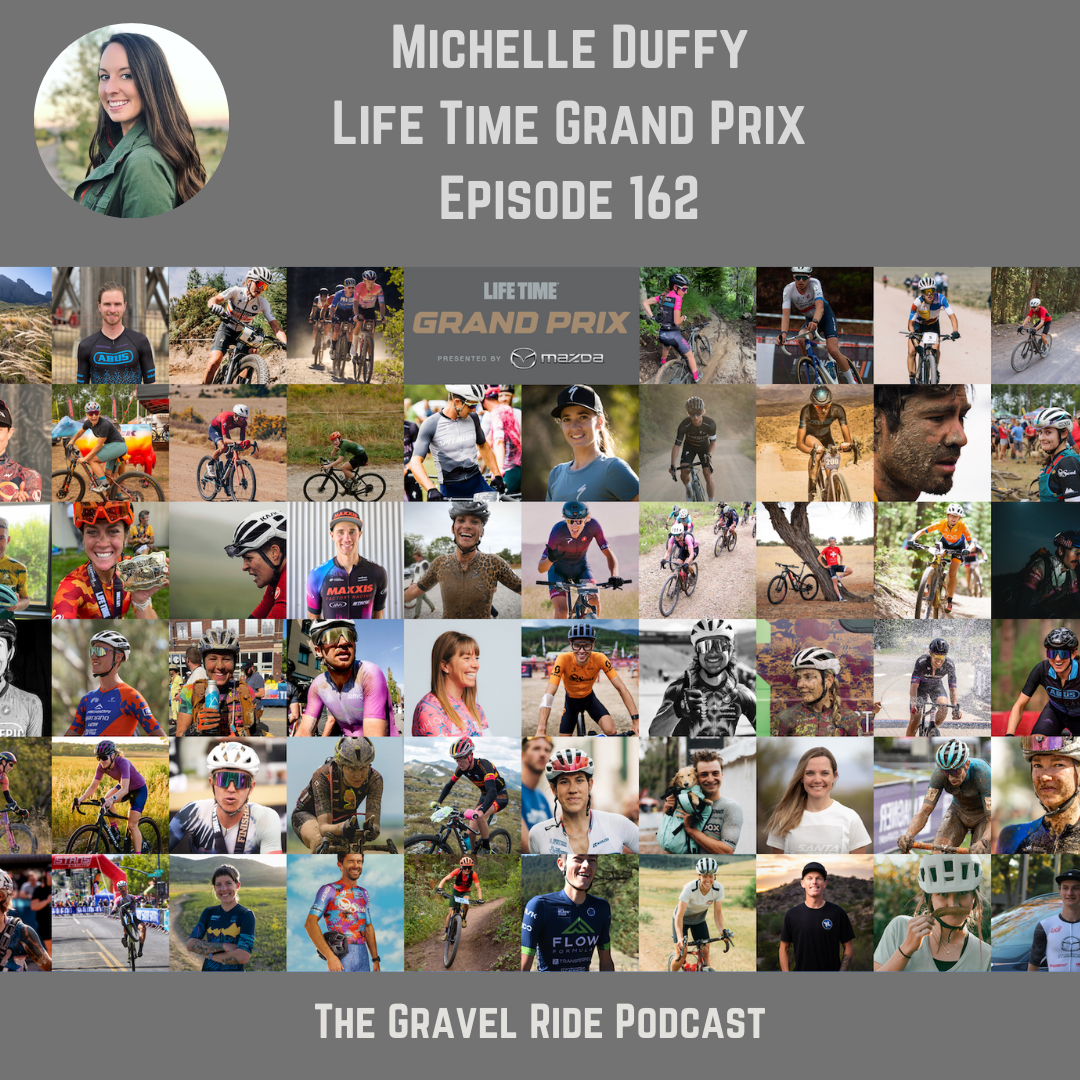
Michelle Duffy - Life Time Grand Prix 2023
This week we sit down with yet another friend of the pod, Michelle Duffy from Life Time. We catch up on the upcoming kickoff for the 2023 Life Time Grand Prix and some of the changes in store for athletes and fans. Episode Sponsor: Athletic Greens Support the Podcast Join The Ridership Automated Transcription, please excuse the typos: [00:00:00] Craig Dalton: Hello, and welcome to the gravel ride podcast, where we go deep on the sport of gravel cycling through in-depth interviews with product designers, event organizers and athletes. Who are pioneering the sport I'm your host, Craig Dalton, a lifelong cyclist who discovered gravel cycling back in 2016 and made all the mistakes you don't need to make. I approach each episode as a beginner down, unlock all the knowledge you need to become a great gravel cyclist. This week on the show, I'm excited to welcome back Michelle Duffy from lifetime to talk about the lifetime grand Prix for 2023. I know this show. Isn't all about racing, but I'm a fan of the sport. I love riding. I love participating in my own way at the back of the pack. But also like following the front of the pack. And I found that the lifetime grand Prix added a lot of fun to my 2022 fandom. As I was able to follow the battles throughout the year. And even after the season, I was able to relive some of those moments through a YouTube series that lifetime published about the grand Prix that allowed us to get behind the scenes with some of the athletes and see some of the personalities and some of the action and drama we might not have seen. As a casual fan, the lifetime grand Prix is back for 2023. They've made some tweaks to the number of events you can now drop to events. So I wanted to have Michelle back at the beginning of the season to just talk about some of those changes. To reflect on the action from 2022 and just generally catch up. Michelle puts a lot of energy into the gravel cycling community, and I'm always happy to highlight those efforts. Before we jump in, I do need to thank this week. Sponsor athletic greens. Athletic greens and AIG. One is a comprehensive daily nutrition made from simple, powerful ingredients. It's made up of 75 high quality, whole food sourced ingredients. Carefully curated to nourish all the body's systems holistically. As many of you know, I've been an athletic greens user for many, many years, predating the podcast. So I've been super stoked that athletic greens has been a big partner for what I do The key to ag one is that it replaces key health products in one simple scoop. AIG one combines nine health products working together as one, replacing your multivitamin. Multimineral. Pre and probiotics. Immunity support and more, that means ag one does more for your body and saves you time, money and confusion compared to taking multiple unique products. And that is a hundred percent key for me. I do one scoop in the morning, mixed up with a little bit of ice, and I feel like I've got some of my nutritional basis started before I've even begun the day. If you're interested in learning more about athletic greens, go to www.athleticgreens.com/the gravel ride. For podcast listeners, our friends at athletic greens have given us a free year supply of vitamin D and five free travel packs. If you ordered today. Simply visit athletic greens.com/the gravel ride to get your age. The one on the way today. With that said let's dive right into my conversation with Michelle Duffy. [00:03:23] Craig Dalton: Hey Michelle, welcome back to the show. [00:03:25] Michelle Duffy: Thank you for having me back. [00:03:27] Craig Dalton: It's good to see you. I was looking back in my notes and it looks like it was just, just a little less than a year ago. We sat down at Sea Otter, which was the first event of the inaugural lifetime Grand Prix. [00:03:40] Michelle Duffy: Yes. It's crazy to think it's almost the otter time again. [00:03:44] Craig Dalton: I know I've been getting the emails and I'm like, gosh, I gotta get my stuff together, and it's exciting to have it kick off. [00:03:51] Michelle Duffy: Oh yeah. It's like the kickoff of everyone's cycling year. I feel like. [00:03:56] Craig Dalton: And such a big one at that with all the, the expo activity and the so many different forms of racing going on, it literally does cover like every discipline of cycling. I feel like. [00:04:07] Michelle Duffy: I, yeah, that's what's so special, like from the industry perspective, mountain biking, road gravelly, everyone's together. Um, so I'm really looking forward to getting back to Monterey. [00:04:17] Craig Dalton: Yeah, for sure. I thought it would be a good opportunity to just sit down with you again and reflect back on that inaugural season of the Lifetime Grand Prix. Such a interesting series to kind of infuse into the gravel world, and I'm sure you learned a lot along the way. I just wanted to sort of get your basic reflections of the season. Maybe some of the key moments that you'd highlig

Amanda Nauman - Mammoth Tuff, Tuff Ventures and women in gravel racing
This week we catch up with Amanda Nauman to discuss all things gravel. We touch on the Mammoth Tuff gravel race, Tuff Camps and how to continue to invite women into the sport. Amanda is an OG in the sport and friend of the pod which made for a super enjoyable conversation. Tuff Ventures Website Support the Podcast Join The Ridership Automated Transcription, please excuse the typos: [00:00:00] Craig Dalton: Hello, and welcome to the gravel ride podcast, where we go deep on the sport of gravel cycling through in-depth interviews with product designers, event organizers and athletes. Who are pioneering the sport I'm your host, Craig Dalton, a lifelong cyclist who discovered gravel cycling back in 2016 and made all the mistakes you don't need to make. I approach each episode as a beginner down, unlock all the knowledge you need to become a great gravel cyclist. This week on the podcast, I'm super stoked to invite back. Amanda Naaman. Amanda is a big time friend of the pod. A podcast or herself as the co-host of the grody. Podcast. A very accomplished off-road athlete. With notable wins twice. At Unbound 200. Five times at the rock cobbler, . We touch on rock cobbler this year, and some of the help she provided Sam aims with inviting and encouraging more female athletes to toe the line at this year's rock cobbler event. She and Dave Sheik are also the co-founders of the mammoth tough event in mammoth, California, which occurs in September. Each year She's a member of the gravel cycling hall of fame advisory board. And according to her. She's Walter, the dog's favorite. I'm not going to get into that domestic squabble, but we'll leave it at that. I'm excited to bring you a followup conversation with our friend, Amanda Naaman. Hi, Craig. How are you? I am doing great. It's so good [00:01:32] Amanda Nauman: to see you. Yeah, likewise. I'm excited. What, almost two and a half years [00:01:36] Craig Dalton: later. Yeah. Yeah. And you know, the funny thing about our first recording I was recalling, we were doing an Instagram live at the same time. It was back when everybody was trying to figure out Instagram Live, so we were doing that. And recording our conversation and I ultimately posted it to the podcast Feed . [00:01:54] Amanda Nauman: Nice, nice. . [00:01:56] Craig Dalton: What am I sort of, I would say to the failed endeavor into Instagram Live. It's not something I, I jam on. I'm much more comfortable in the podcast format where I can just talk to people and publish it later. [00:02:08] Amanda Nauman: Yeah. Yeah. No, it's hard and distracting. You get all the messages, you're like, what? What is that question? ? . [00:02:14] Craig Dalton: I feel like we have so much ground to cover. We were chatting a little bit offline, but I, I thought what would be an interesting place to start knowing you participated in the Lifetime Grand Prix in in 2020 2, 20 22. I just wanted to get your kind of overall perceptions as someone who's been around gravel racing for many years with that structure of your season. infused onto your life. H uh, how did it go and what were your thoughts on the, the lifetime Grand Prix in general? [00:02:42] Amanda Nauman: Yeah, I signed up probably on the last day that was possible to turn in the applications that, um, winter before, cuz I really contemplated whether or not it was something that I wanted to do for a while cuz I knew. You know, I had done Unbound Excel. They had put Leadville on the list for the Grand Prix, and I was like, man, I've always wanted to do Leadville. I can kind of shape my calendar around the rest of the series as well. So ultimately I decided to sign up for it knowing, you know, it's kind of a shoe-in to Leadville, which is one thing I had always wanted to do. And at the same time, I get to do some gravel and some other mountain bike races that I hadn't necessarily done before. So I was very optimistic and excited about the Grand Prix last. . It didn't necessarily go how I had planned or anticipated, but uh, yeah, I think what they have created in the series and the opportunities for athletes to go race that, I think it's a great, a great thing and great structure for a lot of people, but it wasn't necessarily, let's say, the right fit for me last year. [00:03:44] Craig Dalton: Did that make sense? I mean, just for the listener's sake, like if you go back a few years before that as a gravel racer, how would you go about picking your Cal. [00:03:53] Amanda Nauman: Yeah, I mean, there's just some of the marquee events that. I would've picked, you know, in 2019, like for sure rock cobbler, mid-South Belgian waffle ride San Diego. And then you'd go into Unbound, like for I think a California racer. That was sort of the way you would go. And then as summer happened, you know, you could pick and choose events. S B T I think was a was happening at that time. So it was a good summer. One gravel worlds. And then R P I. Was kind of sort of a season ender a little bit before y