The Food Programme
844 episodes — Page 8 of 17
The Physicist In the Kitchen
Can a grounding in science help us become better cooks? Dan Saladino speaks with chefs Heston Blumenthal, Raymond Blanc, food writers Harold McGee and Niki Segnit to find out what a little chemistry and physics can do for our kitchen skills. Each of these chefs and cooks have been influenced by a lecture delivered to the Royal Institution in 1969 delivered by an Oxford professor of physics, a Hungarian called Nicholas Kurti.In his talk, titled, "A Physicist In The Kitchen," Kurti came up with the memorable quote, "I think it is a sad reflection on our civilisation that while we can and do measure the temperature in the atmosphere of Venus, we do not know what goes on inside our soufflés." He believed that food and cooking were such important features of human life they deserved greater attention from science, and that likewise, that cooks should better understand the science that unfolds when we mix, heat and chill ingredients. The lecture and the quote inspired chef Raymond Blanc, who in the 1990s made a television series with Nicholas Kurti, and whose own cooking was transformed by working with the physicist. Heston Blumenthal was also inspired. He was among a group of chefs who attended a series of food and science workshops held in Sicily and founded by Kurti. It set him on a voyage of scientific discovery and some of the most experimental cooking seen and tasted in the UK. Dan caught up with Heston as he was researching a new menu for the restaurant Dinner by Heston Blumenthal, at an exhibition at the Ashmolean. New scientific techniques are revealing how people in the ancient city were eating and cooking before Vesuvius erupted. From this research the Dinner team have created a menu featuring ancient varieties of spelt flour served with butter, and crafted to resemble lava rock. As well as the role of science in creative restaurant cooking, physics and chemistry have been at the heart of the work of food writers Harold McGee and Niki Segnit (author of The Flavour Thesaurus and Lateral Cooking). They explain how learning about copper ions and flavour molecule can transform a dish. To explain who Nicholas Kurti was, Professor of Physics, and Radio 4 presenter Jim Al-Khalili sheds light on Kurti's career and shares his own thoughts on the role of science in the future of our food.Presented by Dan Saladino. Photograph: Emily Jarrett Photography
Yes We Can: What do the tins we eat say about the UK?
Baked beans, tinned pies, corned beef, creamed tomato soup, plum tomatoes, ackee, pineapple chunks and condensed milk.Our store cupboards are bursting with tins of food, they provide comfort, cheap family meals, quick lunches and easy dinners. Maybe even a sure stock of ingredients as Brexit edges closer. Yet over the years, the UK market is dwindling. Stats show young people are less interested in tinned fruit and fish. And then there's the image problem. Tinned food has a reputation in the UK it's struggling to shake off. Cheap, unhealthy. Fine for those making do with tiny budgets, not if you can afford the fresh equivalents.As Madrid born Patrick Martinez found out first hand when he set up a bespoke tinned fish company in Liverpool, we have a funny relationship with tinned food in the UK. A relationship quite unlike our continental neighbours. We deeply love these foods, but we might not admit our affection openly. In this programme Sheila Dillon speaks to food writer Jack Monroe about the politics of tinned food and why she thinks we ought to cook and love the tinned foods lurking in our cupboards.Presented by Sheila Dillon. Produced in Bristol by Clare Salisbury.
Pints of progress: The brewers changing attitudes to learning disabilities
Brewer and broadcaster Jaega Wise visits breweries where a progressive approach to employing people with learning disabilities is pouring away preconceptions. Helping tell the story is Michaela Overton, a brewer at Ignition in Sydenham, South London, a brewery founded to create meaningful work for people with learning disabilities, which has gone from glorified homebrew to running two taprooms selling their beers. In this programme, we follow their collaboration with London brewer Gipsy Hill to make a beer as part the Social Brew Collective. Jaega joins in the project teams up with Spotlight Brewing in Goole in East Yorkshire. There she meets Neil, Michael and Kev and Ric who are making beers with names like Undiagnosed and Spectrum to raise awareness of learning disabilities.Spotlight and Ignition are a taste of change to come but Jaega finds opportunities like these in the food industry are hard to come by for most people with learning disabilities so she meets Mencap's Natalie Duo to talk about her work training potential employers in the changes they can make to create a more accessible workplace. Presenter: Jaega Wise Producer: Tom Bonnett
Could eating microalgae be the next big thing?
Sheila Dillon enters the murky green and bright blue world of microalgae and cynobacteria to meet the people who believe humble pond scum could be the secret to securing food for the world's growing population. She visits YeoTown Kitchen in West London where Mercedes Sieff serves up a platter of brightly coloured delights and then meets Andrew Spicer, CEO of Algenuity, who is exploring how microalgae could be an egg replacement of the future. Somehow, their conversation leads Sheila to make a green Victoria sponge. Away from the kitchen, Sheila tells the story of Saumil Shah who is growing spirulina on rooftops in Bangkok and Simon Perez who has been inventing hot dogs, crisps and salad dressings from spirulina in Copenhagen. She hears from one of the world's leading algae scientists, Professor Alison Smith, Head of Plant Sciences at the University of Cambridge, and nutritionist Rhiannon Lambert before finding out from Dr Gisela Detrell how microalgae could feed astronauts on missions to Mars.Presenter: Sheila Dillon Producer: Tom Bonnett Photograph: Space10
Is The Dinner Party Dead?
Cast your mind back to the days when as a child you’d be pushed into the backroom with the TV on a Saturday night whilst your parents ‘entertained friends’ in the dining room. Three courses, nibbles. If you were a child of the 70s, prawn cocktails and stroganoff. In the 80s, parents made vol-au-vents and devilled eggs, black forest gateaux slaved over all day. (Course you’d make do with cheese on toast before your mum got changed.) Today it doesn’t happen like it used to. Homes are built without dining rooms, that’s if you can afford your own place anyway. We’re too frightened of the elaborate dishes cooked by TV chefs that we prefer to meet up with friends over Sunday roasts or bottomless brunch. Yes we might have people over for food, but it’s shared out in the kitchen, or eaten on knees in-front of the TV. So are we in a post-dinner party era? Or should we invest in a decent table cloth and be proud about entertaining the people we love? Leyla Kazim speaks to New Yorker and author of 'Nothing Fancy', Alison Roman who is not mourning the dinner party. Instead, Alison gives her ultimate guide to having friends over for food, complete with a 'washing up' dance party. British podcast host and writer Alexandra Dudley defends the glitz that only comes with a proper party and shares some simple hacks. And best-selling author Josceline Dimbleby describes how the way she cooks for friends has changed since she released her first cookbook in 1976.Presented by Leyla Kazim. Produced in Bristol by Clare Salisbury.
Michel Roux Jr: A Life Through Food
Sheila Dillon visits London restaurant Le Gavroche, to speak to renowned chef Michel Roux Jr about food, family and festive inspiration.Michel Jr is the second generation of the Roux family to run the Mayfair restaurant, which was started by his father Albert and his uncle Michel. When he took over the kitchen nearly 30 years ago, he fought to put his own stamp on the style – and write the next chapter of the family’s food story.Michel kicks off in the kitchen, cooking two dishes that have special importance to him: Soufflé Suissesse, his father’s decadent cheese soufflé creation that diners won’t allow to be taken off the menu; and roast quail with potato fondant and mushrooms, a dish that he loves and often cooks at home for the family.Over the course of cooking and eating the meal, Sheila asks Michel about his life, his love of food, his inspirations and drive – as well as the pressure that come with being part of a dining dynasty. They also discuss how he’s dealt with the challenges in his life: from the pay scandal of 2016, when Gavroche employees were found to be earning below minimum wage – to his regret over never quite managing to achieve a work/life balance.They’re later joined by Michel’s daughter Emily, who now has her own restaurant in London with her husband Diego Ferrari, and who has a fresh perspective on the industry and how her family have shaped her career. The programme also hears from one half of the team who originated this dynasty: Albert Roux shares his take on his son’s success.Presented by Sheila Dillon, produced by Lucy Taylor.
The Sugar Plum Shift: Exploring the ballet world’s changing approach to food, nutrition and body image
Sparkling lights, twinkly music, frothy tutus and perfectly pirouetting dancers: what could be more magical – and festive – than ballet?This is an art-form that’s been revered over generations, romanticised by books, magazine and movies… but it hasn’t always had the best of reputations when it comes to health and well-being. Ballet dancers are ethereal, elegant, poised – and were, traditionally, often tiny. Over the years, around the world, there have been stories of ballet dancers having unhealthy diets, eating disorders and mental health issues.In more recent decades, the ballet world has recognised this – and a shift is well underway, in attitudes towards food, eating, diet and nutrition… one that’s seen the big ballet companies employing dedicated nutritionists and strength training coaches, training their dancers like professional athletes. The evolution of the art-form has seen ballet become more demanding - and as a result, the ideal ballet body image has shifted to strong, lean and toned; meaning dancers need to be on top of their diet and nutrition, in order to perform. Today, the industry says its focus is on education, and building positive relationships with food and body image right from the start of a dancer's career.So how far has the industry come - and what more could yet be done? Sheila Dillon dons her tutu and ventures into the world of British ballet, to ask: does playing the Sugar Plum Fairy still mean sacrificing any hint of a sugar plum?Presented by Sheila Dillon, produced in Bristol by Lucy Taylor.PICTURED: Yasmine Naghdi, principal dancer with The Royal Ballet, dancing Aurora in The Sleeping Beauty. ©ROH, 2017. Photographed by Bill Cooper.* * *Special thanks to The Royal Ballet for letting us attend and record their rehearsals for Coppélia, featuring dancers Laura Morera in the role of Swanilda and Bennet Gartside as Dr Coppelius - with coaches and former Royal Ballet dancers Leanne Benjamin and Stephen Wicks, accompanied by pianist Kate Shipway.Also thanks to the staff and students of Elmhurst Ballet School for letting us watch and record one of their dance classes, taught by Gloria Grigolato and accompanied by pianist Dominic Mason.
Cookbooks of 2019
Pinch of Nom, Charred and East are among the titles up for discussion as Sheila Dillon and guests gather in Hay-on-Wye to review 2019's best cookbooks. Featuring Cerys Matthews, Lia Moutselou and The Bookseller's Tom Tivnan.Presented by Sheila Dillon. Produced by Clare Salisbury.
Eating Animals Part 2: A Meat Q&A.
Dan Saladino, Sheila Dillon and a range of experts ranging from climate scientists to beef producers answer your questions on meat eating and the future of farming and our diets.Featuring questions on methane, scientific trials of more carbon friendly beef, the impact of rice in climate change, the nutritional benefits of grass-fed meats and the value of traditional diets. Among the contributors are Dr Michelle Cains, a Climate scientist at the Oxford Martin School, Minette Batters, President of the National Farmers Union, Professor of Epidemiological Genetics at Kings College London, Patrick Holden, The Sustainable Food Trust, Tara Garnett of the Food Climate Research Network and environmental campaigner George Monbiot.
Eating Animals Part 1: The Future of Meat
Dan Saladino finds out why tensions are running so high over animal vs plant based diets. In October 2018, the Intergovernmental Panel on Climate Change (IPCC) reported that to keep the rise in global temperatures below 1.5C this century, emissions of carbon dioxide would have to be cut by 45% by 2030. Coming under greater focus were sources of CO₂ and Greenhouse Gas Emissions linked to our food; cows and sheep. For some the science was enough to justify ever greater calls to reduce meat and dairy consumption and rein in the global livestock population. To others, the focus on meat has become too simplistic and driven by ideology. So, who's right and what should the future of meat look (and taste) like?In the first of two programmes Dan asks a number of experts to explain their different points of view. Author (and vegetarian) Jonathan Safran Foer argues that saving the world starts at breakfast and we should all be avoiding meat until the last meal of the day. That way he believes we can begin to bring our consumption of meat under control. Morten Toft Bech, the founder of The Meatless Farm which makes plant based beef alternatives, explains why he set out to help replace animals in the food system. Professor Frederic Leroy of Brussels University in Belgium has been monitoring the meat debate of recent years. He's concerned about the tendency to lump together vastly different production systems, good and bad, to create an anti-meat narrative. Dairy and meat farmer Simon Fairlie describes a possible solution, an approach he calls "default meat". In part two, the following week, it's over to the programme's listeners and their questions on the future of meat. Presented and produced by Dan Saladino.
The Food Programme at 40: Looking Forward (Part II)
Andi Oliver, Rick Stein and Yotam Ottolenghi join Sheila Dillon at the BBC Radio Theatre to celebrate 40 years of The Food Programme and ask what changes the next four decades might bring to the way we eat and drink. Together with restaurant critic for The Guardian and MasterChef regular, Grace Dent and food blogger and presenter Leyla Kazim, they’ll traverse the food trends which have shaped our eating in and eating out, and face questions from listeners from all over the country. From fad diets to food fraud, from the scandals which have shocked us to the cook books we reach for in our flour-coated, milk-spattered kitchen time of need; the highs and lows of 40 years in food and drink.The Food Programme was commissioned in 1979 as a six-part radio series fronted by Derek Cooper. Join in as we share the food stories which have helped make the series the place on BBC Radio 4, for hungry minds across four decades.Produced in Bristol by Clare Salisbury.(Part II of II)
The Food Programme at 40: Looking Back (Part I)
Andi Oliver, Rick Stein and Yotam Ottolenghi join Sheila Dillon at the BBC Radio Theatre to celebrate 40 years of The Food Programme and ask what changes the next four decades might bring to the way we eat and drink. Together with restaurant critic for The Guardian and MasterChef regular, Grace Dent and food blogger and presenter Leyla Kazim, they’ll traverse the food trends which have shaped our eating in and eating out, and face questions from listeners from all over the country. From fad diets to food fraud, from the scandals which have shocked us to the cook books we reach for in our flour-coated, milk-spattered kitchen time of need; the highs and lows of 40 years in food and drink.The Food Programme was commissioned in 1979 as a six-part radio series fronted by Derek Cooper. Join in as we share the food stories which have helped make the series the place on BBC Radio 4, for hungry minds across four decades.Produced in Bristol by Clare Salisbury.(Part I of II)
Smoke and Celebration: Exploring Bonfire Night food traditions
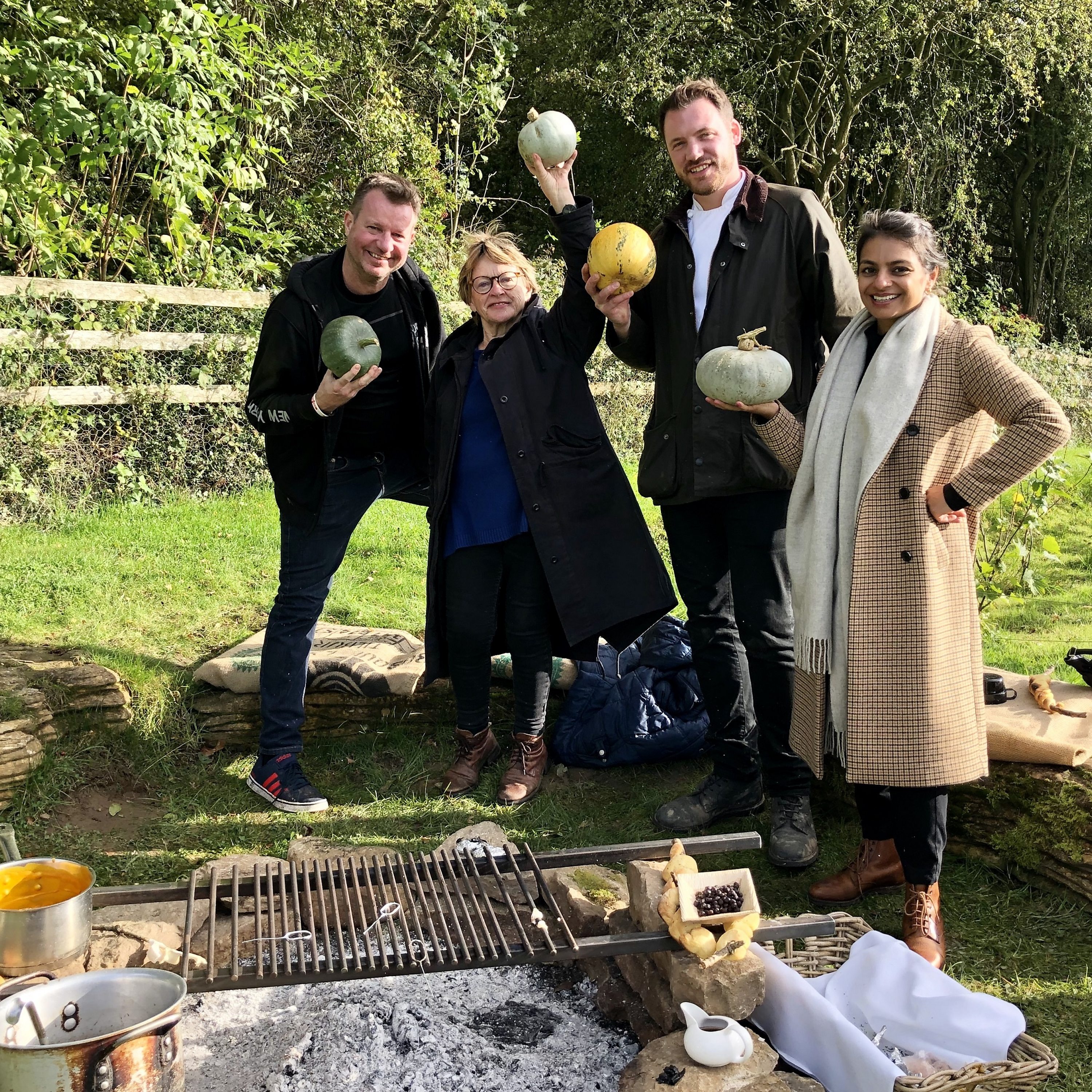
Autumn is the season of mists and mellow fruitfulness – when the air is perfumed with bonfire smoke, sweet crisp apples are weighing down orchard branches, and root vegetables are plump and ready for picking beneath the soil.It’s a time of year when a whole new palette of British produce is ripe and ready to turn into pies, pickles, chutneys, cakes, jams and stews: hearty comfort food to warm and nourish as the weather turns colder.Autumn is also a season for festive gatherings: with Halloween and Guy Fawkes Night leading swiftly into the frenzied run-up to Christmas, providing plenty of opportunity to eat, drink and be merry - and on November 5th in particular, food traditions abound across the UK; from regional specialities to family favourites.In this programme, Sheila Dillon heads to North Yorkshire, to gather round a fire with Michelin-starred chef Tommy Bank; cook and food writer Meera Sodha; and chef and restaurateur Andrew Nutter. Together, they keep the autumn chill at bay with a bonfire feast – whilst sharing stories of their seasonal food memories.
Brexit: The Tomato's Story. What can one food tell us about the future?
Dan Saladino uses the story the tomato to examine the impact of the new Brexit on food.
Could a food project from India solve the UK’s holiday hunger problem?
As many UK schools break for half term, chef Romy Gill and Sheila Dillon focus on our national problem with holiday hunger.Earlier this year, a UN special rapporteur found poverty in the UK to be "systematic" and "tragic". The Work and Pensions Committee published a separate report suggesting that while poverty rates are much higher in households where no-one works, almost one in 10 households with children where all adults work full-time are in poverty. In the school holidays, food budgets are stretched even further.Now a charity from India, who regularly feed 1.76 million school children, says it can help. In this programme, Romy visits a holiday club in Croydon in South London where Akshaya Patra are working with local groups and trialling a new way of providing school meals. Could the organisation's success in India help solve a UK holiday hunger crisis?Presented by Sheila Dillon and Romy Gill. Produced in Bristol by Clare Salisbury.
Joe Wicks: A Life Through Food
When Joe Wicks, the personal trainer, started making Instagram videos in his kitchen in 2014, he couldn't have imagined he'd become author of the second biggest selling UK cookbook of all time. Today he is a phenomenon. He's built a social media brand with millions of followers, nay disciples, on Instagram and YouTube who come for the quick healthy recipes and online fitness workouts. Yet, Joe tells Sheila Dillon, somewhat modestly, "I'm not really great at cooking..." In this programme Sheila visits Joe at home in London to find out what drives his ambition and enduring popularity. They talk cooking, parenthood, and how his own fame has affected his whole family. Presented by Sheila Dillon. Produced in Bristol by Clare Salisbury.
The Return of Zing: How to Get Sour Back into Your Life.
Dan Saladino explores the taste and temptations of sourness, from our evolution to the way we cook and eat. A story of puckering pickles, science, fermentation and edible ants.It's only in recent times that we have understood how and why we experience the sensation of sourness. The leader in the field is EMILY LIMAN, Professor of Biological Sciences at University of Southern California in the USA. She explains the recent discoveries about what happens when we put something sour in our mouths.Forager Miles Irving takes Dan on a wild walk through a field in Kent in search of sources of sourness from insects to red berries. Chinese food expert Fuchsia Dunlop whose new book Sichuan Cookery, focuses on the food of southern provinces explains the role of pickles and vinegars. In the studio Mark Diacano gives a guide to bringing more sour back into your life with lessons in piccalilli making and a beginners guide to kombucha.Produced and presented by Dan Saladino.
Food Additives, Part 2: The Debate
In the second part of The Food Programme's focus on additives, Sheila Dillon takes a closer look the myths and realities around these extra ingredients and their roles in our everyday diets - through addressing questions and comments from listeners.She's joined by a panel of food aficionados as well as an audience of industry professionals and interested listeners, at the BBC's New Broadcasting House in London - to discuss a range of points raised by listeners and audience members.The panellists are:- Dr Helen Crawley, a dietitian and public health nutritionist, who currently manages and coordinates the First Steps Nutrition Trust: an organisation focusing on the need for expert, independent information and support for good childhood nutrition;- Ralph Early, a food scientist, a Trustee of the Food Ethics Council and a Fellow of the Institute of Food Science and Technology. He was formerly Professor of Food Industry at Harper Adams University and has also worked in the food industry itself, primarily in the dairy sector.- Helen West, a dietitian "on a mission to cut through the untruths and nonsense in the world of nutrition"; she’s also co-founder of The Rooted Project: a community that says it aims to make evidence-based nutritional information accessible to all.- And Sanjay Kumar: a chef hailing from Calcutta, who trained in Oxford under Raymond Blanc and has worked in kitchens around the world – but now runs a cookery school, teaching people of all generations to cook and eat better, on a budget.Presented by Sheila Dillon and produced by Lucy Taylor.
Food Additives, Part 1: Sherbet and other E number experiments
From Vitamin C and fruit-flavoured sherbet, to the chemicals adding flavour to ultra-processed foods - Sheila Dillon delves into the world of food additives, to learn about the impact E Numbers have had on modern diets.Sheila meets with food scientist and entertainer Stefan Gates, for some entertaining and surprising E Number experiments in his lab-kitchen... She also hears more about the background to food additives from Stacey Lockyer at the British Nutrition Foundation; and explores some of the impacts, questions and controversies around these added extras, with gut microbiome expert Professor Tim Spector, and science policy professor Erik Millstone.Following this introduction to the world of additives, The Food Programme invites listeners to get in touch and share their questions and thoughts on these ingredients, ahead of a panel discussion on the role of additives in our everyday lives, taking place in front of a live audience next week.Presented by Sheila Dillon; produced in Bristol by Lucy Taylor.
Island to Island: The journey of Mauritian cuisine
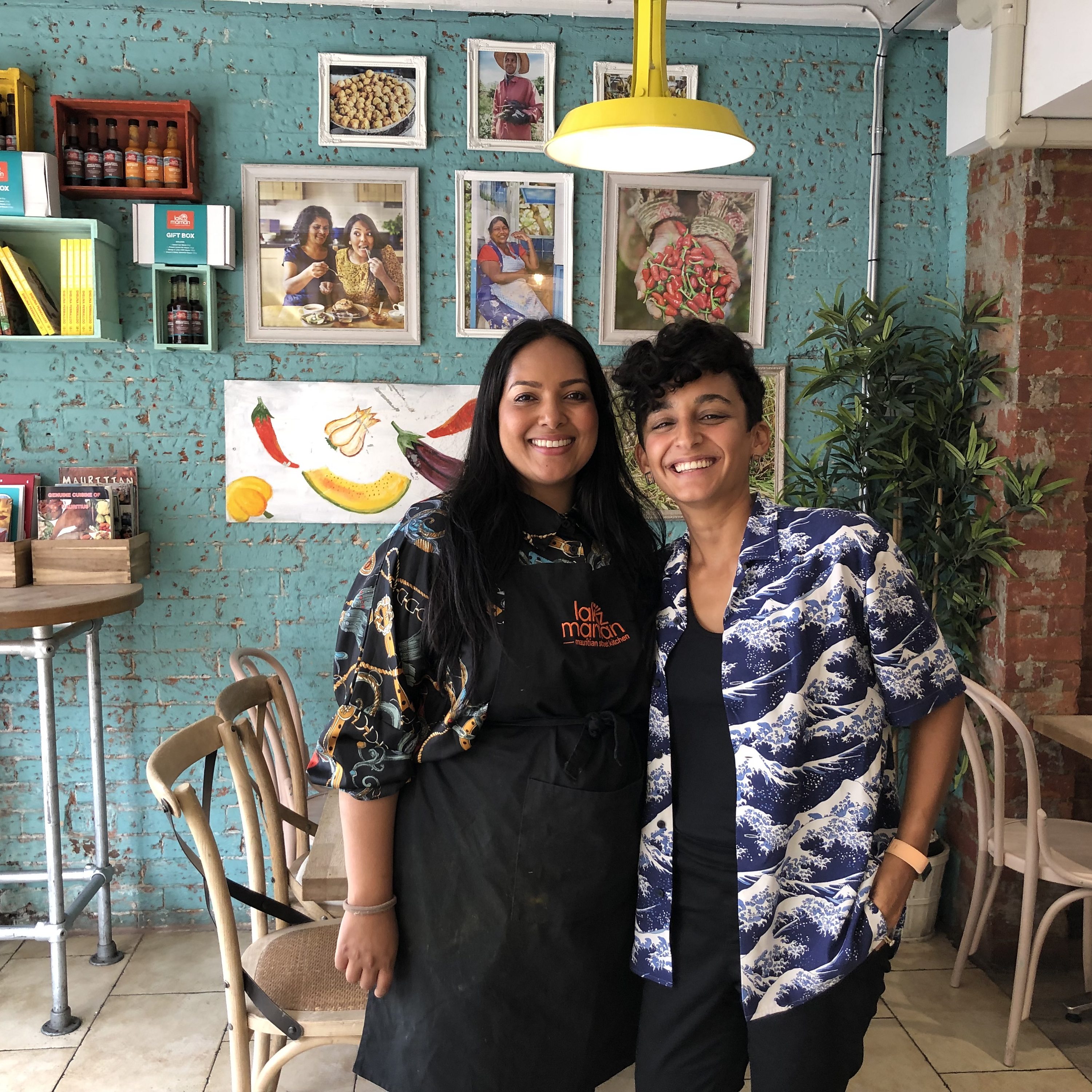
Mauritius recently celebrated its 50th anniversary of independence from the UK – and since that day in the 1960s, tens of thousands of islanders have made the UK their home; bringing with them a unique, diversely influenced cuisine that seems to enthral eaters from the first bite.For those with Mauritian heritage, food - and the very act of coming together to eat with friends and family - is an almost sacred part of life; a tradition packed with love, laughter and lip-smacking dishes.So why hasn't Mauritian food made more of an impact on the UK food scene, over the decades? And is that now starting to change?Food and travel writer Leyla Kazim sets out on a journey to explore her own Mauritian heritage and the island’s growing culinary influence within the UK, learning more about a cuisine that has diversity and family – particularly matriarchs – at its very heart. Leyla meets with pioneering cooks Selina Periampillai and Shelina Permalloo, two women who learned classic recipes handed down over the generations, who are proving that the second generation of Mauritians in the UK are determined to earn their cuisine the recognition it deserves... She also learns more about the diverse history of the Indian Ocean island and its multicultural influences - and hears the moving tale of Clancy Phillippe, a Mauritian living in Australia who was inspired by his wife to introduce traditional Mauritian fare to the world.Presented by Leyla Kazim and produced in Bristol by Lucy Taylor.
Ice Cream Nation
We might like the occasional 99 in the rain in the UK, but not for us the piled high gelato cones of Italy, the tubs of sweet American sundaes, nor the eiscafes of Germany and Austria. Right? Yasmin Khan is on a mission to prove you wrong. In this programme Yasmin (Ice cream fanatic) uncovers the UK’s rich but lesser known ice cream culture, taking a trip down memory lane to visit people making ice cream in places where she's lived. She’ll hear about our overlooked regional specialities like the ‘lemon top’ of Redcar near Middlesbrough. And she’ll hear how our sweet tooth is driving a new market for high street dessert parlours and struggling dairy farms. She’ll find how our love affair with ice cream all goes back to hundreds of years of immigration, from the Swiss Italians in the 19th century to young entrepreneurs today. It’s not an ice cream renaissance, because our love of ice cream has never disappeared. (And also there is nothing wrong with a 99 in the rain.) Presented by Yasmin Khan Produced in Bristol by Clare Salisbury
Taste the Music and Dance
Dan Saladino reports from the Taste The World stage of the world music festival Womad. In 2006 a director of the festival Annie Menter had the idea of asking musicians if they could tell food stories from their home country and cook a dish linked to their food culture.More than a decade on it's become a format that used at Womad events all over the world, providing fascinating and delicious insights into the connections between food and music and the evolution of dishes around the world. Find out what happens when you mix Turkish psychedelia with dumplings and what a Yoik served with Sami bread involves.The artists and their food. Anandi Bhattacharya (Bengal, India) Chicken Rezala. Nimba, (West Africa), Fish in peanut sauce Rura (Scotland) Cullen Skink and Mince and Tatties. Marja Mortensson (Norway) Sami stew with Sami bread. Baba Zula (Turkey) Manti beef dumplings Maija Kauhanen (Finland) Blueberry Pie. Presented and produced by Dan Saladino.
Jamie Oliver: A Life Through Food Part II
On the anniversary of TV series 'The Naked Chef', Jamie Oliver talks to Sheila Dillon about two controversial decades dominating food on our TV screens and online, our home cooking, and dining out.In a two-part programme, Jamie describes being propelled into the limelight as 'The Naked Chef'. The charismatic young line chef given an unexpected TV pilot. His decision not to aim for Michelin stars, but to open a training restaurant for young people who wouldn’t have considered a career in catering.From writing his best-selling books, mainly into a dictaphone due to his Dyslexia, to his relationship with the UK press, and his successes and failings working with a succession of UK governments to get the UK eating healthier. Sheila also speaks to Instagram chef Joe Wicks, Netflix chef Samin Nosrat and members of Jamie’s inner team on the influence of the highest grossing British food writer of all time. This is the second part of two programmes on Jamie Oliver's Life Through Food. Part one was broadcast on Sunday 18th August 2019.Presented by Sheila Dillon Produced by Clare Salisbury
Jamie Oliver: A Life Through Food Part I
On the anniversary of TV series 'The Naked Chef', Jamie Oliver talks to Sheila Dillon about two controversial decades dominating food on our TV screens and online, our home cooking, and dining out.In a two-part programme, Jamie, arguably the UK’s most successful food entrepreneur, reveals where it all went wrong with ill-fated restaurant chain 'Jamie's Italian’; the restaurants were supposed to disrupt mid-market dining, but after more than a decade, the chain collapsed in May. He takes Sheila back to his childhood home, above his dad's Essex pub restaurant where his life in professional kitchens began, clearing up fag ends and polishing urinal pipes. Cooking, the only thing he was “any good at” would propel him into the restaurant scene of 1990s London, and eventually onto our TV screens.This is the first part of two programmes on Jamie Oliver's Life Through Food. Part two will be broadcast on Sunday 25th August 2019.Presented by Sheila Dillon Produced by Clare Salisbury
Why did the chicken cross the road? How food became more than a comedy punchline
Food has been larking about in comedy since Charlie Chaplin first slipped on a banana skin and made bread rolls dance: but somewhere along the way, it's evolved from the slapstick sidekick to a much more significant comic entertainer...From the disastrous duck at Fawlty Towers, to Fleabag’s calamitous catering efforts – via wry dinner ladies, caravan fry-ups, comedic fried chicken shops and dark food-blogger satire – food has come a long way, baby. It’s no longer a simple prop, but a much-loved theme at the very heart of modern entertainment. In between performances at the renowned Edinburgh Festival Fringe, comedian and creative cook George Egg takes us on a journey down the Royal Mile and through the history of culinary comedy; discovering that, as with so much humour, the power of food lies in its normality. And that it’s this everyday appeal that allows food, and comedy, to conjure up safe settings in which to address much bigger issues. Presented by George Egg, produced by Lucy Taylor.Featuring clips from:I'm Alan Partridge: 'A Room with an Alan' Created and written by Peter Baynham, Steve Coogan and Armando Iannucci; performed by Steve Coogan.Victoria Wood as Seen on TV: ‘Waitress’ Written by Victoria Wood; performed by Julie Walters.The Return of Mr Bean: ‘Steak Tartare’ Created and written by Rowan Atkinson, Richard Curtis and Robin Driscoll; performed by Rowan Atkinson and Roger Lloyd-Pack.
The Search for Esiah's Seeds
Dan Saladino tells the story Esiah Levy who shared seeds and changed lives. It all started with a squash. Soon after he started to grow his own food he cut open a particularly delicious variety and discovered hundreds of seeds inside. He felt compelled to share them with people so they could enjoy the same experience. So began a mission to encourage anyone who would listen, where ever they lived, whatever their background, to grow their own food. In his spare time and using allotments and his mother’s garden he grew food, built a seed bank and sent seeds around the world through . He created a project called SeedShare to distribute the varieties he selected, from corn to pumpkins, tomatoes to beans to fellow gardeners around the world, He also made friends with other seed savers including Vivien Sansour, a Palestinian woman who had created a seed library to save disappearing crops on the West Bank.When Esiah Levy passed away suddenly and tragically young at the beginning of this year, Vivien set out to find out what had happened to the seeds he had shared and who had planted them.Produced and presented by Dan Saladino.
The BarbeQ'n'A
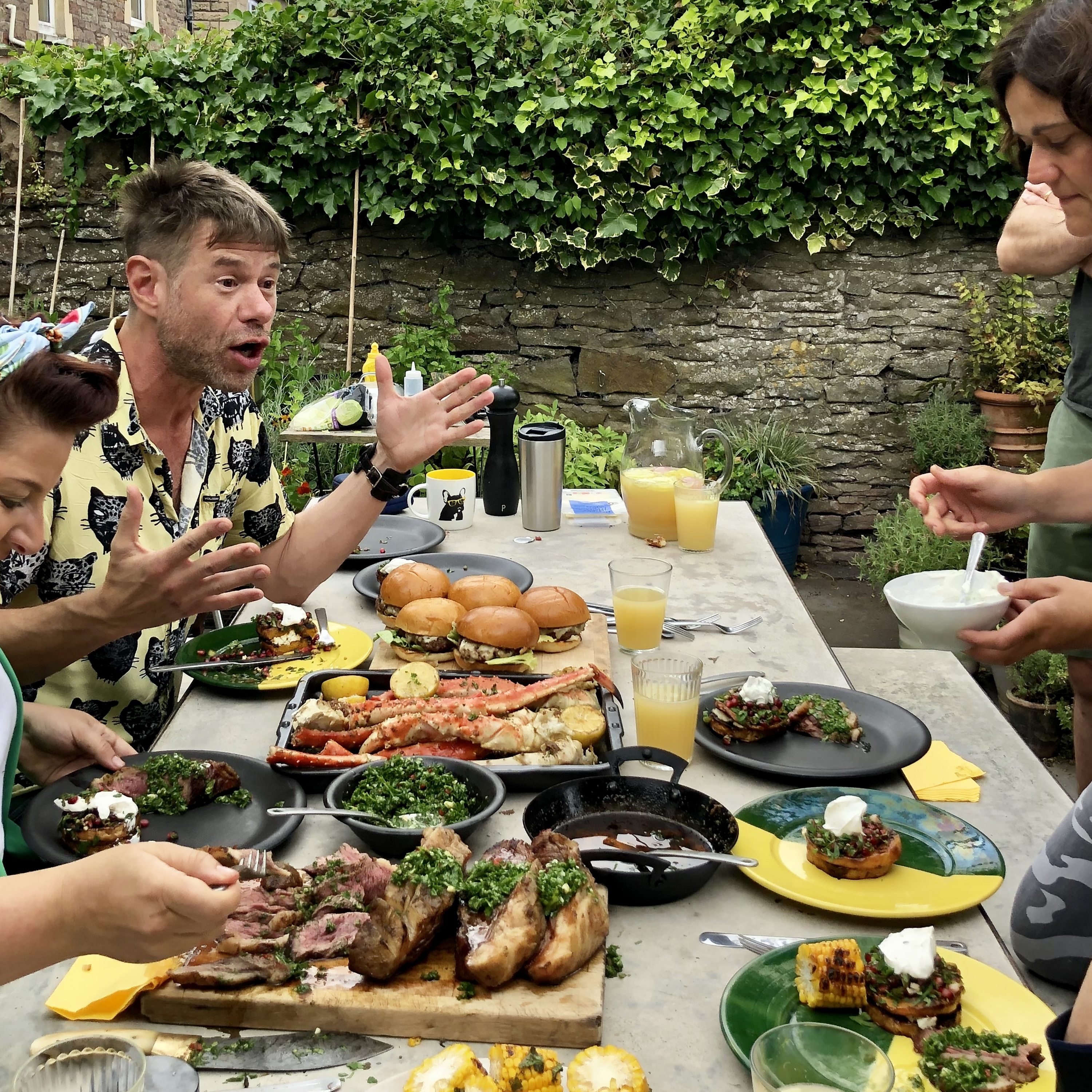
Rain or shine, the British barbecue is a summer tradition: and we want to help your al fresco feasts go with a bang!Sheila Dillon calls on Genevieve Taylor - a food writer, food stylist and presenter with an affinity for the outdoors that’s led to books including How to Eat Outside, The Ultimate Wood Fired Oven Cookbook and most recently Charred: a guide to vegetarian grilling and barbecue. She's also the host for today's programme, with a garden packed full of more barbecues and outdoor ovens than your could shake a sausage at.Joining Sheila and Genevieve for some flame-grilled fun are Christian Stevenson, otherwise known as DJ BBQ: a presenter and barbecue fanatic with a YouTube channel boasting more than 175-thousand subscribers, whose latest publication - The Burger Book - came out earlier this year; and Samantha Evans, one half of the barbecuing duo The Hang Fire Girls: a pair of friends who took a road trip across America in 2012 which fired their enthusiasm for US-style barbecue, and who now run the hugely popular Hang Fire Southern Kitchen in Barry, Wales. They've also written The Hang Fire Cookbook: Recipes & Adventures in American BBQ.Their mission today isn't just to create a fabulous, inspirational barbecue feast, but to answer all our listeners' grilling questions and help banish boring barbecues for good!Helping them out with a bit of specialist advice are the American author Harold McGee, who wrote the renowned book 'On Food and Cooking: The Science and Lore of the Kitchen'; the London-based chef, restaurateur and food writer Yotam Ottolenghi; and Jack Adair Bevan, an award-winning food and drink writer, co-author of The Ethicurean Cookbook and more recently author of 'A Spirited Guide to Vermouth: An Aromatic Journey with Botanical Notes, Classic Cocktails and Elegant Recipes'.Presented by Sheila Dillon; produced in Bristol by Lucy Taylor.
Good Enough for Granny: What's so special about the food our grandmothers cook?
We asked you to tell us stories of meals you remember your grandmothers making. Now Sheila Dillon asks why these dishes - whether delicious or otherwise - stick with us into adulthood. Food writer Alissa Timoshkina shares her Grandparents Siberian recipes which provide the essence for her book 'Salt & Time: Recipes from a Russian Kitchen'. Blogger Ann Storr reminisces about her grannie's high standards at the table. And we hear from people trying to preserve age old recipes, before they disappear for good.Presented by Sheila Dillon Produced in Bristol by Clare Salisbury
Is There A Perfect Diet Just For You? The Future of Personalised Nutrition
Dan Saladino takes part in a gruelling nutrition study to work out what to eat. Founded by Professor Tim Spector "Predict" is one of the biggest food and diet studies ever devised.A technological revolution means it is now possible to monitor large groups of people as they eat food. With this accumulation of 'big data' and the use of Artificial Intelligence it's also becoming increasingly possible to personalise nutritional advice. Dan spends two weeks on the study, being tested and scanned as he eats specially formulated muffins, drinks and meals, all designed to test his response to fats and carbs. At the end of the tough eating regime, Tim Spector gives him some good and bad news about his relationship with different foods. Dan also speaks to Professor Eric Topol, Professor of Molecular Medicine at the Scripps Research Institute in California and the author of Deep Medicine: How Artificial Intelligence Can Make Healthcare Human Again. He believes this more individualised approach to nutrition will soon create the biggest shift we've seen in modern medicine. In the future our phones, watches and smart speakers will be providing increasingly detailed information about how and what we should eat.To get even more of his own personalised nutrition advice Dan has his gut microbiome tested by a company called Atlas Biomed. The microbiome is the collection of trillions of bacteria inside all of us that we now know exerts a big influence on our health. The lead researcher at Atlas Biomed Dmitry Alexeev tells Dan what (or perhaps who) is inside his gut and what this might mean for his future health.Presented and produced by Dan Saladino.

Playing with Food: The world of video game gastronomy
Dan Saladino embarks on an epic quest into a world of food-filled computer games, to find out how and why foraging, cooking and eating have become such important components of the genre.Food has taken on a major role in many modern games - not only in terms of beautiful, Instagram-worthy designs bringing dishes to life on screen, but also food-related quests and story-lines - and even game-based recipe books inspiring players to cook their favourite on-screen meals. And even if you don't play these games yourself, the technology behind such virtual vittles could have a significant impact on how and what we eat in future.In between battling monsters in huge open-world fantasy adventures such as Elder Scrolls Online, and trying to beat the clock in the cooperative kitchen-based stress-fest Overcooked 2, Dan speaks to games enthusiasts and developers to find out more.He even finds time to do a little game-inspired cooking himself...Presented by Dan Saladino. Produced by Lucy Taylor.
Can Anyone Learn To Cook? - A Life Through Food with Samin Nosrat
Netflix chef and author of 'Salt, Fat, Acid, Heat', Samin Nosrat says anyone can learn to cook delicious food. Samin shares a life of food memories with Sheila Dillon.Presented by Sheila Dillon Produced in Bristol by Clare Salisbury
Baking in the Nordics: The Bread Adventures of Chef Magnus Nilsson
Magnus Nilsson takes Dan Saladino on a Nordic baking tour. For a nearly a decade Magnus, who is one of the world's most celebrated chefs, travelled through the region (which includes Sweden, Norway, Denmark, Iceland, Finland and the Faroe Islands) and reached an important and controversial conclusion. He argues that the Nordics has the most diverse and the deepest baking culture in the world today. His research resulted in a hefty tome, The Nordic Baking Book (Phaidon), full of more 700 of the thousands of recipes he discovered when he visited cooks in their homes.Why the world's most diverse baking culture? Magnus's reasoning is that because the region covers such a vast geographical area and its population is spread out across remote villages, information spread slowly historically. This includes recipes and so a huge amount of diversity can still be found in these isolated pockets. When it comes the depth of the baking culture, Magnus points to the fact that fresh yeast is so ubiquitous in the Nordic countries, you can often buy a packet from a newsagents or convenience store.I also has some dramatic climatic extremes, as summer starts to arrive in one area, there can be snow and ice in another. This means that while wheat can be grown in one location, only barley, rye or oats might only be possible in another. Again, this adds to the richness of its baking culture. To illustrate this Magnus takes Dan to a communal oven set in a remote farmhouse in northern Sweden to show how families gather once or twice a year to make flatbreads with barley and rye, a speciality of an area called Jamtland. Meanwhile, another kind of diversity is flourishing in the region's fields with the rediscovery and revival of ancient grains. Farmer Fintan Keenan describes some of the old (but new) varieties; what they taste like and why they might prove to be important for all of our food futures. Presented by Dan Saladino.
The BBC Food & Farming Awards 2019: Second Course
The winners of the BBC Food & Farming Awards 19 are revealed at a ceremony in Bristol. In part two, Jamie Oliver reveals the winner of the inaugral Pat Llewellyn New Talent award.Presented by Sheila Dillon Produced in Bristol by Clare Salisbury
The Food & Farming Awards 2019: First Course
The winners of the BBC Food & Farming Awards 2019 are revealed at a glittering ceremony in Bristol.In the first course of the 2019 awards story, Sheila Dillon is joined by food industry experts including Angela Hartnett, Matt Tebbutt, Hugh Fearnley-Whittingstall and Andi Oliver - to celebrate the cooks, shop keepers, farmers, producers, entrepreneurs and food pioneers who make up this year's finalists.The first instalment of our awards coverage features Best Food Producer, Best Drinks Producer, Best Street Food or Takeaway and Best Shop or Market.Presented by Sheila Dillon Produced in Bristol by Lucy Taylor
Ten Good Things
With days to go before we learn who the winners are of the 2019 BBC Food & Farming Awards Dan Saladino looks at the remaining food and drink ideas on this year's shortlist.Drinks writer Alice Lascelles guides us through the drinks makers; an experimental brewer from Leeds, a distiller based on the east coast of Scotland and a cider and perry producer from Herefordshire.Genevieve Taylor describes the street food offer this year, including a pie shop team who bake in the shadow of Liverpool FC's Anfield Stadium and a fish and chip shop in Nottingham run by a former chef.Barney Desmazery explains the finalists in the inaugural Pat Llewellyn Award set up to recognise young talent in the food world, including two young doctors working to increase the amount of nutrition training in their profession and a young entrepreneur who has devised an ingenious solution to food waste in restaurants.Presented by Dan Saladino.
Faith, Fasting and Feasting – A Ramadan Special
As Ramadan 2019 draws to a close, many British Muslim reach the culmination of a month of fasting during daylight hours. But that doesn't mean that food is forgotten. On the contrary... In this programme, food writer Yasmin Khan celebrates the social, cultural and culinary rituals of Ramadan, the most holy month in the Islamic calendar. She speaks to comedian Tez Ilyas about celebrations with family and friends and a very memorable 'Happy Eid cake'. And in Bristol, Yasmin joins thousands of people coming together for a 'Grand Iftar', a vast street party of Muslims and non-Muslims, who have come together to share a meal with their neighbours once the sun goes down.Presented by Yasmin Khan Produced by Clare Salisbury
An Education: Life lessons through food
Genevieve Taylor sets out to meet a few of this year's BBC Food and Farming Awards finalists, and hear how learning about food has changed their lives for the better.The first stop is Liberty Kitchen - a finalist in the Best Street Food or Takeaway category. This social enterprise operates at Pentonville Prison, where inmates produce a diverse range of 'street balls', including classic Italian meatballs, macaroni cheese balls and veggies balls; these are then sold at London street food markets. Genevieve visits the bustling prison kitchen with founder Janet Boston, before checking out the Liberty Kitchen stall at Leather Lane market in Clerkenwell - and hears overwhelming praise from current and ex-inmates involved in the scheme, who say it's giving them hope of employment post-prison.Next up, Genevieve checks in with Food and Farming Awards judges for the Cook of the Year category: Jeanette Orrey, co-founder of the educational initiative Food For Life, and Paula McIntyre, a cook, food writer and lecturer. They've been to the Moray region of Scotland, to visit finalist Logie Primary: a rural school with just 28 pupils. Although it's small, this primary school’s making a mark with a food-focused social enterprise that’s teaching pupils food and kitchen skills, and at the same time bringing together the local community. The school's older pupils launched the Cup of Joy Community Cafe two years ago, using vegetables grown in their school allotment and eggs from the school chickens; today, it's not only teaching them valuable nutrition and life skills but providing a hub for this rural community.Our final stop is London, where the judges for this years’ Pat Llewellyn New Talent Award - Ben Adler, whose late wife Pat inspired the award; and Barney Desmazery, food editor at large for BBC Good Food magazine - have been to Ealing to join the team behind Fat Macy’s supper club: a dining experience with a difference… The kitchen and front-of-house team are all homeless people currently living in hostels. The founder Meg Doherty launched the project three years ago, as a way to give people in temporary accommodation an opportunity to learn new skills, while earning enough money to get them back into the housing system. Presented by Genevieve Taylor; produced by Lucy Taylor.
Stranded! How to eat on a desert island.
Dan Saladino arrives on a beach for a Robinson Crusoe experience. Will he be able to survive on wild food? Chef Gill Meller and foragers John Wright and Monica Wilde lend their expertise.This castaway coastal feast is something of a tribute to the 300th anniversary of the publication of Daniel Defoe's novel, a story itself inspired by the experience of a Scottish sailor Alexander Selkirk who in 1705 survived for four years on a remote and uninhabited island in the Pacific.Selkirk survived on wild cabbages, shellfish and goat meat, Dan and his forager friends try and recreate something of the sailor's desert island menu. But during their expedition an unexpected guest arrives on the beach, a real life, modern day Robinson Crusoe. Produced and presented by Dan Saladino.
What makes an excellent food producer?
What does it take to produce delicious food of the highest quality in the UK in 2019? This year, it was the turn of chef, food writer, BBC TV presenter, and this year's head judge in the BBC Food and Farming Awards Angela Hartnett to find out. In this programme, Angela and Sheila Dillon spend a day with each of the finalists in the Best Food Producer category. Together, they visit three farms, in Cornwall, Herefordshire and Cumbria. Among the dedicated people they meet are Tanya the 'Duck Dabbler', a woman whose expertise in duck rearing are sought far and wide, Ed the 'first-time' farmer, working slowly and sustainably in the Black Mountains, and Martin whose dedication to making cheese extends even to the starter cultures themselves. Presented by Sheila Dillon Produced by Clare Salisbury
Feeding the High Street: Are food shops the answer?
At a time when shops are closing across the country, we visit three food retail businesses that are bucking the trend. Levenshulme Market in Greater Manchester, A Small Good Thing in Bolton and Squash in Liverpool are all making a positive impact in their communities Sheila Dillon meets entrepreneur John Timpson to find out what this could tell us about the future of our high streets.Presenter: Sheila Dillon Producer: Siobhan Maguire
How reassuring are food assurance labels?
Food assurance labels come in all sorts of forms, appearing on all sorts of ingredients available from shops across the UK. Their logos promise certified standards in a range of production attributes - from environmental impact to animal welfare to safety to chemical usage. But how well are these schemes understood? What does the general public really want to be assured about? How much impact can assurance labels have, in a world where we're eating more and more processed food? And what could such schemes contribute to a post-Brexit UK food system?Sheila Dillon is joined by an expert panel to discuss some of the questions around food assurance labels: Dr Siobhan Mullan, a Senior Research Fellow in Farm Animal Science at the University of Bristol Veterinary School, who's currently helping to develop a new food standard, the Global Federation of Higher Animal Welfare Assurance; Erik Millstone, a Professor of Science Policy at the University of Sussex, whose work focuses on how we structure our food system; and Phil Brooke the Research and Education Manager at the animal welfare lobbying organisation Compassion in World Farming - which has an ongoing 'Honest Labelling' campaign.Presenter: Sheila Dillon Producer: Lucy Taylor
Top Banana: The Future of the World's Most Popular Fruit
Dan Saladino meets the scientists working on the future of a truly global food, the banana.
How to Start a Food Revolution: The Food Adventures of Claus Meyer
Can you reinvent a food culture? Dan Saladino meets a man who did, Denmark's Claus Meyer, the co-founder of Noma, one of the world's most influential restaurants. From there he went to Bolivia and set up a restaurant to rescue lost foods of the Andes and Amazon, and onto New York where he founded a cooking school in a neighbourhood with some of the worst levels of food related illness in America. So what is he now doing in Newport, South Wales. Produced and presented by Dan Saladino. (Photo: Stephan Gamillscheg)
Tipping Point: Time to Rethink the Service Charge?
Should you leave a cash tip or is card just as good, do you prefer a service charge or would you get rid of tipping altogether? Sheila Dillon finds out when she meets the co-founder of Hawksmoor Restaurants William Beckett to talk about our attitude to tipping in the UK and how it varies from city to city. Peter Davies of WMT Accountants describes how high-profile scandals have dented our trust in tipping and Alex Wrethman of the Charlotte Group of restaurants explains how that could be hurting businesses now. Sheila then draws on examples from the US where Saru Jayaraman is President of the Restaurant Opportunities Centre. Jayaraman explains how the system in many states has forced workers to rely on tips to earn the minimum wage and been a cause of poverty and sexual harassment. We hear from the poet Jan Beatty about waiting tables in the US for 15 years and then look at one of the most forward-thinking tipping models in the world, dreamed up by restaurateur Danny Meyer who founded New York’s Union Square Cafe and Gramercy, and ask whether it could be rolled out in the UK. Presenter: Sheila Dillon Producer: Tom Bonnett
Life of Pie
One September Ella Risbridger tried to kill herself. She survived and left the hospital thinking about making a pie. When she got home, her partner persuaded her to make the pie, and it set Ella on a course to teach herself to cook. And in teaching herself to cook, she has taught herself to live. This is a programme about pies. The pork pie of Pete Brown and his ‘soon-to-be-wife’ Liz’s first date in Barnsley market. The pies that Julie Jones made with her mother which helped to keep her calm after a dementia diagnosis. Pies crafted by chef Calum Franklin, inspired by the surroundings of his London childhood, and pies creating a new future for young Preston businessman Robert D'Orville. Sheila Dillon travels to hear these stories, and uncovers a pie story of her own.Presented by Sheila Dillon. Produced in Bristol by Clare Salisbury
Would you let a robot cook you dinner?
Robots are building burgers, stretching dough in pizzerias and cooking up a media storm. Soon, they could deliver our groceries, invent recipes using machine learning and cook in our homes with arms dangling down either side of our stoves. But should they and what will this mean for the future of everyone that works in the food industry? Sheila Dillon talks to the inventor of the Moley Robotic Kitchen and the chef who taught it to cook crab bisque, MasterChef winner Tim Anderson. Find out how Tim felt being immortalised in cyber cooking history, how IBM and McCormick Flavour Solutions could be concocting a recipe for your next meal and hear whether The Guardian journalist John Harris and restaurant workers' rights activist Saru Jayaraman think robots are ushering the end of work for millions of us or could be liberating us to a life of more fulfilling careers. Producer: Tom Bonnett
Delicious and Endangered: The Story of Bluefin Tuna
Dan Saladino travels from Brixham to Tokyo in search of Bluefin tuna. In recent months there have been more sightings of the endangered fish in British waters but does that mean we can eat them?The Bluefin is the rarest, most valuable and at risk of the seven tuna species found around the world. Found in three main stocks around the world, in the Pacific, Southern and Atlantic Oceans, some populations of the fish have declined by more than 97 per cent.The vast majority of these large, fast and magnificent predators end up being auctioned in Japan where they are prized by sushi chefs. Dan looks at the past, present and possible future of our relationship with the Bluefin Tuna, hearing how its numbers fell into decline in the latter half of the twentieth century and why there are hopes for its recovery in years to come. He travels to Tokyo to witness the tuna auctions at which some single fish have fetched prices as high as £2.5 million and finds out what led to its appeal in Asia. Chef Mitch Tonks describes his own experience of Bluefin, both as a fish he's watched hunting along the UK's southern coast and as a food he's eaten in Japanese sushi bars.Professor or Marine Conservation Callum Roberts explains how we should react to the increased sightings in the Atlantic, and a police investigator describes how criminal networks are also targeting the Bluefin trade.For the fascinating tale of how Bluefin tuna came to be so important in Japanese food culture Dan talks to Trevor Corson, author of The Story of Sushi: An Unlikely Saga of Raw Fish and Rice.Presenter: Dan Saladino
A different kind of S.W.A.T team
10 years ago, Randeep Singh and his colleagues had a moment of realisation. More than 200 people in their immediate local community were living without a home. They were hidden from normal life, living beneath bridges or in refuse collection rooms. Together, they decided they could do something to help them, and they begun a project cooking hot meals and sourcing food donations. Their volunteer base grew and by 2012, they'd helped many of the people off the streets. But they didn't stop there. Nishkam S.W.A.T (Sikh Welfare & Awareness Team) was only in it's infancy. A decade on, Randeep and his central team now co-ordinate a fleet of vans, and more than 1000 volunteers, who gather several times a week to provide food and drinks, health services and support at locations across the country and the world. The project comes from the Sikh concept of 'Langar', a volunteer run kitchen found in Sikh temples, and inspired by the message of Guru Nanak. But this is food for anyone who needs it. In this programme, chef Romy Gill cooks with some of the volunteers, and becomes part of the S.W.A.T team serving people in central London. She hears how volunteers have gravitated towards the project, inspired by the difference the project is making, and meets people coming to eat.Presented by Romy Gill. Produced in Bristol by Clare Salisbury.
Why is CBD on everyone's lips?
CBD Gummies, CBD croissants, CBD coffee, CBD pesto, CBD beer... CBD is everywhere.Presenter Charlotte Smith tells the story of how this oil from cannabis that doesn’t get you high is becoming the biggest buzzword in food and drink from its beginnings in the US with the legalisation of medical cannabis through to the proliferation of products on the market today that claim to help with everything from pain to public speaking. Can it live up to the hype? Charlotte heads to the UK's first cannabis-infused restaurant, Brighton's Canna Kitchen, to try it for herself.Producer: Tom Bonnett
The Secret Life of Spaghetti
Dan Saladino looks at our long and tangled relationship with spaghetti. Both carbs and meat are under scrutiny and Mintel, which monitors consumer behaviour around the world, says we're eating less pasta. With that in mind Dan explore the past, present and future of a much loved British classic, Spaghetti Bolognese. Food historian Polly Russell uses the British Library's archives to help plot Britain's love affair with pasta, and goes in search of some of the earliest references and recipes for 'spag bol'.The food writer Daniel Young of Young and Foodish takes Dan on a tour of spaghetti history with lunch at The River Café, not the world famous restaurant but a traditional British café of the same name run by an Italian family who arrived in London in the 1950s. Spag Bol has been on their menu for nearly half a century. Meanwhile Dan's dad Liborio, who arrived in the UK in the mid 1960s finds out if his Britalian style spaghetti Bolognese sauce has enough to impress Giorgio Locatelli.The historian, John Dickie, author of Delizia, explains how making a television series for Italian television, Eating History (for SBS Food), led him to the world's first ever pasta factory. Dan also visits Italy's biggest pasta factory, owned by the Barilla family, where miles of the 'Spaghetti No.5' shape flows off the production line.Jacob Kennedy, chef and owner of Bocca di Lupo, together with Daniel Young, help Dan stage a pasta pop-up event at which the authentic Tagliatelle al Ragu Bolognese is pitched against a 1960s style Spag Bol. Have British eaters become too sophisticated for the home grown and will they vote for authentic Italian tradition instead?If this programme doesn't make you want to sit down to a big bowl of pasta and ragu, nothing will!