The Colonial Department
119 episodes — Page 2 of 3
Special: All about the book 'Silk, Silver, Spices, Slaves'
bonus<html><p>Special episodes take you behind the scenes at The Colonial Dept.! In this bonus bit, I walk you through the book version of this podcast, which is entitled <em>Silk, Silver, Spices, Slaves: Lost Tales from the Philippine Colonial Period, 1565-1946. </em>What's inside? How did I make it? How can you get it? Hopefully, I get to answer all your questions here.</p><p>P.S. <a href="https://asianreviewofbooks.com/content/silk-silver-spices-slaves-lost-tales-from-the-philippine-colonial-period-1565-1946-by-lio-mangubat/" target="_blank">Tap here</a> to read Peter Gordon's review on the <em>Asian Review of Books.</em></p><p><br/></p><p>Follow us on IG: <a href="https://www.instagram.com/thecolonialdept/" target="_blank">@thecolonialdept</a></p><p>Follow us on TikTok: <a href="https://www.tiktok.com/@thecolonialdept" target="_blank">@thecolonialdept</a></p><p>Email us: <a href="mailto:[email protected]" target="_blank">[email protected]</a></p><p>Find out more about the book on <a href="https://www.faction.press/product-page/silk-silver-spices-slaves-philippines-history" target="_blank">Faction Press.</a></p></html>
Special: The book version of this podcast is now live… and so are the remastered eps!
bonus<html><p>Special episodes take you behind the scenes at The Colonial Dept.! In this bonus bit, we talk a bit about my book <em>Silk, Silver, Spices, Slaves</em> (<a href="https://www.faction.press/product-page/silk-silver-spices-slaves-philippines-history" target="_blank">order here</a>). I also announce our new remastered episode initiative—take a listen at the teaser inside!</p><p><br/></p><p>Follow us on IG: <a href="https://www.instagram.com/thecolonialdept/" target="_blank">@thecolonialdept</a></p><p>Follow us on TikTok: <a href="https://www.tiktok.com/@thecolonialdept" target="_blank">@thecolonialdept</a></p><p>Email us: <a href="mailto:[email protected]" target="_blank">[email protected]</a></p><p>Find out more about the book on <a href="https://www.faction.press/product-page/silk-silver-spices-slaves-philippines-history" target="_blank">Faction Press.</a></p><p><br/><br/><br/></p></html>
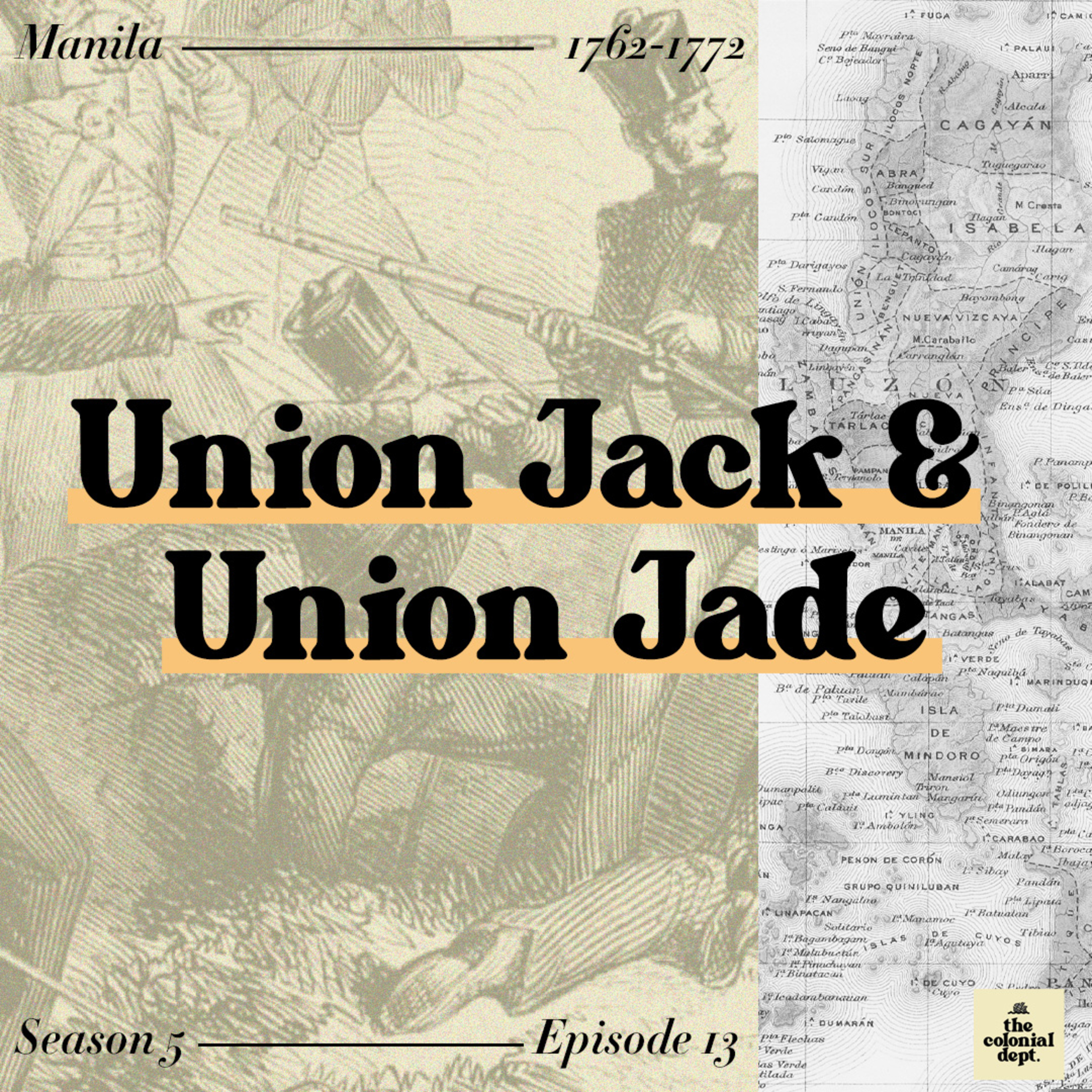
S5 Ep 25S5E13: Union Jack & Union Jade
<html><p>From 1762 to 1764, the British invaded and occupied Manila. When they left and returned the capital to Spain, the Castilians turned their wrath on the Chinese community, calling them traitors, apostates, and collaborators. But what was the real score? </p><p>Follow us on IG: <a href="https://www.instagram.com/thecolonialdept/" target="_blank">@thecolonialdept</a></p><p>Follow us on TikTok: <a href="https://www.tiktok.com/@thecolonialdept" target="_blank">@thecolonialdept</a></p><p>Email us: <a href="mailto:[email protected]" target="_blank">[email protected]</a></p><p><br/>The book version of this podcast is called <em>Silk, Silver, Spices, Slaves: Lost Tales from the Philippine Colonial Period, 1565-1946</em>. <a href="https://www.faction.press/product-page/silk-silver-spices-slaves-philippines-history" target="_blank">Purchase here</a>. (An ebook version is <a href="https://www.amazon.com/Silk-Silver-Spices-Slaves-Philippine-ebook/dp/B0D5JSXC5M" target="_blank">also available in Amazon</a>.) <br/><br/></p><p>References:</p><p>Flannery, Kristie Patrice (2016). “Battlefield Diplomacy and Empire-building in the Early Modern Pacific World.” <em>Itinerario</em>, <em>40</em>(3). p. 67–488. </p><p>Eng Sin Kueh, Joshua (2014). <em>The Manila Chinese: Community, Trade, and Empire, c. 1570-1770</em> [doctoral dissertation]. Georgetown University.</p><p>Escoto, Salvador P. (1999). “Expulsion of the Chinese and Readmission to the Philippines: 1764-1779.” <em>Philippine Studies, 47</em>(1), p. 48-76.</p><p>Escoto, Salvador P. (2000). “A Supplement to the Chinese Expulsion from the Philippines, 1764-1779.” <em>Philippine Studies, 48</em>(2), p. 209-234.</p><p>Wickberg, Edward (1964). “The Chinese Mestizo in Philippine History.” <em>The Journal of Southeast Asian History, 5</em>(1), p. 62-100.</p><p>Ruiz-Stovel, Guillermo (2009). “Chinese Merchants, Silver Galleons, and Ethnic Violence in Spanish Manila, 1603-1686.” <em>Mexico y la Cuenca del Pacifico, 12</em>(36), p. 47-63.</p><p>McCarthy, Charles J. (1970). “Slaughter of Sangleys in 1639.” <em>Philippine Studies, 18</em>(3), p. 659-667.</p><p>Wilson, Andrew (2004). <em>Ambition and Identity: Chinese Merchant Elites in Colonial Manila, 1880-1916.</em> University of Hawaii Press. </p><p>“Journal of the Proceedings of His Majesty’s Forces On An Expedition Against Manila.” In Beatson, Robert (ed.),(1972) <em>Naval and Military Memoirs of Great Britain, From 1727 to 1783, Vol. 2</em>, Greg Press.</p><p>Fish, Shirley (2003). <em>When Britain Ruled the Philippines, 1762-1764: The Story of the 18th Century British Invasion of the Philippines During the Seven Years War.</em> Authorhouse.</p><p><br/></p></html>
S5 Ep 23S5E12: Who Can Mister Filipino Marry?
<html><p>In the early decades of the 20th century, scores of young Filipino men began migrating to the United States to work. In their spare time, they dressed in their best suits and nattiest shoes, then hit the clubs. But when these dance-hall romances blossomed into marriages with white women, the law stepped in to stop them. Central to the plaintiffs’ legal arguments was a dazzling trick question of pure pseudoscience: Was the Filipino a Mongolian… or a Malay? </p><p><br/></p><p>Follow us on IG: <a href="https://www.instagram.com/thecolonialdept/" target="_blank">@thecolonialdept</a><br/>Follow us on TikTok: <a href="https://www.tiktok.com/@thecolonialdept" target="_blank">@thecolonialdept</a><br/>Email us: <a href="mailto:[email protected]" target="_blank">[email protected]</a></p><p><br/></p><p>The book version of this podcast is called <em>Silk, Silver, Spices, Slaves: Lost Tales from the Philippine Colonial Period, 1565-1946</em>. <a href="https://www.faction.press/product-page/silk-silver-spices-slaves-philippines-history" target="_blank">Purchase here</a>. (An ebook version is <a href="https://www.amazon.com/Silk-Silver-Spices-Slaves-Philippine-ebook/dp/B0D5JSXC5M" target="_blank">also available in Amazon</a>.) <br/></p><p>References:</p><p>Strandjord, Corinne (2009). “Filipino Resistance to Anti-Miscegenation Laws in Washington State.” <em>Great Depression in Washington State. </em></p><p><a href="https://depts.washington.edu/depress/filipino_anti_miscegenation.shtml" target="_blank">https://depts.washington.edu/depress/filipino_anti_miscegenation.shtml</a></p><p>Volpp, Leti (1999-2000). “American Mestizo: Filipinos and Antimiscegenation Laws in California.” <em>UC Davis Law Review, 33</em>, 795-835.</p><p>Baldoz, Richard (2004). “Valorizing Racial Boundaries: Hegemony and Conflict in the Racialization of Filipino Migrant Labour in the United States.” <em>Ethnic and Racial Studies,</em> <em>27</em>(6), 969-986.</p><p>Aguilar, Filomeno V. (2011). “Filibustero, Rizal, and the Manilamen of the Nineteenth Century.” <em>Philippine Studies, 59</em>(4), 429–469.</p><p>Johnson, Stefanie (2005). “Blocking Racial Intermarriage Laws in 1935 and 1937.” <em>The Seattle Civil Rights and Labor History Project. </em><a href="https://depts.washington.edu/civilr/antimiscegenation.htm" target="_blank">https://depts.washington.edu/civilr/antimiscegenation.htm</a></p><p>Wilkerson, Isabel (2020). <em>Caste: The Origins of Our Discontents.</em> Random House</p><p>Desmond-Harris, Jenée and Caswell, Estelle (13 January 2015). “The myth of race, debunked in 3 minutes.” <em>Vox. </em><a href="https://www.vox.com/2015/1/13/7536655/race-myth-debunked" target="_blank">https://www.vox.com/2015/1/13/7536655/race-myth-debunked</a></p><p>“Filipino Contract Laborers in Hawaii.” 1926. <em>Monthly Labor Review 24</em>(4), 4-9.</p></html>
S5 Ep 21S5E11: Sweet Carolines
<html><p>Sea snakes and scientists, popes and Pacific islands all star in this wide-ranging episode. As Germany and Spain threaten to go to war over a chain of islands, the Spaniards feared that the diplomatic ruckus kicked up by the Caroline Crisis would also swallow up their colony next door: the Philippines!</p><p>Follow us on IG: <a href="https://www.instagram.com/thecolonialdept/" target="_blank">@thecolonialdept</a></p><p>Follow us on TikTok: <a href="https://www.tiktok.com/@thecolonialdept" target="_blank">@thecolonialdept</a></p><p>Email us: <a href="mailto:[email protected]" target="_blank">[email protected]</a></p><p>P.S. My voiceover partner-in-crime, Anya, is on extended leave, so I’ll be voicing the entirety of this episode.</p><p><br/>The book version of this podcast is called <em>Silk, Silver, Spices, Slaves: Lost Tales from the Philippine Colonial Period, 1565-1946</em>. <a href="https://www.faction.press/product-page/silk-silver-spices-slaves-philippines-history" target="_blank">Purchase here</a>. (An ebook version is <a href="https://www.amazon.com/Silk-Silver-Spices-Slaves-Philippine-ebook/dp/B0D5JSXC5M" target="_blank">also available in Amazon</a>.) <br/></p><p><strong>References: </strong></p><p>Weston, Nathaniel Parker (2012). “Scientific Authority, Nationalism, and Colonial Entanglements between Germany, Spain, and the Philippines, 1850 to 1900” [doctoral dissertation]. University of Washington. </p><p>Weston, Nathaniel Parker (2021). <em>Specters of Germany: Colonial Rivalry and Scholarship in the Philippine Reform Movement and Revolution. </em>Ateneo de Manila University Press.</p><p>Hanlon, David (1988). <em>Upon a Stone Altar: A History of the Island of Pohnpei to 1890. </em>University of Hawaii Press.</p><p>Hezel, Francis X. (1995). <em>Strangers in Their Own Land: A Century of Colonial Rule in the Caroline and Marshall Islands. </em>University of Hawaii Press.<em> </em></p><p>“German Gunboats and Pacific Natives” (14 February 1887). <em>The West Australian.</em></p><p>“Jose Rizal, suspected spy, deciphered” (19 September 2012). National Historical Commission of the Philippines.<strong> </strong><a href="https://nhcp.gov.ph/jose-rizal-suspected-spy-deciphered/" target="_blank">https://nhcp.gov.ph/jose-rizal-suspected-spy-deciphered/</a></p></html>
S5 Ep 19S5E10: Off With Their Heads
<html><p>When the conquistadors arrive in the Philippines, the takers of gold come face to face with the takers of heads.</p><p>Follow us on IG: <a href="https://www.instagram.com/thecolonialdept/" target="_blank">@thecolonialdept</a><br/>Follow us on TikTok: <a href="https://www.tiktok.com/@thecolonialdept" target="_blank">@thecolonialdept</a><br/>Email us: <a href="mailto:[email protected]" target="_blank">[email protected]</a></p><p><br/>The book version of this podcast is called <em>Silk, Silver, Spices, Slaves: Lost Tales from the Philippine Colonial Period, 1565-1946</em>. <a href="https://www.faction.press/product-page/silk-silver-spices-slaves-philippines-history" target="_blank">Purchase here</a>. (An ebook version is <a href="https://www.amazon.com/Silk-Silver-Spices-Slaves-Philippine-ebook/dp/B0D5JSXC5M" target="_blank">also available in Amazon</a>.) <br/><br/>References:</p><p>Tan, Narciso C. (2021). <em>Púgot: Head Taking, Ritual Cannibalism, and Human Sacrifice in the Philippines. </em>Vibal Foundation.</p><p>De Raedt, Jules (2010). “The Talanganay Myth Analyzed.” <em>The Cordillera Review: Journal of Philippine Culture and Society</em>, <em>2</em>(1).</p><p>Zaragoza, Ramon Ma. (2004). “Capitan Juan de Salcedo.” <em>Budhi, 8</em>(3).</p><p>Riquel, Fernando. “Proclamation Regarding Treasure. Order to Make Declaration of the Gold Taken from the Burial-Places of the Indians.” In Blair, Emma Helen, and Robertson, James Alexander (eds.), <em>The Philippine Islands, 1493-1898</em> (Vol. 2), Arthur H. Clark Company.</p></html>
S5 Ep 17S5E9: Manila Starves!
<html><p>Sisid rice. “Star” meat. Loads and loads of kamote. Inside Japanese-occupied Manila, residents of the capital city must do what they can to fend off starvation.</p><p>Follow us on IG: <a href="https://www.instagram.com/thecolonialdept/" target="_blank">@thecolonialdept</a></p><p>Follow us on TikTok: <a href="https://www.tiktok.com/@thecolonialdept" target="_blank">@thecolonialdept</a></p><p>Email us: <a href="mailto:[email protected]" target="_blank">[email protected]</a></p><p><br/>The book version of this podcast is called <em>Silk, Silver, Spices, Slaves: Lost Tales from the Philippine Colonial Period, 1565-1946</em>. <a href="https://www.faction.press/product-page/silk-silver-spices-slaves-philippines-history" target="_blank">Purchase here</a>. (An ebook version is <a href="https://www.amazon.com/Silk-Silver-Spices-Slaves-Philippine-ebook/dp/B0D5JSXC5M" target="_blank">also available in Amazon</a>.) <br/><br/>References:</p><p>Doeppers, Daniel (2016). <em>Feeding Manila in Peace and War, 1850-1945. </em>Ateneo de Manila University Press.</p><p>Jose, Ricardo T. (1998). <em>The Japanese Occupation. </em>In <em>Kasaysayan: The Story of the Filipino People. </em>Asia Publishing Company Limited.</p><p>Fernandez, Doreen (1998). “Surviving Off the Land.” In Jose (1998), <em>The Japanese Occupation. </em>Asia Publishing Company Limited.</p><p>Parsons, Chick (1942). “Memorandum as the Conditions in the Philippines during Japanese Occupation. <em>Memorandum of Mr. C. Parsons to the Department of State </em>[declassified intelligence document].</p><p>PEMSEA (2007). “Manila Bay: Initial risk assessment.” <em>PEMSEA Technical Information Report No. 2007/01112</em>.</p><p>Stinner, William F.; Bacol-Montilla, Melinda (1981). “Population Deconcentration in Metropolitan Manila in the Twentieth Century.” <em>The Journal of Developing Areas, 16</em>(1), 3-16.</p><p>Reyes, Millie and Karla (6 December 2018). “The love story behind the Aristocrat — and the back story of their barbecue.” <em>Philippine Star. </em></p><p>“Lido Cocina Tsina: A must-visit dining institution in Manila.” (25 January 2013). <em>Philippine Star.</em></p><p>French, Paul (2018). <em>City of Devils: The Two Men Who Ruled the Underworld of Old Shanghai. </em>Picador. </p><p>Scott, James C. (2010). <em>The Art of Not Being Governed: An Anarchist History of Upland Southeast Asia</em>. Yale University Press.<br/><br/></p></html>
S5 Ep 15S5E8: Defending Against the Slave Raids
<html><p>The panicked cries of a watchman, the desperate tolling of church bells, the cloud of masts appearing on the horizon. In the coastal towns of colonial Philippines, these can only mean one thing: the slavers have arrived.</p><p>Follow us on IG: <a href="https://www.instagram.com/thecolonialdept/" target="_blank">@thecolonialdept</a><br/>Follow us on TikTok: <a href="https://www.tiktok.com/@thecolonialdept" target="_blank">@thecolonialdept</a><br/>Email us: <a href="mailto:[email protected]" target="_blank">[email protected]</a></p><p><br/>The book version of this podcast is called <em>Silk, Silver, Spices, Slaves: Lost Tales from the Philippine Colonial Period, 1565-1946</em>. <a href="https://www.faction.press/product-page/silk-silver-spices-slaves-philippines-history" target="_blank">Purchase here</a>. (An ebook version is <a href="https://www.amazon.com/Silk-Silver-Spices-Slaves-Philippine-ebook/dp/B0D5JSXC5M" target="_blank">also available in Amazon</a>.) <br/><br/>References:</p><p>Warren, James Francis (2021). <em>The Sulu Zone, 1768-1898: The Dynamics of External Trade, Slavery, and Ethnicity in the Transformation of a Southeast Asian Maritime State (40th Anniversary Ed.) </em>Ateneo de Manila Press.</p><p>Non, Domingo N. (March 1993). “Moro Piracy During the Spanish Period and Its Impact.” <em>Southeast Asian Studies, 30</em>(4).</p></html>
S5 Ep 13S5E7: Climbing Banahaw in the Name of Science
<html><p>The “scientifics” of the so-called Ex Ex summit Mt. Banahaw in 1842, as part of their quest to survey the Philippine archipelago! What does this American scientific expedition find in our islands?</p><p>Follow us on IG: <a href="https://www.instagram.com/thecolonialdept/" target="_blank">@thecolonialdept</a><br/>Follow us on TikTok: <a href="https://www.tiktok.com/@thecolonialdept" target="_blank">@thecolonialdept</a><br/>Email us: <a href="mailto:[email protected]" target="_blank">[email protected]</a></p><p><br/>The book version of this podcast is called <em>Silk, Silver, Spices, Slaves: Lost Tales from the Philippine Colonial Period, 1565-1946</em>. <a href="https://www.faction.press/product-page/silk-silver-spices-slaves-philippines-history" target="_blank">Purchase here</a>. (An ebook version is <a href="https://www.amazon.com/Silk-Silver-Spices-Slaves-Philippine-ebook/dp/B0D5JSXC5M" target="_blank">also available in Amazon</a>.) <br/><br/>References</p><p>Wilkes, Charles (1845).<em> Narrative of the United States Exploring Expedition. During the years 1838, 1839, 1840, 1841, 1842. </em>Lea and Blanchard.</p><p>Walsh, Jane (March 2004). “From the Ends of the Earth: The United States Exploring Expedition Collections.” <em>Smithsonian Libraries. </em><a href="https://www.sil.si.edu/DigitalCollections/usexex/learn/Walsh-01.htm" target="_blank">https://www.sil.si.edu/DigitalCollections/usexex/learn/Walsh-01.htm</a></p><p>Philbrick, Nathaniel (January 2004). “The Scientific Legacy of the U.S. Exploring Expedition.” <em>Smithsonian Libraries. </em><a href="https://www.sil.si.edu/DigitalCollections/usexex/learn/Philbrick.htm" target="_blank">https://www.sil.si.edu/DigitalCollections/usexex/learn/Philbrick.htm</a></p><p>Gorospe, Vitaliano R. (1992). “Mount Banahaw: The Power Mountain From Ritualism to Spirituality.” <em>Philippine Studies, 40</em>(2), 204-218. </p><p>Somera, Rene D. (1986). “Pamumuwesto of Mount Banahaw.” <em>Philippine Studies</em>, <em>34</em>(4), 436-451. </p><p>Grunes, Marissa (2021). “Ahab and Ishmael in Antarctica: How Charles Wilkes's White Continent Gave Rise to the White Whale.” <em>Leviathan,</em> <em>23</em>(2), 3-33. </p><p>Frankopan, Peter (2023). <em>The Earth Transformed: An Untold History of the World. </em>Knopf.</p><p><br/></p></html>
S5 Ep 11S5E6: The Spanish Ore-cuppation
<html><p>Through extortion, occupation, and “tribute”, the Spanish conquistadors in the Philippines get to work looting and plundering that most precious of all metals: gold. </p><p>Follow us on IG: <a href="https://www.instagram.com/thecolonialdept/" target="_blank">@thecolonialdept</a><br/>Follow us on TikTok: <a href="https://www.tiktok.com/@thecolonialdept" target="_blank">@thecolonialdept</a><br/>Email us: <a href="mailto:[email protected]" target="_blank">[email protected]</a></p><p>References:</p><p>Sitoy, T. Valentino, Jr. (1985). <em>A History of Christianity in the Philippines: The Initial Encounter, Vol. 1. </em>New Day Publishers.</p><p>Newson, Linda A. (2011). <em>Conquest &amp; Pestilence in the Early Spanish Philippines. </em>Ateneo de Manila University Press.</p><p>Capistrano-Baker, Florina H.; Guy, John; Miksic, John N. (eds.) (2012). <em>Philippine Ancestral Gold. </em>Ayala Foundation and NUS Press.</p><p>Estrella, Victor (29 November 2016). “Ancient Tagalog Goldworking Technology from Fray San Buenaventura’s Vocabulario de Lengua Tagala: Integrating Archaeological, Linguistic, and Ethnohistoric Data.” <em>Hukay</em>, <em>20</em>, p. 47-78.</p><p>“Reply to Fray Rada’s Opinion,” (1574) in In Blair, Emma Helen, and Robertson, James Alexander (eds.), The Philippine Islands, 1493-1898 (Vol. 3), Arthur H. Clark Company.</p><p>Habana, Olivia M. (2000). “Gold Mining in Benguet to 1898.” <em>Philippine Studies, 48</em>(4), p. 455-487.</p><p>Bangko Sentral ng Pilipinas (undated). “Pre-colonial Gold and Pottery Collection.” <em>Museo ng Bangko Sentral ng Pilipinas. </em></p><p>Ocampo, Ambeth (17 May 2012). “Living in a golden age.” <em>Inquirer.net </em><a href="https://opinion.inquirer.net/28895/living-in-a-golden-age" target="_blank">https://opinion.inquirer.net/28895/living-in-a-golden-age</a></p><p>“A Golden Discovery in the Philippines.” (11 September 2015). Asia Society. <a href="https://asiasociety.org/blog/asia/golden-discovery-philippines" target="_blank">https://asiasociety.org/blog/asia/golden-discovery-philippines</a></p></html>
S5 Ep 9S5E5: The Death March Down South
<html><p>The Bataan Death March is rightly remembered as one of the worst atrocities in the Philippine theater of World War II. But it wasn’t the only death march.</p><p>Follow us on IG: <a href="https://www.instagram.com/thecolonialdept/" target="_blank">@thecolonialdept</a><br/>Follow us on TikTok: <a href="https://www.tiktok.com/@thecolonialdept" target="_blank">@thecolonialdept</a><br/>Email us: <a href="mailto:[email protected]" target="_blank">[email protected]</a></p><p>References:</p><p>Frederick Marion Fullerton Collection (AFC/2001/001/15785), Veterans History Project, American Folklife Center, Library of Congress.</p><p>Edgerton, Ronald K. (2009). <em>People of the Middle Ground: A Century of Conflict and Central Mindanao, 1880-1980s. </em>Ateneo de Manila University Press.<em> </em></p><p>“Interview with Benjamin Hagans” (undated). The Digital Collections of the National WWII Museum.</p><p>Richard P. Beck Collection (AFC/2001/001/54751), Veterans History Project, American Folklife Center, Library of Congress.</p><p>Congressional Office of Iligan City (21 February 2021). “[LOOK]: "The Iligan Death March :What We Should Know about It” [interview with Roderico Y. Dumaug, Jr.]. Facebook Live.</p><p>Donesa, Robert John (2020). “The Mindanao Death March: Establishing a Historical Fact Through Online Research.” <em>International Journal of Innovation, Creativity, and Change, 11</em>(7).</p><p>“Richard P. Beck.” [Obituary] (2 December 2007). <em>The Sumter Item</em>.</p><p>Disabled American Veterans. “Surviving the Bataan Death March [interview with Lester Tenney].” YouTube. <a href="https://www.youtube.com/watch?v=fPbAd1TUGJA" target="_blank">https://www.youtube.com/watch?v=fPbAd1TUGJA</a></p><p><br/></p></html>
S5 Ep 7S5E4: Assembling a Colonial Breakfast
<html><p>In the 1890s, a wealthy Filipino family sits down to eat a “full Filipino breakfast.” Let’s run down the history of everything on their menu, shall we?</p><p>Follow us on IG: <a href="https://www.instagram.com/thecolonialdept/" target="_blank">@thecolonialdept</a><br/><br/>Follow us on TikTok: <a href="https://www.tiktok.com/@thecolonialdept" target="_blank">@thecolonialdept</a><br/><br/>Email us: <a href="mailto:[email protected]" target="_blank">[email protected]</a></p><p>References:</p><p>Doeppers, Daniel (2016). <em>Feeding Manila in Peace and War, 1850-1945. </em>Ateneo de Manila University Press.</p><p>Legarda, Benito J. (1999). <em>After the Galleons: Foreign Trade, Economic Change, and Entrepreneurship in the Nineteenth-Century Philippines. </em>Ateneo de Manila University Press.</p><p>Sta. Maria, Felice Prudente (1991). <em>Pigafetta’s Philippine Picnic: Culinary Encounters During the First Circumnavigation, 1519-1522. </em>National Historical Commission of the Philippines.</p><p>Rafael, Vincente (2000). “Foreword.” In Cardenas, Karen Berthelsen (eds.) <em>The Tayabas Chronicles: The Early Years (1886-1907), </em>Anvil Publishing.</p><p>“What is ENSO?” National Weather Service, National Oceanic and Atmospheric Administration. <a href="https://www.weather.gov/mhx/ensowhat" target="_blank">https://www.weather.gov/mhx/ensowhat</a></p></html>
S5 Ep 5S5E3: An Awkward Armada
<html><p>Kapampangan warriors! Japanese mercs! Spanish soldiers! Portuguese promises! Let’s set sail with the grand fleet of Governor-General Juan de Silva as they face down the Dutch.</p><p>Follow us on IG: <a href="https://www.instagram.com/thecolonialdept/" target="_blank">@thecolonialdept</a><br/><br/>Follow us on TikTok: <a href="https://www.tiktok.com/@thecolonialdept" target="_blank">@thecolonialdept</a><br/><br/>Email us: <a href="mailto:[email protected]" target="_blank">[email protected]</a></p><p>References:</p><p>Borschberg, Peter (2010). “Luso-Spanish Naval Intervention.” In <em>The Singapore and Malaka Straits: Violence, Security and Diplomacy in the 17th Century. </em>National University of Singapore Press, 137-156.</p><p>Newson, Linda A. (2011). <em>Conquest &amp; Pestilence in the Early Spanish Philippines. </em>Ateneo de Manila University Press.</p><p>Andaya, Leonard Y. (1993). <em>The World of Maluku: Eastern Indonesia in the Early Modern</em></p><p><em>Period.</em> University of Hawaii Press.</p><p>Kadir, Hatib Abdul (2014). “History of the Moluccan’s Cloves as a Global Commodity.” <em>Kawalu: Journal of Local Culture, 1</em>(2).</p><p>Valpuesta Villa, Inigo (2022). “Una oportunidad perdida. La gran armada de Juan de Silva en Filipinas (1610-1616).” <em>Obradoiro De Historia Moderna, 31</em>. <a href="https://revistas.usc.gal/index.php/ohm/article/view/7771" target="_blank">https://revistas.usc.gal/index.php/ohm/article/view/7771</a></p><p>Laarhoven, Ruurdje, and Wittermans, Elizabeth Pino (1985). “From Blockade to Trade: Early Dutch Relations with Manila, 1600-1750.” <em>Philippine Studies, 33</em>(4), 485-504.</p><p>Peterson, Andrew Christian (August 2014). <em>Making the First Global Trade Route: The Southeast Asian Foundations of the Acapulco-Manila Galleon Trade, 1519-1650. </em>[Doctoral dissertation, University of Hawaii at Manoa.]</p></html>
S5 Ep 3S5E2: Hattie the Headhunter
<html><p>From princess to flapper to schoolteacher to rebel, this is the extraordinary story of Tarhata Kiram.</p><p>Follow us on IG: <a href="https://www.instagram.com/thecolonialdept/" target="_blank">@thecolonialdept</a></p><p>Follow us on TikTok: <a href="https://www.tiktok.com/@thecolonialdept" target="_blank">@thecolonialdept</a></p><p>Email us: <a href="mailto:[email protected]" target="_blank">[email protected]</a></p><p>Charbonneau, Oliver (2021).<em> Civilizational Imperatives: Americans, Moros, and the Colonial World. </em>Ateneo de Manila University Press.</p><p>Leetaru, Kaleev (2004-2011). “Woman’s Building/Bevier Hall/English Building.” UIHistories Project: A History of the University of Illinois. <a href="https://uihistories.library.illinois.edu/cgi-bin/cview?SITEID=1&amp;ID=80" target="_blank">https://uihistories.library.illinois.edu/cgi-bin/cview?SITEID=1&amp;ID=80</a></p><p>Vaugh, Miles W. (20 April 1927). “Former Illinois University Co-Ed Aspires to Become Moro Empress.” <em>The Pittsburgh Press. </em></p><p>Associated Press (7 February 1927). “Moro Chief Abandons Favorite Wife Who Saved Him From His Armed Foes.” <em>Youngstown Vindicator. </em></p><p>“That Wild Little Sulu Flapper We Couldn’t Tame.” (Author unknown, 27 February 1927) <em>The Sunday Vindicator. </em> </p><p>“Princess Takes Blame For Revolt.” (Author unknown, 7 February 1927). <em>The Telegraph-Herald.</em></p><p>Angeles, Vivienne S.M. (1997). “Philippine Muslim Women: Tradition and Change.” In <em>Islam, Gender, and Social Change</em> (John L. Esposito, Yvonne Yazbeck Haddad, eds.). Oxford University Press.</p><p>Society Editor (10 September 1920). Caption in “The Social Whirl.” <em>The Afro-American.</em></p><p>“Student Life at Illinois: 1910-1919.” Student Life and Culture Archives, University of Illinois Urbana-Champaign. <a href="https://www.library.illinois.edu/slc/research-education/timeline/1910-1919/" target="_blank">https://www.library.illinois.edu/slc/research-education/timeline/1910-1919/</a></p><p>Malcolm, G. A. (1957). <em>American Colonial Careerist. </em>Boston, MA: Christopher Publishing House.</p><p>Chua, Xiao (23 May 2013). “Tarhata Kiram: Astig na Prinsesang Muslim.” <em>It’s Xiaotime! </em><a href="https://xiaochua.net/2013/05/23/xiao-time-23-may-2013-tarhata-kiram-astig-na-prinsesang-muslim/" target="_blank">https://xiaochua.net/2013/05/23/xiao-time-23-may-2013-tarhata-kiram-astig-na-prinsesang-muslim/</a></p><p>Brainard, Cecilia (2 January 2015). “Philippines: Filipina Muslim Princess Tarhata Kiram.” <em>Travels (and More) with Cecilia Brainard.</em><a href="https://cbrainard.blogspot.com/2015/01/princess-tarhata-kiram.html" target="_blank"> https://cbrainard.blogspot.com/2015/01/princess-tarhata-kiram.html</a></p></html>
S5 Ep 1S5E1: The Governor-General’s Love Affair
<html><p>A tantalizing wind was blowing into the Philippines from Madrid. In its wake was Carlos Maria de la Torre, who seemed determined to shock the entrenched colonial establishment.<br/>Follow us on IG: @thecolonialdept<br/>Follow us on TikTok: @the.colonial.dept.<br/>Email us: [email protected]<br/>References:<br/><br/>Simpson, Renate (1980). “Higher Education in the Philippines under the Spanish.” Journal of Asian History, 14(1), p. 1-46.<br/>Smith, Willard A. (July 1950). “The Background of the Spanish Revolution of 1868.” The American Historical Review, 55(4), p. 787-810.<br/>Escudier, Alicia Castellanos. “Carlos María de la Torre y Navacerrada.” Real Academia de la Historia. https://dbe.rah.es/biografias/54427/carlos-maria-de-la-torre-y-navacerrada<br/>Aseniero, George (2013). “From Cádiz to La Liga: The Spanish Context of Rizal’s Political Thought.” Asian Studies: Journal of Critical Perspectives in Asia, 49(1), 1-42. <br/>“Spanish Constitutions, Brief Historical Overview” (undated). Constitucionalism español, Biblioteca Virtual del Patrimonio Bibliografico. https://bvpb.mcu.es/constituciones/en/micrositios/inicio.do<br/>The Senate between 1834 and 1923” (2 January 2023). In Constitutional Periods, Senado de España website, https://www.senado.es/web/conocersenado/senadohistoria/periodosconstitucionales/index.html?lang=en<br/>Coo, Stephanie (2019). Clothing the Colony: Nineteenth-Century Philippine Sartorial Culture, 1820-1896. Ateneo de Manila University Press.<br/>Guerrero, Milagros C. and Schumacher, John N., S.J. (1998). Kasaysan: The Story of the Filipino People. Vol. 5: Reform and Revolution. Asia Publishing Company, Limited.<br/>De Viana, Augusto (2019). “Agoncillo and Zaide painted Governor de la Torre in a favorable light…” [Facebook comment left on Everyday History’s July 12, 2019 photo post). Facebook. https://www.facebook.com/EverydayHistoryPH/posts/july12-on-this-day-in-1869-at-a-feast-hosted-by-liberal-spanish-governor-general/2301798766760540/<br/>Ayala Museum (11 March 2021). “In celebration of #WomensHistoryMonth…” [Facebook photo caption]. Facebook. https://www.facebook.com/ayalamuseum/photos/a.156207354399852/4021961857824363/</p></html>
S4 Ep 26S4E13: Tour de Tojo
<html><p>Prime minister, general, and future convicted war criminal Hideki Tojo drops by the Philippines to see for himself if their colony is ready for independence. So how does his surprise visit go?</p><p>Follow us on IG: <a href="https://www.instagram.com/thecolonialdept/" target="_blank">@thecolonialdept</a></p><p>Email us: <a href="mailto:[email protected]" target="_blank">[email protected]</a></p><p><br/></p><p>References:</p><p>Dery, Luis C. (1984) “Japan’s New Order in the Philippines, 1942-1945: A Blueprint for Asia Under Japan.” <em>Philippine Social Sciences Review 48</em>(1-4), 291-361.</p><p>Eisner, Peter (2017). <em>MacArthur's Spies: The Soldier, the Singer, and the Spymaster Who Defied the Japanese in World War II. </em>Viking.</p><p>Jose, Ricardo T. (1998). <em>The Japanese Occupation. </em>In <em>Kasaysayan: The Story of the Filipino People. </em>Asia Publishing Company Limited.</p><p>Doyo, Ma. Ceres P. (1998). “Anything But Comfort.” In Jose, Ricardo T., <em>The Japanese Occupation</em> (110-111)<em>, </em>Asia Publishing Company Limited.</p><p>“Tojo tells Manila He’ll Crush Allies; Japanese Premier Boasts That 'Thorough Blow at Enemy's Armed Power' Is Near.” <em>New York Times, </em>7 May 1943.</p><p>“January 29, 1943.” Diary of Francis Burton Harrison. In <em>The Philippine Diary Project.</em> <a href="https://philippinediaryproject.com/1943/01/29/january-29-1943/" target="_blank">https://philippinediaryproject.com/1943/01/29/january-29-1943/</a></p></html>
S4 Ep 23S4E12: A Muscular Christianity
<html><p>Civilize? Christianize? As the Americans move into their new colony, they pack an unlikely weapon in their mission to take over the Philippines: sports!</p><p><br/></p><p>Follow us on IG: <a href="https://www.instagram.com/thecolonialdept/" target="_blank">@thecolonialdept</a></p><p>Email us: <a href="mailto:[email protected]" target="_blank">[email protected]</a></p><p><br/></p><p>References:</p><p>Gems, Gerald R. (2016). <em>Sport and the American Occupation of the Philippines: Bats, Balls, and Bayonets. </em>Lexington Books.</p><p>Putz, Paul (31 January 2022). “Muscular Christianity and Moral Formation Through Sports.” <em>Faith &amp; Sports. </em>Truett Seminary of Baylor University. <a href="https://blogs.baylor.edu/faithsports/2022/01/31/muscular-christianity-and-moral-formation-through-sports/" target="_blank">https://blogs.baylor.edu/faithsports/2022/01/31/muscular-christianity-and-moral-formation-through-sports/</a></p><p><em>Report on the YWCA and the YMCA in the Philippine Islands, 1930 </em>(1930)<em>. </em>Sophia Smith Collection of Women’s History (File — Box: 4, Reel: 354, microdex: 8), Smith College Special Collections. <a href="https://findingaids.smith.edu/repositories/2/archival_objects/170680" target="_blank">https://findingaids.smith.edu/repositories/2/archival_objects/170680</a></p><p>Brosas, Arturo (4 January 2023). “What is Texas Gamefowl Chicken?” <em>Agraryo.com </em><a href="https://agraryo.com/poultry/what-is-texas-gamefowl-chicken/" target="_blank">https://agraryo.com/poultry/what-is-texas-gamefowl-chicken/</a></p><p>Kramer, Paul (2014). “Colonial Crossings: Prostitution, Disease, and the Boundaries of Empire During the Philippine-American War.” In <em>Body and Nation: The Global Realm of US Body Politics in the Twentieth Century </em>(Rosenberg, E. and Fitzpatrick S., eds), Duke University Press.</p><p>Bartholomew, Rafe (2010). <em>Pacific Rims: Beermen Ballin’ in Flip-Flops and the Philippines’ Unlikely Love Affair with Basketball. </em>New American Library.</p><p>Anderson, Warwick (2006). <em>Colonial Pathologies: American Tropical Medicine, Race, and Hygiene in the Philippines. </em>Ateneo de Manila Press.<br/><br/></p></html>
S4 Ep 21S4E11: When a Romanov Visited Pampanga
<html><p>Grand Duke Alexei Alexandrovich Romanov, uncle to the last tsar of Russia, makes an unexpected pitstop at a sprawling estate along the banks of the Pampanga River.</p><p>Follow us on IG: <a href="https://www.instagram.com/thecolonialdept/" target="_blank">@thecolonialdept</a></p><p>Email us: <a href="mailto:[email protected]" target="_blank">[email protected]</a></p><p><br/></p><p>References:</p><p>Kowner, Rotem (15 June 2022). “Time to Remember, Time to Forget: The Battle of Tsushima in Japanese Collective Memory since 1905.”<em> The Asia-Pacific Journal 20</em>(12, 3).</p><p>Pyvovarov, Serhii (1 April 2022). “118 years ago, Russia wanted to distract its people from internal problems, inciting a “small victorious war” with Japan. It ended in defeat and revolution, and the phrase became a meme.” <em>Babel.</em> </p><p>“Grand Duke Alexei Alexandrovich” [Caption to a Portrait]. <em>Jewels of the Romanovs: Treasures of the Russian Imperial Court.</em> Online exhibition. <a href="https://www.alexanderpalace.org/jewels/gda.html" target="_blank">https://www.alexanderpalace.org/jewels/gda.html</a></p><p>Carlson, Peter (8 January 2018). “Encounter: Grand Duke Alexis Meets Buffalo Bill, Custer, Sherman, and Chief Spotted Tail.” <em>Historynet. </em><a href="https://www.historynet.com/encounter-grand-duke-alexis-meets-buffalo-bill-custer-sherman-chief-spotted-tail/" target="_blank">https://www.historynet.com/encounter-grand-duke-alexis-meets-buffalo-bill-custer-sherman-chief-spotted-tail/</a> </p><p>Freeman, Dianne (26 July 2021). “The Imperial Russians Who Defied the Czar for Love.” <em>Crime Reads.</em> <a href="https://crimereads.com/the-imperial-russians-who-defied-the-czar-for-love/" target="_blank">https://crimereads.com/the-imperial-russians-who-defied-the-czar-for-love/</a></p><p>Gonzalez, August Marcelino Reyes III and Gonzalez, Macario Diosdado Arnedo (19 August 2006). “Familia Arnedo de Sulipan, Apalit, Pampanga.” <em>Remembrance of Things Awry.</em> <a href="https://remembranceofthingsawry.wordpress.com/2006/08/19/361/" target="_blank">https://remembranceofthingsawry.wordpress.com/2006/08/19/361/</a></p><p>Tinio, Martin I. Jr. (9 June 2018). “A Table Like No Other.” <em>The Spectacular Mid-Year Auction 2018. </em>Leon Gallery.</p><p>Ocampo, Ambeth (3 October 2018). “Berezowsky, Rizal’s Russian Friend.”<em> Philippine Daily Inquirer. </em><a href="https://opinion.inquirer.net/116506/berezowsky-rizals-russian-friend" target="_blank">https://opinion.inquirer.net/116506/berezowsky-rizals-russian-friend</a></p><p>Ocampo, Ambeth (30 June 2023). “History on the tongue.” <em>Philippine Daily Inquirer. </em><a href="https://opinion.inquirer.net/164409/history-on-the-tongue" target="_blank">https://opinion.inquirer.net/164409/history-on-the-tongue</a></p><p>Gonzalez-Ventura, Barbara (2 July 2005). “Fiesta in Apalit and Sulipan.” <em>Philippine Star. </em><a href="https://www.philstar.com/lifestyle/modern-living/2005/07/02/284524/fiesta-apalit-and-sulipan" target="_blank">https://www.philstar.com/lifestyle/modern-living/2005/07/02/284524/fiesta-apalit-and-sulipan</a><br/><br/>Audio of <em>Anastasia </em>© Twentieth Century Fox.<br/><br/></p></html>
S4 Ep 19S4E10: A Flash Flood of Fast Fashion
<html><p>It’s an intercontinental textile trade war, as Spain throws open its colony’s ports to the world, and imported cotton from Britain muscles its way into Philippine markets.</p><p>Follow us on IG: <a href="https://www.instagram.com/thecolonialdept/" target="_blank">@thecolonialdept</a></p><p>Email us: <a href="mailto:[email protected]" target="_blank">[email protected]</a></p><p><br/></p><p>References:</p><p>Coo, Stephanie (2019). <em>Clothing the Colony: Nineteenth Century Philippine Sartorial Culture, 1820-1896.</em> Ateneo de Manila University Press. </p><p>Ladrido, R.C. (27 May 2022) “Piña: The queen of Philippine handwoven textiles.” Vera Files. <a href="https://verafiles.org/articles/pina-the-queen-of-philippine-handwoven-textiles" target="_blank">https://verafiles.org/articles/pina-the-queen-of-philippine-handwoven-textiles</a></p><p>Lush, Emily. “Piña (Pineapple) Cloth, Philippines.” The Textile Atlas. <a href="https://www.thetextileatlas.com/craft-stories/pina-cloth-philippines" target="_blank">https://www.thetextileatlas.com/craft-stories/pina-cloth-philippines</a></p><p>Henry F. Funtecha (December 1981). “Iloilo’s Weaving Industry During the 19th Century.” <em>Philippine Quarterly of Culture and Society 9</em>(4), 301-308. <a href="https://www.jstor.org/stable/29791740" target="_blank">https://www.jstor.org/stable/29791740</a></p><p>Griffin, Emma (2014, 15 May). “Manchester in the 19th century.” British Library. <a href="https://www.bl.uk/romantics-and-victorians/articles/manchester-in-the-19th-century#:~:text=Manchester's%20growth%20rested%20largely%20on,the%20new%20factories%20and%20mills" target="_blank">https://www.bl.uk/romantics-and-victorians/articles/manchester-in-the-19th-century</a></p><p>“Manchester, Cotton, and Slavery.” (19 January 2023). The Science and Industry Museum. <a href="https://www.scienceandindustrymuseum.org.uk/objects-and-stories/manchester-cotton-and-slavery" target="_blank">https://www.scienceandindustrymuseum.org.uk/objects-and-stories/manchester-cotton-and-slavery</a></p><p>Legarda, Benito (1999). <em>After the Galleons: Foreign Trade, Economic Change, and Entrepreneurship in the Nineteenth Century Philippines.</em> Ateneo de Manila University Press.</p><p>Clips from <em>Maria Clara at Ibarra</em> and the <em>Howie Severino Podcast</em> are from GMA.<br/><br/></p></html>
S4 Ep 17S4E9: The Lethal Cost of Building the Galleons
<html><p>Native wood. Native workers. These are the foundations that made the prosperous Galleon Trade between Manila and Acapulco possible. But at what price?</p><p>Follow us on IG: <a href="https://www.instagram.com/thecolonialdept/" target="_blank">@thecolonialdept</a></p><p>Email us: <a href="mailto:[email protected]" target="_blank">[email protected]</a></p><p><br/></p><p>References:</p><p>Peterson, Andrew Christian (August 2014). Making the First Global Trade Route: The Southeast Asian Foundations of the Acapulco-Manila Galleon Trade, 1519-1650. [Doctoral dissertation, University of Hawaii at Manoa.]</p><p>Buhain, Jose M. (1994). “The Recovery of the San Diego.” Philippine Studies 42(4), p. 539-549. <br/><br/></p></html>
S4 Ep 15S4E8: British East India Co., Manila Branch
<html><p>Beginning in the 1670s, the biggest, most rapacious company on earth set its sights on the great trading port of the Pacific.<br/>Follow us on IG: @thecolonialdept<br/>Email us: [email protected]<br/><br/>References:<br/>Dalrymple, Alexander (4 March 2015). “The East India Company: The original corporate raiders.” The Guardian. https://www.theguardian.com/world/2015/mar/04/east-india-company-original-corporate-raiders<br/>Fish, Shirley (2003). When Britain Ruled the Philippines, 1762-1764: The Story of the 18th Century British Invasion of the Philippines During the Seven Years War. 1stBooks Library.<br/>Gallop, Annabel (5 June 2014). “Alexander Dalrymple’s Treaties with Sulu in Malay and Tausug.” British Library, Asian and African Studies. <br/>McIlhagga, Samuel (23 September 2019). “William Dalrymple on why Britain shouldn't be speaking nostalgically about empires amid Brexit.” The National. <br/>Quiason, Serafin (1966). English “Country Trade” with the Philippines: 1644-1765. University of the Philippines Press.<br/>Flannery, Kristie Patricia (14 December 2016). “Battlefield Diplomacy and Empire-building in the Indo-Pacific World during the Seven Years’ War.” Itinerario 40(3). <br/>Thomas, Megan C. (26 March 2019). “Securing Trade: The Military Labor of the British Occupation of Manila, 1762–1764.” International Review of Social History 64.<br/>Apple and Amazon financial news audio from CNBC International and Forbes.</p></html>
S4 Ep 13S4E7: Upon This Rock
<html><p>Prisoners from the Philippines get sent to the slammer—serving their sentences inside the military prison of Alcatraz! But what crimes earned them time on The Rock?<br/>Follow us on IG: @thecolonialdept<br/>Email us: [email protected]<br/><br/>References:<br/>Thompson, Erwin S. (2000). The Rock: A History of Alcatraz Island, 1847-1972. U.S. National Park Service.<br/>Reed, John S. (1995) "External Discipline during Counterinsurgency: A Philippine War Case Study, 1900—1901." The Journal of American-East Asian Relations 4(1), 29-48.<br/>Smiley, Will. (2012). “Lawfare in Luzon: The American Application of the Rules of War in the Philippines, 1898-1903." [Term Paper, Yale Law School]<br/>Wills, Matthew (4 February 2020). “The Jim Crow Army in the Philippine-American War.” JStor Daily. daily.jstor.org/the-jim-crow-army-in-the-philippine-american-war<br/>Hallock, Jennifer (17 January 2021). “Sergeant Major John W. Calloway: A Voice to Challenge Empire.” jenniferhallock.com jenniferhallock.com/2021/01/17/john-calloway-philippines<br/>Audio of The Rock ©Buena Vista Pictures</p></html>
S4 Ep 11S4E6: The Big Book of Family Names
<html><p>The governor-general of the Philippines just conquered an island in Mindanao. Now, he’s about to do the same to each and every name in the archipelago.</p><p>Follow us on IG: <a href="https://www.instagram.com/thecolonialdept/" target="_blank">@thecolonialdept</a></p><p>Email us: <a href="mailto:[email protected]" target="_blank">[email protected]</a></p><p>Check out the Catalogo alfabetico de apellidos at <a href="https://issuu.com/filipinasheritagelibrary/docs/catalogo_alfabetico_de_apellidos" target="_blank">issuu.com/filipinasheritagelibrary/docs/catalogo_alfabetico_de_apellidos</a></p><p>References:</p><p>Cojuangco, Tingting (1993). <em>Kris of Valor: The Samal Balangingi’s Defiance and Diaspora</em>. Manisan Research and Pub. Inc.</p><p>“Tarsila.” (2015). In V. Almario (Ed.),<em> Sagisag Kultura</em> (Vol 1). Manila: National Commission for Culture and the Arts. <a href="https://philippineculturaleducation.com.ph/tarsila/" target="_blank">philippineculturaleducation.com.ph/tarsila/</a></p><p>Dizon, Mark (2015). “Spirit Beliefs, Murder, and Religious Change Among the Eighteenth Century Aeta and Ilongot in Eastern Central Luzon.” <em>Philippine Studies 63</em>(1), 3-38.</p><p>Lambrecht, Francis (1962). “The Religion of the Ifugao.” <em>Philippine Sociological Review 10</em>(1/2), 33-40.</p><p>Scheans, Daniel (1966). “Anak Ti Digos: Ilokano Name Changing and Ritual Kinship.”<em> Philippine Sociological Review 14</em>(2), 82-85.</p><p>Colin, Francisco (1663). Labor Evangelica. In Blair, Emma Helen, and Robertson, James Alexander (eds.), <em>The Philippine Islands, 1493-1898</em> (Vol. 40), Arthur H. Clark Company, 57.</p><p>Lijauco, Chit (16 February 2022). “Tracing the Origins of our Filipino Surnames.” <em>Philippine Tatler.</em> <a href="https://www.tatlerasia.com/lifestyle/others/tracing-the-origins-of-our-filipino-surnames" target="_blank">https://www.tatlerasia.com/lifestyle/others/tracing-the-origins-of-our-filipino-surnames</a></p><p>Ocampo, Ambeth (28 February 2020). “How Filipinos got their surnames.” <em>Philippine Daily Inquirer. </em><a href="https://opinion.inquirer.net/127676/how-filipinos-got-their-surnames" target="_blank">https://opinion.inquirer.net/127676/how-filipinos-got-their-surnames</a></p><p>Ocampo, Ambeth (15 February 2013). “A sense of order.”<em> Philippine Daily Inquirer.</em> <a href="https://opinion.inquirer.net/46885/a-sense-of-order" target="_blank">https://opinion.inquirer.net/46885/a-sense-of-order</a><br/></p><p>Mangubat, Benjamin (undated).<em> …The Infinite Possibilities of a Broken Egg…</em> Self-published.<br/><br/></p></html>
S4 Ep 9S4E5: Shadow of the Fatherland
<html><p>With war looming against the Axis powers, the Nazi party tries to exert its influence on the small community of Germans and Jews who lived in the Philippines. How did we fight back against the antisemitism?</p><p>Follow us on IG: <a href="https://www.instagram.com/thecolonialdept/" target="_blank">@thecolonialdept</a></p><p>Email us: <a href="mailto:[email protected]" target="_blank">[email protected]</a></p><p>References:</p><p>Weston, Nathaniel Parker (2021). <em>Specters of Germany: Colonial Rivalry and Scholarship in the Philippine Reform Movement &amp; Revolution.</em> Ateneo de Manila Press.</p><p>Ephraim, Frank (2008). <em>Escape to Manila: From Nazi Tyranny to Japanese Terror.</em> University of Illinois Press.</p><p>Gopal, Lou (2014 January 28). “Manila Germans and the German Club.” Manila Nostalgia. <a href="http://www.lougopal.com/manila/?p=1869" target="_blank">http://www.lougopal.com/manila/?p=1869</a></p><p>Kotlowski, Dean J. (November 2009). “Breaching the Paper Walls: Paul V. McNutt and Jewish Refugees to the Philippines, 1938-1939.” <em>Diplomatic History 33</em>(5), 865-896.</p><p>Krebs, Gerhard (2015 January 1). “Racism Under Negotiation: The Japanese Race in the Nazi-German Perspective.” In <em>Race and Racism in Modern East Asia</em>, Brill.</p><p>Kowner, Rotem (2017). “When economics, strategy, and racial ideology meet: inter-Axis connections in the wartime Indian Ocean.” J<em>ournal of Global History 12</em>, 228-250.</p><p>Aluit, Alfonso J. (1994). <em>By Sword and Fire: The Destruction of Manila in World War II, 3 February - 3 March 1945. </em>Bookmark, Inc.</p><p>Scott, James M. (2018). <em>Rampage: MacArthur, Yamashita, and the Battle of Manila. </em>W. W. Norton &amp; Company.</p><p>Audio from German newsreels from Pathe and British Movietone. Audio of Kristallnacht survivors from The Atlantic. Audio of the Nanjing Massacre survivor from the Shoah Foundation.</p></html>
S4 Ep 8S4E4: The Bicycle in Peace and War
<html><p>From Rizal in Dapitan to Japanese troops on a blitzkrieg, this is a short history of biking in the Philippines.</p><p>Follow us on IG: <a href="https://www.instagram.com/thecolonialdept/" target="_blank">@thecolonialdept</a></p><p>Email us: <a href="mailto:[email protected]" target="_blank">[email protected]</a></p><p><br/></p><p>References:</p><p>Severino, Howie (22 June 2020). “Rizal’s Wish for a Second-Hand Bicycle.” <em>GMA News Online</em>. <a href="https://www.gmanetwork.com/news/specials/content/160/howie-severino-rizal-s-wish-for-a-second-hand-bicycle/" target="_blank">https://www.gmanetwork.com/news/specials/content/160/howie-severino-rizal-s-wish-for-a-second-hand-bicycle/</a></p><p>Herlihy, David (2010). <em>The Lost Cyclist: The Epic Tale of an American Adventurer and His Mysterious Disappearance. </em>Houghton Mifflin Harcourt.</p><p>Gems, Gerald R. (2016). <em>Sports and the American Occupation of the Philippines</em>. Lexington Books.</p><p>Earle Stevens, Joseph (1899). <em>Yesterdays in the Philippines.</em> Charles Scribner &amp; Sons.</p><p>Giron, Brian Paul (2020 October 4). “Finding bikes in our history.” <em>Cycling Matters</em>. <a href="https://www.cyclingmatters.ph/culture/finding-bikes-in-our-history/" target="_blank">https://www.cyclingmatters.ph/culture/finding-bikes-in-our-history/</a></p><p>Tewell, John. <em>Pretty Filipina with her pride and joy, an American girl’s bicycle</em> [Photo]. <a href="https://www.flickr.com/photos/johntewell/52134258412/sizes/h/?fbclid=IwAR2iU54F7mfNFYEpj3Q8mNc840NVblElvS3hHudysR9q8qo9CwsgsqDglks" target="_blank">https://www.flickr.com/photos/johntewell/52134258412/sizes/h/?fbclid=IwAR2iU54F7mfNFYEpj3Q8mNc840NVblElvS3hHudysR9q8qo9CwsgsqDglks</a></p><p>Fernandez, Yvette and Goy, Abi (2012). <em>Big John: The Life Story of John Gokongwei Jr.</em> Summit Books.</p><p>Ephraim, Frank (2008). <em>Escape to Manila: From Nazi Tyranny to Japanese Terror. </em>University of Illinois Press.</p><p>Barriga, Maria Cynthia B. (2015). “The Asia-Pacific War in the Davao Settler Zone, December 1941.” <em>Kasarinlan: Philippine Journal of Third World Studies</em> <em>30</em>(1): 56–90.</p><p>Danquah, Francis K. (2005). “Reports on Philippine Industrial Crops in World War II from Japan's English Language Press.” <em>Agricultural History 79</em>(1), 74-96 </p><p>LCDR Headrick, Alan C (1994). <em>Bicycle Blitzkrieg: The Malayan Campaign and the Fall of Singapore.</em> (Paper submitted to the Operations Department.) Naval War College. <a href="http://www.ibiblio.org/hyperwar/PTO/RisingSun/BicycleBlitz/" target="_blank">http://www.ibiblio.org/hyperwar/PTO/RisingSun/BicycleBlitz/</a></p><p>Eisner, Peter (2017). <em>MacArthur's Spies: The Soldier, the Singer, and the Spymaster Who Defied the Japanese in World War II.</em> Viking. </p><p>Interview with John Gokongwei Jr. from CNBC International.</p></html>
S4 Ep 5S4E3: Magellan at the Edge of the World
<html><p>Before Magellan crossed the Pacific, headed to the Philippines, and met his end at a Cebu beach, he was tasked with the impossible: sail to the end of their known world. What would he find there?</p><p>Follow us on IG: <u><a href="https://www.instagram.com/thecolonialdept/" target="_blank">@thecolonialdept</a></u></p><p>Email us: <u><a href="mailto:[email protected]" target="_blank">[email protected]</a></u></p><p>Reference:</p><p>Fernández-Armesto, Felipe (2022). <em>Straits: Beyond the Myth of Magellan. </em>Bloomsbury Publishing.</p><p>Columbus Day audio from Mel-O-Toons Animation.</p></html>
S4 Ep 3S4E2: What Happened at Hanapēpē
<html><p>As Filipino immigrants call for better pay and better treatment in the sugar cane plantations, the histories of Hawaii and the Philippines are about to intersect in a bloody way.</p><p>Follow us on IG: <a href="https://www.instagram.com/thecolonialdept/" target="_blank">@thecolonialdept</a></p><p>Email us: <a href="mailto:[email protected]" target="_blank">[email protected]</a></p><p>References:</p><p>Jung, Moon-Kie (2004). “Symbolic and Physical Violence: Legitimate State Coercion of Filipino Workers in Prewar Hawai'i.” <em>American Studies</em> <em>45</em>(3), 107-137.</p><p>Hill, Tiffany (2009, December 30). “A Massacre Forgotten.” <em>Honolulu. </em><a href="https://www.honolulumagazine.com/a-massacre-forgotten/" target="_blank">https://www.honolulumagazine.com/a-massacre-forgotten/</a></p><p>Alegado, Dean (2011, September 26). “Blood In The Fields: The Hanapepe Massacre And The 1924 Filipino Strike.” <em>Positively Filipino</em>. <a href="http://www.positivelyfilipino.com/magazine/2012/11/26/blood-in-the-fields-the-hanapepe-massacre-and-the-1942-filipino-strike" target="_blank">http://www.positivelyfilipino.com/magazine/2012/11/26/blood-in-the-fields-the-hanapepe-massacre-and-the-1942-filipino-strike</a></p><p>Sobeleski, Hank (2006, September 10). “Pablo Manapit and the Hanapepe Massacre.” <em>The Garden Island</em>. <a href="https://www.thegardenisland.com/2006/09/10/lifestyles/pablo-manlapit-and-the-hanapepe-massacre/" target="_blank">https://www.thegardenisland.com/2006/09/10/lifestyles/pablo-manlapit-and-the-hanapepe-massacre/</a></p><p>“Filipino Contract Laborers in Hawaii.” 1926. <em>Monthly Labor Review 24</em>(4), 4-9.</p><p>Van Dijk, Kees (2015). “The Failed Annexation of Hawaii.” In <em>Pacific Strife</em>, Amsterdam University Press.</p></html>
S4 Ep 1S4E1: Spies for the Shogun
<html><p>It’s the beginning of the Spanish reign, and Manila is prime real estate in the eyes of the sea-going empires, including Japan. In the Edo court, the Japanese plan the invasion of the Philippines—three hundred years early.</p><p>Follow us on IG: <u><a href="https://www.instagram.com/thecolonialdept/" target="_blank">@thecolonialdept</a></u></p><p>Email us: <u><a href="mailto:[email protected]" target="_blank">[email protected]</a></u></p><p>References:</p><p>Ka Yin Chan, Caspar (2022). “Revisiting the Battle of Macau in 1622: A Polyphonic Narrative.” <em>The Newsletter (Autumn 2022)</em>, International Institute for Asian Studies.</p><p>Turnbull, Stephen (2016). "Wars and Rumours of Wars: Japanese Plans to Invade the Philippines, 1593–1637.” <em>Naval War College Review 69</em>(4).</p><p>“The Fall of the Arima Clan and the Crackdown on Christianity.” In <em>Light and Shadow: Christian History, Resurrected. </em><em><u><a href="https://christian-nagasaki.jp/en/" target="_blank">https://christian-nagasaki.jp/en/</a></u></em></p><p>Barthell, W. “Matsukara Shigemasa.” In <em>Sengokujidai.org</em>.</p></html>

S3 Ep 24S3E13: The Friar Who Loved the Flowers and the Trees
<html><p>It was one of the most important scientific texts to emerge from the Spanish colonial period. But who was Father Manuel Blanco, and how did this priest-scientist amass his botanical knowledge?</p><p>Follow us on IG: <a href="https://www.instagram.com/thecolonialdept/" target="_blank">@thecolonialdept</a></p><p>Email us: <a href="mailto:[email protected]" target="_blank">[email protected]</a></p><p>References:</p><p>“Manuel Maria Blanco Ramos,” in Real Academia dela Historia, <em>Diccionario Biografico</em>. <a href="https://dbe.rah.es/biografias/14559/manuel-maria-blanco-ramos" target="_blank">https://dbe.rah.es/biografias/14559/manuel-maria-blanco-ramos</a></p><p>Zimmer, Carl (2008, 20 August). “Darwin, Linnaeus, and One Sleepy Guy.” <em>National Geographic. </em><a href="https://www.nationalgeographic.com/science/article/darwin-linnaeus-and-one-sleepy-guy" target="_blank">https://www.nationalgeographic.com/science/article/darwin-linnaeus-and-one-sleepy-guy</a></p><p>Santiago, Luciano P.R. (1993). “The painters of Flora de Filipinas (1877-1883).” <em>Philippine Quarterly of Culture and Society 21</em>(2), 87-112.</p><p>Mojares, Resil (2013). “The Book That Did Not Exist.” In <em>Isabelo’s Archive </em>(141-146), Anvil Publishing.</p><p>Stuart, Barry (1965). “The Birds and the Bees.” Recorded by Dean Martin.</p></html>
S3 Ep 22S3E12: Anak Sa Hapon—The Nikkeijin at the Outbreak of World War II
<html><p>For decades, the Filipino and Japanese communities lived side by side in Davao. Then, after the fateful attack on Pearl Harbor, neighbors became enemies. What happened then?</p><p>Follow us on IG: <u><a href="https://www.instagram.com/thecolonialdept/" target="_blank">@thecolonialdept</a></u></p><p>Email us: <u><a href="mailto:[email protected]" target="_blank">[email protected]</a></u></p><p>References:</p><p>Radovan, Jill Tan (22 September 2022). "How a Teacher in Davao Finally Met Her Japanese Father Three Decades After WWII." <em>Esquire Philippines</em>. Retrieved from <u><a href="https://www.esquiremag.ph/long-reads/features/half-japanese-teacher-davao-finally-meets-father-a2328-20220922-lfrm3" target="_blank">https://www.esquiremag.ph/long-reads/features/half-japanese-teacher-davao-finally-meets-father-a2328-20220922-lfrm3</a></u></p><p>Abinales, Patricio N. (1997). “Davao-kuo: The Political Economy of a Japanese Settler Zone in Philippine Colonial Society.”<em> The Journal of American-East Asian Relations, 6</em>(1), 59-82.</p><p>Jose, Lydia Yu &amp; Dacudao, Patricia Irene (2015). “Visible Japanese and Invisible Filipino: Narratives of the Development of Davao, 1900s to 1930s.” <em>Philippine Studies: Historical &amp; Ethnographical Viewpoints 63</em>(1), 101-129.</p><p>Barriga, Maria Cynthia B. (2015). “The Asia-Pacific War in the Davao Settler Zone, December 1941.” <em> Kasarinlan: Philippine Journal of Third World Studies, 30</em>(1): 56–90.</p><p>Arguillas, C. (2017, January 12). “Encounters with Filipino-Japanese mestizos in Davao bring back memories and open windows to Japan’s Past." In Mindanews. Retrieved from <u><a href="https://www.mindanews.com/top-stories/2017/01/reprint-encounters-with-filipino-japanese-mestizos-in-davao-bring-back-memories-and-open-windows-to-japans-past/" target="_blank">https://www.mindanews.com/top-stories/2017/01/reprint-encounters-with-filipino-japanese-mestizos-in-davao-bring-back-memories-and-open-windows-to-japans-past/</a></u></p><p>Radovan, Jill Tan. Personal communication. 15 December 2022.</p></html>
S3 Ep 20S3E11: The Dawning of the Age of Steam
<html><p>Put on your boldest, brassiest steampunk goggles as we delve deep into the stories of the Philippines’ first steamships, steam engines, and steam-powered trains.</p><p>Follow us on IG: <u><a href="https://www.instagram.com/thecolonialdept/" target="_blank">@thecolonialdept</a></u><u><br/></u><u><br/></u>Email us: <u><a href="mailto:[email protected]" target="_blank">[email protected]</a></u></p><p>References:</p><p>Jose, Ricardo. (2018) “Tranvia: Ang mga Riles sa Kamaynilaan” [Documentary] TVUP. <u><a href="https://www.youtube.com/watch?v=1DshXso7EkM" target="_blank">https://www.youtube.com/watch?v=1DshXso7EkM</a></u></p><p>Doeppers. Daniel F. (2016) <em>Feeding Manila in Peace and War, 1850-1945</em>. Ateneo de Manila Press.</p><p>Legarda, Benito J. (1999). <em>After the Galleons: Foreign Trade, Economic Change and Entrepreneurship in the Nineteenth-Century Philippines. </em>Ateneo de Manila Press.</p><p>Elena, Alberto and Ordóñez, Javier (2000). “Science, Technology, and the Spanish Colonial Experience in the Nineteenth Century.” In<em> Nature and Empire: Science and the Colonial Enterprise </em>(70-82)<em>. </em>The University of Chicago Press.</p><p>Cailloce, Laure (2020). “The Turbulent History of the Suez Canal.” <em>CNRS News</em>. <u><a href="https://news.cnrs.fr/articles/the-turbulent-history-of-the-suez-canal" target="_blank">https://news.cnrs.fr/articles/the-turbulent-history-of-the-suez-canal</a></u></p><p>Gamble, Adrian (2017). “Manila's Long-Lost 'Tranvias' Once the Envy of Asia.”<em> Skyrise Cities. </em><u><a href="https://skyrisecities.com/news/2017/03/manilas-long-lost-tranvias-once-envy-asia" target="_blank">https://skyrisecities.com/news/2017/03/manilas-long-lost-tranvias-once-envy-asia</a></u></p></html>
S3 Ep 18S3E10: Auroran Gods
<html><p>"No anito. No tikbalang. No duwende." Nearly three hundred years ago, on the eastern coast of Luzon, this is what a priest told his converts. But what happens when his mission collides with the old gods and the old ways?</p><p>Follow us on IG:<a href="https://www.instagram.com/thecolonialdept/" target="_blank"> </a><u><a href="https://www.instagram.com/thecolonialdept/" target="_blank">@thecolonialdept</a></u></p><p>Email us: <u><a href="mailto:[email protected]" target="_blank">[email protected]</a></u></p><p>References:</p><p>Dizon, Mark (2011). “Social and Spiritual Kinship in EarlyEighteenth-Century Missions on the Caraballo Mountains.” <em>Philippine Studies 59</em>(3), 367–398.</p><p>Dizon, Mark (2015). “Spirit Beliefs, Murder, and Religious Change Among the Eighteenth Century Aeta and Ilongot in Eastern Central Luzon.” <em>Philippine Studies 63</em>(1), 3-38.</p><p>Mataragnon, Rita (1977). “A Conceptual and Psychological Analysis of Sumpong.” In Pe-Pua, Rogelia (Ed.), <em>Handbuk ng Sikolohiyang Pilipino </em>(339-347). The University of the Philippines Press.</p><p>Audio from <em>Apocalypse Now </em>© United Artists.</p><p>Audio of “Tanging Yaman” from Bukas Palad Ministry.</p></html>
S3 Ep 16S3E9: A Day in the Life in Colonial Manila
<html><p>Swimming. Smoking. Sunsets. It’s just another day for the conyo colonials, living the good life inside Manila.</p><p>Follow us on IG: <u><a href="https://www.instagram.com/thecolonialdept/" target="_blank">@thecolonialdept</a></u></p><p>Email us: <u><a href="mailto:[email protected]" target="_blank">[email protected]</a></u></p><p>References:</p><p>Mallat, Jean (1846). <em>The Philippines: History, Geography, Customs, Agriculture, Industry, and Commerce of the Spanish Colonies in Oceania</em> (Pura Santillan-Castrence, Trans.) (2021). National Historical Commission of the Philippines.</p><p>Camagay, Ma. Luisa T. (1996). “Urban Development of Manila During the 19th Century.” In Enrique L. Victoriano (ed.), <em>Historic Manila: Commemorative Lectures, 1993-1996 </em>(33-42). Manila Historical Commission.</p><p>Doran, Christine (1993). “Spanish and Mestizo Women of Manila.” <em>Philippine Studies 41I</em>(3), 269-286.</p><p>Audio clip from <em>The Fellowship of the Ring</em> © 2001 New Line Cinema</p></html>
S3 Ep 14S3E8: God’s Own Medicine, Part Two
<html><p>Caught in between religion and revolution, opium turned from a politically dicey government cash crop into an evil and illegal narcotic. And the minds behind the anti-opium campaign in the Philippines would arguably set the tone for anti-drug wars around the globe.</p><p>Follow us on IG: <u><a href="https://www.instagram.com/thecolonialdept/" target="_blank">@thecolonialdept</a></u></p><p>Email us: <u><a href="mailto:[email protected]" target="_blank">[email protected]</a></u></p><p>References:</p><p>Bamero, Alma (2006). “Opium: The Evolution of Policies, the Tolerance of the Vice, and the Proliferation of Contraband Trade in the Philippines,1843-1908.” <em>Social Science Diliman</em> <em>3</em>(1-2), 49-83.</p><p>Taft, William Howard (1903, July 13). [Letter from William H. Taft to Elihu Root]. <u><a href="https://www.theodorerooseveltcenter.org/Research/Digital-Library/Record?libID=o41275" target="_blank">https://www.theodorerooseveltcenter.org/Research/Digital-Library/Record?libID=o41275</a></u></p><p>Wertz, Daniel P. (2013). “Idealism, Imperialism, and Internationalism: Opium Politics in the Colonial Philippines, 1898-1925.” <em>Modern Asian Studies</em>, <em>47</em>(2), 467-499.</p><p>Ginsberg, Philip (1970). “The Chinese in the Philippine Revolution.” <em>Asian Studies: Journal of Critical Perspectives 8</em>(1). <u><a href="https://www.asj.upd.edu.ph/mediabox/archive/ASJ-08-01-1970/ginsburg-chinese-philippine-revolution.pdf" target="_blank">https://www.asj.upd.edu.ph/mediabox/archive/ASJ-08-01-1970/ginsburg-chinese-philippine-revolution.pdf</a></u></p><p>Zarco, Ricardo M. (1995). “A Short History of Narcotic Drug Addiction in the Philippines, 1521-1959.” <em>Philippine Sociological Review 43</em>(1/4), 1-15.</p><p>Clip of “The Battle Hymn of the Republic” from the United States Army Band’s YouTube page.</p></html>
S3 Ep 13S3E7: God’s Own Medicine, Part One
<html><p>Opium: the plant of joy, the poppy of oblivion, God’s own medicine. It changed the course of history in the nineteenth century. So what was its effect in the Philippines?</p><p>Follow us on IG: <u><a href="https://www.instagram.com/thecolonialdept/" target="_blank">@thecolonialdept</a></u></p><p>Email us: <u><a href="mailto:[email protected]" target="_blank">[email protected]</a></u></p><p>References:</p><p>Wertz, Daniel P. (2013). “Idealism, Imperialism, and Internationalism: Opium Politics in the Colonial Philippines, 1898-1925.” <em>Modern Asian Studies</em>, <em>47</em>(2), 467-499.</p><p>Dikotter, Frank (23 October 2003). “Patient Zero: China and the Myth of the Opium Plague” (Lecture). <u><a href="https://frankdikotter.com/publications/the-myth-of-opium.pdf" target="_blank">https://frankdikotter.com/publications/the-myth-of-opium.pdf</a></u></p><p>Zarco, Ricardo M. (1995). “A Short History of Narcotic Drug Addiction in the Philippines, 1521-1959.” <em>Philippine Sociological Review 43</em>(1/4), 1-15.</p><p>Tosches, Nick (September 2000). “Confessions of an Opium Seeker.” <em>Vanity Fair. </em><u><a href="https://www.vanityfair.com/news/2000/09/opium-dens-200009" target="_blank">https://www.vanityfair.com/news/2000/09/opium-dens-200009</a></u></p><p>Gamella, Juan F., Martin, Elisa (1992). “Las Rentas de Anfion: El Monopolio Espanol del Opio en Filipinas (1844-1898) y su Rechazo por la Administracion Norteamericana.<em>”</em> <em>Revisita de Indias</em> <em>52</em>(194), 61-106.</p><p>Permanyer-Ugartemendia, Ander (2014). “Opium after the Manila Galleon: The Spanish involvement in the opium economy in East Asia (1815-1830).” <em>Investigaciones de Historia Economica 10</em>(3), 155-164. <u><a href="https://www.elsevier.es/en-revista-investigaciones-historia-economica-economic-328-articulo-opium-after-manila-galleon-the-S1698698914000605" target="_blank">https://www.elsevier.es/en-revista-investigaciones-historia-economica-economic-328-articulo-opium-after-manila-galleon-the-S1698698914000605</a></u></p><p>“Opium Cultivation and Heroin Processing in Southeast Asia.” (1992) US Department of Justice Drug Enforcement Administration Office of Intelligence. <u><a href="https://www.ojp.gov/pdffiles1/Digitization/141189NCJRS.pdf" target="_blank">https://www.ojp.gov/pdffiles1/Digitization/141189NCJRS.pdf</a></u></p><p>Audio clips from <em>The Adventures of Tintin </em>animated series by Ellipse Programme and Nelvana.</p></html>
S3 Ep 11S3E6: From "Constaboy" to Samurai
<html><p>In 1943, the Japanese selected 10 prisoners of war—veterans of the battles of Bataan and Corregidor, survivors of the Death March—for a "re-education" program in the heart of the empire. What could go wrong?</p><p>Follow us on IG: <u><a href="https://www.instagram.com/thecolonialdept/" target="_blank">@thecolonialdept</a></u></p><p>Email us: <u><a href="mailto:[email protected]" target="_blank">[email protected]</a></u></p><p>References:</p><p>Villarin, Mariano (1990). <em>We Remember Bataan and Corregidor: The Story of the American and Filipino Defenders of Bataan and Corregidor and their Captivity. </em>Gateway Press.</p><p>Serizawa, Takamichi (2015). “Japanese Solidarity Discourse on the Philippines during the Second World War.” <em>Philippine Studies: Historical &amp; Ethnographic Viewpoints 63</em>(1), 71-100. Ateneo de Manila University. <u><a href="https://www.jstor.org/stable/24672308" target="_blank">https://www.jstor.org/stable/24672308</a></u></p><p>Karlin, Jason G. (2014) “Narratives of heroism in Meiji Japan.” In Gardner, A., Mackie V., Wohr U. (eds.) <em>Gender and State in Modern Japan</em> (48-67). Routledge.</p><p>Kintanar, Thelma; Aquino, Clemen; Arinto, Patricia; Camagay, Ma. Luisa (2012). <em>Kuwentong Bayan: Noong Panahon Ng Hapon—Everyday Life in a Time of War. </em>University of the Philippines Press.</p><p>Audio snippets are taken from NHK, archival Japanese newsreels, and <em>The Last Samurai</em> from Warner Bros. Pictures.</p></html>
S3 Ep 9S3E5: Sultan of Broadway
<html><p>“The Sultan of Sulu”, a smash hit Broadway play from the early 1900s, had it all: a musical monarch, multiple wives, plenty of laughs, and a sly, anti-imperialist message tucked into the libretto.</p><p>Follow us on IG: <u><a href="https://www.instagram.com/thecolonialdept/" target="_blank">@thecolonialdept</a></u></p><p>Email us: <u><a href="mailto:[email protected]" target="_blank">[email protected]</a></u></p><p>References:</p><p>Mendoza, Victor Roman (2015). <em>Metroimperial Intimacies: Fantasy, Racial-Sexual Governance, and the Philippines in U.S. Imperialism, 1899-1913. </em>Duke University Press.</p><p>Charbonneau, Oliver (2021). <em>Civilizational Imperatives: Americans, Moros, and the Colonial World</em>. Ateneo de Manila University Press.</p><p>Ade, George (1903). <em>The Sultan of Sulu</em>. R.H. Russell. <u><a href="https://archive.org/details/sultansulu00adegrich" target="_blank">https://archive.org/details/sultansulu00adegrich</a></u></p><p>“Wasit to Paradise” (30 November, 1936). <em>Time </em><u><a href="https://content.time.com/time/subscriber/article/0,33009,757014,00.html" target="_blank">https://content.time.com/time/subscriber/article/0,33009,757014,00.html</a></u></p><p>Select audio snippets from the promotions and performance of the Canton Comic Opera Company, uploaded on <u><a href="https://www.youtube.com/c/AmericanMusicalProductions" target="_blank">the American Musical Productions YouTube channel.</a></u></p></html>

S3 Ep 7S3E4: The Coffee Dons (and Don'ts)
<html><p>From sleepy village… to coffee boomtown! The enterprising people of Lipa brewed beans into cold, hard cash, building fortunes that lasted generations. But how did the coffee boom turn into a bust?</p><p>Follow us on IG: <u><a href="https://www.instagram.com/thecolonialdept/" target="_blank">@thecolonialdept</a></u><u><br/></u><u><br/></u>Email us: <u><a href="mailto:[email protected]" target="_blank">[email protected]</a></u></p><p>References:</p><p>Castro, Bel S. (2003) <em>Demythologising the History of Coffee in Lipa, Batangas in the 19th Century </em>[Masteral Dissertation, University of Adelaide]. <u><a href="https://www.academia.edu/12326071/Demythologising_the_History_of_Coffee_in_Lipa_Batangas_in_the_19th_Century" target="_blank">Academia.edu</a></u></p><p>Robles, Eliodoro G. (1969). <em>The Philippines in the 18th Century. </em>Malaya Books, Inc.</p><p>Hau, Caroline S. (2017). <em>Elites and Ilustrados in Philippine Culture. </em>Ateneo de Manila University Press.</p><p>Legarda, Benito (1999). <em>After the Galleons: Foreign Trade, Economic Change, and Entrepreneurship in the Nineteenth Century Philippines. </em>Ateneo de Manila University Press.</p><p>Francisco, Mariel and Arriola, Fe Maria (1987). <em>The History of the Burgis. </em>Fuego y Hielo, Inc.</p><p>Katigbak, Renz (2019). "Donde Florecieron los Cafetos... Un Paseo por Lipa." <em>Herencia Lipeña. </em><u><a href="https://herencialipena.com/2019/07/02/where-the-coffee-plants-bloomed/" target="_blank">https://herencialipena.com/2019/07/02/where-the-coffee-plants-bloomed/</a></u></p></html>
S3 Ep 5S3E3: Mugger, the Giant Crocodile
<html><p>As British, American, and French merchant houses and enterprises pour into the Philippines to fill the void left by the Galleon Trade, a giant crocodile lurks inside one such plantation in the wetlands of Laguna de Bay.</p><p>Follow us on IG: @thecolonialdept</p><p>Email us: <u><a href="mailto:[email protected]" target="_blank">[email protected]</a></u></p><p>References:</p><p>Gironiere, Paul P. De La (1854). <em>Twenty Years in the Philippines </em>(trans.) Harper &amp; Brothers, New York.</p><p>Legarda, Benito (1999). <em>After the Galleons: Foreign Trade, Economic Change, and Entrepreneurship in the Nineteenth Century Philippines. </em>Ateneo de Manila University Press.</p><p>Powell, Alvin (July 2001). “Warm, fuzzy, weird, funny: The Museum(s) of Natural History spin some tall tales.” <em>The Harvard Gazette</em> <u><a href="https://news.harvard.edu/gazette/story/2001/07/warm-fuzzy-weird-funny-the-museums-of-natural-history-spin-some-tall-tales/" target="_blank">https://news.harvard.edu/gazette/story/2001/07/warm-fuzzy-weird-funny-the-museums-of-natural-history-spin-some-tall-tales/</a></u></p><p>Abdulmuti, Chelsy Mae (20 July 2021). “As humans close in on their habitat, crocodiles in the Philippines snap back.” <em>Mongabay</em>. <u><a href="https://news.mongabay.com/2021/07/as-humans-close-in-on-their-habitat-crocodiles-in-the-philippines-snap-back/" target="_blank">https://news.mongabay.com/2021/07/as-humans-close-in-on-their-habitat-crocodiles-in-the-philippines-snap-back/</a></u></p><p>Audio snippets from the Coretta Granberry vlog (<u><a href="https://www.youtube.com/watch?v=064XsYc0418" target="_blank">https://www.youtube.com/watch?v=064XsYc0418</a></u>) and GMA 7 News (<u><a href="https://www.youtube.com/watch?v=rAONTRArGrI" target="_blank">https://www.youtube.com/watch?v=rAONTRArGrI</a></u>)</p></html>
S3 Ep 3S3E2: That Sweet Gangland Music
<html><p>In 1930s Shanghai, the sweet sound of slot machines and swinging bands soundtracked the bars and nightclubs of the city’s seedy underworld. Guess where they all came from.</p><p>Follow us on IG: <u><a href="https://www.instagram.com/thecolonialdept/" target="_blank">https://www.instagram.com/thecolonialdept/</a></u></p><p>References:</p><p>French, Paul (2018). <em>City of Devils: The Two Men Who Ruled the Underworld of Old Shanghai</em>. Picador.</p><p>French, Paul (February 2018). “Gangs of Shanghai.” <em>That’s Shanghai</em>, 40-41.</p><p>Guingona, Phillip (2016). “The Sundry Acquaintances of Dr. Albino Z. Sycip: Exploring the Shanghai-Manila Connection, circa 1910-1940.” <em>Journal of World History, </em>27(1), 27-52. <u><a href="https://www.jstor.org/stable/43901823" target="_blank">https://www.jstor.org/stable/43901823</a></u></p><p>Yamomo, Mele (2015). “Brokering sonic modernities: Migrant Manila musicians in the Asia Pacific, 1881-1948.” <em>Popular Entertainment Studies</em>, 6(2), 22-37.</p><p>Crow, Carl and Kowalsky, V.V. (1935). “Illustrated Historical Map of Shanghai.” (Map) Norman B. Levinthal Map Center Collection at the Boston Public Library. <u><a href="https://collections.leventhalmap.org/search/commonwealth:x633f974z" target="_blank">https://collections.leventhalmap.org/search/commonwealth:x633f974z</a></u></p><p>Cover photo by Malcolm Rosholt, courtesy of Mei-Fei Elrick and Tess Johnston, University of Bristol - Historical Photographs of China</p></html>
S3 Ep 1S3E1: The Silent Service
<html><p>Silent predators stalk the seas of the Philippines! But as the Japanese naval invasion commences, what role did these stealthy subs play in the archipelago’s defense?</p><p>Follow us on IG: <u><a href="https://www.instagram.com/thecolonialdept/" target="_blank">https://www.instagram.com/thecolonialdept/</a></u></p><p>References:</p><p>Parrish, Thomas (2004). <em>Submarines: A History. </em>Viking.</p><p>Sturma, Michael (2021). “Submarine Special Missions: One Day in the Philippines.” <em>The Great Circle, 34(1)</em>, 54-64.</p><p>Sayre, Elizabeth E. (September 1942). “Submarine From Corregidor: The Escape.” <em>The Atlantic.</em></p><p>Eisner. Peter (2017). <em>MacArthur’s Spies: The Soldier, the Singer, and the Spymaster Who Defied the Japanese in World War II</em>. Viking.</p><p>Heritage NSW. “The Japanese midget submarine program." heritage.nsw.gov.au </p></html>
The Colonial Dept: A Trailer
bonus<html><p>What is The Colonial Dept.? Find out what makes this Philippine history podcast tick in this trailer.</p></html>
S2 Ep 13S2E13: The Hell Atop a Dead Volcano
<html><p>On the crater of Bud Dajo in Sulu, a brutal massacre of Moros sparks outrage… and a cover-up from colonial authorities eager to package its troops as heroes.</p><p>Follow us on IG: <u><a href="https://www.instagram.com/thecolonialdept/" target="_blank">https://www.instagram.com/thecolonialdept/</a></u></p><p>References:</p><p>Charbonneau, Oliver (2021). <em>Civilizational Imperatives: Americans, Moros, and the Colonial World. (Philippine Edition.) </em>Ateneo de Manila University Press.</p><p>Sanford, Wayne (May 1982). “Battle of Bud Dajo: 6 March 1906.” <em>Indiana Military History Journal, 7(2). </em>Indiana Historical Society.</p><p>Hawkins, Michael (March 2011). “Managing a Massacre: Savagery, Civility, and Gender in Moro Province in the Wake of Bud Dajo.” <em>Philippine Studies, 59(1)</em>, 83-105. Ateneo de Manila University.</p><p>Niedermeier, Silvan (April 2017). “Intimacy and Annihilation: Approaching the Enforcement of U.S. Colonial Rule in the Southern Philippines through a Private Photograph Collection.” <em>InVisible Culture: An Electronic Journal for Visual Culture, </em>25.</p></html>
S2 Ep 12S2E12: A Very Strange Map, Indeed
<html><p>In 2008, a long-lost map, dating back to the early 1600s, was discovered inside an Oxford library. On it was a depiction of the Philippines, Vietnam, Japan, China, Indonesia, Malaysia, and the great sea that lay in between them. What mysteries did this map hold?</p><p>Follow us on Instagram:<strong> </strong><a href="https://www.instagram.com/thecolonialdept/" target="_blank">https://www.instagram.com/thecolonialdept/</a></p><p>References:</p><p>Brook, Timothy (2013). <em>Mr. Selden's Map of China: The Spice Trade, A Lost Chart, and the South China Sea. </em>Profile Books Ltd. </p><p>Jacobs, J. Bruce (2014). <em>China’s frail historical claims to the South China and East China Seas</em>. American Enterprise Institute.</p><p>Tomacruz Sofia (20 Sept 2019). "Ever heard of the 1734 Murillo Velarde map and why it should be renamed?" <em>Rappler</em>.</p></html>
S2 Ep 11S2E11: First Contact Feasts
<html><p>When first contact was made between the Spanish and the Filipinos, feasts followed, before the fighting. What food and drink did these seafarers encounter in their first meetings?</p><p>Follow us on IG: <u><a href="https://www.instagram.com/thecolonialdept/" target="_blank">https://www.instagram.com/thecolonialdept/</a></u></p><p>References:</p><p>Sta. Maria, Felice Prudente (2021). Pigafetta’s Philippine Picnic: Culinary Encounters During the First Circumnavigation, 1519-1522. The National Historical Commission of the Philippines.</p><p>Alcina, Francisco Ignacio (2005). History of the Bisayan People in the Philippine Islands (Volume III. Cantius J. Kobak and Lucio Gutierrez, trans.). University of Santo Tomas Publishing House. 434-453.</p><p>Chua, Xiao (28 May 2021). “Humabon: Quintessential Filipino ‘pulitiko’.” Manila Times.</p><p>Ocampo, Ambeth (12 May 2021). “Massacre in Cebu.” Philippine Daily Inquirer.</p></html>
S2 Ep 10S2E10: Mr. Burnham Goes to Baguio
<html><p>Gazing out at the sweeping highlands of northern Luzon, architect Daniel Burnham conjures up an ambitious, audacious vision: a summer capital for America’s new prize.</p><p>Follow us on IG: <u><a href="https://www.instagram.com/thecolonialdept/" target="_blank">https://www.instagram.com/thecolonialdept/</a></u></p><p>References:</p><p>Hines, Thomas S. (1988). “No Little Plans: The Achievement of Daniel Burnham.” Art Institute of Chicago Museum Studies, (13)2, 96-105.</p><p>Kirsch, Scott (2017). “Aesthetic Regime Change The Burnham Plans and US Landscape Imperialism in the Philippines.” Philippine Studies: Historical &amp; Ethnographic Viewpoints, 65(3), 315-356.</p><p>Yeoh, Seng-Guan (2011). "Beyond The Commerce Of Man: Street Vending, Sidewalks, And Public Space In A Mountain City In The Philippines.” Urban Anthropology and Studies of Cultural Systems and World Economic Development. 40(3/4), 285-317.</p><p>Wise, Edwin (2019). <em>Manila, City of Islands.</em> Ateneo de Manila University Press.</p><p>Cimatu, Frank (20 September 2019). “Magalong prioritizes preservation of Baguio heirlooms.” <em>Rappler</em>.</p><p>Comanda, Zaldy (11 May 2021). “Magalong to pursue P480M Burnham Park development.” <em>Manila Bulletin.</em></p><p>Santiago, Arline. “The Cordillera Indigenous Peoples’ Right to Land.” Office of the United Nations High Commissioner for Human Rights.</p></html>
S2 Ep 9S2E9: Aztec Eagles, Philippine Skies
<html><p>Let’s take to the wild blue yonder with the Aguilas Aztecas, a squadron of volunteer fighter pilots from Mexico who helped liberate the Philippines from the Japanese.<br/><br/><br/><br/>References:<br/><br/>Lozano, Gustavo Vazquez (2021). 201st Squadron: The Aztec Eagles—The History of the Mexican Pilots Who Fought In World War II. Libros de Mexico.</p><p>Parker, Richard (27 May 2020). “When the Mexican Air Force Went To War Alongside America.” The New York Times Magazine.</p><p>Guevara, Lucy (2000). "Interview with Reynaldo Perez Gallardo." Voces Oral History Center, The University of Texas at Austin. <u><a href="https://voces.lib.utexas.edu/collections/stories/reynaldo-perez-gallardo" target="_blank">voces.lib.utexas.edu/collections/stories/reynaldo-perez-gallardo</a></u></p><p>Albala, Paloma (2003). “Hispanic Words of Indoamerican Origin in the Philippines.” In <em>Philippine Studies</em> 51(1), 125</p><p>Charles, Ronald W. (1947). Troopships of World War II. The Army Transportation Association. history.army.mil/documents/WWII/wwii_Troopships.pdf</p><p>Hutton, Ted (12 November 2005). “Veteran pilots remember P-47.” Orlando Sun-Sentinel. <u><a href="https://www.orlandosentinel.com/news/os-xpm-2005-11-12-pilots12-story.html" target="_blank">orlandosentinel.com/news/os-xpm-2005-11-12-pilots12-story.html</a></u></p><p>Lasco, Gideon (25 January 2022). “How Filipino Sailors—and Coconuts—Helped Create Mexico’s National Drink.” <u><a href="https://www.sapiens.org/column/entanglements/tequila-origins-tuba/" target="_blank">sapiens.org/column/entanglements/tequila-origins-tuba</a></u></p></html>
S2 Ep 8S2E8: Conceiving Concepcion, Part Two (Remastered)
<html><p>The conclusion of our conversation with Albert Samaha, author of the critically acclaimed <em>Concepcion: An Immigrant Family’s Fortunes. </em>What did he learn about writing a book that spans five centuries of Philippine and American history?</p><p><br/></p><p>Follow us on IG: <a href="https://www.instagram.com/thecolonialdept/" target="_blank">@thecolonialdept</a></p><p>Follow us on TikTok: <a href="https://www.tiktok.com/@thecolonialdept" target="_blank">@thecolonialdept</a></p><p>Email us: <a href="mailto:[email protected]" target="_blank">[email protected]</a></p><p>The book version of this podcast, entitled <em>Silk, Silver, Spices, Slaves: Lost Tales from the Philippine Colonial Period, 1565-1946, </em>is now available. Visit my<a href="https://www.faction.press/product-page/silk-silver-spices-slaves-philippines-history" target="_blank"> publisher’s website</a> for availability. (An ebook version is also <a href="https://www.amazon.com/Silk-Silver-Spices-Slaves-Philippine-ebook/dp/B0D5JSXC5M" target="_blank">available on Amazon.</a>)</p><p><br/></p><p>References:</p><p>Samaha, Albert (2021). <em>Concepcion: An Immigrant Family’s Fortunes. </em>Riverhead Books. </p><p>Samaha, Albert (22 February 2022). Personal communication (Zoom interview).</p></html>
S2 Ep 7S2E7: Conceiving Concepcion, Part One (Remastered)
<html><p>Count a Maranao princess and an American spy among this author’s ancestors. Albert Samaha, author of <em>Concepcion: An Immigrant Family’s Fortunes, </em>guests in this episode as he discusses his critically acclaimed book.</p><p><br/></p><p>Follow us on IG: <a href="https://www.instagram.com/thecolonialdept/" target="_blank">@thecolonialdept</a></p><p>Follow us on TikTok: <a href="https://www.tiktok.com/@thecolonialdept" target="_blank">@thecolonialdept</a></p><p>Email us: <a href="mailto:[email protected]" target="_blank">[email protected]</a></p><p>The book version of this podcast, entitled <em>Silk, Silver, Spices, Slaves: Lost Tales from the Philippine Colonial Period, 1565-1946, </em>is now available. Visit my<a href="https://www.faction.press/product-page/silk-silver-spices-slaves-philippines-history" target="_blank"> publisher’s website</a> for availability. (An ebook version is also <a href="https://www.amazon.com/Silk-Silver-Spices-Slaves-Philippine-ebook/dp/B0D5JSXC5M" target="_blank">available on Amazon.</a>)</p><p><br/></p><p>References:</p><p>Samaha, Albert (2021). <em>Concepcion: An Immigrant Family’s Fortunes. </em>Riverhead Books. </p><p>Samaha, Albert (22 February 2022). Personal communication (Zoom interview).</p></html>

S2 Ep 6S2E6: E-RAT-icate!
<html><p>To combat an outbreak of bubonic plague in turn-of-the-century Manila, the American authorities assembled a crack force of ratcatchers and waged a war against rodents.</p></html>