Show overview
The Colonial Department has been publishing since 2021, and across the 5 years since has built a catalogue of 107 episodes, alongside 7 trailers or bonus episodes. That works out to roughly 30 hours of audio in total. Releases follow a monthly cadence, with the show now in its 8th season.
Episodes typically run ten to twenty minutes — most land between 14 min and 17 min — and the run-time is fairly consistent across the catalogue. None of the episodes are flagged explicit by the publisher. It is catalogued as a EN-US-language History show.
The show is actively publishing — the most recent episode landed 6 days ago, with 8 episodes already out so far this year.
From the publisher
Lost stories from 🇵🇭 history 🔊 Narrative nonfiction pod 📖 Book version published by @factionpress 📻 Written, produced, engineered by @liomangubat
Latest Episodes
View all 107 episodesS8E4: Edison’s Cameras, Manila’s Trenches
S8E3: Nobody Expects the Philippine Inquisition!
S8E2: Riding a Tram in 1911 Manila
S8 Ep 3INTERVIEW: Exploring the food history of the Philippines
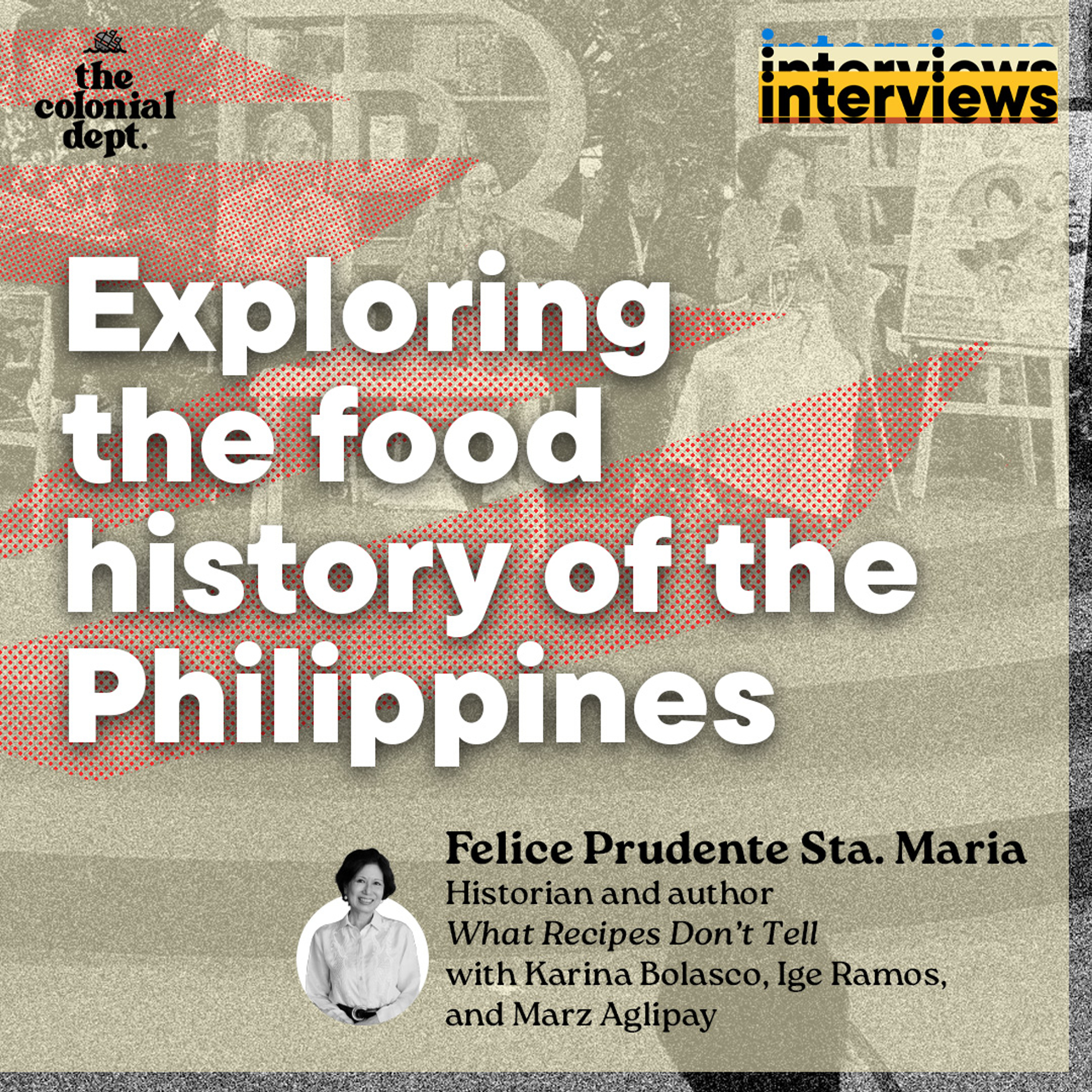
<html><p>“There’s a message to it: It’s our responsibility to keep Filipino food popular!”</p><p>At the launch for her book <em>What Recipes Don’t Tell: Philippine Food History in Fifty Words, </em>author and historian Felice Prudente Sta. Maria talked to a rapt audience at the Philippine Book Festival about a long career of writing about food. What new things can food tell us about our own history? How did we adapt techniques and ingredients from abroad… while still preserving our own? And how should we nurture this knowledge for future generations?</p><p>Joining her in this panel were publisher and editor Karina Bolasco, graphic designer and fellow food scholar Ige Ramos, and printmaker Marz Aglipay. Through their shared history with Felice, they deepened the conversation with their own perspectives on creativity, design, and the space for food in the publishing landscape. </p><p>Special thanks to the Ateneo de Manila University Press for inviting me to moderate this panel, and for letting me record this conversation.</p><p></p><p>Support the podcast: <a href="https://patreon.com/thecolonialdept" target="_blank">patreon.com/thecolonialdept</a></p><p>Follow us on IG: <u><a href="https://www.instagram.com/thecolonialdept/" target="_blank">@thecolonialdept</a></u></p><p>Follow us on TikTok: <u><a href="https://www.tiktok.com/@thecolonialdept" target="_blank">@thecolonialdept</a></u></p><p>Email us: <u><a href="mailto:[email protected]" target="_blank">[email protected]</a></u></p><p></p><p><em>The Colonial Dept. Interview is a series where I talk to researchers and authors shining a light on our past.</em></p></html>
S8 Ep 1S8E1: The Philippine Sour-chipelago
<html><p>Sourness, according to Doreen Fernandez, “is a favored Philippine flavor.” Just how sour is sour? “Sour enough to savor, to make the lips pucker and the eyes squint slightly, and yet not too sour—just at the point of perfection.”</p><p>In the spectrum of sensation, sourness can be both sharp and sudden, an acetic shudder down the spine. Asim, the Tagalogs call it. From the earliest written records about the Philippines, it is this taste that has come to define our cooking. “Spanish colonials from the 1500s through the 1800s described indio food as primarily salty and sour,” writes food historian Felice Prudente Sta. Maria. “Both tastes can induce sweat in hot climates and remind the body to keep hydrated and its electrolytes balanced.” Let us trace the pathways of this taste as it evolved in three key dishes: sinigang, kinilaw, and adobo.</p><p></p><p>Follow us on IG: <u><a href="https://www.instagram.com/thecolonialdept/" target="_blank">@thecolonialdept</a></u></p><p>Follow us on TikTok: <u><a href="https://www.tiktok.com/@thecolonialdept" target="_blank">@thecolonialdept</a></u></p><p>Email us: <u><a href="mailto:[email protected]" target="_blank">[email protected]</a></u></p><p></p><p>References:</p><p>Sta. Maria, Felice Prudente (2025). <em>What Recipes Don't Tell: Philippine Food History in Fifty Words. </em>Ateneo de Manila University Press.</p><p>Fernandez, Doreen G. (1988). “Culture Ingested: Notes on the Indigenization of Philippine Food.” <em>Philippine Studies, 36</em>(2), pp. 219-232.</p><p>Fernandez, Doreen G. (1994). <em>Tikim: Essays on Philippine Food and Culture. </em>Anvil Publishing.</p><p>Frank, Hannah E. R.; Amato, Katie; Trautwein, Michelle; Maia, Paula; Liman, Emily R.; Nichols; Lauren M.; Schwenk, Kurt; Breslin, Paul A. S.; Dunn, Robert R. (2022) “The evolution of sour taste.” <em>Proceedings of the Royal Society B: Biological Sciences, 289</em>(1968). <u><a href="https://royalsocietypublishing.org/rspb/article/289/1968/20211918/79292/The-evolution-of-sour-tasteEvolution-of-Sour-Taste" target="_blank">https://royalsocietypublishing.org/rspb/article/289/1968/20211918/79292/The-evolution-of-sour-tasteEvolution-of-Sour-Taste</a></u></p><p>Shaw, Sterling V. Herrera (30 August 2024). “Adobo is ‘paksiw,’ and other terms in Filipino food history.” <em>Philippine Daily Inquirer. </em></p><p>Ladrido, R.C. (1 July 2022). “Tapayan, Gusi, or Martaban: Tales of Stoneware Jars in the Philippines.” <em>VERA Files.</em></p><p>Newman, Yasmin (11 May 2023). “Kinilaw, the age-old dish of the Philippines (and why it's not ceviche).” <em>SBS Food. </em><u><a href="https://www.sbs.com.au/food/article/kinilaw-the-age-old-dish-of-the-philippines-and-why-its-not-ceviche/4alb6pswa" target="_blank">https://www.sbs.com.au/food/article/kinilaw-the-age-old-dish-of-the-philippines-and-why-its-not-ceviche/4alb6pswa</a></u></p><p>Trinidad, Bea. (16 August 2025). “Say ‘kilawin’ instead of ‘Filipino ceviche’, okay?” <em>The Philippine Star. </em><u><a href="https://www.philstar.com/lifestyle/2025/08/16/2465728/say-kilawin-instead-filipino-ceviche-okay" target="_blank">https://www.philstar.com/lifestyle/2025/08/16/2465728/say-kilawin-instead-filipino-ceviche-okay</a></u></p><p>Banez, George (31 August 2025). “Sinigang Through Time: The Filipino Sour Soup with Many Faces, One Soul.” <em>Pressenza Philippines</em></p><p>Pigafetta, Antonio (ca. 1525). “Primo viaggio intorno al mondo.” In Blair, Emma Helen, and Robertson, James Alexander (eds.), <em>The Philippine Islands, 1493-1898</em> (Vol. 33), Arthur H. Clark Company.</p><p>Wertz, S.K. (2013). “The Elements of Taste: How Many Are There?” <em>The Journal of Aesthetic Education,47</em>(1), pp. 46-57 <u><a href="https://www.jstor.org/stable/10.5406/jaesteduc.47.1.0046" target="_blank">https://www.jstor.org/stable/10.5406/jaesteduc.47.1.0046</a></u></p><p>Ferguson, Priscilla Parkhurst (2011). “The Senses of Taste.” <em>American Historical Review, 116</em>(2), pp. 371-384. <u><a href="https://www.jstor.org/stable/23307701" target="_blank">https://www.jstor.org/stable/23307701</a></u></p></html>
S7 Ep 28An important announcement about the future of The Colonial Dept.
<html><p>Before we start Season 8, I have an important announcement about this little podcast. For more info, <a href="https://www.instagram.com/p/DVPjYWmk3Nx" target="_blank">check out this Instagram post</a>.</p></html>
S7 Ep 27INTERVIEW: Twin timelines, entangled histories
<html><p>“What does it take for a culture that has caused a lot of pain and suffering to have any chance at redemption… or any sense of justice?”</p><p>Tom Sykes’ riotous new book—a collision of a neon-powered 1980s Manila and a disaster-stricken barangay in the 1570s—attempts to answer the question… with many seedy side quests in between. How did he attempt to write his wild, genre-bending vision of the Philippines? And how does <em>Back to the Future</em> figure into it?</p><p>The Colonial Dept. Interview is a bonus show where I talk to researchers and authors who are shining a light on our past.</p></html>
S7 Ep 26INTERVIEW: Sungka as a wargame?
<html><p>What a folk game can tell us about how a datu waged war. An interview with Micah Perez of the UP Diliman Department of History. </p><p>The Colonial Dept. Interview is a bonus show where I talk to researchers and authors shining a light on our past. Know a historian or author I should talk to? Email me at [email protected].</p><p>Thumbnail image: Usernameko/Wikimedia Commons</p></html>

S7 Ep 24S7E13: The War and the Weatherpriests
<html><p>Ever since its founding in the 1860s, the Manila Observatory had stood watch against the typhoons and hurricanes that threatened to strike the Philippines. But decades later, they were unprepared for a different kind of approaching storm: the Second World War!</p><p>Cover photo from the Illustrated London News.</p><p>Additional audio from British Pathe. </p><p><br/></p><p>Follow us on IG: <u><a href="https://www.instagram.com/thecolonialdept/" target="_blank">@thecolonialdept</a></u></p><p>Follow us on TikTok: <u><a href="https://www.tiktok.com/@thecolonialdept" target="_blank">@thecolonialdept</a></u></p><p>Email us: <u><a href="mailto:[email protected]" target="_blank">[email protected]</a></u></p><p><br/></p><p>References:</p><p>Warren, James Francis (2024). <em>Typhoons: Climate, Society, and History in the Philippines. </em>Ateneo de Manila University Press.</p><p>Hidalgo, Angel (1967). “Miguel Selga, 1879-1956: Priest and Scientist.”<em> Philippine Studies</em>, <em>15</em>(2), pp. 307-347.</p><p>Bocar, Efren Cyril (19 November 2024). “‘Signs of disaster’: How weather lore holds up against typhoons and science.” <em>Rappler. </em></p><p>Biolong, Fr. Raymundus Rede, SVD (1996). “The Ivatan Cultural Adaptation to Typhoons: A Portrait of a Self-Reliant Community from the Indigenous Development Perspective.” </p><p>Ribera, Pedro; García-Herrera, Ricardo; Gimeno, Luis (2008). “Historical deadly typhoons in the Philippines.” <em>Weather, 63</em>(7), pp. 194-199.</p></html>

S7 Ep 22S7E12: Turbulent Times at Manila Bay
<html><p>In the late 1500s, sultans, kings, and outlaws alike all wanted a little slice of Manila. And over two turbulent decades, everyone from faraway Spain to neighboring Brunei asserted their claims over the rajahs and datus that lived there. This is the turbulent origin story of the city that we know today.</p><p><br/></p><p>Follow us on IG: <a href="https://www.instagram.com/thecolonialdept/" target="_blank">@thecolonialdept</a></p><p>Follow us on TikTok: <a href="https://www.tiktok.com/@thecolonialdept" target="_blank">@thecolonialdept</a></p><p>Email us: <a href="mailto:[email protected]" target="_blank">[email protected]</a></p><p><br/></p><p>Cover photo from “Ataque de Li-ma-hong a Manila en 1574” by Juan Caro y Mora</p><p><br/></p><p>References:</p><p>Patanne, E.P. (1993-1996). “Old Tondo and the Lakandula Revolt of 1574.”<em>Historic Manila: Commemorative Lectures. </em>Manila Historical Commission.</p><p>Majul, Cesar Adib (1999). <em>Muslims in the Philippines </em>(third edition). University of the Philippines Press.</p><p>Elsa Clavé, Arlo Griffiths (2022). “The Laguna Copperplate Inscription: Tenth-Century Luzon, Java, and the Malay World.” <em>Philippine Studies: Historical and Ethnographic Viewpoints,</em> <em>70</em>(2), pp.167-242.</p><p>Postma, Antoon (1992). “The Laguna Copper-Plate Inscription: Text and Commentary.”</p><p><em>Philippine Studies,</em> <em>40</em>(2), pp. 183–203.</p><p>“Paghinumdom: Retrospection of the Hindu-Buddhist Cultural Influences Based on Tangible Finds in the Caraga Region.” (2022) <a href="https://www.nationalmuseum.gov.ph/2022/09/30/paghinumdom-retrospection-of-the-hindu-buddhist-cultural-influences-based-on-tangible-finds-in-the-caraga-region/" target="_blank">https://www.nationalmuseum.gov.ph/2022/09/30/paghinumdom-retrospection-of-the-hindu-buddhist-cultural-influences-based-on-tangible-finds-in-the-caraga-region/</a></p><p>Velez, Genesis (2020). “Chinese Merchants in Late Pre-Hispanic Cebu: Context, Issues, and Possibilities.” <em>Philippine Quarterly of Culture and Society, 48</em>(3/4), pp. 125-155.</p><p>Shutz, J. Travis (2019). “Limahong’s Pirates, Ming Mariners, and Early Sino-Spanish Relations: The Pangasinan Campaign of 1575 and Global History From Below.” <em>Philippine Studies: Historical and Ethnographic Viewpoints, 67</em>(3/4), pp. 315-342.</p></html>

S7 Ep 20S7E11: Paint Me By Your Name
<html><p>The nineteenth century—steamships, family names, world trade, foreign firms, liberal ideas. Great tides of change are roiling Manila. In the middle of the chaos, a new art trend captures the imagination of local elites. How are these letras y figuras holding a mirror to Philippine society?</p><p><br/></p><p>Cover Photo from the Ayala Corporation Collection.</p><p><br/></p><p>Follow us on IG: <a href="https://www.instagram.com/thecolonialdept/" target="_blank">@thecolonialdept</a></p><p>Follow us on TikTok: <a href="https://www.tiktok.com/@thecolonialdept" target="_blank">@thecolonialdept</a></p><p>Email us: <a href="mailto:[email protected]" target="_blank">[email protected]</a></p><p><br/></p><p>References:</p><p>Blanco, John D. (2009). <em>Frontier Constitutions: Christianity and Colonial Empire in the Nineteenth-Century Philippines. </em>University of the Philippines Press.</p><p>Santiago, Luciano P.R. (December 1991). “Damian Domingo and the First Philippine Art Academy.” <em>Philippine Quarterly of Culture and Society, 19</em>(4), pp. 264-280. </p><p>Flores, Patrick D. (17 November 2011). “Everyday, Elsewhere: Allegory in Philippine Art.” <em>Contemporary Aesthetics, (0)</em>3 (Special Issue). </p><p>“Lot 46. Jose Honorato Lozano, c. 1815-1885.” (2021) Salcedo Auctions. </p><p>Quirino, Carlos (1961) "Damian Domingo, Filipino Painter." <em>Philippine Studies: Historical and Ethnographic Viewpoints, 9</em>(1), pp. 78-96.</p><p>“Jose Honorato Lozano (c. 1815-c. 1885).” (undated) Christie’s.</p><p>Sorilla IV, Franz (8 February 2021). “Letras y Figuras: The 19th Century Philippine Art Form’s Origins and Legacy.” <em>Tatler Asia.</em></p><p>Buenconsejo, Jose S. (2018). “Keyboards in the Nineteenth-Century Philippines.” In Tan, Arwin Q. (ed.), <em>Saysay Himig: A Sourcebook on Philippine Music History</em>, University of the Philippines Press, pp. 234-242.</p><p>Navarro, Raul Casantusan. (2018). “Opera in the Philippines, 1860s-1940s.” In Tan, Arwin Q. (ed.), <em>Saysay Himig: A Sourcebook on Philippine Music History</em>, University of the Philippines Press, pp. 234-242.</p><p>Mallat, Jean (1846). <em>The Philippines: History, Geography, Customs, Agriculture, Industry, and Commerce of the Spanish Colonies in Oceania</em> (Pura Santillan-Castrence, Trans.) (2021). National Historical Commission of the Philippines.</p></html>

S7 Ep 18S7E10: Abaca World War
<html><p>It was the Great War, the War to End All the Wars… and Philippine abaca merchants were raking in sky-high profits. The world’s most powerful navies relied on this plant—which is native to the Philippines—to keep their warships in battle-ready shape. But what the First World War giveth, the First World War also taketh away.</p><p><br/></p><p>Follow us on IG: <u><a href="https://www.instagram.com/thecolonialdept/" target="_blank">@thecolonialdept</a></u></p><p>Follow us on TikTok: <u><a href="https://www.tiktok.com/@thecolonialdept" target="_blank">@thecolonialdept</a></u></p><p>Email us: <u><a href="mailto:[email protected]" target="_blank">[email protected]</a></u></p><p><br/></p><p>References:</p><p>Dacudao, Patricia Irene (2023). <em>Abaca Frontier: The Socioeconomic and Cultural Transformation of Davao, 1898-1941. </em>Ateneo de Manila University Press.</p><p>Crapo, G.R. (February 1926). “The Philippine Fiber Industry.” <em>Proceedings, 52</em>(2). <u><a href="https://www.usni.org/magazines/proceedings/1926/february/philippine-fiber-industry" target="_blank">https://www.usni.org/magazines/proceedings/1926/february/philippine-fiber-industry</a></u></p><p>Layton, J. Kent (undated). “Lusitania 100 years later: never forget.” National Museums Liverpool. <u><a href="https://www.liverpoolmuseums.org.uk/stories/lusitania-100-years-later-never-forget" target="_blank">https://www.liverpoolmuseums.org.uk/stories/lusitania-100-years-later-never-forget</a></u></p><p>Jose, Ricardo Trota (1988). “The Philippine National Guard in World War I.” <em>Philippine Studies, 36</em>(3), pp. 275-299. <u><a href="https://www.jstor.org/stable/42633097" target="_blank">https://www.jstor.org/stable/42633097</a></u></p><p>Nagano, Yoshiko (2012). “The Philippine National Bank and Credit Inflation after World War I.” Global COE Hi-Stat Discussion Paper Series gd11-216, Institute of Economic Research, Hitotsubashi University.</p><p>Ybiernas, Vicente Angel (2012) "Philippine Financial Standing in 1921: The First World War Boom and Bust."<em> Philippine Studies, 55</em>(3), pp. 345-372.</p></html>

S7 Ep 16S7E9: Running of the Bulls, Part Two
<html><p>In the second part of our look at the lost sport of Philippine bullfighting, we go deep into its heyday in the 1800s, with social clubs, provincial arenas, and matadors with nicknames like “Fatiguitas.”</p><p>Then, we look at how and why bullfighting faded away in our archipelago.</p><p><br/></p><p>Follow us on IG: @thecolonialdept</p><p>Follow us on TikTok: @thecolonialdept</p><p>Email us: <a href="mailto:[email protected]" target="_blank">[email protected]</a></p><p><br/></p><p>References:</p><p>Vibal, Gaspar (2022).<em> Bullfighting in the Philippines, 1602-2022. </em>Vibal Books<em>. </em></p><p>Cornwell, Zach (Host).<em> (</em>13 December 2021). “Gore: The Brutal History of Bullfighting” [Audio podcast episode]. In<em> Conflicted, </em>Evergreen Podcast.</p><p>Amano, N., Bankoff, G., Findley, D. M., Barretto-Tesoro, G., &amp; Roberts, P. (2020). “Archaeological and historical insights into the ecological impacts of pre-colonial and colonial introductions into the Philippine Archipelago.” <em>The Holocene, 31</em>(2), pp. 313-330. <a href="https://doi.org/10.1177/0959683620941152" target="_blank">https://doi.org/10.1177/0959683620941152</a></p><p>Mudar, Karen (1997). “Patterns of Animal Utilization in the Holocene of the Philippines: A Comparison of Faunal Samples from Four Archaeological Sites.” <em>Asian Perspectives, 36(</em>1), pp. 67-105.</p><p>Davis, Janet M. (2013) “Cockfight Nationalism: Blood Sport and the Moral Politics of American Empire and Nation Building.” <em>American Quarterly, 65</em>(3), pp. 549-574.</p></html>

S7 Ep 15S7E8: Running of the Bulls, Part One
<html><p>In fiestas in a bygone age, the corrida de toros—the coursing of the bulls—would always be part of the festivities and celebrations in town plazas across the Philippines. Why did this tradition disappear from our shores?</p><p>In this two-part episode, we examine the history of bullfighting in the Philippines. In Part One, join Antonio Luna as he watches his first bullfight… and then travel back in time to the very start of the Spanish occupation, when the fiesta de toros became a fixture in our holidays!</p><p><br/></p><p>Follow us on IG: <a href="https://www.instagram.com/thecolonialdept/" target="_blank">@thecolonialdept</a></p><p>Follow us on TikTok: <a href="https://www.tiktok.com/@thecolonialdept" target="_blank">@thecolonialdept</a></p><p>Email us: <a href="mailto:[email protected]" target="_blank">[email protected]</a></p><p><br/></p><p>References:</p><p>Vibal, Gaspar (2022). B<em>ullfighting in the Philippines, 1602-2022. </em>Vibal Books. </p><p>Hemingway, Ernest (1927). <em>Fiesta; or, The Sun Also Rises. </em>Jonathan Cape Ltd.</p><p>Hartwell, Rafael Ernest (2019). “Bad English and Fresh Spaniards: Translation and Authority in Philippine and Cuban Travel Writing.<em>” Unitas, 92</em>(1), pp. 43-74.</p><p>Cornwell, Zach (Host). (13 December 2021). “Gore: The Brutal History of Bullfighting” [Audio podcast episode]. In <em>Conflicted, </em>Evergreen Podcast.</p></html>

S7 Ep 13S7E7: Extramuros
<html><p>For centuries, Spain ruled the Philippines from within the closed, claustrophobic walls of Intramuros—the walled city of Manila. But right outside these walls, Manila, too, grew and developed, following the contours of migration, enterprise, and yes, even conflict. Let’s track the evolution of the districts and arrabales outside the walls, or <em>extramuros.</em></p><p><br/></p><p>Follow us on IG: <u><a href="https://www.instagram.com/thecolonialdept/" target="_blank">@thecolonialdept</a></u></p><p>Follow us on TikTok: <u><a href="https://www.tiktok.com/@thecolonialdept" target="_blank">@thecolonialdept</a></u></p><p>Email us: <u><a href="mailto:[email protected]" target="_blank">[email protected]</a></u></p><p><br/></p><p>References:</p><p>Camagay, Ma. Luisa (1993-1996). “Urban Development of Manila During the 19th Century.” In Victoriano, Enrique L. (ed.), <em>Historic Manila: Commemorative Lectures, </em>Manila Historical Commission.</p><p>Wise, Edwin (2019). <em>Manila, City of Islands. </em>Ateneo de Manila University Press.</p><p>Eng Sin Kueh, Joshua (2014). <em>The Manila Chinese: Community, Trade, and Empire, c. 1570-1770</em> [doctoral dissertation]. Georgetown University.</p><p>Fish, Shirley (2003). <em>When Britain Ruled the Philippines, 1762-1764: The Story of the 18th Century British Invasion of the Philippines During the Seven Years War.</em> FirstBooks Library.</p><p>Banyard, Laurence (16 May 2025). “Manila Port City – A Story of Mutual Interdependence and Competing Self-interest.” <em>PortCityFutures. </em><u><a href="https://www.portcityfutures.nl/news/manila-port-city-a-story-of-mutual-interdependence-and-competing-self-interest" target="_blank">https://www.portcityfutures.nl/news/manila-port-city-a-story-of-mutual-interdependence-and-competing-self-interest</a></u></p><p>Cubeiro, Didac (2017). “Modernizing the Colony: Ports in Colonial Philippines, 1880-1908.” <em>World History Connected. </em><u><a href="https://worldhistoryconnected.press.uillinois.edu/14.3/forum_cubeiro.html" target="_blank">https://worldhistoryconnected.press.uillinois.edu/14.3/forum_cubeiro.html</a></u></p><p>Enano, Jhesset O. (25 June 2019). “Metro Manila’s green spaces continue to shrink.” <em>Philippine Daily Inquirer. </em><u><a href="https://newsinfo.inquirer.net/1133654/metro-manilas-green-spaces-continue-to-shrink" target="_blank">https://newsinfo.inquirer.net/1133654/metro-manilas-green-spaces-continue-to-shrink</a></u></p><p>De Villa, Kathleen (1 May 2025). “21 Manila Bay reclamation projects equal area of 2 cities.” <em> Philippine Daily Inquirer. </em><u><a href="https://newsinfo.inquirer.net/2057082/21-manila-bay-reclamation-projects-equal-area-of-2-cities" target="_blank">https://newsinfo.inquirer.net/2057082/21-manila-bay-reclamation-projects-equal-area-of-2-cities</a></u></p></html>

S7 Ep 11S7E6: Shisōsen—A Japanese Propagandist Confronts the Filipino Psyche
<html><p>Beyond the bullets, the tanks, the planes, the bombs, the Japanese also brought other weapons to bear against the Filipinos: Typewriters. Radio waves. Movie theaters.</p><p>Here is one story from the frontlines of shisōsen, or "the thought war."</p><p><br/></p><p>Follow us on IG: <u><a href="https://www.instagram.com/thecolonialdept/" target="_blank">@thecolonialdept</a></u></p><p>Follow us on TikTok: <u><a href="https://www.tiktok.com/@thecolonialdept" target="_blank">@thecolonialdept</a></u></p><p>Email us: <u><a href="mailto:[email protected]" target="_blank">[email protected]</a></u></p><p><br/></p><p>References:</p><p>Campoamor II, Gonzalo (2017). “Re-Examining Japanese Wartime Intellectuals: Kiyoshi Miki during the Japanese Occupation of the Philippines.” <em>Asian Studies: Journal of Critical Perspectives on Asia, 53</em>(1), pp. 1-38.</p><p>Terami-Wada, Motoe (1990). “The Japanese Propaganda Corps in the Philippines.” <em>Philippine Studies, 38</em>(3), pp. 279-300.</p><p>Lagmay, Alfred (1977). “Bahala Na!” In Pe-Pua, Rogelio (ed., 2018), <em>Handbuk ng Sikolohiyang Pilipino, Bolyum I: Perspektibo at Metodolohiya, </em>University of the Philippines Press.</p><p>Jose, Ricardo T. (1998). <em>The Japanese Occupation. </em>In <em>Kasaysayan: The Story of the Filipino People. </em>Asia Publishing Company Limited.</p><p>Griggs, Alyson (2020). <em>There Were Children on the Battleground: Japanese and Filipino Youth in the Second World War</em> [masteral dissertation]. Utah State University.</p></html>

S7 Ep 9S7E5: Inside Tom’s Dixie Kitchen, Prewar Manila’s Hottest Restaurant
<html><p>Governors and gangsters, spies and socialites—it seemed that all of Manila dined out at the two-floor restaurant that rose above the bustle of Plaza Goiti. Inside, waiters handed you menus with more than three hundred dishes on offer, and, for special guests, directed you to special themed dining rooms upstairs. But there was enough entertainment on the first floor. There was a jazz band playing live music. There was a boxing promoter hamming it up at the next table. There was a steady stream of VIPs coming in through the front door.</p><p>This is the story of Tom’s Dixie Kitchen.</p><p><br/></p><p>Follow us on IG: <a href="https://www.instagram.com/thecolonialdept/" target="_blank">@thecolonialdept</a></p><p>Follow us on TikTok: <a href="https://www.tiktok.com/@thecolonialdept" target="_blank">@thecolonialdept</a></p><p>Email us: <a href="mailto:[email protected]" target="_blank">[email protected]</a></p><p><br/></p><p>References:</p><p>Manila Electric Co. (1932). “City of Manila and Suburbs [map].”</p><p>Mount, Guy Emerson (2018). “Soul Food, Stir Fry, and Citizenship.” In Mount, <em>The Last Reconstruction: Slavery, Emancipation, and Empire in the Black Pacific </em>[doctoral dissertation], The University of Chicago.</p><p>Mount, Guy Emerson (2018). “An Open Door: The Geopolitical Possibilities and Pitfalls of Black Colonization to the Pacific.” In Mount, <em>The Last Reconstruction: Slavery, Emancipation, and Empire in the Black Pacific </em>[doctoral dissertation], The University of Chicago.</p><p>Ngozi-Brown, Scot (1997). “African-American Soldiers and Filipinos: Racial Imperialism, Jim Crow and Social Relations.” <em>The Journal of Negro History, 82</em>(1), pp. 42-53.</p><p>Lee, Ira (17 March 2020). “How Racism Pushed This U.S. Soldier to Join Filipino Guerrillas.” <em>Esquire Philippines. </em></p><p>Department of Agricultural and Commerce (1934). <em>Philippine Statistical Review. </em>Bureau of Printing.</p><p>Pritchard vs. Republic, Case Digest (G.R. No. L-1715) (1948).</p></html>

S7 Ep 7S7E4: The Plague Years
<html><p>Smallpox was one of the deadliest diseases known to man—and not even the Philippines was immune to its virulent dangers! But how did the dreaded disease arrive on our shores? And what devastating effects did it have during the long centuries of our occupation?</p><p><br/></p><p>Follow us on IG: <u><a href="https://www.instagram.com/thecolonialdept/" target="_blank">@thecolonialdept</a></u></p><p>Follow us on TikTok: <u><a href="https://www.tiktok.com/@thecolonialdept" target="_blank">@thecolonialdept</a></u></p><p>Email us: <u><a href="mailto:[email protected]" target="_blank">[email protected]</a></u></p><p><br/></p><p>The thumbnail image, which dates from the 16th century, depicts Aztec victims of smallpox.</p><p><br/></p><p>References:</p><p>Newson, Linda A. (2011). <em>Conquest and Pestilence in the Early Spanish Philippines. </em>Ateneo de Manila University Press.</p><p>Fenner, F.; Henderson, D.A.; Arita, I.; Jezek, Z.; Ladnyi, I.D. (1988). <em>Smallpox and Its Eradication. </em>World Health Organization.</p><p>“Termination of Smallpox Vaccination.” DOH Memorandum Circular, May 08, 1980.</p><p>Herzog, Richard (23 September 2020). “How Aztecs Reacted to Colonial Epidemics.” <em>JSTOR Daily. </em><u><a href="https://daily.jstor.org/how-aztecs-reacted-to-colonial-epidemics/" target="_blank">https://daily.jstor.org/how-aztecs-reacted-to-colonial-epidemics/</a></u></p><p>Mursell, Ian. (7 April 2020) “IN THE NEWS: epidemic, self-isolation, dedication and the preservation of memory.” <em>Mexicolore. </em><u><a href="https://www.mexicolore.co.uk/aztecs/spanish-invasion/epidemic-self-isolation-dedication-and-the-preservation-of-memory" target="_blank">https://www.mexicolore.co.uk/aztecs/spanish-invasion/epidemic-self-isolation-dedication-and-the-preservation-of-memory</a></u></p><p>Thein, M.M.; Goh, L.G., Phua, K.H. (1988). “The Smallpox Story: From Variolation to Victory.” <em>Asia Pacific Journal of Public Health, 2</em>(3), pp. 203-210.</p><p>Wise, Edwin (2019). <em>Manila, City of Islands. </em>Ateneo de Manila University Press.</p></html>

S7 Ep 5S7E3: A Short Philippine History of Beverages
<html><p>Coffee. Tea. Cocoa. The three have a surprisingly rich, complex, and layered history in the Philippines. How did they arrive here, and what effect did they have in the archipelago’s colonial period?</p><p><br/></p><p>Follow us on IG: <u><a href="https://www.instagram.com/thecolonialdept/" target="_blank">@thecolonialdept</a></u></p><p>Follow us on TikTok: <u><a href="https://www.tiktok.com/@thecolonialdept" target="_blank">@thecolonialdept</a></u></p><p>Email us: <u><a href="mailto:[email protected]" target="_blank">[email protected]</a></u></p><p><br/></p><p>Thanks to <a href="https://www.instagram.com/beachreads.kap" target="_blank">Beach Reads Book Club</a> (based in <a href="https://www.instagram.com/thebeachhousekapitolyo" target="_blank">The Beach House</a> cafe in Kapitolyo) for hosting the live premiere of this episode last July 5. </p><p><br/></p><p>References:</p><p><br/></p><p>Acabado, Stephen (4 May 2025). “[Time Trowel] A drunk history of the Philippines.” <em>Rappler. </em><u><a href="https://www.rappler.com/voices/thought-leaders/time-trowel-drunk-history-philippines/" target="_blank">https://www.rappler.com/voices/thought-leaders/time-trowel-drunk-history-philippines/</a></u></p><p>Edgar, Blake (2010). “The Power of Chocolate.” <em>Archaeology, 63</em>(6), pp. 20-25. <u><a href="https://www.jstor.org/stable/41780626" target="_blank">https://www.jstor.org/stable/41780626</a></u></p><p>Doeppers, Daniel (2016). <em>Feeding Manila in Peace and War, 1850-1945. </em>Ateneo de Manila University Press.</p><p>Topik, Steven (2003). <em>The World Coffee Market in the Eighteenth and Nineteenth Centuries, from Colonial to National Regimes. </em>GEHN Conference, Bankside, London.</p><p>Sonnad, Nikhil (11 January 2018). “Tea if by sea, cha if by land: Why the world only has two words for tea.” <em>Vox.</em></p><p>Chia, Lucille (2006). “The Butcher, the Baker, and the Carpenter: Chinese Sojourners in the Spanish Philippines and Their Impact on Southern Fujian (Sixteenth-Eighteenth Centuries).” <em>Journal of the Economic and Social History of the Orient, 49</em>(4), pp. 509-534.</p><p>Lanzona, Claudine (2019). “The Search Party.” <em>Grid. </em></p><p>“Cocoa (cacao).” (n.d.) <em>Plant Village. </em><u><a href="https://plantvillage.psu.edu/topics/cocoa-cacao/infos" target="_blank">https://plantvillage.psu.edu/topics/cocoa-cacao/infos</a></u></p><p>Crawford, John (1852). “History of Coffee.” Journal of the Statistical Society of London, 15(1), pp. 50-58.</p></html>

S7 Ep 3S7E2: An Ottoman Emissary in Mindanao
<html><p>As the United States moves to take over Mindanao, both the Americans and the Moros invoke the name of the Ottoman Empire—seat of the Caliph—to support their campaigns. But in 1914, an actual Ottoman emissary arrives in Zamboanga. How will the American occupiers react to his visit?</p><p><br/></p><p><br/></p><p>Follow us on IG: <a href="https://www.instagram.com/thecolonialdept/" target="_blank">@thecolonialdept</a></p><p><br/></p><p>Follow us on TikTok: <a href="https://www.tiktok.com/@thecolonialdept" target="_blank">@thecolonialdept</a></p><p><br/></p><p>Email us: <a href="mailto:[email protected]" target="_blank">[email protected]</a></p><p><br/></p><p><br/></p><p>References:</p><p><br/></p><p>Dwight, H.D. (1915). <em>Constantinople: Old and New. </em>Charles Scribner’s Sons.</p><p><br/></p><p>Inanc, Yusuf Selman. “Abdulhamid II: An autocrat, reformer and the last stand of the Ottoman Empire.” <em>Middle East Eye. </em><a href="https://www.middleeasteye.net/discover/abdulhamid-ii-last-stand-ottoman-empire" target="_blank">https://www.middleeasteye.net/discover/abdulhamid-ii-last-stand-ottoman-empire</a></p><p><br/></p><p>Göksoy, Ismail Hakki (2024). “The Ottomans’ Shaykh Al-Islam of Philippines, Mehmet Vecih Efendi: His Life, Duties and Activities.” In Göksoy, Kadi (eds.), <em>Studies on the Relations Between the Ottoman Empire and Southeast Asia</em>, YTB Publications.</p><p><br/></p><p>Charbonneau, Oliver (2021).<em> Civilizational Imperatives: Americans, Moros, and the Colonial World. </em>Ateneo de Manila University Press.</p><p><br/></p><p>Amirell, Stefan Eklöf (25 August 2022). “‘An Extremely Mild Form of Slavery … of the Worst Sort’: American Perceptions of Slavery in the Sulu Sultanate, 1899–1904,” <em>Slavery &amp; Abolition, 43</em>(3), pp. 517-532.</p><p><br/></p><p>Vatin, Nicolas (19 December 2017). “The Death of Ottoman Sultans.” <em>Politika. </em><a href="https://www.politika.io/en/notice/the-death-of-ottoman-sultans" target="_blank">https://www.politika.io/en/notice/the-death-of-ottoman-sultans</a></p></html>