
The Arise Podcast
144 episodes — Page 1 of 3
Season 7, Episode 4: Jenny McGrath, Rebecca Walston and Danielle S Castillejo on Elections
Season 7, Episode 3: Jenny, Rebecca and Danielle - the Power of Mutual Aid and the issue of Fear
Season 7, Episode 2: HBCUs, The Empire and Whatever else
Season 7, Episode 1: The Graveyard of Instagram with Rebecca W. Walston and Danielle S. Rueb Castillejo
Season 6, Episode 33: Adoption and Whiteness with Rebecca, Jenny and Danielle
Season 6, Episode 32: Jenny McGrath and Danielle S. Rueb Castillejo on the World Cup and Cancel Culture
Season 6, Episode 31: Danielle Castillejo and Jenny McGrath talk about Dissociation
Season 6, Episode 30: The First, The Few, The Only with Michael Thornhill
Season 6, Episode 29: Rebecca W. Walston and Danielle S. Castillejo - Updates - Voting Right's Act
Season 6, Episode 28: Rebecca, Danielle, and Jenny: Settler Colonial Sex and Purity Culture Stuff
Season 6, Episode 27: Danielle, Rebecca and Jenny McGrath - Pope Leo and the President
S6 Ep 26Season 6, Episode 26: Danielle, Jenny, and Rebecca on Women in Power, Pam Bondi?
Danielle “When it comes to defending my kids, my husband, my community, my family members—even if I don’t like you and I thought it was unjust—I could really step in and kick some ass. But when it comes to myself, the shutdown is so strong. I almost want to fall asleep.” Rebecca “There’s a reason why you can be so passionate about justice—because you know what unjust feels like and looks like and sounds like. Whatever we have to do to survive that stays with us. And we can simultaneously say, ‘I won’t ever stand by and watch somebody I love feel what I felt.’” Jenny “I think part of it is how I’ve been socialized as a white woman—you are supposed to be demure and look out for the betterment of other people. And even when women speak up about harm, they say, ‘I didn’t want this to happen to another woman.’ And that’s good—but why isn’t it enough to say, ‘This happened to me, and it’s not okay?’ It’s like we need a surrogate to make it permissible to tell the truth.” Well, first I guess I would have to believe that there was or is an actual political dialogue taking place that I could potentially be a part of. And honestly, I'm not sure that I believe that.
S6 Ep 25Season 6, Episode 25: Jenny, Danielle and Rebecca: Iran, Dolores Huerta, and Women
Episode Summary Trigger Warning: We should mention that parts of this story might be disturbing for some of our listeners. Dolores Huerta reminds us of the risk still carried in speaking: “I think that women when they do come forward with their stories, that they instead of getting the kind of support that they need, to get attacked, I mean, or they're not believed that we've seen this happen throughout history, and so I think we'll just have to deal with that if it does happen. Hopefully it won't, but if it does, we'll just have to deal with it… have you spoken to the two women who were girls when they were assaulted by Cesar Chavez?” From Latino USA Podcast In this episode, the hosts move from a light, relatable moment—caring for an anxious rescue cat—into a deeply layered conversation about power, harm, and the complexities of accountability in both personal and societal contexts. Prompted by emerging allegations surrounding civil rights leader Cesar Chavez, the conversation explores a painful and recurring question: how do we reconcile meaningful social contributions with personal harm, particularly when those in power abuse their position? The hosts reflect on the exhaustion of witnessing repeated patterns of powerful men causing harm, and consider how systems of power themselves may shape or even encourage these dynamics. Drawing on psychological frameworks like the Stanford Prison Experiment, the discussion examines how dominance, hierarchy, and culturally defined leadership traits may predispose individuals toward harmful behavior. Danielle introduces her theory of “white attachment” as a hierarchical rather than relational system—one that prioritizes proximity to power over mutual connection—resulting in cycles of exclusion, trauma, and disconnection from belonging. The conversation expands into a broader critique of Western constructs of identity and belonging, particularly the idea that access to power and resources defines inclusion. Rebecca frames “whiteness” not as an inherent trait, but as a system organized around who is granted access and who is denied it—often requiring individuals to sacrifice parts of themselves to belong. From there, the hosts explore the instability of belonging in American systems—where invitations (to citizenship, safety, or care) are often paired with betrayal. This tension is linked to intergenerational trauma, migration, and the lived reality that safety is never guaranteed, even when promised. A central theme emerges around accountability: what it is, who enforces it, and whether current systems are capable of holding harm in meaningful ways. The group critiques institutional failures—from government to churches—and wrestles with the limitations of both punitive and individualistic approaches. In contrast, they reflect on community-based models of accountability, including restorative practices observed in Ugandan communities, where harm is understood as collective and healing involves ritual, reintegration, and shared responsibility. This raises a core tension between individual justice and communal repair—especially in cases of sexual violence, where harm is both deeply personal and socially embedded. The episode also highlights: The cost of silence for survivors, particularly when speaking out threatens community stability The lack of accountability for perpetrators, even when evidence is public (e.g., Epstein cases) The need to shift cultural responsibility from protecting victims to shaping the behavior and accountability of men The failure of communities to address early warning signs of harm Throughout, the hosts resist easy answers. Instead, they hold the complexity of these issues—acknowledging the difficulty of balancing justice, safety, belonging, and repair in a world where harm is both systemic and deeply human. The episode closes with a recognition that while no clear solutions were reached, the conversation itself reflects an ongoing search for more honest, collective, and humane ways of addressing harm and accountability. Well, first I guess I would have to believe that there was or is an actual political dialogue taking place that I could potentially be a part of. And honestly, I'm not sure that I believe that.
S3 Ep 21Season 6, Episode 24: Jenny, Danielle and Rebecca on Epstein, Iran and White Women
Jenny (00:02): I think is actually thought provoking. I've seen some conversation around the idea that there was this intentional move to make white women the face of this administration and to do it in a way that is you're woefully unprepared. You maybe even are intentionally ill prepared to take the fall and that that is not a new dynamic for white men. Rebecca (01:03): She really can't talk. Jenny (01:06): Okay. I'm sorry. We had just talked, so I was not prepared for your voice to sound like that. It sounds great. It sounds great. Yeah. (01:28): I know. I know, but I still wasn't ready. I'm sorry, friend. That sucks. You sound really sorry. (01:53): Yeah. No, I like this, Rebecca. I feel like this is so much about what I've been researching and writing for my book is what I'm calling the anatomy of a missionary and looking at how white women were set up as soft power for imperialism and the gender social role that white women serve abroad. I think we're experiencing now what Emma says calls the boomerang of imperialism. And so the roles that white women have taken on in the global south for 50 years plus, we're now seeing those higher levels of power, but it's not actually ... It is levels of power, but it's mostly levels in proximity to male power that are still above those women. So they're always going to be on the sacrificial block whenever they need to be more than the white males in those positions would be, is what I think. (03:05): I would call it a position of power so long as the performance is enacted to suit power. And I just read this really great article from Carrie Twigg about how Christine Nome essentially got fired because she couldn't perform on TV well. And Trump is looking to continue to build his media empire and use propaganda to get people to continue to stand behind him, and she didn't perform well. And so it is power so long as you don't mess up, but the second that you don't align yourself with the way that power wants you to. So it's a really precarious power, I would say. Rebecca (03:56): See, I would even say, I don't think that's why she got fired. I would say that- And there was no move to find someone that's actually qualified, who had a snowball's chance of performing well on the world stage. So that's why I'm like, I don't think it is as simple as she didn't perform well. She was never going to perform well. And you knew that when you picked her. And so to me, I'm like, what's that choice actually about? It's the same thing now. I heard on the news recently that (05:09): Erica Kirk just got appointed to be the chair of the Air Force. I don't know. Some committee, some task force that has something to do with the running of something to do with the Air Force. And all of my apologies for not getting this particular thing specifically right. But my thing is, what do you know about armed forces? Nothing. It's not like you're a former retired Air Force, whatever. You're not. You know nothing about any of this. So again, you're picking someone from jump, blonde-haired, blue-eyed female who is ill-prepared from the very beginning for this very public face of a very armed forces in the middle of a war and your pick is Erica Kirk. Really? What's that set up about? (06:25): I'm just saying when it goes left and it will, just like what happened with ICE, it's going to take this turn for the worst that you won't actually recover from. Now you have a sacrificial lamb. You can say that somebody lost their job over this and it makes it look like you are doing something to address a grave wrong and you're not. (07:12): And the sad part is that I saw something recently where Stephen Smith, that sports news guy has made this comment about Kamala Harris, like if I hear her say one more time, she told you so. And the thing that I think is interesting is like, you do have these women, in this case, a black woman, who actually has the credentials to weigh in on something in proximity or juxtaposition to these white women who don't have the credentials. And what is that about? Jenny (07:56): Well, again, I think it's part of that world and the role that white women have taken on, where it's this double bind where I would say it is privileged and power, or maybe privileged without the power, but it is still sacrificial and it always will be. And I think of like the qualifications, the men, many of them aren't qualified for the roles that they're taking on, but they're likely not going to be sacrificed in the same way that the women will. And I think part of that structure is the cult of domesticity, that white women represent this demure, trad wife aesthetic. So if you get these purity culture-esque white women up there, it's going to make sense in the psyche of people that have been conditioned in Christian nationalism to see this as innocent and pure and good and not question the impacts that those women are actually having in the decisions and the actions that they're doing. Rebecca (09:14)
S5 Ep 7Season 6, Episode 23: Jenny, Danielle, Rebecca: Christian Nationalism and this Moment in Iran
“El mexicano frecuenta a la muerte, la burla, la acaricia, duerme con ella, la festeja, es uno de sus juguetes favoritos y su amor permanente.” ― Octavio Paz, El Laberinto de la Soledad Lindsay Graham: https://abcnews4.com/news/local/after-laying-out-a-similar-plan-11-years-ago-lindsey-graham-hails-trumps-iran-operation https://youtu.be/wjGgrU8g30c?si=Bly_wZswHLJr8gpw Danielle (00:04): I saw this thing from Lindsay Graham, this clip, and he was saying what we're doing in Iran now is going to ... And Lindsay Grand is a senator here in the United States. And he said he's going to ... What we're doing in Iran, quote, doing, because they're not calling it a war, they're calling it a special operation. He said is going to set the tone in the Middle East for the next 1000 years. And so you can go into your eschatology and your theology after this, Jenny, but he also then proceeded to say that this is a matter of which religion is going to be predominant in the planet. And they talked about Islam and they spoke about Christianity in those terms. And yeah, I wonder what comes up for you as I even just say those brief few sentences about theologically how we grew up or the frame you come from. Jenny (01:03): So much. I mean, so much. I think about how skewed and biased the interpretation of Revelation was in the world that I grew up in. And it was always like fear mongering, like barcodes were the mark of the beast. And then I know people in that same world that said that COVID vaccines were the mark of the beast and just like all of these things. And the mark of the beast was literally the numerical definition of Caesar Nero. It's nothing like we say it is. It was apocalyptic literature that was speaking to the time for a very specific purpose. And yet it has been co-opted. And I really appreciate this book from Bart Erman called Armageddon, and he breaks down the entire historical context for the Book of Revelation and then what has happened to it. And I was thinking about, I was nine, 10 years old when I watched the movie Left Behind with Kirk Cameron and I was terrified that the rapture was going to happen. (02:16): And it was only a year or so, maybe it was even in that same year that I watched the two planes hit the world Trade Center buildings on my family's television. And it was the same television I had just watched Left Behind on that year. And so in my little nine, 10, 11 year old brain, I was like, oh my God, those pilots got raptured and me and my mom are here in our living room and that's what happened.That's how quickly and how much that was associated with my consciousness and what I had been conditioned to. There's many more things that come to mind, but those are some of my first thoughts. Danielle (03:00): Well, even into my young adulthood, and maybe even now, it's been so ... We had to watch when I was little, we went to church and we watched these scenes of the United ... The rapture had happened. And then if you were left behind, then what would happen to you? And the only image I remember from these movies, and I should look them up, is people confessing Jesus because they wouldn't take the mark of the beast. And then they ... I wasn't even in kindergarten, so they put their heads through this guillotine and then they snapped down and people were beheaded. So I remember watching that at church and then at some point coming home and dreaming that the devil was in my room and then running outside and no one was in the garage. So I thought I'd been left behind. And oddly enough, even though I have moved away from that belief entirely about the rapture, if I wake up and everybody's gone or I'm not expecting it, even to this day, something flashes in my mind, "Oh, I wonder if that happened. (04:11): I wonder if I got left. I wonder if I didn't make it. " So those things have a lasting impact. Jenny (04:18): They do. They really do. I mean, I often think about ... So nine eleven happened and then that following summer, me and my mostly white dance studio from Colorado Springs was dancing at the Colorado State Fair to the song Courtesy of the Red, White, and Blue. That's literally about bombing and destroying lives and people. And we were doing punches and kicks in these old Navy American flag t-shirts. And it was, again, this fusion of fear of the rapture with this belief in if Israel takes over all of the land around Palestine, then Jesus is going to come back. And I was so conditioned to be excited about the death and decimation of hundreds of thousands and millions of lives of people. And it is so devastating and infuriating to me to think about the rhetoric of those jihad terrorists over there conditioning children for war. (05:31): When I was literally being conditioned for war and the holy war and believing that I was on the side of God and these other people were on the side of Satan, it leads to so much dehumanization and harm. I hate it so much. Danielle (05:50): Yeah. It's almost like ap
S6 Ep 22Season 6, Episode 22: Danielle, Rebecca and Jenny
Jenny (02:14): I have been thinking about conversations that I've been having and things that I've been seeing lately about this new found anger and rage for MAGA friends and family members. And I think this facade of hope for a long time that I had been called Hyperbolic and I'd been saying I was overreacting or I was paranoid, and then when things continued to escalate, there was the sense of, okay, now they'll see. Now they'll see. And really feeling like there's pretty much not more that could happen that would lift the veil of where we are in this current moment. And so then to still have family members not rejecting Trump, not rejecting Christian nationalism, not rejecting white supremacy, it has been really challenging to think through what does relationship mean right now? What does it mean from a privileged body too? I'm really hesitant, and Danielle and I have talked a lot about this, that it's a very white thing to be like, ah, I'm just going to not talk to you and I don't feel like that's necessary. And if people are saying, you just need to not talk about politics with me, what does it look like to hold my own integrity and be in relationship with people in this moment? I am struggling to know what that looks like and how to do that. Rebecca (04:20): It makes me think I'm getting ready to do, you guys probably saw this, but I'm going to do starting Monday, a group with Jen Murphy, and the name of it is Rebuilding Hope. And I think Hope has something to do with what you just said, Jenny. I am not sure how it plugs in, but I do think there's, what I hear is what do I do? Do I just give into the, they're never going to get there, and what does that mean for our capacity to stay connected in any way? Or do I still hold something of this hope that might even feel foolish in this moment of someday? Maybe somebody's going to get there. (05:18): And it reminds me a little bit of, I probably said this before in here too, there's a podcast between a conversation between Tahi cos and Ezra Klein, and in some ways they end up talking about this question of hope, although I don't think they use the word necessarily, but one of the questions that Ezra Klein it keeps asking is like, why do you keep putting everything in this long historical arc? Every single thing that we're talking about in this moment is sort of this question to Tanya. She comes like, why do you keep putting it in this long arc of history? Because that feels too heavy. It's too much, right? That's too dark. And in part I think at least the way I interpret coats as an answer is because that's where you access this kind of hope that over the long arc of history, something will shift and bend towards something that feels like justice. And that's sort of bringing Martin Luther King into this conversation about the long arc of justice. But I think Coates's answer is something of that's where we gather the capacity and the strength from the past in order to actually stay in the present with the kind of insistence for something good to come out of all of this. So I don't know, there's something in that sort of narrative and that history that I want to borrow from to say, unfortunately, this is not a new conversation in this country. (07:13): It feels that way because it's new in my lifetime. It's new in our lifetime, it's new in our generation, but it's not actually new to the country. And when you look over time, there has always forever been this strain of Christian nationalism and white supremacy, and yet we are still here and we are still here with moments like Bad Bunny in the Super Bowl still happening. And so I think, at least for me, in part, the answer to your question is I have to borrow from that space in order to have the capacity to stay in this one. And it occurs to me that I was born in the seventies post civil rights legislation by the time I was in high school applying to college, affirmative action was the law of the land (08:21): I have lived in. We have lived in the harvest of someone else's labor. We have lived in a time when rights were continually being added to the conversation in our lifetime, women could vote in our lifetime. Women can own property, they can have credit cards, they can hold all of these things. And this is the first time in my lifetime I have lived through a retraction of rights, a retraction of oxygen, a retraction of space, and it feels excruciating, but it's not the first time this country has been through that kind of rhythm and our ancestors survived and we will survive, right? At least for me, that's maybe not an answer to the question of how do you relate to your family? But it's the only way I have to go with it is to just say, somehow we will actually survive this. I don't know how, and I dunno what will be left when we start the process of rebuilding, but I have to borrow from that history to feel like I can breathe on a Thursday morning. Jenny (10:08): Yeah. I think that's part of what I am thin
S6 Ep 21Season 6, Episode 21: Jenny and Danielle and Rebecca on this current Trauma moment
Rebecca W. Walston: https://rebuildingmyfoundation.comAt Solid Foundation Story Coaching, we believe that stories shape our lives. Our experiences—both joyful and painful—define how we see ourselves and interact with the world. Story Coaching offers a unique space to explore your personal journey, uncover patterns of hurt and resilience, and gain clarity on how your past shapes your present. Unlike therapy, Story Coaching is not about diagnosis or treatment. Instead, it’s about having someone truly listen—without judgment or advice—so you can process your story in a safe and supportive space. Whether you choose one-on-one coaching or small group sessions, you’ll have the opportunity to share, reflect, and grow at your own pace.Jenny McGrath: https://www.indwellcounseling.comI am Jenny! (She/Her) MACP, LMHC I am a Licensed Mental Health Counselor, Somatic Experiencing® Practitioner, Certified Yoga Teacher, and an Approved Supervisor in the state of Washington. have spent over a decade researching the ways in which the body can heal from trauma through movement and connection. I have come to see that our bodies know what they need. By approaching our body with curiosity we can begin to listen to the innate wisdom our body has to teach us. And that is where the magic happens! Danielle S. Rueb Castillejo: www.wayfindingtherapy.comDanielle (00:06):Welcome to the Arise Podcast, conversations on faith, race, justice, gender, spirituality. We're jumping here and talking about this current moment. We just can't get away from it. There's so much going on, protest kids, walking out of schools, navigating the moment of trauma. Is that really trauma? So I hope you enjoy this conversation with Danielle, Jenny and Rebecca,Rebecca (00:28):A sentence that probably I'm going to record us. Maybe it's fair, maybe it's not. But I feel like everyone is, is traumatized, and I'm only using the word traumatized because I don't have a better word to say. I think there's very little time and space to give this well reasoned, well thought out, grounded reaction to everything because there's the threat level is too high. So trying to ground yourself in this kind of environment and feel like you're surefooted about the choices that you're making feels really hard. It is just hard. And I don't say that to invalidate anybody's choice. I say that just to say everything feels like it's just difficult and most things feel like there are impossible choices. I don't know. It just, yeah, it's a crazy maker.Jenny (01:45):I agree with you. And I also feel like it's like we need a new word other than trauma, because Bessel Vander Kott kind of came up with this idea of trauma working with veterans who had gone through the war. We are actively in the war right now. And so what is the impact of our nervous system when we're not going, oh, that's a trauma that happened 10 years ago, 20 years ago, but every single day we're in a nervous system. Overwhelmed. Is there a word for that? What is that that we're experiencing? And maybe trauma works, but it's almost like it doesn't even capture what we're trying to survive right now.Rebecca (02:31):Yes. And even when you just said the idea of nervous system overwhelmed, I wanted to go, is that word even accurate? I have lots of questions for which I don't have any answers, like minute to minute, am I overwhelmed individually? Is my people group overwhelmed? I don't know. But I feel that same sense of, it's hard to put your finger on vocabulary that actually taps into what may or may not be happening minute by minute, hour by hour for someone. Right? There might be this circumstance where you feel, you don't feel overwhelmed. You feel like you could see with startling clarity exactly what is happening and exactly the move you want to make in that space. And 30 seconds later you might feel overwhelmed.Danielle (03:35):I agree. It's such a hot kettle for conflict too. It's like a hot, hot kettle. Anytime it feels like you might be at odds with someone you didn't even know it was coming. You know what I mean? Jude, which just amplifies the moment because then you have, we were talking about you got your nervous system, you got trauma, whatever it is, and then you're trying to get along with people in a hot situation and make decisions. And also you don't want to do things collectively. You just want to, and also then sometimes it needs to be all about this long process, but if ice is banging at your door, you don't have time to have a group talk about whistles. It's just like you can't have a group meeting about it. You know what I'm saying? Right, right.Speaker 2 (04:37):I think if you, and I remember us having this conversation in a total other setting about what's the definition of trauma? Is trauma this event that happens or is it the feeling of your system being overwhelmed or any other host of things? But I think if we think about it from the frame of, are the support systems that I have in place either ind
S6 Ep 20Season 6, Episode 20: Jenny McGrath and Danielle Rueb Castillejo on Subverting Supremacy in our Practices
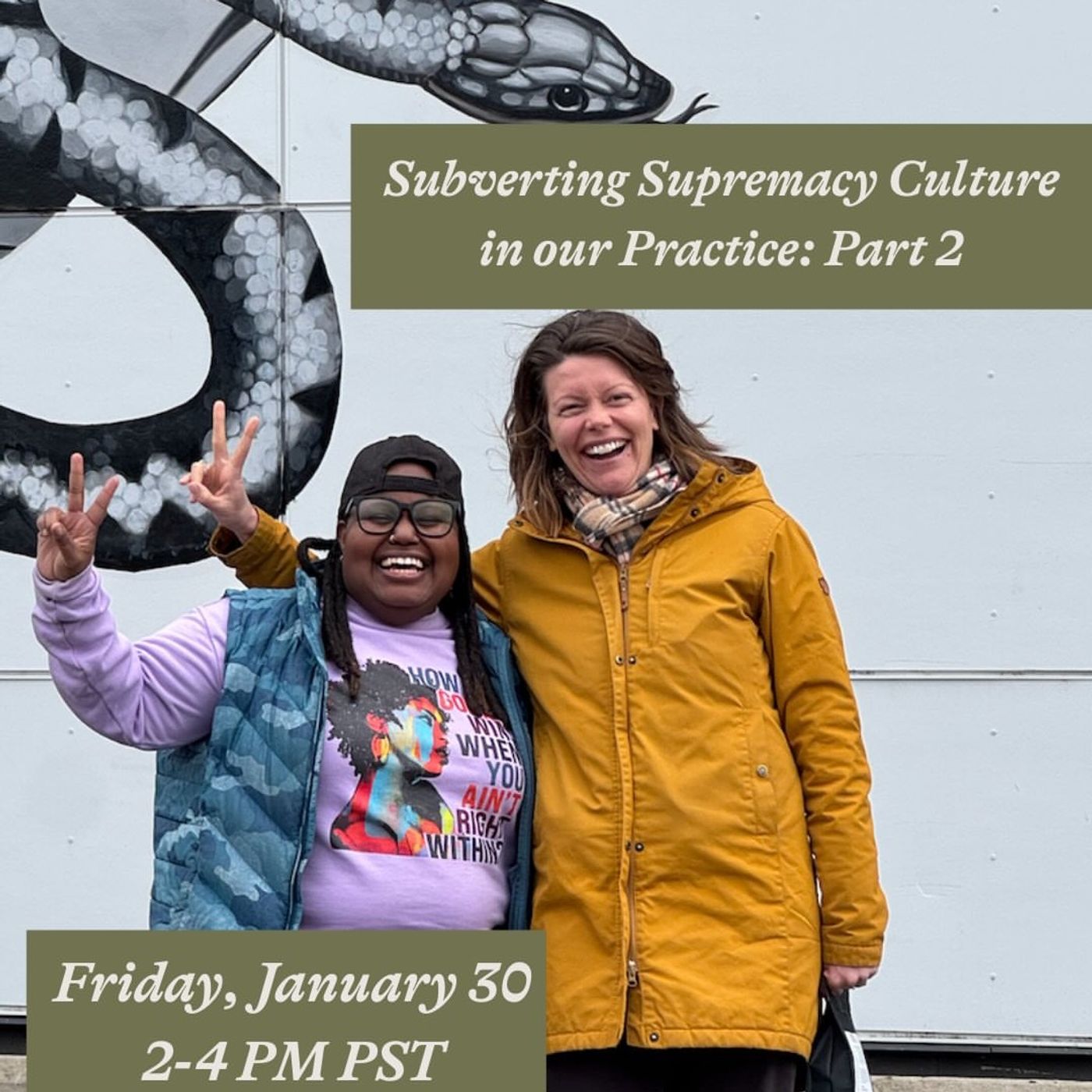
In this episode, we explore what it means to stay human in a time of collective trauma. We talk about messiness as a core part of being alive, how purity culture and rigid systems disconnect us from our bodies, and why agency, consent, and clear yeses and nos are essential forms of resistance. Together, we unpack how supremacy shapes therapy, relationships, and identity — especially through individualism, whiteness, and disembodiment — and imagine more liberating ways of practicing care, connection, and community. The conversation weaves personal reflection, cultural critique, and somatic wisdom, inviting listeners back into their bodies, their grief, and their shared humanity.Subverting Supremacy Culture in our Practice: Part 2Friday, January 30, 20262:00 PM 4:00 PMVIRTUALhttps://www.shelterwoodcollective.com/events/subverting-supremacy-culture-in-our-practice-part-2Working with people means navigating power, race, and trauma.This workshop will help you notice supremacy culture in the room and resist it. Due to the way Christian nationalism works in the US we create space to engage Christian supremacy and its manifestations of racialized heteronormativity that affects all bodies — regardless of religious or non-religious status. You will learn embodied, relational tools to strengthen your practice and reduce harm. Danielle S. Rueb Castillejo (she/her), Psychotherapist, Activist, Community Organizer; Jenny McGrath (she/her), Psychotherapist Writer, Author, Body Movement Worker; Abby Wong-Heffter, (she/her), Psychotherapist Teacher, Attachment Specialist; Tamice Spencer-Helms, (she/they), Author, Theoactivist, Non-Profit Leader are collaborating to create a generative learning space for therapists, social workers, educators, organizers, spiritual leaders, healthcare providers, and community practitioners. Together we will work with the ways supremacy culture shows up somatically, relationally, and structurally in helping professions. We will examine how dissociation, fragmentation, and inherited oppression narratives shape our work, and develop practices to interrupt these patterns.This workshop addresses diversity and cultural competence by:Examining how supremacy culture impacts Black, Indigenous, and People of Color differently than white-bodied practitioners. Naming cultural, historical, and intergenerational forces that shape power dynamics in clinical and community settings. Offering embodied, relational, and trauma-informed tools to practitioners working across racial, ethnic, cultural, and linguistic differences. Developing the capacity to recognize and intervene in oppression harm while maintaining therapeutic integrity and accountability. Participants will engage in reflective dialogue, somatic exercises, case-based examples, and guided exploration of their own positionality. The intent is not perfection but deepening collective responsibility and expanding our capacity to resist supremacy culture inside our practice and in ourselves. The workshop is designed to meet the Washington Department of Health requirement for two hours of health equity continuing education (WAC 246-12-820).The Blackfoot Wisdom that Inspired Maslow’s HierarchyBy Teju Ravilochan, originally published by Esperanza Projecthttps://www.resilience.org/stories/2021-06-18/the-blackfoot-wisdom-that-inspired-maslows-hierarchy/ Danielle (00:05):Be with you. Yeah. Well, it seems like from week to week, something drastically changes or some new trauma happens. It reminds me a lot of 2020.Jenny (00:15):Yeah. Yeah, it really does. I do feel like the positive in that is that similar to 2020, it seems like people are really looking for points of connection with one another, and I feel like there was this lull on Zoom calls or trainings or things like that for a while. People were just burned out and now people are like, okay, where in the world can I connect with people that are similar to me? And sometimes that means neighbors, but sadly, I think a lot of times that means people in other states, a lot of people that can feel kind of siloed in where they are and how they're doing right now.Danielle (00:56):Yeah, I was just thinking about how even I have become resistant to zoom or kind of tired and fed up and then all of a sudden meeting online or texting or whatever feels safer. Okay. Again.About? Just all the shit and then you go out in the real world and do I messed that up? I messed that up. I messed that up. I think that's part of it though, not living in perfection, being willing to be really messy. And how does that play out? How does that play out in our therapeutic practices?Jenny (01:50):Yeah, totally. I've been thinking a lot about messiness lately and how we actually come into the world. I think reveling often in messiness for anyone that's tried to feed a young child or a toddler and they just have spaghetti in their hair and everything's everywhere. And then we work so hard to tell kids, don't be messy. Don't be messy. And I'm
S6 Ep 19Season 6, Episode 19: Jenny McGrath, Rebecca W Walston and Danielle S Rueb Castillejo on the Five Year Old Boy Kidnappe
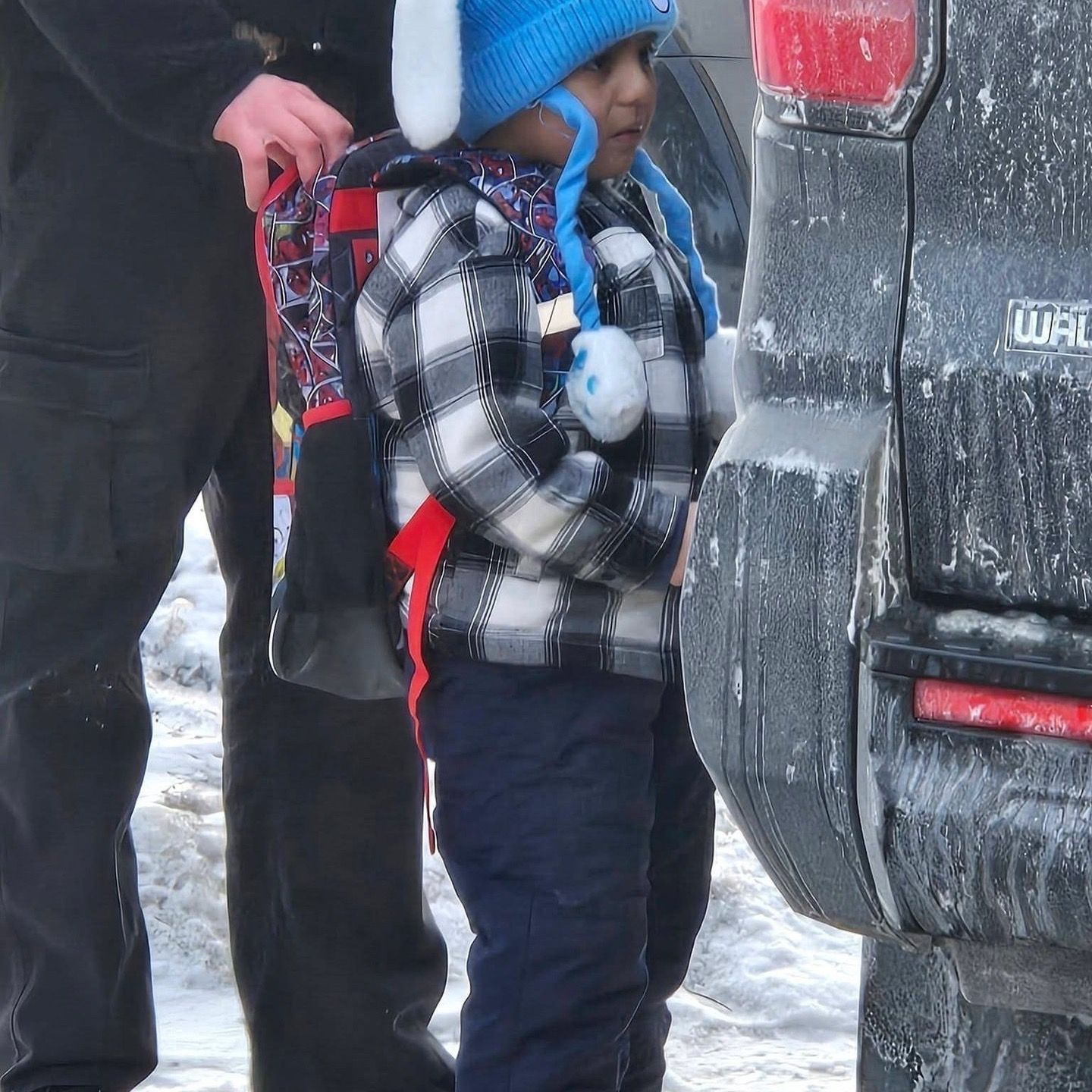
https://www.theguardian.com/us-news/2026/jan/21/ice-arrests-five-year-old-boy-minnesotaUS Immigration and Customs Enforcement (ICE) detained a five-year-old Minnesota boy on Tuesday as he returned home from school and transported him and his father to a Texas detention center, according to school officials.Liam Ramos, a preschooler, and his father were taken into custody while in their driveway, the superintendent of the school district in Columbia Heights, a Minneapolis suburb, said at a press conference on Wednesday. Liam, who had recently turned five, is one of four children in the school district who have been detained by federal immigration agents during the Trump administration’s enforcement surge in the region over the last two weeks, the district said. portrait of child wearing black poloLiam Ramos. Photograph: Courtesy of Columbia Heights Public SchoolsLiam and his father had just arrived home when they were detained, according to Zena Stenvik, the superintendent, who said she drove to the home when she learned of the detentions.When she arrived, Stenvik said the father’s car was still running and the father and son had already been apprehended. An agent had taken Liam out of the car, led the boy to his front door and directed him to knock on the door asking to be let in, “in order to see if anyone else was home – essentially using a five-year-old as bait”, the superintendent said in a statement. Danielle (00:02):Well, Hey, Jenny, how you doing? I'm hanging in there. How you doing? Same hanging in there a part. I think of it as trying to get in or out of a space and hanging by my fingernails on an edge. That's how I think of it sometimes.(00:27):One time I told a friend, Hey man, I can do a pull up off a door jam. And they were like, really? And I was just like, yeah. And then they tried to do it repeatedly. Their hands were so sore. I was like, I didn't really mean it. I was just joking, but maybe it's like that doing a pull up off a door jam or something. Yeah,Jenny (00:46):I can't even do a normal pull up. I'm working on it. I'm working on my strength.Yeah. I'm trying.Danielle (00:53):Good for you. That's our power.Jenny (00:55):That's right.I am currently in Florida, and so I'm a little worried about this ice storm that's coming through. I think I'm a little bit south of it, so we should hopefully be in the clear, but it's still, you can feel Winter's, the Bruin here.I know. It's a little scary. We're going to just thankfully be parked somewhere where we don't have to drive for at least a few days just in case.Danielle (01:33):Okay, cool. Cool. Will you stay in Florida or what's your trajectory right now?Jenny (01:38):Yeah, we're going to be here probably a couple months, and then we'll probably head over to New Orleans. There's a New Orleans book festival. It's a giant book event, so we're excited for that. And then we'll start probably heading back up to the northeast when it starts to warm up again in late spring, early summer.Yeah. Yeah. So my manuscript is complete and I have sent it to my ideal publisher and they like it and they're going to pitch it by the end of February. So I'm just crossing all my fingers and toes that they all feel like it's a really good fit, and hopefully in about a month from now I'll have a definitive answer, but I have a really good feeling about it. I really value this publisher and yeah, it feels really in alignment with what I'm trying to do with my book.I am trying to help folks understand that their individual body, specifically white cis women in the United States that has been positioned and conditioned within Christian nationalism is just that it is conditioned and positioned by Christian nationalism. And the more that we become aware of that and conscious of that, the more mobility and freedom we can find in our bodies and hopefully in our country and in our world, so that we can move and breathe and have our being in more free sovereign ways.Danielle (03:26):That feels like a little bit of a dream right now, but hey, I'm a dreamer. I'm all over it. Yeah, I'm all over it. I'm all over it. Well, every time we hop on here, I'm always like, oh, what should we talk about? And there's always something really fucked up in the world to dive into, right? Yes.Jenny (03:44):Yeah. Yeah. I think what feels so loud is just in the last 24, 48 hours, I don't know exactly the date five-year-old boy was taken with his dad from Minnesota just immediately basically swept away to another state, and so the family and their lawyer, or even just trying to track down where they are, and I am thinking of four and five-year-olds I know in my life and just how young and how tender and how dependent a child is at that age, and I find myself feeling a lot of rage and a lot of grief and a lot of helplessness, a sense of I want to do something and how do we do something? How about,Danielle (04:40):Let me just read this to us or to us, US Immigration and Customs Enforcement. Ice detai
S6 Ep 18Season 6, Episode 18: Jenny McGrath and Rebecca W. Walston and Danielle - this current moment in 2026
ESeason 6 episode 18 rebecca j...and therapy - 1_8_26, 10.27 AMThu, Jan 08, 2026 10:40AM • 57:28SUMMARY KEYWORDSemotional metabolization, existential threat, destabilizing changes, social media, information overload, Venezuela crisis, racial identity, colonization, anti-blackness, white privilege, immigration policies, historical context, white supremacy, interdependence, narrative controlSPEAKERSSpeaker 3, Speaker 1, Speaker 2 Jenny 00:30I think something I'm sitting with is the impossibility and the necessity of trying to metabolize what's going on in our bodies. Yeah, and it feels like this double bind where I feel like we need to do it. We need to feel rage and grief and fear and everything else that we feel, and I don't think our nervous systems have evolved to deal with this level of overwhelm and existential threat that we're experiencing, but I do believe our bodies, Yeah, need space to try to do that, yeah,yesterday, I was sitting at, I don't know what's gonna happen to people anyway, Rebecca 01:45Pretty good. I'm okay. It like everyone. I think there's just a lot of crazy like and a lot of shifting to like, things that we could normally depend on as consistent and constant are not constant anymore. And that is like, it's very, 02:11I don't even have a word I want to say, disconcerting, but that's too light. There's, it's very destabilizing to to watch things that were constants and norms just be ripped out from underneath. People on like, every day there's something new that used to be illegal and now it's legal, or vice versa. Every day there's like, this new thing, and then you're having to think, like, how is that going to impact me? Is it going to impact me? How is it going to impact the people that I care about and love? Yeah, Danielle 02:52Jenny and I were just saying, like, maybe we could talk about just what's going on in the world right now, in this moment. And Jenny, I forgot how you were saying it like you were saying that we need to give our bodies space, but we also need to find a way to metabolize it so we can take action. I'm paraphrasing, but yeah, Rebecca 03:30And I would agree, and something else that I was thinking about too is like, what do you metabolize? And how do you metabolize it? Right? Like, in terms of what's happening in Venezuela, I have people that I count very dear to me who feel like it was a very appropriate action, and and people who are very dear to me who feel like absolutely not. That's ridiculous, right? And so, and I'm aware on that particular conversation, I'm not Venezuelan. I'm not I'm very aware that I stand on the outside of that community and I'm looking in on it, going, what do I need to know in order to metabolize this? What do I not know or not understand about the people who are directly impacted by this. And so I, like, I have questions even you know about some of the stuff that I'm watching. Like, what do you metabolize and how do you come to understand it? And in a place where it's very difficult to trust your information sources and know if the source that you're you're have is reliable or accurate or or complete in it, in its detail, it feels those are reasons why, to me, it feels really hard to metabolize things i. Jenny 05:06There's this like rule or like theory thing. I wish I could remember the name of it, but it's essentially like this, this graph that falls off, and it's like, the less you know about something, the more you think you know about it, and the more confident you are. And the more you know, the less confident you are. And it just explains so well our social media moment, and people that read like one headline and then put all these reels together and things talking about it. And on one hand, I'm grateful that we live in an age where we can get information about what's going on. And at the other end, like, you know, I know there, there's somewhere, some professor that's spent 15 years researching this and being like it is. There's so much here that people don't know and understand. And yeah, it feels like the sense of urgency is on purpose. Like that we just have to like it feels like people almost need to stay up to date with everything. But then I also wonder how much of that is whiteness and this idea of like, saviorism and like, if I'm just informed, then I'm doing my duty and like what I need to do and and what does it look like to slow down and be with things that are right in front of US and immediate, without ignoring these larger, transnational and global issues. Yeah, it feels so complicated. Rebecca 06:55I do think the sense of urgency is on purpose. I think that the overwhelming flood of information at this time is not just a function of like social media, but I think, I think the release of things and the timing of things is intentional, I think, and so I think there's a lot of Let's throw this one thing in front of you, and while you everybody's paying attention to that, let's do 10 other things behind closed door
S6 Ep 17Season 6, Episode 17: Therapy and Healing around the Holidays w/Jenny and Danielle
Welcome to the Arise podcast, conversations on faith, race, justice, gender, the church, and what are we seeing in reality right now? So Jenny and I dive in a little bit about therapy. The holidays, I would don't say the words collective liberation, but it feels like that's what we're really touching on and what does that mean in this day and age? What are we finding with one another? How are we seeking help? What does it look like and what about healing? What does that mean to us? This isn't like a tell all or the answer to all the problems. We don't have any secret knowledge. Jenny and I are just talking out some of the thoughts and feeling and talking through what does it mean for us as we engage one another, engage healing spaces, what do we want for ourselves? And I think we're still figuring that out. You're just going to hear us going back and forth talking and thank you for joining. Danielle (00:10):Welcome to the Arise podcast, conversations on faith, race, justice, gender, the church, and what are we seeing in reality right now? So Jenny and I dive in a little bit about therapy. The holidays, I would don't say the words collective liberation, but it feels like that's what we're really touching on and what does that mean in this day and age? What are we finding with one another? How are we seeking help? What does it look like and what about healing? What does that mean to us? This isn't like a tell all or the answer to all the problems. We don't have any secret knowledge. Jenny and I are just talking out some of the thoughts and feeling and talking through what does it mean for us as we engage one another, engage healing spaces, what do we want for ourselves? And I think we're still figuring that out. You're just going to hear us going back and forth talking and thank you for joining. Download, subscribe. So Jenny, we were just talking about therapy because we're therapists and all. And what were you saying about it?Jenny (01:17):I was saying that I'm actually pretty disillusioned with therapy and the therapy model as it stands currently and everything. I don't want to put it in the all bad bucket and say it's only bad because obviously I do it and I, I've done it myself. I am a therapist and I think there is a lot of benefit that can come from it, and I think it eventually meets this rub where it is so individualistic and it is one person usually talking to one person. And I don't think we are going to dismantle the collective systems that we need to dismantle if we are only doing individual therapy. I think we really need to reimagine what healing looks like in a collective space.Danielle (02:15):Yeah, I agree. And it's odd to talk about it both as therapists. You and I have done a lot of groups together. Has that been different? I know for me as I've reflected on groups. Yeah. I'll just say this before you answer that. As I've reflected on groups, when I first started and joined groups, it was really based on a model of there's an expert teacher, which I accepted willingly because I was used to a church or patriarchal format. There's expert teacher or teachers like plural. And then after that there's a group, and in your group there's an expert. And I viewed that person as a guru, a professional, of course, they were professional, they are professionals, but someone that might have insider knowledge about me or people in my group that would bring that to light and that knowledge alone would change me or being witnessed, which I think is important in a group setting would change me. But I think part of the linchpin was having that expert guide and now I don't know what I think about that.(03:36):I think I really appreciate the somatic experiencing model that would say my client's body is the wisest person in the room.(03:46):And so I have shifted over the years from a more directive model where I'm the wisest person in the room and I'm going to name these things and I'm going to call these things out in your story to how do I just hold a space for your body to do what your body knows how to do? And I really ascribe to the idea that trauma is not about an event. It's about not having a safe place to go in the midst of or after an event. And so I think we need safe enough places to let our bodies do what our bodies have really evolved to do. And I really trust that more and more that less is more, and actually the more that I get out of the way and my clients can metabolize what they need to, that actually I think centers their agency more. Because if I'm always needing to defer my story to someone else to see things, I'm never going to be able to come into my own and say, no, I actually maybe disagree with you, or I see that differently, or I'm okay not figuring that out or whatever it might be. I get to stay centered in my own agency. And I think a professional model disavow someone of their own agency and their own ability to live their story from the inside outDanielle (05:19):To live their sto
S6 Ep 16Season 6, Episode 16: Rebecca W. Walston, Jenny McGrath and Danielle on MTG, Politics and the Continuum of Moral Awareness
“It’s not enough to build a system and then exit stage left when you realize it’s broken. The ‘I’m sorry’ is not the work — it’s only the acknowledgment that work needs to be done. After the apology, you must actually do the repair. And what I see from her is the language of accountability without the actions that would demonstrate it. That’s insufficient for real change.” Danielle (01:03):Well, I mean, what's not going on? Just, I don't know. I think the government feels more and more extreme. So that's one thing I feel people are like, why is your practice so busy? I'm like, have you seen the government? It's traumatizing all my clients. Hey Jeremy. Hey Jenny.Jenny (01:33):I'm in Charlottesville, Virginia. So close to Rebecca. We're going to soon.Rebecca (01:48):Yeah, she is. Yeah, she is. And before you pull up in my driveway, I need you to doorbell dish everybody with the Trump flag and then you can come. I'm so readyThat's a good question. That's a good question. I think that, I don't know that I know anybody that's ready to just say out loud. I am not a Trump supporter anymore, but I do know there's a lot of dissonance with individual policies or practices that impact somebody specifically. There's a lot of conversation about either he doesn't know what he's doing or somebody in his cabinet is incompetent in their job and their incompetency is making other people's lives harder and more difficult. Yeah, I think there's a lot of that.(03:08):Would she had my attention for about two minutes in the space where she was saying, okay, I need to rethink some of this. But then as soon as she says she was quitting Congress, I have a problem with that because you are part of the reason why we have the infrastructure that we have. You help build it and it isn't enough to me for you to build it and then say there's something wrong with it and then exit the building. You're not equally responsible for dismantling what you helped to put in place. So after that I was like, yeah, I don't know that there's any authenticity to your current set of objections,I'm not a fan of particularly when you are a person that in your public platform built something that is problematic and then you figure out that it's problematic and then you just leave. That's not sufficient for me, for you to just put on Twitter or Facebook. Oh yeah, sorry. That was a mistake. And then exit stage leftJenny (04:25):And I watched just a portion of an interview she was on recently and she was essentially called in to accountability and you are part of creating this. And she immediately lashed out at the interviewer and was like, you do this too. You're accusing me. And just went straight into defensive white lady mode and I'm just like, oh, you haven't actually learned anything from this. You're just trying to optically still look pure. That's what it seems like to me that she's wanting to do without actually admitting she has been. And she is complicit in the system that she was a really powerful force in building.Rebecca (05:12):Yeah, it reminds me of, remember that story, excuse me, a few years ago about that black guy that was birdwatching in Central Park and this white woman called the cops on him. And I watched a political analyst do some analysis of that whole engagement. And one of the things that he said, and I hate, I don't know the person name, whoever you are, if you said this and you hear this, I'm giving you credit for having said it, but one of the things that he was talking about is nobody wants you to actually give away your privilege. You actually couldn't if you tried. What I want you to do is learn how to leverage the privilege that you have for something that is good. And I think that example of that bird watching thing was like you could see, if you see the clip, you can see this woman, think about the fact that she has power in this moment and think about what she's going to do with that power.(06:20):And so she picks up her phone and calls the cops, and she's standing in front of this black guy lying, saying like, I'm in fear for my life. And as if they're doing anything except standing several feet apart, he is not yelling at you. He hasn't taken a step towards you, he doesn't have a weapon, any of that. And so you can see her figure out what her privilege looks like and feels like and sounds like in that moment. And you can see her use it to her own advantage. And so I've never forgotten that analysis of we're not trying to take that from you. We couldn't if we tried, we're not asking you to surrender it because you, if you tried, if you are in a place of privilege in a system, you can't actually give it up because you're not the person that granted it to yourself. The system gave it to you. We just want you to learn how to leverage it. So I would love to see Marjorie Taylor Greene actually leverage the platform that she has to do something good with it. And just exiting stays left is not helpful.Danielle (07:33):And to tha
S6 Ep 15Season 6< Episode 15: Therapy and Faith, Colonized? Dominion? How do we make sense of it?
Danielle (00:02):Hey, Jenny, you and I usually hop on here and you're like, what's happening today? Is there a guest today? Isn't that what you told me at the beginning?And then I sent you this Instagram reel that was talking about, I feel like I've had this, my own therapeutic journey of landing with someone that was very unhelpful, going to someone that I thought was more helpful. And then coming out of that and doing some somatic work and different kind of therapeutic tools, but all in the effort for me at least, it's been like, I want to feel better. I want my body to have less pain. I want to have less PTSD. I want to have a richer life, stay present with my kids and my family. So those are the places pursuit of healing came from for me. What about you? Why did you enter therapy?Jenny (00:53):I entered therapy because of chronic state of dissociation and not feeling real, coupled with pretty incessant intrusive thoughts, kind of OCD tendencies and just fixating and paranoid about so many things that I knew even before I did therapy. I needed therapy. And I came from a world where therapy wasn't really considered very Christian. It was like, you should just pray and if you pray, God will take it away. So I actually remember I went to the Seattle School of Theology and Psychology, partly because I knew it was a requirement to get therapy. And so for the first three years I was like, yeah, yeah, my school requires me to go to therapy. And then even after I graduated, I was like, well, I'm just staying in therapy to talk about what's coming up for my clients. And then it was probably five years, six years into therapy when I was finally like, no, I've gone through some really tough things and I just actually need a space to talk about it and process it. And so trying to develop a healthier relationship with my own body and figuring out how I wanted to move with integrity through the world is a big part of my healing journey.Danielle (02:23):I remember when I went to therapy as a kid and well, it was a psychologist and him just kind of asking really direct questions and because they were so direct and pointed, just me just saying like, nah, never happened, never did that, never felt that way, et cetera, et cetera. So I feel like as I've progressed through life, I've had even a better understanding of what's healing for me, what is love life like my imagination for what things could be. But also I think I was very trusting and taught to trust authority figures, even though at the same time my own trauma kept me very distrusting, if that makes sense. So my first recommendations when I went, I was skeptical, but I was also very hopeful. This is going to help.Jenny (03:13):Yeah, totally. Yep. Yeah. And sometimes it's hard for me to know what is my homeschool brain and what is just my brain, because I always think everyone else knows more than me about pretty much everything. And so then I will do crazy amount of research about something and then Sean will be like, yeah, most people don't even know that much about that subject. And I'm like, dang it, I wasted so much effort again. But I think especially in the therapy world, when I first started therapy, and I've seen different therapists over the years, some better experiences than others, and I think I often had that same dissonance where I was like, I think more than me, but I don't want you to know more than me. And so I would feel like this wrestling of you don't know me actually. And so it created a lot of tension in my earlier days of therapy, I think.Danielle (04:16):Yeah, I didn't know too with my faith background how therapy and my faith or theological beliefs might impact therapy. So along the lines of stereotypes for race or stereotypes for gender or what do you do? I am a spiritual person, so what do I do with the thought of I do believe in angels and spiritual beings and evil and good in the world, and what do I do? How does that mix into therapy? And I grew up evangelical. And so there was always this story, I don't know if you watched Heaven's Gates, Hells Flames at your church Ever? No. But it was this play that they came and they did, and you were supposed to invite your friends. And the story was some people came and at the end of their life, they had this choice to choose Jesus or not. And the story of some people choosing Jesus and making it into heaven and some people not choosing Jesus and being sent to hell, and then there was these pictures of these demons and the devil and stuff. So I had a lot of fear around how evil spirits were even just interacting with us on a daily basis.Jenny (05:35):Yeah, I grew up evangelical, but not in a Pentecostal charismatic world at all. And so in my family, things like spiritual warfare or things like that were not often talked about in my faith tradition in my family. But I grew up in Colorado Springs, and so by the time I was in sixth, seventh grade, maybe seventh or eighth grade, I was spending a lot
S6 Ep 14Season 6, Episode 14: Jenny and Danielle talk about Mutual Aid
Donations Resources (feminine hygiene products, and diapers, etc.)https://my.liberaforms.org/solidarity-kitchen-2Cash Pledges (100 percent goes to families)https://my.liberaforms.org/solidarity-kitchen-3Here is our plan: December 2, 2025 (Tuesday), 2:30 p.m. - 7 p.m., North Point ChurchServe up to 400 to go meals for students, parents and/or family members in our school district who have experienced the government shut down, food insecurity, or just plain tight times, with inflation and the job market.We will cook and pack to-go containers of meals, and be ready to send those off with students and/or families and/or caregivers. We will also have cash donations to put into envelopes, gift card donations to give away to those families that need additional support recovering from the shutdown or SNAP break. If folks would like to give to this, we are in process of setting up a secure format for it, in collaboration.TRANSCRIPTSDanielle (00:00):Cut it off. I just is so swamped with trying to respond to people's texts and calls. We have the whole system going, but I can explain more when we talk. It's justJenny (00:12):Okay. Oh my gosh. Yeah. We can do kind of a short one if that helps, or whatever feels supportive for you.I'm doing good. I'm thinking about the American Academy of Religions Conference this weekend. It kicks off tonight and I'll be presenting on my panel tomorrow, so I've been thinking about that.Yeah, I feel nervous, but I feel good. I feel really supported by the Purity Culture Research Collective and the colleagues and friends that I have there. So I mostly excited just to see folks coming in from all over, so I think it'll be a fun time.Danielle (01:02):Do you feel like you're going to be able to say what you want to say in the way you want to say it?Jenny (01:08):I think so. I keep reading over it again and again and tweaking it. It's hard to say what you want to say in five minutes, but,Oh goodness. I think there's eight of us. Eight or nine, I can't remember exactly. So we each get five minutes, but then it opens up into a q and a and sort of a discussion, so I'll have more time to expand on what I'm trying to say and it'll be fun to weave it together with other people.Danielle (01:42):It's interesting. I feel like we're all in these different places. We are physically sometimes, but even if we're in the same city and we're doing different things towards similar goals, that really strikes me. It's one reason I get excited about what you're doing.Oh, yeah, that's right. Well, I think I wrote in an email to friends to get it started. Basically what happened is we were at a band concert a month ago and it was the government shutdown, and my kids were talking about it and some of their classmates not having paychecks, their parents not having paychecks because we live in Kitsap County, and so there are two military, well, maybe there's three military bases in the area, so a lot of government funded work employees, the military obviously. And then also in our school district, I became aware that almost 30% of our students are either on SNAP or free and reduced lunch. So if you add that plus the level of the population of kids in our schools, either with parents in the military or in government position jobs, that's a lot of kids. And so I was like, oh, shit, what are we going to do? And I thought to myself, I was like, how can you not get on board with feeding kids? Really? They're innocent, they're young. I mean, we have plenty of riches in our county, in our country actually to do this should not be a thing. So that's kind of how it got started.Well, now it's called the Solidarity Kitchen. I'm like one member. There's many members of the Solidarity Kitchen, and we try to make decisions collaboratively. Some of us are better at some things like I'm not going to, I did take my food handlers permit test and passed it, by the way, today. Good job. I'm not going to be in charge. I'm not the expert at that. I like cooking for masses. So although I give input, there's other people that know more than me. There's also other people that know more about organizing volunteers or creating forms, and I dabbled a little bit in the art, but there's people that know more about how art should look and the words that need to go on art. I'm out here telling people, Hey, this is what we're about.(04:07):Would you like to join us? And trying to make space that's big enough for a lot of people to join in. It really felt like this collective consciousness movement. I go and I talk to someone, they're like, oh, we would love to do that. And it's like they've already thought of it. So it's not me trying to convince anybody to do anything or any of us, it's just like, oh, this is a need. This is something we can do. And we don't have to agree on a thousand things to get it done because I don't know. I know there are people in our government right now that are just wicked enough not to feed kids. We saw that as evidence
S6 Ep 13Season 6, Episode 13: Jenny McGrath and Danielle Castillejo on Abstinence, Purity Culture and Epstein
Bio: Jenny - Co-Host Podcast (er):I am Jenny! (She/Her) MACP, LMHCI am a Licensed Mental Health Counselor, Somatic Experiencing® Practitioner, Certified Yoga Teacher, and an Approved Supervisor in the state of Washington.I have spent over a decade researching the ways in which the body can heal from trauma through movement and connection. I have come to see that our bodies know what they need. By approaching our body with curiosity we can begin to listen to the innate wisdom our body has to teach us. And that is where the magic happens!I was raised within fundamentalist Christianity. I have been, and am still on my own journey of healing from religious trauma and religious sexual shame (as well as consistently engaging my entanglement with white saviorism). I am a white, straight, able-bodied, cis woman. I recognize the power and privilege this affords me socially, and I am committed to understanding my bias’ and privilege in the work that I do. I am LGBTQIA+ affirming and actively engage critical race theory and consultation to see a better way forward that honors all bodies of various sizes, races, ability, religion, gender, and sexuality.I am immensely grateful for the teachers, healers, therapists, and friends (and of course my husband and dog!) for the healing I have been offered. I strive to pay it forward with my clients and students. Few things make me happier than seeing people live freely in their bodies from the inside out!Danielle (00:10):Welcome to the Arise Podcast with my colleague Jenny McGrath and I today Jenny's going to read a part of a presentation she's giving in a week, and I hope you really listen in The political times are heavy and the news about Epstein has been triggering for so many, including Jenny and myself. I hope as you listen, you find yourself somewhere in the conversation and if you don't, I hope that you can find yourself with someone else in your close sphere of influence. These conversations aren't perfect. We can't resolve it at the end. We don't often know what we need, so I hope as you listen along that you join us, you join us and you reach out for connection in your community with friends, people that you trust, people that you know can hold your story. And if you don't have any of those people that maybe you can find the energy and the time and the internal resources to reach out. You also may find yourself activated during this conversation. You may find yourself triggered and so this is a notice that if you feel that that is a possibility and you need to take a break and not listen to this episode, that's okay. Be gentle and kind with yourself and if you feel like you want to keep listening, have some self-care and some ways of connecting with others in place, go ahead and listen in. Hey Jenny, I'd love to hear a bit about your presentation if you don't even mind giving us what you got.Jenny (01:41):Yeah, absolutely. I am very honored. I am going to be on a panel entitled Beyond Abstinence Only Purity Culture in Today's Political Moment, and this is for the American Academy of Religion. And so I am talking about, well, yeah, I think I'll just read a very rough draft version of my remarks. I will give a disclaimer, I've only gone over it once so far, maybe twice, so it will shift before I present it, but I'm actually looking forward to talking about it with you because I think that will help me figure out how I want to change it. I think it'll probably just be a three to five minute read if that evenOkay. Alright. I to look at the current political moment in the US and try to extract meaning and orientation from purity culture is essential, but if we only focus on purity culture in the us, we are naval gazing and missing a vital aspect of the project that is purity culture. It is no doubt an imperialist project. White women serving as missionaries have been foot soldiers for since Manifest Destiny and the creation of residential schools in North America and even before this, yet the wave of white women as a force of white Christian nationalism reached its white cap in the early two thousands manifest by the power of purity culture. In the early 1990s, a generation of young white women were groomed to be agents of empire unwittingly. We were told that our value and worth was in our good pure motives and responsibility to others.(03:31):We were trained that our racial and gender roles were pivotal in upholding the white, straight, heteronormative, capitalistic family that God designed and we understood that this would come at us martyring our own body. White women therefore learned to transmute the healthy erotic vitality that comes from an awakening body into forms of service. The transnational cast of white Christian supremacy taught us that there were none more deserving more in need than black and brown bodies in the global south pay no attention to black and brown bodies suffering within the us. We were told they could pull themselves up by their bootstraps,
S6 Ep 12Season 6, Episode 12: Jenny McGrath and Organizer Mary Lovell Reality and Organizing in this moment
EMary Lovell is a queer grassroots organizer, visual artist, and activist who has been fighting oil and gas infrastructure and for social justice for their adult life - living up in the Kitsap Penninsula they are working on their first book and love working with people to build power in their communitiesWelcome to the Arise podcast. This is episode 12, conversations on Reality. And today we're touching on organizing and what does it mean to organize? How do we organize? And we talk to a seasoned organizer, Mary Lavelle. And so Mary is a queer, grassroots organizer, visual artist and activist who has been fighting oil and gas infrastructure and fighting for social justice in their adult life. Living in the Kitsap Peninsula. They're working on their first book and love working with people to build power in their communities. Join us. I hope you stay curious and we continue the dialogue.Danielle (00:02):Okay, Mary, it's so great to have you today. Just want to hear a little bit about who you are, where you come from, how did you land? I know I met you in Kitsap County. Are you originally from here? Yeah. Just take itMary (00:15):Away. Yeah. So my name is Mary Lovel. I use she or they pronouns and I live in Washington State in Kitsap County. And then I have been organizing, I met Danielle through organizing, but I've spent most of my life organizing against oil and gas pipelines. I grew up in Washington state and then I moved up to Canada where there was a major oil pipeline crossing through where I was living. And so that got me engaged in social justice movements. That's the Transmountain pipeline, which it was eventually built, but we delayed it by a decade through a ton of different organizing, combination of lawsuits and direct action and all sorts of different tactics. And so I got to try and learn a lot of different things through that. And then now I'm living in Washington state and do a lot of different social justice bits and bobs of organizing, but mostly I'm focused on stopping. There's a major gas build out in Texas and Louisiana, and so I've been working with communities down there on pressuring financiers behind those oil and gas pipelines and major gas export. But all that to say, it's also like everyone is getting attacked on all sides. So I see it as a very intersectional fight of so many communities are being impacted by ice and the rise of the police state becoming even more prolific and surveillance becoming more prolific and all the things. So I see it as one little niche in a much larger fight. Yeah,Yeah, totally. I think when I moved up to Canada, I was just finished high school, was moving up for college, had been going to some of the anti-war marches that were happening at the time, but was very much along for the ride, was like, oh, I'll go to big stuff. But it was more like if there was a student walkout or someone else was organizing people. And then when I moved up to Canada, I just saw the history of the nation state there in a totally different way. I started learning about colonialism and understanding that the land that I had moved to was unseated Tu Squamish and Musqueam land, and started learning also about how resource extraction and indigenous rights went hand in hand. I think in general, in the Pacific Northwest and Coast Salish territories, the presence of indigenous communities is really a lot more visible than other parts of North America because of the timelines of colonization.(03:29):But basically when I moved and had a fresh set of eyes, I was seeing the major marginalization of indigenous communities in Canada and the way that racism was showing up against indigenous communities there and just the racial demographics are really different in Canada. And so then I was just seeing the impacts of that in just a new way, and it was just frankly really startling. It's the sheer number of people that are forced to be houseless and the disproportionate impacts on especially indigenous communities in Canada, where in the US it's just different demographics of folks that are facing houselessness. And it made me realize that the racial context is so different place to place. But anyways, so all that to say is that I started learning about the combination there was the rise of the idle, no more movement was happening. And so people were doing a lot of really large marches and public demonstrations and hunger strikes and all these different things around it, indigenous rights in Canada and in bc there was a major pipeline that people were fighting too.(04:48):And that was the first time that I understood that my general concerns about climate and air and water were one in the same with racial justice. And I think that that really motivated me, but I also think I started learning about it from an academic standpoint and then I was like, this is incredibly dumb. It's like all these people are just writing about this. Why is not anyone doing anything about it? I was going to Simon
S6 Ep 11Season 6, Episode 11: Jenny McGrath, Renee Begay, and Rebecca W. Walston on Resilience and Die De Los Metros
Guest Bio: Renee Kylestewa Begay is from the Pueblo of Zuni in Southwest New Mexico. She is a mother to three daughters and married to high school sweetheart Donnie Begay. During her undergrad, she founded the Nations movement—a national ministry...Good morning. It's October 30th, 2025. Can you believe it? So I'm releasing these videos. Today's videos on resilience. Four distinct cultures coming at you. Jenny McGrath. Me, Danielle, my friend Renee Begay from New Mexico and Rebecca Wheeler, Walston. Tune in, listen to the distinctly different places we're coming from and how we're each thinking about resilience. And then find a way that that impacts you and your own community and you can create more resilience, more generosity, more connection to one another. It's what we need in this moment. Oh, and this is The Arise Podcast, and it's online. If you want to download, listen to it. There you can as well. Renee Begay (00:14):Okay, cool. Okay, so for those watching my introduction, I'll do it in my language. So my name is Renee Bega. I just spoke in my language, which is I'm from the Pueblo of Zuni tribe in Southwest New Mexico, and I shared the way that we relate to one another. So you share the clan system that you're from. So being a matrilineal society, we belong to our, there's lineage and then we are a child of our father's side of the family. And so I belong to the Sandhill Crane clan as my mom is my grandma. And then my daughters are Sandhill Crane, and then I'm a child of the Eagle Clan, which is my dad's side. So if I do introduce myself in Zuni and I say these clans, then people know, oh, okay, you're from this family, or I'm, or if I meet others that are probably Child of Crane, then I know that I have responsibility toward them. We figure out responsibility toward each other in the community and stuff, who's related to all those things. Yeah. And here in New Mexico, there are 19 Pueblo tribes, two to three Apache tribes, and then one Navajo nation tribe. So there's a large population of indigenous tribes here in New Mexico. So grateful and glad to be here.(02:22):Yeah. I guess I can answer your question about what comes to mind with just the word resilience, but even you saying a d Los Muertos, for me that was like, oh, that's self-determination, something that you practice to keep it going, to remember all those things. And then when you mentioned the family, Jenny, I was like, I think I did watch it and I looked on my phone to go look for it, and I was like, oh yeah, I remember watching that. I have a really short-term memory with books or things that I watch. I don't remember exactly details, but I know how I felt. And I know when I was watching that show, I was just like, whoa, this is crazy.(03:12):So yes, I remember watching that docuseries. And then I think Rebecca, when you're talking about, I was thinking through resilience feels like this vacillation between different levels, levels of the individual in relation to the community, how much do we participate in self discovery, self-determination, all those things, but then also connect it to community. How do we continue to do that as a community to stay resilient or keep practicing what we've been taught? But then also generationally too, I think that every generation has to figure out based on their experience in this modern world, what to do with the information and the knowledge that is given to us, and then how to kind of encourage the next generation too. So I was just thinking of all those scenes when I was listening to you guys.Rebecca (04:25):Yeah, when you said the generational thing that each generation has to decide what to do with the information given to them. This past weekend in the last week or so was that second New Kings march, and there's some conversation about the fact that it was overwhelmingly white and in my community that conversation has been, we weren't there. And what does that mean, right? Or the noticing that typically in this country when there are protests around human rights, typically there's a pretty solid black contingency that's part of that conversation. And so I just have been aware internally the conversation has been, we're not coming to this one. We're tired. And when I say I say black women specifically in some instances, the larger black community, we are tired.(05:28):We are tapping out after what happened in the last election. And I have a lot of ambivalence about that tapping out. I'm not sure how I feel about it, but it does make me think about what you said that in this moment my community is taking the information given to them and making a conscious choice to do something different than what we have done historically. So that's what I thought about when you were mentioning the generational sort of space that's there. What do we do with that and what does that mean about what we pass to the next generation?Danielle (06:09):Through this moment. So I think it's interesting to say, I think Re
S6 Ep 10Season 6, Episode 10: Jenny McGrath and Sandra Van Opstal of Chasing Justice talk about Chicago and Resilience
BIO: Sandra Van OpstalEXECUTIVE DIRECTOR AND CO-FOUNDER OF CHASING JUSTICESandra Maria Van Opstal, a second-generation Latina, is Co-Founder and Executive Director of Chasing Justice, a movement led by people of color to mobilize a lifestyle of faith and justice . She is an international speaker, author, and activist, recognized for her courageous work in pursuing justice and disrupting oppressive systems within the church. As a global prophetic voice and an active community member on the west-side of Chicago, Sandra’s initiatives in holistic justice equip communities around the world to practice biblical solidarity and mutuality within various social and cultural locations.https://chasingjustice.com/sandra-van-opstal/ Giving in Chicago: https://newlifecenters.org/ Ordg to follow in chicagohttps://www.icirr.org/ Tshirt https://secure.qgiv.com/for/peoplearenotillegalt-shirt/Danielle (00:09):good afternoon, y'all. I have a second video coming to you from my dear friend and colleague in Chicago, Humboldt Park area, a faith leader there that collaborates with the different faith communities in the area. And she's going to talk about some ways she's personally affected by what's happening by the invasion there and how you can think about things, how you might get involved. I hope you'll join me in this conversation and honor yourself. Stay curious, honor, humanity, get involved. Take collective action. Talk to your own neighbor. Let's start caring really well for one another.Oh wow. Sandra, you know me. This is Jenny McGrath. This is my colleague. She's a bible nut. She wrote out the Bible How many times?Like scripture nut and a researcher, a therapist and purity culture, kind of like Survivor, but did a lot of work with women around that. And we talk a lot about race and current events. And I restarted my podcast and I asked Jenny if she'd want to join me. She has a great love for justice and humans and making a difference. So that's kind of how Jenny joined up with me. Right. Anything else you want to say?Sandra, I saw your post on social media and I was like, I could do that. I could contribute to that. And so that's what I'm here to do. Want to hear about your experience. What does resilience look like for you all over there? What do you need from us? How can we be a part of what's happening in Chicago from wherever we are? And if there's practical needs or things you want to share here, we can also send those out.Yeah. Can you tell us a little bit about who you are, what you do, where you're located in Chicago, and just a little bit even about your family, if you're willing?Sandra (01:40):Yeah, sure. So it's great to be with you guys. I'm Sandra Van Opal and I'm here on the west side of Chicago in a neighborhood called Humble Park. It's if you see in the news with all that's happening, it's the humble Hermosa, Avondale kind of zone of the ice crackdown. Well, let's not call it a crackdown. The ice invasion(02:06):Here in Chicago. I am the daughter of immigrants, so my mom is from Columbia. My father was from Argentina. They came to live in Chicago when they were in their twenties and thirties. They met in English class, so they were taking TOEFL exams, which is an exam you take in order to enter into college and schooling here in the US to show your language proficiency. And so they met learning English and the rest is history. I grew up here. I've lived here my whole life. I'm raising my family here. I'm married. I have two kids that just turned 11, so they're in fifth grade and sixth grade. And the school that they go to is a primarily immigrant school immersion, Spanish immersion. So it's a school where you take classes basically 90% in Spanish when you start and you move every year a little bit more English until you graduate when you're 50 50.(03:03):And so the school context they've been in has been receiving a lot of new neighbors, a lot of new classmates. And for that reason, actually most of their classes are still almost fully in Spanish, so they should probably be 60 40 right now. But I think a lot of their curriculum is still in Spanish, or the children have the option of having the math book in Spanish or English if they want it. If they're supposed to be English Spanish, or sorry, English math this year, then they might choose to have a Spanish book even if the instruction is in English. So that's the context I live in. I am here. I live in a home. I have chickens and a garden, and I love to be outside watching my neighbors and connecting with people. And we have a black club in our community, so a lot of our information that we're sharing with each other is through our email list and our signal group. Yeah. Oh, also what I do, I run an organization called Chasing Justice, which is focused on the intersection of faith and making the world a better place. And I am a local pastor and author on issues of worship and justice. So that's my function in this world.Danielle (04:31):I think we talk abo
S6 Ep 9Season 6, Episode 9: Danielle S. Castillejo speak with Vanessa Ogaldez, LAMFT and Chicago and La Migra
Vanessa Ogaldez, LAMFTSPECIALTIES:TraumaCouples CommunicationIdentity/Self Acceptancehttps://www.dcctherapy.com/vanessa-ogaldez-lamftFrom Her website: Maybe you have said something like, “What else can I do?” and it is possible you feel stuck or heartbroken because you can’t seem to connect with your partner as you want or used to. Whether or not you’re in a relationship and you have experienced trauma, hurtful arguments, or life changes that have brought on disconnection in your relationships, there is a sense of loss and heartache. You may find yourself in “robot mode” just going through your daily tasks, causing you to eventually disconnect from others, only to continue the cycle of miscommunication and loneliness. Perhaps you feel misunderstood, and you compensate by being helpful to everyone else while you yearn for true intimacy and friendships. Sometimes you feel there are so many experiences that have contributed to your pain and suffering that you don’t know where to start. There are Cultural norms you may feel that not everyone can understand and therapy is not one of those Cultural norms. I believe therapy can be a place of safety, healing, and self-discovery. As a therapist, my focus is to support you and your goals in life and relationships. I am committed to you building deep communications, connections and feeling secure in the ability to share your emotions.Danielle (00:06):Good morning. I just had the privilege and honor of interviewing my colleague, another therapist and mental health counselor in Chicago, Vanessa Les, and she is located right in the midst of Chicago with an eye and a view out of her office towards what's happening with ICE and immigration raids. I want to encourage you to listen into this episode of the Arise Podcast, firsthand witness accounts and what is it actually like to try to engage in a healing process when the trauma may be committed right before someone comes in the office. We know that's a possibility and right after they leave the office, not suggesting that it's right outside the door, but essentially that the world in which we are living is not as hopeful and as Mary as we would like to think, I am sad and deeply disturbed and also very hopeful that we share this power inside of ourselves.(01:10):It's based on nonviolence and care and love for neighbor, and that is why Vanessa and I connected. It's not because we're neighbors in the sense of I live next door to her in Chicago and she lives next door to me in Washington. We're neighbors because as Latinas in this world, we have a sense of great solidarity in this fight for ourselves, for our families, for our clients, to live in a world where there's freedom, expression, liberation, and a movement towards justice and away from systems and oppression that want to literally drag us into the pit of hell. We're here to say no. We're here to stand beside one another in solidarity and do that together. I hope you join us in this conversation and I hope you find your way to jump in and offer your actual physical resources, whether it's money, whether it's walking, whether it's calling a friend, whether it's paying for someone's mental health therapy, whether it's sharing a meal with someone, sharing a coffee with someone. All these things, they're just different kinds of things that we can do, and that's not an exhaustive list.(02:28):I love my neighbor. I even want to talk to the people that don't agree with me, and I believe Vanessa feels the same way. And so this episode means a lot to me. It's very important that we pay attention to what's happening and we ground ourselves in the reality and the experiences of black and brown bodies, and we don't attempt to make them prove over and over and over what we can actually see and investigate with our own eyes. Join in. Hey, welcome Vanessa. I've only met you once in person and we follow each other online, but part of the instigation for the conversation is a conversation about what is reality. So there's so many messages being thrown at us, so many things happening in the world regarding immigration, law enforcement, even mental health fields, and I've just been having conversations with different community members and activists and finding out how do you find yourself in reality what's happening. I just first would love to hear who you are, where you're at, where you're coming from, and then we can go from there.Vanessa (03:41):Okay. Well, my name is Vanessa Valez. I'm a licensed marriage and family therapist. Before becoming a therapist five years ago through my license, I worked in nonprofit for over 20 years, working with families and community and addressing what is the need and what is the problem and how can we all get together. Been involved with different movements and nonprofit organizations focusing on the community in Humbolt Park and Logan Square in the inner city of Chicago. My parents are longtime activists and they've been instrumental in teaching me h
S6 Ep 8Season 6, Episode 8: Jenny Mcgrath, Rev. Dr. Starlette Thomas and Danielle Castillejo speak about Christian Nationalism, Race, and History
BIO:The Reverend Dr. Starlette Thomas is a poet, practical theologian, and itinerant prophet for a coming undivided “kin-dom.” She is the director of The Raceless Gospel Initiative, named for her work and witness and an associate editor at Good Faith Media. Starlette regularly writes on the sociopolitical construct of race and its longstanding membership in the North American church. Her writings have been featured in Sojourners, Red Letter Christians, Free Black Thought, Word & Way, Plough, Baptist News Global and Nurturing Faith Journal among others. She is a frequent guest on podcasts and has her own. The Raceless Gospel podcast takes her listeners to a virtual church service where she and her guests tackle that taboo trinity— race, religion, and politics. Starlette is also an activist who bears witness against police brutality and most recently the cultural erasure of the Black Lives Matter Plaza in Washington, D.C. It was erected in memory of the 2020 protests that brought the world together through this shared declaration of somebodiness after the gruesome murder of George Perry Floyd, Jr. Her act of resistance caught the attention of the Associated Press. An image of her reclaiming the rubble went viral and in May, she was featured in a CNN article.Starlette has spoken before the World Council of Churches North America and the United Methodist Church’s Council of Bishops on the color- coded caste system of race and its abolition. She has also authored and presented papers to the members of the Baptist World Alliance in Zurich, Switzerland and Nassau, Bahamas to this end. She has cast a vision for the future of religion at the National Museum of African American History and Culture’s “Forward Conference: Religions Envisioning Change.” Her paper was titled “Press Forward: A Raceless Gospel for Ex- Colored People Who Have Lost Faith in White Supremacy.” She has lectured at The Queen’s Foundation in Birmingham, U.K. on a baptismal pedagogy for antiracist theological education, leadership and ministries. Starlette’s research interests have been supported by the Louisville Institute and the Lilly Foundation. Examining the work of the Reverend Dr. Clarence Jordan, whose farm turned “demonstration plot” in Americus, Georgia refused to agree to the social arrangements of segregation because of his Christian convictions, Starlette now takes this dirt to the church. Her thesis is titled, “Afraid of Koinonia: How life on this farm reveals the fear of Christian community.” A full circle moment, she was recently invited to write the introduction to Jordan’s newest collection of writings, The Inconvenient Gospel: A Southern Prophet Tackles War, Wealth, Race and Religion.Starlette is a member of the Christian Community Development Association, the Peace & Justice Studies Association, and the Koinonia Advisory Council. A womanist in ministry, she has served as a pastor as well as a denominational leader. An unrepentant academician and bibliophile, Starlette holds degrees from Buffalo State College, Colgate Rochester Crozer Divinity School and Wesley Theological Seminary. Last year, she was awarded an honorary doctorate in Sacred Theology for her work and witness as a public theologian from Wayland Baptist Theological Seminary. She is the author of "Take Me to the Water": The Raceless Gospel as Baptismal Pedagogy for a Desegregated Church and a contributing author of the book Faith Forward: A Dialogue on Children, Youth & a New Kind of Christianity. JennyI was just saying that I've been thinking a lot about the distinction between Christianity and Christian supremacy and Christian nationalism, and I have been researching Christian nationalism for probably about five or six years now. And one of my introductions to the concept of it was a book that's based on a documentary that's based on a book called Constantine Sword. And it talked about how prior to Constantine, Christians had the image of fish and life and fertility, and that is what they lived by. And then Constantine supposedly had this vision of a cross and it said, with this sign, you shall reign. And he married the church and the state. And ever since then, there's been this snowball effect of Christian empire through the Crusades, through manifest destiny, through all of these things that we're seeing play out in the United States now that aren't new. But I think there's something new about how it's playing out right now.Danielle (02:15):I was thinking about the doctrine of discovery and how that was the creation of that legal framework and ideology to justify the seizure of indigenous lands and the subjugation of indigenous peoples. And just how part of that doctrine you have to necessarily make the quote, humans that exist there, you have to make them vacant. Or even though they're a body, you have to see them as internally maybe empty or lacking or less. And that really becomes this frame. Well, a repeated frame.Jenny (03:08):Yep. Yeah. Yeah. And it feels

S6 Ep 7Season 6, Episode 7: Jenny Mcgrath and Rebecca Walston speak about Reality and Resilience in this moment
Bio: Jenny - Co-Host Podcast (er):I am Jenny! (She/Her) MACP, LMHCI am a Licensed Mental Health Counselor, Somatic Experiencing® Practitioner, Certified Yoga Teacher, and an Approved Supervisor in the state of Washington.I have spent over a decade researching the ways in which the body can heal from trauma through movement and connection. I have come to see that our bodies know what they need. By approaching our body with curiosity we can begin to listen to the innate wisdom our body has to teach us. And that is where the magic happens!I was raised within fundamentalist Christianity. I have been, and am still on my own journey of healing from religious trauma and religious sexual shame (as well as consistently engaging my entanglement with white saviorism). I am a white, straight, able-bodied, cis woman. I recognize the power and privilege this affords me socially, and I am committed to understanding my bias’ and privilege in the work that I do. I am LGBTQIA+ affirming and actively engage critical race theory and consultation to see a better way forward that honors all bodies of various sizes, races, ability, religion, gender, and sexuality.I am immensely grateful for the teachers, healers, therapists, and friends (and of course my husband and dog!) for the healing I have been offered. I strive to pay it forward with my clients and students. Few things make me happier than seeing people live freely in their bodies from the inside out!Rebecca A. Wheeler Walston, J.D., Master of Arts in CounselingEmail: [email protected]: +1.5104686137Website: Rebuildingmyfoundation.comI have been doing story work for nearly a decade. I earned a Master of Arts in Counseling from Reformed Theological Seminary and trained in story work at The Allender Center at The Seattle School of Theology and Psychology. I have served as a story facilitator and trainer at both The Allender Center and the Art of Living Counseling Center. I currently see clients for one-on-one story coaching and work as a speaker and facilitator with Hope & Anchor, an initiative of The Impact Movement, Inc., bringing the power of story work to college students.By all accounts, I should not be the person that I am today. I should not have survived the difficulties and the struggles that I have faced. At best, I should be beaten down by life‘s struggles, perhaps bitter. I should have given in and given up long ago. But I was invited to do the good work of (re)building a solid foundation. More than once in my life, I have witnessed God send someone my way at just the right moment to help me understand my own story, and to find the strength to step away from the seemingly inevitable ending of living life in defeat. More than once I have been invited and challenged to find the resilience that lies within me to overcome the difficult moment. To trust in the goodness and the power of a kind gesture. What follows is a snapshot of a pivotal invitation to trust the kindness of another in my own story. May it invite you to receive to the pivotal invitation of kindness in your own story. Listen with me… Danielle (00:17):Welcome to the Arise podcast, and as you know, we're continuing on the intersection of where our reality meets and today it's where our reality meets our resilience. And how do we define that? A lovely conversation. It's actually just part one. I'm thinking it's going to be multiple conversations. Jenny McGrath, LMHC, and Rebecca Wheeler, Walston. Join me again, look for their bios in the notes and tag along with us. I thought we could start by talking about what do we see as resilience in this moment and what do we see, maybe like I'm saying a lot now, what do we see as the ideal of that resilience and what is actually accessible to us? Because I think there's these great quotes from philosophers and our ancestors, but we don't know all their day-to-day life. What did it look like day to day? So I'm wondering, just kind of posing that for you all, what do you think about resilience? How does it intersect with this moment and how do we kind of ground ourselves in reality?Rebecca (01:33):Rebecca? Coffee helps. Coffee definitely helps. It does. I have coffee here.(01:42):Me too. I would probably try to start with something of a working definition of the word. One of the things that I think makes this moment difficult in terms of a sense of what's real and what's not is the way that our vocabulary is being co-opted or redefined without our permission. And things are being defined in ways that are not accurate or not grounded in reality. And I think that that's part of what feels disorienting in this moment. So I would love for us to just start with a definition of the word, and I'm guessing the three of us will have different versions of that.(02:25):So if I had to start, I would say that I used to think about resilience as sort of springing back to a starting point. You started in this place and then something knocked you off of where y
S6 Ep 6Season 6, Episode 6: Community Advocate Sarah Van Gelder speaks about Reality and Politics
Danielle (00:20):Welcome to the Arise podcast, conversations about reality and talking a lot about what that means in the context of church, faith, race, justice, religion, all the things. Today, I'm so honored to have Sarah Van Gelder, a community leader, an example of working and continuing to work on building solidarity and networks and communication skills and settling into her lane. I hope you enjoy this conversation. Hey, Sarah, it's so good to be with you. And these are just casual conversations, and I do actual minimal editing, but they do get a pretty good reach, so that's exciting. I would love to hear you introduce yourself. How do you introduce yourself these days? Tell me a little bit about who you are. Okay.Sarah (01:14):My name is Sarah Van Gelder and I live in Bremer and Washington. I just retired after working for the Suquamish Tribe for six years, so I'm still in the process of figuring out what it means to be retired, doing a lot of writing, a certain amount of activism, and of course, just trying to figure out day to day, how to deal with the latest, outrageous coming from the administration. But that's the most recent thing. I think what I'm most known for is the founding yes magazine and being the editor for many years. So I still think a lot about how do we understand that we're in an era that's essentially collapsing and something new may be emerging to take its place? How do we understand what this moment is and really give energy to the emergence of something new? So those are sort of the foundational questions that I think about.Danielle (02:20):Okay. Those are big questions. I hadn't actually imagined that something new is going to emerge, but I do agree there is something that's collapsing, that's disintegrating. As you know, I reached out about how are we thinking about what is reality and what is not? And you can kind of see throughout the political spectrum or community, depending on who you're with and at what time people are viewing the world through a specific lens. And of course, we always are. We have our own lens, and some people allow other inputs into that lens. Some people are very specific, what they allow, what they don't allow. And so what do we call as reality when it comes to reality and politics or reality and faith or gender, sexuality? It's feeling more and more separate. And so that's kind of why I reached out to you. I know you're a thinker. I know you're a writer, and so I was wondering, as you think about those topics, what do you think even just about what I've said or where does your mind go?Sarah (03:32):Yeah. Well, at first when you said that was the topic, I was a little intimidated by it because it sounded a little abstract. But then I started thinking about how it is so hard right now to know what's real, partly because there's this very conscious effort to distort reality and get people to accept lies. And I think actually part of totalitarian work is to get people to just in the Orwellian book 1984, the character had to agree that two plus two equals five. And only when he had fully embraced that idea could he be considered really part of society.(04:14):So there's this effort to get us to accept things that we actually know aren't true. And there's a deep betrayal that takes place when we do that, when we essentially gaslight ourselves to say something is true when we know it's not. And I think for a lot of people who have, I think that's one of the reasons the Republican party is in such trouble right now, is because so many people who in previous years might've had some integrity with their own belief system, have had to toss that aside to adopt the lies of the Trump administration, for example, that the 2020 election was stolen. And if they don't accept those lies, they get rejected from the party. And once you accept those lies, then from then on you have betrayed yourself. And in many ways, you've betrayed the people who trust you. So it's a really tough dilemma sort of at that political level, even for people who have not bought into the MAGA mindset, or I do think of it as many people have described as a cult.(05:31):Now, even for people who have not bought into that, I think it's just really hard to be in a world where so many fundamental aspects of reality are not shared with people in your own family, in your own workplace, in your own community. I think it's incredibly challenging and we don't really know, and I certainly don't know how to have conversations. In fact, this is a question I wanted to ask you to have conversations across that line of reality because there's so much places where feelings get hurt, but there's also hard to reference back to any shared understanding in order to start with some kind of common ground. It feels like the ground is just completely unreliable. But I'd love to hear your thoughts about how you think about that.Danielle (06:33):It's interesting. I have some family members that are on the far, far, i
S6 Ep 5Season 6, Episode 5: Jenny Mcgrath on Reality and Therapy - How do we get through this?
Bio: Jenny - Co-Host Podcast (er):I am Jenny! (She/Her) MACP, LMHCI am a Licensed Mental Health Counselor, Somatic Experiencing® Practitioner, Certified Yoga Teacher, and an Approved Supervisor in the state of Washington.I have spent over a decade researching the ways in which the body can heal from trauma through movement and connection. I have come to see that our bodies know what they need. By approaching our body with curiosity we can begin to listen to the innate wisdom our body has to teach us. And that is where the magic happens!I was raised within fundamentalist Christianity. I have been, and am still on my own journey of healing from religious trauma and religious sexual shame (as well as consistently engaging my entanglement with white saviorism). I am a white, straight, able-bodied, cis woman. I recognize the power and privilege this affords me socially, and I am committed to understanding my bias’ and privilege in the work that I do. I am LGBTQIA+ affirming and actively engage critical race theory and consultation to see a better way forward that honors all bodies of various sizes, races, ability, religion, gender, and sexuality.I am immensely grateful for the teachers, healers, therapists, and friends (and of course my husband and dog!) for the healing I have been offered. I strive to pay it forward with my clients and students. Few things make me happier than seeing people live freely in their bodies from the inside out!Danielle (00:28):Welcome to the Arise Podcast, conversations based in what our reality is, faith, race, justice, gender in the church, therapy, all matter of things considered just exploring this topic of reality. Hey, I'm having this regular podcast co-host. Her name is Jenny McGrath. She's an M-A-C-P-L-M-H-C. She's dope. She's a licensed mental health counselor, a somatic experiencing practitioner, certified yoga teacher, and an approved supervisor in the state of Washington. She spent over a decade researching the ways in which the body can heal from trauma through movement and connection. And she's come to see that bodies are so important and she believes that by approaching the body with curiosity, we can begin to listen to the innate wisdom our body has to teach us. And that is where the magic happens. So I hope you're as thrilled as me to have such an amazing co-host join me. Yeah, we're going to talk about reality and therapy. We're just jumping in. Jenny and I are both writing books.Jenny, I think it's funny that we are good friends and we see each other when we're around each other, but then if not, we're always trading reels and often they're like parodies on real life. Funny things about real life that are happening, which I've been, the theme of my book is called Splitting, and I know you write about purity culture, and a part of that I think really has to do with what is our reality and how is it formed? And then that shapes what we do, how we act, how we behave in the world, how we relate to each other. So any thoughts on that? On Thursday, September 25th,Jenny (02:17):I mean, as you named that, I think 10 minutes before this started, I sent you a reel. There was a comedian singing Why She Doesn't Go to Therapy, and it says, all my friends that go to therapy are mean to me, and you don't have boundaries. You're just being an asshole. And it was good, but it was also existential. This was what seems to me a white woman. And I do think as a white woman who's a therapist, I feel existential a lot about the work I do in therapy and in healing spaces, and how we do this in a way that doesn't promote this hyper individualistic reality. And this idea that everything I see and everything I think is the way that it is, how do I stay open to more of a communal or collective way of knowing? And I think that that's a challenging thing. So that's something that comes to mind for me as you bring up Instagram reels.Danielle (03:26):Oh man, I have so many thoughts on that that I wasn't thinking before you said it, but I think they were all locked in a vault, been unleashed. No, seriously. You come from your own position in the world. Talk about your position and how did you come to that point of seeing more of a collective mindset or reality point of view?Jenny (03:47):I mean, honestly, I think a big part has been knowing you and working with you and knowing that I think we've had conversations over the years of both the privilege and the detriment that happens in a lot of white therapeutic spaces that say you just need detach from your family, from your community, from those who have harmed you. And I want to be very, very clear and very careful that obviously I do think that there are situations we need to extract ourselves from and remove ourselves from. And I think that can become disabling for bodies to, I've been having this thing play in my head lately where I'm like, are you healed? Or have you just cut off everyone that triggers you?Yeah, and I saw another, speaking of
S6 Ep 4Season 6, Episode 4: Reality and Faith with Dr. Phil Allen Jr. Part 2 - Knowing your roots
BioPhil Allen, Jr., PhD is a theologian and ethicist whose research and writings include the intersections of social structure, race, culture, and theology and ethics of justice. He has authored two books: Open Wounds: A Story of Racial Tragedy, Trauma, and Redemption and The Prophetic Lens: The Camera and Black Moral Agency From MLK to Darnella Frazier. He is an affiliate assistant professor at Fuller Theological Seminary, a poet, and documentary filmmaker. Dr. Allen is also founder of the nonprofit Racial Solidarity Project based in Pasadena, CA. As a former Division 1 college basketball player, he has enjoyed opportunities as a guest chaplain for college and professional sports teams.Phil Allen Jr., PhDAffiliate Assistant Professor | Fuller Theological SeminaryPresident: Racial Solidarity Project (RSP)Philallenjr.com | openwoundsdoc.comInstagram: @philallenjrig | @the_rspThreads: @philallenjrigFacebook: Phil Allen, Jr.Substack: @philallenjrLinkedIn: @philallenjrWelcome to the Arise podcast, conversations in Reality centered on our same themes, faith, race, justice, gender in the church. So happy to welcome my buddy and a colleague, just a phenomenal human being. Dr. Phil Allen, Jr. He has a PhD. He's a theologian and an ethicist whose research and writings include intersections of social structure, race, culture, and theology, and the ethics of justice. He has also authored two books, open Wounds, A Story of Racial Tragedy, trauma and Redemption, and the Prophetic Lens, the Camera and the Black Moral Agency from MLK to Dan Darnell Frazier. He's an affiliate assistant professor at Fuller Theological Seminary, a poet and a documentary filmmaker. Dr. Allen is also founder of the nonprofit Racial Solidarity Project based in Pasadena, California as a former division one college basketball player. Yes, he has enjoyed opportunities as a guest chaplain for college and professional sports. Hey, you're not going to be disappointed. You're going to find questions, curiosity ways to interact with the material here. Please just open up your mindset and your heart to what is shared today, and I encourage you to share and spread the word. Hey, Phil. Here we find ourselves back again talking about similar subjects.Danielle (00:18):Welcome to the Arise podcast, conversations in Reality centered on our same themes, faith, race, justice, gender in the church. So happy to welcome my buddy and a colleague, just a phenomenal human being. Dr. Phil Allen, Jr. He has a PhD. He's a theologian and an ethicist whose research and writings include intersections of social structure, race, culture, and theology, and the ethics of justice. He has also authored two books, open Wounds, A Story of Racial Tragedy, trauma and Redemption, and the Prophetic Lens, the Camera and the Black Moral Agency from MLK to Dan Darnell Frazier. He's an affiliate assistant professor at Fuller Theological Seminary, a poet and a documentary filmmaker. Dr. Allen is also founder of the nonprofit Racial Solidarity Project based in Pasadena, California as a former division one college basketball player. Yes, he has enjoyed opportunities as a guest chaplain for college and professional sports. Hey, you're not going to be disappointed. You're going to find questions, curiosity ways to interact with the material here. Please just open up your mindset and your heart to what is shared today, and I encourage you to share and spread the word. Hey, Phil. Here we find ourselves back again talking about similar subjects.Unfortunately. Well, how are you coming in today? How is your body? How's your mind? How are you coming in? Just first of all,Phil Allen Jr. (01:51):I am coming in probably in one of the best places, spaces in a long time. The last two days have been very, very encouraging and uplifting, having nothing to do with what's happening in the world. I turned 52, I told you I turned 52 yesterday. So whenever I see the happy birthdays and the messages, text messages, social media messages, literally it just lifts me up. But in that, I also had two people share something that I preached. Oh, 10 years ago, what? And one other person, it was 17 years ago, something I taught that came full circle. One person used it in a message for a group of people, and the other person was just saying, 10 years ago, about 10 years ago, you preached a message that was, it impacted me seriously. He didn't know who I was, and he the dots, and he realized, oh, that's the guy that preached when we went to that. And so that, to me, it was so encouraging to hear thoseBecause you never know where your messages land, how impactful they are, and for people to bring that up. That just had me light. Then I did 20 miles, so physically 20I feel great after that. I'm not sore. I'm not tired. I could go run right now, another 10, but I'm not. Okay. Okay, good. Today is rest day good? Yes, I did a crim community resiliency model present workshop.I dunno if you're familiar with, are you familiar wit
S6 Ep 3Season 6, Episode 3: Reality and Story Work with Rebecca W. Walston
Rebecca A. Wheeler Walston, J.D., Master of Arts in CounselingEmail: [email protected]: +1.5104686137Website: Rebuildingmyfoundation.comI have been doing story work for nearly a decade. I earned a Master of Arts in Counseling from Reformed Theological Seminary and trained in story work at The Allender Center at The Seattle School of Theology and Psychology. I have served as a story facilitator and trainer at both The Allender Center and the Art of Living Counseling Center. I currently see clients for one-on-one story coaching and work as a speaker and facilitator with Hope & Anchor, an initiative of The Impact Movement, Inc., bringing the power of story work to college students.By all accounts, I should not be the person that I am today. I should not have survived the difficulties and the struggles that I have faced. At best, I should be beaten down by life‘s struggles, perhaps bitter. I should have given in and given up long ago. But I was invited to do the good work of (re)building a solid foundation. More than once in my life, I have witnessed God send someone my way at just the right moment to help me understand my own story, and to find the strength to step away from the seemingly inevitable ending of living life in defeat. More than once I have been invited and challenged to find the resilience that lies within me to overcome the difficult moment. To trust in the goodness and the power of a kind gesture. What follows is a snapshot of a pivotal invitation to trust the kindness of another in my own story. May it invite you to receive to the pivotal invitation of kindness in your own story. Listen with me… Rebecca (01:12):Say, oh, this is for black women, and then what? Because I quoted a couple of black people that count. I don't want to do that. And also I'm still trying to process. When you run a group like that for, and it's not embedded in something like a story workshop or a larger kind of thing, the balance of how do you give people the information and still leave room to process all of that. I'm still trying to figure out what does it look like? What does it feel like? What does it sound like? And I won't be able to figure, it's not like I can figure it out before the group and you know what I mean? You just have to roll with it. So yeah,Danielle (02:01):All those things. That's so hard, man. Man, dude, that's so hard. It's so hard to categorize it. Even What's the right time of day to hold this? What are the right words to say to tell people, this is how you can show up. And even when you say all those things and you think you've created some clarity or safety or space, they still show up in their own way, of course. And they may not have read your email. They may have signed all this stuff and it may not be what they want. Or maybe it changes and it becomes something even more beautiful. I don't know. That's how I've experienced it.Rebecca (02:39):It's all those things, and I think, and this is what I want to do, this is taking this work into a community and a space that is never going to show up in Seattle for all a thousand reasons. And soDanielle (02:56):Thousands of dollar reasons,Rebecca (02:58):Right? Thousands of dollar reasons. And so this is what I want to do. And so the million dollar question, how do you actually do that with some integrity? How do you do it in a way that actually, I don't even know if I could say I know that I want it to produce a particular result is just when I started doing this on my own, I had a lot of people reach out to me and go like, this is amazing. This is a brilliant, this is something I've been looking for without knowing that's what I've been looking for. Do you know what I mean? I think that that's true, sort of that evangelical refugee space. That's true right now. I think it's appealing on those levels. I think for people who would not necessarily go to therapy for the hundred of reasons why that's an uncomfortable thing. Culturally, this feels like it has a little more oxygen in the room,Danielle (04:20):And I'll turn my screen off. I'll make the call and then yeah, then I want to hear a little bit about your business, more about your group, and I, I'd love to just, I want to focus this whole season on what is reality in the realm of faith, culture, life therapy, religion, if you're in a religion versus a faith. Yeah. Just those what is our reality? Because I think even as you talk about group, it's like what is the reality for that group of people for accessing care? So that's the overall season theme.Speaker 2 (05:00):Okay.Speaker 1 (05:02):How does that sound for you?Speaker 2 (05:03):That sounds great.Speaker 1 (05:04):Yeah. I know you have a lot of thoughts,Speaker 2 (05:07):But we do good bouncing off each other's thoughts. Me and you were good.Speaker 1 (05:13):So tell me how you started your own business.Speaker 2 (05:16):That's a good question. There's probably a long answer and a short answer. The long one is that I
S6 Ep 2Season 6, Episode 2: Reality and Faith with Rev. Starlette Thomas and Dr. Tamice Spencer Helms
Reality and Faith Prompts1. What are the formations or structures for how you know you are in reality in regards to your faith? Do you have indicators? Internal senses? External resources? 2. Who are you in active dialogue with in regards to your faith? Who that is living and who that is passed on? 3. When you encounter dissonance with your reality of faith, how do you stay grounded in your experience?TranscriptsDanielle (00:00):To my computer. So thank you Starlet. Thank you Tamis for being with me. I've given already full introductions. I've recorded those separately. So the theme of the conversation and kind of what we're getting into on this podcast this season is I had this vision for talking about the themes have been race, faith, culture, church in the past on my podcast. But what I really think the question is, where is our reality and where are our touchpoints in those different realms? And so today there's going to be more info on this in the future, but where do we find reality and how do we form our reality when we integrate faith? So one of the questions I was asking Tamis and Starlet was what are the formations or structures for how you know are in reality in regards to your faith? Do you have indicators? Do you have internal senses? Do you have external resources? And so that's where I want to jump off from and it's free flow. I don't do a whole lot of editing, but yeah, just curious where your mind goes when you hear that, what comes to mind and we'll jump from there.Starlette (01:12):I immediately thought of baptism, baptismal waters. My baptismal identity forms and shapes me. It keeps me in touch with my body. It keeps me from being disembodied. Also, it keeps me from being swindled out of authority over my body due to the dangerous irrationalism of white body supremacy. So that's one thing. Protest also keeps me grounded. I have found that acts of defiance, minor personal rebellions, they do well for me. They keep me spiritually that I feel like it keeps me in step with Jesus. And I always feel like I'm catching up that I'm almost stepping on his feet. So for me, baptismal identity and protesting, those are the two things come to me immediately.Tamice (02:04):Whoa, that's so deep. Wow, I never thought about that. But I never thought about protests being a thing that groundsBecause I mean I've just been, for me I would say I've been working on the right so, and y'all know me, so I got acronyms for days. But I mean I think that the radical ethical spirituality that's tethered to my tradition, that's a rule of life, but it's also a litmus test. So for me, if you can't tell the truth, we don't have conversations about non-violence and loving enemies. I don't get to ethical spirituality unless you come through the front door of truth telling and truth telling in that sense of the r. And the rest arrest mix tape is radical. Angela Davis says radical and that's grasping stuff at the root. So before we have conversations about forgiveness for instance, or Jesus or scripture or what is right and what is moral, it's very important that we first tell the truth about the foundations of those realities and what we even mean by those terms and whose those terms serve and where they come from. I talk about it asking to see the manager. We need see the manager(03:24):Me that grounds me is now if something comes in and it calls me to move in a different way or corrects me or checks me in a certain way, I say yes to it if it comes through the door of truth telling because it means I also got to be true and tell the truth to myself. So that keeps me grounded. That kind of acronym is kind of how I move, but it's also how I keep toxic ways of doing religion out. And I also have come back into relationship with trees and grass and the waters and that's been really powerful for moving down into different types of intelligence. For me, the earth has been pulling me into a different way of knowing and being in that part brings me to ancestors. Just like you starlet my ancestors, I keep finding them in the trees and in the water and in the wind. So it's like, well I need them real bad right now. So that's where I'm kind of grounding myself these days.But to your point about grounding and protest, I feel most compelled to show up in spaces where the ground is crying out screaming. I feel like it beckons me there. And we talked about the most recent news of Trey being found and you talked about truth telling and what resonated immediately. And it didn't sit right with me that African-American people, people of African descent know not to take their lives in that way because of the traumatic history that when you say things like you don't suspect any foul play, it sounds like what has historically been named as at the hands of persons unknown where that no one is held responsible for the death of African-American people. That's what ties it in for me. And I feel like it's an ancestral pool that they didn't leave this

S6 Ep 1Season 6: Episode 1: Re-Introducing - Reality? Faith, Race, Gender, and Current Events
The Arise Podcast – Edited TranscriptSpeaker 1 (00:29):Welcome to the Rise Podcast. As part of this process, we're going to talk about what reality is—how to find it, and how to ground yourself in it. I’ll have some regular co-hosts with me, as I mentioned earlier, and we’ll continue to explore faith, gender, race, sex, the church—all in the context of discovering reality.Today is September 10, 2025. As I pushed to get this episode out, plans shifted and things got canceled. I was busy with the kids, checking the news, scrolling Instagram, running errands, picking up sandwiches—just an ordinary day. Then I saw the headline: Charlie Kirk had been shot.Interestingly, Charlie Kirk and I disagree on almost everything, but I’ve occasionally listened to his podcast. I also listen to the Midas Touch podcast and others across the spectrum to understand what people are thinking and believing.(01:47)I ask myself: what reality am I living in, and whose voices am I letting in? When I have the capacity, I listen to people like Charlie Kirk, sometimes tune in to Fox News, check X/Twitter, or look at Truth Social—just to gauge different perspectives.I live on Squamish land—land of cedar and clear salt water—here in Poulsbo, Washington. Kitsap County is an interesting rural mix. We’re near Seattle, often labeled “ultra-liberal,” but that doesn’t exempt us from racism, elitism, or entrenched power structures. And our rural neighbors may identify as fiscally or socially conservative. You might meet someone who voted very differently from you—someone who will happily bring you cookies, or someone who might actually despise you.(02:48)This mix, I think, is closer to reality than living in silos. We may choose echo chambers for news, but we still rub shoulders at coffee shops, restaurants, gyms, and schools with people who think differently.I keep asking: how do we find a shared space to even talk? How do we locate common reality?Back in 2020, when George Floyd was murdered, I saw deep fractures emerge. I was just starting therapy groups on race and whiteness. Our diverse group gathered to talk about racism at a time when the country seemed ready for those conversations.(04:54)But quickly I noticed what I call splitting—fracturing when someone said something others couldn’t accept or even register in their bodies. It sometimes caused silence or confusion, and often led to sharp, even violent words meant to wound. And often the person speaking didn’t realize the harm.This fascinated me as a therapist. From a psychological perspective, I began to wonder: which part of ourselves shows up in everyday interactions? At a store, maybe just a polite hello. With a friend, maybe a brief check-in that still doesn’t touch the day’s deeper feelings.(07:07)Sometimes those layers of relationship reveal unspoken emotions—feelings inside that remain hidden. Healthy boundaries are normal, but there’s no guarantee that with those we love we suddenly share every vulnerable part of ourselves.Now add politics, faith, love, gender, culture: more layers. Many of these parts trace back to childhood—traumas, arguments, experiences at school or with caregivers.(08:15)So when I see splitting—what some call polarization, black-and-white or binary thinking, or even “boundaries as weapons”—I see people wrestling with what it means to be a neighbor and to engage someone who thinks radically differently.I feel the temptation myself to label everything all good or all bad. Children need that kind of distinction to learn what’s safe and unsafe, but adults must grow beyond it. Two things can be true at the same time: you hurt me, and I still love you and will show up. Yet our world increasingly tells us that can’t be true.(11:05)This pressure to split is intense—internally, from media, from social circles, from family. Sometimes I want to run away into the woods, start a farm, keep my kids home, just stay safe. Today, after news of a school shooting and Charlie Kirk’s murder, that desire feels even stronger.There are days I simply cannot engage with people who think differently. Other days, I have more capacity.So where is reality? For me, it’s grounding in faith—literally planting my feet on the earth, hugging a tree, touching grass.(13:30)I ask: who is God? Who is Jesus? And who have I been told God and Jesus are? I grew up in a rigid evangelical structure—shaped by purity culture and fear of punishment. I remember hearing, “If God calls you and you don’t act, He’ll move on and you’ll be left behind.” Even now, at 47, that idea haunts me.When I meet people from that tradition, I feel the urge to split—making my perspective all right and theirs all wrong. I have to remind myself of their humanity and of God’s love for them.Earlier this year, I chose to resist those splits. I called people where relationships felt scratchy or unresolved, inviting conversation. Not everyone responded, but the practice helped loosen old binds.(16:55)I also keep listening to multipl

S5 Ep 6Season 5, Episode 6: Spiritual Abuse, Christianity and the Election with Guest Host
Spiritual Abuse, Christianity and the Election with Guest HostChristian Nationalism and Spiritual Abuse: A 90 minute workshop with Jenny McGrath (click here to register)w/Danielle S. Castillejo and Jenny McGrathAre you confused about what is going on in the US? Do you feel triggered about past spiritual abuse when you see certain elected officials and faith leaders using harmful rhetoric? Are you wanting understanding and tools to navigate this present moment? You are not alone! Danielle Castillejo and I have been researching the various tributaries of white supremacy via Christian nationalism and spiritual abuse for years now. We are devastated to see what is playing out post Trump’s election, but we are not surprised.In early 2025 Danielle and I will be beginning groups for individuals who are wanting to process, grieve, and learn more about spiritual abuse and it’s various intersections with race. For now we are offering an introductory workshop to help individuals feel empowered to know what is going on. This workshop is hybrid- you can join online or in person in Poulsbo, Washington.We will not be giving all of the answers, but we will be giving a framework of “purity culture” and how that has fostered violence based on race, gender, ethnicity, and sexuality since the inception of the US. What is going on right now is not new, but many people are awakening to it for the first time.Stay awake. Come learn with us how we can resist, together. Note: This workshop will be recorded and made available for future purchase. Speaker 1 (00:13):Welcome to the ARise podcast, conversations on faith, race, justice, gender, and the church. And tune in and listen to this conversation today. Hey, thanks for joining me today. We've been talking about getting together, I think, in this format on a podcast since before the election, but obviously the election happened. It was a hectic season. I know for me, and I know for you, I want to hear about how that has been as well. But even just as we were kind of saying hello, we're leading in, I could tell like, oh man, shit, there's so many emotions that possibly come up. So we talked about talking about spiritual abuse, the election, and the role of Christianity in that. And for me, it's been so confusing. I grew up a really strict evangelical church. When Fox News appeared on the scene, my dad was watching Fox News and I was watching Fox News, and I've been trying to trace back, did I ever have any dissonance with this?(01:22):And I remember some of the first things when I was a kid, like reading a Time magazine about the election and wondering to myself, why do Christians, the Christians I was with, why do they support Republicans? Why are they against social programs? And then when the Iraq war was going on, it felt very clear to me that SDA Hus saying that they were lying about what was happening in the Middle East. But I didn't understand how all of the Republicans that were kind of pushing this narrative about Iraq, why didn't anybody even ask just simple history majors becauseSpeaker 2 (02:02):It'sSpeaker 1 (02:02):Obvious. So those are kind of some of the origins. I remember kind of questioning my roots and questioning the narrative of say, Fox News. And now I know there's, there's Charlie Kirk, there's all these other podcast out there kind of rebranding Fox News talking points. But I mean, where that intersected with faith for me is just like, well, how do I even talk about a character like Jesus with someone from that old place when I don't really know if we're talking about the same person anymore? In fact, it's fairly clear to me that it's not the same guy. And who's that guy in the Bible? It's been very confusing for me, but I'm just curious, how do you even open up to think about those questions and kind of the topics?Speaker 2 (02:51):Yeah, I mean, I resonate with the confusion and definitely feel that too. And I think it's one of those things where when I try to pull it apart and get some footing on where I'm at and what I think about it, it is hard to know where to start. Even your words about, okay, Fox News came out, my dad's watching this. I'm watching this. I'm a little confused, but also not quite sure what to make of it or how to even approach the dissonance that I'm experiencing. It goes back so far and so in the air water that it feels hard to disentangle. But I mean, I'm with you and feel so much of that same confusion. And I think even being in a red state, very red state, very conservative, very evangelical area, it's almost as if the Jesus and the political views are not for many.(04:09):And I am sure this is not limited to this area, but one of the things I experienced is it's not even, you can't even question, you can't even ask the question, the question of, wait, what's actually happening here? What is someone who actually has a degree in history in Middle Eastern politics? You can't even ask those questions because those questions are a sign

S5 Ep 5Season 5, Episode 4: Dr. Phillip Allen Jr and Danielle S. Castillejo talk about the Plantation Complex, the Election and Implications
https://www.philallenjr.comPhil is a man driven by vision, compelled to fulfill God’s calling on his life. His passion is not only to see individuals come to know and grow in a relationship with Jesus, but to see social transformation that includes addressing systems and structures that affect the everyday lives of people, especially those typically pushed to the margins because of oppression, injustices, and inequities grounded in race, gender, sexuality, ability, age, and any part of their being that does not fit the dominant group membership.As an All-American high school basketball player, Phil attended North Carolina A&T University to play basketball and study architectural engineering. Upon his call to ministry years later, he went on to receive his Bachelors in Theological Studies, with an emphasis in Christian Ministries from The King’s University. While working as a full-time lead pastor of Own Your Faith Ministries (Santa Clarita, CA), Phil completed a Master of Arts in Theology degree from Fuller Theological Seminary, studying Christian Ethics. As a current PhD candidate in Christian Ethics, with a minor in Theology and Culture, his research involves race theory, theology, ethics, culture, and the theology and ethics of Martin Luther King, Jr.He is founder of the non-profit organization Racial Solidarity Project based in Los Angeles, CA. His passion for dialogue, resistance, and solutions to the problem of systemic racism was fostered by his family and personal life experiences as well as his educational journey. Phil was recently named a Pannell Center for Black Church Studies Fellow at Fuller Theological Seminary. As a fellow his research on Black Church theology, liturgy, and ethics further undergirds his own ethics of justice, healing racial trauma, and racial solidarity. He has taught undergraduate classes on biblical ethics toward racial solidarity. His fields of interest include Christian ethics, Black Church studies, race theory, pneumatology, theology of justice and theology of play and sport.When he isn’t pastoring, studying, or writing, Phil enjoys running, bowling, basketball, and just watching his favorite television shows. As an all-around creative, he is an author, a teacher, pastor, filmmaker (see his documentary Open Wounds), but first a poet. His diverse experiences and interests have gifted him with the ability to relate to and inspire just about anyone he meets.He is the author of two books, Open Wounds: A Story of Racial Tragedy, Trauma, and Redemption (Fortress Press, 2021) and The Prophetic Lens: The Camera and Black Moral Agency From MLK to Darnella Frazier (Fortress Press, 2022).Speaker 1 (00:13):Welcome to the Arise podcast, conversations on faith, race, justice, gender, and the church. And tune in and listen to this conversation today. Dr. Phil Allen, Jr and myself are going to have a conversation today. And if you go to his website, phil allen jr.com, you can see that his quote is Justice Matters, my neighbors Matter, creation matters, faith Matters. And really in this conversation, I want you to pay attention to those points that he makes in this quote from his website and how that filters through in the research he does in the point of view he's bringing to the table for this conversation on what are we doing? And I think a lot of people are like, are we still talking about the Yes, we're still talking about it. Yes. It's still relevant and we're talking about it because from understanding creates pathways towards action, towards organizing, towards being together with one another in community so that we can support justice, so that we can support our neighbors so that we have faith in creator. And so I want to encourage you to listen through that lens. Go find his website, phil allen jr.com. Look up this amazing man, this professor, he's got a podcast, he's got books, poetry speaking, a documentary. Don't hesitate to reach out, but as you listen, focusing on justice Neighbor and creation and Faith.(01:48):Yeah. What has it been like for you since the election? Or what's that been likeSpeaker 2 (01:57):Since the election? The first couple of days were, I was a bit numb. I was very disappointed in 2016. I wasn't surprised. I had this feeling that he was going to win, even though people thought Hillary would win. I just didn't have the confidence in those battleground swing state. I thought he represented something that a lot of people in this country are drawn to. And this year I really felt like she was going to win. Vice President Harris was going to win because of the coalition, because of the momentum. People can critique and criticize her campaign, but there's nothing orthodox about starting a hundred days before. And I think what they did was calculated. I won't say perfect, but it was good. It was a solid campaign given what she had to work with. And I really thought she would win. And I was just extremely disappointed. It was like this heaviness over me, but t

S5 Ep 4Season 5, Episode 3: Anticipatory Intelligence and Anxiety with Rebecca Wheeler Walston
Trigger Warning: Proceed only if you are comfortable with potentially sensitive topics.This is not psychological advice, service, or prescriptive treatment for anxiety or depression. The content related to descriptions of depression, anxiety, or despair may be upsetting or triggering, but are clearly not exhaustive. If you should feel symptoms of depression and/or anxiety, please seek professional mental health services, or contact (in Kitsap County) Kitsap Mobile Crisis Team at 1-888-910-0416. The line is staffed by professionals who are trained to determine the level of crisis services needed. Depending on the need, this may include dispatching the KMHS Mobile Crisis Outreach Team for emergency assessment. In the Words and Voice of Rebecca W. Walston:Anticipatory intelligence is a phrase that I heard at a seminar talking about racial trauma. The speaker whose name I can't remember, was talking about this idea of a kind of intelligence that is often developed by marginalized people. And because this was a seminar on racial trauma in the United States, her examples were all primarily around racialized experiences as the United States understand that sense of racialized society. And so the idea of anticipatory intelligence is the amount of effort or energy that we put in emotionally, mentally, psychologically, to anticipating how our bodies and the stories that they represent will be received in a space that we are in before we get there.Speaker 1 (00:18):Welcome to the Arise podcast, conversations on faith, race, justice, gender, and spirituality. In this episode, I get to interview my dear friend, Rebecca Wheeler Walston, and we are talking about anticipatory intelligence. I think all of us, or at least most of the people I speak with lately when I'm like, how are you doing? They're like, and they're like, well, that's a complicated answer. And it definitely is. There's an underlying sense of unease, of discontent, of just a lack of surety, about what is going to come next in the new year that I think I haven't felt for a long time. The collective sense that I have right now as you listen to this episode and take a sneak peek into some of the conversations Rebecca and I have had for a while, I encourage you to be kind to your body Again. I've put in previous episodes, resources, get out, get mental health care, spend time with friends, play, go play pickleball, get out in the snow, read a good book, text a friend, call a friend.(01:37):Do the things that connect you back to life giving activities. Find your spiritual practices, light candles, take a bath. All these things that therapists often say are helpful. I mean, maybe it's you go hug a tree or put your feet, your literal bare feet in the dirt. I don't know what it is for you, but leaning on the people and the resources in your area and also leaning on things that connect you back to groundedness, to feeling in your body. And so those are the things that I do. I enjoy lately eating Honey Nut Cheerios. Sounds weird. I love Dry Honey Nut Cheerios. I don't know why, but I let myself indulge in that. So again, I'm not prescribing anything to anyone. This is not a prescription, a diagnosis, a treatment plan. It is saying, how can you find ways to ground yourself in really good healthy ways that you can actually care for your good body?(02:50):I don't enjoy talking about anxiety. I don't love it. In fact, talking about it sometimes I feel really anxious in the moment my heart starts pounding, I get sweaty hands, et cetera. And yet there is something grounding for me about stepping into shared realities with my friends or neighbor, colleague or family. And so this is a reality that Rebecca and I have been talking about. What is anticipatory intelligence? And I'm going to let her jump in and start it off here. Hey, Rebecca, I know you and I chat a lot, and part of our talks are like, Hey, how you doing? Hey, how am I doing? And a while back when I reached out to you and said, Hey, let's do this thing way before the election on anxiety and race. And you're like, wait a minute. I want to talk about this thing called anticipatory intelligence. And so I want to hear about that from you. What is that?Speaker 2 (03:51):Hey, Danielle, as always, Hey, hey,(03:56):Post 2024 election, I'm going to just take a huge breath and say that I've had this low grade sort of nausea in my gut for at least a week, if not longer. So yeah, let's talk. So anticipatory intelligence is a phrase that I heard at a seminar talking about racial trauma. The speaker whose name I can't remember, was talking about this idea of a kind of intelligence that is often developed by marginalized people. And because this was a seminar on racial trauma in the United States, her examples were all primarily around racialized experiences as the United States understand that sense of racialized society. And so the idea of anticipatory intelligence is the amount of effort or energy that we put in emotionall

S5 Ep 3Season 5, Episode 3: Election Conversations with Mr. Matthias Roberts and Rebecca Walston
Matthias Roberts is a queer psychotherapist (in Washington State) and the author of both "Holy Runaways:Rediscovering Faith After Being Burned by Religion" and "Beyond Shame: Creating a Healthy Sex Life on Your Own Terms". He is one of my favorite friends I met in graduate school, a human deeply committed to connection and curiosity, and someone who I deeply admire. With Matthias, I feel a sense of belonging and openness to understanding the world and holding space for that curiosity which is so threatening elsewhere. Rebecca W. Walston is an African American lawyer, who also holds a MA Counseling, an all around boss babe. Rebecca runs a Law Practice and serves as General Legal Counsel for The Impact Movement, Inc. She is someone who fiercely advocates for others freedom and healing. She is a dear friend and colleague, who anyone would be lucky to spend a dinner with talking about almost anything.Trigger Warning: Proceed only if you are comfortable with potentially sensitive topics.This is not psychological advice, service, or prescriptive treatment for anxiety or depression. The content related to descriptions of depression, anxiety, or despair may be upsetting or triggering, but are clearly not exhaustive. If you should feel symptoms of depression and/or anxiety, please seek professional mental health services, or contact (in Kitsap County) Kitsap Mobile Crisis Team at 1-888-910-0416. The line is staffed by professionals who are trained to determine the level of crisis services needed. Depending on the need, this may include dispatching the KMHS Mobile Crisis Outreach Team for emergency assessment. Speaker 1 (00:18):Welcome to the Rise podcast, conversations on faith, race, justice, gender, and spirituality. Today we're continuing our conversation on election humanity and politics. I have two guests today. I'm very excited about it. Matthias Roberts, who's a queer psychotherapist in Washington State, and the author of both Holy Runaways and Beyond Shame. Actually, he's one of my favorite friends I met in graduate school. I don't know if he knows that he's a human, deeply committed to connection and curiosity and someone I deeply admire with Matthias. I've always felt this sense of belonging and openness to understanding the world and holding space for that actual curiosity, which has seems so threatening elsewhere. So I want to thank Matthias for joining me and taking time out of his morning. And Rebecca Wheeler Walstead holds an MA in counseling an all around boss babe. Rebecca runs a law practice and serves as general legal counsel for the Impact movement, and she is someone who fiercely advocates for others freedom and healing. She's a dear friend, obviously she's a colleague and she's someone that anybody would be lucky to spend a dinner with talking about almost anything. So thank you, Rebecca, for joining me today.(01:40):I can say that for myself in my own experience, my anxiety is heightened overall and feelings that I can keep at bay with regular normal coping mechanisms such as exercise. It takes to me a little bit more and I have to offer myself a lot more grace in the process. I encourage you no matter where you are, to engage these topics with grace towards your own self, towards your neighbor, towards your family, and towards whoever's in your proximity. We won't get things done overnight no matter who we are, and we will get them done if we become more aligned and care more for those in our proximity, that means our neighbor. So if you're feeling or experiencing anxiety around the election or family or other triggers, I want you to encourage you to seek out and find someone to speak with. Maybe you need a mental health professional, maybe you need a spiritual advisor. Maybe it's your coach and it's something related to business. Maybe you need to go see your doctor for aches and pains you've been having. I don't know what it might be for you, but don't hesitate to reach out and get the help you need. We're going to jump into the conversation and voices from across the country. We are all different and we're not meant to be the same. I hope you find pieces of you in each of their stories. Hey, Rebecca. Hey, Matthias. Thanks for being with me today.Speaker 2 (03:06):Daniel, thanks for havingSpeaker 1 (03:07):Us. I just thought we would talk about this really amazing subject of politics and humanness because we're so good at it in the United States. Yeah, right. Y'all thoughts on that? Even as I say that, just politics and being human, what comes to mind?Speaker 2 (03:34):For me, there's almost a dual process happening. I think about my first thought was, well, politics are, but then I also thought about how when we separate institutions out from people, especially in the way that corporations tend to separate out how they become anti-human so quickly, and not that politics is necessarily a corporation, but I think there's a form of it. There's something corporate about it. And so I think abou

S5 Ep 2Season Five, Episode 2: Election, Humanity, and How do we vote when nothing feels right
Trigger Warning: Proceed only if you are comfortable with potentially sensitive topics.This is not psychological advice, service, or prescriptive treatment for anxiety or depression. The content related to descriptions of depression, anxiety, or despair may be upsetting or triggering, but are clearly not exhaustive. If you should feel symptoms of depression and/or anxiety, please seek professional mental health services, or contact (in Kitsap County) Kitsap Mobile Crisis Team at 1-888-910-0416. The line is staffed by professionals who are trained to determine the level of crisis services needed. Depending on the need, this may include dispatching the KMHS Mobile Crisis Outreach Team for emergency assessment. Danielle (00:26):Welcome to the Rise podcast, conversations on faith, race, justice, gender, and spirituality. This is a part two of our season five opener, which was review and recap of the past year, and also engaging some questions around humanity, the election, and how do we see our neighbor? We are going to be hearing from a couple of organizers who have been in my county, Kitsap County for more than a decade. You're going to hear some of their experiences, some of what they've gone through, as well as a few other folks who are giving their response to the questions we posed last week. I've been doing a lot of listening. This isn't an endorsement for any candidate. This isn't a psychological advice, and this isn't a prescription for how you should vote. Voting is a right. It's something we can participate in. It's a way to participate in our system. A lot of folks are swinging wildly between two pendulums. There's the thought of my vote doesn't matter and I'm not going to vote, or I'm going to vote for X person as a protest vote. These are all of your rights. You have the right to do. So. I've been thinking a lot about change and what does change mean? How do we want to see change come about, and what does long-term change really look like? I can't speak from an electoral politics standpoint because I'm not an elected official and I don't plan to be anytime soon. I can speak as a person, a mother, a wife, a partner, a colleague, a friend, and a community member. And what I can say is people powered movements are what I have seen from the ground up, bring change in communities. This isn't unlike what happens in our bodies from a psychological experience in my own body. Change doesn't come from merely thinking about it. It comes from the ground up in my body. It comes from addressing the feelings, paying attention to my body, and becoming a more integrated person. I would challenge all of us to look around and what are the people powered movements for social change that we desire, and what are the ways our body is talking to us and how if we listen, will it inform us where we stand on many of these different issues? This brings me to another sensitive topic. The topic of how we are feeling, how we are doing in the sociopolitical climate. We're living in these United States. I can say that for myself in my own experience, my anxiety is heightened overall and feelings that I can keep at bay with regular normal coping mechanisms such as exercise. It takes me a little bit more and I have to offer myself a lot more grace in the process. I encourage you no matter where you are, to engage these topics with grace towards your own self, towards your neighbor, towards your family, and towards whoever's in your proximity. We won't get things done overnight. That's not how change works. Change is a process. It is for us as individuals, and it is for us as a collective society. So hang in there. If you need help, get the help you need. Maybe it's a mental health counselor, maybe it's a spiritual advisor. Maybe it's your pastor, maybe it's your friend. Maybe it's someone in your community that you look up to, like a mentor, or maybe you just need to sit down with your friends and have a good old fashioned dinner and drinks and put your phones away. Whatever the help you need is, it's important that you seek out that help and that support. The goal isn't to be perfect. It isn't to be fixed. The goal is to be in our process and getting what we need so each day we can show up for ourselves and those in our community. We're going to jump into the conversation and voices from across the country. We are all different and we're not meant to be the same. I hope you find pieces of you in each of their stories. Speaker 2 (04:37):Hi, this is Raquel Jarek and I'm coming to you from Bloomington, Minnesota, which is a suburb in the Minneapolis area. I teach astronomy for work to college students in downtown Minneapolis and am an aerospace engineer and was raised in a very Christian home. And I'm still a practicing Christian in many ways, and I make space for people with different political views in all kinds of moments in my life. I do it at my work with students because I have a variety of people in my classes. I'm actually ch

S5 Ep 1Season 5 - Election Season, a recap and where and how do we hold humanity of others in the midst of polarization
Contributors are listed here: Danielle S. Castillejo (Rueb), Cyon Edgerton, Rachael Reese, Chasity Malatesta, Debby Haase, Kim Frasier, Briana Cardenas, Holly Christy, Clare Menard, Marjorie Long, Cristi McCorkle, Terri Schumaker, Diana Frazier, Eliza Cortes Bast, Tracy Johnson, Sarah Van Gelder, Marwan, and more Welcome to the Arise Podcast, conversations on faith, race, justice, gender, and spirituality. You'll notice there's going to be some updated changes and different voices on the podcast this season. It's season five. It's October 1st, 2024. I haven't recorded a podcast since June of 2023, and at that time, if you've been following along in my town in Kitsap County, we were working through what would prove to be an extensive and prove to be an extensive fight for justice in our school district. And at this time, we have made some very significant shifts. I want to get into this episode to kind of catch you up on where I'm at, where the podcast is at, and hopefully as you listen to myself and some different voices on these upcoming podcasts, you understand that we have this fundamental common theme amongst us, which is our humanity. And when we drop down into that humanity, because our work, our lives, our families, there's all these poles and all these different ways for us to separate ourselves from our humanness and be busy or accomplish this or accomplish that.(00:01:52):And I know because I'm in there too, we actually separate ourselves from our neighbor. And so I'm hoping as we engage tough topics of politics and we get into the sticky points of it, that there's a sense that, yeah, I don't agree with that person or I agree with that person, but there is a sense that there is shared humanity. And so as we talk about these different subjects, I wanted to emphasize that first, an article was released in the fall last year saying in September of 2023 saying that there was, the school district's investigation had concluded and they had deemed that there was no racism in the North Kitsap School district. As you can imagine, a report like that on the front page of the paper, after all we'd been through after sitting through numerous hours of meetings listening to families and their experiences was disheartening.(00:02:45):We came to find out that some of the families felt or experienced what they deemed to be threatening tones from the investigators or understood that they could possibly be under penalty of perjury depending on what they answered. And I'm not saying that this was always the case, but the threat was on the table. And when you're dealing with working with majority world peoples who are marginalized in the United States, that threat can be very real. And the impact of it is very great. So I began to understand that this investigation wasn't actually looking for the truth and how to solve the problem. It was actually looking for a way of complete and utter defense against what these families had reported their students had experienced. It's a very different thing. And I think there were rumors like were these families going to sue the district, bring a lawsuit to the district?(00:03:41):And we've seen in neighboring school districts, just in recent times, lawsuits have been filed for much less. I mean, we had 90 original complaints. We have more people that had come forward as time had moved on. And yet there was never a move to actually file a lawsuit. We didn't file a lawsuit. We continued to move forward with our lives and think about our students. I think at some point in last fall of 2023, there was just a sense of deep despair like we put in years of effort. And the result was this report that basically attempted to delegitimize all the stories of all these families. It was horrible and heartbreaking and followed the fall. And in the late winter there was going to be a vote for this school bond. And as the yes for the bond campaign rolled out, led by a committee of yes folks, which included some Paul's Bowl rotary members and then the superintendent, it became clear to different community members that there were a lot of questions still to be asked, a lot of information we wanted to have and a lot of things that just felt like they were missing.(00:04:57):I'm not saying they were all missing, but there were pieces and details that appeared to be missing. And when we asked the questions similar to what happened with the complaints, we didn't get answers. The answers were couched in long paragraphs or explanations, and the architects seemed like they didn't have access to the buildings. Again, we didn't know all the details of what happened. And this is just a general recap. You can look at the ensuing political drama online. If you Google superintendent signs and polls Bowl, Washington, P-O-U-L-S-B-O Washington, you will find articles on NBC to Fox News to video clips, all of the above. There were signs all over our county, as I'm sure in your different counties or if you live in Kit

S4 Ep 20Season 4, Episode 20: Part 4 - In Their Own Voices - Justice for ALL Students Campaign
Link to Solutions article: HEREhttps://www.kitsapsun.com/story/opinion/columnists/2023/03/10/parent-group-offers-steps-toward-safety-inclusion-in-schools/69987422007/ Latino parent group presents steps toward safety, inclusion in schoolsDanielle S. CastillejoGuest columnOn February 7 community members gathered at a town hall meeting in Poulsbo to support the Latino Parent Group’s request to the North Kitsap School District (NKSD) to investigate ongoing allegations of discrimination against students. At least 125 people attended, including Kitsap ERACE Coalition, the NAACP, Suquamish Tribal Elder Barbara Lawrence, Kitsap SURJ, local business owners, teachers, Poulsbo City Council, Kitsap Public Health, Kitsap Black Student Union, Kitsap Strong, Living Life Leadership, Poulsbo for All, Kitsap Mental Health Services representatives, Central Kitsap school administrators, Bainbridge Island school administrators, Bainbridge Island's mayor and Cultural Council, and many Latino families.We are grateful we are not alone. And we express our gratitude to the North Kitsap School District for processing some 85 emailed complaints and hiring an investigator to explore and resolve these concerns.In Kitsap County, we must urgently consider practical solutions for addressing racism in education, its effects on our youth’s learning and mental health. Unaddressed racial trauma in our schools creates barriers to education, work, and mental and physical health. Our youth — all youth — are searching for ways to cope with the effects of racism, the pandemic and violence.Therefore, we must also urgently pursue healing. The North Kitsap Latino community offers the school district community-based practical solutions for forming partnerships with immigrants of other national origins, African Americans, Asian American/Pacific Islanders, and Indigenous students. Working together, we give all of our children a more inclusive society.In the words of Cesar Chavez: “We cannot seek achievement for ourselves and forget about progress and prosperity for our community. Our ambitions must be broad enough to include the aspirations and needs of others, for their sakes and for our own.”The problems the Latino community face are deeply rooted in Kitsap County’s historical racism, discrimination, and resulting harm to others who are perceived as “different.” Latino families share an important indigeneity connection with the Suquamish and Port Gamble S’Klallam Tribes, on whose ancestral lands we are guests. We are deeply grateful for these Tribes’ work and advocacy to achieve justice and healing on behalf of, not only themselves, but also many other Kitsap County communities, including ours.As committed investors in our county economically and socially, we are also deeply committed stakeholders in the education of our children. Empowering our Latino community and other communities of Color, which bear the impact of racism and discrimination, builds bridges and creates movement toward truth, healing, and reconciliation.In a story published by the Kitsap Sun last November on this issue, NKSD stated, "Students and families should feel welcome and have a sense of belonging in our schools. When there are barriers to this, it is on us to have the courageous conversations to make meaningful changes."To advance these aspirational goals, we have asked the NK School District for two things: Equal access to education for English language learners and a culture of belonging that includes educating and providing learning on nondiscrimination.We have also provided specific practical solutions:1. An equity concern form to be provided in both English and Spanish. It may be completed by students, staff, parents or community members to report district or school equity concerns, as well as give positive feedback to the district.2. Critical communication such as student updates, school announcements, emergency messages, and counseling services will be made available in the top three languages other than English. Additionally, qualified interpreters will be made available for parents to communicate with administrators and educators at all school events.3. English-language acquisition and student supports:- English language learners will receive language support regularly, for a minimum 4 days a week, at 20 minutes a day. These students will be placed in classrooms with teachers trained in evidence-based teaching strategies while supported by administrators in their classroom needs.- The district ensures all students have access to understanding their class content and materials, in classes, such as English, math, science, music, and all electives. - English language learning will include support for speaking, listening, reading and writing skills.4. Professional development will be provided for administrators, teachers, para-professionals and any staff working with children and youth, covering these specific topics: the impact of racial trauma, understanding student nee

S4 Ep 19Season 4, Episode 19: Segment #3 of the History of the Campaign , "Justice for all students" from December 2022 to February 2023
STOP the HARM NOWBackground informa/on, context and chronology of events: For those fighting racism in the North Kitsap School District In November you, NK families, were asked to come up with solutions to the problems your students and you are experiencing. As a member of the Poulsbo Latino community I was invited to support my community in coming up with viable solutions. A good place to start is by understanding the laws, policies and your rights. My role here today is to share these guiding policies and laws with you so that you can come up with viable solutions. I am also here to support your linguistic needs as an interpreter. I am not here representing North Kitsap or my current district, again, I am here as a community member. As I am not a representative of any district, I cannot answer questions regarding district work. En noviembre se les pidió a ustedes, las familias de NK, que propongan soluciones a los problemas, y experiencias de sus estudiantes y ustedes. Como miembro de la comunidad latina de Poulsbo, fui invitada a apoyar a mi comunidad para encontrar soluciones. Un buen lugar para comenzar es comprender las leyes, las pólizas y sus derechos civiles. Estoy aquí hoy para compartir estas pólizas y leyes con ustedes para que guíen las soluciones. También estoy aquí para apoyar sus necesidades lingüísticas como intérprete. No estoy aquí representando a North Kitsap o mi distrito actual, nuevamente, estoy aquí como miembro de la comunidad. Como no soy representante de ningún distrito, no puedo responder preguntas sobre el trabajo del distrito.Guía de pólizas para estudiantes multilingües del estado de WA (página 36):Guía de derechos civiles del personal: los distritos escolares tienen la obligación de proporcionar el personal y los recursos necesarios para implementar de manera efectiva los modelos de Programa de Educación Transicional Bilingüe (TBIP). Esta obligación incluye tener maestros altamente calificados para brindar servicios de desarrollo del idioma inglés, maestros de contenido básico (por ejemplo, maestros de matemáticas, ciencias, ciencias sociales, etc), maestros capacitados y apoyados que brinden acceso significativo a contenido riguroso a nivel de grado, administradores capacitados en la adquisición de un segundo idioma que puedan evaluar a estos maestros y materiales adecuados y apropiados para el Programa de Educación Transicional Bilingüe.WA State Multilingual Learner Policies and Practices Guide (page 36): "Civil Rights Staffing Guidance—School districts have an obligation to provide the personnel and resources necessary to effectively implement their chosen Transitional Bilingual Instructional Program (TBIP) models. This obligation includes having highly qualified teachers to provide English language development services, trained and supported core content teachers who provide meaningful access to rigorous, grade-level content, administrators trained in second language acquisition who can evaluate these teachers, and adequate and appropriate materials for the TBIP program."Definiciones de Leyes:Castañeda Para Pickard la enseñanza del desarrollo del idioma inglés debe estar diseñada para satisfacer las necesidades individuales de progreso sostenido hacia el logro del dominio del inglés en la menor cantidad de tiempo (Castañeda v. Pickard, 1981, Tribunal de Apelaciones de EE. UU.).Castañeda Para Pickard proporciona una prueba de tres frentes para guiar a los distritos en el diseño, evaluación y mejora de su programa de desarrollo del idioma inglés para estudiantes de inglés/multilingües:El programa diseñado debe basarse en una teoría educativa sólida y/o resultados de investigación científica de alta calidad.El programa debe contar con el personal y los fondos suficientes.El distrito está obligado a evaluar la eficacia de los servicios proporcionados y hacer ajustes para garantizar que los estudiantes alcancen el dominio del idioma y el éxito académico.Definitions of Laws:Castañeda v. Pickard English language development instruction must be designed to meet individual needs for sustained progress toward reaching English proficiency in the least amount of time (Castañeda v. Pickard, 1981, U.S. Court of Appeals).Castañeda v. Pickard provides a three-pronged test to guide districts in designing, evaluating, and improving their English language development program for multilingual/English learners:Program designed must be based on sound educational theory and/or high-quality research findings.Program must be sufficiently staffed and funded.District is obligated to evaluate the effectiveness of the services provided and make adjustments to ensure students are achieving language proficiency and academic success.Lau Para Nichols: Los estudiantes multilingües/de inglés elegibles deben recibir apoyos adecuados para un acceso significativo a contenido riguroso (Lau para. Nichols, 1974, Tribunal Supremo de EE. UU.). Actualizado en julio de 2022 3 Plyler v. Doe La Corte Suprema de EE. UU

S4 Ep 18Season 4, Episode 18: An Introduction to a Latinx Therapeutic Lens with Danielle S Castillejo
Hey y'all, some reason I have to think that all of us got into this work is because there's something about telling our story or being on the other side of listening to someone else's story that connects us. And it's not just the pain that connects us, it's the goodness that brings us together when we can be with another person in their pain and the story of their people and the pain of their people. And when we joined them in that, when we witnessed them in that story, there's a sense of love, a sense of healing, a sense of like, you're not alone anymore. A sense of we can be together on this and move forward. And so the past weekend, we weren't together. I felt that rupture. So what does it mean to tell a truer story? What does it mean to engage collective trauma, but also collective healing?I mean, when we think about collective trauma, it's a traumatic experience. Like here's the, like by the book Play of Collective Trauma, it's a traumatic experience that affects entire people, groups, communities, or societies. The size and scope of which shatter the very fabric of the communities impacted. I think about Uvalde, I think about Buffalo. I think about the Atlanta massacre. There's a number of examples we have in our communities of collective trauma. It not only brings distress and negative feelings and consequences to individuals, but it also changes the very fabric of our communities. A sense of life, like before the event, and a sense of life after the cataclysmic event. When I think about collective trauma and the Latinx story, it's like, how do we even define Latinx, right? Like, I'm Mexican. My mom's mostly indigenous, and her family came over from Mexico. Then I know there's those of us that come from other countries in Latin America that are often forgotten.There's Puerto Rico, there's Afro-Latinos, there's the indigenous Latinos, there's fair-skinned Latinos. There's really dark-skinned Latinos that aren't black. So we have this wide variety of what it is that's come to be called commonly as Latinx. So when we talk about telling, uh, a truer story, we're engaging all of these ethnicities at once under the Latinx umbrella, which actually isn't very fair. We're talking about memories. We have these collective traumas. We didn't really talk about collective resilience, but let's be real. We have collective ways of being resilient and surviving and thriving. We're not just surviving. Many of our communities are thriving in our own ways. But let's go back to collective memory. So we remember these historical accounts, and there's facts and events, but how do we make meaning of those facts? Or the memory is how we make meaning. What are the stories we tell about the events?It lives beyond the lives that are directly impacted. So there will be stories told about Uvalde, the stories told about the teachers, the stories told about the students, the parents who were waiting and fighting to get into the school. They will tell their own stories now. And in a generation, people will be telling stories about what they remember from the stories they were told. Collective memory is remembered by a group members that may be far removed from the original traumatic events in time and space. There's three things I want us to think about from a Latinx, and I'm, I know it's very general. I want us to think about [inaudible] heart to heart listening. I want us to think about testimonial like a testimony technically in English, but it's a sharing, telling or expressing these events in the presence of a collective community. It's a strategy for survival resistance, and it's a refusal rooted in indigenous traditions and the Latin American social movements.Speaker 2 (05:06):So I think that, that, that might be the sense of heart to heart listening, right? Like there's something that happens where, right, that, that's a part of the alignment is I can read with my eyes the, the space, right? And then this thing about testimonial, what comes to my mind is that the phraseology keeping it real, right? This idea that with there, like the story that is being told needs to be a true story. Mm-hmm. , we have lots of, you know, when you hear the snaps and all this, but the sense that something has resonated in my body, w with the sense of like, now what you just said is that that's the truth, right? Mm-hmm. and, and, and a problem. If that, if that's not what happens, right? To the point, that is a compliment. Oh, he keeps it real. She keeps it real. He keeps it 100, right? It's the basic sense. You're, you are telling, you're, you're saying the story that you're giving is the truer or truest version of what happened. Um, and probably for the last one, in terms of trust or confidence or inclusion, My, I I will probably say, um, the, the sense when I be like, oh, that's my girl and we're here, right? Mm-hmm. , that's, and again, with the eyes, it's something like these two things. If the first two things happen that leaves the door o

S4 Ep 17Season 4, Episode 17: JUSTICE FOR ALL STUDENTS - the Second Part on the history of Latino/a/x Struggle in North Kitsap School District
Latino parents, students say they face racism, discrimination at North Kitsap HighPeiyu LinKitsap SunNORTH KITSAP — More than 40 members of the Latino community gathered in the library of North Kitsap High School on Tuesday to tell high school administrators about instances of discrimination against Latino students.Participant after participant stood up and spoke, most in Spanish, offering testimonies that ranged from stories of racial bullying on school buses and on campus to not getting important school notices for parents printed in Spanish. One parent shared a story of her son being subjected to racial stereotypes, being told by a teacher he eats too many burritos.The meeting was organized by NK High Principal Megan Sawicki. Danielle Castillejo, a therapist, and her husband, Luis, parents of students at North Kitsap High School and Poulsbo Middle School, led most of the conversation and interpreted what Latino families shared from Spanish to English to the Sawicki. They also interpreted what Sawicki said from English to Spanish to the attendees. A Kitsap Public Health District community engagement specialist was at the meeting to help with the interpretation.Sawicki said she called the meeting after hearing from Castillejo and other Latino families that there was a need to better understand the experiences of Latino families and students in North Kitsap High School, and what the school can do to make them better."I may not have all the answers, but I'm hoping that we can — I can — start learning a little more from you about how things are going for you and for our kids," Sawicki told those at the meeting.Some parents said that some teachers do not respect Latino students and the Hispanic culture they belong to. Others said their students are being bullied on campus and on school buses, and when they reached out to the school to report it, their requests were ignored or not followed up on by school administrators. One parent said that a teacher told a student their performance was harmed because they had eaten too many burritos. One said students are not taught to be proud of their culture at school.Some said Latino students were not given assistance in applying for college or given information about scholarships. One shared that a student was discouraged to pursue his dream when the student told a teacher he wants to become an engineer. One claimed that Latino parents didn't get notices to attend school meetings and that none of the information provided by the school was in Spanish, creating a barrier for Latino parents who speak little English to understand what happens at school.The system needs to be changed, they said, and they urged the district to hold more meetings in the future.Melissa Ramirez, whose parents are immigrants, graduated from NKHS in June. She said she never saw any representation of her culture in her years growing up in North Kitsap and she felt she had to leave her culture to fit in at school."And the reason why I'm saying this in English is because the school system did rob me of a lot of my Spanish-speaking skills," Ramirez said at the meeting.Ramirez's parents are immigrants from Mexico and she was born and raised in Washington. Ramirez is now a freshman at Western Washington University studying business administration with a concentration in marketing, she said.Ramirez said her university has an ethnic student center that provides support for students of color, and she wishes she would have had that in North Kitsap.Julie Castillejo, Danielle Castillejo's daughter, an NK sophomore, said on Skyward, an online portal where North Kitsap High School communicates with students and parents, the system automatically put her race as "Chicano," which refers to Mexicans living in the U.S., and her main language as Spanish, instead of leaving the race and language parts blank for her to decide. Julie said she's three-quarters Mexican and one-quarter European."It was unfair for them to just assume my race and it wasn't the right thing to do," Julie Castillejo told Kitsap Sun.Charo De Sanchez, a Latino community leader and a parent who previously had a child in the district, told the Kitsap Sun she thinks teachers should be educated to respect the Latino Hispanic community, She said students learn from their behaviors.Danielle Castillejo said that more meetings are needed to discuss discrimination and racism against Latino students."Latino students are under-resourced, so we need to create more resources, more options," she told the Kitsap Sun. "The first thing we need to have is that the teachers are able to have some training on inclusivity."In a written statement sent to the Kitsap Sun following the meeting, the North Kitsap School District said that the district is "deeply saddened" by the examples shared and that it is committed to listening to students, parents and the community to address discrimination and racist behavior."While the stories we have heard in this meeting are hard to

S4 Ep 16Season 4, Episode 16: The "Break" Explanation and History of North Kitsap School District Latino/a/x Movement
LINKS to ARTICLEShttps://www.kitsapsun.com/story/news/2022/11/26/latino-parents-students-discrimination-racism-at-north-kitsap-high-school/69673972007/https://www.kitsapsun.com/story/news/2023/02/06/latino-parent-group-meeting-with-north-kitsap-schools-over-race-issues/69864128007/https://www.kitsapsun.com/story/opinion/columnists/2023/03/10/parent-group-offers-steps-toward-safety-inclusion-in-schools/69987422007/https://www.kitsapsun.com/story/news/2023/05/22/eliminate-racial-violencehundreds-protests-at-nksd-for-racial-discrimination-against-latino-students/70229951007/https://www.kitsapsun.com/story/opinion/readers/2023/05/20/we-have-no-confidence-in-nksd-leadership-to-handle-racism-bullying/70237118007/https://www.kitsapsun.com/story/news/2021/05/07/kitsap-public-health-district-declares-racism-public-health-crisis/4984962001/IN Partnership with KAIRE:Kitsap Advocating for Immigrant Rights & EqualitySince late 2022, KAIRE has supported and come alongside the grassroots efforts ofLatino/a/x students, families, and community of North Kitsap, amplifying their con-cerns and self-advocacy within North Kitsap School District (NKSD). These are broadlystated as equal access to education for English Language Learners and pursuit of aculture of belonging with teacher skills development in nondiscrimination. KAIRE andLatino/a/x community have articulated these issues and proposed specific solutions,directly communicated to NKSD in the FEB 22, 2023 "Seven Solutions" letter. Formonths, NKSD has failed to meaningfully engage with individual families or respondwith a plan to implement the proposed solutions. KAIRE supports Latino/a/xstudents, families, and community in their demand that NKSD meet themon theirterms. The table must be set by community, not by the District.Speaker 1 (00:25):Good morning. Welcome to the Arise Podcast, conversations on faith, race, justice, gender healing. Um, sometimes we're talking a lot about the church, and you may have noticed a few months hiatus. Partly that is due to me, Danielle Rueb, Castillejo, doing this on my own, and also just in February, having a town hall and gathering the community together, which I want to talk more about and, and which this situation with the school board has not been resolved yet. So sadly, that has taken an, an honorable place of, of my time and I'm continuing to work towards that. But I thought it might be helpful to tell a little bit of the history of how that got started and, um, what happened for me and why the meeting happened in November of 2022. If you're following along, I'll put some links to the Kitsap Sun articles, uh, in the notes. But if you're following along with the story, there was an original meeting in November 22nd, 2022 at North Kitsap High School in the library. It was me, my husband, uh, a couple of community members I didn't really know very well. And then we had like seven to 10 days, I can't remember exactly, I could look it up in my notes to invite, uh, community members, la Latino community members. But there was things and events that preceded, um, preceded that meeting time in November. And I think those, that's part of the history that's important to know over the last three years and actually since maybe even like 2015 and right leading up to Trump's election, there were so many things that happened in the school that Luis and I, my husband, my partner and I, we just really let them slide, uh, microaggressions with the kids, bullying comments at school. And, you know, we semi address them, semi didn't address them, but just kind of trusted the school district to be following up on those issues. In 2016 when Trump was elected, I got a call from a friend and she said, Hey, we're not doing the celebration of Guadalupe. Everybody's afraid to meet, you know, Trump made president. This is a scary time. And if you're not familiar, what it is, uh, of, uh, December is the celebration of the Virgin of Guadalupe, the que that app appeared in Mexico and she's called the que de Guadalupe. And, and so I won't go into that history, but to celebrate that there's a mass, uh, there's singing, there's a process of communion, and then there's a celebration afterwards. So like the kids would dance, like sometimes there's mariachi, um, there's professional dancers that would come all, all the way to this little town here in Paul's bow. And my kids, we got four little kids, they were always invited to participate by one of my dear friends. So I was assuming this event would happened. I got a call from my friend like, hey, it's not going to happen. And, and there's a lot of fear in the community, and we said, no, like, let's make it happen. Let's move in solidarity, let's do this thing. And I even had a little op-ed, uh, published in the Seattle Times about, uh, this event. So we had, we had the celebration of Guadalupe. It was amazing, amazing food. And Trump, uh, his presidency continued for the next four years, obviously, and 2020 hit and we

S4 Ep 15Season 4, Episode 15: Abby Wong- Heffter, Jenny McGrath and Cyndi Mesmer on Story Work
Listen to this fun conversationwith @indwell_movement and @abbymwong and myself@artoflivingcounselingcenter as we talk about attachment,somatic body movement, and group work in the context ofstory. I love these fierce, brilliant and playful woman and welove doing our Trauma Focused Narrative Group Trainingsand would love to have you join us for our upcoming springcohort. Deadline for registration is Friday February 24th. Sosign up today. You can find out more information and registerwhen you click the link in my bio or visitartoflivingcounseling.com under Trainings. We would love tojourney with you!The Teaching teach and coaches:@abbymwong@indwell_movement@[email protected]@artoflivingcounselingcenter#traumainformed#collectivetrauma#somaticmovement#attachment#inclusive#trainings#racialequity#continuingeducation Well, first I guess I would have to believe that there was or is an actual political dialogue taking place that I could potentially be a part of. And honestly, I'm not sure that I believe that.

S4 Ep 14Cyndi Mesmer, Rebecca Walston and Danielle Castillejo on Story Work - Listening Circles
TELLING A TRU(ER) STORY MASTER CLASSAre you struggling with a traumatic experience or maybe trying to better understand how your past keeps impacting your present? Are you in a helping profession (mental health professionals, ministers, spiritual directors, teachers, mentors) and want to learn how to assist others that are navigating traumatic experiences?Introducing a NEW 2-Track professional training from The Art of Living Counseling Center.Final registration closes on February 24, 2023. Don’t miss out. https://artoflivingcounseling.com/professional-training/ Cyndi Mesmer Speaker & Facilitator Cyndi Mesmer, LCPC identifies as a white cisgender, able-bodied, straight woman. She is the clinical director and co-owns, with her husband Steve, The Art of living Counseling Center in Crystal Lake, IL. Cyndi worked as a teacher, supervisor and trainer at The Allender Center in Seattle WA. Cyndi has worked in all levels of care for mental health.She has about 30 years of experience working with individuals, families and groups. She primarily works with clients working through trauma, both past and present. She sees the world through the lens of story and invites others to engage their stories in a way that brings more freedom and life, both personal and communal. She is a seeker of racial justice and advocate for other oppressed groups believing that there should be equal rights and flourishing for all humans. You can read more at www.artoflivingcounseling.com Rebecca Wheeler Walston Guest Speaker & Facilitator Rebecca Wheeler Walston holds a Master of Arts in Counseling from Reformed Theological Seminary and currently serves as a Fellow with The Allender Center, facilitating Story Workshops and NFTC. Rebecca also comes to this work through The Impact Movement, a college ministry to Black students, as Impact partners with The Allender Center to bring this work to BIPOC spaces in creative and innovative ways. She lives in Williamsburg, VA with her husband Vaughn and their two children, where Vaughn works as an Engineer and Rebecca runs a Law Practice and serves as General Legal Counsel for The Impact Movement, Inc. Danielle S. Castillejo Guest Speaker & Facilitator Danielle holds an MA in Counseling in Psychology from The Seattle School of Theology and Psychology, is a Licensed Mental Health Counselor Associate in Washington State, story lover, owner of Way-Finding Therapy, podcaster, avid reader, writer, adventurer and advocate.She works and advocates from an anti-oppression lens, holding space for hope, love and repair. She loves the anticipation of Spring and Summer in the Northwest – the long days and sunlight we miss in the dark winters. You can easily find her out on a trail, laughing, cooking with her kids, or working in the yard.If you choose to reach out and we embark on a counseling journey together, it will be one that is co-created. I do not believe that I have all of the answers, nor all of the ideas or intellect to guide you. I trust my body and intuition. I trust your body and intuition. We will work with both narrative and somatic narrative. I believe our bodies tell a story. You can read mine at www.wayfindingtherapy.com DATES OF TRAININGFinal registration closes on February 24, 2023.DATES OF TRAINING & TOPICSMarch 10, 2023 9:00am – 4:00pm CTMarch 24, 2023 9:00am – 4:00pm CTApril 21, 2023 9:00am – 4:00pm CTMay 12, 2023 9:00am – 4:00pmCTWe are excited to offer two interconnected tracks for this training:Track 1: The Teaching Experience. Track 1 is for those participants who want to be further educated about trauma and traumas impact on an individual. There will be four teaching sessions over four Fridays in the Spring of 2023 (see dates above). Each sessions will include interactive teaching and discussion as well as a live story facilitation. If you are signing up for The Teaching Experience of the Telling a Tru(er) Story Spring Training you will have access to the live virtual training as well as, access to watch or re-watch the recorded teachings at your leisure. Tier 1 is recommended for individuals who would like to gain further understanding about the nature of trauma, and how it affects us. It is open to an unlimited number of registrants and no prior experience is needed. Track 2: The Story Group Experience. Track 2 includes everything in Track 1 but adds more in depth training through participation in six, 2-hour Story Groups. Participants signing up for Track 2 will have the opportunity to practice what they are learning in the Track 1 teaching through written story work as well as practicing engaging another persons story of harm. With this Story Group Experience participants will gain experience both as a reader of a personal narrative and as a Co-facilitator of a fellow group members personal narrative. As a reader you will gain experience writing two personal narratives, reading your stories within a group setting and receiving feedback and care around your personal narrative. As a co-f