
Tank Talks By Ripple Ventures
349 episodes — Page 6 of 7
How Every Startup is Becoming a Fintech Company with Joe Keeley, CEO of JustiFi
FinTech is both an undeniable tech movement, as well as, an ambiguous buzzword that founders can use for caché. So what is it and how can startups truly utilize tools from the FinTech world to give their own companies superpowers. Our guest today, Joe Keeley, is the Co-Founder and CEO of JustiFi, a platform that allows Vertical SaaS companies to add sophisticated FinTech to their service offerings and how that can save companies in processing fees and give customers more flexibility in payments. We also discuss how startups should think about choosing third-party service providers when entering the embedded fintech arena and why it may not be the smartest choice to build your own in-house payments team from scratch. They recently announced a Seed+ round led by our good friends at Crosslink Capital aligned with existing investors Rally Ventures and Emergence Capital.About Joe Keeley:Joe is the CEO and Co-founder of JustiFi Technologies, a venture-backed fintech business providing payments and fintech infrastructure and strategy for vertical SaaS platforms.Prior to JustiFi, Joe founded and grew College Nannies, Sitters & Tutors (CNST), the nation’s largest in-home childcare and tutoring company. He led CNST to over 200 franchises in the USA and United Kingdom (a milestone less than 5% of franchisors achieve) and over 13,000 employees. In 2016, College Nannies, Sitters & Tutors was acquired by Bright Horizons Family Solutions (NYSE: BFAM), the largest corporate-sponsored childcare operator globally.He has been named the prestigious Ernst & Young “Entrepreneur of The Year”, the “Global Student Entrepreneur of the Year”, “Top 25 under 25 to Watch” by Business Week Magazine, “20 under 30 Who Will Change the World” by Citizen Culture magazine, one of the Minneapolis-St. Paul Business Journal’s “Young Entrepreneurs” and “40 under 40”, Glass Door’s Top 100 Companies to Work For, Minnesota Business 100 Best Companies to Work For, and Entrepreneur Magazine's top 100 Franchise concepts many years running.A word from our sponsor:At Ripple, we manage all of our fund expenses and employee credit cards using Jeeves.The team at Jeeves helped get me and my team setup with physical and virtual credit cards in days. I was able to allow my teammates to expense items in multiple currencies allowing them to pay for anything, anywhere at any time. We weren’t asked for any personal guarantees or to pay any setup or monthly SaaS fees.Not only does Jeeves save us time, but they also give us up to 3% cash back on our purchases including expenses like Google, Facebook or AWS every month. The best part is Jeeves puts up the cash, and you settle up once every 30 days in any currency you want, unlike some other corporate card companies that make you pre-pay every month.Jeeves also recently launched its Jeeves Growth and Working Capital initiative for startups and fast-growing companies to enable more financial freedom for every entrepreneur. The best thing of all is that Jeeves is live in 24 countries including Canada, the US and many other countries around the world. Jeeves truly offers the best all-in-one expense management corporate card program for all startups especially the ones at Ripple and we at Tank Talks could not be more excited to officially partner with them.Listeners of Tank Talks can get set up with a demo of Jeeves today and take advantage of our Tank Talks special with a $700 sign-on bonus and skip the waitlist that already has thousands of companies by visiting tryjeeves.com/tanktalks - Use Referral Code - TankTalks to get setup today!In this episode we discuss:02:42 Joe journey to creating CNST04:19 How Joe embraced technology as a solution for childcare and tutoring05:42 Why Joe’s first company was bootstrapped07:51 Why Joe and his co-founders decided to launch JustiFi11:21 Solving the processing fee problems for small business13:06 The history of FinTech and embedded FinTech16:05 How smaller businesses can benefit from embedded FinTech18:53 Why startups benefit from outsourcing FinTech tools21:02 How businesses should choose an embedded FinTech partner23:45 Choosing a generalist vs specialist service partner26:40 Why being the best at what you do is the most important thing as a startup28:32 Why Vertical SaaS is JustiFi’s current target market31:48 What lowering fees has meant to JustiFi’s customers34:12 How bigger is JustiFi’s Total Addressable Market35:58 Plans for JustiFi’s recent fundraiseFast FavoritesPodcastThe BBC MinuteNewsletter/BlogMorning BrewTech GadgetSonosNew TrendBack to officeBookThe Giving TreeLife LessonWork Hard and Be NiceFollow Matt Cohen and Tank Talks here!Podcast production support provided by Agentbee.Agency This is a public episode. If you would like to discuss this with other subscribers or get access to bonus episodes, visit tanktalks.substack.com

How Growth Stage Startups Can Navigate The Current Markets with Margo Wu of Georgian Partners
With the recent market pullback, growth-stage startups have to figure out how to best navigate today’s markets. In this episode, we welcome Margaret Wu, Partner and Lead Investor at Georgian Partners, a Canadian fund that invests in high-growth tech companies. Recently they have focused on the growth of applied AI, investing in Vention, a digital manufacturing automation platform in its $95M Series-C round; and in a $150M Series-C round for global HR software platform Oyster.Georgian Partners also publishes The Georgian Impact Podcast, runs the collaborative pre-investment CoLab program, and has developed a robust R&D team that leverages AI-driven solutions for its founders. Margo and I discuss how software can be the lifeblood of a well-run organization; how Georgian is currently managing its existing portfolio investments, and the incredible platform Georgian has built to help companies use data to deliver insights to CEOs and startups. About Margo Wu:Margaret “Margo” Wu is a Lead Investor at Georgian and is involved in due diligence, deal selection, and board governance for startups exploiting Applied AI.Prior to Georgian, she was a Product Manager for mobile marketing at Amazon, co-founded a biotech company, and served as COO at OneSpout, a local e-commerce startup. Margaret began her career in technology consulting at Accenture and holds an MBA from Cornell University, as well as a BSc and BES from the University of Waterloo. A word from our sponsor:At Ripple, we manage all of our fund expenses and employee credit cards using Jeeves.The team at Jeeves helped get me and my team setup with physical and virtual credit cards in days. I was able to allow my teammates to expense items in multiple currencies allowing them to pay for anything, anywhere at any time. We weren’t asked for any personal guarantees or to pay any setup or monthly SaaS fees.Not only does Jeeves save us time, but they also give us up to 3% cash back on our purchases including expenses like Google, Facebook or AWS every month. The best part is Jeeves puts up the cash, and you settle up once every 30 days in any currency you want, unlike some other corporate card companies that make you pre-pay every month.Jeeves also recently launched its Jeeves Growth and Working Capital initiative for startups and fast-growing companies to enable more financial freedom for every entrepreneur. The best thing of all is that Jeeves is live in 24 countries including Canada, the US and many other countries around the world. Jeeves truly offers the best all-in-one expense management corporate card program for all startups especially the ones at Ripple and we at Tank Talks could not be more excited to officially partner with them.Listeners of Tank Talks can get set up with a demo of Jeeves today and take advantage of our Tank Talks special with a $700 sign-on bonus and skip the waitlist that already has thousands of companies by visiting tryjeeves.com/tanktalks to get setup today!In this episode we discuss:02:37 Margo’s background in technology and startups and her journey into investing04:20 How consulting helped Margo understand the building and scaling of companies06:05 Lessons learned from Product Management at Amazon10:25 Georgian’s investment thesis and mandate13:40 How Georgian found deals at the right valuations over the past year16:49 Thoughts on “Operating during a Downturn” and preparing for a crucible moment19:47 How Georgian is thinking about profitability and how realistic it is for founders to pursue23:01 Georgian’s acquisition strategy given the cheap opportunities in the public market25:04 Advice to founders looking for growth capital but are at risk of a flat/down round26:49 How Founders are responding to the current market conditions28:56 Does Georgian Partners time the markets?30:55 How Georgian manages follow-up investments in later-stage, pre-IPO firms32:00 How Georgian’s platform has tactically supported founders34:23 How the CoLab program works38:13 How the R&D Team can help portfolio and non-portfolio company founders Fast FavoritesPodcastAll-In PodcastBlog/NewletterWait but Why By Tim UrbanTech GadgetNintendo 64New TrendRemote Work/ WFHBookArt of the Start by Guy KawasakiLife LessonKnowing when to pivot and when to persevereFollow Matt Cohen and Tank Talks here!Podcast production support provided by Agentbee.Agency This is a public episode. If you would like to discuss this with other subscribers or get access to bonus episodes, visit tanktalks.substack.com
New Stack's Nate Pierotti on why betting on Outsiders is a winning strategy
Being an outsider these days has a lot of advantages. It can allow ideas to crystallize in ways that someone who is too close to an industry may avoid. Today we welcome Nate Pierotti, Principal of New Stack Ventures, an early-stage fund whose mission is to invest in outsiders and founders that don’t come from the same educational pedigrees or locations we typically see in the venture world. New Stack has been encouraging entrepreneurship in new places and innovation in new technologies and recently announced the close of their second fund of $42.6 million. In this episode, we discuss the mass exodus from the Silicon Valley, the effects of the pandemic and the recent market meltdown on VC firms, and the future of technological startups.About Nate Pierotti:With New Stack Ventures, Nate Pierotti has used his deep technical knowledge and invested in startups like insurance platform Covie and life sciences platform BTR. He was previously co-founder and CEO of Monarch, a sports robotics company. He received multiple patents for his work at Monarc, and was part of engineering and product design. He graduated with a Bachelor's Degree in Computer Engineering from the University of Iowa.A word from our sponsor:At Ripple, we manage all of our fund expenses and employee credit cards using Jeeves.The team at Jeeves helped get me and my team setup with physical and virtual credit cards in days. I was able to allow my teammates to expense items in multiple currencies allowing them to pay for anything, anywhere at any time. We weren’t asked for any personal guarantees or to pay any setup or monthly SaaS fees.Not only does Jeeves save us time, but they also give us up to 3% cash back on our purchases including expenses like Google, Facebook or AWS every month. The best part is Jeeves puts up the cash, and you settle up once every 30 days in any currency you want, unlike some other corporate card companies that make you pre-pay every month.Jeeves also recently launched its Jeeves Growth and Working Capital initiative for startups and fast-growing companies to enable more financial freedom for every entrepreneur. The best thing of all is that Jeeves is live in 24 countries including Canada, the US and many other countries around the world. Jeeves truly offers the best all-in-one expense management corporate card program for all startups especially the ones at Ripple and we at Tank Talks could not be more excited to officially partner with them.Listeners of Tank Talks can get set up with a demo of Jeeves today and take advantage of our Tank Talks special with a $700 sign-on bonus and skip the waitlist that already has thousands of companies by visiting tryjeeves.com/tanktalks to get setup today!In this episode we discuss:02:33 Nate’s background and his journey into startups and technology04:34 Nate’s experience with building his first startup, Monarc07:13 What differentiates non-coastal founders in the VC world08:20 Nate’s transition into venture capital with New Stack Ventures14:24 How entrepreneurs have resisted the pressure to move to the Silicon Valley 17:06 How New Stack Ventures keeps its founders from becoming complacent18:01 Finding and scaling management teams locally20:48 The future of outsider-built technologies and startups25:37 What the mass exodus from the Silicon Valley means for entrepreneurs28:00 Supporting diverse founders outside of the Valley29:10 How New Stack competes with other firms in the Midwest, and firms along the coasts35:41 How New Stack advises its founders and helps them access capital and opportunitiesFast FavoritesPodcastsThe 20 VCBlog/NewletterAbove the Crowd by Bill GurleyTech GadgetAirPodsNew TrendUnit EconomicsBookPredictably Irrational by Dan ArielyLife LessonTreating people fairly and with respectFollow Matt Cohen and Tank Talks here!Podcast production support provided by Agentbee.Agency This is a public episode. If you would like to discuss this with other subscribers or get access to bonus episodes, visit tanktalks.substack.com
Revisiting Our Conversation with Boris Wertz on being an early believer in De-Fi
It’s been a year since Boris Wertz was a guest on Tank Talks, and oh what a year it’s been. We’ve seen NFTs and Crypto rise, fall, rise, and crash. And that’s just the last few weeks. We thought it would be fun to listen with new ears to this thought-provoking conservation with someone who has helped build the crypto space into what it is today. Through his position as an early investor in Dapper Labs, creators of CryptoKitties and NBA TopShot, Boris has been an early believer in the power of blockchain and crypto and he’s now setting his sights on climate change investing and the creator economy.Boris’ Background:Boris Wertz is founding partner of Version One and one of the top tech early-stage investors in North America. Born in Germany and based in Vancouver, Boris takes a wide-angle view to find great companies all across North America with a focus on the pre-seed and the seed stage in marketplaces, enterprise SaaS, crypto, healthcare, energy, climate.. He is a board partner with Andreessen Horowitz and is well-respected for his uncanny ability to find the next generation of leaders. Before becoming an investor, Boris built an online marketplace for used and out-of-print books in 1999, selling the business to AbeBooks.com where he became COO and led a team of 140 people doing $250mm in platform revenues. After AbeBooks.com was sold to Amazon, he moved into investing, first as an angel and now with his own fund Version One which launched in 2012.A word from our sponsor:At Ripple, we manage all of our fund expenses and employee credit cards using Jeeves.The team at Jeeves helped get me and my team setup with physical and virtual credit cards in days. I was able to allow my teammates to expense items in multiple currencies allowing them to pay for anything, anywhere at any time. We weren’t asked for any personal guarantees or to pay any setup or monthly SaaS fees.Not only does Jeeves save us time, but they also give us up to 3% cash back on our purchases including expenses like Google, Facebook or AWS every month. The best part is Jeeves puts up the cash, and you settle up once every 30 days in any currency you want, unlike some other corporate card companies that make you pre-pay every month.Jeeves also recently launched its Jeeves Growth and Working Capital initiative for startups and fast-growing companies to enable more financial freedom for every entrepreneur. The best thing of all is that Jeeves is live in 24 countries including Canada, the US and many other countries around the world. Jeeves truly offers the best all-in-one expense management corporate card program for all startups especially the ones at Ripple and we at Tank Talks could not be more excited to officially partner with them.Listeners of Tank Talks can get set up with a demo of Jeeves today and take advantage of our Tank Talks special with a $700 sign-on bonus and skip the waitlist that already has thousands of companies by visiting tryjeeves.com/tanktalks to get setup today!In this episode we discuss:02:27 The growth of DeFi as an industry03:48 How negative associations with the early ICO market has affected DeFi06:01 The opportunity Boris saw in 201709:32 The speed of innovation the crypto space11:14 How big the market for Ethereum can grow12:52 Valuing crypto platforms and protocols14:04 How Uniswap.com works and its power16:10 The lending mechanic in Ethereum18:58 New platforms like nexusmutual.io and opyn.co22:42 How DeFi compares and competes with another Boris portfolio company, Coinbase27:28 Has Boris bought any TopShot packs personally29:39 Selling his Cryptokitties investment to his LPs31:30 The future of cryptoart32:33 What value means with today’s meme-investing34:47 How his team decides on what is worth investing in37:50 Addressing Warren Buffet and Charlie Munger’s crypto critique40:08 Working with LPs as investment thesis evolves43:02 How portfolio company silviaterra.com is working to fight climate change44:34 Investing while remoteFast FavoritesPodcast:Invest Like The BestNewsletter or blog:stratechery.comTech gadget:Google PixelNew trend:The creator economyFavorite book:Albert Banger’s forthcoming bookFollow Matt Cohen and Tank Talks here!Podcast production support provided by Agentbee.Agency This is a public episode. If you would like to discuss this with other subscribers or get access to bonus episodes, visit tanktalks.substack.com

Solving the Complicated Compensation Issue for Startups with OpenComp CEO Thanh Nguyen
One of the trickiest problems in the startup world is how to properly compensate your employees. It’s a delicate balance between providing competitive offers, retaining employees, and being wise with your funding. Our guest today is looking to help founders navigate these decisions, Thanh Nguyen, CEO and Co-Founder of OpenComp is building a platform that allows companies to evaluate how their organization's compensation data stacks up against the market and build fair offers, and qualify compensation requests from potential candidates directly against real market data.About Thanh Nguyen:Thanh is a leading expert in his field with more than two decades of experience in compensation and HR strategies. He has worked with thousands of technology companies, including Airbnb, A16z, Chan Zuckerburg Initiative, Figma, LiveNation, Lyft, Uber, and many othersPrior to OpenComp, Thanh was most recently a partner of Connery Consulting, overseeing operations, a team of management and delivery consultants, and business development. Thanh also worked as the first member of the Rewards team at Salesforce.com where he remained for nearly a decade, spanning various domestic and international HR leadership roles.A word from our sponsor:At Ripple, we manage all of our fund expenses and employee credit cards using Jeeves.The team at Jeeves helped get me and my team setup with physical and virtual credit cards in days. I was able to allow my teammates to expense items in multiple currencies allowing them to pay for anything, anywhere at any time. We weren’t asked for any personal guarantees or to pay any setup or monthly SaaS fees.Not only does Jeeves save us time, but they also give us up to 3% cash back on our purchases including expenses like Google, Facebook or AWS every month. The best part is Jeeves puts up the cash, and you settle up once every 30 days in any currency you want, unlike some other corporate card companies that make you pre-pay every month.Jeeves also recently launched its Jeeves Growth and Working Capital initiative for startups and fast-growing companies to enable more financial freedom for every entrepreneur. The best thing of all is that Jeeves is live in 24 countries including Canada, the US and many other countries around the world. Jeeves truly offers the best all-in-one expense management corporate card program for all startups especially the ones at Ripple and we at Tank Talks could not be more excited to officially partner with them.Listeners of Tank Talks can get set up with a demo of Jeeves today and take advantage of our Tank Talks special with a $700 sign-on bonus and skip the waitlist that already has thousands of companies by visiting tryjeeves.com/tanktalks to get setup today!In this episode we discuss:02:50 Thanh’s journey into a career in compensation08:46 Lessons he learned on how to grow a startup from his time at Salesforce12:30 Why Thanh saw the need to start OpenComp14:24 How OpenComp works and where its data comes from18:11 The volume of data OpenComp tracks and how their freemium model works19:22 How OpenComp weaves user data into a broader picture of the market21:44 Mistakes early founders make when building a compensation plan23:30 Why growth rounds can pressure founders to hire the wrong people24:57 Advice to founders that are struggling to compete for talent26:55 How to think about equity when building compensation plans29:48 Pros and cons of salary transparency at OpenComp and in the market in general32:38 How pay transparency can help guide companies that may only be salary-focused34:48 What Thanh advises companies to think about compensation with a hybrid work environment37:40 How OpenComp is helping to fight the great resignation and ensure employee retention39:30 How data from OpenComp is helping companies the importance of DEI42:52 Plans for OpenComp’s recent $20M Series A led by K5 Global, Time Ventures, 8VC, Mantis VC, and J.P. MorganFast FavoritesPodcastsAudio BooksBlog/NewletterApple News FeedTech GadgetApple ecosystemNew TrendPay transparencyBookBreathLife LessonEmbrace The GrindFollow Matt Cohen and Tank Talks here!Podcast production support provided by Agentbee.Agency This is a public episode. If you would like to discuss this with other subscribers or get access to bonus episodes, visit tanktalks.substack.com

Democratizing Access to Startup Investing with STONKS.com Founder Ali Moiz
Retail investing, meme stocks, and finding new ways to bring underrepresented and non-traditional demographics into the investor class will be a lasting impact of the last two years. Our guest today, Ali Moiz, Founder and CEO of Stonks.com is at the center of that movement. We talk with him about what led him to create the platform, which allows accelerators and investors to Livestream demo days and founder pitch sessions. We hear the story of how he got the domain, how his history led him to this, and what he plans to do with his recent funding round which he raised obviously on Stonks.com itself.About Ali Moiz:Ali has been a successful founder for over 20 years. Most notably as CEO of Streamlabs, a platform to improve the streaming experience for creators on platforms like Twitch. He Founded Stonks.com in 2021.A word from our sponsor:At Ripple, we manage all of our fund expenses and employee credit cards using Jeeves. The team at Jeeves helped get me and my team setup with physical and virtual credit cards in days. I was able to allow my teammates to expense items in multiple currencies allowing them to pay for anything, anywhere at any time. We weren’t asked for any personal guarantees or to pay any setup or monthly SaaS fees. Not only does Jeeves save us time, but they also give us up to 3% cash back on our purchases including expenses like Google, Facebook or AWS every month. The best part is Jeeves puts up the cash, and you settle up once every 30 days in any currency you want, unlike some other corporate card companies that make you pre-pay every month. Jeeves also recently launched its Jeeves Growth and Working Capital initiative for startups and fast-growing companies to enable more financial freedom for every entrepreneur. The best thing of all is that Jeeves is live in 24 countries including Canada, the US and many other countries around the world. Jeeves truly offers the best all-in-one expense management corporate card program for all startups especially the ones at Ripple and we at Tank Talks could not be more excited to officially partner with them. Listeners of Tank Talks can get set up with a demo of Jeeves today and take advantage of our Tank Talks special with a $700 sign-on bonus and skip the waitlist that already has thousands of companies by visiting tryjeeves.com/tanktalks to get setup today! In this episode we discuss:03:21 Ali’s journey into startups and company building05:35 The biggest lessons he learned from his experiences with startups07:42 His early experiences with angel investments09:48 What Stonks.com is and how it works16:06 How the pre-seed and seed rounds of Stonks.com came together18:21 How Stonks.com short-circuits the fundraising process for startups21:11 How companies can raise capital on Stonks.com23:09 What Stonks.com addresses that other platforms are not28:16 How Stonks.com sets up for Demo Days38:40 How Stonks.com is infiltrating the traditional market41:08 Managing VC relationships offline42:30 Ali’s advice for acquiring liquidity on the secondary share market50:01 Building companies in and around financial crisesFast Favorites:PodcastThe All-In PodcastNewsletter/Bloga16zTech GadgetWhoopNew TrendDemocratizing access to asset classes that were previously closed (The Robinhood Movement)BookThe Almanack of Naval RavikantThe Cold Start ProblemLife LessonGrit/ PersistenceFollow Matt Cohen and Tank Talks here!Podcast production support provided by Agentbee.Agency This is a public episode. If you would like to discuss this with other subscribers or get access to bonus episodes, visit tanktalks.substack.com

Why Fundraising Is More Than Just A Pitch Deck with Jonathan Lowenhar and Leslie Fine from Enjoy The Work
Fundraising can be one of the most daunting tasks as a founder or even for a fund manager like me. If you just google how to fundraise, you get millions of results, a lot of conflicting information and it can all be overwhelming. Our guests today, Leslie Fine and Jonathan Lowenhar are looking to help solve that for founders by being a trusted source of coaching and advice with their startup advisory firm, Enjoy The Work.About Jonathan Lowenhar:Jonathan is an operator who successfully built a $1B business segment for a large public company, guided the turnaround of a distressed $100M+ revenue business, launched and sold a venture-backed startup, and led a B2B SaaS business to global-scale.In 2015, he founded Enjoy The Work, a firm of expert early-stage operators who have combined their considerable skills to advise the next generation of startups to launch, grow, and reach scale.About Leslie Fine:In 2008, Leslie founded Crowdcast, and successfully exited the company in 2012. Following Crowdcast, she helped lead three more startups, and landed at Salesforce to help launch their first AI product. She joined Enjoy The Work in 2019 as a General Partner. She has a PhD in Game Theory and Behavioral Economics from Caltech.In this episode we discuss:01:21 Leslie’s journey into the startup ecosystem03:43 Jonathan’s journey into the startup ecosystem06:38 Why they had to leave her corporate job to return to startups08:48 What about working with startups that excited Leslie11:21 Why fundraising is so much more than building a pitch deck and hope isn’t a strategy14:36 Other things founders need to think about when entering a fundraise and why being defensive is the death of a fundraising effort17:52 Investors are looking for no, not looking for yes19:02 Entrepreneurs need to understand that investors also have bosses, so make their jobs easy22:14 Why fundraising is a sales funnel that deserves scrutiny at every stage of the process24:48 Being arrogantly likable as a founder during a fundraising process26:09 The four different playbooks for fundraising30:22 Having a support person on the road to fundraising32:00 The third rails of fundraising41:42 Managing emotions during the fundraise44:22 Warm intros vs. cold introsLeslie’s Fast FavoritesPodcastThe IndicatorNewsletter/BlogTomasz TunguzTech GadgetTheragunNew TrednFemale EntrepreneursBookAlice in WonderlandLife LessonIf it takes less than 5 minutes, just do it.Jonathan’s Fast FavoritesPodcastThe Bill Simmons PodcastNewsletter/BlogScott GallowayTech GadgetAir FryerNew TrendSoft PantsBookThe FountainheadLife LessonDon’t keep scoreFollow Matt Cohen and Tank Talks here!Podcast production support provided by Agentbee.Agency This is a public episode. If you would like to discuss this with other subscribers or get access to bonus episodes, visit tanktalks.substack.com
How a Career in Consulting and VC Prepared Jennifer Smith for a Life as CEO of Scribe
Onboarding is a pain point in hiring, but also when bringing new customers up to speed. Not only can it be difficult to navigate as a consumer, but it can be difficult to produce the materials and tutorials in the first place. Our guest today is aiming to fix all of that, Jennifer Smith is the Co-Founder and CEO of Scribe, a platform that makes manuals a thing of the past. She talks to us about how her platform works, what it was like fundraising while pregnant, and how her background in consulting and VC prepared her for life as a startup founder.About Jennifer Smith:Jennifer Smith started her career in consulting at McKinsey. She left to join Coatue and then Greylock Partners, heading up their CXO Program. In 2019 she Co-Founded Scribe. She did her undergrad at Princeton and has an MBA from Harvard Business.In this episode we discuss:01:37 How consulting helped her become an investor03:01 Early experiences that showed Jennifer the connection between finance and tech04:56 Knowledge is not evenly distributed and how to tap into that05:47 Her experience at Greylock Partners and how it prepared her to be a founder07:54 Jennifer’s advice to VCs11:06 Fundamental problems large organizations face and how smaller companies can help solve them13:42 Employee onboarding difficulties companies face14:48 When Jennifer started thinking about launching Scribe17:16 Meeting her co-founder19:05 Why they built in stealth for over a year20:45 Early customer hypotheses’s that proved wrong22:03 How Scribe actually works24:37 Scribe’s cross-platform functionality28:26 Is video a good platform to help onboarding30:15 Use cases Jennifer is seeing for Scribe32:30 How she fundraised her Series A34:01 Some of her most helpful Angel Investors36:05 Why founders should push back against Lead investors to fit in more strategic angelsFast FavoritesPodcastPlanet MoneyNewsletter/BlogAllison PickensTech GadgetSiri DictationNannetteNew TrendThe 90’s aestheticBookWallace WattlesLife LessonGeneralists are overrated.Follow Matt Cohen and Tank Talks here!Podcast production support provided by Agentbee.Agency This is a public episode. If you would like to discuss this with other subscribers or get access to bonus episodes, visit tanktalks.substack.com
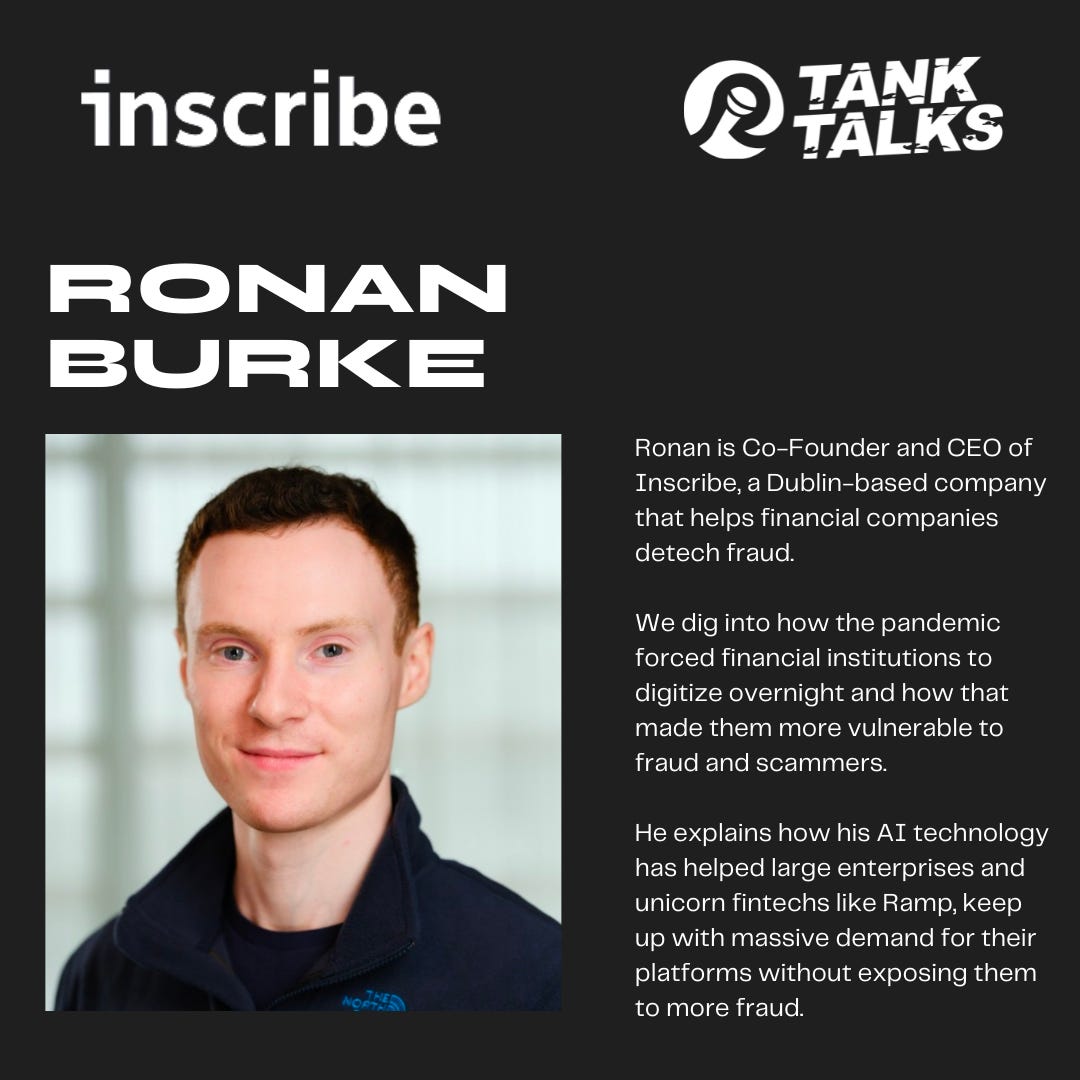
How AI is detecting Billions in Fraud with CEO of Inscribe Ronan Burke
There’s a lot of hype around AI—both its capabilities and the extreme predictions of its utility and potential harm to society. Our guest today is using AI to help reduce harm by detecting fraud at scale in the financial sector. Ronan Burke is Co-Founder and CEO of Inscribe, a platform that has a mission to save billions of dollars lost to fraud by onboarding trusted customers faster and finding bad-faith users quicker using AI.About Ronan Burke:Ronan Burke is the Co-Founder of Inscribe.ai, which he founded after graduating from University College in Dublin. He participated in YCS18 and Inscribe is trusted by companies like BlueVine, Petal, Fair, and Ramp, and backed by Y Combinator, Uncork Capital, Crosslink Capital, and Foundry Group.In this episode we discuss:01:37 Ronan’s path to founding Inscribe with his twin brother03:02 How they viewed startups growing up in Ireland04:44 Growing the startup ecosystem in Dublin05:20 The launch of Inscribe08:06 Deciding which brother was CTO and which was CEO09:52 Ronan experience at YC12:54 What fraud means to Inscribe and how the pandemic made their service even more urgently needed16:09 The ROI of Inscribe to onboarding customers and detecting fraud from preexisting customers19:29 The three steps Inscribe uses to validate customers21:54 How Inscribe searches the dark web for templates and other fraudulent activities23:33 How the volume of data helps their ML24:00 What a typical fraud case looks like25:28 The market size for fraud detection26:55 Competition to Inscribe28:00 What the sales process looks like when selling to large FinTechs30:19 Case studies for Inscribe31:53 How their fundraising process went33:23 Plans for the next few years34:20 Plans for a hybrid model workplaceFast FavoritesPodcastTim Ferris ShowNewsletter BlogSimon Taylor FinTech Brain FoodTech GadgetLogiTech Stream CamNew TrendHybrid WorkingBookPrincipalsLife LessonIf you care about something, double down on it.Follow Matt Cohen and Tank Talks here!Podcast production support provided by Agentbee.Agency This is a public episode. If you would like to discuss this with other subscribers or get access to bonus episodes, visit tanktalks.substack.com
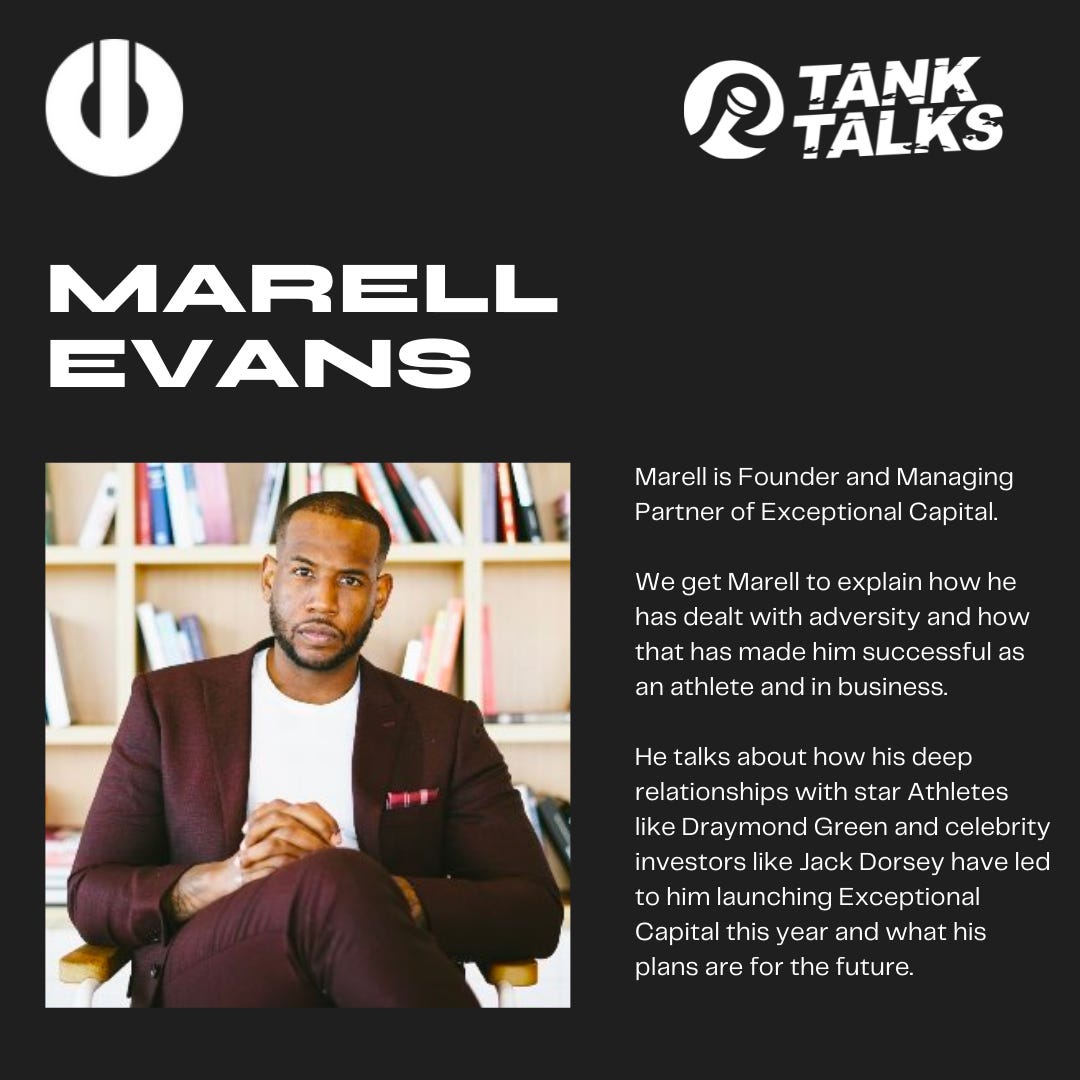
Exceptional Capital's Marell Evans on How Being a Top NCAA Athlete Helped Start a Career into VC
The rise of influencer to VC is starting to hit its stride. This has been an evolution from celebrities like Ashton Kutcher to newsletter writers like Packy McCormick. Our guest today is a part of that trend, moving from Division I college football player at the University of Michigan to sales at IBM and Okta, and now Marell Evans, Founder and Managing Partner of Exceptional Capital, is a rising star in the VC world. He is making an impact through his connections to sports and other high-impact individuals and his experience in sales and investing.About Marell Evans:Marell started his career in sales at IBM and Okta. He moved into the investing when he joined 415 in 2017, an early-stage fund founded by Owen Van Natta. From there he moved to Softback to help with their incubation and investing efforts and launched Exceptional Capital in 2022. He graduated from the University of Michigan.In this episode we discuss:01:41 Marell background and how he started playing football02:25 How Marell was the first college graduate from his family03:27 Who gave him motivation to succeed at an early age05:00 How Marell views the struggles in his early life06:59 The path from footbal to the tech world11:10 Why high-level athletes make strong hires13:37 Leadership is born and honed through sports14:38 Marell’s experience at Okta18:11 What it was like working at Softbank21:28 Lessons he took from his time at Softbank23:50 Marell’s relationship with Draymond Greene and what they have learned from each other26:27 Why athletes going into VC is a techtonic shift for good28:36 How Name Image Likeness is changing college athletics and how his career would have been different if that was in place when he played30:19 The fundraising process for Exceptional Ventures and how he attracted high-profile LPs33:57 What type of support his high-profile LPs have brought to Exceptional Ventures34:57 How to get in touch with MarellFast FavoritesPodcastAll In PodcastBlog/NewsletterFortune Deal TermsTech GadgetGarmin Fitness WatchNew TrendEmerging ManagersBookOutliersLife LessonDon’t let your humility compromise your competencyFollow Matt Cohen and Tank Talks here!Podcast production support provided by Agentbee.Agency This is a public episode. If you would like to discuss this with other subscribers or get access to bonus episodes, visit tanktalks.substack.com
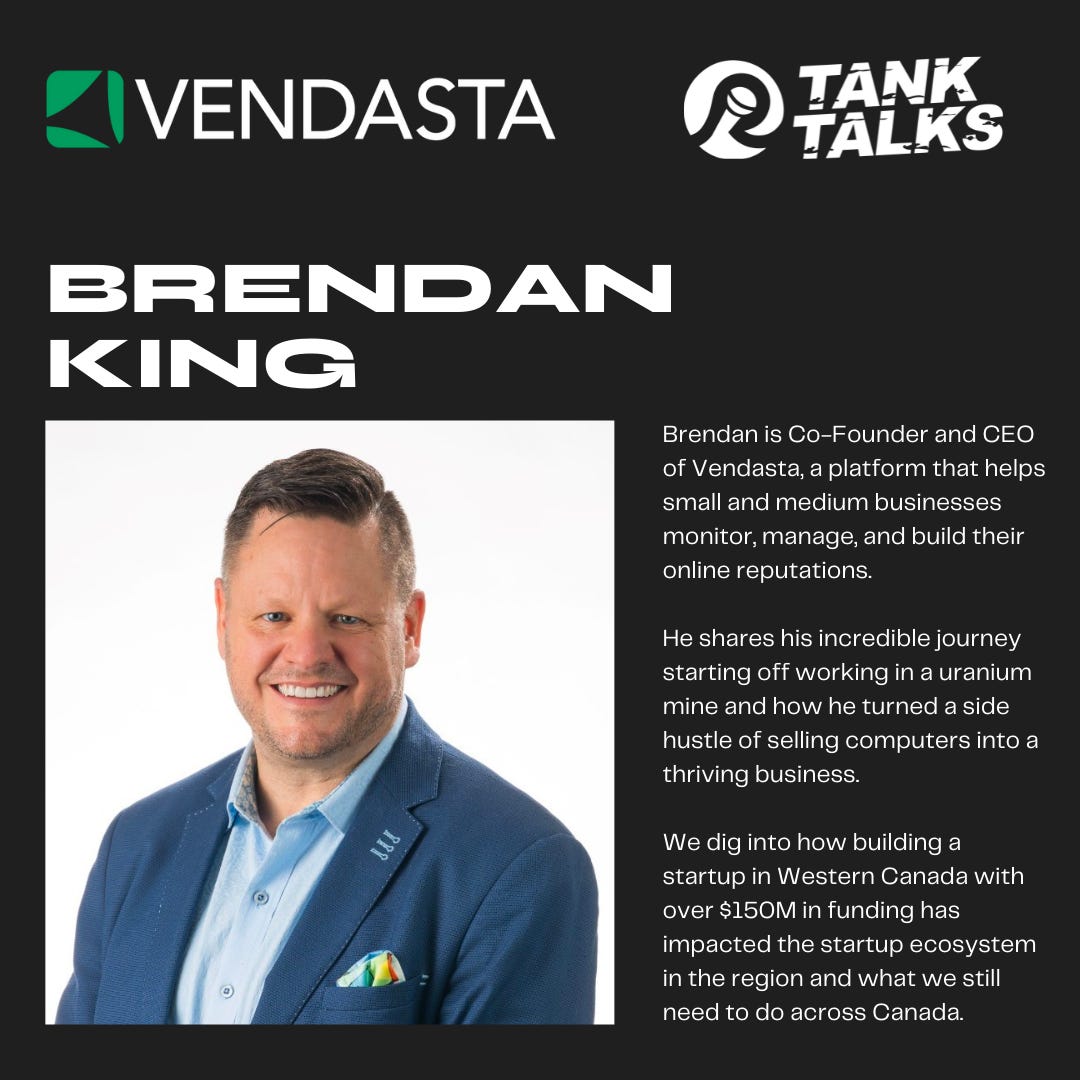
Vendasta CEO Brendan King on Building a Vibrant Tech Ecosystem for Small Businesses
We hear a lot about building a community and creating startup ecosystems, but what does that really look like? Our guest today, Brendan King, Co-Founder and CEO of Vendasta has built both a community-focused platform and has helped build the startup ecosystem in Western Canada. Vendasta helps small and medium businesses create SaaS offerings by combining best-of-breed software vendors and the expertise of local media companies.About Brendan King:Before founding Vendasta in 2008, Brendan served as COO and a Director of Point2 Realty solutions, growing its membership to over 165,000 agents and brokers in 85 countries. In 2007, he was named one of the '100 Most Influential Real Estate Leaders' by Inman News. Prior to that he founded and sold two successful computer retailing operations and also worked for Cameco Corporation as a Geophysicist. Brendan holds an Advanced Bachelor of Science degree in Physics from the University of Saskatchewan.In this episode we discuss:01:31 Brendan’s career journey04:39 Lessons he learned that gave him grit and stick-to-itiveness05:48 Why he and Vendasta are focused on the SMB segment07:15 How Vendasta helps serve SMB with a three-sided marketplace10:15 Pain points Vendasta addresses for SMB12:56 The mistakes he made and how they can solve problems for time-starved businesses14:28 Helping build a startup ecosystem in Western Canada16:51 The way Vendasta is adjusting to remote work19:50 Why resuburbanization is a trend moving forward21:52 How remote work is exposing Vendasta to stronger recruiting competition23:40 What Canadian investors can do to further accelerate the startup scene across the country28:02 What government in Canada has done to support Vendasta31:16 The decision of when to go public34:53 What other communities around the globe can do to jumpstart a startup ecosystemFast FavoritesPodcastAll InSaaStrNewsletter/BlogJames ClearDavid Skok For EntrepreneursTech GadgetNestNew TrendRemote Hybrid Organization DesignBookGood to GreatWorking BackwardsThinking Fast and SlowLife LessonBeing challenged is inevitable, being defeated is optionalFollow Matt Cohen and Tank Talks here!Podcast production support provided by Agentbee.Agency This is a public episode. If you would like to discuss this with other subscribers or get access to bonus episodes, visit tanktalks.substack.com
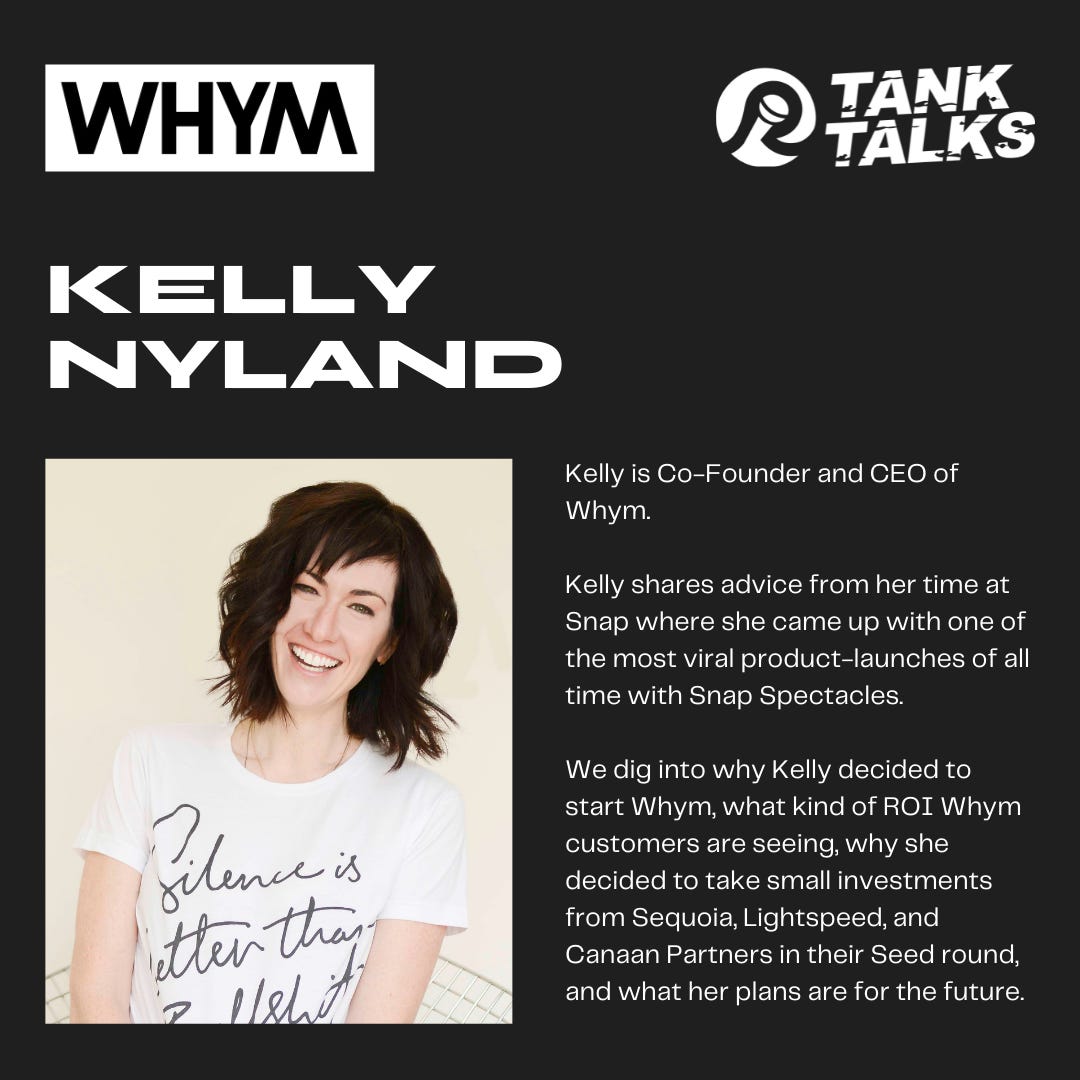
Whym's CEO Kelly Nyland on the power of conversational commerce
Finding new ways for e-commerce to connect with consumers is driving today’s guest, Kelly Nyland, Co-Founder and CEO of Whym, to help brands and retailers sell more products via SMS and messaging. Whym has raised $4.3M to build a conversational marketing platform that allows a direct relationship between buyers and sellers using messaging as the medium.About Kelly Nyland:Over the past 15 years, Kelly has had a hand in building four successful tech companies, two of which have realized public offerings during her tenure. As CEO Whym, she has garnered the support and backing of well-respected Silicon Valley investors.She has introduced over 120 digital products, software, apps, and consumer electronics to market in 40 countries. Kelly has worked across a variety of emerging technology sectors including mobile VR / AR, artificial intelligence, robotics, machine learning and voice-enabled TTS / STT.She has been responsible for helping startups launch, market, and grow both in the US and overseas. Kelly has lead international GTM and sales teams for over 20,000 points of sale, architected partnerships with Apple and Amazon teams, globally, and established B2B software partnerships for education and developer networks.In this episode we discuss:01:19 Kelly’s background and how she ended up Co-Founding Whym03:42 How the Snap Spectacles launch went down07:14 Lessons she learned from the launch of Snap Spectacles12:14 The initial idea behind Whym16:25 Streamlining the conversational marketing channels21:32 The IP around conversational marketing and early test cases23:16 How the conversational marketing process works for the consumers25:04 Why text is a vital channel27:40 Early adopters of conversational marketing30:48 How Whym works for brands and retailers31:42 The pricing model of Whym and the ROI for brands34:37 How their recent funding round went36:27 Whym’s future plansFast FavoritesFavourite BooksVenture DealsThe InevitableThe Physics of BrandLife LessonPower of will and tenacity will get you further than you knowFollow Matt Cohen and Tank Talks here!Podcast production support provided by Agentbee.Agency This is a public episode. If you would like to discuss this with other subscribers or get access to bonus episodes, visit tanktalks.substack.com
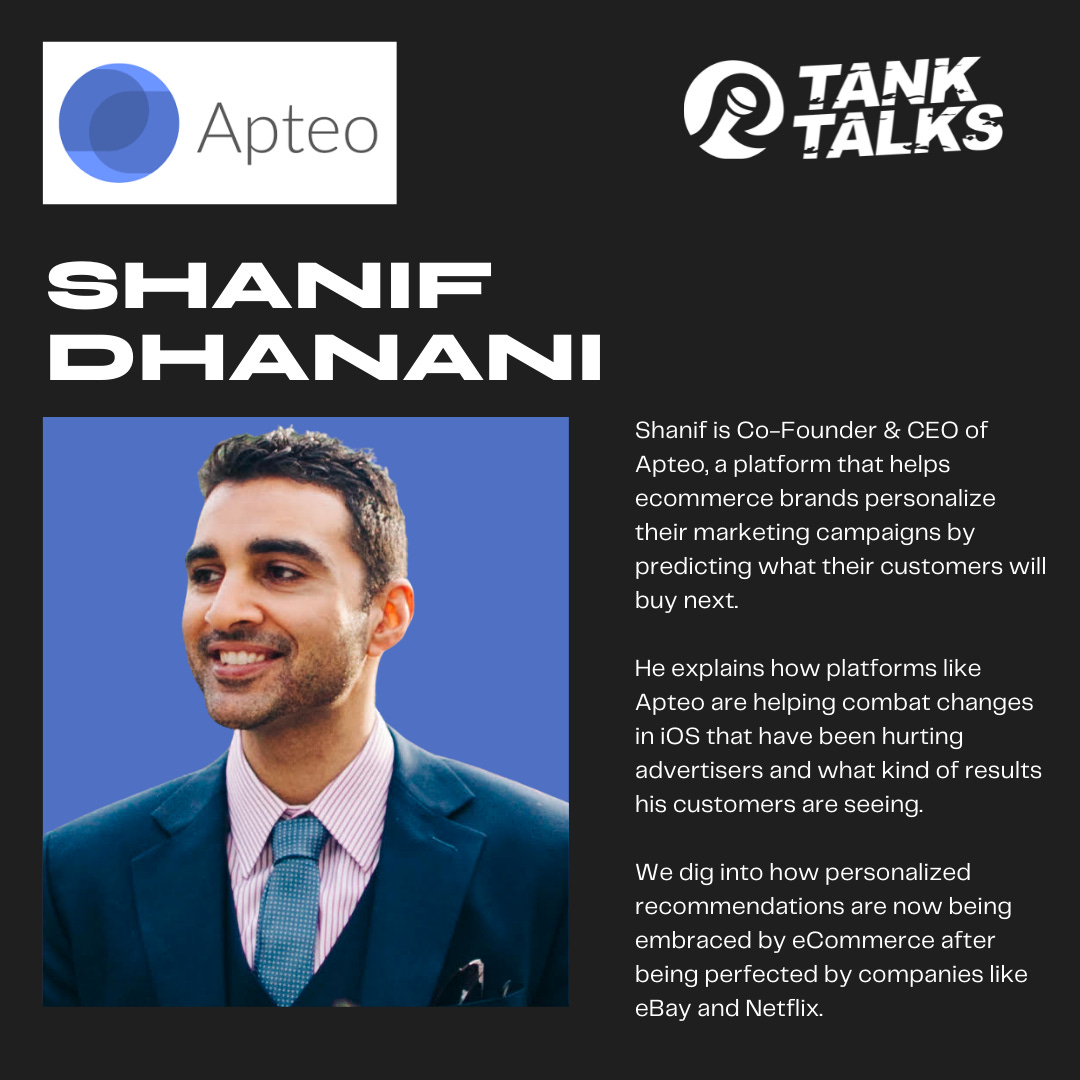
Apteo's Shanif Dhanani on How AI Can Help Advertisers Navigate Apples new iOS privacy Changes
We may be leaving a golden age of digital marketing, with the rise of Facebook ads, e-commerce and other small businesses were able to find their niche audiences at a fairly reasonable price. But changes to iOS have had broad impacts across many industries. Our guest today, Shanif Dhanani, Co-Founder and CEO of Apteo is hoping to throw a lifeline to marketers of all sizes with his AI-powered platform that helps e-commerce brands personalize their marketing campaigns by predicting what their customers will buy next. Their recommendation engine identifies high-probability upsell and cross-sell ideas for each customer and syncs those recommendations to email and SMS tools.About Shanif Dhanani:Shanif has been in and around the Startup world for his entire career. He was an early-employee and board member of a small startup in 2006 before moving to Booz Allen Hamilton. He went to Tap Commerce and was part of its acquisition by Twitter before he co-founded Apteo in 2019. He got his bachelor’s from the University of Virginia and his MBA from NYU Stern.In this episode we discuss:01:29 Shanif’s journey into startups and data science04:22 How Shanif views his own success05:20 Why Shanif is so public about sharing his life and journey07:08 How recommendations to consumers has evolved and improved over the years09:53 How AI and Natural Language Processing is improving recommendations13:19 Why e-commerce is waking up to the power of recommendations16:43 How Apteo works for e-commerce and some case studies21:48 What the recent changes to iOS are and how they are affecting e-commerce24:41 How Apteo can help fill the void left from the iOS changes30:17 How e-commerce sites can start with platforms like Apteo33:11 The longterm vision for ApteoFast FavoritesPodcastStartup SchoolNewsletter/BlogNeil PatelHomebrewTech GadgetAlexaNew TrendPeople leaving jobs they don’t want to be inBookThe Wealthy BarberLife LessonIt’s always about the peopleFollow Matt Cohen and Tank Talks here!Podcast production support provided by Agentbee.Agency This is a public episode. If you would like to discuss this with other subscribers or get access to bonus episodes, visit tanktalks.substack.com

Fathom CEO Richard White on Finding Success in a Crowded Market
We know that one of the most valuable skills that a founder can have is grit. That determination to succeed and take their idea from a dream into reality. Our guest today has a ton of grit and we dive deep into his storied journey from being amongst the early companies at YC to becoming a member of a recent YCW21 class. Richard White is the founder and CEO of Fathom Video, an app for Zoom that allows you to record and highlight, in real-time, your Zoom meetings so you can write your notes later or skip the notes completely and share clips from your calls with colleagues. Ranked #1 Zoom App on the new Zoom App Marketplace, #1 Product of the Day, and #5 Product of the Month for Dec 2021. Fathom also recently raised a $4.7M seed round from a number of great investors including the CEOs of Twitch, Justin and Emmet, Reddit, Cruise, Clearbit, and many more.About Richard White:Richard White has been a founder and deeply entrenched in the Silicon Valley startup scene for the last two decades. He was Product Design lead at Kiko.com, the startup that Justin Kan and Emmett (subsequent founders of Twitch.tv) sold on ebay for $258K. He went on to found UserVoice where he is still chairman of the board. He founded Fathom Video in 2020 and was in YC Class of Winter 2021.In this episode we discuss:01:29 Richard’s journey to founding Fathom Video02:48 Being an early-employee at a YC05 company05:27 Childhood experiences that helped shape him07:04 Why he decided to start a company inside the Zoom eco-system09:15 Why being in a “crowded market” didn’t scare away Richard from starting Fathom Video12:13 Getting comfortable with Zoom itself as a potential competitor13:37 When he first heard about the Zoom App marketplace14:53 Thinking about competition and moving users to use something better17:25 His process of customer discovery and interview to help define a product that was 10x better20:13 What questions founders should ask themselves before entering a crowded market21:09 Best ways to onboard customers so that they experience instant success24:38 Talking about investors about their crowded market26:49 When to launch and how long you should build in private28:34 Richard’s fundraising journey for Thrive Video32:22 Fathom Video’s plans for the future33:40 How to get to product-led growth quicker34:30 The status of Fathom Video’s relationship with ZoomFast Favorites:PodcastThe QuestNewsletter/BlogPassTech GadgetSamson Q2UNew TrendCrypto WinterBookObviously AwesomeLife LessonDon’t be afraid to cold email peopleFollow Matt Cohen and Tank Talks here!Podcast production support provided by Agentbee.Agency This is a public episode. If you would like to discuss this with other subscribers or get access to bonus episodes, visit tanktalks.substack.com
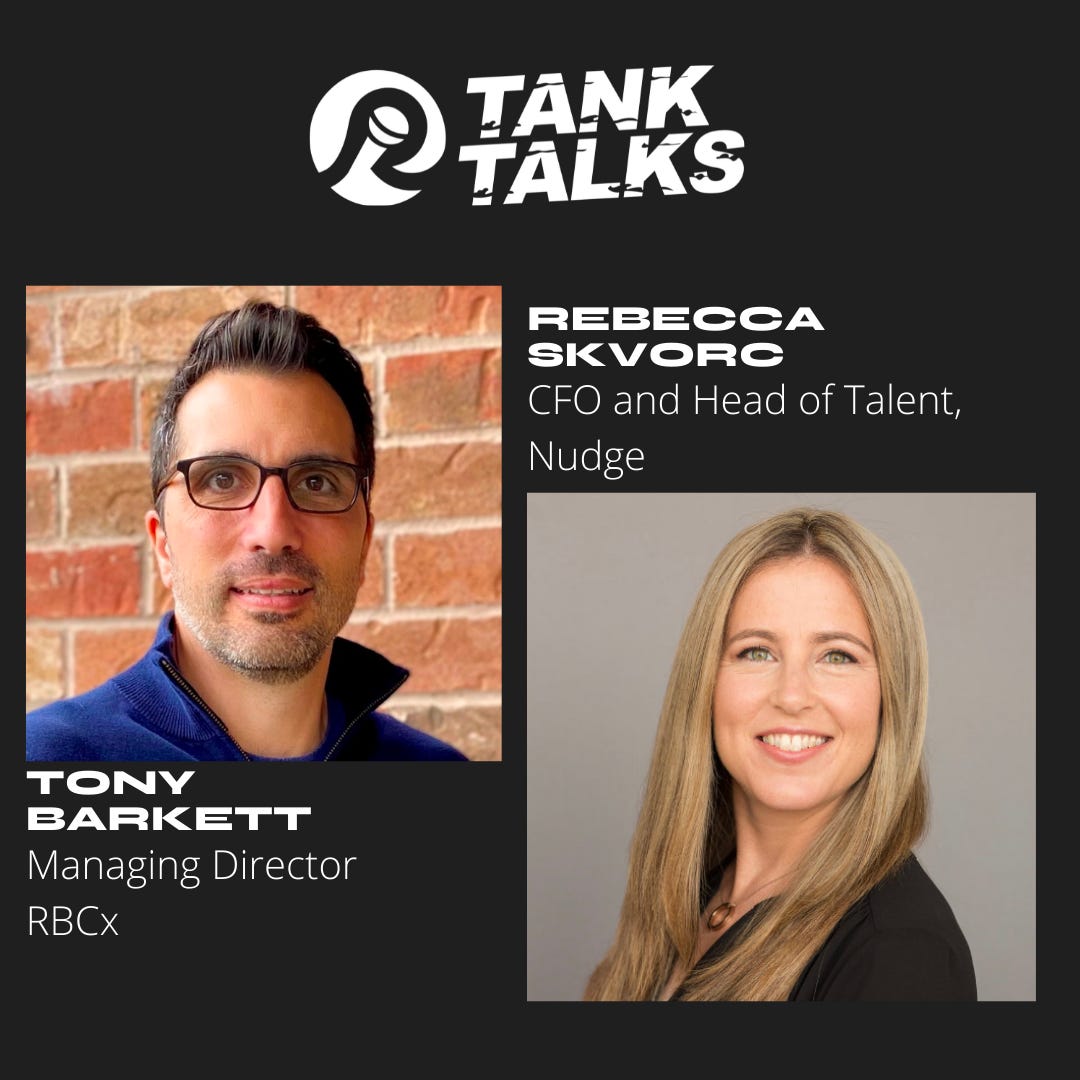
Tony Barkett from RBCx and Nudge's Rebecca Skvorc on Using Debt Strategies to Scale Your Startup
One of the most misunderstood calculations a founding team can make is when to exchange equity for capital and when you should turn to Venture Debt. We are a Venture Fund, but we are also partners with our founders, and we know that sometimes the better option is Venture Debt. Today’s guests, Tony Barkett, Managing Director of RBCx and Rebecca Skvorc, CFO and Head of Talent at Nudge, talk through the Venture Debt process and when it works (and when it doesn’t)About Tony Barkett:Tony Barkett leads the delivery of industry-tailored capital financing, business advice, and solutions that go beyond traditional banking. And when he isn’t busy supporting the growth of innovative companies in Canada, he’s a sports coach for his two sons and an avid golfer. He started his career at SVB, and did his undergrad at the University of Massachusetts, Amherst.About Rebecca Skvorc:Rebecca has 19 years of progressive and diverse financial experience. Prior to her roles at Nudge, she was an SVP at Wave HQ, she’s been in operations and banking for the last 19 years and has successfully closed US$55m in financing over 5 rounds. She got her bachelor’s at Wilfrid Laurier University.In this episode we discuss:01:16 Their journey into the tech eco-system03:17 What is venture debt and why is it issued04:38 How Venture Debt has evolved over the last few decades05:54 Venture Debt from an operator’s perspective07:51 Timing to take on Venture Debt as a startup10:41 Incentives for Debt providers to find high-growth companies11:26 How a company can know its ready for a debt-facility13:53 How Rebecca knew Venture Debt was the right course for her companies15:28 The starting points founders should consider when looking at Venture Debt18:55 Other risks founders should consider when looking at Venture Debt21:19 How Venture Debt is evolving for later-stage companies22:47 When should founders look at cleaning up their debt23:42 Can you use equity to solve a debt problem?24:38 Lessons Rebecca learned from her time at Wave HQ25:45 Picking the right lender for you Venture Debt26:53 How Tony has helped companies survive s**t-hitting-the-fan moments29:19 The importance of honesty and transparency with your bankers and investors31:00 Exciting things about today’s Canadian tech eco-systemTony’s Fast Favorites:PodcastTank TalksNewsletter/BlogTerm SheetGadgetiPhoneNew TrendGoing OutsideBookThe Hard Thing About Hard ThingsLife LessonTeach them to fish, don’t give them a fishRebecca’s Fast FavoritesPodcastAll In PodNewsletter/BlogTim FerrisGadgetiPhoneNew TrendTravellingBookThe EconomistLife LessonHold your loved ones closeFollow Matt Cohen and Tank Talks here!Podcast production support provided by Agentbee.Agency This is a public episode. If you would like to discuss this with other subscribers or get access to bonus episodes, visit tanktalks.substack.com
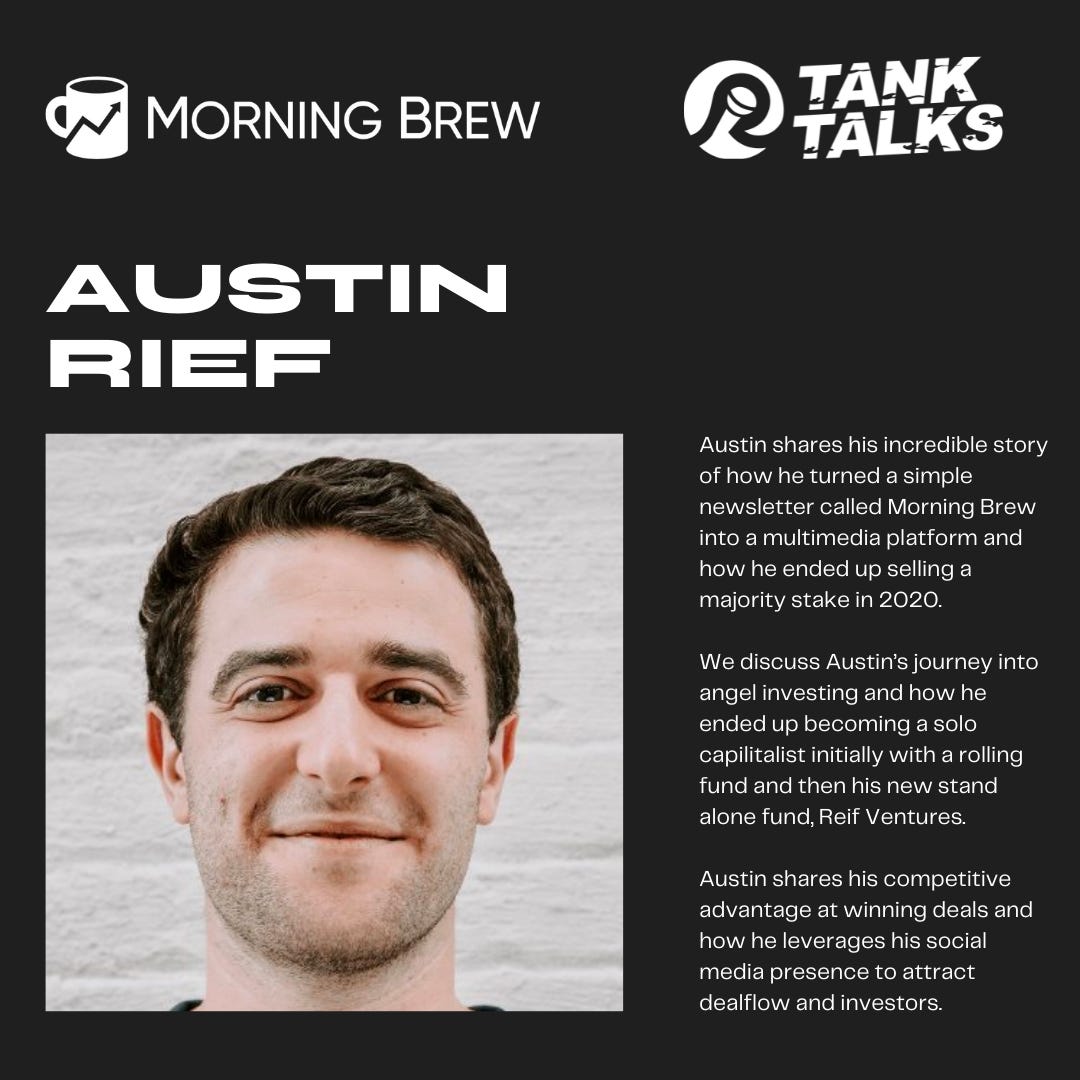
Morning Brew CEO Austin Rief on the Rise of the Solo Capitalist
With the disaggregation of traditional media, the popularity of influencers, and the unraveling of ad platforms like Facebook, creating a community through content has never been more important. Our guest today knows about the power of content and how it can grow into something world-changing. Austin Rief, is the CEO and Co-Founder of Morning Brew, an online media powerhouse that was founded as a newsletter in the dorms of the University of Michigan in 2015. Its impact and growth quickly became apparent and in 2020 it sold a majority interest to Business Insider for a reported $75M. Austin is also a solo capitalist at his fund, Austin Rief Ventures.About Austin Rief:Austin started at the University of Michigan as a Finance major in 2014, and he left 3 years later with a degree and was well on his way to becoming a media mogul. Co-Founding Morning Brew in 2015 and was originally the COO, he became the CEO in 2021. He also started a rolling fund on Angel List and parlayed that into Austin Rief Ventures, a seed-stage fund.In this episode we discuss:01:34 The early days of bootstrapping Morning Brew02:13 Early expectations for Morning Brew03:41 Lessons learned from the M&A process05:16 Why they decided to sell in 202006:24 What the internal conversations were like around the sale07:48 Why Austin decided to start investing09:28 Reasons why founders seek him out to be on their cap table11:58 Why he believes content and social media can help founders14:31 How his due diligence process works15:50 Favorite questions he likes to ask founders17:27 How he views portfolio construction19:28 Getting allocations in competitive rounds20:33 How he views founders with stacked SAFE rounds21:44 Why it’s okay for founders selling on the secondary24:00 How top funds will need to adapt to smaller investors getting pro rata25:05 Working and attracting LPs as a solo capitalist27:06 Austin’s skillsets that founder come to rely on28:15 The importance of finding a CEO coach31:31 What Austin is most excited about in the startup space34:48 Why it’s important to be in the best companies36:41 The future of Crypto and Defi and why he invested in Rare Circle40:26 Thoughts on the new YC deal structure42:40 What Austin has learned from his misses46:14 Plans for Rief VenturesFast Favorites:Podcast:Trillionaire MindsetAll-InNewsletter/BlogMorning BrewBen ThompsonPack McCormickTech GadgetEight Sleep MattressNew TrendThe feud between threads and shitpostersBook:Not Fade AwayWhen Breathe Becomes AirLife Lesson:Focus on increasing luck’s surface areaFollow Matt Cohen and Tank Talks here!Podcast production support provided by Agentbee.Agency This is a public episode. If you would like to discuss this with other subscribers or get access to bonus episodes, visit tanktalks.substack.com

Founder & CEO of Meez, Josh Sharkey, on Building the Operating System for Chefs
A clear trend is these days is the Ops movement. DevOps, AdOps are the most well-known, but more and more support functions are having dedicated systems and platforms created to help support their roles.Our guest today, Josh Sharkey, Founder and CEO of meez, is pioneering the Food Tech space and creating a Google-Drive for restaurants and chefs. He talks about being a non-technical founder and why he wanted to build a dedicated platform for chefs.About Josh Sharkey:Josh started his career as a line cook working for renowned Chef Rick Moonen, he worked his way up the ladder in the NYC food scene (including working with Mario Batali) and became Chef at Gray Cafe in 2004. In 2009, he founded his own restaurant chain, Bark Hot Dogs. From there Josh became COO at Aurify Brands in 2016. Aurify includes chains Five Guys and Le Pain Quotidien. He founded meez inside Aurify in 2017 while still COO, and went full-time at meez in 2020.In this episode we discuss:01:28 How Josh’s journey in the restaurant industry lead him to founding meez04:29 Lessons learned from his first startup Bark Hot Dogs07:06 The early inspiration for meez08:22 The off-the-shelf solutions he tried prior to building something for himself09:54 Why chefs have been forgotten in technology solutions prior to meez12:26 How Josh’s experience has shaped the product offering from meez13:29 Finding user adoption in the chef community14:50 The process of building his MVP16:16 The preconceived notions that needed to rechecked after getting user feedback18:16 Why meez is finding traction20:36 How the vision for the company has evolved as more customers have onboarded21:31 Meez’s data strategy currently and moving forward24:32 Content strategy for meez26:10 What Josh cooks for his family27:41 How recipes add into meez and work for him29:42 Plans for the recent $6.5m seed round with Stuck Capital and Craft Ventures alongside the Founder of Bento BoxFast FavoritesPodcastStarting GreatnessBlogFirst Round ReviewTech GadgetOura RingPitchTrendGig economyBookSiddharthaZero to OneMythical Man-MonthLife LessonEverything is my fault.RecipeFresh pizza doughFollow Matt Cohen and Tank Talks here!Podcast production support provided by Agentbee.Agency This is a public episode. If you would like to discuss this with other subscribers or get access to bonus episodes, visit tanktalks.substack.com

Democratizing access to Startups and Venture Capital with Dominic Lau, Founder of RippleX
Today we take a deep dive into the Ripple X Fellowship, with its Founder, Dominic Lau. The world of startups and venture capital can be the road to providing immense value to consumers, founders, and investors, but it also can look like a brick wall to those without insight, connections, or knowledge of it all works. The RippleX Fellowship program gives students looking to become Founders and Investors access to that knowledge, as well as, a cohort of like-minded people to collaborate with.Founded in 2019, the RippleX Fellowship recently launched its tenth cohort and is now making its curriculum open to the public at ripplexfellowship.thinkific.com for students globally to help democratize access to startups and venture capital.About Dominic Lau:Dom joined Ripple Ventures as its first employee right after graduating from Waterloo and has been an integral part of building the firm from day one. He is Principal at Ripple Ventures and runs the RippleX Fellowship and is a Board member on several of Ripple’s Portfolio companies.In this episode we discuss:01:30 Dom’s background and why he wanted to jump into Venture investing02:43 How he got hired at Ripple Ventures04:02 Why Dom started the RippleX Fellowship07:46 What it was like to launch the first RippleX cohort10:19 How the program has evolved over the years11:51 How the fellowship grew to beyond Matt and Dom’s personal networks and into the US13:08 The pitch to participants to get them to apply and thrive in the program14:40 Success stories from the RippleX Fellowship18:05 Other benefits of participation in the fellowship19:22 The importance of the alumni network22:00 Focus of the 10th cohort and moving forward24:33 Why Dom decided to open up the curriculum to anyone27:21 The importance of persistence when applying to programs like the RippleX Fellowship28:15 The long-term vision of the RippleX Fellowship29:03 Why the RippleX Fellowship prides themselves on diversityFast FavoritesPodcastBeautiful Stories from Anonymous PeopleNewsletter/BlogVeradi VerdictTech GadgetNinja CoffeemakerNew TrendWeb3 Gaming (Here’s Dom’s Blog Series on Web3)BookMaybe You Should Talk To SomeoneLife LessonMomentum is EverythingFollow Matt Cohen and Tank Talks here!Podcast production support provided by Agentbee.Agency This is a public episode. If you would like to discuss this with other subscribers or get access to bonus episodes, visit tanktalks.substack.com
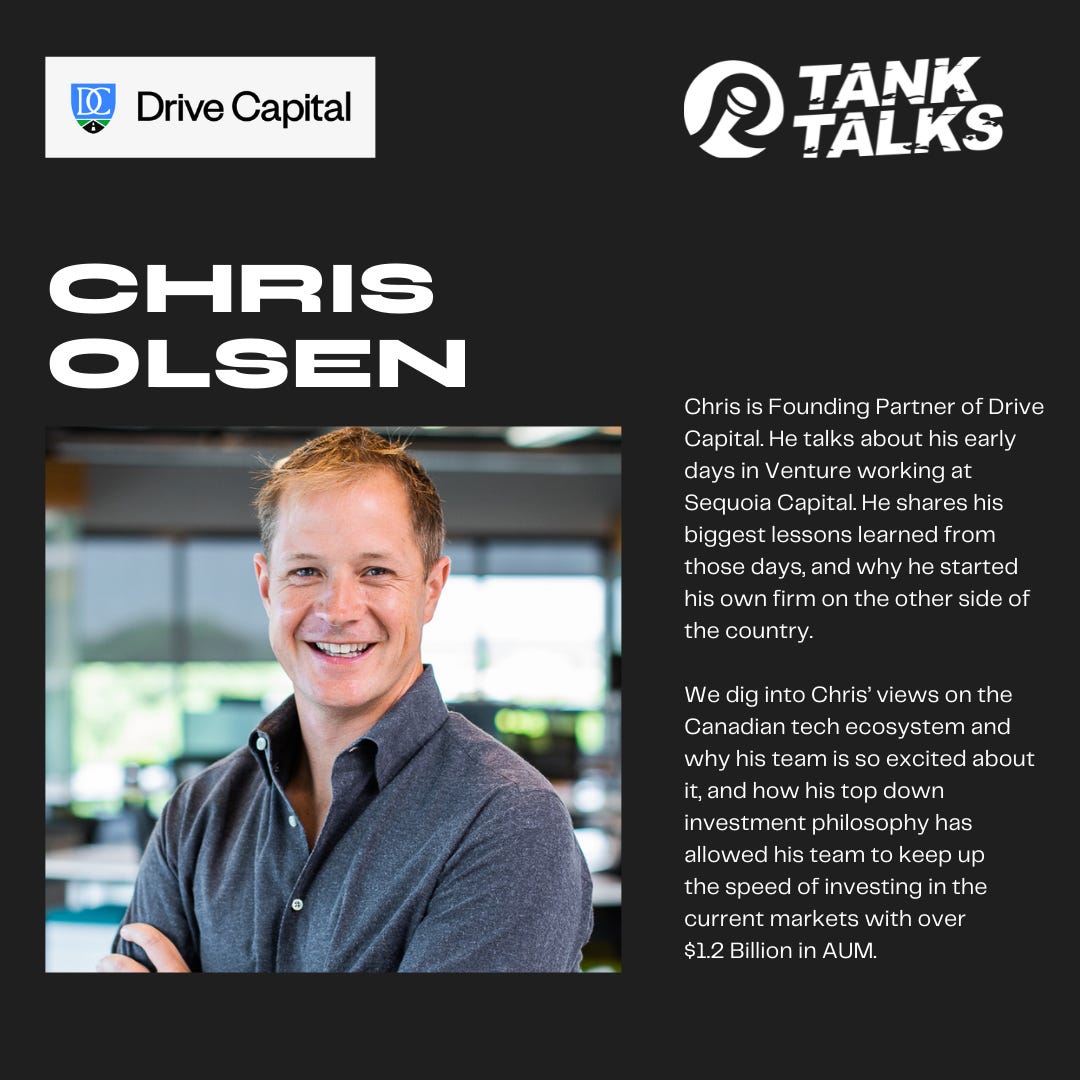
Drive Capital's Chris Olsen on Why Investing in the Mid-West is Better Than the Old West
Investors from the coasts can fall into the flyover trap, looking only for opportunities in larger coastal Metros like Silicon Valley or NYC, but our guest today Chris Olsen, Founding Partner of Drive Capital, threw conventional wisdom to the wind by leaving a job at Sequoia Capital and moving to Columbus, Ohio to raise a new fund and bet on founders in underserved geographies. Since then, Drive Capital has grown to $1.2B AUM and its portfolio includes Duolingo, Udacity, Lightstream, Root Insurance, and Comply360.About Chris Olsen:A native of Cincinnati, Chris is a Co-Founder and Partner of Drive Capital, a Columbus-based venture capital firm focused on investing in world-class technology companies outside of Silicon Valley. Prior to founding Drive, Chris was a Partner at Sequoia Capital for six years and helped launch the firm’s first growth fund. Chris’ first job out of school was on the professional squash circuit where he quickly learned he was better suited to work with entrepreneurs.In this episode we discuss:01:36 How Chris’ time at Sequoia Capital shaped him as an investor04:52 Biggest winners and some of the lessons he took away07:02 What he learned from the misses during that time08:33 The importance of teams and iteration for early startups10:03 The aha moments of when he saw the opportunities outside of Silicon Valley14:32 The reality of being comfortable when you are starting something new18:20 How he found his co-founders and why he moved before the fund had closed23:52 Factors that Drive Capital looks at when investing in an underserved geography25:35 How new ecosystems are made and how institutional dollars flow into new cities27:58 Why Canada has been a focus of Drive’s recent investment30:19 How Canada’s founders differ from US founders and why immigration is Canada’s secret weapon32:42 Why Chris like founders to take big swings to create large enterprises36:02 The culture of speed that Drive Captial has built and how founders should think about working with them39:51 What Chris is excited about and nervous about in the current VC market43:23 How Drive’s business model has evolved over the last 8 yearsFast FavoritesPodcast20 Minute VCBlog/NewletterThe EconomistTech GadgetTesla Model XNew TrendGrowth of capital and companies outside of Silicon ValleyBookThe Old Man and The SeaLife LessonYou’ve got to fail until you succeed.Follow Matt Cohen and Tank Talks here!Podcast production support provided by Agentbee.Agency This is a public episode. If you would like to discuss this with other subscribers or get access to bonus episodes, visit tanktalks.substack.com
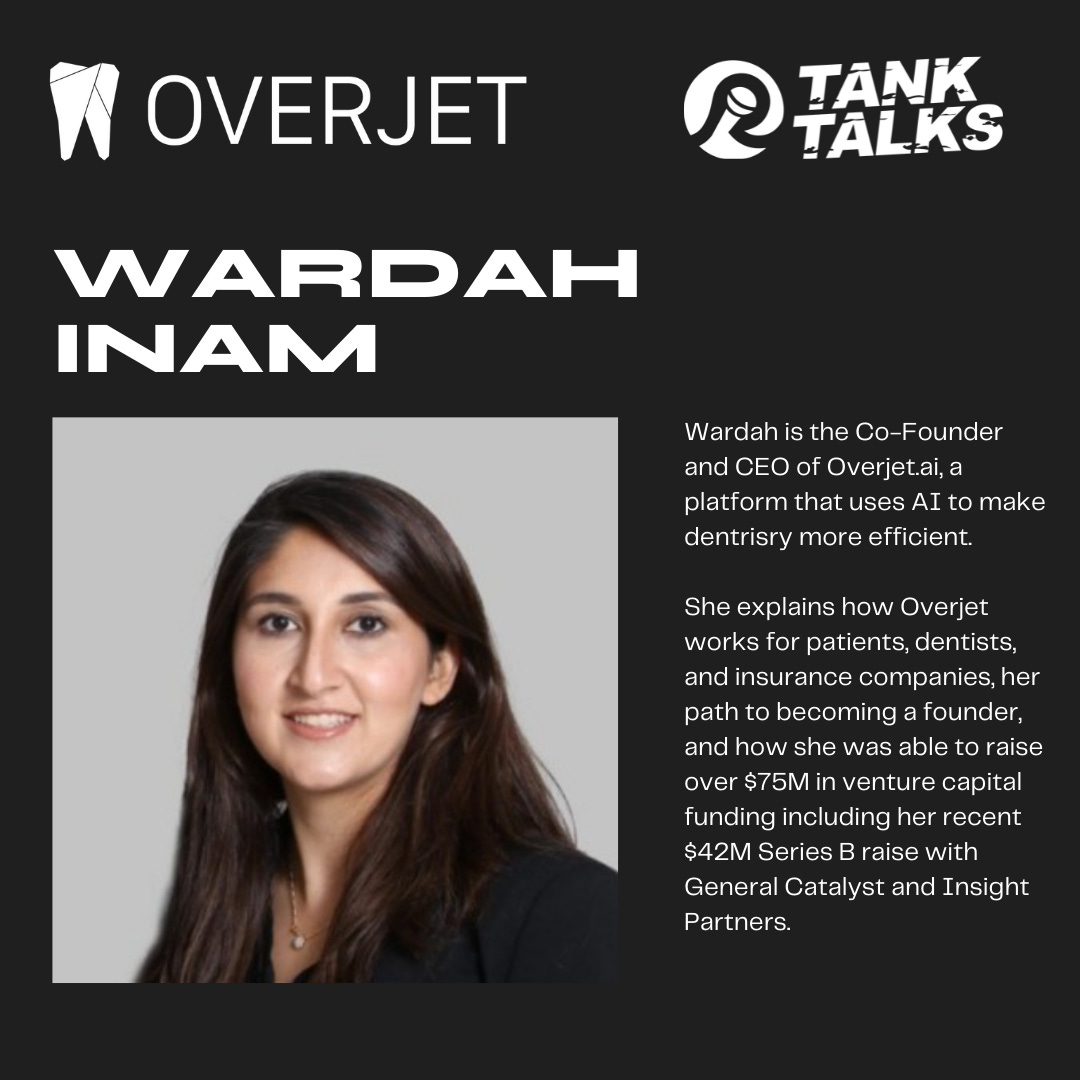
Overjet CEO Wardah Inam on Building the Future of Dentistry
The healthcare industry offers a tremendous opportunity for entrepreneurs, and the Dental Instrusty, in particular, is experiencing rapid change and transformation with advancements in imaging and analysis. Our guest today, Wardah Inam, Co-Founder and CEO of Overjet is improving the accuracy of dental x-rays and reducing costs for providers and insurance companies. Overjet recently closed a $42M Series B with General Catalyst and Insight Partners, and has raised $75M in total venture financing.About Wardah Inam:Wardah Inam has been a robotics and AI researcher, operator, and now founder for the last 15 years. After completing her undergraduate work at Ghulam Ishaq Khan Institute of Engineering Sciences and Technology, Wardah came to Boston to finish her schooling at MIT/Havard Business School for a Masters and PhD. After working in product management at Q bio, Wardah co-founded Overjet in 2018.In this episode we discuss:01:38 Wardah’s journey to starting Overjet02:54 How she came to the dental industry04:11 Finding her co-founders and starting the business04:58 The experience of starting Overjet at the Harvard Innovation Labs05:50 What Overjet’s mission is and how it works07:32 How Overjet got access to providers09:54 What Overjet does to solve pain points in the dental industry using AI11:58 How Dental Service Organizations are using to Overjet to drive efficiency14:56 The ways insurance companies are using Overjet and how they got their first insurance customers17:54 Their sales process now that they have momentum and trust in the marketplace18:47 Detecting suspicious claims using Overjet’s AI21:42 Going beyond cavity detection into tumor detection22:57 Overjet’s testing process and better than dentist bar they set for themselves and FDA clearances25:38 How Overjet is used by dentists as a communication tool to patients28:14 The pricing model for Overjet and how that evolved29:30 Learnings from their pricing experimentation32:13 Plans for their recent raise and the long term vision for OverjetFast FavoritesPodcastAll In PodcastNewsletter/BlogTBD ;)Tech GadgetAirpodsNew TrendDigital NomadBookHigh Growth HandbookLife LessonEverything you put in the world is a reflection of youFollow Matt Cohen and Tank Talks here!Podcast production support provided by Agentbee.Agency This is a public episode. If you would like to discuss this with other subscribers or get access to bonus episodes, visit tanktalks.substack.com

Eclipse Ventures Founder Lior Susan on Investing in Old-Line Industries post-COVID
There are few experiences more loaded with lore and mystique in the western world than the Israeli kibbutz and being a soldier in the special forces. Our guest today is Lior Susan, Founding Partner at Eclipse Ventures, and he has lived both of those lives, as well as, being a successful founder and operator, and a non-consensus venture investor. Eclipse invests in founders who want to bring the full-stack approach to legacy industries and build digital bridges to the physical world. They have $2.6B in AUM. Lior’s investments include Bright Machines, Augury, Cheetah, Owlet Baby Care, June Life, Insidepacket, and Lucira Health.About Lior Susan:Prior to launching Eclipse in 2015, Lior was Founder and General Partner at LabIX, the hardware investment platform of Flextronics where he led investments in companies across energy storage, wireless/infrastructure, 3-D optics, additive manufacturing, and robotics.Lior also co-founded Farm 2050, an AgTech Collective, with Innovation Endeavors to address the global food challenge. Prior to LabIX, he was part of the founding team of Elementum, the Flex proprietary SaaS platform, which was later spun out. Before moving to Silicon Valley, Lior was a serial entrepreneur in Tel Aviv, where he helped build Intucell, which was sold to Cisco in 2012. Lior is a reservist of an elite Special Forces unit in the Israel Defense Force.In this episode we discuss:01:47 How Lior’s experience growing up in a kibutz shaped his worldview05:47 What being in the military and special ops taught him07:06 How he and his brother were able to turn a $5M investment in their startup into a $475M exit to Cisco in two years10:10 Why he joined an established company after his startup experience12:29 What he learned about supply chain management and why he started thinking about founding Eclipse16:02 Why Lior wanted to back founders looking to disrupt old-line industries and the early LPs that believed in him18:07 How Lior overcame his lack of track record as an investor when he first started Eclipse19:55 Eclipse’s track record before and after Covid21:28 Timing signals on when to invest in disruptive technologies26:29 Is updating the supply line just about automation and replacing workforce?28:54 How Covid is refocusing supplychains away from global suppliers32:08 Advice for founders looking to disrupt and sell into legacy industries33:35 Why he recommends to his founders to go after larger players first instead of SMB35:02 The importance of finding a design partner36:30 What Lior is telling his companies about how deal with inflation38:59 Why founders should avoid exclusivity40:40 The strategy around Eclipse’s two newest fundsFast FavoritesPodcastBridgewaterNewsletter/BlogWall Street JournalTech GadgetOwletNew TrendClimate InvestingBookThe Art of WarLife LessonWhen you don’t build, you don’t break.Follow Matt Cohen and Tank Talks here!Podcast production support provided by Agentbee.Agency This is a public episode. If you would like to discuss this with other subscribers or get access to bonus episodes, visit tanktalks.substack.com
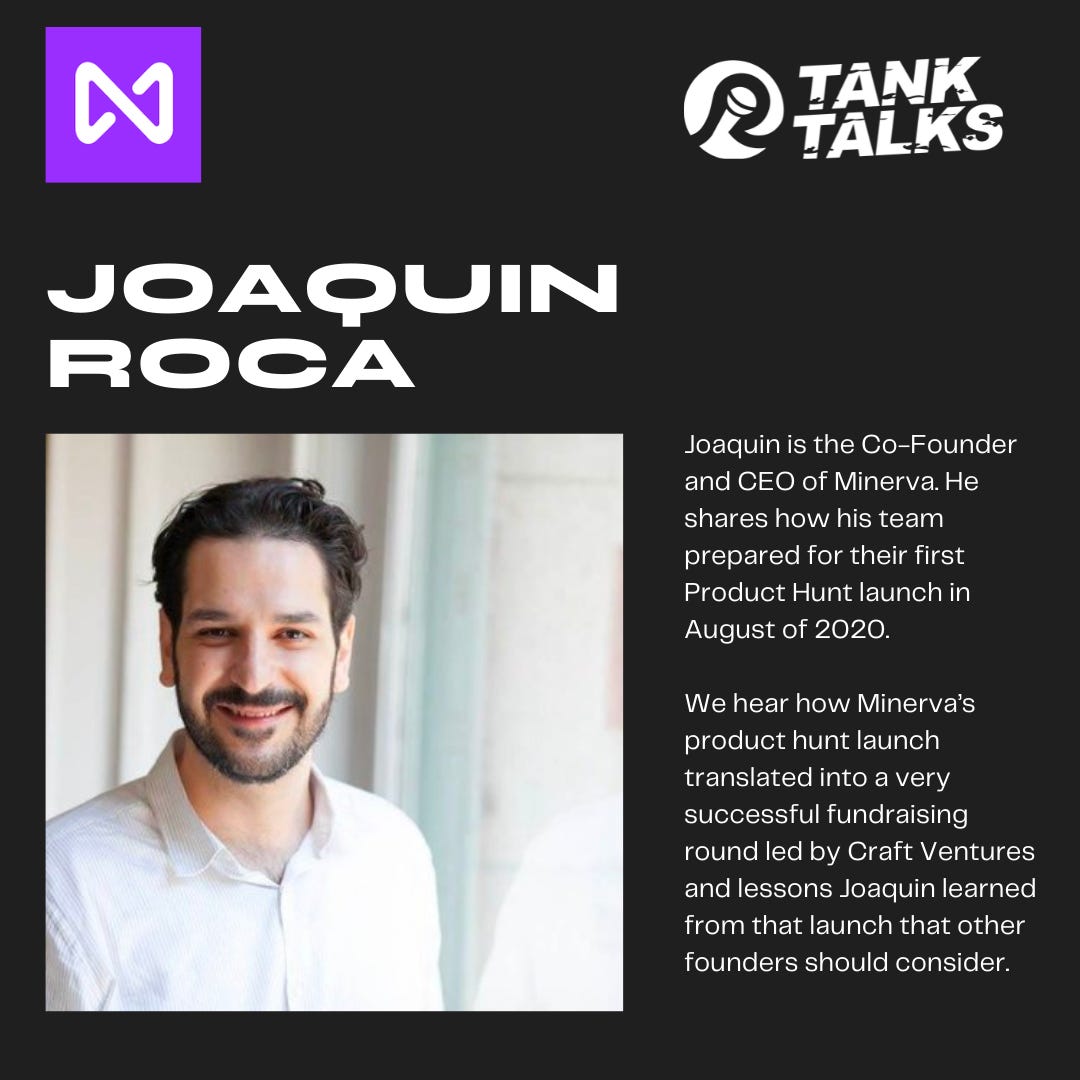
CEO of Minerva Joaquin Roca on Creating The Perfect Product Hunt Launch
A great launch can change the trajectory of your startup, and one of the places you can have a great launch is on Product Hunt. So how can you set yourself up for success on that platform?Our guest today, Joaquin Roca, Co-Founder and CEO of Minerva, a Chrome extension that allows you to easily create training guides, and has had multiple successful Product Hunt launches. He talks through some strategies and what he’s learned about launching and running a startup over the last few years.About Joaquin Roca:Joaquín V. Roca is a seasoned organizational consultant with wide-ranging experience. In addition to consulting, Joaquín has founded two technology companies built to help managers learn to become great leaders (LeaderNation and the Scaffold). As an entrepreneur Joaquín has played every role imaginable from sales rep, to accountant, and from designer to software engineer.Prior to Minerva, Joaquín has an extensive background in teaching at the graduate and undergraduate levels, where he has designed and delivered courses on varied topics including organization development, statistics, research design, creativity, innovation, and leadership.He then became a consultant working with startups (e.g., SumAll, Eyeview, Datadog, Digital Ocean), large organizations (e.g., Hyundai Capital America, Pfizer, American Express), and government and non-government organizations (e.g., UNICEF, UNFPA, the Borough of Lansdale Pennsylvania).Joaquín did his undergrad at NYU and graduate work at Columbia.A word from our sponsor:Ripple Ventures is always focused on helping our founders and CEOs find the best partners to work with. But before we introduce any provider to our companies, we always make sure we try the product first. And when it comes to managing business expenses at Ripple, we were super excited when the team at Jeeves came knocking on our door.Jeeves helped get me and my team setup with physical and virtual credit cards in days. I was able to allow my teammates to expense items in multiple currencies allowing them to pay for anything, anywhere at any time. We weren’t asked for any personal guarantees or pay any setup or annual fees either. Not only does Jeeves save us time, but they also give us up to 3% cashback on our purchases including expenses like Google, Facebook or AWS every month. The best part, Jeeves puts up the cash, and you settle up once every 30 days, unlike some other corporate card companies that make you pre-pay every month. Jeeves offers a truly all-in-one expense management corporate card program for international startups and we at Tank Talks could not be more excited to partner with them. Listeners of Tank Talks can get set up with a demo of Jeeves today and take advantage of a $700 discount and skip the waitlist by visiting tryjeeves.com/tanktalks to learn more.In this episode we discuss:02:28 Joaquin’s journey to starting Minerva03:46 The most difficult manual guide he made prior to Minerva04:34 Minerva’s beta process and how the team knew they were onto something06:10 Early use cases and how they found early users08:04 The importance of iterating while defining your Ideal Customer Profile09:16 Why they decided to launch as a Chrome extension11:22 Surprising use cases that have popped up on the platform12:58 What they did prior to launching on Product Hunt14:53 The community’s response to the Product Hunt Launch16:10 What the “mission control” looked like during the launch17:42 Their research process prior to launching19:06 Minerva’s social media strategy on launch day21:20 Jaoquin’s general approach to social media and building in public22:32 How they closed their seed round after their first Product Hunt launch25:46 Looking back on how their fundraising went and how it forced him to step up27:52 Where they ended up after that first Product Hunt launch and what the immediate effect was on their business30:21 the biggest lessons from his Product Hunt launches33:16 How Joaquin is still trigger shy to hire a new head of sales and what steps he’s taking for long-term sales success36:01 Immediate plans for using their $4M Seed round lead by Bryan Rosenblatt Craft VenturesFast FavoritesPodcastShay AnythingNewsletter/BlogMario GabrieleTech GadgetGoogle PixelTrendTikTok as User Acquisition ToolBookIf On A Winter’s Night, A TravellerTeam of RivalsGetting to YesLife LessonDon’t take it too seriously, you’re not getting out alive.Follow Matt Cohen and Tank Talks here!Podcast production support provided by Agentbee.Agency This is a public episode. If you would like to discuss this with other subscribers or get access to bonus episodes, visit tanktalks.substack.com
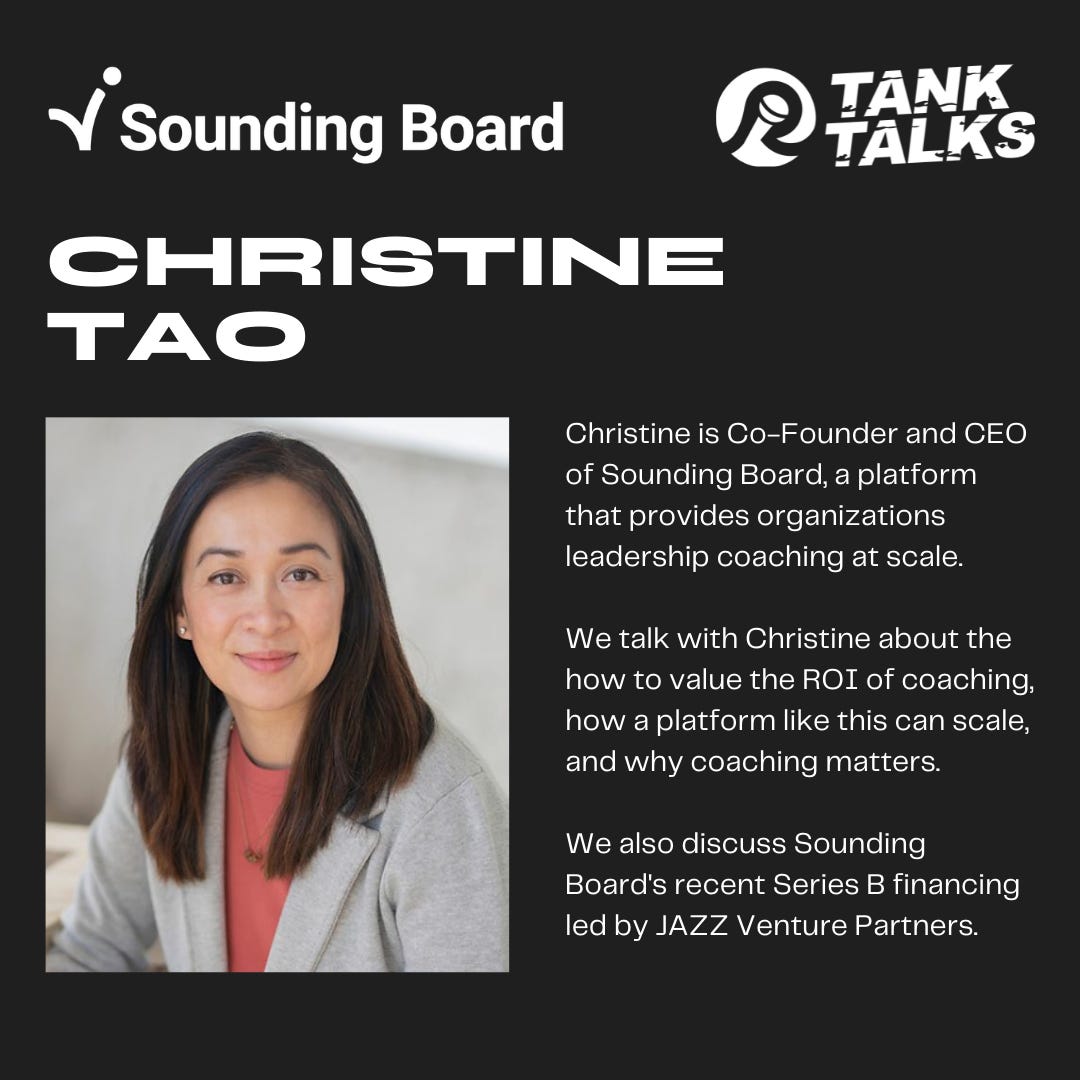
Sounding Board's CEO Christine Tao on Why Everyone Needs A Coach
The notion that leaders are born and not made can feel oppressive to founders and others working their way up the business ladder. Leadership is isolating enough without the toxic mythology that you’re just supposed to know how to do from the get-go. Our guest today, Christine Tao, Co-Founder and CEO of Sounding Board, is working to normalize coaching for CEOs, Founders, and others who want to become better leaders. Sounding Board allows organizations to manage, scale, and measure coaching on one unified platform. Their AI-Powered admin tools and centralized data insights integrate with our proprietary, managed coach network to deliver coaching at scale. Sounding Board recently closed a $30M Series B funding round led by JAZZ Venture Partners.About Christine Tao:Christine co-founded Sounding Board in 2016 to solve the most challenging yet important part of her role as SVP of a fast-growing VC-backed startup: Leadership Development. Her experience as an operator at stops like YouTube and Tapjoy has helped guide at Sounding Board. She did her undergrad at UC Berkeley and her MBA at Wharton.A word from our sponsor:Ripple Ventures is always focused on helping our founders and CEOs find the best partners to work with. But before we introduce any provider to our companies, we always make sure we try the product first. And when it comes to managing business expenses at Ripple, we were super excited when the team at Jeeves came knocking on our door.Jeeves helped get me and my team setup with physical and virtual credit cards in days. I was able to allow my teammates to expense items in multiple currencies allowing them to pay for anything, anywhere at any time. We weren’t asked for any personal guarantees or pay any setup or annual fees either. Not only does Jeeves save us time, but they also give us up to 3% cashback on our purchases including expenses like Google, Facebook or AWS every month. The best part, Jeeves puts up the cash, and you settle up once every 30 days, unlike some other corporate card companies that make you pre-pay every month. Jeeves offers a truly all-in-one expense management corporate card program for international startups and we at Tank Talks could not be more excited to partner with them. Listeners of Tank Talks can get set up with a demo of Jeeves today and take advantage of a $700 discount and skip the waitlist by visiting tryjeeves.com/tanktalks to learn more.In this episode we discuss:02:33 The difference between a coach and a mentor04:51 The lightswitch moment when she knew she had to found Sounding Board08:26 Why she decided to turn her coach into her co-founder11:53 The value and ROI coaching brings to clients and organizations15:23 How the Sounding Board platform is scalable for future growth18:55 Solving the cold start problem with a marketplace21:13 The ICP for Sounding Board and what leadership means to Christine23:35 How they landed at that ICP25:10 How Sounding Board integrates with learning platforms27:02 The biggest challenges coaches and organizations saw during the early pandemic28:32 How Sounding Board standardizes it caching approach across organizations and internally30:32 The structure Sounding Board uses to contract and pay their coaches31:37 Overcoming jargon and other industry-specific knowledge32:34 The success and flexibility of matching coaches to organizations34:00 What the future of the coaching industry looks like over the next 5-10 years37:27 The broad appeal of coaching across the work/life spectrum39:30 Plans to deploy their recent $30M Series B lead by JAZZ Venture Partners41:51 The number of coaches on the platform today and the plans for growthFast Favorites:PodcastThe Startup Chat20 Minute VCNewsletter/BlogMark SusterFirst Round ReviewReforgeTech GadgetLogitech Video CamNew TrendRenting, not owningRentTheRunway.comBookThe Hard Thing About Hard Things By Ben HorowitzLife LessonYou should always just ask.Follow Matt Cohen and Tank Talks here!Podcast production support provided by Agentbee.Agency This is a public episode. If you would like to discuss this with other subscribers or get access to bonus episodes, visit tanktalks.substack.com
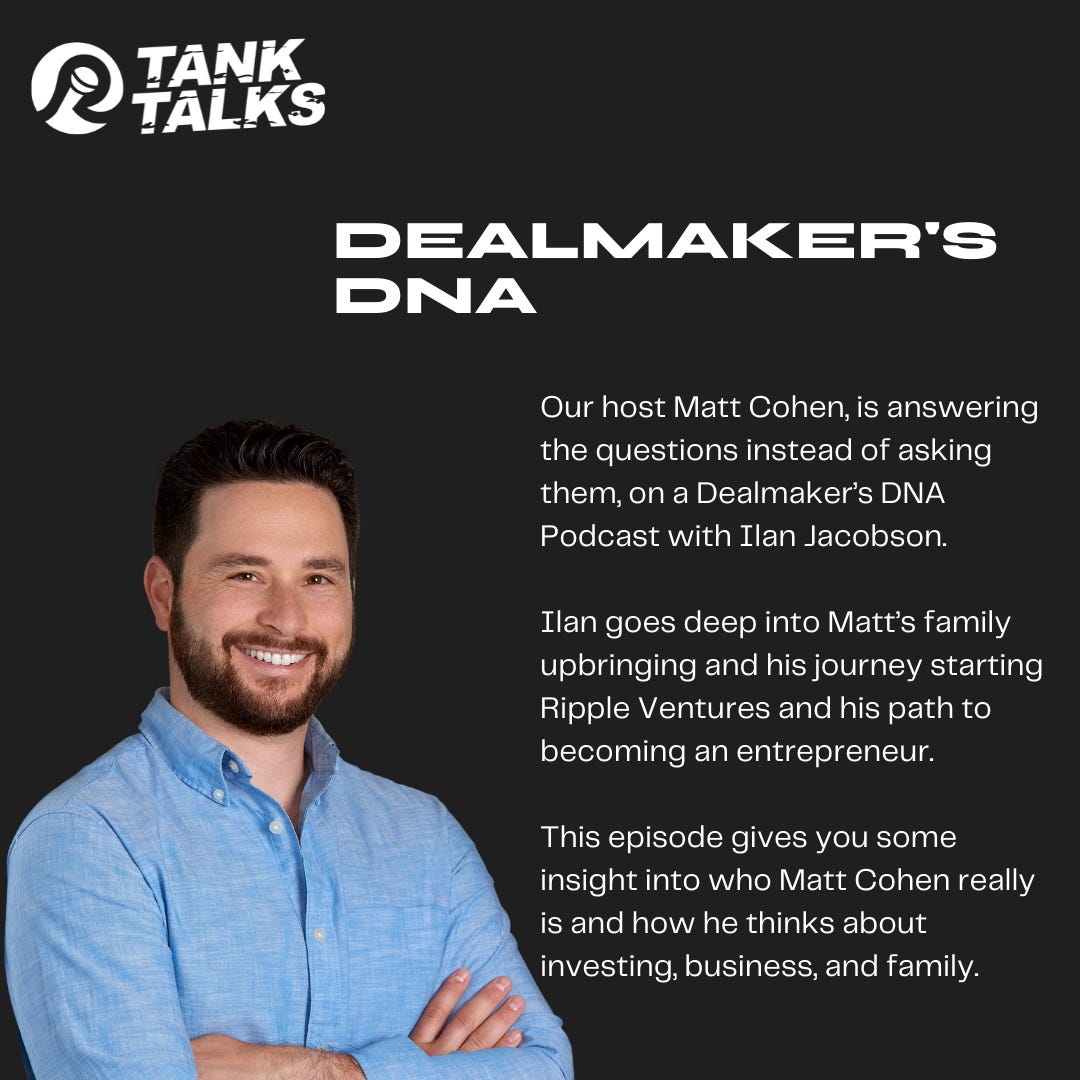
Deep Dive with our Host, Matt Cohen, on a Dealmaker's DNA Podcast
We are changing things up with today’s episode whereby our host, Matt Cohen, is answering the questions instead of asking them, on a Dealmaker’s DNA Podcast with Ilan Jacobson.Ilan goes deep into Matt’s family upbringing and how he became so interested in business and investing. They dig into his journey starting Ripple Ventures and his path to becoming an entrepreneur. This episode gives you some insight into who Matt Cohen really is and how he thinks about investing, business, and family.Topics discussed:* What Ripple is and why Matt started it* What creates entrepreneurs* Matt’s backstory and family upbringing* The level of sacrifice involved in being an entrepreneur* Matt’s view on failure and why everyone needs to own it* Matt’s constant curiosity on all things* Maintaining a good network* The line between business and personal* Matt’s mentors* How to pick jockeys (ie startup CEOs)* How our minds perform at the highest level and how we can take care of it This is a public episode. If you would like to discuss this with other subscribers or get access to bonus episodes, visit tanktalks.substack.com

Building the Successor to Google Docs with CEO of Almanac, Adam Nathan
If the pandemic has taught us anything, it’s that we need better tools to work and collaborate remotely. For years engineering teams have solved this problem with GitHub and other version control systems, but for documents and other collaborative workflows, there hasn’t been a rock-solid tool. Today’s guest, Adam Nathan, co-founder and CEO of Almanac is working to change that. Almanac is working to replace entrenched players like Google Workspace and Microsoft Office, and a recent $34M Raise led by Tiger Global and joined by Floodgate and others will give them a real shot at disruption.About Adam Nathan:Adam started his career at the White House, where he worked on policy initiatives. He moved to the private sector and had roles at Lyft, Apple, and Varo before co-founding Almanac. He did his undergrad at Duke and an MBA at Harvard.A word from our sponsor:Ripple Ventures is always focused on helping our founders and CEOs find the best partners to work with. But before we introduce any provider to our companies, we always make sure we try the product first. And when it comes to managing business expenses at Ripple, we were super excited when the team at Jeeves came knocking on our door.Jeeves helped get me and my team setup with physical and virtual credit cards in days. I was able to allow my teammates to expense items in multiple currencies allowing them to pay for anything, anywhere at any time. We weren’t asked for any personal guarantees or pay any setup or annual fees either. Not only does Jeeves save us time, but they also give us up to 3% cashback on our purchases including expenses like Google, Facebook or AWS every month. The best part, Jeeves puts up the cash, and you settle up once every 30 days, unlike some other corporate card companies that make you pre-pay every month. Jeeves offers a truly all-in-one expense management corporate card program for international startups and we at Tank Talks could not be more excited to partner with them. Listeners of Tank Talks can get set up with a demo of Jeeves today and take advantage of a $700 discount and skip the waitlist by visiting tryjeeves.com/tanktalks to learn more.In this episode we discuss:02:57 Adam’s journey to becoming a founder07:34 Why disrupting the status quo has been a recurring theme in his career11:45 How starting Almanac prior to the pandemic allowed them to A-B test assumptions prior to being more widely adopted16:19 Painpoints with Google Workspace and Microsoft Office that Almanac is trying to solve19:50 What Almanac has learned from early use cases outside of the tech world23:39 How their CORE document template library has helped customers and accelerated growth26:01 Uses for Almanac’s Snippet feature28:18 Why Adam thinks Hybrid office strategies are doomed to fail31:24 How Almanac is a cultural choice, not a productivity tool35:15 Adam’s experience working with Floodgate and TigerFast FavoritesPodcastSmartlessNewsletter/BlogWait But WhyTech GadgetAirpodsTrendArtisanal CoffeeBookDeep WorkLife LessonDo Your Homework.Follow Matt Cohen and Tank Talks here!Podcast production support provided by Agentbee.Agency This is a public episode. If you would like to discuss this with other subscribers or get access to bonus episodes, visit tanktalks.substack.com
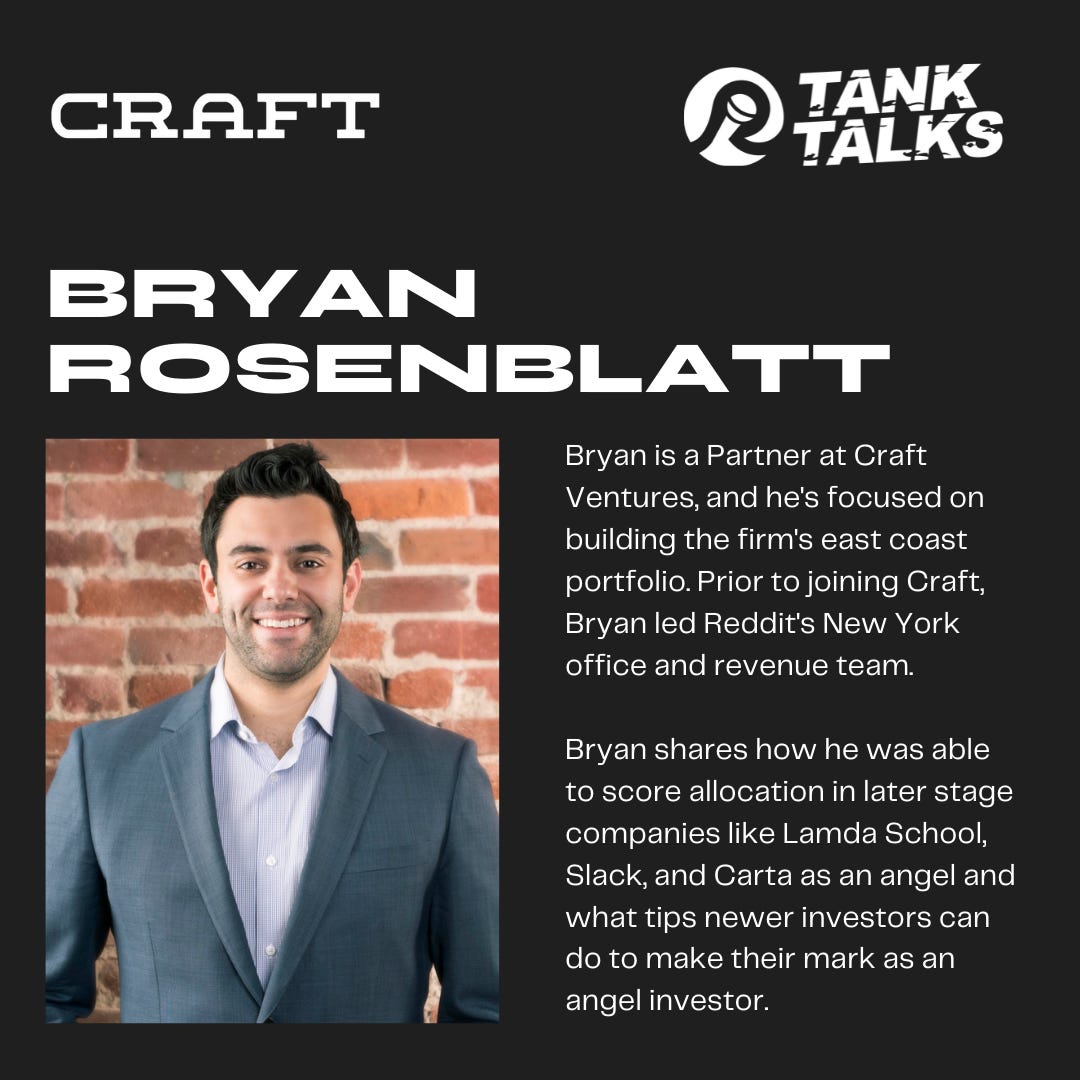
Craft Ventures Bryan Rosenblatt on Angel investing and the current VC landscape
On Today's show, we talk about angel investing, the current venture landscape, and how the later stage investing world is being disrupted with Partner at Craft Ventures, Bryan Rosenblatt. Bryan brings a deep operations background to his investing from working at companies like Twitter and Reddit where he helped with customer acquisition. He soon added angel investing as a side hustle and was able to get into competitive rounds in later-stage companies like Lamda School, Slack, and Carta. It’s a great conversation.About Bryan Rosenblatt:Bryan is a partner at Craft Ventures, focused on building the firm's east coast portfolio. Prior to joining Craft, Bryan led Reddit's New York office and revenue team, cultivating partnerships with brands like Google, Microsoft, Coca-Cola, P&G, and HBO. During his time at Reddit, the revenue organization grew 10x while scaling revenue to a $100m+ annualized revenue run rate. Bryan was an early member of Twitter's New York team where he worked with brands like Peloton, Harry's, Bonobo's, Casper, and Under Armour on their acquisition marketing efforts. Bryan has been an active investor both personally and via Riverside Ventures, which he founded in early 2017. His investments include Carta, Citizen, Bonobo's, Slack, and Dapper Labs. In 2018, Bryan was named to Forbes 30 Under 30 list for Marketing & Advertising. He was also recognized by Ad Council for championing nonprofit advertising that builds awareness around topics including mental health and diversity & inclusion. In 2021, Bryan was named to Business Insider's Top 100 Seed Investors.Bryan is a mentor for Backstage Capital, helping advance underrepresented founders and entrepreneurs.A message from our sponsor:Now more than ever, entrepreneurs need committed partners to help them navigate the hardest pain points of scaling a technology business. Created by one of Canada’s largest banks, RBCx is re-imagining what it means to create meaningful and impactful technology companies in Canada.RBCx – the tech banking arm of the Royal Bank of Canada - is a full-service platform that accelerates the entrepreneurial journey at every stage of growth – providing access to a complete suite of capital solutions, innovative products and services, and operational expertise to help technology companies scale.Sid Paquette – former Managing Partner at OMERS Ventures, is leading the group and has recruited a bunch of new faces to the bank from the Venture and Tech industry. Tony Barkett and Tyler Kirk – two former Silicon Valley Bank leaders in addition to Nicole Kelly and Anthony Mouchantaf have also joined Sid from OMERS Ventures.RBCx has been incredibly active since their launch in June as an LP, and have already backed some of Canada’s most notable VC funds including Golden, Amplitude, Version One, and Lumira Ventures. To learn more about RBCx visit www.rbcx.com or follow them on Twitter or Linkedin.In this episode we discuss:02:42 Biggest lessons he learned in his early career at Reddit and Twitter about customer acquisiton04:34 How he evolved from a qualitative perspective to a quantitative perspective on marketing05:49 The experience of building a sales team at Reddit starting in 201507:41 The importance of brand story and opportunity when there is a strong userbase10:14 How Bryan was able to get into competitive later rounds as an angel investor12:07 The importance of momentum and building on wins to secure dealflow13:26 Bryan’s early due-diligence process14:18 Why a founder’s character is important at early stage investing15:05 The learning value of losing money as angel investor16:04 Early personal risk when investing16:39 The biggest loss and biggest wins as an angel investor18:54 Training yourself to know when to listen to your gut20:34 Ways he needed to step up his game when joining a marquee firm like Craft Ventures22:15 Early lessons he learned from the senior Craft Ventures partners24:01 What was the hardest thing to learn in his transition to venture investing25:18 How the market has evolved since becoming a VC27:16 The importance of conviction in growth when investing28:12 The SaasGridQA.com tool Craft just launched for founders to help analyze and predict growth29:10 How Bryan helps foster and grow partnerships within his portfolio30:55 Will companies like Pipe.com ultimately destroy the VC model?32:25 Bryan’s tips for founders who are pursuing a product-led growth strategy34:33 The best way to onboard new customers35:44 Craft Venture portfolio companies that have nailed the product-led growth strategy37:18 The part of the Craft platform Bryan would recommend to every founder38:53 How Craft views the market in generalFast FavoritesPodcastAll In PodcastNewsletter/BlogFred WilsonHoward Linson/r/MetsTech GadgetQuestTrendAlternative assets like trading cardsBookThinking in BetsLife LessonStay hungry, stay humble.Follow Matt Cohen and Tank Talks here!Podcast production support provided by Agentbee.Agency This is a public episode.
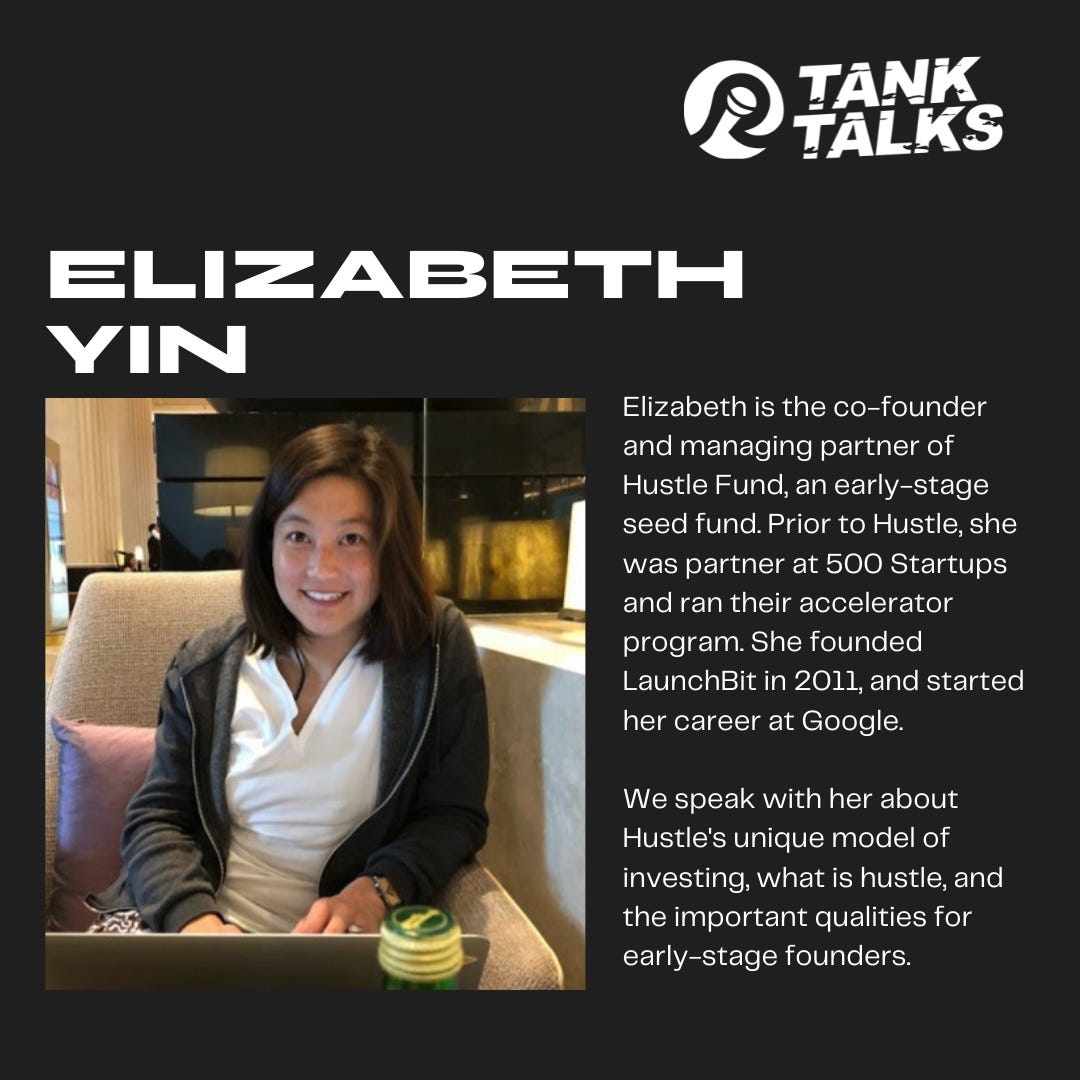
Elizabeth Yin of Hustle Fund on what is hustle
On today’s Tank Talk, we have a throwback episode with Elizabeth Yin, Co-Founder & General Partner of Hustle Fund.We spoke with Elizabeth in July of 2020 and covered her journey in leaving Google and starting LaunchBit, an ad-tech platform that she eventually sold to BuySellAds, and how she eventually made her way onto the investment side with 500 Startups. We dig into Elizabeth's time in running the 500 Startups Mountain View office and how she was able to select founders to back after reviewing over 20,000 pitch decks. Next, we discuss the reason she started Hustle fund with her partner Eric and what their mission is for the next 25 years. Finally, we ask Elizabeth to explain what hustle means to her as an early-stage investor and how she assesses hustle when meeting founders for the first and sometimes only time before deciding on backing them with a $25,000 investment.About Elizabeth Yin:Elizabeth is the co-founder and managing partner of Hustle Fund, an early-stage seed fund. Prior to Hustle, she was a partner at 500 Startups and ran their accelerator program. She founded LaunchBit in 2011, and started her career at Google. She completed her BS at Stanford and her MBA at Sloan/MIT.A word from our sponsor:Ripple Ventures is always focused on helping our founders and CEOs find the best partners to work with. But before we introduce any provider to our companies, we always make sure we try the product first. And when it comes to managing business expenses at Ripple, we were super excited when the team at Jeeves came knocking on our door.Jeeves helped get me and my team setup with physical and virtual credit cards in days. I was able to allow my teammates to expense items in multiple currencies allowing them to pay for anything, anywhere at any time. We weren’t asked for any personal guarantees or pay any setup or annual fees either. Not only does Jeeves save us time, but they also give us up to 3% cashback on our purchases including expenses like Google, Facebook or AWS every month. The best part, Jeeves puts up the cash, and you settle up once every 30 days, unlike some other corporate card companies that make you pre-pay every month. Jeeves offers a truly all-in-one expense management corporate card program for international startups and we at Tank Talks could not be more excited to partner with them. Listeners of Tank Talks can get set up with a demo of Jeeves today and take advantage of a $700 discount and skip the waitlist by visiting tryjeeves.com/tanktalks to learn more.In this episode we discuss:02:28 Elizabeth’s journey to becoming a founder04:58 What lead to the acquisition of LaunchBit07:23 How Elizabeth got to 500 Startups and what their process was like there11:32 The economics of accelerators vs. venture capital14:53 Hustle Fund’s mission and why they launched17:41 How Hustle Fund defines ‘hustle’ and is there such a thing as too much hustle20:18 The difference between hustle and multitasking21:10 Qualities in startup teams Elizabeth looks for23:52 How Hustle fund supports founders and encourages them to not burnout25:54 Hustle Fund’s investment strategy27:42 Early lessons and changes from the pandemicFavorite Books:The Lean StartupThe Hard Thing About Hard ThingsPredictable RevenueElizabeth’s words of inspiration“Building a startup is tough, so make sure you dig deep and decide why you want to do it, besides the money, because it can really be your north star when moving through difficult times”Follow Matt Cohen and Tank Talks here!Podcast production support provided by Agentbee.Agency This is a public episode. If you would like to discuss this with other subscribers or get access to bonus episodes, visit tanktalks.substack.com
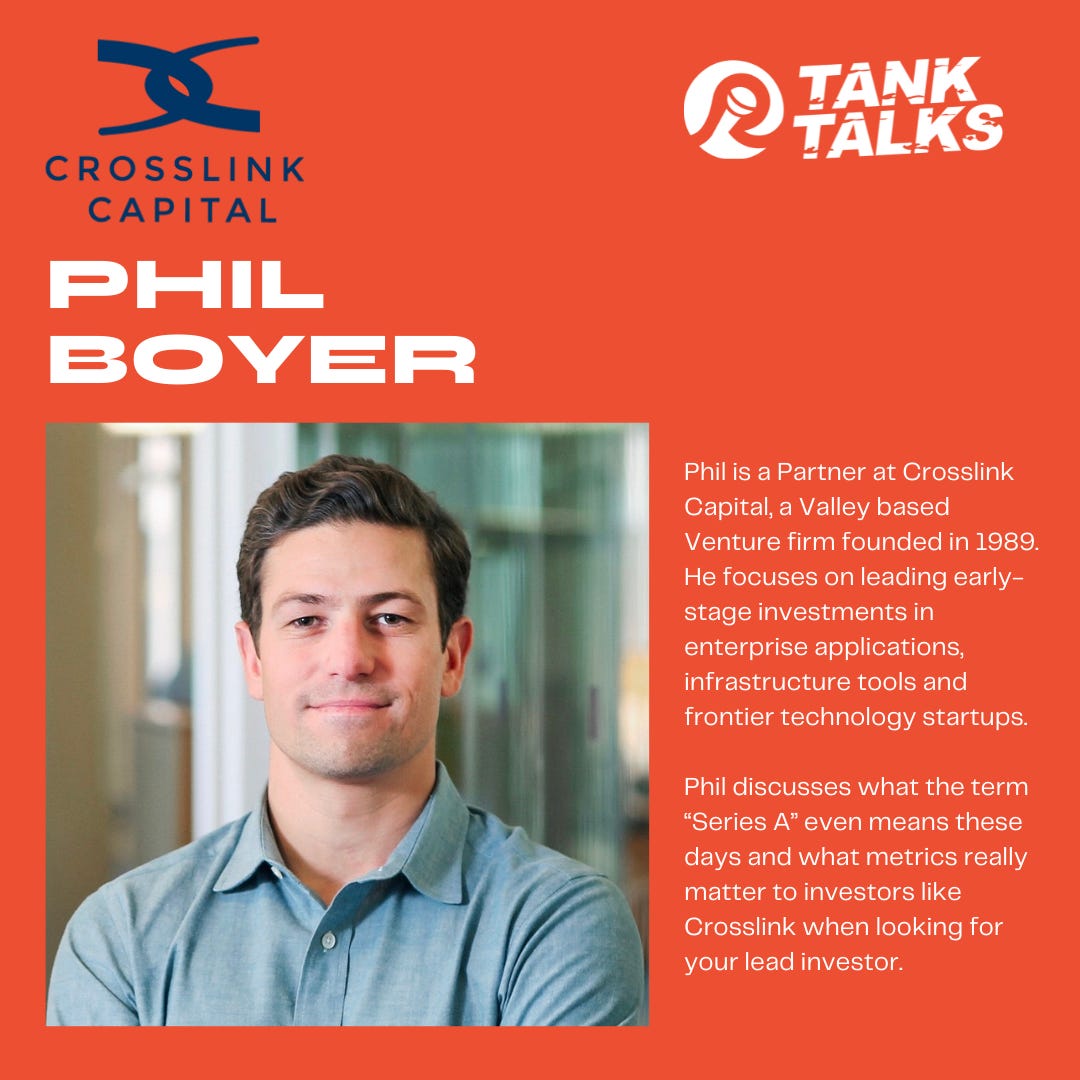
Crosslink Capital's Phil Boyer on what does 'Series A' even mean anymore and what metrics matter for VCs?
There’s a term one hears to describe the venture capital market in 2021—frothy. What does that actually mean and what does it mean in the larger historical context of Venture Capital? We speak with Phil Boyer, a partner at Crosslink Capital since 2014. Crosslink was founded in Silicon Valley in 1989 and has institutional memories of the beginning and end of Dot-Com bubble 20+ years ago and the global financial crisis in 2008. How does the firm’s deep history inform what is happening today, what is the outlook for the future, and how can founders pitch their companies to funds like Crosslink.About Phil Boyer:Phil brings over a decade of experience as a technology investor with deep sector expertise within enterprise and vertical software (AI, cloud, developer tools, SaaS, security). He is passionate about serving as a partner with early-stage founding teams, with an eye towards helping strong technical teams build category-defining companies. At Crosslink, Phil’s investments include Armory, BetterUp, Iron Ox, Molekule, Overjet, Verodin (FEYE), and Weave (IPO NYSE: WEAV), among other companies.Prior to Crosslink, Phil was an investor with NYC-based venture capital firm Tenfore Holdings, with early investments in Optoro and Trulioo during his tenure. Before beginning his venture capital career, Phil wrote and published research on the technology sector at Credit Suisse and RBC, where he covered companies such as Google, Amazon, LinkedIn, eBay, Priceline, Yelp, and many others.A word from our sponsor:Ripple Ventures is always focused on helping our founders and CEOs find the best partners to work with. But before we introduce any provider to our companies, we always make sure we try the product first. And when it comes to managing business expenses at Ripple, we were super excited when the team at Jeeves came knocking on our door.Jeeves helped get me and my team setup with physical and virtual credit cards in days. I was able to allow my teammates to expense items in multiple currencies allowing them to pay for anything, anywhere at any time. We weren’t asked for any personal guarantees or pay any setup or annual fees either. Not only does Jeeves save us time, but they also give us up to 3% cashback on our purchases including expenses like Google, Facebook or AWS every month. The best part, Jeeves puts up the cash, and you settle up once every 30 days, unlike some other corporate card companies that make you pre-pay every month. Jeeves offers a truly all-in-one expense management corporate card program for international startups and we at Tank Talks could not be more excited to partner with them. Listeners of Tank Talks can get set up with a demo of Jeeves today and take advantage of a $700 discount and skip the waitlist by visiting tryjeeves.com/tanktalks to learn more.In this episode we discuss:02:49 The evolution of metrics founders need for later round financing07:34 Why Team is so important to investors at the series A round12:17 How growth velocity can be just as important as size of ARR16:27 What is Net Dollar Retention and why is it important to investors22:49 How to properly calculate CAC/LTV25:03 Deal velocity and speed to close as a metric28:17 Is it better to land and expand deals or to hunt for bigger deals from an investor perspective32:06 Conviction in your model is important and knowing what you want to build33:49 How the speed of venture rounds is affecting the market and larger considerations for founders36:46 How Crosslink is dealing with the market39:55 The Crosslink Alpha network and how it brings value to its foundersFast FavoritesAcquiredHow I Built ThisNewsletterWhat’s Hot in Enterprise IT by Ed SimTech GadgetAirpodsTrendxOpsBookThe Hard Thing About Hard Things by Ben HorowitzLife LessonThe only thing that stays constant is change.Follow Matt Cohen and Tank Talks here!Podcast production support provided by Agentbee.Agency This is a public episode. If you would like to discuss this with other subscribers or get access to bonus episodes, visit tanktalks.substack.com
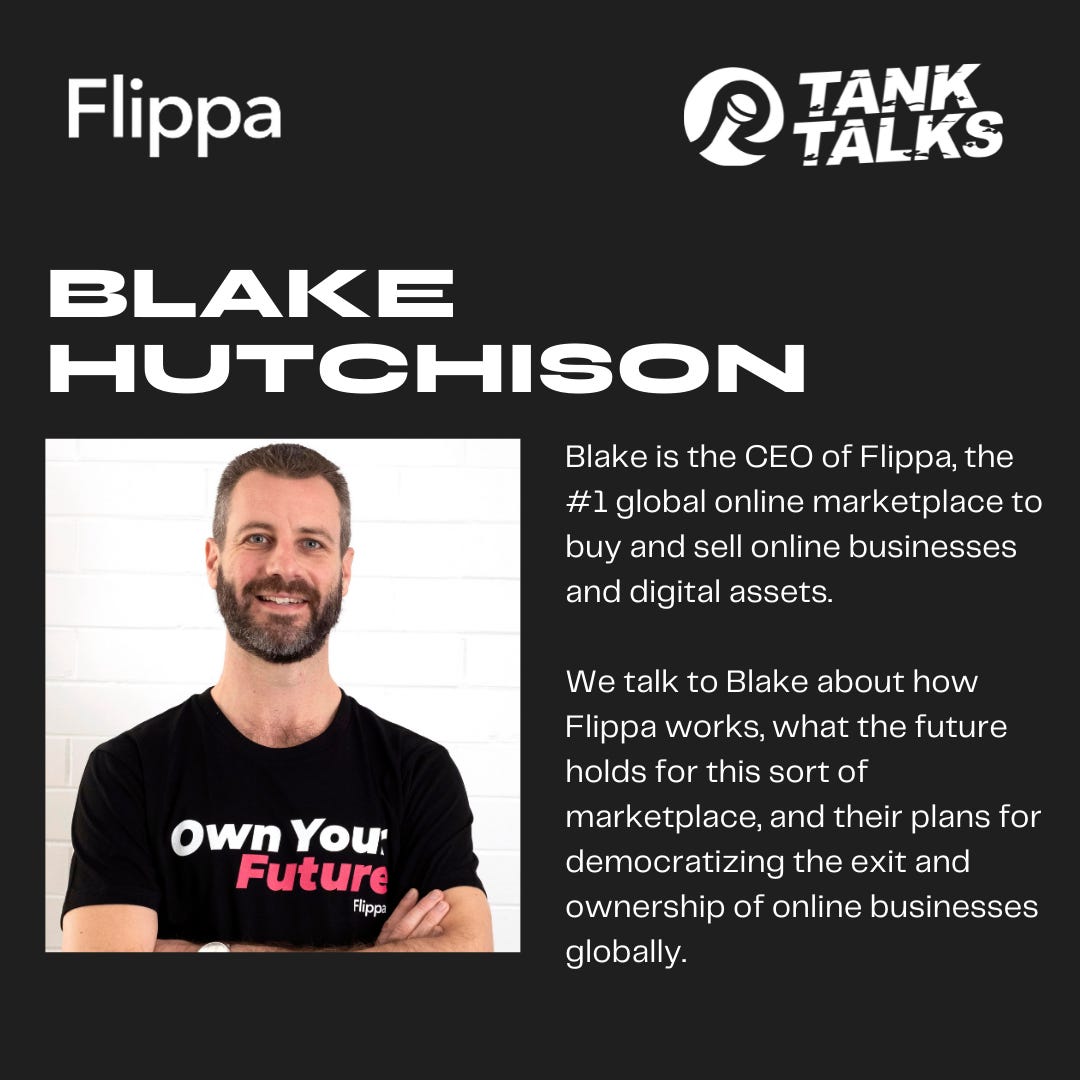
Flippa's CEO, Blake Hutchison on The Rise of Digital Asset Marketplaces
Ecommerce and auctions for physical goods is a maturing space in the online world, but when you want to sell a business itself or a digital good it is much less evolved. Our guest today, Blake Hutchison, CEO of Flippa, is working to change that. Flippa has a suite of tools on its platform to help streamline these transactions and help buyers and sellers with these sometimes complicated transactions. They recently completed an $11M Series A raise led by OneVentures to expand their buying and selling options and to offer new ways to support the community.About Blake Hutchison:Blake leads the team at Flippa, the leading marketplace globally to buy and sell sites, stores, and digital properties. Flippa was started in Melbourne in 2009 and he joined the team in 2018. Prior to Flippa, Blake held roles at various companies, including Xero, Good44, and Lonely Planet.A word from our sponsor:Ripple Ventures is always focused on helping our founders and CEOs find the best partners to work with. But before we introduce any provider to our companies, we always make sure we try the product first. And when it comes to managing business expenses at Ripple, we were super excited when the team at Jeeves came knocking on our door.Jeeves helped get me and my team setup with physical and virtual credit cards in days. I was able to allow my teammates to expense items in multiple currencies allowing them to pay for anything, anywhere at any time. We weren’t asked for any personal guarantees or pay any setup or annual fees either. Not only does Jeeves save us time, but they also give us up to 3% cashback on our purchases including expenses like Google, Facebook or AWS every month. The best part, Jeeves puts up the cash, and you settle up once every 30 days, unlike some other corporate card companies that make you pre-pay every month. Jeeves offers a truly all-in-one expense management corporate card program for international startups and we at Tank Talks could not be more excited to partner with them. Listeners of Tank Talks can get set up with a demo of Jeeves today and take advantage of a $700 discount and skip the waitlist by visiting tryjeeves.com/tanktalks to learn more.In this episode we discuss:03:15 The current state of online marketplaces and why they have seen such explosive growth04:15 How the marketplace worked prior to Flippa07:04 What is the right size of deal for a site like Flippa09:36 What buying and selling actually is like when using Flippa13:39 How Flippa helps qualify buyers to help maximize sellers time15:22 Other ways Flippa brings trust into the marketplace16:42 Why most sellers are not prepared to sell at the beginning of the process19:02 Why digital marketplaces like Flippa are more trustworthy than private sellers20:10 Statistics from recent sales on Flippa23:57 Are rollup funds and other institutional buyers using Flippa24:57 How Flippa differentiates itself from other competition29:42 How Flippa fits into the early stage VC model31:02 Future features for Flippa32:44 How Flippas large user base is an asset for the company and community as a whole34:12 Plans for crypto on Flippa34:49 What their $11M Series A will mean to themFast FavoritesPodcastBusiness WarsNewsletter/BlogInvesting.ioGadgetiPhoneTrendNFTsBlack Box ThinkingLife LessonDon’t peak when you’re 18.Follow Matt Cohen and Tank Talks here!Podcast production support provided by Agentbee.Agency This is a public episode. If you would like to discuss this with other subscribers or get access to bonus episodes, visit tanktalks.substack.com

Storyboard's JP Gooderham on how to keep employees engaged in a Remote-first world
Podcasting as a medium has been around for close to 20 years, and it has become a vibrant channel of community and connection with little regard for gatekeepers and constraints. Which is wonderful for something like Tank Talks, but less so for communicating non-public and sensitive internal information to employees. Our guest today, JP Gooderham, founder and CEO of Storyboard, is helping companies to use podcasting as a safe, secure, and transparent to way talk to each other and help overcome the physical distance of remote work through podcasts.About JP Gooderham:JP started at Google when he graduated from Tulane University in 2013, he worked his way up the ranks to become Global Product Lead and decided to found Storyboard in 2019. In 2020, Storyboard raised a $4.5M seed round lead by CRV and joined by Harry Stebbings of 20MinuteVC, Operator Partners, Slack Fund, Dave Ambrose, and Matt Ziskie.A word from our sponsor:Ripple Ventures is always focused on helping our founders and CEOs find the best partners to work with. But before we introduce any provider to our companies, we always make sure we try the product first. And when it comes to managing business expenses at Ripple, we were super excited when the team at Jeeves came knocking on our door.Jeeves helped get me and my team setup with physical and virtual credit cards in days. I was able to allow my teammates to expense items in multiple currencies allowing them to pay for anything, anywhere at any time. We weren’t asked for any personal guarantees or pay any setup or annual fees either.Not only does Jeeves save us time, but they also give us up to 3% cashback on our purchases including expenses like Google, Facebook, or AWS every month. The best part, Jeeves puts up the cash, and you settle up once every 30 days, unlike some other corporate card companies that make you pre-pay every month.Jeeves offers a truly all-in-one expense management corporate card program for international startups and we at Tank Talks could not be more excited to partner with them. Listeners of Tank Talks can get set up with a demo of Jeeves today and take advantage of a $700 discount and skip the waitlist by visiting tryjeeves.com/tanktalks to learn more.In this episode we discuss:02:56 The challenges of employee engagement in the landscape of remote work04:56 Ways companies are using Storyboard to reach distributed workforces08:14 Use cases for Storyboard and audio has a way to build and maintain culture11:03 The affect of the pandemic on adoption of platforms like Storyboard13:32 How fast it takes for a company to fully adopt Storyboard into their internal communication15:59 Turning listeners into creators and driving ROI18:42 Storyboard’s playbook for upping ROI to their customers22:54 Diving into social audio tools beyond podcasting25:31 How secure is audio from outside listeners27:36 Case studies of companies using Storyboard to solve communication challenges30:53 How Storyboard is different from traditional Learning and Development33:54 How bottom up content is the future of employee communication and training37:15 Why Harry Stebbings decided to make his first investment in the podcasting spaceFast FavoritesPodcastBeyond The GridNewsletter/BlogNewcomerGadgetWhoopTrendAudioBookShoe Dog by Phil KnightLife LessonEat the frog firstFollow Matt Cohen and Tank Talks here!Podcast production support provided by Agentbee.Agency This is a public episode. If you would like to discuss this with other subscribers or get access to bonus episodes, visit tanktalks.substack.com

Voiceflow CEO Braden Ream on The Future of Voice & Conversational AI
Voice has long been the final frontier of computing interfaces, and now with the technology of smart speakers and other voice-enabled technologies we are finally able to access what science fiction has been writing about for decades. Our guest today, Braden Ream, founder and CEO of Voiceflow, is helping create that future. Voiceflow, then known as Storyflow, was one of the first portfolio companies backed by Ripple Ventures. Back then it was a platform that helped build skills on Alexa, but has since grown to become the go-to platform for voice and chat-based interfaces and is being used by global Fortune 500 companies like USAA, McDonalds & BMW.About Braden Ream:Braden Ream is the Co-Founder and CEO of Voiceflow, a platform that helps teams design, prototype and launch voice & chat assistants. Founded in 2018, Voiceflow currently powers 300M monthly messages and is deployed across 75,000 teams. Prior to Voiceflow, Braden worked at RBC and founded a social media app.A word from our sponsor:Ripple Ventures is always focused on helping our founders and CEOs find the best partners to work with. But before we introduce any provider to our companies, we always make sure we try the product first. And when it comes to managing business expenses at Ripple, we were super excited when the team at Jeeves came knocking on our door.Jeeves helped get me and my team setup with physical and virtual credit cards in days. I was able to allow my teammates to expense items in multiple currencies allowing them to pay for anything, anywhere at any time. We weren’t asked for any personal guarantees or pay any setup or annual fees either.Not only does Jeeves save us time, but they also give us up to 3% cashback on our purchases including expenses like Google, Facebook, or AWS every month. The best part, Jeeves puts up the cash, and you settle up once every 30 days, unlike some other corporate card companies that make you pre-pay every month.Jeeves offers a truly all-in-one expense management corporate card program for international startups and we at Tank Talks could not be more excited to partner with them. Listeners of Tank Talks can get set up with a demo of Jeeves today and take advantage of a $700 discount and skip the waitlist by visiting tryjeeves.com/tanktalks to learn more.In this episode we discuss:03:12 The history of voice tech leading to Voiceflow09:32 Why Alexa, Siri, and other voice-enabled platforms are succeeding where prior platforms have failed14:02 How the pandemic has helped shape the voice tech industry16:36 The other factors pushing forward voice tech21:42 How the voice apps are the new landing pages and the next internet25:23 Becoming a standard toolset for developing voice interfaces31:32 Addressing privacy concerns around voice tech36:02 How wake words work on Alexa and other platforms38:29 Plans for their recent raise from Felics Ventures, Ripple Ventures, True Ventures, Craft Ventures and othersFast Favorites:PodcastEconomics ExplainedNewsletter/BlogPaul GrahamTech GadgetiPad/Apple PencilNew TrendChessBookCrossing the ChasmBlue Ocean StrategyLife LessonThe world is run by people no smarter than you.Follow Matt Cohen and Tank Talks here!Podcast production support provided by Agentbee.Agency This is a public episode. If you would like to discuss this with other subscribers or get access to bonus episodes, visit tanktalks.substack.com

Dan Pantelo, CEO of Marpipe, on The Evolution of AdTech & The Need for Speed
Digital marketing is increasingly important to the success of every business, but it’s a dynamic industry, seeing major disruptions this year with the change to tracking brought by iOS 14. Our guest, Dan Pantelo, founder and CEO of Marpipe, is helping marketers figure out what’s actually working through scalable A-B testing and performance marketing with his platform Marpipe.We talk to Dan about the need for better testing, the current state of MarTech, and his recent $8M series A raise led by Stage 2 Capital along with ourselves at Ripple, Samsung Ventures, Laconia Capital Group, and others.About Dan Pantelo:Dan started out as a street salesman in some of NYC's lowest-income neighborhoods selling electronics on street corners. He went on to found Pantelo Group, an agency that quickly grew to $2M in monthly campaign spend. He founded Marpipe in 2019. Dan did his undergrad at Binghampton University.A word from our sponsor:For anyone that is lucky enough to be a part of building startups, we’ve all seen that mad-rush to answer extensive security questionnaires and implement SOC 2 controls the moment that big whale of a client is on the hook in order to not lose the deal. Which unfortunately ends up swallowing the entire organization's time and resources in the hopes to land that whale, right? Lucky for us at Ripple, we have partnered with compliance automation provider Drata. Drata saves our portfolio companies from these same issues when it comes to effectively proving a strong, ongoing security posture and achieving frameworks like SOC 2 and ISO 27001.Drata allows startups to put Security and Compliance on Autopilot. Companies using Drata experience an average time savings of 85% when compared to running the SOC 2 process manually. Build trust with customers by proving your commitment to security, and maintain continuous compliance in between your audits. Don’t take it from us, Drata works with all kinds of startups like ClearCo, Lemonade, FullStory, Slice and countless others. They're backed by top venture funds such as Okta Ventures and GGV, and are currently G2's number one ranked cloud compliance software provider for customer satisfaction. Listeners of Tank Talks can get set up with a demo of Drata and take advantage of a 15% discount offer and waived implementation fees by visiting drata.com/tanktalks to get setup today.In this episode we discuss:03:20 How personalization in advertising, data, and customization have evolved over the years since advertisers were forced online05:48 Every company is now a marketing company with a subject matter expertise09:28 Other challenges digital marketers face and how they are overcoming them11:30 How brands are using technology to harness User Generated Content (UGC)15:09 Why companies should be focused more on performance marketing20:16 The traditional ad creation process vs. the process with Marpipe24:27 Why creative is now more important with better tracking and recent changes to Facebook27:11 Typical ROI Marpipe customers are seeing31:14 the Marpipe target customer35:12 How Marpipe can use data to decipher trends and what works for specific clients36:46 The future of performance-based marketing39:22 Plans for the $8M Series A raiseFast FavoritesPodcastHow to Take Over The WorldNewsletter/BlogBanklessTech GadgetAirpod ProNew TrendDAOsBookBlack Swan by by Nassim Nicholas Taleb Life LessonOnly worry about things in your direct controlFollow Matt Cohen and Tank Talks here!Podcast production support provided by Agentbee.Agency This is a public episode. If you would like to discuss this with other subscribers or get access to bonus episodes, visit tanktalks.substack.com

Dan Park, CEO of Clutch on The Future of Auto-Tech
The market for cars in 2021 has been one of the most pandemic-affected markets. The supply of both new and used cars has never been tighter and our guest today is seeing it from all sides. Dan Park is the CEO of Clutch, Canada's first and largest online car retailer. We talk to Dan about the automotive industry, his path to becoming CEO, and about his plans for the $60M he recently raised from Canaan Partners, FJ Labs, and Real Ventures.About Dan Park:Dan is CEO of Clutch, an online platform for car buying and ownership. Prior to Clutch, Dan was GM & Head of Uber Eats Canada. During his time at Uber, Dan led the growth of Uber's food delivery platform in Canada. Previously, Dan was a Venture Partner at Azure Capital Partners and led the firm’s Canadian investment efforts.A word from our sponsor:For anyone that is lucky enough to be a part of building startups, we’ve all seen that mad-rush to answer extensive security questionnaires and implement SOC 2 controls the moment that big whale of a client is on the hook in order to not lose the deal. Which unfortunately ends up swallowing the entire organization's time and resources in the hopes to land that whale, right? Lucky for us at Ripple, we have partnered with compliance automation provider Drata. Drata saves our portfolio companies from these same issues when it comes to effectively proving a strong, ongoing security posture and achieving frameworks like SOC 2 and ISO 27001.Drata allows startups to put Security and Compliance on Autopilot. Companies using Drata experience an average time savings of 85% when compared to running the SOC 2 process manually. Build trust with customers by proving your commitment to security, and maintain continuous compliance in between your audits. Don’t take it from us, Drata works with all kinds of startups like ClearCo, Lemonade, FullStory, Slice and countless others. They're backed by top venture funds such as Okta Ventures and GGV, and are currently G2's number one ranked cloud compliance software provider for customer satisfaction. Listeners of Tank Talks can get set up with a demo of Drata and take advantage of a 15% discount offer and waived implementation fees by visiting drata.com/tanktalks to get setup today.In this episode we discuss:02:44 How the auto industry is evolving and why now is a great time for disruption04:56 The effect of the pandemic on modernizing the automotive industry and how its effected supply and demand for cars07:39 How consumer behavior during the pandemic pushed forward app adoption09:18 What the enduring lessons from the pandemic will be for the automotive industry10:30 Why the dealership model is ready for disruption11:42 How established players in the industry are fighting back against being disrupted from outsiders13:18 Breaking down the existing legal structures between dealerships and automotive brands16:16 How Clutch is using their data to analyze the aftermarket and used car market18:59 Why Clutch is a better way to buy a used car20:43 Real-world lessons Dan and his team have had to make while building Clutch22:06 How Clutch has captured market share23:18 How Dan defines Clutch’s company culture24:26 Why Dan left Uber Eats to become the CEO of Clutch26:46 Plans for Clutch’s recent $60M raiseFast Favorites:Favourite PodcastHow I Built ThisMasters Of ScaleRevisionist HistoryThis American LifeBlog/NewsletterThe PeakTech GadgetGoPro MaxTrendCanada’s startup sceneBookShoe Dog by Phil KnightFollow Matt Cohen and Tank Talks here!Podcast production support provided by Agentbee.Agency This is a public episode. If you would like to discuss this with other subscribers or get access to bonus episodes, visit tanktalks.substack.com
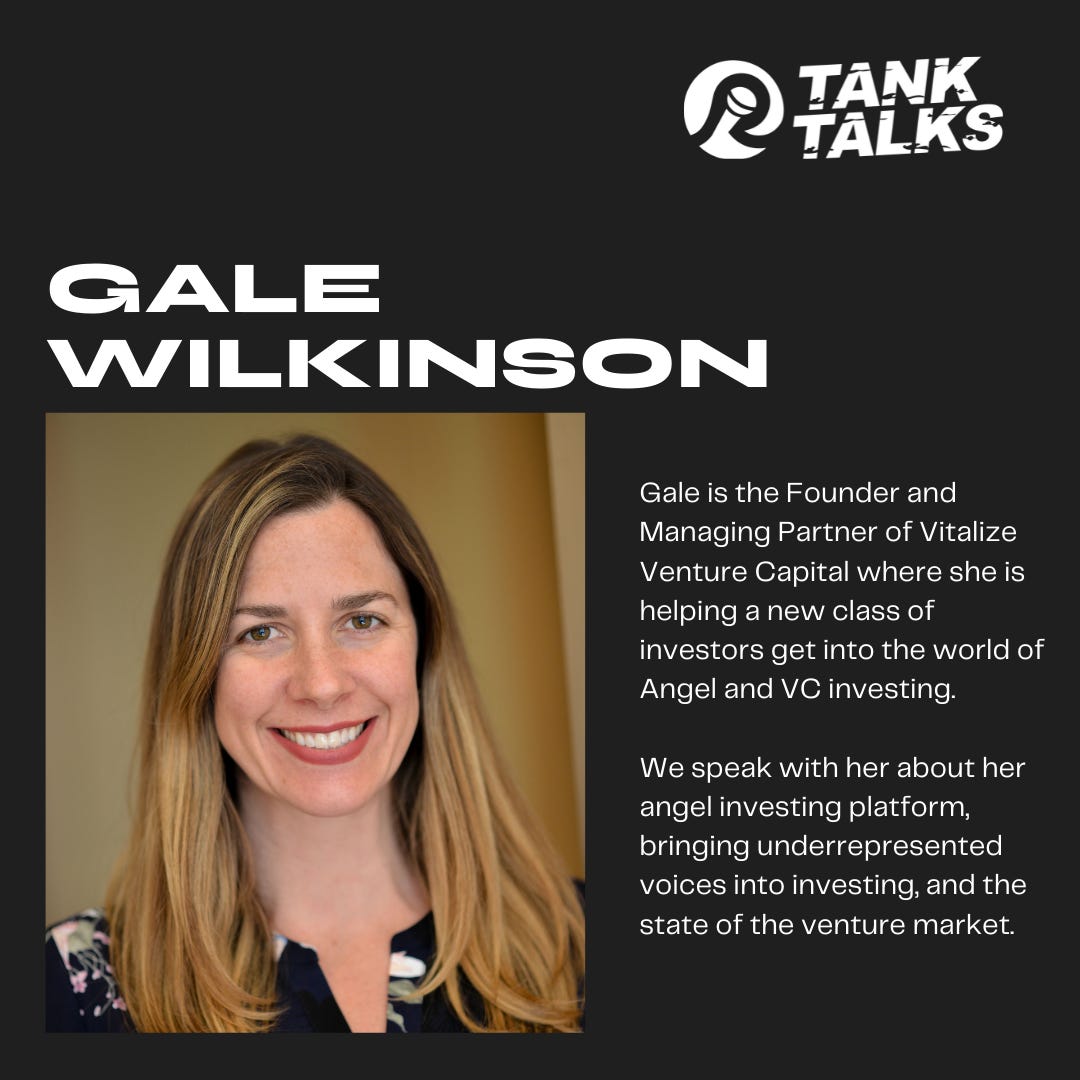
Gale Wilkinson of Vitalize VC on the Future of Work and how to invest in it
Our guest today, Gale Wilkinson, founder and managing director of Vitalize Venture Capital, is working to change how we work, how we learn, and how people can access investing in startups.Vitalize is known for investing in the future of work and the future of learning startups. They typically invest $250K-$1.5M at the pre-seed and seed stages. Portfolio companies include Placer, The Mom Project, Toucan, Zero Grocery, Zingtree, hiitide, and many more. They have also recently launched a platform that allows non-qualified investors to invest in start-ups before they hit the public markets.About Gale Wilkinson:Gale started in analyst roles at Nielsen and Orbitz before moving into investing in 2012 by founding Irish Angels, a network of angel investors affiliated with the University of Norte Dame. In 2017 she launched a formal fund, Vitalize Venture Capital. She did her undergrad at Notre Dame and got her MBA at the University of Chicago. She is currently a member of the Kauffman Fellows class of 2023.A word from our sponsor:For anyone that is lucky enough to be a part of building startups, we’ve all seen that mad-rush to answer extensive security questionnaires and implement SOC 2 controls the moment that big whale of a client is on the hook in order to not lose the deal. Which unfortunately ends up swallowing the entire organization's time and resources in the hopes to land that whale, right? Lucky for us at Ripple, we have partnered with compliance automation provider Drata. Drata saves our portfolio companies from these same issues when it comes to effectively proving a strong, ongoing security posture and achieving frameworks like SOC 2 and ISO 27001.Drata allows startups to put Security and Compliance on Autopilot. Companies using Drata experience an average time savings of 85% when compared to running the SOC 2 process manually. Build trust with customers by proving your commitment to security, and maintain continuous compliance in between your audits. Don’t take it from us, Drata works with all kinds of startups like ClearCo, Lemonade, FullStory, Slice and countless others. They're backed by top venture funds such as Okta Ventures and GGV, and are currently G2's number one ranked cloud compliance software provider for customer satisfaction. Listeners of Tank Talks can get set up with a demo of Drata and take advantage of a 15% discount offer and waived implementation fees by visiting drata.com/tanktalks to get setup today.In this episode we discuss:03:26 Why the future of work is such an important area of Gale’s investing07:37 Is future of work just a code name for automation09:23 How remote work and gig economy interact with each other10:42 What Vitalize is excited about with Future of Work13:23 How the metaverse and online will mix with real-world opportunities14:03 Overlooked opportunities in the future of workspace15:24 The ethical questions around working for multiple employers16:39 Areas Gale is wary of in the future of work19:10 Areas in the creator economy Vitalize is looking to bet on20:54 Future of learning and where college degrees will be in the coming years22:40 How the pandemic has affected the future of work and the future of learning23:32 Opening up Venture to populations that have been historically excluded from investing24:48 Gale’s goal for Vitalize and how founders and investors can connect25:26 Gale’s secret to being so great on TwitterFast favourites:PodcastVenture UnlockedNewsletter/BlogAxiosTech GadgetHer PhoneNew TrendEco-friendly packagingBookThe Startup Community Way: Evolving an Entrepreneurial Ecosystem by Brad FeldFollow Matt Cohen and Tank Talks here!Podcast production support provided by Agentbee.Agency This is a public episode. If you would like to discuss this with other subscribers or get access to bonus episodes, visit tanktalks.substack.com
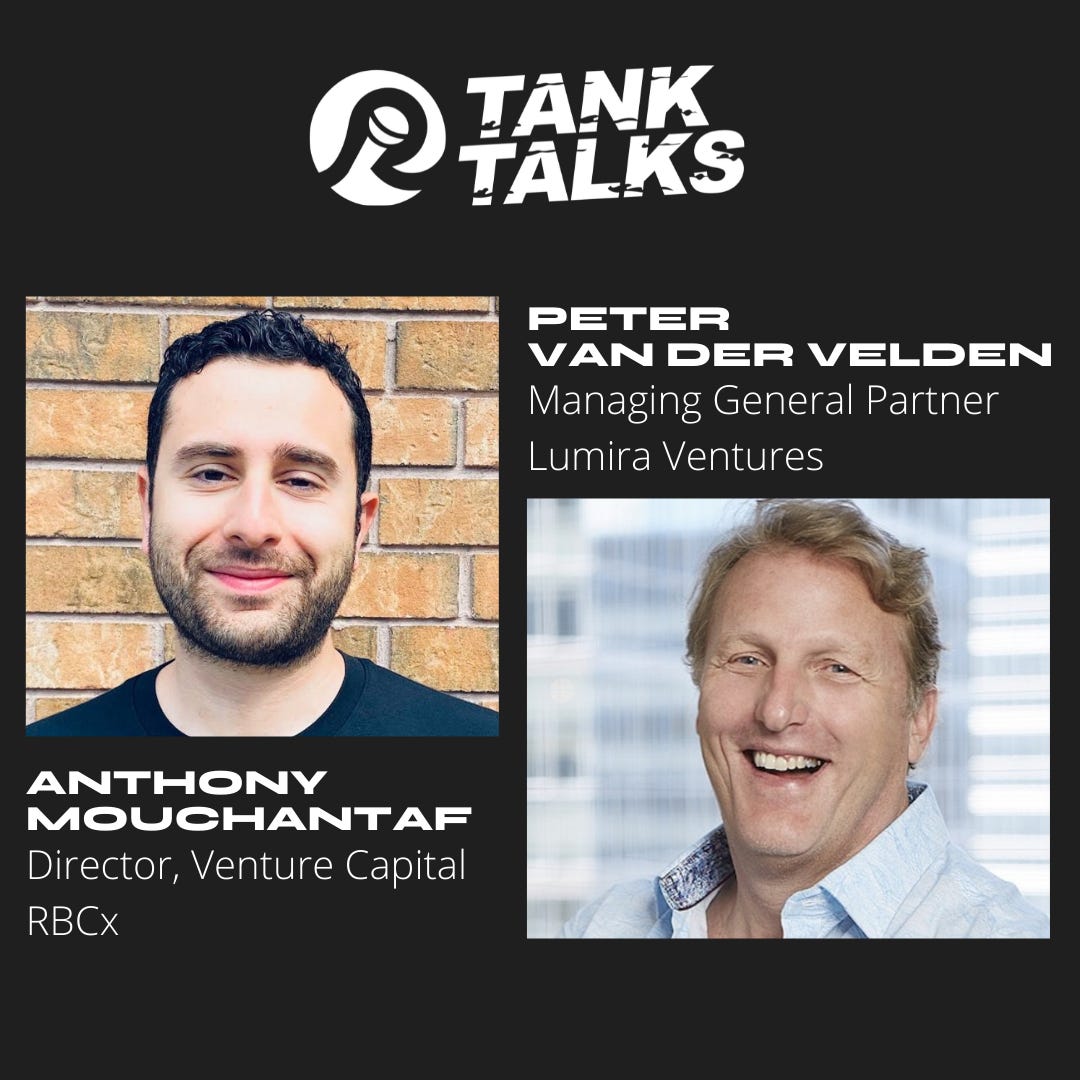
Anthony Mouchantaf (RBCx) and Peter van der Velden (Lumira VC) on Why Canadian LPs are starting to wake up to the Biotech Industry
As we’ve seen from the last two years, BioTech holds immense promise for the future but brings along challenges as an investor into the space. Today we have a lively discussion with two sides of the BioTech investing world, Peter van der Velden, General Partner and Managing director of Lumira Ventures, and Anthony Mouchantaf, Director, Venture Capital at RBCx.About Anthony Mouchantaf:As Director of Venture Capital with RBCx, Anthony works closely with partners across RBC on the bank’s venture investment strategy and leads the venture fund finance group. Prior to joining RBC Anthony was a VC-backed startup founder and a venture capital investor with OMERS Ventures, based out of the fund’s London and Toronto offices.About Peter van der Velden:With 28 years of investment and operating experience, Peter has participated in building companies from start-up through to expansion in the life sciences, information technology, and consumer sectors. Peter’s experience includes: Founder of a boutique merchant bank focused on private IT-based companies, Head of Investment Banking for a boutique investment bank focused on the public IT-based companies, Partner in a buyout partnership targeting retail and consumer-centric businesses; Vice President Business Development for a venture capital-backed drug delivery company; and an Associate role at Canada’s then-largest venture capital firm. Peter started his working career with Canada’s largest independent vaccine manufacturer.A word from our sponsor:For anyone that is lucky enough to be a part of building startups, we’ve all seen that mad-rush to answer extensive security questionnaires and implement SOC 2 controls the moment that big whale of a client is on the hook in order to not lose the deal. Which unfortunately ends up swallowing the entire organization's time and resources in the hopes to land that whale, right? Lucky for us at Ripple, we have partnered with compliance automation provider Drata. Drata saves our portfolio companies from these same issues when it comes to effectively proving a strong, ongoing security posture and achieving frameworks like SOC 2 and ISO 27001.Drata allows startups to put Security and Compliance on Autopilot. Companies using Drata experience an average time savings of 85% when compared to running the SOC 2 process manually. Build trust with customers by proving your commitment to security, and maintain continuous compliance in between your audits. Don’t take it from us, Drata works with all kinds of startups like ClearCo, Lemonade, FullStory, Slice and countless others. They're backed by top venture funds such as Okta Ventures and GGV, and are currently G2's number one ranked cloud compliance software provider for customer satisfaction. Listeners of Tank Talks can get set up with a demo of Drata and take advantage of a 15% discount offer and waived implementation fees by visiting drata.com/tanktalks to get setup today.In this episode we discuss:03:32 Peter’s journey to becoming a BioTech investor06:04 What the Canadian BioTech scene was like 10 years ago07:36 How Anthony convinced the team at RBCx to take BioTech seriously08:52 The pandemic’s role in convincing LPs to take BioTech seriously11:33 Peter’s take on why institutional investors have started to take BioTech investing more seriously15:09 How life sciences has more liquidity than traditional tech sectors17:07 How the life sciences market has matured over the last 10 years18:21 Insight into how investment committees at institutional investors work and how they look at biotech and life sciences23:26 Why life sciences can be intimidating to traditional investors30:57 What needs to happen to get Canadian investors more comfortable with investing in BioTech35:15 Why making unicorns isn’t everything in investing38:09 What value RBCx brings to the table besides capital41:40 How to manage LP communications in the BioTech space48:13 How Canada can become a global life sciences powerhouseFast FavoritesPodcastAnthonyThis is Actually HappeningPeterMasters of ScaleAmerican InnovationsNewsletter/BlogAnthonyVisual CapitalistPeterStat NewsTech GadgetAnthonyOura RingPeterApple WatchTrendAnthonyTikTokPeterWork-Life Balance from remote workBookAnthonyThe Federalist PapersPeterAtlas Shrugged by Ayn RandFollow Matt Cohen and Tank Talks here!Podcast production support provided by Agentbee.Agency This is a public episode. If you would like to discuss this with other subscribers or get access to bonus episodes, visit tanktalks.substack.com
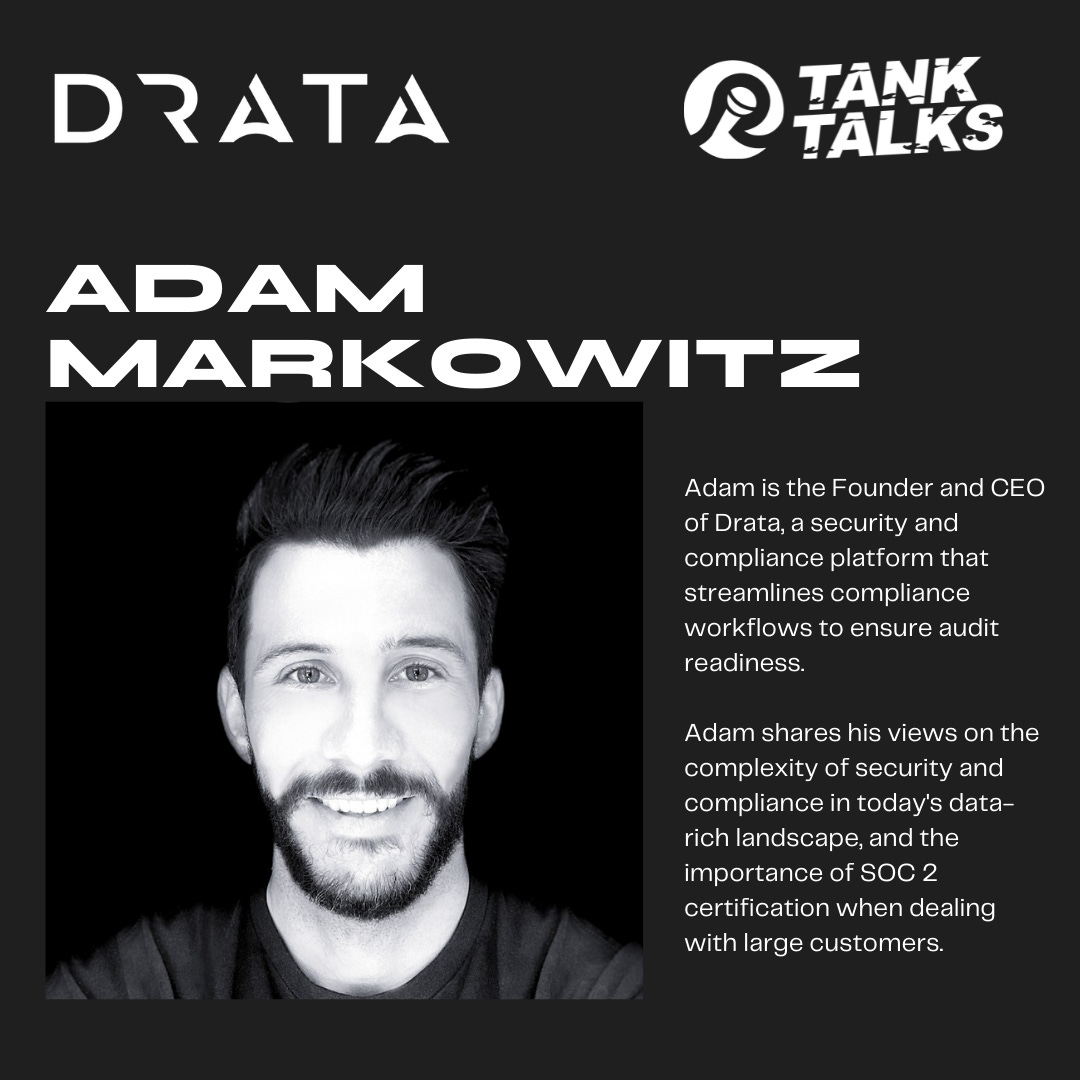
Adam Markowitz of Drata on Why Startups Can't Hide From SOC 2 Anymore
Data security is a huge concern, and a way to prove you take data security seriously is by obtaining a SOC 2 certificate. When obtained, SOC 2 is the gateway to larger enterprise contracts for SaaS companies, but the process of obtaining it can be labor-intensive, costly, and confusing. Drata was born to help streamline this process. We talk with Adam Markowitz, co-founder and CEO of Drata, to talk through SOC 2 and what Drata does for its customers.About Adam Markowitz:Adam is a former aerospace engineer who worked on rocket engines for NASA’s next-generation space launch vehicle as well as the Space Shuttle Main Engine. He went on to be the founder and CEO of Portfolium (Acquired by Instructure – 2019), proudly serving millions of students and grads from over 3,600 colleges and universities. He co-founded Drata in 2020 and recently closed a $25M Series A with GGV Capital, SVCI - Silicon Valley CISO Investments, Okta Ventures, Cowboy Ventures, and Leaders Fund.In this episode we discuss:01:58 What does SOC 2 Compliance and why is it so hard to achieve?05:03 The SOC 2 process with and without Drata06:48 Why SOC 2 is a growing concern for startups08:22 Is SOC 2 standard for B2B companies?09:53 What’s the first thing you should know if you’re asked for a SOC2 report?12:12 The difference between SOC 2 Type I and SOC2 Type II13:07 What the best case turnaround time for a SOC 2 Type I report13:48 Why many companies do a SOC 2 Type I on the way to get a SOC 2 Type II14:43 What type on content is in a SOC 2 report16:43 How founders should think about SOC 2 requests from clients18:25 How can startups instill a culture of cybersecurity20:59 Who should manage the SOC 2 process at smaller startups23:07 What Drata does to help simplify and automate the SOC 2 process26:13 What is the overlap between SOC 2 and HIPPA27:23 When is the right time to add a CISO position to a startup?28:50 Drata’s traction and recent Series A financingFast FavoritesPodcastMasters of ScaleNewsletter/BlogTed TalksGadgetAirpodsTrendHybrid/Remote workBookExtreme Ownership: How the US Navy SEALs Lead and Win by Jocko WilinkRelentless: From Good to Great to Unstoppable by Tim Grover and Shari WenkFollow Matt Cohen and Tank Talks here!Podcast production support provided by Agentbee.Agency This is a public episode. If you would like to discuss this with other subscribers or get access to bonus episodes, visit tanktalks.substack.com
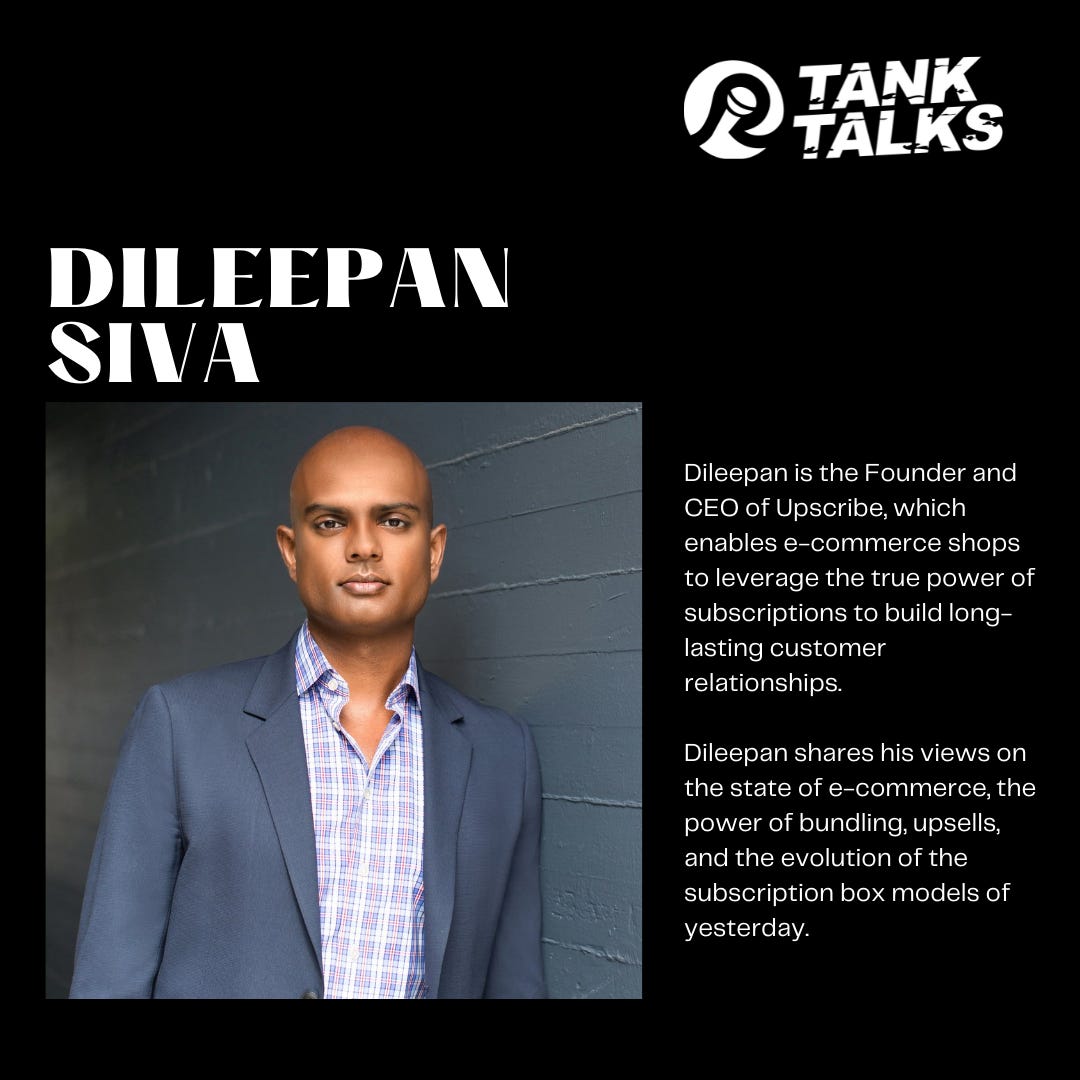
CEO of Upscribe, Dileepan Siva, on The Future of the Subscription Economy
Subscriptions are taking over the world, but it can often be a challenge for smaller e-commerce sites to add and service this new sector on top of their existing business, Upscribe is here to fill that niche for Shopify shops and other e-commerce platforms. We talk with Dileepan Siva, founder and CEO, about what he’s building, the e-commerce landscape, and how to reduce churn and increase loyalty through smarter subscription offerings.About Dileepan Siva:Dileepan grew up across three continents and four countries before the age of ten. His dream job growing up was to be the UN Secretary General. After graduating from UC Berkeley and getting an MBA from Harvard, he went on to be an advisor for the US and UN in war-torn countries.After his time in government and politics, he moved to consulting and tech operations at Ebay, and Twitter, before becoming a founder for himself. Upscribe was founded in 2019 and recently closed a $4M seed round lead by Uncork Capital.In this episode we discuss:01:24 The evolution of the subscription economy03:09 What has caused the shift to subscriptions?06:13 The technologies that have helped enable subscriptions08:25 How companies can start into subscriptions10:27 Why Shopify and CAC has changed the game in e-commerce12:15 How non-SaaS businesses can implement subscriptions13:52 Why subscriptions are not just yesterday’s box companies15:25 What is the best strategy for pricing your subscriptions17:24 Why bundling is so important to e-commerce19:21 The importance of data and personalized marketing with subscription21:18 How companies should think about retention in relation to growth24:05 Dileepan’s best advice for a company just starting a subscription service26:18 Targeting data that Upscribe uses to upsell customers27:22 Why smart subscriptions is a good idea29:14 The decision to take on funding from UncorkFast FavoritesPodcast:Invest Like The BestNewsletter/BlogScott GallowayTech GadgetSony HeadphonesTrendThe future of workBookUntethered Soul by Michael SingerFollow Matt Cohen and Tank Talks here!Podcast production support provided by Agentbee.Agency This is a public episode. If you would like to discuss this with other subscribers or get access to bonus episodes, visit tanktalks.substack.com
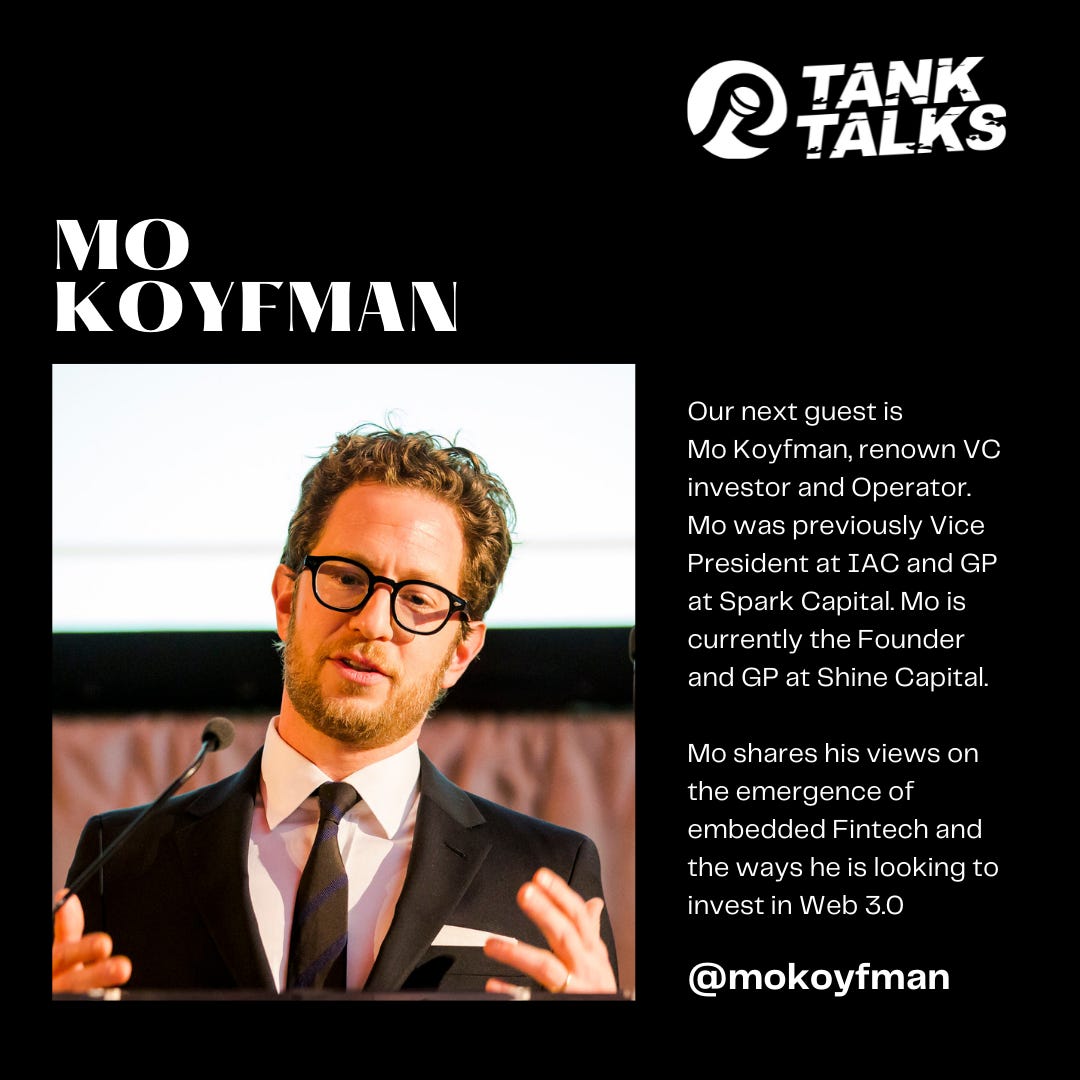
Mo Koyfman from Shine Capital on Embedded FinTech as the new SaaS 3.0
The transitions into different eras of the web can sometimes be hard to miss, but our guest today, renowned VC investor and Operator Mo Koyfman, has seen the signs clearer than others. He helped shape Web 2.0 as an operator and is now working hard shaping Web 3.0 as an investor. Mo and Matt have a fun conversation that dives into his views on the emergence of embedded Fintech and the ways he is looking to invest in the future of Fintech.About Mo Koyfman:Mo Koyfman is a prolific venture capitalist who started his career investing at IAC, working underneath Barry Diller. Mo led IAC’s acquisition of Vimeo, while also acting as COO for a period of time, Mo later moved on to Spark Capital in 2008, where he led investments in companies like Skillshare, Warby Parker, Plaid, and several others.Mo launched his new fund Shine Capital with $125 Million in funding in the Fall of 2020.A message from our sponsor:Now more than ever, entrepreneurs need committed partners to help them navigate the hardest pain points of scaling a technology business. Created by one of Canada’s largest banks, RBCx is re-imagining what it means to create meaningful and impactful technology companies in Canada.RBCx – the tech banking arm of the Royal Bank of Canada - is a full-service platform that accelerates the entrepreneurial journey at every stage of growth – providing access to a complete suite of capital solutions, innovative products and services, and operational expertise to help technology companies scale.Sid Paquette – former Managing Partner at OMERS Ventures, is leading the group and has recruited a bunch of new faces to the bank from the Venture and Tech industry. Tony Barkett and Tyler Kirk – two former Silicon Valley Bank leaders in addition to Nicole Kelly and Anthony Mouchantaf have also joined Sid from OMERS Ventures.RBCx has been incredibly active since their launch in June as an LP, and have already backed some of Canada’s most notable VC funds including Golden, Amplitude, Version One and Lumira Ventures. To learn more about RBCx visit www.rbcx.com or follow them on Twitter or Linkedin.In this episode we discuss:03:12 Mo’s definition of embedded FinTech16:50 How investing about learning and problem solving27:54 Lowering SaaS CAC and increasing LTV through embedded FinTech32:43 Calculations startups should make when deciding to add FinTech and other services38:53 Is the fight for new corporate credit cards a race to the bottom44:36 The future of offerings like compliance and tax services48:24 Shine Capital’s investment thesisFast FavoritesPodcastsJoe RoganNewsletter/BlogAVCTech GadgetHyperVoltNew TrendCryptoBookPortnoy's Complaint by Philip RothFollow Matt Cohen and Tank Talks here!Podcast production support provided by Agentbee.Agency This is a public episode. If you would like to discuss this with other subscribers or get access to bonus episodes, visit tanktalks.substack.com
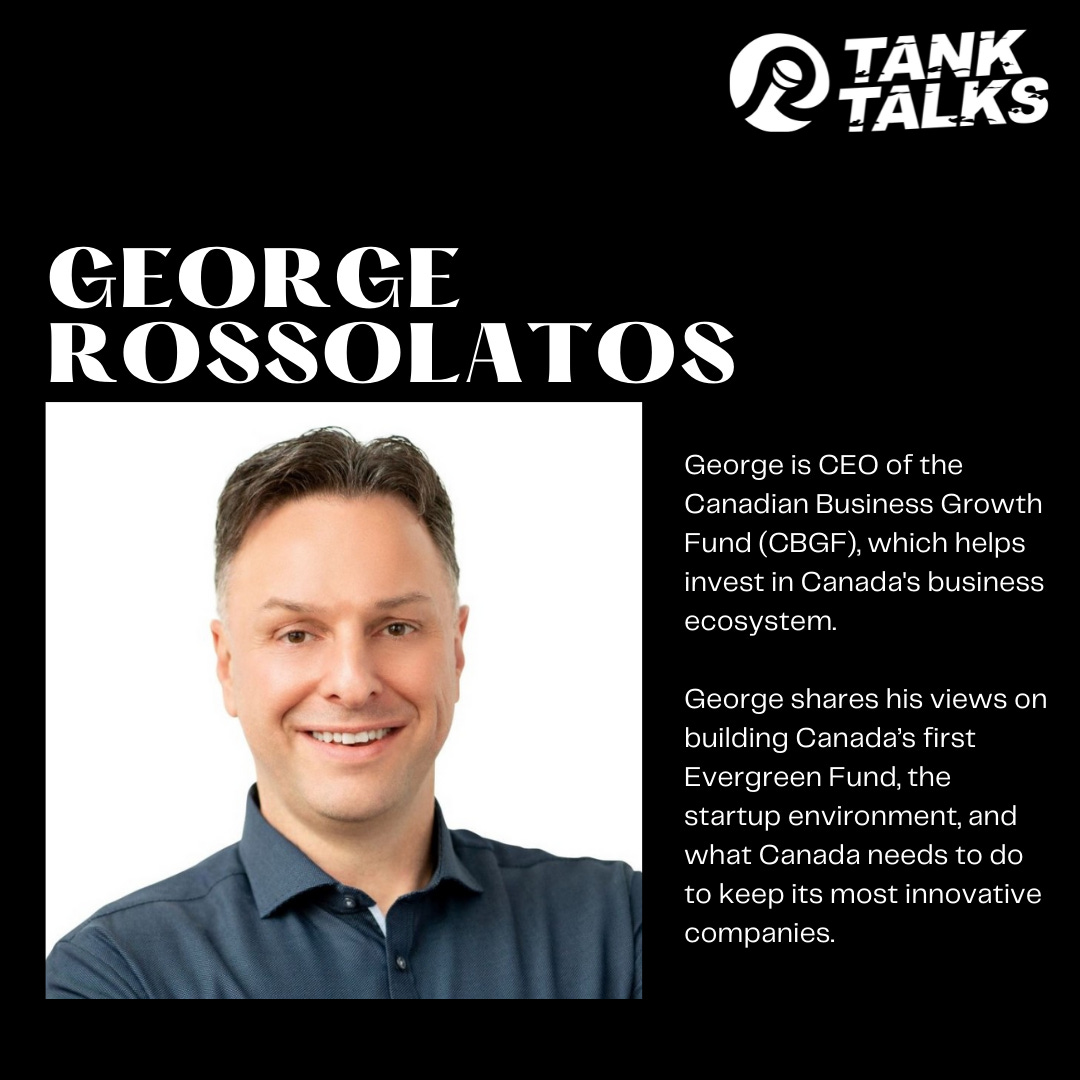
Building an everlasting Evergreen fund with George Rossolatos, CEO of Canadian Business Growth Fund (CBGF)
Our guest today, George Rossolatos, is the CEO of the Canadian Business Growth Fund (CBGF), which is an evergreen fund. Evergreen funds, or sometimes referred to as open-ended funds, are different than closed-ended funds which are the most typical structure we see in venture capital. With evergreen funds, capital is invested directly into an LLC on an ongoing basis with no termination date meaning they live on FOREVER!We talk with George about this unique position in the market as Canada’s first growth equity evergreen fund, the startup environment, and what Canada needs to do to keep its most innovative companies from receiving funding elsewhere.About George Rossolatos:As CEO of the Canadian Business Growth Fund (CBGF), George is responsible for developing the Fund’s national launch strategy, talent recruitment and the leadership and oversight of its investment activities.Previously, he served as CEO at Avante Logixx, a publicly-traded security and technology company, where he oversaw the company’s successful turnaround and growth strategies. Prior to that, he held leadership roles in private equity, first at Harrowston (acquired by TD Capital) and then at TorQuest as Co-founder and Partner where he launched the Fund’s $180 million Value Fund in 2002 and its $550 million Value Fund II in 2006.In addition to a degree in Commerce from Queens University, he has an FCPA Designation and an MBA from the Kellogg School of Management at Northwestern University with a specialty in Marketing, Entrepreneurship & Technology. He was previously recognized with the Top 40 Under 40 award, recognizing young business leaders.In this episode we discuss:01:56 Why CBGF decided to go with an evergreen fund as a structure03:21 From an LP perspective how does an evergreen fund look different from a traditional investment fund04:44 The types of investors that are LPs in CBGF05:34 Where the idea for an evergreen fund started07:24 Advantages and differences between CBGF and traditional VC funds09:34 Strategic differences between evergreen and other funds11:04 The transparency of management fees with an evergreen fund12:10 The benefits of of awarding carry to evergreen fund employees to attract and retain talent13:15 The challenges of running an evergreen fund16:58 How entrepreneurs view taking money from a CBGF versus more traditional funds19:47 Was an evergreen structure formed because of the nature of the LP base, or was the LP base attracted to the fund because it was an evergreen fund?21:39 How CBGF manages relationships with its portfolio companies and its LPs22:43 How Net Asset Value (NAV) is calculated at CBGF24:17 Where CBGF likes to be positioned on the cap table25:25 How returns compare historically between evergreen and traditional funds28:10 Deal competition in the current market30:46 Price sensitivity in their deal analysis32:22 How CBGF manages co-investments with their LP base33:54 Where they see exits for their companies35:57 How CBGF views the long term for the fund itself37:55 The state of the Canadian startup ecosystemFast Favorites:PodcastKwik Brain with Jim KwikNewsletter/BlogJohn P. Hussman’s Market CommentGadgetKindleNew TrendVirtual MeetingsBookGetting to Yes: Negotiating to Agreement, Without Giving In by Roger FisherFollow Matt Cohen and Tank Talks here!Podcast production support provided by Agentbee.Agency This is a public episode. If you would like to discuss this with other subscribers or get access to bonus episodes, visit tanktalks.substack.com

How Investors should think about investing in the Next Big Thing with Nikhil Basu Trivedi
Today’s incredible guest is Nikhil Basu Trivedi, an investor who has been on the leading edge of investing in dozens of startups just before they become the next big thing. His portfolio includes Canva, Hinge, DoctoronDemand and many more. We asked Nikhil about what sort of data points he looks for when analyzing markets, in order to time the next big thing perfectly for investment; and we dig into some of the biggest lessons he’s learned in the process.About Nikhil:Nikhil Basu Trivedi is Co-Founder and General Partner of Footwork, an early-stage VC firm focused on consumer technology and the consumerization of enterprise technology. Previously, he was Managing Director of Shasta Ventures and an investor with Insight Venture Partners. He graduated from Princeton University with a degree in molecular biology and finance.He writes at nbt.substack.comA message from our sponsor:Now more than ever, entrepreneurs need committed partners to help them navigate the hardest pain points of scaling a technology business. Created by one of Canada’s largest banks, RBCx is re-imagining what it means to create meaningful and impactful technology companies in Canada.RBCx – the tech banking arm of the Royal Bank of Canada - is a full-service platform that accelerates the entrepreneurial journey at every stage of growth – providing access to a complete suite of capital solutions, innovative products and services, and operational expertise to help technology companies scale.Sid Paquette – former Managing Partner at OMERS Ventures, is leading the group and has recruited a bunch of new faces to the bank from the Venture and Tech industry. Tony Barkett and Tyler Kirk – two former Silicon Valley Bank leaders in addition to Nicole Kelly and Anthony Mouchantaf have also joined Sid from OMERS Ventures.RBCx has been incredibly active since their launch in June as an LP, and have already backed some of Canada’s most notable VC funds including Golden, Amplitude, Version One and Lumira Ventures. To learn more about RBCx visit www.rbcx.com or follow them on Twitter or Linkedin.In this episode we discuss:03:38 How does Nikhil define the “next big thing”04:48 The biggest lesson Nikhil has learned07:18 How to think about timing when to step in10:05 The NFT wave and opening up of new opportunities12:53 How to think about potential sizes of investment16:57 Staying grounded in reality rather than being driven by hype19:09 What Nikhil looks for in founders20:36 Analyzing product market fit24:59 Viewing competitors in the early-stage market27:14 Enterprise trends post-pandemic that Nikhil is excited about29:50 Thoughts on clean tech/ deep tech32:34 Staying a generalist when investing35:54 What to look for from Footwork VCFast FavoritesPodcastsThe All In PodcastNewsletter/BlogNot Boring by Packy McCormickTech GadgetAirPodsNew TrendFounders working on climate related solutionsBookLeading: Learning from Life and My Years at Manchester United by Alex Ferguson and Michael MoritzFollow Matt Cohen and Tank Talks here!Podcast production support provided by Agentbee.Agency This is a public episode. If you would like to discuss this with other subscribers or get access to bonus episodes, visit tanktalks.substack.com
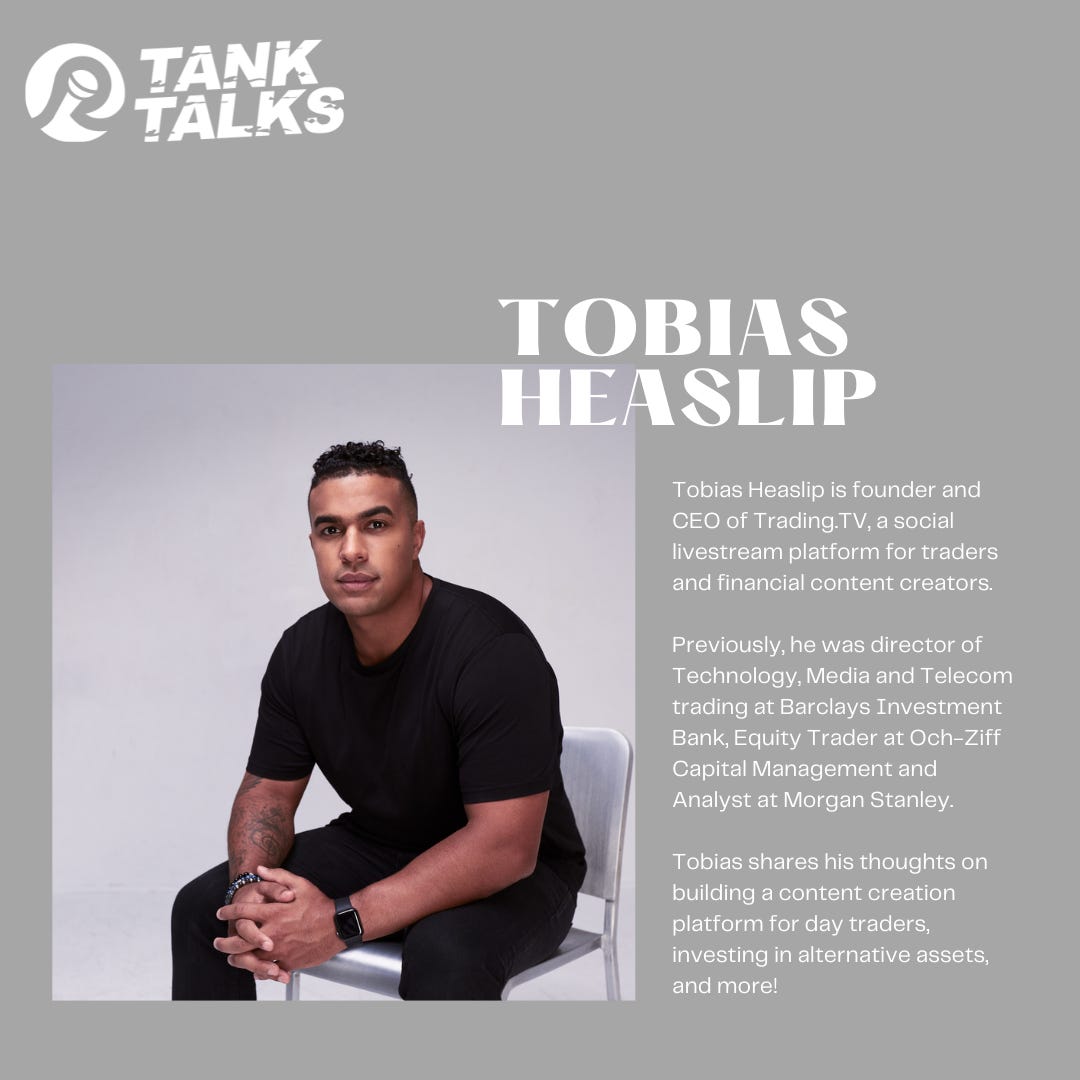
Building the Twitch for Day Traders with Tobias Heaslip of Trading.TV
Since the onset of the pandemic, everyone became a day trader overnight, whether it was Robinhood day traders trading options in Tesla or Wall Street investors betting in meme stocks like Gamestop. On today’s show we ask Tobias why he thinks building a content creation platform for day traders is what people really want, how Trading.TV plans to integrate with other platforms who trade in stocks, crypto and other alternative assets, and more!About Tobias:Tobias Heaslip is founder and CEO of Trading.TV, a social livestream platform for traders and financial content creators. Previously, he was director of Technology, Media and Telecom trading at Barclays Investment Bank, Equity Trader at Och-Ziff Capital Management and Analyst at Morgan Stanley. In this episode we discuss:02:00 Tobias’ personal background and why he founded Trading.TV03:25 Tracking financial markets on social media06:04 Competing with different online platforms08:13 Why we need a new trading platform09:04 What kind of content is on Trading.TV09:58 Managing the costs of content creation11:42 Verifying users on the platform15:23 Incentivizing content creators on the platform16:48 Promotional content on financial TV18:17 Short form content for financial advice20:40 Integrations with other platforms21:35 Getting away from the liability of offering financial advice23:55 How to make different asset classes digestible30:20 Creating an inclusive and diverse community32:12 What to expect from Trading.TVFast FavoritesPodcastsGroup ChatNewsletter/BlogThe HustleTech GadgetiPhoneNew TrendNFTsBookHarry PotterFollow Matt Cohen and Tank Talks here!Podcast production support provided by Agentbee.Agency This is a public episode. If you would like to discuss this with other subscribers or get access to bonus episodes, visit tanktalks.substack.com
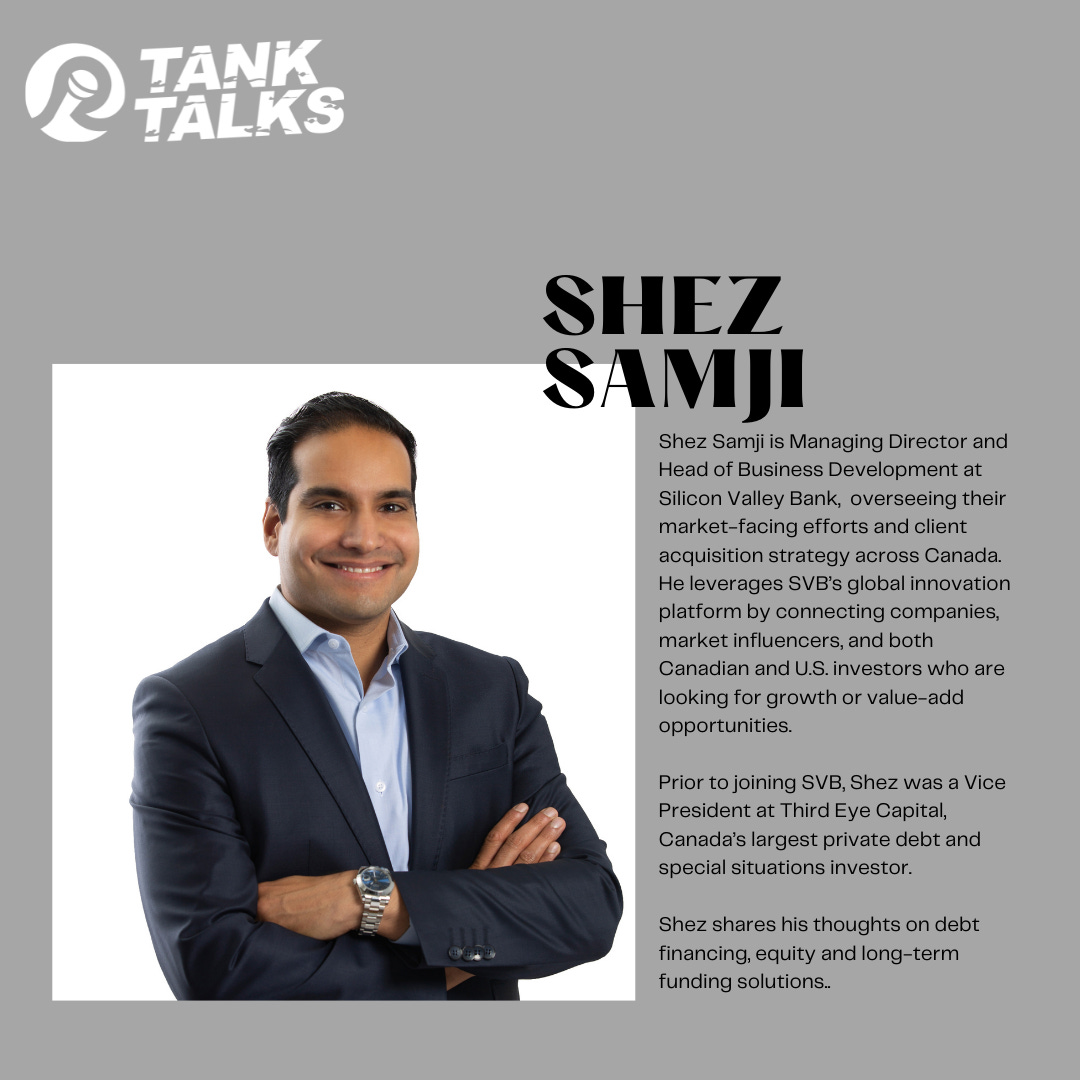
Raising Venture Debt vs Equity with Shez Samji of Silicon Valley Bank
Funding a new business to fuel growth can be done through some form of debt financing or equity funding. Venture debt is a little different from traditional debt financing and in 2020, VC-backed companies in the US alone received debt financing of more than $25B. On today’s show, we talk about when founders should consider debt financing, the ways in which startups should think about raising debt vs. equity in the early stages, and why it's important to never use short-term debt to fund long-term solutions.About Shez:Shez Samji is Managing Director and Head of Business Development at Silicon Valley Bank Canada. Previously, he was VP of Investments at Third Eye Capital, Analyst at AHF Capital Partners and Associate at BMO Capital Partners. He graduated from York University’s Schulich School of Business with a degree in Finance and Accounting.In this episode we discuss:02:07 The pros and cons of for startups to consider when looking at different funding options05:11 Debt financing after a seed/ Series A round06:53 Why SVB cares about equity09:17 Bank debt vs venture capital debt12:12 Avoiding short-term debt as a long-term solution13:26 Questions startups should ask themselves when considering debt financing15:08 Next steps for startups looking for financing16:56 Red flags to look for in loan clauses21:20 Picking between the options23:40 How founders should think about “repayment”25:03 Costs and benefits associated with credit28:33 Differences between venture financing and more conventional methods of lending32:43 Benefits of working with a bank focused on startup financing34:12 What Shez is excited about for the future of the marketFast FavoritesPodcastsThe All In PodcastNewsletter/BlogBloombergTech GadgetiPhoneNew TrendCanada’s VC environmentBookThe Most Important Thing by Howard MarksFollow Matt Cohen and Tank Talks here!Podcast production support provided by Agentbee.Agency This is a public episode. If you would like to discuss this with other subscribers or get access to bonus episodes, visit tanktalks.substack.com
The Future of Pet Tech with Pawp founder and CEO Marc Atiyeh
The petcare industry is a $100 billion dollar market, with about 2/3rds of US households owning a pet. Recently, consumers have started spending more on their pet’s health and well-being. On today’s show, we ask Marc about the petcare’s industry transition to healthtech, the effects the pandemic has had on pet adoption and ownership, and how startups like Pawp are helping owners take back control of their pet’s data.About Marc AtiyehMarc Atiyeh is the founder/CEO of Pawp, a digital health clinic that provides unlimited access to licensed vets 24/7 & a $3,000/year pet emergency fund. Previously, he served as the CSO of Clarity Money (Acquired by Goldman Sachs) and was the Head of Growth at Paribus (acquired by Capital One.) He graduated from Harvard with a degree in Electrical and Computer Engineering.In this episode we discuss:01:58 How has PetTech evolved since the inception of the industry03:53 Why has it been so slow to adopt technology06:04 Financial and informational inefficiencies in the veterinary space10:07 The replacement value of PetTech12:48 Marc’s ground-up approach to building a pet startup15:59 Why did it take so long for telehealth to enter the market20:09 Closing the gap between prescriptions and telemedicine24:11 Defending against larger retailers30:39 How Pawp differentiates itself from its competitors38:43 The impact of COVID on pet demand (COVID puppies) and how it affected the industry44:28 Fundraising for Pawp Series A Fast FavoritesPodcastThe Pomp PodcastNewsletter/BlogMorning BrewTech GadgetWHOOPNew TrendPeople drinking less alcoholBookCrossing the Chasm by Geoffrey MooreFollow Matt Cohen and Tank Talks here!Podcast production support provided by Agentbee.Agency This is a public episode. If you would like to discuss this with other subscribers or get access to bonus episodes, visit tanktalks.substack.com
Managing global payments in a remote world with Jeeves co-founder/CEO Dileep Thazhmon
As everyone quickly realized during the pandemic, remote work and distributed teams are here to stay. How should startups think about managing their global payments? On today’s show, we ask Dileep about the issues with multiple payment rails, bringing on independent contractors as full-time employees, and setting up local and global entities with various forms of credit.About DileepDileep is the co-founder and CEO of Jeeves, a company that provides financial infrastructure for global startups. Previously, he was Co-Founder & COO at Jeeng/PowerInbox and M&A Strategy consultant at Deloitte Consulting. He graduated with an MBA from Stanford, and was part of the YC Summer Class of 20. In this episode we discuss:02:22 What the distributed workforce market looked like prior to COVID-1904:33 How COVID changed the global infrastructure stack06:16 How startups have dealt with hiring remote workers07:14 Other challenges startups face when paying in local currencies10:03 Navigating the input-output flow of currencies11:43 Why most fintechs tend to focus on a single country13:36 How Jeeves is thinking about the future of multi-faceted payments14:22 The democratization of single payments across the world15:53 Suggestions for founders regarding international payroll/ HR risks18:06 Advice from Dileep as a founder20:37 Should international employees be hired as independent contractors?22:29 Over-correcting for success23:36 Covering third party costs for remote teams25:44 How should a founder think about hidden/unseen costs in the global market?27:57 Annual losses to global transaction costs, and why there has not been a solution before31:09 How non-US entities can benefit from working with Jeeves33:34 Jeeves’ funding history36:08 Taking on additional debt37:01 The future of Jeeves in terms of new markets/product offeringsFast FavoritesPodcastThe DailyNewsletter/BlogPro Football TalkTech GadgetPortable SpeakersNew TrendMeme StocksBookThe Undercover Economist by Tim HarfordFollow Matt Cohen and Tank Talks here!Podcast production support provided by Agentbee.Agency This is a public episode. If you would like to discuss this with other subscribers or get access to bonus episodes, visit tanktalks.substack.com

The Future of Construction Tech and how startups like Briq are reshaping the industry with co-founder and CRO Ron Goldschmidt
The construction industry is estimated to be over $2.5 trillion and growing in the United States, yet the industry has been especially slow at adopting newer technology solutions. Ron Goldschmidt joins us to share his thoughts on how construction companies can adapt to our remote reality, and why they have been resistant to change in the first place.About RonRon Goldschmidt co-founded Briq, a fintech company for the construction industry, in 2018 and has been Chief revenue Officer since 2020. Prior to this, he worked on Wall Street as Head of Emerging Markets at RBC Capital Markets and as Executive Director at UBS. He graduated from the Ivey Business School at Western University with an honors in Business Administration. In this episode we discuss:02:14 Why has the construction industry failed to invest in newer productivity tools?04:17 What sort of efficiencies are being deployed in the industry today?07:43 How has management successfully changed in the construction industry?12:12 How Briq is dealing with legacy APIs in the construction industry15:54 Technological innovations like electronic invoicing and data solutions18:23 The role of AI and ML in the construction industry22:00 The labor shortage in the construction industry24:53 Carve-outs for construction in the infrastructure bill27:09 How inflation plays into budgeting and supply/material forecasting30:06 How Briq approaches these budgeting challenges34:15 Briq’s Series B funding round with Tiger GlobalFast FavoritesPodcastsThe Portal with Eric WeinsteinNewsletter/BlogKnowledge Traction by Pascal UngerTech GadgetPortable Massager/ TheragunNew TrendVertical FintechBookA Land So Strange: The Epic Journey of Cabeza de Vaca by Andrés ReséndezStart with Why: How Great Leaders Inspire Everyone to Take Action by Simon SinekFollow Matt Cohen and Tank Talks here!Podcast production support provided by Agentbee.Agency This is a public episode. If you would like to discuss this with other subscribers or get access to bonus episodes, visit tanktalks.substack.com
The True Cost of Decarbonizing our Homes with Manuel Schoenfeld, Founder & CEO of PowerX
In the United States, the average household spends around $4200 a year on energy costs. How can we reduce this burden by building more efficient homes? We ask Manuel about how PowerX is helping consumers save costs and resources, how he attracted investments from the likes of Tesla and YCombinator, and more on today’s episode. About ManuelManuel Schoenfeld has been the founding CEO of PowerX since 2019. He was previously a project manager at McKinsey, and consultant at the World Bank, where he advised on innovative energy solutions. He was a McCloy Scholar at Harvard University, a Van Beek Scholar at the Wharton Business School, and graduated from the Rotterdam School of Management with the highest grade average in history.In this episode we discuss:03:45 The problem with the continued use of energy inefficient resources05:57 The importance of more information07:44 Legislation and energy conservation09:41 Cost and financial incentives making change easier10:58 Why haven’t builders adapted to building energy efficient homes from scratch12:22 Push and pull strategies between customers and builders13:12 When the US could become net zero 15:58 How the pandemic has affected this problem19:33 The origins and the mission of PowerX23:59 How PowerX is keeping costs low30:37 The recommendation algorithm of PowerX33:34 PowerX’s Kickstarter campaign35:28 Plans for growth over the next yearFast FavoritesPodcastsResidential Tech TalksNewsletter/BlogFortune Term SheetCleanTechnicaTech GadgetBB8New TrendAnything in the climate change arenaPutting value on human relationships and physical interaction post-COVIDBookBooks on Quantum PhysicsFollow Matt Cohen and Tank Talks here!Podcast production support provided by Agentbee.Agency This is a public episode. If you would like to discuss this with other subscribers or get access to bonus episodes, visit tanktalks.substack.com
Phillip Klein on De-mystifying Corporate Treasury Solutions and how startups can service Fortune 500 companies
Treasury departments are full of business-critical activities, but still have manual interventions. In a world gone remote, how have platforms like FinLync dealt with supply chain issues and real-time payments? All this and more, on today’s episode with Phillip Klein.About PhillipPhillip Ashley Klein is CEO and Co-founder of FinLync, a global fintech company. He was previously a management consultant at Deloitte London, a derivatives and structured products trader at Morgan Stanley and a treasury trader at Citi London. He graduated from Loughborough University with a bachelor’s degree in Management, Finance & Economics.In this episode we discuss:01:38 What corporate treasury departments do03:14 Manual errors in corporate treasury operations06:35 How financial risks have changed since the pandemic and how FinLync dealt with them11:01 FinLync’s real-time payment infrastructure13:02 Risks associated with real-time payments15:25 FinLync’s integration with SAP/ERP systems18:15 Advice for startups considering integrations19:51 FinLync’s partnerships with global banks21:57 Defense against exclusivity demands for startups24:41 Overcoming budget pushbacks in a slower industry26:57 How startups should think about building their treasury systems29:33 Advice for founders in a remote work environment and global culture32:25 FinLync’s recent equity funding roundFast FavoritesPodcastsHow I Built This with Guy RazNewsletter/BlogAbundance Insider by Peter DiamandisTech GadgetiPhoneNew TrendBoxingBookSteve Jobs by Walter IsaacsonFollow Matt Cohen and Tank Talks here!Podcast production support provided by Agentbee.Agency This is a public episode. If you would like to discuss this with other subscribers or get access to bonus episodes, visit tanktalks.substack.com
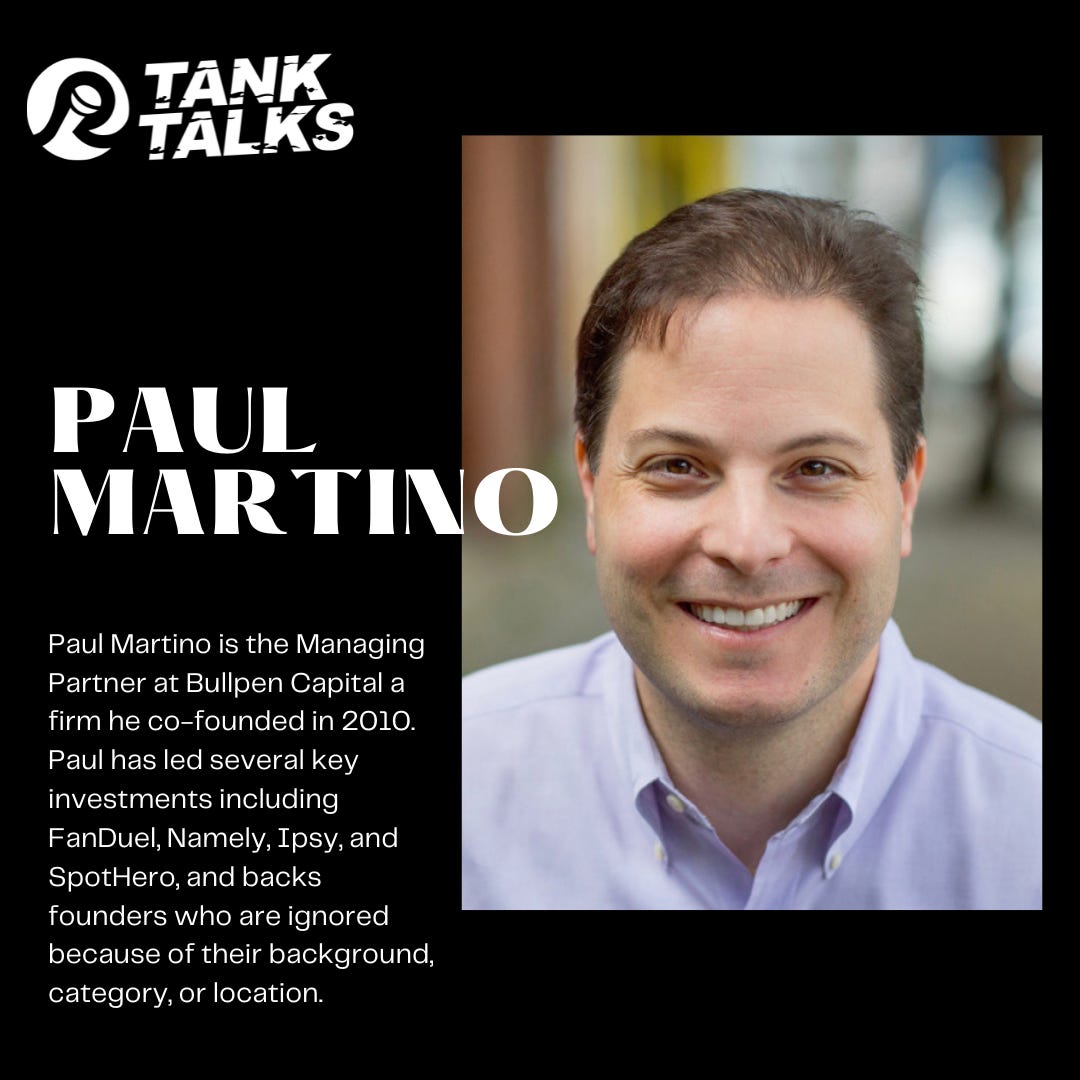
Paul Martino on why Product-Market Fit should always be evolving for startups and growth stage companies
Paul Martino is truly a pioneer in the world of social networking. His early online gaming innovations from over 30 years ago are the inspiration for several of the modern social gaming offerings, and he holds over a dozen patents on core social networking concepts, content targeting, and recommendation systems. In this episode, we chat with him about his experience in finding product-market fit and keeping up with ever-changing market trends.About Paul:Paul Martino is an entrepreneur and investor, interested in the intersection of sports, gaming, gambling, and technology. He is co-founder of Bullpen Capital and has founded seven other companies, including Ahpah Software (a computer security firm); Tribe (one of the world’s first social networks), and Aggregate Knowledge (a big data advertising attribution company). His latest endeavor, Bankroll, is building a next-generation sports betting-focused elevated dining restaurant in his hometown of Philadelphia.In this episode we discuss:03:05 What exactly is product market fit?04:05 Is it more important to focus on people, product or market when starting out?09:36 How should people think about finding new markets?11:55 The importance of iteration speed when finding product market fits17:57 What should founders ask themselves to find out if they have product market fit?21:20 Testing whether you have product market fit23:11 Are NPS scores valuable?24:55 What are some misconceptions founders should be aware of?30:50 How do founders avoid premature scaling?32:28 Advice for hiring when you find product market fit34:48 Bullpen’s plan to continue helping firms find product market fitFast FavoritesPodcastsWhistleblowerNewsletter/BlogMatt Ocko’s Data CollectiveNew TrendDemocratization of access to capitalBookThe Burden of Bad Ideas by Heather Mac DonaldFollow Matt Cohen and Tank Talks here!Podcast production support provided by Agentbee.Agency This is a public episode. If you would like to discuss this with other subscribers or get access to bonus episodes, visit tanktalks.substack.com

Canada Day Flashback - John Ruffolo, Founder of Maverix PE
Today, we’re revisiting an episode with the unbreakable John Ruffolo, recorded during the pandemic last year. Since then, John has suffered a cycling accident, made an incredible recovery, and launched a $500M growth stage equity fund, Maverix PE. For Canada Day, we’re chatting with this maverick about nurturing the next generation of tech and VC entrepreneurs.About JohnJohn Ruffolo is Founder & former CEO of OMERS Ventures and Co-Founder & Vice Chair of the Council of Canadian Innovators. He started the Ontario Municipal Workers Pension Funds Venture arm in 2011, and has been instrumental in helping develop some of Canada’s biggest tech companies. John’s portfolio includes companies such as Hootsuite, Hopper, PasswordBox (which sold to Intel), Shopify (which IPOd 2015), Wave (which sold to H&R Block) and countless others.In this episode we discuss:02:00 Private market valuations prior to the onset of the COVID-19 crisis09:26 How growth investors are pricing investments given the flux in public markets15:51 Building stronger and deeper relationships without being able to visit CEOs18:57 Adding value as a late-stage investor24:08 How to raise capital as a seed/ Series A founder27:45 John’s view on the Canadian tech landscape36:16 Weak points in the tech ecosystem and recommendations for founders45:04 Where emerging managers should focus their attention in a new landscapeFollow Matt Cohen and Tank Talks here!Podcast production support provided by Agentbee.Agency This is a public episode. If you would like to discuss this with other subscribers or get access to bonus episodes, visit tanktalks.substack.com
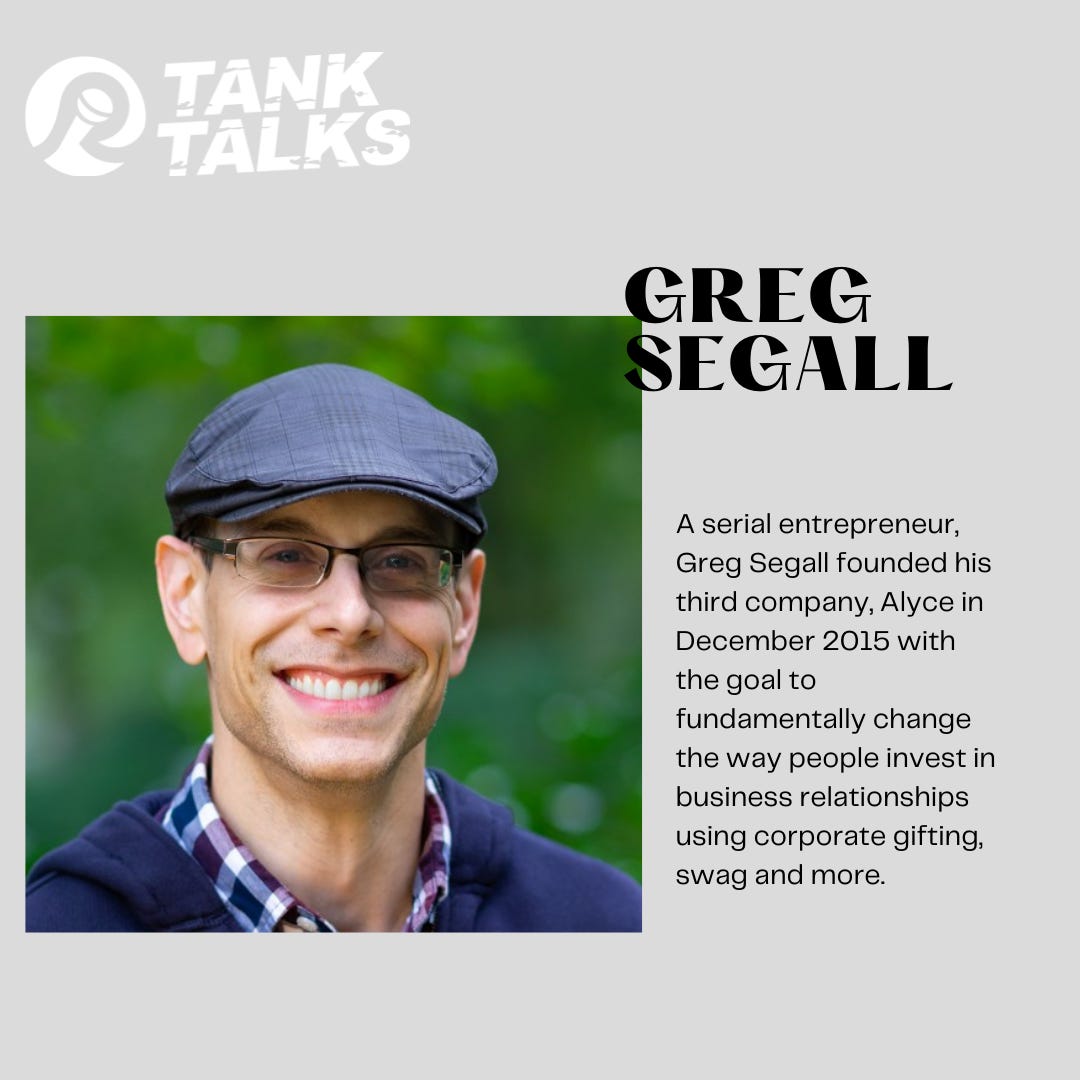
Greg Segall of Alyce on the Future of Corporate Entertainment and Gifting Post-Covid
What if you had a psychic digital gift concierge to help improve your corporate prospects and perhaps rid you of some decision fatigue in the process? That’s where Greg Segall, design/UX enthusiast and e-commerce expert comes in. How has this $120B industry evolved in a world where interpersonal exchange seems like an artifact of the past? All this, and more on today’s episode.About Greg:Greg Segall is an entrepreneur, executive, and supply-chain manager. He is the founder and CEO of Alyce, an AI powered corporate gifting platform. He was also founder and CEO of One Pica (now Astound Commerce), a global e-commerce agency, until 2012. Greg graduated from Boston University with a Bachelor’s degree in Design and Computer Science.Support for this podcast comes from Silicon Valley Bank“What’s next?”“What if?”“Now what?”Silicon Valley Bank understands these questions can keep founders up at night.For over thirty-five years, Silicon Valley Bank has helped high growth companies through scalable financial solutions, plus insights and expertise that many other banks just can’t.In 2019 we opened an office in Toronto dedicated to lending to Canadian businesses and their investors.Find out more at svb.com/CanadaSilicon Valley Bank – Built for What’s Next.In this episode we discuss:02:58 The current state of the corporate entertainment world and challenges companies face07:04 Why startups and technology companies have taken a liking to corporate gifting recently09:21 How to scale authenticity when it comes to one-to-one interactions16:35 Attention vs. action in a digital age18:44 Swag as a tool to build affinity for a brand21:43 How Alyce personalizes gift-giving26:13 Measuring ROI in corporate entertainment29:37 Following up with clients after hosting events and converting leads into opportunities35:00 How the market is going to move into more intimate environments40:36 Alyce’s growth planFast FavoritesPodcastsMasters of ScaleSaastrNewsletter/BlogMorning BrewTech GadgetEcho BikeNew TrendThe Push/Pull/Legs RoutinePeople to FollowJeff CavaliereBookThe Hard Thing About Hard Things by Ben HorowitzFollow Matt Cohen and Tank Talks here!Podcast production support provided by Agentbee.Agency This is a public episode. If you would like to discuss this with other subscribers or get access to bonus episodes, visit tanktalks.substack.com