Tank Talks By Ripple Ventures
349 episodes — Page 4 of 7

Private Equity Insights: Strategic Growth with Nolan Bederman of Bederman Capital
This week's guest is Nolan Bederman of Bederman Capital discusses the evolving landscape of private equity, emphasizing the importance of strategic growth, innovation, and building strong management partnerships. He highlights the need to balance technology and business operations, address regulatory challenges, and prioritize psychological insight in investment decisions. Bederman also critiques the Canadian regulatory environment, calling for a more supportive approach to entrepreneurship to drive productivity and economic growth.About Nolan Bederman:Nolan Bederman is the Executive Chair of the Lifespeak and is also the founder and managing partner of Bederman Capital Corp., a private equity business focused on investing in North American growth companies.In 2017, he formalized a partnership with New York-based Reynolds Channel Capital Partners, a private equity fund focused on making similar investments.Before founding Bederman Capital Corp., Nolan was a co-founding partner of Genuity Capital Partners, a mid-market private equity fund, where he spent almost ten years leading numerous successful private equity investments. Prior to joining Genuity, Mr. Bederman was an Executive Director in private equity at CIBC Capital Partners. Mr. Bederman was also a Vice President in the US Mergers & Acquisitions group of Merrill Lynch & Co., where he focused on advising global companies in the capital/consumer goods, transportation, food, and pharma sectors.He graduated with a combined JD/MBA program from the University of Toronto and a BA (Econ.) from the University of Western Ontario.In this episode, we discuss:(01:00) Career Transition and Private Equity Beginnings(02:25) Building and Growing Businesses(04:00) Notable Investments and Lessons Learned(08:13) Challenges and Learning from Failures(11:00) The Role of Trust in Private Equity(15:22) Engagement in Companies and Private Equity Dynamics(20:14) Psychology in Private Equity(25:17) Private Equity Landscape Changes(29:00) Advice for Aspiring Private Equity Professionals(34:35) Technological Innovation and Business Strategy(41:11) Mental Health in the Workplace(45:52) Impact of Canadian Economic PoliciesFast Favorites🎙 Favorite Podcast: Bill Maher's Club Random, Scott Galloway's Pivot (with Kara Swisher), Dan Carlin’s Hardcore History📰 Favorite Newsletter / Blog: Fast Company, Inc.📲 Favorite Tech Gadget: Miele coffee maker📈 Favorite New Trend: Walking while on conference calls📚 Favorite Book: The Birth of Loud by Ian S. Port (story of Leo Fender and Les Paul)🤔 Favorite Life Lesson: Treat everyone with respect, regardless of their position.Follow Matt Cohen and Tank Talks here!Podcast production support provided by Agentbee.ai This is a public episode. If you would like to discuss this with other subscribers or get access to bonus episodes, visit tanktalks.substack.com

Clutch CEO Dan Park on Resilience & Leadership in the Face of Adversity
On this week’s episode, we welcome back Dan Park, CEO of Clutch, for his second appearance. Dan shares how his team navigated the recent downturn in the startup world and the valuable lessons they learned from the experience.Since his last visit in October 2021, Dan and his team faced significant economic turbulence in the tech and automotive ecosystems. After securing a $100 million Series B and $150 million in debt financing, Clutch had to make tough decisions, including a 30% reduction in workforce. Dan walks us through these pivotal moments, discussing the strategies Clutch employed to adapt its business model and maintain trust with customers and employees.Additionally, Dan offers insights on managing investor expectations during turbulent times and how Clutch is positioned today, achieving record growth despite the challenges.We also have John Ruffolo back to discuss the news!Now, let’s jump into the Tank with Dan Park from Clutch.A word from our sponsor:The team at Ripple is always focused on helping our founders and portfolio companies find the best partners to work with within the tech and venture capital ecosystem. And that is why we are so excited to announce our partnership with the incredible team at Torys LLP. When it comes to legal support and advice, the team at Torys is the best in class. Torys is a storied Canadian law firm with offices in Toronto, Montreal, Calgary, Halifax and New York City. Torys has been around since its founding in 1941.They have always worked closely with players across the emerging startup ecosystem in all aspects of the creation, acquisition and commercialization of businesses. They help founders determine when and how much to fundraise, how to achieve the right economic structure, how to think about board and control issues and how to successfully navigate different stages of growth. They are also advisors to VC funds, strategic investors, private equity funds and other institutional investors on fund formation and shareholder arrangements to buyouts and other exits.In fact, Torys recently acted as counsel to Maverix PE on the transformative $260M Miovision Technologies growth funding with an advisory team that included Dany Assaf, Konata Lake and Max Schwartz-Labell on that investment.So whether you are negotiating a new business arrangement or developing a new service offering, Torys helps clients seize new opportunities and build creative, market-leading business models in this fast-paced world we live in every day space.Visit torys.com to learn more.About Dan Park:Dan is CEO of Clutch, an online platform for car buying and ownership. Prior to Clutch, Dan was GM & Head of Uber Eats Canada. During his time at Uber, Dan led the growth of Uber's food delivery platform in Canada. Previously, Dan was a Venture Partner at Azure Capital Partners and led the firm’s Canadian investment efforts.In this episode, we discuss:(02:18) John Ruffolo discusses the potential of AI to solve productivity losses and the challenges of enterprise adoption.(06:12) Intellectual Property in AI Development including data scraping issues and the need for regulatory frameworks(09:31) Stability AI's Downfall and the broader implications for the AI industry, including the challenges of profitability and competition(14:32) Toronto's Office Vacancy Crisis and its impact on property valuations, and the financial health of Canada's largest pension funds(20:00) Dan provides a background on Clutch's business model and the strategic adjustments made to navigate economic challenges, including reducing geographic footprint and focusing on profitability(26:30) The experience of facing economic turbulence, including the shift in market sentiment and the need for rapid strategic changes.(30:04) How Clutch maintained customer trust and transparency during challenging times and insights gained from customer feedback(35:56) Clutch's investment in technology, including AI-powered pricing models and internal tooling, to enhance efficiency and customer experience(41:16) Dan shares his vision for the future of the online used car marketplace, predicting increased e-commerce adoption and leveraging AI for better pricing and customer service(52:24) Advice to entrepreneurs on handling stress, seeking support, and making tough decisions during challenging timesFast Favorites🎙 Favorite Podcast: WorkLife by Adam Grant and All-In📰 Favorite Newsletter / Blog: The Peak📲 Favorite Tech Gadget: Oura Ring📈 Favorite New Trend: Lower use of phones in schools and people focused on reducing screen time📚 Favorite Book: "Endurance" by Alfred Lansing and "Into Thin Air" by Jon Krakauer🤔 Favorite Life Lesson: "Do things for the stories" - the value of experiences and learning through challengesFollow Matt Cohen and Tank Talks here!Podcast production support provided by Agentbee.ai This is a public episode. If you would like to discuss this with other subscribers or get access to bonus episodes, visit tanktalks.substack.com
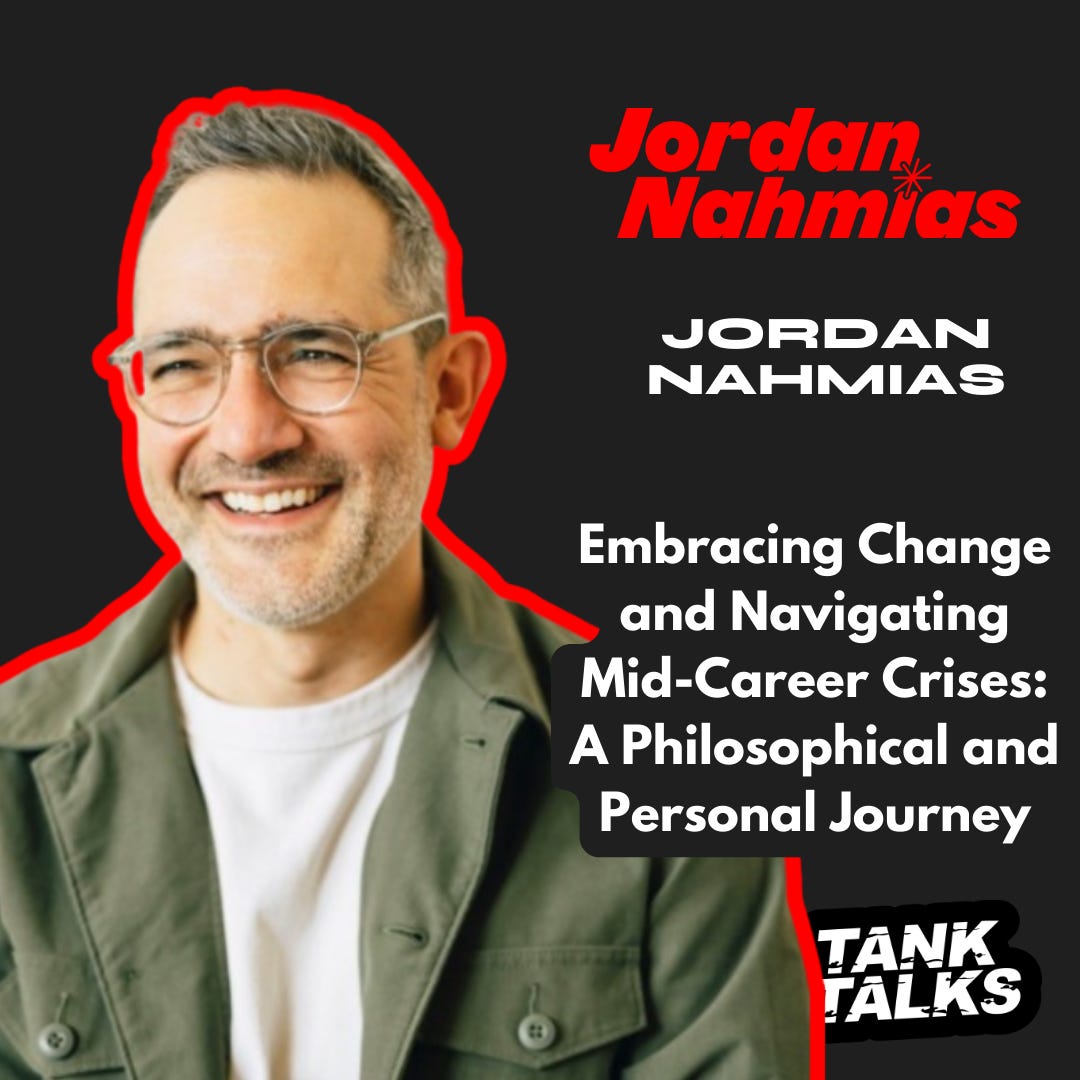
Embracing Change and Navigating Mid-Career Crises with Jordan Nahmias of Unstuck Consulting
Jordan Nahmias shares his journey from law school to lawyer to know coaching others on how to change careers at Unstuck Consulting. He discusses his dissatisfaction with his law career and the moment he realized he needed a change. Jordan talks about the fear and terror he experienced when deciding to leave his law practice and the support he received from his family and friends during his career transition from being a lawyer to becoming a coach and therapist. He shares his passion for helping people and his ability to listen and understand others.About Jordan Nahmias:Jordan Nahmias is Founder and Principal at Unstuck Consulting Inc. At Unstuck Consulting, he helps lawyers and other professionals find purpose in their careers through coaching.Before starting Unstuck, Jordan was a lawyer working at Goldenberg Nahmias LLP, Hall Webber LLP, and his own law firm, Nahmias Law Professional Corporation.Jordan studied law at the University of Toronto and the University of Hong Kong, earning his Juris Doctor in 2008. He also has a B.A. in Philosophy from Huron University.In this episode, we discuss:(01:34) - Jordan’s journey growing up and his early career path(03:49) - His time after law school teaching yoga and doing legal work on the side(04:29) - Starting his own legal practice and focuses on film and TV work, growing the practice, and merging with another firm(05:19) - The decision to leave legal practice in 2021(06:30) - Reflecting on dissatisfaction with the legal profession from the beginning(08:52) - Realization that a drastic change in career was needed.(09:13) - COVID and having a child as critical factors that sped up the decision to leave law(10:00) - Impact of not bringing the best self home to the family(12:39) - Hitting the "wall" in a career similar to the scene in "The Truman Show"(14:43) - Feelings of terror and preparation involved in making a career change(16:45) - Fear of failure and responsibility in making the decision to change careers(18:15) - The privilege of being able to make such a change and the importance of a supportive network(20:47) - Feedback received during the transition and the importance of accepting one's feelings(24:11) - Explanation of the new career path in helping others navigate periods of stuckness(27:18) - Working with clients to help them navigate career changes and find satisfaction(30:51) - Insights from the keynote on doing scary things and the importance of facing fears(32:39) - Dealing with regret by practicing gratitude(34:13) - Emphasis on focusing on feelings and the person rather than rushing to solutions(39:10) - The role of habits and practices in helping people manage their careers and personal lives(41:13) - Using social media to connect with others and shared experiences(42:40) - What’s next for his career and how people can get in touch with himFast Favorites:* 🎙- Favorite Podcast: Making Sense by Sam Harris* 📰- Favorite Newsletter / Blog: The Imperfectionist by Oliver Burkeman* 📲- Favorite Tech Gadget: Teleprompter setup with an SLR and iPad for Zoom calls* 📈- Favorite New Trend: Baggy clothing coming back into style and the acceptance of discussing dissatisfaction with work, especially for men* 📚- Favorite Book: Fiction: American Psycho; Non-fiction: Let Your Life Speak by Parker Palmer and The Middle Passage by James Hollis* 🤔 - Favorite Life Lesson: "No mud, no lotus" and Nothing is permanent: good times and bad times both passFollow Matt Cohen and Tank Talks here!Podcast production support provided by Agentbee.ai This is a public episode. If you would like to discuss this with other subscribers or get access to bonus episodes, visit tanktalks.substack.com
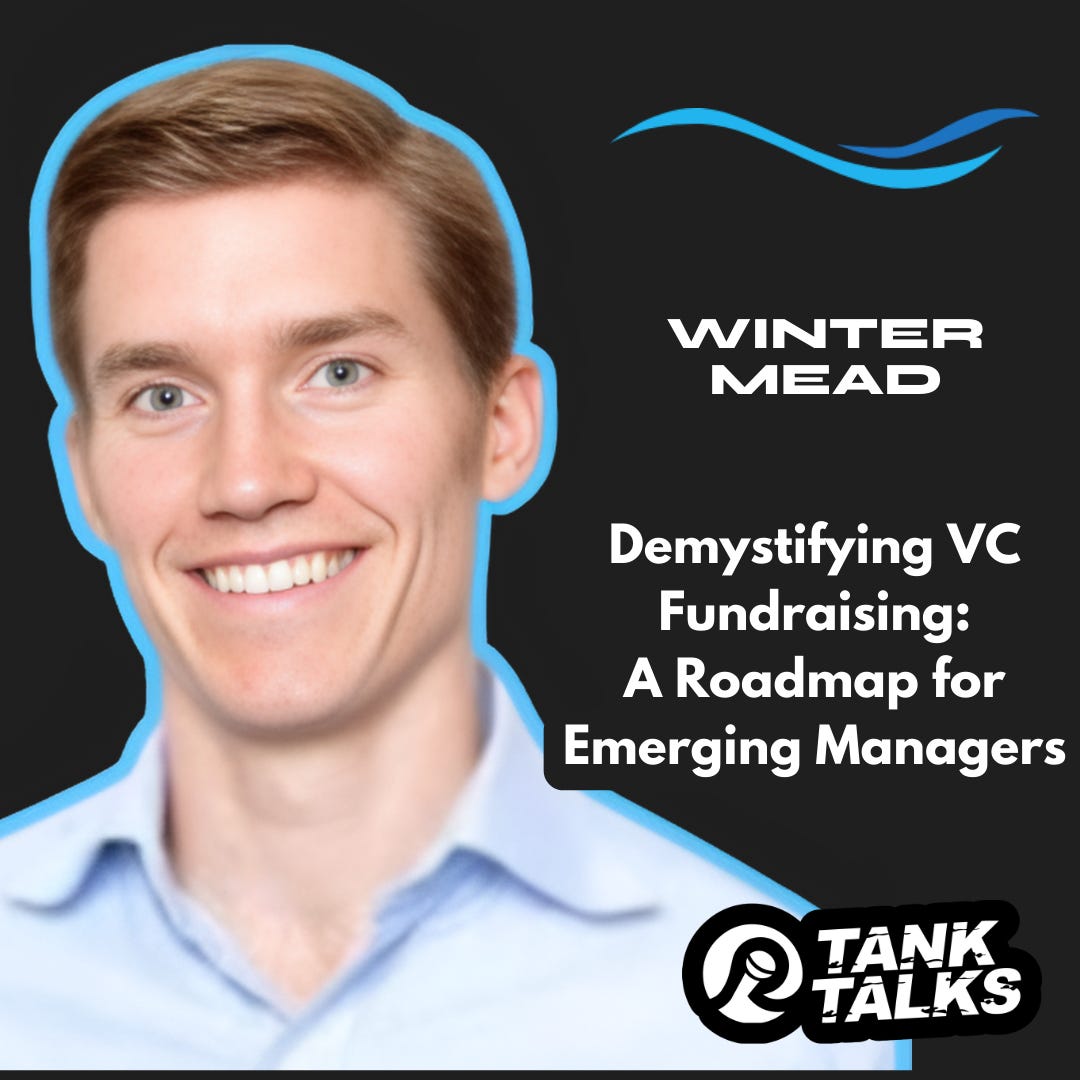
Demystifying VC Fundraising: A Roadmap for Emerging Managers with Winter Mead of Coolwater Capital
This week in the Tank we have Winter Mead, founder of Coolwater Capital, to discuss his background in venture capital and the challenges faced by emerging fund managers. He emphasizes the importance of understanding the LP perspective and operationalizing the fund to attract institutional investors. Winter also shares insights from his book on raising a venture capital fund and the mission of Coolwater Capital's Accelerator program. The program aims to bridge the knowledge gap for emerging VCs and provides guidance on fund formation, LP fundraising, and fund management. Winter highlights the criteria for selecting VCs for the program and the focus on community orientation.The conversation covers three main themes: fund management and operations, fundraising, and the future of venture capital. Winter emphasizes the importance of setting up the operations of a fund correctly, learning the new language of being a fund manager, and understanding the market when it comes to fundraising. He also discusses the benefits of building a network and leveraging relationships in the venture capital industry. Winter shares their thoughts on the future of venture capital, including the potential for consolidation, the role of AI in fund management, and the continued focus on investing in big themes and challenges.And John Ruffolo and Matt Cohen discuss the week’s news.About Winter Mead:Winter Mead is the founder and managing member of the investment firm Coolwater Capital. The firm focuses on emerging managers and technology investments. He is author of How To Raise A Venture Capital Fund, and operates Coolwater, an academy for training, building and scaling emerging managers. Coolwater has worked with over 240 emerging managers in the last four years.Prior, Winter helped build and invest an evergreen fund at SAP, a publicly listed enterprise software company, where he co-founded the LP transparency movement called #OpenLP. Winter also worked as a private equity and venture capital investor at a large multi-family office in San Francisco. Winter has completed seventy-nine institutional investments, as well as over twenty-five other investments since leaving his institutional allocator role. He served as junior faculty at Stanford Graduate School of Business on Venture Capital and Entrepreneurship.Winter holds a Master of Science degree majoring in Management Research from the University of Oxford and a Bachelor of Arts degree from Harvard University.In this episode, we discuss:(02:06) John Ruffolo discusses the potential political motivations behind not including a higher capital gains tax in the recent budget proposal and how it might be a strategic move by the government to pressure the conservative opposition(02:29) A potential second reason for the omission might be a need for more time to draft detailed rules around the new capital gains strategies, suggesting it's still a work in progress(03:35) The governmental challenges in managing the budget and public expectations, highlighting the difficulty in aligning political strategies with economic needs.(06:01) Concerns about the impact of unrestricted immigration on housing markets, criticizing the government for not addressing the core issues of housing supply.(07:34) The need for national unity and economic growth rather than redistributive measures that pit different societal groups against each other.(12:40) Llama 3 might cause disruption in the AI model market, praising its rapid adoption and potential to democratize high-quality AI tools(16:34) Winter Mead describes the mission of Coolwater Capital as supporting emerging managers, detailing how the firm aids them through training and network building to establish and grow their funds.(17:24) Foundational experiences at Sapphire Ventures that led him to focus on venture capital, highlighting the importance of understanding the investment landscape and operational aspects of managing a fund.(19:39) Discusses the importance of creating educational resources like his book to help emerging managers navigate the complexities of VC funding, emphasizing the lack of consolidated knowledge in the field(23:26) The challenges of fundraising for new funds, including the necessity of aligning with the right LPs and understanding the fundraising environment to effectively position a new fund in the market(24:32) The reasons behind writing his guidebook, aimed at solidifying his understanding of venture capital and offering a structured tool for new fund managers to increase their probability of success(28:07) The inception of Coolwater Capital and its strategic focus on providing a scaffolding to support emerging VC managers through both the fundraising process and fund operations(30:40) The operational complexities of running a venture capital fund, from compliance and management to investor relations, underscoring the importance of operational efficiency for fund success(34:27) The long-term commitment required to manage a ven

News Rundown with Jon Love of KingSett Capital
Our focus on the 2024 Canadian Federal budget continues, we have Jon Love Executive Chair and Founder of KingSett Capital back to discuss the lack of emphasis on fostering prosperity and a shrinking GDP per capita.While the budget offers some incentives aimed at improving housing affordability and encouraging investments in Canada, the increase in capital gains tax and other measures may slow down real estate development.Notably, the budget doesn't sufficiently tackle the need to boost the housing supply, which is essential for a healthy real estate market. These tax hikes and regulations could also deter investments and lead capital to flee the country. The budget overlooks important challenges faced by small and medium businesses and predominantly focuses on demand without sufficiently addressing supply issues.In this episode we discuss:(00:46) - Overview of the 2024 Canadian Federal Budget and its real estate implications(01:32) - Discussion on new incentives and the overshadowing impact of capital gains increase(05:12) - Challenges in the condo market and strategies for developers(09:28) - The misconceptions around financialization in real estate(13:24) - Necessity for a prosperity agenda and strategies for economic growth(17:31) - Potential effects of the budget on small and medium businesses(19:19) - The long-term consequences of current government policiesAbout Jon Love: Jon Love is the Executive Chair and Founder of KingSett Capital, a prominent private equity real estate investment firm. Since its inception in 2002, KingSett has impressively managed over $17 billion in assets, earning a strong reputation for its effective investment strategies across various sectors, including Growth, Income, Urban Development, Mortgage, Residential Development, and Affordable Housing.Before his leadership at KingSett, Jon had a distinguished career at Oxford Properties, beginning in 1980 and eventually becoming President in 1987 and then CEO in 1992. He notably guided Oxford's transition to a publicly traded company in 1995. In 2001, Oxford was privatized when it was acquired by the Ontario Municipal Employees Retirement System (OMERS) in a $4 billion deal.Jon actively participates in prestigious business organizations and has received numerous accolades for his leadership and academic achievements, including an Honorary Doctorate from Western University in 2016, membership in the Order of Canada (C.M.) in 2018, and prestigious awards such as the Ivey Business Leader of the Year Award and the NAIOP Rex Icon Award in 2023.Follow Matt Cohen and Tank Talks here!Podcast production support provided by Agentbee.ai This is a public episode. If you would like to discuss this with other subscribers or get access to bonus episodes, visit tanktalks.substack.com

From Bay Street to Bakery Street with Nicolas Mulroney of Bond Bakery Brands
This week we're joined by Nicolas Mulroney, President and CEO of Bond Bakery Brands. Nicolas shares his transition from a finance career at RBC to leading a thriving baking enterprise, highlighting the pivot that led him from Bay Street to Bakery Street.We talk about the founding of Bond Bakery amid the challenges posed by the COVID-19 pandemic and how his upbringing in a political family shaped his entrepreneurial spirit. Nicolas discusses how technology integrates in his business, he offers insights for budding entrepreneurs, and he outlines his future aspirations for the baking industry in Canada.We are also joined by John Ruffolo to talk more about the proposed Federal budget and other news in tech.About Nicolas Mulroney:Nicolas Mulroney is the Co-Founder, Chairman, CEO, and President of Bond Bakery Brands Ltd.Based in Toronto, Ontario, Bond Bakery Brands operates as an investment platform accelerating the growth of bakery companies throughout North America. The company emphasizes community engagement and investment in family- and founder-run businesses, striving to demonstrate that profitability and positive impact can coexist. Bond's portfolio includes a variety of bakery companies, and it employs over 600 individuals across 11 facilities.Before launching Bond Bakery Brands, Nicolas served as the Chairman of Portofino Bakery from June 2019 to October 2020, and he remains the Founder and Managing Partner at Northern Waters Capital since August 2018. His career in the capital markets sector includes roles at CIBC Capital Markets in Investment Banking and Institutional Equity Sales, and at Park Lawn Corporation as Vice President of Mergers, Acquisitions & Strategic Initiatives.Nicolas holds an MBA from the University of Toronto's Rotman School of Management and a Bachelor of Arts from Boston College.In this episode, we discuss:(01:52) John Ruffolo discusses meeting with Minister Freeland focusing on adverse effects of proposed capital gains changes on entrepreneurs and investors(03:32) The dual concerns for innovation community: impact on entrepreneurs and availability of capital(05:00) The federal budget is poor public policy, particularly for venture capital, stressing the importance of maintaining strong domestic capital source(07:24) The need to grow the economic pie rather than just redistributing income(13:45) Public discussions should aim at understanding fundamental problems and exploring viable solutions to foster a collaborative environment across various sectors(15:54) Nicolas Mulroney’s entrepreneurial journey(16:09) Nic’s upbringing and the influence of his family, especially his father from Prime Minister Brian Mulroney, on his career choices(18:27) Challenges and learning experiences from his time in finance that prepared him for entrepreneurship(20:10) Nic’s decision to leave finance to pursue running a business, attracted to transforming old economy industries(21:20) The process and rationale behind using a search fund to acquire a business, eventually leading to the purchase of a bakery(23:37) Advice from his father and Paul Demarais, encouraging him to pursue entrepreneurship(25:33) Operational challenges faced during the pandemic and the strategic shift towards building Bond Bakery Brands(30:08) Describes expansion of Bond Bakery Brands, highlighting the acquisition of assets and focus on commercial bakeries(32:08) The use of technology and data to improve operational efficiency across Bond Bakery Brands(34:36) Consumer trends affecting the bakery industry and the strategic response of Bond Bakery Brands to changing market conditionsFast Favorites:* 🎙- Favorite Podcast: How I Built This* 📰- Favorite Newsletter / Blog: New York Times Dealbook* 📲- Favorite Tech Gadget: Phone* 📈- Favorite New Trend: Ozempic* 📚- Favorite Book: The Outsiders* 🤔 - Favorite Life Lesson: It's a funny thing, the more I practice, the luckier I get.Follow Matt Cohen and Tank Talks here!Podcast production support provided by Agentbee.ai This is a public episode. If you would like to discuss this with other subscribers or get access to bonus episodes, visit tanktalks.substack.com
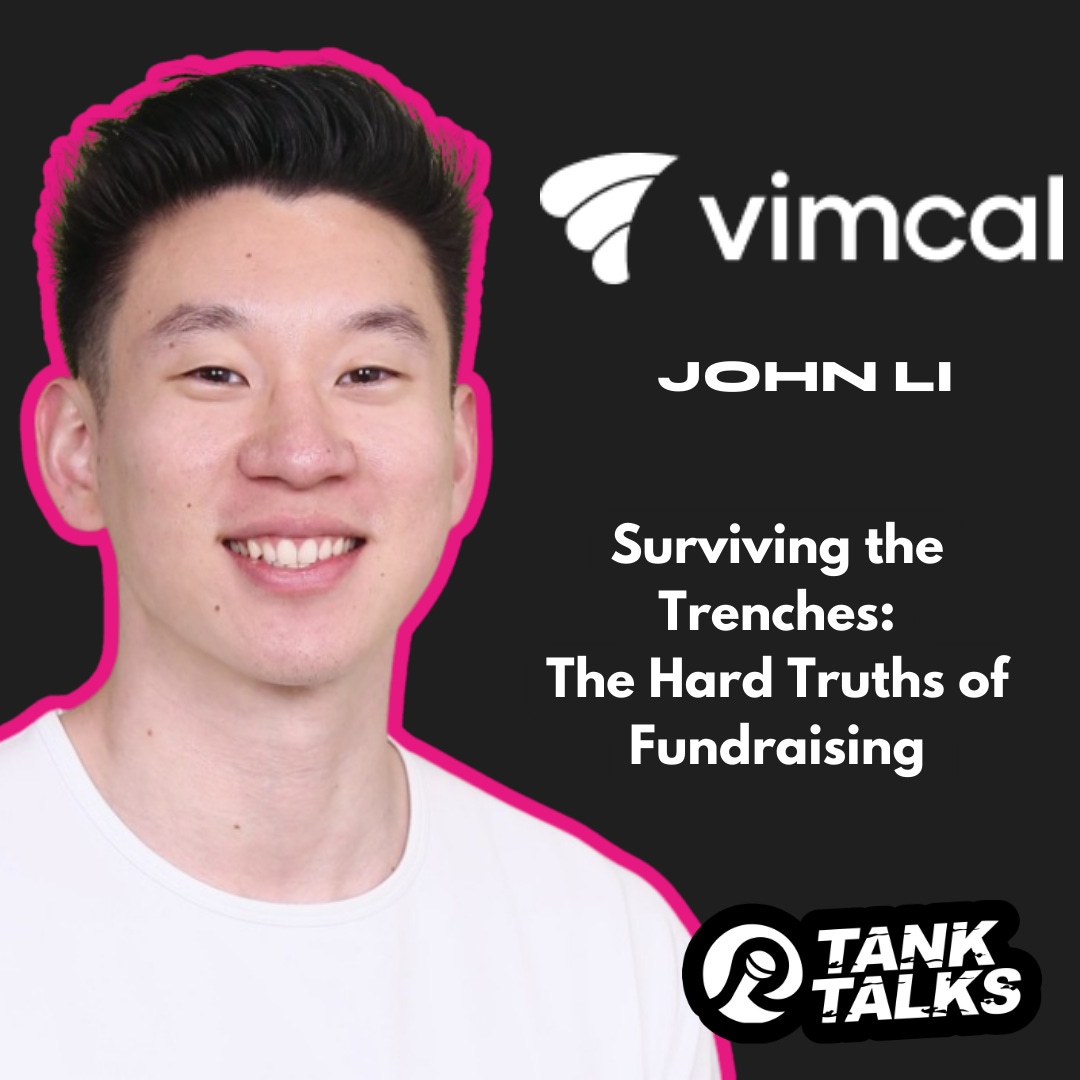
Surviving the Trenches: The Hard Truths of Fundraising with John Li of Vimcal
On this week's episode, we welcome John Li, CEO and Co-Founder of VimCal. John shares the rollercoaster of starting VimCal, from the initial struggles to gaining traction through a product-led approach, particularly appealing to like identifying and appealing directly to its most influential users—executive assistants.Plus, hear about the extreme loyalty VimCal has inspired, including one user's permanent tribute with a VimCal tattoo.This a candid conversation about resilience, user-focused development, and the importance of customer feedback in building a product that people not only use but love.Also, we have John Ruffolo to discuss the week’s news. Note the news rundown was recorded before the Federal Budget proposal was released, for a full breakdown of the budget go here. About John Li:John Li co-founded Vimcal in 2018 and serves as its CEO. Vimcal is a fast calendar app that helps people manage many meetings and was in Y Combinator. It has features like time zone conversion and keyboard shortcuts. The company introduced Vimcal EA for Executive Assistants, saving time for users at companies like Kleiner Perkins and Dropbox.Before Vimcal, John worked at Twitter as a software engineer from 2016 to 2018, after his company, Peer was bought by Twitter. He started his career with an internship at Apple.John studied at the University of California, Berkeley, where he earned degrees in Computer Science, Business Administration, and French.In this episode, we discuss:(0:02:36) Public reactions to the growth of the public sector and concerns about Canada's economic policies favoring public sector employment over entrepreneurship(0:04:17) Inefficiency in government and the significant decline in productivity among remote public sector workers(0:07:34) The upcoming federal budget will lean heavily on tax increases and the mobility of wealthier individuals and the potential for them to leave Canada due to high taxation(0:15:25) John Li shares his entrepreneurial background, mentioning his early career moves, including working at Twitter and an internship at Apple, which influenced his product development perspective(0:18:21) The moment he and his co-founder decided to start their venture after realizing they enjoyed working together on technology projects outside their corporate jobs(0:20:35) The initial concept for their AR startup, aiming to integrate native advertising into AR environments, and how this idea was ultimately too premature for the market(0:21:51) Pivoting from their initial AR idea during YC after feedback that the market timing was off, describing the emotional challenge of shifting away from an idea that defined their entrepreneurial identity(0:25:56) The shift to VimCal, born out of the frustrations with scheduling during their fundraising. He emphasizes the importance of building a product that the founders themselves would use(0:33:48) The enthusiastic reception of VimCal within the YC community and how personal onboarding calls helped refine the product and convert users into paying customers.(0:43:16) A memorable encounter with a VimCal fan who demonstrated his loyalty through a permanent tattoo of the VimCal logo, highlighting the passionate user base of the product.(0:56:23) The future focus of VimCal on enhancing team features for both internal and external scheduling, aiming to simplify complex scheduling scenarios and expand team collaboration toolsFast Favorites:* 🎙- Favorite Podcast: My First Million* 📰- Favorite Newsletter / Blog: James Clear* 📲- Favorite Tech Gadget: Sous Vide* 📈- Favorite New Trend: Living At Home Into Your 20s* 📚- Favorite Book: Animal Farm* 🤔 - Favorite Life Lesson: Learning how to deal with emotional triggers on a daily basisFollow Matt Cohen and Tank Talks here!Podcast production support provided by Agentbee.ai This is a public episode. If you would like to discuss this with other subscribers or get access to bonus episodes, visit tanktalks.substack.com
News Rundown: Federal Budget Review
John Ruffolo and Matt Cohen break down the federal budget proposal announced yesterday and its implications for investors, founders, and entrepreneurs.The increase in the capital gains tax and the lack of appreciation for founders and owners of businesses are driving the narrative of taxing success and the impact this will have on young founders, corporations, and very mobile individuals who can leave the country.The potential negative knock-on effects this will have on innovation and productivity gains and that damage to the startup ecosystem and investment landscape across Canada. The conversation explores potential next steps and the importance of being a part of the solution.Follow Matt Cohen and Tank Talks here!Podcast production support provided by Agentbee.ai This is a public episode. If you would like to discuss this with other subscribers or get access to bonus episodes, visit tanktalks.substack.com

News Rundown: Ottawa Invests $2.4B in AI, J.P. Morgan Grand Vision of AI's Future, and the Future of Higher Ed
John Ruffolo and Matt Cohen survived the eclipse and are back discussing the week’s news.Topics discussed:(01:08) Canada's new $2.4 billion AI initiative, positioning the country as a future AI powerhouse with a comprehensive investment plan(07:13) Jamie Dimon's enthusiastic endorsement of AI's transformative potential in his shareholder letter, emphasizing JP Morgan's massive AI investment and ambitious plans(12:56) Paddy Cosgrave's return to Web Summit after a brief hiatus what’s the impact on his reputation and the event's future(14:46) Queen's University introduced a lottery system for medical school admissions to foster diversity, reflecting on the evolving role and value of higher education amidst changing student prioritiesFollow Matt Cohen and Tank Talks here!Podcast production support provided by Agentbee.ai This is a public episode. If you would like to discuss this with other subscribers or get access to bonus episodes, visit tanktalks.substack.com
News Rundown: Cohere raising $500M with PSP, Schools Sue Social Media for $4.5B, Going Private, and SBF gets sentenced
Topics John Ruffolo and Matt Cohen discuss:* (00:00) Cohere's significant fundraising efforts, competing in the LLM space, and the notable involvement of Canadian pension funds at a valuation of $5 billion.* (03:29) Canada's strategy in artificial intelligence emphasizes the critical role of government in education and talent development, but is direct governmental involvement in AI businesses effective?* (06:09) A $4.5 billion lawsuit has been filed against major social media companies by four Canadian school boards* (11:15) Canadian public tech companies like Nuve and Lightspeed consider privatization to avoid public market scrutiny and leverage private investment strategies* (17:00) FTX founder Sam Bankman-Fried sentenced to 25 years for fraud what will the implications be for investor compensation and the broader crypto industryFollow Matt Cohen and Tank Talks here!Podcast production support provided by Agentbee.ai This is a public episode. If you would like to discuss this with other subscribers or get access to bonus episodes, visit tanktalks.substack.com
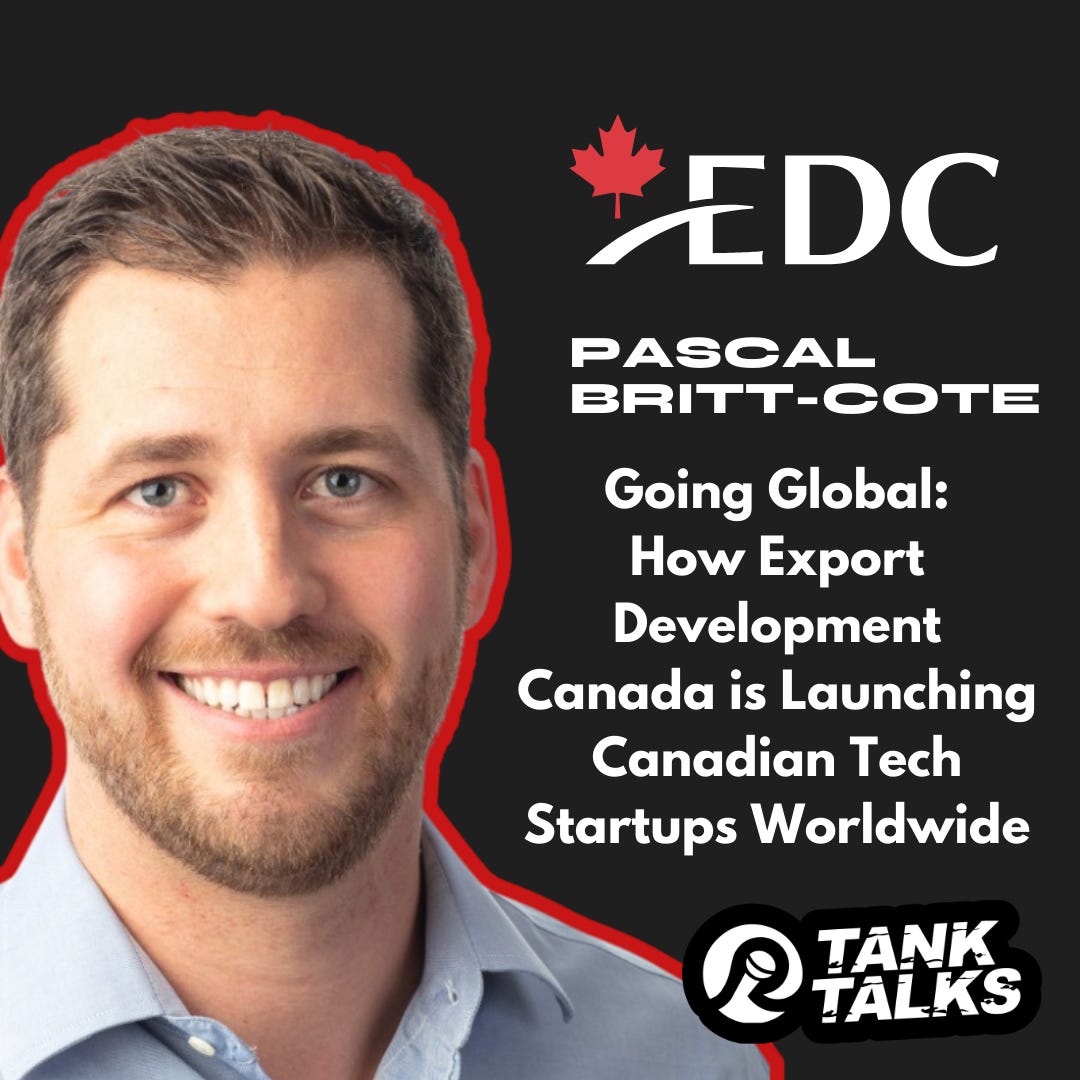
Going Global: How Export Development Canada is Launching Canadian Tech Startups Worldwide with Pascal Britt-Cote
On this week’s Tank Talks, we're joined by Pascal Britt-Cote from Export Development Canada (EDC). Pascal breaks down how EDC supports Canadian tech globally, far beyond just physical goods, aiding software and service sectors with knowledge, connections, and financial support to scale internationally.EDC's initiatives include specialized tech units, engagement at key tech events, and partnerships with tech bankers and associations. Utilizing its worldwide offices, EDC connects Canadian firms with global partners and customers. Pascal also highlights EDC's investment matching program for midsize companies, providing targeted financial support based on growth plans.About Pascal Britt-Cote:Pascal Britt-Cote works as the Regional Director, Mid-Market Business for the technology sector for the province of Ontario. He supports a team of talented Relationship Managers located in Ottawa, Toronto and Kitchener / Waterloo. During his 16 years at EDC he's had the opportunity to be part of different teams including underwriting EDC's three suites of products: International Financial Guarantee (IFG), International Trade Guarantee (ITG) and Account Receivable Insurance (ARI). He started his EDC career in 2007 as an Account Manager.He has a BCom with a specialization in Management from the University of Ottawa and also holds an MBA from the University of Montreal.In this episode, we discuss:(01:38) Started working at EDC 17 years ago, interested in international trade and finance. Worked in various roles within EDC, currently leads the Ontario tech mid-market team.(03:02) EDC supports companies that export goods, services, or software. Focuses on five key subsectors including software and B2B.(04:46) Since 2018, EDC has focused on the tech sector, creating tech units in Ontario and Quebec to understand and support the sector better.(07:13) Describes EDC as evolving and more engaged with tech companies. Initial meeting with companies to understand their needs and how EDC can support them.(09:21) EDC can assist founders and sales leaders looking for international partners and customers.(11:47) Explains that every country has an Export Credit Agency (ECA) like EDC; the U.S. equivalent is EXIM.(12:31) EDC's mid-market team handles accounts with sales from $10M to $300M. Criteria for support include having an export angle and a signed equity term sheet.(20:13) EDC helped companies during COVID by providing bonds and standby letters of guarantee to ease supplier payment terms.(26:20) EDC supports companies with knowledge on expanding internationally, including understanding local markets, legal and tax compliance.(30:59) EDC aims to connect with as many tech companies as possible, offering knowledge, connections, and financial solutions.(32:26) Highlights the Indo Pacific region's growing importance and EDC's focus on sectors with the highest growth potential.Fast Favorites:* 🎙- Favorite Podcast: All In* 📰- Favorite Newsletter / Blog: BetaKit* 📲- Favorite Tech Gadget: AirTag* 📈- Favorite New Trend: Polar plunges* 📚- Favorite Book: Can’t Hurt Me* 🤔 - Favorite Life Lesson: Never take anything for granted.Follow Matt Cohen and Tank Talks here!Podcast production support provided by Agentbee.ai This is a public episode. If you would like to discuss this with other subscribers or get access to bonus episodes, visit tanktalks.substack.com
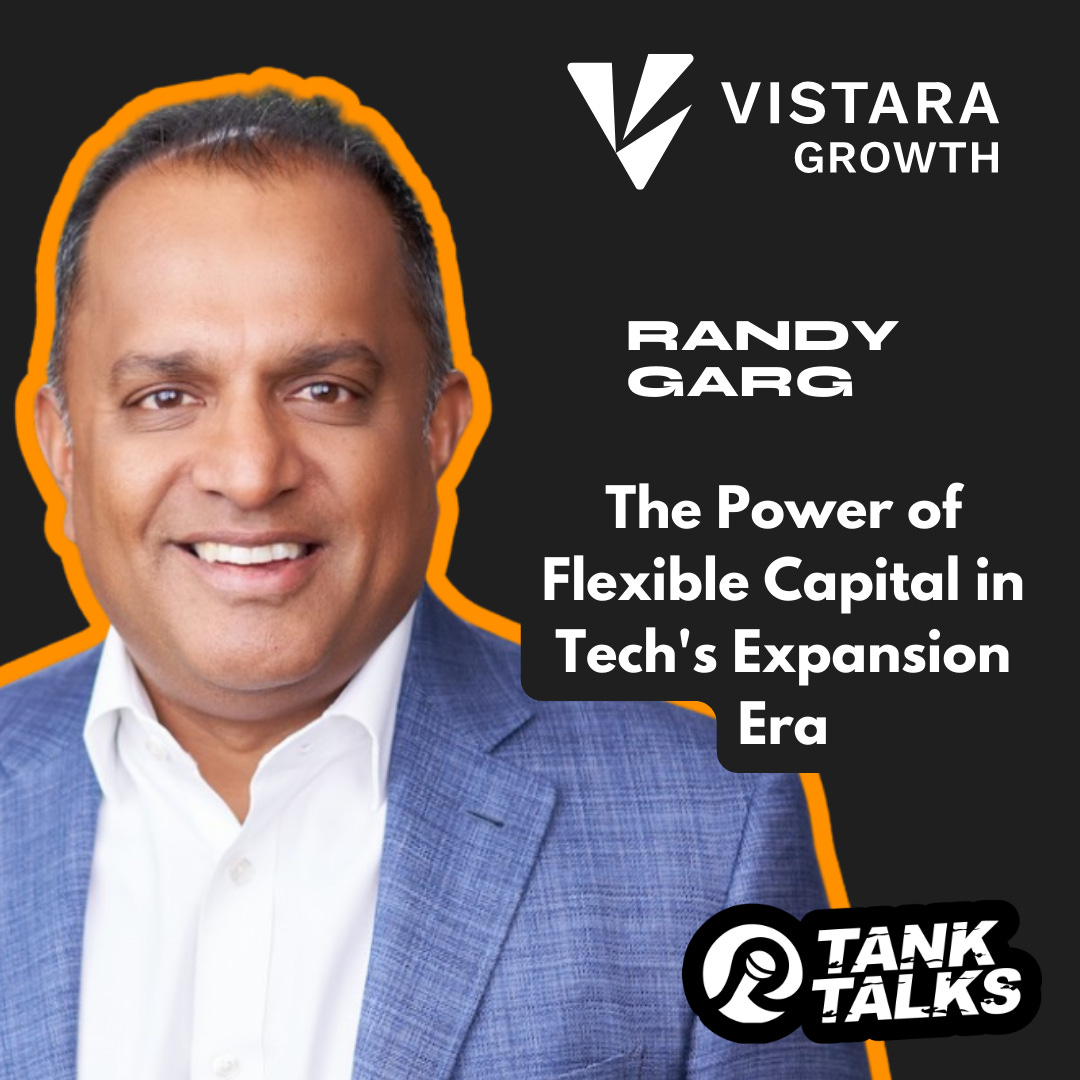
The Power of Flexible Capital in Tech's Expansion Era with Randy Garg of Vistara Growth
This week we welcome Randy Garg, Founder and Managing Partner of Vistara Growth. Randy shares his journey from his beginnings at PwC and Discovery Capital to co-founding Beedie Capital in 2010, and launching Vistara Growth in 2015 with support from the Beedie family as his first LP.Randy discusses the challenges tech companies face in securing growth capital and how Vistara Growth offers a mix of Growth Debt and Growth Equity to meet these needs, highlighting successful investments in companies like Zafin and Kore.ai. He delves into the state of private credit, public tech companies, and Vistara's fundraising strategies for its funds, including the transition from family office LPs to institutional LPs with Fund Five.Additionally, Randy talks about the importance of having a credit mindset, distinguishing growth debt from venture debt, and shares strategies for businesses to achieve sustainable growth and overcome scaling challenges. He also emphasizes leadership's role in growth and shares personal recommendations for podcasts, newsletters, and books, along with his life lesson on the importance of self-belief.About Randy Garg:Randy Garg is Founder and Managing Partner of Vistara Growth which provides creative and tailored Growth Debt & Growth Equity financing solutions to mid-later stage technology companies across North America. Vistara's typical investment size ranges from $10 million to $30 million for companies that have scaled or are scaling past $10 million+ in revenues. To date Vistara has raised $600M and is currently investing out of its fifth fund.Prior to launching Vistara, Randy co-founded and was Managing Partner of family office group Beedie Capital (2011-2015). During that time he sourced, completed and managed numerous growth capital financings with particular emphasis on the technology sector.Randy received his BBA from York University, his MBA from UBC, and holds a Chartered Financial Analyst (CFA) designation.In this episode, we discuss:(01:00) Randy shares his extensive background in venture capital, private equity/debt investing, and his significant experience in corporate finance and M&A(03:58) His role as Co-Founder and Managing Partner at Beedie Capital Partners (05:55) Founding Vistara Growth to provide flexible Growth Debt and Growth Equity financing solutions to mid-later stage technology companies across North America(07:48) His stint at PwC Corporate Finance leading the firm’s corporate finance activities across Western Canada for the technology practice(08:44) Vistara Growth's investment philosophy, emphasizing flexible growth capital to support companies as they scale past $10 million+ in revenues(10:21) The current state of private credit and public tech company valuations, identifying opportunities despite market challenges(11:08) Vistara Growth's investment in Zafin(16:45) The broader state of private credit, venture capital retreats, and the impact on companies seeking financing(20:21) The dynamics of the Canadian public market for small-cap tech companies, contrasting it with private financing strategies(23:02) Kore.ai's growth, from significant early achievements to becoming a leader in enterprise-grade virtual assistant platforms(25:52) Explains the unique offering of growth debt and the concept of "rental equity," differentiating Vistara Growth's approach from traditional venture debt(27:09) Future opportunities and strategies for Vistara Growth, focusing on the expanded market gap for flexible capital solutions(31:41) Discusses Vistara Growth's investment strategy and focus areas, including sector-specific strategies and the firm's approach to supporting portfolio companies(35:22) Concludes with future plans for Vistara Growth, emphasizing raising the rest of Fund Five, deployment strategies, and team growth.Fast Favorites:* 🎙- Favorite Podcast: Invest Like The Best* 📰- Favorite Newsletter / Blog: Bloomberg, Wall Street Journal, Globe and Mail, TechCrunch* 📲- Favorite Tech Gadget: Peloton Bike+* 📈- Favorite New Trend: Focusing on health* 📚- Favorite Book: Outlive* 🤔 - Favorite Life Lesson: Always been that on yourself.Follow Matt Cohen and Tank Talks here!Podcast production support provided by Agentbee.ai This is a public episode. If you would like to discuss this with other subscribers or get access to bonus episodes, visit tanktalks.substack.com

Canada's AI Surge Leading the Next Tech Frontier with Alex Kolicich of 8VC
We are excited to have Alex Kolicich, the founding partner of 8VC, on the pod this week. Alex shares his journey from working at Google and Palantir to joining Peter Thiel's hedge fund, Clarion Capital, and later co-founding 8VC. Alex discusses 8VC’s mission to significantly impact their portfolio companies by leveraging their unique blend of industry insight and investment expertise. And we get Alex's take on the recent AI boom in venture capital, dissecting the mega funding rounds in the AI space and providing a forward-looking perspective on startups and fundraising.We also have a news round-up with John Ruffolo.About Alex Kolicich:Alex Kolicich is a Founding Partner at 8VC, where he focuses on IT and Bio-IT investments.Prior to 8VC, Alex was a Partner at Formation 8 and also worked with Peter Thiel as a Principal at Mithril Capital Management, a growth-stage venture fund, where he helped lead investments in AppDirect, C2FO, and Helion Energy.Before his career as an investor, Alex worked as an engineer and early-product advisor at Clarium, Palantir, and Google. He was an early member of the Clarium Capital quantitative engineering team (with Joe Lonsdale) and a close advisor/collaborator with the early Palantir team; advising on product design and contributing to the product. At Google Research, Alex worked on Google Street View before and during its launch and also worked on the development and launch of the Google Checkout.In this episode, we discuss:(01:35) The trend of U.S. private equity firms acquiring Canadian tech companies and the benefits of currency arbitrage(03:17) The difference in capital competition between the U.S. and Canada, indicating a more vibrant private equity scene in the U.S.(06:04) Why John is bullish on Ethereum(08:28) How former Canadian Prime Minister Brian Mulroney's policies shaped the current political and business landscapes(12:45) Alex shares his journey from engineering at Google to venture capital, emphasizing the culture of innovation at Google(14:22) The shift from Google to venture capital, underlining the pivotal role of working with Peter Thiel(17:25) The founding principles of 8VC, focusing on investing in companies that leverage technological advancements(20:05) The potential of AI, Alex predicts its significant impact on the venture capital landscape(23:15) Alex’s his decision to pivot to venture capital, inspired by the opportunity to work with Peter Thiel and invest in deep technology(27:05) Alex discusses the significance of Canadian tech innovations and his motivation to invest in Canadian companies(33:14) Fundraising in 2024 requires growth and capital efficiency(37:25) A future where AI augments knowledge work, leading to societal shifts towards community-oriented living(49:30) Reflecting on Canada's role in the AI revolution, Alex emphasizes the need for proactive policies to attract and nurture talent, positioning Canada as a leader in AI innovation and applicationFast Favorites:* 🎙- Favorite Podcast: Meb Faber* 📰- Favorite Newsletter / Blog: Interconnects* 📲- Favorite Tech Gadget: Airpods Pro* 📈- Favorite New Trend: The rebirth of Silicon Valley* 📚- Favorite Book: 1984* 🤔 - Favorite Life Lesson: Put yourself in a position where you work with the most talented peopleFollow Matt Cohen and Tank Talks here!Podcast production support provided by Agentbee.ai This is a public episode. If you would like to discuss this with other subscribers or get access to bonus episodes, visit tanktalks.substack.com
Scaling B2B Sales: How Scalestack Uses AI to Transform Sales Ops with Elio Narciso
This week we are joined by Elio Narciso, founder of ScaleStack, who discusses his journey as an entrepreneur and the challenges of building and selling companies.He shares insights from his time at AWS and the lessons he learned about go-to-market strategies. Elio explains the creation of ScaleStack AI and the importance of problem-solving before incorporating AI. He emphasizes the significance of founder-led sales and building trust with customers. Finally, Elio introduces the Revenue Engine Masters podcast and its focus on revenue operations and sales operations professionals.About Elio Narciso:Elio Narciso, the Co-Founder and CEO of Scalestack, leads a team focused on innovating sales operations. Before founding Scalestack, Elio worked at AWS as a Principal BD and Program Manager, developing a GTM program that helped startups like Notion, Webflow, and Zapier.His operator background includes starting and selling two mobile internet companies and taking on advisory and investment roles in startups such as Bitbrand and Instal.Elio earned his MBA from MIT Sloan, concentrating on entrepreneurship and finance, and is fluent in three languages.In this episode, we discuss:(01:25) Elio recounts his journey from Italy to the U.S. for an MBA at MIT, where his entrepreneurial aspirations took root.(06:19) His experiences building Mobave, learning from its acquisition, and the importance of co-founders(13:19) The creation and legacy of the AWS Global Startup Program(23:11) Why his startup Measure It's failed due to a focus on technology over market needs(25:07) The thrill of seeing users engage with and love a product, underscoring the importance of creating valuable solutions.(26:32) Why founder-led sales in early-stage startups is critical for direct learning and ensuring product-market fit(33:43) The importance of personal communication, like texting, in building deeper customer relationships.(37:57) ScaleStack's approach to automating sales processes, emphasizing efficiency and the use of AI(41:18) Elio’s podcast targets rev ops and sales ops professionals, focusing on efficiency and innovation in sales.Fast Favorites:* 🎙- Favorite Podcast: Lex Fridman* 📰- Favorite Newsletter / Blog: Money Stuff* 📲- Favorite Tech Gadget: Phone, Sonos* 📈- Favorite New Trend: Productivity gains* 📚- Favorite Book: Guns, Germs, and Steel* 🤔 - Favorite Life Lesson: Be A Better ListenerFollow Matt Cohen and Tank Talks here!Podcast production support provided by Agentbee.ai This is a public episode. If you would like to discuss this with other subscribers or get access to bonus episodes, visit tanktalks.substack.com

News Rundown with John Ruffolo: 2023's Venture Dip, Rise of Zombie Firms, PE Trends in US/Canada, Foundry’s Shutdown, Founders’ Return, & AI’s Surge
Lots of news to discuss with John Ruffolo and Matt Cohen:(00:21) The significant downturn in venture capital, the early reset signs, and the impact of a conservative approach to business and fundraising in 2023, especially in Canada(02:09) The fate of companies that struggled to raise funds in 2023 and the shift towards supporting perceived winners and the inevitable challenges for "B" companies(05:29) Private equity's large market and diverse opportunities(06:48) Foundry Group's shutdown and the lack of structure for succession in VC(09:20) The effectiveness of CEO shakeups and the high-risk nature of founders returning to their companies, questioning such moves.(12:23) AI's explosive growth and why investing in foundational AI technologies is the best approach and the potential for major shifts in enterprise applications and cost reductionsFollow Matt Cohen and Tank Talks here!Podcast production support provided by Agentbee.ai This is a public episode. If you would like to discuss this with other subscribers or get access to bonus episodes, visit tanktalks.substack.com
Venture Frontiers: Navigating the New Dynamics of Defense Tech Investing with Jake Chapman of Marque Ventures
This week, we dive into the exciting world of defense tech with Jake Chapman from Marque Ventures. Jake shares his journey into VC, why Marque Ventures was born, and how shifts in geopolitics and advancements in AI, cybersecurity, and autonomous tech are driving VC interest in defense tech.He opens up about the hurdles of long development cycles, regulatory landscapes, and ethical dilemmas while offering insights into DoD procurement strategies, the importance of a defense-first approach, and the power of public engagement for raising sector awareness.Wrapping up, Jake touches on the significance of strategic partnerships and the evolving M&A scene, highlighting a future with a broader range of buyers in the defense tech space.About Jake Chapman:Jake Chapman is managing director at Marque Ventures, an early-stage VC firm focused on defense and dual-use technologies. He has played pivotal roles in various companies, leveraging technology to enhance national security. Jake focuses his investments on sectors like AI, robotics, aerospace, and quantum computing.In addition to investing, Jake is a co-host of "The Merge," a podcast making defense technology accessible and engaging. He also is a writer, where he shares insights on technology's future and venture capital, contributing to major publications like TechCrunch and WIRED.Jake has a BS and JD from the University of California, Berkeley.In this episode, we discuss:(01:16) Jake's transition from law to venture capital was sparked by his passion for sci-fi and a desire to be closer to technology and entrepreneurship(02:07) Launching Marque Ventures, Jake aimed to bridge the gap between startups and the complexities of DOD procurement, drawing on his rich background in tech and legal expertise(03:05) His endeavor to reform Army Venture Capital led to the creation of Marque Ventures, targeting the underexplored niches of defense technology(06:23) Why the geopolitical climate and innovation in AI, cybersecurity, and autonomous systems for the increased interest in defense tech from generalist VCs(11:59) The unique challenges of DOD procurement, and why startups should align their solutions with DOD needs from the outset(17:12) The importance of securing sufficient funding and understanding the long-term commitment required(20:23) Why Marque Ventures focuses on filling the Series A funding gap in defense tech(22:00) Discussing portfolio synergies, Jake mentions GoTenna's mesh networking as a prime example of integrating technologies for enhanced defense capabilities(23:23) Jake reflects on the changing dynamics of military engagement, stressing the need for cost-effective solutions in contemporary conflicts(25:06) The flaw in cost-plus contracting model, advocating for a shift towards more economically viable defense procurement strategies(28:48) The need for innovation in defense manufacturing, Jake envisions a TSMC-like platform to support the scalability of defense tech startups(35:38) The concept of 'dual use' in defense tech, citing SpaceX as an exemplary model for successfully navigating and scaling in this sector(37:13) The global defense market's potential, encouraging startups to look beyond the US for opportunities(40:44) What its like to co-host his own podcast, The MergeFast Favorites:* 🎙- Favorite Podcast: The Pitch* 📰- Favorite Newsletter / Blog: The Merge Newsletter, Defense Tech and Acquisition* 📲- Favorite Tech Gadget: iPhone, Switch* 📈- Favorite New Trend: Generative AI* 📚- Favorite Book: Tuxedo Park* 🤔 - Favorite Life Lesson: You don't get what you don't ask for.Follow Matt Cohen and Tank Talks here!Podcast production support provided by Agentbee.ai This is a public episode. If you would like to discuss this with other subscribers or get access to bonus episodes, visit tanktalks.substack.com

Crossing Borders, Bridging Gaps: A Vision for Pre-Seed Success in Canadian Tech with Alex McIsaac of Northside Ventures
In this week's episode, we're thrilled to host Alex McIsaac of Northside Ventures. With a diverse background in venture capital, cleantech, and global investing, Alex shares invaluable insights from his tenure as a Partner at Global Founders Capital. We explore why Alex believes it's the right time to launch Northside Ventures and the specific pre-seed market gaps he aims to address.We also delve into the prospects for Canadian AI startups, discussing strategies for outperforming established players and securing Canada's victory in the tech arena.About Alex McIsaac:Alex McIsaac is the Founder and General Partner of Northside Ventures. He has 12 years of experience as both an operator and early-stage investor. Alex led the Canadian practice as a Partner at Global Founders Capital, an international multi-stage venture fund with $3B+ AUM and 15+ offices globally. As a Principal at BDC Capital, the largest venture investor in Canada with $6B+ AUM, Alex helped manage the Seed Fund and Women in Tech fund.Alex spent over six years as a co-founding employee at NRStor, an energy storage-focused cleantech start-up founded in 2012. Blackstone Energy acquired its commercial business in 2018.Alex holds a BScH from Queen’s University and an HBA from the Richard Ivey School of Business.In this episode, we discuss:(01:03) McIsaac's VC journey started with a biology background, shifting to business and early-stage cleantech at Northwater Capital(02:01) The transition to building at NRStor, focused on energy storage technology(04:42) International investing and founder importance at BDC and Global Founders Capital(08:48) The founders' role in company success and adapting to market shifts at GFC.(10:27) Founders' adaptability to profitability during market changes(12:19) Why Alex launched Northside Ventures, focusing on early-stage, high-velocity companies without follow-on checks(17:42) Addressing Canadian pre-seed investment gaps(20:32) His interest in sectors like B2B SaaS, AI, FinTech, and cleantech for long-term growth(23:30) Adding value through investor and customer introductions, and key decision advising(26:18) Emphasis on one-to-one founder relationships over formal board seats for flexibility.(27:14) Targeted diverse LPs as a fundraising strategy(31:02) Using networking and events for LP network building(34:59) The importance of a good CRM as a solo GP(37:18) Early success with investments like Terminal, emphasizing founder-market fit(40:16) Optimism about Canadian AI startups(42:41) AI startups with distinct distribution strategies and customer needs addressing(45:36) Goals to make Northside a leading VC firm, contributing to the Canadian tech ecosystemFast Favorites:* 🎙- Favorite Podcast: 10x Capital* 📰- Favorite Newsletter / Blog: Techmeme* 📲- Favorite Tech Gadget: Oura Ring, Nanit Baby Camera* 📈- Favorite New Trend: Mental Health Awareness* 📚- Favorite Book: Red Notice* 🤔 - Favorite Life Lesson: We live in a marketplace of favors. Be generous with your time to as many people as possible because you never know how those favors or those people may come back to help you out.Follow Matt Cohen and Tank Talks here!Podcast production support provided by Agentbee.ai This is a public episode. If you would like to discuss this with other subscribers or get access to bonus episodes, visit tanktalks.substack.com
NBA All-Star Baron Davis on Bringing Business to Athletes and Investing as a Sport
We welcome NBA superstar Baron Davis, who shares his insights into the transition from sports to business. Baron shares his journey growing up in South Central LA and how he leveraged the advice from mentors and fellow athletes to help build a lasting legacy beyond his NBA days.Baron's story is not just about sports, it's about leveraging his athletic career into a second act in business, and how he was able to navigate the business landscape with the same agility he used on the court, and mentoring the next generation to do the same.About Baron Davis:Baron Davis is an entrepreneur, investor, and two-time NBA All-Star and record-holder. Known for his electrifying style on the court, Davis was a powerful point guard, who won acclaim for executing in crucial, high-pressure moments, when his team needed him the most. As a businessman, Baron was one of the original investors for Vitaminwater and helped launch Thrive Market.Baron is also the founder of several companies, including Sports and Lifestyle in Culture (SLIC), The Black Santa Company, BIG, and No Label—each with the objective of combining creative talent with original publication and production to develop and provide educational and heartwarming stories that appeal to global audiences of all ages. Baron also served as producer of several acclaimed documentaries including Crips and Bloods: Made In America, 30 for 30: Sole Man, and The Drew: No Excuse, Just Produce. In this episode, we discuss:(1:45) Basketball and finance lessons from early mentors shape Baron’s path(3:08) Transition to Crossroads exposes him to diverse social dynamics, sparking entrepreneurial curiosity(5:01) Early representation and self-navigation in his career(7:00) The launches of BIG focusing on curated networking for athletes and investors(11:56) BIG's educational and corporate partnership strategies aim for impactful industry connections(14:08) The importance of efficiently using athletes' time off the court and ensuring meaningful business interactions(16:37) BIG's approach to education and corporate partnerships, aiming for impactful connections across various industries(19:42) BIG's role in fostering business relationships in sports(21:24) Forming productive partnerships between athletes and entrepreneurs(26:36) His personal investment story with Vitamin WaterFast Favorites:* 🎙- Favorite Podcast: All The Smoke, Earn Your Leisure, Lewis Howes* 📈- Favorite New Trend: AI, VR-AR, Digital Asset Protection* 📚- Favorite Book: Rich Dad, Poor Dad, The Tipping Point* 🤔 - Favorite Life Lesson: Be happy for the things you have, be happy for the people that are in your life, and you can't control what other people doFollow Matt Cohen and Tank Talks here!Podcast production support provided by Agentbee.ai This is a public episode. If you would like to discuss this with other subscribers or get access to bonus episodes, visit tanktalks.substack.com
Sergey Gribov of Flint Capital on thriving within the conflict, expanding into the US, and the current markets
Sergey shares his evolution from a startup operator to venture capitalist and how his experience shaped him as an investor.Sergey grew up in Israel and we talk about why Israel’s startup ecosystem has been so successful for so many years even as it grapples with the current conflict.Sergey shares his thoughts around how startups should think about expansion to the U.S from overseas and how to know when you are ready to enter other markets.Lastly Sergey shares his thoughts on the potential rise of Management led buyouts in todays startup world and why we might see more of them in VC-backed startups that are underwater.About Sergey Gribov:Sergey Gribov is General Partner at Flint Capital where he invests in VoIP, cybersecurity, digital health, and finance.Sergey's educational background is as impressive as his professional achievements. He is an alumnus of the Massachusetts Institute of Technology, where he earned his MBA as a Sloan Fellow. This prestigious program is designed for mid-career global executives and entrepreneurs, focusing on entrepreneurship, finance, technology, and innovation management. Additionally, Sergey holds a B.Sc. in Computer Science, Cum Laude, from Beer-Sheva University. His academic pursuits have played a significant role in shaping his analytical and strategic approach to business challenges.In this episode, we discuss:(1:20) Sergey's Background and Journey into Startups and Investing(2:38) Experience in the Israeli Startup Ecosystem(6:03) Shift to Business and Angel Investing(13:26) Collaborative Nature of the Israeli Ecosystem(17:26) Managing Operations During Conflict(21:30) Market Dynamics and Venture Capital Ecosystem(30:54) Management Buyouts in Startups(34:01) Advice for Founders in Current Market ConditionsFast Favorites:* 🎙- Favorite Podcast: 20VC, Lex Fridman* 📰- Favorite Newsletter / Blog: Social Media* 📲- Favorite Tech Gadget: Google Pixel* 📈- Favorite New Trend: LLMs* 📚- Favorite Book: Never Split the Difference* 🤔 - Favorite Life Lesson: They're all luck plays in our life.Follow Matt Cohen and Tank Talks here!Podcast production support provided by Agentbee.ai This is a public episode. If you would like to discuss this with other subscribers or get access to bonus episodes, visit tanktalks.substack.com

News Rundown with John Ruffolo: Capital Crunch, Carta Lapse, and IMF talks AI
The new year brings new news to discuss with John Ruffolo and Matt Cohen. In this episode, we discuss:(00:28) CEO and CRO Changes in Startups and Scale-ups(02:02) Exploration of 'founder flight' in startups, Canada vs. the US(02:39) Runway Shortage in Startups(04:00) AGF Private Capital's Acquisition of Kensington Capital(07:17) Dynamics of Asset Management and Private Equity(08:00) Venture Capital Industry Trends(09:22) JMI Equity's Acquisition of Safe Software(11:26) Analysis of Carta's crisis management in their secondary markets division(18:39) AI's Impact on Job MarketsFollow Matt Cohen and Tank Talks here!Podcast production support provided by Agentbee.ai This is a public episode. If you would like to discuss this with other subscribers or get access to bonus episodes, visit tanktalks.substack.com

PLG Growth Strategies for Startups with Adam Jarczyn of PC Health
Today we're diving into the world of ProductLed growth and user onboarding strategies with our special guest, Adam Jarczyn, Senior Director of Product Digital Health at PC Health and a valued Venture Partner at Ripple.Adam brings a wealth of experience to the product and go-to-market strategies for early-stage startups and offers unique insights that help founders scale revenue and retention. In our conversation, we covered a range of topics, including scoping and discovery core features that can drive significant gains without losing sight of the project's vision, decision Velocity and how to cultivate a culture that values quick and smaller decisions, how urgency shapes PLG strategies and user experiences, and how tailoring your company's onboarding experiences can help address some of the most common PLG challenges.About Adam Jarczyn:Adam Jarczyn works as Senior Director of Product Digital Health at PC Health, while also being a Venture Partner at Ripple Ventures, a ProductLed Coach at ProductLed, and a GTMramp Member at GTMfund, where he advises and invests in companies that leverage product-led growth (PLG) and user onboarding strategies to scale their revenue and retention.He has been a founder and operator at KOHO, Shopify, Slyce and others. He holds a BS and MBA from McMaster University. (0:58) Discussing his career journey, Adam highlights transitions from product-focused roles to operational and go-to-market strategies.(1:41) Reflections on early career experiences include a startup exit and a shift to more operational roles.(1:58) The path into product-led growth (PLG) is described, emphasizing how diverse experiences influenced his understanding of product functions.(2:29) Emphasizing the importance of learning from successes and mistakes, Adam underlines this as a key factor for growth.(3:16) Insights from his tenure at Shopify focus on team dynamics and balancing growth with capacity.(4:46) Importance of compromise and autonomy in diverse problem-solving environments is stressed.(5:49) A problem-solving approach that starts with low-fidelity solutions, scaling up based on success, is explained.(7:35) The early mindset of "the best idea wins" has evolved to prioritize effective problem-solving.(9:07) Focusing on understanding user problems, Adam discusses finding solutions through systematic approaches.(10:36) Advocating for human-led or low-fidelity initial solutions, the emphasis is on minimizing scope in technology projects.(11:12) The advantages for early-stage companies in closely interacting with their users are discussed.(12:34) Advice for early-stage entrepreneurs centers on understanding customer needs and fostering a culture of quick decision-making.(14:28) Prioritizing user interactions and feedback over rapid scaling is highlighted as significant for early-stage companies.(15:58) In discussing product-led growth, understanding customer behavior and preferences is emphasized.(17:28) The role of human interaction in enhancing user experiences within product-led growth strategies is elaborated.(19:28) Balancing product improvement, marketing, and human interaction is advised for addressing user challenges effectively.(22:20) Integration of human elements in product-led growth strategies, especially in customer interactions, is suggested for early-stage teams.(22:43) Direct communication with users and building personal relationships are cited as advantages for early-stage companies.(24:02) A balanced approach between comprehensive data collection and practical action is advocated for data-driven decision making.(25:56) Focusing on key metrics and adapting data collection strategies based on evolving needs is encouraged.(27:05) To understand user drop-offs, focusing on positioning and value proposition is suggested when user interaction data is low.(29:03) Narrowing focus on solving specific user problems is advised for early-stage teams to avoid premature scope broadening.(31:57) Narrowing focus on specific user segments is recommended for more effective problem-solving and marketing for early-stage startups.(34:03) Focusing on user problems without rushing into monetization is emphasized as crucial in early venture stages.(36:57) Learning from sales organizations about managing leading and lagging indicators is advised for product teams.(39:51) Bold experimentation in AB testing is advocated over cautious approaches.(41:38) Quick feedback cycles are emphasized as vital for product innovation, suggesting a focus on leading indicators.(43:58) Incorporating multidisciplinary thinking and cross-team collaboration to solve user problems is recommended.(45:18) Challenges in incorporating new market dynamics into product decision-making are discussed, underlining the value of small-scale experiments.Fast Favorites:* 🎙- Favorite Podcast: The Daily* 📰- Favorite Newsletter / Blog: All In Manager* 📲- Favorite Tech Gadget: Dexcom G7* 📈- Favorite New Trend: Gentle Parenting* 📚- Favorite Book:
2023 Year in Review
With 2023 coming to a close, we thought it would be nice to reflect on the year’s trends with John Ruffolo.Doing the news breakdowns this year it’s been apparent that AI, ML, and ChatGPT have dominated. It’s been a little over a year since the chat interface was launched by OpenAI and we’ve seen a scramble in tech to catch up, a defeated coup at OpenAI itself, and many other developments in the space.We’ve also seen world politics come into the tech world in ways we haven’t seen before, how will the conflicts around the world shape tech and investing moving forward? And with interest rates poised to fall, what will that mean for global finance in 2024?In this episode, we discuss:(01:00) AI Evolution and Historical Comparison(03:16) Nvidia, Salesforce, Amazon, and Microsoft's strategies in AI infrastructure and applications(05:31) 2023 VC and Crypto Challenges(08:30) Geopolitical Impact on Tech Leadership(11:21) 2024 Predictions for Startups and Interest Rates(14:22) Potential 2024 Tech IPOs(14:52) Emerging Tech Trends for 2024(18:00) 2025 Canadian Federal Election Predictions(19:00) Entrepreneurial Advice for 2024Follow Matt Cohen and Tank Talks here!Podcast production support provided by Agentbee.ai This is a public episode. If you would like to discuss this with other subscribers or get access to bonus episodes, visit tanktalks.substack.com
The 5 Steps to Product Market Fit with Pablo Srugo of Mistral VC
The journey to Product Market Fit (PMF) and the common pitfalls for first-time founders are abundant, and finding a trusted guide to help you on your startup journey can be just as difficult. Our guest today is Pablo Srugo from Mistral VC. With his roots in co-founding Gymtrack and transitioning to venture capital, Pablo has seen or experienced many of the challenges of being a founder.In our discussion, Pablo highlights the importance of solving real problems and valuing customer feedback. He also dives into the importance of pivoting for startup survival, sharing real-world examples from his investment career. He wraps up by advising founders on balancing the long-term vision with the immediate quest for PMF, emphasizing the integration of customer feedback and market insights into their strategies.About Pablo Srugo:Pablo Srugo is a Partner at Mistral, based in Toronto. Prior to Mistral, Pablo was the co-founder and COO of Gymtrack, a VC-backed startup in the FitTech space. Pablo also co-founded an online tutoring platform, which was acquired in 2014.He also is the host of The Product Market Fit Show.(01:20) Pablo discusses his transition from founding a tutoring marketplace and Gymtrack to venture capital at Mistral VC(04:19) The importance of empathy in venture capital and how his founder experience helps him understand the challenges of reaching milestones like 10K or 50K MRR(06:26) His time as an Entrepreneur in Residence at Invest Ottawa, noting the common challenge startups face in achieving product market fit due to focusing on less significant problems(08:56) Choosing the right early customers and focusing on core business values.(10:57) Pablo’s experience with Gymtrack, discussing the challenges of finding product market fit and how revenue is not the only indicator of success(13:02) The struggle of gaining significant traction and the realization that their solution was not a top priority for their customer(23:35) Founder’s responsibility for achieving product market fit with VCs playing a supportive role(28:12) ADA’s challenges with customer service quality as its user base grew(30:24) The importance for founders to understand customer pain points and get real-time feedback, rather than delegating key roles too early(31:07) The balance of patience and urgency in venture capital, especially when a portfolio company is struggling to find product market fit(33:50) The tendency of founders, especially first-timers, to rush into building products without fully understanding the market or customer needs.(35:39) Why Minimum Viable Products (MVP) should deliver real value rather than being a half-finished product(41:16) Pablo shares his love for learning about the origin stories of companies like DuPont and FedEx, and the importance of understanding the journey to product market fit(42:00) The power of being a resilient “founder cockroach”Fast Favorites:* 🎙- Favorite Podcast: My First Million* 📰- Favorite Newsletter / Blog: Stratechery* 📲- Favorite Tech Gadget: Airpods* 📈- Favorite New Trend: AR and AI* 📚- Favorite Book: Man's Search for Meaning* 🤔 - Favorite Life Lesson: The only thing that matters is meaningful work and meaningful relationships plus good healthFollow Matt Cohen and Tank Talks here!Podcast production support provided by Agentbee.ai This is a public episode. If you would like to discuss this with other subscribers or get access to bonus episodes, visit tanktalks.substack.com

Fundraising tips for GPs with Ashton Rosin of Lowercarbon Capital
Capital formation, aka fundraising, is the unglamorous side of venture capital. Building a strategy and executing it is the reality for both emerging managers and established brands. Our guest today is Ashton Rosin, an Operating Partner and Head of Capital Formation at Lowercarbon Capital.Ashton shares her amazing journey working in the non-profit and NGO space in Washington DC before making a complete 180 and joining the fast-paced world of hedge funds as an IR manager. Ashton explains how her time working in investor relations at a hedge fund opened her eyes to how other asset classes were so far behind when it came to managing investor relationships and how the role at Lower Carbon came to be.Lastly, we get some tips and tricks for other emerging managers struggling to raise capital and how narrowing down your target list of LPs when fundraising is a better approach than spraying and praying. And John Ruffolo is back to dissect the week’s news.About Ashton Rosin:Ashton Rosin is an Operating Partner and the Head of Capital Formation at Lowercarbon Capital where she leads the firm's partnerships with existing and future investors.Prior to Lowercarbon, Ashton was the Head of Investor Relations at Obvious Ventures where she led capital-raising efforts and built solutions for relationship management, including the ESG considerations of limited partners. She started her career in financial services leading investor relations at Clocktower Group, helping the firm to conceptualize and scale new offerings across the hedge fund and venture capital landscapes. Before her financial services career, Ashton spent her time advocating for international disability rights through her academic, policy, and direct service pursuits around the world. Ashton holds a BA in International Development and a minor in Disability Studies from UCLA. In this episode, we discuss:(1:22) Cohen and Ruffolo delve into Openview's unexpected pause in new investments and its potential causes.(2:26) Exploring the impact of possible key man clauses and layoffs at Openview.(4:10) Predictions about LPs' reactions to Openview's investment suspension.(5:37) The implications for founders backed by Openview are questioned.(7:18) Skepticism about Elon Musk's involvement in multiple businesses.(10:32) Ruffolo shares his views on Bitcoin and Ethereum's roles in investment.(14:00) Ashton recounts her journey from South Africa to the U.S. and her career shift to venture capital.(19:31) Describing her role evolution at Clocktower Group and learning in asset management.(25:10) Ashton discusses the significance of building strategic investor relationships in a climate-focused fund.(30:15) Challenges faced by emerging managers in diversifying their investor base.(36:49) The importance of personal branding for GPs in capital formation and engaging LPs.(40:56) Strategies for maintaining communication with LPs during fundraising gaps.(43:39) Insights on hiring a dedicated head of capital and the use of placement agents.(48:46) Emphasizing research for targeting prospective LPs and the benefits of networking in capital formation.Fast Favorites:* 🎙- Favorite Podcast: My Climate Journey* 📰- Favorite Newsletter / Blog: CTVC* 📲- Favorite Tech Gadget: Kindle and Mill, which offers a unique composting solution, transforming compost into a white powder used for chicken feed* 📈- Favorite New Trend: Climate and AI investing* 📚- Favorite Book: The Unbearable Lightness of Being* 🤔 - Favorite Life Lesson: Life is like a ladder, you can go up or down, but there’s always another rung above you to pull you up.Follow Matt Cohen and Tank Talks here!Podcast production support provided by Agentbee.ai This is a public episode. If you would like to discuss this with other subscribers or get access to bonus episodes, visit tanktalks.substack.com

Fighting Disinformation Online with Ben Dubow of Omelas
Once platforms for connection and communication, social media now often serves as a battleground for digital deception, with algorithms sometimes amplifying extremist content, including jihadi propaganda and anti-Semitism. This complex digital landscape calls for a sophisticated approach to separate the truth from manipulation.Our guest today, Benjamin Dubow, is an expert in navigating this challenging digital terrain. As President and CTO of Omelas, he brings a wealth of experience from his days of monitoring extremist content to leading a company that uses open-source intelligence to combat disinformation.Ben shares his journey and how his expertise in tracking and understanding loyalty to terrorist groups has evolved into addressing broader influence operations by major world powers. He delves into the ethical considerations in AI-driven intelligence and the dynamic nature of misinformation, offering an in-depth look at the societal implications of these phenomena.This episode is a must-listen for anyone interested in the interplay between technology, international politics, and the changing digital world.About Ben Dubow:Benjamin Dubow is the CTO and President of Omelas, a company that blends expert knowledge with artificial intelligence to provide comprehensive context behind data. He is also a fellow at the Center for European Policy and Analysis. His role at Omelas showcases his profound expertise in data architecture and machine learning, enabling him to conduct extensive and innovative research and analysis. Additionally, he is multilingual and proficient in Arabic, French, Farsi, and Russian, which enhances his capabilities in global tech and policy arenas.Prior to Omelas, Ben was the President of Code To Inspire, a nonprofit focused on teaching Afghan women coding skills and helping them secure online employment. He also worked as a consultant for Google, where he played a pivotal role in the removal of ISIS content from YouTube and was instrumental in establishing the Redirect Method, a digital counter-extremism effort. His background in technology and his commitment to social impact have marked him as a notable figure in both the tech and policy sectors.In this episode, we discuss:(01:27) Ben’s career transition from counterterrorism to tech-driven solutions at Omelas(04:30) His experience at Google(06:25) The opportunity he saw when founding Omelas(07:15) Omelas' distinctive approach to open-source intelligence(09:24) Techniques for content analysis and sentiment assessment in intelligence gathering(11:10) Tackling misinformation and the data explosion in the digital age(14:13) The importance of understanding different perspectives in data contextualization(17:29) Analyzing the complex world of digital truth and the rise of disinformation(22:14) The mechanics of Russian influence operations and their unique approaches(29:17) Specific characteristics of jihadi propaganda and the influence of social media algorithms(36:22) Omelas' role in counteracting extremist messaging and propaganda(38:20) Exploring the implications of generative AI in shaping perceptions in information wars(42:55) Outlining Omelas' vision and the significance of truth in information disseminationFast Favorites:* 🎙- Favorite Podcast: Midday Show with Joe Giulio and Hugh Douglas* 📰- Favorite Newsletter / Blog: Eurasia Daily Monitor from Jamestown Foundation* 📲- Favorite Tech Gadget: MidJourney* 📈- Favorite New Trend: AI Videos* 📚- Favorite Book: Searching for Meaning by Viktor Frankl* 🤔 - Favorite Life Lesson: You only have a very, very small perspective of the world.Follow Matt Cohen and Tank Talks here!Podcast production support provided by Agentbee.ai This is a public episode. If you would like to discuss this with other subscribers or get access to bonus episodes, visit tanktalks.substack.com

Tank Talks News Roundup: OpenAI implodes
John Ruffolo and Matt Cohen convene an emergency news rundown to discuss the recent OpenAI news.(00:22) OpenAI's Board’s surprise ousting of CEO Sam Altman(01:07) Impact on investors like Microsoft and Silicon Valley figures(01:29) Perspectives on OpenAI's dramatic changes(03:21) Criticism of OpenAI's governance approach(04:46) Exploration of OpenAI’s corporate structure(06:28) Implications for Microsoft and Tech Industry(07:54) Leadership dynamics and legal aspects(08:32) John's experience at the APEC Summit and discussions on AI and geopolitics.Follow Matt Cohen and Tank Talks here!Podcast production support provided by Agentbee.ai This is a public episode. If you would like to discuss this with other subscribers or get access to bonus episodes, visit tanktalks.substack.com
Building a Sustainable Pet Food Business with Isaac Langleben of Open Farm
There’s a term of art in the business world—dogfooding. It means if you’re going to propose a solution, you should use that same solution to help better understand problems the end user may encounter. Our guest today is familiar with dogfooding, both as a business process and from literally making food for pets. Isaac Langleben made the leap from consulting to leading Open Farm, a sustainable pet food business. We talk about that leap, the Canadian Startup Scene and have a news roundup with John Ruffolo.About Isaac Langleben: Isaac Langleben is the CEO and Co-Founder of Open Farm, a premium pet food brand on a mission to deliver exceptional pet nutrition while driving a positive impact on animals and the planet. Isaac leads Open Farm’s team across Canada and the US in bringing innovative, healthy products to pets through over 6,000 pet stores & online. A serial entrepreneur, Isaac has also co-founded two other pet product companies – Canada Pooch, a leading pet accessories company and Diggs, an innovative pet supplies company.Prior to being a pet entrepreneur, Isaac was at Clairvest Inc, a Toronto-based private equity firm with over $2.4 billion of equity capital under management, and a consultant at Boston Consulting Group.He has two bachelor’s degrees from McGill University.In this episode, we discuss:(01:02) News rundown with John Ruffolo(02:08) Developments and challenges in quantum computing(04:18) Analysis of Microsoft's investment strategies(06:12) Microsoft's approach to innovation in technology(07:24) OpenAI's expansion and its implications(08:12) Challenges and opportunities in AI and consumer technology(10:26) Impact of GPT-4 Turbo on AI development(11:06) Competitive landscape in AI startups(12:58) New AI technologies and privacy concerns(14:07) Role of AI in modern technology trends(15:21) Isaac's journey from law to pet food industry leadership(17:13) His private equity experience and insights into the pet industry(18:44) Evolution of the pet food industry(21:02) Strategies for scaling and diversifying in the pet industry(23:41) Challenges and opportunities in business growth(26:18) Different investment and growth approaches(28:18) Open Farm's commitment to sustainability(30:21) Challenges in global expansion and market entry(32:20) Strategies for customer base expansion in the U.S.(34:22) Open Farm's future growth and sustainability goals(36:15) Alignment of Open Farm's mission with business objectives(38:44) Role of investors and strategic partnerships in business growth(41:51) The Canadian startup ecosystem(44:29) Encouraging entrepreneurship in Canada(47:20) Navigating supply chain challenges during COVID-19(49:38) Isaac's advocacy and educational initiativesFast Favorites:* 🎙- Favorite Podcast: Ringer NBA and Bill Simmons* 📰- Favorite Newsletter / Blog: Axios* 📲- Favorite Tech Gadget: Traeger Timberline* 📈- Favorite New Trend: Return to work and Brazilian jujitsu* 📚- Favorite Book: Every Night is Pizza Night* 🤔 - Favorite Life Lesson: If you see something, just go for itFollow Matt Cohen and Tank Talks here!Podcast production support provided by Agentbee.ai This is a public episode. If you would like to discuss this with other subscribers or get access to bonus episodes, visit tanktalks.substack.com
Building a Tech-Savvy Family Office from a Real Estate Empire with Ronald Shon of REDDS Capital
On Today’s episode, we dive into the world of Family Office Investing with Ronald Shon from REDDS Capital.We talked about to him the beginnings of his family's real estate empire, the Shon Group, which flourished in Vancouver since 1954. Following his education at Stanford and Wharton, Ron took the helm of the business after his father's untimely passing, eventually diversifying into technology and venture capital investments, driven by a pivotal investment in Apple stock that revealed the limitations of real estate compared to institutional investing.Today, as the head of REDDS Capital, Ron emphasizes their distinctive approach to startup assessment, not only providing financial backing but also offering strategic guidance and networking support to foster innovation and growth within their portfolio companies.About Ronald Shon: Ronald Shon Chair & GP of REDDS Capital in Vancouver. He has investments in technology, education, real estate, natural resources, fashion, private equity, and venture capital primarily in North America and Asia. He was a founding shareholder of Salman Partners Inc. an independent boutique investment banking firm that has raised over $20 billion CDN.In this episode, we discuss:(01:11) News Round-Up with John Ruffolo(18:32) Ron Shon's Journey into Real Estate and Investment(21:14) Transition from Real Estate to Technology and VC Investments(23:50) How Ron’s international worldview impacted his perspective in Vancouver(25:18) Insights on Real Estate Development and Challenges(31:09) Investing in Technology and Venture Capital(34:50) Assessing Potential Startup Investments(39:06) Impact of Investments and Future Plans(47:50) Advice to his children and the next generation of investorsFast Favorites:* 🎙- Favorite Podcast: Fast Money* 📲- Favorite Tech Gadget: iPhone* 📈- Favorite New Trend: AI* 📚- Favorite Book: The Fourth Industrial Revolution* 🤔 - Favorite Life Lesson: Always have a planFollow Matt Cohen and Tank Talks here!Podcast production support provided by Agentbee.ai This is a public episode. If you would like to discuss this with other subscribers or get access to bonus episodes, visit tanktalks.substack.com

Expanding Canada's Global Presence with Andre Charoo of Maple VC
As the Canadian Tech scene expands, we often are aided by Canadians abroad who have gained experience and expertise in various aspects of startup life and culture. Our guest today is Andre Charoo, Founder and GP of Maple Ventures, which invests in founders with Canadian roots.We spoke about the lack of early-stage Canadian investors on the cap tables of successful companies like Instacart and Wish even though their founders have Canadian roots and what it was like being an early employee at both Uber and Hired.Maple started in 2016 with just $1.2m in commitments and currently has over $16M in AUM.And John Ruffolo is back to discuss the news.About Andre Charoo:Andre Charoo is the Founding Managing Partner at Maple VC, an early-stage venture capital fund based in San Francisco that backs Canadian-led companies. Andre’s deep operational expertise stems from helping to scale some of the most successful companies around, including his time as one of the first 25 employees at both Uber and Hired. He is also a Co-Chair of The C100, an influential community of Canadians in tech.In this episode, we discuss:(0:01:11) News rundown with John Ruffolo(0:14:09) Andre’s jounrey from Markham, Ontario to Silicon Valley investor(0:31:19) Lessons from being an early employee at Uber and Hired(0:38:21) The problem with Canadian investors(0:40:11) Why all successes are unique(0:43:03) How he signed on to be a Venture Partner with Inovia Capital(0:47:23) Operating from his homebase in Seoul, SK while investing in North America(0:53:39) Tools he uses to stay organized(0:55:48) How Maple’s portfolio construction has evolved(1:00:20) Demonstrat value and viability to his LPsFast Favorites:* 🎙- Favorite Podcast: Acquired* 📰- Favorite Newsletter / Blog: The Generalist* 📲- Favorite Tech Gadget: Too many to name* 📈- Favorite New Trend: AI* 📚- Favorite Book: Shoe Dog* 🤔 - Favorite Life Lesson: Put yourself in uncomfortable situations because that's how you will growFollow Matt Cohen and Tank Talks here!Podcast production support provided by Agentbee.ai This is a public episode. If you would like to discuss this with other subscribers or get access to bonus episodes, visit tanktalks.substack.com
Building the Uber of Lawn Care with Brian Clayton of GreenPal
The grass is always greener, as the saying goes, and when our guest today saw the opportunity to build his lawncare empire and launch GreenPal, a lawncare marketplace he jumped in with both feet and never looked back.Bryan Clayton is the Co-Founder and CEO of GreenPal, and has lived the lawn care life before. He also knew what lawn care professionals needed and what lawn care customers wanted, but he didn’t know much about launching an app.Today, GreenPal is the largest on-demand lawn care marketplace in the US with the goal to be the easiest way to book a local lawn care company for yard maintenance services at an affordable price.We talked to Bryan about his career journey, how to sell your company, and the decision to bootstrap GreenPal to $30M in GMV.About Bryan Clayton:Bryan Clayton is the Co-Founder and CEO of GreenPal, an online marketplace that connects homeowners with local lawn care professionals. GreenPal has been called the “Uber for lawn care” by Entrepreneur magazine and has over 300,000 active users completing thousands of transactions per day.Before starting GreenPal, Bryan Clayton founded Peachtree Inc., one of the largest landscaping companies in the state of Tennessee, growing it to over $10 million a year in annual revenue before it was acquired by Lusa Holdings in 2013. Bryan‘s interest and expertise are related to entrepreneurism, small business growth, marketing, and bootstrapping businesses from zero revenue to profitability and exit.In this episode, we discuss:(01:14) Bryan’s 10-year journey to being an overnight success(02:04) What building a sales process was key to his first business, Peachtree(03:22) Scaling the sales team(07:30) Deciding to sell Peachtree(10:13) How he built GreenPal differently and why they have bootstrapped(12:37) The evolution of his leadership style at GreenPal(14:42) How GreenPal solved the marketplace problem by focusing on the supply side first(17:15) Has bootstrapping effected their decision-making(23:27) How being an industry insider helped him navigate a lot of the blockers in starting GreenPal(26:33) The importance in building community in their lawn care professionals(28:23) Advice for other marketplace founders(30:29) The decision tree for his time and why he says no to many requests(34:05) Understanding a job function before you delegate(34:49) The most rewarding aspect of being an entreprenuer(36:19) What the next 10 years of GreenPal looks likeFast Favorites:* 🎙- Favorite Podcast: All In* 📰- Favorite Newsletter / Blog: Lenny’s Newsletter* 📲- Favorite Tech Gadget: iPhone* 📈- Favorite New Trend: Large Language Models* 📚- Favorite Book: Seven Habits of Highly Effective People, The Cold Start Problem* 🤔 - Favorite Life Lesson: Walk your store.Follow Matt Cohen and Tank Talks here!Podcast production support provided by Agentbee.ai This is a public episode. If you would like to discuss this with other subscribers or get access to bonus episodes, visit tanktalks.substack.com

Standing with Israel - A discussion with Itamar Novick of Recursive Ventures
There are moments that can make your day-to-day life come to a halt. What happened in Israel on 10/7 is the sort of public tragedy that stops the normal course of life, it also creates an impact of devastation that will go on for years to come.These events have struck a chord with us personally as members of the Jewish community. Many of our investors and partners share this connection, whether directly or indirectly, and are being impacted by these unspeakable events.As a firm, we want to clearly state that we unequivocally stand behind Israel and its right to defend itself and its people against terrorism. In the face of terrorism or any acts of violence against our fellow communities, we will remain resolute in our support.We are grateful for the messages of concern and solidarity that we have received from both Jewish and non-Jewish founders and VC colleagues who have reached out to inquire about the safety of our family and friends during these events.In times like these, we all need to support one another.Today we welcome Itamar Novick, an operator, investor, and Israeli who founded Recursive Ventures, a firm based in Berkeley, CA.We spoke about the news he is getting from the ground in Israel and his views on what the future might hold for the country and the world. We also have John Ruffolo on to discuss the current headlines making news around the world. This is a public episode. If you would like to discuss this with other subscribers or get access to bonus episodes, visit tanktalks.substack.com
Shaking up the Canadian Banking Industry with Daniel Eberhard of KOHO Financial
Fintech regulations around the world can vary wildly, but here in Canada, they can be particularly onerous. Today someone who is no stranger to redefining and working through the complexing of Canadian regulations. Our guest is the Founder and CEO of KOHO Financial, Daniel Eberhard.Dan grew up in a tiny town in British Columbia and now runs a company with over 250 employees and $275m in financing.We talk about how bad the Canadian regulatory environment is for fintech companies and why innovation in the industry is being throttled by the government and their respective industry advisory groups.About Daniel Eberhard:Daniel Eberhard is the Founder and CEO of KOHO Financial. He started his career in 2010, building Kineticor Renewables Inc., a Saskatchewan wind farm company he and partner Andrew Plaunt began as a class project. They sold in 2011 to renewable energy giant Algonquin Power & Utilities Corp. Eberhard then decided to take on Canada’s bank giants by starting Koho Financial Inc. in 2014. Koho does away with the bank fees most users pay by providing them with a free, prepaid Visa card and mobile software to do many of their transactions such as taking direct deposits, paying bills, and making electronic transfers. Koho is not a bank but has partnered with Vancouver-based Peoples Trust Company to hold clients’ money while Koho handles the user interface, earning money by taking a portion of the interchange fee that merchants pay to process credit card transactions.In this episode, we discuss:(01:11) Dan’s path to becoming an entrepreneur(05:05) Lessons he learned from his mom about business(06:53) The problems with Canada’s banking regulations(09:26) Why the name KOHO(10:40) The culture at KOHO(13:57) Finding the right fit for new hires(17:50) How EQ figures into Dan’s leadership style(20:36) The impact of coaching and therapy on his leadership(22:52) The role of coaches at KOHO(30:22) How Dan is able to focus and compartmentalize his work(32:31) Why Fintech innovation is failing in Canada(37:26) How the market for fund raising and managing capital as a startup has changed(39:20) The next five years for KOHO(41:41) Advice to new founders(44:08) Early feedback from users(45:06) KOHO’s current relationship to other bankers(45:56) Life if Dan wasn’t a founderFast Favorites:* 🎙- Favorite Podcast: Sam Harris* 📰- Favorite Newsletter / Blog: Wait But Why* 📲- Favorite Tech Gadget: Oura* 📈- Favorite New Trend: Deoptimizing your life* 📚- Favorite Book: The Lessons of History by Will and Ariel Durant* 🤔 - Favorite Life Lesson: Watching how hard his mom workedFollow Matt Cohen and Tank Talks here!Podcast production support provided by Agentbee.ai This is a public episode. If you would like to discuss this with other subscribers or get access to bonus episodes, visit tanktalks.substack.com
Building a Canadian VC Fund Coast to Coast with Prashant Matta of Panache Ventures
We welcome Prashant Matta, General Partner at Panache Ventures.We look back at Prashant's time at OMERS Ventures, how his approach to investing and working with founders has evolved, and the lessons he learned working with some amazing investors and founders during his time there.We dig into the changes in the Canadian venture scene since Prashant entered the industry, how recent market downturns have impacted Panache Ventures' investment strategy, and why they focus on pre-seed and seed-stage investments.And lastly, we discuss the importance of diversity in startups and how Panache Ventures supports founders along the different stages of development.About Prashant Matta:Prashant Matta is a General Partner at Panache Ventures. Before joining Panache, he worked as a Principal at OMERS Ventures as a product strategist at Samsung, and as a senior management consultant at Deloitte.He's a board member at Junior Achievement and the Canadian Venture Capital & Private Equity Association and has been a mentor at Creative Destruction Lab and Techstars.He received a bachelor’s from York University and an MBA from INSEAD.In this episode, we discuss:(01:21) Prashant’s journey to becoming an investor(02:35) His time at OMERS Ventures(04:21) The importance of seeing a lot of deals to learn(05:22) Joining Panache Ventures(07:19) Panache’s place in the Canadian startup ecosystem(10:48) Why Panache focuses on early stage inversting at Pre-Seed and Seed(13:08) LPs view on joining fund II(15:25) Lessons fron the super-heated 2021 venture market(17:49) Why founders are so important to Prashant(19:09) How they source early-stage founders(22:30) The trade-off for going for YC(25:36) What is Founder Fuel(27:44) How Canada differs from other regions with its accelators(34:14) Future plans for PanacheFast Favorites:* 🎙- Favorite Podcast: All In* 📰- Favorite Newsletter / Blog: The Algorithm* 📲- Favorite Tech Gadget: iRobot* 📈- Favorite New Trend: 20 million post-money cash or pre-product market companies* 📚- Favorite Book: Thinking Fast and Slow* 🤔 - Favorite Life Lesson: You've got to stay in the game before you win itFollow Matt Cohen and Tank Talks here!Podcast production support provided by Agentbee.ai This is a public episode. If you would like to discuss this with other subscribers or get access to bonus episodes, visit tanktalks.substack.com

Titan of Real Estate Investing Jon Love of KingSett Capital on Why PE is a Constant Wheel of Terror
This week we have a titan of Private Equity and Real Estate in Canada, Jon Love the Founder and CEO of KingSett Capital.Jon shares some incredible stories from his early years of running Oxford Properties, the lessons he learned from helping the firm navigate two real estate market downturns, and how the eventual sale to OMERS came to be.Jon discusses the reasons he decided to launch KingSett Capital back in 2002, how his leadership style has evolved from his days at Oxford, and how he has been able to grow the firm’s assets to over $17B.We dig into how Canada is falling behind on many aspects of innovation, the return-to-office mandates CEOs are facing today, and his thoughts on the current political climate in Ottawa.Plus we have John Ruffolo back to talk about the week’s news.About Jon Love:Jon Love is the founder and CEO of KingSett Capital, a prominent private equity real estate investment firm. Since its inception in 2002, KingSett has impressively managed over $17 billion in assets, earning a strong reputation for its effective investment strategies across various sectors, including Growth, Income, Urban Development, Mortgage, Residential Development, and Affordable Housing.Before his leadership at KingSett, Jon had a distinguished career at Oxford Properties, beginning in 1980 and eventually becoming President in 1987 and then CEO in 1992. He notably guided Oxford's transition to a publicly traded company in 1995. In 2001, Oxford was privatized when it was acquired by the Ontario Municipal Employees Retirement System (OMERS) in a $4 billion deal.Jon actively participates in prestigious business organizations and has received numerous accolades for his leadership and academic achievements, including an Honorary Doctorate from Western University in 2016, membership in the Order of Canada (C.M.) in 2018, and prestigious awards such as the Ivey Business Leader of the Year Award and the NAIOP Rex Icon Award in 2023.In this episode, we discuss:(0:01:04) News rundown with John Ruffolo(0:21:57) Jon Love’s career journey(0:23:08) Advice his father Don Love gave him as he took over Oxford Properties(0:24:12) How Jon’s experience selling Oxford shaped his view on when to sell(0:26:47) The importance of leveling with creditors and investors(0:30:50) Why he didn’t view as a Oxford a family business(0:33:35) How Jon’s approach evolved when he started KingSett Capital(0:34:26) On second-guessing himself for starting a new business(0:35:38) Making the jump to entreprenuership(0:38:40) How KingSett works to retain talent(0:40:30) How Jon’s approach to fundraising has changed over time(0:41:16) Why no deal is too small for KingSett(0:42:18) Derisking deals to protect against broader market trends(0:44:11) What current market conditions have meant for KingSett(0:45:23) The state of equity deals(0:46:18) Why innovation is lagging in the Real Estate sector(0:48:22) The importance of ESG to Jon and KingSett(0:50:42) Thoughts on the Canadian residential Real Estate market(0:54:39) Advice to younger leaders and CEOs(0:56:15) Why face to face is important(0:57:30) How Jon uses his Family Office Jona Capital(0:58:32) Jon’s passion investments(0:59:34) Political ambitions(1:02:19) How competitive Canadian capital is in the global marketplaceFast Favorites:* 🎙- Favorite Podcast: Tank Talks* 📰- Favorite Newsletter / Blog: Bloomberg News* 📲- Favorite Tech Gadget: His Phone* 📈- Favorite New Trend: Facetime for keeping up with family* 📚- Favorite Book: Kids books with his grandchildren* 🤔 - Favorite Life Lesson: Bet on peopleFollow Matt Cohen and Tank Talks here!Podcast production support provided by Agentbee.ai This is a public episode. If you would like to discuss this with other subscribers or get access to bonus episodes, visit tanktalks.substack.com
Coaching Young Founders to Become Stronger Leaders with Joe Dunn of Cloudbreak
We are big fans of coaching as a way to make career (and life) progress. Having a seasoned third party helping guide you through big decisions and day-to-day processes can be an invaluable edge in business. Our guest today is Joe Dunn, Principal at Cloudbreak - Executive and Founder Leadership Coaching.We dig into some of Joe’s coaching strategies when dealing with young leaders, how his coaching style sets him apart from the other CEO coaches out there, and how Joe balances emotional and rational responses when coaching founders who are struggling to find ways to drive company growth and personal development as a leader.About Joe Dunn:Joe Dunn, Principal at Cloudbreak - Executive and Founder Leadership Coaching, is a certified CTI Professional Coach known for his "Candor Coach" role with the Radical Candor team. With an impressive client roster that includes industry giants like Airbnb, Pinterest, LinkedIn, Asana, Envoy, Segment, and Plaid, Joe specializes in coaching CEOs, founders, executives, and technical leaders in the tech sector. His extensive background encompasses key early roles in three successful startups that went public and another that achieved a noteworthy $250 million sale. From humble beginnings in startup garages to a six-year stint as a product/engineering VP in a publicly traded company, Joe brings a wealth of experience spanning all stages of company growth.Joe's clients, typically founders, executives, and technical leaders, seek his guidance for personal and organizational growth. He offers expertise in various aspects of effective management, including hiring, communication, and navigating organizational change. Moreover, he helps clients uncover and transform fundamental personal patterns that drive success, making him a versatile and invaluable resource for individuals and organizations aiming to reach their next level of achievement.In this episode we discuss:(01:13) Joe’s journey to becoming a leadership coach(04:37) Parallels between coaching and parenting(07:45) Coaching founders and CEOs to be better communicators(09:50) An early experience that showed Joe the importance of a good coach(13:41) Helping founders become leaders(15:49) How surfing around the world with his son helped Joe evolve as a coach(18:03) Joe’s coaching style(22:06) Advice that Joe is giving in this current market to founders(26:13) Common traits amongst successful founders(28:21) How founders can empower their teams and delegate(30:42) What to do if delegating backfires(32:14) Advice to remain mindful and have a work-life balance as a founder(35:03) Perceptions of coaching in the marketplace(37:34) How Founders can maintain their overall focus on their long-term vision(40:03) Will AI replace coaches?Fast Favorites:* 🎙- Favorite Podcast: Prof Galloway* 📰- Favorite Newsletter / Blog: Ben Evans* 📲- Favorite Tech Gadget: Electric Bikes* 📈- Favorite New Trend: Psychedelics* 📚- Favorite Book: Possession by A. S. Byatt* 🤔 - Favorite Life Lesson: There's way more time than you thinkFollow Matt Cohen and Tank Talks here!Podcast production support provided by Agentbee.ai This is a public episode. If you would like to discuss this with other subscribers or get access to bonus episodes, visit tanktalks.substack.com
Why TAM is a Misleading Metric with Alexander Niehenke of Scale VC
Building a career is a series of choices, outcomes of those choices, and then reacting to those outcomes. Sometimes a small choice can have an outsized return, sometimes the reaction to an outcome can lead you down a new path. In investing we are looking for power-law returns, the small bets that we can return exponential value.Our guest today is an investor who has seen some amazing choices turn into huge returns and even better stories to teach and entertain us. Alexander Niehenke is a Partner at Scale Venture Partners where he specializes in Vertical SaaS investing.And John Ruffolo is back to talk about the news!About Alexander Neihenke:Alex Neihenke is a Partner at Scale Venture Partners since 2017. He has focused on early investments in vertical software markets where incumbents have failed to invest in advanced technology offerings. That thesis has led to investments in Archipelago, Dusty Robotics, Motive formally KeepTruckin, Root Insurance, Scout RFP, Spruce, Proscia, and Proxy. Motive has been one of the fastest growing SaaS companies of all time; Scout RFP was acquired by Workday in late 2019 for $540M; and Root completed its IPO in late 2020.He received his bachelor’s from UC Berkeley.In this episode we discuss:(0:00:56) News rundown with John Ruffolo(0:16:27) Alexander’s path to becoming an investor(0:18:45) The effect of watching his dad work so hard(0:20:50) Alex’s experience working in the banking industry(0:24:31) How the experience at Crosslink Capital shaped his career(0:25:56) His role advising Dollar Shave Club(0:28:08) On investing in friends(0:29:46) Joining Scale Venture Partners in 2013(0:32:17) How he focused on Vertical SaaS(0:35:23) Alex’s definition of Vertical SaaS(0:36:20) Misconceptions around Vertical SaaS(0:38:11) Why there’s a misunderstanding around TAM(0:40:08) Case studies around misaligned TAM(0:44:04) Lessons from his investment in Root Insurance(0:48:59) How Scale’s outlook has evolved over the last few years(0:52:06) Why Alex invested in Ripple Portfolio company Rose Rocket(0:54:30) Rules he lives by when joining a new board(0:57:29) What makes a good board member(1:00:00) Why Alex writes about industries prior to investing in them(1:02:52) Thoughts on the AI investing craze(1:05:47) Using data to analyze massive volumes of startups and their success(1:09:16) What would he be doing if he wasn’t an investorFast Favorites:* 🎙- Favorite Podcast: I’ll Drink To That* 📰- Favorite Newsletter / Blog: Scale Studio Flash Updates* 📲- Favorite Tech Gadget: Pokeball* 📈- Favorite New Trend: 90’s Fashion, Open Water Swimming* 📚- Favorite Book: Catch-22* 🤔 - Favorite Life Lesson: Find humor in thingsFollow Matt Cohen and Tank Talks here!Podcast production support provided by Agentbee.ai This is a public episode. If you would like to discuss this with other subscribers or get access to bonus episodes, visit tanktalks.substack.com

The Rise of LP Secondaries with Jeff Leathers of Tap
Liquidity for investing in Venture Capital has been a recurring topic lately. Outsized rewards from investing in early-stage companies come when you hold until an IPO or other liquidity event. But life happens and that sometimes requires LPs to sell early and as more retail investors look into becoming Venture Investors, new ways to find liquidity will become the norm.Our guest today is an expert in secondary markets for LPs, a friend of the Pod Jeff Leathers, Co-Founder and CEO of Tap, a platform designed to help facilitate secondary market sales for LP stakes in PE and Venture Capital funds.About Jeff Leathers:Jeff Leathers is the Co-Founder and CEO of Tap. Before Tap, Jeff started and led the SPV and Fund Formations businesses at Carta. He previously held Product roles at fintech companies, including Quovo (acquired by Plaid) and Bloomberg. He received his MBA from Wharton.In this episode we discuss:(01:42) Jeff’s career and journey to Co-Founding Tap(04:03) Problems he helped GPs and LPs solve while at Carta(06:23) Why he went out and founded Tap(08:21) Differences between LP secondaries and direct secondaries(10:14) Why the time is right for more secondary markets for LPs(11:55) Problems that can occur in secondary markets(14:17) Why GPs can be resistant to secondary markets(15:29) How Tap’s approach is different in the market(17:56) What are stapled transactions(18:37) Defining industry terms like tender offers, continuation, and vehicles(21:45) Making sure deals comply with regulations(23:58) What Jeff is seeing in the market right now(26:47) What’s driving the secondary market(27:45) The biggest challenges for Tap and secondary markets(30:21) What secondary buyers are looking for(34:22) The role of technology in secondary markets(37:15) Tap’s business model(39:40) Advice to LPs and GPs looking at the secondary market(41:03) Jeff’s vision for the secondary market’s futureFast Favorites:* 🎙- Favorite Podcast: Capital Allocators* 📰- Favorite Newsletter / Blog: Money Stuff* 📲- Favorite Tech Gadget: Airpods* 📈- Favorite New Trend: AI, AskPDF* 📚- Favorite Book: The Years of Lyndon Johnson* 🤔 - Favorite Life Lesson: We just got to do everything and have faith that you will win.Follow Matt Cohen and Tank Talks here!Podcast production support provided by Agentbee.ai This is a public episode. If you would like to discuss this with other subscribers or get access to bonus episodes, visit tanktalks.substack.com

Tank Talks News Roundup: OMERS leadership loss, Tiger Global's leaked memo, ChatGPT Enterprise, and Kleenex Clears Out of Canada
John is back! And here’s the news that he and Matt discussed:(00:21) The loss of Damien Steel at OMERS(03:38) Who will fill the void left by OMERS(05:06) Tiger Global’s mysterious liquidity memo(09:08) The importance of a long-term view of relationships with LPs(10:49) ChatGPT Enterprise(13:57) With Kleenex leaving Canada, why is it so hard for US-companies to service us?Follow Matt Cohen and Tank Talks here!Podcast production support provided by Agentbee.ai This is a public episode. If you would like to discuss this with other subscribers or get access to bonus episodes, visit tanktalks.substack.com

Tank Talks Partner Showcase: Torys LLP
Want to be featured on our Tank Talks Partner Showcase Episode - Apply Here!A word from our sponsor:The team at Ripple is always focused on helping our founders and portfolio companies find the best partners to work with within the tech and venture capital ecosystem. And that is why we are so excited to announce our partnership with the incredible team at Torys LLP. When it comes to legal support and advice, the team at Torys is the best in class. Torys is a storied Canadian law firm with offices in Toronto, Montreal, Calgary, Halifax and New York City. Torys has been around since its founding in 1941.They have always worked closely with players across the emerging startup ecosystem in all aspects of the creation, acquisition and commercialization of businesses. They help founders determine when and how much to fundraise, how to achieve the right economic structure, how to think about board and control issues and how to successfully navigate different stages of growth. They are also advisors to VC funds, strategic investors, private equity funds and other institutional investors on fund formation and shareholder arrangements to buyouts and other exits.In fact, Torys recently acted as counsel to Maverix PE on the transformative $260M Miovision Technologies growth funding with an advisory team that included Dany Assaf, Konata Lake and Max Schwartz-Labell on that investment.So whether you are negotiating a new business arrangement or developing a new service offering, Torys helps clients seize new opportunities and build creative, market-leading business models in this fast-paced world we live in every day space.Matt Cohen sat down with Konata Lake from the firm to talk about their background and services.Visit torys.com to learn more.Follow Matt Cohen and Tank Talks here!Podcast production support provided by Agentbee.ai This is a public episode. If you would like to discuss this with other subscribers or get access to bonus episodes, visit tanktalks.substack.com
Supporting Emerging Managers & Underrepresented Founders with Courtney McCrea of Recast Capital
There’s a lot of talk about supporting underrepresented emerging managers and founders in the startup space, and it’s refreshing to speak with someone that’s moving beyond talk into action. Our guest today is Courtney McCrea, Co-Founder and Managing Partner of Recast Capital, a platform supporting and investing in emerging managers in VC. Recast is investing that emerging managers, particularly those with diverse partnerships, that represent both an underserved market and overlooked business opportunity, and is taking a new approach to meeting the need.This was a great conversation where we talked about the state of the market, why diversity is more than just window dressing, as well as the challenges women and underrepresented GPs face in raising venture funds and how Recast Accelerate is making a difference.Also John Ruffolo is back to talk tech headlines with Matt Cohen.About Courtney McCrae:Courtney is Co-Founder and Managing Partner of Recast Capital, an investment platform established to invest in and support emerging managers in venture capital, with a preference for diverse partnerships.Prior to co-founding Recast, Courtney was a Managing Director of Weathergage Capital, a fund of funds that provided its clients with access to premier venture capital, growth equity, and micro-VC partnerships. She also was involved in various private equity and finance roles at Weston Presidio, Silver Partners, Sterling Stamos, PPM America, and GE Capital.Courtney has an M.B.A. from the Kellogg Graduate School of Management and a B.A. from the University of Illinois, Champaign-Urbana. She is a member of the Kauffman Fellows Class 3.In this episode we discuss:(01:13) News rundown with John Ruffolo(18:38) Courtney McCrea’s journey to becoming an investor(20:43) How Weathergauge supprt of emerging managers evolved(22:07) Why emerging managers can outperform established managers(24:06) The decision to launch Recast(27:27) DEI stats for venture were and how is it starting to change(29:50) Early successes for Recast(32:10) How she evaluates potential managers(34:17) Advice she gives to her managers(36:10) What LPs are thinking about in the current market(41:42) Explaining risk and mitigation to her LPs(44:35) How the growth-quity landscape has evolved(46:40) What type of reporting and communication she likes to see(47:46) Advice to new investors looking to get into venture(49:46) The best career advice she’s received(50:43) What keeps Courtney motivatedFast Favorites:* 🎙- Favorite Podcast: Tank Talks* 📰- Favorite Newsletter / Blog: Recast Newsletter* 📲- Favorite Tech Gadget: iPhone* 📈- Favorite New Trend: Technology disrupting legacy industries* 📚- Favorite Book: Grit* 🤔 - Favorite Life Lesson: Be your true self and the rest will come.Follow Matt Cohen and Tank Talks here!Podcast production support provided by Agentbee.ai This is a public episode. If you would like to discuss this with other subscribers or get access to bonus episodes, visit tanktalks.substack.com
Unraveling the Power of Revenue Operations with Tutt Mrasek from Fiat RevOps
Sales and RevOps are the lifeblood of successful startups (and companies in general), and because of that high-stakes nature, there is a lot of fear and confusion on how to set up and run a sales process in the best way. Our guest today is an expert on the RevOps experience, Tutt Mrasek of Fiat RevOps, who has a nearly two-decade career building and guiding companies through creating sales pipelines. And now his company Fiat is also getting into VC investing with Fiat Ventures.Tutt is a fun person to talk to about all things sales, bringing enthusiasm, charm, and insight to the hows and whats of the sales process.About Tutt Mrasek:Tutt Mrasek is the General Manager of Fiat RevOps, the revenue operations and sales consulting arm of Fiat Growth. Fiat RevOps was founded to help Sales Leaders, Sales Teams, and their companies get a more productive, happier, and healthier outcome while building for the future. With a career spanning 18+ years of having built Sales Orgs, three of which created category leaders, Tutt has seen firsthand the steps to success and failure that companies take.In this episode we discuss:(01:33) Tutt’s journey into sales and RevOps(06:43) Falling in love with the grind of sales(08:54) Defining traits of successful sales organizations(10:11) How Fiat RevOps works(11:31) How Tutt defines RevOps(16:26) Why companies need better sales infrastructure sooner than they realize(18:30) What can be done to encourage retention and career growth amongst sales teams(23:49) Some success case studies from Fiat RevOps(28:23) Commons sales issues with startups(31:51) Key components to a successful sales funnel(34:14) Leveling up your sales team(37:32) Shared mindsets that are helpful to grow sales teams(41:23) Coaching strategies and development frameworks for scaling a team(43:08) Dealing with company leadership that is focused on the wrong mindset(45:45) How Fiat Ventures, Fiat Growth, and Fiat RevOps work togetherFast Favorites:* 🎙- Favorite Podcast: Tank Talks / Armchair Expert* 📰- Favorite Newsletter / Blog: RevOps Co-op* 📲- Favorite Tech Gadget: Anything AI right now* 📈- Favorite New Trend: Oversized Everything Clothing - Hilarious* 📚- Favorite Book: The Second Mountain * 🤔 - Favorite Life Lesson: Don't have unrealistic Expectations & My empathy will go as far as your effortFollow Matt Cohen and Tank Talks here!Podcast production support provided by Agentbee.ai This is a public episode. If you would like to discuss this with other subscribers or get access to bonus episodes, visit tanktalks.substack.com

From Geek Squad to Venture Capital with Diana Kimball Berlin of Matrix
Finding the pulse of what’s now and what’s next is a vital part of any VC’s life. You need to see what is both practical as a business, but also what is coming up that might be worth investing time and energy to help grow. Our guest today Diana Kimball Berlin, Partner at Matrix, has only been an investor for a short stint, but she has a long track record of both product management as well as creating and curating internet culture. She founded ROFLCon, an early conference devoted to internet culture and has held product positions at some incredible companies like Microsoft, Soundcloud, and Quip.This was a great conversation where we discussed Diana’s career, Matrix’s mission and ethos as an early-stage investment fund, how they navigate the ever-evolving boundaries between sectors in the startup world, and her strategy for portfolio construction and how she navigates re-investment decisions.About Diana Kimball Berlin:Diana Berlin is an early-stage investor at Matrix with a focus on optimizing work tools, innovative apps, and scaling emotional labour. She was also a host on the "Should We" podcast.Before investing, Diana had roles at Microsoft, SoundCloud, and Quip (acquired by Salesforce). And while studying at Harvard, Diana co-founded ROFLCon one of the first internet culture conferences.She received a BA and MBA from Harvard.In this episode we discuss:(01:34) Diana’s path into tech and investing(04:35) How her degree in history helped shape her career(06:33) Lessons from Soundcloud and Quip(08:10) Differences in the Berlin Startup Scene and San Francisco’s(11:08) Diana experience co-hosting the Should We Podcast(13:52) Why she chose to transition to investing at Matrix(19:35) How deal attribution is structured at Matrix(22:07) Breaking down the factors of why she chose to invest in Accord, a Toronto/SF startup(24:46) How Diana’s product background has informed her investing career(27:16) Areas she is actively investing in(32:51) How Diana stays up on trends(33:59) On not being able to see every deal in the marketplace(37:06) Using metrics to help define success as an introverted investor(40:54) Advice she is giving to her founders to survive this tough market(43:13) How she works with first-time founders(45:15) Decision making around reinvestment(47:36) Diana’s passion for LegoFast Favorites* 🎙- Favorite Podcast: Deep Questions with Cal Newport* 📰- Favorite Newsletter/Blog: Hello Metaverse with Annie Zhang and Elena Mosse* 📲- Favorite Tech Gadget: Anker 737 Power Bank* 📈- Favorite New Trend: Retro apps, especially Retro itself* 📚- Favorite Book: The Age of Em* 🤔 - Favorite Life Lesson: Optimize for outlier outcomesFollow Matt Cohen and Tank Talks here!Podcast production support provided by Agentbee.ai This is a public episode. If you would like to discuss this with other subscribers or get access to bonus episodes, visit tanktalks.substack.com

Unlocking User Value with Robin Rotman of ARE TOO Design
One of the most concrete ways users experience a modern startup is through the design of the app itself. Small choices in design and implementation can sway a user from becoming a fan or never opening the app again. Our guest today is Robin Rotman, Director of Design and Founder of ARE TOO, a design agency that focuses on UX/UI and Branding.About Robin Rotman:Robin Rotman is the Design Director and Founder of ARE TOO. She previously worked at Atlassian on the Trello team. Prior to that, she was at GrubHub Agency, where she started as a Visual Designer and ultimately became their Lead Product Designer and Developer. Designing and developing their core product offerings such as the home screen native app navigation, the Agency web SDK, branded email campaigns, and more.She graduated from Boston University with a BS in advertising.In this episode we discuss:(01:28) Robin’s path to opening ARE TOO(05:02) Why she decided to focus on Product Development and Design(06:51) How remote is impacting creative work and collaboration(08:22) What she took from her time at GrubHub Agency(10:14) The role of the GrubHub Agency(11:39) How Sweetgreen used her platform(12:29) What it was like working on Trello at Atlassian(14:35) Issues she faced at Atlassian(18:00) Are there ever bad signals from users you should ignore?(20:25) MVPs for individual features within an app or experience(21:52) Why she started ARE TOO(24:20) Robin’s process for developing brand identities and apps(26:26) The role of data in the design process(28:56) Balancing form and function of apps(31:22) Robin’s experience being lecturer at her alma mater Boston University(33:13) Advice to aspiring product designers(34:48) Does she recommend college(36:59) The longterm vision for ARE TOOFast Favorites* 🎙- Favorite Podcast: Dear Gabby* 📰- Favorite Newsletter /Blog: Reformation* 📲- Favorite Tech Gadget: Tesla* 📈- Favorite New Trend: Going back to maximalism to logos* 📚- Favorite Book: The Giver* 🤔- Favorite Life Lesson: So much can be accomplished to give space to choose again, Do your best to leave people better than you found themFollow Matt Cohen and Tank Talks here!Podcast production support provided by Agentbee.ai This is a public episode. If you would like to discuss this with other subscribers or get access to bonus episodes, visit tanktalks.substack.com

How to Run a Successful AGM with Matt Curtolo of Allocate
Communicating with investors is delicate — being open and transparent is always the preferred method here at Ripple, but that openness sometimes requires thoughtful framing, especially when dealing with private companies and investments. Our guest today is Matt Curtolo, Managing Director at Allocate, an Alternative investment platform allowing greater access to high-performing venture funds.Matt has 20 years of experience in private financing from his time at MetLife; Hirtle, Callaghan & Co.; and Hamilton Lane. We spoke about assessing subjective qualities like trust, openness, and responsiveness when evaluating potential partners or fund managers, and his best advice for other fund managers when deciding on running a successful AGM.We also have John Ruffolo to run down the news of the week.About Matt Curtolo:Matt Curtolo is Managing Director, Investments at Allocate. Prior to joining Allocate, Mr. Curtolo spent nearly two decades as an investor and allocator within private markets. Mr. Curtolo began his career at Hamilton Lane Advisors, working in a variety of capacities, both in client service and investment roles. He holds a B.S. from DeSales University and is a CAIA charter holder.In this episode we discuss:(00:00:53) News rundown with John Ruffolo(00:21:35) How Matt Curtolo’s career brought him to investing(00:23:59) Why sports statistics played such a key role for him(00:25:39) Matt’s time at Hamilton Lane and how it shaped his career(00:28:34) The importance of client knowledge in the service world(00:30:27) His time at Hirtle, Callaghan & Co.(00:34:14) How he gauges a manager(00:36:06) What Allocate does(00:39:21) How Allocate decides on funds to partner with(00:42:55) Assessing qualitative aspects like trust, openness, and responsiveness(00:46:36) Advice to fund managers about running a successful AGM(00:49:28) What kind of things he looks for as a perspective LP on an AGM visit(00:52:38) How to ensure authenticity and maintain trust from allocators at AGMs(00:55:08) Is the term “emerging manager” overused?(00:58:18) Crafting pitches to different audiences(00:59:38) How Allocate is working with and educating family offices on venture(01:01:21) The illiquidity of the venture market as a feature or a bug of the market(01:04:22) Educating new investors on the risks and rewards of venture(01:06:34) How 2023 is shaping up as a vintage in venture(01:08:27) How new LPs can mitigate risk and capture upside in today's market in the venture capital asset class(01:10:23) Best career advice he’s receivedFast Favorites:* 🎙- Favorite Podcast: Venture Unlocked, Acquired, Capital Allocators, The Rewatchables* 📰- Favorite Newsletter /Blog: AVC (Fred Wilson)* 📲- Favorite Tech Gadget: Shot Scope Rangefinder (after 20 years of “playing” golf, I’m trying to learn how to play!)* 📈- Favorite New Trend: Remote work * 📚- Favorite Book: How to Win Friends and Influence People* 🤔 - Favorite Life Lesson: Always assume good intentionsFollow Matt Cohen and Tank Talks here!Podcast production support provided by Agentbee.ai This is a public episode. If you would like to discuss this with other subscribers or get access to bonus episodes, visit tanktalks.substack.com

Alex Edelson of Slipstream Investors on Portfolio Construction
One of the biggest factors in whether you receive outsized returns as a VC is how your portfolio is constructed. A single investment can create outsized returns which can be lost if your portfolio construction is flawed. Our guest today is Alex Edelson, Founder and GP of Slipstream Investors, a noted and up-and-coming Fund of Funds who has done a lot of work in Portfolio Construction. We get his take and talk about his experiences in Venture and his thoughts on the current market conditions.We also welcome back to the Tank, John Ruffolo of Maverix PE, to discuss the latest tech news and headlines across the venture ecosystem.About Alex Edelson:Alex is the Founder and General Partner of Slipstream Investors. Before starting Slipstream, he worked at QED Investors, a top fintech-focused venture capital firm with $3+ billion in assets under management. Alex joined as Nigel Morris's Chief of Staff and became the Chief Operating Officer and General Counsel. He previously worked at a fintech startup and spent seven years practicing law. Alex holds a J.D. and B.A. from the University of Michigan.In this episode we discuss:(00:00:59) News roundup with John Ruffolo(00:23:56) Alex Edelson’s journey into Venture Capital(00:25:48) Working as a Chief of Staff at QED Investors(00:26:57) Being mentored by Frank Rotman and the QED Team(00:33:54) The importance of providing context to a no over pure speed(00:34:50) Why he decided to start investing on his own(00:39:41) Early LPs that backed his vision(00:40:52) How his investing thesis evolved after the initial conversations with his LPs(00:42:18) The importance of seeing a lot of deals before investing(00:43:26) Setting clear expectations with companies at what stage you are at in your cycle(00:44:45) What Alex looks for to consider a deal a win(00:48:31) How Alex mitigates risk with diversification and other strategies(00:50:24) Why every round of financing is an opportunity to buy or sell(00:52:19) The benefits of having early liquidity(00:54:07) Redflags that can scare LPs from emerging managers(00:59:36) How the current market is affecting his strategy(01:00:44) Trends he is seeing in the market(01:02:21) Best career advice he’s receivedFast Favorites* 🎙- Favorite Podcast: Tank Talks, Venture Unlocked, 20 Minute VC, Sure Shot Entrepreneur* 📰- Favorite Newsletter /Blog: Mark Suster, Open LP* 📲- Favorite Tech Gadget: Cyclops Hammer* 📈- Favorite New Trend: Work from home* 📚- Favorite Book: Man’s Search for Meaning* 🤔 - Favorite Life Lesson: Focus on what you can controlFollow Matt Cohen and Tank Talks here!Podcast production support provided by Agentbee.ai This is a public episode. If you would like to discuss this with other subscribers or get access to bonus episodes, visit tanktalks.substack.com
Matt Roberts of CMD Capital on The Deep History Of Canadian Tech and VC
Matt Roberts is a veteran of the Canadian tech and venture scene. In Silicon Valley, his story would be somewhat common, a young talented tech person, the child of a computer pioneer, moves up the ranks through mentorship and gains wealth and stature through savvy choices and a little luck. However, in Canada, these stories are far less common and therefore more exciting to share.This is a fun trip through Canadian Tech history. Matt was around, and often in a pivotal position, to see the rise of tech giants like GaN Systems and Shopify, and he brings a perspective of a tech scene that pre-dates the internet through the experiences of his late father, John Roberts. This is a candid and wide-ranging conversation that was an amazing deep dive.About Matt Roberts:Matt is a cofounder and General Partner at CMD Capital, focusing on Seed opportunities in AI with a generalist lens. Matt Co-Founded CMD Capital after spending seven years with ScaleUP Ventures, where he was Partner and subsequently a GP in its Opportunity Fund. While there, he was the lead investor in Solink, Renorun, Rewind, and #paid. Prior to that Matt was at BDC, where he led the IT Venture Funds investments in Crowdriff, Sonder (Flatbook), Hubdoc, Unsplash and Crew. He also raised the Seed and Series “A” round for Semiconductor startup GaN Systems. Matt started in Venture as an Analyst at Wesley Clover, best known as billionaire entrepreneur Terry Matthews investment group. He was a founder and operator at various tech companies early in his career.In addition to his MBA from Western University, Matt holds a BA from Carleton University.In this episode we discuss:(01:28) Matt’s journey into tech following in his dad’s footsteps(04:46) Why mentorship and curiosity are so important(05:54) Working with Terry Matthews early in his career(08:20) His experience at GaN Systems helping raise funds(14:07) His time at BDC(16:30) Starting ScaleUp Ventures in 2016(18:18) How being a GP changed his investing philosophy(20:01) Decision making process at ScaleUp(20:44) Why it’s prudent to make friends with Junior partners(22:14) The evolution of the Canadian Venture Capital market(24:22) Launching CMD Capital(26:57) How fund size effects investing(27:36) Why smaller funds can deliver more value(29:16) CMD investing thesis(33:04) How the lack of early-stage Canadian VCs has effected the market(36:25) What CMD brings to founders beyond money(38:13) Advice to young investors(42:28) Trends he is seeing in VCFast Favorites* 🎙- Favorite Podcast: Hardcore History* 📰- Favorite Newsletter /Blog: Paul Wells* 📲- Favorite Tech Gadget: iPhone* 📈- Favorite New Trend: Focus on Revenue* 📚- Favorite Book: Zero To One, Dominion* 🤔 - Favorite Life Lesson: Try something new every dayFollow Matt Cohen and Tank Talks here!Podcast production support provided by Agentbee.ai This is a public episode. If you would like to discuss this with other subscribers or get access to bonus episodes, visit tanktalks.substack.com
The Quest for DPI: Transparency, Challenges, and Benchmarking Returns in Canadian Venture Capital
Source: Canada’s Venture Capital Landscape Report (2023) — BDCObjectiveThe venture capital landscape is a dynamic and ever-evolving environment, where success is measured not only by achieving high valuations but also by generating strong returns for investors. As we saw companies climb Mount Everest to unicorn statuses in the past 18 months, many failed to get back down safely to survive.It is imperative for Canada to ensure transparency in venture capital returns to remain globally competitive. Open dialogues on challenges and strategies are part of this effort. The aim is to disseminate insights, equip other fund managers with valuable knowledge, and bolster Canada’s standing in the global venture capital sphere. This collective effort has the potential to drive Canadian startups forward and attract international capital and talent to this burgeoning ecosystem.In Canada, the federal government has been influential in creating a conducive environment for startups and venture capital, through initiatives such as the Business Development Bank of Canada (BDC) and the Venture Capital Catalyst Initiative (VCCI). These efforts have proven crucial in supplying public funding to draw in private sector capital and kickstart the Canadian VC ecosystem. The significant contribution of these programs in laying the groundwork for a sustainable and competitive startup ecosystem globally is acknowledged and appreciated. Without such support, a number of companies and funds could face substantial hurdles in launching and realizing their full potential. The federal government’s dedication to fostering innovation and entrepreneurship has played a major role in developing the Canadian startup ecosystem.The 2023 Venture Capital Landscape Report by BDC revealed data on Distribution to Paid-In capital (DPI) Across Vintages, indicating that the upper quartile of Canadian funds from pre-2011 to 2013 recorded a 1.2x DPI. This contrasts with the 2.0x DPI of U.S. incumbent funds during the same period, as reported by Cambridge Associates. This difference illustrates the distinct market dynamics that characterized the less mature Canadian venture capital sector during this time. However, since then, Canada’s ecosystem has seen substantial growth, reflected in an increased number of venture funds and startups, and overall improved performance. Notably, most of the active venture funds in Canada, including Ripple Ventures, have been established in the past 5–7 years, underlining the recency of this expansion.While we acknowledge that not all venture capital funds wind down after the traditional 10-year period and extensions can occur, a strategy that funds can take to protect the performance over the life of the fund is to return at least the original capital within the first 6–7 years. This approach allows for sufficient time and opportunities to graduate the portfolio and reduce the entire reliance on unpredictable outliers of breakout companies alone to return the fund. This strategy increases the chances of moving from a 1x to 3x+ return within the remaining 3–5 years. As such, we want to cover two general approaches to achieving a 3x fund. The first relies solely on 1–2 outlier investments that generate significant returns in the final years while having minimal returns in the earlier stages. The second approach involves consistently returning capital throughout the fund’s lifecycle, allowing the mediocre outcomes to return the original capital and for the winners to drive true profit. We believe that the latter approach is more sustainable and favorable. While the former approach can be challenging, requiring a consistent scale of exits and various factors to align perfectly, our belief is that consistent capital returns across the portfolio create a higher probability to outperform over the long run. At Ripple, we personally invest a significant portion of our net worth into our funds, making us very aligned with our limited partners to strive not only for homerun outcomes but also to return our own original investment. Our goal is to open up the discussion of fund performance, key drivers of winning strategies, and how we can put Canada as a winner on the global stage. By highlighting benchmarks and sharing insights from our journey, we aim to contribute to the broader conversation about driving enterprise value in Canada. We recognize the importance of collaboration and knowledge-sharing in building a strong ecosystem, and we are committed to playing our part in its development.Union Square Ventures — the gold standard for DPIBefore diving into the details, we want to establish the gold standard DPI benchmark that every fund should strive to achieve. Recent returns data from the University of Texas Endowment, as highlighted by Eric Newcomer’s blog, has captured attention. Union Square Ventures has demonstrated exceptional performance, delivering 9x DPI cumulatively across all their funds. Their 2012 vintage fund, with a DPI of

Sheel Mohnot of BTV on The Power of Collaboration in Venture Capital
That Sheel Mohnot, Founding Partner of BTV, is a natural storyteller and a good hang, you can just figure that out with his Twitter feed and his track record of creating one of the most popular startup podcasts. That he also happens to be one of the sharpest minds in FinTech investing which makes him an exceedingly interesting guest.This is a wide-ranging conversation that covers Sheel’s early days, what he learned as a founder, and how he’s grown as an investor. Enjoy!A word from our sponsor:The team at Ripple is always focused on helping our founders and portfolio companies find the best partners to work with within the tech and venture capital ecosystem. And that is why we are so excited to announce our partnership with the incredible team at Torys LLP. When it comes to legal support and advice, the team at Torys is the best in class. Torys is a storied Canadian law firm with offices in Toronto, Montreal, Calgary, Halifax and New York City. Torys has been around since its founding in 1941.They have always worked closely with players across the emerging startup ecosystem in all aspects of the creation, acquisition and commercialization of businesses. They help founders determine when and how much to fundraise, how to achieve the right economic structure, how to think about board and control issues and how to successfully navigate different stages of growth. They are also advisors to VC funds, strategic investors, private equity funds and other institutional investors on fund formation and shareholder arrangements to buyouts and other exits.In fact, Torys recently acted as counsel to Maverix PE on the transformative $260M Miovision Technologies growth funding with an advisory team that included Dany Assaf, Konata Lake and Max Schwartz-Labell on that investment.So whether you are negotiating a new business arrangement or developing a new service offering, Torys helps clients seize new opportunities and build creative, market-leading business models in this fast-paced world we live in every day space.Visit torys.com to learn more.About Sheel Mohnot:Sheel Mohnot is a founding partner of Better Tomorrow Ventures. Before BTV, Sheel was a Partner at 500 Startups, running the 500 FinTech Fund and the FinTech track within the San Francisco Accelerator program. His recent startup experience includes 2 successful FinTech exits – a payments company and a high-stakes auction company. He also created and hosted a podcast called The Pitch.He formerly worked as a financial services consultant at BCG and did Microfinance work at the non-profit Kiva. Sheel holds an MBA from the University of Michigan and a BS from Carnegie Mellon. In this episode we discuss:(02:58) Sheel’s journey to becoming a FinTech investor(07:55) How did growing up in India and around the world help shape him(11:14) Sheel’s time at Fee Fighters and why they sold to Groupon(13:33) What he learned at Groupon(16:31) How the Pitch Podcast came to be(18:58) Selling the podcast to Spotify(20:58) How Sheel started as an Angel investor(22:24) 500 FinTech as a stepping stone to becoming a VC(25:05) His first fundraising experience(28:30) Investing in BTV’s first company before they had finished fundraising(30:18) How his investing journey has evolved(32:22) The importance of being a sounding board for founders(33:20) BTV’s investing thesis(35:18) Who Sheel looks up to as investors(36:29) Why VC needs to be collaborative(37:28) The importance of partnership in the VC/Founder relationship(38:56) Concrete things early-stage founders should ask from their VCs(39:37) How power law informs all of VC and portfolio construction(43:14) Lessons from Sheel’s anti-portfolio(44:59) His stay with Brian Chesky at Airbnb LAFast Favorites* 🎙- Favorite Podcast: Acquired* 📰- Favorite Newsletter /Blog: Marginalrevolution* 📲- Favorite Tech Gadget: iphone/airpods, bidets, Disco lights * 📈- Favorite New Trend: would it be crazy not to say AI?* 📚- Favorite Book: Enders Game* 🤔 - Favorite Life Lesson: "People don't want to do new things if they think they're going to be bad at them or people are going to laugh at them. You have to be willing to subject yourself to failure, to be bad, to fall on your head and do it again, and try stuff that you've never done in order to be the best you can be."Follow Matt Cohen and Tank Talks here!Podcast production support provided by Agentbee.ai This is a public episode. If you would like to discuss this with other subscribers or get access to bonus episodes, visit tanktalks.substack.com

Tank Talks News Roundup 6/15/23
Big news this week with Matt and John, we cover Cohere raising $270M at a $2.1B valuation (02:24), Salesforce announcing their AI platform that may be vaporware (06:27), Shopify selling its delivery business (09:50), Nasdaq acquires Adenza for $10.5B (13:40), and TCV and Tiger missing their fund goals (15:43).A word from our sponsor:The team at Ripple is always focused on helping our founders and portfolio companies find the best partners to work with within the tech and venture capital ecosystem. And that is why we are so excited to announce our partnership with the incredible team at Torys LLP. When it comes to legal support and advice, the team at Torys is the best in class. Torys is a storied Canadian law firm with offices in Toronto, Montreal, Calgary, Halifax and New York City. Torys has been around since its founding in 1941.They have always worked closely with players across the emerging startup ecosystem in all aspects of the creation, acquisition and commercialization of businesses. They help founders determine when and how much to fundraise, how to achieve the right economic structure, how to think about board and control issues and how to successfully navigate different stages of growth. They are also advisors to VC funds, strategic investors, private equity funds and other institutional investors on fund formation and shareholder arrangements to buyouts and other exits.In fact, Torys recently acted as counsel to Maverix PE on the transformative $260M Miovision Technologies growth funding with an advisory team that included Dany Assaf, Konata Lake and Max Schwartz-Labell on that investment.So whether you are negotiating a new business arrangement or developing a new service offering, Torys helps clients seize new opportunities and build creative, market-leading business models in this fast-paced world we live in every day space.Visit torys.com to learn more.Follow Matt Cohen and Tank Talks here!Podcast production support provided by Agentbee.ai This is a public episode. If you would like to discuss this with other subscribers or get access to bonus episodes, visit tanktalks.substack.com

Tank Talks News Round Up 6/8/23
Shaking up the format this week by focusing on what’s happening in the world. We welcome back Mark McQueen to dive into what’s been going on in the world with a lively discussion. Hope you enjoy!A word from our sponsor:The team at Ripple is always focused on helping our founders and portfolio companies find the best partners to work with within the tech and venture capital ecosystem. And that is why we are so excited to announce our partnership with the incredible team at Torys LLP. When it comes to legal support and advice, the team at Torys is the best in class. Torys is a storied Canadian law firm with offices in Toronto, Montreal, Calgary, Halifax and New York City. Torys has been around since its founding in 1941.They have always worked closely with players across the emerging startup ecosystem in all aspects of the creation, acquisition and commercialization of businesses. They help founders determine when and how much to fundraise, how to achieve the right economic structure, how to think about board and control issues and how to successfully navigate different stages of growth. They are also advisors to VC funds, strategic investors, private equity funds and other institutional investors on fund formation and shareholder arrangements to buyouts and other exits.In fact, Torys recently acted as counsel to Maverix PE on the transformative $260M Miovision Technologies growth funding with an advisory team that included Dany Assaf, Konata Lake and Max Schwartz-Labell on that investment.So whether you are negotiating a new business arrangement or developing a new service offering, Torys helps clients seize new opportunities and build creative, market-leading business models in this fast-paced world we live in every day space.Visit torys.com to learn more.Topics we cover:(01:59) BetaKit’s reporting on the Collision Conference asking for more government support(11:35) BDC report on Government spending in Canada(18:58) The banking environment in Canada for small businesses in the wake of SVB(25:29) How carbon taxes are impacting Canadians in this inflationary market (Mark’s post for further reading)(32:02) The PGA Tour/LIV golf merger This is a public episode. If you would like to discuss this with other subscribers or get access to bonus episodes, visit tanktalks.substack.com