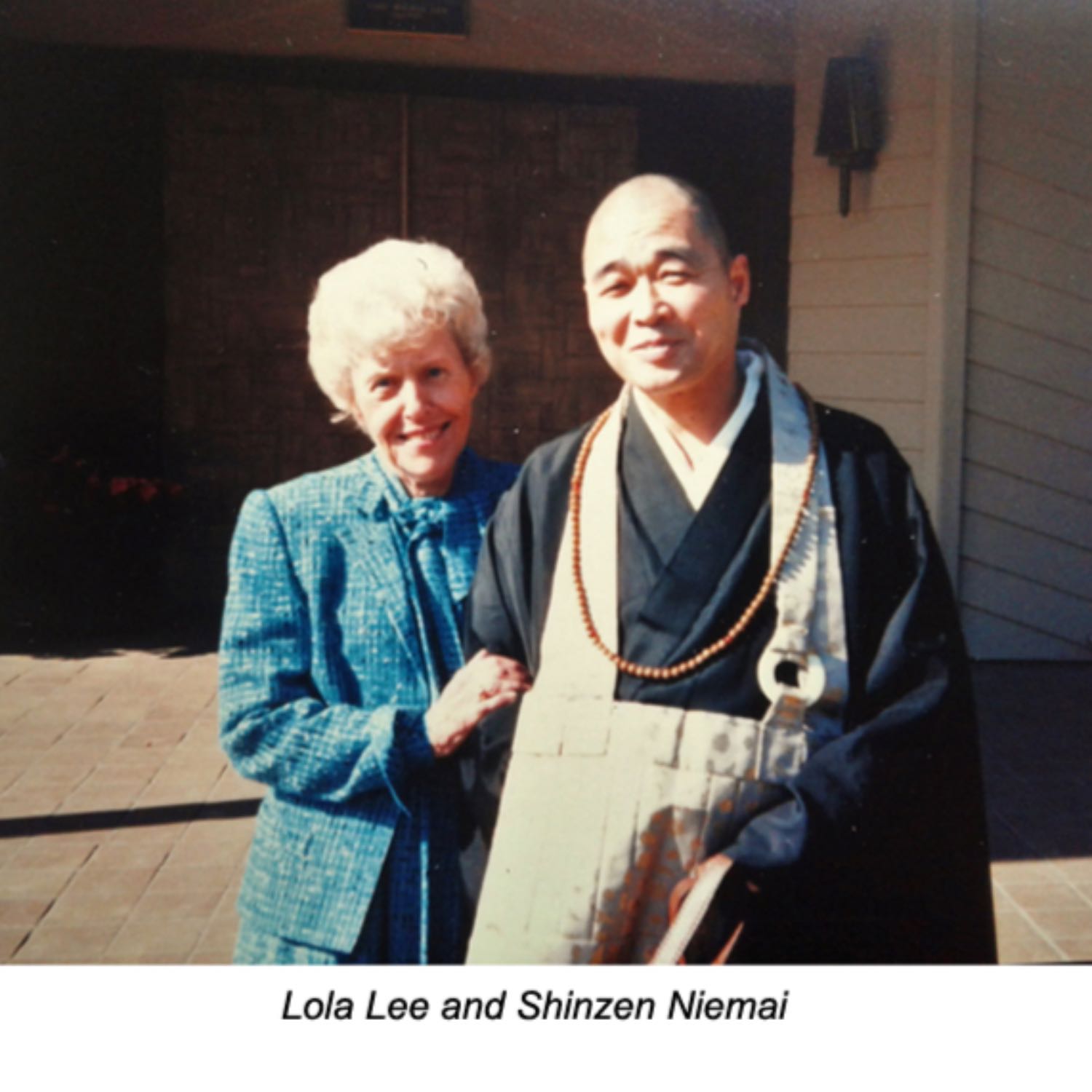
Talks by Zen Roshi, Lola McDowell Lee
145 episodes — Page 2 of 3
S2 Ep 94Lao Tzu on two fundamental types of meditation. May 1, 1988
Zen Roshi, Lola McDowell Lee, gives a detailed explanation of Lao Tzu’s notion that there are two basic types of meditation one should practice. One of emptiness only, and one of concentration.Sitting with pure, empty mind:The first he described as meditating without desire. Chuang-Tzu called it “just sitting and forgetting” meditation. During this practice, we empty the mind of all impediments and sit with only pure mind. Easier said than done. Most of us sit, and only once in a while do e actually meditate. Most of us don’t want to really sit because we don’t want to give up anything.To sit this way, just empty, it does not mean to blank out, or be unconscious. Just be quiet, still, every day. In the Pure Mind. When the mind is empty, Lao Tzu says it is like still water. It can then reflect. Without thoughts, which are activity, disturbances in the water. The clearness of the mind already exists.It is this we often call the mirror mind, that mind which is clear, empty, and able to reflect. Then we can become that mirror.2. Using the Pure Mind to concentrate on something—a word, a sound, a question.Lao Tzu suggests also using a second method where we focus, and develop our concentration.He says we should use both methods of meditation. Learn to find the Pure Mind. And use it to focus.Plotinus, a Neo-platonist, had similar thinking to Lao Tzu in 250 A.D.“The perfect and unchangeable life of the Divine Spirit overflows in an incessant stream of creative activity, which spends itself only when it has reached the lowest confines of being, so that every possible manifestation of Divine energy, every hue of the Divine radiance, every variety in degree as well as in kind, is realized somewhere and somehow. And by the side of this outward flow of creative energy there is another current which carries all the creatures back toward the source of their being. It is this centripetal movement that directs the active life of all creatures endowed with Soul. They were created and sent into the world that they might be moulded a little nearer to the Divine image by yearning for the home which they have left. This aspiration, which slumbers even in unconscious beings, is the mainspring of the moral, intellectual, and aesthetic life of mankind.Lola explains that many look to our outward life to find fulfillment. In creating, achieving, jobs, creating families. But ultimately, fulfillment, she says, is found within.But life should not be just one or the other. We should find fulfillment in both the outer and the inner.How does an oyster know to open itself in order to eat? It doesn’t think. What about the oyster knows to do that?When we look in the eyes of a cat or dog, or bird, we can, if we know how to look, see that divine miracle within them too. We should be in awe of life. But we’re usually not. Our pure intelligence is clouded by our thoughts.As Jesus said, “Eye has not seen, nor ear heard, Nor have entered into the heart of man. The things which God has prepared for those who love Him.”Allow your intelligence to become wisdom.May 1, 1988
S2 Ep 93More Bible parables that can help you practice Zen. Dec 12, 1984
Zen Roshi, Lola McDowell Lee, who is also an ordained Christian minister, continues her exploration of Christian parables and how they might apply for Zen practitioners.Jesus spoke, in the book of Luke 5:36-39:“And no man putteth new wine into old bottles; else the new wine will burst the bottles, and be spilled, and the bottles shall perish. But new wine must be put into new bottles; and both are preserved.”Your life can be life-denying or life-affirming.You can be religious without being part of any organized religion. Being truly religious is an internal practice.Meister Eckhart’s mystical interpretation of the Biblical parables of the Virgin and the Christ.Whatever you do in work, do it with love. It’s easy to swing between love and hate. You become what you love, but you also become what you hate.Lola explores the meaning of Matthew 25:13 - “...always stay awake and be alert, because you don't know the day or the hour when the Bridegroom will appear.”Lola Dec 12, 1984
S2 Ep 92Bible parables that can help you practice Zen. Dec 9, 1984
Zen Roshi, Lola McDowell Lee, who is also an ordained Christian minister, discusses parables from the Bible and how they can help Zen practitioners.Understanding Jesus’ parables is like puzzling with Zen koans. We reach a point with the puzzles and allows them, like a diamond cutter, to work on us. And eventually, in a new state, we begin to understand.We are free. Yet we have no freedom. It’s a paradox. The freedom within, unforced, allows us to mature. But we can choose to ignore the within. We are also free to choose the adventure within.Your choices in this world create your personality. What you become by the end of your life—that you have chosen. Yet, what we are born with affects our choices. We are seeds. How we live that growth is our destiny.Lola discusses the historical meanings of the word sin from the Egyptian and the Greek. From the Greek, to miss.A parable, and a koan, is like a bridge between the Truth and our unconscious selves.We call ourselves human beings. But we are not yet. We are seeds.To illustrate, Lola presents Jesus’ parable of the weeds:“Jesus told them another parable: “The kingdom of heaven is like a man who sowed good seed in his field. But while everyone was sleeping, his enemy came and sowed weeds among the wheat, and went away. When the wheat sprouted and formed heads, then the weeds also appeared.“The owner’s servants came to him and said, ‘Sir, didn’t you sow good seed in your field? Where then did the weeds come from?’“‘An enemy did this,’ he replied.“The servants asked him, ‘Do you want us to go and pull them up?’“‘No,’ he answered, ‘because while you are pulling the weeds, you may uproot the wheat with them. Let both grow together until the harvest. At that time I will tell the harvesters: First collect the weeds and tie them in bundles to be burned; then gather the wheat and bring it into my barn.’”How are we to interpret this? asks Lola.Lola say to look within—and wait. But don’t wait with the old you. That’s your ego waiting. Let go of your attitudes. They’re not important during meditation. Only when a cup is empty can it be filled.Let gratitude well up in you. Sit, and eventually the door opens and light comes in. You don’t bring it in.Lola Dec 9, 1984
S2 Ep 91Zen is not a belief system. Zen disturbs the dreaming mind. Nov 12, 1984
Zen Roshi, Lola McDowell Lee, explains that enlightenment is not a goal. “A goal is like the horizon. You can never reach it.”The immediate is the ultimate. You have to be aware and wake up to this moment. This moment is eternity.Human beings do a lot of unconscious abstracting. Lola explains.The teacher asks, “Do I have a staff or do I not have a staff?” The monk tries to answer in different ways. Finally he is so frustrated he gives up and leaves. He wanders for 12 years and finally returns to the teacher. He repeats the question to the teacher who responds with, “Is that what I said? How silly of me.”Zen is not a belief system. The purpose of Zen is to disturb the dreaming mind. It is a method to awaken. The puzzles in Zen are intended to create such a strain in you that you cannot ignore.Lola recounts the tale of the monk who repeatedly notices his teacher worshiping a statue of the Buddha. He asks him, “Why do you sit there and worship the Buddha? The teacher answers that it is because I like worshiping the Buddha. The monk then asks, “Why do you like worshipping the Buddha?” The monk continues to ask him question after question about this subject which puzzles him. Then the teacher gets up and slaps him.Why did the teacher do that, asks Lola.Zen teachers try to create a fire in the monk’s cauldron, a pot in his gut. The monk’s mind is tethered. So the teacher allows question after question… until he runs out of questions. Then the slap.Lola explains, “When you come to me with questions and I answer them, it does nothing for your consciousness, you’re being. It just gives you more stuff in your head.”Zen is a milieu, and atmosphere, in which to better understand yourself. When you truly practice, you are in the milieu, the Work. And you have made yourself available to God.Nov 12, 1984
S2 Ep 90When you learn to accept that you are alone, truly alone, it builds a great strength. Nov 5 1984
Zen Roshi, Lola McDowell Lee, explains that when you sit properly in meditation, your world is gone. You are alone. Absolutely alone. And when you learn to accept this alone, it builds a great strength. Find that alone—and accept it.She asks: you know all about your history, your friends, your work… but do you know you?Without that light within you—that forgotten light—there would be no you. It is the reason you exist.Many of us—at 40, or 50, or 60—hold the same image of God that we developed at age 5 or 10. Childish beliefs. Philosophies and beliefs make you feel better. But they are avoidances.During troubling times—like during war—people start believing. God is an escape for them.Master Ummon is asked about the four virtues of the Nirvana Sutra: Immutability, Joy, Personal Existence and Purity. Ummon picked up a cup and asked, “How many virtues has this?” “None at all,” the monk answered.Ummon suggested the monk best go on with his lectures about the Sutra.Ummon practices only one virtue: existence value.The garden of your mind is full of beautiful flowers—and weeds. We need to explore it all. But that takes time. We have time for movies and gossip and football—but not to meditate.If you stop puffing up your ego, it will shrink. Which is good, because eventually death will destroy it. This causes us anguish. But with practice, it doesn’t need to.Nov 5, 1984
S2 Ep 89Who are you really? Your name is not you. Your photo is not you. Who are you? Oct 28, 1984
Zen Roshi, Lola McDowell Lee, asks how someone like Hitler could come to power. He was loud, and brash, and gave a secure feeling of strength to those who were insecure.Lola recounts the tale of the Turkish teacher who travels to foreign lands and gathers quite a following. Until some Turks happen onto him and hear the nonsense he speaks. This, she says, is often how we talk to ourselves. We can deceive ourselves for years.She also presents portions of an Ikkyu poem:“The crescent moonBecomes full, and wanes,And nothing is left;But still, there in the dawn,The crescent moon!”Lola discusses Jesus’ line from John 1:9, about the Light that cometh into the world… is the true Light that lighteth every man.It is the light within us.Mankind has, in a sense, fallen asleep to this inner light. We’ve forgotten who we are, as we continue to be mesmerized by the ten thousand things of the world.When you fall in love, you feel good. It strengthens your identity. Same goes when you are popular, or successful. It feels good because it strengthens your identity. But that identity is not you. That’s just how you identify yourself objectively. You are identified with all kinds of things. Patters of thinking, feeling, from your childhood and on—all of which have authority over you. Yet none of these things you identify with say anything about the real you.Who are you really? Your name is not you. Your photo is not you. Who are you?Lola discusses similar ideas from numerous thinkers, including Sri Aurobindo about how we have grown a riddle to ourselves. Also the last words of German theologian, Bonhoeffer, shortly before his execution.Lola tells the humorous story of the forgetful philosopher who, one morning, decided to label absolutely everything so he won’t forget. In the morning he awakens and it’s a grand success. He can find everything in its place… but suddenly panicked when he can’t find himself.Everyone will need to answer the question: Who am I? Until that question becomes so magnificent—but terrifying—you haven’t really asked it yet.Oct 28, 1984
S2 Ep 88We are looking for nothing. Which doesn’t give you much to look for, does it? Oct 21, 1984
Zen Roshi, Lola McDowell Lee, reads from renowned Zen teacher, Ikkyu: “If it rain, let it rain; If it rain not, let it not rain; But even should it not rain, You must travel with wet sleeves.”What is religion? It is an inquiry into yourself.The German theologian, Meister Eckhart, once wrote, “There is an agent in the soul, untouched by time. . . God Himself is that agent.Keep looking inside a seed, you’ll find nothing. Because its essence is invisible. It is there, however, that Truth abides.We are looking for nothingness, Lola notes, laughing, “Nothing doesn’t give you much to look for, does it?” But she adds, “Thou art that.”If you are sure you know something, then how would you ever seek it? Search for nothing at all. Just ask, What is here?The missing 18 years of Jesus’ life, from age 12 to 30. What did he do?Life without choice.Bankei: “There can be no death for what was never born, so if it is unborn, it is obviously undying. There is no need to say it, is there?”Lola explains that we need to learn to watch everything, even our pains. Our tummy aches. Our head aches. Be the watcher. For then you’ll be better prepared to watch your death.Oct 21, 1984
S2 Ep 87Lao Tzu: Existence renders actual. Non-existence renders useful. Oct 7, 1984
Zen Roshi, Lola McDowell Lee, relates the tale of the monk who questions Chuang Tzu. He begins:Monk: "Much of what you talk about is that which is not of use to us."Chuang-Tzu: "Most of the earth is no use to you."Yin and Yang. Two archetypical poles of Nature. Male and female.Yin is quiet, intuitive. Yang is strong, creative, active. We must come to know the other to be in balance.We constantly swing between Yin and Yang. Aristotle said that we mostly ignore the middle.What does a house consist of? Walls make it actual. The seemingly non-existent, empty space inside is what makes it useful. Windows and doors let light in. Keep your eyes and ears open. They are our windows and doors.Like a vessel—its utility is in its emptiness. Existence renders actual. Non-existence renders useful.The same is true of us, such as our emptiness within.Lola also asks: Where does the mind go when you sleep?Lao-Tzu: Non-action is not doing nothing. Oct 7, 1984
S2 Ep 86How can Truth be expressed without speaking—and without being silent? Sep 30, 1984
Zen Roshi, Lola McDowell Lee, tells of the puzzled monk who visits Master Fuketsu. He asks, "How can Truth be expressed without speaking—and without being silent?"Lao Tzu said, he who speaks does not know. And he who knows does not speak.Then there is the Maha Mudra, or the great gesture.When you hear a word from a master, there is a silence in the word.A portion of the great poem by Sri Aurobindo:The Hour Before The Gods AwakeIt was the hour before the Gods awake.Across the path of the divine EventThe huge foreboding mind of Night, aloneIn her unlit temple of eternity,Lay stretched immobile upon Silence' marge.Almost one felt, opaque, impenetrable,In the sombre symbol of her eyeless museThe abysm of the unbodied Infinite;A fathomless zero occupied the world.—-Lola explains the tale of the king who summoned the 27th Patriarch, Prajnatara, to perform a recitation. But when the master arrived, he remained silent, letting his attendant do the reciting, which, at first, upset the king. And what happened when Prajnatara spoke to the king’s three princes. And who the youngest prince became.The next time you’re bothered about something, suggests Lola, just let your breathing remain natural. And see what happens.Then Lola rings her bell, and asks, How do you awaken when you hear the bell? Don’t think. Just listen. Listen not with the ears. Listen with the Mind.Sep 30, 1984
S2 Ep 85Is Zen difficult? Also, an in-depth examination of the Mu koan. Sep 23, 1984
Zen Roshi, Lola McDowell Lee, recounts the story of the family where every member was enlightened. A visitor asked the father, “Is Zen difficult?” The father answered, “Yes, very.” The visitor then asked the son the same question. “No, it’s not difficult at all,” the son said. Then he asked the daughter. She answered, “If you make it difficult, it is difficult. If you make it easy, it is easy.”Actions do not change your being. The periphery does not change the center.The truth is found in the now, the present. If you are looking for it in another world, you’ll miss it here.Look with an undivided eye, and undivided consciousness. Because Samsara is Nirvana, and Nirvana is Samsara.Whatever you do, when you do it in silence, real silence, then God is there. All day long you are becoming, as you look toward your future. Instead of just being. The future, however, will never arrive. It’s a projection.Life, for us, has no beginning or ending. We are always in the middle.Also, Lola presents a detailed discussion of the Mu koan.Sep 23, 1984
S2 Ep 84The story of the centipede, convinced by a fox to start thinking. Sep 16, 1984
Zen Roshi, Lola McDowell Lee, interprets passages of Chuang Tzu, the great Taoist master.The greatest man is nobody. The man of Tao does not cultivate his manner. Nor does he try not to.Our mind moves in one direction—then swings the opposite way. The most difficult thing to do is to keep the mind in the middle. Non-discrimination.Even from waking state to sleeping state, we cross the middle.If there is no motion, then time disappears. Eternity is here and now, not some endless amount of time.Lola shares the tale of Omar and his stopped clock.She explains different types of meditation practice and asks, what happen when you stop thinking?Lola shares the story of the centipede who is convinced by a fox to start thinking.Also, the tale of the hard-working priest, always busy with his duties and charity work. Then he dies. And upon dying, a servant arrives to answer his every need. But then the priest gets bored and restless. What happens next is startling. Sep 16, 1984
S2 Ep 83Don’t run to—and don’t run away. Aug 7, 1988
Zen Roshi, Lola McDowell Lee, explains how nature wants balance. If conditions swing one way, they eventually swing the other way.Human nature is the same. If you strive in one direction about something, then the other direction eventually swings back at you.For example, those who strive to be 100% moral often succumb to immorality. We see this often.As is human nature, we swing in a swirl of thoughts and emotions, crossing the middle, or zero. That is the spot that is great to discover.In each of us there is the feminine and the masculine. Men need to find their feminine side, and women their masculine.We always want more light, less darkness. But we will never succeed at that. Life is both.Don’t run to, and don’t run away. Being free of the sway is equanimity.We all are interdependent — one one another. Because, in reality, we are one consciousness. One awareness.Lola reads passages from the Bhagavad Gita that illuminates this theme.Aug 7, 1988
S2 Ep 82“In what state of mind should I seek Truth?” Doko asks. Sep 9, 1984
Zen Roshi, Lola McDowell Lee, explains how when you first meditate, thoughts of your day may fill your mind. But eventually, you will experience a silence.God isn’t going to talk to you in words. He has no mouth.Junaid, a Sufi Master, seemed an ordinary laborer. And one of his young apprentices often wanted to display his great knowledge of things. Junaid says, “I am not so young as to know so much.”When you know that you do not know, that is when you are most receptive to wisdom.Mencius said that people are basically compassionate. The way of searching it to look for the mind and heart that you’ve let go of.But many naturally find this paradoxical: how can a mind whose function is to think—not think.One day Chuang Tzu took a nap under a tree. And his fellow travelers noticed how uneasy he was in his sleep. When they woke him he said he had dreamt he was a butterfly. They laughed, but he remained deeply troubled. “If I can dream I am a butterfly, then why should I not think that perhaps it is the butterfly that now sleeps and dreams she is Chuang Tzu. This, Lola says, is a tremendous koan.Sometimes you unwittingly experience No Mind. When there is not thought in your mind, where is your mind? Mind with thought in it is stopped. Mind with no thought is ever flowing.Meister Eckhart says if you forget and ignore self-consciousness, it is in the stillness, and silence that the word of God is heard. Once must achieve un-self consciousness by means of transformed knowledge. That is called ignorance. But it is not from lack of knowledge that the ignorance is found. It is from knowledge that it comes. It is by what happens to us, not by what we do, that we are transformed.The tale of the rich man who called all the laborers to work at his farm. Some came in the morning and worked all day, some in the afternoon, some at night… but he paid them all the same. They complained.When there is no mind, there is no sinner or saint. Grace comes to all as a gift.Desires are forms. When enlightenment comes, these desires, which are energies, don’t disappear… they become formless.Sep 9, 1984
S2 Ep 81Without a word, without a thought, who are you? Aug 19, 1984
Zen Roshi, Lola McDowell Lee, tells the story of when Master Hyakujo offered a test to his monks. The winner will be the abbot of the new monastery. He sets out a water jug and says, “Without using its name, what do you call it?”Without a word, without a thought, answer this question: Who are you? Without using a word, show what reality is. You can’t use a word or concept without using your mind. Philosophy is of the mind. Religion is of action. Thoughts are just a small part of you. Between n all your picking and choosing of thoughts, who are you?Don’t expect rewards for meditation or living in the moment.In order to understand the real universe, you need to lose the sense of the unreal world.Ishu Upanishad - The individual movement in the universal motion.A funny tale of a preacher at his first Sunday talk.Also the tale of the two boys sent on errands from two monasteries. One boy has clever answers to his questions about everything. The other boy wants a wise retort as well, and prepares an answer for the next day. Little does he know the other boy’s answer changed. Don’t rehearse. Allow the discomfort of uncertainty. Aug 19, 1984
S2 Ep 80Words can’t teach how to practice. Like swimming, we must do it. Jul 22, 1984
Zen Roshi, Lola McDowell Lee, discusses how words can’t teach how to practice or how to wake up. Just like the wheelwright can’t teach how to make a wheel. Too much force and it weakens. Too little and it weakens. But how does he teach that? One has to do it. Like swimming. To learn it you need to do it. Zen practice is the same way.Chuang Tzu, the master of the absurd’s mysterious tale of putting seven holes in Chaos, and then it disappeared.The tale of the talking horse, who was the ghost of a long-dead master. Jul 22, 1984
S2 Ep 79Lola recounts the surprising tale of the Sufi mystic who is captured and taken to the slave market by his captors. July 15, 1984
Zen Roshi, Lola McDowell Lee, explains how if we are ruled from without, we are slaves. If we are ruled from within, we are still enslaved.Short review of recent sesshin.Lola shares the amusing tale of the teacher's visit to an archery target practice.When you’re always doing, disciplining yourself, there is a conflict. Beyond discipline is stillness.We receive teachings at the level we need them. Consciousness has the body. Not the other way around.Lola recounts the tale of the Sufi mystic who is captured and taken to the slave market by his captors. July 15, 1984
S2 Ep 78The Paramitas - 1. Giving 2. Observing precepts 3. Patience 4. Diligence 5. Meditation. 6. Wisdom. July 8, 1984
Zen Roshi, Lola McDowell Lee, suggests you look at your life as a story. Is there anything you would change? Though this life is not perfect, you’re probably reasonably comfortable living on this shore. Change is scary.While many of us are part of a practice group, we really each travel alone on this path. The truth is inside of us. We can’t find it together outside somewhere.For your travel on this path you have provisions. In Buddhism, they are called the Paramitas, or perfections.Giving. This is not necessarily material giving. Sharing of oneself.Observing the precepts - discipline as to your ethical conduct.PatienceDiligenceMeditationWisdomPatience and diligence on the path might seem like opposites. You can’t just sit there in your meditation and wait for Grace to come to you. Some effort is required. But then Grace does come.Don’t waste energy. Don’t squander it on reckless and distracting activities. Contrary to popular belief, a silent mind is God’s workshop—not the devil’s.Sufi mystic, al-Shibili, was asked who guided him on the path. A dog, he said, who would look at his reflection in the water and be frightened. We are frightened of the illusion we think is ourself.The tale of the monk who is afraid to walk home in the dark. His teacher hands him a candle. Then, on his way out the door the teacher blows out the candle. “My light can’t go with you. You must be a light unto yourself.”July 8, 1984
S2 Ep 77Pranyaparamita, or “the perfection of transcendental wisdom.” July 1, 1984
Zen Roshi, Lola McDowell Lee, explores the possible meanings of several Buddhist and Christian concepts:• Pranyaparamita, or “the perfection of transcendental wisdom.”• Sunyata, or the emptiness that emptiness constitutes ultimate reality. Not adding, but taking away.• Avataṃsaka Sūtra, which comprehensively describes the powers of meditation and emptiness.• Anapanasati - awareness of that before you, of your breath.• Or when Jesus says to Nicodemus: “Except a man be born of water and of the Spirit, he cannot enter into the kingdom of God.” Your ego must be reduced to ashes. And emptiness remains.• Thomas à Kempis, a German-Dutch Augustinian monk, wrote in the Imitation of Christ a strange teaching to “Truly to know and despise self.” But that is not to hate oneself, but one’s obsession with oneself.• As the Buddhists teach, eating, bathing mechanically—not mindfully—is doing these activities with disrespect.• The Ignorantine Friars of the 1500s taught that the more ignorant you were the better off you were. To not read or write.• But Lao Tzu reminds us how precarious it is to chase ideals. “Man on tiptoe is not steady.”Ananda noticed the Buddha never changed position during the night, so one day he asked him: "Do you sleep?" His reply: "When the mind is silent, the body sleeps. Awareness does not."July 1, 1984
S2 Ep 76The similarities between Hassidic Judaism and Buddhism. May 19, 1985
Zen Roshi, Lola McDowell Lee, discusses the similarities between Hasidic Judaism and Buddhism.Many religions are more emotional. Zen practitioners are often intellectual. The similarities between Hasidic Judaism and Buddhism.Also, the tale of two men who travel during a dark night. Only one has a lantern. When their paths split, the man without the lantern must grope along in the darkness. That is not unlike being in life without the presence of your teaching. You must learn to be a light unto yourself. Be okay with groping in the darkness. The light will come. Your path is, ultimately, your own—no one else’s. The old man in you must die for the new man to be born. May 19, 1985
S2 Ep 75Make the smallest distinction and heaven and earth are set infinitely apart. May 12, 1985
Zen Roshi, Lola McDowell Lee, explores the notion of preferences. As the Third Chinese Patriarch of Zen put it: when love and hate are both absent, everything becomes clear and undisguised. Make the smallest distinction, however, and heaven and earth are set infinitely apart. If you wish to see the truth, then hold no opinions for, or against, anything.That is the choice-less reality, true stability. When you make a distinction, you are divided within yourself. The real does not change—only what you project on it.Discrimination does not bring happiness. You cannot say, “I will only love. I will not hate.” It’s like saying, “I will only inhale.” Don’t project onto others how you want them to be. No one is here to fulfill your dreams. Only you are.The deepest truth lies in the principle of identity. May 12, 1985
S2 Ep 74A monk asked his teacher, "I am pecking from inside the shell. I beg you, Master, please peck from outside." May 5, 1985
Zen Roshi, Lola McDowell Lee, explains that when most of us listen to a teacher talk, what we hear is determined by our conditioning. When one talks to God in his thoughts, he is not talking to God. To truly practice, one must be wholly sincere and not deceive oneself.A monk came to a Zen Master and asked, ”What if you meet up with someone who is deaf, dumb, and blind?” Also, if the aim of a Zen master is to save innumerable beings, how does one explain the behavior of a hermit master?A monk asked Kyosei, "I am pecking from inside the shell. I beg you, Master, please peck from outside." But the master asked: “Are you then in a state of readiness?”Zen Master Seppo contended that he was not a teacher. Yet 87 of his monks attained. Also, if we are aiming to experience the void, the emptiness, why would anyone want that? May 5, 1985
S2 Ep 73First is learning, called hearing. Then approaching. Then transcending. Lola Apr 14, 1985
During this talk, Zen Roshi, Lola McDowell Lee, has a bad cough, which she lightheartedly uses in her discussion about how to hear and how to listen. To listen like a tape recorder, without thinking. Lola walks us through a quick history of philosophical thinking, from the Ionians (Thales thought the basic entity was water) to Pythagoras to Aristotle and beyond. To discipline oneself in learning is called hearing. Once you’re full of learning, you begin what is called approaching. Then beyond both is transcending. Once one transcends to non-duality, there is nothing to discuss. Lola Apr 14, 1985
S2 Ep 72As illusions drop, as attitudes drop, how relaxing it is to be at ease with yourself. Mar 31, 1985
You are born into pleasure and pain, and eventually emotions develop. Then centuries of conditioning. From your parents, from your culture. How many personalities and faces do you have? All creating contradictions in you. But if you dig down, there is unity—an undivided, centered individual. Most important: do not deceive yourself. Sit. Look into yourself and the truth will reveal itself to you. As illusions drop, as attitudes drop, how relaxing it is to be at ease with yourself. What could be more tremendous in life than to meet your own destiny? Mar 31, 1985
S2 Ep 71The depth in saying “I don’t know.” Mystica Theologica. Lola Jul 22, 1985
Zen Roshi, Lola McDowell Lee, discusses Mystica Theologica by St Dionysias. He said religious experience can’t be described. Like music: as much as you might name notes, no description is adequate to explain what music really is. So it is with religious experience. Dionysias called it “agnosia” or unknowing. There is a depth in saying “I don’t know.” Even Socrates said the only thing he knows is that he knows nothing. The atheist who says he knows there is no God… does not speak from experience. He really does not know. Both the theist and atheist make wrong assumptions.We meditate to reduce conditioning, etc. The aim is to set ourselves up to experience an empty silence. The emptiness of unknowing. Of Dionysias’ agnosia. Dionysias called it the “translucent darkness.” Or “Knowing ignorance.” God is light and darkness together. Only then can reality of God be experienced. It can be remembered, but cannot be described. Just: “Ah, this.” That is why the Taoists say the wise man keeps his mouth shut. The world is one—the seen and the unseen—even though we don’t see the world as united. Lola Jul 22, 1985
S2 Ep 70Zen masters never tell the truth. July 15, 1985
Zen Roshi, Lola McDowell Lee, recounts the tale of Zen Master Hogen who studied with Keishin Zenji. Once Keishin Zenji asked him, 'Joza, where do you go?' “Hogen answered, 'I am making pilgrimage aimlessly." Lola also shares the story of the non-believer who falls off a cliff and dangles by a small twig. He begs God to help him. "But I thought you didn’t believe in me,” says God. The non-believer says, “Okay, I do now. Please save me." So God answers, “Okay, let go of the twig and I will save you.” Zen masters never tell the truth. They may point, or provoke, or create a situation that will help you learn. But if a teacher says what he is saying is the truth, leave him. If you can see the truth, you can see it here—where you are. Nirvana is samsara. July 15, 1985.
S2 Ep 69"The mind dwells in the cave of the heart. He who conquers it frees himself from slavery." May 26, 1985
Zen Roshi, Lola McDowell Lee, explains how you can ask questions about the meaning of life all day long. But who is the questioner? Usually we take the wrong approach to these questions. The questions and the answers are thoughts—or objects. They are not reality. If you have a deluded mind, how are you supposed to use it in meditation? You must set it aside. When silence is present, where are you? When you aren’t thinking, are you a man or a woman? Tall or short?The real question is “What is the reality of me?” Your mind is full of fragments of your parents, your friends, teachers, books you’ve read. But where is the mind itself? The same one that has always been there.You can’t have someone meditate for you and tell you about it. Enlightenment is a personal experience. The mind dwells in the cave of the heart. He who conquers it frees himself from slavery. May 26, 1985
S2 Ep 68The mightiest fighting rooster does not crow about his might. Jun 24, 1984
Zen Roshi, Lola McDowell Lee, shares the teachings of Lao Tzu. He was not a brave man. Or a coward. Courage does not play a role in the sage. The mightiest fighting rooster does not crow about his might. True confidence does not brag. If you meet a sage on the road, how do you greet him? Meditation is like a coiled spring. You push, push, push it down… then release. Jun 24, 1984
S2 Ep 67When you’re silent, there is one mind. When you’re thinking, you are many. Jun 10, 1984
Zen Roshi, Lola McDowell Lee, explains how a mirror reflects everything before it. It reflects young you when you’re young. It reflects old you when you’re old. But the mirror isn’t old or young. It is uncontaminated. The same consciousness is watching from inside you when you’re young, when you’re middle aged and when you’re old. But that Witness isn’t young or middle aged or old. Just like the mirror, your consciousness doesn’t change. Just the content is different. We all have heard teachings about being good. Buddha said “if you cleanse your heart, your conduct will be unimpeachable. Feeling good about yourself should be a natural thing. A child instinctively wants freedom. The child thinks freedom is good. But then Mother restricts freedom, which says it’s wrong. The child then thinks “I must be wrong.” To be truly good means to be conscious in everything you do. Gurdjieff’s stop method worked to help his students be conscious in everything they did. When you’re silent, there is one mind. When you’re thinking, you are many. And in tumult. Thinking disturbs the silent mind. And he rejects himself. As a human you have a rare opportunity to wake up. Don’t squander that opportunity. Jun 10, 1984
S2 Ep 66Examine your past so it doesn’t govern you. The past is dead. Stop living it. Oct 30, 1983
Zen Roshi, Lola McDowell Lee, explains how when you’re happy, sad, pleased, unpleased—it’s all in your periphery. It is not really you. When you’re happy, sad, pleased, displeased—it’s all in your periphery. It is not really you. Do not deceive yourself with your own attitudes. Plastic flowers do not grow. Plastic personas do not grow. But you can. Your appearances give you respectability but they do not give you contentment. Examine your past so it doesn’t govern you. The past is dead. Stop living it. Whenever you taste the ocean, it always tastes like salt. Find your own unity. Your eyes discriminate. You can open them, close them, direct them. But it’s different with our ears—everything comes in. Truth eventually will reveal itself. Oct 30, 1983
S2 Ep 65What must wake up in you for you to be awake? Oct 29, 1989
Zen Roshi, Lola McDowell Lee, explores the wisdom of Zen Master Ikkyu. What must wake up in you for you to be awake? Where do you go when you’re in a deep sleep? Buddhism is a religion of the individual. We become individually free. Teaching about awakened self is like selling water by the river. We spend our lives trying to make our fantasies a reality. Assuming responsibility for one’s spiritual life. Who owns your karma? Oct 29, 1989
S2 Ep 64Once we understand we are not the masters of our thoughts—but victims—we can stop cooperating. Lola Mar 17, 1985
Zen Roshi, Lola McDowell Lee, recounts tales of Master Fugai. Lola gives a detailed explanation of meditation. How the word meditation, historically, has been thought to mean thinking, pondering. But in Zen it’s just the opposite. In Zen meditation you sit, and can watch your thoughts go by, but you do not get swept up by them. If you observe closely you’ll start to see that your thoughts create a circular pattern… over and over, and at the center of this circle is a point with which you are identified: anger, or greed or some other kind of self-centeredness. Once we understand we are not the masters of our thoughts—but victims—we can stop cooperating, stop remaining a victim of them. When you sit, don’t cling to thoughts or emotions. Just sit. And be. Zen is not something you just read in a book. It is an encounter with reality. Also, Lola discusses how religions can broadly be divided into two different approaches: the path of the heart and the path of the mind. You can pursue God through your heart—with love. Not romantic love, or sexual love. But God’s love, or agape. Lola Mar 17, 1985
S2 Ep 63The tale of the visitor who asked Zen master Bankei what miracles he could perform. Aug 6, 1989
Zen Roshi, Lola McDowell Lee, discusses how we’re all waiting for the most extraordinary teacher. We want only the best. The tale of the visitor who asked Zen master Bankei what miracles he could perform. His answer is lovely Zen. Lola lso, understanding the concept of “don’t know.” It’s very difficult. We all prefer to be clever, which obscures our original mind. If you recognize the original mind, will you reincarnate? Bunka says it won’t matter to you. That is the interest of the ego. Listen to the teacher with no inner commentary. The unconditioned is pure consciousness. Even in our dreams we have a censor that doesn’t allow some material to come up from our unconscious. (Lola has a bad cough through this talk). Aug 6, 1989
S2 Ep 62Easter of 1985 - What Zen practitioners can learn from the story of Christ's Resurrection. Apr 7, 1985
Zen Roshi and ordained Christian minister, Lola McDowell Lee, gives this talk during Easter of 1985. She explores the Resurrection of Christ. You can experience the Resurrection yourself. Your deathless existence is within you. It is the Godseed. The tale of the king who leaves his three sons each a bag of seed and asks them to best preserve them in his absence. The seed must die in order to grow. The tale of a man walking peacefully among the throngs racing through Pompeii during the volcanic eruption. Also, how during our practices we grope inside ourselves. At first what we find may puzzle us, but eventually what we will find is magnificent. Apr 7, 1985
S2 Ep 61Second in a series about using Transactional Analysis in Zen - the Child, Parent, Adult. Lola Oct 13, 1983
Zen Roshi, Lola McDoweel Lee, explains how we all call ourselves an I, but there is only one—which everyone appropriates for themselves. Eventually our thoughts, voices, identifications eclipse the I. We adopt styles from lots of people—actors, ministers, anyone who appeals to us. The second in a series about the Transactional Analysis approach of Child, Parent, Adult. Child enjoys the moment through feeling, often irrationally. The Parental Voice then comes in to caution the child. The Adult brings reason. But Adult reason alone is not the answer. Lola Oct 13, 1983
S2 Ep 60Learning to work with three elements of our identity: the parent, the child and the adult. Oct 6, 1983
Zen Roshi, Lola McDowell Lee, explains three parts of our psychology working against each other --the parent, the child and the adult. The child’s impulses and emotions shouldn’t be in control. The parent alone can be dominating.The adult hold to reason only, which can make for a flat life. Some part will be dissatisfied. Ideally, we become a part of all three. The Buddha doesn’t choose one. He takes the middle path, a the center of all three.Three stages of our development: 1. We do something and are aware we did it. 2. We ask ourself “What am I doing?”3. We are going to do something, but our awareness stops us. Pratyahara means being present. Awareness, mindfulness, stops you. It is difficult to repent without putting your ego back into it. True correction is reform. Insults are meaningless unless you accept them. How to sit with this? Be mindful and you can have the spontaneity of the child and the reason of the adult and parent. Then the three become one—the single I. Oct 6, 1983
S2 Ep 59Most of us are after power. Control in our situation. A wiseman seeks not. Instead, he cooperates. Nov 27, 1923
Zen Roshi, Lola McDowell Lee, explains how most of us are after power—control, authority in our situation. A wise man seeks not. Instead, he cooperates, harmonizes with the situation. The tale of Frederick The Great of Prussia’s solution to the many sparrows eating his kingdom's grain. Cleansing your mind is not a one-time effort. Because each day you gather more dust. So Lola suggests you meditate twice a day. Once to give yourself a clean start to the day. Second, at the end of the day, to cleanse the dust you’ve accumulated. As he was dying, Buddha’s advice to his long-time, devoted follower, Ananda, who was concerned about losing that shining light that was the Buddha: "Be a light unto yourself.” Also the Song of the Sannyasin. Nov 27, 1983
S2 Ep 58Life. Death. And Love. The most important thing for you is your life. Do you ever thoroughly investigate it? Nov 20, 1983
Zen Roshi, Lola McDowell Lee, discusses Love, Life and Death. When you are filled with love, there is nothing missing. Can you love without a lover? Some people share their loneliness and call it love. The most important thing for you is your life. Yet most of us never thoroughly investigate it. In deep meditation you can. Death is an unpopular subject All you think you are now is going to die. Face yourself—beyond time and space. When you are alone, do you lie to yourself? When you let go, where do you let go to? We too are lucky to be born in the time of a Buddha. And that Buddha can be us. Nov 20, 1983
S2 Ep 57We can repeat the most profound teachings and remain stupid. What in us is orginal? May 1, 1983
Understanding the noetic quality of mind, the hidden self, through meditation. That is just a matter of sitting, and being who you are. The difference between sailing on a paper boat and a real boat: How we think about what enlightenment will be. And being it firsthand. Many of us parrot what we know from things we’ve heard or read. We can repeat the most profound teachings and remain stupid. What in us is orginal? A tale of Zen Master Dokuon. May 1, 1983
S2 Ep 56Get beyond the effort of meditation and find real meditation. Jul 3, 1983
Zen Roshi, Lola McDowell Lee, asks: When you are alone… are you really alone? We treat the ego as an absolute, when, in fact, it is a gap between you and totality. Ask yourself: Who am I? And you’ll find the Buddha. What does a Zen teacher do? Beyond aloneness and togetherness is the eternal — no one going nowhere. Non-dualistic wisdom. Remain in the Witness your whole life. It’ll change things. Jul 3, 1983
S2 Ep 54What is the greatest miracle in the world? Oct 30, 1983
Zen Roshi, Lola McDowell Lee, explores how it is In the other that we see what we think is us. When we are alone, many of us feel in strange company. It’s possible to see what one’s life is really about. The thoughts out there, which have have become a mask to our true selves, will grow dimmer. Until our spiritual search is no longer just a curiosity or inquiry—but becomes a deep hunger that consumes us. Someone once asked a Zen master, "What is the greatest miracle in the world?” His answer: “I am sitting here alone.” Oct 30, 1983
S2 Ep 55The Taoist sage, Lieh Tzu, was once asked: Why do you value emptiness? Jun 12, 1983
Zen Roshi, Lola McDowell Lee, explains how existence is reported to us as separate objects. But there is a unity to life that runs through everything—called the Tao. The Taoist sage, Lieh Tzu, was once asked: Why do you value emptiness? His answer is explained. Also, most spiritual paths fall into two categories: via affirmative and via negativa. The affirmative path is where we take actions to make progress. The danger is the ego. The negative path is the path of Zen, an interior path of negation. The danger is lethargy. Though Zen practitioners have activities and devices they use, so we might say they use a little of both paths. Jun 12, 1983
S2 Ep 53By the merit of a single sitting, they destroy innumerable sins. (Hakuin) Jun 5, 1983
Zen Roshi, Lola McDowell Lee, recounts the tale of a teacher’s interaction with his student, Hakuin, who became the founder of Rinzai. From Hakuin’s “Song Of Meditation” we hear: “All beings are from the very beginning Buddhas. It is like water and ice: apart from water, no ice. Outside living beings, no Buddhas. Not knowing it is near, they seek it afar. What a pity!” Jun 5, 1983
S2 Ep 52There are plenty of Buddha statues sitting still. But have you ever seen a Zen master sitting still? Mind vs action. May 29, 1983
Zen Roshi, Lola McDowell Lee, asks: What are you searching for? Do you know it is your ego that is doing the searching? You see plenty of Buddha statues sitting still. But have you ever seen a Zen master sitting still? They are always doing something. There is silence and there is action. The mind and the body. We have both. And we need both to understand. We need to learn how to bring ourselves to our action. Thinking about our actions afterward does little good. Learning to act spontaneously. May 29, 1983
S2 Ep 51The tale of the thief who robs Shichiri Kojun who was busy reciting sutras. Don’t fight the darkness—light a candle. May 22, 1983
Zen Roshi, Lola McDowell Lee, discusses judging others, the interdependence of the universe. Indra’s net — the mirror mind, and how every one of us reflects everything else. How we shouldn't fight the darkness—and just light a candle. The tale of the thief who robs Shichiri Kojun and became a disciple. May 22, 1983
S1 Ep 50Human beings are stuck in an in-between state—not unconscious and we’re not completely conscious. May 15, 1983
Zen Roshi, Lola McDowell Lee, explains that we are in an in-between state. We’re not unconscious and we’re not completely conscious. We are objectively self-conscious—conscious of things out there, and we think of ourselves as things, too. We are stuck in this world between the unconscious and conscious. As fas as thinking goes, we’re fine. The mind can do that. We can also talk. But when it comes to acting—doing something—we need the energy of the unconscious. That’s where all the energy is. Our thinking minds cannot actually do anything. The objectively self-aware ego is helpless. May 15, 1983
S1 Ep 49When we meditate and watch our breath, we are playing an iron flute with no holes. Apr 24, 1983
Zen Roshi, Lola McDowell Lee, recounts the tale of Kakua, the first Japanese man to study Zen in China. After returning to Japan the emperor asked him what he learned. He took out a flute, played a single note and left. No one ever knew what became of him. When we meditate and watch our breath, we are playing an iron flute with no holes. Reason is divisive. Acceptance is saying yes to the totality of yourself. Also, we travel in space and time—but do we ever stay home? Apr 24, 1983
S1 Ep 48Without speaking and without silence, how can you express the Truth? Apr 10, 1983
Zen Roshi, Lola McDowell Lee, recounts the monk who asks Fuketsu “Without speaking and without silence, how can you express the Truth?” His answer: "I always remember springtime in southern China. The birds sing among innumerable kinds of fragrant flowers.” God is speaking to us all the time, and we just don’t hear Him. Baby birds don’t learn how to sing. Spring sings in them. Apr 10, 1983
S1 Ep 47Being truly alive should be an adventure into the unknown. Apr 3, 1983
Zen Roshi, Lola McDowell Lee, describes how humankind repeats the same old pattern. We do not want our dream disturbed.We live in the known, afraid of the unknown. Being truly alive should be an adventure. If your life is not an adventure into the unknown…you’re not truly living. An Easter message of resurrection. A passage by the yogi, Aurobindo. Apr 3, 1983
S1 Ep 46We identify with everything but ourselves. Possessions, emotions, thoughts. But not our true selves. What is true silence? Mar 12, 1983
Zen Roshi, Lola McDowell Lee, recounts the tale of the student who visits a teacher, whose only answer to his questions is to sweep fallen leaves. Also, how we identify with everything but ourselves. Possessions, our emotions, our thoughts. But not our true selves. Gurdjieff would insult a student to spark his anger. Then say, “Be alert in your anger. Be aware in your anger.” In every ritual there is a hidden key. Are you using your rituals as tools to find that silence within you? Mar 12, 1983
S1 Ep 45Chuang Tzu and appreciating the useless in the world. Mar 6, 1983
Zen Roshi, Lola McDowell Lee, explains how existence renders actual . Non-existence renders useful. It is not the walls, but the seemingly non-actual space within the house, that renders it useful. Chuang Tzu teaches us to appreciate the useless in the world. Kierkegaard used to go to church and tell God things he wanted. But then he realized that God knows everything, so why is he telling God what to do? Eventually he learned to be silent, and just listen to God. The absence of talking was more useful than talking. Mar 6, 1983