Talks by Zen Roshi, Lola McDowell Lee
I & A Publishing
Show overview
Talks by Zen Roshi, Lola McDowell Lee has been publishing since 2023, and across the 3 years since has built a catalogue of 135 episodes. That works out to roughly 120 hours of audio in total. Releases follow a weekly cadence, with the show now in its 3rd season.
Episodes typically run thirty-five to sixty minutes — most land between 51 min and 59 min — and the run-time is fairly consistent across the catalogue. None of the episodes are flagged explicit by the publisher. It is catalogued as a EN-language Education show.
The show is actively publishing — the most recent episode landed 5 days ago, with 8 episodes already out so far this year. The busiest year was 2024, with 49 episodes published. Published by I & A Publishing.
From the publisher
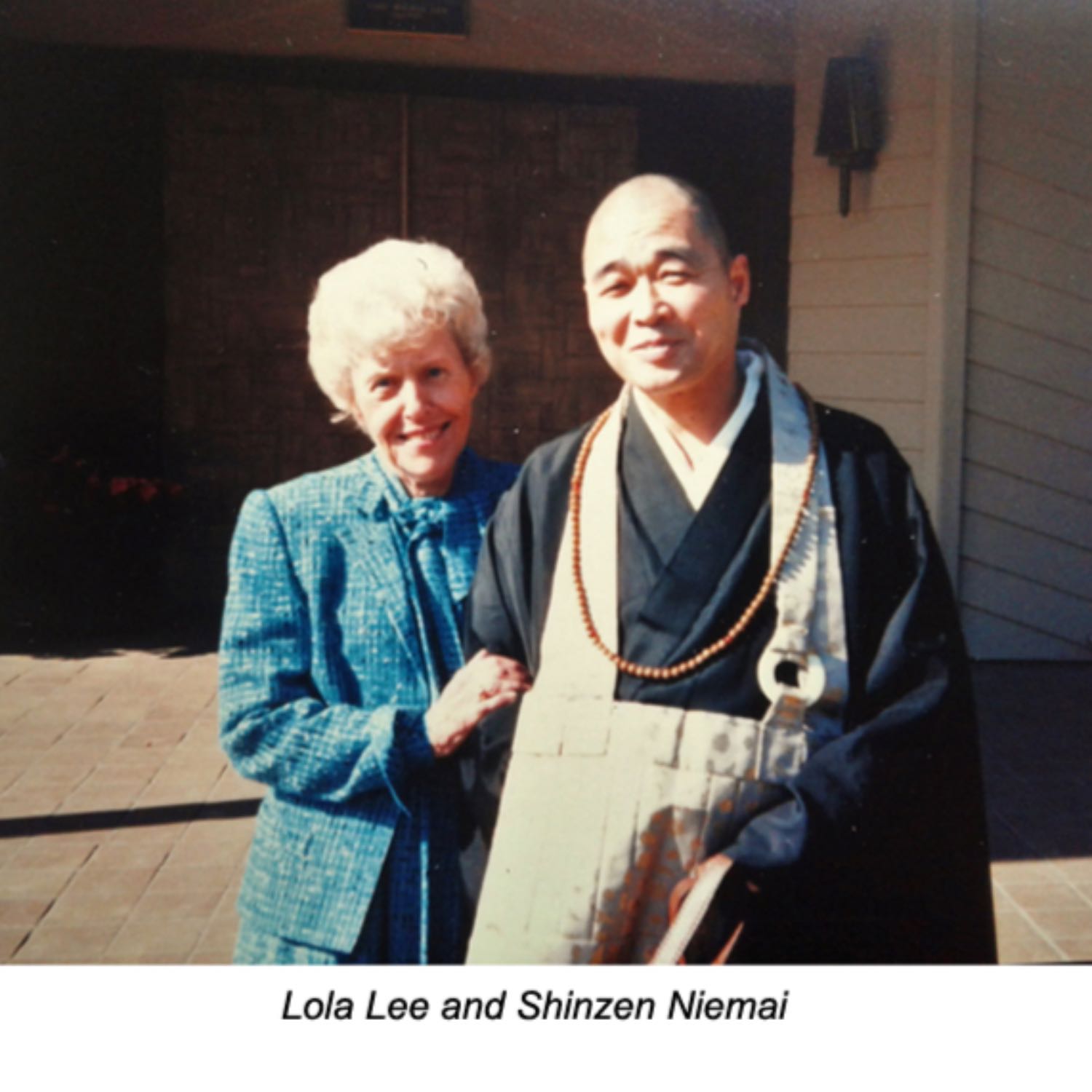
This is a series of newly digitized talks by spiritual teacher, Lola McDowell Lee, spanning two decades—from the early Seventies through the Nineties.Lola was a Zen Roshi whose Rinzai lineage included Doctor Henry Platov and renowned Zen master, Shigetsu Sasaki. Lola was a religious scholar as well as an ordained Christian minister.While the talks are focused mainly on Zen and Buddhism, Lola drew on many spiritual traditions—including those of Jesus, Plato, Lao-Tzu, the Hindu Vedas, Meister Eckhart and Gurdjieff.If you find Lola’s talks valuable, more will be posted in days to come. RSSVERIFY
Latest Episodes
View all 135 episodesHow to enter a gateless gate. Delivered July 6, 1986
The Basic Teachings of Zen Meditation. Presented on June 29, 1986
Accumulating knowledge versus attaining true wisdom. June 22, 1986
S3 Ep 131The Lesson of True Listening. June 15, 1986
Zen Roshi, Lola McDowell Lee, explores the difference between merely seeking reality and actually experiencing it through the practice of true listening.Ancient Zen master, Tokai, is abruptly awakened from a nap by a frantic monk shouting about a fire under the kitchen floor. Rather than panicking or leaping into action regarding a future threat, Tokai requests that the monk wake him only when the fire reaches the passageway, instantly returning to sleep.People often miss this present reality because their minds are busy searching for preconceived concepts of the Buddha or God. The ultimate truth is already at our door.The vital difference between hearing and listening. Our internal voice acts like a thick fog, constantly evaluating, agreeing, or disagreeing with our surroundings. True listening is hearing with awareness, requiring us to drop our mental commentary and simply witness phenomena without the need to say yes or no.The attainable and the unattainable. The attainable represents the dualistic world of objects, ideas, ego, and physical forms—things we can mentally grasp and call our own. When we attain something, we form an attachment to it.The unattainable represents the non-dualistic, transcendent truth that lies within and behind the phenomenal world. The unattainable cannot be possessed or grasped. It can only be realized by abandoning the dualitt of subject and object, and resting in the middle way.A barrier to accessing the unattainable is our conditioning. Our deepest beliefs regarding what is right and wrong are not objective truths, but rather accidental byproducts of our geographic, cultural, and familial upbringing.Beneath the rose of our supposedly logical and righteous beliefs lies the hidden thorn of personal desire for an immortal soul that will survive death.The paradox of clinging to rules, conditioning, and dualistic judgments only creates confusion and chaos.The ultimate solution is to set aside all conditioning and simply listen. By dropping our "isms," religious labels, and mental defenses, we become vulnerable to reality as it is.In this state of pure awareness, trust arises naturally. Without the mind's interference, the chaotic events of the world effortlessly align into cosmic order, acting as perfectly and naturally as flowing water finding its way into a hole in a rock.While breaking old habits requires continuous practice, maintaining this state of active listening allows us to experience a profound unity.June 15, 1986
S3 Ep 130An exploration of the subject of death. Delivered Jun 8, 1986
Zen Roshi Lola McDowell Lee, opens by recounting the classic Zen koan of Master Dogo and his disciple Zengen. When visiting a deceased parishioner, Zengen asks if the person is alive or dead, to which Dogo refuses to answer either way. Even after Dogo’s passing, another master, Sakeso, repeats this refusal, telling Zengen, "No saying whatever".The story illustrates that life and death are not distinct realities, but two doors to the exact same cosmic secret. They are experiences to be lived through directly rather than intellectual problems to be solved.The human mind constantly seeks to placate itself with borrowed concepts and comfortable conclusions, missing the fundamental truth of existence. She cites Sri Ramakrishna’s metaphor of a festival crowd debating the depth of the ocean. While they argue, a man made of salt jumps into the water to discover the truth directly, dissolving in the process.Lola equates humans to this salt man; we must be willing to jump into the unknown and die daily, allowing our conditioned personalities to dissolve into the greater awareness.She notes that individuals satisfy themselves with some spiritual terminology, like karma, using it as a pacifier to explain things away and avoid facing the genuine, sometimes frightening mystery of life. Real understanding requires us to abandon the safety of the shore.She explains that the mechanics of living and dying are intimately connected to the flow of the human energy field. Lee explains that at birth, energy ripples outward, expanding into the world. In contrast, during a natural death or deep meditation, this energy field gradually compacts, subsiding and returning inward to its center to form concentrated light.When one dies, the physical body is a temporary mechanism left behind outside the temple, while unconditioned awareness effortlessly moves through the invisible door of death. Death is not an absolute end, but a transition of awareness.Lola discusses the treacherous nature of language and dualistic thinking. Relying on labels separates the thinker from reality, pushing awareness away through continuous subject-object categorization.She suggests "a-thinking" (the a being like a in amoral, or asymmetric, meaning non-. A-thinking is a wordless, subjective dwelling in non-articulated awareness. The answers to the profound mysteries of existence are found prior to the formation of words, hidden in the translucent darkness within.Lola explains that the words and stories are merely fingers pointing at the truth, and mistaking the finger for the reality it points to is a tragic error in the spiritual journey.June 8, 1986
S3 Ep 129Does an enlightened Zen master live a saintly, extraordinary life? Delivered Jun 1, 1986
Zen Roshi, Lola McDowell Lee, explores the nature of truth, the limitations of the intellect, and the profound importance of trusting one's own immediate experience.She begins by introducing a classic Zen Master Tozan’s question: "What is the Buddha?" While working in a storeroom, replied, "This flax weighs three pounds." This seemingly nonsensical answer helps dismantle our reliance on logical analysis.Lola tells the story of a young student others thought stupid. He who suddenly comes alive in class to ask where numbers go when erased from a blackboard.And the story of a toddler who stumps his mother by asking how the first clock-maker knew what time it was.These questions, like the koan, point to mysteries that cannot be solved by conventional logic.Lee emphasizes that words are merely "fiats" for communication, not the truth themselves. While words carry meaning, they often trap us. If we analyze "three pounds of flax" intellectually, we find no connection to the divine. However, the koan is not a logical proposition but an expression of a state of consciousness. To understand it, one must drop comparative judgments—notions of gain, loss, right, and wrong. The answer points to the "ordinary" nature of reality. There is no other reality than this very ordinary life.Lee observes that humans are plagued by self-distrust because we remember our lies, mistakes, and failures. Yet we have an innate biological trust exhibited daily: we trust our hearts to beat, our lungs to breathe, and we go to sleep assuming we will wake up.A person living entirely in a pitch-dark room demands to be convinced that the sun exists before stepping outside. Words cannot convey the experience of light to someone who has known only darkness; one must step out into the unknown to know it. Similarly, demanding proof of God before meditating is a form of distrust that prevents spiritual discovery.Gurdjeiff described the mind as a broken phonograph record. The repetition creates grooves in the brain, offering a false sense of security. Whether the circle of repetition takes twenty-four hours or ten years, it remains a trap. The goal of religion, she argues, is to get off this self-manufactured wheel and move into the ever-new present moment.She notes that Zen masters often engage in humble, ordinary tasks like making pickles or weighing flax, defying our expectations that a sage must be an extraordinary, otherworldly figure.The koan is a tool to exhaust the intellect. By using all of one's psychic power and Hara to solve the unsolvable, the student pushes logic to its breaking point, transforming intellectualization into intuition.Lola invokes the figure of Hermes Trismegistus to discuss the birth of the Christ consciousness. She ends with a poetic and rhythmic recitation of a Hermetic hymn, calling on the powers of earth, air, fire, and water to sing praises to the "One and All," ultimately guiding the listener toward accepting the gift of God in you and awakening in freedom. Delivered June 1, 1986
S3 Ep 128Give gifts with no notion of reward or praise. Like moving something from one hand to the other. Mar 9, 1986
Zen Roshi, Lola McDowell Lee, discusses the Diamond Sutra, known as the "Cutter of All Doubts." She story of the Buddha and his disciple, Subhuti, a Bodhisattva. It’s a paradoxical teaching: A Bodhisattva should give gifts without being "supported" by anything—not by a notion of a sign, a gift, or a recipient. If a gift is given with the thought "I am giving this to you," it is limited. However, if a gift is given without support—without the self-identification of a giver—the merit is immeasurable.Lola draws a parallel here to the Jesus’ words that "the Son of Man hath nowhere to lay his head." She interprets this as a spiritual state of having "no support" in the ego or the material world.True giving happens when the "me" is removed entirely, making the giver and the receiver one and the same, much like the right hand transferring an object to the left hand without needing praise.Lola tells the story of Master Obaku, who bows to his teacher. But why? a skeptic asks. If there is not to be praise.Lola focuses on the limitations of human thinking. Lola argues that true listening is impossible when the mind is cluttered with past conditioning and constant chatter if thinking. She tells the myth of the Egyptian god Thoth, who tries to gift "thinking" to humanity. A colleague rejects the gift, warning that thinking is what drove Adam and Eve from the Garden of Eden by introducing discrimination—the ability to judge good from bad, hot from cold, and self from other. This discriminatory mind creates a dualistic prison where we constantly judge our position and fail to see the underlying Unity of reality.She contrasts this with the noumenal world of non-discrimination where, like the bamboo trees in a Zen story, the tall and the short exist perfectly without comparison.Lola shares an anecdote about her teacher’s lineage, Dr. Henry Platov, to explain how to transcend the thinking mind. His training involved building complex mental structures (philosophical systems), inhabiting them fully, and then utterly demolishing them. This process, repeated over and over, serves to teach the student that all theories are merely structures, not the Truth itself. By demolishing these intellectual safeguards, the student eventually clears the way for the real Truth to emerge. When this Truth is finally heard by a mind that is alert and free of ego.Lola delves into the Four False Notions and their involvement in the construction of the ego. The Skandhas (Lola refers to “sensations, tendencies, feelings, emotions, thinking”). Some refer to the Five Skandas as “form, feeling, perception, mental formations, and consciousness.”This is how our "Self" is actually constructed. There can be a progression of meditation designed to remove these illusions, one by one, leading to the Zen Koan: "Sitting on the top of a 100-foot pole, how do you take the next step?" This step is the leap into the void of non-support.She concludes with a humorous story about an Emperor seeking a perfect archer who discovers an arrow which appears to have landed perfectly in the center of a target on the ground. The Emperor must find this remarkable archer. It turns out he is a madman who shoots arrows randomly, and when he find them he draws the bulls-eyes around them afterward. This illustrates the Buddha’s teaching that "possession of marks is fraud."True spirituality, like Master Obaku’s bowing, has no motive and seeks nothing. It simply is.March 9, 1986
S3 Ep 127Learning to live less from the mind and more from the hara. Oct 14, 1981
(Note: This recording contains a static hum that, in spite of efforts to remove, does remain somewhat. But the content of the talk might be worth overlooking).Zen Roshi, Lola McDowell Lee, understands how odd it must sound to some that an individual human being can become one with the universe. She explains that this search for unity is often misguided because people look out there for something that can only be found in the immediate present.This issue begins with our own internal division. The split between spirit and body, or matter and consciousness. If a person is divided within themselves, they cannot possibly perceive existence as a unified whole. Only an individual who has achieved internal integration can truly know that existence is indivisible.This internal division is not innate but learned. An infant is born in a state of natural integration, unaware of any separation between body, mind, soul, or even between self and mother. However, the necessities of survival, societal conditioning, and the need for security force the growing child to begin to discriminate.Lola explains how we are taught to identify with the upper part of the body (the intellect and head) while viewing the lower part (instincts and feelings) as inferior or shameful. This preference for the intellect causes blockages, leaving us constantly struggling to control our thoughts and creating a life defined by inner conflict.Lola suggests we try switching it up: a re-awakening of sensitivity. The intellect has no direct access to the world and is entirely dependent on the senses. When we lose touch with our physical senses, our intellect becomes uninformed and life loses its magic. Try to bypass thinking that the flower is beautiful and instead focus on what the senses are actually reporting.This return to sensitivity is likened to the ignorance, or non-duality, of a child. Our goal, however, is to achieve an awakened innocence—a state of wisdom where the knower and the known are one .Unlike intellectual efforts, Lao Tzu focuses on total immersion in one's activity. Whether walking, eating, or listening, try to become the act itself.Lola emphasizes the physiological aspects of spiritual integration, specifically regarding breath. Driven by anxiety, we breathe shallowly from the chest, whereas children and enlightened figures like the Buddha breathe from the abdomen. The tanden is not merely a physical location below the navel, but is a center of spiritual power. By shifting the seat of breath from the chest to the tanden, one can bypass the chaotic attempts by the brain to manage our experience, and access a deeper, more stable source of power. It will quiet the ego. Breathing from the tanden naturally clears the mind and allows mysteries to reveal themselves without intellectual effort .We must avoid the our imagination’s construction of complex illusions, including concepts of gods, heavens, hells, and even enlightenment itself. Intellectual attempts to clear these webs only create more webs. One logic is simply replaced by another. The only way out is to step out of the imagination entirely into a state of pure existence, where there are no thoughts or concepts.If we cannot see God in a simple stone, how can we find God within ourselves. True realization is an all-embracing acceptance of life—seeing the divine in weeds, insects, and stones—resulting in a serenity and the unified, innocent vision of the child. Oct 14, 1981
S3 Ep 126Allowing Purusha to extricate itself from the mindless play of Prakrit. Sept 27, 1987
Zen Roshi, Lola McDowell Lee, discusses the ancient Indian philosophy of Samkhya Yoga as a framework for spiritual observation. It includes the dual principles of Purusha (the essence of the self) and Prakrit (the "Great Mother" or manifested nature and energy).While Samkhya might appear to be dualistic, it aims for a state of Sahaja, or awakened consciousness. This state contains and transcends the three states of objective self-consciousness, dreaming, and deep sleep..The spiritual task involves two seemingly contradictory efforts, or "two ends of one stick.” They are rigorous self-observation and voluntary self-forgetting. To observe correctly, we must develop a background attention that is indifferent to events, watching the movements of energy (Prakrit) without impatience or the desire to give orders.This leads to voluntary self-forgetting, where one stops observing the personal self and begins to watch the broader movement of existence.Obstacles to this awareness are our unconscious desires and our investment in our dreams—memories, future plans, or escapes from today's misery. By constantly wanting to become something better or different, we miss the reality of being.The path forward is meditation to balance the heart and mind, allowing Purusha to finally extricate itself from the mindless play of Prakrit. The ultimate realization is that Nirvana and Samsara are not separate. By witnessing oneself without judgment, one discovers that reality remains exactly what it is.Sept 27, 1987
S3 Ep 125Plato, art and spiritual growth. Sep 5, 1987
Zen Roshi, Lola McDowell Lee, explores the concept of freedom through the conquest of self. Per the Dhammapada, we should direct straying thoughts. The path to happiness is through quieting these elusive thoughts with single-mindedness, which brings freedom.We struggle from confusing wants and needs and forgetting the primary goal: freedom.This freedom is not worldly (economic, political, or social). It’s freedom from the ego. When the ego drops, it’s like a curtain falling, revealing the reality. This is the noumenal world described by philosopher Immanuel Kant.We are caught up primarily in the phenomenal aspect of life, seeing the world through the lens of egocentricity, which acts as a barrier to our understanding reality itself.Lola shares Plato's Allegory of the Cave, in which characters are completely focused on shadows on the wall. The spiritual task is to turn around and see the light that creates those shadows.The Buddhist parable of the poisoned arrow. A monk has all these questions for the Buddha about afterlife, etc, and says he’s giving up if the Buddha doesn’t provide answers. The Buddha responds by asking if a wounded man would refuse to have the arrow removed until he knows all the details about the shooter. The Buddha's teaching is to remove the arrow of suffering. Not provide all the answers.Lola tells the Tibetan story of the servant obsessed with learning the secret of miracles. The Master’s advice is to recite a mantra, and to not think of monkeys as he does so. His resulting experience is the lesson.Lola then discusses the Sanskrit gunas (qualities in man). The importance of cultivating sattvic (fine, high frequency) qualities like sensitivity, love of beauty, and inner harmony. We can choose to exist as inner noise or as a temple of sacred silence.Many assume that Plato's Republic is about government. Then why is its subtitle: The Conquest of Self? If the book is about conquering the self, then the "philosopher king" represents our wisdom, the "guardians" our will, and the "laborers/merchants" our desires/appetites.Lola explores Plato's idea in the book of regulating art. Rather than think of it as censorship in a republic, look at it in terms of what art you want to expose yourself to. An important step in self-conquest is observing what emotions art evokes in us.True philosophy is “love of wisdom,” she concludes, not complex “philosophical” ideas. Originally philosophy was an instruction to go within, and utilize the "noetic quality" for transformation.Sep 5, 1987
S3 Ep 124The Middle Way—between the world of appearance and the inner world of consciousness. Aug 29, 1987
Zen Roshi, Lola McDowell Lee draws on the Dhammapada to emphasize a core principle of spiritual success: vigilance, or watching. The fool is careless and enslaved by desire. The master has firm resolve.Man is the only creature on Earth with the ability to choose. Unlike animals and plants, whose lives are determined by nature, humans possess a mind that allows for conscious choice.Man is not born a true being but a becoming. He is a state of perpetual movement between opposing attitudes and emotional states. This becoming is marked by a continual search, an inner groping.Lola calls it “faith without an object.” This search for something greater raises the perennial philosophical question: Who are you?Lola discusses philosopher Jean-Paul Sartre, who calls man a “project"—one who creates himself by his own effort. Man is born an opportunity, a possibility, who must become actual.The crucial action is making an aware choice, choosing one’s life with full consciousness, rather than simply letting decisions happen passively, out of convenience, desire, or external pressure. Also, not choosing is a choice.Lola discusses two schools of thought: the Essence-Central School, which holds that man is born with a ready-made essence that merely needs to unfold (like an acorn becoming an oak), and Existentialism, which maintains that man is born as pure existence, and his essence must be actively created.Lola recaps the core principles of Buddhism’s Four Noble Truths:The First Truth is the fact of suffering (dukkha), which arises because life is constant change, and change can never satisfy the human desire for permanent pleasure.The Second Truth identifies the cause of suffering as selfish desire—a constant "thirst" or fire that only burns brighter the more it is fed. This desire unrealistically expects life to satisfy every selfish whim, which is as absurd as expecting a banana tree to bear mangoes.The Third Truth offers hope: because suffering has a cause, it has an end. Extinguishing the fire of selfish desire leads to a state of wakefulness and joy, known as Nirvana.The Fourth Truth provides the solution: the Eightfold Path, which she explains in detail.Finally, Lee illustrates the deeper meaning of the Middle Way using the story of the Buddha and a disciple, who was over-exerting himself in ascetic practice. The Buddha showed him a stringed instrument, explaining that to make music, the strings must be tuned "neither too tight nor too loose—it has to be just right." This is the path to enlightenment: balance between extremes.Lee explains how we can take the Middle Way between the world of appearance and the world of inner states of consciousness. The ultimate goal of continuous self-watching is to withdraw energy from the inner "clamoring crowd" of confusion to nourish the "new man" within. Through constant mindfulness and attention to the present moment, a window opens, and one experiences life not as a pure, empty, and all-encompassing presence. Aug 29, 1987
S3 Ep 123How do you go in? Simply stop going out. Aug 2, 1987
Zen Roshi, Lola McDowell Lee, continues her discussion of the Dhammapada.She warns us against mistaking the false for the true, urging us to look into our hearts and follow our true natures. Spiritual texts are meaningless without direct action. Lola discusses the seeming conflict of seeking external rewards while professing detachment from the fruit of action.Truth simply is. It is the truth of being, which human effort must uncover. Our chief obstacle is the web of conditioning. To find truth, one must deliberately extract oneself from this accidental conditioning of our societal pressures, and even our religious background.The price of truth is rigorous personal effort. That is our payment.Lola presents the story of the Siddhartha Gautama as the ultimate example of dedicated effort. His great renunciation, his adoption of the ascetic path, and his eventual realization that extreme mortification weakened his concentration. This led him to the “Middle Way." The climax of his journey was under the fig tree where he vowed to remain until he found the way beyond death and decay.The key to liberation is inwardness. The ancient Greeks believed the heart was the seat of wisdom and intuition. The heart is always pulsing in the present moment, unlike the mind, which is trapped in the past and future.The question, "How do you go in?" is answered simply: "You simply stop going out." Inwardness is achieved by stopping the mind’s outward movement toward thoughts and desires.Lee says to abandon the ways of the "lazy cowherd" who spends his time counting others' cows by merely reading the interpretations of the actual scripture instead of investigating the scripture itself—and seeking direct experience.Aug 2, 1987
S3 Ep 122The meanings of various Buddhist terms, practices & traditions. July 26, 1987
Zen Roshi, Lola McDowell Lee, explores the meaning of the Dhammapada -Twin Verses.She discusses the importance of thought and self-mastery in shaping one's experience. We are what we think. All that we are arises with our thoughts. With our thoughts we make the world.An impure, conditioned mind leads to suffering, while a pure, unconditioned mind leads to unshakable happiness. We have, over and over, a choice of conduct: the easy path of catering to personal ego desires, or the difficult path of conscious transformation.The negative path is effortless and offers temporary satisfaction. The positive path requires a great deal of effort and an active choice to go against one's conditioned nature.For instance those who showed up this morning for Lola’s talk. It would’ve been easier, she says, to sleep in and relax. Their attendance was a choice to take the more difficult path toward awakening.What is vital versus what is trivial? Using the metaphor of a poorly thatched roof, she warns that passion will seep through an untrained mind, while a well-trained mind remains impervious.Lola examines the various Buddhist traditions that emerged after the Buddha's death. She describes the division into the Hinayana (Small Vehicle) and the Mahayana (Great Vehicle).The practical method for self-transformation is Vipassana—the effortless effort meditation. This technique involves simply sitting and observing what rises in the mind and body without judgment. To enter this state, one must "stay out of the picture" of mental activity, serving purely as the witness.The central goal of Buddhism is the enlightenment experience (Bodhi), which means "to wake, to become aware of." This awakening is a shift from a life of relativity and conditioning to an unconditioned life defined by non-attachment, non-discrimination, and non-ego.Enlightenment is a personal experience. Value your own experiences and exert yourself. From the sutras: "By oneself is one purified."The story of Gautama's path to becoming the Buddha.The meanings of the term Dhamma (or Dharma), which is linked to Pada (the path). Dhamma means: Ultimate Reality. Pada is the path to this ultimate truth.We need to drop conceptual thinking. Like a seed: the outer seed rots away to leave the essence from which the entire tree grows, The ego and thoughts must disintegrate to reveal the truth within.Ultimately, the goal is to find the "space before the thought." Or the state of "no mind." July 26, 1987
S3 Ep 121Dogen: “Not knowing is most intimate.” July 5, 1987
Zen Roshi, Lola McDowell Lee, explains the story of Dogen Zenji, the founder of the Soto Zen school in Japan. One master says, “Not knowing is most intimate.”Dogen’s question: if we are already Buddha nature — if enlightenment is our essence — then why do we need to seek it?When Dogen returned to Japan, he founded the Soto school and taught Shikantaza — just sitting. This practice, Lola explains, is single-minded meditation without striving or grasping — simply allowing truth to reveal itself.Meditation, explains Lola, is about resting in awareness, with nothing held back. The nature of mind. It’s both the source of our bondage and the key to our liberation. We must move beyond the “content” of the mind — our thoughts, dreams, and desires — to see mind itself, the clear space in which everything appears.No-mind is not the absence of awareness but awareness without clutter. It is the crystal-clear state when the activity of thinking subsides.We need to observe carefully: subject and object, thinker and thought, self and world. As one sees how all phenomena are like dreams, the sense of self begins to dissolve. Awakening brings clarity and wonder — colors seem brighter, the world more alive, even rocks appear to breathe.Lola warns that the ego can cling to enlightenment experiences. The final task, she says, is to “let go of the remedy” — to release attachment to spiritual methods once they’ve served their purpose. Like the five men carrying a boat instead of realizing they’ve already crossed the river. The teachings from Rinzai Zen are about the four positions in the relationship between ego and True Self, host and guest, questioner and answerer.Enlightenment isn’t somewhere else to reach. It’s here, now, in the clear seeing that truth is.July 5, 1987
S3 Ep 120How you form your ego—and can ultimately overcome it. Jun 28, 1987
Zen Roshi, Lola McDowell Lee, tells a parable about a powerful Chinese prime minister, who was a devoted Zen student. When the minister asked his master, "how does Zen explain egotism?" the master insulted him, calling him a "numbskull". As the minister's face filled with anger and hurt feelings, the master smiled and said, "Your Excellency, this is ego".Lola explains that this ego is our very basic problem. Paradoxically, we need It presents we need the ego to function in the world, yet it is also our biggest stumbling block to discovering our true identity.Most people, she says, are so caught up in this pseudo self that they don't even know how to begin looking for the True Self. She explains that the rules of Zen practice, such as the sesshin, are designed to force practitioners to observe oneself and one’s reactions.Lola explains how the formation of the ego begins in infancy. A child, Lola says, is born like a tabula rasa or "clean slate." Everything—food, love, comfort—comes from out there. The sense of me is formed later, in contrast to “other". This "me" is a "reflected awareness". It is a reflective center built entirely from the opinions of others, starting with the mother. If the mother smiles and appreciates the child, the child feels valuable, and this positive reflection builds the ego . Conversely, if the mother ignores the child, the child feels worthless and rejected, which builds an "ill ego."This ego is necessary. The True Self can only be known by passing through this ego. The path is to first know "other," then "me" (the reflection), and finally to see that reflection as the illusion it is.As the child becomes an adult, the search for the true self begins, but it's often misguided. People look to religion, but with nearly 400 sects, they usually just pick one that reinforces what one already thinks—which reinforces the ego.The great religious traditions all aim to show one, universal truth shared by great figures like Buddha and Jesus. The smaller sects tend to get lost in trappings.This societal atmosphere we develop in helps form the ego. Lola explains there are two centers in each of us. The first is the acquired center, given to us by society and shaped by others. This is not direct experience. The second is the true center, which we are born with and is given by existence; this is direct experience . To glimpse the true center, the ego must be overcome.Lola discusses a concept of "masks of the universe” from physicist Edward Harrison. Including, historically, the magic era, the mythic era, etc. (While this is after Lola’s time, it reminds me of a more primitive structure that scholar Ken Wilber later provides us more comprehensively).Most of us are trapped in our own minds, which are full of intellectual nonsense and sentiments that make us miserable.One way out, Lola concludes, is the Zen path, which requires persistent observation: one must really observe" oneself in action to see the source of one’s misery. Second is re-evaluating our values.The goal is to reach a state of "just so." With values that are free from ego.The parable about the Zen master Joshu and a stone bridge.Jun 28, 1987
S3 Ep 119Zen and Socrates. Jun 21, 1987
Zen Roshi, Lola McDowell Lee, argues that most people waste their lives playing superficial games and are deceived by their own minds. They fail to engage in the urgent, life and death work of knowing themselves. The pursuit of money, power, prestige, and reputation are hollow endeavors, like waves on an ocean.Lola draws parallels between Zen practice and the Socratic method. Many of us meditate for a short period only to ignore one’s inner awareness for the other 23 hours of the day.Lola describes Greek philosopher Socrates as a figure who masterfully employed a method of inquiry similar to that of Zen. Socratic questioning, like the Koan, was a tool to penetrate the world of appearances and challenge ingrained opinions. This method, like Zen, is not about adding new beliefs but about drawing out the truth that is already within.Central to both the Socrates and Zen is in admitting ignorance. Plato depicted Socrates as a man whose wisdom lay in recognizing his own ignorance. Lola parallels this with the Zen master Bodhidharma, who, when asked by an emperor who he was, famously replied, "I don't know". This "unknowing" is a powerful spiritual state that moves beyond concepts, opening a space for true, transformative knowing to emerge.Ideas by themselves, even great spiritual ideas, do not raise the level of a human life. Without action by us, ideas have no real transforming power.Jun 21, 1987
S3 Ep 118Instructions for Koan study. And true understanding & non-discrimination. May 31, 1987
Zen Roshi, Lola McDowell Lee, recounts the story of master Joshu who offers cups of tea to the various monks, illustrating the idea of how distinction keeps us from seeing the world as it is. When he offers the same tea to newcomers and long-time members alike, the manager asks why. And Joshu has a shouting response. Why?Our scientific world breaks the world into bits, opreating within a framework of complexity and duality because seeing the simplicity of the whole is so difficult for us to grasp.Zen teaches us the value of non-discrimination—the art of seeing things as they are, without interpreting or naming. Lola illustrates this with a personal anecdote about a wedding party where she presided—and the which they hoped would symbolize the couple’s eternal love. But the candle kept blowing out.A tool for achieving this mental shift is the koan, and how it is not an intellectual puzzle to be solved. Rather, it is a device intended to exhaust the rational mind. The student should approach a koan" employing great faith, great resolution, and a great spirit of inquiry.”The weakness of this duality-approach becomes clear when we look at many try to understand the notion of God. In doing so, many religions create the Devil to complement the notion of God.The importance of awareness and alertness, and the meaning of the Japanese Tea Ceremony.We must pass through the obstacle of our own discriminating minds to walk freely in the universe.May 31, 1987
S3 Ep 117The limitations of human knowledge. May 17, 1987
Zen Roshi, Lola McDowell Lee, discusses human knowledge an its limitations. Typical knowledge is the result of fragmented perception. Our knowledge is narrow, limited to appearances and governed by desire, habit, and subconscious impulses.The relationship of Surya (divine light) and Agni (divine force). Agni symbolizes will in consciousness. Together, Surya (knowing) and Agni (will) form a unity. Knowledge and Will are not separate. They are two aspects of the same foundation of reality.The Upanishads say that sin is not moral condemnation but that which causes a deviation from the straight path. Even elegant, dazzling thoughts can be a deviation, like a pebble blocking the sun. Each of us has our blind spots.Jesus said, “The crooked shall be made straight.” The ideal is to find the direct way, the single eye that fills the whole house with light.May 17, 1987
S3 Ep 116In the struggle between opposites is the Truth. Mar 6, 1987
Zen Roshi, Lola McDowell Lee, draws on Buddhist and Hindu traditions (including the Mahabharata, Ramayana and Bhagavad Gita) to explain the human condition.Struggles and opposition are partners in our growth. Manjushri (wisdom) is not found in shrines, but is alive within each person.Lola recounts a tale of a monk and the village courtesan.She talks about how struggle is necessary for growth; it develops character. Friend and foe, like rose and thorn, are inseparable opposites. The human tendency is to focus on one side and ignore the other. True vision includes both opposites—and finding a center in the balance of them.Lola discusses whether she thinks someone can be wealthy and still find enlightenment.The true self is both presence and emptiness. The mystery of the self is real and should be made actual. Three spokes unite in one nave, and on that which is non-existent, the nave, depends the wheel's utility.Clay is molded into a vessel, and on that which is non on its hollowness, depends the vessel's utility.By cutting out doors and windows, we build a house. and on that which is nonexistent, on the empty space within, depends the house's utility.Therefore, existence renders actual, but nonexistence renders useful.Mar 6, 1987
S3 Ep 115Where is God? Feb 28, 1987
Note: Generally, this talk is more lighthearted than most that Lola gives. It’s nice to see that side of her personality.Lola begins with a comical tale about a man and a priest he asks for advice.Zen Roshi, Lola McDowell Lee, discusses Lao Tzu concept of how the hole in the wheel’s knave makes its utility. How the emptiness of a vessel creates its utility.Lola asks, “Who would you rather be: a victim or a perpetrator?”It is in the world of the Relative that we can discover the Absolute.How freedom relates to relativity. Some people don’t want freedom. They’d rather follow directions.The world is like a schoolroom where the teacher is absent. It is chaotic. Where is God?She tells the story of Swami Vivekananda, who, during his first visit to the United States in 1893, was shunned for his skin color. Eventually his speech at the Parliament of the World's Religions in Chicago brought him recognition in the US. Lola explains how many spiritual seekers seek after miracles. But the world is full of miracles. A seed dies and falls into the ground and a tree grows from it. Grass grows. Look at man? He’s a miracle. The world is a manifestation of God.Feb 28, 1987