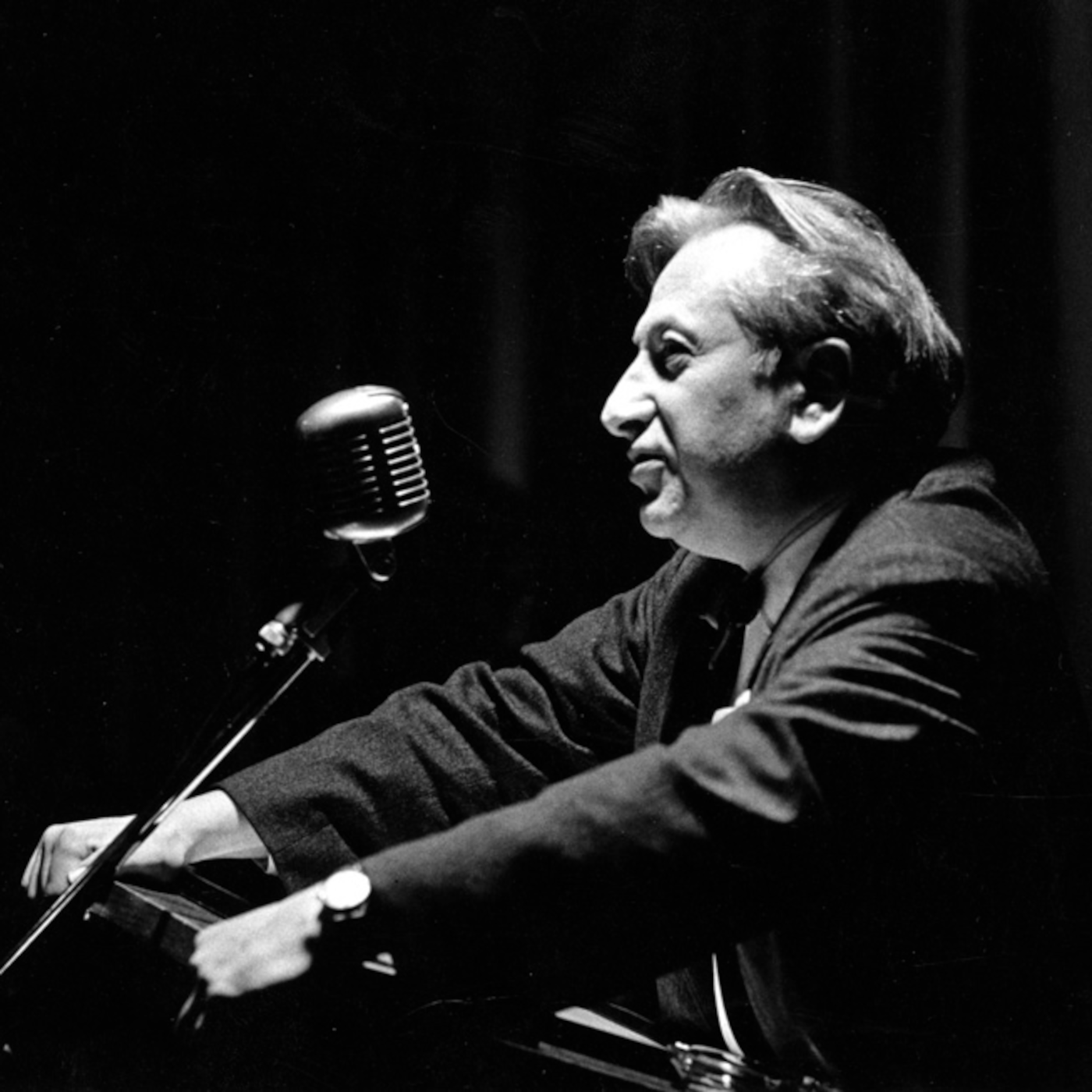
Studs Terkel Archive Podcast
208 episodes — Page 1 of 5
The Walawa Basies talk with Studs Terkel ; part 2
First broadcast on January 14, 1969. Studs Terkel interviews the members of the Walawa Basies: Kelvin Strong, Orlando Lucas, and Levon Campbell.
The Walawa Basies talk with Studs Terkel ; part 1
First broadcast on January 14, 1969. Studs Terkel interviews the members of the Walawa Basies: Kelvin Strong, Orlando Lucas, Levon Campbell, and Justine Cordwell. This is an Interview done in two parts
Barbara Kingsolver discusses her book "Holding the Line: Women in the Great Arizona Mine Strike of 1983"
First broadcast on September 17, 1990. Since no men were allowed to picket against the Phelps Dodge Corp., Mexican American women showed up and according to Kingsolver’s book, “Holding the Line,” the picket lines were a brand new experience for the women. Some of the women had to get their husbands’ permission to picket. The group of women found their lives transformed not only with their cause but with new bonds of friendship from the other women.
Derek Walcott discusses poetry and his play "Dream on Monkey Mountain"
First broadcast on April 11, 1972. Colonial West Indies & Caribbean poet Derek Walcott talks about the traditions of poetry not purely being just the written words. Poetry, says Walcott, is also oral poetry that's found in folk songs, folk tales and calypso music. Walcott's play, "Dream on Monkey Mountain" is about Makak, an old hermit who lived on Monkey Mountain his whole life, and was now being kicked off the mountain.
Daniel Boorstin discuses his book "The Image: A Guide to Pseudo-Events in America"
Discussing the book "The Image: A Guide to Pseudo-Events in America" and interviewing the author Professor Daniel Boorstin.
Brian Dennehy discusses the Goodman Theater's production of "A Touch of a Poet"
First broadcast on May 02, 1996.
A young white cabbie talks with Studs Terkel
First broadcast on March 26, 1962. Interviewing a young white cabbie and farewell comments on the plane ride home when Studs traveled home from Montgomery, Alabama.
Fred W. Friendly discusses his book "Due to Circumstances Beyond Our Control"
Studs Terkel interviews Fred W. Friendly to promote his book "Due to Circumstances Beyond Our Control." Although this interview seems to be the conclusion of a longer discussion, Friendly offers two key points: we should learn from a crisis to better handle the next one and television will shape the world. Duration 1:26. (Part 2 of 2)
Fred W. Friendly discusses his book "Due to Circumstances Beyond Our Control" and his career, part 1
Fred W. Friendly discusses his book "Due to Circumstances Beyond Our Control" and his career. Fred W. Friendly discusses television and mass media. (Part 1 of 2)
Eugene J. McCarthy in conversation with Studs Terkel
First broadcast on November 07, 1977.
Discussing the young vs. adults with teenagers at Saint Timothy Elementary School
Studs Terkel presents a roundtable conversation with children ranging from ages 13-17. They discuss relationships with their family members, other students, growing up in Chicago, and race relations in the U.S.
Discussing the book "The Other America" with Michael Harrington.
First broadcast on July 01, 1964.
Discussing a trip to the Soviet Union with Sharon Tennison and Barbara Rinnan of The Center for Citizen Initiatives (CCI)
First broadcast on February 01, 1985. CCI maintains citizen-to-citizen networks between the US and the USSR in an attempt to empower ordinary citizens to take responsibility.
Ben Kingsley discusses his file "Gandhi" with Studs Terkel, then actress Anabella discusses her film and theatrical career
Brother John Sellers discusses his career as a blues artist and how church music inspired his music
First broadcast on July 02, 1982. Studs interviews Brother John Sellers about his career and other blues singers. Sellers explains that religion influenced his music as did performers like Mahalia Jackson, Big Bill Broonzy, and Muddy Waters. Studs reads some of the lyrics of blues song, "In the Evening." Sellers describes street singers and blind singers. He describes the music and style of Jackson and Broonzy and some of his own songs. Sellers performs "Talk About A Child" and "Sally Go Round the Sunshine" live on the program. Studs and Sellers read together some of the lyrics of "Bo Weavil." Most musical pieces are removed from this edited version of the original recording.
Discussing the book "Get Shorty" with the author Elmore Leonard
First broadcast on July 31, 1991.
Studs Terkel discusses race relations and economic disparity with four Chicago area women ; part 1
First broadcast on January 27, 1965. Studs discusses race relations and economic disparity with four Chicago area women in a program entitled "Each of us can act". This recording was the last of a 6-part series, "Rearing the Child of Good Will", broadcast under the auspices of the National Conference of Christians and Jews. The series focused on prejudice, race, religion, and community. Interviewees are: Madeline Bonsigniore of Chicago's south suburbs Naomi Brodky of the Marynook neighborhood of Chicago Lynn Williams of Winnetka, IL Harriet White of the NCCJ The discussion begins with a snipped from Terkel's interview with "Jimmy" a 17-year old African American male who had been involved with gangs on the Chicago's west side. Other topics of discussion include racial integration, schools, and home ownership.
Studs Terkel discusses race relations and economic disparity with four Chicago area women ; part 2
First broadcast on January 27, 1965. Studs discusses race relations and economic disparity with four Chicago area women in a program entitled "Each of us can act". This recording was the last of a 6-part series, "Rearing the Child of Good Will", broadcast under the auspices of the National Conference of Christians and Jews. The series focused on prejudice, race, religion, and community. Interviewees are: Madeline Bonsigniore of Chicago's south suburbs Naomi Brodky of the Marynook neighborhood of Chicago Lynn Williams of Winnetka, IL Harriet White of the NCCJ The discussion begins with a snipped from Terkel's interview with "Jimmy" a 17-year old African American male who had been involved with gangs on the Chicago's west side. Other topics of discussion include racial integration, schools, and home ownership.
Discussing a tour of the Berlin Wall with author Ursula Bender
Discussing the book "Hoop Dreams: A True Story of Hardship and Triumph" with the author Ben Joravsky
First broadcast on May 17, 1995.
Discussing the struggle for democratic rule in South Africa with President of the African National Congress and Nobel Peace Prize winner, Zulu Chief Albert John Luthuli
Henry Fonda and John Houseman discuss the play "Clarence Darrow"
Henry Fonda and John Houseman talk about working with one another on "Clarence Darrow: A One-Man Play". Houseman is in awe of Fonda's portrayal of Clarence Darrow, explaining that in the play, the audience can really see the growth of Clarence Darrow, from a young lawyer to an experienced, wise one. Fonda talks about the opening scene when Darrow recalls his father talking to him when he was a young boy. Fonda reflects on times when his father talked to him. Fonda recalls being taught not to hate individuals.
Interviewing Chicagoan Kid Pharaoh ; part 2
An interview with Kid Pharoh, a former prize fighter, is included in Terkel's book, "Division Street: America."
Interviewing Chicagoan Kid Pharaoh : part 1
An interview with Kid Pharoh, a former prize fighter, is included in Terkel's book, "Division Street: America."
Interview in Montgomery, Alabama
First broadcast on March 25, 1965. Interviewing in Montgomery, Alabama on March 25, 1965 (Montgomery #1). Speaks with Reverend William Franklin Pascal, cab driver, two barbers
French humorist Jacques Tati talks with Studs Terkel
First broadcast on November 01, 1962. Filmmaker Jacques Tati and Studs discuss finding the humor in everyday life and people becoming their gadgets. The two also go in-depth about Tati's film "Mon Oncle" and the development of the character Monsieur Hulot.
Excerpts from the Division Street recordings Oral Histories, regarding race, religion and humanity
Studs presents excerpts from the Division Street recordings, regarding race, religion and humanity.
Edward Albee discusses the arts and the meaning of plays
First broadcast on December 31, 1967. Every play is political and art isn’t easy, according to Edward Albee. People need to realize that going to the theatre is an arena of engagement rather than one of escapism, says Albee. Due to people’s lack of knowledge and self-awareness, we in society, we deserve everything bad that we get, are also part of Albee’s views.
Lawrence Ferlinghetti discusses his poetry
First broadcast on October 15, 1959. Includes Lawrence Ferlinghetti reading and discussing his poems from his books "A Coney Island State of Mind" and "Big Table."
Allen Ginsberg discusses poetry and meditation
First broadcast on November 29, 1976. Studs Terkel and Allen Ginsberg talk about poetry, meditation, and the shifting of American socio-political consciousness between the 50's and 70's.
Chicago residents Alice and Bob Taylor talk with Studs Terkel
Recorded in the Taylor's home against a backdrop of sounds created by a nine-children family, Studs, Alice and Bob discuss aspects of a white family living in a predominately African-American amidst an exodus of the white, Christian community. Includes a performance of "Onward, Christian Soldiers" by the family around their piano, and "Jesus Loves Me" by two of the children.
Discussing and reading from the book "Shoeless Joe"with W. P. Kinsella
First broadcast on May 24, 1982.
Discussing the book "Maus: Survivor's Tale" with the artist and author Art Spiegelman
First broadcast on October 01, 1986.
Discussing the triple revolution with Bayard Rustin, W. H. Ferry and Ralph Helstein ; part 2
Discussing the triple revolution with Bayard Rustin, W. H. Ferry and Ralph Helstein ; part 1
First broadcast on August 01, 1964. Discussion about the triple revolution
Dick Gregory discusses his career
First broadcast on May 14, 1970. Lillian Smith excerpt opens the program.
Bill Ayers discussing education and Ayers's book "To Teach: The Journey of a Teacher"
First broadcast on June 23, 1993.
Wynton Marsalis discusses his musical upbringing
First broadcast on November 05, 1985. Terkel comments and presents a musical performance by Wynton Marsalis
Studs Terkel discusses adults with young adults
Discussing adults with young people. Subjects are: Ed Bocsel, age 16 Becky Milton, age 24 Chick Marmor, age 19 Stacy Goings, age 22 Danny Paul Yates, age 17 Paul Me, age 19 Jerry J., age 20 Lucky Miller, age 19 Lily, age 16 Topics include: Relationships with adults and family members, social alienation, religion, the Vietnam War, and the rise of corporate America overtaking local businesses.
Leonard Bernstein discusses his career, music, and education
First broadcast on February 01, 1985. Leonard Bernstein discusses his career as a composer along with his thoughts on American culture, musical theater, Black music, classical music, and education; music is played throughout the program including songs from Marc Blitzstein's play "The Cradle Will Rock."
Anita O'Day discusses her career
First broadcast on May 21, 1975. Studs Terkel interviews jazz musician Anita O'Day.
Discussing the book "Hocus Pocus" with the author, novelist Kurt Vonnegut
First broadcast on October 11, 1990.
Gloria Steinem discusses the 10th anniversary of "Ms." magazine
First broadcast on June 17, 1982. According to Gloria Steinem, "Ms." magazine is not only a national feminist magazine, but it's also a portable friend. A regular feature of the magazine is to celebrate found women, women who are not celebrities but who should be celebrated for what they do. This interview also includes an excerpt of Aunt Molly Jackson.
Odetta talks about her music career with Studs Terkel
Odetta (often referred as "The Voice of the Civil Rights Movement") talks about her music career and sings to Studs Terkel. The interview segments are between songs. This record is part of the Studs Terkel Almanac.
Ralph Nader discusses his book "Unsafe at Any Speed"
Studs, teachers and students have a conversation at a high school where there is controversy over the use of the book "Working"
Discussing the controversy over the use of the book "Working" by author Studs Terkel in a senior vocational class. Interviews with Kay Nichols, teacher, and two high school classes, as well as Bob Burns and Jim Richardson. The students talk of how the "bad" language in the book is heard from their peers on a daily basis and they don't find it offensive. [recorded in Girard, Pennsylvania]
Stokely Carmichael, Charlie Cobb, and Courtland Cox discuss the SNCC ; part 1
First broadcast on July 23, 1965. Stokely Carmichael, Charlie Cobb, and Courtland Cox discuss civil rights and African Americans in politics. Discussing the philosophy of SNCC.
Stokely Carmichael, Charlie Cobb, and Courtland Cox discuss the SNCC ; part 2
First broadcast on July 23, 1965. Stokely Carmichael, Charlie Cobb, and Courtland Cox discuss civil rights and African Americans in politics. Discussing the philosophy of SNCC.
John Malkovich and Gary Sinise discuss the film "Of Mice and Men"
First broadcast on September 29, 1981. Studs Terkel discusses the upcoming new film "Of Mice and Men", based on the novel written by John Steinbeck with the starring actors, John Malkovich (Lennie) and Gary Sinise (George). The program begins with the opening excerpt from the play "Of Mice and Men" featuring Terkel (George) and Win Stracke (Lennie) from 1952, which then leads into Malkovich and Sinise's interpretation of the rest of the scene. Folk singer Utah Phillips song "On the Goodnight Loving Trail" is presented as a comparison to themes expressed in "Of Mice and Men". During this program they discuss the following: tackling the characters; the interpretation of the relationship between George and Lennie; universal themes; and the other characters.
Interviewing Francois Truffaut director of "400 Blows"
First broadcast on January 27, 1960.