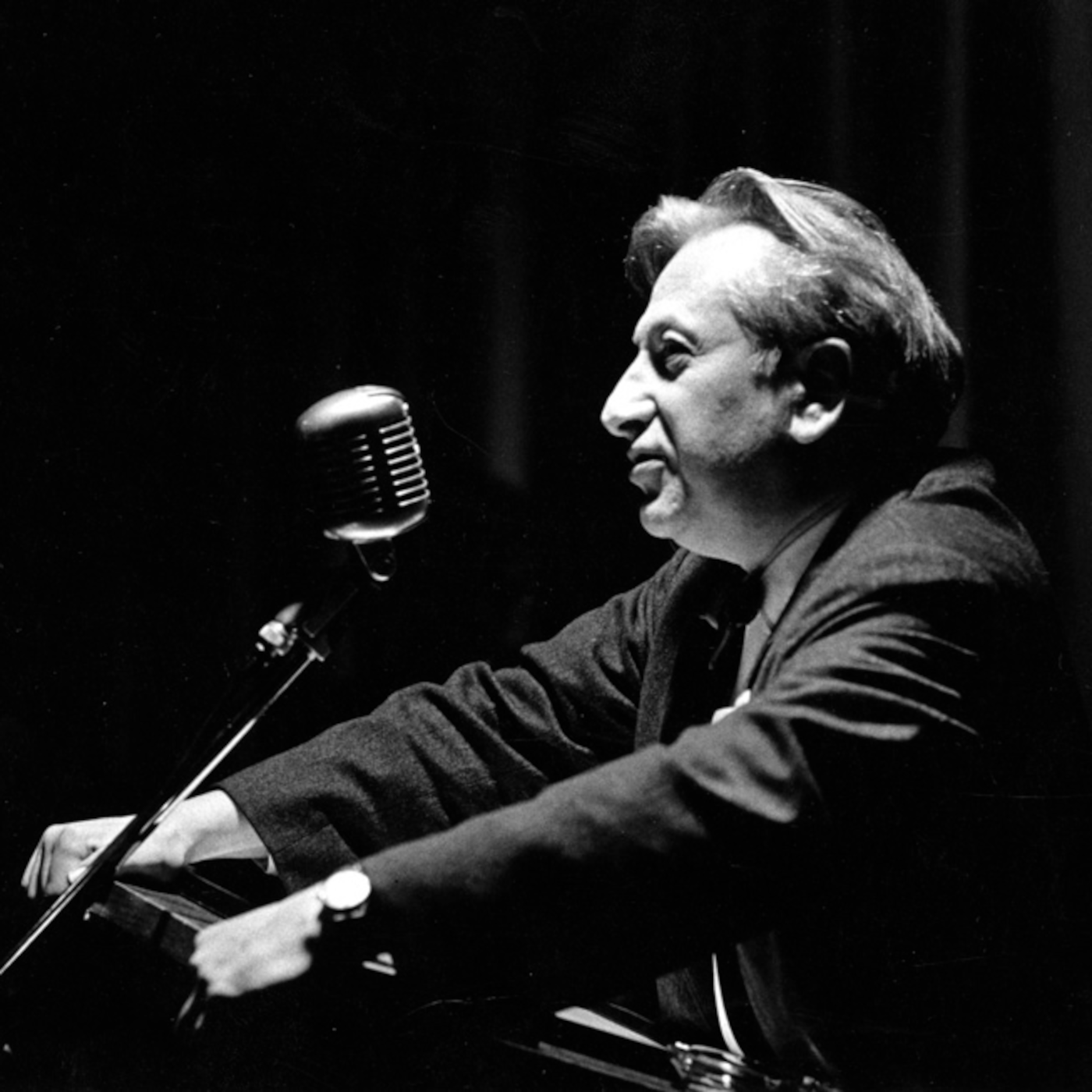
Studs Terkel Archive Podcast
208 episodes — Page 2 of 5
Barrett Deems discusses jazz drumming
First broadcast on March 27, 1979. Barrett Deems discusses his upbringing where he began drumming at age 4 and recalls touring with Louis Armstrong and other musicians. He also talks about meeting drummers in Africa. Music is played throughout: "Flip"- Joe Venuti, "Shine"- Barrett Deems Hottet, "Now You Has Jazz"- Bing Crosby and Louis Armstrong (from "High Society"), "Muskrat Ramble"- Louis Armstrong, "Struttin' with Some Barbecue"- Louis Armstrong, "Slipped Disc"- Benny Goodman, "Stompin' at the Savoy"- Louis Armstrong. Music has been removed from this recording for copyright reasons.
Actress Tallulah Bankhead discusses her career
First broadcast on July 15, 1960. Tallulah Bankhead thought she would become an aerialist when she grew up. At 16, after she saw some plays, Bankhead decided to go into acting. Bankhead never received any formal training and yet some experts in the theatre world called her “a natural”. In a surprise revelation, Bankhead said she does not attend the theatre as an audience member. She went on to say she likes to read books, watch television, and she loves her San Francisco Giants.
Barbara Ehrenreich discusses her book "Fear of Falling: The Inner Life of the Middle Class"
First broadcast on September 18, 1989. Discussing the book "Fear of Falling: The Inner Life of the Middle Class" (published by Pantheon) with the author, political essayist Barbara Ehrenreich.
Discussing the book "Amusing Ourselves to Death: Public Discourse in the Age of Show Business," with the author, culture and communications scholar Neil Postman
First broadcast on November 22, 1985.
Charles Eames discusses his life of travel and his study of design and architecture, part 2
First broadcast on October 01, 1965. Charles Eames an architect, designer, artist, filmmaker and student of human nature talks with Studs about his years of travel in India and Europe. He discusses studying architecture and working as an architect and the nature of his film making.
Charles Eames discusses his life of travel and his study of design and architecture, part 1
First broadcast on October 01, 1965. Charles Eames, an architect, designer, artist, filmmaker and student of human nature, talks with Studs about his years of travel in India and Europe. He discusses studying architecture and working as an architect and the nature of his film making. (Part 1 of 2)
Charles Mingus discusses his book "Beneath The Underdog"
First broadcast on May 20, 1971. Studs Terkel speaks with Charles Mingus about his life and work in the context of his autobiography "Beneath The Underdog".
David Halberstam discusses Bobby Kennedy
Discussing Bobby Kennedy and interviewing David Halberstam.
Studs Terkel interviews Tom Wolfe ; part 1
First broadcast on July 26, 1965. Studs and Tom Wolfe discuss Wolfe's first collection of essays, "The Kandy-Kolored Tangerine-Flake Streamline Baby". Terkel and Wolfe begin their conversation by listening to and discussing an excerpt from an interview with a young motorcycle enthusiast named Chuck. Topics of conversation include Wolfe's writing process and personal history, the generation gap, class and income disparity, motorcycle culture, Las Vegas, and stock car racing.
Studs Terkel interviews Tom Wolfe ; part 2
First broadcast on July 26, 1965. Studs Terkel and Tom Wolfe discuss Wolfe's first collection of essays, "The Kandy-Kolored Tangerine-Flake Streamline Baby". Terkel and Wolfe begin their conversation by listening to and discussing an excerpt from an interview with a young motorcycle enthusiast named Chuck. Topics of conversation include Wolfe's writing process and personal history, the generation gap, class and income disparity, motorcycle culture, Las Vegas, and stock car racing.
Parents of school children talk about integration and busing
First broadcast on August 26, 1981. Interviewing Karen Grzybek, Barbara Tekiela and Mark Smith, parents of Chicago schoolchildren.
Oliver W. Sacks discusses his patients from the book "The Man Who Mistook His Wife for a Hat"; part 2
First broadcast on December 04, 1985. Dr. Oliver W. Sacks details his experiences and approaches to helping patients with various intellectual and physical neurological disorders; part 2.
Interviewing Ralph Ellison ; part 1
Interviewing Ralph Ellison ; part 2
Mr Bugliosi and Mr. Gentry discuss, "Helter Skelter: The True Story of the Manson Murders"
First broadcast on November 06, 1974. Mr Bugliosi and Mr. Gentry discuss, "Helter Skelter: The True Story of the Manson Murders,". Bugliosi was the prosecutor in the case against the Manson "family" for the murders of Sharon Tate and others. The interview opens with "Home is where you are happy" performed by Charles Manson and an excerpt of Catherine Shur Manson's sister talking about her brother. They speak in depth on the Manson "family" and the key players in the murders; Susan Atkins, Steve Grogan, Linda Kasabian, Patricia Krenwinkel, Leslie Van Houten and Charles Watson. Studs brings the interview to a close by reading an excerpt from the book, a quote of Charles Manson's speech after being convicted.
London taxi driver discusses changes in London and speaks about present-day youth culture ; part 1
During a visit to London, Studs interviews a 73 year old cab driver in London, who has 50 years on the job. They discuss traffic jams, the elderly and the young, poverty, welfare, and society. Studs also interviews a number of people attending the Tate Gallery's Lichtenstein Exhibition.
Louis Armstrong discusses music
First broadcast on June 24, 1962. In a nightclub in Chicago, at two in the morning and after a performance, Louis Armstrong talks about his music stylings. Notes are good to learn the tune, says Armstrong, but it's all about the phrasing. Armstrong explained, it's up to you to express yourself. Armstrong shared the one piece of advice that had always stuck with him. King Oliver told Armstrong not to worry about the notes but rather to put some lead into the song.
Marshall McLuhan discusses a wide range of philosophical topics
First broadcast on July 01, 1966. Marshall McLuhan discusses a wide range of topics including conformity, changes in entertainment media, cultural change, art and artists, originality in dance, reading and language, human interaction with nature, and technology. Recorded in front of a live audience at Kendall College, McLuhan takes several questions from the audience throughout the program.
Rita Moreno discusses her role in West Side Story ; part 2
First broadcast on June 13, 1962. Rita Moreno talks about her own Puerto Rican ethnicity and how it relates to her role as Anita in West Side Story.
Rita Moreno discusses her role in West Side Story ; part 1
First broadcast on June 13, 1962. Rita Moreno talks about her own Puerto Rican ethnicity and how it relates to her role as Anita in West Side Story.
Robert Caro reads from and discusses his book "The Years of Lyndon Johnson"
First broadcast on December 09, 1982. Discussing "The years of Lyndon Johnson, Vol 1: the path to power" with the biographer Robert Caro.
Ian McKellan discusses National Theatre of Great Britain's performance of Chekhov's "The Cherry Orchard" at the Blackstone Theatre in Chicago
First broadcast on May 07, 1986.
Interview with members of the Chicago 8
First broadcast on March 26, 1988. Interviewing Abbie Hoffman, Bobby Seale, and Dave Dellinger of the Chicago 8.
Interviewing Howard Zinn ; part 2
Interviewing Howard Zinn ; part 1
Woody Allen discusses his work as a comedic writer and performer
First broadcast on June 01, 1965. Woody Allen discusses his life and art, the influence of both success and failure on his work, and how he finds comedy in life’s difficulties and trials. He discusses his first screenplay, “What’s Up Pussycat?” and other comedians who have influenced the development of his own comedic work, including Mort Sahl, Charlie Chaplin, the Marx Brothers, and George S. Kaufman.
Terkel reads from "The Swimmer" and interviews author John Cheever
Stuart Dybek reads from and discusses his book "The Coast of Chicago"
First broadcast on May 07, 1990. Hearing Chopin being played through the pipes of another apartment and a tale about a young girl who died and whose father froze her body in an ice house are among the stories in Stuart Dybek's book, "The Coast of Chicago." Dybek explained that although his stories may seem dream-like, he tries to come up up with stories from some place of reality.
Interviewing Tuskegee Airmen Ralph Orduna, Sammy Rayner, Col. Bill Thompson, and Judge John W. Rogers
First broadcast on February 05, 1985.
Interviewing students at Metro High School on the Near North Side of Chicago
Metro High School on the Near North Side of Chicago is only one of three high schools in the country that operates without walls and uses the resources of the city for learning. Four students convey how marine biology is taught at the Shed Aquarium, radio production at WIMD, TV production at Dick Barnett studio WMAQ, drafting at architectural firms and blue collar jobs at factories.
Discussing the book, "The Nazi/Skokie Conflict: A Civil Liberties Battle," and interviewing the author David Hamlin
First broadcast on March 05, 1981.
Dr. Timothy Leary discusses the stages of the psychadelic experience of turning on and his role as a Shaman ; part 2
First broadcast on December 01, 1966. Studs interviews Dr. Timothy Leary about the three stages of the psychadelic experience: turning on, tuning in, and dropout. Leary discusses how his life changed from being a successful psychologist and professor at Harvard to renewing his life as a religious teacher. He shares how the drug LSD is used in the tribal communities who turn on and also explains the values of those who practice turning on. Leary also describes other methods used to turn on, which he considers a religious experience. Studs reads what Richard Goldstein said about Dr. Leary. Studs and Leary discuss how turning on can benefit society.
Heinrich Gruber and Howard Schomer discuss Nazi Germany and resistance
German theologian Heinrich Gruber and pastor Howard Schomer discuss Nazi Germany and resistance
Marlon Brando discusses his views on mankind ; part 3
First broadcast on April 19, 1963. Content Warning: This conversation includes racially and/or culturally derogatory language and/or negative depictions of Black and Indigenous people of color, women, and LGBTQI+ individuals. Rather than remove this content, we present it in the context of twentieth-century social history to acknowledge and learn from its impact and to inspire awareness and discussion. In conclusion, Marlon Brando added that his being a famous actor posed an ugly and difficult burden to his son. Through television, Brando believed that today’s kids are cynical because they’re being sold lies and false truths. Brando’s final thoughts when asked, he wondered why so many microphones were being placed in front of him. He wondered why people would want to talk to him and/or listen to anything that he had to say.
Marlon Brando discusses his views on mankind ; part 2
First broadcast on April 19, 1963. Content Warning: This conversation includes racially and/or culturally derogatory language and/or negative depictions of Black and Indigenous people of color, women, and LGBTQI+ individuals. Rather than remove this content, we present it in the context of twentieth-century social history to acknowledge and learn from its impact and to inspire awareness and discussion. In a surprising twist, Marlon Brando asks Studs Terkel why he is so obsessed with asking people so many questions and Terkel’s reply was curiosity. Brando commented that the world is full of atomic bombs and the uncensored life of a politician is a dangerous one. Brando also talks about the meaning of life.
Marlon Brando discusses his views on mankind ; part 1
First broadcast on April 19, 1963. Content Warning: This conversation includes racially and/or culturally derogatory language and/or negative depictions of Black and Indigenous people of color, women, and LGBTQI+ individuals. Rather than remove this content, we present it in the context of twentieth-century social history to acknowledge and learn from its impact and to inspire awareness and discussion. Self-righteousness and values are topics covered by Marlon Brando. Here in the states, Brando said, we are living a dream. We do not want strife in our lives, and yet he says it seems as though we seek it. Brando further explains that even though we have all the advantages, there is no sense of peace and no sense of well-being. He also stated that people will never see eye to eye.
Jack Anderson discusses his book "Confessions of a Muckraker: The Inside Story of Life in Washington During the Truman, Eisenhower, Kennedy, and Johnson Years"
First broadcast on May 23, 1979. Political commentator Jack Anderson talks about his career, from his beginnings as a war correspondent in WWII, to his time under his mentor Drew Pearson.
Interviewing Hiroshima survivors Hibakusha and Orizuru
Interview with Maurice Sendak
First broadcast on November 12, 1984. Discussing the books "Nutcracker," "The Love for Three Oranges: The Glyndebourne Version," "Where the Wild Things Are," and "Outside Over There" with author and artist Maurice Sendak.
Father Daniel Berrigan discusses his life
First broadcast on June 01, 1972. Fr. Daniel Berrigan speaks about his early life, and relationship with his family, on his becoming a priest, and on being an anti-Vietnam War activist.
Edward Said discusses the book "Covering Islam"
Discussing the book "Covering Islam" with the author Edward Said.
Bertrand Russell discusses science and world peace. Phyllis Evans discusses the National Health Plan ; part 1
Sir Bertrand Russell says scientists have a fundamental obligation to let the authorities know if and when what they're working on could lead to or cause a war. Russell claims, no matter the side, there are no winners as a result of war. The world could be a far better place, Russell explained, if it weren't for the fact of man's hatred toward other men. If one lives in the United States and has a grave illness or needs a major surgery, Phyllis Evans says one should not have to go into bankruptcy because of all the costs. Evans talks about the National Health Plan where she lives in Wales.
Discussing the music of the Mothers of Invention and interviewing Frank Zappa
First broadcast on August 01, 1970. Discussing the music of the Mothers of Invention and interviewing Frank Zappa. Songs include "Who are the Brain Police," "Brown Shoes Don't Make It," "Concentration Moon," "Mom and Dad," "Bow Tie Daddy," "Harry, You're a Beast," "What's the Ugliest Part of Your Body?" "Trouble Every Day," "Very Distraughtening," "White Ugliness" and "There Will Come a Time."
Former halfway house residents discuss halfway houses
First broadcast on October 16, 1973. Discussion about halfway houses with a panel of former halfway house residents.
Peter Bogdanovich discusses the "Last Picure Show"
Reminiscing about baseball with former Chicago White Sox owner Bill Veeck, Jr.
First broadcast on February 17, 1981.
Ravi Shankar discusses playing the sitar
First broadcast on October 26, 1983. A master at playing the sitar, Ravi Shankar, also composed the music for the soundtrack of "Gandi". According to Shankar, there are 72 scales in Indian music and when he plays music, 90% of it is improvisation. Younger people became interested in playing the instrument after Shankar announced he was teaching George Harrison of the Beatles how to play the sitar. There is an excerpt of an interview with Shankar from 22 years ago, to the date of this program.
Carl Bernstein and Bob Woodward discuss the book "All the President's Men"
First broadcast on June 21, 1974. Washington Post journalists discuss their book "All the President's Men" about breaking the Watergate scandal.
Alan Lomax discusses collecting international folk music ; part 1
First broadcast on June 30, 1959. This 1959 broadcast was recorded after Alan Lomax traveled Europe collecting folk music.
Alan Lomax discusses collecting international folk music ; part 2
First broadcast on June 30, 1959. This 1959 broadcast was recorded after Alan Lomax traveled Europe collecting folk music.