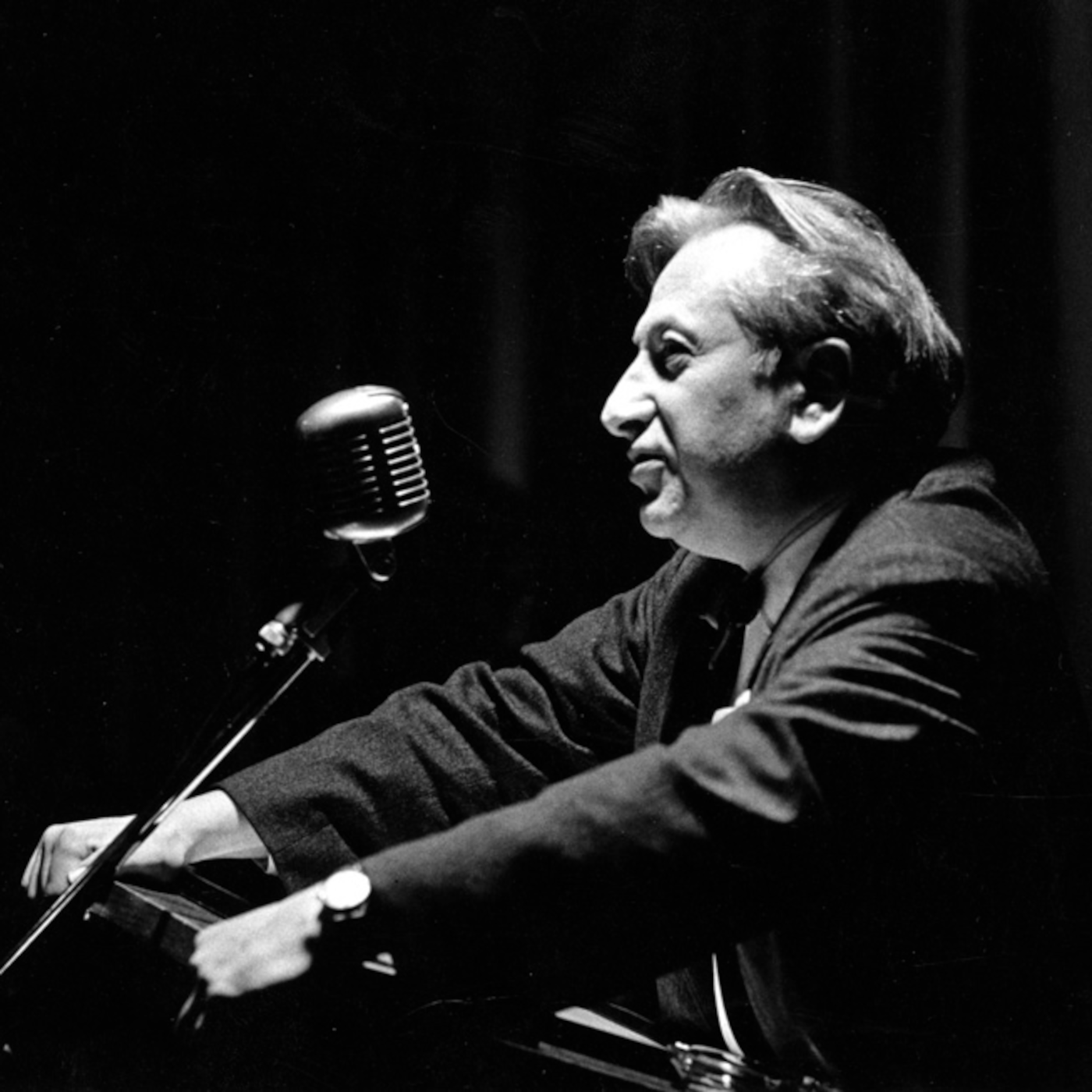
Studs Terkel Archive Podcast
208 episodes — Page 3 of 5
Discussing racial inequality in America with historian John Hope Franklin
First broadcast on March 15, 1979.
Discussing the book "Molly Ivins Can't Say That, Can She?" with journalist and author Molly Ivins
First broadcast on October 25, 1991.
John Prine discusses songwriting and growing up in Southern Illinois
They briefly discuss coal mining in Appalachia, specifically Blackey Kentucky. Includes an interview with Joe Begley a coal miner from Blackey, Kentucky.
Cesar Chavez discusses farm labor rights
Cesar Chavez discusses the United Farm Workers effort to gain rights for farm laborers and his childhood that led him to become a labor rights activist.
Bob Newhart discusses his comedic craft
First broadcast on April 13, 1960. Comedian and actor Bob Newhart discusses his career and his life before becoming a comedian; excerpt from his stand-up performance is played.
Andres Segovia discusses his life and career as a classical guitarist
First broadcast on February 02, 1978. Studs interview with Andres Segovia about his life in Grenada and how he came to play the guitar as an orchestra instrument. Segovia speaks to the history of the guitar and other instruments as classical musical instruments. They discuss Segovia's choice of instrument, how he gives back to his genre, how he stays vibrant at his age, and how he and his audiences relate. Segovia explains his desires for the guitar in the philharmonic world. Studs notes how Segovia has had to teach composers how to write for guitars.
Brownie McGhee and Sonny Terry discuss their careers as blues musicians
First broadcast on January 28, 1970. Brownie McGhee and Sonny Terry discuss their careers as blues musicians and longtime collaborators. The close relationship between Terry and McGhee is apparent as they perform a number of original and traditional songs during the interview. Songs have been removed due to copyright.
Toni Morrison reads from and talks about her book "Sula"
First broadcast on April 16, 1974. Studs Terkel interviews writer Toni Morrison. This interview begins with a reading from the book, "Sula" by Morrison Morrison continues to read excerpts from her novel "Sula" and discusses her literature.
Susan Sontag discusses Tuberculosis
First broadcast on June 30, 1978. Sontag reads from "Illness as Metaphor" and discusses differences between diseases, particularly tuberculosis and cancer, regarding historic understanding and cultural representation.
Mike Royko discussing the book "Boss: Richard J. Daley of Chicago"
First broadcast on March 15, 1971. Chicago newspaper columnist Mike Royko discusses his book "Boss: Richard J. Daley of Chicago" and its subject, former Chicago mayor Richard J. Daley.
Discussing "Sweeny Todd" with Angela Lansbury
First broadcast on February 19, 1981.
Gage Park residents discuss race relations and racial integration at Gage Park High School ; part 2
First broadcast on August 04, 1970. A diverse panel of Gage Park residents discuss racial integration at Gage Park High School, neighborhood change, and race relations in general.
Gage Park residents discuss race relations and racial integration at Gage Park High School ; part 1
First broadcast on August 04, 1970. A diverse panel of Gage Park residents discuss racial integration at Gage Park High School, neighborhood change, and race relations in general.
Dr. Martin Luther King Jr. discusses civil rights in regards to his "I Have a Dream" speech
First broadcast on October 22, 1964. Studs Terkel interviews Dr. Martin Luther King Jr. at the home of gospel singer Mahalia Jackson. They discuss King's "I Have a Dream" speech that he made in 1963, at the foot of the Lincoln Memorial. At the end of the program there are various gospel music selections featuring Jackson and others.
Discussing the book "The Haymarket Tragedy," with the author, historian Paul Avrich
First broadcast on December 27, 1984.
Howard Vincent discusses foreign languages and Herman Melville
First broadcast on December 22, 1959. Foreign language expert Howard Vincent talks with Studs Terkel about foreign languages, Herman Melville, “Moby Dick,” and other literary works.
Discussing the book "The New Russians" with the author, journalist Hedrick Smith
First broadcast on December 13, 1990. Program includes an excerpt of a May 1990 interview with Russian journalist Vitaly Korotich.
Pete Hamill in conversation with Studs Terkel
First broadcast on December 09, 1977.
Federico Fellini and actors discuss their film "La Dolce Vita" and the character Steiner
First broadcast on December 01, 1962. Studs Terkel plays interview clips of actors [Marcello Mastroianni and Alain Cuny] and the director Federico Fellini discussing their film "La Dolce Vita" and the character Steiner. At the beginning of the program Studs Terkel interviews Nelson Algren, a writer, and Mario Devecki (a person who made the film "La Dolce Vita" happen) about La Dolce Vita and Steiner.
Muhammad Ali discusses his book "The Greatest: My Own Story"
First broadcast on November 26, 1975. Content Warning: This conversation includes racially and/or culturally derogatory language and/or negative depictions of Black and Indigenous people of color, women, and LGBTQI+ individuals. Rather than remove this content, we present it in the context of twentieth-century social history to acknowledge and learn from its impact and to inspire awareness and discussion. Muhammad Ali discusses his book "The Greatest: My Own Story," touching on topics including his childhood and family, conversion to Islam, stance on the Vietnam War, and experiences in jail.
Oriana Fallaci in conversation with Studs Terkel
First broadcast on November 21, 1980.
Geoffrey Wolff discusses his book about Harry Crosby
First broadcast on November 17, 1976. Terkel interview author Geoffrey Wolff about his latest book. Entitled "Black Sun," it is a biography of Harry Crosby.
Three Vietman War veterans, Robert Black, Robert Johnson and Dr. Gordon Livingston, discuss the war, part 1
First broadcast on November 12, 1970. Robert Black, Robert Johnson, and Dr. Gordon Livingston talk about the Vietnam War. All three are officers in the military and veterans of the Vietnam War. They talk about the Tet offensive and the Battle of Hue in 1968, and the deplorable treatment of the Vietnamese people by the United States military . Upon returning they have chosen to become anti-Vietnam War because it is not a struggle to stop Communism so much as being a force of destruction.
Professor Ali Irani [pseudonym name to protect his identity] talks about the regime of the Shah [Mohammad Reza Pahlavi]
First broadcast on November 08, 1978. Professor Ali Irani (pseudonym name) is a Humanities professor at a recognized midwest university that discusses the regime of the Shah, Mohammad Reza Pahlavi. Includes a fiften minute interview with an American couple, Luis and Joan Smiley, that talks about their experience with students protesting the regime in Kentucky, Louisiana.
Studs Terkel moderates and comments on a round-table debate about the Montessori educational theory
First broadcast on November 03, 1964. A round-table debate about the Montessori educational theory. Four early childhood development professionals speak of the pros and the cons of the program. Speakers include: Fay Bauling advisor at Wilson Jr. College, Dr. Urban Fleege of DePaul University, Dr. Ner Littner from the Institute of Psychoanalysis, and Hannah MacLaren, head teacher from Ancona School.
Arlo Guthrie discusses his career
First broadcast on October 31, 1980. Arlo Guthrie discusses his approach to songwriting and how storytelling in song writing has changed. He also talks about what it's like to become known for performing works written by others. Arlo Guthrie's music is played and discussed throughout the interview: "Manzanillo Bay", "Week on the Rag", "Buffalo Skinners", "City of New Orleans", "Darkest Hour", "Massachusetts", and "Last Train to Glory". Music has been removed for copyright reasons.
Discussing Ukrainian music with Oleh Saciuk
First broadcast on October 25, 1979. Studs Terkel discussing Ukrainian music with Oleh Saciuk. Includes instrumental music excerpts.
Quentin Crisp discusses homosexuality
First broadcast on October 21, 1992. Quentin Crisp, author of many works about gays in Britain and the United States and, notably, about "coming out" as gay in England in the 1930s, discusses homosexuality and his experiences.
John Kenneth Galbraith in conversation with Studs Terkel
First broadcast on October 17, 1983. Discussing the book "The Anatomy of Power" (published by Houghton Mifflin) with the author, economist John Kenneth Galbraith.
Studs Terkel discusses busing for school integration with psychologist Thomas J. Cottle
First broadcast on October 11, 1976. Studs Terkel discusses the transportation of students for school integration with psychologist Thomas J. Cottle. The main topic of conversation is Cottle's book, "Busing" (1976, Boston, MA, Beacon Press). Terkel and Cottle discuss busing in several cities, focusing on Boston, MA, where Cottle did his research and writing. They each read passages from the book, and discuss the relationship between busing and racism in America.
Interview with Art Buchwald
First broadcast on October 10, 1983. Discussing the book "While Reagan Slept" (published by Putnam) with the author, satirist Art Buchwald.
Carl Sagan discusses the book "Contact"
First broadcast on October 04, 1985. Discussing the book "Contact" (published by Simon & Schuster) with the author, astronomer and science writer Carl Sagan. Starts with clip from Arthur C. Clarke (1856688-3-1).
Sidney Poitier talks with Studs Terkel about his most recent film "The Defiant Ones"
First broadcast on October 01, 1959. Bahamian actor Sidney Poitier talks with Studs Terkel about his most recent film "The Defiant Ones" and how racial type-casting for typically white roles works in Hollywood films. Besides being an actor, he is also a film director, author, and diplomat.
James Baldwin discusses his book "Another Country" and his travels through Africa
First broadcast on September 29, 1962. James Baldwin discusses his book "Another Country" and his trip to Africa. Mr.Baldwin and Studs speak about his place in social reform and his fight for civil rights for all.
Dr. E.F. Schumacher talks with Studs Terkel
First broadcast on September 26, 1974.
Blind John Davis discusses Chicago blues
First broadcast on September 20, 1977. Blind John Davis, Chicago blues pianist, discusses his time playing in Germany and at the Blue Note jazz club, chitlin' parties, growing up on the West side of Chicago. He also recalls meeting and working with musicians like Tampa Red and Big Bill Broonzy. Music has been removed from this recording for copyright reasons.
Discussing the film "Before Stonewall the Making of a Gay and Lesbian Community" with author Reverend Grant Gallup and Chicago gay-friendly bar owner, Marge Summit
First broadcast on September 17, 1985. Discussing the film "Before Stonewall the Making of a Gay and Lesbian Community" with author Reverend Grant Gallup and Chicago gay-friendly bar owner, Marge Summit
Brian Dennehy and Steven Robman discuss their play "Rat in the Skull"
First broadcast on September 11, 1985. Director Steven Robman and actor Brian Dennehy discuss their play "Rat in the Skull". Brian Dennehy performs a passage from Rat in the Skull.
Buster Keaton discusses the release of "When Comedy Was King"
First broadcast on September 05, 1960. Silent film pioneer Buster Keaton discusses his career following the release of "When Comedy Was King," a compilation of some classic shorts by Keaton, Charlie Chaplin, Harold Lloyd, and others. Keaton reveals how they shot the early silent films, generated material and gags, how they planned big chase scenes, the resurging European interest in silent classics, and more. Studs asks Keaton about the stylistic differences between him and Chaplin, whether he would recreate silent films, and how they compare to today's film-making. Keaton reveals how little was scripted but rather improvised in between a start and finish. Keaton describes some classic gags in films like "The Frozen North," "Sherlock Jr.," and "The Navigator." The discussion concludes with Keaton's thoughts on performing on television in front of a live audience.
Studs Terkel interviews writer Tom Wolfe ; part 2
First broadcast on September 01, 1968. Studs Terkel and Tom Wolfe discuss Wolfe's recent work. At the time of the interview, Wolfe had recently released "The Electric Kool-Aid Acid Test", his chronicle of Ken Kesey and his colleagues, and a collection of articles, "The Pump House Gang".
Studs Terkel interviews writer Tom Wolfe ; part 1
First broadcast on September 01, 1968. Studs Terkel and Tom Wolfe discuss Wolfe's recent work. At the time of the interview, Wolfe had recently released "The Electric Kool-Aid Acid Test", his chronicle of Ken Kesey and his colleagues, and a collection of articles, "The Pump House Gang".
Oceanographer Jacques Cousteau talks with Studs Terkel
First broadcast on August 26, 1976. Oceanographer Jacques Cousteau discusses man's effect on the planet. Includes a clip with whale sounds and statements by Joan McIntyre.
Interviewing author, screenwriter and director John Sayles
First broadcast on August 23, 1988.
Erik Bye discusses the history of Norwegian immigration to America in the 19th century and his work as a television journalist and singer
First broadcast on August 18, 1975. Studs interviews Erik Bye about Norwegian immigration to America and his music. They discuss the reasons why people left Norway in the 19th century and the conditions they suffered when they settled in New York. Bye explains Norwegian history and why the Norwegians moved from the American east coast to the west. Studs notes that Bye is in Chicago to gather information to produce a Norwegian television documentary about early Norwegian immigrants. Bye shares his interpretations of some of his songs and explains Norwegian music. He elaborates on the Hardanga fiddle instrument and the artists who played it. Bye discusses the upcoming Norwegian celebration in Chicago for which their King will visit. The musical numbers are removed from this edited version of the original recording.
Studs Terkel comments and presents Picasso unveiling ceremony
First broadcast on August 15, 1967. Studs Terkel presents the unveiling of the Chicago Picasso on August 15th, 1967, asking bystanders for their opinion on the new sculpture.
Marian McPartland and Jimmy McPartland discuss their careers in Jazz
First broadcast on August 09, 1978. Studs interviews Marian and Jimmy McPartland. The McPartlands reflect on those in Jazz who have influenced them. Studs talks to Marian about women in Jazz. They discuss the Jazz audience. The musical numbers are removed from this edited version of the original recording.
David McCullough discusses his book "Mornings on Horseback"
First broadcast on August 05, 1981. Discussing the book "Mornings on Horseback" with author David McCullough.
Nora Ephron discusses feminism and her book "Crazy Salad"
First broadcast on July 28, 1975. Nora Ephron discusses the women’s movement and her book, “Crazy Salad: Some Things About Women.” Ephron discusses the influence of writer Dorothy Parker on her work, as well as topics including women’s rights; the exploitation of women in politics, war, and advertising; the many conflicts she faces in her role as a journalist; and traditional and non-traditional gender roles. Includes an excerpt from a previous interview with Dorothy Parker.
Big Bill Broonzy discusses the blues ; part 2
First broadcast on July 22, 1953. Big Bill Broonzy discusses the blues and growing up in Arkansas with parents who were former slaves. He talks about the family dynamic and sings: "Willie Mae", "Crawdad song", "Going down this road feeling bad" and "John Henry".
Big Bill Broonzy discusses the blues ; part 1
First broadcast on July 22, 1953. Big Bill Broonzy discusses the blues and growing up in Arkansas with parents who were former slaves. He talks about the family dynamic and sings: "Crying Joe Turner", "C.C. Rider", "Make my get away", and " You've got to stand your test in judgement" . Part 1