Social Skills Coaching
255 episodes — Page 4 of 6

Cold Reading: A Look Behind The Curtain
Easily listen to Social Skills Coaching in your podcast app of choice at https://bit.ly/social-skills-home00:07:45 Technique One Shotgun Statements00:09:09 Technique Two Barnum Statements00:11:45 Technique Three ignoring the misses00:14:38 Technique Four passing off failures as successes00:17:11 Technique Five Keeping It VagueHear it Here - https://bit.ly/ExtractInfo• We can improve our information extraction skills by following some of the techniques used by fake psychics when they do “cold reading.”• General principles for cold reading include being subtle, open-ended, and allowing the other person to guide you—without them realizing that you are not doing anything magical but merely working with the information that they provide.• Shotgun statements are random statements made in order to see what response you get so you can follow it up on what sticks.• Barnum statements are those that are likely to be perceived as relevant to individuals, even though they apply to almost everyone. Barnum statements are broad guesses that look specific but actually have a high probability of being on the mark.• When using shotgun or Barnum statements, a cold reader can also ignore their misses and focus on their hits, concealing the fact that they are guessing.• Another way to mask misses is to pass them off as successes retroactively, or rework your claim to make it seem as though you were right all along.• Cold readers deliberately keep things vague to start with, and then fine tune their approach according to the feedback they receive. They begin with a non-committal, low-stakes guess and then, by degree, inch closer to the truth using their audience’s response or lack of it.• A key principle in cold reading is to pay attention to reactions of all kinds, including nonverbal ones.• Expert cold reading combines all of these techniques seamlessly and swiftly to give the impression that the “psychic” has plucked accurate information from the air, when in reality, it has been fed to him unwittingly by the audience all along!#ShotgunStatements #RussellNewton #NewtonMG #PatrickKing #PatrickKingConsulting #SocialSkillsCoaching #HowtoExtractInfo #ColdReading #BarnumStatements #/home/russell/temp/KingEpi-2023-05-23-06-54-yZQ96NEHwQ/psychic-mystic-clairvoyant/1-woman-in-gray-and-black-striped-long-sleeve-shirt-sitting-beside-black-table-7267741-Pavel-Danilyuk.jpg
How To Be Assertive AND Empathic
Easily listen to Social Skills Coaching in your podcast app of choice at https://bit.ly/social-skills-home00:08:38 Psychologist Craig Malkin's book Rethinking Narcissism00:10:59 The Soft Startup 00:13:19 The Empathic Communication Toolkit for Handling Conflict 00:20:47 Use techniques like the Positive no or the Soft Startup https://adbl.co/3shIydQ• To be both assertive and empathic, use techniques like the “positive no” or the “soft startup” when setting a boundary. • When managing conflicts or difficult communication, remember to use open-ended questions; focus on strengths; let the other person lead; normalize rather than pathologize; and use open, conciliatory body language to show that you are on the same side. #Communicating #Communication #Conciliatory #ConversationalTools #CraigMalkins #DifficultConversation #EmpathicAssertion #EmpathicCommunicationToolkit #EmpathicStruggle #Empathy #ExpressEmpathy #Gottman #JulieGottman #Narcissism #NonviolentCommunication #SimpleEmpathicAssertion #UncomfortableConversation #UnconsciousMessage #RussellNewton #NewtonMG #PatrickKing #PatrickKingConsulting #SocialSkillsCoaching
Tools Of The Charming
Easily listen to Social Skills Coaching in your podcast app of choice at https://bit.ly/social-skills-home00:01:34 Talk WITH people and not TO them.00:03:07 Dr. Karl Albrecht in Psychology Today00:15:53 Sustain Conversations with Conversational Threading and Useful Acronyms 00:22:50 Useful Conversational Acronyms The acronym HPM 00:25:17 Another useful acronym is EDRHear it Here - https://bit.ly/3GAwNag• Having charm and charisma is not about you. It’s about the other person and making them feel heard, liked, and supported.• Dr. Albrecht explains that conversations contain three elements: declaratives, questions, and qualifiers. The rule of three tells us that we should not have three declarative statements in a row and should instead mix it up with a question or a qualifier. • It’s not really about the content of what you say but the emotional implications and the energy in how you say it. • Conversational threading is a technique that will help you ensure you never run out of things to say. Listen to what the other person says, pick out a few noteworthy threads, then run with one of them. When the conversation dries up, return to these threads and pick up another one and follow that instead. Be patient, ask open-ended questions, and listen for emotions. • Being a good everyday conversationalist is about being open-minded, spontaneous, and genuine. Keep things flowing! #Albrecht #CasualConversation #Communication #ConversationalAcronyms #ConversationalNarcissist #ConversationalThreading #DeclarativeStatements #DepthTechniques #DrKarlAlbrecht #EDR #EmotionDetailRestatement #EverydayConversations #HPM #RhetoricalQuestions #SkilledConversationalists #RussellNewton #NewtonMG #PatrickKing #PatrickKingConsulting #SocialSkillsCoaching

Look Into My Eyes
Easily listen to Social Skills Coaching in your podcast app of choice at https://bit.ly/social-skills-homeHear it Here - https://bit.ly/ExtractInfo00:01:16 From Patrick King's book how to Extract Info, Secrets and Truth, let's take a look at the importance of eye contact and then spend some time discussing active listening.00:03:34 Effects of Eye Contact and Social Status on the Perception of a Job Applicant in an Employment Interviewing Situation00:03:56 Accurate Intelligence Assessments in Social Interactions, Mediators and Gender Effects00:05:34 A 2016 Japanese study by Kajimura and Nomura titled When We Cannot Speak eye Contact Disrupts Resources Available to Cognitive Control Processes During Verb Generation00:06:22 Helping Children Think Gaze Aversion and Teaching by Phelps and Doherty Snedden, researchers found that kids told to look away while thinking and solving problems showed a 20% increase in performance.00:07:51 Eye Contact, Distance and Affiliation00:22:41 Label Emotions • Eye contact is essential for building trust. If you aren’t able to use eye contact, people will find you untrustworthy. The optimal eye contact period is around three seconds of eye contact at a time, with sufficient rest between gazes.• Active listening is a valuable skill set that any person should master, but the techniques of active listening can also help you improve your elicitation abilities and gather more information about people. You need to comprehend, retain and respond to the information people are sharing with you.• You can build rapport and connection in many ways, for example by restating, reflecting, summarizing, labeling emotions, probing (gently!) and using silence to encourage the other person to open up. Open-ended or leading questions (like those covered in the previous chapter) can subtly guide a person to open up to you.• Avoid giving advice, lecturing, sermonizing or judging.• Active listening techniques are best used when you would like someone to open up with you and share their true feelings. Other techniques are more appropriate for detecting deception.#ActiveListener #Binetti #CommunicationSkills #DohertySneddon #EmpatheticReflection #EyeContact #GazeAversion #GazeDuration #Kajimura #Kressler #LieDetection #NeuroLinguisticProgramming #Nomura #NonverbalCommunication #PupilDilation #RussellNewton #NewtonMG #PatrickKing #PatrickKingConsulting #SocialSkillsCoaching #HowtoExtractInfo #Secrets #andTruth

Don’t Take Your Inner Critic’s Word For It
Hear it Here - adbl.co/3To6NDu• People-pleasing behavior can stem from a harsh inner critic, who is the one telling us that we are not worth anything unless we serve others, or that we do not deserve to have our needs met or boundaries respected.• We can push against our inner critic by becoming aware of its voice and honestly answering some questions, such as: is the choice I’m making ultimately for me or for someone else? Is this voice in my head serving my interests or working against me? The inner critic, however, is there for a reason, and we can ask what that reason is. Seek to understand what that function is, then consciously choose to meet that need in a healthier way.#InnerCritic #NegativeCoreBeliefs #Peoplepleasers #Peoplepleasing #RussellNewton #NewtonMG #PatrickKing #PatrickKingConsulting #SocialSkillsCoaching #StandUpForYourself #SetBoundaries #&StopPleasingOthers
The Power Of Empathic Statements
Easily listen to Social Skills Coaching in your podcast app of choice at https://bit.ly/social-skills-homehttps://adbl.co/3shIydQ00:01:33 What to Say, What Not to Say 00:03:34 Avoid Diminishing 00:05:00 Avoid Dismissing 00:06:14 Avoid Leading Questions 00:07:11 Avoid Advice or Personal Anecdotes 00:09:31 Acknowledge Their Courage 00:09:56 Ask Empathic Questions 00:10:48 Compliment Their Character 00:11:55 Show You Care 00:12:34 An Empathic Statement Formula 00:18:18 Nonviolent Communication/NVC 00:20:48 To use NVC, we must always remember to: 00:23:40 Feelings 00:26:19 Needs00:29:49 Requests 00:34:15 When the Shoe Is on the Other Foot 00:38:43 Let's take a moment to summarize • In empathic communication, we should always seek to understand first and to create connection. Empathic statements can help, but avoid deflecting, diminishing, dismissing, dominating the conversation with leading questions, or giving advice or personal anecdotes. Instead, ask empathic questions, compliment something in their character, or do something practical to show you care. • The nonviolent communication model consists of four components: observations, feelings, needs, and requests. First, become aware of the objective facts of the situation and separate them out from interpretations, assumptions, and judgments about those facts. Next, share what you are feeling, remembering that feelings are connected to our needs, met or unmet. • Then, express these needs without blaming and without confusing needs with strategies used to meet those needs. Finally, finish with a request for that need to be met. Avoid requests that are vague, impossible to fulfil, framed as what you don’t want, or framed as a demand that can’t be refused. A request does not entitle us to receive what we ask for, so we should graciously accept if it isn’t granted. #DrMarshallRosenberg #Empathic #EmpathicConversation #EmpathicStatements #NonjudgmentalPerspective #NonviolentCommunication #NVC #Rosenberg #RussellNewton #NewtonMG #PatrickKing #PatrickKingConsulting #SocialSkillsCoaching #TrainYourEmpathyPhoto by sumit-kapoor and Pexels
Expressing Without Speaking
00:05:40 Posture and Body Orientation 00:09:33 Eye Contact 00:10:54 A study led by Dr. Arthur Aron00:11:53 The Power of Eye Contact by psychologist Michael Ellsberg00:13:03 Kara Ronin’s “triangle technique” 00:13:41 Paralinguistics 00:15:08 The Four Ps of Voice 00:17:37 How to Improve Your Vocal Variety • When reading someone’s body language, pay attention to microexpressions, their overall posture and orientation in space, as well as their degree of eye contact. Paralinguistics refers to information carried in the tone, pace, pitch, etc. of the voice. • Think in terms of overall openness or closedness, but remember that no single detail is decisive and conclusive and that observations should always be compared against a baseline.#Communication #ConfidentSpeaker #DrArthurAron #EyeContact #InvoluntaryFacialExpression #MichaelEllsberg #NonverbalVocalCommunication #Paralinguistics #TriangleTechnique #VerbalCommunication #VerbalExpression #RussellNewton #NewtonMG #PatrickKing #PatrickKingConsulting #SocialSkillsCoaching #CommunicationSkillsTrainingPatrickKingPhoto by fauxels and Pexels
A Mechanism For Learning To Trust
https://www.audible.com/pd/B094NZS81Q/?source_code=AUDFPWS0223189MWU-BK-ACX0-258377&ref=acx_bty_BK_ACX0_258377_pd_us00:02:54 “Stimulus Generalization as A Mechanism for Learning to Trust” by Oriel Feldman Hall00:03:23 “Trust in Close Relationships” by Rempel, Holmes, and Zanna 00:03:56 More Is Better 00:08:59 “Attitudinal Effects of Mere Exposure,” researcher Robert Zajonc 00:09:43 Credibility 00:10:50 Gass and Seiter in their book Persuasion, Social Influence, and Compliance Gaining sought to study credibility.• Trust has been shown to work in a linear fashion. The more you see someone, the more you trust them, regardless of interaction or depth. This is known as the propinquity effect and can be used to your advantage in making people feel psychologically comfortable with sharing more with you.• Credibility is a notch above trust; Trust is about people feeling that they can believe you, and credibility is where people also feel that they can rely on you. There are also proven ways to create an aura of credibility around yourself. These include highlighting qualifications, showing your caring and empathy, showing similarity, being assertive, showing social proof, not contradicting yourself, and avoiding being overly polite.#Festinger #Schachter #Credibility #Credible #DirectTrust #Familiarity #OrielFeldman #RobertZajonc #ThomasSmith #Zajonc #Zanna #RussellNewton #NewtonMG #PatrickKing #PatrickKingConsulting #SocialSkillsCoaching #HowtoExtractInfo #Secrets #andTruthPatrickKing
Speak Loud, Speak Clear, And Speak From The Heart
Hear it Here - adbl.co/3To6NDu00:03:25 Feelings Are Never Right or Wrong 00:05:26 People Are Responsible for Their Own Feelings 00:07:30 Understand What the Goal of Communication Is 00:09:18 Applying Self-Knowledge and Asking for What You Want • Assertive communication is not about force or coercion (aggressive) or pandering and submission (passive-aggressive) but about speaking confidently from the heart. To achieve mature, healthy communication, remember that feelings are never right or wrong, but it matters what we do with those feelings.• Other people are responsible for their feelings, and ultimately, the goal of communication is not to control others but to connect with them and get our mutual needs met. Finally, an important skill is to ask for what you need from a position of self-knowledge.#AggressiveCommunication #Assertive #Communication #CommunicationSkills #GoodConversation #AssertiveCommunication #NegativeEmotions #Passive #PassiveCommunication #Peoplepleasers #PoorCommunication #Reframing #SilentTreatment #SpeakLoud #SpeakClear #AndSpeakFromTheHeart #RussellNewton #NewtonMG #PatrickKing #PatrickKingConsulting #SocialSkillsCoaching #StandUpForYourself #SetBoundaries #&StopPleasingOthers
Curiosity
00:03:07 Can I just observe without judgment or evaluation?00:07:41 Brian Grazer is the author of the bestseller A Curious Mind: The Secret to a Bigger Life.00:10:39 Type 1: Diversive Curiosity This refers to being attracted to novelty.00:11:03 Type 2: Epistemic Curiosity Epistemology is the philosophical branch of inquiry related to the theory of knowledge itself.00:11:51 Type 3: Empathic Curiosity The type we are interested in here.00:14:16 Keep the Spark of Curiosity Alive 00:17:25 Resist Superficiality 00:20:47 No Such Thing as Boring 00:21:26 Artist and composer John Cage gives this advice: “If something is boring after two minutes, try it for four.00:23:51 Random Acts of Kindness • Avoid psychologizing. When we interpret people’s experiences, we are no longer fully listening to them. • Empathy is impossible without curiosity. Curiosity is about more than asking questions—it’s about having a sincere desire to understand someone else’s heart, mind, and complete experience. It requires imagination, a hunger to learn, and an open mind.• The main thing that gets in the way of real curiosity in empathic listening is the impulse to insert our own opinion, perspective, or frame of reference into the conversation. Imagine that learning to be interested in others is not a boring challenge, but a gift and an opportunity. • There are three kinds of curiosity: diversive (interest in novelty), epistemic (deeper inquiry into knowledge itself), and empathic. Whenever you notice mild interest in novelty, see if you can explore and amplify it till it becomes richer empathic curiosity. • Keep the spark of curiosity alive by consistently asking why, digging beneath the superficiality of a situation, and challenging yourself to see nothing as boring. • Random acts of kindness can make us more empathic. Try to be more alert to other people’s needs and respond spontaneously to them. • Kindness is a shift from focus on the self to focus on the other. Continually ask yourself, “How are other people doing? What do they need?”#Empathy #Curiosity #RussellNewton #NewtonMG #PatrickKing #PatrickKingConsulting #SocialSkillsCoaching #TrainYourEmpathy/home/russell/Dropbox/NMGMedia/Stock/JPGs/3182752.jpg
The Rapport Game: Five Ways To Build Rapport
Hear it Here - https://bit.ly/3GAwNag00:01:58 Mirroring and Matching 00:03:03 In the 1970s, Richard Bandler and John Grinder introduced NLP00:05:24 Way 1: Match and Mirror External Communication Cues 00:07:31 Way 2: Match and Mirror Voice and Language 00:12:16 Way 3: Match and Mirror Internal Communication Cues 00:16:56 Way 4: Match on Content 00:18:38 Way 5: Chunking • Good conversation is firstly about the degree of concordance, harmony, and synchronicity between you and the person you’re talking to, i.e., rapport. • We can increase rapport by mirroring and matching both nonverbal and verbal expression. This can be done with internal and external cues, voice and language, content, and chunking style (i.e., up or down).#Chunking #Communication #EffortlessRapport #EmotionalContent #FacialExpression #JohnGrinder #NeuroLinguisticProgrammingNLP #NonverbalCommunication #RichardBandler #VerbalCommunication #TheRapportGame:FiveWaysToBuildRapport #RussellNewton #NewtonMG #PatrickKing #PatrickKingConsulting #SocialSkillsCoaching #CommunicationSkillsTraining/home/russell/Dropbox/NMGMedia/Stock/JPGs/64574.jpg
Putting Your Questions Into Context
Hear it Here - https://bit.ly/ExtractInfo00:04:28 Elicitation Practice If none of the above work, that’s where the practice of elicitation comes in.00:08:15 Ellen Naylor in her 2016 book Win/Loss Analysis wrote about six specific elicitation techniques to get people talking.00:08:27 Recognition Practice Human beings are social animals.00:10:56 Complaining Technique This technique works with something else fundamental to human beings: how much we love to complain!00:15:45 Naïveté Technique In the same vein as the above, many people can’t help speaking up when they believe that someone is not wrong exactly, but merely trying to understand, and it’s their job to clear things up for them.00:17:57 Shift The Window This technique is a little more dramatic than the others, and may take a bit more practice, or otherwise being more familiar with the person in question.00:21:42 Silence Practice This last technique may not seem like the others, but in many cases, it can be the most powerful of all.00:25:05 Episode Takeaways • Analyze the answers to these questions cautiously, and remember to place everything in context. Note how they answer, not just the content, and also not what isn’t said. Use extrapolation to draw conclusions about what their answers say about them in a more general sense. • Questions needs to be iterative and responsive to the context and the answers you’ve already received. Also think about behavior online and in emails, or “read” a person’s possessions or home the way you would their body language. Use these observations to guide your questions.• Elicitation leads you to the information you’re looking for, without it seeming that you are. • Developed originally by the FBI, these techniques are really just ways to carefully work around conversational and societal norms to your advantage. They are effective because they work with human being’s natural social and behavioral tendencies.• For example, one tendency is towards recognition, or social connection. Use compliments or accurate observations to foster a rapport with someone or strengthen your connection. • You can also elicit information by encouraging people to complain, and in doing so, reveal something previously hidden, or else tap into the human need to correct someone’s error. Sued skillfully, most people cannot resist joining in on a complaining session or correcting an “error” you make.• Playing dumb or using naivete or ignorance will also encourage some people to try to educate you, and share vital information, especially since you will seem so non-threatening. • Finally, one technique is to say something quite dramatic to “shift the window” and then act as though nothing has happened; subtly, you may well elicit a revealing response. Silence can also be used effectively, since it encourages people to fill the gap with the information you want to know. #AccurateAssessments #AccurateObservations #AwkwardTension #BehavioralTendencies #Beliefs #BenignSituations #ComplainingTechnique #ElicitationPractice #EllenNaylor #IndirectQuestions #NaïvetéTechnique #SilencePractice #PuttingYourQuestionsIntoContext #RussellNewton #NewtonMG #PatrickKing #PatrickKingConsulting #SocialSkillsCoaching #HowtoExtractInfo #Secrets #andTruth/home/russell/temp/questions/questions-brown-and-black-wooden-blocks-10412820-Sara.jpg
Fake It till You Make It
Hear it Here - adbl.co/3To6NDu00:01:27 In 2019, Matthew Berry and Steven Brown did research on the vocal tones 00:06:14 Jo Emerson is a confidence coach 00:07:10 Watch Your Body Language 00:08:33 Maintain Comfortable Eye Contact 00:09:26 Dress the Part 00:10:38 Develop Your Personal Sense of Poise • Assertiveness is something you can fake till you make! Be mindful of your body language (stand tall and take up space), maintain comfortable eye contact, fine-tune your personal sense of style (whatever that is), and practice the habits of a poised, composed person (such as gracefully accepting compliments).#EyeContact #GenuineConfidence #JoEmerson #MatthewBerry #KarenPine #StevenBrown #BeingAssertive—OrAtLeastHowToFakeItTillYouMakeIt #RussellNewton #NewtonMG #PatrickKing #PatrickKingConsulting #SocialSkillsCoaching #StandUpForYourselfPhoto by Vlada-Karpovich and Pexels
Be Still And Reflect
Hear it Here - https://adbl.co/3shIydQ00:03:35 Psychologist Dr. Ann Vertel uses reflective listening in her practice00:04:35 How to Master Reflective Listening 00:13:48 Psychologizing—A Peculiar Kind of Invalidation • When we listen empathically and reflect, we go quiet and still within ourselves so we can receive as accurate a picture of the other person’s account as possible. We use mirroring and paraphrasing without questioning, leading, or starting a new thread. • We can reflect either content, feeling, or meaning, but should always remain non-directional and non-judgmental.#Empathic #EmpathicListeners #Invalidation #Jung #DrAnnVertel #Psychologizing #Reflecting #BeStillAndReflect #RussellNewton #NewtonMG #PatrickKing #PatrickKingConsulting #SocialSkillsCoaching #TrainYourEmpathyPhoto courtesy of George Becker and Pexels.
Psychological Barriers To Communication
Hear it Here - https://bit.ly/3GAwNag00:03:29 “But I thought you meant X!”00:07:00 Preconceived Attitudes.00:12:34 Judgment and Premature Evaluation.00:15:11 Other Bad Communication Habits to Avoid.00:17:12 Constantly Interrupting.00:19:10 Using Qualifiers.00:20:22 Equating Your Experiences.00:20:27 “I know exactly how you feel!"00:22:24 Waiting Instead of Listening.00:23:14 Fluff and Filler Words.Barriers to good conversation include assumptions, strong negative emotions like anger and aggression (which inspire defensiveness), preconceived ideas and prejudice, fear, inflexibility and a need to control, premature evaluation and judgment, and other negative conversational habits like interrupting or one-upping. #AmazingCommunicationSkills #BadCommunicationHabits #BadConversationalist #BadHabit #CommonHabitualConversationalTraps #Communication #CommunicationBreakdown #CommunicationHabits #CommunicationSkills #ConversationalNarcissism #ConversationFlow #DistortCommunication #EffectiveCommunication #FillerWords #Floundering #Fluff #GoodCommunicator #HumanInteraction #ManipulativeCommunicationStyle #PrematureEvaluation #PsychologicalBarrier #PsychologicalBarriersToCommunication #RussellNewton #NewtonMG #PatrickKing #PatrickKingConsulting #SocialSkillsCoachingPhoto courest of PICHA and Pexels
Asked And Analyzed
Hear it Here - https://www.audible.com/pd/B094NZS81Q/?source_code=AUDFPWS0223189MWU-BK-ACX0-258377&ref=acx_bty_BK_ACX0_258377_pd_usAsking questions is an active way to deliberately elicit information from a person, but they need to be targeted and not too obvious. A few seemingly casual hypothetical questions can reveal a person’s deeper values, perspectives, and goals, for example asking what their favorite movie is, what they would save from a fire, or what animal they see themselves as.#Answer #Answering #DustinWood #Questions #Rorschach #AskedAndAnalyzed #RussellNewton #NewtonMG #PatrickKing #PatrickKingConsulting #SocialSkillsCoachingPhoto Courtesy of Leeloo-Thefirst and Pexels
Everyone Needs Boundaries...Including You!
Hear it Here - adbl.co/3To6NDu• Everyone has a right to have boundaries. Try to reframe how you think of boundaries—they are there to protect and prioritize what’s important, and not shut someone out or offend them. Trust your own feelings and judgments instead of avoiding them.• State your boundary and don’t overexplain or ask permission. Then, if a boundary is violated, follow up with appropriate action. A big part of healthy boundaries is respecting other people’s boundaries, too.Show notes and/or episode transcripts are available at https://bit.ly/social-skills-shownotesLearn more or get a free mini-book on conversation tactics at https://bit.ly/pkconsulting#Acquiescing #Assert #Boundary #Boundarysetting #Communicate #Peoplepleasers #Peoplepleasing #EveryoneNeedsBoundaries...IncludingYou! #RussellNewton #NewtonMG #PatrickKing #PatrickKingConsulting #SocialSkillsCoaching
The Basics Are Not So Basic
• The best mindset to adopt in order to become a better communicator is the one that will best allow you to connect, meet your needs, solve problems, and express yourself. • Begin by asking yourself what your default communication style is: aggressive, passive-aggressive, or manipulative. None of these styles actually achieves the ultimate goal of communication, however. • The way you communicate is a choice. Assertive communication is the ability to express needs, wants, thoughts, and feelings directly without disrespecting or controlling others. Mature conversationalists are self-controlled, balanced, relaxed, open, and respectful.• Communicating well is simple and easy, but we need to remove the formidable psychological barriers that stand in the way. With awareness, we can remove them and improve our communication skills.#AggressiveCommunicator #Assertive #AssertiveCommunicator #Communication #CommunicationStyle #Communicator #Manipulation #Manipulative #ManipulativeCommunicator #Nonverbally #Passive #Passiveaggressive #PassiveAggressiveCommunicator #PassiveCommunicator #TheBasicsAreNotSoBasic #RussellNewton #NewtonMG #PatrickKing #PatrickKingConsulting #SocialSkillsCoaching
The Human Body Is A Whole—Read It That Way
• Body language signals cannot be interpreted in isolation. Rather, first seek a baseline of behavior to help interpret a particular new observation – a baseline helps you identify incongruent behavior and spot a deception. • Look for mirroring, pay attention to overall energy, and remember that body language is dynamic, so you need to gather as much data as possible. Then consider this data in context of history and the current environment. • The voice is a part of the human body and speed, timbre, volume, pitch, and degree of control can signify emotional state. The body is a whole, with verbal and nonverbal mingling together. • Reading “message clusters” helps us organize isolated observations, and note whether they are aggressive, romantic, assertive, deceptive ad so on, in aggregate. #Aggression #Assertive #Clusters #Context #Deceit #Deceptive #DondersInstitute #HumanBody #Nonverbal #PaulEkman #PNAS #Pouw #Submissive #TheHumanBodyIsAWhole—ReadItThatWay #RussellNewton #NewtonMG #PatrickKing #PatrickKingConsulting #SocialSkillsCoaching
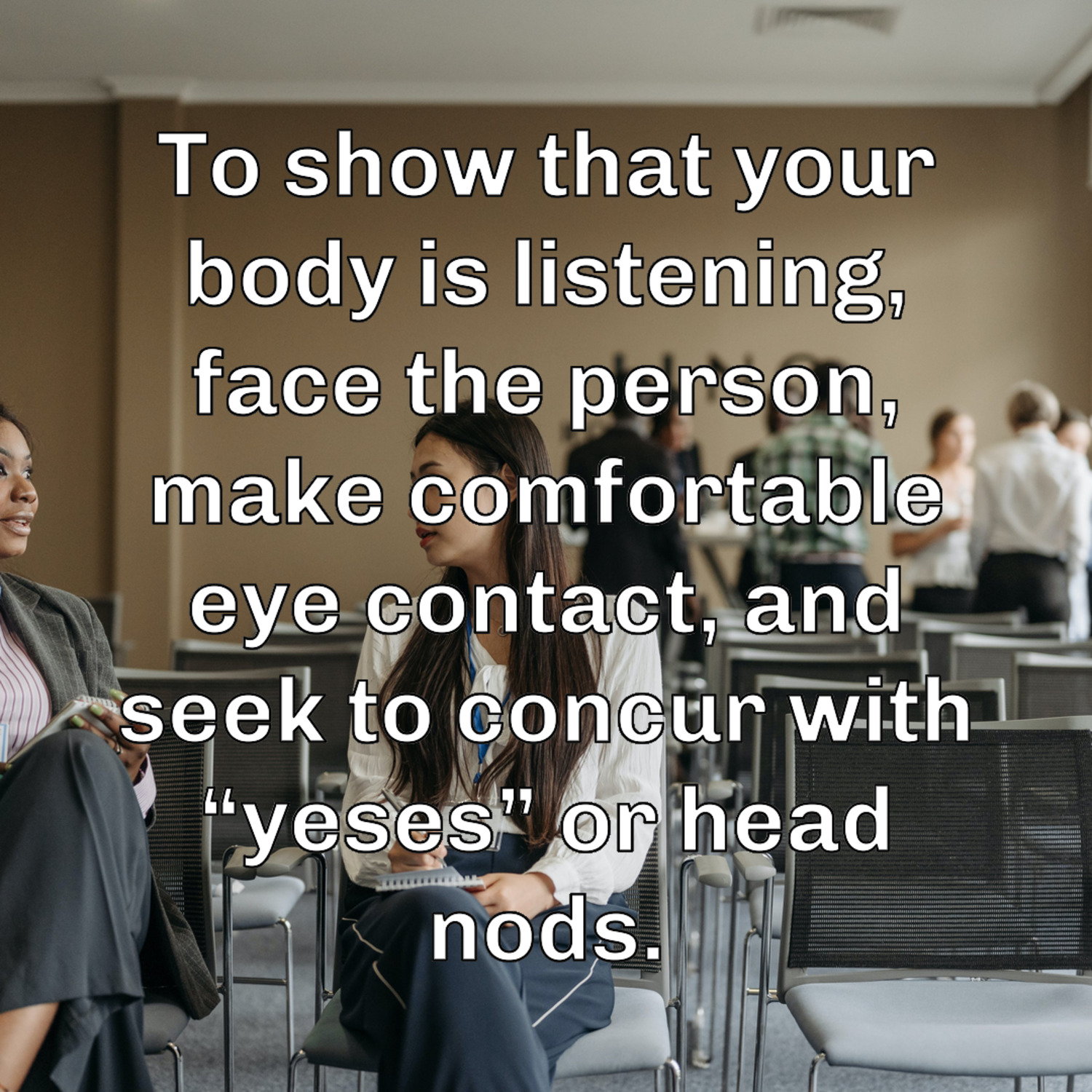
The Body Can Listen, Too
• Use mirroring, paraphrasing, or reflecting to show active listening. • Body language can be empathic too, and when your body mirrors another person’s, this is a way to show physical “active listening” of the body.• To show that your body is listening, face the person, make comfortable eye contact, and seek to concur with “yeses” or head nods. Then mirror their words, voice, posture, or other idiosyncrasies. • When mirroring, be mindful of the gender or cultural context, and only reflect what is positive. Avoid mirroring strong negative emotions (panic, anger, depression) and instead model a sense of calm by slowing down and taking a deep breath; the other person may then mirror you. Show notes and/or episode transcripts are available at https://bit.ly/social-skills-shownotesLearn more or get a free mini-book on conversation tactics at https://bit.ly/pkconsulting#DrKerstinUväsMoberg #Empathy #Gueguen #Heres #Listening #VanBaaren #TheBodyCanListen #Too #RussellNewton #NewtonMG #PatrickKing #PatrickKingConsulting #SocialSkillsCoaching #Mirroring #Paraphrasing #ActiveListening
Six Different Ways To Say NO
One of the most useful tools in the people-pleaser’s survival kit is the ability to say NO. There are at least six different kinds of no to learn and practice: the direct no, the reasoned no, the reflecting no, the rain check no, the enquiring no, and the broken record no. Each can be used in different circumstances, according to the boundary you need to set. Whichever form you use, you’ll need to challenge your assumptions and beliefs about saying no and communicate clearly and confidently.Show notes and/or episode transcripts are available at https://bit.ly/social-skills-shownotesLearn more or get a free mini-book on conversation tactics at https://bit.ly/pkconsulting#Assertiveness #EmotionalAppeal #EmotionalResponse #HealthyRelationship #PoliteRefusal #TrevorPowell #SixDifferentWaysToSayNO #RussellNewton #NewtonMG #PatrickKing #PatrickKingConsulting #SocialSkillsCoaching
Body Talk
• Ex-FBI agent Joe Navarro has some tips for reading body language, and they come from an understanding that body language is inbuilt, automatic and ancient, and based on fight, flight or freeze response in humans. For examples, “pacifying behaviors” like covering the neck can indicate the person is trying to manage stress.• Note how the body is occupying space, and whether it is generally closed or open. Posture and gesture can tell you about whether a person is assertive, aggressive, uncertain or fearful. Bodies expand when they are comfortable, happy, or dominant. They contract when unhappy, fearful, or threatened.#ArmsAkimbo #AutomaticResponses #BasicGestures #BouncyLegs #FacialExpressions #JoeNavarro #Navarro #NegativeEmotions #NervousTension #NonverbalCommunication #NonverbalSignals #Pacifying #PeopleSkills #PrefrontalCortex #Ventilating #BodyTalk #RussellNewton #NewtonMG #PatrickKing #PatrickKingConsulting #SocialSkillsCoaching #ImproveYourPeopleSkills

Don’t Just Listen Actively, Listen Empathically
• To listen effectively and empathically, we need to let our egos take a back seat so the other person can lead. If we are sensitive, alert, and respectful, we can listen without an agenda. • Listen with maximum attention without getting distracted by anything other than the perspective being shared with you in that very moment. • Seek to understand, not to judge, appraise, or evaluate—in fact, your opinion is irrelevant! Only your presence and awareness are necessary. Have radical acceptance for what is simply because it is. • Maintain deep curiosity. Ask questions that create space in which the other person can expand. This sends the message, “You are important. How you are feeling has value. I am listening because what you are going through is worthy of attention and worth knowing more about.”Show notes and/or episode transcripts are available at https://bit.ly/social-skills-shownotesLearn more or get a free mini-book on conversation tactics at https://bit.ly/pkconsulting#CarlRogers #Mindful #Mirroring #Paraphrasing #RadicalAcceptanceFirst #Realizing #Reflecting #Don’TJustListenActively #ListenEmpathically #RussellNewton #NewtonMG #PatrickKing #PatrickKingConsulting #SocialSkillsCoaching
Conflict Avoidance Is Actually A High-Risk Strategy
• People-pleasers can be conflict avoidant, but this is actually a high-risk strategy, and you may gather resentments only to explode later (“gunnysacking”). Instead, use “and” instead of “but” in conversations, or try the “Five Whys” technique to get to the heart of what you’re really avoiding.Show notes and/or episode transcripts are available at https://bit.ly/social-skills-shownotesLearn more or get a free mini-book on conversation tactics at https://bit.ly/pkconsulting#Conflict #Gunnysacking #Peoplepleasers #Peoplepleasing #PeopleSkills #Reparenting #ConflictAvoidanceIsActuallyAHigh-RiskStrategy #RussellNewton #NewtonMG #PatrickKing #PatrickKingConsulting #SocialSkillsCoaching
Look At My Face
• It’s possible to extract loads of useful information from people merely by using the power of observation. • First, observe the face, tiny, quick and involuntary movements of the face can “leak” a person’s true emotions – there are six universal ones: anger, fear, surprise, disgust, happiness. Look for microexpressions that contradict what is said verbally. #Ekman #Macroexpressions #Microexpressions #Observing #PaulEkman #LookAtMyFace #RussellNewton #NewtonMG #PatrickKing #PatrickKingConsulting #SocialSkillsCoaching #HowtoExtractInfo #Secrets #andTruth
Accounting For Bias, Prejudice, Ego, And Perspective
• Your perspective on life is what makes you unique, but it can also be a source of isolation, misunderstanding, and conflict. • A pre-conceived notion about who another person is may be the single biggest obstacle on the path to genuine empathy for them. Getting rid of bias is about more than guarding against sexism or racism and more about consciously choosing to remember that all people are united in their shared humanity. • Prejudice is pre-judging what another’s experience is and what it means. Stereotypes and categories undermine authentic connections with others. Bias is a filter through which all the information we receive about that person is distorted. Being empathic is not just about being kind. It’s about clear, accurate perception and genuine comprehension of another worldview.• To tackle your own prejudice, first acknowledge that you do have it! Consciously choose to expose yourself to the unfamiliar and challenge yourself to empathize not just with similarity but with difference. Assume there is always a common ground between you and another individual and actively choose to focus on that instead of what is different. • Forget the Golden Rule and remember that the very meaning of compassion, kindness, and empathy changes depending on the recipient. Show people compassion, but on their terms, not yours. • In interactions, try to explore: what the other person thinks about themselves, what the other person thinks about you, what you think about them, and what you think about yourself. This can be especially helpful during a conflict.Show notes and/or episode transcripts are available at https://bit.ly/social-skills-shownotesLearn more or get a free mini-book on conversation tactics at https://bit.ly/pkconsulting#GoldenRule #PeopleSkills #Prejudice #Stereotype #Stereotypes #AccountingForBias #Prejudice #Ego #AndPerspective #RussellNewton #NewtonMG #PatrickKing #PatrickKingConsulting #SocialSkillsCoaching #ImproveYourPeopleSkills
“Fawning”—A Response to Trauma
In the face of trauma and conflict, some people respond with anger, some respond by fleeing . . . and some, like Person A, respond with a flood of appeasing, soothing, and conciliatory behavior. “Fight or flight” is an option for some people, but for those with a history of trauma, another option when faced with threat is to go into fawning mode and try to make it all better.Picture an animal defensively rolling onto its back, trying to appear as meek and agreeable as possible so that it’s spared by a powerful predator. Fawning is an attempt to fly under the radar rather than engage in conflict. It’s a way of deflecting attention.In a crisis or disagreement, is your first instinct to soothe, calm, or please others?Do you do anything to avoid conflict—even if that means ignoring your own needs?In a stressful interaction, is your focus on other people’s emotions?Fawning behavior is actually a kind of trauma response. This behavior, in other words, is something you might have learned in childhood, where “rolling over” this way was the only thing that helped you survive conflict.Show notes and/or episode transcripts are available at https://bit.ly/social-skills-shownotesLearn more or get a free mini-book on conversation tactics at https://bit.ly/pkconsulting#Fawning #RussellNewton #NewtonMG #PatrickKing #PatrickKingConsulting #SocialSkillsCoaching #StandUpForYourself #Trauma #DefenseMechanism #Conflict
Analyze Thyself: The ABC Method And Thought Journals
• To rewrite our negative thought patterns, We can't solve problems by using the same kind of thinking we used when we created them.”• We can use the ABCDE acronym (activating event, belief, consequence, disputation, and new event) and explore the stories we’re telling in a thought journal. We can decide whether a new alternative is a good one according to its accuracy, helpfulness, and congruence with our values. • Once you’ve identified your current thoughts, ask if there’s a different way to think about things, and how you can bring that idea to life with concrete action. Seek out evidence for a new belief, practice self-compassion, and go into learning mode, asking questions instead of making statements. • Negativity can be relieved by shifting perspectives and creating psychological distance. Remember that pessimism, negativity, and gloomy nihilism are all coping mechanisms and once served a purpose. But right now, we can choose to cope with adversity in different, healthier ways (and there always will be adversity!) • Create spatial, temporal, and psychological distance from distressing thoughts, ask what others might do in our situation (role-switching), and turn your mind to concrete action instead of asking why. Focus on a small, concrete detail in the present and ask what you can do. Avoid identifying problems without seeking solutions—i.e., complaining! • When we are stuck in intense emotions, we can try the ACT technique of defusion. Imagine that your Mind is something separate from you and that you can watch it. • Remember that you are not your thoughts; you are just having thoughts. Make your thoughts earn their keep! #ABCDE #ACT #Negativity #StopNegativeThinking #AnalyzeThyself:TheABCMethodAndThoughtJournals #RussellNewton #NewtonMG #ThoughtJournals #ABCMethod

How To Discover And Flex Your Empathy Muscles
• Reading literature may actually make you a more empathic human being. It can reduce bias and prejudice and literally change your brain physiology. The key is in the ability to switch perspectives.• Choose literary fiction, preferably written in first person. Try authors who are different from yourself, or books about characters that are unlike yourself.• Read actively and engage with the story. Pause to ask questions to investigate the character’s point of view, switching perspectives and exploring motivations and desires. Ask yourself, “What does the human experience feel like for this specific human? Why?” Instead of asking how you would feel in their shoes, ask how they feel in their shoes. However, be discerning about what kind of perspectives you delve into!• Another way to build empathy is to create “emotional literacy.” Emotional literacy is the ability to identify and verbalize complex emotions. It is an act of self-awareness. With greater emotional identification and awareness comes more clarity, insight, and mastery—and better empathy. • The emotion wheel is a helpful tool that helps you develop increased self-awareness, empathic mastery, and precision when it comes to emotions. It outlines shades and nuances of the eight primary emotions: sadness, anger, disgust, joy, trust, fear, surprise, and anticipation.• We can use the emotion wheel both to identify and explore our own emotions and to identify and empathize with the emotions of others. To empathize with others’ emotions, pause to become aware, notice their body language, then identify a primary emotion on the emotion wheel. Keep asking questions, making observations, or offering emotion labels to home in on exactly what they’re feeling. Show notes and/or episode transcripts are available at https://bit.ly/social-skills-shownotesLearn more or get a free mini-book on conversation tactics at https://bit.ly/pkconsulting#HowToDiscoverAndFlexYourEmpathyMuscles #RussellNewton #NewtonMG #PatrickKing #PatrickKingConsulting #SocialSkillsCoaching #ImproveYourPeopleSkills

Are You Generous? Or Just Afraid Of Rejection?
• Over-giving stemming from fear of rejection is not genuine generosity. Break the cycle by changing the core belief: “I cannot survive rejection.” Instead, court rejection deliberately and teach yourself that it doesn’t define you. Challenge your narratives with self-compassion, and focus on process, not outcome.Show notes and/or episode transcripts are available at https://bit.ly/social-skills-shownotesLearn more or get a free mini-book on conversation tactics at https://bit.ly/pkconsulting#AreYouGenerous?OrJustAfraidOfRejection? #RussellNewton #NewtonMG #PatrickKing #PatrickKingConsulting #SocialSkillsCoaching #ImproveYourPeopleSkills

Reframe Your Internal Dialogue And Take Control Of Your Self-Talk
• How you think creates your life; negativity poisons everything in your world. • Changing negativity requires a degree of metacognition (thinking about thinking) and a leap of faith to do something that hasn’t been done before. Anyone can change their thought patterns; it requires only honest awareness and a willingness to take conscious and inspired action.• Our mental shortcuts, assumptions, biases, and stereotypes are great at saving time and effort, but are not one hundred percent accurate one hundred percent of the time. The “all-or-nothing” disease is when we overextrapolate from one experience to other experiences we haven’t had; we are making an error.• Words have power, and our speech reflects our thought patterns. “Out of power” language is passive, self-victimizing, doubtful, angry, unconfident, fearful, excuse-making, or pessimistic, and can create a self-fulfilling prophesy. • Become aware of your internal verbal habits. Then focus on what can be done, embrace nuance and shades of gray, and speak to yourself like you would a loved one. • A cognitive distortion is a persistently incorrect belief, perception, or thought—for example, mental filtering, personalization, jumping to conclusions, mind-reading, catastrophizing, and using “should” statements and labels. • Positive thinking is not just the absence of distortions, but thinking that helps you feel calm, hopeful, curious, grateful, stable, and confident.• To challenge your inner critic, commit to not allowing your thoughts to dominate you. Gain psychological distance by labeling the thoughts as thoughts, not reality, and have self-compassion. • Change happens outside your comfort zone, so realize that at some point, you’ll need to take the leap and try something new.#InternalDialogue #Self-Talk #NickTrenton #RussellNewton #NewtonMG #StopNegativeThinking
Understanding Empathy And Why We Need It
• Empathy is about the ability to take another person’s perspective. It is similar to “theory of mind,” which is the human capacity to understand another person’s state of mind and comprehend that it is totally different from our own. Empathy is not only theory of mind but “theory of heart”—to feel other people’s emotions—and it’s hardwired into our brains and bodies.• Empathy is not about any particular situation, but about a unique individual’s perspective on that situation.• Though it is an innate human ability, it is in decline. We need to consciously cultivate and develop empathy. • There are three kinds of empathy: Cognitive empathy is empathy based on knowing or understanding what someone else is going through, on an intellectual level.• Emotional empathy is the ability to actually share and take some part in the emotional experience of another person.• With compassionate empathy, we put our feelings of understanding and sympathy to good use. We try to resolve problems, remove burdens, or inspire insights that will help progress the situation.• In an empathic interaction, move from cognitive to emotional to compassionate empathy. • Sympathy is like seeing someone is in a hole, but standing on the outside looking in with concern. Empathy is like getting down into the hole and relating to the person side by side, with them. • Too little empathy is a problem, but so is too much. Becoming overwhelmed in another person’s world means we lose perspective—as well as the ability to be of any practical help to them. Show notes and/or episode transcripts are available at https://bit.ly/social-skills-shownotesLearn more or get a free mini-book on conversation tactics at https://bit.ly/pkconsulting#CompassionateEmpathy #Empathy #Sympathy #UnderstandingEmpathyAndWhyWeNeedIt #RussellNewton #NewtonMG #PatrickKing #PatrickKingConsulting #SocialSkillsCoaching
The Need To Be Liked
• People-pleasing is a complex learned behavior, but it can be understood and changed. One of the most common underlying causes is the need to be liked.• We can counter this mindset by remembering we are like inkblots (i.e., what people see is about them, not about you) and understanding that your worth does not come from other people’s approval.• When you untangle yourself from other people’s opinions and judgments, you free yourself to ask what YOU want, what you care about, and what you value. The “separation of tasks” exercise helps you to tease apart your responsibilities from other peoples’—their feelings are not your business.Show notes and/or episode transcripts are available at https://bit.ly/social-skills-shownotesLearn more or get a free mini-book on conversation tactics at https://bit.ly/pkconsulting#SerenityPrayer #PeoplePleaser #RogerCovin #TheNeedToBeLiked #RussellNewton #NewtonMG #PatrickKing #PatrickKingConsulting #SocialSkillsCoaching #StandUpForYourself
Nine Types Of Active Listening Responses
• To this end, we come to the concept of active listening. It’s a way to participate in conversations while being on the receiving end. Most might think that receiving simply means sitting quietly, but that’s a huge mistake. There are nine types of active listening responses we cover, to be used when trying to connect deeply with someone: comprehending, retaining, responding, restating, reflecting, summarizing, labeling emotions, probing with leading questions, and silence.• Oversharing may seem like something to avoid, but there is plenty of research to suggest that honestly opening up to others actually makes them like and trust us more. You’ll distinguish yourself from the automatic stereotypes by giving specific details about yourself, and make your life seem more interesting and compelling.• We can divulge both by revealing additional information or by confessing to how we feel, sharing a story or revealing something unexpected about ourselves. People bond over emotional identification, so don’t worry about appearing weak or vulnerable—divulging will actually encourage others to do the same and foster good rapport.• When we engage with others, a golden rule of engagement is to focus on finding similarity and creating a sense of a shared experience and familiarity.Show notes and/or episode transcripts are available at https://bit.ly/social-skills-shownotesLearn more or get a free mini-book on conversation tactics at https://bit.ly/pkconsulting#AutomaticStereotypes #EmotionalIdentification #GoodRapport #Oversharing #NineTypesOfActiveListeningResponses #RussellNewton #NewtonMG #PatrickKing #PatrickKingConsulting #SocialSkillsCoaching #ImproveYourPeopleSkills

Subtly Charismatic: Humor And Misdirection
• One quick technique is misdirection, where a statement has two parts: the first is expected and ordinary, the second contradicts it with unexpected and comedic results. Sarcasm can be powerful but is best when directed at yourself and used with those you are more familiar with. Ironic humor is similar to sarcasm, but more focused on the observation of the contrast between the expected and the actual.• The world of improv has a lot to teach us about good conversational chemistry. One improv rule is not to hold on to any outcome too tightly, and be ready to follow the emerging flow of the conversation.• Another rule is to rely on quick connections to make sure you always have something to say. This can be practiced by free associating one, two, or five words. Good improv is about having faith in the conversation’s direction, and your ability to be okay with where it goes.• The 1:1:1 method of storytelling is a mini story technique that relies on one action, summarized in one sentence, that evokes one main emotion in the listener. This keeps your stories engaging, short, and effective. Alternatively, you can ask for other people’s stories.• Conversational diversity is about having as many different tools in your toolkit as possible. Hypothetical questions are one such tool. These kinds of “what if . . .?” questions inject some excitement, creativity, and unpredictability, while showing something interesting about the person giving the answer.• Finally, thinking out loud can be a way to turn monologues into dialogues. If we speak freely and without self-censoring, we break the ice, share ourselves honestly, and invite (rather than demand) others to join us.Show notes and/or episode transcripts are available at https://bit.ly/social-skills-shownotesLearn more or get a free mini-book on conversation tactics at https://bit.ly/pkconsulting#Conversations #Ironic #Sarcasm #SubtlyCharismatic:HumorAndMisdirection #RussellNewton #NewtonMG #PatrickKing #PatrickKingConsulting #SocialSkillsCoaching #ImproveYourPeopleSkills
Boost Your CQ (Conversational Intelligence)
• Being charming is about developing social awareness and conversational intelligence. Much of this depends on empathy, and being able to step outside your own reality bubble and honestly see your own blind spots in conversations.• Try not to ever assume that other people think, feel or believe as you do, or that their conversation experience is the same as yours. “Double click” on what they share with you and be genuinely curious and open minded, rather than making assumptions and guesses.• Contrary to the conventional advice about small talk, you can build rapport with relative strangers by consciously choosing to go deep with them – and such conversations can be less awkward than you imagine. Just don’t complain or pressure people to respond in a particular way.• Show people that you’re paying attention and understand them by using the principles of cold reading. Invite their participation, use high-probability generalized statements, downplay incorrect guesses, and collect observations to show people that you really get them.• Generally, people tend to hide the fact that they want a conversation to end, and most people wish conversations ended sooner. Play it safe by quitting while you’re ahead. Gracefully disengage by waiting for a gap, starting with a positive, making an excuse, and leaving with warmth but also firmness.Show notes and/or episode transcripts are available at https://bit.ly/social-skills-shownotesLearn more or get a free mini-book on conversation tactics at https://bit.ly/pkconsulting#BlindSpots #ConversationalIntelligence #SocialAwareness #BoostYourCQ(ConversationalIntelligence) #RussellNewton #NewtonMG #PatrickKing #PatrickKingConsulting #SocialSkillsCoaching #ImproveYourPeopleSkills
Questions – An Underrated Superpower
• In order to interact and engage more fully in conversations, we need to work against our not-so-useful habits and learn better ones.• A non-negotiable habit is becoming a master at using questions. The right questions help people feel closer to us, communicate our attention and care, share our competence, show that we’re aware and paying attention, deepen intimacy, guide the conversation, and make us more trustworthy.• All exchanges, and hence all questions, are typically on one of three possible levels: those exchanging factual information, those exchanging feelings and emotions, and those communicating deeper values. In social situations, you’ll lean more heavily on the last two, but a good conversation works when people have similar conversational goals and are matched in the level they’re interacting on.• Conversational narcissism is an impediment to curiosity, engagement, and good question asking. Whether unconscious or conscious, this usually results from us placing something other than connection with the other person as our goal for conversation, i.e. to brag, to defend, to compete.• We can reduce our own conversational narcissism by using questions. Follow-up questions are very effective, as are open-ended questions that don’t make people uncomfortable, but may gently push on the barrier or normal etiquette.• Just as a role model can be a guide and inspiration for your own behavior, a model can also help you stay curious when you talk to others. Talk show hosts are experts and placing their conversation partners front and center, so we can ask, what would they do? Usually, the answer is “treat my guest like the most interesting person in the whole universe.”• Curiosity needs to be genuine. We all have a bias against others sometimes, assuming they’re not very interesting, but unless we ask, we won’t learn about their more fascinating sides. Assume that everyone has something to teach you, and foster genuine inquisitiveness. into the details of their world. I guarantee you will not be disappointed.Show notes and/or episode transcripts are available at https://bit.ly/social-skills-shownotesLearn more or get a free mini-book on conversation tactics at https://bit.ly/pkconsulting#ConversationalNarcissism #GoodConversation #Questions–AnUnderratedSuperpower #RussellNewton #NewtonMG #PatrickKing #PatrickKingConsulting #SocialSkillsCoaching #ImproveYourPeopleSkills
Dealing With Conflict And Disagreement
• Arguments are sometimes inevitable but we can argue best if we use “steel manning” rather than attacking a strawman. Create the best version of your opponent’s argument by breaking it down, then help them build that argument, actively arguing on your counterpart’s behalf. You will more quickly reach harmonious agreement, or at least disagree more civilly. • Use the fogging technique to manage people who are aggressive or unreasonable. By giving people a minimal, calm response that they cannot easily engage with, you defuse tension. Listen carefully for a kernel of truth, repeat the truth calmly and neutrally, but don’t add any new information and keep maintaining calm. • The Ransberger pivot is a way to “win an argument without arguing.” Listen carefully to start, look for points of commonality, and keep returning to any ways in which you and the other person are actually on the same page. • The “feel, felt, found” technique is another a simple way to mitigate conflict. Acknowledge how they feel, point to another person who has felt similarly in the past, then show what you have found works based on how this person managed the issue. • Finally, the agreement frame allows us to gracefully disagree with someone without destroying rapport. Use terms like I respect, I appreciate and I agree to signal an intention to cooperate. Agree, acknowledge their position, and acknowledge both your desired outcomes, using “and” rather than “but.” Hear it Here - https://bit.ly/readpeoplekingShow notes and/or episode transcripts are available at https://bit.ly/social-skills-shownotesLearn more or get a free mini-book on conversation tactics at https://bit.ly/pkconsulting#DefuseTension #Harmonious #MitigateConflict #Ransberger #DealingWithConflictAndDisagreement #RussellNewton #NewtonMG #PatrickKing #PatrickKingConsulting #SocialSkillsCoaching #ImproveYourPeopleSkills
The Power Of Shutting Up
• What you don’t say is also important. When you speak, remember to include pauses in the right places to convey confidence or emphasis. Give your listeners time to digest what you’ve said.• Use the Pareto principle, or the 80-20 rule, and try to make 80% of the conversation about the other person and 20% about yourself. Listen, ask questions, and pay attention rather than forcing a particular topic, being fake, trying to impress or interrupting.• Be aware of microexpressions (tiny, ultra-rapid facial expressions), especially those that don’t seem to match what is being said. Microexpressions tell the “truth” about someone’s feelings, so observing them can give you empathy and insight into how they really feel.• People feel like they “click” more often when responses are swift, so pay attention and keep things flowing and responsive. That said, it’s better to end a flagging conversation than panic too much when it goes quiet.• If you find yourself inching towards conflict, pause and ask whether the other person is speaking from a position of cognitive dissonance and, if they are, back away and try to re-establish rapport, since pushing will only invite more resistance. And, of course, be on guard against the tendency to hold incompatible or irrational views yourself!Show notes and/or episode transcripts are available at https://bit.ly/social-skills-shownotesLearn more or get a free mini-book on conversation tactics at https://bit.ly/pkconsulting#CognitiveDissonance #Microexpressions #Pareto #ThePowerOfShuttingUp #RussellNewton #NewtonMG #PatrickKing #PatrickKingConsulting #SocialSkillsCoaching #ImproveYourPeopleSkills
The Bedrock Of Good Communication
• Part 1 of this book is all about the charismatic presence. How might you wish for someone to describe you, and how much does that differ from reality? And then, how do you bridge the gap between these two versions of yourself? Part 1 is more theoretical and introspective, while Part 2 is all about action. How do you actually create the type of interactions that will draw people to you, regardless of your current personality?• Unsurprisingly, it all starts with empathy. When you have empathy, you know what other people are thinking and feeling, or at least you can make a pretty darned good guess about it. And if we know what people are thinking and feeling, we can also make a darned good guess as to what they want. And that’s what will allow us to create charismatic interactions.• The first is to simply read more. This is probably the best practice you can do without having someone in front of you, because it forces you to inhabit someone else’s perspective and inner dialogue. You can see in the story that because X happened, Y and Z might happen. This seems simple, but it is not easy to practice in daily life. Having an experience filter is very similar, in that it forces you to step out of your perspective (which is necessarily limited) and really try to see someone else’s. It might sound like we are only talking about empathy here, but the truth is that empathy and charisma are extremely, extremely related. Yes, deliberately practicing theory of mind is also more in the same direction of understanding another person’s thoughts and emotions.• Finally, understanding the difference between facts and interpretation will help you know what you should respond to. Almost always, you should be trying to respond to people’s interpretation because their emotions are buried within, and that’s what will draw people to you.Show notes and/or episode transcripts are available at https://bit.ly/social-skills-shownotesLearn more or get a free mini-book on conversation tactics at https://bit.ly/pkconsulting#CharismaticInteractions #CharismaticPresence #Empathy #TheBedrockOfGoodCommunication #RussellNewton #NewtonMG #PatrickKing #PatrickKingConsulting #SocialSkillsCoaching #ImproveYourPeopleSkills
Understanding Basic Assertiveness Techniques
• There are many ways to assert your own boundaries and limits without encroaching on others’. Try the stuck record technique (calmly repeating your limit without budging), the “positive no” (reiterate what you are saying yes to) negative assertion or negative enquiry (accepting and enquiring about criticism). • The DESC model can help you stand up for yourself. Describe the facts of the situation, Express how you are being affected, suggest a specific Solution, then finish with a Conclusion/consequences, i.e. what will happen if the behavior is changed and what will happen if it isn’t. • Humor is useful, but it needs to be the right kind. Positive humor styles (especially affiliative humor) are better for relationships. Avoid self-enhancing, aggressive or self-defeating humor styles. • Use the platinum rule: Do unto others as they would want done to them. Listen, be empathetic and stay curious about other people’s perspectives, even and especially if they differ from yours. Ask what they want and need, and how they conceptualize of you, themselves, and the situation. • A good apology needs a few necessary elements: expression of regret, explanation of what went wrong, taking responsibility, repentance, offer for reparations, and a request for forgiveness. Hear it Here - https://bit.ly/readpeoplekingShow notes and/or episode transcripts are available at https://bit.ly/social-skills-shownotesLearn more or get a free mini-book on conversation tactics at https://bit.ly/pkconsulting#AssertiveCommunication #AssertivenessSkill #ConorFriedershof #Communication #DaveKerpen #DESCModel #EverydayConversations #FoggingTechnique #GordonBower #JenniferAaker #Kerpen #Lewicki #ManuelJSmith #NaomiBagdonas #NonverbalCommunication #PersonalRelationships #PlatinumRule #StuckRecordTechnique #UnderstandingBasicAssertivenessTechniques #RussellNewton #NewtonMG #PatrickKing #PatrickKingConsulting #SocialSkillsCoaching #ImproveYourPeopleSkills
Watch What You Say…
• Your voice is a powerful nonverbal communicator. Be aware of your pitch, volume, articulation and pace, and practice to ensure you’re having the effect you want.• Neuroscientist Antonio Damasio found that people make decisions not from logic but from emotion – which is what you should speak to when trying to connect meaningfully with others.• You can use open loops to create conversations that feel rich, full, and “complete.” Simply start a story and don’t finish it, so you can return later if the conversation stalls.• When speaking, you will be more engaging and captivating if your language is fresh, novel and vivid. Use metaphors to explain complex topics in simple, relatable ways. To connect to people emotionally, use compelling language and colorful imagery, and allow your enthusiasm to shine through.• Change the focus of the conversation from yourself to the other person. The goal is to connect and flow, not to compete or perform. Using the words “yes, and” borrowed from improv comedy, you keep things open-ended and dynamic. Be ready to abandon any fixed ideas of the conversation’s goal and follow what is emerging in the moment – your conversation will feel more natural, more joyful, and more connected.Show notes and/or episode transcripts are available at https://bit.ly/social-skills-shownotesLearn more or get a free mini-book on conversation tactics at https://bit.ly/pkconsulting#Conversation #AntonioDamasio #SocialInteractions #SuccessfulConversations #WatchWhatYouSay… #RussellNewton #NewtonMG #PatrickKing #PatrickKingConsulting #SocialSkillsCoaching #ImproveYourPeopleSkills

5 Charismatic Traits
• We can condense the four theories of charisma into 5 distinct charismatic traits: likeability and warmth; power and influence; emotional intelligence; presence, awareness and self-control; and social intelligence and leadership. If we can consistently hit these five notes in our social interactions, we cannot help but boost our “charisma quotient.”• To be impactful, charisma has to be genuine to us. We need to take responsibility for honestly appraising our skills and taking concrete action to improve in real life. Whether we are extroverted or introverted, there is a unique charisma style that will work for us.• Real life celebrities and historical figures can serve as examples and inspiration. Both Will Smith and Marilyn Monroe show how you can tick all 5 charisma boxes, but in completely different ways.• Will Smith teaches us to be prepared, stay humble and work hard, and lead with positivity, humor, and good-naturedness. Though his social mask makes him appear easygoing and lighthearted, it conceals the effort, deliberation and hard work required to build the life and image you want.• Marilyn Monroe teaches us that charisma can also be about magnetically drawing people towards you, rather than being loud and over the top to demand attention. Marilyn shows us the power of appearance, and how to craft a performing person down to the finest detail. She also shows us indirectly that perfection is not required, and that if you can lean honestly into your own vulnerability and fragility, people may love you all the more for it.• You can design your own unique charisma formula by honestly rating how you perform in each of these five areas, and committing to taking action today to improve.Show notes and/or episode transcripts are available at https://bit.ly/social-skills-shownotesLearn more or get a free mini-book on conversation tactics at https://bit.ly/pkconsulting#Charisma #Charismatic #CharismaticTraits #EmotionalIntelligence #IdealPersona #IrresistiblePersona #Likeability #SocialIntelligence #5CharismaticTraits #RussellNewton #NewtonMG #PatrickKing #PatrickKingConsulting #SocialSkillsCoaching #ImproveYourPeopleSkills
Better Conversation Skills
• One useful conversational skill is chunking, where you vary the level of information you get coming back to you. This way, you can reach an agreement, acquire more and correct detail, or even persuade people to move from one plane of thought to another. Chunk up to gain a broader view everyone can agree on, and chunk down to find detail. Move from general to specific, keeping the other person’s reactions in mind. • Use clean language to discover, explore and work with people’s metaphors without “contaminating” them. Listen for metaphors used, ask questions about them and continue the conversation using the same language and imagery to show your understanding.• Use the HPM technique to always have something to say in conversations. Talk about history (a past experience) philosophy (your feelings on it) and a metaphor (describe both with a vivid metaphor). Keep is short, sweet and natural.• Use signposting and transitional words to tell your listeners where your story is going. Signal what is coming and link your ideas logically using words that guide your listener’s understanding. • Use conversational threading. Listen out for emotional hooks and pursue the conversation in that direction. Follow the most exciting or interesting leads and return to old, unexplored ones when conversation flags or ideas run out. Hear it Here - https://bit.ly/readpeoplekingShow notes and/or episode transcripts are available at https://bit.ly/social-skills-shownotesLearn more or get a free mini-book on conversation tactics at https://bit.ly/pkconsulting#AwkwardConversations #CharlyBliss #Chunking #CleanQuestions #Conversation #DavidGrove #EffectiveConversationSkill #GeorgeAMiller #HPM #NonverbalExpression #NumberSevenPlus #SocialSkills #BetterConversationSkills #RussellNewton #NewtonMG #PatrickKing #PatrickKingConsulting #SocialSkillsCoaching #ImproveYourPeopleSkills
Connecting Beneath The Surface
• Conversational charm is about connecting genuinely to others. First, get your ego out of the way by suspending judgment and forgetting about agreement or disagreement. Listen actively, pay full attention and avoid the temptation to connect everything they say to yourself!• Move slowly and sequentially through the three stages of rapport by making appropriate disclosures to signal trust and willingness to connect. Light disclosure can be an embarrassing tale. Medium disclosure shares your beliefs and deeper feelings. Finally, heavy disclosure is about your more serious vulnerabilities. Don’t be a closed book, but be selective about who you open up to.• Use connection stories to tell people about who you are – instead of dry facts, share anecdotes that sincerely convey your values as a person.• You can come across as more charismatic if you show you’re paying attention by labeling the other person’s experience or emotions. Use “it seems like” or “it sounds like” to paraphrase and demonstrate your empathic understanding.• Finally, don’t be boring! Boring traits are those that downplay fun. In conversations, be relaxed, playful, open and warm, and forego needing to be right or appear smart.Show notes and/or episode transcripts are available at https://bit.ly/social-skills-shownotesLearn more or get a free mini-book on conversation tactics at https://bit.ly/pkconsulting#AnnetteSimmons #Conversations #Dreeke #EffectiveConversations #HowardGardner #PositiveEmotion #Rapport #RobertCialdini #RobinDreeke #Tilburg #ToxicRelationship #ConnectingBeneathTheSurface #RussellNewton #NewtonMG #PatrickKing #PatrickKingConsulting #SocialSkillsCoaching #ImproveYourPeopleSkills
Building Real-World Charisma
• Olivia Fox Cabane explains how there are four charisma types according to the proportion of power, presence and warmth. The focused charismatic (who pays deep attention to others), the visionary charismatic (who communicates their infectious passion), the kind charismatic (who inspires with warmth and compassion) and the authoritative charismatic (who leads others with expertise and power). • Depending on your goals, you can play up your natural charisma strengths or seek to balance out your weaknesses. • To be socially and emotionally comfortable, plan ahead and make sure you’re physically comfortable, which will remove barriers to charismatic connection. • Use ritual and visualization as a “social warm up.” Music, meditation, and affirmations can help you prepare. • Build presence with mindfulness. Slow down, breathe and anchor in the senses. Pause before you respond, and take conscious care of every detail of the interaction, including your verbal and nonverbal expression, appearance, and behavior. • Howard Friedman emphasized the affective, nonverbal expressiveness component of charisma. • Communicate with all your body and laugh openly. Speak with a dynamic, varied voice that changes in pitch, tone and expression. Use touch to bridge distance and create warmth, aware that the rules differ for men and women. • Speak less and emote more via facial expression. If you find yourself the center of attention, relax and don’t draw attention to awkwardness, using humor to defuse tension. Use exaggerated, pantomime-like gestures and initiate contact with strangers. Finally, practice the art of “platonic flirting.” • Introverts can be charismatic, but they must do so on their own terms.Show notes and/or episode transcripts are available at https://bit.ly/social-skills-shownotesLearn more or get a free mini-book on conversation tactics at https://bit.ly/pkconsulting#AbstractVisualization #ActiveVisualization #AffectiveCommunicationTest #AuthoritativeCharismatic #Cabane #Charisma #ContrastCharismatic #FoxCabane #Friedman #GretaThunberg #HowardFriedman #KindnessMeditation #MindfulAwareness #Mindfulness #MindfulnessPractice #OliviaFoxCabane #Riggio #BuildingReal-WorldCharisma #RussellNewton #NewtonMG #PatrickKing #PatrickKingConsulting #SocialSkillsCoaching #ImproveYourPeopleSkills
The Power Of Empathy
• Empathy is a nonnegotiable ingredient in genuine, connected interactions, and one easy way to create it is to give compliments. Make it authentic, meaningful to the person receiving it and specific, Avoid insincere exaggeration or vague niceties that don’t speak to a person’s values. • Learn to recognize “bids for attention” because when you “turn toward” these unspoken requests for connection and validation, you deepen and strengthen relationships of all kinds, and respond with empathy. Turning against or away from these requests does the opposite. • Practice the art of nonviolent communication by using four simple steps: first, observe without judgment or interpretation. Second, express how you feel without blame or making anyone responsible. Third, express your needs plainly and assertively, without implicating the other person. Finally, calmly express a specific request that stems from the previous three steps, without entitlement or force. This will make any difficult or emotional conversation infinitely easier.• Use language softeners. Softer language can help foster trust, empathy, and likeability in all social situations. Use modal verbs and qualifiers, focus on the positive, be mindful of your word choice and use a gentler, more respectful and unhurried style to communicate a friendly willingness to cooperate. Hear it Here - https://bit.ly/readpeoplekingShow notes and/or episode transcripts are available at https://bit.ly/social-skills-shownotesLearn more or get a free mini-book on conversation tactics at https://bit.ly/pkconsulting#CarrereGottman #ComplimentTips #DefuseConflict #Empathy #EverydayConversations #GenuineCompliments #Gottman #GottmanInstitute #HealthyRelationships #InsincereExaggeration #JulieGottman #LindsayLiben #MarshalRosenberg #ModalVerbs #NonviolentCommunication #NVC #PassiveAggression #RomanticRelationship #Rosenberg #LanguageSofteners #ThePowerOfEmpathy #RussellNewton #NewtonMG #PatrickKing #PatrickKingConsulting #SocialSkillsCoaching #ImproveYourPeopleSkills
How To Never Have A Bad Interaction
• Most people fail to be charming in conversations because they misunderstand what it really means to be charming. But anyone can build their charisma by practicing a few concrete skills.• Firstly, use mirroring to signal connection and understanding. Whether it’s verbally, nonverbally, or even emotionally, mirroring can build rapport between you and the other person.• Use Albrecht’s “rule of three” to help you have more balanced conversations, i.e. ones where you do enough listening. What you say can either be a Declarative (facts or opinion being stated as facts), Questions, or Qualifiers (or "softeners"). The rule is not to have more than three declaratives in a row – instead, use a question or softener to keep things balanced.• Similarly, the ARE method is a helpful tool to help you nail small talk easily. It stands for Anchor, Reveal, and Encourage. First, identify a shared experience, then reveal something about yourself connected to that anchor, then finally encourage the other person to share, too.• With small talk topics, remember the acronym FORM: Family, Occupation, Recreation (hobbies and interests), and Motivation (goals).• You can avoid overly long-winded responses by remembering the 1 minute traffic light rule. The first 30 seconds or so is a green light to speak as you will, the next 30 seconds is an orange light – watch out for waning interest – and beyond a minute is a red light, where you will likely lose your listener’s attention. Keep it short!Show notes and/or episode transcripts are available at https://bit.ly/social-skills-shownotesLearn more or get a free mini-book on conversation tactics at https://bit.ly/pkconsulting#AuthenticConversations #ConversationFlow #DrCarolFleming #FacialExpression #GoodConversation #KarlAlbrecht #MartyNemko #NonverbalCommunication #WilliamJames #HowToNeverHaveABadInteraction #RussellNewton #NewtonMG #PatrickKing #PatrickKingConsulting #SocialSkillsCoaching #HowtoTalktoAnyone
So, What Is Charisma Anyway?
• Charming people may seem to possess a mysterious quality nobody else does, but charisma is a knowable set of social and emotional behaviors that anyone can learn. • Charisma can be defined as a blend of likeability and influence. Charismatics have presence in a room, can impact and persuade others, can lead, but also know how to put people at ease, are warm, smile often, and get along with anyone. • Practice taking up more space in a room, and examine any core beliefs that may negatively impact your posture and expression. Believe deep down that other people are not a threat and that you have something worthwhile to communicate. • Speak openly about your passions, and when you address others, speak to their highest selves. Smile often and remember the details of what people tell you. • Don’t interrupt, judge, complain, gossip or express negativity. Instead, express gratitude and optimism. • Ronald Riggio broke charisma into 3 social and emotional functions: expressiveness, sensitivity to other people’s expressiveness, and self-control. • To be more charismatic, express yourself emotionally with colorful language and dynamic facial expressions. Pay attention to people’s nonverbal expression, but don’t be afraid to ask directly about how others feel. • To improve emotional control, slow down, breathe and become present, rather than reacting mindlessly. • Acting and improv can help you improve social skills, and the ability to consciously wear a social mask. Pay attention to how you’re physically presenting yourself and dress with care and deliberation. • Finally, learn to “people watch” and get into the habit of asking more questions instead of talking about yourself in conversations.Show notes and/or episode transcripts are available at https://bit.ly/social-skills-shownotesLearn more or get a free mini-book on conversation tactics at https://bit.ly/pkconsulting#Charisma #EmpathySkills #HenryRKravisProfessor #NaturalLeader #Riggio #RonaldERiggio #So #WhatIsCharismaAnyway? #RussellNewton #NewtonMG #PatrickKing #PatrickKingConsulting #SocialSkillsCoaching #MassiveCharisma
Improve Your People Skills
• No matter who you are, it’s always possible to improve your people skills and become a more charming and more likable conversationalist. • Start by building more social awareness. If eye contact is often awkward or uncomfortable, try the triangle technique: Draw an imaginary inverted triangle on the other person’s face around their eyes and mouth. During the conversation, change your gaze every five to ten seconds. • Be aware of proxemics as a nonverbal mode of communication. Intimate, social, personal or public space are used in different contexts and can signal intentions, with people regulating their social closeness by changing their physical proximity. • “Perceptual positions” can help you build empathy and switch perspectives. First position is seeing the world through our eyes, second position is seeing the world through someone else’s eyes, and third position is seeing the world through a neutral observer’s eyes. You can gain insight into a situation by adopting each position in turn. • To be a better and more active listener, paraphrase, clarify and summarize. Avoid judging, interpreting through your own perspective or interrupting, and simply listen. Hear it Here - https://bit.ly/readpeoplekingShow notes and/or episode transcripts are available at https://bit.ly/social-skills-shownotesLearn more or get a free mini-book on conversation tactics at https://bit.ly/pkconsulting#ActiveListener #ConversationalArts #EdwardHall #GoodListener #HarmoniousRelationships #JoeNavarro #KaraRonin #NLP #Paraphrasing #Proxemics #TriangleEyeContactTechnique #RussellNewton #NewtonMG #PatrickKing #PatrickKingConsulting #SocialSkillsCoaching #ImproveYourPeopleSkills