
Science Magazine Podcast
657 episodes — Page 4 of 14

Mysterious objects beyond Neptune, and how wildfire pollution behaves indoors
The Kuiper belt might be bigger than we thought, and managing the effects of wildfires on indoor pollution First up on this week’s show, the Kuiper belt—the circular field of icy bodies, including Pluto, that surrounds our Solar System—might be bigger than we thought. Staff Writer Paul Voosen joins host Sarah Crespi to discuss the distant Kuiper belt objects out past Neptune, and how they were identified by telescopes looking for new targets for a visit by the New Horizons spacecraft. Next up on the show, the impact of wildfire smoke indoors. Producer Kevin McLean talks with Delphine Farmer, a chemist at Colorado State University, about an experiment to measure where particulates and volatile organic compounds end up when they sneak inside during a wildfire event. Finally, in a sponsored segment from the Science/AAAS Custom Publishing Office, Jackie Oberst, associate editor for custom publishing, discusses with Jens Nielsen, CEO of the BioInnovation Institute—an international life science incubator in Copenhagen, Denmark—about the next big leap in biology: synthetic biology. This segment is sponsored by the BioInnovation Institute. This week’s episode was produced with help from Podigy. About the Science Podcast Authors: Sarah Crespi, Paul Voosen, Kevin McLean Episode page: https://www.science.org/doi/10.1126/science.adl3178 Learn more about your ad choices. Visit megaphone.fm/adchoices

How long can ancient DNA survive, and how much stuff do we need to escape poverty?
Pushing ancient DNA past the Pleistocene, and linking agriculture to biodiversity and infectious disease First up on this week’s show, Staff Writer Erik Stokstad brings a host of fascinating stories, from the arrival of deadly avian flu in the Galápagos to measuring the effect of earthworms on our daily bread. He and host Sarah Crespi start off the segment discussing just how much stuff you need to avoid abject poverty and why measuring this value can help us balance human needs against planetary sustainability. Other stories from Erik mentioned in this segment: ● Elephant trunk’s ‘stunning’ microscopic musculature may explain its dexterity | Science ● ‘Mind-boggling’ sea creature spotted off Japan has finally been identified | Science Next up on the show, as part of a special issue on ancient DNA, freelance producer Katherine Irving talks with Love Dalén, a professor of evolutionary genomics at the Centre for Palaeogenetics at Stockholm University. They talk about the longevity of ancient DNA and what it would take to let us see back even further. See the whole ancient DNA special issue here. This week’s episode was produced with help from Podigy. About the Science Podcast Authors: Sarah Crespi, Erik Stokstad, Katherine Irving Episode page: https://www.science.org/doi/10.1126/science.adl1587 Learn more about your ad choices. Visit megaphone.fm/adchoices

Visiting utopias, fighting heat death, and making mysterious ‘dark earth’
A book on utopias and gender roles, India looks to beat climate-induced heat in cities, and how ancient Amazonians improved the soil First up on this week’s show: the latest in our series of books on sex, gender, and science. Books host Angela Saini discusses Everyday Utopia: In Praise of Radical Alternatives to the Traditional Family Home with ethnographer Kristen Ghodsee, professor of Russian and Eastern European studies at the University of Pennsylvania. See this year’s whole series here. Also this week, as part of a special issue on climate change and health, host Sarah Crespi speaks with Vaishnavi Chandrashekhar, a freelance journalist based in Mumbai, India. They talk about how India is looking to avoid overheating cities in the coming decades, as climate change and urbanization collide. Finally, we hear about how ancient Amazonians created fertile “dark earth” on purpose. Sarah is joined by Morgan Schmidt, an archaeologist and geographer at the Federal University of Santa Catarina. They discuss recent research published in Science Advances on the mysterious rich soil that coincides with ancient ruins, which may still be produced by modern Indigenous people in Brazil. This week’s episode was produced with help from Podigy. About the Science Podcast Authors: Sarah Crespi, Vaishnavi Chandrashekhar, Angela Saini Episode page: https://www.science.org/doi/10.1126/science.adl0606 Learn more about your ad choices. Visit megaphone.fm/adchoices

Reducing cartel violence in Mexico, and what to read and see this fall
The key to shrinking cartels is cutting recruitment, and a roundup of books, video games, movies, and more First up on this week’s show: modeling Mexico’s cartels. Rafael Prieto-Curiel, a postdoctoral research fellow at the Complexity Science Hub in Vienna, joins host Sarah Crespi to discuss how modeling cartel activities can help us understand the impact of potential interventions such as increased policing or reducing gang recruitment. Lisa Sanchez, executive director of México Unido Contra la Delincuencia, talks with Sarah about just how difficult it would be to make the model results—which show that reducing recruitment is key—a reality. Next on the show, Science books editor Valerie Thompson and books intern Jamie Dickman discuss a huge selection of science books, movies, video games, and even new exhibits—all due out this fall. See the complete roundup here. This week’s episode was produced with help from Podigy. About the Science Podcast Authors: Sarah Crespi, Valerie Thompson, Jamie Dickman Episode page: https://www.science.org/doi/10.1126/science.adk9453 Learn more about your ad choices. Visit megaphone.fm/adchoices

Why cats love tuna, and powering robots with tiny explosions
Receptors that give our feline friends a craving for meat, and using combustion to propel insect-size robots First up on this week’s episode, Online News Editor David Grimm joins host Sarah Crespi to talk about why despite originating from a dry, desert environment cats seem to love to eat fish. Next on the show, bugs such as ants are tiny while at the same time fast and strong, and small robots can’t seem to match these insectile feats of speed and power. Cameron Aubin, a postdoc at Cornell University who will shortly join the University of Michigan, discusses using miniscule combustion reactions to bring small robots up to ant speed. Finally in a sponsored segment from the Science/AAAS Custom Publishing Office, Jackie Oberst, associate editor for custom publishing, discusses with Bobby Soni, chief business officer at the BioInnovation Institute, an international life science incubator in Copenhagen, Denmark, what it takes to bring a product from lab to market and how to make the leap from scientist to entrepreneur. This segment is sponsored by the BioInnovation Institute. This week’s episode was produced with help from Podigy. About the Science Podcast Authors: Sarah Crespi, David Grimm Episode page: https://www.science.org/doi/10.1126/science.adk8409 Learn more about your ad choices. Visit megaphone.fm/adchoices

Extreme ocean currents from a volcano, and why it’s taking so long to wire green energy into the U.S. grid
How the Tonga eruption caused some of the fastest underwater flows in history, and why many U.S. renewable energy projects are on hold First up on this week’s show, we hear about extremely fast underwater currents after a volcanic eruption. Producer Meagan Cantwell talks with sedimentary geologist Michael Clare and submarine volcanologist Isobel Yeo, both at the U.K. National Oceanography Centre. They discuss the complex aftermath of the Hunga Tonga-Hunga Ha’apai eruption, including fast and powerful ocean currents that severed seafloor cables. Watch a related video on last year’s eruption by Meagan: How the Tonga volcanic eruption rippled through the earth, ocean and atmosphere. Next on the show, an unexpected slowdown in connecting renewable power to the electrical grid. Freelance journalist Dan Charles joins host Sarah Crespi to discuss how problems with modeling energy flow in the electrical grid are holding up wind and solar power projects across the country. This week’s episode was produced with help from Podigy. About the Science Podcast Authors: Sarah Crespi, Meagan Cantwell; Dan Charles Episode page: https://www.science.org/doi/10.1126/science.adk7170 Learn more about your ad choices. Visit megaphone.fm/adchoices

Reducing calculus trauma, and teaching AI to smell
How active learning improves calculus teaching, and using machine learning to map odors in the smell space First up on this week’s show, Laird Kramer, a professor of physics and faculty in the STEM Transformation Institute at Florida International University (FIU), talks with host Sarah Crespi about students leaving STEM fields because of calculus and his research into improving instruction. We also hear from some Science staffers about their own calculus trauma, from fear of spinning shapes to thinking twice about majoring in physics (featuring Kevin McLean, Paul Voosen, Lizzie Wade, Meagan Cantwell, and FIU student and learning assistant Carolyn Marquez). Next on the show, can a computer predict what something will smell like to a person by looking at its chemical structure? Emily Mayhew, a professor in the department of food science and human nutrition at Michigan State University, talks about how this was accomplished using a panel of trained smellers, and what the next steps are for digitizing the sense of smell. This week’s episode was produced with help from Podigy. About the Science Podcast Authors: Sarah Crespi, Kevin McLean; Meagan Cantwell; Paul Voosen; Lizzie Wade Episode page: https://www.science.org/doi/10.1126/science.adk6142 Learn more about your ad choices. Visit megaphone.fm/adchoices

The source of solar wind, hackers and salt halt research, and a book on how institutions decide gender
A close look at a coronal hole, how salt and hackers can affect science, and the latest book in our series on science, sex, and gender First up on this week’s show, determining the origin of solar wind—the streams of plasma that emerge from the Sun and envelope the Solar System. Host Sarah Crespi talks with Lakshmi Pradeep Chitta, a research group leader at the Max Planck Institute for Solar System Research, about how tiny jets in so-called coronal holes seem to be responsible. Sarah also talks with Science Editor Keith Smith about the source of the data, the Solar Orbiter mission. Read a related Perspective. Next, two stories on unlikely reasons for slowing science. First, cyberattacks on telescopes scramble ground-based astronomy in Hawaii and Chile, with Diverse Voices Interns Tanvi Dutta Gupta and Celina Zhao. Also, we hear about an unparalleled water crisis in Uruguay that has left scientists high and dry, with science journalist María de los Ángeles Orfila. Finally, in this month’s books segment in our series on science, sex, and gender, host Angela Saini talks with author and political scientist Paisley Currah about his book, Sex Is as Sex Does: Governing Transgender Identity, on why and how government institutions categorize people by sex and gender. This week’s episode was produced with help from Podigy. About the Science Podcast Authors: Sarah Crespi, Angela Saini; María de los Ángeles Orfila; Celina Zhao; Tanvi Dutta Gupta Episode page: https://www.science.org/doi/10.1126/science.adk4714 Learn more about your ad choices. Visit megaphone.fm/adchoices

What killed off North American megafauna, and making languages less complicated
Ancient wildfires may have doomed Southern California’s big mammals, and do insular societies have more complex languages? First up on this week’s show, what killed off North America’s megafauna, such as dire wolves and saber-toothed cats? Online News Editor Mike Price joins host Sarah Crespi to talk about the likely culprits: climate or humans, or one that combines both—fire. They discuss how the La Brea Tar Pits are helping researchers figure this out. Read the related Science paper. Next up, do languages get less complex when spoken in multilingual societies? Olena Shcherbakova, a doctoral researcher at the Max Planck Institute for Evolutionary Anthropology, joins Sarah with a broad look at how the complexity of languages changes under different social and linguistic environments. In a sponsored segment from the Science/AAAS Custom Publishing Office, Jackie Oberst, associate editor for custom publishing, discusses with Trine Bartholdy, chief innovation officer at the BioInnovation Institute, an international life science incubator in Copenhagen, Denmark, about the continued disparity in women’s health research and funding and ways in which these challenges are being overcome. This segment is sponsored by the BioInnovation Institute. This week’s episode was produced with help from Podigy. Authors: Sarah Crespi, Mike Price Episode page: https://www.science.org/doi/10.1126/science.adk3475 About the Science Podcast: https://www.science.org/content/page/about-science-podcast Learn more about your ad choices. Visit megaphone.fm/adchoices

Why some trees find one another repulsive, and why we don’t know how much our hands weigh
First up on this week’s show, we hear about the skewed perception of our own hands, extremely weird giant viruses, champion regenerating flatworms, and more from Newsletter Editor Christie Wilcox. Christie also chats with host Sarah Crespi about her work on a daily newsletter and what it takes to do it 5 days a week. Read more newsletters and sign up for your daily dose of Science and science. Next on the show, AAAS Intern Andrew Saintsing learns about why trees are repulsive—to one another. Michael Kalyuzhny, a postdoctoral fellow in the department of integrative biology at the University of Texas at Austin, discusses his Science paper on why trees of the same species avoid living close together in diverse habitats such as rainforests. This week’s episode was produced with help from Podigy. About the Science Podcast Authors: Sarah Crespi, Andrew Saintsing, Christie Wilcox Episode page: https://www.science.org/doi/10.1126/science.adk2064 Learn more about your ad choices. Visit megaphone.fm/adchoices

Tracing the genetic history of African Americans using ancient DNA, and ethical questions at a famously weird medical museum
Bringing together ancient DNA from a burial site and a giant database of consumer ancestry DNA helps fill gaps in African American ancestry, and a reckoning for Philadelphia’s Mütter Museum First up on this week’s show, ancient DNA researchers and ancestry giant 23andMe joined forces to uncover present day ties to a cemetery at the Catoctin Furnace ironworks in Maryland, where enslaved people were buried. Contributing producers and hosts of the Dope Labs podcast Titi Shodiya and Zakiya Whatley spoke with authors Éadaoin Harney and David Reich about the historical significance of this work and how it may help some African American communities recover parts of their lost genealogy. Our News team also covered the paper here. Next we have a conversation with Staff Writer Rodrigo Pérez Ortega about Philadelphia’s famously creepy Mütter Museum. He talks to producer Kevin McLean about his recent story on the ethics of showcasing the various medical curiosities that the museum is known for. This week’s episode was produced with help from Podigy. About the Science Podcast Authors: Sarah Crespi, Kevin McLean, Titi Shodiya, Zakiya Whatley, Rodrigo Pérez Ortega Episode page: https://www.science.org/doi/10.1126/science.adk1038 Learn more about your ad choices. Visit megaphone.fm/adchoices

Researchers collaborate with a social media giant, ancient livestock, and sex and gender in South Africa
On this week’s show: evaluating scientific collaborations between independent scholars and industry, farming in ancient Europe, and a book from our series on sex, gender, and science. First up on this week’s show, a look behind the scenes at a collaboration between a social media company and 17 academics. Host Sarah Crespi speaks with Michael Wagner, a professor at the University of Wisconsin-Madison’s School of Journalism and Mass Communication who acted as an impartial observer for Meta’s U.S. 2020 election project. Wagner wrote a commentary piece about what worked and what didn’t in this massive project, which will spawn more than 15 papers, three of them out this week in Science. Then, producer Meagan Cantwell speaks with Silvia Valenzuela Lamas about her talk about how sociopolitical changes shaped livestock in ancient Europe. Her talk was part of a session on migrations and exchanges in ancient civilizations from this year’s AAAS Annual Meeting. Also this week, the latest in our book series on sex, gender, and science. Host Angela Saini talks with author Amanda Lock Swarr about her book: Envisioning African Intersex: Challenging Colonial and Racist Legacies in South African Medicine. This week’s episode was produced with help from Podigy. About the Science Podcast Learn more about your ad choices. Visit megaphone.fm/adchoices

Adding thousands of languages to the AI lexicon, and the genes behind our bones
A massive effort by African volunteers is ensuring artificial intelligence understands their native languages, and measuring 40,000 skeletons Our AI summer continues with a look at how to get artificial intelligence to understand and translate the thousands of languages that don’t have large online sources of text and audio. Freelance journalist Sandeep Ravindran joins host Sarah Crespi to discuss Masakhane, a volunteer-based project dedicated to spurring growth in machine learning of African languages. See the whole special issue on AI here. Also this week on the show, Eucharist Kun, a Ph.D. student at the University of Texas at Austin, and colleagues used machine learning to take skeletal measurements from x-rays stored in the UK Biobank. Kun discusses links from these body proportions to genes, evolution, and disease. Finally, in a sponsored segment from the Science Custom Publishing Office, Erika Berg, director and senior editor of custom publishing, interviews Aysha Akhtar, co-founder and CEO of the Center for Contemporary Sciences, about how the Food and Drug Administration Modernization Act 2.0 along with advances in technology are clearing the way for alternatives to animal testing in the development of new drugs. This segment is sponsored by Michelson Philanthropies. This week’s episode was produced with help from Podigy. About the Science Podcast Authors: Sarah Crespi; Sandeep Ravindran Episode page: https://www.science.org/doi/10.1126/science.adj7646 Learn more about your ad choices. Visit megaphone.fm/adchoices

The AI special issue, adding empathy to robots, and scientists leaving Arecibo
Science’s NextGen voices share their thoughts on artificial intelligence, how to avoid creating sociopathic robots, and a visit to a historic observatory as researchers pack their bags As part of a Science special issue on finding a place for artificial intelligence (AI) in science and society, Producer Kevin McLean shares voices from the next generation of researchers. We hear from students about how they think human scientists will still need to work alongside AI in the future. Continuing the AI theme, we learn about instilling empathy to get better decisions from AI. Researcher Leonardo Christov-Moore, a neuroscientist at the Institute for Advanced Consciousness Studies, discusses his Science Robotics piece on the importance of feelings for future iterations of AI with host Sarah Crespi. Finally, the status of the Arecibo Observatory. Sarah talks with Contributing Correspondent Claudia López Lloreda in Puerto Rico about scientists wrapping up their work at the facility, and the uncertain future of both their work prospects and the site itself. This week’s episode was produced with help from Podigy. About the Science Podcast Authors: Sarah Crespi; Kevin McLean; Claudio Lopez Lloreda Episode page: https://www.science.org/doi/10.1126/science.adj7011 Learn more about your ad choices. Visit megaphone.fm/adchoices

Putting the man-hunter and woman-gatherer myth to the sword, and the electron's dipole moment gets closer to zero
Worldwide survey kills the myth of “Man the Hunter,” and tightly constraining the electric dipole moment of the electron First up this week on the show, freelance science writer Bridget Alex joins host Sarah Crespi to discuss busting the long-standing myth that in our deep past, virtually all hunters were men and women tended to be gatherers. It turns out women hunt in the vast majority of foraging societies, upending old stereotypes. After that, we learn about a hunt for zero. Tanya Roussy, a recent Ph.D. graduate in quantum physics from the University of Colorado, Boulder, discusses her work trying to constrain the electric dipole moment of the electron. She also talks about why the dipole moment being zero could be just as interesting as not zero to people studying the big mysteries of the universe—such as why matter and antimatter didn’t wipe each other out at the beginning of the universe. Read a related commentary. This week’s episode was produced with help from Podigy. About the Science Podcast Authors: Sarah Crespi; Bridget Alex Episode page: https://www.science.org/doi/10.1126/science.adj5600 Learn more about your ad choices. Visit megaphone.fm/adchoices

Putting organs into the deep freeze, a scavenger hunt for robots, and a book on race and reproduction
On this week’s show: Improvements in cryopreservation technology, teaching robots to navigate new places, and the latest book in our series on sex and gender First up this week on the show, scientists are learning how to “cryopreserve” tissues—from donor kidneys to coral larvae. Contributing Correspondent Warren Cornwall joins host Sarah Crespi to talk about the latest in freezing and thawing technology. Next up: How much does a robot need to “know” about the world to navigate it? Theophile Gervet, a Ph.D. student at Carnegie Mellon University, discusses a scavenger hunt–style experiment that involves bringing robots to Airbnb rentals. Finally, as part of our series of books on sex, gender, and science, host Angela Saini interviews author Dorothy Roberts, a professor of law and sociology at the University of Pennsylvania, about her book Killing the Black Body: Race, Reproduction, and the Meaning of Liberty. This week’s episode was produced with help from Podigy. About the Science Podcast Authors: Sarah Crespi; Angela Saini; Warren Cornwall Episode page: https://www.science.org/doi/10.1126/science.adj4684 Learn more about your ad choices. Visit megaphone.fm/adchoices

A space-based telescope to hunt dark energy, and what we can learn from scaleless snakes
On this week’s show: Euclid, a powerful platform for detecting dark energy, and a slithery segment on how snakes make scales First up on the show this week, we’re taking the hunt for dark energy to space. Staff Writer Daniel Clery joins host Sarah Crespi to discuss a new space-based telescope called Euclid, set to launch next month. Euclid will kick off a new phase in the search for dark energy, the mysterious force that is accelerating the expansion of the universe. Also on this week’s show, snakes reveal a new way to pattern the body. Athanasia Tzika, a senior lecturer in the genetics and evolution department at the University of Geneva, talks about her Science Advances paper on the novel way snakes organize their scales. This week’s episode was produced with help from Podigy. About the Science Podcast Authors: Sarah Crespi; Daniel Clery Learn more about your ad choices. Visit megaphone.fm/adchoices

Why it’s tough to measure light pollution, and a mental health first aid course
A special issue on light pollution, and first aid for mental well-being First up this week, cleaning up the night skies. As part of a special issue on light pollution, host Sarah Crespi talks with Stefan Wallner, a researcher at the Slovak Academy of Sciences, about why light pollution is so difficult to measure and how coordination efforts between disciplines will help us darken the nights. Also on this week’s show, a mental health first aid course for scientists. Azmi Ahmad, a postdoctoral fellow at Yale School of Medicine, joins Sarah to discuss steps for supporting mental health day to day and during a crisis. This week’s episode was produced with help from Podigy. About the Science Podcast Authors: Sarah Crespi Episode page: https://www.science.org/doi/10.1126/science.adj2212 Learn more about your ad choices. Visit megaphone.fm/adchoices

Contraception for cats, and taking solvents out of chemistry
A single-shot cat contraceptive, and a close look at “dry” chemistry First up this week: an innovation in cat contraception. Online News Editor David Grimm talks with host Sarah Crespi about a nonsurgical pregnancy prevention technique for cats and why such an approach has been a long-term goal for cat population control. Also on this week’s show, we hear about new insights into mechanical chemistry—using physical force to push molecules together. Science Editor Jake Yeston and Yerzhan Zholdassov, a Ph.D. candidate in chemistry at the City University of New York, join Sarah to discuss why pushing things together works and how it might herald an era of solvent-free chemistry. Read a related commentary article. This week’s episode was produced with help from Podigy. About the Science Podcast Authors: Sarah Crespi; David Grimm; Jake Yeston Episode page: https://www.science.org/doi/10.1126/science.adj0996 Learn more about your ad choices. Visit megaphone.fm/adchoices

How we measure the world with our bodies, and hunting critical minerals
Body-based units of measure in cultural evolution, and how the geologic history of the United States can be used to find vital minerals First up this week, we hear about the advantages of using the body to measure the world around you. Producer Meagan Cantwell talks with Roope Kaaronen, a postdoctoral researcher at the University of Helsinki, about how and why cultures use body-based measurements, such as arm lengths and hand spans. Read the related commentary. Also on this week’s show, the United States starts a big hunt for useful minerals. Staff Writer Paul Voosen joins me to discuss the country’s Earth MRI project, which seeks to locate rare earth elements and other minerals critical to sustainable energy and technology within its borders. This week’s episode was produced with help from Podigy. About the Science Podcast Authors: Sarah Crespi; Meagan Cantwell; Paul Voosen Episode page: https://www.science.org/doi/10.1126/science.adi9883 Learn more about your ad choices. Visit megaphone.fm/adchoices

Talking tongues, detecting beer, and shifting perspectives on females
Why it’s so hard to understand the tongue, a book on a revolutionary shift toward studying the female of the species, and using proteomics to find beer in a painting First on the show this week, Staff Writer Elizabeth Pennisi joins host Sarah Crespi to talk tongues: Who has them, who doesn’t, and all their amazing elaborations. We also have the first in a new six-part series on books exploring the science of sex and gender. For this month’s installment, host Angela Saini talks with evolutionary biologist Malin Ah-King about her book The Female Turn: How Evolutionary Science Shifted Perceptions About Females. Finally, detecting beer in early 19th century Danish paintings. Heritage scientist Fabiana Di Gianvincenzo of the Heritage Science Laboratory at the University of Ljubljana talks about her Science Advances paper on using proteomics to dig out clues to artistic practices of the day and how they fit in with the local beer-loving culture. This week’s episode was produced with help from Podigy. About the Science Podcast Authors: Sarah Crespi; Angela Saini; Elizabeth Pennisi Episode page: https://www.science.org/doi/10.1126/science.adi8592 Learn more about your ad choices. Visit megaphone.fm/adchoices

The earliest evidence for kissing, and engineering crops to clone themselves
Cloning vigorous crops, and finding the first romantic kiss First up this week, building resilience into crops. Staff Writer Erik Stokstad joins host Sarah Crespi to discuss all the tricks farmers use now to make resilient hybrid crops of rice or wheat and how genetically engineering hybrid crop plants to clone themselves may be the next step. After that we ask: When did we start kissing? Troels Pank Arbøll is an assistant professor of Assyriology in the department of cross-cultural and regional studies at the University of Copenhagen. He and Sarah chat about the earliest evidence for kissing—romantic style—and why it is unlikely that such kisses had a single place or time of origin. This week’s episode was produced with help from Podigy. About the Science Podcast Authors: Sarah Crespi; Erik Stokstad Episode page: https://www.science.org/doi/10.1126/science.adi7436 Learn more about your ad choices. Visit megaphone.fm/adchoices
Debating when death begins, and the fate of abandoned lands
A new approach promises to increase organ transplants but some question whether they should proceed without revisiting the definition of death, and what happens to rural lands when people head to urban centers First up this week, innovations in organ transplantation lead to ethical debates. Host Sarah Crespi talks with Staff Writer Jennifer Couzin-Frankel and several transplant surgeons and doctors about defining death, technically. Also in this segment: Anji Wall, abdominal transplant surgeon and bioethicist at Baylor University Medical Center Marat Slessarav, consultant intensivist and donation physician at the London Health Sciences Centre and assistant professor in the department of medicine at Western University Nader Moazami, surgical head of heart transplantation at New York University Langone Health Next up, what happens to abandoned rural lands when people leave the countryside for cities? Producer Kevin McLean talks with Gergana Daskalova, a Schmidt Science Fellow in the Biodiversity, Ecology, and Conservation group at the International Institute for Applied Systems Analysis, about how the end of human activities in these places can lead to opportunities for biodiversity. This week’s episode was produced with help from Podigy. Additional music provided by Looperman.com About the Science Podcast [Image: Martin Cathrae/Flickr; Music: Jeffrey Cook] [alt: partially collapsed old barn with podcast overlay] Authors: Sarah Crespi; Kevin McLean; Jennifer Couzin-Frankel Episode page: https://www.science.org/doi/10.1126/science.adi6336 Learn more about your ad choices. Visit megaphone.fm/adchoices

Building big dream machines, and self-organizing landscapes
Builders of the largest scientific instruments, and how cracks can add resilience to an ecosystem First up this week, a story on a builder of the biggest machines. Producer Kevin McLean talks with Staff Writer Adrian Cho about Adrian’s dad and his other baby: an x-ray synchrotron. Next up on this episode, a look at self-organizing landscapes. Host Sarah Crespi and Chi Xu, a professor of ecology at Nanjing University, talk about a Science Advances paper on how resilience in an ecosystem can come from the interaction of a plant and cracks in the soil. Finally, in a sponsored segment from the Science/AAAS Custom Publishing Office, Jackie Oberst, assistant editor for custom publishing, discusses challenges early-career researchers face and how targeted funding for this group can enable their future success. She talks with Gary Michelson, founder and co-chair of Michelson Philanthropies and Aleksandar Obradovic, this year’s grand prize winner of the annual Michelson Philanthropies and Science Prize for Immunology. This week’s episode was produced with help from Podigy. About the Science Podcast [Image: Hong’an Ding/Yellow River Estuary Association of Photographers; Music: Jeffrey Cook] [alt: red beach from above with podcast overlay] Authors: Sarah Crespi; Kevin McLean; Adrian Cho Episode page: https://www.science.org/doi/science.adi5718 Learn more about your ad choices. Visit megaphone.fm/adchoices

The value of new voices in science and journalism, and what makes something memorable
Science’s editor-in-chief and an award-winning broadcast journalist discuss the struggles shared by journalism and science, and we learn about what makes something stand out in our memories First up on the show this week: Science Editor-in-Chief Holden Thorp talks with Amna Nawaz, an award-winning broadcast journalist and host of the PBS NewsHour, about the value of new voices in science and journalism and other things the two fields have in common. Next up, what makes something stand out in your memory? Is an object or word memorable because it is unique or expressive? Are there features of things that make them memorable, regardless of meaning? Wilma Bainbridge, an assistant professor in the department of psychology at the University of Chicago, joins host Sarah Crespi to discuss her Science Advances paper on teasing apart the features of memorability. This week’s episode was produced with help from Podigy. About the Science Podcast [Image: madabandon/Flickr; Music: Jeffrey Cook] [alt: array of lemons with podcast overlay] Authors: Sarah Crespi; Holden Thorp Episode page: https://www.science.org/doi/10.1126/science.adi4383 Learn more about your ad choices. Visit megaphone.fm/adchoices

Mapping uncharted undersea volcanoes, and elephant seals dive deep to sleep
What does it mean that we have so many more seamounts than previously thought, and finding REM sleep in seals First up on the show this week: so many seamounts. Staff News Writer Paul Voosen joins host Sarah Crespi to discuss a study that mapped about 17,000 never-before-seen underwater volcanoes. They talk about how these new submarine landforms will influence conservation efforts and our understanding of ocean circulation. Next up, how do mammals that spend 90% of their time in the water, get any sleep? Jessica Kendall-Bar, the Schmidt AI in Science postdoctoral fellow at the Scripps Institution of Oceanography at the University of California, San Diego, is here to talk about her work exploring the sleep of elephant seals by capturing their brain waves as they dive deep to slumber. Finally, in a sponsored segment from Science/AAAS Custom Publishing Office, Jackie Oberst, assistant editor for the Custom Publishing office, interviews Friedman Brain Institute Director Eric Nestler and Director of Drug Discovery Paul Kenny, two experts on addiction from the Icahn School of Medicine at Mount Sinai. This segment is sponsored by the Icahn School of Medicine at Mount Sinai. This week’s episode was produced with help from Podigy. [Image: Rob Oo/Flickr; Music: Jeffrey Cook] [alt: two female elephant seals looking at the camera with podcast overlay] Authors: Sarah Crespi; Paul Voosen Episode page: https://www.science.org/doi/10.1126/science.adi3256 About the Science Podcast: https://www.science.org/content/page/about-science-podcast Learn more about your ad choices. Visit megaphone.fm/adchoices

More precise radiocarbon dating, secrets of hibernating bear blood, and a new book series
Anchoring radiocarbon dates to cosmic events, why hibernating bears don't get blood clots, and kicking off a book series on sex, gender, and science First up this week, upping the precision of radiocarbon dating by linking cosmic rays to isotopes in wood. Producer Meagan Cantwell talks with Online News Editor Michael Price about how spikes in cosmic rays—called Miyake events—are helping archaeologists peg the age of wooden artifacts to a year rather than a decade or century. Next on the show, we have a segment on why bears can safely sleep during hibernation without worrying about getting clots in their blood. Unlike bears, when people spend too much time immobilized, such as sitting for a long time on a flight, we risk getting deep vein thrombosis—or a blood clot. Johannes Müller-Reif of the Max Planck Institute of Biochemistry talks with host Sarah Crespi about what we can learn from bears about how and why our bodies decide to make these clots and what we can do to prevent them. Stay tuned for an introduction to our new six-part series on books exploring science, sex, and gender. Guest host Angela Saini talks with scholar Anne Fausto-Sterling about the books in this year's lineup and how they were selected. We’ve been nominated for a Webby! Please support the show and vote for us by 20 April. This week’s episode was produced with help from Podigy. About the Science Podcast [Image: Thomas Zsebok/iStock/Getty; Music: Jeffrey Cook] [alt: brown bear lying in a cave with podcast overlay] Authors: Sarah Crespi; Meagan Cantwell; Mike Price; Angela Saini Episode page: https://www.science.org/doi/10.1126/science.adi2236 Learn more about your ad choices. Visit megaphone.fm/adchoices
Why not vaccinate chickens against avian flu, and new form of reproduction found in yellow crazy ants
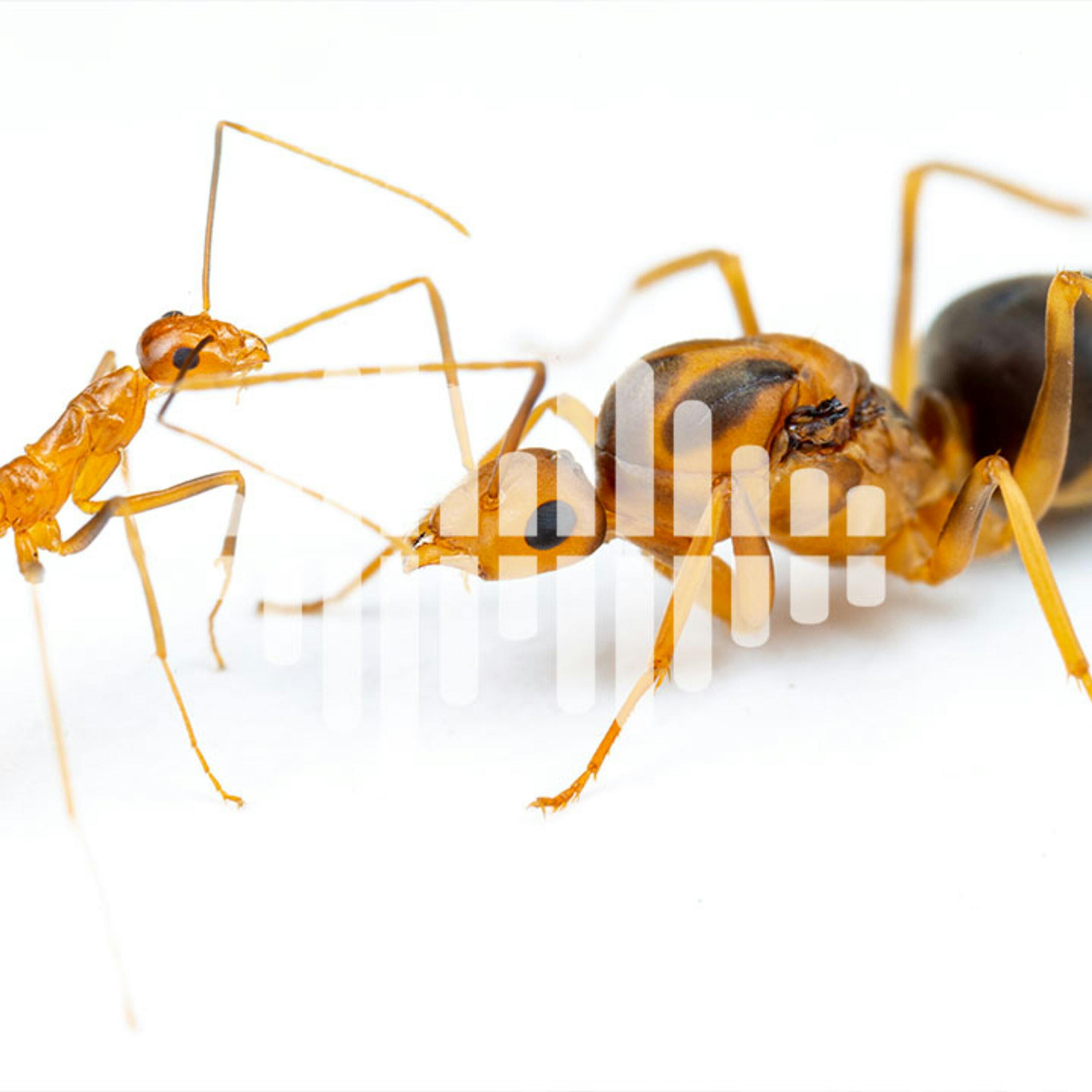
Why some countries, such as China, vaccinate flocks against bird flu but others don’t, and male ants that are always chimeras First up this week, highly pathogenic avian influenza is spreading to domestic flocks around the globe from migrating birds. Why don’t many countries vaccinate their bird herds when finding one case can mean massive culls? Staff News Writer Jon Cohen joins host Sarah Crespi to discuss the push and pull of economics, politics, and science at play in vaccinating poultry against bird flu. Next up, a crazy method of reproduction in the yellow crazy ants (Anoplolepis gracilipes). Hugo Darras, an assistant professor in the Institute of Organismic and Molecular Evolution at Johannes Gutenberg University, talks about how males of this species are always chimeras—which means their body is composed of two different cell lines, one from each parent. Read a related perspective. This week’s episode was produced with help from Podigy. About the Science Podcast [Image: The Wild Martin; Music: Jeffrey Cook] [alt: Queen and worker yellow crazy ants with podcast overlay] Authors: Sarah Crespi; Jon Cohen Episode page: https://www.science.org/doi/10.1126/science.adi0665 Learn more about your ad choices. Visit megaphone.fm/adchoices

How the Maya thought about the ancient ruins in their midst, and the science of Braille
On this week’s show: How people in the past thought about their own past, and a detailed look at how Braille is read First up this week, what did people 1000 years ago think about 5000-year-old Stonehenge? Or about a disused Maya temple smack dab in the middle of the neighborhood? Contributing Correspondent Lizzie Wade joins host Sarah Crespi to discuss how Mesoamerican sites are revealing new ways that ruins were incorporated into past peoples’ lives. Next up on this week’s show is a segment from the AAAS meeting on reading science and Braille. We hear from Robert Englebretson, an associate professor of linguistics at Rice University, about filling in a gap in reading science research when it comes to how Braille is read, written, and learned. This week’s episode was produced with help from Podigy. About the Science Podcast [Image: S. Crespi/Science; Music: Jeffrey Cook] [alt: Maya building with podcast overlay] Authors: Sarah Crespi; Lizzie Wade Episode page: https://www.science.org/doi/10.1126/science.adi0106 Learn more about your ad choices. Visit megaphone.fm/adchoices

New worries about Earth’s asteroid risk, and harnessing plants’ chemical factories
On this week’s show: Earth’s youngest impact craters could be vastly underestimated in size, and remaking a plant’s process for a creating a complex compound First up this week, have we been measuring asteroid impact craters wrong? Staff Writer Paul Voosen talks with host Sarah Crespi about new approaches to measuring the diameter of impact craters. They discuss the new measurements which, if confirmed, might require us to rethink just how often Earth gets hit with large asteroids. Paul also shares more news from the recent Lunar and Planetary Science Conference in Texas. Next up, pulling together all the enzymes used by a plant to make a vaccine adjuvant—a compound used to boost the efficacy of vaccines—in the lab. Anne Osbourn, a group leader and professor of biology at the John Innes Centre in Norwich, England, talks about why plants are so much better at making complex molecules, and an approach that allows scientists to copy their methods. This week’s episode was produced with help from Podigy. About the Science Podcast [Image: NASA/JPL; Music: Jeffrey Cook] [alt: Itturalde crater in Bolivia with podcast overlay] Authors: Sarah Crespi; Paul Voosen Episode page: https://www.science.org/doi/10.1126/science.adh9195 Learn more about your ad choices. Visit megaphone.fm/adchoices

An active volcano on Venus, and a concerning rise in early onset colon cancer
On this week’s show: Spotting volcanic activity on Venus in 30-year-old data, and giving context to increases in early onset colon cancer First up this week, a researcher notices an active volcano on Venus in data from the Magellan mission—which ended in 1994. News Staff Writer Paul Voosen joins host Sarah Crespi to discuss how to find a “fresh” lava flow in 30-year-old readings. Next up, a concerning increase in early onset colon cancer. Kimmie Ng, director of the Young-Onset Colorectal Cancer Center at the Dana-Farber Cancer Institute and associate professor of medicine at Harvard Medical School, is here to talk about how these early colon cancers—those diagnosed before age 50—are different from those diagnosed later in life. We also talk about what needs to be learned about diet, environment, and genetics to better understand this condition. This week’s episode was produced with help from Podigy. About the Science Podcast [Image: NASA; Music: Jeffrey Cook] [alt: Maat Mons volcano on Venus with podcast symbol overlay] Authors: Sarah Crespi; Paul Voosen Episode page: https://www.science.org/doi/10.1126/science.adh8158 Learn more about your ad choices. Visit megaphone.fm/adchoices

Compassion fatigue in those who care for lab animals, and straightening out ocean conveyor belts
On this week’s show: Compassion fatigue will strike most who care for lab animals, but addressing it is challenging. Also, overturning ideas about ocean circulation First up this week: uncovering compassion fatigue in those who work with research animals—from cage cleaners to heads of entire animal facilities. Host Sarah Crespi and Online News Editor David Grimm discuss how to recognize the anxiety and depression that can be associated with this work and what some institutions are doing to help. Featured in this segment: Preston Van Hooser Megan LaFollette Anneke Keizer Next up on the show, a segment from the annual meeting of AAAS (which publishes Science) on overturning assumptions in ocean circulation. Physical oceanographer Susan Lozier, dean of the College of Sciences at the Georgia Institute of Technology, talks with producer Kevin McLean about the limitations of the ocean conveyor belt model, and how new tools have been giving us a much more accurate view of how water moves around the world. This week’s episode was produced with help from Podigy. About the Science Podcast [Image: NASA/Goddard Space Flight Center Scientific Visualization Studio; Music: Jeffrey Cook] [alt: Global sea surface currents and temperature with podcast symbol overlay] Authors: Sarah Crespi; Kevin McLean; David Grimm Episode page: https://www.science.org/doi/10.1126/science.adh4938 Learn more about your ad choices. Visit megaphone.fm/adchoices

Battling bias in medicine, and how dolphins use vocal fry
On this week’s show: Researchers are finding new ways to mitigate implicit bias in medical settings, and how toothed whales use distinct vocal registers for echolocation and communication First up this week: how to fight unconscious bias in the clinic. Staff Writer Rodrigo Pérez Ortega talks with host Sarah Crespi about how researchers are attempting to fight bias on many fronts—from online classes to machine learning to finding a biomarker for pain. Next up on the show: a close look at toothed whale vocalization. Though we have known for more than 50 years that toothed whales such as orcas, sperm whales, and dolphins make diverse and useful sounds, how these noises are produced by their bodies has not been well understood. Coen Elemans, a professor in biology and head of the sound communication and behavior group at the University of Southern Denmark, joins Sarah to talk about using endoscopy and high-speed cameras as well as tissue samples and tracking data to learn how they achieve such amazing feats of sound. This week’s episode was produced with help from Podigy. About the Science Podcast [Image: Thumy Phan; Music: Jeffrey Cook] [alt: looking through glasses at a distorted face in what looks like a medical setting with podcast overlay] Authors: Sarah Crespi; Rodrigo Pérez Ortega Episode page: https://www.science.org/doi/10.1126/science.adh3706 About the Science Podcast: https://www.science.org/content/page/about-science-podcast Learn more about your ad choices. Visit megaphone.fm/adchoices

Shrinking MRI machines, and the smell of tsetse fly love
On this week’s show: Portable MRI scanners could revolutionize medical imaging, and pheromones offer a way to control flies that spread disease First up this week: shrinking MRI machines. Staff Writer Adrian Cho talks with host Sarah Crespi about how engineers and physicists are teaming up to make MRI machines smaller and cheaper. Next up on the show, the smell of tsetse fly love. Producer Kevin McLean talks with Shimaa Ebrahim, a postdoctoral researcher in the department of molecular, cellular, and developmental biology at Yale University, about understanding how tsetse flies use odors to attract one another and how this can be used to prevent the flies from transmitting diseases such as African sleeping sickness. This week’s episode was produced with help from Podigy. About the Science Podcast [Image: GEOFFREY ATTARDO/UNIVERSITY OF CALIFORNIA, DAVIS; Music: Jeffrey Cook] [alt: tsetse fly with podcast symbol overlay] Authors: Sarah Crespi; Kevin McLean; Adrian Cho Episode page: https://www.science.org/doi/10.1126/science.adh3128 About the Science Podcast: https://www.science.org/content/page/about-science-podcast Learn more about your ad choices. Visit megaphone.fm/adchoices

Earth’s hidden hydrogen, and a trip to Uranus
On this week’s show: The hunt for natural hydrogen deposits heats up, and why we need a space mission to an ice giant First up this week: a gold rush for naturally occurring hydrogen. Deputy Editor Eric Hand joins host Sarah Crespi to discuss drilling for hidden pockets of hydrogen, which companies are just now starting to explore as a clean energy option. Next up, big plans for a mission to Uranus. Kathleen Mandt, a planetary scientist at the Johns Hopkins University Applied Physics Laboratory, shares what a mission to Uranus could tell us about the formation of our Solar System and all these exoplanets we keep finding. This week’s episode was produced with help from Podigy. About the Science Podcast [Image: Austin Fisher; Music: Jeffrey Cook] [alt: Uranus illustration with podcast symbol overlay] Authors: Sarah Crespi; Eric Hand Episode page: https://www.science.org/doi/10.1126/science.adh1873 Learn more about your ad choices. Visit megaphone.fm/adchoices

Using sharks to study ocean oxygen, and what ancient minerals teach us about early Earth
On this week’s show: Shark tags to measure ocean deoxygenation, and zircons and the chemistry of early Earth First up this week: using sharks to measure ocean deoxygenation. Contributing Correspondent Warren Cornwall joins us to talk about a group of researchers putting data logging tags on sharks in order to study how climate change is affecting oxygen levels in some of the ocean’s darkest depths. Next up, what can 4-billion-year-old minerals teach us about chemistry on early Earth? Producer Meagan Cantwell talks to geochemist Dustin Trail about using minerals called zircons to deduce the chemical properties of the early hydrothermal pools where life began. This week’s episode was produced with help from Podigy. About the Science Podcast [Image: David Salvatori/VWPICS/Alamy Stock Photo; Music: Jeffrey Cook] [alt: Underwater photo of mako shark with podcast symbol overlay] Authors: Sarah Crespi; Warren Cornwall; Meagan Cantwell Learn more about your ad choices. Visit megaphone.fm/adchoices

Visiting a mummy factory, and improving the IQ of … toilets
On this week’s show: New clues to the chemicals used for mummification, and the benefits and barriers to smart toilets First up this week: What can we learn from a mummy factory? Contributing Correspondent Andrew Curry talks with host Sarah Crespi about mummy chemistry and why we don’t know much about what was used to preserve these ancient bodies. Online News Editor Michael Price makes a special appearance. Next up, how having a smart toilet can contribute to your health. Seung-Min Park, an instructor in the Department of Urology at Stanford University School of Medicine, wrote this week in Science Translational Medicine about the powers of data-collecting toilets to improve health and the psychological and ethical barriers to adopting a smart toilet of your very own. This week’s episode was produced with help from Podigy. [Image: Portugal2004/iStock; Music: Jeffrey Cook] [alt: toilet with podcast symbol overlay] Authors: Sarah Crespi; Andrew Curry; Michael Price Episode page: https://www.science.org/doi/10.1126/science.adg9654 About the Science Podcast: https://www.science.org/content/page/about-science-podcast Learn more about your ad choices. Visit megaphone.fm/adchoices

Wolves hunting otters, and chemical weathering in a warming world
On this week’s show: When deer are scarce these wolves turn to sea otters, and chemical weathering of silicates acts as a geological thermostat First up on this week’s show we have a story about a group of Alaskan wolves that has switched to eating sea otters as deer populations have dwindled. Science journalist Jack Tamisiea tells host Sarah Crespi about some of the recently published work on this diet shift, and wildlife biologist Gretchen Roffler weighs in on the conditions on the island where this is happening. Also on this week’s show: Chemical weathering and the global carbon cycle. Sarah speaks with Susan Brantley, Evan Pugh university professor in the Earth and Environmental Systems Institute and Department of Geosciences at Pennsylvania State University, about how weathering of silicates in rocks pulls carbon dioxide from the atmosphere. They talk about how this temperature-sensitive process could increase as Earth warms, as well as the potential and limitations of this effect on the global carbon budget. Take the podcast audience survey here. This week’s episode was produced with help from Podigy. About the Science Podcast [Image: Landon Bazeley; Music: Jeffrey Cook] [alt: Wolf pup pulling a sea otter carcass up a rocky beach with podcast symbol overlay] Authors: Sarah Crespi; Kevin McLean; Jack Tamisiea Learn more about your ad choices. Visit megaphone.fm/adchoices

Bad stats overturn ‘medical murders,’ and linking allergies with climate change
Statisticians fight bad numbers used in medical murder trials, and the state of allergy science First up on this week’s show, we have a piece on accusations of medical murder. Contributing Correspondent Cathleen O’Grady joins host Sarah Crespi to discuss her story on how statisticians are weighing in on cases where nurses and doctors are convicted of murdering patients based on bad statistics. This segment was produced by Kevin McLean with sound design by James Rowlands. Also on this week’s show: Allergies are on the rise and this increase is linked with climate change. Sarah speaks with Kari Nadeau, Naddisy Foundation endowed professor of medicine and pediatrics at Stanford University, about her review in Science Translational Medicine on the status of allergy science, and how recommendations have changed from when to give children peanuts to opting for sublingual exposure therapy. Take the podcast audience survey at: https://www.surveymonkey.com/r/TLKCHC8 This week’s episode was produced with help from Podigy. [Image: bobtphoto/iStock; Music: Jeffrey Cook] [alt: ragweed field with podcast symbol overlay] Authors: Sarah Crespi; Kevin McLean; Cathleen O’Grady Episode page: https://www.science.org/doi/10.1126/science.adg7524 About the Science Podcast: https://www.science.org/content/page/about-science-podcast Learn more about your ad choices. Visit megaphone.fm/adchoices

Peering beyond the haze of alien worlds, and how failures help us make new discoveries
Data on hazes and clouds may be key to understanding exoplanets, and NextGen letter writers share the upside of failure Hazes and clouds could keep exoplanets’ secrets hidden, unless researchers can re-create them here on Earth. After celebrating JWST and its ability to look far back in time and help us look for habitable exoplanets as the 2022 Science Breakthrough of the Year, News Intern Zack Savitsky talks with host Sarah Crespi about an overlooked problem with using telescopes to examine exoplanets’ atmospheres. What was your greatest mistake? In a chat with producer Kevin McLean, Letters Editor Jennifer Sills shares stories from NextGen Voices about failures that led them in unexpected directions in their science careers. Take the podcast audience survey at: https://www.surveymonkey.com/r/TLKCHC8 This week’s episode was produced with help from Podigy. [Image: NASA/Ames/JPL-Caltech; Music: Jeffrey Cook] [alt: exoplanet with cloudy and hazy atmosphere with podcast symbol overlay] Authors: Sarah Crespi; Kevin McLean; Jennifer Sills; Zack Savitsky Episode page: https://www.science.org/doi/10.1126/science.adg6078 About the Science Podcast: https://www.science.org/content/page/about-science-podcast Learn more about your ad choices. Visit megaphone.fm/adchoices

A controversial dam in the Amazon unites Indigenous people and scientists, and transplanting mitochondria to treat rare diseases
Keeping an eye on the largest hydroelectric project in the Amazon basin, and helping patients with deletions in their mitochondrial DNA We are starting off the new year with producer Kevin McLean and freelance science journalist Sofia Moutinho. They discuss a controversial dam in the Brazilian Amazon and how Indigenous peoples and researchers are trying to monitor its impact. Then, host Sarah Crespi speaks with Elad Jacoby, an expert in pediatric hematology and oncology at the Sheba Medical Center and Tel Aviv University, about the many wonders of mitochondria. In a recent Science Translational Medicine paper, his team took advantage of the fact that mitochondria are almost exclusively inherited from our mothers to transfer mothers’ mitochondria into their children as treatment for mitochondrial genome deletions. Take our audience survey at: https://www.surveymonkey.com/r/TLKCHC8 This week’s episode was produced with help from Podigy. [Image: Dado Galdieri/Hilaea Media; Music: Jeffrey Cook] [alt: two fishermen in a boat with podcast symbol overlay] Authors: Sarah Crespi; Kevin McLean; Sofia Moutinho Episode page: https://www.science.org/doi/10.1126/science.adg5434 About the Science Podcast: https://www.science.org/content/page/about-science-podcast Learn more about your ad choices. Visit megaphone.fm/adchoices
Year in review 2022: Best of online news, and podcast highlights
On this week’s show: A rundown of our favorite online news stories, and some of our favorite moments on the podcast this year This is our last show of the year and it’s a fun one! Dave Grimm, our online news editor, gives a tour of the top online stories of the year, from playful bumble bees to parasite-ridden friars. Then, host Sarah Crespi looks back at some amazing conversations from the podcast this year, including answers to a few questions she never thought she’d be asking. Highlights include why we aren’t just shooting nuclear waste into space, and how mapping ant diversity is like mapping the early universe. Past shows mentioned in this episode: What saliva tells babies about human relationships A global map of ant diversity Gut bacteria that nourish hibernating squirrels Securing nuclear waste for 100,000 years Why rabies remains Why sunscreen is bad for coral Saving the Spix’s macaw Waking up bacterial spores Collecting spider silks Don’t miss this year’s podcast series on books in food, science, and agriculture, hosted by Angela Saini. Take our audience survey at https://www.science.org/podcasts. This week’s episode was produced with help from Podigy. [Image: Peter Trimming/Flickr; Music: Jeffrey Cook] [alt: squirrel relaxing on a branch with podcast symbol overlay] Authors: Sarah Crespi; David Grimm Episode page: https://www.science.org/doi/10.1126/science.adg3947 About the Science Podcast: https://www.science.org/content/page/about-science-podcast Learn more about your ad choices. Visit megaphone.fm/adchoices

Breakthrough of the Year, and the best in science books
On this week’s show: Science’s Breakthrough of the Year and runners-up, plus the top books in 2022 You might not be surprised by this year’s breakthrough, but hopefully you won’t guess all our runners-up. Producer Meagan Cantwell is joined by Greg Miller, who edited the section this year. The two discuss the big winner and more. In our second segment, host Sarah Crespi is joined by Science Books Editor Valerie Thompson to chat about the best books in science from this year, and one movie. Books mentioned in this segment: Otherlands Review | Buy How Far the Light Reaches: A Life in Ten Sea Creatures Review | Buy An Immense World: How Animal Senses Reveal the Hidden Realms Around Us Buy A House Between Earth and the Moon Review | Buy Is Science Enough? Forty Critical Questions About Climate Justice Review | Buy What Climate Justice Means and Why We Should Care Review | Buy Stolen Science: Thirteen Untold Stories of Scientists and Inventors Almost Written out of History Review | Buy The Science Spell Book: Magical Experiments for Kids Review | Buy Fire of Love (Film) Trailer The Exceptions: Nancy Hopkins, MIT, and the Fight for Women in Science (2023) Buy Don’t miss this year’s podcast series on books in food, science, and agriculture, hosted by Angela Saini. Take our audience survey at: https://www.science.org/podcasts This week’s episode was produced with help from Podigy. [Image: NASA; ESA; CSA; STScI; Joseph DePasquale, Alyssa Pagan, and Anton M. Koekemoer/STScI Music: Jeffrey Cook] [alt: the birth of a star with podcast symbol overlay] Authors: Sarah Crespi; Meagan Cantwell; Greg Miller; Valerie Thompson Episode page: https://www.science.org/doi/10.1126/science.adg2633 About the Science Podcast: https://www.science.org/content/page/about-science-podcast Learn more about your ad choices. Visit megaphone.fm/adchoices

The state of science in Ukraine, and a conversation with Anthony Fauci
On this week’s show: The impact of war on science in Ukraine, and a conversation with Anthony Fauci as he prepares to step down Some scientists in Ukraine have been risking their lives to protect scientific facilities, collections, and instruments amid the war. Contributing Correspondent Richard Stone traveled to Kharkiv and Chornobyl earlier this year to meet researchers living and working through the conflict. He spoke with host Sarah Crespi to share some of their stories. Then we have a conversation with Anthony Fauci, who will be stepping down from his government roles this month after more than 50 years in public service. He shares his thoughts on the ongoing challenges of communicating about science and public health, combating misinformation, and his goals for the future with Science Editor-and-Chief Holden Thorp. Take our audience survey at: https://www.science.org/podcasts This week’s episode was produced with help from Podigy. [Image: Rich Stone; Music: Jeffrey Cook] [alt: photo of rubble damaged during war in Ukraine with building spire in background] Authors: Sarah Crespi; Rich Stone; Kevin McLean; Holden Thorp Episode page: https://www.science.org/doi/10.1126/science.adg1712 About the Science Podcast: https://www.science.org/content/page/about-science-podcast Learn more about your ad choices. Visit megaphone.fm/adchoices

A genetic history of Europe’s Jews, and measuring magma under a supervolcano
On this week’s show: A medieval German cemetery yields clues to Jewish migrations in Europe, and supercomputers help researchers estimate magma under Yellowstone First up this week on the podcast, we explore the genetic history of Jewish people in Europe. Contributing Correspondent Andrew Curry talks with host Sarah Crespi about researchers working with rabbis and the local Jewish community to apply new techniques to respectfully study remains in a medieval Jewish cemetery in Germany. We also have a story on how much magma has accumulated inside Yellowstone National Park’s supervolcano. Producer Meagan Cantwell talks with Ross Maguire, an assistant professor in the geology department at University of Illinois, Urbana-Champaign, about using supercomputers to get a clearer picture of the volcanic system’s subsurface. Although this new study shows more magma than previous estimates, it’s still not nearly enough for an eruption anytime soon. This week’s episode was produced with help from Podigy. [Image: Eric Vaughn/Flickr; Music: Jeffrey Cook] [alt: photo of sunset over Yellowstone National Park with podcast overlay symbol] Authors: Sarah Crespi; Meagan Cantwell; Andrew Curry Episode page: https://www.science.org/doi/10.1126/science.adg0498 About the Science Podcast: https://www.science.org/content/page/about-science-podcast Learn more about your ad choices. Visit megaphone.fm/adchoices

Artificial intelligence takes on Diplomacy, and how much water do we really need?
On this week’s show: Meta’s algorithm tackles both language and strategy in a board game, and measuring how much water people use on a daily basis First up this week on the podcast, artificial intelligence (AI) wins at the game Diplomacy. Freelance science journalist Matthew Hutson joins host Sarah Crespi to talk about the advances needed for an AI to win a game that requires cooperation and trust between human and AI players. Next, we hear about how much water people need to stay hydrated. It’s not the eight glasses a day recommendation we’ve heard so much about. Herman Pontzer, a professor in Duke University’s Department of Evolutionary Anthropology and the Duke Global Health Institute, talks about a study that involved recording water turnover from 5000 people around the world. It turns out daily water needs vary from person to person and place to place. This week’s episode was produced with help from Podigy. [Image: manus1550/iStock; Music: Jeffrey Cook] [alt: photo of a stack of drinking water bottles with podcast overlay symbol] Authors: Sarah Crespi; Matt Hutson Episode page: https://www.science.org/doi/10.1126/science.adf8979 About the Science Podcast: https://www.science.org/content/page/about-science-podcast Learn more about your ad choices. Visit megaphone.fm/adchoices

Mammoth ivory trade may be bad for elephants, and making green electronics with fungus
On this week’s show: The potentially harmful effects of prehistoric ivory on present-day elephants, and replacing polymers in electronics with fungal tissue First up this week on the podcast, we hear about the effect of mammoth and mastodon ivory on the illegal elephant ivory trade. Online News Editor Michael Price joins host Sarah Crespi to discuss how as melting permafrost has uncovered fossilized ivory from these extinct creatures, more has entered the ivory trade. The question is: Does the availability of this type of ivory reduce the demand for ivory from elephants, or does it endanger them more? Next, making electronics greener with fungus with Doris Danninger, a Ph.D. student in the Soft Matter Physics Division at the Institute of Experimental Physics at Johannes Kepler University, Linz. Doris and Sarah discuss the feasibility of replacing the bulky backing of chips and the casing of batteries with sheets of fungal tissue to make flexible, renewable, biodegradable electronics. This week’s episode was produced with help from Podigy. [Image: RudiHulshof/iStock; Music: Jeffrey Cook] [alt: photo of an elephant tusk with point facing the camera with podcast overlay symbol] Authors: Sarah Crespi; Michael Price Episode page: https://www.science.org/doi/10.1126/science.adf8340 About the Science Podcast: https://www.science.org/content/page/about-science-podcast Learn more about your ad choices. Visit megaphone.fm/adchoices

Kurt Vonnegut’s contribution to science, and tunas and sharks as ecosystem indicators
On this week’s show: How sci-fi writer Kurt Vonnegut foresaw many of today’s ethical dilemmas, and 70 years of tunas, billfishes, and sharks as sentinels of global ocean health First up this week on the podcast, we revisit the works of science fiction author Kurt Vonneugt on what would have been his 100th birthday. News Intern Zack Savitsky and host Sarah Crespi discuss the work of ethicists, philosophers, and Vonnegut scholars on his influence on the ethics and practice of science. Researchers featured in this segment: Peter-Paul Verbeek, a philosopher of science and technology at the University of Amsterdam and chair of the World Commission on the Ethics of Scientific Knowledge and Technology David Koepsell, a philosopher of science and technology at Texas A&M University, College Station Christina Jarvis, a Vonnegut scholar at the State University of New York, Fredonia, and author of the new book Lucky Mud & Other Foma: A Field Guide to Kurt Vonnegut’s Environmentalism and Planetary Citizenship Sheila Jasanoff, a science studies scholar at Harvard University Next, producer Kevin McLean discusses the connection between fishing pressure and extinction risk for large predatory fish such as tunas and sharks. He’s joined by Maria José Juan Jordá, a postdoc at the Spanish Institute for Oceanography, to learn what a new continuous Red List Index using the past 70 years of fisheries data can tell us about the effectiveness and limits of fishing regulations. Finally, in a sponsored segment from the Science/AAAS Custom Publishing Office, Sean Sanders, director and senior editor for custom publishing, interviews Joseph Hyser, assistant professor in the Department of Molecular Virology and Microbiology at Baylor College of Medicine about his use of wide-field fluorescence live cell microscopy to track intercellular calcium waves created following rotavirus infection. This segment is sponsored by Nikon. This week’s episode was produced with help from Podigy. [Image: richcarey/istock; Music: Jeffrey Cook] [alt: underwater photo of a swirling mass of tunas, with podcast overlay symbol] Authors: Sarah Crespi; Kevin McLean; Zack Savitsky Episode page: https://www.science.org/doi/10.1126/science.adf7398 About the Science Podcast: https://www.science.org/content/page/about-science-podcast Learn more about your ad choices. Visit megaphone.fm/adchoices

Cities as biodiversity havens, and gene therapy for epilepsy
On this week’s show: How urban spaces can help conserve species, and testing a gene therapy strategy for epilepsy in mice First up on the podcast, we explore urban ecology’s roots in Berlin. Contributing Correspondent Gabriel Popkin joins host Sarah Crespi to discuss turning wastelands and decommissioned airports into forests and grasslands inside the confines of a city. Next, we hear about a gene therapy strategy for epilepsy. Yichen Qiu, a recently graduated Ph.D. student and researcher at University College London, talks about introducing a small set of genes into neurons in mice. These genes detect hyperactivity in the brain and respond by quieting the cell, ultimately suppressing seizures. This week’s episode was produced with help from Podigy. [Image: Maurice Weiss; Music: Jeffrey Cook] [alt: dim photo of the forest of the Schöneberger Südgelände with old railroad tracks receding into the distance, with podcast overlay symbol] Authors: Sarah Crespi; Gabriel Popkin Episode page: https://www.science.org/doi/10.1126/science.adf6190 About the Science Podcast: https://www.science.org/content/page/about-science-podcast Learn more about your ad choices. Visit megaphone.fm/adchoices

Space-based solar power gets serious, AI helps optimize chemistry, and a book on food extinction
On this week’s show: Cheaper launches could make solar power satellites a reality, machine learning helps chemists make small organic molecules, and a book on the extinction of foods First up on the podcast, space-based solar power gets closer to launch. Staff Writer Daniel Clery talks with host Sarah Crespi about how reusable rockets bring the possibility of giant solar array satellites that beam down gigawatts of uninterrupted power from space. After that, we hear about small organic molecule synthesis. Making large organic molecules such as proteins and DNA can be a cinch for chemists, but making new smaller organic molecules is tough—partially because optimized general reaction conditions are hard to come by. Nicholas Angello, a graduate research assistant and Department of Defense National Defense Science and Engineering Graduate fellow in the Burke group at the University of Illinois, Urbana-Champaign, talks about an approach that uses robots and machine learning to better optimize these reaction conditions. Also in the episode: the last in our series of books on food and agriculture. This month, host Angela Saini talks with author Dan Saladino about his book Eating to Extinction: The World’s Rarest Foods and Why We Need to Save Them. This week’s episode was produced with help from Podigy. [Image: NASA; Music: Jeffrey Cook] [alt: drawing of satellite solar panels with podcast overlay symbol] Authors: Sarah Crespi; Dan Clery; Angela Saini Episode page: https://www.science.org/doi/10.1126/science.adf4939 About the Science Podcast: https://www.science.org/content/page/about-science-podcast Learn more about your ad choices. Visit megaphone.fm/adchoices