Show overview
Science From the Fringe has been publishing since 2024, and across the 2 years since has built a catalogue of 58 episodes. That works out to roughly 55 hours of audio in total. Releases follow a fortnightly cadence.
Episodes typically run thirty-five to sixty minutes — most land between 44 min and 1h 11m — though episode length varies meaningfully from one episode to the next. None of the episodes are flagged explicit by the publisher. It is catalogued as a EN-language Science show.
The show is actively publishing — the most recent episode landed earlier today, with 19 episodes already out so far this year.
From the publisher
Conversations with fearless scientists, policy experts, and journalists who are defying dogma and defending discovery. sciencefromthefringe.substack.com
Latest Episodes
View all 58 episodesScientific Responsibility in Research on Dangerous Pathogens — Part 2: COVID-19 and What Came Next
Scientific Responsibility in Research on Dangerous Pathogens — Part 1: How We Got Here
A “Bloody Good” Gain-of-Function Policy (In Defense of Virology - Episode 12)
The EPA Took It Down, Roger Put It Back (In Defense of Climate Change - Episode 7)
Tim Hunt - Moving the Goalposts or Protecting Patients?
Science For Sale (In Defense of Climate Change - Episode 6)
Europe's Deadly Aversion to Air Conditioning (In Defense of Climate Change - Episode 5)
Anthony Bellotti - The Price of Principle: Holding NIH Accountable
'Cowards Die Many Times' (In Defense of Virology - Episode 11)
'The Goal Is Not Your Damn Career' (In Defense of Virology - Episode 10)
The Climate Apocalypse Isn’t Around the Corner (In Defense of Climate Change - Episode 4)
'An Inconvenient Truth' - 20 Years Later (In Defense of Climate Change - Episode 3)
The Problem With Peer Review (In Defense of Virology - Episode 9)
In this episode of In Defense of Virology, Bryce Nickels speaks with virologist Simon Wain-Hobson about Simon’s essay, “WHO Wordplay on COVID Origins,” which critiques the WHO SAGO report and a related Nature commentary on what is known about the origins of COVID-19.The discussion begins with SAGO’s claim that most peer-reviewed evidence supports a natural origin, while acknowledging that key intelligence and data remain unavailable. Simon argues this creates a misleading sense of certainty—presenting a conclusion while admitting critical gaps.The conversation then turns to peer review, emphasizing that it is not a final stamp of truth but the beginning of quality control. Publication does not settle questions; real scrutiny happens afterward. Both Simon and Bryce note that top journals can give findings outsized authority before they are fully validated.They argue that in politically sensitive areas like gain-of-function research and COVID origins, the publication system can shift from gatekeeping to gate blocking, limiting debate and shaping consensus prematurely. This has downstream effects, as institutions like SAGO and the Government Accountability Office rely heavily on published literature that may itself be incomplete or biased.The episode also highlights the value of work outside traditional journals, pointing to independent researchers who have contributed meaningful analyses. Dismissing such work solely for lacking peer review, Simon argues, is circular when the formal system restricts what gets published.A key theme is openness versus defensiveness. Drawing on his experiences in the HIV-era experience, Simon argues that confronting difficult hypotheses openly builds trust, while suppressing debate erodes it. This is reflected in the muted in-person response to Matt Ridley’s NIH lecture on the likely lab origin of SARS-CoV-2, which contrasts with stronger criticism expressed online.The episode concludes with potential reforms, including reducing the gatekeeping role of journals and expanding incentives for replication. Both emphasize that science functions best when dissent is allowed, evidence is openly examined, and no single institution defines the boundaries of truth.(recorded March 25, 2026) Get full access to Science From the Fringe at sciencefromthefringe.substack.com/subscribe
'Stick and Jab' (In Defense of Climate Change - Episode 2)
In the second episode of In Defense of Climate Change, Bryce Nickels speaks with climate policy scholar Roger Pielke Jr. about his recent review of Science Under Siege (SUS), a book by Michael Mann and Peter Hotez arguing that an “anti-science movement” threatens society.Roger argues that SUS is less a serious analysis than a partisan manifesto—one that treats political disagreement, especially from Republicans, as a form of scientific heresy. A central theme is the book’s use of terms like “anti-science cabal” and “anti-science ecosystem.” He contends that these categories are vague and elastic, functioning less as analytic concepts than as labels for people the authors oppose. Rather than clarifying how science is distorted in public life, he suggests, the book collapses disagreement into moral warfare.The episode also explores the broader politicization of science. Roger argues that parts of the scientific community have grown too comfortable embracing openly partisan narratives, thereby risking science’s credibility as a public enterprise meant to serve everyone—not just one political faction. At the same time, he criticizes heavy-handed political attacks on scientific institutions, arguing that restoring trust will require greater openness, pluralism, and tolerance for disagreement.(recorded March 31, 2026) Get full access to Science From the Fringe at sciencefromthefringe.substack.com/subscribe
The Best Kept Secret in Climate Science (In Defense of Climate Change - Episode 1)
Climate change is one of the most politically charged issues in science, often framed as a choice between denial and apocalypse. In the first episode of In Defense of Climate Change, Bryce Nickels speaks with climate policy scholar Roger Pielke Jr. about why that framing distorts the realities of climate science.At the center of the conversation is the role of scenarios in climate research—what Roger calls “the best kept secret in climate science.” Climate models do not predict the future; they simulate how the climate would respond under different assumptions about how the world develops, including population growth, economic activity, and energy use. These assumptions, known as emissions scenarios, determine how much carbon dioxide is emitted and, in turn, how much warming is projected.Roger explains that many of the most widely used scenarios—particularly those developed in the early 2000s—were built around assumptions of rapidly expanding coal use. These scenarios helped produce some of the most alarming projections of future warming and came to dominate both the scientific literature and public discussion. However, the world has not followed that trajectory, and many of these scenarios are now outdated—even as they continue to be used in current research.He emphasizes that climate change is real and serious, and that scenarios are a necessary tool for understanding possible futures. But he argues that failing to distinguish between plausible and implausible scenarios—and to update those assumptions as the world changes—can distort how climate science is interpreted.The episode also examines how institutional and methodological factors can slow the updating of scenarios, allowing outdated assumptions to persist in research, media coverage, and policy discussions.(recorded March 12, 2026) Get full access to Science From the Fringe at sciencefromthefringe.substack.com/subscribe
The Experiment That Could Have Killed Billions (In Defense of Virology - Episode 8)
In the eighth episode of In Defense of Virology, distinguished virologist Simon Wain-Hobson joins host Bryce Nickels to discuss Simon’s recent essay, “You Couldn’t Make Body Bags Fast Enough.” The essay examines a largely overlooked gain-of-function influenza experiment involving the avian virus H7N1 (Sutton et al., Airborne transmission of highly pathogenic H7N1 influenza virus in ferrets, published in Journal of Virology, June 15, 2014).In that study, researchers engineered an H7N1 influenza virus capable of airborne transmission in ferrets while retaining high lethality, killing three of five infected animals. Simon argues that if a virus with similar properties spread among humans, the consequences could be catastrophic.The conversation revisits earlier gain-of-function controversies—most notably the 2012 H5N1 experiments by Ron Fouchier and Yoshihiro Kawaoka—and asks why the H7N1 work drew far less scrutiny. Simon points to structural pressures within science—funding incentives, prestige journals, and deference to authority—that can discourage open criticism of risky research. He also discusses the role of journals in publishing studies with clear dual-use implications.Bryce and Simon also discuss the incentives that shape scientific behavior. They argue that current funding structures and the pursuit of high-profile publications can normalize increasingly risky experiments. The episode concludes with a call for clearer boundaries between “cutting-edge” research that benefits the public and “bleeding-edge” work that may put lives at risk—emphasizing that protecting the public from dangerous research requires confronting difficult questions about responsibility, transparency, and acceptable risk.(recorded March 8, 2026) Get full access to Science From the Fringe at sciencefromthefringe.substack.com/subscribe
Anish Koka - Why Vinay Prasad Didn’t Last at the FDA
In this episode of Science from the Fringe, host Bryce Nickels speaks with cardiologist and medical commentator Dr. Anish Koka about his recent article examining the forces that led to physician-scientist Vinay Prasad’s departure from the U.S. Food and Drug Administration (FDA). They discuss how Prasad’s efforts to strengthen evidentiary standards for drug approvals quickly ran up against powerful political, financial, and institutional interests. The conversation explores how his brief tenure became a case study in the difficulty of reforming institutions where scientific standards, patient desperation, political pressure, and financial incentives collide.As Anish explains, Vinay Prasad is an unusually independent thinker within academic medicine who built a reputation challenging weak evidentiary standards for drug approvals long before entering government. Once at the FDA, he attempted to raise those standards—particularly for vaccines and costly therapies approved on limited or indirect evidence. Those efforts quickly triggered backlash from pharmaceutical companies, investors, patient advocacy groups, biotech media, and political actors with stakes in the approval pipeline.Anish walks through a detailed timeline of the flashpoints that defined Prasad’s short tenure: disputes over gene therapies for rare diseases, conflicts with companies such as Sarepta, Moderna, and UniQure, and broader debates about how regulators should weigh desperate patient demand against uncertain clinical evidence. He explains how controversial trial designs—such as reliance on historical controls or small datasets—can allow extremely expensive treatments to reach the market without clear proof they improve patient outcomes. In his view, Prasad’s push to tighten evidentiary standards exposed deeper structural problems in the drug-approval system.The conversation also explores the political and media dynamics surrounding Prasad’s tenure, including accusations that he created “chaos” at the agency, personal attacks, and media leaks that intensified pressure on FDA leadership. Bryce and Anish argue that Prasad’s willingness to publicly take responsibility for regulatory decisions—and to challenge entrenched interests—made him an unusually rare figure in Washington.The episode concludes with a broader discussion about incentives in drug regulation: the influence of pharmaceutical profits, the vulnerability of rare-disease communities to exploitation, and whether meaningful reform of the FDA’s approval process is possible from within the current system. Despite Prasad’s departure, Anish argues that his brief tenure exposed important weaknesses at the intersection of science, regulation, industry, and media.(recorded March 8, 2026)Timestamps00:31 – Introducing Anish Koka and the Vinay Prasad story02:12 – Why Prasad’s FDA appointment was surprising03:20 – Prasad’s background and COVID-era break from consensus04:24 – The core issue: declining evidentiary standards at FDA06:41 – Prasad’s integrity and inevitable clash with the system09:57 – Was Prasad set up?12:08 – Why Peter Marks mattered politically13:19 – Prasad’s new vaccine approval framework14:18 – Sarepta and weak evidence in rare disease drugs17:13 – Media leaks and the role of Stat News19:33 – Marty Makary backs Prasad20:05 – “Bad politics” or principled regulator?21:58 – The Moderna dispute over vaccine evidence23:51 – Accountability and why Prasad stood out27:49 – Personal attacks and mounting pressure28:09 – The UniQure controversy30:53 – What a sham control is33:55 – The problem with historical controls36:00 – Who decides trial matching?38:00 – Media narratives of “chaos” at FDA40:19 – Political pressure from Congress42:39 – The chain of events leading to Prasad’s exit45:04 – Rare disease desperation and potential exploitation49:03 – What Prasad exposed about the FDA ecosystem50:45 – The rare disease approval loophole53:45 – Investors, incentives, and distorted evidence54:13 – Why few would want Prasad’s job54:39 – Final reflections on integrity and institutional pressureintro and outro by Tess Parks Get full access to Science From the Fringe at sciencefromthefringe.substack.com/subscribe
Engineering Consensus on COVID Origins (In Defense of Virology - Episode 7)
In the seventh episode of In Defense of Virology, distinguished virologist Simon Wain-Hobson discusses the science (or lack thereof) behind two of the most influential publications on the origin of SARS-CoV-2: “The Proximal Origin of SARS-CoV-2” (“Proximal Origin,” published in Nature Medicine on March 17, 2020) and “Statement in Support of the Scientists, Public Health Professionals, and Medical Professionals of China Combating COVID-19” (“Calisher et al.,” published in The Lancet on March 7, 2020).These publications were instrumental in establishing the false narrative that the weight of scientific evidence strongly favored a natural origin over a laboratory origin. While both papers have been widely criticized for years (including by Science From the Fringe host Bryce Nickels, who has been part of multiple calls for Proximal Origin to be retracted - see, Proximal Origin Retraction Request #1; Proximal Origin Retraction Request #2; Petition to Retract Proximal Origin), Simon’s comments in this episode, including his own call for their retraction, represent one of the strongest condemnations of these papers from a member of the virology community itself. The conversation concludes with a discussion of the importance of accountability in cases (such as “Proximal Origin” and “Calisher et al.”) where established scientific norms are violated in such an odious manner.This episode serves as a companion to Simon’s essay, “Distal truths,” in which he elaborates on these arguments in written form.(recorded February 2, 2026) Get full access to Science From the Fringe at sciencefromthefringe.substack.com/subscribe
“Really Scared” ... But Not Enough to Act (In Defense of Virology - Episode 6)
In the sixth episode of In Defense of Virology, Rutgers professor and Science From the Fringe host Bryce Nickels speaks with distinguished virologist Simon Wain-Hobson about a potentially catastrophic biosafety issue: the human H2N2 influenza virus is not classified as a federal select agent, yet live samples remain stored in laboratory freezers around the world. The discussion is prompted by Simon’s recent essay, “The virus not on the Select Agent list.”The discussion centers on a concerning exchange between NIH Director Jay Bhattacharya and NIAID Acting Director Jeffrey Taubenberger on an August 2025 episode of The Director’s Desk podcast. During that conversation, Taubenberger—a prominent influenza researcher best known for his role in the highly controversial resurrection of the deadly 1918 “Spanish flu” virus—said that the virus responsible for the 1957 pandemic, H2N2, poses a serious concern. He noted that since 1968, no one has been exposed to this virus, even though it was fully adapted to humans. Despite this, H2N2 is not a select agent. Taubenberger explained that his lab voluntarily handles it under the same conditions as the 1918 virus, though such precautions are not required, and acknowledged that H2N2 likely remains in clinical, diagnostic, and basic virology laboratory freezers around the world. He admitted that this situation “really scares” him, since most of the global population born after 1968 lacks immunity to H2N2—a virus known to have already caused a pandemic.Simon highlights Taubenberger’s striking acknowledgment that live H2N2 stocks persist in numerous laboratories without select agent designation or enhanced biosafety requirements. This stands in sharp contrast to the 1918 influenza virus—reconstructed by Taubenberger himself—which is designated as a Tier 1 select agent and subject to the highest level of regulatory control. Given the well-documented record of laboratory accidents, Simon argues that keeping H2N2 stocks under minimal oversight poses an unacceptable risk of a lab-acquired pandemic.The episode questions why, if Taubenberger himself is “really scared” by the existence of H2N2 stocks in laboratories worldwide, neither he nor the NIH Director has taken concrete action since their podcast discussion. Simon maintains that H2N2 is uniquely dangerous: it is fully adapted to humans, highly transmissible, and capable of causing millions of deaths in today’s densely populated, interconnected world—potentially matching or exceeding the impact of COVID-19. In his view, any speculative scientific value in retaining live H2N2 virus stocks is vastly outweighed by their global hazard.Emphasizing that pandemic potential depends primarily on transmissibility rather than case fatality—unlike pathogens such as Ebola—Simon calls for urgent corrective measures. He advocates adding human H2N2 to the Federal Select Agent List as a Tier 1 agent, destroying all unnecessary laboratory stocks under U.S. jurisdiction, retaining only genomic sequences for possible future reconstruction if ever justified, and encouraging equivalent actions internationally.The conversation places these recommendations within the broader “Do No Harm” ethos of the series, arguing that responsible virology sometimes requires restraint, remediation, and the deliberate elimination of nonessential risks.(recorded January 9, 2026) Get full access to Science From the Fringe at sciencefromthefringe.substack.com/subscribe
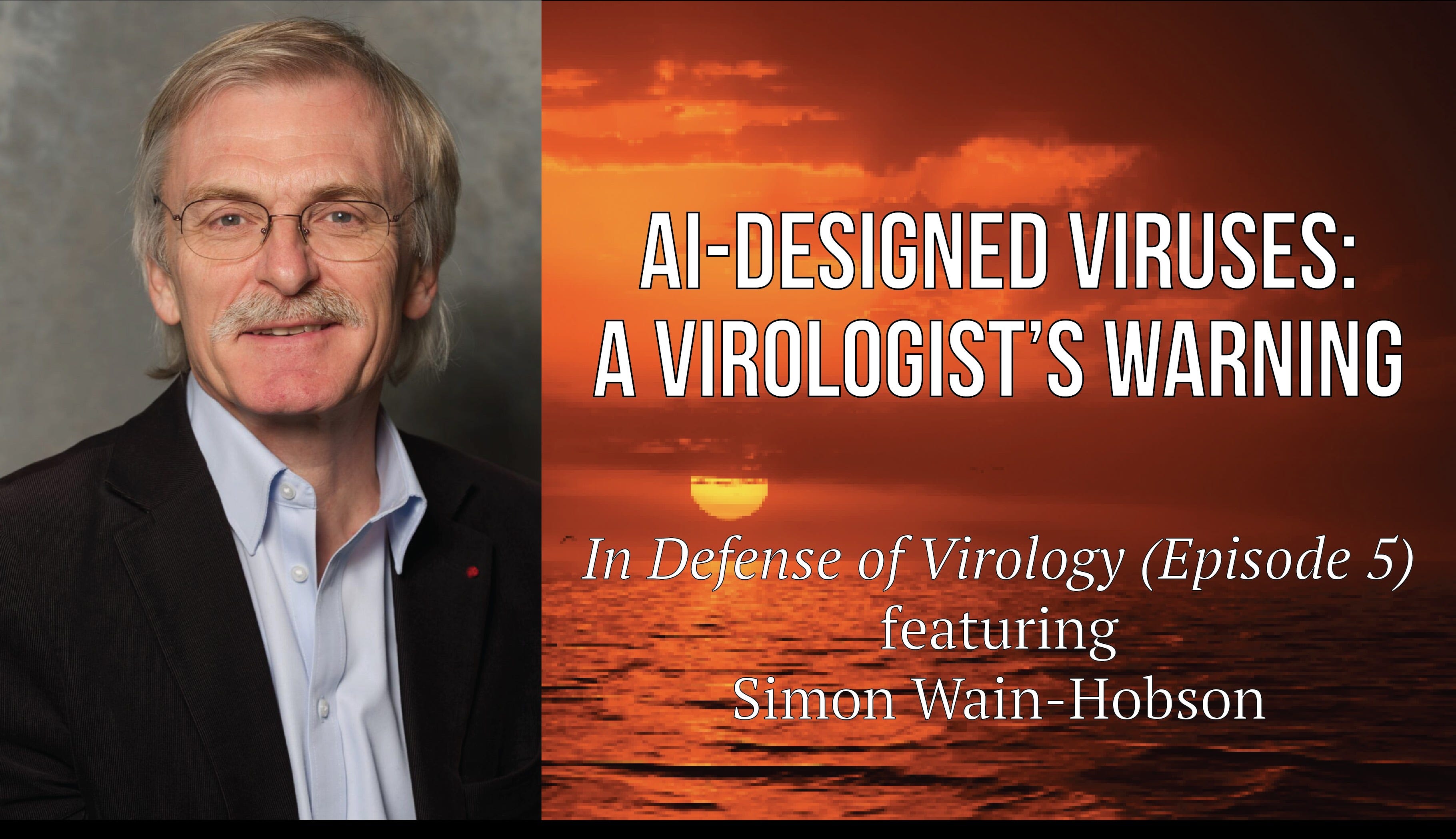
AI-Designed Viruses: A Virologist’s Warning (In Defense of Virology - Episode 5)
In Episode 5 of In Defense of Virology, Bryce Nickels and Simon Wain-Hobson have a sobering conversation about the emerging risks of applying artificial intelligence to virus design.The discussion centers on a recent Stanford preprint in which researchers trained AI models on bacteriophage genomes and used those models to generate entirely new viral sequences. From hundreds of AI-generated designs, the team synthesized 16 fully functional viruses. One replicated faster than its natural reference phage, while six displayed striking genetic stability, accumulating no detectable mutations at all. Even for Simon, whose career spans decades of studying viral evolution, the results were genuinely surprising.Although bacteriophages are often framed as promising therapeutic tools, particularly for treating antibiotic-resistant infections, Simon cautions that the implications of this work extend far beyond phage biology. Applying similar AI-driven approaches to animal or human viruses could unintentionally generate pathogens that are more transmissible or more virulent—effectively producing gain-of-function outcomes without any traditional laboratory manipulation.The episode places these findings within a broader and increasingly urgent context. Leaders in the AI community have begun sounding alarms about AI-enabled biology. Most notably, Yoshua Bengio warned in a New York Times op-ed that the implications of this technology are “terrifying.” Similar concerns were echoed at the September Red Lines AI meeting, where pandemic genesis was identified as the foremost global risk.Simon and Bryce argue that this moment demands restraint rather than curiosity. They urge scientists to refrain from applying AI-based viral design to human-relevant pathogens and call on research funders, including the National Institutes of Health, philanthropies, and private foundations, to withhold support for work that could escalate existential risk. (Such restraint would align with recent U.S. executive orders aimed at preventing the enhancement of dangerous pathogens.)The episode closes with Simon making a broader appeal for scientists to stop prioritizing technical novelty and high-risk experimentation, but for a renewed commitment to the principle of do no harm. Biology, he contends, should focus its energy on urgent human challenges (e.g., cancer, neurodegenerative disease, and mental health) where progress can be transformative without carrying the risk of catastrophic consequences.(recorded December 7, 2025) Get full access to Science From the Fringe at sciencefromthefringe.substack.com/subscribe