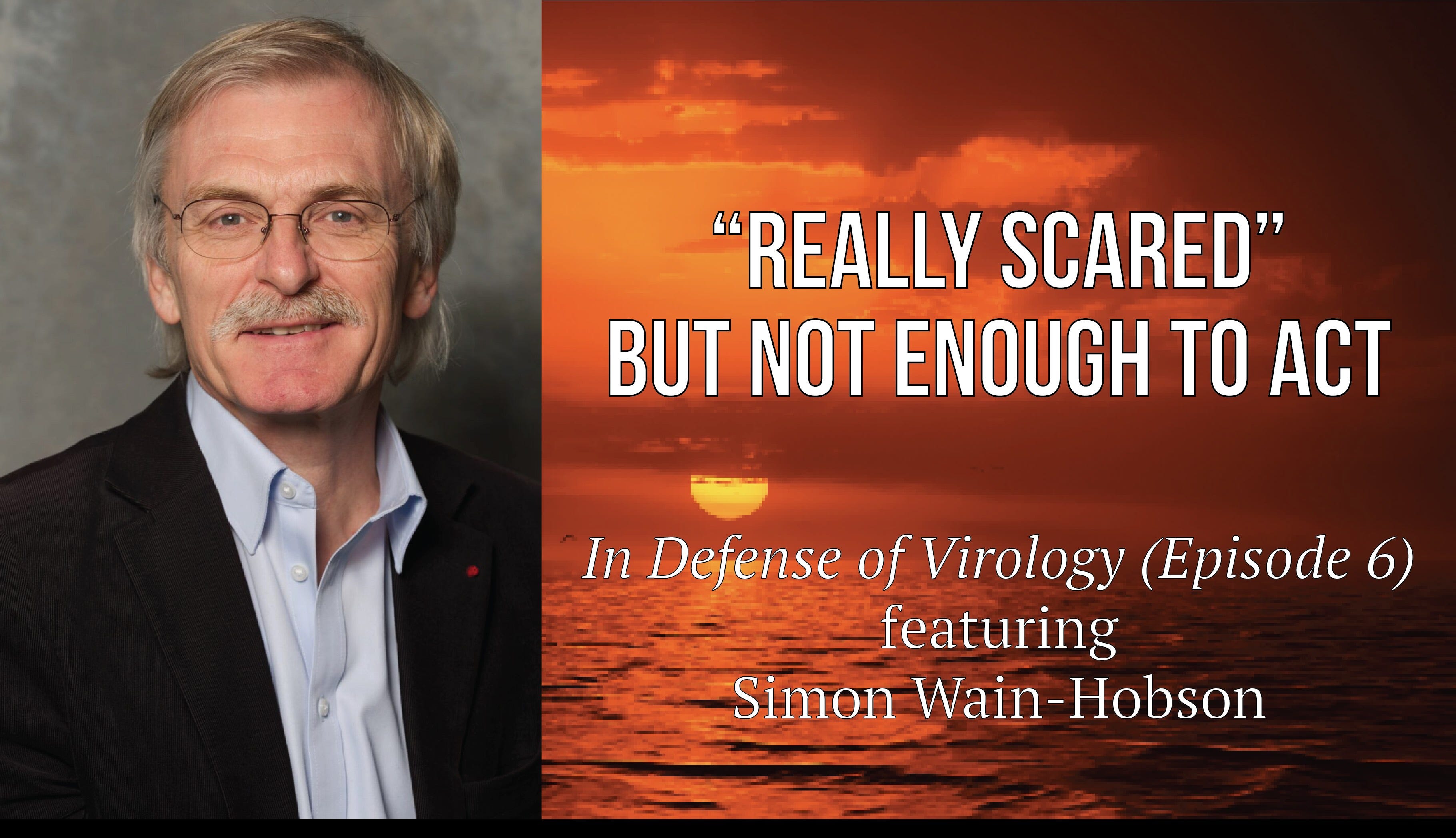
“Really Scared” ... But Not Enough to Act (In Defense of Virology - Episode 6)
Science From the Fringe · Science From The Fringe and Bryce Nickels
Audio is streamed directly from the publisher (api.substack.com) as published in their RSS feed. Play Podcasts does not host this file. Rights-holders can request removal through the copyright & takedown page.
Show Notes
In the sixth episode of In Defense of Virology, Rutgers professor and Science From the Fringe host Bryce Nickels speaks with distinguished virologist Simon Wain-Hobson about a potentially catastrophic biosafety issue: the human H2N2 influenza virus is not classified as a federal select agent, yet live samples remain stored in laboratory freezers around the world. The discussion is prompted by Simon’s recent essay, “The virus not on the Select Agent list.”
The discussion centers on a concerning exchange between NIH Director Jay Bhattacharya and NIAID Acting Director Jeffrey Taubenberger on an August 2025 episode of The Director’s Desk podcast. During that conversation, Taubenberger—a prominent influenza researcher best known for his role in the highly controversial resurrection of the deadly 1918 “Spanish flu” virus—said that the virus responsible for the 1957 pandemic, H2N2, poses a serious concern. He noted that since 1968, no one has been exposed to this virus, even though it was fully adapted to humans. Despite this, H2N2 is not a select agent. Taubenberger explained that his lab voluntarily handles it under the same conditions as the 1918 virus, though such precautions are not required, and acknowledged that H2N2 likely remains in clinical, diagnostic, and basic virology laboratory freezers around the world. He admitted that this situation “really scares” him, since most of the global population born after 1968 lacks immunity to H2N2—a virus known to have already caused a pandemic.
Simon highlights Taubenberger’s striking acknowledgment that live H2N2 stocks persist in numerous laboratories without select agent designation or enhanced biosafety requirements. This stands in sharp contrast to the 1918 influenza virus—reconstructed by Taubenberger himself—which is designated as a Tier 1 select agent and subject to the highest level of regulatory control. Given the well-documented record of laboratory accidents, Simon argues that keeping H2N2 stocks under minimal oversight poses an unacceptable risk of a lab-acquired pandemic.
The episode questions why, if Taubenberger himself is “really scared” by the existence of H2N2 stocks in laboratories worldwide, neither he nor the NIH Director has taken concrete action since their podcast discussion. Simon maintains that H2N2 is uniquely dangerous: it is fully adapted to humans, highly transmissible, and capable of causing millions of deaths in today’s densely populated, interconnected world—potentially matching or exceeding the impact of COVID-19. In his view, any speculative scientific value in retaining live H2N2 virus stocks is vastly outweighed by their global hazard.
Emphasizing that pandemic potential depends primarily on transmissibility rather than case fatality—unlike pathogens such as Ebola—Simon calls for urgent corrective measures. He advocates adding human H2N2 to the Federal Select Agent List as a Tier 1 agent, destroying all unnecessary laboratory stocks under U.S. jurisdiction, retaining only genomic sequences for possible future reconstruction if ever justified, and encouraging equivalent actions internationally.
The conversation places these recommendations within the broader “Do No Harm” ethos of the series, arguing that responsible virology sometimes requires restraint, remediation, and the deliberate elimination of nonessential risks.
(recorded January 9, 2026)
Get full access to Science From the Fringe at sciencefromthefringe.substack.com/subscribe