
Roots and All - Gardening Podcast
411 episodes — Page 5 of 9
Ep 205Episode 205: Gardening on a Gradient
This week's guest is Carol Smith, garden designer, lecturer and author of the book 'Gardening on a Gradient: Designing and Establishing Sloping Gardens'. Interestingly, the book is relevant to home gardeners and professional designers and covers everything from the initial garden site assessment and survey, right through the design process to the final stages of planting, as well as inspiration and ideas from sloping gardens around the UK. If you've ever faced the challenge of a sloping site, you'll know how tricky they can be but fear not, Carol is here to help you tackle them. Dr Ian Bedford's Bug of the Week: Large hairy house spiders What We Talk About Main drawbacks to gardening on a gradient and any advantages Is it more expensive than gardening on the flat? Gardens that slope back towards the house and drainage issues Making changes to levels and water run off Soil moisture and temperature ranges across a slope Surveying a sloping site Retaining soil More naturalistic ways to deal with a sloping site About Carol Smith Carol Smith is a professional garden designer and freelance lecturer. She has worked on several award-winning show gardens and teaches on all aspects of garden and planting design. Links Gardener's Guide to Gardening on a Gradient: Designing and Establishing Sloping Gardens by Carol Smith Other episodes if you liked this one: I Want to Like My Garden with Rachel McCartain Natural Stone with Giles Heap of CED Patreon Membership
Ep 204Episode 204: No Dig with Charles Dowding
This week, making his second appearance on the podcast, is my guest Charles Dowding. Charles is the leading proponent worldwide of No Dig gardening. He's authored and co-authored many books and articles on the subject, including his latest book No Dig which is the result of 40 years experience and looks set to become the definitive text on the subject. He produces enough food to sell to local restaurants and inhabitants, to feed all his course attendees and visitors and also his own household from his plot which until recently has only been a quarter of an acre in size, proving categorically that no-dig equals maximum productivity. He is a prolific generator of media content, his YouTube channel has over 55 million views and he's bought the no-dig technique to a worldwide audience. Dr Ian Bedford's Bug of the Week: Spider silk What We Talk About How Charles got started out in gardening Why do we need compost for no-dig and is it essential to create our own? No dig techniques on different types of soils Giving the beds a year off (or not) and crop rotation No-dig and plant pests and diseases Why every last gardener in the UK hasn't adopted no-dig! About Charles Dowding Charles Dowding is the leading proponent of no-dig gardening. Not only does he have a huge following, but his advice is born out of more than 40 years of growing, analysing, comparing, and recommending. He has been growing veg since 1981, having gardened in four different locations and grown hundreds of thousands of crops. Charles currently gardens his modestly sized plot Homeacres, in Somerset, from which he produces enough food to sell to local restaurants and inhabitants, to feed all his course attendees and visitors and also his own household. He is a prolific generator of media content and has bought the no-dig technique to a worldwide audience. Links No Dig: Nurture Your Soil to Grow Better Veg with Less Effort by Charles Dowding - Dorling Kindersley, September 2022 www.charlesdowding.co.uk Other episodes if you liked this one: Feeding your Soil with Humanure with Joseph Jenkins Growing Food with Stephanie Hafferty Patreon Membership
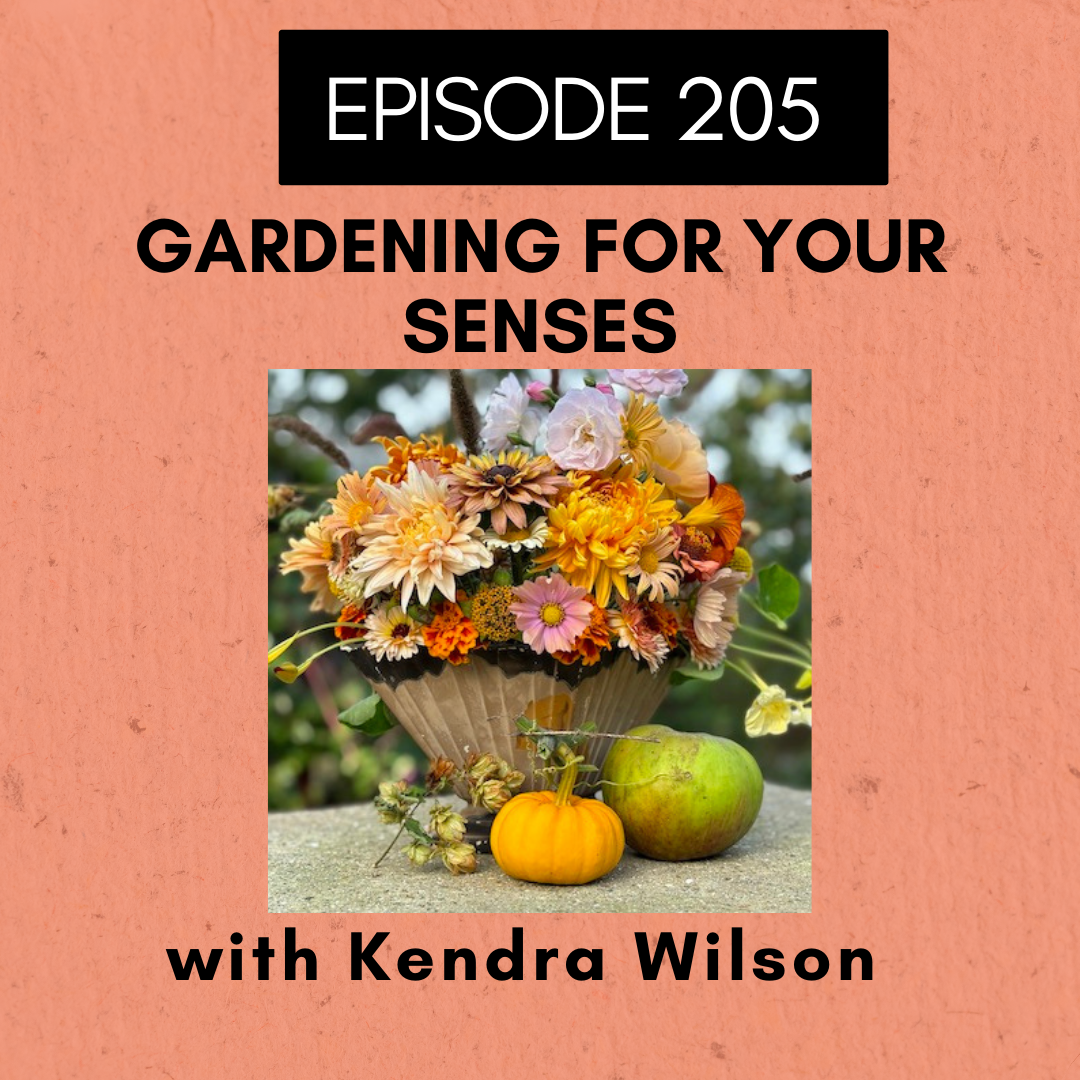
Ep 203Episode 203: Gardening for Your Senses
This week I'm chatting with writer Kendra Wilson. Kendra has written a vast amount about gardening but I was particularly interested in speaking to her about her book Garden for the Senses. Engaging all your senses can lead to a deeper connection with the landscape and it can be an unusual and transformative experience. I wanted to find out how we can all learn to better use our senses and firstly, what prompted Kendra to write the book. Dr Ian Bedford's Bug of the Week: The blue butterflies What We Talk About How catering to the senses can lend another dimension to the garden How many senses should we aim to stimulate in a garden? One good plant that will engage with each of our five senses How you can learn to engage your senses more when in the garden About Kendra Wilson Kendra has contributed to The Sunday Times, Gardens Illustrated, Guardian Weekend, Garden Design Journal, RHS The Garden, and Vogue. She is a longstanding correspondent for Gardenista online and contributed a chapter 'The Gardenista 100' to the 2016 book, Gardenista: The Definitive Guide to Stylish Outdoor Spaces. Kendra has worked on numerous projects including a limited-edition book for Mulberry and other books including My Garden is a Car Park and The Book of the Flower. Links Garden for the Senses by Kendra Wilson - Dorling Kindersley, February 2022 www.kendrapagewilson.com
Ep 202Episode 202: The Composting Process
This week's guest is ecologist and author Julian Doberski. If you think about compost heaps, how much do you really think about the living micro and macro organisms that dwell within them, how they contribute to the composting process and how what you do to your heap can increase or decrease their chances of survival? Julian has written about the science of what goes on in a compost heap and about the living organisms who provide the 'hard graft' of transforming waste organic matter in his latest publication The Science of Compost. I spoke to Julian to find out more. Dr Ian Bedford's Bug of the Week: Fuchsia Gall Mite What We Talk About What is compost? Does what go in also come out? Eg if we want a high nitrogen compost product should we use raw materials that are also high in nitrogen? How do you know what you'll be getting as an end product? How do you get the right balance of the organisms that break down the heap? The correct ratio of woody versus green materials in a compost heap What makes a compost heap break down, apart from the organisms in it? About Julian Doberski Julian Doberski has degrees in Zoology (BSc Southampton), Forestry (MSc Oxford) and a PhD in biological control of insects using fungi (Cambridge). He has thirty years of teaching experience at Anglia Ruskin University in Cambridge (and its predecessor institutions) where he was a Principal Lecturer in Ecology. He has jointly published a resource pack for A level ecology students and a range of scientific research and science in education papers. He is currently retired and lives in Cambridgeshire. Links The Science of Compost: Life, Death and Decay in the Garden by Dr. Julian Doberski Other episodes if you liked this one: The Regenerative Grower's Guide to Garden Amendments with Nigel Palmer Mycorrhizal Fungi with Jeff Lowenfels Patreon Membership
Ep 201Episode 201: Your Garden Spa
This week I'm speaking to Juliette Goggin, perfumery consultant to some of the most recognised brands in the world, upcycling and reusing champion, owner of the cosmetics company Hand Made by Juliette and author of the books Handmade Beauty and Handmade Spa. We talk about how you can use plants from your garden to create products that are natural, inexpensive, easy to make and that actually work. Dr Ian Bedford's Bug of the Week: Gooseberry Sawfly What We Talk About Juliette's background in perfumes and cosmetics The impetus behind the books Handmade Beauty & Handmade Spa Why should we try to make our own products? How are they better than what you can buy? Do you need a lot of equipment? Do you need to source fairly specialist ingredients? How you can incorporate items from your garden into your products Prepping ingredients About Juliette Goggin Juliette trained in perfumery evaluation, and worked for a Fragrance house in Grasse in the South of France to develop bespoke products for niche brands in the UK. Throughout this time Juliette was always keen to learn how everything was made and to expand her knowledge, combining this with a natural love of crafting which she developed as a child forever making things from cast off bits and pieces. Juliette teaches classes in Natural Skincare and Candle Making, based around her Handmade Beauty and Handmade Spa illustrated books. The books also acted as a springboard to creating her own Collection of natural skincare and home fragrance products in 2018, appropriately called Handmade by Juliette. Links www.handmadebyjuliette.com Instagram @handmadebyjuliette Other episodes if you liked this one: Sensory Herbalism with Karen Lawton The Rose in Perfume with Mairi MacKenzie Patreon Membership
Ep 200Episode 200: A Rolling Stone Gathering Moss
Ep 199Episode 199: Sassy Farming
This week's guest is Hawaii-based writer and grower Ja-Ne de Abreu. When the pandemic began, Ja-ne became an instant 24/7 caregiver for her hanai mother. To keep things positive, she started growing food and discovered it also grew peace and calm to their lives amid the ongoing chaos. Ja-ne had an intuition to write Sassy Food to share the inspiration that everyone can grow food at any time of year, anywhere in the world on any budget and harvest peace in the process. We talk about growing in small spaces, how growing food can foster positive connections in difficult times and what happens when the creative spark catches. Dr Ian Bedford's Bug of the Week: Butterfly decline What we cover The idea behind Sassy Food The climate in Hawaii and what you can grow Why it's important that we all grow food where we can Seeds that can be eaten as sprouts Grow tents to increase indoor growing space Easy and cheap/free ways to propagate edible plants Washing produce and some easy, natural products to use Why is food like music? About Ja-ne de Abreu When the pandemic began, Ja-ne de Abreu became an instant 24/7 caregiver for her hanai mother. To keep things positive, she started growing food and discovered it also grew peace and calm to their lives amid the ongoing chaos. Ja-ne had an intuition to write Sassy Food to share the inspiration that everyone can grow food at any time of year, anywhere in the world on any budget and harvest peace in the process. Sassy Food has won two first place book awards and was a finalist in two book contests for the book cover as well as interior design. De Abreu's other award-winning books are a memoir with her sister and brother-in-law, Chasing the Surge: Life as a Travel Nurse in a Global Pandemic, and her debut novel, The Energy Inside Valsin's Choices. In addition, de Abreu also published five books of the Richard Tregaskis Classics Collection under the JMFdeA Press imprint last year and will publish five more in the near future. Ja-ne's focus is exploring the energy inside our choices and the resulting responsibilities and freedoms by telling stories through various methods. Links Join Sassy Food Farms on Instagram Ja-Ne de Abreu's website www.jmfdeapress.com Ja-Ne on Facebook Ja-Ne on Twitter Ja-Ne on Instagram Other episodes if you liked this one: Abundance and Self-Sufficiency with Liz Zorab Patreon Membership
Ep 198Episode 198: Creating Meadows with James Hewetson-Brown
This week I'm speaking to Founder of Wildflower Turf Limited and author of the book 'How to make a wildflower meadow' James Hewetson-Brown. James has a vast amount of experience creating meadows at domestic and public scales, is passionate about creating species rich habitats which are attractive to people and wildlife and which have the added benefits of pollution mitigation and carbon sequestration. We talk about the nuts and bolts of meadow making but also about why meadows can be the solution to so many of our landscaping needs. Dr Ian Bedford's Bug of the Week: Tardegrades What we cover Why meadows can be a quick solution to bring biodiversity to previously relatively barren areas, particularly in urban environments If you build it, will they come? Or is biodiversity too depleted already? The best ways of establishing a meadow Convert an area of lawn to meadow Annual species, perennials, and mixtures of both Do you need grass species in a meadow? Unusual or interesting projects James has worked on Links www.wildflowerturf.co.uk How to make a wildflower meadow: Tried-And-Tested Techniques for New Garden Landscapes by James Hewetson-Brown - Filbert Press, 2016 Other episodes if you liked this one: Meadows with Keith Datchler Patreon Membership
Ep 197Episode 197: Britain's Birds with Benedict Macdonald
My guest this week is naturalist, conservationist and writer Benedict Macdonald. Benedict has recently released a new book 'Cornerstones', which talks about how by restoring cornerstone species we can help turn around the current impoverished state of nature in the UK. His previous book 'Rebirding' was how I first came to know of his work and I've been a great admirer of his work ever since. We talk about the numbers of UK birds, how land management needs to change in order to stop the loss of species in this country and what we can do at a garden level to make changes. Dr Ian Bedford's Bug of the Week: Box tree moth What we cover - Do we waste money propping up untenably small populations of threatened species in isolated areas? - Bird species that are the 'walking dead' in Britain - Achieving cooperation between individual land owners to create the large scale and connected habitats that are needed to sustain populations - Adopting a build it and they will come approach - Are we wasting our time trying to make a difference at the garden scale? If not, what can we do to make a difference? - Some of the problems mentioned in Rebirding are directly related to the EUs common agricultural policy. How could this change given Brexit? - Ecotourism About Benedict Macdonald Benedict Macdonald is a conservation writer, field director in wildlife television, and a keen naturalist. He is passionate about restoring Britain's wildlife, pelicans included, in his lifetime. During his extensive global travel experience, Benedict has found inspiring examples of why desecrating our country's ecosystems is both entirely avoidable and against the national interest. This book is his attempt to ensure that this generation, for the first time in thousands of years, leaves Britain's wildlife better off, not worse, than the generation before – for wildlife and people alike. Benedict is a long-time writer for Birdwatching magazine, as well as a contributor to the RSPB Nature's Home and BBC Wildlife. He has been fortunate to work on TV series for the BBC and Netflix - most notably the grasslands and jungles programmes of Sir David Attenborough's conservation series Our Planet. Links Cornerstones: Wild forces that can change our world by Benedict Macdonald - Bloomsbury Publishing PLC , 2022 Orchard: A Year in England's Eden by Benedict Macdonald - HarperCollins, 2021 Rebirding: Restoring Britain's Wildlife by Benedict Macdonald - Pelagic Publishing, 2020 Other episodes if you liked this one: Irreplaceable with Julian Hoffman Patreon Membership
Ep 196Episode 196: Hoverflies
This week's guest is Martin Harvey, an entomologist and biological recorder based at the UK CEH Biological Records Centre. His main areas of work include the iRecord online recording system, liaison with national recording schemes, and the UK Pollinator Monitoring Scheme. Martin enjoys watching and recording hoverflies and I was delighted he agreed to an interview as although I know next to nothing about them, I do love seeing them in the garden and I'm always keen to find out more. Dr Ian Bedford's Bug of the Week: Beewolf What we cover The UK Pollinator Monitoring Scheme How hoverflies are distinct from bees or other flies How many species of hoverfly are in the UK More common species and the rarest Mimicry How to encourage more hoverflies into our gardens Where to find out more about hoverflies About Martin Harvey Martin Harvey is an entomologist and biological recorder based at the UK CEH Biological Records Centre. His main areas of work include the iRecord online recording system, liaison with national recording schemes, and the UK Pollinator Monitoring Scheme. He also teaches for Field Studies Council. Martin enjoys watching and recording hoverflies and other insects, and as a volunteer he runs the national Soldierflies and Allies Recording Scheme, and is County Moth Recorder for Berkshire. Links UKCEH Biological Records Centre Hoverfly Recording Scheme UK Hoverflies on Facebook Buzz Club hoverfly lagoons from Sussex University Dipterists Forum (the society for the study and conservation of flies) Other episodes if you liked this one: Butterflies with Peter Eeles Patreon Membership
Ep 195Episode 195: Historic Roses
This week, I'm speaking to Michael Marriott about historic roses. Micheal is an expert rosarian, Chairman of the Historic Roses Group and author of the recently published book RHS 'Roses'. We talk about what historic roses are, some of the myths surrounding them and why they're an excellent choice for your garden, particularly if you're looking for something a little different. I began by asking Michael about his background and how he became interested in historic roses. Dr Ian Bedford's Bug of the Week: Harebell Carpenters What we cover The Historic Roses Group and Michael's involvement with the group What is an historic rose? More common historic roses we might have come across Disease resistance Scent Do they repeat flower? Gardens in the UK where you can see historic roses Good old rose varieties if you're dipping your toe in the water of growing them Links Historic Roses Group RHS Roses: An inspirational Guide to Choosing and Growing the Best Roses by Michael Marriott Other episodes if you liked this one: Pruning Roses with Richard Stubbs of David Austin
Ep 194Episode 194: Gardening for Wildlife
Ep 193Episode 193: Growing Under Protection
Ep 192Episode 192: Garden Roots
This week I'm speaking to gardener and writer Lulah Ellender about her book Grounding: Finding Home in a Garden. Lulah's book is about tuning into the unceasing rhythms of nature in order to live with uncertainty and how they can help us become more connected to the places in which we live. We talk about how gardens can root us in time and place, even when those roots seem tenuous and liable to break. Dr Ian Bedford's Bug of the Week: Sentient bugs What we cover The premise behind the book and the circumstances in which Lulah came to write it How Lulah gardened differently when she thought she might lose her garden Why the potential loss of her garden seemed such a wrench Custodianship of gardens Advantages to being a temporary, more tenuous occupier of a space How do gardens help us cope with our emotions? How do they help us make sense of cycles of life, death, birth, aging? About Lulah Ellender Lulah lives in Lewes, East Sussex, with her husband, four children and assorted animals. She has written for the Guardian, the Mail on Sunday's YOU magazine, and Sussex Life among others. She was recently writer in residence at Charleston's Festival of the Garden. Her first book Elisabeth's Lists was published in 2018. Links Grounding: Finding Home in a Garden by Lulah Ellender - Granta Books, April 2022 Patreon Membership
Ep 191Episode 191: Connecting with Plants
Hello and welcome to this week's episode where I'm speaking to Marion Whitehead from the Blue Mountains Botanic Garden in New South Wales, Australia, part of the Royal Botanic Gardens Sydney. I talk with Marion about one of her areas of speciality; the intersection of plants and human feelings, particularly in the context of 3 books as recommended by Marion; Enid Blyton's 'The Magic Faraway Tree', Frances Hodgson Burnett's 'The Secret Garden' and 'The Overstory' by Richard Powers. Dr Ian Bedford's Bug of the Week: Venom What we cover Enid Blyton's 'The Magic Faraway Tree': the tree is the central character, but actually seems pretty inanimate. How does the magic faraway tree provoke emotion? Is there a suggestion in Blyton's book that wild plants are more emotionally provocative than cultivated plants? 'The Secret Garden': the garden heals but it seems to be healing physically as much as emotionally, is this the case? Is the garden responding to individuals' needs? Do people instinctively find or seek out what they need, emotionally, in a garden? Do we have the language to describe our relationship to plants? Richard Powers' 'The Overstory': are plants losing their power to connect with us emotionally, or vice versa, given our detachment from nature? About Marion Whitehead Marion is Senior Horticulturalist at the Blue Mountains Botanic Garden. She has an extensive background in cool climate plant species, with a specific interest in ephemeral and heathland plants. Marion has many horticultural topics of interest from Australian plant history, to managing plant nurseries, to the emotional connection between human and fellow flowers. Links www.bluemountainsbotanicgarden.com The Overstory by Richard Powers The Secret Garden by Frances Hodgson Burnett Patreon Membership
Ep 190Episode 190: Show Gardens
Ep 189Episode 189: Crevice Gardens
This week's guests are Kenton Seth and Paul Spriggs, co-authors of a book that's just been released called 'The Crevice Garden: How to Make the Perfect Home for Plants from Rocky Places.' This book is immensely detailed and if you've ever had an interest in crevice aka rock gardens, or indeed have not but are curious, this book provides a comprehensive overview of the types of plants suited to growing in this style of garden (there are many), the different looks you can create, how to build and maintain them, famous and successful examples and why they are good from an environmental perspective. Dr Ian Bedford's Bug of the Week: Flower Crab Spiders What we cover What is a crevice garden? Advantages to putting plants in crevices The sort of plants suited to growing in crevices Installing a crevice garden Sourcing stone you might need? Planting into a crevice garden Are they a purely aesthetic addition to a garden or can they be useable too? Maintenance About Kenton & Paul Kenton J. Seth began his career in public horticulture and the nursery trade and is now a garden designer who specializes in crevice gardens, drought-tolerant natives, and meadows. He writes for a variety of local, national and international magazines and lectures to rock garden clubs at home in Colorado and overseas. Paul Spriggs has been rock gardening for 23 years and building crevice gardens for the last 16. He is a professional gardener and landscaper, and an avid plant explorer. He has a passion for all wild plants, especially miniatures, collecting and cultivating them at home in Victoria, British Columbia. Links The Crevice Garden: How to Make the Perfect Home for Plants from Rocky Places by Kenton Seth & Paul Spriggs - Filbert Press, April 2022 Huw on YouTube Huw on Facebook Huw on Instagram Patreon Membership
Ep 188Episode 188: Huw Richards on Veg Growing
This week's guest is veg growing expert Huw Richards. Huw grows a vast range of plants in his garden in mid-West Wales and is always trialling and experimenting with new ways of growing. He has an enormously popular YouTube channel and has authored a number of books, the latest of which is 'The Vegetable Grower's Handbook' which draws on his experience as very much a thoughtful and philosophical gardener. Dr Ian Bedford's Bug of the Week: Flower Crab Spiders What we cover Gardening with a mission statement Being organised in the garden; keeping checklists, batching jobs, planning Some of the most surprising things Huw's discovered on his gardening journey Poly culture Intercropping Having an odds and ends bed Harvesting water in the garden The method of multisowing New veg Huw's trialling in 2022 On being a philosophical gardener Links The Veg Grower's Handbook by Huw Richards - Dorling Kindersley Ltd, March 2022 Huw on YouTube Huw on Facebook Huw on Instagram Patreon Membership
Ep 187Episode 187: Irises with Clare Keller
This week's guest is Clare Keller, a fashion designer and stylist who's previously work at Ralph Lauren, Gucci, Pringle, Chloe and Givenchy. Clare is currently a Trustee and spokesperson for the British Iris Society, a society dedicated to promoting and preserving UK irises and providing resources to iris growers. We talk about these picturesque, perpetually popular flowers. Dr Ian Bedford's Bug of the Week: Organic recyclers What we cover How Clare became involved with the British Iris Society and interested in irises Species of iris Ideal iris growing conditions Iris hardiness Propagation of irises Easy irises to grow Links The British Iris Society On Facebook Patreon Membership
Ep 186Episode 186: Climate Cuisine with Clarissa Wei
Hello and welcome to this episode of the podcast where I'm speaking to journalist and host of the Climate Cuisine podcast, Clarissa Wei. On her podcast, Clarissa shares the stories of the crops grown sustainably around the world. The goal is to highlight climate-centric conversations about crops and the food we eat as they become increasingly important to the resiliency and survival of our food systems. Dr Ian Bedford's Bug of the Week: Bumbling bees What we cover Clarissa's background and the idea behind her Climate Cuisine podcast What's wrong with the way we currently farm and consume our food? How individuals can join the growing revolution The importance of growing food that is specific to your climate region How this can change the way we grow and use food How regional food independence helps local communities Government support (or not!) The future of the Climate Cuisine podcast About Clarissa Wei Clarissa Wei is an American Taiwanese freelance journalist and video producer based in Taipei. Bylines include the New York Times, the Los Angeles Times, National Geographic, VICE, among others. She is currently working on her first cookbook, Made In Taiwan (Simon Element). Links Climate Cuisine Trailer Patreon Membership
Ep 185Episode 185: Bonsai with John Hanby
This week I'm speaking to Bonsai expert John Hanby. John has decades of experience studying and creating bonsai trees and has just released an incredibly comprehensive guide called the Practical Art of Bonsai. We talk about selecting a plant, how to train it, and artistic methods and we finish with John's thoughts on how bonsai techniques relate to and inform wider gardening practices. Dr Ian Bedford's Bug of the Week: Large bulb flies What we cover What is a bonsai tree? What can you bonsai? Indoor and outdoor trees Overall aims of bonsai Starting a tree from seed or a cutting Wiring and directional pruning Dead wood as an artistic addition to a tree Watering bonsai trees Specialist bonsai equipment About John Hanby John has been teaching bonsai for over thirty years and is owner of one of the biggest bonsai schools in Europe. He's a long-serving member of the Yorkshire Bonsai Association committee and has previously been the secretary of the Federation of British Bonsai Societies, in addition to being a member of the Belgian Kawabe School. He gives talks and demonstrations in the UK and internationally, and has won multiple awards for his fabulous trees. He provides advice, articles and photographs for podcasts, books and magazines, and has produced a successful DVD. Links Practical Art of Bonsai by John Hanby - The Crowood Press, 2022 www.johnhanbybonsai.co.uk Patreon Membership
Ep 184Episode 184: Forage for Mushrooms Without Dying
This week's guest is Frank Hyman, a certified mushroom forager who teaches mushroom identification to chefs, arborists, organic farmers and the general public. Frank's latest book is called 'How to Forage for Mushrooms Without Dying' and contains guidance on mushroom identification, on your suitability for becoming a mushroom forager on which subject he writes "if you have a reputation among your friends and family for exercising poor judgement…you may not be a very good candidate", about the sniffy attitude of the English to mushrooms versus that of mainland Europeans and a whole host of other myco-related topics that should help you in your quest to survive foraging. Despite dealing with a potentially lethal topic, both book and author are laugh out loud funny and I was delighted that Frank agreed to an interview. Dr Ian Bedford's Bug of the Week: Viruses What we cover Can you take a mushroom guide from one country or continent and use it in another? Frank's three different types of mushrooms Mycophobia Should you be careful of the soil mushrooms are growing in? Nutritional and medicinal values Cleaning and cooking mushrooms About Frank Hyman Frank is a certified mushroom forager who teaches mushroom identification to chefs, arborists, organic farmers and the general public. His writing on foraging has appeared in Forbes, Paleo Magazine and Hobby Farms. He lives in Durham, North Carolina. Links How to Forage for Mushrooms Without Dying: An Absolute Beginner's Guide to Identifying 29 Wild, Edible Mushrooms by Frank Hyman Other episodes you might like: Edible Mushrooms with Geoff Dann In Search of Mycotopia with Doug Bierend Patreon Membership
Ep 183Episode 183: Food Forest Garden
Hello and welcome to this week's episode, where I'm speaking to plant expert and forest garden creator Alan Carter. Alan's latest book, 'A Food Forest in your Garden' teaches you how to grow your own seasonal food in a low maintenance, nature friendly garden that feels like a woodland glade. We talk about starting a forest garden, how to manage it, key plants and some unusual plants and growing techniques. Dr Ian Bedford's Bug of the Week: Common fruit flies What we cover What is a forest garden? Is our UK climate suited to hosting forest gardens? Turkish rocket Can it be difficult and or expensive to start a forest garden given the unusual plants involved? Sourcing plants Acclimating your taste buds to the flavours of some of the plants in the forest garden What plants are essential in a forest garden? How Alan treats kale and radish plants Links A Food Forest in your Garden: Plan It, Grow It, Cook It by Alan Carter www.foodforest.garden Patreon Membership
Ep 182Episode 182: Lichen
This week I'm speaking to April Windle. April is a naturalist with a particular interest in lichens, especially those occupying our rainforest habitats along the western seaboard of the British Isles. April works on a variety of lichen education and conservation projects and co-chairs the Education & Promotions Committee of the British Lichen Society. April talks to me about what lichen actually is, where you can find it and why it's interesting and worth studying. Dr Ian Bedford's Bug of the Week: Brimstone butterflies What we cover What is a lichen? Might they be confused with algae, moss or fungi? The provenance of lichens UK species Where you can find them Lichen propagation Lichens as species or material specific What is life like for lichen given things like development, air pollution and climate change? Edible and medicinal uses Where you can find out more about lichens About April Windle April Windle is a naturalist with a particular interest in lichens, especially those occupying our rainforest habitats along the western seaboard of the British Isles. She is currently self-employed and involved in a variety of lichen education and conservation projects, whilst co-chairing the Education & Promotions Committee of the British Lichen Society. Her employment history includes Plantlife International, the Natural History Museum, Exmoor National Park Authority and the RSPB. Links www.britishlichensociety.org.uk April on Twitter: @aprilwindle Patreon Membership
Ep 181Episode 181: A Therapist's Garden
This week I'm chatting with New England-based horticultural therapist and master gardener, Erik Keller, who is also the author of the book A Therapist's Garden: Using Plants to Revitalise Your Spirit. Over 20 years, Erik has worked with thousands of people of all ages and types, using horticulture and therapeutic techniques to help them deal with physical, emotional and mental challenges. Erik talks about using an outdoor space as a place for therapy and learning and about the downs and ups of bringing horticulture into peoples' lives as a way to heal. Dr Ian Bedford's Bug of the Week: Home grown bugs What we cover Erik's background in therapeutic gardening The most therapeutic and stimulating plant scents for people to work with How plants spark memories Establishing a connection between growing and eating plants Techniques to stop attention wandering whilst completing a task Techniques you use if people are exhibiting undesirable behaviour Lesson planning and being flexible during gardening sessions Using your garden year round How seasonal changes can help garden users deal with their personal issues and relate to the garden About A Therapist's Garden: Using Plants to Revitalise Your Spirit The Zen of mixing mud with seniors; crafting surprising salads out of weeds; and a hidden rabbit bringing joy to girls in a juvenile detention center. These are a few of the nearly 100 stories that Erik Keller takes readers on through a journey of how interacting with plants and nature can help heal mental, emotional, and physical trauma. Through the lens of January to December in a New England landscape, discover how horticultural therapy improves the lives of those in pain including special-needs children, cancer patients, and disabled seniors. A Therapist's Garden is unique in portraying how gardening, nature-based arts, plants and horticulture can revitalize the spirit of people. It encompasses over 20 years of experiences seeing the healing power of horticultural therapy. Its themes and subject material are universal in interest as different portions of this book apply to nearly anyone who likes plants or to garden, both booming activities today, as well as therapists who will find the approach interesting and of use to their client bases. About Erik Keller Over the last 20 years, Erik Keller has worked with thousands of people of all ages and types using horticulture and therapeutic techniques to help them deal with physical, cognitive, social and emotional challenges. Venues have ranged from special-needs schools, to prisons, to nursing facilities to private homes. Certifications from the University of Connecticut as a Master Gardener in 2000 and the New York Botanical Garden in Horticultural Therapy in 2009 has given Keller a strong base of knowledge from which he has been able to help his clients. He is a member of the American Horticultural Therapy Association, the Northeast Horticultural Therapy Network as well as the Connecticut Master Gardeners Association. He writes extensively about the healing power of horticultural therapy on a variety of social media platforms and on his website www.grohappy.com. For over a decade, Keller has been running a twice-monthly horticultural therapy (HT) program at Ann's Place, a not-for-profit facility helping those with cancer located in Danbury, CT. Since the emergence of COVID-19, Keller has developed a wide variety of virtual and hybrid HT sessions for clients. He also manages and maintains the grounds at Ann's Place, which he designed over a decade ago to accommodate therapeutic needs of the client base. Keller is also a commissioner for the Ridgefield Conservation Commission, which manages and maintains over 5,800 acres of open space in Ridgefield, CT. In the past, he has run horticultural therapy programs at senior living and nursing facilities as well as run programs at Green Chimneys, a school for special-needs children in Brewster, NY. Earlier in Keller's career, he spent a decade as a journalist and editor for a variety of technology- focused trade publications, a decade as a Research Fellow at Gartner, Stamford, CT (the leading technology advisory firm in the world), and another decade as a management consultant with his own firm. During that time he received many awards for editorial, writing and analytical excellence. He also wrote a well-received book for the technology community called Technology Paradise Lost (Manning Publications) in 2004. Keller graduated from State University of New York at Stony Brook with a Bachelor's of Engineering degree as well as minored in English and Journalism. While at Stony Brook, he won the University's Martin Buskin Memorial Scholarship for Journalism. Links Black Rose Publishing - A Therapist's Garden: Using Plants to Revitalise Your Spirit www.grohappy.com Patreon Membership
Ep 180Episode 180: Violas
This week I'm talking with Jack Willgoss, who along with wife Laura, runs Wildegoose Nursery in Shropshire where they hold the Bouts collection of violas. The collection comprises over 160 varieties and includes some favourite varieties which date back to the 1800s. Jack talks about his collection, the different types of violas you might come across and how you can best grow them in your garden either in the ground or in containers. Dr Ian Bedford's Bug of the Week: Biodiversity Decline What we cover Jack's collection of violas How many species of viola there are The history of violas in cultivation Violettas Pruning violas Viola growing conditions and feeding Hardiness Violas and scent Viola colours Propagation Edible flowers Links www.wildegoosenursery.co.uk Patreon Membership
Ep 179Episode 179: Welcome to Mintopia
This week's guest is Dr Si Poole, founder of Mintopia, a website dedicated to mint featuring its own online reference library for the different types, the mintopaedia. Si holds one of the National Collections of mint and holds getting on for 200 different cultivars. From his plastic-free, organic nursery, he sells themed collections of mints and he's passionate and knowledgable about every aspect of the Mentha genera, impressive given that there's much more to this plant than mint sauce and mojitos. Dr Ian Bedford's Bug of the Week: Locusts What we cover How Si became interested in mint The different species and cultivars of mint The Mintopia Mint Collections How is mint propagated? The cultivation of mint in the garden Is it true that you shouldn't allow mints of different varieties grow in the same container otherwise they all end up tasting the same? Mint pests and diseases Links Mintopia Patreon Membership
Ep 178Episode 178: Feeding Your Soil with Humanure
EI stumbled across a book called The Humanure Handbook: Shit in a Nutshell and of course, I had to buy a copy. I've long thought that if we're aiming towards a closed system within our gardens then our own waste needs to be factored into the equation so I was intrigued to find out what the book's author Joseph C Jenkins had to say on the matter. What I didn't expect was the book to be one of those that slaps you in the face with facts and makes you question the whole way you've lived your life, in this case in relation to loos and their contents. Not only does Joe comprehensively explain how you can take the contents of your loo and compost it along with your garden waste so that you have a clean and useful product that can be used on everything from vegetables to houseplants, he will make you wonder why you ever thought the alternative of flushing it away was a sensible, viable option. There is so much I wanted to cover with Joe and we only scratched the surface of the subject in this interview. I urge you to get the book and think about the issue of how we deal with waste, it's a vitally important environmental issue. Dr Ian Bedford's Bug of the Week: Eating insects What we cover The background to Joe's work on composting toilet waste and his book, The Humanure Handbook In order to put back what we take out of the soil, we need to be reusing our waste as well as all household and garden waste - how can this work in practice? Is a flushing toilet the holy grail of comfort and civilised living for all? Composting and pathogens Composting and drug residues Compost toilets vs dry composting systems Links Humanure Handbook can be downloaded here Humanure videos Humanure videos on Youtube Humanure research papers: 2018 2015 2013 2011 2009 Patreon Membership
Ep 177Episode 177: The Plants of Armenia
The flora of Armenia is one of the most diverse and interesting in the world and includes many favourite garden plants and their relatives. This week's guest, Tamar Galstyan, has travelled the length and breadth of the country botanising and leading guided plant tours. She's recently published 'A Field Guide to the Plants of Armenia' which includes more than 1000 of the diverse range of plants found in the country and in the interview, we cover the range of habitats and climates found in Armenia, what it's like to travel there to find plants and how the native flora is threatened by things such as climate change and grazing animals. Dr Ian Bedford's Bug of the Week: UV light What we cover How Tamar become interested in plants What makes Armenia so significant in terms of plants The sorts of climates experienced in Armenia The rarest plants you could find Armenian wild plants that are also garden cultivars The protection given to the native flora How to see the plants in Armenia and the best time to visit About Tamar Galstyan Tamar Galstyan graduated from the University of Art and Theatre in Yerevan, Armenia. After some years she studied ecology and worked with children as an ecology teacher. Tamar began travelling regularly in Armenia, taking numerous pictures of plants and identifying them. She created a website to help her students learn about the Armenian flora and this led to her popular Facebook page 'Plants of Armenia'. In 2012 Tamar was invited to guide a botany trip in Armenia. Gradually the geographical range of her trips expanded and some are managed through her own travel company, SkyGreen. Travels in Georgia, Iran and Central Asia deepened Tamar's love of nature as well as her plant knowledge. She learns by travelling and is passionate about sharing what she has learnt during the past nine years guiding botany trips. Links A Field Guide to The Plants of Armenia by Tamar Galstyan Patreon Membership

Ep 176Episode 176: Beans, beans good for…the planet!
This week, I'm talking to Susan Young, author of the book 'Growing Beans'. As I've looked further into having a sustainable diet, into growing and storing crops and into sources of plant protein, beans just seemed to tick every box, but I needed to know more. So Susan's book 'Growing Beans' is exactly what I've been looking for, because it covers growing, harvesting and storing beans and it argues a very convincing case for a fact that many people the world over have known for centuries; that beans are good not only for you but for the planet, because they're such a resilient, easy to grow, low carbon footprint crop. Dr Ian Bedford's Bug of the Week: Tobacco whitefly What we cover What makes beans such a good crop to grow, in terms of their eco credentials? The beans we commonly grow here in the UK Beans to grow for their green pods, as fresh green beans, half dried and drying Bean nutritional needs Overwintering tubers of runner bean plants Drying beans in a UK climate Bean toxicity Storing different types of beans Easy beans to grow Beans for taste and aesthetics Preparing and cooking beans About 'Growing Beans: a diet for healthy people and planet' by Susan Young Susan's new book brings together 10 years of experimentation with multiple varieties of beans. She clearly explains how to sow, grow, harvest, dry, store and cook them, and shares her six 'must grow' varieties. Beans are easy to grow and cook, help build healthy soil in the garden, and also provide a nutrient-rich diet, helping to reduce the risk of obesity, diabetes, heart disease and cancer – they are good sources of protein, fibre, folate, iron and potassium. Plus, they can reduce your carbon footprint and food miles as well! Links 'Growing Beans: a diet for healthy people and planet' by Susan Young Beans and Herbs Publishers of the book, Permaculture Magazine, on Facebook Patreon Membership

Ep 175Episode 175: Seeking Rare Plants
This week's guest is Nick Macer, plant hunter, self-taught botanist, rare species expert and owner of Pan Global Plants, a nursery based in the Severn Valley, which, to quote the website, offers "a selection of the finest, most desirable and often rarest plants capable of growing on these isles". And that's key - Nick hand selects plants, in the past, directly from where they were growing in the wild and brings them into cultivation. He's renowned for choosing sublime varieties and for openly sharing his knowledge and experience. I did intend to talk to Nick a bit about his plant hunting trips, but as a stop has been put to these recently due to rules around the transportation of plant materials, the conversation went in other directions. Dr Ian Bedford's Bug of the Week: Mealybugs What we cover How Nick got into plant hunting How plants make the grade for inclusion into your nursery catalogue Rare plants - hardy or non hardy? Propagating rare plants Using rare plants in the garden About Nick Macer Coincidentally connected to last week's episode on Georgian gardens, Nick Macer rented land at Painswick Rococo Garden before moving to Frampton-on-Severn to set up Pan-Global Plants, which specialises in rare and unusual plants, many of which are well-suited to growing in a UK climate. Nick trained at Merrist Wood and went on to have placements at Westonbirt Arboretum and the Sir Harold Hillier Gardens. He's travelled the globe to find the most beautiful specimens to bring into cultivation and continues to work at the nursery and to share his knowledge in person and in the media. Links www.panglobalplants.com Patreon Membership
Ep 174Episode 174: Painting the Georgian Garden
I'm speaking to Dr Cathryn Spence this week, about Thomas Robins, a painter who documented the country estates of the Georgian gentry in all their Rococo splendour. Robins captured images of this flamboyant age of outdoor design where gardens were laden with symbolism and crammed full of Chinoiserie, follies ruins and the latest imports of exotic animals and plants. Follow the story of Robins as he moves from jobbing fan painter to star of his own paintings, the development of the floral borders around his canvases, for which he's famed, and the evolution of the Georgian garden and what remains of this style today. Dr Ian Bedford's Bug of the Week: Fig wasps What we cover The artist Thomas Robins and when and where he worked What gardens looked like at the time Robins was painting What is a Rococo garden? Why Robins painted floral borders around his paintings How exotic species came to be included in these frames In the book, Cathryn references "the Rococo's requirement of asymmetry". How did this manifest in Robins' artworks and in gardens? Political themes in Georgian gardens Robins' botanical art How contemporary painters painted entire estates on one canvas Remaining examples of rococo gardens About 'Nature's Favourite Child – Thomas Robins and the Art of the Georgian Garden' Thomas Robins the Elder (1716–1770) recorded the country estates of the Georgian gentry—their orchards, Rococo gardens, and potagers—like no other, with both topographical accuracy and delightful artistry, often bordering his gouaches with entrancing tendrils, shells, leaves, and birds. Robins's skill was honed by the delicacy required for his early career as a fan painter and is shown too in his exquisite paintings of butterflies, flowers, and birds. This ravishing and scholarly study emerges from many years' research by Dr Cathryn Spence, the curator and archivist at Bowood House who has also worked for the V&A, the Bath Preservation Trust, and the National Trust. This is the first full study of Thomas Robins since John Harris's Gardens of Delight, published in two volumes in 1978; Harris, in fact, made over all his research notes to Spence in 2005 when she embarked on her work. Chinoiserie is everywhere—a wooden bridge over the Thames, delicious kiosks in a garden, a view of Bath with sampans, and Chinese fishermen on the river. There are also fascinating views of Sudeley Castle and other great houses that incorporated more or less ruined monastic structures, destroyed in the Dissolution of the Monasteries. Spence has tracked down many previously unknown paintings by Robins and sets his elusive life and work in the framework of his patrons. More detective story than art historical monograph, this lavish study delights in Robins's astonishing proficiency as a topographical, botanical, entomological and naturalist artist. About Cathryn Spence Dr Cathryn Spence is a museum professional, lecturer and historic gardens and buildings consultant. After a career in London and Bath museums, including the Victoria & Albert Museum and the Building of Bath Museum, she is now Lord Lansdowne's consultant Archivist and Curator at Bowood House, Wiltshire. She has published several books on the architectural and social history of Bath, most recently The Story of Bath (2016). Her study of Thomas Robins is the culmination of over fifteen years research. Cathryn has worked with the team at Painswick Rococo Garden, a site restored using Robins's paintings from 1984, for the last 5 years advising on the continuing heritage and conservation of the garden. Links Nature's Favourite Child – Thomas Robins and the Art of the Georgian Garden by Cathryn Spence is available from John Sandoe Books or directly from the author. Email [email protected] (£45 to include p&p to a UK address, for RoW postage contact Cathryn on the above email for quote). Painswick Rococo Garden Patreon Membership
Ep 173Episode 173: Sharing and Borrowing Gardens
This week, I'm talking to Joyce Veheary about her fantastic Lend and Tend project, which aims to match garden owners who perhaps don't have the time, experience, desire or means to tend their garden with gardenless gardeners keen to employ their green fingers, pairing up people who are local to each other, then sending them on their merry way in the hopes they will have a long and happy garden sharing relationship. Joyce talks about why she felt the need to begin the project, how it works, what happens when it succeeds and why the idea is of benefit to whole communities, as well as the individuals involved. Dr Ian Bedford's Bug of the Week: Indoor houseplant bugs What we cover Lend and Tend and how it came about How likely are you to find someone on Lend and Tend who shares the same view of what a garden can and should be? Some of the keys to having a mutually beneficial relationship between lender and tender What about tools? Practical considerations such as insurance and references The social element of Lend and Tend and how it benefits the community Where to find out more and get involved About Joyce Veheary Joyce is the founder of Lend and Tend and is a self-taught gardener with a passion for sharing skills and experiences. She is particularly interested in growing her own produce to cook with and she's a keen forager too. Joyce is always looking for ways to look after the environment and to promote social justice. Her aim with Lend and Tend is to democratise access to growing space, which she rightly views as an act of horticultural rebellion. She's also a film and TV actor and her latest role is in Zack Snyder's Justice League where she plays a Gotham cop. Talk about multi-talented! Links www.lendandtend.com Lend and Tend on Facebook Twitter Instagram Patreon Membership

Ep 172Episode 172: Saving Our Seeds
Hello and welcome to this episode of the podcast, where I'm speaking to Madeline McKeever, owner of Brown Envelope Seeds. Madeline's company produces organic, open-pollinated seeds, which are harvested from crops grown on site at the Brown Envelope Seeds' HQ, a farm in Skibbereen in County Cork. Madeline talks about why open-pollinated seeds are essential in the fight to feed people and for greater food biodiversity, the benefits of seed saving and sourcing seeds locally and how you can harvest your own seeds. P.s. for those expecting exotic plants and sunny climes as promised last week, apologies! The course of podcasting never did run smooth - hopefully next week! Dr Ian Bedford's Bug of the Week: Overwintering moths What we cover Brown Envelope Seeds and how Madeline started the company Why organic seeds? Why open-pollinated? On the Brown Envelope Seeds website, Madeline writes that open pollinated seeds "are naturally pollinated - by insects or wind; not enforced pollination or in-breeding". She expands on what she means by this. Food plant biodiversity Why you should try to buy seeds from a seed producer in your region or from one who has similar growing conditions Saving our own seeds If we save seeds each year, are the resulting plants are getting better and better? What to look for when saving seed Potential problems with seed crops that can affect the quality of the seed The situation globally with seed production and seed sellers? About Madeline McKeever Madeline began Brown Envelope Seeds in 2004 with 25 varieties. Since then, the company has grown, along with the amount of varieties offered (especially tomatoes!) to a family business supplying organic and open-pollinated vegetable seeds to Irish growers. Madeline's mission statement is to enable people to grow their own food and she believes producing and saving seeds is a vital part of that. She is doing her part to preserve and safeguard the future of food diversity in Ireland and by sharing her knowledge and expertise, is helping this happen on a global scale. Links www.brownenvelopeseeds.com www.seedie.ie Other episodes you might like: Episode 12 - Esiah Levy's SeedsShare Project Patreon Membership

Ep 171Episode 171: Grow Easy with Anna Greenland
This year's first guest is organic vegetable grower Anna Greenland. Anna has supplied produce to some of the UK's top chefs, including Raymond Blanc and Jamie Oliver, has created gardens at Soho Farmhouse, Kew Gardens and the Huntington Botanical Gardens in LA. She is currently establishing a market garden and gardening school in Suffolk and has just released a book called 'Grow Easy'. Anna talks about working with the best chefs in the best kitchens and catering to their clientele, about producing pristine veg organically, about growing food in different climates and the fundamentals of veg garden success. Dr Ian Bedford's Bug of the Week: Overwintering fruit & vegetable bugs What we cover Anna's background How Anna begins to plan a veg garden from scratch What makes a good site The chefs Anna has worked with Growing food for a professional kitchen Keeping a veg garden in a public space looking good all year round The biggest challenges for new veg gardeners and how they can be overcome About Anna Greenland Anna was working as a model when she moved to Cornwall and began working at Jamie Oliver's Fifteen Cornwall. Bitten by the veg growing bug, she took on a job at The Lost Gardens of Heligan and began supplying produce to Jamie's restaurant. From there, she moved to LA to study Ecological Horticulture and set up a food growing garden at Huntington Botanical Gardens. After moving back to the UK, she worked at Soho Farmhouse, Le Manoir Aux Quat'Saisons for Raymond Blanc and has set up a productive area at Kew Gardens. She won gold and Best in Show for her 'Herbs and Preserves' garden at RHS Hampton Court Flower Show in 2018 and has just released a book, 'Grow Easy'. She now lives in Suffolk where she is setting up a market garden and gardening school. Links www.annagreenland.co.uk Anna on Instagram Grow Easy: Organic crops for pots and small plots - October 2021, Octopus Publishing Patreon Membership

Ep 170Episode 170: Christmas Round Up
Welcome to this pre-Christmas episode of the podcast, the final one of 2021. And what a year this has been! In this episode, I talk about what's been happening at Roots and All and look back over some of the favourite episodes from this year. Thank you for supporting the podcast this year and a Merry Christmas to you! What I cover The redesigned Roots and All website and the bookshop Episode 94 - Wild Gardens with Jo McKerr Episode 99 - Pollinators & Pollination with Prof Jeff Ollerton Episode 108 - Dr Glynn Percival of Bartlett Tree Research Episode 125 - Modern Plant Hunters with Dr Sandy Primrose Episode 136 - The View from Federal Twist with James Golden Patreon Membership

Ep 169Episode 169: Darwin's Garden with Dr Jude Piesse
This week's guest is Dr Jude Piesse. Jude's book 'The Ghost in the Garden' is essentially about Charles Darwin's largely forgotten garden in Shrewsbury but the book turned out to be much more than a study of the garden, its history and the man himself. In fact, these aspects are almost incidental to the other characters in the book and this makes it an amazing narrative where many aspects are hung together on the framework of the garden. In the interview, Jude tells us about how the book developed, the characters that animated the garden and how it fed into Charles Darwin's work and life. Dr Ian Bedford's Bug of the Week: Winter Bumblebees Please don't forget to rate, review and share the podcast! What we cover How Jude first came across Charles Darwin's garden and what was it about the garden that interested her Jude says the book is more a collective biography and memoir than just the story of Darwin and it incorporates a whole host of characters. She talks about whether this was intentional. When the garden was built and what the contemporary horticultural world was like How might the change from landscape gardens to the collectors' gardens with their array of exotic species have contributed to scientific discoveries at that time? Whilst he was on The Beagle, the correspondence between Darwin and his family seems to have been set against the backdrop of seasonal events in the garden. Was this merely a common topic of conversation or were these updates of a deeper significance? Who were the Darwins' gardeners and what role did they play in shaping the garden and Darwin's work? How much did the garden feed into his work? Did Darwin love the garden or was it a laboratory? What is the condition of the garden now? Whose ghost is it in the garden? About Dr Jude Piesse Jude Piesse is an academic and writer. She holds an MA in Creative Writing from the University of East Anglia and a PhD in English Literature from the University of Exeter. She has published widely on nineteenth-century literature and culture, including her book about emigration literature, British Settler Emigration in Print, 1832–1877 (OUP, 2016). Though she grew up in Shropshire, she did not discover Darwin's childhood garden until she moved to Shrewsbury with her young family to take up her first lectureship. She now works as a lecturer in English Literature at Liverpool John Moores University. https://scribepublications.co.uk/books-authors/books/the-ghost-in-the-garden-9781913348052 Links The Ghost in the Garden by Jude Piesse - Scribe Publications, 2021

Ep 168Episode 168: Cottage Gardens with Andrew Sankey
This episode features garden designer, grower, speaker and writer Andrew Sankey. Andrew specialises in English cottage gardens and has meticulously researched the subject for decades, becoming an expert on this style of gardening. He's recently released a book called The English Cottage Garden and in the interview, we talk about what defines a cottage garden, both in the past and now, the plants and features most commonly found in one and tips if you're looking to create your own. Dr Ian Bedford's Bug of the Week: Ivy Mining Bees Please don't forget to rate, review and share the podcast! What we cover What was a cottage garden historically and what is it now? How big is a cottage garden? What hard landscaping elements characterise a cottage garden? Which planting techniques stand out as most cottage garden-like? Where does the winter interest come from in a cottage garden? Using plants as supports for other plants Cottage gardens and wildlife Andrew's 3 essential plants Edibles in a modern cottage garden About Andrew Sankey Andrew left teaching (Head of Graphics/Design) in 1989 to start a Garden Design & Landscaping business in Lincolnshire. He discovered it was very difficult to obtain plants required for designs so started a specialist nursery stocking plants for dry shade/ dry sun. He went on to organise Plant Fairs in Lincolnshire, Cambs and Norfolk & produced a booklet called the Plant Fair Guide for a number of years. Andrew moved to a cottage near Woodhall Spa, Lincs in 1992 and created a cottage garden which was opened twice a year for the NGS and other groups. He became Chairman of the Lincolnshire branch of the Cottage Garden Society and began lecturing on cottage gardens and related subjects (including lecture tours to Minnesota and Wisconsin in the USA). He's written booklets on Companion Planting, Cottage Favourites and Sayings and Superstitions and he continues to design gardens and lecture widely on a range of gardening topics. Links The English Cottage Garden by Andrew Sankey - The Crowood Press Ltd, 2021 Episode 62 - The Living Jigsaw with Val Bourne The Cottage Garden Society

Ep 167Episode 167: Plan, Plant & Maintain Fruit Trees with Wade Muggleton
Hello and thank you for joining me this week, as I talk to Wade Muggleton, permaculturist, tree expert and author of The Orchard Book, a book about incorporating fruit trees into your garden, however big or small your space. Wade is my favourite type of guest in that he's written a book based on 20 years of solid experience and he's busted a few myths along the way, not least the received wisdom around fruit tree pollination. So if you'd like to find out what makes an orchard, when to prune your trees, what types of tree to select, how to underplant your trees, creative tree training, what is a pitcher and what is a chequer, then listen on! Dr Ian Bedford's Bug of the Week: Ear wigglers Please don't forget to rate, review and share the podcast! What we cover What is an orchard? What types of tree might one contain? Underplanting orchard trees Keeping the costs down when establishing an orchard Have you heard of chequers? Grafting and over grafting Pitchers Pollination and the need for multiple trees of the same pollination group Creating step overs and fruit tree arches Pruning in summer instead of winter Top types of tree About Wade Muggleton "Wade Muggleton lives in Shropshire with his partner and two children, where their plot, Station Road Permaculture Garden, is a demonstration site for permaculture and opens under the National Open Gardens Scheme. In 2013, he acquired a field and now has a collection of over 130 fruit trees and was featured on BBC Gardeners' World in 2018." https://www.chelseagreen.com/writer/wade-muggleton/ Links The Orchard Book: Plan, Plant and Maintain Fruit from Garden to Field by Wade Muggleton - 2021, Permanent Publications

Ep 166Episode 166: Water-wise Gardening with Janet Manning
Welcome to this week's episode, where I'm talking water-wise gardening with Janet Manning. Janet undertook a three year project with the RHS and Cranfield University where she looked at strategies and techniques currently available to gardeners to help them both conserve and manage water in a way that reduces waste and protects the environment. We talk about why there's a need to be water-wise in wet countries like the UK, what we can do to help and why gardens are an important part of the bigger environmental picture. Dr Ian Bedford's Bug of the Week: Harvestmen Please don't forget to rate, review and share the podcast! What we cover Janet's work with Cranfield University and the RHS How we gardeners can conserve water in our gardens How we can contribute towards rainwater management Drought tolerant plants The fabled moist, well-drained soil! Using swales and hugelkultur beds Long term meteorological predictions About Janet Manning Janet has just completed a three year water management knowledge transfer partnership between Cranfield University and the RHS. As a graduate of Cranfield with an MSc in process engineering, and after a 17 year career as a scientist in the water industry, she followed her passion for the natural environment into horticulture where she worked on a production nursery producing hardy ornamentals. Having worked 'both ends of the hose' she was well placed to take up the role at the RHS as the first garden water scientist. She has contributed to the water neutral targets set within the RHS's new sustainability strategy and has written the first water road map for Wisley as a plan implement the strategy. A gardener since she was big enough to pick up a trowel, the combination of practical gardening experience and scientific knowledge, she has recently left the Environmental Horticulture Team at Wisley but with a legacy that will continue through the sustainability strategy. Links www.mains2rains.co.uk RHS advice for water management RHS Neutral Water Targets

Ep 165Episode 165: The View From Federal Twist with James Golden
This week's episode features James Golden, talking about the naturalistic garden he's built around his home in New Jersey. James's garden has been created intuitively over time and sits perfectly within the landscape, in fact is a landscape in its own right. Sometimes baffling, sometimes threatening and without utilitarian purpose, the garden is nonetheless life-affirming, vital and dramatically beautiful in different ways from one moment to the next. Dr Ian Bedford's Bug of the Week: Harlequins Please don't forget to rate, review and share the podcast! What we cover About the garden at Federal Twist Would the garden be as successful from a horticultural and aesthetic standpoint if James had plotted the garden on paper, particularly the planting? Visitors often seem to get lost in the space and can't find a route through it - so who did James design the garden for, himself or was it always meant to be shared with visitors? James's stone circle, which serves no purpose other than an aesthetic one James on being a fearless and philosophical gardener How long is long enough to make a garden? How do you create a garden which varies so dramatically from one season to the next? What inspired the garden About James Golden "James Golden's garden design has been featured in national and international magazines, in The New York Times, and in several books on garden design. He has been the recipient of national awards and is widely known in the gardening world through his garden blog View from Federal Twist (www.federaltwist.com). James' Federal Twist garden regularly appears on tours of the Garden Conservancy, the Pennsylvania Horticultural Society, the Hardy Plant Society, and on numerous private tours. Recently retired, he has started a garden design practice." https://federaltwistdesign.org/about Links The View from Federal Twist: A New Way of Thinking About Gardens, Nature and Ourselves by James Golden - Filbert Press, 2021 The View From Federal Twist Federal Twist on Instagram
Ep 164Episode 164: By Any Other Name with Simon Morley
This week's guest in Simon Morley, a British artist and art historian. Simon is the author of several books on modern and contemporary art and is a keen rose gardener. Simon's latest book was released a few weeks ago and is called 'By Any Other Name: A Cultural History of the Rose'. During the interview I ask Simon about the cultural significance of roses throughout history, their symbolism, their origins and what how we use roses in gardens today says about us as a society. Dr Ian Bedford's Bug of the Week: Cluster flies Please don't forget to rate, review and share the podcast! What we cover Why the rose is a meme Why the rose has been so enduringly beloved by humans The origins of Valentine's Day and why roses are intrinsically linked to it Why roses in religious symbology fell out of favour during protestantism Of all the concepts or beliefs that the rose signifies, which most resonates with Simon Which nations were the most important players in the development of the rose varieties we know today? Simon writes "aesthetic horticultural considerations were often coupled with a theoretical component, and the selection and arrangement of plants were determined by the botanical theory of the period, which in its turn reflected the way the world was perceived to be ordered". What does Simon think the way we use roses today tell us about how we perceive the world to be ordered? The lack of a role for roses in movements such as rewilding and the new perennial movement About Simon Morley Simon Morley is a British artist and art historian. He is the author of several books on modern and contemporary art, and has contributed reviews and essays to a number of publications. His artworks have been exhibited internationally. He is currently writing a new history of modern painting, to be published in 2023. Simon lives in France and South Korea, where he teaches at Dankook University. He is also a keen rose gardener. Links By Any Other Name: A Cultural History of the Rose by Simon Morley - Oneworld Publications, 2021 Simon's website Simon on Instagram
Ep 163Episode 163: Camellias with Fiona Edmond
This week's guest is my second ever returning guest, Fiona Edmond of Green Island Gardens a garden and nursery in Essex. Fiona holds National Plant Collection status for her range of camellias, which includes winter/spring flowering varieties, but also the sometimes overlooked autumn flowering varieties, unjustly so as they offer colour in the garden when little else is happening. This episode tells you everything you need to know about successfully growing camellias. Dr Ian Bedford's Bug of the Week: Spanish slugs Please don't forget to rate, review and share the podcast! What we cover Autumn and spring flowering varieties The need for acidic soil when growing camellias Cultivation Feeding Some of Fiona's favourite varieties for the garden Pests and diseases About Fiona Edmond Links wwwgreenislandgardens.co.uk The Green Island Nursery On Instagram On Twitter On Facebook

Ep 162Episode 162: Caring For God's Acre with Harriet Carty
This week's guest is Harriet Carty. Harriet is the Charity Director & Beautiful Burial Ground Project Manager at Caring for God's Acre, an organisation which works nationally to support groups and individuals to investigate, care for, and enjoy burial grounds and graveyards. These sites are refuges for wildlife, veteran trees and plants. They're community assets which need protecting and preserving for us and for future generations and I was fascinated to find out more about what's being done to look after these local treasures. Dr Ian Bedford's Bug of the Week: Overwintering butterflies Please don't forget to rate, review and share the podcast! What we cover About Caring For God's Acre Why it's so important to protect burial grounds and the wildlife and plants that call then home Burial grounds as important historical sites and as a link to the past Veteran trees and ancient yews in burial grounds Biodiversity in burial sites How you can get involved with recording wildlife How to check if your local church is involved About Caring for God's Acre "Caring for God's Acre works nationally to support groups and individuals to investigate, care for, and enjoy burial grounds and graveyards. There are over 20,000 burial grounds in England and Wales, ranging from small rural medieval churchyards to large Victorian city cemeteries, spanning different cultures, religions and centuries. Appealing to many who are interested in local history and the natural world, burial grounds encapsulate the history of communities whilst offering refuge for our native wildlife." https://www.caringforgodsacre.org.uk Links www.caringforgodsacre.org.uk On Twitter On Facebook

Ep 161Episode 161: The Jungle Garden with Philip Oostenbrink
This week's guest is Philip Oostenbrink, Head Gardener at Walmer Castle and Gardens, Collections Coordinator for Plant Heritage in Kent, Plant Trials committee member for the RHS and self-confessed jungle plant nut. Philip has just published a new book titled 'The Jungle Garden' and in this interview, I talk to him about what a jungle garden is, whether they can work in shady and sunny aspects, easy jungle plants, rarer ones, plant hardiness, seasonal and winter interest and where to get plants. Dr Ian Bedford's Bug of the Week: Black vine weevil Please don't forget to rate, review and share the podcast! What we cover What sparked Philip's interest in jungle plants How the jungle influences his design aesthetic The importance of seasonal changes and how do you can highlight these in a jungle garden scheme How much did writing the book make Philip examine what is an instinctual talent for grouping plants? Can jungle plants mix with more traditional cottage style plants? Mixing exotic plants from different continents or eco regions Winter interest in a jungle garden Jungle gardens in full sunshine Good jungle garden climbers Trees for a small space but big impact Easy to look after starter plants Rarer plants to wow your friends About Philip Oostenbrink "My name is Philip Oostenbrink and I am Head Gardener at Walmer Castle and Gardens in East Kent. Apart from my full-time job I am Collections Coordinator for Plant Heritage in Kent and Plant Trials committee member for the RHS. I am also a horticultural speaker for any groups who are interested in gardening and/or history. I have been a plant collector all my life. I have a passion for jungle gardening and I have four National Plant Collections: Aspidistra elatior & sichuanensis, Variegated and Yellow-leaved Convallaria, Hakonechloa macra and Ophiopogon japonicus. I have a love for variegated plants." https://myplants.me Links The Jungle Garden by Philip Oostenbrink - Filbert Press, October 2021 Philip's Blog - 'Thoughts of a plant nut." Philip on Instagram - mr.plantaholic

Ep 160Episode 160: Making a Wildlife Garden with Chris Baines
This week I'm speaking to gardener, TV presenter, author, government adviser and wildlife and environment advocate, Chris Baines. Chris designed the first ever wildlife garden at the Chelsea Flower Show in 1985, which was swiftly followed by his bestselling book 'How to Make a Wildlife Garden' so I thought it would be a perfect time to speak to Chris, given the continuing interest in wild gardens that we witnessed again at this year's Chelsea. Dr Ian Bedford's Bug of the Week: Carrot root flies Please don't forget to rate, review and share the podcast! What we cover How Chris thinks things have changed since the 1980s with regard to the plight of wildlife Why a wildlife garden which mimics a woodland edge is desirable Planting a wildflower strip next to a mixed native hedge, how could you go about starting this type of strip and what plants you might use How you can identify the wildlife in your garden Is Chris hopeful for the future and are things changing quickly enough? Documenting your garden wildlife, in order to help protect habitats threatened by developments About Chris Baines "Chris Baines is one of the UK's leading environmental campaigners, an award-winning writer and broadcaster and an experienced speaker at national and international conferences. His particular garden-related expertise lies in wildlife gardening, community participation and trees in towns. Specilaist subjects: industry and environment, wildlife gardening, community participation, habitat creation, sustainable water management." https://www.gardenmediaguild.co.uk/guild-members/directory/profile/Chris-Baines/15

Ep 159Episode 159: Cosmos & Hollyhocks with Jonathan Sheppard
My guest this week is Jonathan Sheppard, a political lobbyist who somehow fell into becoming the holder of 2 national plant collections; hollyhocks and cosmos. Jonathan talks about how to grow hollyhocks and cosmos, what you can, or can't do about rust, good varieties to try and what to look out for in the coming year in terms of new varieties and colours. Dr Ian Bedford's Bug of the Week: Dragonflies Please don't forget to rate, review and share the podcast! What we cover Hollyhocks and rust When to sow hollyhocks Are they biennial or perennial? The best places to grow hollyhocks Some of the best varieties New colours The cultivation of Cosmos Links British Hollyhocks Jonathan Sheppard on Twitter

Ep 158Episode 158: Growing Big Veg with Social Media Star Gerald Stratford
This week I'm speaking to social media sensation and veg grower Gerald Stratford about growing big veg - do they taste better, how do you avoid pests and diseases, what growing media is best and what you can do with your big veg once you've grown it? Gerald's new book Big Veg has recently been published and his star continues to ascend. Gerald spoke to me from his shed, with his wonderful wife Liz and cat Jet in attendance. Dr Ian Bedford's Bug of the Week: Woodlice This episode is brought to you by Horti:couture, a conference exploring the influence of plants and gardens on the fashion world and featuring some of the industry's leading academics and influencers. For more information visit the LCGD website LCGD.org.uk or their Eventbrite page. The conference will take place on the 9th October and tickets start at just £59 and the day will be streamed online as well as in person at Kew Gardens. Please don't forget to rate, review and share the podcast! What we cover How Gerald got started on social media Why would you want to grow big veg and is big always best for taste? What type of soil you need to grow big veg Avoiding blight on tomatoes and potatoes And rust on onions Using the trench system for runner beans What Gerald is doing on his plot right now About Gerald Stratford Gerald's book of tips and tricks, 'BIG VEG', is accessible for beginners and those interested in grow-your-own veg. This gentle guide distils years of knowledge, including the top 10 vegetables to begin with, how to 'supersize' them and a month-by-month breakdown to sowing, planting and harvesting. Aged 72, Gerald rose to fame later in life, gaining over 308k followers after sharing pictures of his potatoes at the height of lockdown in May 2020. He has been hailed the 'Veg King' by the press and is passionate about sharing the benefits of mindful gardening at any age and cultivating your own food. After becoming a social media sensation, he continues to go viral with his wholesome allotment content. Illustrated with photos throughout, Big Veg is encouraging, full of wisdom and dry humour, much like lovely Gerald himself. In the spirit of bringing joy, please enjoy Gerald as the star of GUCCI's latest campaign! Links Gerald Stratford on Twitter 'Big Veg' by Gerald Stratford Get your tickets for Horti:couture from Eventbrite

Ep 157Episode 157: So you want to write a gardening book?
In this episode, I'm speaking to award-winning writer Catherine Mack about getting a gardening book published. Catherine talks about why you might want to write a book, the process of getting your ideas onto paper and how to get published. Plus, she addresses the most important issue of whether or not you'll make your fortune! If you've ever harboured dreams of writing a book, listen on and be inspired by Catherine's advice and encouragement. Dr Ian Bedford's Bug of the Week: Red Admirals This episode is brought to you by Horti:couture, a conference exploring the influence of plants and gardens on the fashion world and featuring some of the industry's leading academics and influencers. For more information visit the LCGD website LCGD.org.uk or their Eventbrite page. The conference will take place on the 9th October and tickets start at just £59 and the day will be streamed online as well as in person at Kew Gardens. Please don't forget to rate, review and share the podcast! What we cover Good reasons for writing a book How do you know if it will be of interest to readers? How to check someone hasn't already written something similar and does it matter if they have? Your options if you're looking to get published Getting published in a magazine What you need in order to approach potential publishers or crowdfunders Traditional publisher vs. alternatives Are you likely to make any money?! About Catherine Mack Catherine is an award-winning travel writer specialising in sustainable and ethical tourism. Storytelling and sustainability go hand in hand for Catherine, who engages with people just as much as place on her travels. As Covid clipped her wings she started to focus on journeys that people took closer to home. In other words, to their allotments. She is delighted that The Allotmenteers, Profiles of a Growing Community - has now been commissioned by Unbound, an award-winning crowdfunding publisher. Catherine has always sought to understand why people journey and is keen to capture what people gain from travelling this short distance from urban to rural, from home to allotment, as well as the growing and personal journeys they take while being allotmenteers. Catherine doesn't have an allotment and, as it is considered such a private world by those who maintain them, she is able to offer an objective eye in her interviews and subsequent essays, helping the reader feel as if they too are privileged to enter this private world. Read more about The Allotmenteers, and do please pledge to help have this book hit its crowdfunding target. You can also follow Catherine on Twitter and Instagram. Links The Allotmenteers on Unbound Catherine Mack on Twitter Catherine Mack on Instagram Get your tickets for Horti:couture from Eventbrite

Ep 156Episode 156: John Brookes and Denmans
This week, I'm speaking to Gwendolyn van Paaschen about the legendary garden designer John Brookes. Gwendolyn is the owner of Denmans Garden and chairman of the John Brookes-Denmans Foundation. Gwendolyn's new book 'How to Design a Garden' brings together a collection of John's works from across his lengthy career, disseminating the fundamental principles which underpinned his design work, in a way that is useful to both professionals and home gardeners. Gwendolyn is carrying on John's work at Denmans by opening the garden to the public and as she puts in at the end of the interview, keeping his conversation going. Dr Ian Bedford's Bug of the Week: House Spiders Please don't forget to rate, review and share the podcast! What we cover Who was John Brookes and what are some of the highlights he accomplished during his long career? The importance of designing in the vernacular and John expressed this through his designs How John's design style and interests evolved during his career Garden designers today who particularly embody the work of John Brookes His influence on garden design over the past 50 years The long term effect of John's design in the realms of amateur gardening About Gwendolyn van Paasschen Gwendolyn van Paasschen, a garden designer and writer, worked with landscape designer John Brookes MBE and helped write his memoir, A Landscape Legacy (Pimpernel Press, 2018). Chairman of the John Brookes-Denmans Foundation, she owns Denmans Garden. Currently writing a book about Denmans, she also writes about garden design. Links How to Design a Garden By John Brookes MBE. Edited and introduction by Gwendolyn van Paasschen. Preface by Andrew Duff Released 7th October www.denmans.org