
PolliNation Podcast
305 episodes — Page 3 of 7
204 - Josée Rousseau - Birds and the bees: How bird data can inform us on where insect pollinators live
The data we have on the natural history of birds, as well as their ranges, is far richer than for insect pollinators. This week we learned about an innovative approach to use bird data to inform what we know about insect pollinator populations.

203 - Dana Church - How humans changed the world of bumble bees
When people think about beekeeping, their minds turn to honey bees. But humans have influenced the course of natural history for other bees as well. This week we hear about a wonderful new book that considers the ways humanity has shaped the fate of bumble bees.
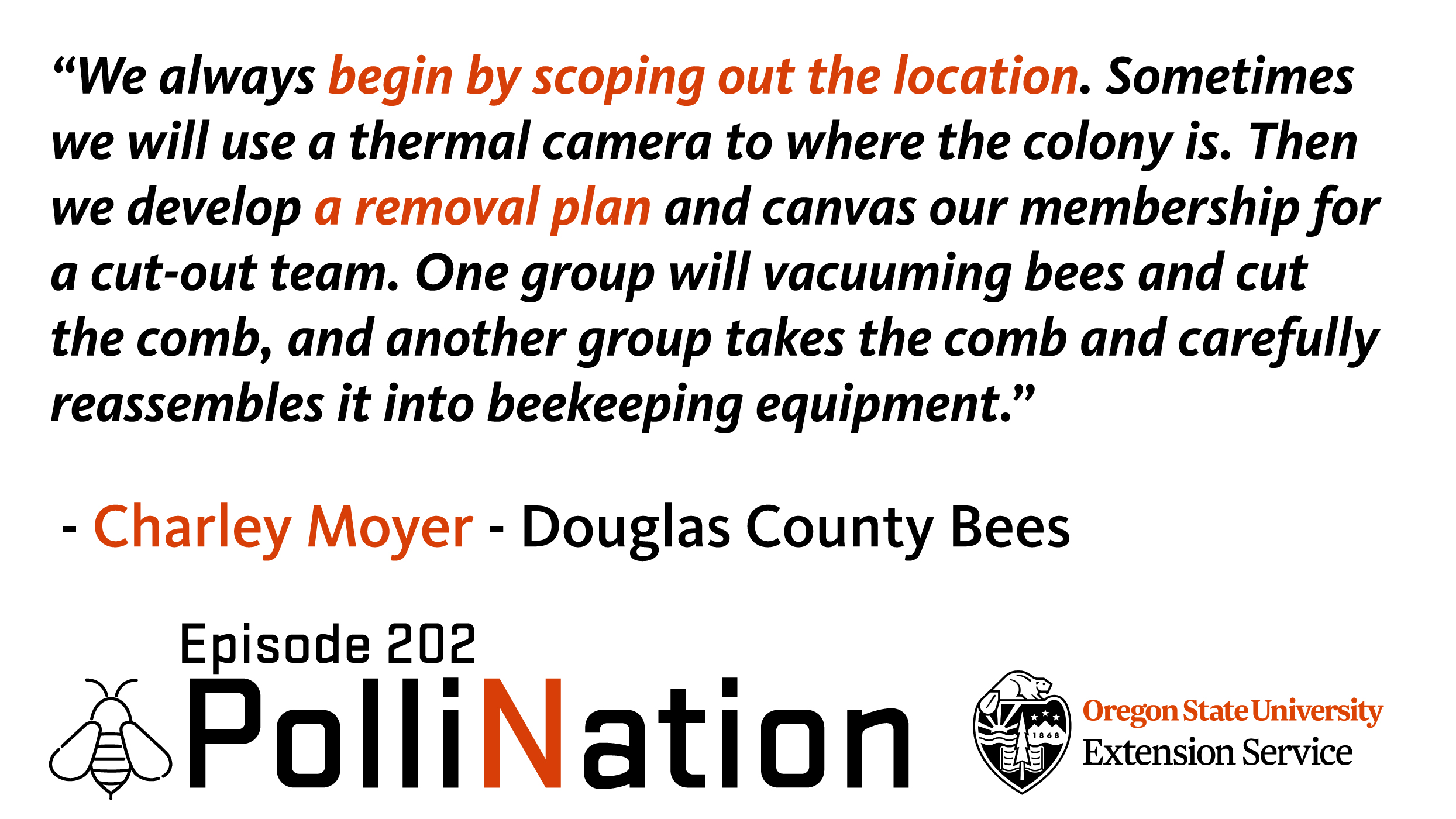
202 - Moyer - Getting Bees Out of the Walls
Sometimes bees will swarm into structures. Getting them out of the structures is not as easy as some on YouTube make it seem. This week we hear about how one bee club has figured out how to easily remove bees from tricky places.
201 - Nico Ardans - What the heck does IPM mean (in nurseries)?
This week we start a new series looking into what integrated pest management (IPM), not as a conceptual framework, but on the ground, where pollinators are scooting around and living their lives. This week we head to a commercial nursery.
200 - OSU Pollinator Health Lab - An Expose!
PolliNation has reached 200 episodes. It has also been 5 years since the OSU Pollinator Health Lab came into existence. To mark the occasion we go behind the scenes to see how the Lab came together and its plans for the future.

199 - Kayla Perry - What drives bumble bee community composition?
The type of insect pollinators you find within a region can vary depending on broad categories of land use. This week we learn about the potential mechanisms that drive this variation, focusing on bumble bees.

198 - James Tracy - Monarch collisions on roadways
Monarch butterflies have been experiencing declines in North America. In this week's episode we hear about the significance of monarch butterfly collisions on interstates and an innovative method to reduce this source of butterfly mortality.
197 - Laura Johnson - Bee Health in Vermont
This week we head to Vermont to hear about the brand new pollinator health position.
196 - Bob Walters - Bee Check
A key principle of state Managed Pollinator Protection plans is to increase communication between beekeepers and pesticide applicators during crop pollination. In this episode, we hear about an initiative to map bee colonies to help applicators find bee colonies in the landscape to help facilitate beekeeper-applicator communication.

195 - Maddie Carpenter - What is the North American honey bee?
Honey bees are not native to North America, but they have been here for hundreds of years. In this episode we dive into the deep history of honey bee importations to North America and learn how molecular technologies can provide insight into the subspecies character of contemporary North American honey bee populations.

194 - Joe Maresh - Oregon State Beekeepers Association Conference
It's the 100th anniversary of the Oregon State Beekeepers Association and to celebrate beekeepers are holding a hybrid conference (in person and online). This week we hear about some of the highlights of the conference and what to look forward to.
193 - Laurie Adams and Josette Lewis - California Pollinator Coalition
This week we hear about an ambitious new initiative in California to increase the adoption of pollinator-friendly practices on working lands.

192 - Lisa DeVetter - Blueberry Pollination Planner
The blueberry industry is one of the most dynamic fruit sectors in the US. As a consequence, what was recommended for pollination a few decades ago may no longer apply. This week we hear about a new initiative to develop a modern pollination planner for US blueberry growers.

191 - Jen Hayes - Natives v nativars for pollinators
There has been an explosion of interest in using native plants for pollinators. Along with this interest there is the question of whether nativars - a natural variant that has been found in the wild and brought into cultivation - are equally beneficial to pollinators. This week we look into an ongoing research project asking this very question.

190 - Maxime Eeraerts - Sweet cherry pollination
Bees are key pollinators of sweet cherry. This week we hear about research from Belgium on using other managed bee species to pollinate this crop (other than honey bees), the influence of encouraging pollinator habitat, as well as tips on keeping managed mason bees healthy and happy during cherry pollination.
189 - Spencer Leonard - Fable of the Bees (Part 2)
One of the most influential books about bees has little to do with bees, but rather reflects on the nature of modern society. Bernard Mandeville (1670-1733) wrote and revised his "Fable of the Bees", after publishing a poem in 1705 titled "The Grumbling Hive: or, Knaves Turn'd Honest". The book is considered one the first pieces of modern sociology and was influential for revolutionaries lat

188 - Spencer Leonard - Fable of the Bees (Part 1)
One of the most influential books about bees has little to do with bees, but rather reflects on the nature of modern society. Bernard Mandeville (1670-1733) wrote and revised his "Fable of the Bees", after publishing a poem in 1705 titled "The Grumbling Hive: or, Knaves Turn'd Honest". The book is considered one the first pieces of modern sociology and was influential for revolutionaries later in the 18th Century. We discuss the book as part of a two-part series.
187 - Mace Vaughn - Natural Resources Conservation Service (NRCS) and Pollinators
Natural Resources Conservation Service has a range of programs to support the development of pollinator habitat in working lands. In this episode you'll get an overview of NRCS programs, how landowners can access them and how, specifically, they can be used to improve habitat for pollinators.
186 - Dean Herzfeld - Where do pesticide applicators get their training?
Pesticide applicators across the US needed to become certified and trained. In this episode we explore where this training requirement came from and how it applies to reducing exposure of pollinators to pesticides.
185 - Kathleen Law - Keeping Bees Safe During Blueberries
Highbush blueberry is the largest pollinated crop in Oregon and one of the top crops in the US as a whole. Beekeepers report that their colonies can sometimes experience difficulties when pollinating this crop. In this episode we hear about how to keep bees healthy in blueberry production systems.
184 - Steve Javorek - Bee Habitat in Lowbush Blueberry
Lowbush blueberry growers in Atlantic Canada have been increasing bee habitat around their fields by encouraging existing plant communities. In this episode we learn how they do this and the incredible bees that pollinate this crop.

183 - Pollinator Partnership - National Pollinator Week (and Beyond)
With National Pollinator week next week, we caught up with staff at Pollinator Partnership (P2) to learn about what's happening to celebrate the week, but also to catch up on growing P2 initiatives; Bee Friendly Farming and the Pollinator Stewards program.
182 - Miranda Jones - The Great Oregon Squash Bee Hunt
Squash bees were never known to Oregon until a few years ago. This summer Oregonians may see the squash bee Peponapis pruinosa for the first time. Learn about these bees and how to track them in the state on this episode.

181- Jim Cane - Pollination of raspberries and other caneberries
Raspberries are not nearly as difficult to pollinate as self-incompatible tree fruit or blueberries. But getting consistent fruit quality still requires finesse. In this episode we cover the pollination requirements of these berries, some of the bees that visit (and nest) in these crops and how to ensure a consistent level of pollination.
180- Glyn Stephens - Splitting your booming colonies
Your honey bees have expanded many fold this spring. Now is the opportunity to split your colonies in half and get two colonies. In this episode we learn all the tricks associated with reliable and quick spring (and summer) and division of colonies.
179- Michael Branstetter - The deep history of the mason bees
Mason bees in the subgenus Osmia emerged sometime before the ice-age, likely in Europe and Asia, but they radiated into North America early on in their history, resulting in one of the most beloved solitary bees, the blue orchard bee. In this episode, we dive into the evolutionary history of this subgenus.
178- Anna Ashby and Amber Reece - 10 beekeeping questions you were too afraid to ask
Starting to keep bees can be overwhelming. To help you get started we have two Oregon Master Beekeepers answer the 10 most common questions that beginners ask.
177- Olivia Messinger Carril - A field guide to the common bees of North America?
Michael O'Loughlin and his family farm a total of 200 acres in Yamhill County. The O'Loughlin Farms and garden is a private research station tracking onsite precipitation, testing slug biocontrol, and studying beetle predation and Northwestern garter and ringneck populations. Michael has been a Master Gardener since 2014 and Oregon Bee Atlas since 2018. Since then, he has mentored new Master Gardener students, participated on the Yamhill County Master Gardener insect committee, taught classes in entomology and garden pollinators, served as a local expert for garden beetle or herpetology questions, and contributed articles to the Master Gardener newsletter. He is also on the Advisory Committee of the Oregon Bee Atlas and leads up the mighty Yamhill County Atlas team. He has also designed, consulted on, and/or built nine school gardens across the state, including a pollinator garden at Mary Wood Elementary School in Tigard. In the six years that O'Loughlin has been a Master Gardener, he has accomplished a tremendous amount of work that benefits gardeners across the state. Although many people may be familiar with his work, many do not know that O'Loughlin is the force behind them, and in 2020 he was awarded the statewide Statewide Behind the Scenes Award for the Master Gardeners.

176- Fred Weisensee - The pollinator plants you need!
With people either reving up to start or spruce up their pollinator garden, we sat down with a local nursery owner about some of the plants he most recommends for bloom across the year.
175 - Marie Vicksta and Michael O'Loughlin - Pollinator Habitat on County Roadsides
This week we hear how Soil and Water Conservation Districts are working to establish cost-effective and pollinator habitat on County roadsides.
174 -Veronica Wignall - Whacking bees for science: Competitive exclusion between honey bees and bumblebees in the UK
Honey bees and native social bees are important crop pollinators and key parts of healthy native plant ecology. However, it's very difficult to examine how these groups of bees interact in the floral landscape. In this episode, we discuss competition between bumble bees and honey bees in an landscape where they are both native, the UK, to uncover what influences they have on each other and the floral resources they share.

173 - Jessica Rendon - Japanese beetle (is no friend of pollinators)
Japanese beetle is a devastating exotic pest. Eradication efforts are underway across the US, including in Oregon. We hear about what is involved with eradication and how it can be done in a way that minimizes impacts to pollinators.
172 - Theresa Pitts-Singer - Where next for managed solitary bees
Managed solitary bees have been a part of crop pollination in the Western US for decades, particularly in alfalfa seed production. But over the last decade, the use of these bees has expanded. We look at the recent expansion and where it might lead in this episode.

171 - Brittany Goodrich - How pollinator markets work
Renting a honey bee colony for pollination seems simple enough, but frequently colonies are contracted months before pollination and a lot can go wrong from the time a contract is inked to when bees are delivered. In this episode we take a deep dive into the fascinating world of beekeepers, growers and pollination brokers.
170 - Halie Cousineau - School gardens and pollinators
Gardens are increasingly appearing in schools. In this episode we learn about strategies to use these gardens to introduce pollinators into school curriculum.

169 - Al Shay - Moving your pollinator garden up a notch
There is an almost inexhaustible amount of options for pollinator gardens. But this can not only be a cause for invigoration, but also confusion. This episode will set you straight on how to take your pollinator garden to the next level.
168 - Carolyn Breece and Ellen Topitzhofer - Late Winter Hive Management
Carolyn Breece and Ellen Topitzhofer support the field research of the OSU Honey Bee Lab. Together they manage the lab's 80 research and educational colonies, preparing them for experiments, and collecting data. They also teach classes and workshops to community beekeepers, OSU undergraduates, and Oregon Master Beekeeper participants.

167 - Linda Hardison - Oregon Flora… reloaded
There have been two exciting developments with Oregon Flora. The first is vol 2 of the flora, which includes an amazing section on Oregon pollinators. The second is there new website, which allows you to do amazing searches for Oregon plant communities.
166 - Alison McAfee - Queens don't like it too hot or cold
Honey bee queens are durable insects, but new research shows that the sperm they store can become quickly degraded by temperature extremes.

165 - Zach Portman - When pan traps might not pan out (for bee surveys).
Pan traps are one of the key methods for surveying for native bees. They are cheap and easy to use, and they aren't subject to the collector bias of studies that rely on netting. This week we hear about the limitations associated with using pan traps.
164 - Chris Looney - Hornets and invasive bumble bees in Washington
Washington contended with two invasive insects in 2020. The first is well-known, Asian Giant Hornet, but the second less so, the common eastern bumble bee. We caught up with the Washington Department of Agriculture for an update on both insects.

163 - Ian Tait - 2020 Year in Review
It was hard to keep track of developments in bee health in 2020 because so much else was going on. In this episode we catch-you-up with a guest who wrote a post per day for since January showcasing what was new in bee health.

162 - Katie Buckley - Washington's Pollinator Health Task Force
The Washington State Legislature just received a set of ground-breaking recommendations on pollinator health from the state's Pollinator Health Task Force. In this episode we hear about what is being recommended and the next steps towards addressing those recommendations.

161 - Kate LeCroy- Exotic Mason Bees
Stem nesting bees like mason bees are particularly amenable to being introduced to distant lands. In this episode we hear about research looking into the impact of these introductions on native bee populations.
160 - Jim Cane - Bees and fire
Devastating wildfires ravaged Western states this summer. In this episode we find out what is known about the effect of forest fires on bees, how bees respond to the land ravaged by fire and how you can help bees while also protecting your property from future fires.

159 - Jamie Ellis - Turning the corner with varroa?
US beekeepers have been struggling to manage varroa mites for over 30 years. Our guest discusses why a solution to varroa has been so elusive and what it would take to finally turn the corner with varroa over the next decade.
158 - Kara Maddox - Pollinators for the Masses
In this episode we learn about an initiative in Texas that engages thousands of families in education around pollinators, headed by the National Pesticide Safety Education Center (NPSEC) and Prairie View A&M University.

157 - Katie Arstingstall - Bees collect pollen from more plants than you think
We have a very dim picture of the flowers bees collect pollen from. In this episode we hear about how lab techniques can be combined with field records of plant occurrences to show that bees may be using a lot more sources of pollen than we once thought.
156 - Shelley Hoover - Preparing hives for winter
The highest period of honey bee colony mortality is during the winter. But there are a number of tricks to ensure high colony survival. In this episode we visit a Canadian bee yard to learn about what they do.

155 - Brian Speisman - Bee Machine
Identifying bees is notoriously difficult and often is an obstacle to beginners interested in contributing to native bee surveys. In this episode we learn about a new initiative to identify bees with machine learning.