
Planet MicroCap Podcast | MicroCap Investing Strategies
463 episodes — Page 1 of 10
Investing Around Catalysts and Knowing When to Trust Management with Christian Schmidt, Private Investor and Co-Founder of Tracktacle
My guest on the show today is Christian Schmidt, a private investor and co-founder of Tracktacle, a financial data and alerts platform that provides real-time alerts on filings and news, plus full-text search across U.S. and Canadian market documents.In this episode, Christian walks us through his unconventional path from banking and e-commerce to becoming a full-time private investor, and how a series of market experiences reshaped his approach to risk, valuation, and opportunity selection. We discuss why he believes private investors have a real edge in microcaps, how he builds positions around clearly defined catalysts, and why doing the valuation work before the news hits is critical to acting with conviction.Christian also shares how painful lessons from turnarounds and management missteps led him to re-prioritize assets and competitive advantage over management narratives — and how those experiences directly inspired the creation of Tracktacle. We dive into how the platform helps investors cut through noise in SEC and SEDAR filings, identify meaningful catalysts faster, and stay on top of microcap developments in real time. We mention a few names on the show today and I'm not a shareholder in any of them.For more information about Tracktacle, please visit: https://www.tracktacle.com/Watch on YouTube:Summary:This podcast covers the investment philosophy, strategic evolution, and entrepreneurial activities of Christian Schmidt, a private investor and co-founder of Tracktacle. Schmidt’s journey began with a bank apprenticeship in Germany, followed by a financially successful but personally unfulfilling career in e-commerce, before a “cathartic” market experience in 2021–2022 catalyzed his transition to full-time private investing in 2023.His investment approach is catalyst-driven and concentrated in the micro-cap space, where he believes private investors possess a clear analytical edge. A core tenet of his process is completing extensive valuation work before anticipated news or filings, enabling rapid and confident action when catalysts materialize. This strategy is exemplified by his successful investment in Regis Corp.Recent experiences—particularly with Innovative Food Holdings—have materially reshaped his views on the relative importance of management versus business quality. Schmidt has shifted from a management-centric mindset to a conviction that assets and real competitive advantages ultimately matter more than management, provided management is not acting in bad faith. As a result, he now prioritizes deep asset analysis before engaging with company leadership.In parallel, Schmidt co-founded Tracktacle, a financial data and alerts platform purpose-built for micro-cap investors. Tracktacle aggregates SEC, SEDAR, and press release data and layers advanced filtering and AI-driven analysis on top, addressing key inefficiencies Schmidt encountered in his own research process.The Investor’s JourneyFrom Banking Apprentice to Full-Time InvestorChristian Schmidt, a 35-year-old investor from Rhineland-Palatinate, Germany, took an unconventional route into investing. Initially planning to study medicine, he instead began an apprenticeship at a rural bank while waiting for a university placement. There, a colleague’s fascination with markets “rubbed off” on him, sparked by the simple power of seeing a DAX ETF chart.Despite this interest, Schmidt found banking unfulfilling. He pursued studies in German and history with the intention of becoming a teacher, while simultaneously working as a self-employed e-commerce consultant. This business became highly profitable—so much so that he abandoned his studies—but he “really hated it from the start.” Over nine years, he invested most of his earnings into stocks and ETFs.A decisive turning point occurred between 2019 and 2021. The November–January period was extremely demanding in e-commerce, leading to “massive” mental overload. During a sharp market drawdown, his largest position, HelloFresh, declined significantly—an experience he describes as “almost cathartic.” This crystallized a binary choice: pursue investing full-time or revert to passive ETFs and his prior profession.In 2023, Schmidt chose the former, becoming a full-time private investor managing his own capital through a tax-efficient German LLC.Intellectual Influences and Strategic EvolutionSchmidt’s investment philosophy evolved from common beginner mistakes into a more flexible, catalyst-focused framework.Early MisstepsHe began by buying stocks promoted in German financial magazines as “the next big thing,” including PayPal, BMW, and Wirecard (which he exited before its collapse). Reflecting on this phase, he notes, “I think most of us started this way.”Key Influences* Paul Chishik: Conversations with Chishik were pivotal, helping Schmidt abandon rigid academic valuation frameworks in favor of more practical, situational analysis. He found traditional valuation textbooks excessively complex, requirin
Why International MicroCaps Resemble the U.S. Opportunity of the 1990s with Robert Gardiner, Chairman & Co-Founder of Grandeur Peak Global Advisors
My guest today is Robert Gardiner, Chairman and Co-Founder of Grandeur Peak Global Advisors. Robert has over four decades of experience investing in small and micro-cap companies across global markets, and in this conversation, he shares how his core investment philosophy has remained remarkably consistent over that entire period. His approach is rooted in bottom-up research — identifying high-quality growth businesses early in their lifecycle, partnering with strong management teams, and maintaining strict valuation discipline.A major theme of this episode is why Robert believes the most compelling opportunity in micro-cap investing today is outside the United States. He explains how international micro-cap markets now resemble the U.S. micro-cap environment of the 1990s — a time defined by a large and growing universe of public companies, limited institutional coverage, and meaningful inefficiencies. We discuss why regulatory changes and the rise of private equity have shrunk the opportunity set in the U.S., and why regions like Japan, the UK, and the Nordics now offer what he describes as “mouthwatering” opportunities.Robert also walks through Grandeur Peak’s two-phase investment process — starting with rigorous quantitative screening across a global universe of roughly 35,000 companies, followed by deep qualitative research that emphasizes direct engagement with management and extensive on-the-ground company visits. We talk about why “touching the company” still matters in an era of AI and data abundance, and how global “dot connecting” can make investors better decision-makers, even in domestic portfolios.Finally, Robert shares lessons from a recent three-year sabbatical that prompted meaningful refinements to both process and culture at Grandeur Peak — including the importance of balancing breadth with depth in research, reinforcing buy and sell discipline, and building a firm culture where every team member feels true ownership.This is a wide-ranging conversation that touches on global markets, micro-cap inefficiencies, investment process, leadership, and long-term perspective from someone who has seen multiple cycles firsthand.For more information about Grandeur Peak Global Advisors, please visit: https://grandeurpeakglobal.com/Watch on YouTube:Summary:This podcast synthesizes the investment philosophy, market outlook, and professional insights of Robert Gardiner, Chairman and co-founder of Grandeur Peak Global Advisors. With more than four decades of experience, Gardiner’s approach is grounded in a consistent, bottom-up strategy focused on identifying high-quality, small growth companies at fair prices.The central thesis is that the most compelling opportunities in micro-cap investing today exist outside the United States. Gardiner argues that international micro-cap markets now resemble the fertile U.S. micro-cap environment of the 1990s—characterized by a broad and growing company universe, limited institutional competition, and attractive valuations—before increased regulation and the rise of private equity constrained opportunity.Regions such as Japan, the United Kingdom, and the Nordics stand out as particularly rich hunting grounds for underfollowed companies. Grandeur Peak’s investment process combines rigorous quantitative screening across a universe of approximately 35,000 global companies with intensive, on-the-ground qualitative research emphasizing direct engagement with management.The document also explores key lessons from Gardiner’s recent three-year sabbatical, which prompted renewed emphasis on research depth, process discipline, leadership presence, and firm culture as foundations for long-term investment success.Robert Gardiner: Career Trajectory and Core PhilosophyAn Unconventional StartRobert Gardiner’s entry into investing was unconventional. At age 16, he began doing “grunt work” for finance professor Sam Stewart, a neighbor, just as personal computers were emerging. What began as an after-school job at Wasatch Advisors, intended to be temporary while Gardiner pursued math and physics, evolved into a lifelong career.Gardiner credits his success to mentors including Sam Stewart and Jeff Carden, offering this advice to young professionals:“Work for some really smart good people… that’s the best thing you can do for your career is to learn from them.”His motivation comes from the intellectual challenge of identifying future market leaders, the competitive nature of investing, and a sense of responsibility for stewarding clients’ “hard-earned money.” After a long tenure at Wasatch, Gardiner co-founded Grandeur Peak Global Advisors in 2011.Enduring Investment PrinciplesGardiner emphasizes that his core strategy has remained unchanged for more than 40 years. It is a common-sense approach focused on finding superior businesses early in their life cycle.Core Tenets* Identify great small companies with substantial long-term growth runway* Seek businesses with durable competitive advan
electroCore (NASDAQ: ECOR): Non-Invasive Nerve Stimulation Products to Rebalance Autonomic Nervous System
My guest today is Dan Goldberger, CEO of electroCore (NASDAQ: ECOR). electroCore is a commercial-stage neuromodulation company developing a suite of non-invasive vagus nerve stimulation devices—delivering a two-minute therapy session designed to rebalance the autonomic nervous system. Built around its nVNS platform, the company operates across three channels: prescription medical devices for headache and migraine, the fast-growing Truvaga direct-to-consumer wellness brand, and a specialized military and government division built around its ruggedized tac-stim product.Founded in 2006 as a non-invasive alternative to implanted vagus nerve stimulators, electroCore has evolved into a multi-indication business with seven FDA authorizations for headache, serving major customers like the U.S. Department of Veterans Affairs and the UK’s National Health Service. I invited Dan to the show to discuss all of this, as well as:* How nVNS platform works and the science behind vagus nerve modulation* electroCore’s evolution from implanted alternatives to multi-channel neuromodulation* The prescription business model across the VA, NHS, and managed care* Truvaga’s growth in the wellness market and why awareness is the primary competitor* The tac-stim military program and its role as a meaningful revenue stream* Strategic priorities heading into 2026—profitability, capital allocation, and commercial execution* Challenges around insurance coverage and overcoming the “chicken and egg” problem* The path toward becoming a $150–200 million business and the long-term vision for the platformFor more information about electroCore, please visit: https://www.electrocore.com/Watch on YouTube:Summary:electroCore is a commercial-stage company developing a suite of non-invasive nerve stimulation products for medical conditions as well as the broader health and wellness market. Its core technology—non-invasive vagus nerve stimulation (nVNS)—is delivered via handheld, portable devices that provide a two-minute therapy session.The business operates across three distinct channels:* Prescription medical devices* Direct-to-consumer (DTC) wellness products* Military and government contractsThe prescription channel is anchored by electroCore’s two largest customers: the U.S. Department of Veterans Affairs (VA) and the UK’s National Health Service (NHS), where the therapy is provided free to patients for headache indications. A key strategic priority is increasing penetration within these established systems—particularly the VA, where electroCore currently reaches only ~2% of the eligible population.The company’s rapidly growing DTC wellness brand, Truvaga, targets stress, sleep, and focus, and is described by management as a “huge blue ocean opportunity.”The company’s primary challenge remains securing broad commercial insurance coverage in the United States. This process is slowed by a “chicken-and-egg” dynamic: insurers require claims data to justify coverage, while claims data requires coverage to be generated at scale. Management has acknowledged investor concerns around cash runway and forecast credibility, noting the company is “unfairly in the doghouse.”electroCore’s central corporate objective is to reach profitability in 2026, achieved by prioritizing capital deployment into proven sales and marketing channels while deferring major R&D initiatives. Longer term, management envisions building a $150–200 million revenue business over a three- to five-year horizon.I. Company Overview & TechnologyCore BusinesselectroCore’s foundational technology is non-invasive vagus nerve stimulation. CEO Dan Goldberger summarizes the company succinctly:“electroCore has a growing suite of non-invasive nerve stimulation products for health and wellness and for certain medical conditions.”Technology and Mechanism of Action* Therapy is delivered via a handheld, personal-use device with two electrodes on the “business end.”* Users are trained to locate the carotid artery in the neck and place the device over that location, where the vagus nerve travels within the same sheath.* A standard therapy session lasts two minutes.* Vagus nerve stimulation restores balance in the autonomic nervous system—shifting the body from a “fight-or-flight” state to a “rest-and-digest” state.* As described by management: if a user is anxious, stimulation brings them down; if lethargic, it brings them up.Company History and Evolution* Founded in 2006 by three physician entrepreneurs as an “overnight success that was started 20 years ago.”* Original thesis: develop a non-invasive alternative to implanted vagus nerve stimulators used for epilepsy and depression in the 1990s.* Early trials focused on epilepsy and immune response; anecdotal patient feedback (“my headache went away”) led to a strategic pivot.* 2017: First FDA De Novo authorization for cluster headache.* Commercial operations began in 2017–2018.* Today, electroCore holds seven FDA indications for headache and migraine—acu
D-BOX Technologies $DBO.TO and Premium Formats in the Theatrical Ecosystem with Dylan Marrello, Founder and Portfolio Manager at Marrello Capital
My guest today is Dylan Marrello, Founder and Portfolio Manager at Marrello Capital. In this episode, we take a deep dive into D-BOX Technologies (TSX: DBO), a haptic technology company that’s been discussed quite a bit recently.The movie theater industry has been through a dramatic reset over the past few years — from streaming pressure and COVID shutdowns to consolidation, higher ticket prices, and a renewed focus on premium, in-theater experiences that audiences simply can’t replicate at home. As the industry recovers, exhibitors and studios alike are leaning into technologies that enhance engagement, drive higher ticket spend, and improve theater economics.We discuss D-BOX’s shift to a high-margin theatrical royalty model, the impact of new management, strong insider alignment, and how premium experiential formats are reshaping the future of moviegoing.For more information about Marrello Capital, please visit: You can Follow Dylan Marrello on Twitter/X @RagingBullCap: https://x.com/ragingbullcapWatch on YouTube:Summary:This podcast synthesizes the investment thesis for D-BOX Technologies, a haptic technology company positioned at a significant financial and strategic inflection point from Dylan Marrello, Founder & Portfolio Manager of Marrello Capital. The core argument Dylan makes is that despite a recent ~500% increase in its share price, D-BOX remains a compelling opportunity due to a convergence of structural, operational, and financial drivers.A new, disciplined management team has refocused the company on its high-margin theatrical royalty business, benefiting from the post-COVID recovery of the movie exhibition industry and a structural shift toward premium consumer experiences. D-BOX’s business model exhibits substantial operating leverage, with ticket royalties carrying nearly 100% incremental margins. Key growth drivers include a large, underpenetrated global theater base, increasing consumer preference for premium formats, and the potential for future royalty rate increases.Supported by unusually strong insider buying and a valuation that remains modest relative to premium peers such as IMAX, D-BOX represents a differentiated opportunity within a recovering and evolving theatrical ecosystem.1. The Macro Theatrical Landscape: An Industry in TransitionPost-COVID Recovery and ConsolidationThe global theatrical exhibition industry has endured significant disruption from streaming adoption and pandemic-related closures. This period triggered widespread consolidation and capital destruction, reshaping the competitive landscape.* Financial trauma: Major operators such as AMC became highly leveraged, while Regal (the #2 U.S. operator) entered bankruptcy.* Capital cycle dynamics: The exit of capital and weaker competitors has improved industry structure for surviving operators.* Box office recovery: Global box office revenues have rebounded to roughly 80% of 2019 levels. Importantly, this recovery has been driven more by higher ticket prices than by attendance growth, demonstrating renewed pricing power.Structural Shift Toward Premium ExperiencesAs at-home viewing has become ubiquitous, theaters have responded by upgrading the in-person experience—consistent with historical responses to prior technological disruptions (e.g., TV, VCRs).* Premiumization strategy: Operators are emphasizing premium formats such as IMAX screens and experiential technologies like D-BOX.* Disproportionate value capture: Premium technology providers capture an outsized share of industry economics. IMAX, for example, trades at ~25–30x earnings and commands a substantial enterprise value despite owning a small percentage of total screens. In China, IMAX represents ~1% of screens but ~6% of box office share.* Operator validation: Cineplex reports that over 40% of its ticket revenue now comes from premium formats, confirming premium offerings as a central revenue driver.2. The D-BOX Technologies Business Model and Value PropositionCore Technology and EconomicsD-BOX Technologies provides a differentiated cinematic experience through proprietary motion (haptic) technology.* Haptic experience: D-BOX installs motion actuators into theater seats, programmed with film-specific choreography.* Dual revenue streams:* Hardware sales: One-time installation revenue with ~30% gross margins.* Ticket royalties: Recurring royalties on each D-BOX ticket sold, carrying near-100% incremental margins.* Ecosystem alignment:* Exhibitors: Higher ticket prices and increased attendance.* Studios: Enhanced box office results and direct collaboration with D-BOX on film choreography.* Consumers: A differentiated, premium viewing experience.This alignment positions D-BOX at the center of the theatrical value chain, enabling it to earn attractive economic rents.3. The Inflection Point: Strategic and Financial CatalystsManagement Overhaul and Strategic RefocusD-BOX has undergone a complete management reset, including the appointment of a new CEO and CFO, follo
The Anatomy of a Fallen Angel: Management, Mispricing, and Turnarounds + Weight Watchers $WW Thesis with Paul Cerro, Founder and CIO of Cedar Grove Capital Management
My guest on the show today is Paul Cerro, Founder and CIO of Cedar Grove Capital Management, and today’s conversation is all about fallen angels — once high-profile companies that collapse due to poor execution, leverage, or macro pressure, but can become some of the most mispriced and compelling opportunities in the market.Paul breaks down the anatomy of a fallen angel, why these setups create structural market inefficiencies — especially in illiquid micro-caps — and how forced selling, headline-driven reactions, and information scarcity can disconnect price from fundamentals. Most importantly, he explains the key dividing line between a genuine opportunity and a value trap: management credibility. In micro-caps, direct access to leadership gives investors a rare ability to test their assumptions and validate the story before making a high-conviction bet.We also zoom out to the macro landscape, where Paul sees 2026 shaping up as a major buyout year for fallen companies. With private equity sitting on record dry powder — and the potential for rate cuts — consumer-facing businesses, retailers, restaurants, and even selected real estate names could become prime acquisition targets.And then we dig into a fascinating case study: Weight Watchers (WW) — a company Cedar Grove originally shorted into bankruptcy, and one Paul now views as a compelling post-reorg long. He walks us through the dramatic deleveraging, the mandatory cash-sweep that accelerates equity value creation, and the company’s strategic pivot toward a holistic wellness model that integrates behavioral coaching with GLP-1 medications. It’s a rare look at how a fallen angel can move from short to long purely based on fundamentals, incentives, and structure.This episode is a deep dive into special situations, fallen angels, restructuring dynamics, and the psychology required to separate opportunity from permanent impairment.And for full disclosure, Paul mentions a number of companies today, and I’m not a shareholder in any of them.For more information about Paul Cerro and Cedar Grove Capital Management, please visit: https://www.cedargrovecm.com/Watch on YouTube:Summary:This podcast synthesizes an in-depth discussion on the investment theme of “fallen angels,” particularly within the microcap universe. A fallen angel is defined as a company with high brand equity and public awareness that has experienced a precipitous or gradual decline in its stock price due to poor execution, management missteps, or macroeconomic pressures.These situations can create significant market mispricing due to:* Forced selling by funds* Inherent illiquidity in smaller stocks* Investor overreactions to negative headlinesThe key to distinguishing a true fallen angel opportunity from a value trap lies in deep analysis of management’s credibility, honesty, and communication. In the micro-cap space, where investors can directly access management, this is a clear advantage after a period of underperformance.The primary case study examined is Weight Watchers (WW)—a classic fallen angel that recently emerged from bankruptcy. The post-restructuring long thesis centers on a dramatic deleveraging of the balance sheet (debt reduced from ~$1.6B to $465M), a mandatory cash sweep accelerating further debt repayment, and a compelling strategic repositioning as a holistic wellness provider integrating behavioral expertise with rising demand for GLP-1 medications.Defining and Identifying “Fallen Angels”Cerro, CIO of Cedar Grove Capital Management, defines a fallen angel as a company that once possessed a high-profile brand or major public attention before experiencing a significant decline. Its prior visibility is what separates a fallen angel from an unknown company that simply performed poorly.Key characteristics of a fallen angel:* High Brand Equity — a household or widely recognized name* Meaningful Decline — caused by execution failures, structural issues, or macro headwinds* Public Awareness — the brand remains in the public consciousnessExamples cited:* Sweetgreen (SG) — widely known but sharply devalued* Lululemon (LULU) — a recent high-profile decline* Robinhood (HOOD) — a company written off after bottoming in 2022 before subsequently recoveringCauses of Market Mispricing and OverreactionIn the decline of a fallen angel, several structural elements—especially in micro caps—can lead to deep mispricing.1. Forced Selling by FundsLarge funds often liquidate positions due to mandates or reallocations. In illiquid micro caps, this selling drags the stock far below intrinsic value.2. Illiquidity as “Bug and Feature”* A bug for investors who must exit* A feature for patient investors who recognize temporary dislocations3. Scarce Information and Headline OverreactionsWith limited analyst coverage or alternative data, the market often overreacts to one headline, such as a guidance miss.4. Psychological BiasInvestors may misclassify a genuine deterioration as an “overreaction” to avoid admi
Thinking like Private Owners in the Public Markets with Jason Kirsch, Portfolio Manager at Rosen Partnership
My guest on the show today is Jason Kirsch, Portfolio Manager at Rosen Partnership and co-architect of the firm’s Active Value Strategy — a concentrated, long-only, private-owner-style approach to investing in micro-cap companies across Canada, the U.S., and Europe.In this episode, Jason walks us through Rosen Partnership’s philosophy of thinking like private owners in the public markets: buying capital-light, high-ROIC compounders at meaningful discounts to intrinsic value; partnering with aligned management teams; and using “constructivism” — a collaborative, non-activist engagement style — to help unlock long-term value.We dig deep into how Jason builds a true knowledge edge: talking not just to management, but to former executives, board members, competitors, suppliers — anyone who can broaden the mosaic and create an informational gap most investors simply aren’t willing to develop. Jason also shares lessons learned from catalysts that didn’t play out, how misaligned incentives can turn a bargain into a value trap, and why understanding your own psychology is just as important as understanding any business.For more information about Rosen Partnership, please visit: https://www.rosenpartnership.com/We just announced our full slate of investor conferences for 2026, all in partnership with MicroCapClub. Our next major event is Planet MicroCap: LAS VEGAS, happening June 16–18, 2026, at the Bellagio. Registration is now open for that. And, later in the year, we’ll be heading back to Toronto, October 27-29, 2026 at the Arcadian Loft. The mission is to bring the best microcap investors and companies together to gather, connect, and grow. This includes your participation.We know you are putting your 2026 investor conference calendars together, and we’d like to humbly invite you to join us for one or both of them. Please visit www.planetmicrocapshowcase.com for more information. See you in Vegas and Toronto!Watch on YouTube:Summary:The core of the firm’s approach is the Active Value Strategy, a concentrated, long-only portfolio focused on micro-cap companies (under $1 billion market cap) across Canada, the U.S., and Europe.The strategy is rooted in thinking like a private owner of a public company, seeking long-term compounders trading at meaningful discounts to intrinsic value. Key criteria include:* High returns on invested capital* Capital-light business models* Management teams with significant “skin in the game”* Clear, thoughtful capital allocationThe investment process is exhaustive, extending research beyond management to former employees, board members, competitors, and suppliers. This depth of work is intended to create a “knowledge gap” that provides an edge. A defining feature of the firm’s approach is constructivism—collaborative engagement with management to unlock value, while stopping short of formal activism.Kirsch emphasizes that understanding oneself—biases, tendencies, reactions—is as essential as understanding the businesses themselves.Jason Kirsch: Background and Formative ExperiencesKirsch’s philosophy is shaped by academic grounding, hands-on experience, and exposure to markets during periods of extreme stress.Early Influences* Interest began in high school with a stock-picking competition.* Studied at McGill University in the Honors Investment Management program, where students launched and ran a regulated asset management firm.* Gained experience in both public markets and fixed income during the Great Financial Crisis, shaping his framework for risk and valuation.Hedge Fund ExperienceAfter graduating, Kirsch worked at three firms including Desautels Capital Management, Galliant Advisors, and Waratah Capital Advisors.Key lesson:“Learning the short side… you have to flip the script on every single name you’re looking at.”This cultivated a deep appreciation for margin of safety, and the ability to analyze every investment from both long and short perspectives—discipline he brings into a long-only format today.Founding the StrategyIn March 2022, Kirsch partnered with Brian Rosen to launch the Active Value Strategy.Their catalyzing observation:“Amazing opportunities—companies trading extraordinarily cheaply at huge discounts to their net asset value.”The Rosen Partnership Active Value StrategyA disciplined, research-heavy, concentrated approach centered on high-conviction ideas.Core Philosophy* Concentrated portfolio: Typically ~10 names representing the majority of assets.* Geographic focus: Canada, the U.S., and increasingly Europe.* Private-owner mindset:“Would we want to own this business privately at this price?”* Investment goal: Own “fantastic businesses that compound naturally” and ideally never sell—potential three, five, or ten-baggers.Key Investment CriteriaInvestment Process and Due DiligenceA process designed to uncover overlooked ideas and develop a knowledge-based edge.SourcingTo build the strategy, the team:“Looked through every single publicly traded name in Canada below a
Capital Cycles, Moats, and Margin of Safety + Thoughts on $AAP $TRBR.V with Kenny Chan, Founder & Portfolio Manager of Korwell Capital
My guest on the show today is Kenny Chan, Founder and Portfolio Manager of Korwell Capital. Kenny is only 23, but he’s built an investment philosophy rooted in the classics — Peter Lynch, Joel Greenblatt, Warren Buffett — and adapted with a modern, high-conviction approach. His north star: “Buy Phil Fisher–like businesses at Graham-like prices.”Kenny walks us through the four categories that define his framework: misunderstood Buffett-like compounders, deep Graham-style value plays, capital-cycle opportunities, and turnarounds. We discuss how he launched Korwell Capital straight out of college, and how investing his own convictions — not academic theory — drives his process.We dig into two examples that bring this to life. First, Advance Auto Parts, where Kenny saw a rare combination of capital-cycle tailwinds, industry consolidation, and a fixable integration problem — creating a classic turnaround at a very cheap price. Second, Trubar, which received a takeover bid on the day of our interview. Kenny breaks down why he viewed the company as a niche brand with a durable moat, why the sale undervalues its long-term potential, and the critical lesson he’s taking away: understand management incentives before you invest.We wrap with Kenny’s advice for aspiring managers — especially the importance of writing publicly, testing your theses, and building a network through the quality of your ideas.We talked about a number of companies in today’s episode, Kenny is a shareholder of Advance Auto Parts and Trubar, and I am not a shareholder in any of the names mentioned.For more information about Kenny Chan and Korwell Capital, please visit: https://korwellcapital.com/Watch on YouTube:Summary:His central thesis is to buy “Phil Fisher–like companies at a Graham-like price,” an idea he executes across four primary investment categories:* Misunderstood Buffett-like companies* Graham-like deep value opportunities* Capital cycle plays* TurnaroundsThe analysis includes detailed case studies illustrating how Chan applies this framework in practice. His investment in Advance Auto Parts demonstrates how capital cycle and turnaround principles can converge within a consolidated, counter-cyclical industry. Meanwhile, the takeover bid for Troubar, a core holding, provides insight into Chan’s thinking around brand-driven moats and the importance of aligning with management incentives for long-term value creation.The podcast concludes with Chan’s reflections on market inefficiencies and his advice for aspiring fund managers—particularly the importance of publicly testing investment theses to build skill, conviction, and a professional network.1. Kenny Chan and the Founding of Korwell Capital1.1 Background and InfluencesKenny Chan’s interest in business began early, inspired by watching his father run a comic book store. This curiosity evolved into a habit of reading business news and, eventually, classic investing literature. His passion was ignited by Peter Lynch’s One Up On Wall Street, which he says “absolutely blew my mind.” He soon immersed himself in the works of Joel Greenblatt, Seth Klarman, Warren Buffett, and other value-investing legends—often reading during daily commutes to school.Chan attended NYU Stern specifically to pursue a career in value investing, supplementing his academic work with internships in private equity and hedge funds.1.2 Path to Founding Korwell CapitalAfter graduation, Chan’s planned private equity role fell through when the fund shut down. He instead joined a small public equity shop. Just months into the role, he approached his boss—who had developed confidence in him—and successfully secured backing to launch Korwell Capital.Asked about the confidence to start a fund at 23, Chan credits two factors:* Opportunity – His boss believed in his ability and provided capital.* Conviction – A strong desire “to be able to research stocks in the way that I believe and ultimately to invest in my own convictions.”He emphasizes that while his strategy is “not new,” he believes he has “a different perspective of [value investing] insights than most investors.”2. Korwell Capital’s Investment Framework2.1 Guiding PhilosophyChan’s process is built around first-principles thinking:“A first principles understanding of business to understand a business beyond just its financial statements.”He cites Li Lu’s concept of “insights”—the handful of fundamental principles Buffett used to outperform his mentors.His core thesis:**• “Buy Phil Fisher–like companies at a Graham-like price.”• “Buy Graham-like companies at a very, very cheap price.”**This requires deep qualitative understanding to identify stocks temporarily mispriced relative to their true business quality.2.2 The Four Investment CategoriesCategoryDescriptionMisunderstood Buffett-like CompaniesHigh-return-on-capital businesses with strong reinvestment opportunities, available at a cheap price. Very rare.Graham-like OpportunitiesCompanies trading far below tangibl
Crypto at a Crossroads: Institutional Viability and Remaining Risks with Jacob Stephan, Senior Research Analyst at Lake Street Capital Markets
My guest on the show today is Jacob Stephan, Senior Research Analyst at Lake Street Capital Markets. He recently authored a “Crypto Industry” white paper, and I invited him on to break it down. In this episode, Jacob lays out why digital assets have crossed into institutional viability—a “normalization phase” driven by clearer regulation, enterprise-grade infrastructure, and real corporate adoption.We discuss the internet-style adoption curve (crypto at ~7% global penetration), why regulation is the cornerstone of investability (FIT 21 progress, the new FASB fair-value accounting, and pending clarity in the U.S.), and how stablecoins—“dollars with an API”—are emerging as the killer app with multi-trillion settlement volumes. Jacob walks through concrete examples from Visa, Mastercard, and JPMorgan moving beyond pilots to on-chain settlement, and contrasts stablecoins’ payment utility with Bitcoin’s treasury/“digital gold” role.We also cover the nuanced risks: centralization at the access layer (custody, cloud, compliance), state-by-state regulatory differences, speculative micro-cap “crypto treasury” raises, and why bipartisan momentum reduces—but doesn’t eliminate—policy risk. Finally, Jacob shares the “picks and shovels” angle—cloud, fintech/payments, and semiconductors—as scalable ways to participate in the build-out without direct token exposure, and why even low single-digit institutional allocations could materially move the asset class.We discussed a number of crypto currencies in today’s episode. Jacob owns SOL, SUI and BTC, and for full disclosure, I also own BTC.For more information about Lake Street Capital Markets, please visit: https://www.lakestreetcapitalmarkets.com/Watch on YouTube:Summary:The central thesis is that digital assets have entered a phase of “institutional viability,” driven by regulatory progress, maturing infrastructure, and meaningful corporate adoption. Stephan argues that crypto is now in its “normalization phase,” analogous to the internet in the late 1990s, with global user penetration (~7%) mirroring the internet at its own early tipping point.The catalyst for this transition is the emergence of clearer U.S. regulation, which provides institutions with legal footing to participate without existential uncertainty. This regulatory shift is reinforced by institutional-grade custody and compliance infrastructure, as well as real corporate use cases—particularly among Visa, Mastercard, PayPal, Tesla, and JP Morgan—who are using blockchain rails for settlement efficiency.While Bitcoin is increasingly used by certain high-conviction companies as a long-term treasury asset, stablecoins have become crypto’s first major “killer app,” processing over $6 trillion in settlement volume in 2024.Key risks include centralization at core access points (custody, cloud services), speculative micro-cap token treasury raises, and regulatory uncertainty that remains unresolved. The most compelling investment opportunities are found in “picks and shovels” plays—cloud, fintech, and semiconductor companies powering blockchain infrastructure—offering exposure to sector growth without direct token risk.1. The “Crypto Normalization” Thesis: An Internet Adoption AnalogyStephan argues that crypto is entering its first true normalization phase, where it becomes “invisible infrastructure,” much like the internet during its early commercial rollout.Adoption Curve Parallels* Internet (late 1990s): 4%–8% global penetration* Crypto (2024): ~560 million users (~7% of global population)This matching penetration level suggests crypto is at a similar inflection point, with network effects driving accelerating adoption.Institutional Legitimacy as the Inflection PointLarge-scale participation from both Wall Street and Silicon Valley—along with improved regulation—has removed the “career risk” institutions previously faced in engaging with digital assets.Stablecoins as Crypto’s “Killer App”Just as email was the internet’s first mainstream use case, stablecoins and tokenization are crypto’s first broadly adopted applications—driving real-world settlement, not speculation.2. Core Drivers of Institutional ViabilityStephan frames institutional adoption around three pillars: regulation, infrastructure, and corporate adoption.Regulation: The Cornerstone“The infrastructure made it usable, but regulations are ultimately what made it investable.“Key U.S. legislative developments:* FIT 21 Act – Passed House; establishes digital asset regulatory framework* Genius Act – Signed July 2024, effective 2027* Clarity Act – Pending in Senate; aims to finalize regulatory designationsThis bipartisan progress provides the legal clarity institutions required.Infrastructure: Institutional-Grade RailsCustody, compliance, and settlement systems have matured significantly. Major custodians and service providers now meet institutional security and reporting standards.Corporate Adoption: Validation Through UtilityMajor firms are integrating o
Financial Archaeology: Deep Research and Uncommon Insights with Gwen Hofmeyr, Founder and Senior Analyst at Maiden Financial
My guest on the show today is Gwen Hofmeyr, Founder and Senior Analyst at Maiden Financial. In this episode, Gwen walks us through her unique research methodology — which she refers to as “financial archaeology.” This is a process built around extremely deep, original investigative work designed to uncover uncommon information — insights that simply aren’t available in typical company reports or mainstream research.We discuss how Gwen routinely spends 200 to 600 hours analyzing a single company, validating market share by breaking down thousands of individual products, and constructing an understanding of a business that is entirely independent of management narrative and sell-side opinion. We also talk about how this approach leads to owner-level conviction, and why that conviction matters so much in the microcap universe, where volatility is high and broad consensus is often absent.Gwen also shares why some of the most compelling opportunities she’s finding today are in Europe, particularly in industrial and lagging-edge technology companies, and how AI is actually increasing the value of deep human research — not replacing it.For more information about Maiden Financial, please visit: https://www.maidenfinancial.io/Watch on YouTube:Summary:Executive SummaryHofmeyr’s central thesis is what she calls “financial archaeology”—a form of extremely deep, original, and time-intensive research designed to uncover uncommon information that the market has not yet priced in. Her approach requires developing a granular, owner-level understanding of a business by analyzing unit-level product data, platform inventories, and geospatial dynamics rather than relying on high-level financial statements or management narratives. A typical research project requires 200–600 hours of work.She currently focuses on opportunities in Europe, particularly in lagging-edge technology and industrial companies where market inefficiencies are structurally persistent and deep work provides a durable edge.I. Founder Background and Origin of Maiden Financial* Hofmeyr studied political science before pivoting to finance.* Began serious self-study in 2017, reading ~36 investment books in the first year.* Influenced heavily by Peter Lynch, Warren Buffett, and Charlie Munger.* Documented her early mistakes in a self-published book, The Halfway Crustacean, applying Munger’s principle of learning by examining errors.* Was hired by Andrew Wilkinson to work at Tiny, later working at its family office Folly Partners, where she developed her research framework independently.* Founded Maiden Financial after realizing most firms did not have the infrastructure or culture to support very deep, original research.“There’s a real lack of in-depth research on the sell side. I wasn’t getting the information necessary to think like an owner.”II. Financial Archaeology: Core PhilosophyHofmeyr evaluates companies as if each were an undiscovered archaeological site—requiring unique methods, curiosity, and patience.Core Principles* Uncommon information → uncommon outcomes.* Hypothesis-driven research: Start with an anomaly worth explaining.* Iterative excavation: Question → answer → dig deeper → repeat.* Self-sufficiency: Conviction should come from firsthand understanding.* Time intensity: 200–600 hours per company is typical.III. Research Process and Investable UniverseUniverse Criteria* Free float: preferably >$200M (though she will consider >$20M).* Operates in jurisdictions with strong rule of law.* Prefers owner-operators and businesses where management incentives align with shareholders.* Comfortable in complex business models others avoid.* Valuation matters but is secondary to understanding competitive structure.Trigger for a Deep Dive* Always begins with a data anomaly, such as:* Unusually high ROE* Superior margins vs. peers* Pricing power not reflected in valuationExample: Malaxisus (Belgium)* Had industry-leading ROE despite being small.* Required analyzing 3,000+ products to understand niche dominance in automotive magnetic sensors.IV. The “Testing Market Share” FrameworkHofmeyr independently verifies competitive positioning rather than accepting reported market share.MethodPurposeExample InsightProduct-level comparisonReveals segment dominance disguised in broad numbersCrane maker claiming 30% share actually dominated heavy-duty segmentPlatform inventory analysisShows real-world demand footprintCompares product count across resellers/manufacturersGeospatial mappingHighlights moat formed by physical distribution & territory strategyStore clustering reveals strategic market captureV. Management Engagement* She does not speak with management until after completing her full analytical process.* This prevents narrative influence and identifies exactly where clarification is needed.* Companies often appreciate receiving her report—it resembles paid strategic research.VI. Publication and ActionabilityHofmeyr publishes when:* A clear asymmetric return exists
The Case for MicroCaps and Why We're in the Early Innings of a New Cycle that Favors Smaller Companies with Doug Porter, Portfolio Manager and Senior Research Analyst at Acuitas Investments
My guest on the show today is Doug Porter, Portfolio Manager and Senior Research Analysts at Acuitas Investments. Doug and his team recently published a new white paper titled, “The Case for MicroCap.” For most of you listening in, you’re already a diehard MicroCap-per, and we’ve all succumbed to the altar to the merits of hunting in inefficient markets.Having said that, I invited Doug on here to not only remind us why we are here, why we hunt for the best investment ideas in our neck of the woods, but more importantly, in my opinion, to showcase why in 2025, the case for investing in MicroCaps has merit as a place to build wealth and allocate capital.Doug breaks down the structural inefficiencies and long-term opportunity in the micro-cap equity market — a segment that remains largely ignored by big institutions, but continues to be fertile ground for alpha generation.We discuss why micro-caps have historically outperformed in 84% of rolling 30-year periods, the critical role of active management in filtering out the riskiest names, and why Doug believes we’re in the early innings of a new cycle that favors smaller companies.Doug also explains how “Stable Operators” — profitable, cash-generating niche businesses — are among the most compelling yet overlooked opportunities in today’s market, and why a dedicated micro-cap allocation can offer diversification, M&A upside, and even a liquid alternative to private equity.Finally, we cover Acuitas’s approach to identifying skilled micro-cap managers across the globe — and how this ecosystem of small, research-driven funds continues to uncover value where few others are looking.For more information about Doug Porter and Acuitas Investments, please visit: https://acuitasinvestments.com/Watch on YouTube:Summary:Acuitas argues that micro-caps represent a structurally inefficient and neglected asset class, offering fertile ground for long-term alpha generation through skilled active management.Key Takeaways:* Structural Inefficiency: Large institutions and sell-side analysts systematically avoid micro-caps due to liquidity constraints and the minimal impact small positions have on large portfolios. This results in less coverage, slower information flow, and greater pricing inefficiency.* Historical Outperformance: The “micro-cap effect” has produced outperformance versus large caps in 84% of rolling 30-year periods, driven by neglect and undervaluation.* Active Management Advantage: Skilled active managers have generated 450+ basis points of annualized alpha over the past decade through deep research and risk avoidance.* Cyclical Opportunity: The market appears to be in the early innings of a new cycle favoring micro-caps, with valuation gaps and cycle lengths suggesting a coming reversion.* Most Attractive Segment: Within micro-caps, “Stable Operators” — profitable niche companies ignored by recent thematic rallies — represent the most compelling opportunity today.1. The Structural Opportunity in Micro-Cap EquitiesInstitutional Neglect and Resulting InefficienciesLarge institutions systematically avoid micro-caps due to:* Liquidity Constraints: Small float sizes make it difficult for large funds to build or exit positions efficiently.* Business Pressures: Firms focused on asset growth prioritize scalability, pushing research and products toward larger-cap stocks.* Inability to “Move the Needle”: A 100% return in a $200M micro-cap position is immaterial to a $50B fund.These structural constraints create enduring inefficiencies:* Fewer “Eyeballs”: The space is dominated by retail or part-time investors with limited professional coverage.* Slower Information Flow: News and filings take longer to be fully reflected in stock prices.* Greater Mispricing: The absence of analysts and institutional capital leads to persistent valuation anomalies.Porter emphasizes this as a permanent feature, not a passing one:“Those lessons… they haven’t changed. They aren’t likely to change.”As large firms continue to consolidate, their growing scale only deepens the neglect of smaller companies.2. Historical Performance and Risk AnalysisThe “Micro-Cap Effect”* Performance Data: Micro-caps have outperformed large-caps in 84% of rolling 30-year periods.* Index Composition: Over 90% of the micro-cap index represents the smallest deciles of the market, compared to just 25% of most “small-cap” indices.* Drivers: The combination of low valuations and structural neglect produces consistent outperformance.Deconstructing Risk PerceptionThe high-risk perception of micro-caps is often based on broad, unfiltered universes.* True Source of Volatility: The riskiest companies — unprofitable, speculative, highly levered — distort the asset class’s overall volatility.* Active Advantage: Skilled managers avoid these “junk” names, creating portfolios that actually have lower risk and volatility than the index.Active investors benefit from the upside of the asset class “with a lot less risk.”3. The Critical R
Aluula Composites (TSX-V: AUUA): Fusing High Performance and Sustainability in Next-Gen Materials
My guest today is Sage Berryman, CEO of Aluula Composites (TSXV: AUUA). Aluula is focused on revolutionizing material science. Founded in 2019, the company has developed a patented process for producing ultra-high molecular weight polyethylene (UHMWPE) composites without glues—fusing at the molecular level to create materials that are lighter, stronger, more durable, and fully recyclable. This “mono-material” design also enables circularity and addresses the growing demand for PFAS-free solutions.The company first gained traction in windsports through its Ocean Rodeo subsidiary, but following a 2023 RTO and a 2024 strategic refocus under Sage’s leadership, Alula divested Ocean Rodeo to concentrate on becoming an ingredient brand. Today, Aluula is targeting both premium outdoor markets—packs, tents, wind sports—and larger commercial and industrial applications, where strength, durability, and recyclability are key.Aluula will be presenting at our conference in Toronto, the Planet MicroCap Showcase on October 21-23, and I invited her on to discuss:* The science behind Aluula’s glue-free composites* Strategic pivot from Ocean Rodeo to ingredient branding* Long but improving sales cycles for adoption* Differentiation from commodity materials like polyester and nylon* Expansion plans into higher-volume industrial applications* Financial discipline, with recent margins of 40–45%For more information about Aluula Composites, please visit: https://aluula.com/Watch on YouTube:Summary:I. Executive SummaryAluula Composites is a publicly traded company revolutionizing material science by combining high performance and sustainability in a single product. Founded in 2019, Aluula has developed a patented glue-free fusing process that enables the creation of multi-layer composites made from ultra-high molecular weight polyethylene (UHMWPE). These materials are significantly stronger, lighter, and more durable than conventional alternatives.Aluula’s unique mono-material design also allows for full recyclability—offering PFAS-free and circular solutions across diverse industries. Following a 2023 reverse takeover (RTO) and a major strategic refocus in 2024 under CEO Sage Bryman, Aluula is now positioned for aggressive growth, targeting both premium performance markets and high-volume commercial applications.II. Key Themes and InsightsA. Core Innovation and Differentiation“Revolutionizing the material science space where you can combine high performance and sustainability in the same product.” – Sage Bryman* Patented Glue-Free Fusing Process:Aluula’s breakthrough lies in its ability to fuse multi-layer composites at a molecular level without adhesives. This eliminates degradation associated with glues and produces cleaner, more durable bonds.* Superior Strength and Lightness:The glue-free process results in composites that are stronger, lighter, and more durable than traditional glued materials (e.g., DaNeeA).* Mono-Material & Fully Recyclable:Because Aluula products are made entirely from polyethylene, they can be fully recycled at end of life—an essential feature as industries seek PFAS-free, circular materials.* Weldable Construction:Unlike most fabrics that require stitching or taping, Aluula materials can be welded, offering improved waterproofing, strength, and reduced weight—ideal for high-performance gear.* Customization:The technology allows tuning of UHMWPE strength and layering to meet specific needs—ranging from stiffness to ultra-light waterproofing and gas retention.B. Company History and Strategic Refocus* Founded in 2019: Created by two wind-sport enthusiasts—one a chemist, one an entrepreneur—seeking stronger, lighter materials for kites and wings.* Early Validation: Initially commercialized through Ocean Rodeo, where the material proved its superior performance in demanding wind-sport environments.* Public Listing (RTO, 2023): Aluula became public through a reverse takeover.* Strategic Refocus (2024): Under CEO Sage Bryman, the company streamlined and reoriented its strategy:* Stabilized operations and clarified the core value proposition.* Divested Ocean Rodeo to avoid conflicts with customer brands.* Built a strong executive team and transitioned from reactive (“inbound”) sales to a proactive global outreach strategy.* Intellectual Property Estate: Robust IP portfolio of patents and trade secrets protecting both material formulation and construction techniques.C. Market Strategy and Target Customers* Ingredient Brand Model:Aluula functions as a B2B ingredient brand, co-branding with partners (e.g., Arc’teryx) that integrate its materials into premium products.* Premium Product, Premium Price:Positioned at the top end of performance materials, commanding premium pricing justified by unique strength, sustainability, and recyclability.* Diversified Market Focus:* Performance Outdoor (Consumer-Facing): Packs, tents, wind sports, and sailing products—key for brand visibility.* Commercial & Industrial (High-Volum
Compounders, Value Today, and Value Tomorrow with Balkar Sivia, Founder & Portfolio Manager at White Falcon Capital Management
My guest on the show today is Balkar Sivia, Founder & Portfolio Manager at White Falcon Capital Management. In this episode, Balkar shares his unique path from engineering to investing, and why he built White Falcon around an unconstrained, opportunistic philosophy — one that rejects traditional style boxes like “growth” or “value.”We dive into White Falcon’s three “engines” — Compounders, Value Today, and Value Tomorrow — and how, for Balkar, this structure should result in part of the portfolio always working. Balkar walks through case studies, explaining how he looks for quality businesses facing temporary challenges, and how narrative shifts and multiple expansion drive returns over a three-year horizon.We also discuss the lessons he’s learned in managing value traps, how he’s thinking about AI as an investor, and the importance of evolving your process over time. At the heart of it all is a focus on quality management, incentives, and high-conviction positions in a concentrated 20-stock North American portfolio.For more information about White Falcon Capital Management, please visit: https://www.whitefalconcap.com/You can Follow Balkar Sivia on Twitter/X @WhiteFalconCap: https://x.com/whitefalconcapWatch on YouTube:Summary:Inspired by Warren Buffett’s early partnership, White Falcon’s portfolio is structured around three “engines”:* Compounders – core high-quality holdings* Value Today – deep value situations facing temporary issues* Value Tomorrow – growth companies with depressed valuationsThis framework ensures some portion of the portfolio is always performing while allowing dynamic capital allocation. The goal: identify businesses where the narrative can shift positively over three years, generating returns from both earnings growth and multiple expansion.1. Background and Firm Genesis* Non-traditional start: Began as an engineer, investing his paychecks before transitioning into finance.* Experience:* Worked with Tim Maldane in Vancouver (protégé of deep value investor Peter Kundle).* Spent 8 years at Burgundy Asset Management (Toronto), focusing on quality value.* White Falcon founded November 2021: Peak of the market, driven by his desire to run a portfolio and to escape restrictive “industry boxes.”2. Core Investment Philosophy: Unconstrained and Opportunistic* Rejects rigid labels (e.g., large-cap growth, small-cap value).* Inspired by Buffett/Munger’s “do whatever it takes” approach.Ultimate Goal: Within three years, capture earnings growth + multiple expansion through narrative shifts.3. The Investment Process: Quality and Conviction* Universe: North America.* Portfolio: ~20 highly concentrated stocks → demands high conviction.* Quality defined: Management and culture matter “equally or more” than moats or capital returns.* Diligence Process:* Monitor earnings and IR contacts.* Deep dive when stock falls on temporary issues.* Consult expert networks on culture/business quality.* Final call with management before investing.4. Case StudiesGrifols (GRFS) – Quality Through a Perfect Storm* Plasma derivatives oligopoly, high barriers.* Hit by supply shortages and governance questions.* Brookfield bid signaled quality, board action addressed governance.* Valuation: ~10x EBITDA vs historical 12–15x.Rentokil (RTO) – “Value Today” Turnaround* Pest control, recurring revenues, route density moat.* Merger with Terminix poorly executed → discount to peer Rollins (ROL P/E 50 vs RTO 16).* Catalyst: Nelson Peltz activist role + management turnover.* Potential to re-rate from turnaround to compounder.Endava (DAVA) – Managing Value Traps* IT outsourcing, bought after big drop.* Disruption: macro slowdown + AI uncertainty.* Red flag: repeated broken guidance.* Sold to preserve “mental capital.”5. Evolving Perspectives and Learnings* Value Traps: Don’t avoid at all costs, but cut quickly when thesis fails.* AI: Focus on “AI-adjacent” quality/value plays like AMD.* Investor Evolution:* Accept higher multiples for quality.* Lesson from dot-com bust: don’t abandon growth, but buy it cheap.* Focus on unit economics over GAAP profit in select SaaS names.6. Concluding Advice* No Shortcuts: Hard work drives returns.* Primary Sources: Focus on filings (10-K, 10-Q).* Incentives Matter: Management pay structures dictate behavior.* Adaptability: Keep evolving, learning from mistakes, and refining process.Planet MicroCap Podcast is on YouTube! All archived episodes and each new episode will be posted on the Planet MicroCap YouTube channel. I’ve provided the link in the description if you’d like to subscribe. You’ll also get the chance to watch all our Video Interviews with management teams, educational panels from the conference, as well as expert commentary from some familiar guests on the podcast.Subscribe here: http://bit.ly/1Q5YfymClick here to rate and review the Planet MicroCap PodcastThe Planet MicroCap Podcast is brought to you by SNN Incorporated, The Official MicroCap News Source, and the Planet MicroCap Review
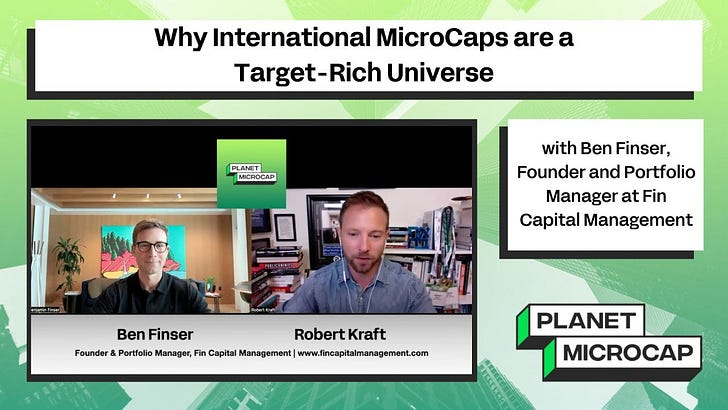
Why International MicroCaps Are a Target-Rich Universe with Ben Finser, Founder and Portfolio Manager at Fin Capital Management
My guest on the show today is Ben Finser, Founder and Portfolio Manager at Fin Capital Management. In this episode, Ben shares his journey from a decade at Kabouter Management to launching Fin Capital in 2024, and how his entrepreneurial background shaped his passion for analyzing and owning high-quality businesses.We dive into his exclusive focus on international micro and small caps, a “target-rich universe” of some 15,000 listed companies in developed markets outside the US. Ben explains why these overlooked businesses — often with no sell-side coverage and tiny trading volumes — present compelling opportunities for investors willing to dig deeper.Ben also details his boots-on-the-ground due diligence process, including traveling globally to meet management teams, comparing companies to global peers, and navigating cultural nuances when assessing business quality and long-term growth. We talk about his “pseudo-activist” engagement approach, where he works alongside management to improve disclosures, expand investor outreach, and unlock value.Finally, Ben shares a case study of a Japanese procurement software company he helped bring onto investors’ radar, and offers perspective on why US outperformance may be cyclical — and why international microcaps deserve a place in more portfolios.For more information about Ben Finser and Fin Capital Management, please visit: https://fincapitalmanagement.com/Watch on YouTube:Summary:I. Background and Investment PhilosophyBen Finser’s passion for investing began early through entrepreneurial ventures—a mountain bike cleaning business at age 11, followed by a gardening business and a healthy vending machine venture in high school. These experiences sparked a curiosity about business quality and what differentiates high- from low-quality companies.His career path included internships and a decade at Kabouter Management, a firm focused exclusively on international micro and small caps. In May 2024, he launched Fin Capital Management.Finser describes himself as a long-term investor who seeks high-quality businesses to own for years, taking advantage of pricing mismatches created by structural inefficiencies. His concentrated fund emphasizes:* Financial discipline (e.g., net debt/EBITDA * Self-financing growth* Proven business models with resilience across cyclesII. International Microcap Opportunity: A Target-Rich UniverseFinser invests exclusively outside the U.S. in developed markets. He describes this as a “target-rich universe” of ~15,000 listed companies, compared with a shrinking U.S. listed base.Key structural drivers of inefficiency:* Abundance of undercovered companies: Many with zero analyst coverage, especially in Japan, which has as many listed companies as the U.S.* Cultural differences in capital markets: In Europe, for example, wealth is often held in cash, bonds, or real estate, reducing equity market sophistication.* Small cap anomaly: As funds grow, they “graduate” out of microcaps, leaving space for smaller managers.* Global comparison advantage: As a global investor, Finser benchmarks local companies against international peers to find mispricings.He screens for businesses that are too small for larger funds (under $2B market cap or decades of operating history and proven durability.III. Boots-on-the-Ground Due Diligence and EngagementA. Due Diligence Process* Screening: Quarterly global screens to identify small, resilient businesses.* Travel-driven research: Trips are planned around clusters of interesting companies.* On-site meetings: Focused on understanding recurring revenue, low churn, long-term growth themes, and valuation relative to peers.* Thesis testing: Meetings include direct feedback from management, ideally with key decision-makers.B. Cultural NuancesFinser stresses the importance of cultural understanding. Example: In Japan, “yes” often means acknowledgment, not agreement. His European background helps him adapt communication across markets.C. Advantage as a Foreign Investor* Seen as a positive signal by local companies, who admire U.S. investors.* Local investors often disappointed post-IPO; foreign long-term focus is refreshing.* Easier meeting access—management appreciates the effort of international travel.* Builds networks via local investors and brokers.D. Active Engagement (“Pseudo-Activism”)Finser takes a collaborative approach, positioning himself as a shareholder partner to help accelerate re-rating:* Encourage English-language earnings calls and materials* Support international roadshows* Improve investor presentations (e.g., highlight customer stickiness, clarify metrics)* Suggest mid-term targets for clarity* Occasionally advise on M&A or incentive plans when “wallcrossed”IV. Case Study: Japanese Procurement Software Company* Situation: Sub-$100M market cap, ignored by investors, misunderstood due to gross vs. net revenue reporting.* Actions: Finser helped them clarify disclosures, highlight customer retention (no losses in
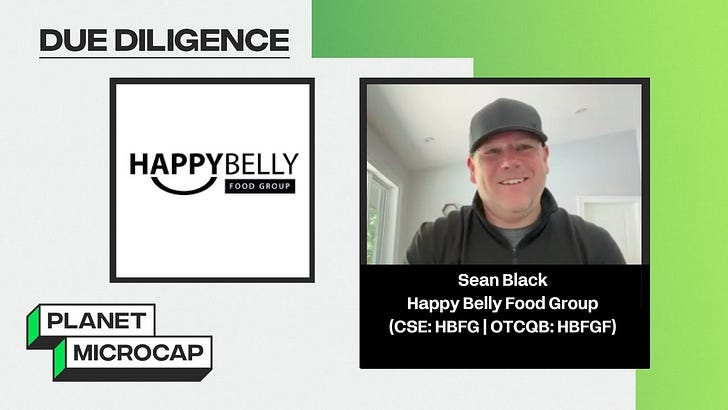
Happy Belly Food Group Inc. (CSE: HBFG | OTCQB: HBFGF): Consolidator of Emerging Food Brands
My guest today is Sean Black, CEO of Happy Belly Food Group (CSE: HBFG | OTCQB: HBFGF). Happy Belly is a Canadian consolidator of emerging Quick Serve Restaurant (QSR) brands, with expansion plans into the U.S. The company started as Plantingco, a niche plant-based CPG business, but under Sean’s leadership pivoted to become food agnostic—focused on scalable, cash flow positive QSR concepts.The model is straightforward: acquire small, profitable, debt-free brands, grow corporate stores with free cash flow, and scale through franchising. The portfolio is intentionally diversified with no duplication—think Rosie’s Burgers as a Shake Shack equivalent, IQ Foods as Canada’s Sweet Green, and Pyro as a Cava-style concept. I spoke with Sean to learn more about the company, as well as:* The pivot from Plantingco to QSR consolidation* M&A model and brand strategy * Growth targets and the $100 million milestone* Risks, alignment, and long-term visionFor more information about Happy Belly Food Group, please visit: https://happybellyfg.com/Watch on YouTube:Summary:OverviewHappy Belly Food Group is a publicly traded Canadian company focused on consolidating and growing emerging food brands, primarily in the Quick Serve Restaurant (QSR) sector. While Canada is the current focus, expansion into the U.S. is underway. 1. Business Model: Consolidator of Emerging Food BrandsCore Strategy: Happy Belly identifies small, profitable, growth-oriented QSR businesses and seeks to double EBITDA within 24 months post-acquisition.Evolution from Niche to Agnostic:* Originally founded as Plantingco, a plant-based CPG business.* Under Sean Black, the company pivoted to become agnostic to the food space, expanding beyond CPG and plant-based to include QSR and non-plant-based brands.“Originally, the company was founded as Plantingco... when I joined we realized plant-based was still pretty niche. To become a company at scale, we needed to be agnostic—so we opened it up beyond CPG to QSR, plant and non-plant.”Hybrid Ownership Model: Corporate and franchised stores are combined, with free cash flow reinvested into corporate growth.“We’re a little more like McDonald’s, reusing free cash flow to accelerate corporate stores. Long-term, the mix will be ~10% corporate and ~90% franchise.”Diversified Portfolio: The goal is a balanced portfolio with no duplication. Each category is represented by one brand—Canadian equivalents to successful U.S. concepts.“If we’re going to have a burger brand, we’ll only have one... If you look at Sweet Green, we have IQ Foods; Cava, we have Pyro; Shake Shack, we have Rosie’s.”2. Growth Trajectory & Financial Performance* 13 consecutive record quarters of system sales, recently surpassing $16M.* Targeting $100M in annual system sales and 100 stores by early 2026.* Successful shift from CPG dominance (>50% of revenue) to QSR (>85% of revenue, >98% of system sales).* All brands acquired are cash flow positive and debt-free; company debt is minimal (~$150K secured).3. Acquisition StrategyCriteria:* Small, profitable, debt-free businesses.* Growth potential to significantly expand EBITDA post-acquisition.Deal Structure:* Acquire 50% initially, with exclusive rights to purchase the rest within 3–5 years.* This phased approach reduces risk by allowing operational insight before full ownership.“That’s been a sweet spot for us—partner first, peek under the hood, then buy the rest. It significantly de-risks for us and our shareholders.”Discipline: Willing to walk away if financial or operational standards aren’t met.“I’ve been a pain in the ass to a lot of people because I won’t budge if I believe it’s right.”No Duplication: Avoids overlapping categories within the portfolio.“I’ve watched others with duplication—it’s like having twins and deciding which one gets attention. It’s really hard.”4. Portfolio Highlights* Heal Wellness (Sai Bowl chain): Acquired with 2 stores doing $1.4M; now 27 stores, on track for 30+ this year and >100 stores with $100M sales within 24 months.* Rosie’s Burgers: Expanded from 2 to 8 stores, with 20–30 projected by 2026.* IQ Foods (Sweet Green equivalent): 4 stores at acquisition; now 6, with 7th opening soon. Profitable and debt-free, unlike some U.S. peers.* Lumberheads Popcorn & Holy Crap Cereal: Smaller, cash flow positive CPG brands. Non-core, could be sold if an attractive offer arises.5. Operational Efficiency & Franchisee Relations* Growth target: 30–50 new restaurants per year across 10 brands (3–5 openings each).* Existing franchisees are a key driver of growth; some own double-digit units.“One of our franchisees is on store number 13 and has purchased 30.”* Lease agreements signed 3–18 months ahead provide visibility into openings through 2025–26.* Geographic diversification across Canada (from Vancouver Island to PEI), with Texas as the first U.S. test market.6. Risks & Mitigations* Management Risk: Loss of key executives is material. Mitigated by strengthening the team (e.g., new VP of
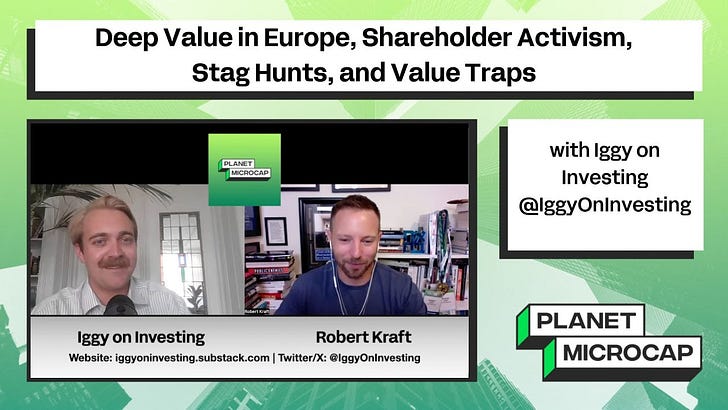
Deep Value in Europe, Shareholder Activism, Stag Hunts, and Value Traps with Iggy on Investing
My guest on the show today is Iggy, better known as Iggy on Investing, a deep value investor and blogger. In this episode, Iggy shares how the COVID-19 lockdown gave him the time to dive into investing, turning inspiration from Buffett and Graham into a disciplined deep value strategy focused on small, illiquid companies trading at substantial discounts to book value.We discuss his “Young Buffett”–style approach—seeking firms at 0.3× to 0.5× book with strong ROIC and catalysts, especially in overlooked European markets—as well as the role his blog plays in clarifying his thinking, building conviction, and holding through long, boring periods.Iggy also walks us through hard-learned lessons—from the importance of staying within your circle of competence and scrutinizing corporate governance, to navigating shareholder activism via a “stag hunt” scenario. And he shares how he’s building investor community in Europe, including hosting his 2nd Annual Benelux Investor Event on Saturday, September 27.For more information about Iggy on Investing and to attend his upcoming event, please visit: You can follow Iggy on Investing on Twitter/X: https://x.com/iggyoninvestingWatch on YouTube:Summary:1. Origins of Passion and Early Influences* Iggy’s investing journey began during the COVID-19 pandemic (2020), when he finally had “a boatload of time on [his] hands” to study.* He was already familiar with Buffett and The Intelligent Investor, but the lockdown provided the push to act.* Earlier, while working at a private bank, he observed bankers “gambling their money away in the market,” which reinforced his belief in Buffett’s idea that markets aren’t always efficient.2. Deep Value Philosophy and Strategy* Style: Follows “Young Buffett”-style deep value investing, often in small, illiquid stocks trading at discounts to book value.* Ideal Setup: Companies selling below book where he is confident they can earn a return on capital.* Key Traits of Targets:* Deep discount to book (0.5x or even 0.3x).* Strong ROIC track record (e.g., 19% historically).* Sometimes catalysts, such as real estate worth more than market cap.* Geographic Focus: Primarily Europe, where he sees more overlooked opportunities, but remains open to global ideas.* Acknowledges ignoring large caps in recent years “has not necessarily been the best decision.”3. Writing and Public Learning* His blog, Iggy on Investing, is central to his process. Writing helps clarify his own thinking and invites feedback.* Writing enforces “commitment bias” that aids in holding long-term.* He calls writing his “#1 tip to anybody starting,” as it builds connections, accountability, and learning.4. Lessons Learned in 2.5 Years* Circle of Competence: Losses stemmed from straying outside it. “Any of the stocks that I’ve lost money on…I understood nothing.”* Good People Matter: Echoing Buffett, “You cannot make a good deal with bad people,” learned firsthand in the Anexo case.* Valuation Provides Defense: Buying very cheap (P/E 3 that becomes 6) still offers margin of safety.* Holding Long-Term is Hard: Describes it as “very slow, very boring.” Writing and not investing full-time help discipline.* Governance Matters: Learned to scrutinize boards for true independence.* Private Owners & Buybacks: Large insiders understand buybacks but often only when buying out the whole company.5. Shareholder Activism & the “Stag Hunt” (Anexo Case)* Case: Anexo, a UK company trading below book. Majority owners tried to push through a “terrible deal,” offering unlisted shares/loan notes.* Stag Hunt: From game theory, minorities needed to coordinate to block the deal.* Outcome: Insiders executed a buyback at an “unfair price,” increasing their control to 75.1% and forcing delisting.* Lesson: Painful but eye-opening about governance risks, market mechanics, and the difficulty of activism.6. Avoiding Value Traps* Focuses on track record of ROIC and sensible capital allocation.* Prefers cheap companies that continue to compound, even slowly—“you are sort of sure to earn some form of return.”* This makes holding positions easier and reduces risk.7. Community and Meetups* Organizes investor meetups in Europe, which he sees as “a desert” compared to North America.* Events include ID dinners and guest speakers, with the goal of idea exchange and building community.ConclusionIggy embodies a disciplined deep value approach: prioritizing fundamentals, staying within his circle of competence, and learning from experience. His public writing both sharpens his analysis and fosters community, while his activism lessons underscore the importance of governance and management integrity.Planet MicroCap Podcast is on YouTube! All archived episodes and each new episode will be posted on the Planet MicroCap YouTube channel. I’ve provided the link in the description if you’d like to subscribe. You’ll also get the chance to watch all our Video Interviews with management teams, educational panels from the conference, as well
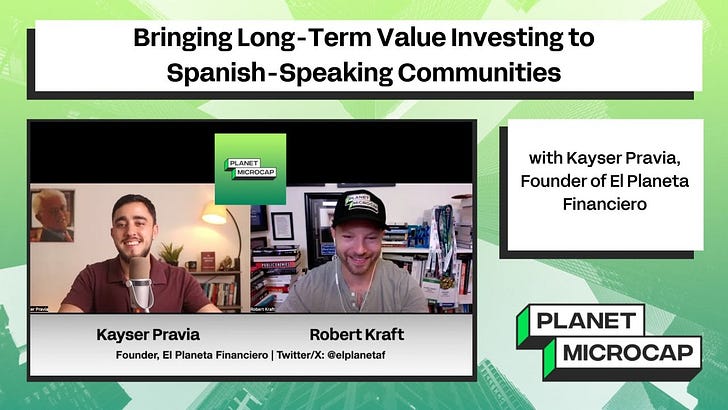
Bringing Long-Term Value Investing to Spanish-Speaking Communities with Kayser Pravia, Founder of El Planeta Financiero
My guest on the show today is Kayser Pravia, Founder of El Planeta Financiero. In this episode, Kayser shares his mission to expand financial literacy and microcap investing for Spanish-speaking investors worldwide.We discuss his evolution from day trading losses to a Buffett- and Lynch-inspired value investor, why he runs a concentrated portfolio, and his focus on recession-proof businesses with strong balance sheets. Kayser also talks about building El Planeta Financiero into a growing educational platform and investing community for Spanish speakers.For more information about El Planeta Financiero, you can subscribe to the YouTube channel here: https://www.youtube.com/@elplanetafinancieroYou can Follow Kayser Pravia on Twitter/X @elplanetaf: https://x.com/elplanetafWatch on YouTube:Summary:I. Introduction: The Mission of El Planeta FinancieroKayser Pravia, founder of El Planeta Financiero, is on a mission to bring financial literacy and stock market investing—particularly in small and micro caps—to Spanish-speaking communities. Pravia’s focus is “financial literacy for Spanish-speaking communities.” His journey began from recognizing a personal knowledge gap and has grown into a multi-platform educational initiative reaching hundreds of thousands of people.II. Humble Beginnings and the Spark of InvestingPravia’s interest in investing began during a psychology class in Kansas, USA, when a teacher asked who was investing in Apple stock:“Everyone had their hand in the sky... I was the only one in the classroom that wasn't investing at all.”That moment, combined with an early, unsuccessful attempt at day trading—“losing my money”—motivated him to seek better strategies. His mother gave pivotal advice:“No, please search who is the most successful investor of the stock market.”This led him to the teachings of Warren Buffett and Peter Lynch, shifting his mindset from short-term speculation to long-term value investing.III. The Evolution to Small and MicroCap InvestingStarting with large-cap names like Twitter and Visa, Pravia’s thinking evolved after reading Buffett’s comment about generating 50% returns in his early years by investing “peanuts.” This, along with Peter Lynch’s concept of “multibaggers,” drew him to the small and micro-cap space. Influences like Ian Cassel and the MicroCapClub deepened his interest.By 2021, he had moved his entire portfolio from large caps to small caps—a transition that faced early skepticism. When his portfolio underperformed the S&P 500 and suffered a 30% drawdown in 2022, critics questioned his strategy. But Pravia stayed the course, recognizing that:“The small cap world, the micro cap world is a whole different world… You can find companies that don’t care about macroeconomics, they don’t care about politics.”IV. Investment Philosophy and Due DiligencePravia’s investing approach blends Buffett and Lynch principles with a focus on small-cap realities:* Recession-Proof Businesses – Focuses on industries like food, services, maintenance, and health that he considers “anti-crisis.”* Healthy Balance Sheet – Prioritizes companies with net cash to mitigate risk.* Growth and Management Quality – Seeks businesses with strong growth potential and management teams that consistently deliver.* Peter Lynch Playbook – Finds businesses with proven models that can scale “10x, 20x, 30x,” citing his early success with Sprouts Farmers Market.* Constant Follow-Up – Actively tracks earnings calls and company updates to ensure management execution matches strategy.V. Case Study: Mama’s Creations and the Power of ConcentrationPravia’s process is exemplified by Mama’s Creations. Initially flagged in 2021 as recession-proof with net cash, he passed due to client concentration risk (60% of revenue). By 2024, diversification, new products, and a board refresh convinced him to invest at “a good price.” Now, he tracks acquisitions, organic growth, margins, and strategic initiatives.This experience reinforced the value of a concentrated portfolio. Inspired by other microcap investors, Pravia now runs seven core positions, with his largest holding 35% of his portfolio and the second-largest at 20%:“I’m very concentrated… fearless with my best ideas.”VI. The Transformative Power of AcquisitionsAn early acquisition win—100% in three months on a position that was just 2% of his portfolio—taught him the importance of sizing. This year, his conviction paid off when a 20% position in Marloi was acquired, producing significant gains:“I made my whole year in one situation… I don’t care about what the S&P 500 is doing… I only care about finding these kinds of situations.”VII. Bridging the Knowledge GapPravia works to counter the negative perception of the stock market, especially in Latin American communities:“People relate small to more risk. But what they don’t understand is that small for us are companies that are selling millions.”Through three weekly YouTube videos and monthly in-person classes in Panama, Pra
Event-Driven Investing Playbook with Asif Suria, Founder of Inside Arbitrage & Co-Host of the Special Situations Report Podcast
My guest on the show today is Asif Suria, founder of Inside Arbitrage and co-host of the Special Situations Report podcast. In this episode, Asif shares his evolution from traditional value investing to a diversified, event-driven strategy that includes merger arbitrage, spin-offs, buybacks, insider activity, and more.We dive into his “three-legged stool” process — combining event triggers, a 14-factor quant model, and deep qualitative research — and how it’s helped him navigate both opportunities and challenges in special situations. Asif also walks through real-world examples, highlighting lessons learned from his biggest wins and most humbling setbacks.For more information about Inside Arbitrage and the Special Situations Report Podcast, please visit: https://www.insidearbitrage.com/You can Follow Asif Suria on Twitter/X @AsifSuria: https://x.com/asifsuriaWatch on YouTube:Summary: 1. The Genesis of Event-Driven InvestingSuria's passion for investing began in 2001, a challenging period following the dot-com bubble burst. His early experiences with the dot-com bear market and the 2008–2009 Great Recession bear market (where “indexes decline[d] as much as 50% or more”) led him to seek “a less painful way of approaching investing.” This quest resulted in his pivot to event-driven strategies, starting with merger arbitrage.* Initial Philosophy: Began as a “value investor,” influenced by figures like Ben Graham, Phil Fisher, and Peter Lynch.* Shift to Event-Driven: The desire for a less painful investment approach, particularly after experiencing significant market downturns, led to exploring event-driven strategies.* Merger Arbitrage as a Starting Point: “The first event-driven strategy that I got interested in was merger arbitrage,” which involves profiting from the spread between a target company's current market price and its acquisition price.2. Identifying and Exploiting Market InefficienciesSuria emphasizes that while broad markets are “quite efficient,” “there are pockets of inefficiencies.” Event-driven strategies are designed to capitalize on these less efficient areas.* Pockets of Inefficiency: Examples include “GameStop, the meme stock mania,” and “micro caps,” where “there just isn't a lot of institutional money that can play in that arena.”* Event-Driven Strategies and Inefficiency: “Event-driven strategies potentially gave you an opportunity to participate in a less efficient market.” This inefficiency arises because events like spin-offs create situations where the market needs time to “fully understand what's happening here.”* Spin-offs as a Prime Example: Spin-offs create inefficiency due to a lack of historical data for the new entity and “natural inefficiency built in where if you own a company... you probably don't want the energy company and you're going to sell it off or forget all about it in your portfolio and that creates a certain amount of selling pressure that Greenblatt discussed in his book You Can Be a Stock Market Genius.”3. The “Toolbox” of Event-Driven StrategiesTo navigate varying market conditions and capitalize on different opportunities, Suria advocates for a diverse “toolbox” of event-driven strategies rather than relying on a single approach.* Multiple Strategies: “Certain strategies come in favor and then go out of favor... I wanted to have a toolbox with multiple strategies that I could deploy at different points in times.”* Core Strategies Tracked by Inside Arbitrage:* Merger Arbitrage (M&A): Company acquisitions. Faced challenges in recent years due to “very irrational antitrust.”* Spin-offs: A company separating a division into an independent entity. Currently a “great area that continue[s] to work.”* Management Changes: Appointments or sudden departures of key executives. “Pretty big area that for some reason retail investors and often professionals don't pay a lot of attention to.”* SPACs (Special Purpose Acquisition Companies): Can offer both long and short opportunities.* Buybacks: Companies repurchasing their own stock, signaling management's belief that “the stock is underpriced.”* Insider Transactions: While not traditionally “event-driven,” they are “overlaid against other events” (e.g., a “double dipper screen” when combined with buybacks).* Strategies Not Tracked: Bankruptcies are avoided due to their “complexity and the need for legal talent to be able to analyze that.”4. The Investment Process: A Three-Legged StoolSuria outlines a systematic three-step process for evaluating investment opportunities:* Event (Idea Generation): The initial trigger.* Quantitative Model: A “14 factor model” classifies every US company and assigns a score. A score of “70 or above” typically prompts a closer look, though this is not a rigid rule. The model helps “quickly run through ideas.”* Qualitative Work: In-depth analysis beyond the quantitative score. “There might be situations where the qualitative work might point to something interesting even though the quantitative
Know Your Edge with Jordan Zinberg, President & CEO of Bedford Park Capital
My guest on the show today is Jordan Zinberg, President & CEO of Bedford Park Capital. Jordan leads the Bedford Park Opportunities Fund, a highly concentrated, Canada-focused small and mid-cap equity strategy.In this episode, Jordan shares how his fund delivered a 58.6% return in 2024, net of fees and expenses, and was named Best One-Year Return at the Canadian Hedge Fund Awards with a 73% return over the 12 months ended June 30, 2024. We also discuss the firm’s annualized return of 18.4% since inception in 2018.Jordan walks us through the firm’s signature approach—identifying high-growth companies trading at reasonable valuations in a deeply inefficient market. We talk about how he builds conviction through intensive research, how he sizes positions (starting small and pyramiding up), and why bad average-down decisions are rare.We take a close look at his biggest winners—Propel Holdings, Source Energy Services, and Enterprise Group—and examine how early theses, growth acceleration, and multiple expansion fueled outsized returns in 2024. Jordan emphasizes building your edge, knowing what you own, and structuring your portfolio with conviction and concentration.For more information about Bedford Park Capital, please visit: https://bedfordparkcapital.com/You can follow Jordan Zinberg on Twitter/X @BedfordParkCap: https://x.com/BedfordParkCapWatch on YouTube:Summary:I. Jordan Zinberg's Background and Path to Bedford Park CapitalEarly Market Exposure:Zinberg’s first experience with markets came around ages 9–10, collecting and trading baseball cards. He remembers tracking “little arrows up and down the Beckett box,” which gave him his first sense of how markets work.Teenage Stock Gift:As a teenager, he received stock as a gift. This required him to “look in the paper and look up the stock price,” eventually encountering a stock split and dividend. Each event became a learning opportunity. He calls it “a great gift” that sparked hands-on interest in investing.Formal Education and Early Career:Zinberg studied business in university, always fascinated by markets. He has now worked in capital markets for over 20 years.Transition to Small Caps:After seven years at RBC working on large caps, he realized “that was where the money was in the market.” However, he saw how inefficient small-cap markets could be and how much opportunity they offered. That led to a shift in focus.Learning at a Small Firm:He joined a small fund focused on Canadian small- and mid-cap growth stocks, where he “really learned the craft.” During his nine years there, the fund grew from $13 million to $400 million.Launching Bedford Park Capital:In 2018, he founded Bedford Park Capital with the goal of applying everything he had learned—and improving upon it—at his own firm.II. Bedford Park Capital’s Investment Philosophy and StrategyExclusive Focus on Canada:Zinberg invests exclusively in Canadian companies, leveraging his “home court advantage.” Canada has over 4,000 public companies, many of which are underfollowed and inefficiently priced.“It’s still possible for a small firm like ours to go out and pick 15 or 20 good opportunities and get to know them really well—and be able to outperform.”Core Philosophy: Growth at a Reasonable Price (GARP) + Momentum Overlay* “The foundation of everything we do at Bedford Park is growth.”* Looks for companies growing revenue at 20%+ annually.* Prefers stocks trading at reasonable—not deep discount—valuations.Factors that lead to attractive mispricings:* Size: Too small for institutional investors.* Liquidity: Large funds can’t participate.* Lack of Coverage: Self-funding companies often have no sell-side analysts.“Sometimes you have bad companies with a lot of cheerleaders—and great companies hiding in the shadows.”Zinberg sees many high-growth Canadian stocks trading at single-digit P/E multiples, and adds a momentum overlay, preferring to add to winners, not average down on losers.Concentrated Portfolio:* Typically 15–25 names, with the top 10 positions making up ~80% of the fund.* Believes concentration is a key driver of alpha.“Nobody should care about my 30th best idea—including me.”Buying Strategy:* Starts with small positions (0.5%–1% weight), usually after meeting management.* Scales up based on performance:“I’ll generally be adding as the name’s moving higher.”* Rarely averages down. Instead, reevaluates the thesis after a bad quarter.Portfolio is divided into:* 10 core holdings ("starters")* 10 bench names ("farm team")Selling Strategy – 3 Triggers:* Deterioration in Growth: If a company falls below 20% growth for 2–3 quarters, it’s usually a sell.* Overvaluation Relative to Growth: Looks at growth-to-multiple ratio.* Better Use of Capital: Will reallocate capital if a more compelling opportunity arises.Special Situations Playbook:Though not resource-focused, he’ll occasionally buy energy/mining services companies (as industrial proxies) during hot resource markets.III. Strategy in Action: Propel H
Why "Old Boring Companies” Benefiting from Data Center and AI Trends + MSM Quality Index Mid-Year 2025 Review with Maj Soueidan, Founder & Editor of GeoInvesting / MS MicroCaps
My guest on the show today is Maj Soueidan, Founder, Editor, and Chief Portfolio Officer at MS MicroCaps and GeoInvesting. In this episode, Maj shares a comprehensive update on his investment philosophy, including the performance and evolution of the MSM Quality Index, a passive, factor-driven approach to finding high-quality microcap stocks with multibagger potential.We discuss how the MSM Index blends qualitative and quantitative analysis, what separates it from traditional model portfolios, and the role of occasional rebalancing. Maj also walks us through how the index achieved over 100% returns since inception and why it’s built for long-term staying power.We also dive into the differences between MS MicroCaps and GeoInvesting — one serving as a pipeline of ideas, the other as a deeper research platform — and how Maj thinks about conviction levels, diversification, and information edge. From spotting opportunities in “old boring companies” benefiting from data center and AI trends to reading between the lines in press releases and earnings transcripts, Maj offers a masterclass in info arbitrage and microcap idea generation.For more information about MS MicroCap Cliffnotes, please visit: https://mscliffnotes.substack.com/For more information about GeoInvesting, please visit: https://geoinvesting.com/Watch on YouTube:Summary:1. The MSM Quality Index: A Passive, Qualitative-Quantitative ApproachInception and Purpose: The MSM Quality Index was launched in February 2022 (with active Substack engagement starting February 2024) after a period of private testing. Its core goal is to identify and track stocks that meet specific quality factors while also triggering "multibagger" potential. As Soueidan explains: "It's not just enough to find quality companies. We want to find them when they're hitting multibagger factors."Methodology: The index uses a 10-point quality checklist, blending both qualitative and quantitative criteria. It incorporates multiple factors to isolate companies with high potential upside.Multibagger Focus: A defining feature of the index is its goal to find multibagger opportunities (100%+ returns). Since inception, it has produced 51 multibaggers out of 120 companies, including 9 acquisitions.Passive vs. Active: The index is passive in nature, unlike a model portfolio. It is not actively rebalanced every quarter, which allows for an honest evaluation of stock selection: "We're not actively rebalancing the index every quarter. This approach really tests stock-picking skills without interfering with outcomes."Rebalancing Strategy: While passive overall, Soueidan acknowledges occasional rebalancing as company narratives evolve. A rebalancing in April 2025 removed a few names. One removal, SCX (initially referenced as SVT), resulted in missing out on a significant acquisition pop from $13 to $40 per share.Performance:* 2022 Index: Over 100% return since inception, outperforming the Russell Microcap Index.* 2025 Rebalanced Index: Achieved 22% returns shortly after the April rebalance.Despite underperformance during downturns due to exposure to turnarounds, the index shows resilience and quick recovery.Staying Power Companies: Soueidan describes a core aim of the process: identifying "staying power" companies—those that can weather tough periods without vanishing.2. Differentiating MSM Quality Index & GeoInvestingMSM Quality Index (Pipeline): The index functions as a pipeline of qualified ideas. It includes companies close to being highest-conviction but not yet fully vetted.GeoInvesting (Deep Dive): GeoInvesting is the research platform where deeper dives occur. As Soueidan puts it: “One out of every seven stocks I add to the Cliffnote index comes to GIO at some point.”3. Investment Strategy & Conviction BucketsPortfolio Construction: Soueidan maintains conviction buckets (1–3) in his personal portfolio, weighting investments accordingly. The index, by contrast, is equally weighted.Subscriber Guidance: For subscribers, spotlight videos highlight one index name at a time. He also recently shared 43 liked stocks, with 18 designated as "high conviction" for a simulated portfolio test (70% allocation to high conviction names).Role of Luck: Soueidan embraces serendipity in investing. For example, TSI—a data center play—benefited unexpectedly from AI-driven growth: "I couldn't have predicted that."4. Info Arbitrage and Press Release AnalysisInformational Arbitrage: Soueidan champions deep reading of press releases and filings, especially in nano-caps where the market often ignores key information.Press Release Advantage: He believes most investors dismiss press releases due to assumed fluff. This creates an edge: “Most of them are not focusing in that area.”Golden Nuggets in Language: He cites United Guardian (UG) as an example where a simple dividend release hinted at major upcoming product growth—an insight most would miss.Information Hierarchy:* Press Releases: First-level insights. Valuable for w
[ARCHIVE] Ep. 41 - The Art of Value Investing with Sanjay Bakshi, Professor and Value Investor (Original air date: March 28, 2017)
To celebrate 10 years since the launch of the Planet MicroCap Podcast, I’m going back through our archives to share with you episodes of the podcast that either: garnered the most downloads/views in our history, stood out to me for the subject matter, the first appearances of regulars and/or that I think you’d really appreciate either re-visiting or for some of you, hearing/watching for the first time.This episode has been, and continues to be, the most watched and downloaded episode of the Planet MicroCap Podcast, a conversation that I cherish very much, and reflect about a lot.I had the honor of speaking with Professor and Value Investor, Sanjay Bakshi in 2017. I was first introduced to Sanjay at the MicroCapClub Leadership Summit 2016 in Chicago – thank you, Ian and Mike for the introduction. He was a speaker at their event, and after his speech I did some more research on him. I was blown away – he above all else, has this insatiable desire for knowledge, which hits home for me. This interview took about six months to book and I’m so grateful for this opportunity.Sanjay Bakshi, as it states on SanjayBakshi.net, is an Adjunct Professor at Management Development Institute, Gurgaon, in India, where he teaches a popular course Behavioral Finance and Business Valuation. He also is a Managing Partner at ValueQuest Capital LLP. On his websites, you can find his teachings and thoughts on investing, which are quite insightful.We covered a lot in this interview, which went into two recording sessions. In between the sessions, I did catch a cold, so I do apologize if I sound different. All I can say is thank you again Sanjay for taking the time to do the interview with me and I am incredibly grateful for the wisdom you imparted.For more information about Sanjay Bakshi, please visit:Blog: https://fundooprofessor.wordpress.com/Site: https://www.sanjaybakshi.net/Twitter: @Sanjay__BakshiWatch on YouTube:Summary:I. Evolution of Value Investing PhilosophyFrom Deep Value to QualitySanjay Bakshi’s investment philosophy has significantly evolved over the decades, beginning as a traditional Graham-style investor and transitioning to a focus on quality businesses, long-term compounding, and trust in exceptional managers.Early Graham & Dodd Influence (1990s)* Foundational Approach: Bakshi began by reading Warren Buffett’s letters, which led him to Benjamin Graham’s works such as Security Analysis.* Style: Focused on:* “Arithmetic” Valuation: Buying below liquidation value, net-net stocks, or low P/E multiples.* Special Situations: Emphasized arbitrage and M&A activity, particularly common in India during the 1990s.* Diversification: Heavy diversification to mitigate risk, with little concern for business or management quality.* Quote: “Graham used to say that I don't even need to know the name of the company—if I had the financial statements, I'll tell you if it is cheap or not.”Shift to Quality and Growth* Avoiding Value Traps: Bakshi learned that not all cheap stocks are good investments, especially if there are issues like bad governance or absent catalysts.* Quote: “Not everything that is cheap will become fairly valued… Maybe it's selling below cash for a reason.”* Expected Return Framework: He adopted a long-term return model that accounts for:* Entry multiple* Earnings growth rate* Exit multiple over a 5–10+ year horizon.* Concentrated Bets: A preference for high-quality businesses allowed for more concentrated portfolios, diverging from his earlier diversified approach.* “Low-Stress” Investing: He avoids:* Unethical industries (tobacco, alcohol, gambling, sugar)* High financial stress (leverage, poor governance, derivatives, shorting)* Daily price checking* Core Metric: “Returns per unit of stress,” not just per unit of risk.Investing in “Extraordinary Capitalists” (Sidecar Investing)* Inspired by Richard Zeckhauser: Bakshi uses the "sidecar" metaphor—riding alongside powerful owner-operators.* Trust and Integrity: Emphasis on management’s integrity and skill is central to his current strategy.* Quote: “It’s all about having faith in those people.”Three Buckets for Evaluating Management* Operating Skills: Measured by comparing peers and performance.* Capital Allocation Skills: Judgment on growth strategies, reinvestment vs. distributions, and M&A decisions.* Integrity: Fundamental. “You’re not going to get a good deal with a bad guy.”II. Key Investing Concepts and LearningsFinancial Independence & Staying Power* Advice: Build an income stream and savings before making long-term bets.* Quote: “You first have to invest and then think about your needs.”Business Quality vs. Investment Price* Core Idea: A great business can be a poor investment if overpriced. A poor business might be a great investment if sufficiently cheap—but Bakshi now prioritizes quality over cheapness.Critique of P/E Ratios* Flawed Metric: P/E fails to capture:* Growth potential* Exit multiples* True owner earnings (especially for R&D-heavy firms like
How the MC GUTS Microcap Index is Beating the Market: Mid-Year 2025 MicroCap Update with Ryan Telford, Head of Evidence-based Research at MicroCapClub
My guest on the show today is Ryan Telford, Head of Evidence-Based Research at MicroCapClub. In this episode, Ryan breaks down the performance and methodology behind the MC Guts MicroCap Index — a quant-driven benchmark launched by MicroCapClub to track microcap stocks in the U.S., Canada, and Europe.We discuss why Canada and Europe are outperforming while the U.S. lags in 2025, sector rotation, and how Ryan’s “GUTS” framework — Growth, Undervalued, Timing, and Sentiment — identifies overlooked opportunities in the microcap universe.Ryan also shares how the index filters for quality, liquidity, and momentum, and how his research is challenging some of the conventional wisdom around dividend payers, ROIC, and the 52-week low strategy.For more information about MicroCapClub, please visit: https://microcapclub.com/Watch on YouTube:Summary:This podcast summarizes a discussion with Ryan Telford, Head of Evidence-Based Research at MicroCapClub, about the performance and methodology of the newly launched MC GUTS Microcap Index. Designed to track microcap stocks in Canada, the U.S., and Europe, the index applies a quantitative GUTS framework—Growth, Undervalued, Timing, and Sentiment.The index has shown strong YTD (Year-to-Date) performance in 2025, significantly outperforming the broader Russell Microcap Index (IWC), especially in Canada and Europe. The U.S. component has lagged, impacted by geopolitical factors, including tariffs. Resource-heavy segments like Canadian gold miners have driven outperformance, and European markets appear to present underexploited quantitative opportunities.MC GUTS Microcap Index: Overview & PerformanceA. Index Framework* Covers microcaps in Canada, the U.S., and Europe.* Applies four core quantitative factors: Growth, Undervalued, Timing, and Sentiment (GUTS).* Tracked and rebalanced monthly.B. Year-to-Date Performance (as of July 2025)* MC GUTS Microcap Index (Combined): +16.5% YTD (in USD)* IWC (Russell Microcap Index): –1.6% YTD* S&P 500 and NASDAQ: Approx. +8% YTD (referenced for context)C. Regional PerformanceCanada* MC GUTS Microcap Canada: +17% YTD* S&P/TSX 60: +9.4% YTD* Key Drivers:* Heavy weighting in resource stocks, especially gold miners, fueled by high gold prices ($3,400+).* "There is a lot of gold in this strategy right now."Europe* MC GUTS Microcap Europe: +19% YTD* Europe Small Benchmark: Low double-digit returns* Key Drivers:* Diversified sector mix* "Capital moving out of the U.S. into Europe"* Europe's low valuations attracting global investors* "Quant strategies aren’t as popular in European markets," potentially creating more alpha.United States* MC GUTS Microcap US: –3% YTD* Underperformance Drivers:* Tariffs: “More harm done to the U.S. than globally”* Dilution & Stock Offerings: High frequency across microcaps* Earnings Misses: Market punishing weak results more harshly than in previous yearsD. Historical Performance* Since 2015: CAGR of 19.7%* Strategy tends to outperform in down markets—2025 being a prime example.Index Methodology & Portfolio ConstructionA. Core Principles* GUTS Factors drive stock rankings.* Companies are scored 0–100 relative to peers, and top-ranked names are selected.* Sector-agnostic: No sector balancing. If 80% of Canada’s top names are in mining, the portfolio reflects that.* Long-only: No shorts or hedging.* Monthly rebalancing ensures fresh positioning.* Turnover: U.S. (56%), Canada (53%), Europe (74%)B. Liquidity Filters* Price floor: ≥ $0.10/share* Volume floor: ≥ $20,000/day or €20,000/day* Exclusions:* OTC pink sheets* Utilities, financials, REITs (low volume/structural complexity)* Global universe: ~4,000 stocks* Portfolio size: 240 stocks* U.S. (100), Europe (100), Canada (40)* Currencies: Traded in native denominations; performance reported in USD.* No currency hedging is applied.C. GUTS Factors Explained* Growth:* Focus on sales growth and earnings growth* Especially valuable for cyclical microcaps* Undervalued:* Seeks low-valuation stocks* “A low valuation by itself doesn’t really tell you a whole lot… but combined with growth, timing, and sentiment—it can create unique opportunities.”* Timing:* Price and fundamental momentum indicators* “Stocks that already have some interest can be a nice signal.”* Sentiment:* Analyst rating changes* Short interest: Avoid highly shorted stocks* Institutional ownership: Viewed as a proxy for “smart money” discoveryEvidence-Based Research at MicroCap ClubRyan Telford leads MicroCap Club’s quantitative research forum, which features 22+ research articles spanning the U.S., Canada, and Europe.Notable Research Topics:* The MicroCap Road Map: Positioning pre-revenue to mature microcaps* ROIC Drivers: Return on invested capital metrics* 52-Week High vs. Low: "It’s not the low that outperforms"* Institutional Ownership: Signals of quality* Dividends: Good vs. poor yielders* EBITDA vs. Net Income: Metric comparisons for effectiveness* Russell IWC Analysis:* Index is overweight biotech, healthca

On the Road: Why Site Visits Matter - MicroCap Fieldwork in Canada with Anthony Perala and James Hannack, Research Analysts at Punch & Associates
My guests on the show today are Anthony Perala and James Hannack, Research Analysts at Punch & Associates. Anthony and James recently returned from a multi-city due diligence trip across Western Canada, and in this episode, they walk us through what they learned — not just about specific companies, but about the power of seeing businesses up close.We talk about why in-person research still matters, especially in microcaps where management access, company culture, and operational visibility aren’t always obvious on paper or a Zoom screen. They share how walking factory floors, reading body language, and noticing office details can shape conviction and surface red flags in ways spreadsheets simply can’t.Anthony and James also explain why Calgary and Vancouver are becoming regular stops on their research itinerary, how they prepare for and structure field visits, and how they filter insights once they’re back at the desk. We also cover common pitfalls, lessons learned, and what separates candid management teams from those just giving the “IR version” of the story.If you’ve ever questioned whether boots-on-the-ground research still adds value in today’s data-rich environment — this episode makes a compelling case that it does.For more information about Punch & Associates, please visit: https://punchinvest.com/Watch on YouTube:Summary:This podcast summarizes a recent due diligence trip to Canada undertaken by Anthony Perala and James Hannack, Research Analysts at Punch & Associates. The discussion highlights the critical importance of on-the-ground due diligence in microcap investing, emphasizing qualitative insights gained from in-person interactions and site visits over traditional conference meetings or virtual calls. Key takeaways include the value of candid conversations with management, observing company culture firsthand, and the unique opportunities found in under-followed markets like Western Canada.* The Rationale for On-the-Ground Due DiligencePunch & Associates, a value-oriented microcap investment firm, places significant emphasis on qualitative factors beyond just valuation and fundamentals. Their process centers on identifying and trusting management teams to drive business growth over a 3–5-year horizon. This necessitates developing strong relationships, best fostered through in-person engagement.* Beyond Rehearsed Interactions: Conferences and Zoom calls often feature "rehearsed mode" management. In-person visits to company facilities or headquarters provide unique insight into how management teams operate in their own environment, allowing for more candid and balanced conversations about both opportunities and challenges.* Observing Company Culture and Management Style: Site visits reveal subtle yet crucial insights into company culture. Analysts notice whether the CEO engages with employees, the condition and style of the offices, and how employees interact—adding to a holistic picture of management as operators and people.* Benchmarking and Efficiency: Facility tours allow for real-time operational benchmarking. Observations of cleanliness, automation, and organization provide tangible data to assess efficiency and opportunities for improvement.* Connecting with the "Real World": These visits transform companies from "numbers on a screen" to tangible businesses. This connection enhances the appreciation for operational complexity and management capability.* Building Trust and Respect: Management teams value the effort involved in site visits, recognizing the investor’s interest in their life’s work and reinforcing long-term alignment.* Strategic Focus: Canadian Microcap MarketThe focus on Western Canada—particularly Calgary and Vancouver—was strategic and rooted in the firm's "fish where the fish are" philosophy:* Attractive Valuations: Canadian companies with strong unique selling propositions often trade at discounts to U.S. counterparts.* Geographic Proximity & Operational Overlap: Many Canadian companies operate extensively in the U.S., making them relevant to U.S.-based funds. Proximity to Minneapolis also makes logistics simpler.* "Unloved" and Candid Management: Western Canada, especially Calgary, is seen as less polished and more candid than Toronto. This aligns with Punch’s preference for practical, under-the-radar companies.* Portfolio Concentration: The trip was triggered by a few concentrated holdings in Calgary where management had not yet been met in person.* Efficient Itinerary Expansion: Proximity between Calgary and Vancouver allowed for additional visits to owned and watchlist companies.* Growing Canadian Exposure: The Canadian portion of the portfolio has grown over the last year, now comprising 10–20% of some strategies.* Pre-Trip Preparation and ObjectivesPreparation was critical to the trip’s success:* Defining the "Why": The team outlined the purpose of each visit and what insights they aimed to gather.* Identifying Targets: The itinerary included a mix of owned, watchl
The 2025 Turnaround in Canadian Cannabis with Mathieu Martin, Portfolio Manager at Rivemont MicroCap Fund
My guest on the show today is Mathieu Martin, Portfolio Manager at Rivemont MicroCap Fund. I've known Mathieu a long time, and he's a regular guest on the show. He's a generalist microcap investor who recently started exploring a sector many investors have written off entirely: Canadian cannabis. After years of avoiding the space due to its speculative excesses, Mathieu has been seeing the potential for a turnaround — with cleaner balance sheets, improving fundamentals, and profitable operators finally emerging.In this episode, we talk about what’s changed in the Canadian cannabis landscape — from rationalized supply and reduced competition, to international export markets and stronger brand differentiation. Mathieu shares how he uncovered opportunities like High Tide, why some vertically integrated players like Cannara Biotech and Rubicon stand out, and how excise tax reform or expanded retail footprints could serve as powerful catalysts for the sector.We also dig into why most investors are still stuck on the legacy LPs from the 2017–2019 bubble — and what they’re missing. Mathieu explains the importance of reading cash flow statements over flashy revenue growth, highlights accounting red flags, and discusses how to navigate this highly regulated, capital-intensive market with discipline.If you’ve written off cannabis or simply haven’t revisited the Canadian names in years, this conversation might just change your mind, and for full disclosure, we discussed a number of companies on today's episode, and I'm not a shareholder in any of them.For more information about the Rivemont MicroCap Fund and the Stocks & Stones Newsletter, please visit: https://stocksandstones.substack.com/You can Follow Mathieu Martin on Twitter/X @Stocks_Stones: https://x.com/Stocks_StonesWatch on YouTube:Summary:I. Overview of the Canadian Cannabis Market ShiftThe Canadian cannabis market is undergoing a significant turnaround after years of stagnation following the speculative bubble from 2017 to 2019. Matthew Martin, who had previously avoided the sector due to its speculative nature, has recently become interested as fundamentals have improved and profitable operators have started to emerge.Historical Context:From 2017 to 2019, Canadian cannabis experienced a massive bull market, which led to excessive speculation. This resulted in a prolonged bust period lasting nearly five years.Renewed Interest:Martin’s interest was reignited in 2023 after an analyst introduced him to High Tide, a cannabis retailer with impressive metrics. Since then, he sees the space “starting to turn around,” with “upcoming winners… starting to emerge.”II. Key Drivers of the Canadian Cannabis Market TurnaroundSeveral factors are driving the renewed momentum and investment opportunity in Canadian cannabis:Rationalized Supply Side* Past Oversupply:During the initial boom, producers built “several times more cultivation capacity than the market demand,” driving wholesale prices down.* Punitive Excise Tax:A fixed excise tax of $1 per gram was originally meant to be 10% of a $10/gram price. As prices dropped to $3–4/gram, this became a 25–40% tax on topline sales, severely hurting margins and pushing many producers out of business.* Bankruptcies and Exits:More than 60 bankruptcies over the past 3–4 years have helped rationalize supply.* Undersupply:Martin notes a “consensus that the Canadian market is now under-supplied,” contributing to rising wholesale prices.Emergence of International Markets* Export Demand:New international markets (Germany, Israel, Australia) lack domestic cultivation and rely on imports. Canada is now the world’s largest exporter of cannabis.* Profitability of Exports:Export sales are “way more profitable” than domestic sales, as Canadian LPs don’t pay excise tax on exports.* Shift in Strategy:Some LPs are doubling down on Canada, while others are pulling product from Canadian shelves and prioritizing exports, reducing domestic supply.Focus on Quality and Consistency* Differentiation:Cannabis is no longer a commodity. Martin emphasizes the importance of flower quality, THC levels, and flavor profile.* Brand Loyalty:Repeat purchasing is growing as consumers begin to recognize and prefer consistent, high-quality brands.* Quality Assurance:Newer cultivators prioritize quality assurance as a core focus and differentiator.III. Investment Focus and Competitive AdvantagesMartin’s investment strategy in cannabis targets profitable, fast-growing companies with strong balance sheets and durable competitive advantages.High Tide (Retail):Martin’s entry point into cannabis. High Tide employs a “Costco model,” offering a premium membership for discounted cannabis and accessories. This makes them the “lowest-cost retailer” and capable of “running their competitors out of business.”Licensed Producers (Cultivation):Initially seen as a commoditized segment, Martin now sees differentiation in quality. He seeks LPs that are “growing 30–40% year-over-year” an
[ARCHIVE] Ep. 45 - Using Your Professional Skills for MicroCap Investing with Meredith Brill, @LockStockBarrl (Original air date: May 24, 2017)
To celebrate 10 years since the launch of the Planet MicroCap Podcast, I’m going back through our archives to share with you episodes of the podcast that either: garnered the most downloads/views in our history, stood out to me for the subject matter, the first appearances of regulars and/or that I think you’d really appreciate either re-visiting or for some of you, hearing/watching for the first time.For this episode of Planet MicroCap Podcast, I spoke with Meredith Brill, who goes by the handle @LockStockBarrl on Twitter and the MicroCapClub.com. We were introduced through a mutual friend, and as you will hear, we discuss how she has been able to leverage her professional skills to help her develop an investing thesis on a potential investment, and to assess her current portfolio. The goal for this episode is to understand that your professional skills can be quite useful when you’re developing your MicroCap investing strategy.Watch on YouTube:Summary below:I. Meredith Brill's Background and Entry into Microcap InvestingUnusual Background:Meredith Brill has a diverse professional background. She initially studied chemical engineering at the University of Toronto, then earned a law degree at Osgoode Hall. She practiced intellectual property law in Toronto for many years, focusing on patents.Shift to Investing:After stepping away from law to become a full-time stay-at-home mother to her three daughters, she began dedicating her time to reading and learning about individual stock picking. She learned through “trial and error,” experiencing both “great successes and some epic failures.”Discovery of Microcaps:Her introduction to microcap stocks happened by chance. She had invested in a larger pharmaceutical company, Paladin Labs, and in 2014 came across a news release from a company with a similar business model—but with a market cap of only around $50 million.Direct Engagement:Despite her initial hesitation around “penny stocks,” she was surprised by the level of access:“I was amazed that I was able to pick up the phone, call the CEO, have a great discussion with him.”That direct engagement was a key differentiator and drew her into the microcap space.II. Why Focus on Microcaps?Market Inefficiencies:Brill recognized that microcaps—being relatively illiquid, under-covered by analysts, and too small for institutional investors—offered significant inefficiencies.Opportunity for Alpha:“If you're willing to do the work and try to identify those really high-quality businesses, I think you can really do well.”Investment Strategy:She looks for companies that can grow earnings per share and are relatively unknown—allowing her to buy at a low valuation with potential upside from both earnings growth and multiple expansion.MicroCapClub:Her research led her to MicroCapClub, a closed online community that shares research on North American microcaps. She became the first woman admitted after submitting a successful stock thesis.III. Women in Microcap InvestingLack of Representation:Brill acknowledges the limited number of women in microcap investing but doesn’t offer a specific theory as to why.Welcoming Community:She praises the MicroCapClub community for being welcoming and supportive, helping her grow as an investor.Networking Value:Conferences like the Detroit MicroCapClub event were valuable for networking, meeting fellow members, and engaging with management teams.“Face-to-face is different than a phone call.”Message to Women:She encourages more women to get involved:“Become actively involved in the community—that's the best way to really ensconce yourself in it.”“It’s not a boys' club at all... it’s a space that you can really excel at if you work really hard.”IV. Investment Philosophy and Idea GenerationSector Focus:With her background in science and patent law, Brill is naturally drawn to growth companies in technology, healthcare, and occasionally the consumer sector.Key Investment Criteria:* Profitability: She looks for profitable companies.* Scalability: A “key word” for her—she seeks companies with excellent reinvestment opportunities at high rates of return.* Platform Companies: She favors businesses with distribution networks that can launch new products to existing customers with minimal marketing costs (e.g., specialty pharmaceutical companies with established salesforces).* Roll-ups/Consolidation: She’s interested in companies rolling up fragmented industries to realize synergies and gain scale.Overarching Theme:“Profitable growth.”Idea Generation Sources:* A close circle of trusted investing friends.* Online communities like MicroCapClub and Value Investors Club.* Microcap conferences, particularly for one-on-one meetings with management teams.She notes that even with a compelling story, she might pass on a company if the management doesn’t leave a good impression.“Sometimes you just don’t like them.”Growth vs. Value:“Growth means lots of opportunity for the company to continue to scale... not just a goo
Finding Asymmetric Opportunities in MicroCaps and Music Royalties with Jerome @UzoCapital
My guest on the show today is Jerome, Portfolio Manager at Uzo Capital. Jerome brings a unique lens to public equity investing—shaped by his experience on the equity trading floor at Merrill Lynch during the financial crisis, his global perspective, and a profitable venture in music royalties.In this episode, we dive into Jerome’s barbell investment approach: pairing stable, cash-generative compounders with higher-risk, venture-style bets in the public markets. He walks us through how he identifies “asymmetric” opportunities—where the upside far outweighs the downside—particularly in companies that are either undiscovered or undergoing transformational change.Jerome also shares how his music royalty business, which generates steady, recurring cash flow, provides the emotional and financial runway to take bold swings on high-risk, high-reward ideas. He discusses how this foundation enables him to withstand volatility and dig deeper into ideas that others may overlook.We cover a lot in this conversation—from PLBY, McCoy Global, and Comstock, to his thesis around durable, capital-light growth businesses and the importance of identifying "free call options" within complex situations. Jerome also lays out a thoughtful framework for due diligence and portfolio sizing that helps manage both risk and conviction. And for full disclosure, we discussed a number of companies during today’s podcast. I am not a shareholder in any of them.For more information about Uzo Capital, please visit: https://uzocapital.substack.com/Watch on YouTube:I. Executive SummaryJerome, portfolio manager at Uzo Capital, shares a deeply personal and analytical look at his investment philosophy, shaped by a formative stint on the Merrill Lynch equity trading floor and the 2008 financial crisis. His strategy blends stable “compounders” with high-upside microcap bets, supported by an uncorrelated income stream from a successful music royalty portfolio. His goal: identify asymmetric risk-reward setups through rigorous due diligence, thematic clarity, and forward-thinking analysis.“I will very much focus on what this company looks like in two or three years. How much am I paying today—and what is that really worth in the future?”II. Core Investment Philosophy: Finding Asymmetry1. Undiscovered MicrocapsJerome hunts for under-the-radar companies, often microcaps ($50M–$1B), that institutional investors overlook.* These may be newly listed, under-covered, or misunderstood.* He actively attends conferences like Planet MicroCap to meet management teams in person.“Every single microcap conference I’ve been to, there’s always been a company I wasn’t expecting to be interesting—but was.”2. Companies Undergoing Structural ChangeHe targets businesses going through major inflection points—spinouts, recent issues masking long-term strength, or new business model transformations.* Examples: IWG (franchise model), PLBY (royalty growth), McCoy Global (recurring revenue from new tech).“The business on a forward-looking basis is going to look really good.”3. High-Margin, Capital-Light CompoundersHis favorite hunting ground: businesses with durable, cash-rich growth that’s underappreciated by the market.“All the growth is coming from high margin, high cash conversion... it transforms the financials of the entire company.”III. Investment Buckets: Barbell Strategy1. Core CompoundersStable, high-quality businesses with predictable growth and free cash flow.* High conviction positions* Easier to size large initially2. High-Risk, High-Reward ("Listed VC")Small, speculative bets with massive upside potential but elevated risk.* Often unprofitable today but have strong unit economics or disruptive potential* Includes warrants, litigation plays, and “free call options” embedded in multi-part businesses“If there’s a 30% chance you make 30x your money—that’s a great payoff. I’ll take that every day.”3. Emotional Stability via RoyaltiesHis passive music royalty income cushions volatility, enabling unemotional decision-making in public markets.“It takes out the emotional swings… you can be a lot more relaxed about the volatility.”IV. Due Diligence and Risk FrameworkDeep Research & Stress TestingEvery position starts with detailed analysis and scenario planning.“You’ve got to understand it well enough to poke holes in it.”Framing Risk-RewardHe seeks setups where the downside is covered by hard assets or core businesses, and upside is a “free option.”* E.g., Comstock’s land + recycling business covers valuation; Biolum is upside.Insider & Strategic ActivityLooks for clues from informed parties—insider buys, strategic investors, or partners making above-market investments.“What are the signals you’re getting?”Team & Capital AllocationJudges management’s thought process, discipline, and alignment.“Do I trust that capital is going to be managed appropriately?”Position SizingRisky positions are sized small to maintain psychological stamina through volatility.“If it halves, are you g
Constructing a Software Investing Thesis in the Age of AI with Ben Brostoff, Editor/Writer of the Stock Talk Newsletter
My guest on the show today is Ben Brostoff, software engineer at Klaviyo and the writer behind the Stock Talk newsletter on Substack. Ben has a fascinating perspective on investing—he started out in investment banking, taught himself to code, and now spends his free time researching microcap companies, especially in the software and tech space.In this episode, we dive into Ben’s investing philosophy—why he targets 8–10% returns with the least amount of risk, how AI is changing the way he evaluates software moats, and why he won’t own a company unless he’s written a blog post about it. We also dig into some of the key lessons he’s learned, from the dangers of leverage to the power of doing more than just reading a 10-K.Ben shares actionable frameworks for evaluating microcap software companies, offers a nuanced view on AI’s impact on infrastructure and margins, and explains why, for him, true due diligence means turning over every rock. And for full disclosure, we discussed a number of companies during today’s podcast. I am not a shareholder in any of them.For more information about the Stock Talk Newsletter, please visit: https://stocktalknewsletter.substack.com/Watch on YouTube:Overview/Breakdown of the interview:From Wall Street to Startups: Ben Brostoff’s JourneySummary:Ben Brostoff began his career in investment banking at Wells Fargo, focusing on securitizations in commercial aircraft and container leasing—an industry he describes as stable but capital-intensive. Wanting to work in a more dynamic, innovative space, he taught himself to code and joined Boston-based startup Klaviyo. This pivot helped him see the deeper layers of value creation in tech.Notable Insights:* Early banking experience taught him how to evaluate credit and leasing businesses.* At Klaviyo, he realized the product wasn’t “just email marketing” but rather “the brains behind your marketing engine.”Quote:“This actually isn't email marketing. This is personalization. This is kind of the brains behind your marketing engine.”A Pragmatic Investing PhilosophySummary:After becoming a father, Brostoff shifted to a more conservative, risk-adjusted return mindset. He targets 8–10% returns, matching historical equity returns, and views risk mitigation as central to his approach. In today’s higher interest rate environment, he often compares stocks to fixed-income options to gauge attractiveness.Key Principles:* Set return targets before picking stocks.* Only invest in companies he has deeply researched—via writing.* Microcaps must offer asymmetric return potential to justify risk.Quote:“I'm very comfortable just saying I'm going to take an eight if I get 8% returns... I'd like to take the least amount of risk possible to achieve that.”AI and Software: First-Inning ImpactsSummary:Brostoff believes the AI revolution is fundamentally altering how software is built and evaluated. Tools like Cursor are significantly boosting developer productivity. However, he emphasizes that durable software businesses still rely on infrastructure, people, and deep ecosystems that AI alone cannot replicate.Subtopics:* Development evolution: Open-source and cloud infrastructure laid the groundwork for today's AI tools.* Moats matter: Ecosystem lock-in, APIs, and migration costs preserve competitive advantage.* AI in practice: Used more for enhancing margins or product capabilities than creating standalone business lines.Quotes:“AI has to impact every single investment decision you make.”“The laws of competitive moats have changed a lot for software… but people and processes are not trivial to replicate.”MicroCap Software: What to Look ForSummary:Brostoff is cautious when evaluating microcap software companies. He emphasizes that enterprise sales are challenging and demands evidence of traction and pricing power. He distinguishes hype from reality by analyzing growth drivers and margin potential.Key Filters:* Growth realism: Enterprise success must be proven, not projected.* Margin dynamics: AI should support—not cannibalize—margins.* Competitive advantage: He looks for businesses with clear cost or performance edge, like Backblaze.Quotes:“Enterprise sales is really hard.”“This new AI feature shouldn’t just be a buzzword—it should justify a price increase or deepen the moat.”Lessons from the Field: Leverage CutsSummary:One of Brostoff’s biggest lessons came from his investment in National Cinemedia. Despite an industry rebound post-COVID, the company’s high leverage left it vulnerable. A key customer bankruptcy led to a cascade that wiped out equity holders.Takeaway:Even with strong fundamentals, over-levered companies can collapse under unexpected stress. Time, a key investor advantage, disappears when debt is too high.Quote:“Leverage cuts. You don't get the benefit of time when you’re that levered.”Research Discipline and Advice to New InvestorsSummary:Brostoff attributes much of his investing success to his insistence on writing detailed blog posts before buying
[ARCHIVE] Ep. 101 - Value Investing: Looking for the Overlooked with Geoff Gannon, Co-Founder and Portfolio Manager at Focused Compounding (Original air date: November 26, 2019)
To celebrate 10 years since the launch of the Planet MicroCap Podcast, I’m going back through our archives to share with you episodes of the podcast that either: garnered the most downloads/views in our history, stood out to me for the subject matter, the first appearances of regulars and/or that I think you’d really appreciate either re-visiting or for some of you, hearing/watching for the first time.Geoff Gannon is the Co-Founder and Portfolio Manager at Focused Compounding. You might also recognize Geoff from the very popular investing podcast, Focused Compounding, which he co-hosts with his partner, Andrew Kuhn. I’m a big fan of their work, and I invited on Geoff to share his background and to chat about his investing philosophy.Watch on YouTube:Summary below:I. Foundations of Value InvestingEarly Exposure and IntuitionGannon's journey into investing began in his teens, inspired by a magazine article about Benjamin Graham. His approach naturally gravitated toward assessing the intrinsic value of businesses over chasing hype.“My dad actually had read a magazine article that mentioned Benjamin Graham... and so I started reading about Ben Graham and that got me interested in value investing.”“Valuing a stock by looking at the entire company—what it’s worth and the financial statements—instead of what people were doing in the late '90s with new issues and IPOs.”II. The Power of Overlooked StocksWhat Makes a Stock Overlooked?Gannon defines "overlooked" by two metrics: low share turnover and low beta. These are often microcaps not followed by analysts, not in indexes, and sometimes not even SEC-registered.“We know it’s overlooked when it has both low share turnover and low beta.”“It’s often a sign that there’s long-term holders—founders or family—so not many shares are trading.”III. Seeking Moats, Not Just MetricsFocus on Quality and Competitive AdvantageWhile disciplined on valuation (rarely paying over 13x earnings), the core of Gannon’s strategy is finding stable businesses with economic moats and low competitive risk.“We look for less competitive businesses—those with higher retention and stable margins.”“We’re looking for something that suggests competitors can’t ruin their business quickly… you’d call it a moat.”Example: NACO’s coal operations, which are co-located with customer power plants, offer protection through long-term contracts.IV. Management Matters—But Keep a DistanceJudging by Actions, Not InterviewsGannon avoids speaking directly with management, preferring to evaluate their capital allocation history and whether they prioritize per-share value creation.“I avoid speaking to management directly... I focus on their capital allocation and strategy.”“Do they issue shares? Do they think in per-share terms? That tells you a lot.”He flags risk in owner-operator microcaps where management may take the company private at a disadvantage to minority shareholders.V. Concentrated Portfolio StrategyFive Stocks, Full FocusFocused Compounding typically owns five stocks. This extreme concentration is by design—it allows them to stay within their circle of competence and focus only on the best opportunities.“People say they’re concentrated until we tell them we own five stocks.”“I can often find five companies well protected from competition... I can’t find a lot more at the prices I want.”VI. Absolute Returns Over Relative GainsIgnore the BenchmarkGannon urges individual investors to focus on their own return goals—not beating the market—especially in later bull markets when pressure can lead to excessive risk-taking.“Focus on your own returns and not compare yourself to the market.”“Eventually you’ll take risks you shouldn’t if you try to match market performance.”VII. Lessons from Market DownturnsEnduring Wisdom from CrisesExperiences during the early 2000s crash and the 2008–2009 financial crisis reinforced Gannon’s commitment to high-quality, stable businesses.“The reason for sticking to less conventional investing is memories of those times.”“2009 was the first time I remember buying really high-quality companies at really low prices.”VIII. Bank Analysis: The Liability AdvantageCost of Deposits Over AssetsWhen analyzing banks, Gannon focuses on the liability side—specifically the cost of deposits. He prefers institutions with scale advantages like Frost or Bank of Hawaii.“I look at the liability side of deposits... who has the lowest cost of deposits.”IX. Essential Investing LiteratureFrom Graham to GreenblattFavorite books include Greenblatt’s You Can Be a Stock Market Genius and Peter Lynch’s work for new investors, along with Graham’s Intelligent Investor.“My favorite is You Can Be a Stock Market Genius. For beginners, probably Beating the Street.”X. Challenges in the Hunt for MicrocapsSifting Through the NoiseIdentifying worthwhile stocks on platforms like OTC or Pink Sheets requires effort—most are quickly dismissed as uninvestable—but the rare gems make it worthwhile.“The disadvantage is I’m look
MicroCap Investing is a Team Sport with Cameron @onecentinvest, Founder of Common Sense Investing
My guest on the show today is Cameron, Founder of Commonsense Investing and author of the Substack microcapstocks.substack.com. Cameron is a microcap investor focused on education, community, and a disciplined research process — bringing a common-sense approach to navigating this often volatile corner of the market.In our conversation, Cameron shares how his investing journey evolved from chasing high-flyers and exposing bad actors to building a thoughtful framework for identifying quality microcap companies. He discusses the importance of doing your own research, filtering stocks through a rigorous process, and why flexibility is a powerful edge for retail investors.We also talk about his personal investing experiences, as well as key red flags to look out for — from share dilution to questionable management behavior. And for full disclosure, we discussed a number of companies during today’s podcast. I am not a shareholder in any of them. For more information about Cameron and Common Sense Investing, please visit: https://commonsenseinvesting.ca/Watch on YouTube:Overview/Breakdown of the interview:I. Philosophy & Core Beliefs“Success in microcaps isn’t about finding the next 10-bagger. It’s about filtering wisely, staying flexible, and constantly learning.”Cameron’s philosophy centers on practical, long-term investing principles—what he calls a “commonsense” approach. His framework goes beyond hype, prioritizing research, education, and community engagement. Investing is seen as a repeatable process rooted in clear criteria and constant iteration, not lottery-ticket speculation.“20% of success in micro cap investing is actually the stocks... 80% of it is kind of strategy.”II. Investing is a Team Sport“We’re not lone wolves—we’re building together.”Microcap investing thrives on collaboration. Cameron pushes back against the lone-genius myth often associated with early-stage stock picking. He highlights the importance of events like Planet MicroCap Showcase for building relationships, exchanging ideas, and refining investment theses in a social context.“Too many new micro cap investors think: I’ll find a stock no one knows and get rich. But the better path is education, community, and learning from different viewpoints.”III. Research, Filtering & Criteria“It’s not about picking stocks. It’s about filtering out the noise.”Cameron outlines a rigorous, layered filtering process. From an initial pool of 100 stocks, he narrows down to ~1% worth serious consideration. Key filters include:* Growth (especially top-line revenue)* Profitability or a clear path to it* Balance sheet strength* Execution-focused management“You need to dig into the earnings, have criteria, and put stocks through a serious filter.”He also stresses the advantage of prepping before conferences, identifying potential one-on-ones, and doing the work upfront to focus on high-quality opportunities.“Being prepared going into an event helps you target the right companies for deeper dives.”IV. From Exposure to Education: Cameron’s Journey“I started out exposing bad stocks. Now I focus on teaching what makes a stock good.”Cameron’s early exposure to investing came via his father and a wild ride with Canadian Solar. His journey took a serious turn during COVID, when rampant speculation inspired him to launch a YouTube channel focused on uncovering fraud and poor governance.“My father was a degenerate micro cap investor… I got addicted after watching Canadian Solar go from $3 to $40 and back.”After legal threats shuttered that effort, he pivoted. The mission now: highlighting quality companies and giving newer investors the tools to succeed.“I thought—if I can’t educate people about bad stocks, I’ll teach them about good ones.”V. Strategy: Iteration, Flexibility & Conviction“Retail’s superpower is flexibility. Use it.”Cameron stresses that unlike institutions, retail investors can scale in and out based on evolving data. His strategy is iterative—begin with a small position, monitor results, and scale conviction over time.“Add a little, test your thesis, adjust. That’s something big funds can’t always do.”A major qualitative factor is trust in management. Cameron values CEOs who own missteps and transparently outline solutions.“When a CEO says, ‘Here’s our problem and how we’ll fix it,’ they build trust.”VI. Mistakes, Red Flags & Learning Loops“Follow the money. Follow the shares.”Cameron shares key red flags: excessive dilution, insider enrichment through options/bonuses, and sweetheart financings.“If money and shares flow to management or financiers, not to growing the business—that’s your sign.”He advocates staying humble, exiting positions when the thesis breaks, and learning from missteps. Conviction without ego is key.VII. Notable Anecdotes & Examples* Telus Stock & Cameron’s Father: A lighthearted story about how a family-held Telus position paid for college—underscoring the multigenerational impact of investing.* Canadian Solar (CISQ): A high-v
[ARCHIVE] Ep. 66 - Focus on Downside Risk and High Quality Businesses with Connor Haley, Managing Partner of Alta Fox Capital Management (Original air date: May 22, 2018)
To celebrate 10 years since the launch of the Planet MicroCap Podcast, I’m going back through our archives to share with you episodes of the podcast that either: garnered the most downloads/views in our history, stood out to me for the subject matter, the first appearances of regulars and/or that I think you’d really appreciate either re-visiting or for some of you, hearing/watching for the first time.First up, I’m sharing my first conversation with Connor Haley from Alta Fox Capital Management. I believe this was around the time that he launched Alta Fox, and it was great timing to showcase his investing strategy and introduce the fund to our community. Connor has since gone on to have massive success with Alta Fox. This episode, both the audio and video versions, is one of the most watched/downloaded episodes we’ve put out there. We recorded this back in May of 2018, so I’m sure some aspects of Connor’s investing strategy and process has changed - keep that in mind. Watch on YouTube:Summary below:I. OverviewThis podcast episode features an interview with Connor Haley, founder and managing partner of Alta Fox Capital Management. Haley, who is also the number one ranked investor on microcapclub.com, shares his background, the reasons behind starting Alta Fox, and his detailed microcap investing philosophy. A key differentiator of Haley's approach is his significant focus on understanding and limiting downside risk while identifying high-quality businesses within the often low-quality microcap universe. He outlines a four-part investment process: search, valuation, sizing, and monitoring.II. Key Themes and IdeasFinding Edge in MicrocapsHaley was drawn to microcaps from a young age due to the inherent disadvantage faced by individual investors when competing with large funds in large-cap stocks. He recognized that microcaps often have limited research coverage and are restricted for larger funds, creating a potential edge for diligent investors. He cites successful investors like Joel Greenblatt, David Einhorn, and Warren Buffett who achieved their best returns in smaller-cap investments.Focus on Quality Within a Low-Quality UniverseHaley's core belief is that while most microcap businesses and management teams are low-quality, a minority of very high-quality businesses can generate exceptional returns. His process is designed to find these exceptions and avoid the rest.Prioritizing Downside ProtectionA central tenet of Haley’s philosophy is focusing on downside protection. He believes that in microcaps, “there’s almost always an exciting growth story,” making it critical to prioritize the downside. Understanding and limiting downside risk allows for higher conviction and larger position sizing. He emphasizes that it is “really hard to come back from losses.”The Importance of a Robust Search ProcessHaley believes superior returns in microcaps come from a better search process. The market is relatively efficient at valuing companies with stable conditions, but less so where there’s uncertainty or complexity. He actively seeks companies that are hard for the market to value accurately.Identifying Companies with Misunderstood Meaningful ChangeHe focuses on businesses undergoing significant, rapid change—such as new management, new business lines, or spin-offs—where the market has not yet understood the implications. These are often mispriced and represent opportunity.Beyond Traditional ValuationHaley prefers simple, intuitive valuations over complex models. He seeks businesses that are “fairly obviously undervalued” using a “back of the napkin” approach, focusing on three or four key drivers and applying bear, base, and bull case scenarios.Emphasis on Management Quality and IncentivesHe prioritizes management teams with strong capital allocation skills and proper incentives. Ideally, managers should own at least 5% of the company. He assesses both ownership and compensation structures to evaluate alignment with shareholder interests.Continuous MonitoringHaley emphasizes the importance of post-purchase monitoring. This includes not just speaking with management, but also gathering external data—such as customer reviews, interviews with former employees, and competitor analysis.Discipline in SizingPosition sizing is guided by rules to avoid overconcentration. Haley caps position size at 15–20% at cost. Sizing reflects conviction and is updated based on fundamentals, not emotions.Patience with High-Quality BusinessesHe aims to “find high-quality companies early and hold longer than anyone else.” His biggest mistakes, he notes, stem from selling great businesses too soon. He is more likely to sell cyclical companies than quality compounders that continue to perform.Learning from Others (but Thinking Independently)Haley values studying investment pitches from others (e.g., Value Investors Club) to develop pattern recognition. However, he stresses independent thinking and personal due diligence.III. Important Facts an

Europe’s Hidden Gems: MicroCap Investing with Thomas Richard, CFA, Portfolio Manager at Philippe Hottinguer Gestion
My guest on the show today is Thomas Richard, CFA, Portfolio Manager at Philippe Hottinguer Gestion, based in Paris. Thomas has been diving deep into European microcaps – a market segment he describes as “so unloved and uncovered,” with unique inefficiencies and opportunities.In our conversation, Thomas lays out why Southern Europe – especially countries like Spain, Italy, and Greece – is currently one of the most interesting regions for microcap investing. He explains the value of bottom-up research, the importance of direct interaction with management teams, how non-European investors can begin navigating this often-overlooked space, as well as some of the structural risks that exist in this space – including governance concerns and delisting threats.We also touch on specific names like Euroconsultants, Shelly Group, Reway, and ALA, and for full disclosure, I am not a shareholder in any of them. For more information about Thomas Richard and Philippe Hottinguer Gestion, please visit: https://www.philippehottinguer.com/fr/phhgestion/Watch on YouTube: Overview/Breakdown of the interview:1. European Microcaps: An Unloved and Inefficient MarketThe European small and microcap segment is heavily underfollowed and has seen sustained outflows in recent years, leading to inefficiencies—and opportunities.“At least in Europe this segment is so unloved and covered nobody cares... you are seeing a lot of outflows... since at least five years.”“This creates a lot of opportunities... a lot of inefficiencies in the market.”2. Regional Focus: Southern Europe Gaining MomentumSouthern European countries (Spain, Italy, Greece) are particularly attractive right now due to economic recovery, EU stimulus, and underperformance in the prior decade.“What’s very interesting is south of Europe... Spain, Italy, Greece... they were lagging during the past decade... now it’s the opposite.”Greece in FocusGreece stands out due to significant inflows from EU recovery funds.“Greece is benefiting the most from the European recovery fund... hundreds of billions going to Greece... this creates a fundamentally favorable environment.”3. Structural and Cultural Barriers for Non-European InvestorsInternational investors face several challenges:* Fragmented markets* Lower liquidity* Language barriers in filings* Differing corporate norms“The European market is very fragmented... language barriers, lower liquidity, and management culture can vary a lot.”4. The Critical Role of Bottom-Up Analysis and Management AccessInvestment decisions are driven more by company-specific factors than country-level macro trends. Speaking directly with management is crucial.“That’s the best part of my job—conferences, talking with management... That’s how you understand company quality.”“You don’t have the same standard from one country to another... management access is key.”5. Technology and Networking are Easing EntryTools like AI-based translation and increased access to company management through conferences and online platforms are lowering the research barrier.“It’s very easy today to translate any document... even an annual report... in a few seconds, and it’s free.”“It’s kind of easy to have access to the management—they want to speak with investors.”6. Behavioral Differences: Risk Aversion in Europe vs. North AmericaEuropean investors tend to be more conservative, leading to fewer microcap opportunities and slower capital flow.“European investors tend to be more risk-averse... there is less capital dynamism in Europe compared to North America.”7. Market Structure and Policy Incentives MatterCertain countries like Italy encourage microcap listings via fiscal incentives, whereas others (France, Germany) lag behind due to lack of government support.“Italy has fiscal incentives for IPOs... that has an effect. More IPOs in Italy compared to France or Germany.”“You don’t have much incentive to invest in small caps in some other countries.”8. Governance Risks: Takeovers and DelistingsFounder-owned or closely held companies can pose a risk of being delisted or bought out at unfair valuations, often involving conflicts of interest.“Sometimes you have companies getting delisted because they get a bid... not properly valued.”“There is a conflict of interest when founders or management buy out and delist the company.”9. Investment Process: Start Small, Build ConvictionRichard prefers starting with a small position to learn more before committing larger capital.“I usually start with a small position... to follow the company and better understand it over time.”10. Recommendations for Non-European Investors* Use free online platforms (Substack, MicroCapClub)* Attend local conferences* Engage directly with company management* Learn from local analysts and investors“You can find a lot of free information... investors writing on Substack, MicroCapClub.”“Try to speak with management—it’s easier in the small/micro space.”11. Highlighted Microcap Investment Ideas🔹 Euroconsulta
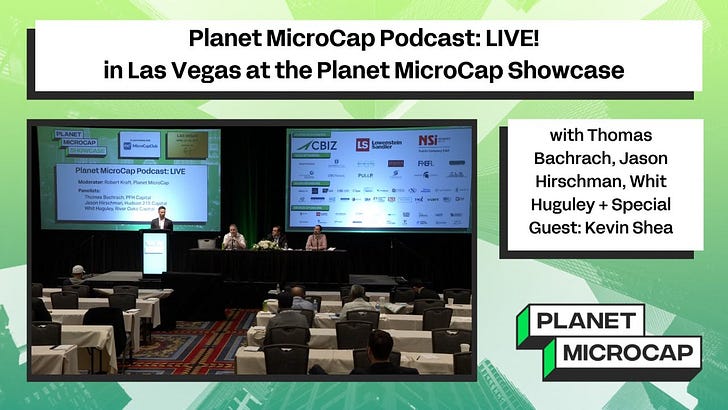
Planet MicroCap Podcast: LIVE! with Thomas Bachrach, Jason Hirschman, Whit Huguley + SPECIAL GUEST: Kevin Shea!
Today, I'm sharing with you our annual Planet MicroCap Podcast: LIVE! panel from the Planet MicroCap Showcase: VEGAS 2025 in partnership with MicroCapClub. Joining me this year are:Thomas Bachrach, PFH CapitalWebsite: https://www.pfhcap.com/Twitter/X: https://x.com/PFHCapitalJason Hirschman, Hudson 215 CapitalTwitter/X: https://x.com/EightTrack180Whit Huguley, River Oaks CapitalWebsite: https://www.riveroaks-capital.com/Twitter/X: https://x.com/Whit_HuguleyPLUS, Special Guest appearance from: Kevin Shea (Twitter/X: https://x.com/thegoodprick)Watch on YouTube:Abridged outline (thank you, Shai!):1. Fund Philosophies and Approaches to Micro-Cap InvestingPFH Capital – Thomas BachrachA small, concentrated (10–20 ideas) long-only value fund with very low turnover and a distinctly international orientation. Bachrach believes the most attractive combinations of growth, quality, and price are found outside the United States—particularly in Asia—where there is far less investor competition.* “We take a very international focus—very little in the U.S. The quality you can get, the growth you can get, for the price you pay is simply more attractive overseas.”River Oaks Capital – Whit HugleyFive-year-old micro-cap, long-only fund holding 10–15 companies. Hugley applies private-equity-style due diligence: on-site visits, conference attendance, and conversations with competitors and industry experts. He also practices “suggestivist investing,” offering capital-allocation ideas (buybacks, asset sales) to management. A core tenet is partnering with A+ CEOs.* “I launched River Oaks in 2020 and was shocked how few public-micro-cap investors do rigorous on-the-ground work.”Hudson 215 Capital – Jason HirschmanA family office focused exclusively on micro and small caps. Hirschman looks for “future great businesses while they are still awkward teenagers,” joking that if things go badly he can always become a Walmart greeter.2. Navigating Volatile Market ConditionsJason HirschmanThe first rule—bull, bear, or volatile market—is knowing what you own. Volatility is the moment to re-test convictions, keeping the truly valuable (“protect Philippe”) and discarding the “fake Rolex.” He cautions against structuring a portfolio around hoped-for future heroes when one tweak can change everything.* “Volatility tempts you to be a hero, but this is not the time. Be cautious.”Whit HugleyHaving launched just before COVID-19 (and enduring an early 30 % draw-down), Hugley is unfazed by swings; he uses sell-offs to increase stakes in “wonderful companies.” Tight insider ownership in micro-caps often reduces forced selling. A wide margin of safety at purchase and A+ CEOs—like Doug Campbell at America’s CarMart—are critical.* “For whatever reason, market drops don’t bother me. I just add to the great businesses we already own.”Thomas BachrachHe rarely checks quotes, taking a multi-generational view. Volatility is welcome because price dislocations versus intrinsic value are the lifeblood of value investing. Today’s unprecedented global leverage ensures more bouts of turmoil ahead. The antidote: own companies you understand and love, and shun those burdened with financial or operational leverage.* “Our intrinsic-value estimates don’t change as quickly as stock prices. Volatility is a gift.”3. Tariffs and International InvestingThomas BachrachSees current tariff rhetoric as an attempt to address the U.S. net-investment deficit, now roughly –$25 trillion versus –$2.5 trillion in 2003. Capital outflows are inevitable, creating a generational chance to buy absurdly cheap exporters—especially in Asia. He avoids companies heavily reliant on U.S. exports.* “When that reversal comes, you’ll want to be positioned in net-exporting markets trading at irrational prices.”Whit HugleyCalls CEOs directly to gauge tariff impact, concluding tariffs will prove inflationary. Avoids businesses with large variable-rate debt that could force dilutive equity raises.Jason HirschmanWarns against turning overly bearish on the U.S.; American ingenuity endures. His tariff lens focuses on production hubs, management’s relocation experience, and supply-chain complexity—the nitty-gritty details.4. The Value of Qualitative Due Diligence & Management InteractionThomas BachrachPrefers the post-conference bar for candid insights; relaxed managers reveal far more than on a trade-floor podium. Seasoned investors develop sharp “B.S. detectors” to distinguish genuine dialogue from rehearsed pitches.* “Put a drink in their hand at 7:30 p.m., and you’ll get real information.”Whit HugleyOne-on-one meetings are vital in micro-cap land. An A+ CEO speaks owner-to-owner—open about strengths, weaknesses, and mistakes. He cites Jim Collins’s “Level 5” leader: personal humility plus professional will. Meeting Dayton Judd of FitLife cemented Hugley’s conviction in finding such leaders.* “Almost every successful investment I’ve made involves an A+ CEO.”Jason HirschmanReminds investors that management te
PLBY Group, Inc. (NASDAQ: PLBY): Managing the Turnaround at Playboy
My guest on the show today is Ben Kohn, President and CEO of PLBY Group, Inc. (NASDAQ: PLBY). PLBY Group, Inc. is a global pleasure and leisure company connecting consumers with products, content, and experiences that help them lead more fulfilling lives. PLBY Group’s flagship consumer brand, Playboy, is one of the most recognizable brands in the world, with products and content available in approximately 180 countries.We all know the brand, we all know who Playboy is, the history, the bunny ears, the magazine; it's an iconic brand. Those don't just grow on trees, nor have the cultural awareness like Playboy has had for 70+ years now. However, following its botched go public strategy in 2021, management has been working hard picking up the pieces to turn things around. That's what I wanted to chat with CEO, Ben Kohn, about, who was very gracious and quite candid as we discussed:* the Corporate history of Playboy* How they are focused on returning customers to Playboy's roots* Licensing deals, specifically the Byborg deal* Managing cultural risks* 3-5 year vision for the companyFor more information about PLBY Group, please visit: https://www.plbygroup.com/Watch on YouTube:This podcast was recorded and is being made available by SNN, Inc. (together with its affiliates and its and their employees, “SNN”) solely for informational purposes. SNN is not providing or undertaking to provide any financial, economic, legal, accounting, tax, or other advice in or by virtue of this podcast. The information, statements, comments, views, and opinions provided in this podcast are general in nature, and such information, statements, comments, views, and opinions, and the viewing of/listening to this podcast are not intended to be and should not be construed as the provision of investment advice by SNN. The information, statements, comments, views, and opinions expressed in this podcast do not constitute and should not be construed as an offer to buy or sell any securities or to make or consider any investment or other course of action.The information, statements, comments, views, and opinions expressed in this podcast (including by guest speakers who are not officers, employees, or agents of SNN) are not necessarily those of SNN and may not be current. Reference to any specific third-party entity, product, service, materials, or content does not constitute an endorsement or recommendation by the SNN. SNN assumes no responsibility or liability for the accuracy or completeness of the content contained in third party materials or on third party sites referenced in this podcast or the compliance with applicable laws of such materials and/or links referenced herein. The views expressed by guest speakers are their own and their appearance on this podcast does not imply an endorsement of them or any entity they represent. SNN does not make any representation or warranty as to the accuracy or completeness of any of the information, statements, comments, views, or opinions contained in this podcast, which may include forward-looking statements where actual results may differ materially. SNN does not undertake any obligation whatsoever to provide any form of update, amendment, change, or correction to any of the information, statements, comments, views or opinions set forth in this podcast.SNN EXPRESSLY DISCLAIMS ANY AND ALL LIABILITY OR RESPONSIBILITY FOR ANY DIRECT, INDIRECT, INCIDENTAL, SPECIAL, CONSEQUENTIAL OR OTHER DAMAGES ARISING OUT OF ANY INDIVIDUAL'S USE OF, REFERENCE TO, RELIANCE ON, OR INABILITY TO USE, THIS PODCAST OR THE INFORMATION PRESENTED IN THIS PODCAST.By accessing this podcast, the listener acknowledges that the entire contents and design of this podcast, are the property of SNN, or used by SNN with permission, and are protected under U.S. and international copyright and trademark laws. Except as otherwise provided herein, users of this podcast may save and use information contained in the podcast only for personal or other non-commercial educational purposes. No other use, including without limitation, reproduction, retransmission, or editing of this podcast may be made without the prior written consent of SNN. This is a public episode. If you would like to discuss this with other subscribers or get access to bonus episodes, visit microcapnewsletter.substack.com
Ascent Industries (NASDAQ: ACNT): Industrial Manufacturing Company Focused on Specialty Chemicals and Stainless Steel Tubular Products
My guest on the show today is Bryan Kitchen, President & CEO, Ryan Kavalauskas CFO of Ascent Industries Co. (NASDAQ: ACNT). Ascent Industries Co. is a company that engages in a number of diverse business activities including the production of specialty chemicals and industrial tubular products. Ascent will be joining us in Las Vegas, and I invited the team on to learn more about:* History of Ascent Industries* Brian and Ryan's background and why they decided to join Ascent; and,* Their experience turning around specialty chemicals businesses* Path to profitability while still focused on growth, and* 3-5 year vision for the companyFor more information about Ascent Industries, please visit: https://ascentco.com/Watch on YouTube:This podcast was recorded and is being made available by SNN, Inc. (together with its affiliates and its and their employees, “SNN”) solely for informational purposes. SNN is not providing or undertaking to provide any financial, economic, legal, accounting, tax, or other advice in or by virtue of this podcast. The information, statements, comments, views, and opinions provided in this podcast are general in nature, and such information, statements, comments, views, and opinions, and the viewing of/listening to this podcast are not intended to be and should not be construed as the provision of investment advice by SNN. The information, statements, comments, views, and opinions expressed in this podcast do not constitute and should not be construed as an offer to buy or sell any securities or to make or consider any investment or other course of action.The information, statements, comments, views, and opinions expressed in this podcast (including by guest speakers who are not officers, employees, or agents of SNN) are not necessarily those of SNN and may not be current. Reference to any specific third-party entity, product, service, materials, or content does not constitute an endorsement or recommendation by the SNN. SNN assumes no responsibility or liability for the accuracy or completeness of the content contained in third party materials or on third party sites referenced in this podcast or the compliance with applicable laws of such materials and/or links referenced herein. The views expressed by guest speakers are their own and their appearance on this podcast does not imply an endorsement of them or any entity they represent. SNN does not make any representation or warranty as to the accuracy or completeness of any of the information, statements, comments, views, or opinions contained in this podcast, which may include forward-looking statements where actual results may differ materially. SNN does not undertake any obligation whatsoever to provide any form of update, amendment, change, or correction to any of the information, statements, comments, views or opinions set forth in this podcast.SNN EXPRESSLY DISCLAIMS ANY AND ALL LIABILITY OR RESPONSIBILITY FOR ANY DIRECT, INDIRECT, INCIDENTAL, SPECIAL, CONSEQUENTIAL OR OTHER DAMAGES ARISING OUT OF ANY INDIVIDUAL'S USE OF, REFERENCE TO, RELIANCE ON, OR INABILITY TO USE, THIS PODCAST OR THE INFORMATION PRESENTED IN THIS PODCAST.By accessing this podcast, the listener acknowledges that the entire contents and design of this podcast, are the property of SNN, or used by SNN with permission, and are protected under U.S. and international copyright and trademark laws. Except as otherwise provided herein, users of this podcast may save and use information contained in the podcast only for personal or other non-commercial educational purposes. No other use, including without limitation, reproduction, retransmission, or editing of this podcast may be made without the prior written consent of SNN. This is a public episode. If you would like to discuss this with other subscribers or get access to bonus episodes, visit microcapnewsletter.substack.com
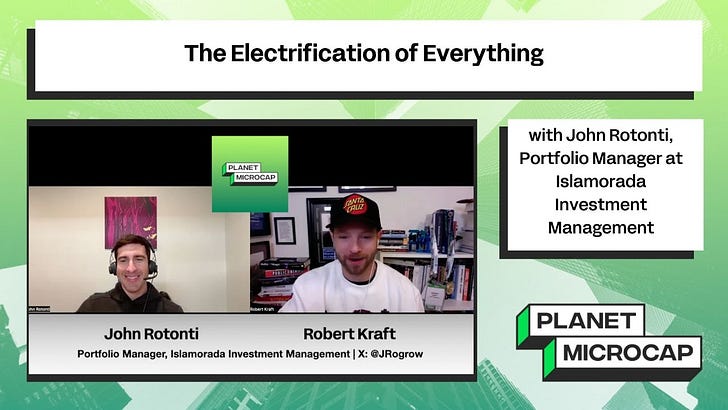
The Electrification of Everything with John Rotonti, Portfolio Manager at Islamorada Investment Management
My guest on the show today is with John Rotonti, Portfolio Manager at Islamorada Investment Management. John very recently joined Islamorada Investment Management running their Industrial and Infrastructure portfolio, and he's been actively researching and dissecting about the electrification of everything plus anything housing related. We jump in headfirst on his investing philosophy and checklist/criteria when looking at this swath of companies. And for full disclosure, we discussed a number of companies during today's podcast, I am not a shareholder in any of them.For more information about Islamorada Investment Management, please visit: https://www.islainvest.com/You can Follow John Rotonti on Twitter/X: @Jrogrow: https://x.com/JRogrowWatch on YouTube:We're excited to announce that we'll be partnering up with MicroCapClub for our full slate of investor conferences in 2025. Ian Cassel and his team at MicroCapClub have not only built and fostered the best community of MicroCap investors, but it's arguably one of the best investing communities, period.We couldn't be more thrilled to leverage our expertise in curating and hosting large scale MicroCap conferences, and teaming up with MicroCapClub to put together world class conferences for the MicroCap community.First up, the Planet MicroCap Showcase: VEGAS in partnership with MicroCapClub will be held on April 22-24, 2025 at the Paris Hotel & Casino in Las Vegas. Registration is now live, please visit: https://www.meetmax.com/sched/event_113149/conference_home.html. See you in Vegas!Planet MicroCap Podcast is on YouTube! All archived episodes and each new episode will be posted on the Planet MicroCap YouTube channel. I’ve provided the link in the description if you’d like to subscribe. You’ll also get the chance to watch all our Video Interviews with management teams, educational panels from the conference, as well as expert commentary from some familiar guests on the podcast.Subscribe here: http://bit.ly/1Q5YfymClick here to rate and review the Planet MicroCap PodcastThe Planet MicroCap Podcast is brought to you by SNN Incorporated, The Official MicroCap News Source, and the Planet MicroCap Review Magazine, the leading magazine in the MicroCap market.You can Follow the Planet MicroCap Podcast on Twitter @BobbyKKraft This is a public episode. If you would like to discuss this with other subscribers or get access to bonus episodes, visit microcapnewsletter.substack.com
The Unintentional and Gradual Making of An Activist Investor with Denver Smith, Managing Partner & Chief Investment Officer at Carlson Ridge Capital
My guest on the show today is Denver Smith, Managing Partner & Chief Investment Officer at Carlson Ridge Capital. We've done a number of episodes over the years on Activist Investing, and I'd say all the investors that end up going activist, it's a reluctant endeavour; they basically, with all the circumstances happening in that particular company, made a conscious decision doing a time and cost analysis that it was a necessary step. But the biggest difference between most activist investors we've had on, or rather, investors that have gone active, is that they wouldn't necessarily describe themselves as activist investors; it was all situational. While becoming an activist investor was initially unintentional with my guest today, Denver Smith, he is now most certainly intentional when the circumstances are ripe. And we dive into what a ripe situation looks like. And for full disclosure, we discussed a number of companies during today's podcast, I am not a shareholder in any of them.For more information about Carlson Ridge Capital, please visit: https://carlsonridge.com/Watch on YouTube:We're excited to announce that we'll be partnering up with MicroCapClub for our full slate of investor conferences in 2025. Ian Cassel and his team at MicroCapClub have not only built and fostered the best community of MicroCap investors, but it's arguably one of the best investing communities, period.We couldn't be more thrilled to leverage our expertise in curating and hosting large scale MicroCap conferences, and teaming up with MicroCapClub to put together world class conferences for the MicroCap community.First up, the Planet MicroCap Showcase: VEGAS in partnership with MicroCapClub will be held on April 22-24, 2025 at the Paris Hotel & Casino in Las Vegas. Registration is now live, please visit: https://www.meetmax.com/sched/event_113149/conference_home.html. See you in Vegas!Planet MicroCap Podcast is on YouTube! All archived episodes and each new episode will be posted on the Planet MicroCap YouTube channel. I’ve provided the link in the description if you’d like to subscribe. You’ll also get the chance to watch all our Video Interviews with management teams, educational panels from the conference, as well as expert commentary from some familiar guests on the podcast.Subscribe here: http://bit.ly/1Q5YfymClick here to rate and review the Planet MicroCap PodcastThe Planet MicroCap Podcast is brought to you by SNN Incorporated, The Official MicroCap News Source, and the Planet MicroCap Review Magazine, the leading magazine in the MicroCap market.You can Follow the Planet MicroCap Podcast on Twitter @BobbyKKraft This is a public episode. If you would like to discuss this with other subscribers or get access to bonus episodes, visit microcapnewsletter.substack.com

Cleaning Up Unclean Stories, Numbers, Narratives, Nicotine Industry + Haypp Group with Devin LaSarre, Founder & Editor of Invariant
My guest on the show today is with Devin LaSarre, Founder & Editor of Invariant. I've been following Devin for a while on social media, and invited him on to better understand his overall investing philosophy, and then specifically dig into an industry / idea a bit further. This episode I would say falls into the "ways of seeing" bucket, meaning, every once in a while I have a conversation on here with someone that has a completely different way they look at investing that I find very unique. In this case, Devin's focus on finding very "unclean" stories and doing the work to clean it up struck a chord that I wanted to understand further. I had a blast jamming on this concept, and then diving further on the Nicotine industry and his thesis on Haypp Group. And for full disclosure, we discussed a number of companies during today's podcast, I am not a shareholder in any of them.For more information about Invariant, please visit: https://invariant.substack.com/You can Follow Devin LaSarre on Twitter/X: https://x.com/DevinLaSarreWatch on YouTube:We're excited to announce that we'll be partnering up with MicroCapClub for our full slate of investor conferences in 2025. Ian Cassel and his team at MicroCapClub have not only built and fostered the best community of MicroCap investors, but it's arguably one of the best investing communities, period.We couldn't be more thrilled to leverage our expertise in curating and hosting large scale MicroCap conferences, and teaming up with MicroCapClub to put together world class conferences for the MicroCap community.First up, the Planet MicroCap Showcase: VEGAS in partnership with MicroCapClub will be held on April 22-24, 2025 at the Paris Hotel & Casino in Las Vegas. Registration is now live, please visit: https://www.meetmax.com/sched/event_113149/conference_home.html. See you in Vegas!Planet MicroCap Podcast is on YouTube! All archived episodes and each new episode will be posted on the Planet MicroCap YouTube channel. I’ve provided the link in the description if you’d like to subscribe. You’ll also get the chance to watch all our Video Interviews with management teams, educational panels from the conference, as well as expert commentary from some familiar guests on the podcast.Subscribe here: http://bit.ly/1Q5YfymClick here to rate and review the Planet MicroCap PodcastThe Planet MicroCap Podcast is brought to you by SNN Incorporated, The Official MicroCap News Source, and the Planet MicroCap Review Magazine, the leading magazine in the MicroCap market.You can Follow the Planet MicroCap Podcast on Twitter @BobbyKKraft This is a public episode. If you would like to discuss this with other subscribers or get access to bonus episodes, visit microcapnewsletter.substack.com
Locafy Limited (NASDAQ: LCFY): Focus on Location-based Digital Marketing
My guest on the show today is Gavin Burnett, CEO of Locafy (NASDAQ: LCFY). Locafy is a software-as-a-service technology company specializing in local search engine marketing. Founded in 2009, Locafy's mission is to revolutionize the US$700 billion SEO sector.SEO, Search Engine Optimization, is phrase you have probably heard a million times, and you probably couldn't define exactly what it is. You're not alone. And the main reason being is that it's a sector that is evolving so quickly that it's difficult to keep up. I invited on Gavin today because, since I last interviewed him back in February 2023, the company has had it's own evolution in tackling this both simple and complex problem every company must figure out: how do people find our business on the internet. We discuss this, and: * Locafy's suite of solutions* The company's business strategy* What the competitive landscape looks like* Progress towards profitability; balancing growth vs. focus on profitability, and* their 3-5 year vision for the company For more information about Locafy, please visit: https://locafy.com/Watch on YouTube:This podcast was recorded and is being made available by SNN, Inc. (together with its affiliates and its and their employees, “SNN”) solely for informational purposes. SNN is not providing or undertaking to provide any financial, economic, legal, accounting, tax, or other advice in or by virtue of this podcast. The information, statements, comments, views, and opinions provided in this podcast are general in nature, and such information, statements, comments, views, and opinions, and the viewing of/listening to this podcast are not intended to be and should not be construed as the provision of investment advice by SNN. The information, statements, comments, views, and opinions expressed in this podcast do not constitute and should not be construed as an offer to buy or sell any securities or to make or consider any investment or other course of action.The information, statements, comments, views, and opinions expressed in this podcast (including by guest speakers who are not officers, employees, or agents of SNN) are not necessarily those of SNN and may not be current. Reference to any specific third-party entity, product, service, materials, or content does not constitute an endorsement or recommendation by the SNN. SNN assumes no responsibility or liability for the accuracy or completeness of the content contained in third party materials or on third party sites referenced in this podcast or the compliance with applicable laws of such materials and/or links referenced herein. The views expressed by guest speakers are their own and their appearance on this podcast does not imply an endorsement of them or any entity they represent. SNN does not make any representation or warranty as to the accuracy or completeness of any of the information, statements, comments, views, or opinions contained in this podcast, which may include forward-looking statements where actual results may differ materially. SNN does not undertake any obligation whatsoever to provide any form of update, amendment, change, or correction to any of the information, statements, comments, views or opinions set forth in this podcast.SNN EXPRESSLY DISCLAIMS ANY AND ALL LIABILITY OR RESPONSIBILITY FOR ANY DIRECT, INDIRECT, INCIDENTAL, SPECIAL, CONSEQUENTIAL OR OTHER DAMAGES ARISING OUT OF ANY INDIVIDUAL'S USE OF, REFERENCE TO, RELIANCE ON, OR INABILITY TO USE, THIS PODCAST OR THE INFORMATION PRESENTED IN THIS PODCAST.By accessing this podcast, the listener acknowledges that the entire contents and design of this podcast, are the property of SNN, or used by SNN with permission, and are protected under U.S. and international copyright and trademark laws. Except as otherwise provided herein, users of this podcast may save and use information contained in the podcast only for personal or other non-commercial educational purposes. No other use, including without limitation, reproduction, retransmission, or editing of this podcast may be made without the prior written consent of SNN. This is a public episode. If you would like to discuss this with other subscribers or get access to bonus episodes, visit microcapnewsletter.substack.com
Quality Business vs. Quality Investment, Kill Criteria, Dichotomy of Control + Zedcor $ZDC.V with Kyle Grieve, Host of We Study Billionaires
My guest on the show today is Kyle Grieve, Host of We Study Billionaires Podcast on the Investor's Podcast Network. I've been a fan from afar and had the chance to hang with Kyle at our conference in Vancouver last year. We had a blast and thought we should bring that energy to the podcast. I wanted to learn more about his background and how he got hooked into our MicroCap world here. We dove deeper into his thoughts on the differences between a quality business and quality investment, his criteria for an ideal investment and we close with lessons learned that came to his mind from his interviews on the We Host Billionaires podcast. And for full disclosure, we discussed a number of companies during today's podcast, I am not a shareholder in any of them.For more information about We Study Billionaires, please visit: https://www.theinvestorspodcast.com/we-study-billionaires/You can Follow Kyle Grieve on Twitter/X: https://x.com/IrrationalMrktsWatch on YouTube:We're excited to announce that we'll be partnering up with MicroCapClub for our full slate of investor conferences in 2025. Ian Cassel and his team at MicroCapClub have not only built and fostered the best community of MicroCap investors, but it's arguably one of the best investing communities, period.We couldn't be more thrilled to leverage our expertise in curating and hosting large scale MicroCap conferences, and teaming up with MicroCapClub to put together world class conferences for the MicroCap community.First up, the Planet MicroCap Showcase: VEGAS in partnership with MicroCapClub will be held on April 22-24, 2025 at the Paris Hotel & Casino in Las Vegas. Registration is now live, please visit: https://www.meetmax.com/sched/event_113149/conference_home.html. See you in Vegas!Planet MicroCap Podcast is on YouTube! All archived episodes and each new episode will be posted on the Planet MicroCap YouTube channel. I’ve provided the link in the description if you’d like to subscribe. You’ll also get the chance to watch all our Video Interviews with management teams, educational panels from the conference, as well as expert commentary from some familiar guests on the podcast.Subscribe here: http://bit.ly/1Q5YfymClick here to rate and review the Planet MicroCap PodcastThe Planet MicroCap Podcast is brought to you by SNN Incorporated, The Official MicroCap News Source, and the Planet MicroCap Review Magazine, the leading magazine in the MicroCap market.You can Follow the Planet MicroCap Podcast on Twitter @BobbyKKraft This is a public episode. If you would like to discuss this with other subscribers or get access to bonus episodes, visit microcapnewsletter.substack.com
We (Investors / Shareholders) Will Find You with Adam Wilk, Founder & Portfolio Manager at Greystone Capital Management
My guest on the show today is Adam Wilk, Founder and Portfolio Manager at Greystone Capital Management. I invited Adam back on to discuss an article he wrote back in August 2024 to explore the idea of investors/shareholders finding companies, in other words, delving deeper into a statement made famous by Buffett, "companies ultimately end up with the shareholders they deserve." There's many different ways to think about this concept - Adam and I do our best to cover them all. I thought it was particularly interesting for why Adam even wrote the article was inspired by potential LPs and other investors asking him why won't this company stay cheap forever; I would've thought for sure this article was inspired by management teams asking him about this topic. And for full disclosure, we discussed a number of companies during today's podcast, I am not a shareholder in any of them.For more information about Greystone Capital Management, please visit: https://www.greystonevalue.com/You can Follow Adam Wilk on Twitter/X here: https://x.com/AKWilkMicroCapClub article: https://microcapclub.com/we-will-find-you/Watch on YouTube:We're excited to announce that we'll be partnering up with MicroCapClub for our full slate of investor conferences in 2025. Ian Cassel and his team at MicroCapClub have not only built and fostered the best community of MicroCap investors, but it's arguably one of the best investing communities, period.We couldn't be more thrilled to leverage our expertise in curating and hosting large scale MicroCap conferences, and teaming up with MicroCapClub to put together world class conferences for the MicroCap community.First up, the Planet MicroCap Showcase: VEGAS in partnership with MicroCapClub will be held on April 22-24, 2025 at the Paris Hotel & Casino in Las Vegas. Registration is now live, please visit: https://www.meetmax.com/sched/event_113149/conference_home.html. See you in Vegas!Planet MicroCap Podcast is on YouTube! All archived episodes and each new episode will be posted on the Planet MicroCap YouTube channel. I’ve provided the link in the description if you’d like to subscribe. You’ll also get the chance to watch all our Video Interviews with management teams, educational panels from the conference, as well as expert commentary from some familiar guests on the podcast.Subscribe here: http://bit.ly/1Q5YfymClick here to rate and review the Planet MicroCap PodcastThe Planet MicroCap Podcast is brought to you by SNN Incorporated, The Official MicroCap News Source, and the Planet MicroCap Review Magazine, the leading magazine in the MicroCap market.You can Follow the Planet MicroCap Podcast on Twitter @BobbyKKraft This is a public episode. If you would like to discuss this with other subscribers or get access to bonus episodes, visit microcapnewsletter.substack.com
A+ Capital Allocator, Inefficient, Fragmented Market with Valuation that Provides a Margin of Safety with Whit Huguley, Fund Manager at River Oaks Capital
My guest on the show today is Whit Huguley, Fund Manager at River Oaks Capital. I've known Whit for a few years now, first having met him at one of my own conferences in Vegas, and have gotten to know and appreciate Whit's investing style. He launched his Fund, River Oaks Capital, about 5 years ago now, and while he's in the middle of writing his annual letter, he graciously jumped on the pod to talk more about what he's learned from running a MicroCap fund thus far. And for full disclosure, we discussed a number of companies during today's podcast, I am not a shareholder in any of them.For more information about River Oaks Capital, please visit: https://www.riveroaks-capital.com/You can Follow Whit Huguley on Twitter/X: https://x.com/Whit_HuguleyWatch on YouTube: We're excited to announce that we'll be partnering up with MicroCapClub for our full slate of investor conferences in 2025. Ian Cassel and his team at MicroCapClub have not only built and fostered the best community of MicroCap investors, but it's arguably one of the best investing communities, period.We couldn't be more thrilled to leverage our expertise in curating and hosting large scale MicroCap conferences, and teaming up with MicroCapClub to put together world class conferences for the MicroCap community.First up, the Planet MicroCap Showcase: VEGAS in partnership with MicroCapClub will be held on April 22-24, 2025 at the Paris Hotel & Casino in Las Vegas. Registration is now live, please visit: https://www.meetmax.com/sched/event_113149/conference_home.html. See you in Vegas!Planet MicroCap Podcast is on YouTube! All archived episodes and each new episode will be posted on the Planet MicroCap YouTube channel. I’ve provided the link in the description if you’d like to subscribe. You’ll also get the chance to watch all our Video Interviews with management teams, educational panels from the conference, as well as expert commentary from some familiar guests on the podcast.Subscribe here: http://bit.ly/1Q5YfymClick here to rate and review the Planet MicroCap PodcastThe Planet MicroCap Podcast is brought to you by SNN Incorporated, The Official MicroCap News Source, and the Planet MicroCap Review Magazine, the leading magazine in the MicroCap market.You can Follow the Planet MicroCap Podcast on Twitter @BobbyKKraft This is a public episode. If you would like to discuss this with other subscribers or get access to bonus episodes, visit microcapnewsletter.substack.com
Special Situations: Why Mispricing Exists, Why is the Market Wrong and Know Your Downside with Conor Maguire, Founder and Editor of the Value Situations Newsletter
My guest on the show today is Conor Maguire, Founder and Editor of the Value Situations Newsletter on Substack. I've always enjoyed Conor's appearances on Yet Another Value Podcast pitching individual ideas, and invited him on here to share more about his background, fundamental investing philosophy, what an ideal investment looks like to him, investing framework, and more. Special situations is always fun to talk about, in my opinion, and some of my favorite conversations are had when discussing the topic. This one with Conor fits that bill in spades. And for full disclosure, we discussed a number of companies during today's podcast, I am not a shareholder in any of them.For more information about the Value Situations Newsletter, please visit: https://valuesits.substack.com/You can Follow Conor Maguire on Twitter/X: https://x.com/ValueSituationsWatch on YouTube:We're excited to announce that we'll be partnering up with MicroCapClub for our full slate of investor conferences in 2025. Ian Cassel and his team at MicroCapClub have not only built and fostered the best community of MicroCap investors, but it's arguably one of the best investing communities, period.We couldn't be more thrilled to leverage our expertise in curating and hosting large scale MicroCap conferences, and teaming up with MicroCapClub to put together world class conferences for the MicroCap community.First up, the Planet MicroCap Showcase: VEGAS in partnership with MicroCapClub will be held on April 22-24, 2025 at the Paris Hotel & Casino in Las Vegas. Registration is now live, please visit: https://www.meetmax.com/sched/event_113149/conference_home.html. See you in Vegas!Planet MicroCap Podcast is on YouTube! All archived episodes and each new episode will be posted on the Planet MicroCap YouTube channel. I’ve provided the link in the description if you’d like to subscribe. You’ll also get the chance to watch all our Video Interviews with management teams, educational panels from the conference, as well as expert commentary from some familiar guests on the podcast.Subscribe here: http://bit.ly/1Q5YfymClick here to rate and review the Planet MicroCap PodcastThe Planet MicroCap Podcast is brought to you by SNN Incorporated, The Official MicroCap News Source, and the Planet MicroCap Review Magazine, the leading magazine in the MicroCap market.You can Follow the Planet MicroCap Podcast on Twitter @BobbyKKraft This is a public episode. If you would like to discuss this with other subscribers or get access to bonus episodes, visit microcapnewsletter.substack.com
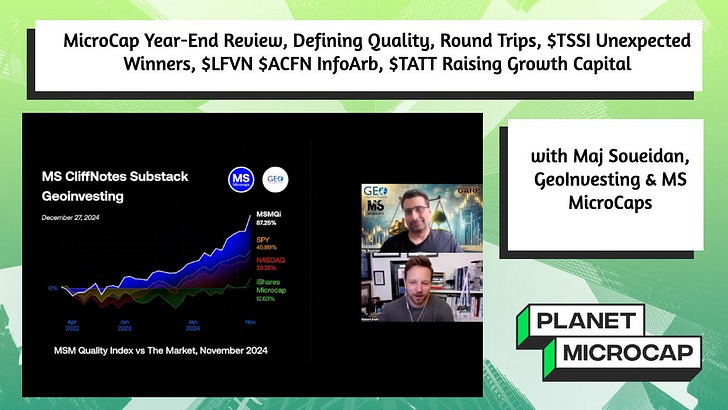
MicroCap Year-End Review: Round Trips, Unexpected Winners, InfoArb, Raising Growth Capital + $TSSI $LFVN $ACFN $TATT with Maj Soueidan, GeoInvesting & MS MicroCaps
My guest on the show today is Maj Soueidan, Founder and Editor at GeoInvesting. 2024 is in the books, and like every good podcaster, we had to do our version of a year-in-review, and in the MicroCap world, there's no shortage of things to cover. So much so, this might be Maj and I's longest pod ever - an hour and 40 minutes worth of mostly what I think we do best, jam session on MicroCap stocks and investing. Maj absolutely cooks on this episode, and it's always fun to watch. We dissect defining quality, round trips, unexpected winners, information arbitrage, growth capital, how diversification can allow you to concentrate, and much more. We discussed a number of stocks during our interview today, I am not a shareholder in any of them, and Maj also may or may not own companies that comprise their Tier One Quality MicroCap Index, please see MS MicroCaps and GeoInvesting for full disclosure.For more information about MS MicroCap Cliffnotes, please visit: For more information about GeoInvesting, please visit: https://geoinvesting.com/Watch on YouTube:We're excited to announce that we'll be partnering up with MicroCapClub for our full slate of investor conferences in 2025. Ian Cassel and his team at MicroCapClub have not only built and fostered the best community of MicroCap investors, but it's arguably one of the best investing communities, period.We couldn't be more thrilled to leverage our expertise in curating and hosting large scale MicroCap conferences, and teaming up with MicroCapClub to put together world class conferences for the MicroCap community.First up, the Planet MicroCap Showcase: VEGAS in partnership with MicroCapClub will be held on April 22-24, 2025 at the Paris Hotel & Casino in Las Vegas. Registration is now live, please visit: https://www.meetmax.com/sched/event_113149/conference_home.html. See you in Vegas!Planet MicroCap Podcast is on YouTube! All archived episodes and each new episode will be posted on the Planet MicroCap YouTube channel. I’ve provided the link in the description if you’d like to subscribe. You’ll also get the chance to watch all our Video Interviews with management teams, educational panels from the conference, as well as expert commentary from some familiar guests on the podcast.Subscribe here: http://bit.ly/1Q5YfymClick here to rate and review the Planet MicroCap PodcastThe Planet MicroCap Podcast is brought to you by SNN Incorporated, The Official MicroCap News Source, and the Planet MicroCap Review Magazine, the leading magazine in the MicroCap market.You can Follow the Planet MicroCap Podcast on Twitter @BobbyKKraft This is a public episode. If you would like to discuss this with other subscribers or get access to bonus episodes, visit microcapnewsletter.substack.com
GARRRP: Growth at a Reasonable Reasonable…Reasonable Price with Roger Fan, Founder and CIO of RF Capital Management
My guest on the show today is Roger Fan, Founder and CIO of RF Capital Management. Firstly, shout out to Chris Abbott from 1035 Capital for the introduction. Roger runs a long-biased investment firm in LA that invests primarily in equities, and focuses on nanocaps and special situations. Their objective is to compound at 15-20%+ over the long term with a concentrated portfolio and minimal/no leverage or shorting. I invited Roger on to learn more about his strategy and how he intends to achieve these returns. Roger mentioned a number of names during the interview today and for full disclosure, I am not a shareholder in any of them.For more information about RF Capital Management, please visit: https://www.rfcapitalmanagement.com/You can Follow Roger Fan on Twitter/X @rgrfan: https://x.com/rgrfanWatch on YouTube:We're excited to announce that we'll be partnering up with MicroCapClub for our full slate of investor conferences in 2025. Ian Cassel and his team at MicroCapClub have not only built and fostered the best community of MicroCap investors, but it's arguably one of the best investing communities, period.We couldn't be more thrilled to leverage our expertise in curating and hosting large scale MicroCap conferences, and teaming up with MicroCapClub to put together world class conferences for the MicroCap community.First up, the Planet MicroCap Showcase: VEGAS in partnership with MicroCapClub will be held on April 22-24, 2025 at the Paris Hotel & Casino in Las Vegas. Registration is now live, please visit: https://www.meetmax.com/sched/event_113149/conference_home.html. See you in Vegas!Planet MicroCap Podcast is on YouTube! All archived episodes and each new episode will be posted on the Planet MicroCap YouTube channel. I’ve provided the link in the description if you’d like to subscribe. You’ll also get the chance to watch all our Video Interviews with management teams, educational panels from the conference, as well as expert commentary from some familiar guests on the podcast.Subscribe here: http://bit.ly/1Q5YfymClick here to rate and review the Planet MicroCap PodcastThe Planet MicroCap Podcast is brought to you by SNN Incorporated, The Official MicroCap News Source, and the Planet MicroCap Review Magazine, the leading magazine in the MicroCap market.You can Follow the Planet MicroCap Podcast on Twitter @BobbyKKraft This is a public episode. If you would like to discuss this with other subscribers or get access to bonus episodes, visit microcapnewsletter.substack.com
Conceptualizing the Future with Deiya Pernas, Co-Founder and Analyst at Pernas Research
My guest on the show today is Deiya Pernas, Co-Founder and Analyst at Pernas Research. Growth, runway for growth, greenfield opportunities, current market penetration, competitive landscape: these are all concepts we need to think about when looking at MicroCaps, and we've talked at length on this show about. The idea, or the ability, to conceptualize the future for any given company is a skill I think we all wish we had mastered (then we'd all be extremely wealthy), and yet, is what makes investing in Small, MicroCaps so damn fun. Deiya and his team at Pernas Research focus heavily on companies where their future is brighter than their current state, in other words, how the conceptualization of their futures are different from market perception. We dig into this idea today, and provide a few examples to illustrate what Deiya means. Deiya mentioned a number of names during the interview today and for full disclosure, I am not a shareholder in any of them.For more information about Pernas Research, please visit: https://pernasresearch.com/You can Follow Deiya Pernas and Pernas Research on Twitter/X @pernasresearch: https://x.com/pernasresearchWatch on YouTube:We're excited to announce that we'll be partnering up with MicroCapClub for our full slate of investor conferences in 2025. Ian Cassel and his team at MicroCapClub have not only built and fostered the best community of MicroCap investors, but it's arguably one of the best investing communities, period.We couldn't be more thrilled to leverage our expertise in curating and hosting large scale MicroCap conferences, and teaming up with MicroCapClub to put together world class conferences for the MicroCap community.First up, the Planet MicroCap Showcase: VEGAS in partnership with MicroCapClub will be held on April 22-24, 2025 at the Paris Hotel & Casino in Las Vegas. Registration is now live, please visit: https://www.meetmax.com/sched/event_113149/conference_home.html. See you in Vegas!Planet MicroCap Podcast is on YouTube! All archived episodes and each new episode will be posted on the Planet MicroCap YouTube channel. I’ve provided the link in the description if you’d like to subscribe. You’ll also get the chance to watch all our Video Interviews with management teams, educational panels from the conference, as well as expert commentary from some familiar guests on the podcast.Subscribe here: http://bit.ly/1Q5YfymClick here to rate and review the Planet MicroCap PodcastThe Planet MicroCap Podcast is brought to you by SNN Incorporated, The Official MicroCap News Source, and the Planet MicroCap Review Magazine, the leading magazine in the MicroCap market.You can Follow the Planet MicroCap Podcast on Twitter @BobbyKKraft This is a public episode. If you would like to discuss this with other subscribers or get access to bonus episodes, visit microcapnewsletter.substack.com
Buying and Operating Portfolio of Small Private Companies is Harder than it Looks with Colin King, Partner at Circle City Capital Group, Inc.
My guest on the show today is Colin King, Partner at Circle City Capital Group, Inc., and known as @valuedontlie on Twitter/X. I think we've all seen those memes and videos of folks who left their amazing job at Goldman Sacks to buy multiple small businesses, then of course, if you subscribe to their newsletter they'll show you how they did it. All jokes aside, it's a strategy that has worked time and again for many folks out there, however, buying and operating small private businesses is not as easy as social media would make you think, goes without saying. I invited on Colin to talk about his journey to launching and running this strategy at Circle City Capital Group. Colin mentioned a number of names during the interview today and for full disclosure, I am not a shareholder in any of them.For more information about Circle City Capital Group, Inc., please visit: https://www.circlecitycapitalgroup.com/You can Follow Colin King on Twitter/X @valuedontlie: https://x.com/valuedontlieWatch on YouTube:We're excited to announce that we'll be partnering up with MicroCapClub for our full slate of investor conferences in 2025. Ian Cassel and his team at MicroCapClub have not only built and fostered the best community of MicroCap investors, but it's arguably one of the best investing communities, period.We couldn't be more thrilled to leverage our expertise in curating and hosting large scale MicroCap conferences, and teaming up with MicroCapClub to put together world class conferences for the MicroCap community.First up, the Planet MicroCap Showcase: VEGAS in partnership with MicroCapClub will be held on April 22-24, 2025 at the Paris Hotel & Casino in Las Vegas. Registration is now live, please visit: https://www.meetmax.com/sched/event_113149/conference_home.html. See you in Vegas!Planet MicroCap Podcast is on YouTube! All archived episodes and each new episode will be posted on the Planet MicroCap YouTube channel. I’ve provided the link in the description if you’d like to subscribe. You’ll also get the chance to watch all our Video Interviews with management teams, educational panels from the conference, as well as expert commentary from some familiar guests on the podcast.Subscribe here: http://bit.ly/1Q5YfymClick here to rate and review the Planet MicroCap PodcastThe Planet MicroCap Podcast is brought to you by SNN Incorporated, The Official MicroCap News Source, and the Planet MicroCap Review Magazine, the leading magazine in the MicroCap market.You can Follow the Planet MicroCap Podcast on Twitter @BobbyKKraft This is a public episode. If you would like to discuss this with other subscribers or get access to bonus episodes, visit microcapnewsletter.substack.com
Game Selection, Repeated Exposure from Multiple Stakeholder Angles + Case Studies with Tristan Waine @hurdle_rate
My guest on the show today is Tristan Waine, better known as @hurdle_rate on Twitter/X and Editor, Author of the Hurdle Rate newsletter on Substack. We've talked many times here about the circle of competence, investing in what you know, looking at companies that produce goods or services that you actually consume, a style of investing, or more specifically, idea generation that Peter Lynch made famous. In our conversation today, Tristan and I talk extensively about this concept as it pertains to his investing style and philosophy. Specifically, we thought we could up the boring business ante, by talking about the sexiest businesses alive: accounting and document management software. In all seriousness, we have a great time, and Tristan provides some valuable insight on the topic of investing in what you know. Tristan mentioned a number of names during the interview today and for full disclosure, I am not a shareholder in any of them.For more information about the Hurdle Rate newsletter on Substack, please visit: You can Follow Tristan on Twitter/X @hurlde_rate: https://x.com/hurdle_rateWatch on YouTube:We're excited to announce that we'll be partnering up with MicroCapClub for our full slate of investor conferences in 2025. Ian Cassel and his team at MicroCapClub have not only built and fostered the best community of MicroCap investors, but it's arguably one of the best investing communities, period.We couldn't be more thrilled to leverage our expertise in curating and hosting large scale MicroCap conferences, and teaming up with MicroCapClub to put together world class conferences for the MicroCap community.First up, the Planet MicroCap Showcase: VEGAS in partnership with MicroCapClub will be held on April 22-24, 2025 at the Paris Hotel & Casino in Las Vegas. Registration is now live, please visit: https://www.meetmax.com/sched/event_113149/conference_home.html. See you in Vegas!Planet MicroCap Podcast is on YouTube! All archived episodes and each new episode will be posted on the Planet MicroCap YouTube channel. I’ve provided the link in the description if you’d like to subscribe. You’ll also get the chance to watch all our Video Interviews with management teams, educational panels from the conference, as well as expert commentary from some familiar guests on the podcast.Subscribe here: http://bit.ly/1Q5YfymClick here to rate and review the Planet MicroCap PodcastThe Planet MicroCap Podcast is brought to you by SNN Incorporated, The Official MicroCap News Source, and the Planet MicroCap Review Magazine, the leading magazine in the MicroCap market.You can Follow the Planet MicroCap Podcast on Twitter @BobbyKKraft This is a public episode. If you would like to discuss this with other subscribers or get access to bonus episodes, visit microcapnewsletter.substack.com
Owning = Knowing, European Small/MicroCaps, Disassociating from FOMO + Shelly Group $SLYG Thesis with @mavix_leon
My guest on the show today is Leon, better known as @mavix_leon on Twitter/X, and writer/editor of Underfollowed Stocks Newsletter on Substack. As his publication indicates, Leon is all about finding underfollowed investing opportunities with little to no institutional following, a natural fit for our show here. I invited him on to better understand his approach here, plus: European Small/MicroCaps, disassociating from FOMO and his thesis on Shelly Group $SLYG. Leon mentioned a number of names during the interview today and for full disclosure, I am not a shareholder in any of them. For more information about Underfollowed Stocks newsletter, please visit: https://underfollowedstocks.substack.com/You can Follow @mavix_leon on Twitter/X here: https://x.com/mavix_leonWatch on YouTube:We're excited to announce that we'll be partnering up with MicroCapClub for our full slate of investor conferences in 2025. Ian Cassel and his team at MicroCapClub have not only built and fostered the best community of MicroCap investors, but it's arguably one of the best investing communities, period.We couldn't be more thrilled to leverage our expertise in curating and hosting large scale MicroCap conferences, and teaming up with MicroCapClub to put together world class conferences for the MicroCap community.First up, the Planet MicroCap Showcase: VEGAS in partnership with MicroCapClub will be held on April 22-24, 2025 at the Paris Hotel & Casino in Las Vegas. Registration is now live, please visit: https://www.meetmax.com/sched/event_113149/conference_home.html. See you in Vegas!Planet MicroCap Podcast is on YouTube! All archived episodes and each new episode will be posted on the Planet MicroCap YouTube channel. I’ve provided the link in the description if you’d like to subscribe. You’ll also get the chance to watch all our Video Interviews with management teams, educational panels from the conference, as well as expert commentary from some familiar guests on the podcast.Subscribe here: http://bit.ly/1Q5YfymClick here to rate and review the Planet MicroCap PodcastThe Planet MicroCap Podcast is brought to you by SNN Incorporated, The Official MicroCap News Source, and the Planet MicroCap Review Magazine, the leading magazine in the MicroCap market.You can Follow the Planet MicroCap Podcast on Twitter @BobbyKKraft This is a public episode. If you would like to discuss this with other subscribers or get access to bonus episodes, visit microcapnewsletter.substack.com
Counter Cyclicality, Buying Scarce Assets, Inflation Protection + Cipher Thesis $CPH.TO with Dylan Marrello, @ragingbullcap
My guest on the show today is Dylan Marrello, better known as @ragingbullcap on Twitter/X. I've been following Dylan for a while now and wanted to invite him on to learn more about investing strategy, philosophy, and most interestingly, what investing themes he's looking at right now. As a natural contrarian, we jammed on a bunch of these ideas, including: counter cyclicality, offshore oil drilling, commercial real estate, coal, buying scarce assets, inflation protection, and more! We also talk at length about his largest position, Cipher Pharmaceuticals.Dylan mentioned a number of names during the interview today and for full disclosure, I am not a shareholder in any of them.For more information about Raging Bull Investments Substack, please visit: You can Follow Dylan on Twitter/X @ragingbullcap: https://x.com/ragingbullcapWatch on YouTube:We're excited to announce that we'll be partnering up with MicroCapClub for our full slate of investor conferences in 2025. Ian Cassel and his team at MicroCapClub have not only built and fostered the best community of MicroCap investors, but it's arguably one of the best investing communities, period.We couldn't be more thrilled to leverage our expertise in curating and hosting large scale MicroCap conferences, and teaming up with MicroCapClub to put together world class conferences for the MicroCap community.First up, the Planet MicroCap Showcase: VEGAS in partnership with MicroCapClub will be held on April 22-24, 2025 at the Paris Hotel & Casino in Las Vegas. Registration is now live, please visit: https://www.meetmax.com/sched/event_113149/conference_home.html. See you in Vegas!Planet MicroCap Podcast is on YouTube! All archived episodes and each new episode will be posted on the Planet MicroCap YouTube channel. I’ve provided the link in the description if you’d like to subscribe. You’ll also get the chance to watch all our Video Interviews with management teams, educational panels from the conference, as well as expert commentary from some familiar guests on the podcast.Subscribe here: http://bit.ly/1Q5YfymClick here to rate and review the Planet MicroCap PodcastThe Planet MicroCap Podcast is brought to you by SNN Incorporated, The Official MicroCap News Source, and the Planet MicroCap Review Magazine, the leading magazine in the MicroCap market.You can Follow the Planet MicroCap Podcast on Twitter @BobbyKKraft This is a public episode. If you would like to discuss this with other subscribers or get access to bonus episodes, visit microcapnewsletter.substack.com
It’s Not Necessarily Bottom Fishing Looking at MicroCaps with Paul Cerro, CIO of Cedar Grove Capital Management
My guest on the show today is Paul Cerro, CIO of Cedar Grove Capital Management. Paul was recently on Andrew Walker's Yet Another Value Podcast having a conversation about Red Cat Holdings $RCAT - a company we actually interviewed, now way back in the day, in 2019 when they were still on the Pink Sheets. He did an awesome job on the show, and invited him on today to learn more about his investing philosophy, strategy and why it's not necessarily bottom fishing when looking at MicroCaps.For more information about Paul Cerro and Cedar Grove Capital Management, please visit: https://www.cedargrovecm.com/Watch on YouTube: We're excited to announce that we'll be partnering up with MicroCapClub for our full slate of investor conferences in 2025. Ian Cassel and his team at MicroCapClub have not only built and fostered the best community of MicroCap investors, but it's arguably one of the best investing communities, period.We couldn't be more thrilled to leverage our expertise in curating and hosting large scale MicroCap conferences, and teaming up with MicroCapClub to put together world class conferences for the MicroCap community.First up, the Planet MicroCap Showcase: VEGAS in partnership with MicroCapClub will be held on April 22-24, 2025 at the Paris Hotel & Casino in Las Vegas. Registration is now live, please visit: https://www.meetmax.com/sched/event_113149/conference_home.html. See you in Vegas!Planet MicroCap Podcast is on YouTube! All archived episodes and each new episode will be posted on the Planet MicroCap YouTube channel. I’ve provided the link in the description if you’d like to subscribe. You’ll also get the chance to watch all our Video Interviews with management teams, educational panels from the conference, as well as expert commentary from some familiar guests on the podcast.Subscribe here: http://bit.ly/1Q5YfymClick here to rate and review the Planet MicroCap PodcastThe Planet MicroCap Podcast is brought to you by SNN Incorporated, The Official MicroCap News Source, and the Planet MicroCap Review Magazine, the leading magazine in the MicroCap market.You can Follow the Planet MicroCap Podcast on Twitter @BobbyKKraft This is a public episode. If you would like to discuss this with other subscribers or get access to bonus episodes, visit microcapnewsletter.substack.com
MicroCap M&A: UGE Take Private - Why it Happened, Why Now, Lessons Learned with Nick Blitterswyk, CEO of UGE International
My guest on the show today is Nick Blitterswyk, CEO of UGE International. On May 29, 2024, UGE announced an arrangement agreement for going private transaction with NOVA Infrastructure Fund for an all-cash consideration of C$2.00 per common share, a 270% premium to the closing price of the common shares on May 28, 2024. The company officially closed the planned take-private transaction on August 15, 2024. Today's interview has a few factors at play here:1. We've done quite a few interviews recently here, i.e., with Mathieu Martin and Paul Andreola, about how M&A has been hot, particularly in Canada, for the last 12-18 months, with no signs of slowing down.2. I've known Nick now for almost 10 years, having first interviewed him back in 2015, and have covered the UGE journey from beginning to now conclusion of their life as a public company.So, I wanted to share with you all a conversation about Nick's experience as a MicroCap public company CEO, what it means to run a MicroCap public company, what happened and why now was the time to go forward with the transaction to go private, lessons learned, insights to pass on about his experience being a MicroCap CEO and more! Now that the deal has officially closed, I really appreciated Nick's candor and hopefully a lot can be gleaned from this episode that the entire MicroCap space can learn from, as well as a glimpse behind the thought process when faced with the prospect of staying public vs. being acquired/going private.For more information about UGE, please visit: https://ugei.com/We're excited to announce that we'll be partnering up with MicroCapClub for our full slate of investor conferences in 2025. Ian Cassel and his team at MicroCapClub have not only built and fostered the best community of MicroCap investors, but it's arguably one of the best investing communities, period.We couldn't be more thrilled to leverage our expertise in curating and hosting large scale MicroCap conferences, and teaming up with MicroCapClub to put together world class conferences for the MicroCap community.First up, the Planet MicroCap Showcase: VEGAS in partnership with MicroCapClub will be held on April 22-24, 2025 at the Paris Hotel & Casino in Las Vegas. Registration is now live, please visit: https://www.meetmax.com/sched/event_113149/conference_home.html. See you in Vegas!Watch on YouTube:Planet MicroCap Podcast is on YouTube! All archived episodes and each new episode will be posted on the Planet MicroCap YouTube channel. I’ve provided the link in the description if you’d like to subscribe. You’ll also get the chance to watch all our Video Interviews with management teams, educational panels from the conference, as well as expert commentary from some familiar guests on the podcast.Subscribe here: http://bit.ly/1Q5YfymClick here to rate and review the Planet MicroCap PodcastThe Planet MicroCap Podcast is brought to you by SNN Incorporated, The Official MicroCap News Source, and the Planet MicroCap Review Magazine, the leading magazine in the MicroCap market.You can Follow the Planet MicroCap Podcast on Twitter @BobbyKKraft This is a public episode. If you would like to discuss this with other subscribers or get access to bonus episodes, visit microcapnewsletter.substack.com