One Planet Podcast · Climate Change, Politics, Sustainability, Environmental Solutions, Renewable Energy, Activism, Biodiversity, Carbon Footprint, Wildlife, Regenerative Agriculture, Circular Economy, Extinction, Net-Zero
311 episodes — Page 5 of 7
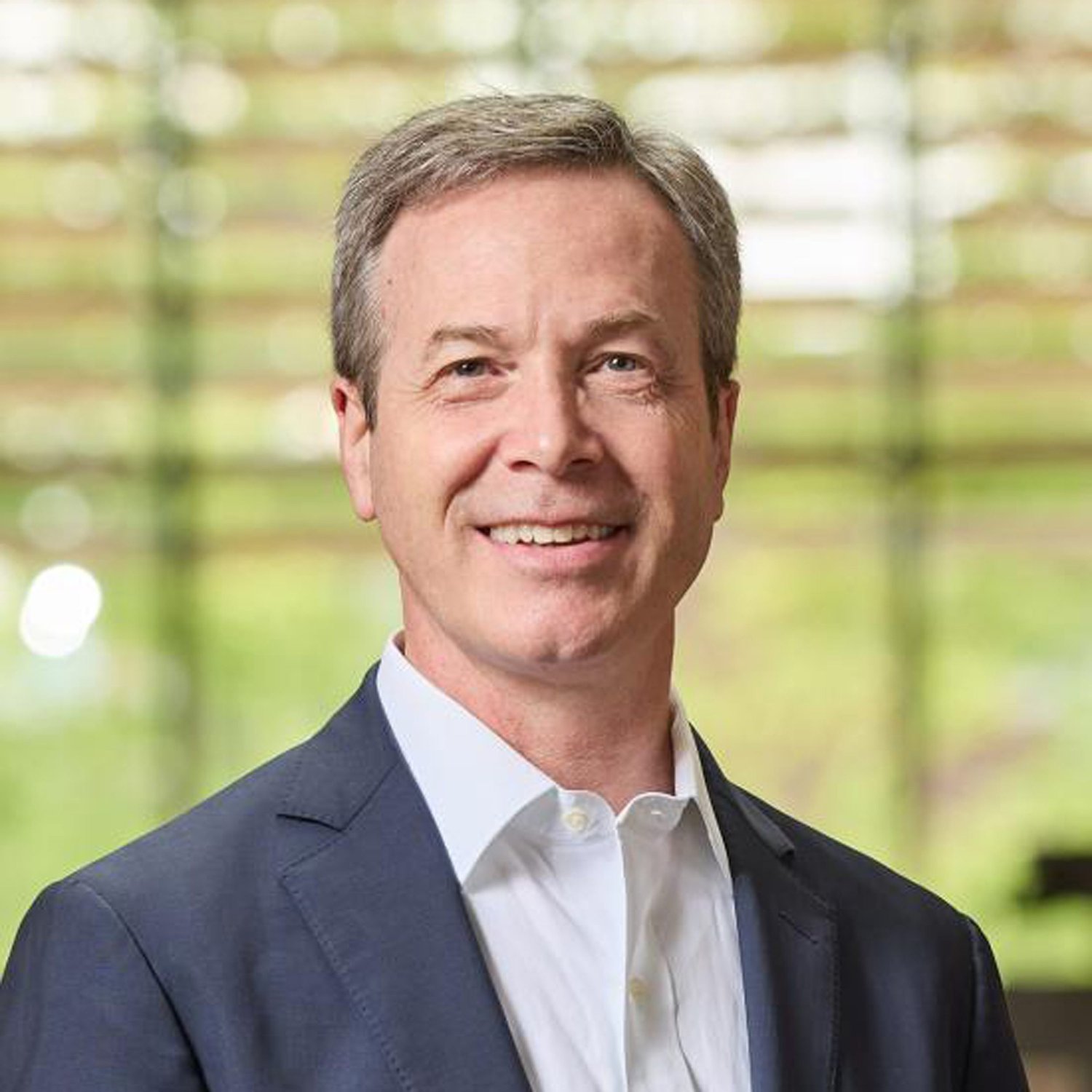
ANTHONY LEISEROWITZ - Founding Director of Yale Program on Climate Change Communication - Host of Climate Connections
Anthony Leiserowitz, Ph.D. is the founder and Director of the Yale Program on Climate Change Communication and a Senior Research Scientist at the Yale School of the Environment. He is an internationally recognized expert on public climate change beliefs, attitudes, policy support, and behavior, and the psychological, cultural, and political factors that shape them and conducts research globally, including in the United States, China, India, and Brazil. He has published more than 250 scientific articles, chapters, and reports and has worked with the Intergovernmental Panel on Climate Change, the National Academy of Sciences, the Smithsonian Museum of Natural History, the Harvard Kennedy School, the United Nations Development Program, the Gallup World Poll, and the World Economic Forum, among others. He is a recipient of the Friend of the Planet Award from the National Center for Science Education, the Mitofsky Innovator Award from the American Association of Public Opinion Research, the Stephen H. Schneider Award for Outstanding Climate Science Communication from Climate One, and an Environmental Innovator award from the Environmental Protection Agency. In 2020, he was named the second-most influential climate scientist in the world (of 1,000) by Reuters. He is also the host of Climate Connections, a radio program broadcast each day on more than 700 stations nationwide."So the why really depends on where you are. People are not all the same. There is no such thing as the public. There are many, many, many different publics within a state, within a country, within the world, right? So one of the first cardinal rules of effective communication is know your audience. Who are they? What do they know? What do they think they know? Who do they trust? Where do they get their information? What are their underlying values? And it's only once you know who they are that you as a communicator can go more than halfway to try to meet them where they are not where you are. Where they are. That's so easy to say, but it's actually so hard for so many of us within the climate community to do because we're steeped in this issue. We want to talk about things."https://environment.yale.edu/profile/leiserowitzhttps://climatecommunication.yale.eduwww.yaleclimateconnections.orgwww.creativeprocess.infowww.oneplanetpodcast.orgIG www.instagram.com/creativeprocesspodcast

Highlights - RALPH GIBSON - Award-winning Photographer - Leica Hall of Fame Inductee
"I was fortunate to be able to visit the original Lascaux Cave in the Dordogne. And in any of these paleolithic caves, we find there are certain themes there that seem to be, as long as humanity has been on planet earth: there's always been war, there's always been migration. There's always been a search for God, a form of worship, and there's always been a fear of the apocalypse, the end of the world, which if you open up Paris Match tomorrow or the New York Times on the front page, you'll find those four subjects are still being addressed.Now, we're talking about BC up to today. Now, of course, things are moving much faster now than they did 40, 000 years ago. But I think that capitalism, which created much of this pollution, will find a way of sustaining itself in cleaning up all this pollution."Ralph Gibson is one of the most interesting American photographers of our time. His international renown is based on his work, which is shown and collected by some of the world’s leading museums, including the Museum of Modern Art in New York, the J.P. Getty Museum in Los Angeles, the John Simon Guggenheim Memorial Foundation, the Creative Center for Photography in Tucson, the Museum of Fine Arts in Houston, the Maison Européenne de la Photographie in Paris, the Bibliothèque Nationale de France in Paris, and the Fotomuseum Winterthur in Switzerland.Gibson’s works reveal a meticulous aesthetic and visual territory edging on the surreal. His recent books include his memoir Self Exposure, Sacred Land: Israel before and after Time, and Secret of Light, which accompanied his exhibition at the Deichtorhallen House of Photography in Hamburg. He is a Leica Hall of Fame Inductee and has been awarded the French Legion of Honor. In 2022, The Gibson | Goeun Museum of Photography devoted to his work opened in Busan, South Korea.www.ralphgibson.comwww.deichtorhallen.de/en/ausstellung/ralph-gibsonwww.gibsongoeunmuseum.comwww.creativeprocess.infowww.oneplanetpodcast.orgIG www.instagram.com/creativeprocesspodcast
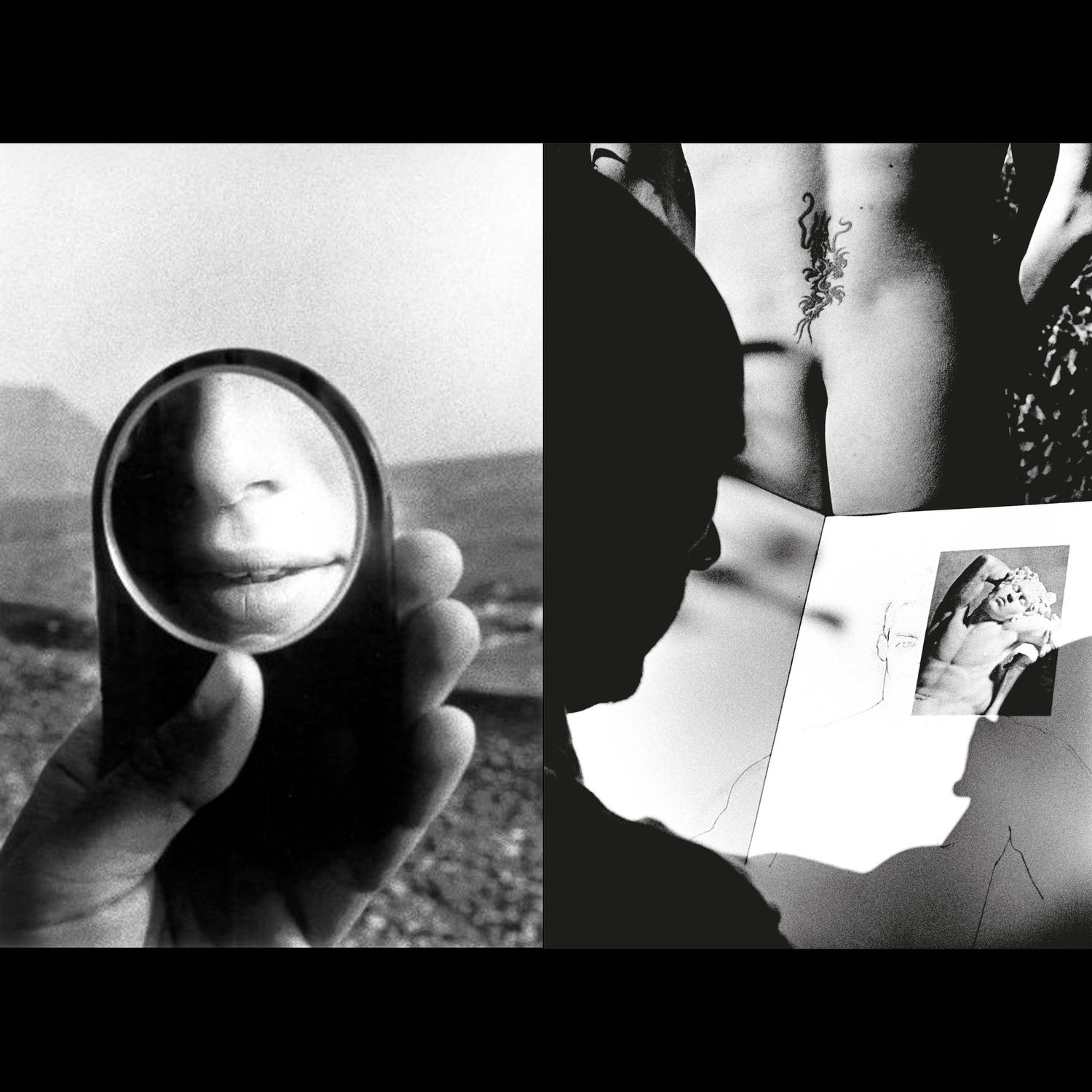
RALPH GIBSON - Award-winning Photographer - Leica Hall of Fame Inductee
Ralph Gibson is one of the most interesting American photographers of our time. His international renown is based on his work, which is shown and collected by some of the world’s leading museums, including the Museum of Modern Art in New York, the J.P. Getty Museum in Los Angeles, the John Simon Guggenheim Memorial Foundation, the Creative Center for Photography in Tucson, the Museum of Fine Arts in Houston, the Maison Européenne de la Photographie in Paris, the Bibliothèque Nationale de France in Paris, and the Fotomuseum Winterthur in Switzerland.Gibson’s works reveal a meticulous aesthetic and visual territory edging on the surreal. His recent books include his memoir Self Exposure, Sacred Land: Israel before and after Time, and Secret of Light, which accompanied his exhibition at the Deichtorhallen House of Photography in Hamburg. He is a Leica Hall of Fame Inductee and has been awarded the French Legion of Honor. In 2022, The Gibson | Goeun Museum of Photography devoted to his work opened in Busan, South Korea."I was fortunate to be able to visit the original Lascaux Cave in the Dordogne. And in any of these paleolithic caves, we find there are certain themes there that seem to be, as long as humanity has been on planet earth: there's always been war, there's always been migration. There's always been a search for God, a form of worship, and there's always been a fear of the apocalypse, the end of the world, which if you open up Paris Match tomorrow or the New York Times on the front page, you'll find those four subjects are still being addressed.Now, we're talking about BC up to today. Now, of course, things are moving much faster now than they did 40, 000 years ago. But I think that capitalism, which created much of this pollution, will find a way of sustaining itself in cleaning up all this pollution."www.ralphgibson.comwww.deichtorhallen.de/en/ausstellung/ralph-gibsonwww.gibsongoeunmuseum.comwww.creativeprocess.infowww.oneplanetpodcast.orgIG www.instagram.com/creativeprocesspodcast
Highlights - IAN ROBERTSON - Author of How Confidence Works - Co-Director, Global Brain Health Institute
“Young people who are rightly feeling very anxious about the future of the world, the worst thing for them is to just feel this constant sense of threat and hopelessness. The best thing they can do is to change that fear into anger. However, anger is a dangerous and powerful emotion. And the thing about anger is its purpose in life is as a negotiating tool. So there has to be a sense of action of something you want to happen, a goal, and you know who it is you're asking to achieve that goal. And that's where collective action becomes a fuel and that fuel empowers confidence. And of course, confidence is most powerful when it's collective.”How important is confidence? Psychologists say confidence is a series of mental, physical, and emotional habits that can be learned. What makes some people overconfident while others are realistic about their abilities and why are both outlooks important to succeed in life?Ian Robertson is Co-Director of the Global Brain Health Institute (Trinity College Dublin and University of California at San Francisco) and Co-Leader of The BrainHealth Project at University of Texas at Dallas. A trained clinical psychologist as well as a neuroscientist, he is internationally renowned for his research on neuropsychology. He has written five books and numerous newspaper and magazine articles and comment pieces in the Guardian, Times, Telegraph, Irish Times, Time magazine and New York magazine, amongst others. He has appeared on BBC Radio and featured in several major television documentaries. He is a regular speaker at major futurology and business conferences in Europe, the USA and Asia.https://ianrobertson.orgwww.gbhi.orgwww.penguin.co.uk/books/441931/how-confidence-works-by-robertson-ian/9781787633728https://centerforbrainhealth.org/projectwww.creativeprocess.infowww.oneplanetpodcast.orgIG www.instagram.com/creativeprocesspodcast

IAN ROBERTSON - Author of How Confidence Works: The New Science of Self-belief - Co-Director of the Global Brain Health Institute
How important is confidence? Psychologists say confidence is a series of mental, physical, and emotional habits that can be learned. What makes some people overconfident while others are realistic about their abilities and why are both outlooks important to succeed in life?Ian Robertson is Co-Director of the Global Brain Health Institute (Trinity College Dublin and University of California at San Francisco) and Co-Leader of The BrainHealth Project at University of Texas at Dallas. A trained clinical psychologist as well as a neuroscientist, he is internationally renowned for his research on neuropsychology. He has written five books and numerous newspaper and magazine articles and comment pieces in the Guardian, Times, Telegraph, Irish Times, Time magazine and New York magazine, amongst others. He has appeared on BBC Radio and featured in several major television documentaries. He is a regular speaker at major futurology and business conferences in Europe, the USA and Asia.“Young people who are rightly feeling very anxious about the future of the world, the worst thing for them is to just feel this constant sense of threat and hopelessness. The best thing they can do is to change that fear into anger. However, anger is a dangerous and powerful emotion. And the thing about anger is its purpose in life is as a negotiating tool. So there has to be a sense of action of something you want to happen, a goal, and you know who it is you're asking to achieve that goal. And that's where collective action becomes a fuel and that fuel empowers confidence. And of course, confidence is most powerful when it's collective.”https://ianrobertson.orgwww.gbhi.orgwww.penguin.co.uk/books/441931/how-confidence-works-by-robertson-ian/9781787633728https://centerforbrainhealth.org/projectwww.creativeprocess.infowww.oneplanetpodcast.orgIG www.instagram.com/creativeprocesspodcast
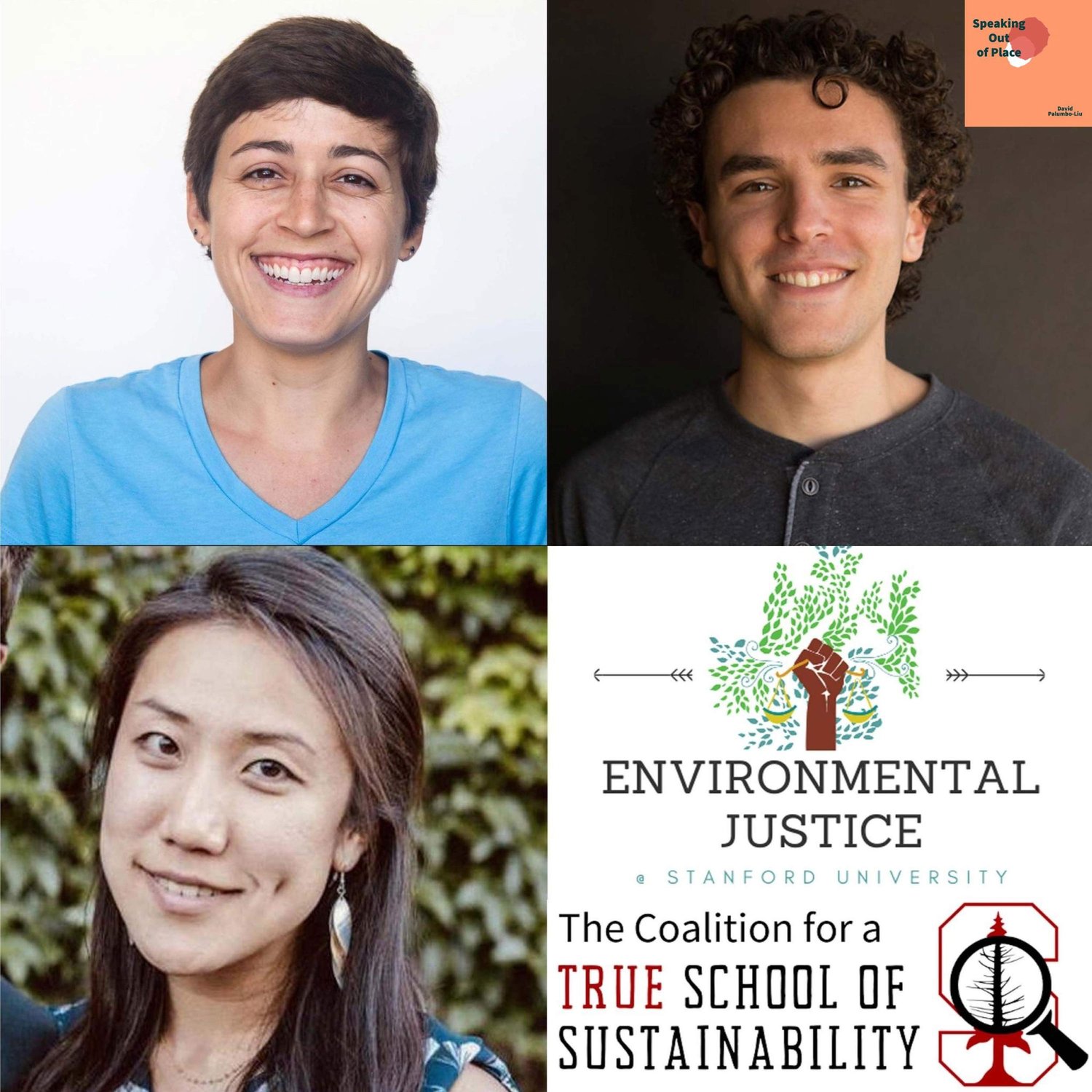
Speaking Out of Place: JUNE CHOI, YANNAI KASHTAN & BELINDA RAMIREZ on the Coalition for a True School of Sustainability
In this episode of the Speaking Out of Place podcast, Professor David Palumbo-Liu speaks with June Choi, Yannai Kashtan, and Belinda Ramírez from the Coalition for a True School of Sustainability. Amidst great fanfare, Stanford University created the Doerr School for Sustainability, which immediately said that it would accept funding from the fossil fuel industry. June, Yannai, and Belinda are helping lead the movement of students pushing back to dissociate from such funds. David asks what drives them and sustains them in building a True School of Sustainability.www.truesustainabilityschool.comwww.ejstanford.comJune Choi is a PhD candidate in Earth System Science at the Doerr School of Sustainability. Her research focuses on quantifying the impacts of climate change to inform adaptation strategies. Her previous work involved tracking global climate finance flows, setting standards for green bonds and sustainable finance integrity. She holds an MA in International Relations from John Hopkins University and BA in Sociology from Amherst College.Yannai Kashtan is a PhD candidate in Earth System Science at the Doerr School of Sustainability, where he studies health-related hazards of residential fossil-fueled appliances. His most recent project quantified benzene emissions from gas and propane stoves. He earned a BA from Pomona College, where he majored in physics and chemistry and studied organic semiconductors.Belinda Ramírez (they/them) teaches introductory liberal education courses at Stanford as a COLLEGE Fellow, including courses on environmental sustainability, food and culture, and climate/environmental/food justice. They also organize with Stanford’s Environmental Justice Working Group and the Coalition for a True School of Sustainability. Trained in cultural anthropology, their research deals with the social, racial/ethnic, political, and economic dimensions of urban agriculture and other food movements situated within the modern industrialized and corporatized global food system. In researching these topics, Belinda has come to recognize the fulfillment found in experiential learning and working firsthand to change their local food system, receiving agricultural training through local farms and community gardens in southern San Diego. They have also engaged in statewide political advocacy for young farmers through the National Young Farmers Coalition, served as both Board and Food Justice Co-Chair for Slow Food Urban San Diego, and worked as a Soil Farmer for Food2Soil. They consider themselves a farmer-scholar, bridging the worlds between praxis and theory, academia and tangible, on-the-ground work.www.palumbo-liu.com https://speakingoutofplace.comhttps://twitter.com/palumboliu?s=20
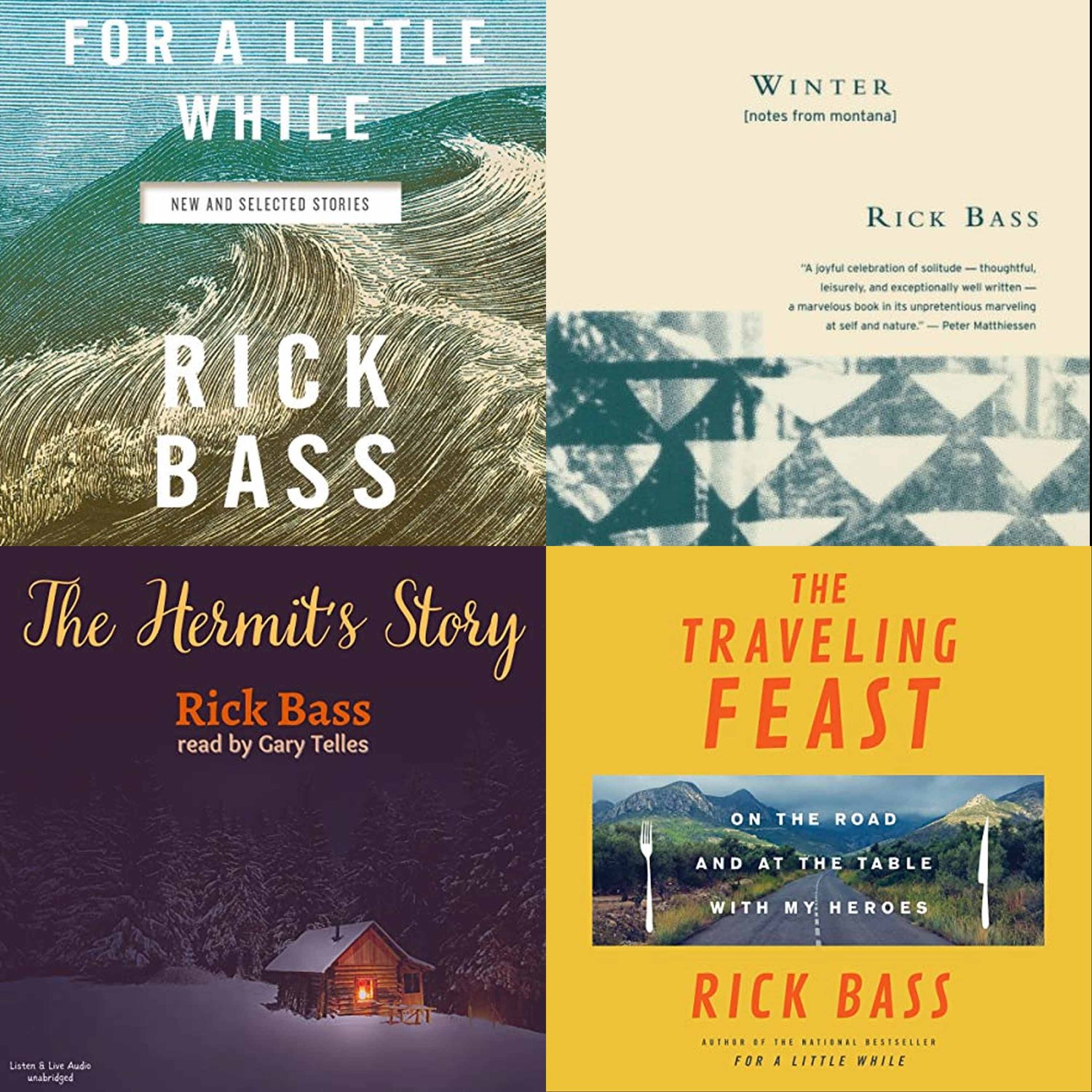
Highlights - RICK BASS - Author & Environmentalist - “Why I Came West”, “For a Little While”
"So it's just a great joy to be passing this guitar made from the wood of an 800-year-old tree around to musicians and asking them to play a song of resistance or celebration. And that's what we're going to do at Climate Aid: The Voice of the Forest. We're going to have it be an annual event like Farm Aid. And we want it to be big. We want it to be Woodstock in its pivot point. The way the Children's Trust court case was pivotal, the way this Black Ram court case we had and won was pivotal.We want Climate Aid to be a celebration. And this one guitar exploring the question: Can one tree save a forest? Can one song save a forest? And we think the answer is yes. We believe it will be. What we want to do with the forest that the guitar came from is establish it as a climate refuge, a place dedicated to storing as much carbon and long-term safekeeping as possible.We want the climate refuge to be really big. We want it to store a ton of carbon. We want it to be a focal point for increased scientific and artistic inquiry. We've brought in the world's leading climate scientists, and they've analyzed it, and they're proposing studies that should happen there. We've brought in our country's leading artists and they have experienced it and responded to it in their own way. We've had performance artists come and play music in the forest. So we want to establish the nation's first climate refuge. There is no such designation. We want it to be in Black Ram. This forest that almost got erased, a forest that was a thousand years old and almost went away. But we're getting a second chance. We saved it. Now we want to preserve it for another thousand years to study it, but we don't want to stop there. We want the government to establish a series of climate refuges all along the northern tier of the United States. What we think of as a necklace of green, a curtain of green. And from there to go around the globe, across northern Europe and northern Asia, and back around to Alaska. The amount of carbon that can be kept safely sequestered there is extraordinary. The numbers are almost unbelievable."Rick Bass, a National Book Critics Circle Award finalist for his memoir Why I Came West, was born and raised in Texas, worked as a petroleum geologist in Mississippi, and has lived in Montana's Yaak Valley for almost three decades. His short fiction, which has appeared in The New Yorker, The Atlantic, Esquire, and The Paris Review, as well as numerous times in Best American Short Stories, has earned him The Story Prize, multiple O. Henry Awards and Pushcart Prizes in addition to NEA and Guggenheim fellowships.He’s an organizer and speaker at Climate Aid: The Voice of the Forest, a fundraiser event to benefit the grassroots environmental movement of Protect Ancient Forests & The Montana Project. Featuring Maggie Rogers and more great performers and speakers. The evening will advance the efforts to protect the Black Ram forest by designating the region as the nation’s first Climate Refuge. Portland, Maine, on Sunday, Oct. 15 at 7 p.m. ET, at the Merrill Auditorium. Tickets available at the Merrill’s box office and online at PortTIX.com. www.rickbass.netwww.protectancientforests.orgwww.montanaproject.orgwww.PortTIX.comwww.creativeprocess.infowww.oneplanetpodcast.orgIG www.instagram.com/creativeprocesspodcast

RICK BASS - Environmentalist & Story Prize Award-winning Author of “Why I Came West”, “For a Little While”
Rick Bass, a National Book Critics Circle Award finalist for his memoir Why I Came West, was born and raised in Texas, worked as a petroleum geologist in Mississippi, and has lived in Montana's Yaak Valley for almost three decades. His short fiction, which has appeared in The New Yorker, The Atlantic, Esquire, and The Paris Review, as well as numerous times in Best American Short Stories, has earned him The Story Prize, multiple O. Henry Awards and Pushcart Prizes in addition to NEA and Guggenheim fellowships.He’s an organizer and speaker at Climate Aid: The Voice of the Forest, a fundraiser event to benefit the grassroots environmental movement of Protect Ancient Forests & The Montana Project. Featuring Maggie Rogers and more great performers and speakers. The evening will advance the efforts to protect the Black Ram forest by designating the region as the nation’s first Climate Refuge. Portland, Maine, on Sunday, Oct. 15 at 7 p.m. ET, at the Merrill Auditorium. Tickets available at the Merrill’s box office and online at PortTIX.com. "So it's just a great joy to be passing this guitar made from the wood of an 800-year-old tree around to musicians and asking them to play a song of resistance or celebration. And that's what we're going to do at Climate Aid: The Voice of the Forest. We're going to have it be an annual event like Farm Aid. And we want it to be big. We want it to be Woodstock in its pivot point. The way the Children's Trust court case was pivotal, the way this Black Ram court case we had and won was pivotal.We want Climate Aid to be a celebration. And this one guitar exploring the question: Can one tree save a forest? Can one song save a forest? And we think the answer is yes. We believe it will be. What we want to do with the forest that the guitar came from is establish it as a climate refuge, a place dedicated to storing as much carbon and long-term safekeeping as possible.We want the climate refuge to be really big. We want it to store a ton of carbon. We want it to be a focal point for increased scientific and artistic inquiry. We've brought in the world's leading climate scientists, and they've analyzed it, and they're proposing studies that should happen there. We've brought in our country's leading artists and they have experienced it and responded to it in their own way. We've had performance artists come and play music in the forest. So we want to establish the nation's first climate refuge. There is no such designation. We want it to be in Black Ram. This forest that almost got erased, a forest that was a thousand years old and almost went away. But we're getting a second chance. We saved it. Now we want to preserve it for another thousand years to study it, but we don't want to stop there. We want the government to establish a series of climate refuges all along the northern tier of the United States. What we think of as a necklace of green, a curtain of green. And from there to go around the globe, across northern Europe and northern Asia, and back around to Alaska. The amount of carbon that can be kept safely sequestered there is extraordinary. The numbers are almost unbelievable."www.rickbass.netwww.protectancientforests.orgwww.montanaproject.orgwww.PortTIX.comwww.creativeprocess.infowww.oneplanetpodcast.orgIG www.instagram.com/creativeprocesspodcast

Speaking Out of Place: LIZA FEATHERSTONE on Build Public Renewables Act (BPRA)
"We have passed the Build Public Renewables Act which mandates and requires the state's power authority the New York State Power Authority to build its own publicly funded renewables: renewable energy, wind, and solar. And this was a long, long hard hard-fought victory. And to say how it happened, we need to think back to the early Bernie days just after the Bernie Sanders' 2016 presidential campaign. Obviously, people were very disappointed that Bernie Sanders didn't win, but a lot of people were also very politicized by that campaign and by that moment. And so a lot of people were joining DSA (Democratic Socialists of America). At the same time, a lot of young people were becoming very aware and very anxious, disturbed, and deeply depressed by the climate crisis."In this episode of the Speaking Out of Place podcast, Professor David Palumbo-Liu interviews Liza Featherstone about Build Public Renewables Act. It’s a huge victory for ecosocialists, and for everybody in New York, that came with the passage of a bold piece of legislation, the Build Public Renewables Act, or BPRA. Featherstone explains the genesis of the bill, and the specific wrk that activists put into its passage. What obstacles did they confront, how did they work together to overcome those obstacles, and what can other environmental activists learn from this historic moment?Liza Featherstone is the author of Divining Desire: Focus Groups and the Culture of Consultation, published by O/R Books in 2018, as well as Selling Women Short: the Landmark Battle for Workers’ Rights at Walmart (Basic Books, 2004). She co-authored Students Against Sweatshops (Verso, 2002) and is editor of False Choices: the Faux Feminism of Hillary Rodham Clinton (Verso, 2016). She's currently editing a collection of Alexandra Kollontai 's work for O/R Books and International Publishers and writing the introduction to that volume.Featherstone's work has been published in Lux, TV Guide, The New York Times, The Washington Post, Ms., the American Prospect, Columbia Journalism Review, Glamour, Teen Vogue, Dissent, the Guardian, In These Times, and many other publications. Liza teaches at NYU's Literary Reportage Program as well as at Columbia University School for International and Public Affairs. She is proud to be an active member of the New York City Democratic Socialists of America and of UAW local 7902.https://publicpowerny.org/legislationwww.orbooks.com/catalog/divining-desire-liza-featherstonehttps://twitter.com/lfeatherzwww.palumbo-liu.com https://speakingoutofplace.comhttps://twitter.com/palumboliu?s=20
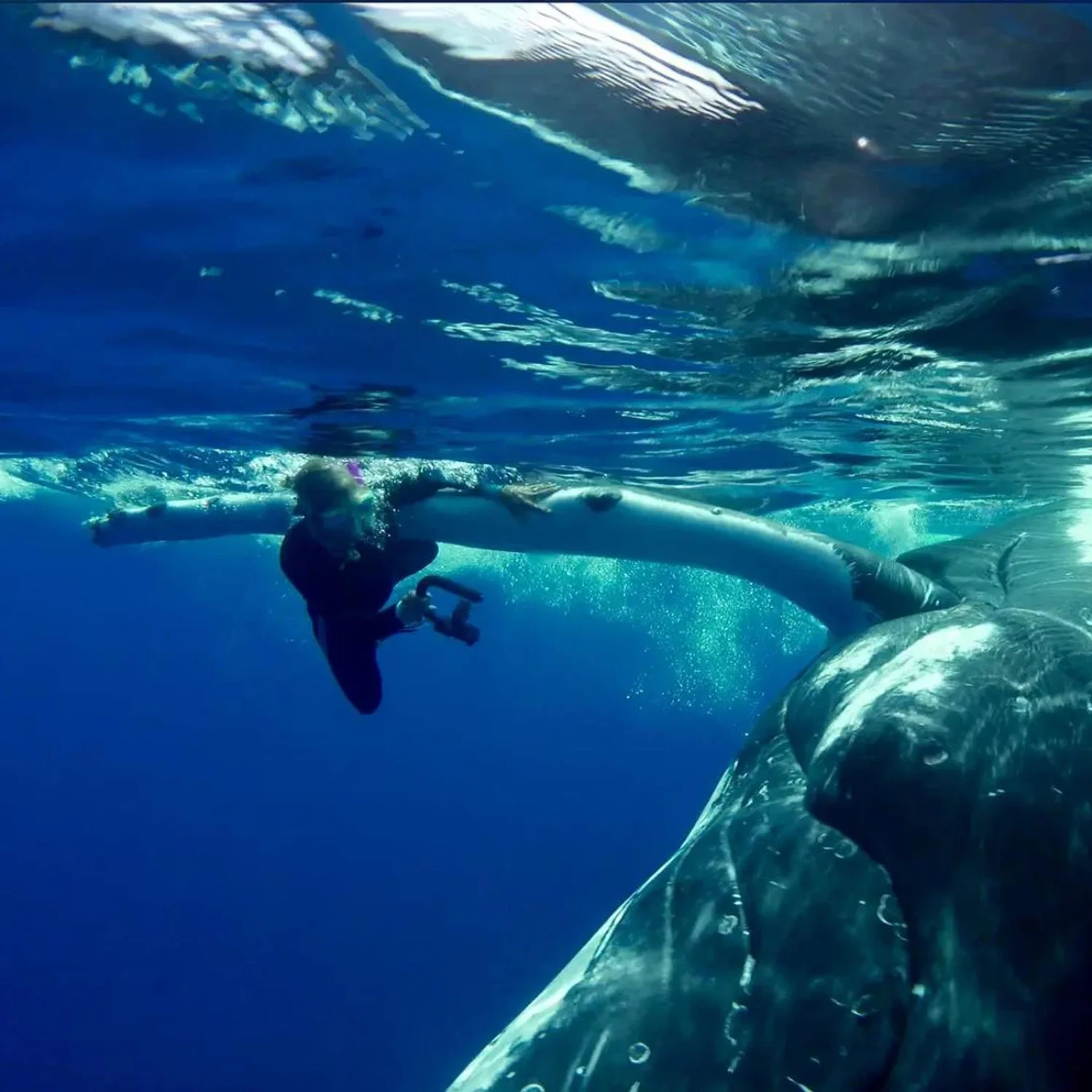
Highlights - NAN HAUSER - Whale Researcher - Director, Cook Islands Whale Research - President, Center for Cetacean Research & Conservation
"I don't think a lot of people realize how absolutely important whales are, and not just because they're beautiful and they make people happy, but whales carry nutrients from the depths they feed back to the surface. And there's this liquidy plume of fecal matter, and it's called the whale pump. And they bring all these nutrients upward with their tails by swimming up and down the water column, it's like an upward biological pump. And there's an incredible amount of nitrogen that's released in these plumes. And we get this great soup of nutrients. We get more from this nitrogen than all the rivers combined. And in the past, we recognized microbes and plankton and fish and that they recycled nutrients in the ocean, yet whales and other marine mammals have largely been overlooked and that's too bad because they are bioengineers. They help the climate so much because of all this creates more plankton by circulating the nutrients and fertilizing the phytoplankton with their poo. For instance, sperm whales alone in the Southern Ocean help sequester over 19 million trees worth of carbon. They are bioengineers of their ecosystems and our ecosystems too. They promote the growth of phytoplankton, which absorbs carbon. So, if we just leave them alone, that could be an incredible solution for us to help with the mess we've made. And there's also the whole thing about the whale fall. When a whale dies and the crabs and the worms and the clams and everything start to eat it, the whale carcass itself transports about 190,000 tons of carbon. That's what is produced by about 80,000 cars every year. So when you think about saving the whales, you're thinking about saving the planet and people, whether it's your family or your grandchildren or your great-grandchildren or whatever. This is a really big issue for me because I have nine grandchildren, and I worry about what we are leaving them because we are leaving them a big mess. We need to think beyond immediate results and consider the next steps and the consequences. And I think we tend to forget to do that because otherwise, they're going to get stuck with it."Nan Hauser is the President and Director of the Center for Cetacean Research & Conservation and the Director and Principal Investigator of Cook Islands Whale Research. Currently she's in the field studying the migration of the Southern Humpback Whale population that is currently passing through the Cook Islands, where she resides on the main island of Rarotonga. Her research includes population identity and abundance, acoustics, genetics stable isotopes behavior, and the navigation of cetaceans.https://whaleresearch.orghttps://whaleresearch.org/saved-by-a-whalewww.creativeprocess.infowww.oneplanetpodcast.orgIG www.instagram.com/creativeprocesspodcast
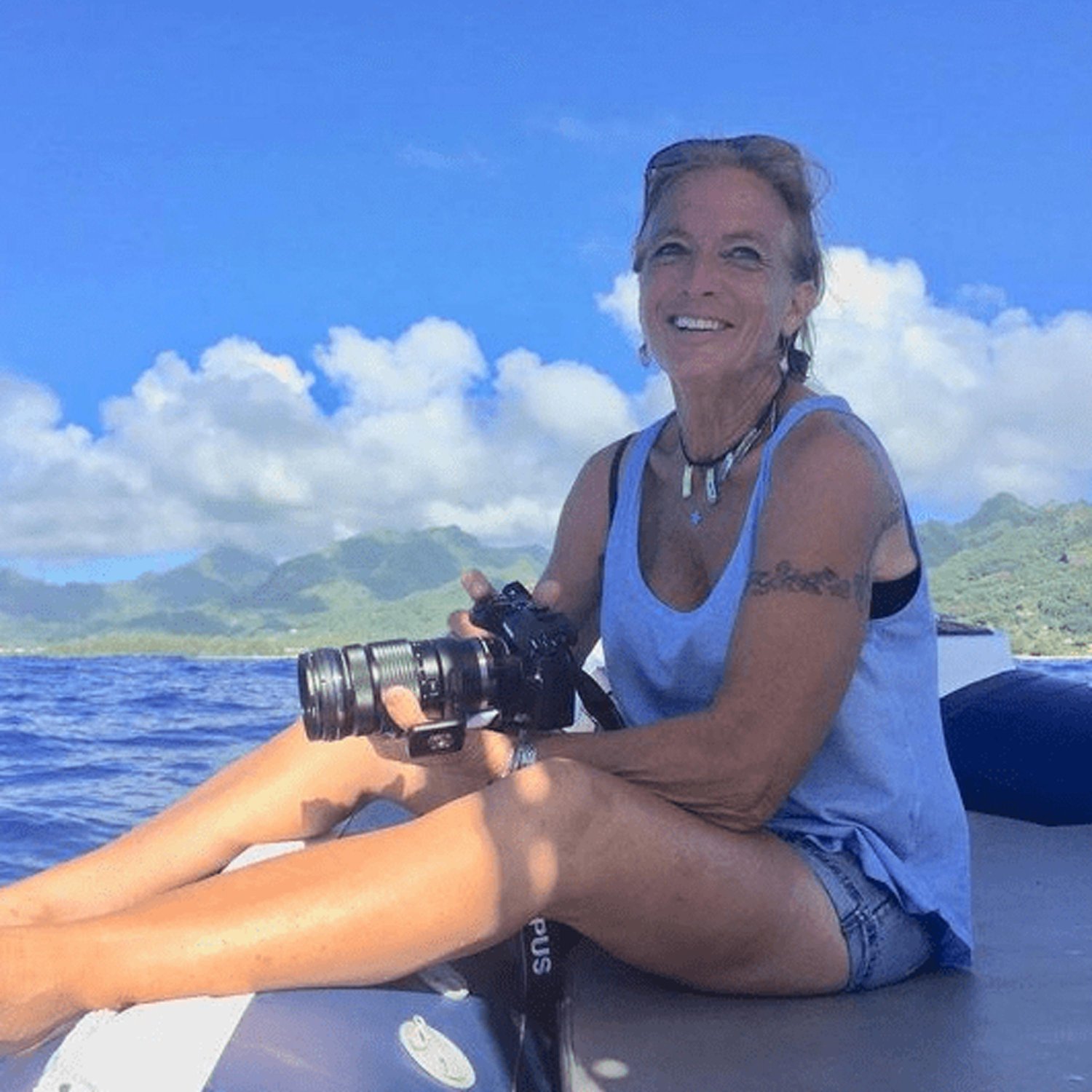
NAN HAUSER - Whale Researcher - President, Center for Cetacean Research & Conservation - Director, Cook Islands Whale Research
Nan Hauser is the President and Director of the Center for Cetacean Research & Conservation and the Director and Principal Investigator of Cook Islands Whale Research. Currently she's in the field studying the migration of the Southern Humpback Whale population that is currently passing through the Cook Islands, where she resides on the main island of Rarotonga. Her research includes population identity and abundance, acoustics, genetics stable isotopes behavior, and the navigation of cetaceans."I don't think a lot of people realize how absolutely important whales are, and not just because they're beautiful and they make people happy, but whales carry nutrients from the depths they feed back to the surface. And there's this liquidy plume of fecal matter, and it's called the whale pump. And they bring all these nutrients upward with their tails by swimming up and down the water column, it's like an upward biological pump. And there's an incredible amount of nitrogen that's released in these plumes. And we get this great soup of nutrients. We get more from this nitrogen than all the rivers combined. And in the past, we recognized microbes and plankton and fish and that they recycled nutrients in the ocean, yet whales and other marine mammals have largely been overlooked and that's too bad because they are bioengineers. They help the climate so much because of all this creates more plankton by circulating the nutrients and fertilizing the phytoplankton with their poo. For instance, sperm whales alone in the Southern Ocean help sequester over 19 million trees worth of carbon. They are bioengineers of their ecosystems and our ecosystems too. They promote the growth of phytoplankton, which absorbs carbon. So, if we just leave them alone, that could be an incredible solution for us to help with the mess we've made. And there's also the whole thing about the whale fall. When a whale dies and the crabs and the worms and the clams and everything start to eat it, the whale carcass itself transports about 190,000 tons of carbon. That's what is produced by about 80,000 cars every year. So when you think about saving the whales, you're thinking about saving the planet and people, whether it's your family or your grandchildren or your great-grandchildren or whatever.This is a really big issue for me because I have nine grandchildren, and I worry about what we are leaving them because we are leaving them a big mess. We need to think beyond immediate results and consider the next steps and the consequences. And I think we tend to forget to do that because otherwise, they're going to get stuck with it."https://whaleresearch.orghttps://whaleresearch.org/saved-by-a-whalewww.creativeprocess.infowww.oneplanetpodcast.orgIG www.instagram.com/creativeprocesspodcast

ROB VERCHICK - Leading Climate Change Scholar - Author of The Octopus in the Parking Garage
Rob Verchick is one of the nation’s leading scholars in disaster and climate change law and a former EPA official in the Obama administration. He holds the Gauthier-St. Martin Eminent Scholar Chair in Environmental Law at Loyola University New Orleans. Professor Verchick is also a Senior Fellow in Disaster Resilience at Tulane University and the President of the Center for Progressive Reform, a research and advocacy organization that advocates for solutions to our most pressing societal challenges. He is the author of numerous articles and books, including The Octopus in the Parking Garage. A Call for Climate Resilience.“Well, there are good stories and bad stories. So the good stories are, Oh my gosh, renewable energy is just a wonderful technology story with solar panels getting as cheap as almost anything. Wind turbine technology. We're working on offshore wind farm planning in the Gulf right now, and we're going to build wind turbines that can survive hurricanes. So there's a lot of technology going on in energy storage that involves batteries. And I'm hoping that at some point we're going to get to batteries that don't use things like lithium so much, so that we don't have to be involved so much in the mining of those kinds of things.There's a lot of really interesting technology going on with using natural landscapes to protect against flooding and storms. So we have a coastal restoration effort in Louisiana, one of the largest in the world. And what we're experimenting with is diverting water from the Mississippi River to replenish sediment and grow new wetlands on our tattered shores. And that's technology, too. I mean, we've got some of the best engineering firms in the world down here, and NASA trying to figure out exactly how to do that. And if we can do it, we'll export that technology all over the place and help rebuild coastlines. So those are some really bright spots in terms of the technology that I see.”https://robverchick.comhttps://works.bepress.com/robert_verchickwww.progressivereform.org/Twitter/X/Instagram/Facebook: @robverchick @robsoctopusbookwww.creativeprocess.infowww.oneplanetpodcast.orgIG www.instagram.com/creativeprocesspodcast

Highlights - LESLEY HUGHES - Lead Author, IPCC 4th, 5th Assessment Reports - Biology Professor, Macquarie University
"Australia is generally considered one of the most vulnerable developed countries to the impacts of climate change, and I've been in the climate science space for more than 30 years, but I have to say this last month has been particularly confronting. We're seeing all sorts of tipping points that scientists have been warning about for decades and they are really real right now. I've never had such climate anxiety, and it's sort of new for me to be struggling with that because I think I've been pretty resilient to sort of eco-anxiety. Talking about averages all the time is a real problem in climate science because the temperature on any one day goes up and down a lot more than 1.5 or 2 degrees. So we have to keep working on relating those average global temperatures to the extremes that people experience in their lives on the ground where they live. We have to keep reminding people that that is the sort of thing that we are going to see more and more often. It isn't a one-off event. It's a message about the future."Now in the 21st century, with an abundance of renewable technologies, why is the world still using 18th-century energy technology? How can each of us harness our unique skills to help solve the climate crisis?Lesley Hughes is a Distinguished Professor of Biology and Interim Executive Dean of the Faculty of Science & Engineering at Macquarie University. She is an ecologist whose main research interest has been the impacts of climate change on species and ecosystems, and the implications of climate change for conservation. She was a Lead Author of the IPCC’s 4th and 5th Assessment Report, Director for the WWF Australia and federal Climate Commissioner and is now a Councillor and Director with the Climate Council of Australia. She is also a member of the Wentworth Group of Concerned Scientists.https://researchers.mq.edu.au/en/persons/lesley-hugheswww.climatecouncil.org.auwww.creativeprocess.infowww.oneplanetpodcast.orgIG www.instagram.com/creativeprocesspodcast

LESLEY HUGHES - Lead Author of IPCC 4th & 5th Assessment Reports - Director of Climate Council of Australia
Now in the 21st century, with an abundance of renewable technologies, why is the world still using 18th-century energy technology? How can each of us harness our unique skills to help solve the climate crisis?Lesley Hughes is a Distinguished Professor of Biology and Interim Executive Dean of the Faculty of Science & Engineering at Macquarie University. She is an ecologist whose main research interest has been the impacts of climate change on species and ecosystems, and the implications of climate change for conservation. She was a Lead Author of the IPCC’s 4th and 5th Assessment Report, Director for the WWF Australia and federal Climate Commissioner and is now a Councillor and Director with the Climate Council of Australia. She is also a member of the Wentworth Group of Concerned Scientists."Australia is generally considered one of the most vulnerable developed countries to the impacts of climate change, and I've been in the climate science space for more than 30 years, but I have to say this last month has been particularly confronting. We're seeing all sorts of tipping points that scientists have been warning about for decades and they are really real right now. I've never had such climate anxiety, and it's sort of new for me to be struggling with that because I think I've been pretty resilient to sort of eco-anxiety. Talking about averages all the time is a real problem in climate science because the temperature on any one day goes up and down a lot more than 1.5 or 2 degrees. So we have to keep working on relating those average global temperatures to the extremes that people experience in their lives on the ground where they live. We have to keep reminding people that that is the sort of thing that we are going to see more and more often. It isn't a one-off event. It's a message about the future."https://researchers.mq.edu.au/en/persons/lesley-hugheswww.climatecouncil.org.auwww.creativeprocess.infowww.oneplanetpodcast.orgIG www.instagram.com/creativeprocesspodcast
Highlights - JAMES BROWNING - Founder & Exec. Director, F Minus Research & Advocacy Group
"The lobbyists that represent the fossil fuel companies like ExxonMobil, Koch companies, and the American Petroleum Institute, they knew for years that the climate crisis would happen, and they've been telling us that it wouldn't. And right now in every state capital, the lobbyists are doing everything they can to slow the transition from fossil fuel to renewables. The sad fact is, these oil and gas lobbyists will never wake up one morning and say: I am worried about the climate crisis. I'm worried about my children. I am going to cut off ties with these oil and gas companies and stop taking their money. That will never happen. And I'm sad to say this, but it's been a long, long road to try to change their behavior with facts or reason."Why are fossil fuel lobbyists also allowed to work for communities, schools, businesses, and nonprofit organizations being harmed by the climate crisis without declaring their conflict of interest? Why divestment from fossil fuels should include divesting from lobbyists which play for both sides.James Browning is the founder of F Minus, a research and advocacy group that tracks the extent to which fossil fuel lobbyists also represent victims of the climate crisis. He is also a writer and game designer, and his novel The Fracking King was named one of the best 100 books of 2014 by Amazon.https://fminus.orgwww.creativeprocess.infowww.oneplanetpodcast.orgIG www.instagram.com/creativeprocesspodcast

JAMES BROWNING - Founder of F Minus: Calling for Divestment from Fossil Fuel Lobbyists
Why are fossil fuel lobbyists also allowed to work for communities, schools, businesses, and nonprofit organizations being harmed by the climate crisis without declaring their conflict of interest? Why divestment from fossil fuels should include divesting from lobbyists which play for both sides.James Browning is the founder of F Minus, a research and advocacy group that tracks the extent to which fossil fuel lobbyists also represent victims of the climate crisis. He is also a writer and game designer, and his novel The Fracking King was named one of the best 100 books of 2014 by Amazon."The lobbyists that represent the fossil fuel companies like ExxonMobil, Koch companies, and the American Petroleum Institute, they knew for years that the climate crisis would happen, and they've been telling us that it wouldn't. And right now in every state capital, the lobbyists are doing everything they can to slow the transition from fossil fuel to renewables. The sad fact is, these oil and gas lobbyists will never wake up one morning and say: I am worried about the climate crisis. I'm worried about my children. I am going to cut off ties with these oil and gas companies and stop taking their money. That will never happen. And I'm sad to say this, but it's been a long, long road to try to change their behavior with facts or reason."https://fminus.orgwww.creativeprocess.infowww.oneplanetpodcast.orgIG www.instagram.com/creativeprocesspodcast
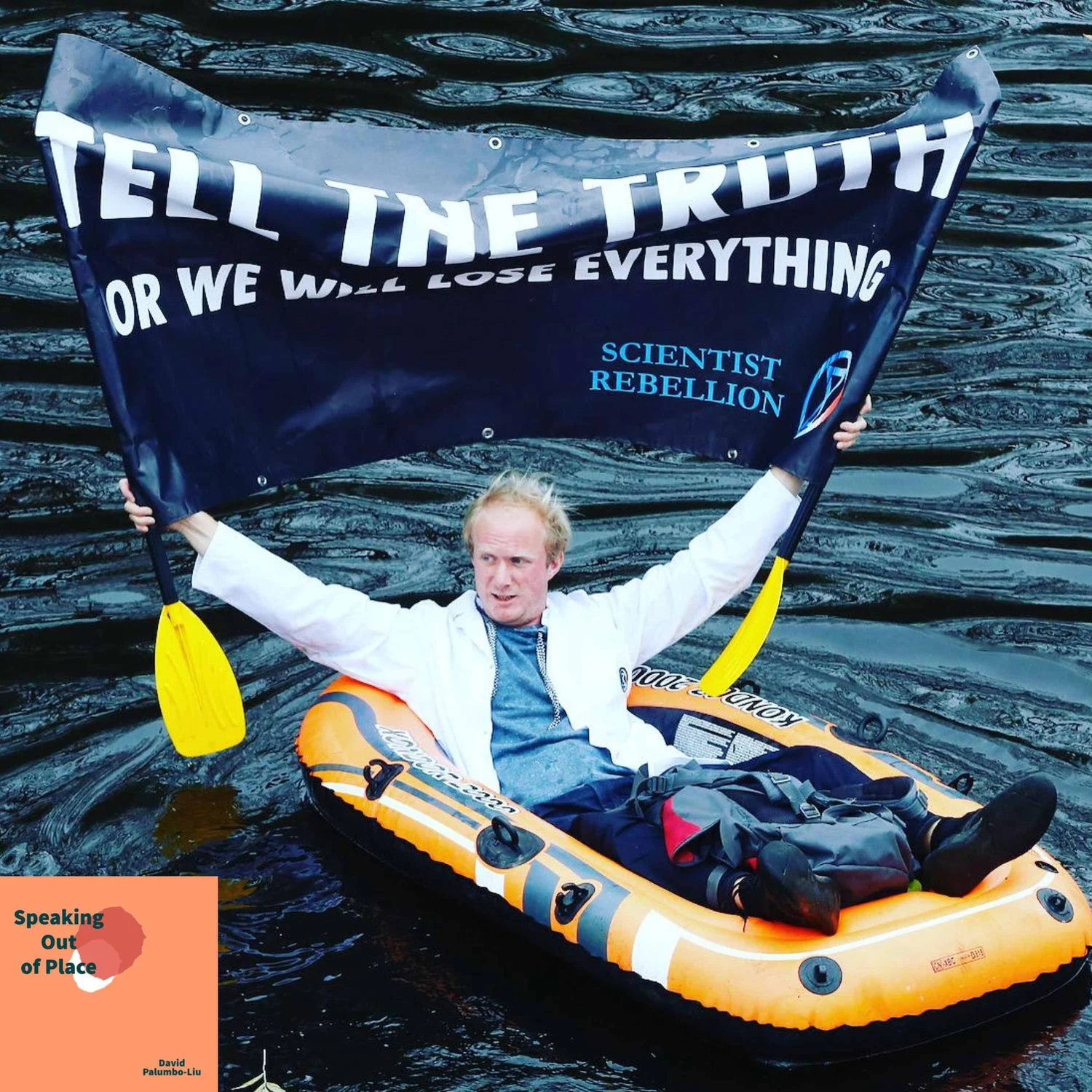
Speaking Out of Place: TIM HEWLETT - Co-founder of Scientist Rebellion, Activist, Astrophysicist
In this episode of the Speaking Out of Place podcast, Professor David Palumbo-Liu interviews climate activist, astrophysicist and co-founder of Scientist Rebellion Tim Hewlett.Scientist Rebellion is a growing climate activist group with 1000+ scientists and academics across 32 countries. Members range from science students and professors to IPCC contributors and leading climate-related scientists. Through disruptive nonviolent action, Scientist Rebellion demands emergency decarbonization via economic degrowth. During acts of civil resistance, members wear lab coats, and volunteers organize the vast majority of the campaign activity."I believe in the UK there have been over a hundred cases in the last year, many of them ending in jail, and that's a massive escalation in recent history. And yet we had one in February that was dating back to the founding action at the Royal Society, but we were being tried for there. And we did win that case. But I think all around the world, what we're seeing is a convergence of institutions of power to try to shut out truthtellers, to try to shut out activists and people who would hold those powerful actors to account.I suspect it's because they recognize that they are committing heinous crimes, and if there were to be true accountability, they would be the ones being prosecuted.We've seen top-down directives from the government which are blocking activists and people in court from making legal arguments. In our case, for instance, we weren't allowed to refer to human rights legislation. We weren't allowed to argue the defense of necessity that we're trying to avoid greater harm. There's a long-established principle in case law, but you're not allowed to make those arguments anymore because activists kept on winning. And that's extremely inconvenient to the government. So the government dictated they shouldn't be able to do that. And that's not something that's meant to happen in a separation of powers. So we're seeing this convergence, coalescence of these institutions to try to protect the powerful and to protect the status quo even though that status quo inevitably leads to the breakdown of society."http://scientistrebellion.orgwww.palumbo-liu.com https://speakingoutofplace.comhttps://twitter.com/palumboliu?s=20

Speaking Out of Place: ANTHONY ARNOVE & HALEY PESSIN discuss Voices of a People’s History of the United States in the 21st Century
In this episode of the Speaking Out of Place podcast, Professor David Palumbo-Liu and Azeezah Kanji talk with Anthony Arnove and Haley Pessin about their new volume Voices of a People’s History of the United States in the 21st Century: Documents of Hope and Resistance.This book is not only a beautiful archive of people's struggles in the 21st century, but also a powerful tribute to and continuation of the work of professor and radical historian Howard Zinn. We speak with Anthony and Haley about the histories of struggles and the possibilities for building a more beautiful future.Anthony Arnove is the editor of several books, including, with Howard Zinn, Voices of a People’s History of the United States and Terrorism and War. He wrote the introduction for the thirty-fifth anniversary edition of Zinn’s classic book, A People’s History of the United States. Arnove cofounded the nonprofit education and arts organization Voices of a People’s History of the United States, wrote, directed, and produced the documentary The People Speak, and has directed stage and television versions of The People Speak in Dublin with Stephen Rea, in London with Colin Firth, and across the United States with various groups including Lincoln Center, the Brooklyn Academy of Music, and the Sundance Film Festival. He produced the Academy Award-nominated documentary Dirty Wars. Arnove is on the editorial boards of Haymarket Books and Tempestmag.org and is the director of Roam Agency, where he represents authors including Arundhati Roy and Noam Chomsky. He lives in Hopewell, New Jersey.Haley Pessin is a socialist activist living in Queens, New York. They have participated in struggles against police brutality and mass incarceration, in solidarity with Palestine, in defense of abortion rights and reproductive justice, and as a legal service worker and union delegate for 119SEIU (Service Employees International Union). Pessin has spoken at conferences in Switzerland, Australia, Ireland, Quebec, and throughout the United States on the struggle for Black liberation. Their writing has appeared in New Politics and at Tempestmag.org, where they currently serve on the editorial board."Climate action has become woven into every aspect of our society. I remember that time so clearly. It wasn't just activists and politicians who were building the future. Artists, creatives, storytellers, actors, and athletes began realizing their part in these movements to shape culture and reach the masses. Entrepreneurs, designers, architects, and poets began to reimagine what our society could look like if we used this great time of crisis as humanity's most unifying moment.I remember the shows I played and how we transformed those arenas into places of celebration and unity. The idea of being an activist was left behind. We realized that it is within our power as humanity and identity that belongs to all of us. To change the story and to build the world we've always known was possible. The place the world is in is a result of us striking the balance between technology, innovation, culture, and the ancient wisdom and teachings of the original peoples of this earth. Here we are, 10 years after changing everything to redefine our legacy, carried on in flowers and songs."from Xiuhtezcatl Tonatiuh Martinez’s “To Fight for a Just Climate Is to Fight for Everything That We Love” inChapter 8: OUR RESISTANCE MUST BE INTERSECTIONALhttps://sevenstories.com/books/4479-voices-of-a-people-s-history-of-the-united-states-in-the-21st-centurywww.palumbo-liu.com https://speakingoutofplace.comhttps://twitter.com/palumboliu?s=20Photo credit: Francesca Ruggiero and Eric Soucy
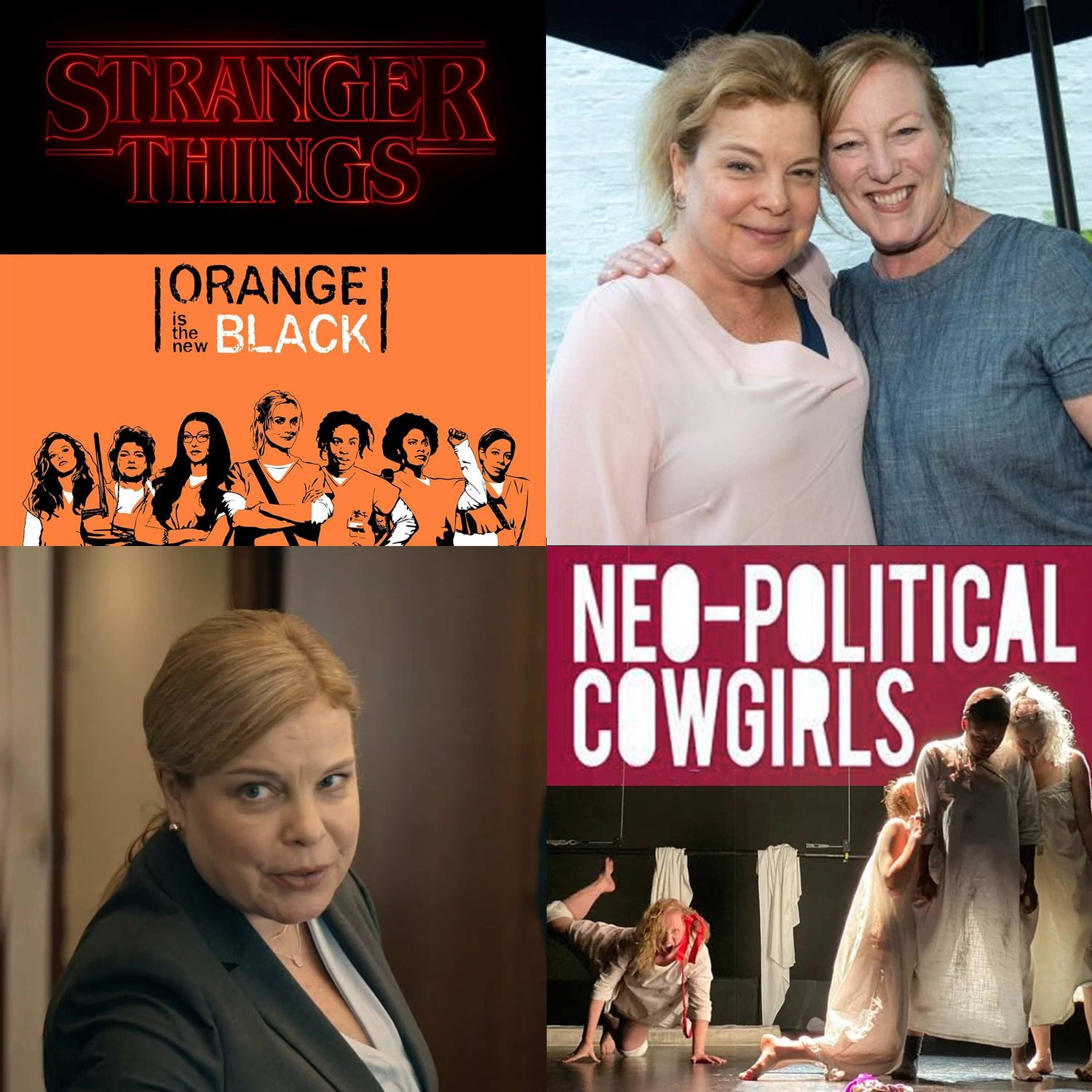
Actress CATHERINE CURTIN (Stranger Things) & Artistic Director KATE MUETH (Neo-Political Cowgirls)
Why do we make art? What can the performing arts teach us about how to engage in dialogues to overcome conflict and division?Our guests today are actress Catherine Curtin and artistic director Kate Mueth. Curtin is known for her roles on Stranger Things, Homeland, and Insecure. She played correctional officer Wanda Bell in Orange Is the New Black, and for this role she was a joint winner of two Screen Actors Guild Awards for Outstanding Performance by an Ensemble in a Comedy Series.Mueth is the Founder and Artistic Director of the award-winning dance theater company The Neo-Political Cowgirls that seeks to deepen and challenge the ways in which audiences experience stories and awaken their human connection. Based in East Hampton, New York they have performed to audiences in America and Europe."It's so important, like when Number 45 went into office, and he emptied out all of the documentation in the EPA. He was like, empty all those files, get rid of all that research, get rid of all those researchers. I think that clearly, even now, the Trumpers are like, oh, the environment. It was a global warming. You know, we had a global warming problem. Well, we knew that a long time ago. And so one hopes that maybe that is one of the places that AI can improve the human condition. Maybe AI, the statistical data, and the non-emotional data will convince people when there's a problem and take the emotion out of the issue. Because I think that that's one of the reasons why issues don't move forward sometimes is that the emotional impact is too hot. And so maybe just getting it into statistics or getting it into data, or getting it into numbers where people can't really deny the truth of one plus one does equal two, you know?www.imdb.com/name/nm0193160/www.npcowgirls.orgwww.creativeprocess.infowww.oneplanetpodcast.orgIG www.instagram.com/creativeprocesspodcast

Highlights - STEPHANIE FELDSTEIN - Population & Sustainability Director, Center for Biological Diversity
"Capitalism is an inherently unsustainable system the way that it is being practiced now. It is an economy that is based on infinite growth, even though we live on a finite planet. What if we measured success based on happiness and based on the health of communities? Based on wealth equity instead of just how rich are the richest people?So there's always going to be an end game for a growth-based economy. But, of course, that's being largely ignored right now to the detriment of the world around us. It's focused on growth and maximizing corporate profits but at the expense of people and the planet. It exploits workers. It exploits the environment. So we need to reimagine how we approach our economy."How can we take inspiration from our love for animals to protect wildlife and change the world? How can we take action and start making changes in our lives? What if we measured success based on happiness and on the health of communities? Stephanie Feldstein leads the Center for Biological Diversity's work to highlight and address threats to endangered species and wild places from runaway human population growth and overconsumption. Previously Stephanie worked for Change.org, where she helped hundreds of people start and win online campaigns to protect wildlife. She has years of experience in organizing, outreach and communications. She is the author of The Animal Lover’s Guide to Changing the World, and the series aimed at young adults Take Action: Save Life on Earth.https://biologicaldiversity.org/about/staff/#sfeldstein https://biologicaldiversity.org www.abebooks.com/9781250153258/Animal-Lovers-Guide-Changing-World-1250153255/plp https://cherrylakepublishing.com/series/445-take-action-save-life-on-earth https://takeextinctionoffyourplate.com/ https://endangeredspeciescondoms.com/www.creativeprocess.infowww.oneplanetpodcast.orgIG www.instagram.com/creativeprocesspodcast

STEPHANIE FELDSTEIN - Author of The Animal Lover’s Guide to Changing the World & Take Action: Save Life on Earth
How can we take inspiration from our love for animals to protect wildlife and change the world? How can we take action and start making changes in our lives? What if we measured success based on happiness and on the health of communities? Stephanie Feldstein leads the Center for Biological Diversity's work to highlight and address threats to endangered species and wild places from runaway human population growth and overconsumption. Previously Stephanie worked for Change.org, where she helped hundreds of people start and win online campaigns to protect wildlife. She has years of experience in organizing, outreach and communications. She is the author of The Animal Lover’s Guide to Changing the World, and the series aimed at young adults Take Action: Save Life on Earth."Capitalism is an inherently unsustainable system the way that it is being practiced now. It is an economy that is based on infinite growth, even though we live on a finite planet. What if we measured success based on happiness and based on the health of communities? Based on wealth equity instead of just how rich are the richest people?So there's always going to be an end game for a growth-based economy. But, of course, that's being largely ignored right now to the detriment of the world around us. It's focused on growth and maximizing corporate profits but at the expense of people and the planet. It exploits workers. It exploits the environment. So we need to reimagine how we approach our economy."https://biologicaldiversity.org/about/staff/#sfeldstein https://biologicaldiversity.org www.abebooks.com/9781250153258/Animal-Lovers-Guide-Changing-World-1250153255/plp https://cherrylakepublishing.com/series/445-take-action-save-life-on-earth https://takeextinctionoffyourplate.com/ https://endangeredspeciescondoms.com/www.creativeprocess.infowww.oneplanetpodcast.orgIG www.instagram.com/creativeprocesspodcast
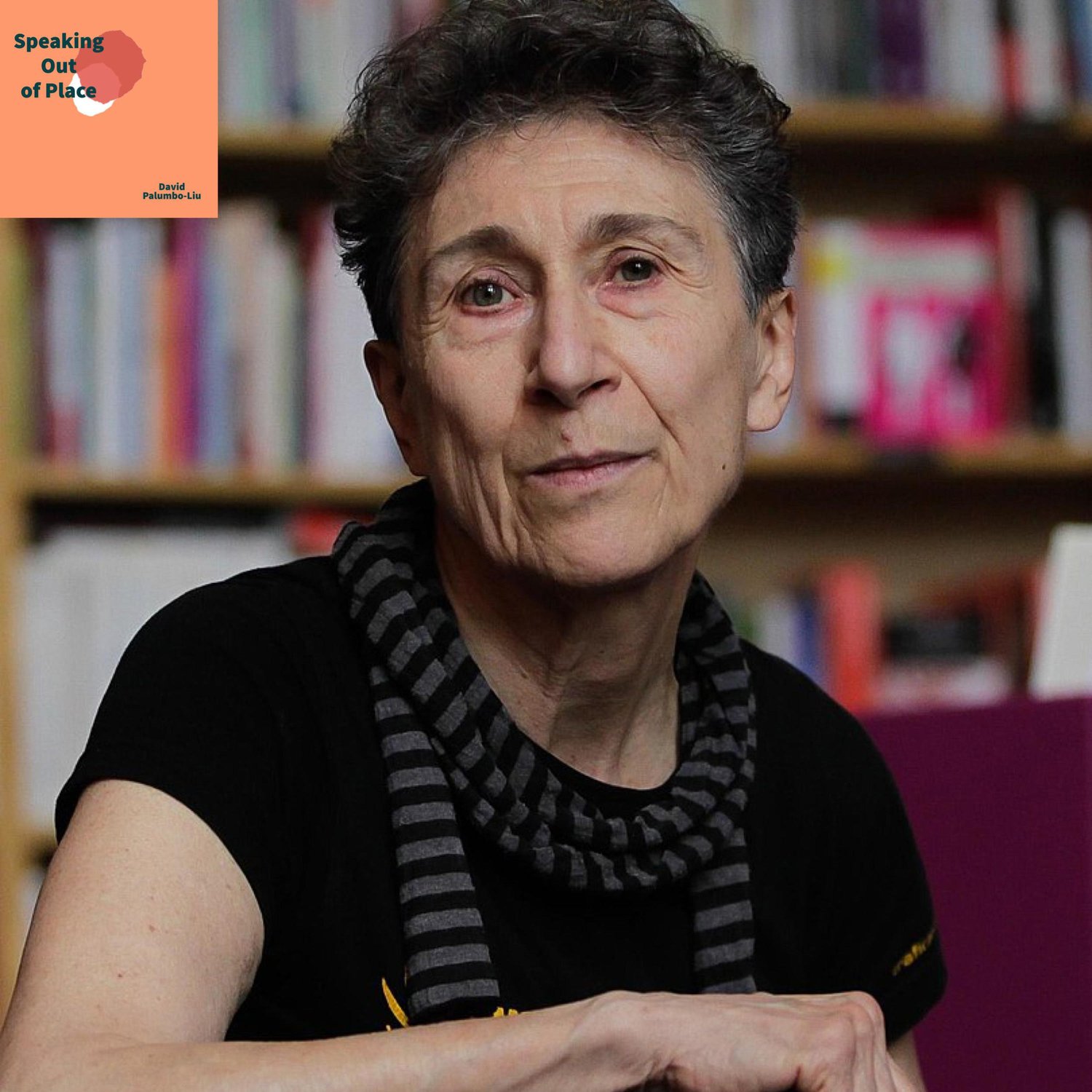
Speaking Out of Place: SILVIA FEDERICI discusses Re-enchanting the World: Feminism and the Politics of the Commons
In this episode of the Speaking Out of Place podcast, Professor David Palumbo-Liu and Azeezah Kanji interview renown scholar, activist, and writer Silvia Federici about her powerful and inspiring collection of essays, Re-enchanting the World: Feminism and the Politics of the Commons. These essays, written over the span of several decades, display her abilities to diagnose and indeed predict the most important issues facing us today.Silvia Federici is a scholar, teacher, and feminist activist based in New York. She is a professor emerita and teaching fellow at Hofstra University in New York State, where she was a social science professor. She also taught at the University of Port Harcourt in Nigeria. In 1972, she co-founded the International Feminist Collective. In 1995, in the course of the campaign to demand the liberation of Mumia Abu-Jamal, she cofounded the Radical Philosophy Association (RPA) anti-death penalty project, an organization intended to help educators become a driving force towards its abolition. For several decades, Federici has been working in a variety of projects with feminist organizations across the world like Women in Nigeria (WIN), Ni Una Menos, the Argentinian feminist organization; she alsohas been organizing a project with feminist collectives in Spain to reconstruct the history of the women who were persecuted as witches in early modern Europe, and raise consciousness about the contemporary witch-hunts that are taking place across the world.Federici is considered one of the leading feminist theoreticians in Marxist feminist theory, women’s history, political philosophy, and the history and theory of the commons. Her most famous book, Caliban and the Witch, has been translated in more than 20 foreign languages, and adopted in courses across the U.S. and many other countries. Often described as a counterpoint to Marx’s and Foucault’s account of “primitive accumulation,” Caliban reconstructs the history of capitalism, highlighting the continuity between the capitalist subjugation of women, the slave trade, and the colonization of the Americas. It has been described as the first history of capitalism with women at the center."To me, the struggle should not ever be purely an oppositional action but should actually be something constructive. Struggle is also a moment in which you raise your consciousness. You take your consciousness, you express a vision of the world that you want to construct what is being denied. The struggle is at the same time negation and also affirmation of the possibility of another world, another vision. And because of it, the struggle is also transformative. It's not only a wall against your enemies. It is also reshaping the relationship with other people. It's a moment of collective reconstruction. It's a moment of collective solidarity. This, to me, has become a very important element. This is what I've learned from the women's movement. That there's so much of our comfort, when we left the male-dominated organization, had to do not only with the program but also the forms of organizing, the kind of relation that you have with people. It became very, very important to think of the struggle as something much different and far more creative, far more constructive, and this vision of the struggle is also what should attract people to look at the struggle as something in which they want to be, not as another burden, not as another piece of work added to the day-to-day misery and the day in day workload. But actually, something that you look forward to. Going to a meeting has to be something that you look forward to as you go to a party, in the sense that here are the people that you feel connected with. You're building something. You are discovering something."www.pmpress.org/index.php?l=product_detail&p=961www.palumbo-liu.com https://speakingoutofplace.comhttps://twitter.com/palumboliu?s=20
Highlights - Nobel Peace Prize-winning Climate Scientist MARK HOWDEN - Director, Climate Change Institute at ANU - Vice Chair of IPCC
"We live in a diverse world, and we're in a funny time where we sometimes see the best of humanity and the worst of humanity. And I think what we need to do is be very strong in wanting to lift the game of each other and ourselves. And so I think that's one of the sort of key things. Particularly, young people should be more demanding that we behave better towards each other and care more about each other and the world that we live in. In terms of these heatwaves, droughts, and fires that the world is seeing, which we thought were going to hit us in 2050 or 2070, are hitting us now in 2023. So, those risks are coming much faster and harder than we thought they were going to come. And so, in many cases, we're unprepared for the severity of these changes."Our window to adapt to a warming world is narrowing quickly. What it will take to avert the climate crises? Mark Howden is Director of the Climate Change Institute at The Australian National University and a Vice Chair of the Intergovernmental Panel on Climate Change (IPCC) and a member of the Australian National Climate Science Advisory Committee. He has been a major contributor to the IPCC since 1991, with roles in the Second, Third, Fourth, Fifth and now Sixth Assessment Reports, sharing the 2007 Nobel Peace Prize with other IPCC participants and Al Gore. He was on the US Federal Advisory Committee for the 3rd National Climate Assessment and contributes to several major national and international science and policy advisory bodies. Mark has worked on climate variability, climate change, innovation and adoption issues for over 30 years in partnership with many industry, community and policy groups via both research and science-policy roles. https://iceds.anu.edu.au/people/academics/professor-mark-howdenhttps://iceds.anu.edu.au/www.ipcc.chwww.creativeprocess.infowww.oneplanetpodcast.orgIG www.instagram.com/creativeprocesspodcast

MARK HOWDEN - Vice Chair, Intergovernmental Panel on Climate Change - Director, Climate Change Institute at The Australian National University
Our window to adapt to a warming world is narrowing quickly. What it will take to avert the climate crises? Mark Howden is Director of the Climate Change Institute at The Australian National University and a Vice Chair of the Intergovernmental Panel on Climate Change (IPCC) and a member of the Australian National Climate Science Advisory Committee. He has been a major contributor to the IPCC since 1991, with roles in the Second, Third, Fourth, Fifth and now Sixth Assessment Reports, sharing the 2007 Nobel Peace Prize with other IPCC participants and Al Gore. He was on the US Federal Advisory Committee for the 3rd National Climate Assessment and contributes to several major national and international science and policy advisory bodies. Mark has worked on climate variability, climate change, innovation and adoption issues for over 30 years in partnership with many industry, community and policy groups via both research and science-policy roles. "We live in a diverse world, and we're in a funny time where we sometimes see the best of humanity and the worst of humanity. And I think what we need to do is be very strong in wanting to lift the game of each other and ourselves. And so I think that's one of the sort of key things. Particularly, young people should be more demanding that we behave better towards each other and care more about each other and the world that we live in. In terms of these heatwaves, droughts, and fires that the world is seeing, which we thought were going to hit us in 2050 or 2070, are hitting us now in 2023. So, those risks are coming much faster and harder than we thought they were going to come. And so, in many cases, we're unprepared for the severity of these changes."https://iceds.anu.edu.au/people/academics/professor-mark-howdenhttps://iceds.anu.edu.au/www.ipcc.chwww.creativeprocess.infowww.oneplanetpodcast.orgIG www.instagram.com/creativeprocesspodcastPhoto credit: Lannon Harley/ANU

Highlights - SUE INCHES - Fmr. Director, Maine Department of Marine Resources - Fmr. Deputy Director, State Planning Office
"Our culture and the way that we carry out capitalism is that we have allowed businesses to create a mess. And then the taxpayers are the ones that pay to clean it up. Corporations need to be held accountable for the environmental harm that they cause. And that way it's not going to be left to us. Corporations are caught in a system and the way that we carry out capitalism now is that profit is above everything, including people's health. And these corporations feel that if they don't maximize profit, they could be sued by their shareholders because their shareholders are basically holding them accountable for profit only. One of them that's worked quite well in Europe, and it's just starting to emerge in America, is to require that corporations report on their environmental impact. So right alongside their financial report would be environmental risk and environmental impact reporting.”Sue Inches is an advocate, author, and teacher. She has worked in public policy for over 25 years, serving as the Deputy Director of the State Planning Office, and as a Director at the Maine Department of Marine Resources. She is author of Advocating for the Environment: How to Gather Your Power and Take Action, and teaches college and high school workshops on same. Her consulting work focuses on strategic planning, program development, and environmental campaigns.https://sueinches.comwww.penguinrandomhouse.com/books/670609/advocating-for-the-environment-by-susan-b-incheswww.creativeprocess.infowww.oneplanetpodcast.orgIG www.instagram.com/creativeprocesspodcast

SUE INCHES - Author of Advocating for the Environment: How to Gather Your Power and Take Action
Sue Inches is an advocate, author, and teacher. She has worked in public policy for over 25 years, serving as the Deputy Director of the State Planning Office, and as a Director at the Maine Department of Marine Resources. She is author of Advocating for the Environment: How to Gather Your Power and Take Action, and teaches college and high school workshops on same. Her consulting work focuses on strategic planning, program development, and environmental campaigns."Our culture and the way that we carry out capitalism is that we have allowed businesses to create a mess. And then the taxpayers are the ones that pay to clean it up. Corporations need to be held accountable for the environmental harm that they cause. And that way it's not going to be left to us. Corporations are caught in a system and the way that we carry out capitalism now is that profit is above everything, including people's health. And these corporations feel that if they don't maximize profit, they could be sued by their shareholders because their shareholders are basically holding them accountable for profit only. One of them that's worked quite well in Europe, and it's just starting to emerge in America, is to require that corporations report on their environmental impact. So right alongside their financial report would be environmental risk and environmental impact reporting.”https://sueinches.comwww.penguinrandomhouse.com/books/670609/advocating-for-the-environment-by-susan-b-incheswww.creativeprocess.infowww.oneplanetpodcast.orgIG www.instagram.com/creativeprocesspodcast
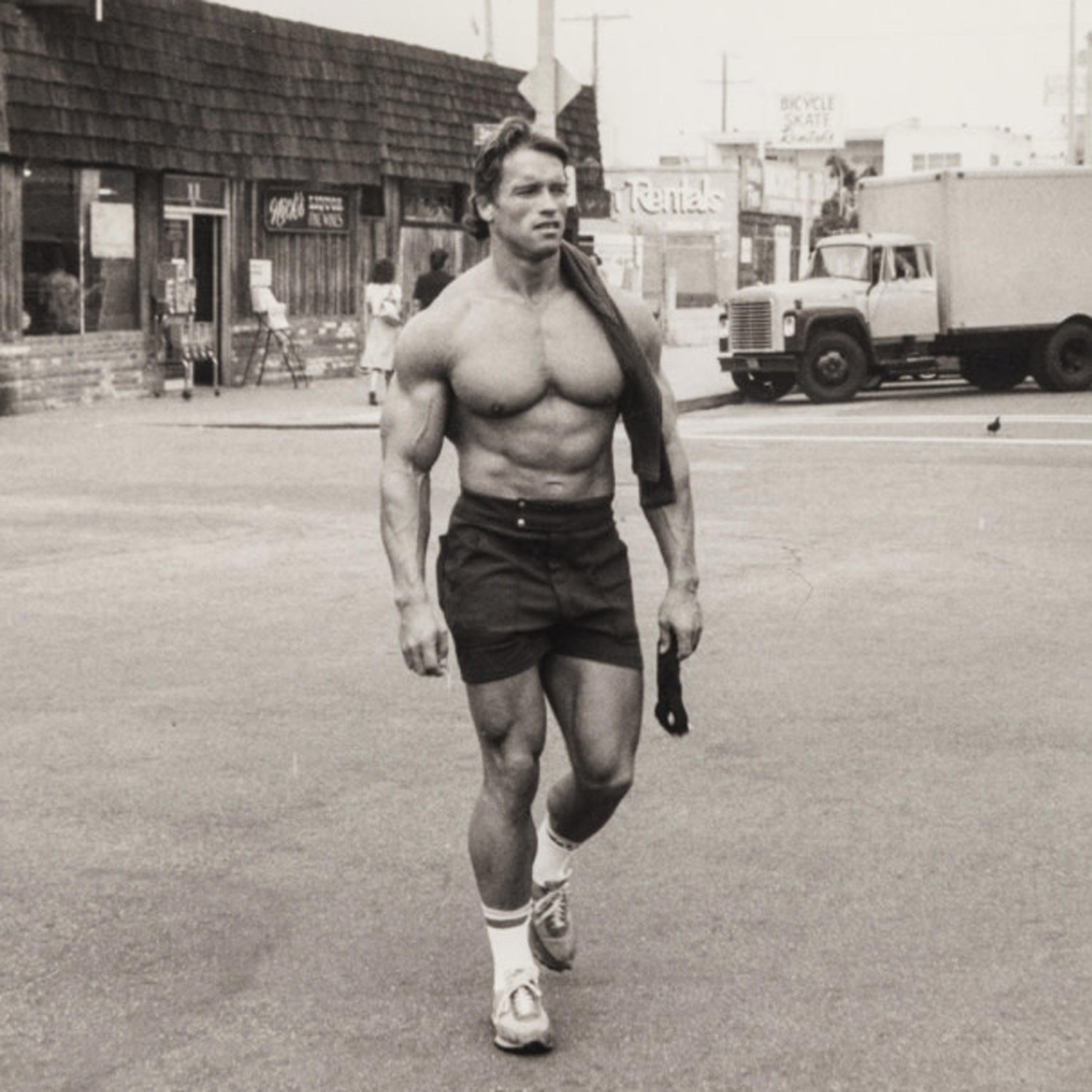
Highlights - ARNOLD SCHWARZENEGGER: Athlete, Actor, American, Activist - Conversation with Editor DIAN HANSON
"As Arnold Schwarzenegger says, 'We don't have Republican air. We don't have Democrat water. We all breathe the same air. We all have the same water. It's happening to all of us, and it's happening all over the world. And if we just continue to ignore it so that we can put some money in our pockets, or we can get reelected, what are we leaving for the future?' And you know, his devotion to children and to helping children makes him look at it from a different perspective. He's not one of these heartless old politicians who's just like, well, as long as it doesn't happen while I'm alive, I'm going to get rich off of this. He is always thinking of the next generations. He is always thinking of what he is going to be able to hand down."“Why I was different from all the other boys in my town I cannot tell you. I was simply born with the gift of vision.” – ARNOLD SCHWARZENEGGERIs there any better example of the American Dream than Arnold Schwarzenegger? What does it take to make your vision a reality? How do you cultivate iron focus to overcome any obstacle and realize your dreams?On the publication of Arnold Schwarzenegger’s limited edition two-volume book published by TASCHEN, we sat down with Senior Editor and Writer Dian Hansen to discuss Schwarzenegger’s life, accomplishments, and history of unforgettable performances. The book has been a decade-long collaborative process and along with portraits by leading photographers Richard Avedon, Annie Leibovitz, Robert Mapplethorpe, Herb Ritts, Francesco Scavullo, and Andy Warhol, it is also filled with photos from Arnold’s private archive and exclusive interviews. Dian’s other works include The Art of Pin-up, Masterpieces of Fantasy Art, and The Fantastic Worlds of Frank Frazetta.www.taschen.com/en/limited-editions/film/03105/arnold-collector-s-editionwww.schwarzenegger.comwww.creativeprocess.infowww.oneplanetpodcast.orgIG www.instagram.com/creativeprocesspodcastImage courtesy of Taschen. Photo credit: ARNOLD SCHWARZENEGGER IN VENICE, CALIFORNIA. PHOTO BY ALBERT BUSEK, 1980

ARNOLD SCHWARZENEGGER: Athlete, Actor, American, Activist - Conversation with Editor DIAN HANSON
“Why I was different from all the other boys in my town I cannot tell you. I was simply born with the gift of vision.” – ARNOLD SCHWARZENEGGERIs there any better example of the American Dream than Arnold Schwarzenegger? What does it take to make your vision a reality? How do you cultivate iron focus to overcome any obstacle and realize your dreams?On the publication of Arnold Schwarzenegger’s limited edition two-volume book published by TASCHEN, we sat down with Senior Editor and Writer Dian Hansen to discuss Schwarzenegger’s life, accomplishments, and history of unforgettable performances. The book has been a decade-long collaborative process and along with portraits by leading photographers Richard Avedon, Annie Leibovitz, Robert Mapplethorpe, Herb Ritts, Francesco Scavullo, and Andy Warhol, it is also filled with photos from Arnold’s private archive and exclusive interviews. Dian’s other works include The Art of Pin-up, Masterpieces of Fantasy Art, and The Fantastic Worlds of Frank Frazetta."As Arnold Schwarzenegger says, 'We don't have Republican air. We don't have Democrat water. We all breathe the same air. We all have the same water. It's happening to all of us, and it's happening all over the world. And if we just continue to ignore it so that we can put some money in our pockets, or we can get reelected, what are we leaving for the future?' And you know, his devotion to children and to helping children makes him look at it from a different perspective. He's not one of these heartless old politicians who's just like, well, as long as it doesn't happen while I'm alive, I'm going to get rich off of this. He is always thinking of the next generations. He is always thinking of what he is going to be able to hand down."www.taschen.com/en/limited-editions/film/03105/arnold-collector-s-editionwww.schwarzenegger.comwww.creativeprocess.infowww.oneplanetpodcast.orgIG www.instagram.com/creativeprocesspodcastImages courtesy of Taschen. Photo credits: CoverArnold Schwarzenegger for the film End of Days. Sante D'Orazio, 1999Governor Schwarzenegger with the Lincoln Memorial · Photo by Peter Grigsby, 2009 Arnold Schwarzenegger and Lulu at his Los Angeles home · Photo by Tracy Nguyen, 2021
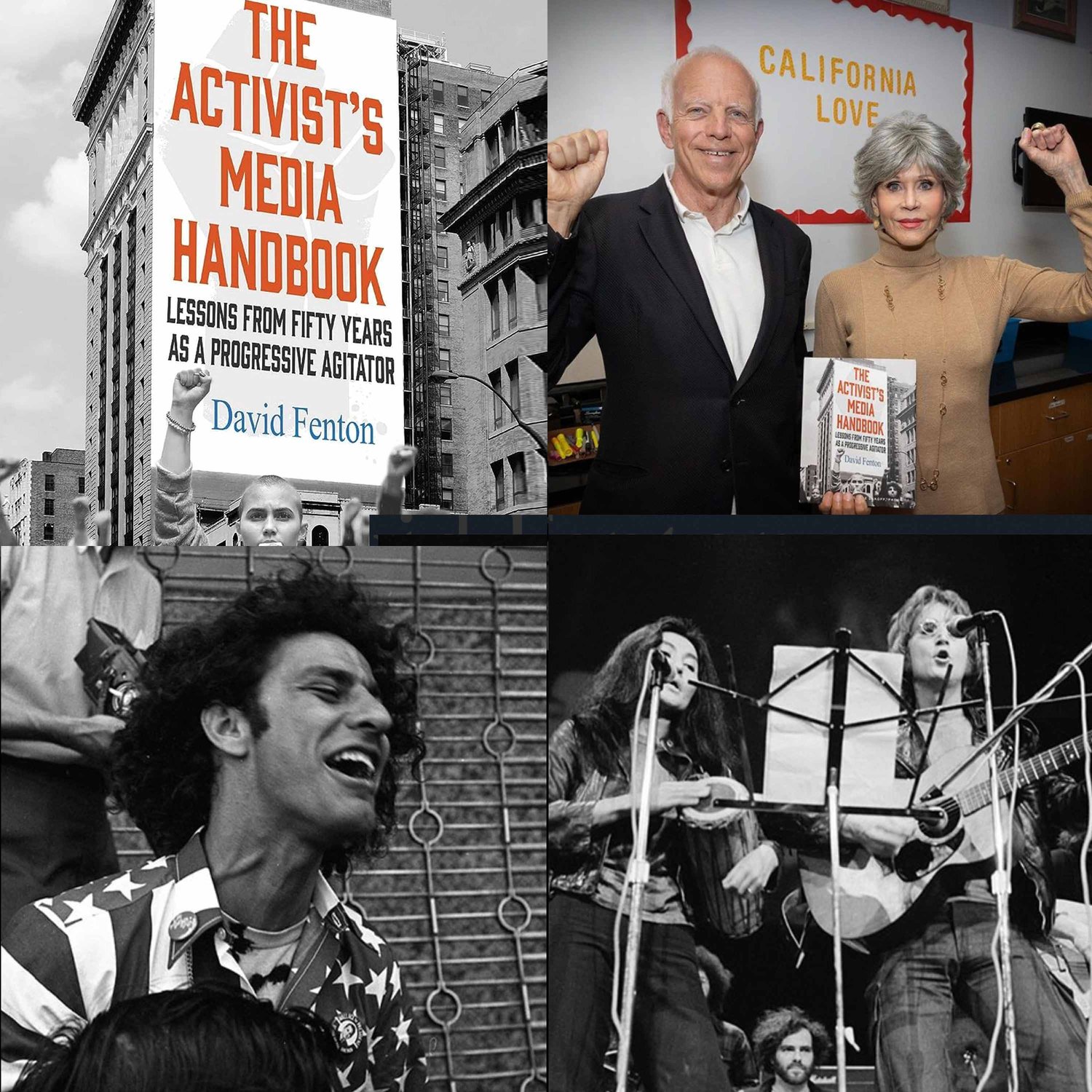
Highlights - DAVID FENTON - Author of The Activist’s Media Handbook: Lessons From 50 Years as a Progressive Agitator
"The linguists and the cognitive scientists have established that as you're exposed to language from childhood and over your lifetime, it forms literal circuits in your brain. They call them frames. So in order to communicate successfully with people, the best way is to use language that activates existing frames. So for example, when I say we need to get to net zero by 2050, nobody knows what I'm talking about. There's no existing circuitry to process that language. What the hell is net zero? Is that less than zero? Now, if I say we have to stop pollution because pollution is heating the planet, we've formed a blanket of pollution around the earth that is trapping heat that used to go back out to space. And then everybody knows what I'm talking about because they know what pollution is. That's an existing mental frame. And by the way, no one will defend pollution. You won't find anyone that thinks pollution is a good thing. So it's a universally negative frame in all languages. And then when I say it's like a blanket around the earth, there's another existing mental frame. Everybody knows what a blanket is and how it works. It traps your body heat so you don't get cold. So that's what we're doing to the earth. And yes, all that trapped heat energy on Earth has to go somewhere. So it goes to create stronger storms and droughts and floods and melts the ice."How can we effectively communicate that we're moving beyond climate change to a state of climate crisis? The trapped heat energy on Earth is equal to a million Atomic bombs going off every single day. Today we talk to someone who's been mobilizing the public mind for over 50 years. David Fenton, named “one of the 100 most influential PR people” by PR Week and “the Robin Hood of public relations” by The National Journal, founded Fenton in 1982 to create communications campaigns for the environment, public health, and human rights. For more than five decades he has pioneered the use of PR, social media, and advertising techniques for social change. Fenton started his career as a photojournalist in the late 1960s – his book Shots: An American Photographer’s Journal was published in 2005. He was formerly director of public relations at Rolling Stone magazine and co-producer of the No-Nukes concerts in 1979 at Madison Square Garden with Bruce Springsteen, Bonnie Raitt, James Taylor, Jackson Browne, and other artists. He has also helped create JStreet, Climate Nexus, the Death Penalty Information Center, and Families for a Future. He sold Fenton a few years ago to work on climate change full time. He is the author of The Activist’s Media Handbook: Lessons From 50 Years as a Progressive Agitator.https://davidfentonactivist.comwww.simonandschuster.com/books/The-Activists-Media-Handbook/David-Fenton/9781647228668https://fenton.comX / twitter @dfentonIG @dfenton1 facebook.com/davidfentonactivistwww.creativeprocess.info www.oneplanetpodcast.orgIG www.instagram.com/creativeprocesspodcastAll photographs © 1968-2022 David Fenton
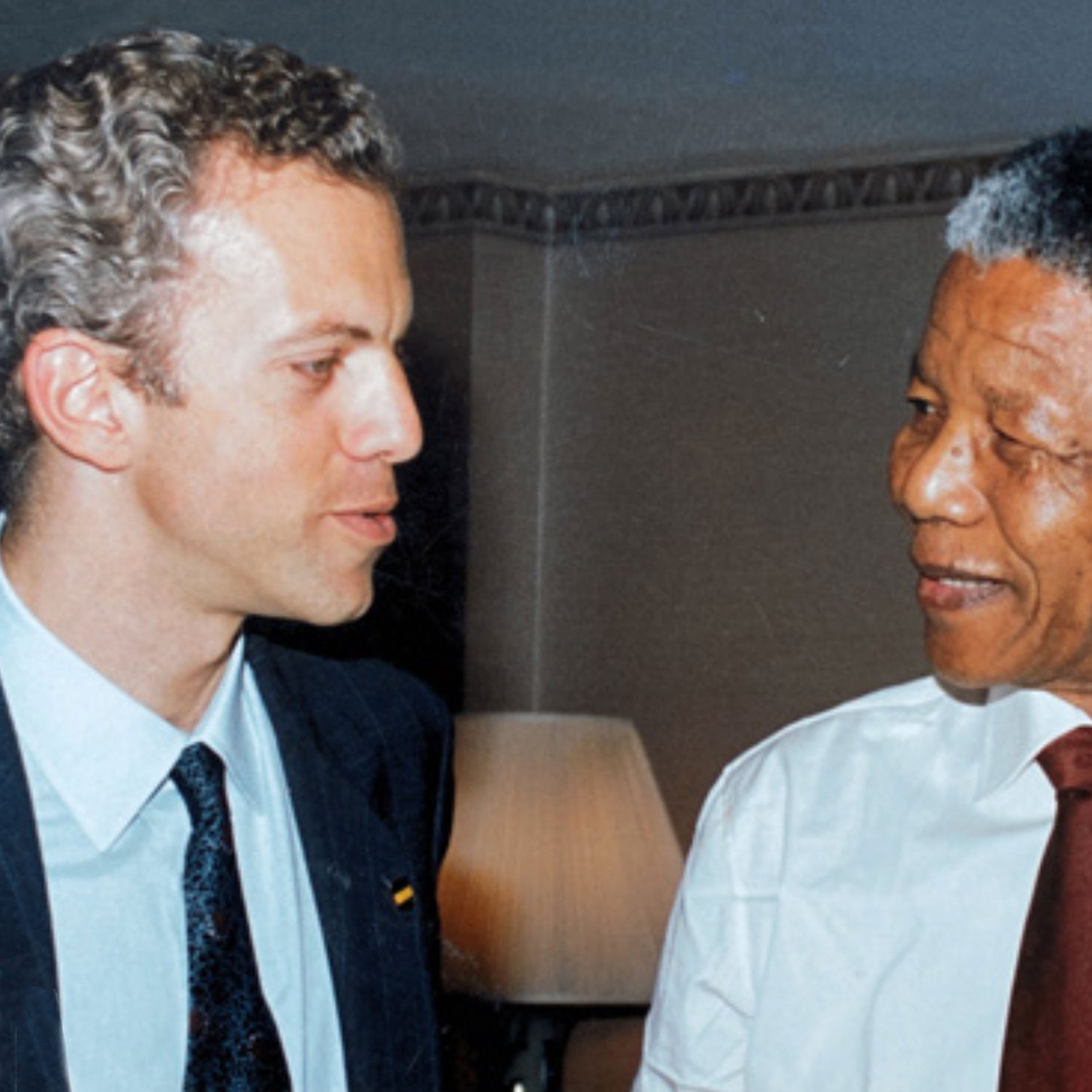
DAVID FENTON - Founder of Fenton Communications, Author of The Activist’s Media Handbook: Lessons From 50 Years as a Progressive Agitator
How can we effectively communicate that we're moving beyond climate change to a state of climate crisis? The trapped heat energy on Earth is equal to a million Atomic bombs going off every single day. Today we talk to someone who's been mobilizing the public mind for over 50 years. David Fenton, named “one of the 100 most influential PR people” by PR Week and “the Robin Hood of public relations” by The National Journal, founded Fenton in 1982 to create communications campaigns for the environment, public health, and human rights. For more than five decades he has pioneered the use of PR, social media, and advertising techniques for social change. Fenton started his career as a photojournalist in the late 1960s – his book Shots: An American Photographer’s Journal was published in 2005. He was formerly director of public relations at Rolling Stone magazine and co-producer of the No-Nukes concerts in 1979 at Madison Square Garden with Bruce Springsteen, Bonnie Raitt, James Taylor, Jackson Browne, and other artists. He has also helped create JStreet, Climate Nexus, the Death Penalty Information Center, and Families for a Future. He sold Fenton a few years ago to work on climate change full time. He is the author of The Activist’s Media Handbook: Lessons From 50 Years as a Progressive Agitator."The linguists and the cognitive scientists have established that as you're exposed to language from childhood and over your lifetime, it forms literal circuits in your brain. They call them frames. So in order to communicate successfully with people, the best way is to use language that activates existing frames. So for example, when I say we need to get to net zero by 2050, nobody knows what I'm talking about. There's no existing circuitry to process that language. What the hell is net zero? Is that less than zero? Now, if I say we have to stop pollution because pollution is heating the planet, we've formed a blanket of pollution around the earth that is trapping heat that used to go back out to space. And then everybody knows what I'm talking about because they know what pollution is. That's an existing mental frame. And by the way, no one will defend pollution. You won't find anyone that thinks pollution is a good thing. So it's a universally negative frame in all languages. And then when I say it's like a blanket around the earth, there's another existing mental frame. Everybody knows what a blanket is and how it works. It traps your body heat so you don't get cold. So that's what we're doing to the earth. And yes, all that trapped heat energy on Earth has to go somewhere. So it goes to create stronger storms and droughts and floods and melts the ice."https://davidfentonactivist.comwww.simonandschuster.com/books/The-Activists-Media-Handbook/David-Fenton/9781647228668https://fenton.comX / twitter @dfentonIG @dfenton1 facebook.com/davidfentonactivistwww.creativeprocess.info www.oneplanetpodcast.orgIG www.instagram.com/creativeprocesspodcastAll photographs © 1968-2022 David Fenton

SIMON DALBY - Author of Pyromania: Fire and Geopolitics in a Climate-Disrupted World
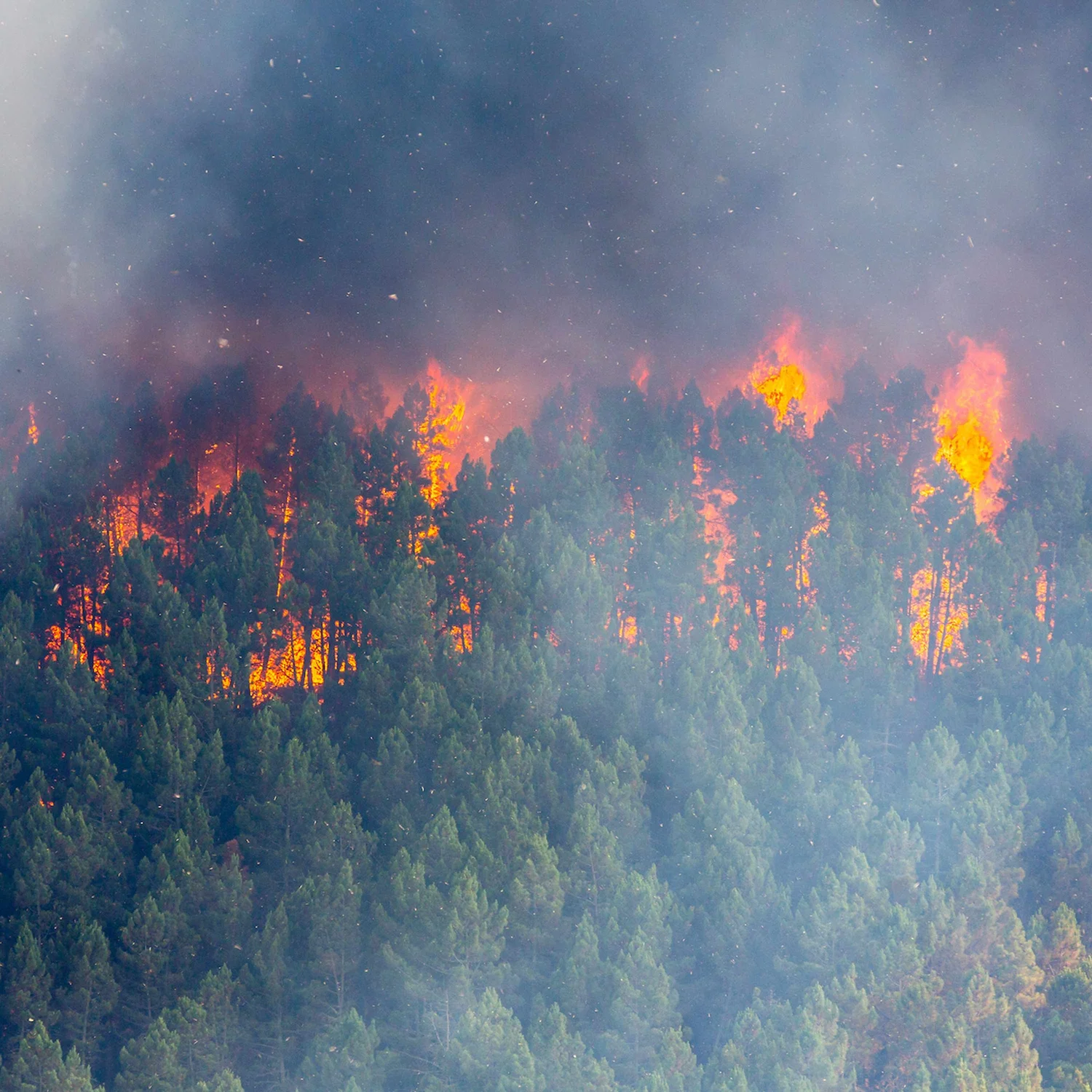
Wildfire season is starting earlier and lasting longer due to global warming across the world. What will we do to save the world on fire? How can we cure our addiction to fossil fuels which is verging on pyromania?Simon Dalby is author of Pyromania: Fire and Geopolitics in a Climate-Disrupted World and Professor Emeritus at Wilfrid Laurier University. His other books are Rethinking Environmental Security, Anthropocene Geopolitics: Globalization, Security, Sustainability, and Security and Environmental Change. He’s co-editor of Achieving the Sustainable Development Goals, and Reframing Climate Change: Constructing Ecological Geopolitics."We also need to note most people move locally rather than globally. In the discussions about climate refugees, people are going to be dislocated. There are obviously going to be places that are going to become quite literally uninhabitable because they're too hot and too dry, or they've been flooded so frequently that they're just not sustainable. That said it is also worth pointing out that this climate change process is playing out in a global economy, which is also changing where people live and how people live very rapidly. the migration from rural areas to urban systems has been massive over the last couple of generations. We became an urban species."https://experts.wlu.ca/simon-dalby-1www.agendapub.com/page/detail/pyromania/?k=9781788216500www.creativeprocess.infowww.oneplanetpodcast.orgIG www.instagram.com/creativeprocesspodcast
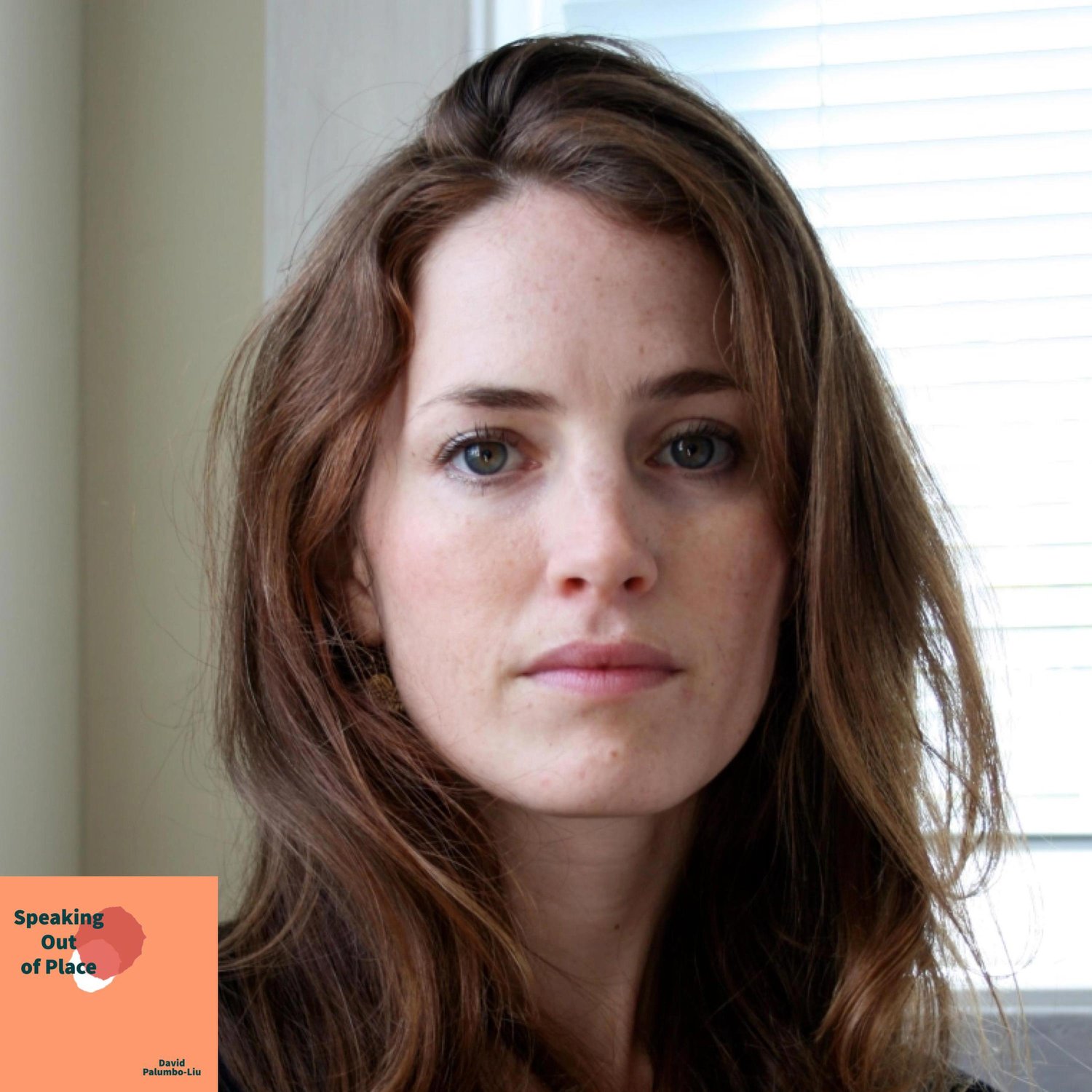
Speaking Out of Place: JENNIFER JACQUET discusses The Playbook: How to Deny Science, Sell Lies, and Make a Killing in the Corporate World
In this episode of the Speaking Out of Place podcast, Professor David Palumbo-Liu interviews Jennifer Jacquet, who is an Associate Professor in the Department of Environmental Studies and Director of XE: Experimental Humanities and Social Engagement at NYU. She is also deputy director of NYU's Center for Environmental and Animal Protection. Her research focuses on animals and the environment, Agnotology, and attribution and responsibility in the Anthropocene. She is author of The Playbook: How to Deny Science, Sell Lies, and Make a Killing in the Corporate World-- a work of 'epistolary non-fiction' that makes the business case for scientific denial. Among other things, we learn how corporations create an arsenal of experts and pseudo-experts at prestigious universities to create misinformation and disinformation for corporate profit, and at great cost to the public. At the end, we make the case for a partnership between the sciences and the humanities to fight such lies and violence.Jennifer Jacquet’s research focuses on animals and the environment, Agnotology, and attribution and responsibility in the Anthropocene. She is author of The: How to Deny Science, Sell Lies, and Make a Killing in the Corporate World (Pantheon/Penguin, 2022)-- a work of 'epistolary non-fiction' that makes the business case for scientific denial. She also wrote Is Shame Necessary? (Pantheon/Penguin, 2015) about the evolution, function, and future of the use of social disapproval in a globalized, digitized world. She is the recipient of a 2015 Alfred P. Sloan research fellowship and a 2016 Pew Fellowship in Marine Conservation.https://jenniferjacquet.com https://as.nyu.edu/faculty/jennifer-jacquet.htmlwww.palumbo-liu.com https://speakingoutofplace.com https://twitter.com/palumboliu?s=20

Highlights - ERICA BERRY - Author of Wolfish: Wolf, Self, and the Stories We Tell About Fear
"It's felt very anxious to imagine going towards the next few decades. And I do get a real sense of solidarity and hope by how wolves are navigating these change landscapes and moving through them and raising new generations. In the face of it, a wolf pack will pass on territory potentially through multiple generations.We have to rekindle the herd instinct. Cows right now are bred just for meat. They are bred to exist within capitalism. The cows have forgotten how to interact with each other and protect each other. They are stewards of the land and what can we learn from that?"The lone wolf is actually alone because it's looking for connection. They leave in order to find a mate and form their own pack. If loneliness is an epidemic, what can wolves teach us about loneliness, courage, and connection?Erica Berry is the author of Wolfish: Wolf, Self, and the Stories We Tell About Fear. Her essays in journalism appear in Outside, Wired, The Yale Review, The Guardian, Literary Hub, The New York Times Magazine, The Atlantic, and Guernica, among other publications. Berry has taught workshops for teenagers and adults at Literary Arts, the Sitka Center for Art and Ecology, the New York Times Student Journeys in Oxford Academia.www.ericaberry.comhttps://us.macmillan.com/books/9781250882264/wolfishwww.creativeprocess.info www.oneplanetpodcast.orgIG www.instagram.com/creativeprocesspodcast
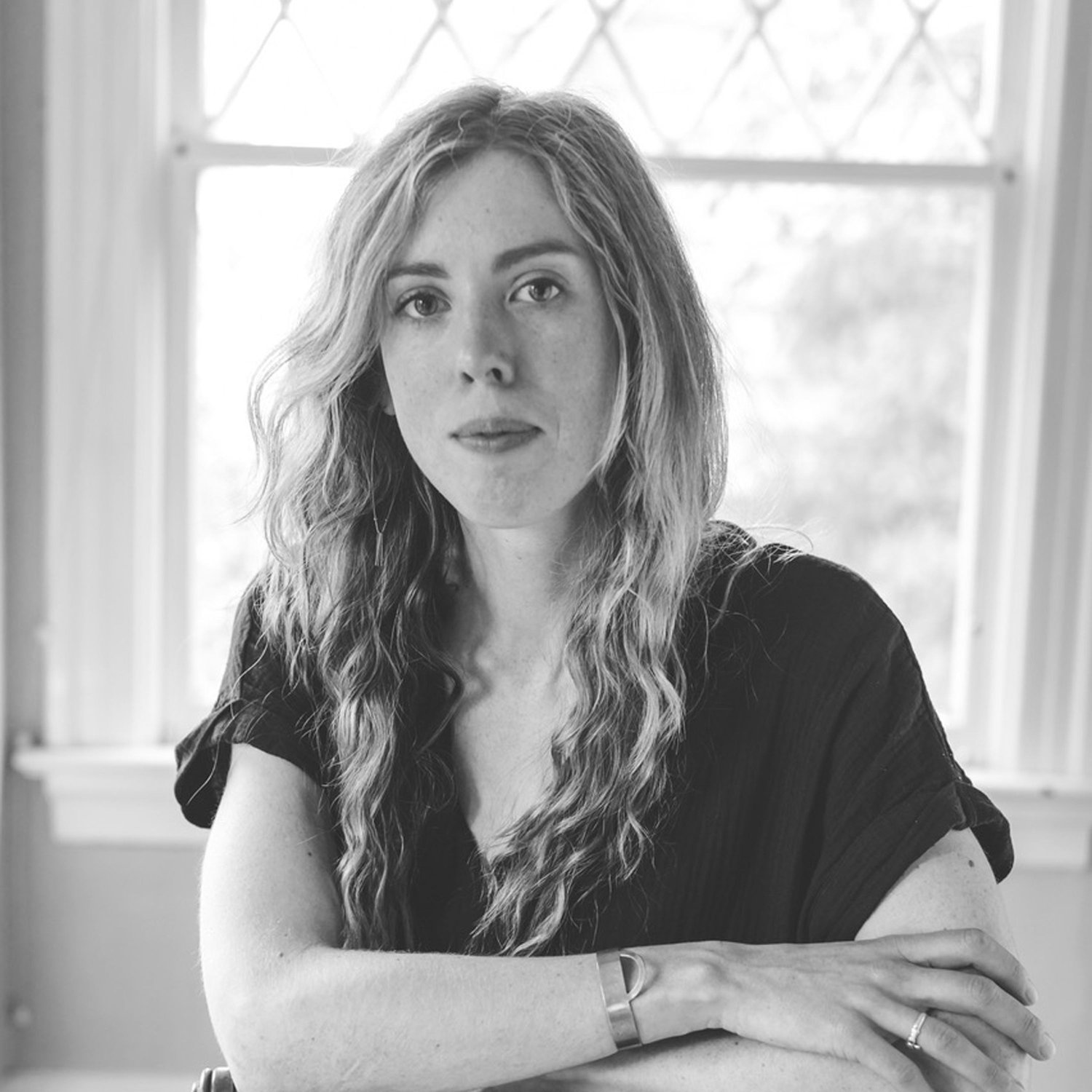
ERICA BERRY - Author of Wolfish: Wolf, Self, and the Stories We Tell About Fear
The lone wolf is actually alone because it's looking for connection. They leave in order to find a mate and form their own pack. If loneliness is an epidemic, what can wolves teach us about loneliness, courage, and connection?Erica Berry is the author of Wolfish: Wolf, Self, and the Stories We Tell About Fear. Her essays in journalism appear in Outside, Wired, The Yale Review, The Guardian, Literary Hub, The New York Times Magazine, The Atlantic, and Guernica, among other publications. Berry has taught workshops for teenagers and adults at Literary Arts, the Sitka Center for Art and Ecology, the New York Times Student Journeys in Oxford Academia."It's felt very anxious to imagine going towards the next few decades. And I do get a real sense of solidarity and hope by how wolves are navigating these change landscapes and moving through them and raising new generations. In the face of it, a wolf pack will pass on territory potentially through multiple generations.We have to rekindle the herd instinct. Cows right now are bred just for meat. They are bred to exist within capitalism. The cows have forgotten how to interact with each other and protect each other. They are stewards of the land and what can we learn from that?"www.ericaberry.com https://us.macmillan.com/books/9781250882264/wolfishwww.creativeprocess.info www.oneplanetpodcast.org IG www.instagram.com/creativeprocesspodcastPhoto by Andrea Lonas
Highlights - MARK MASLIN - Author of How To Save Our Planet: The Facts - Professor, Earth System Science, UCLondon
"EO Wilson suggested that we had to think about the world as a place that we share. And he said: Look, we always seem to need a lot of stuff. So why don't we leave half the earth to the natural environment and allow all the natural processes that we need, and then we use the other half for ourselves. And it's an interesting concept because it says to economists and to the capitalist system: you cannot use all of it. You have to leave half of it to allow the systems to produce clean air, clean water, and allow for biodiversity and ecosystems to restore themselves."Can we imagine a world where we leave half the earth to the natural environment and use the other half for ourselves? Can we change history and protect the Indigenous, the vulnerable, and the very poorest in society?Mark Maslin is a Professor of Earth System Science at University College London. Maslin is a leading expert in understanding the anthropocene and how it relates to the major challenges facing humanity in the 21st century. He has written a number of books on the issue of climate change, his most book is How to Save Our Planet: The Facts.www.geog.ucl.ac.uk/people/academic-staff/mark-maslinwww.penguin.co.uk/books/320155/how-to-save-our-planet-by-maslin-mark/9780241472521www.creativeprocess.info www.oneplanetpodcast.org IG www.instagram.com/creativeprocesspodcastImage courtesy of Mark Maslin
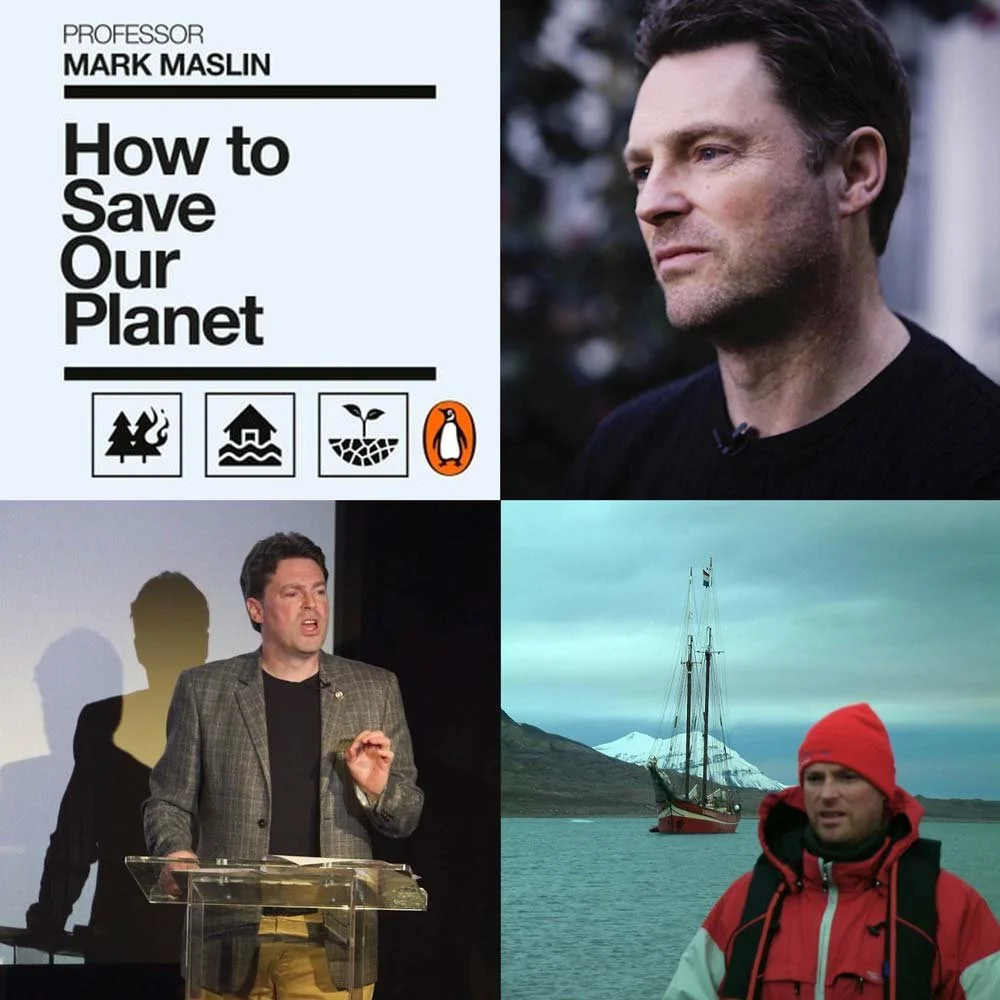
MARK MASLIN - Author of How To Save Our Planet: The Facts - Professor, Earth System Science, University College London
Can we imagine a world where we leave half the earth to the natural environment and use the other half for ourselves? Can we change history and protect the Indigenous, the vulnerable, and the very poorest in society?Mark Maslin is a Professor of Earth System Science at University College London. Maslin is a leading expert in understanding the anthropocene and how it relates to the major challenges facing humanity in the 21st century. He has written a number of books on the issue of climate change, his most book is How to Save Our Planet: The Facts."EO Wilson suggested that we had to think about the world as a place that we share. And he said: Look, we always seem to need a lot of stuff. So why don't we leave half the earth to the natural environment and allow all the natural processes that we need, and then we use the other half for ourselves. And it's an interesting concept because it says to economists and to the capitalist system: you cannot use all of it. You have to leave half of it to allow the systems to produce clean air, clean water, and allow for biodiversity and ecosystems to restore themselves."www.geog.ucl.ac.uk/people/academic-staff/mark-maslinwww.penguin.co.uk/books/320155/how-to-save-our-planet-by-maslin-mark/9780241472521www.creativeprocess.info www.oneplanetpodcast.org IG www.instagram.com/creativeprocesspodcastAll images courtesy of Mark Maslin
SCOTT TEW - VP of Sustainability, Trane Technologies & Managing Director, Center for Energy Efficiency & Sustainability
The time to start looking into tomorrow is now.Scott Tew is the leader of the Center for Energy Efficiency & Sustainability at Trane Technologies (CEES) and is responsible for forward-looking sustainability initiatives aimed at transitioning to more efficient and climate-friendly solutions and minimizing resource use within company facilities. Trane’s smart solutions support many of the challenges businesses, buildings, and the transport sector face in the fight to decarbonize our future, which we will continue to face in the decades ahead. Scott serves as a thought leader in linking public policy, economic impacts and a value-stream approach to sustainability. His efforts have led to the development of world-class initiatives, including introduction of the company’s comprehensive 2030 Sustainability Commitments with the largest customer-facing corporate commitment to combat climate change with the Gigaton Challenge; and as a pioneer in integrated reporting.Scott holds graduate and undergraduate degrees in environmental science and ecology from Livingston University. He serves on the Advisory Council of the Corporate Eco Forum; as the board chair of the World Environment Center; and as the chair of the US Business Council for Sustainable Development (USBCSD). www.tranetechnologies.com https://blog.tranetechnologies.com/en/home/author/scott-tew.htmlSeason 2 of Business & Society focuses on Leaders, Sustainability & Environmental Solutions Business & Society is a limited series co-hosted by Bruce Piasecki & Mia Funk www.oneplanetpodcast.org

Highlights - Erland Cooper - Scottish Composer, Producer, Multi-instrumentalist
"I often feel that a lot of facts surrounding the science of climate change and how arguments are presented can be very overwhelming to most people. And people tend to often switch off after a point. But I think what the arts and music can do in particular is they can make humans feel something for a moment. And it's when you feel something that you tend to make instinctive decisions about how you might change, how you might go about the rest of your day, how you might make decisions that might affect other people. And the arts in particular. This is a very potent method of doing that."How has music transported you? Where do you find inspiration from the natural world? Where do you find moments of every day magic? Erland Cooper is a Scottish composer, producer, and multi-instrumentalist from Stromness, Orkney. He has released three acclaimed studio albums, four additional companion albums, and multiple EPs, including a trilogy of work inspired by his childhood home. His work combines field recordings with traditional orchestration and contemporary electronic elements. Through music words and cinematography, he explores landscape, memory, and identity. Cooper also works across mixed media projects, including installation, art, theater, and film. He is widely known for burying the only existing copy of the master tape of his first classical album in Scotland, deleting all digital files, and leaving only a treasure hunt of clues for fans and his record label alike to search for it. The tape has recently been found.www.erlandcooper.comwww.creativeprocess.info www.oneplanetpodcast.orgIG www.instagram.com/creativeprocesspodcast

Erland Cooper - Nature’s Songwriter - Composer of “Folded Landscapes”
How has music transported you? Where do you find inspiration from the natural world? Where do you find moments of every day magic? Erland Cooper is a Scottish composer, producer, and multi-instrumentalist from Stromness, Orkney. He has released three acclaimed studio albums, four additional companion albums, and multiple EPs, including a trilogy of work inspired by his childhood home. His work combines field recordings with traditional orchestration and contemporary electronic elements. Through music words and cinematography, he explores landscape, memory, and identity. Cooper also works across mixed media projects, including installation, art, theater, and film. He is widely known for burying the only existing copy of the master tape of his first classical album in Scotland, deleting all digital files, and leaving only a treasure hunt of clues for fans and his record label alike to search for it. The tape has recently been found."I often feel that a lot of facts surrounding the science of climate change and how arguments are presented can be very overwhelming to most people. And people tend to often switch off after a point. But I think what the arts and music can do in particular is they can make humans feel something for a moment. And it's when you feel something that you tend to make instinctive decisions about how you might change, how you might go about the rest of your day, how you might make decisions that might affect other people. And the arts in particular. This is a very potent method of doing that."www.erlandcooper.comwww.creativeprocess.info www.oneplanetpodcast.orgIG www.instagram.com/creativeprocesspodcastPhoto by Alex Kozobolis
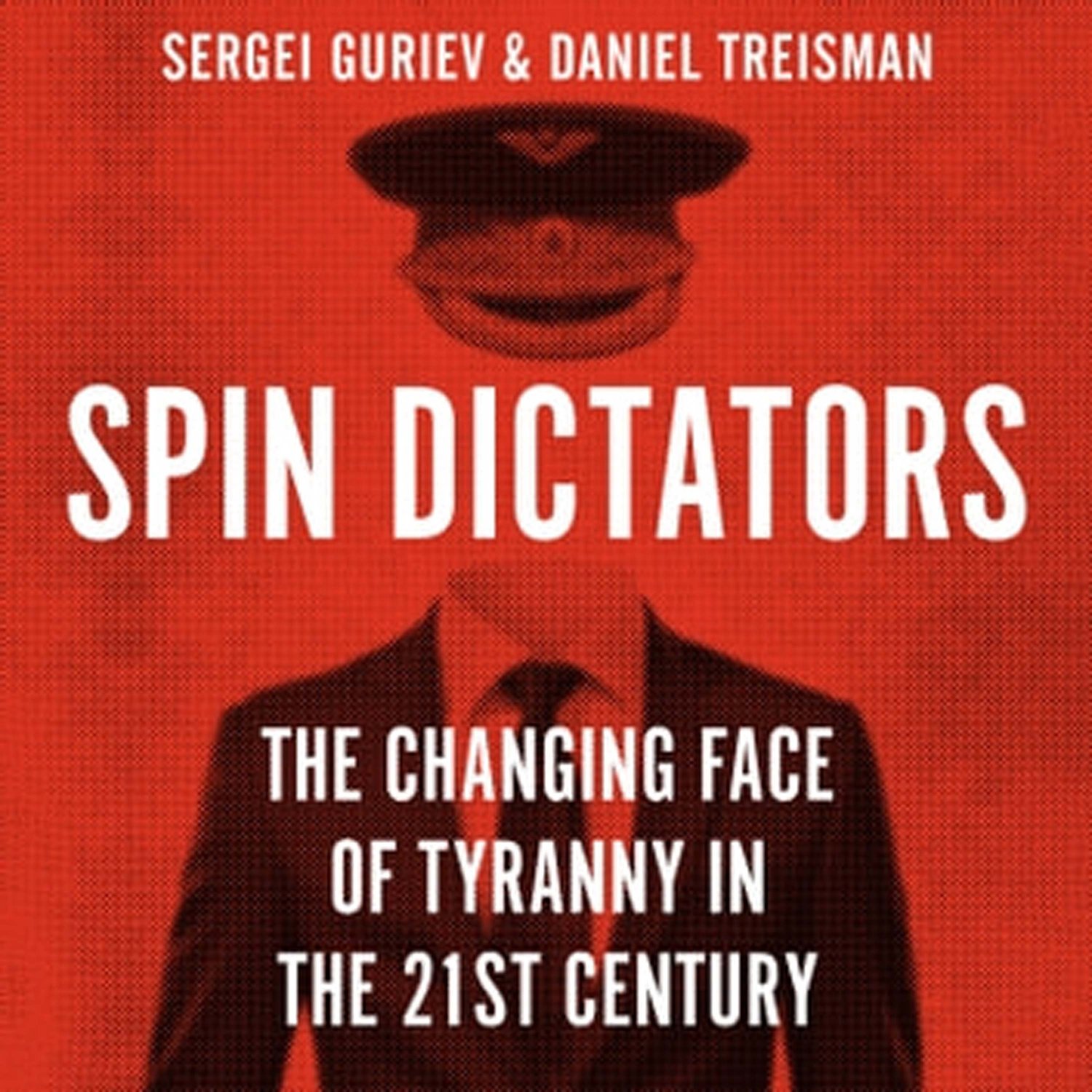
Highlights - SERGEI GURIEV - Political Economist - Provost of SciencesPo - Co-author of Spin Dictators
"It breaks my heart to see that this is an existential issue for our civilization. And instead of focusing on environmental transformation, on sustainability, we have to deal with these unnecessary costly wars which destroy a lot of resources. And what is very, very painful as an economist, if you compare the forecast made for global GDP in 2022 made before the beginning of the war, and right after the beginning of the war, the difference would be 1 trillion. And this is exactly the problem with what we are facing today. We need to focus on green transition, and instead, we focus on how to stop Putin from killing people." What is a spin dictator? What does tyranny look like in the 21st century? Why is populism on the rise? And how do we reinvent democracy?Sergei Guriev is the co-author of Spin Dictators: The Changing Face of Tyranny in the 21st Century. Guriev is Provost and a professor of economics and at Sciences Po in Paris. He is a former Chief Economist of the European Bank for Reconstruction and Development, London, and a former Rector of the New Economic School in Moscow in 2004-13.https://sites.google.com/site/sguriev/https://spindictators.com/www.sciencespo.fr/department-economics/en/researcher/sergei-guriev.htmlwww.creativeprocess.infowww.oneplanetpodcast.orgIG www.instagram.com/creativeprocesspodcast
SERGEI GURIEV - Economist - Provost of SciencesPo - Co-author of Spin Dictators: The Changing Face of Tyranny in the 21st Century
What is a spin dictator? What does tyranny look like in the 21st century? Why is populism on the rise? And how do we reinvent democracy?Sergei Guriev is the co-author of Spin Dictators: The Changing Face of Tyranny in the 21st Century. Guriev is Provost and a professor of economics and at Sciences Po in Paris. He is a former Chief Economist of the European Bank for Reconstruction and Development, London, and a former Rector of the New Economic School in Moscow in 2004-13."It breaks my heart to see that this is an existential issue for our civilization. And instead of focusing on environmental transformation, on sustainability, we have to deal with these unnecessary costly wars which destroy a lot of resources. And what is very, very painful as an economist, if you compare the forecast made for global GDP in 2022 made before the beginning of the war, and right after the beginning of the war, the difference would be 1 trillion. And this is exactly the problem with what we are facing today. We need to focus on green transition, and instead, we focus on how to stop Putin from killing people." https://sites.google.com/site/sguriev/https://spindictators.com/www.sciencespo.fr/department-economics/en/researcher/sergei-guriev.htmlwww.creativeprocess.infowww.oneplanetpodcast.orgIG www.instagram.com/creativeprocesspodcast
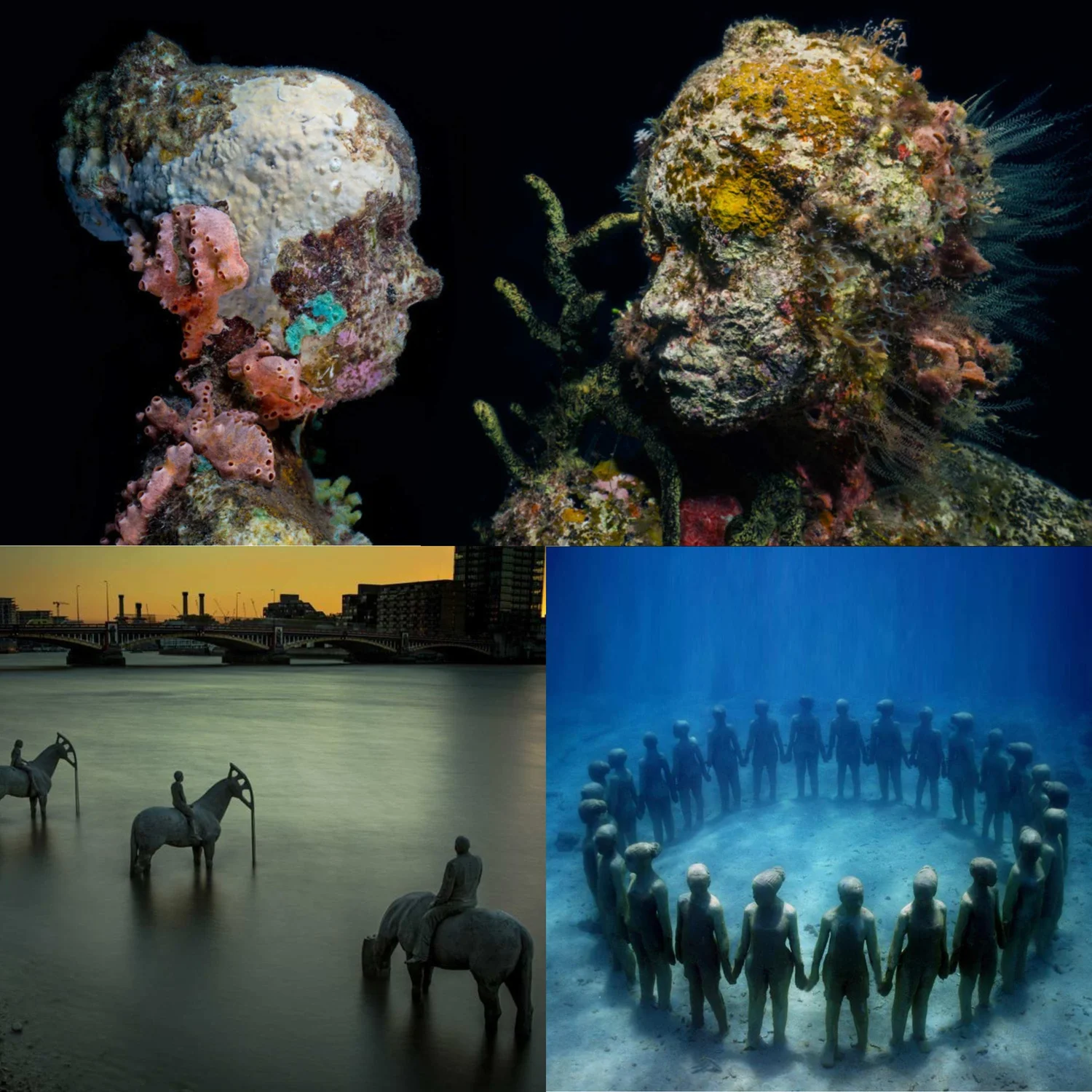
Highlights - JASON deCAIRES TAYLOR - Sculptor, Environmentalist, Creator of Underwater Museums
"It's always difficult to generalize about my work because obviously, they're very different in each location. Sometimes I'll witness some particular species has colonized the rocks in an area or producing certain types of forms that the light looks a certain way, but then other times I wanted to represent people from the local community and that also dictates how the installations are. And then there are messages that I wanted to bring forth regarding climate change. I think we've missed an opportunity where we've had so much science and so many facts and figures and warnings and conventions, but we've forgotten a part that has motivated us for millennia, and that is our emotions. And I think that's where art and that's where often religion comes to the fore."What if museums weren’t confined to buildings but could be part of the natural world? What if sculptures could not only celebrate our oceans, but also provide habitats for marine life?Jason deCaires Taylor is a sculptor, environmentalist, and underwater photographer. His works are constructed using materials to instigate natural growth and the subsequent changes intended to explore the aesthetics of decay, rebirth, and metamorphosis. DeCaires Taylor's pioneering public art projects are not only examples of successful marine conservation but also works of art that seek to encourage environmental awareness and lead us to appreciate the breathtaking natural beauty of the underwater world.www.underwatersculpture.comwww.creativeprocess.infowww.oneplanetpodcast.orgIG www.instagram.com/creativeprocesspodcast
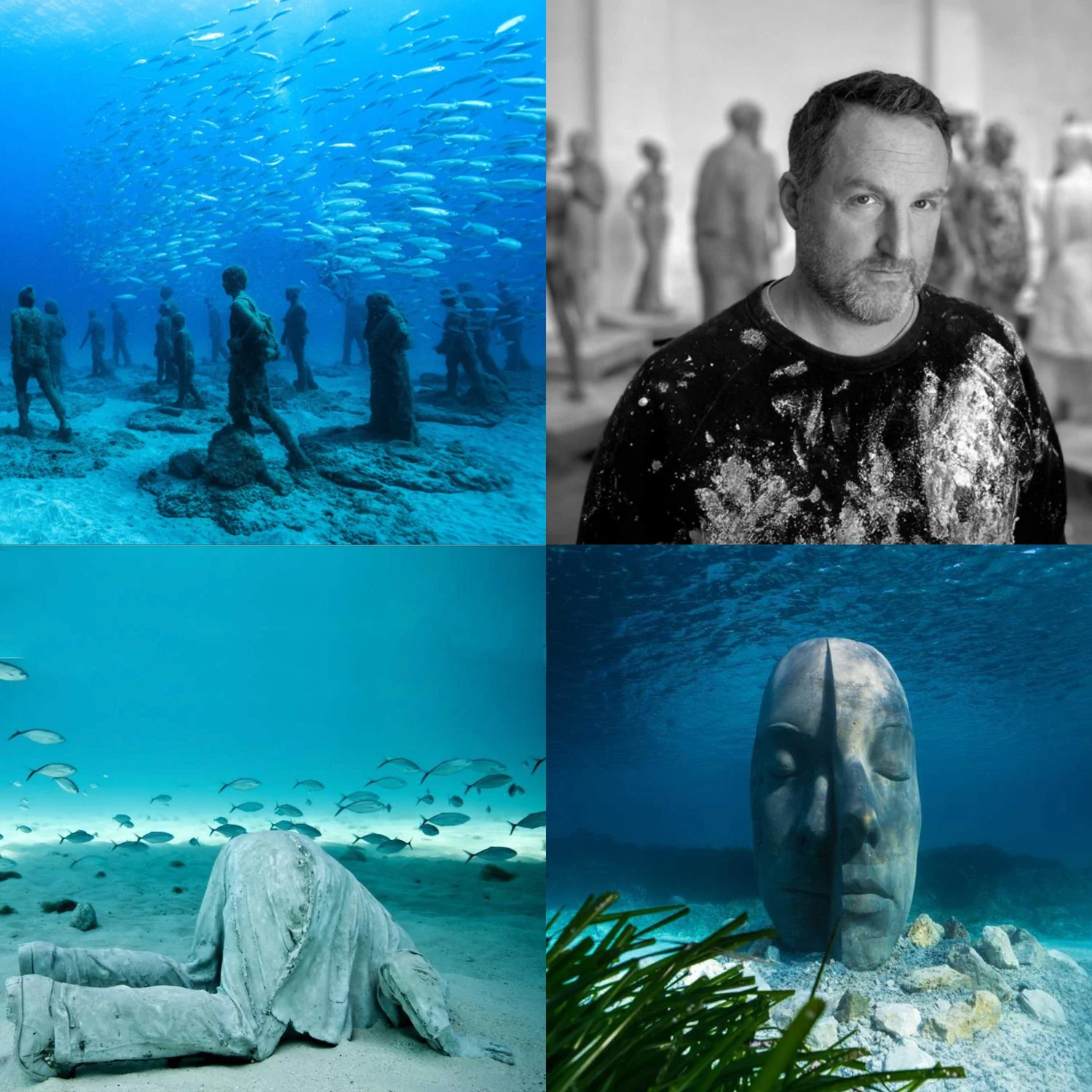
JASON deCAIRES TAYLOR - Sculptor, Environmentalist, Creator of Underwater Museums
What if museums weren’t confined to buildings but could be part of the natural world? What if sculptures could not only celebrate our oceans, but also provide habitats for marine life?Jason deCaires Taylor is a sculptor, environmentalist, and underwater photographer. His works are constructed using materials to instigate natural growth and the subsequent changes intended to explore the aesthetics of decay, rebirth, and metamorphosis. DeCaires Taylor's pioneering public art projects are not only examples of successful marine conservation but also works of art that seek to encourage environmental awareness and lead us to appreciate the breathtaking natural beauty of the underwater world."It's always difficult to generalize about my work because obviously, they're very different in each location. Sometimes I'll witness some particular species has colonized the rocks in an area or producing certain types of forms that the light looks a certain way, but then other times I wanted to represent people from the local community and that also dictates how the installations are. And then there are messages that I wanted to bring forth regarding climate change. I think we've missed an opportunity where we've had so much science and so many facts and figures and warnings and conventions, but we've forgotten a part that has motivated us for millennia, and that is our emotions. And I think that's where art and that's where often religion comes to the fore."www.underwatersculpture.comwww.creativeprocess.infowww.oneplanetpodcast.orgIG www.instagram.com/creativeprocesspodcast
Highlights - DOMINIC McAFEE - Marine Ecologist, University of Adelaide - Restoring Lost Oyster Reefs
"We've lost something like 85% of oyster reefs globally. In Australia it's over 99%. We've smashed this ecosystem to smithereens. It covered something like 7,000 kilometers of coastline and the flat oyster reef, for example, the flat oysters, one type of oyster that we work with were completely removed from the Australian mainland, and about 5,000 kilometers of reef destroyed in a very short period of time. And because of the intensity with which the coastlines were modified following European settlement of Australia, they haven't been able to come back naturally. We've been using healthy marine sounds with underwater speakers to attract oysters to these reefs. So when the historical native habitat was lost, it also lost the sound that was associated with those reefs, that sound created by the millions of animals that live in that complex habitat. Now there's recognition that anthropogenic noise, noise from shipping and motorboats, and other urban noise is masking the natural sounds of the sea and dominating the soundscape as we call it. We're hoping that we can counteract some of those negative impacts of anthropogenic noise by playing healthy marine sounds."We have lost around 85% of oyster reefs. That’s not only the loss of oysters but also the habitat they provide other marine animals and plants. Oysters are amazing, not only do some create pearls but as sequential hermaphrodites, they can switch between male and female almost on a daily basis.Dr. Dominic McAfee is a researcher at the University of Adelaide in Australia. His work centers around restoring lost marine ecosystems, specifically shellfish reefs. Along with employing novel technology and reef restoration projects, he seeks to understand how oysters enhance the resilience and function of coastal ecosystems. He seeks to develop conservation messaging strategies that enhance public engagement via conservation optimism.https://researchers.adelaide.edu.au/profile/dominic.mcafeewww.creativeprocess.info www.oneplanetpodcast.orgIG www.instagram.com/creativeprocesspodcast
DOMINIC McAFEE - Marine Ecologist, University of Adelaide - Restoring Lost Oyster Reefs
We have lost around 85% of oyster reefs. That’s not only the loss of oysters but also the habitat they provide other marine animals and plants. Oysters are amazing, not only do some create pearls but as sequential hermaphrodites, they can switch between male and female almost on a daily basis.Dr. Dominic McAfee is a researcher at the University of Adelaide in Australia. His work centers around restoring lost marine ecosystems, specifically shellfish reefs. Along with employing novel technology and reef restoration projects, he seeks to understand how oysters enhance the resilience and function of coastal ecosystems. He seeks to develop conservation messaging strategies that enhance public engagement via conservation optimism."We've lost something like 85% of oyster reefs globally. In Australia it's over 99%. We've smashed this ecosystem to smithereens. It covered something like 7,000 kilometers of coastline and the flat oyster reef, for example, the flat oysters, one type of oyster that we work with were completely removed from the Australian mainland, and about 5,000 kilometers of reef destroyed in a very short period of time. And because of the intensity with which the coastlines were modified following European settlement of Australia, they haven't been able to come back naturally. We've been using healthy marine sounds with underwater speakers to attract oysters to these reefs. So when the historical native habitat was lost, it also lost the sound that was associated with those reefs, that sound created by the millions of animals that live in that complex habitat. Now there's recognition that anthropogenic noise, noise from shipping and motorboats, and other urban noise is masking the natural sounds of the sea and dominating the soundscape as we call it. We're hoping that we can counteract some of those negative impacts of anthropogenic noise by playing healthy marine sounds."https://researchers.adelaide.edu.au/profile/dominic.mcafeewww.creativeprocess.info www.oneplanetpodcast.orgIG www.instagram.com/creativeprocesspodcast
FABRIZIO MANCINELLI - Composer, Songwriter, Conductor "Food 2050"
What is the role of music in cinema and why it is such an important part of the storytelling process? How does music increase our capacity for empathy and wonder?Fabrizio Mancinelli is an Italian-American composer, songwriter, and conductor, best known for his musical contributions to the world of cinema. As a songwriter, he has created original scores for The Land of Dreams,The Snow Queen 3, The Boat, and the upcoming animated drama Mushka, among others. In 2017, he led the orchestral recording for the Academy Award-winning Green Book, and he recently scored the documentary Food 2050, which premiered at the UN Climate Change Conference in 2022."Food 2050 is a documentary about global warming and the food crisis all over the world. Global warming is made worse by the heavy production and consumption of meat, which leaves a heavy carbon footprint on Earth. We need to do better. We can do better. And the documentary is based on how the crisis is coming to the whole world in different ways, and we can figure out how to solve it in different ways all over the world, but to create a better environment, there is going to be a moment in which money will not be enough because the resources will be gone."https://fabriziomancinelli.uswww.instagram.com/fabmancinelliwww.creativeprocess.info www.oneplanetpodcast.org IG www.instagram.com/creativeprocesspodcast

JEFFREY SACHS - Director, Center for Sustainable Development, Columbia - President, UN Sustainable Development Solutions Network
What is the path to peace for the war in Ukraine? Is America still powerful enough to impose global order? The US has just 4.1% of the world's population, while the BRICS countries have 41.5%. In this conversation with economist Jeffrey Sachs, we discuss the origins of the conflict in Ukraine and NATO enlargement, US-China relations, and the decline of US dominance.Jeffrey Sachs is Director of the Center for Sustainable Development at Columbia University and President of the UN Sustainable Development Solutions Network, Sachs has been Special Advisor to three United Nations Secretaries-General. He was an economic adviser to Gorbachev, Yeltsin, and Former President of Ukraine, Leonid Kuchma. Sachs was twice named among Time magazine’s 100 most influential world leaders, received the Tang Prize in Sustainable Development, the Legion of Honor from France, and was co-recipient of the Blue Planet Prize. He is Co-Chair of the Council of Engineers for the Energy Transition, and academician of the Pontifical Academy of Social Sciences at the Vatican.Sachs has authored and edited numerous books, including three New York Times bestsellers: The End of Poverty (2005), Common Wealth: Economics for a Crowded Planet (2008), and The Price of Civilization (2011)."Young people should lead the way to a safer, cooperative, peaceful, environmentally sustainable, and fair world. We need to build the future. We want not to feel trapped in this mindless cycle of violence and environmental destruction. The problems that we face are solvable, and they are not driven by the needs of the people. They're driven by greed or the power-seeking of elites. And we need to have a new generation say: this is not working. We want a world that is at peace, that is shared in prosperity and that solves the environmental crises which have become so deep and are neglected, in part because we are wasting our time, our lives, our resources on these useless wars.”www.jeffsachs.orghttps://sdgacademy.orgwww.creativeprocess.infowww.oneplanetpodcast.orgIG www.instagram.com/creativeprocesspodcast
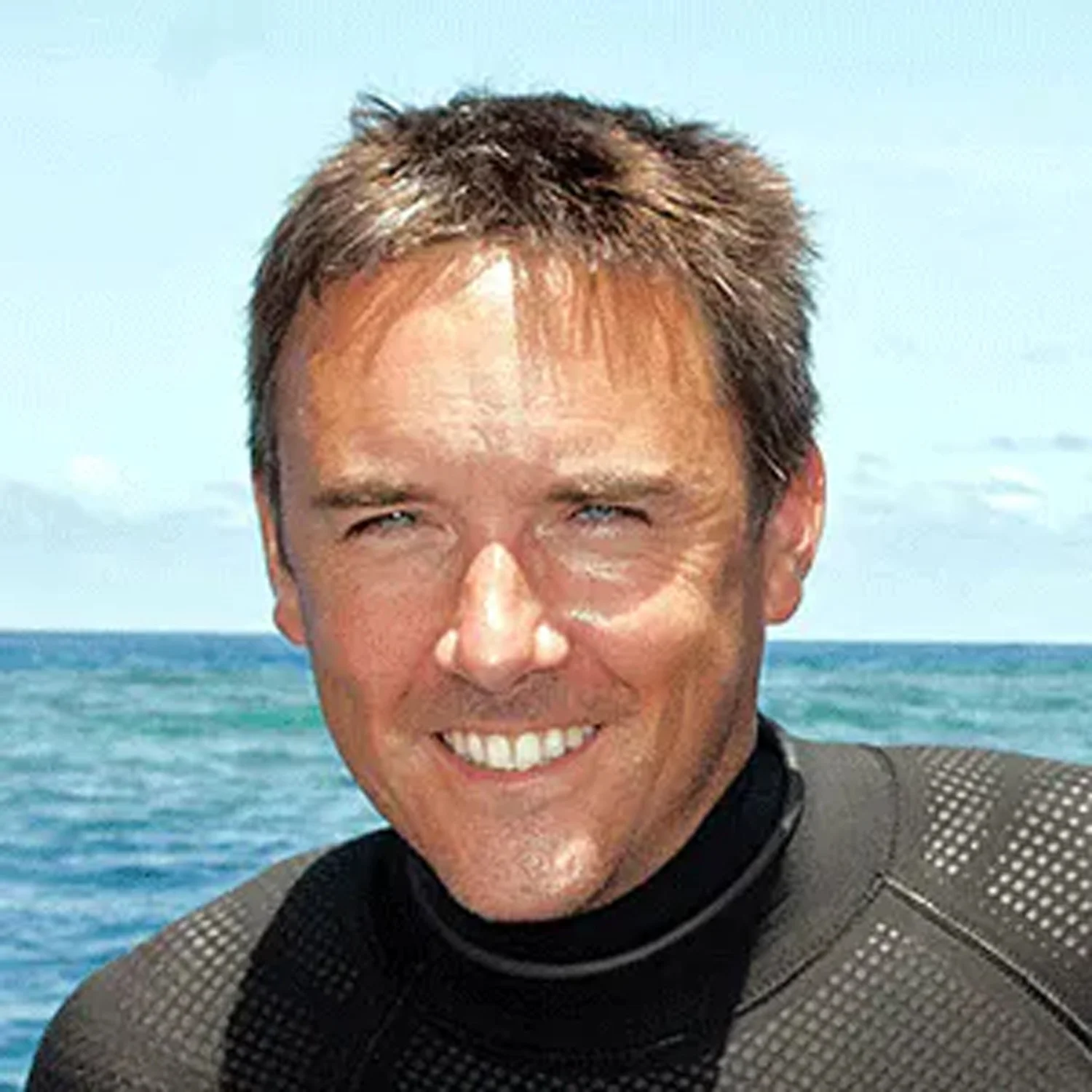
RICHARD VEVERS - Founder & CEO of The Ocean Agency · Featured in Netflix’s Chasing Coral
Richard Vevers is the Founder and CEO of The Ocean Agency. He is a fellow of The Explorers Club and an Adjunct Professor at the University of Rhode Island. He is best known for his leading role in the Emmy Award-winning documentary Chasing Coral on Netflix and his work has been featured in numerous publications and documentaries. Before diving into ocean and coral reef conservation, Vevers worked at some of the top London advertising agencies and then as an artist and underwater photographer. This background guides his unique creative and business-thinking approach to ocean conservation that includes inventing the camera that took Google Street View underwater, pioneering virtual reality ocean education, currently available to over 90 million kids, leading the most comprehensive underwater photographic survey of the world’s coral reefs, and developing a science-based global plan 50 Reefs."So I try to approach things in a different way to be a bit more disruptive. I think individual actions are important, but I think you need to turn it on its head so that it is very scalable, and often we focus on the negative. This is a transformative time, and we need to start thinking smarter about the solutions and how we live our lives. And so what I've tried to do is reframe climate action as something that is exciting and an opportunity. This is a transformative time when we need big ideas and there are opportunities for people doing what people do best - coming up with great ideas."www.theoceanagency.orgwww.50reefs.orgwww.creativeprocess.infowww.oneplanetpodcast.orgIG www.instagram.com/creativeprocesspodcast

ANTHONY WHITE - Artist - What is the Role of Artists in Society?
What role do the visual arts play in drawing upon history, activating democracy, and asking questions about what culture can do?Australian artist Anthony White lives and works in Paris. White’s artistic work revolves around the notion of reclaiming the act of dissent through the production of cultural objects. His research is situated at the intersection of several fields in the social space including, politics, human rights, and postcolonialism. His practice is centered around concepts of design and its history as a form of social and political expression. He works with painting, drawing, collage, and printmaking. Through this practice, he tackles relevant questions to our time, to encourage emancipation and new ways of thinking.Anthony White’s artwork has been exhibited in Australia, Europe, and Asia. He has received support through cultural agencies such as The Trust Company Australia, The National Association for the Visual Arts,(NAVA) and The Copyright Agency Limited (CAL). He has also received critical acclaim by recognition in the form of art prizes and reviews most notably The Marten Bequest Travelling Scholarship (2007) The Creative Art Fellowship at The National Library of Australia (2020) and acknowledgements in The Australia Financial Review, Art Collector Magazine Australia and also Elle Décor US edition. His exhibition Manifestation is on show from the 12–30 of July at Lennox Street Gallery, in Melbourne."Most of the landscape work that I'm making is heavily impastoed oil paintings, which are made with brushes and palette knives, and I was motivated to make a body of works about the climate catastrophe because of the short amount of time since I left Australia 14 years ago, the climate crisis has really hit areas of Australia in a such a dramatic way. That was a method of making the painting landscape orientated around different areas in Tasmania. I also felt that urgency to make the painting at that time. Growing up in Australia, the colonial legacy of landscape painters. And sailors, they had the tradition of actually drawing and painting, that was their basic skills. So they could draw and paint obviously in a pretty prescriptive way, but Australia's still quite fascinated with the landscape. When you grow up there, it's definitely something that stays within you. But I think that the story of the landscape, especially because it's not ours as an Australian, right? It will be interesting to see how that develops in the future and what happens with the story of Australian landscape and this story of Aboriginal landscape to come. It is an exciting place because Aboriginal person's perspective of landscape is much different because there are so many stories."www.anthonywhite.artwww.instagram.com/anthony_white_paris/www.metrogallery.com.au/exhibitions/manifestationwww.creativeprocess.infowww.oneplanetpodcast.orgIG www.instagram.com/creativeprocesspodcast

WORLD OCEANS DAY
Happy World Oceans Day! Today we’re streaming voices of environmentalists and artists with music courtesy of composer, producer and multi-instrumentalist Erland Cooper.Voices on this episode areGIULIO BOCCALETTIAuthor of Water, A BiographyNatural Resource Security & Environmental Sustainability ExpertChief Strategy Officer 2016–2020, The Nature ConservancyPAULA PINHODirector of Just Transition at the European Commission Directorate-General for EnergyRON GONENFounder & CEO of Closed Loop PartnersFmr. Deputy Commissioner of Sanitation, Recycling & Sustainability, NYCMARCIA DESANCTISJournalist, Essayist, Author of A Hard Place to Leave: Stories from a Restless LifeJEAN WEINERGoldman Environmental Prize WinnerFounder of Fondation pour la Protection de la Biodiversité Marine, HaitiDERRICK EMSLEYCo-founder & CEO of veritree - Data-driven Restorative Platform & tentree Apparel Co.DR. FARHANA SULTANACo-author: Water Politics: Governance, Justice & the Right to WaterFmr. UNDP Programme Officer, United Nations Development ProgrammeNEIL GRIMMERBrand President of SOURCE Global · Innovator of the SOURCE Hydropanel: Drinking Water Made from Sunlight and AirALAN JACOBSENDirector of PhotographyEmmy & Sundance Special Jury Award-Winning & Oscar Nominated DocumentariesRICHARD VEVERSFounder & CEO of The Ocean AgencyBRIAN WILCOXChief Engineer & Co-founder of Marine BioEnergyGrows Kelp in the Ocean to Provide Carbon-neutral FuelsSETH M. SIEGELEntrepreneur, Public Speaker & NYTimes Bestselling AuthorLet There Be Water: Israel’s Solution for a Water-Starved WorldTroubled Water: What's Wrong with What We DrinkJOELLE GERGISLead Author of the IPCC Sixth Assessment Report, Author of Humanity’s MomentJAY FAMIGLIETTI, Fmr. Senior Water Scientist at NASA Jet Propulsion Laboratory, Exec. Director, Global Institute for Water Security, Host of "What About Water?" PodcastROB BILOTTEnvironmental Lawyer, Partner Taft Stettinius & Hollister LLPAuthor of Exposure: Poisoned Water, Corporate Greed, and One Lawyer’s Twenty-Year Battle Against DuPontJILL HEINERTHExplorer, Presenter, Author of Into The Planet: My Life as a Cave DiverOSPREY ORIELLE LAKEFounder & Executive Director of the Women's Earth & Climate Action Network InternationalAuthor of Uprisings for the Earth: Reconnecting Culture with Nature & ArtistJESS WILBERInternational Outreach Citizens’ Climate LobbyCoordinator, Senior Stewards Acting for the EnvironmentBERTRAND PICCARDAviator of 1st Round-the-World Solar-Powered Flight, Explorer, Founder, Solar Impulse FoundationIBRAHIM ALHUSSEINIFounder & CEO of FullCycle Fund GARY GRIGGSGlobal Oceans Hero Award-Winner · Distinguished Professor of Earth SciencesDirector Institute of Marine Sciences at UC Santa Cruz 1991 to 2017Sample Credits:BBC News Excerpt, Public broadcast, 19th July. Fair usage, courtesy Simon Gurney, BBC Studios Limited.BBC News Excerpt, Public broadcast, 19th July. Fair usage, courtesy Simon Gurney, BBC Studios Limited.UN Broadcast Excerpt, Greta Thunberg, Young Climate Activist at the Opening of the Climate Action Summit 2019, United Nations license 24 October 2022.CBS News Excerpt 1970. Fair usage, archive courtesy Leah Hodge, CBSwww.erlandcooper.comwww.creativeprocess.info www.oneplanetpodcast.orgIG www.instagram.com/creativeprocesspodcastArtworks by Mia Funk www.miafunk.comMusic from Folded Landscapes courtesy of Erland Cooper and Universal Music Enterprises.