On Being
428 episodes — Page 6 of 9
Robert Coles, Diane Komp, and Carol Dittberner — Children and God (Dec 16, 2004)
Maria Montessori, the great 20th-century educational pioneer, observed that children have an intuition for religious life at an early age that is matched only by their capacity to acquire language. During this holiday season, Speaking of Faith explores the spiritual wisdom and intelligence of children—including their ability to process the difficult realities of life. See more at www.onbeing.org/program/children-and-god/76
Steven Waldman — The Future of Moral Values (Jan 20, 2005)
We deconstruct the phrase "moral values," which has confused and divided Americans since November's election. As the second term of George W. Bush commences, political analyst Steven Waldman helps explore what these words do and do not convey to liberals and conservatives, and why they still matter. What is at stake when both sides fail to understand the moral convictions of the other? See more at www.onbeing.org/program/future-moral-values/198
Phyllis Tickle + Lynn Clark — A Return To Mystery: Religion, Fantasy + Entertainment (Feb 3, 2005)
During the past decade, there has been an explosion of films and television programs containing religious and spiritual themes. Mel Gibson's The "Passion of the Christ" was only the tip of the iceberg. As new generations of Americans work out their spiritual and religious questions, they are increasingly turning to fantasy. We'll explore the deeper appeal of films like "Harry Potter" and "The Matrix," and we'll ask how fantasy in media reflects a changing spiritual imagination, especially in younger Americans. See more at www.onbeing.org/program/return-mystery-religion-fantasy-and-entertainment/57
Laurie Zoloth — A Theological Perspective on Cloning
The idea of human cloning both fascinates and repulses many, and challenges us to ask difficult religious questions? See more at www.onbeing.org/program/theological-perspective-cloning/59
Joel Marcus — The Jewish Roots of the Christian Story
New Testament writings about Jews may sound inflammatory in modern ears. A New Testament scholar with ties to both Judaism and Christianity helps us put these writings in context and look for meaning in the Passion that Hollywood and popular culture can't convey. See more at www.onbeing.org/program/jewish-roots-christian-story/205
Sylvia Poggioli, Donald Cozzens, and Margaret A. Farley — The Religious Legacy of John Paul II
John Paul II's papacy was dramatic and historic on many fronts. Speaking of Faith explores some of the critical religious issues of his 26 years as pontiff and discusses the great and contradictory impact he made on the Catholic Church in America and abroad. Host Krista Tippett speaks with NPR's senior European correspondent Sylvia Poggioli, priest and author Donald Cozzens, and Yale theologian Margaret Farley. See more at www.onbeing.org/program/religious-legacy-john-paul-ii/221
Jelle de Boer and Ursula Goodenough — The Morality of Nature
We explore the human and religious implications of natural disasters through the eyes of two scientists steeped in the workings of the natural world. We approach the morality of nature from a non-theological angle, tracing how natural disasters have sometimes fueled religious agendas and movements and how strictly scientific perspectives can both challenge and illuminate religious questions. See more at www.onbeing.org/program/morality-nature/210
Debbie Morris, Helen Prejean, and Elie Spitz — Reflections on the Death Penalty in America
The American public supports the principle of capital punishment, but there is a growing consensus among Jewish and Christian thinkers — across traditional liberal/conservative lines — that it should be abolished in this country or suspended while the system for imposing it is made more just. Reflections on justice, forgiveness, and the nature of God shed new light on America's death penalty debate. See more at www.onbeing.org/program/reflections-death-penalty-america/151
Abdul-Rasheed Muhammad — Serving Country, Serving Allah
There are an estimated 4,000 Muslim soldiers in the U.S. military, though some counts place that number much higher. We'll speak with the first Muslim imam in the US Army Chaplaincy -- Major Abdul-Rasheed Muhammad -- about Iraq, faith, and military service. See more at www.onbeing.org/program/serving-country-serving-allah/174
Khaled Abou El Fadl and Harold M. Schulweis — Religion and Our World in Crisis
In this personal exchange between a Jewish rabbi and Islamic scholar, host Krista Tippett explores the integrity of religious faith and openness to the faiths of others. In a world in which religious experience is implicated in violence, two thinkers discuss how it is possible to love their own traditions and honor those of others. This program was recorded live at the Skirball Cultural Center in Los Angeles in June 2003. See more at www.onbeing.org/program/religion-and-our-world-crisis/153
Joseph L. Price — In Praise Of Play
If sport is an American religion, is that bad for us? What is the metaphysic of baseball? In this show, we'll speak with a theologian and sports fan who has spent much of his career studying the religious character of rituals in sporting events and the spiritual significance of fans' attention to sports. See more at www.onbeing.org/program/praise-play/111
Kecia Ali, Omid Safi, Precious Rasheeda Muhammad, and Michael Wolfe — Progressive Islam in America
In the years since the terrorist attacks of September 11th, 2001, scrutiny of the religion of Islam has become part and parcel of our public life. In forums of all kinds, often guided by non-Muslim pundits, we ask, what does terrorism have to do with the teachings of the Qur'an? Can Islam coexist with democracy? Is Islam capable of a reformation, or has it fallen into hopeless decay? We pose these questions to a spectrum of American Muslims who describe themselves as devout and moderate. Our guests take us inside the way Muslims discuss such questions among themselves, and they suggest that when we consider "the Muslim world" we must look first at Islam in this country. In this open society, they say, Islam has found a home like no other. See more at www.onbeing.org/program/progressive-islam-america/146
Miroslav Volf — Religion and Violence
Religious extremism drives some of the most intractable conflicts around the world. Our guest knows this shadow side of the Christian faith in his personal history. We'll speak about what goes wrong when religion turns violent, and why, he believes, the cure for religious zealotry is not less religion but more religion — or rather stronger and more intelligent practices of faith. See more at www.onbeing.org/program/religion-and-violence/155#sthash.P3WmxEEW.dpuf
James K. A. Smith and Nancey Murphy — Evangelicals, Out of the Box
Stereotypes tell us this: Evangelical Christians are politically conservative, closed-minded, morally judgmental, and anti-science. We speak with two creative members of a new generation of Evangelical thinkers and teachers, who defy stereotypes and reveal an evolving character for this vast movement that describes 40 percent of Americans. See more at www.onbeing.org/program/evangelicals-out-box/92
Joan Brown Campbell and Thomas Hoyt, Jr. — Living Reconciliation Two Ecumenical Pioneers
Two people with unique perspectives both discovered ecumenism — the movement to reconcile Christian churches — during the Civil Rights era. They'll describe what they've learned about grappling with vexing clashes of difference, and why reconciliation among different Christians still matters in a multi-religious, post-Katrina world. See more at www.onbeing.org/program/living-reconciliation-two-ecumenical-pioneers/127
Don Saliers and Edward Foley — The Meaning of Communion: At the Table
What are the origins of communion, and what is its deepest social relevance? Two leading theologians of communion describe a ritual that is not just personally meaningful for the believer, but also collectively and ethically challenging for Christians. See more at www.onbeing.org/program/table-meaning-communion/69

Joan Halifax — A Midwife to the Dying
The Terri Schiavo case earlier this year raised ethical and medical issues that remain with us today. But missing in that debate was a real attention to the quality and the meaning of death. Joan Halifax tells us what she's learned and how she lives differently after three decades accompanying others to the final boundary of human life. See more at www.onbeing.org/program/midwife-dying/52
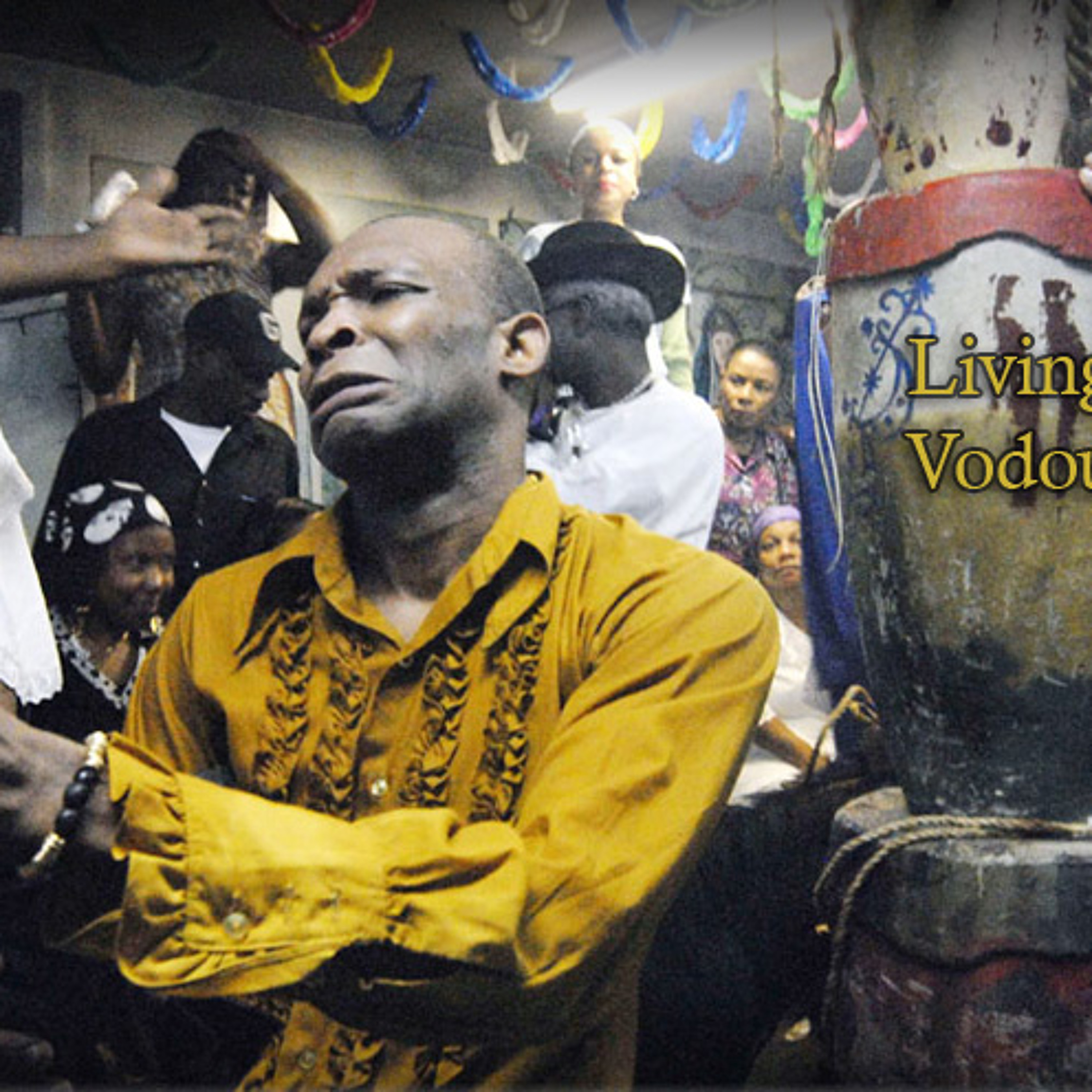
Patrick Bellegarde-Smith — Living Vodou (Jan 9, 2014)
The word "Vodou" evokes images of sorcery and sticking pins into dolls. In fact, it's a living tradition wherever Haitians are found based on ancestral religions in Africa. We walk through this mysterious tradition — one with dramatic rituals of trances and dreaming and of belief in spirits, who speak through human beings, with both good and evil potential. See more at www.onbeing.org/program/living-vodou/128
Marilynne Robinson + Marcelo Gleiser — The Mystery We Are (Jan 2, 2013)
Marcelo Gleiser is an astrophysicist. Marilynne Robinson is a novelist. They’re both passionate about the majesty of science and they share a caution about what they call our modern “piety” towards science. They connect thrilling dots among the current discoveries about the cosmos and the new territory of understanding our own minds. A joyous, heady discussion of “the mystery we are.”
Alberto Ambrosio + Elpidophoros Lambriniadis — Spiritual Boundaries in Modern Turkey (Aug 2, 2012)
We meet a Fr. Alberto Ambrosio, a Dominican friar whose Christianity is inspired by the mystical tradition of Islam. And, Metropolitan Elpidophoros Lambriniadis, an Eastern Orthodox bishop, is creating what he calls a 'dialogue of life' as a religious minority in this crucible of the ancient church.
Jim Daly and Gabe Lyons — The Next Christians (Sep 20, 2012)
Two Christian leaders are working to restore Christian engagement in the world. Gabe Lyons and Jim Daly discuss how they who are reshaping their part in common life, and the common good. This often surprising conversation addresses subjects like gay marriage, abortion, and the strident reputation that Christian evangelicals have earned in the past decade. See more at http://www.onbeing.org/program/next-christians/4839
Sen. Pete Domenici and Alice Rivlin — Political Bridge People (Oct 25, 2012)
A veteran Republican senator and Democratic economist are political bridge people who've brought differing approaches and shared love of country to generations of economic policy. In this tense political moment, they offer straight talk and wise perspective — and won’t let partisan gridlock have the last word. The final dialogue in our Civil Conversations Project. See more at http://www.onbeing.org/program/political-bridge-people-pete-domenici-and-alice-rivlin/4892
Sherry Turkle — Alive Enough? Reflecting — Our Technology (Nov 15, 2012)
Each of us, in our everyday interactions, chooses between letting technology shape us and shaping it towards human purposes, even towards honoring what we hold dear. Sherry Turkle, director of the MIT Initiative on Technology and Self, is full of usable ideas — from how to declare email bankruptcy to teaching our children the rewards of solitude. See more at http://www.onbeing.org/program/alive-enough-reflecting-our-technology/63
Robi Damelin and Ali Abu Awwad — No More Taking Sides (Nov 29, 2012)
Robi Damelin lost her son David to a Palestinian sniper. Ali Abu Awwad lost his older brother Yousef to an Israeli soldier. But, instead of clinging to traditional ideologies and turning their pain into more violence, they've decided to understand the other side — Israeli and Palestinian — by sharing their pain and their humanity. They tell of a gathering network of survivors who share their grief, their stories of loved ones, and their ideas for lasting peace. They don't want to be right; they want to be honest. See more at http://www.onbeing.org/program/no-more-taking-sides/134
Kate Braestrup — A Presence in the Wild (Dec 13, 2012)
Kate Braestrup is a chaplain to game wardens, often on search and rescue missions, in the wilds of Maine. She works, as she puts it, at hinges of human experience when lives alter unexpectedly — where loss, disaster, decency and beauty intertwine. Hear her wise and unusual take on life and death, lost and found. See more at http://www.onbeing.org/program/presence-wild/144
Jon Kabat-Zinn — Opening to Our Lives and a Science of Mindfulness (Dec 27, 2012)
Jon Kabat-Zinn has learned, through science and experience, about mindfulness as a way of life. This is wisdom with immediate relevance to the ordinary and extreme stresses of our time — from economic peril, to parenting, to life in a digital age. See more at http://www.onbeing.org/program/opening-our-lives/138
Tami Simon — Inner Life at Work: Business, Meditation, and Technology (May 30, 2013)
You might call Tami Simon a spiritual entrepreneur. She's built a successful multimedia publishing company with a mission to disseminate "spiritual wisdom" by diverse teachers and thinkers like Pema Chödrön and Eckhart Tolle, Daniel Goleman and Brené Brown. She offers compelling lessons on joining inner life with life in the workplace — and advice on spiritual practice with a mobile device.
Omid Safi and Seemi Bushra Ghazi — The Spirit of Islam (Jan 6, 2005)
We experience the religious thought and the spiritual vitality of two Muslims—male and female—both American and both with roots in ancient Islamic cultural, intellectual, and spiritual traditions. Their stories and ideas, music, and readings, evoke a sense of the richness of global Islamic spirituality and of some of its hidden nuances and beauty. They reveal how sound, music, and especially poetry offer a window onto the subtleties and humanity of Islamic religious experience. See more at www.onbeing.org/program/spirit-islam/226
Where Was God? (Sep 22, 2001)
Great religious minds reflect on tragedies surrounding September 11, 2001. As America moves beyond raw emotion and religious sentiment, this program explores theological and spiritual reflection for the long haul. A gathering of provocative reflections across a broad spectrum of faith, woven together with evocative sound and music. See more at www.onbeing.org/program/where-was-god/243
Walter Brueggemann — The Prophetic Imagination (Dec 19, 2013)
The people we later recognize as prophets, says Walter Brueggemann, are also poets who reframe what is at stake in chaotic times. A special voice addressing our changing lives and the deepest meaning of hope this season. See more at www.onbeing.org/program/prophetic-imagination-walter-brueggemann/475
Phil Donahue — Transformation, On-Screen and Off (Dec 12, 2013)
Talk show pioneer Phil Donahue opens up on his remarkable perspective on the last half century of America and who we are now. He shares with Krista Tippett his personal transformations on race, gender roles, and parenting in the dramatic era he captured on television. http://www.onbeing.org/program/phil-donahue-on-transformation-on-screen-and-off/6081
Vincent Harding and Phyllis Tickle — Racial Identity in the Emerging Church and the World
Emerging church elder Phyllis Tickle and civil rights veteran Vincent Harding in an honest and sometimes politically incorrect conversation on coming to terms with racial identity in the church and in the world. http://www.onbeing.org/program/racial-identity-in-the-emerging-church-and-the-world/6059
Martin Rees — Cosmic Origami and What We Don't Know
Some of the biggest philosophical and ethical questions of this century may be raised on scientific frontiers — as we gain a better understanding of the deep structure of space and time and the wilder "microworld." Astrophysicist Martin Rees paints a fascinating picture of how we might be changed by what we do not yet know: "If science teaches me anything, it teaches me that even simple things like an atom are fairly hard to understand. And that makes me skeptical of anyone who claims to have the last word or complete understanding of any deep aspect of reality." See more at www.onbeing.org/program/cosmic-or…-we-dont-know/250
Ira Byock — Contemplating Mortality (Nov 7, 2013)
What if we understand death as a developmental stage — like adolescence or mid-life? Dr. Ira Byock says we lose sight of "the remarkable value" of the time of life we call dying if we forget that it's always a personal and human event, and not just a medical one. From his place on this medical frontier, he shares how we can understand dying as a time of learning, repair, and completion of our lives. www.onbeing.org/program/contempla…ortality/11072013
Esther Sternberg — The Science of Healing Places
Who knew that the architect behind St. Paul's Cathedral was also an anatomist who diagrammed the human brain? Today, scientists of the brain are learning why our sensory experience in a place like a cathedral — the incense, the soaring music, the stained glass, and the light — is physiologically good for us: "What is it about beautiful vistas of mountains, about the infinite horizon of the ocean, about a cathedral? There are certainly physiological and neuroscientific bases to that feeling, and I am convinced — I know — that these things can be measured. And that's the exciting new frontier for me, to ask exactly that question." Esther Sternberg is an immunologist and a pioneer on this new frontier that's giving rise to disciplines like neuroimmunology and environmental psychology. Architects are working with scientists to imbue the spaces we move through — the sights, sounds, and smells of them — with active healing properties. And Esther Sternberg says all of us can create surroundings and even portable sensations to manage stress and tap our brain's own internal pharmacies. http://www.onbeing.org/program/the-science-of-healing-places/4856
David Sloan Wilson — Evolving a City
David Sloan Wilson believes that evolution is not just a description of how we got here. He says it can also be a tool kit for improving how we live together. He’s taken what he’s learned in studying evolution in animals and is now applying it to the behavior of groups in his hometown of Binghamton, New York. His goal is to help people behave pro-socially — at their best, and for the good of the whole. See more at www.onbeing.org/program/evolving-city/4720
Keith Devlin — The Joy of Math and Learning and What it Means to Be Human
Mathematical equations are like sonnets says Keith Devlin. And, the mathematician says that what most of us learn in school doesn’t begin to convey what mathematics is. Technology may free more of us to discover the wonder of mathematical thinking — as a reflection of the inner world of our minds. Keith Devlin began to learn this as a teenager and he’s been a math evangelist ever since: "It was as if I'd been stumbling around in a forest, and suddenly I've climbed to the top of a tree and looked out and thought, this is the most beautiful place in the world. You can't tell it when you're down in the trees, which I had been, but the moment you reach an elevation where it all falls into place and you can see the topographic display in front of you, then the beauty is incredible. And the moment I discovered it, I said, I want to study mathematics. And I've been studying it ever since." See more at www.onbeing.org/program/the-joy-of-math-keith-devlin-on-learning-and-what-it-means-to-be-human/5946
Arthur Zajonc — Holding Life Consciously (Sep 12, 2013)
What happens when you bring together science and poetry on something like color or light? Arthur Zajonc is a physicist and contemplative. And he says we can all investigate life as vigorously from the inside as from the outside. See more at www.onbeing.org/program/arthur-zajonc-on-holding-life-consciously/109
Natalie Batalha — Exoplanets and Love: Science That Connects Us to One Another (Aug 29, 2013)
http://www.onbeing.org/program/on-exoplanets-and-love/5029 For Natalie Batalha of NASA's Kepler Mission, it's just a matter of time before we look at the sky and know of planets where life exists. And that, she says, will transform our sense of ourselves: "When you look up at the sky on a very dark night at those stars or that crescent moon or whatever it is, what do you feel? You feel wonder, of course. You feel humility. But I think you also feel lonely, small, insignificant. There's a profound sense of loneliness, or just the universe is so big and I'm so small. But imagine in the near-term future, your grandchild or your great-grandchild looks up in the sky and his mother can point to a star and say, that star right there? That star has a planet just like Earth, and it harbors life. That's a different perspective. That's completely different when we can look up in the sky and know that. It's a game-changer." A luminous voice of how we explore the heavens now — bringing the exuberance of science closer to home to us all. "We are extending our senses out into the cosmos in a very real, tangible way, and that makes it so much easier to capture our imagination, to inspire us. Through the Curiosity Rover, we are standing there in our hiking boots on the surface of Mars. Man, I can practically hear the crunching of the dirt underneath my feet. It feels like I could bend down and pick up a rock and toss it over that hill over there, you know? So in a very real way, these experiments are extending our senses out into the cosmos."
Kwame Anthony Appiah — Sidling Up to Difference: Social Change and Moral Revolutions (Aug 15 2013)
How can unimaginable social change happen in a world of strangers? Kwame Anthony Appiah is a philosopher who studies ethics and his parents' marriage helped inspire the movie "Guess Who's Coming to Dinner." In a tense moment in American life, he has refreshing advice on simply living with difference. http://www.onbeing.org/program/sidling-difference/175
Sylvia Earle — Her Deepness (Aug 8, 2013)
Sylvia Earle has done something no one else has — walked solo on the bottom of the sea, under a quarter mile of water. She tells what she saw — and what she has learned — about the giant, living system that is the ocean. And, she explains why seeing a shark is a sign for hope. See more at www.onbeing.org/program/her-deepness-oceanographer-sylvia-earle/4673
David Montgomery — Reading The Rocks: Flood Stories and Deep Time (Aug 1, 2013)
The push and pull between religion and science has shaped advances in geology from the beginning. Geomorphologist David Montgomery set out to debunk Noah’s Flood; instead he discovered this biblical story was the plate tectonics of its day. He tells us how the evolution of landscapes and geological processes shape ecology and humanity. And, how we should read rocks for the stories they tell about who we are and where we came from: "Geology really is, essentially, the scientific creation story. How did it really work? What can we tell from the nature of the universe around us that would inform us in our thinking about how we got to the place we are now? I think that really is central to our sort of view of ourselves as a species, our place in the universe, as well as sort of your personal relationship to the universe. What am I doing here?" See more at www.onbeing.org/program/reading-the-rocks/5851
David Gushee and Frances Kissling — Pro-Life, Pro-Choice, Pro-Dialogue (July 25, 2013)
No issue in America is more intractable than abortion. Or is it? The issue of abortion has again raised its divisive head. Lost in that specter is the enduring fact that most of us don't identify with the absolute positions of always for, or always against, abortion. We never start our public discussions in that nuanced moral center. We wonder why this issue remains so contentious — and what might be at stake in it for us as a culture — that gets hidden by political stalemate? In this podcast, two people demonstrate a different way forward is possible. Frances Kissling, a longtime reproductive rights activist: "Abortion very late in pregnancy, abortion of disabled fetuses, these to me are very, very complicated questions. Even though I don't think fetuses have an absolute right to life, I think fetuses have value. And I don't think you can make the fetus invisible." And David Gushee, a Christian ethicist: "A concern I have about my own side is, what the main activists in the pro-life or anti-abortion community want is an overturn of Roe vs. Wade. I am not at all convinced that if that were to actually happen that they would like the world that they would see on the other side." A conversation that doesn't begin or end in the predictable places. See more at www.onbeing.org/program/pro-life-pro-choice-pro-dialogue/4863
Meredith Monk's Voice (June 27, 2013)
http://www.onbeing.org/program/meredith-monks-voice/1398 Singer and composer Meredith Monk is a kind of archeologist of the human voice. She says that "the voice could be like the body" — flexible and fluid with practice. Through music as through meditation, the longtime Buddhist practitioner pushes the boundaries of what we can do without words.
Sarah Kay's Way with Words (June 13, 2013)
www.onbeing.org/program/sarah-kays-way-words/4548 Sarah Kay says that listening is the better part of speaking. She's a spoken word poet in her twenties who is inspiring teenagers around the world — with the way she uses words: "I like words, I love strange words, I love words that mean exactly what I need them to mean, and the word flux, when I found that word, I loved the way it was fluffy but it was sharp, it was just everything that I wanted and also, my life is just eternally in flux and just has been and probably always will be." Sarah Kay says her job description is rediscovering wonder, and rediscovering how language and listening make impossible connections between people.
S. James Gates — Uncovering the Codes for Reality (June 6, 2013)
Are we in the matrix? Physicist S. James Gates reveals why string theory stretches our imaginations about the nature of reality. Also, how failure makes us more complete, and imagination makes us more knowledgeable. See more at www.onbeing.org/program/uncovering-codes-reality/1457
Andrew Zolli — A Shift to Humility: Resilience and Expanding the Edge of Change (May 16, 2013)
Disruption is around every corner by way of globally connected economies, inevitable superstorms, and technology’s endless reinvention. But most of us were born into a culture which aspired to solve all problems. How do we support people and create systems that know how to recover, persist, and even thrive in the face of change? Andrew Zolli introduces "resilience thinking," a new generation’s wisdom for a world of constant change.
Sylvia Boorstein — What We Nurture (May 9, 2013)
For Mother's Day, the celebrated Jewish-Buddhist teacher and psychotherapist, mother, and grandmother: Sylvia Boorstein. The best way to nurture children's inner lives, she says, is by taking care of our own inner selves for their sake. At a public event in suburban Detroit, Krista Tippett draws out the warmth and wisdom of Ms. Boorstein, and, in a light-hearted moment that is an audience pleaser, Ms. Boorstein shares what GPS might teach us about "recalculating" and our own inner equanimity. See more at http://www.onbeing.org/program/what-we-nurture-with-sylvia-boorstein/242
Lawrence Krauss — Our Origins and the Weight of Space
One of the values of science is to make us uncomfortable says Lawrence Krauss. The particle physicist explains why we should all care about dark energy and the Higgs Boson particle. Science literacy matters, and, more importantly, he suggests we should take joy in science — just as we cultivate enjoyment of arts we may not completely comprehend. http://www.onbeing.org/program/our-origins-and-the-weight-of-space-with-lawrence-krauss/5216
Alan Rabinowitz — A Voice for the Animals (April 18, 2013)
A profound stutter as a child left Alan Rabinowitz virtually unable to communicate and to prefer animals to people. Now a conservationist of tigers and jaguars, an explorer of the world's last wild places, he has extraordinary insight into both animals and the human condition. See more at www.onbeing.org/program/voice-animals/60