
Nursing Mnemonics Podcast by NURSING.com (Nursing Podcast, NCLEX® Prep for nursing students)
135 episodes — Page 2 of 3

Cardiac Valves Blood Flow Nursing Mnemonic (Toilet Paper my Ass)
Download for FREE today - special Mnemonics Cheatsheet - so you can be SURE that you have that Must Know information down: bit.ly/nursing-memory Outline Toilet Paper My Ass T-Tricuspid P-Pulmonic M-Mitral A-Aortic Description This simple mnemonic helps to remember the order in which blood passes through the four heart valves in sequential order.

Cancer – Early Warning Signs Nursing Mnemonic (CAUTION UP, CANCER)
Download for FREE today - special Mnemonics Cheatsheet - so you can be SURE that you have that Must Know information down: bit.ly/nursing-memory Outline CAUTION UP C-Change in bowel or bladder A-A lesion that does not heal U-Unusual bleeding or discharge T-Thickening or lump in breast or elsewhere I-Indigestion or difficulty swallowing O-Obvious changes in wart or mole N-Nagging cough or persistent hoarseness U-Unexplained weight loss P-Pernicious Anemia Description Cancer can sometimes be difficult to identify, but the earlier it is detected the better chance treatment will be effective. Outline CANCER C-Comfort A-Altered Body Image N-Nutrition C-Chemotherapy E-Evaluate response to meds R-Respite for caretakers Description These are the top nursing priorities for a patient with CANCER

Bleeding Precautions Nursing Mnemonic (RANDI)
Download for FREE today - special Mnemonics Cheatsheet - so you can be SURE that you have that Must Know information down: bit.ly/nursing-memory Outline RANDI R-Razor Electric/Blades A-Aspirin N-Needles- small gauge D-Decrease needle sticks I-Injury (Protect from) Description If a patient is taking an anticoagulant to prevent blood clots there is increase risk for bleeding. Be careful with blades when shaving. Do not take aspirin as it interferes with blood clotting and can magnify the effect of the medication. Avoid excess needle sticks and protect the patient from injury.

Asthma management Nursing Mnemonic (ASTHMA)
Download for FREE today - special Mnemonics Cheatsheet - so you can be SURE that you have that Must Know information down: bit.ly/nursing-memory Outline ASTHMA A-Adrenergic (albuterol) S-Steroids T-Theophylline H-Hydration (IV) M-Mask (oxygen) A-Antibiotics Description The therapeutic management for a patient with asthma. Asthma is a spasming of the airways, which causes difficulty breathing.

Appendicitis – Assessment Nursing Mnemonic (PAINS)
Download for FREE today - special Mnemonics Cheatsheet - so you can be SURE that you have that Must Know information down: bit.ly/nursing-memory Outline PAINS P-Pain in the right lower quadrant of the abdomen A-Anorexia-loss of appetite I-Increased temperature, WBC (15,000-20,000) N-Nausea S-Signs (McBurney's, Psoas) Description Psoas sign is pain when a patient extends their thigh while lying on their side with knees extended. It indicates irritation to certain abdominal muscles. McBurney's sign is if there is deep tenderness at McBurney's point, which is located on the right side of the abdomen, one-third the distance from the anterior superior iliac spine to the navel.

Arterial Blood Gases Nursing Mnemonic (ROME)
Download for FREE today - special Mnemonics Cheatsheet - so you can be SURE that you have that Must Know information down: bit.ly/nursing-memory Outline ROME R-Respiratory O-Opposite M-Metabolic E-Equal Description First look at the pH: if it is low it is acidosis, high indicates alkalosis. Second use the ROME mnemonic to determine if you have respiratory vs. metabolic. For Metabolic look at HCO3. For Respiratory, look at pCO2. Metabolic Acidosis – pH Low, HCO3 Low. Metabolic Alkalosis – pH High, HCO3 High. Respiratory Acidosis – pH Low, pCO2 High. Respiratory Alkalosis – pH High, pCO2 Low.

Altered Mental Status Nursing Mnemonic (AEIOU TIPS)
Download for FREE today - special Mnemonics Cheatsheet - so you can be SURE that you have that Must Know information down: bit.ly/nursing-memory Outline AEIOU TIPS A-Alcohol/durgs E-Endocrine I-Insulin O-Overdose U-Uremia T-Trauma I-Infection P-Psychiatric S-Shock Description There are many reasons why a patient may present with altered mental status. Neurological injury is not the only reason for AMS! Make sure you explore all possibilities.

Alzheimer – Diagnosis Nursing Mnemonic (The 5 A's)
Download for FREE today - special Mnemonics Cheatsheet - so you can be SURE that you have that Must Know information down: bit.ly/nursing-memory Outline The 5 A's A-Amnesia – loss of memories A-Anomia – unable to recall names of everyday objects A-Apraxia – unable to perform tasks of movement A-Agnosia – inability to process sensory information A-Aphasia – disruption with ability to communicate Description The 5 A's of Alzhemiers Disease. These signs point to a diagnosis of Alzheimer's Type Dementia

Adrenal Gland Hormones Nursing Mnemonic (The 3 S's)
Download for FREE today - special Mnemonics Cheatsheet - so you can be SURE that you have that Must Know information down: bit.ly/nursing-memory Outline The 3 S's S-Sugar (Glucocorticoids) S-Salt (Mineralcorticoids) S-Sex (Androgens) Description There are three different adrenal gland hormones which can be remembered as the 3 Ss: sugar (glucocorticoids) affects glucose utilization, fat metabolism and aid in reducing inflammation. Salt (mineralcorticoids) plays a role in electrolyte regulation. Androgens are commonly referred to as sex hormones.

Vitamins – Fat Soluble Nursing Mnemonic (All Dogs Eat Kibble)
Download for FREE today - special Mnemonics Cheatsheet - so you can be SURE that you have that Must Know information down: bit.ly/nursing-memory Outline All Dogs Eat Kibble A-Vitamin A D-Vitamin D E-Vitamin E K-Vitamin K Description Vitamins A, D, E, and K are all fat soluble vitamins. Dogs get fat eating too much kibble

Steroids – Side Effects Nursing Mnemonic (6 S's)
Download for FREE today - special Mnemonics Cheatsheet - so you can be SURE that you have that Must Know information down: bit.ly/nursing-memory Outline 6 S's S-Sugar – hyperglycemia S-Soggy Bones – causes osteoporosis S-Sick – decreased immunity S-Sad – depression S-Salt – water and salt retention (hypertension) S-Sex – decreased libido Description Steroids are an effective treatment for asthma, COPD, Crohn's, Lupus and more. However,they have the potential for very serious side effects, which are indicated by the 6 S's. Steroids can be taken by mouth, via an inhaler, topically, or via injection.

Traction – Nursing Care Nursing Mnemonic (TRACTION)
Download for FREE today - special Mnemonics Cheatsheet - so you can be SURE that you have that Must Know information down: bit.ly/nursing-memory Outline TRACTION T-Temperature (Extremity, Infection) R-Ropes hang freely A-Alignment C-Circulation Check (5 Ps) T-Type & Location of fracture I-Increase fluid intake O-Overhead trapeze N-No weights on bed or floor Description Nursing care and responsibilities with patients in traction

Sprains and Strains – Nursing Care Nursing Mnemonic (RICE)
Download for FREE today - special Mnemonics Cheatsheet - so you can be SURE that you have that Must Know information down: bit.ly/nursing-memory Outline RICE R-Rest I-Ice C-Compression E-Elevation Description These four basic interventions can help to alleviate the symptoms of a sprain or a strain. A strain is excessive stretching of muscle. A sprain is excessive stretching of ligament.

Steps in the Nursing Process 2 Nursing Mnemonic (AAPIE)
Download for FREE today - special Mnemonics Cheatsheet - so you can be SURE that you have that Must Know information down: bit.ly/nursing-memory Outline AAPIE (An Apple PIE) A-Assessment A-Analysis P-Planning I-Implementation E-Evaluation Description These are the steps of the nursing process. Gather information, determine the problem and the best approach. Implement your interventions, and then evaluate! Never skip a step!!

Survive NCLEX Prep - No More Drowning, Study Anywhere You Want (with NURSING.com)
Hi NURSING.com family. You can now prep for the NCLEX Anywhere! We just released a new Podcast show, "NCLEX Flash Notes." This is the perfect NCLEX review, and as ALWAYS, we have pulled out the MOST important info that you need to become an Amazing nurse! Listen in each week while we review the critical topics you need to pass the NCLEX Exam. Each episode will cover different MUST-know nursing topics, with a perfect overview of all you need to know. Our new show is NCLEX Flash Notes. Just click the link below for a direct link to the show on either iTunes OR Spotify! https://nursing.com/flashnotes

Steps in the Nursing Process 1 Nursing Mnemonic (ADPIE)
Download for FREE today - special Mnemonics Cheatsheet - so you can be SURE that you have that Must Know information down: bit.ly/nursing-memory Outline ADPIE (A Delicious PIE) A-Assessment D-Diagnosis P-Planning I-Implementation E-Evaluation Description These are the steps of the nursing process. Gather information, determine the problem and the best approach. Implement your interventions, and then evaluate! Never skip a step!!

IADLS (Instrumental Activities of Daily Living) Nursing Mnemonic (SCUM)
Download for FREE today - special Mnemonics Cheatsheet - so you can be SURE that you have that Must Know information down: bit.ly/nursing-memory Outline SCUM S-Shopping C-Cooking and Cleaning U-Using telephone or transportation M-Managing money and medications Description The instrumental activities of daily living are used to determine a patient's ability to carry out necessary functions for independent living. If they are unable to manage the activities below, they will likely require some sort of assistance from family or a home health agency, etc.
Prepping For The NCLEX with NURSING.com (Nursing Podcast, NCLEX® Review for nursing students to help you ace the NCLEX Exam)
Hi NURSING.com family. Are you getting ready for the NCLEX?? This show is the perfect NCLEX review, and as ALWAYS, we have pulled out the MOST important info that you need to become an Amazing nurse! Listen in each week while we review 77 critical topics you need to pass the NCLEX-RN Exam. Each episode will cover these MUST-know nursing topics with a perfect overview. Our new show is NCLEX Flash Notes. You can search that in apple podcasts or spotify and pull up the SHOW. NCLEX Flash Notes NCLEX Flash Notes is your go-to last-minute refresher for the NCLEX exam. Cut through the fluff and get straight to the essential information with this free resource.

Bleeding Complications (Minor) Nursing Mnemonic (BEEP)
Download for FREE today - special Mnemonics Cheatsheet - so you can be SURE that you have that Must Know information down: bit.ly/nursing-memory Outline BEEP B-Bleeding gums E-Epistaxis (nose bleeds) E-Ecchymosis (bruising) P-Petechiae Description Use the mnemonic BEEP to remember minor bleeding precautions. Think – if the patient sees any bleeding, they'll BEEP the call light!

Canes Nursing Mnemonic (COAL)
Download for FREE today - special Mnemonics Cheatsheet - so you can be SURE that you have that Must Know information down: bit.ly/nursing-memory Outline COAL C-Cane O-Opposite A-Affected L-Leg Description When teaching a patient how to walk with a cane it is important to instruct them to keep the cane on the opposite side of the affected extremity.

Body Systems Nursing Mnemonic (MR DICE RUNS)
Download for FREE today - special Mnemonics Cheatsheet - so you can be SURE that you have that Must Know information down: bit.ly/nursing-memory Outline MR DICE RUNS M-Muscular R-Respiratory D-Digestive I-Integumentary C-Circulatory E-Endocrine R-Reproductive U-Urinary N-Nervous S-Skeletal Description To remember the 10 major body systems.

ADLs (Activity of Daily Living) Nursing Mnemonic (BATTED)
Download for FREE today - special Mnemonics Cheatsheet - so you can be SURE that you have that Must Know information down: bit.ly/nursing-memory Outline BATTED B-Bathing A-Ambulation T-Toileting T-Transfers E-Eating D-Dressing Description When assessing a patient's ability to care for him or herself at home we must assess their ability to complete activities of daily living. A patient's ability to bath, walk, and toilet on their own will help us determine the level of care they will need when they leave the hospital.

Lidocaine Toxicity – Signs and Symptoms Nursing Mnemonic (SAMS)
Download for FREE today - special Mnemonics Cheatsheet - so you can be SURE that you have that Must Know information down: bit.ly/nursing-memory Outline SAMS S-Slurred Speech A-Altered Central Nervous System M-Muscle Twitching S-Seizures Description Lidocaine is an anesthetic that prevents painful impulses from reaching the brain. These are signs that the patient may have had too much lidocaine (like buying in bulk)

Emergency Drugs Nursing Mnemonic (LEAN)
Download for FREE today - special Mnemonics Cheatsheet - so you can be SURE that you have that Must Know information down: bit.ly/nursing-memory Outline LEAN L-Lidocaine E-Epinephrine A-Atropine Sulfate N-Narcan Description The above drugs work in a variety of emergency settings, they are good drugs to LEAN on. Lidocaine can be used in emergency situations for ventricular arrhythmias. Epinephrine is a vital drug in the ACLS protocol. Atropine can be given with symptomatic bradycardia. Narcan is a reversal agent for opiate overdose.

Drug Interactions Nursing Mnemonic (These Drugs Can Interact)
Download for FREE today - special Mnemonics Cheatsheet - so you can be SURE that you have that Must Know information down: bit.ly/nursing-memory Outline These Drugs Can Interact T-Theophylline D-Dilantin C-Coumadin I-llosone (Erythromycin) Description Coumadin and ilosone: Ilosone can increase the effects of Coumadin, increase risk for bleeding. Coumadin and Dilantin: potential for increased effects of both. Coumadin and Dilantin: Increased Coumadin metabolism (decreased effect). Theophylline and Dilantin: if taken orally they can interfere with absorption of each other and decrease medication effect.

Cholinergic Crisis – Signs and Symptoms Nursing Mnemonic (SLUDGE)
Download for FREE today - special Mnemonics Cheatsheet - so you can be SURE that you have that Must Know information down: bit.ly/nursing-memory Outline SLUDGE S-Salivation L-Lacrimation U-Urination D-Defecation G-Gastric upset E-Emesis Description A cholinergic crisis can occur if the body stops properly breaking down Acetylcholine. This can cause overactivity of Acetylcholine at the neuromuscular junction. Acetylcholine is part of Rest & Digest (Parasympathetic) – so we see overactive digestion and secretion.
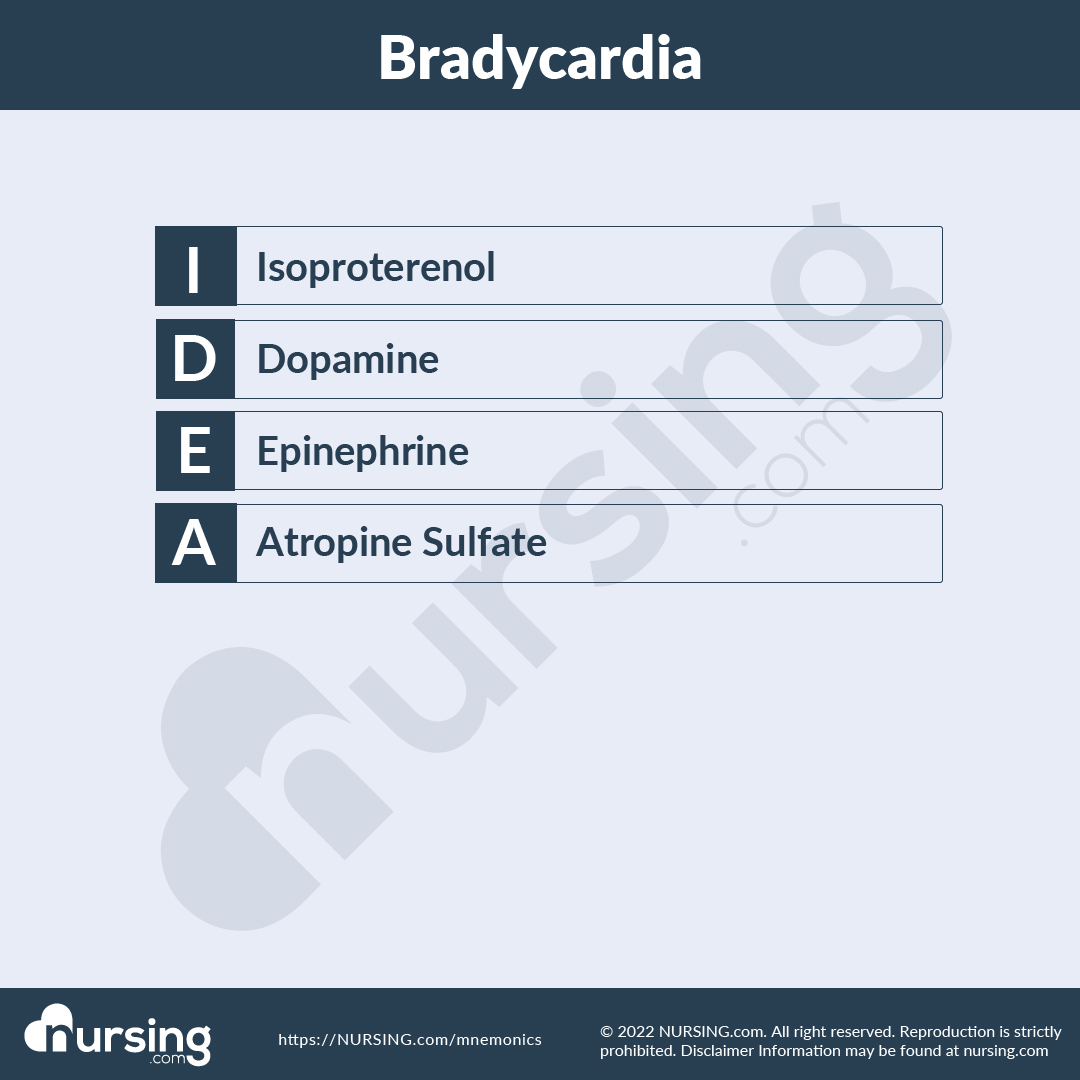
Drugs for Bradycardia & Low Blood Pressure Nursing Mnemonic (IDEA)
Download for FREE today - special Mnemonics Cheatsheet - so you can be SURE that you have that Must Know information down: bit.ly/nursing-memory Outline IDEA I-Isoproterenol D-Dopamine E-Epinephrine A-Atropine S-Sulfate Description This refers to symptomatic bradycardia and hypotension. Bradycardia and hypotension are not necessarily adverse clinical findings requiring treatment in and of themselves.

Beta 1 and Beta 2 Nursing Mnemonic (1 Heart, 2 Lungs)
Download for FREE today - special Mnemonics Cheatsheet - so you can be SURE that you have that Must Know information down: bit.ly/nursing-memory Outline 1 Heart, 2 Lungs BETA 1-One Heart BETA 2-Two Lungs Description Beta 1 adrenergic receptors are mostly found in the heart. Beta 2 adrenergic receptors are found in lungs, GI tract, vascular smooth muscle, skeletal muscle, liver. Beta 1 beta blockers act primarily on the heart. Beta 2 beta blockers act primarily on the lungs.

Alkalosis and Acidosis Nursing Mnemonic (Kick Up, Drop Down)
Download for FREE today - special Mnemonics Cheatsheet - so you can be SURE that you have that Must Know information down: bit.ly/nursing-memory Outline Kick Up, Drop Down K-alKalosis, pH Kicks up D-aciDosis, pH Drops down Description Alkalosis has a K, therefore it is Kicking the pH UP! | Acidosis has a D, therefore it is dropping the pH DOWN!

Electrolytes – Location in Body Nursing Mnemonic (PISO)
Download for FREE today - special Mnemonics Cheatsheet - so you can be SURE that you have that Must Know information down: bit.ly/nursing-memory Outline PISO P-Potassium I-Inside the cell S-Sodium O-Outside the cell Description Potassium and sodium are the two most abundant cations in the body and have an inverse relationship in regards to intracellular and extracellular concentrations. Potassium is primarily located within the cell and sodium is primarily located outside the cell.

Hyponatremia- Definition, Signs and Symptoms Nursing Mnemonic (SALT LOSS)
Download for FREE today - special Mnemonics Cheatsheet - so you can be SURE that you have that Must Know information down: bit.ly/nursing-memory Outline SALT LOSS S-Stupor/coma A-Anorexia, N&V L-Lethargy T-Tendon reflexes decreased L-Limp muscles (weakness) O-Orthostatic hypotension S-Seizures/headache S-Stomach cramping Description Hyponatremia is decreased levels of sodium in the blood. It can be caused by inadequate sodium or excess free water which leads to lower concentration of sodium. Sodium and potassium work together to allow depolarization of muscles. Low sodium levels can limit this ability and cause muscle weakness. Sodium in the blood helps maintain the oncotic pressure. If fluid leaves the blood vessels, it can lead to decreased blood pressure.

Hypokalemia – Signs and Symptoms Nursing Mnemonic (6 L's)
Download for FREE today - special Mnemonics Cheatsheet - so you can be SURE that you have that Must Know information down: bit.ly/nursing-memory Outline 6 L's L-Lethargy L-Leg cramps L-Limp muscles L-Low, shallow respirations L-Lethal cardiac dysrythmias L-Lots of urine (polyuria) Description Hypokalemia is LOW potassium, which starts with L. So the 6 L's can help you recognize the signs and symptoms of LOW potassium or hypokalemia

Hypercalcemia – Signs and Symptoms Nursing Mnemonic (GROANS, MOANS, BONES, STONES, OVERTONES)
Download for FREE today - special Mnemonics Cheatsheet - so you can be SURE that you have that Must Know information down: bit.ly/nursing-memory Outline GROANS, MOANS, BONES, STONES, OVERTONES GROANS-Constipation MOANS-Joint pain BONES-Loss of calcium from bones STONES-Kidney stones OVERTONES-psychiatric overtones (confusion, depression) Description The BONES store the most calcium – remember these words that rhyme with BONES to help you remember possible signs and symptoms of hypercalcemia.

Hypernatremia – Causes Nursing Mnemonic (MODEL)
Download for FREE today - special Mnemonics Cheatsheet - so you can be SURE that you have that Must Know information down: bit.ly/nursing-memory Outline MODEL M-Medications / Meals O-Osmotic diuretics D-Diabetes insipidus E-Excessive water loss L-Low water intake Description Think "Salt Modeling Agency" – Use the word MODEL to remember the causes of hypernatremia

Blood Type O Nursing Mnemonic (Universally Odd)
Download for FREE today - special Mnemonics Cheatsheet - so you can be SURE that you have that Must Know information down: bit.ly/nursing-memory Outline Universally Odd U-Universal Donor O-Only receive from O Description Picture Type O as a huge circle, like the universe, because they are the universal donor. They can give to everyone. However, also think of them as the "odd man out" because they can only receive type O as well. They are universally odd, able to give to all but only receive from themselves!
3 Unbelievably Effective Ways to Stay Organized in Nursing School
Download FREE today - our special Mnemonics Cheatsheet - so you can be SURE that you have that Must Know information down: bit.ly/nursing-memory ------- We have 3 unbelievably effective ways to stay organized in nursing school. These are actually very simple and can be implemented immediately. Even more importantly they will make a drastic difference for you, not just in nursing school but in life in general. If you have been struggling to keep track of all that you have to do and learn in nursing school you are not alone. Nursing school is hard, but we will help you be organized in nursing school starting today. 3 Unbelievable Effective Tips The key to these tips is that they will help you reduce stress enabling you to be more prepared for what comes and helping you to be more effective. Prepare the night before Arrive early Get in the zone

Inflammation (HIPER)
In response to tissue damage the body elicits the inflammatory response in attempt to rid itself of the initial offender. These attempts can sometimes become more of a problem than a solution.

Hypoglycemia (TIRED)
During hypoglycemia the serum glucose level is too low. Cells of the body can't get adequate energy supply when there is not enough sugar in the blood. You will feel TIRED and have the symptoms listed above.

Hypoxia (RAT BED)
Patients experiencing hypoxia will initially demonstrate signs of anxiety and restlessness. As hypoxia continues, the patients conditions deteriorates to bradycardia and dyspnea.

Hypertension (4 Cs)
Complications of untreated hypertension

Hyperglycemia and Hypoglycemia
During hyperglycemia, a patient is dehydrated with elevated blood sugars. You can also remember "High and Dry"
Heart Sounds (APE To Man)
Aortic and Pulmonic (A&P): 2 words, 2 spaces; these coincide in that they are both in the 2nd intercostal space. A is immediately to the right of the sternum, P is immediately to the left of the sternum. Erb's point: Erb has 3 letters; you can find this point in the 3rd intercostal space (just to the left of the sternum), also the 3rd space to auscultate Tricuspid: 5th intercostal, just to the left of the sternum. Tri = 3, this is the fourth place to auscultate in the 5th intercostal space! Mitral: Mit sounds similar to mid.. Midclavicular area and straight down just below nipple line.
Gluten (BROW)
Gluten is a protein found in wheat, barley and rye. People with gluten allergies can be affected by even trace amount of gluten in foods. If they don't feel good, they'll furrow their BROW. Oats do not contain gluten, but they are often milled in the same factories as wheat. Always check food labels to make sure a product is gluten free.

Exercise Guidelines (FIT)
If you want to get FIT, follow these guidelines for exercise!

Epiglottitis (AIR RAID)
The epiglottis is a flap of cartilage that covers the entrance to our airway when we swallow food. Inflammation of the epiglottis can close off the airway entirely.

Dyspnea (6 Ps)
These are six major causes for dyspnea. Pulmonary bronchial constriction prevents the passage of air into the lungs which contributes to dyspnea. (Possible) foreign bodies can become trapped or logged within the trachea restricting air flow. Pulmonary embolisms can prevent complete oxygenation of the blood in the alveoli due to restricted blood flow. Pneumothorax collapses the lung and prevents full expansion, restricting oxygenation. Pump failure refers to the heart not beating appropriately. If the heart is not perfusing the lungs than the lungs will be unable to oxygenate the blood. Pneumonia leads to poor lung ventilation as well.

Diarrhea (BRAT)
The BRAT diet is a bland diet that is low in protein, fiber, and fat. It is thought to be easy on the GI tract and helpful to lesson diarrhea. It is not used commonly anymore because of the lack of protein in the diet.

Cranial Nerve Mnemonic
This is one mnemonic that can help you remember the order of the twelve cranial nerves. Remember the Spinal Accessory nerve (CN XI) can also be called the "Accessory"

Cor Pulmonale (PRHT)
Cor pulmonale is an enlargement of the right side of the heart caused by a problem with the lungs or pulmonary vessels. This pneumonic represents the symptoms

Circulatory Checks (5 Ps)
Check for the 5 P's in every neurovascular check. For example, when the patient has a cast, or had some sort of orthopedic or vascular procedure